You are currently viewing a new version of our website. To view the old version click .

Pharmaceutics, Volume 12, Issue 2

February 2020 - 110 articles

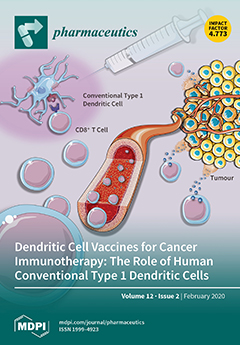
Cover Story: Conventional type 1 dendritic cells (cDC1) superiorly prime antigen-specific cytotoxic T cells and activate NK cells. Accordingly, multiple approaches have been tested, aiming for their use in antitumor vaccines: genetically modifying tumor cells to express the cDC1-recruiting chemokine XCL1; in vivo targeting of tumor antigens to restricted markers, such as CLEC9A or XCR1; ex vivo differentiation from hematopoietic CD34+ precursors or from induced pluripotent stem cells; and direct reprograming from fibroblasts. Although in its beginnings, the clinical exploitation of cDC1 to empower antitumor immunotherapies is a highly promising field. View this paper.
  • Issues are regarded as officially published after their release is announced to the table of contents alert mailing list .
  • You may sign up for email alerts to receive table of contents of newly released issues.
  • PDF is the official format for papers published in both, html and pdf forms. To view the papers in pdf format, click on the "PDF Full-text" link, and use the free Adobe Reader to open them.

Articles (110)

  • Review
  • Open Access
54 Citations
12,999 Views
15 Pages

Chimeric Antigen Receptor-T-Cell Therapy for B-Cell Hematological Malignancies: An Update of the Pivotal Clinical Trial Data

  • Gils Roex,
  • Tom Feys,
  • Yves Beguin,
  • Tessa Kerre,
  • Xavier Poiré,
  • Philippe Lewalle,
  • Peter Vandenberghe,
  • Dominique Bron and
  • Sébastien Anguille

Chimeric antigen receptor (CAR)-T-cell therapy is an innovative form of adoptive cell therapy that has revolutionized the treatment of certain hematological malignancies, including B-cell non-Hodgkin lymphoma (NHL) and B-cell acute lymphoblastic leuk...

  • Article
  • Open Access
20 Citations
6,181 Views
13 Pages

Stability Study of Isoniazid and Rifampicin Oral Solutions Using Hydroxypropyl-Β-Cyclodextrin to Treat Tuberculosis in Paediatrics

  • Ana Santoveña-Estévez,
  • Javier Suárez-González,
  • Amor R. Cáceres-Pérez,
  • Zuleima Ruiz-Noda,
  • Sara Machado-Rodríguez,
  • Magdalena Echezarreta,
  • Mabel Soriano and
  • José B. Fariña

(1) Background: First-line antituberculosis treatment in paediatrics entails the administration of Isoniazid, Pyrazinamide, and Rifampicin. This study examines the possibility of developing a combined dose liquid formulation for oral use that would f...

  • Article
  • Open Access
22 Citations
6,421 Views
15 Pages

Lamivudine (3TC) and zidovudine (AZT) are antiviral agents used orally to manage HIV/AIDS infection. A pseudo one-solvent bottom-up approach was used to develop and produce nano co-crystals of 3TC and AZT. Equimolar amounts of 3TC dissolved in de-ion...

  • Article
  • Open Access
29 Citations
5,410 Views
19 Pages

Co-Encapsulation of Mitoxantrone and β-Elemene in Solid Lipid Nanoparticles to Overcome Multidrug Resistance in Leukemia

  • Kambere Amerigos Daddy J.C.,
  • Minglei Chen,
  • Faisal Raza,
  • Yanyu Xiao,
  • Zhigui Su and
  • Qineng Ping

Multidrug resistance (MDR) due to P-glycoprotein (P-gp) overexpression is a major obstacle to successful leukemia chemotherapy. The combination of anticancer chemotherapy with a chemosensitizer of P-gp inhibitor is promising to overcome MDR, generate...

  • Article
  • Open Access
29 Citations
6,473 Views
20 Pages

Effect of Oxaliplatin-Loaded Poly (d,l-Lactide-co-Glycolic Acid) (PLGA) Nanoparticles Combined with Retinoic Acid and Cholesterol on Apoptosis, Drug Resistance, and Metastasis Factors of Colorectal Cancer

  • Ana Luiza C. de S. L. Oliveira,
  • Raimundo Fernandes de Araújo Júnior,
  • Thaís Gomes de Carvalho,
  • Alan B. Chan,
  • Timo Schomann,
  • Filippo Tamburini,
  • Lioe-Fee de Geus-Oei and
  • Luis J. Cruz

Apoptosis signaling pathways, drug resistance, and metastasis are important targets to develop new cancer treatments. We developed cholesterol-coated Poly(d,l-Lactide-co-Glycolic Acid) (PLGA) nanoparticles for effective encapsulation and delivery of...

  • Review
  • Open Access
34 Citations
7,243 Views
38 Pages

Breaking Barriers: Bioinspired Strategies for Targeted Neuronal Delivery to the Central Nervous System

  • Ana P. Spencer,
  • Marília Torrado,
  • Beatriz Custódio,
  • Sara C. Silva-Reis,
  • Sofia D. Santos,
  • Victoria Leiro and
  • Ana P. Pêgo

Central nervous system (CNS) disorders encompass a vast spectrum of pathological conditions and represent a growing concern worldwide. Despite the high social and clinical interest in trying to solve these pathologies, there are many challenges to br...

  • Article
  • Open Access
37 Citations
4,815 Views
16 Pages

Sphingomyelin-Based Nanosystems (SNs) for the Development of Anticancer miRNA Therapeutics

  • Surasa Nagachinta,
  • Belen Lopez Bouzo,
  • Abi Judit Vazquez-Rios,
  • Rafael Lopez and
  • Maria de la Fuente

Gene replacement therapy with oncosuppressor microRNAs (miRNAs) is a promising alternative to interfere with cancer progression. However, miRNAs are highly inefficient in a biological environment, hampering a successful translation to clinics. Nanote...

  • Review
  • Open Access
61 Citations
7,020 Views
55 Pages

Many patients, especially those with a high pill burden and multiple chronic illnesses, are less adherent to medication. In medication treatments utilizing polypills, this problem might be diminished since multiple drugs are fused into one formulatio...

  • Review
  • Open Access
130 Citations
10,429 Views
23 Pages

Non-Viral in Vitro Gene Delivery: It is Now Time to Set the Bar!

  • Nina Bono,
  • Federica Ponti,
  • Diego Mantovani and
  • Gabriele Candiani

Transfection by means of non-viral gene delivery vectors is the cornerstone of modern gene delivery. Despite the resources poured into the development of ever more effective transfectants, improvement is still slow and limited. Of note, the performan...

  • Article
  • Open Access
10 Citations
4,205 Views
10 Pages

Triterpenes from the outer bark of birch have many beneficial biological and pharmacological activities. In particular, its wound healing efficacy is of paramount importance. Apart from that, particles of a birch bark dry extract aggregate into a thr...

of 11

Get Alerted

Add your email address to receive forthcoming issues of this journal.

XFacebookLinkedIn
Pharmaceutics - ISSN 1999-4923