


Abstract
DNA viruses rely extensively on host cellular machinery, including replication factors and transcriptional systems, to persist after infection. These mechanisms make studying and targeting DNA viral proteins challenging, as they also play key roles in mammalian processes. Traditional strategies include CRISPR-mediated gene disruption and small interfering RNA (siRNA) to target host proteins. However, Proteolysis Targeting Chimeras (PROTACs) offer a novel strategy by enabling the selective and rapid degradation of specific viral or host proteins involved in the DNA viral lifecycle. PROTACs are heterobifunctional molecules composed of three key components: a ligand that binds the target protein, a chemical linker, and a ligand that recruits an E3 ubiquitin ligase. By simultaneously binding both the target protein and the E3 ligase, PROTACs form a ternary complex. This proximity enables the E3 ligase to ubiquitinate the target protein, marking it for recognition and subsequent degradation by the intracellular proteasome. This approach represents a promising avenue for targeting previously undruggable proteins and improving therapeutic outcomes in virus-associated malignancies. In this perspective, we describe studies that use PROTACs as tools to modulate host proteins to investigate DNA viral processes with temporal control of host protein expression, as well as the use of PROTACs as antivirals to directly target DNA viral proteins. We also provide a detailed chart summarizing known host-targeting PROTACs and their potential applications across different stages of DNA viral lifecycles, highlighting opportunities for future DNA virus research.
1. Introduction
Unlike many RNA viruses, most DNA viruses replicate their genomes within the nucleus and rely extensively on host cellular machinery to complete different stages of their lifecycle. Because DNA viruses typically encode relatively small genomes, they possess a limited number of viral proteins capable of carrying out essential processes such as genome replication, transcription, and episome maintenance. As a result, these viruses must use host replication factors, transcriptional machinery, and DNA damage response pathways to support productive and persistent infection [1,2]. DNA viruses have evolved to hijack host factors necessary to support their replication, creating a continual battle for genomic integrity between the virus and the host, a feature that is not always fully appreciated [3]. However, targeting these host proteins experimentally can be challenging, as many of these factors are also essential for normal cellular function.
Targeted protein degradation technology encompasses a broad range of approaches, including PROteolysis TArgeting Chimeras (PROTACs), hydrophobic tagging, N-degron technology, LYTACs, molecular glues, and related systems [4]. However, this Perspective focuses primarily on PROTAC-based approaches, as they currently represent the most widely utilized targeted degradation strategies in DNA virus research. We discuss how targeted protein degradation technologies have been used to study DNA viral processes and how these molecules have emerged as valuable experimental tools for identifying virus–host interactions within infected cells. We will also briefly highlight the potential of PROTAC-based strategies to target viral proteins as a novel antiviral approach.
2. Targeted Protein Degradation Technology with PROTACs
Traditional approaches used to study host protein function, such as CRISPR-mediated gene disruption or siRNA knockdown, often require prolonged depletion of host proteins (24–72 h), which complicates interpretation of viral phenotypes. PROTACs and other targeted protein degradation technologies have emerged as powerful strategies to rapidly and selectively degrade specific proteins [5,6,7,8,9,10]. These molecules recruit E3 ubiquitin ligases to induce proteasomal degradation of target proteins, enabling rapid and reversible depletion of host factors. Here we will describe the use of this technology to study DNA virus biology; however these molecules have also been widely explored in a variety of diseases such as cancer, cardiovascular and neurological diseases [11].
The first PROTAC was designed in 2001 [5]. This peptide-based degrader consisted of a phosphopeptide recognized by the SCFβ-TRCP E3 ubiquitin ligase complex linked to a ligand targeting methionine aminopeptidase-2 (MetAP-2). This study provided one of the first proof-of-concept demonstrations that induced proximity between an E3 ligase and a target protein could drive selective protein degradation. Today’s PROTACs are heterobifunctional molecules consisting of three parts: a ligand that binds the target protein, a linker, and a ligand that recruits an E3 ubiquitin ligase. PROTACs are based on the intracellular ubiquitin–proteasome system (UPS) to degrade target proteins of interest through a multi-step process. First, the PROTAC recruits both the target protein and the E3 ubiquitin ligase, forming a ternary complex; second, the target protein is ubiquitinated by the E3 ligase; third, the ubiquitinated protein is specifically recognized and degraded by intracellular proteasomes; and fourth, the degrader is released and can be reused in the cycle [12].
Unlike CRISPR-Cas systems, which function at the genomic level by introducing targeted DNA double-strand breaks or nucleotide modifications that permanently alter gene expression, PROTACs act at the proteomic level. They recruit E3 ubiquitin ligases to induce selective degradation of disease-causing proteins via the ubiquitin–proteasome system. Thus, CRISPR causes permanent genomic changes, whereas PROTACs are temporal, exerting post-translational, reversible, and catalytic effects that allow for repeated degradation of targeted proteins without permanent genomic consequences for the host or virus [13].
PROTACs typically exhibit a rapid onset of activity because their mechanism induces ubiquitination and proteasomal degradation shortly after cellular exposure. These effects are often measurable within hours due to the efficiency of the ubiquitin–proteasome system. In contrast, CRISPR-based therapeutics take more time, as their mechanism requires cellular delivery, transcription, and DNA repair processes before phenotypic changes are observed; the outcome is also permanent. While CRISPR has long-lasting effects on the genome, PROTACs offer similar functional outcomes without permanent genomic alteration. These differences in timing and reversibility are particularly important when considering adverse events. PROTACs may degrade off-target proteins, but this effect is often reversible. In contrast, off-target effects from CRISPR-based therapeutics result in permanent genomic changes [14,15].
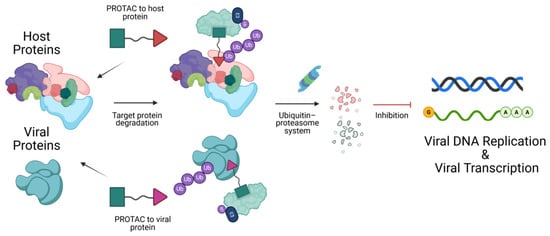
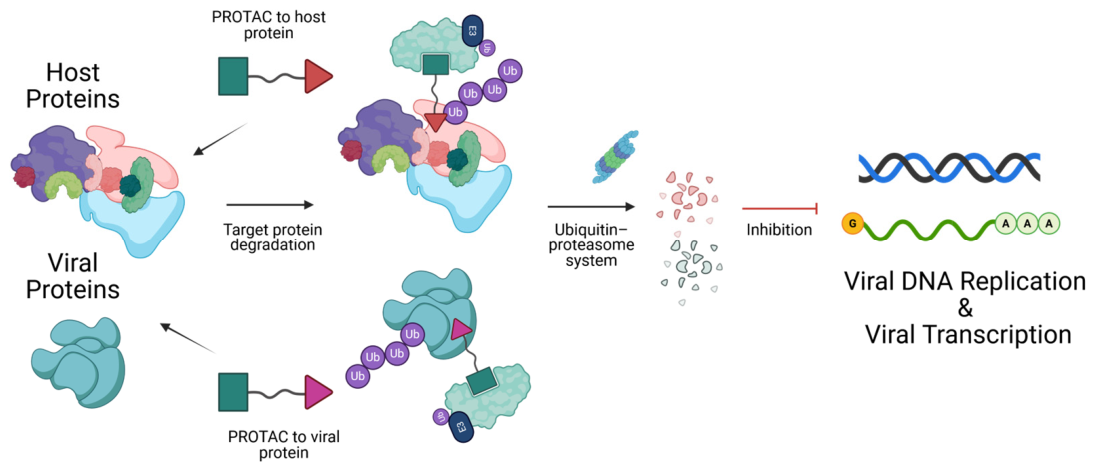
PROTAC technology provides a novel opportunity to study DNA viruses. PROTACs can be used to provide short-term, reversible degradation of host proteins involved in their lifecycles. At a more complex level, they can also be designed to directly target viral proteins (Figure 1). These areas will be discussed in more detail in the following sections.
Figure 1.
DNA viruses rely extensively on host transcriptional and replication machinery to support viral gene expression, genome replication, and productive infection. PROTACs bind to target proteins (triangle) to recruit E3 ubiquitin ligases (square) to selectively ubiquitinate and degrade host or viral proteins through the ubiquitin–proteasome system. Degradation of proteins from the host (top) or the virus (bottom) required for the viral lifecycle disrupts viral transcription, replication, and other essential processes, highlighting the utility of PROTACs as powerful and reversible tools to study DNA virus biology. Figure created in BioRender. DeSmet, M. (2026) https://BioRender.com/ sh66u3j.
3. Host Factor Degradation Reveals Viral Dependencies
DNA viruses rely on host proteins to complete their lifecycles; therefore manipulation of these host proteins is necessary to identify their functions. Here, we describe the use of PROTACs to modulate host protein activity in viral models. These tools provide unique capabilities to tightly control host protein expression.
Hepatitis B virus (HBV) is a partially double-stranded relaxed circular DNA virus that infects hepatocytes and is associated with both acute and chronic liver disease. Chronic infection can lead to hepatocellular carcinoma (HCC). The HBV genome is converted into covalently closed circular DNA (cccDNA), a chromatinized episomal genome that serves as the master template for all HBV transcription. Because cccDNA is organized like host chromatin, wrapped around histones and regulated by epigenetic machinery, Yu et al. [16] reasoned that the virus must be actively co-opting host transcriptional regulators to drive its own gene expression. Through a screen of 146 compounds, they identified BRD4, a host protein that normally promotes gene activation, as a critical factor that HBV utilizes to sustain cccDNA transcription. In this study, BRD4 PROTACs were used as a validation tool. Depleting BRD4 with PROTAC degraders (dBET1 and MZ-1) suppressed viral RNA production in infected cells, supporting that HBV transcription depends on BRD4. Both JQ1 (inhibitor) and PROTACs suppress HBV transcription, but PROTAC-mediated degradation produces a more complete loss of BRD4 function and results in a more pronounced reduction in viral RNA. This suggests that BRD4 contributes to HBV transcription through mechanisms that are not fully inhibited by blocking bromodomain-mediated interactions alone [16]. This distinction illustrates the unique power of targeted degradation as a research tool: by eliminating the protein rather than just blocking its activity, PROTACs can reveal functional dependencies that conventional inhibitors mask.
Human cytomegalovirus (HCMV) is a double-stranded DNA virus of the herpesvirus family that establishes lifelong infection. The virus relies on host cyclin-dependent kinases (CDKs), including CDK9, to promote viral gene expression and replication. Hahn et al. [17] treated HCMV-infected foreskin fibroblasts (HFFs) with the CDK9 PROTAC, THAL-SNS032. CDK9 depletion significantly reduced HCMV replication. Interestingly, treatment of these infected cells with the CDK9 inhibitor SNS032 also reduced HCMV replication, but not to the same extent as removing CDK9 using the PROTAC derived from SNS032. The PROTAC demonstrated greater antiviral activity, highlighting the importance of host protein removal compared to host protein inhibition.
The human papillomavirus (HPV) is a double-stranded DNA tumor virus that relies on host machinery to maintain its genome as an episome during replication and for viral transcription. However, studying these host proteins in the context of viral infection is challenging due to their essential roles in normal cellular processes. To address this, PROTACs have been utilized to enable precise control of host protein expression. For example, BRD4 has been identified as essential to the different steps in the HPV lifecycle [18,19]. Treatment of HPV-31 episomal cells (CIN612) with a BRD4 PROTAC demonstrated the importance of this protein during early viral transcription [20]. In a separate study, Jose et al. [21] treated keratinocytes with a tyrosine kinase focal adhesion kinase (FAK) PROTAC and found that its depletion suppressed HPV replication after infection but not during genome maintenance or amplification. These studies highlight the use of PROTACs to investigate the roles of host proteins across different stages of the HPV lifecycle that are not fully revealed by traditional inhibition strategies.
4. Protein Degradation Anti-Viral Targets
PROTACs present a promising strategy to target DNA viral proteins that are traditionally considered undruggable. However, only a limited number of PROTACs targeting these viral proteins have been developed. In the next section, we discuss known DNA viral targets and their impact on inhibiting the viral lifecycle or persistence.
To create a PROTAC targeting the HPV-16 oncogene, E6, a panel of nanobodies were generated against the protein [22]. Nanobody A5 exhibited the highest affinity toward E6 and was fused with Von Hippel-Lindau (VHL) protein to target E3 ligase activity. Results revealed that the A5-VHL fusion bioPROTAC was able to degrade E6 in vitro resulting in restoration of the tumor suppressor protein p53, which is normally targeted for degradation by E6. Mice with established TC-1 tumors (HPV-16 E6 and E7 positive) were injected at Day 7 and Day 14 with the PROTAC demonstrated a reduction in tumor growth by Day 21 [22]. These findings highlight the potential of PROTAC technology to target viral oncogenes.
Kaposi sarcoma-associated herpesvirus (KSHV) is a double-stranded DNA gammaherpesvirus and a major etiological agent of several malignancies, including Kaposi sarcoma (KS) and primary effusion lymphoma (PEL). The latency-associated nuclear antigen (LANA) is a key viral protein that promotes immune evasion and supports tumorigenesis during latent infection. LANA is essential for latent replication by tethering viral episomes to host chromosomes to ensure the genome is replicated once per cell cycle. A BAC16-derived KSHV genome was engineered to fuse the mini auxin-inducible degron system (mAID) to LANA (mAID-LANA) [23]. Upon addition of the synthetic auxin 5-Ph-IAA, the SCF–OsTIR1 E3 ubiquitin ligase complex is recruited to the mAID tag, leading to polyubiquitination and rapid degradation of mAID-LANA in iSLK cells. After 1.5 h of auxin treatment, Western blot analysis demonstrated a significant reduction in mAID-LANA levels, resulting in a decrease in KSHV DNA. The authors used this system as a tool to manipulate LANA levels. Using this inducible degradation system, Nakajima et al. found that in cells lacking cGAS, a key sensor of the innate immune system, KSHV DNA was not degraded in the presence of auxin. These results suggest that cGAS is necessary to detect the KSHV genome.
A complementary approach utilized HaloTag-fused LANA targeted by HaloPROTAC3 [24]. In this system, LANA was fused at its N-terminus to a HaloTag to enable targeted degradation using HaloPROTAC3. HaloPROTAC3 binds covalently to the HaloTag to recruit the VHL E3 ubiquitin ligase complex, resulting in ubiquitination and degradation of LANA [23,25]. HaloTag–LANA encoded within the recombinant KSHV genome was efficiently degraded in iSLK.BAC16 cells following treatment with HaloPROTAC3. Consistent with this, depletion of LANA resulted in a significant reduction in KSHV episome maintenance within 48 h. Although these studies demonstrate proof-of-principle for targeted degradation of LANA, it does not represent a directly translatable therapeutic strategy for KSHV infection, as it relies on engineered tagged LANA fusion proteins rather than the native viral protein.
Epstein–Barr virus (EBV) is a double-stranded DNA virus with oncogenic properties associated with several malignancies, including nasopharyngeal carcinoma (NPC), gastric carcinoma, and multiple subtypes of lymphoma. EBV encodes Epstein–Barr virus nuclear antigen 1 (EBNA1), which interacts with host proteins such as USP7 and the MCM complex, contributing to viral persistence, immune evasion, and tumor progression. A PROTAC, EP-1215, was designed to target the EBNA1 C-terminal DNA-binding domain [26]. EP-1215 induced degradation of EBNA1 in cells and in xenograft models that overexpress EBNA1. Using this PROTAC, Liu et al. [27] demonstrated that EBNA1 upregulates ADAR1, an RNA editing enzyme that converts adenosine to inosine, thereby suppressing host interferon signaling and promoting tumor immune evasion. The EBNA1-targeting PROTAC elucidated the importance of this viral protein in tumor immune suppression. These findings highlight the dual utility of PROTACs as both therapeutic strategies and tools to uncover the multifaceted roles of viral proteins.
HBV encodes a regulatory protein, the X protein (HBx), which activates viral transcription from cccDNA and contributes to carcinogenesis. Montrose et al. [28] designed a non-traditional PROTAC-like construct by combining a DDB1-derived HBx-binding domain with an oligomerization domain, enabling multivalent binding of HBx and recruitment of the CUL4–DDB1 E3 ligase complex to promote its degradation. In hepatic cells that overexpressed HBx, treatment with a non-traditional, peptide-based PROTAC-like construct induced HBx degradation. However, the impact of this degradation on the HBV lifecycle was not determined.
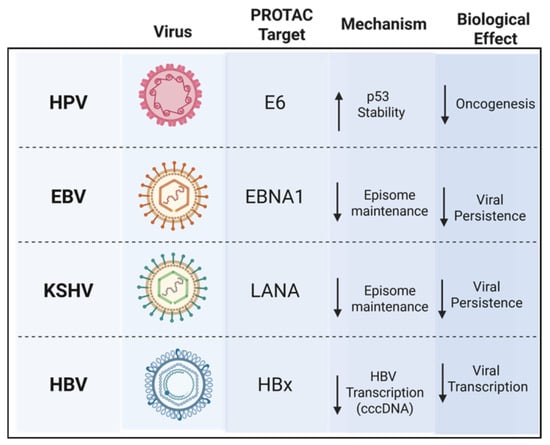
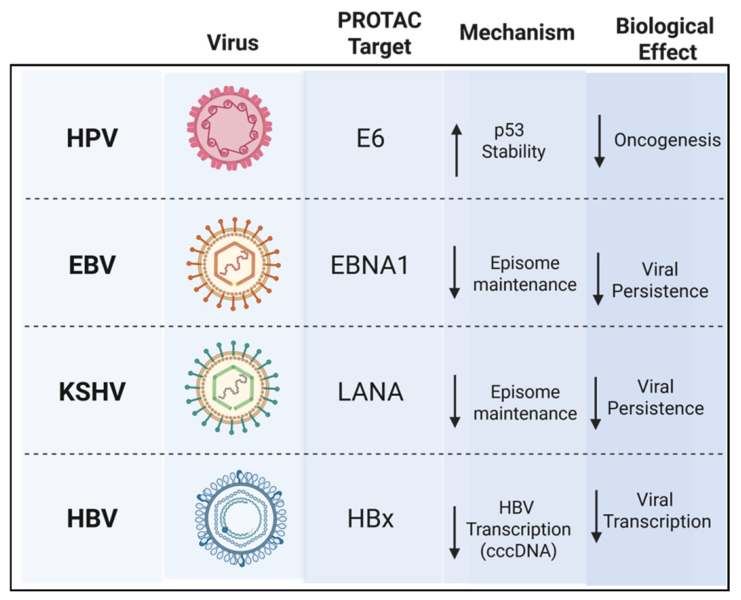
In conclusion, PROTACs offer a powerful strategy for targeted protein degradation, enabling the elimination of protein function and offering therapeutic potential against proteins implicated in viral persistence. These studies demonstrated that PROTACs not only promote degradation of viral proteins (e.g., EBNA1, HBx, E6, and LANA) but also disrupt their roles in viral replication and tumor progression (Figure 2). This is exemplified by the A5-VHL bioPROTAC, which effectively degraded E6 in mice, leading to a reduction in tumor growth. However, the use of PROTACs as antivirals is hindered by several limitations, including reliance on engineered tagging systems, the need for ligands with high affinity and precise target selectivity, and challenges in achieving efficient cellular delivery. In addition, the HPV oncoproteins such as E6 and E7 are intracellular and nonenzymatic, lacking well defined binding pockets, which complicates effective PROTAC-based strategies. Furthermore, the relatively large molecular size of PROTACs restricts the pharmacological and delivery performance of these molecules in vivo. Overall, despite significant challenges, continued advances in targeting strategies and ligand design may enable PROTACs to emerge as future therapeutic antivirals.
Figure 2.
PROTAC-mediated degradation of viral proteins disrupts key mechanisms of DNA virus persistence, transcription, and oncogenesis. Listed are published PROTACs generated targeting viral proteins and their associated mechanisms and biological effects. Figure made with Created in BioRender. DeSmet, M. (2026) https://BioRender.com/ nr888mf.
5. Future Targets with Known PROTACs to Study DNA Lifecycles
Studying the lifecycles of DNA viruses is particularly challenging because these viruses are highly dependent on host cellular machinery for replication. As a result, it is often difficult to distinguish virus-specific functions from host-driven processes. In addition, modeling latency and reactivation remains a significant challenge, as these states are dynamic and tightly regulated by host factors. The temporal complexity of DNA viral lifecycles, combined with their reliance on host proteins, further complicates experimental design and their interpretation. There are limited tools available for precise manipulation of DNA viral genomes, particularly in the context of manipulation of the host proteins necessary to carry out their lifecycles.
The development of PROTACs presents an exciting opportunity to overcome some of these challenges. As described in this Perspective, researchers are increasingly utilizing this technology to selectively target and degrade viral and host proteins involved during the infection and persistence of DNA viruses. Traditional inhibitors and small-molecule drugs typically provide only transient suppression of protein inhibition and are often limited to enzymatic targets. In contrast, PROTACs enable sustained suppression of protein function through targeted degradation. In addition, PROTACs often require lower doses and may reduce the likelihood of resistance.
Several host proteins with established roles in DNA viral lifecycles are now considered PROTAC-accessible targets. These proteins, along with their functions in viral infection, are summarized in Table 1. As the field continues to expand, an increasing number of PROTACs are being developed to target pathways critical for DNA virus replication, persistence, and transcriptional regulation. As shown in Table 1, DNA damage response proteins (e.g., ATM/ATR, CHK1, WEE1) are commonly exploited across multiple DNA viruses, including HPV, KSHV, EBV, HBV, adenovirus, HSV, and polyomavirus, where they facilitate viral genome replication and maintenance. In addition, chromatin and transcriptional regulators (e.g., BRG1, BRD4, CDK9) exhibit broad functional overlap across DNA viruses, supporting processes such as viral transcription, episome maintenance, and oncogene expression. Another area of focus has been the broad targeting of RNA and DNA viruses through host-directed degradation strategies. For example, FM-74-103 induces degradation of human GSPT1, a translation termination factor shown to be required for influenza A virus, SARS-CoV-2, and cytomegalovirus (CMV) replication [29]. Table 1 summarizes host proteins with available PROTAC degraders that have established roles in DNA virus lifecycles and may represent useful tools for future mechanistic studies. Together, these observations highlight a convergence of DNA viruses on host pathways that regulate genome stability and transcriptional control.
Table 1.
Host proteins with available PROTAC degraders that have established roles in DNA virus lifecycles.
Author Contributions
Conceptualization, M.D.; Writing—original draft preparation, M.D., M.L. C.H. and E.T.; writing—review and editing, M.D., M.L. C.H. and E.T.; funding acquisition, M.D. All authors have read and agreed to the published version of the manuscript.
Funding
The authors acknowledge support from Marian University through institutional funds and by the National Institute of Allergy and Infectious Diseases of the National Institutes of Health under Award Number R21AI199466. The content is solely the responsibility of the authors and does not necessarily represent the official views of the National Institutes of Health.
Acknowledgments
During the preparation of this manuscript, the authors used ChatGPT (OpenAI, GPT-5.3) to assist with grammar, clarity, and language refinement. The authors have reviewed and edited the output and take full responsibility for the content of this publication.
Conflicts of Interest
The authors declare no conflicts of interest.
References
- Weitzman, M.D.; Fradet-Turcotte, A. Virus DNA Replication and the Host DNA Damage Response. Annu. Rev. Virol. 2018, 5, 141–164. [Google Scholar] [CrossRef] [Scilit]
- Turnell, A.S.; Grand, R.J. DNA viruses and the cellular DNA-damage response. J. Gen. Virol. 2012, 93, 2076–2097. [Google Scholar] [CrossRef] [Scilit] [PubMed]
- Weitzman, M.D.; Lilley, C.E.; Chaurushiya, M.S. Genomes in conflict: Maintaining genome integrity during virus infection. Annu. Rev. Microbiol. 2010, 64, 61–81. [Google Scholar] [CrossRef] [Scilit] [PubMed]
- Zhao, L.; Zhao, J.; Zhong, K.; Tong, A.; Jia, D. Targeted protein degradation: Mechanisms, strategies and application. Signal Transduct. Target. Ther. 2022, 7, 113. [Google Scholar] [CrossRef] [Scilit] [PubMed]
- Sakamoto, K.M.; Kim, K.B.; Kumagai, A.; Mercurio, F.; Crews, C.M.; Deshaies, R.J. Protacs: Chimeric molecules that target proteins to the Skp1-Cullin-F box complex for ubiquitination and degradation. Proc. Natl. Acad. Sci. USA 2001, 98, 8554–8559. [Google Scholar] [CrossRef] [Scilit]
- Schneekloth, J.S., Jr.; Crews, C.M. Chemical approaches to controlling intracellular protein degradation. Chembiochem 2005, 6, 40–46. [Google Scholar] [CrossRef] [Scilit]
- Bondeson, D.P.; Mares, A.; Smith, I.E.; Ko, E.; Campos, S.; Miah, A.H.; Mulholland, K.E.; Routly, N.; Buckley, D.L.; Gustafson, J.L.; et al. Catalytic in vivo protein knockdown by small-molecule PROTACs. Nat. Chem. Biol. 2015, 11, 611–617. [Google Scholar] [CrossRef] [Scilit]
- Nalawansha, D.A.; Crews, C.M. PROTACs: An Emerging Therapeutic Modality in Precision Medicine. Cell Chem. Biol. 2020, 27, 998–1014. [Google Scholar] [CrossRef] [Scilit]
- Paiva, S.L.; Crews, C.M. Targeted protein degradation: Elements of PROTAC design. Curr. Opin. Chem. Biol. 2019, 50, 111–119. [Google Scholar] [CrossRef] [Scilit] [PubMed]
- Burslem, G.M.; Crews, C.M. Proteolysis-Targeting Chimeras as Therapeutics and Tools for Biological Discovery. Cell 2020, 181, 102–114. [Google Scholar] [CrossRef] [Scilit]
- Yang, X.; Lan, T.; Zhang, B.; Tao, X.; Qi, W.; Xie, K.; Cai, Y.; Liu, C.; Han, J.; Wu, H. Targeting ubiquitination in disease and therapy. Signal Transduct. Target. Ther. 2025, 10, 424. [Google Scholar] [CrossRef] [Scilit]
- Mancarella, C.; Morrione, A.; Scotlandi, K. PROTAC-Based Protein Degradation as a Promising Strategy for Targeted Therapy in Sarcomas. Int. J. Mol. Sci. 2023, 24, 16346. [Google Scholar] [CrossRef] [Scilit] [PubMed]
- Kanbar, K.; El Darzi, R.; Jaalouk, D.E. Precision oncology revolution: CRISPR-Cas9 and PROTAC technologies unleashed. Front. Genet. 2024, 15, 1434002. [Google Scholar] [CrossRef] [Scilit]
- Zhong, G.; Chang, X.; Xie, W.; Zhou, X. Targeted protein degradation: Advances in drug discovery and clinical practice. Signal Transduct. Target. Ther. 2024, 9, 308. [Google Scholar] [CrossRef] [Scilit] [PubMed]
- Röth, S.; Fulcher, L.J.; Sapkota, G.P. Advances in targeted degradation of endogenous proteins. Cell. Mol. Life Sci. 2019, 76, 2761–2777. [Google Scholar] [CrossRef] [Scilit]
- Yu, X.; Long, Q.; Shen, S.; Liu, Z.; Chandran, J.; Zhang, J.; Ding, H.; Zhang, H.; Cai, D.; Kim, E.S.; et al. Screening of an epigenetic compound library identifies BRD4 as a potential antiviral target for hepatitis B virus covalently closed circular DNA transcription. Antivir. Res. 2023, 211, 105552. [Google Scholar] [CrossRef] [Scilit] [PubMed]
- Hahn, F.; Hamilton, S.T.; Wangen, C.; Wild, M.; Kicuntod, J.; Brückner, N.; Follett, J.E.L.; Herrmann, L.; Kheimar, A.; Kaufer, B.B.; et al. Development of a PROTAC-Based Targeting Strategy Provides a Mechanistically Unique Mode of Anti-Cytomegalovirus Activity. Int. J. Mol. Sci. 2021, 22, 12858. [Google Scholar] [CrossRef] [Scilit]
- Iftner, T.; Haedicke-Jarboui, J.; Wu, S.Y.; Chiang, C.M. Involvement of Brd4 in different steps of the papillomavirus life cycle. Virus Res. 2017, 231, 76–82. [Google Scholar] [CrossRef] [Scilit] [PubMed]
- McBride, A.A.; Warburton, A.; Khurana, S. Multiple Roles of Brd4 in the Infectious Cycle of Human Papillomaviruses. Front. Mol. Biosci. 2021, 8, 725794. [Google Scholar] [CrossRef] [Scilit]
- Jose, L.; Androphy, E.J.; DeSmet, M. SETD6 Regulates E2-Dependent Human Papillomavirus Transcription. J. Virol. 2022, 96, e0129522. [Google Scholar] [CrossRef] [Scilit]
- Jose, L.; Gonzalez, J.; Kessinger, E.; Androphy, E.J.; DeSmet, M. Focal Adhesion Kinase Binds to the HPV E2 Protein to Regulate Initial Replication after Infection. Pathogens 2023, 12, 1203. [Google Scholar] [CrossRef] [Scilit]
- Smalley, T.B.; Nicolaci, A.A.; Tran, K.C.; Lokhandwala, J.; Obertopp, N.; Matlack, J.K.; Miner, R.E., 3rd; Teng, M.N.; Pilon-Thomas, S.; Binning, J.M. Targeted degradation of the HPV oncoprotein E6 reduces tumor burden in cervical cancer. Mol. Ther. 2025, 33, 5415–5426. [Google Scholar] [CrossRef] [Scilit] [PubMed]
- Nakajima, K.I.; Inagaki, T.; Espera, J.M.; Izumiya, Y. Kaposi’s sarcoma-associated herpesvirus (KSHV) LANA prevents KSHV episomes from degradation. J. Virol. 2024, 98, e0126823. [Google Scholar] [CrossRef] [Scilit] [PubMed]
- McMahon, S.; Amer, M.; Hall, B.; Shekhar, R.; Renne, R. Targeted Protein Degradation of the Latency-Associated Nuclear Antigen Evicts Kaposi Sarcoma-Associated Herpesvirus Episomes from Infected Cells in Vitro. J. Med. Virol. 2025, 97, e70765. [Google Scholar] [CrossRef] [Scilit]
- Buckley, D.L.; Raina, K.; Darricarrere, N.; Hines, J.; Gustafson, J.L.; Smith, I.E.; Miah, A.H.; Harling, J.D.; Crews, C.M. HaloPROTACS: Use of Small Molecule PROTACs to Induce Degradation of HaloTag Fusion Proteins. ACS Chem. Biol. 2015, 10, 1831–1837. [Google Scholar] [CrossRef] [Scilit] [PubMed]
- Messick, T.E.; Smith, G.R.; Soldan, S.S.; McDonnell, M.E.; Deakyne, J.S.; Malecka, K.A.; Tolvinski, L.; van den Heuvel, A.P.J.; Gu, B.W.; Cassel, J.A.; et al. Structure-based design of small-molecule inhibitors of EBNA1 DNA binding blocks Epstein-Barr virus latent infection and tumor growth. Sci. Transl. Med. 2019, 11, eaau5612. [Google Scholar] [CrossRef] [Scilit]
- Liu, C.; Sun, Z.; Li, C.; Zhou, Y.; Gao, X.; Zhong, Y.; Luo, X.; Wang, C.; Zhang, Y.; Ni, C.; et al. Exogenous Epstein-Barr virus nuclear antigen 1 induces ADAR1-driven tumor resistance against immunotherapy. Signal Transduct. Target. Ther. 2026, 11, 63. [Google Scholar] [CrossRef] [Scilit]
- Montrose, K.; Krissansen, G.W. Design of a PROTAC that antagonizes and destroys the cancer-forming X-protein of the hepatitis B virus. Biochem. Biophys. Res. Commun. 2014, 453, 735–740. [Google Scholar] [CrossRef] [Scilit]
- Zhao, N.; Ho, J.S.Y.; Meng, F.; Zheng, S.; Kurland, A.P.; Tian, L.; Rea-Moreno, M.; Song, X.; Seo, J.S.; Kaniskan, H.; et al. Generation of host-directed and virus-specific antivirals using targeted protein degradation promoted by small molecules and viral RNA mimics. Cell Host Microbe 2023, 31, 1154–1169.e10. [Google Scholar] [CrossRef] [Scilit]
- Olson, C.M.; Jiang, B.; Erb, M.A.; Liang, Y.; Doctor, Z.M.; Zhang, Z.; Zhang, T.; Kwiatkowski, N.; Boukhali, M.; Green, J.L.; et al. Pharmacological perturbation of CDK9 using selective CDK9 inhibition or degradation. Nat. Chem. Biol. 2018, 14, 163–170. [Google Scholar] [CrossRef] [Scilit]
- Ajiro, M.; Sakai, H.; Onogi, H.; Yamamoto, M.; Sumi, E.; Sawada, T.; Nomura, T.; Kabashima, K.; Hosoya, T.; Hagiwara, M. CDK9 Inhibitor FIT-039 Suppresses Viral Oncogenes E6 and E7 and Has a Therapeutic Effect on HPV-Induced Neoplasia. Clin. Cancer Res. 2018, 24, 4518–4528. [Google Scholar] [CrossRef] [Scilit] [PubMed]
- Tanaka, T.; Okuyama-Dobashi, K.; Murakami, S.; Chen, W.; Okamoto, T.; Ueda, K.; Hosoya, T.; Matsuura, Y.; Ryo, A.; Tanaka, Y.; et al. Inhibitory effect of CDK9 inhibitor FIT-039 on hepatitis B virus propagation. Antivir. Res. 2016, 133, 156–164. [Google Scholar] [CrossRef] [Scilit]
- Kansy, A.G.; Ashry, R.; Mustafa, A.M.; Alfayomy, A.M.; Radsak, M.P.; Zeyn, Y.; Bros, M.; Sippl, W.; Krämer, O.H. Pharmacological degradation of ATR induces antiproliferative DNA replication stress in leukemic cells. Mol. Oncol. 2024, 18, 1958–1965. [Google Scholar] [CrossRef] [Scilit]
- Liu, T.T.; Wang, Q.; Zhou, Y.; Ye, B.; Liu, T.; Yan, L.; Fan, J.; Xu, J.; Xia, Z.; Deng, X. Discovery of a Meisoindigo-Derived PROTAC as the ATM Degrader: Revolutionizing Colorectal Cancer Therapy via Synthetic Lethality with ATR Inhibitors. J. Med. Chem. 2024, 67, 7620–7634. [Google Scholar] [CrossRef] [Scilit]
- Vats, A.; Laimins, L. How human papillomavirus (HPV) targets DNA repair pathways for viral replication: From guardian to accomplice. Microbiol. Mol. Biol. Rev. 2025, 89, e0015323. [Google Scholar] [CrossRef] [Scilit] [PubMed]
- Hollingworth, R.; Skalka, G.L.; Stewart, G.S.; Hislop, A.D.; Blackbourn, D.J.; Grand, R.J. Activation of DNA Damage Response Pathways during Lytic Replication of KSHV. Viruses 2015, 7, 2908–2927. [Google Scholar] [CrossRef] [Scilit]
- Kumar, A.; Sahu, S.K.; Mohanty, S.; Chakrabarti, S.; Maji, S.; Reddy, R.R.; Jha, A.K.; Goswami, C.; Kundu, C.N.; Rajasubramaniam, S.; et al. Kaposi sarcoma herpes virus latency associated nuclear antigen protein release the G2/M cell cycle blocks by modulating ATM/ATR mediated checkpoint pathway. PLoS ONE 2014, 9, e100228. [Google Scholar] [CrossRef] [Scilit]
- Hau, P.M.; Tsao, S.W. Epstein-Barr Virus Hijacks DNA Damage Response Transducers to Orchestrate Its Life Cycle. Viruses 2017, 9, 341. [Google Scholar] [CrossRef] [Scilit] [PubMed]
- Matsuda, Y.; Ichida, T. Impact of hepatitis B virus X protein on the DNA damage response during hepatocarcinogenesis. Med. Mol. Morphol. 2009, 42, 138–142. [Google Scholar] [CrossRef] [Scilit] [PubMed]
- Kleinberger, T. En Guard! The Interactions between Adenoviruses and the DNA Damage Response. Viruses 2020, 12, 996. [Google Scholar] [CrossRef] [Scilit]
- Justice, J.L.; Reed, T.J.; Phelan, B.; Greco, T.M.; Hutton, J.E.; Cristea, I.M. DNA-PK and ATM drive phosphorylation signatures that antagonistically regulate cytokine responses to herpesvirus infection or DNA damage. Cell Syst. 2024, 15, 339–361.e8. [Google Scholar] [CrossRef] [Scilit]
- Alli, V.J.; Yadav, P.; Suresh, V.; Jadav, S.S. Synthetic and Medicinal Chemistry Approaches Toward WEE1 Kinase Inhibitors and Its Degraders. ACS Omega 2023, 8, 20196–20233. [Google Scholar] [CrossRef] [Scilit]
- Byskata, K.; Lukoseviciute, M.; Tuti, F.; Zupancic, M.; Kostopoulou, O.N.; Holzhauser, S.; Dalianis, T. Targeted Therapy with PI3K, PARP, and WEE1 Inhibitors and Radiotherapy in HPV Positive and Negative Tonsillar Squamous Cell Carcinoma Cell Lines Reveals Synergy while Effects with APR-246 Are Limited. Cancers 2022, 15, 93. [Google Scholar] [CrossRef] [Scilit] [PubMed]
- Corbin, J.; Yu, X.; Jin, J.; Cai, L.; Wang, G.G. EZH2 PROTACs target EZH2- and FOXM1-associated oncogenic nodes, suppressing breast cancer cell growth. Oncogene 2024, 43, 2722–2736. [Google Scholar] [CrossRef] [Scilit] [PubMed]
- Kim, S.J.; Kiser, P.K.; Asfaha, S.; DeKoter, R.P.; Dick, F.A. EZH2 inhibition stimulates repetitive element expression and viral mimicry in resting splenic B cells. EMBO J. 2023, 42, e114462. [Google Scholar] [CrossRef] [Scilit]
- Ichikawa, T.; Okuno, Y.; Sato, Y.; Goshima, F.; Yoshiyama, H.; Kanda, T.; Kimura, H.; Murata, T. Regulation of Epstein-Barr Virus Life Cycle and Cell Proliferation by Histone H3K27 Methyltransferase EZH2 in Akata Cells. mSphere 2018, 3, 10-1128. [Google Scholar] [CrossRef] [Scilit] [PubMed]
- Cantley, J.; Ye, X.; Rousseau, E.; Januario, T.; Hamman, B.D.; Rose, C.M.; Cheung, T.K.; Hinkle, T.; Soto, L.; Quinn, C.; et al. Selective PROTAC-mediated degradation of SMARCA2 is efficacious in SMARCA4 mutant cancers. Nat. Commun. 2022, 13, 6814. [Google Scholar] [CrossRef] [Scilit]
- Villemure, E.; Januario, T.; Zeng, M.; Budayeva, H.G.; Walters, B.T.; Lictao, A.; Li, K.S.; Ye, X.; Gilchrist, C.L.; Hoag, B.; et al. Rational design of potent small-molecule SMARCA2/A4 degraders acting via the recruitment of FBXO22. Nat. Commun. 2025, 16, 9679. [Google Scholar] [CrossRef] [Scilit]
- Yuan, X.; Geng, W.; Wang, J.; Xiong, C.; Wu, Y.; Wang, Y.; Jin, R.; Wang, X. The SWI/SNF complex mediated chromatin remodeling promotes hepatitis B virus cccDNA transcription. Sci. China Life Sci. 2025, 68, 3486–3494. [Google Scholar] [CrossRef] [Scilit] [PubMed]
- He, H.; Luo, Y. Brg1 regulates the transcription of human papillomavirus type 18 E6 and E7 genes. Cell Cycle 2012, 11, 617–627. [Google Scholar] [CrossRef] [Scilit]
- Cha, S.; Seo, T. hSNF5 is required for human papillomavirus E2-driven transcriptional activation and DNA replication. Intervirology 2011, 54, 66–77. [Google Scholar] [CrossRef] [Scilit]
- Hu, Z.; Zhang, Q.; Li, Z.; Yang, H.; Chen, X.; Yang, T.; He, X.; Feng, Q.; He, J.; Yu, L. Design, synthesis and antitumor activity of a novel FGFR2-selective degrader to overcome resistance of the FGFR2(V564F) gatekeeper mutation based on a pan-FGFR inhibitor. Eur. J. Med. Chem. 2024, 275, 116612. [Google Scholar] [CrossRef] [Scilit] [PubMed]
- Wang, Y.W.; Gao, Y.H.; Wang, C.; Zhang, P.F.; Wang, M.; Lan, L.; Liu, J.Y.; Shi, L.; Sun, L.P. Design, synthesis, and biological evaluation of novel FGFR1 PROTACs. Bioorg. Chem. 2025, 155, 108109. [Google Scholar] [CrossRef] [Scilit]
- Guo, L.; Liu, J.; Nie, X.; Wang, T.; Ma, Z.X.; Yin, D.; Tang, W. Development of selective FGFR1 degraders using a Rapid synthesis of proteolysis targeting Chimera (Rapid-TAC) platform. Bioorg. Med. Chem. Lett. 2022, 75, 128982. [Google Scholar] [CrossRef] [Scilit]
- DeSmet, M.; Kanginakudru, S.; Jose, L.; Xie, F.; Gilson, T.; Androphy, E.J. Papillomavirus E2 protein is regulated by specific fibroblast growth factor receptors. Virology 2018, 521, 62–68. [Google Scholar] [CrossRef] [Scilit]
- Zengerle, M.; Chan, K.H.; Ciulli, A. Selective Small Molecule Induced Degradation of the BET Bromodomain Protein BRD4. ACS Chem. Biol. 2015, 10, 1770–1777. [Google Scholar] [CrossRef] [Scilit] [PubMed]
- Wang, X.; Li, J.; Schowalter, R.M.; Jiao, J.; Buck, C.B.; You, J. Bromodomain protein Brd4 plays a key role in Merkel cell polyomavirus DNA replication. PLoS Pathog. 2012, 8, e1003021. [Google Scholar] [CrossRef] [Scilit]
- Palermo, R.D.; Webb, H.M.; West, M.J. RNA polymerase II stalling promotes nucleosome occlusion and pTEFb recruitment to drive immortalization by Epstein-Barr virus. PLoS Pathog. 2011, 7, e1002334. [Google Scholar] [CrossRef] [Scilit]
- Lin, A.; Wang, S.; Nguyen, T.; Shire, K.; Frappier, L. The EBNA1 protein of Epstein-Barr virus functionally interacts with Brd4. J. Virol. 2008, 82, 12009–12019. [Google Scholar] [CrossRef] [Scilit]
- Francisco, J.C.; Dai, Q.; Luo, Z.; Wang, Y.; Chong, R.H.; Tan, Y.J.; Xie, W.; Lee, G.H.; Lin, C. Transcriptional Elongation Control of Hepatitis B Virus Covalently Closed Circular DNA Transcription by Super Elongation Complex and BRD4. Mol. Cell. Biol. 2017, 37, e00040-17. [Google Scholar] [CrossRef] [Scilit] [PubMed]
- You, J.; Srinivasan, V.; Denis, G.V.; Harrington, W.J., Jr.; Ballestas, M.E.; Kaye, K.M.; Howley, P.M. Kaposi’s sarcoma-associated herpesvirus latency-associated nuclear antigen interacts with bromodomain protein Brd4 on host mitotic chromosomes. J. Virol. 2006, 80, 8909–8919. [Google Scholar] [CrossRef] [Scilit]
- Hainley, L.E.; Hughson, M.S.; Narendran, A.; Smith, R.; Arthur, J.; Hayner-Buchan, A.; Conti, D.J.; Lehman, J.M.; Friedrich, T.D. Chk1 and the Host Cell DNA Damage Response as a Potential Antiviral Target in BK Polyomavirus Infection. Viruses 2021, 13, 1353. [Google Scholar] [CrossRef] [Scilit] [PubMed]
- Connell, C.M.; Shibata, A.; Tookman, L.A.; Archibald, K.M.; Flak, M.B.; Pirlo, K.J.; Lockley, M.; Wheatley, S.P.; McNeish, I.A. Genomic DNA damage and ATR-Chk1 signaling determine oncolytic adenoviral efficacy in human ovarian cancer cells. J. Clin. Investig. 2011, 121, 1283–1297. [Google Scholar] [CrossRef] [Scilit] [PubMed]
- Etingov, I.; Pintel, D.J. Inactivation of checkpoint kinase 1 (Chk1) during parvovirus minute virus of mice (MVM) infection inhibits cellular homologous recombination repair and facilitates viral genome replication. J. Virol. 2024, 98, e0088924. [Google Scholar] [CrossRef] [Scilit] [PubMed]
- Wu, M.; Jiang, Y.; Zhang, D.; Wu, Y.; Jin, Y.; Liu, T.; Mao, X.; Yu, H.; Xu, T.; Chen, Y.; et al. Discovery of a potent PARP1 PROTAC as a chemosensitizer for the treatment of colorectal cancer. Eur. J. Med. Chem. 2025, 282, 117062. [Google Scholar] [CrossRef] [Scilit]
- Ko, H.L.; Ren, E.C. Functional Aspects of PARP1 in DNA Repair and Transcription. Biomolecules 2012, 2, 524–548. [Google Scholar] [CrossRef] [Scilit]
- Chung, W.C.; Song, M.J. Virus-Host Interplay Between Poly (ADP-Ribose) Polymerase 1 and Oncogenic Gammaherpesviruses. Front. Microbiol. 2021, 12, 811671. [Google Scholar] [CrossRef] [Scilit]
- Newton, L.S.; Gathmann, C.; Ridewood, S.; Smith, R.J.; Wijaya, A.J.; Hornsby, T.W.; Morling, K.L.; Annett, D.; Chiozzi, R.Z.; Reuschl, A.K.; et al. Macrocycle-based PROTACs selectively degrade cyclophilin A and inhibit HIV-1 and HCV. Nat. Commun. 2025, 16, 1484. [Google Scholar] [CrossRef] [Scilit]
- Phillips, S.; Chokshi, S.; Chatterji, U.; Riva, A.; Bobardt, M.; Williams, R.; Gallay, P.; Naoumov, N.V. Alisporivir inhibition of hepatocyte cyclophilins reduces HBV replication and hepatitis B surface antigen production. Gastroenterology 2015, 148, 403–414.e7. [Google Scholar] [CrossRef] [Scilit]

Disclaimer/Publisher’s Note: The statements, opinions and data contained in all publications are solely those of the individual author(s) and contributor(s) and not of MDPI and/or the editor(s). MDPI and/or the editor(s) disclaim responsibility for any injury to people or property resulting from any ideas, methods, instructions or products referred to in the content. |
© 2026 by the authors. Licensee MDPI, Basel, Switzerland. This article is an open access article distributed under the terms and conditions of the Creative Commons Attribution (CC BY) license.