


Abstract
Nucleotidylylation is a post-transcriptional modification important for replication in the picornavirus supergroup of RNA viruses, including members of the Caliciviridae, Coronaviridae, Picornaviridae and Potyviridae virus families. This modification occurs when the RNA-dependent RNA polymerase (RdRp) attaches one or more nucleotides to a target protein through a nucleotidyl-transferase reaction. The most characterized nucleotidylylation target is VPg (viral protein genome-linked), a protein linked to the 5′ end of the genome in Caliciviridae, Picornaviridae and Potyviridae. The nucleotidylylation of VPg by RdRp is a critical step for the VPg protein to act as a primer for genome replication and, in Caliciviridae and Potyviridae, for the initiation of translation. In contrast, Coronaviridae do not express a VPg protein, but the nucleotidylylation of proteins involved in replication initiation is critical for genome replication. Furthermore, the RdRp proteins of the viruses that perform nucleotidylylation are themselves nucleotidylylated, and in the case of coronavirus, this has been shown to be essential for viral replication. This review focuses on nucleotidylylation within the picornavirus supergroup of viruses, including the proteins that are modified, what is known about the nucleotidylylation process and the roles that these modifications have in the viral life cycle.
1. Introduction
Positive-sense single-stranded (+ss) RNA viruses are an enormously diverse class of animal, plant and bacterial viruses. Despite this diversity, +ssRNA viruses share a number of key features which facilitate their successful propagation. Notably, the ubiquitous RNA-dependent RNA polymerase is conserved across all +ssRNA viruses, as are its associated functions, targets, main structural architecture and seven highly conserved functional motifs [1,2,3]. RNA polymerases are multifunctional proteins primarily involved in RNA synthesis and transcription of the viral genome (and in some cases the sub-genome), as directed by an RNA template. In addition to transcription, RNA polymerases play key roles in modulating the activity of other molecules, including post-translational modification by nucleotidylylation.
The attachment of one or more oligonucleotides, such as a GTP (guanylylation) or UTP (uridylylation) to a target protein, can influence the function of the recipient enzyme or protein. Nucleotidylylation of viral proteins by RNA polymerases is therefore a mechanism by which viruses can regulate protein functions during the viral lifecycle. In addition, RNA polymerases implicated in the nucleotidylylation of other viral proteins have also been shown to be nucleotidylylated.
Analysis of positive-strand genomic RNA synthesis by a range of +ssRNA viruses shows that initiation can occur via a protein primer-dependent mechanism regulated by the nucleotidylylation of a VPg protein (viral protein genome-linked) [4,5,6,7]. While picornavirus VPg is only involved in genome replication, the nucleotidylylation of calicivirus and potyvirus VPg and its consequent association with the 5′ end of +ssRNA viral genomes—and in some cases, subgenomic RNA—is an essential step for viral protein synthesis, playing a critical role in translation initiation through interaction with cellular translation initiation factors [8,9,10,11,12].
The biochemical modification of VPg that precedes VPg-mediated priming of viral genome replication, and to a lesser extent the nucleotidylylation of the polymerase itself, has been the basis of a body of research across a number of +ssRNA viral families and is the focus of this review. The picornaviruses represent the most widely studied viral family for nucleotidylylation of VPg proteins, with extensive information for both the biochemical nature of the reaction and the accessory components required for efficient nucleotidylylation. In contrast, less is known about VPg nucleotidylylation in the Caliciviridae and Potyviridae families, and the details of nucleotidylylation in astroviruses and sobemoviruses remain to be elucidated. Viruses within the order Nidovirales also undertake protein nucleotidylylation; however, they do not encode a VPg protein, nor has a direct role for the nucleotidylylated proteins in priming genome replication been described.
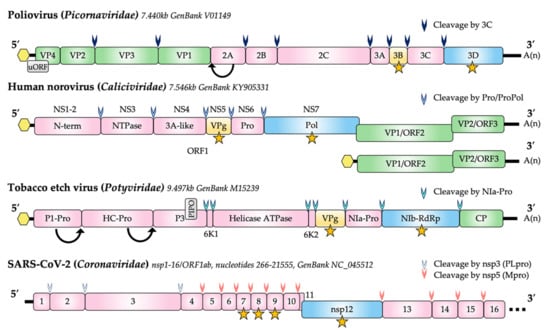
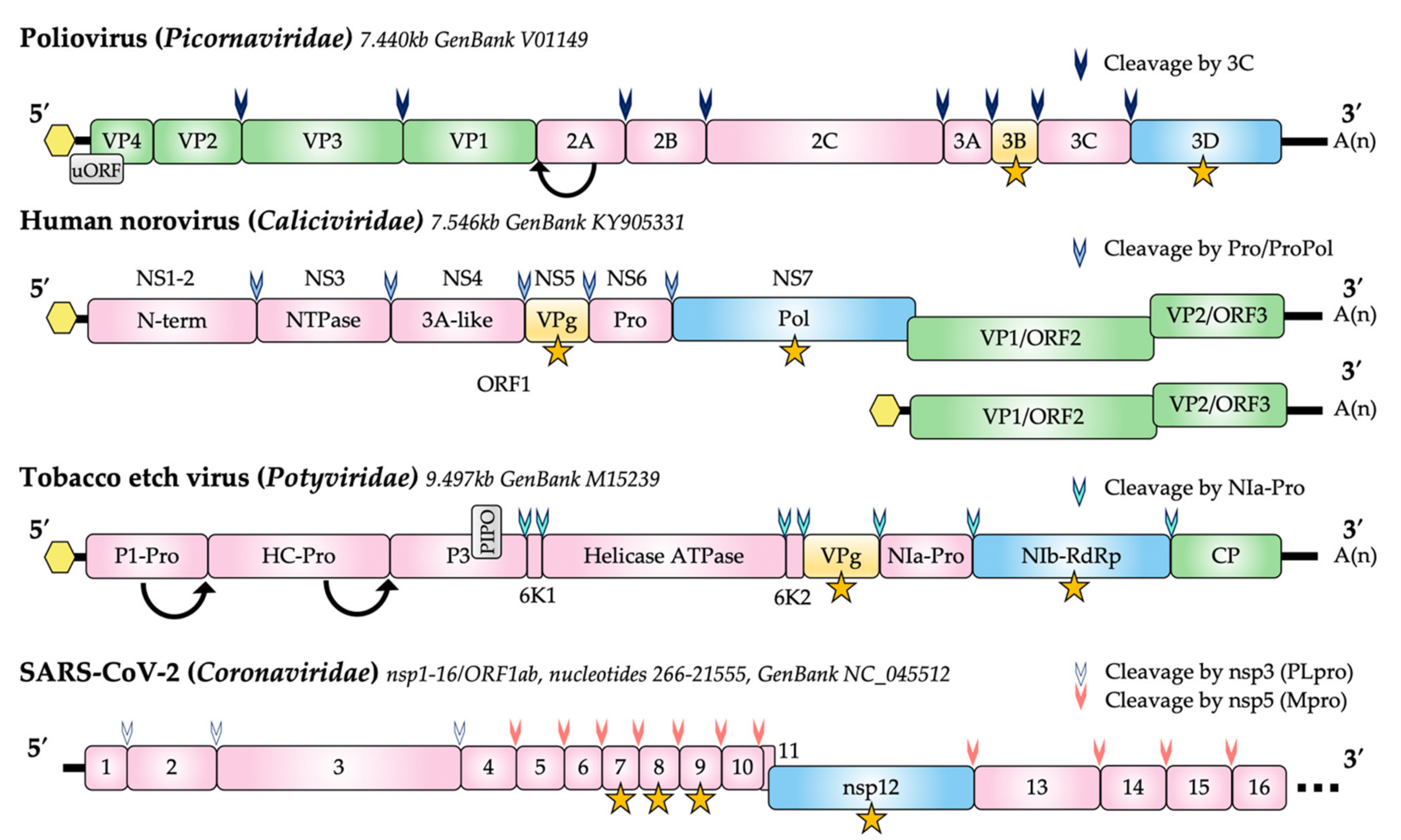
Regardless of the exact mechanism, nucleotidylylation is essential to the replication of a wide range of +ssRNA viruses, and this review will focus upon our understanding of the function and importance of nucleotidylylation during the life cycle of RNA viruses belonging primarily to the Caliciviridae, Coronaviridae, Picornaviridae and Potyviridae viral families (Figure 1).
Figure 1.
Genome structure of representative members of the Caliciviridae, Potyviridae, Picornaviridae and Coronaviridae. The presence of a covalently attached (nucleotidylylated) 5′ VPg is shown as a yellow hexagon. The coding region for VPg proteins is shown in yellow and proteins known to be nucleotidylylated are indicated by a yellow star. Proteolytic processing of viral polyproteins are indicated by arrowheads. Potyvirus P1-Pro and HC-Pro self-cleave from the polyprotein (arrows). Viral capsid proteins are shown in green and the RNA-dependent RNA polymerases (RdRp) are shown in blue. Non-structural proteins (nsp) other than RdRp and VPg are shown in pink with the common name and/or nsp designation indicated. A second reading frame (uORF) produced by poliovirus is shown in grey. The PIPO coding region expressed as a fusion to P3 via a polymerase slippage mechanism is shown in grey for tobacco etch virus. In caliciviruses, the protease (pro) and polymerase (RdRp) are found as unprocessed precursors, analogous to 3CD in picornaviruses. The NS and VP1 genes of some calicivirus genera (e.g., lagoviruses) are a single ORF. Nucleotide lengths for the genomes depicted are indicated and genomes are not to scale.
2. RNA Polymerases and Nucleotidylylation
Viral RNA polymerases primarily function to catalyze the transcription of RNA during viral replication. The RNA polymerases of picornaviruses, caliciviruses, potyviruses, sobemoviruses and coronaviruses are supergroup I RdRps [13] and all cluster within branch 2 of the ‘picornavirus supergroup’ based on RdRp phylogeny as defined by Wolf et al. [14]. The common and unique features of RNA polymerases are reviewed in Velthuis [2] and RdRp structures are reviewed by Ferrero et al. [15]. We refer the reader to these reviews for complementary information.
Nucleotidyl-transferases are a diverse group of enzymes that transfer nucleotides to a protein, nucleic acid or other molecule. Enzymes with nucleotidyl-transferase activity are involved in antibiotic resistance [16], polyadenylation of RNA [17], DNA repair [18], regulation of protein activity [19,20] and viral replication [21].
Nucleotidyl-transferase or nucleotidylylation reactions, catalyzed by the viral polymerase, have been shown to be essential for the replication of certain classes of virus. These viruses use a protein, VPg, covalently linked to a nucleotide monophosphate (NMP) to prime replication of the viral genome. A tyrosine residue in VPg provides the free hydroxyl for the nucleotidylylation reaction in the Astroviridae, Caliciviridae, Picornaviridae and Potyviridae families, while the Sobemovirus genus uses a threonine or a serine amino acid for nucleotidylylation [22,23,24,25,26,27,28]. The role of VPg in priming RNA synthesis has not been confirmed for sobemoviruses [29].
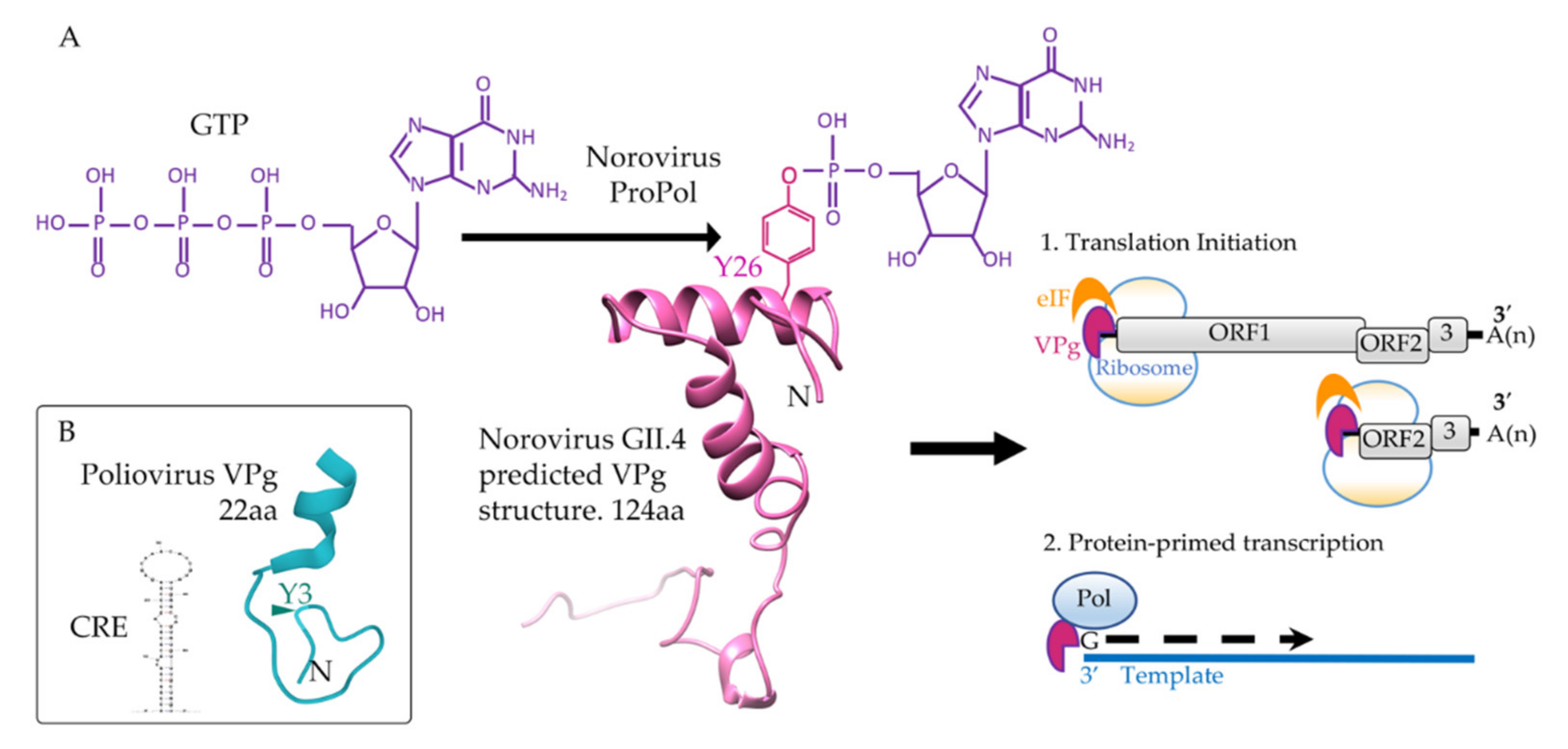
Catalysis of NTPs to NMPs by polymerases occurs via a two-metal-ion mechanism that is reliant on the presence of divalent cations in the form of Mg2+ or Mn2+ [30,31,32]. In the first step of the reaction, a nucleotide, VPg and two divalent cations bind to the polymerase. The polymerase then undergoes a conformational change to orientate and retain the NTP for catalysis. In the nucleotidylylation reaction, one metal ion functions to lower the pKa of the hydroxyl group (in this instance, on the tyrosine or threonine of VPg), making it an effective nucleophile. The hydroxyl group then performs a nucleophilic attack on the alpha phosphate of an NTP. The result is the formation of a phosphodiester bond between the nucleophile and the alpha phosphate and protonation of a pyrophosphate molecule, a by-product of the reaction (Figure 2).
Figure 2.
Guanylylation of a calicivirus VPg. (A) For the nucleotidylylation reaction, ProPol catalyzes a nucleophilic attack by the hydroxyl of Y26 of VPg (pink) on the alpha phosphate of GTP (purple). This produces a phosphodiester bond covalently linking GMP onto Y26 of VPg. Guanylylated human norovirus VPg functions to recruit host eukaryotic initiation factors (eIF) for translation and interacts with Pol or ProPol to stimulate protein-primed transcription of the RNA genome. Structural predictions for human norovirus GII.4 VPg (KY905331) were performed with Phyre and imaged with Chimera [33,34]. (B) In addition to polymerase, a CRE RNA (AY184219) is required for nucleotidylylation of the poliovirus VPg (blue) on tyrosine 3 (Y3). The poliovirus 1 VPg structure (2BBL) was obtained from PDB and the representation of the CRE RNA stem-loop predicted using mFold [35]. Nucleotidylylation of poliovirus VPg does not contribute to translation initiation, only protein-primed transcription. Amino acid (aa) length of the VPg proteins is indicated.
Nucleotidylylation reactions utilizing asparagine, lysine and possibly serine have also been described for viruses in the Coronaviridae family [36,37]. Lysine and asparagine contain a free amino group rather than a hydroxyl group, and therefore, the resulting bond is a phosphoramide rather than a phosphodiester. In the Coronaviridae family, nucleotidylylation occurs on selected proteins in the replication complex (nsp 7, 8, 9 and 12 for SARS-CoV-2), although the exact biological role is not known [36,37].
4. Caliciviruses
Caliciviridae is a family of +ssRNA viruses, comprising 11 viral genera that infect mammals (Lagovirus, Norovirus, Nebovirus, Recovirus, Sapovirus, Valovirus and Vesivirus genera), birds (Bavovirus and Nacovirus genera) and fish (Minovirus and Salovirus genera) [101], causing diseases which encompass respiratory, hemorrhagic and gastrointestinal pathologies. Unclassified caliciviruses have also been identified in amphibians, reptiles and lampreys. Representative caliciviruses include human noroviruses (HuNV; Norovirus), rabbit hemorrhagic disease virus (RHDV; Lagovirus), and feline calicivirus (FCV; Vesivirus).
Notably, noroviruses became the most common cause of viral gastroenteritis following the global introduction of rotavirus vaccines [102,103,104,105]. Causing an estimated 685 million cases per annum, a report published by the Center for Disease Control and Prevention in 2016 revealed that human noroviruses have an estimated medical and socioeconomic burden of $60 billion USD each year [106]. Norovirus is highly infectious and is responsible for around ~800,000 hospitalizations globally each year and more than 50% of all viral gastroenteritis outbreaks in the world [107,108,109]. Despite this, there remain no approved antiviral therapeutics or vaccines available for the treatment or prevention of noroviral infections.
4.1. Calicivirus Nucleotidylylation
Calicivirus genomes carry a VPg covalently bound to the 5′ end, whilst the 3′ end has a poly (A) tail. The genome usually encodes three open reading frames (ORF1–3), the first of which encodes all the non-structural proteins, whilst ORF2 and ORF3 encode the major and minor capsid proteins. The ORF1 non-structural gene is translated to a polyprotein which is post-translationally cleaved into precursor and mature proteins by a 3C-like protease (NS6) (Figure 1).
Within caliciviruses, the length of VPg proteins can vary from 65 amino acids (e.g., bovine nebovirus VPg) to 138 amino acids (e.g., Norwalk virus VPg) [26]. The structure of feline calicivirus and murine norovirus (MNV) VPg proteins were solved by nuclear magnetic resonance spectroscopy, revealing that the core of the calicivirus VPg protein is the only ordered domain, and is flanked by disordered N- and C-termini [110]. Regions of intrinsic disorder allow viral proteins to interact with a range of potential binding partners. Unlike picornavirus VPg proteins, calicivirus VPg proteins are known to recruit host cell translation machinery, namely eIF4E and eIF4G [9,111]. Recruitment of these initiation factors to the viral nucleic acid by VPg initiates translation. In addition to this role, VPg can also bind RNA polymerases and their precursors, induce a G1/S cell cycle arrest and has been proposed to serve as a protective cap for the viral genome against detection by the host immune system [8,27,112,113,114,115,116,117].
Nucleotidylylation is an essential step in the viral lifecycle of caliciviruses, with nucleotidylylated VPg acting to prime transcription of the positive-sense genome by viral RdRp in vitro [5,113] and initiate translation [5,26,111,113,118]. Experimental evidence for MNV, for which a robust cell model exists [119], demonstrated that all infectious MNV virions have VPg caps on the 5′ end of the genome [26], confirming the essential requirement of nucleotidylylated VPg in viral replication.
Nucleotidylylation of VPg by RNA polymerases, specifically the addition of GTP or UTP [27], facilitates the role of VPg in priming RNA synthesis, leading to covalent attachment of VPg at the 5′ end of the viral genome and/or sub-genome [120]. A mass spectrometry-based approach identified that VPg from FCV and MNV are covalently linked to guanosine via a tyrosine at position 24 and 26, respectively [26], that lies within a highly conserved acidic amino acid motif (DEEYD/EE). Guanylylation of VPg provides the 5′ G nucleotide of the viral genome, and hence, mutation of the tyrosine in this motif is detrimental to viral replication and results in a non-infectious virus [26]. The calicivirus VPg N-terminus adjacent to the nucleotidylylated tyrosine is rich in lysine/arginine amino acids and has been shown to have both nucleotide binding capability and a role in nucleotidylylation [121]. Deletion of this region, specifically the first 3, 8 or 10 amino acids of the N-terminus of HuNV VPg, resulted in a progressive reduction of nucleotidylylation at Tyr27 [27].
4.1.1. Proteins That Catalyze the Nucleotidyl-Transferase Reaction
The biomolecular mechanisms behind nucleotidylylation in caliciviruses are not well understood. In contrast to poliovirus nucleotidylylation, where 3Dpol is the active form of the polymerase responsible for catalyzing the reaction, it has been shown for the Caliciviridae family that this is more variable. In MNV and HuNV, nucleotidylylation is catalyzed by both forms of polymerase, the mature RdRp and the ORF1-derived precursor protein comprised of unprocessed protease-polymerase (ProPol, analogous to picornavirus 3CD) [27,121]. In contrast, for FCV, the protease and polymerase remain as a single protein, hence nucleotidylylation relies solely on the 3CD equivalent [122,123]. ProPol was also found to be the predominant form of polymerase in RHDV infected cells [124,125]. In HuNV, ProPol has been demonstrated to be 100-fold more efficient at nucleotidylylation than the mature polymerase, and a similar finding has been shown for RHDV VPg [121]. This suggests that ProPol may be the primary form of polymerase performing protein nucleotidylylation in caliciviruses.
The ability of calicivirus RdRps to nucleotidylylate target proteins from other viruses varies. HuNV RdRp specifically nucleotidylylates only HuNV VPg; in contrast, MNV RdRp is able to nucleotidylylate both HuNV VPg and MNV VPg [126]. Interestingly, the MNV polymerase was more efficient at nucleotidylylating HuNV VPg than the HuNV RdRp, and both HuNV and MNV RdRps nucleotidylylated themselves in vitro [126]. Whether this self-nucleotidylylation mechanism is similar to that identified in coronaviruses and picornaviruses is not known, nor have the target residue(s) been identified and nor has it been determined whether this is an essential function for viral replication.
4.1.2. The Role of RNA in Nucleotidylylation
The evidence for RNA structures contributing to the nucleotidylylation of calicivirus VPg proteins is not obvious. Noroviruses contain evolutionarily conserved RNA structures, which when disrupted, reduce or completely destroy replication of MNV [127,128]. Evidence suggests HuNV ProPol can catalyze nucleotidylylation independently of a poly (A) RNA template in the presence of Mn2+ as a divalent metal cation, whereas mature polymerase is more active in the presence of an RNA template, regardless of the cation available [4,27,129]. Uridylylation by the HuNV ProPol, which does not strictly require an RNA template, can nevertheless be enhanced upon addition of an ORF3-3′ UTR poly (A) template [27]. A similar stimulatory effect on nucleotidylylation activity has also been shown for the MNV polymerase [130]. FCV ProPol, unlike HuNV ProPol, is strictly dependent on the presence of an RNA template as a cofactor for nucleotidyl-transfer [26,123].
4.1.3. Nucleotide Selection for Nucleotidylylation
The HuNV MD145 strain VPg has been shown to be preferentially nucleotidylylated with GTP and UTP over other nucleotides, exhibiting a 2-fold preference for GTP over UTP [27]. A similar finding was found by Medvedev et al. [121], and has also been shown for MNV VPg, which is preferentially guanylylated compared to incorporation of the other NTPs [130]. As all calicivirus genomic and subgenomic RNAs begin with a guanine nucleotide, this supports the priming theory of positive-sense viral RNA replication by a guanylylated VPg.
Both UTP and GTP may be added to VPg, and some evidence suggests that two nucleotides can be added to calicivirus VPg proteins [27], similar to the VPgpUpU formed during picornavirus replication. The VPg of RHDV was originally proposed to be uridylylated by the RNA polymerase [7], based on analogies to picornavirus VPg. Belliot et al. [27] proposed that uridylylated VPg may prime initiation of RNA synthesis only on the anti-sense genome or anti-sense subgenome on the poly (A) tail. Using recombinant polymerase and subgenomic RNA as a surrogate for the norovirus genome, Rohayem et al. showed that uridylylated HuNV VPg primed the subgenome in vitro [4], but not the anti-subgenome. This was consistent with experimental observations in FCV and MNV, which did not find that the antigenome was VPg-linked [26,131], and with findings that initiation of replication of the antigenome occurs via a primer-independent de novo mechanism [4]. If VPg does prime antisense genomic RNA synthesis, then a role for uridylylated VPg can be proposed for this process. That GTP is preferred over UTP would be expected in this case, given that the antisense genome is >1000-fold less abundant than the positive-sense genome during viral replication [131].
To date, the mechanisms behind nucleotide discrimination in nucleotidylylation remain unclear. An NTP-binding sequence has been identified in calicivirus VPgs [121], suggesting VPg itself, as opposed to the polymerase, may bind NTPs prior to nucleotidylylation, and the nucleotide addition cycle of nucleotidylylation begins with the binding of VPg-NTP by the polymerase. However, despite the fact that VPg is preferentially guanylylated, VPg was shown to bind all NTPs with equal efficiency [121], suggesting that the polymerase may have a discriminatory role in preferential NTP addition. It may be possible that VPg is both guanylylated and then uridylylated, as the second nucleotide of norovirus genomes is a uracil. However, how a specific VPgpGpU might be synthesized is unclear, although it is interesting to speculate on the role an RNA template might have in this process, and whether the nucleotides might be added by different forms of polymerase.
5. Potyviruses
Potyviruses are a genus of plant viruses belonging to the Potyviridae viral family and have a wide range of plant hosts, including many vegetables and legume species which constitute important parts of the global food supply. Potyviruses are some of the most common plant viruses in the world, accounting for approximately ~30% of known plant pathogens. Potyviruses are known for causing extensive economic damage to important crops such as potatoes, turnips, tomatoes, beans and peas. Potyviruses are primarily transmitted from plant to plant by arthropods [132]. The viral particles are filamentous and almost all members of the Potyviridae have a monopartite +ssRNA genome of 8–11 kb in length. Potyvirus genomes encode an ORF which is translated to a 340–370 kDa polyprotein, which is then co- and/or post-translationally processed by three forms of internally encoded protease into cleavage intermediates or mature protein products (Figure 1). A fusion protein, P3N-PIPO, is read off an alternative open reading frame as a result of a frameshift caused by RNA polymerase slippage on the first ORF [133,134].
Potyvirus Nucleotidylylation
Potyvirus VPg proteins range from 20–22 kDa and exist in both a mature form as well as a number of uncleaved precursor forms. The potyvirus turnip mosaic virus appears to possess VPg exclusively in precursor forms, as one study focusing on subcellular localization could not detect the mature form of VPg [135]. Potyvirus VPgs, like other viral VPgs, have an ordered central domain flanked by disordered N- and C-termini [136,137]. VPgs from Potyviridae share roughly 50% sequence identity, mostly in the conserved regions of the NTP binding motif, and a bipartite nuclear localization signal [138].
Potyvirus VPgs are genome-linked to the 5′ end of the viral nucleic acid and prime the synthesis of the viral genome [139,140]. As with caliciviruses, potyvirus VPg proteins are covalently bound to genomic RNA by a conserved tyrosine residue. In tobacco vein mottling virus (TVMV) VPg is linked via Tyr60 to the viral nucleic acid, whilst pepper vein banding virus (PVBV) VPg is linked via Tyr66 and potato virus A (PVA) VPg is linked by Tyr63 and possibly by an alternative residue Tyr119 [6,141,142]. In addition to functioning as a genome cap, potyvirus VPgs share a number of other functional similarities to VPgs from picornaviruses and caliciviruses, including binding to host factors such as eIF4E [143]. Potyvirus VPgs are also uridylylated by their respective RNA polymerases [6,138,141].
Co-purification of TVMV VPg with a GST-labelled polymerase fusion protein demonstrated that VPg associates with the polymerase in vitro [144]. Tyr60 of the VPg was shown to be essential for this interaction, as mutation of this residue ablated the association between the polymerase and the VPg entirely [145], preventing viral replication in protoplasts [28,142]. Further, TVMV VPg stimulates inherent polymerase activity, acting as a co-factor in RNA synthesis in addition to the role of VPg as a primer of the viral RNA genome [144].
Studies of PVA and PVBV VPg uridylylation showed that RNA polymerase uridylylates VPg in the presence of a divalent metal cation independently of a poly (A) RNA template [6,141]. A conserved tyrosine residue in PVBV VPg, specifically Tyr42, is part of the nucleotide binding motif AYTTKKGK [141], analogous to a nucleotide binding motif in closely related PVA VPg [6]. However, deletion of this nucleotide binding motif in PVA VPg did not result in complete loss of uridylylation [6], indicating that Tyr42 was not the nucleotidylylation target residue of the PVA polymerase. Tyr66 was identified as the target residue when mutation of Tyr66 to threonine prevented uridylylation by PVBV RNA polymerase [141]. It is not clear if potyvirus VPgs are nucleotidylylated with one residue or two, whether there is nucleotide preference, and whether potyvirus precursor polymerases outperform mature polymerases in this function.
7. Conclusions
Protein nucleotidylylation is a critical component of the replication of a range of viruses, with this modification commonly found in +ssRNA viruses of the picornavirus supergroup [14], and highlights a common feature of this group of viruses. These viruses are important pathogens of humans, other animals and plants with a significant impact on health and well-being, as evidenced by the current SARS-CoV-2 global pandemic. Nucleotidylylation is central to the initiation of viral genome replication, an essential step in the viral life cycle, and the placement of caliciviral and potyviral VPg proteins at the 5′ end of the viral genome is critical for the recruitment of translational initiation factors, and hence, viral protein synthesis, for these two viral families. While nucleotidylylation plays a central role in the replication of viruses that perform this function, the underlying mechanisms and processes largely remain to be determined.
Author Contributions
All authors contributed to conceptualization, writing—original draft preparation, writing—review and editing, and visualization. All authors have read and agreed to the published version of the manuscript.
Funding
This research was funded by the New Zealand Ministry of Business, Innovation & Employment, grant number UOOX1904, the Maurice Wilkins Centre for Molecular Biodiscovery and the University of Otago.
Institutional Review Board Statement
Not applicable.
Informed Consent Statement
Not applicable.
Acknowledgments
V.L. Young for critical review of the manuscript.
Conflicts of Interest
The authors declare no conflict of interest. The funders had no role in the design of the study; in the collection, analyses, or interpretation of data; in the writing of the manuscript; or in the decision to publish the results.
References
- Gorbalenya, A.E.; Pringle, F.M.; Zeddam, J.L.; Luke, B.T.; Cameron, C.E.; Kalmakoff, J.; Hanzlik, T.N.; Gordon, K.H.; Ward, V.K. The palm subdomain-based active site is internally permuted in viral RNA-dependent RNA polymerases of an ancient lineage. J. Mol. Biol. 2002, 324, 47–62. [Google Scholar] [CrossRef] [Scilit]
- Te Velthuis, A.J. Common and unique features of viral RNA-dependent polymerases. Cell Mol. Life Sci. 2014, 71, 4403–4420. [Google Scholar] [CrossRef] [Scilit] [PubMed]
- Bruenn, J.A. A structural and primary sequence comparison of the viral RNA-dependent RNA polymerases. Nucleic Acids Res. 2003, 31, 1821–1829. [Google Scholar] [CrossRef] [Scilit]
- Rohayem, J.; Robel, I.; Jager, K.; Scheffler, U.; Rudolph, W. Protein-primed and de novo initiation of RNA synthesis by norovirus 3Dpol. J. Virol. 2006, 80, 7060–7069. [Google Scholar] [CrossRef] [Scilit] [PubMed]
- Subba-Reddy, C.V.; Goodfellow, I.; Kao, C.C. VPg-primed RNA synthesis of norovirus RNA-dependent RNA polymerases by using a novel cell-based assay. J. Virol. 2011, 85, 13027–13037. [Google Scholar] [CrossRef] [Scilit]
- Puustinen, P.; Makinen, K. Uridylylation of the potyvirus VPg by viral replicase NIb correlates with the nucleotide binding capacity of VPg. J. Biol. Chem. 2004, 279, 38103–38110. [Google Scholar] [CrossRef] [Scilit] [PubMed]
- Machin, A.; Martin Alonso, J.M.; Parra, F. Identification of the amino acid residue involved in rabbit hemorrhagic disease virus VPg uridylylation. J. Biol. Chem. 2001, 276, 27787–27792. [Google Scholar] [CrossRef] [Scilit] [PubMed]
- Daughenbaugh, K.F.; Wobus, C.E.; Hardy, M.E. VPg of murine norovirus binds translation initiation factors in infected cells. Virol. J. 2006, 3, 33. [Google Scholar] [CrossRef] [Scilit]
- Chung, L.; Bailey, D.; Leen, E.N.; Emmott, E.P.; Chaudhry, Y.; Roberts, L.O.; Curry, S.; Locker, N.; Goodfellow, I.G. Norovirus translation requires an interaction between the C Terminus of the genome-linked viral protein VPg and eukaryotic translation initiation factor 4G. J. Biol. Chem. 2014, 289, 21738–21750. [Google Scholar] [CrossRef] [Scilit]
- Tavert-Roudet, G.; Anne, A.; Barra, A.; Chovin, A.; Demaille, C.; Michon, T. The Potyvirus Particle Recruits the Plant Translation Initiation Factor eIF4E by Means of the VPg covalently Linked to the Viral RNA. Mol. Plant. Microbe Interact. 2017, 30, 754–762. [Google Scholar] [CrossRef] [Scilit]
- Walter, J.; Barra, A.; Charon, J.; Tavert-Roudet, G.; Michon, T. Spectroscopic Investigation of the Kinetic Mechanism Involved in the Association of Potyviral VPg with the Host Plant Translation Initiation Factor eIF4E. Int. J. Mol. Sci. 2020, 21, 5618. [Google Scholar] [CrossRef] [Scilit]
- Khan, M.A.; Goss, D.J. Poly (A) binding protein enhances the binding affinity of potyvirus VPg to eukaryotic initiation factor eIF4F and activates in vitro translation. Int. J. Biol. Macromol. 2019, 121, 947–955. [Google Scholar] [CrossRef] [Scilit]
- Aravind, L.; Koonin, E.V. DNA polymerase beta-like nucleotidyltransferase superfamily: Identification of three new families, classification and evolutionary history. Nucleic Acids Res. 1999, 27, 1609–1618. [Google Scholar] [CrossRef] [Scilit]
- Wolf, Y.I.; Kazlauskas, D.; Iranzo, J.; Lucia-Sanz, A.; Kuhn, J.H.; Krupovic, M.; Dolja, V.V.; Koonin, E.V. Origins and Evolution of the Global RNA Virome. mBio 2018, 9, e02329-18. [Google Scholar] [CrossRef] [Scilit]
- Ferrero, D.; Ferrer-Orta, C.; Verdaguer, N. Viral RNA-Dependent RNA Polymerases: A Structural Overview. Subcell Biochem. 2018, 88, 39–71. [Google Scholar] [CrossRef] [Scilit]
- Morar, M.; Bhullar, K.; Hughes, D.W.; Junop, M.; Wright, G.D. Structure and mechanism of the lincosamide antibiotic adenylyltransferase LinB. Structure 2009, 17, 1649–1659. [Google Scholar] [CrossRef] [Scilit]
- Wang, L.; Eckmann, C.R.; Kadyk, L.C.; Wickens, M.; Kimble, J. A regulatory cytoplasmic poly(A) polymerase in Caenorhabditis elegans. Nature 2002, 419, 312–316. [Google Scholar] [CrossRef] [Scilit] [PubMed]
- Della, M.; Palmbos, P.L.; Tseng, H.M.; Tonkin, L.M.; Daley, J.M.; Topper, L.M.; Pitcher, R.S.; Tomkinson, A.E.; Wilson, T.E.; Doherty, A.J. Mycobacterial Ku and ligase proteins constitute a two-component NHEJ repair machine. Science 2004, 306, 683–685. [Google Scholar] [CrossRef] [Scilit]
- Stadtman, E.R. The story of glutamine synthetase regulation. J. Biol. Chem. 2001, 276, 44357–44364. [Google Scholar] [CrossRef] [Scilit] [PubMed]
- Yarbrough, M.L.; Li, Y.; Kinch, L.N.; Grishin, N.V.; Ball, H.L.; Orth, K. AMPylation of Rho GTPases by Vibrio VopS disrupts effector binding and downstream signaling. Science 2009, 323, 269–272. [Google Scholar] [CrossRef] [Scilit] [PubMed]
- Wu, W.; Wang, Z.; Xia, H.; Liu, Y.; Qiu, Y.; Liu, Y.; Hu, Y.; Zhou, X. Flock house virus RNA polymerase initiates RNA synthesis de novo and possesses a terminal nucleotidyl transferase activity. PLoS ONE 2014, 9, e86876. [Google Scholar] [CrossRef] [Scilit] [PubMed]
- Ambros, V.; Baltimore, D. Protein is linked to the 5′ end of poliovirus RNA by a phosphodiester linkage to tyrosine. J. Biol. Chem. 1978, 253, 5263–5266. [Google Scholar] [CrossRef] [Scilit]
- Olspert, A.; Peil, L.; Hebrard, E.; Fargette, D.; Truve, E. Protein-RNA linkage and post-translational modifications of two sobemovirus VPgs. J. Gen. Virol. 2011, 92, 445–452. [Google Scholar] [CrossRef] [Scilit]
- Olspert, A.; Arike, L.; Peil, L.; Truve, E. Sobemovirus RNA linked to VPg over a threonine residue. FEBS Lett. 2011, 585, 2979–2985. [Google Scholar] [CrossRef] [Scilit] [PubMed]
- Fuentes, C.; Bosch, A.; Pinto, R.M.; Guix, S. Identification of human astrovirus genome-linked protein (VPg) essential for virus infectivity. J. Virol. 2012, 86, 10070–10078. [Google Scholar] [CrossRef] [Scilit] [PubMed]
- Olspert, A.; Hosmillo, M.; Chaudhry, Y.; Peil, L.; Truve, E.; Goodfellow, I. Protein-RNA linkage and posttranslational modifications of feline calicivirus and murine norovirus VPg proteins. PeerJ 2016, 4, e2134. [Google Scholar] [CrossRef] [Scilit]
- Belliot, G.; Sosnovtsev, S.V.; Chang, K.O.; McPhie, P.; Green, K.Y. Nucleotidylylation of the VPg protein of a human norovirus by its proteinase-polymerase precursor protein. Virology 2008, 374, 33–49. [Google Scholar] [CrossRef] [Scilit]
- Murphy, J.F.; Klein, P.G.; Hunt, A.G.; Shaw, J.G. Replacement of the tyrosine residue that links a potyviral VPg to the viral RNA is lethal. Virology 1996, 220, 535–538. [Google Scholar] [CrossRef] [Scilit]
- Somera, M.; Sarmiento, C.; Truve, E. Overview on Sobemoviruses and a Proposal for the Creation of the Family Sobemoviridae. Viruses 2015, 7, 3076–3115. [Google Scholar] [CrossRef] [Scilit]
- Carvalho, A.T.; Fernandes, P.A.; Ramos, M.J. The Catalytic Mechanism of RNA Polymerase II. J. Chem Theory Comput. 2011, 7, 1177–1188. [Google Scholar] [CrossRef] [Scilit] [PubMed]
- Castro, C.; Smidansky, E.; Maksimchuk, K.R.; Arnold, J.J.; Korneeva, V.S.; Gotte, M.; Konigsberg, W.; Cameron, C.E. Two proton transfers in the transition state for nucleotidyl transfer catalyzed by RNA- and DNA-dependent RNA and DNA polymerases. Proc. Natl. Acad. Sci. USA 2007, 104, 4267–4272. [Google Scholar] [CrossRef] [Scilit]
- Steitz, T.A.; Steitz, J.A. A general two-metal-ion mechanism for catalytic RNA. Proc. Natl. Acad. Sci. USA 1993, 90, 6498–6502. [Google Scholar] [CrossRef] [Scilit]
- Pettersen, E.F.; Goddard, T.D.; Huang, C.C.; Couch, G.S.; Greenblatt, D.M.; Meng, E.C.; Ferrin, T.E. UCSF Chimera—A visualization system for exploratory research and analysis. J. Comput. Chem. 2004, 25, 1605–1612. [Google Scholar] [CrossRef] [Scilit]
- Kelley, L.A.; Mezulis, S.; Yates, C.M.; Wass, M.N.; Sternberg, M.J. The Phyre2 web portal for protein modeling, prediction and analysis. Nat. Protoc. 2015, 10, 845–858. [Google Scholar] [CrossRef] [Scilit]
- Zuker, M. Mfold web server for nucleic acid folding and hybridization prediction. Nucleic Acids Res. 2003, 31, 3406–3415. [Google Scholar] [CrossRef] [Scilit]
- Lehmann, K.C.; Gulyaeva, A.; Zevenhoven-Dobbe, J.C.; Janssen, G.M.; Ruben, M.; Overkleeft, H.S.; van Veelen, P.A.; Samborskiy, D.V.; Kravchenko, A.A.; Leontovich, A.M.; et al. Discovery of an essential nucleotidylating activity associated with a newly delineated conserved domain in the RNA polymerase-containing protein of all nidoviruses. Nucleic Acids Res. 2015, 43, 8416–8434. [Google Scholar] [CrossRef] [Scilit] [PubMed]
- Conti, B.J.; Leicht, A.S.; Kirchdoerfer, R.N.; Sussman, M.R. Mass spectrometric based detection of protein nucleotidylation in the RNA polymerase of SARS-CoV-2. Commun. Chem. 2021, 4, 41. [Google Scholar] [CrossRef] [Scilit]
- Lulla, V.; Dinan, A.M.; Hosmillo, M.; Chaudhry, Y.; Sherry, L.; Irigoyen, N.; Nayak, K.M.; Stonehouse, N.J.; Zilbauer, M.; Goodfellow, I.; et al. An upstream protein-coding region in enteroviruses modulates virus infection in gut epithelial cells. Nat. MicroBiol. 2019, 4, 280–292. [Google Scholar] [CrossRef] [Scilit] [PubMed]
- Zell, R.; Delwart, E.; Gorbalenya, A.E.; Hovi, T.; King, A.M.Q.; Knowles, N.J.; Lindberg, A.M.; Pallansch, M.A.; Palmenberg, A.C.; Reuter, G.; et al. ICTV Virus Taxonomy Profile: Picornaviridae. J. Gen. Virol. 2017, 98, 2421–2422. [Google Scholar] [CrossRef] [Scilit]
- Zell, R. Picornaviridae-the ever-growing virus family. Arch. Virol. 2018, 163, 299–317. [Google Scholar] [CrossRef] [Scilit] [PubMed]
- Fendrick, A.M.; Monto, A.S.; Nightengale, B.; Sarnes, M. The economic burden of non-influenza-related viral respiratory tract infection in the United States. Arch. Intern. Med. 2003, 163, 487–494. [Google Scholar] [CrossRef] [Scilit] [PubMed]
- Fine, J.; Bray-Aschenbrenner, A.; Williams, H.; Buchanan, P.; Werner, J. The Resource Burden of Infections with Rhinovirus/Enterovirus, Influenza, and Respiratory Syncytial Virus in Children. Clin. Pediatr. 2019, 58, 177–184. [Google Scholar] [CrossRef] [Scilit]
- Knight-Jones, T.J.; Rushton, J. The economic impacts of foot and mouth disease—What are they, how big are they and where do they occur? Prev Vet. Med. 2013, 112, 161–173. [Google Scholar] [CrossRef] [Scilit] [PubMed]
- Paul, A.V.; Wimmer, E. Initiation of protein-primed picornavirus RNA synthesis. Virus Res. 2015, 206, 12–26. [Google Scholar] [CrossRef] [Scilit]
- Lee, Y.F.; Nomoto, A.; Detjen, B.M.; Wimmer, E. A protein covalently linked to poliovirus genome RNA. Proc. Natl. Acad. Sci. USA 1977, 74, 59–63. [Google Scholar] [CrossRef] [Scilit]
- Morasco, B.J.; Sharma, N.; Parilla, J.; Flanegan, J.B. Poliovirus cre(2C)-dependent synthesis of VPgpUpU is required for positive- but not negative-strand RNA synthesis. J. Virol. 2003, 77, 5136–5144. [Google Scholar] [CrossRef] [Scilit]
- Gamarnik, A.V.; Andino, R. Switch from translation to RNA replication in a positive-stranded RNA virus. Genes Dev. 1998, 12, 2293–2304. [Google Scholar] [CrossRef] [Scilit] [PubMed]
- Holmes, A.C.; Zagnoli-Vieira, G.; Caldecott, K.W.; Semler, B.L. Effects of TDP2/VPg Unlinkase Activity on Picornavirus Infections Downstream of Virus Translation. Viruses 2020, 12, 166. [Google Scholar] [CrossRef] [Scilit]
- Virgen-Slane, R.; Rozovics, J.M.; Fitzgerald, K.D.; Ngo, T.; Chou, W.; van der Heden van Noort, G.J.; Filippov, D.V.; Gershon, P.D.; Semler, B.L. An RNA virus hijacks an incognito function of a DNA repair enzyme. Proc. Natl. Acad. Sci. USA 2012, 109, 14634–14639. [Google Scholar] [CrossRef] [Scilit] [PubMed]
- Ambros, V.; Pettersson, R.F.; Baltimore, D. An enzymatic activity in uninfected cells that cleaves the linkage between poliovirion RNA and the 5′ terminal protein. Cell 1978, 15, 1439–1446. [Google Scholar] [CrossRef] [Scilit]
- Andino, R.; Rieckhof, G.E.; Baltimore, D. A functional ribonucleoprotein complex forms around the 5′ end of poliovirus RNA. Cell 1990, 63, 369–380. [Google Scholar] [CrossRef] [Scilit]
- Percy, N.; Belsham, G.J.; Brangwyn, J.K.; Sullivan, M.; Stone, D.M.; Almond, J.W. Intracellular modifications induced by poliovirus reduce the requirement for structural motifs in the 5′ noncoding region of the genome involved in internal initiation of protein synthesis. J. Virol. 1992, 66, 1695–1701. [Google Scholar] [CrossRef] [Scilit]
- Rohll, J.B.; Percy, N.; Ley, R.; Evans, D.J.; Almond, J.W.; Barclay, W.S. The 5′-untranslated regions of picornavirus RNAs contain independent functional domains essential for RNA replication and translation. J. Virol. 1994, 68, 4384–4391. [Google Scholar] [CrossRef] [Scilit]
- Lyons, T.; Murray, K.E.; Roberts, A.W.; Barton, D.J. Poliovirus 5′-terminal cloverleaf RNA is required in cis for VPg uridylylation and the initiation of negative-strand RNA synthesis. J. Virol. 2001, 75, 10696–10708. [Google Scholar] [CrossRef] [Scilit] [PubMed]
- Saiz, M.; Gomez, S.; Martinez-Salas, E.; Sobrino, F. Deletion or substitution of the aphthovirus 3′ NCR abrogates infectivity and virus replication. J. Gen. Virol. 2001, 82, 93–101. [Google Scholar] [CrossRef] [Scilit] [PubMed]
- Silvestri, L.S.; Parilla, J.M.; Morasco, B.J.; Ogram, S.A.; Flanegan, J.B. Relationship between poliovirus negative-strand RNA synthesis and the length of the 3′ poly(A) tail. Virology 2006, 345, 509–519. [Google Scholar] [CrossRef] [Scilit]
- Murray, K.E.; Barton, D.J. Poliovirus CRE-dependent VPg uridylylation is required for positive-strand RNA synthesis but not for negative-strand RNA synthesis. J. Virol. 2003, 77, 4739–4750. [Google Scholar] [CrossRef] [Scilit] [PubMed]
- Nayak, A.; Goodfellow, I.G.; Belsham, G.J. Factors required for the Uridylylation of the foot-and-mouth disease virus 3B1, 3B2, and 3B3 peptides by the RNA-dependent RNA polymerase (3Dpol) in vitro. J. Virol. 2005, 79, 7698–7706. [Google Scholar] [CrossRef] [Scilit]
- King, A.M.; Slade, W.R.; Newman, J.W.; McCahon, D. Temperature-sensitive mutants of foot-and-mouth disease virus with altered structural polypeptides. II. Comparison of recombination and biochemical maps. J. Virol. 1980, 34, 67–72. [Google Scholar] [CrossRef] [Scilit]
- Sun, Y.; Guo, Y.; Lou, Z. Formation and working mechanism of the picornavirus VPg uridylylation complex. Curr. Opin. Virol. 2014, 9, 24–30. [Google Scholar] [CrossRef] [Scilit]
- Schein, C.H.; Oezguen, N.; Volk, D.E.; Garimella, R.; Paul, A.; Braun, W. NMR structure of the viral peptide linked to the genome (VPg) of poliovirus. Peptides 2006, 27, 1676–1684. [Google Scholar] [CrossRef] [Scilit]
- Liu, Y.; Franco, D.; Paul, A.V.; Wimmer, E. Tyrosine 3 of poliovirus terminal peptide VPg(3B) has an essential function in RNA replication in the context of its precursor protein, 3AB. J. Virol. 2007, 81, 5669–5684. [Google Scholar] [CrossRef] [Scilit]
- Lama, J.; Paul, A.V.; Harris, K.S.; Wimmer, E. Properties of purified recombinant poliovirus protein 3aB as substrate for viral proteinases and as co-factor for RNA polymerase 3Dpol. J. Biol. Chem. 1994, 269, 66–70. [Google Scholar] [CrossRef] [Scilit]
- Pathak, H.B.; Oh, H.S.; Goodfellow, I.G.; Arnold, J.J.; Cameron, C.E. Picornavirus genome replication: Roles of precursor proteins and rate-limiting steps in oriI-dependent VPg uridylylation. J. Biol. Chem. 2008, 283, 30677–30688. [Google Scholar] [CrossRef] [Scilit] [PubMed]
- Hope, D.A.; Diamond, S.E.; Kirkegaard, K. Genetic dissection of interaction between poliovirus 3D polymerase and viral protein 3AB. J. Virol. 1997, 71, 9490–9498. [Google Scholar] [CrossRef] [Scilit] [PubMed]
- Xiang, W.; Cuconati, A.; Paul, A.V.; Cao, X.; Wimmer, E. Molecular dissection of the multifunctional poliovirus RNA-binding protein 3AB. RNA 1995, 1, 892–904. [Google Scholar]
- Harris, K.S.; Xiang, W.; Alexander, L.; Lane, W.S.; Paul, A.V.; Wimmer, E. Interaction of poliovirus polypeptide 3CDpro with the 5′ and 3′ termini of the poliovirus genome. Identification of viral and cellular cofactors needed for efficient binding. J. Biol. Chem. 1994, 269, 27004–27014. [Google Scholar] [CrossRef] [Scilit]
- DeStefano, J.J.; Titilope, O. Poliovirus protein 3AB displays nucleic acid chaperone and helix-destabilizing activities. J. Virol. 2006, 80, 1662–1671. [Google Scholar] [CrossRef] [Scilit] [PubMed]
- Xiang, W.; Harris, K.S.; Alexander, L.; Wimmer, E. Interaction between the 5′-terminal cloverleaf and 3AB/3CDpro of poliovirus is essential for RNA replication. J. Virol. 1995, 69, 3658–3667. [Google Scholar] [CrossRef] [Scilit] [PubMed]
- Parsley, T.B.; Towner, J.S.; Blyn, L.B.; Ehrenfeld, E.; Semler, B.L. Poly (rC) binding protein 2 forms a ternary complex with the 5′-terminal sequences of poliovirus RNA and the viral 3CD proteinase. RNA 1997, 3, 1124–1134. [Google Scholar]
- Brunner, J.E.; Ertel, K.J.; Rozovics, J.M.; Semler, B.L. Delayed kinetics of poliovirus RNA synthesis in a human cell line with reduced levels of hnRNP C proteins. Virology 2010, 400, 240–247. [Google Scholar] [CrossRef] [Scilit] [PubMed]
- Brunner, J.E.; Nguyen, J.H.; Roehl, H.H.; Ho, T.V.; Swiderek, K.M.; Semler, B.L. Functional interaction of heterogeneous nuclear ribonucleoprotein C with poliovirus RNA synthesis initiation complexes. J. Virol. 2005, 79, 3254–3266. [Google Scholar] [CrossRef] [Scilit] [PubMed]
- Banerjee, R.; Tsai, W.; Kim, W.; Dasgupta, A. Interaction of poliovirus-encoded 2C/2BC polypeptides with the 3′ terminus negative-strand cloverleaf requires an intact stem-loop b. Virology 2001, 280, 41–51. [Google Scholar] [CrossRef] [Scilit] [PubMed]
- Teterina, N.L.; Egger, D.; Bienz, K.; Brown, D.M.; Semler, B.L.; Ehrenfeld, E. Requirements for assembly of poliovirus replication complexes and negative-strand RNA synthesis. J. Virol. 2001, 75, 3841–3850. [Google Scholar] [CrossRef] [Scilit]
- Paul, A.V.; Rieder, E.; Kim, D.W.; van Boom, J.H.; Wimmer, E. Identification of an RNA hairpin in poliovirus RNA that serves as the primary template in the in vitro uridylylation of VPg. J. Virol. 2000, 74, 10359–10370. [Google Scholar] [CrossRef] [Scilit] [PubMed]
- Harris, K.S.; Reddigari, S.R.; Nicklin, M.J.; Hammerle, T.; Wimmer, E. Purification and characterization of poliovirus polypeptide 3CD, a proteinase and a precursor for RNA polymerase. J. Virol. 1992, 66, 7481–7489. [Google Scholar] [CrossRef] [Scilit] [PubMed]
- Yang, Y.; Rijnbrand, R.; Watowich, S.; Lemon, S.M. Genetic evidence for an interaction between a picornaviral cis-acting RNA replication element and 3CD protein. J. Biol. Chem. 2004, 279, 12659–12667. [Google Scholar] [CrossRef] [Scilit]
- Yin, J.; Paul, A.V.; Wimmer, E.; Rieder, E. Functional dissection of a poliovirus cis-acting replication element [PV-cre(2C)]: Analysis of single- and dual-cre viral genomes and proteins that bind specifically to PV-cre RNA. J. Virol. 2003, 77, 5152–5166. [Google Scholar] [CrossRef] [Scilit]
- Rieder, E.; Paul, A.V.; Kim, D.W.; van Boom, J.H.; Wimmer, E. Genetic and biochemical studies of poliovirus cis-acting replication element cre in relation to VPg uridylylation. J. Virol. 2000, 74, 10371–10380. [Google Scholar] [CrossRef] [Scilit]
- Gerber, K.; Wimmer, E.; Paul, A.V. Biochemical and genetic studies of the initiation of human rhinovirus 2 RNA replication: Identification of a cis-replicating element in the coding sequence of 2A(pro). J. Virol. 2001, 75, 10979–10990. [Google Scholar] [CrossRef] [Scilit]
- Lobert, P.E.; Escriou, N.; Ruelle, J.; Michiels, T. A coding RNA sequence acts as a replication signal in cardioviruses. Proc. Natl. Acad. Sci. USA 1999, 96, 11560–11565. [Google Scholar] [CrossRef] [Scilit]
- Goodfellow, I.; Chaudhry, Y.; Richardson, A.; Meredith, J.; Almond, J.W.; Barclay, W.; Evans, D.J. Identification of a cis-acting replication element within the poliovirus coding region. J. Virol. 2000, 74, 4590–4600. [Google Scholar] [CrossRef] [PubMed]
- Yang, Y.; Yi, M.; Evans, D.J.; Simmonds, P.; Lemon, S.M. Identification of a conserved RNA replication element (cre) within the 3Dpol-coding sequence of hepatoviruses. J. Virol. 2008, 82, 10118–10128. [Google Scholar] [CrossRef] [Scilit] [PubMed]
- Al-Sunaidi, M.; Williams, C.H.; Hughes, P.J.; Schnurr, D.P.; Stanway, G. Analysis of a new human parechovirus allows the definition of parechovirus types and the identification of RNA structural domains. J. Virol. 2007, 81, 1013–1021. [Google Scholar] [CrossRef] [Scilit] [PubMed]
- Son, K.Y.; Kim, D.S.; Kwon, J.; Choi, J.S.; Kang, M.I.; Belsham, G.J.; Cho, K.O. Full-length genomic analysis of Korean porcine Sapelovirus strains. PLoS ONE 2014, 9, e107860. [Google Scholar] [CrossRef] [Scilit]
- Mason, P.W.; Bezborodova, S.V.; Henry, T.M. Identification and characterization of a cis-acting replication element (cre) adjacent to the internal ribosome entry site of foot-and-mouth disease virus. J. Virol. 2002, 76, 9686–9694. [Google Scholar] [CrossRef] [Scilit]
- Paul, A.V.; Peters, J.; Mugavero, J.; Yin, J.; van Boom, J.H.; Wimmer, E. Biochemical and genetic studies of the VPg uridylylation reaction catalyzed by the RNA polymerase of poliovirus. J. Virol. 2003, 77, 891–904. [Google Scholar] [CrossRef] [Scilit]
- Rothberg, P.G.; Harris, T.J.; Nomoto, A.; Wimmer, E. O4-(5′-uridylyl)tyrosine is the bond between the genome-linked protein and the RNA of poliovirus. Proc. Natl. Acad. Sci. USA 1978, 75, 4868–4872. [Google Scholar] [CrossRef] [Scilit]
- Paul, A.V.; van Boom, J.H.; Filippov, D.; Wimmer, E. Protein-primed RNA synthesis by purified poliovirus RNA polymerase. Nature 1998, 393, 280–284. [Google Scholar] [CrossRef] [Scilit]
- Appleby, T.C.; Luecke, H.; Shim, J.H.; Wu, J.Z.; Cheney, I.W.; Zhong, W.; Vogeley, L.; Hong, Z.; Yao, N. Crystal structure of complete rhinovirus RNA polymerase suggests front loading of protein primer. J. Virol. 2005, 79, 277–288. [Google Scholar] [CrossRef] [Scilit]
- Love, R.A.; Maegley, K.A.; Yu, X.; Ferre, R.A.; Lingardo, L.K.; Diehl, W.; Parge, H.E.; Dragovich, P.S.; Fuhrman, S.A. The crystal structure of the RNA-dependent RNA polymerase from human rhinovirus: A dual function target for common cold antiviral therapy. Structure 2004, 12, 1533–1544. [Google Scholar] [CrossRef] [Scilit]
- Ferrer-Orta, C.; Arias, A.; Agudo, R.; Perez-Luque, R.; Escarmis, C.; Domingo, E.; Verdaguer, N. The structure of a protein primer-polymerase complex in the initiation of genome replication. EMBO J. 2006, 25, 880–888. [Google Scholar] [CrossRef] [Scilit]
- Sun, Y.; Wang, Y.; Shan, C.; Chen, C.; Xu, P.; Song, M.; Zhou, H.; Yang, C.; Xu, W.; Shi, P.Y.; et al. Enterovirus 71 VPg uridylation uses a two-molecular mechanism of 3D polymerase. J. Virol. 2012, 86, 13662–13671. [Google Scholar] [CrossRef] [Scilit]
- Gruez, A.; Selisko, B.; Roberts, M.; Bricogne, G.; Bussetta, C.; Jabafi, I.; Coutard, B.; De Palma, A.M.; Neyts, J.; Canard, B. The crystal structure of coxsackievirus B3 RNA-dependent RNA polymerase in complex with its protein primer VPg confirms the existence of a second VPg binding site on Picornaviridae polymerases. J. Virol. 2008, 82, 9577–9590. [Google Scholar] [CrossRef] [Scilit] [PubMed]
- Tellez, A.B.; Crowder, S.; Spagnolo, J.F.; Thompson, A.A.; Peersen, O.B.; Brutlag, D.L.; Kirkegaard, K. Nucleotide channel of RNA-dependent RNA polymerase used for intermolecular uridylylation of protein primer. J. Mol. Biol. 2006, 357, 665–675. [Google Scholar] [CrossRef] [Scilit] [PubMed]
- Richards, O.C.; Spagnolo, J.F.; Lyle, J.M.; Vleck, S.E.; Kuchta, R.D.; Kirkegaard, K. Intramolecular and intermolecular uridylylation by poliovirus RNA-dependent RNA polymerase. J. Virol. 2006, 80, 7405–7415. [Google Scholar] [CrossRef] [Scilit]
- Oh, H.S.; Pathak, H.B.; Goodfellow, I.G.; Arnold, J.J.; Cameron, C.E. Insight into poliovirus genome replication and encapsidation obtained from studies of 3B-3C cleavage site mutants. J. Virol. 2009, 83, 9370–9387. [Google Scholar] [CrossRef] [Scilit]
- Pettersson, R.F.; Ambros, V.; Baltimore, D. Identification of a protein linked to nascent poliovirus RNA and to the polyuridylic acid of negative-strand RNA. J. Virol. 1978, 27, 357–365. [Google Scholar] [CrossRef] [Scilit]
- Goodfellow, I.G.; Polacek, C.; Andino, R.; Evans, D.J. The poliovirus 2C cis-acting replication element-mediated uridylylation of VPg is not required for synthesis of negative-sense genomes. J. Gen. Virol. 2003, 84, 2359–2363. [Google Scholar] [CrossRef] [Scilit] [PubMed]
- van Ooij, M.J.M.; Vogt, D.A.; Paul, A.; Castro, C.; Kuijpers, J.; van Kuppeveld, F.J.M.; Cameron, C.E.; Wimmer, E.; Andino, R.; Melchers, W.J.G. Structural and functional characterization of the coxsackievirus B3 CRE(2C): Role of CRE(2C) in negative- and positive-strand RNA synthesis. J. Gen. Virol. 2006, 87, 103–113. [Google Scholar] [CrossRef] [Scilit]
- Vinje, J.; Estes, M.K.; Esteves, P.; Green, K.Y.; Katayama, K.; Knowles, N.J.; L′Homme, Y.; Martella, V.; Vennema, H.; White, P.A.; et al. ICTV Virus Taxonomy Profile: Caliciviridae. J. Gen. Virol. 2019, 100, 1469–1470. [Google Scholar] [CrossRef] [Scilit] [PubMed]
- Bucardo, F.; Reyes, Y.; Svensson, L.; Nordgren, J. Predominance of norovirus and sapovirus in Nicaragua after implementation of universal rotavirus vaccination. PLoS ONE 2014, 9, e98201. [Google Scholar] [CrossRef] [Scilit] [PubMed]
- Hemming, M.; Rasanen, S.; Huhti, L.; Paloniemi, M.; Salminen, M.; Vesikari, T. Major reduction of rotavirus, but not norovirus, gastroenteritis in children seen in hospital after the introduction of RotaTeq vaccine into the National Immunization Programme in Finland. Eur. J. Pediatr. 2013, 172, 739–746. [Google Scholar] [CrossRef] [Scilit] [PubMed]
- Payne, D.C.; Vinje, J.; Szilagyi, P.G.; Edwards, K.M.; Staat, M.A.; Weinberg, G.A.; Hall, C.B.; Chappell, J.; Bernstein, D.I.; Curns, A.T.; et al. Norovirus and medically attended gastroenteritis in U.S. children. N. Engl. J. Med. 2013, 368, 1121–1130. [Google Scholar] [CrossRef] [Scilit]
- Capece, G.; Gignac, E. Norovirus; StatPearls: Treasure Island, FL, USA, 2021. [Google Scholar]
- Bartsch, S.M.; Lopman, B.A.; Ozawa, S.; Hall, A.J.; Lee, B.Y. Global Economic Burden of Norovirus Gastroenteritis. PLoS ONE 2016, 11, e0151219. [Google Scholar] [CrossRef] [Scilit]
- Koo, H.L.; Neill, F.H.; Estes, M.K.; Munoz, F.M.; Cameron, A.; DuPont, H.L.; Atmar, R.L. Noroviruses: The Most Common Pediatric Viral Enteric Pathogen at a Large University Hospital After Introduction of Rotavirus Vaccination. J. Pediatric Infect. Dis. Soc. 2013, 2, 57–60. [Google Scholar] [CrossRef] [Scilit]
- Bok, K.; Green, K.Y. Norovirus gastroenteritis in immunocompromised patients. N. Engl. J. Med. 2012, 367, 2126–2132. [Google Scholar] [CrossRef] [Scilit]
- Dai, Y.C.; Zhang, X.F.; Xia, M.; Tan, M.; Quigley, C.; Lei, W.; Fang, H.; Zhong, W.; Lee, B.; Pang, X.; et al. Antigenic Relatedness of Norovirus GII.4 Variants Determined by Human Challenge Sera. PLoS ONE 2015, 10, e0124945. [Google Scholar] [CrossRef] [Scilit]
- Leen, E.N.; Kwok, K.Y.; Birtley, J.R.; Simpson, P.J.; Subba-Reddy, C.V.; Chaudhry, Y.; Sosnovtsev, S.V.; Green, K.Y.; Prater, S.N.; Tong, M.; et al. Structures of the compact helical core domains of feline calicivirus and murine norovirus VPg proteins. J. Virol. 2013, 87, 5318–5330. [Google Scholar] [CrossRef] [Scilit]
- Leen, E.N.; Sorgeloos, F.; Correia, S.; Chaudhry, Y.; Cannac, F.; Pastore, C.; Xu, Y.; Graham, S.C.; Matthews, S.J.; Goodfellow, I.G.; et al. A Conserved Interaction between a C-Terminal Motif in Norovirus VPg and the HEAT-1 Domain of eIF4G Is Essential for Translation Initiation. PLos Pathog. 2016, 12, e1005379. [Google Scholar] [CrossRef] [Scilit]
- Daughenbaugh, K.F.; Fraser, C.S.; Hershey, J.W.; Hardy, M.E. The genome-linked protein VPg of the Norwalk virus binds eIF3, suggesting its role in translation initiation complex recruitment. Embo J. 2003, 22, 2852–2859. [Google Scholar] [CrossRef] [Scilit]
- Lee, J.H.; Park, B.S.; Han, K.R.; Biering, S.B.; Kim, S.J.; Choi, J.; Seok, J.H.; Alam, I.; Chung, M.S.; Kim, H.M.; et al. Insight Into the Interaction Between RNA Polymerase and VPg for Murine Norovirus Replication. Front. Microbiol. 2018, 9, 1466. [Google Scholar] [CrossRef] [Scilit]
- Davies, C.; Ward, V.K. Expression of the NS5 (VPg) Protein of Murine Norovirus Induces a G1/S Phase Arrest. PLoS ONE 2016, 11, e0161582. [Google Scholar] [CrossRef] [Scilit] [PubMed]
- McSweeney, A.; Davies, C.; Ward, V.K. Cell Cycle Arrest is a Conserved Function of Norovirus VPg Proteins. Viruses 2019, 11, 217. [Google Scholar] [CrossRef] [Scilit]
- Goodfellow, I. The genome-linked protein VPg of vertebrate viruses—A multifaceted protein. Curr. Opin. Virol. 2011, 1, 355–362. [Google Scholar] [CrossRef] [Scilit]
- Hosmillo, M.; Chaudhry, Y.; Kim, D.S.; Goodfellow, I.; Cho, K.O. Sapovirus translation requires an interaction between VPg and the cap binding protein eIF4E. J. Virol. 2014, 88, 12213–12221. [Google Scholar] [CrossRef] [Scilit] [PubMed]
- Mitra, T.; Sosnovtsev, S.V.; Green, K.Y. Mutagenesis of tyrosine 24 in the VPg protein is lethal for feline calicivirus. J. Virol. 2004, 78, 4931–4935. [Google Scholar] [CrossRef] [Scilit]
- Wobus, C.E.; Karst, S.M.; Thackray, L.B.; Chang, K.O.; Sosnovtsev, S.V.; Belliot, G.; Krug, A.; Mackenzie, J.M.; Green, K.Y.; Virgin, H.W. Replication of Norovirus in cell culture reveals a tropism for dendritic cells and macrophages. PLoS Biol. 2004, 2, e432. [Google Scholar] [CrossRef] [Scilit] [PubMed]
- Herbert, T.P.; Brierley, I.; Brown, T.D. Identification of a protein linked to the genomic and subgenomic mRNAs of feline calicivirus and its role in translation. J. Gen. Virol. 1997, 78, 1033–1040. [Google Scholar] [CrossRef] [Scilit] [PubMed]
- Medvedev, A.; Viswanathan, P.; May, J.; Korba, B. Regulation of human norovirus VPg nucleotidylylation by ProPol and nucleoside triphosphate binding by its amino terminal sequence in vitro. Virology 2017, 503, 37–45. [Google Scholar] [CrossRef] [Scilit]
- Sosnovtsev, S.V.; Garfield, M.; Green, K.Y. Processing map and essential cleavage sites of the nonstructural polyprotein encoded by ORF1 of the feline calicivirus genome. J. Virol. 2002, 76, 7060–7072. [Google Scholar] [CrossRef] [Scilit]
- Wei, L.; Huhn, J.S.; Mory, A.; Pathak, H.B.; Sosnovtsev, S.V.; Green, K.Y.; Cameron, C.E. Proteinase-polymerase precursor as the active form of feline calicivirus RNA-dependent RNA polymerase. J. Virol. 2001, 75, 1211–1219. [Google Scholar] [CrossRef] [Scilit] [PubMed]
- Konig, M.; Thiel, H.J.; Meyers, G. Detection of viral proteins after infection of cultured hepatocytes with rabbit hemorrhagic disease virus. J. Virol. 1998, 72, 4492–4497. [Google Scholar] [CrossRef] [Scilit]
- Machin, A.; Martin Alonso, J.M.; Dalton, K.P.; Parra, F. Functional differences between precursor and mature forms of the RNA-dependent RNA polymerase from rabbit hemorrhagic disease virus. J. Gen. Virol. 2009, 90, 2114–2118. [Google Scholar] [CrossRef] [Scilit]
- Min, B.S.; Han, K.R.; Lee, J.I.; Yang, J.M. cDNA cloning of Korean human norovirus and nucleotidylylation of VPg by norovirus RNA-dependent RNA polymerase. J. Microbiol. 2012, 50, 625–630. [Google Scholar] [CrossRef] [Scilit]
- Bailey, D.; Karakasiliotis, I.; Vashist, S.; Chung, L.M.; Rees, J.; McFadden, N.; Benson, A.; Yarovinsky, F.; Simmonds, P.; Goodfellow, I. Functional analysis of RNA structures present at the 3′ extremity of the murine norovirus genome: The variable polypyrimidine tract plays a role in viral virulence. J. Virol. 2010, 84, 2859–2870. [Google Scholar] [CrossRef] [Scilit]
- Simmonds, P.; Karakasiliotis, I.; Bailey, D.; Chaudhry, Y.; Evans, D.J.; Goodfellow, I.G. Bioinformatic and functional analysis of RNA secondary structure elements among different genera of human and animal caliciviruses. Nucleic Acids Res. 2008, 36, 2530–2546. [Google Scholar] [CrossRef] [Scilit]
- Rohayem, J.; Jager, K.; Robel, I.; Scheffler, U.; Temme, A.; Rudolph, W. Characterization of norovirus 3Dpol RNA-dependent RNA polymerase activity and initiation of RNA synthesis. J. Gen. Virol. 2006, 87, 2621–2630. [Google Scholar] [CrossRef] [Scilit] [PubMed]
- Han, K.R.; Choi, Y.; Min, B.S.; Jeong, H.; Cheon, D.; Kim, J.; Jee, Y.; Shin, S.; Yang, J.M. Murine norovirus-1 3Dpol exhibits RNA-dependent RNA polymerase activity and nucleotidylylates on Tyr of the VPg. J. Gen. Virol. 2010, 91, 1713–1722. [Google Scholar] [CrossRef] [Scilit] [PubMed]
- Vashist, S.; Urena, L.; Chaudhry, Y.; Goodfellow, I. Identification of RNA-protein interaction networks involved in the norovirus life cycle. J. Virol. 2012, 86, 11977–11990. [Google Scholar] [CrossRef] [Scilit]
- Wylie, S.J.; Adams, M.; Chalam, C.; Kreuze, J.; Lopez-Moya, J.J.; Ohshima, K.; Praveen, S.; Rabenstein, F.; Stenger, D.; Wang, A.; et al. ICTV Virus Taxonomy Profile: Potyviridae. J. Gen. Virol. 2017, 98, 352–354. [Google Scholar] [CrossRef] [Scilit] [PubMed]
- Atsumi, G.; Suzuki, H.; Miyashita, Y.; Choi, S.H.; Hisa, Y.; Rihei, S.; Shimada, R.; Jeon, E.J.; Abe, J.; Nakahara, K.S.; et al. P3N-PIPO, a Frameshift Product from the P3 Gene, Pleiotropically Determines the Virulence of Clover Yellow Vein Virus in both Resistant and Susceptible Peas. J. Virol. 2016, 90, 7388–7404. [Google Scholar] [CrossRef] [Scilit] [PubMed]
- Rodamilans, B.; Valli, A.; Mingot, A.; San Leon, D.; Baulcombe, D.; Lopez-Moya, J.J.; Garcia, J.A. RNA polymerase slippage as a mechanism for the production of frameshift gene products in plant viruses of the potyviridae family. J. Virol. 2015, 89, 6965–6967. [Google Scholar] [CrossRef] [Scilit] [PubMed]
- Beauchemin, C.; Boutet, N.; Laliberte, J.F. Visualization of the interaction between the precursors of VPg, the viral protein linked to the genome of turnip mosaic virus, and the translation eukaryotic initiation factor iso 4E in Planta. J. Virol. 2007, 81, 775–782. [Google Scholar] [CrossRef] [Scilit]
- Grzela, R.; Szolajska, E.; Ebel, C.; Madern, D.; Favier, A.; Wojtal, I.; Zagorski, W.; Chroboczek, J. Virulence factor of potato virus Y, genome-attached terminal protein VPg, is a highly disordered protein. J. Biol. Chem. 2008, 283, 213–221. [Google Scholar] [CrossRef] [Scilit] [PubMed]
- Rantalainen, K.I.; Uversky, V.N.; Permi, P.; Kalkkinen, N.; Dunker, A.K.; Makinen, K. Potato virus A genome-linked protein VPg is an intrinsically disordered molten globule-like protein with a hydrophobic core. Virology 2008, 377, 280–288. [Google Scholar] [CrossRef] [Scilit] [PubMed]
- Jiang, J.; Laliberte, J.F. The genome-linked protein VPg of plant viruses-a protein with many partners. Curr. Opin. Virol. 2011, 1, 347–354. [Google Scholar] [CrossRef] [Scilit] [PubMed]
- Zilian, E.; Maiss, E. Detection of plum pox potyviral protein-protein interactions in planta using an optimized mRFP-based bimolecular fluorescence complementation system. J. Gen. Virol. 2011, 92, 2711–2723. [Google Scholar] [CrossRef] [Scilit]
- Siaw, M.F.; Shahabuddin, M.; Ballard, S.; Shaw, J.G.; Rhoads, R.E. Identification of a protein covalently linked to the 5′ terminus of tobacco vein mottling virus RNA. Virology 1985, 142, 134–143. [Google Scholar] [CrossRef] [Scilit]
- Anindya, R.; Chittori, S.; Savithri, H.S. Tyrosine 66 of Pepper vein banding virus genome-linked protein is uridylylated by RNA-dependent RNA polymerase. Virology 2005, 336, 154–162. [Google Scholar] [CrossRef] [Scilit] [PubMed]
- Murphy, J.F.; Rychlik, W.; Rhoads, R.E.; Hunt, A.G.; Shaw, J.G. A tyrosine residue in the small nuclear inclusion protein of tobacco vein mottling virus links the VPg to the viral RNA. J. Virol. 1991, 65, 511–513. [Google Scholar] [CrossRef] [Scilit]
- Roudet-Tavert, G.; Michon, T.; Walter, J.; Delaunay, T.; Redondo, E.; Le Gall, O. Central domain of a potyvirus VPg is involved in the interaction with the host translation initiation factor eIF4E and the viral protein HcPro. J. Gen. Virol. 2007, 88, 1029–1033. [Google Scholar] [CrossRef] [Scilit] [PubMed]
- Fellers, J.; Wan, J.; Hong, Y.; Collins, G.B.; Hunt, A.G. In vitro interactions between a potyvirus-encoded, genome-linked protein and RNA-dependent RNA polymerase. J Gen Virol. 1998, 79 Pt 8, 2043–2049. [Google Scholar] [CrossRef] [Scilit]
- Hong, Y.; Levay, K.; Murphy, J.F.; Klein, P.G.; Shaw, J.G.; Hunt, A.G. A potyvirus polymerase interacts with the viral coat protein and VPg in yeast cells. Virology 1995, 214, 159–166. [Google Scholar] [CrossRef] [Scilit] [PubMed]
- Zhou, Z.; Qiu, Y.; Ge, X. The taxonomy, host range and pathogenicity of coronaviruses and other viruses in the Nidovirales order. Anim. Dis. 2021, 1, 5. [Google Scholar] [CrossRef] [Scilit]
- Kuhn, J.H.; Lauck, M.; Bailey, A.L.; Shchetinin, A.M.; Vishnevskaya, T.V.; Bao, Y.; Ng, T.F.; LeBreton, M.; Schneider, B.S.; Gillis, A.; et al. Reorganization and expansion of the nidoviral family Arteriviridae. Arch. Virol. 2016, 161, 755–768. [Google Scholar] [CrossRef] [Scilit] [PubMed]
- Neumann, E.J.; Kliebenstein, J.B.; Johnson, C.D.; Mabry, J.W.; Bush, E.J.; Seitzinger, A.H.; Green, A.L.; Zimmerman, J.J. Assessment of the economic impact of porcine reproductive and respiratory syndrome on swine production in the United States. J. Am. Vet. Med. Assoc. 2005, 227, 385–392. [Google Scholar] [CrossRef] [Scilit]
- Vasilakis, N.; Guzman, H.; Firth, C.; Forrester, N.L.; Widen, S.G.; Wood, T.G.; Rossi, S.L.; Ghedin, E.; Popov, V.; Blasdell, K.R.; et al. Mesoniviruses are mosquito-specific viruses with extensive geographic distribution and host range. Virol. J. 2014, 11, 97. [Google Scholar] [CrossRef] [Scilit] [PubMed]
- Ganesh, B.; Rajakumar, T.; Malathi, M.; Manikandan, N.; Nagaraj, J.; Santhakumar, A.; Elangovan, A.; Malik, Y.S. Epidemiology and pathobiology of SARS-CoV-2 (COVID-19) in comparison with SARS, MERS: An updated overview of current knowledge and future perspectives. Clin. Epidemiol. Glob. Health 2021, 10, 100694. [Google Scholar] [CrossRef] [Scilit]
- Fung, T.S.; Liu, D.X. Human Coronavirus: Host-Pathogen Interaction. Annu Rev. Microbiol. 2019, 73, 529–557. [Google Scholar] [CrossRef] [Scilit] [PubMed]
- Hu, Z.M.; Yang, Y.L.; Xu, L.D.; Wang, B.; Qin, P.; Huang, Y.W. Porcine Torovirus (PToV)-A Brief Review of Etiology, Diagnostic Assays and Current Epidemiology. Front. Vet. Sci 2019, 6, 120. [Google Scholar] [CrossRef] [Scilit]
- Weiss, M.; Steck, F.; Kaderli, R.; Horzinek, M.C. Antibodies to Berne virus in horses and other animals. Vet. Microbiol. 1984, 9, 523–531. [Google Scholar] [CrossRef] [Scilit]
- Ahn, D.G.; Choi, J.K.; Taylor, D.R.; Oh, J.W. Biochemical characterization of a recombinant SARS coronavirus nsp12 RNA-dependent RNA polymerase capable of copying viral RNA templates. Arch. Virol. 2012, 157, 2095–2104. [Google Scholar] [CrossRef] [Scilit] [PubMed]
- Subissi, L.; Posthuma, C.C.; Collet, A.; Zevenhoven-Dobbe, J.C.; Gorbalenya, A.E.; Decroly, E.; Snijder, E.J.; Canard, B.; Imbert, I. One severe acute respiratory syndrome coronavirus protein complex integrates processive RNA polymerase and exonuclease activities. Proc. Natl. Acad. Sci. USA 2014, 111, E3900–E3909. [Google Scholar] [CrossRef] [Scilit] [PubMed]
- Slanina, H.; Madhugiri, R.; Bylapudi, G.; Schultheiss, K.; Karl, N.; Gulyaeva, A.; Gorbalenya, A.E.; Linne, U.; Ziebuhr, J. Coronavirus replication-transcription complex: Vital and selective NMPylation of a conserved site in nsp9 by the NiRAN-RdRp subunit. Proc. Natl. Acad. Sci. USA 2021, 118, e2022310118. [Google Scholar] [CrossRef] [Scilit] [PubMed]
- Saberi, A.; Gulyaeva, A.A.; Brubacher, J.L.; Newmark, P.A.; Gorbalenya, A.E. A planarian nidovirus expands the limits of RNA genome size. PLoS Pathog. 2018, 14, e1007314. [Google Scholar] [CrossRef] [Scilit]
- Sievers, F.; Wilm, A.; Dineen, D.; Gibson, T.J.; Karplus, K.; Li, W.; Lopez, R.; McWilliam, H.; Remmert, M.; Soding, J.; et al. Fast, scalable generation of high-quality protein multiple sequence alignments using Clustal Omega. Mol. Syst Biol. 2011, 7, 539. [Google Scholar] [CrossRef] [Scilit]
- Manolaridis, I.; Gaudin, C.; Posthuma, C.C.; Zevenhoven-Dobbe, J.C.; Imbert, I.; Canard, B.; Kelly, G.; Tucker, P.A.; Conte, M.R.; Snijder, E.J. Structure and genetic analysis of the arterivirus nonstructural protein 7alpha. J. Virol. 2011, 85, 7449–7453. [Google Scholar] [CrossRef] [Scilit]
- Van Aken, D.; Zevenhoven-Dobbe, J.; Gorbalenya, A.E.; Snijder, E.J. Proteolytic maturation of replicase polyprotein pp1a by the nsp4 main proteinase is essential for equine arteritis virus replication and includes internal cleavage of nsp7. J. Gen. Virol. 2006, 87, 3473–3482. [Google Scholar] [CrossRef] [Scilit]
- Zhang, M.; Cao, Z.; Xie, J.; Zhu, W.; Zhou, P.; Gu, H.; Sun, L.; Su, S.; Zhang, G. Mutagenesis analysis of porcine reproductive and respiratory syndrome virus nonstructural protein 7. Virus Genes 2013, 47, 467–477. [Google Scholar] [CrossRef] [Scilit]
- Littler, D.R.; Gully, B.S.; Colson, R.N.; Rossjohn, J. Crystal Structure of the SARS-CoV-2 Non-structural Protein 9, Nsp9. iScience 2020, 23, 101258. [Google Scholar] [CrossRef] [Scilit]
- Miknis, Z.J.; Donaldson, E.F.; Umland, T.C.; Rimmer, R.A.; Baric, R.S.; Schultz, L.W. Severe acute respiratory syndrome coronavirus nsp9 dimerization is essential for efficient viral growth. J. Virol. 2009, 83, 3007–3018. [Google Scholar] [CrossRef] [Scilit]
- Egloff, M.P.; Ferron, F.; Campanacci, V.; Longhi, S.; Rancurel, C.; Dutartre, H.; Snijder, E.J.; Gorbalenya, A.E.; Cambillau, C.; Canard, B. The severe acute respiratory syndrome-coronavirus replicative protein nsp9 is a single-stranded RNA-binding subunit unique in the RNA virus world. Proc. Natl. Acad. Sci. USA 2004, 101, 3792–3796. [Google Scholar] [CrossRef] [Scilit] [PubMed]
- Konkolova, E.; Klima, M.; Nencka, R.; Boura, E. Structural analysis of the putative SARS-CoV-2 primase complex. J. Struct. Biol. 2020, 211, 107548. [Google Scholar] [CrossRef] [Scilit]
- Peng, Q.; Peng, R.; Yuan, B.; Zhao, J.; Wang, M.; Wang, X.; Wang, Q.; Sun, Y.; Fan, Z.; Qi, J.; et al. Structural and Biochemical Characterization of the nsp12-nsp7-nsp8 Core Polymerase Complex from SARS-CoV-2. Cell Rep. 2020, 31, 107774. [Google Scholar] [CrossRef] [Scilit] [PubMed]
- Yan, L.; Ge, J.; Zheng, L.; Zhang, Y.; Gao, Y.; Wang, T.; Huang, Y.; Yang, Y.; Gao, S.; Li, M.; et al. Cryo-EM Structure of an Extended SARS-CoV-2 Replication and Transcription Complex Reveals an Intermediate State in Cap Synthesis. Cell 2021, 184, 184–193. [Google Scholar] [CrossRef] [Scilit] [PubMed]
Publisher’s Note: MDPI stays neutral with regard to jurisdictional claims in published maps and institutional affiliations. |
© 2021 by the authors. Licensee MDPI, Basel, Switzerland. This article is an open access article distributed under the terms and conditions of the Creative Commons Attribution (CC BY) license (https://creativecommons.org/licenses/by/4.0/).