You are currently viewing a new version of our website. To view the old version click .

Forests, Volume 9, Issue 8

August 2018 - 63 articles

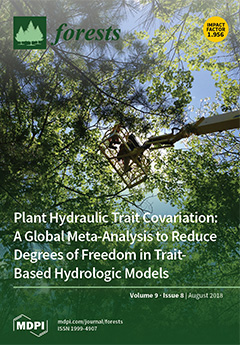
Cover Story: Cover Image: Canopy traits are integral the study of trees and forest ecosystem function, but can be notoriously difficult to assess, often due to challenges inherent in reaching the treetops of established stands. Ecohydrology students at the University of Michigan Biological Station take advantage of a ‘zero-emissions’ battery operated canopy lift to assess physiological and morphological traits of leaves and branches in a 100 year old temperate deciduous forest. Trait observations like these are compiled across multiple ecosystems in the article “Plant Hydraulic Trait Covariation: A Global Meta-Analysis to Reduce Degrees of Freedom in Trait-Based Hydrologic Models.” The cross-trait relationships observed in this work can be used to simplify hydraulically based models of transpiration and root water uptake. While newly developed statistical models relating different trait combinations, or hydraulic strategies, to drought vulnerability can be used as a benchmark for model skill.
  • Issues are regarded as officially published after their release is announced to the table of contents alert mailing list .
  • You may sign up for email alerts to receive table of contents of newly released issues.
  • PDF is the official format for papers published in both, html and pdf forms. To view the papers in pdf format, click on the "PDF Full-text" link, and use the free Adobe Reader to open them.

Articles (63)

  • Article
  • Open Access
17 Citations
4,135 Views
16 Pages

3 August 2018

Pecan [Carya illinoinensis (Wangenh.) K. Koch] is a high-value fruit tree with a long juvenile period. The fruiting process of pecan seedlings can be largely accelerated through grafting. As non-coding small RNAs, plant miRNAs participate in various...

  • Article
  • Open Access
20 Citations
7,534 Views
17 Pages

3 August 2018

The article analyzes the relationships between landscape planning and forests in Italy with a specific focus on Tuscany. For the Tuscan region landscape represents a fundamental value from the cultural, economic, environmental and social point of vie...

  • Article
  • Open Access
33 Citations
6,109 Views
12 Pages

Spatial Variation in Canopy Structure across Forest Landscapes

  • Brady S. Hardiman,
  • Elizabeth A. LaRue,
  • Jeff W. Atkins,
  • Robert T. Fahey,
  • Franklin W. Wagner and
  • Christopher M. Gough

3 August 2018

Forest canopy structure (CS) controls many ecosystem functions and is highly variable across landscapes, but the magnitude and scale of this variation is not well understood. We used a portable canopy LiDAR system to characterize variation in five ca...

  • Review
  • Open Access
56 Citations
6,636 Views
20 Pages

Incorporating Insect and Wind Disturbances in a Natural Disturbance-Based Management Framework for the Boreal Forest

  • Louis De Grandpré,
  • Kaysandra Waldron,
  • Mathieu Bouchard,
  • Sylvie Gauthier,
  • Marilou Beaudet,
  • Jean-Claude Ruel,
  • Christian Hébert and
  • Daniel D. Kneeshaw

2 August 2018

Natural disturbances are fundamental to forest ecosystem dynamics and have been used for two decades to improve forest management, notably in the boreal forest. Initially based on fire regimes, there is now a need to extend the concept to include oth...

  • Article
  • Open Access
28 Citations
4,606 Views
16 Pages

Qualitative Assessment of Forest Ecosystem Services: The Stakeholders’ Point of View in Support of Landscape Planning

  • Isabella De Meo,
  • Maria Giulia Cantiani,
  • Fabrizio Ferretti and
  • Alessandro Paletto

1 August 2018

In the last decades, the ecosystem services (ES) concept has become one of the main challenges of study and discussion in the scientific community. The quantitative and qualitative assessment of ES is as a tool to address forest management planning o...

  • Article
  • Open Access
3 Citations
3,681 Views
13 Pages

Provenance Variation in Pinus palustris Foliar δ13C

  • Lisa Samuelson,
  • Kurt Johnsen,
  • Tom Stokes,
  • Peter Anderson and
  • C. Dana Nelson

1 August 2018

Longleaf pine forests are currently being restored in the southern U.S. To aid in the deployment of longleaf pine under current and future climate conditions, we tested the hypothesis that genetic variability in foliar carbon isotope composition (&de...

  • Review
  • Open Access
20 Citations
5,501 Views
17 Pages

State of the Art on the Use of Trees as Supports and Anchors in Forest Operations

  • Luca Marchi,
  • Stefano Grigolato,
  • Omar Mologni,
  • Roberto Scotta,
  • Raffaele Cavalli and
  • Lucio Montecchio

1 August 2018

Tree stability assessment is fundamental to preserve the safety of both people and goods. This topic attributes high relevance to cable-supported harvesting where trees and stumps are used as supporting and anchoring elements. In this case, the appli...

  • Article
  • Open Access
11 Citations
4,447 Views
19 Pages

Orchestrating Forest Policy in Italy: Mission Impossible?

  • Laura Secco,
  • Alessandro Paletto,
  • Raoul Romano,
  • Mauro Masiero,
  • Davide Pettenella,
  • Francesco Carbone and
  • Isabella De Meo

1 August 2018

In the Italian political and economic agenda the forest sector occupies a marginal role. The forest sector in Italy is characterized by a high institutional fragmentation and centralized decision-making processes dominated by Public Forest Administra...

  • Article
  • Open Access
11 Citations
4,897 Views
19 Pages

Genetic Variation of European Beech Populations and Their Progeny from Northeast Germany to Southwest Switzerland

  • Markus Müller,
  • Laura Cuervo-Alarcon,
  • Oliver Gailing,
  • Rajendra K.C.,
  • Meena Suyal Chhetri,
  • Sarah Seifert,
  • Matthias Arend,
  • Konstantin V. Krutovsky and
  • Reiner Finkeldey

1 August 2018

Climate change can adversely affect the growth of European beech (Fagus sylvatica L.) across its entire distribution range. Therefore, knowledge of the adaptive potential of this species to changing climatic conditions is of foremost importance. Gene...

  • Article
  • Open Access
16 Citations
5,841 Views
23 Pages

1 August 2018

Forests are a key player within the global carbon cycle and reforestation is an important climate change mitigation mechanism. In this study, we identify potentially suitable areas for reforestation to assess the carbon sequestration potential in the...

of 7

Get Alerted

Add your email address to receive forthcoming issues of this journal.

XFacebookLinkedIn
Forests - ISSN 1999-4907