


Abstract
Plants associated with arbuscular mycorrhizal (AM) and ectomycorrhizal (ECM) fungi exhibit distinct strategies for acquiring phosphorus (P), yet how these strategies respond to increased soil P availability remains poorly understood. We investigated how P addition altered rhizosphere P fractions, root-derived organic acids, and microbial PLFA groups in representative AM and ECM tree species in a subtropical region. Under control conditions, rhizosphere soils planted with AM tree species contained greater bacterial and actinomycete PLFA abundances, whereas those of ECM tree species had higher organic acid concentrations and fungal-to-bacterial PLFA ratios. These patterns indicated greater reliance on bacteria-associated processes in AM species and on fungal activity and root-derived organic acids in ECM species for rhizosphere P mobilization. The P addition increased most rhizosphere soil P fractions but markedly decreased most organic acids in both mycorrhizal types. In contrast, bacterial abundances showed no significant response to P addition. These shifts indicated that increased soil P availability reduced the relative reliance on root-derived P mobilization and increased the potential reliance on readily available soil P. Nevertheless, AM tree species remained more strongly associated with inorganic P pools, whereas ECM tree species retained greater potential for organic P mobilization. Our results highlight contrasting rhizosphere P mobilization strategies between AM and ECM tree species and demonstrate that these strategies shift with soil P availability, providing new insights into mycorrhizal regulation of rhizosphere P cycling.
1. Introduction
Phosphorus (P) is one of the major nutrients limiting plant growth and terrestrial ecosystem productivity, particularly in tropical and subtropical regions [1]. In acidic soils, P is readily adsorbed and immobilized by iron and aluminum oxides or converted into relatively stable organic and occluded P forms, resulting in low soil P availability. Forest soils in the lower subtropical regions of China are generally characterized by high nitrogen but low P availability, and the growth of plants and microorganisms is frequently limited by P [2,3,4,5].
Plants have developed different strategies to improve P acquisition, including adjustments in root traits, the formation of mycorrhizal associations, the release of root-derived organic acids, and the regulation of rhizosphere microbial communities [6]. Among these strategies, low-molecular-weight organic acids can promote the mobilization of insoluble P through rhizosphere acidification, metal complexation, and ligand exchange. Rhizosphere microorganisms can also regulate soil P availability through organic matter decomposition, P mineralization, and microbial biomass P turnover. In addition, root-derived organic acids provide carbon substrates for rhizosphere microorganisms and influence soil P transformations by altering microbial activity and community composition [7]. Therefore, interactions between root-derived organic acids and rhizosphere microorganisms represent an important mechanism by which plants adapt to P-limited environments.
Arbuscular mycorrhizal (AM) and ectomycorrhizal (ECM) associations represent two major mycorrhizal types in forest ecosystems and are associated with contrasting nutrient acquisition and rhizosphere P mobilization pathways. AM tree species are generally associated with greater reliance on inorganic P uptake through roots and mycorrhizal hyphae, while rhizosphere bacteria may also contribute to P release through organic matter decomposition. In contrast, ECM tree species can promote the mineralization of organic P and the mobilization of mineral-bound P through the secretion of extracellular enzymes and low-molecular-weight organic acids by ectomycorrhizal fungi [8,9,10,11]. Consequently, the two mycorrhizal types may show contrasting responses in rhizosphere microbial composition, root-derived organic acids, and soil P fraction transformations [12].
Previous studies have focused on the relationships among root-derived organic acids, microbial communities, and soil P transformations under P-limited conditions [13,14]. Experimental P addition in temperate forests has also been shown to alter microbial processes associated with soil P availability, indicating that rhizosphere P-mobilization processes may respond to changes in P availability [15]. However, how interactions between root-derived organic acids and rhizosphere microorganisms respond to P addition remain poorly understood. It is also unclear whether these responses differ between AM and ECM tree species. With increasing soil P availability, plants may reduce their investment in biologically mediated P mobilization and rely more strongly on readily available soil P. Nevertheless, whether the responses of AM and ECM tree species are consistent remains unclear. By simultaneously examining soil P fractions, root-derived organic acids, and rhizosphere microbial PLFA groups across multiple AM and ECM tree species under different levels of P addition, this study provides a comparative framework for determining how P enrichment alters rhizosphere P-mobilization processes and whether these responses differ between the two mycorrhizal types. Given the use of PLFA analysis in this comparative framework, it is important to recognize that this approach is useful for comparing broad microbial groups across treatments, although its taxonomic resolution is limited and individual biomarkers may not be specific to particular microbial taxa or functional groups. Therefore, PLFA-based biomarkers, particularly those associated with mycorrhizal fungi, should be interpreted as relative indicators rather than taxon-specific quantitative measures.
In this study, we conducted a pot experiment using representative AM and ECM tree species from a subtropical region under control, medium P, and high P addition treatments. Over the course of one year, we collected soil samples at three time points and measured rhizosphere soil P fractions, root-derived organic acids, and microbial PLFA groups. The aim of this study was to determine how AM and ECM tree species differ in their rhizosphere P mobilization pathways and how these pathways respond to increasing P availability. We addressed the following questions: (1) How did AM and ECM tree species differ in their rhizosphere P mobilization pathways under the control treatment; and (2) How did P addition alter root-derived organic acids, microbial PLFA groups, and soil P fractions in the two mycorrhizal types? We hypothesized that (1) under the control treatment, AM tree species would show stronger bacteria-associated P mobilization, whereas ECM tree species would show stronger fungal- and organic acid-associated P mobilization; and (2) P addition would reduce the relative importance of root-derived organic acids and microbial processes in rhizosphere P mobilization in both mycorrhizal types. These hypotheses were based on contrasting mycorrhizal nutrient economies and on the expectation that readily available P reduces carbon investment in P acquisition [8,10,11].
2. Materials and Methods
2.1. Site Description
2.1.1. Soil Collection
The soil used in this pot experiment was collected from the Heshan National Field Research Station of Forest Ecosystem, Chinese Academy of Sciences (22.41° N, 112.54° E), located in the hilly region of central Guangdong Province in southern subtropical China. The region has a subtropical monsoon climate, with a mean annual temperature of 22.5 °C and mean annual precipitation of approximately 1700 mm [16]. The soil is classified as lateritic red soil and the dominant vegetation type is subtropical evergreen broad-leaved forest [17]. Specifically, the soil was collected from a secondary evergreen broad-leaved forest restored for more than 30 years, in which the dominant tree species included Schima superba Gardner & Champ., Castanopsis hystrix Miq., Michelia macclurei Dandy., and Cinnamomum burmanni (Nees & T.Nees) Blume [18]. The coexistence of tree species associated with different mycorrhizal types suggests that propagules of both AM and ECM fungi may have been present in the collected soil.
The physicochemical properties of the surface soil collected from a depth of 0–30 cm were as follows: pH, 4.17; total carbon (TC), 11.53 g kg−1; total nitrogen (TN), 0.75 g kg−1; total phosphorus (TP), 0.21 g kg−1; nitrate nitrogen (NO3−–N), 3.91 mg kg−1; ammonium nitrogen (NH4+–N), 10.64 mg kg−1; and available phosphorus (AP), 1.32 mg kg−1.
2.1.2. Experimental Design
A 12-month greenhouse pot experiment was conducted in the research area of the South China Botanical Garden, Chinese Academy of Sciences, Guangzhou, China (23.16° N, 113.35° E). One-year-old seedlings of representative tree species from southern subtropical China with contrasting mycorrhizal associations were selected, including two arbuscular mycorrhizal (AM) tree species, Camphora officinarum Boerh. ex Fabr. [19] and Michelia macclurei [20], and three ectomycorrhizal (ECM) tree species, Syzygium rehderianum Merr. & L.M.Perry [21], Castanopsis fissa (Champ. ex Benth.) Rehder & E.H.Wilson, and Castanopsis hystrix [20]. These mycorrhizal classifications were based on previous studies [19,20,21] and were further supported by observations of mycorrhizal colonization before the experiment.
In May 2021, one seedling was transplanted into each pot (30 cm in diameter and 26 cm in height) containing 8 kg of soil. Each pot was labeled and placed on a tray. After a one-month acclimation period, three P treatments were applied from June 2021 to May 2022. The unamended soil collected from the Heshan station represented the low-P condition and was used as the control treatment (CK). The two P-addition treatments comprised a medium-P treatment (MP, 7.5 g P m−2 year−1, equivalent to 75 kg P ha−1 year−1) and a high-P treatment (HP, 15 g P m−2 year−1, equivalent to 150 kg P ha−1 year−1). Given the limited pot volume and the relatively short experimental duration, these P-addition levels were selected with reference to P-addition rates used in tropical and subtropical regions [22]. Each species × treatment combination initially included 16 replicates arranged in randomized blocks, of which 12 were used for the three destructive harvests and four were retained as reserve plants.
Sodium dihydrogen phosphate (NaH2PO4; Guangdong Guanghua Sci-Tech Co., Ltd., Shantou, China) was used as the P source. For the MP and HP treatments, 64.99 g and 129.6 g of NaH2PO4, respectively, were separately dissolved in 28.8 L of water. Each pot received 300 mL of the corresponding NaH2PO4 solution twice per month from June 2021 to May 2022, whereas CK pots received an equivalent volume of purified water. Soil moisture was monitored using a TDR300 soil moisture meter (Soil Moisture Equipment, Santa Barbara, CA, USA), and additional water was supplied as needed based on the measured soil moisture to maintain the soil at approximately 70% of field water-holding capacity.
Destructive sampling was conducted after 3, 6, and 12 months of P addition, in September 2021, December 2021, and June 2022, respectively. At each sampling time, four seedlings of each species were randomly harvested from each treatment, yielding 60 seedlings per harvest and 180 seedlings in total.
2.2. Sampling and Sample Preparation
Rhizosphere soil was collected using the root-shaking method [23]. After the seedlings were removed from the pots, loosely adhering bulk soil was removed by gently shaking the roots, and the soil remaining attached to the root surface was carefully collected with a brush as rhizosphere soil. The collected rhizosphere soil was then divided into subsamples and stored at 4 °C for physicochemical analyses, at −20 °C for phospholipid fatty acid analysis, or air-dried, ground, passed through a 100-mesh sieve, and sealed for soil P fractionation.
2.3. Sample Measurements and Analyses
2.3.1. Soil Phosphorus Fractions
Soil P fractions were determined using a modified sequential extraction method for acidic soils [24,25]. Briefly, 3 g of air-dried soil was sequentially extracted with 1.0 M NH4Cl, 0.1 M NH4F, 0.1 M NaOH, and 0.5 M H2SO4 to obtain soluble P, Al-bound P, Fe-bound P, and Ca-bound P, respectively. The NH4Cl extraction was conducted for 30 min, whereas the remaining extractions were performed for 16 h. After each extraction, samples were centrifuged at 10,000 rpm for 10 min at 4 °C and filtered through 0.45 μm membranes.
Inorganic P (Pi) in the NH4F and NaOH extracts was measured directly, whereas organic P (Po) was calculated as the difference between total and inorganic P. The residual soil was used to determine occluded inorganic and total P before and after ignition at 550 °C, and occluded organic P was calculated by difference. Moderately labile inorganic P was calculated as Al-Pi (aluminum-bound inorganic phosphorus) + Fe-Pi (iron-bound inorganic phosphorus), whereas moderately labile organic P was calculated as Al-Po (aluminum-bound organic phosphorus) + Fe-Po (iron-bound organic phosphorus). Phosphorus concentrations were determined using ICP-OES (Optima 2000 DV, PerkinElmer, Waltham, MA, USA) and are reported on an air-dried soil mass basis in mg P kg−1 soil.
2.3.2. Organic Acids
To minimize microbial degradation during collection of root-derived organic acids, the first three root orders, which were predominantly absorptive roots and generally less than 2 mm in diameter, were used for organic acid collection. They were immersed in 500 mL of thymol solution for 6 h after each destructive harvest. These absorptive roots are considered the most active in exudation. Subsequently, 200 mL of the collection solution was concentrated to 5 mL for analysis.
Low-molecular-weight organic acids were quantified by high-performance liquid chromatography (Agilent 1260 Infinity, Agilent Technologies, Santa Clara, CA, USA) using a reversed-phase C18 column (XSelect HSS T3, 250 × 4.6 mm, 5 μm; Waters Corporation, Milford, MA, USA). The mobile phase was 20 mM KH2PO4 buffer adjusted to pH 2.73, delivered at 0.5 mL min−1. Detection was performed at 210 nm, with the column maintained at 30 °C and an injection volume of 10 μL. Oxalic, tartaric, malic, malonic, and citric acids were identified and quantified using calibration curves prepared from the corresponding standards [26]. Root-derived organic acids that were not detected were recorded as zero and retained as zero in the statistical analyses.
2.3.3. Microbial PLFA Groups
Soil microbial PLFA groups were determined using phospholipid fatty acid (PLFA) analysis [27]. Lipids were extracted from 8 g of freeze-dried soil using a phosphate buffer–chloroform–methanol mixture (5:6:12, v/v/v), separated by solid-phase extraction, and methylated to fatty acid methyl esters. The extracts were analyzed using a gas chromatograph (Agilent GC7890A, Agilent Technologies, Santa Clara, CA, USA) coupled with the MIDI microbial identification system. Individual PLFAs were quantified using 19:0 as an internal standard and expressed as nmol g−1 dry soil [28].
Microbial groups were assigned according to the biomarker PLFAs listed in Table 1. The biomarkers 16:1ω5c and 18:2ω6c were treated as putative AMF-associated and ECMF-associated PLFA indicators, respectively. Given the limited taxonomic specificity of these biomarkers, particularly 18:2ω6c, which may also occur in non-ectomycorrhizal fungi, they were interpreted as relative PLFA indicators rather than as direct quantitative measures of arbuscular mycorrhizal fungal or ectomycorrhizal fungal abundance. The G+/G− and F/B ratios were calculated from the corresponding biomarker abundances [29].
Table 1.
PLFAs detected in this study and their microbial classifications.
2.4. Statistical Analysis
All statistical analyses were performed using R version 4.2.3. Data were log-transformed when necessary to meet the assumptions of normality and homogeneity of variances. Linear mixed-effects models, with mycorrhizal type and P treatment as fixed effects and tree species, block, and sampling time (September 2021, December 2021, and June 2022) as random effects, were used to examine the effects of mycorrhizal type, P treatment, and their interaction on soil P fractions, root-derived organic acids, and microbial PLFA abundances and ratios. Post hoc pairwise comparisons between AM and ECM tree species within the same P treatment were conducted using independent-samples t-tests when a significant main effect was detected in the mixed-effects model. Multiple comparisons among the three P-addition treatments were performed using Tukey’s HSD test. Linear mixed-effects models were fitted using the lme4 and lmerTest packages [36,37], and post hoc comparisons were conducted using the emmeans package [38]. Moreover, to assess whether the AM–ECM comparisons were disproportionately influenced by the inclusion of two congeneric Castanopsis species, sensitivity analyses were conducted by repeating the original linear mixed-effects analyses after excluding either Castanopsis fissa or Castanopsis hystrix separately, while retaining the same fixed- and random-effects structure.
Pearson correlation and simple linear regression analyses were used to examine the relationships between soil available P concentration and root-derived low-molecular-weight organic acid concentrations. Linear regression analyses were conducted using the car package [39], and Pearson correlation coefficients were calculated using the Hmisc package. The results were visualized using the ggplot2 package [40].
In all analyses, effects were considered significant at p < 0.05.
3. Results
3.1. Effects of P Addition on Rhizosphere Soil P Fractions in AM and ECM Tree Species
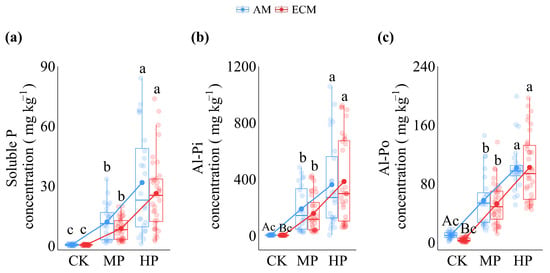
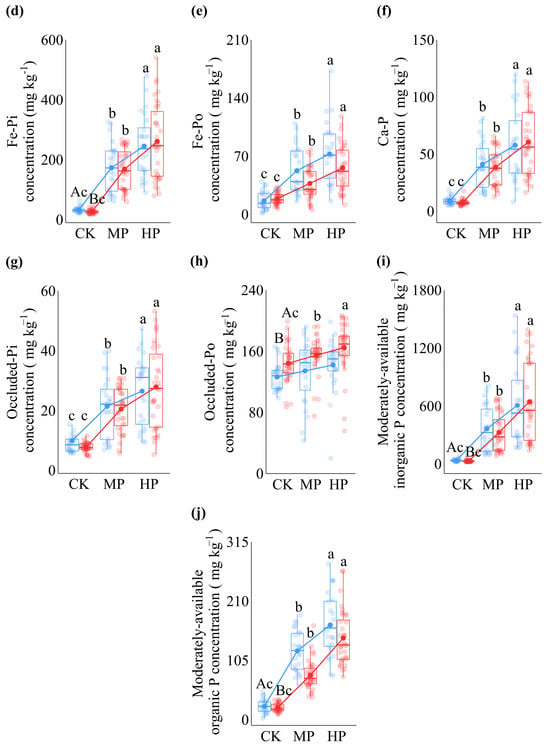
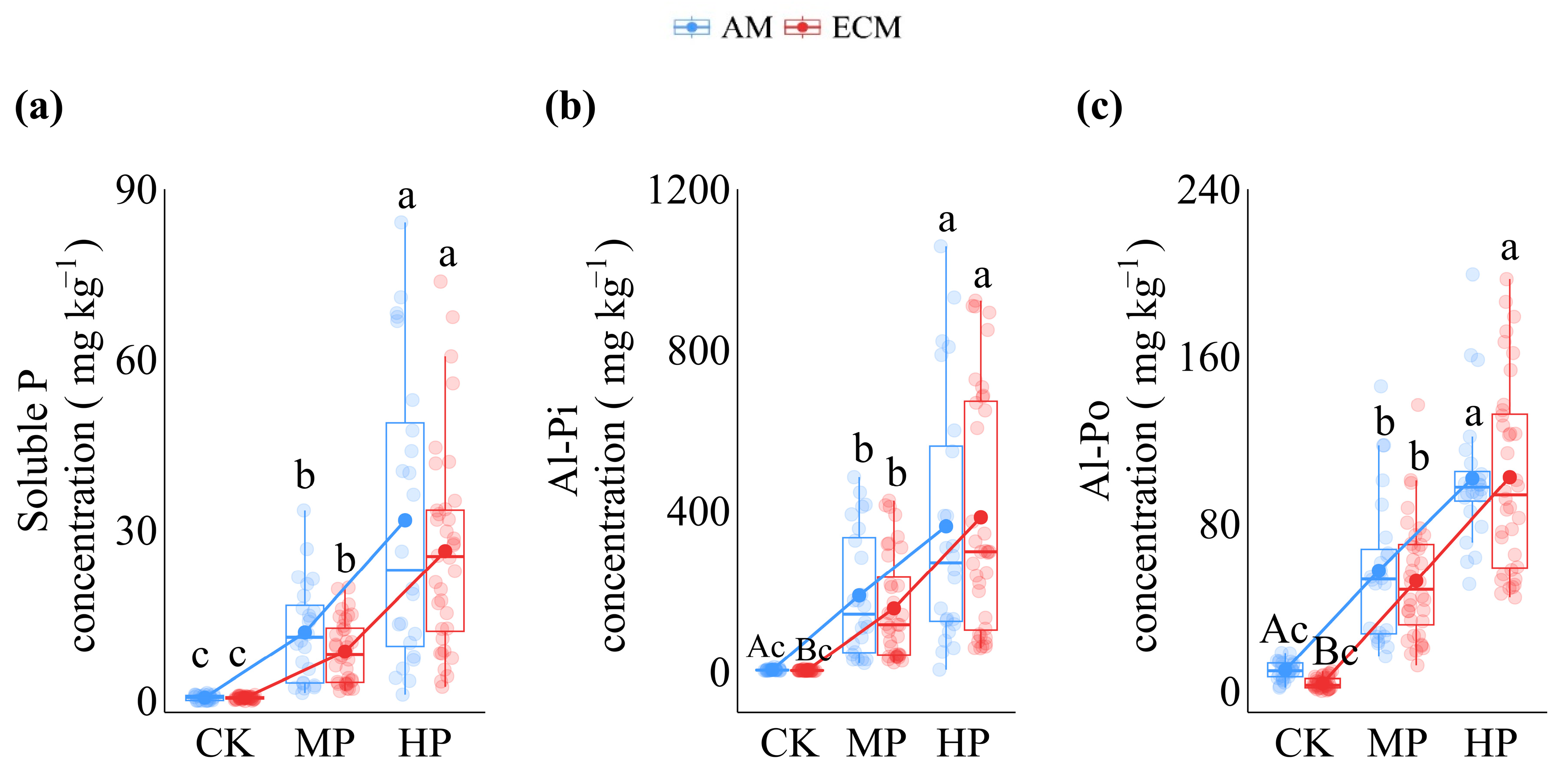
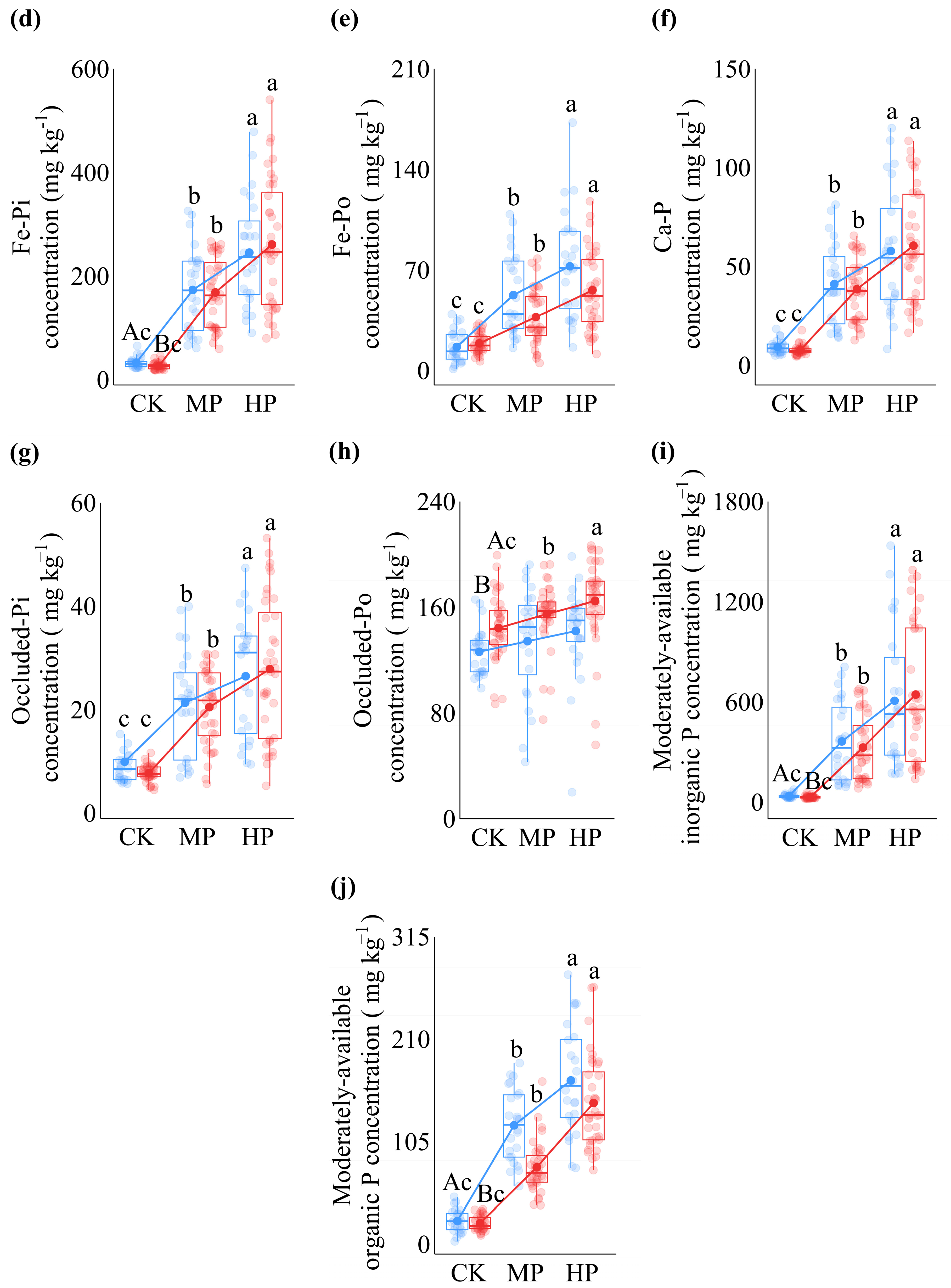
As shown in Figure 1, under the control treatment, the concentrations of aluminum-bound inorganic P (Al-Pi), aluminum-bound organic P (Al-Po), iron-bound inorganic P (Fe-Pi), moderately labile inorganic P, and moderately labile organic P were significantly higher in the rhizosphere soils of AM tree species than in those of ECM tree species. The concentration of occluded organic P (Occluded-Po) was also significantly higher in the rhizosphere soils of AM tree species than in those of ECM tree species (p < 0.05). No significant differences were observed between AM and ECM tree species in the concentrations of soluble P, iron-bound organic P (Fe-Po), calcium-bound P (Ca-P), or occluded inorganic P (Occluded-Pi).
Figure 1.
Effects of P addition on rhizosphere soil P fractions in AM and ECM tree species. Note: CK, control treatment; MP, medium P addition treatment; HP, high P addition treatment. (a) Soluble P, soluble phosphorus; (b) Al-Pi, aluminum-bound inorganic phosphorus; (c) Al-Po, aluminum-bound organic phosphorus; (d) Fe-Pi, iron-bound inorganic phosphorus; (e) Fe-Po, iron-bound organic phosphorus; (f) Ca-P, calcium phosphorus; (g) Occluded-Pi, occluded inorganic phosphorus; (h) Occluded-Po, occluded organic phosphorus; (i) Moderately-available inorganic P concentration; (j) Moderately-available organic P concentration. Different lowercase letters indicate significant differences among P treatments within the same mycorrhizal type, as determined by Tukey’s HSD test. Different capital letters indicate significant differences between AM and ECM tree species within the same P treatment, as determined by independent-samples t-tests (p < 0.05). Error bars indicate standard errors (AM, n = 24; ECM, n = 36).
Compared with the control treatment, P addition significantly increased the concentrations of soluble P, Al-Pi, Al-Po, Fe-Pi, Fe-Po, Ca-P, Occluded-Pi, moderately labile inorganic P, and moderately labile organic P in the rhizosphere soils of both AM and ECM tree species, whereas no significant increase was observed in Occluded-Po. The increases in moderately labile organic P under both the medium and high P addition treatments were greater in the rhizosphere soils of AM tree species than in those of ECM tree species. Moreover, the concentration of moderately labile organic P was consistently higher in the rhizosphere soils of AM tree species than in those of ECM tree species under each treatment.
3.2. Changes in Root-Derived Organic Acids and Their Relationships with Soil Available Phosphorus Concentration
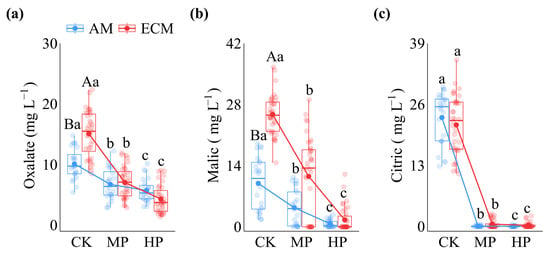
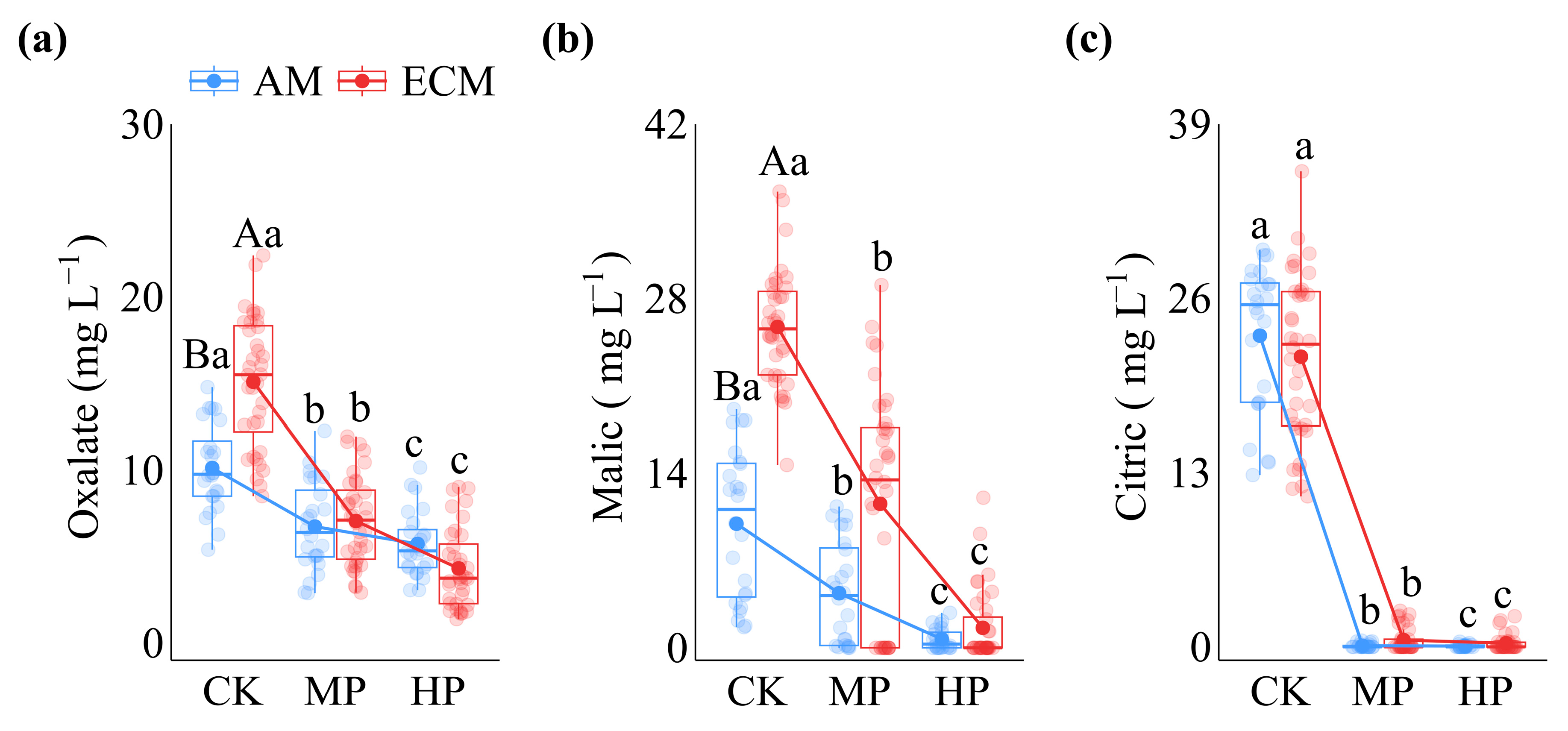
Under the control treatment, the concentrations of oxalic acid, tartaric acid, malic acid, and malonic acid in the root exudate collection solutions from ECM tree species were significantly higher than those from AM tree species (p < 0.05), whereas no significant difference in citric acid concentration was observed between the two mycorrhizal types (Figure 2 and Table 2). Compared with the control treatment, the concentrations of oxalic acid, malic acid, and citric acid in the collection solutions from ECM tree species decreased significantly by 53% and 71%, 55% and 94%, and 98% and 99% under the medium and high P addition treatments, respectively. Similar reductions in the concentrations of these three organic acids were observed in the collection solutions from AM tree species (p < 0.05).
Figure 2.
Effects of P addition on oxalic acid, malic acid, and citric acid concentrations in AM and ECM tree species. Note: CK, control treatment; MP, medium P addition treatment; HP, high P addition treatment. (a) oxalate acid; (b) malic acid; (c) citric acid. Different lowercase letters indicate significant differences among P treatments within the same mycorrhizal type, as determined by Tukey’s HSD test. Different capital letters indicate significant differences between AM and ECM tree species within the same P treatment, as determined by independent-samples t-tests (p < 0.05). Error bars indicate standard errors (AM, n = 24; ECM, n = 36).
Table 2.
Effects of P addition on tartaric acid and malonic acid concentrations in AM and ECM tree species.
The concentration of tartaric acid in the collection solutions from ECM tree species under the high-P addition treatment was below the detection limit. Compared with the control treatment, tartaric acid concentration also decreased significantly under the medium-P addition treatment (p < 0.05). Similarly, tartaric acid concentrations in the collection solutions from AM tree species under both the medium- and high-P addition treatments were below the detection limit. For malonic acid, concentrations were below the detection limit in the collection solutions from AM tree species under the high-P addition treatment and in those from ECM tree species under both the medium and high P addition treatments. These concentrations were therefore significantly lower than those under the control treatment (p < 0.05).
As shown in Table 3, Pearson correlation analyses between soil available P concentration and low-molecular-weight organic acids, including oxalic, tartaric, malic, malonic, and citric acids, indicated that soil available P concentration was significantly negatively correlated with all measured organic acids in both AM and ECM tree species, except for oxalic and tartaric acids in AM tree species (p < 0.05). Overall, the correlation coefficients between low-molecular-weight organic acid concentrations and soil available P concentration were generally stronger in ECM tree species than in AM tree species. These correlations suggest that root-derived organic acids may be more closely associated with changes in soil available P in ECM tree species than in AM tree species.
Table 3.
Pearson correlations between soil available P concentration and root-derived organic acid concentrations.
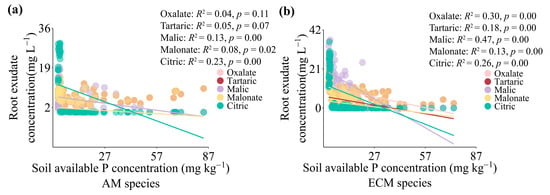
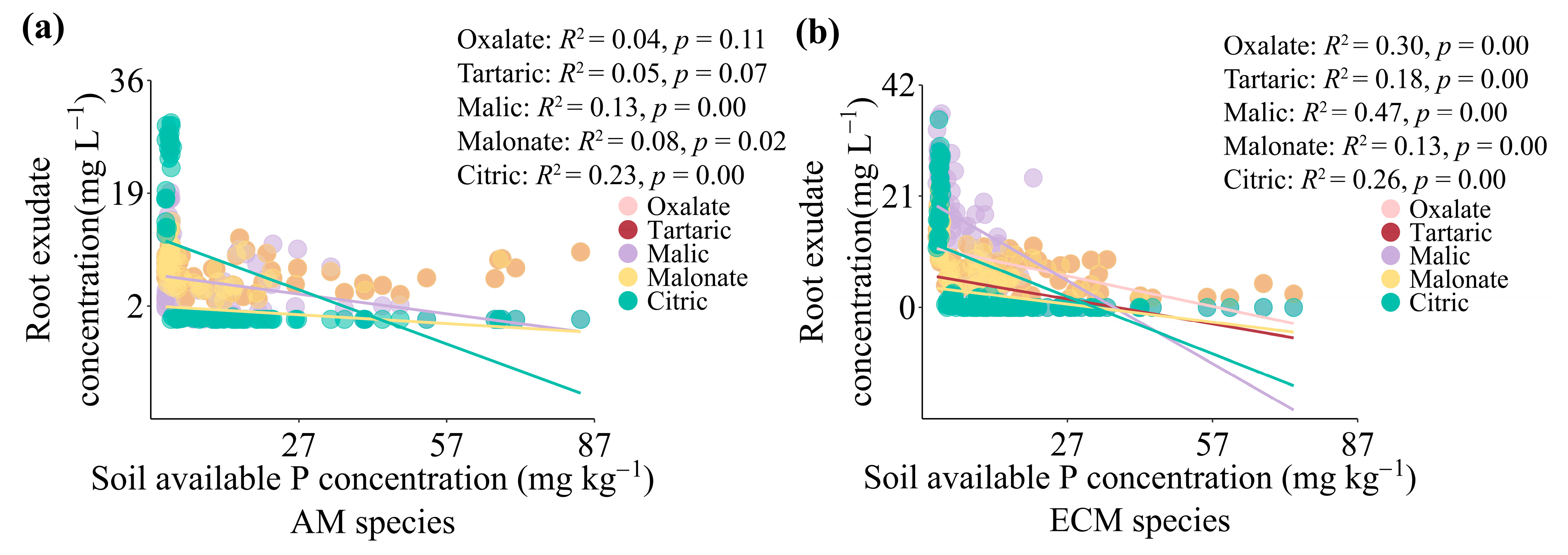
The simple linear regression results shown in Figure 3 further demonstrated that the concentrations of malic, malonic, and citric acids in AM tree species decreased significantly with increasing soil available P concentration (p < 0.05), whereas oxalic and tartaric acids showed no significant linear relationships with soil available P concentration. In ECM tree species, the concentrations of oxalic, tartaric, malic, malonic, and citric acids all decreased significantly with increasing soil available P concentration (p < 0.05).
Figure 3.
Linear regression models of soil available P concentration against organic acid concentrations in AM and ECM tree species. Note: Colored lines and dots represent significant linear relationships for different root-derived organic acids (Malic acid, Tartaric acid, Oxalic acid, Citric acid, and Malonic acid), as indicated by the legend. (p < 0.05). Pane (a) represents AM tree species; Pane (b) represents ECM tree species. Different colors represent different root-derived organic acids.
3.3. Effects of Phosphorus Addition on Soil Microbial PLFA Groups of AM and ECM Tree Species
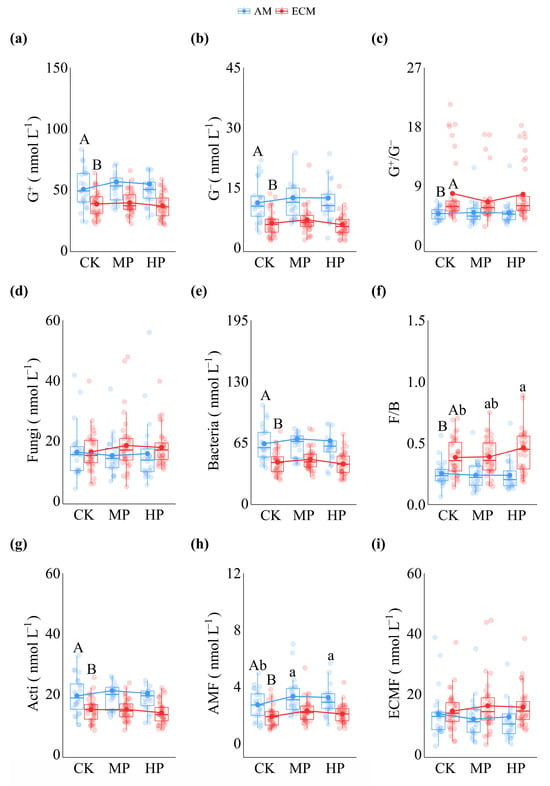
For bacterial PLFA groups, as shown in Figure 4, under the control treatment, the abundances of Gram-positive bacteria (G+), Gram-negative bacteria (G−), total bacteria, and actinomycetes were significantly higher in the rhizosphere soils of AM tree species than in those of ECM tree species. In contrast, the ratio of Gram-positive to Gram-negative bacteria (G+/G−) was significantly higher in ECM tree species than in AM tree species (p < 0.05).
Figure 4.
Effects of P addition on microbial PLFA groups in AM and ECM tree species. Note: CK, control treatment; MP, medium P addition treatment; HP, high P addition treatment. (a) G+, Gram-positive bacteria; (b) G−, Gram-negative bacteria; (c) G+/G−, Gram-positive/Gram-negative bacteria ratio; (d) Fungi; (e) Bacteria; (f) F/B, fungi/bacteria ratio; (g) Acti, actinomycetes; (h) AMF, AMF-associated PLFA indicator; (i) ECMF, ECMF-associated PLFA indicator. Different lowercase letters indicate significant differences among treatments, while different capital letters indicate differences between AM and ECM tree species (p < 0.05). Error bars indicate standard errors (AM, n = 24; ECM, n = 36).
Compared with the control treatment, P addition had no significant effects on the abundances of G+, G−, total bacteria, or actinomycetes, or on the G+/G− ratio in either AM or ECM tree species. These results indicated that P addition did not significantly alter the bacterial PLFA groups associated with either mycorrhizal type.
For fungal PLFA groups, as shown in Figure 4, under the control treatment, the abundance of the AMF-associated PLFA indicator was significantly higher in AM tree species than in ECM tree species, whereas the fungal-to-bacterial ratio (F/B) was significantly lower in AM tree species (p < 0.05). No significant differences in total fungal PLFA abundance or the ECMF-associated PLFA indicator were observed between AM and ECM tree species.
Compared with the control treatment, P addition significantly increased the abundance of the AMF-associated PLFA indicator in AM tree species (p < 0.05), but had no significant effect on this indicator in ECM tree species. Moreover, the increase in the AMF-associated PLFA indicator under P addition was greater in AM tree species than in ECM tree species. The medium P addition treatment did not significantly increase the F/B ratio in ECM tree species and had no significant effect on this ratio in AM tree species.
Notably, although P addition had no significant effect on the ECMF-associated PLFA indicator in either mycorrhizal type, the abundance of this indicator tended to decrease in AM tree species under the medium and high P addition treatments compared with the control, whereas it tended to increase in ECM tree species.
3.4. Sensitivity Analysis
Sensitivity analyses excluding either Castanopsis fissa or Castanopsis hystrix separately showed that the main AM–ECM patterns were generally robust. The higher concentrations of oxalic, tartaric, malic, and malonic acids in ECM tree species, the higher total bacterial PLFA abundance in AM tree species, and the higher fungal-to-bacterial PLFA ratio in ECM tree species remained significant in both sensitivity analyses. However, some individual comparisons were less robust after the exclusion of C. hystrix. Specifically, the differences in Fe-bound inorganic P, G+, G−, and Acti between AM and ECM tree species became nonsignificant after excluding C. hystrix (p = 0.255, 0.113, 0.089, and 0.131, respectively). Overall, these sensitivity analyses indicate that the main organic acid and microbial patterns were not driven solely by the inclusion of the two congeneric Castanopsis species, although some individual comparisons were sensitive to reduced species representation.
4. Discussion
4.1. Contrasting Rhizosphere P Mobilization Pathways of AM and ECM Tree Species Under the Control Treatment
For ECM tree species, the concentrations of oxalic, malic, tartaric, and malonic acids were significantly higher than those of AM tree species under the control treatment. These low-molecular-weight organic acids may enhance soil P availability by complexing Fe3+ and Al3+ and promoting ligand exchange, thereby mobilizing mineral-bound inorganic P into orthophosphate available for plant uptake [41,42]. Fungi are generally better adapted than bacteria to soils containing abundant insoluble compounds and can release low-molecular-weight organic acids that facilitate soil P mobilization [11,43,44]. Fungal communities may also exhibit greater resistance to environmental disturbance and form more complex interaction networks than bacterial communities, potentially contributing to the maintenance and recovery of soil nutrient cycling under changing environmental conditions [45]. In addition, extracellular phosphatases can contribute to organic P mobilization by hydrolyzing organic P compounds and may represent an important pathway of P acquisition associated with ECM fungi [46]. Because phosphatase activity was not included in the analyses presented here, its contribution to the observed patterns cannot be directly evaluated. Our results also showed that the rhizosphere soils of ECM tree species exhibited a higher fungal-to-bacterial ratio but a lower concentration of moderately labile organic P than those of AM tree species. These results were consistent with greater fungal involvement in rhizosphere P cycling and potentially stronger mobilization of moderately labile organic P under the control treatment. Root-derived organic acids and fungal activity may reinforce one another: greater exudate inputs could supply carbon substrates that supported fungal growth, whereas enhanced fungal activity may further stimulate the release of low-molecular-weight organic acids [9]. Together, these patterns suggested that coordinated interactions between root-derived organic acids and rhizosphere fungi may represent an important pathway through which ECM tree species enhanced rhizosphere P mobilization under P-limited conditions [10].
For AM tree species, under the control treatment, the abundances of Gram-positive bacteria, Gram-negative bacteria, and actinomycetes were significantly higher than those in ECM tree species, whereas soil organic carbon (SOC) concentration was significantly lower (unpublished data). These results suggested a potentially greater involvement of bacteria-associated processes in rhizosphere organic matter decomposition and P mobilization in AM tree species. This bacteria-associated pathway differed from the fungal- and root-derived organic acid-associated P mobilization pathway observed in ECM tree species under the control treatment [47,48]. Rhizosphere-associated bacteria play important roles in nutrient cycling by contributing to organic matter decomposition and C, N, and P transformations, including through the production of extracellular enzymes involved in carbon decomposition and N and P acquisition [49,50]. These functions may facilitate nutrient mobilization and availability in the rhizosphere.
Taken together, these results supported our first hypothesis that AM and ECM tree species differed in their dominant rhizosphere P mobilization pathways under the control treatment. AM tree species showed stronger associations with bacteria-associated P mobilization, whereas ECM tree species showed stronger associations with fungal activity and root-derived organic acids. Sensitivity analyses generally supported these contrasting P mobilization patterns after the separate exclusion of either Castanopsis fissa or Castanopsis hystrix.
4.2. Effects of P Addition on Rhizosphere P Mobilization Pathways in AM and ECM Tree Species
Compared with the control treatment, both medium and high P addition significantly increased the concentrations of soil organic and inorganic P fractions in the rhizosphere soils of AM and ECM tree species. Phosphorus addition markedly reduced root-derived organic acid concentrations in both mycorrhizal types but had limited effects on the microbial PLFA groups measured in ECM tree species and the bacterial PLFA groups measured in AM tree species. The pronounced decline in organic acid concentrations suggested that organic acid-associated P mobilization became less important under elevated P availability, which may have partly contributed to the accumulation of some soil organic P fractions.
For ECM tree species, with increasing P addition, the increases in soil available P and moderately labile organic P concentrations were generally smaller in the rhizosphere soils of ECM tree species than in those of AM tree species. Notably, although P addition increased both moderately labile organic and inorganic P concentrations in AM and ECM tree species, the magnitude of increase differed between the two mycorrhizal types. The rhizosphere soils of ECM tree species exhibited a smaller increase in moderately labile organic P than those of AM tree species, whereas AM tree species showed a smaller increase in moderately labile inorganic P. This pattern suggested that, even under P addition, the two mycorrhizal types continued to influence inorganic and organic soil P pools differently [51,52].
Under the control treatment, ECM tree species exhibited higher concentrations and a greater range of low-molecular-weight organic acids than AM tree species. These organic acids may enhance soil P availability by interacting with Fe- and Al-bearing minerals and reducing phosphate adsorption and fixation [53,54,55,56]. In addition, the higher F/B ratio and lower concentration of moderately labile organic P in ECM tree species were consistent with a potentially greater fungal contribution to organic P mobilization. Many fungal taxa could access relatively complex organic P compounds and may contribute substantially to organic P mineralization in acidic forest soils [57]. Together, these patterns suggest that ECM tree species were more strongly associated with fungal- and organic acid-associated rhizosphere P mobilization under the control treatment, consistent with the organic nutrient economy proposed by the mycorrhizal-associated nutrient economy framework [8].
Phosphorus addition significantly reduced the concentrations of most low-molecular-weight organic acids released by ECM tree species but had no significant effect on the abundances of the fungal or bacterial PLFA groups measured. Because root-derived organic acids can stimulate microbial activity and facilitate nutrient exchange under P-limited conditions [11,58], their marked decline under P addition suggests a reduced dependence of ECM tree species on exudate-mediated P mobilization. The contrasting responses of root-derived organic acids and microbial PLFA groups suggested that the relative importance of biologically associated P-mobilization processes may have declined as P availability increased. Collectively, these results suggested that ECM tree species reduced their investment in organic acid-associated P mobilization as soil P availability increased and may consequently have relied more strongly on readily available soil P, consistent with previous findings from subtropical forests dominated by ECM tree species [59].
Under the control treatment, AM tree species had significantly greater abundances of Gram-positive bacteria, Gram-negative bacteria, and actinomycetes than ECM tree species, despite having lower soil organic carbon concentrations. This pattern suggested a potentially greater involvement of bacteria-associated processes in rhizosphere organic matter decomposition and P mobilization in AM tree species. Plant-derived carbon inputs may have contributed to sustaining these bacteria-associated processes and promoting the release of available P [48,49]. However, the rhizosphere soils of AM tree species also contained higher concentrations of moderately labile organic P. This difference may reflect contrasting microbial groups and root-derived organic acid release between the two mycorrhizal types. Although AM tree species had a greater abundance of the AMF-associated PLFA indicator, they released substantially lower concentrations of oxalic, malonic, malic, and tartaric acids than ECM tree species. Ectomycorrhizal fungi are generally considered to have a greater capacity than Arbuscular mycorrhizal fungi to release organic acids and access relatively complex organic P pools, which may facilitate the mobilization of organic P into more readily available forms [8,60,61]. Moreover, fungal-associated processes may have a greater capacity than bacteria-associated decomposition to mobilize relatively complex organic P pools under acidic forest soil conditions. Consequently, the bacteria-associated pathway that was more prominent in AM tree species may have mobilized moderately labile organic P more slowly than the fungal- and organic acid-associated pathway in ECM tree species, thereby contributing to the greater retention of moderately labile organic P in the rhizosphere soils of AM tree species [62,63,64,65].
Phosphorus addition had no significant effect on the bacterial PLFA groups measured in AM tree species but markedly reduced their root-derived organic acid concentrations. Although root-derived organic acids were less abundant in AM than in ECM tree species under the control treatment, their progressive decline with increasing P supply indicated reduced investment in organic acid-associated P mobilization. Instead, the increase in soil available P may have reduced the need for additional investment in organic acid release and bacteria-associated P mobilization. Because P was supplied in an inorganic form, readily available P pools increased without requiring additional biological mobilization. This response may reduce the carbon and energy costs associated with rhizosphere P mobilization [66,67].
Taken together, these responses support our second hypothesis that P addition reduced the relative importance of root-derived organic acids and microbial processes in rhizosphere P mobilization in both AM and ECM tree species. Nevertheless, the two mycorrhizal types retained contrasting associations with inorganic and organic soil P pools. However, PLFA analysis provides information on broad microbial groups rather than detailed taxonomic composition, and plant biomass, biomass allocation, and mycorrhizal colonization were not included in the analyses presented here. Future studies integrating molecular approaches with plant and mycorrhizal traits would help clarify their respective contributions to rhizosphere P mobilization and the contrasting responses of AM and ECM tree species to P availability.
5. Conclusions
Our findings demonstrate that AM and ECM tree species employ contrasting rhizosphere P mobilization strategies under low-P conditions, with bacteria-associated processes being more prominent in AM species and fungal activity and root-derived organic acids being more important in ECM species. Phosphorus addition reduced the reliance on these biologically mediated mobilization processes, indicating that rhizosphere P mobilization is strongly regulated by soil P availability. These contrasting strategies may potentially complement each other in mixed forests, but this possibility remains to be tested. Overall, our results highlight the importance of mycorrhizal type in shaping rhizosphere P mobilization and provide a basis for understanding P cycling and nutrient interactions in mixed forests.
Author Contributions
X.Z. conceived the study, conducted the greenhouse experiment and laboratory analyses, performed the statistical analyses and data visualization, and drafted the original manuscript. Z.L., B.D. and W.S. discussed the analyses and results and revised the manuscript. All authors have read and agreed to the published version of the manuscript.
Funding
This study was supported by the National Natural Science Foundation of China (32271847, 32471680, 32101344) and the Innovative Team for the Development and Utilization of Tropical Crop Germplasm Resources (2025KCXTD084). We also gratefully acknowledge the fellowship awarded to Xiaojun Zou by the China Scholarship Council (202204910365).
Data Availability Statement
The data presented in this study are available from the corresponding author upon reasonable request.
Acknowledgments
We gratefully acknowledge Xiangping Tan, Yanxia Nie, Shengnan Ouyang, Jinhong He, Xin Rao, Zhiming Guo, Yuming Luo, Xiuling Ni, and Shaoyun Lv for their assistance in establishing the greenhouse experiment at the South China Botanical Garden, Guangzhou, China.
Conflicts of Interest
The authors declare no conflicts of interest.
References
- Hou, E.; Wen, D.; Jiang, L.; Luo, X.; Kuang, Y.; Lu, X.; Chen, C.; Allen, K.T.; He, X.; Huang, X.; et al. Latitudinal patterns of terrestrial phosphorus limitation over the globe. Ecol. Lett. 2021, 24, 1420–1431. [Google Scholar] [CrossRef] [Scilit] [PubMed]
- Xu, Z.; Yu, G.; Zhang, X.; He, N.; Wang, Q.; Wang, S.; Wang, R.; Zhao, N.; Jia, Y.; Wang, C. Soil enzyme activity and stoichiometry in forest ecosystems along the North-South Transect in eastern China (NSTEC). Soil Biol. Biochem. 2017, 104, 152–163. [Google Scholar] [CrossRef] [Scilit]
- Hou, E.; Tang, S.; Chen, C.; Kuang, Y.; Lu, X.; Heenan, M.; Wen, D. Solubility of phosphorus in subtropical forest soils as influenced by low-molecular organic acids and key soil properties. Geoderma 2018, 313, 172–180. [Google Scholar] [CrossRef] [Scilit]
- Zhang, L.; Shi, N.; Fan, J.; Wang, F.; George, T.S.; Feng, G. Arbuscular mycorrhizal fungi stimulate organic phosphate mobilization associated with changing bacterial community structure under field conditions. Environ. Microbiol. 2018, 20, 2639–2651. [Google Scholar] [CrossRef] [Scilit] [PubMed]
- Gao, Y.; Jia, Y.; Yu, G.; He, N.; Zhang, L.; Zhu, B.; Wang, Y. Anthropogenic reactive nitrogen deposition and associated nutrient limitation effect on gross primary productivity in inland water of China. J. Clean. Prod. 2019, 208, 530–540. [Google Scholar] [CrossRef] [Scilit]
- Jiang, Z.; Luo, W.; Zhu, E.; Zhao, Y.; Liu, C.; Zhou, L.; Feng, X. Changing plant phosphorus acquisition strategies in relation to altered soil phosphorus fractions after wetland drainage. Funct. Ecol. 2024, 38, 2433–2446. [Google Scholar] [CrossRef] [Scilit]
- Zhao, M.; Zhao, J.; Yuan, J.; Hale, L.; Wen, T.; Huang, Q.; Vivanco, J.M.; Zhou, J.; Kowalchuk, G.A.; Shen, Q. Root exudates drive soil-microbe-nutrient feedbacks in response to plant growth. Plant Cell Environ. 2021, 44, 613–628. [Google Scholar] [CrossRef] [Scilit] [PubMed]
- Phillips, R.P.; Brzostek, E.; Midgley, M.G. The mycorrhizal-associated nutrient economy: A new framework for predicting carbon–nutrient couplings in temperate forests. New Phytol. 2013, 199, 41–51. [Google Scholar] [CrossRef] [Scilit] [PubMed]
- Shi, J.; Wang, X.; Wang, E. Mycorrhizal symbiosis in plant growth and stress adaptation: From genes to ecosystems. Annu. Rev. Plant Biol. 2023, 74, 569–607. [Google Scholar] [CrossRef] [Scilit] [PubMed]
- Tedersoo, L.; Bahram, M. Mycorrhizal types differ in ecophysiology and alter plant nutrition and soil processes. Biol. Rev. 2019, 94, 1857–1880. [Google Scholar] [CrossRef] [Scilit] [PubMed]
- Cao, T.; Luo, Y.; Shi, M.; Tian, X.; Kuzyakov, Y. Microbial interactions for nutrient acquisition in soil: Miners, scavengers, and carriers. Soil Biol. Biochem. 2024, 188, 109215. [Google Scholar] [CrossRef] [Scilit]
- Rosling, A.; Midgley, M.G.; Cheeke, T.; Urbina, H.; Fransson, P.; Phillips, R.P. Phosphorus cycling in deciduous forest soil differs between stands dominated by ecto- and arbuscular mycorrhizal trees. New Phytol. 2016, 209, 1184–1195. [Google Scholar] [CrossRef] [Scilit] [PubMed]
- Chen, S.; Lin, L.; Deng, Y.; Yuan, S.; Zhang, N. Tree species richness and mycorrhizal types drive soil nitrogen cycling by regulating soil microbial community composition and diversity in tropical forests. For. Ecol. Manag. 2024, 569, 122187. [Google Scholar] [CrossRef] [Scilit]
- Koester, M.; Stock, S.C.; Nájera, F.; Abdallah, K.; Gorbushina, A.; Prietzel, J.; Matus, F.; Klysubun, W.; Boy, J.; Kuzyakov, Y.; et al. From rock eating to vegetarian ecosystems-disentangling processes of phosphorus acquisition across biomes. Geoderma 2021, 388, 114827. [Google Scholar] [CrossRef] [Scilit]
- DeForest, J.L.; Smemo, K.A.; Burke, D.J.; Elliott, H.L.; Becker, J.C. Soil microbial responses to elevated phosphorus and pH in acidic temperate deciduous forests. Biogeochemistry 2012, 109, 189–202. [Google Scholar] [CrossRef] [Scilit]
- Mao, J.; Mao, Q.; Gundersen, P.; Gurmesa, G.A.; Zhang, W.; Huang, J.; Wang, S.; Li, A.; Wang, Y.; Guo, Y.; et al. Unexpected high retention of 15N-labeled nitrogen in a tropical legume forest under long-term nitrogen enrichment. Glob. Change Biol. 2022, 28, 1529–1543. [Google Scholar] [CrossRef] [Scilit] [PubMed]
- Ouyang, L.; Gao, J.; Zhao, P.; Rao, X. Species-specific transpiration and water use patterns of two pioneer dominant tree species under manipulated rainfall in a low-subtropical secondary evergreen forest. Ecohydrology 2020, 13, e2234. [Google Scholar] [CrossRef] [Scilit]
- Hu, Y.; Zhao, P.; Shen, W.; Zhu, L.; Ni, G.; Zhao, X.; Zhang, Z.; Rao, X.; Ouyang, L.; Zeng, X.; et al. Responses of tree transpiration and growth to seasonal rainfall redistribution in a subtropical evergreen broad-leaved forest. Ecosystems 2018, 21, 811–826. [Google Scholar] [CrossRef] [Scilit]
- Yang, Y.; Zhang, X.; Wang, J.; Kou, L.; Ma, Z.; Lyu, S.; Wei, J.; Wang, H.; Wen, X. Phosphorus acquisition strategies of arbuscular mycorrhizal and ectomycorrhizal trees in subtropical plantations. Eur. J. Soil Sci. 2022, 73, e13303. [Google Scholar] [CrossRef] [Scilit]
- Soudzilovskaia, N.A.; Vaessen, S.; Barcelo, M.; He, J.; Rahimlou, S.; Abarenkov, K.; Brundrett, M.C.; Gomes, S.I.; Merckx, V.; Tedersoo, L. FungalRoot: Global online database of plant mycorrhizal associations. New Phytol. 2020, 227, 955–966. [Google Scholar] [CrossRef] [Scilit] [PubMed]
- Lie, Z.; Huang, W.; Liu, X.; Zhou, G.; Yan, J.; Li, Y.; Huang, C.; Wu, T.; Fang, X.; Zhao, M.; et al. Warming leads to more closed nitrogen cycling in nitrogen-rich tropical forests. Glob. Change Biol. 2021, 27, 664–674. [Google Scholar] [CrossRef] [Scilit] [PubMed]
- Zheng, M.; Zhang, T.; Liu, L.; Zhang, W.; Lu, X.; Mo, J. Effects of nitrogen and phosphorus additions on soil methane uptake in disturbed forests. J. Geophys. Res. Biogeosci. 2016, 121, 3089–3100. [Google Scholar] [CrossRef] [Scilit]
- Riley, D.; Barber, S.A. Bicarbonate accumulation and pH changes at the soybean (Glycine max (L.) Merr.) root-soil interface. Soil Sci. Soc. Am. J. 1969, 33, 905–908. [Google Scholar] [CrossRef] [Scilit]
- Tiessen, H.; Moir, J.O. Characterization of available P by sequential extraction. In Soil Sampling and Methods of Analysis; Lewis Publishers: Boca Raton, FL, USA, 1993; pp. 75–86. [Google Scholar]
- McDowell, R.; Condron, L. Chemical nature and potential mobility of phosphorus in fertilized grassland soils. Nutr. Cycl. Agroecosystems 2000, 57, 225–233. [Google Scholar] [CrossRef] [Scilit]
- Liu, B.; Liu, X.; Huo, S.; Chen, X.; Wu, L.; Chen, M.; Zhou, K.; Li, Q.; Peng, L. Properties of root exudates and rhizosphere sediment of Bruguiera gymnorrhiza (L.). J. Soils Sediments 2017, 17, 266–276. [Google Scholar] [CrossRef] [Scilit]
- Bossio, D.A.; Scow, K.M. Impacts of carbon and flooding on soil microbial communities: Phospholipid fatty acid profiles and substrate utilization patterns. Microb. Ecol. 1998, 35, 265–278. [Google Scholar] [CrossRef] [Scilit] [PubMed]
- Tunlid, A.; Hoitink, H.A.J.; Low, C.; White, D.C. Characterization of bacteria that suppress Rhizoctonia damping-off in bark compost media by analysis of fatty acid biomarkers. Appl. Environ. Microbiol. 1989, 55, 1368–1374. [Google Scholar] [CrossRef] [Scilit] [PubMed]
- Streit, K.; Hagedorn, F.; Hiltbrunner, D.; Portmann, M.; Saurer, M.; Buchmann, N.; Wild, B.; Richter, A.; Wipf, S.; Siegwolf, R.T.W. Soil warming alters microbial substrate use in alpine soils. Glob. Change Biol. 2014, 20, 1327–1338. [Google Scholar] [CrossRef] [Scilit] [PubMed]
- Frostegård, A.; Bååth, E. The use of phospholipid fatty acid analysis to estimate bacterial and fungal biomass in soil. Biol. Fertil. Soils 1996, 22, 59–65. [Google Scholar] [CrossRef] [Scilit]
- Zelles, L. Fatty acid patterns of phospholipids and lipopolysaccharides in the characterisation of microbial communities in soil: A review. Biol. Fertil. Soils 1999, 29, 111–129. [Google Scholar] [CrossRef] [Scilit]
- Frostegård, Å.; Bååth, E.; Tunlio, A. Shifts in the structure of soil microbial communities in limed forests as revealed by phospholipid fatty acid analysis. Soil Biol. Biochem. 1993, 25, 723–730. [Google Scholar] [CrossRef] [Scilit]
- Korkama, T.; Fritze, H.; Pakkanen, A.; Pennanen, T. Interactions between extraradical ectomycorrhizal mycelia, microbes associated with the mycelia and growth rate of Norway spruce (Picea abies) clones. New Phytol. 2007, 173, 798–807. [Google Scholar] [CrossRef] [Scilit] [PubMed]
- Hu, Y.; Chen, J.; Hui, D.; Wang, Y.; Li, J.; Chen, J.; Chen, G.; Zhu, Y.; Zhang, L.; Zhang, D.; et al. Mycorrhizal fungi alleviate acidification-induced phosphorus limitation: Evidence from a decade-long field experiment of simulated acid deposition in a tropical forest in south China. Glob. Change Biol. 2022, 28, 3605–3619. [Google Scholar] [CrossRef] [Scilit] [PubMed]
- Zak, D.R.; Ringelberg, D.B.; Pregitzer, K.S.; Randlett, D.L.; White, D.C.; Curtis, P.S. Soil microbial communities beneath Populus grandidentata grown under elevated atmospheric CO2. Ecol. Appl. 1996, 6, 257–262. [Google Scholar] [CrossRef] [Scilit]
- Bates, D.; Mächler, M.; Bolker, B.; Walker, S. Fitting linear mixed-effects models using lme4. J. Stat. Softw. 2015, 67, 1–48. [Google Scholar]
- Kuznetsova, A.; Brockhoff, P.B.; Christensen, R.H.B. lmerTest package: Tests in linear mixed effects models. J. Stat. Softw. 2017, 82, 1–26. [Google Scholar] [CrossRef] [Scilit]
- Lenth, R.V. emmeans: Estimated Marginal Means, aka Least-Squares Means, R Package Version 1.8.5; R Core Team: Vienna, Austria, 2023.
- Fox, J.; Weisberg, S. An R Companion to Applied Regression, 3rd ed.; Sage Publications: Thousand Oaks, CA, USA, 2019. [Google Scholar]
- Wickham, H. ggplot2: Elegant Graphics for Data Analysis; Springer: New York, NY, USA, 2016. [Google Scholar]
- Lin, X.; Ning, C.; Liu, T.; Gao, D.; Smith, A.R.; Yan, W.; Liu, S. Heterogeneity of phosphorus sources invokes distinct niche partitioning pathways of ectomycorrhizal fungi in forest soils. Soil Biol. Biochem. 2024, 194, 109440. [Google Scholar] [CrossRef] [Scilit]
- Yan, L.; Tang, D.; Pang, J.; Lambers, H. Root carboxylate release is common in phosphorus-limited forest ecosystems in China: Using leaf manganese concentration as a proxy. Plant Soil 2025, 508, 143–158. [Google Scholar] [CrossRef] [Scilit]
- Pang, F.; Li, Q.; Solanki, M.K.; Wang, Z.; Xing, Y.-X.; Dong, D.-F. Soil phosphorus transformation and plant uptake driven by phosphate-solubilizing microorganisms. Front. Microbiol. 2024, 15, 1383813. [Google Scholar] [CrossRef] [Scilit] [PubMed]
- Baldrian, P.; López-Mondéjar, R.; Kohout, P. Forest microbiome and global change. Nat. Rev. Microbiol. 2023, 21, 487–501. [Google Scholar] [CrossRef] [Scilit] [PubMed]
- Arunrat, N.; Sansupa, C.; Sereenonchai, S.; Hatano, R. Short-term response of soil bacterial and fungal communities to fire in rotational shifting cultivation, northern Thailand. Appl. Soil Ecol. 2024, 196, 105303. [Google Scholar] [CrossRef] [Scilit]
- Chen, W.; He, L.; Tian, S.; Yuan, D.; Masabni, J.; Xiong, H.; Zou, F. The role of ectomycorrhization with Scleroderma sp. in promoting substrate nutrients mobilization under phosphorus-enriched compost amendment: A case study with Castanea henryi seedlings. For. Ecol. Manag. 2023, 532, 120823. [Google Scholar] [CrossRef] [Scilit]
- Dijkstra, F.A.; Carrillo, Y.; Pendall, E.; Morgan, J.A. Rhizosphere priming: A nutrient perspective. Front. Microbiol. 2013, 4, 216. [Google Scholar] [CrossRef] [Scilit] [PubMed]
- Lu, J.; Cai, J.; Dijkstra, F.A.; Yin, L.; Wang, P.; Cheng, W. Rhizosphere priming and effects on mobilization and immobilization of multiple soil nutrients. Soil Biol. Biochem. 2024, 199, 109615. [Google Scholar] [CrossRef] [Scilit]
- Arunrat, N.; Uttarotai, T.; Mhuantong, W.; Kongsurakan, P.; Sereenonchai, S.; Hatano, R. Soil bacterial communities in a 10-year fallow rotational shifting cultivation field and an 85-year-old terraced paddy field in Northern Thailand. Environ. Sci. Eur. 2025, 37, 66. [Google Scholar] [CrossRef] [Scilit]
- Xiong, Z.; Li, Q.; Fu, R.; Wang, J.; Lu, D.; Chen, C. The reorganization of rice rhizosphere microbial communities driven by nitrogen utilization efficiency and the regulatory mechanism of soil nitrogen cycling. Microorganisms 2025, 13, 2215. [Google Scholar] [CrossRef] [Scilit] [PubMed]
- Krumina, L.; De Beeck, M.O.; Meklesh, V.; Tunlid, A.; Persson, P. Ectomycorrhizal fungal transformation of dissolved organic matter: Consequences for reductive iron oxide dissolution and Fenton-based oxidation of mineral-associated organic matter. Front. Earth Sci. 2022, 10, 108465. [Google Scholar] [CrossRef] [Scilit]
- Tunlid, A.; Floudas, D.; De Beeck, M.O.; Wang, T.; Persson, P. Decomposition of soil organic matter by ectomycorrhizal fungi: Mechanisms and consequences for organic nitrogen uptake and soil carbon stabilization. Front. For. Glob. Change 2022, 5, 934409. [Google Scholar] [CrossRef] [Scilit]
- Lambers, H.; Shane, M.W.; Cramer, M.D.; Pearse, S.J.; Veneklaas, E.J. Root structure and functioning for efficient acquisition of phosphorus: Matching morphological and physiological traits. Ann. Bot. 2006, 98, 693–713. [Google Scholar] [CrossRef] [Scilit] [PubMed]
- Lambers, H. Phosphorus acquisition and utilization in plants. Annu. Rev. Plant Biol. 2022, 73, 17–42. [Google Scholar] [CrossRef] [Scilit] [PubMed]
- Yu, R.; Su, Y.; Lambers, H.; van Ruijven, J.; An, R.; Yang, H.; Yin, X.; Xing, Y.; Zhang, W.; Li, L. A novel proxy to examine interspecific phosphorus facilitation between plant species. New Phytol. 2023, 239, 1637–1650. [Google Scholar] [CrossRef] [Scilit] [PubMed]
- Zhao, Y.; Zhang, M.; Liu, Z.; Yang, F. Migration and transformation of soil phosphorus by organic acids: A global meta-analysis. J. Soils Sediments 2024, 24, 589–602. [Google Scholar] [CrossRef] [Scilit]
- Chen, Y.; Sun, R.; Sun, T.; Chen, P.; Yu, Z.; Ding, L.; Jiang, Y.; Wang, X.; Dai, C.; Sun, B. Evidence for involvement of keystone fungal taxa in organic phosphorus mineralization in subtropical soil and the impact of labile carbon. Soil Biol. Biochem. 2020, 148, 107900. [Google Scholar] [CrossRef] [Scilit]
- Ai, J.; Banfield, C.C.; Shao, G.; Zamanian, K.; Stürzebecher, T.; Shi, L.; Fan, L.; Liu, X.; Spielvogel, S.; Dippold, M.A. What controls the availability of organic and inorganic P sources in top- and subsoils? A 33P isotopic labeling study with root exudate addition. Soil Biol. Biochem. 2023, 185, 109129. [Google Scholar] [CrossRef] [Scilit]
- Jiang, Z.; Thakur, M.P.; Liu, R.; Zhou, G.; Zhou, L.; Fu, Y.; Zhang, P.; He, Y.; Shao, J.; Gao, J.; et al. Soil P availability and mycorrhizal type determine root exudation in sub-tropical forests. Soil Biol. Biochem. 2022, 171, 108722. [Google Scholar] [CrossRef] [Scilit]
- Laliberté, E. Below-ground frontiers in trait-based plant ecology. New Phytol. 2017, 213, 1597–1603. [Google Scholar] [CrossRef] [Scilit] [PubMed]
- Huang, Y.; Dai, Z.; Lin, J.; Li, D.; Ye, H.; Dahlgren, R.A.; Xu, J. Labile carbon facilitated phosphorus solubilization as regulated by bacterial and fungal communities in Zea mays. Soil Biol. Biochem. 2021, 163, 108465. [Google Scholar] [CrossRef] [Scilit]
- Kirk, G.; Santos, E.; Findenegg, G. Phosphate solubilization by organic anion excretion from rice (Oryza sativa L.) growing in aerobic soil. Plant Soil 1999, 211, 11–18. [Google Scholar] [CrossRef] [Scilit]
- Hodge, A. Arbuscular mycorrhizal fungi influence decomposition of, but not plant nutrient capture from, glycine patches in soil. New Phytol. 2001, 151, 725–734. [Google Scholar] [CrossRef] [Scilit] [PubMed]
- Martin, F.M.; van der Heijden, M.G.A. The mycorrhizal symbiosis: Research frontiers in genomics, ecology, and agricultural application. New Phytol. 2024, 242, 1486–1506. [Google Scholar] [CrossRef] [Scilit] [PubMed]
- Luo, S.; Phillips, R.P.; Jo, I.; Fei, S.; Liang, J.; Schmid, B.; Eisenhauer, N. Higher productivity in forests with mixed mycorrhizal strategies. Nat. Commun. 2023, 14, 1377. [Google Scholar] [CrossRef] [Scilit] [PubMed]
- Liu, X.; Burslem, D.F.R.P.; Taylor, J.D.; Taylor, A.F.S.; Khoo, E.; Majalap-Lee, N.; Helgason, T.; Johnson, D. Partitioning of soil phosphorus among arbuscular and ectomycorrhizal trees in tropical and subtropical forests. Ecol. Lett. 2018, 21, 713–723. [Google Scholar] [CrossRef] [Scilit] [PubMed]
- Shao, L.; Peng, Y.; Liu, H.; Zhao, R.; Jiang, L.; Li, Y.; Han, P.; Jiang, Y.; Wei, C.; Han, X.; et al. Applied phosphorus is maintained in labile and moderately occluded fractions in a typical meadow steppe with the addition of multiple nutrients. J. Environ. Manag. 2023, 345, 118807. [Google Scholar] [CrossRef] [Scilit] [PubMed]

Disclaimer/Publisher’s Note: The statements, opinions and data contained in all publications are solely those of the individual author(s) and contributor(s) and not of MDPI and/or the editor(s). MDPI and/or the editor(s) disclaim responsibility for any injury to people or property resulting from any ideas, methods, instructions or products referred to in the content. |
© 2026 by the authors. Licensee MDPI, Basel, Switzerland. This article is an open access article distributed under the terms and conditions of the Creative Commons Attribution (CC BY) license.