


Abstract
Pleating (20% compression) is a thermo-hydromechanical modification that improves wood pliability but markedly increases longitudinal dimensional instability. This study evaluates the combined effects of pleating, fixation (maintaining the compressed state for 5 h), and subsequent thermal treatment (160 and 200 °C) on the wood–water relations of beech (Fagus sylvatica L.) and sessile oak (Quercus petraea (Matt.) Liebl.). Density, equilibrium moisture content, swelling, shrinking, anisotropy, and anti-swelling efficiency were determined over two soaking–drying cycles. Thermal modification substantially reduced equilibrium moisture content from approximately 10.3%–10.4% in untreated wood to 7.8%–8.0% at 160 °C and 4.9%–5.0% at 200 °C. In contrast, mechanical modification largely mitigated the density loss caused by thermal treatment. Although pleating and fixation greatly increased longitudinal dimensional changes, thermal treatment effectively compensated for this effect. Treatment at 200 °C provided the greatest dimensional stability but was accompanied by more extensive chemical degradation. The results demonstrate that combining pleating with moderate thermal treatment may offer an effective, chemical-free approach to improving the dimensional stability of compressed hardwoods.
1. Introduction
Compression along the grain after fiber softening (aka. pleating) is a thermo-hydromechanical modification technique in which wood is compressed longitudinally under hot, steam-saturated conditions. This process produces a material that exhibits enhanced bendability in both heated and ambient conditions compared with untreated wood [1]. To ensure consistent starting conditions, a compression ratio of approximately 20% is typically applied in the green state. Upon release of the compressive load, wood undergoes partial elastic recovery (“spring-back”), resulting in a residual longitudinal shrinking of about 3%–10% [2].
Compared to unmodified timber, pleated wood can be bent to a greater curvature and with substantially lower force while retaining the possibility of cold forming. These features make it particularly valuable in the furniture industry, where it can be processed using conventional woodworking tools and technologies [2]. Several settings exist for pleating, and the selection of the appropriate technique depends on the desired wood performance. Among the influencing parameters, the degree of compression—commonly about 20% of the initial length—is the dominant factor determining the mechanical and physical properties of the final product. Additionally, the fixation time during which the wood is held under compression significantly affects the results of the modification [3].
Since the cell wall structure is partially damaged during compression, a reduction in mechanical performance is expected. The resistance of wood to deformation under variable environmental conditions also decreases. Both higher compression levels and extended fixation times exacerbate the decline in strength properties. For example, in beech, the modulus of elasticity (MoE) decreases to roughly 30% of that of uncompressed wood at 15% compression ratio and to about 25% at a 20% compression ratio. A similar trend has been observed in oak, where the MoE is reduced to nearly half at 10% compression ratio and decreases slightly further at 20% [4]. The bending strength follows a comparable pattern, dropping to approximately 50% of the reference value for beech and around 60% for oak at 20% compression ratio [5,6].
Pleating has a limited influence on compressive strength; however, the compression modulus of elasticity is reduced by nearly half [3]. Moreover, longitudinal shrinking and swelling in wood compressed along the grain are roughly six times higher than in untreated material, highlighting the importance of research into mitigation strategies. A promising approach is the thermal post-treatment of pleated wood, which motivated the present study, mainly consisting of tests and related analyses concerning the interactions between wood and water.
The result of thermal treatment is influenced by a number of factors. The anatomical structure of the wood (wood species), extractives, moisture content, environmental factors such as pressure, moisture present in the environment during thermal treatment, oxidative or inert atmosphere, and the duration and intensity of the thermal treatment, among others [7]. The inert atmosphere favors thermal decomposition processes, while the presence of oxygen favors oxidative decomposition processes, especially at higher temperatures [8]. Furthermore, extractives, which are present in small quantities in wood compared to other constituents, play an important role. Their presence may inhibit or facilitate certain transformations and decomposition processes. The transformation threshold temperature can also be slightly influenced by the rate of temperature change in variable temperature treatments [8]. In many cases, longer thermal treatments can achieve the same results as shorter but higher temperature treatments that are more intensive.
Thermal treatment significantly reduces swelling and shrinking due to decreased hygroscopicity. The equilibrium moisture content of beech was reduced by 10% at 160 °C and up to 13%–20% at 200 °C, enhancing dimensional stability [9,10]. Oak shows improved dimensional stability. The swelling and shrinking are reduced by 33% at 200 °C [10] due to cross-linking of lignin and removal of hemicelluloses as hygroscopic components [11].
The thermal treatment of wood, particularly species like diffuse-porous beech (Fagus sylvatica) and ring-porous oak (Quercus spp.), is a process used to improve wood properties such as dimensional stability and resistance to biological degradation. There are still a lot of gaps in research, such as the need for studies focused on the long-term durability and performance of thermally treated beech and oak under various environmental conditions. For pleating, higher-density hardwood species such as beech and oak are suitable. Unfortunately, pleated wood reacts to moisture changes with much greater dimensional and shape changes than untreated wood. The combination of the two major modification processes introduced—pleating followed by thermal treatment—may result in wood with unique properties, primarily in terms of significantly increasing dimensional stability and shape stability.
This study analyzes the wood–water relationships of beech and oak treated in two different ways: compressed along the grain or/and thermally modified. This research is necessary because it fills a gap in the current scientific literature, which contains little information on this topic. Accordingly, the aim is to examine density at various moisture contents, equilibrium moisture content, swelling and shrinking over multiple cycles, shrinking–swelling anisotropy, as well as changes in anti-swelling efficiency for the two main hardwood groups in their untreated state and under each treatment condition. It is also related to a prior study, which evaluated the bending properties of the same wood species after the same treatments applied [12]. Together, these two studies provide a good overview of important changes related to the examined double modifications, creating opportunities for further consideration of activities and possible future industrial applications.
2. Materials and Methods
The experimental work was conducted on beech (Fagus sylvatica L.) and sessile oak (Quercus petraea (Matt.) Liebl.) specimens. Beech was selected due to its industrial relevance in compression and steam-bending processes, while oak served as a representative species for ring-porous hardwoods undergoing compression and thermal modification. For both species, an untreated reference sample and various treated samples were prepared.
Given the inherent heterogeneity and anisotropy of wood—where mechanical and chemical properties can vary even within a single tree—specimens for each species were taken from the same log section to minimize variability. Only clear, defect-free material with zero or slight slope of grain was used, following the criteria described by Báder [2]. The initial specimen dimensions were 20 × 30 × 200 mm (T × R × L) due to the capacity of the compression device [12]. Plasticization was achieved by steaming the samples for at least 45 min in saturated steam at 100 °C under atmospheric pressure, with the duration determined according to specimen thickness [13]. Compression was carried out along the grain to a 20% reduction in length using the procedure described by Báder and Németh [3]. Two fixation regimes (wood is held under the same compression ratio for a predetermined time) were applied: a short fixation of one minute and an extended fixation of five hours. Since fixation durations beyond five hours cause negligible further change, this upper limit was selected [12]. Owing to the time-intensive specimen preparation process, three specimens were produced for each fixated sample and a minimum of ten for the remaining samples. These were further cut into smaller parts for testing purposes. As a result, the number of test specimens was the same for each sample.
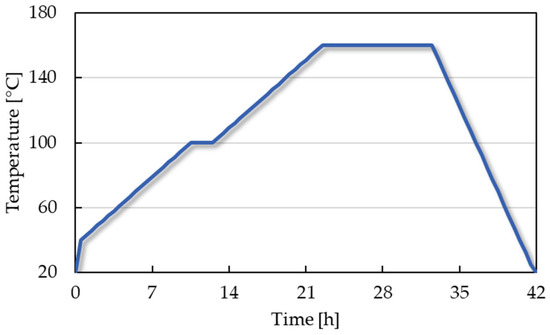
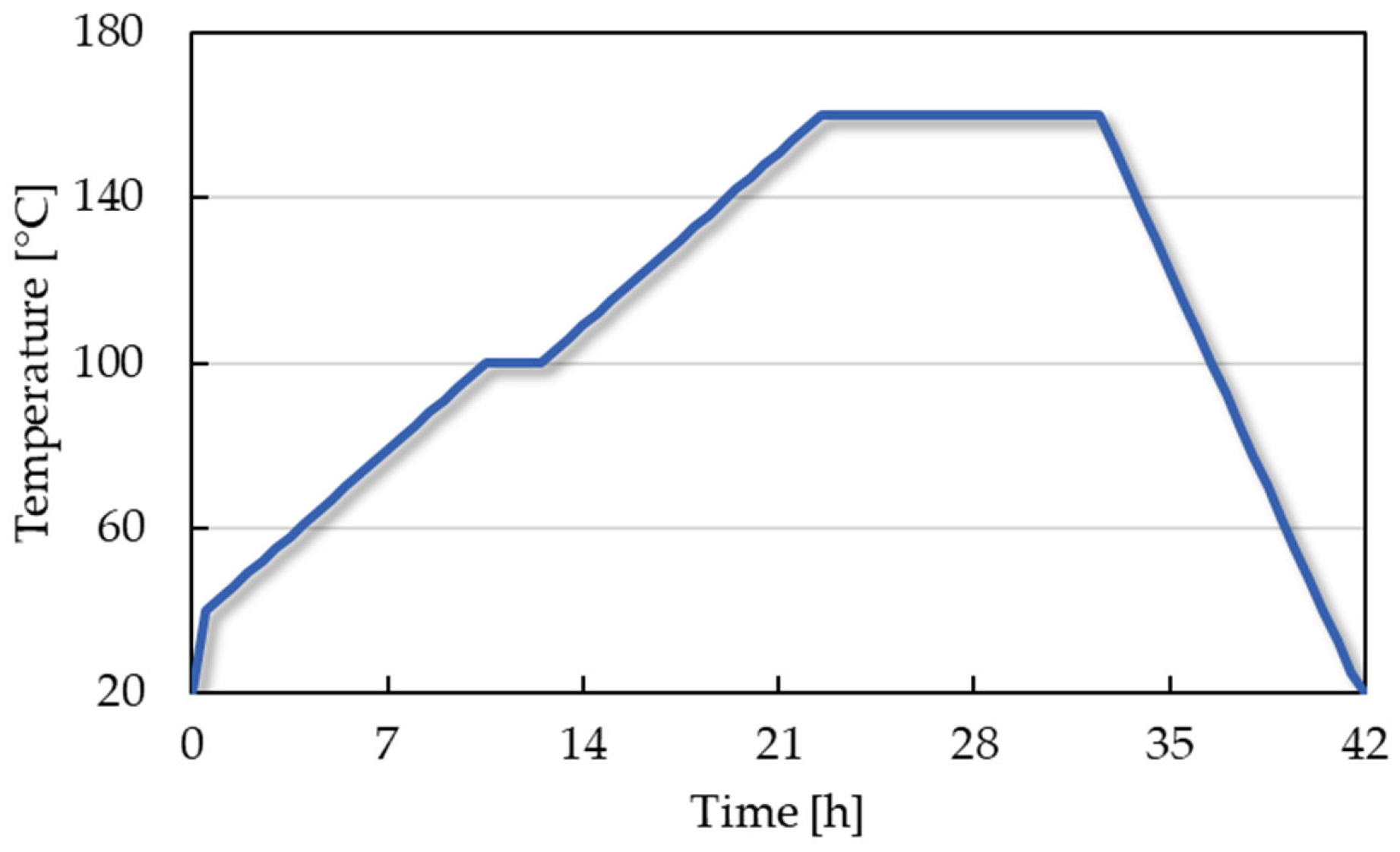
Thermal modifications were performed under normal atmospheric conditions following pre-drying at 103 °C to constant mass. The treatments were carried out in a custom-built vacuum-pressure chamber. The chamber was thermally insulated, equipped with bottom-mounted electric heating elements, and temperature-controlled via a programmable logic controller (PLC). The treatment protocol involved an initial heating phase to 40 °C, followed by a controlled temperature increase at a rate of 10 min/°C until reaching the tempering stage at 100 °C. After a 2 h heat retention—sufficient given the prior drying step—the main thermal treatment was conducted for 10 h. The final temperatures were either 160 °C or 200 °C, depending on the experimental group. Cooling was then performed at a rate of 4 min/°C (Figure 1), after which specimens were conditioned under standard laboratory conditions (20 °C, 65% relative humidity).
Figure 1.
Parameters for thermal treatment at 160 °C.
Finally, nine samples were prepared for both wood species as follows. The study will use the terms in parentheses below for the sake of clarity:
- untreated (Untreated);
- pleated (Pleated);
- fixated (Fixated);
- thermally treated at 160 °C (Thermally treated 160);
- thermally treated at 200 °C (Thermally treated 200);
- pleated and thermally treated at 160 °C (Pleated 160);
- pleated and thermally treated at 200 °C (Pleated 200);
- fixated and thermally treated at 160 °C (Fixated 160);
- fixated and thermally treated at 200 °C (Fixated 200).
The change in size of wood along the grain is negligible, so it is usually not taken into account in swelling–shrinking tests. A good example of this is the ISO13061 standards series, which only specifies tangential, radial, and volumetric tests and calculations. In our case, however, pleating significantly increases the change in dimension of wood along the grain. As described by Báder et al. [14], pleated oak shrinks in the longitudinal direction by an average of 0.4% above the FSP, between 47% and 25% MC, followed by a shrinking of 1.18% between 25% and 0% MC. This is partly due to the natural reaction of wood as a result of the decrease in MC, and partly due to the memory effect, which is most significant during the first soaking [14]. The typical size of the swelling–shrinking specimens was 11 × 11 × 17 mm (T × R × L). This size is explained by the capacity of the compression device, which enabled an efficient specimen production: bending test specimens with a cross-section of 19 × 11 mm were prepared from the compressed specimens, thus doubling the amount of material that could be tested. Their length was between 162 and 200 mm, depending on the wood species and the applied treatment. Nine samples were prepared; each contained 16 swelling–shrinking specimens made from the bending specimens. The dimensions of the three sides and the mass of the specimens were determined for both wood species. Measurements were performed on four occasions at different moisture contents with two repetitions, resulting in a total of 9216 individual data points for the swelling–shrinking analysis. Prior to the swelling–shrinking test, samples were conditioned at 20 °C, 65% relative humidity. The weight of the specimens was measured in grams using a Precisa XT 1220M-FT (Precisa Gravimetrics AG, Dietikon, Switzerland) scale, and their dimensions were measured in millimeters also to three decimals with a Helios Economy (Helios-Preisser GmbH, Gammertingen, Germany) digital gauge. The next step was sample drying, re-conditioning, and then soaking in accordance with the standards ISO13061-13:2016, ISO13061-14:2016, ISO13061-15:2017, and ISO13061-16:2017 [15,16,17,18]. Two swelling and shrinking cycles were done.
The equilibrium moisture content (EMC) was calculated using the weight of the swelling–shrinking specimens after conditioning until constant mass at 20 °C and 65% relative humidity in the beginning of the swelling–shrinking tests (mc). The other value was the weight of the oven-dry specimens (md). EMC was calculated according to Equation (1).
The anti-shrinking efficiency in a given anatomical direction (ASEd) was determined based on Siuda et al. [19], as shown in Equation (2).
where
Dud: linear shrinking/swelling value on untreated test specimens (tangential, radial, longitudinal) [%];
Dtd: linear shrinking/swelling value on treated test specimens (tangential, radial, longitudinal) [%].
The shrinking–swelling anisotropy (T/R) was calculated according to Equation (3), based on Sadegh et al. [20].
where
Dt: tangential shrinking/swelling value of a specimen;
Dr: radial shrinking/swelling value of a specimen.
The densities were calculated from the swelling–shrinking data for the samples at different moisture contents. Since the samples formed rectangular prisms, the volume could be calculated accurately based on the dimensions of the three main anatomical directions, in accordance with ISO 13061-02:2014 [21].
To evaluate the statistical significance of differences between the samples, a one-way Analysis of Variance (ANOVA) was conducted, followed by the Fisher LSD post hoc test at a 0.05 significance level. The validity of the ANOVA model was systematically evaluated against its key parametric assumptions. Independence of observations was ensured by the experimental design, with nine pieces of separate, non-overlapping samples by the clearly different treatments. Normality of the results was assessed using the Shapiro–Wilk W Test. Homoscedasticity (homogeneity of variances) across all samples was verified using Levene’s test. In all cases, a p-value greater than 0.05 was used. Statistical analyses were done with TIBCO Statistica version 14.0.1.25 (TIBCO Software Inc., Palo Alto, CA, USA).
3. Results and Discussion
3.1. Density
Moisture content (MC) strongly influences, among several other properties, wood density, making it important to consider absolute dry values in addition to densities measured under standard conditioning, which better reflect practical use conditions. Pleating (steaming and compressing along the grain by 20%) resulted in a density increase of 3.2% for beech, while fixation (pleated and then kept compressed for 5 h) led to a 6.3% increase (Table 1). In contrast, thermal treatment of beech resulted in substantial reductions in density due to a significant mass loss caused by the thermal degradation of wood cell wall polymers [7]. The reduction is largely attributed to the decomposition of hemicelluloses [22]. Specifically, treatment at 160 °C reduced density by 6.2%, and treatment at 200 °C resulted in an 18.2% decrease. For pleated samples, the corresponding reductions were 3.3% and 7.7%, while fixated specimens showed decreases of 3.8% and 6.0%, respectively. These results indicate that mechanical modification strongly mitigates the density-reducing effect of thermal treatment.
Table 1.
Average densities [kg/m3] of all beech samples in the study conditioned under normal conditions (20 °C/65% humidity). MC indicates equilibrium moisture content at the time of the conditioned density measurement. Standard deviations are shown after the ± sign. Cycles refer to the swelling–shrinking measurement cycles described earlier. Abbreviations: TT—thermally treated; Pleated—steamed and compressed along the grain by 20%; Fixated—pleated and then kept compressed for 5 h.
The observed moderation of beech density loss is likely related to the pre-steaming and compression processes: the plasticized and buckled cell walls may alter the response of tissue elements and their chemical constituents during subsequent thermal exposure. Leaching may occur due to steaming, similar to the case with oak (Table 2). This is supported by the decrease in density after each cycle. This is also indicated by the fact that the decreases were greater for oak, which has higher content of extractives. When compared with untreated wood, the density changes in double-treated samples were minimal. In pleated specimens subjected to thermal treatment, density decreased by only 0.2% at 160 °C and 4.7% at 200 °C. In fixated–thermally treated samples, a 2.2% increase at 160 °C and a negligible, 0.1% decrease at 200 °C were observed compared to untreated samples.
Table 2.
Average densities [kg/m3] of all oak samples in the study conditioned under normal conditions (20 °C/65% humidity). MC indicates equilibrium moisture content at the time of the conditioned density measurement. Standard deviations are shown after the ± sign. Cycles refer to the swelling–shrinking measurement cycles described earlier. Abbreviations: TT—thermally treated; Pleated—steamed and compressed along the grain by 20%; Fixated—pleated and then kept compressed for 5 h.
For oak, the results of the same modifications were similar. Pleating decreased density by 7.8%, while fixation increased it by 1.8%. It may appear counterintuitive that the density of the specimens decreased after compression along the grain. This phenomenon can primarily be attributed to the substantial loss of extractives during the steaming process of oak, while acidic constituents also promoted the degradation of other wood components. A second contributing factor is that, during compression along the grain, the specimens went through a slight lateral expansion in the transverse directions. It is also noteworthy that the fixated specimens, despite exhibiting considerable permanent shortening, showed only a negligible increase in density. The explanation is essentially the same as for the pleated specimens, particularly because the treatment procedure exposes the material to degrading effects for a substantially longer period. After thermal treatment, significant decrease was observed in density at 160 °C (12.7%) and 200 °C (25.1%). The decreases were higher for oak compared to beech. As treatment temperature increases, the severe degradation of amorphous polysaccharides and the evaporation of extractives lead to a decrease in density [7,23]. For pleated oak samples, the corresponding changes were a reduction of 5.8% and an increase of 3.8%, while the density of fixated specimens increased by 4.0% and decreased by 6.3%, respectively. These results confirm what was observed with beech. Mechanical modification strongly mitigates the density-reducing effect of thermal treatment. Consequently, the reduction in density observed in mechanically modified specimens is far less pronounced than that found in mechanically unmodified samples. For oak, the loss of density is driven not only by plasticization and the altering of cell walls, but by the degradation of the high amount of extractives, mainly tannic acid.
Looking at the specific values, the absolute dry density values show that, during the soaking cycles, the density decreased slightly from cycle to cycle due to leaching for both wood species [7]. This phenomenon did not occur in the thermally modified samples, or was less pronounced, because the high temperature had already removed many leachable substances (hence the term “extractives”) from the samples prior to the soaking process. Compared to density-data in the literature, the specimens of this study can be considered average. The conditioned density of untreated beech was 720 kg/m3, while that of oak was 761 kg/m3. Based on the coefficient of variation (CV), the tests performed are reliable, at 3.6% and 3.3%, respectively. The average values in the literature for beech give an average of 713 ± 50 kg/m3 [24,25,26,27], while for oak 735 ± 37 kg/m3 [12,27,28,29,30,31,32]. In other words, the tests were conducted on suitable, average-quality raw materials. It should be noted that the various treatments increased CV somewhat, but it remained at a low level even after fixation and thermal modification at 200 °C, which can be considered the two most severe treatments.
3.2. Equilibrium Moisture Content (EMC)
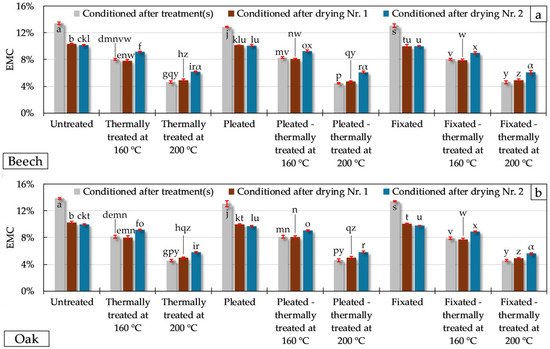
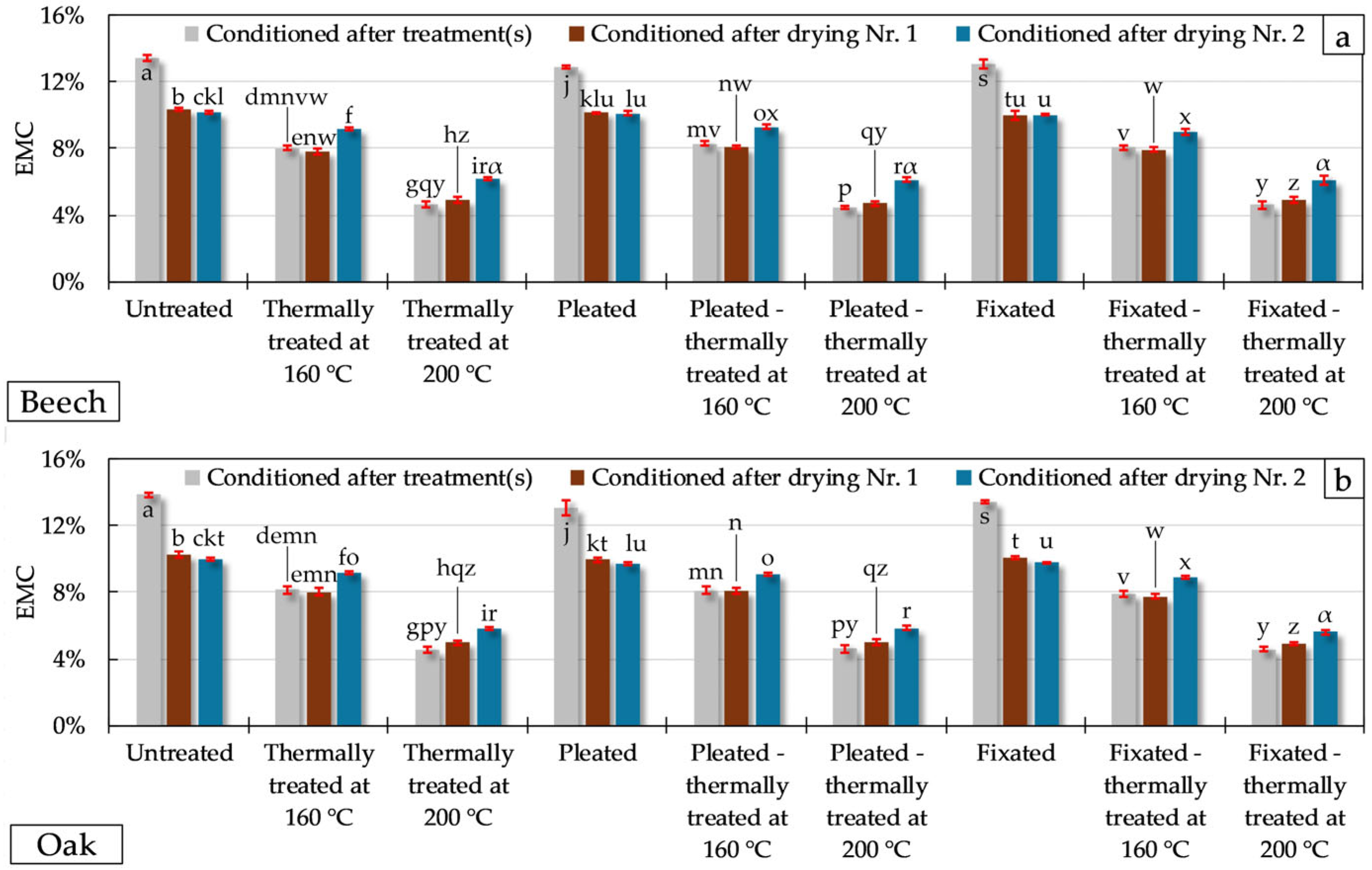
When the EMCs are compared for each treatment after conditioning at 20 °C and 65% relative humidity following treatment-induced drying, and subsequently two more times after conditioning following the soaking and drying cycles, the observed differences in MC represented one segment of sorption hysteresis under a single climatic condition. In the samples thermally not modified, a pronounced reduction of 27.2%–35.0% was observed after the first soaking and drying cycle in both beech and oak (Figure 2). Comparing the first and the second soaking and drying cycles, however, no substantial difference in conditioned EMC was detected, indicating that sorption hysteresis became negligible. Irrespective of the other treatments, it can be concluded that the applied mechanical modifications caused either no sorption hysteresis or only a very limited effect: pleating and fixation resulted in only a 3.0%–5.9% reduction in EMC compared to the Untreated sample, as reported by Báder and Németh [1]. In contrast, for the thermally modified samples, only the second soaking and drying cycle produced a difference, resulting in an 11.4%–23.4% increase in EMC. Compared with the Untreated sample, the significant effect of thermal treatment is usually the case through the reduction in accessible hydroxyl groups.
Figure 2.
Equilibrium moisture content (EMC) of (a) beech and (b) oak samples after conditioning at 20 °C and 65% relative humidity. The Latin letters as well as α above the columns indicate similarities and differences identified through statistical analysis.
Compared with the Untreated sample, the significant effect of thermal treatment is usually the case through the reduction in accessible hydroxyl groups [7,23]. Irreversible hydrogen bonding between carbohydrate elements, known as hornification, significantly limits the hygroscopicity of the material [22]. In the following, the results obtained after the first drying cycle will be analyzed, as this can be considered the most uniform condition, in which all samples have already undergone drying, not just the thermally treated ones. The EMC of untreated beech was 10.4%; after pleating, it became 10.1% and remained at 10.0% even after fixation. The untreated value for oak was 10.3%; after pleating, it became 10.0%, and after fixation, it became 10.1%. Statistically, the only significant difference can be observed between untreated and pleated beech wood. Minor differences can be observed between the two wood species, but it is true for both that the EMC of thermally treated wood is stable or increases as the swelling–shrinking cycles progress (Figure 2).
Treatment at 160 °C reduced EMC to approximately two-thirds, while treatment at 200 °C reduced it to one-third in both untreated and mechanically treated samples. In numerical terms, thermal treatment at 160 °C reduced the EMC of beech wood to 7.8%, and at 200 °C to 4.9%. The EMC results of thermal treatments performed both after pleating and fixation show very similar values, which are statistically identical in most cases. The same is true for oak. Even the results of samples that were not mechanically modified but were thermally treated are very similar: EMC is 8.0% at 160 °C and 5.0% at 200 °C. This has a positive effect in terms of dimensional stability and is shown by the literature as well [7]. This will be analyzed in the swelling–shrinking tests later. Consequently, since wood compressed along the grain is very sensitive to moisture changes as it reacts with significant deformation [14], thermal treatment represents a substantial advance in this area, without the use of chemicals and non-biobased materials.
For both the untreated and mechanically modified samples, very similar values were obtained after the second soaking–drying-conditioning cycle. Interestingly, after the second cycle, the EMC values of the thermally treated samples increased markedly in all cases. The increase ranged from 12.8% to 30.5%, with an average of 18.2%. In terms of the actual numerical values, this means that, for example, the average conditioned MC of the Pleated and Thermally treated 200 beech sample was 4.7% after the first cycle, while it was 6.1% after the second cycle; the difference between the two was low: 1.4 percentage points, which corresponds to the previously mentioned maximum difference of 30.5%. For beech wood, treatment at 200 °C roughly doubled the ratio of increase (the increase was 15% at 160 °C and 27% at 200 °C compared to the EMC of the first soaking–drying-conditioning cycle). The reason for that may be that during wetting–drying cycles the leachable compounds are extracted from the wood tissue. This is also supported by the slightly decreasing densities during the cycles (Table 1). On the other hand, internal stresses are released as a result of wetting–drying cycles which also contribute to this phenomenon [33,34]. The quality of the tests is demonstrated by the extremely low CV values, averaging 2.0%, while the highest value is 5%. Based on the bending test results presented in the previous article [12], thermal treatment at 160 °C temperature improves the bending strength of fixated wood, so it may be worth trying even lower temperatures. This can be effective only if the swelling and shrinking values still decrease in the process, resulting from thermal treatment. Accordingly, such tests are presented in the following.
3.3. Swelling and Shrinking
The exceptionally large dataset resulted from the nine treatment conditions applied to the two wood species (Table 1 and Table 2 and Figure 3). For each treatment condition, swelling and shrinking had to be evaluated in the three principal anatomical directions as well as volumetrically (four categories in total), across four different states (first-cycle swelling, first-cycle shrinking, second-cycle swelling, and second-cycle shrinking). Therefore, the results are presented and discussed in separate subsections according to different evaluation aspects. Furthermore, the swelling and shrinking behavior of pleated and fixated specimens had already been analyzed in a previous study [14], and the present investigation produced similar results and identical trends. The same applies to the outcomes of thermal modification. Accordingly, these aspects are discussed only briefly in the following sections, while the primary focus is placed on the combined treatments.
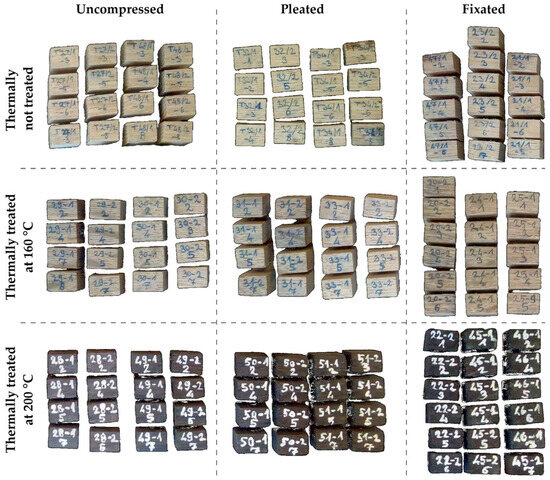
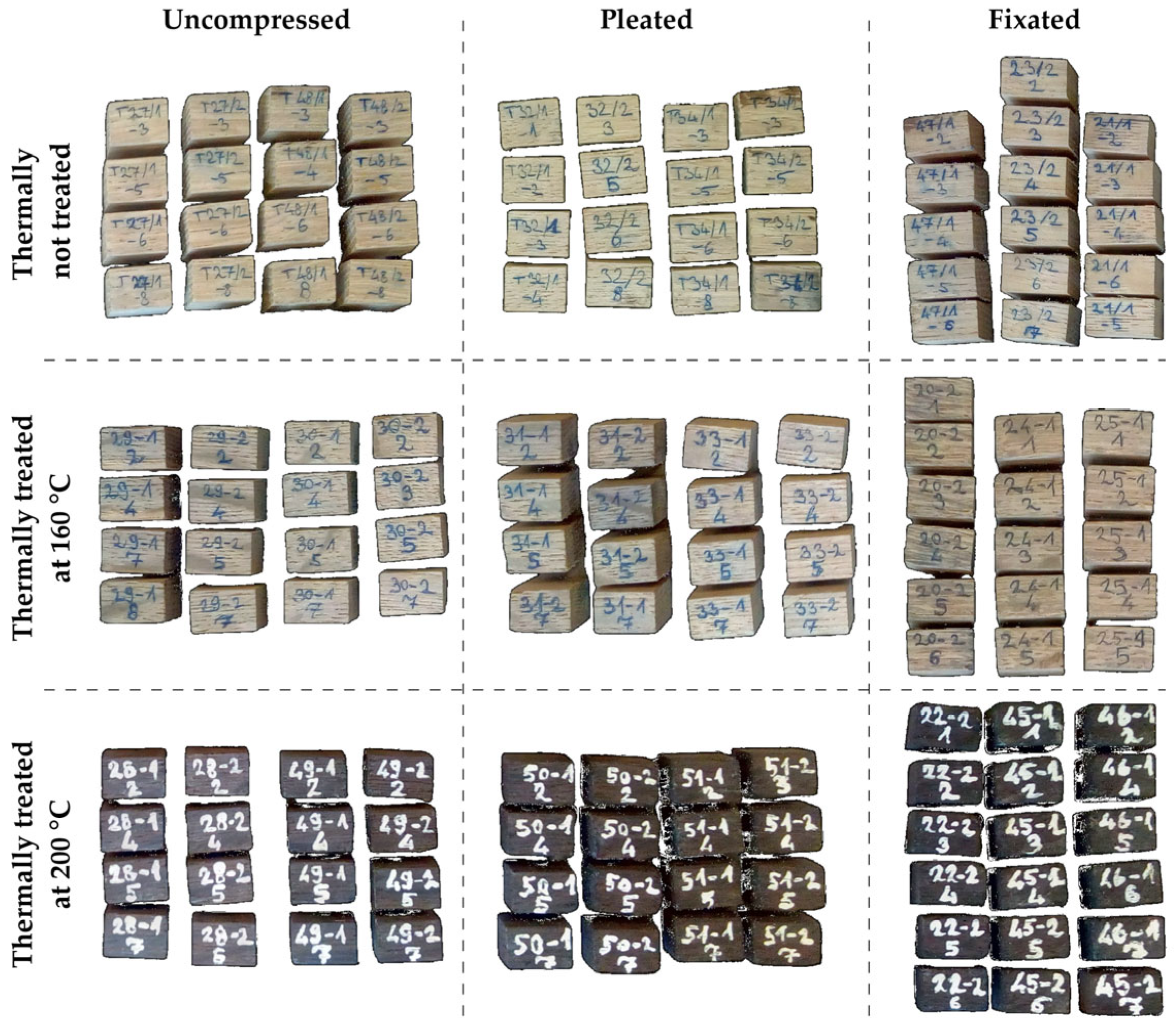
Figure 3.
Oak specimens grouped by samples prepared for swelling–shrinking tests.
3.3.1. Specific Results of the Swelling and Shrinking Tests
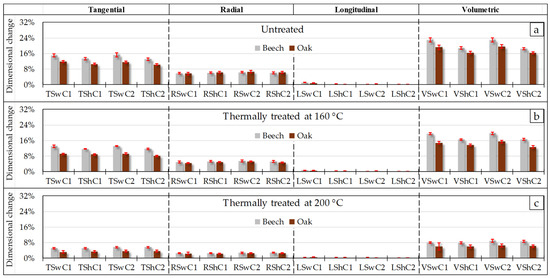
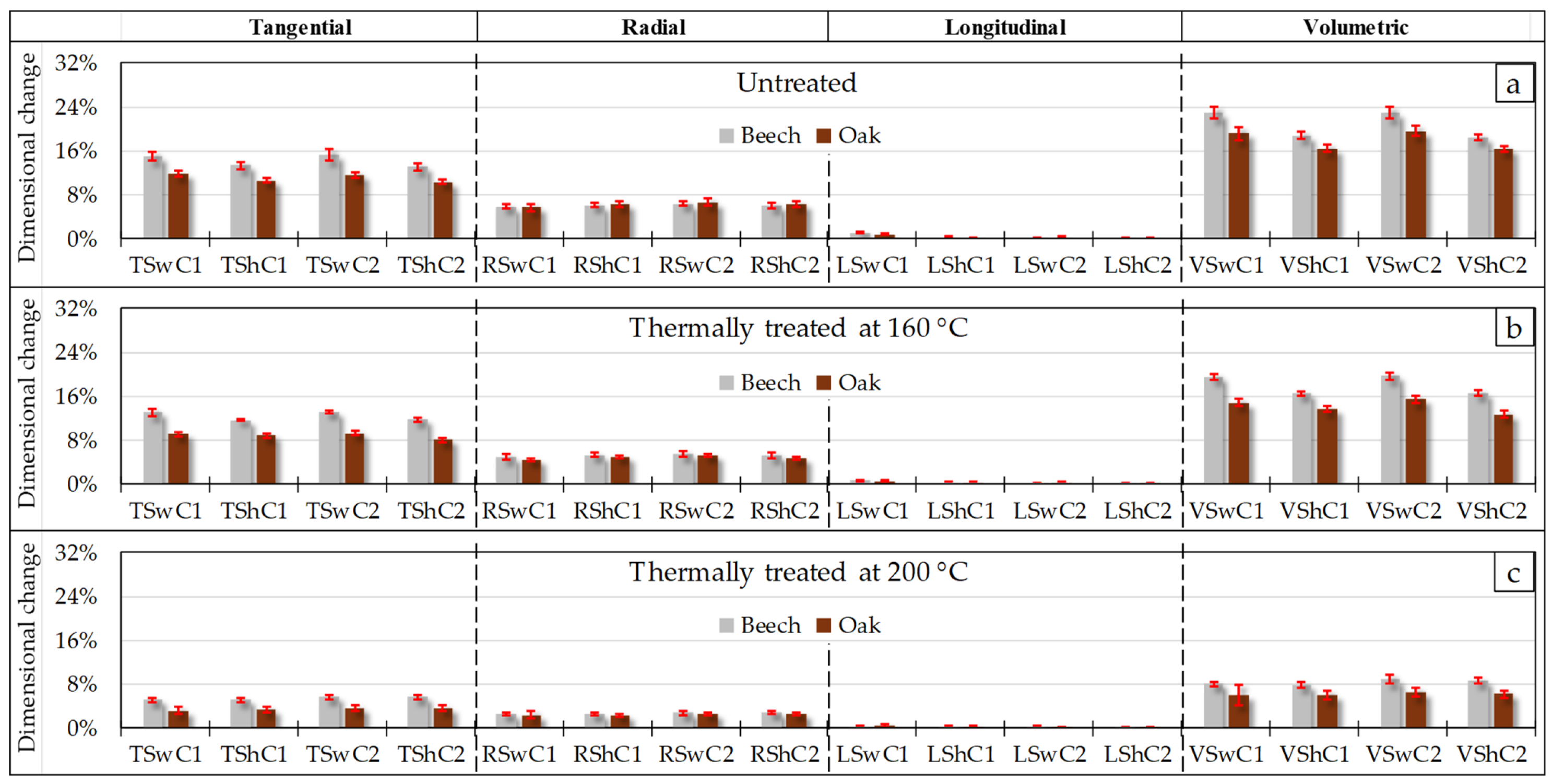
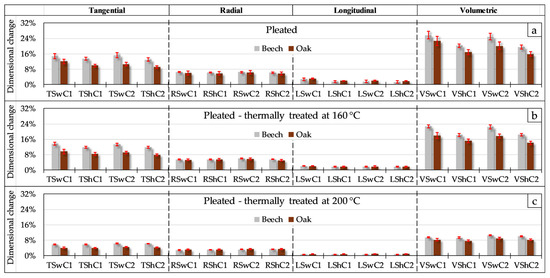
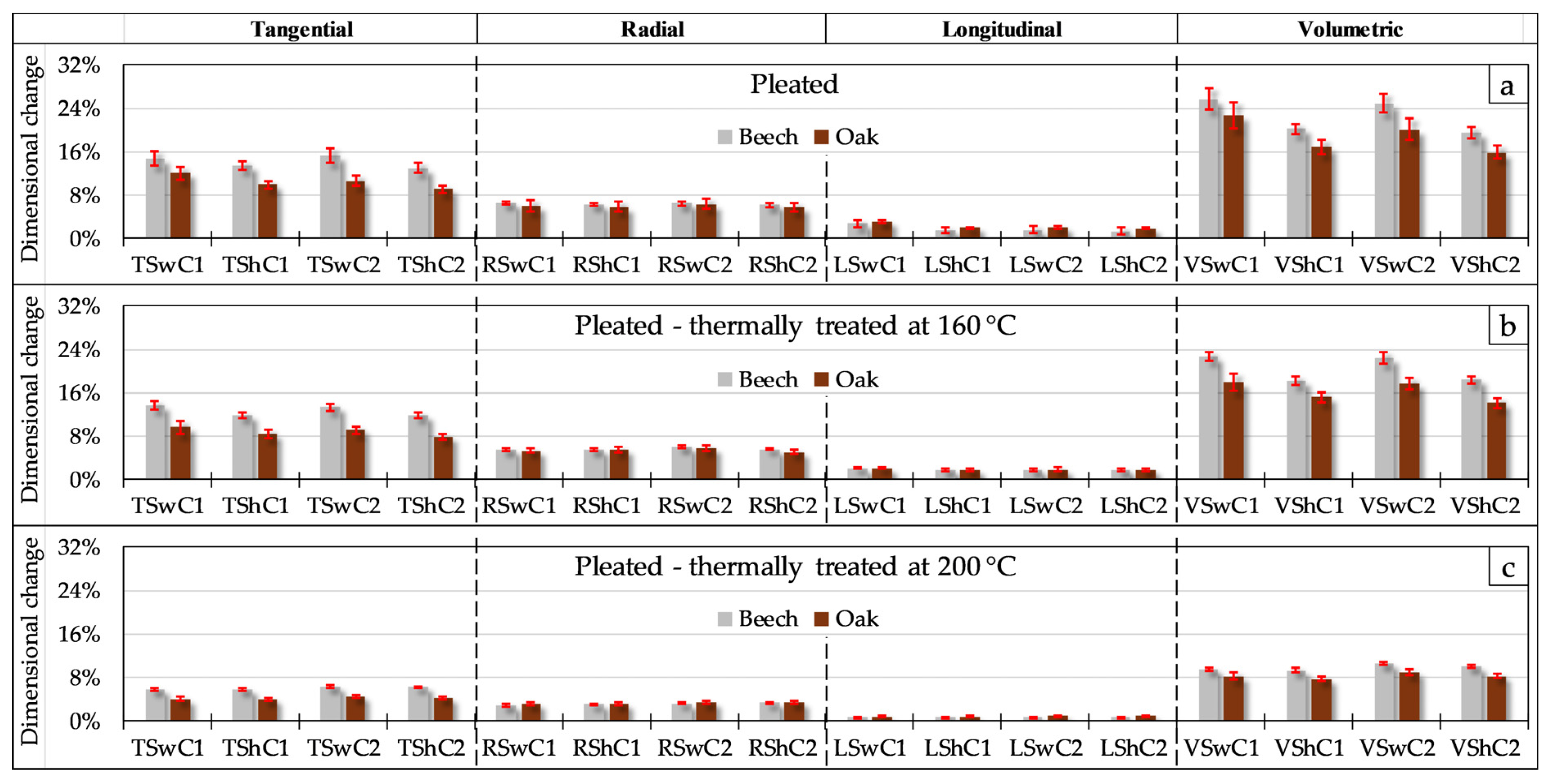
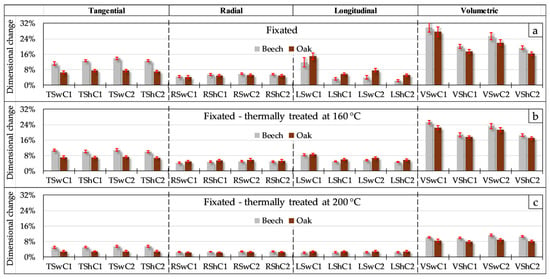
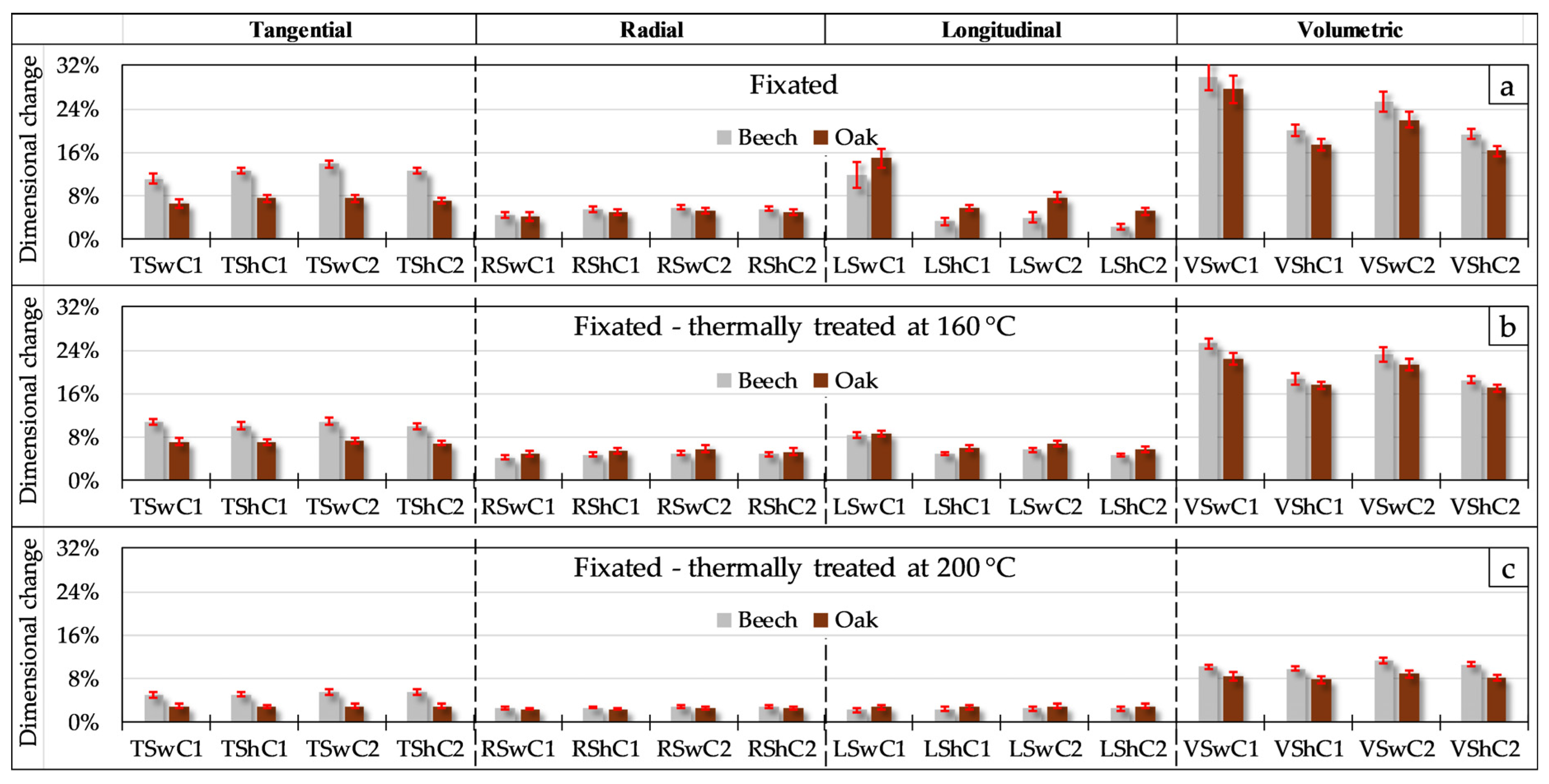
The swelling and shrinking of the two wood species can be found in Figure 4, Figure 5 and Figure 6. In the longitudinal direction, the treatment effects observed during shrinking closely resembled those recorded during the second swelling cycle; therefore, a detailed analysis of all diagrams was considered unnecessary.
Figure 4.
Swelling and shrinking results of uncompressed samples: (a) untreated; (b) thermally treated at 160 °C; (c) thermally treated at 200 °C. Standard deviations are indicated by the red lines. Abbreviations on the X-axis: T—tangential; R—radial; L—longitudinal (along the grain); V—volumetric; Sw—swelling; Sh—shrinking; C1—first swelling–shrinking cycle; C2—second swelling–shrinking cycle.
Figure 5.
Swelling and shrinking results of pleated samples: (a) pleated; (b) pleated and thermally treated at 160 °C; (c) pleated and thermally treated at 200 °C. Standard deviations are indicated by the red lines. Abbreviations on the X-axis: T—tangential; R—radial; L—longitudinal (along the grain); V—volumetric; Sw—swelling; Sh—shrinking; C1—first swelling–shrinking cycle; C2—second swelling–shrinking cycle.
Figure 6.
Swelling and shrinking results of fixated samples: (a) fixated; (b) fixated and thermally treated at 160 °C; (c) fixated and thermally treated at 200 °C. Standard deviations are indicated by the red lines. Abbreviations on the X-axis: T—tangential; R—radial; L—longitudinal (along the grain); V—volumetric; Sw—swelling; Sh—shrinking; C1—first swelling–shrinking cycle; C2—second swelling–shrinking cycle.
Compressibility is characteristic of wood species. At the temperature of the preceding plastification, only slight chemical changes take place in the wood that would significantly affect shrinking, swelling, and strength values, so mainly the anatomical structure of the wood plays a major role in the effect of the treatment. For wood steamed and compressed along the grain, the remaining shortening of oak after fixation (163.7 mm—18.1% remaining shortening) markedly exceeded that of beech (176.0 mm–12.0% remaining shortening), and accordingly, several differences can be observed between the swelling and shrinking of the two wood species. Pleating causes only minor changes in the transverse swelling and shrinking of wood (Figure 4, Figure 5 and Figure 6). But fixation results in substantial changes: a clear transverse decrease can be seen up to 11.2% for beech and up to 6.6% for oak, while untreated wood had a decrease of 14.9% and 11.8%, respectively. The results for the untreated samples are consistent with the values reported in the literature. For beech, Gryc et al. [26] reported 15.1% in the tangential direction, 7.3% in the radial direction, 0.5% in the longitudinal direction, and 24.2% by volumetric swelling. The decrease by fixation is due to the buckling of the cells and the buckling of the microfibrils that build up the cells. During pleating, changes do not only happen in the grain direction, but slight transverse compression also takes place. In addition to the buckling of the cell walls, extensive indentation of the material into the cell lumina also occurs [3]. Since oak is a ring-porous wood species, it is conceivable that these processes occurred to a greater extent in the radial direction. Pleating improves the radial swelling of beech by 12.0%, while Fixation decreases it by 23.4%. The same can be observed for oak: 6.4% and 27.3%, respectively. The slight transverse compression of earlywood may also explain the swelling–shrinking reduction effect of pleating in oak wood.
Nevertheless, the effect of thermal treatment is more considerable in both wood species. The transversal swelling of beech wood is decreased by fixation (Figure 4 and Figure 6), which is further highly decreased by thermal treatment (Figure 6). Fixation decreases the swelling of oak wood to a much greater extent (from 11.1% to 7.2% tangentially and from 6.3% to 4.8% radially), while thermal treatment at 160 °C only slightly decreases it to 8.9% and 4.9%, respectively. In this case, the effect of thermal treatment at 200 °C is substantial. The average of swellings and shrinkings reduced to 3.5% and 2.5%, respectively, while—unlike with beech wood—pleating also causes some decrease here.
Both pleating and fixation drastically increase wood swelling along the grain in both cycles. The initially increased swelling along the grain was turned into a decrease as a result of thermal treatment at 160 and 200 °C for beech and oak as well, except the second swelling cycle of beech at 160 °C (Figure 5 and Figure 6).
The effectiveness of treatments in reducing shrinking in beech wood differs from that seen in swelling. In the first cycle, thermal treatment at 160 °C highly decreases the shrinking of both pleated and fixated wood, and even treatment at 200 °C does not cause as much decrease as in the second cycle of swelling. The reactions of oak differ from those of beech, with thermal treatments being much more pronounced. The efficiency of thermal treatment at 200 °C is reduced for fixated samples (the averages of swellings and shrinkings reduced from 8.4% to 2.9%), compared to pleated samples thermally treated at 200 °C (the averages of swellings and shrinkings reduced from 2.3% to 0.9%). Another important difference is that, for fixated wood, thermal treatment at 160 °C, similar to beech, increases the shrinking of the wood, albeit to a small extent (5.9 to 6.0%), which deteriorates further in the second cycle from 5.1 to 5.8%. This is not observed in pleated samples, where thermal treatment at 160 °C improves the dimensional stability of the wood, explained in more detail later in Section 3.5.
3.3.2. Analysis of Swelling and Shrinking by Anatomical Direction in Both Cycles
In the different anatomical directions as well as volumetrically, statistical analysis demonstrated the similarities of swelling and shrinking behavior of the different sample-pairs. The similarities relating to the beech species can be found in Table 3, whilst the relevant information, reasons and conclusions are set out below, organized into bullet points according to anatomical directions.
Table 3.
Pairs of beech wood samples showing multiple statistically identical (p > 0.05) swelling and shrinking values in the two cycles, analyzed by different anatomical directions.
- In the tangential direction of beech samples, in addition to the information shown in Table 3, isolated similarities were detected between Fixated and Fixated 160 during the first swelling cycle, as well as between Pleated 160 and Fixated, during the second swelling cycle. Considering that only a small number of matches occurred among the 4 × 36 possible treatment pairs (9.0%), the occasional agreements accounted for only 1.4%, these isolated similarities can be regarded as random. It should also be emphasized that thermal treatment at 200 °C altered the beech wood so extensively that no dimensional-change similarity was observed with either untreated wood or wood modified at 160 °C. Statistical evaluation further revealed that whenever similarities occurred in the tangential direction, thermal modification represented the dominant determining factor; consequently, similarities were predominantly found between specimens subjected to the same thermal treatment level (untreated, 160 °C, or 200 °C).
- In the radial direction, in addition to the sample pairs listed in Table 3, only one single isolated similarity was observed between Fixated and Fixated 160 during the first swelling cycle. Although compression along the grain affects the entire wood structure, its influence is substantially greater in the longitudinal direction than in the transverse directions. Consequently, only a limited number of similarities were identified in tangential and radial swelling and shrinking behavior associated with this modification, representing merely 9.0% of the evaluated pairs, again.
- In contrast, substantially more relationships were identified in the longitudinal direction. It should be noted that the dimensional changes measured longitudinally were extremely small and approached the accuracy limits of the measuring instrument; therefore, some differences may partly reflect measurement uncertainty. Nevertheless, pronounced dimensional changes revealed meaningful similarities and differences among treatments. Statistical analysis showed that cases in which similar behavior resulted solely from identical thermal modification became less dominant, while the proportion of matching pairs increased to 13.9% of the 144 evaluated combinations (Table 3). Eight treatment pairs showed statistically identical swelling during the first cycle. This phenomenon reflects the effect of longitudinal compression, which substantially increases longitudinal dimensional change during the first swelling cycle, as previously demonstrated by Báder et al. [14]. Microfibrils are generally dimensionally stable along their longitudinal axis, whereas water molecules entering between them can separate them laterally, thereby inducing swelling [35]. Compression causes the microfibrils to bend [36]; consequently, swelling induced by entered water molecules becomes evident not only in the transverse directions but also along the grain. Thermal modification can reduce this first-cycle swelling to such an extent that the substantially increased swelling of compressed specimens becomes statistically equivalent to that of untreated wood.
- Volumetric dimensional change provides the most comprehensive, albeit often the most complex interpretable representation of overall dimensional behavior. Since volumetric change is generally dominated by the anatomical direction exhibiting the greatest dimensional variation, relationships are typically expected to reflect tangential behavior. In the present study, however, this assumption is less straightforward because compression along the grain dramatically increased longitudinal dimensional changes, particularly during the first cycle. Consequently, volumetric dimensional changes were in some cases influenced not only by transverse behavior but also by longitudinal deformation. Thus, in wood compressed along the grain, volumetric results genuinely reflect the combined dimensional responses of all three anatomical directions. Volumetric dimensional-change similarities were again identified in only 9.0% of the 144 evaluated pairs (Table 3). For Untreated–Pleated 160 treatment, for shrinking in the first cycle the difference was close to statistical equivalence and would have been considered identical at the 1% significance level. Therefore, thermal modification of pleated wood at 160 °C effectively counterbalanced the dimensional change-increasing effect of pleating, resulting in swelling and shrinking behavior comparable to that of untreated wood.
Table 4—like Table 3 presented earlier—shows which pairs of oak samples exhibit statistically significant similarities in different anatomical directions and volumetrically in terms of multiple swelling and shrinking in the two cycles.
Table 4.
Pairs of oak wood samples showing multiple statistically identical (p > 0.05) swelling and shrinking values in the two cycles, analyzed by different anatomical directions.
- Examining similarities between swelling and shrinking across the two wetting–drying cycles for oak samples separately for each anatomical direction, only two statistically identical pairs were identified tangentially (Table 4). Thermal treatment at 160 °C does not induce substantial changes in the wood structure, as this similarity also appears in several other anatomical directions. In the tangential direction of oak, only 5.6% of the 144 possible treatment pairs showed statistical equivalence. This exceptionally low ratio further emphasizes the significance of the repeated similarity observed between the Thermally treated 160 and Pleated 160 treatments listed in Table 4.
- A greater number of similarities were observed in the radial direction (Table 4), As observed previously for beech, oak also exhibited more similarities in the radial direction than in the tangential direction. In the present case, 11.8% of the 144 treatment pairs showed statistical equivalence. This phenomenon can be attributed primarily to anatomical factors. Based on the book by Skaar [35] the transverse anisotropy in wood, where tangential shrinking typically doubles radial shrinking, is driven by several key anatomical factors. A primary mechanism is “ray restraint”, in which radially oriented ray tissues—which are stiffer and less hygroscopic—mechanically inhibit the radial movement of surrounding tissue. In species like oak and beech, isolated and wide rays exhibit significantly lower radial shrinking. Additionally, the earlywood-latewood interaction theory posits that continuous tangential bands of stronger latewood force earlywood to shrink tangentially at the same rate, whereas radial layers, arranged in series, shrink more independently. Within the cells, microfibril angles in the S2 cell wall layer are often reported to be greater in radial walls than tangential walls, particularly in the vicinity of abundant pits; these larger angles generally correlate with reduced transverse expansion in those specific walls. Differences in lignification and the distribution of the middle lamella also contribute to this imbalance; radial walls are often more highly lignified, acting as a stiffening “bulking agent” that resists expansion more effectively than the more compliant tangential walls.
- Numerous similarities were detected in the longitudinal direction, too; however, these are largely attributable to the extremely small dimensional changes occurring along the grain and their proximity to the measurement accuracy limits as discussed for beech samples. The similarities observed in Figure 4 demonstrate again that thermal modification at 160 °C frequently exerts only negligible influence.
- Considering volumetric dimensional changes, statistical equivalences highlight the effectiveness of the more intensive thermal modification. Although the underlying causes are generally similar to those described for beech, the distinct anatomical and chemical structure of oak results in certain differences. Consequently, statistical equivalence is observed between different treatment combinations in oak compared with beech.
3.3.3. Relationships Between Different Anatomical Directions Within the Same Cycle
The following analysis examines the effects of various treatments by swelling–shrinking cycles to identify the relationships between different anatomical directions. Focusing on the first-cycle swelling of beech wood, only two statistically identical treatment pairs were identified, which appear in multiple anatomical directions, shown in Table 5.
Table 5.
The pairs of beech samples with statistically identical (p > 0.05) swelling or shrinking in multiple anatomical directions as well as volumetrically.
- Whereas untreated specimens showed average tangential and radial swelling values of 14.9% and 5.8%, respectively, in the first-cycle swelling, the corresponding values were 11.2% and 4.5% for Fixated specimens and 10.8% and 4.2% for Fixated 160 specimens. Thus, fixation caused a decrease in swelling, while subsequent thermal modification at 160 °C produced no further significant change. Coefficients of variation were low in all cases, ranging from 5.5% to 12.8%. In the longitudinal direction, however, swelling increased 10.82-fold as a result of the fixation, while thermal modification of the fixated wood at 160 °C reduced this value to 71%. This effect was also reflected in first-cycle volumetric swelling. The average volumetric swelling of untreated specimens increased from 23.0% to 30.0% following fixation and subsequently decreased to 25.3% after thermal modification at 160 °C. These findings indicate that even relatively mild thermal modification can substantially improve the dimensional stability of fixated wood. For the second pair exhibiting statistically identical tangential and radial swelling in cycle 1, the values were 5.1% and 2.6%, respectively, representing substantial decrease relative to untreated wood (14.9% and 5.8%). Such behavior is well known for high-temperature thermal modification [7]. If both the EMC and the dimensional changes are lower, this can be clearly attributed to sorption hysteresis, as in the present case, see Figure 2. Thermal treatment reduces wood swelling and shrinking primarily through the thermal degradation of hemicelluloses, which are the most hydrophilic and thermally labile cell wall components [7]. This chemical change reduces the concentration of accessible hydroxyl groups, effectively decreasing hygroscopicity and EMC [23]. Physically, the process induces irreversible hydrogen bond forming between carbohydrate elements during water removal [22]. These effects are more significant at higher temperatures because the degradation of amorphous polysaccharides becomes more severe, resulting in greater mass loss and a lower oxygen-to-carbon ratio [7]. Furthermore, elevated temperatures promote lignin condensation and the formation of a more rigid, crosslinked polymer matrix, which physically restricts the ability of the cell wall to expand upon re-wetting [7,23]. On the other hand, it is particularly noteworthy that the effects of fixation on swelling were essentially eliminated after thermal treatment at 200 °C. This phenomenon can be attributed exclusively to chemical modifications induced by the treatment. In the longitudinal direction, however, the situation differed: thermal modification at 200 °C reduced swelling to a fraction of the untreated value, whereas the fixated and subsequently thermally modified specimens still exhibited approximately twice the longitudinal swelling of untreated wood. This difference was also evident in volumetric dimensional changes; the volumetric swelling of untreated wood decreased from 23.0% to 8.1% after thermal modification at 200 °C, whereas fixation followed by thermal treatment at 200 °C resulted in a volumetric swelling of 10.2%. Thus, wood responded particularly well to the combined treatment. Unfortunately, the high treatment temperature also increased brittleness, a phenomenon discussed in detail in Section 3.5.
- During first-cycle shrinking, it was particularly notable that none of the statistically identical treatment pairs identified for volumetric shrinking (Untreated–Fixated 160, Pleated–Fixated, and Pleated 160–Fixated 160) appeared among the anatomical directions, similar to the findings for first-cycle swelling. In contrast, the Thermally treated 200–Fixated 200 pair exhibited statistically insignificant difference in shrinking in all three anatomical directions, but there was no match volumetrically. Once again, treatment at 200 °C demonstrated a strong homogenizing effect. At this temperature, degradation becomes so extensive that specimens can exhibit similar shrinking behavior regardless of their previous treatment history. The same phenomenon was observed for swelling in the preceding analysis.
- The comparison of the statistically identical pairs in the second-cycle swelling produced the same results as observed during the second-cycle shrinking (Table 5). In addition, the Thermally treated 200–Fixated 200 pairs showed identical swelling behavior in tangential and radial directions. Overall, substantially fewer similarities were detected during the second cycle, indicating that dimensional changes had become stabilized. This stabilization likely resulted from repeated wetting and drying, which promoted stress redistribution and ultimately led to more uniform stress levels in the tissue. This interpretation is supported by the volumetric dimensional changes, where the Untreated–Pleated 160, Untreated–Fixated 160, and Pleated–Fixated pairs exhibited insignificant differences during second-cycle shrinking, exactly as previously observed during second-cycle swelling for beech.
Table 6—similar to Table 5 presented earlier—shows the pairs of oak samples that show statistically significant similarities in different swelling and shrinking cycles across multiple anatomical directions or volumetrically.
Table 6.
The pairs of oak samples with statistically identical (p > 0.05) swelling or shrinking in multiple anatomical directions as well as volumetrically.
- During the first swelling cycle, only two treatment pairs exhibited statistically identical behavior in both the tangential and radial directions of oak wood (Table 6). Untreated oak exhibited swelling values of 11.8% in the tangential direction and 5.7% in the radial direction. The substantially lower tangential swelling compared with beech (14.9%) reflects the more favorable T/R ratio of oak. Regarding volumetric swelling during the first soaking cycle, two statistically equivalent pairs were identified, highlighting the effects of thermal modification. Pleated specimens exhibited volumetric swelling of 22.6%, which was statistically equivalent to the 22.4% observed in Fixated 160 specimens. Although fixation increased first-cycle swelling even more strongly than pleating, resulting in a value of 27.6%, subsequent thermal modification at 160 °C reduced swelling to a level statistically similar to that of pleated specimens. A similar relationship was observed for the Pleated 200 (8.3%)–Fixated 200 (8.4%) pair. It should be noted that the Thermally treated 200 specimens exhibited first-cycle volumetric swelling of only 6.0%, which was likewise very close to these values. In the longitudinal direction, seven statistically equivalent pairs were identified. This high number is attributable to the strong influence of compression along the grain on longitudinal dimensional changes. During the first swelling cycle, mechanically modified specimens exhibited substantial longitudinal dimensional recovery. At the same time, thermal modification markedly decreased the dimensional changes in uncompressed specimens, resulting in values approaching the measurement error limits.
- The first-cycle shrinking of oak revealed more distinct and stable differences than those observed during swelling. Regarding volumetric shrinking, the Untreated–Pleated and Pleated–Fixated pairs exhibited statistically identical values, with averages of 16.7% and 17.1%, respectively. Among the thermally modified samples, the Pleated 200–Fixated 200 and the Fixated–Fixated 160 pairs showed statistical equivalence, with average volumetric shrinking of 7.8% and 17.5%, respectively. The similarity between the latter pair reflects the relatively weak effect of thermal modification at 160 °C, which was unable to alter the dimensional behavior of the fixated wood. In contrast, the similarity between the Pleated 200 and Fixated 200 specimens reflects the dominant influence of thermal modification at 200 °C, which overrides the effects of previous treatments, as discussed earlier.
- During the swelling in the second cycle, the Fixated–Fixated 160 pair once again exhibited statistical equivalence both in the tangential direction (7.6% and 7.4%, respectively) and in volumetric swelling (22.0% and 21.4%, respectively). It can therefore be concluded that thermal modification at 160 °C is unable to alter with adequate reliability the increased dimensional changes induced by fixation, regardless of whether swelling or shrinking is considered. Examination of volumetric dimensional changes again revealed equivalence between the Pleated 200 and Fixated 200 treatments (8.9% and 8.8%, respectively), while the Untreated–Pleated pair also emerged as statistically identical (19.6% and 20.2%, respectively). These results clearly demonstrate that the dimensional-change-increasing effect of fixation remained detectable even during the second swelling cycle, whereas thermal modification at 200 °C reduced dimensional changes to less than half of their original value.
- Among the fifteen statistically equivalent treatment pairs identified during second-cycle shrinking, only one pair exhibited simultaneous similarity in two anatomical directions (Table 6). The Thermally treated 160 and Pleated 160 samples showed tangential shrinking values of 8.1% and 7.9%, respectively, and radial shrinking values of 4.8% and 5.1%, respectively. Examination of the volumetric results indicates that the effects of mechanical modifications had largely disappeared by the end of the second wetting–drying cycle. Consequently, the Untreated–Pleated, Untreated–Fixated, and Pleated–Fixated pairs all exhibited statistically insignificant differences in volumetric shrinking, averaging approximately 16.2%. In addition, statistical equivalence was observed between the Pleated 200 and Fixated 200 treatments (8.3% and 8.2%, respectively), reflecting the previously discussed effects of intensive thermal modification.
From the perspective of practical utilization of untreated and modified wood, anti-swelling efficiency (ASE) provides a more informative and comprehensive characterization than swelling and shrinking values alone. Accordingly, Section 3.5 focuses on the presentation and analysis of ASE, highlighting the relative effects of the various treatments on beech and oak wood. But first, Section 3.4 explores the key topics related to the ratio of tangential to radial dimensional changes.
3.4. Swelling–Shrinking Anisotropy
The swelling–shrinking anisotropy, known as the ratio of tangential to radial shrinking or the ratio of tangential to radial swelling (T/R), clearly determines the warping tendency of wood. Values exceeding approximately 2.00 generally indicate a pronounced tendency toward warping and potentially cracking, owing to the substantial difference between tangential and radial dimensional changes. The closer the T/R ratio is to 1.0, the more dimensionally stable and higher-quality the wood is considered to be, reflecting lower internal stresses [37]. According to the literature, beech is characterized by a relatively high T/R ratio (2.03), whereas oak exhibits a lower value (1.44) [25,31]. In the present study, the highest T/R values generally occurred during the first swelling cycle, reaching 2.57 for untreated beech and 2.11 for untreated oak. Beech and oak exhibited similar responses in terms of T/R ratio following modification and repeated wetting–drying cycles. Coefficients of variation were generally low (8.5% for beech and 8.8% for oak), with only one notable exception occurring during the first swelling cycle of the Fixated specimens (18% for beech and 17% for oak). That is why standard deviations are not presented in Table 7, thereby improving data understanding and table clarity. It is noteworthy that, in beech, even thermal modification at 200 °C reduced the T/R ratio only slightly below 2.0, whereas the same treatment generally resulted in markedly better values in oak reaching 1.12. A lower T/R ratio is practically beneficial. It indicates less warping, wood is less prone to cupping, bowing, or twisting as MC changes; fewer cracks appear because of the lower internal stress that is less likely to induce surface checking, splitting, and honeycombing during drying and daily use. The reliability of glued joints is also better, mortise- and tenon connections, as well as mechanical fasteners hold their grip longer without loosening or shearing [38]. Regarding the esthetic advantages, tighter tolerances can be used during engineering and manufacturing for precision items like musical instruments, flooring, and tight-fitting cabinetry. Paint, varnishes, and other finishes split less often because the underlying wood moves uniformly in different directions. In addition, it is easier for engineers and carpenters to design structures that adapt to changes in ambient humidity using simpler compensatory solutions.
Table 7.
The ratio of tangential to radial shrinking and swelling (T/R). Abbreviations: SwC1—swelling in cycle 1; ShC1—shrinking in cycle 1; SwC1—swelling in cycle 2; SwC1—shrinking in cycle 2.
3.5. Anti-Swelling and Anti-Shrinking Efficiency
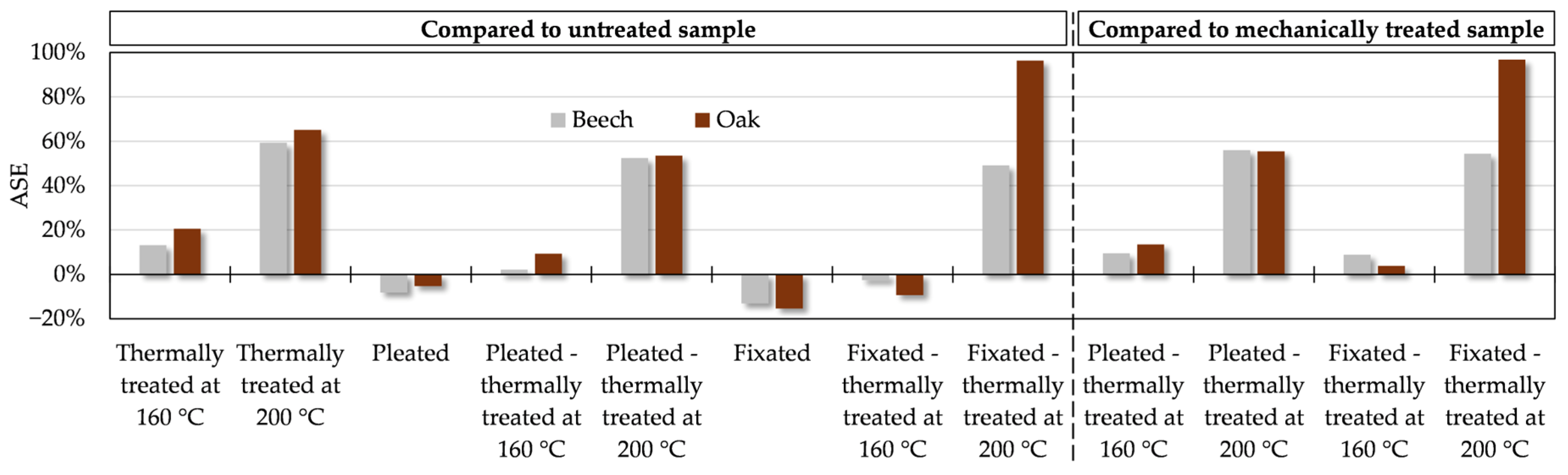
In beech, thermal modification at 160 °C slightly improved dimensional stability in both radial and tangential directions (between 10.3% and 14.7%). However, this level of improvement is not significant enough to justify carrying out the modification under industrial conditions. At 200 °C, considerably greater ASE values were achieved, ranging from 51.0% to 65.7%. Thermal modification produced similar effects in pleated beech. Pleating itself had no influence on ASE, except for the radial ASE value measured during the first swelling cycle, in which case the swelling increased, resulting in a negative ASE value of 12.0%. In contrast, fixation exerted a pronounced influence despite the fact that ASE enhancement is not an intended objective of this modification. ASE values ranged from 6.0% to 25.5%, with an average of 11.5%. Subsequent thermal modification at 160 °C further improved ASE to an average of 23.9%, whereas treatment at 200 °C again yielded values around 60%. In fixated specimens, first-cycle swelling was substantially greater than in subsequent cycles, likely because the compressed wood partially recovered its original dimensions and some of the buckled cell walls partially straightened. In the longitudinal direction, thermal modification of natural wood at 160 °C and 200 °C substantially improved ASE, particularly during the first swelling cycle (43.1% and 73.6%, respectively). However, mechanical modifications strongly degraded dimensional stability. ASE calculations yielded values of several thousand percent, but these large percentages are somewhat misleading because the absolute dimensional changes were very small. Such values are a consequence of small initial (base) values. The largest difference was observed in the Fixated–thermally treated at 160 °C sample, where the average longitudinal swelling in cycle 2 changed from 0.27% to 5.74% as a result of the combined treatment. Thus, the relative change appears large, although its contribution to volumetric ASE remains limited. Nevertheless, in applications relying on the inherently low longitudinal dimensional variation in wood, such increases may become problematic. For example, if longitudinal swelling increases several-fold and reaches approximately 2%, dimensional changes over several meters could amount to several centimeters, potentially causing structural issues. Despite this, longitudinal swelling and shrinking contributed only minimally to the volumetric ASE values of beech. Considering the average of the four ASE values obtained from the two wetting–drying cycles, thermal modification improved volumetric ASE by 13.1% at 160 °C and by 59.3% at 200 °C, corresponding closely to the radial and tangential ASE trends (Figure 7). Pleating degraded dimensional stability by 8.2%, while fixation degraded it by 13.1%. Thermal modification effectively mitigated the negative effects of longitudinal compression. If ASE calculations are based on the swelling and shrinking behavior after the initial mechanical modification (pleating or fixation), a more precise assessment of thermal treatment effects can be obtained. Relative to pleated specimens, thermal modification improved ASE by an average of 9.5% at 160 °C and 55.9% at 200 °C (right side of Figure 7). Compared to fixated specimens, the corresponding improvements were 8.9% and 54.4%, respectively, indicating identical responses.
Figure 7.
Volumetric anti-swelling and anti-shrinking efficiencies of the tested samples. Individual results cannot be compared, only the averages; thus, standard deviations cannot be shown on the bar chart.
For oak samples, many ASE values were statistically equivalent, whereas others exhibited larger absolute magnitudes compared to beech. Thus, the general trends were similar, although the treatment-induced changes were often more pronounced for oak. This is advantageous from the perspective of dimensional stability improvement, even if negative ASE values occurred more strongly in the longitudinal direction, indicating decreased dimensional stability. Considering volumetric ASE, as discussed previously, these longitudinal effects were sufficiently small; they were plentifully compensated by the transverse ASE values. Consequently, volumetric ASE values were at least as favorable as those observed in beech and, in many cases, substantially better (Figure 7). The only exception was oak subjected to fixation followed by thermal modification at 160 °C, which degraded dimensional stability by 6.8% compared to untreated wood. Nevertheless, compared with the ASE of the fixated condition itself (15.4%), this value of 6.8% still represented an improvement. Specimens treated at 200 °C exhibited exceptionally high ASE in both beech and oak.
Thermal modification of fixated oak at 160 °C was less effective in improving ASE than for beech. Although both species are hardwoods, their anatomical structures differ considerably, which was one of the reasons for their selection in this study. Ring-porous oak possesses a substantially less homogeneous structure than beech due to the presence of numerous large vessels. Although beech exhibits a comparable density despite its smaller vessel size, it generally contains substantially higher internal stresses than oak, as was evidenced in Section 3.4. Differences also exist in the relative amount of cell types and in chemical composition. For example, oak contains large amounts of acidic extractives, which significantly influence the course and effect of thermal modification. The combination of these factors causes variations in ASE values; the effect of thermal modification is enhanced by the tannic acid found in oak [39].
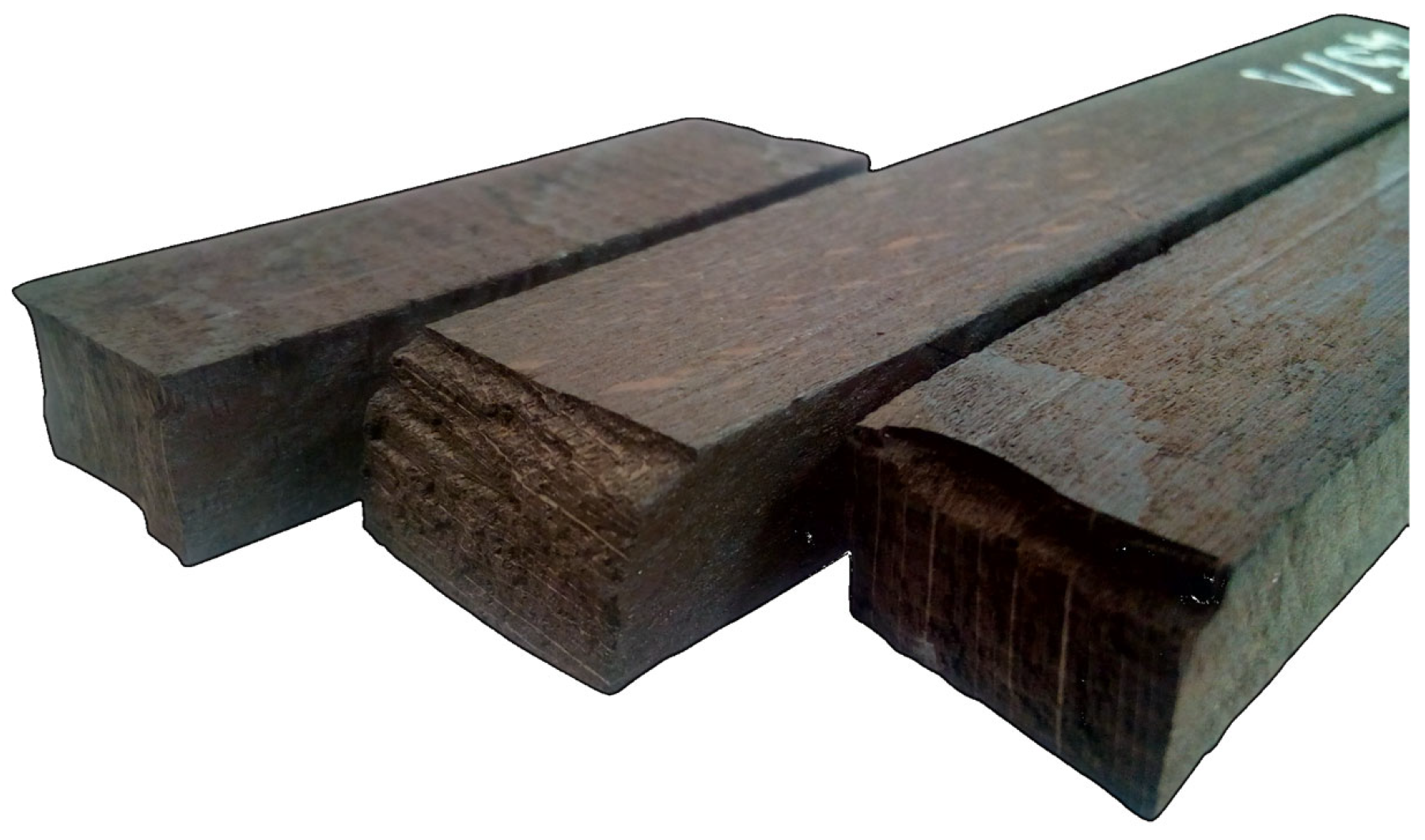
The numerous changes induced by the individual and combined treatments are the result of multiple interacting factors. One of the most apparent changes in wood is that compression along the grain (pleating) markedly increases the flexibility of wood [4,5], an effect that is further enhanced by fixation. In pleated specimens, the fibers become partially buckled [4], whereas fixation causes pronounced waviness in the walls of all cells. These changes are also evident at the level of the cell wall microfibrils [36]. Because swelling originates from the insertion of water molecules between microfibrils within the cell wall, compression along the grain must inevitably influence wood–water interactions. Nevertheless, the present results indicate that thermal modification exerts a substantially greater influence in this respect. Consistent with several studies, such as Tolvaj [40], the wood became visibly darker as treatment intensity increased. Wood darkens during thermal treatment because elevated temperatures promote condensation and oxidation reactions, forming electron-conjugated systems that increase visible light absorption [23]. This structural modification, alongside the accumulation of hemicellulose and lignin degradation products, results in substantial color deterioration as treatment intensity increases [7]. Another important consequence is the increased brittleness of the wood. Following severe thermal modification, wood typically fractures suddenly with lower resistance and exhibits relatively smooth, straight fracture surfaces [12], which was also observed in the specimens examined in the present study. Wood brittleness increases at higher temperatures primarily due to the severe chemical degradation of hemicelluloses and evaporation of extractives [7,23]. The loss of these thermally labile components is considerable. The matrix material composed largely of hemicelluloses and lignin, which binds cellulose fibers, microfibrils, and cells together, is partially transformed or lost during treatment. Consequently, the reinforcing cellulose framework becomes less effectively interconnected, reducing the ability of structural components to act cooperatively due to the reduced chain mobility of the amorphous polymer network, causing the wood to behave as a stiff, elastic, yet brittle material [7]. Furthermore, physical changes such as irreversible hydrogen bonding during drying also contribute to cell wall rigidification [22]. Consequently, thermally modified wood exhibits a marked reduction in ductility and fracture resistance [7]. It should also be noted that specimens subjected to fixation followed by thermal modification at 200 °C retained their overall structure but lost mechanical resistance to such an extent that many could be fractured manually and, in some cases, even crumbled by hand, indicating extremely low bending strength (Figure 8). This phenomenon is attributable both to the severe mechanical deformation and buckling of the cells and to the extensive loss of matrix components, a process further promoted in oak by acidic constituents [7,23]. Pleating highly improves pliability, but thermal treatment at 200 °C largely reduces it, ultimately making the treated wood more rigid compared to the untreated wood. Thermal treatment at 160 °C also makes the pleated wood more rigid. Thermal treatment eliminates the original purpose of pleating, which is to make the wood pliable. This is advantageous for a component shaped to a specific form, since the goal is to maintain the specified shape so that the component can be used as a custom-shaped part. As a result, the two treatments can complement each other perfectly. Additional information and photographic documentation can be found in the study of Báder et al. [12]. Consequently, although highly favorable dimensional-change characteristics were achieved, high-temperature thermal modification of compressed wood along the grain is not recommended. Based on the swelling–shrinking and ASE analyses conducted, thermal treatment at 160 °C was not sufficiently effective, while treatment at 200 °C rendered the wood unsuitable for further use. For this reason, it is recommended to apply the 200 °C treatment for a shorter duration or to try the 180 °C treatment, in order to obtain wood with the appropriate strength and sufficiently decreased swelling and shrinking. Possible future industrial applications for the wood treated with the combined modifications presented in this study may include furniture and interior design products exposed to changing conditions, such as furniture for damp rooms, curved furniture on ships, shoe insoles, or interior roofing for open structures.
Figure 8.
Typical brittle fracture patterns of fixated and thermally modified specimens at 200 °C.
4. Conclusions
This study investigated the combined effects of thermo-hydromechanical pleating (20% compression of plasticized wood along the grain), fixation (maintaining the compression for five hours), and subsequent thermal modification at 160 and 200 °C on the wood–water relations of beech (Fagus sylvatica L.) and sessile oak (Quercus petraea (Matt.) Liebl.). Density, equilibrium moisture content, swelling and shrinking, swelling–shrinking anisotropy, and dimensional stability were evaluated over two complete soaking–drying cycles to determine whether thermal treatment can compensate for the moisture sensitivity induced by compression along the grain. Pleating and fixation alone had only a minor influence on equilibrium moisture content, whereas thermal treatment reduced it to 7.8–8.0% at 160 °C and 4.9–5.0% at 200 °C, substantially improving hygroscopic stability. Thermal modifications also decreased oven-dry density from 720 kg/m3 to 671 kg/m3 and 580 kg/m3 in beech and from 761 kg/m3 to 656 kg/m3 and 557 kg/m3 in oak at 160 and 200 °C, respectively, although the reductions were markedly smaller in mechanically modified specimens. While pleating greatly increased longitudinal swelling and shrinking, moderate thermal treatment effectively counteracted this effect, and the volumetric dimensional changes in pleated wood treated at 160 °C became statistically comparable to those of untreated wood. Treatment at 200 °C produced the greatest reduction in swelling and shrinking and lowered the tangential-to-radial swelling ratio to 1.84–1.99 in beech and to 1.12–1.28 in oak, indicating enhanced dimensional stability. However, considering the pronounced mechanical degradation associated with high-temperature treatment reported previously, thermal modification at 160 °C represents the most balanced approach, providing a chemical-free route to stabilizing pleated hardwoods while largely preserving the functional advantages for applications requiring high pliability and improved moisture resistance.
Author Contributions
Conceptualization, M.B. (Mátyás Báder), M.B. (Miklós Bak) and R.N.; Methodology, M.B. (Mátyás Báder) and M.B. (Miklós Bak); Validation, M.B. (Mátyás Báder) and M.B. (Miklós Bak); Formal Analysis, M.B. (Mátyás Báder); Investigation, B.J.H.; Resources, M.B. (Mátyás Báder); Writing—Original Draft Preparation, M.B. (Mátyás Báder) and B.J.H.; Writing—Review and Editing, M.B. (Mátyás Báder) and M.B. (Miklós Bak); Visualization, M.B. (Mátyás Báder); Supervision, M.B. (Mátyás Báder), M.B. (Miklós Bak) and R.N.; Project Administration, M.B. (Mátyás Báder), M.B. (Miklós Bak) and R.N.; Funding Acquisition, M.B. (Miklós Bak) and R.N. All authors have read and agreed to the published version of the manuscript.
Funding
This paper was supported by the János Bolyai Research Scholarship of the Hungarian Academy of Sciences. Project identifier: BO/00872/23.
Data Availability Statement
Data are contained within the article.
Acknowledgments
Many thanks to Imre Horváth for preparing the specimens.
Conflicts of Interest
The authors declare no conflicts of interest.
References
- Báder, M.; Németh, R. Hygroscopicity of Longitudinally Compressed Wood. Acta Silv. Lign. Hung. 2017, 13, 135–144. [Google Scholar] [CrossRef] [Scilit][Green Version]
- Báder, M. Practical issues of longitudinally compressed wood—Part 1: The raw material and its preparation; the theory of compression (Faanyag rostirányú tömörítésével kapcsolatos elméleti és gyakorlati kérdések áttekintése-1. rész: Az alapanyagok és előkészítésük, a tömörítés elmélete). Faipar 2015, 63, 1–9. [Google Scholar] [CrossRef] [Scilit]
- Báder, M.; Németh, R. Moisture-Dependent Mechanical Properties of Longitudinally Compressed Wood. Eur. J. Wood Prod. 2019, 77, 1009–1019. [Google Scholar] [CrossRef] [Scilit]
- Kuzsella, L. Effect of Longitudinal Compression on the Structure and Mechanical Properties of Beech Wood (Rostirányú Tömörítés Hatása a Bükk Faanyag Szerkezetére és Mechanikai Tulajdonságaira). Ph.D. Thesis, University of Miskolc, Miskolc, Hungary, 2011. [Google Scholar]
- Ivánovics, G. Strength Test of Longitudinally Compressed Wood (Rostirányban Tömörített Faanyagok Szilárdsági Vizsgálata); Belina, K., Ed.; College of Kecskemét: Kecskemét, Hungary, 2006; pp. 171–176. [Google Scholar]
- Sadadt nezhad, S.; Tajvidi, M.; Usefi, H. Effect of longitudinal compression to bulk cell wall on mechanical properties of steamed treated of beach wood. Iran. J. Wood Pap. Sci. Res. 2008, 23, 191–199. [Google Scholar] [CrossRef] [Scilit]
- Hill, C.; Altgen, M.; Rautkari, L. Thermal Modification of Wood—A Review: Chemical Changes and Hygroscopicity. J. Mater. Sci. 2021, 56, 6581–6614. [Google Scholar] [CrossRef] [Scilit]
- Sandberg, D.; Kutnar, A.; Karlsson, O.; Jones, D. Wood Modification Technologies: Principles, Sustainability, and the Need for Innovation, 1st ed.; CRC Press/Taylor & Francis Group: Boca Raton, FL, USA, 2021; p. 431. [Google Scholar]
- Borůvka, V.; Zeidler, A.; Holeček, T.; Dudík, R. Elastic and Strength Properties of Heat-Treated Beech and Birch Wood. Forests 2018, 9, 197. [Google Scholar] [CrossRef] [Scilit]
- Sinković, T.; Govorčin, S.; Sedlar, T. Comparison of Physical Properties of Heat Treated and Untreated Hornbeam Wood, Beech Wood, Ash Wood and Oak Wood. In Hardwood Science and Technology. The 5th Conference on Hardwood Research and Utilisation in Europe; Németh, R., Teischinger, A., Eds.; Sopron, Hungary, 2012; pp. 63–70. [Google Scholar]
- Kubovský, I.; Kačíková, D.; Kačík, F. Structural Changes of Oak Wood Main Components Caused by Thermal Modification. Polymers 2020, 12, 485. [Google Scholar] [CrossRef] [Scilit]
- Báder, M.; Horváth, B.J.; Bak, M. Bending Properties of Pleated Wood Thermally Treated at 160 °C and 200 °C Temperatures. Forests 2025, 16, 1702. [Google Scholar] [CrossRef] [Scilit]
- Stevens, W.; Turner, N. Solid and Laminated Wood Bending; Forest Products Research Laboratory, Department of Scientific and Industrial Research, His Majesty’s Stationery Office: London, UK, 1948; p. 71. [Google Scholar]
- Báder, M.; Németh, R.; Novák, D.; Horváth, F.; Hofmann, T. The First Results of Shrinkage and Swelling of Lactic Acid-Treated Beech Wood. In 9th Hardwood Conference Proceedings Part I. With Special Focus on “An Underutilized Resource: Hardwood Oriented Research”; Németh, R., Rademacher, P., Hansmann, C., Bak, M., Báder, M., Eds.; University of Sopron Press: Sopron, Hungary, 2020; Volume 1, pp. 27–32. [Google Scholar]
- ISO 13061-13:2016; Physical and Mechanical Properties of Wood—Test Methods for Small Clear Wood Specimens—Part 13: Determination of Radial and Tangential Shrinkage. International Organization for Standardization: Geneva, Switzerland, 2016.
- ISO 13061-14:2016; Physical and Mechanical Properties of Wood—Test Methods for Small Clear Wood Specimens—Part 14: Determination of Volumetric Shrinkage. International Organization for Standardization: Geneva, Switzerland, 2016.
- ISO 13061-15:2017; Physical and Mechanical Properties of Wood—Test Methods for Small Clear Wood Specimens—Part 15: Determination of Radial and Tangential Swelling. International Organization for Standardization: Geneva, Switzerland, 2017.
- ISO 13061-16:2017; Physical and Mechanical Properties of Wood—Test Methods for Small Clear Wood Specimens—Part 16: Determination of Volumetric Swelling. International Organization for Standardization: Geneva, Switzerland, 2017.
- Siuda, J.; Mazela, B.; Perdoch, W. Waterlogged Archaeological Wood Silanization With MTMOS. Drewno 2019, 62, 169–179. [Google Scholar] [CrossRef] [Scilit]
- Sadegh, A.; Kiaei, M.; Samariha, A. Experimental Characterization of Shrinkage and Density of Tamarix Aphylla Wood. Cellulose Chem. Technol. 2012, 46, 369–373. [Google Scholar]
- ISO 13061-02:2014; Physical and Mechanical Properties of Wood—Test Methods for Small Clear Wood Specimens—Part 02: Determination of Density for Physical and Mechanical Tests. International Organization for Standardization: Geneva, Switzerland, 2014.
- Borrega, M.; Kärenlampi, P.P. Hygroscopicity of Heat-Treated Norway Spruce (Picea Abies) Wood. Eur. J. Wood Prod. 2010, 68, 233–235. [Google Scholar] [CrossRef] [Scilit]
- Zhang, J.-W.; Liu, H.-H.; Yang, L.; Han, T.-Q.; Yin, Q. Effect of Moderate Temperature Thermal Modification Combined with Wax Impregnation on Wood Properties. Appl. Sci. 2020, 10, 8231. [Google Scholar] [CrossRef] [Scilit]
- Meier, E. European Beech. Available online: http://www.wood-database.com/european-beech/ (accessed on 20 January 2018).
- Molnár, S. Beech. In Industrial Wood Species of the World (Földünk Ipari Fái 2. Kiadás), 2nd ed.; Molnár, S., Farkas, P., Börcsök, Z., Zoltán, G., Eds.; Faipari Tudományos Egyesület: Sopron, Hungary, 2024; pp. 41–44. [Google Scholar]
- Gryc, V.; Vavrčík, H.; Gomola, Š. Selected Properties of European Beech (Fagus sylvatica L.). J. For. Sci. 2008, 54, 418–425. [Google Scholar] [CrossRef] [Scilit]
- Wagenführ, R. Holzatlas (Atlas of Wood); 6; neu bearb. und erw. Aufl.; Fachbuchverl; Leipzig im Hanser Verl: Leipzig, Germany, 2007; p. 816. [Google Scholar]
- Aicher, S.; Stapf, G. Glulam from European White Oak: Finger Joint Influence on Bending Size Effect. In Materials and Joints in Timber Structures; Aicher, S., Reinhardt, H.-W., Garrecht, H., Eds.; Springer: Dordrecht, The Netherlands, 2014; pp. 641–656. [Google Scholar]
- Taschner, R. A Tölgyek Nagy Értékű Hasznosítását Befolyásoló Tényezők Vizsgálata és Összehasonlító Elemzése; Nyugat-Magyarországi Egyetem: Sopron, Hungary, 2013. [Google Scholar]
- Gustafsson, S. The Strength Properties of Swedish Oak and Beech. Drewno. Pr. Nauk. Donies. Komunik. 2010, 53, 67–83. [Google Scholar]
- Molnár, S.; Farkas, P. Oak (penduculate and sessile oak). In Industrial Wood Species of the World (Földünk Ipari Fái 2. Kiadás), 2nd ed.; Molnár, S., Farkas, P., Börcsök, Z., Zoltán, G., Eds.; Faipari Tudományos Egyesület: Sopron, Hungary, 2024; pp. 125–130. [Google Scholar]
- Molnár, S.; Varga, M.F.; Fehér, S.; Németh, R. Technical properties of wood (A faanyag műszaki tulajdonságai). In Wood Industrial Handbook I/Faipari kézikönyv I; Molnár, S., Ed.; Faipari Tudományos Alapítvány: Sopron, Hungary, 2000; pp. 59–88. [Google Scholar]
- Čermák, P.; Rautkari, L.; Horáček, P.; Saake, B.; Rademacher, P.; Sablík, P. Analysis of Dimensional Stability of Thermally Modified Wood Affected by Re-Wetting Cycles. BioResources 2015, 10, 3242–3253. [Google Scholar] [CrossRef] [Scilit]
- Čermák, P.; Vahtikari, K.; Rautkari, L.; Laine, K.; Horáček, P.; Baar, J. The Effect of Wetting Cycles on Moisture Behaviour of Thermally Modified Scots Pine (Pinus sylvestris L.) Wood. J. Mater. Sci. 2016, 51, 1504–1511. [Google Scholar] [CrossRef] [Scilit]
- Skaar, C. Wood-Water Relations; Springer: Berlin/Heidelberg, Germany, 1988; p. 283. [Google Scholar]
- Báder, M.; Németh, R.; Konnerth, J. Micromechanical Properties of Longitudinally Compressed Wood. Eur. J. Wood Prod. 2019, 77, 11. [Google Scholar] [CrossRef] [Scilit]
- Göker, Y.; As, N.; Akbulut, T.; Dündar, T. Effects of the Spiral Grain on Some Physical Properties of Calabrian Pine (Pinus Brutia Ten.) Wood. Turk. J. Agric. For. 2000, 24, 51–56. [Google Scholar]
- Hitka, M.; Naď, M.; Klement, I.; Sydor, M. Improving Joint Strength through Controlled Wood Swelling. Wood Mater. Sci. Eng. 2026, 21, 1071–1080. [Google Scholar] [CrossRef] [Scilit]
- Zhao, Y.; He, L.; Kang, J.; Gao, J.; Huo, G.; Xu, K.; Wang, T.; He, Z.; Wang, Z.; Yi, S. Effects of Tannin Acid Impregnated Pretreatment on Dimensional Stability and Chemical Composition of Heat-Treated Chinese Fir. Holzforschung 2024, 78, 127–136. [Google Scholar] [CrossRef] [Scilit]
- Tolvaj, L. Optical Properties of Wood: Measurement Methods and Result Evaluations; Smart Sensors, Measurement and Instrumentation; Springer Nature: Cham, Switzerland, 2024; Volume 45, p. 307. [Google Scholar]

Disclaimer/Publisher’s Note: The statements, opinions and data contained in all publications are solely those of the individual author(s) and contributor(s) and not of MDPI and/or the editor(s). MDPI and/or the editor(s) disclaim responsibility for any injury to people or property resulting from any ideas, methods, instructions or products referred to in the content. |
© 2026 by the authors. Licensee MDPI, Basel, Switzerland. This article is an open access article distributed under the terms and conditions of the Creative Commons Attribution (CC BY) license.