


Abstract
Dispersal mechanisms of phytopathogenic fungi and oomycetes are critical components of forest disease dynamics. While wind and water are well-studied pathways, the role of large forest herbivores as passive vectors remains significantly overlooked. This study quantifies and compares the pathogen loads carried on the hooves and hair of wild red deer (Cervus elaphus) to evaluate their epidemiological potential. Swab samples were collected from the hooves and hair of harvested deer in the Czerwony Bór Forest District, Poland. Quantitative PCR (qPCR) assays targeting the ITS1 region were deployed to detect total fungal DNA, Alternaria alternata, Fusarium avenaceum/F. tricinctum, and several Phytophthora species. A linear mixed-effects model was implemented to statistically evaluate variations in pathogen loads across anatomical sampling locations while controlling for individual animal variability. Fungal DNA was detected in 87.5% of hoof samples, showing significantly lower Ct values (13.85–18.54) compared to fur samples (17.02–29.56), which exhibited a more patchy distribution (p = 0.016). Similarly, A. alternata transfer was highly favored by hooves (p < 0.001). Conversely, F. avenaceum was more frequently detected on hair. Among oomycetes, Phytophthora pseudosyringae was detected in all sampled animals, whereas Phytophthora cactorum occurred rarely, and other tested Phytophthora species were not detected. Wild deer carry DNA of multiple fungal and oomycete pathogens and may act as potential passive carriers within forest ecosystems. Hooves constitute the primary vector for soil-borne pathogens due to sustained contact with topsoil, whereas hair facilitates the movement of specific canopy or airborne taxa. These findings suggest that wildlife movements should be considered in future forest biosecurity assessments for comprehensive forest health management and for understanding pathogen exchange between forest and agricultural ecosystems.
1. Introduction
Forest ecosystems worldwide are increasingly threatened by emerging plant diseases, which cause severe ecological degradation, biodiversity loss, and substantial economic deficits in forestry [1,2]. Among the most destructive agents of these declines are phytopathogenic oomycetes and fungi, which attack a wide range of woody hosts. Species belonging to the genus Phytophthora (oomycetes), along with fungal pathogens such as Fusarium and Alternaria, are notorious for inducing root rots, stem cankers, and dieback syndromes [3,4]. Understanding the dispersal dynamics of these pathogens is crucial for predicting disease spread and implementing effective biosecurity measures.
To date, research on the epidemiology of forest pathogens has predominantly focused on abiotic vectors, such as wind and water currents, or anthropogenic pathways, including the global trade of live plants and timber [5,6]. While the role of large mammals in the epidemiology of zoonotic and vector-borne animal pathogens is well documented [7,8], their potential as passive dispersal agents for microbial plant pathogens remains critically overlooked. Epizoochory, the external transport of propagules on animal bodies, is heavily studied regarding seed dispersal [9], yet its relevance to microbial plant pathogens is rarely integrated into forest health assessments [10,11].
Large wild herbivores, particularly red deer (Cervus elaphus), are highly mobile elements of forest landscapes. Their ecological behaviors, including wallowing, scraping, and foraging across heterogeneous habitats (e.g., dense woodlands, riparian zones, and agricultural fringes), bring them into continuous, direct contact with topsoils and infected plant debris. These activities create ideal conditions for the mechanical acquisition of soil-borne oospores, chlamydospores, and fungal mycelia. Consequently, migratory and local movements of game animals may facilitate long-distance pathogen dispersal and breach geographical barriers that would otherwise limit natural pathogen expansion [12,13]. Red deer are among the most influential large herbivores in European forest ecosystems and are frequently associated with conflicts in forestry due to browsing and bark stripping damage [14,15]. During spring and summer, their diet consists mainly of protein-rich grasses and herbs, but deer also commonly forage in agricultural fields where they may cause crop losses [16,17,18]. Consequently, regular movements between forest habitats and agricultural areas create opportunities for the exchange of biological material, including plant pathogens, across ecosystem boundaries. In addition, both hunting pressure and protection regimes can alter deer spatial behaviour and local densities, potentially affecting the scale and frequency of pathogen transport across landscapes [19,20].
Among the fungal taxa potentially dispersed by large herbivores, Alternaria alternata deserves particular attention because of its economic importance in agricultural systems. Alternaria alternata causes diseases of more than 100 host plant species, including potato and oilseed rape, and is also responsible for post-harvest diseases in cereal crops [21]. Owing to the strong association of Alternaria species with agricultural production, the highest airborne spore concentrations are typically recorded in rural areas dominated by cereal and oilseed rape cultivation [22]. Alternaria conidia are produced on elongated conidiophores and are passively released by physical disturbances such as wind gusts and the natural vibration of plant tissues [23]. A positive relationship between agricultural land cover and airborne Alternaria spore abundance has been demonstrated in the Central and Eastern Black Sea region [24]. Furthermore, spore concentration peaks during the growing season are closely linked to agricultural activities, particularly crop harvesting, which can release large quantities of spores into the atmosphere [22]. In Poland, the main seasonal peak of airborne Alternaria spores occurs between July and August, followed by a marked decline in September [25]. Although dispersal of Alternaria spores is often considered predominantly local and restricted to individual fields [26], recent studies have demonstrated that despite their relatively large size, spores may be transported over distances of several hundred kilometres under favourable atmospheric conditions [27,28]. These findings suggest that additional vectors, including highly mobile vertebrates moving between agricultural and forest habitats, may contribute to the redistribution of Alternaria inoculum across ecosystem boundaries.
Species belonging to the genus Fusarium are among the most important pathogens of cereal crops worldwide. They cause Fusarium head blight (FHB) and Fusarium foot rot (FFR), two major diseases responsible for yield losses and mycotoxin contamination in wheat and other cereals [29,30]. In Poland, the predominant cereal-associated species include F. avenaceum, F. culmorum, F. graminearum, F. langsethiae, F. sporotrichioides, F. oxysporum, F. poae, and F. tricinctum [31,32]. Higher abundances of Fusarium species are generally observed in regions characterized by intensive agricultural production [33]. The primary mechanism of Fusarium spore dispersal involves rain-splash transport, whereby spores are vertically projected from infected plant material and subsequently transferred from leaves to cereal ears [34,35]. Experimental studies have shown that rain-splash droplets may propel spores up to 1 m above the canopy [36]. Following release, spores may be entrained by wind and transported over distances of several kilometres under suitable meteorological conditions [37]. Temperature, precipitation and relative humidity strongly influence spore release and dispersal dynamics [38]. Since sexual stages are absent in many Fusarium species, infection is typically initiated by microconidia and macroconidia, which constitute the principal source of inoculum [39].
Although previous qualitative studies have occasionally noted the presence of fungi on wildlife tissues, quantitative assessments distinguishing between different anatomical matrices are lacking. It remains unclear whether the dense pelage (fur) or the keratinized surfaces of the hooves, which accumulate soil particulates, serve as the primary reservoir for pathogen transmission.
In addition to abiotic pathways, a growing body of evidence indicates that animals may contribute substantially to the dispersal of phytopathogenic fungi. Numerous arthropod taxa representing different trophic groups have been identified as potential carriers of fungal propagules, including species of the genus Fusarium [40]. Such transport has been documented in ants, millipedes and spiders [41], while ground beetles have been shown to carry several species of both Fusarium and Alternaria across agricultural landscapes [42]. Fungal spores readily adhere to body surface microstructures such as setae, hairs and spines, facilitating their passive transport by invertebrate vectors [43]. Vertebrates may also act as fungal dispersal agents. Rodents, squirrels and woodpeckers contribute to fungal spread within forest ecosystems, whereas birds can transport fungal propagules over much greater distances and potentially facilitate biological invasions at continental scales [44,45]. Despite their potential epidemiological importance, such animal-mediated pathways remain poorly understood and are often referred to as “cryptic vectors” because they are frequently overlooked in plant disease studies [45]. Their significance may increase under climate change, which is expected to alter vector distributions, abundance and movement patterns, thereby potentially enhancing the spread of fungal pathogens [46,47]. Large forest mammals such as wild boar, roe deer and red deer represent particularly plausible cryptic vectors because they routinely move between agricultural and forest habitats. In a previous study, we demonstrated that browsing damage inflicted by cervids on Scots pine seedlings facilitated fungal infections and that the frequency of occurrence of Fusarium pathogens decreased with increasing distance from agricultural fields. The study identified important pathogens, including Fusarium avenaceum and F. oxysporum, consistent with the possibility of pathogen exchange between agricultural and forest ecosystems and increased susceptibility of younger seedlings to infection [48].
Given the ecological importance of these potential transmission pathways, highly sensitive molecular techniques are required to assess the occurrence of pathogenic organisms on wildlife. In the present study, species-specific quantitative PCR (qPCR) assays were used to detect fungal and oomycete DNA on deer hooves and fur. The selected taxa included forest pathogens as well as agriculturally important species such as Alternaria alternata and Fusarium avenaceum. This combination enabled simultaneous evaluation of risks associated with both forest health and the movement of pathogens between agricultural and forest ecosystems. To our knowledge, no previous study has quantitatively compared the occurrence of fungal and oomycete pathogens on deer hooves and fur using species-specific qPCR assays.
To address this knowledge gap, the objective of this study was to quantitatively evaluate and compare the capacity of deer hooves and hair to function as external vectors for total fungi, Alternaria alternata, Fusarium species, and highly destructive Phytophthora species. Utilizing species-specific quantitative PCR (qPCR) assays combined with linear mixed-effects modeling, we tested the hypothesis that hooves carry significantly higher pathogen loads due to sustained edaphic contact, thereby acting as critical, yet overlooked, vectors in forest disease networks.
2. Materials and Methods
2.1. Sampling and DNA Extraction
Samples were collected from six female red deer (Cervus elaphus) harvested in the Czerwony Bór Forest District (Łomża Forest District, Poland). From each animal, samples were collected separately from all four hooves and from four fur sampling locations, resulting in eight samples per deer. All samples were gathered using sterile cotton swabs and stored immediately in individually labeled zip-lock bags. Red deer were selected because they are among the most widespread and mobile large herbivores in European forests and frequently move between forest and agricultural habitats, making them suitable candidates for studies of pathogen dispersal. The Czerwony Bór Forest District was selected because it supports a relatively abundant red deer population and provides access to legally harvested animals through routine wildlife management activities. In addition, the study area is characterized by a heterogeneous landscape composed of forest stands interspersed with agricultural land. Such habitat structure promotes regular movements of deer between forest and agricultural environments and therefore provides suitable conditions for investigating the potential passive transport of fungal and oomycete pathogens across ecosystem boundaries. The selection of this study area was therefore based on both practical considerations related to sample availability and its ecological suitability for assessing wildlife-associated pathogen transport. Following harvest, carcasses were stored at 4 °C and sampled within 48 h after hunting. Disposable gloves were changed between animals, sterile individually packaged swabs were used for each sample, and all samples were processed separately to minimize contamination.
Total genomic DNA was extracted from both the cotton swabs and target reference cultures. The reference strains included Alternaria alternata (strain p18.22.2023), Fusarium avenaceum (strain p12.56.2016), Fusarium culmorum (strain p18.22.2023), Fusarium graminearum (strain OLH2014/75), and Penicillium verrucosum (strain OLH2015/41). Extractions were performed using the NucleoSpin Soil kit (Macherey-Nagel, Düren, Germany) according to the manufacturer’s instructions. All reference strains originated from the culture collection of the Department of Genetics and Plant Pathophysiology at the University of Warmia and Mazury in Olsztyn and were maintained at °C prior to analysis.
The purity and concentration of the isolated DNA were determined using a NanoDrop 2000C spectrophotometer (Thermo Scientific, Waltham, MA, USA). For each pathogen species, a series of 10-fold dilutions of genomic DNA was prepared to establish standard calibration curves. Additionally, a mixed fungal DNA composite sample was generated to serve as a standard for total fungal quantification using the FungiQuant primer set. Each qPCR run included positive controls, no-template controls (NTC), and extraction blanks. All qPCR reactions were performed in triplicate.
2.2. Quantitative PCR (qPCR) Assays
Amplification of the internal transcribed spacer 1 (ITS1) region was performed using specialized primers for Phytophthora cactorum and Phytophthora plurivora following Nowakowska et al. (2017), and for Phytophthora multiformis, Phytophthora pseudosyringae, and Phytophthora quercina as detailed by Nowakowska et al. [49,50]. Oligonucleotide synthesis was performed by Merck (Darmstadt, Germany).
Briefly, qPCR assays were carried out in a total volume of 20 μL, containing 1 μM of each forward and reverse primer, 10 μL of 2× LuminoCt qPCR ReadyMix (Merck, Darmstadt, Germany), and 2 μL of extracted template DNA. Thermocycling was executed on an Applied Biosystems 7500 Real-Time PCR System (Applied Biosystems, Foster City, CA, USA) under the following conditions: initial denaturation at 95 °C for 3 min, followed by 40 cycles of denaturation at 95 °C for 30 s, annealing at 52 °C for 30 s, and extension at 72 °C for 30 s. Threshold cycle () values less than 40 were defined as a positive detection response. The < 40 threshold was adopted based on assay validation and previous studies employing the same primer sets. All samples were analysed in technical triplicate. Positive detections, including reactions generating high Ct values, were interpreted according to previously validated assay protocols and the predefined positivity threshold (Ct < 40). No additional confirmatory analyses beyond technical triplicates were performed.
Because threshold cycle () values are inversely proportional to template abundance, lower values indicate higher quantities of pathogen DNA in the analysed samples. Primer and probe sequences, GenBank accession numbers, amplicon sizes, amplification efficiencies, coefficients of determination (R2), detection limits, and literature sources for all qPCR assays are provided in Appendix B Table A2.
2.3. Statistical Model
A statistical model was developed to verify the hypothesis that the spread of pathogens by game animals depends on the anatomical sampling location, specifically comparing vectors carried on hooves versus fur.
Samples with no detectable amplification signal were treated as non-detects and assigned a value of zero prior to statistical analysis. Consequently, both positive and negative samples were retained in the dataset used for comparisons between hoof and fur samples. To account for the non-independence of observations arising from repeated sampling within the same individual animal, a linear mixed-effects model was employed [51]. In this framework, the categorical variable C (denoting hooves or fur) was treated as a fixed effect, while the subject identifier A (denoting the individual animal) was included as a random effect to capture between-subject variability. The model is expressed as:
where denotes the observed quantification value ( value or log-transformed DNA mass) for the j-th sample from the i-th subject. represents the fixed intercept, indicates the fixed effect of the sampling location (hooves vs. fur), is the random effect associated with subject i, and represents the residual error term. This approach appropriately models the hierarchical structure of the data and allows valid inference on the effect of C while accounting for within-subject correlation.
The model was implemented in Python 3.12 using the statsmodels library [52], specifically utilizing the MixedLM class for linear mixed-effects estimation. Fixed effects were specified using a formula interface, and the grouping structure for the random effects was defined by the animal identifier. Model parameters were estimated using restricted maximum likelihood (REML). Statistical inference for the fixed effect was based on the estimated coefficient and its associated standard error, yielding a z-test statistic and a corresponding p-value. Model diagnostics, including inspection of residuals and assessment of the random effects distribution, were performed to verify the validity of normality and homoscedasticity assumptions.
Because the study was based on a limited number of animals (), the statistical analyses were intended primarily to explore potential differences between sampling locations and to identify patterns that may warrant further investigation in larger studies. Therefore, statistical inference should be interpreted with appropriate caution.
3. Results
3.1. qPCR Detection of Fungal and Oomycete DNA
Swabs obtained from the hooves and hair of red deer were analysed using quantitative PCR to detect the presence and establish the loads of target fungi and Phytophthora species. The comprehensive raw results of this qPCR analysis are documented in Appendix A, Table A1. Total fungal DNA was successfully detected in 87.5% of the samples retrieved from deer hooves, which also exhibited the highest concentration of genetic material, with threshold cycle () values ranging from 13.85 to 18.54. Although fungal DNA was also found to be carried on the hair, the total mass transferred via this matrix was substantially lower ( 17.02–29.56). Furthermore, the distribution on the pelage was highly patchy, resulting in zero detection across 50.0% of the body sampling locations. These metrics indicate a significantly higher concentration of fungal biomaterial within the foreign matter and soil compressed onto the hoof surface. These results suggest that hooves may represent an important substrate for the passive transport of fungal propagules in forest environments due to their continuous contact with topsoil and associated microbial communities. The detection frequency of Alternaria alternata on deer hooves precisely mirrored that of total fungi (87.5%), whereas its occurrence on hair was markedly lower (33.3%). Interestingly, the actual quantity of DNA transferred between the two matrices fell within a similar range ( 29.09–34.39 for hooves and 31.42–34.24 for hair). This quantitative similarity indicates that DNA of A. alternata can be detected on both hooves and fur; however, the present data do not allow conclusions regarding fungal viability or persistence on animal tissues.
In contrast to the patterns observed for A. alternata, the complex of Fusarium avenaceum/Fusarium tricinctum was carried approximately twice as frequently on hair as on hooves, yielding detection frequencies of 45.8% and 20.8%, respectively.
Among the tested oomycetes, Phytophthora pseudosyringae exhibited the highest prevalence, achieving a 100% detection frequency across all sampled animals. It was recovered from both matrices, although Ct values were slightly higher in fur samples, displaying values of 29.92–34.04 on hooves and 32.61–38.17 on hair. Conversely, the destructive pathogen Phytophthora cactorum was transferred at much lower frequencies (16.7% on hooves and 12.5% on hair), though its relative DNA loads remained within a similar range. The remaining target oomycete species, including Phytophthora multiformis, Phytophthora plurivora, and Phytophthora quercina, were not detected in any of the analyzed samples.
3.2. Pathogen Dispersal by Hooves and Fur
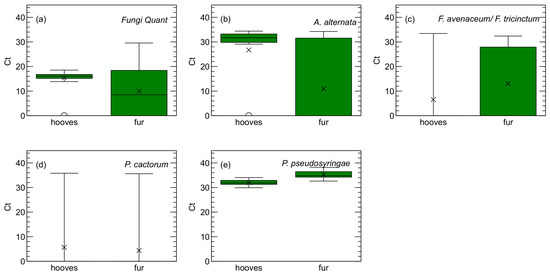
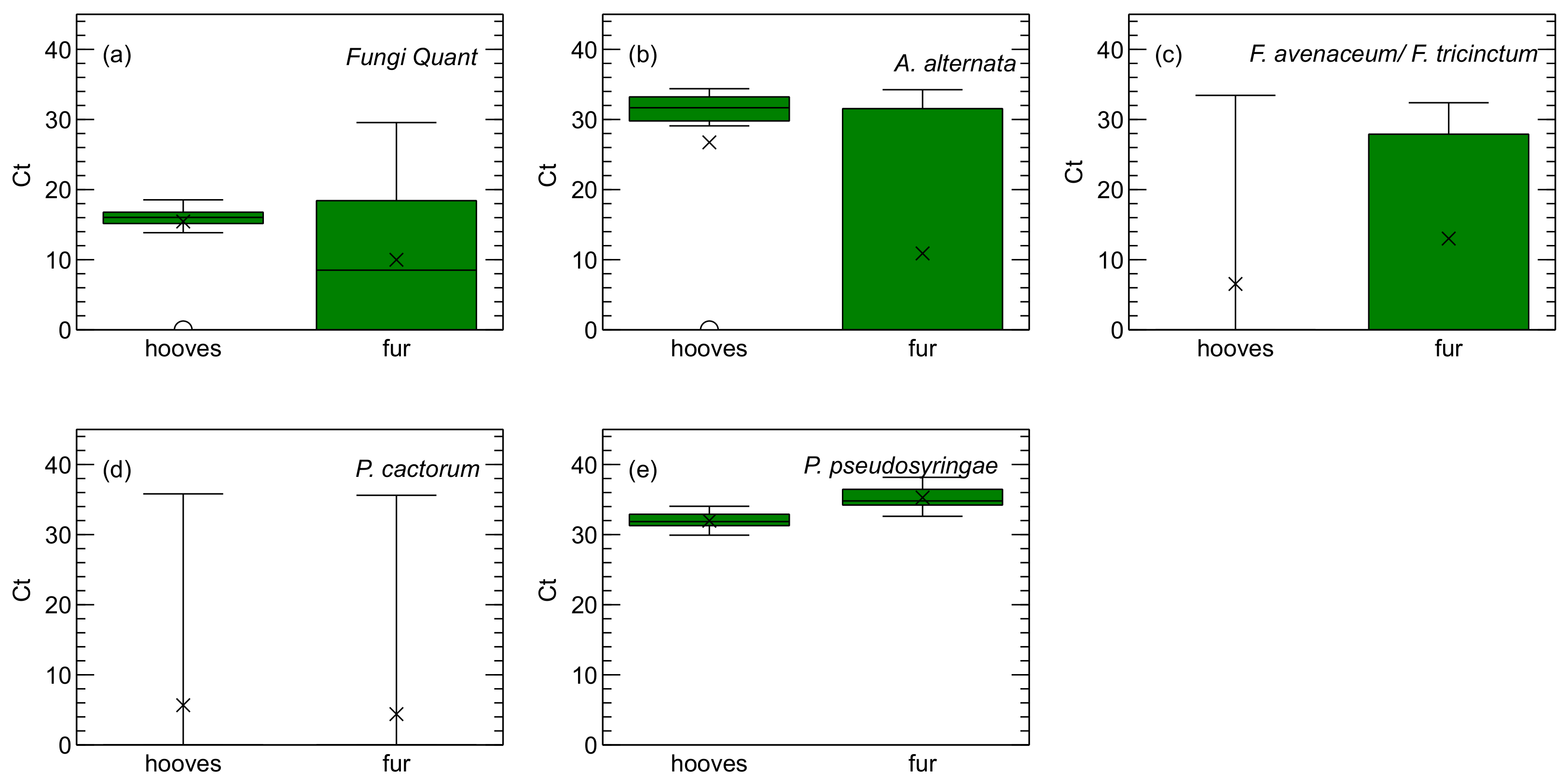
A graphical comparison illustrating the variations in the distributions of detected pathogen quantities between the two anatomical sampling locations (hooves versus fur) is presented in Figure 1. The outputs of the linear mixed-effects models verifying the statistical significance of the differences in means between these sampling matrices are summarized in Table 1.
Figure 1.
Comparison of values obtained for pathogen DNA detected in hoof and fur samples collected from six red deer. (a) Total fungal DNA, (b) Alternaria alternata, (c) Fusarium avenaceum/F. tricinctum, (d) Phytophthora cactorum, and (e) Phytophthora pseudosyringae. Boxes represent interquartile ranges, horizontal lines indicate medians, and points represent individual observations.
Table 1.
Results of linear mixed-effects models comparing pathogen quantities between two sampling locations (hooves and fur). Separate models were fitted for each fungal and oomycete taxon.
As demonstrated in Figure 1a, the quantity of total fungal DNA detected in samples recovered from hooves was significantly higher than that isolated from fur. This architectural variation was confirmed to be statistically significant by the linear mixed-effects model (Table 1; p = 0.016). The magnitude of this effect was substantial, indicating significantly lower fungal DNA abundance on fur than on hooves. Parallel trends were established for the DNA loads of Alternaria alternata, where the effect was highly significant (), indicating a markedly greater abundance of pathogen DNA on hooves than on fur.
Conversely, Fusarium species remained undetected across numerous hoof samples (Figure 1c), and the quantitative variation between hooves and fur did not meet the threshold for statistical significance. Regarding the dispersal of oomycetes, Phytophthora cactorum was recovered with low frequency; consequently, no statistically significant difference was observed between the two anatomical locations.
In the case of Phytophthora pseudosyringae, although the fixed effect model indicated an inverse relationship—suggesting that propagule transmission via the pelage might surpass that of the hooves—and the output was statistically significant (p < 0.001), the actual magnitude of this effect was minor, accounting for a variation of only about 10%. Given this narrow margin, this specific deviation is likely attributable to minor statistical fluctuations within the dataset rather than a distinct biological mechanism favoring fur-mediated transmission.
4. Discussion
This study provides novel quantitative evidence that red deer (Cervus elaphus) may function as potential external mechanical carriers of both oomycete and fungal phytopathogens, substantiating their role as overlooked multi-pathogen vectors within forest ecosystems. By transitioning from traditional qualitative tracking to species-specific qPCR quantification, our findings confirm that wildlife-mediated epizoochory is a highly dynamic pathway capable of moving structurally diverse plant pathogens simultaneously.
The significantly higher pathogen loads consistently detected on deer hooves indicate that soil-mediated contamination represents the dominant mechanism of propagule acquisition. This physical pattern closely aligns with the ecological and spatial behaviors of large wild ungulates. Deer frequently traverse dense, wet, and heterogeneous forest floor environments, including riparian zones and muddy wallows, which are well-documented edaphic reservoirs where zoosporic oomycetes like Phytophthora persist [3,49,50]. The lower, more fragmented pathogen distribution observed on the hair further supports this hypothesis; airborne or plant-associated propagules (such as Alternaria or Fusarium) likely adhere to the pelage during browsing, whereas the hooves directly compress and trap highly concentrated inoculum directly from the topsoil.
Importantly, the concurrent detection of pathogen DNA from Phytophthora, Fusarium, and Alternaria on the same animal subjects demonstrates that the external carriage of plant pathogens by large herbivores is not taxon-specific. Instead, it represents a generalized biophysical process dictated by animal–substrate interactions. This insight expands upon previous epidemiological frameworks, which have conventionally evaluated wildlife vectors through the lens of single target pathogen groups [10,13]. The detection of Phytophthora pseudosyringae in all sampled individuals suggests frequent exposure of deer to this pathogen in the study area, whereas the sporadic detection of Phytophthora cactorum may reflect localized ecological constraints, lower zoospore density, or distinct seasonal sporulation patterns.
The detection of Alternaria alternata and Fusarium avenaceum/F. tricinctum is particularly relevant from both epidemiological and ecological perspectives. Both taxa are strongly associated with cereal and oilseed rape production systems and commonly occur at high abundance in agricultural landscapes. Their presence on deer hooves and fur suggests that large herbivores may contribute to the passive redistribution of agricultural pathogens beyond cultivated fields and facilitate pathogen exchange between agricultural and forest ecosystems. Such transport may be especially important in fragmented landscapes where forests and arable land occur in close proximity and are regularly used by the same animal populations. The observed differences between Alternaria and Fusarium may reflect differences in their ecology and dispersal strategies. Whereas Alternaria spores are readily dispersed through the atmosphere and may easily settle on animal surfaces, Fusarium species are more frequently associated with infected plant residues and rain-splash dispersal. Consequently, acquisition and retention of propagules on deer may vary depending on fungal biology, habitat use, and weather conditions. Although the abundance of Fusarium DNA tended to be higher on fur than on hooves, this pattern was not statistically significant and should therefore be interpreted with caution.
From an epidemiological perspective, the capacity of large wild herbivores to rapidly cross ecological borders—moving seamlessly between interior forest stands, agricultural fringes, and sensitive wetlands—may contribute to pathogen dispersal across broader spatial scales. This long-distance transport mechanism is particularly critical under shifting climate regimes. Altered precipitation patterns and temperature anomalies are projected to stress forest overstories while expanding the seasonal windows favorable to oomycete zoospore discharge [12]. In such changing landscapes, alternative transmission pathways, like wildlife epizoochory, can amplify the rate of disease expansion into previously unaffected or regenerating forest compartments.
Our findings support the concept of large herbivores acting as cryptic vectors of plant pathogens. Unlike insects or airborne pathways, wildlife-mediated transport is difficult to observe directly and therefore is frequently omitted from disease monitoring programmes. Nevertheless, the extensive movements of red deer across habitat boundaries, combined with their ability to carry multiple pathogen taxa simultaneously, suggest that wildlife may represent an underestimated component of pathogen dispersal networks. This mechanism may become increasingly important under ongoing climate and land-use changes that alter animal movement patterns and increase contact between agricultural and forest ecosystems.
Overall, these findings highlight a poorly understood but potentially important pathway of plant pathogen dispersal. The simultaneous detection of fungal and oomycete pathogens on deer hooves and fur indicates that wildlife may contribute to the exchange of inoculum between habitats and ecosystems. Incorporating wildlife ecology into forest biosecurity and disease-risk assessments may therefore improve our ability to predict and manage pathogen spread under changing environmental conditions.
The present study has several limitations. First, pathogen detection was based exclusively on qPCR assays. The analyses demonstrate the occurrence of pathogen DNA on deer hooves and fur but do not directly confirm propagule viability or infectivity. Consequently, the present results should be interpreted as evidence of pathogen transport potential rather than direct proof of successful pathogen transmission or disease establishment. Second, the number of sampled animals was relatively small (). Although multiple anatomical samples were collected from each individual and analysed using a mixed-effects framework, broader geographic and temporal sampling would improve the generality of the conclusions and allow stronger inference regarding population-level pathogen dispersal patterns. Therefore, the present study should be considered a proof-of-concept investigation demonstrating the feasibility of using species-specific qPCR assays to evaluate wildlife-mediated pathogen transport. Future studies incorporating culture-based isolation methods, viability assays, or viability PCR approaches would help determine the epidemiological significance of wildlife-mediated pathogen transport. Representative PCR products were not sequenced. Although species-specific qPCR assays previously validated in independent studies were employed, the absence of sequencing confirmation represents an additional limitation of the present study and may reduce taxonomic verification beyond the specificity of the applied assays.
The statistical analyses should be interpreted with caution because the study involved only six animals. Although mixed-effects models were used to account for repeated measurements obtained from the same individuals, the results should be considered exploratory and hypothesis-generating rather than definitive evidence of population-level patterns.
5. Conclusions
- DNA of several fungal and oomycete pathogens was detected on the hooves and fur of red deer (Cervus elaphus).
- Hooves carried higher amounts of fungal DNA than fur, suggesting greater exposure to soil-associated inoculum.
- DNA of agriculturally important pathogens, including Alternaria alternata and Fusarium avenaceum/F. tricinctum, was detected on both sample types, indicating a potential role of deer in passive pathogen transport.
- Because pathogen detection was based exclusively on qPCR assays and the study involved only six animals, further research is required to determine propagule viability and the epidemiological significance of wildlife-mediated transport.
Author Contributions
Conceptualization: T.O., A.O., T.M. Methodology: A.O., X.F., M.W., T.M. Software: T.M., A.O., J.N., X.F., P.B. Validation: X.F., M.W., J.N., P.B. Formal analysis: T.M., S.B., A.O., P.B. Investigation: B.K., K.K., T.M., A.O. Resources: J.N., S.B., A.O. Writing—original draft preparation: T.O., K.K., B.K. Writing—review and editing: A.O., S.B., J.N., X.F., M.W., T.O. Supervision: T.O., S.B. Project administration: S.B., T.O. Funding acquisition: J.N., A.O., S.B. All authors have read and agreed to the published version of the manuscript.
Funding
The research was carried out under task no. WZ/WB-INL/2/2025 at the Bialystok University of Technology and was financed through the subsidy for scientific activities provided by the Polish Ministry of Science and Higher Education.
Institutional Review Board Statement
Not applicable.
Informed Consent Statement
Not applicable.
Data Availability Statement
The original contributions presented in the study are included in the article.
Conflicts of Interest
The authors declare no conflicts of interest.
Appendix A. Results of qPCR Analysis for Fungi and Oomycetes Detection
Table A1.
Raw results of qPCR analysis for fungi and oomycetes detection.
Appendix B. Primer and Probe Sequences and Performance Characteristics of qPCR Assays
Table A2.
Primer and probe sequences and performance characteristics of qPCR assays used in this study.
References
- Boyd, I.L.; Freer-Smith, P.H.; Gilligan, C.A.; Godfray, H.C.J. The consequence of tree pests and diseases for ecosystem services. Science 2013, 342, 1235773. [Google Scholar] [CrossRef] [Scilit] [PubMed]
- Guegan, J.F.; de Thoisy, B.; Gomez-Gallego, M.; Jactel, H. World forests, global change, and emerging pests and pathogens. Curr. Opin. Environ. Sustain. 2023, 61, 101266. [Google Scholar] [CrossRef] [Scilit]
- Cahill, D.M.; Rookes, J.E.; Wilson, B.A.; Gibson, L.; McDougall, K.L. Phytophthora cinnamomi and Australia’s biodiversity: Impacts, predictions and progress towards control. Aust. J. Bot. 2008, 56, 279–310. [Google Scholar] [CrossRef] [Scilit]
- Goodwin, S.B. The Population Genetics of Phytophthora. Phytopathology 1997, 87, 462–473. [Google Scholar] [CrossRef] [Scilit] [PubMed]
- Panzavolta, T.; Bracalini, M.; Benigno, A.; Moricca, S. Alien invasive pathogens and pests harming trees, forests, and plantations: Pathways, global consequences and management. Forests 2021, 12, 1364. [Google Scholar] [CrossRef] [Scilit]
- Ghelardini, L.; Luchi, N.; Pecori, F.; Pepori, A.L.; Danti, R.; Della Rocca, G.; Capretti, P.; Tsopelas, P.; Santini, A. Ecology of invasive forest pathogens. Biol. Invasions 2017, 19, 3183–3200. [Google Scholar] [CrossRef] [Scilit]
- Messner, M.; Kayikci, F.N.; Shahi-Barogh, B.; Harl, J.; Messner, C.; Fuehrer, H.P. Screening of wild ruminants from the Kaunertal and other alpine regions of Tyrol (Austria) for vector-borne pathogens. Parasitol. Res. 2019, 118, 2735–2740. [Google Scholar] [CrossRef] [Scilit] [PubMed]
- Valcárcel, F.; Elhachimi, L.; Vilà, M.; Tomassone, L.; Sánchez, M.; Selles, S.M.A.; Kouidri, M.; González, M.G.; Martín-Hernández, R.; Valcárcel, Á.; et al. Emerging Hyalomma lusitanicum: From identification to vectorial role and integrated control. Med. Vet. Entomol. 2023, 37, 425–459. [Google Scholar] [CrossRef] [Scilit] [PubMed]
- von Oheimb, G.; Schmidt, M.; Kriebitzsch, W.U.; Ellenberg, H. Dispersal of vascular plants by game in northern Germany. Part II: Red deer (Cervus elaphus). Eur. J. For. Res. 2005, 124, 55–65. [Google Scholar] [CrossRef] [Scilit]
- Hub’alek, Z. Fungi associated with free-living birds in Czechoslovakia and Yugoslavia. Acta Sci. Nat. Acad. Sci. Bohemoslov. Brno 1974, 8, 1–62. [Google Scholar]
- Keast, D.; Walsh, L.G. Passage and Survival of Chlamydospores of Phytophthora cinnamomi Rands, the Causal Agent of Forest Dieback Disease, Through the Gastrointestinal Tracts of Termites and Wild Birds. Appl. Environ. Microbiol. 1979, 37, 661–664. [Google Scholar] [CrossRef] [Scilit] [PubMed]
- Dadam, D.; Siasou, E.; Woodward, S.; Clark, J.A. Migratory passerine birds in Britain carry Phytophthora ramorum inoculum on their feathers and “feet” at low frequency. For. Pathol. 2019, 50, e12569. [Google Scholar] [CrossRef] [Scilit]
- Malewski, T.; Brzezińska, B.; Belbahri, L.; Oszako, T. Role of avian vectors in the spread of Phytophthora species in Poland. Eur. J. Plant Pathol. 2019, 155, 1363–1366. [Google Scholar] [CrossRef] [Scilit]
- Reimoser, F.; Reimoser, S. Ungulates and Their Management in Austria. In European Ungulates and Their Management in the 21st Century; Cambridge University Press: Cambridge, UK, 2010; pp. 338–356. [Google Scholar]
- Reimoser, F.; Putman, R.J. Impacts of Wild Ungulates on Vegetation: Costs and Benefits. In Ungulate Management in Europe: Problems and Practices; Putman, R., Apollonio, M., Andersen, R., Eds.; Cambridge University Press: Cambridge, UK, 2011; pp. 144–191. [Google Scholar] [CrossRef] [Scilit]
- Zweifel-Schielly, B.; Leuenberger, Y.; Kreuzer, M.; Suter, W. A Herbivore’s Food Landscape: Seasonal Dynamics and Nutritional Implications of Diet Selection by a Red Deer Population in Contrasting Alpine Habitats. J. Zool. 2012, 286, 68–80. [Google Scholar] [CrossRef] [Scilit]
- Borowski, Z.; Bałazy, R.; Ciesielski, M.; Korzeniewski, K. Does Winter Supplementary Feeding Affect Deer Damage in a Forest Ecosystem? A Field Test in Areas with Different Levels of Deer Pressure. Pest Manag. Sci. 2019, 75, 893–899. [Google Scholar] [CrossRef] [Scilit] [PubMed]
- Oro, D.; Genovart, M.; Tavecchia, G.; Fowler, M.S.; Martínez-Abraín, A. Ecological and Evolutionary Implications of Food Subsidies from Humans. Ecol. Lett. 2013, 16, 1501–1514. [Google Scholar] [CrossRef] [Scilit] [PubMed]
- Marchand, P.; Garel, M.; Bourgoin, G.; Dubray, D.; Maillard, D.; Loison, A. Impacts of Tourism and Hunting on a Large Herbivore’s Spatio-Temporal Behavior in and Around a French Protected Area. Biol. Conserv. 2014, 177, 1–11. [Google Scholar] [CrossRef] [Scilit]
- Borkowski, J.; Banul, R.; Jurkiewicz, J.; Hołdyński, C.; Świeczkowska, J.; Nasiadko, M.; Załuski, D. High Density of Keystone Herbivore vs. Conservation of Natural Resources: Factors Affecting Red Deer Distribution and Impact on Vegetation in Słowiński National Park, Poland. For. Ecol. Manag. 2019, 450, 117503. [Google Scholar] [CrossRef] [Scilit]
- Meena, M.; Samal, S.C. Alternaria host-specific (HSTs) toxins: An overview of chemical characterization, target sites, regulation and their toxic effects. Toxicol. Rep. 2019, 6, 745–758. [Google Scholar] [CrossRef] [Scilit] [PubMed]
- Apangu, G.P.; Frisk, C.A.; Adams-Groom, B.; Satchwell, J.; Pashley, C.H.; Skjøth, C.A. Air mass trajectories and land cover map reveal cereals and oilseed rape as major local sources of Alternaria spores in the Midlands, UK. Atmos. Pollut. Res. 2020, 11, 1668–1679. [Google Scholar] [CrossRef] [Scilit]
- Van der Waals, J.E.; Korsten, L.; Aveling, T.A.S.; Denner, F.D.N. Influence of environmental factors on field concentrations of Alternaria solani conidia above a South African potato crop. Phytoparasitica 2003, 31, 353–364. [Google Scholar] [CrossRef] [Scilit]
- Grinn-Gofroń, A.; Çeter, T.; Pinar, N.M.; Bosiacka, B.; Çeter, S.; Keçeli, T.; Myśliwy, M.; Şahin, A.A.; Bogawski, P. Airborne fungal spore load and season timing in the Central and Eastern Black Sea region of Turkey explained by climate conditions and land use. Agric. For. Meteorol. 2020, 295, 108191. [Google Scholar] [CrossRef] [Scilit]
- Grewling, Ł.; Nowak, M.; Szymańska, A.; Kostecki, Ł.; Bogawski, P. Temporal variability in the allergenicity of airborne Alternaria spores. Med. Mycol. 2019, 57, 403–411. [Google Scholar] [CrossRef] [Scilit] [PubMed]
- Olsen, Y.; Gosewinkel, U.B.; Skjøth, C.A.; Hertel, O.; Rasmussen, K.; Sigsgaard, T. Regional variation in airborne Alternaria spore concentrations in Denmark through 2012–2015 seasons. Aerobiologia 2019, 35, 533–551. [Google Scholar] [CrossRef] [Scilit]
- Skjøth, C.A.; Sommer, J.; Frederiksen, L.; Gosewinkel Karlson, U. Crop harvest in Denmark and Central Europe contributes to the local load of airborne Alternaria spore concentrations in Copenhagen. Atmos. Chem. Phys. 2012, 12, 11107–11123. [Google Scholar] [CrossRef] [Scilit]
- Grewling, L.; Magyar, D.; Chłopek, K.; Grinn-Gofroń, A.; Gwiazdowska, J.; Siddiquee, A.; Ianovici, N.; Kasprzyk, I.; Wójcik, M.; Lafférsová, J.; et al. Bioaerosols on the atmospheric super highway: An example of long distance transport of Alternaria spores from the Pannonian Plain to Poland. Sci. Total Environ. 2022, 819, 153148. [Google Scholar] [CrossRef] [Scilit] [PubMed]
- Leslie, J.F.; Moretti, A.; Mesterházy, Á.; Ameye, M.; Audenaert, K.; Singh, P.K.; Richard-Forget, F.; Chulze, S.N.; Del Ponte, E.M.; Chala, A.; et al. Key Global Actions for Mycotoxin Management in Wheat and Other Small Grains. Toxins 2021, 13, 725. [Google Scholar] [CrossRef] [Scilit] [PubMed]
- Campanella, V. Fusarium foot rot: Monitoring and characterization of soil-rhizosphere populations in durum wheat. Appl. Soil Ecol. 2023, 191, 105051. [Google Scholar] [CrossRef] [Scilit]
- Mielniczuk, E.; Skwaryło-Bednarz, B. Fusarium Head Blight, Mycotoxins and Strategies for Their Reduction. Agronomy 2020, 10, 509. [Google Scholar] [CrossRef] [Scilit]
- Góral, T.; Grelewska-Nowotko, K.; Ochodzki, P.; Wiewióra, B. DNA-Based Quantification of Fusarium Species in Winter Wheat Grain in Poland from 2014 to 2017 and 2019. Agronomy 2025, 15, 2430. [Google Scholar] [CrossRef] [Scilit]
- Schiro, G.; Verch, G.; Grimm, V.; Müller, M.E.H. Alternaria and Fusarium Fungi: Differences in Distribution and Spore Deposition in a Topographically Heterogeneous Wheat Field. J. Fungi 2018, 4, 63. [Google Scholar] [CrossRef] [Scilit] [PubMed]
- Mukherjee, R.; Gruszewski, H.A.; Bilyeu, L.T.; Schmale, D.G.I.; Boreyko, J.B. Synergistic dispersal of plant pathogen spores by jumping-droplet condensation and wind. Proc. Natl. Acad. Sci. USA 2021, 118, e2106938118. [Google Scholar] [CrossRef] [Scilit] [PubMed]
- Gilet, T.; Bourouiba, L. Fluid fragmentation shapes rain-induced foliar disease transmission. J. R. Soc. Interface 2015, 12, 20141092. [Google Scholar] [CrossRef] [Scilit] [PubMed]
- Manstretta, V.; Gourdain, E.; Rossi, V. Deposition patterns of Fusarium graminearum ascospores and conidia within a wheat canopy. Eur. J. Plant Pathol. 2015, 143, 873–880. [Google Scholar] [CrossRef] [Scilit]
- Lin, B.; Ross, S.D.; Prussin, A.J.I.; Schmale, D.G.I. Seasonal associations and atmospheric transport distances of fungi in the genus Fusarium collected with unmanned aerial vehicles and ground-based sampling devices. Atmos. Environ. 2014, 94, 385–391. [Google Scholar] [CrossRef] [Scilit]
- David, R.F.; Marr, L.C.; Schmale, D.G. Ascospore release and discharge distances of Fusarium graminearum under controlled temperature and relative humidity. Eur. J. Plant Pathol. 2016, 146, 59–69. [Google Scholar] [CrossRef] [Scilit]
- Leslie, J.F.; Summerell, B.A. The Fusarium Laboratory Manual; Blackwell Publishing: Ames, IA, USA, 2007. [Google Scholar]
- Heitmann, N.; Glemnitz, M.; Birkhofer, K.; Müller, M.E.H. Unselective Transport of Phytopathogenic Fusarium Fungi from Litter and Soil by Ground-Dwelling Arthropods Links Semi-Natural and Agricultural Habitats. Microorganisms 2022, 10, 335. [Google Scholar] [CrossRef] [Scilit] [PubMed]
- Moyo, P.; Allsopp, E.; Roets, F.; Mostert, L.; Halleen, F. Arthropods Vector Grapevine Trunk Disease Pathogens. Phytopathology 2014, 104, 1063–1069. [Google Scholar] [CrossRef] [Scilit] [PubMed]
- Heitmann, N.; Glemnitz, M.; Lentzsch, P.; Platen, R.; Müller, M.E.H. Quantifying the Role of Ground Beetles for the Dispersal of Fusarium and Alternaria Fungi in Agricultural Landscapes. J. Fungi 2021, 7, 863. [Google Scholar] [CrossRef] [Scilit] [PubMed]
- Dillard, H.R.; Cobb, A.C.; Lamboy, J.S. Transmission of Alternaria brassicicola to Cabbage by Flea Beetles (Phyllotreta cruciferae). Plant Dis. 1998, 82, 153–157. [Google Scholar] [CrossRef] [Scilit] [PubMed]
- Bielčík, M.; Aguilar-Trigueros, C.A.; Lakovic, M.; Jeltsch, F.; Rillig, M.C. The role of active movement in fungal ecology and community assembly. Mov. Ecol. 2019, 7, 36. [Google Scholar] [CrossRef] [Scilit] [PubMed]
- Korkmaz, Y.; Bełka, M.; Blumenstein, K. How cryptic animal vectors of fungi can influence forest health in a changing climate and how to anticipate them. Appl. Microbiol. Biotechnol. 2025, 109, 65. [Google Scholar] [CrossRef] [Scilit] [PubMed]
- Singh, B.K.; Delgado-Baquerizo, M.; Egidi, E.; Guirado, E.; Leach, J.E.; Liu, H.; Trivedi, P. Climate change impacts on plant pathogens, food security and paths forward. Nat. Rev. Microbiol. 2023, 21, 640–656. [Google Scholar] [CrossRef] [Scilit] [PubMed]
- Velásquez, A.C.; Castroverde, C.D.M.; He, S.Y. Plant–pathogen warfare under changing climate conditions. Curr. Biol. 2018, 28, R619–R634. [Google Scholar] [CrossRef] [Scilit] [PubMed]
- Okorski, A.; Paczkowska, G.; Dąbrowska, J.; Rutkiewicz, A.; Borowik, P.; Pszczółkowska, A.; Oszako, T. Characterization of the mycobiome of Pinus sylvestris L. seedlings damaged by forest animals, with an emphasis on pathogenic species. Eur. J. Plant Pathol. 2025, 171, 201–222. [Google Scholar] [CrossRef] [Scilit]
- Nowakowska, J.A.; Malewski, T.; Tereba, A.; Borys, M.; Oszako, T. Molecular diagnostic of Phytophthora pathogens as a tool for integrated pest management. Sylwan 2016, 160, 365–370. [Google Scholar]
- Nowakowska, J.A.; Malewski, T.; Tereba, A.; Oszako, T. Rapid diagnosis of pathogenic Phytophthora species in soil by real-time PCR. For. Pathol. 2016, 47, e12303. [Google Scholar] [CrossRef] [Scilit]
- Gelman, A.; Hill, J. Data Analysis Using Regression and Multilevel/Hierarchical Models; Cambridge University Press: Cambridge, UK, 2006. [Google Scholar]
- Seabold, S.; Perktold, J. Statsmodels: Econometric and statistical modeling with Python. In Proceedings of the 9th Python in Science Conference; SciPy: Tacoma, WA, USA, 2010; pp. 92–96. [Google Scholar]
- Nikitin, M.; Deych, K.; Grevtseva, I.; Girsova, N.; Kuznetsova, M.; Pridannikov, M.; Dzhavakhiya, V.; Statsyuk, N.; Golikov, A. Preserved Microarrays for Simultaneous Detection and Identification of Six Fungal Potato Pathogens with the Use of Real-Time PCR in Matrix Format. Biosensors 2018, 8, 129. [Google Scholar] [CrossRef] [Scilit] [PubMed]
- Kulik, T.; Jestoi, M.; Okorski, A. Development of TaqMan assays for the quantitative detection of Fusarium avenaceum/Fusarium tricinctum and Fusarium poae esyn1 genotypes from cereal grain: Quantitative detection of Fusarium esyn1 genotypes. Fems Microbiol. Lett. 2011, 314, 49–56. [Google Scholar] [CrossRef] [Scilit] [PubMed]
- Liu, C.M.; Kachur, S.; Dwan, M.G.; Abraham, A.G.; Aziz, M.; Hsueh, P.R.; Huang, Y.T.; Busch, J.D.; Lamit, L.J.; Gehring, C.A.; et al. FungiQuant: A broad-coverage fungal quantitative real-time PCR assay. Bmc Microbiol. 2012, 12, 255. [Google Scholar] [CrossRef] [PubMed]

Disclaimer/Publisher’s Note: The statements, opinions and data contained in all publications are solely those of the individual author(s) and contributor(s) and not of MDPI and/or the editor(s). MDPI and/or the editor(s) disclaim responsibility for any injury to people or property resulting from any ideas, methods, instructions or products referred to in the content. |
© 2026 by the authors. Licensee MDPI, Basel, Switzerland. This article is an open access article distributed under the terms and conditions of the Creative Commons Attribution (CC BY) license.