


Abstract
This study presents a controllable alkaline degradation strategy for preparing biomimetic archaeological Chinese fir through potassium hydroxide (KOH) impregnation, addressing the limitations of scarce and heterogeneous authentic archaeological wood for conservation research. Four KOH concentrations (5%, 10%, 20%, and 30%) combined with different treatment cycles (2–6 cycles) were applied to induce controlled degradation states under laboratory conditions. The results demonstrated that KOH concentration and treatment cycles effectively controlled the structure–property evolution of Chinese fir. Mass loss increased to 42.14%, while maximum water content reached 427.35%, accompanied by reductions in oven-dry and basic densities. X-ray diffraction analysis revealed a decrease in cellulose crystallinity from 34.10% to approximately 24%–26%, indicating partial disruption of cellulose crystalline domains, while Fourier transform infrared spectroscopy confirmed preferential degradation of hemicellulose through alkaline hydrolysis and relative preservation of lignin structures. Scanning electron microscopy further demonstrated tracheid deformation, lumen collapse, and enhanced pore connectivity after severe treatment. Based on the combined evaluation of physical, chemical, mechanical, and microstructural parameters, a three-level biomimetic archaeological wood grading system was established to correlate KOH treatment conditions with different degradation states. This study provides a reproducible approach for fabricating standardized biomimetic archaeological wood models and offers a reliable platform for conservation material evaluation and degradation mechanism studies.
1. Introduction
Wood, as one of the earliest natural organic materials utilized by humankind, has been extensively applied in ancient architecture, shipbuilding, coffins, utensils, and daily necessities, thereby preserving significant historical, technological, and cultural information [1]. A large number of archaeological wooden artifacts have been excavated from buried, waterlogged, or high-humidity anaerobic environments, forming what is commonly referred to as waterlogged archaeological wood [2]. Although these materials often retain relatively intact macroscopic morphology upon excavation, their internal cell wall structures and chemical compositions are typically severely degraded [3]. During long-term burial, wood is subjected to complex environmental processes, including microbial degradation, hydrolysis, inorganic salt deposition, oxidation reactions, and mechanical stress, leading to progressive degradation of hemicellulose and cellulose, relative enrichment of lignin, and collapse of the cell wall structural network. Consequently, waterlogged wood generally exhibits increased porosity, higher maximum water content, reduced basic density, poor dimensional stability, and significantly weakened mechanical properties [4,5].
The degree of degradation directly determines the selection of subsequent conservation strategies for archaeological wood. Previous studies have demonstrated that parameters such as maximum water content, basic density, porosity, shrinkage behavior, and mechanical strength can effectively reflect the preservation state of waterlogged wood [6]. Among these indicators, maximum water content increases with increasing degradation severity and reflects both the destruction of the cell wall matrix and the expansion of free water storage space. In contrast, a reduction in basic density indicates the loss of solid cell wall components, particularly polysaccharides such as hemicellulose and cellulose [7]. Furthermore, capillary tension generated during drying processes can induce severe structural collapse and volumetric shrinkage, making highly degraded archaeological wood extremely vulnerable to cracking, deformation, and collapse after excavation [8]. For example, waterlogged wood from shipwreck sites has been reported to exhibit basic densities of approximately 0.19–0.38 g/cm3 and maximum water contents ranging from approximately 170% to over 450%, depending on species and degradation degree [2,6]. Therefore, establishing laboratory models that reproduce these characteristic ranges is essential for evaluating conservation strategies under controlled conditions.
However, authentic archaeological wood is inherently scarce, non-renewable, and irreplaceable, making it unsuitable for destructive experimental studies. Moreover, excavated wood samples differ significantly in species, burial duration, sediment conditions, microbial communities, and inorganic contamination levels, resulting in highly heterogeneous degradation states and complicating experimental interpretation [9]. To address these limitations, the preparation of artificial archaeological wood with structures and properties comparable to naturally degraded wood has become a critical research direction in wood conservation science. Such artificial materials provide stable and reproducible experimental platforms for evaluating conservation agents, optimizing drying and reinforcement processes, and investigating the relationships between cell wall degradation, pore evolution, and mechanical deterioration.
Currently, artificial degradation methods mainly include chemical treatment, biological degradation, and enzymatic hydrolysis. Although biological and enzymatic approaches can simulate natural decay processes, they generally require long treatment periods and provide limited control over degradation intensity. In contrast, alkaline treatment provides a rapid and adjustable approach for inducing controlled degradation of lignocellulosic materials. Alkaline hydrolysis can selectively remove hemicellulose and disrupt amorphous cellulose regions, generating chemical and structural changes similar to those observed in naturally degraded archaeological wood, including polysaccharide depletion, increased porosity, and mechanical weakening [10].
Among alkaline reagents, sodium hydroxide (NaOH) has been widely used for wood modification and delignification; however, potassium hydroxide (KOH) was selected in this study because its alkaline hydrolysis capability allows effective degradation of polysaccharide components while avoiding excessive sodium accumulation in the treated wood matrix. Moreover, KOH provides an alternative chemical regulation system for constructing biomimetic archaeological wood models and enables further investigation of alkali-induced structure–property evolution. The controlled adjustment of KOH concentration and treatment duration offers potential advantages for establishing graded degradation states rather than generating uncontrolled severe chemical damage.
Chinese fir (Cunninghamia lanceolata) is a widely distributed and historically important softwood species in southern China, extensively used in ancient buildings, ship components, and wooden artifacts. Recent studies on the Wenzhou No.1 shipwreck and other archaeological sites have shown that Chinese fir components exhibit varying degrees of degradation after long-term burial, with significant variations in basic density and maximum water content, providing an important reference for artificial simulation [11]. These characteristics make Chinese fir an appropriate model material for reproducing the degradation behavior of waterlogged archaeological softwood. Although previous studies have investigated chemical degradation and conservation treatment of archaeological wood, a quantitative relationship between artificial degradation parameters and archaeological-like deterioration levels remains insufficiently established. Therefore, the hypothesis of this study is that controlled KOH impregnation can regulate the chemical degradation of Chinese fir cell wall components, thereby producing predictable structure–property evolution patterns comparable to different stages of waterlogged archaeological wood deterioration.
In this study, KOH impregnation was employed to prepare biomimetic archaeological Chinese fir. Four KOH concentrations (5%, 10%, 20%, and 30%) and different treatment cycles were designed to regulate the degree of artificial degradation. The effects of KOH treatment on physical properties, chemical composition, mechanical behavior, and microstructural characteristics were systematically evaluated by measuring basic density, maximum water content, porosity, mass loss, surface wettability, shrinkage and swelling behavior, and compressive strength. In addition, Fourier transform infrared spectroscopy (FTIR), X-ray diffraction (XRD), and scanning electron microscopy (SEM) were used to elucidate the multi-scale structural evolution mechanisms.
Based on the correlations among degradation parameters, physical properties, chemical structure, and mechanical performance, a three-level biomimetic archaeological wood grading system was proposed. This classification provides a quantitative framework linking KOH treatment conditions with archaeological-like degradation states and represents the main innovation of this study. The proposed method establishes a controllable, reproducible, and scalable platform for preparing artificial archaeological wood, offering valuable experimental models for conservation material evaluation, reinforcement strategy optimization, and degradation mechanism studies of waterlogged wooden cultural heritage.
2. Materials and Methods
2.1. Materials
Heartwood from Chinese fir (Cunninghamia lanceolata (Lamb.) Hook.) was chosen as the starting material for producing imitation archaeological wood. Chinese fir is a widely distributed softwood species in southern China and has been extensively used in ancient architecture, shipbuilding, coffins, and wooden artifacts, with frequent archaeological findings confirming its historical importance [8,12,13,14,15]. The wood samples were purchased from Jiangning Timber Market (Nanjing, China) in the form of defect-free boards with a thickness of approximately 2.5 cm. The source timber had an average age of 25–30 years, a mean annual ring width of 8.1 ± 0.5 mm, and an initial oven-dry density of roughly 0.40 g/cm3. To minimize variability, only sound heartwood without visible defects (e.g., knots, cracks, insect damage, or decay) was used. Following the guidelines of GB/T 1929-2009, ISO 3129:2019, and ASTM D143 [16,17,18], the specimens were cut to standardized dimensions of 2 cm × 2 cm × 3 cm (radial × tangential × longitudinal). In total, 200 pieces were prepared, with an initial moisture content near 12%.
Reagent-grade potassium hydroxide (KOH, ≥96%) was obtained from Nanjing Chemical Reagent Co., Ltd., Nanjing, China. Four concentrations (5%, 10%, 20%, and 30%) were prepared to induce controlled chemical degradation. KOH treatment was designed to simulate the progressive structural deterioration of archaeological wood commonly observed in buried or waterlogged environments.
2.2. Preparation of Biomimetic Archaeological Wood
Before starting the chemical treatments, all fir blocks were dried in an oven at 103 ± 2 °C for about 24 h until reaching constant weight, ensuring a consistent initial dry condition for accurate tracking of subsequent mass changes. After drying, the specimens were randomly assigned to 12 treatment groups (15 specimens per group), while an additional 20 untreated specimens served as controls, resulting in a total of 200 samples. A two-factor experimental design was adopted, in which Factor A represented KOH concentration (5%, 10%, 20%, and 30%), and Factor B represented treatment cycles (2, 4, and 6 cycles). Each combination was designed to represent a specific degradation level, enabling systematic evaluation of structure–property evolution under controlled chemical conditions.
KOH treatment was performed using a vacuum-assisted impregnation method. Specimens were fully immersed in KOH solutions and subjected to vacuum at −0.09 MPa for 2 h to facilitate air removal from cell lumens and enhance solution penetration into the wood microstructure. After vacuum release, the samples were kept under atmospheric pressure and continuously immersed for 120 h to ensure sufficient chemical reaction. Each complete treatment cycle comprised vacuum impregnation (2 h), soaking under atmospheric pressure (120 h), rinsing with distilled water, and finally oven-drying to constant mass. Depending on the experimental design, the specimens underwent 2, 4, or 6 repeated cycles. After the last cycle, all samples were repeatedly washed with distilled water until the rinse solution reached neutral pH, thereby removing residual alkali. All steps were carried out at ambient temperature; prior to testing, the specimens were equilibrated at 20 ± 2 °C and 65 ± 5% relative humidity for 48 h to minimize moisture-related variations.
2.3. Characterization Methods
2.3.1. Mass Loss, Oven-Dry Density, and Basic Density
Mass loss (ML) was calculated to evaluate the extent of solid component removal during KOH treatment. Oven-dry mass was measured using an analytical balance (Sartorius AG, Göttingen, Germany; accuracy 0.0001 g).
Mass loss was calculated as:
where denotes the initial oven-dry mass and Mt is the mass after treatment.
Oven-dry density (ρ0) was determined according to ASTM D2395 [19] and ISO 13061-2 [20]:
where V0 is the oven-dry volume measured using a digital caliper (Mitutoyo, Kawasaki, Japan; precision 0.01 mm).
Basic density (ρb) was defined as oven-dry mass divided by saturated volume (see Section 2.3.2).
2.3.2. Maximum Water Content and Basic Density
Maximum water content (MWC) serves as an indicator of the water-holding capacity and internal void volume within the wood. Specimens were submerged in distilled water until their mass stabilized. Saturated mass (Ms) and saturated volume (Vs) were recorded.
Each condition included at least 11 replicates.
2.3.3. X-Ray Diffraction (XRD) Analysis
XRD patterns were recorded on a Bruker D8 Advance diffractometer (Cu–Kα radiation, λ = 0.154 nm), over a 2θ range of 5–40° with a step increment of 0.02°/s. The crystallinity index (CrI) was derived using the Segal equation:
where I002 is the intensity of the (002) crystalline peak near ~22°, and Iam is the intensity of the amorphous halo near ~18°.
2.3.4. Fourier Transform Infrared Spectroscopy (FTIR)
To examine chemical changes in KOH-treated wood, FTIR spectra were acquired using a Thermo Fisher Scientific spectrometer (Thermo Fisher Scientific, Waltham, MA, USA). Prior to testing, specimens were ground into fine powder and oven-dried to remove moisture interference. Spectra were recorded over a range of 4000–400 cm−1 with a resolution of 4 cm−1, and 32 scans were averaged for each sample to improve the signal-to-noise ratio. The analysis focused on characteristic absorption bands associated with major cell wall components, including hemicellulose carbonyl groups (1733 cm−1), lignin aromatic skeletal vibrations (1595 and 1505 cm−1), and polysaccharide-related C–O–C and C–OH stretching vibrations (1023 cm−1), which were used to evaluate chemical composition changes induced by KOH treatment.
2.3.5. Scanning Electron Microscopy (SEM)
Microstructural alterations in the cell walls were observed via a Hitachi S-4800 field-emission SEM (Hitachi High-Tech Corporation, Tokyo, Japan). Prior to imaging, specimens were freeze-dried and sputter-coated with a thin gold layer to improve conductivity. Observations were performed at an accelerating voltage of 5–10 kV, with at least three replicates per treatment group to ensure reliability. The microstructural evaluation focused on cell wall integrity, tracheid morphology, lumen deformation, and pore structure evolution, providing direct morphological evidence for the structural degradation induced by KOH treatment.
2.3.6. Swelling and Shrinkage Tests
Dimensional stability was evaluated by measuring radial, tangential, and longitudinal dimensions under oven-dry, saturated, and redried states.
Each direction was tested with at least 11 replicates.
2.3.7. Compressive Strength Parallel to Grain
Compressive tests were performed using an Instron 5967 universal testing machine at a loading rate of 2 mm/min.
where Fmax is maximum load and A is cross-sectional area.
2.3.8. Statistical Analysis
All statistical evaluations were carried out using SPSS 26.0. A two-way ANOVA was employed to assess the individual and interactive effects of KOH concentration and treatment cycles on all measured variables. Statistical significance was set at p < 0.05. Post hoc multiple comparisons were performed with Fisher’s least significant difference (LSD) test. Data are presented as mean ± standard deviation, with 7–11 replicates per test type.
3. Results and Discussion
3.1. KOH Treatment Effects on Physical Properties of Chinese Fir
In the untreated condition, Chinese fir had an oven-dry density of 0.39 g/cm3 and a maximum water content of 145.73 ± 9.93%, representing the baseline state of sound wood. After KOH treatment, all samples exhibited significant physical degradation, including increased mass loss, reduced density, and enhanced hygroscopicity. As shown in Table 1, both KOH concentration and treatment cycles systematically influenced wood properties, indicating that controlled alkali impregnation enables tunable degradation and the preparation of biomimetic archaeological wood with graded deterioration levels.
Table 1.
Effects of KOH concentration (5%, 10%, 20%, 30%) and cycle number (2, 4, 6) on the physical properties of Chinese fir.
KOH concentration was identified as the dominant factor controlling physical changes. As concentration increased from 5% to 30%, mass loss increased significantly from 15.23% to 42.14% (p < 0.0001), nearly a 2.8-fold increase (Table 1). This trend reflects progressive alkaline hydrolysis of hemicellulose and partial degradation of amorphous cellulose, consistent with previous reports on alkali-induced polysaccharide dissolution in lignocellulosic materials [21]. The statistically significant effect of concentration further confirms its primary role in regulating degradation intensity. Treatment cycles also contributed to cumulative deterioration (p < 0.0001), with mass loss increasing from 22.50% to 34.07% as cycles increased from 2 to 6. This indicates a progressive rather than single-step degradation mechanism, where repeated alkali exposure continuously weakens the polysaccharide network and amplifies structural instability [22]. However, oven-dry density showed no significant dependence on cycle number (p = 0.774), suggesting that early-stage cyclic treatment primarily alters chemical composition rather than macroscopic geometry.
In contrast, basic density decreased more evidently, from 0.27 to 0.19 g/cm3, with increasing concentration (Table 1), indicating substantial loss of solid cell wall materials and increased internal porosity. This behavior aligns with alkali-induced removal of hemicellulose and partial cellulose depolymerization, which directly reduces cell wall mass fraction [23]. Maximum water content (MWC) showed the most pronounced variation, increasing from 145.73% in untreated wood to 211.27%–427.35% in the treated samples. The 30% KOH group reached 427.35%, representing a 193% increase. Such enhancement in water uptake is attributed to increased porosity and hydrophilicity caused by cell wall degradation and microvoid formation [9]. Cycle number also significantly increased MWC (p < 0.0001), rising from 296.75% to 350.61%, indicating progressive pore network development. From a degradation classification perspective, all treated samples exceeded 185% MWC, corresponding to moderate deterioration, while high-concentration groups approached severe degradation levels (~400%), demonstrating that the KOH system effectively replicates a wide degradation spectrum of archaeological wood.
A clear inverse relationship between basic density and maximum water content was observed, reflecting a coupled mechanism of “mass loss–pore development–water uptake enhancement.” Overall, KOH treatment transforms dense wood into a porous, highly hygroscopic structure, effectively simulating long-term buried degradation processes reported in archaeological wood studies [11].
3.2. Chemical Property Evolution of KOH-Treated Wood
3.2.1. XRD Pattern Analysis
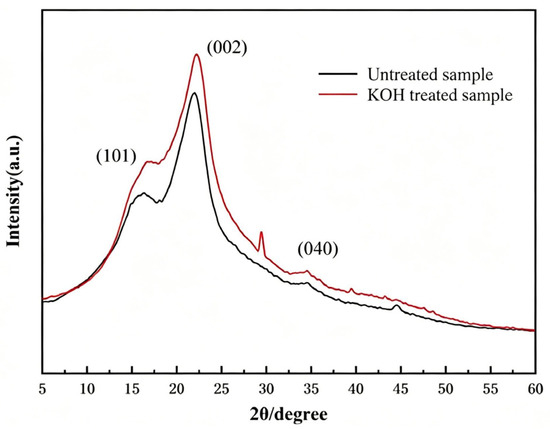
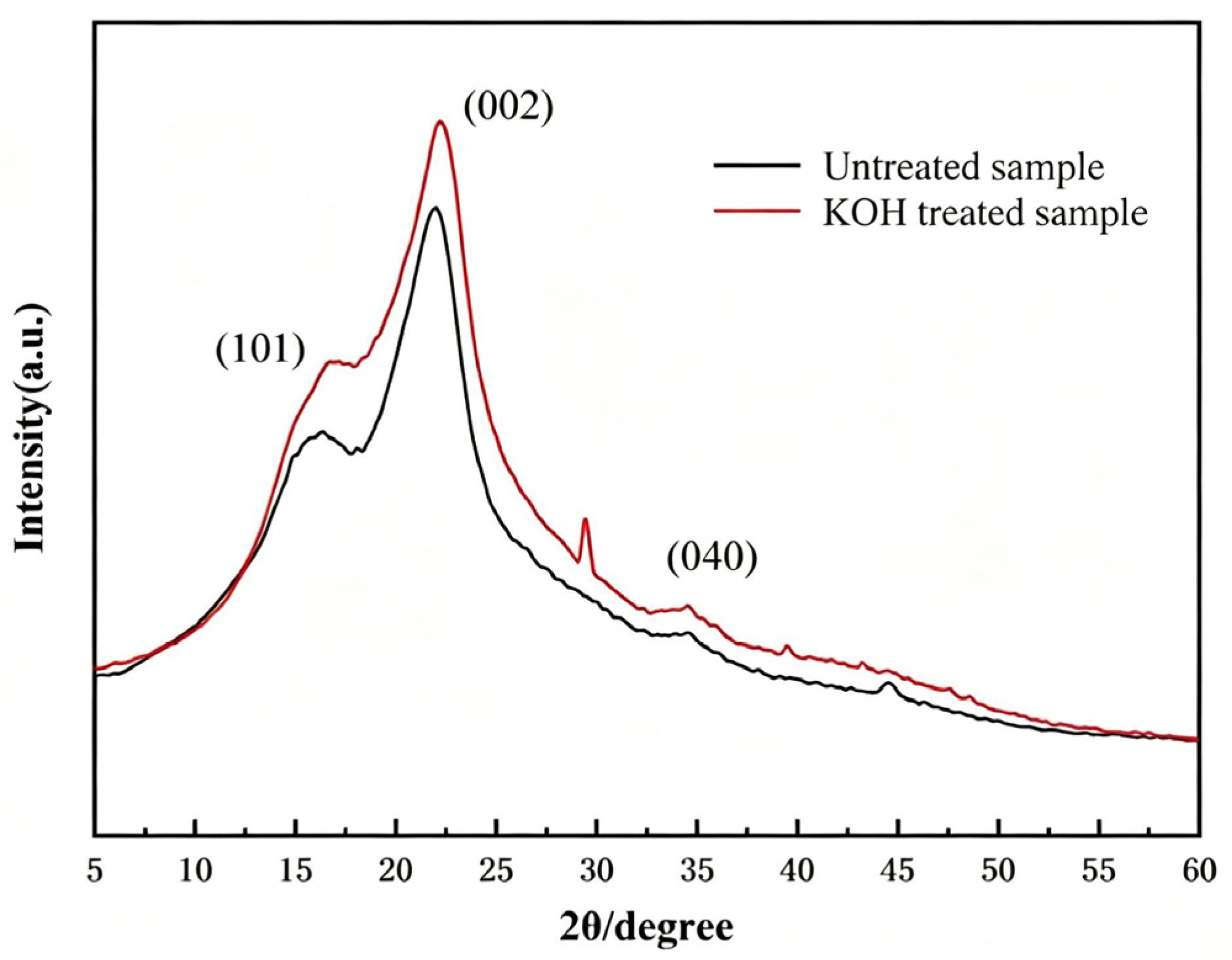
Cellulose constitutes the main crystalline component in wood cell walls, and its degree of structural order can be assessed via XRD, which provides information on the arrangement of cellulose microfibrils. As depicted in Figure 1, the XRD profile of untreated Chinese fir displays characteristic peaks at approximately 2θ = 15.5° (assigned to the (101) plane), 22.5° ((002) plane), and 35° ((040) plane), while a broad peak around 18° corresponds to amorphous regions of cellulose [24,25,26].
Figure 1.
X-ray diffraction (XRD) patterns of untreated Chinese fir and KOH-treated samples.
Following KOH exposure, the positions of these major diffraction maxima remained essentially unchanged, confirming that the cellulose maintained its native cellulose I crystalline form without undergoing polymorphic conversion. However, a pronounced decrease in peak intensity was observed, suggesting partial disruption of ordered crystalline domains. Quantitative analysis using the Segal method showed that the cellulose crystallinity index (CrI) decreased from 34.10% in untreated wood to approximately 24.2%–25.0% after KOH treatment, representing a reduction of about 9%–10%.
This decline indicates that KOH primarily affects the crystalline–amorphous interfacial regions of cellulose, promoting partial disordering of microfibril assemblies. The reduction in crystallinity weakens hydrogen bonding networks within the cell wall, leading to decreased structural rigidity and stability. Similar crystallinity ranges have been reported in naturally degraded waterlogged archaeological wood (6.1%–28.3%), confirming that KOH treatment can effectively simulate long-term burial-induced degradation at the molecular level.
3.2.2. Fourier Transform Infrared (FTIR) Spectroscopy
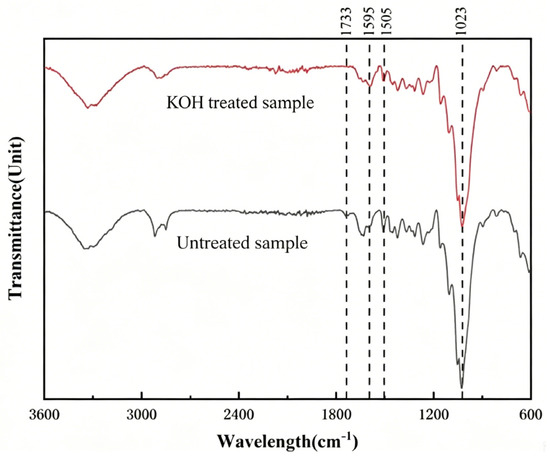
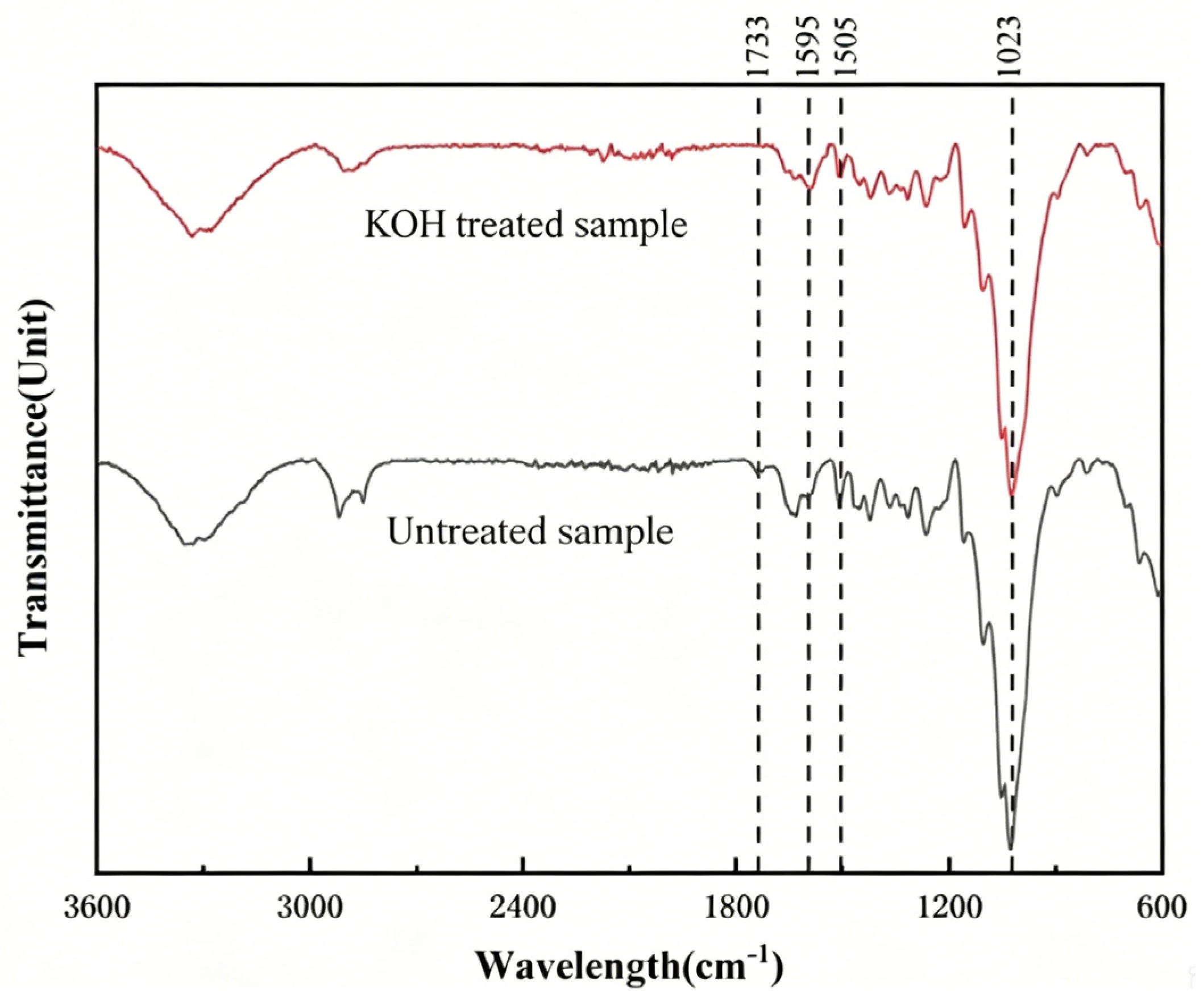
FTIR analysis was performed to further investigate chemical composition changes in KOH-treated wood (Figure 2). In untreated samples, the absorption peak at 1733 cm−1 is attributed to the C=O stretching vibration of acetyl groups in hemicellulose, serving as a key indicator of hemicellulose integrity. After KOH treatment, this peak significantly weakened or nearly disappeared, indicating extensive alkaline hydrolysis and deacetylation of hemicellulose, resulting in the removal of acetylated xylan and other hemicellulosic components from the cell wall matrix.
Figure 2.
FTIR spectra of untreated and KOH-treated Chinese fir.
The peaks at 1595 cm−1 and 1505 cm−1, corresponding to aromatic skeletal vibrations of lignin, showed relatively enhanced intensity after KOH treatment. This phenomenon does not indicate an increase in the absolute lignin content, but rather reflects the preferential removal of hemicellulose and partial cellulose components, which increases the relative contribution of lignin-associated signals in the remaining cell wall matrix. Compared with polysaccharides, lignin exhibits higher resistance to alkaline hydrolysis due to its complex aromatic structure and cross-linked network. Therefore, the residual lignin fraction can partially maintain cell wall integrity and provide temporary structural support during the early and moderate stages of KOH degradation.
However, under severe treatment conditions (30% KOH with multiple cycles), the protective effect of lignin becomes insufficient to prevent structural failure. Although lignin-related aromatic signals remain detectable, extensive degradation of hemicellulose and disruption of cellulose structures weaken the polysaccharide framework that supports lignin networks.
In addition, the band at 1023 cm−1, associated with C–O–C and C–OH stretching vibrations in polysaccharides, exhibited significant variation, reflecting the cleavage of glycosidic bonds and structural rearrangement of cellulose and hemicellulose networks. These spectral variations indicate that KOH treatment induces selective degradation of hemicellulose and disruption of amorphous cellulose regions, leading to the loosening of hydrogen-bonding interactions and increased exposure of hydroxyl groups. Overall, the FTIR results demonstrate that KOH-induced degradation follows a selective pathway in which hemicellulose is preferentially removed, cellulose crystallinity is gradually disrupted, while lignin partially remains as a resistant structural component. Nevertheless, at high KOH concentrations, the loss of polysaccharide reinforcement exceeds the protective capacity of lignin, resulting in irreversible cell wall collapse. These chemical changes are consistent with the reductions in density, increased water uptake, and microstructural deterioration observed in previous sections [27,28].
3.3. Microstructural Changes Induced by KOH Treatment
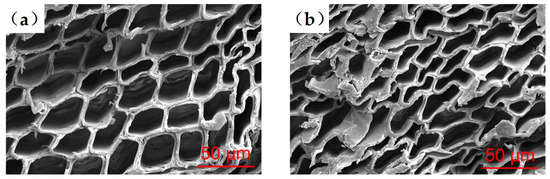
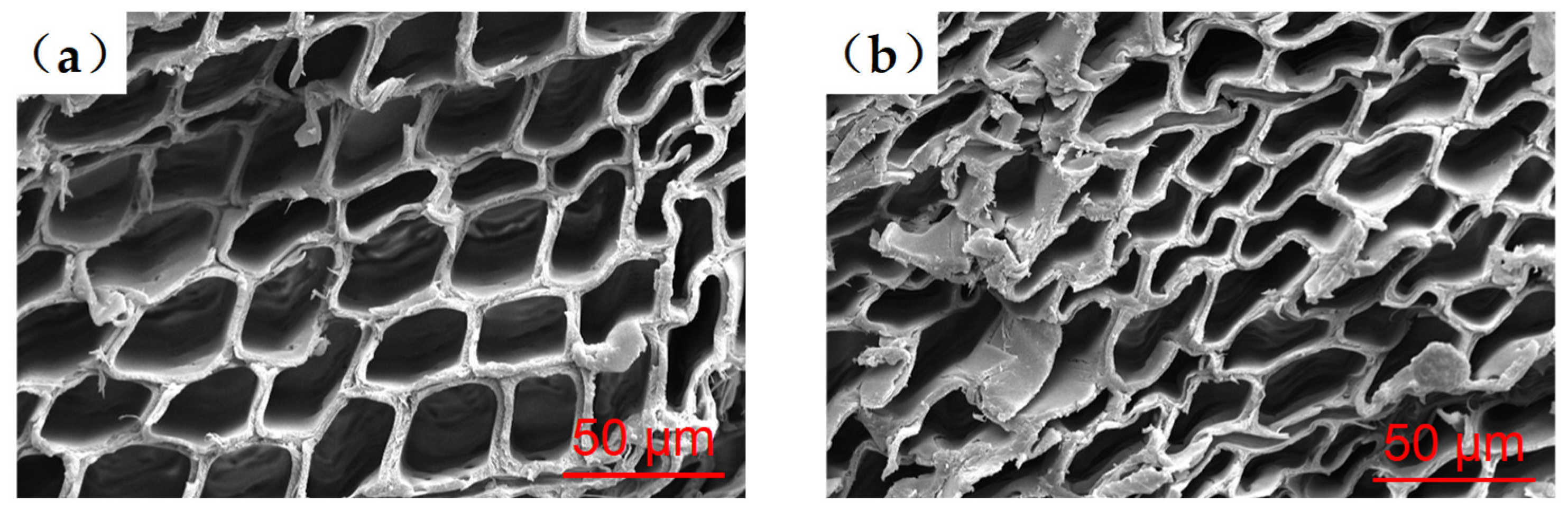
The transverse microstructure of Chinese fir before and after KOH treatment was examined using SEM (Figure 3a,b), offering direct visual evidence of alkali-induced degradation of the cell wall. In Figure 3a, the untreated wood shows a well-preserved cellular framework, with tracheids arranged in an orderly fashion and mostly exhibiting a quadrangular or near-polygonal outline. The cell walls are continuous and compact, while the lumina are open, well-defined, and clearly separated. This highly ordered structure reflects the typical anatomical organization of sound softwood, which is maintained by an intact cellulose–hemicellulose–lignin network that ensures both geometric stability and mechanical support of the cell wall system [29].
Figure 3.
SEM images of the transverse sections of Chinese fir: (a) untreated wood; (b) KOH-treated wood.
In contrast, the KOH-treated sample (Figure 3b) exhibited obvious microstructural degradation features. The originally regular tracheids became distorted, with many cells transforming from quadrilateral shapes into irregular, deformed, or partially collapsed geometries. Cell wall boundaries became indistinct, and localized shrinkage, bending, and collapse were frequently observed. In particular, the lumina were significantly flattened or partially closed, indicating a substantial loss of internal structural support. These observations suggest that KOH treatment disrupted hemicellulose and amorphous cellulose domains, thereby weakening the cell wall framework and reducing its resistance to deformation during both chemical treatment and subsequent drying processes. Similar collapse phenomena have been widely reported in degraded archaeological wood, where polysaccharide loss leads to lumen deformation, pore structure alteration, and a general decline in structural integrity.
Overall, the SEM observations confirm that KOH treatment transforms Chinese fir from an ordered cellular system into a structurally weakened and more porous material. The deformation of tracheids and the collapse of lumina indicate not only the loss of cell wall components but also the reorganization of internal pore connectivity. This structural evolution helps explain the increased maximum water content and reduced density observed in Section 3.1. Moreover, these findings are consistent with the FTIR and XRD results, which demonstrate selective polysaccharide degradation and a reduction in cellulose crystallinity. Therefore, SEM analysis provides direct morphological evidence supporting the multi-scale degradation pathway induced by KOH impregnation and further confirms its effectiveness for preparing biomimetic archaeological wood [30,31].
3.4. Dimensional Stability of KOH-Treated Wood
Dimensional stability is a key indicator reflecting the integrity of wood cell wall structures under moisture variation. As shown in Table 2, both swelling and shrinkage ratios of Chinese fir exhibited obvious changing trends after KOH treatment across radial, tangential, and longitudinal directions, indicating that alkali impregnation significantly alters the moisture–deformation response of wood. Overall, increasing KOH concentration and treatment cycles led to enhanced dimensional variability, suggesting progressive weakening of the cell wall constraint system.
Table 2.
Effects of KOH concentration and treatment cycle number (2, 4, 6) on the swelling and shrinkage rates of Chinese fir.
KOH concentration exerted a dominant influence on dimensional behavior (p < 0.0001). With concentration increasing from 5% to 30%, radial swelling increased from 5.27% to 10.43%, while tangential swelling increased more dramatically from 8.49% to 28.19% (Table 2). A similar trend was observed for shrinkage behavior. The pronounced anisotropy, particularly in the tangential direction, can be attributed to the layered arrangement of tracheids and the preferential degradation of hemicellulose, which weakens hydrogen bonding within the cell wall matrix and enhances moisture accessibility [32,33].
Treatment cycles also significantly affected dimensional stability (p < 0.05). As the number of cycles increased from 2 to 6, swelling and shrinkage ratios consistently increased in all directions, indicating cumulative structural damage. This behavior suggests that repeated alkali exposure continuously disrupts the cell wall ultrastructure, enlarges pore networks, and enhances water diffusion pathways, thereby amplifying moisture-induced deformation [34].
From a mechanistic perspective, the observed dimensional instability is primarily driven by the degradation of hemicellulose and partial disruption of amorphous cellulose regions, which reduces the restraining capacity of the microfibril network. As a result, the wood structure becomes more compliant to moisture-induced expansion and contraction. Notably, the tangential direction exhibited the highest sensitivity due to its structural dependence on ray-tracheid interactions and layered cell wall organization, which are more vulnerable to chemical degradation [11].
Overall, KOH treatment significantly reduces the dimensional stability of Chinese fir and intensifies its anisotropic deformation behavior. These changes are consistent with the physical property deterioration, chemical composition alterations, and microstructural collapse, confirming a coherent multi-scale degradation pathway induced by alkali impregnation.
3.5. Effect of KOH Treatment on the Mechanical Properties of Wood
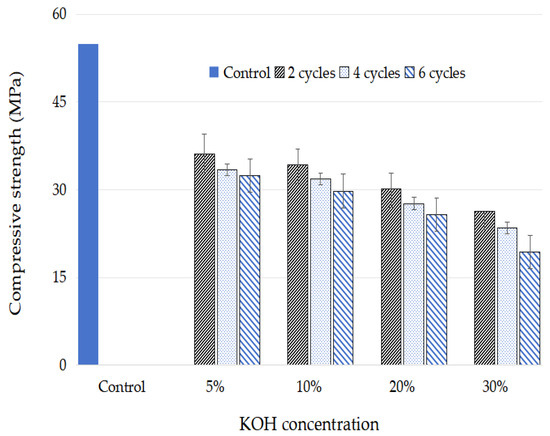
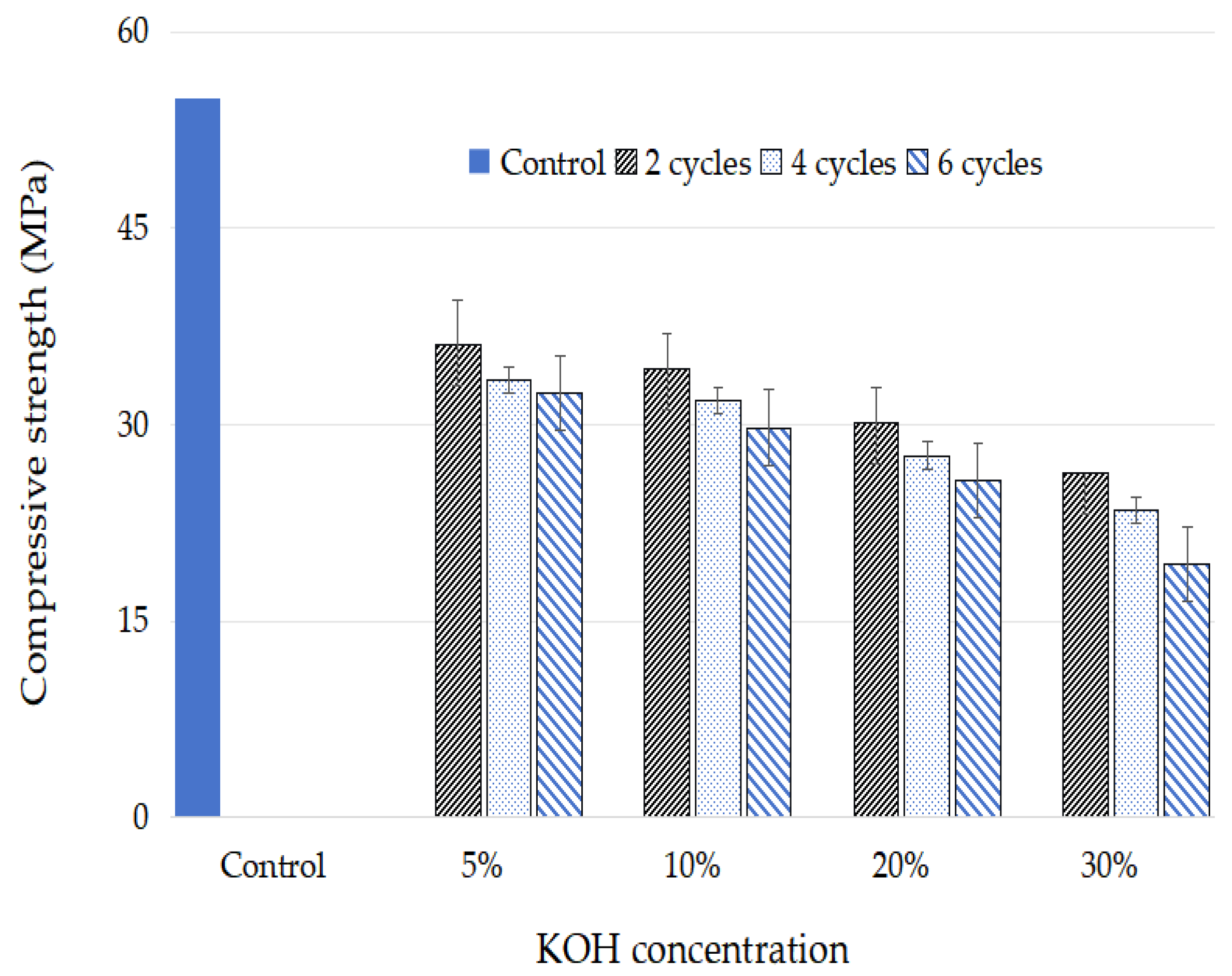
As illustrated in Figure 4, both KOH concentration and the number of treatment cycles significantly influenced the longitudinal compressive strength of Chinese fir. The untreated control group recorded a compressive strength in the range of approximately 50–55 MPa, representing the typical mechanical load-bearing level of sound, healthy Chinese fir. After KOH treatment, the compressive strength decreased markedly in all treatment groups, indicating that alkali treatment substantially weakens the wood cell wall structure and directly reduces the axial load-bearing capacity.
Figure 4.
Compressive strength of KOH-treated Chinese fir.
In terms of KOH concentration, the mechanical properties showed a clear decreasing trend. Under 5% KOH treatment, the compressive strength remained in the range of about 30–36 MPa but had already decreased by approximately 30%–40% compared with the control group. When the concentration was increased to 10%, the strength further dropped to about 29–34 MPa; at 20%, it fell to about 25–30 MPa; and under 30% KOH treatment, the compressive strength reached its lowest value, only about 18–26 MPa. These results indicate that as alkali concentration increases, the degree of internal structural damage intensifies, and the load-bearing capacity continues to decline [35].
With respect to the number of treatment cycles, the cyclic effect was also highly significant. Under the same concentration conditions, the compressive strength consistently followed a decreasing pattern of “2 cycles > 4 cycles > 6 cycles.” For example, in the 5% KOH group, the 2-cycle samples exhibited the highest strength, while the 6-cycle samples showed the most pronounced decrease; this trend was even more prominent in the high-concentration (30%) group, where the 6-cycle samples approached the lowest strength values, suggesting that repeated treatment accumulates cell wall damage and progressively destabilizes the structure [36].
Overall, the effects of KOH concentration and cycle number on mechanical properties exhibit a synergistic amplification: low concentration with short cycle numbers causes only partial cell wall weakening, whereas high concentration with multiple cycles induces significant structural disruption and failure of the load-bearing network, transforming the wood from a “continuous load-bearing system” into a “locally fragmented load-bearing system.”
From a mechanistic perspective, the reduction in mechanical properties induced by KOH treatment can be attributed to three main factors: first, the preferential degradation of hemicellulose weakens the cell wall matrix phase and reduces its toughness contribution; second, the disruption of amorphous cellulose regions and the weakening of crystalline region boundaries lower the inter-microfibril bonding strength; and third, the expansion of cell wall pores and local collapse interrupt stress transfer pathways, preventing effective load distribution.
Therefore, the continuous decline in compressive strength is not merely a consequence of material mass loss, but rather a macroscopic manifestation of multi-scale cell wall degradation. These results are highly consistent with the preceding FTIR, XRD, and dimensional stability analyses, collectively confirming that KOH treatment can effectively simulate the structural deterioration and mechanical attenuation characteristics of archaeological wood during long-term burial.
4. KOH Treatment Parameters and Biomimetic Archaeological Grading System
KOH impregnation enables controllable degradation of Chinese fir through the synergistic regulation of concentration and treatment cycles, thereby providing a reproducible approach for simulating different deterioration states of waterlogged archaeological wood. Unlike previous studies that mainly focused on the degradation mechanism or conservation treatment of excavated archaeological wood, this study establishes a quantitative relationship between artificial degradation parameters and archaeological-like deterioration levels. The proposed grading system is therefore based on the integrated evolution of physical properties, chemical structure, microstructural characteristics, and mechanical performance rather than a single evaluation indicator.
Based on the multi-scale characterization results, KOH concentration was identified as the dominant factor controlling degradation severity, whereas treatment cycles mainly influenced the cumulative depth and uniformity of structural deterioration. At low concentration (5%), only slight hemicellulose degradation and limited pore development occur, with relatively low mass loss (~15%), high basic density (~0.27 g/cm3), and minor strength reduction, corresponding to slightly biomimetic archaeological wood with largely preserved cell wall integrity. This degradation state is comparable to slightly deteriorated archaeological wood, where the secondary cell wall is partially preserved and the loss of polysaccharides remains limited [11,37].
With concentration increasing to 10%–20%, wood degradation becomes significantly more pronounced. Mass loss increases to 20%–35%, maximum water content rises to approximately 280%–360%, and cellulose crystallinity decreases from 34.10% to ~24%–26%.
SEM observations further revealed obvious tracheid deformation and lumen collapse, while FTIR analysis indicated progressive degradation of hemicellulose and disruption of cellulose-related structures. These characteristics correspond well with moderate degradation states observed in waterlogged archaeological wood, where increased porosity, reduced basic density, and weakened mechanical properties result from long-term microbial and chemical degradation [9,38]. Previous studies on shipwreck wood have reported basic densities of approximately 0.19–0.33 g/cm3 and maximum water contents exceeding 180%, which are comparable to the intermediate degradation range achieved by KOH treatment in this study [11,39]. Therefore, the Grade II condition represents a realistic simulation of moderately degraded archaeological softwood rather than an arbitrary chemical degradation level.
Under severe conditions (30% KOH combined with ≥4–6 cycles), extensive structural deterioration occurred. Mass loss exceeded 40%, maximum water content surpassed 400%, basic density decreased to approximately 0.19 g/cm3, and compressive strength declined to 18–26 MPa. SEM images showed severe lumen flattening and partial cell collapse, while FTIR and XRD results demonstrated substantial hemicellulose degradation and reduced cellulose crystallinity. These features are consistent with severely degraded waterlogged archaeological wood, in which extensive polysaccharide depletion leads to collapse of the cell wall framework and significant mechanical weakening [37,40]. The obtained properties approach the degradation range reported for highly deteriorated shipwreck wood, demonstrating the potential of severe KOH treatment for reproducing advanced archaeological degradation states.
Correlation analysis further demonstrates that mass loss, basic density, and compressive strength decrease with increasing KOH concentration, whereas maximum water content and dimensional deformation increase. These relationships indicate that KOH-induced degradation follows a progressive pathway of “alkaline hydrolysis of cell wall polymers, loss of structural components, pore expansion and lumen deformation, deterioration of macroscopic properties.” Treatment cycles further regulate the extent of this degradation process: two cycles initiate chemical modification of the cell wall, four cycles promote structural loosening, and six cycles intensify cumulative damage, resulting in deeper and more heterogeneous degradation.
Based on the combined evaluation of mass loss, density reduction, water absorption capacity, cellulose crystallinity, mechanical strength, and microscopic morphology, a three-level biomimetic archaeological grading system was established (Table 3). Grade I (5% KOH, 2–4 cycles) represents slightly degraded wood with relatively preserved cellular integrity. Grade II (10%–20% KOH, 2–6 cycles) represents moderately degraded wood characterized by increased porosity, reduced crystallinity, and obvious mechanical deterioration. Grade III (30% KOH, ≥4 cycles) represents severely degraded wood with collapsed cellular structures, high water absorption capacity, and significant loss of mechanical strength.
Table 3.
Proposed grading system for biomimetic archaeological Chinese fir prepared by controlled KOH impregnation.
Compared with naturally buried archaeological wood, this grading system provides a controllable and quantitative bridge between laboratory-induced degradation and archaeological preservation states. It avoids the limitations caused by the scarcity and heterogeneity of excavated wood samples and provides standardized materials for evaluating consolidation agents, drying strategies, and conservation technologies.
5. Conclusions
In this study, a controllable KOH impregnation method was established to prepare biomimetic archaeological Chinese fir and simulate the progressive structure–property evolution of waterlogged archaeological wood. The results demonstrated that both KOH concentration and treatment cycle number significantly influenced degradation behavior, with concentration acting as the dominant controlling factor. As treatment severity increased, mass loss increased from 15.23% at 5% KOH to 42.14% at 30% KOH, while maximum water content increased from 211.27% to 427.35%, indicating substantial cell wall component loss and pore structure development. The basic density decreased from 0.27 g/cm3 to 0.19 g/cm3, demonstrating progressive deterioration of wood structural integrity. XRD results showed that cellulose crystallinity decreased from 34.10% in untreated wood to approximately 24%–26% after KOH treatment, while FTIR analysis confirmed significant hemicellulose degradation through the weakening of the 1733 cm−1 carbonyl absorption band and relative enrichment of lignin-associated structures. SEM observations further revealed the transformation from regular tracheid structures to deformed cells with flattened or partially collapsed lumina. Correspondingly, the compressive strength decreased to 18–26 MPa under severe treatment conditions, accompanied by increased dimensional instability. Based on the correlation among degradation parameters, a three-level biomimetic archaeological wood grading system was proposed: slight degradation (5% KOH), moderate degradation (10%–20% KOH), and severe degradation (30% KOH with multiple cycles). The proposed framework establishes a quantitative relationship between chemical treatment parameters and archaeological-like degradation states, providing a standardized experimental model for conservation material assessment, reinforcement strategy optimization, and further investigation of waterlogged archaeological wood degradation mechanisms.
Author Contributions
Conceptualization, H.S. and W.W.; methodology, H.S.; software, H.S.; validation, H.S., Z.T., and W.W.; formal analysis, H.S.; investigation, H.S.; resources, W.W.; data curation, H.S.; writing—original draft preparation, H.S.; writing—review and editing, H.S. and W.W.; visualization, H.S.; supervision, W.W.; project administration, W.W.; funding acquisition, W.W. All authors have read and agreed to the published version of the manuscript.
Funding
This research received no external funding.
Institutional Review Board Statement
Not applicable.
Data Availability Statement
Data are contained within the article.
Conflicts of Interest
The authors declare no conflicts of interest.
References
- High, K.E.; Penkman, K.E. A review of analytical methods for assessing preservation in waterlogged archaeological wood and their application in practice. Herit. Sci. 2020, 8, 83. [Google Scholar] [CrossRef] [Scilit]
- Stelzner, I.; Stelzner, J.; Fischer, B.; Hamann, E.; Zuber, M.; Schuetz, P. A multi-technique and multiscale comparative study on the efficiency of conservation methods for the stabilisation of waterlogged archaeological pine. Sci. Rep. 2024, 14, 8681. [Google Scholar] [CrossRef] [Scilit] [PubMed]
- Li, R.; Guo, J.; Macchioni, N.; Pizzo, B.; Xi, G.; Tian, X.; Yin, Y. Characterisation of waterlogged archaeological wood from Nanhai No. 1 shipwreck by multidisciplinary diagnostic methods. J. Cult. Herit. 2022, 56, 25–35. [Google Scholar] [CrossRef] [Scilit]
- Pecoraro, E.; Pelé-Meziani, C.; Macchioni, N.; Lemoine, G.; Guilminot, E.; Pizzo, B. Effects of iron removal treatments on the chemical and viscoelastic properties of waterlogged wood. J. Cult. Herit. 2022, 56, 149–158. [Google Scholar] [CrossRef] [Scilit]
- Guo, J.; Xiao, L.; Han, L.; Wu, H.; Yang, T.; Wu, S.; Yin, Y. Deterioration of the cell wall in waterlogged wooden archeological artifacts, 2400 years old. IAWA J. 2019, 40, 820–844. [Google Scholar] [CrossRef] [Scilit]
- Pizzo, B.; Pecoraro, E.; Sozzi, L.; Salvini, A. Collapsed and re-swollen archaeological wood: Efficiency and effects on the chemical and viscoelastic characteristics of wood. J. Cult. Herit. 2021, 51, 79–88. [Google Scholar] [CrossRef] [Scilit]
- Shen, D.; Gu, X.; Zhang, H.; Macchioni, N.; Cheng, Q.; Tian, X.; Yuan, K. Study on the feasibility of the TG method for maximum water content measurement of waterlogged archaeological wood. Stud. Conserv. 2024, 69, 621–634. [Google Scholar]
- Xu, P.; Guan, C.; Zhang, H.; Li, G.; Zhao, D.; Ross, R.J.; Shen, Y. Application of nondestructive testing technologies in preserving historic trees and ancient timber structures in China. Forests 2021, 12, 318. [Google Scholar] [CrossRef] [Scilit]
- Cao, H.; Gao, X.; Chen, J.; Xi, G.; Yin, Y.; Guo, J. Changes in moisture characteristics of waterlogged archaeological wood owing to microbial degradation. Forests 2022, 14, 9. [Google Scholar] [CrossRef] [Scilit]
- Liu, L.; Zhang, L.; Zhang, B.; Hu, Y. A comparative study of reinforcement materials for waterlogged wood relics in laboratory. J. Cult. Herit. 2019, 36, 94–102. [Google Scholar] [CrossRef] [Scilit]
- Wang, X.; Chen, W.; Liang, Y.; Li, N. Physical and chemical degradation characteristics of waterlogged archaeological wood from the Wenzhou No. 1 shipwreck. npj Herit. Sci. 2025, 13, 520. [Google Scholar] [CrossRef] [Scilit]
- Huang, C.; Su, Y.; Shi, J.; Yuan, C.; Zhai, S.; Yong, Q. Revealing the effects of centuries of ageing on the chemical structural features of lignin in archaeological fir woods. New J. Chem. 2019, 43, 3520–3528. [Google Scholar] [CrossRef] [Scilit]
- Qian, J.; Han, T.; Cheng, T.; Xia, P.; Sun, Z.; Dai, C.; Sun, J. Effects of ultrasonic pretreatment on physicochemical properties and drying behavior of Cunninghamia lanceolata and Eucalyptus grandis × urophylla. Ultrason. Sonochem. 2025, 121, 107549. [Google Scholar] [CrossRef] [Scilit] [PubMed]
- Li, Y.; Deng, X.; Zhang, Y.; Huang, Y.; Wang, C.; Xiang, W.; Wei, X. Chemical characteristics of heartwood and sapwood of red-heart Chinese Fir (Cunninghamia lanceolata). For. Prod. J. 2019, 69, 103–109. [Google Scholar] [CrossRef] [Scilit]
- Cesar, T.; Danevčič, T.; Kavkler, K.; Stopar, D. Melamine polymerization in organic solutions and waterlogged archaeological wood studied by FTIR spectroscopy. J. Cult. Herit. 2017, 23, 106–110. [Google Scholar] [CrossRef] [Scilit]
- GB1929-2009; Methods for Sawing and Sampling of Wood Specimens for Physical and Mechanical Testing. Standards Press of China: Beijing, China, 2009.
- ISO 3129:2019; Wood—Sampling Methods and General Requirements for Physical and Mechanical Testing of Small Clear Wood Specimens. International Organization for Standardization: Geneva, Switzerland, 2019.
- ASTM D143-22; Standard Test Methods for Small Clear Specimens of Timber. ASTM International: West Conshohocken, PA, USA, 2022.
- ASTM D2395-17; Standard Test Methods for Density and Specific Gravity (Relative Density) of Wood and Wood-Based Materials. ASTM International: West Conshohocken, PA, USA, 2017.
- ISO 13061-2:2014; Physical and Mechanical Properties of Wood—Test Methods for Small Clear Wood Specimens—Part 2: Determination of Density for Physical and Mechanical Tests. International Organization for Standardization: Geneva, Switzerland, 2014.
- Fengel, D.; Wegener, G. (Eds.) Wood: Chemistry, Ultrastructure, Reactions; Walter de Gruyter: Berlin, Germany, 2011. [Google Scholar]
- Rowell, R.M. Chemical modification of wood: A short review. Wood Mater. Sci. Eng. 2006, 1, 29–33. [Google Scholar] [CrossRef] [Scilit]
- Esteves, B. Wood modification by heat treatment: A review. BioResources 2009, 1, 370–404. [Google Scholar]
- Oh, S.Y.; Yoo, D.I.; Shin, Y.; Kim, H.C.; Kim, H.Y.; Chung, Y.S.; Youk, J.H. Crystalline structure analysis of cellulose treated with sodium hydroxide and carbon dioxide by means of X-ray diffraction and FTIR spectroscopy. Carbohydr. Res. 2005, 340, 2376–2391. [Google Scholar] [CrossRef] [Scilit] [PubMed]
- Riggio, M.; Sandak, J.; Sandak, A.; Pauliny, D.; Babiński, L. Analysis and prediction of selected mechanical/dynamic properties of wood after short and long-term waterlogging. Constr. Build. Mater. 2014, 68, 444–454. [Google Scholar] [CrossRef] [Scilit]
- Christensen, M.; Kutzke, H.; Hansen, F.K. New materials used for the consolidation of archaeological wood–past attempts, present struggles, and future requirements. J. Cult. Herit. 2012, 13, S183–S190. [Google Scholar] [CrossRef] [Scilit]
- Chen, T.; Li, J.; Liu, X.; Li, T. Unraveling the physicochemical properties between proteinaceous binders and pigments (cinnabar/orpiment) by multi-analytical techniques. Dye. Pigment. 2026, 251, 113751. [Google Scholar] [CrossRef] [Scilit]
- Liu, X. Wood Processing, Modification, and Performance: A Multidisciplinary Overview of Recent Advances. Forests 2026, 17, 325. [Google Scholar] [CrossRef] [Scilit]
- Antonelli, F.; Galotta, G.; Sidoti, G.; Zikeli, F.; Nisi, R.; Davidde Petriaggi, B.; Romagnoli, M. Cellulose and lignin nano-scale consolidants for waterlogged archaeological wood. Front. Chem. 2020, 8, 32. [Google Scholar] [CrossRef] [Scilit] [PubMed]
- Lv, L.; Zhong, W.; Wang, Z. Surface modification of hierarchically porous wood derived cellulose sponges with remarkable compressibility and recyclability for efficient microplastic removal. Sep. Purif. Technol. 2025, 379, 134943. [Google Scholar] [CrossRef] [Scilit]
- Sandak, A.; Sandak, J.; Babiński, L.; Pauliny, D.; Riggio, M. Spectral analysis of changes to pine and oak wood natural polymers after short-term waterlogging. Polym. Degrad. Stab. 2014, 99, 68–79. [Google Scholar] [CrossRef] [Scilit]
- Xu, L.; Wei, R.; Liu, X. Bridging Time: A Dual Path Analysis of Chinese Furniture Culture from Diplomatic Exchange to Digital Narratives. BioResources 2025, 20, 9008–9019. [Google Scholar] [CrossRef] [Scilit]
- Tu, X.; Li, T.; Li, J.; Zhang, F.; Liu, H.; Yang, L. Structural and chemical compositional characteristics of rubberwood with gelatinous fibre distribution in the tension and opposite wood. Wood Sci. Technol. 2026, 60, 28. [Google Scholar] [CrossRef] [Scilit]
- Broda, M.; Hill, C.A. Conservation of waterlogged wood—Past, present and future perspectives. Forests 2021, 12, 1193. [Google Scholar] [CrossRef] [Scilit]
- Kavvouras, P.K.; Kostarelou, C.; Zisi, A.; Petrou, M.; Moraitou, G. Use of silanol-terminated polydimethylsiloxane in the conservation of waterlogged archaeological wood. Stud. Conserv. 2009, 54, 65–76. [Google Scholar] [CrossRef] [Scilit]
- Zhang, J.; Li, Y.; Ke, D.; Wang, C.; Pan, H.; Chen, K.; Zhang, H. Modified lignin nanoparticles as potential conservation materials for waterlogged archaeological wood. ACS Appl. Nano Mater. 2023, 6, 12351–12363. [Google Scholar] [CrossRef] [Scilit]
- Stelzner, J.; Gwerder, D.; Pohmann, R.; Schuetz, P.; Muskalla, W.; Wittköpper, M.; Schmidt-Ott, K.; Stelzner, I. Stabilisation of waterlogged archaeological wood: The analysis of structural and dimensional changes of different conservation methods using magnetic resonance imaging and X-ray micro-computed tomography. Sci. Rep. 2025, 15, 38481. [Google Scholar] [CrossRef] [Scilit] [PubMed]
- Li, R.; Zhang, Z.; Jiao, Y.; Tie, F.; Sun, M. Combining microscale ATR-FTIR and chemometrics to interpret degradation characteristics of earlywood, latewood, and compression wood in waterlogged archaeological pine wood. Herit. Sci. 2024, 12, 387. [Google Scholar] [CrossRef] [Scilit]
- Yang, W.; Ma, W.; Liu, X. Evaluation of deterioration degree of archaeological wood from Luoyang Canal No. 1 Ancient Ship. Forests 2024, 15, 963. [Google Scholar] [CrossRef] [Scilit]
- Chu, S.; Li, Y.; Wang, X.; Li, N.; Song, J.; Lin, L. Degradation condition and microbial analysis of waterlogged archaeological wood from the second shipwreck site on the northwestern continental slope of the South China Sea. npj Herit. Sci. 2025, 13, 10. [Google Scholar] [CrossRef] [Scilit]

Disclaimer/Publisher’s Note: The statements, opinions and data contained in all publications are solely those of the individual author(s) and contributor(s) and not of MDPI and/or the editor(s). MDPI and/or the editor(s) disclaim responsibility for any injury to people or property resulting from any ideas, methods, instructions or products referred to in the content. |
© 2026 by the authors. Licensee MDPI, Basel, Switzerland. This article is an open access article distributed under the terms and conditions of the Creative Commons Attribution (CC BY) license.