


Abstract
To investigate the long-term water use efficiency (WUE) and ecological adaptation strategies of seven endangered Ormosia plant species, and to identify superior tree species with strong drought resistance, thereby providing a scientific basis for ecological restoration, represented the objectives of this research. This study focused on Ormosia semicastrata, Ormosia pinnata, Ormosia fordiana, Ormosia xylocarpa, Ormosia glaberrima, Ormosia emarginata and Ormosia henryi. Using these seven Ormosia species as subjects of study, and the commonly planted afforestation species Michelia macclurei and Castanopsis hystrix as controls, we determined long-term water-use efficiency by measuring stable carbon isotope (δ13) values of the leaves. This was combined with growth indices and chlorophyll content; a systematic analysis was conducted of interspecific differences and similarities with the afforestation species, to reveal the ecological adaptability and survival potential of Ormosia plants in arid environments. Methodologically, leaf carbon isotope (δ13) values were measured for each tree species to estimate long-term water use efficiency, whilst growth indices and chlorophyll content were also determined to compare differences between Ormosia plants and the control species. The results indicate that the leaf carbon isotope (δ13) values of the seven Ormosia species ranged from −31.88‰ to −29.03‰. Among these, O. xylocarpa, O. pinnata and O. emarginata exhibited higher leaf carbon isotope (δ13) values and water use efficiency, suggesting greater water utilisation capacity and drought tolerance; whereas O. fordiana and O. glaberrima exhibited lower values for both parameters. Chlorophyll analysis revealed that the total chlorophyll content of O. pinnata and O. fordiana was significantly higher than that of Michelia macclurei and Castanopsis hystrix, and the chlorophyll a to chlorophyll b ratio of all Ormosia species was higher than that of the afforestation tree species, suggesting greater photosynthetic capacity and adaptability to high-light environments. Furthermore, leaf carbon isotope (δ13) values showed a highly significant positive correlation with water use efficiency, validating the reliability of carbon isotopes in assessing long-term water use efficiency in plants. Taking all indicators into account, O. xylocarpa and O. pinnata demonstrated good root development and efficient allocation of photosynthetic pigments whilst maintaining high water use efficiency; they are therefore considered excellent tree species that combine drought resistance with growth potential. By integrating growth, photosynthetic and water-use characteristics, this study has clarified the water-adaptation strategies of different Ormosia species, providing a scientific basis for selecting drought-tolerant Ormosia species and for ecological restoration.
1. Introduction
Ormosia belongs to the Fabaceae family (subfamily Papilionoideae). It comprises evergreen trees or shrubs and is a rare tree species found in tropical and subtropical regions. The wood of most species is of moderate hardness [1] and has a wide range of applications, including furniture, construction, agricultural implements and paper production, making it an excellent timber species. Some species also offer good ornamental value and are suitable for landscaping [2], whilst the roots, branches and leaves of certain species are used for medicinal purposes [3]. Plants of this genus are predominantly distributed in southern and south-western China. However, due to socio-economic development, increasing environmental degradation caused by human activity, and factors inherent to the species itself, Ormosia plant resources are steadily declining. In 2021, except for Ormosia microphylla, which was listed as a Class I protected wild plant in the “National List of Key Protected Wild Plants” [4], all other Ormosia species were classified as Class II protected wild plants.
Vegetation water use efficiency (WUE) is a key indicator for measuring how plants convert water into biomass [5]; it not only influences plant biomass accumulation and water utilisation but also determines plants’ ecological adaptability in arid or water-deficient environments [6]. Furthermore, as a crucial link between the ecosystem carbon cycle and the water cycle, vegetation water use efficiency is of great significance for both ecological conservation and agricultural production [7]. From the perspectives of plant physiology and ecology, water use efficiency reflects the characteristics of plants in their energy conversion processes, as well as their water-saving and drought-tolerance capabilities; it therefore serves as a crucial basis for assessing plants’ adaptability to the environment [8]. Currently, global warming is having a profound impact on plants’ water utilisation processes. A plant’s ability to respond to these water-related changes is closely linked to its own water utilisation characteristics and drought tolerance. Consequently, investigating plants’ capacity to respond to water fluctuations is of great significance for understanding their long-term adaptive mechanisms in water-deficient environments, as well as for predicting the impact of future climate change on the ecosystem water cycle [9]. With the continuous advancement of stable isotope analysis techniques, relevant studies have confirmed a close relationship between the carbon isotope composition () of plant leaves and long-term water use efficiency. These findings provide a scientifically sound and reliable technical approach for conducting large-scale, systematic analyses of plant water use patterns and for quantitatively assessing their drought-adaptation strategies. In the specific experimental design, the selection of leaf stable carbon isotope composition () as the core measurement parameter was based primarily on the following considerations: firstly, the response of in plant tissues to environmental changes is relatively stable, enabling it to reflect the average water utilisation status of plants during the growing season and thereby avoiding the limitations of instantaneous gas exchange measurements, which are subject to interference from environmental fluctuations; secondly, compared with traditional pot-based water-restriction experiments or long-term weighing methods, analysis offers the advantages of ease of operation, minimal sample requirements and high data reproducibility, making it suitable for comparative studies involving multiple plant species simultaneously; thirdly, interspecific differences in values under similar habitat conditions directly reflect the divergence in intrinsic water-use strategies among different tree species, providing an objective basis for assessing the drought-tolerance potential of cerris species.
At present, systematic research on the carbon isotope composition and water use efficiency of Ormosia species remains limited, particularly in terms of comparisons between various Ormosia species and analytical comparisons with common native tree species in the region. Michelia macclurei and Castanopsis hystrix are excellent native broad-leaved afforestation species widely planted in the Guangxi region, characterised by rapid growth and strong environmental adaptability [10]. As they are frequently planted in mixed stands with Ormosia species, they are suitable as control materials for this study. In addition to water use efficiency, plant growth and leaf photosynthetic pigment content are also key indicators for assessing a plant’s environmental adaptability and growth productivity [11,12]. Growth indicators include plant height, ground diameter and root growth status; photosynthetic pigment indicators are centred on the ratio of chlorophyll a to chlorophyll b. Combining water use efficiency with growth and photosynthetic physiological characteristics can provide a more comprehensive understanding of the resource utilisation strategies and ecological adaptation mechanisms of endangered Ormosia plants. Against the backdrop of the aforementioned research, this study aims to systematically evaluate the long-term water use efficiency and ecological adaptation strategies of seven endangered Ormosia species. The main objectives include: (1) to reveal interspecific differences in the relationship between leaf carbon isotope composition and long-term water use efficiency among different Ormosia species; (2) to elucidate the similarities and differences in water use strategies between Ormosia species and commonly used native afforestation tree species, and to clarify their relative drought-tolerance potential; (3) to integrate growth performance with photosynthetic pigment allocation characteristics to comprehensively assess the resource utilisation patterns of Ormosia plants and their adaptability to arid environments; (4) to screen for superior drought-tolerant tree species that combine high water-use efficiency with good growth potential, thereby providing a scientific basis for the ex situ conservation, population restoration and ecological restoration of endangered Ormosia plants.
2. Materials and Methods
2.1. Overview of the Study Area
The study area is situated at the Deqing Forestry Farm in Zhaoqing City, Guangdong Province, China. Located in the hilly region of western Guangdong, it falls within the South Subtropical Monsoon climate zone, with an average annual temperature of approximately 21.5 °C and annual precipitation of around 1500 mm. The region experiences distinct wet and dry seasons, characterised by hot, rainy summers and mild, dry winters. The soil within the forestry farm is predominantly red soil, characterised by deep soil layers and good drainage, making it suitable for the growth of a wide variety of native tree species. The vegetation in this area consists of typical subtropical evergreen broad-leaved forest, with a relatively rich diversity of Ormosia plant resources, making it an ideal study site for research into tree species’ water use efficiency and ecological adaptation.
2.2. Test Materials
In 2025, at the Deqing Forestry Farm in Zhaoqing City, Guangdong Province, healthy, mature seeds were collected from seven species of the genus Ormosia—namely O. semicastrata, O. pinnata, O. fordiana, O. xylocarpa, O. glaberrima, O. emarginata and O. henryi—as well as from the commonly used afforestation species Michelia macclurei and Castanopsis hystrix. All seeds were disinfected and pre-germinated before being grown in containers at the forestry nursery, where they received standardised water and fertiliser management. In January 2026, one-year-old seedlings in good health and free from pests and diseases were selected for the measurement of various indicators, with five plants chosen from each species.
2.3. Sample Collection and Analysis
The leaves from each plant were placed in separate sealed bags, labelled and taken back to the laboratory, where surface impurities were washed off with pure water. They were then placed in an oven at 105 °C for 15 min to inactivate enzymes, before being dried in an oven at 60 °C. The determination of the value of the leaves was commissioned to the Institute of Botany, Chinese Academy of Sciences, using a stable isotope mass spectrometer (Delta V Advantage) supplied by Thermo Fisher Scientific of Bremen, Germany.
2.4. Measurement of Growth Parameters
One-year-old seedlings of seven Ormosia species in good health and free from pests and diseases, as well as the commonly used afforestation species Michelia macclurei and Castanopsis hystrix, were collected. Fifteen seedlings were randomly selected from each species, and the following parameters were measured for each seedling: plant height, crown breadth, ground diameter, leaf number, root length, root number, aboveground fresh mass, aboveground dry mass, belowground fresh mass and belowground dry mass. Measurement of ground diameter: a vernier calliper was used to measure the seedling’s ground diameter, i.e., the thickness at the soil mark at the base of the stem. Measurement of plant height: a tape measure was used to measure the length of the stem from the ground diameter to the base of the terminal bud. Determination of root length: the length from the base of the rootstock to the tip of the longest root was measured using a tape measure. Aboveground fresh mass, aboveground dry mass, belowground fresh mass, and belowground dry mass were weighed using an electronic balance [13]. Crown breadth refers to the average crown span, calculated as diameter = (east–west diameter + north–south diameter)/2.
2.5. Determination of Chlorophyll Content
Three leaves of uniform maturity, selected from the same batch as those used for the photosynthetic parameter measurements, were collected for the determination of chlorophyll content. Each sample was accurately weighed to 0.2 g and immersed in 25 mL of 95% ethanol; after standing in the dark for 24 h, the absorbance of the extract was measured at 665 nm, 649 nm, and 470 nm [14]. Each sample was analysed in triplicate, and the contents of chlorophyll a (), chlorophyll b () [15], as well as the chlorophyll () and carotenoids (), as well as the chlorophyll a/b ratio (/) and the carotenoid/chlorophyll ratio (/)), were calculated using the relevant formulae. The procedure is as follows:
In the formula: A649, A470, and A665 represent the absorbance values at wavelengths of 649, 470, and 665 nm, respectively.
2.6. Processing of Carbon Isotope Data
The determination of δ13 values in plant leaves is based on PDB (Pee Dee Belemnite) standards, calculated according to the formula:
In the equation: δ13 denotes the carbon isotope value of plant leaves; represents the 13/12 ratio of the plant leaves under analysis; denotes the 13/12 ratio of the standard material PDB.
The method for calculating the stable carbon isotope ratio (Δ13) in plant leaves is as follows [16]:
In the equation: δ13 and denote the carbon isotope values of plant leaves and atmospheric carbon dioxide (CO2), respectively.
The concentration () and carbon isotope value of CO2 are calculated according to formula:
In the formula: t denotes the sampling year (2026).
Formula for calculating the carbon dioxide concentration () in plant chloroplasts [17]:
In the equation: denotes CO2 concentration (μmol/mol); b (29‰) represents carboxylation by Rubisco enzyme; ∆13 indicates the stable carbon isotope resolution of plant leaves; [(12 ± 4)‰] signifies the fractionation coefficient during photorespiration; denotes the CO2 compensation point in the absence of dark respiration; denotes atmospheric CO2 partial pressure; a (4.4‰) represents CO2 flux through stomata; (0.79 ± 0.07) indicates the ratio of stomatal to mesophyll conductance for CO2; (1.8‰) denotes diffusion across mesophyll cells.
The formula for calculating is given by [15]:
In the equation: (4.332 Pa) denotes the CO2 compensation point at 25 °C; represents atmospheric pressure, calculated based on the sampling point’s altitude (108 m) and ambient temperature (8 °C) during sampling; P0 (101,325 Pa) denotes atmospheric pressure at sea level; (37,830 J/mol) represents the activation energy; (8.314 J/(mol·K)) is the gas constant; and T (8 °C) is the temperature at the time of sample collection.
2.7. Data Analysis Methods
Statistical analysis and graphical representation were performed using Excel 2016, SPSS 27 [18], R 4.5.1 and Origin 2024, respectively; data are presented as mean ± standard error (SE). Plant water use efficiency (WUE) was calculated based on the Δ13C content of plant leaves, using the ‘mesophyll’ function from the ‘isocalcR’ package in R version 4.5.1, taking into account the year of sampling, the altitude of the sampling site and the average temperature during the growing season at the sampling site. Differences in growth indices and chlorophyll content among tree species were analysed using one-way analysis of variance (ANOVA) and Tukey’s HSD post hoc test.
3. Results
3.1. Leaf Carbon Isotope Composition of Seven Ormosia Species and Commonly Used Afforestation Tree Species
The leaf carbon isotope () values for seven Ormosia species and two commonly used afforestation tree species (Michelia macclurei and Castanopsis hystrix) are shown in Table 1. The carbon isotope () values for the seven Ormosia species ranged from −31.88‰ to −29.03‰, with an average of approximately −30.59‰; significant differences were observed between species (p < 0.05). The leaf carbon isotope () values, from highest to lowest, were O. xylocarpa > O. pinnata > O. emarginata > O. semicastrata > O. henryi > O. glaberrima > O. fordiana, with O. xylocarpa having the highest carbon isotope () value of −29.03 ± 0.83‰. Compared with commonly used afforestation tree species, the average plant carbon isotope () value for Ormosia was −30.59‰, which was significantly higher than the leaf carbon isotope () values of Castanopsis hystrix and Michelia macclurei, which were −32.37‰ and −31.78‰, respectively. Among these, O. xylocarpa exhibited the highest carbon isotope value, approximately 1.25% higher than that of the other species. The carbon isotope values of O. fordiana and O. glaberrima were similar to those of Michelia macclurei, but remained significantly higher than those of Castanopsis hystrix.
Table 1.
Leaf carbon isotopes of seven Ormosia species and common afforestation tree species.
3.2. A Comparative Analysis of Water Use Efficiency in Seven Ormosia Species and Commonly Used Afforestation Species
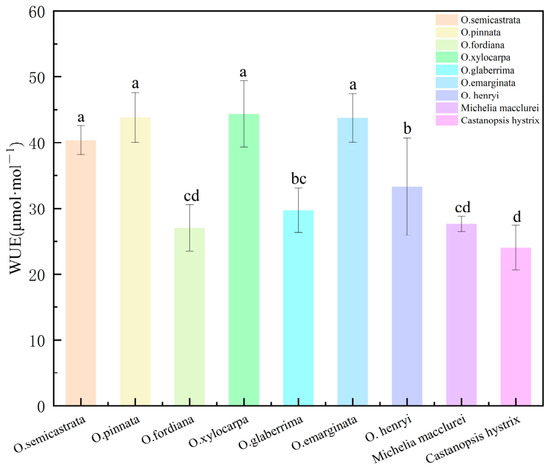
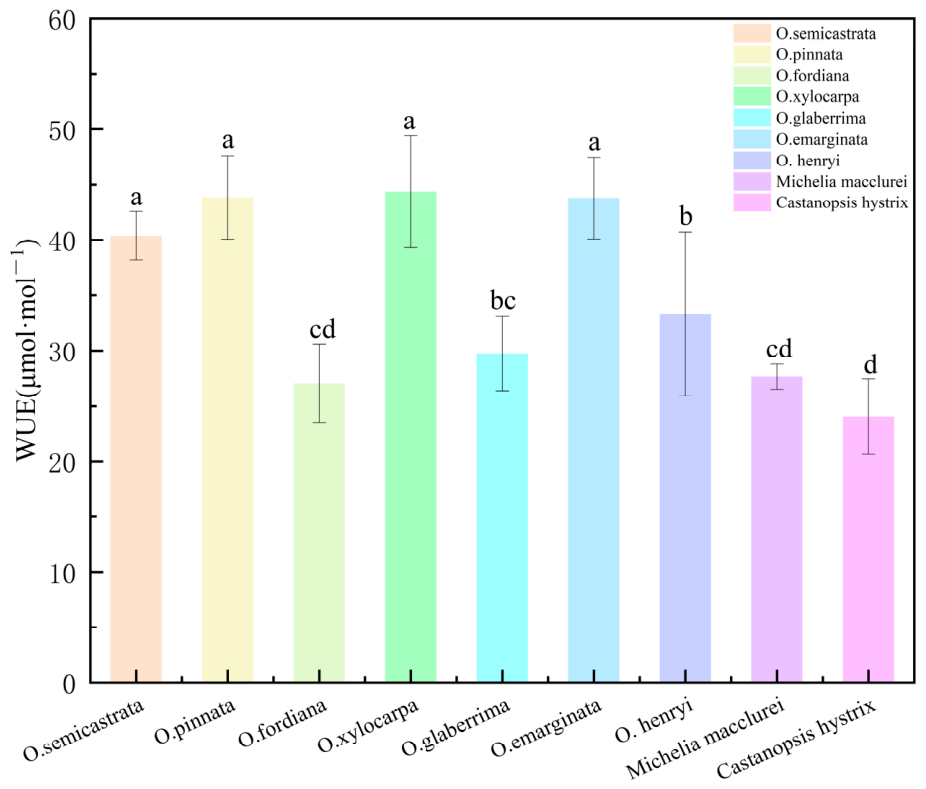
Water use efficiency of seven Ormosia species and two commonly used afforestation tree species (Michelia macclurei and Castanopsis hystrix) is shown in Figure 1. The results indicate that there are significant differences in water use efficiency among the seven Ormosia species. The water use efficiency of the seven Ormosia species, from highest to lowest, was: O. xylocarpa > O. pinnata > O. emarginata > O. semicastrata > O. henryi > O. glaberrima > O. fordiana. This order is consistent with that of the carbon isotope () values, supporting the theoretical correlation between leaf carbon isotope values and long-term water use efficiency [19]. O. xylocarpa, O. pinnata and O. emarginata exhibited the highest water use efficiency, significantly higher than that of other Ormosia species and commonly used afforestation tree species; among the seven Ormosia species, O. fordiana had the lowest water use efficiency. The water use efficiency of the commonly used afforestation tree species Michelia macclurei and Castanopsis hystrix was significantly lower than that of most Ormosia species, with Castanopsis hystrix exhibiting the lowest water use efficiency; this result is consistent with the carbon isotope () values. Differences in water use efficiency among species affect their drought resistance; in water-deficient environments, with the exception of O. fordiana, other species of the Ormosia genus have a greater survival advantage than the two commonly used tree species, Michelia macclurei and Castanopsis hystrix.
Figure 1.
Comparison of leaf water use efficiency between seven Ormosia species and commonly used afforestation tree species. Note: Different letters indicate significant differences (p < 0.05).
3.3. A Comprehensive Comparative Analysis of Ormosia and Commonly Used Afforestation Species
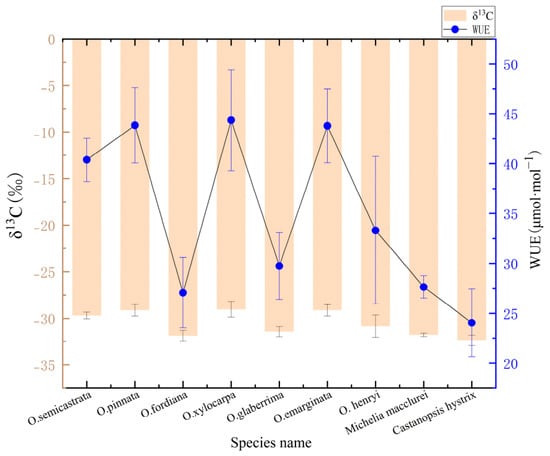
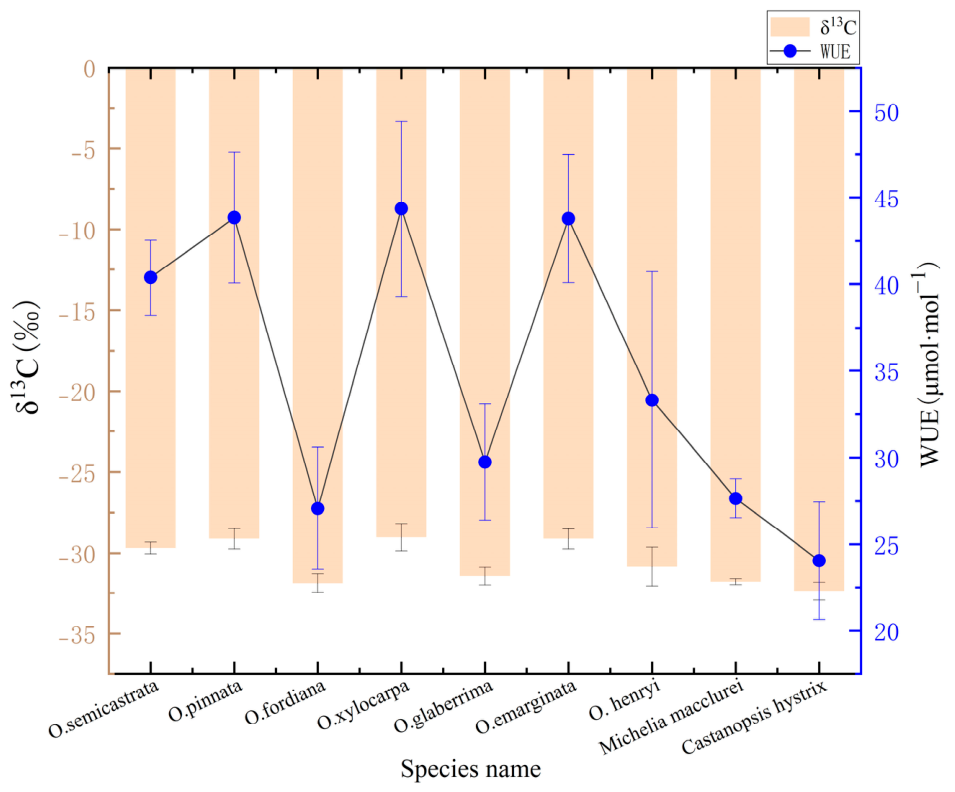
The carbon isotope () values of the leaves of seven Ormosia species showed a highly significant positive correlation (p < 0.001) with water use efficiency; in other words, the higher the carbon isotope value, the greater the water use efficiency of the plants. As shown in Figure 2, in terms of the relationship between carbon isotope composition and water use efficiency, O. xylocarpa, O. pinnata and O. emarginata exhibit higher carbon isotope () values; these three Ormosia species achieve highly efficient water use and are classified as high water use efficiency types; O. semicastrata belongs to the medium-to-high water use efficiency type; O. henryi and O. glaberrima are classified as having medium water use efficiency; whilst O. fordiana is classified as having low water use efficiency.
Figure 2.
Comparison of leaf carbon isotope ratios and water use efficiency between Ormosia species and commonly used afforestation tree species.
Compared with commonly used afforestation species such as Michelia macclurei and Castanopsis hystrix, Ormosia plants exhibit superior overall water-use characteristics. This suggests that, against the backdrop of intensifying aridification in subtropical regions, most Ormosia plants are more suitable than traditional afforestation species as preferred materials for ecological restoration and drought-resistant afforestation. Among these, O. xylocarpa and O. pinnata maintain high water use efficiency whilst exhibiting well-developed root systems and high chlorophyll content, demonstrating an excellent combination of ‘water conservation, high photosynthetic efficiency and deep root systems’; they have therefore been identified as the preferred drought-tolerant tree species in this study.
3.4. Analysis of Growth Parameters of Seven Ormosia Species and Commonly Used Afforestation Species
As shown in Table 2, growth parameters such as plant height, ground diameter, crown breadth, leaf number, root number, root length, leaf area, aboveground fresh mass, aboveground dry mass, belowground fresh mass, and belowground dry mass were compared between the seven Ormosia species and the commonly used afforestation species Michelia macclurei and Castanopsis hystrix. The results indicate that there are significant differences in growth parameters between different species (p < 0.05). In terms of plant height and ground diameter, Michelia macclurei was significantly higher than the seven Ormosia species, at 62.00 ± 6.60 cm and 6.28 ± 0.94 cm, respectively, demonstrating typical characteristics of fast-growing plants. Among the Ormosia plants, O. fordiana exhibited the highest values for plant height, ground diameter and crown breadth, at 32.15 ± 6.14 cm, 4.99 ± 0.89 cm and 2.315 ± 5.03 cm respectively; in particular, its plant height and crown breadth were significantly higher than those of other Ormosia species. Regarding leaf number, O. henryi had the highest count at 28.45 ± 7.50, significantly higher than that of Michelia macclurei and Castanopsis hystrix. In terms of root number, O. glaberrima had the highest count at 20.00 ± 2.35, followed by O. semicastrata, whilst O. xylocarpa had the lowest. In terms of root length, O. fordiana was the longest at 99.98 ± 13.82 cm, significantly longer than Michelia macclurei and Castanopsis hystrix, indicating that Ormosia plants have a stronger root growth capacity. Regarding leaf area, Michelia macclurei had the largest at 29.63 ± 8.93 cm2, followed by O. semicastrata among the Ormosia species at 24.24 ± 8.54 cm2. Both aboveground fresh mass and aboveground dry mass were highest for Michelia macclurei, at 13.72 ± 3.35 g and 4.70 ± 1.49 g, respectively, which were significantly higher than those of most Ormosia species. In terms of belowground fresh mass, Michelia macclurei and Castanopsis hystrix were significantly higher than Ormosia plants, but in terms of belowground dry mass, O. glaberrima and O. henryi performed better among the Ormosia species, showing no significant difference from Castanopsis hystrix.
Table 2.
Analysis of growth parameters for seven Ormosia species and commonly used afforestation tree species.
The results indicate that the growth rates and whole-plant dry mass of Ormosia plants are generally lower than those of common fast-growing afforestation species, but there are marked differences in growth strategies among different Ormosia species.
3.5. Comparison of Chlorophyll Content in Seven Ormosia Species and Commonly Used Afforestation Species
Chlorophyll content is an important indicator of a plant’s photosynthetic capacity [20,21]. As shown in Table 3, the levels of chlorophyll a (), chlorophyll b (), carotenoids (), chlorophyll (), chlorophyll a/b ratio (/) and carotenoid/chlorophyll ratio (/) (p < 0.05). Regarding chlorophyll (), O. fordiana and O. pinnata had the highest values, at 30.99 ± 3.24 mg/g and 30.86 ± 1.70 mg/g, respectively, which were significantly higher than those of Michelia macclurei and Castanopsis hystrix (p < 0.05), indicating that these two Ormosia species have a greater capacity to capture light energy. O. glaberrima had the lowest value at 7.47 ± 0.41 mg/g. Regarding the chlorophyll a/b ratio (/), O. henryi had the highest value among the Ormosia species at 3.13 ± 0.06 mg/g, followed by O. semicastrata at 3.11 ± 0.14 mg/g, whilst O. glaberrima had the lowest value at 2.90 ± 0.11 mg/g. The ratios for all Ormosia species were significantly higher than those of Michelia macclurei and Castanopsis hystrix (p < 0.05), indicating that Ormosia plants are better suited to growing in high-light environments and have higher light-use efficiency. Regarding the carotenoid/chlorophyll ratio, O. glaberrima had the highest value at 0.27 ± 0.01 mg/g, followed by O. semicastrata at 0.21 ± 0.002 mg/g, whilst Castanopsis hystrix had the lowest at 0.06 ± 0.004 mg/g.
Table 3.
Chlorophyll Content in Seven Species of Ormosia and Commonly Used Afforestation Tree Species.
The results indicate that Ormosia species possess a higher chlorophyll a/b ratio [22]; this characteristic demonstrates that Ormosia plants are better adapted to high-light environments, whereas the distribution of photosynthetic pigments in commonly used afforestation tree species differs markedly from that of Ormosia plants.
3.6. Correlation Analysis of Seven Ormosia Species with Plant Growth Characteristics, Photosynthetic Pigment Content, Carbon Isotope Ratios and Water Use Efficiency Parameters of Commonly Used Afforestation Species
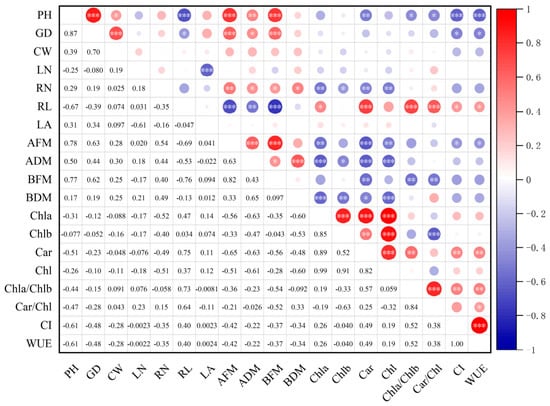
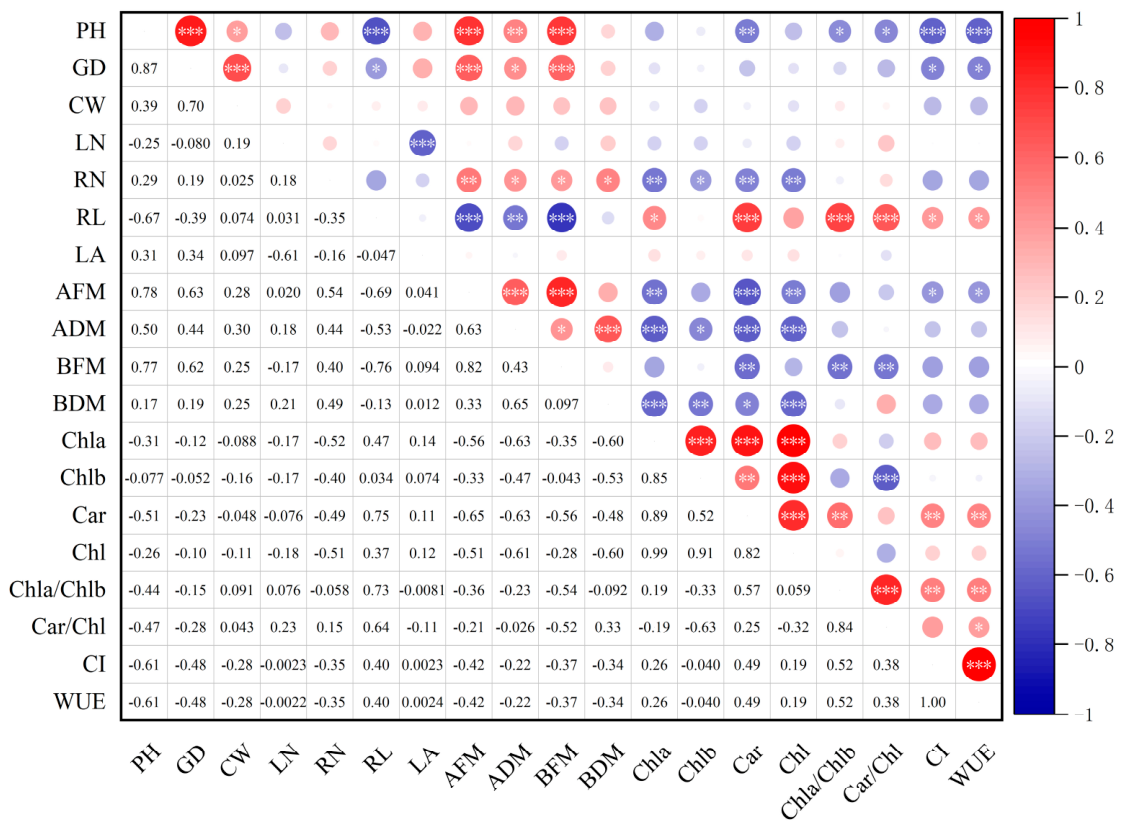
As shown in Figure 3, carbon isotopes () exhibited a highly significant correlation with water use efficiency (p < 0.001), confirming the reliability of carbon isotopes in assessing long-term water use efficiency in plants [23]. With regard to growth indices, showed a highly significant correlation with plant height (p < 0.001), indicating that Ormosia plants with high water use efficiency possess greater potential for above-ground growth. also exhibited significant correlations with root length and above-ground fresh weight (p < 0.05), suggesting that plants with high values possess both more developed root systems and higher accumulation of above-ground biomass. showed no significant correlation with crown breadth, leaf number or root number (p > 0.05), indicating that these indicators have a weaker association with water use efficiency. Regarding photosynthetic pigments, the chlorophyll a/b ratio was significantly correlated with (p < 0.01), suggesting that efficient allocation of photosynthetic pigments contributes to improved water use efficiency in plants. No significant correlations were found between the growth parameters CW and LA and the chlorophyll contents , , , , /, and /; nor were any significant correlations found with the biomass parameters ADM, AFM, BFM, and BDM, or the physiological-ecological parameters CI and WUE.
Figure 3.
Correlation analysis of growth characteristics, chlorophyll content, carbon isotope ratios and water use efficiency parameters for seven Ormosia species and commonly used afforestation tree species. Note: * indicates p < 0.05; ** indicates p < 0.01; *** indicates p < 0.001.
4. Discussion
Stable carbon isotopes are a reliable method for assessing long-term water use efficiency (WUE) in plants [24,25]. A highly significant correlation (p < 0.001) was observed between carbon isotope ratios () and water use efficiency, indicating that carbon isotope ratios () can serve as a key indicator for the rapid screening of drought-tolerant Ormosia cultivars [26,27]. Traditional gas exchange methods have significant limitations; they are susceptible to transient environmental influences and struggle to reflect long-term water use characteristics in plants [28,29]. In contrast, carbon isotope analysis requires only a small number of leaf samples to effectively characterise the cumulative information regarding the coupling relationship between photosynthetic carbon assimilation and stomatal transpiration over an entire growing season or even longer time scales. This method offers advantages such as simplicity of operation [30], stable results and high reproducibility [31], making it particularly suitable for the large-scale screening and evaluation of rare and endangered tree species. In this study, by measuring the leaf carbon isotope (δ13) values of seven endangered Ormosia species and two commonly used afforestation tree species (Michelia macclurei, Castanopsis hystrix), this study systematically analysed interspecific differences in water use efficiency. By integrating growth indices and chlorophyll content, it explored their ecological adaptation strategies, thereby filling a gap in domestic research on the carbon isotope physiological ecology of Ormosia plants and providing foundational data and methodological references for subsequent related studies. Plant water use efficiency is an important physiological indicator reflecting a plant’s adaptation to arid environments [32,33]; it provides a direct measure of a plant’s ability to utilise water under arid conditions [34] and serves as a key reference for selecting drought-tolerant afforestation tree species.
In this study, the leaf carbon isotope () values of the seven Ormosia species ranged from −31.88‰ to −29.03‰, with a mean of −30.59‰, which was significantly higher than those of the two commonly used afforestation species, Michelia macclurei (−31.78‰) and Castanopsis hystrix (−32.37‰). The leaf carbon isotope () values of the plants showed a highly significant positive correlation with long-term water use efficiency. The results indicate that Ormosia plants have higher water use efficiency than Michelia macclurei and Castanopsis hystrix, thereby demonstrating stronger water utilisation capacity and drought tolerance. This finding is consistent with the conclusions of the study by Yu Fengyuan et al. on the leaf of the main afforestation tree species in the Horqin Sandy Land, namely that plants with high carbon isotope () values in arid environments tend to possess higher water use efficiency [35].
Ormosia species exhibit high water use efficiency, which is likely related to their growing environment. Michelia macclurei and Castanopsis hystrix, as common afforestation species, are characterised by high transpiration rates and low water use efficiency, and thus have high demands on habitat moisture conditions [36]. In contrast, some species within the Ormosia genus have long been established in the limestone regions of southern China, where rock exposure is high, and soil water-holding capacity is poor [37]. Prolonged exposure to the environmental stresses of aridity and water scarcity has led Ormosia to gradually develop water-saving strategies: reducing water loss by regulating stomatal conductance whilst maintaining good photosynthetic capacity [38,39]. This physiological adaptation, which balances water retention and photosynthesis, enables Ormosia plants to effectively adapt to the specific, arid and nutrient-poor habitats. Leaf carbon isotope values provide a direct reflection of the plant’s long-term water use status and accurately demonstrate this unique physiological adaptation in Ormosia plants.
In terms of intraspecific variation within the Ormosia genus, water use efficiency ranks from highest to lowest as follows: O. xylocarpa > O. pinnata > O. emarginata > O. semicastrata > O. henryi > O. glaberrima > O. fordiana. Among these, O. xylocarpa, O. pinnata and O. emarginata exhibited significantly higher leaf carbon isotope () values and water use efficiency than the other species, indicating that they are plants with higher drought tolerance. O. fordiana and O. glaberrima had the lowest values and are classified as plants with lower drought tolerance. O. semicastrata and O. henryi fell within the intermediate range. This result may be related to the species’ native habitats. O. xylocarpa commonly grows on slopes, in valleys, along roadsides, and within sparse or dense forests near streams [40]; O. pinnata is typically found in mid- and low-altitude valleys and on forested slopes [41]; O. emarginata is commonly found in mixed forests on slopes and in valleys. O. xylocarpa, O. pinnata and O. emarginata can all grow on open slopes or forest edges; having long adapted to environments with ample light and unstable water availability, they may have developed a thicker cuticle, higher stomatal regulation capacity and an efficient photosynthetic system, thereby enhancing water use efficiency [42,43]. In contrast, O. fordiana and O. glaberrima predominantly grow in shaded, moist forest understories and have a lower tolerance to water stress; consequently, their carbon isotope () values and water use efficiency are lower. Species in moist habitats generally exhibit lower water use efficiency than their closely related counterparts in arid habitats [44,45].
Correlation analysis revealed a synergistic relationship between carbon isotopes () and multiple growth indices. showed a highly significant correlation with plant height (p < 0.001), indicating that high water use efficiency does not restrict above-ground growth; on the contrary, Ormosia species with high water use efficiency (such as O. xylocarpa and O. pinnata) also exhibit superior plant height growth. showed a significant correlation with root length and aboveground fresh mass (p < 0.05), suggesting that individuals with high water use efficiency possess more developed root systems and accumulate higher aboveground biomass. This combination of ‘high water use efficiency and robust growth’ confers a survival advantage and growth potential to species such as O. xylocarpa and O. pinnata in arid environments. showed no significant correlation with crown breadth, leaf number or root number (p > 0.05), indicating that these indicators are not sensitive to changes in water use efficiency and may be significantly influenced by environmental factors. The chlorophyll a/b ratio showed a significant correlation (p < 0.01), suggesting that efficient allocation of photosynthetic pigments is a key physiological basis for Ormosia plants to achieve high water use efficiency.
About growth parameters, this study compared seven species of Ormosia with two commonly used afforestation species, Michelia macclurei and Castanopsis hystrix. The results showed that the plant height, ground diameter, and total stem weight of the Ormosia species were generally lower than those of the afforestation species Michelia macclurei and Castanopsis hystrix, indicating that Ormosia species grow more slowly overall. Among the Ormosia species, O. fordiana performed best, with a plant height of 32.15 ± 6.14 cm, a ground diameter of 4.99 ± 0.89 cm, a crown breadth of 2.315 ± 5.03 cm, and root length of 99.98 ± 13.82 cm, all of which were significantly higher than those of other Ormosia species, indicating that O. fordiana seedlings grow well and possess a stronger root system. In contrast, O. pinnata and O. semicastrata exhibited relatively lower plant height and total stem weight, reflecting a more conservative allocation of resources. It is worth noting that Ormosia plants possess a distinct advantage in root development. The root lengths of O. fordiana and O. pinnata are significantly longer than those of Michelia macclurei and Castanopsis hystrix, suggesting that they can rely on their well-developed root systems to absorb water from deep soil layers, thereby enhancing their drought tolerance [46]. This growth characteristic is consistent with the high water use efficiency mentioned earlier. Consequently, in water-deficient environments, Ormosia plants adapt to arid conditions primarily by efficiently utilising available water, combined with deep root systems to draw water from deeper soil layers.
In terms of chlorophyll content, O. pinnata and O. fordiana had chlorophyll () levels of 30.86 ± 1.70 mg/g and 30.99 ± 3.24 mg/g respectively, which were significantly higher than those of Michelia macclurei and Castanopsis hystrix, indicating that these two Ormosia species possess strong light-harvesting capacity and photosynthetic potential [47]. Furthermore, the chlorophyll a/b ratio (/) of all seven Ormosia species was significantly higher than that of the two afforestation tree species, with O. henryi and O. semicastrata exhibiting the highest values at 3.13 ± 0.06 mg/g and 3.11 ± 0.14 mg/g, respectively. Relevant studies have shown that the higher the chlorophyll a/b ratio in plants, the greater their adaptability to high-light environments [48]. A higher ratio can enhance the plant’s light energy conversion efficiency and mitigate damage caused by intense light. Most Ormosia plants grow on open slopes, forest edges, and in limestone areas, where light intensity is high and water conditions are unstable. In contrast, the chlorophyll a/b ratios of Michelia macclurei and Castanopsis hystrix are lower, at 2.32 ± 1.06 mg/g and 1.62 ± 0.03 mg/g, respectively; this is the primary reason for their relatively low water-use efficiency under arid conditions.
5. Conclusions
A comparative analysis of Ormosia species with Michelia macclurei and Castanopsis hystrix revealed that the overall carbon isotope () values and water use efficiency (WUE) of the seven Ormosia species were significantly higher than those of Michelia macclurei and Castanopsis hystrix. This suggests that, against the backdrop of increasingly frequent droughts and seasonal water shortages in the South subtropical climate, Ormosia species are better adapted to arid environments than currently commonly used broad-leaved tree species, and are therefore more suitable for afforestation and ecological restoration in arid habitats. A comprehensive analysis of growth indices and chlorophyll content revealed that O. xylocarpa, O. pinnata and O. emarginata exhibited the highest values and water use efficiency, demonstrating optimal root development and photosynthetic capacity, and the strongest drought resistance. Although O. fordiana grows rapidly and has high chlorophyll content, its water use efficiency is low, and it has high water requirements; O. glaberrima scored low across all indicators and has relatively limited adaptability. Correlation analysis revealed a highly significant positive correlation between leaf carbon isotope ratios () and plant height (p < 0.001), as well as significant positive correlations with root length and fresh above-ground biomass (p < 0.05), indicating a synergistic relationship between high water use efficiency and robust above-ground growth and root development. Ormosia plants have developed a drought-adaptation strategy characterised by slow above-ground growth, well-developed root systems, high photosynthetic efficiency and high water-use efficiency, which differs significantly from that of commonly used afforestation species. Ormosia is a rare timber species. It is recommended that, when selecting Ormosia species for afforestation, priority be given to the propagation and promotion of O. xylocarpa, O. pinnata and O. emarginata.
Author Contributions
Conceptualization, J.Y.; methodology, J.Y. and Y.W.; validation, J.Y., Y.W., Y.J., R.Z. and Y.Y.; formal analysis, J.Y., Y.W. and Y.Y.; investigation, Y.W., Y.J., C.Z., F.W. and F.H.; data curation, R.Z., C.Z., F.W. and F.H.; writing—original draft preparation, J.Y. and Y.W.; writing—review and editing, J.T. and X.W.; visualisation, J.Y. and Y.W.; supervision, C.Z., F.H., X.W. and J.T.; project administration, X.W. and J.T.; funding acquisition, X.W. and J.T. All authors have read and agreed to the published version of the manuscript.
Funding
The National Natural Science Foundation of China (No. 32560330); Guangxi Natural Science Foundation (No. 2024GXNSFAA010452); Guangxi Institute of Botany Business Expense Number: (Gui Zhi Ye 25009); Autonomous Projects of the Guangxi Key Laboratory of Functional Phytochemicals Research and Sustainable Utilisation (Nos. ZRJJ2024-3 and ZRJJ2024-11); Hechi Municipal Science and Technology Base and Talent Programme (HeKe AC231113); The 2022 Guilin Municipal Technology Application and Promotion Programme (Nos. 20220134-3 and 20230102-3).
Data Availability Statement
The original contributions presented in this study are included in the article. Further inquiries can be directed to the corresponding authors.
Acknowledgments
The successful completion of this research would not have been possible without the invaluable support and assistance of my supervisor, senior colleagues, and fellow students. First and foremost, I extend my heartfelt gratitude to Wu Yingying, and Wang Feng for their invaluable assistance in sample collection and processing. I am also deeply appreciative of Zou Rou, Jiang Yunsheng, Yang Yishan, Zhu Chenghao, and Huang Fuzhao for their meticulous support during the data processing and analysis stages. Their rigorous approach laid a solid foundation for the accuracy of the research conclusions. I am equally grateful to Tang Jianmin and Wei Xiao for their professional guidance during the drafting and revision stages of this thesis. Their invaluable suggestions, from refining the research framework to enhancing the logical coherence of the content, enabled continuous optimisation of this study. My most sincere thanks are extended to all colleagues who supported this research endeavour.
Conflicts of Interest
The authors declare no conflicts of interest.
Abbreviations
The following abbreviations are used in this manuscript:
| PH | Plant height |
| GD | Ground diameter |
| CW | Crown breadth |
| LN | Leaf number |
| RN | Root number |
| RL | Root length |
| LA | Leaf area |
| AFM | Aboveground fresh mass |
| ADM | Aboveground dry mass |
| BFM | Belowground fresh mass |
| BDM | Belowground dry mass |
| Chla | Chlorophyll a |
| Chlb | Chlorophyll b |
| Car | Carotenoids |
| Chl | Regarding chlorophyll |
| Chla/Chlb | Chlorophyll a/b ratio |
| Car/Chl | Carotenoid/chlorophyll ratio |
| CI | Carbon isotopes () |
| WUE | Water use efficiency |
References
- Wang, X.D.; Liu, P.; Liu, M.J.; Xiao, X.Y.; Chen, F.S. Biology and ecology research status of Ormosia species in China. Acta Bot. Sin. 2018, 36, 440–451. [Google Scholar]
- Wu, G.C. Research on the genus Phaseolus in China. Today’s Sci. Technol. 1984, 8. Available online: https://kns.cnki.net/kcms2/article/abstract?v=0E3RU1Fdg_N6NJ3SroWyWwJjAsfc67wmUnlV2Quu6-EsI576oWqCuqFRduvpzMtXU_XcSch4IhkN_zY8MVe2_lAitKRRLt1-MGdaJI1RRI0YND1l2ikj65U2bHR_h5daOWt7fx1QTB6uVEDl7BL7aKPG-At_QSgy&uniplatform=NZKPT (accessed on 1 July 2026).
- Zhang, L.J.; Zhou, W.J.; Ni, L.; Huang, M.Q.; Zhang, X.Q.; Xu, H.Y. A review on chemical constituents and pharmacological activities of Ormosia. Chin. Herb. Herbal. Med. 2021, 52, 4433–4442. [Google Scholar]
- Tang, J.M.; Qin, H.Z.; Liang, H.; Wei, X. A Study on the Quality Grading of Ormosia microphylla Seedlings. Spec. Econ. Flora Fauna 2023, 26, 40–42. [Google Scholar]
- Pei, T.T.; Li, X.Y.; Wu, H.W.; Wu, X.C.; Chen, Y.; Xie, B.P. Sensitivity of vegetation water use efficiency to climate and vegetation index in Loess Plateau, China. J. Agric. Eng. 2019, 35, 119–125+319. [Google Scholar]
- Duan, A.G.; Zhang, J.G.; Zhang, J.P.; He, C.Y. Dynamics of water-use efficiency of tree species for vegetation restoration in dry-hot river valleys. J. Beijing For. Univ. 2010, 32, 13–19. [Google Scholar] [CrossRef]
- Chen, Y.Q.; Chen, S.R.; Shao, X.R.; Zang, L.P.; Zhang, G.Q.; Liu, Q.F.; Chen, D.M.; Sui, M.Z. Review on Plant Water Use Efficiency and Its Influencing Factors Based on Stable Isotopes. J. Mt. Agric. Biol. 2025, 44, 21–29. [Google Scholar] [CrossRef]
- Wu, Y.W.; Zhang, J.C.; Gu, Z.Y.; Liu, X.; Han, C. Study on Photosynthesis-transpiration Characteristics of Two Broadleaf Woody Plant Species in the Forests of Baishanzu. Soil Water Conserv. Res. 2014, 21, 204–210. [Google Scholar] [CrossRef]
- Zhao, J.H.; Sun, H.Y.; Chen, H.; Yang, F. Water use efficiency of desert shrub in Qaidam basin and its influencing factors. Acta Ecol. Sin. 2025, 45, 2605–2620. [Google Scholar] [CrossRef]
- Lu, C.X.; Pan, S.H.; Huang, L.M.; Deng, Z.Y.; Wang, J.Y.; Guo, D.Q.; Lu, X.; Chen, Q.F.; Chen, J.B. Initial Growth Effect of Mixed Forests of Eucalyptus cloeziana and Castanopsis hystrix/Michelia macclurei. Eucalypt Sci. Technol. 2021, 38, 41–44. [Google Scholar] [CrossRef]
- Bao, W.K.; Leng, L. A Comparison of Photosynthetic Pigment Content in Three Species of Mosses Under Identical Conditions. J. Plant Resour. Environ. 2005, 3, 53–54. [Google Scholar]
- Cheng, J.F.; Chen, G.Y.; Shen, Y.G. Leaves characteristics and photosynthetic capacities of various plantsin Shennongjia National Nature Reserve. Ecol. Environ. Sci. 2010, 19, 165–171. [Google Scholar] [CrossRef]
- Liu, M.; Qin, H.Z.; Liang, H.; Tang, J.M.; Wei, X.; Gao, L.M. A Study on the Quality Grading of Ormosia pachycarpa Seedlings. Spec. Econ. Flora Fauna 2023, 26, 1–3. Available online: https://kns.cnki.net/kcms2/article/abstract?v=0E3RU1Fdg_NEmZnaHiUctvh-C-YVIcaaMHJDuKrTGen-f0J2cRlD5t6MG8AUGYi0HywiucbSd_cIMh63VFqGKUyXGJPXCIdNzsWu0Cb5zOE3NenpjSf0LX3pHFH2Dvk-KA9vasycIck6pdiL7Ve6py7-jYXv2AB3ryXpYahGc8k=&uniplatform=NZKPT (accessed on 1 July 2026).
- He, G.H.; Tang, J.M.; Li, X.; Lu, L.; Cai, X.; Feng, S.; Zou, R.; Deng, Z.; Luo, Y.; Gao, L.; et al. Study on the differences in photosynthetic characteristics and leaf anatomical structure among various species of Ormosia plants. Appl. Ecol. Environ. Res. 2025, 23, 3603–3621. [Google Scholar] [CrossRef] [Scilit]
- Xu, W.; Ji, S.F. Effect of Different Extraction Methods on Chlorophyll Content. J. Langfang Norm. Univ. (Nat. Sci. Ed.) 2022, 22, 56–59. [Google Scholar]
- Tao, W.L.; Huang, F.Z.; Li, J.X.; Wang, Z.Y.; Luo, T.; Lu, F.; Li, X.K. Plant Water Use Efficency of Different Intercropping Patterns in the Karst Area of the Lijiang River Watershed. For. Grassl. Resour. Res. 2024, 2, 34–42. [Google Scholar] [CrossRef]
- Huang, F.Z.; Li, D.X.; Wang, B.; Xiang, W.S.; Guo, Y.L.; Wen, S.J.; Chen, T.; Li, X.K. Foliar stable carbon isotope composition and water use efficiency of plant in the Karst seasonal rain forest. Chin. J. Appl. Ecol. 2019, 30, 1833–1839. [Google Scholar] [CrossRef] [PubMed]
- Li, H.H.; Li, X.; Li, W.T.; Wang, T.; Li, C.P.; Wang, X.Y.; Zhao, J.X. Effects of Low Molecular Weight Organic Acid Extraction on the Release of Metal Cations and Chemical Alteration in Purple Soil. J. Soil Water Conserv. 2024, 38, 343–352. [Google Scholar] [CrossRef]
- Fan, R.; Xu, H.F.; Li, C.; Zhang, H.; Zhang, H.; Chen, L.; Wang, N.L. Changes in plant diversity and water use efficiency during the restoration process of subtropical forests. Geogr. Res. 2024, 43, 776–790. [Google Scholar]
- Luo, W.C.; Zeng, F.J.; Liu, B.; Zhang, L.G.; Liu, Z.; Song, C.; Peng, S.L.; Peng, H.Q. Photosynthetic and physiological characteristics of introduced plants at the desert-oasis ecotone. Acta Prataculturae Sin. 2013, 22, 273–280. [Google Scholar]
- Sun, Y.J.; Zhuang, D.H.; Du, H.; Xu, X.H.; Ma, R.J. Impact of different allelochemicals on protective enzyme system of exotic invasive plant Ipomoea cairica (Linn.) Sweet. Chin. J. Eco-Agric. 2011, 19, 1480–1482. [Google Scholar] [CrossRef] [Scilit]
- Yang, Y.; Cao, Y.; Zhang, S.J. Effects of Soil Moisture Regime on Rhizomatic Germination and Young Shoot Growth of Carex cinerascens. J. Ecol. Rural Environ. 2015, 31, 180–187. [Google Scholar]
- Chen, T.; Feng, H.Y.; Xu, S.J.; Qiang, W.Y.; An, L.Z. Stable Carbon Isotope Composition of Desert Plant Leavesand Water-use Efficiency. J. Desert Res. 2002, 3, 87–90. [Google Scholar]
- Chen, P.; Zhang, J.S.; Meng, P.; He, C.X.; Jia, C.R.; Li, J.Z. Feasibility analysis on the determination of WUE by stable carbon isotope: Cassia obtusifolia L. as an example. Acta Ecol. Sin. 2014, 34, 5453–5459. [Google Scholar] [CrossRef] [Scilit]
- Brendel, O. The relationship between plant growth and water consumption: A history from the classical four elements to modern stable isotopes. Ann. For. Sci. 2021, 78, 47. [Google Scholar] [CrossRef] [Scilit]
- Wang, X.H.; Liu, C.M. Advances in Crop Water Use Efficiency Research. Adv. Water Sci. 2000, 1, 99–104. [Google Scholar] [CrossRef]
- Li, Y.Y. Application of Carbon Isotope Technique on the STUDYOF Water Use Efficiency of Crops. Acta Agric. Nucl. Sin. 2000, 2, 115–121. [Google Scholar]
- Wu, J.N.; Liu, W.J.; Zhu, C.J. Application of Stable Isotope Techniques in the Study of Plant Water Sources and Use Efficiency. J. Southwest For. Univ. 2014, 34, 103–110. [Google Scholar] [CrossRef] [Scilit]
- Yan, Y.X.; Hu, C.C.; Lei, Y.B.; Tan, Y.; Liu, X. Carbon isotope constraints on plant water use efficiency in a tropical invaded ecosystem. J. Geophys. Res. Biogeosci. 2025, 130, e2025JG008997. [Google Scholar] [CrossRef] [Scilit]
- Ding, M.M.; Su, X.H.; Huang, Q.J. Application of Stable Carbon Isotope Techniques in Genetic Improvement of Forest. World For. Res. 2005, 5, 23–28. [Google Scholar] [CrossRef]
- Ge, T.D.; Wang, D.D.; Zhu, Z.K.; Wei, L.; Wei, X.M.; Wu, J.S. Tracing technology of carbon isotope and its applications to studies of carbon cycling in terrestrial ecosystem. Chin. J. Plant Ecol. 2020, 44, 360–372. [Google Scholar] [CrossRef] [Scilit]
- Gao, S.; Su, P.X.; Yan, Q.D.; Ding, S.S.; Zhang, L.M. Leaf Anatomical Structure And Photosynthetic Physiological Characteristics Of C4 Desert Specres Salsola Collina and S. arbuscula. Chin. J. Plant Ecol. 2009, 33, 347–354. [Google Scholar] [CrossRef] [Scilit]
- Cao, S.K.; Feng, Q.; Si, J.H.; Chang, Z.Q.; Zhou, M.; Xi, H.Y.; Su, Y.H. Summary on the plant water use efficiency at leaf level. Acta Ecol. Sin. 2009, 29, 3882–3892. [Google Scholar]
- Liu, Y.; Li, P.; Xu, G.C.; Xiao, L.; Ren, Z.P.; Li, Z.B. Growth, Morphological, and Physiological Responses to Drought Stress in Bothriochloa ischaemum. Front. Plant Sci. 2017, 8, 230. [Google Scholar] [CrossRef] [Scilit] [PubMed]
- Yu, F.Y.; Zhang, J.X.; Sun, Y.R.; Song, L.N. Leaf δ13C of the Main Afforestation Tree Species in Horqin Sandy Land. For. Res. 2022, 35, 179–187. [Google Scholar] [CrossRef]
- Hu, H.L.; Zhang, J.; Wan, X.Q.; Chen, H.; Yi, W.Y.; Zhou, Y.C. The water consumption and water use efficiency of the seedlings of Eucalyptus grandis and other five tree species in Sichuan Province. Acta Ecol. Sin. 2012, 32, 3873–3882. [Google Scholar] [CrossRef] [Scilit]
- Long, C.B.; Zhang, Z.H. Water Absorption Characteristics of Bryophytes in Karst Rocky Desertification Area. Bull. Soil Water Conserv. 2015, 35, 350–354. [Google Scholar] [CrossRef]
- Wei, J.M.; Huang, X.; Zhang, D.L.; Li, Y.Z. Mechanism of Guizhou Native Semi-wild Tomato Rootstocks Mediates ABA Biosynthesis Signaling Pathway to Regulate Plant Drought Tolerance. J. Nucl. Agric. Sci. 2023, 37, 707–719. [Google Scholar]
- Ding, X.X.; Tang, L.Y.; Zhang, B.N.; Ye, L.F.; Xi, J.B.; Wang, Z.Y. Adaptive strategies of twig functional traits in Robinia pseudoacacia alonga precipitation gradient and their driving mechanisms. J. Zhejiang A F Univ. 2025, 42, 503–512. [Google Scholar]
- Deng, Y.L.; Chen, R.; Wu, M.; Yuan, S.Q.; Huang, Y.C.; Luo, Y.M.; Cao, J.W.; Xiong, Z.Y.; Li, G. Analysis of differences in leaf functione structure of Ormosia xylocarpa at different seedling ages. Hunan For. Sci. 2025, 52, 17–23. [Google Scholar]
- Chen, X.D.; Ma, H.W. Propagation and Cultivation Techniques for Ormosia pinnata. Mod. Hortic. 2017, 22, 28. [Google Scholar] [CrossRef]
- Min, X.Y.; Xiong, K.N.; Shen, X.Y.; Hang, H.T.; Chi, Y.K.; Zhang, S.H. Research Progress of Plant Adaptability to Drought Stress in Karst Rocky Desertification Area. World For. Res. 2020, 33, 7–12. [Google Scholar] [CrossRef]
- Sun, S.F.; Huang, J.H.; Lin, G.H.; Zhao, W.; Han, X.G. Application of stable isotope technique in the study of plant water use. Acta Ecol. Sin. 2005, 9, 2362–2371. [Google Scholar]
- Wang, Y.N.; Xiong, W.; Wang, Y.H.; Yu, P.; Xu, L.H.; Zuo, H.J.; Cao, G.X.; Sun, H. A Review on Leaf Water Use Efficiency of Major Trees Species in Arid and Semi-Arid Area. World For. Res. 2012, 25, 17–23. [Google Scholar] [CrossRef]
- Zhang, S.; Liu, Y.; Li, G.L.; Hen, X.C.; Sun, Q.Y.; Xu, F. Application of Stable Carbon Isotope to Research on Water Use Efficiency of Forest Plant. World For. Res. 2013, 26, 39–45. [Google Scholar] [CrossRef]
- Li, J.H.; Li, W.J.; Wang, Y.Y.; Shi, X.J.; Hao, X.Z.; Liu, P. Response of Root Growth and Water Use Efficiency to Drought in Different Drought Tolerant Cotton Varieties. Xinjiang Agric. Sci. 2022, 59, 20–29. [Google Scholar]
- Fan, X.; Wang, S.S.; Liu, J.P.; You, M.H. Effects of different shading treatments on some morphological, growth and physiological indexes of Epilobium fangii. J. Plant Resour. Environ. 2016, 25, 53–61. [Google Scholar] [CrossRef] [Scilit]
- Liu, H.; Li, M.L.; Li, D.M.; Liu, R.; Xie, D.; Ning, Z.L.; Deng, L.S. Effects of Different Nitrogen Concentrations on Growth and Physiological Characteristics of Primulina rubella Seedlings. Subtrop. Plant Sci. 2025, 54, 398–407. [Google Scholar]

Disclaimer/Publisher’s Note: The statements, opinions and data contained in all publications are solely those of the individual author(s) and contributor(s) and not of MDPI and/or the editor(s). MDPI and/or the editor(s) disclaim responsibility for any injury to people or property resulting from any ideas, methods, instructions or products referred to in the content. |
© 2026 by the authors. Licensee MDPI, Basel, Switzerland. This article is an open access article distributed under the terms and conditions of the Creative Commons Attribution (CC BY) license.