


Abstract
This study aimed to develop a stand yield table for Acacia mangium plantations in Vietnam and to analyze their economic feasibility. Field measurements were conducted across 12 temporary sample plots established in A. mangium plantations aged 1–7 years in northeastern Vietnam, using a chronosequence sampling design. Based on this, regression analyses were performed to develop stand growth models for DBH, H, SD, BA, and V. NPV measures the absolute value of the investment at a specified discount rate (4.0%, 5.5%, and 7.0%), while IRR identifies the break-even discount rate. At rotation ages of 5–7 years, IRR values are negative—a mathematically valid result arising from non-conventional cash flow structures in which Norstrom’s sign-change criterion is not satisfied; positive IRR values (~4%) are obtained from rotation age 8 onward. A sensitivity analysis confirmed that increasing yields is the most effective strategy for increasing plantation viability. This study serves as a fundamental resource for plantation projects in Vietnam and emphasizes the necessity of management improvements to create sustainable plantation operations.
1. Introduction
The Reducing Emissions from Deforestation and Forest Degradation Plus (REDD+) framework has gained international attention as a forest-based carbon reduction strategy. This global framework aims to mitigate greenhouse gas emissions by preventing deforestation and forest degradation in developing countries, promoting sustainable forest management, and enhancing the carbon absorption capacity of forests. The issue of deforestation and forest degradation is prevalent in most developing countries, many of which are largely covered by tropical forests [1]. The destruction of tropical forests is exacerbated by indiscriminate logging [2], with harvested timber being utilized for both local livelihoods and commercial purposes. Additionally, large-scale agriculture following deforestation has brought its own adverse effects, such as excessive pesticide use, water pollution, and soil degradation [3]. Given these circumstances, it is essential to establish systematic management strategies tailored to each country’s unique conditions, supported by technical and financial assistance through international cooperation.
Among developing countries, Vietnam has significant potential for the implementation of REDD+ projects and is regarded as one of the key nations requiring further research and project expansion [1]. Since 1998, the Vietnamese government has been actively engaged in forest plantation development through the Five Million Hectare Reforestation Project (5MHRP), utilizing fast-growing Acacia species, in particular, to sustain a stable supply of commercial timber [4]. As a result, in 2021, Vietnam’s total forest plantation area reached 4,573,444 ha, with Acacia species covering more than 2,200,000 ha (48.1%) and becoming the dominant plantation species [5]. Currently, Acacia plantations in Vietnam provide livelihoods for millions of smallholder farmers and generate significant economic benefits for rural communities [6]. Acacia species exhibit rapid growth rates and high ecological adaptability, enabling them to thrive in diverse soil conditions. Moreover, they contribute to soil improvement and ecological restoration [7]. Additionally, Acacia wood is highly valued for its superior quality and is widely utilized in a variety of industries, including wood processing, pulp and paper production, and wood chip manufacturing. Notably, Acacia wood chips account for approximately 70% of Vietnam’s total wood chip raw materials [8]. Research is being actively conducted in Vietnam and several neighboring countries to develop sustainable plantation management strategies aimed at improving the productivity of Acacia species [9,10].
For government agencies, companies, and individuals engaging in overseas plantation projects, the assessment and prediction of stand growth are essential factors, making accurate estimation essential [11]. In general, stand yield tables are used to predict growth and harvest. They allow stand volume by age to be easily calculated, facilitating the development of effective forest management strategies [12,13]. Many nations with advanced forestry industries have developed yield tables for their representative plantation species, utilizing them in a wide range of forest management and research activities. However, stand growth varies considerably across regions due to differences in climate, soil conditions, topography, and management practices, which limits the applicability of yield tables developed in one region to others. In Vietnam, although Acacia plantations are widely distributed, reliable stand yield tables that reflect region-specific growth characteristics remain limited. The development of such region-specific yield tables can serve not only as a tool for predicting stand growth but also as a key component in evaluating the economic feasibility of plantation projects. Accurate yield predictions enable more precise estimation of the current and future asset values of plantations, thereby supporting more reliable investment decisions and contributing to the long-term sustainability of plantations.
To date, no field-survey-based regression growth models or empirically derived yield tables have been developed specifically for Acacia mangium plantations in the northeastern Vietnam biogeographic zone—a region distinguished from the central and southern highlands by its distinct monsoon regime, soil characteristics, and topographic profile. Prior studies conducted in neighboring regions of Vietnam employed GIS-based or spatially explicit modeling frameworks designed to characterize broad spatial patterns of forest productivity and therefore differ fundamentally in scale, methodology, and management applicability from the stand-level approach adopted here. Against this background, the present study pursues three objectives: (1) to develop stand-level regression models for dominant height, diameter at breast height, and merchantable volume, and to construct an empirical yield table for Acacia mangium in northeastern Vietnam; (2) to integrate these biometric outputs with a comprehensive economic feasibility analysis—encompassing NPV, BC ratio, and IRR across discount rates of 4.0%, 5.5%, and 7.0%, together with multi-scenario sensitivity analysis—within a single unified analytical framework; and (3) to derive evidence-based rotation-age recommendations that can serve directly as decision-support tools for forest managers and policymakers in this data-sparse region.
2. Materials and Methods
2.1. Study Sites
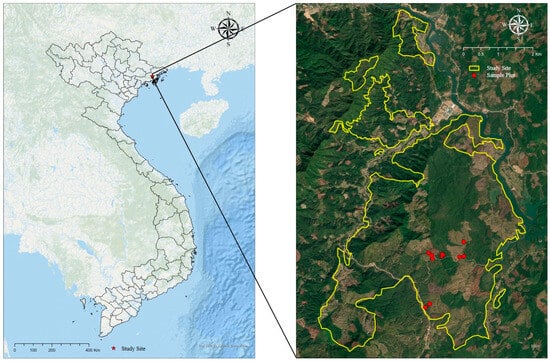
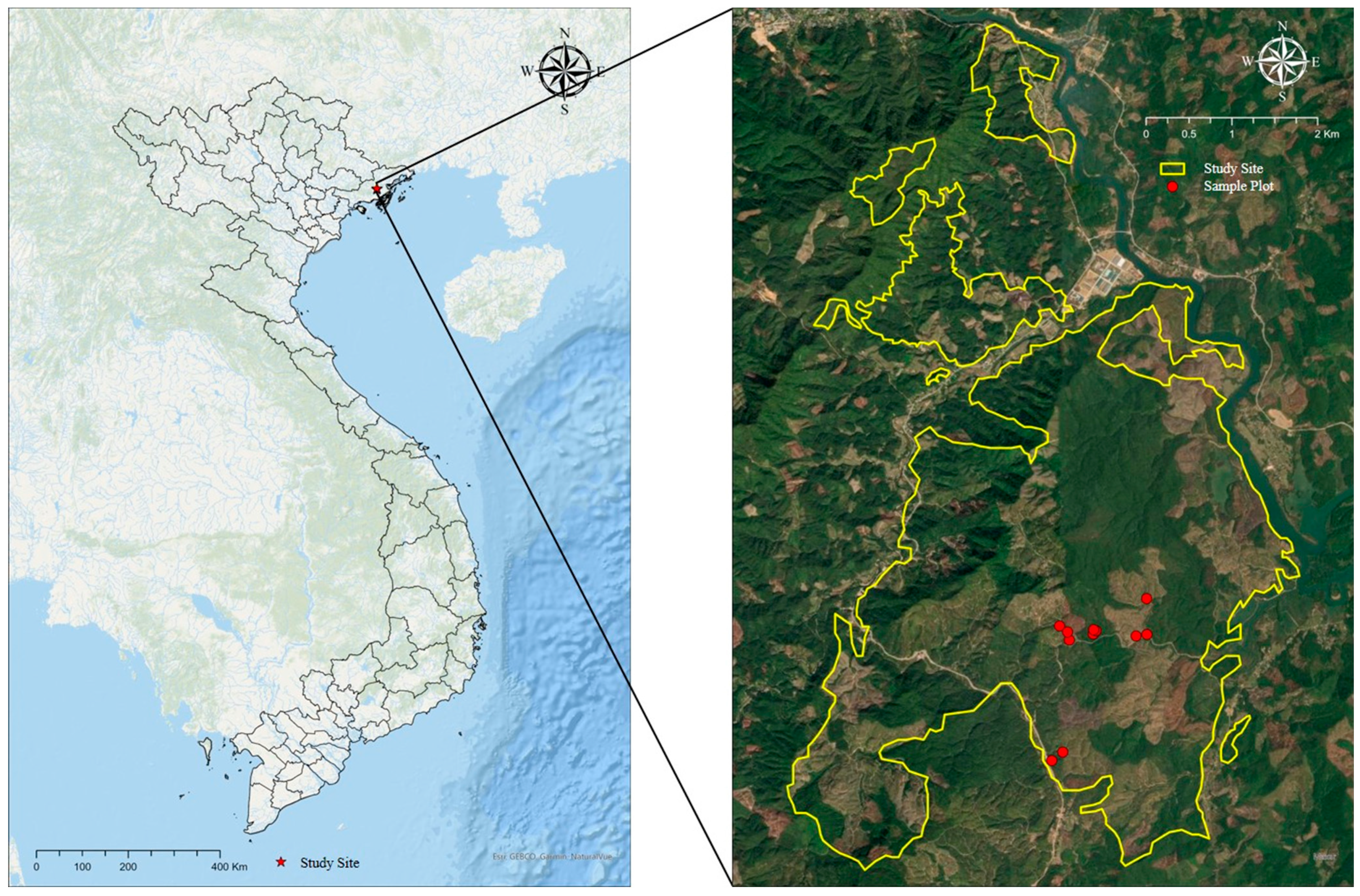
The study sites were located in the Ba Chẽ district, Quảng Ninh province, Vietnam (Figure 1), where the primary plantation species is A. mangium. Quảng Ninh province is situated in northeastern Vietnam, approximately 200 km east of Hà Nội. This region falls within the subtropical climate zone, with temperatures ranging seasonally from an annual maximum of 38–40 °C to an annual minimum of 6–7 °C. The average annual precipitation is approximately 2000 mm, occurring predominantly during the summer. The plantations were established and managed by a local forestry company in Ba Chẽ, with relatively consistent management practices. In all study areas, one-year-old seedlings were planted at a density of 3000 trees per hectare. The study sites were subjected to weeding only during the first two years after planting, and no subsequent management practices, such as thinning or pruning, were implemented. Additionally, the study sites were managed using prescribed burning after clear-cutting to remove harvest residues.
Figure 1.
Locations of the study region in Vietnam (left) and of the plots in the study site (right). The red circles in the right-hand map indicate the locations of the plots where forest surveys were conducted.
A soil survey was conducted to examine the physical and chemical properties of the soils within the plantation areas. The results indicated that in areas with high groundwater levels, such as foothills and regions near reservoirs, soil moisture contents exceeded 20%, whereas ridge areas, including mid-slopes and summits, had soil moisture contents of 20% or less. Soils were primarily sandy loams and clay loams. Soil acidities (pH) ranged from 3.6 to 4.2, while cation exchange capacities varied between 5.8 and 14.6 mmol 100 g−1. Organic matter contents ranged from 3 to 6% in the topsoil (A horizon), indicating moderate levels, whereas in the subsoil (B horizon), it was approximately 1%, which is considered very low.
2.2. Measurement of Stand Growth
A forest survey was conducted from 16 to 22 June 2024 to estimate stand growth. Each sample plot was 20 × 20 m, and a total of 12 plots were established, with three plots each representing 2-, 5-, 6-, and 7-year-old plantations (Table 1). Within each plot, all standing trees were counted, and their diameters at breast height (DBH) and tree heights (H) were measured.
Table 1.
Basic measurements of the A. mangium study stands. The values are expressed as the mean ± standard deviation based on three replicate plots for each stand age.
For DBH, measurements were taken 1.2 m above the ground using a diameter tape (Shinill Science, Paju-si, Republic of Korea). In plots where trees were less than 1.2 m tall, root collar diameters (RCD) were measured at 0.2 m above the ground instead of DBH. H was measured for all trees within each plot using a height meter (suunto, Vantaa, Finland). To verify and calibrate the height meter-based measurements, three representative trees per plot were selected based on proximity to the mean stand height, felled, and precisely re-measured using a tape measure. The felled-tree measurements were used to correct any systematic bias in the height meter readings and to confirm the accuracy of the height data before model fitting. Stand density (SD) was determined as the number of trees per hectare, calculated using field survey data. Basal area (BA, m2 ha−1) was calculated as the total cross-sectional area of trees per hectare, using DBH measurements (in cm), as shown in Equation (1):
Stand volume (V) is typically calculated using yield tables. However, as no yield tables have been developed for A. mangium, the DBH form factor method (Equation (2)) was applied for stands in which all tree heights were >1.2 m, while, since the DBH form factor method cannot be applied for stands containing any trees with H < 1.2 m, V (m3 ha−1) was calculated in such stands using Equation (3):
where g is the basal area of an individual tree at breast height (m2), g0 is the basal area of an individual tree at the root collar, and f is the DBH form factor. A DBH form factor of 0.5 was applied in this study, following established practice for A. mangium plantations in Southeast Asia, where stem form is characteristically cylindrical and form factor values in the range of 0.45–0.55 have been consistently reported [7,11,14].
2.3. Developing Stand Growth Models and a Yield Table
All statistical analyses were conducted using SigmaPlot ver. 10.0 (Grafiti LLC, Palo Alto, CA USA), based on the collected forest survey data. Regression analyses were performed to model stand growth characteristics, including DBH, H, SD, BA, and V, as a function of stand age. The Chapman–Richards function (Equation (4)), which produces a sigmoid-shaped curve, was used to predict DBH, H, BA, and V. This equation is derived from principles of plant growth and is widely used in forestry to predict growth and yield based on stand age [15]. To model SD, which decreases as stand age increases, a negative exponential function was employed (Equation (5)). Stand density is generally represented by an exponential decay or negative power-function curve [16], capturing how SD decreases either rapidly or gradually with increasing stand age. Based on our analytical results, stand growth models were developed for each factor, and using these, a stand yield table for A. mangium in Vietnam was ultimately constructed.
2.4. Analyzing Economic Feasibility
An economic analysis was conducted to evaluate the economic feasibility of A. mangium plantation investments. All monetary values are expressed in constant 2024 USD, with no inflation adjustment applied, consistent with standard practice in plantation feasibility studies [14]. The economic assumptions were established as follows:
- (1)
- Planting density: A. mangium was planted at a density of 3000 trees ha−1, reflecting the standard operational practice at the study site as confirmed through field interviews.
- (2)
- Yield estimates: Stand volume (V) was derived from the yield table developed in the present study, with a wood conversion rate of 90% applied to account for harvest and processing losses.
- (3)
- Timber price: The wood chip market price was set at USD 38 m−3, based on the prevailing purchase price reported by a local forestry company operating in Ba Chẽ district, Quảng Ninh province, as of 2024. This price is consistent with recent export price data for Vietnamese wood chips [8].
- (4)
- Discount rate: The base discount rate was set at 5.5%, corresponding to the Vietnamese commercial bank lending rate in 2024. For the sensitivity analysis, rates of 4.0% and 7.0% were additionally applied to reflect the observed range of Vietnamese interest rates over the past decade (minimum 4.0%, maximum approximately 6.5%).
- (5)
- Costs: Annual establishment and management costs were estimated through structured interviews with plantation management personnel at the local forestry company and are reported in full in Table 2. Costs were classified into material costs (seedlings, fertilizers, and field labor) and management costs (operational planning, wildfire protection, general site maintenance, and land lease fees).Table 2. Annual production and management costs per ha (USD ha−1) for running a plantation under the economic feasibility scenario.
Based on this scenario, the net present value (NPV), benefit/cost ratio (B/C ratio), and internal rate of return (IRR) were calculated to evaluate the economic feasibility of the plantation:
where t is time (y), n is the total period (y), Bt is the annual cumulative benefits up to time t (USD per hectare), Ct is the annual cumulative costs up to time t (USD per hectare), and r is the interest rate (%).
Annual costs were estimated and aggregated, as presented in Table 2. In this study, the costs were classified into material costs and management costs. Material costs include direct expenses required for plantation establishment, consisting of material costs and labor costs. Material costs cover expenditures for purchasing inputs such as seedlings and fertilizers, while labor costs refer to wages for field operations, including planting. Management costs include expenses related to plantation operation and maintenance, comprising management planning costs, wildfire protection costs, general management costs, and land lease fees. Management planning costs refer to expenses required for establishing annual plantation operation plans. Wildfire protection costs include expenditures associated with safety management, such as fire prevention and the establishment of fire breaks. General management costs refer to expenses incurred for site maintenance, equipment operation, and routine management activities. Land lease fees represent the cost of leasing land per hectare for plantation use.
2.5. Sensitivity Analysis
Based on the results of the economic analysis, a sensitivity analysis was conducted focusing on three key variables: the interest rate, the wood chip market price, and wood chip yield. The interest rates were set at 4.0%, 5.5%, and 7.0%, reflecting the fluctuations of Vietnam’s interest rates over the past decade (minimum 4.0%, maximum 6.5%). Variations in the wood chip market price were determined considering potential changes based on market supply and demand. Vietnam is currently the world’s largest wood chip exporter, and its wood-based product manufacturing and export sector is rapidly expanding [17,18]. Given a continuously increasing demand for wood chips in the recent past, the market price is expected to rise in the future [19]. Therefore, in this study, wood chip market price variations were set at +0%, +10%, and +20%. Variations in wood chip yield were introduced as scenario-based assumptions to evaluate the sensitivity of economic feasibility to changes in plantation productivity. The +70% and +140% scenarios do not represent validated forecasts for the study site; rather, they were selected as exploratory ranges to simulate moderate and substantial productivity improvements that could arise under more favorable management or site conditions. Therefore, the results should be interpreted as sensitivity-testing outcomes that illustrate the relative influence of yield improvement on financial indicators, not as directly observed or confirmed production targets. Accordingly, wood chip yield variations were set at +0%, +70%, and +140%. Using the chosen levels, the sensitivity analysis was conducted, and the impact of fluctuations in the three key variables on financial indicators, including the NPV, the B/C ratio, and the IRR, was evaluated.
3. Results and Discussion
3.1. Model Goodness of Fit
The estimated parameters and goodness-of-fit statistics for the stand growth models predicting A. mangium stand development in northeastern Vietnam are presented in Table 3. For all models except the stand density (SD) model, the adjusted R2 value exceeded 0.97, and all results were highly statistically significant (p < 0.0001), indicating that the fitted models reliably capture the dominant age-related growth trends for this species. The R2 values obtained for the DBH (R2 = 0.98), height (R2 = 0.99), basal area (R2 = 0.97), and volume (R2 = 0.97) models are consistent with, or exceed, those reported in previous stand-level growth modeling studies for Acacia and other fast-growing tropical plantation species [11,14], confirming the suitability of the developed models for predicting and evaluating stand growth in the study region.
Table 3.
Parameters and statistics of stand growth equations for A. mangium in Vietnam.
Among the fitted models, stand volume exhibited the highest mean square error (MSE = 77.09), reflecting the compounding of variability across its multiple input variables. Unlike height or DBH—each measured directly as a single field variable—stand volume is derived from a combination of DBH, height, stand density, and the applied form factor (Equation (2)). Uncertainty in each of these inputs propagates through the volume calculation, resulting in greater overall estimation variability relative to the primary mensuration variables. This pattern is consistent with findings reported in comparable tropical plantation growth modeling studies [14].
The SD model yielded a substantially lower R2 of 0.51, which is attributable to the vigorous sprouting ability characteristic of A. mangium. Sprouting introduces irregular variability in stand density that fluctuates depending on sprout survival rate and intraspecific competition, even among stands of the same age, such that the relationship between stand age and SD does not follow a strong or consistent pattern. Notwithstanding this limitation, the SD model was retained in the yield table framework because stand density is a prerequisite input for basal area and volume estimation, and its exclusion would preclude a complete characterization of stand development.
3.2. Development of a Yield Table Using Stand Growth Models
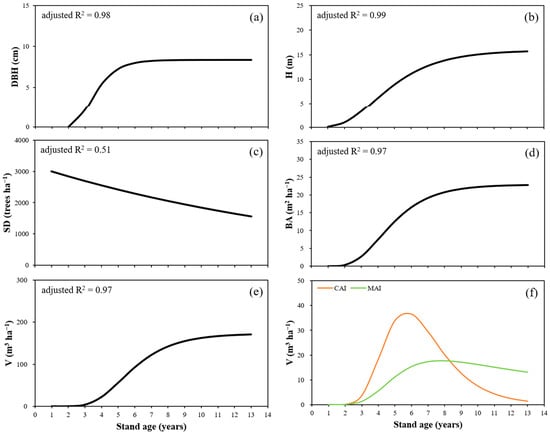
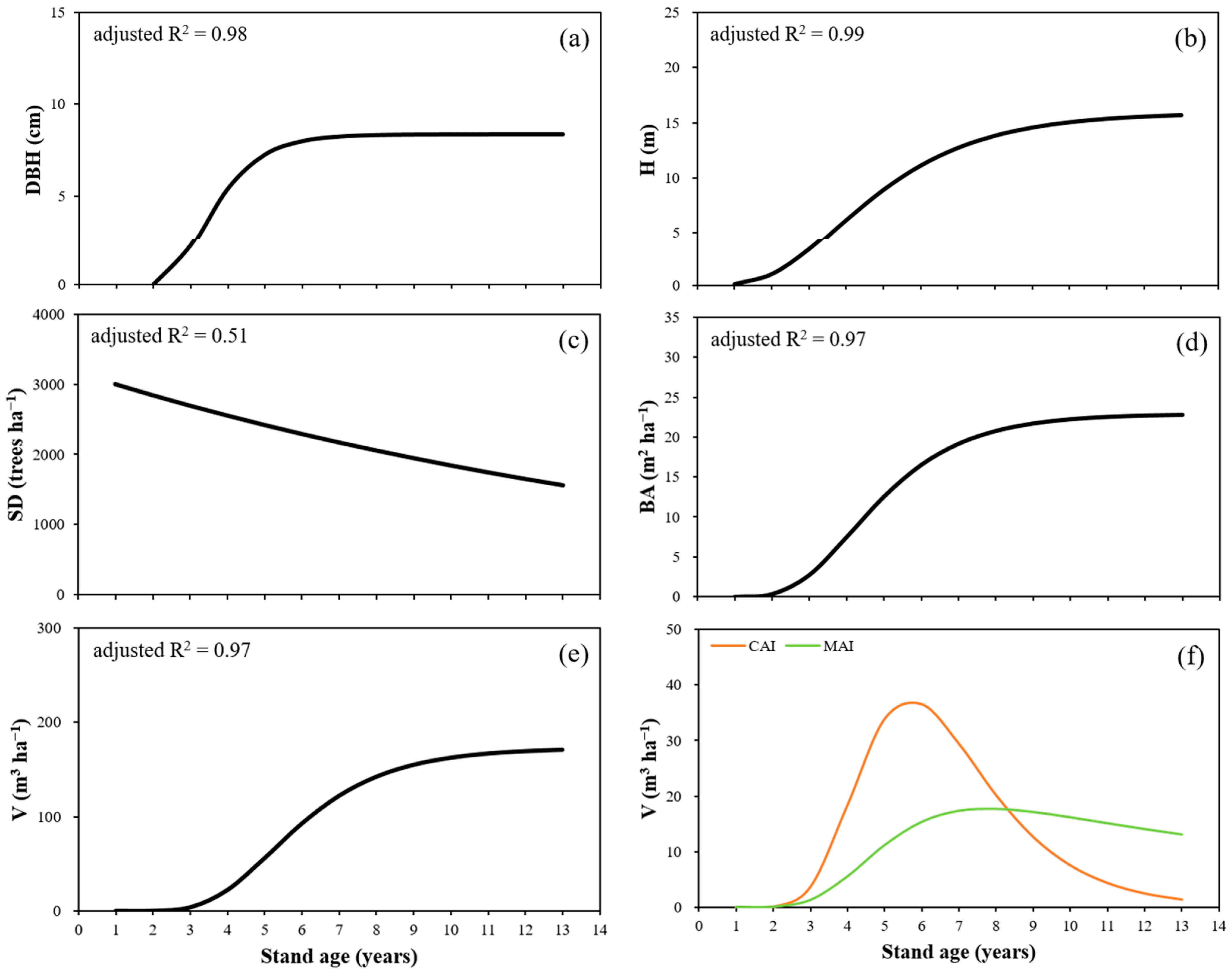
Stand-level growth predictions serve as fundamental data for managing forests and setting silvicultural objectives. Unlike individual tree growth prediction, this approach must comprehensively reflect structural changes resulting from stand dynamics [20]. To predict the stand growth of A. mangium in Vietnam, stand growth models were developed to analyze changes in the growth of each factor according to stand age (Figure 2). Based on this, a stand yield table was developed (Table 4).
Figure 2.
Stand growth curves: (a) average tree diameter at breast height (DBH), (b) average tree height (H), (c) stand density (SD), (d) basal area (BA), (e) stand volume (V), and (f) the current annual increment (CAI) and mean annual increment (MAI) in volume over 14 y in A. mangium plantations at the study site in Vietnam.
Table 4.
Yield table developed in the present study for A. mangium plantations in Vietnam. Diameter at breast height (DBH), basal area (BA), height (H), stand density (SD), stand volume (V), current annual increment (CAI), and mean annual increment (MAI) were calculated at each stand age using the growth models developed in this study.
The average DBH of A. mangium continuously increased until age 6, reaching approximately 8.0 cm (Table 4). Thereafter, the annual increment in DBH had declined sharply to near zero, and growth plateaued at age 7, approaching an asymptote (Figure 2a). Acacia species are characterized by vigorous sprouting [21]. Since sprouts have a relatively small DBH compared to planted trees, they may contribute to a decline in the annual increment of the average DBH within the stand. Thinning at an early stand age would be expected to enhance DBH growth by removing poorly growing trees and securing sufficient growing space for dominant trees.
Tree height growth is closely related to site quality and serves as a key factor in assessing site productivity [22]. The height of A. mangium continuously increased with stand age, reaching approximately 15.1 m at age 10 (Figure 2b; Table 4). This is lower than the 24.7 m heights observed in a 10-year-old A. mangium plantation in the Kalimantan region of Indonesia [11]. The study site employs a management method that involves prescribed burning after clear-cutting to remove residual materials. According to previous research, in A. mangium plantations, cation concentrations in the soil initially increase immediately after prescribed burning; however, after one year, there is a significant decline in pH, organic carbon, nitrogen, and most cations, including calcium, magnesium, potassium, and sodium [23]. These findings suggest that while prescribed burning may temporarily enhance soil nutrient availability by converting organic matter into inorganic nutrients, it may also contribute to nutrient depletion over time, potentially influencing tree growth. Therefore, prescribed burning may be one of several factors influencing tree height growth in the study area. In addition, since tree height variation within the even-aged stands was relatively small, tree height was measured using three representative trees per plot. However, this sampling approach may still introduce some uncertainty into stand height estimation. Future studies incorporating a larger number of sample trees would further improve the reliability of these estimates.
Stand density is an important factor in growth analysis, as it directly influences BA, V, and other factors. In the A. mangium plantations at the study site, one-year-old-seedlings were planted at a density of 3000 trees ha−1, but over time, SD gradually declined, reaching 1563 trees ha−1 at age 13, a reduction of approximately 48% (Table 4). This gradual reduction reflects the process of self-thinning. As the stand ages, the growth of trees intensifies competition among individuals, leading to the natural mortality of some trees and a subsequent decline in SD [24]. The vigorous sprouting of A. mangium likely contributed to the lower R2 of the SD model. To mitigate intense competition and enhance DBH growth without compromising stand volume, early intervention is recommended. Specifically, implementing cull thinning can effectively remove suppressed or poorly formed sprouts, thereby securing sufficient growing space for the dominant trees. However, the thinning intensity must be carefully controlled. While a decreased density accelerates individual diameter growth, it can also lead to a tapering stem. Conversely, maintaining an optimal, slightly higher density promotes cylindrical development, which is crucial for maximizing the yield of high-quality timber. Therefore, applying systematic cull thinning rather than leaving the stand to natural self-thinning can optimize both individual stem form and overall stand productivity.
In stand growth models, BA represents an accumulated value rather than an average, making it a critical indicator for assessing the actual stand condition [14]. Since BA growth is influenced by two key factors—DBH growth and SD decline—both variables must be considered comprehensively when evaluating BA development. The BA of the A. mangium stands at the study site continuously increased until age 9, primarily due to increases in DBH (Figure 2d). However, after age 9, the annual increment of BA showed a decreasing trend. Although DBH had approached a plateau, BA continued to increase. This can be explained by the emergence of new sprouts: while the inclusion of these sprouts reduced the average DBH, causing the mean annual increment to approach zero, the BA contributed by the sprouts increased the total BA, resulting in a positive annual increment.
Stand volume, V, not only provides fundamental information on stand growth but also serves as a crucial criterion for forest value assessment. In the study sites, V of A. mangium consistently increased with stand age, driven by the continuous growth of H and BA (Figure 2e). To more precisely evaluate stand development, it is necessary to examine the current annual increment (CAI) and mean annual increment (MAI), which are fundamental indicators for assessing stand growth dynamics and provide a basis for determining appropriate harvesting schedules. In the study site, the CAI of the A. mangium stands peaked at 36.52 m3 ha−1 y−1 at 6 years of age (Table 4). After this point, CAI gradually declined as the annual increments of DBH and H decreased (Figure 2f). In contrast, MAI reached a maximum of 17.76 m3 ha−1 at 8 years of age. This point, where MAI and CAI intersect, is defined as the culmination age for maximum volume harvest [25]. Harvesting at this stage would maximize timber production. Currently, A. mangium plantations in Vietnam are being harvested at stand ages of 5 to 7 y, which is earlier than the MAI peak at 8 y [7]. Based on these results, extending the rotation age to around 8 years may allow for more efficient utilization of stand volume and improved timber yield.
It should be noted that the regression models fitted in this study do not impose a formally defined asymptote, and predicted values for stand variables therefore continue to increase—albeit at a progressively diminishing rate—beyond the observed age range. However, the predicted values for DBH (stabilizing near 8.3 cm), height (approaching approximately 15.7 m at age 13), and stand volume (converging near 170 m3 ha−1) remain within the range of values documented for mature A. mangium stands in comparable tropical plantation environments, where maximum heights of approximately 25–35 m have been reported under optimal conditions [7,26]. The convergent behavior of the fitted models therefore suggests that growth projections within the reported age range (up to 13 years) are biologically plausible, even in the absence of a formally constrained asymptotic term. Nevertheless, future studies are encouraged to evaluate inherently asymptotic growth functions—such as the Chapman–Richards or Gompertz models—which impose a biologically defined upper bound and may provide more robust projections over longer rotation periods.
A methodological limitation should be noted when interpreting the present yield table. Direct comparison with previous GIS-based or spatially explicit Acacia growth studies was not attempted because their objectives and modeling structures differ from those of the present study. The model developed here is a stand-level regression model derived from field survey data and intended for local growth prediction and plantation-level economic assessment, whereas GIS-based models are generally intended to describe broader spatial or temporal growth patterns across larger and more heterogeneous areas. For this reason, direct numerical comparison between the two approaches may not provide an appropriate basis for validation.
Moreover, an independent validation dataset was not available for older stands in the study area because only stands up to 7 years of age could be surveyed under the current plantation conditions. Accordingly, the developed models should be interpreted as region-specific preliminary tools based on the available chronosequence data. Further validation using additional field datasets covering broader stand ages and site conditions is needed to improve the robustness and applicability of the yield table.
3.3. Economic Feasibility of A. mangium Plantations in Northeastern Vietnam
The economic feasibility of the A. mangium plantations at the study site is presented in Table 5. At the typical harvesting age of 7 y (6 y after planting), the NPV was USD 1220.1 ha−1, indicating a positive value. However, the IRR was −19%, which is significantly lower than the market interest rate of 5.5%. The NPV steadily increased until the 8th year after planting (a stand age of 9 y), reaching a maximum of USD 1612.7 ha−1. However, the IRR remained at 4%, which is still lower than the market interest rate, indicating that economic feasibility cannot be ensured. By the 9th year after planting (a stand age of 10 y), the NPV slightly declined to USD 1589.0 ha−1, while the IRR was projected to exceed the market interest rate at 9%. Afterward, the NPV continued to decrease, reaching USD 1236.2 ha−1 by the 12th year after planting (a stand age of 13 y). Although the IRR continued to increase, its growth rate slowed after the 11th year after planting (a stand age of 12 y), reaching an estimated 16% by the 12th year after planting (a stand age of 13 y). These findings clearly indicate that, under the current conditions, A. mangium plantation projects in northeastern Vietnam lack economic feasibility.
Table 5.
Results of economic feasibility analysis on A. mangium plantation. NPV is net present value, B/C Ratio is benefit–cost ratio, and IRR is internal rate of return.
A sign change in annual cash flow occurred between year 4 and year 5, when thinning revenues first became positive. However, because cumulative establishment costs remained substantially larger than early thinning revenues through year 7, the NPV function crossed zero only at a negative discount rate during this period, yielding mathematically valid but negative IRR values. The IRR became positive at year 8, when final harvest revenues caused the cumulative cash flow to turn permanently positive, satisfying the condition for a conventional positive IRR. These results indicate that the plantation investment begins to generate a positive financial return—in the IRR sense—only upon final harvest.
Conversely, in Acacia plantations located in Quảng Trị, central Vietnam, harvesting at 6 y after planting for pulpwood production resulted in a positive IRR of 31% [19]. Comparing plantations in the study site to the plantations in Quảng Trị revealed significant differences in yield, which can likely be attributed to variations in plantation management practices. Typically, A. mangium plantations intended for pulpwood production are established at planting densities ranging from approximately 1100 trees ha−1 (initial spacing of 3 × 3 m) to 1600 trees ha−1 (initial spacing of 3 × 2 m) [7,26]. However, the study site was established at a relatively high initial density of 3000 trees ha−1, which may have intensified inter-tree competition and consequently constrained diameter growth. Previous studies have reported that stand density involves a trade-off between individual tree growth and stand-level productivity [27]. In general, lower planting densities tend to promote greater diameter growth of individual trees, whereas higher densities can maintain or increase stand basal area due to a greater number of trees per unit area. Therefore, it is important to determine an optimal planting density that balances individual tree growth and stand productivity in accordance with the plantation objectives. In particular, in cases such as the present study site where a relatively high initial density was applied, adjusting stand density may help alleviate competition among trees and potentially contribute to improved growth performance.
Additionally, land management practices at the study site include post-harvest prescribed burnings. Previous studies have suggested that such practices may lead to the loss of organic matter and topsoil, potentially reducing overall productivity, and in severe cases, may contribute to long-term land degradation [28]. Studies have also indicated that maintaining aboveground biomass can support sustainable productivity [29,30]. In particular, extensive research conducted by the Center for International Forestry Research (CIFOR) has demonstrated that retaining leaf litter and harvest residues on the soil surface can enhance productivity [31]. This is because leaf litter and harvest residues help prevent soil moisture and nutrient loss while maintaining physical properties such as soil porosity and permeability. These findings are also consistent with previous studies emphasizing the importance of inter-rotation management in determining plantation productivity. A study on A. mangium in Indonesia reported that conservative and integrated site management practices such as minimizing burning and soil disturbance can significantly improve productivity [10]. Meanwhile, a multi-rotation trial of A. auriculiformis conducted in southern Vietnam reported that inappropriate site management can lead to cumulative declines in productivity, equivalent to the loss of one harvest per every four to five rotations [1]. Taken together, these findings suggest that management practices aimed at conserving site resources, such as reducing residue removal and maintaining organic inputs, may contribute to improved growth of A. mangium and enhanced plantation productivity under similar site conditions.
3.4. Sensitivity of A. mangium Plantation Economic Feasibility
Based on the above economic analysis, a sensitivity analysis was conducted to assess the impact of variability in key parameters on economic feasibility. Table 6 and Table 7 show the effects of changes in the market price of wood chips and harvest volumes on financial indicators at different interest rates (4.0%, 5.5%, and 7.0%).
Table 6.
Sensitivity analysis based on three financial indicators, NPV, BCR, and IRR, testing changes in the market price of wood chips.
Table 7.
Sensitivity analysis based on three financial indicators, NPV, the B/C ratio, and the IRR, testing changes in the wood chip yield of plantations.
When the market price of wood chips increased by 10%, the IRRs at the 8-year stand age did not exceed any of the applied interest rates. This suggests that the relatively small market price increases did not increase profitability enough to ensure economic feasibility. When the market price rose by 20%, IRRs reached 7% and 6% in the 4.0% and 5.5% interest rate scenarios, respectively, exceeding the respective interest rates. However, in the 7.0% interest rate scenario, the IRR remained at 6%, failing to top the interest rate. Thus, at higher interest rates, a simple increase in market price alone may not be sufficient to achieve economic feasibility.
When the wood chip harvest volume increased by 70%, the IRRs at the 8-year stand age exceeded the interest rates in all three scenarios. Compared to the base scenario (a 0% harvest volume increase), where the IRRs ranged from −4% to −5%, the IRRs increased substantially, reaching values ranging from 23% to 24%. A similar trend was observed with a 140% increase in harvest volume, under which the IRRs rose greatly, reaching 41%–42%. These results indicate that increased harvest volumes substantially improve profitability, securing economic feasibility and potentially allowing the rotation age to be decreased from 10 to 8 y, which would increase harvesting frequency and provide additional harvesting opportunities. Moreover, since harvested wood products (HWPs) are recognized as carbon credits [32], advancing the rotation age can contribute to carbon credit acquisition through increased wood production.
Overall, this sensitivity analysis suggests that to improve the economic feasibility of plantation projects, enhancing plantation productivity and, thus, harvest volume is a more effective strategy than relying on external factors, such as market prices or interest rates. If harvest volume is maintained above a certain threshold, it may help buffer the impacts of fluctuations in market conditions or interest rates and contribute to more stable economic performance.
Additionally, a methodological limitation regarding volume estimation must be noted. In this study, a fixed form factor (f = 0.5) was uniformly applied following local practices. However, stem form factor inherently varies with stand age, density, and specific site conditions. Utilizing a uniform form factor may introduce over- or under-estimation in the calculated stand volume, which subsequently affects the precision of the economic indicators (NPV and IRR). While our sensitivity analysis addressed variations in overall yield, future studies should develop localized taper equations or age-specific form factors for A. mangium to enhance the accuracy of both volume prediction and financial valuations.
A limitation of the present economic analysis concerns the use of a deterministic sensitivity analysis in place of a stochastic approach. While the multi-scenario sensitivity analysis conducted here systematically quantifies the directional influence of key input variables—discount rate, timber price, and harvest yield—on financial indicators, it does not characterize the full probability distribution of economic outcomes. A Monte Carlo simulation, in which input variables are sampled repeatedly from empirically defined probability distributions, would provide a more rigorous quantification of investment risk and return variability. The application of such an approach was precluded in the present study by the limited availability of documented price and yield distribution data for the northeastern Vietnam plantation market. Future studies with access to longer time-series market data are encouraged to apply Monte Carlo simulation to extend and validate the economic conclusions presented here.
4. Conclusions
This study developed stand growth models and yield tables for A. mangium plantations in Quang Ninh Province, northern Vietnam. The developed growth models showed a high level of goodness-of-fit and effectively captured the overall growth patterns of A. mangium. Based on these model outputs, the economic analysis indicated that plantation projects are not economically viable under the current management conditions. These findings suggest that more effective silvicultural strategies are required to improve the economic performance and sustainability of plantation forestry in Vietnam.
The yield tables and economic analysis developed in this study are expected to serve as fundamental reference data for plantation projects in northeastern Vietnam. However, a key limitation regarding the data scope must be acknowledged. First, the sample data were limited to stands up to 7 years of age. This is an unavoidable constraint reflecting the practical reality of A. mangium plantation management in Vietnam, where stands are typically clear-cut at 5 to 8 years of age for pulpwood production. Consequently, growth projections and economic analyses beyond this age rely on mathematical extrapolation. This extrapolation was analytically necessary to determine the theoretical culmination of the mean annual increment (MAI) and to project long-term financial viability. While the employed growth functions are robust, readers should note that predictions for older stands represent theoretical potentials to optimize rotation age, rather than observable field conditions under the current short-rotation regime. Second, the stand growth models and yield tables developed in this study were based on 12 sample plots, comprising three plots for each of the four stand ages. The relatively limited sample size may limit the statistical robustness of the developed models. This limitation may also influence the subsequent economic and sensitivity analyses. Future studies incorporating additional sample plots and a wider range of stand ages could further improve reliability and applicability. Third, the growth models and yield tables were developed based on a specific management regime in Quang Ninh Province. Variations in climate, soil conditions, and management practices across Vietnam may lead to substantial differences in growth rates. Therefore, caution should be exercised when generalizing these findings to other regions.
In addition, direct comparison with previously reported GIS-based Acacia growth studies was limited because those approaches differ substantially from the present field survey-based regression modeling framework in terms of objective, scale, and application. Therefore, the yield table developed in this study should be regarded as a region-specific preliminary tool, and future studies should aim to validate and refine it using additional field observations and independent datasets.
Author Contributions
Conceptualization, A.-H.Y. and H.-J.K.; methodology, A.-H.Y. and H.-J.K.; formal analysis, A.-H.Y.; investigation, A.-H.Y., H.-J.N., J.-H.J. and H.-J.K.; writing—original draft preparation, A.-H.Y., J.-G.L. and D.-H.L.; writing—review and editing, A.-H.Y., J.-H.J. and S.H.H.; visualization, A.-H.Y.; supervision, H.-J.K.; project administration, H.-J.K.; funding acquisition, H.-J.K. All authors have read and agreed to the published version of the manuscript.
Funding
This research received no external funding. The APC was funded by the corresponding author.
Data Availability Statement
The data that support the findings of this study are available from the corresponding author upon reasonable request.
Conflicts of Interest
Author Jin-Heon Jeong was employed by the company Forest Information Co., Ltd. The remaining authors declare that the research was conducted in the absence of any commercial or financial relationships that could be construed as a potential conflict of interest.
References
- Hong, M.A.; Song, C.H.; Yoo, S.M.; Kim, H.J.; Ko, Y.J.; Lee, W.K. Evaluation on forest cooperation feasibility using a REDD+ strategic system in Vietnam. J. Climate Chang. Res. 2022, 13, 167–187. [Google Scholar] [CrossRef] [Scilit]
- Seok, H.D.; Yoon, B.S. Understanding of the UNFCCC REDD+ Mechanism and Prospect of REDD+ Negotiations; Korea Rural Economic Institute: Naju, Republic of Korea, 2010. [Google Scholar]
- Bae, J.S.; Bae, K.K. Assessment of the potential carbon credits from reducing emissions from deforestation and enhancement of forest carbon stock activities in developing countries. J. Korean Soc. For. Sci. 2009, 98, 263–271. [Google Scholar]
- Savero, A.M.; Kim, J.H.; Purusatama, B.D.; Prasetia, D.; Park, S.H.; Kim, N.H. A comparative study on the anatomical characteristics of Acacia mangium and Acacia hybrid grown in Vietnam. Forests 2022, 13, 1700. [Google Scholar] [CrossRef] [Scilit]
- MARD. Report on the Implementation of the Agriculture and Rural Areas Development Plan in 2021 and Implementation in 2022; Ministry of Agriculture and Rural Development: Hanoi, Vietnam, 2021.
- Harwood, C.E.; Nambiar, E.K.S. Sustainable Plantation Forestry in South-East Asia; ACIAR Tech Rep No. 84; Australian Centre for International Agricultural Research: Canberra, Australia, 2014; p. 100.
- Sein, C.C.; Mitlöhner, R. Acacia mangium Wild: Ecology and Silviculture in Vietnam; Center for International Forestry Research (CIFOR): Bogor, Indonesia, 2011. [Google Scholar]
- Huy, T.L.; Phuc, T.X. Wood Chip Industry in Vietnam: Current Status and Trends in the Future; Vietnam’s Institution Wood and Forest Product: Quy Nhon, Binh Dinh, Vietnam, 2013. [Google Scholar]
- Huong, V.D.; Nambiar, E.K.S.; Hai, N.X.; Ha, K.M.; Dang, N.V. Sustainable management of Acacia auriculiformis plantations for wood production over four successive rotations in South Vietnam. Forests 2020, 11, 550. [Google Scholar] [CrossRef] [Scilit]
- Hardiyanto, E.B.; Inail, M.A.; Nambiar, S.; Mendham, D.S. Sustaining plantation forest productivity in Sumatra over three decades: From acacias to eucalypts. For. Ecol. Manag. 2024, 553, 121416. [Google Scholar]
- Son, Y.M.; Kim, H.; Lee, H.Y.; Kim, C.M.; Kim, C.S.; Kim, J.W.; Joo, R.W.; Lee, K.H. Stand yield table and commercial timber volume of Eucalyptus pellita and Acacia mangium plantations in Indonesia. J. Korean Soc. For. Sci. 2010, 99, 9–15. [Google Scholar]
- Burkhart, H.E. Status and future of growth and yield models. In Proceedings of a Symposium on State-of-the-Art Methodology of Forest Inventory; USDA Forest Service: Washington, DC, USA, 1990. [Google Scholar]
- Vanclay, J.K. Modelling Forest Growth and Yield: Applications to Mixed Tropical Forests; CAB Internationl: Wallingford, UK, 1994. [Google Scholar]
- Lee, S.H.; Kim, D.H.; Jeong, J.H.; Han, S.H.; Kim, S.; Park, H.J.; Kim, H.J. Developing a yield table and analyzing the economic feasibility for Acacia hybrid plantations in achieving carbon neutrality in southern Vietnam. Forests 2022, 13, 1316. [Google Scholar] [CrossRef] [Scilit]
- Kim, H.S.; Jung, S.Y.; Lee, K.S. Comparison of site index by growth characteristics of coastal and inland Pinus thunbergii Parl. stands. J. Agric. Life Sci. 2023, 57, 63–69. [Google Scholar] [CrossRef] [Scilit]
- Zeide, B. How to measure stand density. Trees 2005, 19, 1–14. [Google Scholar]
- Darr, D.; Pretzsch, J. Analysis of Acacia hybrid timber value chains: A case study of woodchip and furniture production in central Vietnam. For. Policy Econ. 2021, 125, 102401. [Google Scholar] [CrossRef] [Scilit]
- Maraseni, T.N.; Son, H.L.; Cockfield, G.; Duy, H.V.; Dai Nghia, T. The financial benefits of forest certification: Case studies of Acacia growers and a furniture company in Central Vietnam. Land. Use Policy 2017, 69, 56–63. [Google Scholar] [CrossRef] [Scilit]
- Maraseni, T.N.; Son, H.L.; Cockfield, G.; Duy, H.V.; Dai Nghia, T. Comparing the financial returns from Acacia plantations with different plantation densities and rotation ages in Vietnam. For. Policy Econ. 2017, 83, 80–87. [Google Scholar] [CrossRef] [Scilit]
- Kim, S.Y.; Seol, A.R.; Jeong, J.S. Development of diameter growth and mortality prediction models of Pinus Koraiensis based on periodic annual increment. J. Korean For. Sci. 2011, 100, 1–7. [Google Scholar]
- Powell, J.; Box, T.W.; Baker, C.V. Growth rate of sprouts after top removal of huisache (Acacia farnesiana (L.) Willd.)(Leguminosae) in South Texas. Southwest. Nat. 1972, 17, 191–195. [Google Scholar]
- Bailey, R.L.; Clutter, J.L. Base-age invariant polymorphic site curves. For. Sci. 1974, 20, 155–159. [Google Scholar] [CrossRef] [Scilit]
- Saharjo, B.H.; Makhrawie, M. The changes in soil chemical properties after fire in four-year-old Acacia mangium and Eucalyptus urophylla plantations. Trop. Ecol. 1998, 39, 97–102. [Google Scholar]
- Westoby, M. The self-thinning rule. Adv. Ecol. Res. 1984, 14, 167–225. [Google Scholar] [CrossRef] [Scilit]
- Yoon, J.H.; Bae, E.J.; Son, Y.M. Growth curve estimation of stand volume by major species and forest type on actual forest in Korea. J. Korean Soc. For. Sci. 2021, 110, 648–657. [Google Scholar]
- Hegde, M.; Palanisamy, K.; Yi, J.S. Acacia mangium Willd.-A fast growing tree for tropical plantation. J. For. Environ. Sci. 2013, 29, 1–14. [Google Scholar]
- Arisman, H.; Kurinobu, S.; Hardiyanto, E. A simple step-wise procedure for predicting stand development of Acacia mangium plantations based on the maximum size-density line in South Sumatra, Indonesia. J. For. Res. 2005, 10, 313–318. [Google Scholar]
- Nambiar, E.K.S.; Harwood, C.E.; Kien, N.D. Acacia plantations in Vietnam: Research and knowledge application to secure a sustainable future. South. For. 2015, 77, 1–10. [Google Scholar]
- Nambiar, E.K.S.; Kallio, M.H. Increasing and sustaining productivity in subtropical and tropical plantation forests: Making a difference through research partnership. In Site Management and Productivity in Tropical Plantation Forests. Proceedings; CIFOR: Bogor, Indonesia, 2008; p. 205. [Google Scholar]
- Titshall, L.; Dovey, S.; Rietz, D. A review of management impacts on the soil productivity of South African commercial forestry plantations and the implications for multiple-rotation productivity. South. For. 2013, 75, 169–183. [Google Scholar] [CrossRef] [Scilit]
- Gonçalves, J.L.D.; Alvares, C.A.; Higa, A.R.; Silva, L.D.; Alfenas, A.C.; Stahl, J.; Ferraz, S.F.D.; Lima, W.D.P.; Brancalion, P.H.S.; Hubner, A.; et al. Integrating genetic and silvicultural strategies to minimize abiotic and biotic constraints in Brazilian eucalypt plantations. For. Ecol. Manag. 2013, 301, 6–27. [Google Scholar] [CrossRef] [Scilit]
- IPCC. Volume 4: Agriculture, forestry and Other Land Use (AFOLU). In 2019 Refinement to the 2006 IPCC Guidelines for National Greenhouse Gas Inventories; IPCC: Geneva, Switzerland, 2019; Available online: https://www.ipcc-nggip.iges.or.jp/public/2019rf/ (accessed on 24 March 2025).

Disclaimer/Publisher’s Note: The statements, opinions and data contained in all publications are solely those of the individual author(s) and contributor(s) and not of MDPI and/or the editor(s). MDPI and/or the editor(s) disclaim responsibility for any injury to people or property resulting from any ideas, methods, instructions or products referred to in the content. |
© 2026 by the authors. Licensee MDPI, Basel, Switzerland. This article is an open access article distributed under the terms and conditions of the Creative Commons Attribution (CC BY) license.