


Abstract
In Mediterranean small-scale forestry, the adoption of highly mechanized CTL systems remains limited by fragmented forest lots, variable stand conditions, and high machine costs. This case study evaluated the operational productivity and economic feasibility of harvester-based felling and processing in two Mediterranean conifer stands in Southern Italy. A harvester was monitored in Calabrian pine and silver fir stands using a time-motion approach. Processing represented the dominant productive phase, while moving accounted for about one-third of productive machine time. Under the observed site conditions, the Calabrian pine showed higher gross productivity and lower unit time consumption than silver fir. The economic analysis indicated that feasibility was strongly dependent on gross productivity, benchmark motor-manual costs, and harvested lot volume, with more favourable break-even conditions in Calabrian pine.
1. Introduction
Advanced mechanization of forest operations has represented, over recent decades, one of the main drivers of increased technical and economic efficiency in wood harvesting, substantially to the sector’s capacity to supply renewable raw materials and support bioeconomy pathways. The performance of mechanized harvesting operations in converting standing trees into marketable roundwood assortments and processed logs directly affects supply chain costs, the organization of silvicultural activities, carbon inventory assessments, and forest sustainability certification processes [1,2]. Similarly, Polowy and Molińska-Glura [3] highlighted the potential of automatically collected harvester data and data-mining approaches for analysing machine performance and supporting operational decision-making. From this perspective, operational sustainability is no longer assessed solely in terms of harvested timber volume, but rather as a balance among economic performance, environmental impact mitigation, occupational safety and ergonomics, and product quality.
Within this framework, the cut-to-length (CTL) system represents one of the principal models of modern forest mechanization. Based on the harvester–forwarder combination, it has become an operational standard in forest areas where site and infrastructure conditions allow its application. The system integrates felling, delimbing, and processing into assortments directly at the stump using a harvester, followed by timber extraction to the landing by means of a forwarder. Compared with other ground-based systems, this configuration offers a high degree of mechanization, reducing operator exposure to the most hazardous work phases and improving operational efficiency in terms of working time and unit production costs. However, it is also complex and costly, requires highly trained operators, and demands frequent specialized maintenance [4]. In particular, the harvester currently represents the most technologically advanced component of the CTL harvesting system, as it integrates the optimization of the entire operational cycle within a single machine platform. The literature on harvester productivity consistently indicates that operational performance and, consequently, unit production costs are strongly influenced by both dendrometric and operational variables. Among these, average tree size or stem volume is recognized as one of the main determining factors, together with harvesting intensity, operator skill, and site-specific morphological and environmental conditions, all of which may significantly affect processing times. Operator-related factors may also play a relevant role in determining harvester performance. Pagnussat et al. [5] demonstrated that operator training affects both machine availability and productivity during timber harvester operations, confirming that technical performance cannot be interpreted independently from operator experience and work organization.
While these factors make harvesters a well-established solution in industrial timber plantations and agroforestry systems, such as poplar cultivation, where high and continuous harvesting volumes, favourable accessibility, and regular stand layouts allow the full exploitation of mechanized CTL capabilities, the direct transfer of this highly specialized paradigm to small-scale Mediterranean forest conditions remains challenging. In particular, outside plantation forestry, empirical evidence regarding the operational boundaries, performance thresholds, and minimum efficiency conditions for harvester deployment in Mediterranean natural and semi-natural stands remain limited.
Bolding et al. [6] highlighted that, outside the Nordic context, the adoption of harvesters remains constrained by persistent barriers related to high capital costs, operator skill requirements and training gaps, as well as market and logistical limitations. These constraints are particularly relevant where the economic advantages of highly mechanized harvesting are reduced in small-diameter stands, and where forest operations and supply chains have historically been organized around full-tree or tree-length systems rather than harvester-based processing at the stump. In Mediterranean forestry, where operations are often carried out by small enterprises with limited investment capacity and where road density and site-access conditions can be restrictive, these constraints may directly limit the practical adoption of highly specialized harvesting machinery and reduce the likelihood of achieving the utilization levels required to amortize fixed ownership costs. Recent evidence also indicates that idle time and machine underutilization can strongly affect the economic performance of mechanized harvesting. Pesonen et al. [7] reported that idle times are closely related to fleet organization, work scheduling, and operational coordination, aspects that are particularly relevant in small-scale forestry, where fragmented harvesting lots may reduce machine utilization and increase the incidence of fixed costs. Under Mediterranean mountain conditions, several studies have shown that mechanized processing systems, including harvester-based solutions, can reduce processing costs compared with motor-manual operations. In Italy, although a certain degree of mechanization has progressively been introduced in timber extraction, particularly through the use of increasingly specialized machines such as forwarders for extraction and bunching operations, the adoption of highly mechanized felling and processing systems remains more limited in small-scale and mountainous contexts [8].
However, they also emphasize that economic sustainability strongly depends on high annual machine utilization, a condition that is often difficult to achieve in small and fragmented forest operations. Spinelli et al. [9] showed that, under Mediterranean mountain conditions, shifting from motor-manual processing to mechanized roadside operations, including harvester-based systems, can reduce processing costs, provided that work organization and annual output are sufficient to sustain capital investment. More recently, Schweier et al. [10] demonstrated in Mediterranean pine plantations that both the harvesting system (CTL vs. whole tree) and the level of mechanization (motor manual vs. fully mechanized) significantly affect productivity, costs, and sustainability trade-offs, suggesting that CTL systems can be advantageous where entrepreneurial capacity and logistics enable effective deployment. Focusing specifically on small-scale constraints, several studies indicate that organizational strategies such as clustering small forest lots into larger management or sales units can improve operational efficiency by reducing machine relocations and increasing utilization rates [11]. Evidence from small-diameter thinning operations further suggests that compact, lower-investment harvester configurations can perform effectively under suitable operational conditions [12]. Overall, these findings indicate that harvester-based operations in small-scale forestry become economically, operationally, and environmentally more sustainable when utilization rates, work continuity, logistical planning, and fuel efficiency are actively optimized [7,13,14].
Mediterranean conifer stands, although often originating from plantations, are generally managed under silvicultural and regulatory constraints rather than as industrial timber plantations. Consequently, the direct transfer of high-capital CTL systems from intensive plantation forestry to Mediterranean small-scale forestry remains uncertain and strongly dependent on operational productivity, lot size, and local cost conditions. In this context, the aim of this case study was to evaluate the operational performance and economic feasibility of a harvester used for mechanized felling and processing in two Mediterranean conifer stands under small-scale forestry conditions. Specifically, the study aimed to: (i) quantify harvester work cycle structure, net and gross productivity, and the role of delays and operational variability; (ii) assess how tree size and stand/species conditions affect harvester productivity; and (iii) determine the economic break-even conditions of the mechanized system by comparing its unit cost with benchmark costs for conventional motor-manual felling and processing, and use this comparison to estimate the minimum lot volume and equivalent treated area required for the harvester to become economically competitive.
2. Materials and Methods
2.1. Study Areas and Stand Characteristics
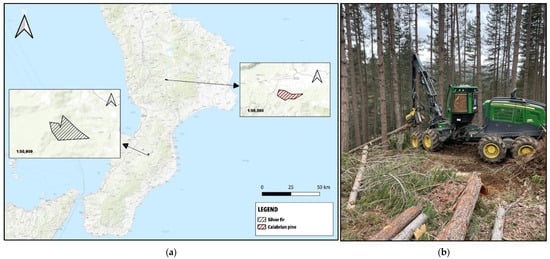
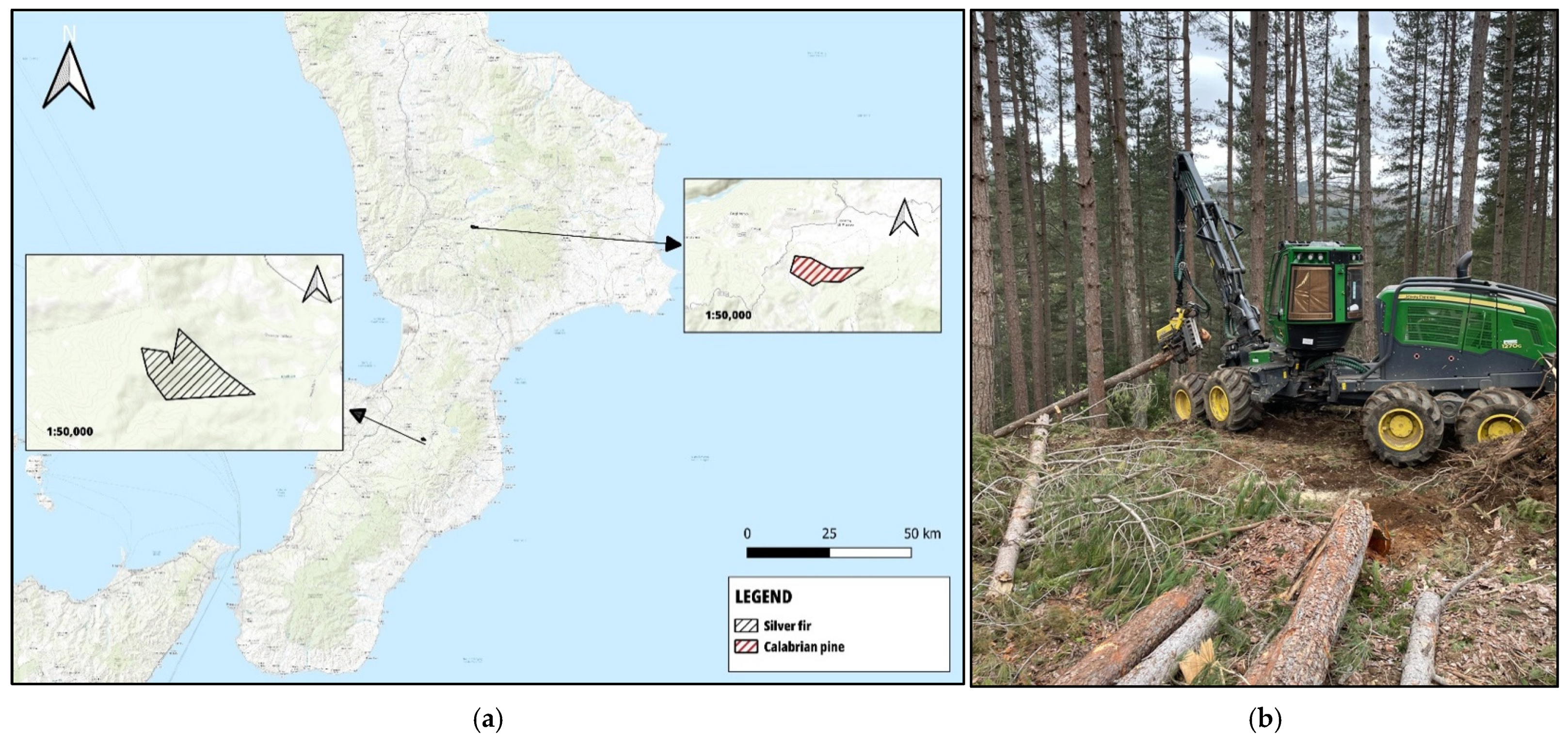
This study was conducted as a case study comparison in two experimental forest sites in Calabria, Southern Italy, characterized by coniferous stands subjected to mechanized harvesting using a harvester: one Calabrian pine stand (Pinus nigra subsp. laricio) and one silver fir stand (Abies alba) (Figure 1a). Both sites were characterized by comparable moderate slopes of approximately 20% and were selected to represent similar small-scale mountain harvesting conditions in terms of machine accessibility and working environment. Calabria is among the most forest-rich regions of Southern Italy, with productive mountain forests where Calabrian pine and silver fir represent important components of the forest landscape and local wood economy [15].
Figure 1.
Overview of the study context: (a) location of the study area in Calabria, Southern Italy; (b) John Deere 1270D harvester monitored during felling and processing operations.
The Calabrian pine site was located in Bocca di Piazza, province of Cosenza, at approximately 1250 m a.s.l. Before intervention, stand density was approximately 600 trees ha−1 and was reduced to about 450 trees ha−1, corresponding to the removal of approximately 150 trees ha−1, equal to about 25% of the initial density. The silver fir site was located in the Serre massif, province of Vibo Valentia, at approximately 1070 m a.s.l. Before intervention, stand density was approximately 800 trees ha−1 and was reduced to about 610 trees ha−1, corresponding to the removal of approximately 190 trees ha−1, equal to about 24% of the initial density. Harvesting intensity was defined in accordance with current regional forestry regulations and minimum standing-volume requirements, ensuring that the residual growing stock remained above the minimum reference thresholds established for the Calabria Region [16,17,18]. Because each species was represented by one study site, differences between Calabrian pine and silver fir were interpreted as stand/species-related differences rather than as pure species effects. Site-specific conditions, including stand structure, operational layout, accessibility, and terrain conditions, may have contributed to the observed differences in productivity and efficiency.
2.2. Machine Description and Time-Motion Study
Felling and processing operations were carried out using a John Deere 1270D harvester equipped with a John Deere H480 harvesting head (Figure 1b). The machine, with a rated power of 160 kW and an operating weight of 17.5 t, was used under real operating conditions and performed the main phases of the harvesting cycle, including tree identification, head positioning, felling, stem handling, delimbing, cross-cutting, and preparation of the assortments. During the monitored operations, bucking was performed using the harvester’s automatic bucking optimization system. The optimization system supported cross-cutting decisions according to the assortment specifications set before the operation, while the operator retained the possibility of manual adjustment when required by stem quality or operational conditions. The same operator, employed by the same forest company, carried out the harvester operations in both study sites, thereby reducing variability related to operator skill and work habits. Work was organized along the extraction trails or operating corridors established within each site. The processed assortments were deposited close to the machine operating position and/or along the designated extraction routes. Operational performance was assessed through a time-motion study based on video recording and subsequent analysis of the work cycles. Each operating cycle was divided into three main elements: search and cut, including tree search, head positioning, and felling; processing, including delimbing and cross-cutting/preparation of assortments; and moving, corresponding to machine movement between trees. The productive machine time was defined as PMH0 and calculated as the sum of the three cycle elements. The total observed time, including recorded delays, was defined as an SMH proxy and was obtained by adding the delay time observed during this study to the productive machine time. All data were organized in a database for subsequent statistical analysis.
2.3. Determination of Operational Efficiency and Productivity
For each harvested tree, the processed volume (m3) was obtained from the harvester measurement system. During field work, diameter measurements were also taken on standing trees and processed logs to verify the consistency of the machine-derived volume estimates. Since the harvester volume outputs were consistent with the manually checked measurements, these machine-derived volumes were used for both study sites to calculate total processed volume, productivity, and unit time consumption. The total processed volume was then calculated for each study site and used to determine productivity and operational efficiency. Operational efficiency was expressed as the time consumed per unit volume and was calculated as follows (Equation (1)):
where tm3 is the unit processing time, expressed in s m−3; SMHs is the total observed time, expressed in seconds and including recorded delays; and V is the processed volume, expressed in m3. Lower values of tm3 indicate lower time consumption per cubic meter and, therefore, higher operational efficiency.
Productivity was calculated as both net productivity, based only on productive machine time (PMH0), and gross productivity, based on the total observed time, considered as a proxy for scheduled machine hours (SMHs). Specifically, net and gross productivity were calculated according to Equations (2) and (3), respectively:
where V is the processed volume (m3), PMH0 is the productive machine time (h), and SMH is the total observed time (h), including recorded delays. The percentage shares of the three cycle elements in the productive machine time were calculated for each stand in order to evaluate the relative contribution of search/cut, processing, and moving.
2.4. Harvester Hourly Cost Rate (HMR) Estimation
The harvester hourly cost rate (HMR) was estimated as a full cost, defined as the total cost per hour of machine use during the felling and processing phases within a cut-to-length system, excluding extraction/forwarding. HMR was calculated using the standard machine rate approach, whereby total hourly cost is derived from the combination of ownership costs, operating costs, and labour costs [19,20,21]. The input assumptions required for the machine rate calculation, such as annual use, economic life, and residual machine value, were established consistently with the available literature on CTL machines [22]. In this study, a conservative value of HMR = EUR 280 SMH−1 was adopted for the John Deere 1270D harvester. This value was selected to represent high-cost operating conditions typical of small-scale harvesting, where limited annual utilization, fragmented lots, machine relocation, ownership costs, and labour costs strongly influence the hourly machine rate. The selected HMR is supported by the wide range of hourly costs reported in European mechanized harvesting studies, where values above EUR 200 h−1 are obtained under cost assumptions involving high capital investment, interest rate, depreciation period, useful machine life, annual utilization, and labour costs [23]. This assumption is also consistent with recent applications of the machine rate framework to harvester cost estimation, in which hourly cost is calculated by combining ownership, operating, and labour cost components [21,24].
2.5. Economic Analysis and Estimation of Break-Even Thresholds
The economic analysis was limited to felling and processing operations, excluding extraction, and was based on a unit cost model as a function of harvested lot volume V (m3) (Equation (4)):
where P represents productivity, with Pgross primarily used to reflect realistic operating conditions; HMR is the hourly machine cost (EUR SMH−1); and F is a fixed cost per harvesting lot (EUR lot−1), representing mobilization and setup costs independent of the processed volume.
The break-even threshold with respect to a benchmark cost Cbench (EUR m−3) for the conventional felling and processing system was calculated as (Equation (5)):
with no finite solution when Cbench ≤ HMR/P, indicating a “no break-even” condition. The break-even volume V* was converted into a minimum equivalent surface area A*, calculated as A* = V*/Vrem,ha, where Vrem,ha is the volume removed per hectare under the stand-specific scenario. The benchmark cost Cbench was explored through a sensitivity grid of EUR 8, 10, 12, 14, and 16 m−3. The uncertainty associated with the economic thresholds V* and A* was quantified using a non-parametric bootstrap at the tree level (B = 2000). At each resampling iteration, productivity was recalculated and propagated into the cost model. The median and 95% confidence interval were then reported for each species and benchmark value.
2.6. Statistical Analysis
The collected data were processed in R using RStudio 4.3.3 (R Foundation for Statistical Computing, Vienna, Austria). Descriptive statistics, including mean, median, standard deviation, minimum, and maximum values, were calculated for each stand for dendrometric and operational variables, as well as for efficiency and productivity indicators. This study was designed as a case study comparison based on tree-level operational observations collected in two real harvesting sites using the same machine configuration. Accordingly, individual harvesting cycles were used to describe within-case variability in productivity and time consumption; the statistical models were interpreted as exploratory tools for identifying operational patterns under the monitored conditions. Differences between species in the unit processing time tm3 (s m−3) were tested using the Wilcoxon rank-sum test for independent samples. The effect size was quantified using Cliff’s delta with confidence intervals.
Productivity was modelled using generalized linear models (GLMs) with a Gamma distribution and log link. A logarithmic time offset was included to express the response in terms of productivity, i.e., processed volume per unit time, while maintaining processed volume per harvested tree as the dependent variable. Specifically, under realistic operating conditions, a model with log (SMHi) as an offset was fitted:
A similar “best-case” model was fitted by replacing the offset with log (PMH0i). Model effects were interpreted as multiplicative factors using exp(β) and expressed as percentage changes as (exp(β) − 1) × 100.
To identify which phases of the work cycle contributed most to operational differences between stand/species, three separate GLMs with a Gamma distribution and log link were fitted for the search/cut, processing, and moving component times. Each component time was modelled as a function of stand/species and log (DBH), and the effects were reported as percentage changes relative to the reference stand/species. The distribution of the productive cycle among the operational components was also estimated as the percentage share of each component relative to productive machine time (PMH0) for each stand/species and represented graphically using stacked bar charts. A significance threshold of α = 0.05 was used for all statistical analyses. Model diagnostics were assessed by a visual inspection of standard diagnostic plots, including residuals versus fitted values, Q–Q plots, scale–location plots, and residuals versus leverage. Goodness of fit was evaluated using AIC and residual deviance, while potential overdispersion was assessed using the residual deviance/residual degrees-of-freedom ratio and the estimated dispersion parameter. For the productivity models, no relevant overdispersion was detected.
3. Results and Discussion
3.1. Harvester Operation Efficiency
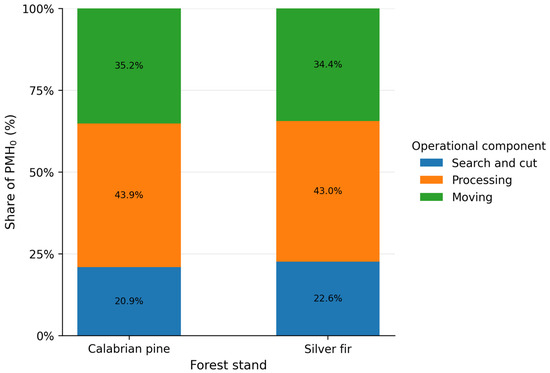
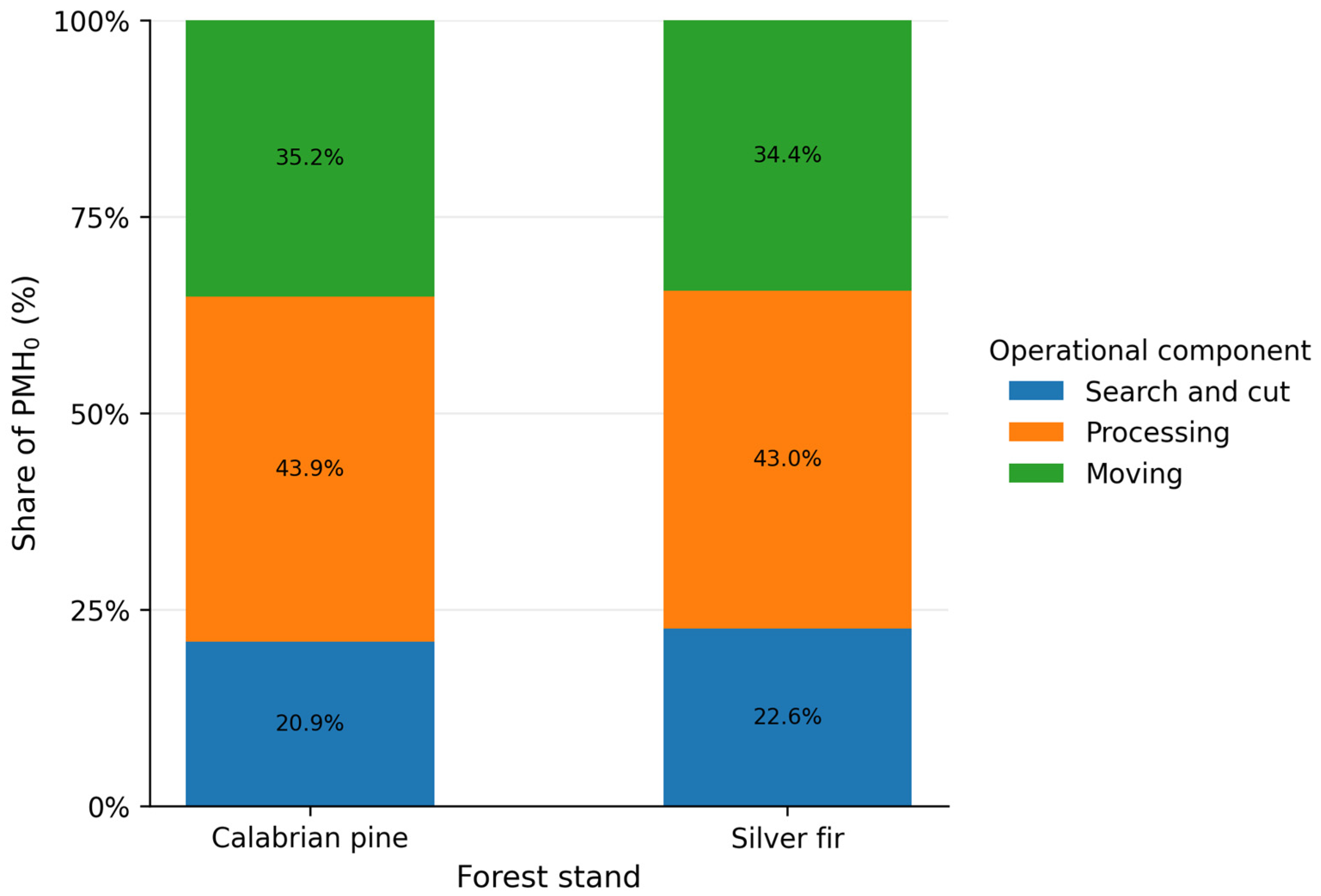
The percentage distribution of productive machine time (PMH0) showed a substantially similar cycle structure in the two stands (Figure 2). In both cases, processing was the dominant phase, accounting for 43.9% of PMH0 in Calabrian pine and 43.0% in silver fir, followed by moving time (35.2% and 34.4%, respectively) and search/cut time (20.9% and 22.6%, respectively).
Figure 2.
Percentage distribution of productive machine time (PMH0) across the three operational components of the harvester cycle: search and cut, processing, and moving.
This pattern suggests that, despite differences in stand conditions, such as density and average tree size, the internal structure of the harvester work cycle in CTL thinning remained relatively stable and was mainly driven by stem processing operations. The predominance of processing time is consistent with previous time-consumption studies on CTL systems, where delimbing and bucking usually represent a major component of productive machine time and cycle variability is strongly affected by stem size and operating conditions. In this regard, Nurminen et al. [25] reported that productivity and work-time distribution in CTL harvesting are largely governed by tree dimensional variables and by the operational structure of the harvesting cycle.
From a small-scale forestry perspective, however, it is particularly relevant that the moving component accounted for approximately one-third of productive machine time. This indicates that worksite spatial organization, including the distance between selected trees, the need for machine repositioning, and micro-topographical accessibility, can substantially affect overall performance, together with stem processing itself. This interpretation is consistent with observations from thinning operations, where trail layout and operating distance management can influence the productivity and cost of mechanized systems. Mederski [26] showed that organizational factors in thinning operations, such as the presence and design of internal operating areas, can affect both productivity and costs.
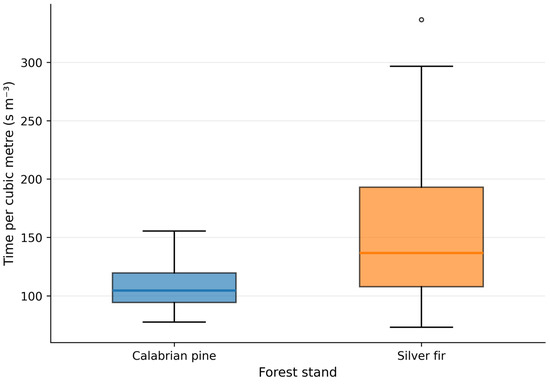
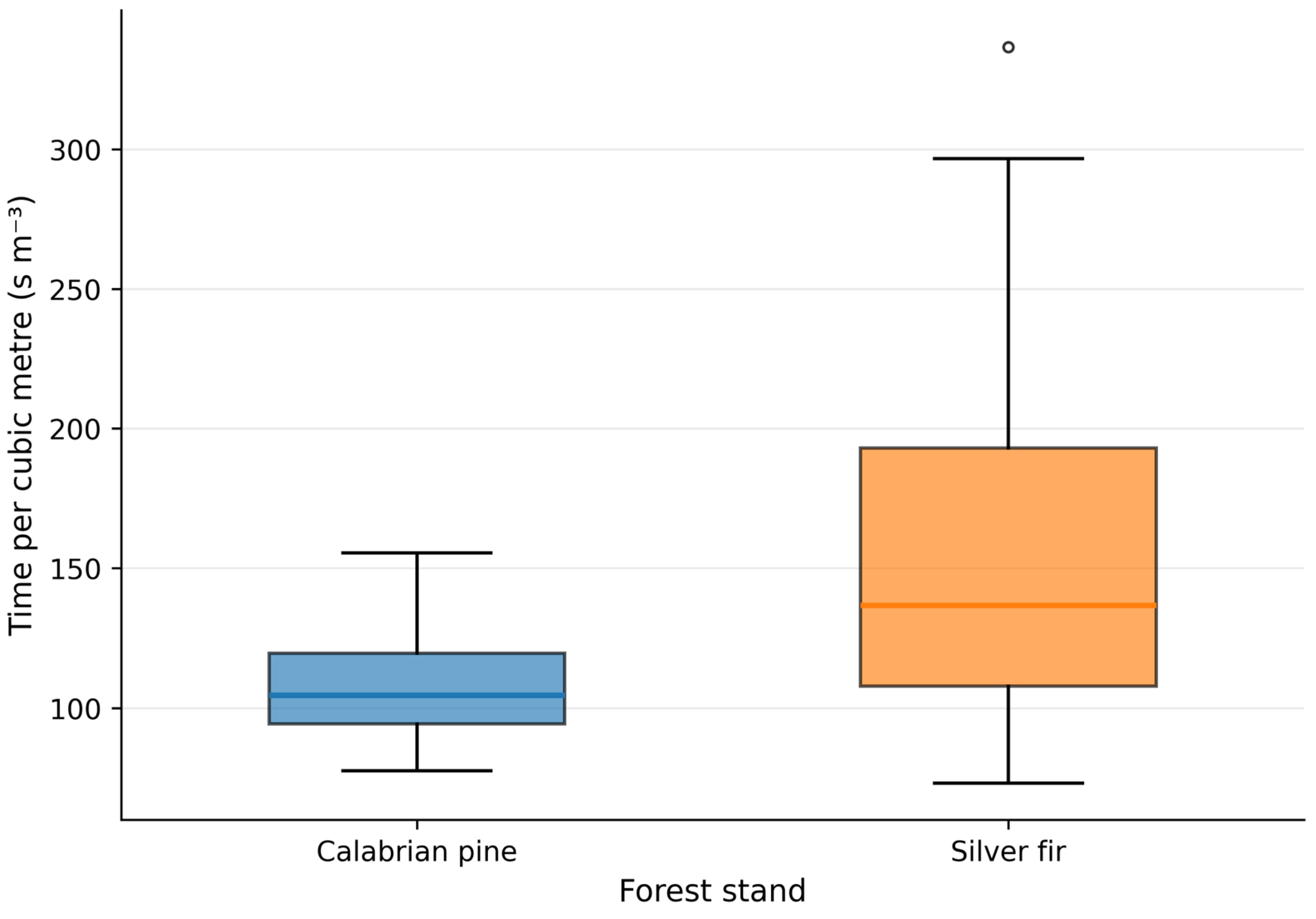
Differences between the two case study stands became more evident when performance was normalized by processed volume. Operational efficiency, expressed as total observed time consumption per unit volume (s m−3), was significantly higher in Calabrian pine than in silver fir (Figure 3). In the Calabrian pine stand, the mean unit time was 107.8 s m−3 (SD 17.3), whereas in the fir stand it increased to 154.7 s m−3 (SD 64.5), with substantially greater variability (Table 1). A key point, already highlighted by Nurminen et al. [25], is that differences in absolute time per tree do not necessarily translate into differences in efficiency per unit volume. The determining factor is the ratio between time consumption and processed volume, which is strongly influenced by stem size and by the volume distribution within the harvested lot. From a small-scale operational perspective, the greater dispersion observed in silver fir also represents an important management indicator, as variability between cycles may increase planning uncertainty and reduce the predictability of unit costs.
Figure 3.
Felling and processing efficiency in the two stands, expressed as total observed time per cubic meter of processed wood. Lower values indicate higher operational efficiency.
Table 1.
Descriptive statistics.
The productivity values are consistent with the unit time consumption expressed in s m−3 and further clarify the differences between the two study sites (Table 1). Net productivity, calculated on productive machine time (PMH0), was 44.27 m3 PMH0−1 in Calabrian pine and 37.21 m3 PMH0−1 in silver fir. When total observed time was considered, gross productivity decreased to 33.98 m3 SMH−1 in Calabrian pine and 26.75 m3 SMH−1 in silver fir. This reduction is consistent with the higher incidence of delays in the silver fir stand, where delays accounted for 28.13% of total observed time, compared with 23.25% in Calabrian pine. These results indicate that delays affected both contexts but had a stronger penalizing effect under the real operating conditions observed in silver fir. In small-scale harvesting, this difference is particularly important because gross productivity (SMH) is the metric that directly determines unit cost [27].
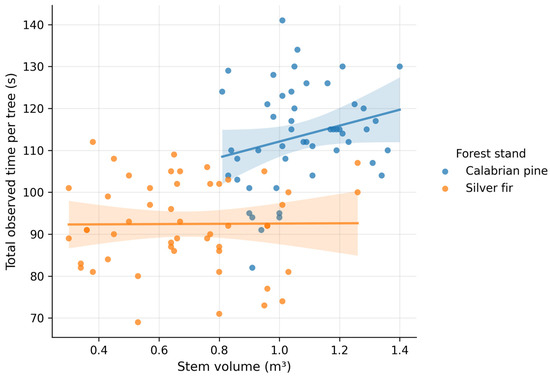
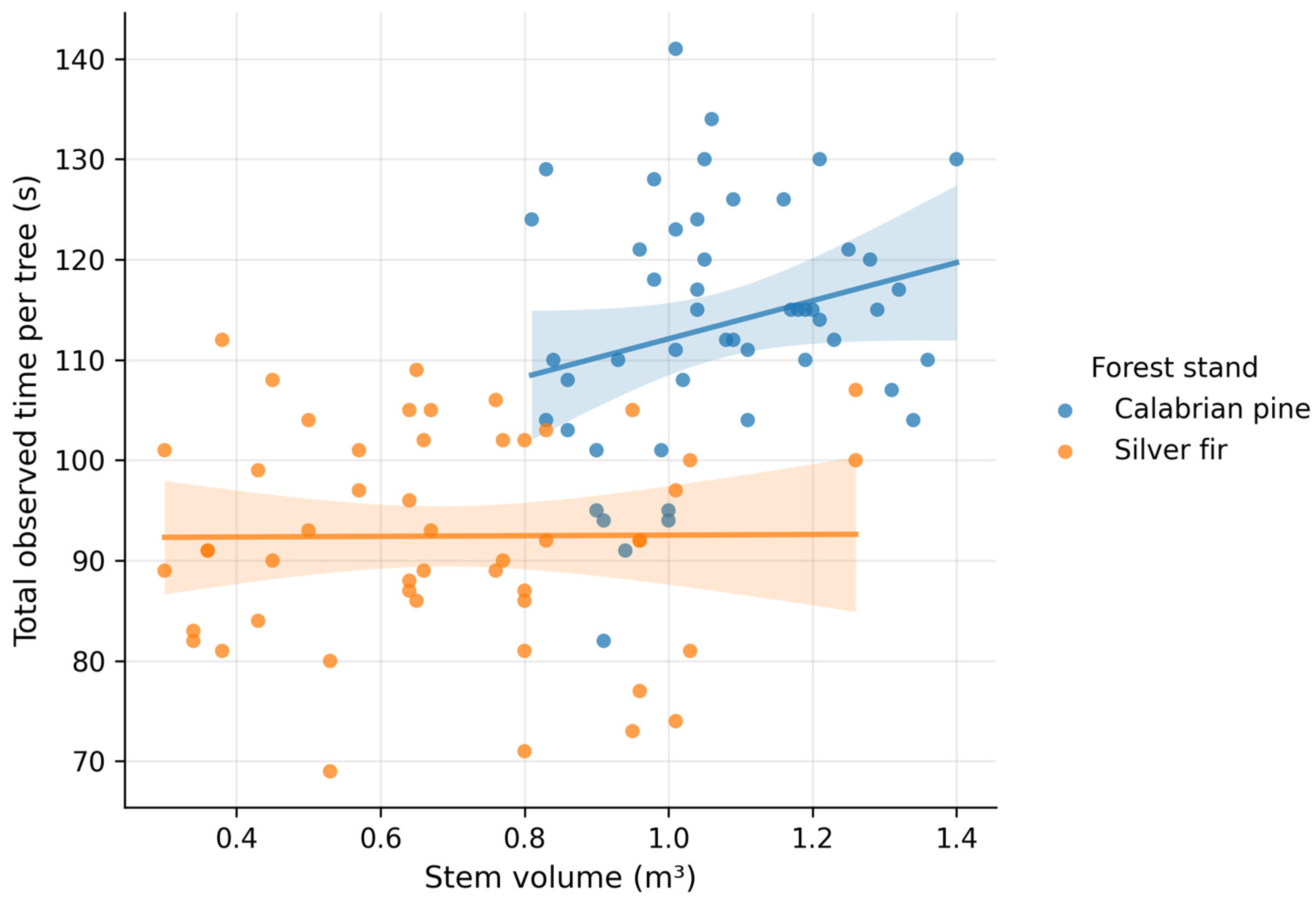
The relationship between total time per tree and individual tree volume (Figure 4) helps explain why comparisons based solely on time per tree can be misleading. In Calabrian pine, a positive trend was observed, indicating that larger stems required longer cycle times, whereas in silver fir this relationship was less pronounced and the observed volume range was generally lower. The combined interpretation of Figure 4 and the efficiency results shown in Figure 3 confirms that the key parameter is not absolute time per tree, but rather the ratio between time consumption and processed volume. In Calabrian pine, longer average cycles were compensated by a higher mean volume per tree, whereas in silver fir the combination of lower individual volumes and greater time variability penalized both operational efficiency and gross productivity.
Figure 4.
Relationship between total time per tree and individual stem volume in the two stands. The lines represent the estimated trend for each stand.
The CTL literature confirms that stem size is one of the primary determinants of productivity and that silvicultural management, by influencing tree size distribution, can directly affect harvester operational performance [28,29]. This is consistent with the descriptive statistics reported in Table 1. Calabrian pine showed a higher mean DBH (0.31 m) and mean tree volume (1.07 m3) than silver fir (0.24 m and 0.69 m3, respectively), while also showing higher mean values for both productive cycle time (87.06 s vs. 66.44 s) and total observed time (113.44 s vs. 92.44 s). Despite this, Calabrian pine maintained lower unit time consumption (107.8 s m−3 vs. 154.7 s m−3) and higher gross productivity (34.0 vs. 26.7 m3 SMH−1). In other words, under the analysed conditions, Calabrian pine required more time per tree but produced a greater volume per cycle, resulting in higher efficiency per unit of processed wood. This behaviour is consistent with time-consumption models developed for CTL systems, in which tree size and processed volume strongly influence productivity [25].
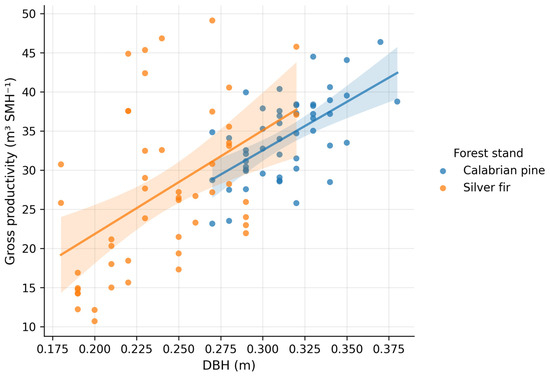
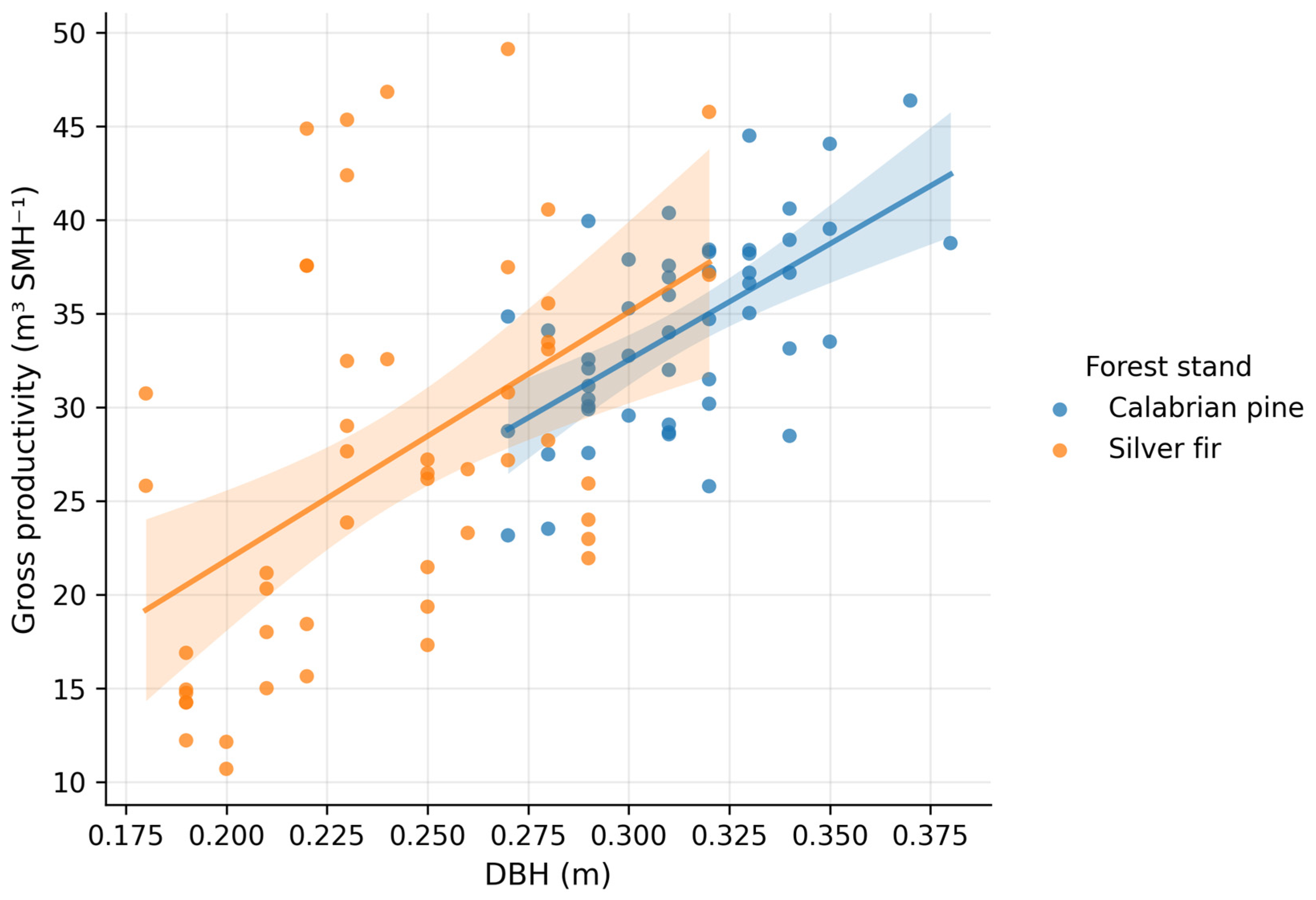
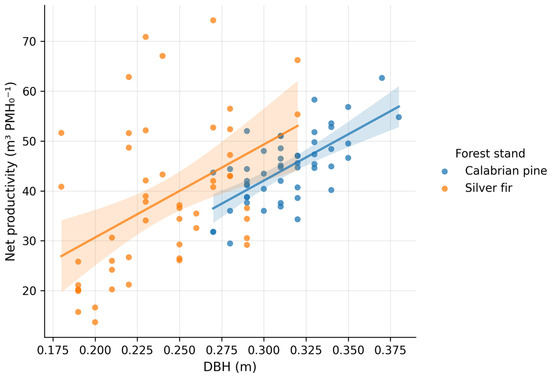
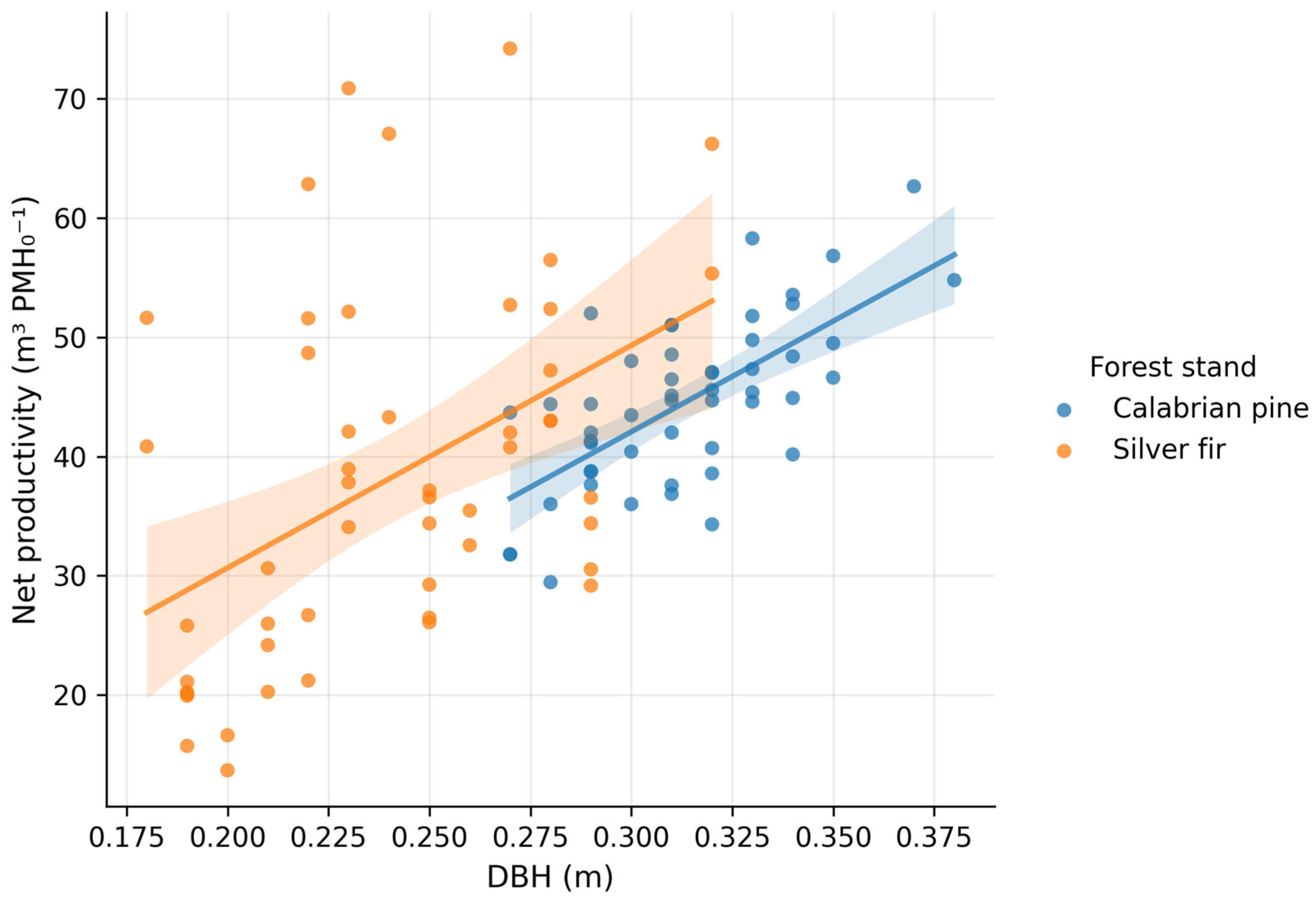
Productivity models, fitted as Gamma GLMs with a log link and time offset, confirmed that tree size was a primary driver of productivity (Table 2; Figure 5 and Figure 6). The effect of log (DBH) was highly significant both in the model based on total observed time (SMH) (estimate = 1.240; p < 0.001) and in the model based on productive machine time (PMH0) (estimate = 1.231; p < 0.001), indicating a robust increase in productivity with increasing tree diameter. This evidence is consistent with previous literature, which identifies tree size as one of the most important factors affecting harvester productivity and decisions related to mechanized harvesting investment and use [28,29].
Table 2.
Results of Gamma GLMs with log link and time offset fitted to harvester productivity.
Figure 5.
Observed and predicted productivity as a function of DBH, considering total observed time (SMH). Points represent tree-level observations, while lines indicate model-predicted values.
Figure 6.
Observed and predicted productivity as a function of DBH, considering productive machine time (PMH0). Points represent tree-level observations, while lines indicate model-predicted values.
The stand/species effect, however, differed depending on the time metric considered. In the SMH-based model, the stand/species effect was not significant (estimate = 0.097; p = 0.233), whereas in the PMH0-based model it was significant (estimate = 0.171; p = 0.047). This difference supports the small-scale operational interpretation of the results: when only productive machine time is considered, technical differences in harvester performance between stands may emerge for a given tree size. However, when total observed time is used, delays and organizational factors tend to reduce or mask these differences under real operating conditions.
To further investigate whether differences emerged at the level of individual operational phases, separate models were fitted for the duration of the three cycle components, search/cut (SC), processing (PR), and moving (MV), as a function of species and log (DBH) (Table 3). The stand/species variable was significantly associated with the duration of all components, with negative coefficients for silver fir compared with Calabrian pine (SC: −0.165; p = 0.009; PR: −0.260; p < 0.001; MV: −0.347; p < 0.001). These coefficients correspond to expected reductions of approximately 15%, 23%, and 29%. Within the observed range, the effect of log (DBH) was not significant in the component models (Table 3), suggesting that variability in phase duration was more closely related to contextual factors and worksite organization than to tree diameter alone.
Table 3.
Results of Gamma GLMs with log link fitted to the time required for each operational component of the harvester cycle.
However, this time advantage at the component level did not automatically translate into higher operational efficiency or gross productivity, because silver fir was associated with lower average tree volume and a higher incidence of delays in total observed time (Table 1). In other words, even when individual cycle phases were faster on average, the combination of lower volume per cycle and higher delay incidence penalized the time/volume ratio, explaining the lower efficiency and gross productivity observed in silver fir.
The results provide a coherent interpretation for small-scale forestry, showing that operational competitiveness was mainly driven by the ability of each work cycle to generate sufficient processed volume while limiting delay incidence. Although the percentage structure of the harvester cycle remained similar across the two study sites, differences in productivity and efficiency likely reflected the combined influence of tree size distribution, stand structure, accessibility, operational layout, and delay incidence. Since each species was represented by one study site, these differences should be interpreted as stand/species-related patterns rather than as pure species effects. The high share of moving time further highlights that worksite layout and tree selection can be as important as dendrometric parameters in determining overall performance. Operator-related factors may also have contributed to cycle-time variability. Although the same operator worked in both study sites, aspects such as decision-making during head positioning and field of view from the cab can affect both safety and operational performance. These factors were not directly quantified in the present study and should be considered in future analyses of harvester productivity. This interpretation is consistent with Spinelli et al. [30], who showed that the efficiency and economic feasibility of mechanized thinning systems in Mediterranean conifer plantations are strongly influenced by mechanization level and worksite organization, especially when the operational scale is small.
3.2. Economic Analysis
The economic analysis was limited to felling and processing operations within the CTL system, excluding extraction/forwarding, and linked unit cost to the observed gross productivity (Pgross) on an SMH basis. A full-cost hourly machine rate of HMR = EUR 280 SMH−1 was adopted, estimated using the machine rate approach [19,20,21]. In addition to hourly machine cost, the model included a site start-up cost, representing mobilization and setup, treated as a fixed cost per harvesting lot. This component is particularly relevant in small-scale operations, where fixed costs may be distributed over relatively limited harvested volumes. The use of HMR on an SMH basis is consistent with the economic objective of representing real operating conditions, since gross productivity includes recorded delays and operational variability. Furthermore, the literature shows that assumptions such as useful machine life, annual utilization, interest rate, and labour costs can generate substantially different hourly cost estimates [22,23,31].
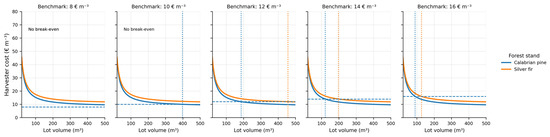
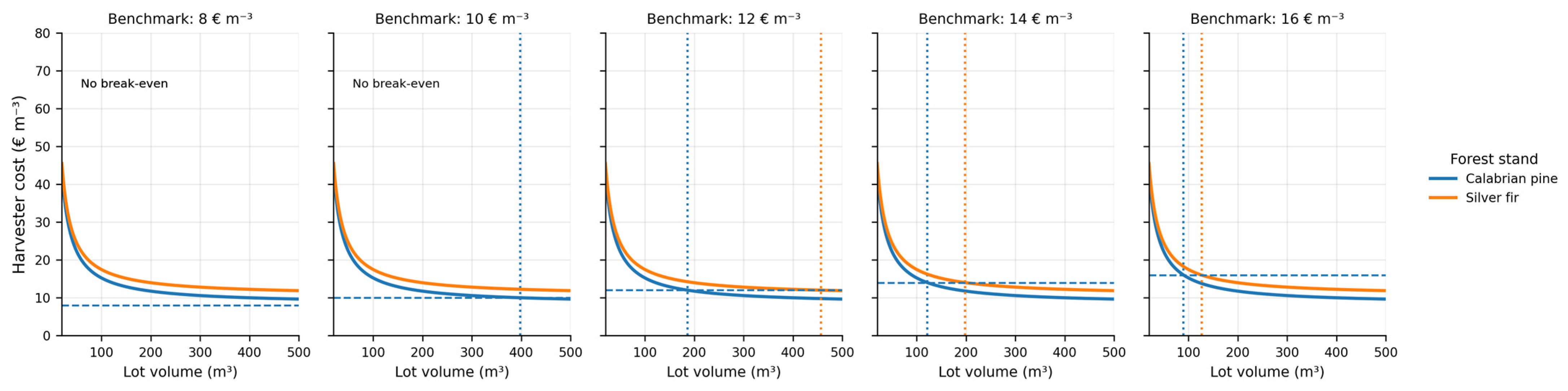
The cost–volume curves (Figure 7) show a rapid decrease in unit cost (EUR m−3) as harvesting lot volume increases for both species, with systematically more favourable values for Calabrian pine than for silver fir. This result is consistent with the higher gross productivity observed in Calabrian pine and confirms a principle widely reported in the literature on mechanized harvesting: unit cost is strongly dependent on actual productivity and processed volume. Mizaras et al. [32], in a study on the costs and productivity of harvesting machines in Lithuania, showed that harvester productivity increased with average stem volume and that unit costs were strongly influenced by the size of the processed material. In their study, a Timberjack 1270D achieved 32.9–46.5 m3 per effective hour in cuts with an average stem volume range of 0.545–1.067 m3, values that support the strong relationship between individual tree volume and economic–operational performance.
Figure 7.
Harvester cost–volume curves and break-even thresholds relative to the benchmark costs of the chainsaw + operator system. Horizontal dashed lines represent the manual cost benchmarks, while vertical lines indicate the minimum break-even volume when present.
Spinelli et al. [30], in a study on Mediterranean conifer plantations, showed that mechanization can reduce thinning costs compared with less mechanized systems, although cost-effectiveness varies according to the operating system and final product. This supports our interpretation that mechanized thinning is not automatically cost-effective at small scale but becomes competitive only when gross productivity and harvested lot volume are sufficient to compensate for the high hourly machine cost. In the present study, the comparison refers exclusively to the felling and processing phases, excluding extraction/forwarding.
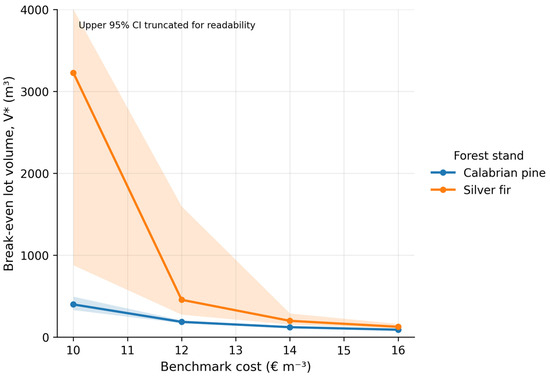
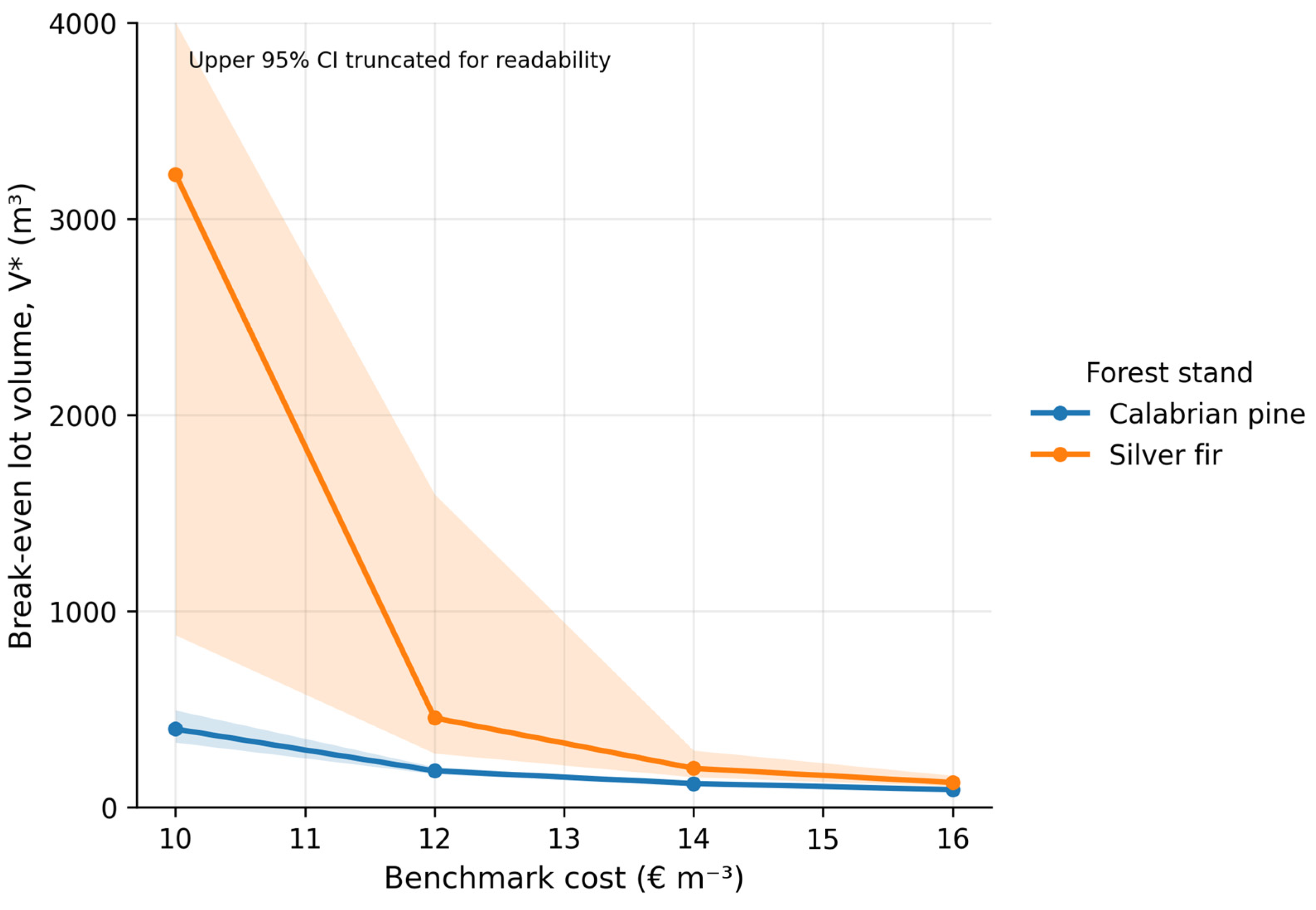
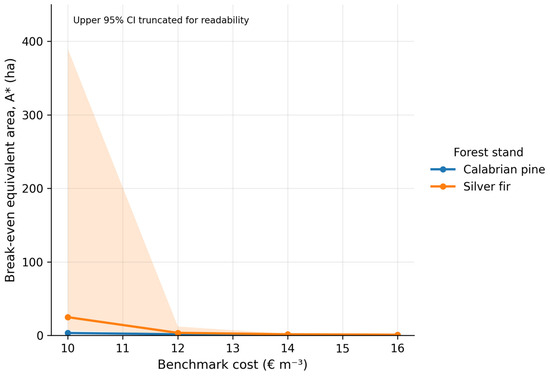
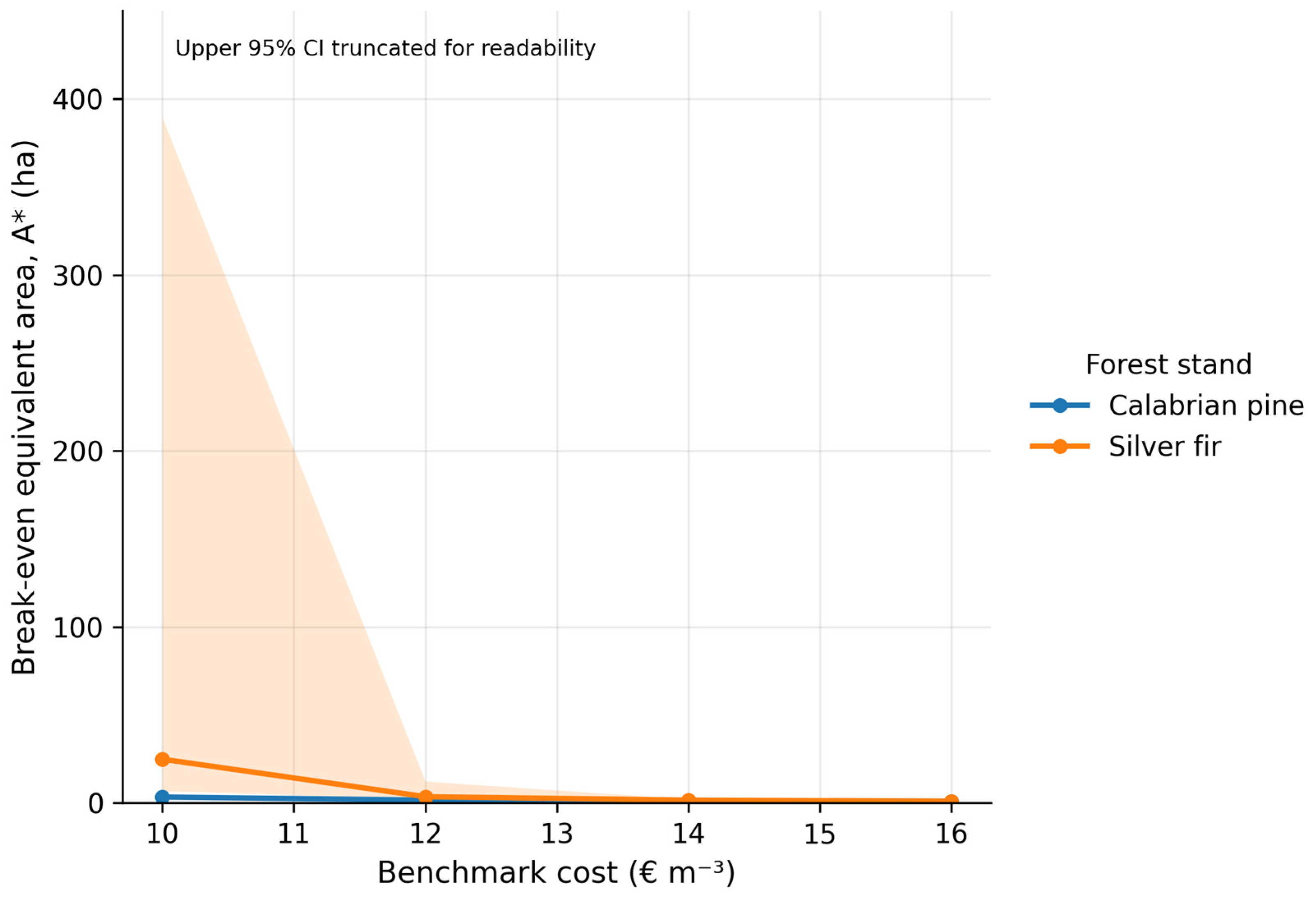
The sensitivity of the alternative system to the benchmark cost is highlighted by the relationship between the benchmark and the minimum break-even volume V* (Figure 8), as well as by the corresponding minimum equivalent surface area A* (Figure 9). In this study, Cbench represents the reference unit cost of the traditional motor-manual felling and processing system using chainsaws, which remains widely used in small-scale forest operations in Southern Italy. Consistent with the scope of the analysis, the benchmark was used to compare only the felling and processing phases and did not include extraction/forwarding. This approach is also supported by the review of Moskalik et al. [33], which showed that chainsaw-based and less mechanized systems remain widespread in several European countries, especially where mechanization is constrained by economic, territorial, or organizational factors. For example, the authors reported that approximately 98% of work in Romania was still carried out using chainsaws, while in Slovakia approximately 95% of annual felling operations were performed by chainsaw. This confirms that, in many non-Nordic contexts, the comparison between harvesters and motor-manual systems remains methodologically relevant.
Figure 8.
Minimum lot volume V* required to reach break-even as a function of the benchmark cost of the chainsaw + operator system. Shaded bands represent the 95% bootstrap confidence interval.
Figure 9.
Minimum equivalent surface area A* required to reach break-even as a function of the benchmark cost of the chainsaw + operator system. Shaded bands represent the 95% bootstrap confidence interval.
At low benchmark values, particularly in the range of EUR 8–10 m−3, non-feasible conditions or highly unstable break-even thresholds emerged, especially for silver fir. At EUR 8 m−3, no finite solution was obtained for silver fir (“no break-even”), whereas for Calabrian pine the threshold, although sometimes calculable, reached extremely high values that are unrealistic for small-scale operations (Table A1). This behaviour can be attributed to a near-threshold condition, in which the benchmark cost approaches the variable cost of the harvester (HMR/Pgross). Under such conditions, even small variations in gross productivity generate very large changes in the minimum break-even volume, producing operational estimates with limited robustness. This interpretation is consistent with Sessions et al. [31], who highlighted that machine-cost assumptions can substantially alter comparative assessments between harvesting systems, operational strategies, and the economic sustainability of interventions.
The bootstrap analysis (Table A1) quantified this uncertainty and provided useful operational indications. At a benchmark cost of EUR 10 m−3, the break-even threshold in Calabrian pine was achievable with volumes of a few hundred cubic metres, with a 95% CI range of approximately 333–504 m3. This corresponded to a minimum equivalent surface area A* of several hectares, with a 95% CI range of about 2.78–4.20 ha, assuming a removed volume of 120 m3 ha−1. In silver fir, however, the threshold at EUR 10 m−3 was much higher and highly unstable, with a very wide 95% CI range of approximately 822–56,765 m3 for V*. The corresponding A* was also much larger and highly uncertain, with a 95% CI range of about 6.32–436.7 ha. This indicates that, under a low-cost motor-manual benchmark scenario, the competitiveness of the harvester for felling and processing only would require exceptionally large harvesting lots, which are difficult to reconcile with Mediterranean small-scale thinning operations.
This result becomes particularly interesting when compared with the values reported by Moskalik et al. [33] for different European contexts. Their review reported an average cost paid by state-owned forestry companies to private contractors in Bulgaria of EUR 15.10 m−3 for timber delivered to the roadside. In the Czech Republic, felling costs were reported at EUR 17.1 m−3, with logging costs of EUR 8.3 m−3, whereas in Poland the average cost of felling, delimbing, and cross-cutting was EUR 6.5 m−3, with logging costs of EUR 5.65 m−3. These values support the plausibility of the benchmark range adopted in the present study (EUR 8 to 16 m−3) to represent different motor-manual or semi-mechanized cost scenarios. At the same time, they help explain why the estimated break-even thresholds changed so markedly: benchmark values close to a range of EUR 8–10 m−3 represent a highly competitive scenario for the traditional system, whereas values closer to a range of EUR 14–16 m−3 increasingly favour harvester use.
As the benchmark increased from EUR 12 to 16 m−3, the break-even thresholds decreased rapidly and became more stable for both species (Figure 8 and Figure 9; Table A1). Within this range, V* reached volumes more compatible with small-scale forest operations, while A* approached values close to or below approximately 1 ha, particularly in Calabrian pine. The importance of lot size and work continuity is consistent with the findings of Väätäinen et al. [14], who demonstrated that harvesting site reserves and machine relocation timing can significantly affect the performance of mechanized CTL systems. In the present study, this supports the interpretation that small harvested volumes and fragmented operational contexts may increase the difficulty of distributing fixed and mobilization costs across sufficient production volumes. This trend is consistent with Spinelli et al. [31], who showed that mechanization can become competitive in Mediterranean thinning operations when the alternative system is characterized by higher costs or lower productivity. Similarly, Lerma-Arce et al. [27], comparing alternative harvesting systems in selective thinning of Pinus halepensis under Mediterranean conditions, confirmed that system selection depends on the combination of productivity, operating costs, product destination, and stand conditions, and therefore cannot be generalized independently of the operational context.
Further support comes from studies on early thinnings in Scots pine. Leszczyński et al. [12], analysing the use of a mini harvester in early thinning, showed that the economic evaluation of mechanization depends strongly on the access system and worksite configuration. This confirms that, in small-diameter stands or early thinnings, the key issue is not only the hourly machine cost, but the relationship between productivity, average tree volume, and operational layout. Similarly, Szewczyk et al. [34] highlighted that, in early thinning of pine stands, the unit cost of mechanized harvesting is influenced by harvested tree volume, harvester model, and soil conditions. These findings support our interpretation: in Calabrian pine, higher average tree volume and higher gross productivity allowed break-even to be reached at more realistic operational scales, whereas in silver fir the combination of lower gross productivity and a low benchmark cost shifted the threshold towards volumes and surface areas that are difficult to reconcile with Mediterranean small-scale forestry.
4. Conclusions
This study evaluated the operational performance and economic feasibility of a harvester used for felling and processing operations in Mediterranean conifer stands under conditions representative of small-scale forestry. The results show that the cost-effectiveness of the system depends not only on the technical productivity of the machine, but also on the interaction among average tree volume, gross productivity, delays, worksite organization, and overall harvested lot volume. Within this context, Calabrian pine provided more favourable conditions than silver fir due to its greater average tree volume and higher gross productivity. Silver fir, despite showing shorter operating times during some phases of the cycle, was penalized by the lower volume processed per tree and by greater time variability in time consumption.
The economic analysis showed that the harvester can become competitive with the traditional motor-manual system only when both the benchmark cost of the conventional system and the harvested lot volume are sufficient to offset the high full-cost hourly machine rate and site start-up costs. At lower benchmark values, break-even thresholds were high or unstable, particularly for silver fir. Conversely, as benchmark values increased, the required volume and area thresholds became more compatible with small-scale operations, especially in Calabrian pine.
These results are particularly relevant in the Mediterranean forestry context, where harvesting operations are still characterized by a low–medium level of mechanization, small-scale enterprises, fragmented harvesting lots, and silvicultural constraints that limit the concentration of harvested volumes. Under these conditions, the introduction of harvesters represents a potential innovation capable of improving productivity, worker safety, operational regularity, and the organization of the forest-wood supply chain. However, its adoption requires careful planning of the minimum conditions needed to achieve economic feasibility.
Looking ahead, the application of CTL mechanization in Mediterranean forestry systems should be supported by lot consolidation strategies, improved logistical planning, adequate forest road density and accessibility, operator training, and preventive economic assessments based on gross productivity, available volume, and the actual cost of the alternative system. In this perspective, forest accessibility and road network planning represent fundamental prerequisites for efficient forest operations, as an adequate road network can reduce extraction distances, improve operational coordination, and support the economic sustainability of mechanized harvesting systems [35]. A further area of development concerns the use of more compact and flexible machines, capable of operating in fragmented environments while still being suitable for processing medium-to-large trees within appropriate technical limits. Although the present case study refers to the monitored John Deere 1270D–H480 configuration, the results provide useful indications for comparable harvester-based felling and processing operations under small-scale Mediterranean conditions. Future research should extend the analysis beyond felling and processing to include extraction/forwarding, transport, product assortments, and cooperative organizational scenarios, in order to define sustainable and scalable mechanization models adapted to Mediterranean forestry conditions. Therefore, the results of this case study should be interpreted as evidence from two real small-scale Mediterranean harvesting contexts rather than as a generalized species-level comparison. The observed differences between the Calabrian pine and silver fir stands cannot be attributed exclusively to species, since site conditions, stand structure, accessibility, and operational layout may also have influenced productivity and economic feasibility. Further studies including a larger number of harvesting sites, operators, stand structures, and terrain conditions are needed to validate whether these patterns can be generalized at the species level across Calabria and broader Mediterranean forestry settings.
Author Contributions
Conceptualization, A.Z., S.F.P., and A.R.P.; methodology, A.Z., S.F.P., and A.R.P.; software, A.Z., S.F.P., and A.R.P.; validation, A.Z., S.F.P., and A.R.P.; formal analysis, A.Z., S.F.P., and A.R.P.; investigation, A.Z., S.F.P., and A.R.P.; resources, A.Z., S.F.P., and A.R.P.; data curation, A.Z., S.F.P., and A.R.P.; writing—original draft preparation, A.Z., S.F.P., and A.R.P.; writing—review and editing, A.Z., S.F.P., and A.R.P.; visualization, A.Z., S.F.P., and A.R.P.; supervision; project administration, and funding acquisition, A.R.P. All authors have read and agreed to the published version of the manuscript.
Funding
This work was supported by the course “Agricultural, Food and Forestry Science” of the Mediterranean University of Reggio Calabria (Italy)—XXXIX cycle.
Data Availability Statement
Data are contained within the article.
Conflicts of Interest
The authors declare no conflicts of interest.
Appendix A
Table A1.
Bootstrap-based uncertainty of the minimum break-even lot volume (V*) and corresponding minimum equivalent surface area (A*) for the harvester system under different benchmark costs of the conventional motor-manual felling and processing system. Values are reported as 95% bootstrap confidence intervals. The percentage of feasible bootstrap runs indicates the proportion of resampling iterations in which a finite break-even solution was obtained.
References
- Kemmerer, J.; Labelle, E.R. Using harvester data from on-board computers: A review of key findings, opportunities and challenges. Eur. J. For. Res. 2021, 140, 1–17. [Google Scholar] [CrossRef] [Scilit]
- Labelle, E.R.; Bergen, M.; Windisch, J. The effect of quality bucking and automatic bucking on harvesting productivity and product recovery in a pine-dominated stand. Eur. J. For. Res. 2017, 136, 639–652. [Google Scholar] [CrossRef] [Scilit]
- Polowy, K.; Molińska-Glura, M. Data mining in the analysis of tree harvester performance based on automatically collected data. Forests 2023, 14, 165. [Google Scholar] [CrossRef] [Scilit]
- LeDoux, C.B.; Huyler, N.K. Comparison of two cut-to-length harvesting systems operating in eastern hardwoods. Int. J. For. Eng. 2001, 12, 53–59. [Google Scholar]
- Pagnussat, M.B.; da Silva, L.E.; Robert, R.C.G. Machine availability and productivity during timber harvester machine operator training. Can. J. For. Res. 2021, 51, 433–438. [Google Scholar] [CrossRef] [Scilit]
- Bolding, M.C.; Ersson, B.T.; Spinelli, R.; Magagnotti, N.; Miller, T.R.; Mapatunage, H. The evolution and expansion of cut-to-length harvesting systems outside the Nordic countries. Curr. For. Rep. 2025, 11, 24. [Google Scholar] [CrossRef] [Scilit]
- Pesonen, J.; Jeskanen, J.; Kangas, M.; Prinz, R.; Ovaskainen, H.; Kauranen, P.; Kärhä, K. Idle times of forest machine and truck fleets in Finnish logging and timber-hauling enterprises. Eur. J. For. Res. 2025, 144, 1537–1550. [Google Scholar] [CrossRef] [Scilit]
- Papandrea, S.F.; Stoilov, S.; Cataldo, M.F.; Nichev, P.; Angelov, G.; Proto, A.R. How different distribution of assortments on worksites influences forwarder performance in coniferous plantations. Croat. J. For. Eng. 2025, 46, 33–45. [Google Scholar] [CrossRef] [Scilit]
- Spinelli, R.; Magagnotti, N.; Nati, C. Options for the mechanised processing of hardwood trees in Mediterranean forests. Int. J. For. Eng. 2009, 20, 39–44. [Google Scholar] [CrossRef] [Scilit]
- Schweier, J.; Spinelli, R.; Magagnotti, N.; Wolfslehner, B.; Lexer, M.J. Sustainability Assessment of Alternative Thinning Operations in Mediterranean Softwood Plantations. Forests 2018, 9, 375. [Google Scholar] [CrossRef] [Scilit]
- Spinelli, R.; Magagnotti, N.; Kováč, B.; Heger, P.; Heilig, D.; Heil, B.; Mihelič, M. A cost-benefit analysis of pre-sorting using a feller-buncher in underdeveloped short rotation poplar plantations. Int. J. For. Eng. 2023, 34, 90–99. [Google Scholar]
- Leszczyński, K.; Stańczykiewicz, A.; Kulak, D.; Szewczyk, G.; Tylek, P. Estimation of Productivity and Costs of Using a Track Mini-Harvester with a Stroke Head for the First Commercial Thinning of a Scots Pine Stand. Forests 2021, 12, 870. [Google Scholar] [CrossRef] [Scilit]
- Kärhä, K.; Eliasson, L.; Kühmaier, M.; Spinelli, R. Fuel Consumption and CO2 Emissions in Fully Mechanized Cut-to-Length (CTL) Harvesting Operations of Industrial Roundwood: A Review. Curr. For. Rep. 2024, 10, 255–272. [Google Scholar] [CrossRef] [Scilit]
- Väätäinen, K.; Hyvönen, P.; Kankaanhuhta, V.; Laitila, J.; Hirvelä, H. The impact of fleet size, harvesting site reserve, and timing of machine relocations on the performance indicators of mechanized CTL harvesting in Finland. Forests 2021, 12, 1328. [Google Scholar] [CrossRef] [Scilit]
- Proto, A.R.; Bernardini, V.; Cataldo, M.F.; Zimbalatti, G. Whole tree system evaluation of thinning a pine plantation in Southern Italy. Ann. Silvic. Res. 2020, 45, 44–52. [Google Scholar] [CrossRef] [Scilit]
- Calabria, R. Prescrizioni di Massima e di Polizia Forestale Della Regione Calabria; Regione Calabria: Catanzaro, Italy, 2011. [Google Scholar]
- Calabria, R. Linee Guida Per la Redazione dei Piani di Gestione Forestale, Deliberazione Della Giunta Regionale n. 548 del 16 Dicembre 2016; Regione Calabria: Catanzaro, Italy, 2016. [Google Scholar]
- Calabria, R. Regolamento Regionale n. 4 del 30 Aprile 2024: Regolamento Forestale Regionale; Bollettino Ufficiale della Regione Calabria: Catanzaro, Italy, 2024. [Google Scholar]
- Miyata, E.S. Determining Fixed and Operating Costs of Logging Equipment; USDA Forest Service, North Central Forest Experiment Station: St. Paul, MN, USA, 1980; 16p.
- Ackerman, P.; Belbo, H.; Eliasson, L.; de Jong, J.J.; Lazdins, A.; Lyons, J. The COST model for calculation of forest operations costs. Int. J. For. Eng. 2014, 25, 75–81. [Google Scholar] [CrossRef] [Scilit]
- Black, T.M.; Sessions, J.; Boston, K.; Murphy, G. Updating the machine rate costing approach for forest operations. Int. J. For. Eng. 2025, 36, 213–221. [Google Scholar] [CrossRef] [Scilit]
- Spinelli, R.; Magagnotti, N.; Picchi, G. Annual use, economic life and residual value of cut-to-length harvesting machines. J. For. Econ. 2011, 17, 378–387. [Google Scholar] [CrossRef] [Scilit]
- Jakob, M.; Cremer, T.; Mederski, P.S.; Berendt, F. Productivity, Costs and Residual Stand Damage of Timber Harvesting Methods in Scots Pine Stands with Extended Distance Between Skid Trails. Croat. J. For. Eng. 2026, 47, 69–87. [Google Scholar] [CrossRef] [Scilit]
- Rodrigues, T.A.; da Silva, M.L.; Fernandes, H.C.; Leite, E.S.; Schettini, B.L.S.; Silva, A.A.; Minette, L.J. The optimal replacement time for harvesters: An economic analysis. Rev. Árvore 2024, 48, e4812. [Google Scholar] [CrossRef] [Scilit]
- Nurminen, T.; Korpunen, H.; Uusitalo, J. Time consumption analysis of the mechanized cut-to-length harvesting system. Silva Fenn. 2006, 40, 335–363. [Google Scholar] [CrossRef] [Scilit]
- Mederski, P.S. A comparison of harvesting productivity and costs in thinning operations with and without midfield. For. Ecol. Manag. 2006, 224, 286–296. [Google Scholar] [CrossRef] [Scilit]
- Lerma-Arce, V.; Oliver-Villanueva, J.V.; Segura-Orenga, G.; Urchueguía-Schölzel, J.F. Comparison of alternative harvesting systems for selective thinning in a Mediterranean pine afforestation (Pinus halepensis Mill.) for bioenergy use. iForest 2021, 14, 465–472. [Google Scholar] [CrossRef] [Scilit]
- Ackerman, S.; Bekker, J.; Astrup, R.; Talbot, B. The effect of tree and harvester size on productivity and harvester investment decisions. Int. J. For. Eng. 2022, 33, 22–32. [Google Scholar] [CrossRef] [Scilit]
- Ackerman, S.; Bekker, J.; Astrup, R.; Talbot, B. Understanding the influence of tree size distribution on the CTL harvesting productivity of two different size harvesting machines. Eur. J. For. Res. 2024, 143, 1199–1211. [Google Scholar] [CrossRef] [Scilit]
- Spinelli, R.; Magagnotti, N.; Picchi, G.; Lombardini, C.; Nati, C. The effect of mechanization level and harvesting system on the thinning cost of Mediterranean softwood plantations. Silva Fenn. 2014, 48, 1003. [Google Scholar] [CrossRef] [Scilit]
- Sessions, J.; Berry, M.; Han, H.-S. Machine rate estimates and equipment utilization: A modified approach. Croat. J. For. Eng. 2021, 42, 437–443. [Google Scholar] [CrossRef] [Scilit]
- Mizaras, S.; Sadauskiene, L.; Mizaraitė, D. Productivity of harvesting machines and costs of mechanized wood harvesting: Lithuanian case study. Balt. For. 2008, 14, 155–162. [Google Scholar]
- Moskalik, T.; Borz, S.A.; Dvořák, J.; Ferencik, M.; Glushkov, S.; Muiste, P.; Lazdiņš, A.; Styranivsky, O. Timber harvesting methods in Eastern European countries: A review. Croat. J. For. Eng. 2017, 38, 231–241. [Google Scholar]
- Szewczyk, G.; Krilek, J.; Kulak, D.; Leszczyński, K.; Pacia, T.; Sowa, J.M.; Stańczykiewicz, A. Economic efficiency of fully mechanized timber harvesting in coniferous stands of the 2nd age class. Ann. For. Res. 2023, 66, 155–169. [Google Scholar] [CrossRef] [Scilit]
- Đuka, A.; Papa, I.; Proto, A.R.; Latterini, F.; Mederski, P.S.; Borz, S.A.; Iordache, E.; Sokolović, D.; Karišik, A.; Stojnić, D.; et al. Forest accessibility and road network density: A global overview with a special focus on Europe. Curr. For. Rep. 2025, 11, 26. [Google Scholar] [CrossRef] [Scilit]

Disclaimer/Publisher’s Note: The statements, opinions and data contained in all publications are solely those of the individual author(s) and contributor(s) and not of MDPI and/or the editor(s). MDPI and/or the editor(s) disclaim responsibility for any injury to people or property resulting from any ideas, methods, instructions or products referred to in the content. |
© 2026 by the authors. Licensee MDPI, Basel, Switzerland. This article is an open access article distributed under the terms and conditions of the Creative Commons Attribution (CC BY) license.