


Abstract
Thermal modification (TM) enhances wood properties, but a gap exists in validating non-destructive testing (NDT) methods for thermally modified woods, as chemical and structural alterations may influence wave propagation. This study validated NDT wave propagation methods to estimate static MOE in Eucalyptus sp., Pinus sp., and Cedrela sp. woods subjected to TM (140 °C to 240 °C). Impulse excitation (longitudinal and flexural modes) and ultrasonic waves (90 kHz and 500 kHz) were used to obtain dynamic MOE, which was compared with static MOE obtained from three-point bending tests. Results showed high coefficients of determination (R2 > 90%) across all species and treatments. Longitudinal excitation presented the highest accuracy (R2 up to 97.96%); for ultrasound, 500 kHz was superior to 90 kHz. Control conditions and 240 °C resulted in the highest R2 values, indicating greater predictability. As a novel contribution, robust quantitative correlations between NDT methods and static MOE were established specifically for thermally modified tropical woods. Validated methods provide reliable tools for industrial quality control and process optimization, enabling rapid non-destructive assessment without material sacrifice.
1. Introduction
Wood, a naturally complex and heterogeneous material, has been fundamental in construction and various applications throughout human history. In the current global scenario, marked by growing concerns about sustainability and climate change, as evidenced in international forums such as the Conference of the Parties on Climate (COP) [1], there has been an impetus toward seeking renewable and environmentally responsible construction materials, placing wood in the spotlight as a sustainable alternative. However, its intrinsic characteristics, such as susceptibility to biological degradation and dimensional variability in response to moisture, limit its use under certain conditions [2,3]. Faced with these challenges, the forestry sector has sought innovations that improve wood properties, especially those of fast-growing species, such as those of the genera Eucalyptus and Pinus, which dominate planted forests in Brazil [4].
Among wood enhancement technologies, thermal modification (TM) has gained prominence [5,6,7]. This process involves exposing wood to elevated temperatures, generally between 140 °C and 260 °C, in a controlled atmosphere, without the presence of oxygen or under conditions that prevent carbonization [8,9]. Comprehensive reviews have demonstrated that thermal modification represents a well-established technology for wood enhancement, with extensive documentation of its effects on wood properties and industrial applications [10,11].
The main objective of TM is to induce chemical alterations in the wood’s composition, such as hemicellulose degradation and lignin modifications, resulting in significant improvements in dimensional stability through reduced hygroscopicity, enhanced biodegradation resistance, and altered coloration [12,13]. Several studies have reported the chemical changes occurring during TM, particularly regarding the relationship between treatment parameters and the resulting material properties [14,15].
Although TM confers various benefits, it is important to understand its impact on the mechanical properties of wood, which may be negatively affected, such as decreased strength [16]. Previous studies have demonstrated complex relationships between thermal treatment conditions and mechanical properties, with strength characteristics being particularly sensitive to treatment intensity [17]. The mechanical properties of wood, such as the modulus of elasticity (MOE) and modulus of rupture (MOR), are essential indicators for its structural applicability and for determining its quality [18,19]. The determination of these properties traditionally involves destructive testing, which is expensive, time-consuming, and prevents subsequent utilization of the tested material [20].
In this context, the use of non-destructive testing (NDT) emerges as an efficient alternative for wood evaluation, representing a significant technological advance in structural wood assessment [21]. NDT allows for rapid estimation of physical and mechanical properties without causing damage to the material, which is particularly relevant for the timber industry and research [20,22]. Among NDT methods, wave propagation tests stand out, such as impulse excitation and ultrasonic wave propagation [23]. These methods correlate the velocity of wave propagation through the material with its dynamic MOE (MOEd) which, in turn, can be related to static MOE.
Previous studies have investigated NDT applications in various wood modification processes and have shown encouraging results [24]. Specific research on thermally modified woods has demonstrated the effectiveness of ultrasonic and resonance methods for characterizing elastic properties, though validation across multiple species and treatment conditions remains limited [25]. However, systematic validation across multiple thermal modification temperatures and tropical wood species remains an important research need. The chemical and structural alterations induced by TM may influence how waves propagate through the material, impacting the accuracy of estimates [26]. Therefore, it is fundamental to verify the reliability of these methods in wood that has undergone such transformations.
As its main objective, this study aimed to validate the application of non-destructive wave propagation methods to estimate the static MOE in thermally modified tropical woods, based on the premise that, despite the chemical and physical transformations induced by thermal treatment, the fundamental relationship between the dynamic and static properties of wood remains preserved and quantifiable. The investigation was conducted under the expectation that different NDT methods would present varied sensitivities to structural modifications, with potential to identify the most robust method for each treatment condition. Specifically, this research focused on wood from Eucalyptus sp., Pinus sp., and Cedrela sp. subjected to different thermal modification temperatures.
As a novel contribution, this study establishes robust quantitative correlations between NDT methods and static MOE specifically for thermally modified tropical woods, filling an important gap in the scientific literature. Unlike previous studies focused on temperate species or isolated treatments, this research systematically validates multiple NDT methods across a complete gradient of thermal modification temperatures in commercially relevant tropical species. The validation of these methods will contribute to the development of efficient quality control tools for thermally modified woods, optimizing their processing and ensuring their performance in various industrial applications.
2. Materials and Methods
2.1. Sample Preparation
This study used wood specimens from three distinct species: Eucalyptus sp., Pinus sp., and Cedrela sp. Eucalyptus logs were obtained from the experimental area of the Federal University of Espírito Santo (UFES), Brazil, and processed using longitudinal tangential cutting at diameter at breast height (DBH). Pine and cedar boards were obtained through donations from a furniture sector company. All woods were subjected to natural air drying until reaching 12% (±2) moisture content. Test specimen (TS) preparation was performed at the Carpentry of the Department of Forest and Wood Sciences (DCFM) of UFES, in Jerônimo Monteiro, Espírito Santo State, Brazil.
The species selection was based on both commercial relevance and scientific necessity. Eucalyptus sp. and Pinus sp. were chosen as they represent the most extensively planted forest species in Brazil, accounting for approximately 77% and 20% of the total planted forest area, respectively [4], making them economically strategic for industrial applications of thermal modification. Cedrela sp. was included to address the scientific need for expanding knowledge beyond conventional plantation species, representing native tropical hardwoods with distinct anatomical characteristics and potential for value-added applications through thermal treatment. This species combination enables validation across different wood densities, anatomical structures, and market segments, from industrial plantation species to high-value native woods.
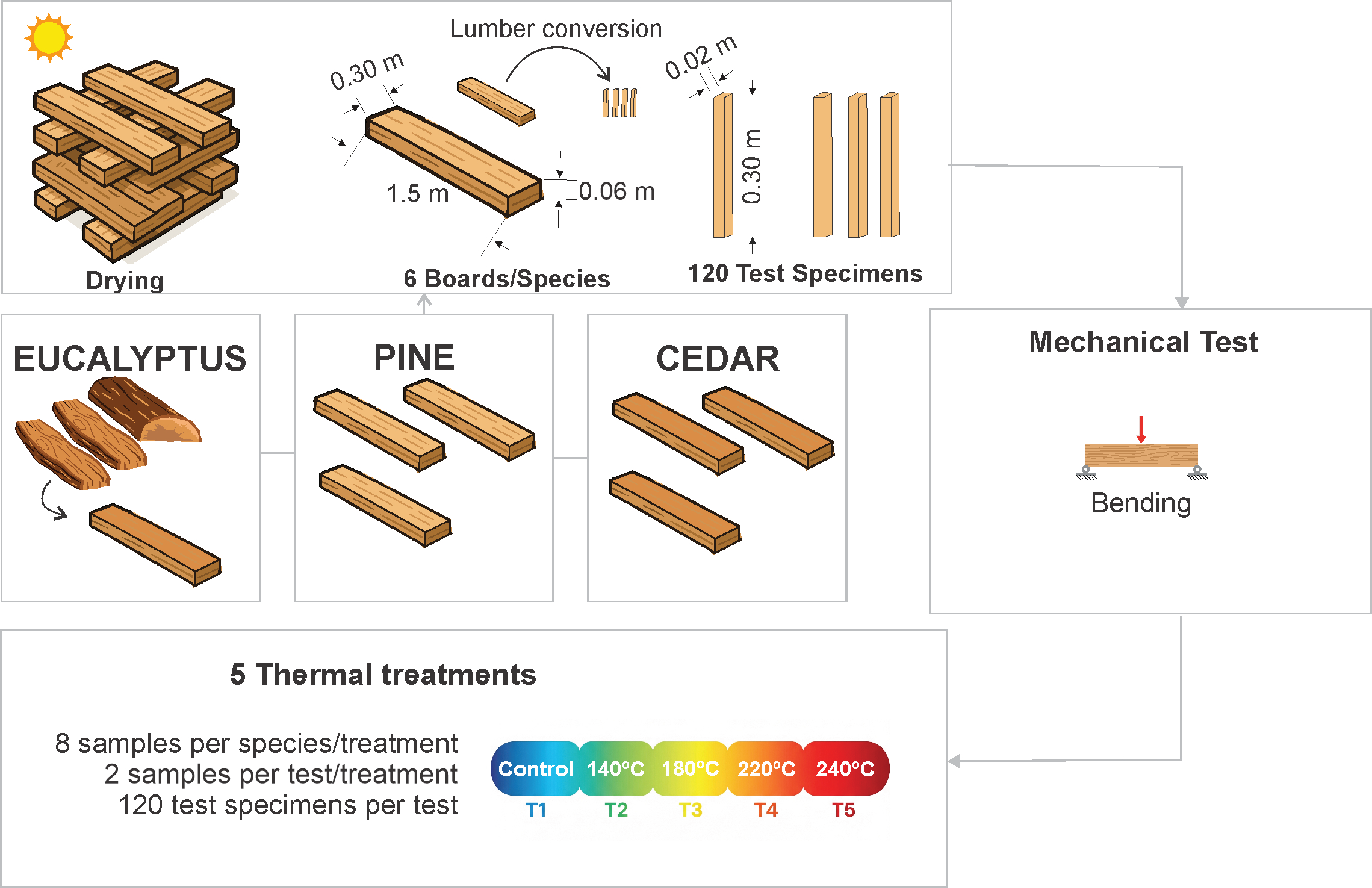
Sampling consisted of eight samples per species and treatment. The sample size was selected based on Brazilian Standard [18] requirements, which establishes a minimum of six specimens for simplified characterization of wood species, with our methodology exceeding this minimum by 33% to ensure adequate statistical robustness. To ensure representativeness and account for the natural variability of wood, approximately six different boards per species were used for preparing all test specimens (TSs), with two samples systematically taken from each set of boards per test/treatment. This sampling strategy ensured that samples originated from different pieces of wood, minimizing intra-board variability effects and enhancing the representativeness of the obtained results. This methodology resulted in 120 TSs in total, with 40 for each studied species.
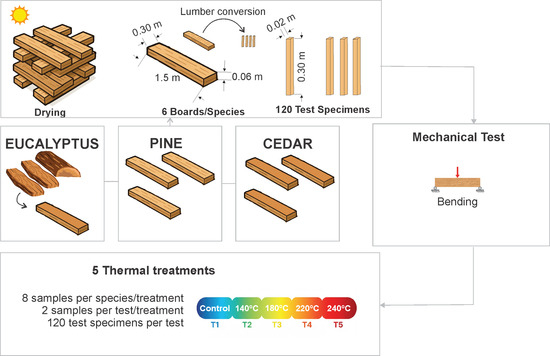
The TS dimensions for static bending tests followed Brazilian Standard specifications of 2 × 2 × 30 cm (width × height × length) [18]. These dimensions were selected to comply with the standard requirements for small clear specimens, ensuring adequate span-to-depth ratio (15:1) for three-point bending tests while maintaining specimen homogeneity. All samples were carefully selected to be free from defects such as knots, cracks, warping, or other imperfections that could compromise the test results. The average apparent densities of the studied species were: Eucalyptus sp. (650.4 ± 52.6 kg/m3), Pinus sp. (708.7 ± 20.9 kg/m3), and Cedrela sp. (398.4 ± 30.1 kg/m3), representing a range from medium to high-density woods with the cedar being classified as medium-density and eucalyptus and pine as high-density woods. Figure 1 presents the TS preparation scheme for thermal modification and mechanical tests.
Figure 1.
Test specimen preparation scheme for thermal modification.
2.2. Thermal Modification Process
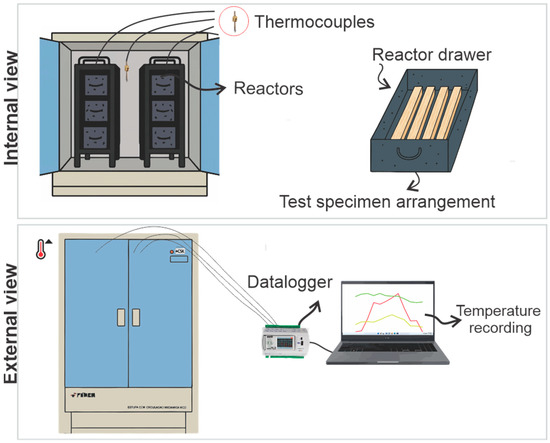
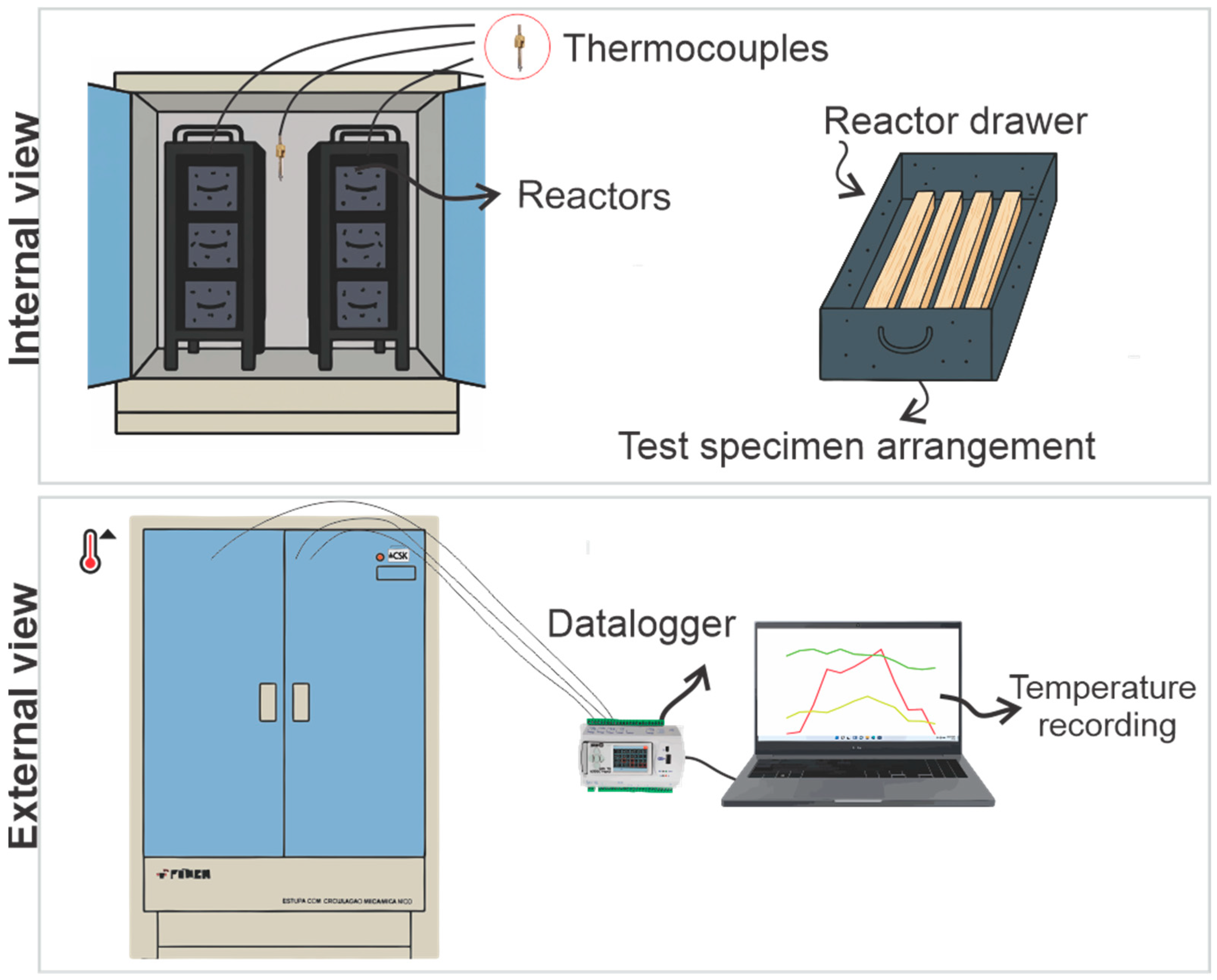
The thermal modification process was conducted in a mechanical circulation oven (FANEM, model 320 E, Guarulhos, Brazil). Two reactors were arranged inside the oven, each equipped with four perforated drawers to ensure homogeneous heat circulation. Thermocouples were installed in each reactor and oven, connected to a datalogger for continuous temperature monitoring and recording. Thermal modifications were performed at the Multiuser Biomass Energy Laboratory (LEB) of DCFM/UFES.
Previously identified TSs were systematically organized in drawers by species and size, avoiding overlaps. Four test specimens were placed in each drawer, with samples from the three species distributed across both reactors (totaling 8 drawers with 4 TSs each, for a total of 32 TSs per thermal treatment). To ensure treatment condition homogeneity, the process was conducted separately for each mechanical test type, ensuring TSs intended for the same test were treated simultaneously. This arrangement allowed for uniform heat exposure while maintaining species identification and preventing cross-contamination between different test groups. TS dimensions were those specified by ABNT NBR 7190 [18]. Figure 2 illustrates the methodological scheme of the process.
Figure 2.
Methodological scheme of thermal modification process in three distinct species and four temperatures.
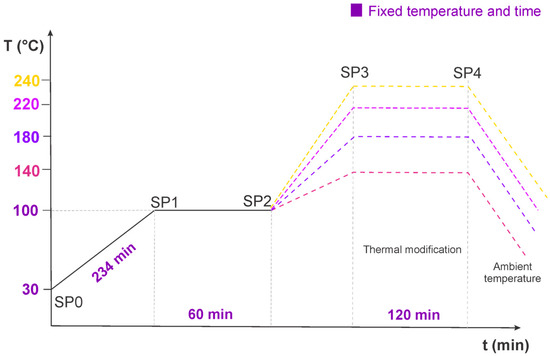
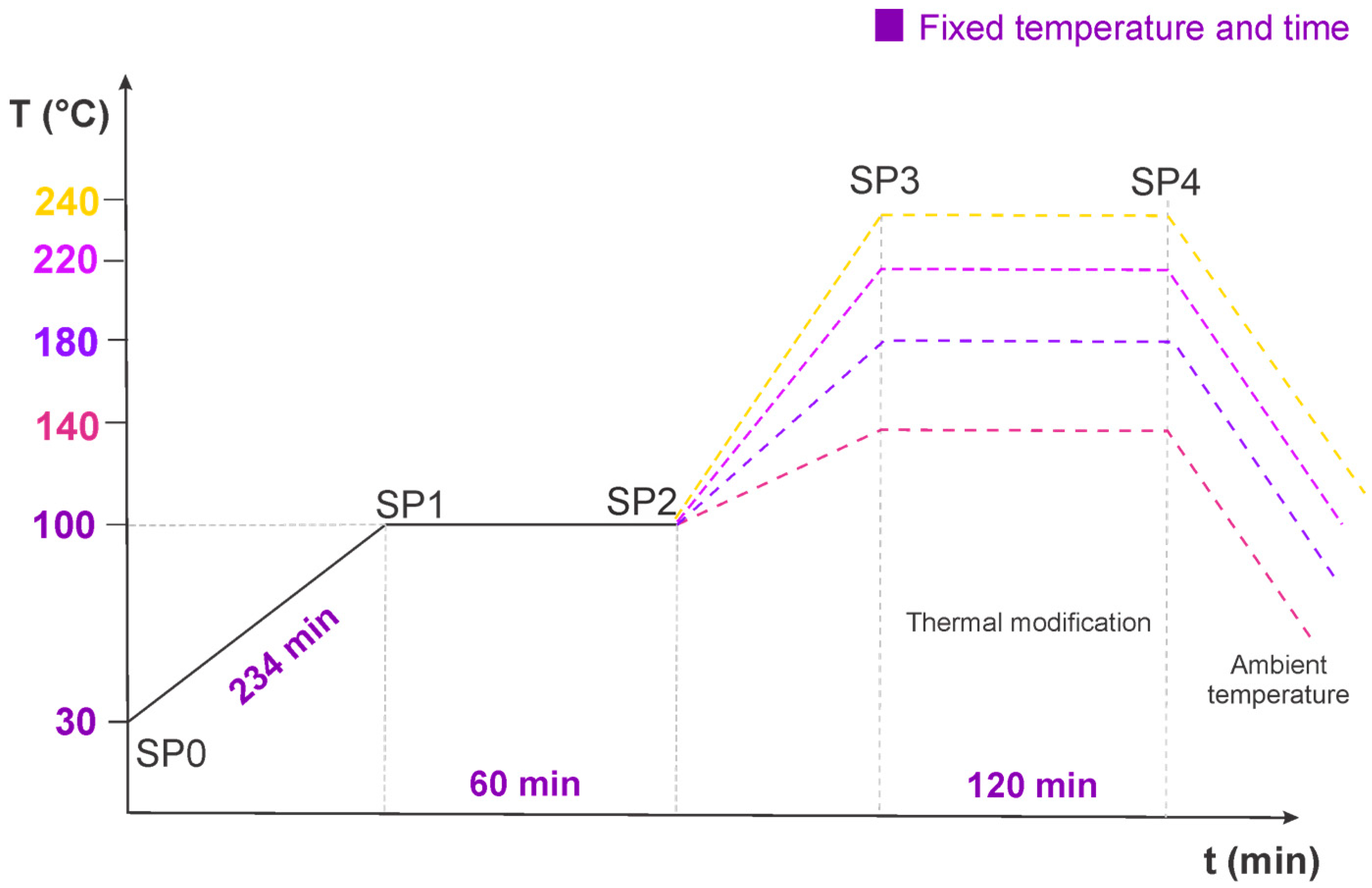
The TM process began at 30 °C (Figure 3). A controlled heating ramp was applied, gradually raising temperature at 0.3 °C per minute until reaching the desired final temperature: 140 °C, 180 °C, 220 °C, or 240 °C. After 12 h from process completion, samples were weighed again. The heating ramp was divided into four main segments, as shown in Figure 3. The first (SP0–SP01), second (SP1–SP2), and fourth (SP3–SP4) segments were identical for all modification temperatures. Differentiation occurred in the third segment (SP2–SP3), where temperature was raised to the final plateau of interest.
Figure 3.
General heating ramp with four segments for wood thermal modification process.
In the first segment, the samples were gradually heated to 100 °C. This temperature was kept constant for one hour in the second segment. The third segment comprised the final heating to the established process temperature. The duration of this segment varied from 1 h 7 min to 5 h, being directly proportional to the required final temperature. In the fourth and final segment, the maximum temperature was maintained for two hours, period during which the TM process effectively occurred. After completion, the equipment was turned off so that the temperature would return to ambient conditions.
2.3. Non-Destructive Methods for Modulus of Elasticity Characterization
2.3.1. Wave Propagation by Excitation
Wave propagation excitation testing was performed using Sonelastic equipment, following ASTM E1876 (2022) guidelines [27]. The same TSs prepared for static bending tests were used. Initially, the TS dimensions and mass were measured with digital calipers and an analytical balance, and entered into the equipment’s software. Sonelastic analyzes acoustic responses captured by a microphone after manual impulses performed with a pulser.
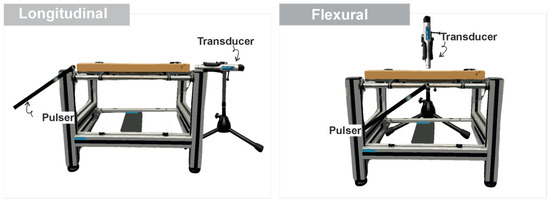
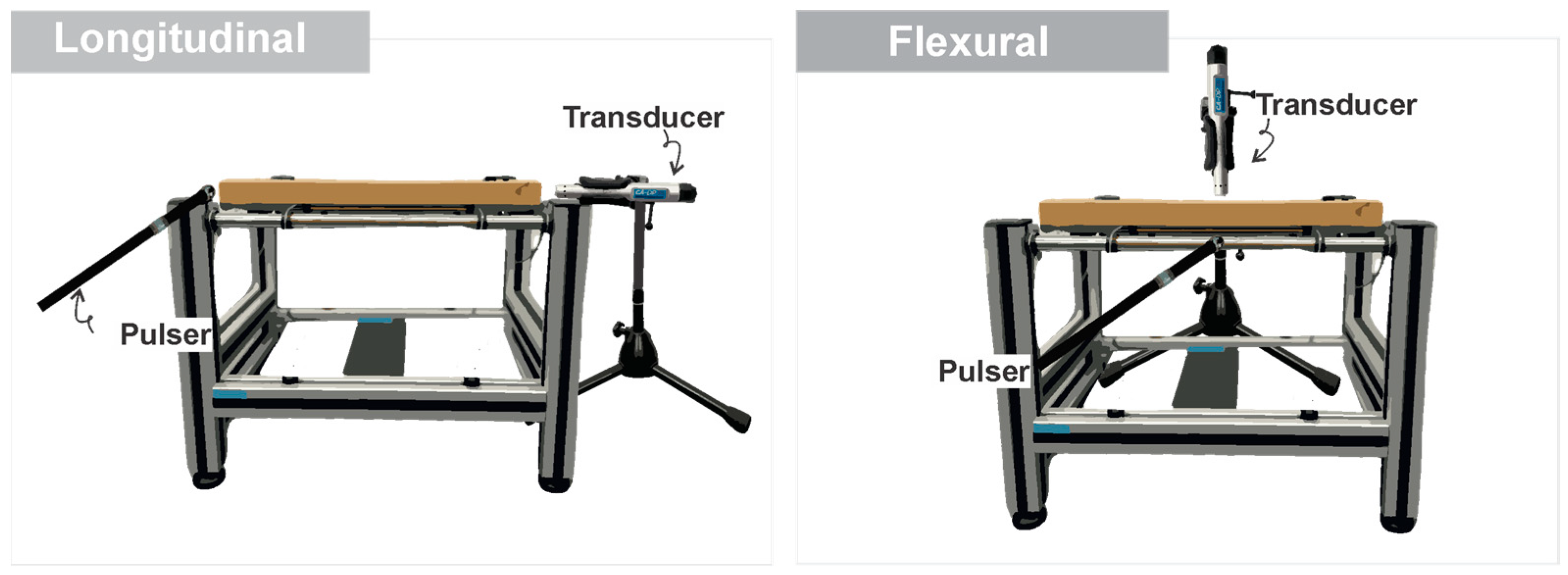
Tests were conducted under two boundary conditions: longitudinal and flexural. Markings were made on samples at 0.224 L distance from extremities for longitudinal and flexural tests. Respecting the boundary conditions, the Fourier transform was applied to obtain natural frequency spectra and their dynamic elasticity moduli [28].
Different vibration modes were evaluated, adapting strategic microphone positioning and manual impulse location. Figure 4 demonstrates the configurations used for each vibration mode.
Figure 4.
Experimental demonstration of fundamental mechanical vibration modes (longitudinal and flexural) in test specimens, excited through manual pulser and monitored by acoustic transducer.
To calculate the longitudinal elasticity modulus (MOEd), Equation (1) was used:
where
MOEd = dynamic elasticity modulus (Pa) determined from longitudinal mode
m = test specimen mass (g)
L = test specimen length (mm)
b = test specimen width (mm)
t = test specimen thickness (mm)
fl = fundamental frequency for sample in longitudinal mode (Hz)
K = correction factor
To determine the dynamic elasticity modulus (MOEd) using flexural boundary conditions, it was necessary to apply a correction factor called T1, which considers the influence of the test specimen’s geometry and the Poisson’s coefficient (µ) of the material, Equation (2):
where
T1 = correction factor for dynamic longitudinal elasticity modulus
µ = material Poisson’s coefficient
The correction factor T1 was then applied in Equation (3) to calculate MOEd:
where
MOEd = dynamic elasticity modulus
ff = fundamental frequency for sample in flexural mode (Hz)
T1 = previously calculated correction factor
µ = material Poisson’s coefficient
2.3.2. Ultrasonic Wave Propagation
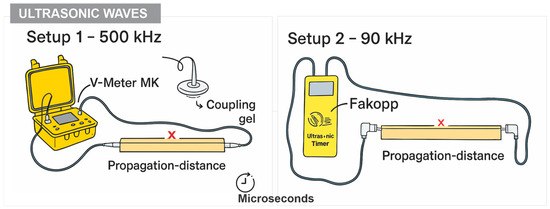
Ultrasonic wave propagation tests were performed following ASTM E494 (2015) guidelines [29], using the same TSs prepared for bending tests. Two distinct ultrasound equipment were employed: V-Meter MK and UltraSonic Timer, operating with transducers at frequencies of 500 kHz and 90 kHz, respectively (Figure 5).
Figure 5.
V-Meter MK and UltraSonic Timer equipment used for non-destructive wood characterization through direct method.
For testing, the two transducers were coupled to TS cross-sections. For equipment with 500 kHz transducer, coupling gel was used to ensure adequate contact between surfaces. For equipment with needle-type transducer (90 kHz), transducers were inserted into wood surface. In both cases, one transducer acts as a wave signal emitter, while the other functions as a receiver. Measurements were performed along the test specimen’s length, with transducers positioned on opposite faces, and the propagation time was recorded in microseconds. Based on the time and distance traveled by the wave (corresponding to TS length), the wave propagation velocity (V) was calculated using Equation (4):
where
V = wave propagation velocity (m/s)
L = test specimen length or distance between transducers (m)
t = wave propagation time (µs)
From the propagation velocity, MOEd was calculated using Equation (5):
where
MOEd = dynamic elasticity modulus (MPa)
V = wave propagation velocity (m/s)
ρ = material density (kg/m3)
2.4. Static Mechanical Test (Bending)
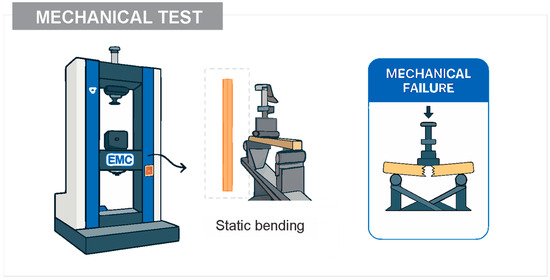
For non-destructive method validation, static MOE was determined through static bending tests, following ABNT NBR 7190 (2022) [18]. Tests were performed on an EMIC universal testing machine (model DL 10000, Instron, São José dos Pinhais, Brazil) at the Wood Anatomy Laboratory of DCFM/UFES (Figure 6). The procedure was conducted with a 10,000 N load cell and increasing monotonic loading corresponding to 10 MPa/min rate, applying load continuously until resistance limit.
Figure 6.
Universal testing machine and configuration for static bending mechanical test.
2.5. Statistical Analysis
Statistical analyses were performed using Minitab software (version 19, Minitab Inc., State College, PA, USA). To evaluate correlations between non-destructive methods and static tests, a simple linear regression model was employed (Equation (6)):
where β0 is the intercept, β1 is the slope coefficient, and ε is the residual error.
2.5.1. Assumption Verification
The linear regression assumptions were verified through: (a) normality of residuals using the Anderson–Darling test (p > 0.05); (b) homoscedasticity through graphical analysis of residuals versus fitted values; (c) independence of residuals confirmed by the randomness in data collection.
2.5.2. Evaluation Metrics
The predictive quality was assessed using the coefficient of determination (R2) and Mean Absolute Percentage Error (MAPE), calculated according to Equation (7):
2.5.3. Comparative Analysis
To identify significant differences between factors, Analysis of Variance (ANOVA) was applied to individual MAPE values, followed by Tukey’s post hoc test (α = 0.05). The design considered as main factors: Species (3 levels), NDT Method (4 levels), and Heat treatment (5 levels). To investigate the effect of inter- versus intra-specific heterogeneity, analyses were conducted both for the complete dataset (multi-species) and for each species individually, allowing identification of optimal frequencies at different scales of structural variability.
3. Results and Discussion
3.1. Characterization of Static and Dynamic MOE by Species
The mean static MOE values obtained from three-point bending tests varied significantly among the studied species (Table 1 and Table 2). Pinus sp. presented the highest mean value (12,621.0 ± 2129.03 MPa), followed by Eucalyptus sp. (9015.34 ± 2008.75 MPa) and Cedrela sp. (4749.01 ± 1044.75 MPa). This variation reflects differences in anatomical properties and basic density among species, being directly related to wood strength and stiffness [19].
Table 1.
Mean values of static MOE and coefficients of determination (R2) for impulse excitation methods by species.
Table 2.
Mean values of static MOE and coefficients of determination (R2) for ultrasonic wave methods by species.
The observed standard deviations reflect not only the natural variability inherent to each species, but also the effect of different thermal treatments applied (control, 140 °C, 180 °C, 220 °C, and 240 °C), which promoted alterations in mechanical properties along the temperature gradient within each species. Species-specific analysis revealed distinct behaviors in NDT adequacy, which can be explained by the interaction between wood density, anatomical structure, and ultrasonic frequency, based on acoustic propagation principles established in the literature [30,31].
In the ultrasonic method, it is observed that within the species-specific evaluation, although both frequencies presented adequate relationships (R2 > 70%), superior performance was obtained at the lower frequency used, with this difference being more evident for hardwood species (Eucalyptus sp. and Cedrela sp.). This result aligns with the frequency-dependent damping and anatomical complexity principles established in the literature [32]. Frequencies close to fundamental vibration modes (90 kHz) present lower energy dissipation during propagation, since they require simpler structural deformations of wood compared to high frequencies that induce higher vibrational modes with greater internal friction.
The variable anatomical complexity among species, from the homogeneous tracheid structure in conifers to the heterogeneous architecture with vessels and fibers in hardwoods, explains why different ultrasonic frequencies present variable adequacy according to the analyzed species [33]. This structural heterogeneity makes hardwoods more sensitive to frequency selection, since different anatomical elements respond variably to acoustic waves. In contrast, the more uniform structure of conifers results in less variation in response between different frequencies, explaining the less pronounced difference observed for Pinus sp.
These results reinforce the importance of careful NDT method selection based on species-specific characteristics, as suggested by previous studies demonstrating that the effectiveness of non-destructive methods is intrinsically linked to the physical and anatomical properties of wood.
These robust correlations (R2 > 70%) across all species and NDT methods support the initial premise that thermal modification, despite inducing significant chemical and structural changes, does not fundamentally disrupt the relationship between dynamic and static elastic properties. The preservation of quantifiable correlations validates the applicability of wave propagation principles in thermally modified woods, providing a theoretical foundation for NDT implementation in this material class.
3.2. Overall NDT Performance by Treatment
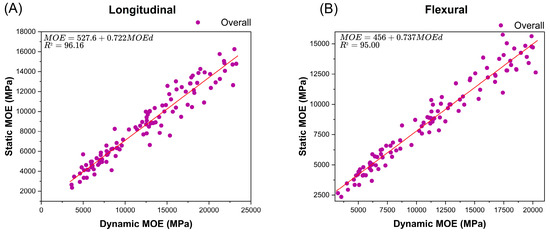
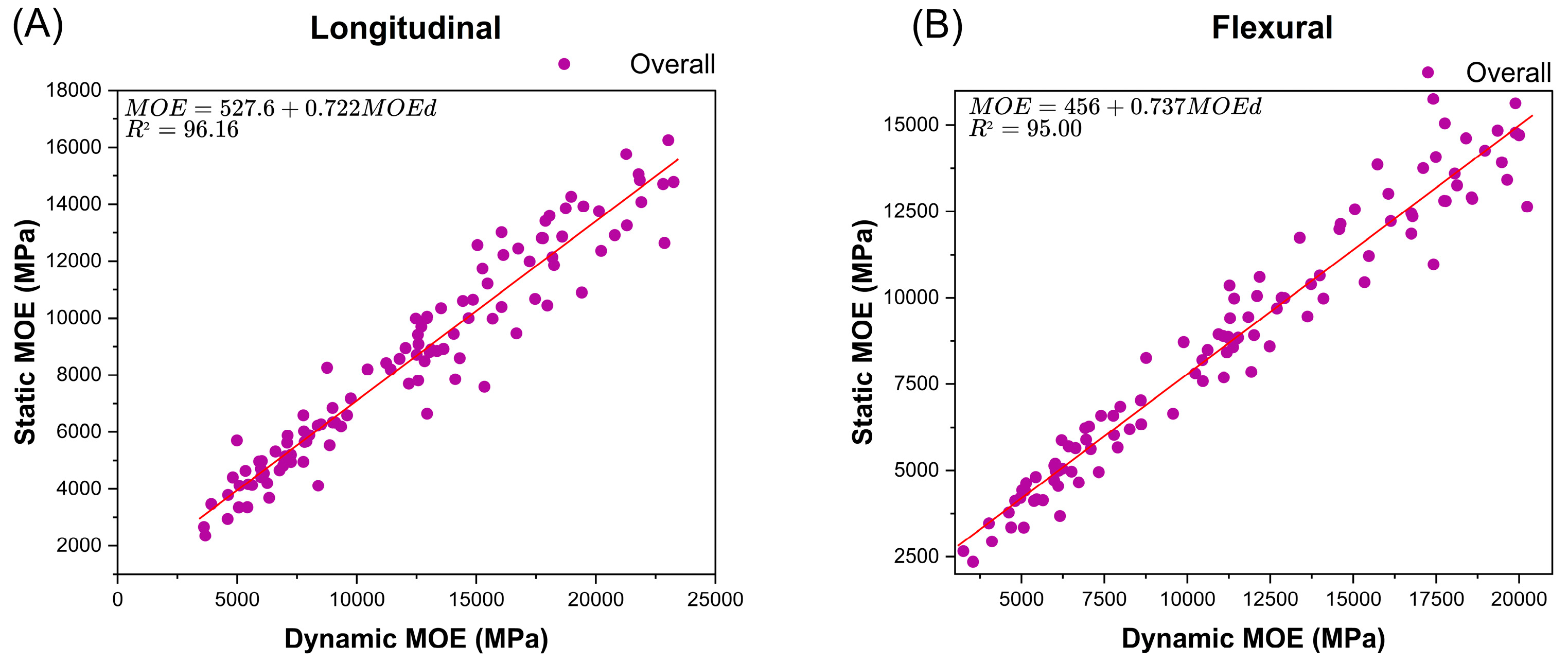
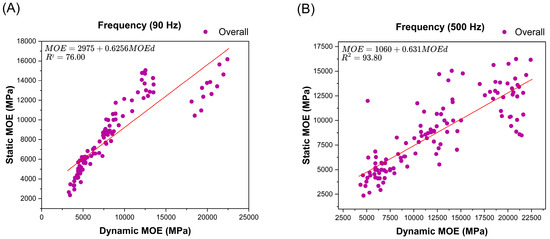
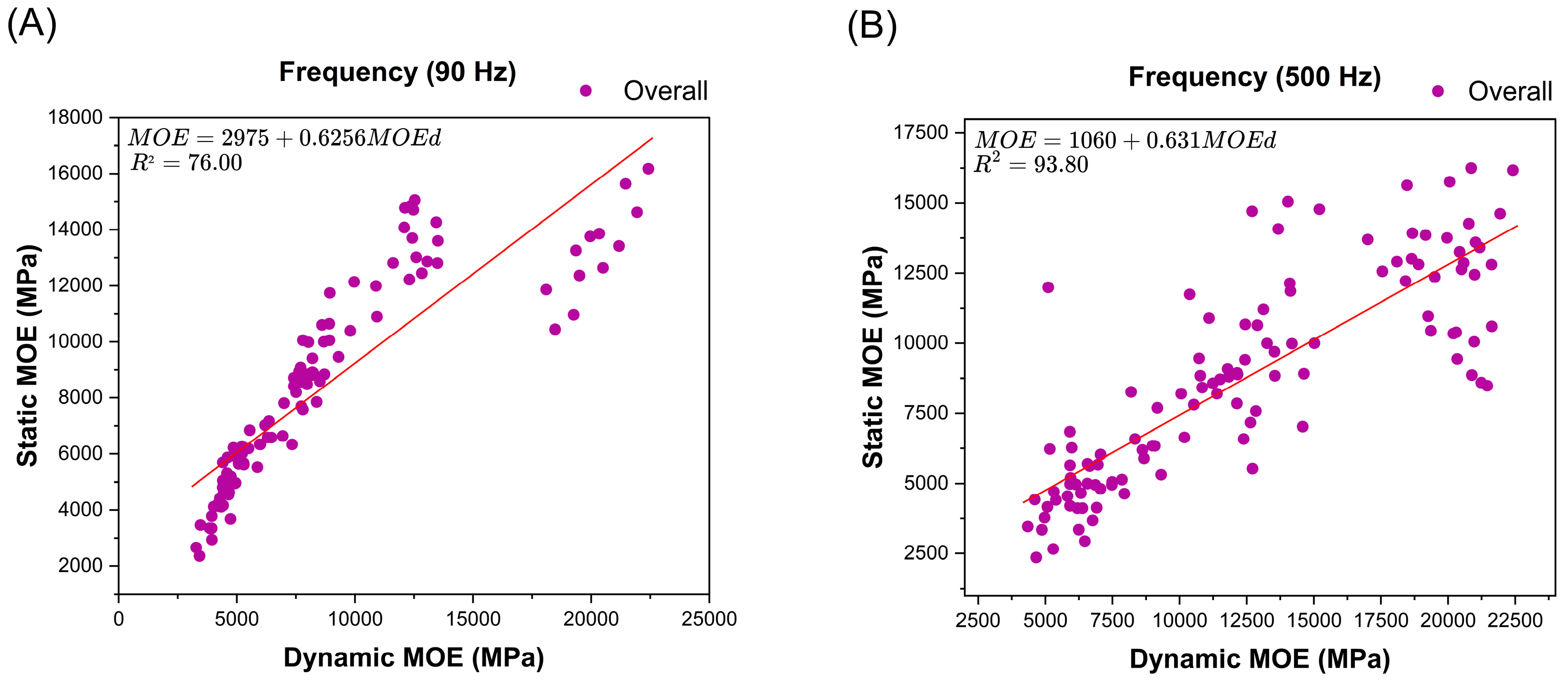
Table 3 and Table 4 present coefficients of determination (R2) obtained for each thermal treatment (including general analysis of all treatments), as well as respective regression equations relating dynamic MOE to static MOE. Figure 7 and Figure 8 graphically illustrate the correlations of the general equations presented in the tables.
Table 3.
Coefficients of determination (R2) for impulse excitation method relative to static MOE, by treatment.
Table 4.
Coefficients of determination (R2) for ultrasonic wave method relative to static MOE, by treatment.
Figure 7.
Linear regression graphs with determination coefficients and fitted equations for wave propagation excitation methods comparing dynamic and static moduli of elasticity of thermally treated samples: (A) Longitudinal mode; (B) Flexural mode.
Figure 8.
Linear regression graphs with determination coefficients and fitted equations for wave propagation excitation methods comparing dynamic and static moduli of elasticity of thermally treated samples: (A) Frequency of 90 Hz; (B) Frequency of 500 Hz.
The R2 values obtained for all methods and treatments ranged between 76.00% and 97.96%. It is important to note that all these values are above 70%, a threshold generally accepted as indicative of a good coefficient of determination, confirming that dynamic MOE determined by these methods is a reliable predictor of static MOE for the evaluated thermally modified woods [26]. The observed variability in R2 values across NDT methods (ranging from 70% to 97.96%) confirms the expectation that different methods exhibit distinct sensitivities to structural modifications induced by thermal treatment. This differential performance, with impulse excitation methods consistently outperforming ultrasonic approaches, underscores the importance of method-specific validation for each treatment condition and reinforces the need for careful NDT selection based on application requirements.
3.3. Predictive Accuracy Analysis (MAPE)
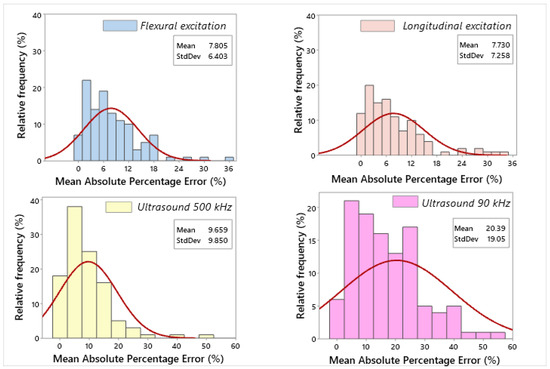
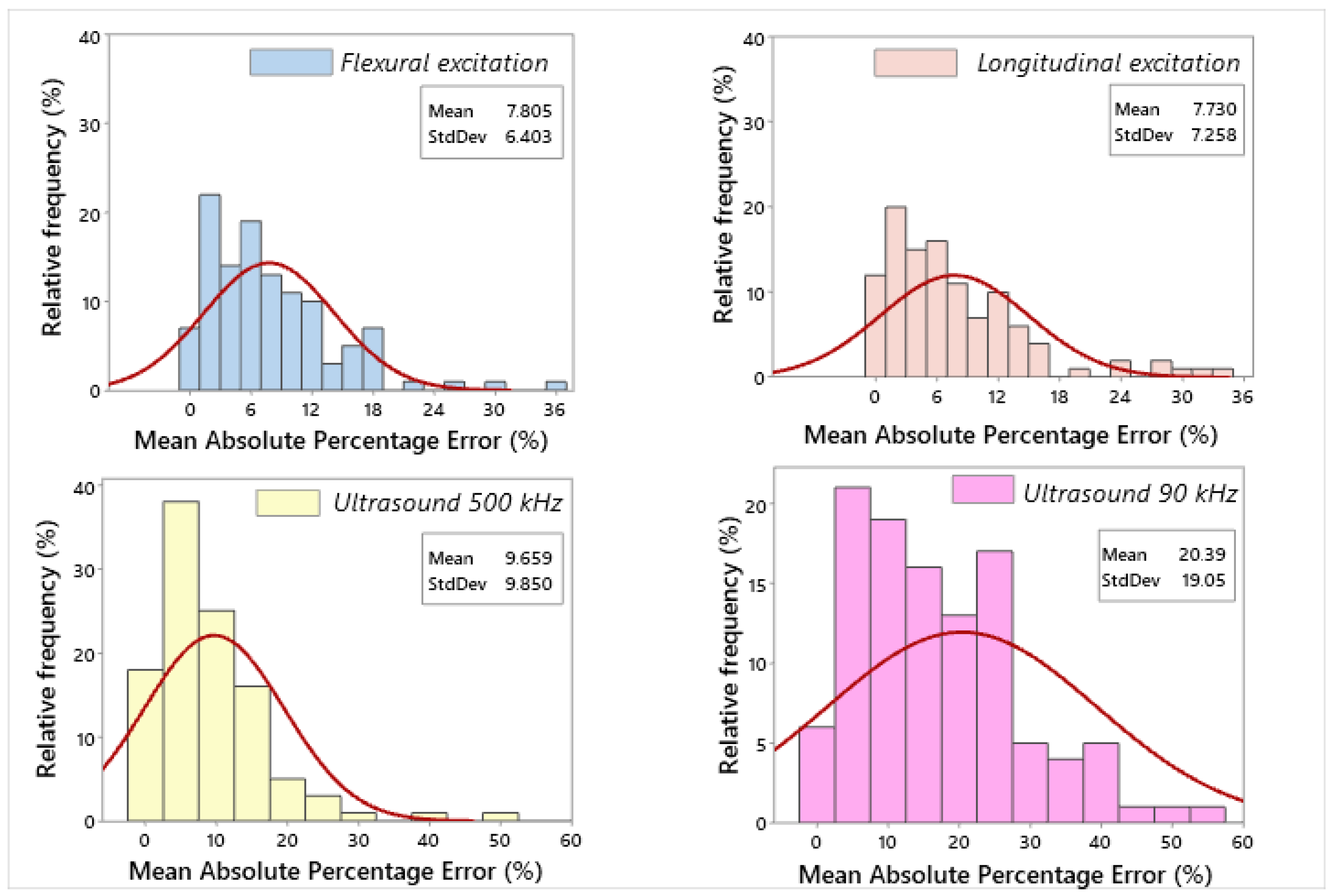
To complement the coefficient of determination analysis, practical predictive accuracy was evaluated through the Mean Absolute Percentage Error (MAPE). Figure 9 presents the distribution of MAPE values for each NDT method, revealing significant differences in predictive accuracy patterns. Impulse excitation methods demonstrated the lowest error means (7.73% longitudinal and 7.81% flexural) with concentrated distributions, confirming their high accuracy and consistency. The 500 kHz ultrasound presented intermediate performance (9.66%), while the 90 kHz ultrasound showed greater variability (20.39%), explaining the lower coefficients of determination observed for this method in some thermal treatments. All distributions follow a normal pattern, validating the statistical assumptions of the regression analyses.
Figure 9.
Distribution of Mean Absolute Percentage Error (MAPE) values for each non-destructive testing method, indicating the predictive accuracy of the models.
The results for impulse excitation (7.73–7.81% MAPE) are compatible with the industrial efficiency of ±5% reported for integrated ultrasonic systems [34] and align with precision ranges established in the literature for non-destructive acoustic methods, including 3.187% for bamboo-wood composites [35] and ~9.6% for MOE prediction in Pinus pinaster using cross-validation [36].
The performance hierarchy observed in MAPE (longitudinal excitation > flexural excitation > 500 kHz ultrasound > 90 kHz ultrasound) corroborates the patterns identified in linear regression analysis, confirming consistency between the evaluation metrics used. This agreement between R2 and MAPE reinforces the robustness of impulse excitation methods, which simultaneously presented the highest coefficients of determination and the lowest prediction errors.
3.4. Statistical Factor Analysis
The analysis of variance of main factors revealed significant differences both among species and among NDT methods. Tukey’s test (Table 5) identified that Cedrela sp. presented significantly higher prediction error (15.28% MAPE) compared to other species. Eucalyptus sp. (9.14%) and Pinus sp. (9.96%) did not differ statistically from each other, but both presented superior performance compared to cedar.
Table 5.
Tukey’s multiple comparison test results for species effect on Mean Absolute Percentage Error (MAPE).
Tukey’s test (Table 6) showed that impulse excitation methods (longitudinal and flexural) and 500 kHz ultrasound presented statistically similar MAPE. However, when examining R2 values, important differences emerge in the predictive capacity of these methods that need to be considered when choosing the most appropriate technique.
Table 6.
Tukey’s multiple comparison test results for NDT method effect on Mean Absolute Percentage Error (MAPE).
Among the vibrational modes evaluated by impulse excitation, the longitudinal mode presented the highest precision, simultaneously showing the lowest MAPE (7.73%) and the highest R2 values (up to 97.96%). This result is in consonance with the literature, which suggests that vibration properties in longitudinal mode tend to be superior to those of transverse modes [37]. Such behavior can be attributed to the lower influence of defects and surface discontinuities in the material structure on the longitudinal mode, compared to transverse modes, which may have their precision compromised [38].
The flexural excitation mode, despite being statistically equivalent to the longitudinal mode in terms of MAPE (7.80%), presented slightly lower R2 values (up to 97.49%), confirming its high precision but with lower predictive consistency. This behavior aligns with the literature, which demonstrates that transverse modes are more sensitive to microstructural variations resulting from thermal modification [39]. Previous research has also found R2 above 90% for transverse vibration in 29 wood species, highlighting the high reliability of non-destructive methods [40].
The 500 kHz ultrasound, although statistically grouped with excitation methods (MAPE = 9.65%), showed lower R2 (up to 96.94% at 240 °C condition). This difference suggests that, despite comparable precision, predictive consistency is lower, possibly due to the higher sensitivity of high frequency to density variations and anatomical heterogeneities. The 90 kHz frequency presented significantly inferior performance (MAPE = 20.39%, maximum R2 of 97.10% only at 240 °C), confirming the limitations of this frequency for multi-specific analyses. The lower spatial resolution and greater susceptibility to interference compromise both precision and predictive consistency [41].
3.5. Ultrasonic Wave Propagation: Differential Performance Between Intra- and Inter-Specific Analyses
In the ultrasonic wave propagation method, a difference in precision was observed between the frequencies used. In the general analysis (multi-species), the 500 kHz frequency presented superior R2 values (Table 4) compared to the 90 kHz frequency, especially in the general analysis of all treatments, where the R2 difference was approximately 17.80%. In the individual species analysis, the pattern was inverse, where the 90 kHz frequency proved superior in terms of precision (Table 2).
This result can be attributed to the spatial resolution principle, where higher frequencies generate a more concentrated and directional ultrasonic beam [41]. In multi-specific analysis, the extreme structural heterogeneity among species, such as density variation between species, requires greater penetration and discrimination capacity. Spatial resolution, being inversely proportional to wavelength, makes 500 kHz more effective for detecting and traversing the drastic anatomical differences between conifers and hardwoods. Although higher frequencies may naturally present lower signal amplitude [25], the use of coupling gel in the 500 kHz equipment compensates for this limitation, ensuring good signal transmission and, consequently, higher R2 [42]. Previous studies have demonstrated that frequencies above 500 kHz are more suitable for laboratory-scale specimens, as they allow a length/wavelength ratio (L/λ) greater than 3.0 to be obtained, a necessary condition to avoid interference that compromises the precision of ultrasonic measurements [43]. The importance of adapting transducer frequency to test specimen size to obtain reliable measurements has been reinforced [44].
3.6. Predictive Accuracy Variation Along the Thermal Modification Gradient
The variation in R2 values observed along the temperature gradient reflects the gradual changes in wood structure during the thermal modification process, influencing the precision of prediction models. The extreme treatments (control and 240 °C) presented the highest R2 values, indicating greater predictability of wood properties under these conditions. In untreated wood, the high R2 values reflect its natural equilibrium state. On the other hand, in wood treated at 240 °C, these values result from intense degradation of hemicelluloses and amorphous zones of cellulose, which promotes a more homogeneous structure [11]. This structural uniformity, resulting from lignin reallocation and hemicellulose degradation, provides more consistent and predictable mechanical behavior, which is reflected in higher R2 values [17].
In contrast, intermediate temperatures presented greater data dispersion. Studies have demonstrated that thermal modification differentially affects the dynamic properties of wood, and that at intermediate temperatures, structural changes are more heterogeneous, leading to greater data dispersion and, consequently, lower predictive precision of the models [23].
3.7. Practical Implications and Industrial Applications
The validated NDT methods established in this study offer significant practical advantages for the industrial quality control of thermally modified wood. The ability to predict static MOE with high accuracy (R2 > 90%) and acceptable prediction errors (MAPE < 10% for optimal methods) enables the rapid, non-destructive assessment of structural properties without material sacrifice.
For industrial implementation, longitudinal impulse excitation is recommended as the standard method due to its optimal combination of high precision (R2 up to 97.96%, MAPE = 7.73%), operational simplicity, and cost-effectiveness. The 500 kHz ultrasonic method offers advantages in field applications, although coupling requirements must be considered for rough surface conditions.
The prediction accuracies achieved in this study (R2 > 90%, MAPE < 10%) are comparable to those obtained using machine learning approaches in the recent literature. Previous studies reported MAPE values of 0.74–1.04% for MOR and 1.14–2.21% for MOE in heat-treated woods using artificial neural networks [45], while others achieved R2 values of 0.95–0.96 for MOE using guided Lamb waves combined with GMDH networks [46]. However, unlike these studies that require complex neural network architectures, the present study demonstrates that robust predictions can be achieved through physically based correlations between impulse excitation parameters and mechanical properties, offering a more transparent and interpretable approach suitable for industrial implementation.
An important advantage of impulse excitation validated herein is its insensitivity to moisture content variations through the established correlations, whereas guided Lamb wave velocity requires MC as an explicit input parameter due to its strong dependence on moisture beyond the fiber saturation point [46]. This characteristic makes impulse excitation particularly advantageous for thermally modified woods where moisture equilibration is controlled during processing. Future integration of the validated correlations with machine learning techniques could enable enhanced predictive capabilities. However, the physically based approach provides a reliable and interpretable foundation critical for industrial implementation. These validated correlations offer the wood industry implementable tools for efficient quality control, supporting broader adoption of thermally modified wood in structural applications.
While this study provides robust validation across multiple species and thermal treatments, certain methodological constraints regarding sample size and generic species identification define opportunities for expanding this research. Future investigations could significantly enhance industrial applicability through validation in commercial-scale structural elements with natural variability, species-specific calibration for major commercial clones, integration with machine learning techniques for real-time quality prediction, and development of portable NDT equipment for industrial in-line quality control. These advances would strengthen the bridge between laboratory validation and full-scale industrial implementation, supporting broader adoption of thermally modified tropical woods in structural applications.
4. Conclusions
This study successfully validated non-destructive wave propagation methods for predicting static MOE in thermally modified tropical woods (Eucalyptus sp., Pinus sp., and Cedrela sp.) across different thermal treatment temperatures. All evaluated methods achieved high coefficients of determination and acceptable prediction errors, with longitudinal impulse excitation demonstrating superior performance, making it the recommended standard method for industrial quality control. As a novel contribution, this research provides the first comprehensive validation of multiple NDT methods specifically for thermally modified tropical species, establishing robust quantitative correlations that fill an important gap in the scientific literature, which previously focused on temperate species or isolated treatment conditions. The study limitations include small sample size and generic species identification; future research should prioritize validation in commercial-scale elements and integration with machine learning techniques. These validated methods enable efficient, non-destructive quality control in the wood industry, supporting the broader adoption of thermally modified wood in structural applications.
Author Contributions
Conceptualization, R.C.A. and N.G.F.D.P.; methodology, R.C.A., A.F.D.J. and L.G.d.M.R.; formal analysis, N.G.F.D.P., R.C.A., E.V.M.C. and A.F.D.J.; investigation, N.G.F.D.P. and L.G.d.M.R.; resources, R.C.A. and A.F.D.J.; data curation, N.G.F.D.P.; writing—original draft preparation, N.G.F.D.P.; writing—review and editing, N.G.F.D.P., R.C.A., A.F.D.J. and E.V.M.C.; visualization, N.G.F.D.P.; supervision, R.C.A.; project administration, R.C.A. All authors have read and agreed to the published version of the manuscript.
Funding
This research received no external funding.
Data Availability Statement
The data presented in this study are available in the article.
Acknowledgments
The authors thank the Laboratory of Wood Experimentation and Multiple Uses for experimental support and the Foundation for Research and Innovation Support of Espírito Santo (FAPES) for research support.
Conflicts of Interest
The authors declare no conflicts of interest.
Abbreviations
The following abbreviations are used in this manuscript:
| ABNT | Associação Brasileira de Normas Técnicas |
| ASTM | American Society for Testing and Materials |
| DCFM | Department of Forest and Wood Sciences |
| LEB | Multiuser Biomass Energy Laboratory |
| MOE | Modulus of Elasticity |
| MOEd | Dynamic Modulus of Elasticity |
| MOR | Modulus of Rupture |
| NDT | Non-Destructive Testing |
| TM | Thermal Modification |
| TS | Test Specimen |
| UFES | Universidade Federal do Espírito Santo |
References
- United Nations. Report of the Conference of the Parties on Its Twenty-First Session, Held in Paris from 30 November to 13 December 2015, Distr.: General 29 January 2016. Available online: https://unfccc.int/resource/docs/2015/cop21/eng/10.pdf (accessed on 17 July 2025).
- Esteves, B.; Pereira, H. Wood modification by heat treatment: A review. BioResources 2009, 4, 370–404. [Google Scholar] [CrossRef] [Scilit]
- Zhang, L.; Liu, M.; Liu, Y.; Wang, J.; Lei, Y.; Chen, Z.; Yan, L. Evaluation of the colour parameters on hygroscopicity and dimensional stability of thermally modified Populus tomentosa Carr. Ind. Crops Prod. 2023, 205, 117506. [Google Scholar] [CrossRef] [Scilit]
- Indústria Brasileira de Árvores. Relatório Anual 2024; IBÁ: São Paulo, Brasil, 2024. [Google Scholar]
- Lobato, C.C.S.; Vale, I.D.; de Souza, L.M.; de Abreu, J.L.L.; Ferreira, G.C.; Bufalino, L. Densidade básica e estabilidade dimensional de madeiras tropicais modificadas por tratamentos térmicos. Nativa 2020, 8, 708–714. [Google Scholar] [CrossRef] [Scilit]
- Schulz, H.R.; Pereira, A.A.; Techera, B.K.; da Silva, J.M.A.P.; Ezequiel, G.; de Ávila, D.R.; Alberto, G.D. Chemical, mechanical, thermal, and colorimetric features of the thermally treated Eucalyptus grandis wood planted in Brazil. J. Korean Wood Sci. Technol. 2021, 49, 226–233. [Google Scholar] [CrossRef] [Scilit]
- Mangini, T.S.; Candaten, L.; Eloy, E.; Trevisan, R.; Caron, B.O. A modificação térmica influencia na estabilidade dimensional da madeira de espécies de um sistema agroflorestal. Sci. For. 2023, 51, e4006. [Google Scholar] [CrossRef] [Scilit]
- Sivrikaya, H.; Hosseinpourpia, R.; Ahmed, S.A.; Adamopoulos, S. Vacuum-heat treatment of Scots pine (Pinus sylvestris L.) wood pre-treated with propanetriol. Wood Mater. Sci. Eng. 2020, 17, 328–336. [Google Scholar] [CrossRef] [Scilit]
- Silva, R.C.S.; de Morais, P.L.; Reis, A.R.S.; Nascimento, M.F.D.; Lahr, F.A.R.; da Silva, M.R. Identificação anatômica e avaliação da melhoria na estabilidade dimensional em espécies amazônicas termorretificadas. Matéria 2022, 27, e13205. [Google Scholar] [CrossRef] [Scilit]
- Candelier, K.; Thevenon, M.-F.; Petrissans, A.; Dumarcay, S.; Gerardin, P.; Petrissans, M. Control of heat treatment of wood and its effects on resistance to decay: A revision. Ann. For. Sci. 2016, 73, 571–583. [Google Scholar] [CrossRef] [Scilit]
- Hill, C.; Altgen, M.; Rautkari, L. Thermal modification of wood—A review: Chemical changes and hygroscopicity. J. Mater. Sci. 2021, 56, 6581–6614. [Google Scholar] [CrossRef] [Scilit]
- Laudares, S.; Nascimento, A.M.D.; Oliveira, R.N.; dos Santos, R.R.; Moura, F.D.G. Avaliação das propriedades acústicas de mogno africano (Khaya ivorensis) submetido a tratamento térmico em estufa e autoclave. Rev. Matéria. 2023, 28. [Google Scholar] [CrossRef] [Scilit]
- Medeiros, D.T.; Batista, F.G.; de Melo, R.R.; Mascarenhas, A.R.P.; Pedrosa, T.D. Physical-mechanical alterations in Qualea paraensis wood after heat treatment. Madera Bosques 2021, 27, 1–15. [Google Scholar] [CrossRef] [Scilit]
- Gaff, M.; Kubovský, I.; Sikora, A.; Kačíková, D.; Li, H.; Kubovský, M.; Kačík, F. Impact of thermal modification on color and chemical changes of African padauk, merbau, mahogany, and iroko wood species. Rev. Adv. Mater. Sci. 2023, 62, 20220277. [Google Scholar] [CrossRef] [Scilit]
- Monaco, A.; Pelosi, C.; Agresti, G.; Picchio, R.; Rubino, G. Influence of thermal treatment on selected properties of chestnut wood and full range of its visual features. Drewno 2020, 63, 5–24. [Google Scholar] [CrossRef] [Scilit]
- Santos Júnior, J.A.; Stragliotto, M.C.; Di Carvalho, M.A.; De Brito, D.Y.O.; Longui, E.L.; Da Silva, J.R.M. Propriedades físicas da madeira modificada termicamente. In Tópicos Especiais em Engenharia Florestal; Capítulo 12; Editora Científica Digital: Guarujá, Brazil, 2024; Volume 1, pp. 246–259. [Google Scholar] [CrossRef] [Scilit]
- Boonstra, M.J.; Van Acker, J.; Tjeerdsma, B.F.; Kegel, E.V. Strength properties of thermally modified softwoods and its relation to polymeric structural wood constituents. Ann. For. Sci. 2007, 64, 679–690. [Google Scholar] [CrossRef] [Scilit]
- Associação Brasileira de Normas Técnicas. NBR 7190-1: Projeto de Estruturas de Madeira; ABNT: Rio de Janeiro, Brazil, 2022. [Google Scholar]
- Cruz, S.S.; da Fonseca Júnior, A.S.; de Carvalho Júnior, Á.B.; Inacio, M. Utilização de ondas acústicas para a caracterização de propriedades físicas e mecânicas das madeiras. Peer Rev. 2024, 6, 97–116. [Google Scholar] [CrossRef] [Scilit]
- Fathi, H.; Kazemirad, S.; Nasir, V. Lamb wave propagation method for nondestructive characterization of the elastic properties of wood. Appl. Acoust. 2021, 171, 107565. [Google Scholar] [CrossRef] [Scilit]
- Brougui, M.; Andor, K.; Szabó, P. Evaluation of Timber Mechanical Properties Through Non-Destructive Testing: A Bibliometric Analysis. Buildings 2025, 15, 2192. [Google Scholar] [CrossRef] [Scilit]
- Silva, L.S.Z.R.S.; Panzera, T.H.; Garcia, C.T.; Silva, D.A.L.; Lahr, F.A.R.; Christoforo, A.L. Propriedades físico-mecânicas da madeira de cajueiro estimadas por métodos não destrutivos com base na densidade aparente e frequência natural de vibração. Ciênc. Florest. 2023, 33, e66096. [Google Scholar] [CrossRef] [Scilit]
- Melo, R.R.; Barbosa, K.T.; Beltrame, R.; Acosta, A.P.; Pimenta, A.S.; Mascarenhas, A.R.P. Ultrasound to determine physical-mechanical properties of Eucalyptus camaldulensis wood. Wood Mater. Sci. Eng. 2021, 16, 407–413. [Google Scholar] [CrossRef] [Scilit]
- Aydın, T.Y.; Aydın, M. Non-Destructive Evaluation of Thermal Treatment Influence on Elastic Engineering Parameters of Poplar. Drv. Ind. 2024, 75, 405–418. [Google Scholar] [CrossRef] [Scilit]
- Holeček, T.; Gašparík, M.; Lagaňa, R.; Borůvka, V.; Oberhofnerová, E. Measuring the Modulus of Elasticity of Thermally Treated Spruce Wood using the Ultrasound and Resonance Methods. BioResources 2017, 12, 819–838. [Google Scholar] [CrossRef] [Scilit]
- Mania, P.; Flach, A.; Pilarska, M. Sound Wave Absorption Coefficient and Sound Velocity in Thermally Modified Wood. Appl. Sci. 2023, 13, 8136. [Google Scholar] [CrossRef] [Scilit]
- ASTM E1876; Standard Test Method for Dynamic Young’s Modulus, Shear Modulus, and Poisson’s Ratio by Impulse Excitation of Vibration. ASTM International: West Conshohocken, PA, USA, 2022.
- Otani, L.B.; Pereira, A.H.A. Caracterização do Módulo de Elasticidade de Materiais Isotrópicos por Meio da Técnica de Excitação por Impulso. Informativo Técnico-Científico ITC-05/ATCP; ATCP Engenharia Física: Ribeirão Preto, Brasil, 2013; 27p. [Google Scholar]
- ASTM E494-15; Standard Practice for Measuring Ultrasonic Velocity in Materials. ASTM International: West Conshohocken, PA, USA, 2015.
- Xu, H.; Xu, G.; Wang, L.; Yu, L. Propagation behavior of acoustic wave in wood. J. For. Res. 2014, 25, 671–676. [Google Scholar] [CrossRef] [Scilit]
- Li, M.; Wang, M.; Ding, R.; Deng, T.; Fang, S.; Lai, F.; Luoi, R. Study of acoustic emission propagation characteristics and energy attenuation of surface transverse wave and internal longitudinal wave of wood. Wood Sci. Technol. 2021, 55, 1619–1637. [Google Scholar] [CrossRef] [Scilit]
- Miklič, M.; Pařil, R.M. Effect of thermal modification, wood moisture content, frequency, and direction of vibration on wood damping. Forests 2025, 16, 1055. [Google Scholar] [CrossRef] [Scilit]
- Faktorová, D.; Stanciu, M.D.; Krbata, M.; Savin, A.; Kohutiar, M.; Chlada, M.; Năstac, S.M. Analysis of the anisotropy of sound propagation velocity in thin wooden plates using lamb waves. Polymers 2024, 16, 753. [Google Scholar] [CrossRef] [Scilit]
- Sandoz, J.L. Ultrasonic solid wood evaluation in industrial applications. NDTnet 1996, 1, 12. [Google Scholar]
- You, G.; Wang, B.; Li, J.; Chen, A.; Sun, J. The prediction of MOE of bamboo-wood composites by ANN models based on the non-destructive vibration testing. J. Build. Eng. 2022, 59, 105078. [Google Scholar] [CrossRef] [Scilit]
- Villasante, A.; Fernández-Serrano, Á.; Osuna-Sequera, C.; Hermoso, E. Methodology for stiffness prediction in structural timber using cross-validation RMSE analysis. J. Build. Eng. 2025, 107, 112767. [Google Scholar] [CrossRef] [Scilit]
- Segundinho, P.G.A.; Regazzi, A.J.; Poletti, F.S.; de Paula, M.O.; de Mendonça, A.R.; Gonçalves, F.G. Variação dos módulos de elasticidade e ruptura em madeira de cedro-australiano por meio de ensaios não destrutivo e destrutivo. Ciênc. Florest. 2018, 28, 1163–1178. [Google Scholar] [CrossRef] [Scilit]
- Otani, L.B.; Pereira, A.H.; de Alcântara Segundinho, P.G.; Morales, E.A. Determinação dos Módulos Elásticos de Madeiras e Derivados Empregando a Técnica de Excitação por Impulso. Informativo Técnico-Científico ITC-05/ATCP; ATCP Engenharia Física: Ribeirão Preto, Brasil, 2022. [Google Scholar]
- Danihelová, A.; Vidholdová, Z.; Gergeľ, T.; Kružlicová, L.S.; Pástor, M. Thermal Modification of Spruce and Maple Wood for Special Wood Products. Polymers 2022, 14, 2813. [Google Scholar] [CrossRef] [Scilit]
- Carrasco, E.V.M.; Vargas, C.B.; Souza, M.d.F.; Mantilla, J.N.R. Avaliação das características mecânicas da madeira por meio de excitação por impulse. Rev. Matéria 2017, 22, 1–15. [Google Scholar] [CrossRef] [Scilit]
- Peixoto, G.C.X.; Lira, R.A.; Alves, N.D.; Silva, A.R. Bases físicas da formação da imagem ultrassonográfica. Acta Vet. Bras. 2010, 4, 15–24. [Google Scholar]
- Tiitta, M.; Tiitta, V.; Gaal, M.; Heikkinen, J.; Lappalainen, R.; Tomppo, L. Air-coupled ultrasound detection of natural defects in wood using ferroelectret and piezoelectric sensors. Wood Sci. Technol. 2020, 54, 1051–1064. [Google Scholar] [CrossRef] [Scilit]
- Trinca, A.J.; Gonçalves, R. Efeito das dimensões da seção transversal e da frequência do transdutor na velocidade de propagação de ondas de ultra-som na madeira. Rev. Árvore 2009, 33, 177–184. [Google Scholar] [CrossRef] [Scilit]
- Oliveira, F.G.R.; Miller, K.P.; Candian, M.; Sales, A. Efeito do comprimento do corpo-de-prova na velocidade ultrassônica em madeiras. Rev. Árvore 2006, 30, 141–145. [Google Scholar] [CrossRef] [Scilit]
- Tiryaki, S.; Hamzaçebi, C. Predicting modulus of rupture (MOR) and modulus of elasticity (MOE) of heat treated woods by artificial neural networks. Measurement 2014, 49, 266–274. [Google Scholar] [CrossRef] [Scilit]
- Fathi, H.; Nasir, V.; Kazemirad, S. Prediction of the mechanical properties of wood using guided wave propagation and machine learning. Constr. Build. Mater. 2020, 262, 120848. [Google Scholar] [CrossRef] [Scilit]

Disclaimer/Publisher’s Note: The statements, opinions and data contained in all publications are solely those of the individual author(s) and contributor(s) and not of MDPI and/or the editor(s). MDPI and/or the editor(s) disclaim responsibility for any injury to people or property resulting from any ideas, methods, instructions or products referred to in the content. |
© 2026 by the authors. Licensee MDPI, Basel, Switzerland. This article is an open access article distributed under the terms and conditions of the Creative Commons Attribution (CC BY) license.