Communication

Black Locust Restoration Plantations Reduce Noise Exposure at a Mining Area in Greece

by
Chariton Sachanidis
1,
Natasa Kiorapostolou
2,*,
Nikoleta Eleftheriadou
2,
Mariangela N. Fotelli
2,
Nikos Markos
2,
Nikolaos M. Fyllas
3 and
Kalliopi Radoglou
1
1
Department of Forestry and Management of the Environment and Natural Resources, Democritus University of Thrace, GR-68200 Orestiada, Greece
2
Forest Research Institute, Hellenic Agricultural Organization Dimitra, Vassilika, GR-57006 Thessaloniki, Greece
3
Section of Ecology and Taxonomy, Department of Biology, National and Kapodistrian University of Athens, GR-15772 Athens, Greece
*
Author to whom correspondence should be addressed.
Forests 2026, 17(6), 690; https://doi.org/10.3390/f17060690 (registering DOI)
Submission received: 9 May 2026 / Revised: 5 June 2026 / Accepted: 6 June 2026 / Published: 10 June 2026
(This article belongs to the Section Forest Ecology and Management)

Abstract

Mining activities elevate environmental noise and represent a major disturbance in terrestrial ecosystems. Vegetation belts are often used as mitigation measures. This study evaluates the role of Robinia pseudoacacia L. forest plantations in reducing noise at the lignite complex of western Macedonia, in Greece. Field measurements of noise level (LAeq) were conducted inside and outside the plantations from spring to autumn during 2020 and 2021. Measurements were taken at five points across four sites differing in their distance from the noise source. Leaf Area Index (LAI) was recorded, and meteorological variables were measured concurrently. Linear mixed-effect models were used to assess the effects of forest presence, distance from source, climatic conditions, and LAI, while accounting for repeated measurements across sampling days and sites. Noise levels were significantly lower within plantations than outside, indicating that restored forest stands can act as buffers to mining noise. The distance of trees from the noise source and atmospheric conditions are also significant drivers of noise levels. These findings highlight the potential of post-mining plantations to provide an additional acoustic regulation service in restored industrial landscapes.

1. Introduction

Noise generated by human activities is recognized as an important environmental stressor in terrestrial ecosystems as it can interfere with animal communication, alter behavior and habitat use, and modify the structure of local soundscapes [1,2]. In industrial areas, persistent noise may become a dominant component of the acoustic environment, with consequences that extend beyond human disturbance to broader ecological processes [1,2,3]. Mining activities constitute a particularly relevant case, as excavation, crushing, hauling, conveyor systems, and vehicle traffic generate continuous and spatially extensive noise that may affect both nearby habitats and restored areas [3].
Noise generated by mining activities has been associated with both human and ecological impacts, including disturbance to nearby settlements, impacts to wildlife behavior, and degradation of acoustic habitat quality. Open-cast mining activities generate persistent low to mid-frequency noise from excavation machinery, haul roads, and vehicle traffic, often producing sound levels that propagate over large distances in open landscapes [3,4]. Previous studies from mining regions have shown that vegetation belts and reclamation plantings may contribute to the reduction in noise transmission, although the reported attenuation depends strongly on plantation structure, width, species selection, and composition, and local atmospheric conditions [4,5,6,7]. Despite the increasing interest in ecosystem restoration in post-mining landscapes, the acoustic role of restoration plantations has received relatively limited attention compared to other ecosystem services such as erosion control, carbon sequestration, and particulate retention.
Vegetation is widely acknowledged as a multifunctional component of disturbed landscapes, capable of regulating environmental conditions through a variety of processes. Tree belts and forest plantations may contribute to air quality improvement, microclimatic regulation, carbon storage, soil stabilization, and habitat provision, while also influencing the propagation of sound [4,5,6]. From this perspective, noise attenuation can be viewed as a regulating ecosystem service provided by plant cover. Studies have shown that vegetation may reduce environmental noise through absorption, scattering, diffraction, and ground-related effects (where the porous forest floor acts as an acoustic absorber) [7,8], although the magnitude of attenuation depends on vegetation structure, belt width, surface properties, and atmospheric conditions [4,5,6].
This is especially relevant in post-mining landscapes, where restoration plantings are established primarily to recover ecosystem structure and function after severe disturbance. In such cases, plantations can contribute to the re-establishment of vegetation cover and provide additional environmental benefits beyond site stabilization alone. In the former lignite mining area of western Macedonia, which is the largest in Greece, extensive plantations dominated by Robinia pseudoacacia L. have been established over the past 40 years, as part of reclamation efforts due to the species’ rapid growth on heavily degraded soils. These post-mining plantations have already been shown to accumulate biomass, contribute to ecosystem recovery, and support environmental regulation in restored mine lands [9,10,11]. Beyond site stabilization, post-mining plantations of R. pseudoacacia can modify abiotic conditions, contribute to soil fertility, soil carbon accumulation and carbon sequestration, and thus, function as regulators of ecosystem recovery in degraded landscapes [12,13]. However, their potential role in modulating noise propagation has not yet been evaluated.
Understanding the role of forest plantations in noise limitation is important, as the acoustic effect of plantations is unlikely to depend on vegetation presence alone. Outdoor sound propagation is influenced by source–receiver distance and meteorological conditions, which may interact with vegetation structure and alter near-ground transmission [6,14,15,16]. Vegetation attributes such as canopy development and foliage density may affect the degree to which plantations function as acoustic buffers [4,5,6,17]. In addition, atmospheric conditions such as wind and turbulence may affect sound propagation and thus, vegetation mediated attenuation [16].
In this context, this study aims to evaluate whether R. pseudoacacia plantations in the largest lignite complex in Greece function as effective vegetative buffers that reduce and modulate mining noise. By conducting measurements inside and outside plantations across four sites, we tested the hypothesis that noise attenuation would be enhanced within forested areas compared to open areas, and equivalent continuous sound levels (LAeq) would decrease with increasing distance of the trees from the noise source. We also examined whether climatic conditions (air temperature and relative humidity, wind speed and direction) influence this pattern and whether Leaf Area Index (LAI) affects the variation in noise attenuation within plantations. By focusing on a widespread restoration species in a post-mining landscape, the study aims to clarify the co-benefit of plantations’ acoustic regulation in addition to their better-known roles in post-disturbance ecosystem recovery [9,10,11,12,13].

2. Materials and Methods

2.1. Study Area and Experimental Design

The study was conducted in the wider Ptolemaida coal mining region of Western Macedonia, Greece, where plantations of black locust (Robinia pseudoacacia L.) have been established during the last 40 years as part of post-mining restoration. The plantations were established on depositions resulted from lignite excavation with a texture of sandy clay loam (on average 48.4% sand, 28.5% silt, 23.1% clay) and alkaline pH with an average of 7.9 [12]. Field measurements were performed during the growing season, from spring to autumn, in 2020 and 2021. Four (4) sites were used at different distances from the noise sources, primarily belt conveyor systems transferring excavated coal. These noise sources operated continuously during the measurement periods, producing a relatively stable background industrial noise.
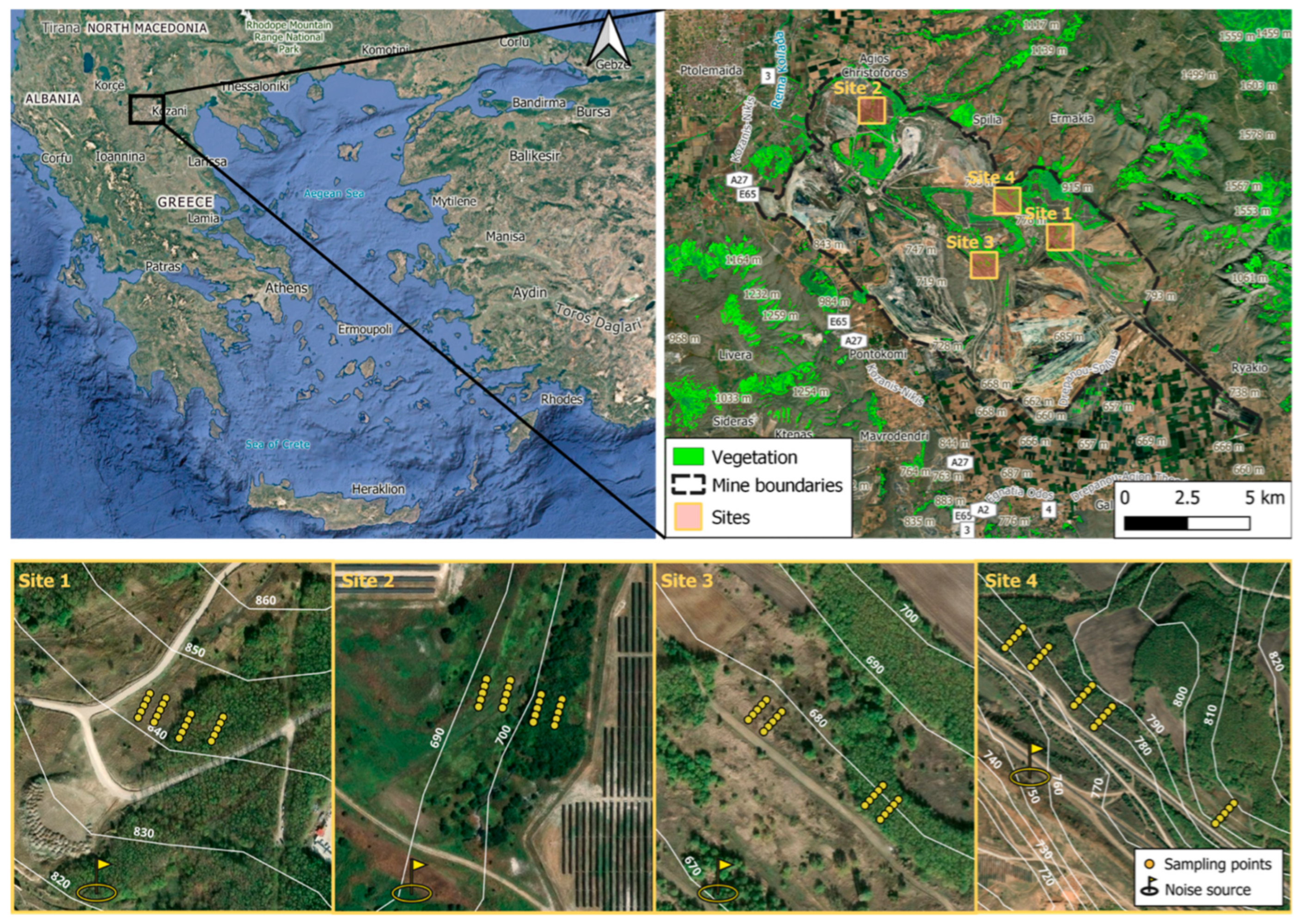
At each site, sound level measurements were conducted along sampling lines extending away from the dominant noise source and passing through the plantation. Five (5) measurement positions were established along each sampling line, corresponding to increasing site-specific distance classes from the source. Measurements were taken both inside and outside forest plantations, allowing comparisons of sound levels between forested and non-forested conditions. The spatial arrangement of the sampling design is shown in Figure 1, including the position of the noise source, the plantation belt, inside and outside forest positions, and the distance classes.
In total, 459 five-minute observations of A-weighted equivalent continuous sound levels (LAeq, dB) were collected. This resulted from repeated measurements across the four sites, inside and outside forest positions, distance classes, and multiple sampling dates during the two study years. Measurements taken on the same date were not statistically independent and thus, date was included as a random effect in the mixed-effects models.

2.2. Noise Measurements and Other Variables Recorded

Noise was measured using a portable Casella CEL-490 sound level meter (Casella CEL Limited, Bedford, UK). During all measurements, the device was fixed on a tripod at a fixed height of 1.2 m above ground to standardize measurement height across all sampling positions. Each observation represented a five-minute measurement period. The response variable used was the A-weighted equivalent continuous sound level (LAeq, dB), recorded using a “Fast” time response setting, which expresses the energy-averaged sound level over each five-minute sampling interval.
During each measurement, meteorological conditions were recorded concurrently or matched to the closest available hourly records from the Pontokomi meteorological station (20.22 N, 21.50 E, 707 m.a.s.l.). The variables used in the analysis are wind speed (km/h), wind direction (degrees), air temperature (°C), and relative humidity (%). These variables were included as outdoor sound propagation is strongly affected by atmospheric conditions.
For the inside forest observations, vegetation structure was characterized using Leaf Area Index (LAI). LAI was measured in situ with a portable canopy analyzer (LAI-2000 Plant Canopy Analyser, LICOR Bioscientific Inc., Lincoln, NE, USA). The instrument provides an estimate of leaf area per unit ground surface area based on below-canopy light transmission. Measurements were performed at all inside-forest points throughout the study period, concurrently with the noise measurements. At each measurement position, below-canopy readings were collected and referenced against open-sky measurements following the manufacturer’s guidelines. Measurements were performed under diffuse light conditions or during periods of low direct solar radiation to minimize bias. LAI values were averaged for each sampling position.

2.3. Statistical Analysis

The analysis was conducted using two complementary mixed-effects models. The first model used the full dataset of 459 LAeq observations and tested whether sound levels differed between inside-forest and outside-forest positions while accounting for distance from the noise source, month, site, wind direction, wind speed, air temperature, and relative humidity. The distance from the noise source was log-transformed before modeling to account for the non-linear nature of outdoor sound attenuation with increasing distance. The measurement date was included as a random intercept to account for repeated measurements collected on the same date.
The second model was fitted only to the inside-forest subset. This subset consisted of 229 observations recorded within plantations for which LAI measurements and all relevant meteorological covariates were available. Outside-forest observations were excluded from this model because LAI is a vegetation-structure variable that is only meaningful within forested stands. Therefore, this model was used specifically to test whether variation in canopy development within plantations explained additional variation in LAeq beyond distance, site, month, and meteorological conditions. The subset was considered representative of inside-forest conditions because it covered the same sampling period, sites, and repeated field campaigns as the main analysis, while restricting the data to observations where vegetation structure could be measured directly.
Model assumptions were evaluated using residual diagnostics, and fixed-effect estimates were interpreted using confidence intervals and p-values from the mixed-effects model outputs. All analyses were performed in R version 4.4.1. [18], using the packages “lme4” [19], “lmerTest” [20], and “emeans” [21].

3. Results

3.1. Differences Among Sites, Forest Position, Distance, and Meteorological Conditions

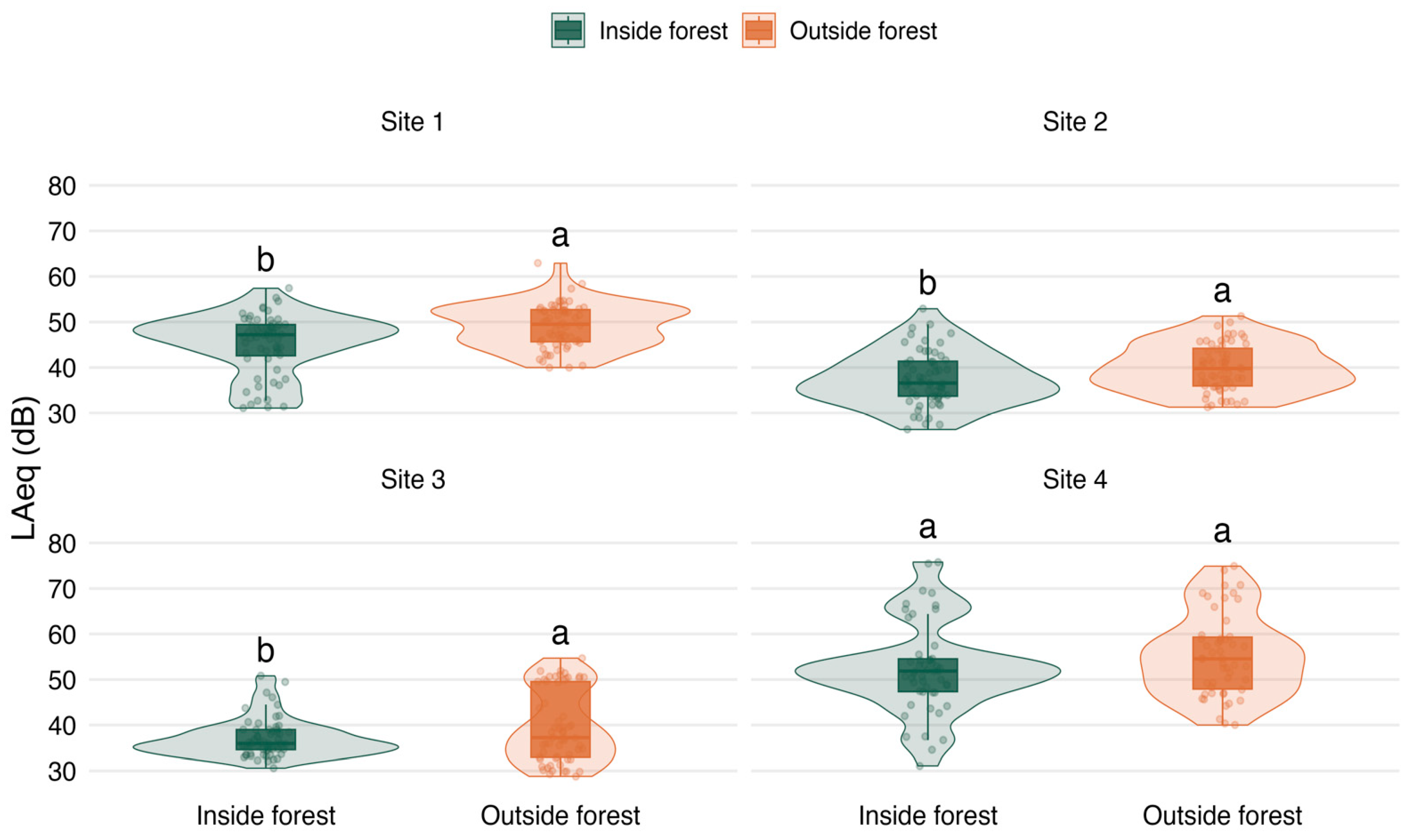
Observed LAeq distributions consistently showed lower values inside the forest than outside (Figure 2), with the difference being significant in 3 of the 4 study sites. The main model explained a substantial proportion of LAeq variation (marginal R2 = 0.56). Site 2 was lower than Site 1 by 5.20 dB (95% CI −8.48 to −1.92, p = 0.002), Site 3 was lower by 7.37 dB (95% CI −10.06 to −4.69, p < 0.001), and Site 4 was higher by 13.26 dB (95% CI 7.08 to 19.43, p < 0.001) (Table 1).
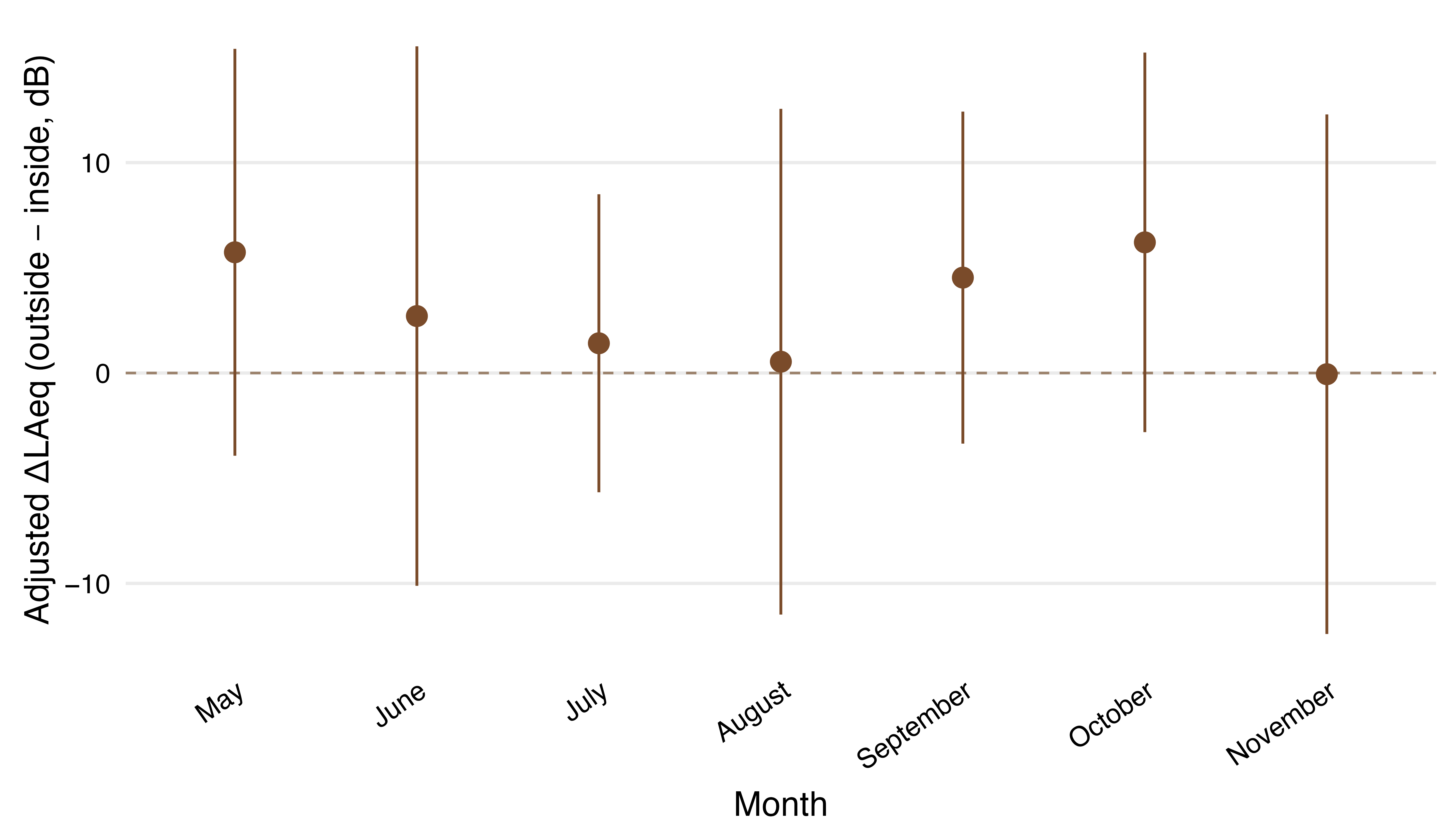
The adjusted inside vs. outside forest contrast was approximately 2.95 dB at the mean observed wind speed and was consistent across sites because the site-by-forest interaction was not significant (p > 0.05). However, the contrast varied with wind speed, as indicated by the significant forest position x wind speed interaction (Table 1). Seasonality was a significant predictor in LAeq (Table 1). The largest inside vs. outside forest contrast was observed in May, when ΔLAeq values were highest, suggesting stronger attenuation within the plantations during late spring (Figure 3). In contrast, attenuation was weaker during August, October, and November, when the inside vs. outside differences were reduced, and confidence intervals largely overlapped to zero (Figure 3). Further, the mixed effect model showed significant monthly differences relative to May, with decreases of 17.24 dB and 14.49 dB, respectively (p < 0.001). August and September showed lower estimated LAeq values than May; however, these effects were not statistically significant (p > 0.05). October and November displayed intermediate values with high variability among observations.
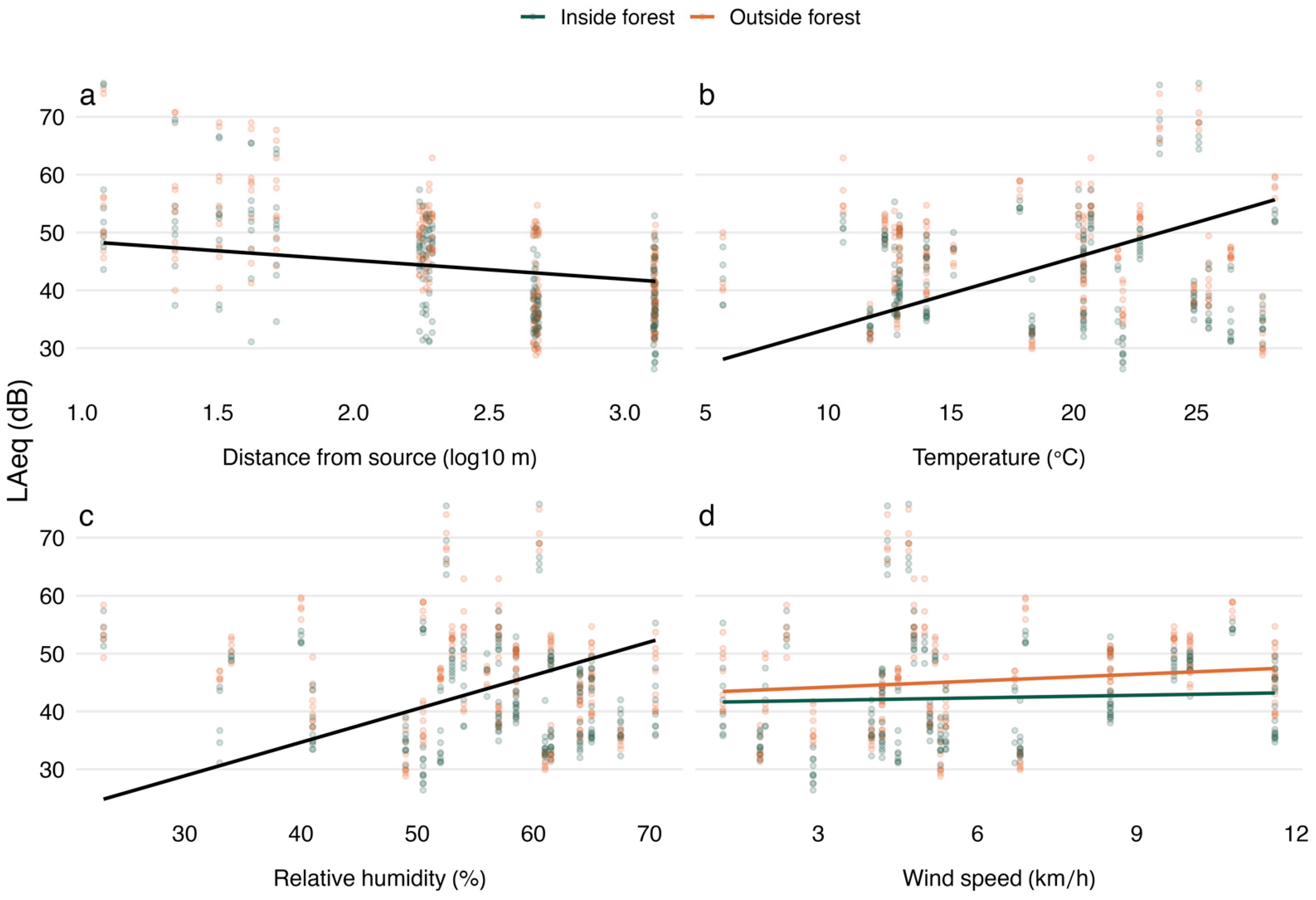
The distance from the source had a significant negative effect (beta = −3.27, p = 0.039; Figure 4a). Air temperature (beta = 1.23, p < 0.001; Figure 4b) and relative humidity (beta = 0.58, p < 0.001; Figure 4c) were positively associated with LAeq (Table 1). Wind speed was not significant (p > 0.05), but its interaction with forest position was significant and positive, indicating that increasing wind speed was associated with a stronger rise in noise levels outside the forest (p < 0.05; Table 1; Figure 4d).

3.2. Inside Forest Model

The inside-forest model explained a similar proportion to the main one (marginal R2 = 0.58). Distance from the source remained negatively associated with LAeq, while temperature and relative humidity had positive effects (Table 1). LAI had a negative but not significant effect (p > 0.05). Adding LAI did not improve model fit (p > 0.05), and the site by LAI interaction was not supported (p > 0.05) (Table 1).

4. Discussion

4.1. Forest Plantations as Acoustic Buffers in Mining Areas

Our results show that noise levels are consistently lower within R. pseudoacacia forest plantations than outside, supporting the central hypothesis that this species’ restoration plantations can function as acoustic buffers at mining sites. The observed reduction is consistent with previous studies showing that tree belts and forested strips can reduce environmental noise during outdoor propagation through a combination of processes, including the partial sound absorption by foliage and bark, scattering by stems and branches, interference associated with heterogeneous vegetation structure, and changes in ground conditions relative to adjacent unvegetated surfaces [4,5,6]. For example, green belts surrounding coal mining areas reduced noise levels by approximately 3–6 dB [4], while wider and denser vegetation belts have also been shown to significantly attenuate environmental noise compared to narrower, sparser plantings [7]. Even modest reductions in noise levels may be ecologically significant, as they can alter masking conditions for wildlife and improve the local sound environment in disturbed habitats where biological sounds compete with persistent technophony (human-generated non-biological sounds produced by machines, vehicles, industrial activity) [1,2,3]. In our case, the reduction observed inside the plantations suggests that post-mining restoration stands may provide not only structural rehabilitation of degraded lands, but also a regulating ecosystem service linked to the acoustic environment.
It is worth mentioning that most studies on vegetation and noise attenuation have focused on roads, transport corridors, or urban belts [4,5,6], whereas studies from restored mining systems are still limited. Our study, therefore, extends knowledge by showing that reclamation plantations established primarily for ecosystem recovery may also reduce noise propagation. This is important in post-mining planning, where vegetation is usually justified by erosion control, biomass production, carbon storage, habitat recovery, and pollution mitigation [9,10,11,12] but may also provide additional regulating functions that remain under-evaluated.

4.2. Role of Distance from the Source

The significant decline in LAeq with increasing distance of the trees from the noise source agrees with general principles of outdoor acoustics and with expectations for industrial noise propagation. As sound travels away from the source, geometric spreading and atmospheric losses reduce received levels in general, although the exact rate of decline is modified by source configuration, terrain, ground properties, and local meteorological conditions [14,15,16]. This result supports our interpretation of the plantation effect, indicating that increased forest plantation depth provided excess attenuation beyond the expected atmospheric and distance-related decrease alone.

4.3. Climatic Conditions and the Moderating Role of Forest Cover

Air temperature and relative humidity were positively associated with LAeq, in accordance with studies showing that sound propagation is sensitive to atmospheric conditions because sound-speed structure, air absorption, and turbulence vary with meteorological state, while gradients in temperature and wind can refract sound waves and alter the amount of acoustic energy reaching near-ground receivers [15,16].
Wind speed was not significant, but the positive interaction between wind speed and the inside-outside-forest variable indicated that increasing wind speed was associated with a stronger rise in noise levels outside the forest than inside. This result suggests that the plantations provided a moderating effect on wind-induced noise transmission, and it is in accordance with studies of vegetated sound barriers, where vegetation structure was found to alter airflow and affect sound propagation [6]. A likely explanation is that the physical structure of the plantation increased aerodynamic roughness, limiting wind velocity and creating a more stable acoustic environment compared to the unobstructed and more direct propagation conditions present in open areas. Studies of sound transmission near forest edges support the view that vegetation boundaries and stand interiors can create more complex propagation environments through scattering, surface contrasts, and altered near-ground atmospheric structure [14].

4.4. Denser Foliage Did Not Reduce Noise

LAI did not have a significant effect on LAeq. Although this may seem contrary to the expectation that denser foliage should produce stronger attenuation, the literature suggests that the relationship between vegetation density and sound reduction is not straightforward. Acoustic performance often depends not only on foliage amount, but also on vertical layering, stem density, belt width, understory development, ground impedance, source frequency spectrum, and the relative geometry of source and receiver [4,5,6,17]. Studies further indicate that vegetation mediated attenuation results from the combined effects of scattering, absorption, diffusion, and modified ground interactions rather than canopy development alone [6,17,22]. As a result, LAI alone may capture only part of the structural variability relevant to sound propagation. This agrees with previous studies showing that vegetation belts with greater structural complexity and depth may provide stronger attenuation independently of foliage density [22].
In addition, the noise attenuation observed in our study may have been driven more by the combined effects of stand presence, edge transition, and microclimatic conditions. This interpretation is consistent with studies showing that the acoustic influence of vegetation often emerges from the whole vegetation–ground system rather than from canopy density alone [5,6,17].
This non-significant role of LAI suggests that the existence of the plantation itself was more important than the variation in canopy density within the sampling sites.

4.5. Site Differences and Seasonal Pattern

Variation across sites is expected in largely fragmented mining areas such as the study area because sound emission depends on the location and intensity of operations, topography, exposure, and the spatial configuration of bare ground, machinery, roads, and restored surfaces [3]. Similar spatial variability in vegetation-mediated noise attenuation has been reported in other studies, where attenuation efficiency depended strongly on vegetation depth, source–receiver geometry, and vegetation structure [4,5,6,7]. Vegetation belts may reduce environmental noise through a combination of sound absorption, scattering, and diffusion processes associated with stems, foliage, and heterogeneous canopy structure [5,6,7].
Seasonal variation was also found, with monthly effects evident in both LAeq and the inside–outside forest difference, and the greatest contrast reported in May. Seasonal differences in vegetation-mediated attenuation have also been discussed in previous studies, although the relationship between foliage development and acoustic attenuation remains complex [5,23]. In our study, no significant relationship between LAI and LAeq was found, suggesting that canopy leaf development alone may not sufficiently explain attenuation patterns. This agrees with previous work indicating that the acoustic benefits of vegetation are not controlled exclusively by foliage density, but also by vegetation structure, ground effects, and perceptual mechanisms associated with green infrastructure [23].
This variation may reflect changes in mining activity and/or shifts in meteorological conditions. At the same time, warmer periods may affect both how much noise is produced by mining activity and how that noise travels through the air, as temperature, humidity, and wind influence sound propagation [15,16]. Because these drivers co-vary seasonally, the present data indicate a robust temporal pattern but do not isolate a single causal mechanism behind the May peak in ΔLAeq.

4.6. Implications for Post-Mining Restoration

Our results support that restoration plantations in industrial landscapes may deliver an additional regulating service, which is acoustic buffering. In the studied mining area, black locust plantations have already been shown to contribute to biomass accumulation, carbon sequestration, soil improvement, and the retention of airborne particulate matter in restored lignite mines [9,10,11,12]. The present findings suggest that these plantations may also reduce and modulate noise propagation, adding another dimension to their environmental value, in consistency with studies emphasizing the multifunctional role of green infrastructure in landscape planning and environmental restoration [24]. This is particularly relevant in post-lignite transition planning, where restoration interventions are increasingly expected to provide multiple ecosystem services rather than simple land-cover replacement [25].
The results support the inclusion of strategically placed forest belts or wider restored plantation zones between noise sources and sensitive receptors, including remnant habitats, restoration patches, infrastructure, or nearby communities. However, the moderate size of the attenuation effect also indicates that vegetation should be viewed as a complementary rather than a stand-alone mitigation measure in active mining systems. Where stronger reductions are required, plantations are likely to be most effective when combined with source control, terrain shaping, earth berms, and careful spatial planning of haul roads and machinery [17]. These findings indicate that black locust restoration plantations should be considered not only as revegetation structures, but also as systems that regulate abiotic conditions and contribute to the recovery of post-mining landscapes [11,12,25].

5. Conclusions

Our study shows that Robinia pseudoacacia L. restoration plantations can reduce the propagation of environmental noise at the largest mining complex in Greece. Noise levels were significantly lower inside plantations than outside, indicating a measurable buffering effect of forest cover. Distance from the noise source remained the strongest predictor of LAeq, while temperature and relative humidity also significantly influenced sound propagation. In contrast, LAI was not significantly associated with noise levels, suggesting that the presence and structural continuity of the plantation may be more important for noise attenuation than short-term variation in tree canopy development.
Vegetation structure was represented primarily through LAI measurements, while other structural characteristics, such as stem density and understory complexity, were not evaluated explicitly. The analyses were based on integrated acoustic indicators rather than frequency-resolved spectral measurements. Thus, the present results support an overall buffering effect of plantations on environmental noise but do not allow identification of the specific frequency ranges most affected by vegetation. In addition, measurements were obtained with a Class 2 sound level meter and thus, small differences close to the tolerance range of the instrument should be interpreted cautiously. However, the inference in this study is based on repeated measurements across sites and dates and on mixed-effects model estimates rather than on isolated paired measurements. Despite these limitations, the present study provides evidence that restoration plantations may contribute to the mitigation of anthropogenic noise in mining areas and highlights the importance of considering vegetation and atmospheric conditions together when evaluating acoustic ecosystem services. Future studies might therefore incorporate octave-band or spectral analyses to better distinguish vegetation-related attenuation mechanisms from other environmental influences on sound propagation.

Author Contributions

Conceptualization, C.S., M.N.F., N.M.F. and K.R.; methodology, C.S., M.N.F., N.M.F. and K.R.; software, C.S., and N.K.; validation, C.S., M.N.F., N.M.F., N.M. and K.R.; formal analysis, N.K.; investigation, C.S.; resources, M.N.F., N.M.F. and K.R.; data curation, C.S., and N.K.; writing—original draft preparation, N.K.; writing—review and editing, N.K., C.S., N.E., M.N.F., N.M.F., N.M., and K.R.; visualization, N.K. and N.E. All authors have read and agreed to the published version of the manuscript.

Funding

This research was funded by the COFORMIT project “Contribution of the tree planted land of West Macedonia lignite center to protection of environment and to mitigation of climate change” (T1EDK-02521), which was financially supported by the Single RTDI state Aid Action Research-Create-Innovate funded by the Operational Program Competitiveness, Entrepreneurship and Innovation 2014–2020 (EPAnEK).

Data Availability Statement

Dataset available on request from the authors.

Acknowledgments

We kindly acknowledge the Hellenic Public Power Corporation (HPPC) for their support with equipment during the field campaigns and for providing climate data from the company’s network of climate stations.

Conflicts of Interest

The authors declare no conflicts of interest.

Abbreviations

The following abbreviations are used in this manuscript:
LAeqA-weighted equivalent continuous sound level
ΔLAeqLAeq outside forest minus LAeq inside forest
LAILeaf Area Index

References

  1. Francis, C.D.; Barber, J.R. A framework for understanding noise impacts on wildlife: An urgent conservation priority. Front. Ecol. Environ. 2013, 11, 305–313. [Google Scholar] [CrossRef]
  2. Shannon, G.; McKenna, M.F.; Angeloni, L.M.; Crooks, K.R.; Fristrup, K.M.; Brown, E.; Warner, K.A.; Nelson, M.D.; White, C.; Briggs, J.; et al. A synthesis of two decades of research documenting the effects of noise on wildlife. Biol. Rev. 2016, 91, 982–1005. [Google Scholar] [CrossRef] [PubMed]
  3. Duarte, M.H.L.; Sousa-Lima, R.S.; Young, R.J.; Farina, A.; Vasconcelos, M.; Rodrigues, M.; Pieretti, N. The impact of noise from open-cast mining on Atlantic forest biophony. Biol. Conserv. 2015, 191, 623–631. [Google Scholar] [CrossRef]
  4. Pal, A.K.; Kumar, V.; Saxena, N.C. Noise attenuation by green belts. J. Sound. Vib. 2000, 234, 149–165. [Google Scholar] [CrossRef]
  5. Van Renterghem, T.; Botteldooren, D.; Verheyen, K. Road traffic noise shielding by vegetation belts of limited depth. J. Sound. Vib. 2012, 331, 2404–2425. [Google Scholar] [CrossRef]
  6. Van Renterghem, T.; Forssén, J.; Attenborough, K.; Jean, P.; Defrance, J.; Hornikx, M.; Kang, J. Using natural means to reduce surface transport noise during propagation outdoors. Appl. Acoust. 2015, 92, 86–101. [Google Scholar] [CrossRef]
  7. Fang, C.-F.; Ling, D.-L. Investigation of the noise reduction provided by tree belts. Landsc. Urban Plan. 2003, 63, 187–195. [Google Scholar] [CrossRef]
  8. Bucur, V. Noise Attenuation with Plant Material. In Urban Forest Acoustics; Springer: Berlin/Heidelberg, Germany, 2006. [Google Scholar] [CrossRef]
  9. Spyroglou, G.; Fotelli, M.; Nanos, N.; Radoglou, K. Assessing black locust biomass accumulation in restoration plantations. Forests 2021, 12, 1477. [Google Scholar] [CrossRef]
  10. Samara, T.; Spanos, I.; Platis, P.; Papachristou, T.G. Heavy metal retention by different forest species used for restoration of post-mining landscapes, N. Greece. Sustainability 2020, 12, 4453. [Google Scholar] [CrossRef]
  11. Sachanidis, C.; Fotelli, M.N.; Markos, N.; Fyllas, N.M.; Radoglou, K. Drivers of PM10 retention by black locust post-mining restoration plantations. Atmosphere 2025, 16, 555. [Google Scholar] [CrossRef]
  12. Xanthopoulos, G.; Radoglou, K.; Derrien, D.; Spyroglou, G.; Angeli, N.; Tsioni, G.; Fotelli, M. Carbon sequestration and soil nitrogen enrichment in Robinia pseudoacacia L. post-mining restoration plantations. Front. For. Glob. Change 2023, 6, 1190026. [Google Scholar] [CrossRef]
  13. Kanzler, M.; Böhm, C.; Freese, D. The development of soil organic carbon under young black locust (Robinia pseudoacacia L.) trees at a post-mining landscape in eastern Germany. New For. 2021, 52, 47–68. [Google Scholar] [CrossRef]
  14. Swearingen, M.E.; White, M.J.; Guertin, P.J. Influence of a forest edge on acoustical propagation: Experimental results. J. Acoust. Soc. Am. 2013, 133, 2566–2575. [Google Scholar] [CrossRef]
  15. Ingard, U. A review of the influence of meteorological conditions on sound propagation. J. Acoust. Soc. Am. 1953, 25, 405–411. [Google Scholar] [CrossRef]
  16. Cheinet, S.; Ehrhardt, L.; Juvé, D.; Blanc-Benon, P. Unified modeling of turbulence effects on sound propagation. J. Acoust. Soc. Am. 2012, 132, 2198–2209. [Google Scholar] [CrossRef] [PubMed]
  17. Van Renterghem, T. Guidelines for optimizing road traffic noise shielding by non-deep tree belts. Ecol. Eng. 2014, 69, 276–286. [Google Scholar] [CrossRef]
  18. R Core Team. R: A Language and Environment for Statistical Computing; (Version 4.4.1) [Computer Software]; R Foundation for Statistical Computing: Vienna, Austria, 2024; Available online: https://www.R-project.org/ (accessed on 8 May 2026).
  19. Bates, D.; Maechler, M.; Bolker, B.; Walker, S. Fitting Linear Mixed-Effects Models Using lme4. J. Stat. Softw. 2015, 67, 1–48. [Google Scholar] [CrossRef]
  20. Kuznetsova, A.; Brockhoff, P.B.; Christensen, R.H.B. lmerTest Package: Tests in Linear Mixed Effects Models. J. Stat. Softw. 2017, 82, 1–26. [Google Scholar] [CrossRef]
  21. Lenth, R.V. Emmeans: Estimated Marginal Means, Aka Least-Squares Means. R Package Version 1.11.1. 2025. Available online: https://CRAN.R-project.org/package=emmeans (accessed on 8 May 2026).
  22. Zhang, Q.; Zhao, L.; Cui, H. Investigation of the noise reduction provided by vegetation belt in different design styles. In Proceedings of the 22nd International Congress on Acoustics (ICA 2016), Buenos Aires, Argentina, 5–9 September 2016. Paper ICA2016-128. [Google Scholar]
  23. Van Renterghem, T. Towards explaining the positive effect of vegetation on the perception of environmental noise. Urban For. Urban Green. 2019, 40, 133–144. [Google Scholar] [CrossRef]
  24. Łowicki, D.; Fornal-Pieniak, B.; Schwerk, A. Urban greenery services for noise attenuation, pollutant filtration, and temperature lowering: Supply potential, demand, and budgets in Poznań, Poland. Ecosyst. Serv. 2025, 73, 101713. [Google Scholar] [CrossRef]
  25. Larondelle, N.; Haase, D. Valuing post-mining landscapes using an ecosystem services approach—An example from Germany. Ecol. Indic. 2012, 18, 567–574. [Google Scholar] [CrossRef]
Figure 1. Study area and sampling design used for sound level measurements in restoration plantations within the mining complex of Western Macedonia, Greece. Upper left: Location of the mining area within Greece. Upper right: The four study sites where measurements were conducted within the mining complex. Bottom: The four study sites including noise sources, sampling points, and terrain elevation lines.
Forests 17 00690 g001
Figure 2. LAeq data distribution inside and outside the forest by sites. Raw distributions are shown with violin and boxplots overlaid with individual observations shown as slightly offset points. Median LAeq values were 44.0 vs. 51.8 dB at Site 1, 37.5 vs. 40.1 dB at Site 2, 36.1 vs. 41.3 dB at Site 3, and 49.9 vs. 51.8 dB at Site 4. Letters indicate Tukey groupings, and different letters indicate significant differences between inside and outside forest positions at p < 0.05.
Forests 17 00690 g002
Figure 3. Seasonal variation in ΔLAeq, defined as LAeq (outside_forest)–LAeq (inside_forest). Positive values indicate that noise levels were higher outside the forest, consistent with stronger sound attenuation within the plantations (n = 20 per month).
Forests 17 00690 g003
Figure 4. Partial effects of environmental variables on LAeq estimated from the mixed-effect models. Panels show (a) distance from source, (b) air temperature, (c) air relative humidity, and (d) wind speed. Black lines in panels (ac) show adjusted fitted relationships averaged over the observed distribution of the other covariates. In panel (d), inside and outside forest effects are shown separately for wind speed. Dots represent raw observations.
Forests 17 00690 g004
Table 1. Fixed-effect estimates for the main model.
EffectTermEstimateStd. ErrorStatisticdfp ValueConf. LowConf. High
fixed(Intercept)1.36810.3310.13234.1880.895−19.62422.360
fixedsite_group Site2−5.1971.670−3.112456.4280.002−8.479−1.915
fixedsite_group Site3−7.3741.366−5.398339.044<0.001−10.062−4.687
fixedsite_group Site413.2563.0624.33042.472<0.0017.08019.433
fixedmonth June−17.2354.406−3.91125.488<0.001−26.301−8.168
fixedmonth July−14.4893.628−3.99424.995<0.001−21.960−7.017
fixedmonth August−8.0054.732−1.69225.4400.103−17.7421.733
fixedmonth September−5.3883.113−1.73124.7170.096−11.8021.026
fixedmonth October−2.6633.478−0.76623.6050.452−9.8484.522
fixedmonth November−6.8194.348−1.56824.1270.130−15.7922.153
fixedin_out_forest01.5450.7502.060433.1520.0400.0713.019
fixedwind_speed0.1500.3760.39925.6330.693−0.6230.923
fixedlog10_dist_m−3.2681.581−2.067433.1420.039−6.374−0.161
fixedwd1.2981.5640.83024.3480.415−1.9274.524
fixedtemp_sampling1.2260.2474.97125.382<0.0010.7181.734
fixedrh_sampling0.5790.1314.42725.774<0.0010.3100.848
fixedin_out_forest0:
wind_speed
0.2320.1112.095433.1490.0370.0140.450
Disclaimer/Publisher’s Note: The statements, opinions and data contained in all publications are solely those of the individual author(s) and contributor(s) and not of MDPI and/or the editor(s). MDPI and/or the editor(s) disclaim responsibility for any injury to people or property resulting from any ideas, methods, instructions or products referred to in the content.