


Abstract
Acantholyda posticalis (Hymenoptera: Pamphiliidae) is a forestry pest in China. They primarily infest pine trees, causing serious ecological damage. The research aims to identify the key environmental factors influencing the suitable distribution area of Acantholyda posticalis and their optimal conditions, and investigate the impacts of climate change and possible impacts of its main host plants on the distribution of Acantholyda posticalis. By utilizing the MaxEnt model, we predict the potential distribution of Acantholyda posticalis and its main host plant, Pinus tabuliformis, under current and future climatic conditions. The results indicate that under current climatic conditions, the suitable areas for Acantholyda posticalis in China are extensive in the Loess Plateau and North China Plain regions and have extensive overlapping area with the distribution of Pinus tabuliformis. The dominant environmental factors influencing the distribution of suitable areas for Acantholyda posticalis are the Minimum Temperature of the Coldest Month, Precipitation of the Wettest Quarter, Altitude and Temperature Seasonality. Under the SSP126 and SSP585 climate scenarios for the period 2081–2100, the overall suitable area for Acantholyda posticalis is projected to follow a decreasing trend, exhibiting a tendency to extend toward the southern and eastern regions. Meanwhile, the moderately and highly suitable areas are more concentrated and extensive. The research provides a theoretical foundation for the control of Acantholyda posticalis and the protection of the ecological environment.
1. Introduction
Acantholyda posticalis (Hymenoptera: Pamphiliidae) is a widespread web-spinning sawfly characterized by its large population size, rapid dispersal rate, and high density of overwintering larvae in the soil. In recent years, outbreaks of Acantholyda posticalis have occurred in multiple regions across China. In China, it primarily damages pine trees such as Pinus tabuliformis, Pinus densiflora and Pinus sylvestris, which play vital roles in windbreak and sand fixation, soil and water conservation, climate regulation, biodiversity maintenance, and ecological restoration [1,2]. For instance, from 1967 to 1979, Acantholyda posticalis damaged over 2000 hectares of secondary Pinus tabuliformis forests in the Shuzhang forest area of Huguan County, Shanxi Province. Subsequently, outbreaks of Acantholyda posticalis have been reported in regions including Shaanxi, Shanxi, Henan, Gansu, Shandong, and Heilongjiang, severely disrupting normal tree growth and posing a significant threat to the ecological environment [2,3,4,5,6,7]. The larvae of Acantholyda posticalis bring serious damage to pine trees, the larvae sever the base of the current year’s pine shoots, spin silk to form nests, and then cut off the tips of newly grown needles to drag into the nests for feeding. This leads to a massive needle drop, with severely infested pine forests appearing scorched and yellowed, resembling a burned-like landscape, continuous infestation over several years can result in the death of trees [5]. Therefore, given the damage caused by Acantholyda posticalis to forestry ecological construction and the overall ecological environment, effective control and management of this pest are of critical importance. Currently, multiple regions in China have undertaken control measures against Acantholyda posticalis. These include the implementation of appropriate silvicultural practices, effective chemical and biological pesticide applications, as well as natural enemy-based biological control [1]. Although significant achievements have been made in control efforts, they have been limited to areas where Acantholyda posticalis has already erupted. The control measures exhibit a certain degree of lag and face challenges in implementing preventive actions ahead of potential outbreaks.
To enhance the prevention of Acantholyda posticalis, this research utilized 57 distribution points of Acantholyda posticalis and 381 distribution points of its primary host plant, Pinus tabuliformis, in China, combined with 19 climatic environmental variables and altitude data, constructing MaxEnt models. We obtained the potential suitable area of Acantholyda posticalis and its main host plants, Pinus tabuliformis, in China under current and future climate conditions and identified the key environmental factors influencing their distribution and their optimal suitability conditions. Furthermore, we investigated the impacts of climate change on the expansion trends of the suitable area for Acantholyda posticalis and Pinus tabuliformis, explored the possible impact of host plants on the potential distribution of Acantholyda posticalis, and thereby provided a theoretical foundation for the control of Acantholyda posticalis and the protection of the ecological environment.
2. Materials and Methods
2.1. Occurrence Data
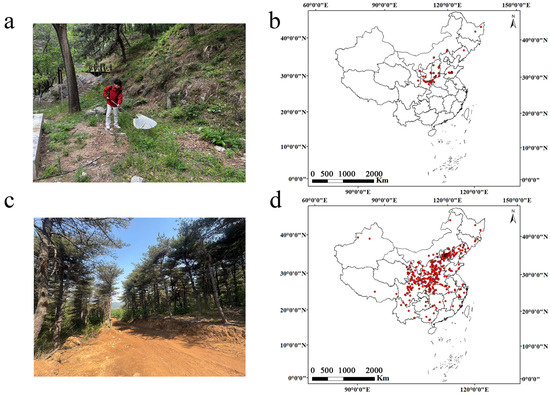
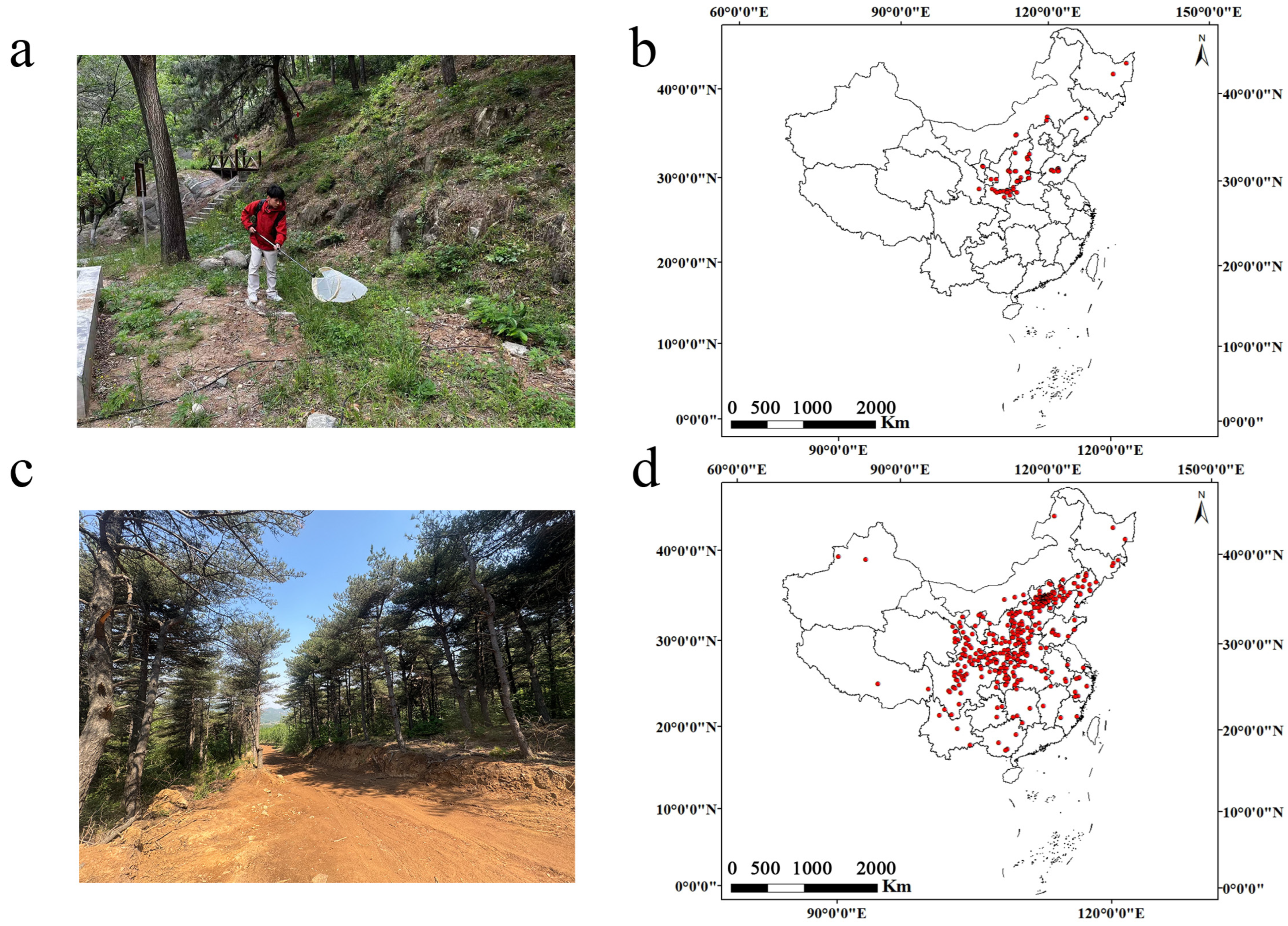
By consulting GBIF (https://www.gbif.org/ (accessed on 12 May 2026)) and iNaturalist (https://www.inaturalist.org (accessed on 12 May 2026)), conducting literature searches, and performing field collections (Figure 1a,c), the distribution points of Acantholyda posticalis and its primary host plant Pinus tabuliformis in China were obtained [1,2,3,4,7,8,9,10,11,12,13,14,15,16,17,18,19,20,21,22,23,24,25,26]. To avoid overfitting caused by overly clustered distribution points, the occurrence data for both Acantholyda posticalis and Pinus tabuliformis were filtered using ENMTools 1.1.5 [27]. This ensured that only one occurrence point was retained per raster cell of each environmental variable. Through this processing, we sacrificed some sample size but significantly improved the independence and representativeness of the samples in both geographic and environmental space, preventing model predictions from being biased toward densely sampled areas. This process resulted in a final dataset of 57 distribution points for Acantholyda posticalis (Figure 1b) and 381 distribution points for Pinus tabuliformis (Figure 1d). Our distribution records cover most of the distribution records of Acantholyda posticalis and Pinus tabuliformis in China and previous studies have shown that MaxEnt performs reliably even with small sample sizes [28]. Therefore, our sample size is sufficient to support robust model construction.
Figure 1.
Occurrence data of Acantholyda posticalis and its primary host plant Pinus tabuliformis in China. (a) Authors’ field—collected photographs. (b) Occurrence data of Acantholyda posticalis in China. (c) Field collection sites of Acantholyda posticalis. (d) Occurrence data of Pinus tabuliformis in China.
2.2. Bioclimatic Variables
The environmental variables utilized in this study were all sourced from WorldClim (https://www.worldclim.org (accessed on 12 May 2026)). The selected variables include 19 climatic environmental variables under current climatic conditions (1970–2000) and 19 climatic environmental variables under future climatic conditions (2081–2100), along with elevation data. All the selected variables were at a spatial resolution of 2.5 arc-minutes. For the future climatic environmental variables, this study adopted the BCC-CSM2-MR model (Beijing Climate Center Climate System Model, a medium-resolution model) from the Coupled Model Intercomparison Project Phase 6 (CMIP6). Based on shared socioeconomic pathways, the research selected two greenhouse gas emission scenarios: SSP126 and SSP585 [29].
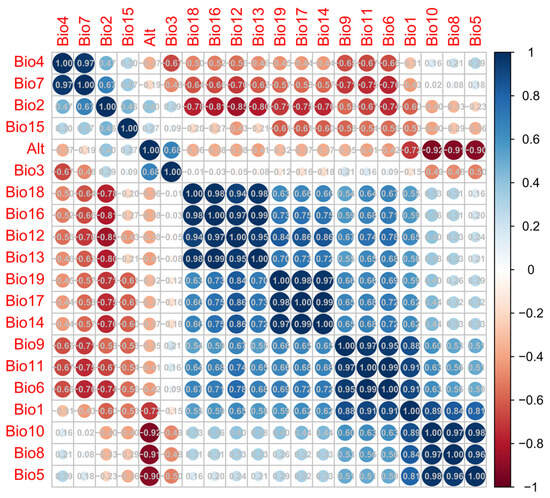
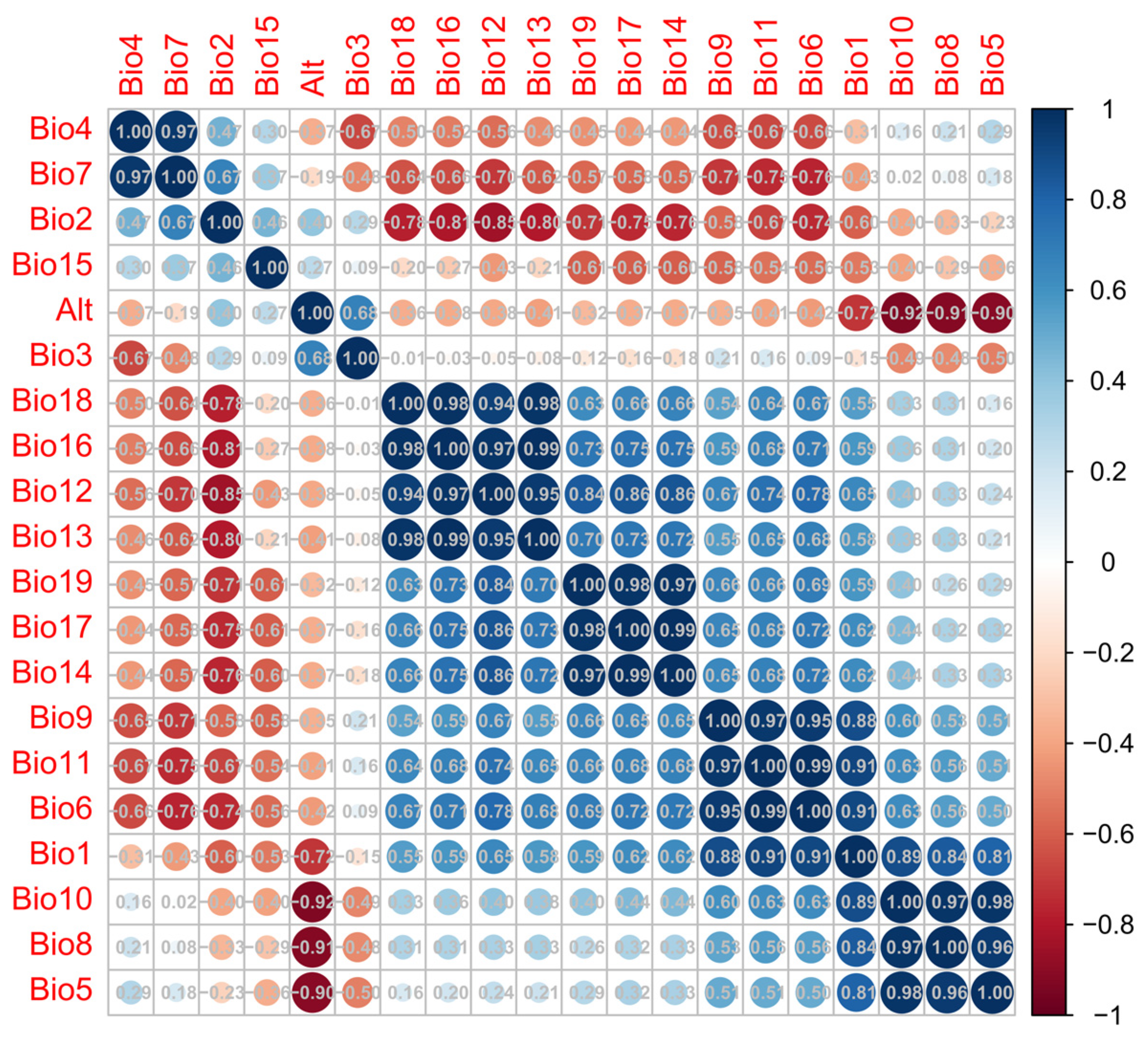
There is correlation among different environmental variables, which can lead to model overfitting and affect the accuracy of model predictions. To avoid overfitting and inaccurate predictions caused by excessively high correlations among environmental variables, we screened the environmental variables [30]. First, a model was constructed using all environmental variables to calculate the contribution rate of each variable. Subsequently, correlation analysis of the environmental variables was performed using ENMeval (version 2.0.5) in R (version 4.4.3) to assess the relationships among them (Figure 2). It is generally considered that a correlation greater than 0.8 between two environmental variables indicates a high degree of correlation. If the correlation between two environmental variables exceeds 0.8, the variable with the higher contribution rate was retained for subsequent model construction.
Figure 2.
Correlation between environmental variables.
Finally, eight environmental variables were selected for the model construction of Acantholyda posticalis (Table 1), including: Mean Diurnal Range (Bio2), Temperature Seasonality (Bio4), Min Temperature of Coldest Month (Bio6), Mean Temperature of Warmest Quarter (Bio10), Precipitation Seasonality (Bio15), Precipitation of Wettest Quarter (Bio16), Precipitation of Driest Quarter (Bio17) and Altitude. Eight environmental variables were selected for the model construction of Pinus tabuliformis (Table 2), including: Mean Diurnal Range (Bio2), Isothermality (Bio3), Temperature Annual Range (Bio7), Mean Temperature of Wettest Quarter (Bio8), Mean Temperature of Coldest Quarter (Bio11), Annual Precipitation (Bio12), Precipitation Seasonality (Bio15) and Altitude.
Table 1.
Percentage contribution of environmental variable for MaxEnt model of Acantholyda posticalis.
Table 2.
Percentage contribution of environmental variable for MaxEnt model of Pinus tabuliformis.
2.3. Modeling Procedure and Optimization
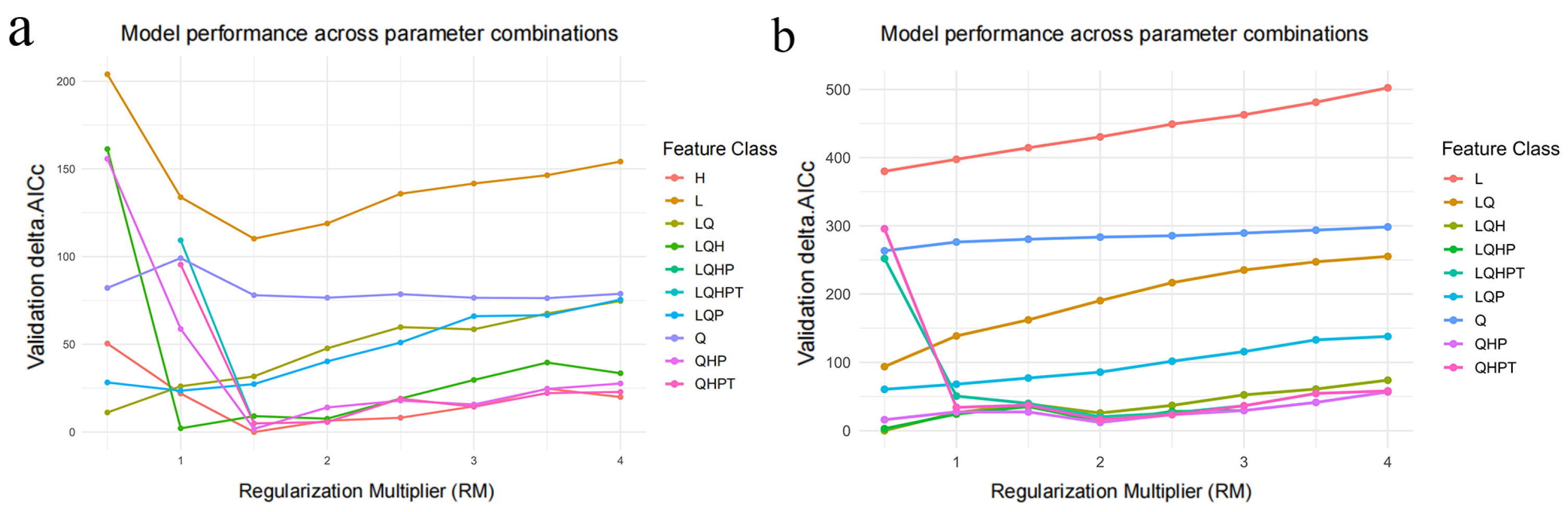
MaxEnt version 3.4.4 was used in this study [31]. The screened species distribution points and the environmental variables used for modeling were input into the MaxEnt model. For the parameter settings of the MaxEnt model, the output format was typically set to “Logistic”, with “ASC” selected as the file type and “Subsample” as the replication type. Usually, 25% of the dataset was randomly allocated as the test dataset, the number of training replicates was set to 10, and the maximum number of iterations was set to 5000. When the MaxEnt model is overly simplistic or complex, it may reduce the model’s ability to predict the potential distribution of species [32]. The Akaike Information Criterion (AIC) is used to evaluate model performance by balancing goodness of fit and complexity. By adjusting the regularization multiplier and feature types, the model parameters are tuned to minimize the AICc value, balancing goodness-of-fit and complexity to avoid overfitting. A model with the minimum AICc value (ΔAICc = 0) is considered the most parsimonious and optimal. In this study, different feature combinations (FC) and regularization multipliers (RM) were tested in R (version 4.4.3), and the combination with the lowest AICc was selected as the optimal configuration for model construction [33].
2.4. Model Evaluation
Model evaluation was performed using the Receiver Operating Characteristic (ROC) curve from the Area Under the Curve (AUC) analysis method [34]. The AUC value ranges from 0 to 1, with the following evaluation criteria: 0–0.6 indicates no predictive ability, 0.6–0.7 indicates low predictive ability, 0.7–0.8 indicates moderate predictive ability, 0.8–0.9 indicates good predictive ability, and 0.9–1 indicates excellent predictive ability. However, given the limitations of traditional AUC value, we also used the Partial ROC (pROC) method for model evaluation. Partial ROC focuses only on the portion of the ROC curve with low false positive rates, which better aligns with the requirements of ecological niche modeling. The Partial ROC results are presented as the AUC ratio and its statistical significance (p-value). An AUC ratio > 1 indicates that the model performs significantly better than random prediction, a p-value < 0.05 indicates that this improvement is statistically significant [35]. TSS (True Skill Statistic) measures the binary classification accuracy of a model at a given threshold. We also used a True Skill Statistic (TSS) value to evaluate the model. The TSS value ranges from 0 to 1, with larger values indicating a better model [36]. Moreover, the Omission rate measures the extent to which a model misclassifies actual presence points as “absent”. After converting the continuous model predictions into a binary grid (suitable/unsuitable) using a selected threshold, the Omission rate is the proportion of test presence points that fall into “unsuitable” areas (grid cells below the threshold) [37]. It is also very important for model evaluation. The Omission rate ranges from 0 to 1: a value of 0 indicates that all test presence points fall within predicted suitable area, representing minimal omission error; a value of 1 indicates that all test presence points are omitted, meaning the model completely fails. In this study, we used the model’s minimum training presence training omission, minimum training presence test omission, 10 percentile training presence training omission and 10 percentile training presence test omission as an important indicator for evaluating the model. The constructed MaxEnt model was imported into ArcGIS 10.8.1 software for reclassification processing [38], dividing the suitable area for Acantholyda posticalis and its main host plant Pinus tabuliformis into non-suitable area (≤0.1), low-suitable area (0.1–0.3), medium-suitable area (0.3–0.5), and high-suitable area (>0.5).
3. Results
3.1. Parameters of the Model
The AICc value of the MaxEnt models for Acantholyda posticalis and Pinus tabuliformis under different parameter settings were obtained via ENMeval (Figure 3). For the MaxEnt model of Acantholyda posticalis, the AICc value was 0 when FC = H and RM = 1.5; for the MaxEnt model of Pinus tabuliformis, the AICc value was 0 when FC = LQH and RM = 0.5. Therefore, these parameter combinations were selected for modeling Acantholyda posticalis and Pinus tabuliformis in this research.
Figure 3.
The AICc value of the MaxEnt model for Acantholyda posticalis and Pinus tabuliformis under different parameters. (a) AICc value of the MaxEnt model for Acantholyda posticalis under different parameters. (b) AICc value of the MaxEnt model for Pinus tabuliformis under different parameters. Note: The “LQHP” curve and the “QHP” curve in (a) coincide.
3.2. Model Assessment and Main Environmental Factors Affecting the Distribution of Acantholyda posticalis and Pinus tabuliformis
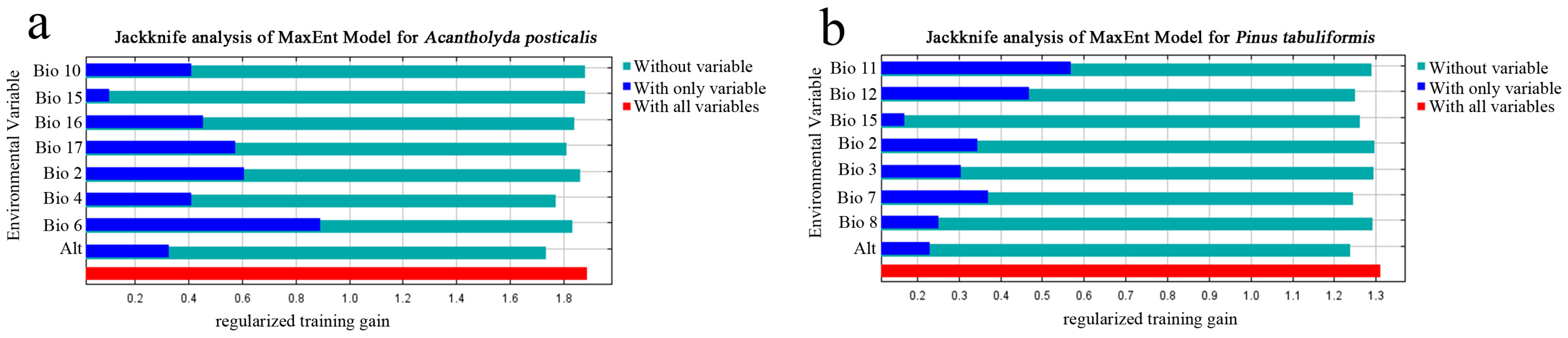
The AUC value, TSS value, Omission rate, Partial ROC value and AUC Ratio value of MaxEnt model for Acantholyda posticalis are shown in Table 3. The model evaluation result indicates that the model possesses high predictive capability (Table 3). According to the Jackknife analysis of the model for Acantholyda posticalis (Figure 4a), the model’s gain was highest when the Minimum Temperature of the Coldest Month (Bio6) was used alone. The model’s gain decreased the most when the Altitude was excluded individually. Integrating the contribution rates of the environmental variables, the key environmental factors determining the distribution of suitable areas for Acantholyda posticalis were identified as the Minimum Temperature of the Coldest Month (Bio6), Precipitation of the Wettest Quarter (Bio16), Altitude, and Temperature Seasonality (Bio4). The AUC value, TSS value, Omission rate, Partial ROC value and AUC Ratio value of MaxEnt model for Pinus tabuliformis is shown in Table 4. The result of model evaluation indicates that the model also has good predictive performance (Table 4). Based on the Jackknife analysis of the model for Pinus tabuliformis (Figure 4b), the model’s gain was highest when the Mean Temperature of the Coldest Quarter (Bio11) was used alone; the model’s gain decreased the most when the Altitude variable was excluded individually. Considering the contribution rates of the environmental variables, the key environmental factors influencing the distribution of suitable habitats for Pinus tabuliformis were determined to be the Mean Temperature of the Coldest Quarter (Bio11), Annual Precipitation (Bio12), Altitude, Temperature Annual Range (Bio7), and Precipitation Seasonality (Bio15).
Table 3.
Model evaluation of Acantholyda posticalis.
Figure 4.
Jackknife analysis of MaxEnt model for Acantholyda posticalis and Pinus tabuliformis. (a) Jackknife analysis of MaxEnt model for Acantholyda posticalis. (b) Jackknife analysis of MaxEnt model for Pinus tabuliformis.
Table 4.
Model evaluation of Pinus tabuliformis.
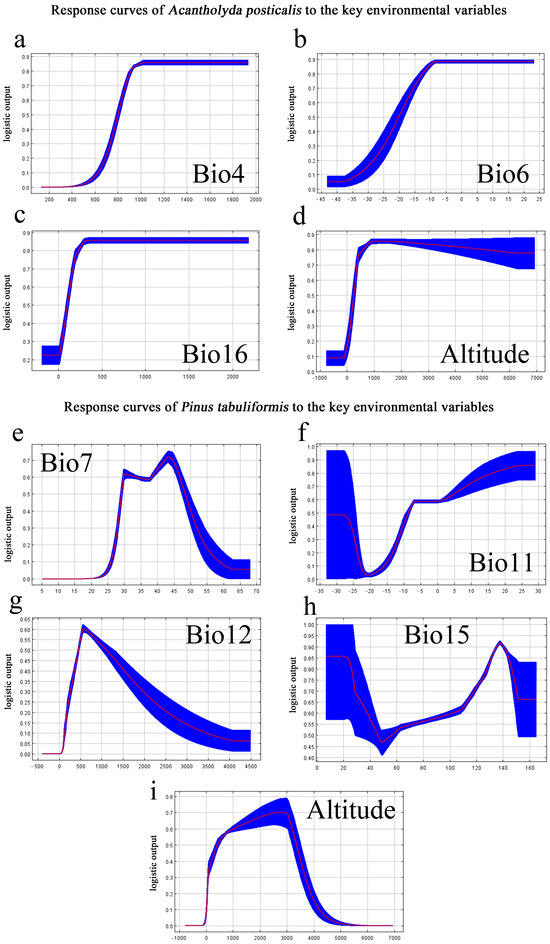
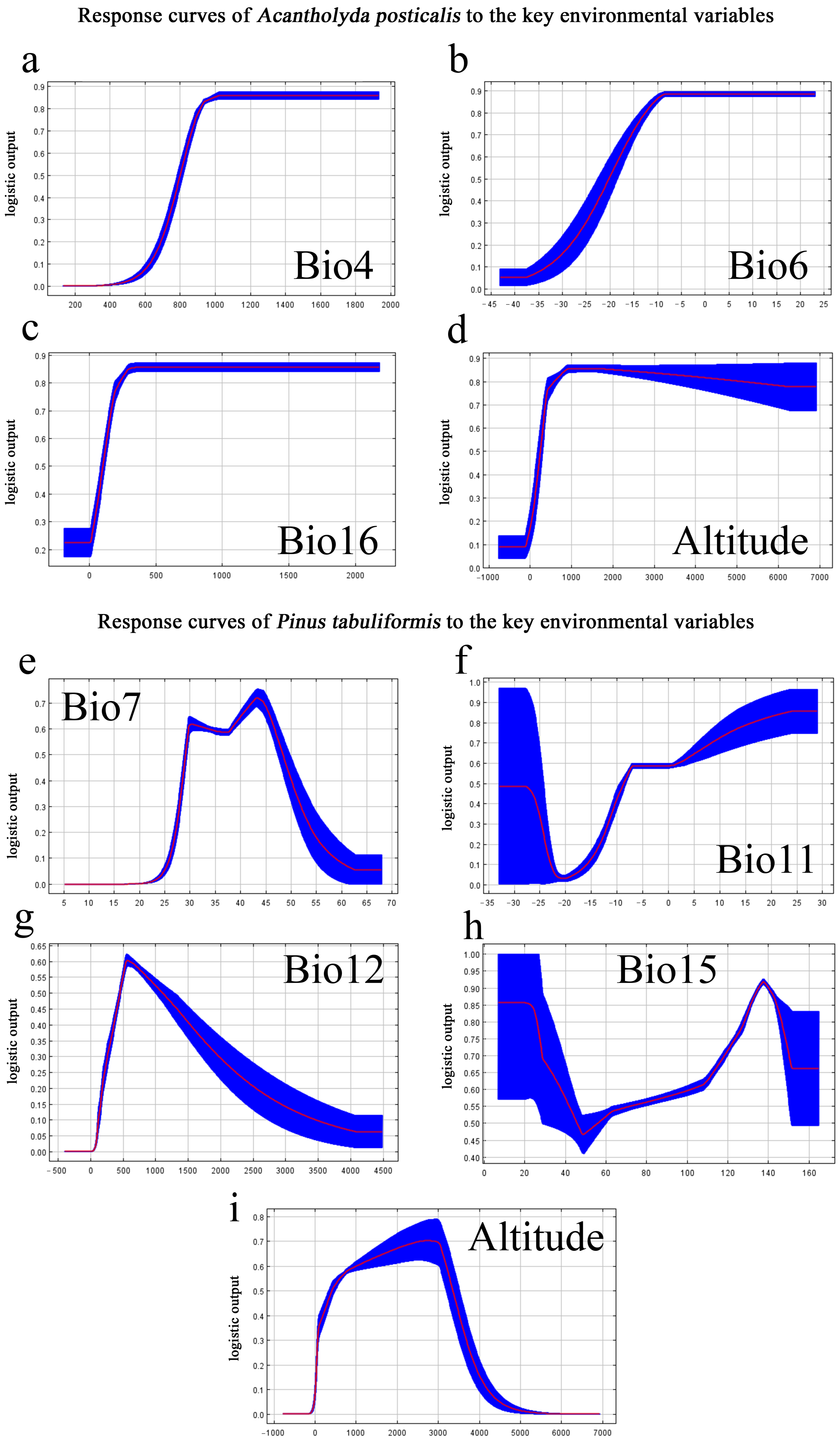
Based on the response curves from the MaxEnt model (Figure 5), the optimal suitable conditions for Acantholyda posticalis are as follows: suitability increases with Temperature Seasonality (Bio4) when it ranges from 600 to 1000, peaking above 1000. It also increases with the Minimum Temperature of the Coldest Month (Bio6) between −30 °C and −10 °C, with the peak above −10 °C. Similarly, suitability rises with Precipitation of the Wettest Quarter (Bio16) from 0 to 300 mm (peak > 300 mm) and with Altitude from 0 to 1000 m (peak around 1000 m). For Pinus tabuliformis, the response patterns are more complex. For Temperature Annual Range (Bio7), suitability follows a fluctuating trend: increases between 25 and 30 °C, decreases between 30 and 38 °C, increases again between 38 and 43 °C, and decreases beyond 43 °C, with the overall peak near 43 °C. Regarding the Mean Temperature of the Coldest Quarter (Bio11), suitability decreases between −27 °C and −22 °C, remains stable between −22 °C and −20 °C, increases between −20 °C and −8 °C, stabilizes again between −8 °C and 0 °C, and increases further from 0 °C to 23 °C, peaking around 23 °C. For Annual Precipitation (Bio12), suitability increases up to 550 mm and then decreases, with the peak at approximately 550 mm. When it comes to Precipitation Seasonality (Bio15), suitability shows a decrease (20–48), then an increase (48–137.5), and finally a decrease (137.5–151.6), peaking near 137.5. In terms of Altitude, suitability increases up to 2780 m and decreases thereafter, peaking at around 2780 m.
Figure 5.
Response curves of Acantholyda posticalis to the key environmental variables. (a) Response curve of Acantholyda posticalis to Temperature Seasonality. (b) Response curve of Acantholyda posticalis to Minimum Temperature of the Coldest Month. (c) Response curve of Acantholyda posticalis to Precipitation of the Wettest Quarter. (d) Response curve of Acantholyda posticalis to Altitude. (e) Response curve of Pinus tabuliformis to Temperature Annual Range. (f) Response curve of Pinus tabuliformis to Mean Temperature of the Coldest Quarter. (g) Response curve of Pinus tabuliformis to Annual Precipitation. (h) Response curve of Pinus tabuliformis to Precipitation Seasonality. (i) Response curve of Pinus tabuliformis to Altitude. Note: The curves show the mean response of the 10 replicate Maxent runs (red) and the mean +/− one standard deviation (blue).
3.3. The Potential Distribution of Acantholyda posticalis and Pinus tabuliformis in China Under Current Climate Conditions
3.3.1. The Potential Distribution of Acantholyda posticalis in China Under Current Climate Conditions
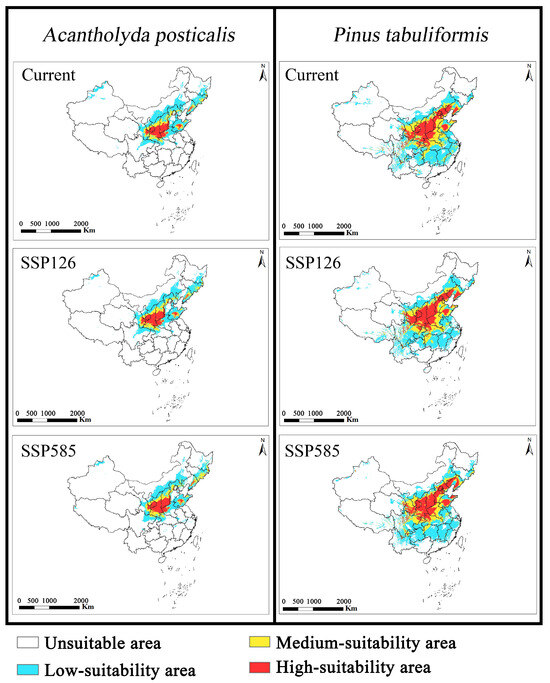
Based on the Maxent model and the distribution of Acantholyda posticalis in China, the prediction results of its suitable area under current climate conditions (Figure 6) indicate that the suitable area for Acantholyda posticalis in China is relatively large, with a total area of approximately 1.70 million km2. Among these, the total area of high-suitability zones is about 0.27 million km2, accounting for approximately 15.9% of the total suitable area. These zones are mainly distributed in Shaanxi Province, eastern Gansu Province, southern Shanxi Province, western Henan Province, Shandong Province and Liaoning Province. The total area of medium-suitability zones is about 0.30 million km2, accounting for approximately 17.4% of the total suitable area. These zones are primarily distributed in Shaanxi Province, Shandong Province and northeastern Hubei Province. The low-suitability zones cover an extensive area, with a total of approximately 1.13 million km2, accounting for about 66.7% of the total suitable area. These zones are mainly distributed in central and northeastern China, including Shandong Province, Henan Province, southern Inner Mongolia Autonomous Region, Heilongjiang Province, Jilin Province, Liaoning Province, northern Hebei Province, Tianjin Municipality and northeastern Sichuan Province.
Figure 6.
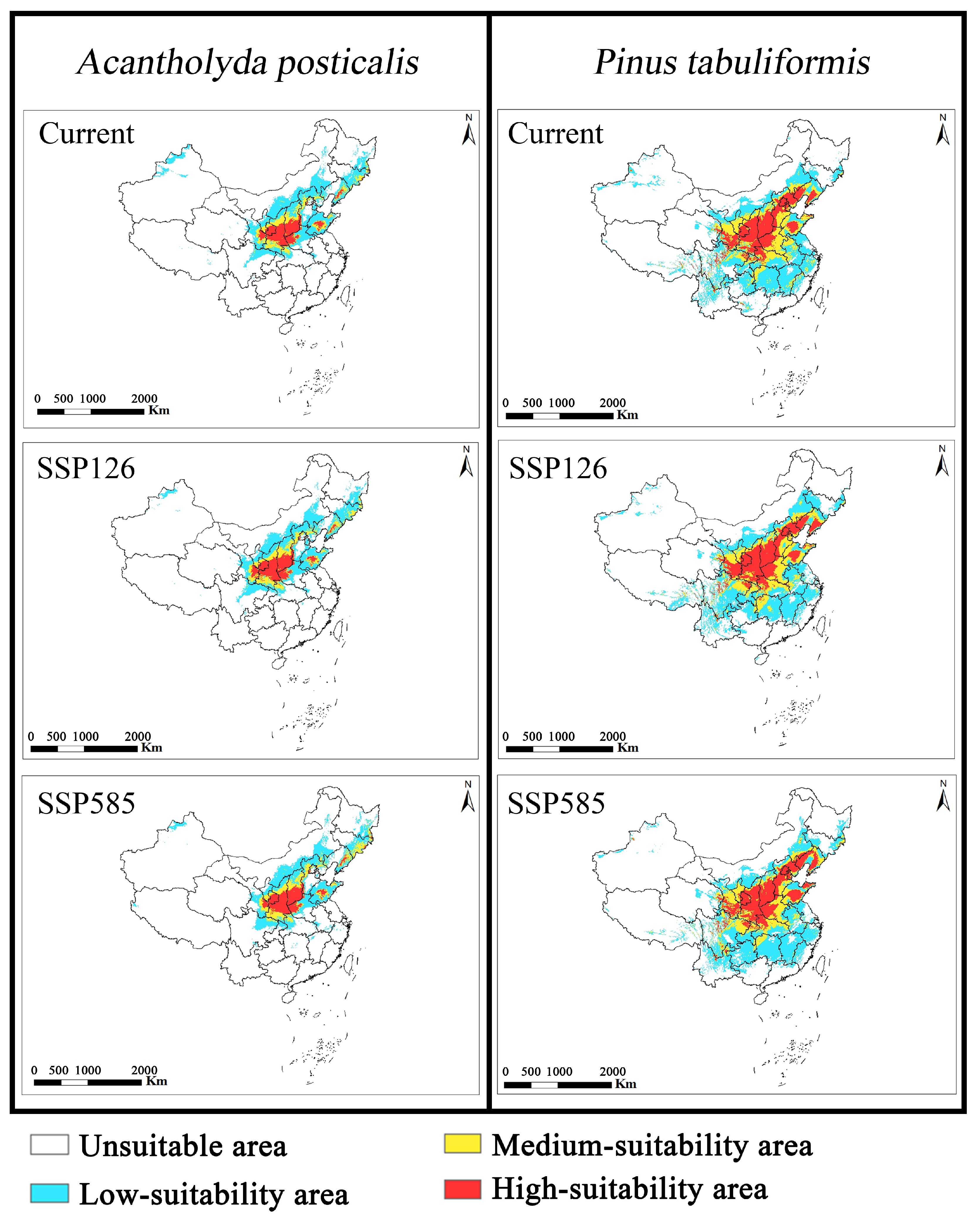
Suitable area of Acantholyda posticalis and Pinus tabuliformis under current and future climate scenarios in China.
3.3.2. The Potential Distribution of Pinus tabuliformis in China Under Current Climate Conditions
Based on the Maxent model and the distribution of Pinus tabuliformis in China, the prediction results of the suitable habitat area for Pinus tabuliformis under current climate scenarios (Figure 6) indicate that the suitable habitat range for Pinus tabuliformis is larger than that of Acantholyda posticalis, with a total area of approximately 3.26 million km2. Among these, the high-suitability area covers about 0.71 million km2, accounting for approximately 21.9% of the total suitable habitat area. This area is mainly distributed in regions such as Shaanxi Province, Shanxi Province, Beijing, Hebei Province, Liaoning Province, Henan Province, Gansu Province, Shandong Province, and Hubei Province. The medium-suitability area covers about 0.84 million km2, accounting for approximately 25.7% of the total suitable habitat area, primarily located in Hebei Province, Henan Province, Ningxia Hui Autonomous Region, Hubei Province, and Gansu Province. The low-suitability area covers approximately 1.71 million km2, accounting for about 52.4% of the total suitable habitat area, distributed across Hunan Province, Jiangxi Province, Anhui Province, Zhejiang Province, Chongqing, Sichuan Province, Guizhou Province, Fujian Province, Yunnan Province, and Inner Mongolia Autonomous Region.
3.4. The Potential Distribution of Acantholyda posticalis and Pinus tabuliformis in China Under Future Climate Conditions
3.4.1. The Potential Distribution of Acantholyda posticalis in China Under Future Climate Conditions
Under future climate scenarios, the suitable habitat area for Acantholyda posticalis in China will exhibit an overall trend of eastward and southward expansion compared to current climate conditions. Across different future climate scenarios, the total area of suitable habitats for Acantholyda posticalis in China will show a decreasing trend. However, the moderately and highly suitable areas have significantly increased compared to those under the current climate scenario.
Under the SSP126 climate scenario for the year 2081–2100, the suitable habitat area for Acantholyda posticalis in China will decrease to approximately 1.65 million km2. Compared to the current climate scenario, this will represent a decrease of 3.07% in the suitable habitat area for Acantholyda posticalis in China under the 2081–2100 SSP126 scenario. The highly suitable area will have increased by 5.45% compared to the current climate scenario. The moderately suitable area will have increased by 3.72% compared to the current climate scenario, showing a trend of expansion toward the south. Notably, the moderately suitable area in southern Shaanxi Province and southern Gansu Province will have increased significantly. The low-suitability area will show a decreasing trend, having decreased by 6.88% compared to the current climate scenario, with an overall shift toward the south. The low-suitability area in regions such as Hebei Province and Ningxia Hui Autonomous Region will decrease significantly (Figure 6).
Under the SSP585 climate scenario, the suitable habitat area for Acantholyda posticalis in China will be approximately 1.62 million km2, representing a decrease of 4.84% compared to the current climate conditions. The highly suitable area will show an upward trend, increasing by 5.34% relative to the current climate scenario. The moderately suitable area will also expand and show a tendency to spread toward the north and east, with an increase of 15.49% compared to the current climate scenario. Significant increases in the moderately suitable area will be observed in regions such as Shanxi, Hebei, and Jilin provinces. In contrast, the low-suitability area will decrease by 12.57% compared to the current climate scenario. Specifically, the low-suitability area in Hebei Province decreases significantly (Figure 6).
3.4.2. The Potential Distribution of Pinus tabuliformis in China Under Future Climate Conditions
Under future climate scenarios, the suitable distribution area for Pinus tabuliformis in China will exhibit an overall trend of expanding toward the northeast and southwest compared to current climatic conditions. The total area of suitable habitats for Pinus tabuliformis in China will generally show an upward trend under different future climate scenarios.
Under the SSP126 climate scenario in 2081–2100, the suitable distribution area of Pinus tabuliformis in China is approximately 3.26 million km2, representing an increase of 0.05% compared to the current climate scenario. Among these, the area of highly suitable regions will show an overall increasing trend, rising by 7.2% relative to the current climate scenario. Notably, the highly suitable area will expand significantly in Shaanxi, Gansu, and Liaoning provinces. The area of moderately suitable regions will decrease by 5.27% compared to the current climate scenario, with varying degrees of reduction observed in Liaoning, Anhui, Hebei, Hunan, Sichuan, and other provinces. The area of low-suitability regions will decline by 0.32% compared to the current climate scenario, showing a tendency to shift toward the northeast and southwest directions. Specifically, the low-suitability area will show a clear decreasing trend in Jiangsu and Zhejiang provinces, while an obvious increasing trend will be observed in Jilin, Sichuan, Jiangsu, and other regions (Figure 6).
Under the SSP585 climate scenario, the suitable area for Pinus tabuliformis in China will be 3.30 million km2, representing an increase of 1.26% compared to the current climate scenario. Among this, the highly suitable area will have increased by 9.7% relative to the current climate scenario, showing a tendency to expand toward the northeastern regions. The highly suitable area will increase significantly in provinces such as Shaanxi, Liaoning, Shandong, and Hebei. In contrast, the moderately suitable area will decrease overall by approximately 8.65% compared to the current climate scenario, with notable reductions observed in Shandong, Anhui, and Hebei provinces. The low-suitability area will increase by 2.58% compared to the current climate scenario. Specifically, the minimally suitable area will decrease significantly in Jiangsu and Zhejiang provinces, while it has significantly increased in Heilongjiang, Sichuan, and Guizhou provinces (Figure 6).
3.5. Analysis of the Overlapping Area of Potential Distribution for Acantholyda posticalis and Pinus tabuliformis Under Current and Future Climate Conditions
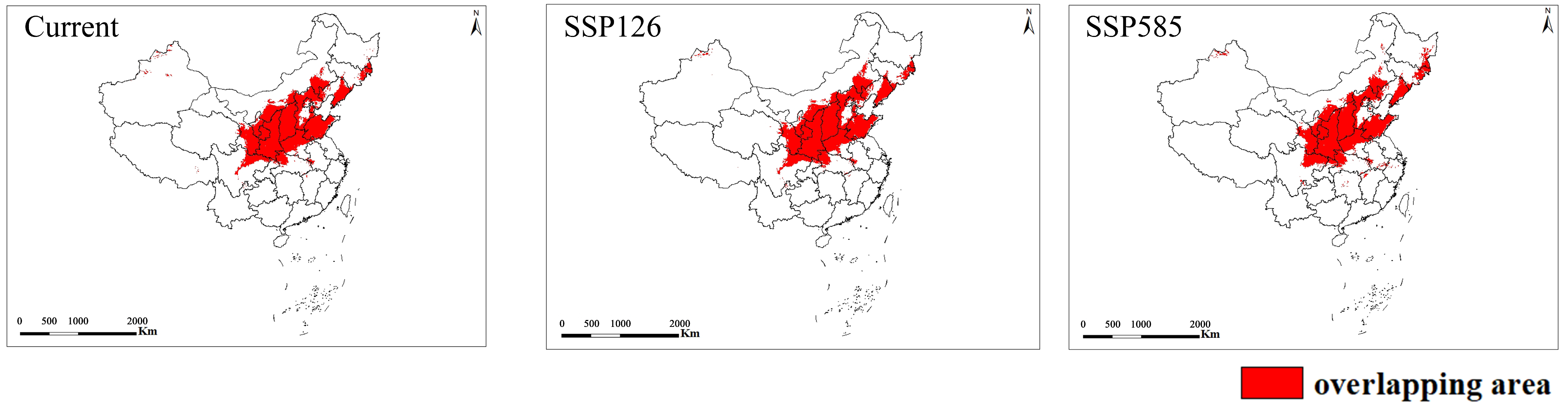
Based on the MaxEnt model and the distribution of Acantholyda posticalis and Pinus tabuliformis in China, we calculated the overlapping area of potential distribution for Acantholyda posticalis and Pinus tabuliformis under current and future climate conditions (Figure 7). Under the current climate scenario, the overlapping area of potential distribution for Acantholyda posticalis and Pinus tabuliformis is approximately 1.41 million km2, accounting for approximately 82.7% of the total area of potential distribution for Acantholyda posticalis and approximately 43.2% for Pinus tabuliformis. Under the SSP126 climate scenario in 2081–2100, the overlapping area of potential distribution for Acantholyda posticalis and Pinus tabuliformis will be approximately 1.43 million km2, corresponding to approximately 86.5% of the total area of potential distribution for Acantholyda posticalis and approximately 43.8% for Pinus tabuliformis. Under the SSP585 climate scenario in 2081–2100, the overlapping area of potential distribution for Acantholyda posticalis and Pinus tabuliformis will be approximately 1.39 million km2, amounting to approximately 85.6% of the total area of potential distribution for Acantholyda posticalis and approximately 42.0% for Pinus tabuliformis.
Figure 7.
The overlapping area of potential distribution for Acantholyda posticalis and Pinus tabuliformis under current and future climate conditions.
3.6. Changes in the Distribution Center of Acantholyda posticalis in China Under Future Climate Conditions
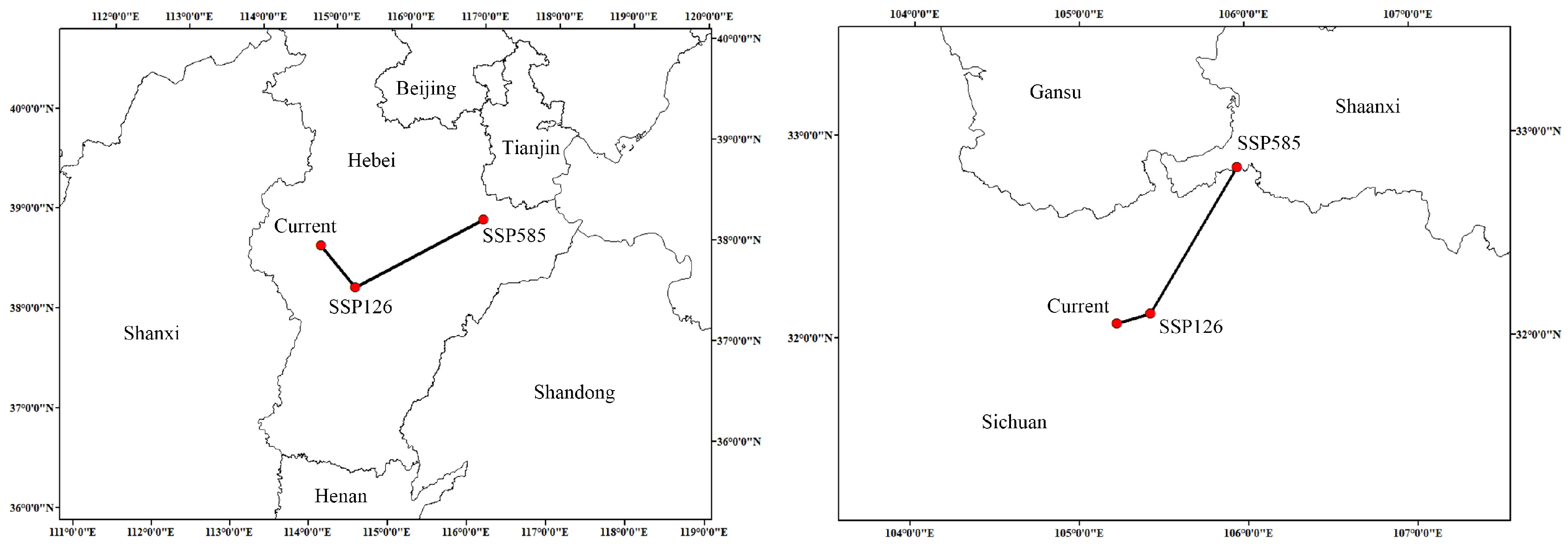
Comparative analysis of the centroid shifts in suitable habitats for Acantholyda posticalis and Pinus tabuliformis under current and future (2081–2100) SSP126 and SSP585 climate scenarios was conducted (Figure 8). Under the current climate scenario, the centroid of Acantholyda posticalis’ suitable habitat is located in the western region of Hebei Province (geographic center coordinates 38.42° N, 114.49° E). Under the SSP126 climate scenario, the centroid of Acantholyda posticalis’ suitable habitat will shift to the southwestern region of Hebei Province (geographic center coordinates 37.96° N, 114.89° E). Under the SSP585 climate scenario, the centroid of Acantholyda posticalis’ suitable habitat will further shift to the southeastern region of Hebei Province (geographic center coordinates 38.50° N, 116.66° E). Under the current climate scenario, the centroid of Pinus tabuliformis’ suitable habitat is located in the northern region of Sichuan Province (geographic center coordinates 32.08° N, 105.22° E). Under the SSP126 climate scenario, the centroid of Pinus tabuliformis’ suitable habitat will shift to the northeast (geographic center coordinates 32.13° N, 105.42° E). Under the SSP585 climate scenario, the centroid of Pinus tabuliformis’ suitable habitat will further shift to the southwestern region of Shaanxi Province (geographic center coordinates 32.85° N, 105.95° E).
Figure 8.
The distribution center shifts in Acantholyda posticalis and Pinus tabuliformis in China.
4. Discussion
These results indicate that under current climate conditions, the Acantholyda posticalis has potentially suitable distribution ranges in Loess Plateau and North China Plain regions in China. Specifically, high-suitability areas for Acantholyda posticalis are widely distributed in central Shaanxi Province, eastern Gansu Province, southern Shanxi Province, western Henan Province, Shandong Province, and Liaoning Province in China (Figure 6). Under future climate scenarios, the suitable distribution area of Acantholyda posticalis shows a decreasing trend, among this, minimally suitable areas for Acantholyda posticalis will significantly decrease compared to those under the current climate scenario. But the moderately suitable and highly suitable areas will significantly increase compared to those under the current climate scenario. This result indicates that the minimally suitable area will gradually shrink, while the remaining suitable habitat patches will shift toward higher suitability classes. Consequently, although the overall distribution range of Acantholyda posticalis will narrow, its core suitable area (moderately and highly suitable areas) will become more concentrated and extensive (Figure 6). Under current climate conditions, the Pinus tabuliformis’ suitable area covers Loess Plateau, North China Plain, Southeastern Hilly Region and Sichuan Basin in China. Specifically, high-suitability areas for Pinus tabuliformis are widely distributed in Beijing Municipality, Tianjin Municipality, central Shaanxi Province, southern Gansu Province, central and southern Shanxi Province, Hebei Province, western Henan Province, Northwestern Hubei Province, Shandong Province and Liaoning Province in China (Figure 6). Under future climate scenarios, the total area of suitable habitats for Pinus tabuliformis in China will generally show an upward trend, among this, the highly suitable area will significantly increase, but the moderately suitable area will significantly decrease. This result indicates that suitable areas will become increasingly concentrated in higher suitability patches, but intermediate transitional areas will shrink. This result suggests that although total suitable area for Pinus tabuliformis will increase, habitat connectivity may be compromised, and the species may become more dependent on core suitable areas. Furthermore, the research identified the key environmental variables influencing the distribution of suitable areas for Acantholyda posticalis as Minimum Temperature of the Coldest Month (Bio6), Precipitation of the Wettest Quarter (Bio16), Altitude, and Temperature Seasonality (Bio4). The key environmental variables influencing the distribution of suitable areas for Pinus tabuliformis are the Mean Temperature of the Coldest Quarter (Bio11), Annual Precipitation (Bio12), Altitude, Temperature Annual Range (Bio7), and Precipitation Seasonality (Bio15). The optimal suitability conditions for Acantholyda posticalis and Pinus tabuliformis were determined, and the influences of climatic factors (Table 1 and Table 2) and the possible impact of host plants on the potential distribution of Acantholyda posticalis were explored. This provides a theoretical basis for subsequent pest control and ecological conservation efforts regarding Acantholyda posticalis. Based on the research, we will discuss the following aspects:
4.1. The Impact of Climate Change on the Spread of Acantholyda posticalis and Pinus tabuliformis
Insects are poikilothermic animals; temperature has a significant impact on their distribution [39,40,41]. Furthermore, overwintering in the soil is an essential stage for the larvae of Acantholyda posticalis to develop into adults. The larvae of Acantholyda posticalis mostly enter the soil at a depth of 6–20 cm under the tree crown projection in early June, where they construct a loose earthen chamber to spend the summer and winter [42]. According to the results of the MaxEnt model, the Minimum Temperature of the Coldest Month (Bio6) is the key environmental factor limiting the potential suitable distribution of Acantholyda posticalis, suggesting that extreme low temperatures may be a constraint on its population survival and expansion. Under future climate scenarios, the Minimum Temperature of the Coldest Month in northeastern China shows an upward trend, which may influence the spread of Acantholyda posticalis to some extent. The response curves indicate that when the Minimum Temperature of the Coldest Month (Bio6) was between −30 °C and −10 °C, the suitability of Acantholyda posticalis increased significantly as temperature increased (Figure 5); this may influence its northward expansion. Moreover, the Precipitation of the Wettest Quarter (Bio16) may directly affect the survival rate of Acantholyda posticalis’ larvae by influencing soil moisture, thereby impacting the distribution of its potentially suitable area. Numerous studies have confirmed a significant positive correlation between summer and autumn precipitation and shallow soil moisture [43]. Furthermore, research has shown that the water content of the larvae is positively correlated with local precipitation [44]. Appropriate soil moisture ensures that the larval body does not desiccate and shrivel, thereby maintaining normal physiological metabolism. In forest stands with deep soil layers, loose soil texture, and high moisture content, the overwintering survival rate of the larvae is higher [1]. Based on the results of the response curves (Figure 5), when the Precipitation of the Wettest Quarter (Bio16) was between 0 and 300 mm, the suitability of Acantholyda posticalis increased as precipitation increased. This suggests that the larvae of Acantholyda posticalis prefer to overwinter in moist soil. Under the SSP585 climate scenario, Precipitation of the Wettest Quarter in northeastern China increases significantly, which may facilitate the spread of Acantholyda posticalis. Temperature Seasonality (Bio4) is also a critical environmental factor affecting the suitable distribution of Acantholyda posticalis. According to the response curves (Figure 5), when Temperature Seasonality was between 600 and 1000, the suitability of Acantholyda posticalis increased as Temperature Seasonality increased; this suggests that Acantholyda posticalis is more adapted to temperate climates with distinct seasons, warm summers, and cold winters. This aligns with the concentration of its primary potential suitable area in northern China under both current and future climate scenarios (Figure 6). When Altitude was between 0 and 1000 m, the suitability of Acantholyda posticalis increased as altitude increased, with the highest suitability observed at 1000 m. This suggests that within this elevation range, higher altitudes facilitate the spread of Acantholyda posticalis. The pests may favor lower temperature and less anthropogenic disturbance. According to the research results, when the Temperature Annual Range (Bio7) is around 43 °C, the suitability of Pinus tabuliformis is relatively high. This suggests that Pinus tabuliformis may prefer a climate with a large temperature difference between winter and summer. When the Mean Temperature of the Coldest Quarter (Bio11) ranges from 0 °C to 23 °C, the suitability of Pinus tabuliformis increases significantly with rising temperature, indicating that Pinus tabuliformis favors relatively mild cold-season temperatures. When the mean temperature of the coldest quarter is too low, the suitability of Pinus tabuliformis decreases markedly, whereas milder cold-season temperatures may be more favorable for its survival. Among the moisture-related factors, Annual Precipitation (Bio12) and Precipitation Seasonality (Bio15) also have significant effects. The suitability of Pinus tabuliformis increases with increasing annual precipitation in the range of 0–550 mm, but decreases with increasing precipitation in the range of 550–1000 mm, with the peak occurring around 550 mm. This indicates that Pinus tabuliformis may prefer moderate precipitation conditions, as both excessively wet and excessively dry conditions are unfavorable for the formation of its optimal habitat. Regarding Precipitation Seasonality (Bio15), when it ranges from 20 to 48, the suitability of Pinus tabuliformis decreases with increasing seasonality; when it ranges from 48 to 137.5, suitability increases with increasing seasonality; and when it ranges from 137.5 to 151.6, suitability decreases again with increasing seasonality. The peak suitability occurs around 137.5. This suggests that both extremely high and extremely low precipitation seasonality may reduce the suitability of Pinus tabuliformis, and that Pinus tabuliformis may be better adapted to regions with a pronounced summer rainy season that is not overly concentrated. In addition, altitude also has a significant influence on the potential distribution of suitable habitats for Pinus tabuliformis. In the altitude range of 0–2780 m, suitability increases with increasing altitude. In the range of 2780–5000 m, suitability decreases with increasing altitude. The peak suitability occurs around 2780 m, indicating that this altitude area may be the most suitable zone for the growth of Pinus tabuliformis.
Moreover, several limitations should be emphasized. First, our models are correlative and do not establish causality. The identified values reflect statistical associations rather than true physiological or ecological breakpoints. Second, we did not incorporate biotic interactions such as competition, predation, dispersal constraints, or human-mediated transport, all of which may strongly modulate species expansion. Consequently, predictions of epidemic risk based on these values should be interpreted cautiously.
4.2. The Possible Impact of Host Plant Distribution on the Spread of Acantholyda posticalis
Host plants serve as a crucial material foundation for species survival [38,45,46]. The possible influence of host plants on the distribution of Acantholyda posticalis is also quite significant. According to the research results, there is extensive overlapping area between the suitable area of Acantholyda posticalis and its primary host plant, Pinus tabuliformis, under both current and future climate scenarios (Figure 7). Under the current climate scenario, the overlapping area reaches approximately 1.41 million km2, accounting for 82.7% of the pests’ potential range but only 43.2% of the host plants’ range. This indicates that although there is a large overlap in the potential distribution areas between Acantholyda posticalis and Pinus tabuliformis, a substantial proportion of the host plants’ range remains uncolonized, possibly due to additional climatic limitations. Under the SSP126 scenario in 2081–2100, the overlapping area slightly increases to 1.43 million km2, raising the proportion of the pests’ range occupied by the host to 86.5%. This suggests that a low-emission scenario may further align the pests’ potential distribution with its host plants, potentially facilitating range expansion of Acantholyda posticalis. In contrast, under the SSP585 scenario in 2081–2100, the overlapping area decreases to 1.39 million km2, representing 85.6% of the pests’ range and 42.0% of the host plants’ range. This indicates that climate change could drive the pest and its host plants toward partial mismatch, potentially limiting the spread of Acantholyda posticalis in some regions where the host plants remain but climatic conditions become unfavorable for the pests, or the pests remain but climatic conditions become unfavorable for the host plants. The result also indicates a significant expansion of the highly suitable area for Pinus tabuliformis, with a notable spread toward the northeastern region of China. This trend and the dispersal pattern of Acantholyda posticalis’s moderately suitable area are simultaneous, which greatly increases the risk of outbreaks of Acantholyda posticalis in the northeastern area. In the future, the overlapping area of the suitable areas for Acantholyda posticalis and Pinus tabuliformis such as Shaanxi Province, Shanxi Province, Henan Province, southeastern Gansu Province, Shandong Province, Hebei Province, eastern Liaoning Province, southern Ningxia Hui Autonomous Region, northwestern Hubei Province and northeastern Sichuan Province can be regarded as a high-risk area. These areas exhibit extensive overlap in the suitable habitats of Acantholyda posticalis and Pinus tabuliformis, indicating a high likelihood of Acantholyda posticalis establishing populations, which poses a significant threat to host plants and the ecological environment. It is also noteworthy that the research results indicate the dominant climatic variables for Pinus tabuliformis are the Mean Temperature of the Coldest Quarter (Bio11) and Annual Precipitation (Bio12) (Table 2). The result suggests that the distribution conditions for Pinus tabuliformis may be more influenced by long-term climatic conditions. The distribution of Acantholyda posticalis, however, is more strongly influenced by climatic conditions related to larval overwintering, such as extreme low temperatures. The result indicates that although the potential distribution of Acantholyda posticalis and Pinus tabuliformis have extensive overlapping areas under current and future climate scenarios, their ecological niches do not entirely overlap due to differences in the dominant climatic variables. Furthermore, the research predicted the potential suitable area for Acantholyda posticalis and Pinus tabuliformis separately, without incorporating the distribution of Pinus tabuliformis as an environmental variable into the MaxEnt model. Future research could integrate biological factors such as the distribution of the pest’s natural enemies, primary host plants, and human activities into the model to improve the accuracy of the results.
4.3. Ecological Security and Control Strategies
The research provides a theoretical basis for ecological security protection and pest control. Under the current climate scenario, the moderately and highly suitable areas for Acantholyda posticalis are concentrated in regions such as Shaanxi Province, Shanxi Province, and Gansu Province in China (Figure 6). These areas should be designated as core zones for continuous monitoring and control. Meanwhile, in regions where the study indicates significant expansion of medium-suitability areas, such as the southeastern part of Jilin Province, the northeastern part of Shanxi Province and western part of Hebei Province which represent the leading edges of Acantholyda posticalis expansion, it is essential to establish early monitoring and warning systems in advance (Figure 6). Strengthened quarantine measures should be implemented, with a focus on preventing human-assisted spread through the transport of infested seedlings [47], thereby effectively carrying out prevention and blockade efforts against Acantholyda posticalis.
Under the SSP126 and SSP585 climate scenarios (2081–2100), although the total suitable area for Acantholyda posticalis tends to decrease, its core suitable area (moderately and highly suitable areas) will become more concentrated and extensive. Specifically, under the SSP585 climate scenario, moderately suitable areas increase notably in Shanxi Province and Jilin Province. Moreover, the distribution center of suitable areas moves from western Hebei Province (38.42° N, 114.49° E) to the southwestern region of Hebei Province (37.96° N, 114.89° E) and further to southeastern Hebei (38.50° N, 116.66° E). Control efforts should therefore gradually shift eastward, with proactive management plans established in regions such as the southeastern part of Jilin Province, where the suitability for pests will significantly increase. In areas where current suitability is projected to decline, such as in central Sichuan and northwestern Xinjiang Uygur Autonomous Region, routine control inputs can be reduced in favor of ecological restoration and stand structure optimization.
The suitable areas of Acantholyda posticalis and Pinus tabuliformis exhibit a high degree of overlap. These overlapping zones are mainly located in the Loess Plateau and North China Plain. We recommend implementing an integrated “host resistance–pest management” strategy in these zones: prioritize planting resistant provenances of Pinus tabuliformis, avoid large-scale pure stands, and promote mixed forest patterns in overlapping areas, such as in Shaanxi Province, Shanxi Province, Henan Province, southeastern Gansu Province, Shandong Province, Hebei Province, eastern Liaoning Province, southern Ningxia Hui Autonomous Region, northwestern Hubei Province and northeastern Sichuan Province, to reduce outbreak risk. Additionally, as the suitable area of Pinus tabuliformis is projected to expand northeastward and southwestward, new afforestation should avoid the overlapping area of potential distribution for Acantholyda posticalis and Pinus tabuliformis.
In addition, it is important to note that although chemical control may yield faster results during pest outbreaks, it can pose risks to the ecological environment and non-target organisms. Given the wide range of suitable habitats for the Acantholyda posticalis and the fragility of the ecosystems involved, sustainable control strategies should be adopted. In potential suitable areas for Acantholyda posticalis, priority should be given to biological control and ecological regulation strategies. For biological control, natural enemies such as predatory bugs can be protected and utilized [1,3]. For ecological regulation, mixed forests should be established to avoid a large-scale monoculture of pine species, thereby enhancing forest diversity and stability and improving resistance to pests [1]. When chemical intervention is necessary, environmentally friendly agents should be used as much as possible, with precise and targeted application to minimize harm to the ecological environment and non-target organisms.
4.4. Limitations of Sample Size and Their Potential Impact on Predictive Accuracy
Although the MaxEnt models constructed in this study demonstrated excellent predictive performance, it is important to acknowledge that the limited number of occurrence records—particularly only 57 distribution points for Acantholyda posticalis—may impose constraints on the robustness and generalizability of the predicted suitable areas. Insufficient sample size can lead to overfitting or underfitting, where the model fails to detect critical environmental constraints.
In the present study, the 57 distribution points of Acantholyda posticalis were carefully screened to reduce spatial autocorrelation using ENMTools, and the model parameters were optimized via the AICc-based approach to mitigate overfitting. Nevertheless, the relatively sparse sampling, especially from the western and southern parts of China, may mean that the full range of environmental conditions tolerated by the species is not fully represented. This could result in an underestimation of potentially suitable areas in undersampled regions or, conversely, an overestimation in regions where sampling points are clustered.
To address these limitations, future research should collect more distribution points for Acantholyda posticalis across its entire potential range in China. More comprehensive distribution points could further enhance model validation. Additionally, ensemble modeling approaches—combining multiple algorithms such as GARP, BIOCLIM and random forest—may help reduce the uncertainty associated with single-model predictions driven by small sample sizes [48].
5. Conclusions
The research results indicated that Acantholyda posticalis and Pinus tabuliformis have broad potential suitable areas in China. Under future climate scenarios, the low suitable area of Acantholyda posticalis will gradually shrink, while the remaining suitable habitat patches will shift toward higher suitability classes, the moderately suitable area and high suitable area of Acantholyda posticalis will expand significantly and show a trend of spreading toward the northeast (Figure 6 and Figure 8). This expansion trend may pose a relatively serious potential threat to pine forest ecosystems in northern China. The results of this research clarified the potential suitable area of Acantholyda posticalis and Pinus tabuliformis in China under current and future climate conditions, identified the key environmental factors influencing their potential distribution and their optimal ranges, explored the impact of climate change on their potential suitable area and explored the possible impact of host plant distribution on the pest’s potential suitable area. In the future, forest pest management can integrate the distribution changes in host plants to conduct effective risk assessments, promote the establishment of an integrated governance system encompassing “monitoring and early warning, prevention and interception, ecological regulation, emergency control”, and ultimately minimize the harm caused by Acantholyda posticalis to the ecological environment and the forestry ecological development of China.
Author Contributions
Conceptualization, H.Z., M.W. and D.R.; methodology, H.Z.; software, H.Z. and W.T.; validation, H.Z., M.W. and D.R.; formal analysis, H.Z., M.W. and D.R.; investigation, H.Z. and J.Z.; resources, M.W. and D.R.; data curation, H.Z.; writing—original draft preparation, H.Z.; writing—review and editing, H.Z., J.Z., M.W. and D.R.; visualization, H.Z.; supervision, M.W. and D.R.; project administration, M.W. and D.R.; funding acquisition, M.W. and D.R. All authors have read and agreed to the published version of the manuscript.
Funding
This research was funded by the Fundamental Research Funds for the Central Non-Profit Research Institute of Chinese Academy of Forestry, grant number CAFYBB2024QG005 and the National Natural Science Foundation of China, grant number 42472001.
Data Availability Statement
The data that support the findings of this study are available from corresponding authors upon reasonable request.
Acknowledgments
We would like to thank the editor and reviewers for their valuable comments on this article. We acknowledge the groups of ArcGIS, MaxEnt, and WorldClim for their contribution in making this simulation possible. We also give our sincere gratitude to Qi Feng, Liang Chen, and Jiawei Chao (all from Capital Normal University) for their technical support.
Conflicts of Interest
The authors have no competing interests to declare that are relevant to the content of this article.
References
- Gao, J.Q. Biological Characteristics of Acantholyda posticalis Matsumura and Its Comprehensive Control Measures. Mod. Agric. Sci. Technol. 2022, 13, 60–62+71. (In Chinese) [Google Scholar] [CrossRef]
- Zhao, X.L. Study on the Biological Characteristics of Acantholyda posticalis. J. Green Sci. Technol. 2017, 94–95. (In Chinese) [Google Scholar] [CrossRef]
- Chen, G.H.; Wang, K.H.; Zhao, Y.R.; Zhang, Y.W.; Wang, L.R.; Huang, F.Y. Control techniques against Acantholyda posticalis in Fushun. For. Pest Dis. 2005, 27–29. (In Chinese) [Google Scholar] [CrossRef]
- Wu, X.Y.; Xin, H.; Ma, S.Y. Study on Occurrence Law of Acantholyda posticalis and Its Techniques. J. Gansu For. Sci. Technol. 2005, 30, 20–23+49. [Google Scholar] [CrossRef]
- Dang, Z.W.; Zhou, S.J. Biological Characteristics of Acantholyda posticalis Matsunura and its Controlling Techniques. Shaanxi For. Sci. Technol. 2010, 44–46. (In Chinese) [Google Scholar] [CrossRef]
- Yuan, X.J. Geographic variation of Acantholyda posticalis Matsunura and its response mechanism to host volatiles. Chin. Acad. For. 2013. (In Chinese) [Google Scholar] [CrossRef]
- Zhang, M.L.; Xiao, P. Control of Acantholyda posticalis with ground spraying technique. For. Pest Dis. 2014, 33, 35–36+40. (In Chinese) [Google Scholar] [CrossRef]
- GBIF Occurrence Download. Available online: https://www.gbif.org/occurrence/download/0006823-251120083545085 (accessed on 25 November 2025).
- Cao, Z.Q.; Ma, S.D.; Zhang, L.T. Prevention and Control of Acantholyda posticalis. For. China 2012, 12, 48. Available online: https://kns.cnki.net/kcms2/article/abstract?v=ZO6hV6rGk-aY4tqbaCARFvoO-PlxJrCZnT-ztbf2MGz6QaTF7MpskvrhbbgfOZDzzFgM8VAmWtOLikTbD8rEaeqW7yn8ogMZ55iT-382Z5csnGn22li3ojLaYRClkjidQW5iEbybq6AuAinH0QuwqGENyN0tZwro7GJU7uD2LqNi7f7i2EooPw==&uniplatform=NZKPT&language=CHS (accessed on 12 May 2026). (In Chinese)
- Dang, Z.W. Preliminary Report on Aerial Spray for Control of Acantholyda posticalis. Shaanxi For. Sci. Technol. 2017, 41–44. (In Chinese) [Google Scholar] [CrossRef]
- Guo, C.Z. Preliminary Report on the Investigation of Acantholyda posticalis Occurrence in Yangquan Region, Shanxi Province. For. Pest Dis. 2009, 28, 48. (In Chinese) [Google Scholar] [CrossRef]
- Guo, C.Z. Studies on Acantholyda posticalis of defoliating insect of Pinus tabulaeformis in Yangquan Shanxi Province China. J. Shanxi Agric. Univ. (Nat. Sci. Ed.) 2009, 29, 433–436. (In Chinese) [Google Scholar] [CrossRef]
- Huang, X. Airplane Spray for Control of Acantholyda posticalis in Luonan County. Shaanxi For. Sci. Technol. 2019, 47, 62–64. (In Chinese) [Google Scholar] [CrossRef]
- Jiang, B.B.; Liu, S.P.; Fan, J.W.; Xu, J.L. Occurrence Regularity and Control Techniques of Acantholyda posticalis in South of Shaanxi. Shaanxi For. Sci. Technol. 2007, 31–33. (In Chinese) [Google Scholar] [CrossRef]
- Lan, Z.Z.; Wang, X.P.; Shi, X.W.; Dong, C. Key factors affecting the occurrence of Acantholyda posticalis larvae in Luoshan Mountains, Ningxia. J. Zhejiang A&F Univ. 2024, 41, 735–743. (In Chinese) [Google Scholar] [CrossRef]
- Li, B.; Liu, Y.L. Occurrence and Control of Acantholyda posticalis in Lushan Forest Farm, Zibo City. For. Sci. Technol. 2014, 41–42. (In Chinese) [Google Scholar] [CrossRef]
- Liang, Z.G.; Sun, X.G. Determination and analysis of body’s aminoacid contents of over-wintering larva of Acantholyda posticalis. J. Biosaf. 2007, 281–284. Available online: https://kns.cnki.net/kcms2/article/abstract?v=ZO6hV6rGk-bIcDzrTCcHNRsuSBUNvESTdg6T9U6R2-QotzxG8akxpKL6anQ7Sk3eKwveEg3KXjHmn4TRLrfwv2IdIGld_4can7hm04NRublB5v7Fu8dwHRGbI0U3m8wfgH9oYAtkdfCmaTIZr0sZZRALZvASPj6lCaWOwyBEzMfo8dFJRZsGDQ==&uniplatform=NZKPT&language=CHS (accessed on 12 May 2026). (In Chinese)
- Liu, Y. A Preliminary Study on the Biological Characteristics of Acantholyda posticalis. For. Shanxi 2015, 45–46. (In Chinese) [Google Scholar] [CrossRef]
- Ma, W.H.; Ji, J.Y.; Zou, H.F.; Geng, N.N.; An, J.Y.; Zhang, G.C. Occurence Regularity and Control Efficiency of Aerial Control of Acantholyda posticalis. J. Northeast For. Univ. 2023, 51, 75–79. (In Chinese) [Google Scholar] [CrossRef]
- Ma, Y.Y.; Yan, H.F.; Zhou, J.H.; Tang, G.H.; Zhang, X. Chemical Control of Acantholyda posticalis at Louguantai Forest Park. J. Northwest For. Univ. 2008, 132–135. Available online: https://kns.cnki.net/kcms2/article/abstract?v=ZO6hV6rGk-YHu8cI5S70vMDEbnChJwVYNa8k7D7qXEwFT6YZ3SU0bJYs96yBRXn_Qq9GlpQK2rdwqTPSfX8rripGt5Vz6MS5k2rSoWWx-J-kCPdPwEXwcx50Z_cIHMeA6dGEpKKJ0_O0KYgvp_sG3E30HsQHCaM8e5R9uv9fvZsow-xFl_xykw==&uniplatform=NZKPT&language=CHS (accessed on 12 May 2026). (In Chinese)
- Niu, W.M.; Li, H.B.; Liu, A.Q.; Yang, L.X. Study on the Growth Impact of Acantholyda posticalis on Pure Pinus tabuliformis Forests. Mod. Agric. Sci. Technol. 2010, 18, 146+149. (In Chinese) [Google Scholar] [CrossRef]
- Wang, P. Control Strategies and Recommendations for Acantholyda posticalis in Zhongtiao Mountain Forest Region. For. Shanxi 2021, 4, 46–48. (In Chinese) [Google Scholar] [CrossRef]
- Wu, Q.J.; Xie, Q.R.; Guo, J.B.; Liu, W.W.; Dou, C.S. Technical Research on Aerial Pesticide Application for Control of Acantholyda posticalis in Yiyuan County. J. Shandong For. Sci. Technol. 2019, 49, 67–68. (In Chinese) [Google Scholar] [CrossRef]
- Xiao, Y. Investigation on the Control Efficacy of Acantholyda posticalis in Pinus tabuliformis Forests. J. Hebei For. Sci. Technol. 2011, 28. (In Chinese) [Google Scholar] [CrossRef]
- Zhang, S.S. The Gut Bacterial Composition and Diversity of Sawfly Acantholyda posticalis Matsumura. Master’s Thesis, Northwest A&F University, Xianyang, China, 2016. (In Chinese) [Google Scholar]
- Zhang, X.Q. Experimental Study on Comprehensive Control of Acantholyda posticalis. J. Jilin For. Sci. Technol. 2025, 54, 15–19. (In Chinese) [Google Scholar] [CrossRef]
- Warren, D.L.; Matzke, N.J.; Cardillo, M.; Baumgartner, J.B.; Beaumont, L.J.; Turelli, M.; Glor, R.E.; Huron, N.A.; Simões, M.; Iglesias, T.L.; et al. ENMTools 1.0: An R package for comparative ecological biogeography. Ecography 2021, 44, 504–511. [Google Scholar] [CrossRef] [Scilit]
- Wisz, M.S.; Hijmans, R.J.; Li, J.; Peterson, A.T.; Graham, C.H.; Guisan, A.; NCEAS Predicting Species Distributions Working Group. Effects of sample size on the performance of species distribution models. Divers. Distrib. 2008, 14, 763–773. [Google Scholar] [CrossRef] [Scilit]
- Jiang, T.; Lü, Y.R.; Huang, J.L.; Wang, Y.J.; Su, B.D.; Tao, H. New Scenarios of CMIP6 Model (SSP-RCP) and Its Application in the Huaihe River Basin. Adv. Meteorol. Sci. Technol. 2020, 10, 102–109. (In Chinese) [Google Scholar] [CrossRef]
- Zhu, G.P.; Liu, Q.; Gao, Y.B. Improving ecological niche model transferability to predict the potential distribution of invasive exotic species. Biodivers. Sci. 2014, 22, 223–230. (In Chinese) [Google Scholar] [CrossRef] [Scilit]
- Phillips, S.J.; Dudík, M.; Schapire, R.E. Maxent Software for Modeling Species Niches and Distributions (Version 3.4.1). Available online: http://biodiversityinformatics.amnh.org/open_source/maxent/ (accessed on 17 March 2026).
- Warren, D.L.; Seifert, S.N. Ecological niche modeling in Maxent: The importance of model complexity and the performance of model selection criteria. Ecol. Appl. 2011, 21, 335–342. [Google Scholar] [CrossRef] [Scilit]
- Muscarella, R.; Galante, P.J.; Soley-Guardia, M.; Boria, R.A.; Kass, J.M.; Uriarte, M.; Anderson, R.P. Enmeval: An R package for conducting spatially independent evaluations and estimating optimal model complexity for maxent ecological niche models. Methods Ecol. Evol. 2015, 5, 1198–1205. [Google Scholar] [CrossRef] [Scilit]
- Qin, Z.; Zhang, J.E.; DiTommaso, A.; Wang, R.L.; Wu, R.S. Predicting invasions of Wedelia trilobata (L.) Hitchc. with Maxent and GARP models. J. Plant Res. 2015, 128, 763–775. [Google Scholar] [CrossRef] [Scilit]
- Peterson, A.T.; Papeş, M.; Soberón, J. Rethinking receiver operating characteristic analysis applications in ecological niche modeling. Ecol. Model. 2008, 213, 63–72. [Google Scholar] [CrossRef] [Scilit]
- Allouche, O.; Tsoar, A.; Kadmon, R. Assessing the accuracy of species distribution models: Prevalence, kappa and the true skill statistic (TSS). J. Appl. Ecol. 2006, 43, 1223–1232. [Google Scholar] [CrossRef] [Scilit]
- Peterson, A.T.; Soberón, J.; Pearson, R.G.; Anderson, R.P.; Martinez-Meyer, E.; Nakamura, M.; Araújo, M.B. Evaluating Model Performance and Significance. In Ecological Niches and Geographic Distributions; Monographs in Population Biology; Princeton University Press: Princeton, NJ, USA, 2011; Volume 49. [Google Scholar]
- Dang, Y.Q.; Zhang, Y.L.; Wang, X.Y.; Xin, B.; Quinn, N.F.; Duan, J.J. Retrospective analysis of factors affecting the distribution of an invasive wood-boring insect using native range data: The importance of host plants. J. Pest Sci. 2021, 94, 981–990. [Google Scholar] [CrossRef] [Scilit]
- Chen, Y.; Ma, C.S. Effect of global warming on insect: A literature review. Acta Ecol. Sin. 2010, 30, 2159–2172. (In Chinese) [Google Scholar] [CrossRef]
- Ma, G.; Ma, C.S. The Impacts of Extreme High Temperature on Insect Populations under Climate Change: A Review. Sci. Sin. Vitae 2016, 46, 9. (In Chinese) [Google Scholar] [CrossRef] [Scilit]
- Bai, Y.L.; Zhou, W.W.; Zhu, Z.R. Effects of global warming on insect natural enemies. J. Zhejiang Univ. (Agric. Life Sci.) 2022, 48, 269–278. (In Chinese) [Google Scholar] [CrossRef]
- Gao, F. Studies on Biology and the Variation of Related Enzymes’ Specific Activity of Acantholyda posticalis During Diapause. Master’s Thesis, Shandong Agricultural University, Taian, China, 2011. (In Chinese) [Google Scholar] [CrossRef]
- Shi, Z.P.; Yang, D.W.; Cui, Z.Y.; Li, R.J.; Yang, L.J. Spatial and Temporal Distribution Characteristics of Soil Relative Humidity in Shandong Province. Chin. J. Soil Sci. 2024, 55, 20−28. [Google Scholar] [CrossRef]
- Liang, Z.G. Studies on Cold-Resistance and Winter-Hardness Mechanism of Over-Wintering Larva of Acantholyda posticalis Matsumura. Master’s Thesis, Shandong Agricultural University, Taian, China, 2003. [Google Scholar] [CrossRef]
- Zhang, Y.F.; Dang, Y.Q.; Wang, X.Y. Risk Assessment of the Worldwide Expansion and Outbreak of Massicus raddei (Blessig) (Coleoptera: Cerambycidae) Based on Host Plant and Climatic Factors. Insects 2022, 13, 730. [Google Scholar] [CrossRef] [Scilit]
- Zhang, J.M.; Li, Y.C.; Wang, X.; Ba, Y.S.L.; Bao, W.T.; Hao, E.H.; Lu, P.F.; Cheng, Y.S. Prediction of the potential suitable zone of Namangan longhorn beetle Xylotrechus namanganensis and its host plant based on the MaxEnt model. J. Plant Prot. 2024, 51, 1484–1495. (In Chinese) [Google Scholar] [CrossRef]
- Pawson, S.; Kerr, J.L.; Somchit, C.; Wardhaugh, C. Flight activity of wood- and bark-boring insects at New Zealand ports. N. Z. J. For. Sci. 2020, 50, 14. [Google Scholar] [CrossRef] [Scilit]
- Araújo, M.B.; New, M. Ensemble forecasting of species distributions. Trends Ecol. Evol. 2007, 22, 42–47. [Google Scholar] [CrossRef] [Scilit] [PubMed]

Disclaimer/Publisher’s Note: The statements, opinions and data contained in all publications are solely those of the individual author(s) and contributor(s) and not of MDPI and/or the editor(s). MDPI and/or the editor(s) disclaim responsibility for any injury to people or property resulting from any ideas, methods, instructions or products referred to in the content. |
© 2026 by the authors. Licensee MDPI, Basel, Switzerland. This article is an open access article distributed under the terms and conditions of the Creative Commons Attribution (CC BY) license.