Article

Functional Acclimation of Quercus robur from Nine European Provenances to Repeated Drought Events


Faculty of Forestry and Wood technology, University of Zagreb, Svetošimunska 23, HR-10000 Zagreb, Croatia
*
Author to whom correspondence should be addressed.
Forests 2026, 17(6), 636; https://doi.org/10.3390/f17060636 (registering DOI)
Submission received: 17 April 2026 / Revised: 14 May 2026 / Accepted: 21 May 2026 / Published: 23 May 2026

Abstract

Forest tree provenances have evolved diverse and complex mechanisms to acclimate to changes in environmental conditions. Pedunculate oak (Quercus robur L.), along with other European tree species, is increasingly exposed to the adverse effects of climate change, particularly prolonged drought periods and severe drought stress. Understanding the species’ capacity to acclimate to expected environmental changes requires knowledge of key functional traits linked to drought tolerance, such as leaf structure and gas exchange. To explore the acclimation mechanisms of pedunculate oak provenances to repeated drought events, a study was conducted under controlled conditions with plants from nine provenances spanning a north–south gradient across eastern Europe, from Estonia to Italy. The study consisted of two parts: first, leaf structural traits were analyzed after three years of experimentally induced drought by comparing drought and control treatments; second, both treatments were subjected to subsequent drought to analyze differences in gas exchange trait responses. Results demonstrated ecotypic differentiation among provenances in morphological, but not in gas exchange traits, suggesting that provenance adaptedness to drier habitats is more closely associated with structural than physiological traits. Provenances originating from drier habitats showed lower specific leaf area but also different acclimation to repeated drought events, including a stronger reduction in stomatal density and a smaller increase in leaf dry matter content, compared to provenances from more humid habitats. Gas exchange acclimation occurred through a shift in the strategy of photosynthesis down-regulation. These findings emphasize the importance of investigating multiple functional traits rather than focusing solely on individual key traits.

1. Introduction

Extreme climatic events associated with climate change, including the increasing frequency and intensity of droughts, pose significant challenges to tree species in forest ecosystems [1]. Trees, as long-lived organisms, have evolved complex mechanisms to acclimate their responses to environmental changes, including drought episodes, over their lifespans. Acclimation modifies plant physiology and morphology to enhance tolerance or improve fitness in response to periodic environmental changes [2]. Many studies have demonstrated that plants subjected to repeated stressful events exhibit a key acclimation mechanism known as stress memory [3]. This concept suggests that previous exposure to stressors, such as drought, can adjust a plant’s physiological or morphological response to subsequent stress events, potentially leading to increased tolerance or sensitivity [4,5]. Stress memory has been explored in the context of drought hardening of planted forest seedlings through controlled water deficit treatments in nurseries. The positive outcomes of drought hardening are mostly attributed to modifications in morpho-physiological traits, such as reduced water demand due to decreased foliage area, increased leaf sclerophylly, and enhanced osmotic regulation [5,6]. The expression of drought memory varies depending on each species’ ecological adaptations and the specific morpho-physiological traits being examined. These differences are linked to factors such as species-specific water-use strategies, root system architecture, and inherent physiological plasticity [7].
Forest tree species distributed across diverse environmental conditions have been subjected to differential selective pressures throughout their evolutionary history. Long-term selection has led to genetic differentiation and the development of varied acclimation mechanisms among provenances due to local adaptedness. Local adaptedness implies that genotypes achieve better fitness in their local environments compared to genotypes from other provenances [8]. Elucidating variation in acclimation mechanisms for key functional traits, along with disentangling adaptive responses of major forest tree species to recurrent drought events, is crucial for understanding their adaptation to a changing climate. These insights can help to define conservation strategies for potentially endangered populations and guide adaptive forest management practices. It enables matching genetic material to site-specific conditions, increasing survival rates and promoting resilience under future climate scenarios [9].
Pedunculate oak (Quercus robur L.) is a widespread European temperate tree species with a broad ecological amplitude, although it generally prefers fertile and moist habitats. It is a dominant species in various forest communities at low-mid elevations and is one of the most economically valuable hardwoods in Europe [10,11]. Recently, oak forests, along with other forest ecosystems across Europe, have been increasingly affected by climate change, particularly through prolonged drought periods and severe drought stress. Such events negatively impact the overall fitness of forest tree species [12,13,14].
Oaks are generally considered relatively drought-tolerant, exhibiting high plasticity in traits such as leaf morphology, wood anatomy, root structure, and the ability to recover CO2 assimilation following periods of water deficiency [15,16,17]. Consequently, climate change may enhance the competitiveness of European oaks compared to less drought -tolerant species such as beech and lime [18,19]. However, changing conditions could also lead to the partial competitive exclusion of pedunculate oak by closely related species such as Q. petraea and Q. pubescens, which are better adapted to drought and high temperatures [16,20].
To understand the capacity of pedunculate oak to adapt in a timely manner to expected environmental changes, it is essential to examine key functional traits related to drought tolerance, such as stomatal density, leaf structure, and stomatal conductance. However, knowledge about the genetic basis and intraspecific variation in these traits in oaks remains limited [21,22]. As widespread species, European oaks experience diverse environmental conditions across their distribution range [11] and possess high genetic diversity, leading to significant population differentiation in many adaptive traits [23].
To address these goals, we established a pedunculate oak provenance trial using plants originating from nine provenances along an eastern European north–south gradient, spanning Estonia to Italy. Experimental drought treatments were applied to study their acclimation mechanisms. Over three growing seasons (2015–2017), half of the plants from each provenance were subjected to drought (Drought Treatment—DT), while the other half were maintained under well-watered conditions (Control Treatment—CT). In the final growing season (2018), all plants in both treatments were exposed to drought to study photosynthetic acclimation to subsequent stress.
The study consisted of two parts: (I) an analysis of leaf functional traits after three years of drought by comparing drought and control treatments at the start of the 2018 growing season, and (II) an examination of gas exchange responses to subsequent drought during the 2018 growing season. The study aimed to investigate (1) how different pedunculate oak provenances acclimate leaf structural traits (specific leaf area—SLA, leaf dry matter content—LDMC, stomatal density—SD) following long-term (three years) experimentally induced drought, and (2) how these provenances acclimate gas exchange traits (net CO2 assimilation rate—A, transpiration rate—E, stomatal conductance—gs) in response to subsequent drought stress. We hypothesize that long-term experimentally induced drought leads to functional acclimation of leaf structural traits in the studied pedunculate oak provenances. Furthermore, repeated drought exposure enhances drought tolerance as reflected in gas exchange traits, enabling previously drought-treated plants to maintain higher A, E, and gs during subsequent drought stress compared with control plants.

2. Materials and Methods

2.1. Plant Material and Provenance Origin

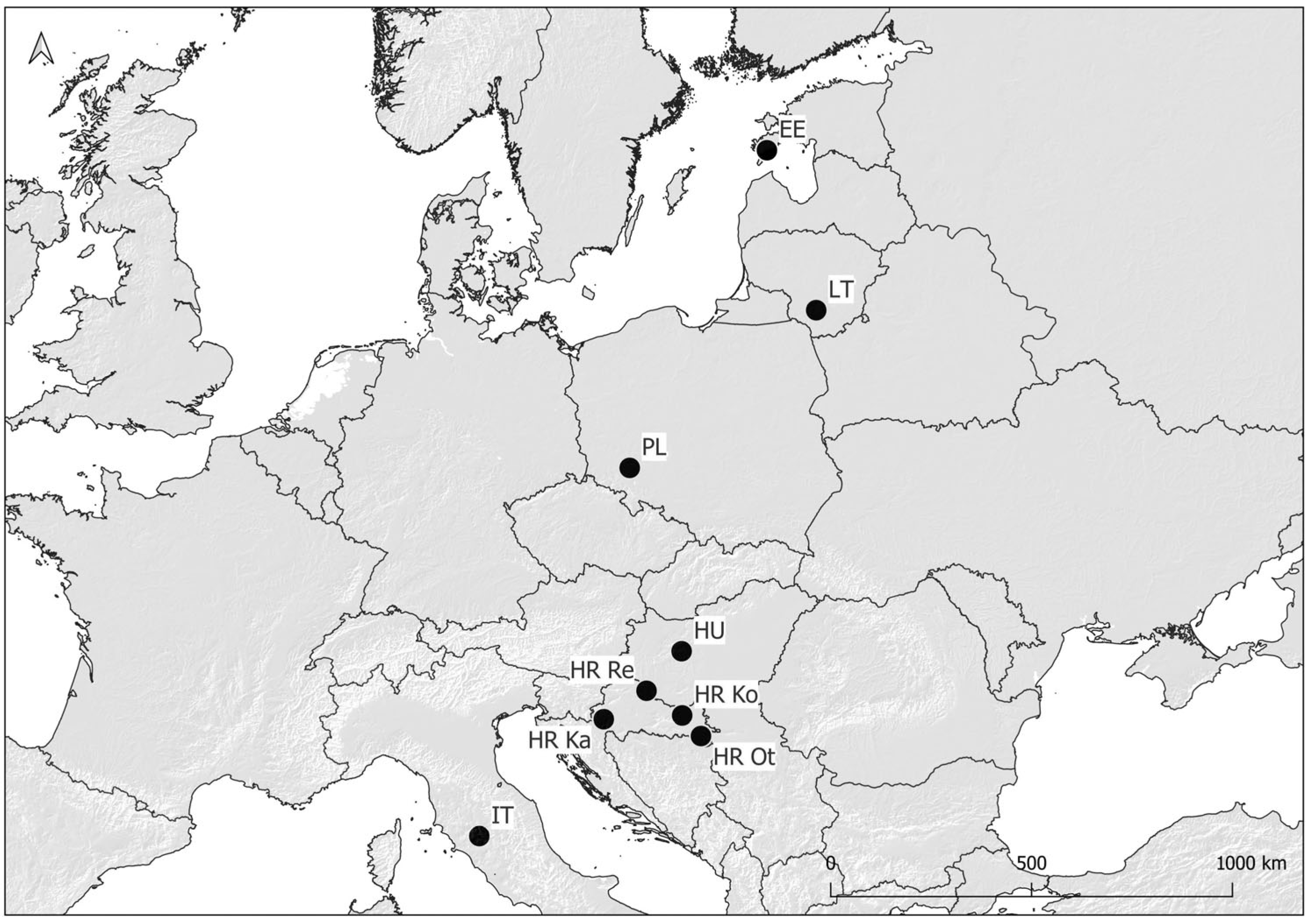
The study was conducted on a provenance trial established at the nursery of the Croatian Forest Research Institute (45.66896 N, 15.64269 E; 141 m a.s.l.). Plants were grown from acorns collected in autumn 2013 beneath the crowns of at least 10 randomly selected mature trees (spaced at least 100 m apart) from nine pedunculate oak stands (provenances). These provenances were distributed along a latitudinal gradient in Europe, from Estonia to Italy (Table 1 and Figure 1). Acorns were sown in pots filled with nursery substrate, and germinated seedlings were transplanted in spring 2014 into 50 L PVC pots filled with homogenized natural soil extracted from a local pedunculate oak forest (soil type: gleysol; pH = 7.6; texture: silty loam). During the 2014 growing season, plants were exposed to natural weather conditions and regularly watered to ensure acclimatization and survival. Further details on plant material and the provenance trial can be found in Čehulić et al. [24].

2.2. Experimental Design and Growth Conditions

During the 2015 growing season, plants were grown in a greenhouse. For the next three growing seasons (2016–2018), plants were moved outdoors (Figure S1).
On 15 March 2015, potted plants were transferred to a greenhouse equipped with a ventilation and cooling system to prevent excessive atmospheric moisture and overheating. Pots were arranged into two groups representing control treatment (CT) and drought treatment (DT). Plants were randomly arranged within treatments, with each provenance represented by 9 to 28 plants (Table 1), depending on acorn germination and seedling survival rates in 2014.
In the CT group, plants were watered with 4 L of water per pot every three days using an automated drip irrigation system from 1 April to 31 October 015. The amount of water applied was calculated to maintain the soil near field capacity. In the DT group, plants were deprived of water from 1 April to 21 July 2015, until the volumetric soil water content (SWC) approached the permanent wilting point, and about 50% of plants exhibited visible drought stress symptoms (leaf curling and yellowing). From 22 July to 31 October 2015, DT plants were watered similarly to CT plants. During the winter of 2015/2016, all plants were moved outdoors and exposed to natural winter conditions.
Due to unexpectedly vigorous plant growth in the greenhouse, which threatened to reach the ceiling, the trial was relocated outdoors for the remaining study duration (2016–2018). The arrangement of plants within and between treatments remained consistent. To prevent natural precipitation from entering the pots, polystyrene panels were fitted around the plant stems, sealed with polyurethane foam and duct tape (Figure S1). Plants were watered with 4 L of water per pot every three days. During the 2016 and 2017 growing seasons, DT plants were deprived of water from 20 June to 16 July, when visual symptoms of drought stress appeared. From 16 July to 31 October in both years, DT plants were watered as in the CT group. During the winter periods of 2016/2017 and 2017/2018, polystyrene panels were removed, and plants were exposed to natural winter conditions.
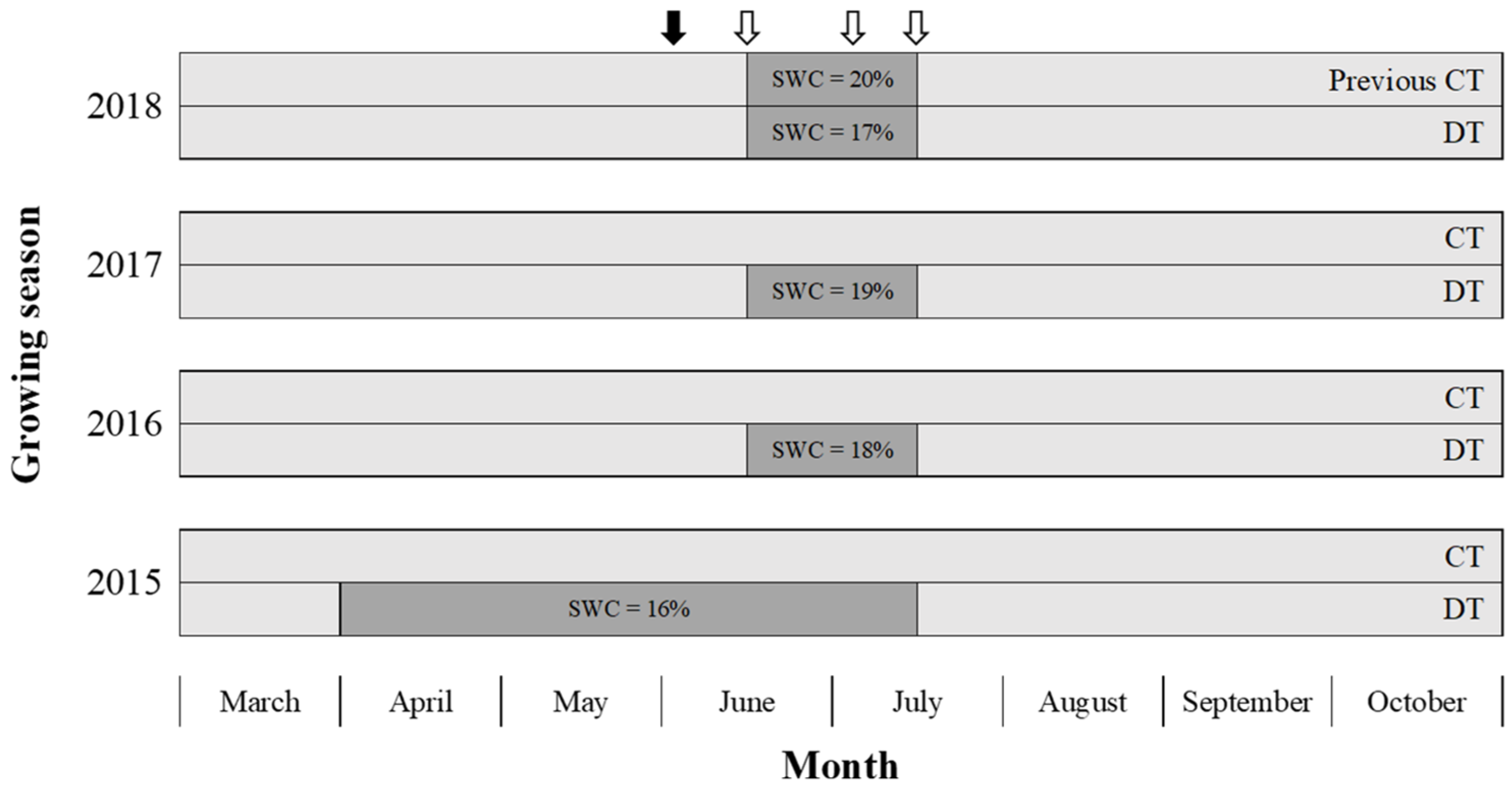
In the final growing season of 2018, all plants from both treatments were subjected to drought from 20 June to 18 July until visible drought stress symptoms appeared (Figure 2). Throughout the study (2015–2018), SWC in pots was measured using 54 sensors (EC-5 soil water sensors; Decagon Devices, Inc., Pullman, WA, USA) connected to data loggers (ECH2O, Decagon Devices, Inc., Pullman, WA, USA). Sensors were placed at a depth of 15–20 cm in three randomly selected pots per provenance within each treatment. SWC in CT pots was maintained at 40%–50%, corresponding approximately to field capacity, while SWC in DT pots dropped to 16%–20% during drought periods, corresponding approximately to the permanent wilting point, both determined for the soil used in the experiment (Figure 2).

2.3. Leaf Structural Traits

Leaf samples were collected on 1 June 2018, from regularly watered and drought -treated plants that had been exposed to their respective treatments during the 2015–2017 growing seasons. Three fully expanded, healthy leaves were sampled per plant. Accordingly, a total of 561 leaves from 187 plants were sampled in the CT, and 576 leaves from 192 plants were sampled in the DT. Leaves were rehydrated in the dark for 24 h before fresh mass was measured. Leaf area was determined using a desktop scanner (150 dpi) and analyzed with WINFOLIA 2001 software (Regent Instruments Inc., Quebec, QC, Canada). Dry mass was measured after drying leaves for 72 h at 60 °C. Specific leaf area (SLA, m2/kg) was calculated as the ratio of leaf area to dry mass. Leaf dry matter content (LDMC, mg/g) was calculated as the ratio of dry mass to fresh mass. To determine the number of stomata, each sampled leaf was covered with a thin layer of clear fingernail polish in the area between two veins on the lower epidermis. A short strip of clear tape was used to transfer the imprint to a microscope slide. Stomatal counts were made at five different locations (each with an area of 1 mm2) on each previously prepared microscope slide/imprint using a microscope OLYMPUS BX41 (Olympus Corporation, Tokyo, Japan) with magnification of 100×. Stomatal density (SD, stomata/mm2) was calculated as the number of stomata per leaf area. All individual leaf data were averaged per plant.

2.4. Measurements of Leaf Water Potential and Gas Exchange Traits

Pre-dawn leaf water potentials and gas exchange were measured on all plants in the trial three times during the 2018 growing season: at the beginning (20 June), middle (5 July), and end (18 July) of the drought period. Measurements were conducted on DT plants (previously exposed to drought) and CT plants (experiencing drought for the first time) (Figure 2). Pre-dawn leaf water potential was measured using a Scholander pressure chamber (M600; Mosler Tech Support, Berlin, Germany). Measurements of the instantaneous rate of net CO2 assimilation (A) and H2O transpiration (E), as well as stomatal conductance (gs), were carried out using a portable photosynthesis system LCpro+ (ADC BioScentific Ltd., Hoddesdon, UK) equipped with a broadleaf cuvette. All measurements were taken between 10:00 AM and 3:00 PM. The conditions inside the cuvette were kept constant at 400 ppm CO2, a photon flux density of 1000 μmol m−2 s−1 and an air temperature of 25 ± 2 °C. The cuvette with a leaf enclosed was equilibrated for 1 min before a reading.

2.5. Statistical Analysis

Differences between treatments and provenances for all analyzed variables were tested using the Analysis of Covariance (ANCOVA) procedure of Statistica software package [26]. Initial (measured in January 2015) and final (measured in January 2018) plant heights were included as covariates in the models analyzing leaf structural traits and gas exchange traits, respectively. Covariates were included because of their potential influence on studied traits and also to minimize potential maternal effects [27]. Although interactions involving the covariate were initially tested, only the interaction between treatments and provenances was retained in the final model. Normality of model residuals and homogeneity of variances were assessed visually using quantile-quantile plots and residuals versus fitted values plots. Significant differences among treatments and provenances were evaluated using Fisher’s LSD post hoc tests at p < 0.05.
Plasticity in leaf structural traits was calculated as the difference between control and drought treatment means for each provenance. The relationship between all measured variables (including plasticity) and climatic conditions of the sampled provenances was assessed for both treatments separately, using a Pearson correlation coefficient.

3. Results

3.1. Leaf Structural Trait Responses After Three Years of Drought Treatment

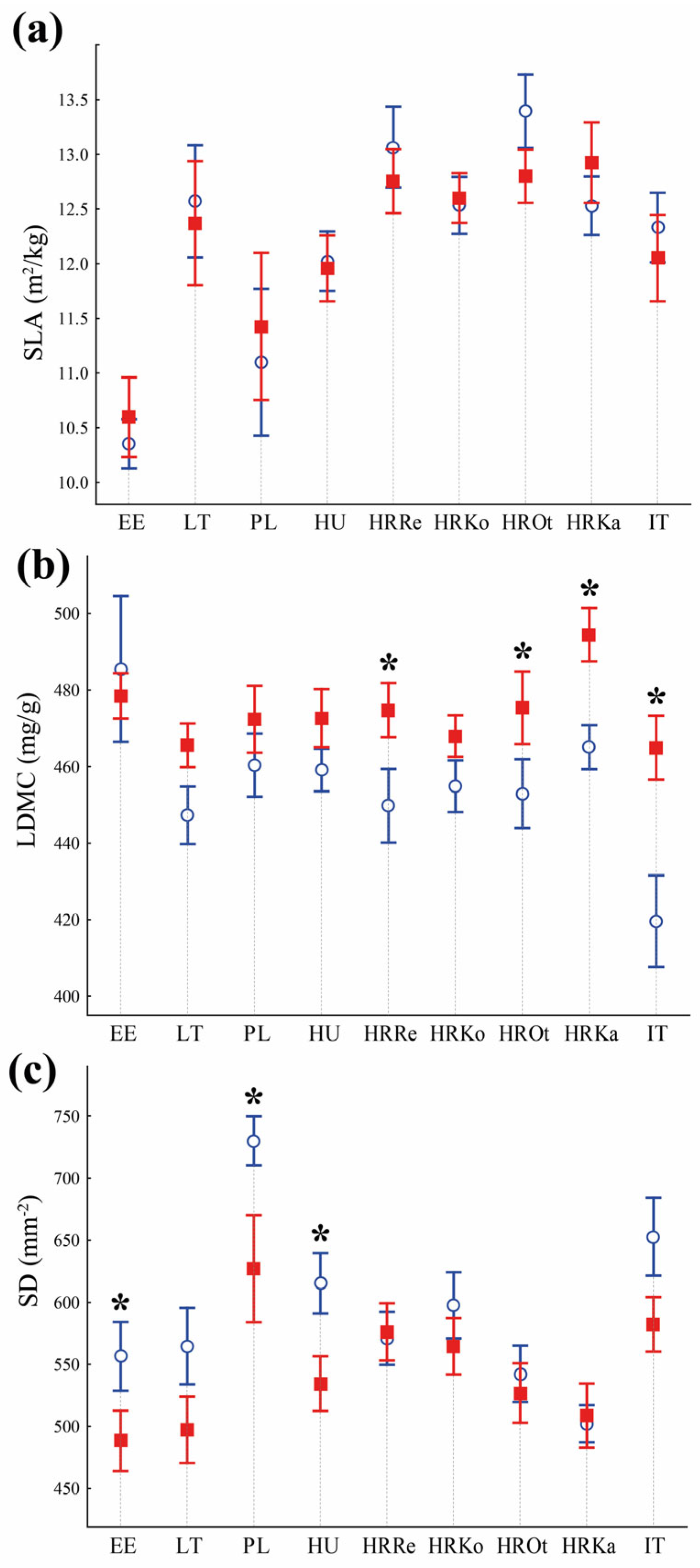
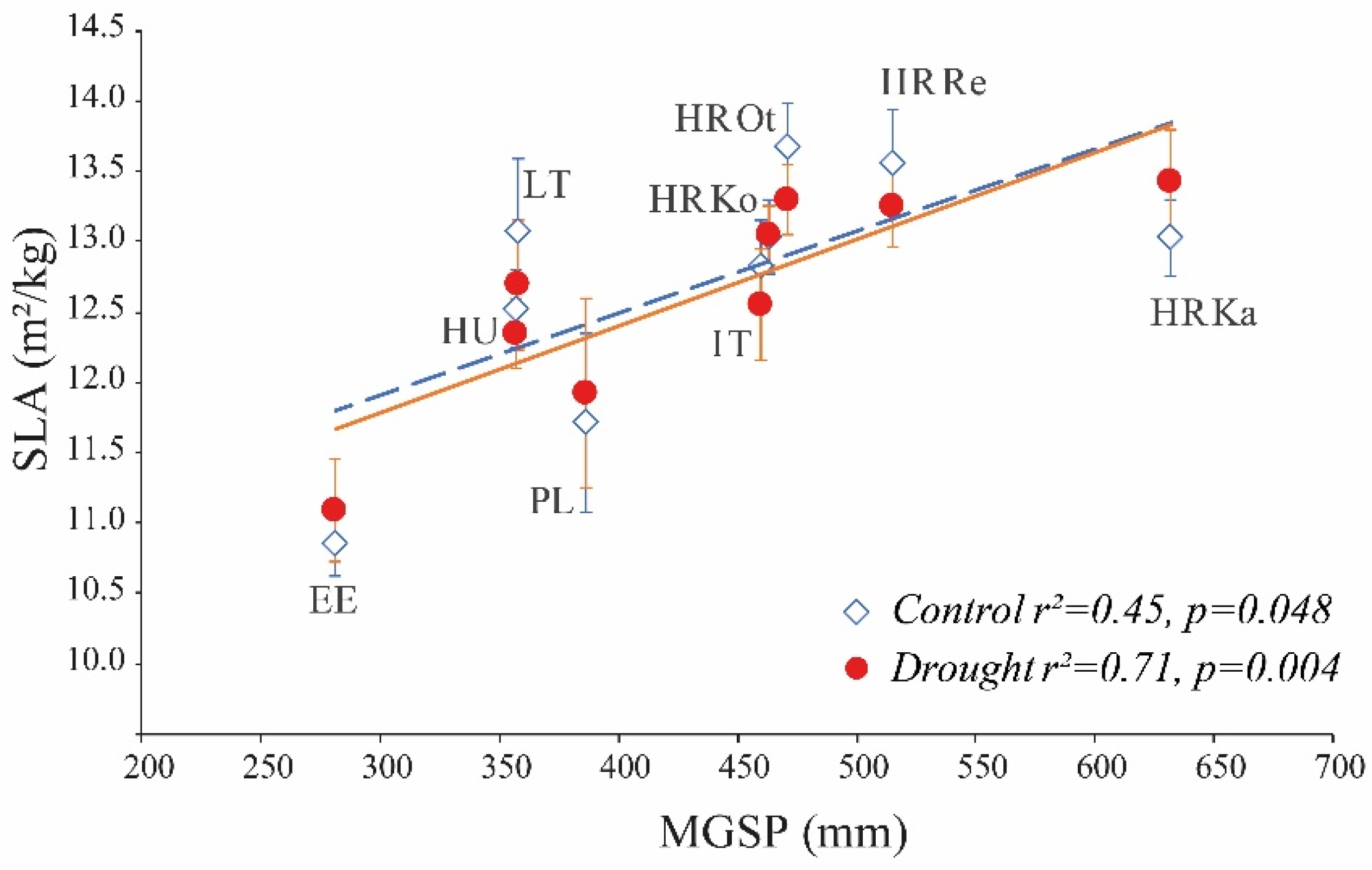
Plants exposed to drought for three consecutive years (2015, 2016 and 2017) did not change SLA in the subsequent year 2018 compared to the control plants (Table 2, Figure 3a). However, regardless of the different water treatments, a clear differentiation of provenances was observed (Table 2 and Table S3). SLA showed a significant relationship with the mean growing season precipitation of the provenance origin. SLA increases with MGSP, with the lowest SLA values in Estonian provenance and the highest values in Croatian provenances, especially Otok and Repaš (Figure 4).
On the other hand, the effect of both the drought treatment and provenance was significant for LDMC and SD (Table 2). Although the interaction between treatment and provenance was not statistically significant for LDMC and SD (Table 2), we observed visual trends suggesting that drought-treated plants tended to exhibit increased LDMC in wetter provenances (e.g., Italy and Croatian sites), and reduced SD in some drier provenances (e.g., Estonia, Poland, Hungary) (Figure 3b,c). These trends should be interpreted cautiously as exploratory observations rather than statistically confirmed differences.
Contrary to SLA, the provenances mean LDMC and SD values are not related to the MGSP (Table S1). However, plasticity of LDMC was related to MGSP, with the lower difference between the control and drought treatments in Estonian and Polish provenances and the higher in Italian and Croatian provenances, especially Karlovac (Figure 3b and Figure S4a). In a similar way, plasticity of SD was related to MGSP, but contrary to the higher difference between the control and drought treatments in Polish, Estonian and Hungarian provenances and the lower in Croatian provenances (Figure 3c and Figure S4b).

3.2. Response of Gas Exchange Traits of Previously Controlled and Drought-Treated Plants to Subsequent Drought in 2018

On 20 June, at the beginning of the subsequent drought period in 2018, when the plants had not yet experienced drought stress, significant differences in gs, A and E (gas exchange traits) between drought and control treatment were not observed (Table 3). It indicates that experimentally induced drought for the three previous and consecutive years, 2015, 2016 and 2017, did not have a negative impact on gas exchange traits of the investigated plants. Before the onset of drought stress on 20 June 2018, significant provenance differentiation was observed only for A (Table 3), with the highest mean values for EE and the lowest for HR Ot and HR Re (Table S3). However, no clear pattern of this differentiation was found. Moreover, the relation between gas exchange traits on 20 June and MGSP was weak and not significant (Table S1).
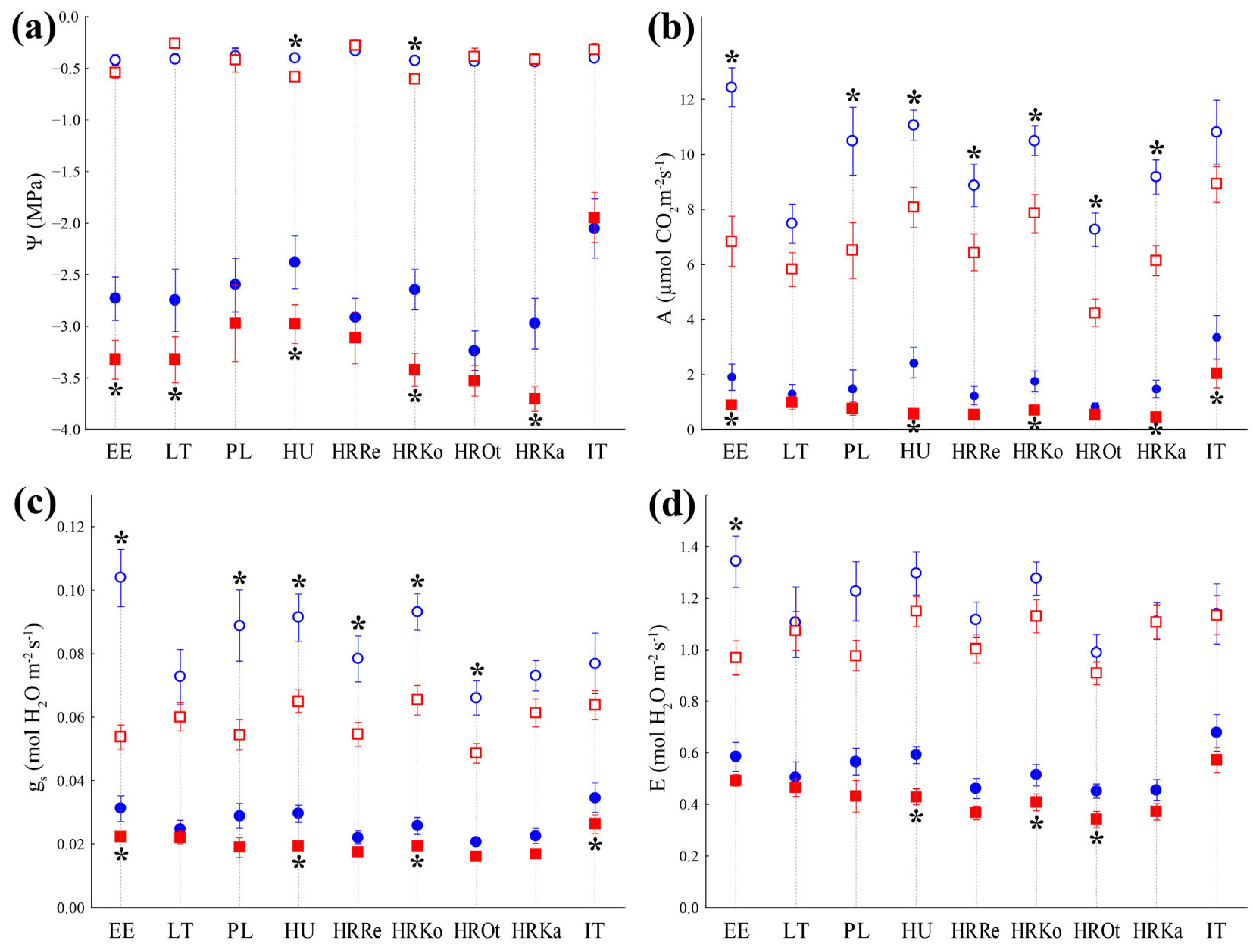
On 5 July 2018, following two weeks of experimentally induced drought, a significant difference in Ψ was observed between treatments (Table 3). However, Ψ was significantly lower in drought-treated plants than in previously control plants only for HU and HR Ko provenances (Figure 5a). On that date, the average Ψ of all provenances in both treatments was around −0.5 MPa (Figure 5a), and soil moisture significantly decreased compared to the beginning of the treatment (Figure S3).
Despite the favourable water potential, a reduction in gs, E and A was observed, with drought-treated plants exhibiting a more pronounced reduction compared to the previous control (Table 3). These results for gs and E were significantly influenced by the height of the plants at the onset of the subsequent drought treatments, with higher plants generally exhibiting lower gs and E (Table 3, Figure S2).
On 18 July 2018, after four weeks of experimentally induced drought, a strong decline of Ψ below −2.5 MPa was recorded for all provenances, except the Italian provenance, where it was around −2.0 MPa (Figure 5a), indicating quite severe drought stress of all investigated plants. However, on 18 July 2018, Ψ in drought-treated plants was lower than in previously control plants in all provenances (Figure 4).
After four weeks of experimentally induced drought, gs, E, and A further decreased to very low levels, leading to a reduction in the difference between drought-treated and previously control plants (Figure 5b–d). The observed population differentiation for gas exchange traits (Table 3) was not related to the MGSP of provenance origin (Table S1).

4. Discussion

4.1. Leaf Structural Trait Responses After Three Years of Drought Treatment

We found no SLA adjustments in pedunculate oak in response to three consecutive years of drought compared to control plants (Table 2), which is consistent with results reported for other deciduous oak species (Q. petraea, Q. robur, Q. pubescens) in a previous study [28]. On the contrary, evergreen oaks in experimental field trials show a highly plastic response in SLA that adjusts to interannual precipitation variations [27,29,30]. Our results confirm that, compared with evergreen oaks, deciduous oak species display lower plasticity in SLA and rely more on other morphological and physiological traits to cope with drought [31].
Our results revealed strong ecotypic differentiation in SLA (Table 2), which was expected for provenances originating from climatically diverse regions along the studied latitudinal gradient. This differentiation was primarily associated with the amount of precipitation during the growing season. Provenances from sites with lower precipitation exhibited lower SLA compared to those from wetter habitats (Figure 4). These are northern provenances characterized by very short growing seasons (e.g., EE) or provenances characterized by generally low total precipitation (e.g., HU), both of which result in lower precipitation during the growing season and overall higher physiological aridity. SLA commonly decreases with decreasing rainfall in oaks [27,30,32,33], as well as in other tree species [34,35], although such a relationship has not always been observed [36]. Since different provenances are adapted to their original environmental conditions, the observed provenance differentiation may be attributed, at least partially, to ecotypic adaptedness to varying climatic conditions. Lower SLA as an adaptation to arid habitat conditions is consistent with the hypothesis that drought tolerance evolves to enhance fitness in low -water environments [29,33]. Sclerophyllous leaves with reduced SLA confer an advantage by enabling plants to maintain photosynthetic activity and carbon assimilation during extended drought periods [37,38].
Unlike SLA, drought memory effects were evident in other structural traits (Table 2). After three consecutive years of drought, a significant overall increase in LDMC and a reduction in SD were observed across provenances (Table 2). While the interaction terms were not statistically significant, visual trends suggest that provenances from drier habitats tended to show lower SD, and wetter provenances tended to show higher LDMC under drought conditions (Figure 3b,c). These patterns may reflect different acclimation strategies, but should be viewed as indicative rather than conclusive, given the absence of significant interaction effects. Furthermore, plasticity (the difference between control and drought-hardened plants) decreases with increasing habitat aridity (Figure S4).
These findings indicate that drought-adapted provenances tend to have less plasticity in LDMC due to their inherently sclerophyllous leaves, which is consistent with previous research [39]. They already have more sclerophyllous leaves, so it can be assumed that further sclerophyllization could reduce mesophyll conductance and photosynthetic efficiency due to decreased cell wall permeability to CO2 [40]. For this reason, there is a trade-off in dry-adapted provenances, and they reduce SD to a greater extent. The reduction in SD in response to repeated drought is a common adjustment mechanism of plants that try to improve water use efficiency [41].
The contrasting responses of SLA and LDMC to drought in our experiment are not unexpected, as these traits are functionally distinct. SLA and its reciprocal counterpart LMA are composite traits related to two variables: leaf tissue density (LD) and leaf thickness (LT), and can be expressed by the following equation: SLA = 1/(LT × LD) [42,43]. LT and LD can vary independently along different environmental gradients [40,44,45]. Conversely, LDMC is closely related to LD [46]. Since LDMC differentiation among provenances was not correlated with habitat aridity (Figure 3b), it is likely that the observed SLA reduction with increasing aridity was driven by increases in LT rather than LD.
Our results suggest that memory response to repeated drought of studied pedunculate oak provenances and their adaptedness to dry habitat conditions with regard to the morphological functional leaf traits takes place according to two different scenarios in accordance with the leaf economic spectrum theory [47,48]. Adaptedness of provenances to dry habitat conditions is achieved by decreasing SLA associated with an increase in leaf mesophyll thickness and the amount of photosynthetically active tissues [47,49]. This leads to a greater capacity for C assimilation per unit leaf area and enables compensation for a shorter favourable season caused by a higher duration of stressful climatic events such as aridity or cold [31]. In contrast, provenances’ memory response to repeated drought is associated with an increase in LDMC (Figure 3b), i.e., LD. Higher LD is usually associated with thicker cell walls, higher vein density or the presence of sclerenchyma, giving more structural resistance to the leaf cells necessary under drought stress events [40,44,45,46]. In this way, the increase in LD has a protective role against intense drought climatic stresses because this ensures a longer lifespan of such leaves, compensating for the lower C assimilation rate caused by reducing the efficiency of photosynthesis due to a reduction in cell wall permeability to CO2 [31,50].
A limitation of our study is that we described habitat aridity using a climatic variable that quantifies the amount of precipitation during the growing season (Table 1). This variable effectively reflects the severity of environmental conditions as it integrates two key climatic drivers affecting plant fitness: the amount of precipitation and the length of the favourable growing season. Our findings indicate that adaptedness and acclimation mechanisms are differentiated based on the severity of environmental conditions. Provenances with more arid and stressful climates, such as HU, where low precipitation results from a continental climate, or EE, where prolonged cold periods shorten favourable seasons, show distinct differentiation (Table 1). In contrast, less arid provenances are characterized by higher precipitation and longer favourable growing seasons. However, the moisture levels in lowland habitats, where pedunculate oak commonly occurs, are also significantly influenced by proximity to watercourses and groundwater levels. To better understand the underlying drivers of intraspecific variability, future research should include variables that more comprehensively characterize the aridity of habitats where different provenances are found.

4.2. Response of Gas Exchange Traits of Previously Controlled and Drought-Treated Plants to Subsequent Drought in 2018

Drought limits photosynthesis through both stomatal closure and metabolic impairment, though the relative contributions of these mechanisms are often unclear [51]. In our study, the observed decline in net CO2 assimilation rate (A) during the final experimental year, as a response to repeated drought in the preceding three years, was primarily due to stomatal limitation, as A decreased in parallel with stomatal conductance (gs) (Figure 4). This response is consistent with the general pattern of drought-induced photosynthetic limitation observed in many tree species, including Quercus robur [16,52].
However, plants that experienced drought in previous years changed the dynamics of the down-regulation of gs. Even with a minor reduction in leaf water potential, when plants were not under severe drought stress (Figure 5a), they significantly reduced gs to conserve water, leading to a simultaneous reduction in A due to decreased CO2 uptake. In contrast, control plants maintained higher gs (and consequently A) under moderate water stress, only reducing gs sharply when water potential dropped below a critical threshold (~−2.0 MPa, Figure 5). These findings suggest that the investigated plants, as a physiological response to repeated drought stress (acclimation), changed the strategy of photosynthetic down-regulation. In drought-hardened plants, stomata appeared to become more sensitive, resulting in a shift from anisohydric toward more isohydric stomatal regulation. It has been suggested that anisohydric species such as oaks exhibit plasticity in leaf biophysical properties and may shift along the iso/anisohydric continuum depending on developmental stage and environmental conditions [53,54]. Consequently, acclimated plants appeared to prioritize hydraulic safety over carbon gain by reducing gs and A under relatively moderate water deficits. Numerous plant traits may underlie these changes in stomatal behaviour, including phytohormonal signalling (ABA), hydraulic traits (e.g., embolism resistance, turgor loss point, and water potential at stomatal closure), and structural investment traits such as wood density, SLA, and leaf carbon content [53].
Although gs showed significant differentiation among provenances on 5 July (Table 3), this differentiation was weak under drought conditions, as gs values were reduced to similar levels across provenances (Figure 5c, Table S3). However, in previously controlled plants subsequently exposed to drought stress, clear differentiation among provenances was evident in the degree of gs reduction. This differentiation was not associated with the local habitat conditions of the provenances (Table S1) but appeared to be linked to plant size, represented here by plant height at the onset of the subsequent drought treatment (significant effect of plant height for gs and E on 5 July, Table 3).
Provenances with smaller reductions in gs had lower mean plant heights (Figure 5c and Figure S2), which also influenced patterns of differentiation in A and E (Figure 5b,d and Figure S2). Smaller plants, with lower total leaf area, depleted soil water more slowly in the restricted pot volume, resulting in less pronounced reductions in gs. However, in acclimated plants, plant size had less impact, as they responded to soil drying by rapidly reducing gs (Figure 5c).
Stomata often close in response to soil drying before significant changes in leaf water potential occur, driven by drought-induced root-to-leaf signalling [55]. This mechanism was evident in our study (Figure 5c and Figure S3).
Although the experimental design and pot traits in this study were chosen in line with positive experiences in designing drought experiments [56], the use of pots likely influenced some results, particularly the pattern of provenance differentiation in gas exchange traits under subsequent drought. This is a consequence of the prolonged duration of the experiment and the use of a woody species that grew significantly during this period (Figure S2). Generally, it can be suggested that the use of pots in our field trial may have amplified the observed acclimatization effect, as it is known that the effect is significantly more pronounced in pot-based experiments [57], probably due to restriction of root exploration, which limits access to moist soil layers and increases reliance on physiological mechanisms and carbon allocation changes induced by conditioning [58].
The differences observed on 18 July between drought-treated and previously control plants for Ψ and gas exchange traits may initially appear unexpected. Drought-treated plants, which had closed their stomata earlier and more extensively, exhibited lower Ψ along with reduced gas exchange traits (Table 3, Figure 5). This suggests that repeated drought exposure may have caused damage to their vascular system and/or roots. As a result, these plants, despite reducing gs more than control plants, were less effective at maintaining favourable Ψ.
Previous drought exposure can significantly reduce the capacity of roots to absorb water after stress cessation [57]. Additionally, xylem conductivity may be reduced due to embolism, which does not fully recover in the following season after the stress ends [59].

4.3. Relationship Between Structural Leaf Traits and Gas Exchange Traits

SLA is a key anatomical trait, and according to expectations based on the leaf economic spectrum, there is a positive relation between SLA and mass-based net CO2 assimilation across species at the global scale [47]. However, the relationships between SLA and area-based net CO2 assimilation are less clear and could be influenced by different physiological and structural traits [49]. Alonso-Forn et al. [49] observed a negative relationship between SLA and area-based net CO2 assimilation among deciduous oak species (the general relationship considering both deciduous and evergreen oak species was not significant).
The relationship between SLA and net CO2 assimilation within single oak species is less studied, but a negative relationship has been reported for a few evergreen oak species [30,60,61], which is congruent with our results (Table S2). However, according to expectations based on the leaf economic spectrum, low SLA should constrain photosynthesis due to a higher investment in non-photosynthetic tissues and a reduction in mesophyll conductance to CO2, limiting the efficiency of the photosynthesis [47,62]. No significant relation between A and leaf density or LDMC (Table S1) suggests that the negative relationship between SLA and area-based photosynthetic rate observed in our study can be attributed to the thicker mesophyll of leaves with lower SLA, which leads to the accumulation of photosynthetically active biomass per unit leaf area. A similar relationship between mesophyll leaf thickness and area-based photosynthesis was also observed by Niinemets [60] in Q. ilex and Ramírez-Valiente et al. [30] in Q. oleoides. The pattern of intraspecific relationships among photosynthesis, SLA and other structural traits in Q. robur, as well as in other deciduous oaks, should be investigated in more detail.

5. Conclusions

Our results suggest that drought hardening of young pedunculate oak trees induces alterations in leaf physiological and morphological traits, leading to a more efficient drought response and enhancing the capacity to acclimate to harsh environmental conditions and climate change. Morphological trait acclimation to repeated drought involved adjustments in stomatal density and leaf dry matter content, while gas exchange trait acclimation occurred through a shift in the strategy of photosynthesis down-regulation. This supports the application of drought hardening practices in forest nurseries aimed at improving drought resilience and enhancing plant survival and performance under dry conditions in the field. Furthermore, our results revealed ecotypic differentiation among pedunculate oak provenances in morphological but not in gas exchange traits, indicating that adaptedness to drier conditions is primarily linked to leaf structural traits rather than physiological traits. The identified ecotypic differentiation is reflected in the lower specific leaf area of provenances originating from drier habitats. In addition, these provenances exhibited different acclimation to repeated drought events, including a stronger reduction in stomatal density and a smaller increase in leaf dry matter content, compared to provenances from more humid habitats. Pedunculate oak has evolved diverse multiple mechanisms of acclimation and adaptation to drought stress, which underscore the necessity of investigating multiple functional traits rather than focusing on individual key traits. A comprehensive approach allows us to better understand the complex patterns of adaptation and acclimation in forest trees, offering critical insights for their conservation and management in the face of future climate change. Understanding intraspecific variability is particularly important for defining effective management strategies and optimizing the use of reproductive material under changing environmental conditions. To achieve this, future research in field trials should integrate a broader range of functional traits, such as leaf turgor loss point, leaf carbon content, wood density and xylem embolism resistance, to provide a more complete picture of the underlying mechanisms. Such work will enhance our ability to develop strategies for sustaining forest ecosystems in an increasingly unpredictable climate.

Supplementary Materials

The following supporting information can be downloaded at: https://www.mdpi.com/article/10.3390/f17060636/s1, Figure S1: Investigated plants in greenhouse at the beginning of the experiment, during the first growing season 2015 on April 1st (a) and July 1st (b), as well as outside (c) during the next three growing seasons 2016, 2017 and 2018, when the wetting of the soil with natural precipitation was prevented by polystyrene panels (d); Figure S2: Provenance means for initial plant height; Figure S3: Provenance means ± SE for relative soil water content; Figure S4: Relationship between mean growing season precipitation of provenance origin and plasticity; Table S1: Pearson pairwise correlation coefficients and level of significance between mean provenance SLA, LDMC, SD, rate of net CO2 assimilation, stomatal conductance and rate of transpiration and mean growing season precipitation; Table S2: Pearson pairwise correlation coefficients among specific leaf area, leaf dry matter content and stomatal density on the one hand (morphological traits) and rate of net CO2 assimilation, stomatal conductance and rate of transpiration on the other hand (physiological traits); Table S3: Provenance means and significant differences among provenances calculated using Fisher’s LSD post hoc tests.

Author Contributions

Conceptualization, Ž.Š., K.S. and S.B.; methodology, Ž.Š., K.S. and S.B.; investigation, D.K. and I.K.B.; writing—original draft preparation, Ž.Š.; writing—review and editing, K.S. and S.B.; All authors have read and agreed to the published version of the manuscript.

Funding

This study was funded by the European Union from source 581—Recovery and Resilience Mechanism (NextGenerationEU) under project “Genetic, phenotypic and ecological characterization of forest reproductive material sources of economically important oaks—ŠRMQuercus, FŠDT11001”, which is currently being conducted at the University of Zagreb, Faculty of Forestry and Wood Technology.

Data Availability Statement

The data presented in this study are available on request from the corresponding author.

Conflicts of Interest

The authors declare no conflicts of interest.

References

  1. Bréda, N.; Huc, R.; Granier, A.; Dreyer, E. Temperate forest trees and stands under severe drought: A review of ecophysiological responses, adaptation processes and long-term consequences. Ann. For. Sci. 2006, 63, 625–644. [Google Scholar] [CrossRef]
  2. Taiz, L.; Zeiger, E.; Møller, I.M.; Murphy, A. Plant Physiology and Development, 6th ed.; Sinauer Associates Incorporated: Sunderland, MA, USA, 2015. [Google Scholar]
  3. Fleta-Soriano, E.; Munné-Bosch, S. Stress memory and the inevitable effects of drought: A physiological perspective. Front. Plant Sci. 2016, 7, 171549. [Google Scholar] [CrossRef] [PubMed]
  4. Alves, R.D.F.B.; Menezes-Silva, P.E.; Sousa, L.F.; Loram-Lourenço, L.; Silva, M.L.F.; Almeida, S.E.S.; Silva, F.G.; Farnese, F.S. Evidence of drought memory in Dipteryx alata indicates differential acclimation of plants to savanna conditions. Sci. Rep. 2020, 10, 16455. [Google Scholar] [CrossRef]
  5. Pritzkow, C.; Szota, C.; Williamson, V.; Arndt, S.K. Previous drought exposure leads to greater drought resistance in eucalypts through changes in morphology rather than physiology. Tree Physiol. 2021, 41, 1186–1198. [Google Scholar] [CrossRef] [PubMed]
  6. Villar-Salvador, P.; Planelles, R.; Oliet, J.; Peñuelas-Rubira, J.L.; Jacobs, D.F.; González, M. Drought tolerance and transplanting performance of holm oak (Quercus ilex) seedlings after drought hardening in the nursery. Tree Physiol. 2004, 24, 1147–1155. [Google Scholar] [CrossRef]
  7. Toca, A.; Gonzalez-Benecke, C.A.; Nelson, A.S.; Jacobs, D.F. Drought memory expression varies across ecologically contrasting forest tree species. Environ. Exp. Bot. 2025, 231, 106094. [Google Scholar] [CrossRef]
  8. Kawecki, T.J.; Ebert, D. Conceptual issues in local adaptation. Ecol. Lett. 2004, 7, 1225–1241. [Google Scholar] [CrossRef]
  9. George, J.P.; Theroux-Rancourt, G.; Rungwattana, K.; Scheffknecht, S.; Momirovic, N.; Neuhauser, L.; Weißenbacher, L.; Watzinger, A.; Hietz, P. Assessing adaptive and plastic responses in growth and functional traits in a 10-year-old common garden experiment with pedunculate oak (Quercus robur L.) suggests that directional selection can drive climatic adaptation. Evol. Appl. 2020, 13, 2422–2438. [Google Scholar] [CrossRef] [PubMed]
  10. Ellenberg, H. Vegetation Ecology of Central Europe, 4th ed.; Cambridge University Press: Cambridge, UK, 2009; p. 756. [Google Scholar]
  11. Eaton, E.; Caudullo, G.; Oliveira, S.; de Rigo, D. Quercus robur and Quercus petraea in Europe: Distribution, habitat, usage and threats. In European Atlas of Forest Tree Species; San-Miguel-Ayanz, J., de Rigo, D., Caudullo, G., Houston Durrant, T., Mauri, A., Eds.; Publ. Off. EU: Luxembourg, 2016; p. e01c6df+. [Google Scholar]
  12. Lindner, M.; Maroschek, M.; Netherer, S.; Kremer, A.; Barbati, A.; Garcia-Gonzalo, J.; Seidl, R.; Delzon, S.; Corona, P.; Kolström, M.; et al. Climate change impacts, adaptive capacity, and vulnerability of European forest ecosystems. For. Ecol. Manag. 2010, 259, 698–709. [Google Scholar] [CrossRef]
  13. Hlásny, T.; Mátyás, C.; Seidl, R.; Kulla, L.; Merganičová, K.; Trombik, J.; Dobor, L.; Barcza, Z.; Konôpka, B. Climate change increases the drought risk in Central European forests: What are the options for adaptation? C. Eur. For. J. 2014, 60, 5–18. [Google Scholar] [CrossRef]
  14. Hanel, M.; Rakovec, O.; Markonis, Y.; Máca, P.; Samaniego, L.; Kyselý, J.; Kumar, R. Revisiting the Recent European Droughts from a Long-Term Perspective. Sci. Rep. 2018, 8, 9499. [Google Scholar] [CrossRef]
  15. Kleinschmit, J. Intraspecific variation of growth and adaptive traits in European oak species. Ann. Sci. For. 1993, 50, 166–185. [Google Scholar] [CrossRef]
  16. Arend, M.; Brem, A.; Kuster, T.M.; Gunthardt-Goerg, M.S. Seasonal photosynthetic responses of European oaks to drought andelevated daytime temperature. Plant. Biol. 2013, 15, 169–176. [Google Scholar] [CrossRef]
  17. Vukmirović, A.; Škvorc, Ž.; Bogdan, S.; Krstonošić, D.; Bogdan, I.K.; Karažija, T.; Bačurin, M.; Brener, M.; Sever, K. Photosynthetic Response to Phosphorus Fertilization in Drought-Stressed Common Beech and Sessile Oak from Different Provenances. Plants 2024, 13, 2270. [Google Scholar] [CrossRef]
  18. Schroeder, H.; Nosenko, T.; Ghirardo, A.; Fladung, M.; Schnitzler, J.P.; Kersten, B. Oaks as beacons of hope for threatened mixed forests in Central Europe. Front. For. Glob. Change 2021, 4, 670797. [Google Scholar] [CrossRef]
  19. Kasper, J.; Leuschner, C.; Walentowski, H.; Petritan, A.M.; Weigel, R. Winners and losers of climate warming: Declining growth in Fagus and Tilia vs. stable growth in three Quercus species in the natural beech–oak forest ecotone (western Romania). For. Ecol. Manag. 2022, 506, 119892. [Google Scholar] [CrossRef]
  20. Alexandre, H.; Truffaut, L.; Klein, E.; Ducousso, A.; Chancerel, E.; Lesur, I.; Dencausse, B.; Louvet, J.-M.; Napveu, G.; Torres-Ruiz, J.M.; et al. How does contemporary selection shape oak phenotypes? Evol. Appl. 2020, 13, 2772–2790. [Google Scholar] [CrossRef] [PubMed]
  21. Bresson, C.C.; Vitasse, Y.; Kremer, A.; Delzon, S. To what extent is altitudinal variation of functional traits driven by genetic adaptation in European oak and beech? Tree Physiol. 2011, 31, 1164–1174. [Google Scholar] [CrossRef]
  22. Torres-Ruiz, J.M.; Kremer, A.; Carins Murphy, M.R.; Brodribb, T.; Lamarque, L.J.; Truffaut, L.; Bonne, F.; Ducousso, A.; Delzon, S. Genetic differentiation in functional traits among European sessile oak populations. Tree Physiol. 2019, 39, 1736–1749. [Google Scholar] [CrossRef]
  23. Kremer, A. Evolutionary responses of European oaks to climate change. Ir. For. 2010, 67, 53–66. [Google Scholar]
  24. Čehulić, I.; Sever, K.; Katičić Bogdan, I.; Jazbec, A.; Škvorc, Ž.; Bogdan, S. Drought impact on leaf phenology and spring frost susceptibility in a Quercus robur L. provenance trial. Forests 2019, 10, 50. [Google Scholar] [CrossRef]
  25. Marchi, M.; Castellanos-Acuña, D.; Hamann, A.; Wang, T.; Ray, D.; Menzel, A. ClimateEU, scale-free climate normals, historical time series, and future projections for Europe. Sci. Data 2020, 7, 428. [Google Scholar] [CrossRef] [PubMed]
  26. TIBCO Software Inc. Data Science Workbench; version 14; TIBCO Software Inc.: San Ramon, CA, USA, 2020; Available online: http://tibco.com (accessed on 14 May 2026).
  27. Ramírez-Valiente, J.A.; Sánchez-Gómez, D.; Aranda, I.; Valladares, F. Phenotypic plasticity and local adaptation in leaf ecophysiological traits of 13 contrasting cork oak populations under different water availabilities. Tree Physiol. 2010, 30, 618–627. [Google Scholar] [CrossRef] [PubMed]
  28. Günthardt-Goerg, M.S.; Kuster, T.M.; Arend, M.; Vollenweider, P. Foliage response of young central European oaks to air warming, drought and soil type. Plant Biol. 2013, 15, 185–197. [Google Scholar] [CrossRef]
  29. Ramírez-Valiente, J.A.; Valladares, F.; Delgado, A.; Nicotra, A.B.; Aranda, I. Understanding the importance of intrapopulation functional variability and phenotypic plasticity in Quercus suber. Tree Genet. Genomes 2015, 11, 35. [Google Scholar] [CrossRef]
  30. Ramírez-Valiente, J.A.; Center, A.; Sparks, J.P.; Sparks, K.L.; Etterson, J.R.; Longwell, T.; Pilz, G.; Cavender-Bares, J. Population-level differentiation in growth rates and leaf traits in seedlings of the neotropical live oak Quercus oleoides grown under natural and manipulated precipitation regimes. Front. Plant Sci. 2017, 8, 585. [Google Scholar] [CrossRef]
  31. Sancho-Knapik, D.; Escudero, A.; Mediavilla, S.; Scoffoni, C.; Zailaa, J.; Cavender-Bares, J.; Álvarez-Arenas, T.G.; Molins, A.; Alonso-Forn, D.; Ferrio, J.P.; et al. Deciduous and evergreen oaks show contrasting adaptive responses in leaf mass per area across environments. New Phytol. 2021, 230, 521–534. [Google Scholar] [CrossRef]
  32. Bruschi, P. Geographical variation in morphology of Quercus petraea (Matt.) Liebl. as related to drought stress. Plant Biosyst. 2010, 144, 298–307. [Google Scholar] [CrossRef]
  33. Ramírez-Valiente, J.A.; Valladares, F.; Sánchez-Gómez, D.; Delgado, A.; Aranda, I. Population variation and natural selection on leaf traits in cork oak throughout its distribution range. Acta Oecol. 2014, 58, 49–56. [Google Scholar] [CrossRef]
  34. Fonseca, C.R.; Overton, J.M.; Collins, B.; Westoby, M. Shifts in trait-combinations along rainfall and phosphorus gradients. J. Ecol. 2000, 88, 964–977. [Google Scholar] [CrossRef]
  35. Marchin, R.M.; Sage, E.L.; Ward, J.K. Population-level variation of Fraxinus americana (white ash) is influenced by precipitation differences across the native range. Tree Physiol. 2008, 28, 151–159. [Google Scholar] [CrossRef]
  36. Aranda, I.; Castro, L.; Alía, R.; Pardos, J.A.; Gil, L. Low temperature during winter elicits differential responses among populations of the Mediterranean evergreen cork oak (Quercus suber). Tree Physiol. 2005, 25, 1085–1090. [Google Scholar] [CrossRef]
  37. Dudley, S.A. Differing selection on plant physiological traits in response to environmental water availability: A test of adaptive hypotheses. Evolution 1996, 50, 92–102. [Google Scholar] [CrossRef]
  38. Dudley, S.A. The response to differing selection on plant physiological traits: Evidence for local adaptation. Evolution 1996, 50, 103–110. [Google Scholar] [CrossRef]
  39. Anderegg, L.D.; Loy, X.; Markham, I.P.; Elmer, C.M.; Hovenden, M.J.; HilleRisLambers, J.; Mayfield, M.M. Aridity drives coordinated trait shifts but not decreased trait variance across the geographic range of eight Australian trees. New Phytol. 2021, 229, 1375–1387. [Google Scholar] [CrossRef] [PubMed]
  40. Niinemets, Ü. Components of leaf dry mass per area-thickness and density-alter leaf photosynthetic capacity in reverse directions in woody plants. New Phytol. 1999, 144, 35–47. [Google Scholar] [CrossRef]
  41. Bertolino, L.T.; Caine, R.S.; Gray, J.E. Impact of stomatal density and morphology on water-use efficiency in a changing world. Front. Plant Sci. 2019, 10, 225. [Google Scholar] [CrossRef]
  42. Witkowski, E.T.F.; Lamont, B.B. Leaf specific mass confounds leaf density and thickness. Oecologia 1991, 88, 486–493. [Google Scholar] [CrossRef] [PubMed]
  43. John, G.P.; Scoffoni, C.; Buckley, T.N.; Villar, R.; Poorter, H.; Sack, L. The anatomical and compositional basis of leaf mass per area. Ecol. Lett. 2017, 20, 412–425. [Google Scholar] [CrossRef]
  44. Niinemets, Ü. Global-scale climatic controls of leaf dry mass per area, density, and thickness in trees and shrubs. Ecology 2001, 82, 453–469. [Google Scholar] [CrossRef]
  45. Poorter, H.; Niinemets, Ü.; Poorter, L.; Wright, I.J.; Villar, R. Causes and consequences of variation in leaf mass per area (LMA): A meta-analysis. New Phytol. 2009, 182, 565–588. [Google Scholar] [CrossRef] [PubMed]
  46. Shipley, B.; Vu, T.-T. Dry matter content as a measure of dry matter concentration in plants and their parts. New Phytol. 2002, 153, 359–364. [Google Scholar] [CrossRef]
  47. Wright, I.J.; Reich, P.B.; Westoby, M.; Ackerly, D.D.; Baruch, Z.; Bongers, F.; Cavender-Bares, J.; Chapin, T.; Cornelissen, J.H.C.; Diemer, M.; et al. The worldwide leaf economics spectrum. Nature 2004, 428, 821–827. [Google Scholar] [CrossRef]
  48. Shipley, B.; Lechowicz, M.J.; Wright, I.; Reich, P.B. Fundamental trade-offs generating the worldwide leaf economics spectrum. Ecology 2006, 87, 535–541. [Google Scholar] [CrossRef]
  49. Alonso-Forn, D.; Sancho-Knapik, D.; Ferrio, J.P.; Peguero-Pina, J.J.; Bueno, A.; Onoda, Y.; Cavender-Bares, J.; Niinemets, Ü.; Jansen, S.; Riederer, M.; et al. Revisiting the functional basis of sclerophylly within the leaf economics spectrum of oaks: Different roads to Rome. Curr. For. Rep. 2020, 6, 260–281. [Google Scholar] [CrossRef]
  50. Turner, I.M. Sclerophylly: Primarily Protective? Funct. Ecol. 1994, 8, 669. [Google Scholar] [CrossRef]
  51. Flexas, J.; Gallé, A.; Galmés, J.; Ribas-Carbo, M.; Medrano, H. The response of photosynthesis to soil water stress. In Plant Responses to Drought Stress: From Morphological to Molecular Features; Aroca, R., Ed.; Springer: Berlin/Heidelberg, Germany, 2012; pp. 129–144. [Google Scholar] [CrossRef]
  52. Rennenberg, H.; Loreto, F.; Polle, A.; Brilli, F.; Fares, S.; Beniwal, R.S.; Gessler, A. Physiological responses of forest trees to heat and drought. Plant Biol. 2006, 8, 556–571. [Google Scholar] [CrossRef]
  53. Chen, Z.; Li, S.; Wan, X.; Liu, S. Strategies of tree species to adapt to drought from leaf stomatal regulation and stem embolism resistance to root properties. Front. Plant Sci. 2022, 13, 926535. [Google Scholar] [CrossRef]
  54. Meinzer, F.C.; Woodruff, D.R.; Marias, D.E.; Smith, D.D.; McCulloh, K.A.; Howard, A.R.; Magedman, A. L Mapping ‘hydroscapes’ along the iso- to anisohydric continuum of stomatal regulation of plant water status. Ecol. Lett. 2016, 19, 1343–1352. [Google Scholar] [CrossRef]
  55. Medrano, H.; Escalona, J.M.; Bota, J.; Gulías, J.; Flexas, J. Regulation of photosynthesis of C3 plants in response to progressive drought: Stomatal conductance as a reference parameter. Ann. Bot. 2002, 89, 895–905. [Google Scholar] [CrossRef] [PubMed]
  56. Turner, N.C. Imposing and maintaining soil water deficits in drought studies in pots. Plant Soil 2019, 439, 45–55. [Google Scholar] [CrossRef]
  57. Puértolas, J.; Villar-Salvador, P.; Andivia, E.; Ahuja, I.; Cocozza, C.; Cvjetković, B.; Devetaković, J.; Diez, J.J.; Fløistad, I.S.; Ganatsas, P.; et al. Die-hard seedlings. A global meta-analysis on the factors determining the effectiveness of drought hardening on growth and survival of forest plantations. For. Ecol. Manag. 2024, 572, 122300. [Google Scholar] [CrossRef]
  58. Moler, E.R.V.; Nelson, A.S. Perspectives on drought preconditioning treatments with a case study using western larch. Front. Plant Sci. 2021, 12, 741027. [Google Scholar] [CrossRef]
  59. Klein, T.; Zeppel, M.J.; Anderegg, W.R.; Bloemen, J.; De Kauwe, M.G.; Hudson, P.; Ruehr, N.K.; Powel, T.L.; Arx, G.; Nardini, A. Xylem embolism refilling and resilience against drought-induced mortality in woody plants: Processes and trade-offs. Ecol. Res. 2018, 33, 839–855. [Google Scholar] [CrossRef]
  60. Niinemets, Ü. Is there a species spectrum within the world-wide leaf economics spectrum? Major variations in leaf functional traits in the Mediterranean sclerophyll Quercus ilex. New Phytol. 2015, 205, 79–96. [Google Scholar] [CrossRef] [PubMed]
  61. Škvorc, Ž.; Lisica, L.; Zorić, V.; Bačurin, M.; Sever, K. Functional differentiation of holm oak provenances in the east Adriatic coast. Šumar. List. 2021, 145, 415–420. [Google Scholar] [CrossRef]
  62. Niinemets, Ü.; Díaz-Espejo, A.; Flexas, J.; Galmés, J.; Warren, C.R. Role of mesophyll diffusion conductance in constraining potential photosynthetic productivity in the field. J. Exp. Bot. 2009, 60, 2249–2270. [Google Scholar] [CrossRef]
Figure 1. Location of acorn collection sites. The provenance labels correspond to Table 1.
Forests 17 00636 g001
Figure 2. Water regimes in the control (CT) and drought (DT) treatments during the four consecutive growing seasons 2015–2018. Duration of drought periods marked as dark grey polygons in DT and in the previous control treatment for the last season 2018 (previous CT). Relative values in dark grey polygons indicate the lowest mean values of volumetric soil water content (SWC) during the drought period. Light grey colour in CT and DTs indicates the periods when the plants were regularly watered, with variation in SWC in the range from 40% to 50%. The black arrow indicates the date of leaf sampling for measurements of leaf structural traits (1 June 2018). White arrows indicate dates of leaf water potential and gas exchange measurements at the beginning (20 June 2018), in the middle (5 July 2018), and at the end (18 July 2018) of the drought period.
Forests 17 00636 g002
Figure 3. Provenance means for (a) specific leaf area (SLA), (b) leaf dry matter content (LDMC) and (c) stomatal density (SD) control (empty blue circles) and drought (filled red rectangles) treatments. Vertical bars indicate ± SE. Significant differences between control and drought treatment for each provenance are indicated with * at p < 0.05.
Forests 17 00636 g003
Figure 4. Relationship between the mean growing season precipitation (MGSP) of provenance origin and specific leaf area (SLA). Points represent provenance means for control treatment (empty blue rectangles) and drought treatment (filled red circles). The regression line is shown as a dashed blue line for the control and as a solid red line for the drought treatment. Vertical bars indicate ± SE.
Forests 17 00636 g004
Figure 5. Provenance means ± SE for (a) leaf water potential (Ψ), (b) rate of CO2 net assimilation (A), (c) stomatal conductance (gs) and (d) rate of transpiration (E) measured in the middle (5 July, upper and empty circles and rectangles) and on the end (18 July, lower and filled circles and rectangles) of the drought period in growing season 2018 in previously control (blue circles) and drought (red rectangles) treatments. Significant differences between the previously control and drought treatment for each measurement date are indicated with * at p < 0.05.
Forests 17 00636 g005
Table 1. Location and climate of acorn collection sites. Mean annual temperature (MAT), mean annual precipitation (MAP), mean growing season precipitation (MGSP) and number of investigated plants in control (CT) and drought (DT) treatment.
ProvenanceLatitude NLongitude EMAT (°C)MAP (mm)MGSP (mm)CTDT
Estonia—EE58.2385222.442896.76072812627
Lithuania—LT54.5379823.811186.96123581514
Poland—PL51.1903016.549019.052038699
Hungary—HU47.0251218.2635011.55463572224
Croatia (Repaš)—HR Re46.1397617.0916111.47815152324
Croatia (Koška)—HR Ko45.5697318.2355611.67194632828
Croatia (Karlovac)—HR Ka45.4948915.7083811.89696322323
Croatia (Otok)—HR Ot45.0942518.8215211.87454712728
Italy—IT42.7553811.9180414.66704601415
MAT, MAP and MGSP were generated with ClimateEU software (version 4.63) for the period 1983–2013 [25].
Table 2. Effects of treatment, provenance and interaction treatment × provenance on specific leaf area (SLA), leaf dry matter content (LDMC) and stomatal density (SD) as calculated with the ANCOVA procedure. Covariates: initial plant height.
TraitValueTreatmentProvenanceTreatment × ProvenanceInitial Height
SLA (m2/kg)F0.0410.410.531.62
p0.851<0.0010.8340.204
η2p<0.0010.1890.0120.004
LDMC (mg/g)F15.242.891.130.20
p<0.0010.0030.3400.660
η2p0.0410.0610.024<0.001
SD (mm−2)F11.406.721.007.35
p<0.001<0.0010.4380.009
η2p0.0270.1780.0250.012
Bolded values indicate significant effects at p < 0.05.
Table 3. Effects of treatment, provenence and interaction treatment × provenance on leaf water potential (Ψ), rate of net CO2 assimilation (A), stomatal conductance (gs) and rate of transpiration (E) measured at the beginning (20 June), in the middle (5 July) and on the end (18 July) of the drought period in growing season 2018, as calculated with ANCOVA procedure. Covariates: plant height at the beginning of subsequent drought treatment in 2018.
DateTraitValuesTreatmentProvenanceTreatment × ProvenancesHeight
June 20thΨ (MPa)F5.230.912.020.01
p0.0490.5130.0500.921
η2p0.0220.0390.083<0.001
A (µmol CO2 m−2 s−1)F0.435.510.351.99
p0.513<0.0010.9440.159
η2p0.0010.1090.0080.005
gs (mol H2O m−2 s−1)F3.011.060.352.17
p0.0840.3940.9430.141
η2p0.0080.0230.0080.006
E (mol H2O m−2 s−1)F0.390.980.261.09
p0.5350.4530.9780.298
η2p0.0010.0210.0050.003
5 JulyΨ (MPa)F24.082.122.840.25
p<0.0010.0460.0090.613
η2p0.0400.0690.094<0.001
A (µmol CO2 m−2 s−1)F57.798.111.340.02
p<0.001<0.0010.2240.884
η2p0.1380.1520.028<0.001
gs (mol H2O m−2 s−1)F68.593.971.835.55
p<0.0010.0030.0480.019
η2p0.1600.0620.0390.015
E (mol H2O m−2 s−1)F16.522.520.936.45
p<0.0010.0110.4930.012
η2p0.0440.0550.0200.017
18 JulyΨ (MPa)F9.263.851.185.46
p0.003<0.0010.3130.021
η2p0.0490.1480.0500.030
A (µmol CO2 m−2 s−1)F32.935.101.121.92
p<0.001<0.0010.3510.167
η2p0.0840.1020.0240.005
gs (mol H2O m−2 s−1)F31.524.000.520.79
p<0.001<0.0010.8410.376
η2p0.0800.0810.0110.002
E (mol H2O m−2 s−1)F24.085.230.290.29
p<0.001<0.0010.9700.588
η2p0.0630.1040.006<0.001
Bolded values indicate significant effects at p < 0.05.
Disclaimer/Publisher’s Note: The statements, opinions and data contained in all publications are solely those of the individual author(s) and contributor(s) and not of MDPI and/or the editor(s). MDPI and/or the editor(s) disclaim responsibility for any injury to people or property resulting from any ideas, methods, instructions or products referred to in the content.