


Abstract
Soil- and plant-associated fungi and bacteria are an important part of many ecosystems as they can affect plant health, growth and stress tolerance. However, it remains poorly understood whether the microbiomes differ between conifer species growing in the same site conditions and between tree ecosystem compartments. The main aim of the study was to describe and compare the microbiomes of Scots pine (Pinus sylvestris L.) and Norway spruce (Picea abies (L.) H. Karst.), growing in a boreal forest common garden experiment on adjacent forest plots, to analyse the tree species effect on the composition of the needle and surface soil organic-mineral horizon microbiomes. The needle and surface soil organic-mineral horizon bacterial and fungal microbiomes were simultaneously analysed by full-length 16S and ITS sequencing on a long-read sequencing platform; however, the bacterial analysis was restricted to soil samples. The highly abundant bacterial phyla in both pine and spruce soil were Actinomycetota, Pseudomonadota, Planctomycetota and Acidobacteriota. The dominant fungal phyla in pine and spruce surface organic-mineral soil was Basidiomycota, while the needles were dominated by Ascomycota. The results showed an effect of tree species on the soil bacterial and fungal microbiomes and needle fungal microbiomes based on alpha diversity, which was higher for Norway spruce compared to Scots pine. The results indicated that Norway spruce might be able to support higher microbial diversity, which could potentially be due to differences in needle longevity, root exudates, litter input and its degradation, between pine and spruce. Furthermore, the results indicated distinct microbiomes between the soil and needle compartments.
1. Introduction
An integral part of agricultural and forest ecosystems are soil- and plant-associated microbiomes, which affect both plant and soil health, fitness, stress tolerance, nutrition and growth [1,2]. These comprise bacterial, fungal, archaeal and protist species [3,4], which are present in bulk soil, rhizosphere, phyllosphere and endosphere [5,6,7]. In the past, the taxonomic structure of the bacterial and fungal microbiomes was described through culturing methods followed by morphological characterisation of the isolated organisms [8]. In recent decades, it has become common to use sequencing strategies to analyse microbiomes as they allow for the identification of slow-growing and even unculturable bacteria and fungi [9,10,11]. Sequencing technologies have significantly increased the speed, sensitivity and accuracy of analysing and describing the microbiomes present in different ecosystems [8,12], allowing for the identification of factors affecting fungal and bacterial microbiomes [13]. Commonly, the fungal and bacterial microbiomes have been analysed separately [14,15,16]; however, analysing them simultaneously is advantageous for identifying if similar or diverse factors are impacting these microbiomes [14]. Our knowledge about soil- and plant-associated microbiomes in forest ecosystems [2,14,16] and the factors affecting them is still limited [3,14], and this knowledge gap is especially apparent for bacterial and endospheric communities. A better understanding of these communities and the factors affecting them will enable better management of microbiomes, especially in connection to climate change [3,11,17,18], as diverse microorganisms are proposed to be capable of providing plants with different functional adaptations needed to adjust to the changing climate [19,20,21].
In general, important factors shown to affect the composition and diversity of the soil- and plant-associated microbiomes are soil properties, environmental conditions and plant species [4,13,19,22,23,24,25,26,27,28,29]. Looking specifically at the needle-associated microbiota, previous studies have shown that the phyllosphere community can be affected by tree species, needle age and geographic location [30,31]. The effect of plant species observed in several studies is proposed to be due to the plants selecting their own microbiome [3,13,32,33]; however, the importance of plant species effect on the microbiome is not well understood for conifer trees in boreal forests. On the one hand, several previous studies have shown significant tree species effects on both the soil and needle-associated microbiome composition by comparing two or more coniferous and deciduous forest tree species [15,25,30,31,34,35], and even differences among tree genotypes for some species (e.g., Populus and Pinus sp. [36,37,38]). On the other hand, several studies have concluded that tree species have little effect on shaping tree microbiomes [39,40,41].
Common garden experiments are a useful tool to isolate the importance of tree species on microbiomes because they allow direct comparisons of tree species microbiomes while holding microclimate, soil type, hydrology, tree age, land use and topography constant [27,42,43]. The tree species effect on microbiomes can best be seen by looking at the abundance of microbial taxa at multiple taxonomic hierarchies (e.g., phyla, classes, and species), as well as community composition and species richness [1,44,45]. Although different tree species are proposed to have diverse soil and endophytic microbiomes due to tree species effects, it has been hypothesised that there is a core microbiome shared across tree species and compartments [11,46,47]. The definition of a core microbiome is a set of microbial taxa, including their genotypic and functional characteristics, always present in a specific host or environment [48]. The microbes present in the core microbiome are supposed to possess functional traits that help plants better overcome biotic and abiotic stress [19,20,21].
The nitrogen-limited Fennoscandian boreal forest is dominated by two conifer species: Norway spruce (P. abies (L.) H. Karst.) and Scots pine (P. sylvestris L.), which in Sweden represent 80% of the standing forest volume [49]. Studies looking only into Norway spruce-associated microbiomes have suggested a difference between the belowground and aboveground microbiomes [1,2,27]. The Norway spruce microbiome has, as far as we know, not been compared to other boreal forest conifer species, but previous studies have shown differences between Norway spruce and several deciduous tree species [15,43,50]. Studies on the less-researched Scots pine microbiome have indicated the presence of a core microbiome, i.e., a set of microbial species always found related to it [11,46], and conflicting data regarding any difference in the microbiome compared to other pine and deciduous tree species [11,51]. A sequencing study looking at nursery-grown Scots pine and Norway spruce seedlings did not find any differences between their microbiomes [52]. We could not find any study comparing Norway Spruce and Scots pine needle-associated microbiomes, but studies looking at mature Norway spruce and Scots pine trees have, however, found differences in their soil microbiomes, based on phospholipid fatty acid (PLFA) and community-level physiological profile (CLPP) analyses [35,53,54,55]. To our knowledge, no study has applied sequencing techniques to compare surface soil organic-mineral horizon and needle endophytic bacterial and fungal microbiomes of mature Norway spruce and Scots pine trees.
The main aim of the study was to use a 30-year-old common garden experiment setup to perform simultaneous analysis of both fungal and bacterial microbiomes in surface soil organic-mineral horizon and inside needles on adjacent monoculture plots of Scots pine and Norway spruce using a long-read sequencing platform. We addressed the two following hypotheses: (1) The microbiome will differ between the two tree species, but (2) a core microbiome will be shared across the two tree species and both sampled compartments.
2. Materials and Methods
2.1. Field Site
Samples were collected in November 2021 at the Svartberget common tree garden experiment site in northern Sweden (coordinates 64.259944 N, 19.791194 E). The collection time point after the end of the growing season was selected, as this time point is often overlooked in other studies. At the time when the field site was established in 1992, the growing degree days were 792 (base +5 °C). In the year 2021, when the samples were collected, the average temperature was 2.2 °C, and the annual precipitation was 770 mm [56]. The site used to be a conifer-dominated boreal forest on podzol developed from glacial till, which was clear-cut during 1989–1990. The common garden experiment site was established by planting seedlings in 1992, utilising a complete randomised block design with three replicate blocks, each containing 10 plots (34 × 34 m) with one species per plot (Figure S1). The experiment site includes several boreal forest tree species; however, sampling for our study focused on Scots pine (P. sylvestris) and Norway spruce (P. abies) plots.
2.2. Sampling
Soil and needle samples for this study (Table S1) were collected in 2021 when the age of the common garden was 30 years after initial planting. The common garden consisted of three replicate blocks, with paired Scots pine and Norway spruce plots, from which we performed needle and soil sampling. In each plot, we sampled three representative trees, situated around the plot centre, five metres apart in an equilateral triangle configuration.
For soils, we collected five sub-samples under each tree, where we performed needle sampling, which were composited to create a single representative sample for each sampled tree. The soil sub-sampling approach helped account for the high variability of microbiomes in the soil [57]. In the study, the unit of replication for both needle and surface soil organic-mineral horizon samples were the individual trees (for needle samples) and the soil underneath the individual sampled trees (for surface soil organic-mineral horizon samples), regardless of the plot, meaning 9 samples in total per compartment and tree species. The number of samples was chosen to get a representative view of each of the plots included in the common garden experiment. Soil samples were collected using a soil corer with a diameter of five centimetres. The collected soil samples consisted of a five-centimetre-deep layer of the lower organic horizon and a five-centimetre-deep layer of the uppermost part of the mineral soil, collected to obtain an equal mixture of organic and mineral soil. The sampling focused on the intersection between organic and mineral layers because more than 50% of fungal and bacterial activity and biomass is present in this intersection [28,58,59]. Soil samples were stored on dry ice until further processing in the laboratory. In the laboratory, samples were sieved using a 2 mm sterilised sieve, freeze-dried and kept at −80 °C until DNA extraction.
Needles of all ages were collected from each selected tree from several branches at a height of around 1.5 m and mixed into one sample per selected tree. Needles of all ages were used in the study to analyse the whole needle microbiome; however, we acknowledge that difference in needle longevity could be a mechanism that influences the microbiome diversity between these two tree species. The collected needles were kept on dry ice until transported to the laboratory. To only analyse the needle endophytic microbiome, the needles were surface-sterilised using 30% hydrogen peroxide following exactly the protocol described by Bizjak et al. [60,61], including an imprinting sterility check. However, it cannot be excluded that some DNA traces of epiphytic and lichen-associated organisms have been left on the needles. The surface-sterilised samples were kept at −80 °C until DNA extraction.
2.3. DNA Extraction and Sequencing
The DNA from soil samples was isolated using DNeasy PowerLyzer PowerSoil Kit (Qiagen, Venlo, The Netherlands) according to the manufacturer’s instructions. The soil samples were ground using the bead beating method included in the kit using Power-Bead tubes and the Power-Bead solution provided. Specifically, the samples were homogenised on the FastPrep machine (MP Biomedicals, Irvine, CA, USA) at 4 m/s for 45 s. Before the needle DNA isolation, the frozen needles were ground in an autoclaved mortar and pestle using liquid nitrogen. The DNA from needles was isolated with E.Z.N.A. Plant DNA Kit (Omega Bio-Tek, Norcross, GA, USA) according to the manufacturer’s instructions. During both the needle DNA and soil DNA extraction, we used four extraction blanks, which were also sent for sequencing. The quality and quantity of the isolated DNA from all samples were checked using Nanodrop (Thermo Fisher Scientific, Waltham, MA, USA) and Qubit dsDNA Quantification Assay Kit (Invitrogen, Waltham, MA, USA) before being sent for library preparation and sequencing at Maryland Genomics, USA. The acceptable values for the 260/280 ratio were between 1.75 and 2.05, with most of the samples between 1.8 and 1.9. The minimal acceptable DNA concentration was above 10 ng/μL, but most of the samples were above 20 ng/μL. As the study simultaneously investigated bacterial and fungal microbiomes, the samples were analysed using both 16S rRNA and ITS primers. The 16S rRNA and ITS full-length amplicon libraries from the sent DNA samples were prepared and subsequently sequenced on PacBio Sequel II/IIe Cell 8M sequencing run (HiFi/CCS mode, 30 h movie; PacBio, Menlo Park, CA, USA). The universal primers used to amplify the full-length 16S rRNA were 27F (5′-AGRGTTYGATYMTGGCTCAG-3′) and 1492R (5′-RGYTACCTTGTTACGACTT-3′) [62]. For full-length ITS, the used primers were ITS9MUNngs (5′-TACACACCGCCCGTCG-3′) and ITS4ngsUni (5′-CCTSCSCTTANTDATATGC-3′) [63].
2.4. Data Preprocessing
The initial steps of data analysis, including pre-processing, ASV generation and taxonomic assignment, were done by Maryland Genomics, USA. DADA2 version 1.22 [62,64] was used on 16S rRNA and ITS sequences for trimming, filtering, de-noising, removing chimaeras and generating ASVs. Two PCR-positive and two PCR-negative controls were used for ITS sequences, and equally, two PCR-positive and two PCR-negative controls were used for 16S sequences, which were included in the data pre-processing. Bacterial 16S rRNA ASVs were taxonomically assigned using the SILVA 138 database [65,66,67,68], and fungal ITS ASVs were assigned using the UNITE database [65,68]. We further processed the samples using R Statistical Software version 4.2.2 [69] and packages phyloseq version 1.42.0 [70] and ggplot2 version 3.5.1 [71] unless otherwise specified. The total number of samples for both bacterial and fungal microbiome analysis was nine per tree species (either Scots pine or Norway spruce) and per sample compartment (either needle or soil), as individual trees or soil underneath these trees were considered as the unit of replication. At the beginning of our analysis, the bacterial 16S rRNA samples had a total of 1,409,913 reads and 1679 ASVs. After removing the mitochondrial sequences, chloroplast sequences and ASVs present in the negative controls, some samples had a low number of remaining reads and ASVs (details on the number of reads in Table S2). Therefore, we decided to remove all samples with fewer than 700 reads or 10 ASVs, which unfortunately meant removing some soil samples and all needle samples. Therefore, the bacterial needle microbiome could not be analysed. We were, therefore, left with six pine soil samples and eight spruce soil samples, still representing Scots pine and Norway spruce plots from all three replicate blocks. We continued our analysis with this dataset, which included 33,389 reads and 208 ASVs. For the fungal ITS samples, we started with 199,528 reads and 1361 ASVs. Reads not belonging to the fungal kingdom and all ASVs present in negative controls were removed, and additionally, samples with reads below 1000 or a number of ASVs below 5 were removed (details on the number of reads in Table S3). The filtered ITS dataset used for the analysis included 14 needle samples (six pine and eight spruce needle samples) and 14 soil samples (six pine samples and eight spruce soil samples), totalling up to 63,035 reads and 479 ASVs, still representing all replicate blocks. Rarefaction curves showed that all samples from the final 16S rRNA dataset (Figure S2A) and final ITS dataset (Figure S2B) reached a plateau, indicating that the sequencing depth was probably sufficient. Both datasets were rarefied using the R package metagMisc version 0.5.0 [72] without replacement and with averaging of 10,000 resamplings. The 16S rRNA dataset was rarefied to 896 reads and the ITS dataset to 1049 reads. The relatively low rarefaction depth is a limitation of this study; however, it was chosen to retain as many samples as possible, particularly to ensure that all three sampled blocks could be included in the analyses. Despite the low rarefaction threshold, all samples used in downstream analyses reached clear plateaus in their rarefaction curves, indicating that the sequencing depth was probably sufficient to capture the detectable diversity. The analysis of the ITS sequencing data showed that the needle and surface soil organic-mineral horizon compartments had unique fungal microbiomes as they did not share any ASVs (Figure S3). Therefore, we divided them into two separate datasets for further analysis. The soil ITS dataset with six pine soil and eight spruce soil samples had 35,245 reads and 315 ASVs, while the needle ITS dataset with six pine needle and eight spruce needle samples had 27,790 reads and 164 ASVs.
2.5. Data Analysis and Statistics
For relative abundance-based microbiome analysis and differential abundance analysis, the non-normalised datasets were used; otherwise, the rarefied 16S rRNA and ITS datasets were used. For microbiome relative abundance analysis and the analysis of the shared and unique ASVs, we used individual trees as the unit of replication (six samples for pine and eight samples for spruce). For alpha diversity, community composition analysis and differential abundance analysis, the samples from the same plot were merged into one sample per plot to avoid the issue of pseudoreplication (therefore, the number of samples was three per species). Alpha diversity analysis included richness, Chao1 and Shannon indices. Alpha diversity is a metric summarising the evenness and richness of taxonomic groups within a sample [73,74], and in this study, alpha diversity is the evenness and richness of taxonomic groups within each tree species and ecosystem compartment. The richness index is simply the number of ASVs detected in a sample. The Chao1 index accounts for the observation of ASVs very rarely captured, thus giving a more accurate count of species richness than other indices [8,75]. The Shannon index is based on the quantification of the uncertainty in predicting the identity of a random ASV from the dataset [76] and therefore takes into account both the richness and evenness of the ASVs, providing a broader view of diversity than the Chao 1 index. The alpha diversity was statistically analysed by applying a linear mixed-effects model with species as a fixed variable, and block as a random variable (Alpha diversity measure ~ Species + (1|Block)). ANOVA with the Kenward–Roger method for the computation of denominator degrees of freedom (R package lme4 version 1.1.35.5 [77], car version 3.1.3 [78]) was used, followed by post hoc estimated marginal means (EMMs) with Tukey’s adjustment (R package emmeans version 1.10.5 [79]). For community composition analysis, Bray–Curtis distances were calculated and Principal Coordinates Analysis (PCoA) was used as the ordination method. Prior to PERMANOVA, the homogeneity of multivariate dispersions was evaluated using a permutation test. Differences in community composition were then tested by applying permutational multivariate analysis of variance (PERMANOVA) with 9999 permutations, including tree species as the explanatory variable and restricting permutations within blocks using the strata function (R package vegan version 2.6.4) [80]. Community composition analysis quantifies taxonomic composition differences between samples [74,81], and in this study, the community composition analysis looked at differences in diversity between the tree species and ecosystem compartments. Due to the rather vague definition of core microbiome, we defined the core microbiome for the purpose of our study as bacterial and fungal amplicon sequence variants (ASVs) present in more than 80% of all samples and shared across both tree species and compartments. Venn diagrams were created using MicEco package version 0.9.19 [82] and eulerr package version 7.0.0 [83]. Further, we used the DESeq2 package version 1.38.3 [84] with the default setting for differential abundance analysis. The formula used for the DeSeq2 analysis was (~Block + Species), and the p-values were adjusted for multiple testing using the Benjamini–Hochberg false discovery rate procedure implemented in DESeq2.
3. Results
3.1. Bacterial Microbiome
The bacterial microbiome analysis, of full-length 16S rRNA gene sequences from the long-read PacBio platform, was only done on Norway spruce and Scots pine soil samples. This was due to an insufficient number of reads for needle samples after removing mitochondrial and chloroplast sequences.
Soil Bacterial Microbiome
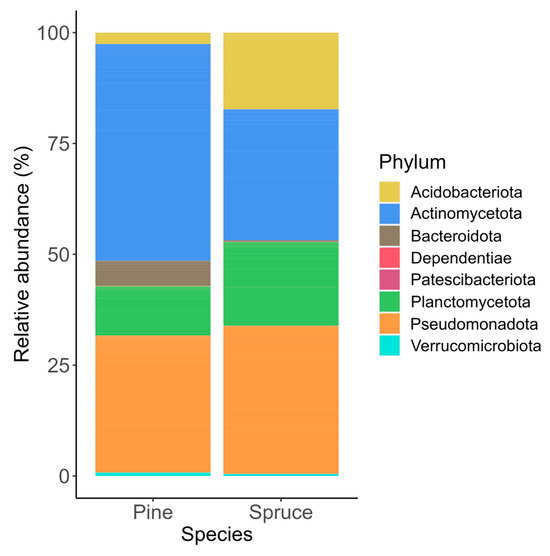
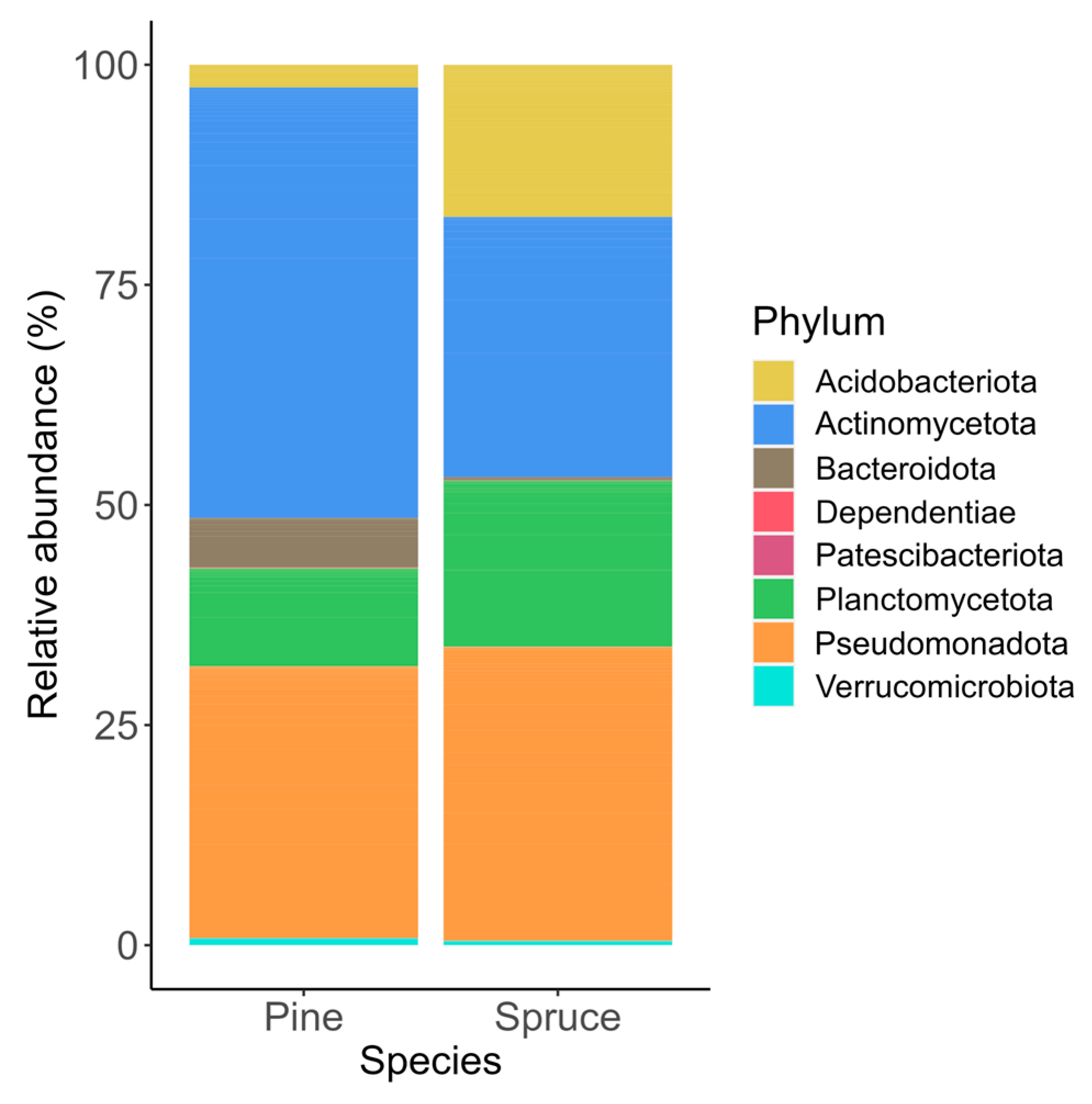
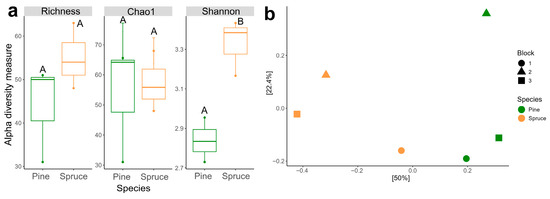
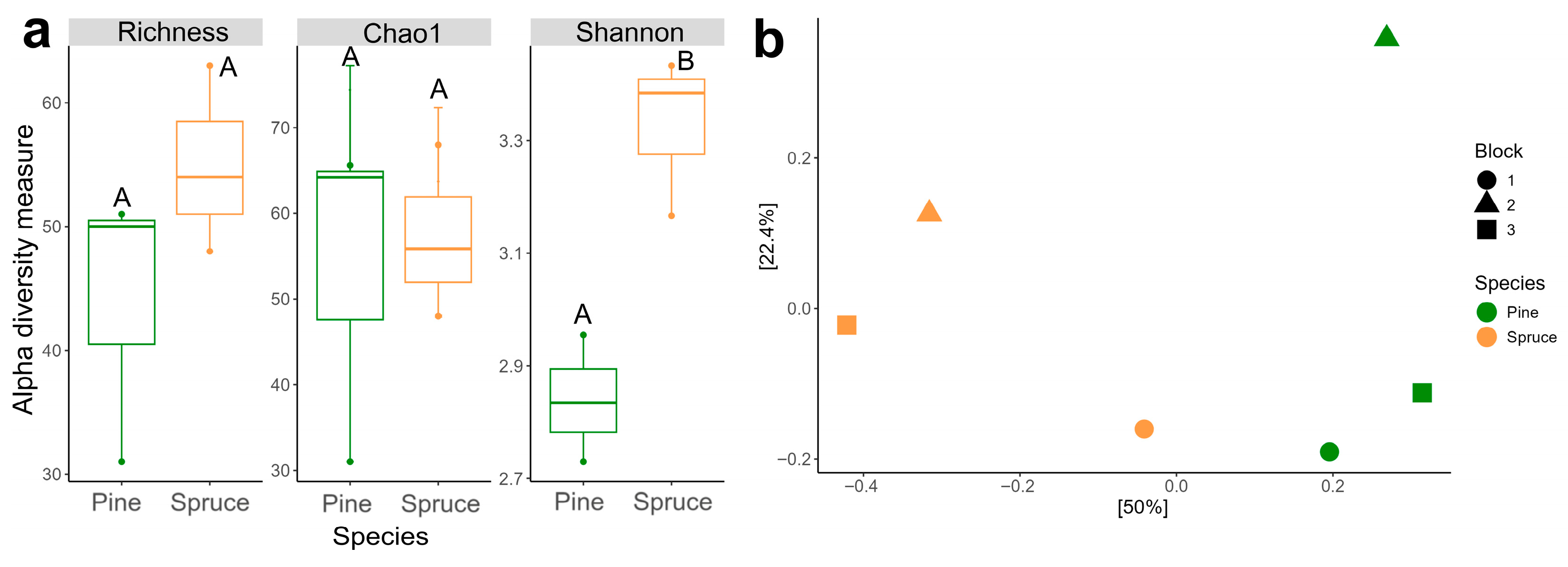
The bacterial microbiome in soil samples consisted of eight different phyla: Acidobacteriota, Actinomycetota, Bacteroidota, Dependentiae, Patescibacteriota, Planctomycetota, Pseudomonadota and Verrucomicrobiota (Figure 1 and Figure S4). While the relative abundance of Actinomycetota and Bacteroidota was higher in pine samples, the relative abundance of Acidobacteriota and Planctomycetota was higher in spruce samples. At the level of ASVs, pine and spruce soil samples shared 20 bacterial ASVs, while the spruce had 95 and pine 89 unique ASVs (Figure S5a). However, even though the two species shared a relatively low number of ASVs, the relative abundance of those that were shared was almost 64%. Looking at the ten most abundant bacterial ASVs in the soil samples (Figure S5b), only ASV0004 (Mycobacterium) was present in all samples analysed. Other ASVs were present in fewer soil samples, with only ASV0029 and ASV0007 (both Roseiarcus) being present in more than 80% of the samples. The bacterial soil microbiome alpha diversity tended to be higher in spruce samples compared to pine soil samples, but it was only significantly different for the Shannon index (p-value = 0.013, Figure 2a). Further, the community composition analysis showed that samples tended to be separated by tree species based on the first axis, explaining 50% of the variance observed (Figure 2b). However, the trend was not significant based on the PERMANOVA results (homogeneity p-value = 0.32, PERMANOVA p-value = 0.25). Based on DESeq2 analysis, 8 ASVs contributed significantly towards the difference between pine and spruce soil bacterial microbiomes (Figure S6). These ASVs belonged to the Acidocella, Aquisphaera, Bradyrhizobium, Granulicella, Mycobacterium and Occallatibacter genera. Interestingly, all of the ASVs were significantly more abundant in spruce samples compared to pine samples (Figure S6).
Figure 1.
Mean relative abundances (%) of bacterial phyla in pine and spruce soil samples from monoculture plots in a common garden experiment (n = 6 for pine and n = 8 for spruce due to filtering based on the number of reads).
Figure 2.
(a) Three indices of alpha diversity (richness, Chao1 and Shannon) of bacterial microbiomes in soils of pine and spruce monoculture plots in a common garden experiment. Different letters indicate statistically significant differences in alpha diversity between the two tree species based on EMM. (b) Community composition based on Bray–Curtis distances and PCoA ordination. The soil bacterial dataset was generated with full-length 16S sequencing (n = 3 for pine and spruce as samples from the same plot were merged).
3.2. Fungal Microbiome
The fungal microbiomes of Scots pine and Norway spruce needles and soils were analysed based on the obtained full-length ITS sequences from the long-read PacBio sequencing platform. As the soil and needle samples did not share any ASVs (Figure S3), the analysis was done separately for soil and needle samples.
3.2.1. Soil Fungal Microbiome
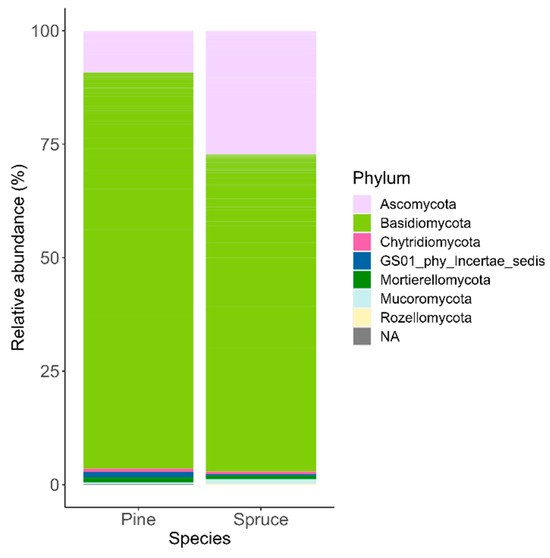
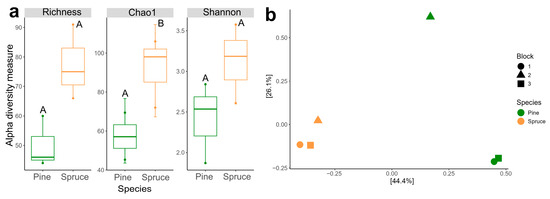
The soil of both Norway spruce and Scots pine samples had a very high relative abundance of Basidiomycota, followed by Ascomycota phylum (Figure 3 and Figure S7). Phyla Chytridiomycota (saprotrophic), GS01, Mortierellomycota (saprotrophic), Mucoromycota and Rozellomycota (parasitic) were present in lower abundances. The relative abundance of Basidiomycota was higher in pine samples compared to spruce, which generally had a higher relative abundance of Ascomycota. The two tree species shared 33 fungal ASVs, representing approximately 38% of the total relative abundance (Figure S8a). Further, 101 ASVs were unique to Scots pine soil samples and 181 ASVs were unique to Norway spruce soil samples. The results at the ASV level show that most of the ten top abundant fungal ASVs were present in either spruce or pine soil samples and rarely in both (Figure S8b). Only ASV0004 (Lactarius, ectomycorrhizal) was present in more than 80% of all soil samples, while the other ASVs were present in fewer samples. The fungal soil microbiome alpha diversity was estimated for both tree species and tended to be higher for spruce soils based on all alpha diversity indices, but was only significantly higher based on Chao1 (p-value = 0.039, Figure 4a). The community composition analysis showed a grouping of samples based on the tree species along the first axis, which explained around 44% of the variance (Figure 4b), but it was not statistically different based on PERMANOVA (homogeneity p-value = 0.41, PERMANOVA p-value = 0.25). Furthermore, the DESeq2 analysis showed that 13 fungal ASVs significantly contributed to the difference between pine and spruce soil fungal microbiomes (Figure S9). The ASVs identified in the analysis belonged to the genera Amphinema (ectomycorrhizal), Cortinarius (ectomycorrhizal), Hyaloscypta (ericoid mycorrhizal/endophytic), Oidiodendron (ericoid mycorrhizal), Tylospora (ectomycorrhizal) and unknown. All the ASVs were more abundant in spruce samples (Figure S9).
Figure 3.
Mean relative abundance (%) of fungal phyla in pine and spruce soil samples from monoculture plots in a common garden experiment (n = 6 for pine and n = 8 for spruce due to filtering based on the number of reads).
Figure 4.
(a) Three indices of alpha diversity (richness, Chao1 and Shannon) of fungal soil microbiome of spruce and pine monoculture plots in a common garden experiment. Different letters indicate statistically significant differences in alpha diversity based on EMM. (b) Community composition based on Bray–Curtis distances and PCoA ordination. The fungal soil dataset was generated with full-length ITS sequencing (n = 3 for pine and spruce as samples from the same plot were merged).
3.2.2. Needle Fungal Microbiome
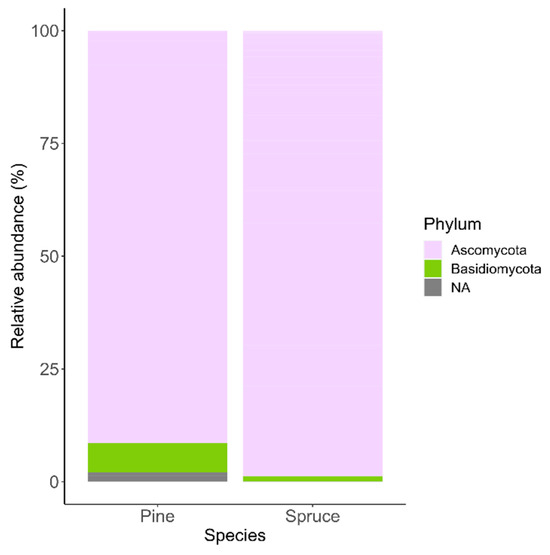
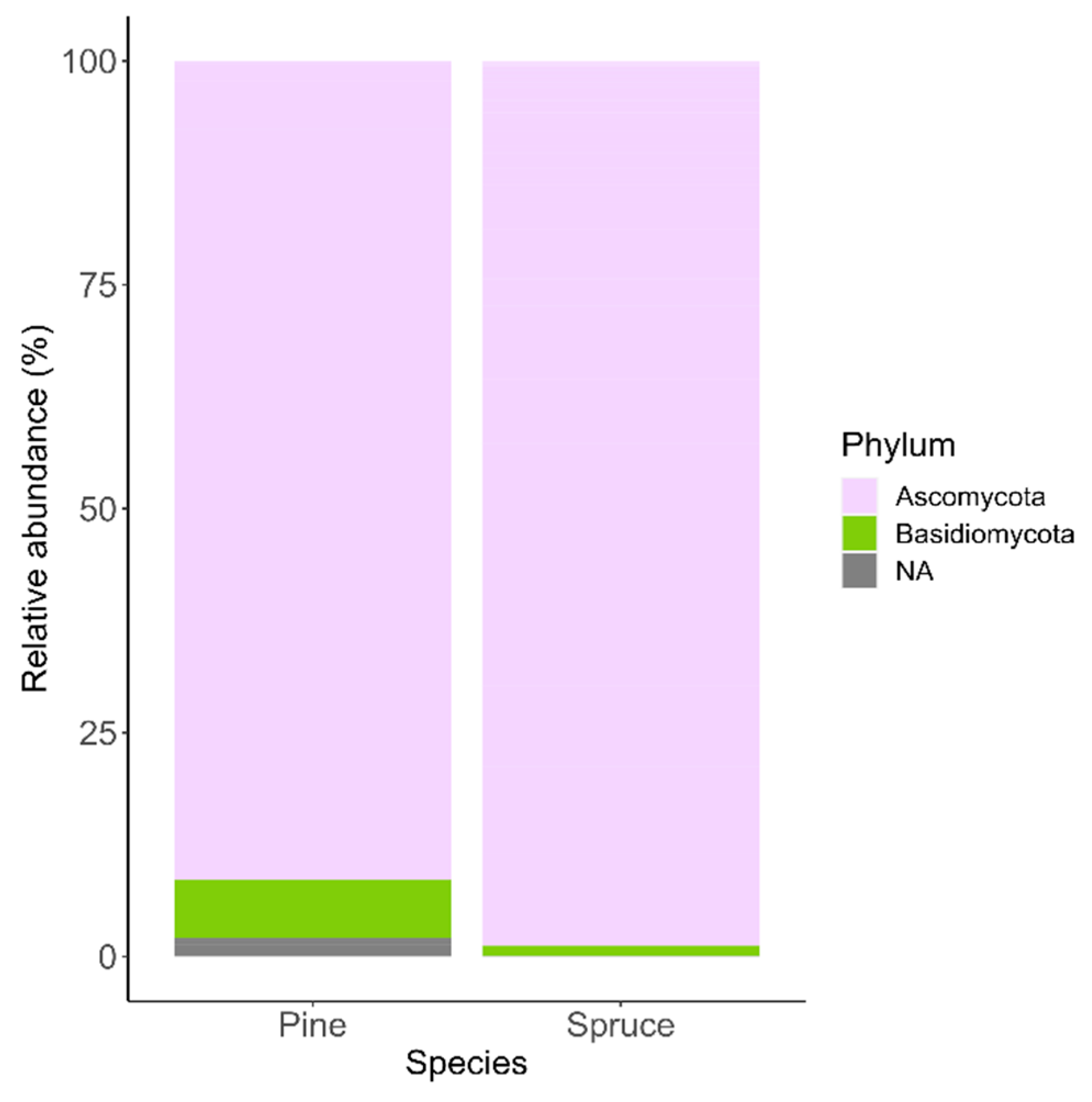
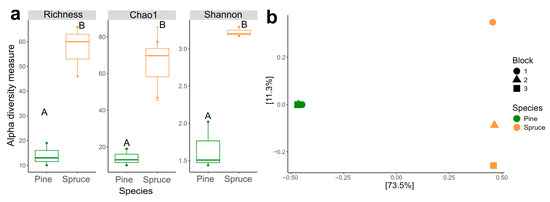
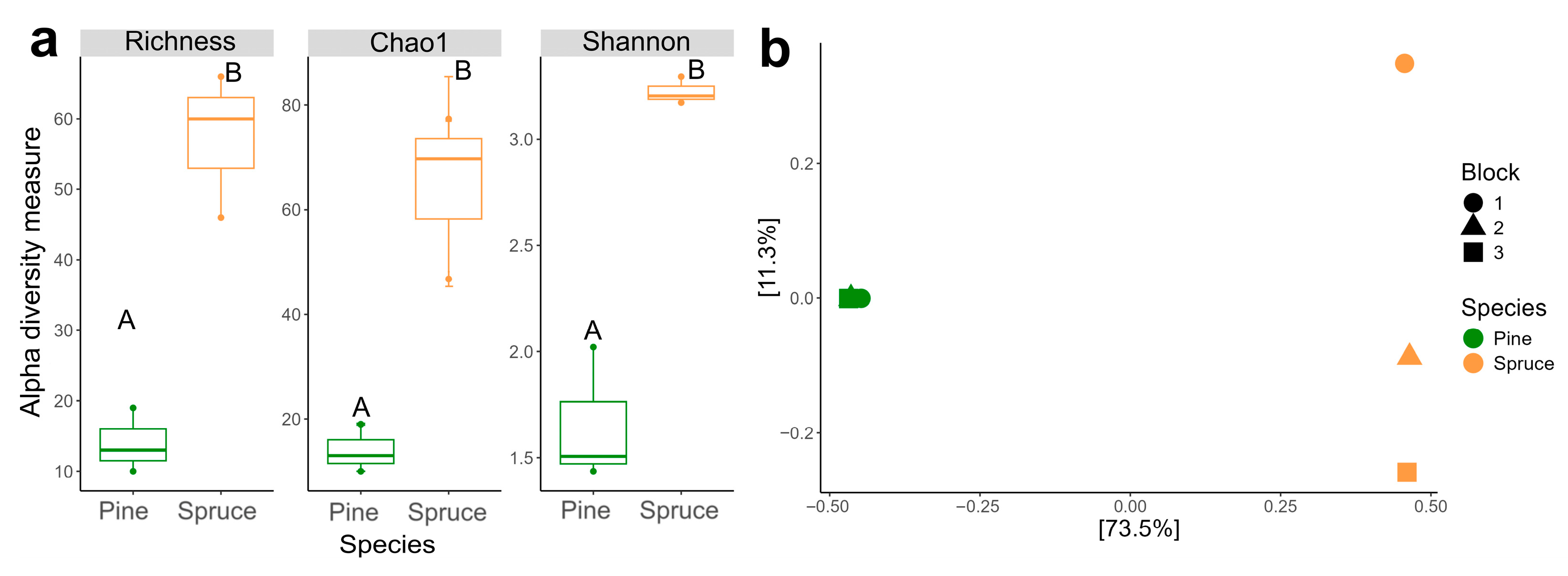
The spruce and pine needle samples showed a high relative abundance of the fungal phyla Ascomycota (Figure 5 and Figure S10). Compared to spruce, pine needle samples tended to have a slightly higher Basidiomycota and unknown fungal phyla relative abundance. The results at the ASV level showed no shared fungal ASVs between pine and spruce needle samples, but 30 unique fungal ASVs were present in pine needle samples, and 134 unique ASVs in spruce needle samples (Figure S11a). This was additionally seen in the distribution of the ten most abundant fungal ASVs, which showed that the ASVs were present in either pine or spruce samples, but never in both (Figure S11b). Therefore, no fungal ASVs were present in more than 80% of all samples. The calculated alpha diversity of the fungal needle microbiome showed a statistically significantly higher alpha diversity for spruce samples according to the richness (p-value = 0.022, Figure 6a), Chao1 (p-value = 0.034, Figure 6a) and Shannon index (p-value = 0.014, Figure 6a). The community composition analysis showed sample grouping based on tree species along the first axis, explaining roughly 74% of the observed variance (Figure 6b). However, the PERMANOVA did not show a statistically significant result (homogeneity p-value = 0.01; PERMANOVA p-value = 0.25). The 12 ASVs contributing significantly to the differences between Scots pine and Norway spruce endophytic needle fungal microbiome analysis, based on DESeq2, belonged to the genera Fellhanera (lichen-associated), Hypogymnia (lichen-associated), Lichenostigmatales (lichen-associated), Lophodermium (endophytic/saprotrophic) and unknown (Figure S12). Three of these ASVs were significantly more abundant in pine samples, while the other nine ASVs were significantly more abundant in spruce samples (Figure S12).
Figure 5.
Mean relative abundance (%) of fungal phyla in pine and spruce needle samples of trees growing on monoculture plots in a common garden experiment (n = 6 for pine and n = 8 for spruce due to filtering based on the number of reads).
Figure 6.
(a) Three indices of alpha diversity (richness, Chao1 and Shannon) of the needle fungal microbiome of spruce and pine trees growing on monoculture plots in a common garden experiment. Different letters indicate statistically significant differences in alpha diversity based on EMM. (b) Community composition based on Bray–Curtis distances and PCoA ordination. The fungal needle dataset was generated with full-length ITS sequencing (n = 3 for pine and spruce as samples from the same plot were merged).
4. Discussion
In this study, the simultaneous sequencing of Scots pine and Norway spruce fungal and bacterial microbiomes in the surface soil organic-mineral horizons and sequencing of fungal microbiomes in the needles collected from adjacent plots in a boreal forest common tree garden experiment allowed for an analysis of the microbiome composition and evaluation of the tree species effect on the microbiomes in the absence of most other confounding factors (such as tree age and environmental conditions). Due to an insufficient number of reads after filtering, the bacterial microbiome in the needles could not be analysed. That was due to the majority of the reads belonging to plant mitochondrial and chloroplast sequences. The use of primers designed to amplify bacterial sequences and avoid amplification of plant host sequences could help with this issue, but those primers usually only amplify a part of the length of the bacterial 16S sequence [85]. Another option to reduce the amplification of the host sequences in future studies could be the use of peptide nucleic acid clamps [86].
The full-length 16S sequencing showed that the most abundant surface soil organic-mineral horizon bacterial phyla associated with both pine and spruce were Actinomycetota and Pseudomonadota (Figure 1). Pseudomonadota are known for rapid growth, quick adaptation to different environments, and fast response to diverse labile carbon sources [17,44,87]. A high abundance of Pseudomonadota has been noticed in previous conifer microbiome studies [14,44,88,89]. In contrast to our study, most previous studies reported a higher abundance of Acidobacteriota than of Actinomycetota [14,15,44,88,89]. The observed difference could be due to differences in soil layers analysed, as Actinomycetota are more prevalent in mineral soil layers compared to Acidobacteriota [90]. Or it could be due to differences in soil properties between different studies, as it has been shown previously that soil properties (such as pH and carbon content) can affect the relative abundance of different bacterial phyla in the soil [91]. However, both Acidobacteriota and Actinobacteriota are known for their roles in biogeochemical cycles, including plant biomass degradation, increasing soil phosphorus availability, and the production of several bioactive compounds [92,93,94,95]. The bacterial genera with relatively high abundance previously detected in pine and spruce forests are Bradyrhizobium, Acidothermus, Pseudolabrys, Gemmatimonas, Chthoniobacter and Ktedonobacter [15,96].
The full-length ITS analysis of fungal microbiomes showed fungi from the Basidiomycota phylum were more abundant in soil samples, while needle samples had a higher abundance of Ascomycota (Figure 3 and Figure 5). This result was expected, as soil-abundant Basidiomycota are mostly saprotrophs, while detected fungi from the Ascomycota phylum in needles are often endophytes [97,98], and the same pattern has been observed in other studies looking at the conifer fungal microbiomes [3,58]. Both Ascomycota and Basidiomycota phyla are important for nutrient cycling in the boreal forests [99] and include generalists, saprotrophic fungi, and ectomycorrhizal fungi [100]. Some of the ectomycorrhizal fungi are known to be associated with Scots pine and Norway spruce [101], and the more abundant ectomycorrhizal genera detected in our study surface soil organic-mineral horizon samples were Cortinarius, Lactarius, Russula, Tylospora and Piloderma. Previously detected abundant genera in pine and spruce soil were Russula, Archaeorhizomyces, Hygrophorus, Tylospora, Helotiaceae, Thelephora, Piloderma, Amanita and Inocybe [15,88,102]. Previously detected genera in Norway spruce and Scots pine needles were Taphrina, Phacidium, Lalaria, Sydowia and unknown [2,103].
Confirming our first hypothesis, we observed a tree species effect on both fungal needle and bacterial and fungal soil microbiome in this study, as there were significant differences in alpha diversity and observed, but not statistically significant, differences in microbiome community composition between the pine and spruce monoculture plots analysed.
The observed pattern was a higher microbial diversity linked to spruce than to pine. Specifically, the soil bacterial microbiome linked to spruce had a statistically significantly higher Shannon index (Figure 2a), the fungal soil microbiome had significantly higher Chao1 (Figure 4a), and the endophytic needle fungal microbiome showed higher alpha diversity based on all three diversity indices (Figure 6a). The results were somewhat surprising, as several previous studies reported lower biodiversity connected to spruce compared to pine [35,54,104]. However, some previous studies have observed the same trend of higher microbiome diversity linked to spruce compared to pine, e.g., a study comparing bacterial microbiomes between Engelmann spruce and limber pine [89]. As we sampled all ages of needles, a possible contributor to this pattern is that the diversity is higher in spruce needles compared to pine needles due to the longer longevity of spruce needles. The mean age of Scots pine needles is 2.5 years [105], while the mean age of Norway spruce needles is 5.5 years [106]. In addition to differences in needle longevity, another part of the explanation could be linked to previously observed differences between pine and spruce in litter input and its degradation [55,107,108,109]. Spruce is known to produce harder-to-decompose litter compared to pine [108,109], which could contribute to higher microbial diversity, as studies on other plant species showed that harder-to-decompose litter generally supports higher microbial diversity compared to more easily degradable litter [110,111]. Spruce and pine also produce different metabolites and root exudates [112,113,114], changing the availability of diverse carbon sources in soils [35,50], which could influence the microbiome composition and diversity. Furthermore, some studies have indicated that Norway spruce supported a higher diversity of canopy spiders compared to fir, and a higher diversity of ants and ground beetles compared to pine [115,116], which could then, in turn, be linked to more diverse microbiomes due to the dispersal of microorganisms by insects [117,118]. Further research is needed to analyse if the same pattern is observed in other pine and spruce forests and to determine if spruce, in general, supports higher microbial diversity than pine. If that is the case, the exact mechanisms behind it should be researched as well. One of the limitations of this study was that we only analysed the surface soil organic-mineral horizons, and therefore it would be interesting if future studies included deeper soil layers, as pine roots generally reach deeper soil layers compared to spruce [119].
In addition to alpha diversity, we observed a trend of differences between the tree species regarding fungal needle and bacterial and fungal soil microbial community composition based on the grouping of the samples. However, this trend could not be statistically confirmed by PERMANOVA analysis. Tree species effects on soil microbiome community composition have been observed for several other tree species comparisons [26,50,117,120,121,122], including a few studies specifically looking at the Norway spruce and Scots pine microbiomes using PLFA and CLPP analysis [35,53,54].
The core microbiome is described as the community of microbial species that are consistently present and associated with a specific environment, but each microbial species’ relative abundance can change through time [11,48,123,124]. These core species have been proposed to be a key for providing the required ecological services, connected to, e.g., plant nutrition, drought adaptation, plant hormone balance and disease suppression, to their host [20,21]. In our study, we defined the core microbiome as ASVs present in more than 80% of all samples across both Norway spruce and Scots pine and both soil and needle compartments. Based on this definition, our second hypothesis that predicted a shared core microbiome was not confirmed for the fungal microbiome and could not be analysed for the bacterial microbiome due to the insufficient number of bacterial sequencing reads in needle samples. The results show that, in the case of fungi, there were no shared ASVs between soil and needle compartments at all (Figure S3), which means no shared core microbiome across these compartments, according to our definition of the core microbiome. However, if we look only at a specific compartment, then there were no fungal ASVs shared between more than 80% of the pine and spruce needle samples (Figures S2 and S11a). There was only one fungal ASV shared by more than 80% of pine and spruce soil samples (Figures S2 and S8a), which might indicate one fungal core microbiome ASV present across only the soil samples. Looking at the bacterial core microbiome, there were three ASVs present in more than 80% samples, which indicates a shared bacterial core microbiome across soil samples. Our results contradict the majority of previous studies where a shared core microbiome was detected in a specific environment with different tree species [34,89], but those mostly focused only on one compartment. However, the absence of a core microbiome has been observed in a study looking at bacterial phyllosphere communities of 56 tree species representing 14 different plant orders at one location [54]. Previous results suggested that phylogenetic distance between tree species may be an important factor concerning microbiome composition [120,125,126], which could, to a certain degree, explain the results observed in this study, even if pine and spruce are relatively phylogenetically close compared to, for example, deciduous trees. Additionally, the absence of a core microbiome across compartments and different tree species could be because plants select the fungi based on their beneficial functions and not based on their taxonomy, especially in light of many phylogenetically distant microbial species with overlapping functions [21].
5. Conclusions
This study showed tree species effects on fungal needle microbiome and both fungal and bacterial soil microbiomes in Scots pine and Norway spruce trees by utilising a common garden experiment and simultaneous sequencing of both microbiomes. Interestingly, the results showed that spruce had higher alpha diversity indices compared to pine, indicating that it sustained a higher microbiological diversity. The presence of a core microbiome across both tree species and both compartments was not observed, as the fungal soil and needle microbiome did not share any ASVs. However, there were some fungal and bacterial ASVs that were shared across both tree species within the same compartment (soil or needles). More studies are needed to match these microbiome assemblies to key ecosystem functions, such as needle longevity, decomposition, and nutrient supply, and to better understand the role of both bacterial and fungal microbiomes in the boreal forest and the tree effects on the composition of these microbiomes.
Supplementary Materials
The supporting information can be downloaded at: https://www.mdpi.com/article/10.3390/f17040446/s1.
Author Contributions
Conceptualisation, T.B.-J., M.L., M.J.G. and A.N.; methodology, T.B.-J. and M.L.; analysis, T.B.-J.; writing—original draft preparation, T.B.-J.; writing—review and editing, T.B.-J., M.L., M.J.G. and A.N.; supervision, M.J.G. and A.N. All authors have read and agreed to the published version of the manuscript.
Funding
T.B.-J.’s PhD position is funded by the Knut and Alice Wallenberg Foundation by a grant to A.N.
Data Availability Statement
Sequencing data is available at the National Centre for Biotechnology Information (NCBI) Sequence Read Archive (SRA) under BioProject PRJNA1162294: “Norway spruce and Scots pine soil and endophytic needle bacterial and fungal communities”. The linked metadata and negative controls raw sequencing data can be accessed on the SafeDeposit at the Swedish University of Agriculture server at https://www.safedeposit.se/projects/519 (accessed on 28 March 2026).
Acknowledgments
We would like to thank Andreas Schneider for his thorough pre-review of the article, as his comments significantly improved our manuscript. A.N. is grateful to Stora Enso for allowing her to fulfil duties at the Swedish University of Agricultural Sciences.
Conflicts of Interest
A.N. is employed by Stora Enso AB; however, Stora Enso was not involved in this study, and there is no relevance between this research and Stora Enso. The remaining authors declare that the research was conducted in the absence of any commercial or financial relationships that could be construed as potential conflicts of interest. The funders had no role in the design of the study; in the collection, analyses, or interpretation of data; in the writing of the manuscript; or in the decision to publish the results.
References
- Schneider, A.N.; Sundh, J.; Sundström, G.; Richau, K.; Delhomme, N.; Grabherr, M.; Hurry, V.; Street, N.R. Comparative Fungal Community Analyses Using Metatranscriptomics and Internal Transcribed Spacer Amplicon Sequencing from Norway Spruce. mSystems 2021, 6, 00884-20. [Google Scholar] [CrossRef] [Scilit]
- Haas, J.C.; Street, N.; Sjödin, A.; Lee, N.M.; Högberg, M.N.; Näsholm, T.; Hurry, V. Microbial community response to growing season and plant nutrient optimisation in a boreal Norway spruce forest. Soil Biol. Biochem. 2018, 125, 197–209. [Google Scholar] [CrossRef] [Scilit]
- Terhonen, E.; Blumenstein, K.; Kovalchuk, A.; Asiegbu, F.O. Forest Tree Microbiomes and Associated Fungal Endophytes: Functional Roles and Impact on Forest Health. Forests 2019, 10, 42. [Google Scholar] [CrossRef] [Scilit]
- Kandel, S.L.; Joubert, P.M.; Doty, S.L. Bacterial Endophyte Colonization and Distribution within Plants. Microorganisms 2017, 5, 77. [Google Scholar] [CrossRef] [Scilit] [PubMed]
- Thapa, S.; Prasanna, R. Prospecting the characteristics and significance of the phyllosphere microbiome. Ann. Microbiol. 2018, 68, 229–245. [Google Scholar] [CrossRef] [Scilit]
- Compant, S.; Cambon, M.C.; Vacher, C.; Mitter, B.; Samad, A.; Sessitsch, A. The plant endosphere world—Bacterial life within plants. Environ. Microbiol. 2021, 23, 1812–1829. [Google Scholar] [CrossRef] [Scilit]
- Philippot, L.; Raaijmakers, J.M.; Lemanceau, P.; van der Putten, W.H. Going back to the roots: The microbial ecology of the rhizosphere. Nat. Rev. Microbiol. 2013, 11, 789–799. [Google Scholar] [CrossRef] [Scilit]
- Cameron, E.S.; Schmidt, P.J.; Tremblay, B.J.; Emelko, M.B.; Muller, K.M. Enhancing diversity analysis by repeatedly rarefying next generation sequencing data describing microbial communities. Sci. Rep. 2021, 11, 22302. [Google Scholar] [CrossRef] [Scilit]
- Orozco-Mosqueda, M.D.C.; Fadiji, A.E.; Babalola, O.O.; Glick, B.R.; Santoyo, G. Rhizobiome engineering: Unveiling complex rhizosphere interactions to enhance plant growth and health. Microbiol. Res. 2022, 263, 127137. [Google Scholar] [CrossRef] [Scilit]
- Nguyen, D.; Boberg, J.; Ihrmark, K.; Stenström, E.; Stenlid, J. Do foliar fungal communities of Norway spruce shift along a tree species diversity gradient in mature European forests? Fungal Ecol. 2016, 23, 97–108. [Google Scholar] [CrossRef] [Scilit]
- Romeralo, C.; Martin-Garcia, J.; Martinez-Alvarez, P.; Muñoz-Adalia, J.E.; Gonçalves, D.R.; Torres, E.; Witzell, J.; Diez, J.J. Pine species determine fungal microbiome composition in a common garden experiment. Fungal Ecol. 2022, 56, 101137. [Google Scholar] [CrossRef] [Scilit]
- Aghai, M.M.; Khan, Z.; Joseph, M.R.; Stoda, A.M.; Sher, A.W.; Ettl, G.J.; Doty, S.L. The Effect of Microbial Endophyte Consortia on Pseudotsuga menziesii and Thuja plicata Survival, Growth, and Physiology Across Edaphic Gradients. Front. Microbiol. 2019, 10, 1353. [Google Scholar] [CrossRef] [Scilit] [PubMed]
- Gaiero, J.R.; McCall, C.A.; Thompson, K.A.; Day, N.J.; Best, A.S.; Dunfield, K.E. Inside the root microbiome: Bacterial root endophytes and plant growth promotion. Am. J. Bot. 2013, 100, 1738–1750. [Google Scholar] [CrossRef] [Scilit] [PubMed]
- Uroz, S.; Oger, P.; Tisserand, E.; Cébron, A.; Turpault, M.-P.; Buée, M.; De Boer, W.; Leveau, J.H.J.; Frey-Klett, P. Specific impacts of beech and Norway spruce on the structure and diversity of the rhizosphere and soil microbial communities. Sci. Rep. 2016, 6, 27756. [Google Scholar] [CrossRef] [Scilit]
- Nacke, H.; Goldmann, K.; Schöning, I.; Pfeiffer, B.; Kaiser, K.; Castillo-Villamizar, G.A.; Schrumpf, M.; Buscot, F.; Daniel, R.; Wubet, T. Fine Spatial Scale Variation of Soil Microbial Communities under European Beech and Norway Spruce. Front. Microbiol. 2016, 7, 2067. [Google Scholar] [CrossRef] [Scilit]
- Uroz, S.; Buée, M.; Deveau, A.; Mieszkin, S.; Martin, F. Ecology of the forest microbiome: Highlights of temperate and boreal ecosystems. Soil Biol. Biochem. 2016, 103, 471–488. [Google Scholar] [CrossRef] [Scilit]
- Yuan, Z.; Liu, F.; Zeng, Z.H.; Pan, H. Community Structure and Diversity of Rhizosphere Soil and Endophytic Bacteria during the Period of Growth of Moso Bamboo Shoots. Front. Biosci. (Landmark Ed.) 2023, 28, 329. [Google Scholar] [CrossRef] [Scilit]
- Carrell, A.A.; Frank, A.C. Bacterial endophyte communities in the foliage of coast redwood and giant sequoia. Front. Microbiol. 2015, 6, 1008. [Google Scholar] [CrossRef] [Scilit]
- Papik, J.; Folkmanova, M.; Polivkova-Majorova, M.; Suman, J.; Uhlik, O. The invisible life inside plants: Deciphering the riddles of endophytic bacterial diversity. Biotechnol. Adv. 2020, 44, 107614. [Google Scholar] [CrossRef] [Scilit]
- Kong, Z.; Hart, M.; Liu, H. Paving the Way From the Lab to the Field: Using Synthetic Microbial Consortia to Produce High-Quality Crops. Front. Plant Sci. 2018, 9, 1467. [Google Scholar] [CrossRef] [Scilit]
- Lemanceau, P.; Blouin, M.; Muller, D.; Moenne-Loccoz, Y. Let the Core Microbiota Be Functional. Trends Plant Sci. 2017, 22, 583–595. [Google Scholar] [CrossRef] [Scilit] [PubMed]
- Rosenblueth, M.; Martinez-Romero, E. Bacterial endophytes and their interactions with hosts. Mol. Plant Microbe Interact. 2006, 19, 827–837. [Google Scholar] [CrossRef] [Scilit] [PubMed]
- de Souza Rocha, A.F.; Vitorino, L.C.; Bessa, L.A.; Fonseca Costa, R.R.G.; da Silva Brasil, M.; Souchie, E.L. Soil parameters affect the functional diversity of the symbiotic microbiota of Hymenaea courbaril L., a Neotropical fruit tree. Rhizosphere 2020, 16, 100237. [Google Scholar] [CrossRef] [Scilit]
- Glick, B.R. Plant growth-promoting bacteria: Mechanisms and applications. Scientifica 2012, 2012, 963401. [Google Scholar] [CrossRef] [Scilit]
- Grayston, S.J.; Prescott, C.E. Microbial communities in forest floors under four tree species in coastal British Columbia. Soil Biol. Biochem. 2005, 37, 1157–1167. [Google Scholar] [CrossRef] [Scilit]
- Maillard, F.; Beatty, B.; Park, M.; Adamczyk, S.; Adamczyk, B.; See, C.R.; Cavender-Bares, J.; Hobbie, S.E.; Kennedy, P.G. Microbial community attributes supersede plant and soil parameters in predicting fungal necromass decomposition rates in a 12-tree species common garden experiment. Soil Biol. Biochem. 2023, 184, 109124. [Google Scholar] [CrossRef] [Scilit]
- Li, Y.; Li, Y.; Wu, X.; Chen, T.; Wang, W.; Liu, G.; Zhang, W.; Li, S.; Wang, M.; Zhao, C.; et al. Plant Phenotypic Traits Eventually Shape Its Microbiota: A Common Garden Test. Front. Microbiol. 2018, 9, 2479. [Google Scholar] [CrossRef] [Scilit]
- Tedersoo, L.; Bahram, M.; Cajthaml, T.; Põlme, S.; Hiiesalu, I.; Anslan, S.; Harend, H.; Buegger, F.; Pritsch, K.; Koricheva, J.; et al. Tree diversity and species identity effects on soil fungi, protists and animals are context dependent. ISME J. 2016, 10, 346–362. [Google Scholar] [CrossRef] [Scilit]
- Doty, S.L.; Sher, A.W.; Fleck, N.D.; Khorasani, M.; Bumgarner, R.E.; Khan, Z.; Ko, A.W.K.; Kim, S.-H.; DeLuca, T.H. Variable Nitrogen Fixation in Wild Populus. PLoS ONE 2016, 11, e0155979. [Google Scholar] [CrossRef] [Scilit]
- Bowers, R.M.; Bennett, S.; Riley, R.; Villada, J.C.; Ramalho Da Silva, I.; Woyke, T.; Frank, A.C. Host species and geographic location shape microbial diversity and functional potential in the conifer needle microbiome. Microbiome 2025, 13, 222. [Google Scholar] [CrossRef] [Scilit]
- Wang, L.; Liu, Z.; Bres, C.; Jin, G.; Fanin, N. Coniferous Tree Species Identity and Leaf Aging Alter the Composition of Phyllosphere Communities Through Changes in Leaf Traits. Microb. Ecol. 2024, 87, 126. [Google Scholar] [CrossRef] [Scilit]
- Ray, P.; Lakshmanan, V.; Labbe, J.L.; Craven, K.D. Microbe to Microbiome: A Paradigm Shift in the Application of Microorganisms for Sustainable Agriculture. Front. Microbiol. 2020, 11, 622926. [Google Scholar] [CrossRef] [Scilit]
- da Costa, P.B.; Beneduzi, A.; de Souza, R.; Schoenfeld, R.; Kayser Vargas, L.; Passaglia, L.M.P. The effects of different fertilization conditions on bacterial plant growth promoting traits: Guidelines for directed bacterial prospection and testing. Plant Soil 2012, 368, 267–280. [Google Scholar] [CrossRef] [Scilit]
- Bonito, G.; Reynolds, H.; Robeson, M.S.; Nelson, J.; Hodkinson, B.P.; Tuskan, G.; Schadt, C.W.; Vilgalys, R. Plant host and soil origin influence fungal and bacterial assemblages in the roots of woody plants. Mol. Ecol. 2014, 23, 3356–3370. [Google Scholar] [CrossRef] [Scilit] [PubMed]
- Priha, O.; Grayston, S.J.; Hiukka, R.; Pennanen, T.; Smolander, A. Microbial community structure and characteristics of the organic matter in soils under Pinus sylvestris, Picea abies and Betula pendula at two forest sites. Biol. Fertil. Soils 2001, 33, 17–24. [Google Scholar] [CrossRef] [Scilit]
- Balint, M.; Tiffin, P.; Hallström, B.; O’Hara, R.B.; Olson, M.S.; Fankhauser, J.D.; Piepenbring, M.; Schmitt, I. Host genotype shapes the foliar fungal microbiome of balsam poplar (Populus balsamifera). PLoS ONE 2013, 8, e53987. [Google Scholar] [CrossRef] [Scilit]
- Pérez-Izquierdo, L.; Zabal-Aguirre, M.; González-Martínez, S.C.; Buée, M.; Verdú, M.; Rincón, A.; Goberna, M. Plant intraspecific variation modulates nutrient cycling through its below ground rhizospheric microbiome. J. Ecol. 2019, 107, 1594–1605. [Google Scholar] [CrossRef] [Scilit]
- Moore, F.P.; Barac, T.; Borremans, B.; Oeyen, L.; Vangronsveld, J.; van der Lelie, D.; Campbell, C.D.; Moore, E.R.B. Endophytic bacterial diversity in poplar trees growing on a BTEX-contaminated site: The characterisation of isolates with potential to enhance phytoremediation. Syst. Appl. Microbiol. 2006, 29, 539–556. [Google Scholar] [CrossRef] [Scilit]
- Brockett, B.F.T.; Prescott, C.E.; Grayston, S.J. Soil moisture is the major factor influencing microbial community structure and enzyme activities across seven biogeoclimatic zones in western Canada. Soil Biol. Biochem. 2012, 44, 9–20. [Google Scholar] [CrossRef] [Scilit]
- Cregger, M.A.; Veach, A.M.; Yang, Z.K.; Crouch, M.J.; Vilgalys, R.; Tuskan, G.A.; Schadt, C.W. The Populus holobiont: Dissecting the effects of plant niches and genotype on the microbiome. Microbiome 2018, 6, 31. [Google Scholar] [CrossRef] [Scilit]
- Carrell, A.A.; Carper, D.L.; Frank, A.C. Subalpine conifers in different geographical locations host highly similar foliar bacterial endophyte communities. FEMS Microbiol. Ecol. 2016, 92, fiw124. [Google Scholar] [CrossRef] [Scilit] [PubMed]
- Stefanowicz, A.M.; Rożek, K.; Stanek, M.; Rola, K.; Zubek, S. Moderate effects of tree species identity on soil microbial communities and soil chemical properties in a common garden experiment. For. Ecol. Manag. 2021, 482, 118799. [Google Scholar] [CrossRef] [Scilit]
- Zheng, H.; Heděnec, P.; Rousk, J.; Schmidt, I.K.; Peng, Y.; Vesterdal, L. Effects of common European tree species on soil microbial resource limitation, microbial communities and soil carbon. Soil Biol. Biochem. 2022, 172, 108754. [Google Scholar] [CrossRef] [Scilit]
- Padda, K.P.; Puri, A.; Nguyen, N.K.; Philpott, T.J.; Chanway, C.P. Evaluating the rhizospheric and endophytic bacterial microbiome of pioneering pines in an aggregate mining ecosystem post-disturbance. Plant Soil 2022, 474, 213–232. [Google Scholar] [CrossRef] [Scilit]
- Zhang, Y.; Ding, C.T.; Jiang, T.; Liu, Y.H.; Wu, Y.; Zhou, H.W.; Zhang, L.S.; Chen, Y. Community structure and niche differentiation of endosphere bacterial microbiome in Camellia oleifera. Microbiol. Spectr. 2023, 11, e0133523. [Google Scholar] [CrossRef] [Scilit]
- Castro, D.; Schneider, A.N.; Holmlund, M.; Näsholm, T.; Street, N.R.; Hurry, V. Effects of Early, Small-Scale Nitrogen Addition on Germination and Early Growth of Scots Pine (Pinus sylvestris) Seedlings and on the Recruitment of the Root-Associated Fungal Community. Forests 2021, 12, 1589. [Google Scholar] [CrossRef] [Scilit]
- Griffin, E.A.; Harrison, J.G.; Kembel, S.W.; Carrell, A.A.; Wright, S.J.; Carson, W.P. Plant host identity and soil macronutrients explain little variation in sapling endophyte community composition: Is disturbance an alternative explanation? J. Ecol. 2019, 107, 1876–1889. [Google Scholar] [CrossRef] [Scilit]
- Neu, A.T.; Allen, E.E.; Roy, K. Defining and quantifying the core microbiome: Challenges and prospects. Proc. Natl. Acad. Sci. USA 2021, 118, e2104429118. [Google Scholar] [CrossRef] [Scilit]
- Hansson, K.; Olsson, B.A.; Olsson, M.; Johansson, U.; Kleja, D.B. Differences in soil properties in adjacent stands of Scots pine, Norway spruce and silver birch in SW Sweden. For. Ecol. Manag. 2011, 262, 522–530. [Google Scholar] [CrossRef] [Scilit]
- Lejon, D.P.; Chaussod, R.; Ranger, J.; Ranjard, L. Microbial community structure and density under different tree species in an acid forest soil (Morvan, France). Microb. Ecol. 2005, 50, 614–625. [Google Scholar] [CrossRef] [Scilit]
- Izumi, H.; Anderson, I.C.; Killham, K.; Moore, E.R. Diversity of predominant endophytic bacteria in European deciduous and coniferous trees. Can. J. Microbiol. 2008, 54, 173–179. [Google Scholar] [CrossRef] [Scilit]
- Stenström, E.; Ndobe, N.E.; Jonsson, M.; Stenlid, J.; Menkis, A. Root-associated fungi of healthy-looking Pinus sylvestris and Picea abies seedlings in Swedish forest nurseries. Scand. J. For. Res. 2013, 29, 12–21. [Google Scholar] [CrossRef] [Scilit]
- Priha, O.; Grayston, S.; Pennanen, T.; Smolander, A. Microbial activities related to C and N cycling and microbial community structure in the rhizospheres of Pinus sylvestris, Picea abies and Betula pendula seedlings in an organic and mineral soil. FEMS Microbiol. Ecol. 1999, 30, 187–199. [Google Scholar] [CrossRef] [PubMed]
- Ferris, R.; Peace, A.J.; Newton, A.C. Macrofungal communities of lowland Scots pine (Pinus sylvestris L.) and Norway spruce (Picea abies (L.) Karsten.) plantations in England: Relationships with site factors and stand structure. For. Ecol. Manag. 2000, 131, 255–267. [Google Scholar] [CrossRef] [Scilit]
- Chodak, M.; Klimek, B.; Azarbad, H.; Jaźwa, M. Functional diversity of soil microbial communities under Scots pine, Norway spruce, silver birch and mixed boreal forests. Pedobiologia 2015, 58, 81–88. [Google Scholar] [CrossRef] [Scilit]
- Svartberget Research Station. Swedish Infrastructure for Ecosystem Science (SITES). 2022. Available online: https://hdl.handle.net/11676.1/QICcQkbxDr1-4bcGw7vAUSku (accessed on 4 April 2024).
- Bell-Doyon, P.; Bellavance, V.; Bélanger, L.; Mazerolle, M.J.; Villarreal, A.J.C. Bacterial, fungal, and mycorrhizal communities in the soil differ between clearcuts and insect outbreaks in the boreal forest 50 years after disturbance. For. Ecol. Manag. 2022, 523, 120493. [Google Scholar] [CrossRef] [Scilit]
- Starke, R.; López Mondéjar, R.; Human, Z.R.; Navrátilová, D.; Štursová, M.; Větrovský, T.; Olson, H.M.; Orton, D.J.; Callister, S.J.; Lipton, M.S.; et al. Niche differentiation of bacteria and fungi in carbon and nitrogen cycling of different habitats in a temperate coniferous forest: A metaproteomic approach. Soil Biol. Biochem. 2021, 155, 108170. [Google Scholar] [CrossRef] [Scilit]
- Tedersoo, L.; Bahram, M.; Põlme, S.; Kõljalg, U.; Yorou, N.S.; Wijesundera, R.; Villarreal Ruiz, L.; Vasco-Palacios, A.M.; Thu, P.Q.; Suija, A.; et al. Fungal biogeography. Global diversity and geography of soil fungi. Science 2014, 346, 1256688. [Google Scholar] [CrossRef] [Scilit]
- Bizjak, T.; Sellstedt, A.; Gratz, R.; Nordin, A. Presence and activity of nitrogen-fixing bacteria in Scots pine needles in a boreal forest: A nitrogen-addition experiment. Tree Physiol. 2023, 43, 1354–1364. [Google Scholar] [CrossRef] [Scilit]
- Bizjak-Johansson, T. Some Aspects on Boreal Forest Microbiotas and Nitrogen. Ph.D. Thesis, Swedish University of Agricultural Sciences, Uppsala, Sweden, 2025. [Google Scholar] [CrossRef] [Scilit]
- Callahan, B.J.; Wong, J.; Heiner, C.; Oh, S.; Theriot, C.M.; Gulati, A.S.; McGill, S.K.; Dougherty, M.K. High-throughput amplicon sequencing of the full-length 16S rRNA gene with single-nucleotide resolution. Nucleic Acids Res. 2019, 47, e103. [Google Scholar] [CrossRef] [Scilit]
- Tedersoo, L.; Lindahl, B. Fungal identification biases in microbiome projects. Environ. Microbiol. Rep. 2016, 8, 774–779. [Google Scholar] [CrossRef] [Scilit] [PubMed]
- Callahan, B.J.; McMurdie, P.J.; Rosen, M.J.; Han, A.W.; Johnson, A.J.A.; Holmes, S.P. DADA2: High-resolution sample inference from Illumina amplicon data. Nat. Methods 2016, 13, 581–583. [Google Scholar] [CrossRef] [Scilit] [PubMed]
- Wang, Q.; Garrity, G.M.; Tiedje, J.M.; Cole, J.R. Naive Bayesian classifier for rapid assignment of rRNA sequences into the new bacterial taxonomy. Appl. Environ. Microbiol. 2007, 73, 5261–5267. [Google Scholar] [CrossRef] [Scilit] [PubMed]
- Quast, C.; Pruesse, E.; Yilmaz, P.; Gerken, J.; Schweer, T.; Yarza, P.; Peplies, J.; Glöckner, F.O. The SILVA ribosomal RNA gene database project: Improved data processing and web-based tools. Nucleic Acids Res. 2013, 41, D590–D596. [Google Scholar] [CrossRef] [Scilit]
- Yilmaz, P.; Parfrey, L.W.; Yarza, P.; Gerken, J.; Pruesse, E.; Quast, C.; Schweer, T.; Peplies, J.; Ludwig, W.; Glöckner, F.O. The SILVA and “All-species Living Tree Project (LTP)” taxonomic frameworks. Nucleic Acids Res. 2014, 42, D643–D648. [Google Scholar] [CrossRef] [Scilit]
- Abarenkov, K.; Nilsson, R.H.; Larsson, K.-H.; Taylor, A.F.S.; May, T.W.; Frøslev, T.G.; Pawlowska, J.; Lindahl, B.; Põldmaa, K.; Truong, C.; et al. The UNITE database for molecular identification and taxonomic communication of fungi and other eukaryotes: Sequences, taxa and classifications reconsidered. Nucleic Acids Res. 2024, 52, D791–D797. [Google Scholar] [CrossRef] [Scilit]
- R Core Team. R: A Language and Environment for Statistical Computing; R Foundation for Statistical Computing: Vienna, Austria, 2014. [Google Scholar]
- McMurdie, P.J.; Holmes, S. phyloseq: An R package for reproducible interactive analysis and graphics of microbiome census data. PLoS ONE 2013, 8, e61217. [Google Scholar] [CrossRef] [Scilit]
- Wickham, H. ggplot2: Elegant Graphics for Data Analysis, 2nd ed.; Springer: Cham, Switzerland, 2016. [Google Scholar]
- R Package, version 0.5.0; metagMisc: Miscellaneous Functions for Metagenomic Analysis v; R Core Team: Vienna, Austria, 2024.
- Peeters, J.; Thas, O.; Shkedy, Z.; Kodalci, L.; Musisi, C.; Owokotomo, O.E.; Dyczko, A.; Hamad, I.; Vangronsveld, J.; Kleinewietfeld, M.; et al. Exploring the Microbiome Analysis and Visualization Landscape. Front. Bioinform. 2021, 1, 774631. [Google Scholar] [CrossRef] [Scilit]
- Kers, J.G.; Saccenti, E. The Power of Microbiome Studies: Some Considerations on Which Alpha and Beta Metrics to Use and How to Report Results. Front. Microbiol. 2021, 12, 796025. [Google Scholar] [CrossRef] [Scilit]
- Hughes, J.B.; Hellmann, J.J.; Ricketts, T.H.; Bohannan, B.J. Counting the uncountable: Statistical approaches to estimating microbial diversity. Appl. Environ. Microbiol. 2001, 67, 4399–4406. [Google Scholar] [CrossRef] [Scilit]
- Morris, E.K.; Caruso, T.; Buscot, F.; Fischer, M.; Hancock, C.; Maier, T.S.; Meiners, T.; Müller, C.; Obermaier, E.; Prati, D.; et al. Choosing and using diversity indices: Insights for ecological applications from the German Biodiversity Exploratories. Ecol. Evol. 2014, 4, 3514–3524. [Google Scholar] [CrossRef] [Scilit] [PubMed]
- Bates, D.; Mächler, M.; Bolker, B.; Walker, S. Fitting Linear Mixed-Effects Models Usinglme4. J. Stat. Softw. 2015, 67, 1–48. [Google Scholar] [CrossRef] [Scilit]
- Fox, J.; Weisberg, S. An R Companion to Applied Regression, 3rd ed.; Sage: Thousand Oaks, CA, USA, 2019. [Google Scholar]
- emmeans: Estimated Marginal Means, aka Least-Squares Means; R Core Team: Vienna, Austria, 2024.
- R Package, version 2.6-4; vegan: Community Ecology Package v; R Core Team: Vienna, Austria, 2022.
- Gail, M.H.; Wan, Y.; Shi, J. Power of Microbiome Beta-Diversity Analyses Based on Standard Reference Samples. Am. J. Epidemiol. 2021, 190, 439–447. [Google Scholar] [CrossRef] [Scilit] [PubMed]
- R Package, version 0.9.19; MicEco: Various Functions for Microbial Community Data v; R Core Team: Vienna, Austria, 2023.
- Larsson, J.; Gustafsson, P. A Case Study in Fitting Area-Proportional Euler Diagrams with Ellipses using eulerr. In Proceedings of the International Workshop on Set Visualization and Reasoning, Edinburgh, UK, 18 June 2018; Volume 2116, pp. 84–91. [Google Scholar]
- Love, M.I.; Huber, W.; Anders, S. Moderated estimation of fold change and dispersion for RNA-seq data with DESeq2. Genome Biol. 2014, 15, 550. [Google Scholar] [CrossRef] [Scilit]
- Chen, L.; Zhang, M.; Liu, D.; Sun, H.; Wu, J.; Huo, Y.; Chen, X.; Fang, R.; Zhang, L. Designing specific bacterial 16S primers to sequence and quantitate plant endo-bacteriome. Sci. China Life Sci. 2022, 65, 1000–1013. [Google Scholar] [CrossRef] [Scilit]
- Mertin, A.A.; Blackall, L.L.; Brumley, D.R.; Liew, E.C.Y.; van der Merwe, M.M. To Clamp or Not to Clamp: Enhancing Seed Endophyte Metabarcoding Success. Seeds 2025, 4, 28. [Google Scholar] [CrossRef] [Scilit]
- Lagos, L.; Maruyama, F.; Nannipieri, P.; Mora, M.L.; Ogram, A.; Jorquera, M.A. Current overview on the study of bacteria in the rhizosphere by modern molecular techniques: A mini-review. J. Soil Sci. Plant Nutr. 2015, 15, 504–523. [Google Scholar] [CrossRef] [Scilit]
- Choma, M.; Šamonil, P.; Kaštovská, E.; Bárta, J.; Tahovská, K.; Valtera, M.; Šantrůčková, H. Soil Microbiome Composition along the Natural Norway Spruce Forest Life Cycle. Forests 2021, 12, 410. [Google Scholar] [CrossRef] [Scilit]
- Carrell, A.A.; Frank, A.C. Pinus flexilis and Picea engelmannii share a simple and consistent needle endophyte microbiota with a potential role in nitrogen fixation. Front. Microbiol. 2014, 5, 333. [Google Scholar] [CrossRef] [Scilit]
- Luo, X.; Gong, Y.; Xu, F.; Wang, S.; Tao, Y.; Yang, M. Soil horizons regulate bacterial community structure and functions in Dabie Mountain of the East China. Sci. Rep. 2023, 13, 15866. [Google Scholar] [CrossRef] [Scilit]
- Conradie, T.A.; Jacobs, K. Distribution Patterns of Acidobacteriota in Different Fynbos Soils. PLoS ONE 2021, 16, e0248913. [Google Scholar] [CrossRef] [Scilit] [PubMed]
- van Bergeijk, D.A.; Terlouw, B.R.; Medema, M.H.; van Wezel, G.P. Ecology and genomics of Actinobacteria: New concepts for natural product discovery. Nat. Rev. Microbiol. 2020, 18, 546–558. [Google Scholar] [CrossRef] [Scilit] [PubMed]
- Lewin, G.R.; Carlos, C.; Chevrette, M.G.; Horn, H.A.; McDonald, B.R.; Stankey, R.J.; Fox, B.G.; Currie, C.R. Evolution and Ecology of Actinobacteria and Their Bioenergy Applications. Annu. Rev. Microbiol. 2016, 70, 235–254. [Google Scholar] [CrossRef] [Scilit] [PubMed]
- Mitra, D.; Mondal, R.; Khoshru, B.; Senapati, A.; Radha, T.K.; Mahakur, B.; Uniyal, N.; Myo, E.M.; Boutaj, H.; Guerra Sierra, B.E.; et al. Actinobacteria-enhanced plant growth, nutrient acquisition, and crop protection: Advances in soil, plant, and microbial multifactorial interactions. Pedosphere 2022, 32, 149–170. [Google Scholar] [CrossRef] [Scilit]
- Gonçalves, O.S.; Fernandes, A.S.; Tupy, S.M.; Ferreira, T.G.; Almeida, L.N.; Creevey, C.J.; Santana, M.F. Insights into plant interactions and the biogeochemical role of the globally widespread Acidobacteriota phylum. Soil Biol. Biochem. 2024, 192, 109369. [Google Scholar] [CrossRef] [Scilit]
- Amoo, A.E.; Babalola, O.O. Impact of Land Use on Bacterial Diversity and Community Structure in Temperate Pine and Indigenous Forest Soils. Diversity 2019, 11, 217. [Google Scholar] [CrossRef] [Scilit]
- Liao, C.; Doilom, M.; Jeewon, R.; Hyde, K.D.; Manawasinghe, I.S.; Chethana, K.W.T.; Balasuriya, A.; Thakshila, S.A.D.; Luo, M.; Mapook, A.; et al. Challenges and update on fungal endophytes: Classification, definition, diversity, ecology, evolution and functions. Fungal Divers. 2025, 131, 301–367. [Google Scholar] [CrossRef] [Scilit]
- Rodriguez, R.J.; White, J.F., Jr.; Arnold, A.E.; Redman, R.S. Fungal endophytes: Diversity and functional roles. New Phytol. 2009, 182, 314–330. [Google Scholar] [CrossRef] [Scilit]
- Jesus, J.G.; Máguas, C.; Dias, R.; Nunes, M.; Pascoal, P.; Pereira, M.; Trindade, H. What If Root Nodules Are a Guesthouse for a Microbiome? The Case Study of Acacia longifolia. Biology 2023, 12, 1168. [Google Scholar] [CrossRef] [Scilit]
- Li, X.; Qu, Z.; Zhang, Y.; Ge, Y.; Sun, H. Soil Fungal Community and Potential Function in Different Forest Ecosystems. Diversity 2022, 14, 520. [Google Scholar] [CrossRef] [Scilit]
- Lilleskov, E.A.; Kuyper, T.W.; Bidartondo, M.I.; Hobbie, E.A. Atmospheric nitrogen deposition impacts on the structure and function of forest mycorrhizal communities: A review. Environ. Pollut. 2019, 246, 148–162. [Google Scholar] [CrossRef] [Scilit]
- Povilaitienė, A.; Gedminas, A.; Varnagirytė-Kabašinskienė, I.; Marčiulynienė, D.; Marčiulynas, A.; Lynikienė, J.; Mishcherikova, V.; Menkis, A. Changes in Chemical Properties and Fungal Communities of Mineral Soil after Clear-Cutting and Reforestation of Scots Pine (Pinus sylvestris L.) Sites. Forests 2022, 13, 1780. [Google Scholar] [CrossRef] [Scilit]
- Marčiulynienė, D.; Marčiulynas, A.; Mishcherikova, V.; Lynikienė, J.; Gedminas, A.; Franic, I.; Menkis, A. Principal Drivers of Fungal Communities Associated with Needles, Shoots, Roots and Adjacent Soil of Pinus sylvestris. J. Fungi 2022, 8, 1112. [Google Scholar] [CrossRef] [Scilit] [PubMed]
- Felton, A.; Petersson, L.; Nilsson, O.; Witzell, J.; Cleary, M.; Felton, A.M.; Björkman, C.; Ode Sang, Å.; Jonsell, M.; Holmström, E.; et al. The tree species matters: Biodiversity and ecosystem service implications of replacing Scots pine production stands with Norway spruce. Ambio 2020, 49, 1035–1049. [Google Scholar] [CrossRef] [Scilit] [PubMed]
- Muukkonen, P. Needle biomass turnover rates of Scots pine (Pinus sylvestris L.) derived from the needle-shed dynamics. Trees 2004, 19, 273–279. [Google Scholar] [CrossRef] [Scilit]
- Muukkonen, P.; Lehtonen, A. Needle and branch biomass turnover rates of Norway spruce (Picea abies). Can. J. For. Res. 2004, 34, 2517–2527. [Google Scholar] [CrossRef] [Scilit]
- Kanerva, S.; Smolander, A. Microbial activities in forest floor layers under silver birch, Norway spruce and Scots pine. Soil Biol. Biochem. 2007, 39, 1459–1467. [Google Scholar] [CrossRef] [Scilit]
- Berg, B.; Lönn, M.; Ni, X.; Sun, T.; Dong, L.; Gaitnieks, T.; Virzo De Santo, A.; Johansson, M.-B. Decomposition rates in late stages of Scots pine and Norway spruce needle litter: Influence of nutrients and substrate properties over a climate gradient. For. Ecol. Manag. 2022, 522, 120452. [Google Scholar] [CrossRef] [Scilit]
- Berg, B.; Lönn, M. Long-Term Effects of Climate and Litter Chemistry on Rates and Stable Fractions of Decomposing Scots Pine and Norway Spruce Needle Litter—A Synthesis. Forests 2022, 13, 125. [Google Scholar] [CrossRef] [Scilit]
- Dilly, O.; Bloem, J.; Vos, A.; Munch, J.C. Bacterial diversity in agricultural soils during litter decomposition. Appl. Environ. Microbiol. 2004, 70, 468–474. [Google Scholar] [CrossRef] [Scilit]
- Wang, X.; Cui, H.; Shi, J.; Zhao, X.; Zhao, Y.; Wei, Z. Relationship between bacterial diversity and environmental parameters during composting of different raw materials. Bioresour. Technol. 2015, 198, 395–402. [Google Scholar] [CrossRef] [Scilit]
- Zwetsloot, M.J.; Kessler, A.; Bauerle, T.L. Phenolic root exudate and tissue compounds vary widely among temperate forest tree species and have contrasting effects on soil microbial respiration. New Phytol. 2018, 218, 530–541. [Google Scholar] [CrossRef] [Scilit]
- Metsämuuronen, S.; Sirén, H. Bioactive phenolic compounds, metabolism and properties: A review on valuable chemical compounds in Scots pine and Norway spruce. Phytochem. Rev. 2019, 18, 623–664. [Google Scholar] [CrossRef] [Scilit]
- Stolter, C.; Niemelä, P.; Ball, J.P.; Julkunen-Tiitto, R.; Vanhatalo, A.; Danell, K.; Varvikko, T.; Ganzhorn, J.U. Comparison of plant secondary metabolites and digestibility of three different boreal coniferous trees. Basic Appl. Ecol. 2009, 10, 19–26. [Google Scholar] [CrossRef] [Scilit]
- Wildermuth, B.; Dönges, C.; Matevski, D.; Penanhoat, A.; Seifert, C.L.; Seidel, D.; Scheu, S.; Schuldt, A. Tree species identity, canopy structure and prey availability differentially affect canopy spider diversity and trophic composition. Oecologia 2023, 203, 37–51. [Google Scholar] [CrossRef] [Scilit]
- Komonen, A.; Övermark, E.; Hytönen, J.; Halme, P. Tree species influences diversity of ground-dwelling insects in afforested fields. For. Ecol. Manag. 2015, 349, 12–19. [Google Scholar] [CrossRef] [Scilit]
- Zhou, W.; Shi, W.; Soltis, P.S.; Soltis, D.E.; Xiang, Q.J. Foliar endophyte diversity in Eastern Asian-Eastern North American disjunct tree species—Influences of host identity, environment, phylogeny, and geographic isolation. Front. Plant Sci. 2023, 14, 1274746. [Google Scholar] [CrossRef] [Scilit] [PubMed]
- Legein, M.; Smets, W.; Vandenheuvel, D.; Eilers, T.; Muyshondt, B.; Prinsen, E.; Samson, R.; Lebeer, S. Modes of Action of Microbial Biocontrol in the Phyllosphere. Front. Microbiol. 2020, 11, 1619. [Google Scholar] [CrossRef] [Scilit]
- Stone, E.L.; Kalisz, P.J. On the Maximum Extent of Tree Roots. For. Ecol. Manag. 1991, 46, 59–102. [Google Scholar] [CrossRef] [Scilit]
- Redford, A.J.; Bowers, R.M.; Knight, R.; Linhart, Y.; Fierer, N. The ecology of the phyllosphere: Geographic and phylogenetic variability in the distribution of bacteria on tree leaves. Environ. Microbiol. 2010, 12, 2885–2893. [Google Scholar] [CrossRef] [Scilit]
- Urbanová, M.; Šnajdr, J.; Baldrian, P. Composition of fungal and bacterial communities in forest litter and soil is largely determined by dominant trees. Soil Biol. Biochem. 2015, 84, 53–64. [Google Scholar] [CrossRef] [Scilit]
- Laforest-Lapointe, I.; Messier, C.; Kembel, S.W. Host species identity, site and time drive temperate tree phyllosphere bacterial community structure. Microbiome 2016, 4, 27. [Google Scholar] [CrossRef] [Scilit] [PubMed]
- Berg, G.; Rybakova, D.; Fischer, D.; Cernava, T.; Champomier Vergès, M.-C.; Charles, T.; Chen, X.; Cocolin, L.; Eversole, K.; Herrero Corral, G. Microbiome definition re-visited: Old concepts and new challenges. Microbiome 2020, 8, 103. [Google Scholar] [CrossRef] [Scilit]
- Marupakula, S.; Mahmood, S.; Finlay, R.D. Analysis of single root tip microbiomes suggests that distinctive bacterial communities are selected by Pinus sylvestris roots colonized by different ectomycorrhizal fungi. Environ. Microbiol. 2016, 18, 1470–1483. [Google Scholar] [CrossRef] [Scilit] [PubMed]
- Gundale, M.J.; Almeida, J.P.; Wallander, H.; Wardle, D.A.; Kardol, P.; Nilsson, M.-C.; Fajardo, A.; Pauchard, A.; Peltzer, D.A.; Ruotsalainen, S.; et al. Differences in endophyte communities of introduced trees depend on the phylogenetic relatedness of the receiving forest. J. Ecol. 2016, 104, 1219–1232. [Google Scholar] [CrossRef] [Scilit]
- Zhao, R.; Nuske, S.J.; Nuñez, M.A.; Fajardo, A.; Moyano, J.; McIntosh, A.C.S.; Nilsson, M.-C.; Gundale, M.J. Distinct foliar fungal communities in Pinus contorta across native and introduced ranges: Evidence for context dependency of pathogen release. Sci. Rep. 2025, 15, 7273. [Google Scholar] [CrossRef] [Scilit]
Disclaimer/Publisher’s Note: The statements, opinions and data contained in all publications are solely those of the individual author(s) and contributor(s) and not of MDPI and/or the editor(s). MDPI and/or the editor(s) disclaim responsibility for any injury to people or property resulting from any ideas, methods, instructions or products referred to in the content. |
© 2026 by the authors. Licensee MDPI, Basel, Switzerland. This article is an open access article distributed under the terms and conditions of the Creative Commons Attribution (CC BY) license.