


Abstract
Plant growth-promoting rhizobacteria (PGPR) are considered promising bio-inoculants for poplar production, but their effects can vary depending on bacterial strain, host genotype, and growth environment. In this study, we evaluated the responses of ten poplar clones representing three taxonomic groups to five indigenous PGPR strains under greenhouse and open-field nursery conditions. Under greenhouse conditions, Priestia aryabhattai GJRr2, Variovorax boronicumulans HNRr1, and a mixed inoculum (Mix) showed the most consistent positive effects. Plant height increased from 86.1 ± 5.6 cm in the control to 156.0 ± 9.4 cm in the GJRr2 treatment, whereas HNRr1 produced the greatest stem diameter (9.01 ± 0.26 mm) and total fresh weight (94.0 ± 6.0 g). Clone identity explained a larger independent fraction of growth variation than bacterial strain, and the strongest integrated responses were observed in I-476, Dorskamp, and Eco28. Field responses were generally weaker, but GJRr2 and Mix still increased height, DBH, and stem volume, whereas ORa was associated with negative responses in these traits. These results demonstrate that PGPR effects in poplar are strain-specific, clone-dependent, and environmentally contingent, indicating that inoculant selection should account for both host genotype and performance stability across growth conditions.
1. Introduction
Poplars (Populus spp.) are fast-growing trees with high biomass productivity and play important roles in afforestation, timber production, and bioenergy systems [1,2]. Owing to their rapid juvenile growth, ease of clonal propagation, and suitability for replicated experiments, poplars have long served as a model system in woody plant research and field-based studies [3]. In addition, the genus Populus exhibits extensive interspecific hybridization and substantial clonal variation, making it well suited for evaluating genotype-dependent responses to microbial inoculation [4,5]. Because poplars are commonly established through stem cuttings, successful establishment depends heavily on rapid adventitious root formation and early shoot development [6,7]. However, these early developmental processes are strongly influenced by site conditions such as soil moisture, nutrient availability, and other environmental factors, meaning that the nursery stage often becomes a major bottleneck in poplar production systems [8].
Root-associated microorganisms are known to influence the performance of woody plants in multiple ways. In Populus, previous studies have shown that mycorrhizal fungi, endophytes, and other beneficial microbes can affect nutrient uptake, rooting, and stress tolerance [9]. Among these beneficial microbes, plant growth-promoting rhizobacteria (PGPR) are of particular interest because they can enhance plant growth through both direct and indirect mechanisms. Direct mechanisms include modulation of phytohormones such as indole-3-acetic acid (IAA), biological nitrogen fixation, phosphate solubilization, and siderophore-mediated iron acquisition, whereas indirect mechanisms include suppression of phytopathogens and induction of plant defense responses [10,11,12,13,14]. Through these functions, PGPR can improve plant vigor under adverse conditions such as nutrient limitation, drought, and oxidative stress [15,16,17]. At the same time, PGPR effects are influenced not only by bacterial functional traits but also by successful rhizosphere establishment and compatibility with the host plant. Consequently, growth responses may vary considerably among bacterial strains and plant genotypes [18,19].
Although PGPR have been extensively studied in agricultural crops, their application in forest trees remains comparatively underexplored [20,21,22]. Several studies have suggested that bacterial inoculants can improve rooting, early growth, or stress tolerance in poplar cuttings and seedlings [23]. However, most of these studies have been conducted under controlled greenhouse conditions and have typically involved only one or a few genotypes [24,25]. This is an important limitation in tree systems, where longer life spans, greater genetic heterogeneity, and continued exposure to heterogeneous soil and climatic conditions may strongly influence microbial colonization, persistence, and functional expression [26,27,28,29,30]. Under nursery and field conditions, introduced strains must also compete with indigenous microbial communities while tolerating fluctuations in temperature, moisture, and soil properties, all of which may alter inoculant performance [31,32]. This issue is especially relevant for indigenous PGPR isolates. Although such isolates are often assumed to be better adapted to local environments, their performance across different host genotypes and under operational nursery conditions remains poorly understood [33,34].
Consequently, it remains unclear how indigenous PGPR strains interact with diverse Populus clones and whether their growth-promoting effects are maintained when moving from controlled greenhouse environments to heterogeneous open-field nursery conditions. This lack of field-validated, genotype-specific evidence limits the development of reliable microbial inoculants for poplar production and forestry applications [35].
In this study, we evaluated the responses of multiple poplar clones to indigenous PGPR inoculation under both greenhouse and open-field nursery conditions. Specifically, we examined whether (i) the effects of individual PGPR strains differed among host clones and (ii) these effects were maintained across controlled and operational nursery environments. Our aim was to clarify clone-dependent PGPR performance and provide a basis for genotype-informed inoculation strategies in poplar production systems.
2. Materials and Methods
2.1. Isolation of Plant-Associated Bacteria
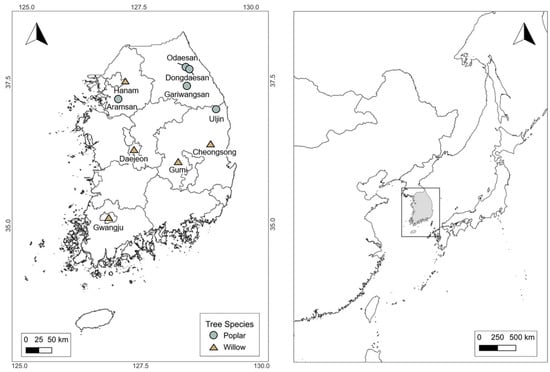
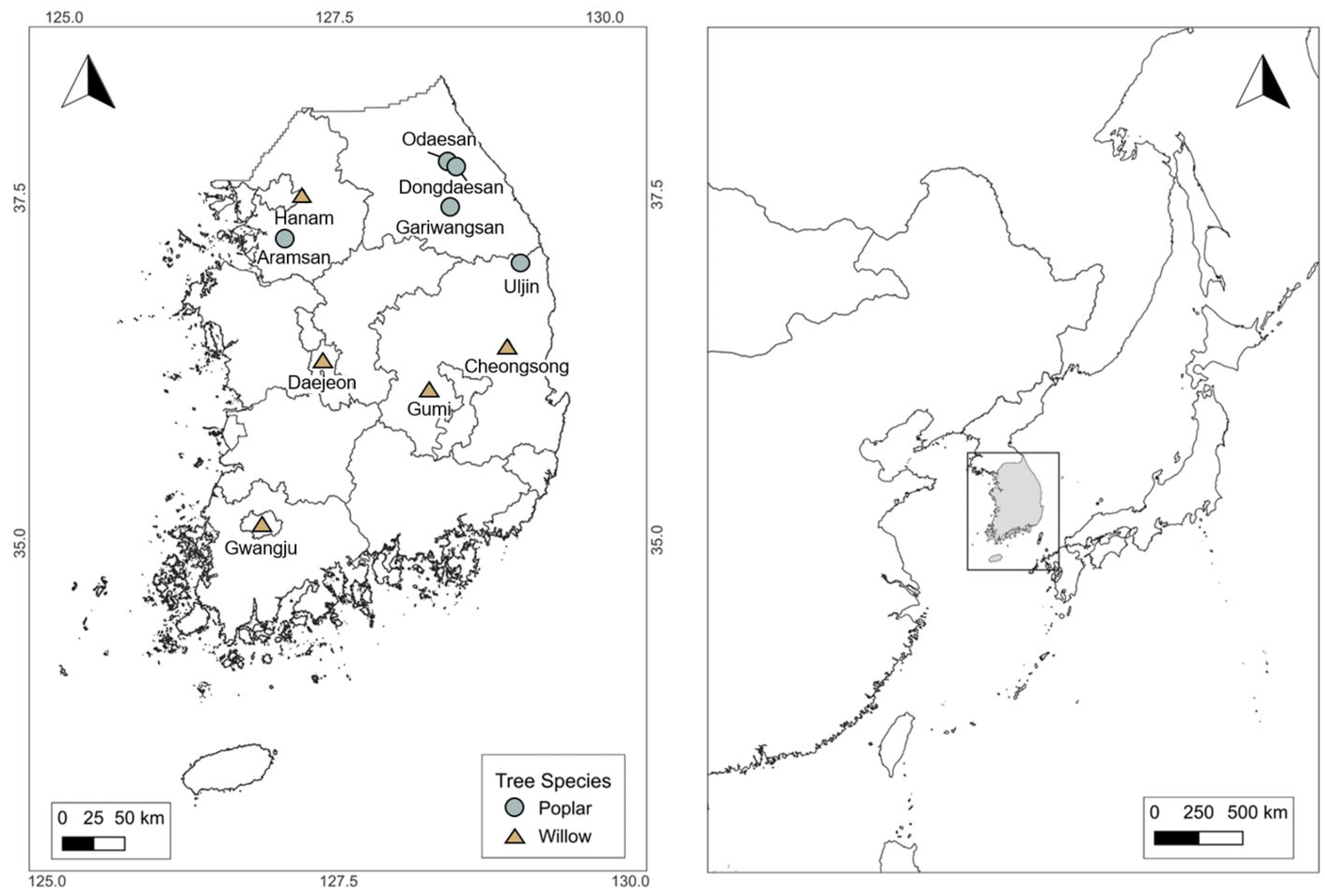
Plant-associated bacteria were isolated from rhizosphere soils and internal root tissues of Salix and Populus species collected from ten sampling sites across South Korea (Figure 1). At each site, three healthy trees were sampled as biological replicates, and fine roots were collected from three directions around each tree and composited for bacterial isolation. For rhizosphere isolates, approximately 1 g of soil adhering to fine roots was suspended in sterile distilled water, serially diluted (10−1–10−6), and 0.1 mL aliquots were spread on R2A and TSA for Salix, and on LB agar, NA, R2A agar, and TSA for Populus (MBcell, Seoul, Republic of Korea). For endophytic isolates, surface-sterilized roots were homogenized, serially diluted (10−1–10−3), and plated on the same media. Plates were incubated at 27 °C for 3 days. Morphologically distinct colonies were purified by repeated streaking, and all isolates were stored at −80 °C in 25% glycerol stocks, with five vials prepared per strain.
Figure 1.
Sampling locations of Salix pierotii and Populus davidiana used for bacterial isolation across South Korea. Circles indicate Populus sampling sites and triangles indicate Salix sampling sites. The (right) panel shows the location of the Korean Peninsula within East Asia, and the (left) panel provides a detailed map of the sampling sites.
2.2. Taxonomic Identification of Representative Bacterial Isolates
To obtain a non-redundant set for downstream screening, isolates representing distinct colony morphotypes were selected based on visible differences in colony size, color, margin, elevation, and surface texture, and were then identified by 16S rRNA gene sequencing. When multiple isolates showed the same or highly similar 16S rRNA-based taxonomic assignments, one representative isolate was retained. The resulting representatives were screened for PGP potential using an initial IAA assay, followed by additional functional trait assays. Genomic DNA was extracted from pure cultures, and the 16S rRNA gene was amplified using primers 27F (5′-AGAGTTTGATCMTGGCTCAG-3′) and 1492R (5′-TACGGYTACCTTGTTACGACTT-3′) [36]. Sanger sequencing was performed by Macrogen (Seoul, Republic of Korea). Consensus sequences were queried against the NCBI nucleotide database using BLASTn, and taxonomic assignments were cross-checked using EzBioCloud (CJ Bioscience, Inc., Seoul, Republic of Korea) [37]. Multiple sequence alignment and phylogenetic analyses were conducted in MEGA version 11 using the neighbor-joining method with 1000 bootstrap replications under the maximum composite-likelihood model [38,39]. The key strains used for inoculation, Priestia aryabhattai GJRr2 and Variovorax boronicumulans HNRr1, were deposited in the Korean Agricultural Culture Collection (KACC, Wanju, Republic of Korea) as patent microorganisms under accession numbers KACC 92649P and KACC 92648P, respectively.
2.3. Functional Trait Profiling of PGPR Strains (In Vitro)
Functional traits of PGPR strains were characterized using a set of in vitro assays targeting hormone production, nutrient mobilization, enzymatic activity, and antioxidant capacity.
2.3.1. Indole-3-Acetic Acid (IAA) Production Assay
Indole-3-acetic acid (IAA) production was determined using a colorimetric assay based on Salkowski reagent [40]. A total of 1.0 mL of bacterial cultures was inoculated into 10 mL of L-tryptophan broth (10 g gelatin pancreatic peptone, 5 g NaCl, and 1 g L-tryptophan per liter; pH 7.5) and incubated at 27 °C for 4 days with shaking at 150 rpm. After incubation, cultures were centrifuged at 7267× g for 10 min at 4 °C, and 1.5 mL of the supernatant was mixed with 3.0 mL of Salkowski reagent (98 mL of 35% HClO4 and 2 mL of 0.5 M FeCl3). The mixture was incubated at room temperature in the dark for 30 min, and absorbance was measured at 530 nm using a UV–Vis spectrophotometer (Ubi-600, MicroDigital, Seongnam, Republic of Korea). IAA concentrations were quantified using a standard curve prepared with pure IAA and were used for comparative screening of isolates. Because the initial screening was based on supernatant IAA concentration rather than biomass-normalized production, the assay was intended to compare relative IAA accumulation among isolates under standardized culture conditions. Isolates producing more than 5 µg mL−1 were classified as high producers.
2.3.2. Phosphate Solubilization and Siderophore Production Assays
Phosphate solubilization was assessed on National Botanical Research Institute’s Phosphate (NBRIP) agar medium containing (per liter) 10 g glucose, 5 g Ca3(PO4)2, 5 g MgCl2·6H2O, 0.14 g MgSO4, 0.2 g KCl, and 0.1 g (NH4)2SO4 [41]. Sterile paper discs (6 mm diameter; Whatman AA) were placed at the center of agar plates and inoculated with 3 µL of pre-cultured bacterial suspension.
Siderophore production was evaluated on chrome azurol S (CAS) agar according to Schwyn and Neilands, with minor modifications [42]. The CAS medium contained (per liter) 60.5 mg chrome azurol S, 72.9 mg hexadecyltrimethylammonium bromide (HDTMA), 10 µM FeCl3·6H2O, and 10 mM PIPES buffer (pH 6.8). Sterile paper discs were inoculated with 3 µL of bacterial suspension and incubated at 27 °C for 4 days.
Phosphate solubilization and siderophore production were assessed qualitatively based on the formation of clear (phosphate solubilization) or orange (siderophore production) halo zones surrounding the inoculated discs. These assays were used as qualitative screens of trait expression, and strains showing visible halo formation were recorded as positive.
2.3.3. Hydrolytic Enzyme Activity Assays
Hydrolytic enzyme activities of bacterial strains were assessed using plate-based assays. Cellulase activity was evaluated on potato dextrose agar (PDA) supplemented with 1% (w/v) carboxymethylcellulose, and protease activity was assessed on PDA supplemented with 2% (w/v) skim milk. Sterile paper discs (6 mm diameter) were placed at the center of agar plates and inoculated with 3 µL of overnight bacterial culture. Each strain was tested on three replicate plates per assay. Plates were incubated at 27 °C for 4 days, and enzymatic activity was recorded as positive when a visible clear zone formed around the inoculated discs.
2.3.4. Optimization of IAA Production by Selected Strains
Optimization of indole-3-acetic acid (IAA) production was conducted for two representative strains (GJRr2 and HNRr1) to characterize strain-specific responses to physicochemical culture conditions. Incubation temperature (20–35 °C at 5 °C intervals), initial medium pH (5–9 at 1-unit intervals), L-tryptophan concentration (0, 1, 3, and 5 mM), and incubation time (24, 30, 48, and 72 h) were varied independently while all other conditions were held constant.
IAA concentration was quantified using the Salkowski assay (Section 2.3.1). Maximum IAA production was defined as the highest value observed across the tested conditions. To account for differences in bacterial growth, IAA production was normalized to biomass as IAA/OD600.
2.4. Plant Experiments (In Planta)
2.4.1. Plant Materials
Ten Populus clones were used in this study. Four clones belonged to Populus deltoides, three to Populus tomentiglandulosa T. B. Lee, and three to Populus canadensis Moench (Table 1). All clones were provided by the National Institute of Forest Science (NIFoS, Suwon, Republic of Korea) and were treated as independent experimental units to evaluate clone-dependent variation in growth responses to PGPR inoculation. Dormant stem cuttings were collected in mid-to-late March 2025 from current-year shoots in the NIFoS nursery. Cuttings were selected to be healthy and undamaged, standardized to approximately 20 cm in length and 1 cm in diameter, wrapped to prevent desiccation, and stored at 4 °C until use. They were then rooted in propagation trays and transplanted into pots for the greenhouse experiment or planted directly in field plots for the open-field experiment.
Table 1.
List of Populus clones used in this study (ten clones across three taxonomic groups).
2.4.2. Experimental Setup
Greenhouse and open-field experiments were conducted simultaneously at the NIFoS in Suwon, Republic of Korea (37°15′8″ N, 126°57′29″ E). In both experiments, each inoculation treatment was assigned to a separate plot (block), within which Populus cuttings were planted and managed under the same conditions. For the greenhouse experiment, rooted Populus cuttings were transplanted into 10 L pots filled with a non-sterilized peat moss:perlite mixture (3:1, v/v). Pots were arranged by treatment group in separate plots under ambient greenhouse conditions without artificial environmental control and were irrigated twice daily with tap water. Within each treatment plot, clone and replicate individuals were arranged in a predefined order, and pot positions were rotated during the experiment to reduce positional effects while maintaining the treatment layout. Planting was conducted on 10 April 2025, and no fertilizer was applied during the experimental period. The field experiment was conducted in an open nursery at the same institute. Treatment plots were established in twelve blocks distributed across two rows. Before planting, the site was leveled to improve plot uniformity. Within each treatment plot, ten Populus clones were planted in a single row with nine plants per clone (90 plants per plot; 1080 plants in total). Cuttings were planted at 0.6 m spacing within rows and 0.5 m spacing between rows, and clone positions were rotated among blocks to reduce spatial heterogeneity. Film mulching was applied before planting to suppress weed growth and reduce surface moisture loss. Plots were irrigated automatically using a sprinkler system, and weeds emerging through the mulch holes were removed manually as needed during the experimental period. To minimize edge effects, additional guard rows were established at the uppermost and lowermost edges of each block, and guard-row plants were excluded from all measurements and statistical analyses.
2.4.3. Bacterial Inoculation Treatments
Seven inoculation treatments were applied, including an uninoculated control, five single-strain treatments (OLa, GJRr2, HNRr1, CSRr1, and ORa), and one mixed-strain treatment containing all five strains (Mix). Each strain was cultured in tryptic soy broth at 27 °C for 72 h with shaking at 150 rpm, centrifuged at 1666× g for 10 min, and concentrated 20-fold. Concentrated suspensions were stored at 4 °C and diluted with tap water immediately before application.
For the greenhouse experiment, bacterial suspensions were adjusted to an optical density of OD600 = 0.1, whereas for the field experiment, suspensions were adjusted to OD600 = 0.2. Different inoculum concentrations were used in the greenhouse and field experiments to account for differences in application volume, environmental exposure, and expected dilution under field conditions. Bacterial application was performed using both root dipping and soil drenching methods to promote early root-surface contact and continued delivery of inoculum after planting. For root dipping, stem cuttings were immersed in bacterial suspensions for 24 h prior to planting. For soil drenching, bacterial suspensions were applied directly to the soil surface immediately after planting at volumes of 50 mL per pot in the greenhouse experiment and 100 mL per plant in the field experiment.
Inoculations were repeated eight times at intervals of two to four weeks, consisting of six biweekly and two monthly applications. Control plants received the same volume of tap water at each application. Statistical analyses were based on measurements taken 18 weeks after planting in the greenhouse experiment and 20 weeks after planting in the field experiment.
2.4.4. Assessment of Plant Growth Responses
Plant growth responses were assessed at the final evaluation of each experiment. Measured traits included shoot length, stem diameter, and number of leaves. Shoot length was measured using a measuring tape, and stem diameter was measured using a digital Vernier caliper (500-702-20, Mitutoyo Corp., Kawasaki, Japan). Shoot and root biomass were recorded as fresh and dry weight. Before fresh weight measurement, surface moisture was gently removed from shoots and roots using paper towels. Dry weight was determined after oven-drying at 65 °C for 48 h until constant weight using a drying oven (JSOF-150, JSR, Gonju, Republic of Korea). Fresh and dry biomass were measured using balances (MWII-H and SWII-CW, CAS, Yangju, Republic of Korea). In the greenhouse experiment, stem diameter was measured at the root collar (root collar diameter, RCD), reflecting early-stage growth. In the field experiment, stem diameter was measured as diameter at breast height (DBH), following standard forestry practice. Basal area (BA) and stem volume (V) were calculated from stem diameter (D) and shoot height (H), where D represents RCD in the greenhouse experiment and DBH in the field experiment. Stem volume was estimated using a simplified geometric approximation assuming a conical stem shape, applied consistently within each experiment to allow comparisons among treatments. The equations were as follows:
Statistical analyses were conducted using five biological replicates per treatment at the final assessment.
2.5. Statistical Analysis
All statistical analyses were performed in R (v4.3.2) [43]. For both greenhouse and field experiments, treatment effects on individual growth traits were tested using Welch’s analysis of variance (ANOVA) to account for heteroscedasticity. When treatment effects were significant, post hoc comparisons against the uninoculated control were conducted using Games–Howell tests. In the greenhouse experiment, the effects of strain, clone, and their interaction were further evaluated using two-way ANOVA with strain and clone as fixed factors. To summarize overall growth responses in the greenhouse experiment, individual trait values at week 18 for number of leaves, height, stem diameter, leaf fresh weight, leaf dry weight, root fresh weight, root dry weight, total fresh weight, and total dry weight were standardized as z-scores, and a composite growth index was calculated for each plant as the mean of these standardized values. Strain effects on this index were assessed using a linear mixed-effects model with strain as a fixed effect and clone as a random effect, and estimated marginal means were compared using Tukey-adjusted multiple comparisons. To compare treatment responses between greenhouse and field experiments, standardized effect sizes (Hedges’ g) were calculated for each trait relative to the control [44]. Spearman’s rank correlation analysis was used to examine relationships among key growth traits in the greenhouse and open-field experiments. In the greenhouse experiment, correlations were evaluated among height, stem diameter, and total fresh weight at 18 weeks after planting. In the open-field experiment, correlations were evaluated among height, diameter at breast height (DBH), and shoot fresh weight at 20 weeks after planting. Correlation coefficients were calculated for the pooled dataset and separately for each clone group (P. deltoides, P. tomentiglandulosa, and P. canadensis). Statistical significance was set at p < 0.05.
3. Results
3.1. Diversity and Taxonomic Composition of Plant-Associated Bacteria
A total of 332 bacterial isolates were obtained from the rhizosphere soils and root tissues of Salix pierotii Miq. and Populus davidiana Dode collected across ten sites in South Korea. Of these, 142 isolates originated from Salix and 190 from Populus. Among the 332 isolates, 291 yielded reliable 16S rRNA gene sequence-based taxonomic assignments and were used for taxonomic analysis.
Based on 16S rRNA gene sequencing, these 291 isolates were assigned to 54 genera belonging to 35 families. Salix-associated isolates comprised 34 genera, including 20 recovered from root tissues and 26 from rhizosphere soils, whereas Populus-associated isolates represented 31 genera, with 17 from roots and 23 from soils. Among the identified isolates, Bacillaceae was the dominant family, accounting for 55.0% (160/291) of all taxonomically assigned isolates. At the genus level, Bacillus was the most abundant genus (25.8%, 75/291), followed by Lysinibacillus (7.2%, 21/291), Paenibacillus (6.9%, 20/291), Gottfriedia (6.2%, 18/291), and Priestia (4.8%, 14/291). Together, these five genera accounted for 50.9% of all identified isolates.
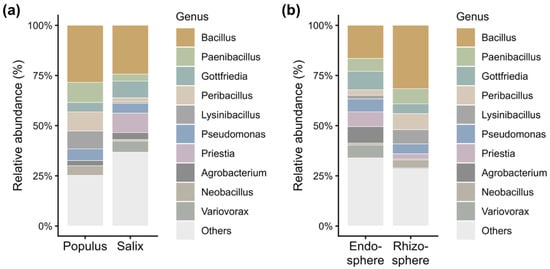
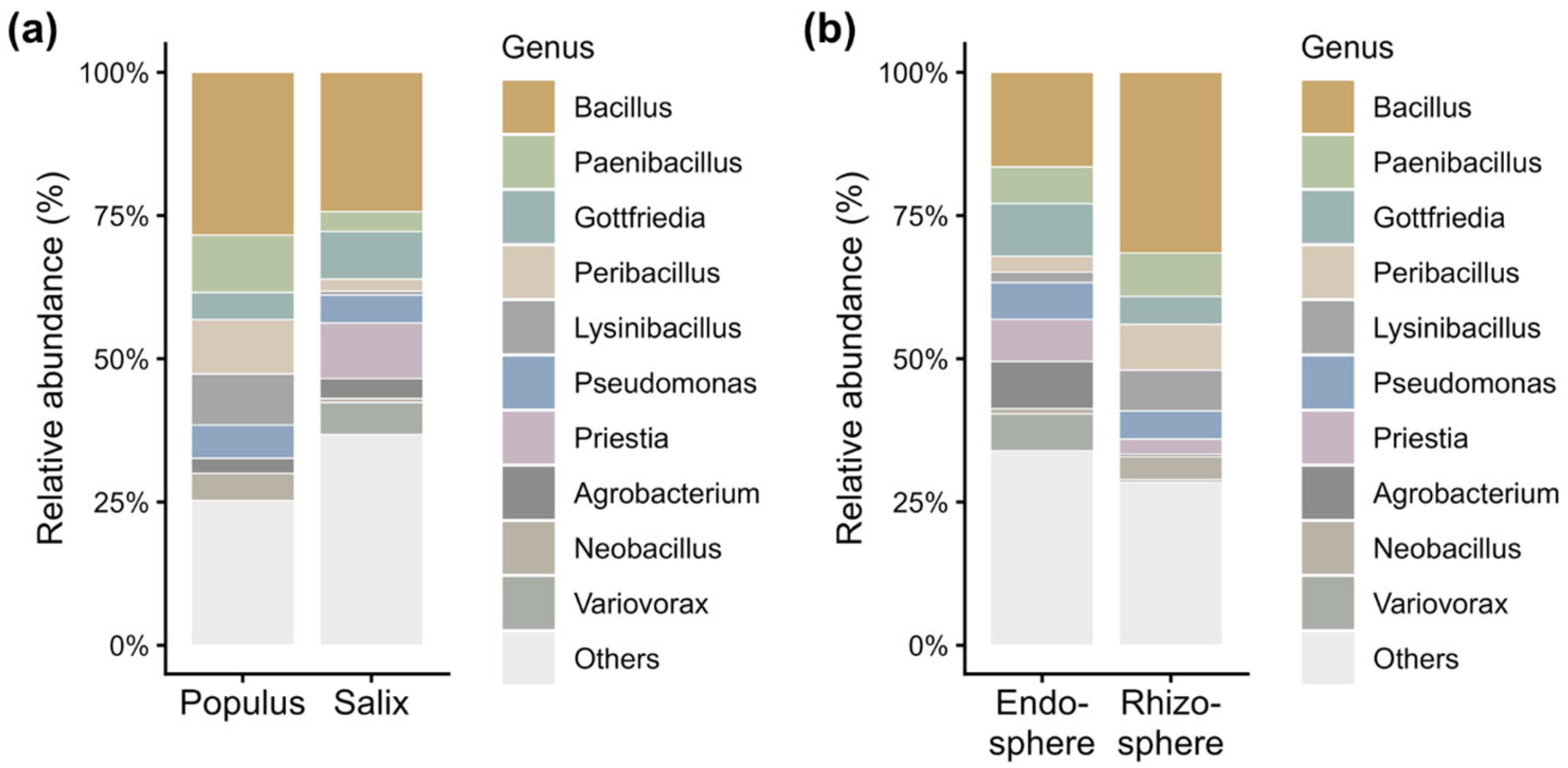
At the genus level, Salix-associated isolates were mainly affiliated with Priestia, Gottfriedia, Bacillus, and Variovorax, whereas Populus-associated isolates were dominated by Bacillus, Paenibacillus, Peribacillus, and Lysinibacillus (Figure 2a). Although several genera were shared between the two host plants, their relative abundances differed between Salix and Populus. In particular, Priestia and Variovorax were more prominent among Salix-associated isolates, whereas Paenibacillus, Peribacillus, and Lysinibacillus were more characteristic of Populus-associated isolates. Distinct compartment-specific patterns were also observed (Figure 2b). Bacillus was more abundant in rhizosphere samples than in root endosphere samples, whereas Agrobacterium, Priestia, Pseudomonas, and Variovorax were relatively more represented in endophytic compartments (Figure 2b).
Figure 2.
Genus-level distribution of culturable bacterial isolates associated with Salix and Populus. Bars represent the relative abundance of isolates grouped by (a) host genus and (b) plant compartment (endosphere or rhizosphere), based on 16S rRNA gene identification. The ten most abundant genera across all samples are shown, and remaining taxa are combined as ‘Others’.
3.2. In Vitro Plant Growth–Promoting Traits of Bacterial Isolates
3.2.1. Indole-3-Acetic Acid Production
Indole-3-acetic acid (IAA) production varied widely among the bacterial isolates in the presence of L-tryptophan, ranging from trace levels to more than 40 ppm under the assay conditions. Detectable IAA production was observed in 81 isolates, of which 35 produced more than 5 ppm and 8 produced more than 10 ppm in the colorimetric screening assay. Endophytic isolates generally showed higher supernatant IAA concentrations than rhizospheric isolates. Among the tested isolates, Variovorax boronicumulans HNRr1 showed the highest measured IAA concentration, reaching 42.2 ± 0.9 ppm under the screening conditions.
3.2.2. Phosphate Solubilization and Siderophore Production
Phosphate solubilization and siderophore production were detected in multiple isolates. On NBRIP agar, phosphate solubilization was indicated by the formation of clear halo zones, whereas siderophore production on CAS agar was confirmed by the appearance of orange halos surrounding bacterial colonies. Distinct halo formation was observed for several isolates, including Priestia aryabhattai GJRr2 and Variovorax boronicumulans HNRr1, in both assays.
3.2.3. Hydrolytic Enzyme Activities
Hydrolytic enzyme assays indicated that cellulase activity was detected in several isolates, whereas protease activity was observed in only one isolate. Clear cellulolytic zones were formed by Paenibacillus gorillae OLa, Ensifer morelensis CSRr1, Bacillus thuringiensis ORa, P. aryabhattai GJRr2, and V. boronicumulans HNRr1. Protease activity, indicated by casein hydrolysis on skim-milk agar, was detected only in P. aryabhattai GJRr2. Representative isolates exhibiting contrasting plant growth–promoting traits are summarized in Table 2.
Table 2.
In vitro screening of plant growth–promoting traits in representative bacterial isolates.
3.3. Optimization of IAA Production in Selected Strains
Stepwise optimization experiments were conducted to determine culture conditions that maximize IAA production in strains GJRr2 and HNRr1. Individual factors were examined separately, and the best-performing ranges were combined to identify the final optimal conditions. The optimized conditions and corresponding IAA production levels are summarized in Table 3.
Table 3.
Optimized culture conditions for indole-3-acetic acid (IAA) production in P. aryabhattai GJRr2 and V. boronicumulans HNRr1.
The two strains exhibited distinct temporal patterns of IAA production. GJRr2 reached its maximum IAA level within 24 h, whereas HNRr1 showed a more gradual increase, with peak production observed at 30 h. Strain-specific differences were also observed in the response to L-tryptophan concentration. IAA production in GJRr2 increased steadily up to 5 mM, whereas HNRr1 reached its maximum at 3 mM and showed a reduced response at 5 mM.
For both strains, the highest IAA concentrations were observed at pH 7 and 8. When expressed as absolute IAA concentration, GJRr2 showed higher production under high-density culture conditions. In contrast, when normalized to cell density (IAA/OD600), HNRr1 showed greater IAA production efficiency per unit biomass. Final optimal conditions were selected based on the maximum absolute IAA concentration for each strain, whereas IAA/OD600 values were used to interpret strain-specific differences in production efficiency.
3.4. Growth Response Under Greenhouse Conditions
3.4.1. Strain-Dependent Growth Responses
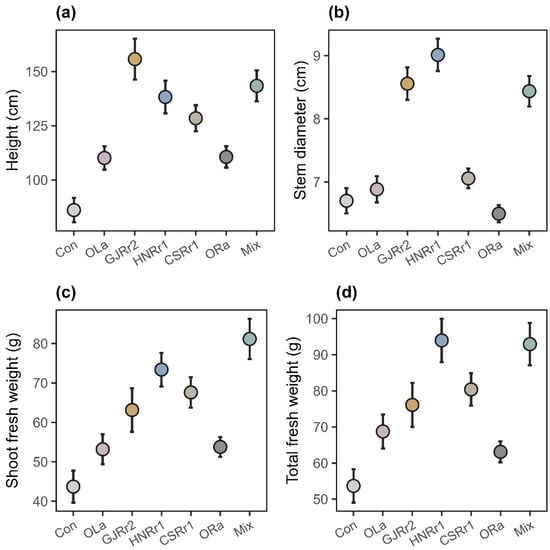
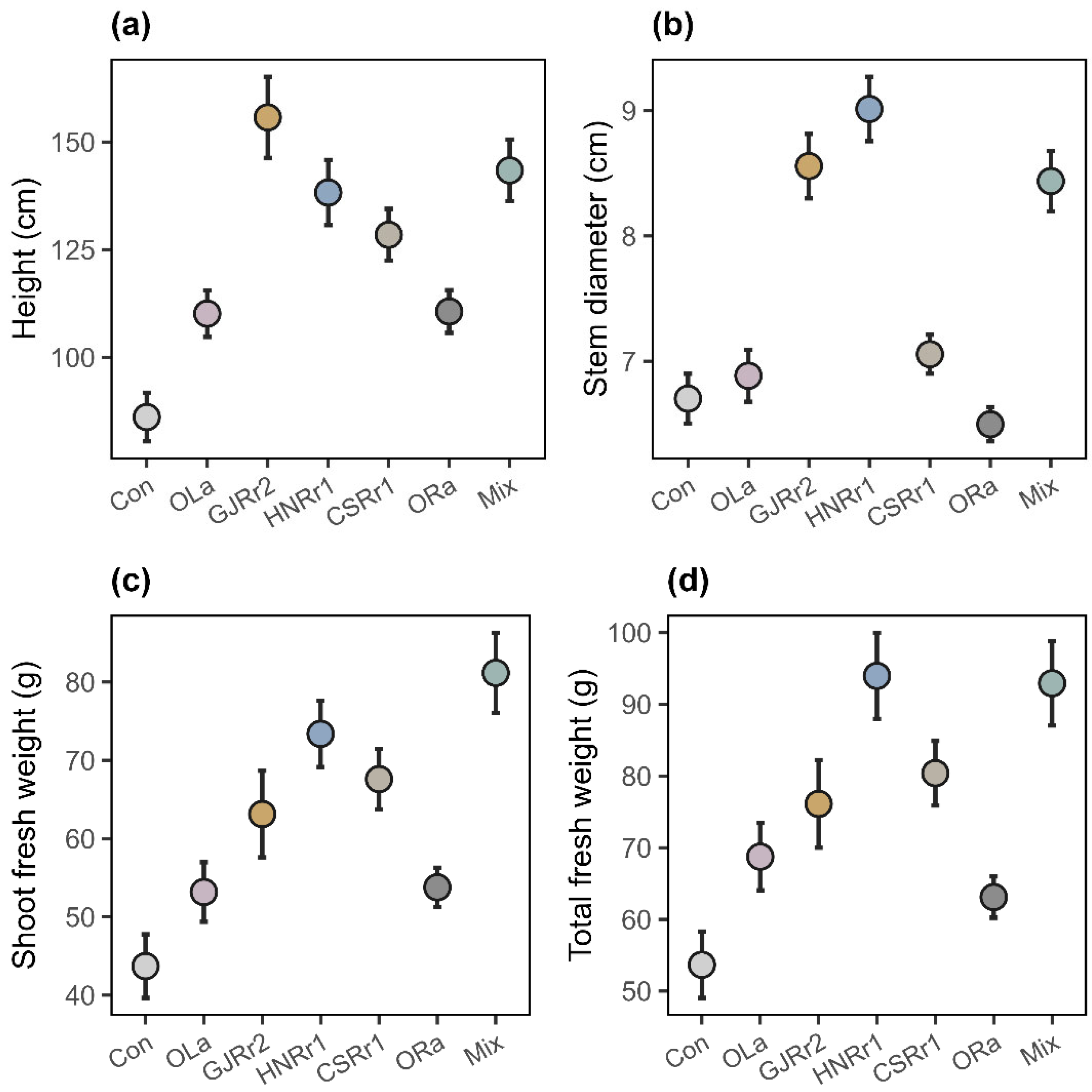
Under greenhouse conditions, significant strain effects were detected for all measured traits (Welch’s ANOVA, p < 0.001), indicating that PGPR inoculation resulted in strain-dependent differences in plant growth responses (Figure 3). Relative to the uninoculated control, the largest and most consistent increases were observed for HNRr1, GJRr2, and the mixed inoculum (Mix), particularly for height, stem diameter, and biomass-related traits. For example, plant height increased from 86.1 ± 5.6 cm in the control to 156.0 ± 9.4 cm in GJRr2, 138.2 ± 7.6 cm in HNRr1, and 143.4 ± 7.1 cm in Mix.
Figure 3.
Strain-dependent growth responses of Populus cuttings under greenhouse conditions. Effects of PGPR inoculation on (a) plant height, (b) stem diameter, (c) shoot fresh weight, and (d) total fresh weight measured at the final harvest. Values are means ± SE. Treatment effects were tested using Welch’s ANOVA (p < 0.05). Con, uninoculated control; Mix, mixed inoculum. Different colored circles are used only to visually distinguish the treatments.
Among individual treatments, HNRr1 produced the highest values for stem diameter (9.01 ± 0.26 mm) and total fresh weight (94.0 ± 6.0 g), whereas Mix showed the highest shoot fresh weight (81.2 ± 5.1 g). GJRr2 also exhibited pronounced positive effects across multiple traits, including the greatest plant height and the highest number of leaves. In contrast, ORa and CSRr1 showed moderate, trait-specific responses, whereas OLa remained relatively close to the control across most traits despite a modest increase in height.
3.4.2. Clone-Dependent Variation in Growth Traits
Clone group significantly affected most aboveground growth traits under greenhouse conditions, including height, number of leaves, stem diameter, shoot fresh weight, shoot dry weight, total fresh weight, and total dry weight (Welch’s ANOVA, p < 0.001). By contrast, root fresh and dry weights did not differ significantly among clone groups (p > 0.05).
Among the three groups, P. tomentiglandulosa (PT) and P. canadensis (PC) generally showed greater aboveground growth than P. deltoides (PD). Height was highest in PT (153.35 ± 5.13 cm), followed by PC (149.18 ± 4.12 cm), whereas PD had the lowest value (89.43 ± 2.52 cm). Both PT and PC were significantly taller than PD (p < 0.001), while PT and PC did not differ significantly. PT also produced the highest number of leaves (38.31 ± 1.84), whereas PC showed the greatest RCD (8.20 ± 0.19 mm) and the highest total fresh and dry weights (84.59 ± 3.88 g and 24.38 ± 1.22 g, respectively).
3.4.3. Strain-Clone Interaction
Significant strain × clone interactions were detected for height, stem diameter, shoot fresh weight, shoot dry weight, root fresh weight, root dry weight, total fresh weight, and total dry weight (p < 0.05), whereas the interaction for number of leaves was not significant (p > 0.05).
When treatment responses were expressed relative to the uninoculated control within each clone, the strongest responses differed among clone–strain combinations. For height, the largest increases were recorded in clone ‘I-476′ treated with GJRr2 (+119.0 cm), clone ’72-30′ treated with GJRr2 (+112.0 cm), and clone ‘Bongwha’ treated with HNRr1 (+104.0 cm). Across clones, the highest control-relative responses were most frequently associated with GJRr2, HNRr1, or Mix.
3.4.4. Multivariate Integration of Growth Traits
While the preceding analyses focused on individual growth traits, multivariate analyses were used to evaluate integrated growth responses under greenhouse conditions. PERMANOVA detected significant effects of strain (F = 14.59, R2 = 0.1624, p = 0.001), clone (F = 14.07, R2 = 0.2349, p = 0.001), and the strain × clone interaction (F = 1.92, R2 = 0.1927, p = 0.001). Variation partitioning further showed that clone identity explained the largest independent fraction of multivariate trait variation (Adj. R2 = 0.2197), whereas strain explained an additional independent fraction (Adj. R2 = 0.1405).
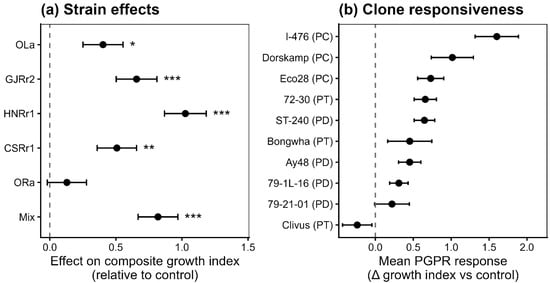
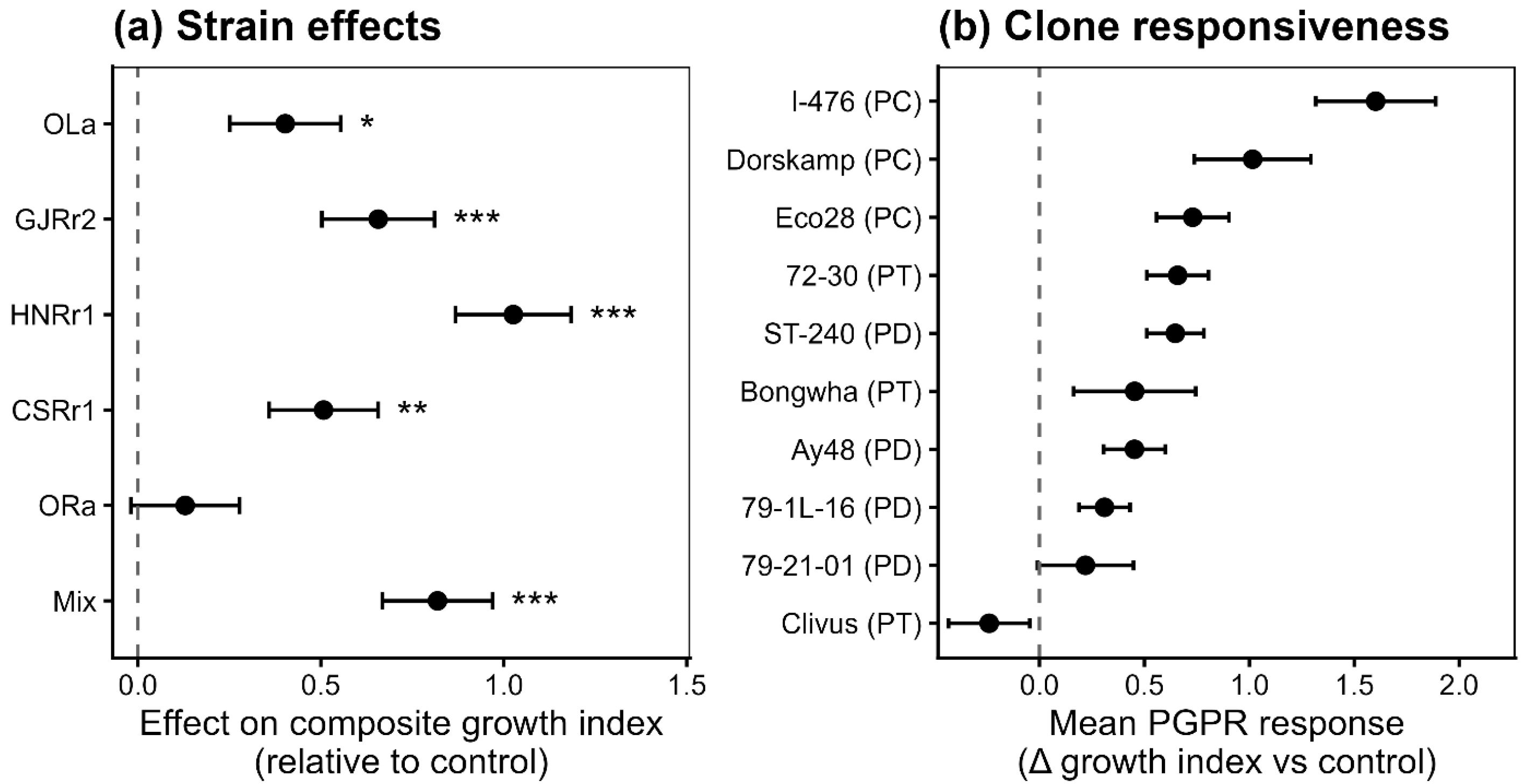
To summarize treatment effects across multiple growth traits, a composite growth index was calculated as the mean of z-transformed trait values. A linear mixed-effects model, with clone treated as a random factor, revealed a significant main effect of strain on the composite growth index (F = 11.80, p < 0.001). Relative to the control, the largest positive deviations were observed for HNRr1 (estimate = 1.026, p < 0.001), followed by Mix (0.819, p < 0.001) and GJRr2 (0.657, p < 0.001). CSRr1 (0.508, p = 0.004) and OLa (0.403, p = 0.043) also showed positive deviations, whereas ORa did not differ significantly from the control (0.129, p = 0.841) (Figure 4a).
Figure 4.
Integrated PGPR effects on poplar growth under greenhouse conditions, based on a composite growth index calculated as the mean of z-standardized growth traits. (a) Strain effects relative to the uninoculated control, estimated from a linear mixed-effects model with strain as a fixed effect and clone as a random effect. (b) Clone responsiveness, expressed as the mean change (Δ) in composite growth index relative to the corresponding control of each clone across PGPR treatments. Points indicate estimates and horizontal bars represent 95% confidence intervals. The dashed vertical line indicates no difference from the control, and asterisks denote significant differences from the control (* p < 0.05, ** p < 0.01, *** p < 0.001).
Clone-level responsiveness also varied substantially (Figure 4b). The highest mean PGPR responses were observed in I-476 (PC) (Δ growth index = 1.60 ± 0.29), Dorskamp (PC) (1.02 ± 0.28), and Eco28 (PC) (0.73 ± 0.17), whereas Clivus (PT) showed a negative mean response (−0.24 ± 0.19). Among the lower-responding clones, 79-21-01 (PD) and 79-1L-16 (PD) showed only small positive deviations from their respective controls.
3.4.5. Correlations Among Major Growth Traits
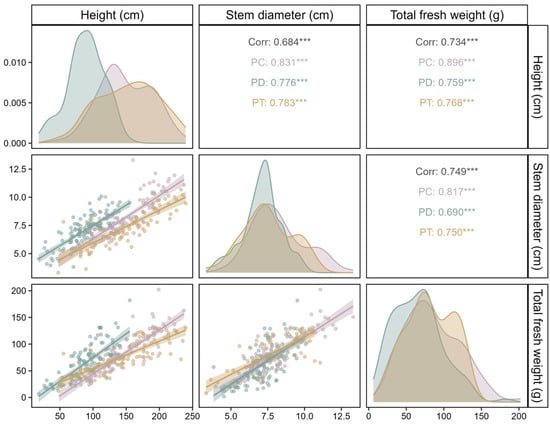
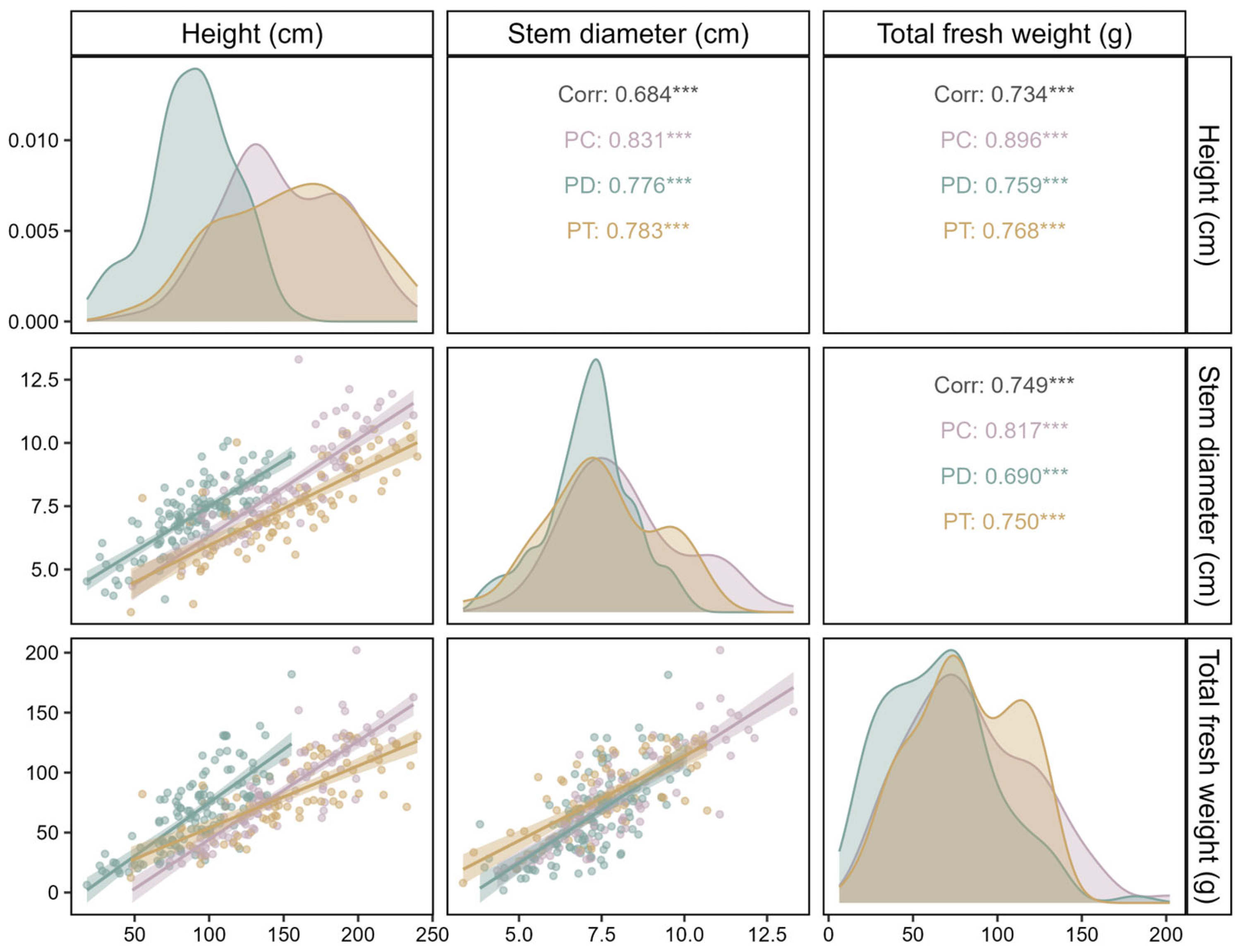
Spearman correlation analysis showed that the major growth traits measured in the greenhouse experiment were all positively associated with one another (Figure 5). In the pooled dataset, height was positively correlated with stem diameter (ρ = 0.684, p < 0.001) and total fresh weight (ρ = 0.734, p < 0.001), and stem diameter was also positively correlated with total fresh weight (ρ = 0.749, p < 0.001).
Figure 5.
Spearman correlation matrix of major growth traits measured in the greenhouse experiment at 18 weeks after planting. Height, stem diameter, and total fresh weight were positively associated in the pooled dataset and within each clone group. Diagonal panels show trait distributions, lower panels show pairwise scatterplots with fitted trend lines, and upper panels present Spearman correlation coefficients. Colors indicate clone groups: P. canadensis (PC), P. deltoides (PD), and P. tomentiglandulosa (PT). Asterisks indicate significance at p < 0.001.
Positive relationships were also consistently observed within each clone group. For the correlation between height and stem diameter, the coefficients were 0.831 in PC, 0.776 in PD, and 0.783 in PT (all p < 0.001). For height and total fresh weight, the corresponding coefficients were 0.896 in PC, 0.759 in PD, and 0.768 in PT (all p < 0.001). Similarly, stem diameter and total fresh weight were positively correlated in all clone groups, with coefficients of 0.817 in PC, 0.690 in PD, and 0.750 in PT (all p < 0.001).
3.5. Field Validation of PGPR Effects
3.5.1. Treatment Effects Under Field Conditions
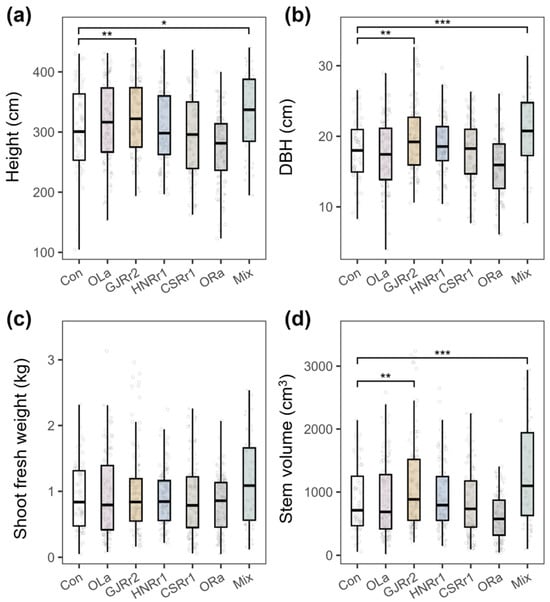
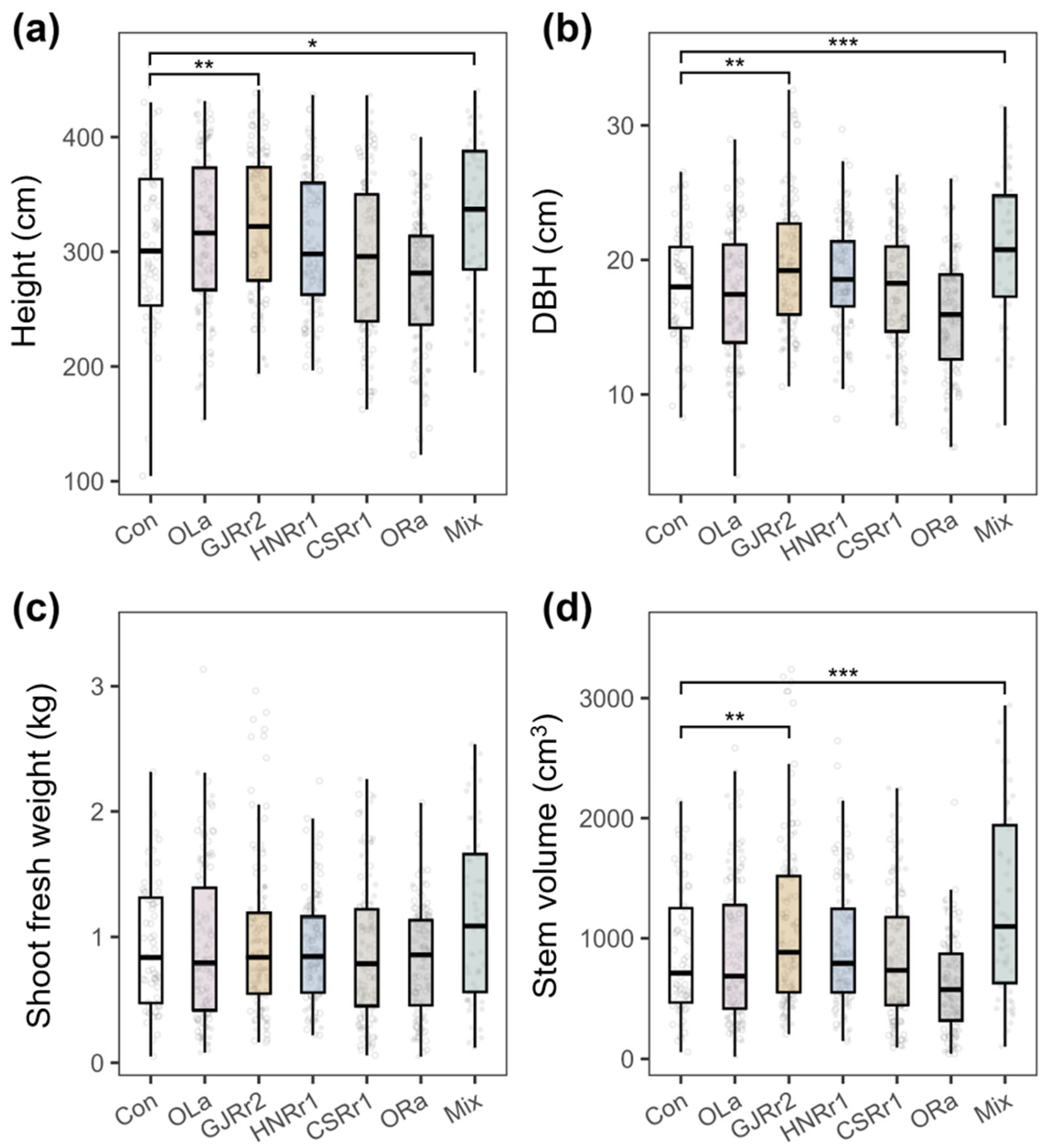
Under field conditions, treatment effects were detected for height, stem diameter, shoot fresh weight, and stem volume (Figure 6). Among the inoculated treatments, GJRr2 and Mix showed positive effects on several structural growth traits relative to the uninoculated control. Plant height increased by 18.5 cm in GJRr2 and by 20.3 cm in Mix (p < 0.05 for both). DBH also increased in these two treatments, by 1.66 mm in GJRr2 and 2.58 mm in Mix, and both differences were significant. A similar pattern was found for stem volume, which was higher than the control by 221.9 cm3 in GJRr2 and 361.0 cm3 in Mix.
Figure 6.
Effects of PGPR inoculation on growth traits of Populus cuttings under field conditions. Boxplots show (a) plant height, (b) diameter at breast height (DBH), (c) shoot fresh weight, and (d) stem volume measured at 20 weeks after planting. Brackets indicate significant differences compared with the uninoculated control (Con) based on Welch’s ANOVA followed by Games–Howell post hoc tests (* p < 0.05, ** p < 0.01, *** p < 0.001).
By contrast, ORa showed negative responses for the same traits. Compared with the control, plant height was lower by 34.5 cm, DBH by 2.28 mm, and stem volume by 275.3 cm3 (p < 0.001 for all three traits). The remaining treatments did not differ significantly from the control for these variables. Although fresh weight was included in the overall model, none of the treatments showed a significant difference from the control after multiple-comparison adjustment.
3.5.2. Comparison of Effect Sizes Between Greenhouse and Field Experiments
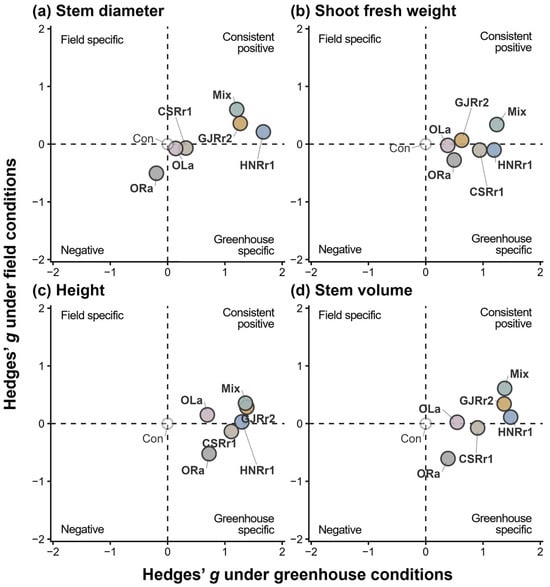
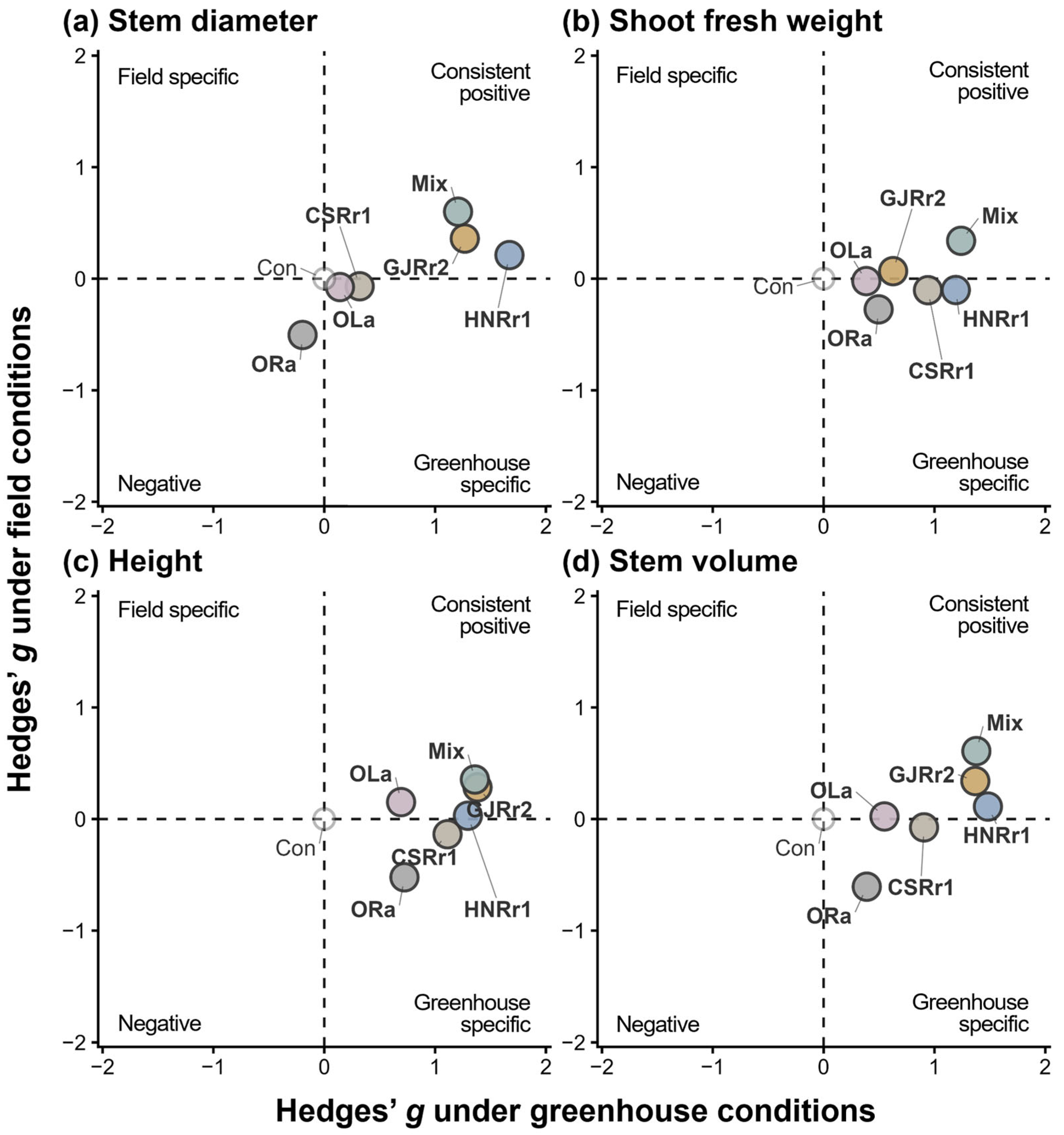
PGPR treatment effects were further compared between greenhouse and field experiments using standardized effect sizes relative to the control (Hedges’ g) (Figure 7). The degree of consistency between environments differed among traits and strains. For stem diameter, positive effect sizes were observed under both conditions for GJRr2 (g = 1.27 in the greenhouse; 0.36 in the field), HNRr1 (1.67; 0.21), and Mix (1.21; 0.60), whereas ORa showed negative values in both environments (−0.20; −0.51). A similar pattern was found for stem volume, with Mix (1.38; 0.61) and GJRr2 (1.37; 0.34) remaining positive across both environments, while ORa shifted to a negative field response (0.39; −0.61).
Figure 7.
Comparison of PGPR treatment effects between greenhouse and field experiments based on standardized effect sizes relative to the uninoculated control (Hedges’ g). Effect sizes are shown for (a) stem diameter, (b) shoot fresh weight, (c) height, and (d) stem volume. Each point represents one inoculation treatment, including five single-strain treatments and the mixed inoculum (Mix). Values of 0 on either axis indicate no difference from the control in the corresponding environment. Dashed lines divide each panel into quadrants representing consistently positive responses (upper right), greenhouse-specific positive responses (lower right), field-specific positive responses (upper left), and negative responses in both environments (lower left).
Responses were less consistent for shoot fresh weight and height. For shoot fresh weight, most strains showed positive effect sizes in the greenhouse, but field responses were reduced or became negative for several treatments, including CSRr1 (0.94; −0.10), HNRr1 (1.19; −0.10), and ORa (0.50; −0.28). In contrast, Mix retained a positive response in both environments (1.24; 0.34). For height, GJRr2 (1.38; 0.28) and Mix (1.36; 0.35) remained positive in both environments, whereas ORa shifted from a positive greenhouse effect to a negative field response (0.72; −0.52). Across environments, Mix and GJRr2 showed the most consistently positive effect sizes, particularly for structural growth traits, whereas shoot fresh weight responses were less consistent under field conditions.
3.5.3. Correlations Among Major Growth Traits Under Field Conditions
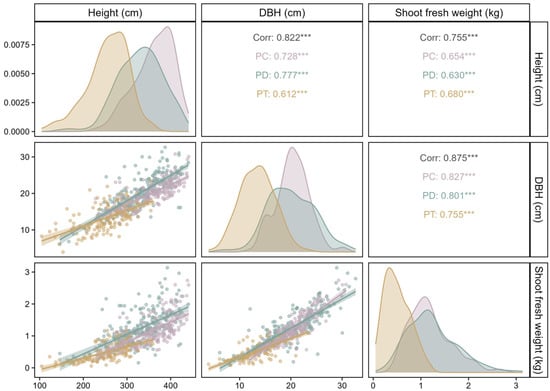
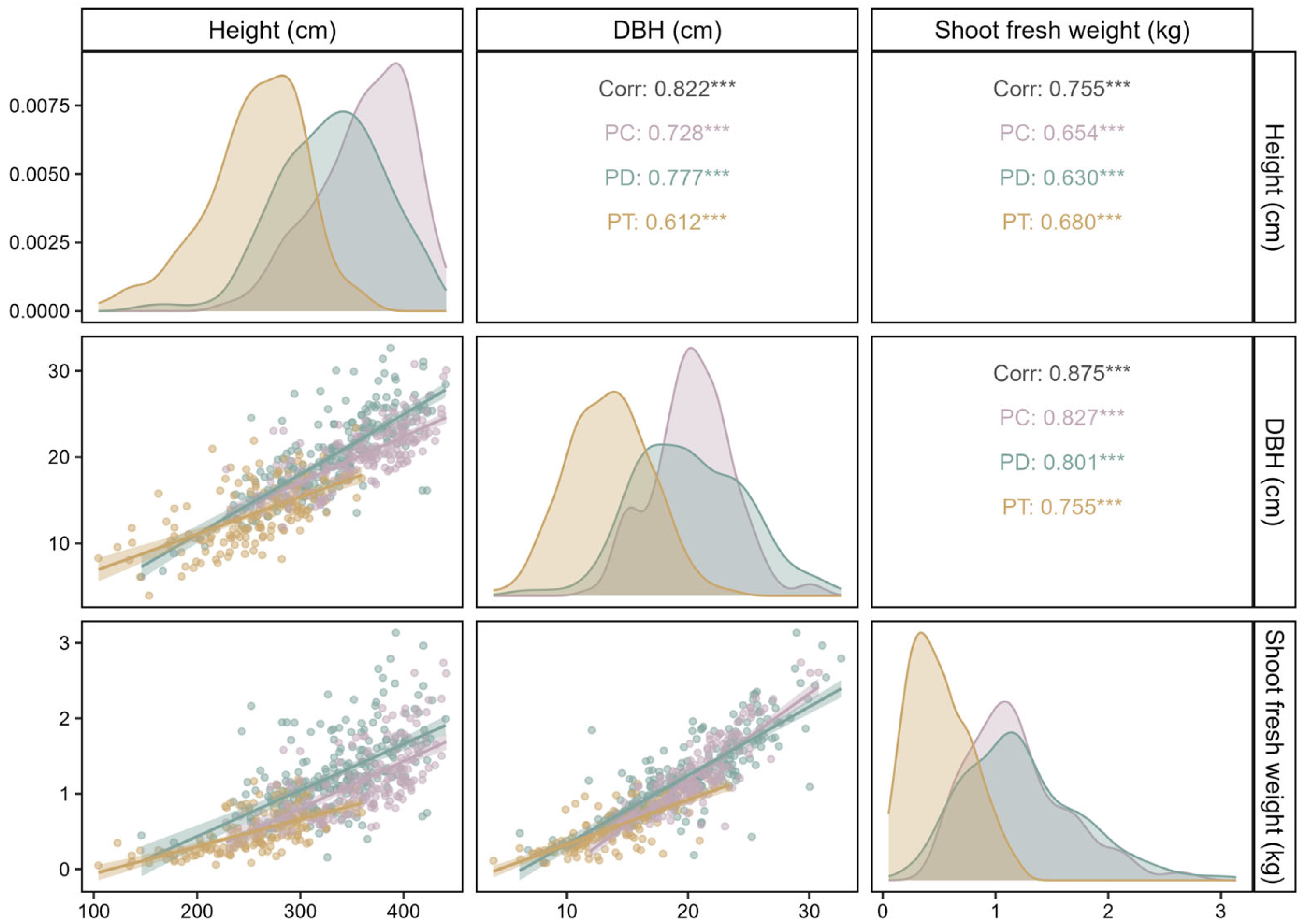
Spearman correlation analysis showed that the major growth traits measured in the open-field nursery were all positively associated with one another (Figure 8). In the pooled dataset, height was positively correlated with DBH (ρ = 0.822, p < 0.001) and shoot fresh weight (ρ = 0.755, p < 0.001), and DBH was also positively correlated with shoot fresh weight (ρ = 0.875, p < 0.001).
Figure 8.
Spearman correlation matrix of major growth traits measured in the open-field nursery experiment at 20 weeks after planting. Height, diameter at breast height (DBH), and shoot fresh weight were positively associated in the pooled dataset and within each clone group. Diagonal panels show trait distributions, lower panels show pairwise scatterplots with fitted trend lines, and upper panels present Spearman correlation coefficients. Colors indicate clone groups: P. canadensis (PC), P. deltoides (PD), and P. tomentiglandulosa (PT). Asterisks indicate significance at p < 0.001.
Positive relationships were also observed within each clone group. For the correlation between height and DBH, the coefficients were 0.728 in PC, 0.777 in PD, and 0.612 in PT (all p < 0.001). For height and shoot fresh weight, the corresponding coefficients were 0.654 in PC, 0.630 in PD, and 0.680 in PT (all p < 0.001). Similarly, DBH and shoot fresh weight were positively correlated in all clone groups, with coefficients of 0.827 in PC, 0.801 in PD, and 0.755 in PT (all p < 0.001).
4. Discussion
4.1. Strain-Specific Growth Responses and Functional Compatibility
The greenhouse experiment showed clear strain-dependent differences in the early growth of poplar stem cuttings. In particular, Variovorax boronicumulans HNRr1, Priestia aryabhattai GJRr2, and the mixed inoculum (Mix) produced relatively consistent positive responses across height, stem diameter, and biomass-related traits. These results indicate that growth promotion in Populus was not shared equally among all beneficial rhizobacteria, but varied according to the characteristics of individual strains and their compatibility with early host development [45,46]. Because successful establishment of woody cuttings depends strongly on early rooting, shoot development, and nutrient acquisition [6,47], strains that function more effectively during this stage may produce stronger growth responses [48].
HNRr1 showed the highest IAA production in vitro and performed particularly well in stem diameter and total biomass under greenhouse conditions. This suggests that its high IAA-producing ability may have contributed to growth promotion, but the response cannot be attributed to IAA alone. HNRr1 did not produce the strongest response in every trait, indicating that high in vitro IAA production was associated with some aspects of growth promotion rather than with all plant responses. A more cautious interpretation is that HNRr1 was more effective for specific components of early poplar establishment, especially stem thickening and biomass accumulation [49].
GJRr2 showed a different pattern. Although its IAA production was lower than that of HNRr1, it produced strong responses in height and leaf-related traits. GJRr2 also expressed several in vitro traits, including phosphate solubilization, siderophore production, and protease activity. This suggests that its growth-promoting effect was more likely associated with multiple functions acting together rather than with one dominant trait alone [50]. In this study, the strong height response observed in GJRr2-treated plants is therefore better interpreted as the outcome of a broader functional profile during early establishment than as a simple auxin-related effect [51].
The mixed inoculum also showed relatively stable positive responses across several traits under greenhouse conditions. Compared with single-strain treatments, Mix produced a more even response across vertical growth and stem thickening. This pattern suggests that mixed inoculation may provide a broader functional range than a single strain [52]. Overall, the greenhouse results show that PGPR effects in poplar cuttings were strain-specific and differed according to how individual strains functioned during early establishment.
4.2. Decoupling of in Vitro Traits and in Planta Performance
The selected strains showed several plant growth-promoting traits in vitro, but these traits were not directly reflected in plant growth responses. In particular, HNRr1 produced the highest amount of IAA in vitro, yet it did not show the strongest effect for every growth trait. This mismatch indicates that in vitro functional traits are useful for identifying promising strains, but do not fully predict plant performance under greenhouse or field conditions [53,54].
One likely reason is that trait expression on artificial media does not necessarily reflect how the same function operates in the rhizosphere. Plant responses depend not only on the presence of a bacterial trait, but also on the root environment, host physiological condition, and the timing of plant–microbe interaction [55,56]. The present results are consistent with this interpretation. HNRr1 showed very strong IAA production in vitro, but its in planta effects differed among traits, suggesting that high trait intensity under laboratory conditions does not always translate into uniformly strong plant responses.
This limitation also applies to other in vitro traits. Phosphate solubilization, siderophore production, and enzyme activity are relatively easy to detect on culture media, but their effects in the rhizosphere may vary with carbon availability, nutrient chemistry, microbial competition, and microsite conditions around roots [57,58]. Therefore, a positive plate-based result should not be interpreted as direct evidence of equivalent activity under plant-associated conditions. In the present study, GJRr2 expressed several in vitro traits, yet its strongest in planta effects were more evident in specific traits such as height and leaf-related responses rather than uniformly across all variables. This again indicates that laboratory trait profiles and plant responses do not always show a one-to-one relationship [51].
Taken together, these results indicate that in vitro screening is useful for narrowing down candidate strains, but it should be treated as an initial selection step rather than as a direct predictor of plant growth outcomes. For poplar, the actual effect of a PGPR strain still needs to be confirmed through plant-based experiments under biologically relevant conditions [34].
4.3. Host Genetic Background and Clone-Dependent Responsiveness
One of the clearest findings of this study was the large difference in PGPR responsiveness among poplar clones. Even under greenhouse conditions, clone identity had a strong effect on height, leaf number, stem diameter, and biomass-related traits, and multivariate analysis showed that clone explained a larger independent fraction of variation than strain. This indicates that PGPR effects in Populus depended not only on inoculant identity but also on host genetic background [59,60].
This result is consistent with previous studies showing substantial intraspecific and interspecific variation in growth traits and environmental responses within Populus [1,5]. Genotype-dependent differences in associated microbial communities have also been reported in tree systems, suggesting that some host genotypes may be more responsive to microbial inoculation than others [61]. In this context, the strong clone-dependent responses observed in the present study are not unexpected.
In the present dataset, clones belonging to the P. canadensis group showed relatively high integrated growth responses, whereas several P. deltoides clones showed lower responsiveness. However, this pattern should not be generalized too broadly at the taxonomic-group level. Considerable variation was still present among clones within the same group, indicating that both group-level background and individual clone identity contributed to the observed differences [62]. It is therefore more appropriate to interpret the present results as evidence of clone-dependent variation rather than as a fixed ranking among taxonomic groups.
This point is important for strain selection. A strain that performs well in one clone may not show the same level of benefit in another. Accordingly, PGPR screening for poplar should not rely on a single host genotype. Evaluation across representative clones or genotype groups is needed if inoculation performance is to be interpreted in a way that is relevant for practical application [63,64].
Overall, the results show that PGPR effects in poplar were shaped by both strain identity and host genetic background. This supports a genotype-aware approach rather than a single-strain, single-host screening strategy [65,66].
4.4. Greenhouse–Field Differences and Environmental Constraints on PGPR Performance
When greenhouse and field results were compared, PGPR effects were generally weaker and less consistent under field conditions. Several strains produced clear positive responses in the greenhouse, but only a subset of these effects was retained in the field. This pattern agrees with previous studies showing that microbial inoculation effects observed under controlled conditions are often reduced in open environments [35,67].
A likely explanation is the greater environmental variability under field conditions. Unlike greenhouse experiments, field environments involve continuous variation in soil moisture, temperature, nutrient availability, and soil structure, all of which can influence the establishment and activity of introduced strains [68,69]. In addition, introduced PGPR must function in the presence of indigenous microbial communities already adapted to the site. Competition for space and resources in the rhizosphere may therefore reduce the consistency of inoculant effects [58,68]. The overall weakening of field responses observed in this study is consistent with these constraints.
Another notable pattern was that structural traits, especially stem diameter and stem volume, showed more stable responses across environments than height or shoot fresh weight. This may reflect differences in trait sensitivity. Height and fresh biomass often respond more rapidly to short-term variation in water status or growth conditions, whereas stem diameter and volume tend to reflect more cumulative growth over time [70,71]. In the present study, this may explain why some positive effects remained detectable in structural traits even when other responses became weaker or more variable in the field.
The mixed inoculum also deserves attention. Under field conditions, Mix maintained relatively stable positive responses, particularly in stem-related traits. Compared with single-strain treatments, this suggests that mixed inoculation may provide a broader functional range under variable conditions [56,72]. However, because this study did not directly measure the establishment or relative contribution of each strain within the mixture, the mechanism behind this result cannot be determined from the present data alone.
Overall, the comparison between greenhouse and field experiments indicates that PGPR performance in poplar was strongly influenced by environmental context. It also suggests that stability across environments, rather than strong performance under a single controlled condition, should be considered an important criterion when selecting candidate inoculants for practical use.
4.5. Limitations and Future Directions
This study provides comparative evidence for strain specificity, clone dependency, and environmental variation in PGPR responses of poplar cuttings, but several limitations should be noted. First, the actual colonization and persistence of the inoculated strains were not measured. As a result, it was not possible to distinguish whether weaker responses in the field were caused by reduced survival of the inoculated strains or by reduced functional expression after establishment. This is an important limitation when interpreting field performance.
Second, the study focused mainly on growth traits, and physiological responses were not measured. Accordingly, the mechanisms linking inoculation to plant performance remain unresolved. It was not possible to determine whether observed growth differences were more closely related to hormonal regulation, nutrient acquisition, water relations, or other physiological processes. Third, the present experiments were limited to the early growth stage. Whether the observed responses persist over longer periods or remain meaningful during later nursery or field development is still unknown.
Future work should address these limitations directly. Tracking strain persistence using qPCR, strain-specific markers, or other monitoring approaches would help clarify whether inoculation success depends on survival, colonization stability, or both [73]. In addition, measurements of physiological traits such as chlorophyll fluorescence, gas exchange, nutrient status, or water-use-related variables would help explain why certain strains and clones responded more strongly than others [74]. Repeated trials across different seasons or field conditions would also improve evaluation of environmental stability. For mixed inoculation, further work is needed to determine whether the observed response reflects additive effects, complementary functions, or uneven contributions among component strains [75,76].
In summary, the present study shows that PGPR effects in poplar cannot be evaluated adequately by in vitro screening or by testing a single host genotype under one environment. Strain identity, host clone, and growth environment all influenced the final response. For practical application, these factors should be considered together rather than separately.
5. Conclusions
This study showed that the growth-promoting effects of indigenous PGPR on poplar cuttings varied according to bacterial strain, host clone, and growth environment. Under greenhouse conditions, HNRr1, GJRr2, and the mixed inoculum (Mix) showed the most consistent positive responses across multiple growth traits. Among them, GJRr2 produced the greatest increase in plant height (156.0 ± 9.4 cm vs. 86.1 ± 5.6 cm in the control), whereas HNRr1 showed the highest stem diameter (9.01 ± 0.26 mm) and total fresh weight (94.0 ± 6.0 g).
Responses were also strongly clone-dependent. Integrated analysis indicated that clone identity explained a larger fraction of variation than strain, and relatively strong mean responses were observed in I-476, Dorskamp, and Eco28, whereas other clones showed weaker or inconsistent responses. These findings indicate that PGPR performance in poplar should not be generalized across host genotypes.
Compared with the greenhouse experiment, field responses were weaker, but some positive effects were retained. In particular, GJRr2 and Mix maintained positive effects on height, DBH, and stem volume, whereas ORa showed negative responses for the same traits. Effect-size comparisons between greenhouse and field experiments further indicated that GJRr2 and Mix were the most stable treatments across environments, especially for structural growth traits.
Taken together, these results identify GJRr2, HNRr1, and Mix as the most promising treatments among the strains tested, while also showing that their performance depended on host clone and growth condition. For practical application in poplar production, inoculant selection should therefore consider not only strain performance under controlled conditions but also clone-specific responsiveness and stability across environments.
Future work should prioritize confirmation of strain colonization and persistence, physiological measurements to clarify the basis of growth responses, and longer-term field validation across multiple clones and environments.
6. Patents
Priestia aryabhattai GJRr2 and Variovorax boronicumulans HNRr1 were deposited for patent protection (Korean Patent Application Nos. 10-2025-0154373 and 10-2025-0154366, respectively).
Author Contributions
Conceptualization, J.W.K.; methodology, J.W.K. and H.-J.K.; formal analysis, H.-J.K.; investigation, H.-J.K., D.S.K., S.H.L. and J.Y.P.; data curation, H.-J.K.; writing—original draft preparation, H.-J.K.; writing—review and editing, H.L. and J.W.K.; supervision, J.W.K.; project administration, J.W.K. All authors have read and agreed to the published version of the manuscript.
Funding
This research was funded by the National Institute of Forest Science (NIFoS), grant number FG0402-2022-01-2026, and by the Korea Forest Service through the Korea Forestry Promotion Institute, grant number RS-2024-00404388.
Data Availability Statement
The original data presented in the study are openly available in Zenodo at https://doi.org/10.5281/zenodo.18918492.
Acknowledgments
We thank the staff of the National Institute of Forest Science for technical support and assistance with greenhouse and field experiments.
Conflicts of Interest
The authors declare no conflicts of interest.
References
- Jansson, S.; Douglas, C.J. Populus: A model system for plant biology. Annu. Rev. Plant Biol. 2007, 58, 435–458. [Google Scholar] [CrossRef] [Scilit] [PubMed]
- Taylor, G. Populus: Arabidopsis for forestry. Do we need a model tree? Ann. Bot. 2002, 90, 681–689. [Google Scholar] [CrossRef] [Scilit] [PubMed]
- Dickmann, D.I. Silviculture and biology of short-rotation woody crops in temperate regions: Then and now. Biomass Bioenergy 2006, 30, 696–705. [Google Scholar] [CrossRef] [Scilit]
- Bradshaw, H.; Ceulemans, R.; Davis, J.; Stettler, R. Emerging model systems in plant biology: Poplar (Populus) as a model forest tree. J. Plant Growth Regul. 2000, 19, 306–313. [Google Scholar] [CrossRef] [Scilit]
- Tuskan, G.A.; Difazio, S.; Jansson, S.; Bohlmann, J.; Grigoriev, I.; Hellsten, U.; Putnam, N.; Ralph, S.; Rombauts, S.; Salamov, A.; et al. The genome of black cottonwood, Populus trichocarpa (Torr. & Gray). Science 2006, 313, 1596–1604. [Google Scholar] [CrossRef] [Scilit]
- Bellini, C.; Pacurar, D.I.; Perrone, I. Adventitious roots and lateral roots: Similarities and differences. Annu. Rev. Plant Biol. 2014, 65, 639–666. [Google Scholar] [CrossRef] [Scilit]
- Druege, U.; Franken, P.; Hajirezaei, M.R. Plant hormone homeostasis, signaling, and function during adventitious root formation in cuttings. Front. Plant Sci. 2016, 7, 381. [Google Scholar] [CrossRef] [Scilit]
- Zalesny, J.; Hall, R.; Bauer, E.; Riemenschneider, D. Soil temperature and precipitation affect the rooting ability of dormant hardwood cuttings of Populus. Silvae Genet. 2005, 54, 47–58. [Google Scholar] [CrossRef] [Scilit]
- Hacquard, S.; Schadt, C.W. Towards a holistic understanding of the beneficial interactions across the Populus microbiome. New Phytol. 2015, 205, 1424–1430. [Google Scholar] [CrossRef] [Scilit]
- Vessey, J.K. Plant growth promoting rhizobacteria as biofertilizers. Plant Soil 2003, 255, 571–586. [Google Scholar] [CrossRef] [Scilit]
- Backer, R.; Rokem, J.S.; Ilangumaran, G.; Lamont, J.; Praslickova, D.; Ricci, E.; Subramanian, S.; Smith, D.L. Plant growth-promoting rhizobacteria: Context, mechanisms of action, and roadmap to commercialization of biostimulants for sustainable agriculture. Front. Plant Sci. 2018, 9, 1473. [Google Scholar] [CrossRef] [Scilit] [PubMed]
- Bashan, Y.; de-Bashan, L.E. How the plant growth-promoting bacterium Azospirillum promotes plant growth—A critical assessment. Adv. Agron. 2010, 108, 77–136. [Google Scholar]
- Glick, B.R. Plant growth-promoting bacteria: Mechanisms and applications. Scientifica 2012, 2012, 963401. [Google Scholar] [CrossRef] [Scilit] [PubMed]
- Lugtenberg, B.; Kamilova, F. Plant-growth-promoting rhizobacteria. Annu. Rev. Microbiol. 2009, 63, 541–556. [Google Scholar] [CrossRef] [Scilit]
- Timmusk, S.; Abd El-Daim, I.A.; Copolovici, L.; Tanilas, T.; Kännaste, A.; Behers, L.; Nevo, E.; Seisenbaeva, G.; Stenström, E.; Niinemets, Ü. Drought-tolerance of wheat improved by rhizosphere bacteria from harsh environments: Enhanced biomass production and reduced emissions of stress volatiles. PLoS ONE 2014, 9, e96086. [Google Scholar] [CrossRef] [Scilit]
- Yang, J.; Kloepper, J.W.; Ryu, C.-M. Rhizosphere bacteria help plants tolerate abiotic stress. Trends Plant Sci. 2009, 14, 1–4. [Google Scholar] [CrossRef] [Scilit]
- Dimkpa, C.; Weinand, T.; Asch, F. Plant–rhizobacteria interactions alleviate abiotic stress conditions. Plant Cell Environ. 2009, 32, 1682–1694. [Google Scholar] [CrossRef] [Scilit]
- Cregger, M.; Veach, A.; Yang, Z.; Crouch, M.; Vilgalys, R.; Tuskan, G.; Schadt, C. The Populus holobiont: Dissecting the effects of plant niches and genotype on the microbiome. Microbiome 2018, 6, 31. [Google Scholar] [CrossRef] [Scilit]
- Yáñez, M.A.; Espinoza, S.; Ovalle, J.; Magni, C.; Martínez-Herrera, E. Variations in the performance of hybrid poplars subjected to the inoculation of a microbial consortium and water restriction. iForest 2023, 16, 352. [Google Scholar] [CrossRef] [Scilit]
- Compant, S.; Samad, A.; Faist, H.; Sessitsch, A. A review on the plant microbiome: Ecology, functions, and emerging trends in microbial application. J. Adv. Res. 2019, 19, 29–37. [Google Scholar] [CrossRef] [Scilit]
- Mendes, R.; Garbeva, P.; Raaijmakers, J.M. The rhizosphere microbiome: Significance of plant beneficial, plant pathogenic, and human pathogenic microorganisms. FEMS Microbiol. Rev. 2013, 37, 634–663. [Google Scholar] [CrossRef] [Scilit] [PubMed]
- Trivedi, P.; Leach, J.E.; Tringe, S.G.; Sa, T.; Singh, B.K. Plant–microbiome interactions: From community assembly to plant health. Nat. Rev. Microbiol. 2020, 18, 607–621. [Google Scholar] [CrossRef] [Scilit]
- Jang, J.; Kim, S.-H.; Khaine, I.; Kwak, M.; Lee, H.; Lee, T.; Lee, W.; Woo, S. Physiological changes and growth promotion induced in poplar seedlings by the plant growth-promoting rhizobacteria Bacillus subtilis JS. Photosynthetica 2018, 56, 1188–1203. [Google Scholar] [CrossRef] [Scilit]
- Kloepper, J.W.; Ryu, C.-M.; Zhang, S. Induced systemic resistance and promotion of plant growth by Bacillus spp. Phytopathology 2004, 94, 1259–1266. [Google Scholar] [CrossRef] [Scilit] [PubMed]
- Plett, J.M.; Tisserant, E.; Brun, A.; Morin, E.; Grigoriev, I.V.; Kuo, A.; Martin, F.; Kohler, A. The mutualist Laccaria bicolor expresses a core gene regulon during the colonization of diverse host plants and a variable regulon to counteract host-specific defenses. Mol. Plant-Microbe Interact. 2015, 28, 261–273. [Google Scholar] [CrossRef] [Scilit]
- Bonan, G. Ecological Climatology: Concepts and Applications; Cambridge University Press: Cambridge, UK, 2015. [Google Scholar]
- Petit, R.J.; Hampe, A. Some evolutionary consequences of being a tree. Annu. Rev. Ecol. Evol. Syst. 2006, 37, 187–214. [Google Scholar] [CrossRef] [Scilit]
- Berg, G.; Grube, M.; Schloter, M.; Smalla, K. Unraveling the plant microbiome: Looking back and future perspectives. Front. Microbiol. 2014, 5, 148. [Google Scholar] [CrossRef] [Scilit]
- Philippot, L.; Raaijmakers, J.M.; Lemanceau, P.; Van Der Putten, W.H. Going back to the roots: The microbial ecology of the rhizosphere. Nat. Rev. Microbiol. 2013, 11, 789–799. [Google Scholar] [CrossRef] [Scilit]
- Van Der Heijden, M.G.; Bardgett, R.D.; Van Straalen, N.M. The unseen majority: Soil microbes as drivers of plant diversity and productivity in terrestrial ecosystems. Ecol. Lett. 2008, 11, 296–310. [Google Scholar] [CrossRef] [Scilit]
- Hartmann, A.; Schmid, M.; Tuinen, D.V.; Berg, G. Plant-driven selection of microbes. Plant Soil 2009, 321, 235–257. [Google Scholar] [CrossRef] [Scilit]
- Van der Putten, W.H.; Bradford, M.A.; Pernilla Brinkman, E.; van de Voorde, T.F.; Veen, G. Where, when and how plant–soil feedback matters in a changing world. Funct. Ecol. 2016, 30, 1109–1121. [Google Scholar] [CrossRef] [Scilit]
- Ghosh, A.; Acharya, R.; Shaw, S.; Gangopadhyay, D. Plant Growth-Promoting Rhizobacteria (PGPR): A Potential. In Updates on Rhizobacteria; IntechOpen: London, UK, 2024; p. 51. [Google Scholar]
- Kaminsky, L.M.; Trexler, R.V.; Malik, R.J.; Hockett, K.L.; Bell, T.H. The inherent conflicts in developing soil microbial inoculants. Trends Biotechnol. 2019, 37, 140–151. [Google Scholar] [CrossRef] [Scilit] [PubMed]
- Bulgarelli, D.; Schlaeppi, K.; Spaepen, S.; Van Themaat, E.V.L.; Schulze-Lefert, P. Structure and functions of the bacterial microbiota of plants. Annu. Rev. Plant Biol. 2013, 64, 807–838. [Google Scholar] [CrossRef] [Scilit] [PubMed]
- Lane, D. 16S/23S rRNA Sequencing; Stackebrandt, E., Goodfellow, M., Eds.; John Wiley and Sons: New York, NY, USA, 1991; pp. 115–175. [Google Scholar]
- Yoon, S.-H.; Ha, S.-M.; Kwon, S.; Lim, J.; Kim, Y.; Seo, H.; Chun, J. Introducing EzBioCloud: A taxonomically united database of 16S rRNA gene sequences and whole-genome assemblies. Int. J. Syst. Evol. Microbiol. 2017, 67, 1613–1617. [Google Scholar] [CrossRef] [Scilit]
- Tamura, K.; Stecher, G.; Kumar, S. MEGA11: Molecular evolutionary genetics analysis version 11. Mol. Biol. Evol. 2021, 38, 3022–3027. [Google Scholar] [CrossRef] [Scilit]
- Saitou, N.; Nei, M. The neighbor-joining method: A new method for reconstructing phylogenetic trees. Mol. Biol. Evol. 1987, 4, 406–425. [Google Scholar] [CrossRef] [Scilit]
- Gordon, S.A.; Weber, R.P. Colorimetric estimation of indoleacetic acid. Plant Physiol. 1951, 26, 192. [Google Scholar] [CrossRef] [Scilit]
- Nautiyal, C.S. An efficient microbiological growth medium for screening phosphate solubilizing microorganisms. FEMS Microbiol. Lett. 1999, 170, 265–270. [Google Scholar] [CrossRef]
- Schwyn, B.; Neilands, J. Universal chemical assay for the detection and determination of siderophores. Anal. Biochem. 1987, 160, 47–56. [Google Scholar] [CrossRef] [Scilit]
- R Core Team. R: A Language and Environment for Statistical Computing; R Core Team: Vienna, Austria, 2025. [Google Scholar]
- Hedges, L.V.; Olkin, I. Statistical Methods for Meta-Analysis; Academic Press: Orlando, FL, USA, 1985. [Google Scholar]
- Bashan, Y.; de-Bashan, L.E.; Prabhu, S.; Hernandez, J.-P. Advances in plant growth-promoting bacterial inoculant technology: Formulations and practical perspectives (1998–2013). Plant Soil 2014, 378, 1–33. [Google Scholar] [CrossRef] [Scilit]
- Fitzpatrick, C.R.; Copeland, J.; Wang, P.W.; Guttman, D.S.; Kotanen, P.M.; Johnson, M.T. Assembly and ecological function of the root microbiome across angiosperm plant species. Proc. Natl. Acad. Sci. USA 2018, 115, E1157–E1165. [Google Scholar] [CrossRef] [Scilit]
- Da Costa, C.T.; De Almeida, M.R.; Ruedell, C.M.; Schwambach, J.; Maraschin, F.S.; Fett-Neto, A.G. When stress and development go hand in hand: Main hormonal controls of adventitious rooting in cuttings. Front. Plant Sci. 2013, 4, 133. [Google Scholar] [CrossRef] [Scilit] [PubMed]
- Lucy, M.; Reed, E.; Glick, B.R. Applications of free living plant growth-promoting rhizobacteria. Antonie Van Leeuwenhoek 2004, 86, 1–25. [Google Scholar] [CrossRef] [Scilit] [PubMed]
- Ahkami, A.H. Systems biology of root development in Populus: Review and perspectives. Plant Sci. 2023, 335, 111818. [Google Scholar] [CrossRef] [Scilit] [PubMed]
- Park, Y.-G.; Mun, B.-G.; Kang, S.-M.; Hussain, A.; Shahzad, R.; Seo, C.-W.; Kim, A.-Y.; Lee, S.-U.; Oh, K.Y.; Lee, D.Y.; et al. Bacillus aryabhattai SRB02 tolerates oxidative and nitrosative stress and promotes the growth of soybean by modulating the production of phytohormones. PLoS ONE 2017, 12, e0173203. [Google Scholar] [CrossRef] [Scilit]
- Thomas-Barry, G.; Martin, C.S.; Ramsubhag, A.; Eudoxie, G.; Miller, J.R. Multi-trait efficiency and interactivity of bacterial consortia used to enhance plant performance under water stress conditions. Microbiol. Res. 2024, 281, 127610. [Google Scholar] [CrossRef] [Scilit]
- Finkel, O.M.; Salas-González, I.; Castrillo, G.; Conway, J.M.; Law, T.F.; Teixeira, P.J.P.L.; Wilson, E.D.; Fitzpatrick, C.R.; Jones, C.D.; Dangl, J.L. A single bacterial genus maintains root growth in a complex microbiome. Nature 2020, 587, 103–108. [Google Scholar] [CrossRef] [Scilit]
- Wankhade, A.; Wilkinson, E.; Britt, D.W.; Kaundal, A. A review of plant–microbe interactions in the rhizosphere and the role of root exudates in microbiome engineering. Appl. Sci. 2025, 15, 7127. [Google Scholar] [CrossRef] [Scilit]
- Díaz-Rodríguez, A.M.; Parra Cota, F.I.; Cira Chávez, L.A.; García Ortega, L.F.; Estrada Alvarado, M.I.; Santoyo, G.; de Los Santos-Villalobos, S. Microbial inoculants in sustainable agriculture: Advancements, challenges, and future directions. Plants 2025, 14, 191. [Google Scholar] [CrossRef] [Scilit]
- Berendsen, R.L.; Pieterse, C.M.; Bakker, P.A. The rhizosphere microbiome and plant health. Trends Plant Sci. 2012, 17, 478–486. [Google Scholar] [CrossRef] [Scilit]
- Xu, X.; Dinesen, C.; Pioppi, A.; Kovács, Á.T.; Lozano-Andrade, C.N. Composing a microbial symphony: Synthetic communities for promoting plant growth. Trends Microbiol. 2025, 33, 738–751. [Google Scholar] [CrossRef] [Scilit] [PubMed]
- Rodríguez, H.; Fraga, R.; González, T.; Bashan, Y. Genetics of phosphate solubilization and its potential applications for improving plant growth-promoting bacteria. Plant Soil 2006, 287, 15–21. [Google Scholar] [CrossRef] [Scilit]
- Kuzyakov, Y.; Blagodatskaya, E. Microbial hotspots and hot moments in soil: Concept & review. Soil Biol. Biochem. 2015, 83, 184–199. [Google Scholar] [CrossRef] [Scilit]
- Graham, N.J.; Slavov, G.T.; Wakelin, S.A.; Day, N.J. Host genetics influences the root microbiome of Pinus radiata. Plant Soil 2025, 515, 1883–1902. [Google Scholar] [CrossRef] [Scilit]
- Ahmad, M.; Rahman, S.; Aziz, M.A.; Masmoudi, K. Host Genotype and Compartment Regulate Bacterial Microbiome Composition, Assembly Pattern and Network Complexity in Three Salt Tolerant Date Palm Cultivars. J. Sustain. Agric. Environ. 2025, 4, e70088. [Google Scholar] [CrossRef] [Scilit]
- Lamit, L.J.; Busby, P.E.; Lau, M.K.; Compson, Z.G.; Wojtowicz, T.; Keith, A.R.; Zinkgraf, M.S.; Schweitzer, J.A.; Shuster, S.M.; Gehring, C.A.; et al. Tree genotype mediates covariance among communities from microbes to lichens and arthropods. J. Ecol. 2015, 103, 840–850. [Google Scholar] [CrossRef] [Scilit]
- Purahong, W.; Durka, W.; Fischer, M.; Dommert, S.; Schöps, R.; Buscot, F.; Wubet, T. Tree species, tree genotypes and tree genotypic diversity levels affect microbe-mediated soil ecosystem functions in a subtropical forest. Sci. Rep. 2016, 6, 36672. [Google Scholar] [CrossRef] [Scilit]
- Wagner, M.R.; Lundberg, D.S.; Del Rio, T.G.; Tringe, S.G.; Dangl, J.L.; Mitchell-Olds, T. Host genotype and age shape the leaf and root microbiomes of a wild perennial plant. Nat. Commun. 2016, 7, 12151. [Google Scholar] [CrossRef] [Scilit]
- Berg, G.; Köberl, M.; Rybakova, D.; Müller, H.; Grosch, R.; Smalla, K. Plant microbial diversity is suggested as the key to future biocontrol and health trends. FEMS Microbiol. Ecol. 2017, 93, fix050. [Google Scholar] [CrossRef] [Scilit]
- Berlow, M.; Mesa, M.; Creek, M.; Duarte, J.G.; Carpenter, E.; Phinizy, B.; Andonian, K.; Dlugosch, K.M. Plant G× Microbial E: Plant Genotype Interaction with Soil Bacterial Community Shapes Rhizosphere Composition During Invasion. Microb. Ecol. 2024, 87, 113. [Google Scholar] [CrossRef] [Scilit]
- Fang, J.; Wang, G.; Zhang, C.; Liu, G.; Xu, J.; Gao, Y.; Guo, Y.; Wang, X.; Qiu, T. Conserved genotype-independent rhizobacteria promote maize growth. npj Biofilms Microbiomes 2025, 12, 29. [Google Scholar] [CrossRef] [Scilit] [PubMed]
- Schreiter, S.; Ding, G.-C.; Heuer, H.; Neumann, G.; Sandmann, M.; Grosch, R.; Kropf, S.; Smalla, K. Effect of the soil type on the microbiome in the rhizosphere of field-grown lettuce. Front. Microbiol. 2014, 5, 144. [Google Scholar] [CrossRef] [Scilit] [PubMed]
- Francioli, D.; Kampouris, I.D.; Kuhl-Nagel, T.; Babin, D.; Sommermann, L.; Behr, J.H.; Chowdhury, S.P.; Zrenner, R.; Moradtalab, N.; Schloter, M.; et al. Microbial inoculants modulate the rhizosphere microbiome, alleviate plant stress responses, and enhance maize growth at field scale. Genome Biol. 2025, 26, 148. [Google Scholar] [CrossRef] [Scilit] [PubMed]
- Igiehon, B.C.; Babalola, O.O.; Hassen, A.I. Rhizosphere competence and applications of plant growth-promoting rhizobacteria in food production–A review. Sci. Afr. 2024, 23, e02081. [Google Scholar] [CrossRef] [Scilit]
- Körner, C. Paradigm shift in plant growth control. Curr. Opin. Plant Biol. 2015, 25, 107–114. [Google Scholar] [CrossRef] [Scilit]
- Poorter, H.; Niklas, K.J.; Reich, P.B.; Oleksyn, J.; Poot, P.; Mommer, L. Biomass allocation to leaves, stems and roots: Meta-analyses of interspecific variation and environmental control. New Phytol. 2012, 193, 30–50. [Google Scholar] [CrossRef] [Scilit]
- Sokolova, E.A.; Smirnova, N.V.; Fedorets, V.A.; Khlistun, I.V.; Mishukova, O.V.; Tromenschleger, I.N.; Savenkov, O.A.; Saprikin, O.I.; Rogaev, E.I.; Buyanova, M.D.; et al. Microbial Consortium Application Under Temperature Stress: Effects on the Rhizosphere Microbiome and Plant Growth. Int. J. Mol. Sci. 2025, 26, 11814. [Google Scholar] [CrossRef] [Scilit]
- Zhang, Q.; Stummer, B.E.; Guo, Q.; Zhang, W.; Zhang, X.; Zhang, L.; Harvey, P.R. Quantification of Pseudomonas protegens FD6 and Bacillus subtilis NCD-2 in soil and the wheat rhizosphere and suppression of root pathogenic Rhizoctonia solani AG-8. Biol. Control 2021, 154, 104504. [Google Scholar] [CrossRef] [Scilit]
- Raimam, M.P.; de Castro, G.L.S.; Rodrigues, G.R.; de Moraes, A.J.G.; da Silva, G.B. Inoculation of Bacillus sp. improves root architecture, gas exchange and efficiency of nutrient use in Corymbia seedlings. Sci. Hortic. 2024, 338, 113756. [Google Scholar] [CrossRef] [Scilit]
- Nunes, P.S.; Lacerda-Junior, G.V.; Mascarin, G.M.; Guimarães, R.A.; Medeiros, F.H.; Arthurs, S.; Bettiol, W. Microbial consortia of biological products: Do they have a future? Biol. Control 2024, 188, 105439. [Google Scholar] [CrossRef] [Scilit]
- Redondo-Gómez, S.; Mesa-Marín, J.; Pérez-Romero, J.A.; López-Jurado, J.; García-López, J.V.; Mariscal, V.; Molina-Heredia, F.P.; Pajuelo, E.; Rodríguez-Llorente, I.D.; Flowers, T.J.; et al. Consortia of plant-growth-promoting rhizobacteria isolated from halophytes improve response of eight crops to soil salinization and climate change conditions. Agronomy 2021, 11, 1609. [Google Scholar] [CrossRef] [Scilit]

Disclaimer/Publisher’s Note: The statements, opinions and data contained in all publications are solely those of the individual author(s) and contributor(s) and not of MDPI and/or the editor(s). MDPI and/or the editor(s) disclaim responsibility for any injury to people or property resulting from any ideas, methods, instructions or products referred to in the content. |
© 2026 by the authors. Licensee MDPI, Basel, Switzerland. This article is an open access article distributed under the terms and conditions of the Creative Commons Attribution (CC BY) license.