


Abstract
Efforts to build a sociobiodiversity-based bioeconomy increasingly depend on recognizing and rewarding the stewardship practices carried out by Indigenous Peoples and Local Communities, and smallholder farmers. Yet, such practices, rooted in collective governance, traditional knowledge, and care for ecosystems, remain largely invisible in market and policy frameworks. This study compares recognition mechanisms for stewardship practices worldwide (38 case studies) and in Brazilian projects supporting sociobiodiversity chains (384 projects) using an inductive typology of material and non-material recognition and Arnstein’s Ladder of Citizen Participation. Results show that 70% of cases combine multiple recognition forms, but their distribution and empowerment outcomes diverge. Globally, recognition mechanisms are more balanced, often codified in laws, participatory councils, and payment-for-ecosystem-service schemes that place communities on the upper rungs of Arnstein’s ladder, with co-management authority. In Brazilian projects, recognition remains predominantly material and focused on short-term interventions–capacity-building, equipment, and market access, corresponding to lower rungs of citizen participation. Overcoming this condition requires policies that couple economic incentives with institutionalized participation. Markets alone will not value the non-material elements that sustain sociobiodiversity. Implementing Brazil’s National Bioeconomy Strategy will therefore depend on public policies that reward both the products and the collective stewardship behind them.
1. Introduction
Over the past decade, the concept of bioeconomy has gained increasing relevance in global sustainability agendas as countries seek to reconcile economic development with environmental protection [1,2,3,4,5]. The bioeconomy is commonly understood as the transition from a fossil-based to a biological resource-based economy, aiming to reduce greenhouse gas emissions, foster innovation, and promote more efficient resource use [6,7]. By replacing non-renewable resources with biomass and other biological materials, bioeconomy strategies are expected to decouple economic growth from environmental degradation while generating new jobs and income opportunities [8,9].
However, the bioeconomy is far from a uniform concept [1,10,11]. A growing body of literature highlights at least three distinct strands—biotechnology, bio-resource, and bio-ecology—that reflect different understandings of how biological resources, knowledge, and values are mobilized [12]. While the first two emphasize technological efficiency and market competitiveness, the bio-ecology perspective stresses ecological integrity, circularity, and social inclusion. In biodiverse countries such as Brazil, these debates are closely intertwined with challenges of biodiversity conservation, social justice, and the recognition of the roles played by Indigenous Peoples and Local Communities (IP&LC), specially regarding their actions to protect, care for, and responsibly use the environment based on Traditional Ecological Knowledge (TEK), relational values, and collective responsibility, known as stewardship practices [13,14]. Through the sustainable management of forests, rivers, and landscapes, individuals, informal groups, and community-based organizations act as stewards of both species and ecosystems [15,16,17]. Their practices sustain ecological functions while enabling livelihoods through diverse activities such as rotational agroforestry, community-based fisheries, and the use and commercialization of Non-Timber Forest Products (NTFP) [18,19,20,21]. Given its biological and cultural diversity, in Brazil, the bioeconomy debate has given rise to the notion of a sociobiodiversity-based bioeconomy, which links the sustainable use of native species to territorial rights and TEK [22,23]. The recent National Bioeconomy Strategy, instituted in 2024 (Decree Nº. 12.044/2024) [24], explicitly recognizes sociobiodiversity, understood as the dynamic interaction between biological diversity and the cultural, ecological, and territorial practices of IP&LC [25], as a central pillar of the country’s development pathway. Rather than focusing solely on biomass or productivity, this approach seeks to strengthen community-driven value chains grounded in biodiversity products and collective management systems [26,27]. The Strategy is expected to be implemented through the National Bioeconomy Development Plan (PNDBio), which will define resources, actions, responsibilities, targets, and indicators for bioeconomy development in Brazil. While this framework signals a political commitment to valuing sociobiodiversity and the contributions of IP&LC, it also raises a practical question that remains largely unaddressed: how can the principles of sociobiodiversity be operationalized in concrete policy and governance instruments, rather than remaining primarily aspirational?
At the heart of sociobiodiversity are the stewardship practices carried out by IP&LC. In this sense, sociobiodiversity products, and in particular NTFPs, occupy a distinctive place within socioecological systems as biocultural keystones, sustaining both ecological functions and cultural traditions through their multiple roles in ecosystem regulation, resource provision, and symbolic meaning [28]. The sustainable use and management of these species by IP&LC thus represents a tangible form of stewardship practice, linking biodiversity conservation with cultural continuity and livelihood strategies.
Yet, despite the rapid expansion of the bioeconomy literature, stewardship practices are rarely treated as a central analytical category within bioeconomy frameworks. Dominant interpretations remain predominantly anchored in technological innovation, biomass productivity, and market-oriented value creation [1,2,3,4,5,6,7,8,9,10,11,12], with limited attention to the social practices and governance arrangements that underpin sustainable resource use [18,29]. Even the literature that explicitly emphasizes sustainability and inclusion [7,29,30] rarely engages with the notion of stewardship as a central analytical category. Most policies and market mechanisms prioritize material and commodified outputs (biomass yield, productivity, or export potential) while overlooking the immaterial dimensions that sustain ecosystems, such as care, knowledge transmission, and collective governance [21,31]. This narrow valuation reduces biodiversity-based livelihoods to commodity chains and IP&LC merely as suppliers of raw materials rather than as co-creators of sustainability, leaving TEK and community stewardship largely invisible [32,33]. As a result, the social and ecological foundations of the bioeconomy risk being neglected, despite their centrality to the goals of biodiversity conservation and sustainability [21].
Conversely, the literature on stewardship has often evolved in parallel to bioeconomy debates, focusing either on conservation outcomes or on normative discussions of responsibility and ethics [14,15,16,17,20,21], without systematically examining how stewardship practices are recognized, valued, or governed within economic and policy-oriented frameworks. This matters because recognition, understood as inclusion and respect [34], encompasses not only monetary compensation [35,36] but also involves creating governance mechanisms that guarantee the active participation and empowerment of IP&LC in decision-making arenas that affect their territories, resources, and ways of life [31]. Recognizing stewardship practices, therefore, is not only an ethical imperative but also a strategic condition for building a resilient and inclusive bioeconomy capable of aligning biodiversity conservation with social justice [34,37].
Against this backdrop, this study addresses a dual gap in the literature. Conceptually, it brings stewardship practices into the core of bioeconomy analysis, highlighting recognition as a key mechanism through which sociobiodiversity principles are translated into governance arrangements. Empirically, this study bridges global academic case studies and Brazilian project-based interventions to examine how different forms of recognition relate to varying degrees of participation, decision-making authority, and empowerment.
This study deliberately brings into dialogue two distinct bodies of empirical material: peer-reviewed global case studies and a portfolio of Brazilian development and conservation projects. These datasets differ in nature, purpose, and scale and are therefore not treated as directly comparable forms of evidence. Rather than aiming at statistical equivalence, the analysis adopts an interpretive and policy-oriented comparative approach.
Global case studies documented in the academic literature are used as emblematic examples of how stewardship practices have been recognized and institutionalized in different regions of the world. These cases provide insights into recognition mechanisms that have already reached a certain degree of stabilization and visibility within governance and policy frameworks. In contrast, the Brazilian dataset reflects the dominant institutional reality through which sociobiodiversity-based practices are supported in the country. In Brazil, the use and management of biodiversity resources by Indigenous Peoples and Local Communities are predominantly promoted through project-based interventions funded by national and international programs.
Analyzing these projects as empirical material allows us to examine recognition as it is operationalized in practice, revealing how different types of interventions acknowledge stewardship practices and whether they contribute to increasing participation and decision-making power among beneficiaries. The analytical value of this juxtaposition lies precisely in highlighting the differences between recognition as a codified outcome and recognition as a project-based instrument. By situating Brazilian experiences in light of global emblematic cases, the study seeks to generate insights that can inform policy-makers about which recognition mechanisms are more likely to foster empowerment and long-term stewardship, rather than merely providing material support.
By doing so, the study contributes to clarifying how the social and environmental ambitions of sociobiodiversity-based bioeconomy strategies can be operationalized beyond policy discourse and into concrete institutional practice.
In this sense, this study specifically aimed to:
- (1)
- identify and classify the forms of recognition through which stewardship practices carried out by Indigenous Peoples and Local Communities are valued across different institutional contexts;
- (2)
- analyze how these recognition mechanisms differ between globally documented case studies and project-based interventions supporting sociobiodiversity value chains in Brazil;
- (3)
- assess how different forms of recognition are associated with varying degrees of community participation, decision-making authority, and empowerment, using Arnstein’s Ladder of Citizen Participation as an analytical lens. Beyond its academic contribution, this study seeks to generate analytical insights that can assist policymakers and decision-makers in operationalizing more inclusive bioeconomy strategies.
By comparing global experiences with Brazilian projects, this study seeks to identify concrete examples of how recognition-based mechanisms can strengthen the governance foundations of the sociobiodiversity bioeconomy. The comparative approach thus offers both empirical and normative insights: empirically, it maps the diversity of recognition mechanisms worldwide and situates Brazil within that spectrum; normatively, it illuminates pathways through which the Brazilian bioeconomy can institutionalize the value of stewardship as a cornerstone of sustainability transitions.
2. Materials and Methods
2.1. Data Collection
2.1.1. Systematic Literature Review
A systematic literature review of English-language articles published between 2019 and 2024 was conducted following a structured and transparent multi-stage procedure inspired by PRISMA guidelines, adapted to the interdisciplinary scope of stewardship and bioeconomy research. The objective was to identify peer-reviewed studies explicitly documenting concrete cases in which Indigenous Peoples and Local Communities (IP&LC) received some form of recognition for stewardship practices.
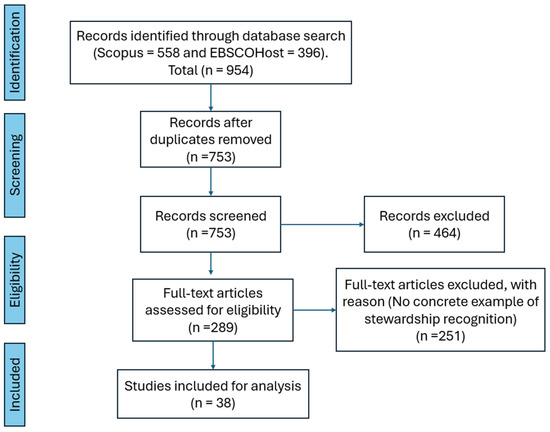
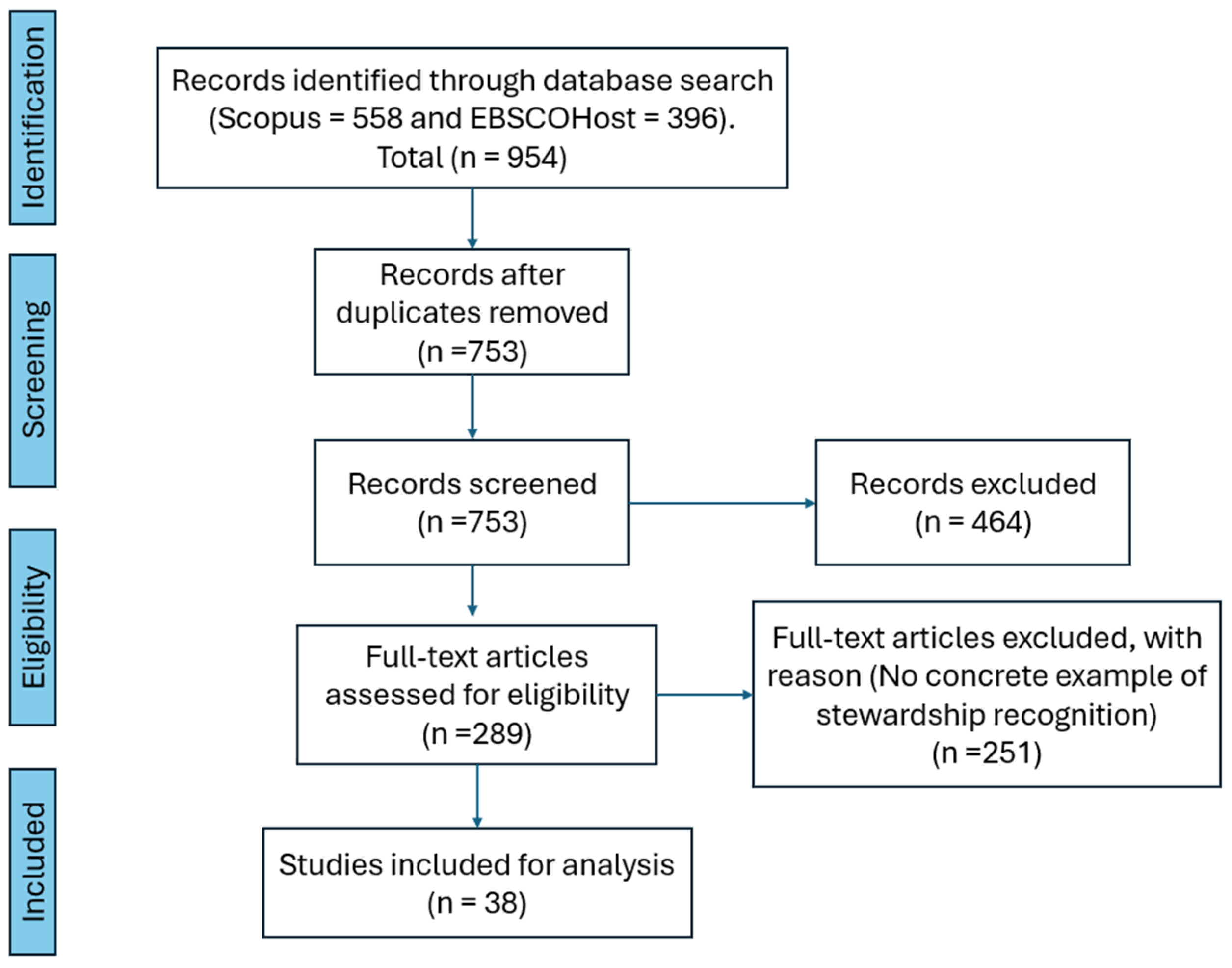
The review followed four sequential steps: identification, screening, eligibility assessment, and inclusion. First, searches were performed in Scopus and EBSCOHost using predefined combinations of keywords related to “people”, “nature”, “people-nature interactions”, and “bioeconomy” (see Supplementary Materials for complete description). This resulted in 954 records. After removal of duplicates (n = 201), 753 titles and abstracts were screened independently by at least two reviewers.
In the screening stage, studies were excluded if they (i) did not refer to concrete stewardship practices carried out by identifiable IP&LC, (ii) addressed conservation outcomes without reference to recognition or reward mechanisms, or (iii) were purely conceptual or theoretical. Full texts of the remaining studies were then assessed for eligibility, resulting in a final sample of 38 case studies that explicitly described how stewardship practices were recognized through material, institutional, participatory, or symbolic mechanisms.
Throughout the process, disagreements between reviewers were resolved through discussion and, when necessary, consultation with a third reviewer. A PRISMA-style flow diagram summarizing the selection process is provided in Figure 1.
Figure 1.
PRISMA-style flow diagram of the systematic literature review of global case studies.
2.1.2. Brazilian Projects’ Database
A comprehensive dataset of 384 projects implemented between 2000 and 2024 was compiled to examine how stewardship practices have been supported and valued in Brazil. Data was extracted from:
- PPP-ECOS, a long-standing small-grants initiative supporting sociobiodiversity-based livelihoods in the Cerrado and Caatinga biomes; and
- Amazon Fund, one of the world’s largest results-based climate finance mechanisms focused on sustainable development in the Legal Amazon region.
The construction of this database followed a two-step procedure. In the first stage a web scraping approach and data mining was carried out to survey Brazilian initiatives that promote local community engagement through the use and commercialization of native species/NTFP. We collected data from websites of governmental, non-governmental organizations (NGOs), foundations and funding entities that provide open access, using Python (Python Software Foundation, Wilmington, DE, USA), version 3.11.7 in a Jupyter Notebook environment. Following a detailed review of the data sources, we identified 1286 initiatives that are directly related to sociobiodiversity product chains. The selection went down to 384 initiatives (projects) that explicitly provided information about the type of intervention. Together, these sources represent the most comprehensive and systematic public repositories of community-based sociobiodiversity projects in Brazil. They span more than two decades, cover all major biomes, and provide consistent and transparent documentation of project interventions. Because all projects aimed to structure sociobiodiversity value chains and improve local livelihoods, the type of intervention was interpreted as a proxy for the form of recognition or reward given to stewardship practices.
In the Brazilian dataset, recognition mechanisms are not always explicitly framed as such. Instead, recognition is embedded in the design of development and conservation interventions aimed at supporting sociobiodiversity-based livelihoods. For this reason, project interventions were interpreted analytically as proxies for recognition mechanisms.
This interpretation is grounded in the understanding of recognition not only as symbolic acknowledgment or direct payment, but as the allocation of resources, rights, or institutional support that signals the social value attributed to stewardship practices. When public programs and funds direct financial resources, infrastructure, technical assistance, or governance roles specifically to communities because of their stewardship of biodiversity, these interventions function de facto as forms of recognition, even if they are not labeled as such in project documents.
Importantly, this approach does not assume that all project interventions are equally empowering. Rather, it allows us to examine how different types of project-based recognition vary in their capacity to alter power relations, governance roles, and decision-making authority—a distinction that is subsequently assessed using Arnstein’s Ladder.
The two datasets (38 global case studies found in the literature review and the 384 Brazilian projects) were not intended to be symmetrical in evidentiary terms. The global cases reflect research-selected examples that meet publication standards and often emphasize successful or innovative governance arrangements. The Brazilian projects, by contrast, represent a near-census of interventions funded over more than two decades, including heterogeneous designs, durations, and outcomes.
To ensure analytical consistency, both datasets were examined through the same coding framework focused on forms of recognition and degrees of decision-making authority. However, interpretation explicitly accounts for their different epistemic statuses: academic case studies as ex post analyses of governance outcomes, and project portfolios as ex ante or interim expressions of recognition embedded in policy and funding instruments.
2.2. Data Analysis
To categorize forms of recognition of stewardship practices, an inductive qualitative coding approach was applied across both the international and Brazilian datasets, following grounded theory and qualitative content analysis methods [38,39,40]. Comparisons between datasets are therefore interpretive rather than inferential. Differences in participation levels are not attributed to community capacity or performance, but to the institutional conditions under which recognition mechanisms are designed and implemented.
- Stage 1—Open coding
All text excerpts describing how communities were recognized or supported for environmental stewardship were coded using in vivo terms drawn directly from the material.
- Stage 2—Conceptual clustering
Codes were iteratively grouped into broader conceptual clusters reflecting patterns observed across cases. Through continuous comparison and refinement, two general and five specific overarching categories emerged, capturing both material and non-material forms of recognition: material (monetary and non-monetary), legal and institutional, participatory and governance, cultural and symbolic. Material and monetary recognition refers to direct financial transfers or payments provided to communities as compensation or incentive for stewardship practices. It includes cash transfers, wages, subsidies, price premiums, Payments for Environmental Services (PES), and revenue-sharing schemes associated with sustainable production or conservation outcomes. Material non-monetary material recognition encompasses in-kind benefits that enhance the material conditions of production or wellbeing without direct cash transfer. This includes equipment, infrastructure, processing units, food supplies, or technical services offered as project support to strengthen community livelihoods. Non-material recognition captures symbolic, institutional, and participatory mechanisms that confer legitimacy, voice, or visibility to local actors. It includes legal and institutional recognition (formal inclusion in policies or land-use regulations), participatory and governance recognition (representation in decision-making councils or co-management committees), and cultural and symbolic recognition (storytelling, collective brands, awards, or public campaigns).
- Stage 3—Cross-validation and triangulation
The typology was cross-validated between the 38 global case studies and 384 Brazilian projects, ensuring conceptual coherence across contexts. Each project could exhibit multiple forms of recognition.
To assess the degree of community participation and empowerment embedded in the recognition mechanisms, we adopted Arnstein’s Ladder of Citizen Participation [41] as an analytical framework. This classic framework conceptualizes participation as a continuum of power distribution between authorities and citizens, ranging from manipulation to full citizen control. Although originally developed in the context of urban planning, the Ladder has been widely employed in different contexts, such as the environment in rural areas [42,43], education [44], and health [45] as a conceptual tool to assess how different forms of participation shape citizens’ influence over decision-making processes [44]. Arnstein’s original concern was not with participation as a procedural formality, but with participation as a means of redistributing power to groups historically excluded from decision-making processes, particularly marginalized and underprivileged communities. We believe this framework can be used in environmental governance and natural resource management precisely because it offers a clear and parsimonious way to distinguish between participation as consultation and participation as authority. In this sense, its relevance lies less in its historical origin than in its analytical focus on power asymmetries—a central concern in debates on Indigenous rights, co-management, and stewardship recognition.
In applying Arnstein’s ladder to Indigenous Peoples and Local Communities (IP&LC), we do not assume that participation should follow Western institutional forms, nor do we equate higher rungs with externally defined notions of “good governance.” Rather, the ladder is used comparatively to examine whether recognition mechanisms merely acknowledge communities as implementers of externally designed interventions, or whether they effectively transfer decision-making authority, territorial control, and governance responsibilities to local actors.
This approach aligns with contemporary scholarship that emphasizes empowerment, autonomy, and co-governance as key dimensions of stewardship and sustainable resource management [46,47,48,49]. By explicitly focusing on who decides, rather than how decisions are culturally organized, Arnstein’s ladder provides an analytically robust lens to compare heterogeneous recognition mechanisms across contexts, without erasing the plurality of Indigenous and local governance systems. The ladder comprises eight levels grouped into three broad categories: Non-participation, Tokenism, and Citizen Power.
At the lowest levels, manipulation and therapy represent forms of non-participation, in which participation serves primarily to legitimate decisions already made. In the manipulation stage, citizens are included only to endorse predetermined agendas, while in therapy they are treated as passive subjects to be “guided” or “educated” by authorities rather than as capable decision-makers. The intermediate levels—informing, consultation, and placation—reflect degrees of tokenism, where citizens are given a voice but limited influence. Informing provides one-way communication: authorities share information but do not invite feedback. Consultation introduces opportunities to express opinions—through surveys or public meetings—yet without guarantees that those views will affect outcomes. Placation allows limited representation, such as advisory roles or minority seats on committees, but real decision-making power remains concentrated with authorities. At the upper levels, partnership, delegated power, and citizen control represent increasing degrees of citizen power. In partnership, decision-making responsibilities are genuinely shared between communities and institutions through co-management or participatory councils. Delegated power grants citizens primary authority over specific areas or programs, with authorities retaining only supportive roles. Finally, citizen control denotes full empowerment, where communities independently design, implement, and oversee decisions concerning their territories and resources [41].
Each example of recognition and its categorization identified in both the global and Brazilian datasets was examined according to the extent to which it enabled communities to influence decision-making, co-manage resources, or exercise autonomy over their territories and production systems. The assignment of participation levels followed a transparent and replicable qualitative procedure. For each global case study and Brazilian project, textual descriptions of objectives, governance arrangements, decision-making processes, and reported outcomes were examined. Classification focused on three analytical criteria: (i) who holds formal authority over rules and resource use; (ii) whether communities participate in decision-making bodies with binding power; and (iii) the degree of autonomy communities have over implementation, monitoring, and benefit allocation.
Based on these criteria, each case was assigned to one of the eight levels of Arnstein’s Ladder. For example, cases categorized as Informing involved one-way communication or training without decision-making power; Consultation included opportunities for feedback without guaranteed influence; Partnership involved shared decision-making through councils or co-management arrangements; and Delegated Power or Citizen Control required formal transfer of authority over specific domains, such as fisheries quotas, forest management, or territorial governance.
To enhance consistency, coding was conducted iteratively and discussed among the authors, with ambiguous cases resolved through consensus. Numerical scores (1–8) were subsequently used only as a descriptive device to summarize patterns across datasets, not as precise measurements of empowerment (Table 1).
Table 1.
Arnstein’s Ladder of Citizen Participation and Numerical Scores Used in This Study.
The classification was conducted through qualitative content analysis of the descriptions, outcomes, and governance arrangements. For each example identified in the global and Brazilian datasets, a numerical value from 1 to 8 (from the lower level of participation to the higher level) was assigned according to the degree of decision-making power and autonomy granted to local actors. Average participation scores were then calculated for each dataset—global (n = 38) and Brazilian (n = 384)—by dividing the sum of the assigned levels by the total number of cases. This procedure enabled a quantitative comparison of empowerment degrees across contexts (Details in Supplementary Materials).
3. Results
3.1. Stewardship Practices Around the Globe
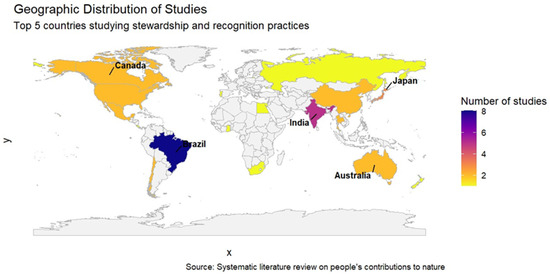
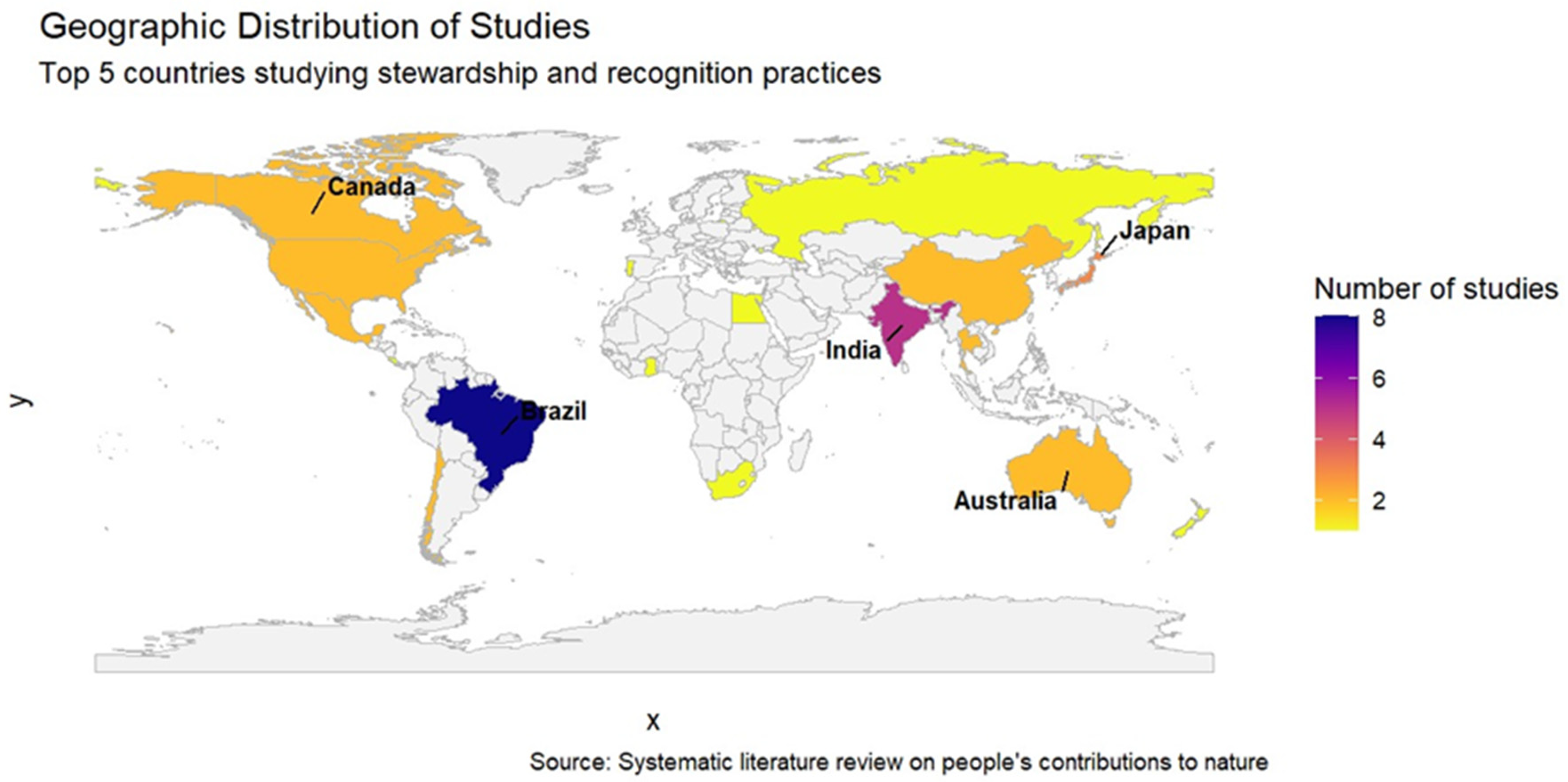
A total of 38 case studies reporting real and concrete examples of stewardship practices recognition were identified in 19 countries across the globe. The highest number of documented cases came from Brazil (8), India (5), and Japan (4), followed by Mexico, Chile, Thailand, Canada, China, and the United States (2 each). Several additional cases Nepal–India–Bangladesh, the United States–Canada–Mexico, and Portugal–Spain (Figure 2).
Figure 2.
Geographic distribution of studies found in the literature review, yellow corresponding to a single case study and purple to eight.
Across the 38 global case studies analyzed, stewardship practices (Table 2) displayed geographical diversity while converging around three main domains of action: resource use and harvesting, ecosystem management and restoration, and territorial governance and cultural continuity. In Asia, cases from India, Japan, Thailand, and China reveal long-standing systems of community-based land and forest management rooted in TEK. Indian examples highlight rotational and mixed farming systems, sacred groves, and community forestry institutions (Van Panchayats) [50]. At the same time, Japanese satoyama landscapes illustrate the integration of irrigation, paddy-field biodiversity, and forest management through seasonal water control [51,52]. Thai Karen communities demonstrate adaptive forest governance combining PES mechanisms, fire management, and agroforestry diversification [46], whereas Tibetan and Chinese communities practice rotational grazing, wildlife monitoring, and sustainable NTFP harvesting [51,52]. In the Americas, studies from Brazil, Mexico, Costa Rica, Canada, the United States (US), and Chile emphasize the stewardship of aquatic and forest ecosystems through community-based fisheries, forest restoration, and agroforestry. Brazilian and Mexican cases include sustainable extraction of NTFP and collaborative fisheries [48,53,54,55,56], while IP&LC in Costa Rica, Canada, and the U.S. engage in co-management of forests, kelp beds, and wildlife populations [57,58,59,60,61]. In Africa, examples from Ghana, Egypt, and South Africa feature community-led restoration of rangelands and invasive plant control, linking stewardship with livelihood improvement and ecosystem recovery [62,63,64]. In Oceania, Indigenous fire management in northern Australia and Māori-led restoration in New Zealand exemplify the integration of cultural protocols with ecological restoration and biodiversity monitoring [49,65]. Finally, European and Eurasian cases, from Portugal and Spain’s transboundary river fisheries to Russia’s Khanty and Nenets herders, reveal the persistence of customary governance systems that maintain ecological balance through collective rules and seasonal mobility [66,67,68]. Taken together, these cases demonstrate that stewardship is not limited to resource extraction but encompasses complex socio-ecological arrangements that combine local TEK, collective norms, and adaptive management to sustain biodiversity and livelihoods across diverse biomes.
Table 2.
Global examples of stewardship practices by country and social group.
Among these case studies identified worldwide, Brazil emerged as the country with the highest number of documented examples, accounting for eight cases (Figure 1). Examples include rotational NTFP collection and community-managed pirarucu (Arapaima gigas) fisheries in the Amazon, where local associations establish harvest quotas; seed collection networks in the Cerrado for large-scale ecological restoration; and agroforestry systems in the Atlantic Forest.
Following the global analysis, a closer look at the 384 Brazilian community-based projects shows that stewardship practices present in these initiatives are associated with both traditional and commercial uses of native biodiversity, reflecting what IPBES [69] defines as the sustainable use of wild species. These practices are embedded in the structuring of sociobiodiversity value chains, where IP&LC combine livelihood strategies with conservation actions. Sustainable use of wild species is also associated with other types of stewardship practices, including agroforestry and agroecological diversification, where native species are cultivated in combination with annual crops to restore soil fertility and diversify income; forest and landscape restoration, involving seed collection, natural regeneration, and reforestation with native species; collective management, including local rules for fishing, fire control, and resource sharing; and traditional fire and water management practices, rooted in IP&LC.
In the Amazon, IP&LC carried out sustainable harvesting of native products such as açaí (Euterpe oleracea/precatoria), Brazil nut (Bertholletia excelsa), rubber (Hevea brasiliensis), and andiroba (Carapa guianensis) oil, along with community-based fisheries management for pirarucu and restoration of degraded areas through natural regeneration and seed collection. In the Cerrado, cooperatives and associations of smallholders and other IP&LC groups, such as Geraizeiros and Veredeiros, implemented agroforestry systems combining pequi (Caryocar Brasiliense), buriti (Mauritia flexuosa), and baru (Dipteryx alata), maintained community seed banks and nurseries, and developed fire management practices adapted to local TEK. In the Caatinga, family farmers and caatingueiros engaged in agroecological and dryland restoration practices that integrated the extraction of umbu (Spondias tuberosa), licuri (Syagrus coronata), and maracujá-do-mato (Passiflora cincinnata) with soil and water conservation techniques. In the Atlantic Forest, quilombola, caiçara, and family farming communities practiced agroforestry, native seed collection, and reforestation connected to river restoration, local markets, and community-based processing units. Several initiatives operated across biomes, such as the Rede de Sementes do Xingu and Rede de Sementes do Cerrado, cooperatives like COOPERACRE and COOPESAB, which coordinated collective processing, product certification, and landscape restoration in multiple territories. Socially, the projects involved a wide range of actors, including IP&LC, women’s organizations, and mixed cooperatives. Table 3 presents some representative examples of stewardship practices.
Table 3.
Representative examples of stewardship practices identified among sociobiodiversity projects in Brazil.
3.2. Types of Recognition Mechanisms in Global and Brazilian Contexts
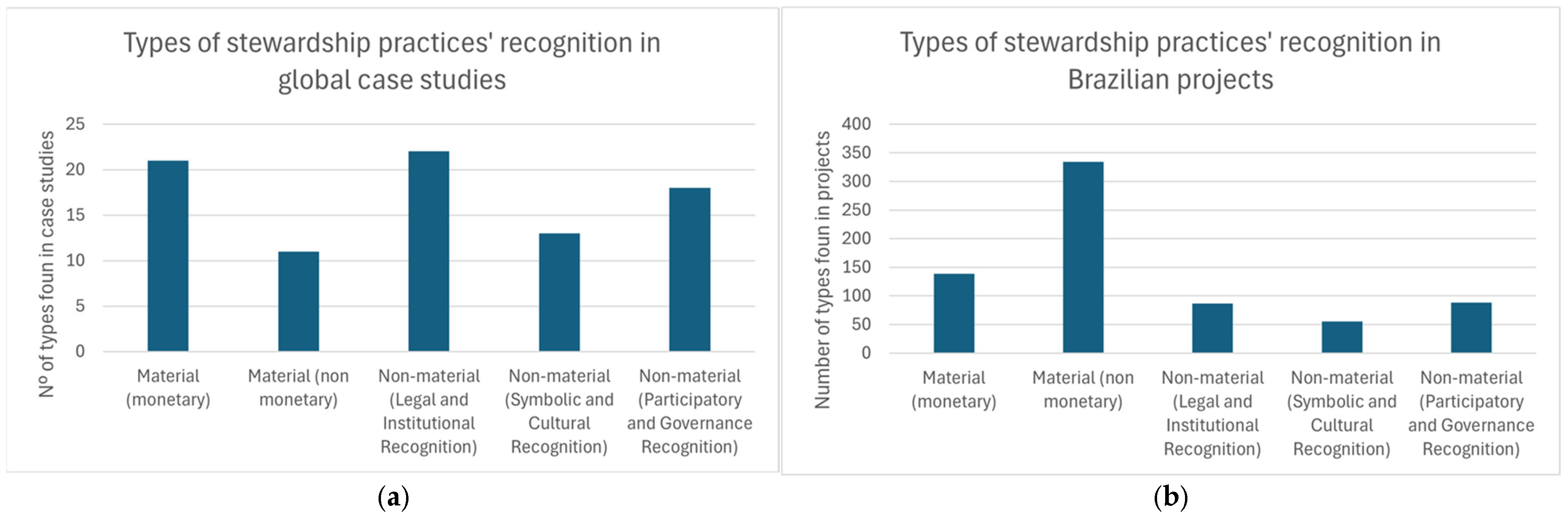
The comparative analysis of recognition mechanisms across the global and Brazilian datasets reveals how distinct forms of material and non-material recognition reflect different ways of valuing stewardship practices (Figure 3). Monetary mechanisms were observed in 53% of total global cases like the PES-funded community forestry programs in Thailand [46] and REDD+ initiatives in Costa Rica [57], where local forest users receive regular payments linked to verified conservation outcomes. In the Brazilian dataset, similar monetary incentives were less common (36%). Some cooperatives indirectly benefited from improved market access and better selling conditions, for instance, COOPAVAM and ASPROC. Yet these gains stemmed from collective organization rather than formal price premiums or payment-for-services schemes.
Figure 3.
Types of stewardship practices’ recognition: (a) In global case studies; (b) In Brazil projects.
Non-monetary material recognition, in turn, encompasses in-kind benefits that enhance production or well-being without direct cash transfers. These included the provision of equipment, infrastructure, and technical assistance aimed at strengthening community livelihoods. This type was predominant among the 384 Brazilian projects (87% of the total), such as the installation of fruit-processing units, oil extraction equipment, or community warehouses under initiatives led by Cooperativa Grande Sertão, Rede do Pequi, and COOPERACRE.
Non-material recognition captures symbolic, institutional, and participatory mechanisms that confer legitimacy, visibility, or decision-making power to local actors. Within this domain, legal and institutional recognition emerged when stewardship practices were incorporated into formal policies or regulations. This was particularly visible in global cases (55%) where IP&LC hold legal authority over resources, such as the Van Panchayat community forests in India [50], co-management of mangroves in Thailand [70], and Indigenous forest governance in Costa Rica and Canada [57,59]. In Brazilian projects, however, such institutionalized forms of recognition were less frequent (23%), appearing mainly in territories with formal legal arrangements (e.g., Extractive Reserves such as Tapajós-Arapiuns and Rio Unini, or the Community Fisheries Agreements of ASPROC in the Amazon), where communities exercise partial governance over natural resources.
Participatory and governance recognition involved shared decision-making through councils, committees, or collective governance systems. In the global sample, 45% of case studies present this type of recognition. Such arrangements were prominent in Canada’s Okanagan Basin co-management councils [58], Japan’s Satoyama forest management committees [51,52], and India’s community biodiversity registers, where IP&LC co-manage resources with state institutions [50,71]. In Brazilian projects, analogous forms were less frequent (28%) and identified in multi-stakeholder territorial networks, such as Rede de Sementes do Xingu and MIQCB (Women Babassu Breakers Movement), both of which have progressively consolidated community-led governance structures.
Finally, cultural and symbolic recognition, involving storytelling, collective brands, and public campaigns, was present in 33% of global case studies and in only 19% of the Brazilian projects. While such initiatives contribute to visibility and valorization, they rarely involve communities in decision-making. Examples include documentary and video production and public campaigns in Brazil, and heritage-based tourism and festivals in Japan’s Satoyama and Chile’s marine stewardship initiatives [51,72].
While approximately 70% of the cases (both in global case studies and in the Brazilian dataset) exhibited more than one form of recognition, the distribution of recognition types differs markedly between them. In the global sample, recognition is more evenly distributed across material (monetary and non-monetary) and non-material (legal–institutional, symbolic–cultural, participatory–governance) forms, with an emphasis in monetary, legal/institution and participatory/governance recognition, suggesting more balanced combinations of incentives, legal frameworks, and participatory arrangements. In contrast, the Brazilian projects show a strong predominance of non-monetary material recognition while other forms, particularly legal, cultural, or governance-based, remain comparatively limited (Figure 3).
3.3. Degrees of Community Participation and Empowerment
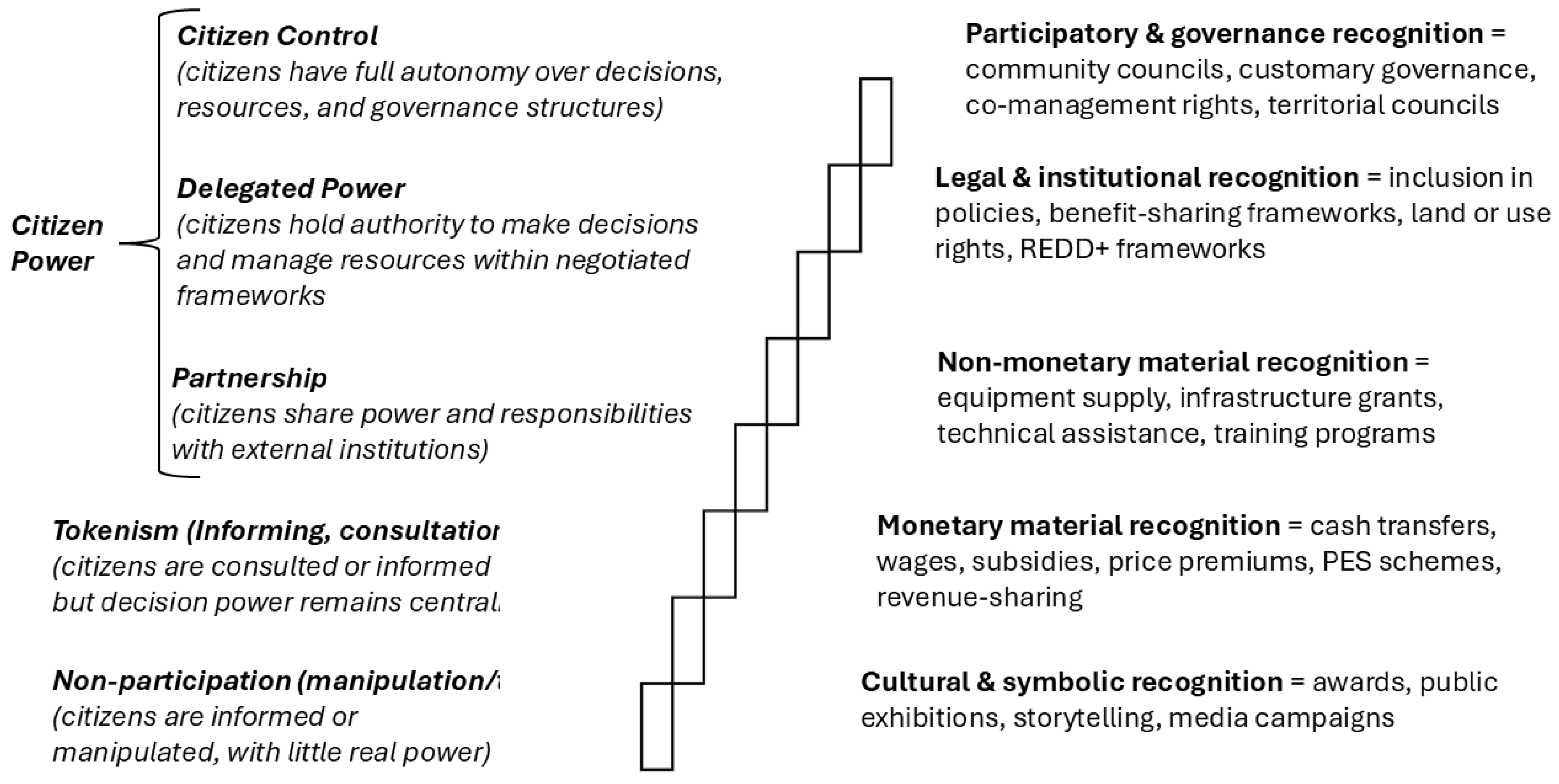
By mapping the typology of recognition mechanisms onto Arnstein’s Ladder of Citizen Participation, it becomes evident that material recognitions (monetary and non-monetary) tend to align with lower to intermediate levels of participation, while legal–institutional and participatory recognitions correspond to higher rungs associated with citizen power and self-governance (Figure 4).
Figure 4.
Stylized representation based on Arnstein’s Ladder of Citizen Participation [41] showing the conceptual alignment between forms of recognition of stewardship practices and the degree of community participation and empowerment. Each recognition type corresponds to distinct modes of material, institutional, or symbolic valuation, ranging from externally driven awareness and technical assistance (non-participation and tokenism) to autonomous, community-led governance (citizen power).
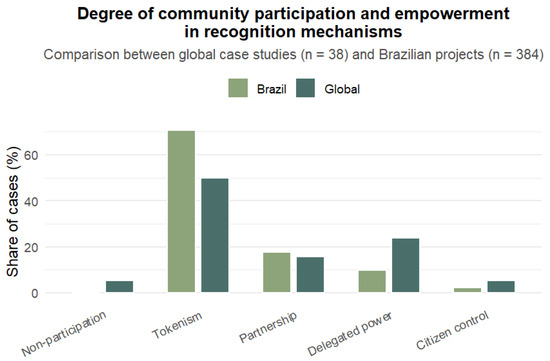
The quantitative comparison between global and Brazilian cases underscores this gradient. Among the 38 global case studies, most examples were concentrated in the intermediate and upper levels of the ladder: 6 cases classified as Informing, 3 as Consultation, 4 as Placation, 10 as Partnership, 12 as Delegated Power, and 2 as Citizen Control. Only one case (3%) was categorized as Manipulation. The mean participation score for the global sample was 5.55, corresponding to a position between Placation and Partnership, indicating moderately high community influence.
In contrast, within the Brazilian dataset of 384 projects, participation was more frequently positioned at the lower and intermediate rungs: 224 cases (58%) were categorized as Informing, 36 (9%) as Consultation, 4 (1%) as Placation, 66 (17%) as Partnership, 36 (9%) as Delegated Power, and 8 (2%) as Citizen Control. The resulting average participation score of 4.14 suggests that, while participatory elements are recurrent in project design, most recognition mechanisms remain within consultative or partnership-oriented frameworks, with relatively few achieving full decision-making authority.
When grouped into Arnstein’s three broader participation domains—Non-participation, Tokenism, and Citizen Power—clear differences emerge between contexts. In the global sample, 63% of the cases reached the Citizen Power range (Partnership, Delegated Power, or Citizen Control), particularly in India, Thailand, Costa Rica, and Canada, where stewardship practices are embedded in legally recognized community governance systems. Conversely, in Brazil, only 28.6% of the 384 projects reached this range, while 68.8% were concentrated within Tokenism (Informing, Consultation, Placation) and 2.6% in Non-participation (Figure 5).
Figure 5.
Comparison of degree of community participation and empowerment between global case studies and Brazilian projects.
4. Discussion
The prominence of Brazil within the global dataset, accounting for 21% of the international case studies, may reflect the country’s exceptional socio-environmental diversity. It harbors between 15% and 20% of global biodiversity [73,74], holds the largest number of endemic species, the world’s largest tropical forest (the Amazon), and two of the nineteen global biodiversity hotspots: the Atlantic Forest and the Cerrado [75,76]. Its territory also encompasses significant cultural diversity, represented by 355 officially recognized Indigenous lands, 253 Afro-descendent territories, and 28 groups of traditional communities [77]. Or maybe this highlight can be explained by Brazil’s leadership in creating a national protected areas system or the emergence of strong and influential nongovernmental conservation organizations, and the advance of conservation science in the country [78].
What is particularly noteworthy is that, when these internationally visible Brazilian cases are contrasted with the national portfolio of 384 community-based projects, a dual reality emerges: while a few landmark cases reached the upper rungs of Arnstein’s ladder (especially Delegated Power), the majority of implemented projects remain concentrated at intermediate or consultative levels of participation. In the global review, Brazilian cases ranged from Placation (e.g., families in the South region participating in a research project were able to access resources from government programs to implement improvements on their properties) to Delegated Power (e.g., community-based pirarucu quotas in the Amazon, the Araçá Bay participatory management process, and the Volunteer Environmental Agents programme in Amazonas). Some of them, such as the Rede de Sementes do Cerrado and restoration/seed-supply arrangements around Chapada dos Veadeiros National Park, show how technical collaboration with the Chico Mendes Institute for Biodiversity Conservation (ICMBio), universities, and NGOs was gradually formalized, giving local collectors an authorized role in large-scale restoration and generating stable income from seed sales [79]. Others, like the Guardians of Araçá Bay, illustrated how participatory research and local mobilization were translated into institutional recognition through judicial decisions and coastal zone planning instruments that incorporated caiçara stewardship practices [80]. Still others, such as the legal and symbolic protection of the human–dolphin cooperative fishery in Laguna (Santa Catarina), revealed how cultural valorization can support conservation practices even when it does not fully transfer decision-making power [55].
By contrast, most of the projects mapped in Brazil were oriented to productive inclusion through alternative uses and commercialization of extractive products as a strategy to increase family income [81]. Organizations received equipment, processing units, training, and support to access markets; far fewer received recognition that altered who decides over access rules, benefit-sharing, territorial monitoring, or long-term financing [27]. These initiatives undoubtedly strengthened local livelihoods and organization, but they rarely created enduring institutional arrangements or legally binding forms of recognition [81], particularly because they are short-term interventions [82]. In terms of Arnstein’s ladder, they sit predominantly in the tokenism–partnership band: communities are informed, consulted, equipped, and sometimes co-implement actions, but the authority to define rules, allocate benefits, or sustain funding remains external [83]. In practical terms, communities are recognized as implementers of conservation-and-livelihood activities, but less frequently as rule-makers or co-managers of territorial assets.
This asymmetry points to a governance gap. Many of the Brazilian cases that reached delegated power in the global dataset did not emerge solely from ordinary short-term initiatives. They were the outcome of long-duration institutional struggles (Araçá), state-endorsed programs (Volunteer Environmental Agents), or multi-level coalitions that successfully inserted TEK into formal decision-making arenas (seed-restoration markets in the Cerrado). In those experiences, recognition materialized not as a temporary initiative output but as an institutionalized mechanism—codified in decrees, participatory councils, protected-area management rules, or national policies for IP&LC [48,84]. This is precisely what allowed them to climb the upper rungs of Arnstein’s ladder.
From another angle, the two datasets reveal a structural tension in the current bioeconomy debate. Sociobiodiversity value chains are de facto anchored in stewardship practices carried out by IP&LC [28], but the instruments that recognize these practices (basically material) still operate, in Brazil, mainly through externally designed, short-term charity-based initiatives that are more likely reproducing dependency rather than strengthening local capacities or empowering communities [84]. Globally, we found a higher incidence of legal/institutional and participatory/governance recognitions in the upper rungs (partnership, delegated power, and, in a few cases, citizen control), especially in countries where community tenure, IP&LC territorial rights, co-management of fisheries, or community forestry are already institutionalized (India, Costa Rica, Canada, Chile). In these contexts, recognition is not merely symbolic or compensatory, but it is constitutive of governance, where communities are formally authorized to manage forests, rivers, coastal zones, or rangelands, and economic instruments (PES, revenue-sharing, community funds) are attached to that authority [35,85,86].
Our results show that (1) recognition mechanisms take diverse material and non-material forms, (2) community participation levels vary widely across contexts, and (3) balanced combinations of incentives, legal frameworks, and participatory arrangements correlate with higher degrees of empowerment. These findings have three main implications for fostering inclusive governance and valuing the contributions of IP&LC in the transition toward a biodiversity-based bioeconomy.
First, beyond their material dimension, sociobiodiversity products embody intangible values that distinguish them from conventional commodities [87]. Each product represents the outcome of continuous relational and governance efforts—the collective monitoring of territories, the enforcement of customary rules, the negotiation of access and use, and the intergenerational transmission of ecological knowledge. Such practices anchor production in care, reciprocity, and responsibility toward ecosystems, making IP&LC not only producers but custodians of biodiversity. Yet, these contributions remain largely invisible within market logics that reward volume and price rather than ecological stewardship or cultural continuity. Markets alone are unlikely to recognize or remunerate these immaterial values, as they operate on criteria that exclude collective governance, traditional knowledge, and interdependence with nature. A truly recognition-based bioeconomy therefore requires public policies and institutional arrangements that create incentives to value and reward the relational work sustaining sociobiodiversity, acknowledging that the protection of ecosystems and the reproduction of cultural and ecological knowledge are public goods that merit collective investment.
Second, recognition should not be equated with payments or value addition alone. Monetary and in-kind support remain essential, especially given that many sociobiodiversity chains operate in contexts of economic vulnerability where the market value of native products is often far below the costs required to sustain livelihoods [25]. Financial incentives, therefore, can play a vital role in addressing structural inequalities and compensating for the undervaluation of local stewardship. Yet, the international cases show that these measures only become transformative when they are coupled with redistributive governance arrangements. Recognition reaches the upper rungs of Arnstein’s ladder when it appears not merely as financial aid, but as a right-bearing condition: when PES schemes, community forestry concessions, or co-management agreements confer both resources and authority. In such settings, stewardship is institutionalized as a legitimate governance function, not as a temporary project deliverable [35,84,85,86].
These findings directly inform the implementation of the Brazilian National Bioeconomy Strategy and the forthcoming National Sociobiodiversity Bioeconomy Plan. The Decree nº 12.044/24 already defines bioeconomy as “based on values of justice, ethics, and inclusion” and acknowledges TEK. To translate this principle into practice, policies must bridge the gap between participation and authority, and mechanisms of recognition that explicitly finance the governance work carried out by communities are needed. Where recognition climbs the ladder, moving from information to co-decision, stewardship practices become durable, intergenerational, and investable. Where it remains confined to the lower rungs, the bioeconomy stays dependent on short project cycles, vulnerable to budget fluctuations, and weakly articulated with territorial institutions. In sum, a biodiversity-based and socially just bioeconomy will only emerge if public policy values not only the products of sociobiodiversity, but also the institutions, relationships, and governance capacities that make them possible.
The comparative analysis yields three key lessons for the design of recognition-based bioeconomy policies.
First, recognition mechanisms that rely exclusively on material support—whether monetary or in-kind—are insufficient to promote empowerment when they are not coupled with decision-making authority. While such mechanisms can improve livelihoods in the short term, they tend to reproduce asymmetric governance arrangements in which communities remain implementers rather than co-governors.
Second, the durability of stewardship recognition depends on its institutionalization. Global cases show that recognition becomes transformative when it is embedded in legal frameworks, co-management agreements, or formally recognized territorial rights. In contrast, project-based recognition remains fragile, highly dependent on funding cycles, and vulnerable to policy discontinuities.
Third, participation only translates into empowerment when it alters who defines rules, allocates benefits, and monitors compliance. Mechanisms positioned at the upper rungs of Arnstein’s ladder demonstrate that stewardship recognition is most effective when communities are formally entrusted with governance responsibilities, rather than merely consulted or informed.
These lessons suggest that advancing a sociobiodiversity-based bioeconomy requires shifting from recognition as support to recognition as governance.
5. Conclusions
Our study showed that building a stronger sociobiodiversity-based bioeconomy in Brazil requires moving beyond project-based support toward enduring systems of recognition and shared governance. Beyond documenting existing recognition mechanisms, this study highlights the conditions under which recognition contributes to empowerment and durable governance. The lessons derived from the comparative analysis reinforce that markets and projects alone are insufficient to value stewardship. Recognition must be designed as an institutional and political process that redistributes authority, not only resources. The country’s vast socio-environmental diversity already sustains multiple stewardship practices carried out by IP&LC, but these remain undervalued within prevailing policy and market frameworks. To realize the principles established by Decree no. 12.044/2024, public policy must reward not only the tangible products of sociobiodiversity but also the collective governance, TEK, and relational labor that sustain them. This involves integrating financial and non-financial incentives with legal and participatory mechanisms that grant communities co-management authority over territories and resources. In practical terms, markets alone will not internalize these immaterial values. It is the role of the State to design instruments, such as tailored PES schemes, community funds, and procurement policies, that link economic incentives with empowerment and long-term governance. Only by aligning recognition, redistribution, and authority can Brazil consolidate a bioeconomy that is truly socially just and institutionally resilient.
Supplementary Materials
The following supporting information can be downloaded at: https://www.mdpi.com/article/10.3390/f17030380/s1, Figure S1: Geographical distribution of case studies analysed in the Brazilian project database; Table S1: Description of keywords and search string adopted in this study; Table S2: Inclusion and exclusion criteria for document selection; Table S3: Categories used for coding the selected literature; Table S4: Typology for different kinds of recognition of stewardship practices; Table S5: Final classification of types of recognition according to Arnstein’s Ladder of Citizen Participation.
Author Contributions
A.C.M.d.S.: conceptualization, data curation, formal analysis, investigation, methodology, supervision, validation, visualization and writing—original draft; S.M.C.R.: conceptualization, methodology, formal analysis and writing—review and editing; G.M.: conceptualization, data curation, formal analysis, investigation, methodology, validation and writing—review and editing; W.M.-L.: conceptualization, data curation, formal analysis, writing—review and editing; N.S.: conceptualization, data curation, formal analysis, investigation and methodology, writing—review and editing. All authors have read and agreed to the published version of the manuscript.
Funding
This research was financed by the São Paulo School of Advanced Science on Co-designing Biodiversity Assessments/Instituto de Biologia, Universidade Estadual de Campinas (IB-Unicamp), Grant Number 2023/05582-0. Author W.M-L. was funded by a FCT Ph.D. fellowship (ref. UI/BD/153596/2022). Author N.S. received support from the European Union–NextGenerationEU as part of the National Biodiversity Future Center, Italian National Recovery and Resilience Plan (NRRP) Mission 4 Component 2 Investment 1.4 (CUP: B83C22002950007).
Data Availability Statement
The dataset for the current study is available from the authors on a reasonable request.
Acknowledgments
Special thanks to Lisley P. Lemos, Caetano Franco, and Maria Carmen Lemos, for their valuable insights.
Conflicts of Interest
The authors declare no conflicts of interest.
Abbreviations
The following abbreviations are used in this manuscript:
| IP&LC | Indigenous Peoples and Local Communities |
| TEK | Traditional Ecological Knowledge |
| NTFP | Non-Timber Forest Products |
| PPP-ECOS | Small Eco-social Projects Program |
| PES | Payments for Environmental Services |
| MIQCB | Women Babassu Breakers Movement |
| ICMBio | Chico Mendes Institute for Biodiversity Conservation |
References
- Birner, R. Bioeconomy Concepts. In Bioeconomy; Lewandowski, I., Ed.; Springer International Publishing: Cham, Switzerland, 2018; pp. 17–38. [Google Scholar]
- Philp, J. The Bioeconomy, the Challenge of the Century for Policy Makers. New Biotechnol. 2018, 40, 11–19. [Google Scholar] [CrossRef] [Scilit] [PubMed]
- Patermann, C.; Aguilar, A. A Bioeconomy for the next Decade. EFB Bioecon. J. 2021, 1, 100005. [Google Scholar] [CrossRef] [Scilit]
- Aguilar, A.; Twardowski, T. Bioeconomy in a Changing Word. EFB Bioecon. J. 2022, 2, 100041. [Google Scholar] [CrossRef] [Scilit]
- Dolge, K.; Balode, L.; Laktuka, K.; Kirsanovs, V.; Barisa, A.; Kubule, A. A Comparative Analysis of Bioeconomy Development in European Union Countries. Environ. Manag. 2023, 71, 215–233. [Google Scholar] [CrossRef] [Scilit]
- OECD. The Bioeconomy to 2030: Designing a Policy Agenda; OECD: Paris, France, 2009. [Google Scholar]
- European Commission (Ed.) A Sustainable Bioeconomy for Europe: Strengthening the Connection between Economy, Society and the Environment: Updated Bioeconomy Strategy; European Commission: Luxembourg, 2018. [Google Scholar]
- Mastini, R.; Kallis, G.; Hickel, J. A Green New Deal without Growth? Ecol. Econ. 2021, 179, 106832. [Google Scholar] [CrossRef] [Scilit]
- Eversberg, D.; Koch, P.; Lehmann, R.; Saltelli, A.; Ramcilovic-Suominen, S.; Kovacic, Z. The More Things Change, the More They Stay the Same: Promises of Bioeconomy and the Economy of Promises. Sustain. Sci. 2023, 18, 557–568. [Google Scholar] [CrossRef] [Scilit]
- Allain, S.; Ruault, J.-F.; Moraine, M.; Madelrieux, S. The ‘Bioeconomics vs Bioeconomy’ Debate: Beyond Criticism, Advancing Research Fronts. Environ. Innov. Soc. Transit. 2022, 42, 58–73. [Google Scholar] [CrossRef] [Scilit]
- Proestou, M.; Schulz, N.; Feindt, P.H. A Global Analysis of Bioeconomy Visions in Governmental Bioeconomy Strategies. Ambio 2024, 53, 376–388. [Google Scholar] [CrossRef] [Scilit]
- Bugge, M.; Hansen, T.; Klitkou, A. What Is the Bioeconomy? A Review of the Literature. Sustainability 2016, 8, 691. [Google Scholar] [CrossRef] [Scilit]
- Price, M.F. Navigating Social–Ecological Systems: Building Resilience for Complexity and Change. Biol. Conserv. 2004, 119, 581. [Google Scholar] [CrossRef] [Scilit]
- Bennett, N.J.; Whitty, T.S.; Finkbeiner, E.; Pittman, J.; Bassett, H.; Gelcich, S.; Allison, E.H. Environmental Stewardship: A Conceptual Review and Analytical Framework. Environ. Manag. 2018, 61, 597–614. [Google Scholar] [CrossRef] [Scilit] [PubMed]
- Ellis, E.C.; Gauthier, N.; Klein Goldewijk, K.; Bliege Bird, R.; Boivin, N.; Díaz, S.; Fuller, D.Q.; Gill, J.L.; Kaplan, J.O.; Kingston, N.; et al. People Have Shaped Most of Terrestrial Nature for at Least 12,000 Years. Proc. Natl. Acad. Sci. USA 2021, 118, e2023483118. [Google Scholar] [CrossRef] [Scilit] [PubMed]
- Ellis, E.C.; Ramankutty, N. Putting People in the Map: Anthropogenic Biomes of the World. Front. Ecol. Environ. 2008, 6, 439–447. [Google Scholar] [CrossRef] [Scilit]
- Chapin, F.S.; Carpenter, S.R.; Kofinas, G.P.; Folke, C.; Abel, N.; Clark, W.C.; Olsson, P.; Smith, D.M.S.; Walker, B.; Young, O.R.; et al. Ecosystem Stewardship: Sustainability Strategies for a Rapidly Changing Planet. Trends Ecol. Evol. 2010, 25, 241–249. [Google Scholar] [CrossRef] [Scilit]
- Bastos Lima, M.G.; Palme, U. The Bioeconomy–Biodiversity Nexus: Enhancing or Undermining Nature’s Contributions to People? Conservation 2021, 2, 7–25. [Google Scholar] [CrossRef] [Scilit]
- Bastos Lima, M.G. Just Transition towards a Bioeconomy: Four Dimensions in Brazil, India and Indonesia. For. Policy Econ. 2022, 136, 102684. [Google Scholar] [CrossRef] [Scilit]
- Campbell, L.; Wiesen, A. Restorative Commons: Creating Health and Well-Being Through Urban Landscapes; U.S. Department of Agriculture, Forest Service, Northern Research Station: Newtown Square, PA, USA, 2009; p. NRS-GTR-P-39.
- Díaz, S.; Pascual, U.; Stenseke, M.; Martín-López, B.; Watson, R.T.; Molnár, Z.; Hill, R.; Chan, K.M.A.; Baste, I.A.; Brauman, K.A.; et al. Assessing Nature’s Contributions to People. Science 2018, 359, 270–272. [Google Scholar] [CrossRef] [Scilit]
- Abramovay, R.; Ferreira, J.; Costa, F.; Ehrlich, M.; Euler, A.; Young, C.E.; Kaimowitz, D.; Moutinho, P.; Nobre, I.; Rogez, H.; et al. The New Bioeconomy in the Amazon: Opportunities and Challenges for a Healthy Standing Forest and Flowing Rivers. In Amazon Assessment Report 2021; United Nations Sustainable Development Solutions Network: New York, NY, USA, 2021; pp. 30.1–30.57. [Google Scholar]
- Bergamo, D.; Zerbini, O.; Pinho, P.; Moutinho, P. The Amazon Bioeconomy: Beyond the Use of Forest Products. Ecol. Econ. 2022, 199, 107448. [Google Scholar] [CrossRef] [Scilit]
- Diário Oficial da União. Decreto No 12.044, de 5 de Junho de 2024. Institui a Estratégia Nacional de Bioeconomia; Diário Oficial da União: Seção 1; Diário Oficial da União: Brasilia, Brazil, 2024; p. 3.
- Carvalho Ribeiro, S.M.; Soares Filho, B.; Leles Costa, W.; Bachi, L.; Ribeiro De Oliveira, A.; Bilotta, P.; Saadi, A.; Lopes, E.; O’Riordan, T.; Lôbo Pennacchio, H.; et al. Can Multifunctional Livelihoods Including Recreational Ecosystem Services (RES) and Non Timber Forest Products (NTFP) Maintain Biodiverse Forests in the Brazilian Amazon? Ecosyst. Serv. 2018, 31, 517–526. [Google Scholar] [CrossRef] [Scilit]
- Costa, F.d.A. Bioeconomia da Sociobiodiversidade no Estado do Pará; The Nature Conservancy: Brasilia, Brazil, 2021. [Google Scholar]
- Garrett, R.; Ferreira, J.; Abramovay, R.; Brandão, J.; Brondizio, E.; Euler, A.; Pinedo, D.; Porro, R.; Cabrera Rocha, E.; Sampaio, O.; et al. Transformative Changes Are Needed to Support Socio-Bioeconomies for People and Ecosystems in the Amazon. Nat. Ecol. Evol. 2024, 8, 1815–1825. [Google Scholar] [CrossRef] [Scilit]
- Shackleton, C.M.; Ticktin, T.; Cunningham, A.B. Nontimber Forest Products as Ecological and Biocultural Keystone Species. Ecol. Soc. 2018, 23, art22. [Google Scholar] [CrossRef] [Scilit]
- Pfau, S.; Hagens, J.; Dankbaar, B.; Smits, A. Visions of Sustainability in Bioeconomy Research. Sustainability 2014, 6, 1222–1249. [Google Scholar] [CrossRef] [Scilit]
- Kleinschmit, D.; Arts, B.; Giurca, A.; Mustalahti, I.; Sergent, A.; Pülzl, H. Environmental Concerns in Political Bioeconomy Discourses. Int. For. Rev. 2017, 19, 41–55. [Google Scholar] [CrossRef] [Scilit]
- Brondízio, E.S.; Aumeeruddy-Thomas, Y.; Bates, P.; Carino, J.; Fernández-Llamazares, Á.; Ferrari, M.F.; Galvin, K.; Reyes-García, V.; McElwee, P.; Molnár, Z.; et al. Locally Based, Regionally Manifested, and Globally Relevant: Indigenous and Local Knowledge, Values, and Practices for Nature. Annu. Rev. Environ. Resour. 2021, 46, 481–509. [Google Scholar] [CrossRef] [Scilit]
- Shackleton, S.; Shanley, P.; Ndoye, O. Invisible but Viable: Recognising Local Markets for Non-Timber Forest Products. Int. For. Rev. 2007, 9, 697–712. [Google Scholar] [CrossRef] [Scilit]
- Carvalho Ribeiro, S.; Soares Filho, B.; Cesalpino, T.; Araújo, A.; Teixeira, M.; Cardoso, J.; Figueiras, D.; Nunes, F.; Rajão, R. Bioeconomic Markets Based on the Use of Native Species (NS) in Brazil. Ecol. Econ. 2024, 218, 108124. [Google Scholar] [CrossRef] [Scilit]
- Guibrunet, L.; Gerritsen, P.R.W.; Sierra-Huelsz, J.A.; Flores-Díaz, A.C.; García-Frapolli, E.; García-Serrano, E.; Pascual, U.; Balvanera, P. Beyond Participation: How to Achieve the Recognition of Local Communities’ Value-systems in Conservation? Some Insights from Mexico. People Nat. 2021, 3, 528–541. [Google Scholar] [CrossRef] [Scilit]
- Rodrigues, A.C.; Costa, H.C.M.; Peres, C.A.; Brondizio, E.S.; Dias, A.; De Moraes, J.A.; Constantino, P.D.A.L.; Ladle, R.J.; Malhado, A.C.M.; Campos-Silva, J.V. Community-Based Management Expands Ecosystem Protection Footprint in Amazonian Forests. Nat. Sustain. 2025, 8, 1304–1313. [Google Scholar] [CrossRef] [Scilit]
- OECD. Scaling Up Biodiversity-Positive Incentives: Delivering on Target 18 of the Global Biodiversity Framework; OECD Publishing: Paris, France, 2025. [Google Scholar]
- McMillen, H.; Campbell, L.; Svendsen, E.; Reynolds, R. Recognizing Stewardship Practices as Indicators of Social Resilience: In Living Memorials and in a Community Garden. Sustainability 2016, 8, 775. [Google Scholar] [CrossRef] [Scilit]
- Bohm, I.; Sundqvist, J. Qualitative Content Analysis: A Step-by-Step Guide for Beginners to the Method, Theories, Epistemology, Ontology, and Rigour. Qual. Rep. 2025, 30, 4236–4263. [Google Scholar] [CrossRef] [Scilit]
- Barney, G.; Strauss, A. The Discovery of Grounded Theory: Strategies for Qualitative Research; Aldine Transaction; Routledge: New York, NY, USA, 2006. [Google Scholar]
- Charmaz, K. Constructing Grounded Theory: A Practical Guide through Qualitative Analysis; Sage Publications: London, UK, 2006. [Google Scholar]
- Arnstein, S. A Ladder of Citizen Participation. J. Am. Inst. Plan. 1969, 35, 216–224. [Google Scholar] [CrossRef] [Scilit]
- Ahmad, M.S.; Abu Talib, N. Decentralization and participatory rural development: A literature review. Contemp. Econ. 2011, 5, 58–67. [Google Scholar] [CrossRef] [Scilit]
- Reed, M.S. Stakeholder participation for environmental management: A literature review. Biol. Conserv. 2008, 141, 2417–2431. [Google Scholar] [CrossRef] [Scilit]
- Varwell, S. A Literature Review of Arnstein’s Ladder of Citizen Participation: Lessons for contemporary student engagement. Exch. Interdiscip. Res. J. 2022, 10, 108–144. [Google Scholar] [CrossRef] [Scilit]
- Nitsch, M.; Waldherr, K.; Denk, E.; Griebler, U.; Marent, B.; Forster, R. Participation by different stakeholders in participatory evaluation of health promotion: A literature review. Eval. Program Plan. 2013, 40, 42–54. [Google Scholar] [CrossRef] [Scilit]
- Ayuttacorn, A. Community Forest Management and the Resilience of Karen Indigenous Knowledge in Northern Thailand. Environ. Manag. 2024, 74, 1006–1019. [Google Scholar] [CrossRef] [Scilit]
- Jiang, W.; Wu, T. Community-Based Management of Protected Areas: The Case of the Mangkang National Nature Reserve on the Qinghai-Tibetan Plateau. J. Nat. Conserv. 2021, 64, 126087. [Google Scholar] [CrossRef] [Scilit]
- Franco, C.L.B.; El Bizri, H.R.; Souza, P.R.E.; Fa, J.E.; Valsecchi, J.; Sousa, I.S.D.; Queiroz, H.L.D. Community-Based Environmental Protection in the Brazilian Amazon: Recent History, Legal Landmarks and Expansion across Protected Areas. J. Environ. Manag. 2021, 287, 112314. [Google Scholar] [CrossRef] [Scilit]
- Hill, R.; Walsh, F.J.; Davies, J.; Sparrow, A.; Mooney, M.; Wise, R.M.; Tengö, M. Knowledge Co-Production for Indigenous Adaptation Pathways: Transform Post-Colonial Articulation Complexes to Empower Local Decision-Making. Glob. Environ. Change 2020, 65, 102161. [Google Scholar] [CrossRef] [Scilit]
- Negi, V.S.; Pathak, R.; Thakur, S.; Joshi, R.K.; Bhatt, I.D.; Rawal, R.S. Scoping the Need of Mainstreaming Indigenous Knowledge for Sustainable Use of Bioresources in the Indian Himalayan Region. Environ. Manag. 2023, 72, 135–146. [Google Scholar] [CrossRef] [Scilit]
- Ito, T.; Sugiura, M. Satoyama Landscapes as Ecological Mosaics of Biodiversity: Local Knowledge, Environmental Education, and the Future of Japan’s Rural Areas. Environ. Sci. Policy Sustain. Dev. 2021, 63, 14–25. [Google Scholar] [CrossRef] [Scilit]
- Hacker, C.E.; Janecka, J.E.; Jackson, R.M.; Li, D.; Zhang, Y. Pastoralism Partnerships: Recognizing the Value of Local Involvement in China’s Snow Leopard Conservation Efforts. Sustainability 2020, 12, 6491. [Google Scholar] [CrossRef] [Scilit]
- Morzaria-Luna, H.N.; Turk-Boyer, P.; Polanco-Mizquez, E.I.; Downton-Hoffmann, C.; Cruz-Piñón, G.; Carrillo-Lammens, T.; Loaiza-Villanueva, R.; Valdivia-Jiménez, P.; Sánchez-Cruz, A.; Peña-Mendoza, V.; et al. Coastal and Marine Spatial Planning in the Northern Gulf of California, Mexico: Consolidating Stewardship, Property Rights, and Enforcement for Ecosystem-Based Fisheries Management. Ocean Coast. Manag. 2020, 197, 105316. [Google Scholar] [CrossRef] [Scilit]
- Bachi, L.; Corrêa, D.; Fonseca, C.; Carvalho-Ribeiro, S. Are There Bright Spots in an Agriculture Frontier? Characterizing Seeds of Good Anthropocene in Matopiba, Brazil. Environ. Dev. 2023, 46, 100856. [Google Scholar] [CrossRef] [Scilit]
- Cantor, M.; Santos-Silva, B.; Daura-Jorge, F.G.; Machado, A.M.S.; Peterson, D.; da-Rosa, D.X.; Simões-Lopes, P.C.; Valle-Pereira, J.V.S.; Zank, S.; Hanazaki, N. Changes in the Users of the Social-ecological System around a Reciprocal Human-dolphin Relationship. People Nat. 2025, 7, 974–989. [Google Scholar] [CrossRef] [Scilit]
- Campos-Silva, J.V.; Peres, C.A.; Amaral, J.H.F.; Sarmento, H.; Forsberg, B.; Fonseca, C.R. Fisheries Management Influences Phytoplankton Biomass of Amazonian Floodplain Lakes. J. Appl. Ecol. 2021, 58, 731–743. [Google Scholar] [CrossRef] [Scilit]
- Villhauer, B. Transforming REDD+ for Indigenous Rights in Costa Rica. Local Environ. 2021, 26, 1221–1234. [Google Scholar] [CrossRef] [Scilit]
- Correia, M.; Alexis, S.; Dulic, A. Bringing the Salmon Home: A Study of Cross-Cultural Collaboration in the Syilx Okanagan Territory of British Columbia. Ecol. Soc. 2024, 29, art15. [Google Scholar] [CrossRef] [Scilit]
- Kobluk, H.M.; Gladstone, K.; Reid, M.; Brown, K.; Krumhansl, K.A.; Salomon, A.K. Indigenous Knowledge of Key Ecological Processes Confers Resilience to a Small-scale Kelp Fishery. People Nat. 2021, 3, 723–739. [Google Scholar] [CrossRef] [Scilit]
- Green, K.M.; Beaudreau, A.H.; Lukin, M.K.; Ardoin, N.M. Pathways to Subsistence Management in Alaska National Parks: Perspectives of Harvesters and Agency Staff. People Nat. 2022, 4, 1664–1678. [Google Scholar] [CrossRef] [Scilit]
- Slaton, M.R.; Holmquist, J.G.; Meyer, M.; Andrews, R.; Beidl, J. Traditional Ecological Knowledge Used in Forest Restoration Benefits Natural and Cultural Resources: The Intersection between Pandora Moths, Jeffrey Pine, People, and Fire. Nat. Areas J. 2019, 39, 461. [Google Scholar] [CrossRef] [Scilit]
- Soliku, O.; Schraml, U. Protected Areas Management: A Comparison of Perceived Outcomes Associated with Different Co-Management Types. For. Policy Econ. 2020, 118, 102258. [Google Scholar] [CrossRef] [Scilit]
- Kandal, H.A.; Swart, J.A.A.; Yacoub, H.A.; Gerkema, M.P. Engaging Local Communities in Restoration Projects: Reconsidering the Role of Traditional Knowledge in Wadi Allaqi, Egypt. Restor. Ecol. 2022, 30, e13598. [Google Scholar] [CrossRef] [Scilit]
- Nxele, B.J.; Pieterse, P.J.; Larson, D.L. Ecosystem Restoration Coupled with Poverty Alleviation in ETHEKWINI Municipality, KWAZULU-Natal Province, South Africa. Restor. Ecol. 2024, 32, e14224. [Google Scholar] [CrossRef] [Scilit]
- Hall, M.M.; Wehi, P.M.; Whaanga, H.; Walker, E.T.; Koia, J.H.; Wallace, K.J. Promoting Social and Environmental Justice to Support Indigenous Partnerships in Urban Ecosystem Restoration. Restor. Ecol. 2021, 29, e13305. [Google Scholar] [CrossRef] [Scilit]
- Filous, A.; Lennox, R.J.; Beaury, J.P.; Bagnis, H.; Mchugh, M.; Friedlander, A.M.; Clua, E.E.G.; Cooke, S.J.; Fuller, T.K.; Danylchuk, A.J. Fisheries Science and Marine Education Catalyze the Renaissance of Traditional Management (Rahui) to Improve an Artisanal Fishery in French Polynesia. Mar. Policy 2021, 123, 104291. [Google Scholar] [CrossRef] [Scilit]
- Minayeva, T.Y.; Filippov, I.V.; Tysiachniouk, M.S.; Markina, A.V.; Kiselev, S.B.; Lapshina, E.D.; Sirin, A.A. Connecting Biodiversity and Human Dimensions through Ecosystem Services: The Numto Nature Park in West Siberia. Ambio 2021, 50, 2009–2021. [Google Scholar] [CrossRef] [Scilit]
- Stratoudakis, Y.; Antunes, C.; Correia, C.; Belo, A.F.; Almeida, P.R. Riverine Communities and Management Systems for Anadromous Fisheries in the Iberian Peninsula: Global Strategy, Local Realities. Rev. Fish. Biol. Fish. 2023, 33, 875–892. [Google Scholar] [CrossRef] [Scilit]
- Intergovernmental Science; Fromentin, J.-M.; Emery, M.R.; Donaldson, J.; Danner, M.-C.; Halosserie, A.; Kieling, D.; Balachander, G.; Barron, E.S.; Chaudhary, R.P.; et al. (Eds.) Summary for Policymakers of the Thematic Assessment of the Sustainable Use of Wild Species of the Intergovernmental Science-Policy Platform on Biodiversity and Ecosystem Services (IPBES); Zenodo: Geneva, Switzerland, 2022. [Google Scholar]
- Elwin, A.; Robinson, E.J.Z.; Feola, G.; Jintana, V.; Clark, J. How Is Mangrove Ecosystem Health Defined? A Local Community Perspective from Coastal Thailand. Ocean Coast. Manag. 2024, 251, 107037. [Google Scholar] [CrossRef] [Scilit]
- Das, B.K. Beyond the ‘Protected Area’ Paradigm in Conservation: Exploring India’s Forest Legislation as a New Conservation Model for Developing Countries. Environ. Manag. 2024, 74, 1223–1238. [Google Scholar] [CrossRef] [Scilit]
- Vázquez Pinillos, F.J.; Barragán Muñoz, J.M. Progress and Challenges for the Establishment of a Sustainable Blue Economy in Chiloe (Chile): Exploring the Connections of a Socio-Ecological System. Ocean Coast. Manag. 2024, 257, 107323. [Google Scholar] [CrossRef] [Scilit]
- Joly, C.A.; Scarano, F.R.; Bustamante, M.; Gadda, T.M.C.; Metzger, J.P.W.; Seixas, C.S.; Ometto, J.P.H.; Pires, A.P.F.; Boesing, A.L.; Sousa, F.D.R.; et al. Brazilian Assessment on Biodiversity and Ecosystem Services: Summary for Policy Makers. Biota Neotrop 2019, 19, e20190865. [Google Scholar] [CrossRef] [Scilit]
- Blundo, C.; Carilla, J.; Grau, R.; Malizia, A.; Malizia, L.; Osinaga-Acosta, O.; Bird, M.; Bradford, M.; Catchpole, D.; Ford, A.; et al. Taking the Pulse of Earth’s Tropical Forests Using Networks of Highly Distributed Plots. Biol. Conserv. 2021, 260, 108849. [Google Scholar] [CrossRef] [Scilit]
- Prates, A.P.L.; Irving, M.D.A. Conservação da Biodiversidade e Políticas Públicas para as áreas protegidas no Brasil: Desafios e tendências da origem da CDB às Metas de Aichi. Rev. Bras. Políticas Públicas 2015, 5, 27–57. [Google Scholar] [CrossRef] [Scilit]
- Myers, N.; Mittermeier, R.A.; Mittermeier, C.G.; Da Fonseca, G.A.B.; Kent, J. Biodiversity Hotspots for Conservation Priorities. Nature 2000, 403, 853–858. [Google Scholar] [CrossRef] [Scilit]
- Cunha, M.C. Da Povos Tradicionais e Biodiversidade No Brasil. Contribuições dos Povos Indígenas, Quilombolas e Comunidades Tradicionais Para a Biodiversidade, Políticas e Ameaças. Comunidades Tradicionais; SBPC: São Paulo, Brazil, 2022. [Google Scholar]
- Mittermeier, R.A.; Da Fonseca, G.A.B.; Rylands, A.B.; Brandon, K. A Brief History of Biodiversity Conservation in Brazil. Conserv. Biol. 2005, 19, 601–607. [Google Scholar] [CrossRef] [Scilit]
- Schmidt, I.B.; De Urzedo, D.I.; Piña-Rodrigues, F.C.M.; Vieira, D.L.M.; De Rezende, G.M.; Sampaio, A.B.; Junqueira, R.G.P. Community-based Native Seed Production for Restoration in Brazil—The Role of Science and Policy. Plant Biol. J. 2019, 21, 389–397. [Google Scholar] [CrossRef] [Scilit]
- Stori, F.T.; Peres, C.M.; Turra, A.; Pressey, R.L. Traditional Ecological Knowledge Supports Ecosystem-Based Management in Disturbed Coastal Marine Social-Ecological Systems. Front. Mar. Sci. 2019, 6, 571. [Google Scholar] [CrossRef] [Scilit]
- Lal, R.; Sorte Junior, W.F. Onde Biodiversidade, Conhecimento Tradicional, Saúde e Subsistência Encontram-Se: Pilares Institucionais Para a Inclusão Produtiva de Comunidades Locais (Estudo de Caso No Brasil); IPC-IG (UNDP): Brasilia, Brazil, 2011. [Google Scholar]
- Rosenfeld, T.; Pokorny, B.; Marcovitch, J.; Poschen, P. Local Development Based on Non-Timber Forest Products: Evidence from a Mapping of Initiatives in the Brazilian Amazon since Rio 1992. Sustainability 2024, 16, 6005. [Google Scholar] [CrossRef] [Scilit]
- Lopes, C.L.; Corleto, A.F.; Chiavari, J. Amazônia 2030; CPI/PUC-Rio: Rio de Janeiro, Brazil, 2025. [Google Scholar]
- Huber, J.M.; Newig, J.; Loos, J. Participation in Protected Area Governance: A Systematic Case Survey of the Evidence on Ecological and Social Outcomes. J. Environ. Manag. 2023, 336, 117593. [Google Scholar] [CrossRef] [Scilit]
- De Medeiros, P.M.; Da Silva, R.R.V. Governance and Wild Food Plant Value Chains: A Look at the Brazilian Context. J. Ethnobiol. Ethnomedicine 2025, 21, 10. [Google Scholar] [CrossRef] [Scilit]
- Cronkleton, P.; Bray, D.B.; Medina, G. Community Forest Management and the Emergence of Multi-Scale Governance Institutions: Lessons for REDD+ Development from Mexico, Brazil and Bolivia. Forests 2011, 2, 451–473. [Google Scholar] [CrossRef] [Scilit]
- Weiss, G.; Emery, M.R.; Corradini, G.; Živojinović, I. New Values of Non-Wood Forest Products. Forests 2020, 11, 165. [Google Scholar] [CrossRef] [Scilit]

Disclaimer/Publisher’s Note: The statements, opinions and data contained in all publications are solely those of the individual author(s) and contributor(s) and not of MDPI and/or the editor(s). MDPI and/or the editor(s) disclaim responsibility for any injury to people or property resulting from any ideas, methods, instructions or products referred to in the content. |
© 2026 by the authors. Licensee MDPI, Basel, Switzerland. This article is an open access article distributed under the terms and conditions of the Creative Commons Attribution (CC BY) license.