


Abstract
Within the framework of the carbon market mechanism, corporate investments to secure forestry carbon credits play a pivotal role in mobilizing social capital for ecological construction and realizing the value of ecosystem services. This study integrates information decision theory and Bayesian network analysis to simulate corporate investment decision-making for forestry carbon sequestration within China’s carbon market. Through this approach, we explore the decision-making mechanisms behind corporate investments in forestry carbon sequestration and conduct decision simulations. The findings reveal several key insights: (1) External factors, including tax incentives, consumer preference for low-carbon products, and societal environmental awareness, exert a significant impact on the valuation of forestry carbon sequestration investments. Internally, the challenge posed by technological costs in achieving emission reductions significantly influences the evaluation of forestry carbon sequestration investments. (2) Investment value judgments are shaped by the nature of the decision-making problem, which inherently involves a synergistic relationship. (3) Corporations recognize the importance of forestry carbon sequestration in reducing the costs of emission reduction, formulating low-carbon development plans, expanding investment opportunities, and enhancing the quality of forestry carbon sequestration. (4) The collective value judgment of corporates regarding forestry carbon sequestration in terms of cost reduction for emission reduction, low-carbon development planning, investment opportunity expansion, and corporate image enhancement significantly influences their investment decisions in forestry carbon sequestration. (5) Corporate investment decisions exhibit a strong preference for market-based pricing and risk-sharing mechanisms. Consequently, enhancing the carbon information disclosure system and the carbon market trading mechanism, as well as establishing price protection and income stabilization expectations for forestry carbon sequestration, can encourage corporates to make investments in this area. This not only aids in the green, low-carbon transformation of businesses but also addresses the challenge of positive externalities associated with forestry carbon sequestration through market-oriented solutions.
1. Introduction
Forestry carbon sequestration investment under China’s carbon market framework represents a strategic economic activity for allowance-covered corporations. It involves allocating capital to secure carbon credits—via direct project investment or purchasing China Certified Emission Reductions (CCER)—to achieve compliance, future earnings, or capital gains. As a pivotal carbon financial instrument, CCER facilitates corporate carbon asset management and climate action, crucial for mobilizing social capital towards ecological construction and valuing ecosystem services [1]. Its institutional issuance follows a rigorous process: methodology-based project development, third-party validation, national registration, and post-verification issuance. Since pioneering market-based models in 2007, China has integrated CCERs into pilot trading programs as a supplementary offset mechanism. While evolving carbon markets have boosted interest in forestry investments alongside traditional carbon trading [2,3], their practical development and market penetration remain low. This stagnation stems from multiple barriers: methodological complexities, high MRV costs, perceived high risks and long payback periods, historical quota oversupply, and regulatory uncertainties [4]. These factors collectively lead to corporate underinvestment, underscoring an urgent need to investigate the underlying decision-making mechanisms to stimulate investment and inform effective, market-oriented policies that address positive externalities and support the green transition.
While the broader literature on forests in climate mitigation offers essential context [5], research specific to China’s carbon market has predominantly employed a top-down, systemic perspective to examine corporate behavior under carbon constraints. For instance, studies have analyzed how environmental regulations affect industry-level skill premiums and emission outcomes [6], or explored joint financing and operational decisions in low-carbon supply chains [7,8]. Although insightful for understanding strategic adaptations, such work seldom delves into the micro-cognitive processes behind specific investment decisions in nature-based solutions like forestry carbon sequestration.
Existing research on forestry carbon sequestration investment evolves along two main streams. The first focuses on project-level assessments, evaluating feasibility, risk, value, and co-benefits. This includes early work developing indices for regional potential [9] and later applications of real options theory to quantify value under policy and market uncertainty [10]. Recent refinements, such as compound real option models, demonstrate how policy stability and price floors can lower investment thresholds for long-rotation projects [11]. The second stream investigates financial innovation, exploring instruments like forestry carbon funds [12] and sequestration banks [13] designed to mitigate information asymmetry and revenue volatility. Contemporary studies increasingly note that liquidity constraints and a lack of standardized products hinder institutional investment in forestry CCERs [14] and identify evolving corporate motivations—like reputational enhancement and environmental, social, and governance (ESG) positioning—that extend beyond mere compliance.
Despite these valuable insights into supply-side economics and macro-financial trends, a critical gap persists: a micro-empirical analysis of the demand side—specifically, how corporate investors perceive value, assess risks, and integrate forestry carbon sequestration into their decision-making processes within the carbon market framework [15,16]. Addressing this gap is essential to uncover the cognitive and motivational drivers of investment behavior and to design effective policies for mobilizing corporate capital, a prerequisite for leveraging market mechanisms towards carbon neutrality.
A systematic review of the pertinent literature, summarized below, aligns their findings with our analytical framework (see Table 1).
Table 1.
Summary of the key literature and findings.
This study addresses this gap by introducing a Bayesian network model to simulate corporate investment decision pathways. Diverging from prior methodological approaches, our model integrates external market signals, internal corporate constraints, and cognitive value judgments into a unified framework capable of handling high uncertainty and interacting factors—a perspective largely absent in the literature. Through this framework, we identify key determinants of investment behavior and propose targeted strategies to enhance carbon market mechanisms, thereby fostering a more dynamic and sustainable investment ecosystem for forestry carbon sequestration.
2. Decision-Making Mechanism of Corporate Forestry Carbon Sequestration Investment
Drawing on insights from information economics and behavioral decision theory, corporate investment in forestry carbon sequestration within the carbon market constitutes a strategic choice made under conditions of significant informational incompleteness and uncertainty [17]. A firm’s valuation of such a project is not a straightforward calculation but a judgment shaped by accessible data on emission reductions. Critically, this judgment is moderated by the cognitive characteristics of decision-makers—such as ambiguity aversion—and the organization’s capacity for managing complex ESG information [18,19].
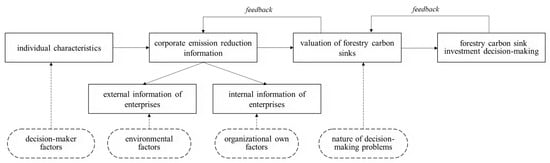
Consequently, the investment decision-making mechanism is inherently complex, driven by the interaction of four core factor categories, as illustrated in Figure 1:
Figure 1.
Decision-making mechanism for corporate forestry carbon sequestration investment.
Decision-Maker Characteristics: Including cognitive biases like ambiguity aversion and prior knowledge.
Environmental Factors: Encompassing policy stability, carbon price volatility, and regulatory dynamics.
Organizational Factors: Such as internal resource allocation, technological capability, and ESG information management routines.
Nature of the Decision Problem: Defined by its long-term horizon, irreversibility, and the need to value non-market benefits.
Recent empirical and theoretical advancements provide a coherent framework for analyzing these interactions. To manage valuation challenges under incomplete information, firms may evaluate forestry projects through a real options lens, treating investment as a sequence of deferrable, staged decisions rather than a static, binary choice. This approach is particularly relevant given the ambiguity inherent in long-term policy signals, which can trigger aversion in decision-makers and lead to a systematic underweighting of future green investment opportunities. In such a dynamic environment, corporate strategy is adaptive; firms engage in active learning and information updating to navigate policy uncertainty, gradually forming more stable investment signals over time [20]. The effectiveness of this learning process is, itself, dependent on organizational capabilities in ESG information management, which structures how external data is integrated into long-term strategic planning.
Decision-maker factors: Within the carbon market mechanism, these factors refer to the collective influence of key personnel’s personal traits on organizational choices. Corporate decision-making is a collective process that must reconcile the interests of various stakeholders. Individual limitations in values, attitudes, and backgrounds necessitate the involvement of members from diverse fields. For instance, highly educated decision-makers may better grasp the objectives of forestry carbon sequestration investments and assess their performance more rationally, enabling a scientific valuation. Senior managers, with broader strategic vision and authority, often prioritize corporate ESG initiatives, making them more inclined toward such investments. Moreover, investment preferences vary across sectors. Decision-makers in the energy sector, being more attuned to corporate energy consumption and emissions, may be stronger supporters. In contrast, those in R&D might favor investments in low-carbon technological innovation. This diversity underscores the importance of a multidisciplinary approach in forestry carbon sequestration investment decisions.
Environmental factors: Corporates have external information on carbon market mechanisms, other environmental regulations, and the social market environment. Among them, the carbon market mechanism is based on two core elements: the total carbon emission limit and the trading price of carbon emission rights [21,22]. Forestry carbon sequestration projects, as generators of CCERs, operate within this market-based pricing instrument. Other environmental regulations include command-and-control instruments (e.g., logging bans), direct subsidies or special funds, tax exemptions or loan preferences, and relevant laws and regulations. Forestry CCER projects are distinct from but can be complementary to such regulations or fiscal measures; their unique position lies in creating tradeable environmental assets that align ecological outcomes with corporate financial incentives. The social market environment includes social and environmental responsibilities assumed by peers, preferences of customers and consumers for low-carbon products, and media publicity. The Non-Annex I Mitigation Initiatives (NAMIs) follow the carbon market mechanism and other environmental regulations and choose the emission reduction path with the lowest transaction cost and the highest return on investment [15]. At the same time, the value judgment of forestry carbon sequestration will be dynamically adjusted due to the influence of the social market environment, especially the stakeholders [16].
Organizational factors: Organizational factors combine internal information such as low-carbon technology, energy structure and abatement costs which, together with external information, become direct influences on the value of a corporate investment in forestry carbon sequestration. Corporates are not only examining their own factors, but also comparing themselves to the average of their peers in terms of technology and cost, and at the same time considering how to utilize environmental factors to achieve incentive compatibility. Therefore, a corporate’s internal information can be summarized as a cost–benefit comparison among three options: in-house emission reduction, investment in forestry carbon sinks, and paying penalties for over-emissions. This comparison forms the reference system for valuing forestry carbon sequestration. Ultimately, this valuation manifests as the firm’s investment willingness and confidence.
The investment decision-making problem centers on how corporate managers value forestry carbon sequestration. Such valuation is shaped by heterogeneous interpretations of environmental and organizational factors, compounded by an evolving carbon market and limited direct investment experience. Consequently, it often extends beyond immediate market prices to encompass broader social and environmental co-benefits. While underlying project characteristics—such as tree species selection and rotation length—directly influence the crediting period and permanence risk of carbon credits (thereby affecting the long-term risk–return profile), corporate investors typically integrate these technical dimensions into aggregated assessments of value, risk, and investment horizon. Thus, the investment decision transcends a purely financial calculus, representing a strategic choice that aligns environmental action with long-term corporate development.
Accordingly, the decision-making problem surrounding forestry carbon sequestration investment is inherently multifaceted, encompassing not only financial considerations but also strategic objectives, including access to policy support, reductions in emission abatement costs, the creation of new investment opportunities, flexible fulfillment of environmental responsibilities, and the formulation of long-term low-carbon development strategies.
Under the carbon market mechanism, the investment decision of forestry carbon sequestration of many corporates may appear as the “surge phenomenon”, which in turn will have a reverse effect on the corporate value judgment of forestry carbon sequestration, which in turn will cause the adaptive adjustment of the corporate information on emission reduction, thus forming a feedback loop of the corporate investment decision of forestry carbon sequestration in the carbon market mechanism, which has become the theoretical basis for studying the macro carbon market mechanism from the perspective of the micro-corporate. This has become the theoretical basis for studying the macro carbon market mechanism from the perspective of micro-corporates.
3. Research Design
3.1. Data Sources and Variable Definitions
The data of this study primarily relies on corporates mandatorily included in Shanghai’s environmental energy trading carbon emission management. Following the principle of stratified sampling, the first stratum comprises corporates in the electric power, iron and steel, and chemical industries, which is mainly considered that in recent years, the total amount of carbon emissions from the above three industries accounted for more than 65% of the country’s total amount of carbon emissions, and that the number of corporates in these three industries and their initial quotas accounted for a relatively high proportion in Shanghai and in various carbon trading pilots. Secondly, eight corporates from each of the above three industries (the iron and steel industry is sampled from the independent branch plants of Baosteel Group) constitute the second layer; finally, 20 employees from each sample corporate (The extraction here does not follow the principle of complete randomness, but rather as a compliance unit to send members who have participated in the Shanghai Environment and Energy Exchange organized by the carbon market operation and risk management, carbon trading and low-carbon management courses and other training, which also guarantees that the key informants in this study on corporate emissions reduction information, the value of forestry carbon sequestrations, and other issues with the professional cognition and rational attitude) are sampled as key informants and constitute the third layer. Therefore, the total number of key informants in the surveyed corporates is 480, and 451 valid questionnaires are finally recovered through the questionnaire survey and structured interviews, with the effective questionnaire recovery rate of 94%. The 451 key informants mentioned above constitute the sample for studying the forestry carbon sequestration investment decision-making problem of corporates.
In line with the decision-making mechanism outlined earlier, the decision-maker factors are operationalized as the individual characteristics of key informants (P layer), which contains four variables: education (P1), position (P2), department (P3) and industry (P4). From Table 1, the key informants were from R&D, energy, and administrative departments, and the average education of those engaged in carbon asset management was above bachelor’s degree, which was related to the fact that the recognition, measurement, reporting, and carbon emission right trading of energy saving, consumption reduction, and pollution emission reduction of the corporate were mainly responsible by the financial personnel. As far as the construction of corporate carbon emission management is concerned, in addition to the improvement of corporate basic accounts by the administrative department, the energy department and the R&D department also need to cooperate with energy-saving technological transformation, effective control of emissions, and so on.
The external information of corporates is reflected by the environmental factors (X layer) held by key informants, and the environmental factors are divided into three dimensions: first, the environmental regulations other than carbon market mechanism, including the degree of influence of direct government subsidies or special funds on corporate emission reduction (X1), the degree of influence of tax relief or preferential lending policies on corporate emission reduction (X2), the degree of influence of relevant laws and regulations on corporate emission reduction (X3), and the degree of influence of these environmental regulations on corporate emission reduction (X3). From the sample mean, the impact of these environmental regulations on corporate emission reduction in general, the key informants in these environmental regulations on the corporate emission reduction impact of the judgment of a large difference, so the need to introduce the carbon market mechanism as a relatively independent environmental regulation as a supplement to the information; Second, the carbon market mechanism, given that the price mechanism is the core of the market mechanism, here using the corporate into the carbon market after the price of the CCERs overall situation (X4) and fluctuation (X5), the price of CCERs in the carbon market is considered to be generally moderate but fluctuating; Third, the socio-economic environment, which is represented by the three variables of the peer group’s investment in proactively fulfilling their social and environmental responsibilities (X6), the preference of the corporate customers and consumers in purchasing low-carbon products (X7), and the degree of influence of the media publicity on the emission reductions of the corporate (X8).
Internal information is represented by the organization’s own factors, and this study adopts three proxy variables: the degree of lack of R&D talents in emission reduction technology (X9), the difficulty of technological emission reduction due to the structure of the corporate energy use (X10), and the cost of purchasing emission reduction technology or reducing the emission by the corporate itself (X11). From the mean values, internal information brings more direct pressure on corporates to reduce emissions than external information, forcing them to make low-carbon transformation, optimize resource allocation by using the carbon market mechanism, and interact with other corporates’ external information to influence forestry carbon sequestration investment decisions.
The nature of the decision problem is centered on the value of information, i.e., the value of forestry carbon sequestration (M layer), and five variables are used: forestry carbon sequestration investment can enable corporates to obtain other policy support (M1), reduce the cost of emission reduction (M2), bring new investment opportunities (M3), flexibly fulfill environmental protection responsibilities (M4), and construct new low-carbon development plans (M5). Corporates’ subjective evaluation system incorporates considerations of both long-term and short-term returns, as well as direct and indirect benefits. These holistic value judgments inherently account for underlying project-specific factors (e.g., tree species, rotation length) which influence the temporal profile and riskiness of returns by affecting credit duration and permanence; however, from the corporate investor’s perspective in this model, such technical specifics are integrated into the aggregated perceptions of value, risk, and duration captured by the M layer variables.
At present, the carbon market mechanism is still imperfect, and the design of the forestry carbon sequestration investment system is also in urgent need of testing. In this study, the forestry carbon sequestration investment decision (D layer) is expressed by four variables: price decision (D1), risk taking (D2), offset ratio (D3) and investment willingness (D4). The first three variables (D1–D3) represent key design choices within the investment system available to corporates. Specifically, the offset ratio (D3) reflects corporate preferences under varying hypothetical policy caps, with its baseline anchored to the 5% limit commonly used in previous pilot market phases. It is important to note that while real-world forestry projects vary in technical characteristics (e.g., species composition, rotation length, and associated crediting periods or permanence profiles), our model approaches “forestry carbon sequestration investment” from the corporate investor’s perspective as a generalized asset class. Consequently, such project-level heterogeneity is not explicitly modeled but is understood to be aggregated into and reflected through the broader perceptions of risk, return, and value captured by these decision variables—particularly through the aggregate “risk-taking” (D2) assessment. From the sample data, it can be seen that the corporates’ willingness to invest in forestry carbon sequestration is moderate, and they are relatively rational in deciding the investment price and risk taking. Regarding the offset ratio (D3), the sample data indicate a corporate preference for it to increase or remain stable relative to the historical 5% benchmark, reflecting their views within the assumed flexible policy scenario.
3.2. Research Methodology and Model Construction
Due to the many layers of influencing factors and the high uncertainty of key variable values that affect corporate forestry carbon sequestration investment decisions, this makes the traditional econometric model no longer applicable [22,23]. The Bayesian analysis method implies the causal relationship and conditional correlation between the variables of the network nodes, and its structure is flexible, which can make effective probabilistic inference on the relationship between many variables in the complex network system, which is more suitable for solving the research problem [24]. This methodology is particularly well-suited for addressing the research questions at hand and is commonly employed in studies concerning project portfolio decision-making, investment risk, and performance evaluation. For example, prior research has utilized Bayesian methods to manage the uncertainty inherent in value estimation during project portfolio selection. This approach facilitates investment decisions based on the ex-ante estimation of the future value of risky projects, thereby reducing the potential for post-decision disappointment regarding investment expectations [22,25]. Other studies have applied Bayesian network decision-making to real estate investment risk control research, and derived the conditional probabilities corresponding to different investment risk control benefits through Bayesian networks, thus obtaining more precise and explicit real estate investment risk control decision-making signals [23]. While research, such as that by West et al. [26] has identified the purchase of low-cost emission reductions as a key corporate compliance strategy, the decision-making processes for direct investment in forestry carbon sequestration—as a distinct investment class—remain unexplored. The situation of “having a business but not a market” also means that there are both opportunities and challenges for forestry carbon sequestration investment, which makes the Bayesian network modeling to analyze corporates’ forestry carbon sequestration investment decision-making more research value and practical significance.
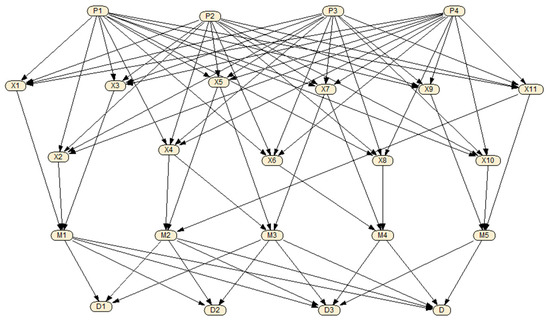
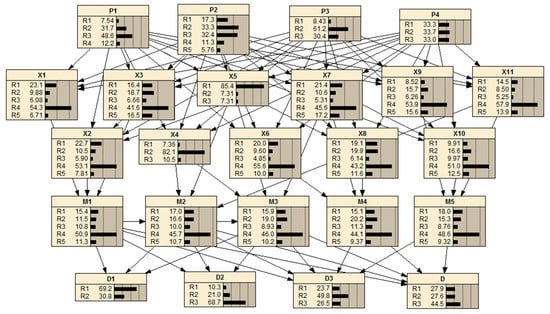
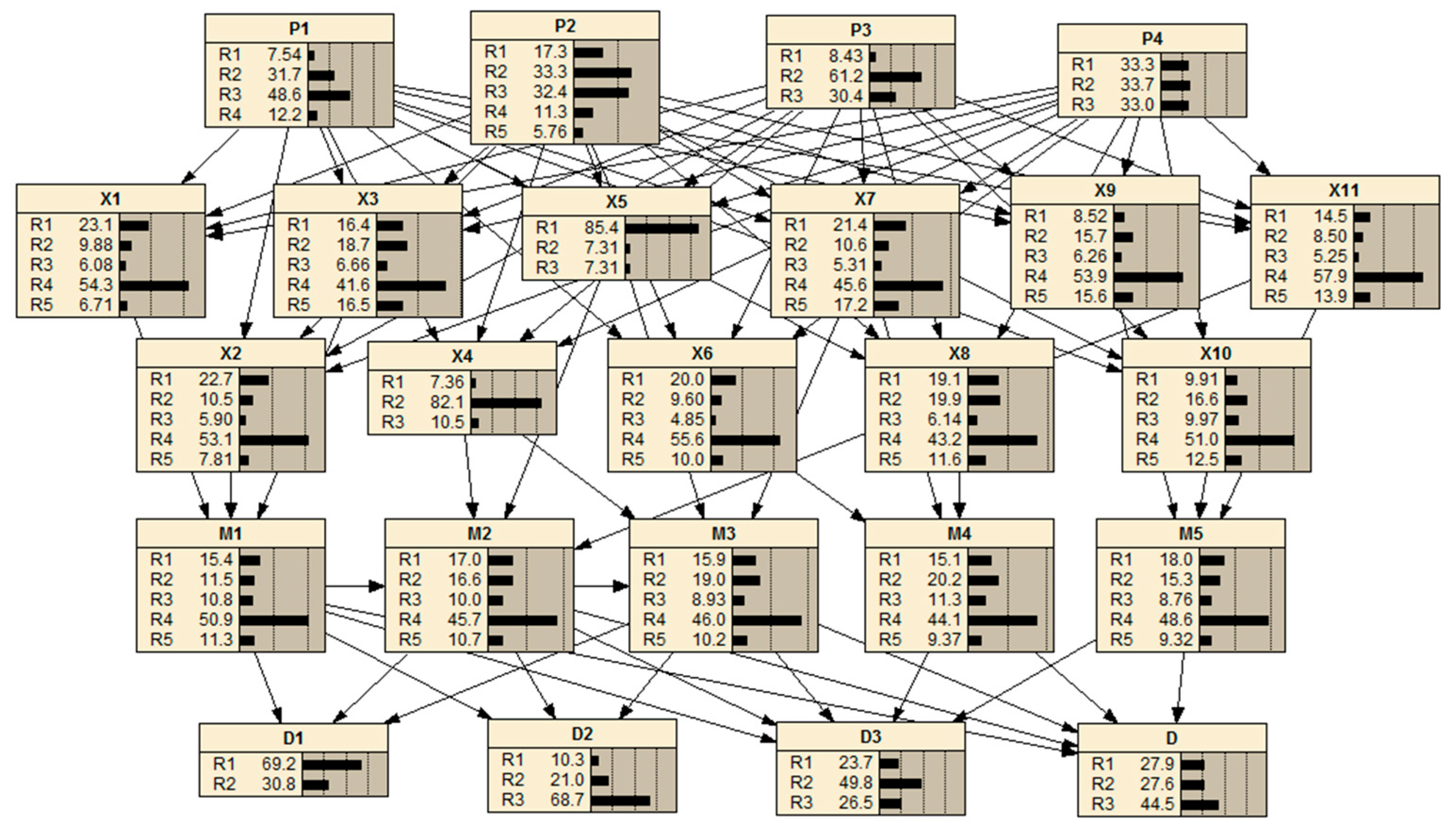
The Bayesian network model employs structural learning to construct a network topology graph that represents the relationship between variables, learning parameters from field research data, determining the conditional probability of nodes, and then determining the degree of dependence between nodes, and arriving at the network model of the corporate forestry carbon sequestration investment decision-making for systematic analysis (see Figure 2), where the variables, also known as nodes, are connected by directed arrows. Changes in the state of a node will trigger the linkage of related nodes to reflect the “individual characteristics—forestry carbon sequestration emission reduction information—forestry carbon sequestration value judgment—forestry carbon sequestration investment decision”.
Figure 2.
Decision-making network model for corporate forestry carbon sequestration investment.
Further, in this study, the K-fold cross-validation method was used to test the effectiveness of the above Bayesian network model by dividing the data into seven groups, of which six groups were used as experimental data and one group was used as validation data, calculating the model error rate for nodes D1, D2, D3, and D4, and rotating cross-validation through the Confusion Matrix (Confusion Matrix), and returning the model error rate of the seven validations as the average value of the overall data performance. The mean value of the model error rate of the seven validations is returned as the evaluation value of the overall data performance. The formula for calculating the model error rate is as follows:
where denotes the number of observations where the predicted values do not match the actual values and denotes the number of observations where the predicted values match the actual values. From the validation results (see Table 2), the overall data error rate of the model is 18.79%, and the overall performance of the model is stable and acceptable. Finally, the data of subgroup 5 with the lowest error rate (13.85%) was used to obtain the initial probability of the network model through Bayesian network machine learning (see Figure 3) to serve as the basis for sensitivity analysis and scenario simulation.
Table 2.
Results of descriptive statistics of variables.
Figure 3.
The initial probability of investment decision network model of forestry carbon sequestration for corporate. Note: The state of each node in the graph is denoted by Ri (i = 1, 2, …, 5), and the corresponding meanings are shown in Table 1 “Variable Values”.
4. Simulation of Corporate Forestry Carbon Sequestration Investment Decision-Making
4.1. Scenario Design
The complex connections and interactions among the factors affecting corporates’ forestry carbon sequestration investment decisions will bring high uncertainty to their investments. Therefore, this paper adopts sensitivity analysis in the Bayesian network model to measure, one by one, the impacts of various information from internal and external sources on the value judgment of forestry carbon sequestration and the impacts of the value judgment of forestry carbon sequestration on the investment decision of forestry carbon sequestration of corporates, and to find out the key factors that have a greater impact on the value judgment of forestry carbon sequestration and the investment decision of corporates, which is used as the basis for the design of the scenarios. The variables involved in this study are all discrete variables. Specifically, mutual information from information theory is used as a measure to reflect the reduction in uncertainty of one random variable due to the knowledge of another.
Let the joint distribution of any two random variables in the evaluation of the value of forestry carbon sequestration and the internal and external information of the corporate be and the marginal distributions be and , respectively, and the mutual information be the relative entropy of the joint distribution and the marginal distribution , that is,
According to the calculation results of the above formula, the most sensitive factors of the internal and external information of the corporate on the value of forestry carbon sequestration, and the value of forestry carbon sequestration on each node of the forestry carbon sequestration investment decision, are selected (see Table 3), the four key factors of the x layer are finally screened out as x2, x7, x8, and x11, respectively, and the three key factors of the M layer are M1, M2, and M3. In order to simulate the combination effect of the key factors of the corporate forestry carbon sequestration investment decision in the layers, the following two scenarios are designed. In order to simulate the combination effect of the key factors of each layer, the following two scenarios are designed:
Table 3.
Results of cross-validation of model error rate (in %).
Scenario 1 is the change of internal and external environment of corporates: the X2, X7, X8 and X11 variables take the value of 4, that is, all corporates under the carbon market mechanism, when other factors remain unchanged, the impact of tax breaks or loan preferential policies on the corporate emission reductions, the preference of customers and consumers to buy low-carbon products, the impact of media publicity on the corporate emission reductions, and the corporate technical emission reduction costs are all higher;
Scenario 2 is the change in the value of forestry carbon sequestration investment: the M1, M2 and M3 variables all take the value of 4, that is, all corporates under the carbon market mechanism, when other factors remain unchanged, corporates believe that the forestry carbon sequestration investment can enable corporates to obtain the policy support, reduce the cost of emission reduction, and bring new investment opportunities and other aspects of the value of the expectations of the higher.
4.2. Simulation Results
In the sensitivity analysis, the target node itself also has variance reduction value. For example, V (X2)/V (M1) = 0.26056/1.97381 = 13.2%, indicating that the node M1 (“Forestry carbon sequestration can get more policy support”) is relatively less affected by the node X2 (“Tax relief and loan preferential policies”) on corporate emission reduction, accounting for only 13.2% of the total effect. More policy support” by node X2 “tax breaks and loan preferential policies” on corporate emission reduction effect is relatively small, accounting for 13.2% of the total effect.
Corporates’ value judgment of forestry carbon sequestration is influenced by the corresponding information nodes in the overall topological network structure, respectively. From the sensitivity analysis, we can derive the sensitivity nodes that meet the setting, which can be summarized as follows:
- (1)
- In the existing relationship network, M1, M4 and M5 exhibit the highest sensitivity to the ideal node. M1 “forestry carbon sequestration can get more policy support” is influenced more by X2 “tax relief and loan preferential policies” and X3 “improvement of related laws and regulations”. “M4 “Forestry carbon sequestration can improve corporate image” is more influenced by X8 “media publicity and social awareness of environmental protection”. M4 “Forestry carbon sequestration can improve corporate image” is more influenced by X8 “Media publicity and social awareness of environmental protection”, followed by X7 “Consumer preference for low-carbon products”; M5 “Forestry carbon sequestration can help corporates to plan for new low-carbon development” is most sensitive to X11 “Difficulty in emission reduction due to high cost of technology emission reduction”, followed by X12 “Difficulty in emission reduction due to high cost of technology emission reduction”. M5 “Forestry carbon sequestration can help corporates make new low-carbon plans” is the most sensitive to X11 “the difficulty of emission reduction due to the high cost of technical emission reduction”, followed by X9 “the lack of emission reduction technicians” and X10 “the difficulty of emission reduction due to the energy structure”, which account for only 7.42% and 5.08%, respectively.
- (2)
- Of M2, M3 in the existence of artificially constructed links did not play a role in influencing, such as how node X4 “CCER price” and X5 “CCER price fluctuations” did not play a role in M2 and M3, and further analysis of the data source found that the probability distributions of X4 and X5 itself converge. Further analysis of the data source found that the probability distribution of X4 and X5 converge, i.e., they are concentrated in the state of “CCER price in general” and “CCER price volatility”; therefore, the distribution of the value choice of M2 and M3 is missing in other states of CCER.
- (3)
- In addition to analyzing the established links, there are also interactions between the M layers under the overall Bayesian network topology, such as M2 “Forestry carbon sequestration can reduce the cost of emission reduction” and M5 “Forestry carbon sequestration can help corporates to plan for low carbon,” M3 “Forestry carbon sequestration can bring more investment opportunities” and M4 “Forestry carbon sequestration can improve the image of corporates”; there is a mutual linkage effect, each as a sensitivity node. M3 “Forestry carbon sequestration can bring more investment opportunities” and M4 “Forestry carbon sequestration can improve the image of corporates have mutual linkages”, which are sensitivity nodes of each other.
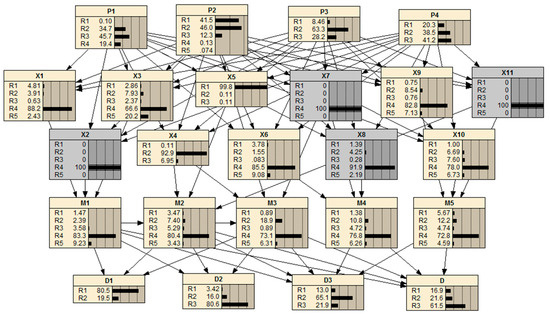
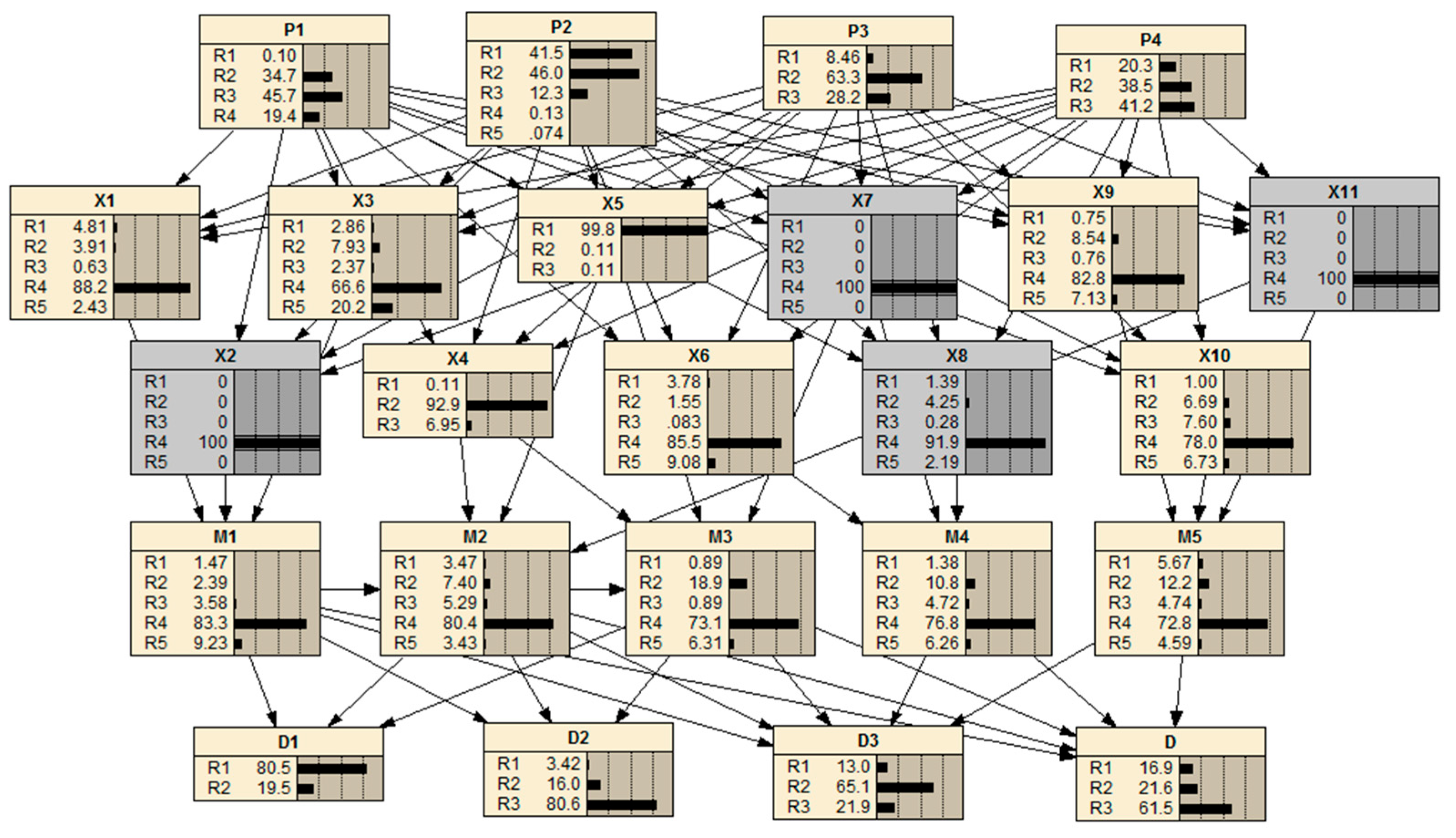
After constructing a complete Bayesian network topology graph which can be predicted, from the baseline scenario, the indicator layer nodes are state value distribution after machine learning; select the information nodes in the sensitivity analysis that have a greater effect on the nodes in the M-value layer, specifically X2, X7, X8, X11 (the most sensitive nodes of M2 and M5 are all X11), and set them to the ideal state, i.e., the highest probability value of state value set to 100%. After setting the ideal state of the key nodes, followed by a node update of the network as a whole, it is found that the relevant nodes will produce systematic linkage effect, especially for the nodes that need to be observed in this section (D layer) to produce predictions, the formation of the network topology diagram is as follows (see Figure 3):
Corporates obtain information feedback after initial decision-making, and decision-makers then adjust their value judgment of information (realized by setting the most ideal state value) before making a new round of decision-making adjustment. For the forestry carbon sequestration investment decision-making layer (D layer) to be discussed, the updated network topology graph is compared with the initial graph, the initial probability graph of the corporate forestry carbon sequestration investment decision-making network model is the control group, the updated network topology graph after the scenario simulation is the experimental group, and the comparison reveals that the node state of the D layer has a clear trend change, see Table 4 and Figure 4.
Table 4.
Sensitivity analysis of X layer to M layer and M layer to D layer.
Figure 4.
The topology diagram of simulation prediction.
When the external information factors corresponding to specific internal and external corporate nodes (X2, X7, X8, X11) in the model are strengthened to their idealized states, the simulation results demonstrate a systematic shift in corporate investment preferences towards forestry carbon sequestration. As summarized in Table 4, this shift extends beyond mere percentage changes in individual variables and collectively reveals corporate expectations for a more mature and market-oriented investment environment.
Specifically, the preference for “market-participated pricing” (R1) in node D1 (Pricing Subject of Forestry Carbon Sequestration) increases by 11.3%. Concurrently, the probability of selecting “buyer-seller risk-sharing” (R3) in node D2 (Risk-bearing Subject) rises significantly from 68.7% to 80.6%. These two changes are intrinsically linked: the strengthened preference for a market-based pricing mechanism logically aligns with a higher acceptance of shared risk models. Together, they indicate that under conditions of more transparent and positive information, corporates favor a more liquid market structure with clearly defined rights and responsibilities, moving away from reliance on government-administered pricing or assuming risks unilaterally.
Furthermore, the desired proportion of forestry carbon sequestration in CCER offsets (Node D3) increases by 15.3%, and the proportion of corporates indicating a willingness to invest (R3 in Node D4, Corporate Investment Willingness) rises from 44.5% to 61.5%. This set of results confirms that favorable information can effectively boost market demand expectations and direct corporate participation. However, a critical finding is that even under optimal information stimulation for this subset of factors, investment willingness (61.5%) does not reach a dominant or qualitatively transformed level. This observation precisely validates the core insight of the Bayesian network model: corporate investment decisions are the complex outcome of multiple interacting factors. The current simulation only optimizes a portion of the information nodes in the M layer. The potential for a compounded and amplified effect on investment willingness remains substantial if other critical network nodes—such as those related to technology cost and policy stability—are synchronously adjusted to their ideal states. This finding provides a crucial quantitative basis for advocating systematic market design through a coordinated “policy mix.”, see Table 5.
Table 5.
Comparison of probability distributions for stratum D (unit: %).
5. Discussion and Conclusions
5.1. Discussion
This study employs a Bayesian network model to decode the corporate investment decision-making process for forestry carbon sequestration. The simulation results provide nuanced, quantitative insights that critically engage with and extend the existing literature.
- (1)
- External Drivers vs. Internal Cost Barriers: Confirming and Nuancing Priorities
The model confirms the primary influence of external factors—tax/loan incentives (X2), consumer preference (X7), and media influence (X8)—on corporate value judgment. This finding offers demand-side quantification of a trend noted in the literature: just as Bragança et al. (2022) found external support boosted farmer adoption of low-carbon practices by ~25% [10], this study shows that optimizing these nodes raised Corporate Investment Willingness (D4) by 17 percentage points (from 44.5% to 61.5%).
Conversely, the model identifies the high cost of technical emission reduction (X11) as the paramount internal constraint. This complements and contrasts with the supply-side focus of studies like Shen et al. (2025), which emphasize policy and price risks for project valuation [11]. For corporate investors, the immediate “abatement cost barrier” (mean scores of 3.46–3.64 for internal factors) outweighs concerns about CCER price levels (mean 2.02). This highlights a critical demand-side obstacle that aligns with and helps explain the institutional investment barriers noted by Li and Zhang (2024) [14], suggesting policy must address internal costs alongside market signals.
- (2)
- Synergistic Value: Mapping Interconnected Motivations
The network reveals significant synergies between value perceptions (e.g., M2 “cost reduction” and M5 “strategic planning” are mutually sensitive). This empirically unpacks the broader shift beyond compliance observed by Xu (2026) [27]. The interconnectedness implies that corporate motivations are not siloed; enhancing one value dimension (e.g., cost reduction) can amplify another (e.g., strategic benefit). This supports advocating for policies that promote forestry carbon sinks as a bundled strategic asset, leveraging these cognitive linkages for greater impact.
- (3)
- Evolving Market Preferences: From Compliance to Participation
The simulation captures a clear strategic shift towards market-based mechanisms. Optimizing external information increased preference for “market-participated pricing” (D1) by 11.3% and for “buyer-seller risk-sharing” (D3) to 80.6%. This moves beyond the historical compliance behavior of seeking low-cost allowances seen in early phases of mechanisms like the EU ETS [15], directly supporting contemporary calls for sophisticated financial products [6,12].
A key finding is the strong demand-pull effect of a higher forestry CCER offset ratio, with preference for a >10% ratio increasing by 15.3%. This bridges a critical gap between supply- and demand-side research. While the literature often focuses on improving project supply and valuation [28,29], this result demonstrates that clear demand-side policy signals are equally crucial to stimulate investment, addressing the multi-dimensional market barriers identified by Zhang and Wang (2024) [4].
5.2. Conclusions
This study constructed a Bayesian network model to simulate the decision-making pathways of corporate investors regarding forestry carbon sequestration under China’s carbon market. The main conclusions are as follows:
- (1)
- External Information is the Key Driver: Corporate value judgment is predominantly shaped by external information, including government tax and loan incentives, consumer preferences for low-carbon products, and media publicity.
- (2)
- Internal Constraints and Value Synergies Coexist: Internally, the foremost constraint is the high cost and technical difficulty of emission reduction. Importantly, the perceived value of forestry carbon sequestration is not isolated; significant synergies exist between its economic (e.g., cost reduction), strategic (e.g., enabling low-carbon planning), and reputational benefits, which collectively enhance its investment appeal.
- (3)
- Market-Based Mechanisms Activate Investment: Corporate investment decisions, mediated by the composite value judgment, show a clear preference for market-oriented mechanisms—specifically, market-participated pricing and shared risk-bearing arrangements. The investment willingness is positively influenced by a higher allowable offset ratio for forestry CCERs within the compliance framework.
In summary, this research complements the extant literature by decoding the micro-foundations of corporate investment decisions. It highlights that activating corporate capital requires not only addressing external policy and market incentives but also mitigating internal technical constraints, communicating the synergistic value proposition, and firmly establishing market-based mechanisms with clear demand signals.
6. Implication and Limitation
6.1. Implication
Unlike general commodity markets and financial markets, the carbon market utilizes market mechanisms, but is not spontaneously formed; it places greater emphasis on regulatory stability and orderly market operation [25]. For forestry carbon sequestration investment, the decision essentially involves comparing marginal abatement costs, where the information available to and understood by the corporation is crucial. Based on our findings and to address identified barriers, we propose the following recommendations targeting policymakers, regulators, and financial institutions:
- (1)
- Enhance Information Transparency and Credibility through Robust Institutions.
To improve corporate decision-making, a foundational step is strengthening the carbon information disclosure ecosystem. Government regulators (e.g., the Ministry of Ecology and Environment) should formulate unified disclosure standards, establish a constraint mechanism, and increase third-party auditing. Simultaneously, support for the professional accreditation and oversight of third-party verification agencies is critical. Corporates, in turn, should accelerate the development of internal carbon asset management talent and disclosure systems. This dual approach enhances decision-makers’ cognition, improves the predictability of forestry carbon sequestration value, and builds market-wide confidence in the underlying assets.
- (2)
- Develop Differentiated Incentives and Financial Products.
Moving beyond generic subsidies, policymakers (e.g., finance, ecology ministries) should refine targeted incentives (e.g., tax breaks, loan preferences) and integrate forestry carbon sequestration into core ESG metrics. Crucially, financial regulators and institutions must develop differentiated products based on robust criteria like rotation length and permanence risk. For example, long-rotation, high-permanence projects could qualify for extended crediting periods paired with dedicated risk buffers or insurance, whereas shorter-rotation projects might align with standard structures. Supporting derivatives like price insurance and revenue-right pledge loans remains key. This systematic differentiation will bolster market confidence, mitigate risks, and advance forestry carbon sequestration as a mature financial asset class. Furthermore, facilitating aggregation mechanisms (e.g., via cooperatives or specialized developers) is essential to lower transaction costs, integrate small-scale owners, and increase project supply diversity.
- (3)
- Stabilize Long-term Market Expectations with Clear and Adaptive Policy.
Stabilizing expectations requires consistent and forward-looking policy signals. Market regulators should, on one hand, consider a predictable trajectory for tightening initial corporate carbon emission quotas, creating a steady compliance demand pull. On the other hand, they must focus on building a multi-level and credible market infrastructure. This involves ensuring policy continuity, supporting the timely launch of nationally accepted, high-integrity forestry carbon sequestration products, and communicating a clear “carbon has a price” signal to the public. Establishing clear rules regarding the proportion of forestry CCERs allowed for offsetting (the offset ratio) and maintaining policy stability around this parameter are vital for corporate investment planning. Looking ahead, while China’s carbon market is currently domestically focused, policymakers should also consider the potential for future international interoperability. Developing robust domestic standards now positions China’s forestry carbon credits favorably should recognition under future bilateral or multilateral carbon market linkages become possible.
- (4)
- Consolidate the Credibility Foundation of Carbon Credits.
The credibility of carbon credits is the cornerstone of market function. Our analysis identifies corporate reliance on credible emission reduction information as a critical factor in investment decisions. Therefore, establishing a robust and independent verification infrastructure must be a foundational policy priority. This entails strengthening the national accreditation and oversight of third-party MRV verifiers to ensure their technical rigor, operational independence, and consistent audit quality. Enhancing the perceived and actual integrity of the verification process directly mitigates a key investment risk identified in our study, thereby increasing the fundamental bankability of forestry carbon sequestration projects and mobilizing essential private capital.
6.2. Limitation
This study has several limitations that suggest avenues for future research. First, it primarily examines the demand side (i.e., corporate investors under Shanghai’s carbon quota system), offering limited insight into the constraints and incentives facing supply-side actors such as forest farmers and project developers. Second, the analysis relies mainly on stated-preference data from cross-sectional surveys and key informant interviews, which may not fully capture actual investment behavior. Furthermore, the limited availability of historical transaction data from the newly restarted CCER market constrained the model’s capacity to analyze market dynamics.
Based on these limitations, future research could advance in the following directions: (1) incorporating supply-side actors into a unified analytical framework to examine interaction mechanisms and coordination barriers between demand and supply; (2) conducting longitudinal studies using actual transaction and investment data from the revitalized CCER market to validate and refine the decision model proposed here; (3) performing cross-regional comparisons to explore how differences in carbon market policies, economic development levels, and resource endowments shape corporate investment decisions; and (4) investigating how project-level technical features (e.g., tree species, permanence risk tiers) can be integrated into financial product design to better reflect value and risk in corporate assessments. Such work would enable a more comprehensive and dynamic understanding of the forestry carbon sequestration market and provide a stronger basis for policy and practice.
Author Contributions
Conceptualization, H.Q., X.Z. and X.L.; Data Curation, H.Q., X.Z. and X.L.; Formal Analysis, X.L.; Funding Acquisition, H.Q., X.Z. and X.L.; Methodology, H.Q. and X.Z.; Project Administration, H.Q. and X.L.; Resources, F.L.; Software, X.L.; Supervision, H.Q. and X.L.; Validation, H.Q., X.Z. and X.L.; Writing—Original Draft, X.Z.; Writing—Review and Editing, H.Q. and X.L. All authors have read and agreed to the published version of the manuscript.
Funding
This work was supported by the National Social Science Foundation of China (22BGL168).
Institutional Review Board Statement
This study did not require any ethical approval.
Informed Consent Statement
Not applicable.
Data Availability Statement
The datasets generated and analyzed during the current study are available from the corresponding author on reasonable request.
Acknowledgments
The authors are grateful to [Huibo Qi, Fei Long and Xiaowei Lu] for their insightful feedback on the research design. We also thank [Xiaoyu Zheng] for providing access to the dataset used in this study. Additionally, we acknowledge the constructive comments from the anonymous reviewers and editors, which significantly improved the quality of this manuscript.
Conflicts of Interest
The authors declare that they have no relevant financial or non-financial interests that might be perceived as influencing the research presented in this paper.
References
- Kang, J.N.; Wei, Y.M.; Liu, L.C. Observing technology reserves of carbon capture and storage via patent data: Paving the way for carbon neutrality. Technol. Forecast. Soc. Change 2021, 171, 120933. [Google Scholar] [CrossRef] [Scilit]
- Qin, J.; Fu, H.; Wang, Z.; Xia, L. Financing and carbon emission reduction strategies of capital-constrained manufacturers in e-commerce supply chains. Int. J. Prod. Econ. 2021, 241, 108271. [Google Scholar] [CrossRef] [Scilit]
- Cao, E.; Yu, M. The bright side of carbon emission permits on supply chain financing and performance. Omega 2019, 88, 24–39. [Google Scholar] [CrossRef] [Scilit]
- Ganatsas, P.; Tsakaldimi, M.; Karydopoulos, T.; Papaemannuil, A.; Papadopoulos, S. Long-term effect of different forest thinning intensity on carbon sequestration rates and potential uses in climate change mitigation actions. Mitig. Adapt. Strateg. Glob. Chang. 2024, 29, 1–22. [Google Scholar] [CrossRef] [Scilit]
- Beljan, K. Forests and the economics of climate change: A review of knowledge, challenges and future directions. Croat. J. For. Eng. 2025, 46, 53–62. [Google Scholar] [CrossRef] [Scilit]
- Wang, A.; Hu, S.; Lin, B. Can environmental regulation solve pollution problems? Theoretical model and empirical research based on the skill premium. Energy Econ. 2021, 94, 105068. [Google Scholar] [CrossRef] [Scilit]
- Zou, T.; Zou, Q.; Hu, L. Joint decision of financing and ordering in an emission-dependent supply chain with yield uncertainty. Comput. Ind. Eng. 2021, 152, 106994. [Google Scholar] [CrossRef] [Scilit]
- Xia, T.; Wang, Y.; Lv, L. Financing decisions of low-carbon supply chains under chain-to-chain competition. Int. J. Prod. Res. 2023, 61, 6153–6176. [Google Scholar] [CrossRef] [Scilit]
- Zhang, Y.; Zhang, J. Estimating the impacts of emissions trading schemes on low-carbon development. J. Clean. Prod. 2019, 238, 117913. [Google Scholar] [CrossRef] [Scilit]
- Bragança, A.; Newton, P.; Cohn, A. Extension services can promote pasture restoration: Evidence from Brazil’s low carbon agriculture plan. Proc. Natl. Acad. Sci. USA 2022, 119, e2114913119. [Google Scholar] [CrossRef] [Scilit]
- Zhou, B.; Zhang, C.; Song, H. How does emission trading reduce China’s carbon intensity: An exploration using a decomposition and difference-in-differences approach. Sci. Total Environ. 2019, 655, 514–523. [Google Scholar] [CrossRef] [Scilit]
- Kuang, Y.; Lin, B. Public participation and city sustainability: Evidence from urban garbage classification in China. Sustain. Cities Soc. 2021, 67, 102741. [Google Scholar] [CrossRef] [Scilit]
- Du, G.; Liu, S.; Lei, N. A test of environmental Kuznets curve for haze pollution in China. J. Clean. Prod. 2018, 205, 821–827. [Google Scholar] [CrossRef] [Scilit]
- Liu, W.Y.; Lu, Y.H.; Lin, C.C. Assessing carbon abatement costs considering forest carbon sequestration and carbon offset mechanism: Evidence from Taiwan. For. Sci. 2023, 69, 382–396. [Google Scholar] [CrossRef] [Scilit]
- Martin, R.; Muûls, M.; Wagner, U.J. The impact of the EU ETS on regulated firms. Rev. Environ. Econ. Policy 2016, 10, 129–148. [Google Scholar] [CrossRef] [Scilit]
- Nong, D.; Nguyen, T.H.; Wang, C. Environmental and economic impacts of ETS in Vietnam. Energy Policy 2020, 140, 111362. [Google Scholar] [CrossRef] [Scilit]
- Mäntymaa, E.; Artell, J.; Forsman, J.T.; Juutinen, A. Is it more important to increase carbon sequestration, biodiversity, or jobs? A case study of citizens’ preferences for forest policy in Finland. For. Policy Econ. 2023, 154, 103023. [Google Scholar] [CrossRef] [Scilit]
- Heyward, C.; Lenzi, D. Improving arguments for local carbon rights: The case of forest-based sequestration. J. Appl. Philos. 2023, 40, 593–607. [Google Scholar] [CrossRef] [Scilit]
- Dranev, Y.; Izosimova, A.; Meissner, D. The impact of ESG information management on long-term investment decisions. Technol. Forecast. Soc. Change 2023, 186, 122158. [Google Scholar]
- Kong, D.; Wang, Y. Policy uncertainty and corporate green innovation under the carbon market. Energy Econ. 2022, 115, 106353. [Google Scholar]
- Carter, T.A.; Buma, B. The distribution of tree biomass carbon within the Pacific Coastal Temperate Rainforest, a disproportionally carbon-dense forest. Can. J. For. Res. 2024, 51, 956–977. [Google Scholar] [CrossRef] [Scilit]
- Li, X.; Wang, Y.; Zhang, J. Corporate environmental responsibility and financial performance: The moderating effect of regional environmental regulations. J. Clean. Prod. 2021, 297, 1266–1279. [Google Scholar]
- Andoh, J.; Martey, E.; Obeng, E.A.; Oduro, K.A.; Salimath, P.; Lee, Y. Safeguarding local communities for REDD+ implementation in Ghana. Forests 2024, 15, 1349. [Google Scholar] [CrossRef] [Scilit]
- Segura, S.; Ferruz, L.; Gargallo, P. Environmental versus economic performance in the EU ETS. J. Clean. Prod. 2018, 176, 1111–1132. [Google Scholar] [CrossRef] [Scilit]
- Duan, H.; Rogelj, J.; Veysey, J. Modeling deep decarbonization. Appl. Energy 2020, 262, 114517. [Google Scholar] [CrossRef] [Scilit]
- West, T.A.P.; Wilson, C.; Vrachioli, M. Carbon payments for extended rotations. Ecol. Econ. 2019, 163, 70–76. [Google Scholar] [CrossRef] [Scilit]
- Billio, M.; Costola, M.; Hristova, I.; Latino, C.; Pelizzon, L. Inside the ESG ratings: (Dis)agreement and performance. Corp. Soc. Responsib. Environ. Manag. 2021, 28, 1426–1445. [Google Scholar] [CrossRef] [Scilit]
- Qin, Z.; Deng, X.; Griscom, B. Natural climate solutions for China. Adv. Atmos. Sci. 2021, 27, 889–895. [Google Scholar] [CrossRef] [Scilit]
- Tang, Y.; Yang, C.; Wu, H.; Xu, Z.; Tan, L.; Tu, W.; Li, B.; Li, Z.; Wang, Z.; Guo, K.; et al. Tropical forest carbon offsets deliver partial gains amid persistent over-crediting. Science 2025, 390, 182–187. [Google Scholar] [CrossRef] [Scilit]

Disclaimer/Publisher’s Note: The statements, opinions and data contained in all publications are solely those of the individual author(s) and contributor(s) and not of MDPI and/or the editor(s). MDPI and/or the editor(s) disclaim responsibility for any injury to people or property resulting from any ideas, methods, instructions or products referred to in the content. |
© 2026 by the authors. Licensee MDPI, Basel, Switzerland. This article is an open access article distributed under the terms and conditions of the Creative Commons Attribution (CC BY) license.