Article

Comparing 30 Tree Biomass Models to Estimate Forest Biomass in the Amazon
by
Rebecca A. Garcia
1,
Lina M. R. Galvão
1,
Xavier S. Chivale
1,
Thaís C. Almeida
1,
Fabiano R. Pereira
1,
Rorai Pereira Martins-Neto
2,*,
Carlos R. Sanquetta
1 and
Hassan C. David
1
1
Department of Forest Sciences, Federal University of Paraná, Curitiba 82590-300, PR, Brazil
2
Faculty of Forestry and Wood Sciences, Czech University of Life Sciences Prague, Kamýcká 129, 16500 Prague, Czech Republic
*
Author to whom correspondence should be addressed.
Forests 2026, 17(2), 213; https://doi.org/10.3390/f17020213
Submission received: 22 November 2025 / Revised: 26 January 2026 / Accepted: 31 January 2026 / Published: 4 February 2026
(This article belongs to the Special Issue Forest Resources Inventory, Monitoring, and Assessment)

Abstract

This study tests the performance of 30 tree-level models of literature to predict the aboveground biomass (AGB) of trees in 200 1 ha simulated plots representing the following two successional stages of Amazonian forests: Advanced Secondary Forest (ASF) and Mature Forest (MF). This matters because reliable biomass estimates are fundamental to carbon quantification and climate policy. Ensuring consistency between tree-level and plot-level accuracy strengthens transparency and credibility in global reporting. The aim was twofold: (i) to recommend accurate models to predict biomass in the Amazon and (ii) to detect what characteristics of the model calibration dataset can affect the accuracy of the AGB predicted at the plot level. We considered the characteristics of datasets, sample size, minimum, maximum, and range of tree diameters, as well as the coefficient of determination, root mean square error (RMSE), and number of predictors of the 30 models consulted in the literature. These characteristics were correlated with the biomass error per unit area. We listed 11 models based on their acceptable (overall ± 10%) accuracy, whereas four models overestimated and 15 models underestimated the biomass per unit area beyond the acceptable limit. Our analysis pointed out that the strongest (but moderate) correlation (r) was observed for the RMSE of the models, i.e., precision of model predictions. These correlations were r = 0.60 (p = 0.40) for ASF (kg) and r = 0.40 (p = 0.60) for MF (kg) and r = 0.57 (p = 0.18) for ASF (log) and r = 0.21 (p = 0.64) for MF (log), which means that models with greater uncertainty (higher RMSE) tend to produce larger errors in AGB estimation. As a main conclusion, this study cautions that selecting one model among several based on the lowest RMSE is a misleading practice because the precision of predictions at the tree level is not in agreement with the precision at the plot level.

1. Introduction

Accurate predictions of aboveground biomass (AGB) in tropical forests are crucial for monitoring the global carbon cycle and developing effective climate change mitigation and adaptation policies, particularly within the REDD+ framework [1]. However, obtaining these predictions in regions like the Amazon presents significant challenges due to high biodiversity, complex forest structure, and variable local conditions.
Traditional methods, requiring detailed measurements of all trees in a plot, are costly, time-consuming, and impractical at large scales. While innovative approaches simplify the process by using only the largest trees to estimate AGB and forest structure [2], limitations exist. The density of larger trees, while a significant predictor of total biomass [3], explaining approximately 70% of pan-tropical variance, does not fully account for variability among biomes and regions.
Furthermore, this simplified approach may not accurately capture the structure of degraded forests, where larger trees are often removed, nor fully account for the characteristics of smaller trees. The variability in tree diameter range also impacts the accuracy of biomass predictions [2]. Therefore, incorporating smaller trees is essential for a more comprehensive understanding of forest structure and ensuring accurate AGB predictions.
Another significant challenge lies in the quality of existing allometric models used to convert tree measurements into biomass values. These models inherently carry uncertainties associated with fitted equations [4], and their calibration requires extensive datasets encompassing all possible combinations of predictor variables (number of predictors) to avoid extrapolation and unreliable predictions. Such datasets are scarce, even in large-scale projects.
Research has explored new approaches to improve AGB estimation accuracy. For instance, ref. [4] developed improved pantropical allometric models using tree diameter, total height, and wood density, demonstrating their validity across various tropical vegetation types and reducing uncertainties compared to local models. Similarly, ref. [2] showed that measuring the 20 largest trees (sample size) per hectare yields accurate predictions of key forest structure parameters, with relative errors ranging from 4% to 17.7%.
Despite these advancements, the influence of dataset characteristics on AGB estimation accuracy remains poorly understood, particularly in the Amazon. A systematic investigation is needed into factors such as sample size, diameter range, R2, RMSE, and the number of predictors on the quality of Amazonian forest plot sampling.
While [4] demonstrated good biomass estimation accuracy using a dataset of 4004 trees (diameters ranging from 5 to 212 cm), assessing the coefficient of variation (CV), R2, and RMSE, ref. [5] highlights the importance of reference datasets for biomass estimation, emphasizing the homogeneity of tree characteristics for accurate model calibration. This matters because reliable biomass estimates are essential for carbon quantification and effective climate policy. Plot-level uncertainties can scale up to regional inventories, undermining coherent forest management. Strengthening consistency between tree-level and plot-level accuracy enhances transparency, reduces uncertainty, and reinforces the credibility of global carbon reporting and climate mitigation strategies.
Against this background, the present study had the following two main objectives: (i) to recommend accurate models to predict biomass in Amazonian forests and (ii) to detect what characteristics of the model calibration dataset can affect the accuracy of the AGB predicted at the plot level. We considered the characteristics of datasets, sample size, minimum, maximum, and range of tree diameters, as well as the coefficient of determination, root mean square error (RMSE), and number of predictors of the 30 models consulted in the literature.

2. Materials and Methods

2.1. Data and Study Area

This study employs data from a subset of the global tree dataset published by [4]. The complete dataset of [4] comprises data from 4004 trees across the pantropical region, but we sub-selected data from the Brazilian Amazon region only, which totals 543 trees with a diameter at breast height (DBH) ≥ 5 cm. This subset is referred to as the ‘Amazon subset’. The trees belonging to the Amazon subset are a sample collected in the following four Brazilian states: Amazonas (BraMan2), Mato Grosso (SouthBrazil 1, 2 and 3), Pará (BraPara 1 and 3), and Rondônia (BraRond). More information related to data collection and tree variables available can be found in [4]. Allometric relationships for the Amazon subset are shown in Figure 1.
Table 1 summarizes the descriptive statistics for the Amazon dataset. DBH ranged from 5 to 138 cm, with a mean of 19.0 cm and a coefficient of variation (CV) of 84.6%, indicating substantial variability in tree size. Total tree height (H) also exhibited considerable variation, ranging from 6 to 54.1 m (mean = 17.4 m, CV = 42.5%). Biomass values demonstrated an even wider range, from 5.1 to 20,416 kg (mean = 558.0 kg, CV = 306%). Finally, wood density varied from 0.22 to 1.08 g/cm3, with a mean of 0.61 g/cm3 and a CV of 22.8%.

2.2. Analytical Procedure

Based on the Amazon subset previously described, we simulated plots of the Amazon forest that mimic two succession stages of growth: secondary advanced forest (ASF) and mature (old-growth) forest (MF). The criteria for the definition of both succession stages, description of the algorithm for plot simulation, and assessment of the model are described in the next subsections.

2.2.1. Succession Stages of the Amazon Forest

To mimic the succession stages in the simulation process, we determined basal area (BA) and average tree height (H) as parameters of forest composition, as in [6]. These authors indicate a BA of 10–30 m2 ha−1 and an average H of 13–17 m for ASF and a BA of 25–50 m2 ha−1 and an average H of 15–24 m for MF. Thus, these values of BA and H were the basis for the horizontal and vertical forest composition, respectively.
Tree density (N, trees ha−1) was defined using the forest simulator TB&C (www.tropicalbiomass.com; [7]), which represents tropical forest diameter structures through a beta distribution (parameters α and β), assuming an inverted-J shape typical of moist tropical forests [8]. Multiple combinations of α, β, and N were tested, and only those producing inverted-J distributions and basal areas (BA) within the predefined limits were retained. Accordingly, N (DBH ≥ 5 cm) ranged from 308 to 1083 trees ha−1 in advanced secondary forests (ASF) and from 308 to 1151 trees ha−1 in mature forests (MF). When these BA and N values were parameterized in TB&C, the simulated aboveground biomass (AGB) per unit area fell within the reference intervals reported for South American forests in [5], supporting consistency between the simulated forest composition and AGB values observed in field plots.

2.2.2. Plot Simulation and Modeling

The algorithm was written in the R language (version 2025.05.1) [9] and generates simulated plots of Amazonian forests representing the two succession stages, MF and ASF. Our programming code can be reproduced as follows. Denoting i for trees and j for (simulated) plots, then:
(1)
From the Amazon dataset, select without replacement a random N j within the limits defined in methodology, calculate B A j as in Equation (1), and average H as in Equation (2).
(2)
For the plot simulated in the previous step, consider approving that plot such that both B A j and H ¯ j fall into the limits defined in methodology, and go to the next step. For not-approved plots, redo step 1. For the j-th plot approved in the previous step, obtain the observed A G B j and predicted A G ^ B j m through the biomass models shown in Table 2.
B A j = i = 1 n t r e e s π D i j 2 40,000
H ¯ j = i = 1 n t r e e s H i j / n t r e e s
A G B j = i = 1 n t r e e s A G B i j
A G ^ B j m = i = 1 n t r e e s A G ^ B i j m
(3)
For every simulated plot and m-th biomass model, obtain the plot AGB error in Mg ha−1 (Equation (5)), plot AGB absolute error in Mg ha−1 (Equation (6)), and plot AGB relative error in % (Equation (7)).
ε j m = A G ^ B j m A G B j
ε a j m = A G ^ B j m A G B j
ε r j m = 100 × ε j m A G B j
(4)
Replicate steps 1–4 until a set with 100 simulated plots is obtained.
(5)
For the set of simulated plots and m-th biomass model (Table 2), estimate the mean error in Mg ha−1 (Equation (8)), mean absolute error in Mg ha−1 (Equation (9)), mean relative error in % (Equation (10)), and root mean square error in Mg ha−1 (Equation (11)).
ε ¯ m = j = 1 100 ε j m / 100
ε ¯ a m = j = 1 100 ε a j m / 100
ε ¯ r m = j = 1 100 ε r j m / 100
R M S E m = j = 1 100 ε j m 2 / 100
(6)
Repeat steps 1–6 for all succession stages.

The execution of steps 1–7 outputs 200 simulated plots. The models we tested (Table 2) were recommended when it was guaranteed that at least 90% of plot AGB relative errors ( r ε j ) were within ±10% or ±20%. These thresholds of precision are normally considered good and acceptable, respectively, meaning that the recommended models could be safely applied to extreme conditions of AGB stock.
Table 2. Allometric models for predicting aboveground biomass (AGB) at the individual tree level in tropical forests.
M.Biomass ModelsAuthor
1 l n   A G ^ B i = 1.716 + 2.413 × l n ( D B H ) [10]
2 l n   A G ^ B i = 1.335 + 1.551 × l n D A P + 0.415 × l n D B H 2 0.053 × l n D B H 3 [11]
3 l n   A G ^ B i = 0.370 + 0.333 × l n D B H + 0.933 × l n D B H 2 0.122 × l n D B H 3 [11]
4 l n   A G ^ B i = 4.898 + 4.512 × l n D B H 0.319 × l n D B H 2 [11]
5 l n   A G ^ B i = 0.720 1.042 × l n D B H + 1.467 × l n D B H 2 0.188 × l n D B H 3 [11]
6 A G ^ B i = 0.0326 × D B H 2 × H [12]
7 l n   A G ^ B i = 1.996 + 2.32 × l n ( D B H ) [13]
8 A G ^ B i = 21.297 6.953 × D B H + 0.740 × D B H 2 [13]
9 l n   A G ^ B i = 3.375 + 0.948 × l n ( D B H 2 × H ) [14]
10 A G ^ B i = 21.297022 6.952649 × D B H + 0.7403 × D B H 2 [14]
11 A G ^ B i = 34.4703 8.0671 × D B H + 0.6589 × D B H 2 [15]
12 A G ^ B i = 13.2579 4.8945 × D B H + 0.6713 × D B H 2 [15]
13 l n   A G ^ B i = 3.3012 + 0.9439 × l n ( D B H 2 × H ) [15]
14 l n   A G ^ B i = 1.966 + 1.242 × l n D B H 2 [16]
15 l n   A G ^ B i = 3.843 + 1.035 × l n ( D B H 2 × H ) [16]
16 l n   A G ^ B i = 2.059 + 1.256 × l n D B H 2 [16]
17 l n   A G ^ B i = 3.555 + 1.002 × l n ( D B H 2 × H ) [16]
18 l n   A G ^ B i = 1.8985 + 2.1569 × l n ( D B H ) + 0.3888 × l n ( H ) + 0.7218 × l n ( ρ )   [17]
19 l n   A G ^ B i = 1.9968 + 2.4128 × l n D B H [17]
20 l n   A G ^ B i = 2.5202 + 2.14 × l n D B H + 0.4644 × l n ( H ) [17]
21 A G ^ B i = 0.2237 × D B H 2.260 [18]
22 A G ^ B i = 0.0985 × D B H 1.879 × H 0.7355 [18]
23 l n   A G ^ B i = 2.17 + 1.02 × l n D B H 2 + 0.39 × l n ( H ) [19]
24 l n   A G ^ B i = 1.497 + 2.548 × l n D B H [20]
25 l n   A G ^ B i = 2.694 + 2.038 × l n D B H + 0.902 × l n ( H ) [20]
26 l n   A G ^ B i = 0.151 + 2.170 × l n D B H [20]
27 A G ^ B i = 0.0009 × D B H 1.585 × H 2.651 [20]
28 l n   A G ^ B i = 2.977 + l n (   p × D B H 2 × H ) [21]
29 l n   A G ^ B i = p × ( 1.499 + 2.148 × l n D B H + 0.207 × l n D B H 2 0.0281 × l n D B H 3 ) [21]
30 A G ^ B i = 0.673 × (   ρ × D B H 2 × H ) 0.976 [21]
Where A G ^ B i : Predicted aboveground biomass of the i-th tree, in kg. DBH: Diameter at breast height (1.30 m), in cm. H: Total height, in m. ρ: Wood density, in g cm−3. ln: natural logarithm. M is for model.
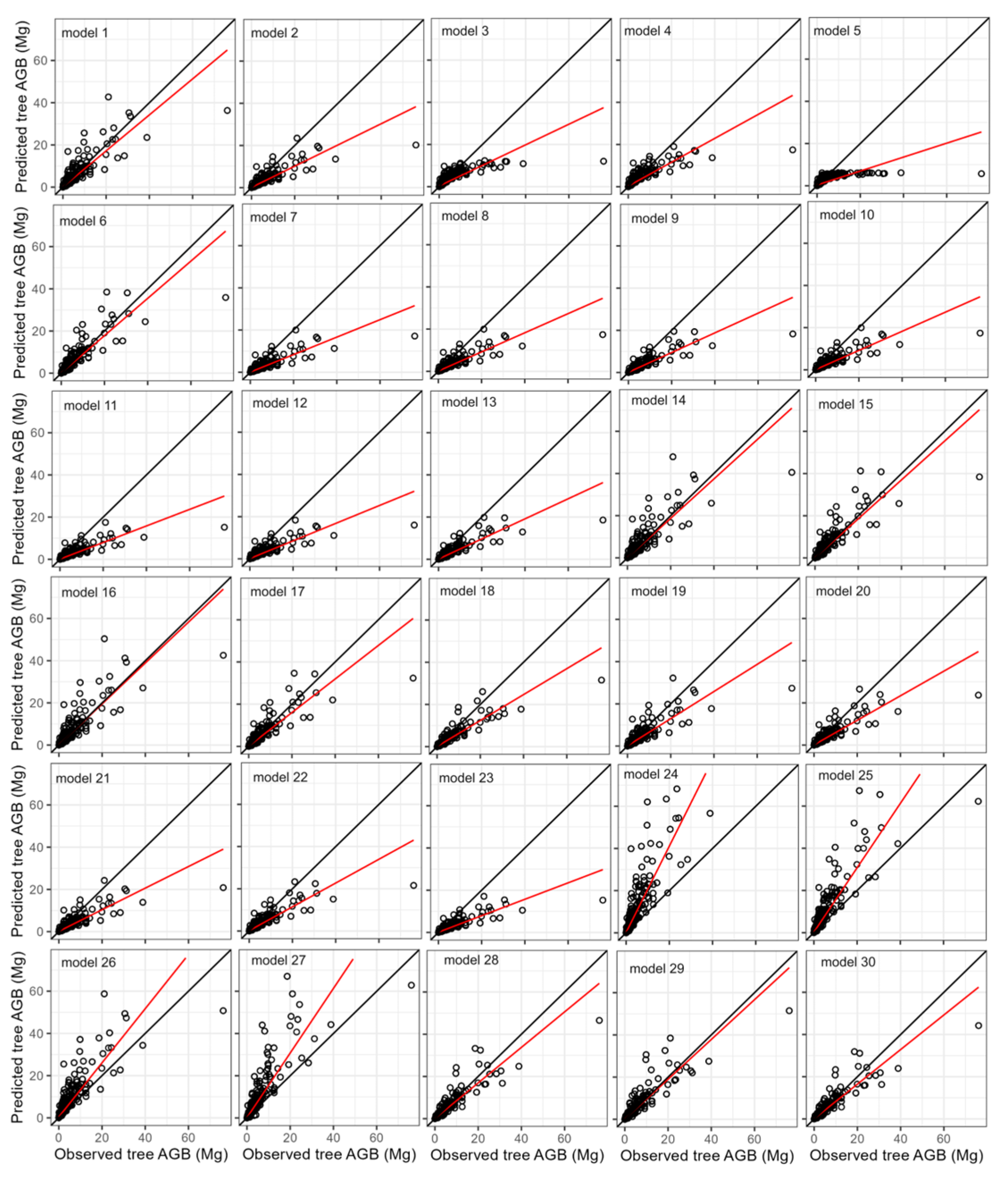
Results of model performance obtained from Equations (5)–(7) were illustrated in graphs, and the results of the means that were calculated as in Equations (8)–(11) were presented in tables. In addition, scatter plots were constructed to compare the observed biomass with the predicted biomass for each model in Table 2. In these plots, a trend line was added to visualize the correlation between the observed and predicted values, accompanied by a line of identity (1:1), which represents the ideal scenario where the predicted values equal the observed values.
In order to examine the correlation between the performance of the allometric equations and their inherent characteristics, a Spearman rank correlation analysis was performed at the model level, stratified by forest type (Advanced Secondary Forest and Mature Forest). The mean prediction error was correlated with various equation attributes, including minimum and maximum DBH, DBH range, coefficient of determination (R2), root mean square error (RMSE), and the number of parameters (Np) employed in the equation calibration process.
As the studies analyzed reported the model’s performance under different scale assumptions, the RMSE was calculated and analyzed separately on the original scale (kg) and on the logarithmic scale (log), in line with the assumptions adopted in the original articles. Furthermore, as the original studies used heterogeneous metrics and performance units, only a subset of four equations explicitly reported the RMSE on the original mass scale (kg). Consequently, correlation analyses involving the RMSE in kilograms were restricted to these four equations to avoid unit inconsistency and to preserve statistical validity. A significance level of p ≤ 0.05 was adopted for all inferential tests.

3. Results

Figure 2 illustrates the relationship between observed and predicted AGB of the trees for each of the 30 calibration models. The scatter plots provide a visual representation of the model performance, allowing for a qualitative assessment of bias and precision. A closer fit of the points to the 1:1 line indicates higher accuracy and lower prediction error.
Model performance, as illustrated in Figure 2, reveals that models 1 [10], 3 [11], 4 [11], 5 [11], 6 [12], 14 [16], 15 [16], 17 [16], 28 [21], 29 [21], and 30 [4] provided the most accurate aboveground biomass (AGB) predictions. Nevertheless, a general tendency toward AGB underestimation was observed, contrasting with the [20] models, which consistently overestimated AGB across all size classes.
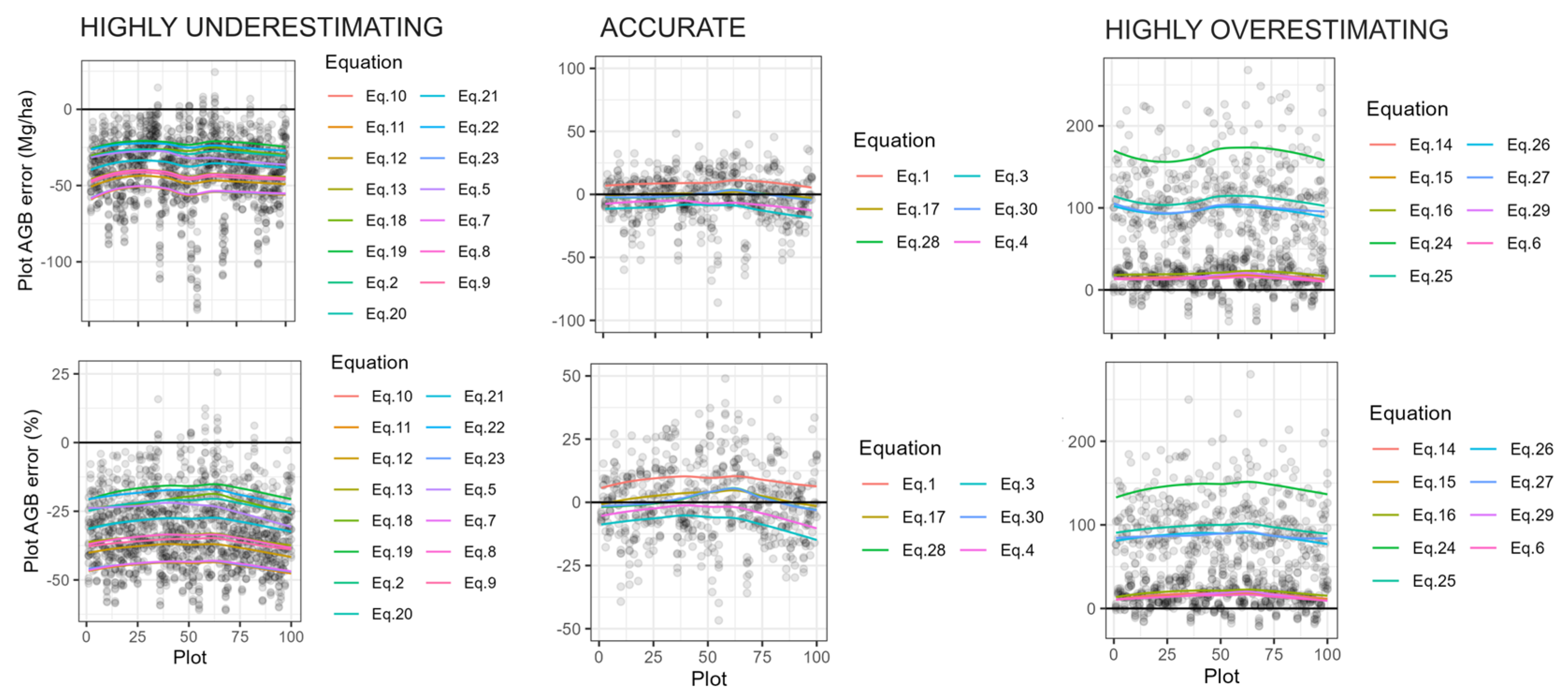
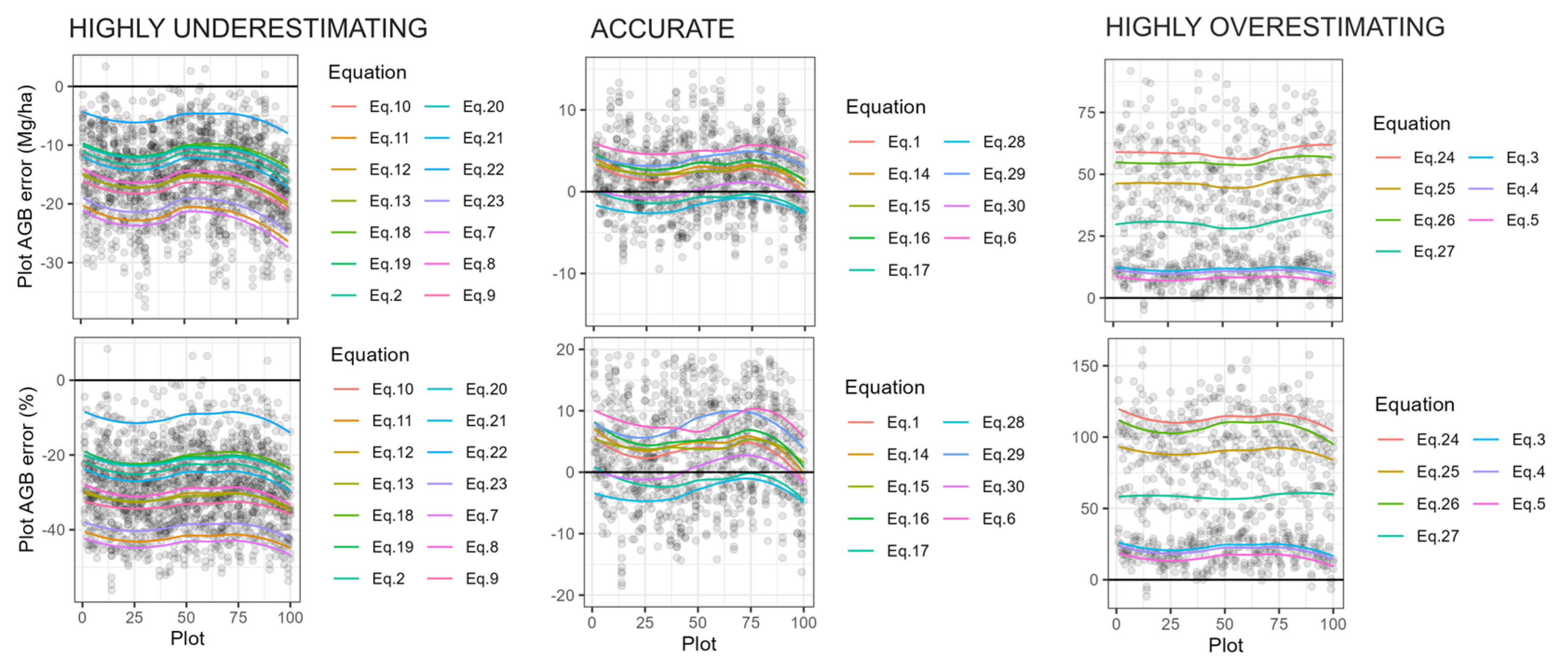
Errors in plot AGB predictions for the forest succession stages ASF and MF are shown, respectively, in Figure 3 and Figure 4. The results strongly support the observations in Figure 2, indicating a prevalent negative bias (underestimation) across most models. The models in [20] (24, 25, 26, and 27) represent a notable exception, displaying significant positive bias (overestimation) values of 324.2%, 264.8%, 280.9%, and 221.6%, respectively. Models 28, 29, and 30 showed good performance with mean errors of −10.9%, 15.5%, and −1.6%, respectively.
Histograms of plot AGB errors in Mg ha−1 (Equation (5)) and in relative terms (Equation (7)) are shown in, respectively, Figures S1 and S2 (Supplementary File). Table 3 gives the results of estimates of statistics described in Equations (8)–(11) for both forest succession stages.
The relationship between model characteristics and the mean AGB estimation error is assessed using Spearman’s rank correlation (r) for both successional stages—ASF and MF—with the results presented in Table 4. Model characteristics include minimum DBH, maximum DBH, DBH range, R2, root mean square error (RMSE), and the number of predictors.
Across both successional stages, minimum DBH showed weak and non-significant correlations, with mean estimation error (ASF: r = 0.19, p = 0.32; MF: r = 0.16, p = 0.40), suggesting that the size of the smallest trees in the stand has little influence on biomass prediction accuracy. Maximum DBH displayed moderate positive correlations in both forest types (r = 0.38 in both stages), with p close to the conventional significance threshold (p ≈ 0.04). This indicates a tendency for stands containing larger trees to exhibit higher estimation errors, although the strength of evidence should be interpreted cautiously.
DBH range presented weak-to-moderate positive correlations in both successional stages (ASF: r = 0.33, p = 0.08; MF: r = 0.37, p = 0.05). Overall, this pattern suggests that structural heterogeneity—expressed as variation in tree diameters—may be associated with estimation error, but the relationship is not consistently supported across stages.
R2 also exhibited moderate correlations with mean estimation error in both forest types (ASF: r = 0.33, p = 0.07; MF: r = 0.34, p = 0.07). Although these associations did not meet the α = 0.05 criterion, they suggest that higher internal explanatory power does not necessarily translate into lower prediction error, highlighting that traditional goodness-of-fit metrics may not reliably reflect predictive performance across contrasting structural conditions.
RMSE (kg) yielded the highest Spearman coefficients among the evaluated variables, with a moderate-to-strong positive relationship in both forest types (ASF: r = 0.60, p = 0.40; MF: r = 0.40, p = 0.60). RMSE (log) was assessed separately to evaluate whether the association pattern was consistent across scales; the correlation was moderate in ASF (r = 0.57, p = 0.18) and weak in MF (r = 0.21, p = 0.64). Taken together, these results are directionally consistent with the expectation that equations with greater uncertainty (higher RMSE) tend to yield larger biomass estimation errors, although the evidence is not statistically conclusive for the correlations reported here.
Finally, the number of predictors showed weak and non-significant correlations with mean estimation error in both successional stages (ASF: r = 0.10, p = 0.60; MF: r = −0.03, p = 0.99), indicating that increasing model complexity without sufficient representative data may add uncertainty rather than improve predictions. Overall, correlation patterns were broadly similar between ASF and the MF, suggesting that successional stage does not substantially alter the association between model characteristics and AGB estimation error in this dataset.

4. Discussion

Our findings suggest that factors such as minimum and maximum DBH, DBH range, coefficient of determination (R2), root mean square error (RMSE), and the number of parameters (Np) do not strongly influence the accuracy of plot AGB predictions, thus suggesting rejection of our hypothesis. Though RMSE did not strongly correlate to the plot AGB error, there is evidence that such a statistic may correlate in a counter-intuitive way, in which models with lower RMSE values do not necessarily produce more reliable or biologically meaningful predictions. This makes sense because models calibrated with data containing large trees tend to produce higher RMSEs than models calibrated without large trees.
However, it is also expected that models calibrated with large trees can better estimate the forest AGB, since larger trees store most of the total forest biomass. Ref. [21] examined the biomass concentration in humid tropical forests of Brazil and noted that the 1% heaviest trees account for 25%–35% of the total biomass, and the 5% heaviest trees store 50%–75% of the total biomass. This author also examined the effect of model calibration datasets, reporting that such models providing low RMSEs were the worst for prediction plot-level AGB. Our study aligns with the findings of [21], suggesting that selecting biomass models based solely on RMSE can lead to misleading conclusions, particularly when the goal is to obtain plot-level AGB predictions.
The high variability in DBH, height, biomass, and wood density values reflects the diversity in tree structure within the simulated dataset. This diversity is essential for testing allometric models across a wide range of tree sizes and conditions. By including individuals with both small and large dimensions, as well as a range of wood densities, the dataset provides a comprehensive basis for assessing model performance under varied scenarios.
Despite the overall tendency of models to underestimate AGB, the performance of models 6 and 15, based on only two predictor variables (DBH and height), was noteworthy, with mean errors of 8.8% and −3.2%, respectively. This suggests that simpler models may capture the characteristics of this specific dataset, potentially due to better alignment with the data’s structure and origin. A closer examination of Figure 2 reveals that these models consistently produced estimates close to the reference values across a wide range of tree sizes, especially at the individual-tree level.
The strong performance of these simpler models suggests that they may be particularly well-aligned with the structure of the simulated data. This alignment could stem from similarities in the size distribution, height–diameter relationships, and wood density ranges present in both the calibration datasets of those models and the trees used in the simulation. Such a finding reinforces the idea that, under certain conditions, simpler allometric equations, when properly parameterized, can yield highly reliable results, especially when their calibration context is compatible with the application dataset.
In contrast, the strong overestimation by the [20] models suggests that their parameters may not be suitable for the simulated data, possibly due to differences in forest type, species composition, or sample structure. Besides the methodological and structural divergences already discussed, it is essential to note that models developed for specific Amazonian regions, such as the Central Amazon, may yield inaccurate estimates when applied to other areas, like Southwestern Amazonia. Forests in this region display distinct characteristics, including shorter stature for a given DBH, lower basic wood density, and higher dynamism. These differences contribute to significant divergences in biomass and carbon estimates when using generic or pantropical allometric models.
Furthermore, the strong performance of models 28–30 [4] can be attributed to their development using a broad dataset, like the one simulated in this study. It is therefore important to consider that the observed accuracy of these models may be partially confounded by the inclusion of the same trees in both the calibration dataset and the simulation, potentially inflating their predictive performance. It is essential to note that Model 30, which achieved the lowest error, utilized three predictor variables, DBH, H, and wood density, as well as a large sample size [4].
These findings align partially with those of [22], who demonstrated that precise volumetric models can be fitted with minimal tree sampling in the Brazilian Amazon. However, it is crucial to acknowledge that the representative sample size for a reliable model depends on location, stand conditions, species rarity, time constraints, and costs.
Biomass prediction variability stems from multiple sources. These include methodological differences, site-specific conditions, tree structural traits, and the choice of predictor variables in allometric equations. Previous studies have incorporated trees across diverse DBH ranges, including very small trees (DBH ≥ 5 cm), and utilized allometric equations with various combinations of predictor variables (DBH only: [10,11,13]; DBH and H: [16,18,20,21]; DBH, H, and ρ: [4]).
It is important to exercise caution when directly comparing allometric equations, as differences in sampling criteria, measurement protocols, and selected predictor variables can introduce substantial variability (e.g., stem biomass determined by direct weighing vs. volume-to-mass conversion, or variation in wood density determination methods). The underrepresentation of large trees in most datasets contributes to biased estimates in upper DBH classes. Hence, adequate sampling across the full diameter range, especially including large individuals, is essential to reduce estimation errors and allow for the development of more robust diameter-class-specific models.
The divergence in allometric equation parameters, as highlighted by [23], is a primary source of uncertainty in biomass predictions, as using uncalibrated equations ignores local variations in the biomass–diameter relationship, amplifying estimation errors. Furthermore, accurate biomass estimation in tropical forests necessitates predictors that capture species-specific architectural variations; generic global or pantropical models can introduce substantial biases [24].
Interestingly, increasing the number of predictor variables did not guarantee better performance, aligning with the findings of [23], who emphasized the risks of using uncalibrated models. Using overly complex models without local calibration can amplify uncertainty rather than reduce it. This is particularly relevant for tropical forests, where species diversity and architectural variability are high, requiring models that account for local specificities [24].
The correlation analysis highlighted that root mean square error (RMSE) is the most influential factor in reducing biomass prediction errors, emphasizing the importance of model precision over mere complexity. While R2 is often considered a key indicator of model performance, its moderate correlation with error demonstrates that it alone is not a reliable indicator of prediction accuracy.
Additionally, the analysis revealed the following relevant and somewhat counterintuitive result: the model with the lowest RMSE, indicating better fit at the individual-tree level, produced the highest errors when biomass was expressed in megagrams per hectare. This inverse pattern is consistent with the fact that models with low RMSE are often calibrated using smaller trees, which reduces residual dispersion in kilograms.
However, such models tend to underrepresent large trees, which account for the majority of biomass per hectare. A recent study by [25] demonstrated that the top 5% of heaviest trees can store more than 60%–70% of total aboveground biomass, reinforcing the importance of including these individuals in allometric model calibration. As a result, low RMSE values at the tree level do not necessarily guarantee accurate biomass estimates at the plot scale, particularly in MFs dominated by large trees.
Furthermore, this study reinforces the importance of appropriate sample size and forest representativeness in model calibration, as previously discussed by [22]. Models developed from limited sample sizes may still yield accurate biomass estimations, provided they adequately represent the structural heterogeneity of the forest stand. This underscores that, beyond conventional statistical metrics, the ecological representativeness and comprehensiveness of the calibration dataset are essential prerequisites for the development of robust allometric models, particularly in structurally complex, uneven-aged, or MF ecosystems.

5. Conclusions

The list of biomass models from Table 1 that produced biomass per unit area in acceptable (i.e., mean relative error below 10%) accuracy is as follows: Model (M) 1 [10], M3 [11], M4 [11], M5 [11], M6 [12], M14 [16], M15 [16], M17 [16], M28 [21], M29 [21], and M30 [4].
Although we did not clearly detect which characteristics of the model calibration dataset impact the accuracy of the plot-level AGB predictions, we concluded that biometricians should not use RMSE of the models as a criterion to select models for forest biomass estimation purposes. Importantly, these conclusions are conditional on the domain represented by our simulated plots and the Amazonian subset analyzed.

Supplementary Materials

The following supporting information can be downloaded at: https://www.mdpi.com/article/10.3390/f17020213/s1.

Author Contributions

Conceptualization, H.C.D.; methodology, R.A.G., X.S.C. and L.M.R.G.; software, R.A.G. and L.M.R.G., validation, R.A.G., L.M.R.G., T.C.A. and C.R.S.; formal analysis, R.A.G.; investigation, R.A.G. and F.R.P.; resources, R.A.G., T.C.A., F.R.P., C.R.S. and R.P.M.-N.; data curation, X.S.C. and L.M.R.G.; writing—original draft preparation, R.A.G. and X.S.C.; writing—review and editing, R.A.G., X.S.C., H.C.D. and R.P.M.-N.; visualization, L.M.R.G.; supervision, H.C.D.; project administration, H.C.D. and R.P.M.-N.; funding acquisition, R.P.M.-N. All authors have read and agreed to the published version of the manuscript.

Funding

This research received no external funding.

Data Availability Statement

Data available upon request due to restrictions.

Acknowledgments

The authors acknowledge the support of the Conselho Nacional de Tecnologia e Desenvolvimento Científico (CNPq) and the Coordenação de Aperfeiçoamento de Pessoal de Nível Superior (CAPES). The author Rorai Pereira Martins-Neto was partially funded by the grant FORESTin3D.

Conflicts of Interest

The authors declare no conflicts of interest.

References

  1. Malhi, Y.; Wood, D.; Baker, T.R.; Wright, J.; Phillips, O.L.; Cochrane, T.; Meir, P.; Chave, J.; Almeida, S.; Arroyo, L.; et al. The regional variation of aboveground live biomass in old-growth Amazonian forests. Glob. Change Biol. 2006, 12, 1107–1138. [Google Scholar] [CrossRef]
  2. Bastin, J.F.; Rutishauser, E.; Kellner, J.R.; Saatchi, S.; Pélissier, R.; Hérault, B.; Réjou-Méchain, M. Pan-tropical prediction of forest structure from the largest trees. Glob. Ecol. Biogeogr. 2018, 27, 1366–1383. [Google Scholar] [CrossRef]
  3. Slik, J.W.F.; Aiba, S.I.; Brearley, F.Q.; Cannon, C.H.; Forshed, O.; Kitayama, K.; Nagamasu, H.; Nilo, R.; Payne, J.; Paoli, G.; et al. Environmental correlates of tree biomass, basal area, wood specific gravity, and stem density gradients in Borneo tropical forests. Glob. Ecol. Biogeogr. 2010, 19, 50–60. [Google Scholar] [CrossRef]
  4. Chave, J.; Réjou-Méchain, M.; Búrquez, A.; Chidumayo, E.; Colgan, M.S.; Delitti, W.B.C.; Vieilledent, G.; Eid, T.; Fearnside, P.M.; Goodman, R.C.; et al. Improved allometric models to estimate the aboveground biomass of tropical trees. Glob. Change Biol. 2014, 20, 3177–3190. [Google Scholar] [CrossRef]
  5. Avitabile, V.; Herold, M.; Heuvelink, G.B.M.; Lewis, S.L.; Phillips, O.L.; Asner, G.P.; Willcock, S. An integrated pan-tropical biomass map using multiple reference datasets. Glob. Change Biol. 2016, 22, 1406–1420. [Google Scholar] [CrossRef] [PubMed]
  6. Moran, E.F.; Brondizio, E.S.; Tucker, J.; Silva-Forsberg, M.D.; Falesi, I.; McCracken, S. Strategies for Amazonian Forest Restoration: Evidence for Afforestation in Five Regions of the Brazilian Amazon. In Amazônia at the Crossroads: The Challenge of Sustainable Development; Institute for Latin American Studies/University of London: London, UK, 2000; pp. 129–149. [Google Scholar]
  7. David, H.C.; Barbosa, R.I.; Vibrans, A.C.; Watzlawick, L.F.; Trautenmuller, J.W.; Balbinot, R.; Ribeiro, S.C.; Jacovine, L.A.G.; Corte, A.P.D.; Sanquetta, C.R.; et al. The tropical biomass & carbon project—An application for forest biomass and carbon estimates. Ecol. Model. 2022, 472, 110067. [Google Scholar] [CrossRef]
  8. David, H.C.; Carvalho, J.O.P.; Pires, I.P.; Santos, L.S.; Barbosa, E.S.; Braga, N.S. A 20-year tree liberation experiment in the Amazon: Highlights for diameter growth rates and species-specific management. For. Ecol. Manag. 2019, 453, 117584. [Google Scholar] [CrossRef]
  9. R Core Team. R: A Language and Environment for Statistical Computing; R Foundation for Statistical Computing: Vienna, Austria, 2024. [Google Scholar]
  10. Nogueira, E.M.; Fearnside, P.M.; Nelson, B.W.; Barbosa, R.I.; Keiser, E.W.H. Estimates of forest biomass in the Brazilian Amazon: New allometric equations and adjustments to biomass from wood-volume inventories. For. Ecol. Manag. 2008, 256, 1853–1867. [Google Scholar] [CrossRef]
  11. Chambers, J.Q.; Dos Santos, J.; Ribeiro, R.J.; Higuchi, N. Tree damage, allometric relationships, and above-ground net primary production in central Amazon forest. For. Ecol. Manag. 2001, 152, 73–84. [Google Scholar] [CrossRef]
  12. Brown, I.F.; Martinelli, L.A.; Thomas, W.W.; Moreira, M.Z.; Ferreira, C.A.C.; Victoria, R.A. Uncertainty in the biomass of Amazonian forests: An example from Rondônia, Brazil. For. Ecol. Manag. 1995, 75, 175–189. [Google Scholar] [CrossRef]
  13. Brown, S. Estimating Biomass and Biomass Change of Tropical Forests: A Primer. In FAO Forestry Paper; Food and Agriculture Organization: Rome, Italy, 1997; Volume 134. Available online: www.fao.org/docrep/w4095e/w4095e00.HTM (accessed on 7 November 2025).
  14. Brown, S.; Iverson, L.R. Biomass estimates for tropical forests. World Resour. Rev. 1992, 4, 366–384. [Google Scholar]
  15. Brown, S.; Gillespie, A.; Lugo, A.E. Biomass Estimation Methods for Tropical Forests with Applications to Forest Inventory Data. For. Sci. 1989, 35, 881–902. [Google Scholar] [CrossRef]
  16. Overman, J.P.M.; Witte, H.J.L.; Saldarriaga, J.G. Evaluation of regression models for above-ground biomass determination in Amazon rainforest. J. Trop. Ecol. 1994, 10, 207–218. [Google Scholar] [CrossRef]
  17. Nelson, B.W.; Mesquita, R.; Pereira, J.L.G.; Souza, S.G.A.; Batista, G.T.; Couto, L.B. Allometric regressions for improved estimate of secondary forest biomass in the central Amazon. For. Ecol. Manag. 1999, 117, 149–167. [Google Scholar] [CrossRef]
  18. Ducey, M.J.; Zarin, D.J.; Vasconcelos, S.S.; Araújo, M.M. Biomass equations for forest regrowth in the eastern Amazon using randomized branch sampling. Acta Amaz. 2009, 39, 349–360. [Google Scholar] [CrossRef][Green Version]
  19. Uhl, C.; Buschbacher, R.; Serrao, E.A.S. Abandoned Pastures in Eastern Amazonia. I. Patterns of Plant Succession. J. Ecol. 1988, 76, 663. [Google Scholar] [CrossRef]
  20. Higuchi, N.; Santos, J.; Ribeiro, R.J.; Minette, L.; Biot, Y. Biomassa da parte aérea da vegetação da Floresta Tropical úmida de terra firme da Amazônia Brasileira. Acta Amaz. 1998, 28, 153. [Google Scholar] [CrossRef]
  21. Chave, J.; Andalo, C.; Brown, S.; Cairns, M.A.; Chambers, J.Q.; Eamus, D.; Folster, H.; Fromard, F.; Higuchi, N.; Kira, T.; et al. Tree allometry and improved estimation of carbon stocks and balance in tropical forests. Oecologia 2005, 145, 87–99. [Google Scholar] [CrossRef]
  22. Leão, F.M.; Nascimento, R.G.M.; Emmert, F.; Santos, G.G.A.; Caldeira, N.A.M.; Miranda, I.S. How many trees are necessary to fit an accurate volume model for the Amazon forest? A site-dependent analysis. For. Ecol. Manag. 2021, 480, 118652. [Google Scholar] [CrossRef]
  23. Ketterings, Q.M.; Coe, R.; Noordwijk, M.V.; Ambagau’, Y.; Palm, C.A. Reducing uncertainty in the use of allometric biomass equations for predicting above-ground tree biomass in mixed secondary forests. For. Ecol. Manag. 2001, 146, 199–209. [Google Scholar] [CrossRef]
  24. Marra, D.M.; Higuchi, N.; Trumbore, S.E.; Ribeiro, G.H.P.M.; Santos, J.; Carneiro, V.M.C.; Lima, A.J.N.; Chambers, J.Q.; Negrón-Juárez, R.I.; Holzwarth, F. Predicting biomass of hyperdiverse and structurally complex central Amazonian forests—A virtual approach using extensive field data. Biogeosciences 2016, 13, 1553–1570. [Google Scholar] [CrossRef]
  25. David, H.C. Are tropical forests an extremistan environment? CERNE 2024, 30, 10338. [Google Scholar] [CrossRef]
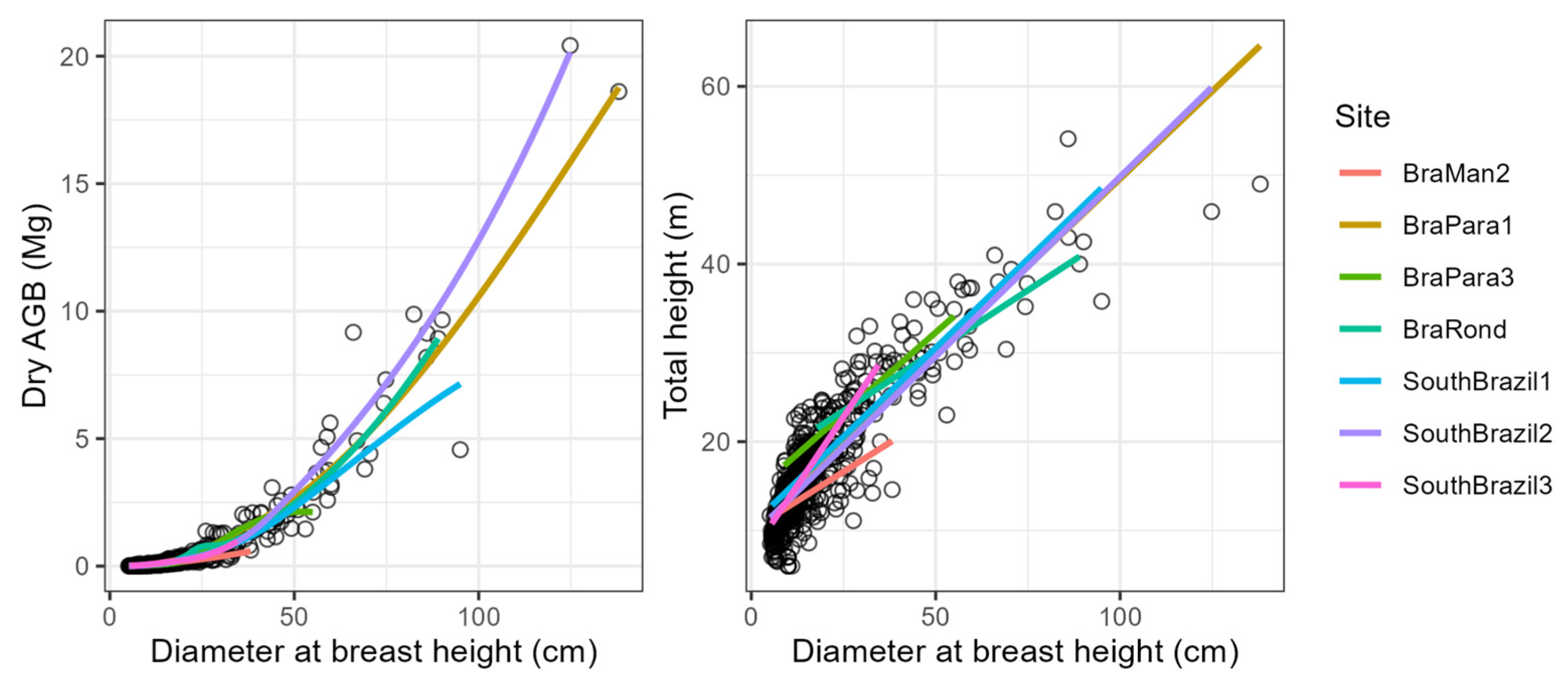
Figure 1. Allometric relationship of trees (n = 543) sampled in seven sites of the Amazon forest in Brazil.
Forests 17 00213 g001
Figure 2. Performance of 30 allometric models in predicting above-ground biomass (AGB). Where: Mg = megagrams; circles = individual tree data; black line = ideal 1:1 ratio (perfect prediction); red line = fit of each model.
Forests 17 00213 g002
Figure 3. Plot aboveground biomass (AGB) error for the models applied in Advanced Secondary Forests.
Forests 17 00213 g003
Figure 4. Plot aboveground biomass (AGB) error for the models applied in Mature Forests.
Forests 17 00213 g004
Table 1. Descriptive statistics of tree (n) variables of the Amazon subset.
VariablesMinimumMeanMaximumCV (%)
DBH (cm)5.019.0138.084.6
H (m)6.017.454.142.5
Biomass (kg)5.1558.020,416.0306
Density (g/cm3)0.220.611.0822.8
Table 3. Performance of tree-level models while predicting AGB at the plot level for the two succession stages of growth.
Model ε ¯ m ε ¯ a m ε ¯ r m R M S E m ε ¯ m ε ¯ a m ε ¯ r m R M S E m
Advanced secondary forestMature forest
M12.13.74.2%4.68.815.89.7%20.2
M2−12.612.6−23.8%13.4−35.936−29.0%40.8
M311.711.722.8%12.8−12.417.4−8.1%24.2
M410.510.620.6%11.6−7.514.8−3.9%20.7
M57.88.115.5%9.1−31.431.5−24.5%38.8
M65.15.410.0%6.413.417.713.6%20.8
M7−23.023.0−43.9%23.9−53.553.5−44.4%57.5
M8−15.715.7−29.9%16.5−42.842.8−35.0%47.4
M9−17.617.6−33.5%18.4−44.344.3−36.3%48.3
M10−15.715.7−29.8%16.5−42.842.8−35.0%47.3
M11−22.222.2−42.2%23−54.254.2−44.9%58.2
M12−16.516.5−31.4%17.4−46.846.8−38.4%51.1
M13−16.516.5−31.5%17.3−42.442.4−34.8%46.6
M142.74.05.3%5.016.320.316.1%24.9
M152.53.65.0%4.514.418.314.3%21.5
M16−30.930.9−58.9%31.9−72.772.7−61.0%76.3
M17−0.92.9−1.5%3.60.112.12.1%16.0
M18−7.17.2−13.3%8.2−14.918.0−10.9%23.5
M19−11.311.3−21.4%12.1−22.223.4−17.2%28.9
M20−11.511.5−21.8%12.3−28.228.5−22.4%33.6
M21−13.613.6−25.7%14.4−3.0636.1−29.1%40.9
M22−5.55.7−10.1%6.6−24.424.7−19.0%30.3
M23−20.720.7−39.4%21.5−53.753.7−44.5%57.6
M2459.059.0113.1%61.2165.1165.1145.2%170.2
M2546.846.889.9%48.5108.8108.896.3%111.6
M2655.255.2106.5%57.196.696.686.3%99.6
M2730.830.858.9%32.398.698.686.7%102.0
M28−1.82.7−3.1%3.4−0.910.80.7%14.1
M294.04.47.9%5.215.318.014.8%22.3
M300.12.40.6%3.0−0.910.70.8%14.1
In each block of the table, ε ¯ m , ε ¯ a m and ε ¯ r m are given in relative terms, whereas R M S E m is given in Mg ha−1.
Table 4. Spearman’s rank correlation coefficient (r) between the characteristics of the equations and the mean error in the estimation of aboveground biomass (AGB).
Model CharacteristicsAdvanced Secondary ForestMature ForestN
Correlation (r)p-ValueCorrelation (r)p-Value
DBH Min0.190.320.160.4030
DBH Max0.380.040.420.0230
Range of DBH0.330.080.370.0530
R20.330.070.340.0730
RMSE (unit: kg)0.60 (a)0.40 (a)0.40 (a)0.60 (a)4
RMSE (unit: log)0.57 (b)0.18 (b)0.21 (b)0.64 (b)26
Number of predictors0.100.60–0.030.9930
(a): values obtained with N equal to 4; (b): values obtained with N equal to 26.
Disclaimer/Publisher’s Note: The statements, opinions and data contained in all publications are solely those of the individual author(s) and contributor(s) and not of MDPI and/or the editor(s). MDPI and/or the editor(s) disclaim responsibility for any injury to people or property resulting from any ideas, methods, instructions or products referred to in the content.