


Abstract
Moso bamboo forests provide substantial ecological, economic, and social benefits, and nitrogen (N) fertilization is widely used to enhance their productivity. However, the mechanisms by which N fertilization regulates soil microbial nutrient limitation during the shoot-bud differentiation stage, a critical phase in the growth cycle of Moso bamboo, remain poorly understood, particularly in long-term unfertilized stands. We conducted an N-addition experiment in a long-term unfertilized Moso bamboo forest in southeastern Anhui Province, China, to investigate the effects of four N application rates on soil extracellular enzyme activities and microbial nutrient limitation at depths of 0–15 cm and 15–30 cm. The results showed that short-term N addition significantly altered soil nutrient availability, microbial biomass carbon (MBC), and extracellular enzyme activities, with pronounced depth-dependent responses. In the surface soil, N-III (726 kg N·hm−2) significantly decreased β-1,4-glucosidase (BG) activity, the C:N and C:P ratios of extracellular enzyme activities (C:Neea and C:Peea), and vector length (VL) (p < 0.05). N-II (484 kg N·hm−2) significantly decreased the combined activity of leucine aminopeptidase and β-1,4-N-acetylglucosaminidase (LAP + NAG) and acid phosphatase (ACP) (p < 0.05). N-III also significantly decreased ACP activity (p < 0.05), whereas N-I (242 kg N·hm−2) had no significant effect (p > 0.05). In the subsoil, N-II and N-III significantly decreased BG activity and VL (p < 0.05); N-I and N-III significantly decreased LAP + NAG activity (p < 0.05), while ACP activity was not significantly affected (p > 0.05). N-II and N-III significantly decreased C:Neea and C:Peea (p < 0.05), whereas N-I significantly increased C:Neea (p < 0.05). N:Peea did not differ significantly among treatments (p > 0.05). Vector angle (VA) exceeded 45° across treatments and soil depths, but was significantly higher under N-III than under the unfertilized control (CK) only in the subsoil (p < 0.05). These vector results indicate reduced relative microbial investment in C-acquiring enzymes under selected N treatments; under subsoil N-III, enzyme allocation shifted toward P acquisition relative to N acquisition. However, these metrics provide only indirect evidence of microbial nutrient limitation. Mantel tests showed that available phosphorus (AP) was significantly associated with VL in both soil layers (p < 0.05). In the exploratory random forest analysis, AP ranked first in permutation importance for the VL models. Dissolved organic carbon (DOC) and MBC were significantly associated with VL in the surface soil and subsoil, respectively (p < 0.05). Overall, a single N application altered enzyme-based microbial resource-acquisition patterns over the short term. Specifically, VL decreased under selected N treatments, indicating reduced relative investment in C-acquiring enzymes, whereas VA increased significantly only under N-III in the subsoil, indicating a shift in relative enzyme allocation toward P acquisition over N acquisition. Because these findings were based on a single sampling during autumn shoot-bud development, they should not be extrapolated directly to repeated annual fertilization. Nevertheless, they suggest that soil P availability and C–P acquisition balance should be considered when evaluating N inputs in Moso bamboo forest management.
1. Introduction
Soil nutrient availability underpins forest productivity and the sustainable management of plantations. Nitrogen (N) is one of the most essential macronutrients required for tree growth [1], and N fertilization represents a key silvicultural measure in intensive management to meet stand N demand [2]. However, exogenous N inputs, while supplementing N pools, may simultaneously disrupt the relative supply and stoichiometric balance of soil carbon (C), nitrogen (N), and phosphorus (P) [3]. Soil microorganisms, as the primary drivers of nutrient transformation and organic matter decomposition [4,5], play a critical role in forest element cycling and productivity through extracellular enzyme-mediated mineralization processes and associated nutrient limitation states [6]. Nevertheless, microbial growth and metabolism are often constrained by the imbalanced supply of major soil nutrients, particularly C, N, and P. To cope with such constraints, microorganisms adjust the synthesis and allocation of extracellular enzymes to optimize the acquisition of limiting nutrients [7,8]. The secretion of extracellular enzymes is an essential component of microbial metabolism, and enzyme activities collectively reflect microbial metabolic capacity, nutrient demand, resource allocation strategies, and soil nutrient status [9,10,11]. Soil β-1,4-glucosidase (BG), leucine aminopeptidase (LAP), β-1-N-acetylglucosaminidase (NAG), and acid phosphatase (ACP) are key extracellular enzymes involved in microbial acquisition of C, N, and P, respectively [12]. Their activities and stoichiometric ratios have been widely used as indicators of microbial nutrient limitation [10,13]. Therefore, when evaluating the effects of N fertilization, attention should extend beyond plant growth performance and yield to encompass its impacts on soil microbial resource allocation and nutrient limitation.
Enzyme stoichiometry serves as an effective approach for quantifying soil microbial resource demand and nutrient limitation. By analyzing the activity ratios of key extracellular enzymes involved in soil C, N, and P cycling, this approach accurately reflects the relative microbial demand for and limitation status of C, N, and P nutrients [7,14]. The global-scale stoichiometric ratio of soil microbial C:N:P-acquiring enzyme activities approximates 1:1:1, and deviations from this balanced state indicate nutrient limitation for the corresponding elements [10]. Nitrogen addition can modulate soil extracellular enzyme secretion strategies by altering soil physicochemical properties (e.g., pH and nutrient availability) and microbial community structure, thereby influencing enzyme stoichiometric characteristics [15,16]. For instance, N and P additions altered soil enzyme activities and microbial community properties in Chinese fir (Cunninghamia lanceolata (Lamb.) Hook.) plantations [16]. In a larch (Larix principis-rupprechtii Mayr) plantation, N addition was associated with non-monotonic changes in soil enzyme C:N and C:P ratios and an overall increase in vector length (VL), which the author interpreted as stronger C limitation. They also inferred concurrent C and N limitation and suggested that high N addition could increase the risk of P limitation [17]. In dryland agroecosystems of the Loess Plateau, the interactive effects of N addition and plastic film mulching further modulated enzyme stoichiometric balance and microbial nutrient limitation through regulating soil pH and nutrient content [18]. Furthermore, the vector analysis approach, which constructs enzyme VL and vector angle (VA) based on enzyme stoichiometry, was used to quantitatively parse the intensity of carbon limitation and the type of N/P limitation in microbial communities [19]. This approach has now become a critical methodology for elucidating mechanisms of soil nutrient limitation.
Moso bamboo (Phyllostachys edulis (Carrière) J.Houz.) is an ecologically and economically important bamboo species in subtropical China, characterized by rapid growth, a short stand establishment period, high C sequestration capacity, and substantial biomass production [20,21]. Its C stocks are concentrated not only in aboveground biomass but also in soil C pools [22,23]. Currently, Moso bamboo forests cover approximately 5.28 million ha in China, accounting for about 70% of the country’s total bamboo forest area [24]. Sustaining the productivity of Moso bamboo forests requires a continuous supply of soil nutrients. Soil microorganisms mediate organic matter decomposition and nutrient transformation through extracellular enzymes, thereby influencing soil nutrient availability [9]. Moso bamboo growth is closely linked to soil N cycling and microbial communities [25], highlighting the critical role of soil microorganisms in connecting soil nutrient cycling with bamboo growth. Autumn shoot-bud development is a critical stage for bud growth and resource accumulation before shoot emergence in the following spring. During this stage, belowground resource demand and C allocation patterns may influence microbial substrate availability and nutrient acquisition. N addition may further alter the relative availability of soil C, N, and P. Moreover, long-term intensive management and the harvesting of bamboo shoots and culms result in substantial nutrient removal, making the rational regulation of N supply an essential component of nutrient management. Moso bamboo forests are predominantly distributed across the acidic soils of southern China, where insufficient P availability is widespread [26]. Under these conditions, different levels of N input may alter the relative availability and stoichiometric balance of soil C, N, and P. Previous research in Moso bamboo forests showed that five years of N addition intensified enzyme-based indications of microbial C and P limitation [27], suggesting that N input can alter the relative microbial demand for different resources. Therefore, examining extracellular enzyme activities and their stoichiometric characteristics during autumn shoot-bud development can improve our understanding of how microbial resource-acquisition strategies respond to short-term N inputs and provide insights relevant to nutrient management in Moso bamboo forests.
Long-term unfertilized Moso bamboo forests provide a relatively stable soil nutrient background, offering a suitable system for assessing how N addition alters microbial resource-acquisition patterns. Although N fertilization is widely used in Moso bamboo forest management [2], its effects on soil microbial resource acquisition remain insufficiently understood. Chu et al. [28] previously reported that soil microbial resource acquisition in a Moso bamboo forest in northern Guizhou was primarily constrained by C and N following fertilization. However, their N treatments were applied with basal P and potassium (K) fertilizers, and only the 0–10 cm surface soil was examined. Consequently, it remains unclear how different soil layers respond to N addition in the absence of concurrent P and K inputs. Moreover, whether these responses are consistent across regions with contrasting soil nutrient conditions remains unresolved. To address these knowledge gaps, we conducted a field N-addition experiment in a long-term unfertilized Moso bamboo forest in southeastern Anhui Province, China. Four N treatments were established: the unfertilized control (CK) and three N-addition (N-I, N-II, and N-III, respectively). Soil samples were collected from the 0–15 and 15–30 cm layers to determine soil nutrient properties, C-, N-, and P-acquiring enzyme activities, and their stoichiometric characteristics. Enzymatic vector analysis, Mantel tests, and random forest models were used to characterize microbial resource-acquisition patterns and identify the soil properties associated with their variation. We hypothesized that short-term N addition would alter extracellular enzyme activities and the relative allocation of enzymes involved in C, N, and P acquisition, with responses varying between soil depths. Accordingly, this study aimed to (1) determine how different N-addition rates affect soil extracellular enzyme activities, enzymatic stoichiometry, and microbial resource-acquisition patterns and (2) examine their relationships with soil properties.
2. Materials and Methods
2.1. Overview of the Study Area
The study was conducted at the Wulongshan State-owned Forest Farm in Guangde, Anhui Province, China (119°13′–119°18′ E, 30°52′–30°57′ N). The region has a northern subtropical humid climate, with a mean annual temperature of 15.6 °C, mean annual precipitation of 1299 mm, a frost-free period of 220 days, and mean annual sunshine duration of 2162 h [29]. The study area is characterized by low mountains and hills. The soils are predominantly mountain yellow-red soils developed from parent materials such as granite, slate, and shale, with a soil thickness of approximately 1.0–1.2 m. The experimental stand was a typical Moso bamboo forest that had received no fertilizer for approximately 10 consecutive years prior to the experiment, although routine management practices, including periodic selective harvesting, were maintained. Bamboo culms were harvested at approximately 2-year intervals. The stand had a mean diameter at breast height (DBH) of 9.35 cm, a mean culm height of 13.06 m, and a density of 3215 culms ha−1. The soil in this area has a total carbon content of 12.9 g·kg−1, a total nitrogen content of 1.06 g·kg−1, a total phosphorus content of 0.45 g·kg−1, and a pH of 5.07. The understory vegetation was mainly composed of Pteridium sp., Lindera glauca (Siebold & Zucc.) Blume, Rubus corchorifolius L. f., Rosa multiflora Thunb., and Smilax china L.
2.2. Experimental Design
In February 2025, a Moso bamboo stand that had received no fertilizer for approximately 10 consecutive years was selected for the field experiment. Experimental plots were established in areas with comparable stand structure and site conditions. Based on previous work by our research group, the N-addition gradient was adapted from the Moso bamboo fertilization experiment of Chu et al. [28], in which 242 kg·N·hm−2·yr−1 was used as a reference annual application rate. In the present experiment, the corresponding amounts were applied as single doses rather than as part of a repeated annual fertilization regime. In this study, four N-addition treatments were established: CK (0 kg N·hm−2), N-I (242 kg N·hm−2), N-II (484 kg N·hm−2), and N-III (726 kg N·hm−2), where CK served as the control. Each treatment was replicated three times. The experiment followed a randomized block design comprising 12 plots. Each plot measured 15 m × 15 m and was surrounded by a 5-m-wide buffer zone. However, because rhizomes were not severed and no belowground barriers were installed, rhizome connections and resource transfer among adjacent treatment plots could not be excluded. A single N application was made in late February 2025, with urea (46% N) used as the N source. To ensure uniform application, the amount of urea required for each treatment was dissolved in 50 L of purified water and evenly sprayed over the corresponding plot. The control plots received an equal volume of purified water to account for potential effects of water addition. No additional N was applied before soil sampling in October 2025.
2.3. Soil Sampling and Processing
Soil samples were collected in October 2025, during the shoot-bud development and belowground rhizome and root growth stage of Moso bamboo. Because bamboo rhizomes and fine roots are concentrated primarily within the upper 30 cm of soil, samples were collected from the 0–15 and 15–30 cm layers. Within each plot, 10 sampling points were selected following an S-shaped sampling pattern. After removing surface litter, soil cores were collected separately from each layer using a soil auger with an inner diameter of 38 mm.
Samples were immediately placed in a portable insulated container and promptly transported to the laboratory. The 10 cores from the same soil layer within each plot were thoroughly mixed to form one composite sample, yielding 24 composite soil samples in total (12 plots × 2 soil depths). Stones, plant residues, fine roots, and other visible debris were carefully removed before the soil was passed through a 2-mm sieve and divided into subsamples. Subsamples used for determining enzyme activities, microbial biomass carbon (MBC), and dissolved organic carbon (DOC) were stored at −20 °C for no longer than two months. Before analysis, the frozen soil samples were completely thawed at 4 °C, thoroughly mixed, and then used for enzyme assays or extraction for MBC and DOC determination. The remaining subsamples were air-dried, ground, and sieved for determination of soil pH, total carbon (TC), total nitrogen (TN), total phosphorus (TP), alkali-hydrolyzable nitrogen (AN), and available phosphorus (AP). Soil C/N, C/P, and N/P ratios were calculated from the measured TC, TN, and TP concentrations, respectively. All measurements were completed within two months of sampling.
2.4. Soil Property Analysis
Soil pH was measured using a glass-electrode pH meter at a soil-to-water ratio of 1:2.5. TC was determined using a TOC analyzer (Multi N/C 3100, Analytik Jena, Jena, Germany). TN was measured by sulfuric acid digestion followed by the Kjeldahl method, whereas TP was determined using the molybdenum–antimony colorimetric method. AN was measured using the alkaline hydrolysis diffusion method, and AP was extracted with 0.5 mol·L−1 NaHCO3 and subsequently quantified using the molybdenum–antimony colorimetric method. DOC was extracted using a modified deionized-water extraction procedure based on Jones and Willett [30]. Fresh soil samples passed through a 2-mm sieve were mixed with deionized water at a soil-to-water ratio of 1:5 (g:mL), shaken at 25 °C and 250 rpm for 1 h, and then centrifuged at 15,000 rpm for 10 min. The supernatant was filtered through a 0.45-μm membrane filter. Organic C in the filtrate was quantified by potassium dichromate oxidation followed by ferrous sulfate titration, using an oxidation correction factor of 1.1. MBC was determined using the chloroform fumigation–K2SO4 extraction method described by Vance et al. [31]. Soil samples were fumigated with chloroform in the dark at 25 °C for 24 h. After residual chloroform was removed, the fumigated and corresponding non-fumigated samples were extracted with 0.5 mol·L−1 K2SO4 at a soil-to-extractant ratio of 1:2 (g:mL) by shaking at 25 °C and 300 rpm for 30 min. Organic C in the fumigated and non-fumigated K2SO4 extracts was determined using the same potassium dichromate oxidation–ferrous sulfate titration method. MBC was calculated as MBC = EC/kEC, where EC represents the difference in extractable organic C between the fumigated and non-fumigated samples, and a kEC value of 0.45 was used. DOC and MBC contents were calculated on a dry-soil basis and expressed as mg·kg−1 dry soil. Unless otherwise specified, the above soil physicochemical properties were determined following the procedures described in Soil and Agricultural Chemistry Analysis [32].
2.5. Determination of Soil Enzyme Activity and Calculation of Enzyme Stoichiometry
Following the methods of German et al. [33] and Bell et al. [34], with minor modifications, the activities of soil β-1,4-glucosidase (BG), β-1,4-N-acetylglucosaminidase (NAG), leucine aminopeptidase (LAP), and acid phosphatase (ACP) were measured using a 96-well microplate fluorometric assay. The substrates used for BG, NAG, LAP, and ACP were 4-methylumbelliferyl β-D-glucopyranoside, 4-methylumbelliferyl N-acetyl-β-D-glucosaminide, L-leucine-7-amido-4-methylcoumarin hydrochloride, and 4-methylumbelliferyl phosphate, respectively. Fresh soil (1.00 g) was suspended in 50 mL of sodium acetate buffer (50 mmol L−1, pH 5.0), sonicated at 300 W for 60 s, and vortexed for approximately 30 s. Each well received 200 μL of soil suspension and 50 μL of substrate solution (200 μmol L−1), yielding a final substrate concentration of 40 μmol L−1. Three technical replicate wells were prepared for each soil sample and enzyme and incubated in the dark at 25 °C. BG and LAP were incubated for 4 h, whereas NAG and ACP were incubated for 2 h.
Fluorescence was measured using a microplate reader at excitation and emission wavelengths of 360 and 460 nm, respectively. Accordingly, 4-methylumbelliferone (MUB) was used as the standard for BG, NAG, and ACP, whereas 7-amino-4-methylcoumarin (AMC) was used for LAP. Sample-specific standard curves were established in the corresponding soil suspensions to correct for matrix-induced fluorescence quenching, with substrate blanks and soil-suspension blanks included. Enzyme activities were calculated from the standard curves and incubation times and normalized to the corresponding dry soil mass in each well. Activities were expressed as nmol g−1 h−1. The sum of LAP and NAG activities was used to represent microbial N-acquiring enzyme activity in subsequent ecoenzymatic stoichiometric analyses, and their individual activities are presented in Table S1.
The enzyme stoichiometric ratios were calculated as follows [35]:
C:Neea = ln(BG): ln(LAP + NAG)
C:Peea = ln(BG): ln(ACP)
N:Peea = ln(LAP + NAG): ln(ACP)
Here, ln denotes the natural logarithm; BG, NAG, LAP, and ACP represent the activities of β-1,4-glucosidase, β-1,4-N-acetylglucosaminidase, leucine aminopeptidase, and acid phosphatase, respectively; and NAG + LAP represents microbial N-acquiring enzyme activity. All enzyme activities were expressed as nmol g−1 dry soil h−1 and natural-log-transformed as specified in Equations (1)–(3).
2.6. Quantification of Microbial Nutritional Limitations
Enzyme vector analysis was employed to evaluate the relative limitation of soil microbial nutrients [36]. Vector length serves as an indicator of the degree of C limitation on soil microbial growth, while vector angle is used to assess whether soil microbes are limited by N or P. The calculations were performed using the following formulae [19,36]:
Vector length = SQRT[(ln(BG)/(ln(ACP))2 + (ln(BG)/ln(LAP + NAG))2]
Vector angle = Degrees[ATAN2(ln(BG)/ln(ACP), ln(BG)/ln(LAP + NAG))]
Here, vector length represents the magnitude of C limitation, with larger values indicating stronger C limitation and smaller values indicating weaker C limitation. Vector angle is interpreted relative to a threshold of 45°: values less than 45° indicate N limitation, whereas values greater than 45° indicate P limitation.
2.7. Statistical Analysis
Data were organized in Microsoft Excel 2021 and analyzed in R. Within each soil layer, N-addition treatments were compared using one-way analysis of variance (ANOVA) followed by Duncan’s multiple range test. Within each treatment, soil layers were compared using independent-samples Student’s t-tests. Two-way analysis of variance (ANOVA) tested the main and interactive effects of N-addition treatment and soil depth on soil physicochemical properties. Pearson correlations were calculated separately for each soil layer to assess associations of enzyme activities and their stoichiometric ratios with soil properties and to generate correlation matrices among soil properties. Results were considered statistically significant at p < 0.05.
For each soil layer, Mantel tests assessed associations of VL and VA with individual soil properties using Bray–Curtis dissimilarities for VL and VA and Euclidean distances for soil properties. The tests were conducted using linkET::mantel_test(), which passes the specified number of permutations to vegan::mantel(). The Mantel statistic was the Pearson correlation coefficient between the corresponding distance matrices. One-sided p-values were obtained from 999 unrestricted permutations of sample labels in the VL or VA dissimilarity matrix (seed = 42 per layer).
Separate random forest regressions were fitted for VL and VA at each depth using randomForest and rfPermute (12 plots, 11 predictors, 500 trees, mtry = 3, and seed = 42 per model). Internal predictive performance was assessed using root mean squared error (RMSE) and R2 calculated from plot-level out-of-bag (OOB) predictions. Predictor importance was expressed as the percentage increase in mean tree-level OOB mean squared error (MSE) after permuting each predictor, relative to the corresponding mean OOB MSE before permutation. One-sided p-values were obtained by comparing observed unscaled importance scores with null distributions from 500 response permutations, with the models refitted after each permutation. Benjamini–Hochberg-adjusted p-values across all 44 predictor-by-model tests are reported in the Supplementary Materials. Ranking sensitivity was assessed by refitting each model after omitting one plot at a time. The full ranking-sensitivity results are provided in Table S4. Figures were generated in Origin 2024 and R version 4.6.1.
3. Results
3.1. Change in Soil Properties and Stoichiometric Ratios
The effects of nitrogen fertilization on several soil properties varied significantly with soil depth (Table 1). In the surface soil (0–15 cm), compared with CK, the N-I treatment significantly increased soil TC and TP by 19.42% and 38.89%, respectively, while significantly decreasing AP to 0.70 mg·kg−1, representing a reduction of 56.52%. Except for TC, TP, AP, and MBC, the N-I treatment had no significant effects on the other soil properties or stoichiometric ratios (p > 0.05). The N-III treatment significantly increased soil TP, AN, and AP by 27.78%, 12.48%, and 239.75%, respectively, while significantly decreasing C/P and DOC by 25.49% and 22.32%, respectively. All N-addition treatments significantly increased MBC in the surface soil. The mean MBC values were 277.89, 241.94, and 237.50 mg·kg−1 under the N-I, N-II, and N-III treatments, respectively, corresponding to increases of 46.57%, 27.61%, and 25.26% relative to CK. The greatest increase in MBC occurred under N-I, whereas no significant difference was detected between the N-II and N-III treatments (p > 0.05).
Table 1.
Effects of different nitrogen application and soil depths on the soil properties of Moso bamboo forests.
In the subsoil (15–30 cm), compared with CK, the N-I treatment significantly decreased TC, AN, C/N, and C/P by 29.68%, 16.80%, 25.66%, and 36.80%, respectively, while significantly increasing MBC by 8.18% to 167.89 mg·kg−1. The N-II treatment significantly decreased TC, C/P, and MBC by 23.51%, 19.46%, and 14.39%, respectively. The N-III treatment significantly decreased TC and C/P by 29.48% and 26.23%, respectively, while significantly increasing AN and AP by 6.55% and 320.24%, respectively, with AP reaching 3.53 mg·kg−1. Although AP tended to decrease under N-I and increase under N-II, neither treatment differed significantly from CK (p > 0.05). The N-III treatment had no significant effect on subsoil MBC, and none of the N-addition treatments significantly affected subsoil DOC (p > 0.05).
Two-way ANOVA revealed significant interactions between N-addition treatment and soil depth for TC, C/N, AN, AP, MBC, and DOC (p < 0.05; Table 1). Overall, the responses of soil properties to N addition were treatment- and depth-dependent. The N-I treatment produced the greatest increase in surface-soil MBC, whereas the N-III treatment significantly increased AP in both soil layers and decreased DOC in the surface soil.
3.2. Soil Extracellular Enzyme Activity and Their Stoichiometric Ratio
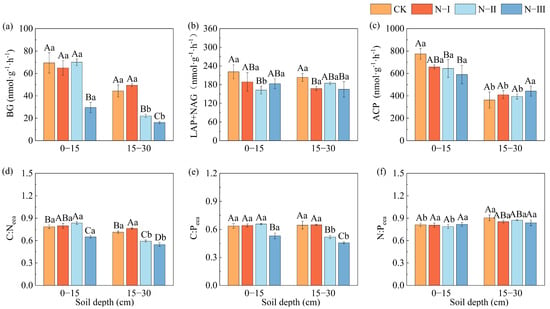
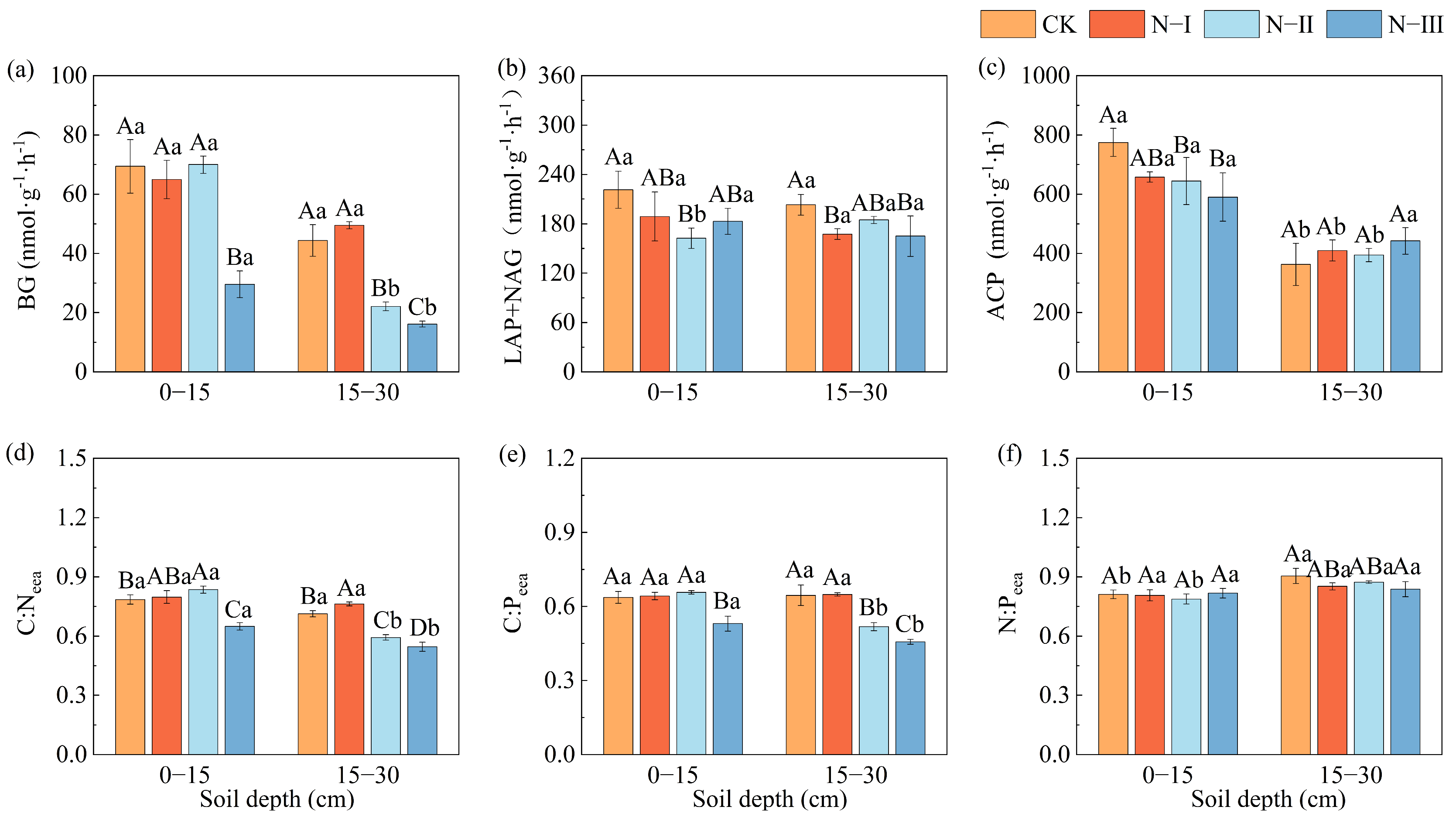
Soil extracellular enzyme activities and their stoichiometric ratios varied with N-addition treatment and soil depth (Figure 1). In the surface soil, BG activity under the N-III treatment was 29.56 nmol·g−1·h−1, representing a significant reduction of 57.41% relative to CK (p < 0.05) (Figure 1a). The combined activity of LAP + NAG under the N-II treatment was 162.39 nmol·g−1·h−1, which was 26.64% lower than that under CK (p < 0.05) (Figure 1b). ACP activities under the N-I, N-II, and N-III treatments were 657.79, 644.33, and 590.08 nmol·g−1·h−1, respectively. Although ACP activity was numerically reduced by 15.08% under N-I, it did not differ significantly from that under CK (p > 0.05). In contrast, the N-II and N-III treatments significantly reduced ACP activity by 16.82% and 23.83%, respectively (p < 0.05) (Figure 1c). In the subsoil, BG activities under the N-II and N-III treatments were 22.11 and 16.13 nmol·g−1·h−1, respectively, representing significant reductions of 50.16% and 63.64% relative to CK (p < 0.05) (Figure 1a). The combined LAP + NAG activities under the N-I and N-III treatments were 167.42 and 164.91 nmol·g−1·h−1, respectively, corresponding to significant reductions of 17.55% and 18.78% relative to CK (p < 0.05) (Figure 1b). ACP activity was numerically higher under each N-addition treatment than under CK, but none of these differences was statistically significant (p > 0.05) (Figure 1c). Comparisons between soil layers showed that BG activity was significantly lower in the subsoil under N-II and N-III (p < 0.05), but did not differ between soil layers under CK or N-I (p > 0.05). LAP + NAG activity did not differ significantly between soil layers under any treatment (p > 0.05), whereas ACP activity was significantly lower in the subsoil under CK, N-I, and N-II (p < 0.05), but not under N-III (p > 0.05) (Figure 1a–c).
Figure 1.
Soil extracellular enzyme activities (a–c) and their stoichiometric ratios (d–f) under different nitrogen application levels. BG, β-1,4-glucosidase; LAP, L-leucine aminopeptidase; NAG, β-1,4-N-acetylglucosaminidase; ACP, acid phosphatase; C:Neea, ln(BG)/ln(LAP + NAG); C:Peea, ln(BG)/ln(ACP); N:Peea, ln(LAP + NAG)/ln(ACP). Different capital letters indicate significant differences between nitrogen fertilizer input treatments within the same soil layer (p < 0.05); different lowercase letters indicate significant differences between soil depths under the same nitrogen input treatment (p < 0.05). Values are the mean ± SD. ns: not significant.
Enzymatic stoichiometric ratios also exhibited treatment- and depth-dependent responses (Figure 1d–f). In the surface soil, C:Neea was significantly lower under N-III than under CK, whereas N-I and N-II did not differ significantly from CK (p > 0.05). C:Peea was significantly lower only under N-III (p < 0.05) (Figure 1d,e). In the subsoil, C:Neea was significantly higher under N-I but significantly lower under N-II and N-III than under CK (p < 0.05). C:Peea was significantly lower under N-II and N-III than under CK (p < 0.05), whereas N-I did not differ significantly from CK (p > 0.05) (Figure 1d,e). Thus, neither C:Neea nor C:Peea exhibited a consistently monotonic response across the full N-addition gradient; however, both ratios were significantly reduced under the N-II and N-III treatments in the subsoil. N:Peea did not differ significantly among treatments in the surface soil (p > 0.05). The same was true in the subsoil (p > 0.05) (Figure 1f). Comparisons between soil layers showed that C:Neea and C:Peea were significantly lower in the subsoil under N-II and N-III (p < 0.05), but did not differ between soil layers under CK or N-I (p > 0.05). N:Peea was significantly higher in the subsoil under CK, N-I, and N-II (p < 0.05), but did not differ between soil layers under N-III (p > 0.05) (Figure 1d–f).
3.3. Soil Microbial Nutrient Limitations
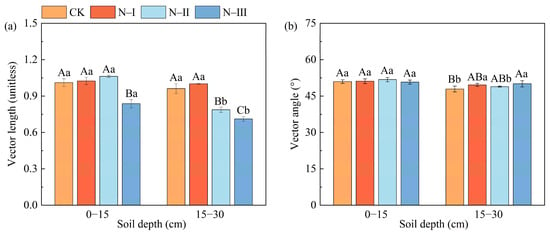
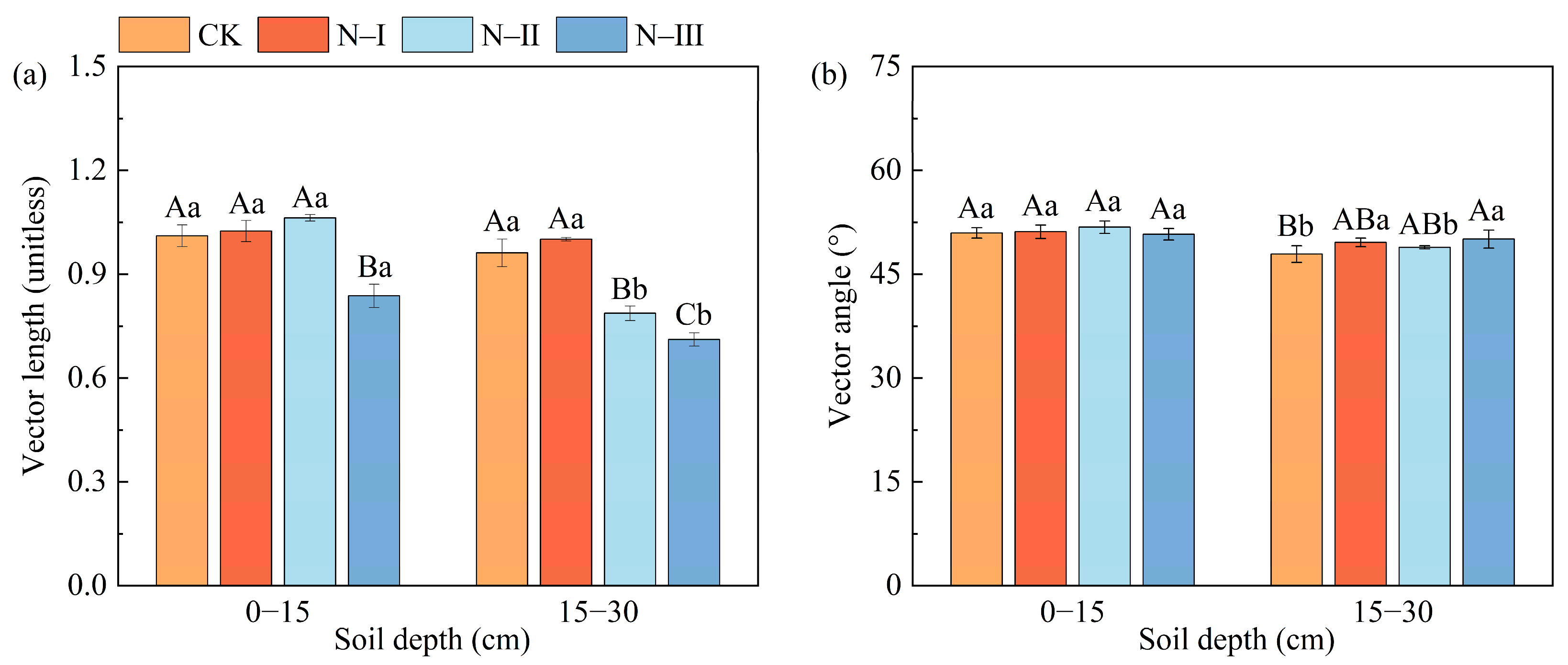
Soil ecoenzymatic stoichiometric VL and VA exhibited distinct patterns across soil depths under N addition (Figure 2). In the 0–15 cm soil layer, N-III significantly decreased VL relative to CK (p < 0.05), whereas N-I and N-II had no significant effects on VL (p > 0.05) (Figure 2a). VA did not differ significantly among treatments in the surface soil (p > 0.05) (Figure 2b). In the 15–30 cm soil layer, N-II and N-III significantly decreased VL relative to CK (p < 0.05), whereas N-I had no significant effect (p > 0.05). Moreover, VL was significantly lower under N-III than under N-II (p < 0.05) (Figure 2a). For VA, only N-III resulted in a significantly higher value than CK (p < 0.05), whereas neither N-I nor N-II differed significantly from CK (p > 0.05) (Figure 2b). Comparisons between soil layers showed that VL was significantly lower in the 15–30 cm layer than in the 0–15 cm layer under N-II and N-III, whereas no significant depth differences were observed under CK or N-I (Figure 2a). Under CK and N-II, VA was significantly lower in the subsoil than in the surface soil (p < 0.05); however, no significant depth differences in VA were detected under N-I or N-III (p > 0.05) (Figure 2b). VA exceeded 45° under all treatments in both soil layers. Within the framework of ecoenzymatic stoichiometric vector analysis, a decrease in VL indicates reduced relative microbial investment in C-acquiring enzymes, whereas VA values greater than 45° and increases in VA indicate a stronger allocation of enzymatic resources toward P acquisition relative to N acquisition. Therefore, these vector metrics characterize relative microbial resource-acquisition patterns inferred from soil extracellular enzyme activities rather than directly measured microbial responses to C or P availability.
Figure 2.
Soil ecoenzymatic vector length (a) and vector angle (b) at two soil depths under different nitrogen application levels. Different capital letters indicate significant differences between nitrogen input treatments within the same soil layer (p < 0.05); different lowercase letters indicate significant differences between soil depths (p < 0.05).
3.4. Correlation Analysis of Soil Enzyme Activity, Enzyme Stoichiometric Ratio and Vector Characteristics with Soil Properties
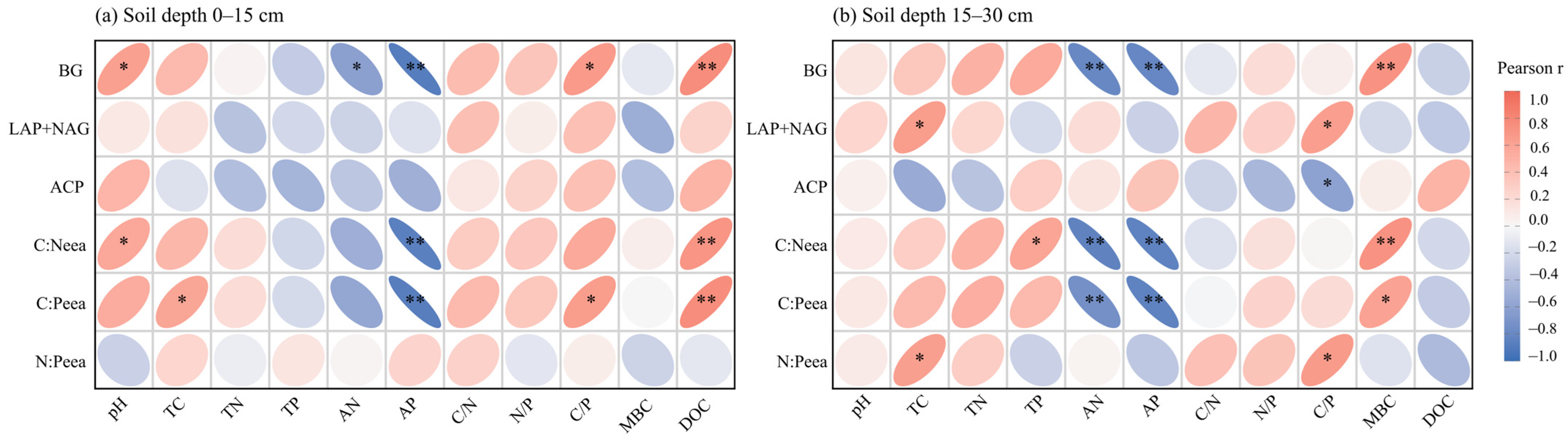
Significant Pearson correlations are reported separately for the two soil depths (Figure 3). In the surface soil (0–15 cm), BG activity was positively correlated with pH, C/P, and DOC and negatively correlated with AN and AP (Figure 3). The C:Neea ratio was positively correlated with pH and DOC and negatively correlated with AP, whereas the C:Peea ratio was positively correlated with TC, C/P, and DOC and negatively correlated with AP. LAP + NAG activity, ACP activity, and the N:Peea ratio showed no significant correlations with any measured soil property. In the subsoil (15–30 cm), BG activity was positively correlated with MBC and negatively correlated with AN and AP (Figure 3b). LAP + NAG activity was positively correlated with TC and C/P, whereas ACP activity was negatively correlated with C/P. The C:Neea ratio was positively correlated with TP and MBC, and the C:Peea ratio was positively correlated with MBC. Both ratios were negatively correlated with AN and AP. The N:Peea ratio was positively correlated with TC and C/P.
Figure 3.
Correlation analysis between soil enzyme activities and their stoichiometric ratios and soil properties in the 0–15 cm (a) and 15–30 cm soil layers (b). BG, β-1,4-glucosidase; LAP, L-leucine aminopeptidase; NAG, β-1,4-N-acetylglucosaminidase; ACP, acid phosphatase; C:Neea, ln(BG)/ln(LAP + NAG); C:Peea, ln(BG)/ln(ACP); N:Peea, ln(LAP + NAG)/ln(ACP). TC, total carbon; TN, total nitrogen; TP, total phosphorus; C/N, C/P, and N/P, ratios of total carbon to total nitrogen, total carbon to total phosphorus, and total nitrogen to total phosphorus, respectively; AN, available nitrogen; AP, available phosphorus; MBC, microbial biomass carbon; DOC, dissolved organic carbon. *, p < 0.05, **, p < 0.01.
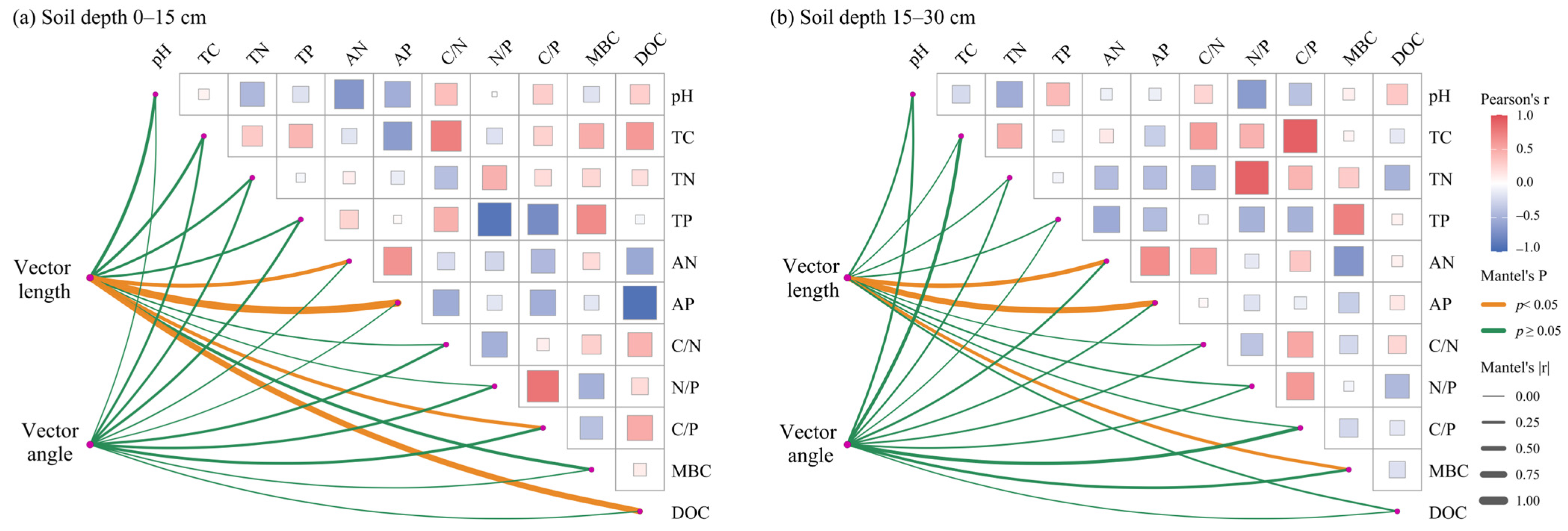
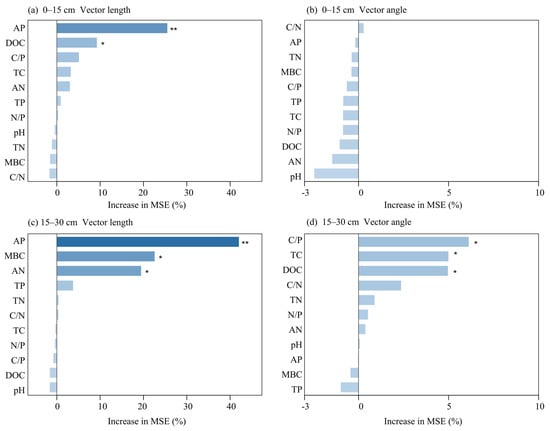
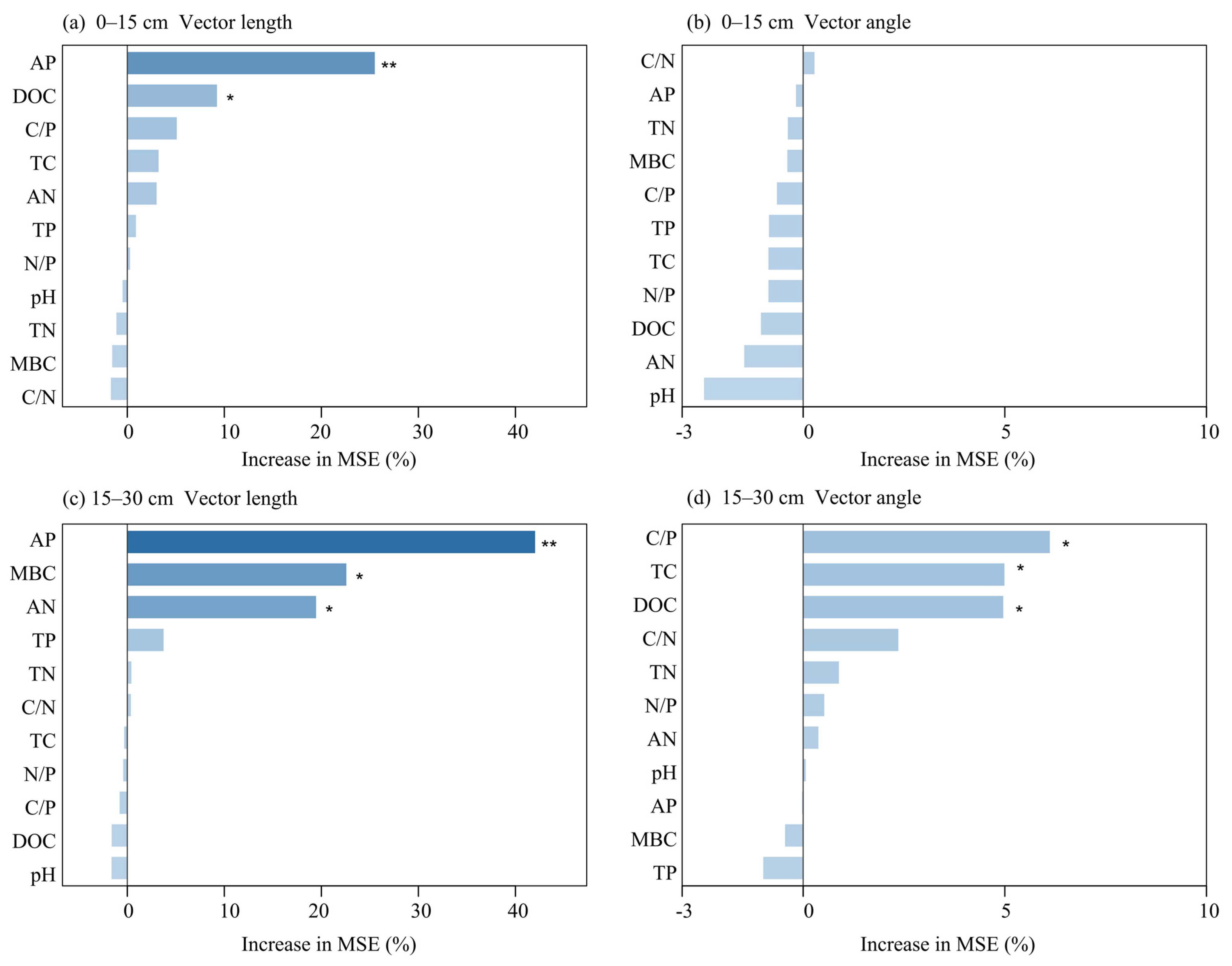
Mantel tests showed that VL was significantly associated with AN, AP, C/P, and DOC in the surface soil (Figure 4a) and with AN, AP, and MBC in the subsoil (Figure 4b). VA showed no significant associations with the measured soil properties at either depth. In the exploratory random forest analysis, the out-of-bag (OOB) R2 values for VL were 0.327 in the surface soil and 0.644 in the subsoil. The corresponding values for VA were −0.620 and −0.009 (Table S2). AP ranked first in permutation importance for VL at both depths (Figure 5a,c). After Benjamini–Hochberg correction, AP was the only predictor whose permutation importance remained significant in both VL models (adjusted p = 0.0444 in each model). In leave-one-plot-out refits, AP ranked first in 10 of 11 valid surface-soil VL models and in all 11 valid subsoil VL models (Table S4). In the unadjusted permutation tests, DOC in the surface-soil VL model (Figure 5a), MBC and AN in the subsoil VL model (Figure 5c), and C/P, TC, and DOC in the subsoil VA model (Figure 5d) also had significant permutation importance (p < 0.05). No predictor reached this threshold in the surface-soil VA model (Figure 5b). Unadjusted and adjusted permutation p-values for all predictor–model combinations are provided in Table S3.
Figure 4.
Mantel test of ecological enzyme vector length and angle with soil properties in the 0–15 cm (a) and 15–30 cm soil layers (b). TC, total carbon; TN, total nitrogen; TP, total phosphorus; C/N, C/P, and N/P, ratios of total carbon to total nitrogen, total carbon to total phosphorus, and total nitrogen to total phosphorus, respectively; AN, available nitrogen; AP, available phosphorus; MBC, microbial biomass carbon; DOC, dissolved organic carbon. Different line colors indicate ranges of Mantel test significance levels (p-values), whereas line thickness represents ranges of Mantel correlation coefficients (r-values).
Figure 5.
Random forest model predictions of the effects of soil properties on ecological enzyme vector length (a,c) and vector angle (b,d). TC, total carbon; TN, total nitrogen; TP, total phosphorus; C/N, C/P, and N/P, ratios of total carbon to total nitrogen, total carbon to total phosphorus, and total nitrogen to total phosphorus, respectively; AN, available nitrogen; AP, available phosphorus; MBC, microbial biomass carbon; DOC, dissolved organic carbon. MSE, mean squared error. *, p < 0.05; **, p < 0.01.
4. Discussion
4.1. Effects of Short-Term Nitrogen Addition on Soil Extracellular Enzyme Activities and Stoichiometry in Moso Bamboo Stands
Soil extracellular enzyme activities reflect microbial resource allocation toward C, N, and P acquisition and are highly sensitive to changes in soil nutrient availability [7,10,37]. Our results demonstrated that short-term N addition significantly altered C-, N-, and P-acquiring enzyme activities in Moso bamboo forest soils, but the magnitude of these responses varied markedly between soil layers. Furthermore, significant interactions between N-addition treatment and soil depth were observed for TC, C/N, AN, AP, MBC, and DOC (Table 1), demonstrating that soil resource responses to N addition differed between soil depths. Previous studies have shown that increasing soil depth alters substrate availability, nutrient accessibility, and microbial metabolic demands, resulting in distinct microbial resource acquisition strategies across soil layers [38]. The depth-dependent enzyme responses observed here may therefore reflect differences in soil resource conditions and microbial nutrient requirements. Because sampling was conducted once during the autumn shoot-bud differentiation stage, these responses characterize soil conditions at that sampling time and should not be assumed to represent other phenological stages [25].
In the present study, N addition significantly suppressed BG activity, with significant reductions observed under N-III treatment in the surface soil and N-II and N-III treatments in the subsoil, where BG activity decreased by 57.41%, 50.16%, and 63.64%, respectively (Figure 1a). This pattern differs from the commonly reported positive effects of N addition on C-acquiring enzyme activities in some ecosystems [12], suggesting that extracellular enzyme responses to N inputs are highly ecosystem-dependent. Previous studies have shown that the effects of N addition on extracellular enzyme activities are jointly regulated by initial soil nutrient status, N addition intensity, experimental duration, microbial biomass, and substrate availability [12,39]. In this study, N-III significantly decreased surface-soil DOC (Table 1), while BG activity was positively correlated with DOC (Figure 3a), suggesting that the decrease in BG activity may be associated with reduced labile C availability under N-III. However, lower BG activity may also reflect reduced substrate induction, potential shifts in microbial community composition, or changes in extracellular enzyme production, stabilization, and turnover. Therefore, the decline in BG activity alone should not be interpreted as direct evidence that microbial C limitation was alleviated. The significant negative correlations between BG activity and both AN and AP (Figure 3) further suggest that microbial investment in C-acquiring enzymes was associated with soil inorganic nutrient availability. Studies in Moso bamboo forests have similarly demonstrated that N addition and intensive management can substantially modify labile C pools, microbial biomass, and C-cycling-related enzyme activities, indicating that extracellular enzyme responses depend not only on N availability itself but also on C substrate conditions [40,41].
The response of N-acquiring enzymes to N addition also showed clear treatment- and depth-dependent patterns. In the surface soil, N-II significantly reduced LAP + NAG activity, whereas in the subsoil, both N-I and N-III treatments significantly decreased LAP + NAG activity (Figure 1b). According to microbial resource allocation theory, increased inorganic N availability can reduce microbial demand for organic N acquisition by allowing microorganisms to directly utilize more readily available mineral N, thereby decreasing investment in enzymes involved in organic N decomposition [37,42]. Consistently, a global meta-analysis showed that N addition can have weak inhibitory effects on some N-acquiring enzymes, particularly aminopeptidases involved in protein degradation [39]. Therefore, the decline in LAP + NAG activity observed in this study may reflect reduced microbial investment in organic N acquisition following N addition. However, the response of LAP + NAG did not exhibit a consistent dose-dependent inhibition pattern among N treatments, suggesting that this enzyme activity was also influenced by other factors, including C availability, microbial biomass, substrate composition, and soil depth.
In contrast, ACP activity exhibited a more complex response pattern. In the surface soil, N-I, N-II, and N-III treatments significantly decreased ACP activity, whereas in the subsoil, ACP activity showed an increasing trend under N addition, although the differences were not significant (Figure 1c). Global-scale studies generally suggest that N addition promotes phosphatase activity because alleviation of N limitation can increase plant and microbial P demand, while adequate N supply may also support enzyme synthesis [43,44]. In our study, the increase in surface-soil AP under N-III coincided with lower ACP activity, which is consistent with reduced microbial demand for ACP-mediated organic P acquisition under greater AP availability. However, the response of ACP cannot be explained by AP alone: N-I lowered AP without significantly affecting ACP, and unmeasured factors—including microbial community composition, organic P substrate availability, root-derived phosphatases, and enzyme stabilization and turnover—may also have contributed.
Extracellular enzyme activities and their stoichiometric ratios provide enzyme-based indicators of microbial resource-acquisition strategies by reflecting relative resource allocation among C-, N-, and P-acquiring processes [45]. The responses of C:Neea and C:Peea depended on both treatment and soil depth. In the surface soil, both ratios were lower under N-III than under the control. In the subsoil, C:Neea was lower under N-II and N-III but higher under N-I, whereas C:Peea was lower under N-II and N-III; N-I did not differ significantly from the control (Figure 1d,e). N:Peea showed no significant treatment differences in the surface soil, while in the subsoil it was lower under N-III than under the control (Figure 1f). The lower C:Neea and C:Peea ratios under some N treatments indicate shifts in relative enzyme allocation involving C acquisition, but they should not be interpreted alone as evidence of a general reallocation from C acquisition toward both N and P acquisition. The depth- and treatment-dependent ratio responses, together with the declines in BG activity and VL under selected N treatments, indicate that short-term N addition altered enzyme-based resource-acquisition patterns. Previous studies have also found that fertilization changes enzyme stoichiometry, although the direction and magnitude vary with ecosystem nutrient status, substrate availability, and microbial resource demands [28].
4.2. Effects of Nitrogen Addition on Enzyme-Based Microbial Resource-Acquisition Patterns in Moso Bamboo Stands
Enzymatic vector analysis provides a framework for interpreting the relative allocation of microbial resources to extracellular enzyme production. Within this framework, decreases in VL indicate reduced relative investment in C-acquiring enzymes, whereas VA greater than 45° indicate that enzymatic resource allocation is oriented more strongly toward P acquisition than toward N acquisition [19]. In the present study, VA exceeded 45° across all treatments and soil depths (Figure 2b), indicating that enzyme allocation was oriented more strongly toward P acquisition than toward N acquisition. This enzyme-based pattern is consistent with the widespread P limitation reported for subtropical forest soils and with previous evidence that P availability plays an important role in regulating nutrient cycling and productivity in Moso bamboo forests [38,46]. The treatment effects on vector metrics, however, differed by soil depth. In the surface soil, N-III significantly decreased VL, whereas VA did not differ significantly among treatments. In the subsoil, N-II and N-III significantly decreased VL, with N-III producing a lower value than N-II; only N-III significantly increased VA relative to the control. N-I had no significant effect on either metric in the subsoil (Figure 2a,b). Thus, higher N inputs reduced relative allocation to C-acquiring enzymes in both soil layers, whereas a shift toward greater P acquisition relative to N acquisition was detected only under N-III in the subsoil. However, because no C- or P-addition bioassays were conducted, these vector responses should not be interpreted as direct evidence that microbial C limitation was alleviated or that P limitation was intensified. These results support our hypothesis that short-term N addition alters relative microbial allocation to resource-acquiring enzymes, with responses varying between soil depths.
Our findings differ from those of a global meta-analysis [47], which reported that N addition generally increased BG activity and VL, a pattern interpreted as stronger microbial C limitation, while having relatively weak effects on VA. This discrepancy may reflect differences in ecosystem type, initial nutrient status, N application rate, and experimental duration. The global meta-analysis integrated evidence from forests, grasslands, croplands, and other ecosystems, whereas the present study examined the short-term response of a long-term unfertilized Moso bamboo forest to a single N application. The observed changes in soil properties, including AN, AP, DOC, and MBC, coincided with changes in enzyme-based vector metrics and may provide context for interpreting the microbial responses, although the relationships do not establish causation. Previous studies in Moso bamboo forests have likewise shown that fertilization regimes and initial soil fertility can result in contrasting enzyme-based microbial resource-acquisition patterns [28]. In addition, interconnected rhizomes mediate the transfer of non-structural carbohydrates from mature culms to developing shoots [48] and may also facilitate N and P transfer between attached mature and young bamboo [49]. However, such transfer among experimental plots was not quantified in this study. Because rhizomes were not severed and no belowground barriers were installed, rhizome-mediated redistribution cannot be regarded as an independent mechanism explaining the observed treatment differences. Accordingly, the enzyme-based responses should be interpreted as plot-scale patterns under conditions in which belowground connectivity among plots could not be excluded.
The increase in AP under N-III did not correspond to a significant increase in VA in the surface soil, whereas in the subsoil N-III increased both AP and VA relative to the control. These patterns show that changes in AP and enzyme-based allocation were not consistently coupled across soil depths. AP represents the extractable P pool at the time of sampling, whereas VA reflects relative enzyme allocation between N and P acquisition. Consequently, a higher AP concentration does not necessarily result in reduced investment in P-acquiring enzymes. Previous studies have shown that N input can modify soil P cycling and alter the relative demand of plants and microorganisms for P [43,44]. A previous study further showed that inoculation with phosphate-solubilizing bacteria enhanced phosphatase activity and the abundance of P-transformation functional genes, increased soil AP, altered microbial community composition, and promoted Moso bamboo growth [50]. These findings underscore the importance of P availability and microbially mediated P transformation in regulating nutrient supply and plant growth in Moso bamboo forests. The concurrent increases in AP and VA under N-III in the subsoil are therefore consistent with a depth-dependent association between the extractable P pool and enzyme-based P-acquisition allocation, but do not demonstrate that microbial P limitation intensified.
Pearson correlations, Mantel tests, and exploratory random forest analyses provided complementary, but distinct, evidence concerning soil properties and enzyme-based vector metrics. Mantel tests showed that VL was associated with AN, AP, C/P, and DOC in the surface soil, and with AN, AP, and MBC in the subsoil; VA was not significantly associated with the measured soil properties at either depth. AP ranked first in permutation importance for VL in both soil layers and was the only predictor that remained significant after Benjamini–Hochberg correction across all 44 predictor-by-model tests. Based on unadjusted permutation p-values, DOC also showed significant importance in the surface-soil vector-length model; AN and MBC did so in the subsoil vector-length model; and C/P, TC, and DOC did so in the subsoil vector-angle model. No predictor reached the unadjusted significance threshold in the surface-soil vector-angle model. In the surface soil, BG activity was positively correlated with DOC but negatively correlated with both AN and AP, whereas the C:Neea and C:Peea ratios were positively correlated with DOC but negatively correlated with AP. These relationships suggest that extracellular enzyme allocation was associated with both C availability and soil nutrient conditions [37,42]. However, because each random forest model included only 12 observations and 11 potentially correlated or mathematically dependent predictors, the observed variable importance should be interpreted as exploratory predictive associations rather than evidence of independent or causal effects. Overall, short-term N addition altered enzyme-based C- and P-acquisition relationships, and these responses were associated with N-addition level, soil depth, and the prevailing soil resource conditions.
4.3. Limitations of the Current Study and Future Prospects
Although this study investigated the effects of short-term N input on soil extracellular enzyme activities and enzyme-based microbial resource-acquisition patterns in a long-term unfertilized Moso bamboo forest, several limitations should be acknowledged. First, the results reflect a single sampling campaign in October 2025, approximately eight months after one N application, during the autumn shoot-bud differentiation stage. Moso bamboo forests exhibit pronounced seasonal growth rhythms, and root activity, nutrient uptake, and C allocation may vary substantially among developmental stages, with corresponding changes in soil extracellular enzyme activities, labile nutrient pools, and microbial resource demand. Long-term N addition may also affect extracellular enzyme activities and resource-acquisition strategies through soil acidification, nutrient imbalances, and shifts in microbial community composition [51,52]. Therefore, these findings should not be extrapolated directly to repeated N inputs, and seasonal and multiyear observations are required to assess their persistence. Second, this study did not include C- or P-addition bioassays or an N × P factorial design. Extracellular enzyme stoichiometry and vector analysis therefore reflect relative microbial resource allocation but cannot directly demonstrate that microbial C limitation was alleviated or that P limitation was intensified. Moreover, because VL and VA were derived from the same enzyme activity data, their relationship may partly reflect mathematical coupling rather than an independent biological trade-off. Future studies should combine nutrient-addition bioassays with measurements of microbial growth, respiration, microbial biomass C:N:P stoichiometry, and soil P fractions to provide more direct evidence of microbial resource limitation. Finally, although adjacent plots were separated by 5-m-wide buffer zones, rhizomes were not severed, and no belowground barriers were installed. Potential rhizome-mediated resource transfer among treatment plots therefore cannot be excluded, limiting the assumption of complete plot independence. Each depth-specific random forest model also included only 12 observations and 11 potentially correlated or mathematically dependent predictors. Although AP in the two VL models remained significant after Benjamini–Hochberg correction, the variable-importance rankings should be treated as exploratory and not as evidence of independent contributions or causal effects. Future studies should incorporate rhizome isolation or isotopic tracing, larger sample sizes, a more parsimonious predictor set that accounts for predictor dependence, and independent model validation.
5. Conclusions
Short-term nitrogen addition altered the enzyme-based resource-acquisition patterns in Moso bamboo forest soils, with responses varying by soil depth. Overall, higher N inputs reduced VL in both soil layers, indicating a lower relative allocation to C-acquiring enzymes; treatment effects on VA, however, were detected only in the subsoil. Mean VA values exceeded 45° across all treatments, indicating that enzyme allocation was generally more strongly oriented toward P acquisition than toward N acquisition. AP was significantly associated with VL in both soil layers, although this association alone does not demonstrate that changes in available P caused shifts in enzyme allocation. These findings suggest that soil depth influences the enzyme-based response of Moso bamboo forest soils to short-term N addition, and that available P is relevant to interpreting variation in VL. Because the study involved a single sampling after one N application, it remains unclear whether these responses persist under repeated fertilization or across seasons. Their long-term dynamics and relationship to actual microbial nutrient limitation require further investigation.
Supplementary Materials
The following supporting information can be downloaded at https://www.mdpi.com/article/10.3390/f17111363/s1. Table S1. Activities of leucine aminopeptidase and β-1,4-N-acetylglucosaminidase under different nitrogen-addition treatments at two soil depths. Table S2. Out-of-bag predictive performance of random forest models for vector length and vector angle by soil depth. Table S3. Permutation importance of soil predictors in random forest models of vector length (VL) and vector angle (VA) by soil depth. Table S4. Sensitivity of predictor importance rankings to leave-one-plot-out refitting of random forest models for vector length (VL) and vector angle (VA).
Author Contributions
Conceptualization, S.F. and W.S.; methodology, S.F., W.S., and X.H.; software, X.H., Z.H., and B.W.; formal analysis, X.H., Z.H., and C.L.; investigation, X.H., Z.H., C.L., B.W., and Y.G.; resources, S.F. and W.S.; data curation, C.L. and B.W.; writing—original draft preparation, X.H.; writing—review and editing, X.H. and W.S.; visualization, X.H.; project administration, S.F. and W.S.; funding acquisition, W.S. All authors have read and agreed to the published version of the manuscript.
Funding
This research was funded by the National Key R&D Program of China (grant number 2023YFD2201202).
Data Availability Statement
The original contributions presented in this study are included in the article. Further inquiries can be directed to the corresponding authors.
Acknowledgments
We thank Renfa Zhang, Xin Li, and Jinjun Yue for providing assistance in setting up sample plots and collecting soil samples.
Conflicts of Interest
The authors declare no conflicts of interest.
References
- Kurmi, B.; Nath, A.J.; Lal, R.; Das, A.K. Water stable aggregates and the associated active and recalcitrant carbon in soil under rubber plantation. Sci. Total Environ. 2019, 703, 135498. [Google Scholar] [CrossRef] [Scilit] [PubMed]
- Lu, Q.; Lin, S.; Liu, S.; Zheng, X.; Bi, Y.; Xiao, Z.; Jiang, J.; Wang, A.; Du, X. Meta-analysis of the effect of fertilization on the yield of Phyllostachys edulis forest. J. Nanjing For. Univ. (Nat. Sci. Ed.) 2024, 48, 88–96. [Google Scholar] [CrossRef]
- He, X.; Shi, F.; Xu, T.; Song, F. Variations in soil organic carbon pool structure in the humus layer influenced by soil nutrient stoichiometry under nitrogen addition treatments: Evidence from a temperate Korean pine plantation in northeast China. For. Ecol. Manag. 2025, 585, 122687. [Google Scholar] [CrossRef] [Scilit]
- Cusack, D.F.; Silver, W.L.; Torn, M.S.; Burton, S.D.; Firestone, M.K. Changes in microbial community characteristics and soil organic matter with nitrogen additions in two tropical forests. Ecology 2011, 92, 621–632. [Google Scholar] [CrossRef] [Scilit] [PubMed]
- Prasad, S.; Malav, L.C.; Choudhary, J.; Kannojiya, S.; Kundu, M.; Kumar, S.; Yadav, A.N. Soil Microbiomes for Healthy Nutrient Recycling. In Current Trends in Microbial Biotechnology for Sustainable Agriculture; Environmental and Microbial Biotechnology; Springer: Singapore, 2021; pp. 1–21. [Google Scholar] [CrossRef] [Scilit]
- Li, Y.; Wang, C.; Gao, S.; Wang, P.; Qiu, J.; Shang, S. Impacts of simulated nitrogen deposition on soil enzyme activity in a northern temperate forest ecosystem depend on the form and level of added nitrogen. Eur. J. Soil Biol. 2021, 103, 103287. [Google Scholar] [CrossRef] [Scilit]
- Sinsabaugh, R.L.; Hill, B.H.; Shah, J.J.F. Ecoenzymatic stoichiometry of microbial organic nutrient acquisition in soil and sediment. Nature 2009, 462, 795–798. [Google Scholar] [CrossRef] [Scilit] [PubMed]
- Stock, S.C.; Köster, M.; Dippold, M.A.; Nájera, F.; Matus, F.; Merino, C.; Boy, J.; Spielvogel, S.; Gorbushina, A.; Kuzyakov, Y. Environmental drivers and stoichiometric constraints on enzyme activities in soils from rhizosphere to continental scale. Geoderma 2019, 337, 973–982. [Google Scholar] [CrossRef] [Scilit]
- Burns, R.G.; DeForest, J.L.; Marxsen, J.; Sinsabaugh, R.L.; Stromberger, M.E.; Wallenstein, M.D.; Weintraub, M.N.; Zoppini, A. Soil enzymes in a changing environment: Current knowledge and future directions. Soil Biol. Biochem. 2013, 58, 216–234. [Google Scholar] [CrossRef] [Scilit]
- Sinsabaugh, R.L.; Lauber, C.L.; Weintraub, M.N.; Ahmed, B.; Allison, S.D.; Crenshaw, C.; Contosta, A.R.; Cusack, D.; Frey, S.; Gallo, M.E.; et al. Stoichiometry of soil enzyme activity at global scale. Ecol. Lett. 2008, 11, 1252–1264. [Google Scholar] [CrossRef] [Scilit] [PubMed]
- Xiao, L.; Liu, G.; Li, P.; Li, Q.; Xue, S. Ecoenzymatic stoichiometry and microbial nutrient limitation during secondary succession of natural grassland on the Loess Plateau, China. Soil Tillage Res. 2020, 200, 104605. [Google Scholar] [CrossRef] [Scilit]
- Jian, S.; Li, J.; Chen, J.; Wang, G.; Mayes, M.A.; Dzantor, K.E.; Hui, D.; Luo, Y. Soil extracellular enzyme activities, soil carbon and nitrogen storage under nitrogen fertilization: A meta-analysis. Soil Biol. Biochem. 2016, 101, 32–43. [Google Scholar] [CrossRef] [Scilit]
- Xu, Z.; Yu, G.; Zhang, X.; He, N.; Wang, Q.; Wang, S.; Wang, R.; Zhao, N.; Jia, Y.; Wang, C. Soil enzyme activity and stoichiometry in forest ecosystems along the North-South Transect in eastern China (NSTEC). Soil Biol. Biochem. 2017, 104, 152–163. [Google Scholar] [CrossRef] [Scilit]
- Zhou, L.; Liu, S.; Shen, H.; Zhao, M.; Xu, L.; Xing, A.; Fang, J. Soil extracellular enzyme activity and stoichiometry in China’s forests. Funct. Ecol. 2020, 34, 1461–1471. [Google Scholar] [CrossRef] [Scilit]
- Liu, M.; Gan, B.; Li, Q.; Xiao, W.; Song, X. Effects of Nitrogen and Phosphorus Addition on Soil Extracellular Enzyme Activity and Stoichiometry in Chinese Fir (Cunninghamia lanceolata) Forests. Front. Plant Sci. 2022, 13, 834184. [Google Scholar] [CrossRef] [Scilit] [PubMed]
- Yang, X.; Yang, L.; Li, Q.; Li, X.; Xu, G.; Xu, Z.; Jia, Y.; Jia, Y. Short-term responses of soil nutrients and enzyme activities to nitrogen addition in a Larix principis-rupprechtii plantation in North China. Front. Ecol. Evol. 2023, 11, 1105150. [Google Scholar] [CrossRef] [Scilit]
- Dong, W.Y.; Zhang, X.Y.; Liu, X.Y.; Fu, X.L.; Chen, F.S.; Wang, H.M.; Sun, X.M.; Wen, X.F. Responses of soil microbial communities and enzyme activities to nitrogen and phosphorus additions in Chinese fir plantations of subtropical China. Biogeosciences 2015, 12, 5537–5546. [Google Scholar] [CrossRef] [Scilit]
- Liu, M.; Wang, M.; Sun, C.; Wu, H.; Zhao, X.; Liu, E.; Dong, W.; Yan, M. Self-Regulation of Soil Enzyme Activity and Stoichiometry under Nitrogen Addition and Plastic Film Mulching in the Loess Plateau Area, Northwest China. Agriculture 2023, 13, 938. [Google Scholar] [CrossRef] [Scilit]
- Moorhead, D.L.; Sinsabaugh, R.L.; Hill, B.H.; Weintraub, M.N. Vector analysis of ecoenzyme activities reveal constraints on coupled C, N and P dynamics. Soil Biol. Biochem. 2016, 93, 1–7. [Google Scholar] [CrossRef] [Scilit]
- Chen, M.; Guo, L.; Ramakrishnan, M.; Fei, Z.; Vinod, K.K.; Ding, Y.; Jiao, C.; Gao, Z.; Zha, R.; Wang, C.; et al. Rapid growth of Moso bamboo (Phyllostachys edulis): Cellular roadmaps, transcriptome dynamics, and environmental factors. Plant Cell 2022, 34, 3577–3610. [Google Scholar] [CrossRef] [Scilit] [PubMed]
- Mo, S.; Luo, X.; Li, J.; Liu, F.; He, B. Distribution Characteristics of Biomass and Carbon Storage of Phyllostachys pubescens Plantation in Nandan County, Guangxi. J. Agric. Res. Appl. 2023, 36, 39–44. [Google Scholar] [CrossRef]
- Du, H.; Zhou, G.; Fan, W.; Ge, H.; Xu, X.; Shi, Y.; Fan, W. Spatial heterogeneity and carbon contribution of aboveground biomass of moso bamboo by using geostatistical theory. Plant Ecol. 2009, 207, 131–139. [Google Scholar] [CrossRef] [Scilit]
- Li, P.; Zhou, G.; Du, H.; Lu, D.; Mo, L.; Xu, X.; Shi, Y.; Zhou, Y. Current and potential carbon stocks in Moso bamboo forests in China. J. Environ. Manag. 2015, 156, 89–96. [Google Scholar] [CrossRef] [Scilit] [PubMed]
- Feng, P.; Li, Y. China’s Bamboo Resources in 2021. World Bamboo Ratt. 2023, 21, 100–103. [Google Scholar] [CrossRef]
- Zhang, M.; Wang, W.; Bai, S.H.; Xu, Z.; Yun, Z.; Zhang, W. Linking Phyllostachys edulis (moso bamboo) growth with soil nitrogen cycling and microbial community of plant-soil system: Effects of plant age and niche differentiation. Ind. Crops Prod. 2022, 177, 114520. [Google Scholar] [CrossRef] [Scilit]
- Qu, X.; Peñuelas, J.; Delgado-Baquerizo, M.; Kuzyakov, Y.; Liao, Y.; Guo, J.; Zi, H.; Pan, C.; Cao, F.; Li, X. Forest conversion in subtropical ecosystems reduces soil microbial phosphorus potential. Commun. Earth Environ. 2025, 6, 734. [Google Scholar] [CrossRef] [Scilit]
- Zeng, Q.; Zhang, Q.; Lin, K.; Zhou, J.; Yuan, X.; Mei, K.; Wu, Y.; Cui, J.; Xu, J.; Chen, Y. Enzyme stoichiometry evidence revealed that five years nitrogen addition exacerbated the carbon and phosphorus limitation of soil microorganisms in a Phyllostachys pubescens forest. Chin. J. Appl. Ecol. 2021, 32, 521–528. [Google Scholar] [CrossRef] [PubMed]
- Chu, H.; Su, W.; Zhou, Y.; Wang, Z.; Long, Y.; Sun, Y.; Fan, S. Enzyme Activity Stoichiometry Suggests That Fertilization, Especially Nitrogen Fertilization, Alleviates Nutrient Limitation of Soil Microorganisms in Moso Bamboo Forests. Forests 2024, 15, 1040. [Google Scholar] [CrossRef] [Scilit]
- Sun, H.; Cao, Z.; Wu, Z.; Fang, M.; Zhang, R.; Liu, J.; Miao, T.; Yan, C. Effects of mulching on soil nutrients, enzyme activities and microbial community in Phyllostachys edulis forest. Non-Wood For. Res. 2023, 41, 223–233. [Google Scholar] [CrossRef]
- Jones, D.; Willett, V. Experimental evaluation of methods to quantify dissolved organic nitrogen (DON) and dissolved organic carbon (DOC) in soil. Soil Biol. Biochem. 2006, 38, 991–999. [Google Scholar] [CrossRef] [Scilit]
- Vance, E.D.; Brookes, P.C.; Jenkinson, D.S. An extraction method for measuring soil microbial biomass C. Soil Biol. Biochem. 1987, 19, 703–707. [Google Scholar] [CrossRef] [Scilit]
- Bao, S. Soil and Agricultural Chemistry Analysis; China Agriculture Press: Beijing, China, 2000. [Google Scholar]
- German, D.P.; Weintraub, M.N.; Stuart, G.A.; Lauber, C.L.; Rinkes, Z.L.; Allison, S.D. Optimization of hydrolytic and oxidative enzyme methods for ecosystem studies. Soil Biol. Biochem. 2011, 43, 1387–1397. [Google Scholar] [CrossRef] [Scilit]
- Bell, C.W.; Fricks, B.E.; Rocca, J.D.; Steinweg, J.M.; McMahon, S.K.; Wallenstein, M.D. High-throughput Fluorometric Measurement of Potential Soil Extracellular Enzyme Activities. J. Vis. Exp. 2013, 81, e50961. [Google Scholar] [CrossRef] [Scilit] [PubMed]
- Zhang, X.; Li, Q.; Zhong, Z.; Huang, Z.; Wen, X.; Bian, F.; Yang, C. Determining changes in microbial nutrient limitations in bamboo soils under different management practices via enzyme stoichiometry. Catena 2023, 223, 106939. [Google Scholar] [CrossRef] [Scilit]
- Moorhead, D.L.; Rinkes, Z.L.; Sinsabaugh, R.L.; Weintraub, M.N. Dynamic relationships between microbial biomass, respiration, inorganic nutrients and enzyme activities: Informing enzyme-based decomposition models. Front. Microbiol. 2013, 4, 223. [Google Scholar] [CrossRef] [Scilit] [PubMed]
- Sinsabaugh, R.L.; Shah, J.J.F. Ecoenzymatic Stoichiometry and Ecological Theory. Annu. Rev. Ecol. Evol. Syst. 2012, 43, 313–343. [Google Scholar] [CrossRef] [Scilit]
- Liu, J.; Chen, J.; Chen, G.; Guo, J.; Li, Y. Enzyme stoichiometry indicates the variation of microbial nutrient requirements at different soil depths in subtropical forests. PLoS ONE 2020, 15, e0220599. [Google Scholar] [CrossRef] [Scilit] [PubMed]
- Chen, H.; Li, D.; Zhao, J.; Xiao, K.; Wang, K. Effects of nitrogen addition on activities of soil nitrogen acquisition enzymes: A meta-analysis. Agric. Ecosyst. Environ. 2018, 252, 126–131. [Google Scholar] [CrossRef] [Scilit]
- Li, Q.; Song, X.; Gu, H.; Gao, F. Nitrogen deposition and management practices increase soil microbial biomass carbon but decrease diversity in Moso bamboo plantations. Sci. Rep. 2016, 6, 28235. [Google Scholar] [CrossRef] [Scilit] [PubMed]
- Ni, H.; Su, W.; Fan, S.; Chu, H. Effects of intensive management practices on rhizosphere soil properties, root growth, and nutrient uptake in Moso bamboo plantations in subtropical China. For. Ecol. Manag. 2021, 493, 119083. [Google Scholar] [CrossRef] [Scilit]
- Allison, S.D.; Vitousek, P.M. Responses of extracellular enzymes to simple and complex nutrient inputs. Soil Biol. Biochem. 2005, 37, 937–944. [Google Scholar] [CrossRef] [Scilit]
- Marklein, A.R.; Houlton, B.Z. Nitrogen inputs accelerate phosphorus cycling rates across a wide variety of terrestrial ecosystems. New Phytol. 2012, 193, 696–704. [Google Scholar] [CrossRef] [Scilit] [PubMed]
- Deng, Q.; Hui, D.; Dennis, S.; Reddy, K.C. Responses of terrestrial ecosystem phosphorus cycling to nitrogen addition: A meta-analysis. Glob. Ecol. Biogeogr. 2017, 26, 713–728. [Google Scholar] [CrossRef] [Scilit]
- Chen, X.; Ding, Z.; Tang, M.; Zhu, B. Greater variations of rhizosphere effects within mycorrhizal group than between mycorrhizal group in a temperate forest. Soil Biol. Biochem. 2018, 126, 237–246. [Google Scholar] [CrossRef] [Scilit]
- Wang, Y.; Zhang, H.; Li, Q.; Zhang, J.; Wang, S.; Song, X. Effect of nitrogen addition on soil phosphorus fractions in the Phyllostachys edulis plantation. J. Zhejiang A&F Univ. 2022, 39, 695–704. [Google Scholar] [CrossRef]
- Chen, H.; Li, D.; Zhao, J.; Zhang, W.; Xiao, K.; Wang, K. Nitrogen addition aggravates microbial carbon limitation: Evidence from ecoenzymatic stoichiometry. Geoderma 2018, 329, 61–64. [Google Scholar] [CrossRef] [Scilit]
- Song, X.; Peng, C.; Zhou, G.; Gu, H.; Li, Q.; Zhang, C. Dynamic allocation and transfer of non-structural carbohydrates, a possible mechanism for the explosive growth of Moso bamboo (Phyllostachys heterocycla). Sci. Rep. 2016, 6, 25908. [Google Scholar] [CrossRef] [Scilit] [PubMed]
- Sun, H.; Li, Q.; Lei, Z.; Zhang, J.; Song, X.; Song, X. Ecological stoichiometry of nitrogen and phosphorus in Moso bamboo (Phyllostachys edulis) during the explosive growth period of new emergent shoots. J. Plant Res. 2019, 132, 107–115. [Google Scholar] [CrossRef] [Scilit] [PubMed]
- Bortoluzzi, E.C.; Pérez, C.A.S.; Ardisson, J.D.; Tiecher, T.; Caner, L. Occurrence of iron and aluminum sesquioxides and their implications for the P sorption in subtropical soils. Appl. Clay Sci. 2015, 104, 196–204. [Google Scholar] [CrossRef] [Scilit]
- Lu, X.; Mao, Q.; Gilliam, F.S.; Luo, Y.; Mo, J. Nitrogen deposition contributes to soil acidification in tropical ecosystems. Glob. Change Biol. 2014, 20, 3790–3801. [Google Scholar] [CrossRef] [Scilit] [PubMed]
- Zhang, T.A.; Chen, H.Y.H.; Ruan, H. Global negative effects of nitrogen deposition on soil microbes. ISME J. 2018, 12, 1817–1825. [Google Scholar] [CrossRef] [Scilit] [PubMed]

Disclaimer/Publisher’s Note: The statements, opinions and data contained in all publications are solely those of the individual author(s) and contributor(s) and not of MDPI and/or the editor(s). MDPI and/or the editor(s) disclaim responsibility for any injury to people or property resulting from any ideas, methods, instructions or products referred to in the content. |
© 2026 by the authors. Licensee MDPI, Basel, Switzerland. This article is an open access article distributed under the terms and conditions of the Creative Commons Attribution (CC BY) license.