


Abstract
The intensity of wildfires is projected to increase with the rising frequency of droughts due to climate change. Management practices following forest fires must include restoring the appropriate species composition. This study was performed within the wider context of the regeneration of soil properties, including the stock and soil organic matter (SOM) content, at the largest forest fire site in Poland (more than 9000 ha) in the Rudziniec Forest District, Upper Silesia. Research plots were established on sandy soils (Podzols and Arenosols) in pure stands of Scots pine (Pinus sylvestris L.), common birch (Betula pendula Roth), and black alder (Alnus glutinosa (L.) Gaertn.). The organic and mineral soil horizons were sampled from each research plot and control plots unaffected by the fire. The trees’ foliage was also sampled to determine the nutrient supply. Basic soil properties were determined, including the texture, pH, bulk density, organic carbon (C), macronutrient contents, soil microbial biomass, and labile C and nitrogen (N) fractions. We found that, 30 years after the fire, the post-fire soils had similar SOC stocks (34.80 Mg ha−1) to the control plots (31.72 Mg ha−1); however, they differed in their stocks of labile C and N fractions. The post-fire soils had a less stable C pool due to a higher stock of the fraction associated with particulate organic matter. In contrast, the N pool was more stable in the post-fire soils than in the control soils due to a lower contribution of the most labile fractions. The soils under Scots pine had the least stable SOM, which may have influenced the intensification of the podzolization process, whereas the highest biomass of soil microorganisms was observed under common birch. The soils under black alder had the highest acidity and lowest phosphorus (P) content. The C:N:P ratios in the post-fire soils and tree foliage indicated that P may have been the limiting factor in alder growth, and N for pine and birch. Our findings indicate that tree species composition is an important factor in the recovery of post-fire soil properties. However, the introduction of pure black alder stands to post-fire soils with low moisture and P availability showed little effectiveness in restoring the SOM content and N pool.
1. Introduction
As a result of ongoing climate change, the frequency and scale of droughts and associated fires are increasing worldwide [1]. In Europe, this has mainly affected countries in the Mediterranean zone [2]. However, an increase in fire risk across the continent has been forecast for several years, and large-scale forest fires have recently occurred in both Central Europe (e.g., the Czech Switzerland National Park in the Czech Republic [3]) and Northern Europe (e.g., Sweden [4]).
Fires are part of the natural dynamics of forest ecosystems. By facilitating secondary succession, they play an important role in the regeneration process of many woody species, including Scots pine (Pinus sylvestris L.) and common birch (Betula pendula Roth) [5]. However, large-scale fires, especially in commercial forests, can have numerous adverse environmental, social, and economic consequences [6,7]. During a forest fire, the temperature of the top mineral soil horizons rises to approximately 300 °C and can reach 500–700 °C if large quantities of biomass are burned. Locally, topsoil temperatures can reach 1400–1500 °C [7]. Such high temperatures cause the decomposition of soil organic matter (SOM) and the loss or alteration of nutrient availability, particularly nitrogen (N) [6]. Additionally, soil pH increases because of the alkalizing effect of the ash [6,8]. This ultimately leads to erosion, a change in the air–water properties of soils, and potentially a long-term decline in the biomass and activity of soil microorganisms and fauna [6].
In commercial forest stands, fire regeneration is one of the most important factors influencing the dynamics of the soil regeneration process [9]. Tree species introduced as part of restoration projects affect the soil properties in different ways. By varying the degree of canopy closure and openness, they regulate the amount of light reaching the forest floor, thereby modifying the microclimatic conditions [10]. The species of tree introduced to an area influences the dynamics of SOM accumulation and the rate of nutrient cycling through biochemical interactions between the subcanopy organic litter, roots, and biochemically active secretions [11]. These factors, and their interactions, have complex effects on soil properties [12].
Key aspects of forest management include assessing the impact of the regeneration species composition following large-scale disturbances and developing recommendations for silvicultural planning in affected forest sites. In Central Europe, pioneer tree species such as Scots pine and common birch are often introduced in post-fire areas [13]. They are also typically the first species to recover naturally during secondary succession in forest ecosystems affected by fire or other disturbances [5]. These species have a broad ecological range, are adapted to oligotrophic soils, and have high light requirements. They also grow rapidly in their early stages, which makes them competitive with herbaceous vegetation [14]. Competition for light and nutrients (especially N) is a major factor in the succession and regeneration of forest ecosystems [15,16]. For this reason, species capable of symbiosis with atmospheric N-fixing bacteria, such as black alder (Alnus glutinosa (L.) Gaertn.), are introduced after disturbances [17].
However, black alder requires high soil fertility and moisture to thrive [14], and the favorable processes of carbon (C) and N accumulation under alder vary according to climate, soil fertility, and the type of disturbance. We expected that the introduction of alder to post-fire areas may result in consequences distinct from those observed when it is introduced under optimal habitat conditions. Typically, the leaf litter of species found in eutrophic habitats, including black alder, has higher nutrient contents and a faster rate of decomposition than that of species characteristic of oligotrophic habitats [18,19]. Some studies have indicated that tree species whose leaf litter has intermediate nutrient contents and decomposition rates can accelerate the nutrient cycling dynamics in oligotrophic habitats and slow them down in eutrophic habitats [18]. Such feedback between biotic and abiotic environmental factors can modify the processes involved in the regeneration of soil properties after disturbances and the large-scale decay of stands [20]. Understanding these relationships can contribute to the design of effective management measures, including the appropriate composition of regeneration species.
The literature lacks studies on long-term monitoring of soil recovery dynamics and trajectories after fires [21]. Research has instead focused on the impact of fire on soil properties and the rate of soil regeneration over a period of several years [22,23]. Data are also lacking regarding the effect of the species of introduced stands on the dynamics of soil regeneration [5]. Available data on the impact of tree species come primarily from other habitat conditions, such as managed forest ecosystems, and cannot necessarily be applied to forest ecosystems during succession after disturbances [9].
In this paper, we present a comprehensive study on the impacts of pure stands of three tree species on the process of soil regeneration, including their effects on the stock and properties of SOM, nutrient content, microbial indicators, and C:N:P stoichiometry, 30 years after a large-scale forest fire. The tree species were chosen to represent three functional groups: Scots pine as a conifer, common birch as a deciduous tree, and black alder as a N-fixer. Unburned sites representing the optimal growth conditions for the studied tree species were used as a control.
2. Materials and Methods
Our study was conducted at the site of a large-scale fire in the Rudziniec Forest District of southern Poland (50°18′57.6″ N, 18°25′10.4″ E). This fire occurred in August 1992 and was the largest in Poland since World War II. It covered a total of 9062 ha, including 8461 ha of forest land. Before the fire, the area was dominated by pine trees (accounting for approximately 80% of the tree stand), which had been weakened by industrial activity [24].
Study plots in the post-fire site (PF) were established on sandy soils (Podzols and Brunic Arenosols) in 26- to 27-year-old pure stands of Scots pine, common birch, and black alder. As a point of reference, control plots (CP) were established near the fire site in stands of the studied tree species that had not been affected by fire. The ages of the stands in the control plots were 54 years for the alder stands and 70 years for the pine and birch stands. A total of 24 test plots, each 100 m2 (10 × 10 m), were established, comprising four replicates for each variant. In each study plot, the organic horizons (Olf) and mineral soils were sampled (i.e., 0–5 and 0–30 cm). Samples were also taken from the trees’ assimilation apparatus (foliage) to determine the degree to which it was supplied with nutrients [9,25,26,27].
The mass of the organic horizons was also determined along with the texture, pH in water, bulk density, soil organic carbon (SOC), and macronutrient contents. The labile C and N fractions extractable in cold water (WSC and WSN, respectively) and hot water (HWC and HWN, respectively), as well as those associated with particulate organic C (POC) and N (PON), were measured in the mineral horizon samples. The soil microbial properties were also determined, namely, the soil microbial biomass C (MBC), basal respiration rate (RESP), and the urease, acid phosphatase (Pho), and alkaline Pho activity. The stock of SOC, N, and its labile fractions, as well as the microbial properties, were determined in the uppermost 0–5 cm soil horizons. Texture, pH, microelement content (P, Ca, K, Mg), and C:P and N:P ratios were determined for the 0–30 cm soil horizons. In the laboratory, the collected soil samples were analyzed for grain size using the Fritsch GmbH Laser Particle Sizer ANALYSETTE 22 (Fritsch GmbH, Idar-Oberstein, Germany); pH was measured potentiometrically (maintaining a ratio of soil:solution 1:2.5), the total forms of elements were analysed using ICP OES ICAP 6000 Series spectrophotometer (Thermo Fisher Scientific, Waltham, MA, USA), the labile C and N fractions extractable in cold water using Shimadzu TOC-VCPH analyzer (Shimadzu Corporation, Kyoto, Japan). The C and macronutrient contents were determined in the foliage of tree species. Analysis of variance (ANOVA) was performed using the Statistica software (v13) to test for significant differences between the mean values of the studied parameters [9,25,26,27].
To explore the joint variation in soil physicochemical properties and microbial parameters, a principal component analysis (PCA) was performed on the combined set of eight variables measured in the topsoil: total nitrogen stock (N-stock), soil organic carbon stock (SOC-stock), pH, sand fraction, microbial biomass carbon (MBC), basal respiration (RESP), urease activity (URE), and phosphatase activity (Pho). Before the analysis, all variables were standardized to give each equal weight and to satisfy the linearity assumption of PCA. The analysis was run in Canoco (v5), which extracts orthogonal axes that maximize the explained variance of a multivariate dataset. Significance of the first two canonical axes was assessed with a Monte Carlo permutation test (999 permutations). The resulting biplot was used to visualize the relationships between the soil and microbial variables, the experimental sites, the tree species, and the fire status.
3. Results and Discussion
3.1. Influence of Tree Species on the pH and Chemical Properties of Soils
The soils in the post-fire site were found to be acidic. In the mineral layer (0–30 cm), the pH values were higher under the birch and pine stands than under the alder stands (Table 1). A similar increase in soil acidity under black alder when compared with Scots pine, European larch (Larix decidua Mill.), and common birch has previously been reported from a post-mining site reclaimed for forestry [26]. The higher acidity of soils under alder stands may be due to atmospheric N-fixation processes [27]. The oxidation reactions that occur during the nitrification process performed by microorganisms produce nitric acid (HNO3), which then dissociates into hydrogen (H+) and nitrate () ions. This increases soil acidification both directly through the increase in H+ ions and through the leaching of mobile cations by the ions [27]. However, the pH was not lower in the soils under alder than under the other tree species in the control plots (Table 1). This may be due to the soil type under alder in the control site having a greater buffering capacity than the soils under the other tree species.
Table 1.
Textures, pH values, and selected chemical properties of the mineral soil horizons (0–30 cm) under different tree species.
The post-fire soils under the birch stands contained more phosphorus (P), calcium (Ca), and magnesium (Mg) than those under the other tree species (Table 1). This confirms the utility of birch as a “soil improver” [28,29]. Our results also indicate that alder can cause a decrease in P content in the mineral horizons of post-fire soils (Table 1). According to Mitchell and Ruess [30], the presence of green alder (Alnus alnobetula (Ehrh.) K.Koch) on post-fire sites in Alaska has resulted in more acidic soils with a low P content. Species symbiotic with atmospheric N-fixing bacteria have higher P requirements than others because the N assimilation process requires large amounts of P [31]. The P concentration can be up to three times higher in the root nodules of N-fixing species than in the roots and aboveground biomass of trees [32].
3.2. Influence of Tree Species on Soil Organic Carbon and Nitrogen Stock and Its Fractions
The total (organic and uppermost mineral horizons) stocks of SOC and N in the soils of the post-fire and control sites had similar values (Table 2). A global meta-analysis found that fires reduce the SOC in soils by an average of 15.2%, with a stronger impact in tropical and temperate climates than in Mediterranean and subtropical climates. It may take approximately 10 years for the SOC and N resources to regenerate to values similar to the pre-fire levels [33]. In boreal forests, it has been shown to take approximately 20 years for SOC levels in post-fire sites to reach those of ecosystems unaffected by fire [34]. However, not all fires lead to reductions in SOC resources. In Mediterranean pine forests dominated by Pinus pinaster Aiton and Pinus pinea L., the C pool was found to decrease only in the organic levels after a fire [35]. There have even been indications of an increase in SOC resources in mineral soil layers as a result of the inflow of unburned, dead forest biomass or the accumulation of charcoal [36,37].
Table 2.
SOC and N stocks in the studied soils under different tree species.
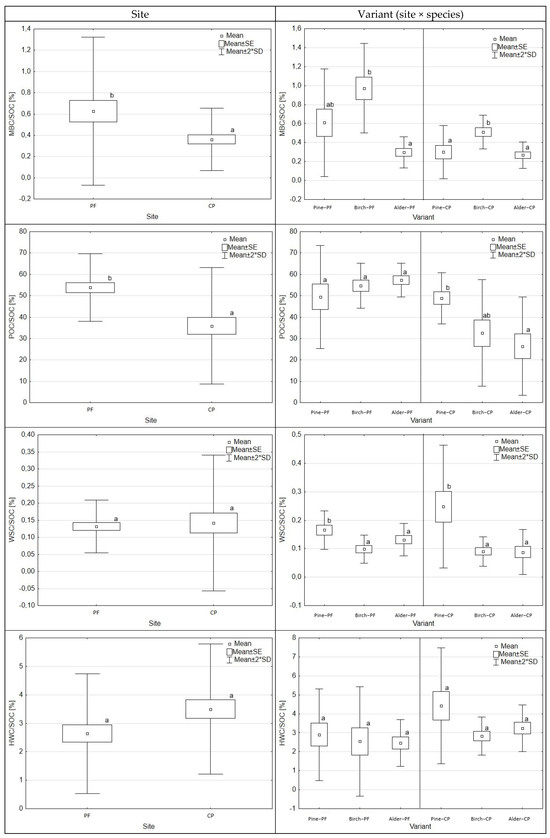
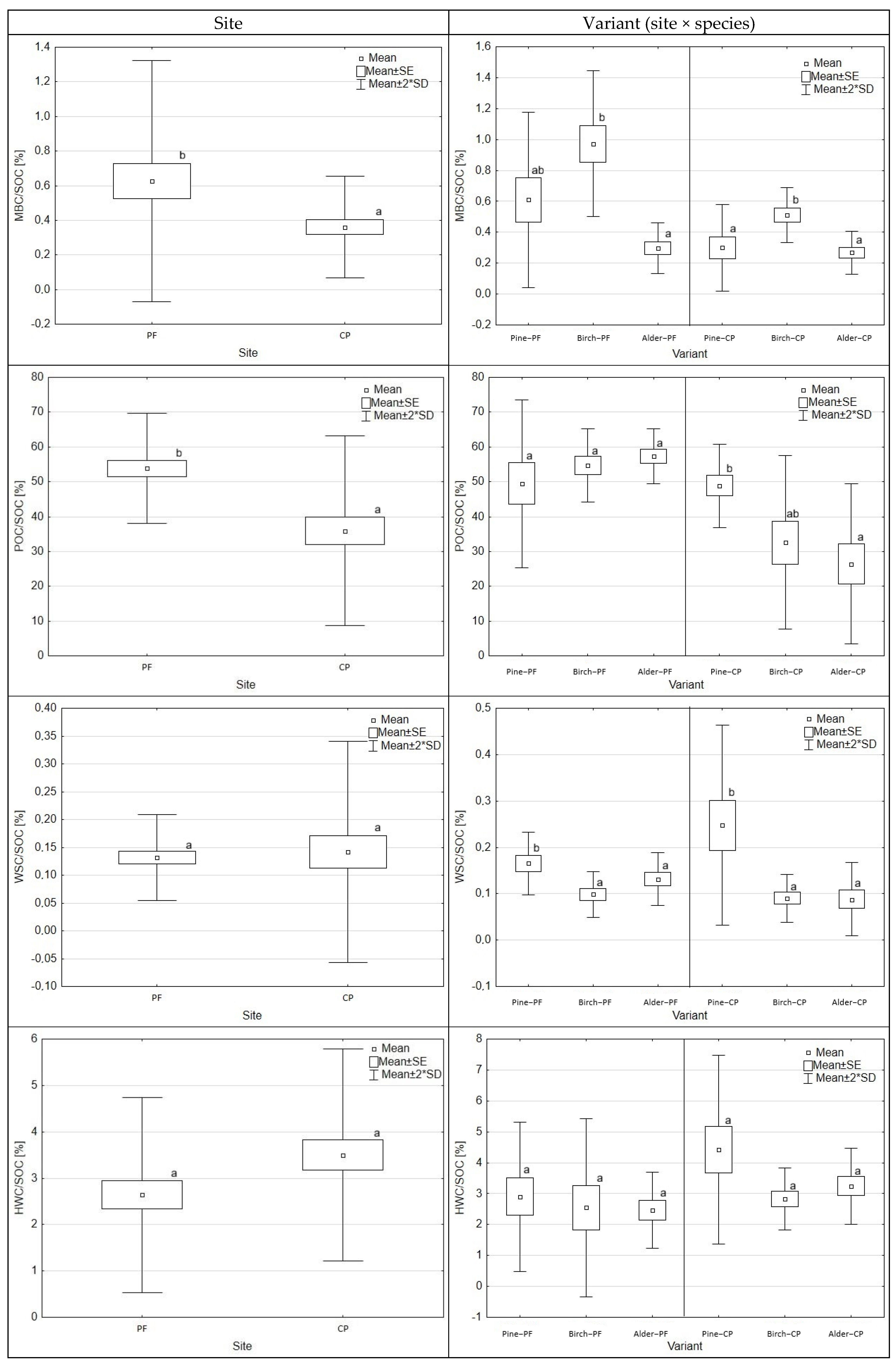
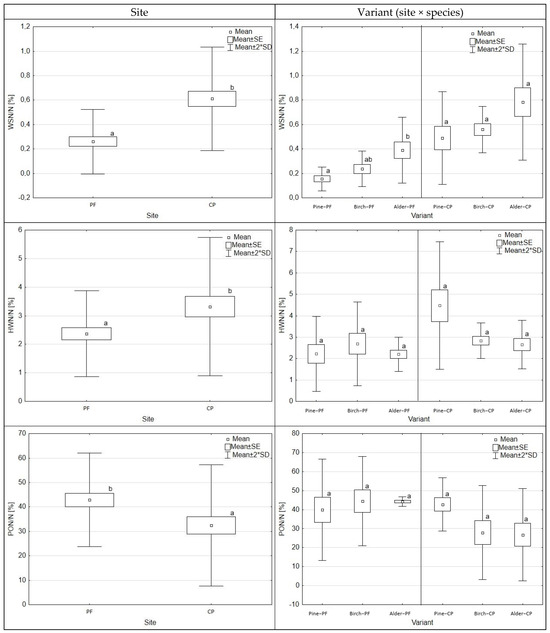
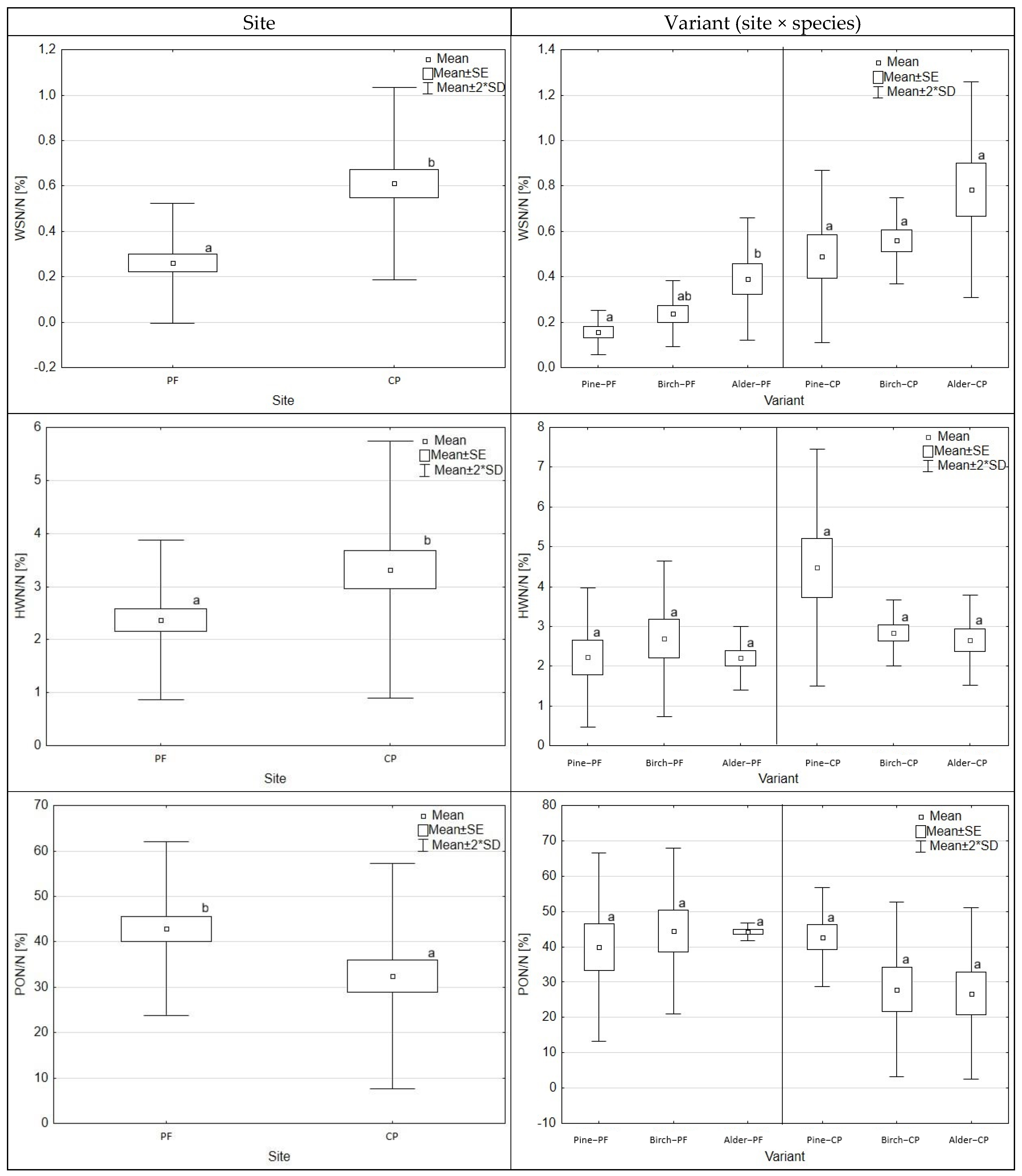
Nearly 30 years after the fire at the study site, no significant differences were observed between the total SOC and N stock values (for the organic and mineral horizons) in the post-fire soils and the undisturbed soils at the control sites (Table 2). However, the mineral horizons of these soils differed in labile SOC and N fraction stocks (Figure 1 and Figure 2). The content of individual SOC and N fractions may be related to soil texture and soil type [38]. However, a redundancy analysis showed that the texture of the analyzed soils was not a significant factor in explaining the content of labile SOC and N fractions in the soils [25]. On the basis of a review of 150 experiments from the literature, Gosling et al. [39] concluded that in agricultural soils, texture affects the SOC content but not the POC content. A similar lack of correlation between soil texture and POC content has been reported in soils under grassland and forest ecosystems in North America [40]. Higher POC stocks and POC:SOC ratios in post-fire soils than in control soils may be due to charcoal [36,37]. On the other hand, the proportion of labile SOM relative to total SOM may decrease as an ecosystem progresses to maturity following a disturbance, because mature ecosystems accumulate a larger amount of more stable, recalcitrant SOM [41,42]. The POC fraction is the main source of C and energy for heterotrophic soil microorganism populations. Therefore, microorganisms are not uniformly distributed in soils; higher biomass and activity are observed near POC particles [43]. This may explain the higher MBC:SOC ratios found in post-fire soils than in soils at control sites (Figure 1).
Figure 1.
Ratios of labile carbon fractions to SOC content in the uppermost and 0–5 cm soil horizons. Abbreviations: MBC, microbial biomass carbon; WSC, cold water extractable carbon; HWC, hot water extractable carbon; POC, particulate organic carbon. Note: For all quantities, mean ± SD is shown; the letters (a, b) indicate significant differences between the mean parameters within the studied sites.
Figure 2.
Ratios of labile nitrogen fractions to total N content in the uppermost and 0–5 cm soil horizons. Abbreviations: WSN, cold water extractable nitrogen; HWN, hot water extractable nitrogen; PON, N in particulate organic matter. Note: For all quantities, mean ± SD is shown; the letters (a, b) indicate significant diffebetweene-tween the mean parameters within the studied sites.
The highest MBC stocks were found under birch stands in both the post-fire and control soils (Figure 1). Similarly, higher microbial biomass and activity were found in soils under birch, compared with pine and alder, in sites reclaimed after sand exploitation [44]. This may be due to the greater quantity of fine roots in birch stands than in pine and alder stands [45]. Priha et al. [46] found that birch stands also have a beneficial indirect effect on soil due to the light and thermal conditions beneath the birch canopy, which encourage microbial activity. It has also been noted that birch trees produce organic litter containing large amounts of easily degradable compounds that stimulate microorganism activity [47].
Alder is often introduced to degraded sites and after large-scale disturbances as a phytomeliorative species to improve the soil properties, intensify SOC and N accumulation, and stimulate the growth of other tree species [17]. However, we found no clear effect of pure black alder stands on the SOC and N pools in the soils of the post-fire site (Table 2). Nitrogen fixing is an energy-intensive process [48]. Notably, the low P content found in soils under alder stands may limit N fixation [49,50]. Studies have indicated varying effects of introducing alder as an admixture to stands. On a reclaimed sand pit in Upper Silesia, Poland, introducing rows of black alder into pine stands had an effect on tree microbiological parameters at a distance of up to 3 m from the alder rows [51]. In studies conducted by the authors of the present study on a post-mining site in the Rudziniec Forest District, birch stands with an admixture of alder had higher growth parameters (mean height and diameter at breast height) than pure stands, which might be associated with higher SOC and N contents in the soils.
Higher WSC:SOC ratios indicate that the SOC pool in soils under pine stands (both at the post-fire and control sites) was less stable than in soils under birch and alder stands (Figure 1). Although WSC is the most active form of C, it contributes minimally to the growth of SOC resources [52]; however, it has a significant impact on the flow of C and other substances in the soil profile [53]. The movement of WSC from the upper organic layers to the deeper mineral layers is one of the main factors in Podzol formation [54]. Therefore, our results confirm that pine can stimulate podzolization processes in forest soils through the production of difficult-to-decompose litter rich in polyphenols [55].
3.3. Soil Microbial Properties
The studied tree species had distinct effects on the microbiological properties of the post-fire soils. In particular, common birch increased MBC, RESP, and urease activity, whereas black alder stimulated Pho activity (Table 3). The high Pho activity in soils under alder resulted from the higher N content and competition for P between the alder roots and the soil microorganisms [56,57]. This competition may have resulted in lower MBC values in soils under alder, despite their high SOC and N contents. Scots pine exhibited the weakest effect on the microbiological properties of the soils, with MBC, RESP, and enzyme activity values being the lowest under this tree species [44].
Table 3.
Microbial properties of the studied post-fire soils.
3.4. C:N:P Stoichiometry in Soils and Tree Foliage
The N:P stoichiometry ratios in foliage indicate which element may be a limiting factor for tree growth [58]. The ranges of the N:P ratios at which N or P limitation occurs can vary considerably depending on the species and the habitat conditions. Generally, it has been reported that a N:P ratio in plant tissue in the range of 6.7–16 corresponds to N limitation, whereas a value in the range 12.5–26.3 results in P limitation [59,60,61,62,63]. Olde Venterink et al. [64] demonstrated that, at N:P ratios under 14.5 in the biomass, plant growth is limited by N, and at values over 14.5, it is limited by P. Thus, it can be concluded that the pine and birch trees at the post-fire sites were growing under stress due to N limitation. As a N-fixing species, alder occurs in conditions of stress associated with P limitation (Table 4). Similarly, under tropical climate conditions, the growth of N-fixing tree species is limited by soil P availability, whereas the growth of non-N-fixers is limited by other resources [65]. The notion that P is the limiting element in alder growth was confirmed by the high C:P and N:P ratios in the soils under alder stands. These high C:P and N:P ratios may even indicate P immobilization [66,67]. Studies conducted in China have indicated that the introduction of N-fixing species to Eucalyptus plantations resulted in increased soil C:P and N:P ratios. However, this did not alter the stoichiometric ratios in the aboveground tissues of Eucalyptus [68].
Table 4.
C:P and N:P ratios in the 0–30 cm soil mineral horizons and in the tree foliage.
3.5. Relationships Between Chemical and Microbial Soil Parameters
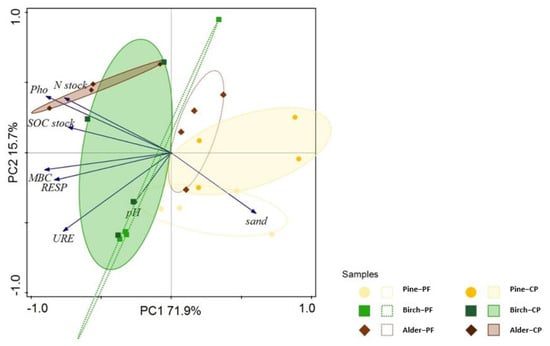
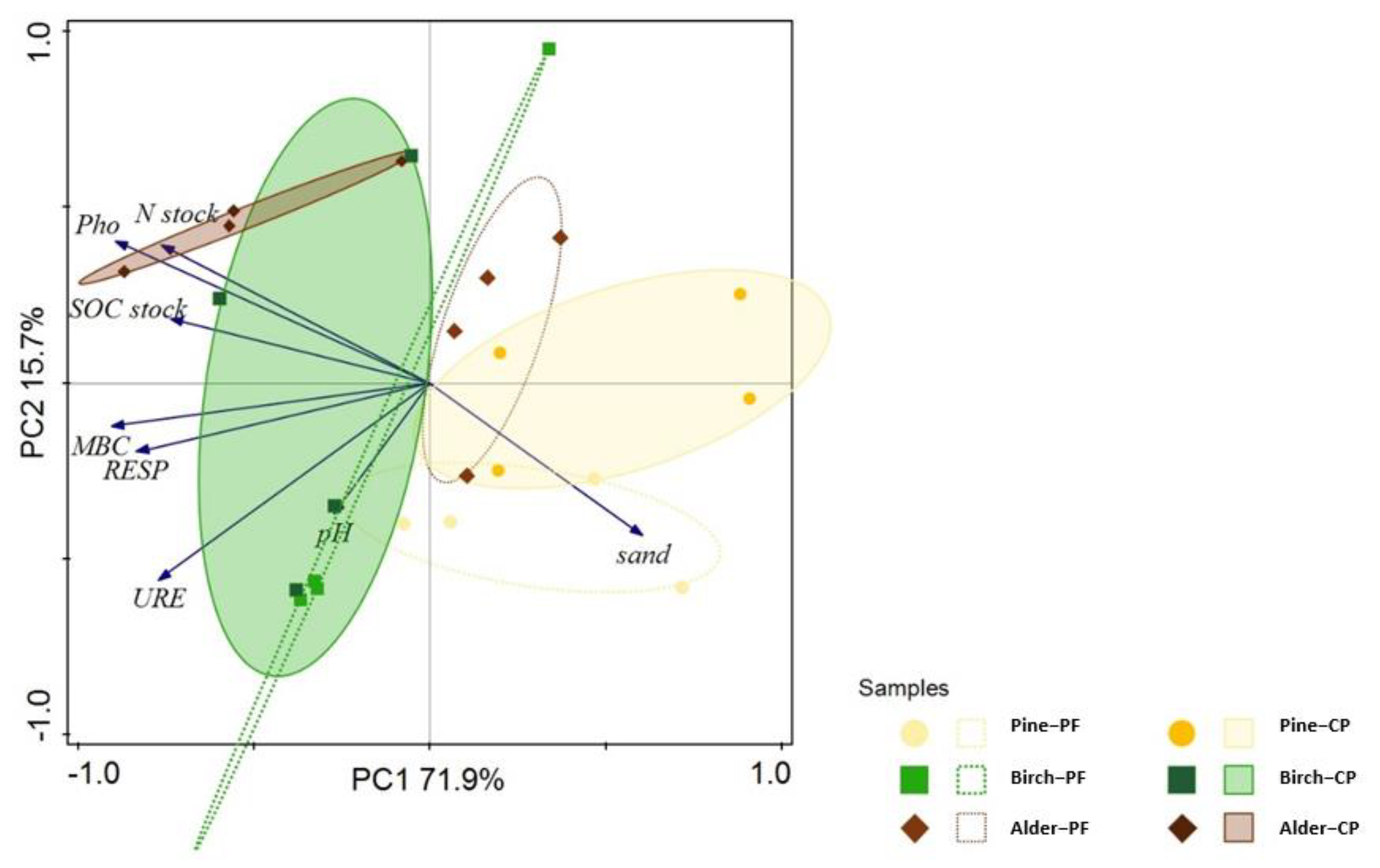
The biplot in Figure 3 clearly separates the samples along two biologically meaningful gradients. On the first component (PC1), the left side of the plot is occupied by Birch-CP, Alder-CP, and Birch-PF, indicating their close association with vectors that describe higher soil fertility (SOC-stock, N-stock, pH) and greater enzymatic activity (Pho, URE) as well as higher microbial activity (RESP, MBC). This pattern is consistent with observations that birch increases macro-element concentrations and microbial biomass in the soil (as a “soil improver”) and that alder soils, despite being more acidic, retain high nitrogen stocks.
Figure 3.
Biplot of a principal component analysis (PCA) of the chemical and microbiological variation in the mineral soil (0–30 cm) under pure stands of Scots pine (Pinus sylvestris), common birch (Betula pendula), and black alder (Alnus glutinosa) in post-fire (PF) and control (CP) conditions. PC1 explains 71.9% of the variance and PC2 15.0%. Points are coded as follows: yellow circles represent Pine–PF, green squares Birch–PF, brown diamonds Alder–PF, dark yellow squares Pine–CP, dark green squares Birch–CP, and dark brown squares Alder–CP. The 95% confidence-interval ellipses group samples by species and fire status. Blue arrows represent the variables used in the ordination: phosphatase activity (Pho), N-stock, SOC-stock, microbial biomass C (MBC), respiration (RESP), urease activity (URE), and pH.
On the right side of PC1 are Pine-CP, Pine-PF, and Alder-PF. Their position near the sand vector reflects a larger proportion of the sandy fraction and lower contents of essential nutrients, properties that are characteristic of pine-dominated soils and of soils recovering from fire, where podzolization processes are intensified. In addition, this group shows reduced microbial biomass (MBC) and lower enzymatic activity, confirming the weaker influence of pine on soil microbiological properties.
The second component (PC2) separates the samples according to the structure of microbial activity: positive PC2 values (in the upper part of the plot) are mainly linked with higher phosphatase activity and larger C and N pools (vectors Pho, N-stock, SOC-stock), best representing the position of Alder–CP and part of the Birch–CP samples. Negative PC2 values (in the lower part of the plot) are correlated with the vectors URE, RESP, MBC, sand, and pH; this zone contains primarily the pine surfaces (Pine–CP, Pine–PF) and the post-fire birch surface (Birch–PF), indicating a different type of microbial functioning in the sandier soils.
4. Conclusions
Thirty years after the fire, the studied soils had total SOC and N stocks similar to the undisturbed (control) soils. However, there was a difference in the stocks of labile C and N fractions. The C pool in the post-fire soil was more strongly associated with the labile fraction of organic matter, whereas the N pool was more closely linked to more stable fractions when compared with the control sites. The choice of tree species for post-fire site reforestation is crucial to the recovery of soil properties. In the present study, the C:P and N:P stoichiometry ratios in the post-fire soils indicated that P may be a limiting macro-element for the growth and development of alder stands, whereas N content may be a limiting factor for the growth of birch and pine stands. Common birch serves a valuable role in increasing the macro-element content, microbial biomass, and activity in post-fire soils. The soils under pine had the most labile organic matter, which may influence the intensification of the podzolization process under this tree species. However, introducing pure stands of alder to post-fire soils with low moisture and P availability as a phytomeliorative species with the goal of increasing soil C and N has rather limited effectiveness.
Author Contributions
Conceptualization, B.W. and M.P.; methodology, B.W. and M.P.; investigation, B.W. and J.L.-C.; data curation, B.W.; writing—original draft preparation, B.W. and J.L.-C.; writing—review and editing, B.W., J.L.-C., M.K. and A.J.; supervision, M.P. All authors have read and agreed to the published version of the manuscript.
Funding
This research was funded by the Ministry of Science and Higher Education of the Republic of Poland (SUB/040016-D019).
Data Availability Statement
The datasets are available from the corresponding author on reasonable request.
Conflicts of Interest
The authors declare no conflicts of interest.
References
- Jones, M.W.; Abatzoglou, J.T.; Veraverbeke, S.; Andela, N.; Lasslop, G.; Forkel, M.; Smith, A.J.P.; Burton, C.; Betts, R.A.; van der Werf, G.R.; et al. Global and regional trends and drivers of fire under climate change. Rev. Geophys. 2022, 60, e2020RG000726. [Google Scholar] [CrossRef] [Scilit]
- San-Miguel-Ayanz, J.; Durrant, T.; Boca, R.; Maianti, P.; Libertà, G.; Oom, D.; Branco, A.; De Rigo, D.; Suarez-Moreno, M.; Ferrari, D.; et al. Advance Report on Forest Fires in Europe, Middle East and North Africa 2024; Publications Office of the European Union: Luxembourg, 2025. [Google Scholar]
- Yilgan, F.; Miháliková, M.; Kara, R.S.; Ustuner, M. Analysis of the forest fire in the ‘Bohemian Switzerland’ National Park using Landsat-8 and Sentinel-5P in Google Earth Engine. Nat. Hazards 2024, 121, 6133–6154. [Google Scholar] [CrossRef] [Scilit]
- Eriksson, C.P.; Johansson, N.; McNamee, M. The performance of wildfire danger indices: A Swedish case study. Saf. Sci. 2023, 159, 106038. [Google Scholar] [CrossRef] [Scilit]
- Dzwonko, Z.; Loster, S.; Gawroński, S. Impact of fire severity on soil properties and the development of tree and shrub species in a Scots pine moist forest site in southern Poland. For. Ecol. Manag. 2015, 342, 56–63. [Google Scholar] [CrossRef] [Scilit]
- Neary, D.G.; Ryan, K.C.; DeBano, L.F. Wildland Fires in Ecosystems—Effects of Fire on Soil and Water, General Technical Report RMRS-GTR-42; United States Department of Agriculture, Forest Service: Washington, DC, USA; Rocky Mountains Research Station: Ogden, UT, USA, 2005; Volume 4.
- Wiłkomirski, B.; Gutry, P. Zmiany przyrodnicze w ekosystemach pod wpływem pożarów środowiskowych. Rocz. Świętokrz. Ser. B 2010, 31, 95–110. [Google Scholar]
- Romeo, F.; Marziliano, P.A.; Turrion, M.B.; Muscolo, A. Short-term effects of different fire severities on soil properties and Pinus halepensis regeneration. J. For. Res. 2020, 31, 1271–1282. [Google Scholar] [CrossRef] [Scilit]
- Woś, B.; Józefowska, A.; Likus-Cieślik, J.; Chodak, M.; Pietrzykowski, M. Effect of tree species and soil texture on the carbon stock, macronutrient content, and physicochemical properties of regenerated postfire forest soils. Land Degrad. Dev. 2021, 32, 5227–5240. [Google Scholar] [CrossRef] [Scilit]
- Barbier, S.; Gosselin, F.; Balandier, P. Influence of tree species on understory vegetation diversity and mechanisms involved—A critical review for temperate and boreal forests. For. Ecol. Manag. 2008, 254, 1–15. [Google Scholar] [CrossRef] [Scilit]
- Angst, G.; Mueller, K.E.; Eissenstat, D.M.; Trumbore, S.; Freeman, K.H.; Hobbie, S.E.; Chorover, J.; Oleksyn, J.; Reich, P.B.; Mueller, C.W. Soil organic carbon stability in forests: Distinct effects of tree species identity and traits. Glob. Change Biol. 2019, 25, 1529–1546. [Google Scholar] [CrossRef] [Scilit]
- Reich, P.B.; Oleksyn, J.; Modrzynski, J.; Mrozinski, P.; Hobbie, S.E.; Eissenstat, D.M.; Chorover, J.; Chadwick, O.A.; Hale, C.M.; Tjoelker, M.G. Linking litter calcium, earthworms and soil properties: A common garden test with 14 tree species. Ecol. Lett. 2005, 8, 811–818. [Google Scholar] [CrossRef] [Scilit]
- Bojarski, K.; Kaczmarek, Z. Soil properties and dendrological parameters of trees after 20-year reforestation in the post fire area Potrzebowice (middle Poland). J. Res. Appl. Agric. Eng. 2018, 63, 9–14. [Google Scholar]
- Jaworski, A. Charakterystyka Hodowlana Drzew Leśnych; Gutenberg: Kraków, Poland, 1995. [Google Scholar]
- Schippers, P.; Kropff, M.J. Competition for light and nitrogen among grassland species: A simulation analysis. Funct. Ecol. 2001, 15, 155–164. [Google Scholar] [CrossRef] [Scilit]
- Tilman, D. Secondary succession and the pattern of plant dominance along experimental nitrogen gradients. Ecol. Monogr. 1987, 57, 189–214. [Google Scholar] [CrossRef] [Scilit]
- Pietrzykowski, M.; Sroka, K.; Woś, B.; Pająk, M.; Wanic, T.; Świątek, B.; Warczyk, A.; Chodak, M. Olsze. Alnus sp. w Rekultywacji Terenów Poprzemysłowych; Wydawnictwo Uniwersytetu Rolniczego w Krakowie: Kraków, Poland, 2020. [Google Scholar]
- Binkley, D.; Giardina, C. Why do tree species affect soils? The warp and woof of tree–soil interactions. Biogeochemistry 1998, 42, 89–106. [Google Scholar] [CrossRef] [Scilit]
- Hobbie, S.E. Effects of plant species on nutrient cycling. Trends Ecol. Evol. 1992, 7, 336–339. [Google Scholar] [CrossRef] [Scilit] [PubMed]
- Kaiser, S.; Fegel, T.S.; Barnard, D.M.; Mahood, A.L.; Sparks, K.; Amundson, K.K.; Wilkins, M.J.; Rhoades, C.C. Long-term soil nutrient and understory plant responses to post-fire rehabilitation in a lodgepole pine forest. For. Ecol. Manag. 2025, 575, 122359. [Google Scholar] [CrossRef] [Scilit]
- Agbeshie, A.A.; Abugre, S.; Atta-Darkwa, T.; Awuah, R. A review of the effects of forest fire on soil properties. J. For. Res. 2022, 33, 1419–1441. [Google Scholar] [CrossRef] [Scilit]
- Barreiro, A.; Díaz-Raviña, M. Fire impacts on soil microorganisms: Mass, activity, and diversity. Curr. Opin. Environ. Sci. Health 2021, 22, 100264. [Google Scholar] [CrossRef] [Scilit]
- Suding, K.N.; Gross, K.L.; Houseman, G.R. Alternative states and positive feedbacks in restoration ecology. Trends Ecol. Evol. 2004, 19, 46–53. [Google Scholar] [CrossRef] [Scilit]
- Szabla, K. Warunki powstawania i rozwoju pożarów, niektóre działania organizacyjne oraz aktualne zagadnienia hodowlane i ochronne na pożarzysku w Nadleśnictwie Rudy Raciborskie. Sylwan 1994, 138, 75–83. [Google Scholar]
- Woś, B.; Józefowska, A.; Chodak, M.; Pietrzykowski, M. Recovering of soil organic matter and associated C and N pools on regenerated forest ecosystems at different tree species influence on post-fire and reclaimed mine sites. Geoderma Reg. 2023, 33, e00632. [Google Scholar] [CrossRef] [Scilit]
- Woś, B.; Pietrzykowski, M. Wpływ gatunków drzew na zawartość makropierwiastków i właściwości gleb inicjalnych w warunkach zrekultywowanego wyrobiska popiaskowego. Sylwan 2019, 163, 407–414. [Google Scholar]
- Cole, D.W.; Compton, J.; Van Miegroet, H.; Homann, P. Changes in soil properties and site productivity caused by red alder. Water Air Soil Pollut. 1990, 54, 231–246. [Google Scholar] [CrossRef] [Scilit]
- Miles, J. Effect of Birch on Moorlands; Institute of Terrestrial Ecology: Cambridge, UK, 1981. [Google Scholar]
- Perala, D.A.; Alm, A.A. Reproductive ecology of birch: A review. For. Ecol. Manag. 1990, 32, 1–38. [Google Scholar] [CrossRef] [Scilit]
- Mitchell, J.S.; Ruess, R.W. N2 fixing alder (Alnus viridis spp. fruticosa) effects on soil properties across a secondary successional chronosequence in interior Alaska. Biogeochemistry 2009, 95, 215–229. [Google Scholar] [CrossRef] [Scilit]
- Ardanuy, A.; Walker, J.K.M.; Kritzler, U.; Taylor, A.F.S.; Johnson, D. Tripartite symbioses regulate plant–soil feedback in alder. Funct. Ecol. 2021, 35, 1353–1365. [Google Scholar] [CrossRef] [Scilit]
- Cooper, J.E.; Scherer, H.W. Nitrogen fixation. In Marschner’s Mineral Nutrition of Higher Plants, 3rd ed.; Marschner, P., Ed.; Elsevier Ltd.: Amsterdam, The Netherlands, 2012; pp. 389–408. [Google Scholar]
- Li, J.; Pei, J.; Liu, J.; Wu, J.; Li, B.; Fang, C.; Nie, M. Spatiotemporal variability of fire effects on soil carbon and nitrogen: A global meta-analysis. Glob. Change Biol. 2021, 27, 4196–4206. [Google Scholar] [CrossRef] [Scilit]
- Parro, K.; Koster, K.; Jogiste, K.; Seglins, K.; Sims, A.; Stanturf, J.A.; Metslaid, M. Impact of post-fire management on soil respiration, carbon and nitrogen content in a managed hemiboreal forest. J. Environ. Manag. 2019, 233, 371–377. [Google Scholar] [CrossRef] [Scilit]
- Certini, G.; Nocentini, C.; Knicker, H.; Arfaioli, P.; Rumpel, C. Wildfire effects on soil organic matter quantity and quality in two fire-prone Mediterranean pine forests. Geoderma 2011, 167–168, 148–155. [Google Scholar] [CrossRef] [Scilit]
- Gonzalez-Perez, J.A.; Gonzalez-Vila, F.J.; Almendros, G.; Knicker, H. The effect of fire on soil organic matter—A review. Environ. Int. 2004, 30, 855–870. [Google Scholar] [CrossRef] [Scilit]
- Makoto, K.; Hirobe, M.; DeLuca, T.H.; Bryanin, S.V.; Procopchuk, V.F.; Koike, T. Effects of fire-derived charcoal on soil properties and seedling regeneration in a recently burned Larix gmelinii/Pinus sylvestris forest. J. Soils Sediments 2011, 11, 1317–1322. [Google Scholar] [CrossRef] [Scilit]
- Cai, A.; Feng, W.; Zhang, W.; Xu, M. Climate, soil texture, and soil types affect the contributions of fine-fraction-stabilized carbon to total soil organic carbon in different land uses across China. J. Environ. Manag. 2016, 172, 2–9. [Google Scholar] [CrossRef] [Scilit] [PubMed]
- Gosling, P.; Parsons, N.; Bending, G.D. What are the primary factors controlling the light fraction and particulate soil organic matter content of agricultural soils? Biol. Fertil. Soils 2013, 49, 1001–1014. [Google Scholar] [CrossRef] [Scilit]
- Plante, A.F.; Conant, R.T.; Stewart, C.E.; Paustian, K.; Six, J. Impact of soil texture on the distribution of soil organic matter in physical and chemical fractions. Soil Sci. Soc. Am. J. 2006, 70, 287–296. [Google Scholar] [CrossRef] [Scilit]
- Shi, J.; Yang, L.; Liao, Y.; Li, J.; Jiao, S.; Shangguan, Z.; Deng, L. Soil labile organic carbon fractions mediate microbial community assembly processes during long-term vegetation succession in a semiarid region. iMeta 2023, 2, e142. [Google Scholar] [CrossRef] [Scilit] [PubMed]
- Xiang, H.; Luo, X.; Zhang, L.; Hou, E.; Li, J.; Zhu, Q.; Wen, D. Forest succession accelerates soil carbon accumulation by increasing recalcitrant carbon stock in subtropical forest topsoils. Catena 2022, 212, 106030. [Google Scholar] [CrossRef] [Scilit]
- Haynes, R.J. Labile organic matter fractions as central components of the quality of agricultural soils: An overview. Adv. Agron. 2005, 85, 221–268. [Google Scholar]
- Chodak, M.; Sroka, K.; Woś, B.; Pietrzykowski, M. Chemical and microbial properties of post-mining and post-fire soils afforested with different tree species. Appl. Soil Ecol. 2022, 171, 104321. [Google Scholar] [CrossRef] [Scilit]
- Józefowska, A.; Woś, B.; Pietrzykowski, M. Tree species and soil substrate effects on soil biota during early soil forming stages at afforested mine sites. Appl. Soil Ecol. 2016, 102, 70–79. [Google Scholar] [CrossRef] [Scilit]
- Priha, O.; Grayston, S.J.; Hiukka, R.; Pennanen, T.; Smolander, A. Microbial community structure and characteristics of the organic matter in soils under Pinus sylvestris, Picea abies and Betula pendula at two forest sites. Biol. Fertil. Soils 2001, 33, 17–24. [Google Scholar] [CrossRef] [Scilit]
- Kiikkila, O.; Kitunen, V.; Smolander, A. Dissolved soil organic matter from surface organic horizons under birch and conifers: Degradation in relation to chemical characteristics. Soil Biol. Biochem. 2006, 38, 737–746. [Google Scholar] [CrossRef] [Scilit]
- Markham, J.; Anderson, P. Soil moisture, N, P, and forest cover effects on N fixation in alders in the southern boreal forest. Ecosphere 2021, 12, e03708. [Google Scholar] [CrossRef] [Scilit]
- Smith, V.H. Effects of nitrogen: Phosphorus supply ratios on nitrogen fixation in agricultural and pastoral ecosystems. Biogeochemistry 1992, 18, 19–35. [Google Scholar] [CrossRef] [Scilit]
- Uliassi, D.D.; Ruess, R.W. Limitations to symbiotic nitrogen fixation in primary succession on the Tanana River floodplain. Ecology 2002, 83, 88–103. [Google Scholar] [CrossRef]
- Sroka, K.; Chodak, M.; Klimek, B.; Pietrzykowski, M. Effect of black alder (Alnus glutinosa) admixture to Scots pine (Pinus sylvestris) plantations on chemical and microbial properties of sandy mine soils. Appl. Soil Ecol. 2018, 124, 62–68. [Google Scholar] [CrossRef] [Scilit]
- Neff, J.C.; Asner, G.P. Dissolved organic carbon in terrestrial ecosystems: Synthesis and a model. Ecosystems 2001, 4, 29–48. [Google Scholar] [CrossRef] [Scilit]
- Kalbitz, K.; Kaiser, K. Contribution of dissolved organic matter to carbon storage in forest mineral soils. J. Plant Nutr. Soil Sci. 2008, 171, 52–60. [Google Scholar] [CrossRef] [Scilit]
- Andersson, S.; Nilsson, I.; Saetre, P. Leaching of dissolved organic carbon (DOC) and dissolved organic nitrogen (DON) in moor humus as affected by temperature and pH. Soil Biol. Biochem. 2000, 32, 1–10. [Google Scholar] [CrossRef] [Scilit]
- Scholes, M.C.; Nowicki, T.E. Effects of pines on soil properties and processes. In Ecology and Biogeography of Pinus; Richardson, D.M., Ed.; Cambridge University Press: Cambridge, UK, 2000; pp. 341–353. [Google Scholar]
- Margalef, O.; Sardans, J.; Fernández-Martínez, M.; Molowny-Horas, R.; Janssens, I.A.; Ciais, P.; Goll, D.; Richter, A.; Obersteiner, M.; Asensio, D.; et al. Global patterns of phosphatase activity in natural soils. Sci. Rep. 2017, 7, 1337. [Google Scholar] [CrossRef] [Scilit] [PubMed]
- Olander, L.P.; Vitousek, P.M. Regulation of soil phosphatase and chitinase activity by N and P availability. Biogeochemistry 2000, 49, 175–191. [Google Scholar] [CrossRef] [Scilit]
- Ågren, G.I. The C:N:P stoichiometry of autotrophs—Theory and observations. Ecol. Lett. 2004, 7, 185–191. [Google Scholar] [CrossRef] [Scilit]
- Du, Y.; Pan, G.; Li, L.; Hu, Z.; Wang, X. Leaf N/P ratio and nutrient reuse between dominant species and stands: Predicting phosphorus deficiencies in karst ecosystems, southwestern China. Environ. Earth Sci. 2011, 64, 299–309. [Google Scholar] [CrossRef] [Scilit]
- Güsewell, S. N:P ratios in terrestrial plants: Variation and functional significance. New Phytol. 2004, 164, 243–266. [Google Scholar] [CrossRef] [Scilit]
- Hofmeister, J.; Mihaljevič, M.; Hošek, J.; Sádlo, J. Eutrophication of deciduous forests in the Bohemian Karst (Czech Republic): The role of nitrogen and phosphorus. For. Ecol. Manag. 2002, 169, 213–230. [Google Scholar] [CrossRef] [Scilit]
- Niinemets, Ü.; Kull, K. Co-limitation of plant primary productivity by nitrogen and phosphorus in a species-rich wooded meadow on calcareous soils. Acta Oecol. 2005, 28, 345–356. [Google Scholar] [CrossRef] [Scilit]
- Tessier, J.T.; Raynal, D.J. Use of nitrogen to phosphorus ratios in plant tissue as an indicator of nutrient limitation and nitrogen saturation. J. Appl. Ecol. 2003, 40, 523–534. [Google Scholar] [CrossRef] [Scilit]
- Olde Venterink, H.; Wassen, M.J.; Verkroost, A.W.M.; de Ruiter, P.C. Species richness–productivity patterns differ between N-, P-, and K-limited wetlands. Ecology 2003, 84, 2191–2199. [Google Scholar] [CrossRef] [Scilit]
- Toro, L.; Pereira-Arias, D.; Perez-Aviles, D.; Vargas, G.G.; Soper, F.M.; Gutknecht, J.; Powers, J.S. Phosphorus limitation of early growth differs between nitrogen-fixing and nonfixing dry tropical forest tree species. New Phytol. 2022, 237, 18612. [Google Scholar] [CrossRef] [Scilit]
- Bui, E.N.; Henderson, B.L. C:N:P stoichiometry in Australian soils with respect to vegetation and environmental factors. Plant Soil 2013, 373, 553–568. [Google Scholar] [CrossRef] [Scilit]
- Stevenson, F.J.; Cole, M.A. Cycles of Soils: Carbon, Nitrogen, Phosphorus, Sulfur, Micronutrients, 3rd ed.; John Wiley & Sons: Hoboken, NJ, USA, 1999. [Google Scholar]
- Yao, X.; Hui, D.; Xing, S.; Zhang, Q.; Chen, J.; Li, Z.; Xu, Y.; Deng, Q. Mixed plantations with N-fixing tree species maintain ecosystem C:N:P stoichiometry: Implication for sustainable production. Soil Biol. Biochem. 2024, 191, 109356. [Google Scholar] [CrossRef] [Scilit]

Disclaimer/Publisher’s Note: The statements, opinions and data contained in all publications are solely those of the individual author(s) and contributor(s) and not of MDPI and/or the editor(s). MDPI and/or the editor(s) disclaim responsibility for any injury to people or property resulting from any ideas, methods, instructions or products referred to in the content. |
© 2025 by the authors. Licensee MDPI, Basel, Switzerland. This article is an open access article distributed under the terms and conditions of the Creative Commons Attribution (CC BY) license (https://creativecommons.org/licenses/by/4.0/).