1. Introduction
With the growing global population and accelerating economic development, human activities have significantly stressed the natural environment. Anthropogenic pollution has contaminated air, land, water, and oceans, affecting developed and developing nations. This escalating environmental degradation disrupts ecosystem balance, exacerbates habitat loss, and accelerates biodiversity decline. Furthermore, the continuous rise in greenhouse gas emissions poses severe threats to the climate, intensifying the urgency of addressing climate change impacts [
1]. The effects of such changes are overwhelming: air pollution leads to 6.7 million premature deaths annually [
2]. According to [
3], pollution-associated diseases decrease gross domestic product by 1.3%–1.9% each year in low-income developing economies. With low or no mitigation, climatic changes pose a significant threat to quality of life and could lower world GDP by up to 7% by the end of this century [
4]. According to World Economic Forum [
5] research, over half of the world’s GDP faces direct and indirect risks due to current environmental challenges.
Forests are extensively recognized as important carbon sinks that naturally absorb CO
2 from the atmosphere. However, under certain conditions, they can also function as sources of carbon emission. One major pathway is through forest fires, which release substantial amounts of carbon; for example, more than 119,000 acres of forestland burned in the United States in 2016 alone [
6]. Secondly, forests also emit carbon through natural biological processes. While plants absorb CO
2 during photosynthesis, they simultaneously release part of it back into the atmosphere through respiration. Whether a forest serves as a net sink or a net emitter depends on the balance between these two processes. Thirdly, large-scale tree mortality can trigger increased soil decomposition, as microbes break down dead organic matter and emit stored carbon. Deforestation is another critical driver of rising CO
2 emissions, accounting for an estimated 6%–17% of global emissions. Denman et al. [
7] reported that deforestation contributes approximately 5800 million tonnes of CO
2 annually. On the other hand, the FAO [
8] reported that global forest cover has fallen to historically low levels. Although the UN Framework Convention has presented financial incentives to curb deforestation, inadequate funding remains a major barrier to progress. Overall, forests play an essential role in climate regulation, yet significant challenges must be addressed to preserve and restore their carbon-sequestration potential. Waheed et al. [
9] emphasized that reducing deforestation remains one of the most cost-effective strategies for lowering CO
2 emissions.
When forest wood is burned for generating energy, the carbon stored in the wood is immediately released into the atmosphere, primarily as CO
2. Forest wood used for energy production can originate from standing trees, harvesting residues such as branches and logs, material from thinning or salvage operations, and by-products from wood-processing industries, including sawdust and wood chips. Searchinger et al. [
10] argued that although biomass combustion releases CO
2 instantly, the reabsorption of this carbon by new forest growth can take many years, potentially limiting short-term climate benefits. By contrast, when bioenergy is produced from sustainable sources such as residues, waste wood, or thinning, it can be carbon-neutral or even carbon-negative [
11]. Berndes et al. [
12] noted that achieving carbon neutrality hinges on maintaining a balance between carbon emissions from combustion and carbon uptake by forest regrowth. Pingoud et al. [
13] further added that substituting fossil fuels with bioenergy can reduce greenhouse gas emissions if forest carbon stocks are maintained or enhanced. Thus, while forest-based bioenergy can contribute to long-term emission reductions, its immediate climate impact depends on harvesting practices, energy conversion efficiency, and overall management of forest carbon cycles [
14].
Using a spatially explicit modeling framework, Repo et al. [
15] examined the temporal dynamics of carbon emissions from forest-based biomass, finding that using forest residues for energy initially leads to emission levels similar to those of fossil fuels. Over time, however, the climate impact diminishes because these residues would eventually decompose and release CO
2 naturally. Their findings indicated that although forest-residue-based bioenergy can deliver meaningful emission reductions in the long run, its short-term mitigation potential is limited. These studies highlighted the importance of extending strict sustainability criteria to solid bioenergy, alongside liquid biofuels, to ensure that bioenergy systems truly contribute to long-term greenhouse gas reduction. Wu et al. [
16] noted that the environmental impacts of bioenergy vary substantially depending on biomass type, geographic conditions, and management practices. While first-generation biofuel crops can exacerbate biodiversity loss and soil degradation, perennial grasses and forest residues can provide environmental benefits when cultivated on marginal or degraded lands. Recent findings by Segaran and Guruswami [
17] further explained that bioenergy can serve as a reliable and renewable energy source. The study highlighted that forest-based bioenergy, when supported by efficient and advanced conversion technologies, not only helps lower carbon emissions but also contributes to sustainable economic development.
Meanwhile, environmental education is important in improving clean environmental preferences. It helps to reduce CO
2 emissions by altering behaviors, promoting sustainable development practices, and uplifting environmental awareness at the individual and societal levels. Awareness about the pernicious effects of emissions on human life motivates a sense of responsibility, and individuals tend to reduce energy consumption and waste reduction and adopt an environmentally friendly lifestyle. Environmental education improves awareness about alternative clean energy sources [
18]. Well-informed citizens prioritize clean energy over conventional energy sources, lowering CO
2 emissions [
19]. Environmentalists and policymakers with environmental education are more likely to support regulations aimed at declining CO
2 emissions, enhancing energy efficiency, as well as support green technologies [
20]. Environmental education accelerates community and grassroots activism in favor of conserving the environment. The bottom-up approach can lead to a significant decline in CO
2 emissions on a regional or country level. The life cycle assessment theory postulates how citizens can improve their environmental education by considering the environmental footprints of their daily life activities, by assessing the carbon emissions linked with the entire life cycle of products and services. This theory motivates students to reflect on their own carbon footprints, leading to lower CO
2 emissions [
21]. By using the stability theory of differential equations, Misra and Verma [
22] illustrated that environmental education programs can significantly mitigate CO
2 emissions, although the magnitude depends on the degree to which individuals act upon their knowledge. In addition, Wu et al. [
23] showed that environmental education improves environmental quality by enhancing green consumption intentions and adoption of cleaner production.
The literature on achieving net zero carbon emissions is growing [
24,
25]; however, the majority of the past studies have focused on renewable energy sources and economic factors, without focusing on the specific role of bioenergy and environmental education in achieving net zero carbon emissions. Recent studies indicate that forest bioenergy may facilitate decarbonization, net-zero pathways, energy transition, and energy security. On the other hand, the literature on environmental education highlights its significance in fostering low-carbon awareness, pro-environmental attitudes, and support for renewables, including biomass, and can influence investment and household behavior. Nevertheless, the literature has overlooked the combination of bioenergy forest and environmental education within the function of zero carbon emissions of BRICS economies. The lack of research consensus on forest bioenergy and environmental education motivates us to conduct the study. Therefore, the main research question is:
RQ1. How do forest bioenergy and environmental education contribute to achieving a zero-carbon transition?
This study proposes the following research hypotheses:
H1. Environmental education plays a significant positive role in the environment.
H2. Forest bioenergy accelerates the zero-carbon transition.
The present study’s contributions to the literature are described as follows:
First, this study focuses on BRICS economies as they are central to global discussions and negotiations on environmental preservation. The issue of emissions in these economies is significant, as many companies from the developed world have moved their production plants into these economies owing to strict environmental regulations in their home economies. As a result, CO2 emissions in these economies have increased compared to other developing economies. This study gives useful policy lessons for reducing emissions and offers guidance for global environmental goals.
Second, past research has investigated the diverse causes of CO2 emissions in these economies, but less focus is given to our selected variable. Some studies have considered the role of these two determinants. However, they consider their effect in isolation or in other settings of sample economies. No one has investigated their effects on environmental quality and considered their simultaneous role in CO2 emissions in a single model. The study explicitly examines how forest-bioenergy deployment and environmental education interact as joint drivers of a zero-carbon transition. Education has dual benefits: enhancing people’s awareness of the environment and promoting public acceptance, governance preferences, and demand for sustainable forest bioenergy. By combining forest bioenergy and environmental educate within a zero-carbon transition framework, the study fills a clear gap in the nexus between bioenergy systems, climate education, and zero-carbon transition.
Third, this research contributes to the literature by considering the effects of forest bioenergy and environmental education on carbon emissions in BRICS countries. This is a grave concern for industrializing economies like BRICS. Our study controls the effect of economic growth, natural resource rent, and financial development while assessing the role of forest bioenergy and environmental education on carbon emissions. Particularly, this research extends the literature by considering the simultaneous effects of forest bioenergy and environmental education on CO2 emissions.
Fourth, earlier studies ignored slope heterogeneity and CSD in panel data, leading to unreliable results. This study uses improved panel data methods that address these problems and produce stronger findings. Lastly, as BRICS countries work toward sustainable development and ecological balance, this research provides policy insights on the role of forest bioenergy and environmental education in improving environmental quality. The results support carbon reduction goals, including cutting emissions by half by 2030 and achieving net zero by 2050.
2. Econometric Model, Data, and Variables Description
This study empirically examines the impact of forest bioenergy and environmental education on the environment. Bioenergy helps reduce emissions by replacing fossil fuels like coal and oil [
26]. The substitution effect theory suggests that replacing fossil fuels with forest bioenergy reduces net CO
2 emissions because bioenergy displaces carbon-intensive energy sources. Zheng et al. [
27] stated that education plays an important role in the global fight against climate change and global warming by restricting CO
2 emissions. Education raises people’s awareness of the issue and provides them with the information and skills they need to lessen its effects; higher education may help stop the growth of this worldwide catastrophe. Thus, with the inclusion of forest bioenergy and environmental education, we have developed the following econometric model.
where CO
2 emissions (CO
2) is a function of forest bioenergy (FBE), environmental education (EE), economic growth (EG), natural resources rents (NRR), financial development (FD), and error term (ε
it). Forest bioenergy helps the climate by reducing carbon emissions. However, environmental education could have a negative effect on CO
2. Environmental education encourages green economic activities that lead to environmental quality.
This study investigates the effect of forest bioenergy and environmental education on CO
2 emissions using the BRICS economies dataset from 2000 to 2023. CO
2 emissions are measured in metric tons per capita, and the data series is obtained from the WDI. Forest bioenergy production is measured in m
3, and the FAO data is collected. Following the proxy measure employed by Zeng et al. [
28], the environmental education (EE) is assessed through the total number of publications in environmental sciences. The required data is obtained from the SCImago Journal Rank. Regarding control variables, economic growth positively and negatively influences CO
2 emissions. Balsalobre-Lorente et al. [
29] reported that economic growth increases economic activities that result in higher consumption of energy, thus contributing to CO
2 emissions. Acheampong [
30] revealed that economic growth reduces CO
2 by investing in clean energy and technologies. Economic growth (EG) is assessed through GDP growth in annual percent, and the data is retrieved from the WDI. Cai et al. [
31] reported that NRR can be a blessing or a curse for the environment. Therefore, NRR can have a positive or negative impact on CO
2. NRR data is taken from the WDI, which is measured by total natural resource rents as a percent of GDP. Similarly, Khezri et al. [
32] described that financial development increases CO
2 emissions by increasing energy consumption and industrial activities. Conversely, Alsagr [
33] illustrated that financial development fosters investments in clean energy projects and innovation, thus helping to reduce CO
2. Financial development is measured by an index, which is formulated by the IMF.
In
Table 1, the mean values are positive with scores 5.527 for CO
2, 17.99 for FBE, 8.250 for EE, 4.475 for EG, 1.575 for NRR, and 0.517 for FD. The standard deviation scores are: 3.741 for CO
2, 1.343 for FBE, 1.294 for EE, 3.883 for EG, 0.787 for NRR, and 0.076 for FD. The mean scores of CO
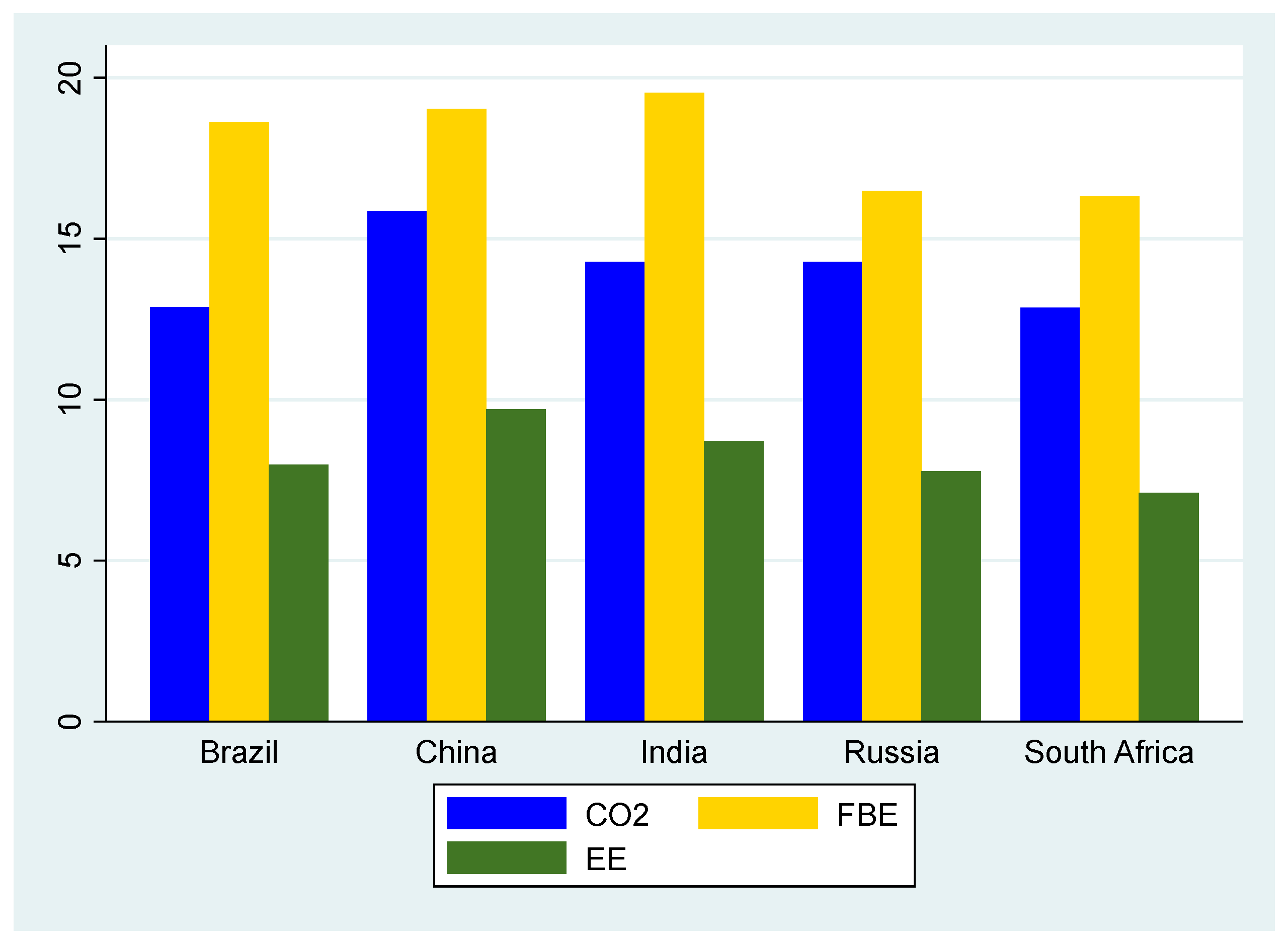
2, FBE, and EE are presented in
Figure 1. Higher carbon emissions and environmental education are observed in China, while India has the highest forest bioenergy compared to other countries. A few diagnostic plots for the dependent variable (CO
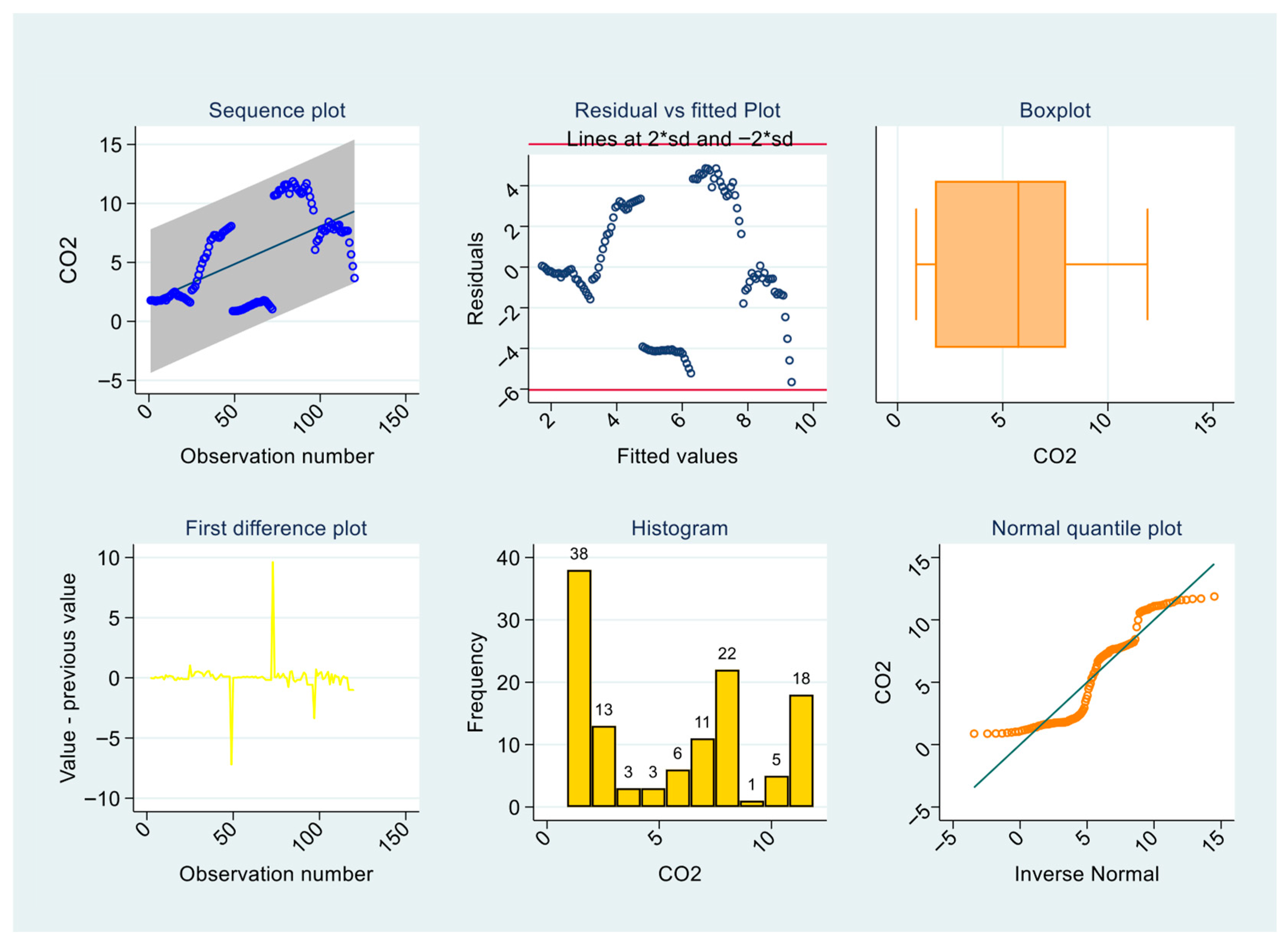
2) are also presented in
Figure 2 and show non-normality.
Figure 2 presents a set of diagnostic plots for the CO
2 series. The sequence plot shows that CO
2 exhibits a clear upward trend, indicating non-stationary behavior. The residual-versus-fitted plot reveals a non-linearity and heteroscedasticity. The boxplot highlights the presence of outliers. The first-difference plot reveals that differencing stabilizes the series. The histogram and normal quantile plot show that CO
2 values are non-normal. These results justify the appropriateness of the quantile regression methodology.
4. Empirical Results and Discussion
Table 2 shows the results of the CSD and slope homogeneity tests. The findings reveal that all variables in the analysis show CSD, meaning the BRICS countries are cross-sectionally dependent. There is only one exception; the indicator of FBE is not cross-sectionally dependent. Next, we conduct slope homogeneity tests to check if the slopes are the same across the selected countries. The test results reject slope homogeneity, indicating varying coefficients across cross-sections. There is only one exception: the EG indicator for the slope homogeneity hypothesis is not rejected. Next, we perform panel unit root tests to check whether the selected series are stationary.
Table 3 shows the results of the unit root tests. Because the sample has cross-sectional dependency, second-generation tests (CIPS and CADF) are used. The CIPS results show that CO
2, FBE, EE, NRR, and FD are non-stationary at level but become stationary at their first difference, while EG is stationary at level. This indicates a mixed order of integration. Similarly, the CADF results confirm that CO
2, FBE, EE, NRR, and FD are non-stationary at level but stationary at their first difference, while EG remains stationary at level. Since both tests show a mixed order of integration, the ARDL model is suitable for the analysis, as it handles such cases where no variable is integrated of order two. Also, a cross-sectionally adjusted ARDL model is applied because the data show cross-sectional dependency.
In the next step, the cointegration of the series is tested using the Westerlund cointegration test (
Table 4). It is a second-generation cointegration test that provides several statistics. The results show that the Gt and Pt statistics are significant at the 5% level, meaning the null hypothesis of no cointegration is rejected. Therefore, the selected series has a long-run relationship.
Table 5 shows the panel estimates of CO
2 emissions. The results are obtained using the CS-ARDL method, while PMG-ARDL and DCCE are applied for robustness checks. In the CS-ARDL model, the long-run coefficient of FBE shows that forest bioenergy has a negative and significant effect on CO
2 emissions in BRICS countries. The parameter estimate indicates that a 1% increase in FBE leads to a 2.192% decline in CO
2. According to Calvin et al. [
43], bioenergy can contribute meaningfully to climate change mitigation, provided it is produced and utilized in a sustainable manner. A key mechanism through which forest bioenergy reduces CO
2 emissions is fuel substitution, whereby wood biomass replaces fossil fuels such as coal, oil, or natural gas in energy production, thereby offsetting the fossil-derived CO
2 that would otherwise be released. These findings are supported by Berndes et al. [
12], who noted that bioenergy generated from forest residues and industrial by-products can substantially lower net carbon emissions compared to fossil fuel alternatives. Additionally, product substitution offers another important pathway for emission reduction, as using wood in construction and manufacturing can replace more carbon-intensive materials, such as steel and concrete. As noted by Sathre & O’Connor [
44], substituting wood for these materials not only locks carbon within long-lived products but also avoids the emissions associated with producing energy-intensive industrial materials. However, the climate benefits of forest bioenergy are not guaranteed and largely depend on the nature of the feedstock, land-use management practices, and the temporal scale of carbon accounting. Forest bioenergy derived from whole-tree harvests or from converting natural forests into energy plantations may lead to net increases in atmospheric CO
2 over extended periods, thereby diminishing its overall mitigation potential [
45].
The long-run coefficient on EE indicates that environmental education exerts a negative and significant influence on CO
2 in BRICS. The parameter estimate indicates that a one percent increase in EE leads to a 0.749 percent decline in CO
2. EE alters behaviors towards a clean environment, promotes sustainable development practices, and uplifts environmental awareness, thereby lowering pressure on the environment. With more environmental awareness, particularly an understanding of its harmful effects on humans, individuals consider effective energy use, reduce waste, and adopt an environmentally supporting lifestyle. This outcome is consistent with Liu et al. [
19] who demonstrated that citizens with EE prioritize clean energy sources over conventional energy sources, and therefore, alleviate pressure on CO
2. Moreover, Edsand & Broich [
20] suggested that environmentalists and policymakers who have EE are more likely to support regulations aimed at declining CO
2, enhancing energy efficiency, and supporting green technologies. This finding is consistent with the LCA theory, which suggests that citizens can enhance their EE by assessing the carbon emissions linked with the entire life cycle of products and services [
21].
The long-run coefficient of EG shows that economic growth has a positive and significant impact on CO
2 emissions in BRICS countries. A 1% increase in EG leads to a 0.213% rise in CO
2 emissions. A 1% increase in EG leads to a 0.213% rise in CO
2 emissions. As economies grow, people become more affluent, and they start consuming big-ticket items, significantly increasing the energy demand and CO
2 emissions [
46]. Likewise, due to higher demand, the production and investment activities also increase, which leads to enhanced energy consumption and ultimately the carbon intensity within the ecosystem. The effects of NRR and FD are not significant. For robustness, the PMG-ARDL model is also applied, and the key variables remain significant with the same signs. The DCCE results also confirm the main findings, showing that FBE has a strong and negative effect on CO
2 emissions. The impact of EE remains in the same direction but loses significance. The ECM coefficient shows that 55% of the disequilibrium is corrected each year, while in the PMG-ARDL model, 18% of the errors are adjusted annually.
Table 6 presents the results of the MMQR, illustrating the effects of FBE, EE, EG, NRR, and FD on CO
2 across 0.10 to 0.90 quantiles. The findings reveal that the coefficient of FBE is negative and highly significant at all quantiles, indicating that an increase in forest bioenergy is associated with a reduction in the dependent variable across the entire distribution. However, the magnitude of the negative effect becomes slightly stronger at higher quantiles. This pattern implies that the mitigating role of forest bioenergy intensifies as the level of the dependent variable increases, highlighting its stable contribution to emission reduction outcomes. Similarly, EE exhibits a strong and statistically significant negative effect on CO
2 across all quantiles. The coefficient increases in magnitude from the 0.10 quantile to the 0.90 quantile, indicating that improvements in energy education are more effective in higher quantiles. In contrast, EG has a positive and significant impact across all quantiles, with coefficients rising gradually from the 0.10 quantile to the 0.90 quantile. This consistent positive relationship implies that higher economic activity contributes to increases in CO
2 emissions, though the effect remains modest in magnitude, reflecting a relatively stable impact across the distribution. NRR displays a negative but statistically insignificant effect on CO
2 throughout all quantiles. Lastly, FD shows a significantly positive impact on CO
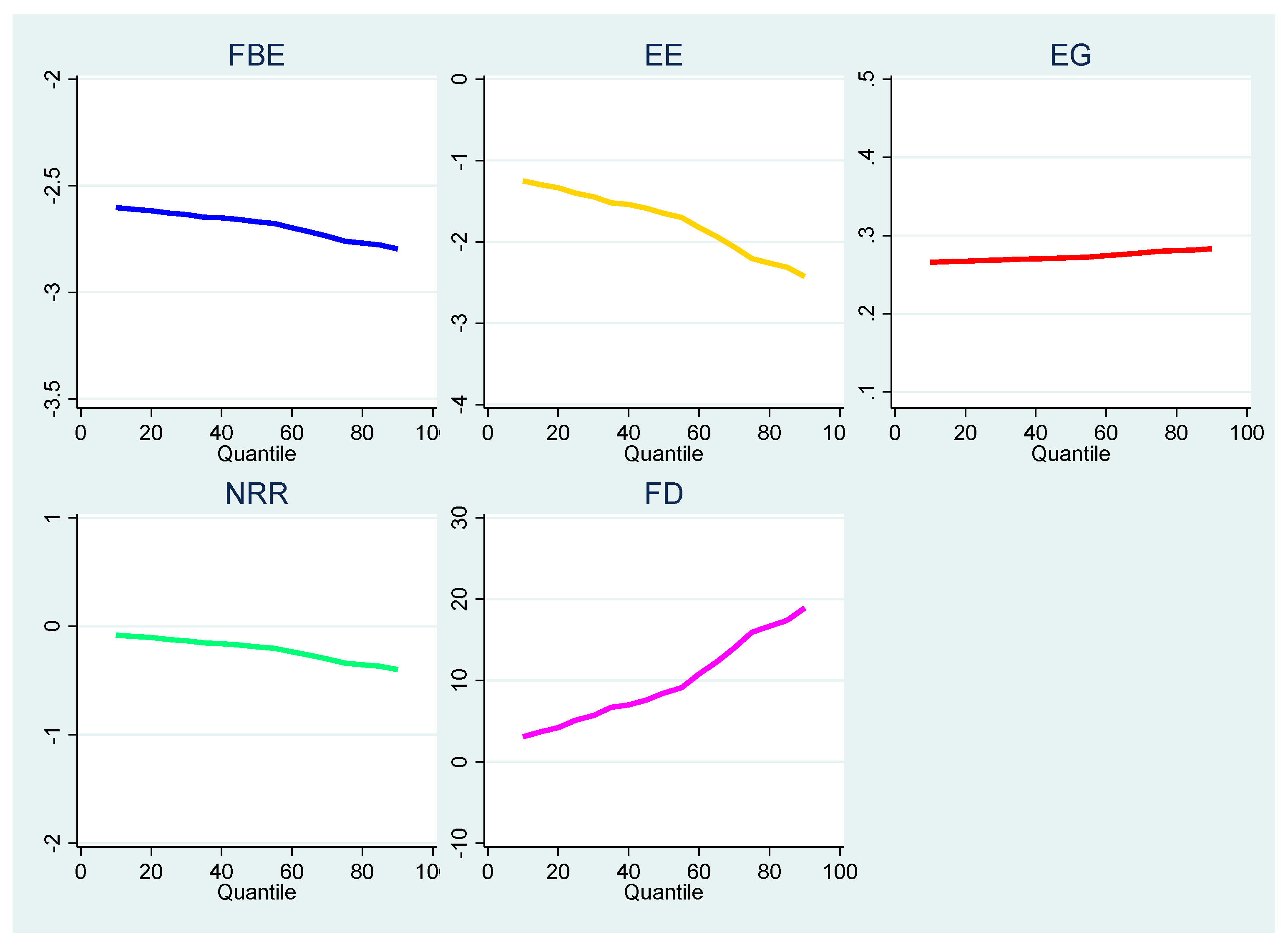
2 across all quantiles except 0.10. The magnitude of the coefficient increases from the 0.20 quantile to the 0.90 quantile, revealing that financial development intensifies carbon emissions at higher quantiles. MMQR results in graphs are presented in
Figure 3.
Figure 3 highlights the outcomes of the MMQR in graphical form. The figure confirms the negative connection between the forest bioenergy and CO
2 emissions, and the negative connection is increasing from the lowest to the highest quantiles. Likewise, environmental education causes the CO
2 emissions to fall as the relationship between the two is negative and increasing from the lowest to the highest quantiles. In addition, a negative relationship is also observed between natural resource rent and CO
2 emissions. On the other hand, the economic growth fosters CO
2 emissions, and the relationship between the two factors remains stable from the 10th to the 90th quantiles. Also, the relationship between financial development and CO
2 emissions is positive and increasing from the lowest to the highest quantiles.
Table 7 reports country-specific estimates of CO
2 based on ARDL. FBE had significant negative effects on CO
2 in the case of Brazil, India, and China. Comparatively, its effect is strong in the case of China. In the case of Russia and South Africa, its effects were insignificant. These findings support baseline collective findings. EE has negative and significant effects in the case of Russia and China, suggesting that only two economies are demonstrating the favorable role of EE in environmental quality. Interestingly, in India, EE has a positive and significant effect on CO
2 emissions. This result agrees with Zhang et al. [
47], who also found a positive link between education and CO
2 using data from 48 developing countries. However, in Brazil and South Africa, the effect of EE on CO
2 is not significant. In the LR, EG exhibits a significantly positive effect on CO
2 emissions in Brazil, Russia, India, and China, indicating that economic expansion contributes to higher emission levels in these economies. NRR shows a significantly positive relationship with CO
2 emissions in Brazil but a significantly negative one in China, revealing that resource dependence intensifies emissions in Brazil while helping to mitigate them in China. FD also displays a significantly positive association with CO
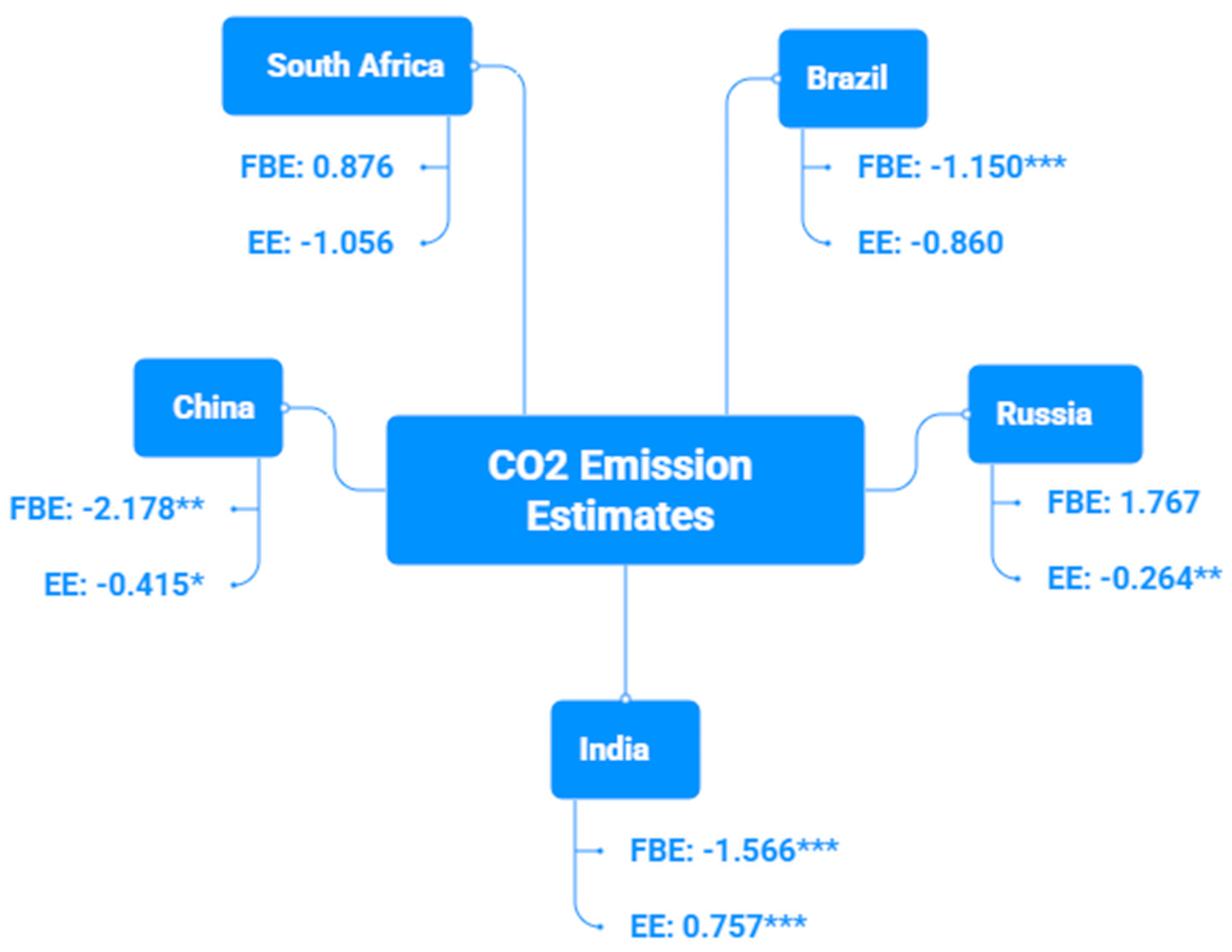
2 emissions in both Brazil and China, implying that advancements in the financial sector are linked to increased environmental pressures in these countries. The summary of key results is reported in
Figure 4.
In the SR, FBE and EE are found to have a significantly negative relationship with CO2 emissions only in India, reflecting their role in reducing emissions in the SR. Conversely, EG maintains a significantly positive association with CO2 emissions in Brazil and Russia, confirming the persistence of growth-induced environmental degradation in these economies. Again, NRR shows a significantly positive effect on CO2 emissions in Brazil but a significantly negative one in Russia. However, the relationship between NRR and CO2 emissions is statistically insignificant across all economies in the SR.
The diagnostic test results presented in the lower panel of
Table 7 indicate that all ECM (−1) coefficients are negative, as expected. The magnitude of these ECM coefficients indicates that 0.123% of disequilibrium will be corrected within 1 year in Brazil, 0.253% in Russia, 0.517% in India, 0.640% in China, and 0.260% in South Africa. Findings further illustrate the absence of autocorrelation across all BRICS economies, as indicated by the results of the Lagrange Multiplier (LM) test. Likewise, the correct model specification is evident from the outcomes of the Ramsey Regression Equation Specification Error Test (RESET). Further, the cumulative sum (CUSUM) and cumulative sum squares (CUSUM-sq) findings confirm the stability of the models.
The summary of key results is reported in
Figure 4. In China, the FBE coefficient is −2.178, which indicates that a 1% increase in forest bioenergy use is associated with a 2.178 reduction in CO
2 emissions. In China, the EE estimate is −0.415, which states that a 1% rise in EE reduces CO
2 emissions by 0.415%. India similarly shows a strong negative and significant FBE coefficient (i.e., −1.566), meaning FBE effectively lowers emissions by 1.566%; however, the positive EE coefficient (i.e., 0.757) reveals that 1% increase in environmental education is linked with a 0.757% increase in CO
2 emissions. In Brazil, the FBE coefficient is −1.150, which confirms a significant emission-reducing role; although the EE coefficient is −0.860, the effect is statistically insignificant. Conversely, the FBE effect on CO
2 emissions is found to be insignificant in Russia, while EE (−0.264 **) significantly reduces emissions. Finally, FBE and EE exhibit an insignificant effect on CO
2 in South Africa.
5. Conclusions and Implications
Global policymakers face the urgent challenge of worsening climate change and rising temperatures, largely driven by CO2 and other greenhouse gas emissions. The 2015 Paris Agreement requires countries to cut emissions by 2030 and pursue net-zero, or carbon neutrality, by 2050. Against this backdrop, this study examines how forest bioenergy and environmental education support carbon neutrality in BRICS economies. In order to empirically examine the nexus, we employ the CS-ARDL approach. The summary of our main findings is as follows.
First, forest bioenergy and CO2 are negatively related to each other, suggesting that enhanced forest bioenergy contributes to the carbon neutrality objective.
Second, environmental education is crucial for reducing CO2 and thus helps in achieving carbon neutrality objectives.
Lastly, economic growth is detrimental to the carbon neutrality objective, whereas natural resources rent is favorable to the objective. At the same time, financial development has an insignificant impact on CO2.
The following policy implications are derived from the study’s findings. Governments should advocate for sustainable forest bioenergy and environmental education as fundamental instruments for achieving carbon neutrality. In this regard, it is suggested that the government should enhance incentives for certified forest bioenergy, while educational institutions, media, and training programs can gather public support for low-carbon alternatives. Policymakers should also promote local biomass initiatives using forest leftovers, implement stringent ecological laws, and promote modern and efficient boilers to ensure that forest bioenergy effectively reduces CO2 emissions. The governments of BRICS economies should focus on enhancing the general education level, which is important in creating awareness of keeping the environment clean and green. The government should work with universities to introduce dedicated environmental education courses and integrate them into existing degree programs. Research and innovation policies must prioritize improving bioenergy conversion efficiency, while increased public and private investment in these technologies can boost energy output and lower the carbon footprint. Also, economic expansion increases CO2 emissions, requiring the government to move towards green growth methods and implement more stringent emission regulations. Further, we also suggest that the government should utilize revenues from natural resource rents need to be used for reforestation and renewable energy, while banking reforms should prioritize stability over credit growth.
The study has made a significant contribution, yet has certain limitations. First and foremost, the macroeconomic variables are mostly asymmetric in nature. Although we have employed the MMQR, which can capture the asymmetric influence, the linear assumption within the CS-ARDL, PMG-ARDL, and DCCE does not justify the application of the MMQR. Therefore, future analysis must use the asymmetric assumption within CS-ARDL, PMG-ARDL, and DCCE while estimating the nexus. Second, the study estimates the nexus in BRICS economies, which are emerging economies, and overlooks the advanced economies, limiting the scope of the study. Thus, in order to obtain more valuable information regarding the impact of bioenergy forests and environmental education on CO2 emissions within varying socio-economic and political environments, the future analysis must focus on the comparative analysis between advanced and emerging economies. Lastly, in our empirical analysis, EE is proxied using the number of scientific publications related to environmental topics. We acknowledge that this indicator primarily reflects academic research activity rather than the broader societal level of environmental education. Future research should incorporate more comprehensive and direct measures, such as public expenditure on environmental education, the number of instructional hours, or outreach activities, to better reflect the societal penetration of environmental education.