


Abstract
Korean wooden architectural heritage buildings are often damaged by termites, and climate change is expected to exacerbate the problem. To prevent termite damage, it is necessary to identify the habitat range and activity period of termites. In this study, we comprehensively analyzed the ecological characteristics of Reticulitermes speratus, the dominant termite species in South Korea, past termite damage records of wooden architectural heritage buildings, and climate data (2000–2019). We determined that termite infestations could potentially occur in 98.5% of the total studied area, except for a few mountainous regions in South Korea. In addition, termites were active for an average of 209 days per year. The habitat range of termites appears to be gradually expanding, possibly as a result of a combination of anthropogenic interventions, rising temperatures caused by climate change, and the ecological characteristics of termites. In the future, it is imperative to implement enhanced preventive and active termite control measures to preserve the original wooden architectural heritage buildings of South Korea.
1. Introduction
Termites are the leading cause of damage to wooden buildings and result in considerable economic losses. Although they are important decomposers in the ecosystem by effectively disintegrating plant material [1], the economic loss caused by termites is estimated to reach up to $40 billion annually [2]. Termites also pose a considerable threat to wooden architectural heritage buildings worldwide. Termite damage to wooden architectural buildings has been reported in China [3], Taiwan [4], Japan [5], and Southeast Asia [6]. In South Korea, termite damage to wooden architectural heritage buildings has been continuously confirmed since the 1980s [7,8,9,10]. A comprehensive analysis of biological damage surveys revealed that 51% of national wooden architectural heritage buildings presented evidence of termite damage [11]. Furthermore, climate change and the introduction of invasive species are anticipated to increase termite-induced damage to wooden architectural heritage buildings [12].
To date, a total of two families (Rhinotermitidae, Kalotermitidae), three genera (Reticulitermes, Glyptotermes, Incisitermes), and four species (Reticulitermes speratus, Reticulitermes kanmonensis, Glyptotermes nakajimai, Incisitermes minor) of termites have been confirmed in South Korea (Table 1). Of these, the latter three species have only been recently discovered (since the 2010s) and are found in a small number of locations. Conversely, the presence of R. speratus in Korea has been confirmed as early as the 1920s, and being a dominant species found throughout the country, it is widely considered to be the primary cause of the deterioration of wooden architectural heritage buildings [13].
Table 1.
Distribution of termite (Blattodea: Isoptera) species in South Korea.
Reticulitermes speratus is a kind of subterranean termite. They make many nests that are connected by galleries within wood or underground. Their workers explore their surroundings to find food sources, a process called foraging. During this process, they enter the surrounding wood structures and cause damage. R. speratus is widely distributed in Far East Asia, including Japan and northern China, as well as South Korea, where it causes damage to wooden structures [14]. Therefore, various studies have been conducted on the distribution range of this species in order to characterize its ecology and effectively control it. Consequently, the distribution range of this species was estimated to include areas where the mean temperature during January, the coldest month of the year, was at least −4 °C [20,21,22]. Based on this, the latitudinal limit of termite distribution in South Korea was estimated to be around the city of Chuncheon (37.88° N, 127.73° E) [23]. However, since the 2000s, colonies of R. speratus and damaged wooden buildings have been identified in places with mean temperature in the coldest month below −4 °C, such as Asashigawa in Hokkaido [24] and Sugadaira highland in Honshu [25]. Accordingly, Ohmura [26] investigated termite damage and infestations in Japan and found that the distribution of R. speratus was wider than previously estimated.
Similar cases have been identified in China. Termite damage in China has predominantly been observed in the southeast, whereas termite infestations have not been confirmed in the northeast due to the prevailing cold and dry winter; however, the termite distribution range has expanded to the northeast since the 2000s [27]. Termite infestations and damage have been confirmed in the Forbidden City in Beijing [28], and in 2012, termites were found in Gongzhuling, Jilin Sheng (43.2–44.2° N, 124.0–125.3° E) in Jilin Province. Of note, the mean January temperature in this area is cold, reaching approximately −10 °C, and is considered the northern limit of termite distribution in China [27].
Temperature exerts influence over the habitat range and activity period of termites [29,30]; consequently, climate change is expected to expand the habitat range of termites and prolong their activity period [31]. In a recent study, a 10 °C increase in the average annual temperature led to an approximately 6.8-fold increase in wood decomposition by termites [32]. In South Korea, the annual mean temperature has increased by 1.5 ℃ over the past 100 years, with the average temperature in January, the coldest month, being increased by 2.1 °C, which is estimated to have increased the activity period of termites by approximately 16 days [33]. In addition, the change in the activity period of termites over the past 40 years (1980−2019) in 106 national state-designated wooden architectural heritage buildings located in 84 cities and counties nationwide was estimated to have increased by approximately 9.2 days, from 243.3 to 252.5 days [34].
Termite damage is occurring in most wooden architectural heritage buildings in South Korea, with termites expanding their distribution range and prolonging their activity period. To reduce termite damage and preserve architectural heritage buildings, it is crucial to determine the range of termites in South Korea; however, no comprehensive study has been conducted on the distribution range of termites in South Korea. Therefore, in this study, we investigated the termite-induced damage status of important wooden architectural heritage buildings in South Korea and the temperature of each building throughout the year and estimated the habitat range and activity period of termites.
2. Research Site and Methods
2.1. Research Site
2.1.1. Study Area
South Korea is located in the mid-latitude region on the eastern edge of the Eurasian continent. Consequently, its climate is characterized by cold, dry winters and hot, rainy summers due to continental and oceanic influences. Due to its geographic location as a peninsula, the coastal regions surrounding the Korean Peninsula experience diverse maritime influences throughout the year, whereas the inland areas exhibit a distinct contrast, which can be attributed to a combination of seasonal wind changes and undulating topography [35]. Complex mountainous terrain covers approximately 70% of the Korean territory; despite the average elevation of the Korean Peninsula (448 m) not exceeding the overall average for East Asia (910 m), its relatively steep slopes and complex structural features contribute to its high diversity [36].
2.1.2. Wooden Architectural Heritage Buildings in South Korea
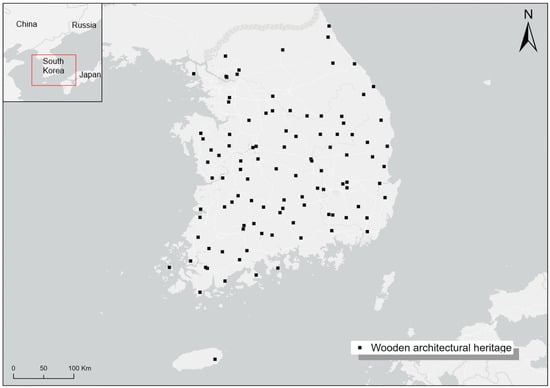
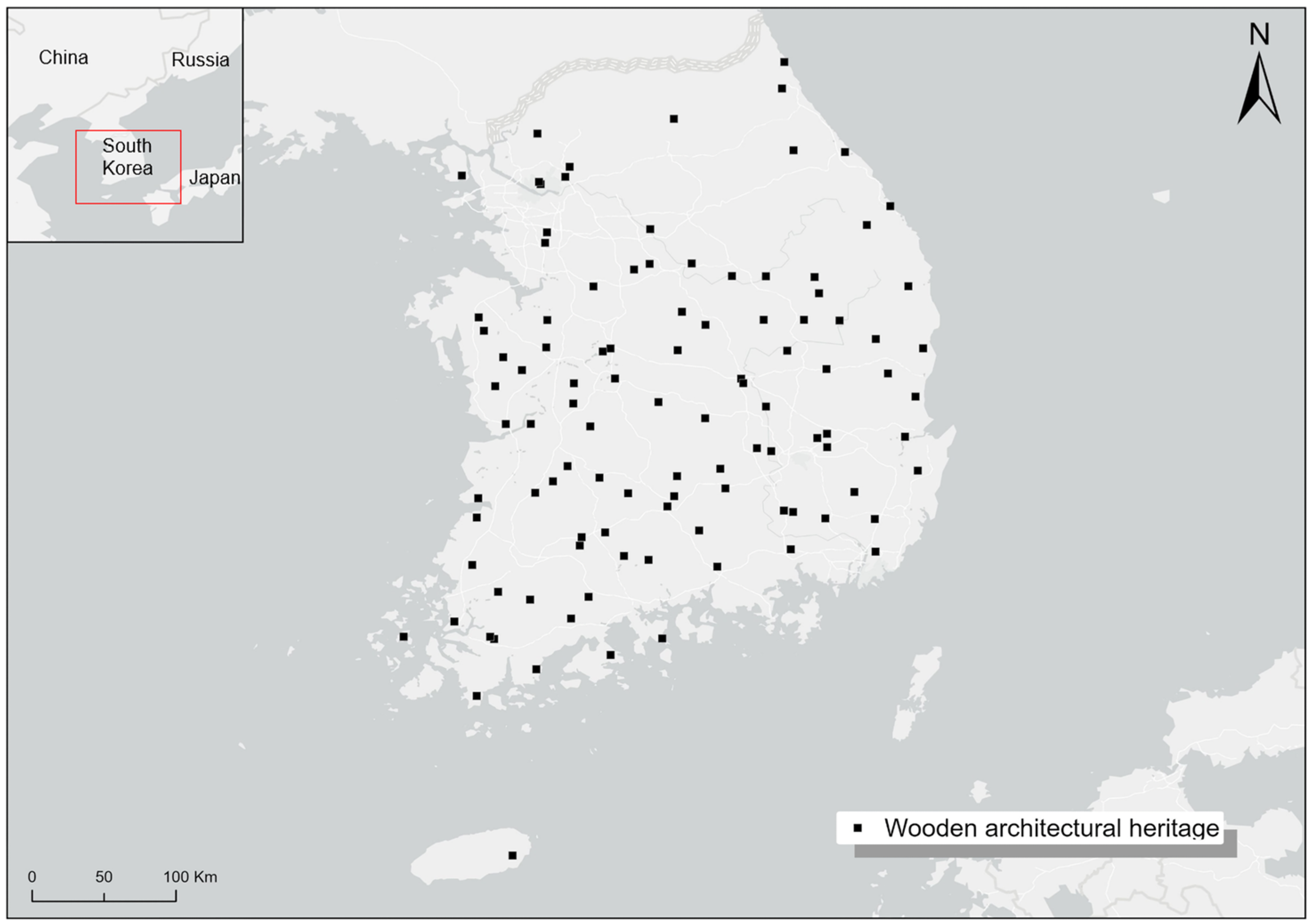
A total of 449 state-designated wooden architectural heritage buildings are found in South Korea (25 National Treasures, 230 Treasures, and 194 National Folk Cultural Properties) [37]. In this study, 104 sites (16 National treasures, 53 Treasures, 34 National Folk Cultural Properties, and one Historic Site) were selected from nine provinces and 94 counties, taking into account the geographical distribution (Figure 1). A detailed list is provided in Appendix A (Table A1).
Figure 1.
Location of research subjects (104 Wooden Architectural Heritage Buildings in South Korea).
2.2. Methods
2.2.1. Determining the Status of Termite Damage in Wooden Architectural Heritage Buildings
The current status of termite damage to wooden architectural heritage buildings was confirmed through the “Report on the Investigation of Species Causing Damage to Wooden Cultural Heritage” (NRICH, 2017−2022), which was conducted by the National Research Institute of Cultural Heritage. This study identified termite damage to wooden structures adjacent to individual heritage buildings and termite infestations in the surrounding forests. If termite damage or colonies were confirmed at least once in the case of a heritage building site that was inspected more than twice, the building was considered as a place of possible termite infestation.
2.2.2. Estimation of Outdoor Temperature at the Sites of Wooden Architectural Heritage Buildings Studied
The daily mean temperature for each architectural heritage building site was derived by collecting and processing MK−PRISM climate data provided by the Korea Meteorological Administration Climate Information Portal [38]. MK−PRISM data refer to a modified version of the Parameter-elevation Regression on Independent Slopes Model (PRISM) specifically tailored for South Korea; it takes into account factors such as the effects of altitude, distance, orientation, and oceanicity on local climate and has been modified to fit the 1 km grid of South Korea [38]. Currently, climate data available for the last 20 years from 2000 to 2019 are provided from MK-PRISM at 1 km × 1 km spatial resolution. From this data, we obtained daily mean temperature data for 104 wooden architectural heritage building sites.
2.2.3. Analysis of Thermal Limit of Termite Distribution
The thermal limit of termite distribution is determined by temperature during the coldest period. Using the termite damage records of heritage building sites and the Monthly Mean Temperature (MMT) value in January (the coldest month for all 104 heritage building sites), the lowest temperature at which termites can be active was determined.
2.2.4. Mapping the Termite Distribution Range
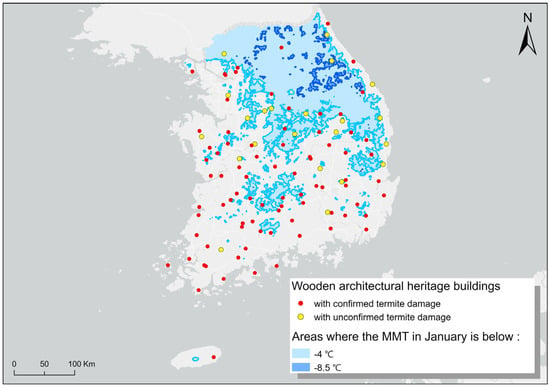
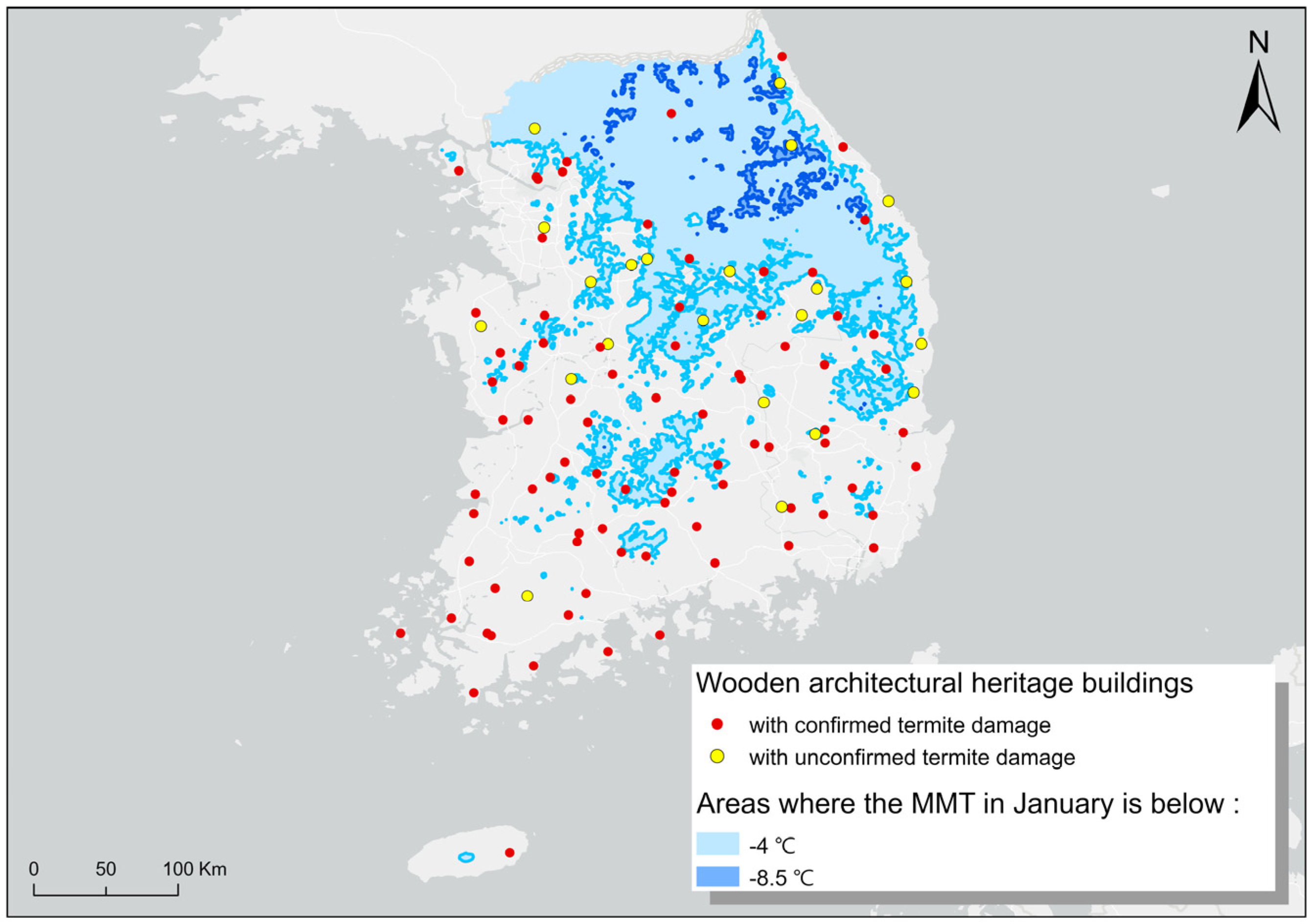
For each architectural heritage building identified above, the distribution range of termites in South Korea was mapped based on the results of the termite damage investigation and the MMT in January for the last 20 years. The map was created using ArcGIS Pro 3.2.2, the latest software in the ESRI GIS family (ESRI, Redlands, CA, USA) (Figure 2).
Figure 2.
Range of monthly mean temperature (MMT) in January over the last 20 years (2000–2019) and termite damage records of wooden architectural heritage buildings.
2.2.5. Calculating the Number of Days Available for Termite Activity at Each Wooden Architectural Heritage Building Site
The activity period of termites at each heritage was estimated to be consistent with the findings reported in previous studies [33,34]. Previous studies on termite survival rate and wood consumption by temperature [23,39] showed a high survival rate at 10–30 °C, with temperature values and wood consumption exhibiting a proportional correlation. Therefore, in this study, the period with a mean daily temperature of 10–30 °C was defined as the “number of days available for termite activity (NDATA)”. The NDATA was calculated using climate data for each architectural heritage building site.
3. Results
3.1. Outdoor Temperature at All Sites of the 104 Heritage Wood Buildings Studied
The monthly and annual mean temperatures of a total of 104 wooden architectural heritage buildings are presented in Appendix A (Table A2). The lowest MMT across all destinations was in January. From April to October, the monthly MMT at heritage building sites nationwide was over 11 °C, confirming that R. speratus was active on the ground nationwide. In March and November, the MMT nationwide was 5–7 °C, with deviations in temperature by region, indicating that the termite activity period was likely to differ across regions.
In order to examine the regional characteristics within South Korea, representative wooden architectural heritage buildings were selected from nine regions and their temperature distributions were examined. The monthly and annual mean temperatures at nine major heritage building sites are shown in Table 2. Gangwon-do had the lowest monthly and annual mean temperatures. This could be attributed to the fact that many architectural heritage buildings in the region are located at high latitudes and elevations. In contrast, Jeollanam-do had the highest temperature distribution showing the highest monthly and annual mean temperatures on the Korean Peninsula owing to the large number of architectural heritage buildings located at lower latitudes and elevations. Jeju Island is a volcanic island located approximately 80 km south of the Korean Peninsula, and its architectural heritage buildings are located along the coast, resulting in the highest mean monthly and annual temperatures of wooden heritage building sites in the country owing to their distribution in low latitudes and elevations.
Table 2.
Monthly mean temperature of major wooden architectural heritage buildings by region using MK-PRISM data (Unit: °C).
3.2. Termite Damage and Distribution Range
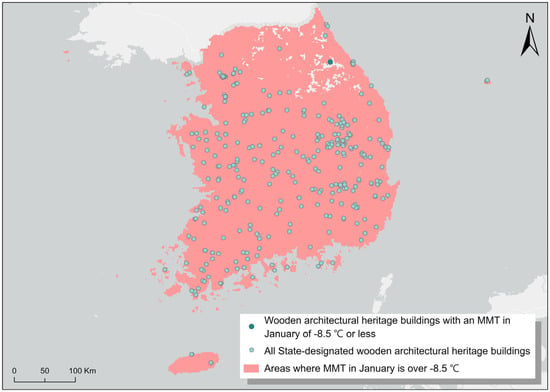
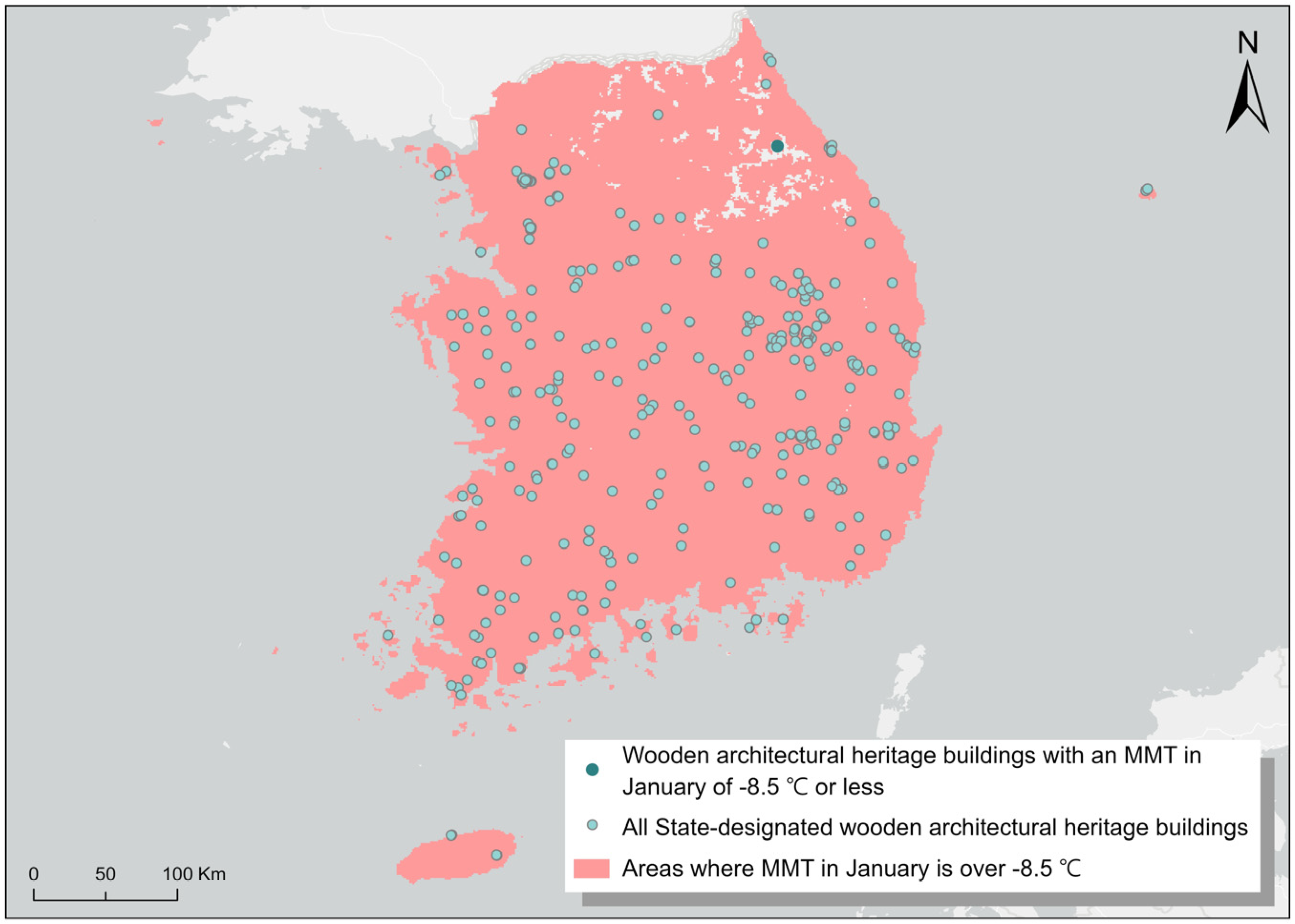
Of the 104 sites studied, 83 (79.8%) showed termite damage to the architectural heritage buildings or neighboring wooden buildings. There are 17 heritage building sites located in areas where the MMT is below −4 °C, 12 (70.5%) of which termite damage was detected despite such a cold environment (Table 3). In particular, termite damage was confirmed in the architectural heritage buildings or neighboring buildings at the House with an Oak Bark Roof in Daei−ri, Samcheok, with an MMT in January of −8.5 °C, and Hoejeonmun Gate of Cheongpyeongsa Temple, Chuncheon, with an MMT in January of −7.5 °C. This finding suggested that termites may have a wider distribution range than expected. Based on these results, the distribution range of termites in South Korea was estimated to be 95,941 km2, accounting for 98.5% of the total land area of South Korea, 97,377 km2 (Figure 3). Of the 449 state-designated wooden architectural heritage buildings in South Korea, only one, Jeokmyeolbogung Hall of Jungdae Terrace in Odaesan Mountain, Pyeongchang (Treasure), shows an MMT lower than −8.5 °C in January, whereas the remaining 448 are all within the temperature range for termite damage.
Table 3.
Wooden architectural heritage buildings in Korea with a monthly mean temperature of −4 °C or less in January.
Figure 3.
Location of state-designated wooden architectural heritage buildings in South Korea and potential range of termite damage.
3.3. Number of Days Available for Termite Activity at Each Wooden Architectural Heritage Building Site
The number of days available for termite activity at each architectural heritage building site ranged from 138 to 249 days, with an average of 209 days (Table 4 and Table 5). Among the tested sites, Jeokmyeolbogung Hall of Jungdae Terrace in Odaesan Mountain, Pyeongchang, had the shortest termite activity period of 138 days. This site is located at an elevation of 1180 m and had an MMT of −10.4 °C in January, which was the lowest among all tested sites. Excluding this location, the remaining 103 termite activity periods ranged from 165 to 249 days. Therefore, termites might be active in the ground for approximately five to eight months, although this period varies by region.
Table 4.
Distribution of the number of days available for termite activity at major wooden architectural heritage buildings in South Korea.
Table 5.
Number of days available for termite activity at wooden architectural heritage building sites by region.
4. Discussion and Conclusions
In this study, 104 wooden architectural heritage buildings in 94 counties in South Korea were selected to determine the damage caused by R. speratus. The distribution range and activity period of termites were estimated by examining the extent of damage caused, as well as the MMT at each site throughout a period of 20 years. Consequently, approximately 80% of sites were found to have termite damage to the heritage or neighboring buildings, confirming the occurrence of termite damage in wooden architectural heritage buildings across almost all regions of South Korea.
In addition, termite damage was confirmed in the architectural heritage buildings or surrounding buildings in 12 of the 17 sites with MMT lower than −4 °C, which was previously considered the thermal limit for R. speratus distribution. In particular, R. speratus damage was confirmed in places with MMTs of −7.5 and −8.5 °C in January, suggesting that the species is widely distributed throughout South Korea, with few exceptions in certain mountainous areas. Of the 449 state-designated wooden architectural heritage buildings, except for the Jeokmyeolbogung Hall of Jungdae Terrace in Odaesan Mountain, Pyeongchang, all the others were within the temperature range conducive to potential termite damage. This termite damage risk is wider than that reported in the study by Lee and Jeong [23], who estimated the northern limit of termite distribution in South Korea to be near Chuncheon (MMT of −4.4 °C in January).
This study and other recent studies in Japan, China, and elsewhere have confirmed the gradually expanding distribution range of R. speratus. This could be attributed to a combination of environmental changes, termite ecology, and other factors. Urbanization and anthropogenic interventions, such as alterations in land cover and improvements in home insulation, have led to a reduction in the extent of freezing and increased temperatures, which may have facilitated the infestations of urban centers in colder regions by termites, which were previously absent from these areas [40].
Termites possess the ability to survive the cold of winter through a variety of strategies at the individual and colony levels. At the individual level, termites have the ability to alter the composition of their carbohydrate metabolites as well as balance their body water content and total lipids as a physiological strategy to adapt to the cold [41]. In addition, an evaluation of termite survival in response to temperature changes revealed a substantial decrease in their survival during short-term cold exposure when temperatures were lower than −8 °C for kings and queens and lower than −4 °C for soldiers and worker ants [42]. Even when subject to low temperatures, termites require a specific duration to die. Due to their social nature, termites are not readily exposed to low temperatures that might lead to freezing.
At the colony level, R. speratus forms multiple-site nesting connecting several wood resources by underground tunnels [43]. This elaborate nest structure plays a crucial role in regulating fluctuations in the outside temperature and creating a favorable microenvironment for the survival of termites. Subterranean termites also move their habitat in response to temperature changes. During winter, the ground temperature consistently remains higher than the air temperature, leading to less variation. As a result, it is expected that subterranean termites will descend into the deep underground where temperatures are relatively high in order to overwinter [44]. Eastern subterranean termites (R. flavipes) have been found to descend to 1 m underground [45], whereas Formosan subterranean termites (C. formosanus) and Eastern subterranean worker ants move progressively deeper into the ground as air temperatures decrease [46].
A recent study of R. speratus showed similar results. The king and queen stayed in their terrestrial habitat during the summer months. However, during the winter months, they moved to the underground royal chamber, where the temperature remained consistently high compared to the outside environment. The royal chamber, where the king and queen wintered, was located 15 to 37 cm below ground, and the inside temperature remained stable at 5 to 10 °C during January and February [42]. Due to their social nature, termites are not readily exposed to low temperatures that might lead to freezing.
As termites are well-adapted to cold climates, their distribution range is likely to expand with climate change. The longer termites are exposed to suitable temperature conditions, the more active they become, and as a result, they can forage more effectively [47]. The increase in winter minimum temperatures due to global warming is expected to increase the active period of forest insects including termites and expand their distribution range [48]. The daily mean temperature in South Korea in winter is exhibiting a sustained long-term trend characterized by increasing temperatures and a decrease in the number of cold days [49,50]. In particular, recent studies have confirmed a trend of a 2.1 °C increase in winter mean temperatures since the mid-1980s [51]. This increase in winter temperatures in South Korea appears to lead to an expansion in the activity range and period of termites.
This study confirmed that termites can inhabit almost all areas of South Korea currently and that most wooden architectural heritage buildings pose to potential threat to termite infestation. Termite damage is expected to increase further due to climate change and the introduction of invasive species. Therefore, proactive and preventive measures for termite control are needed to preserve the original wooden architectural heritage buildings.
Author Contributions
Conceptualization, S.K. and J.K.; methodology, S.K. and J.K.; software, S.K. and J.K.; validation, S.K. and J.K.; formal analysis, S.K. and J.K.; investigation, S.K. and J.K.; resources, S.K.; data curation, S.K. and J.K.; writing—original draft preparation, S.K.; writing—review and editing, S.K. and J.K.; visualization, S.K. and J.K.; supervision, J.K.; project administration, S.K.; funding acquisition, S.K. All authors have read and agreed to the published version of the manuscript.
Funding
This study was supported by the National Research Institute of Cultural Heritage (NRICH-2405-A62F-1).
Data Availability Statement
Data are available on request from the first author.
Acknowledgments
The authors are thankful for administrative support from the National Research Institute of Cultural Heritage.
Conflicts of Interest
The authors declare no conflicts of interest.
Appendix A
Table A1.
Monthly mean temperature of wooden architectural heritage building sites in Korea in the last 20 years (2000–2019).
Table A2.
Days of termite activity in wooden architectural heritage building sites in Korea.
References
- Brune, A. Symbiotic digestion of lignocellulose in termite guts. Nat. Rev. Microbiol. 2014, 12, 168–180. [Google Scholar] [CrossRef] [Scilit] [PubMed]
- Rust, M.K.; Su, N.Y. Managing social insects of urban importance. Annu. Rev. Entomol. 2012, 57, 355–375. [Google Scholar] [CrossRef] [Scilit] [PubMed]
- Zhong, J.H.; Liu, L.L. Termite fauna in china and their economic importance. Sociobiology 2002, 40, 25–32. [Google Scholar]
- Li, H.F.; Su, N.Y.; Wen-Jer, W.; Err-Lieh, L. Termite pests and their control in Taiwan. Sociobiology 2011, 57, 575–586. [Google Scholar]
- Takahashi, M.; Yoshimura, T. Recent development in the control of Japanese subterranean termites. Sociobiology 2002, 40, 13–24. [Google Scholar]
- Kuswanto, E.; Ahmad, I.; Dungani, R. Threat of subterranean termites attack in the Asian countries and their control: A review. Asian J. Appl. Sci. 2015, 8, 227–239. [Google Scholar] [CrossRef] [Scilit]
- Han, S.; Lee, K.; Chung, Y. Characteristic of termite inhabits in South Korea and the control. Conserv. Stud. 1998, 19, 133–158. [Google Scholar]
- Lee, K.; Jeong, S.; Chung, Y. Termite monitoring and control managements for wooden building. Conserv. Stud. 2001, 22, 41–52. [Google Scholar]
- Kim, D.; Jeong, S.; Lee, S.; Chung, Y. Study on the adaption technique for detection of termites using microwave. Conserv. Sci. 2010, 26, 77–83. [Google Scholar]
- Im, I.; Cha, H.; Kang, W.; Lee, S.; Han, G. The status of damage and monitoring of subterranean termite (Reticulitermes spp.) (Blattodea: Rhinotermitidae) for wooden cultural heritage in Korea. J. Conserv. Sci. 2021, 37, 191–208. [Google Scholar] [CrossRef] [Scilit]
- Kim, S.; Chung, Y. An analysis of termite (R. speratus kyushuensis) damage to nationally designated wooden architectural heritage in Korea. MUNHWAJAE (Korean J. Cult. Herit. Stud.) 2022, 55, 102–111. [Google Scholar] [CrossRef]
- Kim, S.; Lee, S. Introduction of invasive termite and threat of wooden architectural heritage. J. Soc. Cult. Herit. Disaster Prev. 2019, 4, 139–147. [Google Scholar]
- Kim, S.; Chung, Y. Analysis of factors affecting termite damage to Wooden architectural heritage buildings in Korea. Forests 2022, 13, 465. [Google Scholar] [CrossRef] [Scilit]
- Morimoto, K. Termites of the genus Reticulitermes of Japan and Taiwan. Bull. Gov. For. Exp. Stn. 1968, 217, 43–73. [Google Scholar]
- Park, Y.C.; Kitade, O.; Schwarz, M.; Kim, J.P.; Kim, W. Intraspecific molecular phylogeny, genetic variation and phylogeography of Reticulitermes speratus (Isoptera: Rhinotermitidae). Mol. Cells 2006, 21, 89–103. [Google Scholar] [CrossRef] [Scilit] [PubMed]
- Kim, M.; Choi, Y.; Lee, J.; Kim, J.; Kim, G. Molecular characteristics of subterranean termites of the genus Reticulitermes (Isoptera: Rhinotermitidae) from Korea. Ann. Entomol. Soc. Am. 2012, 105, 97–102. [Google Scholar] [CrossRef] [Scilit]
- Lee, W.; Choi, D.; Ji, J.; Kim, N.; Han, J.M.; Park, S.; Lee, S.; Seo, M.S.; Hwang, W.; Forschler, B.T.; et al. A new record of Reticulitermes kanmonensis Takematsu, 1999 (Isoptera: Rhinotermitidae) from Korea. J. Asia Pac. Entomol. 2015, 18, 351–359. [Google Scholar] [CrossRef] [Scilit]
- Shim, J.; Park, H.; Ju, H.; Song, J. First record of the termite family Kalotermitidae (Blattodea: Termitoidae) in Korea. J. Asia Pac. Entomol. 2021, 24, 1266–1269. [Google Scholar] [CrossRef] [Scilit]
- Ministry of the Environment. Results of the Joint Investigation on Invasive Termites in Changwon. 26 September 2023. Available online: http://27.101.216.209/home/web/board/read.do?pagerOffset=0&maxPageItems=10&maxIndexPages=10&searchKey=title&searchValue=%ED%9D%B0%EA%B0%9C%EB%AF%B8&menuId=10525&orgCd=&boardId=1626430&boardMasterId=1&boardCategoryId=39&decorator= (accessed on 10 October 2023).
- Ikehara, S. Distribution of Termites in the Ryukyu Archipelago. Bull. Arts Sci. Math. Nat. Sci. Ryukyu Univ. Div. 1966, 9, 49–178. [Google Scholar]
- Morimoto, K. Biology of termites in the Far East. Rev. Plant Prot. Res. 1975, 8, 29–40. [Google Scholar]
- Matsumoto, T. Biology of Termites and Ants in Ecology of Social Insects; Penfukan Publishing: Tokyo, Japan, 1983. [Google Scholar]
- Lee, K.; Jeong, S. Ecological characteristics of termite (Reticulitermes speratus kyushuensis) for preservation of wooden cultural heritage. MUNHWAJAE (Korean J. Cult. Herit. Stud.) 2004, 37, 327–348. [Google Scholar] [CrossRef]
- Japan Wood Protection Association. Comprehensive Verification Committee of Wooden Long-Term High Quality Housing-Material Committee [2012 Annual Report]; Japan Wood Protection Association: Tokyo, Japan, 2013; Volume 2012. [Google Scholar]
- Takagi, E.; Ogai, T. New distribution record of Reticulitermes speratus Kolbe (Isoptera: Rhinotermitidae) in the coldest highland in central Japan. Sociobiology 2015, 62, 459–460. [Google Scholar] [CrossRef] [Scilit]
- Ohmura, W. Changing habitat distribution of termites −History with area classification of termite management. Mokuzai Hozon (Wood Prot.) 2015, 41, 102–107. [Google Scholar] [CrossRef] [Scilit]
- Li, X. Termites found in the Gongzhuling city of Jilin Province rewrote the northern boundary of termite distribution in China. City Pest Control. 2012, 1, 35–37. [Google Scholar]
- Zhang, G.; Gu, A.; Zhang, D.; Shen, J. Risk assessment and monitoring of termites in the forbidden city under global warming. Stud. Conserv. 2022, 67 (Suppl. S1), 334–340. [Google Scholar] [CrossRef] [Scilit]
- Delaplane, K.S.; Saxton, A.M.; La Fage, J.P.L. Foraging phenology of the Formosan subterranean termite (Isoptera: Rhinotermitidae) in Louisiana. Am. Midl. Nat. 1991, 125, 222–230. [Google Scholar] [CrossRef] [Scilit]
- Hu, X.; Appel, A. Seasonal variation of critical thermal limits and temperature tolerance in Formosan and eastern subterranean termites (Isoptera: Rhinotermitidae). Environ. Entomol. 2004, 33, 197–205. [Google Scholar] [CrossRef] [Scilit]
- Hughes, W.O.; Oldroyd, B.P.; Beekman, M.; Ratnieks, F.L. Ancestral monogamy shows kin selection is key to the evolution of eusociality. Science 2008, 320, 1213–1216. [Google Scholar] [CrossRef] [Scilit] [PubMed]
- Zanne, A.E.; Flores-Moreno, H.; Powell, J.R.; Cornwell, W.K.; Dalling, J.W.; Austin, A.T.; Classen, A.T.; Eggleton, P.; Okada, K.I.; Parr, C.L.; et al. Termite sensitivity to temperature affects global wood decay rates. Science 2022, 377, 1440–1444. [Google Scholar] [CrossRef] [Scilit]
- Kim, S.; Im, I.; Lee, S. A change of termite (Reticulitermes speratus) activity with temperature change in Korea. J. Soc. Cult. Herit. Disaster Prev. 2023, 8, 19–28. [Google Scholar]
- Kim, S.; Kim, J. Korean wooden architectural heritages at an increased risk of termite damage due to temperature change. Conserv. Sci. 2023, 39, 656–661. [Google Scholar] [CrossRef] [Scilit]
- Lee, H. The Climate of Korea; Bupmunsa: Seoul, Republic of Korea, 2000. [Google Scholar]
- National Geography Information Institute (NGII). The National; Atlas of Korea, National Geography Information Institute: Suwon, Republic of Korea, 2020.
- Cultural Heritage Administration. Statistics for Cultural Heritage of Korea; Cultural Heritage Administration: Daejeon, Republic of Korea, 2023. [Google Scholar]
- Korea Meteorological Administration. Available online: http://www.climate.go.kr/home/CCS/contents_2021/32_2_user_analysis_past.php (accessed on 10 October 2023).
- Nakayama, T.; Yoshimura, T.; Imamura, Y. The optimum temperature–humidity combination for the feeding activities of Japanese subterranean termites. J. Wood Sci. 2004, 50, 530–534. [Google Scholar] [CrossRef] [Scilit]
- Aoyama, S.; Murakami, T. The northernmost point of the Japanese termite, Reticulitermes sperarus in Hokkaido. Pestology 2003, 18, 59–63. [Google Scholar]
- Choi, B.; Itakura, S.; Yoshimura, T. Do northern populations of Reticulitermes speratus (Kolbe) possess an additional physiological capacity to cold−acclimate that enhances cold tolerance during the winter? J. Asia Pac. Entomol. 2016, 19, 643–649. [Google Scholar] [CrossRef] [Scilit]
- Takata, M.; Konishi, T.; Nagai, S.; Wu, Y.; Nozaki, T.; Tasaki, E.; Matsuura, K. Discovery of an underground chamber to protect kings and queens during winter in temperate termites. Sci. Rep. 2023, 13, 8809. [Google Scholar] [CrossRef] [Scilit]
- Abe, T. Evolution of life types in termites. In Evolution and Coadaptation in Biotic Communities; Kawano, S., Connell, J.H., Hidaka, T., Eds.; University of Tokyo Press: Tokyo, Japan, 1987; pp. 125–148. [Google Scholar]
- Esenther, G.R. Termites in Wisconsin. Ann. Entomol. Soc. Am. 1969, 62, 1274–1284. [Google Scholar] [CrossRef] [Scilit]
- Cabrera, B.J.; Kamble, S.T. Effects of decreasing thermophotoperiod on the Eastern subterranean termite (Isoptera: Rhinotermitidae). Environ. Entomol. 2001, 30, 166–171. [Google Scholar] [CrossRef] [Scilit]
- Hu, X.P.; Song, D. Behavioral responses of two subterranean termite species (Isoptera: Rhinotermitidae) to instant freezing or chilling temperatures. Environ. Entomol. 2007, 36, 1450–1456. [Google Scholar] [CrossRef] [Scilit]
- Cao, R.; Su, N. Temperature preferences of four subterranean termite species (Isoptera: Rhinotermitidae) and temperature−dependent survivorship and wood−consumption rate. Ann. Entomol. Soc. Am. 2016, 109, 64–71. [Google Scholar] [CrossRef] [Scilit]
- Pureswaran, D.S.; Roques, A.; Battisti, A. Forest insects and climate change. Curr. For. Rep. 2018, 4, 35–50. [Google Scholar] [CrossRef] [Scilit]
- Park, T.; Ho, C.; Jeong, S.; Choi, Y.; Park, S.K.; Song, C. Different characteristics of cold day and cold surge frequency over East Asia in a global warming situation. J. Geophys. Res. 2011, 116, D12118. [Google Scholar] [CrossRef] [Scilit]
- Min, S.; Son, S.; Seo, K.; Kug, J.; An, S.; Choi, Y.; Jeong, J.; Kim, B.; Kim, J.; Kim, Y.; et al. Changes in weather and climate extremes over Korea and possible causes: A review. Asia Pac. J. Atmos. Sci. 2015, 51, 103–121. [Google Scholar] [CrossRef] [Scilit]
- Choi, J.; Hwang, S.; Yeh, S.; Song, S.; Kim, Y. Long-term trend and period analysis of Korean daily temperature during winter season of 40 years (1979~2018). Atmosphere 2019, 29, 599–607. [Google Scholar] [CrossRef]
- National Research Institute of Cultural Heritage. 2018 Report on the Investigation of Species Causing Damage to Wooden Cultural Heritage; National Research Institute of Cultural Heritage: Daejeon, Republic of Korea, 2019.
- National Research Institute of Cultural Heritage. 2019 Report on the Investigation of Species Causing Damage to Wooden Cultural Heritage; National Research Institute of Cultural Heritage: Daejeon, Republic of Korea, 2020.
- National Research Institute of Cultural Heritage. 2021 Report on the Investigation of Species Causing Damage to Wooden Cultural Heritage; National Research Institute of Cultural Heritage: Daejeon, Republic of Korea, 2022.
- National Research Institute of Cultural Heritage. 2016 Report on the Investigation of Species Causing Damage to Wooden Cultural Heritage; National Research Institute of Cultural Heritage: Daejeon, Republic of Korea, 2017.
- National Research Institute of Cultural Heritage. 2017 Report on the Investigation of Species Causing Damage to Wooden Cultural Heritage; National Research Institute of Cultural Heritage: Daejeon, Republic of Korea, 2018.
- Cultural Heritage Administration. Report of Restoration of Mireukjeon Hall of Geumsansa Temple Buddhist temple; Cultural Heritage Administration: Daejeon, Republic of Korea, 1987.
- National Research Institute of Cultural Heritage. 2020 Report on the Investigation of Species Causing Damage to Wooden Cultural Heritage; National Research Institute of Cultural Heritage: Daejeon, Republic of Korea, 2021.

Disclaimer/Publisher’s Note: The statements, opinions and data contained in all publications are solely those of the individual author(s) and contributor(s) and not of MDPI and/or the editor(s). MDPI and/or the editor(s) disclaim responsibility for any injury to people or property resulting from any ideas, methods, instructions or products referred to in the content. |
© 2024 by the authors. Licensee MDPI, Basel, Switzerland. This article is an open access article distributed under the terms and conditions of the Creative Commons Attribution (CC BY) license (https://creativecommons.org/licenses/by/4.0/).