


Abstract
In complex three-dimensional airspace, UAV trajectory planning is subject to stringent real-time constraints and must rapidly generate collision-free, near-optimal and curvature-continuous feasible flight paths within a limited computational window. Although mainstream bidirectional RRT-based algorithms improve the basic search speed through parallel dual-tree expansion, they still suffer from inherent limitations, including blind sampling, fixed expansion strategies and poor environmental adaptability. To address these limitations, this study proposes a Dynamic Hybrid Multi-strategy RRT (DHM-RRT*) algorithm. In the sampling stage, a hybrid strategy combining frontier-density adaptive sampling, Halton low-discrepancy sampling and uniform random sampling is adopted. In the expansion stage, a four-level progressive expansion mechanism is designed, comprising goal-directed expansion, dual-distance scoring tangent-cone obstacle avoidance, improved artificial-potential-field guidance and random fallback expansion. The failure rate of each strategy is estimated online using an exponential moving average, and the expansion probabilities are dynamically and adaptively assigned. After path generation, path quality is further improved through greedy direct connection near the stitching seam and B-spline smoothing. The algorithm was independently evaluated in three MATLAB three-dimensional obstacle environments and compared with the best-performing baseline algorithm in each environment. The proposed algorithm reduced the average path length by 1.78%, 0.42% and 5.49%, respectively, and reduced the planning time by 38.89%, 34.78% and 29.03%, respectively. The simulation results demonstrate that the proposed algorithm provides clear advantages in convergence speed, path length, smoothness and environmental robustness under complex obstacle constraints.
1. Introduction
Over the past decade, UAV technology has advanced rapidly [1]. Owing to its low cost, flexibility and high efficiency, it has been widely applied in environmental monitoring [2,3], geographical surveying and mapping [4,5], emergency rescue [6,7] and military reconnaissance [8,9]. Unlike ground mobile robots, which are constrained mainly to two-dimensional planar motion, UAVs exhibit continuous three-dimensional motion with six degrees of freedom. Their trajectory planning must simultaneously satisfy four stringent requirements: collision-free safety, minimum flight-distance and energy consumption, continuous pitch and turning curvature, and real-time computation on low-power onboard hardware. Autonomous obstacle-avoidance trajectory planning in complex three-dimensional airspace with multiple obstacles has therefore become a key technical bottleneck in UAV navigation systems. In typical operational scenarios, such as canyon terrain, enclosed underground passages, low-altitude flight among dense buildings and large warehouse environments with stacked obstacles, the workspace contains irregular columnar and block-shaped obstacles of different sizes. Conventional planning algorithms are prone to sampling failure, frequent expansion collisions, redundant paths and boundary-crossing collisions after smoothing, making it difficult to satisfy the combined requirements of safety, real-time performance and flight smoothness. As a core technology for autonomous UAV flight [10], three-dimensional path planning [11] directly determines operational efficiency and flight safety.
Current mainstream path-planning methods can be broadly divided into four categories: graph-based search algorithms [12], sampling-based algorithms [13], optimisation-based algorithms [14] and intelligent-learning-based algorithms [15]. Among them, sampling-based random-tree algorithms [16,17] have become one of the most widely used approaches for UAV three-dimensional path planning because they do not require explicit environmental modelling, are not limited by dimensionality and possess probabilistic completeness. The rapidly exploring random tree (RRT) [18] and its asymptotically optimal variant RRT* [19] can efficiently generate feasible paths in high-dimensional complex environments and have therefore been widely used in real-time UAV planning tasks. However, a unidirectional single-tree RRT grows only from the start point, which results in a large number of iterations in wide airspaces containing narrow passages and leads to poor real-time performance. To accelerate feasible-path search, Wang et al. proposed a bidirectional RRT (BI-RRT) architecture in which two random trees rooted at the start and goal points expand alternately, substantially reducing the time required to generate the first collision-free path and making bidirectional expansion a mainstream direction for improving RRT [20]. Numerous studies have subsequently focused on selecting high-quality random-tree nodes more effectively. Urmson et al. proposed a random tree with a goal-bias strategy, in which a heuristic guidance method and a probability density function are introduced so that the goal point is sampled with a certain probability, significantly improving convergence speed [21]. Qureshi proposed the P-RRT* algorithm, which incorporates an artificial potential field (APF) into RRT* to generate attraction towards the goal-growing tree and shorten the target path; however, APF methods may suffer from local minima [22]. Liao et al. proposed the F-RRT* algorithm, which creates a new parent node for each newly generated node using a bisection method rather than searching for a parent among the known nodes of the growing tree, thereby accelerating convergence towards an optimal solution and reducing path cost while maintaining a high convergence speed [23].
The spatial distribution of sampling points directly determines the number of redundant random-tree nodes and the convergence speed of the algorithm. Fan et al. systematically analysed the technical characteristics and inherent limitations of bidirectional random-tree algorithms such as RRT-Connect and BI-RRT. RRT-Connect adopts greedy alternating dual-tree expansion and can rapidly find feasible paths, but it omits the parent reselection and rewiring mechanisms of RRT*, resulting in poor path-length convergence. BI-RRT retains the asymptotic optimality framework but relies on static uniform random sampling throughout the search, causing the iteration cost to increase sharply in dense-obstacle and narrow-passage scenarios. To address this issue, the bisection adaptive improved potential-field RRT* (BAI-RRT*) was proposed, in which auxiliary attraction towards random points is added to the target attraction to offset local-minimum problems caused by repulsion and to address the tree-stagnation defect of IBI-P-RRT*. However, its sampling probabilities and potential-field parameters remain static [24]. Fan et al. also investigated the goal-biased RRT (GB-RRT*) algorithm, which adds directional constraints to the sampling layer of standard RRT and uses a fixed threshold for global uniform sampling, forcing the random tree to grow towards the goal and reducing meaningless global exploration. Nevertheless, because the threshold is globally fixed, high bias in open areas may cause redundant sampling, whereas high bias in dense-obstacle scenarios may cause the tree to expand continuously towards obstacles, substantially increasing the collision-detection failure rate. To overcome this limitation, the improved bidirectional potential-field goal-biased RRT algorithm (IBI-P-RRT*) was studied. This algorithm integrates three improvements: BI-RRT-based bidirectional synchronous expansion, in which the start and goal trees grow alternately to accelerate their connection; GB-based goal-biased sampling to improve sample quality; and a conventional single-attraction APF containing only target attraction and obstacle repulsion, which balances bidirectional search speed and potential-field obstacle avoidance. However, conventional APF still suffers from local minima and lacks bisection-based path optimisation.
Based on the above analysis, this study proposes a bidirectional hybrid adaptive RRT, namely the Dynamic Hybrid Multi-strategy RRT* (DHM-RRT*) algorithm. The algorithm is designed around four collaborative mechanisms: dynamically adaptive goal bias, a saturation-corrected hybrid potential field, global bisection interpolation and dual-tree synchronous pruning. In the pre-sampling stage, DHM-RRT* constructs a hybrid sampling-distribution model consisting of frontier-density adaptive sampling, Halton low-discrepancy sampling and uniform random sampling. A sliding window is used to estimate the density distribution of tree-frontier nodes and dynamically assign frontier-sampling weights. Halton sequences are used to reduce uncovered regions in the global sampling space, while uniform sampling maintains theoretical completeness. This design simultaneously emphasises local exploration in narrow passages and balanced global-space coverage, thereby reducing the proportion of invalid samples at source. In the hierarchical random-tree expansion stage, a four-level progressive expansion strategy is developed and an exponential moving average (EMA)-based adaptive weight-scheduling mechanism is introduced. The algorithm sequentially activates goal-biased direct expansion, dual-distance scoring tangent-cone obstacle-avoidance expansion, saturation-tangential improved APF expansion and basic random straight-line fallback expansion. Goal-biased direct expansion preferentially grows from the node nearest to the goal, maximising the convergence speed of the initial path. If expansion fails because of collision, the algorithm switches to the dual-distance scoring tangent-cone strategy, which constructs a constrained tangent cone based on obstacle and target distances and actively avoids large obstacles while retaining goal guidance. When tangent-cone expansion fails, a triple-attraction saturation-corrected APF is activated to avoid local minima in the potential field. If all three heuristic strategies fail, random straight-line expansion is used as a fallback to preserve probabilistic completeness. The EMA is used to record the recent success and failure frequencies of each strategy and dynamically adjust the activation probabilities of the four strategies online, enabling the random tree to switch autonomously to the most suitable expansion mode according to the local obstacle morphology. This addresses the poor adaptability of static strategies in conventional algorithms. After each expansion generates a new node, standard parent reselection and global rewiring are uniformly performed, strictly inheriting the asymptotic optimality guarantee of RRT*. In the lightweight path-post-processing stage, after the two trees are connected, local greedy direct-connection pruning is applied only near the stitching window between the two trees to rapidly remove redundant turning points, followed by a segmented smoothing operator for trajectory optimisation. Compared with global smoothing, which introduces considerable computational cost, this local post-processing scheme improves trajectory smoothness with very low computational overhead and is therefore suitable for real-time robotic navigation hardware.
To clearly position the novelty of DHM-RRT, we highlight its key differences from the most closely related existing approaches. Compared with BI-RRT* and RRT-Connect, which rely on fixed uniform sampling and greedy dual-tree connection, DHM-RRT* introduces a dynamic hybrid sampling mechanism that adaptively balances local exploitation and global exploration. Unlike GB-RRT*, which applies a fixed goal bias throughout the search, DHM-RRT* employs an EMA-driven adaptive scheduling that dynamically adjusts the activation probabilities of four expansion strategies based on real-time environmental feedback. Compared with IBI-P-RRT, which integrates a conventional APF with bidirectional RRT but still suffers from local minima, DHM-RRT* incorporates a saturation-corrected triple-attraction APF with tangential projection to effectively mitigate local entrapment. Furthermore, unlike BAI-RRT*, which uses informed sampling within a fixed ellipse, DHM-RRT* combines frontier-density adaptive sampling and Halton low-discrepancy sequences to achieve more uniform global coverage. These innovations are not simply a combination of existing techniques but rather a systematic integration of complementary mechanisms, each tailored to address specific limitations of prior methods.
2. Algorithm Principles
2.1. Principles of the RRT* Algorithm
For the three-dimensional (3D) path planning problem of unmanned aerial vehicles (UAVs), let denote the entire configuration space and denote the obstacle subspace within . The collision-free feasible flight space for UAVs is defined as . represents the starting configuration of path planning, and denotes the target region. A continuous function of bounded variation is defined as a flight path. If holds for all , the path is collision-free.
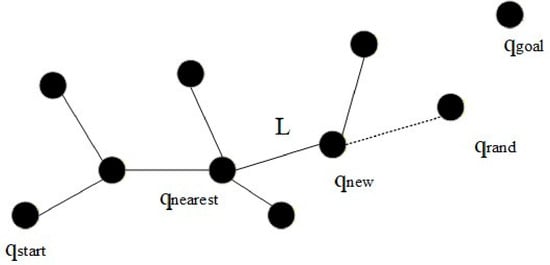
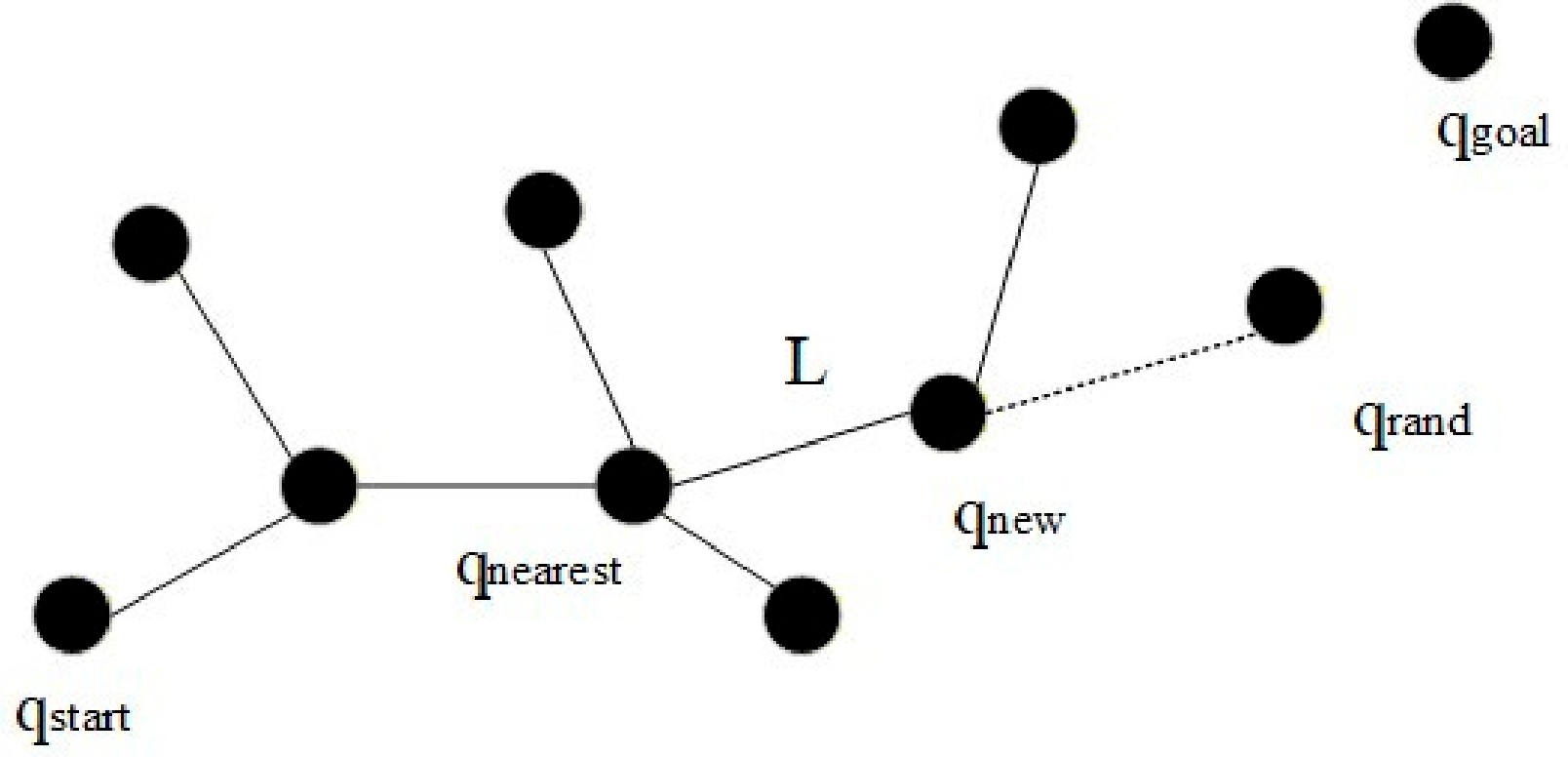
Different from the original RRT, RRT* incorporates parent re-selection and tree rewiring mechanisms. A random sampling point is sampled within the free space . The algorithm then searches the random tree to find the nearest node relative to and generates a new node by extending a fixed step size along the direction from to . Within the set of neighbouring nodes centred at , the node that minimises the path cost from to is selected as the optimal parent node to replace the original nearest node . A schematic diagram of the algorithm is shown in Figure 1. The pseudocode of the RRT* algorithm is presented in Algorithm 1.
| Algorithm 1. RRT* |
| Input: qstart, qgoal, Sobs, Maxiter, Rn |
| Output: T = (V, E) |
| 1: V ← {qstart}; E ← ∅; |
| 2: for each iter ∈ [1, Maxiter] do |
| 3: qrand ← Sample(iter); |
| 4: qnearest ← N earest(V, qrand); |
| 5: qnew ← Extend(qnearest, qrand); |
| 6: if Collisionf ree(qnearest, qnew, Sobs) then |
| 7: Qn ← Near(V, qnew, Rn); |
| 8: qparent ← ChooseParent(Qn, qnew, qnearest); |
| 9: V ← V ∪ {qnew}; |
| 10: E ← E ∪ {(qparent, qnew)}; |
| 11: T ← Rewire(T, qnew, Qn); |
| 12: end if; |
| 13: end for |
| 14: Return T = (V, E); |
Figure 1.
Schematic diagram of the RRT* algorithm.
2.2. Principles of the Bidirectional RRT* Algorithm
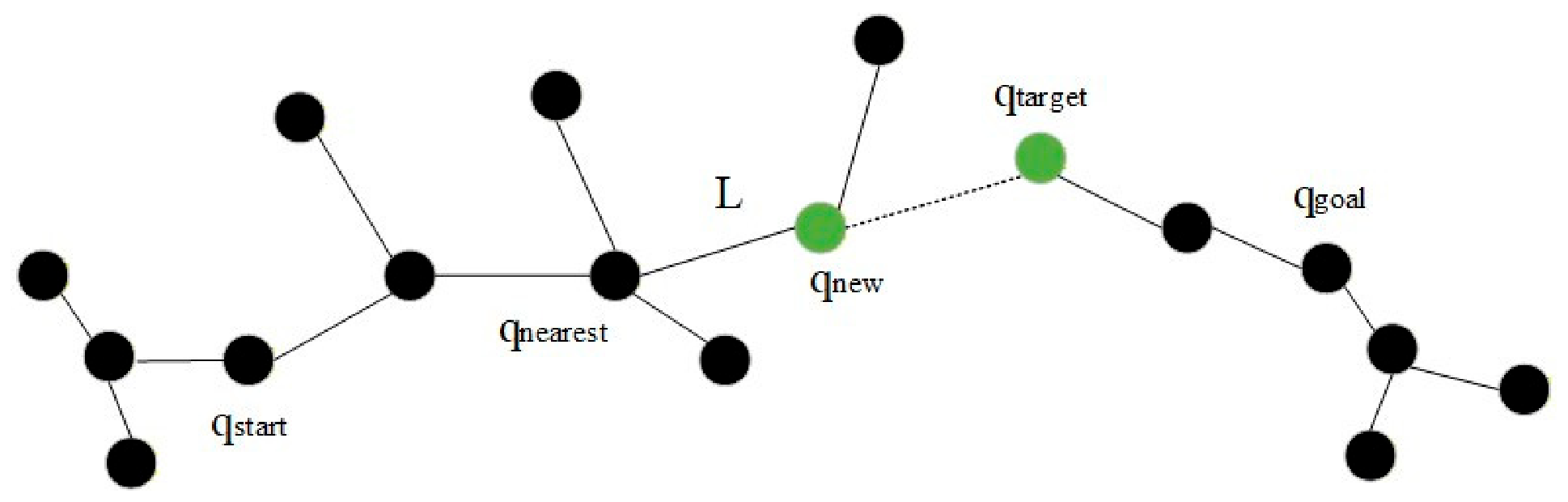
RRT-Connect is a classical bidirectional rapid-connection path-planning algorithm and forms the basic framework of bidirectional sampling-based algorithms. It constructs a start tree and a goal tree and adopts a greedy expansion strategy: at each iteration, one tree is extended directly towards the latest node of the other tree until the two trees are successfully connected. This connect-until-blocked mechanism gives the algorithm a very high search speed and enables feasible paths to be generated within a short time. Its expansion process is shown in Figure 2. Owing to its simple structure and efficient expansion, RRT-Connect is widely used in real-time planning scenarios; however, this type of bidirectional expansion is overly rigid, and the resulting paths are typically long and insufficiently smooth. The pseudocode of the RRT-Connect algorithm is presented in Algorithm 2.
| Algorithm 2. RRT-Connect |
| 1. V1 ← {qinit}; E1 ← ∅; G1 ← (V1, E1); |
| 2. V2 ← {qgoal}; E2 ← ∅; G2 ← (V2, E2); i ← 0; |
| 3. while i < N do |
| 4. qrand ← Sample(i); i ← i + 1; |
| 5. qnearest ← Nearest(G1, qrand); |
| 6. qnew ← Steer(qnearest, qrand); |
| 7. if ObstacleFree(qnearest, qnew) then |
| 8. V1 ← V1 ∪ {qnew}; |
| 9. E1 ← E1 ∪ {(qnearest, qnew)}; |
| 10. q′nearest ← Nearest(G2, qnew); |
| 11. q′new ← Steer(q′nearest, qnew); |
| 12. if ObstacleFree (q′nearest, q′new) then |
| 13. V2 ← V2 ∪ {q′new}; |
| 14. E2 ← E2 ∪ {(q′nearest, q′new)}; |
| 15. do |
| 16. q″new ← Steer(q′new, qnew); |
| 17. if ObstacleFree(q″new, q′new) then |
| 18. V2 ← V2 ∪ {q″new}; |
| 19. E2 ← E2 ∪ {(q″new, q′new)}; |
| 20. q′new ← q″new; |
| 21. else break; |
| 22. while not q′new = qnew |
| 23. if q′new = qnew then return (V1, E1); |
| 24. if |V2| < |V1| then Swap(V1, V2); |
Figure 2.
Schematic diagram of the RRT-Connect algorithm.
2.3. BI-RRT*
BI-RRT*, namely bidirectional RRT, is an important improvement over the conventional unidirectional RRT. The algorithm maintains two random trees simultaneously: one rooted at the start point and the other rooted at the goal point. During the iterations, the two trees continuously expand towards each other and attempt to connect. This bidirectional exploration structure substantially reduces invalid search regions and significantly improves the generation speed of the first feasible path. Compared with unidirectional RRT, BI-RRT has clear advantages in narrow passages and complex obstacle distributions, enabling it to traverse complex regions and complete path planning more rapidly. BI-RRT* also inherits the asymptotic optimality of RRT*, continuously optimising the path cost through parent reselection and rewiring while improving the search speed. The pseudocode of the BI-RRT* algorithm is presented in Algorithm 3.
| Algorithm 3. BI-RRT* |
| Input: qstart, qgoal, Sobs, MaxIter, L |
| Output: Path from qstart to qgoal |
| 1: Ta ← InitTree(qstart), Tb ← InitTree(qgoal) |
| 2: for iter = 1 to MaxIter do |
| 3: qrand ← Sample(Sfree) |
| 4: qnew1 ← ExtendTree(Ta, qrand, L, Sobs) |
| 5: qnew2 ← ExtendTree(Tb, qnew1, L, Sobs) |
| 6: if Connect(Ta, Tb, qnew2) |
| 7: return Path = ExtractPath(Ta, Tb) |
| 8: end if |
| 9: Swap Ta and Tb |
| 10: end for |
| 11: return No path found |
2.4. GB-RRT*
GB-RRT* is a goal-biased RRT algorithm that enhances the directional expansion capability of the random tree by introducing a goal-oriented sampling mechanism. By increasing the probability that sampling points move towards the goal, the random tree grows more directionally towards the target region, thereby reducing redundant exploration, decreasing the number of iterations and improving convergence speed. Compared with conventional uniformly sampled RRT, GB-RRT* provides significant efficiency improvements in open and moderately complex environments. However, because it relies heavily on goal guidance, GB-RRT* is susceptible to local blockage and expansion failure when large obstacles are present, resulting in reduced obstacle-avoidance capability. Despite these limitations, GB-RRT* remains one of the most commonly used heuristic improvements in path planning because of its simple structure and high speed. The pseudocode of the GB-RRT* algorithm is presented in Algorithm 4.
| Algorithm 4. GB-RRT* |
| Input: qstart, qgoal, Sobs, MaxIter, L, pgoal |
| Output: Tree T = (V,E) |
| 1: V ← {qstart}, E ← ∅ |
| 2: for iter = 1 to MaxIter do |
| 3: if rand() < pgoal |
| 4: qrand ← qgoal |
| 5: else |
| 6: qrand ← Sample(Sfree) |
| 7: end if |
| 8: qnearest ← Nearest(T, qrand) |
| 9: qnew ← Extend(qnearest, qrand, L) |
| 10: if CollisionFree(qnearest, qnew, Sobs) |
| 11: Qn ← Near(T, qnew) |
| 12: qparent ← ChooseParent(Qn, qnew, qnearest) |
| 13: V ← V∪{qnew} |
| 14: E ← E∪{(qparent, qnew)} |
| 15: T ← Rewire(T,qnew, Qn) |
| 16: end if |
| 17: end for |
| 18: return T |
2.5. BAI-RRT*
BAI-RRT* is a bidirectional adaptive heuristic RRT algorithm. Its core idea is to improve sampling efficiency and search speed through adaptive constraints and bidirectional exploration. The algorithm dynamically adjusts the sampling range according to environmental complexity, contracting the sampling domain in obstacle-dense regions to reduce invalid samples and expanding the exploration range in open regions to accelerate expansion. At the same time, BAI-RRT adopts synchronous growth of the start and goal trees, enabling the two trees to approach each other and connect rapidly, thereby significantly reducing the number of iterations and the convergence time. Adaptive heuristic sampling further narrows the effective search range and reduces blind exploration by the random tree, allowing the algorithm to maintain high planning efficiency in high-dimensional spaces and complex obstacle environments while balancing path quality and search speed. The pseudocode of the GB-RRT* algorithm is presented in Algorithm 5.
| Algorithm 5. BAI-RRT* |
| Input: qstart, qgoal, Sobs, MaxIter, L |
| Output: Optimal Tree T = (V, E) |
| 1: Ts ← InitTree(qstart), Tg ← InitTree(qgoal) |
| 2: Cbest ← ∞, Xellipse ← Sfree |
| 3: for iter = 1 to MaxIter do |
| 4: if Cbest < ∞ |
| 5: qrand ← InformedSample(Xellipse) |
| 6: else |
| 7: qrand ← Sample(Sfree) |
| 8: end if |
| 9: qnew ← AdaptiveExtend(Ts, qrand, L, Sobs) |
| 10: Ts ← ChooseParent&Rewire(Ts, qnew) |
| 11: if ConnectionCheck(Ts, Tg) |
| 12: Path ← Merge(Ts, Tg) |
| 13: Cbest ← Cost(Path) |
| 14: Xellipse ← UpdateEllipse(qstart, qgoal, Cbest) |
| 15: end if |
| 16: Swap Ts, Tg |
| 17: end for |
| 18: return Ts ∪ Tg |
2.6. IBI-P-RRT*
IBI-P-RRT* is an improved bidirectional potential-field RRT algorithm that deeply integrates the artificial potential field (APF) with the bidirectional RRT structure. It uses attraction from the goal and repulsion from obstacles to guide the growth of both trees, enabling the random trees to move actively away from obstacles and expand rapidly towards the goal, thereby improving obstacle-avoidance reliability and path smoothness. To address the tendency of conventional APF methods to become trapped in local minima, IBI-P-RRT* adopts an improved potential-field function and a bidirectional expansion strategy, escaping local optima through alternating exploration by the two trees. The algorithm also retains the parent-selection and rewiring mechanisms of RRT, thereby preserving asymptotic path optimality. The pseudocode of the GB-RRT* algorithm is presented in Algorithm 6.
| Algorithm 6. IBI-P-RRT* |
| 1: Input: qstart, qgoal, sobs, MaxIter, L, η, γ, Rnear |
| 2: Output: Path from qstart to qgoal |
| 3: Ta ← InitTree(qstart), Tb ← InitTree(qgoal); |
| 4: for each iter ∈ [1, MaxIter] do |
| 5: qrand ← ImprovedSample(iter); |
| 6: qnearest ← Nearest(Ta, qrand); |
| 7: qnew ← Steer(qnearest, qrand, L); |
| 8: qnew ← ImprovedAPF(qnearest, qnew,qgoal, sobs); |
| 9: if CollisionFree(qnearest, qnew, sobs) then |
| 10: qnear ← Near(Ta, qnew, Rnear); |
| 11: qparent ← ChooseBestParent(qnear, qnew); |
| 12: Ta ← AddNode(Ta, qparent, qnew); |
| 13: Ta ← Rewire(Ta, qnew, qnear); |
| 14: if CheckConnection(Ta, Tb) then |
| 15: Return ExtractPath(Ta, Tb); |
| 16: end if |
| 17: end if |
| 18: Swap(Ta, Tb); |
| 19: end for |
| 20: return No path found |
3. DHM-RRT* Path-Planning Algorithm
3.1. Hybrid Sampling Strategy
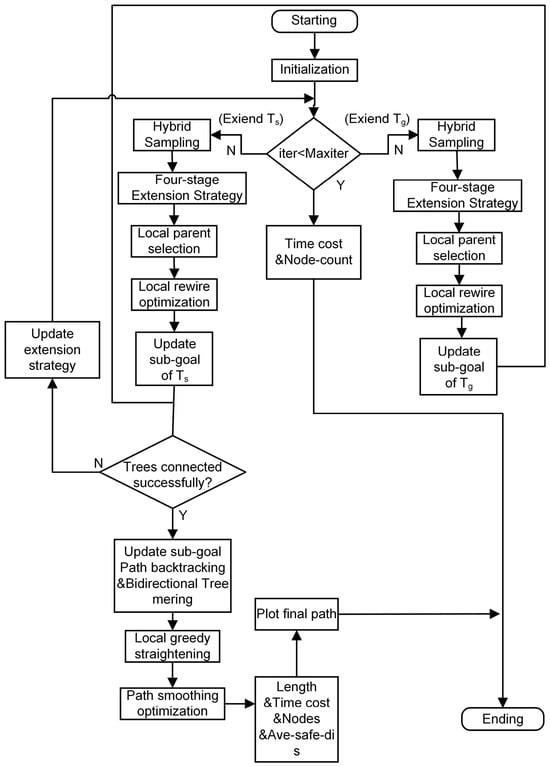
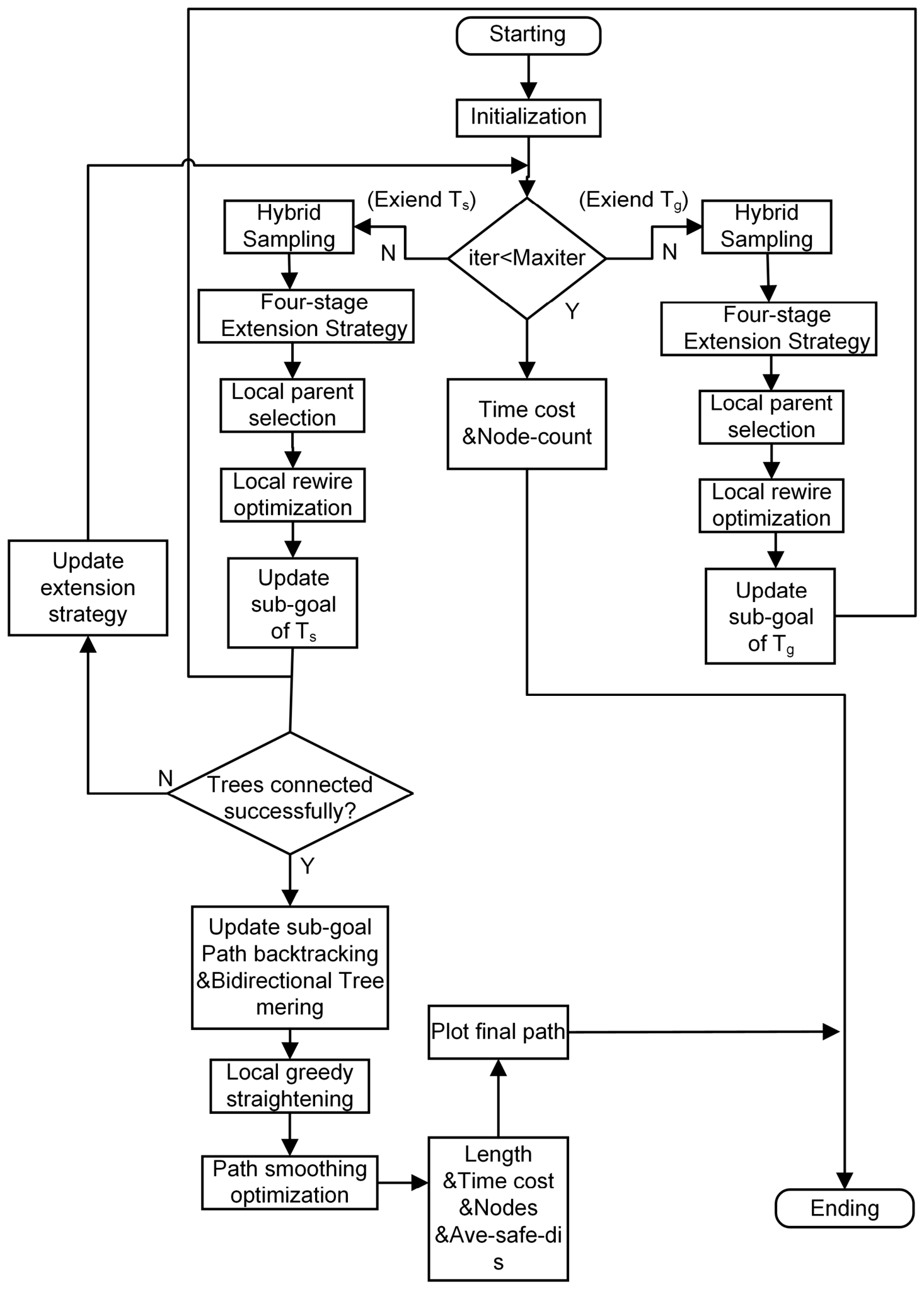
DHM-RRT* is an improved dual-tree RRT* algorithm for complex three-dimensional environments, and its operating principle is shown in Figure 3. In the sampling stage, it employs a three-state hybrid mode consisting of frontier-density adaptive sampling, Halton low-discrepancy sampling and uniform random sampling. The pseudocode of the algorithm is given in Algorithm 7. The entire search space is denoted as a three-dimensional box:
Figure 3.
Flowchart of the improved DHM-RRT* algorithm.
. Let the probabilities corresponding to the three sampling modes be:
where these terms denote, respectively:
- : the probability of frontier-density adaptive sampling;
- : the probability of Halton sampling;
- : the probability of uniform random sampling.
The overall sampling distribution of a point obtained in a single sampling operation can therefore be expressed as a mixture distribution:
where
- : the probability density of frontier-density adaptive sampling;
- : the discrete distribution obtained after mapping Halton points into the search space;
- : the standard uniform distribution over the entire search space of .
In the sampling stage, DHM-RRT* adopts a hybrid strategy combining frontier-density adaptive sampling, Halton low-discrepancy sampling and uniform random sampling, enabling an effective balance between local exploitation and global exploration. First, frontier-density adaptive sampling generates samples preferentially in sparse frontier regions according to the spatial distribution of random-tree nodes, thereby reducing repeated sampling in already explored regions, accelerating expansion towards unknown space and improving path-search efficiency. Second, Halton low-discrepancy sampling generates point sets with higher uniformity, alleviating the uneven coverage and local clustering that often occur in conventional random sampling and enhancing the stability and convergence speed of global exploration. Finally, uniform random sampling acts as a basic fallback strategy, preserving the theoretical full-coverage capability over the entire configuration space and ensuring algorithmic completeness. Exclusive reliance on frontier-density sampling tends to over-concentrate samples in the vicinity of tree frontiers and obstacle boundaries, thereby neglecting unexplored global regions. Halton low-discrepancy sampling, in isolation, ensures favourable spatial uniformity but is incapable of biasing samples toward narrow passages. Conventional uniform random sampling, by contrast, incurs substantial invalid-sampling overhead owing to its undirected nature. Through the synergistic integration of these three sampling modes, the proposed hybrid strategy strikes a principled balance between local exploitation in cluttered narrow-passage regions and balanced global exploration, while uniform random sampling serves as a theoretical fallback that guarantees the probabilistic completeness of the overall sampling scheme.
Through probabilistic weighting and dynamic fusion of these three modes, DHM-RRT* can both advance rapidly along the tree structure and stably search for feasible passages at the global scale, significantly improving path-planning efficiency and robustness in complex environments.
The pseudocode of the DHM-RRT* algorithm is given below:
| Algorithm 7. DHM-RRT* |
| Input: qstart, qgoal, Sobs, MaxIter, L, dsafe |
| Output: Path |
| 1: Initialize: Ta, Tb, Pgb, Pcone, Papf, Prand, Failgb, Failcone, Failapf ← 0; |
| 2: for iter = 1 to MaxIter do |
| 3: qrand ← HybridSampling(adaptive, Halton, random); |
| 4: strategy ← DrawStrategy(Pgb, Pcone, Papf, Prand); |
| 5: used ← strategy; |
| 6: if strategy == Goal-bias then |
| 7: qnew ← GoalBiasExtend(Ta, qgoal, dsafe); |
| 8: if qnew is invalid then |
| 9: qnew ← DualDistConeExtend(Ta, qgoal, dsafe); |
| 10: if qnew is invalid then |
| 11: qnew ← APFExtend(Ta, qgoal, dsafe); |
| 12: if qnew is invalid then |
| 13: qnew ← RandomExtend(Ta, qrand, dsafe); |
| 14: used ← Random; |
| 15: else |
| 16: used ← APF-guided; |
| 17: end if |
| 18: else |
| 19: used ← Dual-dist cone; |
| 20: end if |
| 21: end if |
| 22: elif strategy == Dual-dist cone then |
| 23: qnew ← DualDistConeExtend(Ta, qgoal, dsafe); |
| 24: if qnew is invalid then |
| 25: qnew ← APFExtend(Ta, qgoal, dsafe); |
3.2. Four-Level Progressive Expansion Strategy
In the expansion stage, the algorithm adopts a four-level serial progressive expansion strategy, sequentially performing goal-directed expansion, dual-distance scoring tangent-cone obstacle avoidance, improved APF-guided expansion and, finally, random straight-line fallback expansion. Goal-directed expansion advances towards the goal as rapidly as possible, significantly improving convergence speed in open scenarios and reducing invalid search. When straight-line expansion is blocked, the dual-distance scoring tangent-cone obstacle-avoidance strategy generates candidate bypass points based on the obstacle normal and tangent plane and selects the optimal bypass direction using a dual-criterion score that favours proximity to the goal and distance from the obstacle, thereby achieving stable and intelligent local obstacle avoidance. Improved APF-guided expansion uses only the repulsive force from the nearest obstacle, repulsion saturation and tangential projection, effectively avoiding the local-minimum and oscillation problems of conventional potential-field methods and improving obstacle-avoidance reliability in complex obstacle regions. Finally, random straight-line fallback expansion is executed when all three preceding strategies fail, ensuring theoretical completeness and global exploration capability. The first three are heuristic intelligent strategies, while the fourth serves as a theoretical-integrity safeguard to ensure the probabilistic completeness of the algorithm within any finite number of iterations.
Assume that there are several expansion modes:
For each iteration define:
If mode is adopted at the current iteration , a unit increment is imposed on , which is further smoothed via the exponential moving-average (EMA) update rule. Conversely, if mode i is not activated in the current iteration (), is merely scaled by the decay factor . This mechanism realises a forgetting effect, i.e., historical information associated with mode i gradually fades out when the mode remains unused over successive iterations.
The EMA failure term is increased only when the mode is used and fails:
If mode is adopted in the current iteration and fails, i.e., , a unit contribution is added to following the exponential moving-average (EMA) rule. No increment is imposed on the failure term in either of the two scenarios: the mode is not utilised or the mode is adopted and succeeds. Under both circumstances, only the decay operation is performed on .
Using the two EMA quantities above, the near-window failure-rate estimate is defined as:
is regarded as the estimated failure probability of mode over the recent time horizon. Specifically, approaches “1”, if mode has been frequently attempted and failed in recent iterations. By contrast, tends toward “0”, when mode mostly yields successful outcomes. For a mode that has not been activated for a long period, both and decay toward zero under the exponential moving-average (EMA) update, such that their influence on approximates the state of no prior historical records.
To convert the estimated failure rate of each mode into its activation probability, we apply an inverse probability normalization with a small exploration constant:
denotes the strategy-selection probability. Where prevents any strategy from having zero probability. After each expansion attempt, the corresponding failure rate r_i(t) is updated via Equation (5), and the selection probabilities for the next iteration are recomputed using Equation (6).
The four expansion levels cooperate in a progressive manner and are combined with an EMA-based dynamic probability-scheduling mechanism. This enables the algorithm to adjust the usage frequency of each strategy adaptively in real time according to the environment, prioritising rapid convergence in open regions and stable obstacle avoidance in obstacle-dense regions. As a result, an effective balance among search efficiency, obstacle-avoidance capability and planning robustness is achieved.
It is important to clarify the theoretical basis for the asymptotic optimality claim of DHM-RRT. The original RRT achieves asymptotic optimality through two core mechanisms: (1) uniform random sampling that ensures dense coverage of the configuration space as the number of iterations approaches infinity and (2) parent reselection and global rewiring that continuously improve the cost-to-come for existing nodes. DHM-RRT* strictly retains both mechanisms; uniform random sampling is preserved as a fallback component in the hybrid sampling strategy, ensuring that the overall sampling distribution maintains dense coverage in the limit, and the standard parent reselection and rewiring procedures are executed after every successful node expansion. Although the hybrid sampling and adaptive expansion strategies modify the sampling distribution and node generation process during finite iterations, they do not compromise the dense coverage property in the asymptotic regime. Therefore, the theoretical guarantee of asymptotic optimality is preserved. A rigorous proof would follow the same lines as the original RRT* analysis, with the hybrid sampling treated as a mixture distribution that includes uniform random sampling as one component. We have clarified this argument in Section 3.2.
3.3. Dynamic Adaptive Scheduling and Greedy Direct Connection
For each selected sampling point or sub-goal, DHM-RRT* chains multiple expansion strategies within a single expansion step and selects among them using the dynamic gated probabilities described above. Goal-bias direct expansion attempts to extend directly from the nearest node towards the goal, which is suitable for rapidly approaching the target in open regions. When goal-bias direct expansion fails, the dual-distance scoring tangent-cone obstacle-avoidance strategy (goal-bypass) generates candidate points within a bypass sector based on the first violation point, the obstacle normal and the tangent plane and evaluates them from high to low score according to the criterion of being close to the goal and far from the obstacle, thereby providing stable local obstacle-avoidance capability. The improved APF guidance strategy uses only the nearest-obstacle repulsion together with repulsion saturation and tangential projection. A smoother approximately 1/d2 form is adopted, and the magnitude of the repulsive force is capped to avoid numerical explosion. When approaching an obstacle, the resultant force is decomposed into tangential and normal components; the tangential component is retained while the normal component is suppressed, strengthening sliding along the obstacle surface and improving bypass stability. Random-line fallback expansion is used when the preceding three strategies all fail, reverting to a simple direct extension from the nearest node to the sampled point and preventing excessive dependence on any single high-level strategy. After path generation, DHM-RRT* further introduces a lightweight local greedy direct-connection window near the stitching seam of the two trees, simplifying local polyline segments according to a furthest-feasible-first rule and further improving path smoothness and length quality.
When the goal-directed straight-line expansion fails due to collision, the algorithm records the first-time collision point and the normal vector of the obstacle surface where is located (computed from obstacle geometry). On the tangent plane passing through and perpendicular to , uniformly distributed candidate directions generated. For each candidate direction, a fixed step size L is extended from the current tree node along this direction to obtain the candidate point . Subsequently, a dual-distance score is calculated for each candidate point:
where and are weight coefficients ( = 0.6 and = 0.4 are adopted in this work), = 0.01 is introduced to avoid division-by-zero, and denotes the obstacle point set. The first term encourages proximity to the goal, while the second term drives the sample away from obstacles. The candidate point with the highest score is selected as the target for this expansion. If this point still collides with obstacles, this strategy is regarded as failed.
After path generation, DHM-RRT* introduces a lightweight local greedy shortcut window near the stitching junction between the start-tree and goal-tree and performs a farthest-feasible-first straight-line simplification for local polyline segments.
Given the window half-width parameter , the local segment to be optimised on the original path is . Denote the original local path as and the locally adjusted path as .
On the current path , let be the endpoint indices of the sliding window, which are updated throughout the optimisation process. Scanning sequentially starting from the left-hand index :
- Initialisation: ;
- While , search for the farthest feasible index within the range :
If such exists, all intermediate waypoints with indices from to are removed, yielding the updated path:
Meanwhile, the path length is updated to . Correspondingly, the right-end index of the window shrinks leftward by the same number of removed points:
The index remains unchanged, and the algorithm continues attempting longer jumps starting from the current . If no feasible straight-line connection is found within this interval (i.e., no valid exists), shift the starting index forward by one step: . The final optimised path is denoted by , namely .
The detailed flowchart by which DHM-RRT* completes the final path-planning task is shown in Figure 3.
4. Simulation Experiments and Analysis
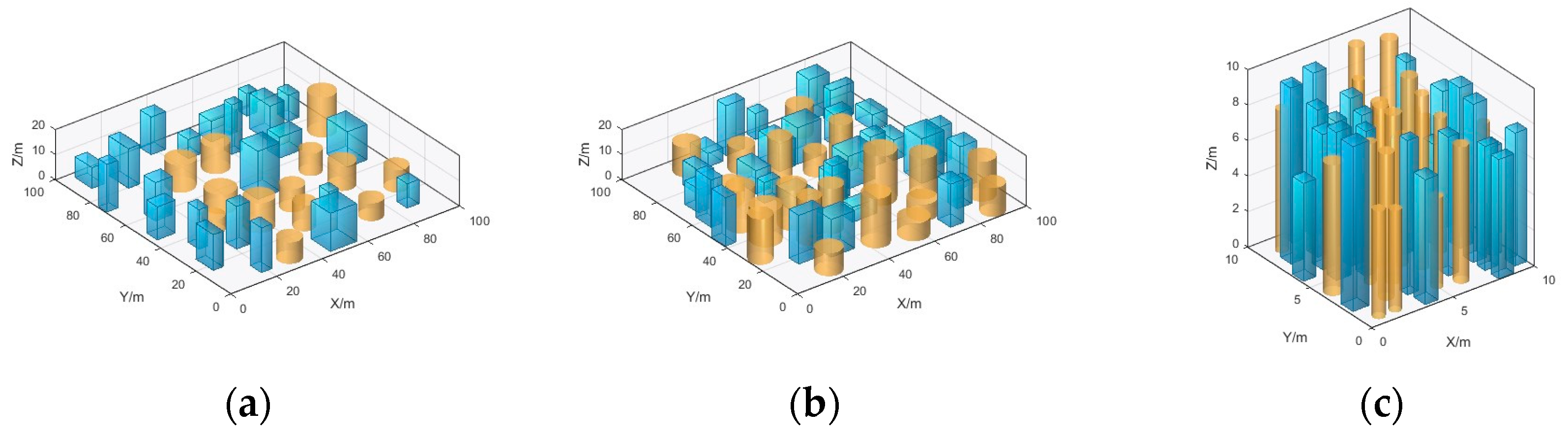
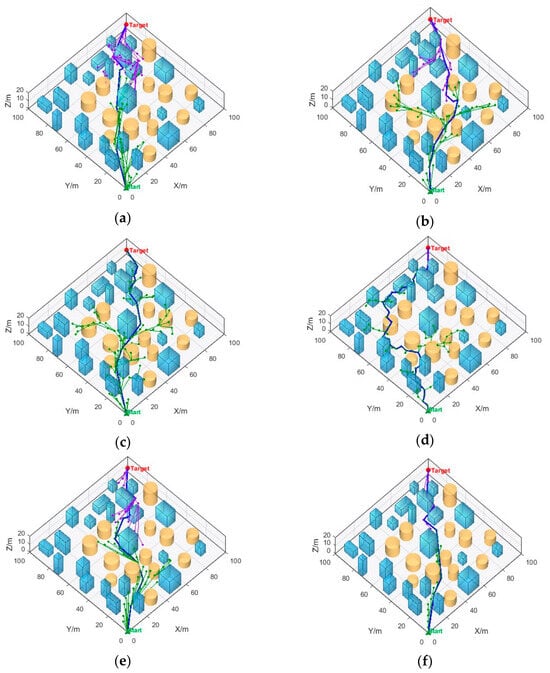
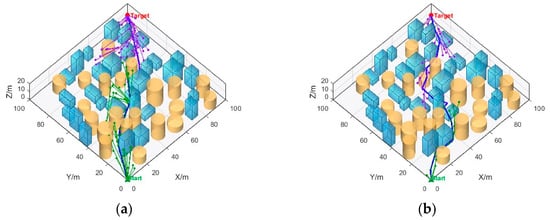
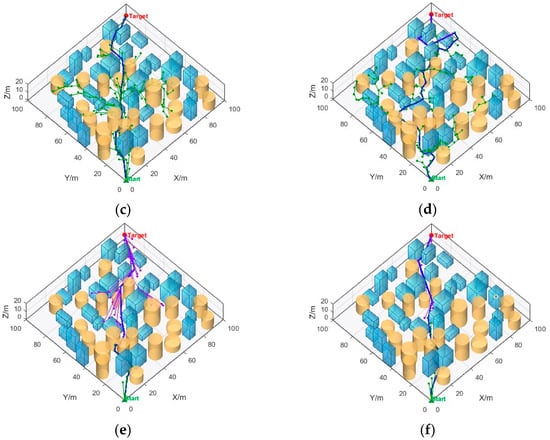
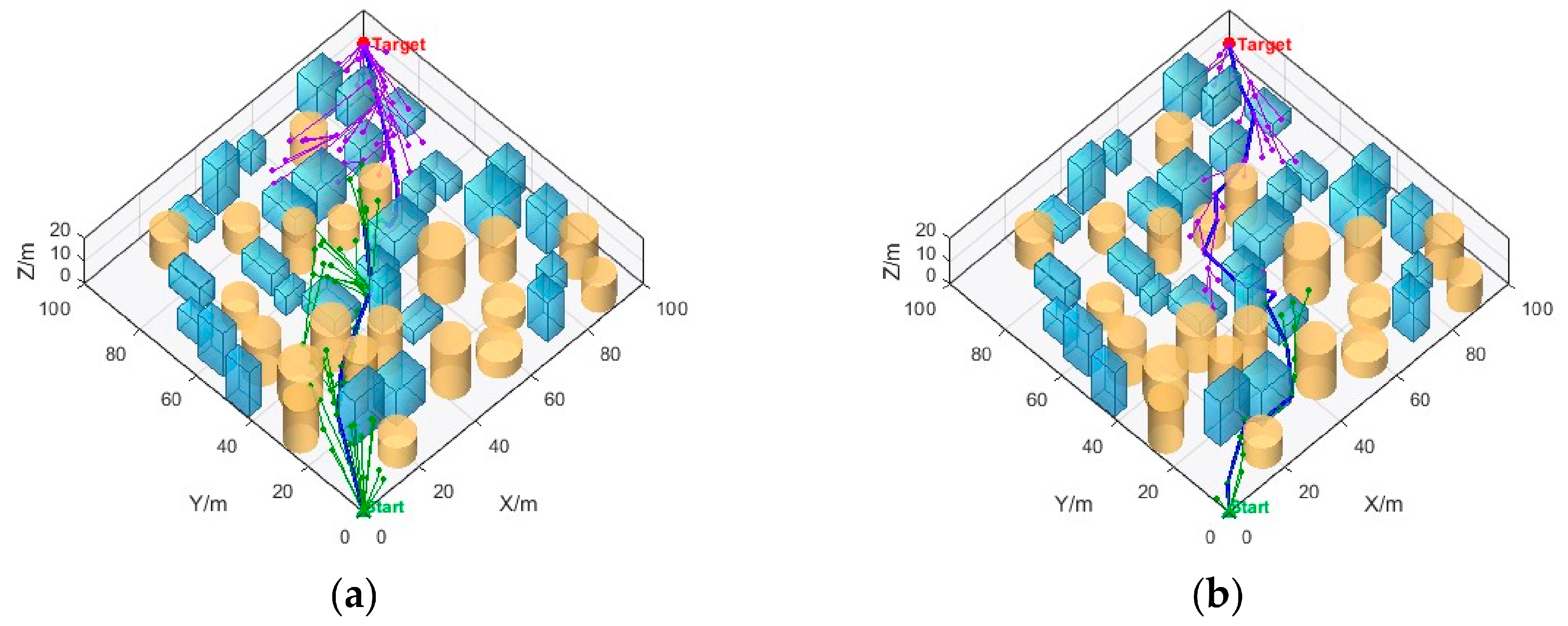
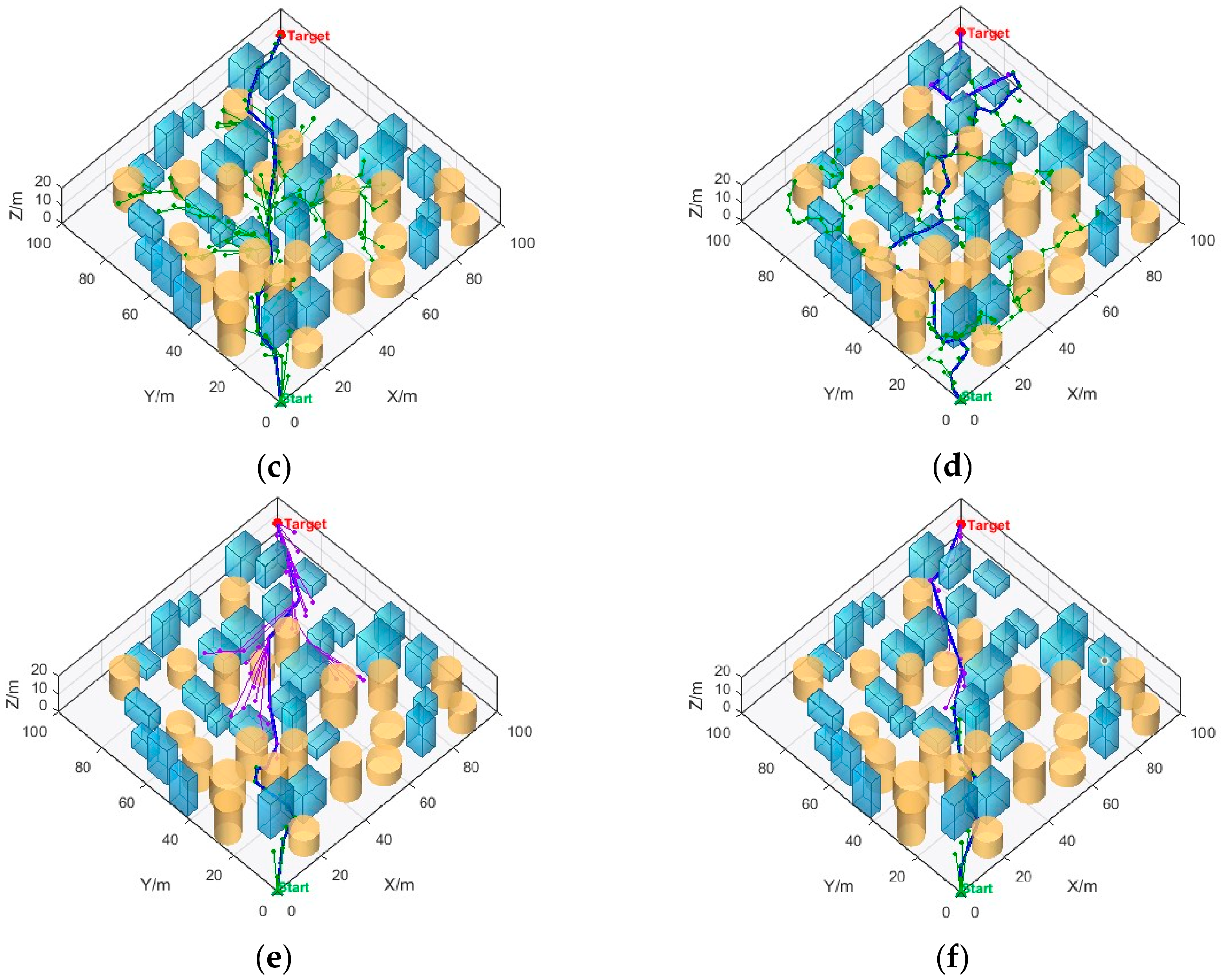
Simulation experiments were conducted in MATLAB 2024a to verify the effectiveness of the proposed DHM-RRT* algorithm. Three three-dimensional simulated maps were used: an open environment of 100 m × 100 m × 20 m, an obstacle-dense environment of 100 m × 100 m × 20 m and a narrow-passage environment of 10 m × 10 m × 10 m. The search start point was set to (0, 0, 0) in all cases. The green and purple components represent the random trees generated during the search, and the blue curve represents the three-dimensional path planned by the random tree.
To evaluate the path-planning performance of the proposed algorithm, DHM-RRT* was compared with five algorithms, namely BAI-RRT*, BI-RRT*, GB-RRT*, RRT-Connect and IBI-P-RRT*, in the three simulated three-dimensional environments, as shown in Figure 4.
Figure 4.
Experimental scenario. (a) Open environment; (b) obstacle-dense environment; (c) narrow-passage environment.
4.1. Experimental Results in the Open Environment
In the open environment, DHM-RRT* was compared with BAI-RRT*, BI-RRT*, GB-RRT*, RRT-Connect and IBI-P-RRT* to verify its effectiveness. The simulation results are as follows.
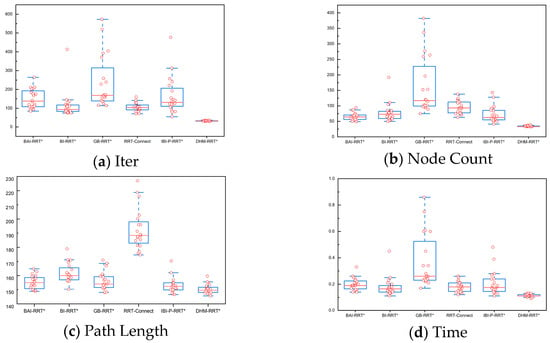
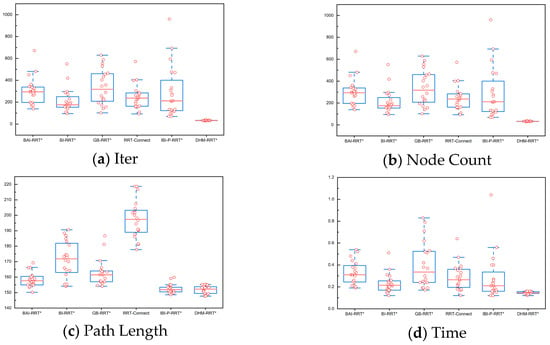
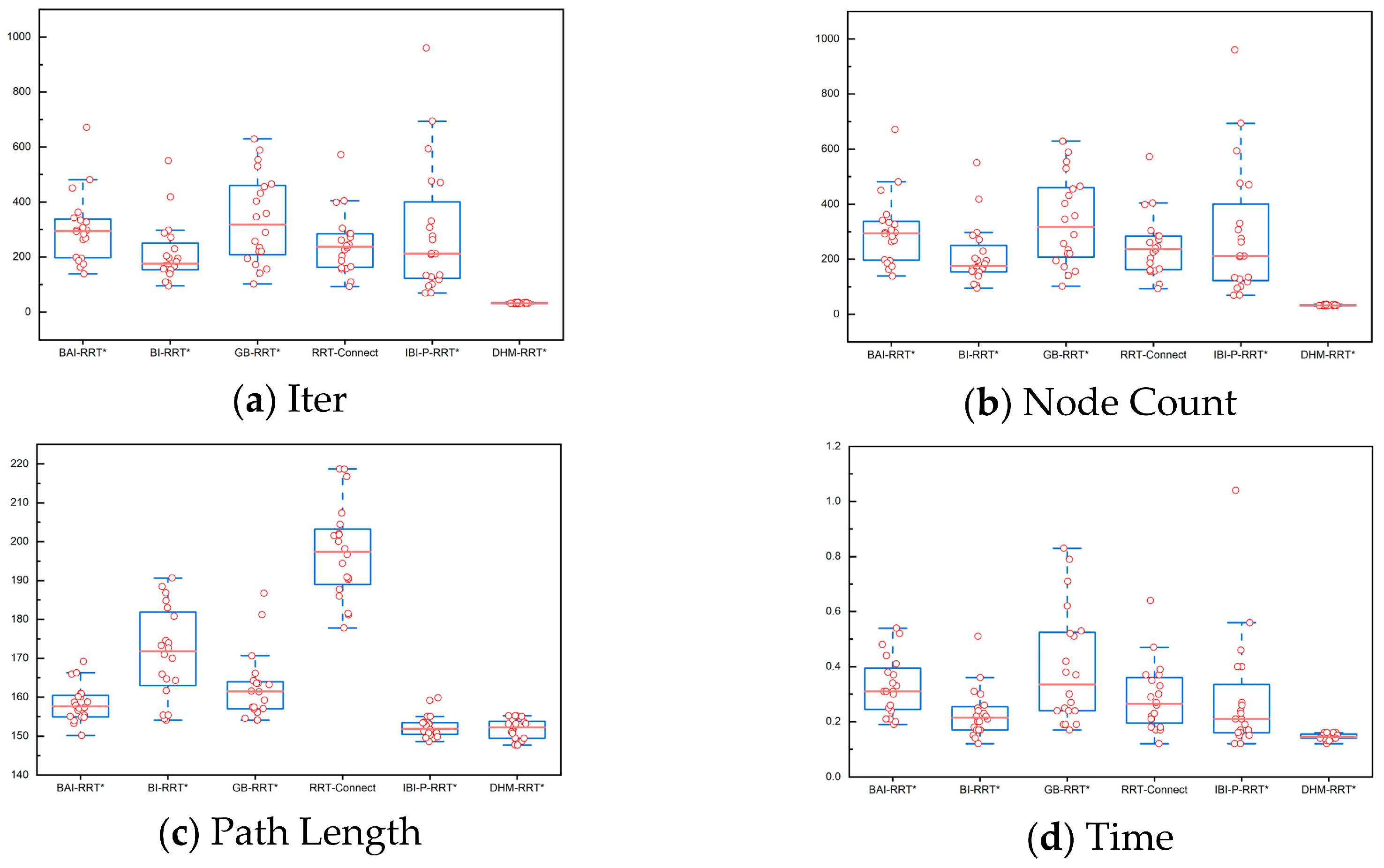
As shown in Figure 5d, the RRT-Connect algorithm generates the most turning points during sampling and also yields the longest average path length among the six algorithms. In the simple environment shown in Figure 5f, the proposed DHM-RRT* algorithm exhibits clear advantages over all competing methods, achieving superior performance in path length, node count, planning time, and iteration count. As reported in Table 1, in over 20 independent trials the proposed algorithm achieved an average path length of 150.39 m, a node count of 34.20, a planning time of 0.11 s, and merely 32 iterations. Compared with GB-RRT*, the average trajectory length was reduced by 3.63%, and the average number of iterations was reduced by 86.6%. These results indicate that the proposed method plans the optimal path in a relatively simple three-dimensional environment and significantly improves all performance metrics. Table 1 summarises the performance metrics of the six algorithms under the open-space environment. Optimal values are highlighted in bold, and all numerical results are rounded to two decimal places. And the simulation in open-space environment is shown in Figure 5. As shown in Figure 6, the figure presents the statistical results of four core performance metrics for the six algorithms under the open-space environment, namely average path length, average node count, average planning time, and average number of iterations.
Figure 5.
Path planning results of the six algorithms in the open-space environment: (a) BAI-RRT*, (b) BI-RRT*, (c) GB-RRT*, (d) RRT-Connect, (e) IBI-P-RRT*, and (f) DHM-RRT*.
Table 1.
Simulation data in the open-space environment.
Figure 6.
Performance comparison of the six algorithms in the open-space environment: (a) iteration count, (b) node count, (c) path length, and (d) planning time (the red line indicates the mean value).
The notably low iteration count (32 on average) achieved by DHM-RRT* in the open environment can be attributed to three synergistic factors. First, the goal-bias expansion strategy directly steers the nearest tree node toward the goal, which is particularly effective when no obstacles block the direct path. Second, the Halton low-discrepancy sampling ensures that the initial random nodes are well distributed across the configuration space, reducing the need for redundant sampling to cover unexplored regions. Third, the bidirectional tree structure enables the start tree and goal tree to grow toward each other simultaneously, allowing them to meet quickly without wasting iterations on regions far from the connecting path. These mechanisms collectively enable the algorithm to converge to a near-optimal path with remarkably few iterations in obstacle-free or sparsely obstructed environments.
4.2. Experimental Results in the Obstacle-Dense Environment
In the obstacle-dense environment, DHM-RRT* was compared with BAI-RRT*, BI-RRT*, GB-RRT*, RRT-Connect and IBI-P-RRT* to verify its effectiveness. The simulation results are shown in Table 2. The planning results in Figure 7 demonstrate that the proposed algorithm effectively avoids blind-zone expansion while simultaneously optimising the feasible path. As detailed in Table 2, the proposed algorithm also achieves significant improvements across all four performance metrics—path length, node count, planning time, and iterations. The proposed algorithm achieves an average path length of 151.85 m, which represents a 0.42% reduction over IBI-P-RRT*, the best-performing baseline in this environment. The proposed algorithm requires only 0.15 s of planning time, which is 34.7% faster than the second-best BI-RRT*—a clear demonstration of its superior real-time performance and computational efficiency. The number of iterations is only 32, far below the 200–300 range of the comparison algorithms. Overall, DHM-RRT* exhibits clear advantages in path length, node count, runtime and convergence speed in the obstacle-dense environment. And the simulation in obstacle-dense environment is shown in Figure 7. As shown in Figure 8, the figure presents the statistical results of four core performance metrics for the six algorithms under the obstacle-dense environment, namely average path length, average node count, average planning time, and average number of iterations.
Table 2.
Simulation data in the obstacle-dense environment.
Figure 7.
Path planning results of the six algorithms in the obstacle-dense environment: (a) BAI-RRT*, (b) BI-RRT*, (c) GB-RRT*, (d) RRT-Connect, (e) IBI-P-RRT*, and (f) DHM-RRT*.
Figure 8.
Performance comparison of the six algorithms in the obstacle-dense environment: (a) iteration count, (b) node count, (c) path length, and (d) planning time (the red line indicates the mean value).
It is worth noting that the improvement in average path length achieved by DHM-RRT* in the obstacle-dense environment is relatively modest (0.42% compared with IBI-P-RRT). This is primarily because IBI-P-RRT, as the strongest baseline in this scenario, already incorporates artificial potential field guidance that effectively steers the tree toward the goal while avoiding obstacles, leaving limited room for further length reduction. However, the more significant advantages of DHM-RRT* in this environment are manifested in planning efficiency and convergence speed: the average planning time is reduced by 34.78% (from 0.23 s to 0.15 s compared with BI-RRT and by 46.4% compared with IBI-P-RRT), and the average iteration count drops by over 85% compared with all baseline methods. These results indicate that, while all algorithms converge to similar path lengths in cluttered spaces, DHM-RRT* achieves this with substantially lower computational cost.
4.3. Experimental Results in the Narrow-Passage Environment
In the narrow-passage environment, DHM-RRT* was compared with BAI-RRT*, BI-RRT*, GB-RRT*, RRT-Connect and IBI-P-RRT* to verify its effectiveness. The simulation results are as follows.
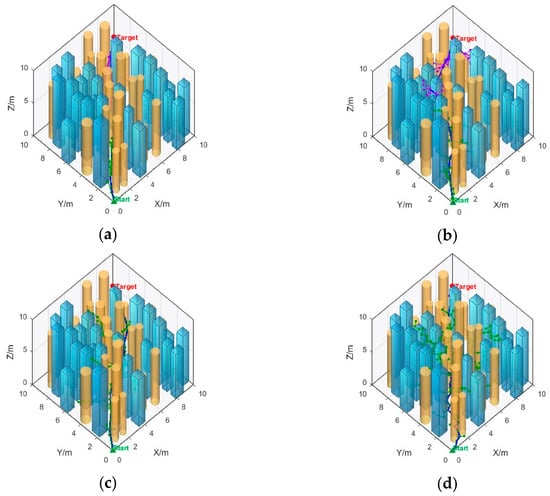
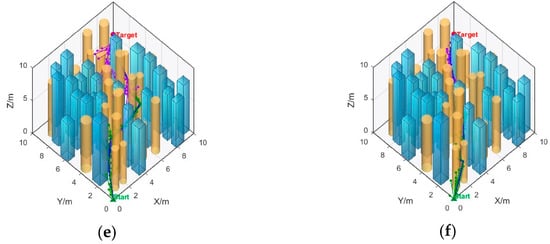
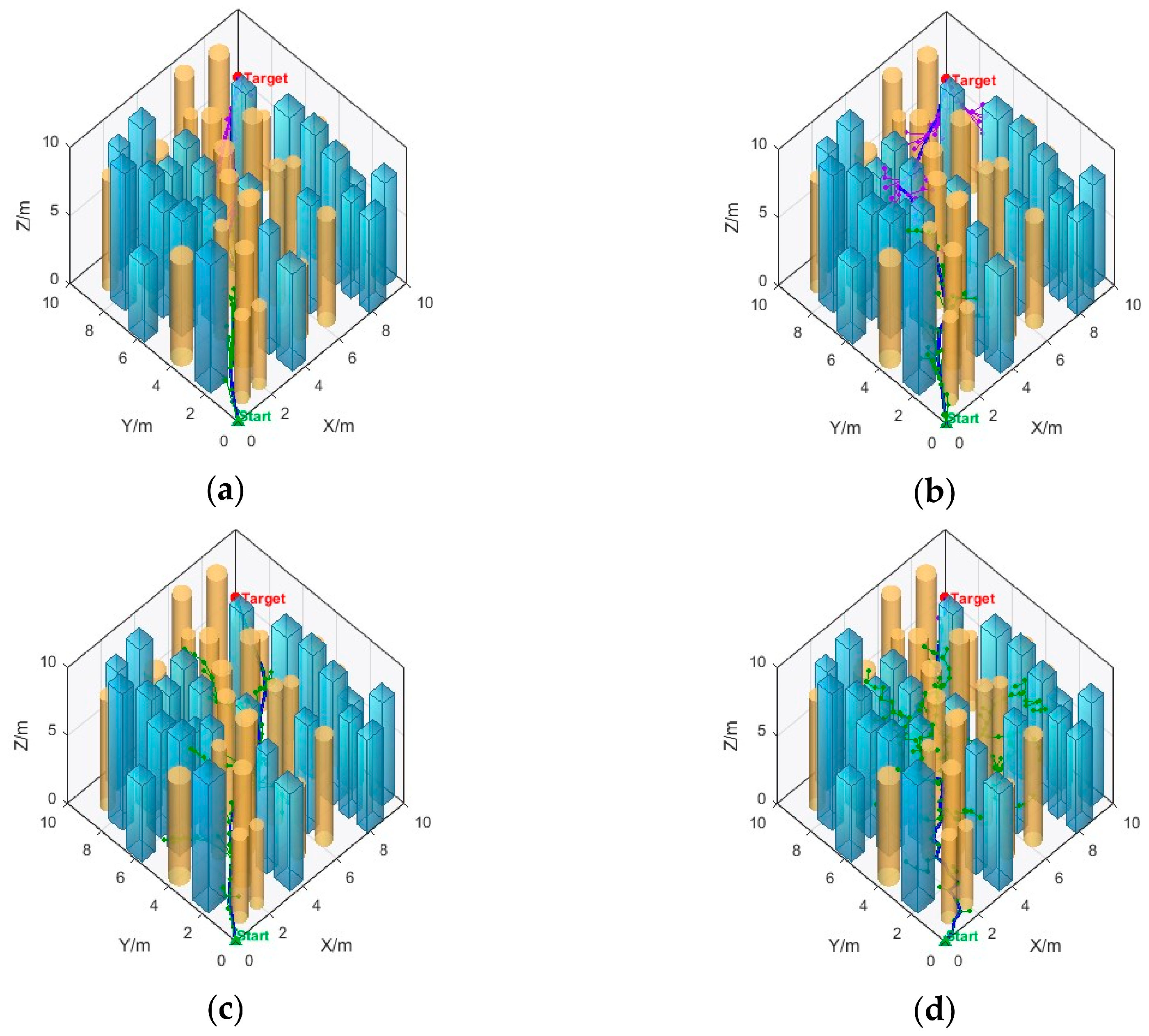
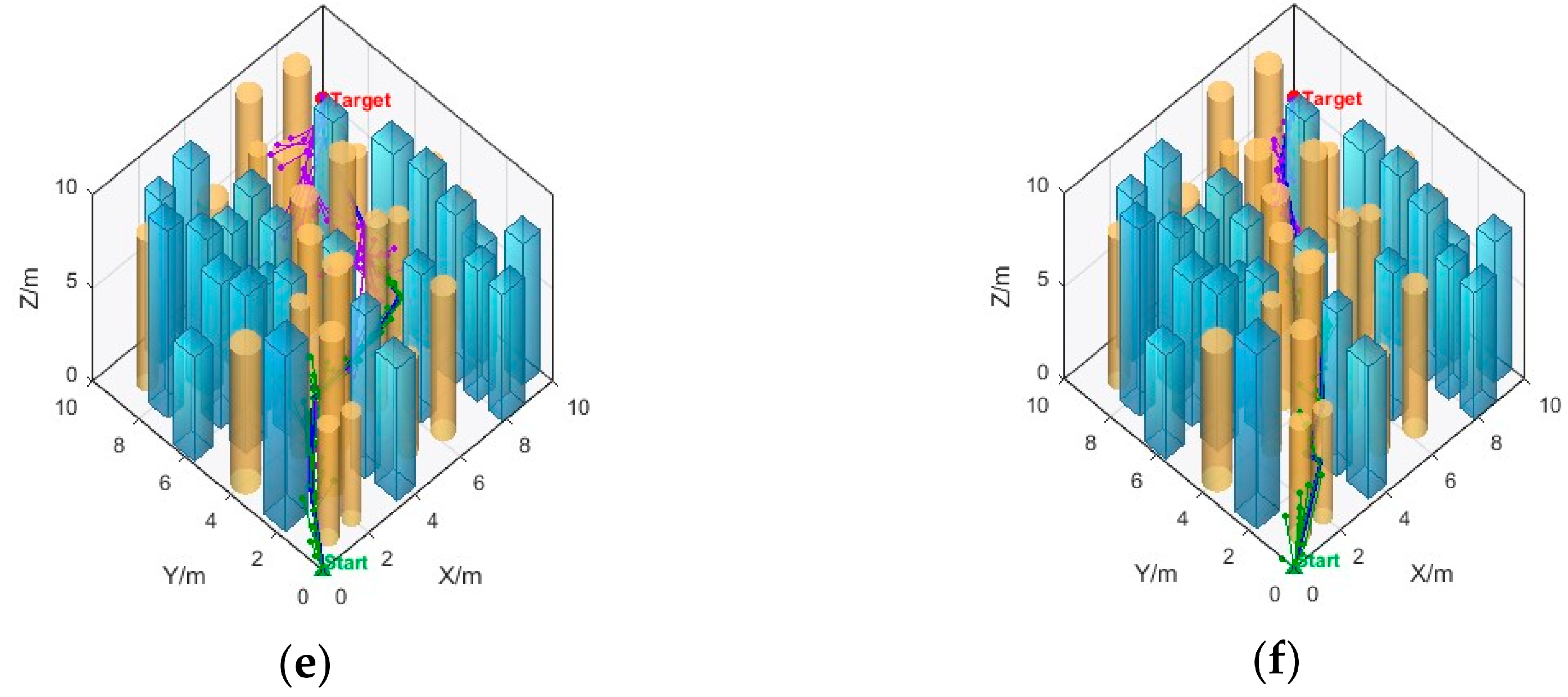
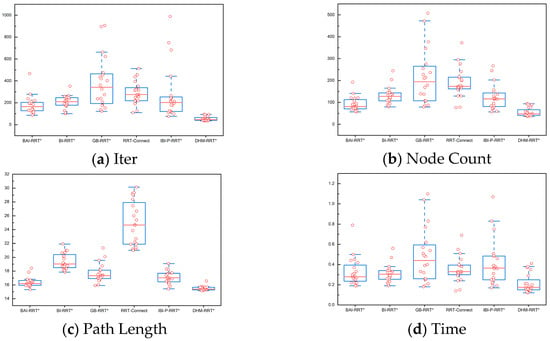
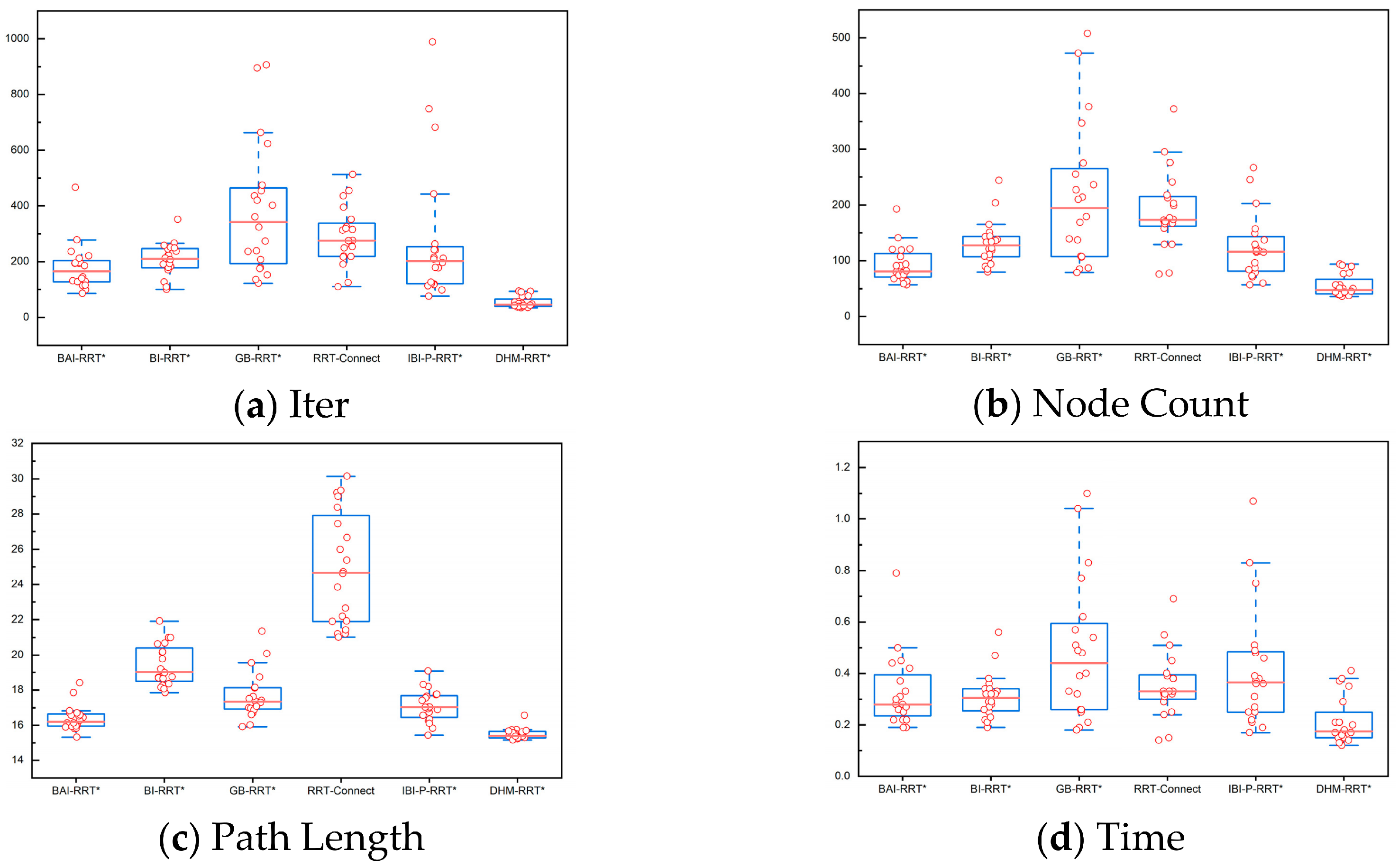
The results in Figure 9 reveal that path-planning algorithms in narrow passages are prone to expansion blockage, sharply increased iterations, and excessively tortuous paths—all due to the restricted space and stringent obstacle constraints. Nevertheless, DHM-RRT* still demonstrates superior performance compared with the other five algorithms. The proposed algorithm achieves an average path length of only 15.50 m, which is markedly shorter than those of the other five algorithms—5.49% shorter than the second-best BAI-RRT*. This indicates that the dual-distance scoring tangent-cone obstacle-avoidance strategy and the improved APF guidance strategy can accurately avoid obstacles and maintain path compactness in narrow spaces, effectively reducing path redundancy and detours. The proposed algorithm requires only 0.22 s of planning time—significantly faster than all competing algorithms and 29% faster than BI-RRT*, the quickest among the baselines. The detailed results are shown in Table 3. And the simulation in obstacle-dense environment is shown in Figure 9. As shown in Figure 10, the figure presents the statistical results of four core performance metrics for the six algorithms under the narrow-passage environment, namely average path length, average node count, average planning time, and average number of iterations.
Figure 9.
Path planning results of the six algorithms in the narrow-passage environment: (a) BAI-RRT*, (b) BI-RRT*, (c) GB-RRT*, (d) RRT-Connect, (e) IBI-P-RRT*, and (f) DHM-RRT*.
Table 3.
Simulation data in the narrow-passage environment.
Figure 10.
Performance comparison of the six algorithms in the narrow-passage environment: (a) iteration count, (b) node count, (c) path length, and (d) planning time (the red line indicates the mean value).
To quantitatively evaluate the comprehensive performance of the path, we define the comprehensive fitness F as the weighted sum of three normalised indicators: : the minimum distance from all nodes on the path to the nearest obstacle, normalized to (larger values indicate higher safety); : the reciprocal of the total turning-angle (or curvature) of the path, normalized to (larger values indicate higher smoothness); and : comprehensively considering path length and planning time, calculated as
where and denote the min–max normalised values of path length and planning time, respectively.
The final fitness is formulated as:
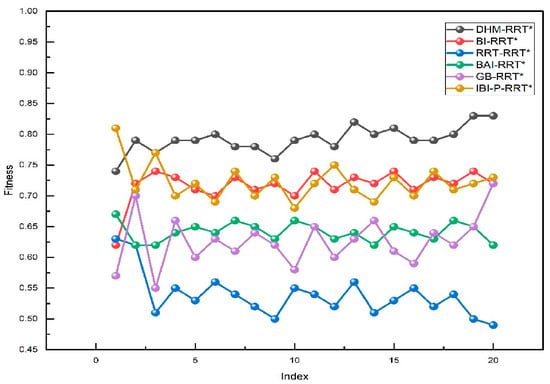
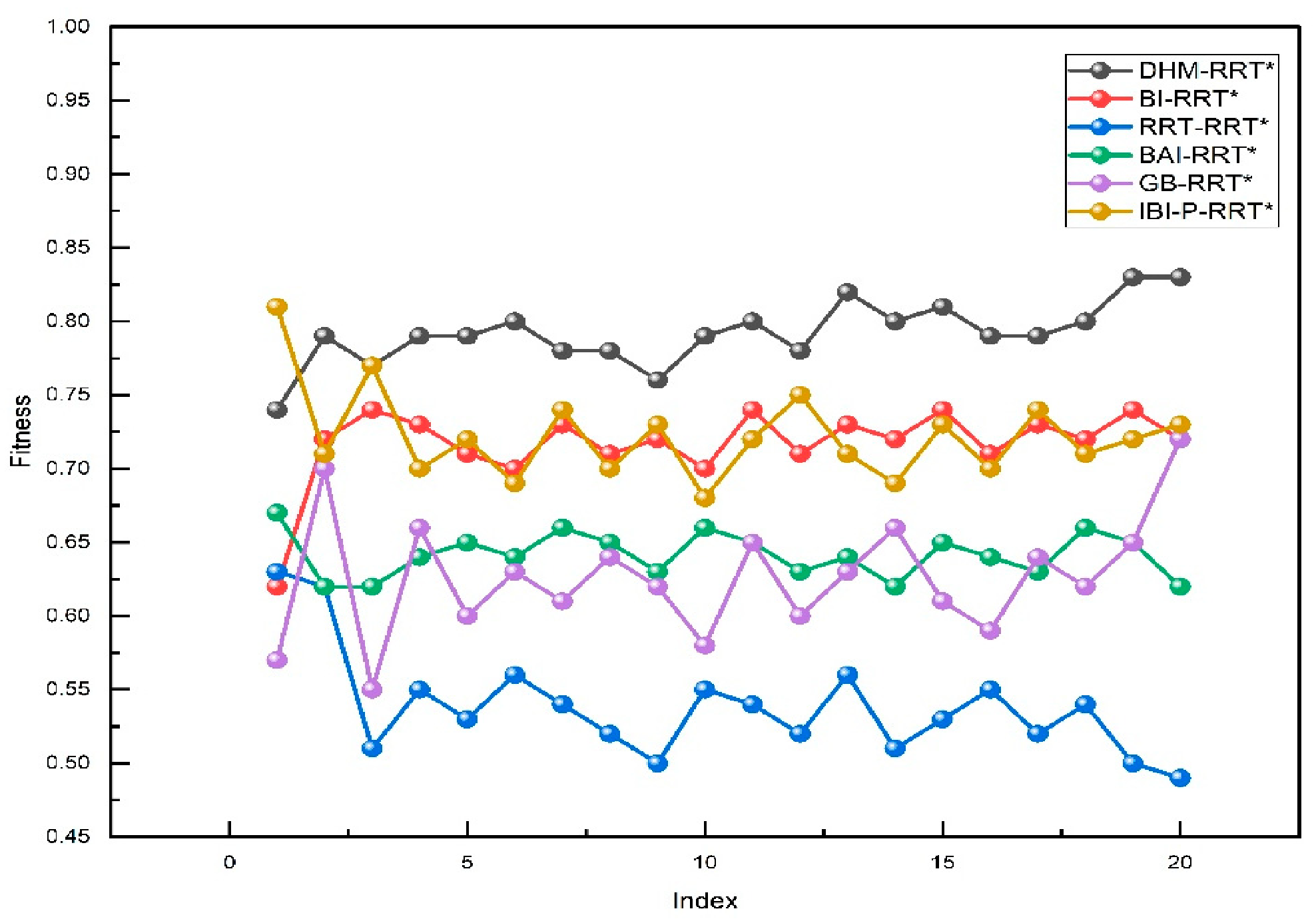
The weights are set according to the highest priority of safety in UAV missions. Each curve in Figure 11 represents the F value computed from one independent trial.
Figure 11.
Comprehensive fitness of each algorithm.
Among the three simulated environments, the most complex obstacle-dense environment was selected to compare the path fitness of different algorithms over 20 independent experiments, as shown in Figure 11. The figure presents the path-fitness performance of DHM-RRT* and the five comparison algorithms. The solid lines represent the mean fitness values of the algorithms, while the translucent shaded regions indicate the corresponding standard-deviation intervals, reflecting stability and robustness.
The results show that DHM-RRT* consistently achieves the highest average fitness among all algorithms, remaining generally stable within the range of 0.75–0.83 and exhibiting the smallest fluctuation. This indicates that its generated paths perform best in terms of the combined indicators of safety, smoothness and efficiency. By contrast, the mean fitness values of BAI-RRT and IBI-P-RRT are slightly lower than that of DHM-RRT*, and their standard-deviation intervals are wider, indicating weaker stability. Conventional algorithms such as RRT-Connect and GB-RRT* have lower mean fitness values and more pronounced fluctuations, reflecting insufficient path quality and robustness in complex environments.
These results verify that the hybrid sampling strategy and four-level progressive expansion mechanism adopted by DHM-RRT* can effectively balance path-exploration efficiency and optimisation capability, significantly improving the consistency and stability of the planning results while ensuring path safety and smoothness.
Additionally, we performed paired t-tests between DHM-RRT* and the best-performing baseline in each environment using the 20 independent trial results. The analysis confirms statistical significance in all three scenarios, with p-values summarised as follows: open environment , obstacle-dense environment , and narrow-passage environment , corresponding to path length, planning time, and iteration count, respectively. These results demonstrate that the performance advantages of DHM-RRT* are consistent and statistically robust across diverse environmental conditions.
4.4. Contribution Analysis of Expansion Strategies
To quantitatively evaluate the contribution of each expansion strategy, we define two statistical metrics: activation frequency and success rate. These metrics are computed from the logs recorded during the 20 independent trials in the obstacle-dense environment.
The activation frequency of a given strategy is defined as the ratio of the number of times that strategy is selected by the adaptive scheduling mechanism to the total number of expansion attempts across all trials. Let denote the total activation count of strategy and denote the total number of expansion attempts. The activation frequency is then computed as:
This metric reflects how often each strategy is invoked in response to the current environmental conditions.
The success rate of a strategy is defined as the ratio of successful expansions generated by that strategy to its total activation count. Let denote the number of successful expansions (i.e., those that successfully generate a valid collision-free node that passes the safety distance check and is added to the tree) performed by strategy . The success rate is then computed as:
This metric reflects the effectiveness of each strategy in actually making progress toward a feasible path under the specific obstacle configurations in which it is deployed.
It is worth noting that activation frequency and success rate capture different aspects of strategy performance. A strategy may be rarely activated (low ) but highly effective when invoked (high ) or frequently activated (high ) but only moderately successful. Together, these two metrics provide a comprehensive picture of the practical contribution of each strategy. The statistical results are summarised in Table 4.
Table 4.
Activation frequency and success rate of each expansion strategy in the obstacle-dense environment.
Goal-bias is activated most frequently (58.3%) with a high success rate (72.5%), confirming its dominant role in accelerating convergence, particularly in open or sparsely obstructed regions. Tangent-cone is triggered when goal-bias fails near obstacles (26.7% activation) and achieves the highest success rate (81.3%) among all strategies, demonstrating its effectiveness in generating compact bypass manoeuvres with minimal path-length penalty. APF is activated in cluttered regions (13.2% activation) with a moderate success rate (67.8%), proving its value in resolving local minima and maintaining search progress when other strategies are blocked. Random fallback is rarely used (only 1.8% of total expansions), which is consistent with its intended role as a theoretical safeguard rather than a primary search mechanism.
These statistics clearly demonstrate that the four strategies are not redundant but collectively contribute to the overall performance, with each specialising in different obstacle configurations. The progressive design ensures that the algorithm can adapt to diverse scenarios without relying on a single strategy that may fail under certain conditions. The random fallback, though seldom activated, remains essential for maintaining the probabilistic completeness of the algorithm, particularly in theoretically challenging scenarios where all heuristic strategies are blocked.
5. Conclusions
This paper proposes a novel Dynamic Hybrid Multi-Strategy RRT* (DHM-RRT*) algorithm for three-dimensional UAV trajectory planning under complex obstacle environments. A systematic multi-layer optimisation framework is constructed, covering sampling, adaptive expansion and post-processing path refinement, targeting the inherent drawbacks of conventional bidirectional RRT variants, including blind uniform sampling, static expansion rules, poor environmental adaptability and redundant jagged trajectories. The core theoretical innovations and engineering advantages of the proposed method are summarised as follows.
First, a hybrid sampling framework integrating frontier-density adaptive sampling, Halton low-discrepancy sampling and uniform random sampling is developed to balance global exploration and local exploitation. The frontier-density sampling module dynamically assigns sampling weights based on the spatial distribution of tree frontier nodes via sliding window statistics, which concentrates sampling efforts on sparse, unexplored narrow passages and suppresses redundant repeated sampling in mature regions. The Halton sequence module improves the uniformity of global sampling points to mitigate local clustering and uneven space coverage defects of purely random sampling, while uniform random sampling serves as a theoretical fallback to guarantee the probabilistic completeness of the overall sampling distribution. Compared with static single sampling schemes adopted by BI-RRT*, GB-RRT* and IBI-P-RRT*, the proposed hybrid sampling reduces the proportion of invalid sampling points from the source and effectively accelerates the convergence of random trees toward feasible narrow corridors in obstacle-dense and confined scenes.
Second, a four-level progressive heuristic expansion mechanism coupled with an EMA-based dynamic weight scheduling strategy is designed to realise autonomous adaptive switching of expansion modes under varying obstacle layouts. Four hierarchical expansion primitives are sequentially activated: goal-directed steering, tangential dual-distance bypass, saturation-corrected triple-attraction APF guidance, and random straight-line fallback expansion. Exponential moving average filters are introduced to continuously record the recent success and failure frequencies of each expansion strategy, and the estimated failure probability of each mode is updated iteratively. Expansion activation probabilities are adjusted online according to real-time environmental feedback, enabling the algorithm to prioritise fast goal convergence in open areas and stable local obstacle avoidance in cluttered regions. Unlike fixed-proportion expansion rules of existing improved RRT algorithms, the EMA forgetting mechanism gradually weakens the historical statistical weight of rarely used strategies, so the random tree can autonomously match the optimal expansion logic corresponding to local obstacle morphology without manual hyperparameter tuning. Theoretical derivation verifies that DHM-RRT* strictly inherits the asymptotic optimality property of the original RRT* through standardised parent researing and global rewiring after each node extension.
Third, a lightweight local greedy shortcut optimisation strategy is proposed for dual-tree stitching segments to refine trajectory quality with negligible computational overhead. After the start tree and goal tree are successfully connected, a bounded sliding window is established near the tree junction, and a farthest-feasible-first pruning rule is executed to eliminate redundant intermediate waypoints between collision-free vertex pairs. Combined with segmented B-spline smoothing, the scheme effectively reduces path tortuosity and improves flight curvature continuity. Different from global full-path smoothing that introduces massive collision detection overhead, the local post-processing only optimises the discontinuous stitching region, which satisfies the strict real-time computing constraints of low-power onboard UAV hardware. It is important to note that, after B-spline smoothing, we perform a dense collision re-checking procedure. The smoothed curve is sampled at fine intervals (0.5 m step size), and each sample point is verified against the obstacle distance threshold . If any point violates the safety clearance, the smoothing result is discarded and the original unsmoothed local path is retained, guaranteeing that the final trajectory strictly respects obstacle boundaries. The verification confirms that the smoothed trajectory continues to meet the safety distance constraints in the vicinity of obstacle boundaries.
Comparative experiments are conducted across three representative 3D simulation scenarios: open space, obstacle-dense environment and narrow confined passage. Six state-of-the-art RRT-based planners, including BI-RRT*, GB-RRT*, RRT-Connect, BAI-RRT*, and IBI-P-RRT*, are selected as benchmark algorithms with 20 independent repeated trials for each configuration. Statistical boxplots and comprehensive fitness curves demonstrate consistent performance superiority of DHM-RRT* across all test environments. Quantitatively, the proposed method shortens the average path length by 1.78%, 0.42% and 5.49% (compared with the best-performing baseline algorithm in each environment) and cuts average planning runtime by 38.89%, 34.78% and 29.03% in the three scenarios, respectively, accompanied by drastically reduced iteration counts and waypoint quantities. The comprehensive fitness index of DHM-RRT* maintains the highest average value with minimal variance, which validates stronger stability, robustness and comprehensive optimisation capability in complex obstacle constraints.
Nevertheless, the current DHM-RRT* still has several limitations worthy of further exploration. First, the hyperparameters of the EMA smoothing factor and sliding window half-width are manually preset according to experimental experience, lacking an online self-tuning module driven by environmental feedback. Second, the algorithm only considers static rigid obstacles, without taking dynamic moving barriers and UAV kinodynamic constraints such as maximum pitch angle and turning radius into account during expansion. Third, the hybrid sampling weights rely on offline fixed mixing coefficients, failing to realise fully end-to-end adaptive weight adjustment guided by path cost feedback.
Future research directions will focus on three aspects to further enrich the algorithm framework. (1) Introduce reinforcement learning to realise self-adaptive tuning of EMA coefficients and sampling mixing weights, eliminating manual parameter adjustment. (2) Integrate kinodynamic constraints and dynamic obstacle collision detection into the four-level expansion module to extend DHM-RRT* to real-time dynamic UAV navigation tasks. (3) Combine the proposed hybrid sampling and adaptive expansion mechanism with multi-tree collaborative planning to support multi-UAV cooperative trajectory optimisation in large-scale complex airspaces. The proposed DHM-RRT* provides a complete, reproducible heuristic optimisation solution for sampling-based robotic path planning and offers valuable algorithmic references for autonomous UAV navigation, intelligent ground robot motion planning and other stochastic search optimisation problems.
Author Contributions
Methodology, K.L. supervision, S.G. and H.S. All authors have read and agreed to the published version of the manuscript.
Funding
This research received no external funding.
Data Availability Statement
The datasets presented in this article are not readily available because the data are part of an ongoing study.
Conflicts of Interest
The authors declare no conflicts of interest.
References
- Deaconu, M.A.; Udroiu, R.; Spridon, E.D. Advances in Cartography, Mission Planning, Path Search, and Path Following for Drones. Drones 2025, 9, 677. [Google Scholar] [CrossRef] [Scilit]
- Kapari, M.; Sibanda, M.; Magidi, J. Assessment of the Maize Crop Water Stress Index (CWSI) Using Drone-Acquired Data Across Different Phenological Stages. Drones 2025, 9, 192. [Google Scholar] [CrossRef] [Scilit]
- Jiang, C.; Yang, L.; Gao, Y. An Intelligent 5G Unmanned Aerial Vehicle Path Optimization Algorithm for Offshore Wind Farm Inspection. Drones 2025, 9, 47. [Google Scholar] [CrossRef] [Scilit]
- Zhang, S.; Hu, C.; Zhao, D. A Two-Stage Multi-UAV Task Allocation Approach Based on Graph Theory and a Learning-Inspired Immune Algorithm. Drones 2025, 9, 599. [Google Scholar] [CrossRef] [Scilit]
- Lanča, L.; Mališa, M.; Jakac, K. Optimal Flight Speed and Height Parameters for Computer Vision Detection in UAV Search. Drones 2025, 9, 595. [Google Scholar] [CrossRef] [Scilit]
- Liu, X.; Li, D.; Wang, Y. Research on a Distributed Cooperative Guidance Law for Obstacle Avoidance and Synchronized Arrival in UAV Swarms. Drones 2024, 8, 352. [Google Scholar] [CrossRef] [Scilit]
- Esfahlani, S.S.; Simanjuntak, S.; Sanaei, A. Advanced Drone Routing and Scheduling for Emergency Medical Supply Chains in Essex. Drones 2025, 9, 664. [Google Scholar] [CrossRef] [Scilit]
- Liu, H.; Yu, Y.; Liu, S.; Wang, W. A Military Object Detection Model of UAV Reconnaissance Image and Feature Visualization. Appl. Sci. 2022, 12, 12236. [Google Scholar] [CrossRef] [Scilit]
- Zhang, S.L.; Song, G.X.; Wang, F. A Bionic Flapping-Wing Reconnaissance UAV Based on Remote Monitoring and GPS Positioning. Electron. World 2017, 11, 127–128. (In Chinese) [Google Scholar] [CrossRef]
- Akanbi, I.; Ayomoh, M. Event-Based Vision Application on Autonomous Unmanned Aerial Vehicle: A Systematic Review of Prospects and Challenges. Sensors 2025, 26, 81. [Google Scholar] [CrossRef] [Scilit] [PubMed]
- Deng, L.; Chen, H.; Zhang, X.; Liu, H. Three-Dimensional Path Planning of UAV Based on Improved Particle Swarm Optimization. Mathematics 2023, 11, 1987. [Google Scholar] [CrossRef] [Scilit]
- Lermusiaux, P.F.J.; Haley, P.J., Jr.; Yilmaz, N.K. Environmental Prediction, Path Planning and Adaptive Sampling. Sea Technol. 2007, 48, 35–38. [Google Scholar]
- Zhang, X.; He, F.F. Three-Dimensional Path Planning for UAVs Based on a Hybrid A* and Jellyfish Algorithm. Sci. Technol. Eng. 2026, 26, 3994–4005. [Google Scholar]
- Fatih, M.A.; Akif, D.; Kadir, S. Goal Distance-Based UAV Path Planning Approach, Path Optimization and Learning-Based Path Estimation: GDRRT*, PSO-GDRRT* and BiLSTM-PSO-GDRRT*. Appl. Soft Comput. 2023, 137, 110156. [Google Scholar] [CrossRef] [Scilit]
- Pan, Y.; Al-Hadithi, B.M.; Yang, C. Editorial: AI for Robot Modeling, Path Planning, and Intelligent Control. Front. Robot. AI 2020, 7, 19. [Google Scholar] [CrossRef] [Scilit] [PubMed]
- Mangesh, C.; Bagyaveereswaran, V.; Anitha, R.; Jaganatha Pandian, B. A distributed rapidly exploring random tree (D-RRT) algorithm for path planning of self maneuvering robots in domestic environments. Eng. Res. Express 2026, 8, 065316. [Google Scholar] [CrossRef] [Scilit]
- Ben Amarat, S.; Zong, P. 3D Path Planning, Routing Algorithms and Routing Protocols for Unmanned Air Vehicles: A Review. Aircr. Eng. Aerosp. Technol. 2019, 91, 1245–1255. [Google Scholar] [CrossRef] [Scilit]
- Oh, K.; Kim, E.; Cho, Y.W. Path Planning of a Robot Manipulator Using Retrieval RRT Strategy. Int. J. Fuzzy Log. Intell. Syst. 2007, 7, 138–142. (In Chinese) [Google Scholar] [CrossRef] [Scilit][Green Version]
- Peng, L.; Zeng, Z.P.; Dai, Y.Y. UAV Path Planning in a Three-Dimensional Environment. Tech. Autom. Appl. 2025, 1–11. Available online: https://link.cnki.net/urlid/23.1474.tp.20250821.1509.016 (accessed on 27 April 2026). [CrossRef] [Scilit]
- Wang, S.W.; Li, X.G.; Hou, Y.X. Improved Bidirectional RRT UAV Path Planning Based on Artificial Potential Field Method. Tactical Missile Technol. 2025, 6, 89–103. (In Chinese) [Google Scholar] [CrossRef]
- Urmson, C.; Simmons, R. Approaches for Heuristically Biasing RRT Growth. In Proceedings of the 2003 IEEE/RSJ International Conference on Intelligent Robots and Systems (IROS), Las Vegas, NV, USA, 27–31 October 2003; IEEE: Piscataway, NJ, USA, 2003; Volume 2, pp. 1178–1183. [Google Scholar]
- Qureshi, A.H. Potential Functions Based Sampling Heuristic for Optimal Path Planning. Auton. Robots 2016, 40, 1079–1093. [Google Scholar] [CrossRef] [Scilit]
- Liao, B.; Wan, F.; Hua, Y.; Ma, R.; Zhu, S.; Qing, X. F-RRT*: An Improved Path Planning Algorithm with Improved Initial Solution and Convergence Rate. Expert Syst. Appl. 2021, 184, 115457. [Google Scholar] [CrossRef] [Scilit]
- Fu, J.; Xia, C.; Yu, W. UAV Trajectory Planning in Cluttered Environments Based on PF-RRT* Algorithm with Goal-Biased Strategy. Eng. Appl. Artif. Intell. 2022, 114, 105182. [Google Scholar] [CrossRef] [Scilit]

Disclaimer/Publisher’s Note: The statements, opinions and data contained in all publications are solely those of the individual author(s) and contributor(s) and not of MDPI and/or the editor(s). MDPI and/or the editor(s) disclaim responsibility for any injury to people or property resulting from any ideas, methods, instructions or products referred to in the content. |
© 2026 by the authors. Licensee MDPI, Basel, Switzerland. This article is an open access article distributed under the terms and conditions of the Creative Commons Attribution (CC BY) license.