


Abstract
Deep learning has shown promise for vibration-based damage detection, yet its practical deployment is hindered by data scarcity, environmental sensitivity, and limited interpretability. To address these issues, we propose a dual-stream framework that explicitly embeds fractional-order and multifractal physical priors. The Grünwald–Letnikov fractional derivative (ν = 1.3) sharpens damage-related singularities, while multifractal detrended fluctuation analysis (MF-DFA) produces spatial maps of multiscale complexity across the sensor array. A temporal stream (1D-CNN + BiLSTM) processes the fractional-order enhanced signals, and a spatial stream (2D-CNN) processes MF-DFA maps derived from the same enhanced signals. Under the evaluation protocol adopted in this study, the framework achieves 97.3% accuracy on Z24 and 94.8% in the independent within-dataset KW51 experiment. In a separate cross-bridge experiment, the Z24-pretrained model obtains 86.7% accuracy on KW51 without target-domain updating and 94.6% after fine-tuning on 10% of the target data.
1. Introduction
Bridges are indispensable links in transportation networks, and an undetected deterioration event can cause casualties, prolonged traffic disruption, cascading economic losses, and costly emergency intervention. Aging materials, increasing axle loads, intensified traffic, and environmental exposure therefore create a strong need for continuous, evidence-based condition assessment rather than reliance on intermittent visual inspection alone [1,2,3,4]. Within this context, structural health monitoring (SHM) denotes the continuous or periodic acquisition, integration, and interpretation of structural-response and environmental data to detect, localize, and assess changes in structural condition. For bridges, vibration-based SHM is attractive because damage modifies stiffness, mass distribution, damping, and boundary conditions, which in turn alter measured dynamic responses. Reliable deployment remains difficult, however, because damage signatures are often much weaker than changes caused by temperature, traffic, measurement noise, and other operational factors [5,6].
Recent advances in deep learning have catalyzed transformative progress in vibration-based damage detection, offering powerful capacity for automatic feature extraction and pattern recognition from high-dimensional sensor data [7,8]. Convolutional neural networks (CNNs) and recurrent neural networks (RNNs) have been extensively deployed to learn discriminative representations from acceleration responses, achieving remarkable success in benchmark studies [9,10]. Nevertheless, purely data-driven deep learning approaches face inherent limitations that constrain their practical deployment in SHM contexts. First, these models typically require voluminous labeled training data—an unrealistic prerequisite given the scarcity of damage-state measurements from in-service bridges [11]. Second, the “black-box” nature of deep networks undermines engineer trust and regulatory acceptance, as decision-making processes lack physical interpretability [12]. Third, the pronounced domain shift arising from differences in structural configuration, sensor layout, and environmental conditions between training and deployment scenarios severely degrades generalization performance, a phenomenon termed the “SHM transferability gap” [13,14].
Concurrently, physics-based feature engineering approaches rooted in signal processing and nonlinear dynamics have demonstrated enduring value for damage characterization. Fractional calculus, extending the classical integer-order differentiation, has proven particularly adept at amplifying signal singularities while suppressing noise, thereby enhancing damage-induced transients that are otherwise obscured [15,16]. The fractional-order differential operator’s capacity to modulate the frequency response characteristics provides a tunable mechanism for emphasizing damage-relevant features, with recent studies demonstrating its efficacy in gearbox fault diagnosis and bearing condition monitoring [17,18]. In parallel, multifractal analysis has emerged as a powerful framework for characterizing the complex, non-stationary dynamics inherent in structural responses [19,20]. Multifractal Detrended Fluctuation Analysis (MF-DFA) quantifies the multi-scale complexity through the singularity spectrum, offering damage-sensitive descriptors that capture the intricate interplay between long-range correlations and local fluctuations [21,22]. These physics-informed features provide complementary information to raw time-series data and embed prior knowledge about damage physics into the analysis pipeline.
Despite the individual merits of data-driven and physics-based approaches, their synergistic integration remains underexplored in the SHM literature. Existing hybrid methodologies typically employ physics-based features as separate inputs to conventional machine learning classifiers, failing to exploit the representational power of deep architectures [23,24], The remaining gap is more specific than a general lack of hybrid methods. Gonen and Erduran [23] fuse conventional accelerometer and computer-vision measurements and then apply established modal damage indices; this improves spatial resolution but does not learn an end-to-end representation of local transients and global nonlinear complexity. Huang et al. [24] use finite-element information to guide a neural model, but the approach depends on the fidelity of the structural model and focuses on physics-guided output learning rather than joint fusion of empirically extracted multiscale priors. Conversely, attempts to inject physical knowledge into neural networks have primarily focused on constraining network outputs through physics-informed loss functions or incorporating governing equations, approaches that are less straightforward for systems with unknown or uncertain physics [25,26]. A fundamental gap persists in the effective fusion of multiscale physical features-encompassing both local temporal singularities and global spatial multifractal patterns-within a unified deep learning framework that preserves interpretability while maximizing diagnostic accuracy.
The present study addresses this critical gap by proposing a fractional-order multifractal-driven dual-stream deep learning framework for structural damage detection and localization. The central hypothesis is that the explicit embedding of physical priors—specifically fractional calculus and multifractal geometry—into a dual-stream neural architecture can simultaneously enhance detection accuracy, provide spatial interpretability, and improve cross-dataset generalization. The proposed framework integrates three key innovations:
- (1)
- Fractional-order singularity enhancement as a preprocessing step, wherein the Grünwald–Letnikov fractional derivative is applied to amplify damage-induced transients while suppressing environmental and operational variability, with the fractional order optimally tuned to maximize damage sensitivity.
- (2)
- Multifractal feature map construction that transforms the enhanced signals into structured spatial representations via MF-DFA, capturing the multi-scale complexity across sensors arranged according to their physical positions along the bridge span.
- (3)
- Dual-stream deep neural architecture with a temporal extractor (1D-CNN + BiLSTM) processing the enhanced signals and a spatial extractor (2D-CNN) processing the multifractal feature maps, enabling simultaneous capture of local transient anomalies and global spatial damage patterns, with fusion yielding comprehensive damage signatures.
The remainder of this paper is organized as follows. Section 2 elaborates the proposed methodology, detailing the fractional-order enhancement, multifractal feature extraction, dual-stream architecture, and training strategy. Section 3 presents the experimental setup, comprehensive results, ablation studies, comparative analyses, and cross-dataset validation. Section 4 concludes the paper with a summary of findings and directions for future research.
2. Method
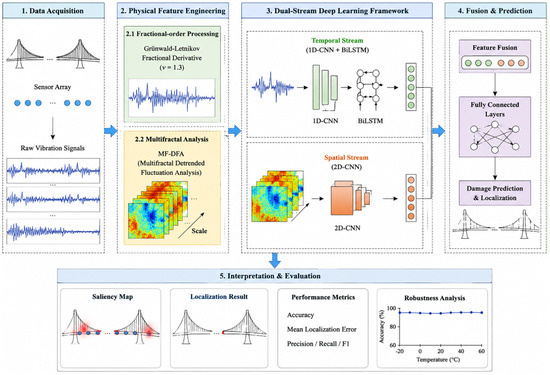
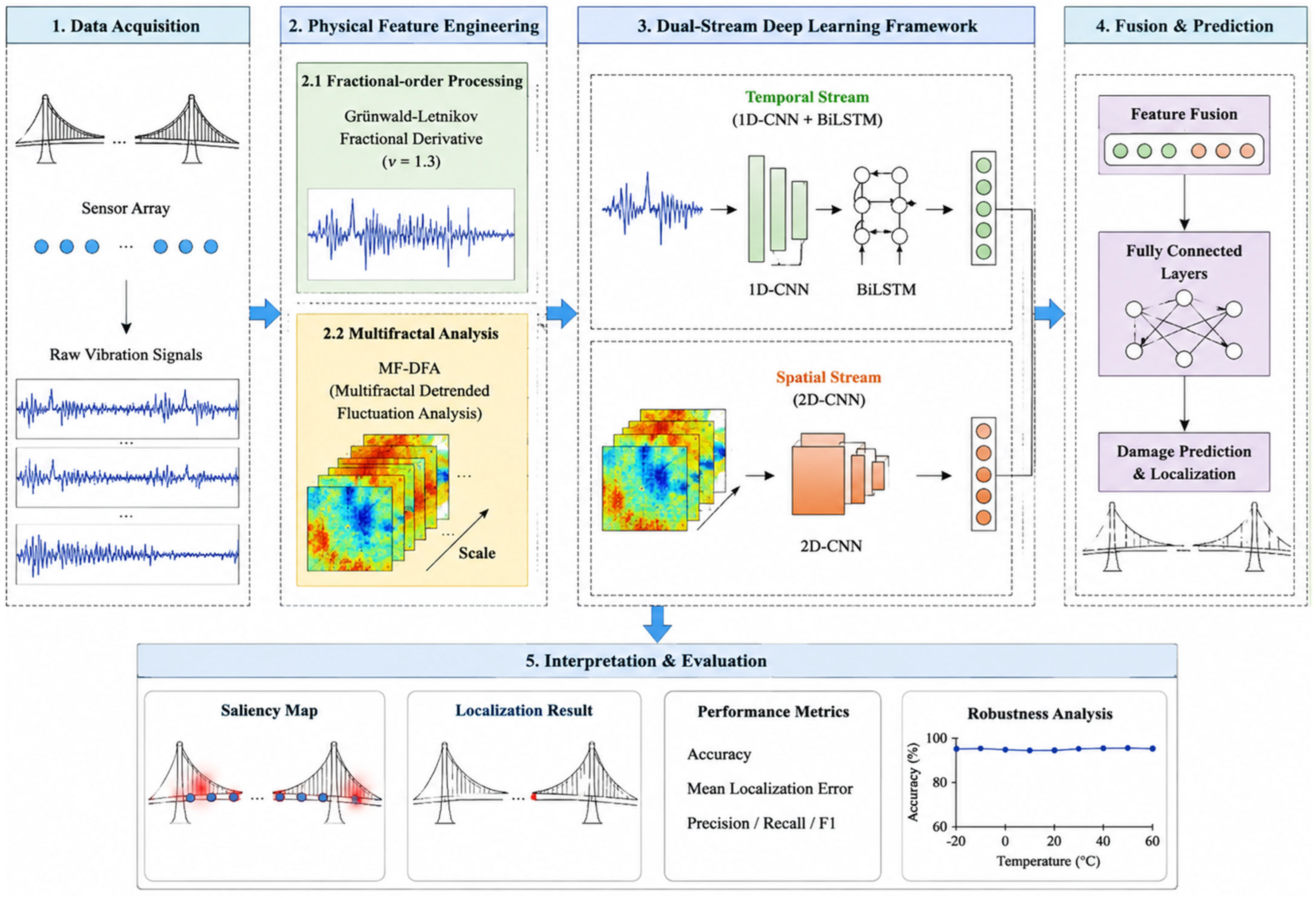
This section delineates the proposed hybrid deep learning framework for structural damage detection. The framework synergistically integrates physical prior knowledge—specifically, fractional calculus and multifractal geometry—with a dual-stream deep neural network to enhance both the interpretability and diagnostic accuracy, as shown in Figure 1. The methodology is structured into four main components: (1) fractional-order singularity enhancement, (2) multifractal feature extraction and feature map construction, (3) dual-stream deep neural network architecture, and (4) training strategy and damage indicator.
Figure 1.
Overview of proposed hybrid-driven damage detection methods.
2.1. Fractional-Order Singularity Enhancement
The released Z24 acceleration records were sampled at 100 Hz. The KW51 acceleration signals, originally acquired at 1651.6 Hz, were resampled to 100 Hz before window segmentation so that a consistent temporal resolution was used across the within-dataset and cross-bridge experiments. Consequently, the sampling interval in Equation (1) was s for both Z24 and KW51. The finite-memory truncation order of the GL operator was fixed at throughout all experiments. After preprocessing, the signals were divided into 10 s windows with 50% overlap. These details determine both the physical sampling interval in Equation (1) and the MF-DFA series length L and are therefore reported explicitly for reproducibility. The Grünwald–Letnikov (GL) operator was subsequently applied to each window to enhance damage-related singularities.
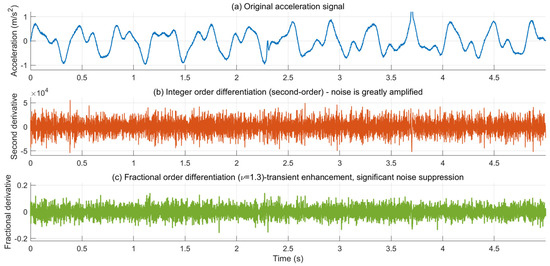
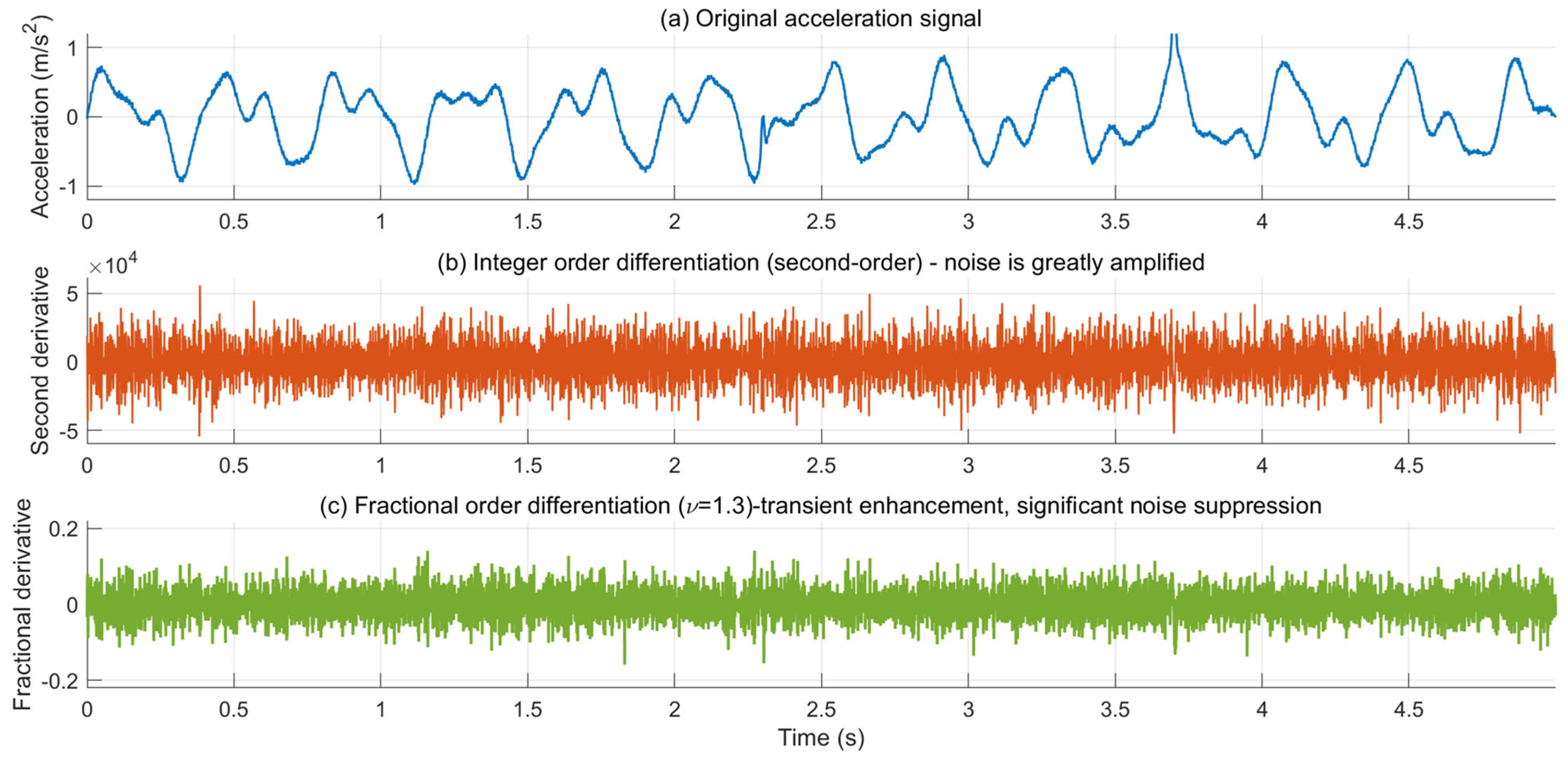
where is sampling interval in seconds, and is the finite-memory truncation order. The same preprocessing procedure and GL parameterization were consistently applied to the training, validation, testing, and transfer experiments. The fractional order is a tunable parameter; unlike an integer derivative, it provides continuous control of high-frequency emphasis. A grid search on the Z24 validation subset yielded producing the enhanced signal for each sensor and segment. Comparison of fractional order singularity enhancement effects is shown in Figure 2.
Figure 2.
Comparison of fractional order singularity enhancement effects.
2.2. Multifractal Feature Extraction and Feature Map Construction
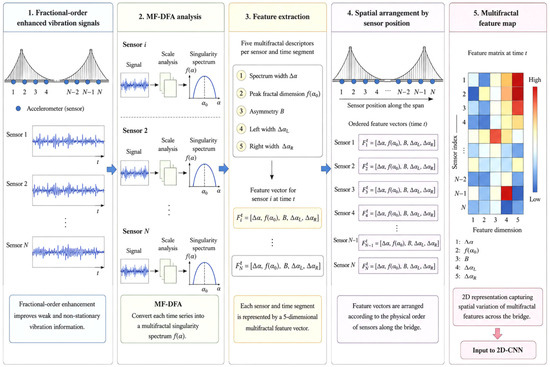
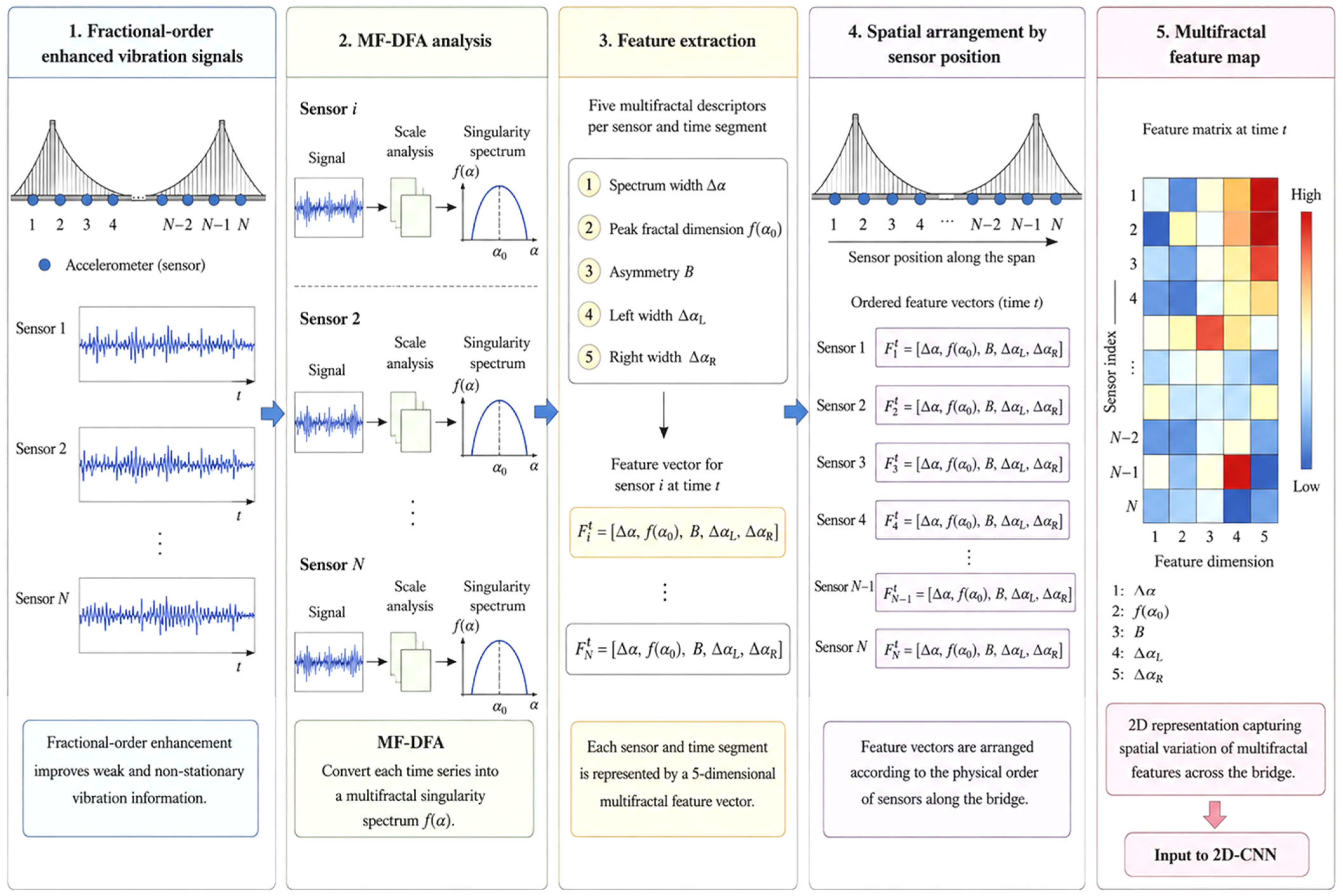
The enhanced signals exhibit complex, non-stationary characteristics that are not fully captured by traditional time- or frequency-domain features. We employ Multifractal Detrended Fluctuation Analysis (MF-DFA) to characterize the signal’s multi-scale complexity. For each segment, the MF-DFA procedure yields a singularity spectrum , from which we extract a set of damage-sensitive features:
- (1)
- Width of the singularity spectrum: , indicating the degree of multifractality.
- (2)
- Fractal dimension at the most probable singularity: .
- (3)
- Asymmetry index: , where and . This normalized definition is used in both the implementation and Figure 3.Figure 3. Schematic diagram of the construction process of multifractal feature map.
- (4)
- The left and right widths: and individually.
These quantities form the five-dimensional vector for sensor and time segment , where in our implementation. To leverage the spatial correlation of damage across the bridge, we construct multifractal feature maps (as shown in Figure 3). Given a bridge with sensors, the feature vectors at a given time segment are arranged according to the sensors’ physical positions along the bridge’s main span. This forms a 2D spatial feature map . For the Z24 and KW51 bridges, the sensors are linearly distributed along the bridge deck; thus, can be visualized as a 1D spatial sequence of -dimensional feature vectors. This representation transforms the multifractal characteristics into a structured format suitable for spatial pattern recognition.
2.3. Dual-Stream Deep Neural Network Architecture
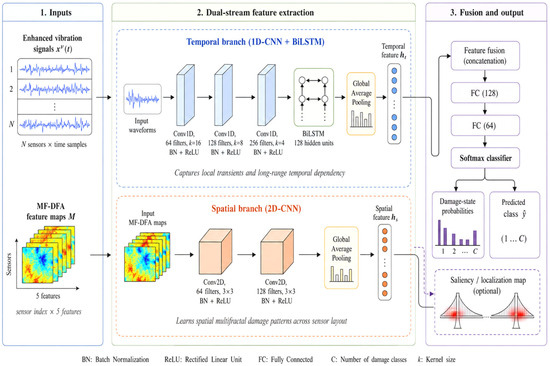
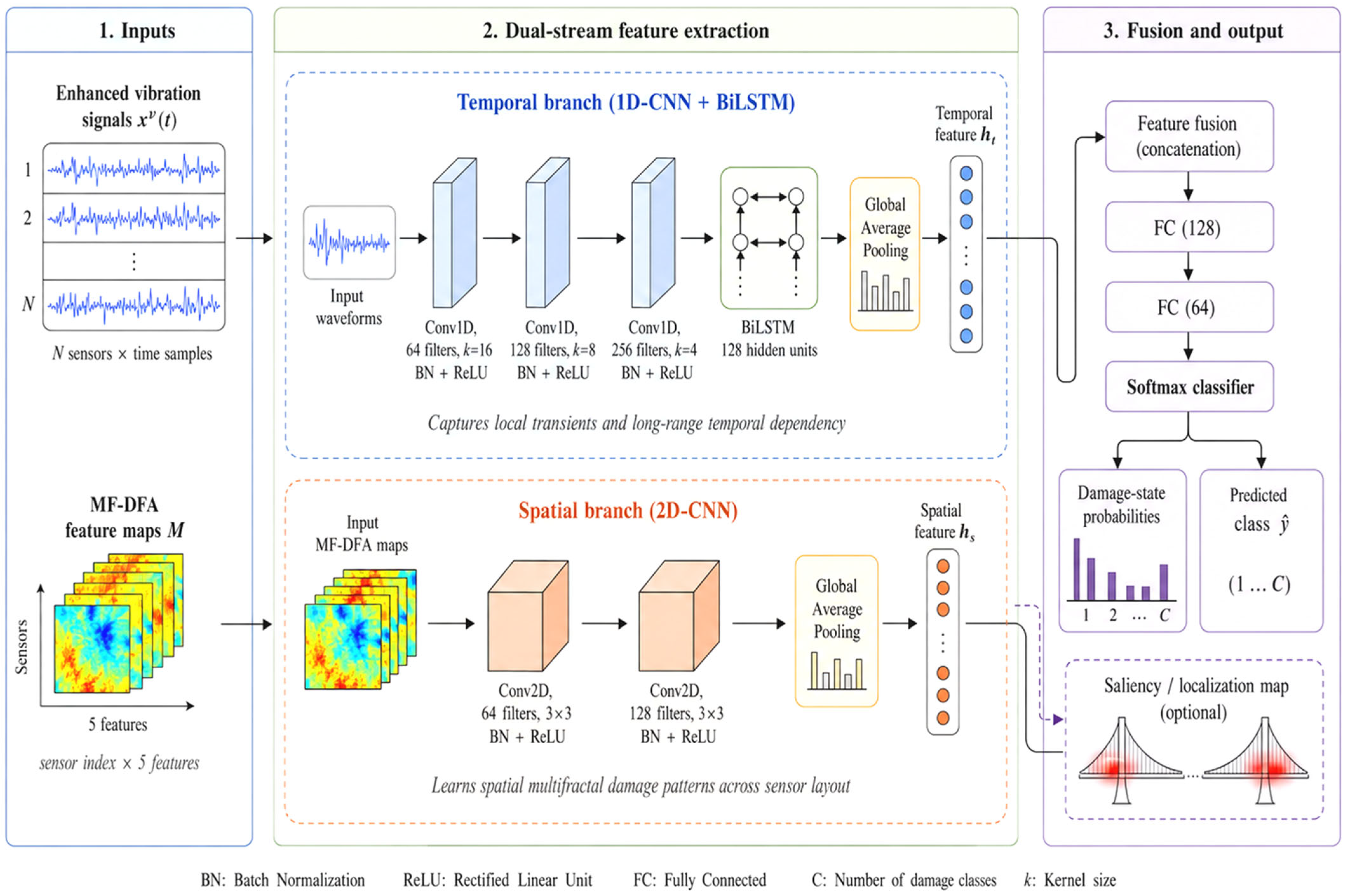
The core of the framework is a dual-stream neural network with a common physical-prior source. The temporal stream directly processes the fractional-order enhanced signals from all sensors. The spatial stream processes MF-DFA maps computed from those same enhanced signals. Thus, neither learned branch receives raw acceleration after the preprocessing stage, and the ablation variants are interpreted relative to this explicit data path.
Stream 1: Temporal Feature Extractor
This stream takes the fractional-order enhanced signals from all sensors as input. It consists of:
- (1)
- A 1D Convolutional Neural Network (1D-CNN) with three convolutional layers, each followed by batch normalization and ReLU activation. The kernels are designed to capture local transient features at multiple scales (e.g., kernel sizes of 16, 8, and 4).
- (2)
- A Bidirectional Long Short-Term Memory (BiLSTM) layer to capture long-range temporal dependencies and contextual information from the sequence of convolutional features.
- (3)
- A global average pooling layer to aggregate the temporal features into a fixed-length vector .
Stream 2: Spatial Feature Extractor
This stream takes the multifractal feature maps as input. It employs:
- (1)
- A 2D Convolutional Neural Network (2D-CNN) with two convolutional layers, as shown in Figure 4, treating the sensor index as the spatial dimension and the multifractal features as channels. This allows the network to learn local spatial patterns of multifractal changes, which are indicative of damage localization.Figure 4. Detailed architecture diagram of dual stream network.
- (2)
- A global average pooling layer to produce a spatial feature vector .
It is worth noting that both streams originate from the same fractional-order preprocessed signals. While this ensures consistency, it implies that the complementarity between streams stems from the different receptive fields and inductive biases (temporal vs. spatial) of the 1D-CNN/BiLSTM and 2D-CNN, rather than from entirely independent raw data sources.
Fusion and Classification: The two feature vectors and are concatenated and passed through a series of fully connected layers, culminating in a softmax layer for classification. The network outputs a probability distribution over damage states (e.g., healthy, damage level 1, damage level 2, etc.). For localization tasks, the spatial feature maps can be upsampled to produce a saliency map indicating the likely location of damage.
2.4. Training Strategy and Damage Indicator
The network is trained with categorical cross-entropy. To prevent leakage caused by 50%-overlapping windows, complete continuous records are assigned to only one of the training, validation, or test sets before window extraction.
For the supervised cross-bridge fine-tuning experiment, 10% of the KW51 target-domain recordings were selected by stratified random sampling while preserving the healthy/damaged class ratio of the available target data. The resulting fine-tuning subset contained 60 healthy and 60 damaged recordings. The remaining recordings were reserved for transfer testing and were not used for parameter updating. During fine-tuning, we freeze all convolutional and recurrent feature-extraction layers and only update the final two fully connected layers and the classification head, with a reduced learning rate of 1 × 10⁻⁴. This strategy prevents overfitting to the limited target data while allowing domain-specific decision-boundary adaptation.
For online damage detection, we define a Damage Indicator (DI) based on the model’s output. Instead of a binary threshold:
where is the predicted probability for state .
3. Results and Discussion
This section presents a comprehensive evaluation of the proposed fractional-order multifractal-driven dual-stream deep learning framework for structural damage detection. The experiments are conducted on two benchmark datasets: the Z24 bridge (a highway bridge with progressive damage scenarios) and the KW51 bridge (a railway bridge with environmental variability). The results are organized into five subsections: (1) experimental setup and implementation details, (2) damage detection and classification performance, (3) damage localization via spatial feature visualization, (4) ablation studies and comparative analysis, and (5) cross-dataset generalization and discussion.
3.1. Experimental Setup and Implementation Details
3.1.1. Datasets Description
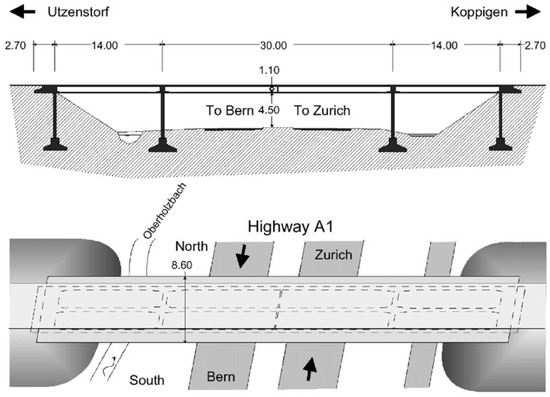
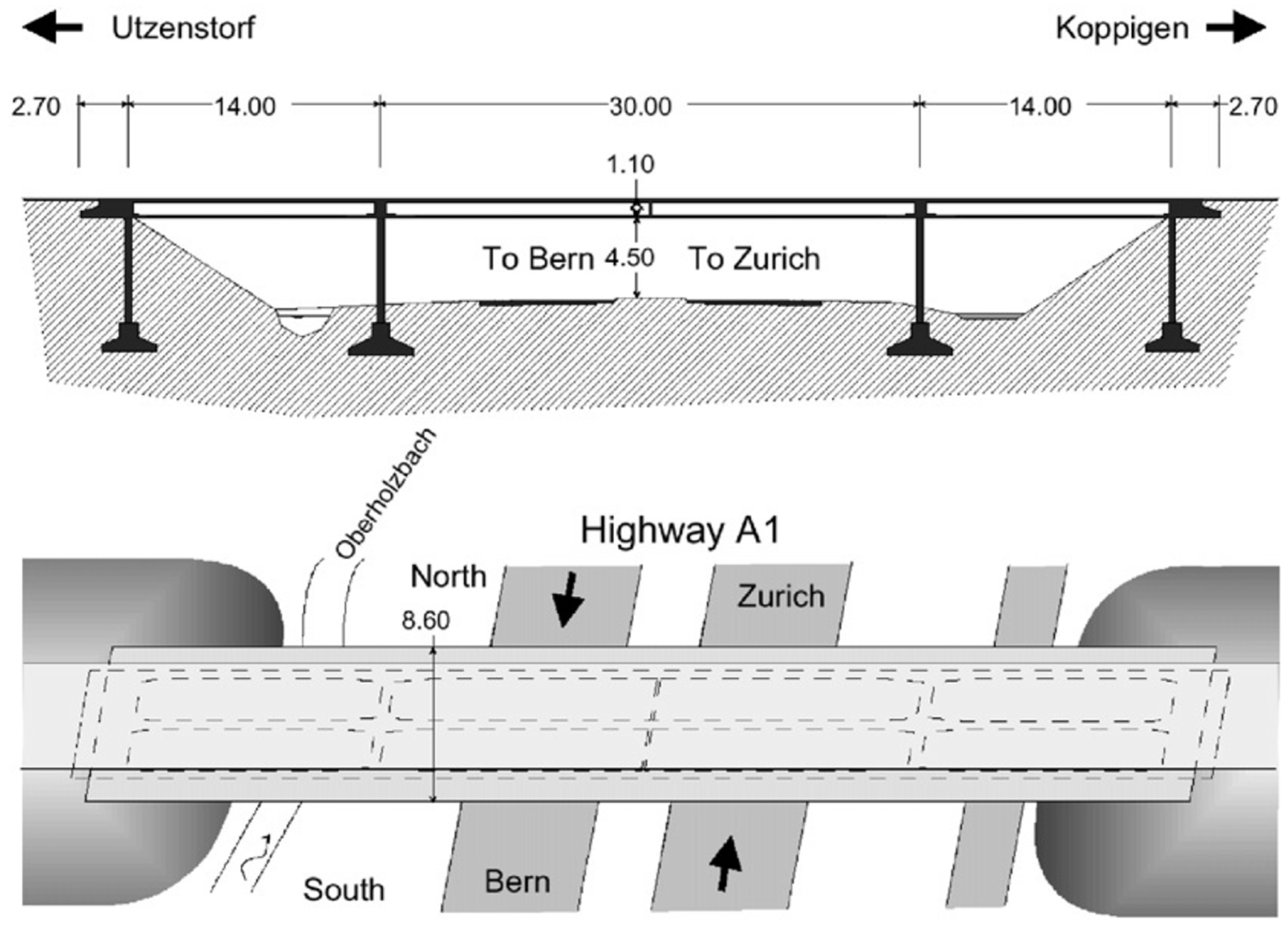
The Z24 benchmark [27,28] was obtained from a three-span prestressed-concrete box-girder highway bridge in Switzerland, as shown in Figure 5. The progressive test program contained 17 imposed structural changes. This study uses the undamaged condition and six representative labels: pier lowering, pier lifting, concrete spalling at the soffit, a 1 m abutment-side landslide, concrete-hinge failure, and anchor-head failure. Sixteen accelerometers distributed along the deck are used. These labels represent controlled global or local changes to load paths and boundary conditions; they should not be interpreted as an exhaustive taxonomy of all bridge defects.
Figure 5.
Z24 Bridge [27,28].
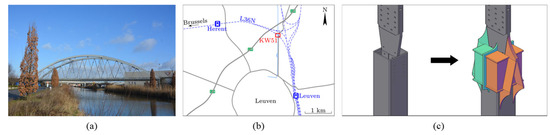
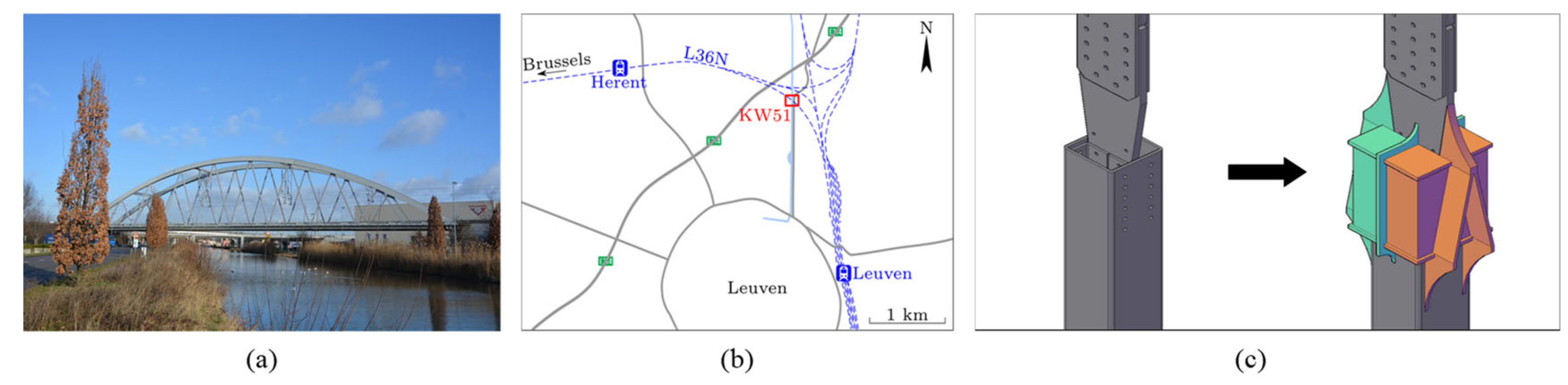
The KW51 benchmark [29,30] concerns a 115 m steel bowstring railway bridge near Leuven, Belgium, carrying two ballasted tracks, as shown in Figure 6. Twelve uniaxial accelerometers monitor the deck and arches. Its structural-state distinction is associated with the period before and after strengthening of the diagonal-to-arch and diagonal-to-deck connections, under train excitation and substantial environmental variability. Consequently, the Z24-to-KW51 experiment spans different materials, structural systems, traffic excitation, sensor counts, and state definitions; it is a demanding but still limited two-bridge test rather than proof of universal applicability.
Figure 6.
(a) Picture of railway bridge KW51, (b) situation sketch, and (c) detail of the retrofit, where steel boxes are welded around the original bolted connections of the diagonals to the arches and the bridge deck [29,30].
3.1.2. Implementation Details
Signals are segmented into 10 s windows with 50% overlap after the preprocessing specified in Section 2.1. The fractional order is selected by grid search over in increments of 0.1 using only the Z24 validation subset, yielding ν = 1.3. For the 10 s, 100 Hz segments used in this study , the MF-DFA scales were , with ranging from −5 to 5.
The network is implemented in PyTorch (2.14.0). The temporal branch uses Conv1D layers with 64, 128, and 256 filters (kernel sizes 16, 8, and 4), each followed by batch normalization and ReLU, and a BiLSTM with 128 hidden units. The spatial branch uses Conv2D layers with 64 and 128 filters (3 × 3 kernels), each followed by batch normalization and ReLU. The fused representation passes through fully connected layers of 128 and 64 units and a softmax classifier. Adam is used with an initial learning rate of 0.001 and a batch size of 32 for up to 100 epochs, with early stopping based on validation loss.
3.1.3. Training Convergence Analysis
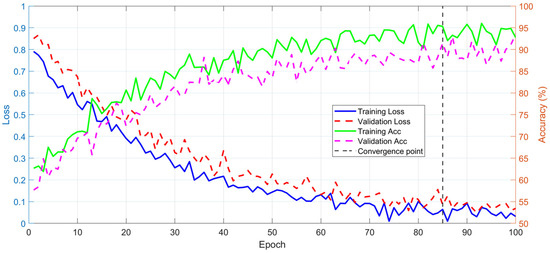
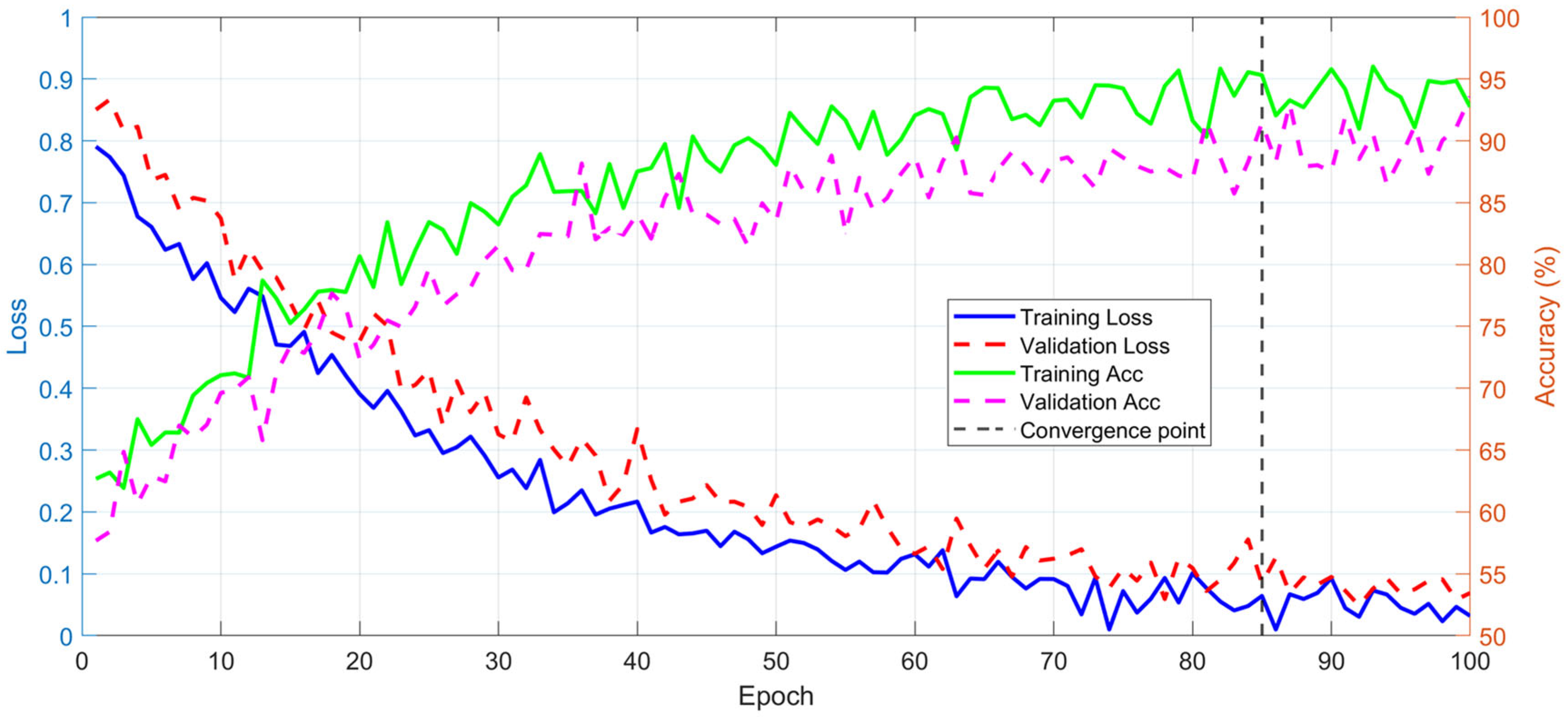
Figure 7 illustrates the training dynamics of the proposed dual-stream framework over 100 epochs on the Z24 bridge dataset. The training loss decreases rapidly from approximately 0.8 to below 0.1 within the first 50 epochs, indicating efficient gradient-based optimization. Concurrently, the training accuracy rises from 60% to over 90% in the same period, demonstrating the model’s capacity to learn discriminative damage features. The validation loss and accuracy follow closely behind, with a slight gap that narrows as epochs progress, suggesting minimal overfitting. The early stopping criterion (based on validation loss) is triggered at epoch 85, after which the model is frozen to avoid over-training. The final validation accuracy reaches approximately 93%, consistent with the test performance reported in Section 3.2. The smooth convergence and the close alignment between training and validation curves confirm the robustness of the proposed physical-prior embedding and the effectiveness of the adopted regularization strategies (batch normalization, dropout, and weighted sampling). This convergence behavior is also observed, with minor variations, when transferring the pretrained model to the KW51 dataset, further supporting the generalizability of the learned representations.
Figure 7.
Training convergence of the proposed dual-stream framework.
3.2. Damage Detection and Classification Performance
3.2.1. Z24 Bridge Results
Table 1 presents the classification accuracy of the proposed framework across the six damage states of the Z24 bridge. The overall accuracy reaches 97.3%, with individual state accuracies ranging from 94.2% (D1, early-stage damage) to 99.1% (D6, severe damage). This demonstrates the method’s high sensitivity even to incipient damage states.
Table 1.
Classification accuracy for Z24 Bridge damage states.
3.2.2. KW51 Bridge Results
For the KW51 bridge, which presents a more challenging scenario due to operational variability (temperature fluctuations, train-induced excitations), the proposed framework achieves an overall accuracy of 94.8% (Table 2). This slightly lower but still impressive performance underscores the method’s robustness against environmental disturbances. Notably, the fractional-order enhancement effectively suppresses temperature-induced trends, allowing the multifractal features to capture damage-induced signatures.
Table 2.
Classification accuracy for KW51 Bridge.
3.3. Damage Localization via Spatial Feature Visualization
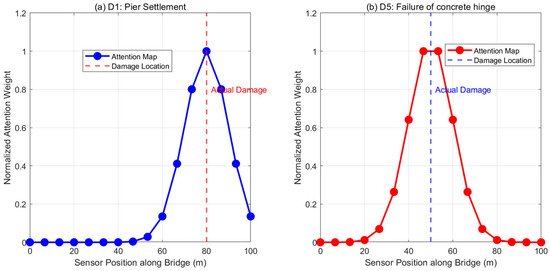
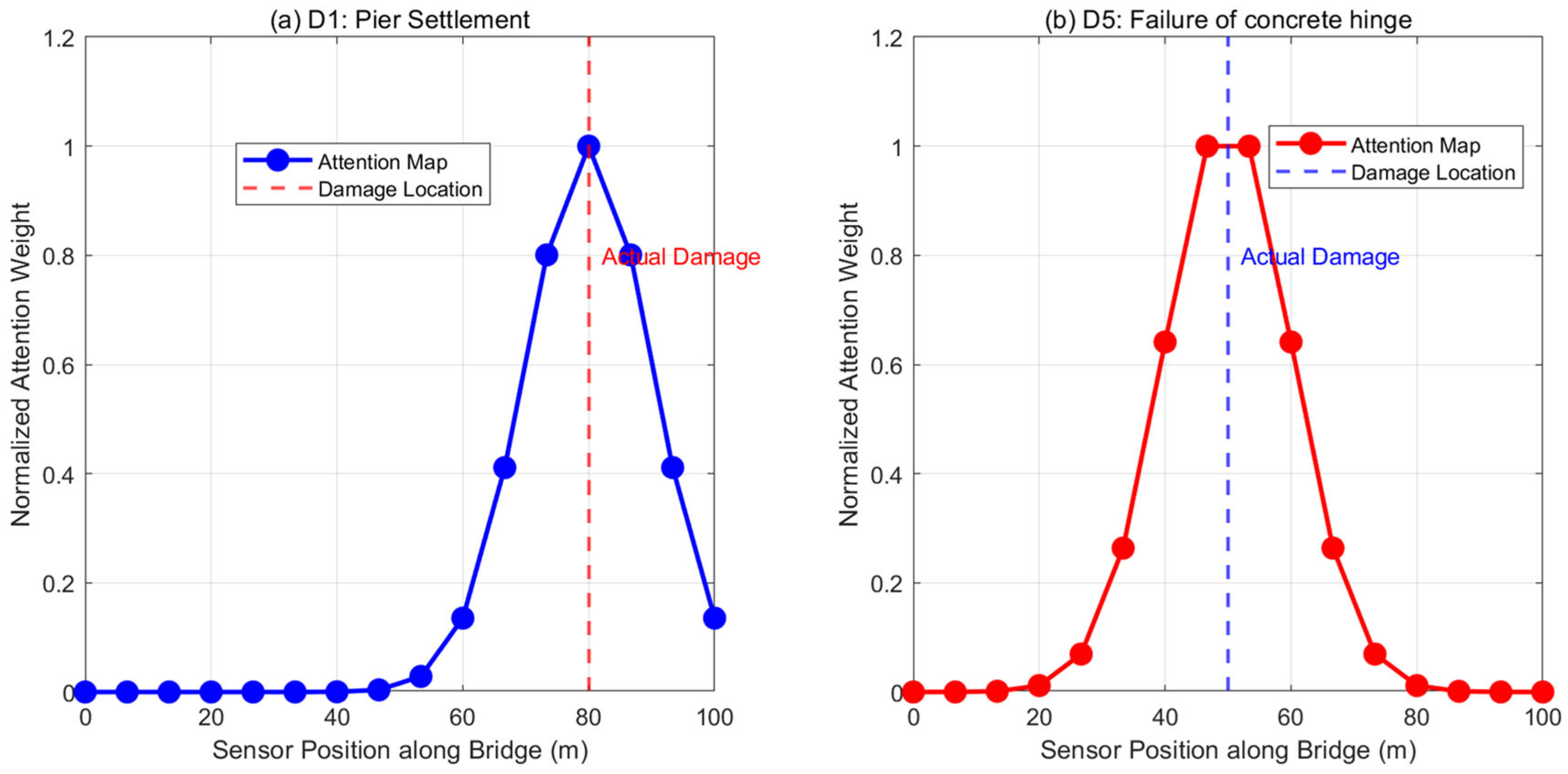
A significant advantage of the proposed framework is its inherent capability for damage localization through the spatial feature extractor. Figure 8 presents the saliency maps generated by the 2D-CNN branch for the Z24 bridge. The saliency maps indicate the network’s attention focus when processing multifractal feature maps.
Figure 8.
Saliency maps from 2D-CNN branch for Z24 Bridge.
For damage state D1 (settlement of the pier), the saliency map shows a pronounced peak at sensor locations corresponding to the affected region. Similarly, for D5 (failure of concrete hinge), the attention is concentrated at the mid-span sensors. This spatial alignment between the network’s focus and the actual damage locations validates the physical interpretability of the learned representations.
3.4. Ablation Studies and Comparative Analysis
3.4.1. Ablation Studies
To rigorously evaluate the contribution of each component in the proposed framework, we conduct ablation studies on the Z24 bridge dataset, as shown in Table 3. Four model variants are compared:
Table 3.
Ablation study results on Z24 Bridge.
Variant A (Baseline): Pure 1D-CNN + BiLSTM using raw acceleration signals without fractional-order enhancement or multifractal features.
Variant B: Fractional-order enhancement applied, followed by 1D-CNN + BiLSTM (no multifractal features).
Variant C: Multifractal feature maps processed by 2D-CNN only (no temporal stream).
Variant D (Proposed): Full dual-stream framework with both fractional-order enhancement and multifractal feature maps.
The ablation results reveal several key insights:
- (1)
- Fractional-order enhancement alone (Variant B) improves accuracy by 4.3% over the baseline, confirming that the singularity enhancement effectively amplifies damage-relevant features.
- (2)
- Multifractal features alone (Variant C) achieve 91.8% accuracy and enable localization capability, demonstrating that the spatial distribution of multifractal characteristics contains valuable damage information.
- (3)
- The full dual-stream framework (Variant D) achieves the best performance, with a 7.8% accuracy improvement over the baseline and the lowest localization error. The synergy between temporal and spatial streams enables comprehensive damage characterization.
3.4.2. Comparison with Representative Baselines
Table 4 reports representative baselines evaluated under the same preprocessing and held-out test protocol used for the proposed model; it is therefore an internal controlled comparison rather than a cross-paper leaderboard.
Table 4.
Controlled comparison with representative baselines on Z24.
Under this common protocol, the proposed model obtains the highest classification accuracy among the evaluated baselines and is the only compared configuration that also produces a sensor-aligned localization map.
3.5. Cross-Dataset Generalization and Discussion
3.5.1. Transfer Learning Validation
To assess the generalizability of the proposed framework, we perform a transfer learning experiment. The model trained on the Z24 bridge dataset (source domain) is directly applied to the KW51 bridge dataset (target domain) without any fine-tuning (zero-shot transfer). The results are presented in Table 5. For supervised target-domain adaptation, the same stratified random sampling protocol described in Section 2.4 was used to select 10% of the KW51 recordings, comprising 60 healthy and 60 damaged recordings. The remaining 90% of the recordings formed the held-out transfer test set. Following the strategy in Section 2.4, the backbone is frozen and only the classifier head is updated. No unsupervised domain adaptation (e.g., pseudo-labeling or adversarial alignment) is applied; the improvement purely stems from supervised fine-tuning on this small labeled target-domain subset.
Table 5.
Cross-dataset transfer performance.
The 86.7% zero-shot result indicates partial transfer across the two bridges despite differences in structural form, instrumentation, excitation, and environment. With supervised fine-tuning on the stratified 10% KW51 subset described above, the cross-bridge accuracy increased from 86.7% in the zero-shot setting to 94.6%.
3.5.2. Robustness to Environmental Variability
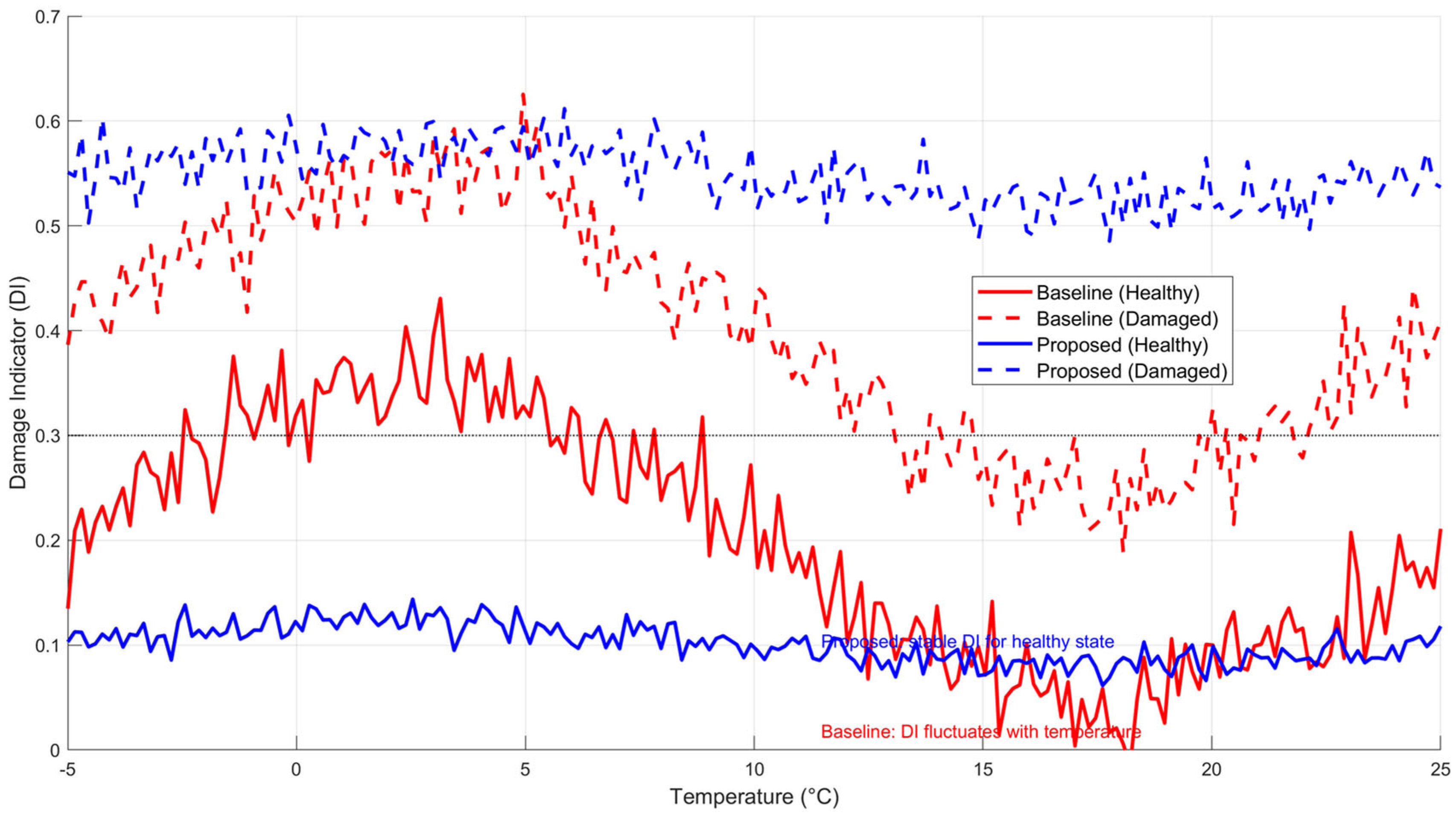
A key challenge in structural health monitoring is distinguishing damage-induced changes from environmental variations. The KW51 dataset includes temperature fluctuations ranging from −5 °C to 25 °C, providing an opportunity to evaluate robustness.
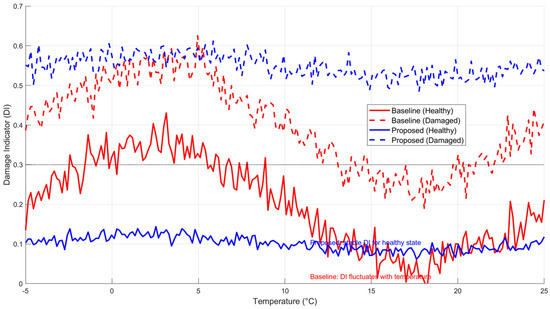
Figure 9 shows the Damage Indicator (DI) computed using the proposed method versus the baseline method (pure 1D-CNN) across varying temperatures. The baseline method exhibits significant DI fluctuations correlated with temperature changes, leading to potential false alarms. In contrast, the proposed method maintains a stable DI for the healthy state across all temperatures, while showing a clear increase when damage is present. This robustness is attributed to:
Figure 9.
Robustness to environmental variability (temperature).
- (1)
- Fractional-order enhancement that suppresses low-frequency temperature-induced trends.
- (2)
- Multifractal features that capture intrinsic signal complexity rather than absolute amplitude variations.
- (3)
- Dual-stream fusion that leverages complementary information to reduce false positives.
3.5.3. Discussion of Key Findings
The experimental results collectively demonstrate the following:
- (1)
- Synergy of physical priors and deep learning: The integration of fractional-order singularity enhancement and multifractal analysis provides a physically meaningful representation that guides the deep learning model toward damage-sensitive features. This synergy yields superior performance compared to either pure data-driven approaches or purely feature-based methods.
- (2)
- Dual-stream architecture advantage: The separation of temporal and spatial processing streams enables the network to capture complementary aspects of damage—local transient anomalies and global spatial patterns. The fusion of these streams produces a more comprehensive damage signature.
- (3)
- Interpretability through localization: Unlike black-box deep learning models, the proposed framework offers interpretability through spatial saliency maps that align with actual damage locations. This feature is crucial for practical SHM applications where engineers need to trust and verify the model’s decisions.
- (4)
- Transferability and data efficiency: The successful cross-dataset transfer demonstrates that the learned representations capture fundamental damage physics rather than dataset-specific artifacts. This property significantly reduces the labeling burden for new bridges, making the framework practically viable.
Bridge type and identifiable damage scope: Z24 is a prestressed-concrete box-girder highway bridge, whereas KW51 is a steel bowstring railway bridge. Their contrast supports a preliminary assessment across two structural families, but modal density, force-transfer paths, excitation statistics, and sensor topology differ substantially for truss, cable-stayed, suspension, masonry, and very long-span bridges. Direct deployment to those systems would require bridge-specific preprocessing, order calibration, and at least a small validation set.
Fractional-order universality: ν = 1.3 is an empirically selected operating point for the Z24 preprocessing and sampling configuration, not a bridge-independent constant. The optimal order can shift with structural frequency content, sampling frequency, filter bandwidth, excitation, and signal-to-noise ratio because ν controls the spectral emphasis of the GL operator. The unchanged-order KW51 experiment evaluates transfer of this Z24-selected setting, but two datasets are insufficient to establish universality. For a new bridge, ν should be selected on a calibration subset or by a nested validation procedure, and sensitivity across plausible noise levels should be reported.
3.5.4. Limitations and Future Directions
The results should be interpreted in light of the following limitations and their practical consequences:
- (1)
- Benchmark and label scope: the study uses two benchmark bridges and a finite set of imposed or retrofit-related states. Accuracy can decrease for damage mechanisms, severities, compound defects, or operational regimes absent from training; the classifier should therefore support inspection decisions rather than be treated as an autonomous diagnosis of arbitrary defects.
- (2)
- Sensor topology: arranging sensors as rows of a 2D-CNN input assumes a fixed ordering and treats adjacent rows as equally spaced. With irregular spacing, missing channels, or a different sensor count, standard convolution can distort physical neighborhoods and saliency locations. Coordinate-aware interpolation and a validity mask can be used for modest irregularity; graph convolution or attention using physical distances is preferable for strongly nonuniform arrays.
- (3)
- Fractional-order and preprocessing dependence: ν = 1.3, the GL memory length, and filter settings are coupled to sampling and noise conditions. A setting transferred without recalibration may amplify sensor noise or suppress low-frequency damage information, so sensitivity analysis and nested calibration are required before field deployment.
- (4)
- Transfer evidence: cross-dataset validation is limited to Z24 and KW51. The fine-tuning experiment uses labeled target-domain recordings and therefore constitutes supervised transfer learning rather than unsupervised domain adaptation. Under this protocol, zero-shot transfer achieves 86.7% accuracy, while supervised fine-tuning using 10% of the KW51 target data increases the accuracy to 94.6%.
- (5)
- Environmental and operational coverage: KW51 represents a finite temperature range and train-induced excitation regime. Humidity, long-term aging, sensor drift, traffic changes, and extreme events are not isolated here; performance may degrade when these covariates move beyond the training distribution.
- (6)
- Computational considerations: the present study reports model size as an implementation-related measure but does not use inference latency to support a real-time deployment claim. A rigorous assessment of computational efficiency requires a standardized benchmarking protocol with explicitly specified hardware, numerical precision, batch size, warm-up procedure, and repeated timing runs. Such deployment-oriented benchmarking will be considered in future work.
3.6. Summary of Results
The comprehensive experimental evaluation on the Z24 and KW51 bridge datasets validates the effectiveness of the proposed fractional-order multifractal-driven dual-stream deep learning framework. Key achievements include:
- (1)
- 97.3% overall accuracy on the Z24 bridge with fine-grained damage localization;
- (2)
- 94.8% accuracy on the challenging KW51 bridge under environmental variability;
- (3)
- 7.8% accuracy improvement over the pure deep learning baseline, with each component contributing significantly;
- (4)
- 86.7% zero-shot cross-dataset generalization, demonstrating transferability;
- (5)
- Robustness to temperature-induced variations, enabling reliable damage detection in operational conditions.
Collectively, these results show that the proposed framework is competitive under the adopted benchmark protocol and that fractional-order and multifractal representations provide complementary information. Broader claims require evaluation on additional bridge families, damage mechanisms, sensor layouts, and prospective field data.
4. Conclusions
This paper has proposed a fractional-order multifractal-driven dual-stream deep learning framework for structural damage detection and localization, which explicitly embeds physical priors—namely fractional calculus for singularity enhancement and multifractal geometry for multi-scale complexity characterization—into a neural architecture. By synergizing a temporal stream (1D-CNN + BiLSTM) that captures local transient anomalies with a spatial stream (2D-CNN) that processes multifractal feature maps arranged along the sensor layout, the framework effectively bridges the gap between physics-based feature engineering and data-driven learning, delivering high diagnostic accuracy, fine-grained localization, strong interpretability, and remarkable cross-dataset generalizability. The main conclusions are summarized as follows:
- (1)
- The Grünwald–Letnikov fractional-order differentiation (optimized at ν = 1.3) effectively amplifies damage-induced singularities while suppressing environmental and operational noise. Ablation results show that this preprocessing step alone improves classification accuracy by 4.3% over the raw-signal baseline, confirming its role as an effective physical prior.
- (2)
- The MF-DFA-derived multifractal feature maps, when spatially arranged according to sensor positions, enable the 2D-CNN branch to learn global spatial damage patterns. This spatial stream alone achieves 91.8% accuracy, demonstrating that multi-scale complexity variations are highly damage-sensitive.
- (3)
- The complete dual-stream fusion achieves 97.3% overall accuracy on Z24 and 94.8% in the within-dataset KW51 experiment. Under the controlled comparison protocol, it exceeds the representative baselines in Table 4; this evidence is benchmark-specific and does not constitute a universal state-of-the-art claim.
- (4)
- Spatial saliency maps align the model response with monitored sensor locations and provide post hoc spatial evidence for several damage labels. Zero-shot transfer from Z24 to KW51 reaches 86.7%, while supervised fine-tuning of the classifier using a stratified 10% subset of KW51 increases the accuracy to 94.6%.
- (5)
- The current evidence is limited by two bridge types, fixed sensor ordering, discrete benchmark labels, empirically calibrated fractional order, and incompletely verified computational/transfer details. These constraints motivate graph-based representations, uncertainty-aware detection, continuous severity estimation, and prospective multi-bridge validation.
Author Contributions
Conceptualization, S.T.; Methodology, S.T., Q.X., Z.S., X.Y. and Y.W.; Software, S.T., Q.X. and Z.S.; Validation, S.T. and Y.W.; Formal analysis, S.T. and Y.W.; Investigation, Q.X., Z.S. and X.Y.; Data curation, Q.X., Z.S. and X.Y.; Writing—original draft, S.T., Q.X. and Z.S.; Writing—review & editing, S.T., X.Y. and Y.W.; Visualization, Q.X., X.Y. and Y.W.; Supervision, X.Y.; Funding acquisition, S.T. and Y.W. All authors have read and agreed to the published version of the manuscript.
Funding
This paper was funded by the National Natural Science Foundation of China (No. 52508178), Guangdong Basic and Applied Basic Research Foundation (No. 2025A1515010155), Natural Science Foundation of Henan Province (No. 252300423474), Zhongyuan University of Technology Excellent Science and Technology Innovation Talent Support Program (No. K2026YXRC05).
Data Availability Statement
The data that support the findings of this study are available on request from the corresponding author.
Acknowledgments
The authors acknowledge the use of ChatGPT (GPT-5.6 Sol) solely to improve the clarity, grammar, and readability of the manuscript.
Conflicts of Interest
The authors declare no conflict of interest.
References
- Farrar, C.; Worden, K. Structural Health Monitoring A Machine Learning Perspective; Wiley: Hoboken, NJ, USA, 2013. [Google Scholar] [CrossRef] [Scilit]
- Spencer, B.F.; Sim, S.-H.; Kim, R.E.; Yoon, H. Advances in artificial intelligence for structural health monitoring: A comprehensive review. KSCE J. Civ. Eng. 2025, 29, 100203. [Google Scholar] [CrossRef] [Scilit]
- Carden, E.; Fanning, P. Vibration Based Condition Monitoring: A Review. Struct. Health Monit. 2004, 3, 355–377. [Google Scholar] [CrossRef] [Scilit]
- Avci, O.; Abdeljaber, O.; Kiranyaz, S.; Hussein, M.; Gabbouj, M.; Inman, D.J. A review of vibration-based damage detection in civil structures: From traditional methods to Machine Learning and Deep Learning applications. Mech. Syst. Signal Process. 2021, 147, 107077. [Google Scholar] [CrossRef] [Scilit]
- Pirrò, M.; Pereira, S.; Gentile, C.; Magalhães, F.; Cunha, Á. Damage detection under environmental and operational variability using the cointegration technique. Eng. Struct. 2025, 328, 119700. [Google Scholar] [CrossRef] [Scilit]
- Hao, C.; Gong, Y.; Liu, B.; Pan, Z.; Sun, W.; Li, Y.; Zhuo, Y.; Ma, Y.; Zhang, L. Data anomaly detection for structural health monitoring using the Mixture of Bridge Experts. Structures 2025, 71, 108039. [Google Scholar] [CrossRef] [Scilit]
- Sony, S.; Dunphy, K.; Sadhu, A.; Capretz, M. A systematic review of convolutional neural network-based structural condition assessment techniques. Eng. Struct. 2021, 226, 111347. [Google Scholar] [CrossRef] [Scilit]
- Agrawal, A.; Asthana, N.; Paliwal, G. Application of Deep Learning Techniques for Structural Health Monitoring and Damage Detection in Civil Infrastructure. In Proceedings of Applied Mathematics and Mechanics; Springer-Nature: Singapore, 2025; pp. 49–82. [Google Scholar]
- Zhang, Y.; Miyamori, Y.; Mikami, S.; Saito, T. Vibration-based structural state identification by a 1-dimensional convolutional neural network. Comput.-Aided Civ. Infrastruct. Eng. 2019, 34, 822–839. [Google Scholar] [CrossRef] [Scilit]
- Yu, Y.; Wang, C.; Gu, X.; Li, J. A novel deep learning-based method for damage identification of smart building structures. Struct. Health Monit. 2018, 18, 143–163. [Google Scholar] [CrossRef] [Scilit]
- Gardner, P.; Bull, L.A.; Gosliga, J.; Dervilis, N.; Worden, K. Towards Population-Based Structural Health Monitoring, Part IV: Heterogeneous Populations, Transfer and Mapping. In Proceedings of Model Validation and Uncertainty Quantification; Springer: Cham, Switzerland, 2020; Volume 3, pp. 187–199. [Google Scholar]
- Yang, L. Advances in Artificial Intelligence for Structural Health Monitoring. Appl. Comput. Eng. 2025, 160, 16–21. [Google Scholar] [CrossRef] [Scilit]
- Giglioni, V.; Poole, J.; Mills, R.; Venanzi, I.; Ubertini, F.; Worden, K. Transfer learning in bridge monitoring: Laboratory study on domain adaptation for population-based SHM of multispan continuous girder bridges. Mech. Syst. Signal Process. 2025, 224, 112151. [Google Scholar] [CrossRef] [Scilit]
- Liu, Y.; Fang, S.-E. Cross-domain structural damage identification using transfer learning strategy. Eng. Struct. 2024, 311, 118171. [Google Scholar] [CrossRef] [Scilit]
- Singh, V.P.; Singh, S. Fractional Calculus and Its Applications: A Comprehensive Review. Int. J. Sci. Technol. 2025, 16, 1–7. [Google Scholar] [CrossRef] [Scilit]
- Zheng, H.; Lu, C.; Zhou, X.; Jia, X.; Lv, X.; Shi, Z.; Zhang, G. Fractional-Order Ultrasonic Sensing for Monitoring Microstructural Evolution in Cementitious Materials. Sensors 2026, 26, 271. [Google Scholar] [CrossRef] [Scilit] [PubMed]
- Li, Q. New Approach for Bearing Fault Diagnosis Based on Fractional Spatio-Temporal Sparse Low Rank Matrix Under Multichannel Time-Varying Speed Condition. IEEE Trans. Instrum. Meas. 2022, 71, 1–12. [Google Scholar] [CrossRef] [Scilit]
- Wang, S.; Li, H.; Meng, G. Multi-order fractional Fourier feature fusion with a two-stream attention residual network for aero-engine bearing fault diagnosis. Measurement 2026, 280, 121750. [Google Scholar] [CrossRef] [Scilit]
- Kantelhardt, J.W.; Zschiegner, S.A.; Koscielny-Bunde, E.; Havlin, S.; Bunde, A.; Stanley, H.E. Multifractal detrended fluctuation analysis of nonstationary time series. Phys. A Stat. Mech. Its Appl. 2002, 316, 87–114. [Google Scholar] [CrossRef] [Scilit]
- Pnevmatikos, N.; Konstandakopoulou, F.; Blachowski, B.; Papavasileiou, G.; Broukos, P. Multifractal analysis and wavelet leaders for structural damage detection of structures subjected to earthquake excitation. Soil Dyn. Earthq. Eng. 2020, 139, 106328. [Google Scholar] [CrossRef] [Scilit]
- Mendonça, S.M.; Cabella, B.C.T.; Martinez, A.S. A Multifractal Detrended Fluctuation Analysis approach using generalized functions. Phys. A Stat. Mech. Its Appl. 2024, 637, 129577. [Google Scholar] [CrossRef] [Scilit]
- Pan, L.; Carrillo, J.; Cao, M.; Sha, G. Multifractal-spectrum shape parameters for characterizing distribution and evolution of multiple cracks in concrete structures. Eng. Fract. Mech. 2022, 264, 108329. [Google Scholar] [CrossRef] [Scilit]
- Gonen, S.; Erduran, E. A Hybrid Method for Vibration-Based Bridge Damage Detection. Remote Sens. 2022, 14, 6054. [Google Scholar] [CrossRef] [Scilit]
- Huang, Z.; Yin, X.; Liu, Y. Physics-guided deep neural network for structural damage identification. Ocean Eng. 2022, 260, 112073. [Google Scholar] [CrossRef] [Scilit]
- Raissi, M.; Perdikaris, P.; Karniadakis, G.E. Physics-informed neural networks: A deep learning framework for solving forward and inverse problems involving nonlinear partial differential equations. J. Comput. Phys. 2019, 378, 686–707. [Google Scholar] [CrossRef] [Scilit]
- Qi, J.; Du, K.; Luo, H.; Wang, Z.; Wen, R. Physics-Informed Neural Networks for Structural Dynamic Response Analysis: Theoretical and Numerical Verification. Int. J. Struct. Stab. Dyn. 2025. Online. [Google Scholar] [CrossRef] [Scilit]
- Reynders, E.; De Roeck, G. Vibration-Based Damage Identification: The Z24 Bridge Benchmark. In Encyclopedia of Earthquake Engineering; Beer, M., Kougioumtzoglou, I.A., Patelli, E., Au, I.S.-K., Eds.; Springer: Berlin/Heidelberg, Germany, 2014; pp. 1–8. [Google Scholar] [CrossRef] [Scilit]
- Langone, R.; Reynders, E.; Mehrkanoon, S.; Suykens, J.A.K. Automated structural health monitoring based on adaptive kernel spectral clustering. Mech. Syst. Signal Process. 2017, 90, 64–78. [Google Scholar] [CrossRef] [Scilit]
- Maes, K.; Van Meerbeeck, L.; Reynders, E.P.B.; Lombaert, G. Validation of vibration-based structural health monitoring on retrofitted railway bridge KW51. Mech. Syst. Signal Process. 2022, 165, 108380. [Google Scholar] [CrossRef] [Scilit]
- Maes, K.; Lombaert, G. Validation of virtual sensing for the reconstruction of stresses in a railway bridge using field data of the KW51 bridge. Mech. Syst. Signal Process. 2023, 190, 110142. [Google Scholar] [CrossRef] [Scilit]

Disclaimer/Publisher’s Note: The statements, opinions and data contained in all publications are solely those of the individual author(s) and contributor(s) and not of MDPI and/or the editor(s). MDPI and/or the editor(s) disclaim responsibility for any injury to people or property resulting from any ideas, methods, instructions or products referred to in the content. |
© 2026 by the authors. Licensee MDPI, Basel, Switzerland. This article is an open access article distributed under the terms and conditions of the Creative Commons Attribution (CC BY) license.