


Abstract
To improve the bending properties and wear resistance of titanium, 20–50 vol.% (TiBw + TiCp) reinforced titanium matrix composites were fabricated by high-energy ball-milling and vacuum hot-pressing at 1200 °C. The relationship between their reinforcement contents and their relative density, microstructures, bending properties and wear resistance was investigated and analyzed. The relative density of the composites decreased with increasing reinforcement content, reaching a maximum value of 98.1% for 20 vol.% composite. Bending properties peaked at 30 vol.%, with a bending strength of 1100.1 MPa and an elastic modulus of 171.1 GPa, 62.5% and 114.4% higher than those of titanium, attributed to a balance between the sufficient densification and effective load transfer from the matrix to the uniformly distributed, high-modulus TiBw and TiCp reinforcements. The wear resistance of composites with increasing reinforcement content was substantially improved at room temperature and at 500 °C. The COF of the 50 vol.% composite sintered at 1200 °C reached 0.188 at 28 °C and 0.295 at 500 °C, and the specific wear rates were only 7.16% and 13.7% of those of pure Ti at the respective temperatures. With the incorporation of the reinforcements suppressing the plastic deformation of the matrix, the dominant wear mechanisms at room temperature changed from adhesion wear in pure Ti to predominantly abrasive wear in the composites, and the oxidized debris formed a localized tribo-oxidation debris layer once compacted at the surface irregularities created by the TiB whisker fracture and matrix wear, limiting material transfer. At 500 °C, adhesive wear dominates in pure Ti, whereas abrasive wear dominates in the composites, with oxidation occurring in both materials.
1. Introduction
Titanium and its alloys are widely used in the aerospace, military, automotive industries and for medical purposes owing to their high specific strength, excellent oxidation resistance, low density and biocompatibility; additive manufacturing is also one of the relatively new and promising ways of producing parts with complex geometries from titanium and its alloys [1,2,3,4,5,6]. However, their poor wear resistance can limit their use in components subjected to sliding contact [7,8,9,10,11,12,13]. Under dry sliding conditions, the repeated deformation of the relatively soft matrix can lead to micro-cutting, groove formation, and the generation of wear debris [11,12,13]. The frictional heat generated during wear cannot be dissipated efficiently, accumulating on the sliding surface and promoting deformation and oxidation, thus exacerbating the inherently poor friction and wear properties of the titanium matrix because of its high friction coefficient and low thermal conductivity [14,15,16]. At elevated temperatures, tribo-oxide layers form during the sliding wear of titanium alloys. These oxide layers are generally regarded as non-protective owing to their brittle and non-adherent characteristics [15,17,18]. Conversely, several studies have reported that tribo-oxides can provide effective protection during the dry sliding wear of titanium, contributing to a superior high-temperature wear resistance [19,20,21,22]. Consequently, a dispute persists regarding the protective role of tribo-oxides in the tribological performance of titanium alloys.
The incorporation of hard ceramic particles or fibers into a ductile titanium matrix, which produces titanium matrix composites (TMCs), substantially enhances their comprehensive mechanical properties compared with surface treatment approaches [23,24,25,26]. TMCs are classified into continuously reinforced TMCs (CRTMCs) or discontinuously reinforced TMCs (DRTMCs) according to the geometry and arrangement of the reinforcements [27]. DRTMCs have attracted greater research attention owing to their lower cost, favorable interfacial compatibility, and superior wear and tribological properties [28,29,30,31,32,33].
The in-situ processing for DRTMCs promotes stronger interfacial bonding between the matrix and the reinforcements, improving its ultimate tensile strength, elongation and hardness relative to ex situ processing [34,35,36,37]. The mechanical properties of DRTMCs are also strongly dependent on the morphology, size and distribution of the reinforcements. The distribution and tribological response of a metal matrix also greatly depend on their milling time, sintering temperature and other manufacturing parameters [38]. Further performance gains can be realized by controlling reinforcement morphology through process optimization and thermal deformation. Tian et al. [39] fabricated TA15 matrix composites reinforced with TiBw via the hot-press sintering method. The nanoscale in situ TiB phase refined the matrix grains, optimized interfacial bonding, and substantially enhanced the high-temperature strength and plasticity of the composites through effective dislocation blocking and load transfer. Wang et al. [40] produced network-structured TiBw/TA15 composites by rapid spark plasma sintering (SPS). By tuning the SPS temperature, the size, aspect ratio, and network distribution of TiBw were tailored, markedly refining the matrix microstructure and achieving simultaneous improvements in ambient and high-temperature strength–ductility relative to monolithic TA15 alloy.
Among the candidate reinforcements, TiB and TiC are considered optimal for DRTMCs because their thermal expansion coefficients closely match that of titanium, and they exhibit excellent thermodynamic compatibility with the matrix [34,41]. TiB is typically employed to enhance room-temperature and high-temperature mechanical performance, whereas TiC primarily improves wear resistance. Kim et al. [42] demonstrated that the wear resistance of (TiB + TiC)/Ti6Al4V composites fabricated by the in situ method increased with higher reinforcement content. Both the wear loss and the friction coefficient of composites decreased as the reinforcement fraction increased. They proposed that the reinforcements effectively prevented the scratching and cracking of the matrix material, thereby reducing debris removal. A fully dense Ti–TiBw composite was produced in situ by SPS [19], and elevated temperatures led to a significant reduction in composite wear loss and friction coefficient under dry sliding conditions, which was attributed to the formation of protective tribo-layers. In addition, micropolishing was identified as the dominant wear mechanism at 800 and 900 °C. Zheng et al. [43] prepared single TiC, single TiB, and (TiB + TiC) hybrid-reinforced Ti6Al4V composites and found that their specific wear rates and friction coefficients decreased with increasing reinforcement volume fraction. This improvement was caused by the enhancement of subsurface strength and ductility by the reinforcements. Notably, in the (TiC + TiB) hybrid composites, the presence of TiB inhibited the growth of TiC particles, resulting in finer TiC and a degree of matrix refinement.
Although the room-temperature wear behavior of in situ synthesized TMCs has been extensively studied, relatively little research has addressed their high-temperature tribological performance and the associated wear mechanisms. Furthermore, the protective nature of the tribo-oxide layer formed on titanium alloys during high-temperature wear remains a matter of debate in the existing literature. In this study, (TiBw + TiCp)/Ti composites with varying reinforcement contents were fabricated by high-energy ball-milling and vacuum hot-pressing sintering. The effects of the reinforcement content on the microstructure and mechanical properties of the composites were systematically investigated. The influence of the reinforcement content on the tribological performance under both room-temperature and high-temperature conditions was examined, with the aim of elucidating the operative wear mechanisms of the (TiBw + TiCp)/Ti composites.
2. Experimental Procedure
2.1. Fabrication of Composites
To examine the effect of reinforcement content, mixed powders with different nominal reinforcement contents ranging from 20 vol.% to 50 vol.%, and pure titanium powder for comparison, were hot pressed at 1200 °C. Pure titanium powder, TiB2 powder and high-purity graphite powder were used to fabricate the composites. Pure titanium powder sourced from Shaanxi Yuguang Feili Metal Materials Co., Ltd (Xi’an, China). with an average particle diameter of 100 μm was used as the matrix material. The TiB2 powder obtained from Ningxia Machinery Research Institute Co., Ltd (Yinchuan, China). and high-purity graphite powder provided by Qingdao Huatai Lubrication and Sealing Technology Co., Ltd (Qingdao, China). served as reinforcement precursors, with average sizes of 4 μm and 0.6 μm respectively. According to reactions (1) and (2), TiBw and TiCp are synthesized in situ during sintering:
Ti(s) + TiB2(s)→2TiB(s)
Ti(s) + C(s)→TiC(s)
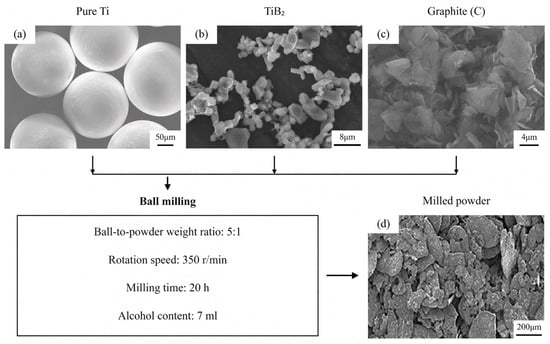
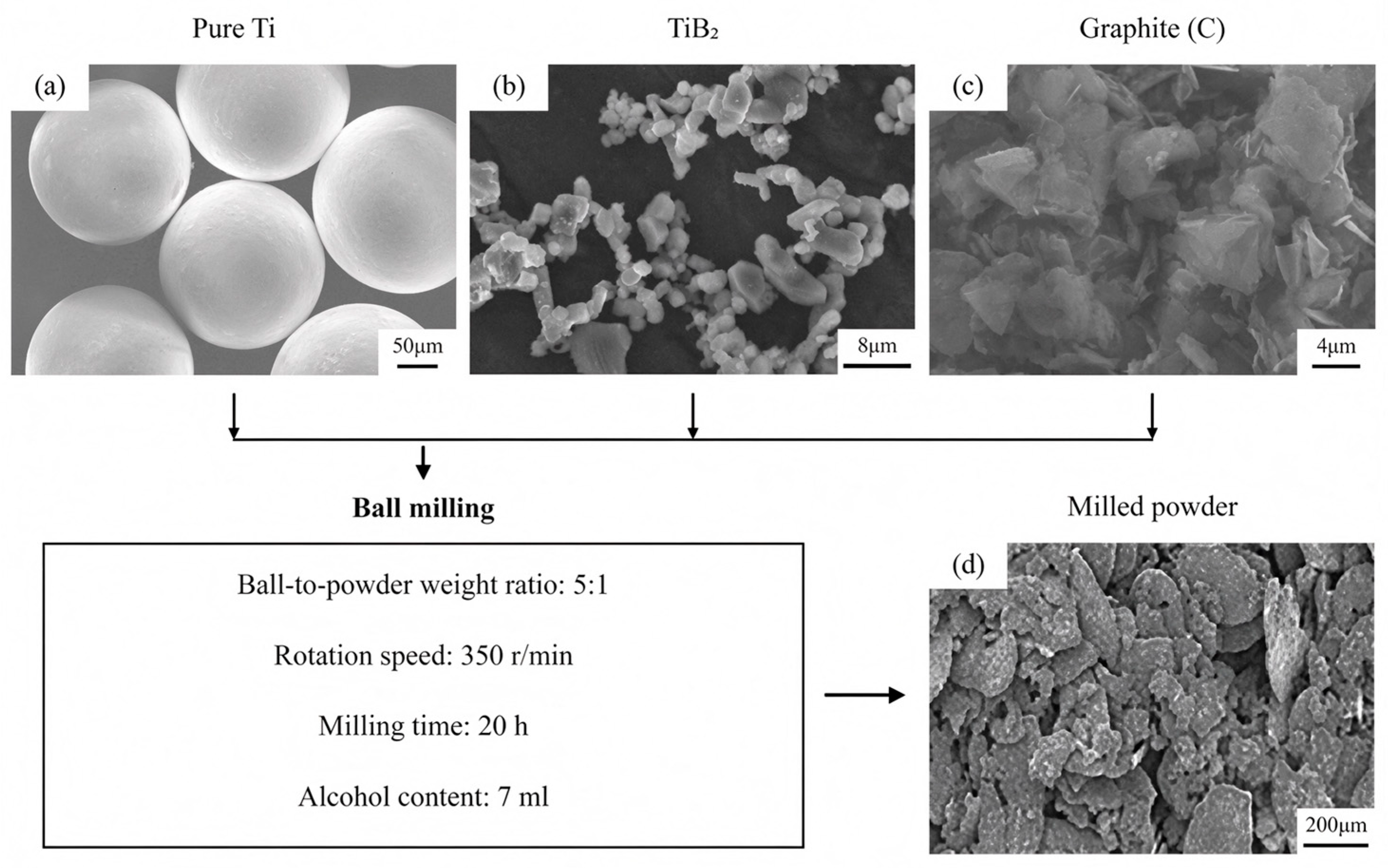
The volume ratio of TiBw to TiCp was fixed at 1:1. The amounts of TiB2 and graphite in the starting powder blends were adjusted to achieve the target combined volume fractions of TiB and TiC after sintering. The powders were mixed by high-energy ball-milling for 20 h at 350 rpm under a protective argon atmosphere. The ratio of the total mass of the milling balls to the combined mass of the three powders was 5:1. Anhydrous ethanol was added as a process control agent. A schematic diagram of the milling process is presented in Figure 1.
Figure 1.
The powder morphologies and schematic of the high-energy ball-milling process: (a) pure Ti powder, (b) TiB2 powder, (c) graphite powder and (d) the powder mixture after milling. The milling conditions are indicated in the diagram.
Sintering was performed by vacuum hot-pressing under the conditions listed in Table 1. All samples were sintered for 1 h under 25 MPa. No visible macroscopic defects were observed on the surfaces of the as-sintered composites. In the sample codes, B and C denote the nominal volume percentages of TiBw and TiCp, respectively, and H denotes the hot-pressing temperature in °C.
Table 1.
Volume fraction of reinforcement and sintering temperature of (TiBw + TiCp)/Ti composites.
2.2. Characterization and Mechanical Tests
Phase identification of the sintered samples was performed by X-ray diffraction (XRD) using a Philips X’Pert diffractometer (Philips, Amsterdam, Netherlands) with Cu Kα radiation at 40 kV and 40 mA. The microstructure of the composites and the fracture surfaces of specimens after room-temperature three-point bending tests were examined by scanning electron microscopy (SEM) using a ZEISS SUPRA55 (Carl Zeiss, Jena, Germany).
The density of the sintered specimens was determined by the Archimedes method using distilled water. For each measurement, the specimen was cleaned, dried, and weighed first in air and then while immersed in distilled water. Its density was calculated as
where ρ is the density of the specimen, ma is the mass of the specimen in air, mw is the mass of the specimen in water, and ρw is the density of water. The mean of four density measurements per specimen was expressed as a percentage of its theoretical density. For the composites, the theoretical density was calculated as the volume-fraction-weighted average of the densities of Ti, TiB, and TiC.
The Vickers hardness of the materials was measured using an HV-200 hardness tester (Shanghai Precision Instruments Co., LTD., Shanghai, China) with a load of 5000 g and a hold time of 10 s. Ten indentations were made on each specimen. The highest and lowest readings were excluded, and the mean of the remaining eight readings was reported as the Vickers hardness of that specimen.
Room-temperature three-point bending tests were performed on an Instron 1186 universal testing machine (Illinois Tool Works Inc., Glenview, IL, USA). The span was 30 mm, and the crosshead speed was 0.5 mm/min. The specimens were rectangular prisms with dimensions of 36 mm × 3 mm × 4 mm. Each room-temperature three-point bending test was performed on four specimens.
Dry sliding wear tests were conducted at room temperature (28 °C) and at 500 °C without lubrication, using an HF-1000 tribometer (Lanzhou Zhongke Kaihua Technology Development Co., Ltd., Lanzhou, China). The specimens were cuboid-shaped. The applied loads were set at 10 N through a silicon nitride ceramic ball with a diameter of 6 mm and a hardness of 20 GPa. The rotation radius was 3 mm and the rotational speed was 399 rpm, corresponding to a linear velocity of 0.125 m/s. Each test lasted 30 min, yielding a total sliding distance of 225 m. Each test was carried out four times.
The specific wear rate was calculated as R = V/(FnL), where V is the measured wear volume, Fn is the normal load, and L is the total sliding distance. For all materials, Fn was 10 N and L was 225 m. R was expressed in mm3/(N·m) and used to compare wear under these fixed conditions.
3. Results and Discussion
3.1. Microstructure, Phase Analyses and Microhardness
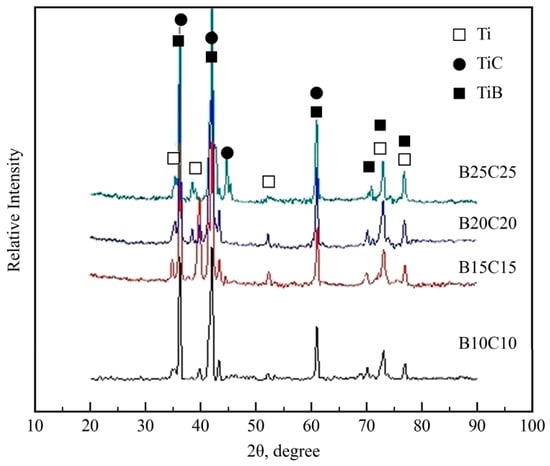
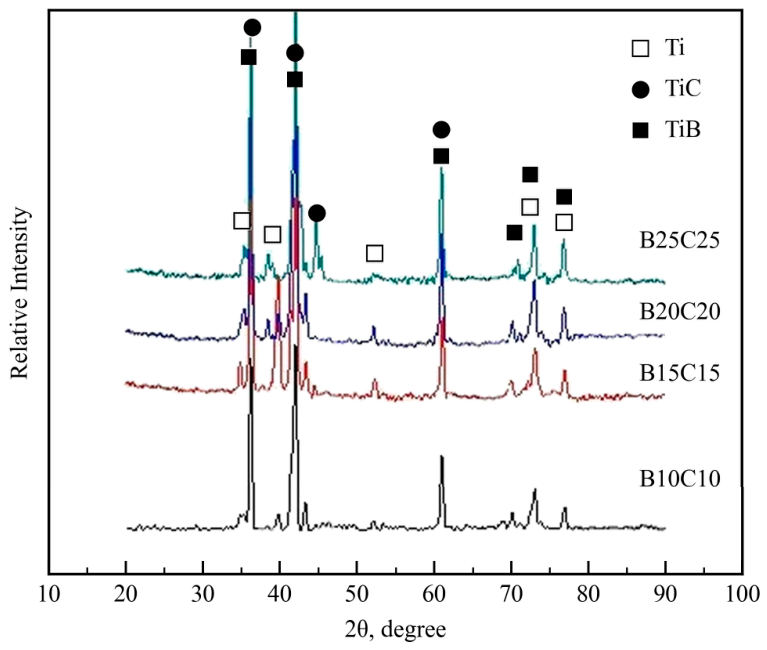
Figure 2 presents the XRD patterns of composites with reinforcement contents ranging from 20 vol.% to 50 vol.%. The Ti, TiC, and TiB phases were identified in all samples. The XRD patterns in Figure 2 are dominated by reflections from Ti, TiC and TiB, demonstrating that reactions (1) and (2) were driven to near completion during sintering.
Figure 2.
XRD patterns of the composites with different reinforcement contents of 20 vol.%, 30 vol.%, 40 vol.% and 50 vol.%, prepared by sintering.
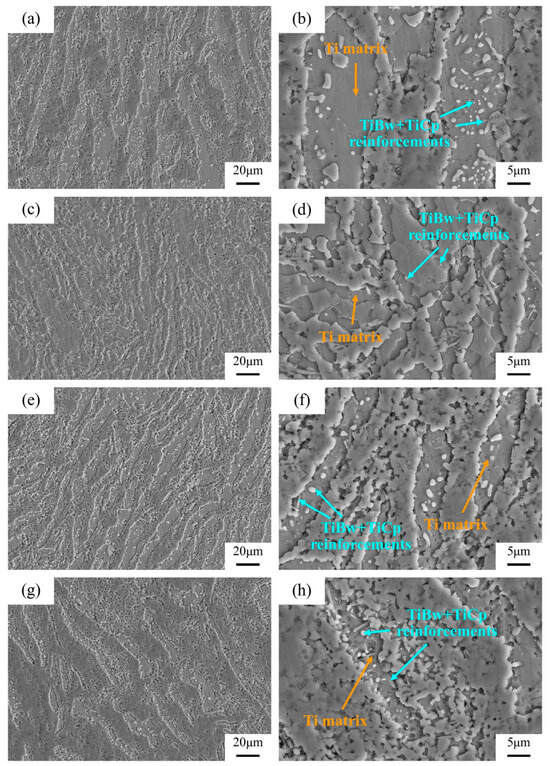
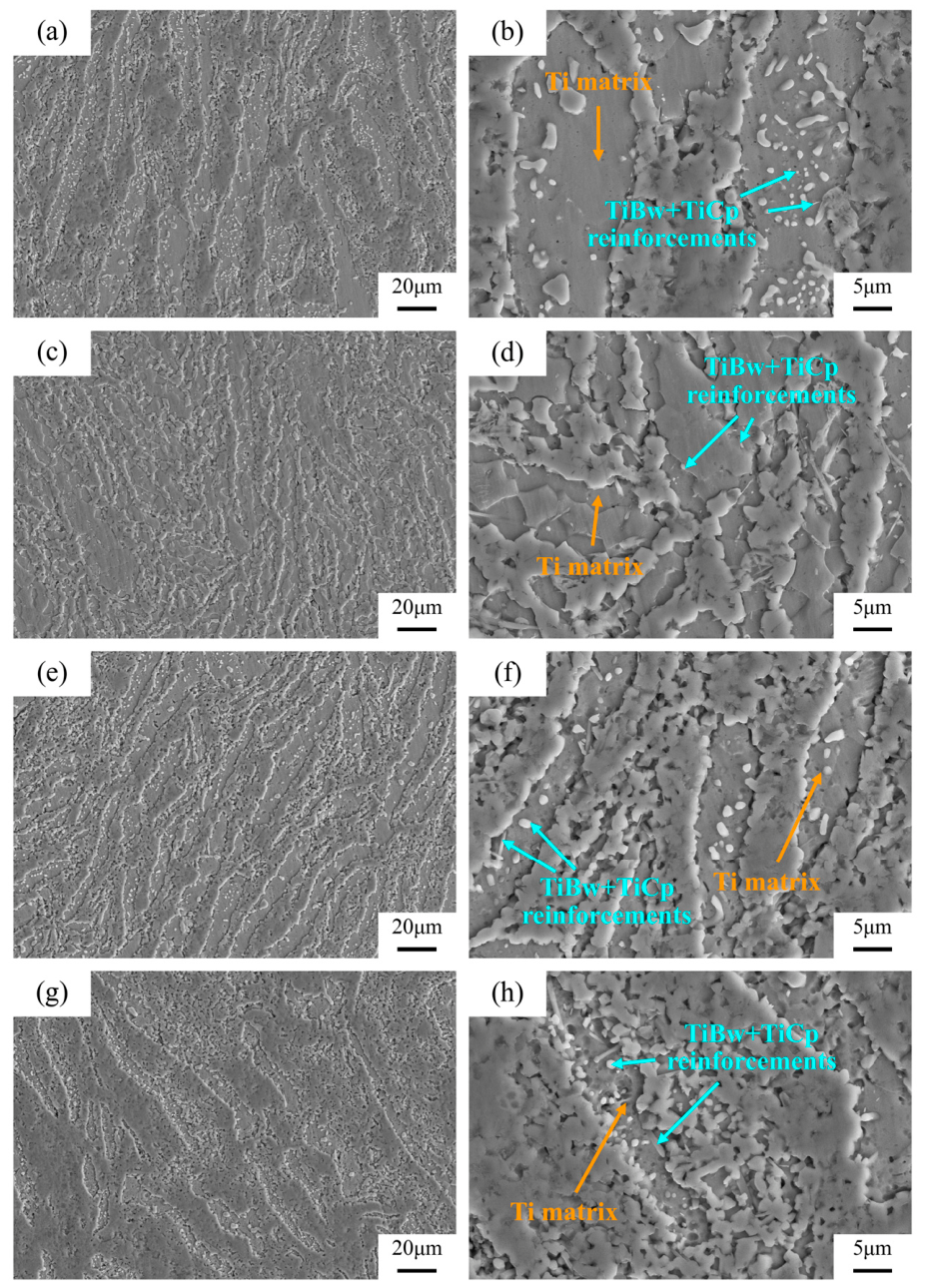
Figure 3 shows the microstructures of (TiBw + TiCp)/Ti composites with varying reinforcement contents. The TiBw and TiCp were uniformly distributed within the titanium matrix. As the reinforcement fraction increased, the content of TiBw increased markedly. The 20 vol.% composite contained a high proportion of fine TiBw, as shown in Figure 3a, and with further increases in reinforcement content, both the average size and the size distribution range of TiBw increased. A similar trend was observed for TiCp. The formation of relatively coarse reinforcement phases may be associated with the local agglomeration of the precursor TiB2 and graphite powders during milling [44].
Figure 3.
SEM images of (TiBw + TiCp)/Ti composites with varying reinforcement contents: (a,b) 20 vol.%, (c,d) 30 vol.%, (e,f) 40 vol.%, (g,h) 50 vol.%.
Table 2 presents the relative density of the sintered (TiBw + TiCp)/Ti composites as a function of reinforcement content. A clear inverse relationship between relative density and reinforcement content was observed in Table 2. The relative density reached a maximum among the composites at 98.1% for the 20 vol.% composite. Increasing the reinforcement content impeded densification by constraining the deformation of the Ti matrix during hot-pressing, leaving more residual porosity [45,46].
Table 2.
The relative density of sintered (TiBw + TiCp)/Ti composites as a function of reinforcement contents.
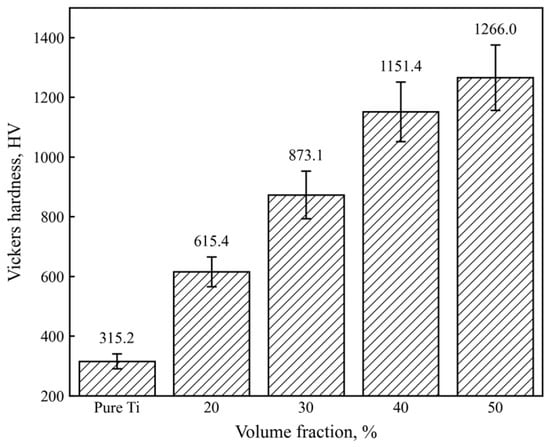
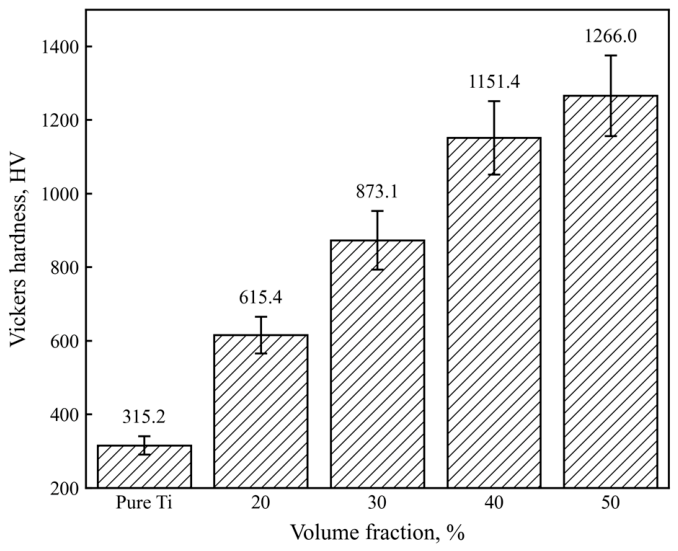
Figure 4 shows the Vickers hardness of the pure Ti and (TiBw + TiCp)/Ti composites containing 20–50 vol.% reinforcement. As shown in Figure 4, the Vickers hardness of the composites increased from 615.4 HV at 20 vol.% reinforcement to 1266.0 HV at 50 vol.% reinforcement. Compared with unreinforced pure Ti (315.2 HV), the composites containing 20, 30, 40, and 50 vol.% reinforcement showed increases in hardness of 93.5%, 174.6%, 263.8%, and 298.1%, respectively. This trend is consistent with a greater contribution from the hard, in situ-formed TiB whiskers and TiC particles at higher reinforcement fractions.
Figure 4.
The Vickers hardness of the pure Ti and (TiBw + TiCp)/Ti composites containing 20–50 vol.% reinforcement.
3.2. Mechanical Properties
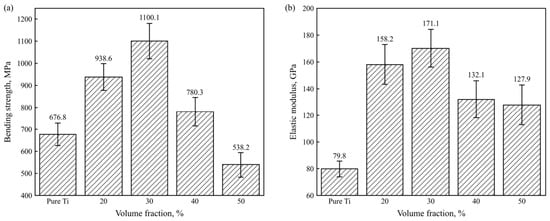
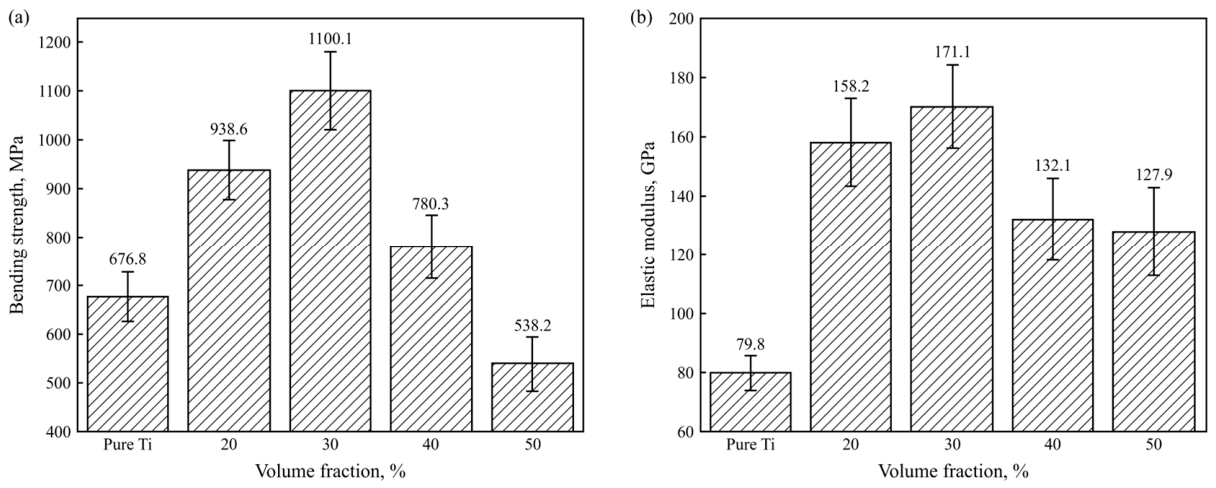
Figure 5 presents the room-temperature bending strength and elastic modulus as a function of reinforcement content. Both properties increased initially, peaked at 30 vol.%, and declined at higher reinforcement contents. The 30 vol.% composite sintered at 1200 °C had the highest bending strength and elastic modulus among the tested compositions, with a bending strength of 1100.1 MPa and an elastic modulus of 171.1 GPa, representing improvements of 62.5% and 114.4% over pure Ti, respectively.
Figure 5.
Room-temperature (a) bending strength and (b) elastic modulus of pure Ti and (TiBw + TiCp)/Ti composites containing 20–50 vol.% reinforcement.
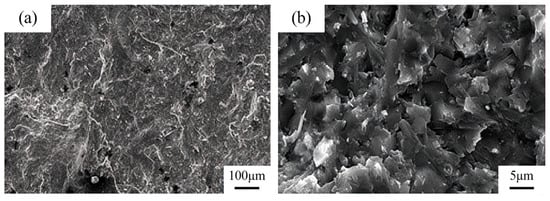
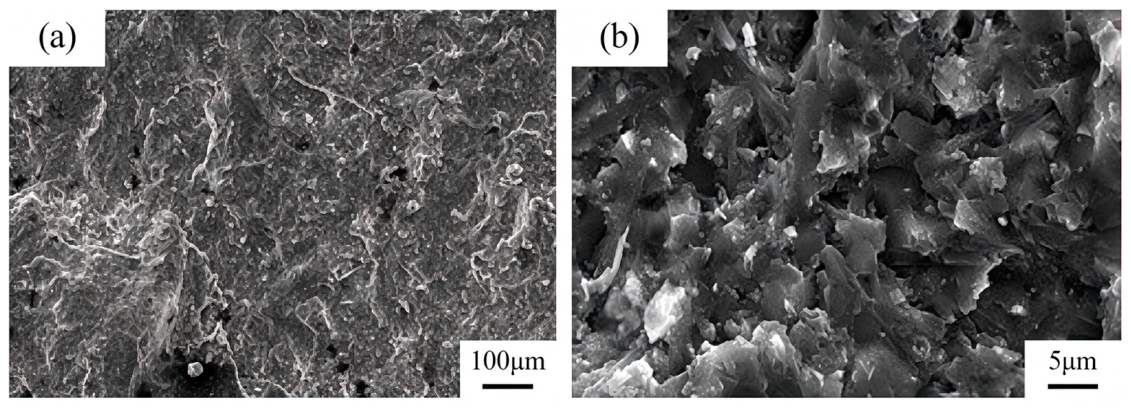
Figure 6 shows the room-temperature three-point bending fracture surfaces of the (TiBw + TiCp)/Ti composites. The fracture surfaces appear relatively flat, lacking dimples or tearing edges, characteristic of brittle fracture. Fractured TiBw and TiCp remained visible on the fracture surface without evidence of debonding, indicating that the reinforcement–matrix interface sustains high bond strength at room temperature. At reinforcement contents below 30 vol.%, this strong interfacial bonding facilitates an effective load transfer from the Ti matrix to the uniformly distributed, high-stiffness TiBw and TiCp reinforcements which bear a substantial fraction of the applied stress, contributing to composite strengthening. However, at reinforcement contents above 30 vol.%, the decline in these properties is attributed primarily to their lower relative density and associated porosity. Residual pores reduce the effective load-bearing area and cause stress concentrations, which promote premature cracking and offset the benefits of additional reinforcement.
Figure 6.
SEM images of fracture surfaces after the room-temperature three-point bending of (TiBw + TiCp)/Ti composites: (a) low-magnification view and (b) high-magnification view.
3.3. Friction and Wear Properties
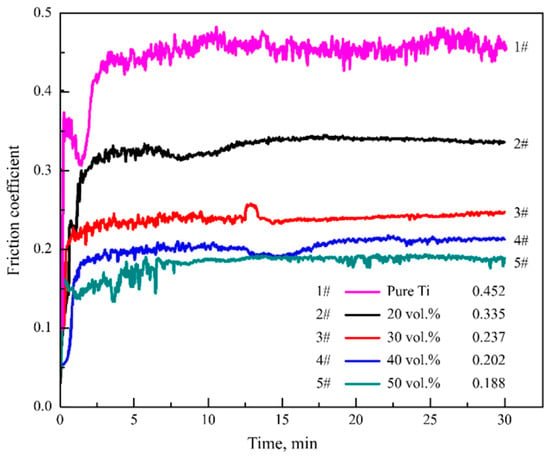
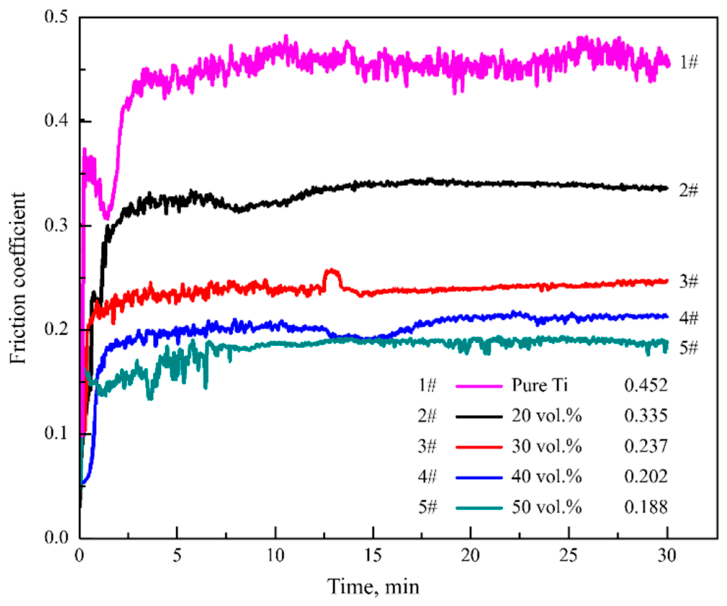
Figure 7 shows the room-temperature COF curves of pure Ti and the composites as a function of the reinforcement content. The incorporation of TiBw and TiCp substantially reduced the COF relative to the unreinforced pure Ti. The COF of pure Ti was 0.452, and with increasing reinforcement content, the COF exhibited a monotonic decrease. At 20 vol.%, the COF dropped to 0.335, and the 50 vol.% composite exhibited the lowest COF of 0.188, corresponding to 41.5% of that of pure Ti. The lower COF may be associated with the ability of the hard TiBw and TiCp reinforcements to support the contact load and resist the local plastic deformation of the Ti matrix. Such support limit matrix–counterface adhesive interactions, contributing to reduced friction [12].
Figure 7.
The coefficient of friction curves of pure Ti and (TiBw + TiCp)/Ti composites with different reinforcement contents at room temperature.
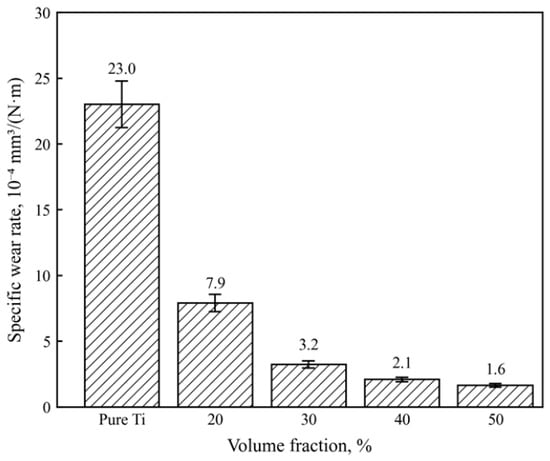
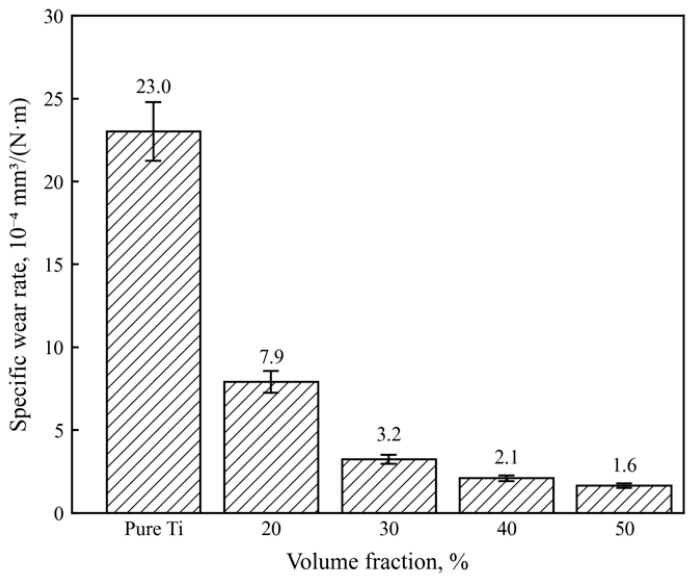
Figure 8 presents the specific wear rates of pure Ti and composites with different reinforcement contents at room temperature. The specific wear rate decreased with increasing reinforcement content. The rates in pure Ti and the 50 vol.% composite were 23.0 × 10⁻⁴ and 1.6 × 10⁻⁴ mm3/(N·m), respectively. The rates in the 20, 30, 40 and 50 vol.% composites corresponded to 34.4%, 14.1%, 9.1% and 7.16% of that of pure Ti. The incremental benefit of additional reinforcement diminished at higher volume fractions.
Figure 8.
Specific wear rates of pure Ti and composites with different reinforcement contents at room temperature.
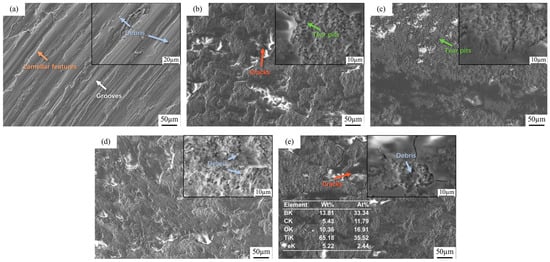
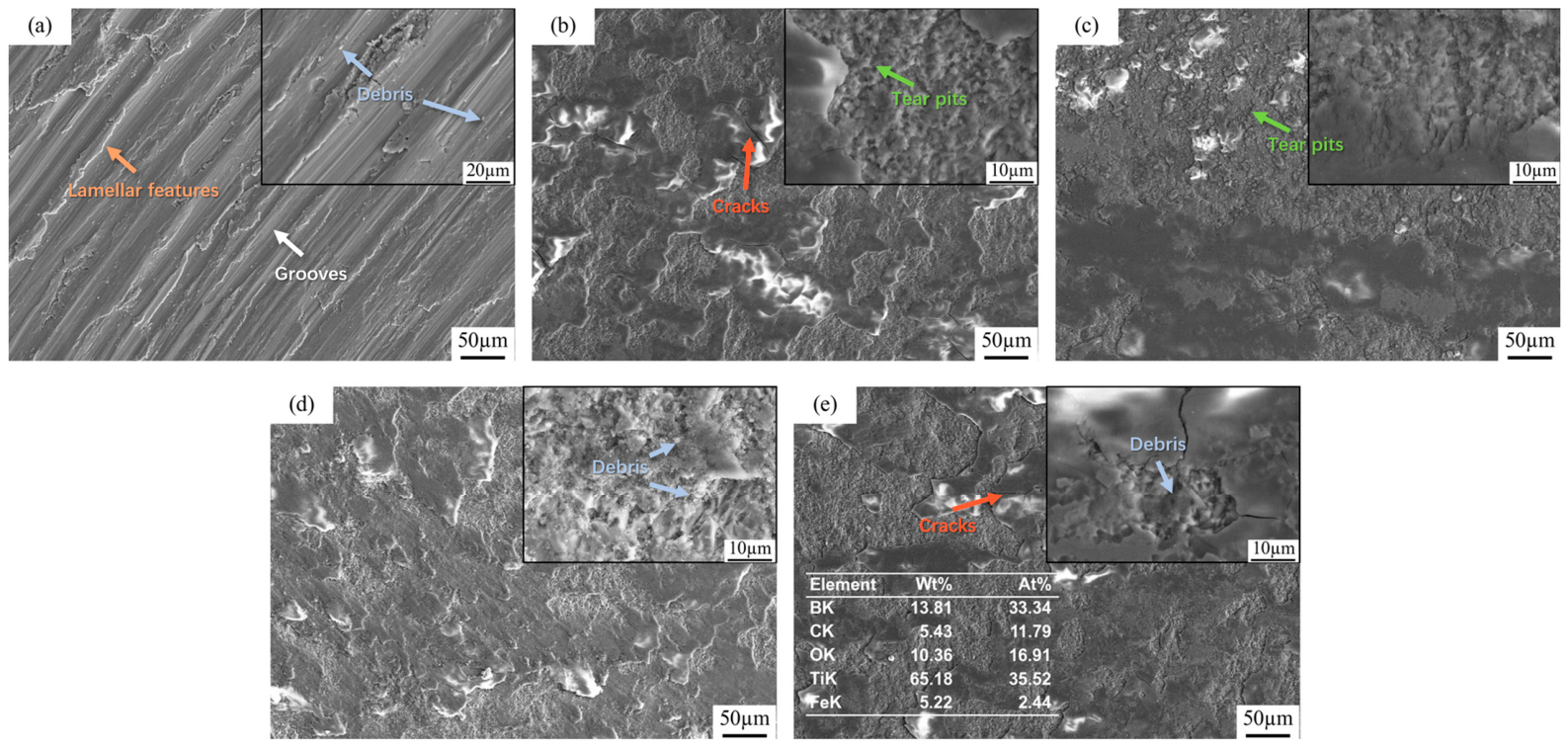
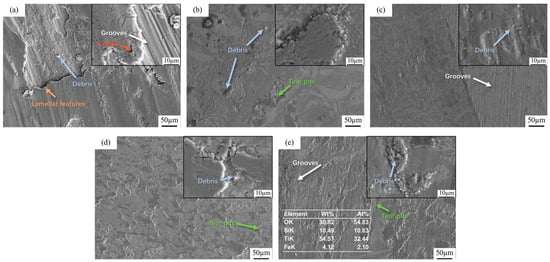
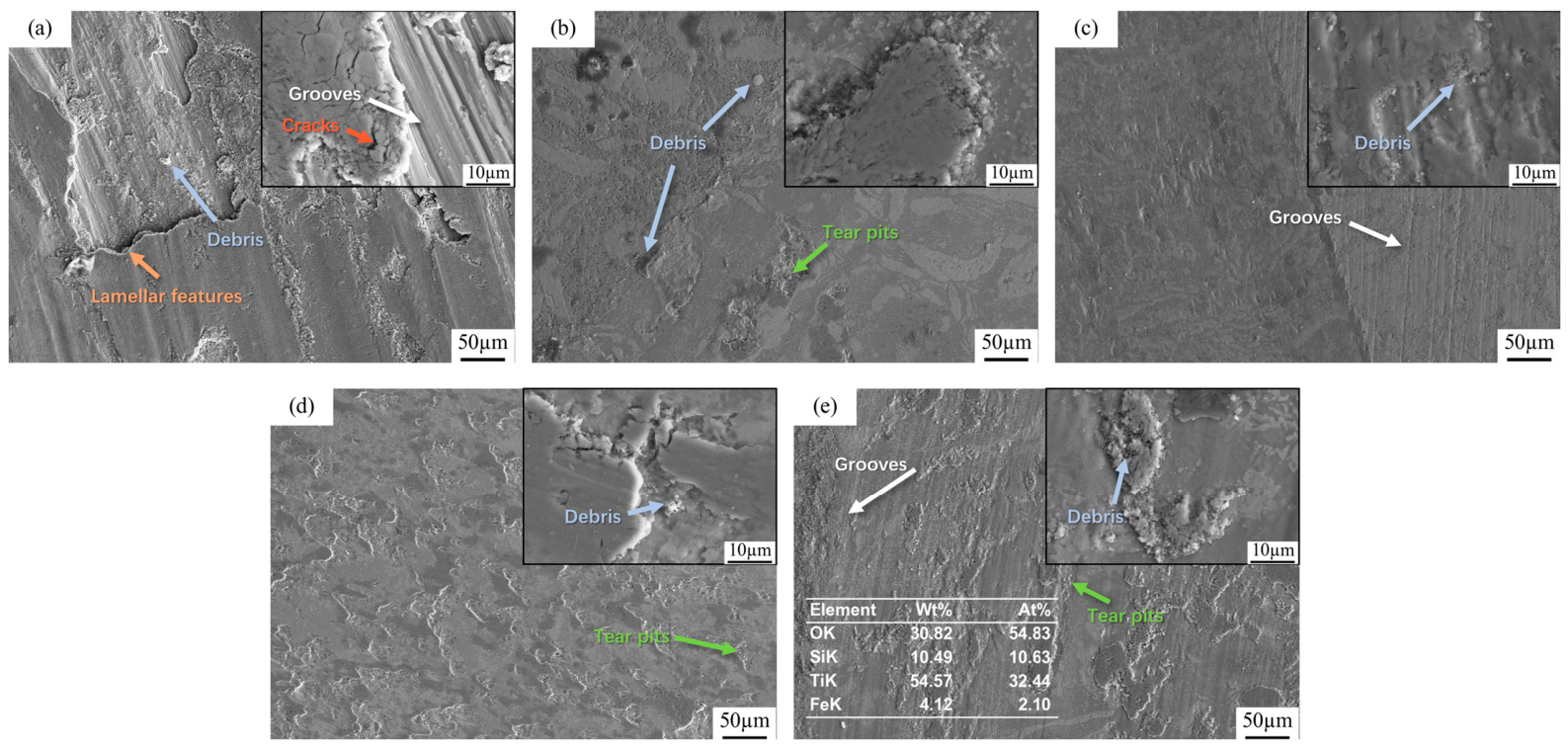
Figure 9 compares the room-temperature worn surfaces of pure Ti and the 50 vol.% composite. Pure Ti exhibited pronounced grooves and lamellar surface features, consistent with plastic deformation, ploughing and delamination, as seen in Figure 9a. The composite showed less pronounced and lighter grooving and fewer lamellar features in the displayed region in Figure 9b–e, and debris and tear pits were visible. Detached hard particles may contribute to third-body abrasion during sliding [42]. The EDS result in Figure 9e indicates oxygen on the composite worn surface, due to the low thermal conductivity of the titanium matrix, which causes the accumulation of frictional heat at the contact interface and a consequent rise in localized temperature. The increased temperature promotes the reaction between titanium and oxygen in the surrounding air, forming a TiO2 oxide layer on the contact surface.
Figure 9.
SEM images of the room-temperature worn surfaces of (a) pure Ti, (b) the 20 vol.% composite, (c) the 30 vol.% composite, (d) the 40 vol.% composite and (e) the 50 vol.% composite.
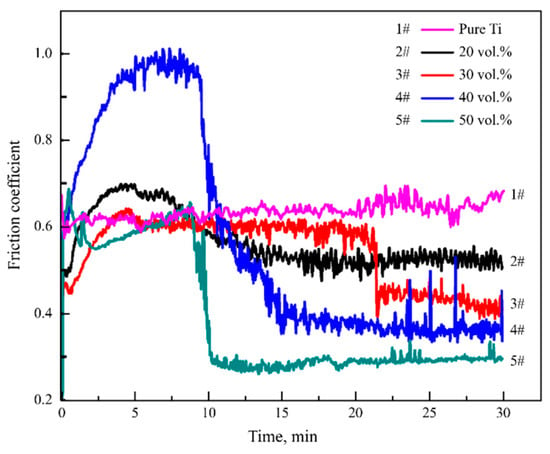
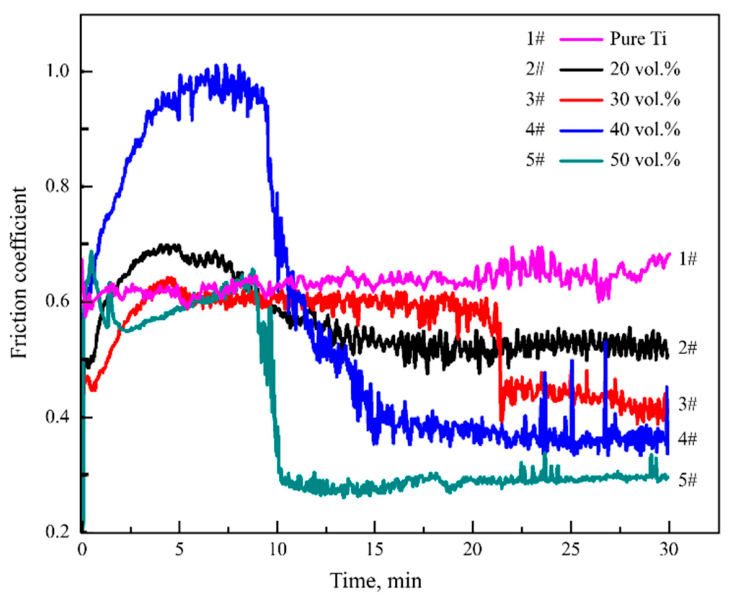
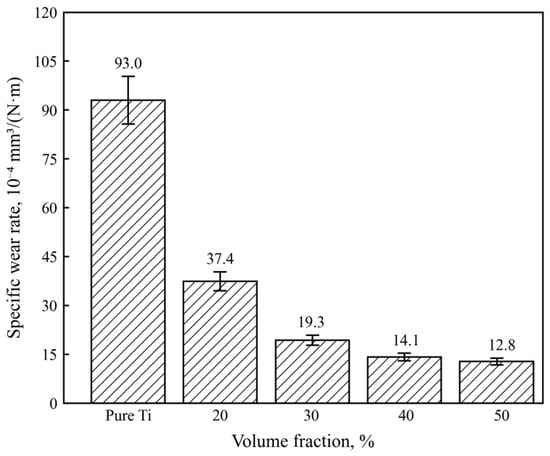
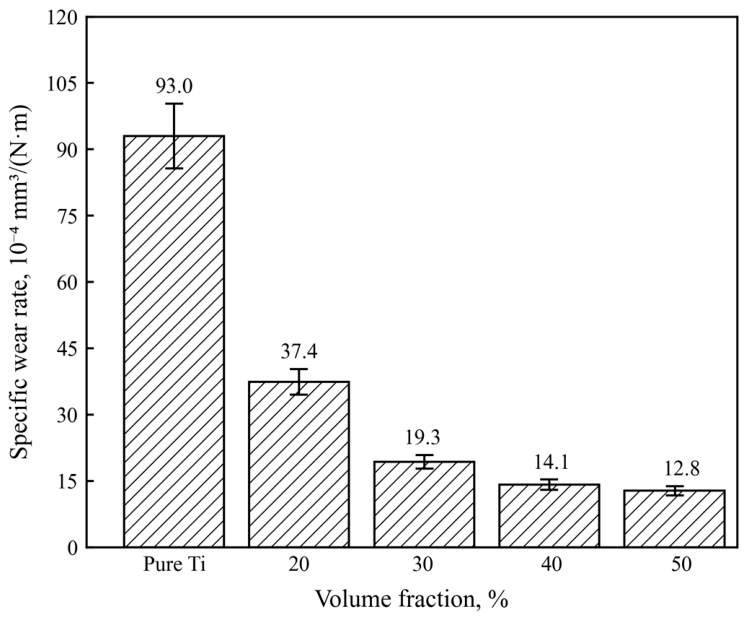
Figure 10 shows the COF curves of pure Ti and the composites at 500 °C. The composites exhibited composition-dependent transients, with different peak shapes and transition times before lower values during later sliding. The 20 vol.% curve declined relatively gradually, whereas the 40 and 50 vol.% curves showed sharper reductions. The 30 vol.% curve underwent a later decrease in several steps. Pure Ti maintained a higher COF overall. At 500 °C, the COF values for the 20, 30, 40 and 50 vol.% composites were 0.507, 0.407, 0.336 and 0.295, respectively, corresponding to 73.7%, 59.2%, 48.9% and 42.9% of that of pure Ti. The COF was higher at 500 °C than at room temperature for all materials. The COF transients at 500 °C reflect the competition between matrix softening and the evolution of oxide-containing third bodies [19,47]. Softening can facilitate local deformation and adhesive interactions, while oxide fracture and hard debris may increase plowing and friction [19]. Intermittent debris removal, renewed matrix contact and reinforcement fragments may cause superimposed fluctuations [47,48]. At 500 °C, the specific wear rate also decreased with increasing reinforcement content, as shown in Figure 11. The values for pure Ti and the 20, 30, 40 and 50 vol.% composites were decreased from 93.0 × 10⁻⁴ mm3/(N·m) to 12.8 × 10⁻⁴ mm3/(N·m), respectively. The composite values corresponded to 40.2%, 20.8%, 15.2% and 13.7% of that of pure Ti.
Figure 10.
The coefficient of friction as a function of sliding time during dry sliding at 500 °C for pure Ti and (TiBw + TiCp)/Ti composites with different reinforcement contents.
Figure 11.
Specific wear rates of pure Ti and composites with different reinforcement contents at 500 °C.
Figure 12 shows the worn surfaces of pure Ti and the 50 vol.% composite after sliding at 500 °C. Pure Ti exhibited sliding grooves and lamellar features, whereas debris and tear pits were more conspicuous on the composite surface. These features are consistent with plastic deformation, plowing and material transfer. The higher wear rates and the worn surfaces tested at 500 °C indicate a greater material removal than at room temperature. The composite EDS result in Figure 12e showed a higher oxygen content than the room-temperature result in Figure 9e, consistent with oxidation, which can be attributed to titanium exhibiting significantly higher oxidation susceptibility at elevated temperature, facilitating the formation of a thicker and more compact TiO2 oxide layer on the sliding surface. The Si signal indicates transfer from the Si3N4 counterface.
Figure 12.
SEM images of the worn surfaces of (a) pure Ti, (b) the 20 vol.% composite, (c) the 30 vol.% composite, (d) the 40 vol.% composite and (e) the 50 vol.% composite after sliding at 500 °C.
3.4. Anti-Wear Mechanisms of Pure Ti and Composites
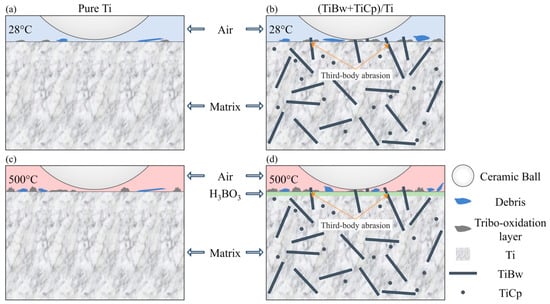
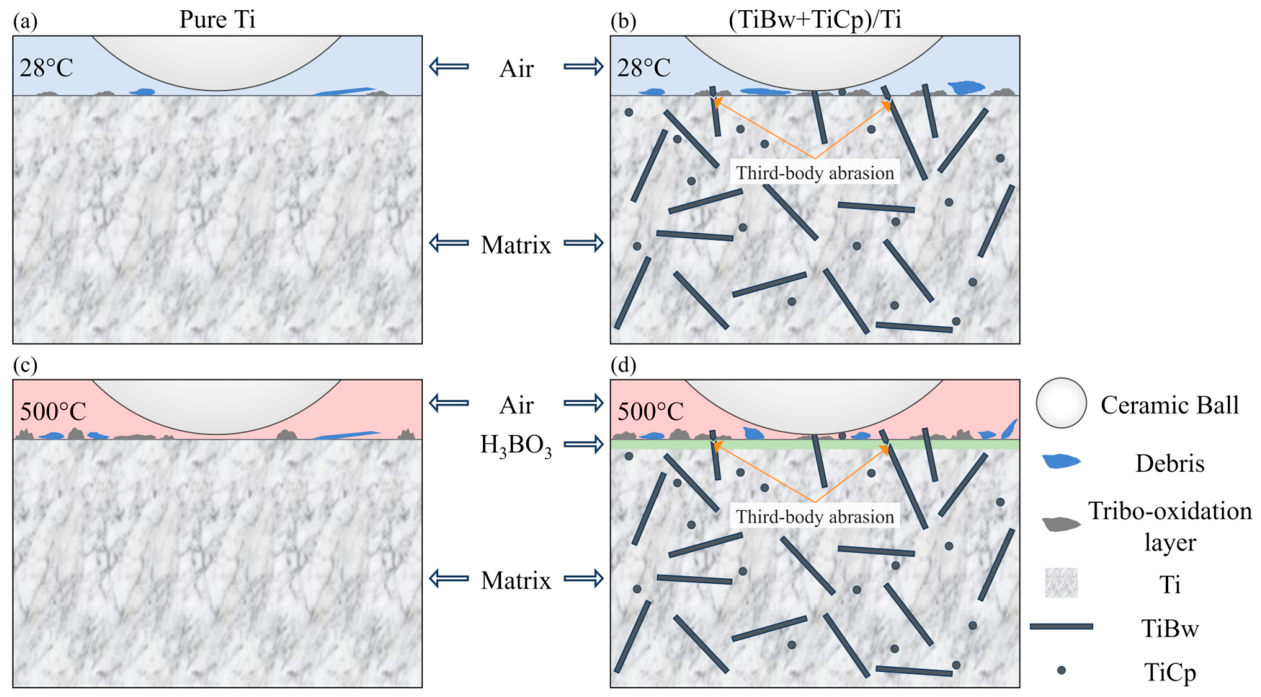
At room temperature, the grooves and lamellar features on pure Ti are consistent with plowing, plastic deformation and delamination. Pure Ti undergoes severe adhesive wear due to its lower strength, hardness, and resistance to plastic shear strain. Furthermore, the poor thermal conductivity of titanium leads to heat accumulation during friction, causing softening, which promotes the initiation and propagation of subsurface cracks parallel to the surface, eventually resulting in the spallation of lamellar debris and the occurrence of delamination wear. Conversely, abrasive wear is the most typical wear mechanism for the composites, as shown in Figure 13b. Additionally, the composites exhibit mild adhesive wear and oxidative wear, similar to pure Ti. The in situ synthesized TiCp and TiBw phases, which possess high hardness and strength, and are uniformly distributed with strong interfacial bonding, have low wear rates compared to a titanium matrix and effectively bear the contact load. The matrix of the composites undergoes plastic deformation and spallation of lamellar wear debris under the applied stress at the initial stage of sliding wear, consistent with the wear behavior of pure Ti. As the wear process proceeds, the reinforcements in the composite become progressively exposed and come into direct contact with the friction pair, which reduces the contact area with the friction pair, suppressing the plastic deformation of the matrix, thereby lowering the coefficient of friction and enhancing the wear resistance of composites. Subsequently, the reinforcements undergo transverse fracture, and a small fraction of the fractured reinforcements detach from the matrix under the action of frictional shear stress. The detached reinforcements act as abrasives in the subsequent wear process, which induce the plowing of the matrix material and result in the formation of plow grooves on the worn surface of the composite. Meanwhile, surface irregularities are created by TiB whisker fracture and matrix wear and provide sites for trapping wear debris. Under repeated contact, oxidized debris become compacted at these sites, forming a localized tribo-oxidation debris layer [49]. When retained, this layer can protect the underlying material and limit further material transfer. Thus, the same debris can promote abrasion when loose but protect the surface when retained and sufficiently compacted.
Figure 13.
Schematic diagram of wear mechanisms of pure Ti and (TiBw + TiCp)/Ti composites: (a) pure Ti at room temperature, (b) composites at room temperature, (c) pure Ti at 500 °C and (d) composites at 500 °C.
At 500 °C, the dominant mechanism is adhesive wear for pure Ti, and abrasive wear for composites, as shown in Figure 13c and Figure 13d, respectively, as well as severe oxidation accompanying adhesive and abrasive damage for pure Ti and composites. The titanium matrix softens at high temperature, which reduce its hardness and shear strength, thereby enhances the degree of adhesion in both the pure Ti matrix and composites, compared to that of room-temperature condition. On the other hand, titanium is prone to oxidation at high temperatures, forming a dense TiO2 layer. Meanwhile, the TiBw reinforcement phase in the composites reacts chemically with oxygen in the air at high temperatures to form TiO2 and boron oxide (B2O3), as shown in the following reaction [43]:
4TiB + 7O2 → 4TiO2 + 2B2O3
Boron oxide exists as a solid state when the temperature is below 450 °C, and transforms into a fluid state when the temperature exceeds 450 °C. The formed boron oxide will further react with water vapor in the air to generate boric acid (H3BO3) according to the reaction below [50]:
B2O3 + 3H2O → 2H3BO3
Both B2O3 and H3BO3 can act as solid lubricants during the friction process at high temperatures exceeding 450 °C, thereby improving the wear resistance of the material. In particular, the triclinic structure of H3BO3 exhibits excellent effectiveness in enhancing the wear resistance of the material [50]. The sliding direction is parallel to the layered structure of H3BO3 during the friction process, which significantly reduces the friction coefficient of the composites and alleviates the degree of wear in the material.
A comparison of the specific wear rate listed in Table 3 provides evidence that (TiBw + TiCp)/Ti composites have great wear resistance. The literature data for sliding contacts under unlubricated conditions range from 10−7 to 10−2 mm3/(N·m) (for adhesive wear) and from 10−5 to 10−1 mm3/(N·m) (for abrasive wear), providing an indirect means of distinguishing between different wear regimes [51]. The trend of decreasing the specific wear rate with increasing reinforcement content in the composites parallels the transition from adhesion-dominated to abrasion-dominated wear. Compared with other reinforcing phases, TiB and TiC produce a substantially greater reduction in the specific wear rates of composites with a pure titanium or titanium alloy matrix. This improvement is attributed to the high strength and hardness of TiB and TiC, and their strong bonding to the matrix. During sliding, these reinforcements wear much more slowly than the surrounding matrix and can carry a greater share of the contact load.
Table 3.
Comparison of the specific wear rates of TMCs at room temperature.
4. Conclusions
In this study, (TiBw + TiCp)/Ti composites with varying reinforcement contents were successfully fabricated via high-energy ball-milling followed by hot-pressing sintering. The microstructure, room-temperature bending properties, and tribological behavior at both room and high temperatures were systematically investigated. The key findings are summarized as follows:
1. In situ (TiBw + TiCp)/Ti composites containing 20–50 vol.% reinforcement were fabricated by high-energy ball-milling and vacuum hot-pressing sintering. Relative density decreased with reinforcement content. For the optimum temperature within the tested range, the 20 vol.% composite reached the highest relative density (98.1%) among the composites. The Vickers hardness of the 50 vol.% composite was 1266.0 HV, showing increases in hardness of 298.1% compared with unreinforced pure Ti, due to a greater contribution from the hard, in situ-formed TiB whiskers and TiC particles at higher reinforcement fractions.
2. The bending strength and elastic modulus peaked at 30 vol.% reinforcement and declined at 40 and 50 vol.%. The 30 vol.% composite achieved a bending strength of 1100.1 MPa and an elastic modulus of 171.1 GPa. These values exceeded those of pure Ti by 62.5% and 114.4%, respectively, attributed to a balance between sufficient densification and an effective load transfer from the matrix to the uniformly distributed, high-strength TiBw and TiCp reinforcements.
3. At room temperature, the 50 vol.% composite achieved a COF of 0.188 and a specific wear rate of 1.6 × 10⁻⁴ mm3/(N·m), corresponding to 41.5% and 7.16% of that of pure Ti, respectively. With the incorporation of the reinforcements suppressing the plastic deformation of the matrix, the dominant wear mechanism at room temperature changed from adhesion wear in pure Ti to predominantly abrasive wear in the composites. The oxidized debris forms a localized tribo-oxidation debris layer once compacted at the surface irregularities created by TiB whisker fracture and matrix wear, protecting the underlying material and limiting further material transfer.
4. At 500 °C, the 50 vol.% composite exhibited a COF of 0.295 and a specific wear rate of 12.8 × 10⁻⁴ mm3/(N·m). These values corresponded to 42.9% and 13.7% of those of pure Ti, respectively; COF and wear rate were higher than at room temperature. The worn-surface features and oxygen enrichment of the examined composite were consistent with the coexisting abrasive and oxidative processes. Load bearing by the reinforcements and protection by tribo-oxidation debris layer limit matrix deformation, but reinforcement detachment can promote further wear.
Author Contributions
J.S.: formal analysis, writing—original draft preparation, writing—review and editing. Q.A.: writing—original draft preparation, writing—review and editing, funding acquisition. X.Z.: writing—review and editing. R.N.: writing—review and editing. L.S.: formal analysis. F.S.: formal analysis. G.J.: formal analysis. L.H.: writing—review and editing, funding acquisition. X.L.: writing—review and editing. L.G.: writing—review and editing. All authors have read and agreed to the published version of the manuscript.
Funding
This work was financially supported by the Advanced Materials–National Science and Technology Major Project (Grant No. 2024ZD0601700), the National Natural Science Foundation of China (Grant Nos. 52371135, 52441401), and the China Postdoctoral Science Foundation (Grant No. 2025M784359).
Data Availability Statement
The original contributions presented in this study are included in the article. Further inquiries can be directed to the corresponding author.
Conflicts of Interest
The authors declare no conflicts of interest.
References
- Fanning, J.C. Military Applications for β Titanium Alloys. J. Mater. Eng. Perform. 2005, 14, 686–690. [Google Scholar] [CrossRef] [Scilit]
- Medvedev, A.E.; Maconachie, T.; Leary, M.; Qian, M.; Brandt, M. Perspectives on Additive Manufacturing for Dynamic Impact Applications. Mater. Des. 2022, 221, 110963. [Google Scholar] [CrossRef] [Scilit]
- Markovsky, P.E.; Savvakin, D.G.; Stasyuk, O.O.; Mecklenburg, M.; Pozuelo, M.; Roberts, C.; Ellison, V.; Prikhodko, S.V. Significant Hardening Effect of High-Temperature Aging of Alloy Ti-6Al-4V Composite Reinforced with TiC. Mater. Des. 2023, 234, 112208. [Google Scholar] [CrossRef] [Scilit]
- Zhang, L.-C.; Chen, L.-Y.; Wang, L. Surface Modification of Titanium and Titanium Alloys: Technologies, Developments, and Future Interests. Adv. Eng. Mater. 2019, 22, 1901258. [Google Scholar] [CrossRef] [Scilit]
- Zivic, F.; Babic, M.; Cvijovic-Alagic, I.; Metrovic, S.; Vencl, A. Wear Behaviour of Ti6Al4V Alloy against Al2O3 under Linear Reciprocating Sliding. J. Balk. Tribol. Assoc. 2011, 17, 27–36. [Google Scholar]
- Kostadinov, G.; Penyashki, T.; Nikolov, A.; Vencl, A. Improving the Surface Quality and Tribological Characteristics of 3D-Printed Titanium Parts through Reactive Electro-Spark Deposition. Materials 2024, 17, 382. [Google Scholar] [CrossRef] [Scilit] [PubMed]
- Choi, H.-J.; Park, C.-W.; Kang, I.-S.; Kim, J.-S.; Choi, S.-D. Material Model Application Considering Strain Softening for Cutting Simulation of Ti-6Al-4V Alloy and Its Experimental Validation. Int. J. Precis. Eng. Manuf. 2016, 17, 1651–1658. [Google Scholar] [CrossRef] [Scilit]
- Fellah, M.; Labaïz, M.; Assala, O.; Dekhil, L.; Taleb, A.; Rezag, H.; Iost, A. Tribological Behavior of Ti-6Al-4V and Ti-6Al-7Nb Alloys for Total Hip Prosthesis. Adv. Tribol. 2014, 2014, 1–13. [Google Scholar] [CrossRef] [Scilit]
- Tur, E.; Betts, J.; Perge, L.; Zeng, Q.; Shokrani, A. Experimental Validation and 3D Finite Element Modelling of Scratch-Induced Deformation in Ti-6Al-4V Alloy. Procedia CIRP 2025, 133, 8–13. [Google Scholar] [CrossRef] [Scilit]
- Ventura Cervellón, A.M.; Varga, M.; Rodríguez Ripoll, M.; Eder, S.J. Resolving High-Strain-Rate Scratch Behavior of Ti6Al4V in Experiment and Meshless Simulation. Wear 2024, 558–559, 205554. [Google Scholar] [CrossRef] [Scilit]
- Ju, J.; Zhao, C.; Kang, M.; Li, J.; He, L.; Wang, C.; Li, J.; Fu, H.; Wang, J. Effect of Heat Treatment on Microstructure and Tribological Behavior of Ti–6Al–4V Alloys Fabricated by Selective Laser Melting. Tribol. Int. 2021, 159, 106996. [Google Scholar] [CrossRef] [Scilit]
- An, Q.; Huang, L.J.; Bao, Y.; Zhang, R.; Jiang, S.; Geng, L.; Xiao, M. Dry Sliding Wear Characteristics of In-Situ TiBw/Ti6Al4V Composites with Different Network Parameters. Tribol. Int. 2018, 121, 252–259. [Google Scholar] [CrossRef] [Scilit]
- Qin, Z.; Zhang, Y.; Zhang, X.; Jin, Z. Comparative Study on Fretting Wear Behavior of Micro-Arc Oxidation Coatings Formed in Aluminate, Phosphate, and Silicate Electrolytes on Ti6Al4V Alloy. Wear 2026, 588, 206512. [Google Scholar] [CrossRef] [Scilit]
- Gopinath, V.M.; Arulvel, S. A Review on the Steels, Alloys/High Entropy Alloys, Composites and Coatings Used in High Temperature Wear Applications. Mater. Today Proc. 2021, 43, 817–823. [Google Scholar] [CrossRef] [Scilit]
- Joshy, J.; Kuriachen, B. Investigations in to the Wear Behavior of Additively Manufactured Ti6Al4V at Elevated Temperatures. Wear 2025, 571, 205774. [Google Scholar] [CrossRef] [Scilit]
- Gupta, M.K.; Etri, H.E.; Korkmaz, M.E.; Ross, N.S.; Krolczyk, G.M.; Gawlik, J.; Yaşar, N.; Pimenov, D.Y. Tribological and Surface Morphological Characteristics of Titanium Alloys: A Review. Arch. Civ. Mech. Eng. 2022, 22, 72. [Google Scholar] [CrossRef] [Scilit]
- Straffelini, G.; Molinari, A. Dry Sliding Wear of Ti–6Al–4V Alloy as Influenced by the Counterface and Sliding Conditions. Wear 1999, 236, 328–338. [Google Scholar] [CrossRef] [Scilit]
- Zhang, Q.Y.; Zhou, Y.; Wang, L.; Cui, X.H.; Wang, S.Q. Investigation on Tribo-Layers and Their Function of a Titanium Alloy during Dry Sliding. Tribol. Int. 2016, 94, 541–549. [Google Scholar] [CrossRef] [Scilit]
- Kumar, R.; Antonov, M.; Liu, L.; Hussainova, I. Sliding Wear Performance of In-Situ Spark Plasma Sintered Ti-TiBw Composite at Temperatures up to 900 °C. Wear 2021, 476, 203663. [Google Scholar] [CrossRef] [Scilit]
- Michalczewski, R.; Łuszcz, M.; Kalbarczyk, M.; Słomka, Z.; Osuch-Słomka, E.; Molenda, J.; Liu, L.; Antonov, M.; Hussainova, I.; Ripoll, M.R. Wear Performance of a Physical Vapour Deposition-Coated, Spark Plasma Sintered TiB2/Ti Composite Lubricated with Externally Introduced hBN at Temperatures up to 900 °C. Materials 2025, 18, 5274. [Google Scholar] [CrossRef] [Scilit] [PubMed]
- Dalili, N.; Edrisy, A.; Farokhzadeh, K.; Li, J.; Lo, J.; Riahi, A.R. Improving the Wear Resistance of Ti–6Al–4V/TiC Composites through Thermal Oxidation (TO). Wear 2010, 269, 590–601. [Google Scholar] [CrossRef] [Scilit]
- Munagala, V.N.V.; Torgerson, T.B.; Scharf, T.W.; Chromik, R.R. High Temperature Friction and Wear Behavior of Cold-Sprayed Ti6Al4V and Ti6Al4V-TiC Composite Coatings. Wear 2019, 426–427, 357–369. [Google Scholar] [CrossRef] [Scilit]
- Candel, J.J.; Amigó, V.; Ramos, J.A.; Busquets, D. Sliding Wear Resistance of TiCp Reinforced Titanium Composite Coating Produced by Laser Cladding. Surf. Coat. Technol. 2010, 204, 3161–3166. [Google Scholar] [CrossRef] [Scilit]
- Sabahi Namini, A.; Dilawary, S.A.A.; Motallebzadeh, A.; Shahedi Asl, M. Effect of TiB2 Addition on the Elevated Temperature Tribological Behavior of Spark Plasma Sintered Ti Matrix Composite. Compos. Part B Eng. 2019, 172, 271–280. [Google Scholar] [CrossRef] [Scilit]
- Ye, Z.; Su, M.; Li, J.; Jing, C.; Xu, S.; Liu, L.; Ren, G.; Wang, X. Laser nano-technology of light materials: Precision and opportunity. Opt. Laser Technol. 2021, 139, 106988. [Google Scholar] [CrossRef] [Scilit]
- Liu, W.; Wang, S.; Chen, X.; Huang, L.; Jin, J.; Jin, J.; Geng, L. Unexpected Ductility Achieved by Carbon Microalloying in TiB/Ti64 Composites. Sci. China Technol. Sci. 2025, 68, 1920207. [Google Scholar] [CrossRef] [Scilit]
- Ammisetti, D.K.; Kruthiventi, S.S.H.; Vinjavarapu, S.; Babu, N.N.; Gandepudi, J.R.; Battula, S.K. A Review on Reinforcements, Fabrication Methods, and Mechanical and Wear Properties of Titanium Metal Matrix Composites. J. Eng. Appl. Sci. 2024, 71, 60. [Google Scholar] [CrossRef] [Scilit]
- Hayat, M.D.; Singh, H.; He, Z.; Cao, P. Titanium Metal Matrix Composites: An Overview. Compos. Part A Appl. Sci. Manuf. 2019, 121, 418–438. [Google Scholar] [CrossRef] [Scilit]
- Yoo, S.C.; Lee, D.; Ryu, S.W.; Kang, B.; Ryu, H.J.; Hong, S.H. Recent Progress in Low-Dimensional Nanomaterials Filled Multifunctional Metal Matrix Nanocomposites. Prog. Mater. Sci. 2023, 132, 101034. [Google Scholar] [CrossRef] [Scilit]
- Jin, J.; Wang, S.; Lu, W.; Huang, L.; Gong, D.; Meng, F.; Liu, W.; Chen, X.; Geng, L. Superior Uniform Deformation Ability of Intragranular Nano TiB Reinforced Ti-6.5Al–2Zr–Mo–V Fabricated by Hot Isostatic Pressing. Mater. Sci. Eng. A 2024, 912, 146993. [Google Scholar] [CrossRef] [Scilit]
- Chen, X.; Huang, L.; Song, J.; Zhou, S.; Wang, S.; Zhang, R.; Geng, L. Towards Strength-Ductility Synergy of Titanium Matrix Composites through Configuration Design: Mesoscale Deformation and Damage Behaviors. Compos. Part B Eng. 2024, 283, 111651. [Google Scholar] [CrossRef] [Scilit]
- Ma, Z.; An, Q.; Guo, B.; Gong, D.; Liu, Y.; Cui, L.; Zhang, R.; Wang, S.; Jin, J.; Huang, L. Achieving Strength-Ductility Synergy in Additive Manufactured α plus β Titanium Alloys through Multi-Scale Microstructure Regulation. Scr. Mater. 2026, 271, 117006. [Google Scholar] [CrossRef] [Scilit]
- An, Q.; Gong, D.; Bao, Y.; Huang, L.; Xue, Y.; Ma, Z.; Liu, Y.; Cui, L.; Wang, S.; Zhang, R.; et al. Tailoring TiB2 Particle Size in Additively Manufactured TiB/Ti6Al4V to Enhance Strength-Ductility Synergy. Mater. Sci. Eng. A-Struct. Mater. Prop. Microstruct. Process. 2026, 950, 149480. [Google Scholar] [CrossRef] [Scilit]
- Geng, L.; Ni, D.R.; Zhang, J.; Zheng, Z.Z. Hybrid Effect of TiBw and TiCp on Tensile Properties of in Situ Titanium Matrix Composites. J. Alloys Compd. 2008, 463, 488–492. [Google Scholar] [CrossRef] [Scilit]
- Wei, L.; Liu, J.; Wu, X.; Liu, X.; Lv, X.; Liu, Y. In Situ Fabrication of Ti–Al/ Ti2AlC Composite by Hot-Press Sintering. J. Alloys Compd. 2020, 813, 152200. [Google Scholar] [CrossRef] [Scilit]
- Meng, F.; Zhang, R.; Wang, S.; Sun, F.; Chen, R.; Huang, L.; Geng, L. Fatigue Crack Initiation and Propagation Dominated by Crystallographic Factors in TiB/near α-Ti Composite. Acta Metall. Sin. (Engl. Lett.) 2024, 37, 763–776. [Google Scholar] [CrossRef] [Scilit]
- An, Q.; Cui, L.; Gong, D.; Cheng, H.; Liu, Y.; Zhang, R.; Bao, Y.; Huang, L.; Geng, L. Refined Martensite and Enhanced Strength of Selective Laser Melted Ti6.5Al2.5Zr1Mo1V Matrix Composites by Minor Nano TiBw Addition. Trans. Mater. Res. 2025, 1, 100014. [Google Scholar] [CrossRef] [Scilit]
- Sutrisna, S.; Purnomo, M.J.; Wartono, W.; Prasetiyo, A.B.; Riadji, M.I.S.; Mingwaro, W.P. Optimisation of Microstructure and Wear Properties of Porous Fe-Cu Bearing Materials. Tribol. Mater. 2026, 5, 50–62. [Google Scholar] [CrossRef] [Scilit]
- Tian, S.; Zhang, Y.; Jia, Z.; Yu, Q.; Zhang, H.; Huang, L.; Wang, S.; Geng, L. Mechanism of Nanoscale TiB Whisker Improving the High-Temperature Strength and Plasticity of TA15 Matrix Composite. Compos. Commun. 2025, 59, 102559. [Google Scholar] [CrossRef] [Scilit]
- Wang, D.; Li, H.; Wang, X.; Zheng, W.; Lin, Z.; Liu, G. The Microstructure Evolution and Mechanical Properties of TiBw/TA15 Composite with Network Structure Prepared by Rapid Current Assisted Sintering. Metals 2019, 9, 540. [Google Scholar] [CrossRef] [Scilit]
- Cui, L.; An, Q.; Lu, W.; Gong, D.; Ma, Z.; Jin, J.; Wang, S.; Zhang, R.; Huang, L.; Wang, L.; et al. Tunable Mechanical Properties in SLMed-TiBw/Ti6.5Al2.5Zr1Mo1V via Precise Regulation on Microstructure. Sci. China Technol. Sci. 2026, 69, 1920204. [Google Scholar] [CrossRef] [Scilit]
- Kim, I.Y.; Choi, B.J.; Kim, Y.J.; Lee, Y.Z. Friction and Wear Behavior of Titanium Matrix (TiB+TiC) Composites. Wear 2011, 271, 1962–1965. [Google Scholar] [CrossRef] [Scilit]
- Zheng, B.; Dong, F.; Yuan, X.; Zhang, Y.; Huang, H.; Zuo, X.; Luo, L.; Wang, L.; Su, Y.; Wang, X.; et al. Investigation on Microstructures and Mechanical Behavior of In-Situ Synthesized TiC and TiB Reinforced Ti6Al4V Based Composite. Mater. Res. Express 2019, 6, 116597. [Google Scholar] [CrossRef] [Scilit]
- Jeong, H.W.; Kim, S.J.; Hyun, Y.T.; Lee, Y.T. Densification and Compressive Strength of In-Situ Processed Ti/TiB Composites by Powder Metallurgy. Met. Mater. Int. 2002, 8, 25–35. [Google Scholar] [CrossRef] [Scilit]
- Ye, B.; Matsen, M.R.; Dunand, D.C. Enhanced Densification of Ti-6Al-4V/TiC Powder Blends by Transformation Mismatch Plasticity. J. Mater. Res. 2013, 28, 2520–2527. [Google Scholar] [CrossRef] [Scilit]
- Li, B.; Yan, T.; Yuan, X.; Pang, J.; Zhang, H.; Zhang, L. Effect of Graphene Content on the Densification Kinetics and Mechanical Properties of Ti-Matrix Composites. Mater. Charact. 2026, 235, 116350. [Google Scholar] [CrossRef] [Scilit]
- Zhang, J.; Yu, W.; Zhang, Z. Friction and Wear Behavior of Commercially Pure Titanium TA1 at High Temperature. J. Mater. Eng. 2021, 49, 93–99. [Google Scholar] [CrossRef]
- Izui, H.; Toen, K.; Kamegawa, S.; Komiya, Y. Dry Sliding Wear Behavior of TiB/Ti and TiC/Ti Composites. Mech. Eng. J. 2018, 5, 17-00523. [Google Scholar] [CrossRef] [Scilit]
- Li, X.; Das, H.; Pole, M.; Li, L.; Soulami, A.; Grant, G.J.; Herling, D.R.; Efe, M. Exceptional Strength and Wear Resistance in an AA7075/TiB2 Composite Fabricated via Friction Consolidation. Mater. Des. 2024, 242, 113006. [Google Scholar] [CrossRef] [Scilit]
- Zhang, E. Effect of in Situ TiB Short Fibre on Oxidation Behavior of Ti–6Al–1.2B Alloy. Scr. Mater. 2002, 46, 811–816. [Google Scholar] [CrossRef] [Scilit]
- Laera, A.M.; Massaro, M.; Dimaio, D.; Vencl, A.; Rizzo, A. Residual Stress and Tribological Performance of ZrN Coatings Produced by Reactive Bipolar Pulsed Magnetron Sputtering. Materials 2021, 14, 6462. [Google Scholar] [CrossRef] [Scilit] [PubMed]
- Shariatnezhad, M.H.; Moazami-Goudarzi, M.; Ardestani, M.; Ebadzadeh, T. Effect of Graphene Nanoplatelets (GNP) Content on Mechanical Properties and Wear Resistance of in-Situ Ti/TiC Composites at Room and High Temperatures. J. Mater. Res. Technol. 2026, 40, 2503–2513. [Google Scholar] [CrossRef] [Scilit]
- Abe, J.O.; Popoola, O.M.; Popoola, P.A. A Synergetic Effect of Ternary Refractory Nitride Reinforcements on Densification, Mechanical, Tribological and Thermal Stability Characteristics of Spark Plasma Sintering-Developed Ti6Al4V Matrix Composites. J. Alloys Compd. 2024, 997, 174888. [Google Scholar] [CrossRef] [Scilit]
- Mao, T.; Yu, Z.; Yan, J.; Xu, Y.; Zhang, S.; Peng, L. Investigation of Friction and Erosion Wear Properties of Titanium and Titanium Alloy Pipes. Materials 2024, 17, 5043. [Google Scholar] [CrossRef] [Scilit] [PubMed]

Disclaimer/Publisher’s Note: The statements, opinions and data contained in all publications are solely those of the individual author(s) and contributor(s) and not of MDPI and/or the editor(s). MDPI and/or the editor(s) disclaim responsibility for any injury to people or property resulting from any ideas, methods, instructions or products referred to in the content. |
© 2026 by the authors. Licensee MDPI, Basel, Switzerland. This article is an open access article distributed under the terms and conditions of the Creative Commons Attribution (CC BY) license.