


Abstract
Rapid setting, limited strength development, and poor freeze–thaw resistance constrain the use of β-hemihydrate phosphogypsum (β-HPG)-rich binders. This study examined a combined bio-derived admixture comprising sodium galactonate (SGA) and dextrin (Dex) in a binder containing 60 wt.% β-HPG and 40 wt.% low-calcium fly ash (FA). Setting, compressive strength, 28-d extract pH, freeze–thaw response, hydration heat, phase assemblage, microstructure, and pore structure were evaluated together with molecular dynamics (MD) simulations. The mixture containing 0.35 wt.% SGA + 0.15 wt.% Dex exhibited initial and final setting times of 47 and 146 min, respectively, and a 28-d compressive strength of 11.68 MPa, compared with 6.73 MPa for the reference. Its extract pH increased from 11.09 to 11.65. After 20 freeze–thaw cycles, mass loss was 4.2%, and relative dynamic elastic modulus retention was 74.3%. The MIP-derived macropore fraction decreased from 51% to 40%, accompanied by finer needle-like crystals within a more continuous low-crystallinity matrix. Separate MD models indicated a persistent SGA O···Ca contact and Dex configurations compatible with hydrogen bonding at the gypsum (010) surface. Overall, the combined admixture was associated with moderated early hydration, a refined accessible pore structure, and improved short-term freeze–thaw performance, while the simulations suggested distinct possible interfacial roles for SGA and Dex.
1. Introduction
Phosphogypsum (PG) is a bulk acidic industrial by-product generated during the wet-process production of phosphoric acid. With the continuous expansion of the phosphate fertilizer industry, the accumulation of PG has become an increasingly serious environmental concern. Large-scale stockpiling not only occupies considerable land resources but also poses potential risks to surrounding soil and groundwater due to the presence of soluble phosphorus, fluorine, and acidic impurities [1]. Consequently, the conversion of PG into low-carbon cementitious materials has attracted considerable attention as a sustainable utilization pathway. In recent years, activated composite systems combining PG with aluminosilicate- or calcium-rich industrial by-products, including fly ash, ground granulated blast-furnace slag (GGBFS), and steel slag, have been investigated as value-added cementitious binder [2,3,4].
Among PG-derived materials, β-HPG is attractive for building materials, pavement base layers, and mine backfilling because of its high hydration reactivity, abundant availability, and low processing cost [5]. However, its rapid dissolution and hydration produce a narrow working window. An unmodified β-HPG paste was reported to exhibit initial and final setting times of 6.60 and 10.67 min, respectively [6]. Its hydration proceeds primarily through hemihydrate dissolution and DH precipitation, and the hardened structure is strongly governed by crystal morphology and intercrystalline packing. Weak crystal interlocking and residual pores can therefore limit its mechanical and moisture resistance [6,7].
To overcome these limitations, previous studies have mainly focused on introducing supplementary cementitious materials and optimizing alkali activation conditions. The incorporation of GGBFS or low-calcium fly ash can promote the formation of AFt and gel phases, thereby improving strength development and pore structure refinement. For example, Jin et al. [5] reported that appropriate curing conditions facilitated AFt formation and pore refinement in β-HPG-GGBFS composite binders. Similarly, wet-ground low-calcium fly ash has been shown to enhance aluminosilicate reactivity and promote the formation of AFt and gel products, enabling compressive strengths of approximately 20 MPa after 28 d of curing [8]. Previous studies have used calcium sulfoaluminate cement addition and calcination treatment to regulate the hydration and engineering properties of PG-based binders [9,10]. More directly, the composition and NaOH/PG ratio of composite activators strongly affect setting, hydration kinetics, phase assemblage, pore-structure development, and strength evolution in PG-containing activated slag binders [11,12]. Nevertheless, in high-volume β-HPG/fly ash binders, the rapid dissolution of β-HPG and the intensive precipitation of sulfate-containing products during the early stage can still disrupt ionic equilibrium and hinder the controlled development of hydration reactions [13,14]. Therefore, effectively suppressing uncontrolled early hydration while maintaining a favorable alkaline environment for the subsequent limited later-age reaction of reactive Al- and Si-bearing species from FA remains a critical challenge.
Retarding admixtures are commonly used to control the rapid hydration of β-HPG-based binders. Low-molecular-weight organic retarders containing carboxyl and hydroxyl groups can delay setting through Ca2+ complexation and adsorption on DH and AFt surfaces [15], although their effectiveness is strongly dosage-dependent. Citric acid can substantially prolong setting, whereas excessive addition may alter gypsum crystal morphology, weaken crystal interlocking, and reduce strength [16]. Sodium gluconate has also been reported to delay early AFt formation in sulfoaluminate-containing systems [17]. These findings demonstrate the potential of small-molecule retarders for controlling early hydration but also highlight the need to avoid over-retardation and adverse changes in crystal development and mechanical performance.
In recent years, bio-based admixtures have attracted increasing attention owing to their renewability, low environmental impact, and resource utilization potential. Sodium galactonate (SGA), a bio-derived hydroxycarboxylate compound, can be produced from waste cheese whey through fermentation and electrodialysis processes. Previous studies conducted by our research group demonstrated that SGA can effectively regulate hydration reactions in alkali-activated slag systems through the synergistic effects of Ca2+/Al3+ complexation and surface adsorption. The incorporation of SGA significantly prolonged setting time, improved flowability, and promoted a more uniform development of hydration products and pore structure [15]. Nevertheless, existing studies on SGA have mainly focused on alkali-activated slag binders, and its applicability in high-phosphogypsum composite binders remains largely unexplored. In particular, the influence of SGA on ionic release, alkalinity evolution, hydration-product formation, and durability performance in high-volume β-HPG systems has not yet been systematically investigated.
Compared with low-molecular-weight retarders, dextrin (Dex) is a biodegradable polysaccharide-based admixture containing abundant hydroxyl groups. Its adsorption and steric effects can influence the nucleation and growth of hydration products. Appropriate Dex dosages have been reported to improve the workability, strength, and pore structure of cementitious materials [18], whereas maltodextrin and related polysaccharides can retard hydration and modify early AFt formation [19]. However, the role of Dex in β-HPG/FA binders remains unclear, particularly regarding ionic transport and hydration-product development. The co-addition of SGA and Dex may provide complementary regulation of early hydration, but this possibility requires experimental verification.
Freeze–thaw resistance is another critical factor limiting the practical application of PG-based cementitious materials in cold regions, particularly for non-structural building materials, pavement base/subbase layers, and low-strength filling materials. During freeze–thaw cycling, repeated freezing and thawing of pore water generates hydraulic pressure, ice-expansion stress, and microcrack propagation, resulting in mass loss, stiffness degradation, and microstructural deterioration [20,21]. For PG-based composite binders, freeze–thaw performance is closely related to pore structure, interfacial bonding, and hydration-product distribution. Recent work on β-HPG/raw-PG composite binders showed that suitable mineral or cementitious additions improved frost resistance by generating hydration products that filled internal pores and strengthened interfacial bonding [22]. Related studies have also associated durability improvements with matrix densification and modified hydration-product distributions [23,24,25]. In particular, uniformly distributed AFt and C-(A)-S-H gel phases can reduce pore connectivity, restrict moisture transport, and enhance resistance to freeze–thaw damage. Therefore, promoting the formation of a well-developed AFt-gel interwoven network while minimizing the local accumulation of coarse DH crystals and unreacted PG particles is expected to be beneficial for improving the freeze–thaw stability of high-volume β-HPG/fly ash binders.
Although numerous studies have investigated precursor design, activator selection, curing conditions, and individual retarders in phosphogypsum-based binders, the respective interfacial roles of small hydroxycarboxylates and bio-based polysaccharides remain insufficiently understood. Conventional calorimetry and phase and microstructural characterization can describe bulk hydration evolution but cannot directly resolve molecular configurations at crystal-growth sites. Molecular dynamics (MD) simulations have related the face-dependent adsorption of organic additives on calcium sulfate hemihydrate to changes in crystal morphology [26]. Combined experimental and MD studies further showed that organic molecules adsorb on gypsum through electrostatic interactions and hydrogen bonding, with adsorption strength and face selectivity governed by molecular architecture [27]. Recent atomistic simulations of calcium sulfate hydrates also linked facet-specific adsorption and polymer conformation to delayed hemihydrate hydration [28]. These findings support the use of MD to examine persistent O···Ca contacts and hydrogen-bond-compatible configurations at dihydrate gypsum (DH) surfaces. However, the respective interfacial roles of SGA and Dex in β-HPG/FA composite binders remain unclear.
Accordingly, this study evaluated the individual and co-addition effects of SGA and Dex in a binder containing 60 wt.% β-HPG and 40 wt.% FA. Setting behavior, compressive strength, aqueous-extract pH, hydration heat, phase assemblage, microstructure, pore structure, and short-term freeze–thaw resistance were investigated. Separate MD simulations of SGA and a representative Dex oligomer on the DH (010) surface were conducted to examine possible O···Ca contacts and hydrogen-bond-compatible configurations. The simulations were interpreted qualitatively together with the experimental results to assess the proposed interfacial roles of the two admixtures.
2. Materials and Methods
2.1. Raw Materials
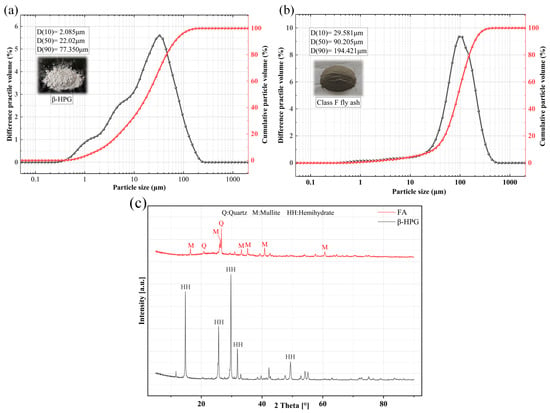
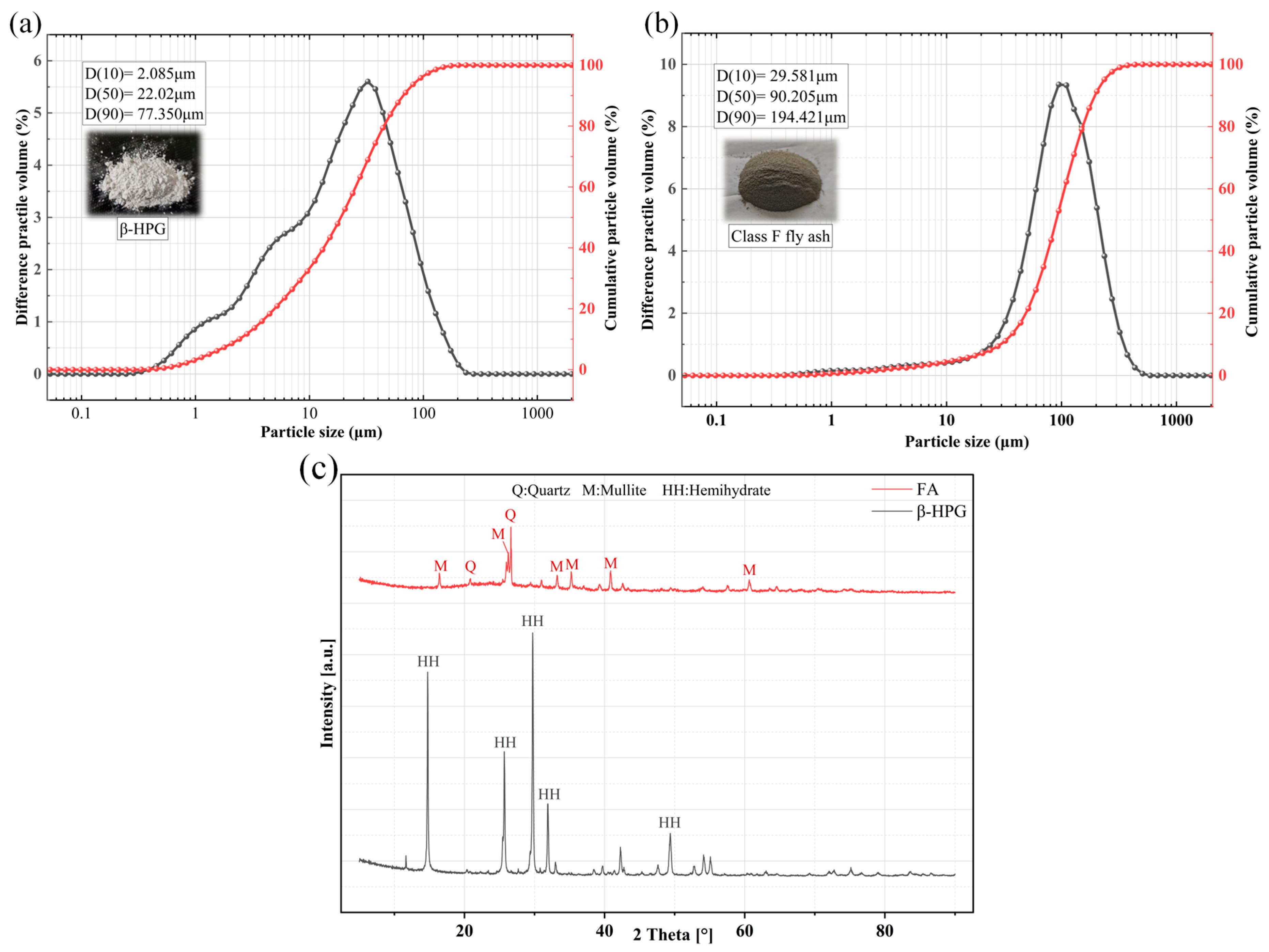
β-Hemihydrate phosphogypsum (β-HPG) supplied by Anhui Senke New Materials Co., Ltd. (Hefei, China) was used as the primary precursor. Low-calcium fly ash (FA) obtained from Nanjing Huaneng Power Plant (Nanjing, China) was employed as the aluminosilicate source. The chemical compositions of β-HPG and FA were determined by X-ray fluorescence (XRF) analysis and are presented in Table 1. The particle-size distributions and mineralogical characteristics of β-HPG and FA are presented in Figure 1. The β-HPG was substantially finer than FA, with median particle sizes, D(50), of 22.020 and 90.205 μm, respectively. The XRD pattern of β-HPG was dominated by the characteristic reflections of calcium sulfate hemihydrate (HH), confirming that hemihydrate was its principal crystalline phase. The FA exhibited crystalline quartz (Q) and mullite (M), together with a diffuse background associated with an amorphous aluminosilicate fraction. These relatively stable crystalline phases are expected to remain largely unreacted, whereas the amorphous fraction may participate in limited later-age alkali-assisted reaction.
Table 1.
Chemical compositions of β-HPG and FA.
Figure 1.
Particle size distribution of precursors: (a) β-HPG, (b) FA, and (c) XRD patterns of β-HPG and FA.
The alkaline activator was prepared by dissolving 40 g of flake NaOH (purity ≥ 99%) and 40 g of anhydrous sodium metasilicate (Na2SiO3) in 400 g of deionized water. The resulting solution contained nominally 8.33 wt.% NaOH and 8.33 wt.% Na2SiO3, with an estimated silicate modulus of 0.40 and an Na2O equivalent of 10.69 wt.%. The solution was cooled to room temperature before use, and its water content was included in the reported w/b of 0.40.
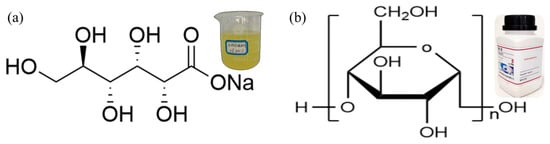
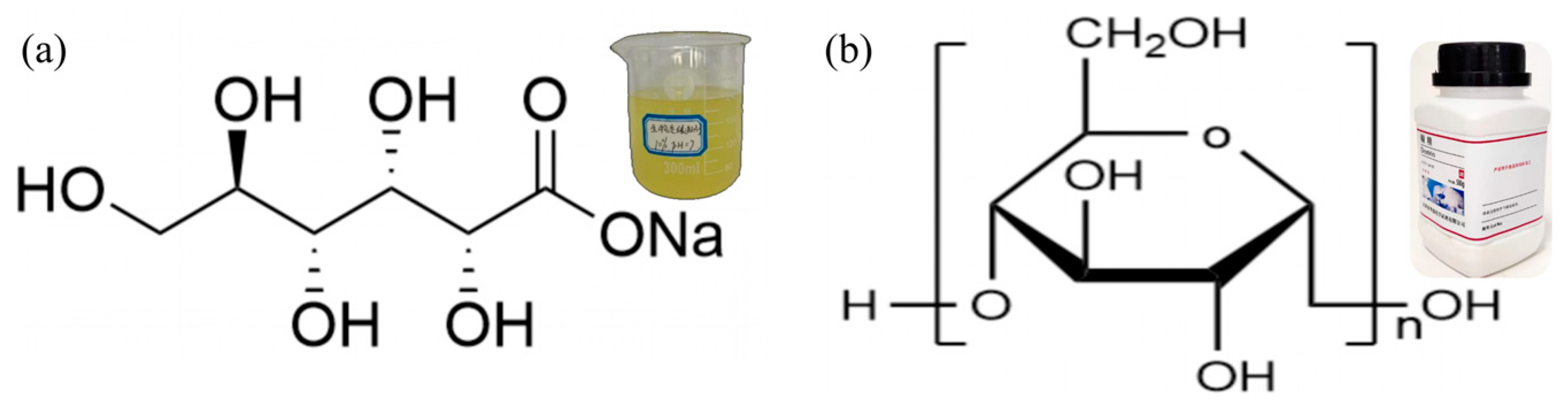
Sodium galactonate (SGA) powder derived from waste cheese whey was used as the bio-based retarder. The spray-dried, demineralized whey powder contained 76.7 wt.% lactose, 9.4 wt.% protein, and 4.0 wt.% ash. After enzymatic hydrolysis at 55 °C, the hydrolysate was fermented with Gluconobacter oxydans at 30 °C and pH 5.6, yielding 75.1 g/L galactonic acid from 80 g/L galactose (88.9% molar yield). The broth was centrifuged at 6000 rpm for 5 min, and the supernatant was treated by electrodialysis. A 50 wt.% NaOH solution was used for pH control and salt formation. The SGA solution was concentrated below 80 °C and processed into a powder with a purity greater than 95%. The powder was weighed and added during dry mixing. Dextrin was supplied by Tianjin Hengxing Chemical Reagent Manufacturing (Tianjin, China). Its certificate reported 9.8 wt.% loss on drying, 0.4 wt.% ignition residue, 0.7 wt.% ethanol-soluble matter, and 4.85 wt.% reducing sugars. The chloride, sulfate, oxalate, iron, and heavy-metal contents were 0.001, 0.002, 0.03, 0.0008, and 0.001 wt.%, respectively. The estimated dry-basis DE was approximately 5.4. The molecular structures of SGA and Dex are illustrated in Figure 2.
Figure 2.
Molecular structures of (a) sodium galactonate (SGA) and (b) dextrin (Dex).
2.2. Mixture Proportions and Specimen Preparation
The binder comprised 60 wt.% β-HPG and 40 wt.% low-calcium fly ash, as determined through preliminary tests of workability, setting behavior, and compressive strength. Mixtures containing SGA, Dex, or both were compared with an admixture-free control. All admixture and activator dosages were expressed as percentages of the total dry mass of β-HPG and fly ash. The SGA dosage was based on the mass of powder added. NaOH and Na2SiO3 were each added at 4 wt.%. All water used to prepare the alkaline activator was included in the water-to-binder ratio (w/b) of 0.40. Table 2 lists the mix proportions.
Table 2.
Mix proportions of β-HPG/FA composite binder specimens.
The β-HPG and FA were dry-mixed for 180 s, followed by the addition of solid SGA and Dex and further mixing for 60 s. The alkaline activator was added within 5 s during low-speed mixing. The paste was then mixed at low speed for 120 s, paused for 30 s to scrape the bowl and blades, and mixed at high speed for 120 s. All mixtures followed the same procedure. The fresh paste was cast into 40 mm × 40 mm × 160 mm prismatic molds and compacted to remove entrapped air. After 24 h, the specimens were demolded, wrapped in polyethylene film, and cured at 25 °C until testing.
2.3. Experimental Methods
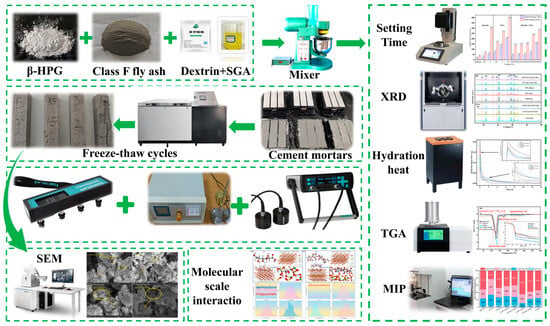
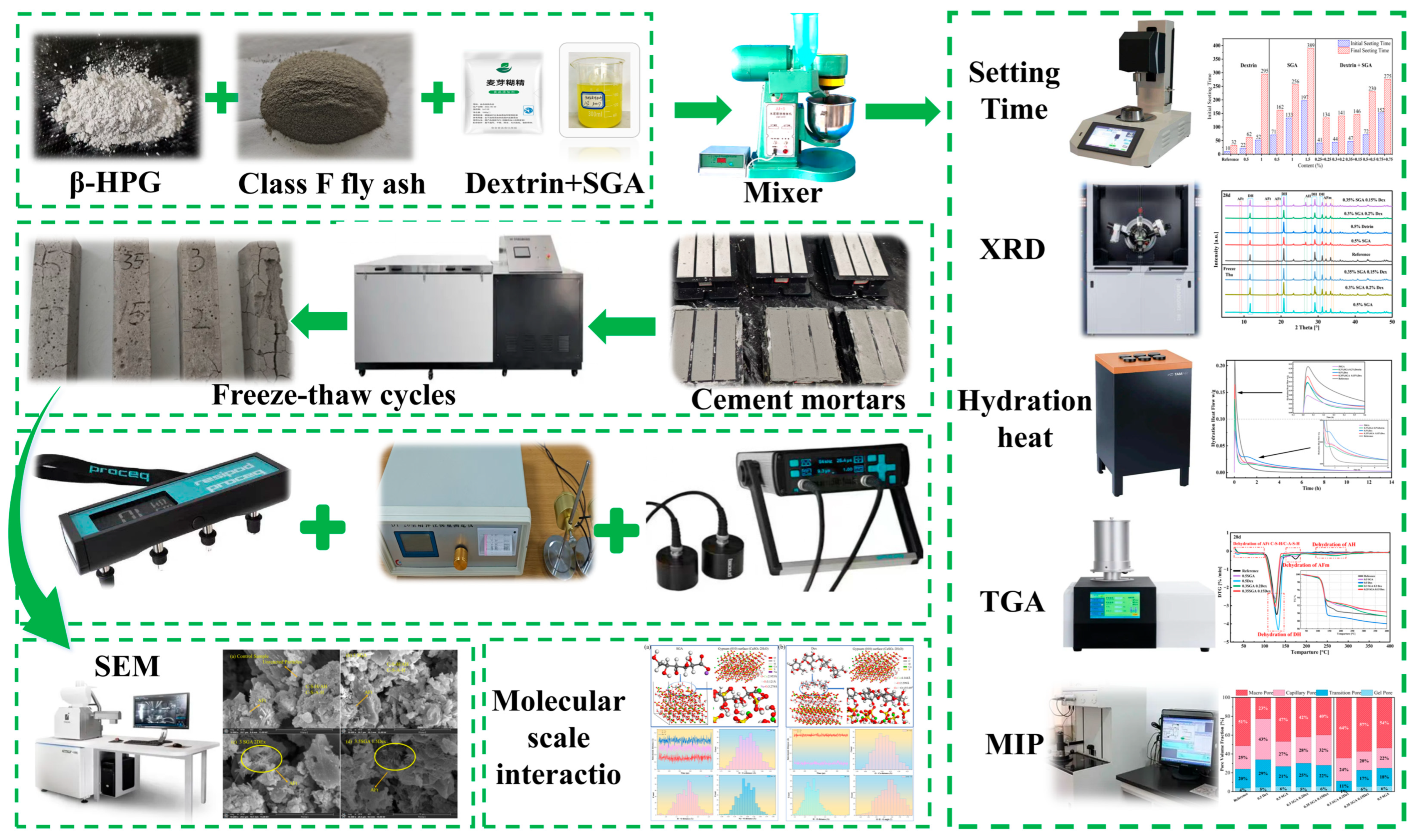
The experimental procedures and testing methods are represented in Figure 3.
Figure 3.
Experimental procedure and testing program.
2.3.1. Setting Time
The initial and final setting times were measured in accordance with the Chinese standard GB/T 1346-2011 [29] using a Vicat apparatus. Fresh paste was immediately transferred into the Vicat mold after mixing and tested under laboratory conditions.
2.3.2. Compressive Strength Test
Compressive strength was measured at 7, 14, and 28 d using an adapted GB/T 17671–2021 [30] procedure for binder paste without ISO standard sand. Three 40 mm × 40 mm × 160 mm prisms were first tested in flexure, yielding six half-prisms without saw-cutting. Each half-prism was loaded perpendicular to its longitudinal axis through a 40 mm × 40 mm molded surface (1600 mm2) at 2.4 ± 0.2 kN/s until failure. The results are reported as the mean and standard deviation of six measurements.
2.3.3. Leachate pH Measurement
The pH of the aqueous extract was determined using a solid–liquid extraction method. The samples were ground and passed through a 200-mesh sieve. A 5.0 g portion of the sieved powder was mixed with 50 mL of deionized water at a liquid-to-solid ratio of 10 mL/g. The suspension was stirred magnetically for 30 min and then allowed to settle for 1 h. The supernatant was collected, and its pH was measured using a pH meter.
2.3.4. Freeze–Thaw Test
The freeze–thaw test was conducted with reference to GB/T 50082–2009 [31], with appropriate adaptations based on GB/T 17671–2021 [30] and JGJ/T 70–2009 [32]. Three 40 mm × 40 mm × 160 mm specimens were tested for each mixture. After standard curing for 24 d, the specimens were immersed in water at 20 ± 2 °C for 4 d. The specimen-center temperature varied between −18 ± 2 °C and 5 ± 2 °C. Each freeze–thaw cycle lasted 3.5 h, comprising 2.5 h of freezing and 1.0 h of thawing. Specimen mass, dynamic elastic modulus, electrical resistivity, and ultrasonic pulse velocity (UPV) were recorded before freeze–thaw exposure and every five cycles for up to 20 cycles. Apparent surface electrical resistivity was measured using a Wenner four-probe array placed along the centerline of a 40 mm × 160 mm face, with an electrode spacing of 40 mm. The dynamic elastic modulus (E) of each prism was determined by transverse resonance. Its retention after n freeze–thaw cycles was calculated as (En/E0) × 100%, where E0 is the initial modulus and En is the modulus after n cycles. UPV (m/s) was calculated by dividing the measured pulse path length of 0.040 m by the transit time in seconds. Failure was defined as a decrease in the relative dynamic elastic modulus to 60% of its initial value or a mass loss of 5%. For specimens that reached either threshold, subsequent readings were recorded while reliable measurements remained possible. The results are reported as the mean and standard deviation of three replicate specimens. In this study, mass loss was mainly attributed to surface scaling caused by microcrack development and pore damage during freeze–thaw cycling. The mass loss rate (W) was calculated using Equation (1):
where W is the mass loss rate after freeze–thaw cycling (%), W0 is the initial mass of the specimen (kg), and Wn is the mass after n freeze–thaw cycles (kg).
The relative dynamic elastic modulus (RDEM) was calculated according to Equation (2):
where P is the relative dynamic elastic modulus (%), E0 is the initial dynamic elastic modulus, and En is the dynamic elastic modulus after n freeze–thaw cycles.
2.3.5. X-Ray Diffraction (XRD) Test
The phase assemblages of hardened samples were characterized using an X-ray diffractometer. After curing, the specimens were crushed and ground into powder passing through a 200-mesh sieve. Scanning was conducted over a 2θ range of 5–90° at a scanning rate of 10° min−1.
2.3.6. Isothermal Calorimetry Test
The hydration heat evolution of the paste samples was monitored using an isothermal calorimeter at a constant temperature of 25 °C. Freshly mixed paste was immediately sealed in the calorimeter ampoules after mixing. The heat flow and cumulative heat release were continuously recorded during the testing period.
2.3.7. Thermogravimetric Analysis (TG-DTG) Test
Thermogravimetric analysis was performed using a simultaneous thermal analyzer under a nitrogen atmosphere. Approximately 10 mg of powdered sample was heated from room temperature to 400 °C at a heating rate of 10 °C min−1.
2.3.8. Scanning Electron Microscopy (SEM-EDS) Test
The microstructure and elemental distribution of selected samples were examined using an environmental scanning electron microscope (Prisma E, Thermo Fisher Scientific, Waltham, MA, USA) equipped with an energy-dispersive spectroscopy (EDS) system. Prior to testing, dried specimens were coated with a thin layer of gold to improve electrical conductivity.
2.3.9. Mercury Intrusion Porosimetry (MIP) Test
Fragments from the specimen interiors were vacuum-dried at 40 °C for 24 h before mercury intrusion porosimetry (MIP). Using the Washburn equation with an assumed mercury–solid contact angle of 130° and a mercury surface tension of 0.485 N/m, the pore-entry diameter range of 5 nm to 200 μm corresponds to an intrusion pressure range of approximately 0.0062–249 MPa.
Pores were classified by equivalent entry diameter (d) as gel (5 ≤ d < 10 nm), transition (10 ≤ d < 100 nm), capillary (100 ≤ d < 1000 nm), and macropores (1 ≤ d ≤ 200 μm). MIP-accessible porosity and each class’s share of the total intruded mercury volume were compared across mixtures before and after freeze–thaw exposure.
2.3.10. Molecular Dynamics Simulations
Molecular dynamics (MD) simulations were performed using Forcite in Materials Studio 23.1. Separate SGA–DH and Dex–DH models were constructed by placing one sodium galactonate molecule (C6H11NaO7) or one simplified maltotetraose molecule (C24H42O21) above a 4 × 4 DH (010) surface containing 768 atoms. Although the experimental Dex had an estimated dry-basis DE of approximately 5.4, maltotetraose was used as a computationally tractable oligomer to examine local hydroxyl- and glycosidic-group interactions. It was not intended to reproduce the molecular-weight distribution or chain-length-dependent behavior of experimental Dex; therefore, the results were interpreted qualitatively.
The simulation cell dimensions were a = 25.146 Å, b = 22.716 Å, and c = 35.052 Å, with α = β = 90°, γ = 65.830°, and an approximately 20 Å vacuum region. The lower 428 substrate atoms were constrained. UFF and QEq charges were applied, and atom-based summation at Fine quality was used for electrostatic and van der Waals interactions. After geometry optimization, the systems were simulated under NVT conditions at 298 K for 500 ps using a 1 fs time step. The 400–500 ps trajectories were analyzed for selected O···Ca, H···O, and Na···O distances and O–H···O angles. Hydrogen bonds were defined by H···O ≤ 2.5 Å and O–H···O ≥ 150°.
The interatomic distance was calculated using Equation (3):
The O-H···O angle was calculated using Equation (4):
3. Results and Discussion
3.1. Retarding Performance
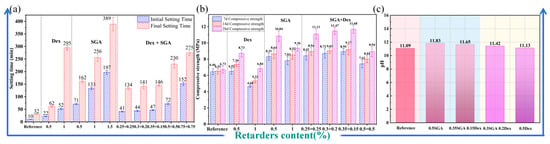
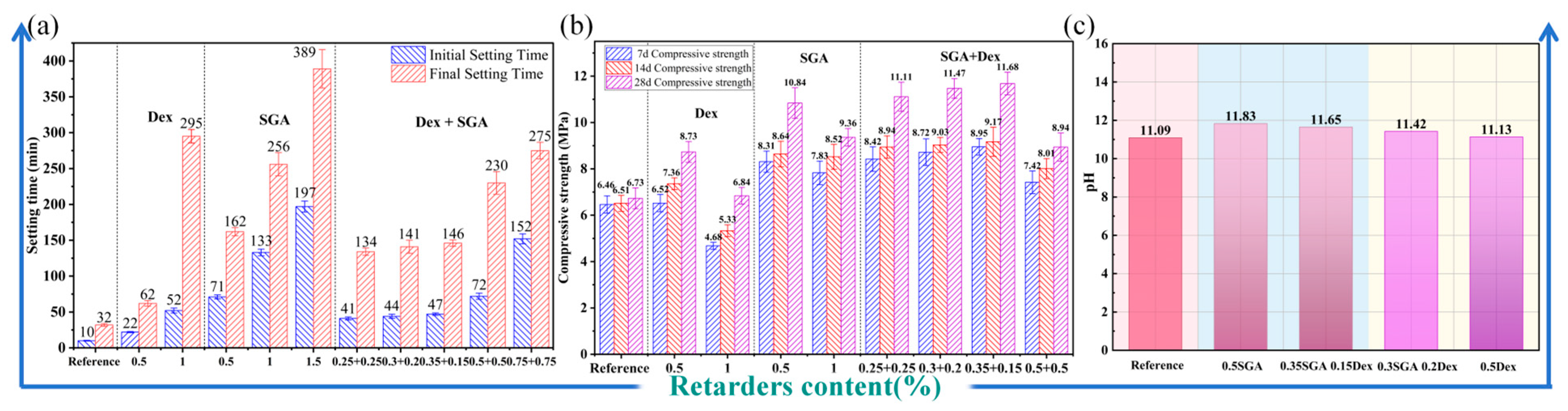
Figure 4a shows the effects of SGA and Dex on the setting behavior of the composite binder containing 60 wt.% β-HPG and 40 wt.% low-calcium FA. Rapid β-HPG dissolution and subsequent dihydrate gypsum (DH) precipitation result in a narrow working window, with initial and final setting times of only 4 and 8 min for unmodified β-HPG paste [16]. The incorporation of 40 wt.% FA extended these times to 10 and 32 min, respectively, mainly through dilution and particle-spacing effects, although the resulting working time remained insufficient. Both Dex and SGA produced dosage-dependent retardation. Increasing the Dex dosage from 0.5 to 1.0 wt.% prolonged the initial/final setting times from 22/62 to 52/295 min, indicating that excessive adsorption, water retention, and steric hindrance strongly restricted ion transport and crystal growth [33,34]. SGA exhibited a stronger retarding effect, with the setting times increasing from 71/162 min at 0.5 wt.% to 197/389 min at 1.5 wt.%. This behavior was attributed to Ca2+ complexation and adsorption of SGA on gypsum nucleation and growth sites [35,36].
Figure 4.
Effects of SGA and Dex on the macroscopic properties of β-HPG/FA composite binders: (a) initial and final setting times; (b) compressive strengths at 7, 14, and 28 d; and (c) 28-d leachate pH.
At a constant total admixture dosage of 0.5 wt.%, the 0.25SGA + 0.25Dex, 0.30SGA + 0.20Dex, and 0.35SGA + 0.15Dex mixtures exhibited initial/final setting times of 41/134, 44/141, and 47/146 min, respectively. The relatively narrow variation among these mixtures indicates stable setting regulation. In particular, the 0.35SGA + 0.15Dex mixture shortened the initial and final setting times by 33.8% and 9.9%, respectively, compared with 0.5 wt.% SGA alone, while retaining an adequate working window. Thus, the combined system moderated the strong retardation of SGA and the dosage sensitivity of Dex, achieving a better balance between workability and timely hardening.
3.2. Compressive Strength
Figure 4b presents the compressive strengths of the β-HPG/FA composite binders at 7, 14, and 28 d. In gypsum-dominated binders, interlocking dihydrate gypsum (DH) crystals contribute to early strength, while low-calcium FA may contribute through particle filling and subsequent alkali-assisted reactions [5]. The reference mixture reached 6.46, 6.51, and 6.73 MPa at 7, 14, and 28 d, respectively. Its strength increased by only 4.2% from 7 to 28 d, indicating that most of its 28 d strength developed during the first 7 d. However, the extent of FA reaction cannot be determined from the strength development or 28 d aqueous-extract pH alone [37,38].
At a dosage of 0.5 wt.%, Dex and SGA increased the 28 d strength to 8.73 and 10.84 MPa, respectively. Increasing the Dex dosage to 1.0 wt.% reduced the strength to 6.84 MPa, close to the reference value, demonstrating a clear dosage-dependent effect. This behavior is consistent with the reported influence of polysaccharide adsorption on gypsum crystal growth and interlocking [18,19].
Among the combined mixtures, 0.35 wt.% SGA + 0.15 wt.% Dex achieved the highest strengths of 8.95, 9.17, and 11.68 MPa at 7, 14, and 28 d, respectively, with the 28 d value being approximately 74% higher than that of the reference. This value was lower than the approximately 20 MPa reported for a wet-ground FA/β-HPG binder [8]; however, direct comparison is limited by differences in FA processing, precursor composition, activator formulation, and curing conditions. The results therefore demonstrate the relative benefit of SGA–Dex within the investigated system.
3.3. Leachate pH
Figure 4c presents the pH of the aqueous extracts obtained from the β-HPG/FA composite binders at 28 d. The reference mixture exhibited the lowest pH (11.09). Residual phosphoric acid and other impurities in phosphogypsum, including fluoride-bearing species, have been reported to affect the alkali demand of the binder [5,12,37,38].
Among the modified mixtures, 0.5SGA exhibited the highest extract pH (11.83), followed by 0.35SGA + 0.15Dex (11.65), 0.30SGA + 0.20Dex (11.42), and 0.5Dex (11.13). Previous studies have associated the retarding effect of SGA with Ca2+ coordination and adsorption at gypsum nucleation and growth sites [15,16,17]. The effects of Dex on crystal growth have been discussed in terms of interfacial adsorption, steric hindrance, and water retention [18,19]. The contributions of these mechanisms to the observed pH differences were not determined in this study.
Under identical extraction conditions, the aqueous extract of the 0.35SGA + 0.15Dex mixture had a higher pH than that of the reference mixture. This comparison applies to aqueous extracts prepared from the hardened binders at 28 d. These measurements alone cannot establish changes in early-age pore-solution pH, reduced hydroxide consumption, or an increased degree of fly ash reaction.
3.4. Freeze–Thaw Resistance
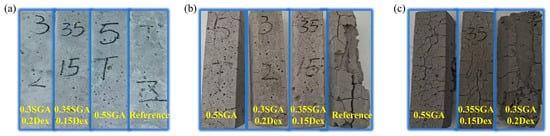
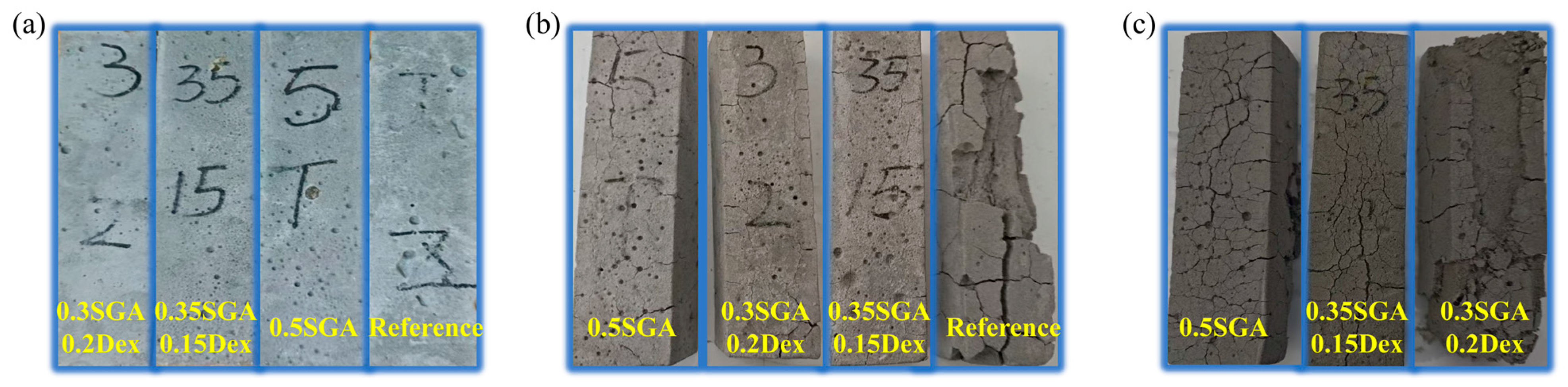
As shown in Figure 5, all specimens were initially intact, while the reference specimen showed severe scaling and penetrating cracks after 10 freeze–thaw cycles. The SGA and Dex modified specimens exhibited better integrity, particularly the 0.35 SGA + 0.15 Dex mixture, indicating improved resistance to freeze–thaw-induced cracking and scaling.
Figure 5.
Visual appearance of β-HPG/FA composite binders before and after freeze–thaw cycles: (a) 0 cycles, (b) 10 cycles and (c) 20 cycles.
3.4.1. Mass Loss and Relative Dynamic Elastic Modulus
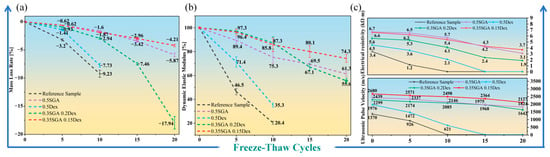
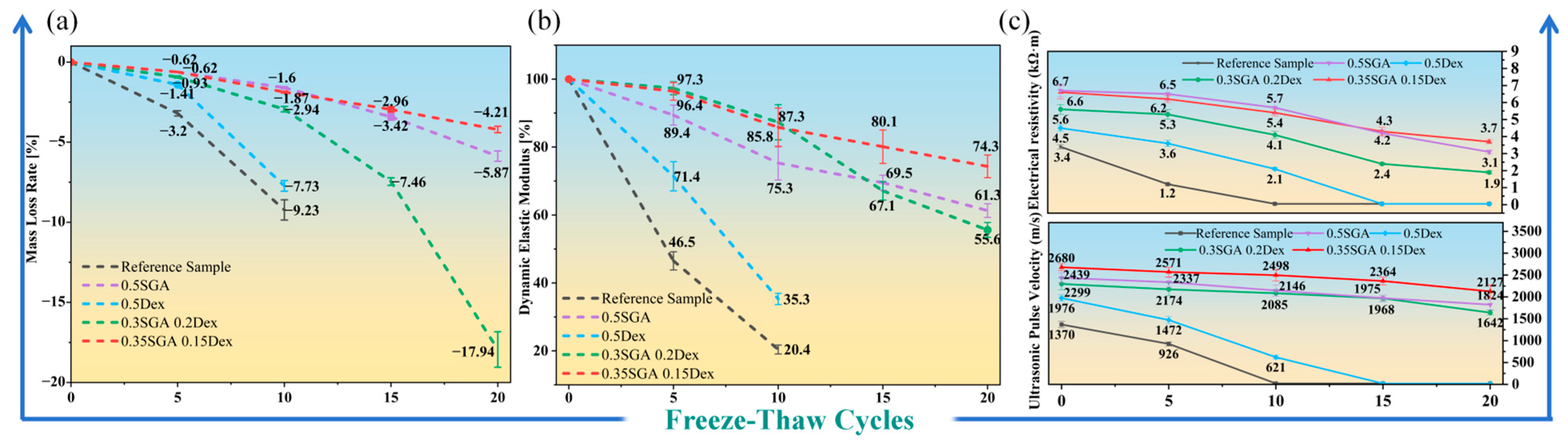
Figure 6a,b shows the evolution of mass loss and relative dynamic elastic modulus (RDEM) during freeze–thaw cycling. Mass loss primarily reflects surface scaling and specimen disintegration, whereas RDEM is more sensitive to internal cracking and stiffness degradation [39]. The reference mixture deteriorated rapidly: its mass loss reached 9.23% after 10 cycles, exceeding the 5% failure threshold, while its RDEM decreased to 46.5% after 5 cycles and 20.4% after 10 cycles. The 0.5Dex mixture also exhibited rapid damage, with a mass loss of 7.73% and an RDEM of 35.3% after 10 cycles. Although this mixture had the smallest macropore fraction at 28 d (23%), its substantial stiffness loss indicates that the initial macropore fraction alone did not predict freeze–thaw performance across the tested mixtures.
Figure 6.
Evolution of freeze–thaw performance of β-HPG/FA composite binders: (a) mass loss; (b) relative dynamic elastic modulus; (c) electrical resistivity; and ultrasonic pulse velocity.
The deterioration rate was strongly dependent on the SGA/Dex ratio. After 20 cycles, the 0.35SGA + 0.15Dex mixture exhibited the lowest mass loss (4.21%) and retained the highest RDEM (74.3%), outperforming both 0.5SGA (5.87% and 61.3%) and 0.30SGA + 0.20Dex (17.94% and 55.6%). The relatively low mass loss but greater RDEM reduction of 0.5SGA further indicates that limited surface scaling does not necessarily imply low internal damage. Overall, the improved short-term freeze–thaw response of the 0.35SGA + 0.15Dex mixture was associated with a smaller increase in MIP-accessible porosity and better retention of RDEM, electrical resistivity, and UPV. These observations suggest better preservation of specimen integrity under the tested conditions but do not directly demonstrate reduced three-dimensional pore connectivity or restricted moisture transport. Similar associations between pore-structure refinement and improved freeze–thaw response have been reported for other phosphogypsum-based and solid-waste composite binders [40,41].
3.4.2. Electrical Resistivity and Ultrasonic Pulse Velocity
Figure 6c compares the electrical resistivity and ultrasonic pulse velocity (UPV) during freeze–thaw cycling. Electrical resistivity reflects the connectivity of water-filled pores and cracks, whereas UPV is sensitive to internal compactness and structural discontinuities [42,43]. The reference mixture exhibited the lowest initial resistivity and UPV, at 3.4 kΩ·m and 1370 m/s, respectively. After five cycles, these values decreased to 1.2 kΩ·m and 926 m/s, and reliable measurements could no longer be obtained after 10 cycles because of severe deterioration. This rapid attenuation indicates a highly connected pore network that facilitated water and ion transport and accelerated freeze–thaw-induced cracking [44,45,46,47].
The 0.35SGA + 0.15Dex mixture had the highest apparent surface electrical resistivity and ultrasonic pulse velocity (UPV) among the mixtures measured after 20 freeze–thaw cycles. Its resistivity decreased from 6.6 to 3.7 kΩ·m, and its UPV decreased from 2680 to 2127 m/s, retaining 56.1% and 79.4% of their initial values, respectively. These measurements, together with the 74.3% retention of its initial dynamic elastic modulus, indicate better preservation of internal integrity during cycling [45]. After 20 cycles, SEM images of this mixture showed fewer visible cracks than those of 0.5SGA, and its MIP-accessible porosity increased by only 0.95 percentage points.. These observations are consistent with the reported relationship between microstructural damage and freeze–thaw deterioration [48].
Water exposure may promote the dissolution and recrystallization of calcium sulfate phases and reduce matrix cohesion. Because no separate water-immersion control was maintained for the same duration, the results after 20 cycles reflect the short-term performance under the combined effects of water exposure and freeze–thaw cycling. The individual contributions of these two effects could not be distinguished.
3.5. XRD Analysis
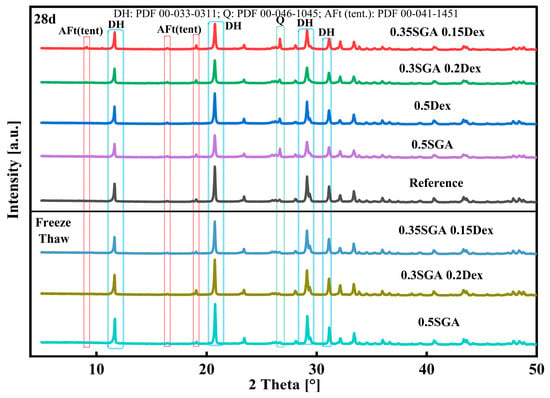
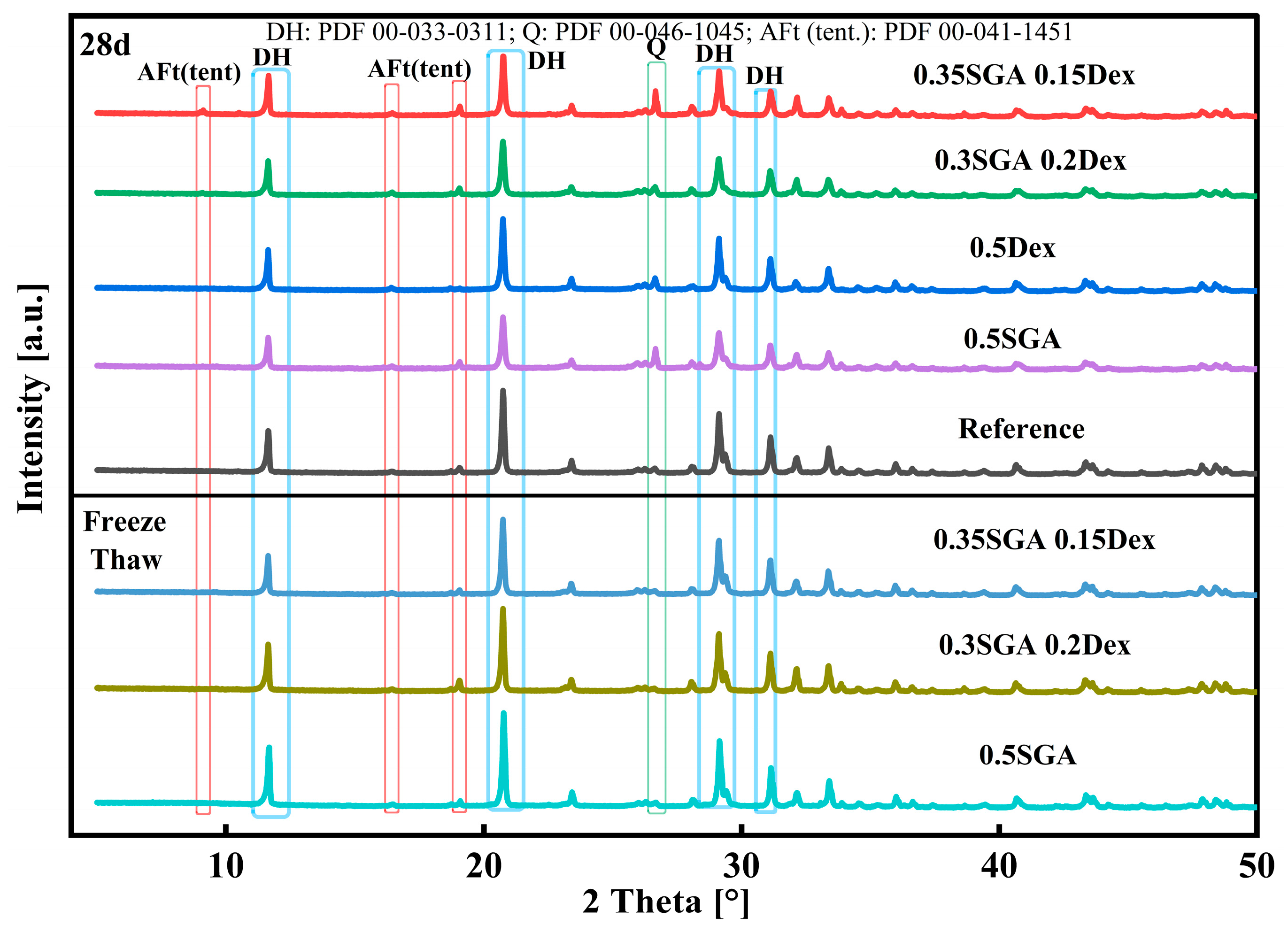
Figure 7 shows the XRD patterns of the β-HPG/FA composite binders at 28 d and after 20 freeze–thaw cycles. Phase identification was performed by comparison with the PDF-ICDD reference patterns. At 28 d, dihydrate gypsum (DH) was the predominant crystalline phase in all mixtures. Its main reflections occurred at approximately 11.6° (020), 20.7° (021), 29.1° (041), and 31.1° (−221), consistent with PDF-ICDD No. 00-033-0311. The reflection at approximately 26.6° was assigned to the (101) plane of quartz (PDF-ICDD No. 46-1045), indicating the persistence of crystalline quartz from the FA. The reaction extent of the glassy FA fraction could not be determined from these patterns.
Figure 7.
XRD patterns of β-HPG/FA composite binders with SGA and Dex.
The reference and modified mixtures exhibited similar DH-dominated patterns, with no unambiguous evidence of additional crystalline phases. Although organic admixtures can influence gypsum crystallization and sulfate–aluminate precipitation [16,17,19], the weak features previously considered possible AFt reflections overlapped with DH peaks and could not be indexed reliably. Therefore, they were not assigned to a specific phase in the revised figure. The patterns were vertically offset for clarity, and no quantitative phase analysis was performed; differences in peak intensity are thus discussed only qualitatively.
After 20 freeze–thaw cycles, DH remained the predominant crystalline phase in the three examined mixtures, and its principal reflections remained at approximately the same positions. Water exposure may promote further hydration of residual calcium sulfate phases [21,39], while changes in moisture and ionic conditions can affect sulfate-bearing hydrates [49,50]. However, peak overlap, particularly in the 32–34° range, prevented reliable identification of minor phases. Consequently, changes in AFt or AFm abundance and possible transformations between them could not be established from the available XRD patterns.
3.6. Hydration Heat Analysis
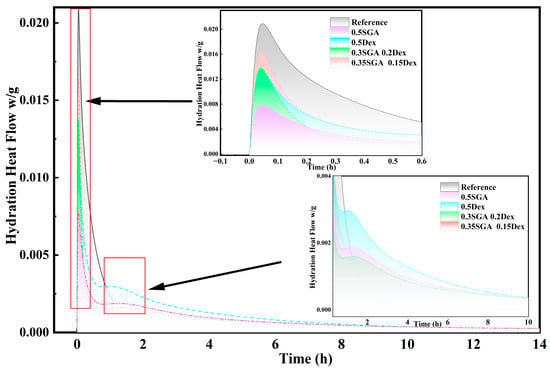
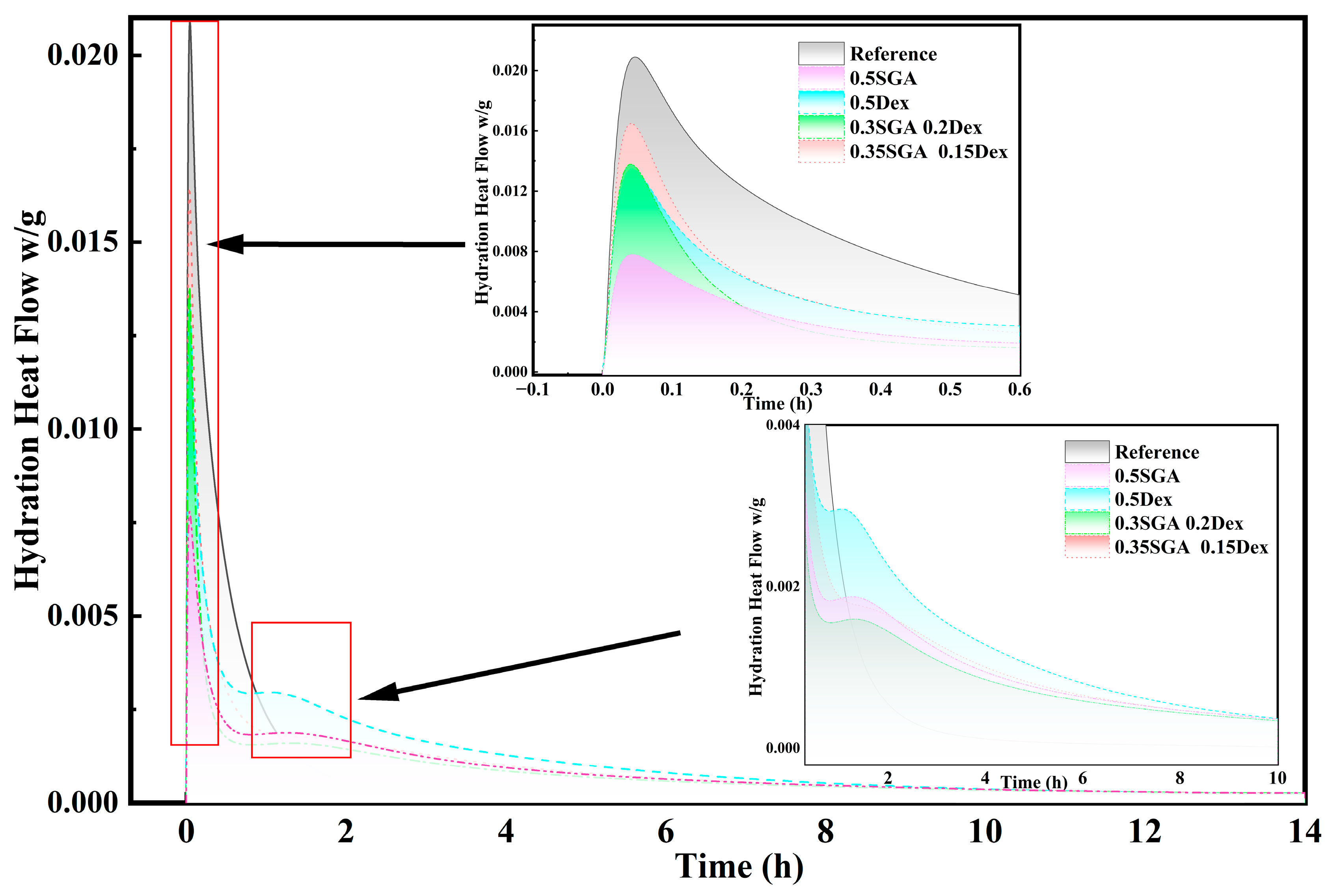
Isothermal calorimetry was used to characterize the early hydration of the β-HPG/FA binder. As shown in Figure 8, the curves exhibited a dominant initial peak followed by a broad, low-intensity exothermic region. The initial peak was mainly associated with rapid β-HPG dissolution and DH precipitation, whereas the subsequent heat release may have involved continued gypsum hydration and minor reactions involving FA and Al-bearing phases [51].
Figure 8.
Hydration heat curves of specimens under the effect of SGA and Dex.
The reference mixture showed an initial peak above 0.020 W g−1, consistent with rapid precipitation and its short final setting time of 32 min. For 0.35SGA + 0.15Dex, the peak decreased to approximately 0.016 W g−1. This reduction is consistent with the proposed Ca2+ coordination and surface interaction of SGA, together with the adsorption and steric-hindrance effects of Dex, which may have moderated early precipitation and crystal growth [16,17,18].
The modified mixtures exhibited more sustained post-peak heat release, suggesting a redistribution of early hydration. However, the DH-dominated XRD patterns do not support interpreting this response as direct evidence of extensive FA activation or specific low-crystallinity products. The high later-stage heat flow but poor mechanical and freeze–thaw performance of 0.5Dex further indicates that heat release alone does not determine matrix quality. For 0.35SGA + 0.15Dex, its smoother heat evolution, prolonged setting, and higher strength suggest more moderated hydration. Limited alkali-assisted reactions involving FA may have contributed to the later heat release, as reported for related activated binders [52,53], but their extent cannot be determined from calorimetry or the 28 d aqueous-extract pH alone.
3.7. TG-DTG Analysis
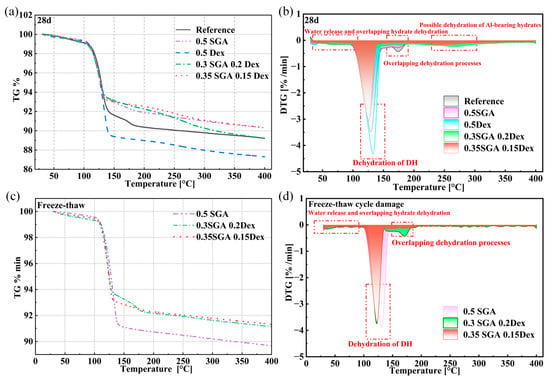
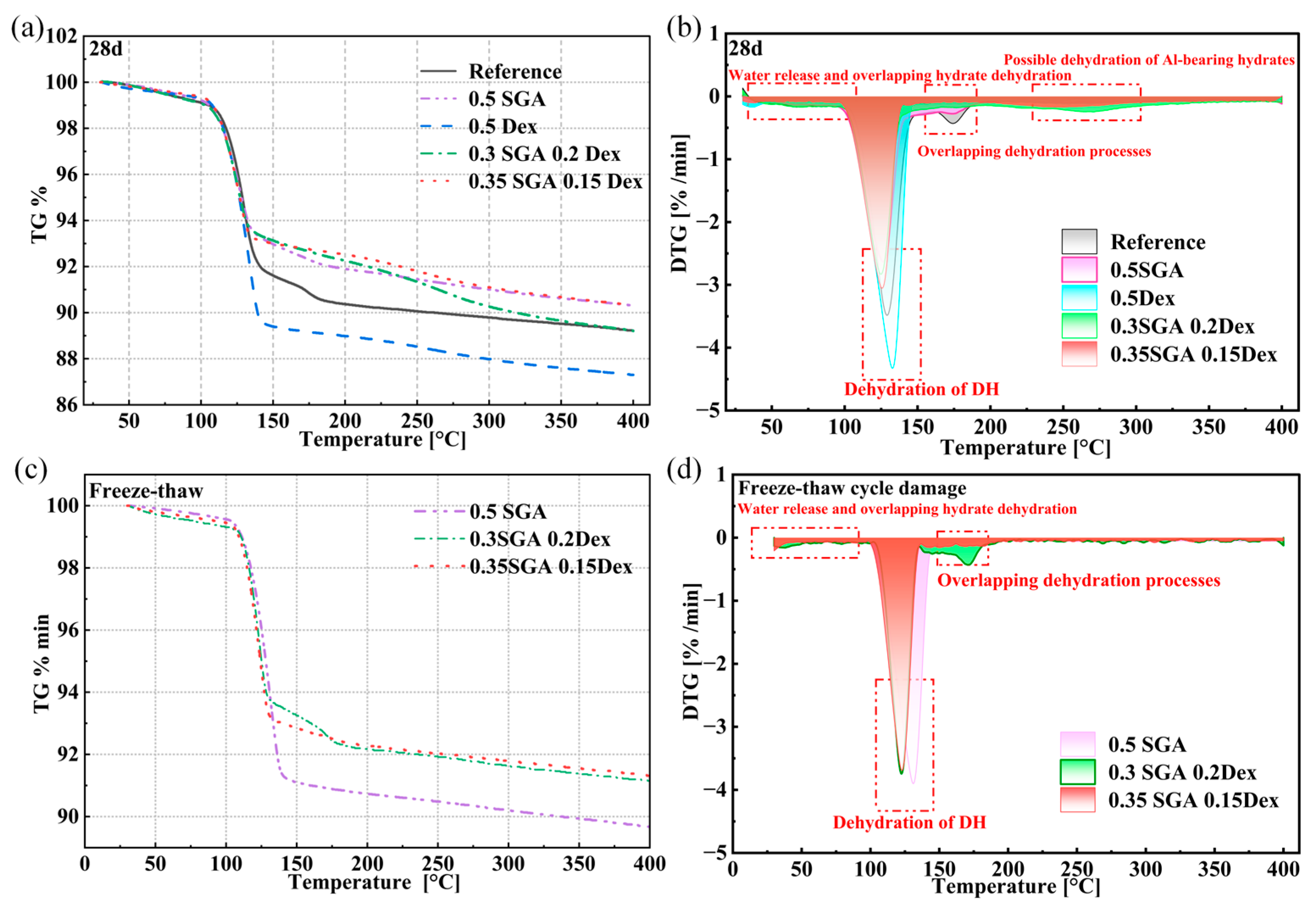
Figure 9 presents the TG and DTG curves of the binders at 28 d and after freeze–thaw exposure. The TG curves show the cumulative mass loss during heating, whereas the DTG curves show the rate of mass loss at each temperature. The low-temperature response at approximately 50–120 °C includes the release of physically bound water and overlapping dehydration of AFt and other hydrates. The dominant DTG minimum at 130–150 °C is attributed primarily to the dehydration of dihydrate gypsum (DH). Continued gypsum dehydration and AFm dehydration may both contribute to the weaker feature near 170 °C [49,54]. The broad response at 225–300 °C is tentatively associated with the dehydration of Al-bearing hydrates [54]. Overlap among these thermal events limits the identification and quantification of individual hydrates, including C–S–H and C–A–S–H.
Figure 9.
TG-DTG curves of β-HPG/FA composite binders: (a,b) 28 d specimens; (c,d) specimens after 20 freeze–thaw cycles.
At 28 d, the cumulative mass loss up to 400 °C was approximately 9.7% for 0.35SGA + 0.15Dex, 10.8% for the reference, and 12.7% for 0.5Dex (Figure 9a). In the DTG curves, 0.5Dex also exhibited the deepest minimum within the DH dehydration interval, indicating the highest peak mass-loss rate among the mixtures examined at 28 d (Figure 9b). The corresponding minimum for 0.35SGA + 0.15Dex was shallower than those of the reference and 0.5Dex. Although adsorption and steric hindrance have been discussed as mechanisms by which Dex influences hydrate development [55], the present thermal measurements do not resolve their contributions to the observed differences.
Post-exposure measurements were available for the three mixtures that completed 20 freeze–thaw cycles: 0.5SGA, 0.30SGA + 0.20Dex, and 0.35SGA + 0.15Dex. For 0.35SGA + 0.15Dex, the DH-related DTG minimum deepened from approximately −3.0 to −3.8% min−1 after exposure (Figure 9b,d), while the cumulative mass loss up to 400 °C decreased from approximately 9.7% to 8.7% (Figure 9a,c). Thus, this mixture exhibited a higher peak dehydration rate within the DH interval despite a lower cumulative mass loss over the full heating range. Dissolution and reprecipitation of sulfate-bearing phases during water exposure [56] and secondary hydration of residual calcium sulfate [21,39] are possible explanations for the change in the dehydration profile. The persistence of DH reflections in Figure 7 confirms the presence of crystalline gypsum after cycling, but the combined XRD and thermal data do not establish a net increase in DH content.
3.8. Micromorphology and Chemical Elements
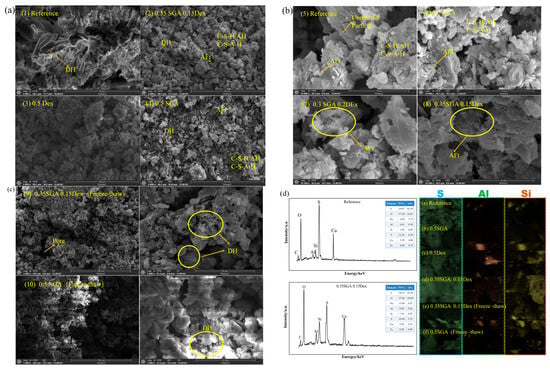
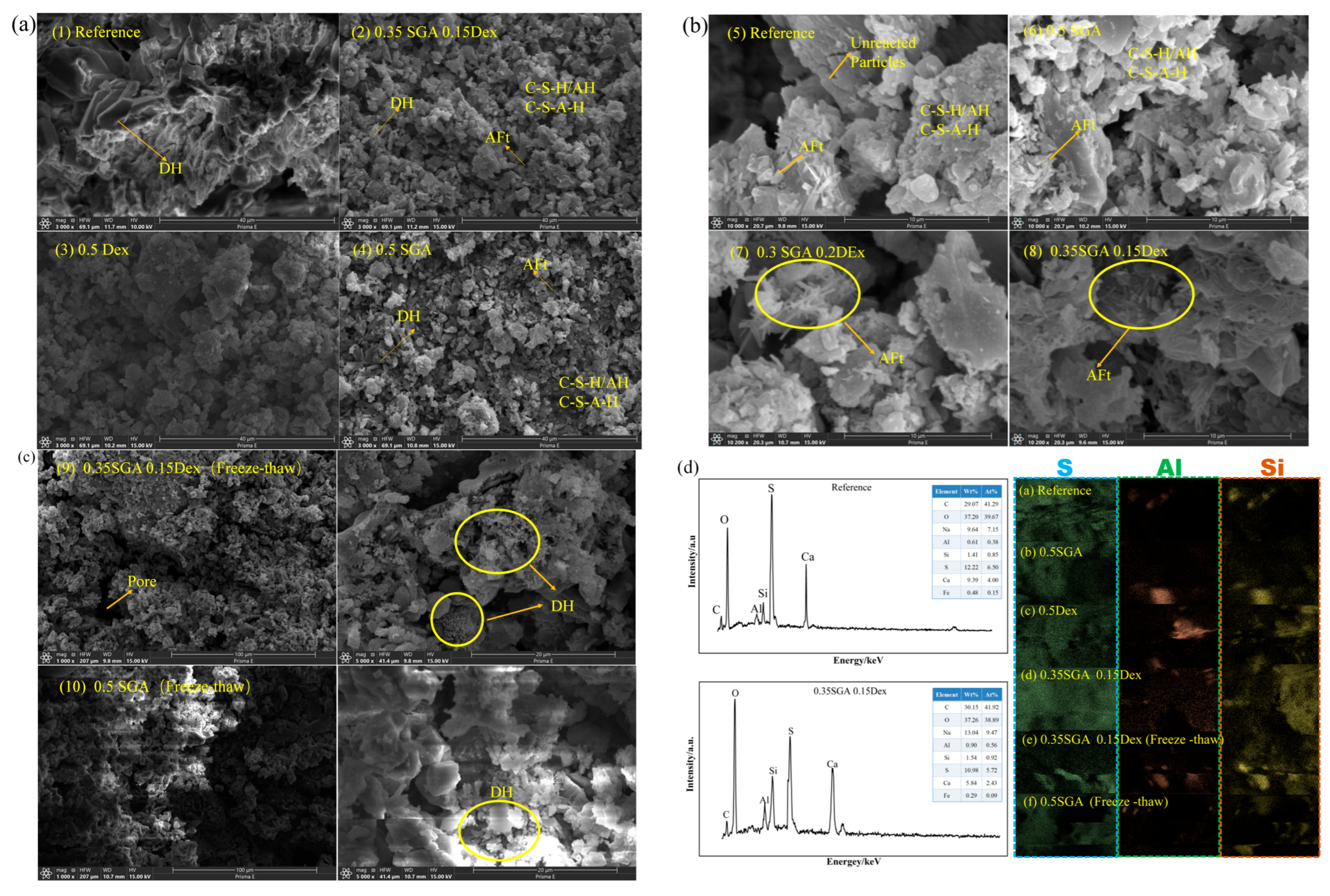
Figure 10 compares the microstructures and elemental distributions of the selected specimens. At 28 d, representative micrographs of the reference and 0.5 wt.% SGA mixtures showed coarse, short-rod crystals morphologically consistent with AFt, together with residual particles and discontinuous low-crystallinity matrix phases. In contrast, the 0.35 wt.% SGA + 0.15 wt.% Dex mixture exhibited finer needle-like AFt-like crystals more uniformly dispersed within a relatively continuous matrix. Because AFt nucleation and growth are influenced by ionic supersaturation, pH, sulfate availability, and admixture adsorption, these morphological differences indicate changes in the local precipitation environment [57]. They are consistent with possible coordination and adsorption of SGA at Ca-bearing surface sites and the interfacial adsorption and steric restriction associated with Dex, which may have moderated rapid precipitation and crystal coarsening [5,16,17,19]. Nevertheless, SEM morphology alone cannot distinguish C-S-H, C-A-S-H, or other amorphous products; therefore, the fine matrix phases are conservatively described as low-crystallinity hydration products.
Figure 10.
Microstructure and elemental characteristics of β-HPG/FA specimens: (a,b) SEM images after curing for 28 d; (c) SEM images after 20 freeze–thaw cycles; and (d) EDS spectra and elemental maps.
After 20 freeze–thaw cycles, representative micrographs of the 0.35 wt.% SGA + 0.15 wt.% Dex mixture showed a relatively continuous matrix with fewer visible large voids and cracks than the 0.5 wt.% SGA mixture. This observation is consistent with its smaller increase in MIP-accessible porosity, although two-dimensional SEM images cannot directly quantify three-dimensional pore connectivity. Crystals morphologically consistent with DH were observed along freeze–thaw-induced cracks and pore edges. When considered together with the more pronounced DH-related signals in XRD and TG–DTG, these observations suggest possible secondary hydration or recrystallization of residual β-HPG and other calcium sulfate-bearing particles during cycling. The DH-like crystals observed in the combined-admixture mixture appeared finer and more dispersed than those in the 0.5 wt.% SGA mixture, which may have limited local stress concentration. This morphological difference was consistent with its lower mass loss and better stiffness retention after freeze–thaw exposure [21,39,55].
The EDS spectra illustrate representative local compositional differences between the selected regions. The local Ca and S mass fractions decreased from 9.39 and 12.22 wt.% in the reference to 5.84 and 10.98 wt.% in the 0.35 wt.% SGA + 0.15 wt.% Dex mixture, respectively, whereas the corresponding Al and Si contents increased slightly from 0.61 and 1.41 wt.% to 0.90 and 1.54 wt.%. Because EDS is a local, semi-quantitative technique, these values cannot be extrapolated to bulk phase contents or independently confirm the formation of specific gel phases. When interpreted together with the XRD, TG–DTG, and SEM observations, the results are consistent with reduced local predominance of Ca- and S-rich regions and a slightly greater local representation of Al- and Si-bearing low-crystallinity products [53,58]. Within the mapped fields, S appeared less locally concentrated, whereas Al and Si showed a more spatially dispersed distribution in the combined-admixture mixture [3]. This qualitative mapping result indicates a more even local elemental distribution but does not independently establish the continuity of a hydration-product network or reduced pore connectivity.
3.9. Pore Structure Analysis
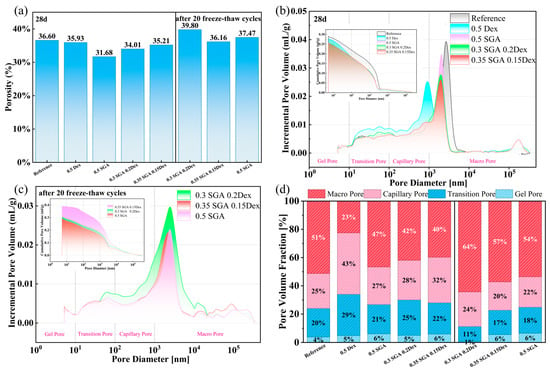
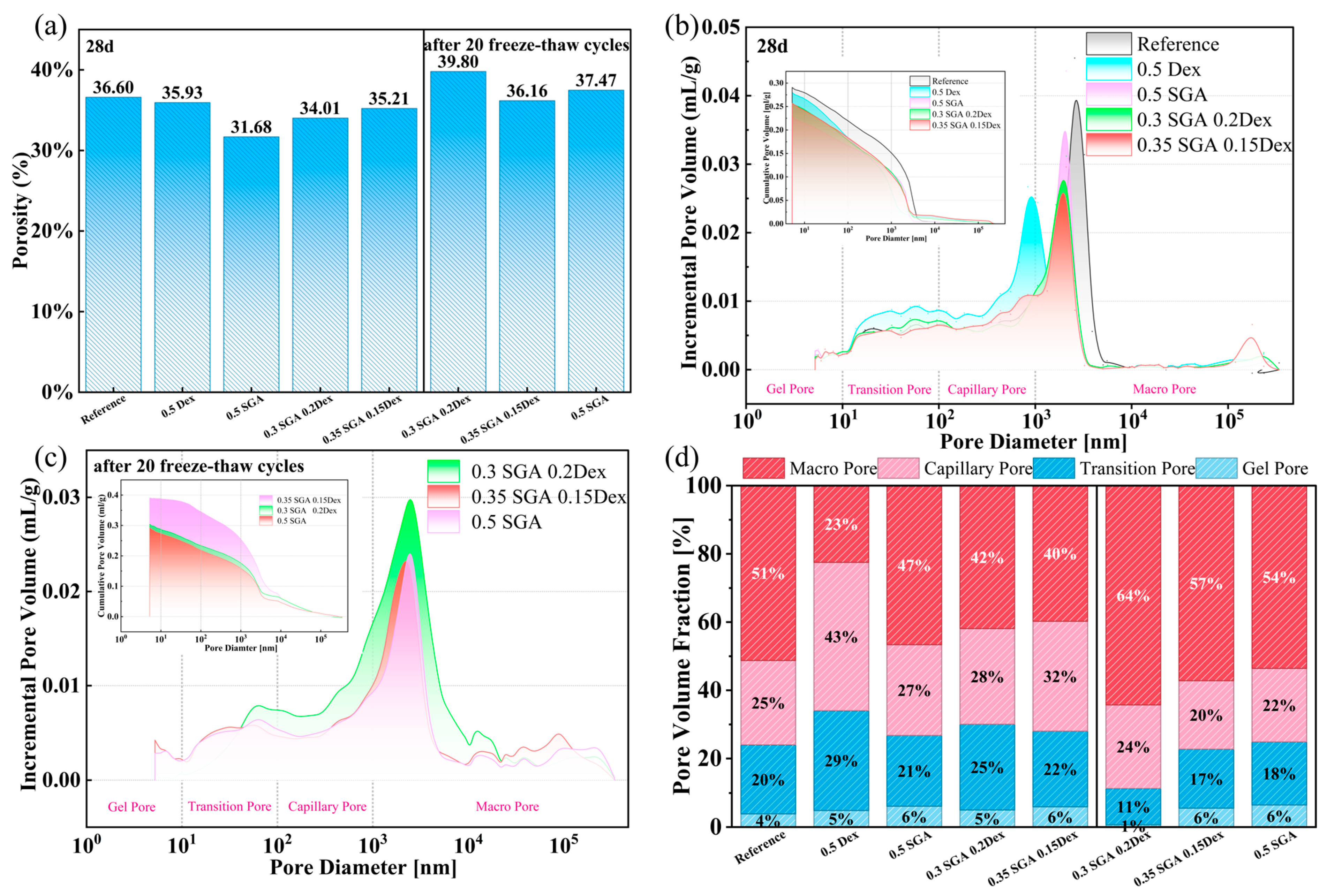
Figure 11 summarizes the MIP-accessible porosity and pore-entry size distributions before and after freeze–thaw exposure. At 28 d, the MIP-accessible porosity was 36.60% for the reference mixture and 35.21% for the 0.35 wt.% SGA + 0.15 wt.% Dex mixture, a difference of 1.39 percentage points. The corresponding fractions of intruded volume in the macropore range were 51% and 40%, respectively. The capillary-, transition-, and gel-pore ranges accounted for 25%, 20%, and 4% in the reference mixture and 32%, 22%, and 6% in the combined mixture. Thus, the main difference between the mixtures was the distribution of intruded volume across pore-entry sizes. Admixture effects on precipitation and crystal growth may have contributed to this difference [16,17,19].
Figure 11.
Pore structure characteristics of β-HPG/FA specimens: (a) total porosity before and after freeze–thaw cycles; (b) pore-size distribution at 28 d; (c) pore-size distribution after 20 freeze–thaw cycles; (d) pore volume fraction before and after freeze–thaw cycles.
Pore-size redistribution alone did not determine performance. Although 0.5 wt.% Dex exhibited the lowest macropore fraction (23%), its capillary- and transition-pore fractions reached 43% and 29%, respectively, while its strength and freeze–thaw resistance remained relatively low [18,19]. The 0.5 wt.% SGA mixture showed the lowest accessible porosity (31.68%) but retained a macropore fraction of 47% and a comparatively heterogeneous matrix containing coarse DH- and AFt-like crystals [7,16,17]. Therefore, accessible porosity should be interpreted together with pore-size distribution and matrix morphology.
After 20 freeze–thaw cycles, the accessible porosity of 0.35 wt.% SGA + 0.15 wt.% Dex increased by only 0.95 percentage points, from 35.21% to 36.16%, whereas those of 0.5 wt.% SGA and 0.30 wt.% SGA + 0.20 wt.% Dex both increased by 5.79 percentage points. Nevertheless, its macropore fraction increased from 40% to 57%, indicating that pore coarsening still occurred. Freeze–thaw-induced cracking may have exposed residual calcium sulfate-bearing particles to water, facilitating secondary hydration or recrystallization [21,39]. Overall, the selected SGA/Dex ratio did not prevent pore coarsening but was associated with the smallest increase in MIP-accessible porosity and the most favorable short-term freeze–thaw response among the surviving mixtures.
3.10. Molecular-Scale Interaction Between SGA and the Gypsum Interface
To examine possible local interactions of SGA and Dex with the DH (010) surface, selected interatomic distances and hydrogen-bond-compatible geometries were analyzed over 400–500 ps. UFF was adopted to describe both the organic admixtures and gypsum, while QEq was used to assign partial atomic charges consistently. The DH (010) face was selected as a well-characterized cleavage surface. Maltotetraose, consisting of four α-(1→4)-linked glucose units, was used as a simplified and computationally tractable model of the hydroxyl groups and glycosidic linkages in Dex. However, it was not intended to reproduce the molecular-weight distribution, branching, or chain-length-dependent behavior of the experimental Dex, which had an estimated dry-basis DE of approximately 5.4. Only one initial molecular position and orientation and one trajectory were analyzed for each SGA–DH and maltotetraose–DH system. Moreover, the models excluded explicit water, competing pore-solution ions, and other binder constituents. Therefore, the observed contact geometries may depend on the selected initial configuration and should be interpreted only as qualitative examples of possible local interfacial interactions rather than statistically representative evidence of adsorption strength or molecular synergy under actual hydration conditions.
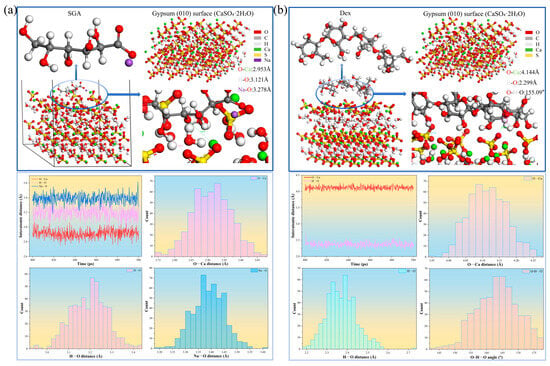
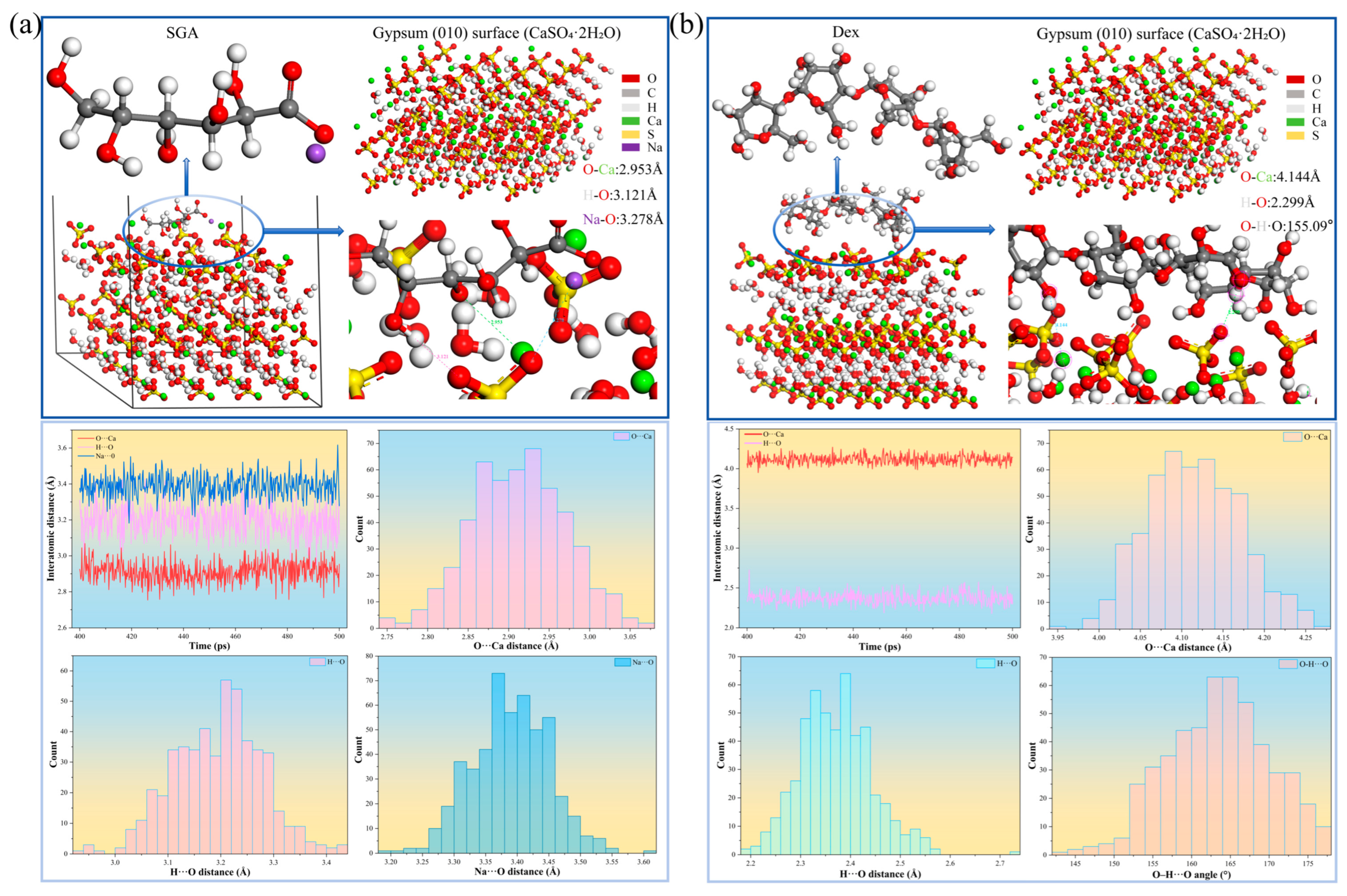
Figure 12 shows the evolution of selected interatomic distances and hydrogen-bond geometries at the SGA–DH and maltotetraose–DH interfaces over 400–500 ps. Table 3 summarizes the corresponding contact geometries. The monitored distances fluctuated within relatively narrow ranges over this interval, allowing the local configurations of the selected atom pairs to be compared.
Figure 12.
Interfacial configurations and local contact statistics for (a) SGA and (b) Dex on the DH (010) surface.
Table 3.
Geometric characteristics of selected interfacial contacts in the SGA-DH and Dex-DH systems over 400–500 ps.
In the SGA–DH model, the mean distance between the selected SGA hydroxyl O atom and the surface Ca atom was 2.913 ± 0.058 Å, and the selected Na···O distance was 3.390 ± 0.061 Å (mean ± standard deviation). The small variation in the O···Ca distance indicates that this hydroxyl O atom remained close to the surface Ca site during the analyzed interval. For the monitored O–H···O donor–acceptor pair, the mean H···O distance and O–H···O angle were 3.195 ± 0.084 Å and 93.39 ± 4.79°, respectively. None of the analyzed frames simultaneously satisfied the hydrogen-bond criteria of H···O ≤ 2.5 Å and O–H···O ≥ 150° for this pair [26,27].
In the maltotetraose–DH model, the selected O···Ca distance fluctuated around 4.1 Å. The monitored H···O distances were concentrated at approximately 2.3–2.5 Å, with O–H···O angles of approximately 155–170°. These geometries are consistent with hydrogen bonding between hydroxyl groups on the modeled Dex segment and the gypsum surface. A chain segment in this configuration could also hinder access to nearby surface sites [28], although the extent of site blocking was not quantified.
The two models thus identify distinct local contacts that could influence access to DH growth sites: a persistent hydroxyl O···Ca contact for SGA and geometries favorable for hydrogen bonding for the modeled Dex segment. Experimentally, the 0.35SGA + 0.15Dex mixture exhibited initial and final setting times of 47 and 146 min, respectively, and its early heat-flow peak was approximately 0.016 W·g−1, compared with more than 0.020 W·g−1 for the reference mixture. These observations are consistent with moderated early hydration. The simulations provide a possible interfacial explanation for this trend. Competitive adsorption, interactions between the two admixtures, and their combined effect on crystal growth in the aqueous binder remain unresolved.
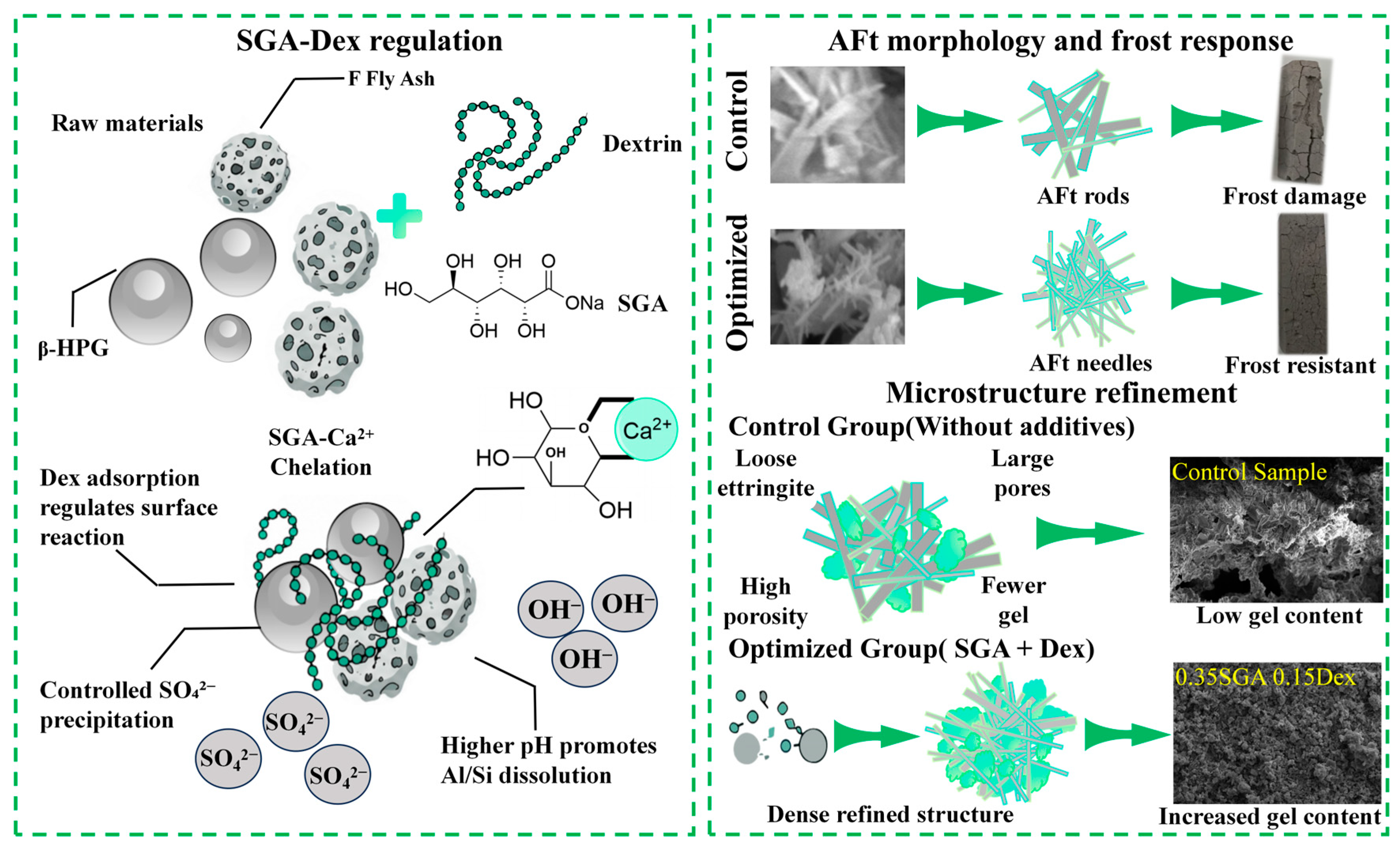
Based on the MD observations and experimental results, the proposed complementary interfacial roles of SGA and Dex are illustrated in Figure 13. SGA exhibited persistent O···Ca contacts with exposed surface-Ca sites on DH, whereas Dex adopted hydrogen-bond-compatible configurations and may impose steric restriction near the surface. These distinct configurations may contribute to the experimentally observed moderation of early hydration. The associated changes in hydration-product morphology and MIP-accessible pore distribution were consistent with the improved short-term freeze–thaw response.
Figure 13.
Proposed complementary interfacial roles of SGA and Dex in hydration regulation and pore-structure development of the β-HPG/FA composite binder.
4. Conclusions
This study investigated the effects of a combined sodium galactonate (SGA)–dextrin (Dex) admixture on the setting behavior, hydration characteristics, microstructure, and short-term freeze–thaw response of a composite binder containing 60 wt.% β-HPG and 40 wt.% low-calcium FA. The main conclusions are as follows:
1. At a total admixture dosage of 0.5 wt.%, the formulation containing 0.35 wt.% SGA and 0.15 wt.% Dex provided the most balanced setting regulation among the investigated mixtures. Its initial and final setting times were 47 and 146 min, respectively, providing an adequate working window without the excessive retardation observed at higher single-admixture dosages.
2. The 0.35SGA + 0.15Dex mixture achieved a 28 d compressive strength of 11.68 MPa, representing a 73.5% increase relative to the reference value of 6.73 MPa. Its 28 d extract pH increased from 11.09 to 11.65, indicating higher aqueous-extract alkalinity after hardening. However, extract pH does not directly represent pore-solution pH or quantify early OH− consumption and FA reaction.
3. XRD confirmed a DH-dominated crystalline phase assemblage, while TG–DTG exhibited overlapping thermal features compatible with the possible presence of minor sulfate- or Al-bearing hydrates; however, these phases could not be unambiguously identified or quantified. SEM revealed finer needle-like features within a more continuous low-crystallinity matrix, and the MIP-accessible macropore fraction decreased from 51% to 40%. Together, these observations support hydration-product redistribution and pore refinement but do not establish the formation of a continuous AFt–gel network.
4. Among the mixtures that completed 20 freeze–thaw cycles, the 0.35 wt.% SGA + 0.15 wt.% Dex mixture showed the lowest mass loss of 4.21% and the highest RDEM of 74.3%. Its improved short-term freeze–thaw response was associated with a smaller increase in MIP-accessible porosity and better retention of electrical resistivity and UPV.
5. In separate interfacial MD models, each based on a single initial configuration and trajectory, SGA maintained persistent O···Ca contacts with the DH (010) surface, whereas the simplified Dex oligomer adopted hydrogen-bond-compatible configurations. Because these contact geometries may depend on the selected initial molecular position and orientation, the results represent only qualitative examples of possible local interfacial configurations and do not establish statistically representative adsorption behavior or molecular synergy under aqueous pore-solution conditions.
6. The selected SGA–Dex formulation shows preliminary potential as a binder component for pavement base/subbase materials, mine backfill, and other non-structural products requiring extended workability and moderate strength. However, the freeze–thaw test was limited to 20 cycles, and aqueous-extract pH alone cannot establish environmental safety. Before engineering application, long-term durability, dimensional stability, and the leaching of soluble P, F, sulfate, and trace metals should be evaluated together with field-scale performance.
Author Contributions
Software, R.Z.; validation, J.W.; formal analysis, R.Z.; investigation, R.Z. and D.J.; resources, J.W. and Y.H.; writing—original draft, R.Z.; writing—review & editing, Y.H. and D.J.; supervision, J.W., Y.H. and D.J.; project administration, J.W.; funding acquisition, J.W. All authors have read and agreed to the published version of the manuscript.
Funding
This research was funded by the Jiangsu Provincial Young Science and Technology Talent Support Program (grant number JSTJ-2024-275).
Data Availability Statement
The original contributions presented in this study are included in the article. Further inquiries can be directed to the corresponding author.
Acknowledgments
The authors gratefully acknowledge the support from the Jiangsu Provincial Young Science and Technology Talent Support Program (Grant No. JSTJ-2024-275).During the preparation of this manuscript, the authors used ChatGPT (OpenAI, GPT-6.2 Astra) to refine the wording, and check grammar and formatting. The prompts included “Please check the manuscript for grammatical errors and formatting issues throughout”. The authors reviewed and edited the output and take full responsibility for the content of this publication.
Conflicts of Interest
The authors declare no conflicts of interest.
References
- Li, J.; Li, Y.; Ge, X.; Li, K.; Yang, Y.; Wang, S. Strength enhancement of 3D-printed phosphogypsum concrete based on synergistic activation of multi-solid wastes. Materials 2026, 19, 482. [Google Scholar] [CrossRef] [Scilit] [PubMed]
- Wang, D.; Zhang, Z.; Guo, W.; Li, J.; Li, X.; Zhao, Q. A novel all-solid-waste binder prepared by salt-alkali synergistic activation system constructed from phosphogypsum, soda residue and calcium carbide slag. Cem. Concr. Compos. 2025, 155, 105841. [Google Scholar] [CrossRef] [Scilit]
- Ouyang, G.; Li, Z.; Sun, T.; Ye, Z.; Deng, Y.; Li, W. Greener phosphogypsum-based all-solid-waste cementitious binder with steel slag activation: Hydration, mechanical properties and durability. J. Clean. Prod. 2024, 443, 140996. [Google Scholar] [CrossRef] [Scilit]
- Feng, Y.; Xue, Z.; Zhang, B.; Xie, J.; Chen, C.; Tan, J.; Zhao, C. Effects of phosphogypsum substitution on the performance of ground granulated blast furnace slag/fly ash-based alkali-activated binders. J. Build. Eng. 2023, 70, 106387. [Google Scholar] [CrossRef] [Scilit]
- Jin, Z.; Gong, C.; He, X.; Su, Y.; Wang, Y.; Li, Y.; Qi, H.; Tian, C. Exploring the curing regimes for nonhydraulic-hydraulic cementitious material composite binder: Study on the hemihydrate phosphogypsum-ground granulated blast-furnace slag system. Cem. Concr. Compos. 2025, 160, 106018. [Google Scholar] [CrossRef] [Scilit]
- Chen, X.; Liu, Y.; Wu, Q.; Ding, Y.; Wang, Q.; Tang, W.; Zhu, B. Study on physical and chemical characteristics of β-hemihydrate phosphogypsum. Case Stud. Constr. Mater. 2022, 17, e01461. [Google Scholar] [CrossRef] [Scilit]
- Zhang, Y.; Yang, J.; Cao, X. Effects of several retarders on setting time and strength of building gypsum. Constr. Build. Mater. 2020, 240, 117927. [Google Scholar] [CrossRef] [Scilit]
- Jin, Z.; Cui, C.; Su, Y.; He, X.; Wang, Y.; Qi, H.; Li, Y.; Duan, X. Improvement of the mechanical properties of beta-hemihydrate phosphogypsum by incorporating wet-ground low-calcium fly ash slurries. Constr. Build. Mater. 2024, 428, 136371. [Google Scholar] [CrossRef] [Scilit]
- Jin, Z.; Ma, B.; Su, Y.; Lu, W.; Qi, H.; Hu, P. Effect of calcium sulphoaluminate cement on mechanical strength and waterproof properties of beta-hemihydrate phosphogypsum. Constr. Build. Mater. 2020, 242, 118198. [Google Scholar] [CrossRef] [Scilit]
- Liu, S.; Ouyang, J.; Ren, J. Mechanism of calcination modification of phosphogypsum and its effect on the hydration properties of phosphogypsum-based supersulfated cement. Constr. Build. Mater. 2020, 243, 118226. [Google Scholar] [CrossRef] [Scilit]
- Zheng, Y.; Zhong, H.; Sun, K.; Shen, B.; Cui, K.; Zhao, Y.; Xiong, G. Feasibility study of utilising NaOH and phosphogypsum as a composite activator for alkali-activated slag. Constr. Build. Mater. 2024, 457, 139436. [Google Scholar] [CrossRef] [Scilit]
- Gijbels, K.; Pontikes, Y.; Samyn, P.; Schreurs, S.; Schroeyers, W. Effect of NaOH content on hydration, mineralogy, porosity and strength in alkali/sulfate-activated binders from ground granulated blast furnace slag and phosphogypsum. Cem. Concr. Res. 2020, 132, 106054. [Google Scholar] [CrossRef] [Scilit]
- Hua, Y.; Zhang, Z.; Yuan, L.; Qian, J.; Yue, Y.; Li, Z.; Jia, X. Effect of soluble phosphate on strength development of anhydrite calcined from phosphogypsum. Cem. Concr. Compos. 2025, 157, 105920. [Google Scholar] [CrossRef] [Scilit]
- Liu, W.; Zhen, Y.; Feng, Y.; Lu, Z.; Xie, J. Hydration mechanism and microstructure evolution of seawater-based low-alkalinity activated phosphogypsum cement. Materials 2026, 19, 617. [Google Scholar] [CrossRef] [Scilit] [PubMed]
- Hu, S.; Wang, J.; Zhou, X.; Li, Q.; Jin, D.; Ge, D.; Shen, F. The utilization of waste cheese whey for retardation in alkali activated slag-based materials: Retarding performance and molecular hydration mechanism. Powder Technol. 2026, 472, 122161. [Google Scholar] [CrossRef] [Scilit]
- Jin, Z.; Wang, L.; Su, Y.; He, X.; Ma, B.; Wang, Y.; Li, Y.; Qi, H.; Wang, B. Effect of different retarders on setting time and mechanical properties of hemihydrate phosphogypsum-calcium sulfoaluminate cement composite binder. Constr. Build. Mater. 2024, 411, 134339. [Google Scholar] [CrossRef] [Scilit]
- Zhang, X.; He, Y.; Lu, C.; Huang, Z. Effects of sodium gluconate on early hydration and mortar performance of Portland cement-calcium aluminate cement-anhydrite binder. Constr. Build. Mater. 2017, 157, 1065–1073. [Google Scholar] [CrossRef] [Scilit]
- Sybis, M.; Konował, E.; Prochaska, K. Dextrins as green and biodegradable modifiers of physicochemical properties of cement composites. Energies 2022, 15, 4115. [Google Scholar] [CrossRef] [Scilit]
- Lei, L.; Li, R.; Fuddin, A. Influence of maltodextrin retarder on the hydration kinetics and mechanical properties of Portland cement. Cem. Concr. Compos. 2020, 114, 103774. [Google Scholar] [CrossRef] [Scilit]
- Liu, C.; Wu, H.; Li, Z.; Shi, H.; Ye, G. Effect of curing condition on mechanical properties and durability of alkali-activated slag mortar. Constr. Build. Mater. 2024, 439, 137376. [Google Scholar] [CrossRef] [Scilit]
- Huang, M.; Bao, S.; Zhang, Y.; Li, M.; Ping, Y.; Lin, C. Durability of alkali-activated cementitious materials at freeze-thaw environment: Damage and protection mechanism. Constr. Build. Mater. 2025, 488, 142102. [Google Scholar] [CrossRef] [Scilit]
- Fu, R.; Lu, Y.; Wang, L.; An, H.; Chen, S.; Kong, D. The effects of admixtures on the durability properties of phosphogypsum-based cementitious materials. Constr. Build. Mater. 2024, 411, 134379. [Google Scholar] [CrossRef] [Scilit]
- Xu, B.; Zhou, Y.; Wu, Z.; Lu, K.; Wang, H.; Gao, A. Chemical mechanisms of cement stabilization and durability enhancement in high-content modified phosphogypsum. Buildings 2025, 15, 723. [Google Scholar] [CrossRef] [Scilit]
- Bian, X.; Xia, J.; Liu, H.; Xiao, T. Strength, durability, and microscopic analysis of silt solidified with two-phase phosphogypsum and cement fiber. Materials 2025, 18, 1960. [Google Scholar] [CrossRef] [Scilit] [PubMed]
- Wang, D.; Na, Q.; Liu, Y.; Feng, Y.; Zhang, Q.; Chen, Q. Hydration process and fluoride solidification mechanism of multi-source solid waste-based phosphogypsum cemented paste backfill under CaO modification. Cem. Concr. Compos. 2024, 154, 105804. [Google Scholar] [CrossRef] [Scilit]
- Mao, X.; Song, X.; Lu, G.; Xu, Y.; Sun, Y.; Yu, J. Effect of additives on the morphology of calcium sulfate hemihydrate: Experimental and molecular dynamics simulation studies. Chem. Eng. J. 2015, 278, 320–327. [Google Scholar] [CrossRef] [Scilit]
- Xu, Q.; Wang, J.; She, A.; Wu, Q.; Zhu, H.; Lu, B.; Zhu, Z. Performance and mechanism of amino acids (AAs) on the gypsum setting-time control. Constr. Build. Mater. 2024, 411, 134373. [Google Scholar] [CrossRef] [Scilit]
- Mishra, R.K.; Darouich, S.; in ’t Veld, P.J.; Flatt, R.J.; Heinz, H. Understanding hydration reactions, mechanical properties, thermal expansion, and organic interfacial interactions of calcium sulfate hydrates from the atomic scale. Cem. Concr. Res. 2025, 189, 107740. [Google Scholar] [CrossRef] [Scilit]
- GB/T 1346-2011; Test Methods for Water Requirement of Normal Consistency, Setting Time and Soundness of the Portland Cement. Standards Press of China: Beijing, China, 2011.
- GB/T 17671-2021; Test Method of Cement Mortar Strength (ISO Method). Standards Press of China: Beijing, China, 2021.
- GB/T 50082-2009; Standard for Test Methods of Long-Term Performance and Durability of Ordinary Concrete. China Architecture & Building Press: Beijing, China, 2010.
- JGJ/T 70-2009; Standard for Test Method of Basic Properties of Construction Mortar. China Architecture & Building Press: Beijing, China, 2009.
- Peschard, A.; Govin, A.; Grosseau, P.; Guilhot, B.; Guyonnet, R. Effect of polysaccharides on the hydration of cement paste at early ages. Cem. Concr. Res. 2004, 34, 2153–2158. [Google Scholar] [CrossRef] [Scilit]
- Toobpeng, N.; Thavorniti, P.; Jiemsirilers, S. Effect of additives on the setting time and compressive strength of activated high-calcium fly ash-based geopolymers. Constr. Build. Mater. 2024, 417, 135035. [Google Scholar] [CrossRef] [Scilit]
- Zou, D.; Zhang, Z.; Wang, D. Influence of citric acid and sodium gluconate on hydration of calcium sulfoaluminate cement at various temperatures. Constr. Build. Mater. 2020, 263, 120247. [Google Scholar] [CrossRef] [Scilit]
- Luo, G.; Liu, M.; Li, H.; Liu, Y.; Tan, H.; Liu, Q. Importance of adsorption compared with complexation for retarding C3S hydration via adding sodium gluconate. Cem. Concr. Res. 2024, 186, 107686. [Google Scholar] [CrossRef] [Scilit]
- Zheng, Y.; Xuan, D.; Shen, B.; Ma, K. Shrinkage mitigation of alkali-activated fly ash/slag mortar by using phosphogypsum waste. Constr. Build. Mater. 2023, 375, 130978. [Google Scholar] [CrossRef] [Scilit]
- Ponomar, V.; Kamali, S.; Luukkonen, T.; Hajimohammadi, A.; Kilpimaa, K. The effect of gypsum on reaction kinetics and microstructure of alkali-activated CaO-FeOx-SiO2 slag. Cem. Concr. Compos. 2025, 160, 106033. [Google Scholar] [CrossRef] [Scilit]
- Zhao, R.; Yuan, Y.; Cheng, Z.; Wen, T.; Li, J.; Li, F.; Ma, Z.J. Freeze-thaw resistance of Class F fly ash-based geopolymer concrete. Constr. Build. Mater. 2019, 222, 474–483. [Google Scholar] [CrossRef] [Scilit]
- Wang, J.; Deng, X.; Tan, H.; Guo, H.; Zhang, J.; Li, M.; Chen, P.; He, X.; Yang, J.; Jian, S.; et al. The mechanical properties and sustainability of phosphogypsum-slag binder activated by nano-ettringite. Sci. Total Environ. 2023, 903, 166015. [Google Scholar] [CrossRef] [Scilit] [PubMed]
- Huang, X.; Liao, J.; Zhang, J.; Wang, Y.; Feng, Q. Insight into the durability of concrete based on ultrafine ground granulated blast furnace slag, phosphogypsum, and steel slag. J. Mater. Res. Technol. 2025, 38, 49–61. [Google Scholar] [CrossRef] [Scilit]
- Noushini, A.; Castel, A. The effect of heat-curing on transport properties of low-calcium fly ash-based geopolymer concrete. Constr. Build. Mater. 2016, 112, 464–477. [Google Scholar] [CrossRef] [Scilit]
- Wang, Z.; Zeng, Q.; Wang, L.; Yao, Y.; Li, K. Characterizing blended cement pastes under cyclic freeze-thaw actions by electrical resistivity. Constr. Build. Mater. 2013, 44, 477–486. [Google Scholar] [CrossRef] [Scilit]
- Rahat, M.H.H.; Brand, A.S. The combined effects of freeze-thaw cycles and seawater on chloride ingress in concrete. Constr. Build. Mater. 2025, 489, 142363. [Google Scholar] [CrossRef] [Scilit]
- Tian, Z.; Ye, H. Electrical resistivity of partially-saturated alkali-activated slag containing sodium nitrite admixture. Cem. Concr. Compos. 2021, 120, 104053. [Google Scholar] [CrossRef] [Scilit]
- Kim, D.; Kim, R.; Min, J.; Choi, H. Initial freeze-thaw damage detection in concrete using two-dimensional non-contact ultrasonic sensors. Constr. Build. Mater. 2023, 364, 129854. [Google Scholar] [CrossRef] [Scilit]
- Ziada, M.; Tanyildizi, H.; Uysal, M. Bacterial healing of geopolymer concrete exposed to combined sulfate and freeze-thaw effects. Constr. Build. Mater. 2023, 369, 130517. [Google Scholar] [CrossRef] [Scilit]
- Chen, S.; Ruan, S.; Zeng, Q.; Liu, Y.; Zhang, M.; Tian, Y.; Yan, D. Pore structure of geopolymer materials and its correlations to engineering properties: A review. Constr. Build. Mater. 2022, 328, 127064. [Google Scholar] [CrossRef] [Scilit]
- Merlo, V.; Marchese, L.; Gastaldi, D.; Boccaleri, E.; Canonico, F.; Paul, G. Investigating the hydration of C3A in the combined presence of anhydrite and limestone using solid-state NMR, XRD and TG techniques. Constr. Build. Mater. 2023, 378, 131028. [Google Scholar] [CrossRef] [Scilit]
- Matschei, T.; Lothenbach, B.; Glasser, F.P. Thermodynamic properties of Portland cement hydrates in the system CaO-Al2O3-SiO2-CaSO4-CaCO3-H2O. Cem. Concr. Res. 2007, 37, 1379–1410. [Google Scholar] [CrossRef] [Scilit]
- Chen, X.; Wang, Q.; Wu, Q.; Xie, X.; Tang, S.; Yang, G.; Luo, L.; Yuan, H. Hydration reaction and microstructural characteristics of hemihydrate phosphogypsum with variable pH. Constr. Build. Mater. 2022, 316, 125891. [Google Scholar] [CrossRef] [Scilit]
- Lin, H.; Hu, J.; Song, T.; Li, Y.; Shen, J. Performance optimization of alkali-activated low-calcium fly ash geopolymers: Experimental study and machine learning modeling. J. Build. Eng. 2025, 113, 114066. [Google Scholar] [CrossRef] [Scilit]
- Long, Z.; Long, G.; Tang, Z.; Shangguan, M.; Wang, J.; Yi, M.; Zhang, Y.; Peng, L.; Wang, L. Analysis of hydration kinetics in high early-strength cementitious system with calcium sulphoaluminate cement and CSH seeds. Constr. Build. Mater. 2024, 448, 138222. [Google Scholar] [CrossRef] [Scilit]
- Qoku, E.; Bier, T.A.; Westphal, T. Phase assemblage in ettringite-forming cement pastes: An X-ray diffraction and thermal analysis characterization. J. Build. Eng. 2017, 12, 37–50. [Google Scholar] [CrossRef] [Scilit]
- Li, J.; Chang, J.; Wang, T.; Zeng, T.; Li, J.; Zhang, J. Effects of phosphogypsum on hydration properties and strength of calcium aluminate cement. Constr. Build. Mater. 2022, 347, 128398. [Google Scholar] [CrossRef] [Scilit]
- Hargis, C.W.; Lothenbach, B.; Müller, C.J.; Winnefeld, F. Further insights into calcium sulfoaluminate cement expansion. Adv. Cem. Res. 2019, 31, 160–177. [Google Scholar] [CrossRef] [Scilit]
- Poupelloz, E.; Gauffinet, S.; Nonat, A. Study of nucleation and growth processes of ettringite in diluted conditions. Cem. Concr. Res. 2020, 127, 105915. [Google Scholar] [CrossRef] [Scilit]
- Wu, M.; Shen, W.; Xiong, X.; Zhao, L.; Yu, Z.; Sun, H.; Xu, G.; Zhao, Q.; Wang, G.; Zhang, W. Effects of the phosphogypsum on the hydration and microstructure of alkali activated slag pastes. Constr. Build. Mater. 2023, 368, 130391. [Google Scholar] [CrossRef] [Scilit]

Disclaimer/Publisher’s Note: The statements, opinions and data contained in all publications are solely those of the individual author(s) and contributor(s) and not of MDPI and/or the editor(s). MDPI and/or the editor(s) disclaim responsibility for any injury to people or property resulting from any ideas, methods, instructions or products referred to in the content. |
© 2026 by the authors. Licensee MDPI, Basel, Switzerland. This article is an open access article distributed under the terms and conditions of the Creative Commons Attribution (CC BY) license.