


Abstract
The transition from the Hall–Petch relationship (HPR) to the inverse Hall–Petch relationship (IHPR) is a key issue in understanding the mechanical behavior of nanocrystalline metals. However, a closed-form analytical description that simultaneously incorporates intrinsic grain boundary energetics and extrinsic thermally activated kinetics is still lacking. In this work, we develop a unified analytical model for the HPR–IHPR transition by coupling grain boundary-induced bond relaxation, cohesive energy variation, temperature, and strain rate effects within a core–shell grain framework. The model yields explicit expressions for the strength evolution and the critical grain size associated with the HPR–IHPR transition. Validation against representative published data demonstrates that the proposed model captures the characteristic HPR–IHPR behavior and reasonably predicts the critical grain size. The analysis further reveals that temperature and strain rate affect both the strength and, in a material-dependent manner, the transition behavior. For the Al configurations examined, the model predicts that introducing either coherent twin boundaries or symmetric tilt grain boundaries raises the peak strength and reduces the critical grain size relative to the reference microstructure. In both cases, hydrogen doping lowers the predicted peak strength and increases the critical grain size relative to the corresponding H-free configuration. The present work provides an analytical framework for understanding grain size-dependent strengthening and softening in nanocrystalline materials.
1. Introduction
The yield strength and hardness of a solid increase as the grain size is reduced to the micro- and sub-microscale, a phenomenon known as the Hall–Petch relationship (HPR) [1]. This strengthening effect arises from the increasing fraction of grain boundaries (GBs), which act as barriers to dislocation motion and lead to dislocation pile-up. However, when the grain size is further refined into the nanometre regime, the HPR ceases to hold [2]. In many cases, the yield stress peaks at a critical mean grain size, denoted as , which typically lies around 10–100 nm. Beyond this critical size, a further reduction in grain size can lead to a softening effect, giving rise to the inverse Hall–Petch relationship (IHPR) [3,4]. It should be noted that the IHPR is not universal, and its occurrence strongly depends on the structure and coupling of grain boundaries. Different types of GBs contribute differently to the HPR–IHPR transition due to their distinct structural characteristics [5,6,7]. For incoherent or weakly coupled interfaces, grain boundary-mediated deformation becomes increasingly important as the grain size decreases, favouring the occurrence of the IHPR. In contrast, coherent and strongly coupled interfaces can maintain their resistance to deformation at much smaller length scales and therefore delay, or in some cases suppress within the accessible size range, the onset of the IHPR. For example, coherent twin boundaries in nanocrystalline Cu were found to shift the HPR–IHPR transition to a smaller grain size, while continuous strengthening has been reported in nanotwinned cBN down to a twin thickness of about 3.8 nm [8,9,10]. Similar high strength together with enhanced thermal stability has also been observed in nanotwinned diamond with twin thicknesses of only a few nanometres [11].
In addition to intrinsic structural features, the segregation of solute atoms at GBs also plays a critical role in the HPR–IHPR transition [12,13]. Hydrogen is a representative example because it readily segregates at GBs and alters the local bonding state [14,15]. In general, hydrogen reduces grain boundary cohesion and may facilitate interfacial deformation, thereby affecting both the strength and the critical grain size [16,17]. Therefore, grain boundary chemistry provides an additional degree of freedom for modifying the HPR–IHPR transition by changing the local bonding characteristics.
Theories proposed to explain the HPR–IHPR transition can be broadly classified into four categories [18]: (1) dislocation-based, (2) diffusion-based, (3) GB shearing-based, and (4) two phase-based models. These approaches have provided important insights into the origin of grain size-dependent strengthening and softening, and generally indicate that the critical grain size is determined by the competition between dislocation activity and grain boundary-related processes [19]. However, most existing descriptions emphasize specific deformation mechanisms, while the intrinsic energetic contribution associated with atomic coordination and bond relaxation remains insufficiently considered. Recent thermodynamic models have incorporated energy-related factors into Hall–Petch-type descriptions of nanostructured materials, but the coupling between local bonding characteristics, thermal activation, and grain size-dependent strength evolution requires further clarification [20]. Attempts have been made to introduce simplified expressions [18,21,22], such as
Here, , where represents the dimensionless grain size, scaled by a characteristic length d such as the atomic bond length. In this definition, D denotes the grain diameter. denotes the strength increment due to grain refinement relative to the ideal crystal (corresponding to the saturation grain size), and f is the adjustable parameter. Equation (1) incorporates both the accumulation term () and the activation term () of dislocations, with the size-dependent melting temperature being proportional to the activation energy for dislocation motion. When is treated as a constant, the conventional linear Hall–Petch relationship can be recovered. However, grain refinement may influence the activation process in a manner analogous to temperature increase [23], leading to a reduction in the effective [21]. Based on this consideration, Equation (1) can qualitatively reproduce the inverse Hall–Petch trend. Nevertheless, this formulation has limitations when describing the complete HPR–IHPR transition. At the low-temperature limit, the activation term leads to an unrealistic divergence of strength; at the high-temperature limit approaching the melting temperature, the model still predicts a grain size-dependent strength variation, whereas the material strength should vanish as the solid phase disappears. Therefore, additional considerations of the intrinsic energetic evolution associated with grain refinement are required to describe the HPR–IHPR transition over a broad temperature range.
Understanding and quantitatively describing the HPR–IHPR transition is essential for predicting the mechanical properties of nanocrystalline materials and provides a practical basis for the design and optimization of advanced structural materials. This study aims to clarify the intrinsic and extrinsic factors governing the HPR–IHPR transition by establishing an analytical relationship among grain size, grain boundary energetics, and thermally activated deformation. We fit the model to published data for representative materials to assess its ability to describe the strength variation and estimate the critical grain size. In addition, hydrogen incorporation at the and grain boundaries in Al is considered as a representative case to examine the influence of grain boundary chemistry on the transition behavior. This paper is organized as follows: Section 2 introduces the theoretical framework and derivation of the analytical formula. By reconsidering the thermally activated dislocation effect, analysing the relationship between atomic bond energy and temperature, and combining the bond order–length–strength correlation, a formula applicable to describing the HPR–IHPR transition over a broad temperature range is obtained. Section 3 presents the fits to published data and examines the effects of temperature, strain rate, and grain boundary chemistry. Section 4 offers concluding remarks.
2. Theoretical Considerations and Formulation
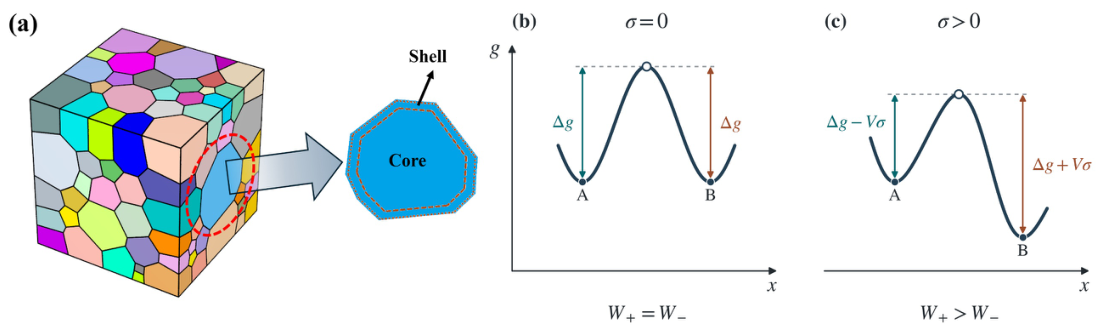
The interatomic bond is the fundamental carrier of energy exchange and storage. The reversible storage and dissipation of energy during deformation govern the mechanical behaviour of solids [24]. In polycrystalline materials, atoms located near grain boundaries possess coordination environments that differ from those in the grain interior. As a first-order approximation, each grain can therefore be regarded as a core–shell structure, as illustrated in Figure 1a. In the present treatment, the interaction between neighbouring grains is not explicitly resolved, and each grain is described as an individual core–shell unit. This approximation is mainly applicable to incoherent or weakly coupled interfaces, for which the grain boundary contribution can be represented by the shell region.
The mechanical and thermal properties of the shell differ from those of the grain interior [25]. Experimental spectroscopic studies have shown that undercoordinated regions in nanocrystals can be represented by a finite-thickness shell of approximately 2.14 bond lengths, providing experimental support for such a core–shell description [26]. When atomic coordination decreases, bond relaxation changes the local energy density. When bonds are compressed or experience altered coordination, the local energy density and the cohesive energy . The two quantities have different physical meanings: has the dimension of energy per unit volume, i.e., stress, and therefore provides an energy scale for the elastic modulus, hardness, and strength. In contrast, has the dimension of energy per atom and is related to the thermal energy scale , thereby governing the thermal stability of the material.
Undercoordination-induced bond contraction can increase and enhance the local strength, whereas the reduction in coordination number can decrease and lower the effective melting temperature. The competition between these two effects becomes increasingly important as the grain size decreases. Therefore, the HPR–IHPR transition is considered here to result from the combined effects of the intrinsic variation in bond length and cohesive energy with grain size and the extrinsic thermally activated dislocation process.
Figure 1.
Schematic illustration of (a) the microstructure of a polycrystalline material and the core–shell representation of a grain; and the energy barrier for thermally activated motion (b) without and (c) with applied stress [27]. For the incoherent interface approximation adopted here, the characteristic shell thickness is taken as 2.14 times the average atomic bond length based on the spectroscopically determined thickness of undercoordinated nanocrystal skins [26].
2.1. Thermally Activated Effect of Dislocation
The thermally activated effect of dislocation motion plays an essential role in determining the temperature dependence of strength. In Equation (1), the contribution of thermal activation is represented by an Arrhenius-type term, . Although this form can qualitatively describe the reduction in strength with increasing temperature, it leads to an unrealistic divergence as T approaches zero, as discussed above. Therefore, a more general description of thermally activated dislocation motion is required to establish a physically consistent HPR–IHPR model over a broad temperature range.
In terms of thermally activated motion of dislocations in the field of external forces, many studies have analysed the temperature dependence of the yield stress [28,29,30,31]. The activation process of plastic deformation can be described as the state overcoming an energy barrier under the influence of external forces [32,33], as shown in Figure 1b,c [34]. In this context, the Gibbs free energy for activation, , represents the energy barrier that must be overcome. Without external force, the diffusion probabilities in both directions, governed by the Maxwell–Boltzmann distribution, remain balanced, leading to no net dislocation movement, as illustrated in Figure 1b. However, when a load is applied, the energy barrier becomes asymmetric, as depicted in Figure 1c, resulting in unequal diffusion probabilities in each direction:
where k is the Boltzmann constant, and and V represent the eigen frequency and activation volume. Consequently, plastic deformation will occur with the plastic strain rate given by
where and correspond to the long-wavelength vibrational entropy difference and the activation enthalpy of the dislocation, respectively. Since is positively correlated with the melting temperature, it can be assumed that , where the dimensionless proportionality coefficient is an intrinsic parameter of the material. The non-Arrhenius form in Equation (3) is considered to accurately describe grain boundary migration [35,36]. If the system is in a steady-state deformation condition, where the rate of plastic deformation remains constant, Equation (3) can be reformulated as follows:
If we ignore the variation of V with temperature T, is an intrinsic parameter of the material which has units of Pa/K, while is related to the plastic strain rate. When the loading rate is constant and the number of activation sources remains unchanged, becomes a constant. Under this perspective, both and have distinct physical meanings: represents the reciprocal of the activation volume, while depends on external loading conditions and is thus considered an extrinsic property. Equation (4) can be used to express the thermal effect on the migration resistance of dislocations. Consequently, the temperature-dependent form of Equation (1) can be rewritten as follows:
Here, , where is the bulk melting temperature. The dimensionless coefficient is the ratio of the thermal activation stress scale to the large-grain reference strength . Under conditions with low temperatures and high stresses, Equation (5a) can be approximated as follows:
It is evident that, as T approaches 0, Equation (5a) is finite and tends towards . This eliminates the unreasonableness of the Arrhenius term in Equation (1) at low temperatures. In fact, the Arrhenius term is a high-temperature approximation of Equation (5a):
Assuming is constant, Equation (5c) reduces to Equation (1). However, if this assumption holds, as T approaches 0, f would diverge to infinity, implying an infinitesimally small dislocation activation volume. For instance, in the case of dislocation slip, the activation volume is usually approximated as the product of the slip-affected area and the Burgers vector. In materials with a very small thermal expansion coefficient, this volume changes only slightly over a wide temperature range. Therefore, the assumption that remains constant is unlikely to hold.
Equation (5a) describes the influence of thermal activation and dislocation accumulation on the temperature-dependent strength evolution. However, the flow stress is also proportional to the shear modulus [37], which may vary with grain size due to changes in atomic coordination and the bonding environment. Therefore, a complete description of the HPR–IHPR transition should consider not only the thermally activated dislocation process but also the intrinsic variation of mechanical properties induced by grain refinement. In Equation (5a), the grain size dependence of the modulus is implicitly neglected. By introducing this effect, the HPR–IHPR transition can be expressed as follows:
To obtain an explicit analytical expression, the functional forms of and need to be determined. Since both quantities originate from atomic bonding characteristics, the next step is to analyse the temperature- and grain size-dependent evolution of bond energy. Within the core–shell framework, this treatment establishes the relationship between atomic coordination, bond relaxation, cohesive energy, and the parameters and . By incorporating these relationships into Equation (6), an analytical expression for describing the HPR–IHPR transition can then be derived.
2.2. Temperature-Related Bond Energy
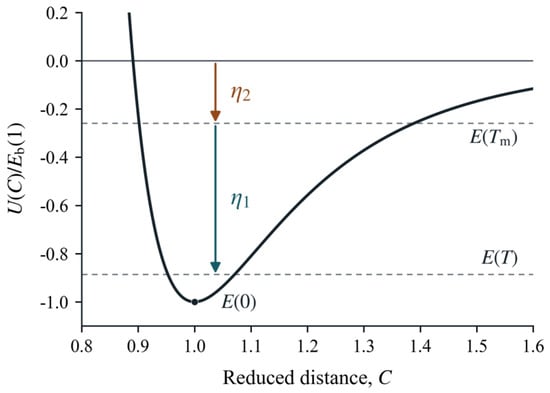
The atomic bond energy determines the local bond strength, and its variation with temperature and grain size plays a crucial role in our understanding of the mechanical behaviour of nanocrystalline materials. Since the macroscopic properties of solids originate from the collective response of atomic bonds, representative bonds with different coordination environments are considered to describe the atomic-scale variation induced by grain refinement. For a homogeneous crystal, atoms experience nearly identical bonding conditions and can be described by a single bond type. In contrast, grain refinement introduces a large fraction of atoms with reduced coordination near interfaces, requiring different bond descriptions for atoms located in the grain interior and the shell region. According to Born’s criterion [38], the rigidity of a solid vanishes catastrophically at the melting temperature . Thus, only the separation between and the operation temperature T governs the strength of the crystallite. Figure 2 illustrates the thermo-mechanics of a bond between adjacent atoms, expressed through the reduced interatomic potential with equilibrium coordinate , where d specifies bond length and E the bond energy. In this framework, the atomic bond energy can be written as the sum of two contributions:
where is the Debye specific heat per coordinate, is the latent heat associated with the liquid–vapour transition, and is the evaporation temperature. The zero-point vibrational energy is typically neglected since it is three orders of magnitude smaller than the atomic binding energy [39]. The term can be approximated as linear in . Thus,
Figure 2.
Reduced interatomic potential as a function of the reduced distance C. The arrows indicate the energy required to heat from the operating temperature to the melting temperature () and the energy contribution from melting to vaporization ().
Consequently, the bond energy or strength of the representative bond decreases as the gap narrows, either by lowering or raising T in operation. For incoherent interfaces, the cohesive energy of atoms in the shell region is lower than that of atoms in the grain interior because of atomic undercoordination. As the grain size decreases, the relative fraction of shell atoms increases, resulting in a reduction in the effective melting temperature and average bond strength. Therefore, grain refinement introduces competing effects: the decrease in cohesive energy reduces thermal stability, while the associated bond relaxation may modify the local energy density and mechanical response.
2.3. Coordination-Dependent Bond Contraction and Energy Scaling in Nanocrystals
The temperature-dependent bond energy is described by Equation (7a). To further determine the grain size dependence of the melting temperature and energy density, the coordination-dependent bond contraction is considered. The bond order–length–strength (BOLS) correlation mechanism provides a quantitative description of the relationship between atomic coordination, bond length, and bond energy [40]. Reduced coordination leads to bond contraction, increasing the local energy density while lowering the cohesive energy . The corresponding scaling relations are as follows [41]:
where z is the coordination number and m is the bond nature index [42]. The parameter m varies with material type, reflecting the sensitivity of bond energy to coordination. For metals, ; for Si and TiO2, optimized values are 4.88 and 5.34, respectively; for compounds, m is 4.0 [43,44,45].
These relations allow the size-dependent evolution of average bond strain, energy density , and cohesive energy to be evaluated within the core–shell framework. The size dependence of grain properties within the core–shell framework can be expressed through two contributions: (i) the intrinsic effect of reduced coordination that induces bond contraction and strength gain, and (ii) the volume fraction of shell atoms. According to Equation (8), we obtain
where Q represents the average value of a physical quantity (such as bond length d, , or ), while q represents the local value of the physical quantity. and h denote the ratio of the coordination number of the jth layer of atoms to that of the atoms in the bulk and the thickness of the shell, respectively. For incoherent interfaces, the shell thickness is approximately 2.14 bond lengths [26], and therefore the summation is limited to the third atomic layer (), beyond which atoms recover bulk-like coordination .
Similarly, the relative volume fraction of atoms in the j-th layer is given by
with representing the geometric shape factor of a plate, cylinder, and sphere, respectively.
At a given temperature, the energy density and melting temperature can be expressed in size-dependent forms according to Equation (9a):
where and represent the size-induced increments of average bond strain and cohesive energy, respectively, relative to the bulk crystal. In the derivation, is approximated to unity, and the term is neglected for simplicity. Therefore, grain refinement affects the HPR–IHPR transition through two coupled contributions: the intrinsic modification of atomic bonding within the shell region and the increasing volume fraction of shell atoms with decreasing grain size.
2.4. Analytical Formulation of the HPR–IHPR Transition
By substituting Equation (10) into Equation (6), the HPR–IHPR transition can be expressed in terms of the relevant variables for spherical grains () as follows:
Equation (11) reveals that the HPR–IHPR transition originates from the competition between intrinsic atomic-scale energetic evolution and extrinsic thermally activated deformation. Within the core–shell framework, the intrinsic contribution is determined by the grain size-dependent variations of average bond strain and the average cohesive energy . Furthermore, extrinsic factors involve temperature T. Using Equations (5b) and (5c), the expressions for high- and low-temperature conditions are respectively derived as follows:
By solving the equation , the critical grain size for the HPR–IHPR transition can be determined. Given the bond length and bulk melting temperature , the IHPR trend and the critical grain size can be predicted for a material using , , and as adjustable parameters. It is important to note that all these parameters possess clear physical meanings: can be treated as a material-specific constant at a given reference state, and is the proportionality constant between the activation enthalpy and , both of which are related to intrinsic material parameters. In contrast, represents an extrinsic parameter associated with the strain rate.
3. Results and Discussion
3.1. Comparison with Data from the Literature
Equation (11) is fitted to published strength and hardness data for the six materials listed in Table 1. For incoherent interfaces, the coordination numbers of atoms in the first three atomic layers are , , and [45]. According to Equation (8), the corresponding bond contraction coefficients are , , and , resulting in based on Equation (10). The values of for several representative materials are summarized in Table 1.
Table 1.
List the critical grain sizes and other relevant parameters for the HPR–IHPR transition in materials with incoherent grain boundaries.
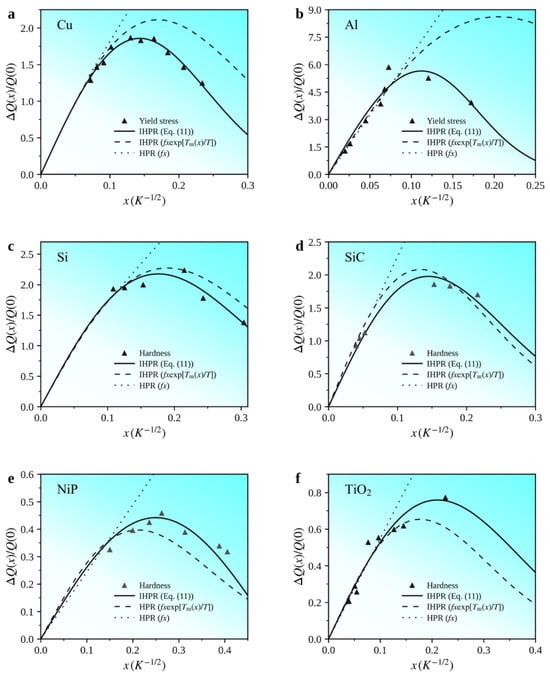
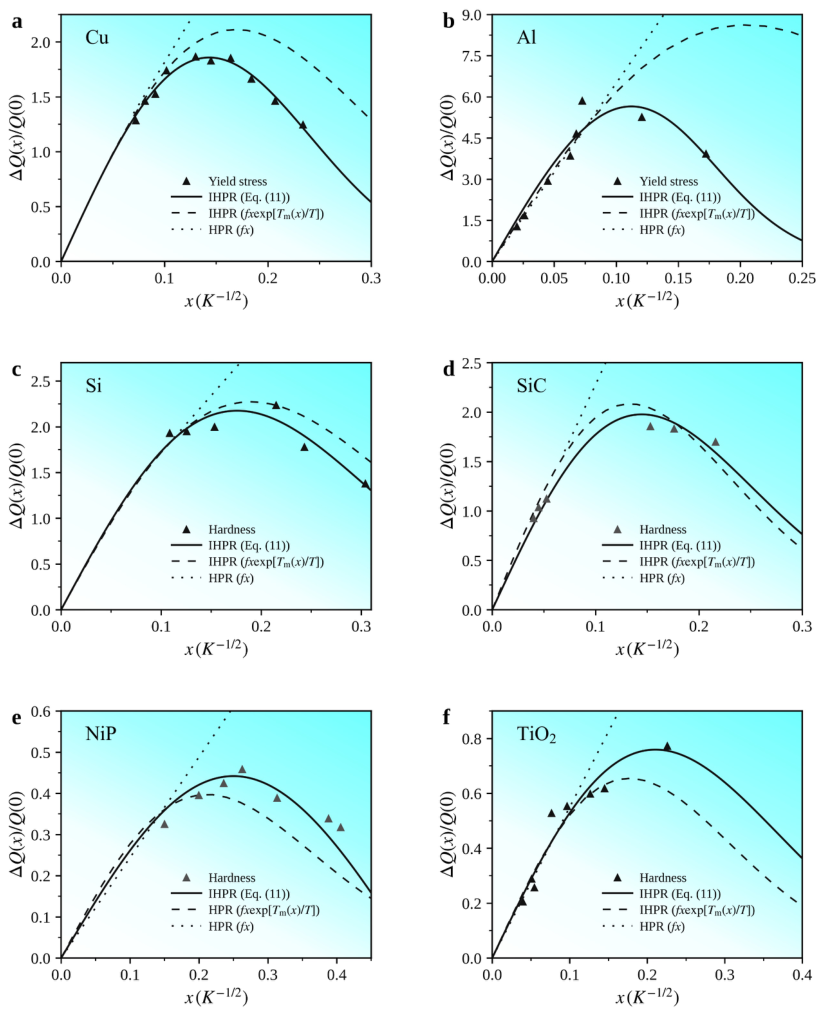
Figure 3 compares the fits of Equation (11) with published measurements and simulation results. For Si, D denotes the diameter of an individual nanoparticle [48]. The particle is represented by a bulk-like core and a shell of undercoordinated atoms at its free surface. As D decreases, the shell accounts for a larger fraction of the atoms and contributes more to the average bond length and cohesive energy. Within this core–shell framework, the fit in Figure 3c describes how indentation hardness varies with particle diameter. The solid curves in Figure 3 were fitted to the normalized strength and hardness increments using Equation (11) at 300 K. The model reproduces the characteristic increase and subsequent decrease in strength or hardness with decreasing grain size for different materials. Compared with the conventional Hall–Petch relation and the temperature-dependent form of Equation (1), Equation (11) captures the transition behaviour by incorporating both the grain size-dependent atomic bonding variation and thermally activated dislocation motion. These results indicate that the competition between bond energy density enhancement and cohesive energy reduction provides the physical basis for the HPR–IHPR transition. These findings are consistent with earlier studies highlighting the importance of strain energy density [53] and interfacial activation energy [19,54].
Figure 3.
Size dependence of the normalized increment , where and is the corresponding reference value. Q denotes the yield stress for (a) Cu [46] and (b) Al [47], and hardness for (c) Si [48], (d) SiC [49,50], (e) NiP [51], and (f) TiO2 [52]. The reference values estimated from the source data are 0.79 GPa for Cu, 61 MPa for Al, 10.5 GPa for Si, 12.7 GPa for SiC, 3.8 GPa for NiP, and 4.2 GPa for TiO2. Solid lines are fits of Equation (11) at 300 K. Dashed and dotted lines represent the temperature-dependent form of Equation (1) and the conventional Hall–Petch relation, respectively.
3.2. Effects of Temperature and Strain Rate on the HPR–IHPR Transition
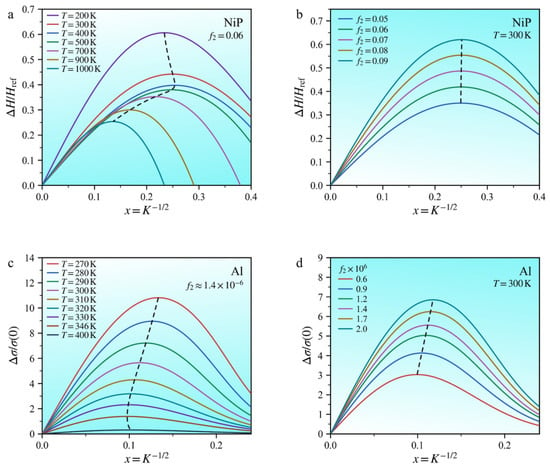
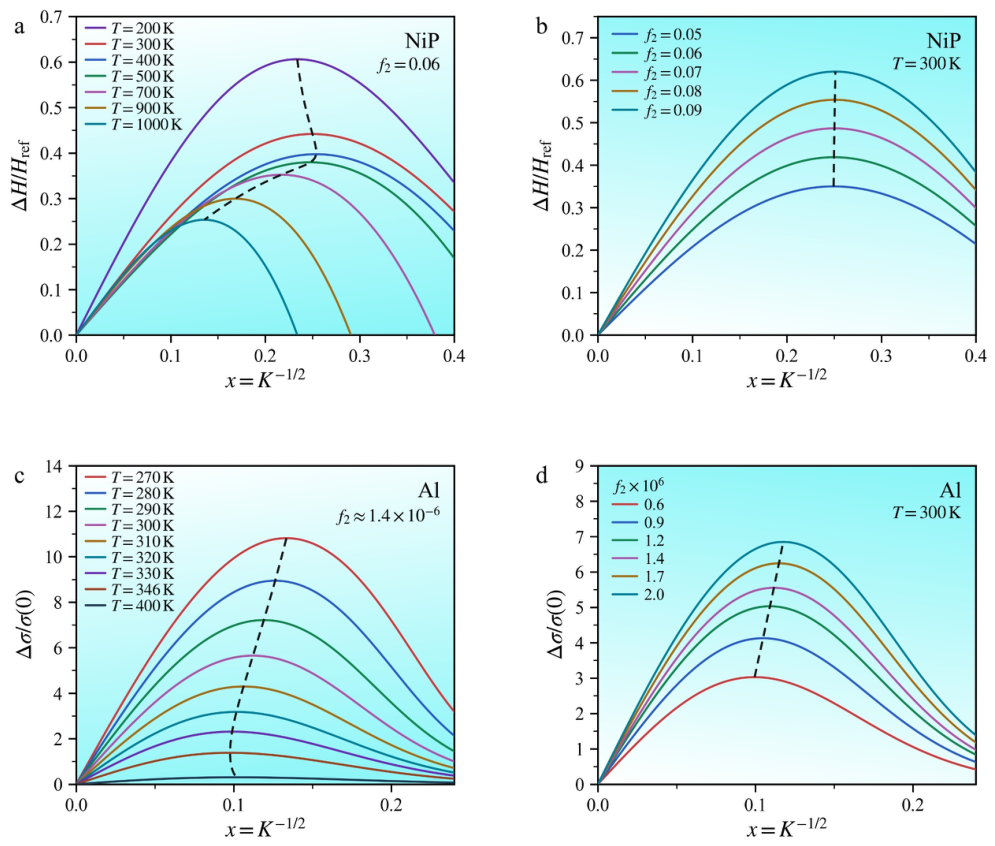
Equation (11) indicates that the external parameters influencing the HPR–IHPR transition are the operation temperature T and , where is proportional to the tensile rate. We therefore examine the sensitivity of the HPR–IHPR transition to these external factors. Figure 4a,c show the effect of temperature on the HPR–IHPR transition in the NiP alloy and pure Al, respectively. The results demonstrate that the IHPR is highly sensitive to changes in both T and . As discussed in Section 2.2, the strength is strongly affected by the separation: as the temperature increases, the strength increment decreases, which is confirmed in both Figure 4a,c. Due to the lower melting point of Al, the softening effect of temperature on the strength increment is more pronounced compared to NiP.
Figure 4.
Effects of temperature and strain rate parameter () on the HPR–IHPR transition in NiP (a,b) and Al (c,d). In (a,c), temperature is varied using the fitted values. In (b,d), is varied at 300 K. Dashed lines connect the maxima of the calculated curves. Other relevant parameters are provided in Table 1.
The critical size is also influenced by temperature. For NiP, increases slightly between 200 and 400 K and then decreases, as indicated by the dashed line in Figure 4a. The corresponding critical grain size decreases from 10.06 nm at 200 K to 8.54 nm at 400 K, then increases to 29.93 nm at 1000 K. This phenomenon has been confirmed experimentally and is referred to as the high-temperature “inverse” Hall–Petch relationship [55,56,57]. For Al, the behaviour is different: Around 300 K, decreases with increasing temperature, corresponding to an increase in the critical grain size with temperature, which exhibits a weak-temperature “inverse” Hall–Petch effect. However, when the temperature rises above 350 K, begins to increase, and the critical grain size decreases gradually with temperature. Mathematically, a strong-temperature “inverse” Hall–Petch effect occurs when . For NiP, with , rapidly increases above 520 K. For Al, with , the rapid increase in occurs above its melting point, where Al can no longer maintain structural stability. Thus, the variation of Al’s critical grain size with temperature is distinct from that of NiP.
Furthermore, for NiP, influences only absolute strength while having little impact on the critical grain size at a given temperature, as shown in Figure 4b. This indicates that for NiP is independent of the strain rate. In contrast, for Al, affects both the absolute strength and the critical size: as the strain rate increases, also increases, leading to a decrease in , as illustrated in Figure 4d. These results indicate that the tensile strain rate sensitivity of Al is higher, which can be attributed to its face-centred cubic (FCC) structure. The high mobility of dislocations in FCC Al enhances the effect of strain rate sensitivity. In contrast, the NiP alloy, being a highly solid-solution polycrystalline material, has constrained dislocation movement [58,59]. This distinction is well captured by the proposed model.
3.3. Effect of Grain Boundary Chemistry on the HPR–IHPR Transition
The foregoing analysis shows that the HPR–IHPR transition is closely related to the coordination-dependent variations in bond length and cohesive energy at grain boundaries. Chemical segregation can modify these local bonding characteristics and consequently affect the transition behaviour. Here, hydrogen is considered as a representative grain boundary chemical factor. First-principles calculations considered two coincidence site lattice (CSL) grain boundaries in Al, a coherent twin boundary and a symmetric tilt grain boundary, with and without hydrogen. The corresponding bond length and cohesion parameters are incorporated into Equation (11).
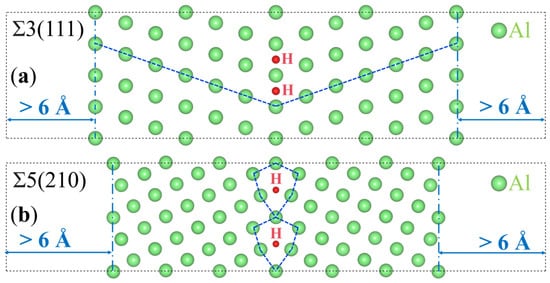
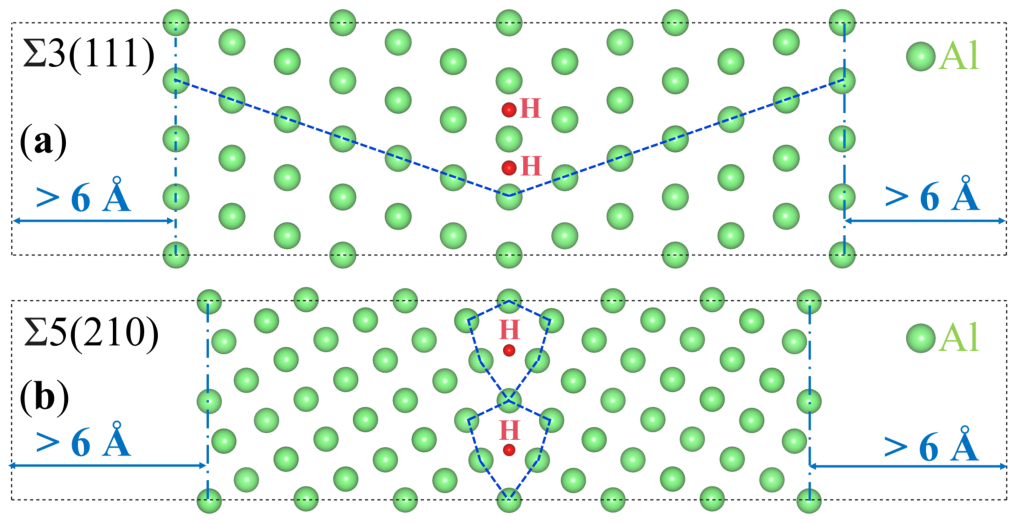
First-principles calculations were performed with density functional theory (DFT) as implemented in the Vienna Ab initio Simulation Package (VASP) [60]. Electron–ion interactions were described using the projector augmented wave method [61]. A generalised gradient approximation [62] of the exchange–correlation energy was used. The total energy was convergent within eV. The convergent atomic force was 0.02 eV/Å. Figure 5 presents the first-principles calculation models used to investigate hydrogen doping at Al grain boundaries. The models include a grain boundary and a with a vacuum layer greater than 12 Å to prevent interlayer interactions. The Brillouin zone was sampled using k-point meshes for and k-point meshes for , respectively. The cutoff energy is 400 eV.
Figure 5.
GBs containing H atoms: (a) and (b) , with a vacuum layer greater than 12 Å. Al atoms are represented by green spheres, while red spheres represent hydrogen atoms positioned in the grain boundary. The configuration contains 104 atoms with dimensions of Å3, while the configuration has 124 atoms and dimensions of Å3.
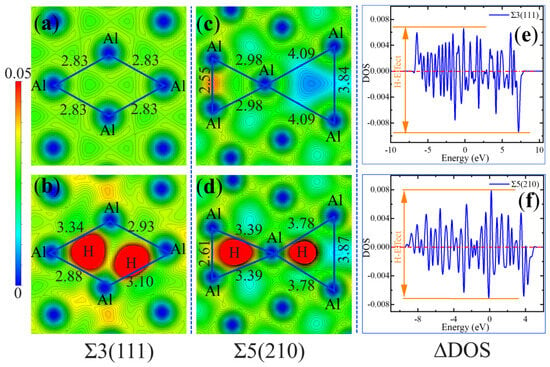
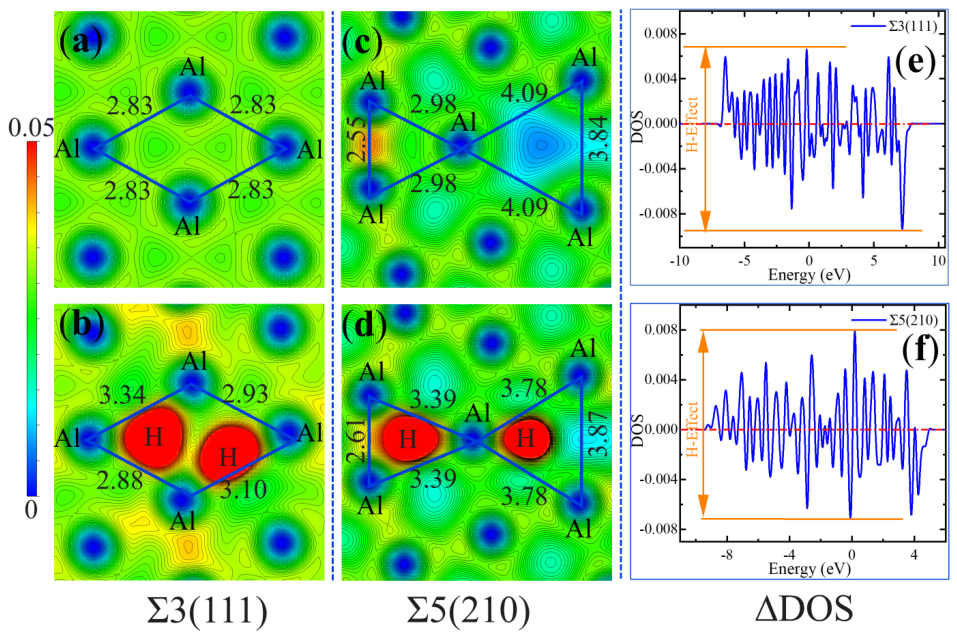
The calculated charge density distribution and density of states (DOS) are shown in Figure 6. Without hydrogen doping, the average bond length of Al atoms at the two grain boundaries examined is 2.83 Å, slightly shorter than the Al bond length in the bulk, which is Å. However, after hydrogen doping, the average bond lengths at the boundaries are significantly elongated. Based on the local structures shown in Figure 6, the interfacial region of each boundary is approximated as one representative atomic layer in Equation (13).
Figure 6.
Effects of hydrogen incorporation on the local bond length, charge density distribution, and density of states near the and grain boundaries in Al.
According to Equation (9a), the increments in average cohesive energy and bond length for the two grain boundary configurations with and without hydrogen can be expressed as follows:
where denotes the undoped grain boundary (GB) or hydrogen-doped grain boundary (GB-H). The average Al–Al bond length at the grain boundary, , is calculated as the arithmetic mean of the four distances around the central Al quadrilateral in Figure 6a,b for and the three distances around the left-hand Al triangle in Figure 6c,d for . Corresponding Al pairs are used in the H-free and H-containing configurations. The cohesion of each configuration can be represented by the energy difference between the bonded state and the two fully separated slabs, scaled to a common reference area of 72.45 Å2, corresponding to the in-plane area of the supercell. Applying the same definition to cleavage of bulk Al along the chosen plane yields a reference cohesive energy of eV. On the same reference area, the values for the H-free and grain boundaries are and eV, respectively. Their greater magnitudes indicate that separating these two boundary configurations requires more energy than cleaving bulk Al along the selected reference plane. The calculated results are summarized in Table 2.
Table 2.
Bond lengths, cohesive energies, and their normalized increments for and grain boundaries in Al with and without hydrogen.
For the H-free and configurations, the positive cohesion coefficients in Table 2 cause to increase with x. For the incoherent boundary reference, decreases with x, as indicated by the coefficients in Table 1. Introducing either of the two H-free CSL boundaries raises the effective melting temperature relative to this reference. At a fixed temperature, the larger contributes to a higher predicted strength in Equation (11). The strengthening predicted for the case is consistent with previous reports on twin boundaries [63,64,65]. For a polycrystal containing multiple grain boundary types, the average increments in cohesive energy and bond length are given by the following weighted sums:
where represents the proportion of the total grain boundary length accounted for by boundary type . By substituting Equation (14) into Equation (11), the IHPR for systems with multiple grain boundary types can be obtained.
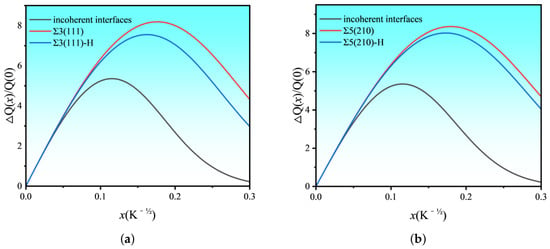
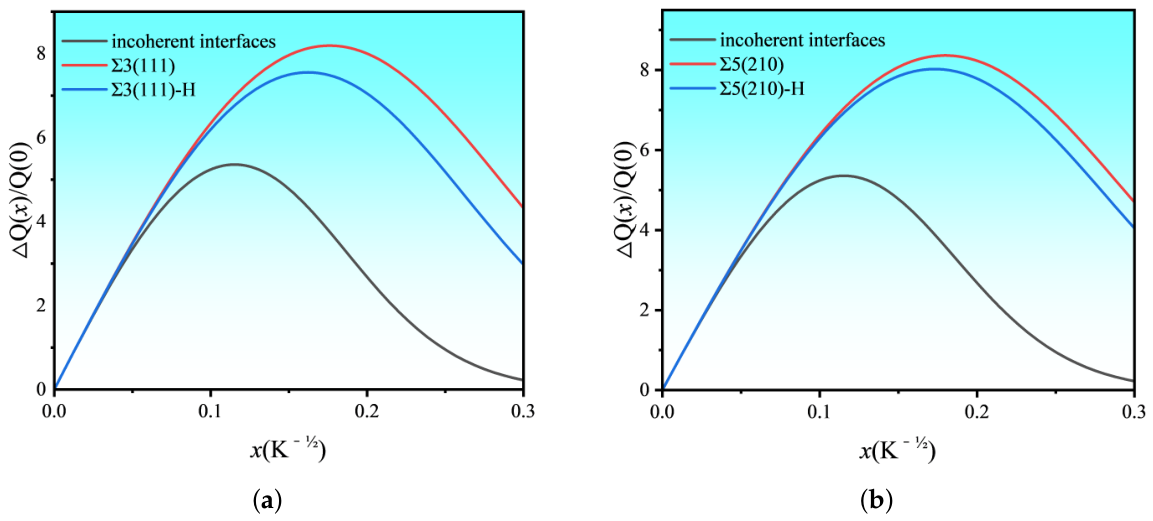
Figure 7 illustrates the HPR–IHPR transition in Al for two mixed-boundary cases. In each case, either or boundaries account for half of the total grain boundary length, with incoherent boundaries accounting for the other half. The peak strengths and critical grain sizes reported here were recalculated separately at 300 K using the revised Al parameters in Table 1 and the grain boundary coefficients in Table 2. For boundaries with , the maximum strength shows a 44.9% increase compared to samples containing only incoherent boundaries, with increasing from 0.11 to 0.17, corresponding to a decrease in from 23.0 nm to 9.9 nm. Similarly, the maximum strength of boundaries containing rises by 47.6%, with also decreasing from 23.0 nm to 9.5 nm. This effect is primarily due to both types of grain boundaries significantly lowering the cohesive energy of Al atoms at the interface, reducing the interface mobility and consequently enhancing strength while decreasing .
Figure 7.
HPR–IHPR transition curves for Al containing either or boundaries mixed with incoherent boundaries in equal fractions by boundary length. The red and blue curves correspond to the H-free and H-containing cases, respectively. The black curve represents the purely incoherent reference.
The model predicts hydrogen-induced weakening for both mixed-boundary cases. Relative to the corresponding H-free configurations, hydrogen doping lowers the predicted peak strength by 8.4% for and 2.9% for . The critical grain size increases from 9.9 to 12.0 nm for and from 9.5 to 10.1 nm for . Even so, both H-doped Al configurations have higher predicted peak strengths than the reference case containing only incoherent grain boundaries. This is because, for both H-doped mixed-boundary cases, the weighted cohesive energy increment at a given grain size is larger than that of the purely incoherent reference, contributing to a higher predicted peak strength.
4. Conclusions
From the perspective of the core–shell structure of grains and bond relaxation at grain boundaries, an analytical framework for the HPR–IHPR transition in nanocrystalline metals was established. The yield strength or hardness is determined both extrinsically by the competition between dislocation activation and accumulation and intrinsically by the interplay of energy density and average cohesive energy, as captured in Equation (11). The main conclusions are summarized as follows:
Intrinsic factors. The intrinsic contributions to the HPR–IHPR transition are the cohesive energy increment and bond length increment induced by grain refinement, which are strongly dependent on grain boundary characteristics. For incoherent grain boundaries, according to the BOLS mechanism, due to undercoordination, , thereby reducing the melting point and thus lowering . Meanwhile, the shell bond length decreases due to undercoordination, resulting in , which increases the energy density and contributes to strengthening. For the two H-free mixed-boundary cases examined here, the model predicts higher peak strengths and smaller critical grain sizes than for the purely incoherent reference.
Extrinsic factors. Temperature and strain rate affect the HPR–IHPR transition through the thermally activated dislocation process. Increasing temperature reduces the separation and generally decreases the strength increment associated with grain refinement. The critical grain size also varies with temperature, and its sensitivity depends on the intrinsic material parameters. Within the present formulation, a pronounced high-temperature inverse Hall–Petch response can occur when the operating temperature approaches the characteristic thermal scale determined by of to . Strain rate mainly affects the strength level, while its influence on the critical grain size is material-dependent.
Boundary chemistry effects. First-principles calculations for and grain boundaries in Al show that hydrogen incorporation increases the interfacial bond length and reduces the cohesive energy. The model predicts that hydrogen doping lowers the peak strength and increases the critical grain size for both the and configurations relative to their respective H-free cases. The predicted peak strength of each H-doped configuration remains higher than that of the Al reference with only incoherent grain boundaries.
In summary, the present model describes the HPR–IHPR transition through the competition between bond energy density enhancement, cohesive energy reduction, and thermally activated dislocation motion. It reproduces the characteristic grain size-dependent strengthening and softening observed in different nanocrystalline materials and provides a direct connection between grain boundary bonding characteristics and the critical grain size. The extension to the two hydrogen-doped CSL grain boundaries in Al further shows how changes in grain boundary chemistry can be incorporated through their effects on bond length and cohesive energy. The model assumes thermally activated deformation at temperatures below both the bulk and grain size-dependent melting temperatures. The core–shell picture remains applicable as long as crystalline grains and their boundaries can be identified, even when boundary atoms occupy most of a grain. The lower size limit is reached when a cluster contains too few atoms to define a grain boundary. Future work could incorporate grain size distributions and use measured grain boundary length fractions in Equation (14). The treatment of grain boundary chemistry could also be extended to other boundary types and solutes by evaluating how solute coverage affects interfacial bond lengths and cohesion.
Author Contributions
Conceptualization, J.C. and C.Q.S.; methodology, J.C. and J.H.; software, Y.W.; validation, Y.W. and J.C.; formal analysis, Y.W.; investigation, J.C. and C.Q.S.; resources, J.C.; data curation, Y.W.; writing—original draft preparation, Y.W.; writing—review and editing, Y.W. and J.C.; visualization, Y.W. and J.H.; supervision, J.H.; project administration, J.C.; funding acquisition, J.C. and J.H. All authors have read and agreed to the published version of the manuscript.
Funding
This work was supported by the Key Support Projects of the Joint Funds of the National Natural Science Foundation of China (Grant No. U25B2082, to Jiapeng Chen) and the Guangdong Basic and Applied Basic Research Foundation (Grant No. 2024A1515110168, to Jun Hui; Grant No. 2024B1515130001, to Jiapeng Chen).
Data Availability Statement
The original contributions presented in this study are included in the article. Further inquiries can be directed to the corresponding authors.
Acknowledgments
The authors acknowledge the computational resources provided by HZWTECH.
Conflicts of Interest
The authors declare no conflicts of interest.
References
- Hall, E.O. The deformation and ageing of mild steel: III Discussion of results. Proc. Phys. Soc. Sect. B 1951, 64, 747–753. [Google Scholar] [CrossRef] [Scilit]
- Zhou, X.; Feng, Z.; Zhu, L.; Xu, J.; Miyagi, L.; Dong, H.; Sheng, H.; Wang, Y.; Li, Q.; Ma, Y. Collective slit deformation enables dislocation-free room-temperature superplasticity. Nature 2020, 579, 67–72. [Google Scholar] [PubMed]
- Chokshi, A.H.; Rosen, A.; Karch, J.; Gleiter, H. On the validity of the Hall–Petch relationship in nanocrystalline materials. Scr. Metall. 1989, 23, 1679–1683. [Google Scholar] [CrossRef] [Scilit]
- Naik, S.N.; Walley, S.M. The Hall–Petch and inverse Hall–Petch relationships in nanocrystalline materials: A review. J. Mater. Sci. 2020, 55, 2661–2681. [Google Scholar]
- Lu, X.; Zhang, W.; Guo, X.; Yang, X.; Li, J.; Ren, J.; Xue, H.; Tang, F. Thermal stability of nanocrystalline materials: A review. Int. J. Mech. Sci. 2023, 255, 108478. [Google Scholar]
- Li, J.; Luo, K.; An, Q. Deformation mechanisms in nanocrystalline metals. Int. J. Mech. Sci. 2025, 286, 109852. [Google Scholar]
- Schïtz, J.; Di Tolla, F.D.; Jacobsen, K.W. Softening of nanocrystalline metals at very small grain sizes. Nature 1998, 391, 561–563. [Google Scholar] [CrossRef] [Scilit]
- Lu, L.; Shen, Y.; Chen, X.; Qian, L.; Lu, K. Ultrahigh strength and high electrical conductivity in copper. Science 2004, 304, 422–426. [Google Scholar] [CrossRef] [Scilit] [PubMed]
- Hu, H.; Fu, T.; Li, C.; Weng, S.; Zhao, Y.; Chen, X.; Peng, X. Strengthening in nanotwinned metals. Phys. Rev. B 2022, 105, 014107. [Google Scholar]
- Tian, Y.; Xu, B.; Yu, D.; Ma, Y.; Wang, Y.; Jiang, Y.; Hu, W.; Tang, C.; Gao, Y.; Luo, K.; et al. Ultrahard nanotwinned cubic boron nitride. Nature 2013, 493, 385–388. [Google Scholar] [CrossRef] [Scilit] [PubMed]
- Huang, Q.; Yu, D.; Xu, B.; Hu, W.; Tian, Y. Nanotwinned diamond with unprecedented hardness and stability. Nature 2014, 510, 250–253. [Google Scholar] [CrossRef] [Scilit] [PubMed]
- Sun, P.; Yu, C.; Kao, P.; Chang, C. Effects of grain size on the mechanical properties of nanocrystalline Ni. Scr. Mater. 2005, 52, 265–269. [Google Scholar] [CrossRef] [Scilit]
- Ding, R.; Yao, Y.; Sun, B.; Liu, G.; He, J.; Li, T.; Wan, X.; Dai, Z.; Ponge, D.; Raabe, D. Chemical- and deformation-driven martensite reversion toward ultrafine grains. Sci. Adv. 2020, 6, eaay1430. [Google Scholar] [PubMed]
- Pundt, A.; Kirchheim, R. Hydrogen in metals: Microstructural aspects. Annu. Rev. Mater. Res. 2006, 36, 555–608. [Google Scholar] [CrossRef] [Scilit]
- Li, X.; Zhang, J.; Cui, Y.; Djukic, M.B.; Feng, H.; Wang, Y. Hydrogen embrittlement in metals: A review. Int. J. Hydrogen Energy 2024, 72, 74–109. [Google Scholar]
- Zan, N.; Ding, H.; Guo, X.; Tang, Z.; Bleck, W. Hydrogen embrittlement of advanced high-strength steels. Int. J. Hydrogen Energy 2015, 40, 10687–10696. [Google Scholar]
- Zhou, X.-Y.; Yang, X.-S.; Zhu, J.-H.; Xing, F. Hydrogen effects at grain boundaries. Int. J. Hydrogen Energy 2020, 45, 3294–3306. [Google Scholar] [CrossRef] [Scilit]
- Carlton, C.E.; Ferreira, P.J. A review on the quantitative relation between stress and grain size in nanocrystalline materials. Acta Mater. 2007, 55, 3749–3756. [Google Scholar]
- Sheinerman, A.G.; Castro, R.H.; Gutkin, M.Y. On the role of grain-boundary energy in Hall–Petch scaling. Mater. Lett. 2020, 260, 126886. [Google Scholar]
- Lv, H.; Jiang, F.; Zhu, Y. Thermodynamic Hall–Petch model for nanocrystalline materials. Materials 2026, 19, 767. [Google Scholar] [PubMed]
- Zhao, M.; Li, J.C.; Jiang, Q. Grain-size-dependent thermal stability and strength of nanocrystalline materials. J. Alloys Compd. 2003, 361, 160–164. [Google Scholar]
- Zhao, Z.; Xu, B.; Tian, Y. Reverse Hall–Petch effect in nanostructured materials. Annu. Rev. Mater. Res. 2016, 46, 383–406. [Google Scholar]
- Padmanabhan, K.; Vasin, R.; Enikeev, F. Superplastic Flow: Common Basis for a Ubiquitous Phenomenon; Springer: Berlin/Heidelberg, Germany, 2001. [Google Scholar]
- Wang, B. Energy storage and dissipation in solids. Sci. China Phys. Mech. Astron. 2020, 63, 124611. [Google Scholar]
- Zhang, X.; Li, W.; Kou, H.; Shao, J.; Deng, Y.; Zhang, X.; Ma, J.; Li, Y.; Zhang, X. Shell properties in nanocrystals. J. Appl. Phys. 2019, 125, 082549. [Google Scholar]
- Peng, Y.; Tong, Z.; Yang, Y.; Sun, C.Q. Skin depth and undercoordination bond relaxation in nanocrystals. Appl. Surf. Sci. 2021, 539, 148208. [Google Scholar]
- Chen, J.; Wang, B. Thermally activated deformation in nanocrystals. Acta Mech. 2025, 1–14. [Google Scholar]
- Orlóvá, A.; Čádek, J. Temperature dependence of yield stress. Mater. Sci. Eng. 1986, 77, 1–18. [Google Scholar] [CrossRef] [Scilit]
- Kotrechko, S.; Ovsjannikov, A. Activation parameters of plastic deformation. Philos. Mag. 2009, 89, 3049–3058. [Google Scholar]
- Brooks, N.; Duckett, R.; Ward, I. Yield stress in polymers. J. Polym. Sci. Part B Polym. Phys. 1998, 36, 2177–2189. [Google Scholar]
- Kawabata, T.; Kanai, T.; Izumi, O. Temperature dependence of flow stress. Philos. Mag. A 1991, 63, 1291–1298. [Google Scholar] [CrossRef] [Scilit]
- Gibbs, G. Thermally activated deformation. Mater. Sci. Eng. 1969, 4, 313–328. [Google Scholar] [CrossRef] [Scilit]
- Mil’man, Y.V.; Trefilov, V. Activation energy for plastic flow. Powder Metall. Met. Ceram. 2010, 49, 374–385. [Google Scholar] [CrossRef] [Scilit]
- Bažant, Z.P.; Pang, S.-D. Mechanics of incremental yielding. J. Mech. Phys. Solids 2007, 55, 91–131. [Google Scholar]
- Verma, A.; Johnson, O.K.; Thompson, G.B.; Ogata, S.; Homer, E.R. Grain-boundary migration kinetics. Acta Mater. 2024, 265, 119605. [Google Scholar] [CrossRef] [Scilit]
- Homer, E.R.; Johnson, O.K.; Britton, D.; Patterson, J.E.; Sevy, E.T.; Thompson, G.B. Grain-boundary mobility. npj Comput. Mater. 2022, 8, 157. [Google Scholar]
- Taylor, G.I. Plastic strain in metals. Proc. R. Soc. Lond. A 1934, 145, 362–387. [Google Scholar]
- Born, M. On the stability of crystal lattices. J. Chem. Phys. 1939, 7, 591–603. [Google Scholar] [CrossRef] [Scilit]
- Yin, M.; Cohen, M.L. Theory of metal vs semiconductor cohesive energies. Phys. Rev. B 1984, 29, 6996. [Google Scholar]
- Sun, C.Q. Bond order–length–strength correlation. Prog. Solid State Chem. 2007, 35, 1–159. [Google Scholar]
- Sun, C.Q.; Sun, Y.; Nie, Y.G.; Wang, Y.; Pan, J.S.; Ouyang, G.; Pan, L.K.; Sun, Z. Coordination–bond-length correlation. J. Phys. Chem. C 2009, 113, 16464–16467. [Google Scholar]
- Sun, C.Q.; Wang, Y.; Tay, B.; Li, S.; Huang, H.; Zhang, Y. Bond nature index. J. Phys. Chem. B 2002, 106, 10701–10705. [Google Scholar]
- Wu, L.; Bo, M.; Guo, Y.; Wang, Y.; Li, C.; Huang, Y.; Sun, C.Q. BOLS for compounds. ChemPhysChem 2016, 17, 310–316. [Google Scholar] [PubMed]
- Pan, L.; Xu, S.; Liu, X.; Qin, W.; Sun, Z.; Zheng, W.; Sun, C.Q. Surface science reports on undercoordination. Surf. Sci. Rep. 2013, 68, 418–445. [Google Scholar]
- Liu, X.J.; Bo, M.L.; Zhang, X.; Li, L.; Nie, Y.G.; Tian, H.; Sun, Y.; Xu, S.; Wang, Y.; Zheng, W.; et al. Coordination-characteristic-dependent behavior of nanocrystals. Chem. Rev. 2015, 115, 6746–6810. [Google Scholar] [PubMed]
- Schiøtz, J.; Jacobsen, K.W. A maximum in the strength of nanocrystalline copper. Science 2003, 301, 1357–1359. [Google Scholar] [CrossRef] [Scilit] [PubMed]
- Jeong, G.; Park, J.; Nam, S.; Shin, S.-E.; Shin, J.; Bae, D.; Choi, H. Hall–Petch behavior in nanocrystalline Al. Arch. Metall. Mater. 2015, 60, 1625–1630. [Google Scholar]
- Zhang, N.; Deng, Q.; Hong, Y.; Xiong, L.; Chen, Y. Hardness of nanocrystalline Si. J. Appl. Phys. 2011, 109, 063534. [Google Scholar]
- Vassen, R.; Stöver, D. Hardness of nanocrystalline SiC. J. Am. Ceram. Soc. 1999, 82, 2585–2593. [Google Scholar]
- Pan, C.; Zhang, L.; Jiang, W.; Setyawan, W.; Chen, L.; Li, Z.; Liu, N.; Wang, T. Mechanical properties of nanocrystalline SiC. J. Eur. Ceram. Soc. 2020, 40, 4396–4402. [Google Scholar] [CrossRef] [Scilit]
- Palumbo, G.; Erb, U.; Aust, K. Grain-size dependence of strength in NiP. Scr. Metall. Mater. 1990, 24, 2347–2350. [Google Scholar]
- Höfler, H.; Averback, R.S. Grain-size dependence of hardness in nanocrystalline TiO2. Scr. Metall. Mater. 1990, 24, 2401–2406. [Google Scholar]
- Wang, Y.; Huang, C.; Ma, X.; Zhao, J.; Guo, F.; Fang, X.; Zhu, Y.; Wei, Y. Strain-energy-density-based plasticity. Int. J. Plast. 2023, 164, 103574. [Google Scholar]
- Huang, Q.; Zhao, Q.; Zhou, H.; Yang, W. Interfacial activation energy in nanocrystals. Int. J. Plast. 2022, 159, 103466. [Google Scholar]
- Li, S.; Li, S.; Liu, L.; Liu, H.; Wang, C.; Withers, P.J.; Zhu, Y.; Gao, L.; Wang, S.; Chen, B. High-temperature inverse Hall–Petch effect. Int. J. Plast. 2024, 176, 103951. [Google Scholar] [CrossRef] [Scilit]
- Figueiredo, R.B.; Kawasaki, M.; Langdon, T.G. Review on Hall–Petch and inverse Hall–Petch. Prog. Mater. Sci. 2023, 137, 101131. [Google Scholar]
- Kareem, S.A.; Anaele, J.U.; Aikulola, E.O.; Olanrewaju, O.F.; Omiyale, B.O.; Falana, S.O.; Oke, S.R.; Bodunrin, M.O. High-temperature mechanical behavior of nanocrystals. Mater. Today Commun. 2025, 112004. [Google Scholar]
- Schuh, C.A.; Hufnagel, T.C.; Ramamurty, U. Mechanical behavior of amorphous alloys. Acta Mater. 2007, 55, 4067–4109. [Google Scholar] [CrossRef] [Scilit]
- Zhu, Y.; Liao, X.; Wu, X. Deformation mechanisms in nanocrystalline metals. Prog. Mater. Sci. 2012, 57, 1–62. [Google Scholar]
- Kresse, G.; Furthmüller, J. Efficient iterative schemes for ab initio total-energy calculations. Phys. Rev. B 1996, 54, 11169–11186. [Google Scholar] [CrossRef] [Scilit] [PubMed]
- Blöchl, P.E. Projector augmented-wave method. Phys. Rev. B 1994, 50, 17953–17979. [Google Scholar] [CrossRef] [Scilit] [PubMed]
- Perdew, J.P.; Chevary, J.A.; Vosko, S.H.; Jackson, K.A.; Pederson, M.R.; Singh, D.J.; Fiolhais, C. Atoms, molecules, solids, and surfaces: Applications of the generalized gradient approximation. Phys. Rev. B 1992, 46, 6671–6687, Correction in Phys. Rev. B 1993, 48, 4978. [Google Scholar] [CrossRef] [Scilit] [PubMed]
- Devaraj, A.; Wang, W.; Vemuri, R.; Kovarik, L.; Jiang, X.; Bowden, M.; Trelewicz, J.; Mathaudhu, S.; Rohatgi, A. Strengthening by twin boundaries. Acta Mater. 2019, 165, 698–708. [Google Scholar]
- Ma, S.; Fu, L.; Shan, A. Mechanical properties of nanotwinned materials. Mater. Charact. 2021, 177, 111057. [Google Scholar]
- Lu, K. Stabilizing nanostructures in metals using grain and twin boundary architectures. Nat. Rev. Mater. 2016, 1, 16019. [Google Scholar] [CrossRef] [Scilit]

Disclaimer/Publisher’s Note: The statements, opinions and data contained in all publications are solely those of the individual author(s) and contributor(s) and not of MDPI and/or the editor(s). MDPI and/or the editor(s) disclaim responsibility for any injury to people or property resulting from any ideas, methods, instructions or products referred to in the content. |
© 2026 by the authors. Licensee MDPI, Basel, Switzerland. This article is an open access article distributed under the terms and conditions of the Creative Commons Attribution (CC BY) license.