


Abstract
First-principles calculations based on density functional theory (DFT) were employed to investigate the binding energy, work function, electronic structure, and optical properties of carbon quantum dots (CQDs) and nitrogen-doped carbon quantum dots (NCQDs) loaded on the TiO2(101) surface. The results indicate that NCQDs exhibit stronger binding affinity to the TiO2(101) surface than CQDs. The charge transferred from CQDs to the TiO2(101) surface mainly originates from the carbon atoms located at the two ends along the a-axis of the CQDs. By contrast, the charge distribution between NCQDs and TiO2(101) is more uniform, with the Bader charges of the carbon atoms at the two ends along the a-axis in NCQDs being reduced to varying degrees compared to those in CQDs. Moreover, loading NCQDs is more favorable for the generation of photogenerated electron-hole pairs and electron transfer, whereas loading CQDs leads to the smallest band gap.
1. Introduction
Due to the increasingly severe energy crisis and environmental pollution, the demand for clean and sustainable energy is urgent. Among all renewable energy sources, hydrogen and solar energy are abundant resources that can respectively generate clean electricity through photovoltaic power generation and clean hydrogen via appropriate photocatalysts [1,2]. As a typical photocatalyst, titanium dioxide (TiO2) is widely applied due to its non-toxicity, good stability, and low cost. It exists in three crystalline forms: anatase, rutile, and brookite. Among these, anatase is widely recognized for its excellent photocatalytic performance. Fujishima and Honda [3] were the first to report water splitting driven by TiO2 photocatalysts; subsequently, water splitting research has expanded to semiconductors composed of transition metal oxides [4]. Although TiO2’s relatively wide band gap allows for sufficient utilization of ultraviolet light, it restricts its performance in the visible light region. Additionally, the high recombination rate of photogenerated electron-hole pairs poses a significant challenge.
In recent years, first-principles calculations have been widely employed to reveal the microscopic mechanisms underlying the photocatalytic performance of semiconductor materials. Fang and Luo et al. found that La and C co-doping in TiO2 introduces impurity levels through charge compensation between Ti 3d and C 2p states and forms a La2O3-TiO2 heterojunction, thereby reducing the band gap and suppressing carrier recombination [5,6]. Dongxiang Li et al. demonstrated that Sc/C co-doping on the TiO2(101) surface introduces shallow impurity states, achieving optimal visible-light absorption at a dopant concentration of 5.56% [7]. Wu and Zhu et al. pointed out that sub-bands derived from C 2p and Cr 3d states in Cr-C co-doped anatase TiO2 narrow the effective band gap to approximately 0.86–1.19 eV [8,9]. Furthermore, Zhan Qu et al. confirmed that a rational interfacial band alignment and built-in potential in BiOI/TiO2 heterojunctions significantly promote photogenerated carrier separation [10]. In summary, DFT calculations provide important theoretical foundations for understanding the modulation mechanisms of doping and heterojunctions on the electronic structure and photophysical properties of semiconductors.
Based on theoretical calculations, numerous regulation strategies have been developed to enhance the photoelectrochemical activity of TiO2 materials, such as single-doping or co-doping with metals/non-metals [11], organic dye sensitization [12], coupling with narrow band gap semiconductors [13], and stress–strain engineering [14], among others. Recently, quantum dots have attracted attention as a novel photocatalytic and photoelectronic material due to their quantum size effects [15]. Under illumination, quantum dots can generate numerous electron-hole pairs; thus, carbon quantum dots (CQDs) have been utilized as a new, efficient, and green sensitizer to enhance the photoelectrochemical performance (PEC) of TiO2. Zhou et al. [16] demonstrated that, compared with the pristine system, the CQD-modified A/R-TiO2 considerably improved visible light absorption, bulk charge separation efficiency, and surface charge injection efficiency. Saud et al. [17] prepared CQDs/TiO2 nanofibers via a simple one-step hydrothermal method and found that anchoring quantum dots not only enhanced light absorption but inhibited the recombination of photogenerated electron-hole pairs, thereby improving the catalytic and antibacterial performance. The catalytic activity of CQDs can be further enhanced by doping with different elements. These newly generated energy states shift the Fermi level toward the conduction band, resulting in faster electron exchange compared to the original CQDs [18,19]. Nitrogen atoms, being almost the same size as carbon atoms with five valence electrons available for bonding with other carbon atoms, increase the surface defect states of CQDs upon doping, thereby enhancing their optical and catalytic activities. TiO2 modified with nitrogen-doped carbon quantum dots (NCQDs) not only improves visible light absorption but facilitates electron transfer and the separation of photogenerated electron-hole pairs [20,21]. Although numerous experimental results have indicated that the modification of TiO2 with CQDs and their derivative materials can enhance its visible light absorption and suppress the recombination of photogenerated charge pairs, the interaction mechanism between CQDs (and their modified counterparts) and TiO2 remains unclear, impeding further improvement of quantum dot-modified TiO2 materials. Therefore, this paper employs first-principles calculations to investigate the electronic structure and optical properties of TiO2(101), CQDs/TiO2(101), and NCQDs/TiO2(101) in order to explore their microscopic interaction mechanisms.
2. Calculation Methods
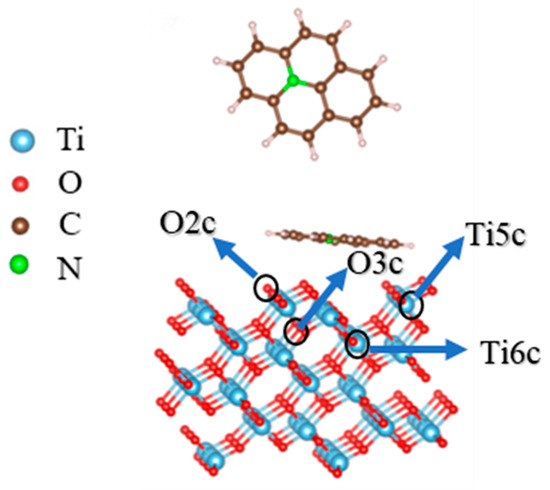
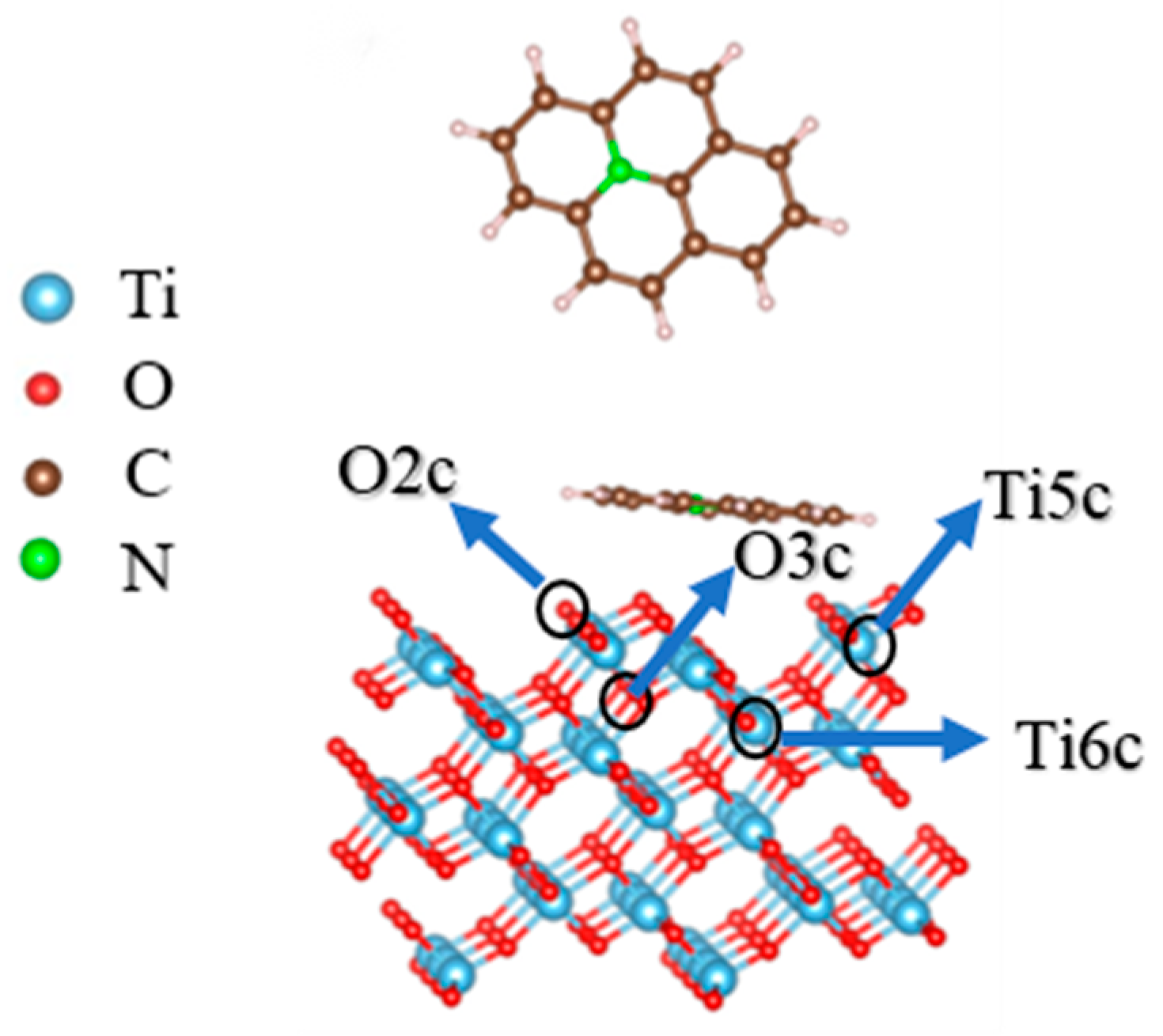
In this study, the electronic structure and optical properties of NCQDs/TiO2(101) were calculated using the first-principles calculation software VASP.6.1.0 [22] (Vienna Ab-initio Simulation Package) based on density functional theory. The interactions between electrons and ions were accurately described employing the projector augmented-wave (PAW) method [23], while the exchange-correlation potential among electrons was treated using the Perdew–Burke–Ernzerhof (GGA-PBE) approach under the generalized gradient approximation. To account for the strong Coulomb repulsion among Ti 3d electrons in anatase TiO2, a Hubbard parameter (U) was incorporated into the GGA functional. Through U-value testing, the U value for Ti d electrons was set at 2.3 eV. A 3 × 3 × 1 supercell was constructed for the anatase TiO2(101) plane with a 10 Å vacuum layer established in the Z-direction; this surface is typically predicted to be the most stable. The surface model was built as a periodic structure consisting of 9 atomic layers, as shown in Figure 1. Due to the complex structure of CQDs in actual systems, accurate modeling of CQDs has remained a challenge. Carbon clusters or graphene quantum dots (GQDs) are often used as substitutes for CQDs in first-principles calculations [24]. In this work, GQDs were adopted as substitutes for CQDs to investigate the properties of various systems, as also illustrated in Figure 1. The plane-wave basis set cutoff energy was fixed at 450 eV, and the Brillouin zone of anatase TiO2 was sampled using a uniform 2 × 2 × 1 Monkhorst–Pack [25] k-point grid. The convergence criteria for the geometric optimization calculations were set at 10−5 eV/cell for energy and −0.01 eV/Å for forces.
Figure 1.
Optimized Surface Models for Different Architectures: NCQDs/TiO2(101).
3. Results and Discussion
3.1. Interface Coupling Parameters
Through DFT calculations, the atomic-level interactions between NCQDs and the TiO2(101) surface were investigated, revealing that carbon quantum dots in different systems are stretched upward in the Z direction. The minimum distance between the CQDs and the TiO2(101) surface is 3.32 Å, which is greater than the corresponding distance of 3.28 Å for NCQDs, indicating that the interaction between NCQDs and the TiO2(101) surface is stronger than that for CQDs. Furthermore, the binding energy between the quantum dots and the TiO2(101) surface was calculated, with the corresponding formula provided below:
where Eb represents the binding energy of the entire A/B system (in eV), EA and EB denote the total energies of individual A and B after relaxation, respectively, and EA/B represents the total energy of the entire A/B system after relaxation.
Weak interactions were observed between the CQDs of different systems and TiO2(101). The binding energy of CQDs/TiO2(101) is 0.014 eV, and that of NCQDs/TiO2(101) is 0.756 eV, indicating that NCQDs are more likely to be loaded on the surface of TiO2(101).
The binding energy of NCQDs (0.756 eV) is much higher than that of CQDs (0.014 eV). This discrepancy mainly arises because conventional CQDs are decorated with abundant surface oxygen-containing functional groups (e.g., −OH and −COOH), which bind to TiO2 via esterification or condensation to form weak Ti−O−C linkages [26].
Apart from Ti−O−C bonding, NCQDs can construct pyrrolic N-related or O−Ti−N bonds with TiO2. Benefiting from plentiful amino and carboxyl groups on their surface as well as the intrinsic sp2-hybridized carbon skeleton, NCQDs are capable of generating π–π stacking interactions with surface −OH groups of TiO2 or target organic molecules. Such interactions optimize electronic level alignment to accelerate interfacial charge transfer, raise the density of surface functional groups and available active sites, and consequently facilitate the immobilization of NCQDs onto the TiO2 substrate.
3.2. Work Function and Electronic Structure
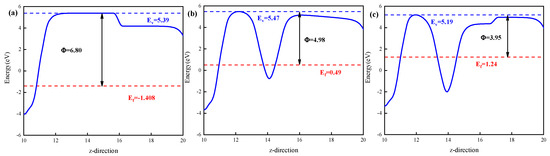
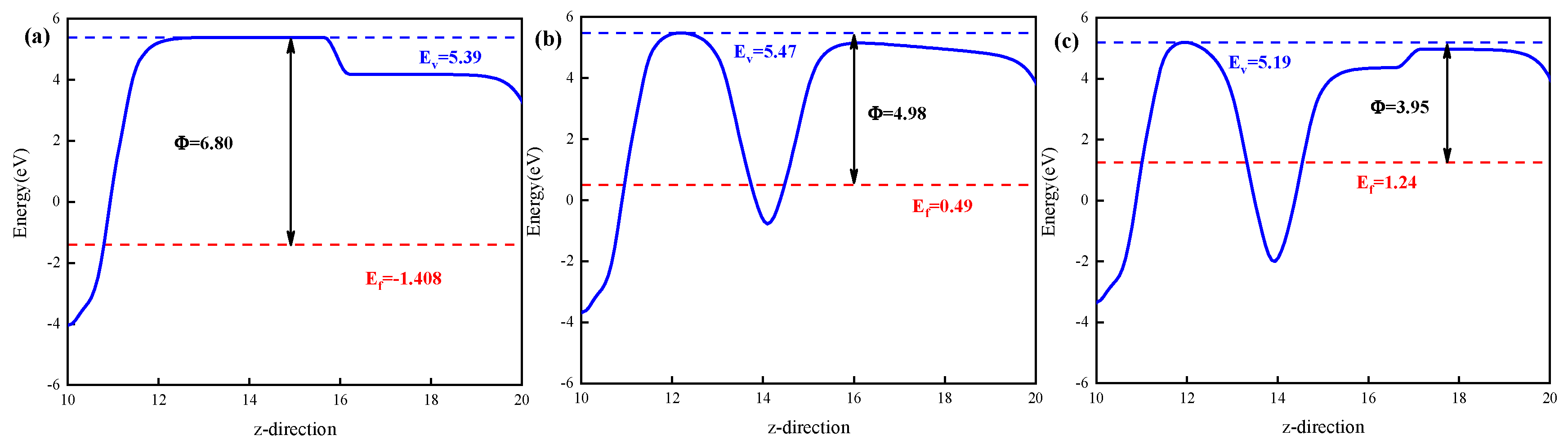
The electronic structure and work function (Φ) of NCQDs/TiO2(101) determine their photoelectric performance; therefore, the work functions, band structures, and density of states of various systems were calculated using first principles. Figure 2 shows the work functions of the different systems. Compared with isolated TiO2(101), it is observed that the work function of the quantum dot-loaded TiO2 structure decreases, with NCQDs/TiO2(101) exhibiting the lowest work function (Φ = 3.95 eV). Previous studies [27,28,29] have indicated that composite nanomaterials show a significant reduction in work function compared to isolated materials. The reduction in the system’s work function caused by the synergistic electronic interactions between NCQDs and TiO2(101) is likely to promote the rapid generation of electron-hole pairs [30,31].
Figure 2.
Work functions of different systems: (a) TiO2(101); (b) CQDs/TiO2(101); (c) NCQDs/TiO2(101).
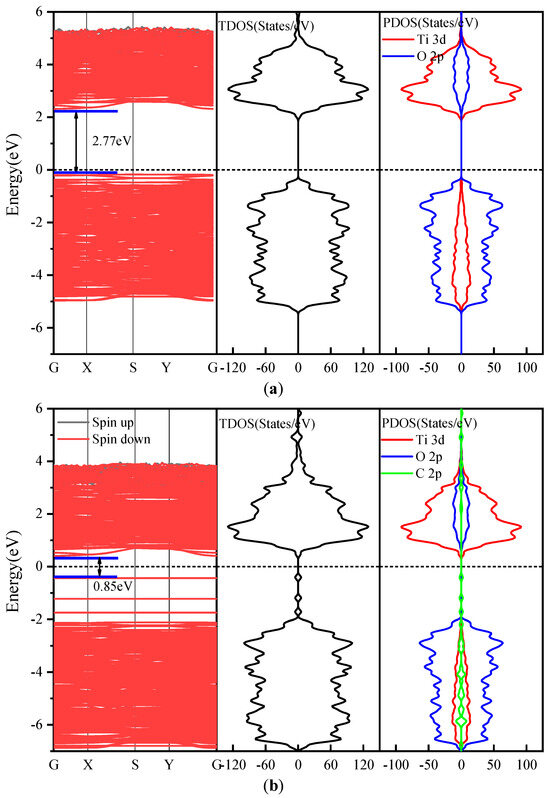
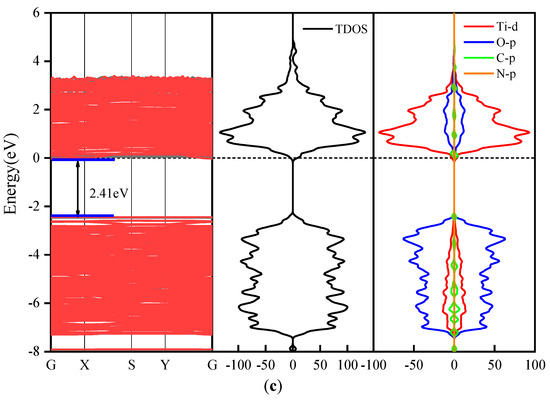
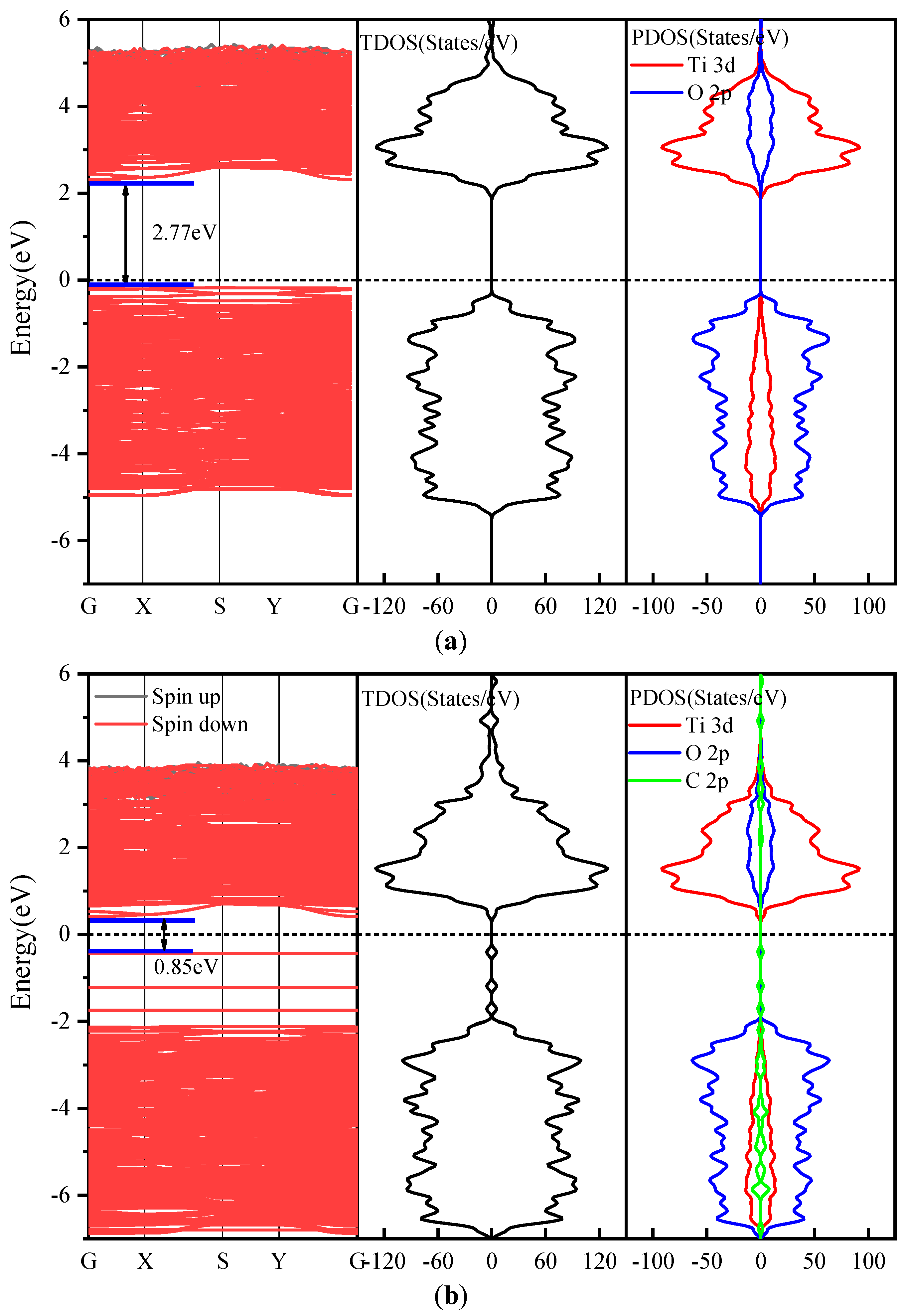
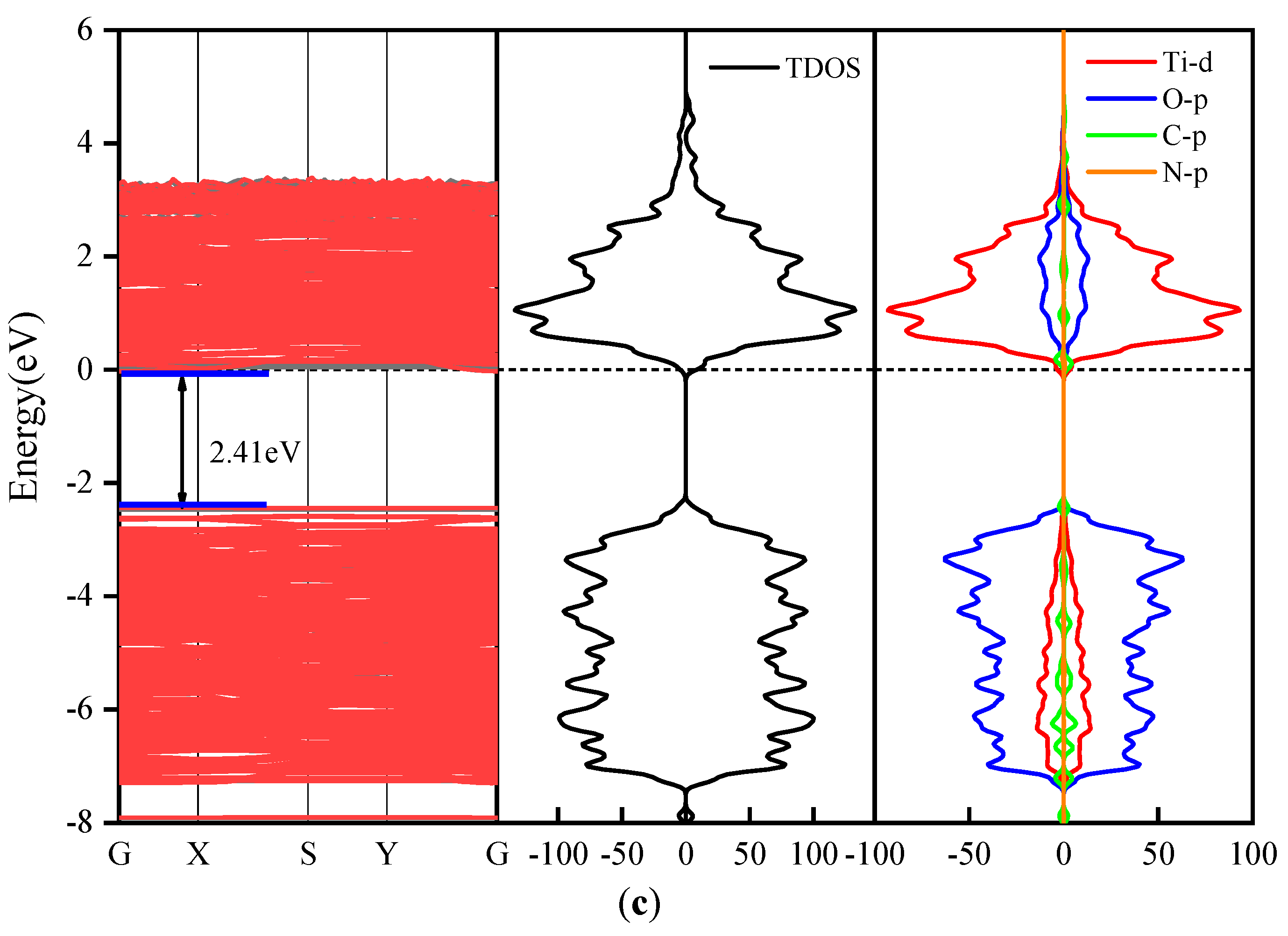
Figure 3 illustrates the band structures and density of states for TiO2(101), CQDs/TiO2(101), and NCQDs/TiO2(101). As shown in Figure 3a, pure TiO2 possesses an indirect band gap with a value of 2.49 eV, which is lower than the experimental value of 3.2 eV [32,33]. This discrepancy arises from an inherent limitation of the PBE functional, as the Kohn–Sham equation in density functional theory does not account for the system’s excited states. Since this study focuses on the variation of band gaps among different systems, this issue does not affect our results. In pure TiO2, the valence band is mainly contributed by O 2p electrons, while the conduction band primarily originates from Ti 3d electrons, which is consistent with the calculations by other researchers [34]. After loading CQDs onto the surface of TiO2(101), three new donor levels were introduced below the Fermi level, resulting in a reduction of the band gap to 0.85 eV (see Figure 3b). Feng et al. [35] observed a reduction in the band gap to 2.77 eV in CQDs/TNRs synthesized via a hydrothermal method. Furthermore, absorption in the visible light region was significantly enhanced, owing to the fact that CQDs enable single photons to generate multiple excitons and play an important role in solar light utilization. A closer look at Figure 3b reveals that the new energy levels are mainly contributed by C 2p electrons, without hybridization with Ti and O atoms, indicating a weak interaction between CQDs and TiO2(101). Therefore, the enhancement in the visible light absorption of CQDs/TiO2(101) relies almost exclusively on the intrinsic properties of CQDs. Upon doping CQDs with nitrogen, the band gap of the system decreased slightly to 2.41 eV compared to that of pure TiO2(101) (see Figure 3c), while the Fermi level shifted upward to the bottom of the conduction band, thereby increasing the carrier mobility. This observation agrees with the computational results of Yashwanth et al. [31]. As shown in Figure 3c, the occupied C 2p orbitals enter the band gap of the TiO2 substrate, while the unoccupied orbitals extend into the conduction band of the substrate. This staggered band arrangement not only represents an important prerequisite for electron injection but facilitates the transition of electrons from the conduction band minimum of TiO2 to the HOMO of NCQDs. Although the reduction in the band gap is less pronounced compared to that observed with CQDs (i.e., the enhancement in visible light absorption is relatively modest), the introduction of nitrogen effectively eliminates the impurity levels generated by CQDs, considerably reducing the recombination of photogenerated electron-hole pairs and prolonging the lifetime of the photogenerated charge carriers. The TDOS integrates over all k-points in the Brillouin zone and counts the number of electronic states within a unit energy at all k-points. Even if a state exists only at k-points along non-high-symmetry paths, the TDOS will include it in the count, thus the TDOS is not zero.
Figure 3.
Band and density of states of (a) TiO2(101), (b) CQDs/TiO2(101), (c) NCQDs/TiO2(101).
The mobility of charge carriers depends on their effective mass, and the calculation formula is given as follows:
In the equation, E, k, and h represent the band energy (eV), wave vector, and Planck constant (6.626 × 10⁻³⁴ J/s), respectively, and μ, q, and τ denote the carrier mobility (cm2/V/s), the charge (e), and the scattering time (s), respectively. By calculating the energy band fitting function of E versus k, the effective mass of electrons and holes in different systems were obtained, as shown in Table 1. Both the CQD and NCQD systems exhibit a lower effective mass compared to the pristine system, with NCQDs having the lowest carrier effective mass and a more pronounced reduction in the effective mass of photogenerated electrons. Equation (2) indicates that the lower the effective mass, the higher the mobility of the photogenerated carriers. Therefore, consistent with the density of state results, the NCQD system can provide more electrons, and there is a qualitative trend of improvement in the band-shaped transmission.
Table 1.
Effective Mass of Charge Carriers in Different Systems.
3.3. Charge Density
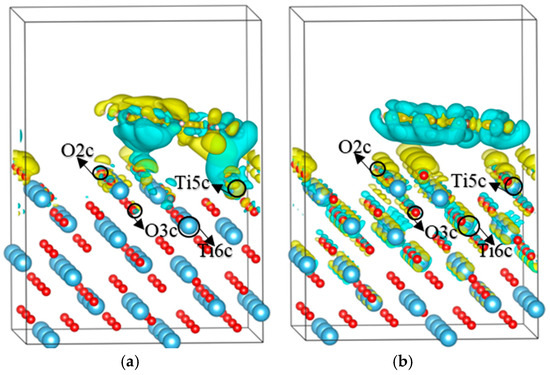
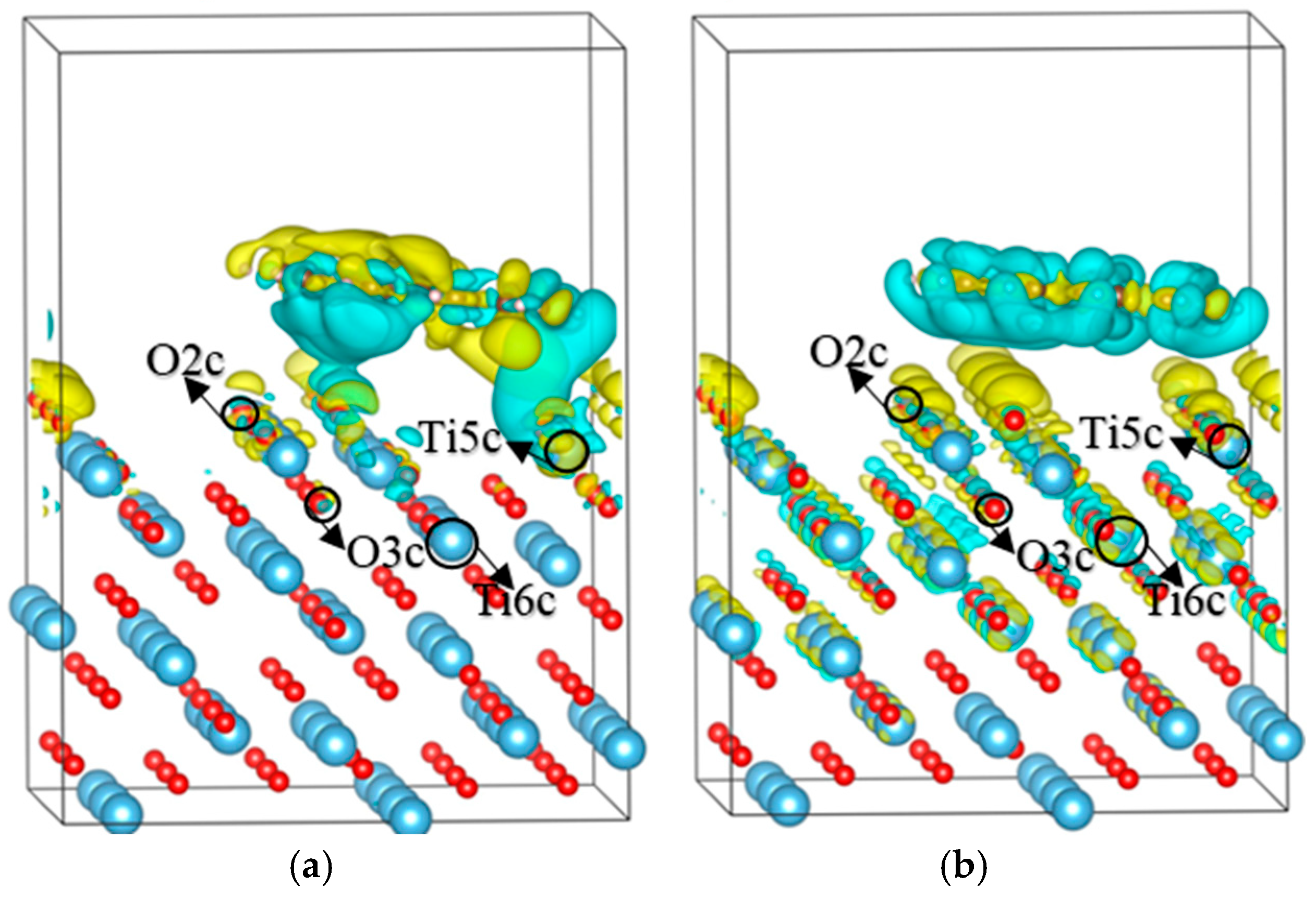
Charge density difference, also known as charge density disparity, is commonly referred to as CDD or DCD. It is a core tool used in first-principles calculations based on density functional theory for analyzing the redistribution of electrons. Its physical essence describes the changes in electron density that occur after specific processes, such as bonding, adsorption, doping, and interface recombination in the system. By comparing the charge density distribution of the target system with that of each isolated component, it quantitatively describes the aggregation and dissipation behavior of electrons. Its physical significance indicates that positive regions represent charge accumulation, i.e., electron enrichment, while negative regions represent charge dissipation, i.e., electron depletion.
Differential charge density serves as a key method for determining whether a chemical bond is formed between two atoms, providing an intuitive means of observing interfacial charge transfer. Figure 4 displays the differential charge density of both the CQD/TiO2(101) and the NCQD/TiO2(101) systems. In the region of the most intimate interfacial interaction, an accumulation of electron density is observed (Figure 4), indicating that an electronic interaction between the NCQDs and the TiO2(101) surface has altered the electronic structure, shifting the Fermi level toward the conduction band edge. As shown in Figure 4a, charge transfer primarily occurs between the CQDs and the 2-coordinated O atoms (O2c), as well as the 5-coordinated Ti atoms (Ti5c) on the surface. By contrast, the electron distribution at the NCQDs/TiO2(101) interface is more uniform (Figure 4b), which is consistent with the computational results reported by other researchers [31].
Figure 4.
Differential charge densities of (a) CQDs/TiO2(101) and (b) of NCQDs/TiO2(101).
To further analyze the charge characteristics of the structure, we calculated the Bader charges for different systems. In the case of the TiO2(101) surface, the Bader charges of the Ti atoms were determined to be +2.3 e for the Ti6c sites and +2.27 e for the Ti5c sites, while those of the surface oxygen atoms were −1.15 e for the O3c sites and −0.89 e for the O2c sites, in agreement with previous studies [36]. For the loaded CQDs, the C atoms at the two ends along the a-axis exhibit Bader charges of +0.2 e and +0.11 e, respectively, with the remaining C atoms showing charges close to 0. Thus, the charge transferred from the CQDs to the TiO2(101) surface mainly originates from the C atoms at the two ends along the a-axis, which is consistent with the differential charge density analysis. By contrast, for the loaded NCQDs, the N atoms have a Bader charge of −0.71 e, and the Bader charges of the C atoms at the a-axis ends are reduced to varying extents relative to those in the CQDs. Furthermore, the Bader charge of the O2c atoms on the TiO2(101) surface, which are closest to NCQDs, increases by approximately 0.12 e compared to that of CQDs. Therefore, the loading of NCQDs more effectively facilitates electron transfer within the system.
3.4. Optical Properties
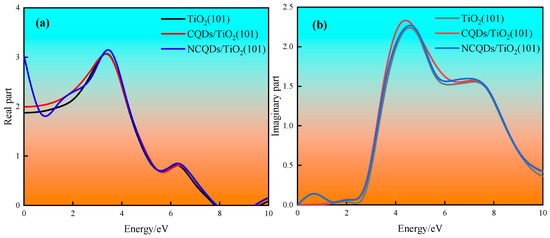
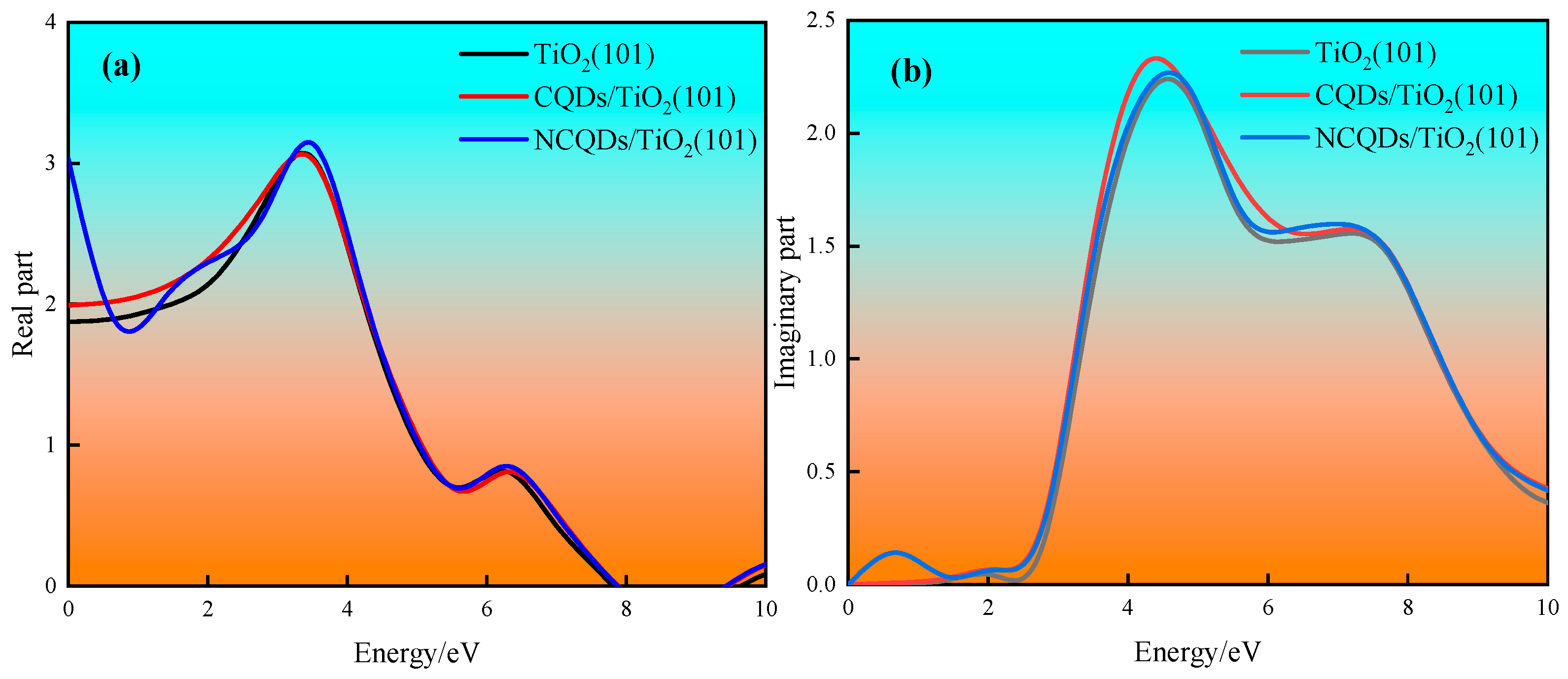
The complex dielectric function, ε(ω) = ε1(ω) + iε2(ω), is used to describe the optical properties of semiconductors within the linear response regime. Figure 5 exhibits the complex dielectric functions for various systems. Regarding the real part of the static dielectric function (Figure 5a), the order is TiO2(101) < CQDs/TiO2(101) < NCQDs/TiO2(101), indicating that TiO2 loaded with NCQDs has an enhanced dielectric performance, which improves the internal polarization capacity and facilitates the migration and separation of photogenerated charge carriers. For pristine TiO2(101), the imaginary part begins to respond at 0.696 eV and reaches a peak at 4.87 eV, indicating that the original system has a relatively poor response within the visible light range of 1.64 eV to 3.19 eV. After loading with quantum dots, the peak shifts negatively, thereby enhancing the response to visible light (Figure 5b).
Figure 5.
The complex dielectric functions of (a) Static dielectric function, (b) After loading with quantum dots.
In VASP, simulating the optical properties of semiconductors involves calculating the variation of the dielectric function ε2 with frequency, and then deriving optical constants, such as the absorption coefficient and refractive index from this. VASP directly provides the starting position of ε2, which corresponds to the energy (direct transition energy) of the DFT electronic band gap. Using the Tauc plotting method, the “direct optical band gap” can be extrapolated. In most inorganic semiconductors, the values of the electronic band gap and the optical band gap are nearly identical at room temperature (as described in this article for the TiO2 material); while in organic semiconductors and two-dimensional materials, the electronic band gap is numerically equal to the optical band gap plus the exciton binding energy. The optical band gap calculated by DFT usually significantly underestimates the true value (PBE generally underestimates by 30–50%), because the Kohn–Sham energy gap is essentially the electronic band gap and is limited by the functional.
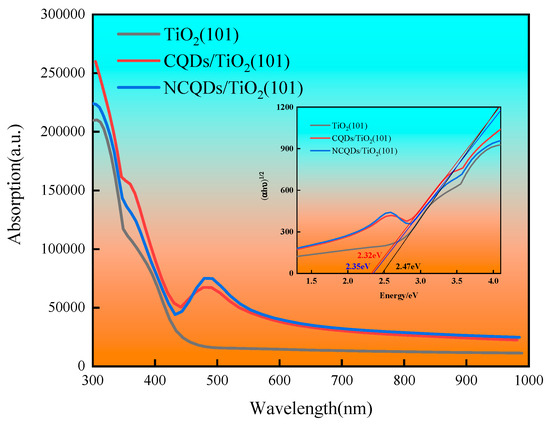
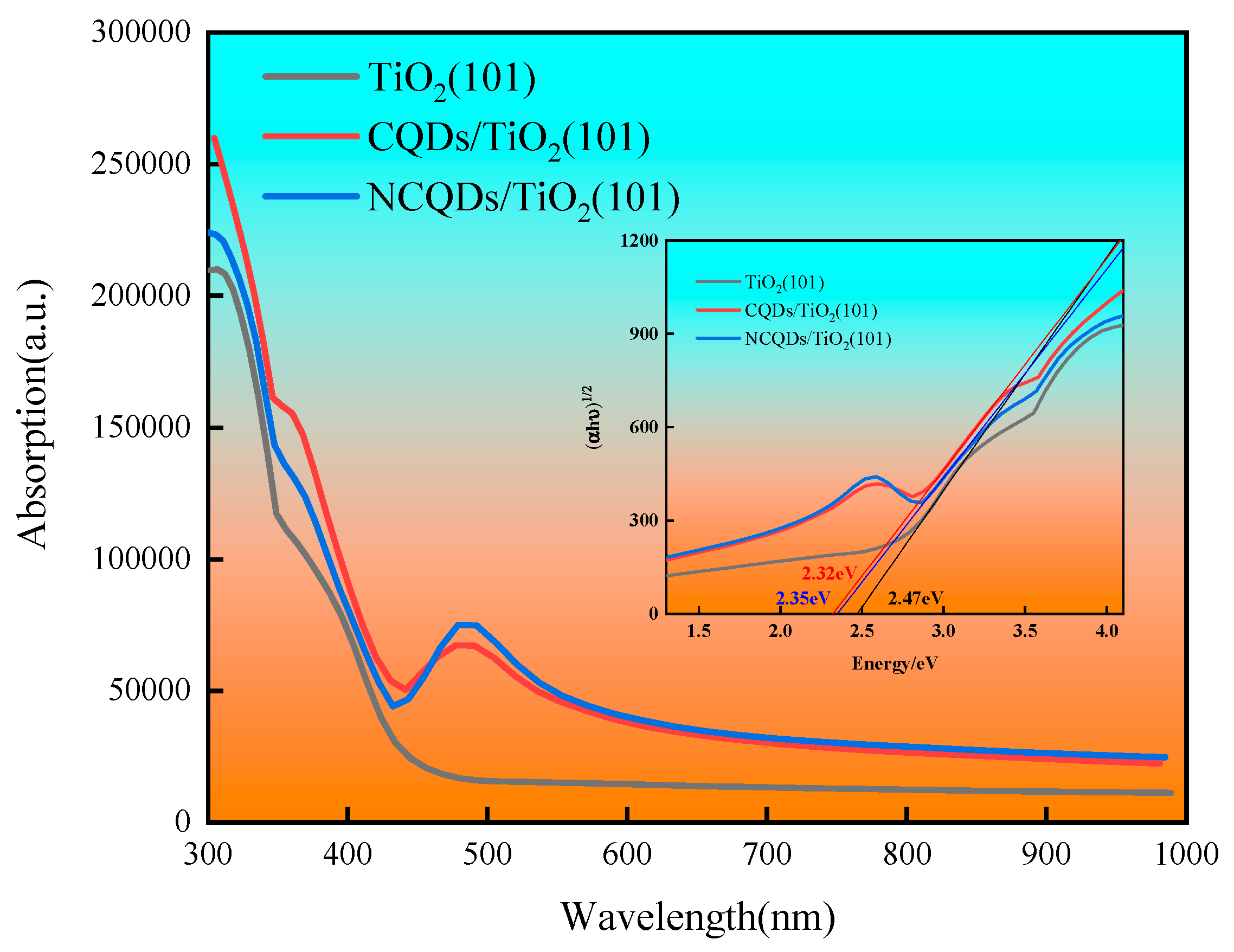
The absorption spectra of TiO2(101), CQDs/TiO2(101), and NCQDs/TiO2(101) were calculated to investigate the influence of quantum dots on the optical properties of TiO2, as presented in Figure 6. Owing to the intrinsic bandgap of TiO2, all three systems exhibit strong ultraviolet absorption. Upon loading with quantum dots, a pronounced redshift of the absorption edge and an increase in absorption intensity in the visible region are observed, which agrees with experimental results [37]. A combined analysis of the band structure and density of states indicates that the loading of CQDs introduces three donor energy levels within the TiO2 bandgap, thereby reducing the energy required for electrons in the valence band to transition to the conduction band. Similarly, the loading of NCQDs shifts the system’s Fermi level upward toward the conduction band, also lowering the energy necessary for electron transitions.
Figure 6.
Absorption spectra and optical band gaps of TiO2(101), CQDs/TiO2(101), and NCQDs/TiO2(101).
4. Conclusions
In this study, we employed first-principles calculations to investigate the binding energy, work function, electronic structure, and optical properties of CQDs and NCQDs loaded on the TiO2(101) surface. The following conclusions are drawn:
- (1)
- A weak interaction exists between CQDs and the TiO2(101) surface, with NCQDs binding to the TiO2(101) surface more readily than CQDs.
- (2)
- The NCQD/TiO2(101) system exhibits the lowest work function, which is most beneficial for promoting the generation of photogenerated electron-hole pairs and electron migration. In addition, the CQD/TiO2(101) system introduces three new donor levels below the Fermi level, resulting in the smallest band gap (0.85 eV). After N-doping of the CQDs, the Fermi level shifts to the bottom of the conduction band; although the band gap increases, it remains smaller than that of TiO2(101), and there is a qualitative trend of improvement in the band-shaped transmission.
- (3)
- In the CQD system, charge transfer primarily occurs between the two-coordinated oxygen atoms (O2c) at the surface and the five-coordinated titanium atoms (Ti5c); the charge transferred from the CQDs to the TiO2(101) surface mainly originates from the carbon atoms located at both ends along the a-axis. In the case of NCQDs, the charge distribution with the TiO2(101) surface is more uniform, and the Bader charges of the carbon atoms at both ends along the a-axis are reduced to varying extents compared to those in CQDs.
- (4)
- The optical property calculations indicate that the abilities of photogenerated charge carrier migration, separation, and visible light response increase in the following order: TiO2(101) < CQDs/TiO2(101) < NCQDs/TiO2(101).
Author Contributions
C.L.: Methodology, Funding acquisition, Project administration, Writing—review and editing. K.J.: Conceptualization, Data curation, Formal analysis, Funding acquisition, Investigation, Methodology, Writing—original draft preparation, Writing—review and editing. G.G.: Methodology, Data curation, Writing—review & editing. J.G.: Writing—review and editing. Z.Z.: Data curation, Writing—review and editing. All authors have read and agreed to the published version of the manuscript.
Funding
Supported by Sichuan Science and Technology Program (2025YFHZ0100).
Data Availability Statement
The original contributions presented in this study are included in the article. Further inquiries can be directed to the corresponding author.
Conflicts of Interest
Author Chao Luo and Jun Gao were employed by CRRC Tangshan Co., Ltd. The remaining authors declare that the research was conducted without any commercial or financial relationships that could be construed as a potential conflict of interest.
References
- Diwate, K.; Rondia, S.; Mayabadi, A.; Rokade, A.; Waykar, R.; Borate, H.; Funde, A.; Shinde, M.; Prasad, M.B.R.; Pathan, H.; et al. Chemical spray pyrolysis synthesis of covellite copper sulphide (CuS) thin films for economical counter electrode for DSSCs. J. Mater. Sci. Mater. Electron. 2018, 29, 4940–4947. [Google Scholar]
- Tasleem, S.; Tahir, M.; Khalifa, W.A. Current trends in structural development and modification strategies for metal-organic frameworks (MOFs) towards photocatalytic H2 production: A review. Int. J. Hydrogen Energy 2021, 46, 14148–14189. [Google Scholar] [CrossRef] [Scilit]
- Fujishima, A.; Honda, K. Electrochemical Photolysis of Water at a Semiconductor Electrode. Nature 1972, 238, 37–38. [Google Scholar] [CrossRef] [Scilit] [PubMed]
- Rokade, A.; Rondiya, S.; Date, A.; Sharma, V.; Prasad, M.; Pathan, H.; Jadkar, S. Electrochemical synthesis of core-shell ZnO/CdS nanostructure for photocatalytic water splitting application. Energy Procedia 2017, 110, 121–127. [Google Scholar]
- Fang, Y.; Xu, T.; Zhang, Y.; Kong, X.; Liu, J.; Cui, S.; Wang, D. Structural, electronic and optical properties of La, C-codoped TiO2 investigated by first principle calculations. J. Phys. Chem. Solids 2019, 132, 121–129. [Google Scholar] [CrossRef] [Scilit]
- Luo, J.; Wang, X.; Yang, A.; Zhu, Y. First-principles study on the electronic structures and optical properties of RbVO3. J. Lumin. 2020, 218, 116832. [Google Scholar] [CrossRef] [Scilit]
- Li, D.; Li, R.; Zeng, F.; Wang, S.; Yan, W.; Deng, M.; Cai, S. Sc/C codoping effect on the electronic and optical properties of the TiO2 (101) surface: A first-principles study. RSC Adv. 2021, 11, 31663–31674. [Google Scholar] [CrossRef] [Scilit] [PubMed]
- Wu, Y.; Saidi, W.A.; Ohodnicki, P.; Chorpening, B.; Duan, Y. First-Principles Investigations of the Temperature Dependence of Electronic Struc-ture and Optical Properties of Rutile TiO2. J. Phys. Chem. C 2018, 122, 22642–22649. [Google Scholar] [CrossRef] [Scilit]
- Zhu, H.X.; Liu, J.M. First-principle study of electronic structures and optical properties of chromium and carbon co-doped ana-tase TiO2. Ceram. Int. 2016, 42, 13900–13908. [Google Scholar] [CrossRef] [Scilit]
- Qu, Z.; Su, Y.; Sun, L.; Liang, F.; Zhang, G. Study of the Structure, Electronic and Optical Properties of BiOI/Rutile-TiO2 Heterojunction by the First-Principle Calculation. Materials 2020, 13, 323. [Google Scholar] [CrossRef] [Scilit] [PubMed]
- Wang, Z.; Li, Z.; Lin, D.; Wang, Y. Preparation and Optical Properties of Al/N Co-doped TiO2 Films. Semicond. Optoelectron. 2023, 44, 87. [Google Scholar]
- Tan, H.; Gao, D.; Yan, B.; Dai, Y. Research Progress on TiO2 Photoanodes for Dye-Sensitized Solar Cells. Laser Optoelectron. Prog. 2023, 60, 1500008. [Google Scholar]
- Wu, Z.; Yuan, D.; Lin, S.; Guo, W.; Zhan, D.; Sun, L.; Lin, C. Enhanced photoelectrocatalytic activity of Bi2S3–TiO2 nanotube arrays hetero-structure under visi-ble light irradiation. Int. J. Hydrogen Energy 2020, 45, 32012–32021. [Google Scholar] [CrossRef] [Scilit]
- Qiu, X.; Gou, G.; Zhang, K.; Zhang, X.; Sun, W.; Qin, S.; Luo, X.; Feng, P.; Pan, J.; Gao, W. Investigation on TiO2 photocathodic protection based on lattice distortion and stress engineering. Mater. Today Commun. 2023, 35, 105782. [Google Scholar] [CrossRef] [Scilit]
- Lin, Z.-Q.; Lai, Y.-K.; Hu, R.-G.; Li, J.; Du, R.-G.; Lin, C.-J. A highly efficient ZnS/CdS@ TiO2 photoelectrode for photogenerated cathodic protection of metals. Electrochim. Acta 2010, 55, 8717–8723. [Google Scholar] [CrossRef] [Scilit]
- Zhou, T.; Chen, S.; Li, L.; Wang, J.; Zhang, Y.; Li, J.; Bai, J.; Xia, L.; Xu, Q.; Rahim, M.; et al. Carbon quantum dots modified anatase/rutile TiO2 photoanode with dramatically enhanced pho-toelectrochemical performance. Appl. Catal. B Environ. 2020, 269, 118776. [Google Scholar] [CrossRef] [Scilit]
- Saud, P.S.; Pant, B.; Alam, A.-M.; Ghouri, Z.K.; Park, M.; Kim, H.-Y. Carbon quantum dots anchored TiO2 nanofibers: Effective photocatalyst for waste water treatment. Ceram. Int. 2015, 41, 11953–11959. [Google Scholar] [CrossRef] [Scilit]
- Dsouza, S.D.; Buerkle, M.; Brunet, P.; Maddi, C.; Padmanaban, D.B.; Morelli, A.; Payam, A.F.; Maguire, P.; Mariotti, D.; Svrcek, V. The importance of surface states in N-doped carbon quantum dots. Carbon 2021, 183, 1–11. [Google Scholar] [CrossRef] [Scilit]
- Yashwanth, H.; Rondiya, S.R.; Dzade, N.Y.; Dhole, S.; Phase, D.; Hareesh, K. Enhanced photocatalytic activity of N, P, co-doped carbon quantum dots: An insight from experimental and computational approach. Vacuum 2020, 180, 109589. [Google Scholar] [CrossRef] [Scilit]
- Jin, Y.; Tang, W.; Wang, J.; Ren, F.; Chen, Z.; Sun, Z.; Ren, P.-G. Construction of biomass derived carbon quantum dots modified TiO2 photocatalysts with supe-rior photocatalytic activity for methylene blue degradation. J. Alloys Compd. 2023, 932, 167627. [Google Scholar] [CrossRef] [Scilit]
- Xie, C.; Fan, T.; Wang, A.; Chen, S.-L. Enhanced visible-light photocatalytic activity of a TiO2 membrane-assisted with N-doped carbon quantum dots and SiO2 opal photonic crystal. Ind. Eng. Chem. Res. 2018, 58, 120–127. [Google Scholar] [CrossRef] [Scilit]
- Kresse, G.; Furthmüller, J. Efficient iterative schemes for ab initio total-energy calculations using a plane-wave basis set. Phys. Rev. B 1996, 54, 11169. [Google Scholar] [CrossRef] [Scilit]
- Perdew, J.P.; Burke, K.; Ernzerhof, M. Generalized gradient approximation made simple. Phys. Rev. Lett. 1996, 77, 3865. [Google Scholar] [CrossRef] [Scilit] [PubMed]
- Wang, X.; Jiang, X.; Sharman, E.; Yang, L.; Li, X.; Zhang, G.; Zhao, J.; Luo, Y.; Jiang, J. Isolating hydrogen from oxygen in photocatalytic water splitting with a car-bon-quantum-dot/carbon-nitride hybrid. J. Mater. Chem. A 2019, 7, 6143–6148. [Google Scholar] [CrossRef] [Scilit]
- Monkhorst, H.J.; Pack, J.D. Special points for Brillouin-zone integrations. Phys. Rev. B 1976, 13, 5188. [Google Scholar] [CrossRef] [Scilit]
- Han, Y.; Wu, J.; Li, Y.; Gu, X.; He, T.; Zhao, Y.; Huang, H.; Liu, Y.; Kang, Z. Carbon dots enhance the interface electron transfer and photoelectrochemical kinetics in TiO2 pho-toanode. Appl. Catal. B Environ. 2022, 304, 120983. [Google Scholar] [CrossRef] [Scilit]
- Baviskar, P.K.; Rondiya, S.R.; Patil, G.P.; Sankapal, B.R.; Pathan, H.M.; Chavan, P.G.; Dzade, N.Y. ZnO/CuSCN Nano-Heterostructure as a Highly Efficient Field Emitter: A Combined Experimental and Theoretical Investigation. ACS Omega 2020, 5, 6715–6724. [Google Scholar] [CrossRef] [Scilit] [PubMed]
- Rondiya, S.R.; Jadhav, C.D.; Chavan, P.G.; Dzade, N.Y. Enhanced Field Emission Properties of Au/SnSe Nano-heterostructure: A Com-bined Experimental and Theoretical Investigation. Sci. Rep. 2020, 10, 2358. [Google Scholar] [CrossRef] [Scilit] [PubMed]
- Rondiya, S.R.; Karbhal, I.; Jadhav, C.D.; Nasane, M.P.; Davies, T.E.; Shelke, M.V.; Jadkar, S.R.; Chavan, P.G.; Dzade, N.Y. Uncovering the origin of enhanced field emission properties of rGO–MnO2 hetero-structures: A synergistic experimental and computational investigation. RSC Adv. 2020, 10, 25988–25998. [Google Scholar] [CrossRef] [Scilit] [PubMed]
- Ashritha, M.G.; Rondiya, S.R.; Cross, R.W.; Dzade, N.Y.; Dhole, S.; Hareesh, K.; Sunitha, D. Experimental and computational studies of sonochemical assisted anchoring of carbon quantum dots on reduced graphene oxide sheets towards the photocatalytic activity. Appl. Surf. Sci. 2021, 545, 148962. [Google Scholar] [CrossRef] [Scilit]
- Yashwanth, H.J.; Rondiya, S.R.; Dzade, N.Y.; Hoye, R.L.Z.; Choudhary, R.J.; Phase, D.M.; Dhole, S.D.; Hareesh, K. Improved photocatalytic activity of TiO2 nanoparticles through nitrogen and phosphorus co-doped carbon quantum dots: An experimental and theoretical study. Phys. Chem. Chem. Phys. 2022, 24, 15271–15279. [Google Scholar] [CrossRef] [Scilit] [PubMed]
- Morales, W.A. Combustion Synthesis and Doping of Titanium Dioxide. Master’s Thesis, University of Texas at Arlington, Arlington, TX, USA, 2007. [Google Scholar]
- Samsudin, E.M.; Abd Hamid, S.B. Effect of band gap engineering in anionic-doped TiO2 photocatalyst. Appl. Surf. Sci. 2017, 391, 326–336. [Google Scholar] [CrossRef] [Scilit]
- Li, D.X.; Li, R.; Luo, Y.Z.; Yan, W.J. A first-principles investigation of the electronic structure and optical properties of the La-doped TiO2 (101) surface. J. At. Mol. Phys. 2020, 37, 596–604. [Google Scholar]
- Feng, M.; Liu, Y.; Zhang, S.; Liu, Y.; Luo, N.; Wang, D. Carbon quantum dots (CQDs) modified TiO2 nanorods photoelectrode for enhanced photoca-thodic protection of Q235 carbon steel. Corros. Sci. 2020, 176, 108919. [Google Scholar] [CrossRef] [Scilit]
- Huang, Z.Q. Research on the Structure and Formation Mechanisms of Copper and Its Oxide Clusters Supported on Ana-tase TiO2 (101) Substrates; Hefei University of Technology: Hefei, China, 2022. [Google Scholar]
- Zhang, J.; Liu, Q.; Wang, J.; He, H.; Shi, F.; Xing, B.; Jia, J.; Huang, G.; Zhang, C. Facile preparation of carbon quantum dots/TiO2 composites at room temperature with im-proved visible-light photocatalytic activity. J. Alloys Compd. 2021, 869, 159389. [Google Scholar] [CrossRef] [Scilit]

Disclaimer/Publisher’s Note: The statements, opinions and data contained in all publications are solely those of the individual author(s) and contributor(s) and not of MDPI and/or the editor(s). MDPI and/or the editor(s) disclaim responsibility for any injury to people or property resulting from any ideas, methods, instructions or products referred to in the content. |
© 2026 by the authors. Licensee MDPI, Basel, Switzerland. This article is an open access article distributed under the terms and conditions of the Creative Commons Attribution (CC BY) license.