


Abstract
In this study, first-principles molecular dynamics (FPMD) simulations were employed to systematically investigate the effects of temperature and composition on the microstructure and transport properties of CaCl2–CaI2 mixed molten salts at the atomic scale. Structural analysis shows that the system exhibits good relaxation behavior and thermodynamic stability, with coordination strength following Ca-Cl > Ca-I. The transport properties reveal a coupled dependence on temperature and composition: increasing CaI2 content enhances the diffusion of I− ions, whereas at 1173 K, a decrease in diffusion coefficients is observed for all ionic species. Arrhenius analysis indicates that increasing CaI2 content lowers the activation energy for ion migration. The shear viscosity follows the order η(Ca2+) > η(Cl−) ≥ η(I−), and decreases with increasing temperature and CaI2 concentration, indicating improved fluidity. Notably, the results reveal a competitive coordination mechanism between Cl− and I− around Ca2+, as well as a non-monotonic transport behavior at high temperatures, reflecting the complex coupling between composition and ionic dynamics in mixed halide melts. This study provides a theoretical basis for the optimization of molten salt electrolysis processes and nuclear energy materials, and offers insight for future multiscale simulations and experimental validation.
1. Introduction
Molten halides exhibit excellent thermophysical properties and have significant application potential in high-temperature solar power generation [1,2], fuel cells [3], and electrolysis technology [4]. They are among the most promising candidate materials for fourth-generation nuclear reactor designs [5]. The heat storage densities of molten halides are significantly higher than those of nitrates. For example, the NaCl–KCl–CaCl2 system has a melting enthalpy of up to 251.37 J/g, and its specific heat capacity remains stable at 0.9–1.1 J/(cm3·K) at 1000 K, providing a key material basis for enhancing the energy conversion efficiency of solar systems [6,7]. Molten salts such as CaCl2 and CaI2 also possess high thermal stability, a wide liquid-phase range, and good ionic conductivity, offering broad application prospects in high-temperature heat transfer, heat storage, and advanced energy systems.
Physical and chemical properties, such as specific heat capacity, thermal conductivity, viscosity, and the electrochemical window, are key parameters for evaluating the applicability of molten salts in high-temperature systems, such as nuclear reactors and solar thermal power generation. These macroscopic properties are determined by the microstructure of the molten salt. Therefore, investigating the intrinsic relationships between the structures of molten halides and their physical and chemical properties is of great theoretical and practical significance in material design and engineering applications.
Owing to the high temperature, toxicity, and strong corrosion of molten salt systems, experimental research faces challenges such as high costs, complex operation, and high safety risks. Molecular dynamics simulations have become an important complementary method for studying the thermophysical properties of molten salts. This approach can reveal the microstructure of molten salts at the atomic scale and accurately predict their macroscopic physical and chemical properties [6,8,9,10,11,12].
Molecular dynamics simulations of molten salts were proposed in 1971. Woodcock and Singer used the Monte Carlo method and Born–Mayer–Huggins and Tosi/Fumi potentials to simulate KCl molten salt [13], and the results were in good agreement with the experimental data. Various rigid and polarizable models have subsequently been used to study the structure and transport properties of alkali halides [14]. In 1983, Tang and Toennies proposed a general dispersion damping function for the Born–Mayer potential, representing the first attempt at describing many-body interactions in multivariate systems [15]. In 1985, Madden and Fowler proposed an asymptotic polarization model, and the LiF simulation results were in good agreement with Hartree–Fock calculation results [16]. In the same year, Car and Parrinello proposed Car–Parrinello molecular dynamics (CPMD), which combines molecular dynamics with density functional theory (DFT) and lays the foundation for simulation research in this field [17]. In 1993, Barnett and Landman implemented DFT-based Born–Oppenheimer molecular dynamics (BOMD), which improved sampling efficiency [18]. Kresse and Hafner proposed a method to initialize CPMD based on energy minimization, which further improved computational efficiency [19]. In 1998, Alfe successfully obtained the diffusion coefficient of liquid aluminum via CPMD, which verified the applicability of DFT in the study of condensed-matter transport properties [20]. In 2003, Aguado et al. parameterized the aspherical ion model through DFT calculations on a multiphase MgO system, which promoted the development of a polarizable model [21]. In 2005, Hazebroucq used tight-binding DFT to study the diffusion behavior of NaCl and KCl [22]. In 2006, Madden et al. noted that dispersion interactions have a major effect on phase-transition behavior [23]. Additionally, Grimme proposed an empirical dispersion correction method for DFT that significantly improved the calculation accuracy [24].
In the field of molten salts, first-principles molecular dynamics (FPMD) is a mainstream simulation method based on BOMD. Compared with traditional molecular dynamics methods, which rely on empirical potential functions and are limited by high parameter dependence and limited transferability, FPMD requires no predefined empirical potentials and offers higher predictive accuracy and portability [25]. FPMD integrates quantum-mechanical calculations (such as DFT) with classical molecular dynamics, enabling simulations to directly describe interatomic interactions at the electronic structure level.
Simulation studies of FPMD in molten salt systems were proposed in 2006. Klix employed CPMD to investigate the diffusion behavior of tritium in FLiBe, marking the first application of ab initio molecular dynamics to molten salt systems and advancing the study of molten salt dynamics into the first-principles era [26]. In 2014, Corradini employed a combined DFT–MD approach to investigate the dispersion effects in LiF, highlighting that dispersion corrections significantly influence the simulated melting points and equilibrium densities [27]. In 2015, Anderson et al. utilized FPMD to simulate FLiNaK and FLiBe molten salts, obtaining thermophysical parameters such as density, diffusion coefficient, and thermal expansion coefficient, which showed good agreement with the experimental data [28].
Over the past decade, research on FPMD of mixed-halide molten salts has increased. In 2019, He et al. employed FPMD simulations to reveal complex ionic-cluster structures within the KF–NaF–AlF3 molten salt system and subsequently validated these structures using computational Raman spectroscopy [29]. In 2020, Li et al. employed FPMD simulation techniques to investigate the dynamic interactions between water impurities and molten salts in a MgCl2–NaCl–KCl molten salt system, revealing dynamic properties such as energy fluctuations, radial-distribution functions (RDFs), and ion auto-diffusion coefficients [30]. In 2025, Luo et al. investigated the thermophysical properties and microstructures of molten NaCl–KCl–CaCl2 salts. Their FPMD simulation results showed good agreement with the experimental data across a temperature range of 873–1173 K, covering parameters such as specific heat capacity, density, self-diffusion coefficient, and viscosity [31].
In this study, FPMD simulations were employed to systematically investigate the synergistic effects of temperature and composition on the microstructure and transport properties of CaCl2–CaI2 mixed molten salts. The coordination behavior between Ca2+ and anions was elucidated by calculating the local structural parameters, including RDFs, coordination number, and bond angle distribution. The transport properties of Ca2+, Cl−, and I− ions were characterized via kinetic indicators such as the self-diffusion coefficient, activation energy, and shear viscosity. This work provides theoretical support for the optimized design of molten salt electrolysis processes and nuclear energy materials, and lays a foundation for multiscale simulations and experimental verification in related fields.
2. Computational Method
In this study, all FPMD simulations were performed using the Vienna ab initio simulation package (VASP, version 5.4.4) [32,33] on a high-performance computing (HPC) cluster. VASP is a commercial software requiring an institutional license. Initial structural models were constructed using Materials Studio 2017 (commercial software) [34], and post-processing analysis, including radial distribution functions (RDF) and mean square displacement (MSD), was carried out using the open-source package VASPKIT (version 1.5.1) [35]. The interaction between ions and electrons was described by the projected augmented wave (PAW) method [36,37], and the electron exchange-correlation energy was treated with the generalized gradient approximation via the Perdew–Burke–Ernzerhof (PBE) functional [38,39]. The valence electron configurations were set to Ca-4s2, I-5s25p5 and Cl-3s23p5. Periodic boundary conditions were applied throughout the simulation to eliminate boundary effects. The lattice parameters of the simulation cell were adjusted based on the experimentally measured density [40], and the initial structure of the molten CaCl2–CaI2 system was generated using Materials Studio. Each simulation cell contained 180 atoms, with initial positions and velocities randomly assigned according to the specified molar ratios. Two representative CaI2 concentrations (20 and 30 mol%) were selected to represent low and intermediate composition regimes. This choice enables a systematic analysis of the competition between Ca-Cl and Ca-I coordination while maintaining the computational feasibility of FPMD simulations. These compositions are also representative of practically relevant concentration ranges in molten halide systems.
The simulations were performed in the NVT ensemble using a Nosé-Hoover thermo-stat [41,42]. Five temperatures (973, 1023, 1073, 1123, and 1173 K) above the melting point were investigated. The van der Waals interactions were corrected using the DFT-D3 method with Becke–Johnson damping [43,44]. The plane-wave cutoff energy was set to 400 eV, a 1 × 1 × 1 k-point grid was used. The integration time step was 1 fs, and the total simulation time per temperature point was 5 ps. It is noted that this simulation time is sufficient to obtain converged structural properties (e.g., RDF and ADF after equilibration), whereas transport properties such as diffusion coefficients and viscosity may still exhibit statistical uncertainty due to finite trajectory length.
Classical molecular dynamics simulations were not performed in this study due to the difficulty in constructing reliable and transferable force field parameters for the CaCl2–CaI2 system, particularly due to the highly polarizable nature of I− and the presence of competing coordination environments.
3. Density Measurements
Density measurement methods include Archimedes, gas expansion, specific-gravity, and X-ray diffraction methods. The CaCl2–CaI2 molten salt system is highly volatile and corrosive; therefore, this study used the Archimedes method, which is based on the hydrostatic balance principle, to measure the density [45,46]. According to Archimedes’ law, the buoyancy of an object immersed in a liquid is equal to the weight of the displaced liquid, which enables reliable density measurements of molten halides.
In this method, the volume of the tungsten hammer used for the determination can be obtained by measuring its mass in air and pure water using the following formula:
where V0 is the volume of the tungsten hammer; M is the mass of the hammer in air; and M0 is the mass of the hammer in a liquid with a density of ρ0. Thus, the density of the high-temperature melts can be calculated as follows:
where ρ is the density of the high-temperature melt; V is the corrected volume of the tungsten hammer; and M1 is the mass of the hammer in the high-temperature melt. The mass was weighed using a ten-thousandth precision balance (using a hook at the bottom of the balance to hang the tungsten wire connected to the tungsten hammer).
The volume of the tungsten hammer measured at room temperature changes at high temperatures; therefore, a thermal expansion correction must be applied. Considering the linear thermal expansion coefficient of tungsten, α = 4.6 × 10⁻⁶ K−1 [47], the corrected volume at the measurement temperature is corrected as follows:
where V0 is the volume calibrated with pure water at temperature T1, and T2 is the temperature of the molten salt during the density measurement.
Pretreated CaI2 and CaCl2 salts (purity ≥99%, Wuhan Huaxiang, China) were dehydrated in a vacuum furnace at 473 K for 24 h. The dried salts were thoroughly mixed in an inert-gas atmosphere based on the target molar ratios and transferred to an alumina crucible inside the reactor. After sealing, the reactor was evacuated to 5–10 Pa and heated to 1073 K at a rate of 10 K·min−1 in an argon atmosphere. The density measurements commenced after the temperature was stabilized for 30 min.
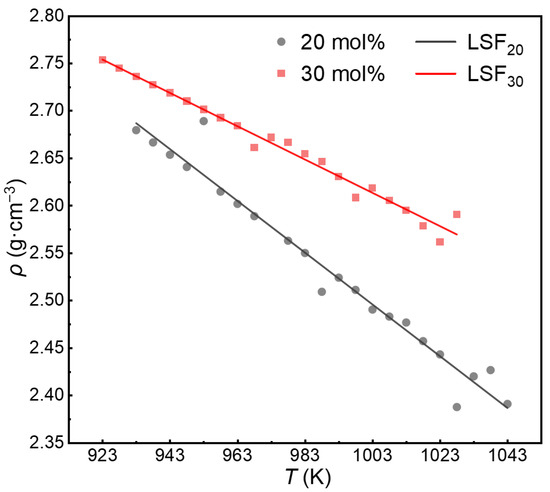
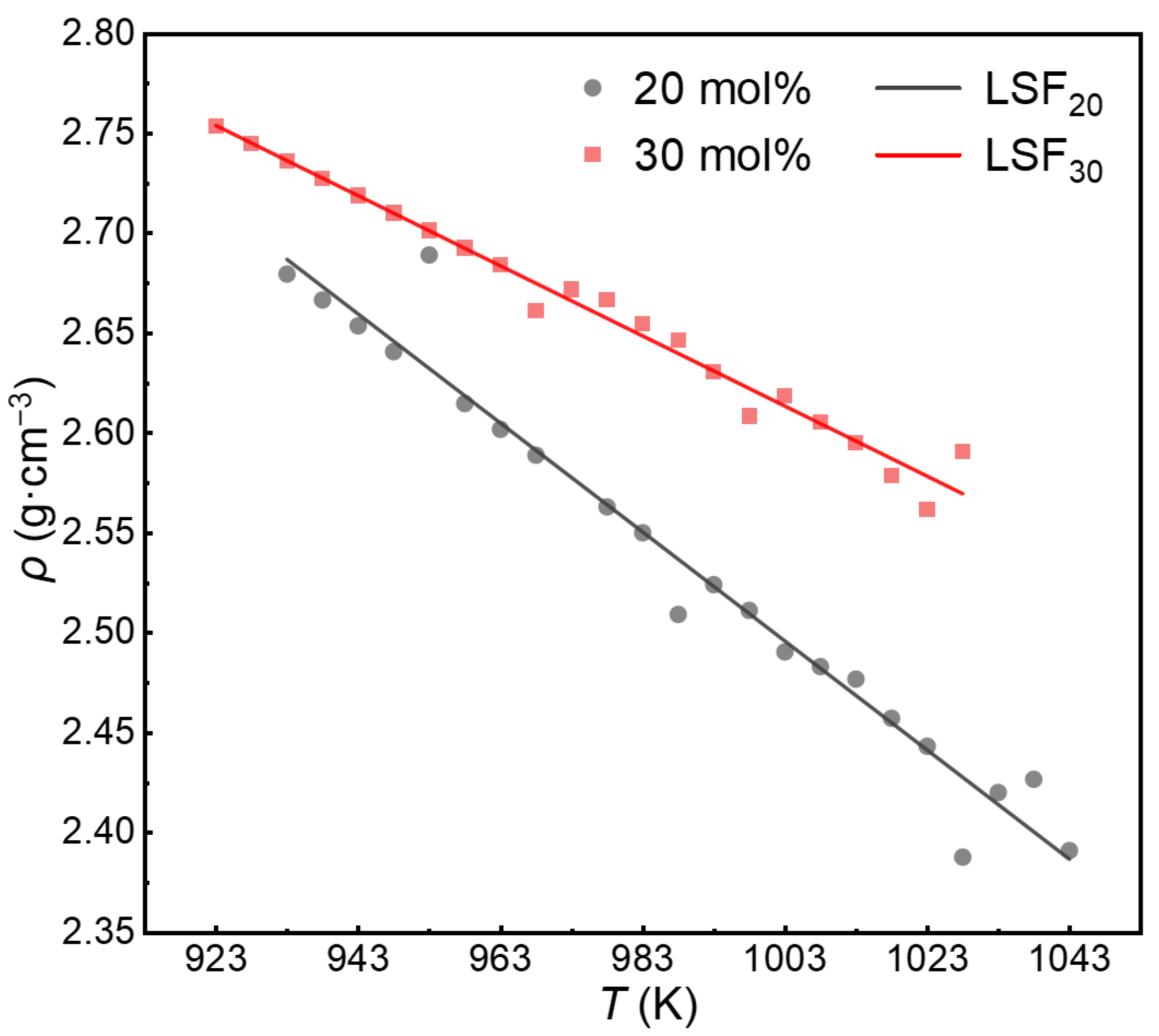
A CaCl2–CaI2 molten salt system with a total mass of 500 g was used as the sample. Density variations in the systems with CaCl2:CaI2 molar ratios of 7:3 and 8:2 were investigated at 923–1043 K. The results are shown in Figure 1. As shown in Figure 1, for a given composition, the density decreased with increasing temperature and was linearly correlated with the temperature. Least squares fitting (LSF) was used to obtain the fitting line as follows:
Figure 1.
Density of the CaCl2–CaI2 molten salt system at different CaI2 contents.
In this context, LSF20 and LSF30 denote the fitted density values of the molten salts with CaI2 contents of 20 and 30 mol%, respectively. At a given temperature, the density increased with an increasing CaI2 mole fraction. A coefficient of determination (R2) close to 1 indicates an excellent linear fit of the experimental density–temperature data, and statistical analysis confirms that the slope is highly significant (p < 0.001). The accurate density measurements provide an experimental basis for establishing the correspondence between the number of atoms and simulation cell volume in the system, and support the parameterization and validation of subsequent FPMD simulations.
4. Results and Discussion
4.1. Microstructure
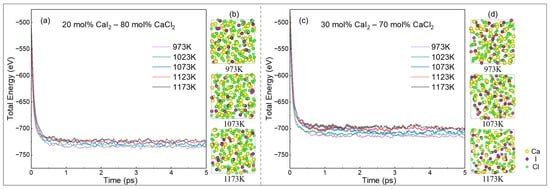
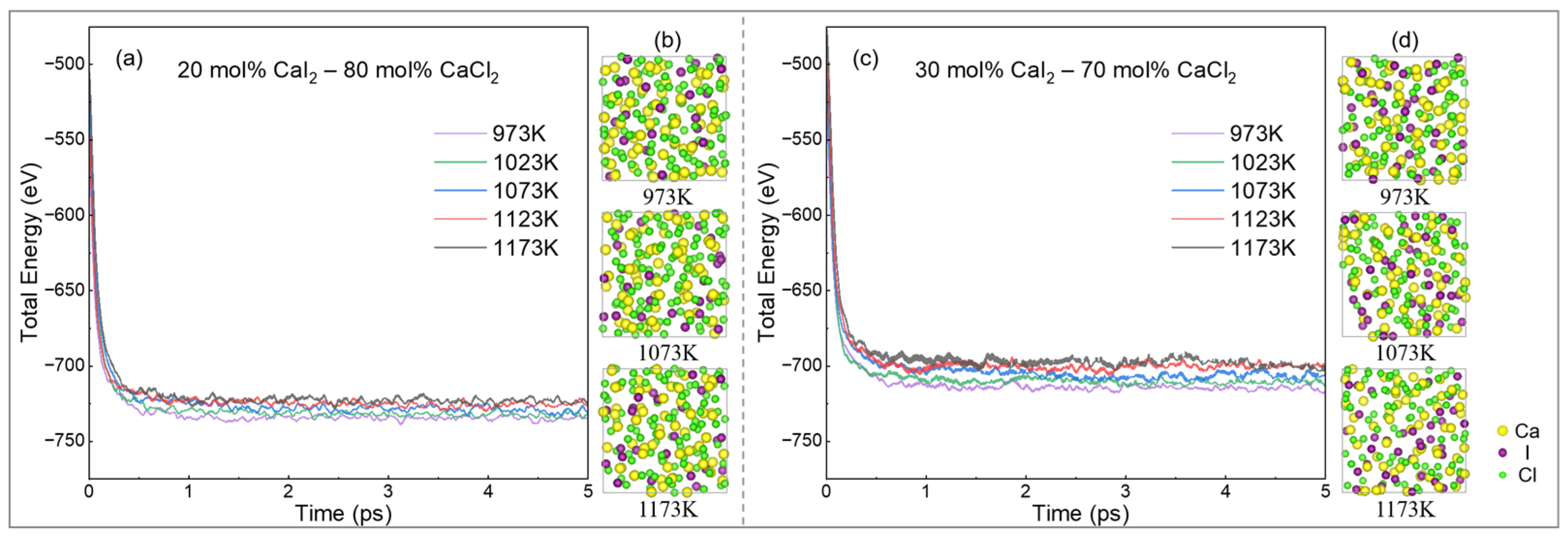
The structural stability evaluation of the molten salt system is a prerequisite for kinetic analysis. Figure 2 shows the total energy evolution and atomic structure characteristics of the CaCl2–CaI2 molten salt system under two composition ratios and different temperature conditions. Figure 2a,c show that the total energy of the system converged rapidly at the beginning of the simulation under all temperature conditions and maintained small fluctuations after reaching equilibrium. The absence of energy divergence or structural instability indicates that a simulation time of 5 ps is sufficient for the molten salt system to reach equilibrium. As the temperature increased, the total equilibrium energy of the system gradually decreased (i.e., its negative value increased), which was consistent with the trend of the energy-state variation at high temperatures. Additionally, an increase in calcium-iodide content increased the total equilibrium energy of the system.
Figure 2.
Dynamic stability of the CaCl2–CaI2 molten salt system: (a,b) total energy evolution and corresponding atomic configuration snapshots of the 20 mol% CaI2 system; (c,d) total energy evolution and corresponding atomic configuration snapshots of the 30 mol% CaI2 system.
Figure 2b,d show snapshots of the atomic configurations at the corresponding temperatures. The ions maintain a disordered liquid distribution after reaching equilibrium, with no unstable behavior such as local crystallization or phase separation. Combined with energy evolution and structural analysis, the system rapidly converged (stabilized within approximately 1–2 ps) under different composition ratios and temperature conditions, indicating the excellent structural relaxation capability and thermodynamic stability of the molten salt system.
The experimentally measured densities (Figure 1) were used to determine the lattice parameters and initial cell volumes of the FPMD simulations at each temperature and composition, ensuring that the simulated systems reproduce the correct macroscopic density. In this way, the atomistic models are directly constrained by experimental thermodynamic data, providing a physically consistent starting point for structural and dynamical analyses.
Furthermore, the experimental density shows a linear decrease with increasing temperature, reflecting thermal expansion of the molten CaCl2–CaI2 system. This macroscopic behavior is consistent with the microscopic structural evolution observed in the present simulations. As will be shown in the following RDF analysis, increasing temperature leads to a broadening of the first coordination shell and a shift in peak positions toward larger interatomic distances, indicating a weakening of short-range ordering.
Therefore, the experimental density not only provides input constraints for the simulation setup but also offers an indirect validation of the structural response obtained from the atomistic model.
The RDFs characterize the spatial distribution of specific particle pairs (i and j) in a multi-component system. The value of the function gij(r) at distance r reflects the local distribution probability of particle j relative to the reference particle i at that distance. This was calculated by statistically averaging molecular dynamics simulation trajectories, as shown in Equation (6) [48]:
where Ni denotes the total number of reference particles i; ρj represents the particle number density of particle j in the system [49]; Δr is the interval width derived from the maximum cutoff distance rmax; and ⟨nij(r)⟩ is the average number of i − j particle pairs observed within the Δr interval. The RDFs results for the CaCl2–CaI2 molten salt system obtained from the FPMD simulations after 5 ps are shown in Figure 3.
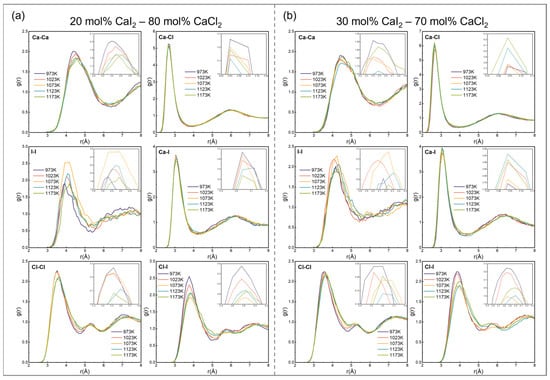
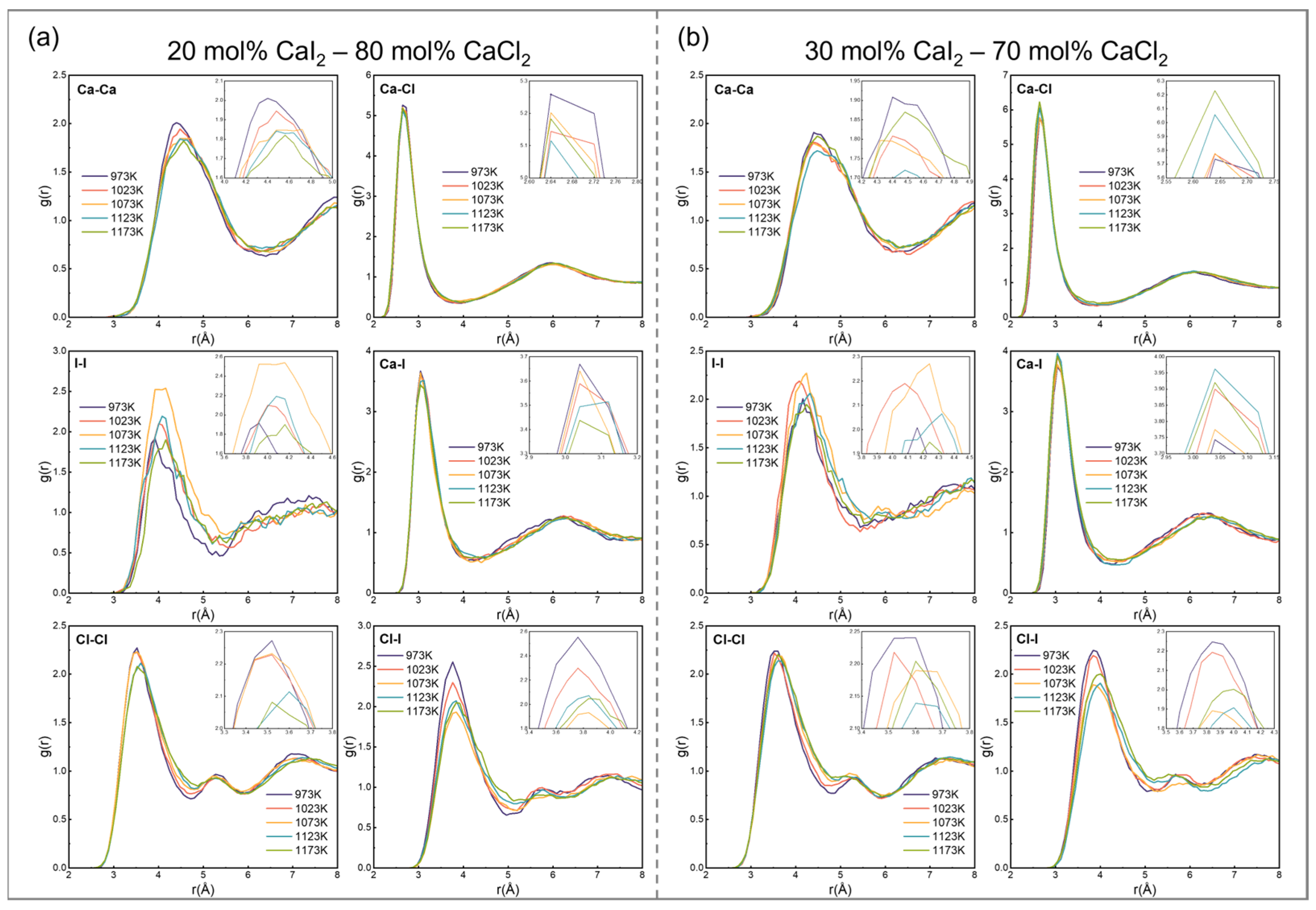
Figure 3.
The radial distribution functions of ion pairs in CaCl2–CaI2 molten salt at different CaI2 contents and temperatures are: (a) 20 mol% CaI2, (b) 30 mol% CaI2 at 973, 1023, 1073, 1123 and 1173 K.
Figure 3 shows that when the temperature increased above the melting point, the RDFs curves exhibited typical molten salt structural characteristics: oscillatory decay, highest intensity at the first coordination peak, gradual weakening as the radial distance increased, and convergence to unity, indicating short-range order and long-range disorder in the system. The RDFs peaks of anion–cation pairs (e.g., Ca-Cl and Ca-I) and like-charge ion pairs (e.g., Cl-Cl and I-I) appear alternately, suggesting a layered arrangement of cations and anions around a central ion, a structural feature dominated by Coulomb interactions. The first peak intensity of oppositely charged ion pairs (e.g., Ca-Cl) was much greater than that of like-charged pairs (e.g., Cl-Cl), reflecting stronger electrostatic attraction and a tighter coordination structure [50]. Moreover, the first peak of the anion–cation pairs occurred at a smaller radial distance, suggesting that Coulomb attraction leads oppositely charged ions to preferentially occupy the nearest-neighbor coordination shell [51]. The RDFs analysis of different ion pairs suggests that the coordination environment of similar ion types remains relatively stable. The first peak position decreased in the order of Ca-Ca > I-I > Cl-I > Cl-Cl > Ca-I > Ca-Cl, whereas the first peak intensity decreased in the order of Ca-Cl > Ca-I > I-I ≈ Cl-I > Cl-Cl > Ca-Ca. The strength, position, and steepness of the first peak indicate that the electrostatic attraction between anions and Ca2+ follows the order Cl− > I−, which is attributed to the smaller ionic radius of Cl− and its stronger Coulomb interaction with cations.
As the temperature increased from 973 to 1173 K, the first peak position of the RDFs shifted to a greater distance and the peak intensity decreased, indicating that the increase in thermal disturbance weakened the short-range order of the molten salt. This phenomenon was consistent across all ion pairs, reflecting the general perturbation effect of increasing temperature on the local structure.
When the temperature was constant, increasing the CaI2 content did not cause noticeable shifts in the first peak positions of the Ca-Cl and Ca-I RDFs curves, indicating that the equilibrium bond lengths of these anion–cation pairs were not affected by composition changes. Although the intensity of the first Ca-I peak increased slightly, its position remained stable. In contrast, the RDFs of the Cl-I and I-I ion pairs showed clear dependence on the composition. With increasing CaI2 content, the first peak shifted to greater radial distances, the peak intensity decreased progressively, and the structural order was reduced, further confirming the greater stability of the Ca-Cl bonds. Furthermore, the shoulder peaks in the Cl-Cl and Cl-I RDFs curves suggest the presence of an additional short-range ordered coordination configuration in the system, which may be owing to the formation of stable complex ion clusters such as CaCl64− by Cl− ions.
To explore the specific form of the anion–cation structure, this study systematically analyzed the coordination behavior between ions via coordination number (CN) curves, the potential of the mean force, and the bond angle distributions. The CN is defined as the average number of particles j within a sphere of radius rmin centered on the reference particle i, where rmin corresponds to the position of the first minimum in the RDFs, as shown in Equation (7):
where rmin is the position of the first minimum in the RDFs, which corresponds to the region of minimum probability between the first and second coordination shells (first and second peaks, respectively). This minimum serves as a boundary to distinguish nearest-neighbor and next-nearest-neighbor atoms.
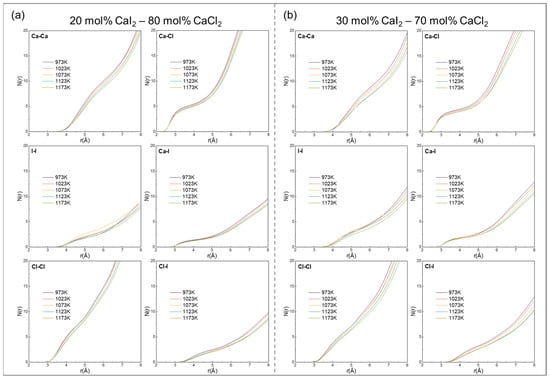
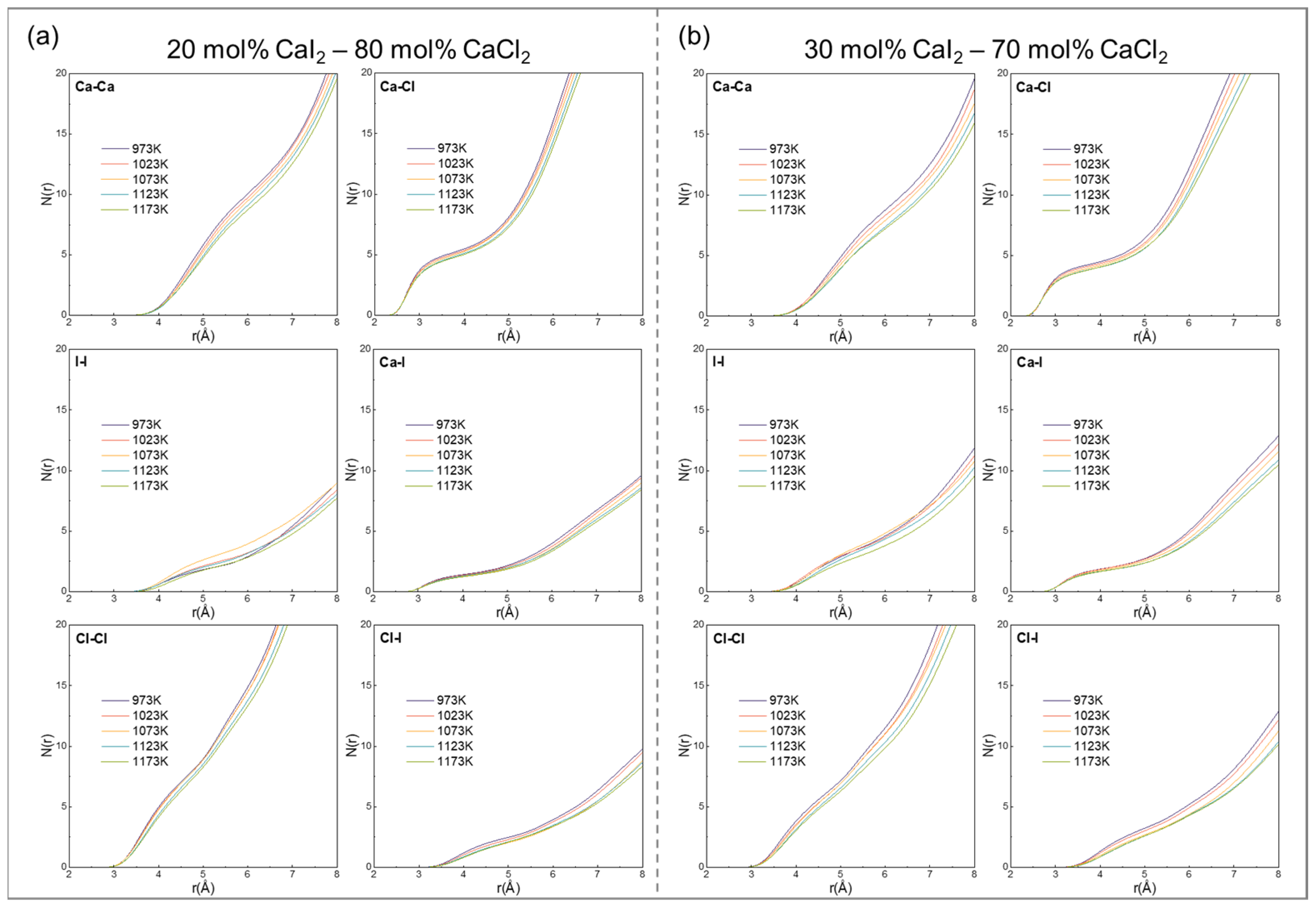
Figure 4 shows the coordination number (CN) profiles of different ion pairs in the CaCl2–CaI2 molten salt system. The CN curves for cation–anion pairs exhibit plateau-like features, where higher plateau values generally indicate stronger local ion association and more persistent coordination environments [52].
Figure 4.
The coordination number of ion pairs in CaCl2–CaI2 molten salt at different CaI2 contents and temperatures: (a) 20 mol% CaI2, (b) 30 mol% CaI2 at 973, 1023, 1073, 1123 and 1173 K.
The relative magnitudes of the CN plateaus suggest that Ca2+ tends to exhibit a stronger coordination with Cl− compared to I− under the present conditions. This difference can be qualitatively related to the smaller ionic radius of Cl− and its stronger electrostatic interaction with Ca2+.
With increasing temperature, the CN curves shift downward and the plateau values gradually decrease. For example, at 30 mol% CaI2, the plateau value for the Ca-Cl pair decreases from approximately 4.5 at 973 K to 4.0 at 1173 K, corresponding to a reduction of ~11.1%. This indicates that thermal fluctuations progressively weaken the persistence of local coordination environments and broaden the distribution of interatomic distances, leading to less well-defined coordination shells.
At a fixed temperature, an increasing CaI2 content results in modest variations in the CN plateau values. In particular, Ca-I coordination shows a slight increase, while Cl-I and I-I correlations exhibit a decrease. These trends suggest a redistribution of local coordination environments associated with changes in anion composition, reflecting a competition between different anion species in coordinating Ca2+ and thereby modifying the short-range structural organization.
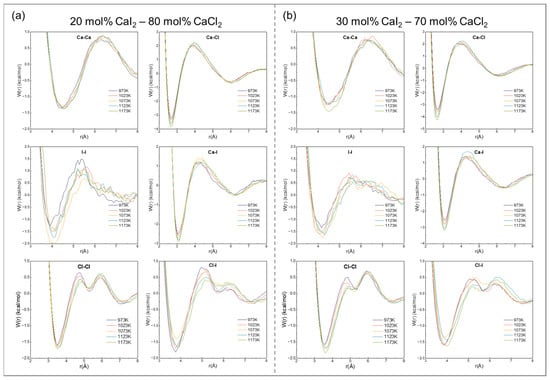
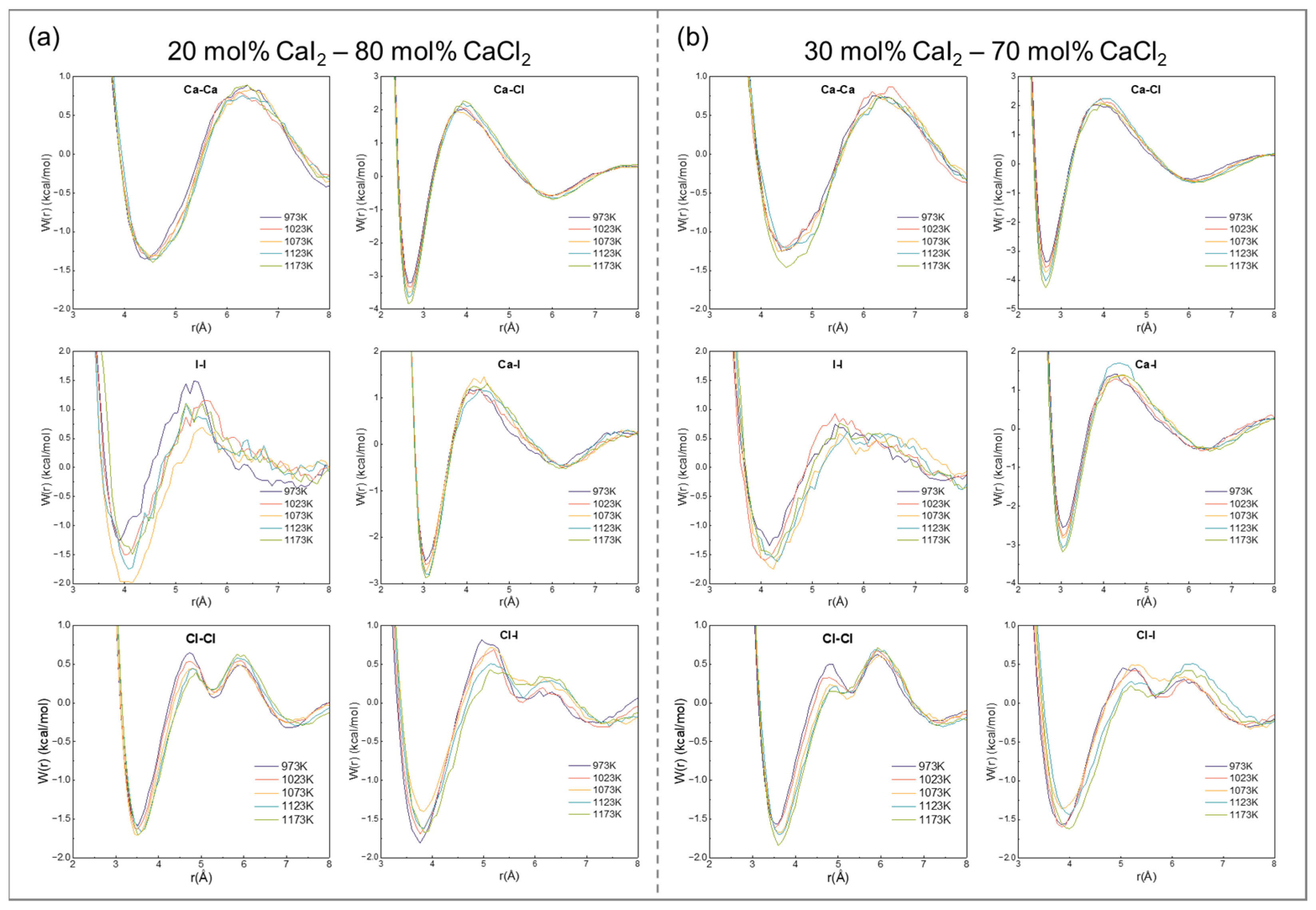
To verify the interaction mechanism between anions and cations, the RDFs was used to calculate the potential of the mean force (PMF) for the ion pairs. The PMF is calculated as follows [53,54]:
where Wijeff(r) represents the effective interaction potential between particles i and j (unit: kcal/mol), kB is the Boltzmann constant (unit: 1.3806505 × 10⁻²³ J·K−1), T is the system temperature (unit: K), and gij(r) is RDFs of the ion pair. In the PMF curve, the energy barrier between the first minimum and maximum reflects the energy required for an ion to escape from the first coordination shell. A higher barrier indicates a greater ion-pair binding stability.
Figure 5 shows the PMF curves of different ion pairs in the CaCl2–CaI2 molten salt system. The energy barrier of the PMF decreased in the order Ca-Cl > Ca-I > Ca-Ca, indicating that the interaction between Cl− and Ca2+ was the strongest, followed by I−, whereas the interaction between the Ca2+-ion pairs was the weakest. This order was consistent with the smaller ionic radius of Cl− and stronger Coulomb attraction it induces.
Figure 5.
The average force potential of ion pairs in CaCl2–CaI2 molten salt at different CaI2 contents and temperatures: (a) 20 mol% CaI2, (b) 30 mol% CaI2 at 973, 1023, 1073, 1123 and 1173 K.
As the temperature increased, the PMF energy barriers for the Ca-Cl and Ca-I pairs showed little change, indicating that thermal disturbance had a limited direct effect on the binding strength. This result further confirmed that the stability of the ion-pair interactions is governed primarily by the local coordination structure.
When the temperature was constant, increasing the CaI2 content increased the PMF energy barrier for the Ca-Cl and Ca-I pairs, indicating a weakening of the effective interionic force. This weakening occurred because a higher I− ratio intensified local coordination competition, thereby reducing the binding strength of the original ion pair.
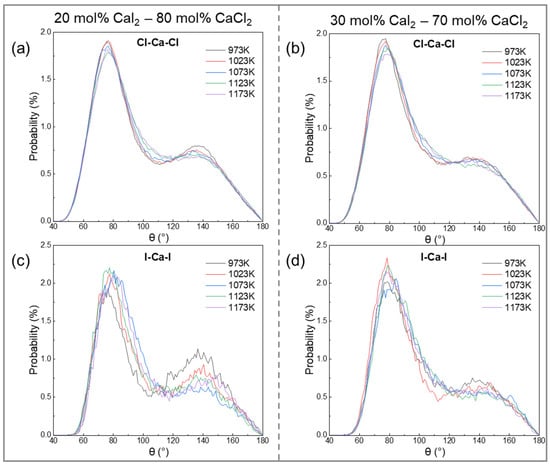
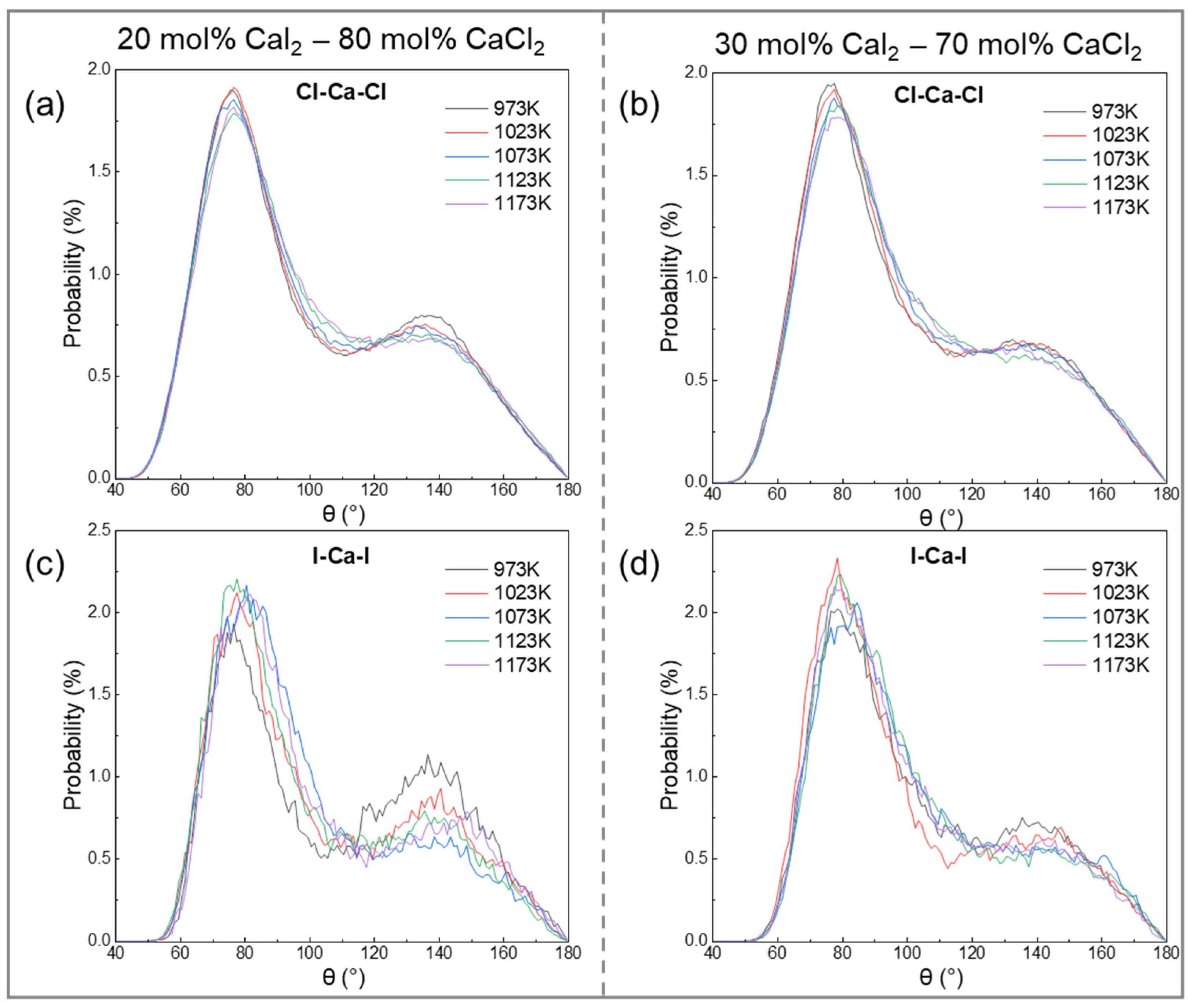
The bond angle distribution function revealed the characteristics and evolution of the anion–cation coordination configurations microscopically. This provided an effective method for determining the coordination configurations of ions. This calculation is as follows:
where i denotes a Ca2+ ion, and j and k are distinct Cl− or I− ions within a distance rmin of the Ca2+ ion.
Figure 6 shows the bond angle distributions of Cl-Ca-Cl and I-Ca-I in the CaCl2–CaI2 molten salt system. The principal peaks of both distributions lie in the range of 60–100°, with a maximum near 80°, which is slightly lower than the ideal tetrahedral or octahedral coordination angle of 90° [55]. This indicates that the coordination configuration between Ca2+ and the anions deviates from the ideal geometry, resulting in the adoption of a distorted local structure.
Figure 6.
The bond angle distribution functions of Cl-Ca-Cl and I-Ca-I in CaCl2–CaI2 molten salt at different CaI2 contents and temperatures: (a) 20 mol% CaI2 of Cl-Ca-Cl, (b) 30 mol% CaI2 of Cl-Ca-Cl, (c) 20 mol% CaI2 of I-Ca-I, (d) 30 mol% CaI2 of I-Ca-I.
As shown in Figure 6a,b, the Cl-Ca-Cl distribution exhibits a broad curve and low peak, indicating significant configurational fluctuations and low local symmetry. As the temperature increased from 973 K to 1173 K, the peak height decreased, and the distribution broadened further, reflecting enhanced bond angle fluctuations due to thermal disturbance. Increasing the CaI2 content has little effect on the peak position of the Cl-Ca-Cl distribution (offset <2°), demonstrating that the Cl− coordination mode has strong structural stability and environmental adaptability.
As shown in Figure 6c,d, although the main peak of the I-Ca-I distribution appeared at a similar angle, it was higher and sharper than that of the Cl-Ca-Cl distribution, indicating a more ordered coordination configuration between I− and Ca2+. This feature may be attributed to the steric hindrance caused by the larger ionic radius of I−, where its diffuse electron cloud constrained the bond angles into a narrower distribution. The broader broadening and greater peak reduction in the I-Ca-I distribution, compared with Cl-Ca-Cl, point to a higher sensitivity of the I− coordination to thermal disturbance. Increasing the CaI2 content increased the peak intensity and narrowed the distribution, indicating enhanced I− coordination competition and improved local structural order.
The comprehensive analysis shows that although both Cl− and I− tend to form an 80° bond angle with Ca2+, the I− coordination configuration results in a higher order and greater temperature sensitivity, whereas Cl− coordination results in greater structural stability.
4.2. Transport Properties
The mean square displacement (MSD) is a key parameter for characterizing the atomic diffusion behavior in molten salt systems. It is defined as the mean square of atomic displacement over a given time interval. The calculation is given by Equation (10):
where ri(t) is the position of particle i at time t and N is the total number of atoms in the system. When the temperature exceeds the melting point, the MSD varies linearly with time, following Einstein’s diffusion law [56], and its slope directly reflects the atomic diffusion coefficient.
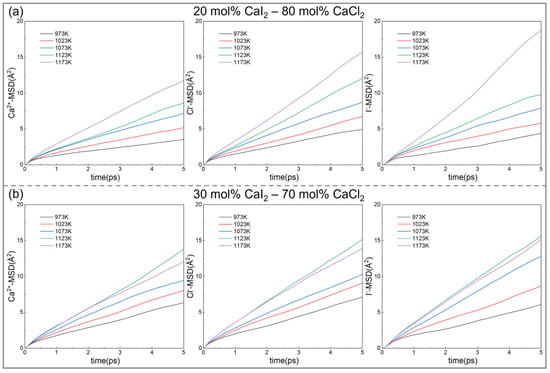
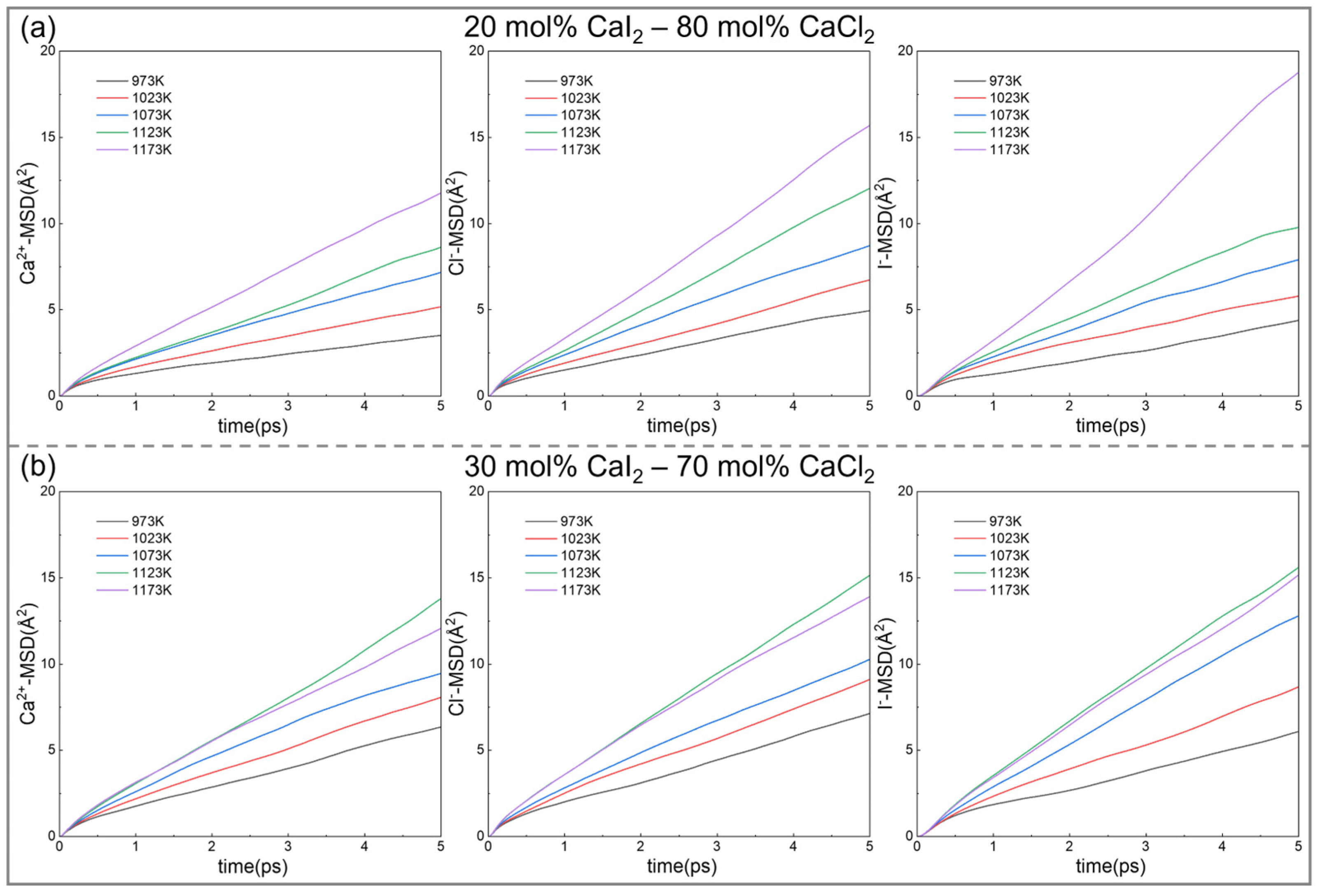
Figure 7 shows the time-dependent MSDs of Ca2+, Cl−, and I− ions in the CaCl2–CaI2 molten salt system. Under all temperature and composition conditions, the MSD increased linearly with time, which is consistent with the diffusion behavior of high-temperature melts. As the temperature increased from 973 to 1173 K, the slopes of the MSD curves for all ions increased, reflecting an enhanced atomic thermal motion and ion-migration ability.
Figure 7.
The MSD of ions in CaCl2–CaI2 molten salt at different CaI2 contents and temperatures: (a) 20 mol% CaI2, (b) 30 mol% CaI2 at 973, 1023, 1073, 1123 and 1173 K.
When the temperature was constant, increasing the CaI2 content increased the MSD slopes of the Ca2+, Cl−, and I− ions at 973–1123 K, indicating that a higher CaI2 ratio promoted ion diffusion. However, at 1173 K, the MSD slopes of Ca2+ and Cl− remained almost unchanged, whereas that of I− decreased, suggesting that the diffusion of I− was suppressed at high temperatures. This may be related to local structural rearrangements and changes in interionic interactions.
MSD analysis demonstrated that the temperature and composition significantly affected ion diffusion in the CaCl2–CaI2 molten salt system. Increasing the temperature generally enhanced ion diffusion, whereas increasing the CaI2 content promoted diffusion between 973 K and 1123 K, but suppressed I− diffusion at 1173 K.
The self-diffusion coefficient D can be expressed as follows:
where a factor of 1/6 was introduced to account for the equivalence of the six diffusion directions. Thus, the self-diffusion coefficient of a particle was calculated to one-sixth of the slope of the linear region of the MSD curve. Table 1 presents the fitted slope values and coefficients of determination (R2) for the MSD in the linear region (1–5 ps) at different temperatures for each component.
Table 1.
Fitted slope values and coefficients of determination for MSD linear regimes (1–5 ps) across temperatures for each component.
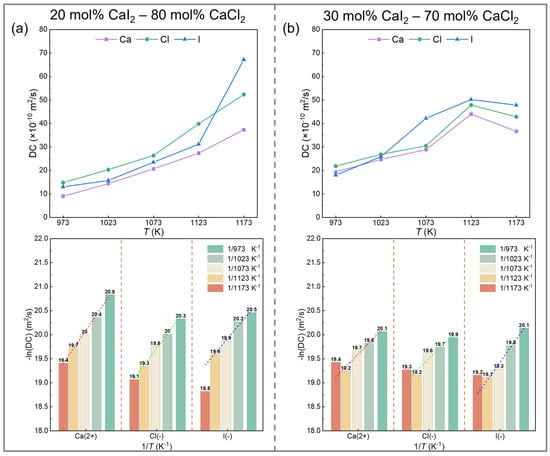
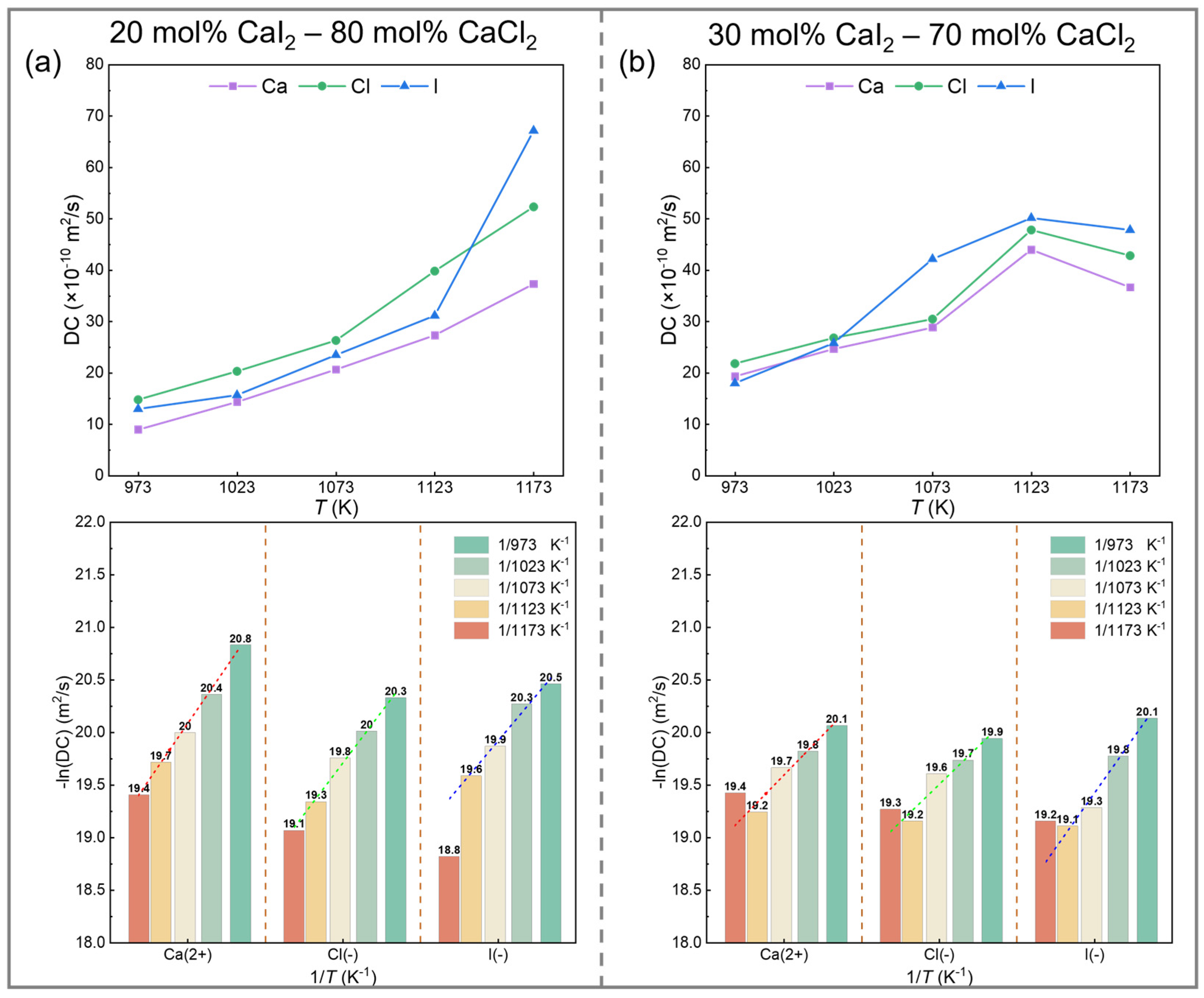
Figure 8 shows the variation in the self-diffusion coefficients of Ca2+, Cl−, and I− ions with CaI2 content in the CaCl2–CaI2 molten salt system over a temperature range of 973–1173 K. As shown in Figure 8, at a CaI2 concentration of 20 mol%, the self-diffusion coefficients followed the order D(Cl−) > D(I−) > D(Ca2+) at 973–1123 K, shifting to D(I−) > D(Cl−) > D(Ca2+) at 1173 K. At a CaI2 concentration of 30 mol%, the order of self-diffusion coefficients is D(Cl−) > D(Ca2+) > D(I−) in the temperature range of below 1023 K. When the temperature increased to 1073 K, the order was D(I−) > D(Cl−) > D(Ca2+). The above results show that the diffusion ability of I− is significantly enhanced with the increase in temperature, and its sensitivity to temperature is higher than that of Cl− and Ca2+. Increasing the CaI2 content increases the self-diffusion coefficient of all ions in the temperature range of 973–1123 K, but decreases the self-diffusion coefficient at 1173 K.
Figure 8.
The self-diffusion coefficients of ions in CaCl2–CaI2 melts at different CaI2 contents and temperatures: (a) 20 mol% CaI2, (b) 30 mol% CaI2 at 973, 1023, 1073, 1123 and 1173 K.
When the molten salt composition was fixed, the relationship between the ion self-diffusion coefficient and temperature conformed to the Arrhenius equation, as follows:
The activation energy Ea and pre-exponential factor D0 obtained by fitting are listed in Table 2. The coefficient of determination (R2) for all linear fits exceeds 0.9, suggesting that the Arrhenius model reasonably describes the temperature dependence of the diffusion coefficients within the studied range. Although the MSD curves exhibit a clear linear regime corresponding to diffusive behavior, the finite simulation time (5 ps) may introduce statistical uncertainty in the calculated diffusion coefficients. Therefore, the reported values are primarily used to analyze relative trends rather than absolute magnitudes.
Table 2.
Arrhenius parameters for ion self-diffusion at various temperatures and compositions in the CaCl2–CaI2 molten salt system (the data obtained at 1173 K were removed).
Table 2 summarizes the Arrhenius fitting parameters for ion diffusion in CaCl2–CaI2 molten salts with different compositions. The results indicate that the variation in diffusion activation energy is ion-dependent. Specifically, the activation energies of Ca2+ and Cl− decrease with increasing CaI2 content, whereas I− exhibits a weaker and non-monotonic variation. This behavior suggests that the diffusion of I− is governed by a combination of thermal activation and local structural heterogeneity arising from its distinct coordination environment. In particular, the increasing competition between Cl− and I− for coordination around Ca2+ at higher CaI2 concentrations may induce local structural frustration, which modulates ion migration pathways. The overall decrease in activation energy reflects a progressive reorganization of the local coordination structure with composition, which facilitates ion transport. Notably, the self-diffusion coefficients of Ca2+, Cl−, and I− decrease at 1173 K and 30 mol% CaI2, which may be associated with transient cluster formation and dissociation processes at elevated temperatures, indicating a possible modification of diffusion mechanisms under these specific thermodynamic conditions.
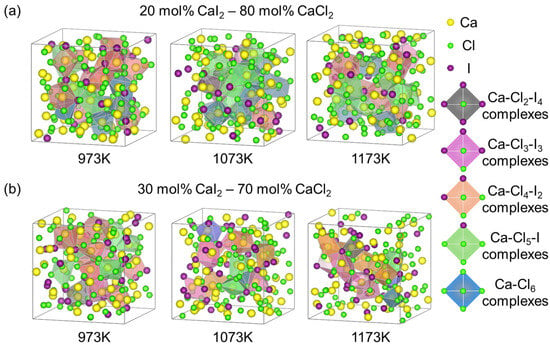
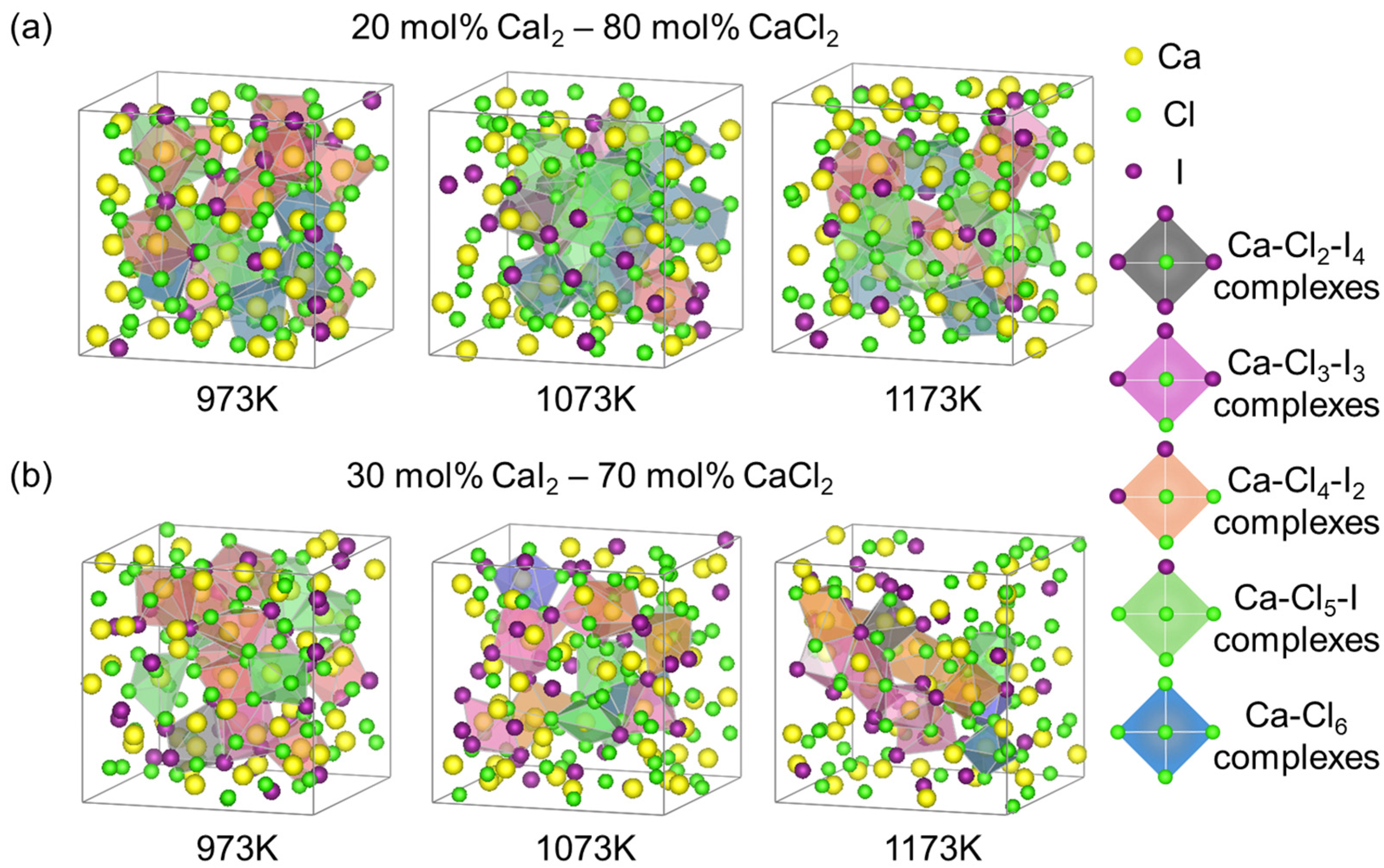
Figure 9 illustrates the evolution of Ca2+ coordination environments with temperature in the CaCl2–CaI2 mixed molten salt system. When the CaI2 content was increased to 30 mol% (Figure 9b), the relative population of Ca-Cl coordinated clusters decreased, accompanied by an increase in Ca-I coordination motifs.
Figure 9.
The local ionic structure of CaCl2–CaI2 molten salt at different CaI2 contents and temperatures: (a) 20 mol% CaI2, (b) 30 mol% CaI2 at 973, 1073 and 1173 K.
At 973 K, Ca-centered polyhedral units are mainly characterized by Ca-Cl-dominated octahedral-like coordination environments, including mixed-halide species such as CaCl5I4− and CaCl4I24− (illustrated by green and orange polyhedra in Figure 9b). As temperature increases from 973 K to 1173 K, partial substitution of Cl− by I− is observed in the first coordination shell, leading to the formation of more iodine-rich mixed coordination environments such as CaCl3I34− and CaCl2I44− (purple and gray polyhedra).
At 1173 K, iodine-containing coordination environments become more prevalent, indicating a redistribution of anion species around Ca2+ under enhanced thermal motion. This change reflects the increased configurational flexibility of the local coordination structure at elevated temperatures.
In contrast, the 20 mol% CaI2 system (Figure 9a) exhibits a more chlorine-dominated coordination environment at 973 K, where CaCl64−-like octahedral configurations are more frequently observed (blue polyhedra). With increasing temperature, I− gradually participates in the first coordination shell, leading to a progressive evolution toward mixed-halide coordination motifs.
These results highlight that both temperature and composition play important roles in modulating the local coordination environment of Ca2+ ions. The observed structural evolution is expected to influence ion transport behavior through changes in local coordination flexibility and anion distribution, although a detailed quantitative correlation requires further analysis.
From a practical perspective, intermediate CaI2 contents and moderate temperatures appear to provide a balanced coordination environment where both structural order and configurational flexibility coexist, which may be favorable for ionic transport in molten salt systems.
In studies of melt properties, the Stokes–Einstein relation describes the functional relationship between the shear viscosity and self-diffusion coefficient, as given in Equation (13):
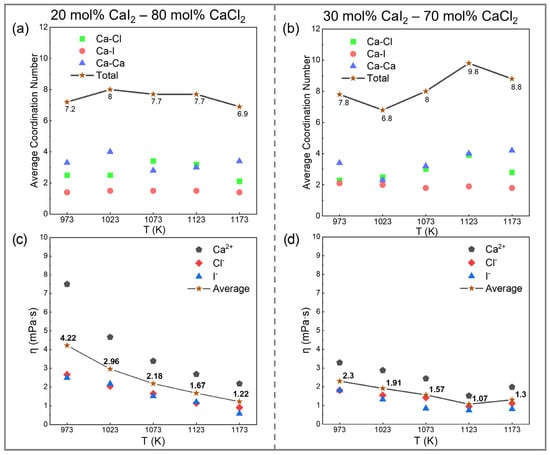
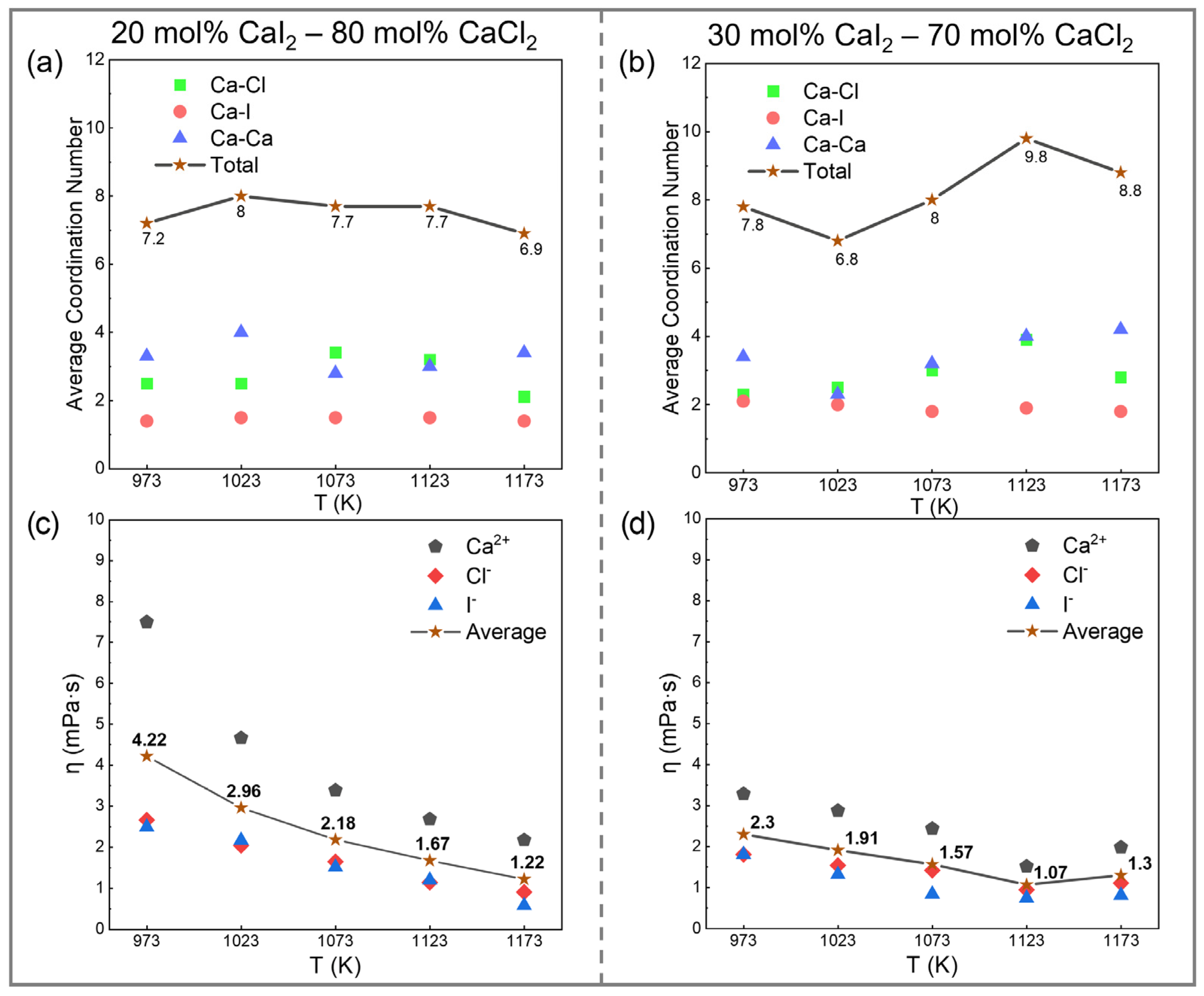
where ηi is the shear viscosity of ion i (unit: Pa·s), Ri is the ionic radius (unit: m), T is the temperature (unit: K), kB is the Boltzmann constant (unit: 1.3806505 × 10⁻²³ N·m·K−1), and Di is the ion self-diffusion coefficient (unit: m2·s−1). Table 3 lists the radii of the Ca2+, Cl−, and I− ions under different coordination states. The ion trajectory and coordination environment were calculated and analyzed, and the results are shown in Figure S1. Based on the average coordination number of Ca2+, the corresponding ionic radius was selected. Using Equation (13), the shear viscosity of individual ions and the overall system was estimated as a function of temperature, as shown in Figure 10c,d. It should be noted that the Stokes–Einstein (SE) relation is an approximate hydrodynamic model and may not be strictly valid in strongly interacting ionic systems such as molten salts, where ion–ion correlations and coordination-dependent dynamics can introduce deviations. Therefore, the viscosity values reported here should be regarded as semi-quantitative estimates, mainly useful for trend analysis. In addition, since viscosity is derived from diffusion coefficients obtained from finite simulation trajectories, it is subject to the same statistical uncertainty.
Table 3.
Radii for Ca2+, Cl−, and I− ions at different coordination states (Å).
Figure 10.
The ion coordination distribution and shear viscosity of CaCl2–CaI2 molten salt at different CaI2 contents and temperatures: (a) average CN of Ca2+ at 20 mol% CaI2 and (b) 30 mol% CaI2. (c) Shear viscosity at 20 mol% CaI2 and (d) 30 mol% CaI2.
It should be noted that the SE relation is an approximate approach based on hydrodynamic assumptions, which may not be strictly valid in strongly interacting ionic systems such as molten salts. In particular, ion–ion correlations and coordination-dependent dynamics can lead to deviations from ideal SE behavior. Therefore, the viscosity values reported here are intended to provide qualitative to semi-quantitative insights into relative trends, rather than precise absolute values.
Within this framework, the estimated results suggest that the shear viscosity of both compositions decreases with increasing temperature, showing a typical negative temperature dependence. Among different ionic species, the viscosity follows the general trend η(Ca2+) > η(Cl−) ≥ η(I−), which can be attributed to the combined influence of ionic charge and size.
Similarly, in the temperature range of 973–1123 K, the estimated viscosity tends to decrease with increasing CaI2 content, indicating enhanced fluidity. At 1173 K, a slight increase in viscosity is observed. This behavior may be related to temperature-induced structural fluctuations and transient coordination rearrangements, although further analysis is required to confirm this mechanism.
Overall, these results suggest that the incorporation of I− generally promotes fluidity in the intermediate temperature range, while its effect becomes less pronounced at higher temperatures. The consistency between structural evolution (e.g., coordination environment and RDF) and transport trends further supports the qualitative validity of this analysis.
4.3. Implications for Structural–Transport Coupling
To bridge the microscopic structural evolution with macroscopic transport behavior, the present results suggest that coordination competition between Ca-Cl and Ca-I interactions may influence the properties of the CaCl2–CaI2 molten salt system. The gradual substitution of Cl− by I− modifies the local coordination environment of Ca2+, leading to changes in polyhedral connectivity and local structural flexibility, which are likely related to variations in ion transport behavior at intermediate temperatures.
At higher I− contents and elevated temperatures, the coordination environment becomes more dynamically heterogeneous, which may transiently influence the continuity of diffusion pathways. Although only two compositions were explicitly investigated, the consistent trends observed in coordination number, PMF, diffusion coefficients, and viscosity suggest a smooth and physically continuous dependence on composition.
On this basis, a compositional design window rather than a single optimal point can be inferred. In particular, a CaI2 content in the range of approximately 20–30 mol% appears to provide a favorable balance between structural stability and ionic mobility. This indicates that the transport performance of the molten salt is likely governed by a competition between relatively rigid Ca-Cl coordination networks and more flexible Ca-I coordination environments, rather than a simple monotonic dependence on composition.
5. Conclusions
In this study, the structural evolution and transport properties of a CaCl2–CaI2 molten salt system at 973–1173 K were systematically investigated via FPMD simulations. The main conclusions are as follows:
- (1)
- The melt exhibits short-range order and long-range disorder. The coordination strength between Ca2+ and the anions follows the order Ca-Cl > Ca-I, with a distorted octahedral coordination environment. Compared with Cl-Ca-Cl, the I-Ca-I angular distribution shows relatively stronger structural ordering but higher sensitivity to temperature. Increasing CaI2 content enhances the competition between Ca-Cl and Ca-I coordination, leading to reduced ordering in Cl-I and I-I correlations, while the Ca-Cl interaction remains relatively stable. These results suggest that local coordination structure plays an important role in governing ion dynamics.
- (2)
- Ion diffusion exhibits a coupled dependence on composition and temperature. At 20 mol% CaI2, the diffusion coefficients follow D(Cl−) > D(I−) > D(Ca2+) at 973–1123 K, shifting to D(I−) > D(Cl−) > D(Ca2+) at 1173 K. When the CaI2 content increases to 30 mol%, I− shows higher mobility than Cl− over a broader temperature range, while at 1173 K, the diffusion of all ions is slightly suppressed. Arrhenius analysis indicates that an increasing CaI2 content reduces the activation energy for ion migration. Structural analysis suggests that the presence of I− modifies the local coordination environment around Ca2+, which correlates with the observed changes in diffusion behavior.
- (3)
- Based on the Stokes–Einstein relation, the shear viscosity follows η(Ca2+) > η(Cl−) ≥ η(I−). In the temperature range of 973–1123 K, the introduction of I− improves the fluidity of the molten salt. However, at 1173 K, this effect becomes less pronounced.
This study elucidates the coupled influence of temperature and composition on the structure and transport properties of CaCl2–CaI2 molten salts at the atomic scale, providing insights for the design of molten salt systems in electrochemical and nuclear applications. It should also be noted that, due to the finite simulation time (5 ps), the reported transport properties may contain statistical uncertainties and are therefore mainly discussed in terms of qualitative trends.
Supplementary Materials
The following supporting information can be downloaded at: https://www.mdpi.com/article/10.3390/ma19101988/s1, Figure S1: Ion1-Ion2 coordination number.
Author Contributions
Conceptualization, M.C., D.Y. and L.Z.; methodology, M.C., D.Y. and L.Z.; software, M.C., D.Y. and L.Z.; validation, M.C.; formal analysis, M.C.; investigation, M.C. and L.Z.; resources, L.K. and B.Y.; data curation, M.C. and D.Y.; writing—original draft preparation, M.C.; writing—review and editing, M.C. and L.Z.; visualization, M.C.; supervision, L.Z. and L.K.; project administration, L.K. and B.Y.; funding acquisition, L.K. All authors have read and agreed to the published version of the manuscript.
Funding
This research was funded by The National Natural Science Foundation of China, grant number 52374356 and The APC was funded by The National Natural Science Foundation of China.
Data Availability Statement
The original contributions presented in this study are included in the article/Supplementary Material. Further inquiries can be directed to the corresponding authors.
Conflicts of Interest
The authors declare no conflicts of interest.
Abbreviations
The following abbreviations are used in this manuscript:
| FPMD | first-principles molecular dynamics |
| CPMD | Car–Parrinello molecular dynamics |
| BOMD | Born–Oppenheimer molecular dynamics |
| DFT | Density functional theory |
| RDFs | Radial-distribution functions |
| PAW | Projected augmented wave |
| PBE | Perdew–Burke–Ernzerhof |
| LSF | Least squares fitting |
| CN | Coordination number |
| PMF | Potential of the mean force |
| MSD | Mean square displacement |
References
- Bonanos, A.M.; Georgiou, M.C.; Stokos, K.G.; Papanicolas, C.N. Engineering aspects and thermal performance of molten salt transfer lines in solar power applications. Appl. Therm. Eng. 2019, 154, 294–301. [Google Scholar] [CrossRef] [Scilit]
- Villada, C.; Jaramillo, F.; Castaño, J.G.; Echeverria, F.; Bolivar, F. Design and development of nitrate–nitrite based molten salts for concentrating solar power applications. Sol. Energy 2019, 188, 291–299. [Google Scholar] [CrossRef] [Scilit]
- Slim, C.; Baklouti, L.; Cassir, M.; Ringuedé, A. Structural and electrochemical performance of gadolinia–doped ceria mixed with alkali chlorides (LiCl–KCl) for Intermediate Temperature–Hybrid Fuel Cell applications. Electrochim. Acta 2014, 123, 127–134. [Google Scholar] [CrossRef] [Scilit]
- Zhang, J.; Fang, S.; Qi, X.P.; Yu, Z.L.; Wu, Z.H.; Yang, J.Y.; Lu, S.G. Preparation of high–purity straight silicon nanowires by molten salt electrolysis. J. Energy Chem. 2020, 40, 171–179. [Google Scholar] [CrossRef] [Scilit]
- Porter, T.; Vaka, M.M.; Steenblik, P.; Della Corte, D. Computational methods to simulate molten salt thermophysical properties. Commun. Chem. 2022, 5, 69. [Google Scholar] [CrossRef] [Scilit]
- Liu, X.Q.; Liang, F.; Liu, S.L.; Pan, G.C.Q.; Ding, J.; Lu, J.F. NaCl–KCl–CaCl2 molten salts for high temperature heat storage: Experimental and deep learning molecular dynamics simulation study. Sol. Energy Mater. Sol. Cells 2025, 280, 113275. [Google Scholar] [CrossRef] [Scilit]
- Lu, J.F.; Yang, S.F.; Pan, G.C.Q.; Ding, J.; Liu, S.L.; Wang, W.L. Thermal and transport properties of molten chloride salts with polarization effect on microstructure. Energies 2021, 14, 746. [Google Scholar] [CrossRef] [Scilit]
- Chen, C.F.; Cheng, Y.C.; Hong, C.W. First principles molecular dynamics computation on ionic transport properties in molten salt materials. Comput. Model. Eng. Sci. 2015, 109–110, 263–283. [Google Scholar] [CrossRef]
- Becker, S.; Meyer, N.; Xu, H.; Wax, J.F. Viscosity of liquid Na–K alloys from molecular dynamics simulations. J. Phys. Condens. Matter 2020, 32, 194005. [Google Scholar] [CrossRef] [Scilit] [PubMed]
- Gygi, F. Large–scale first–principles molecular dynamics: Moving from terascale to petascale computing. J. Phys. Conf. Ser. 2006, 46, 268–277. [Google Scholar] [CrossRef] [Scilit]
- Xu, J.T.; Wang, Y.L.; Yao, B.L.; Jia, Y.H.; Xiao, Y.Q.; Zhang, L.; Li, B.; He, H.; Yue, B.H.; Yan, L.M. Molecular dynamics study of local structure and migration properties of LiCl–Li2O–Li molten salts based on machine–learned deep potential. Nucl. Eng. Des. 2025, 438, 114052. [Google Scholar] [CrossRef] [Scilit]
- Patange, S.R.; Sutar, P.R.; Yadav, G.D. New frontiers in thermal energy storage: An experimental analysis of thermophysical properties and thermal stability of a novel ternary chloride molten salt. Sol. Energy Mater. Sol. Cells 2024, 271, 112866. [Google Scholar] [CrossRef] [Scilit]
- Woodcock, L.V.; Singer, K. Thermodynamic and structural properties of liquid ionic salts obtained by Monte Carlo computation. Part 1.—Potassium chloride. Trans. Faraday Soc. 1971, 67, 12–30. [Google Scholar] [CrossRef] [Scilit]
- Sangster, M.J.L.; Dixon, M. Interionic potentials in alkali halides and their use in simulations of the molten salts. Adv. Phys. 1976, 25, 247–342. [Google Scholar] [CrossRef] [Scilit]
- Tang, K.T.; Toennies, J.P. An improved simple model for the van der Waals potential based on universal damping functions for the dispersion coefficients. J. Chem. Phys. 1984, 80, 3726–3741. [Google Scholar] [CrossRef] [Scilit]
- Fowler, P.W.; Madden, P.A. Fluctuating dipoles and polarizabilities in ionic materials: Calculations on LiF. Phys. Rev. B 1985, 31, 5443. [Google Scholar] [CrossRef] [Scilit]
- Car, R.; Parrinello, M. Unified approach for molecular dynamics and density–functional theory. Phys. Rev. Lett. 1985, 55, 2471. [Google Scholar] [CrossRef] [Scilit] [PubMed]
- Barnett, R.N.; Landman, U. Born-Oppenheimer molecular–dynamics simulations of finite systems: Structure and dynamics of (H2O)2. Phys. Rev. B 1993, 48, 2081. [Google Scholar] [CrossRef] [Scilit] [PubMed]
- Kresse, G.; Hafner, J. Ab initio molecular dynamics for liquid metals. Phys. Rev. B 1993, 47, 558. [Google Scholar] [CrossRef] [Scilit]
- Rowley, A.J.; Jemmer, P.; Wilson, M.; Madden, P.A. Evaluation of the many–body contributions to the interionic interactions in MgO. J. Chem. Phys. 1998, 108, 10209–10219. [Google Scholar] [CrossRef] [Scilit]
- Aguado, A.; Bernasconi, L.; Jahn, S.; Madden, P.A. Multipoles and interaction potentials in ionic materials from planewave–DFT calculations. Faraday Discuss. 2003, 124, 171–184. [Google Scholar] [CrossRef] [Scilit]
- Hazebroucq, S.; Picard, G.S.; Adamo, C.; Heine, T.; Gemming, S.; Seifert, G. Density–functional–based molecular–dynamics simulations of molten salts. J. Chem. Phys. 2005, 123, 134510. [Google Scholar] [CrossRef] [Scilit]
- Madden, P.A.; Heaton, R.; Aguado, A.; Jahn, S. From first–principles to material properties. J. Mol. Struct. THEOCHEM 2006, 771, 9–18. [Google Scholar] [CrossRef] [Scilit]
- Jones, R.O. Density functional theory: Its origins; rise to prominence, and future. Rev. Mod. Phys. 2015, 87, 897–923. [Google Scholar] [CrossRef] [Scilit]
- Biggin, S.; Enderby, J.E. The structure of molten calcium chloride. J. Phys. C Solid State Phys. 1981, 14, 3577. [Google Scholar] [CrossRef] [Scilit]
- Klix, A.; Suzuki, A.; Terai, T. Study of tritium migration in liquid Li2BeF4 with ab initio molecular dynamics. Fusion Eng. Des. 2006, 81, 713–717. [Google Scholar] [CrossRef] [Scilit]
- Corradini, D.; Marrocchelli, D.; Madden, P.A.; Salanne, M. The effect of dispersion interactions on the properties of LiF in condensed phases. J. Phys. Condens. Matter 2014, 26, 244103. [Google Scholar] [CrossRef] [Scilit]
- Anderson, M.; Sridharan, K.; Morgan, D.; Peterson, P.; Calderoni, P.; Scheele, R.; Casekka, A.; McNamara, B. Heat Transfer Salts for Nuclear Reactor Systems—Chemistry Control, Corrosion Mitigation, and Modeling; University of Wisconsin: Madison, WI, USA; University of California: Berkeley, CA, USA; Pacific Northwest National Lab (PNNL): Richland, WA, USA, 2015. [Google Scholar]
- Guo, H.; Li, J.; Zhang, H.; Li, T.; Luo, J.; Yu, X.; Wu, S.; Zong, C. First–principles molecular dynamics investigation on KF–NaF–AlF3 molten salt system. Chem. Phys. Lett. 2019, 730, 587–593. [Google Scholar] [CrossRef] [Scilit]
- Li, X.; Liu, W.; Tang, Z.; Xu, T.; Wang, J. Insight into dynamic interaction of molten MgCl2–NaCl–KCl with impurity water via FPMD simulations. J. Mol. Liq. 2020, 314, 113596. [Google Scholar] [CrossRef] [Scilit]
- Luo, X.; Ling, C.; Xu, T.; Liu, W.; Tang, Z. Thermophysical property and micro–structure of the molten NaCl–KCl–CaCl2 salt at high temperature by FPMD simulation. Sol. Energy Mater. Sol. Cells 2025, 288, 113630. [Google Scholar] [CrossRef] [Scilit]
- Kresse, G.; Furthmüller, J. Efficiency of ab initio total energy calculations for metals and semiconductors using a plane–wave basis set. Comput. Mater. Sci. 1996, 6, 15–50. [Google Scholar] [CrossRef] [Scilit]
- Kresse, G.; Furthmüller, J. Efficient iterative schemes for ab initio total–energy calculations using a plane–wave basis set. Phys. Rev. B 1996, 54, 11169. [Google Scholar] [CrossRef] [Scilit]
- Clark, S.J.; Segall, M.D.; Pickard, C.J.; Hasnip, P.J.; Probert, M.I.J.; Refson, K.; Payne, M.C. First principles methods using CASTEP. Z. Für Krist. 2005, 220, 567–570. [Google Scholar] [CrossRef] [Scilit]
- Wang, V.; Xu, N.; Liu, J.C.; Tang, G.; Geng, W.T. VASPKIT: A user–friendly interface facilitating high–throughput computing and analysis using VASP code. Comput. Phys. Commun. 2021, 267, 108033. [Google Scholar] [CrossRef] [Scilit]
- Blöchl, P.E. Projector augmented–wave method. Phys. Rev. B 1994, 50, 17953. [Google Scholar] [CrossRef] [Scilit] [PubMed]
- Kresse, G.; Joubert, D. From ultrasoft pseudopotentials to the projector augmented–wave method. Phys. Rev. B 1999, 59, 1758. [Google Scholar] [CrossRef] [Scilit]
- Dixon, M.; Gillan, M.J. Structure of molten alkali chlorides: I. A molecular dynamics study. Philos. Mag. B 1981, 43, 1099–1112. [Google Scholar] [CrossRef] [Scilit]
- Perdew, J.P.; Burke, K.; Ernzerhof, M. Generalized gradient approximation made simple. Phys. Rev. Lett. 1996, 77, 3865. [Google Scholar] [CrossRef] [Scilit]
- Hafner, J. Ab-initio simulations of materials using VASP: Density-functional theory and beyond. J. Comput. Chem. 2008, 29, 2044–2078. [Google Scholar] [CrossRef] [Scilit]
- Nosé, S. A unified formulation of the constant temperature molecular dynamics methods. J. Chem. Phys. 1984, 81, 511–519. [Google Scholar] [CrossRef] [Scilit]
- Nosé, S. A molecular dynamics method for simulations in the canonical ensemble. Mol. Phys. 1984, 52, 255–268. [Google Scholar] [CrossRef] [Scilit]
- Becke, A.D.; Johnson, E.R. Exchange–hole dipole moment and the dispersion interaction revisited. J. Chem. Phys. 2007, 127, 154108. [Google Scholar] [CrossRef] [Scilit]
- Grimme, S.; Antony, J.; Ehrlich, S.; Krieg, H. A consistent and accurate ab initio parametrization of density functional dispersion correction (DFT–D) for the 94 elements H–Pu. J. Chem. Phys. 2010, 132, 154104. [Google Scholar] [CrossRef] [Scilit]
- Grjotheim, K.; Holm, J.L.; Lillebuen, B.; Øye, H.A. Densities and excess molar volumes of binary and ternary melts of MgCl2, CaCl2 and AlkCl. Trans. Faraday Soc. 1971, 67, 640–648. [Google Scholar] [CrossRef] [Scilit]
- Ito, H.; Hasegawa, Y.; Ito, Y. Densities of eutectic mixtures of molten alkali chlorides below 673 K. J. Chem. Eng. Data 2001, 46, 1203–1205. [Google Scholar] [CrossRef] [Scilit]
- Kozyrev, N.V.; Gordeev, V.V. Thermodynamic Properties and Equation of State for Tungsten. Crystals 2023, 13, 1470. [Google Scholar] [CrossRef] [Scilit]
- Deng, P.; Li, L.; Jia, Y.Q.; Jang, W.L.; Liu, D.C.; Chen, X.M.; Kong, L.X. First-Principles Molecular Dynamics Study on Ionic Structure and Transport Properties of NaCl-MgCl2-CaCl2 Ternary Molten Salt System. Adv. Theory Simul. 2023, 6, 2200833. [Google Scholar] [CrossRef] [Scilit]
- Lv, X.J.; Han, Z.X.; Zhang, H.X.; Liu, Q.S.; Chen, J.G.; Jiang, L.X. Ionic structure and transport properties of KF–NaF–AlF3 fused salt: A molecular dynamics study. Phys. Chem. Chem. Phys. 2019, 21, 7474–7482. [Google Scholar] [CrossRef] [Scilit]
- Wang, J.; Wu, J.; Lu, G.M.; Yu, J.G. Molecular dynamics study of the transport properties and local structures of molten alkali metal chlorides. Part III. Four binary systems LiCl–RbCl, LiCl–CsCl, NaCl–RbCl and NaCl–CsCl. J. Mol. Liq. 2017, 238, 236–247. [Google Scholar] [CrossRef] [Scilit]
- Wang, J.; Sun, Z.; Lu, G.M.; Yu, J.G. Molecular dynamics simulations of the local structures and transport coefficients of molten alkali chlorides. J. Phys. Chem. B 2014, 118, 10196–10206. [Google Scholar] [CrossRef] [Scilit]
- Fan, H.L.; Chen, D.F.; Liu, P.; Duan, H.M.; Huang, Y.W.; Long, M.J.; Liu, T. Structural and transport properties of FeO–TiO2 system through molecular dynamics simulations. J. Non-Cryst. Solids 2018, 493, 57–64. [Google Scholar] [CrossRef] [Scilit]
- Roy, S.; Brehm, M.; Sharma, S.; Wu, F.; Maltsev, D.S.; Halstenberg, P.; Gallington, L.C.; Mahurin, S.M.; Dai, S.; Ivanov, A.S.; et al. Unraveling local structure of molten salts via X–ray scattering, Raman spectroscopy, and ab initio molecular dynamics. J. Phys. Chem. B 2021, 125, 5971–5982. [Google Scholar] [CrossRef] [Scilit]
- Roy, S.; Sharma, S.; Karunaratne, W.V.; Wu, F.; Gakhar, R.; Maltsev, D.S.; Halstenberg, P.; Abeykoon, M.; Gill, S.K.; Zhang, Y.; et al. X–ray scattering reveals ion clustering of dilute chromium species in molten chloride medium. Chem. Sci. 2021, 12, 8026–8035. [Google Scholar] [CrossRef] [Scilit]
- Liang, W.S.; Wu, J.; Ni, H.O.; Lu, G.M.; Yu, J.G. First–principles molecular dynamics simulations on the local structure and thermokinetic properties of molten magnesium chloride. J. Mol. Liq. 2020, 298, 112063. [Google Scholar] [CrossRef] [Scilit]
- Song, B.Y.; Xu, N.; Jiang, W.L.; Yang, B.; Chen, X.; Xu, B.; Kong, L.; Liu, D.; Dai, Y. Study on azeotropic point of Pb–Sb alloys by ab initio molecular dynamic simulation and vacuum distillation. Vacuum 2016, 125, 209–214. [Google Scholar] [CrossRef] [Scilit]

Disclaimer/Publisher’s Note: The statements, opinions and data contained in all publications are solely those of the individual author(s) and contributor(s) and not of MDPI and/or the editor(s). MDPI and/or the editor(s) disclaim responsibility for any injury to people or property resulting from any ideas, methods, instructions or products referred to in the content. |
© 2026 by the authors. Licensee MDPI, Basel, Switzerland. This article is an open access article distributed under the terms and conditions of the Creative Commons Attribution (CC BY) license.