This is an early access version, the complete PDF, HTML, and XML versions will be available soon.
Article

Research on Tin Bath Bottom Bricks for Float Glass Furnaces

1
School of Energy Science and Engineering, Central South University, Changsha 410083, China
2
School of Materials Science and Engineering, Shanghai University, Shanghai 200444, China
3
State Key Laboratory of Advanced Refractories, Shanghai University, Shanghai 200444, China
*
Author to whom correspondence should be addressed.
Materials 2026, 19(10), 1989; https://doi.org/10.3390/ma19101989
Submission received: 24 March 2026 / Revised: 7 May 2026 / Accepted: 8 May 2026 / Published: 11 May 2026
(This article belongs to the Section Construction and Building Materials)

Abstract

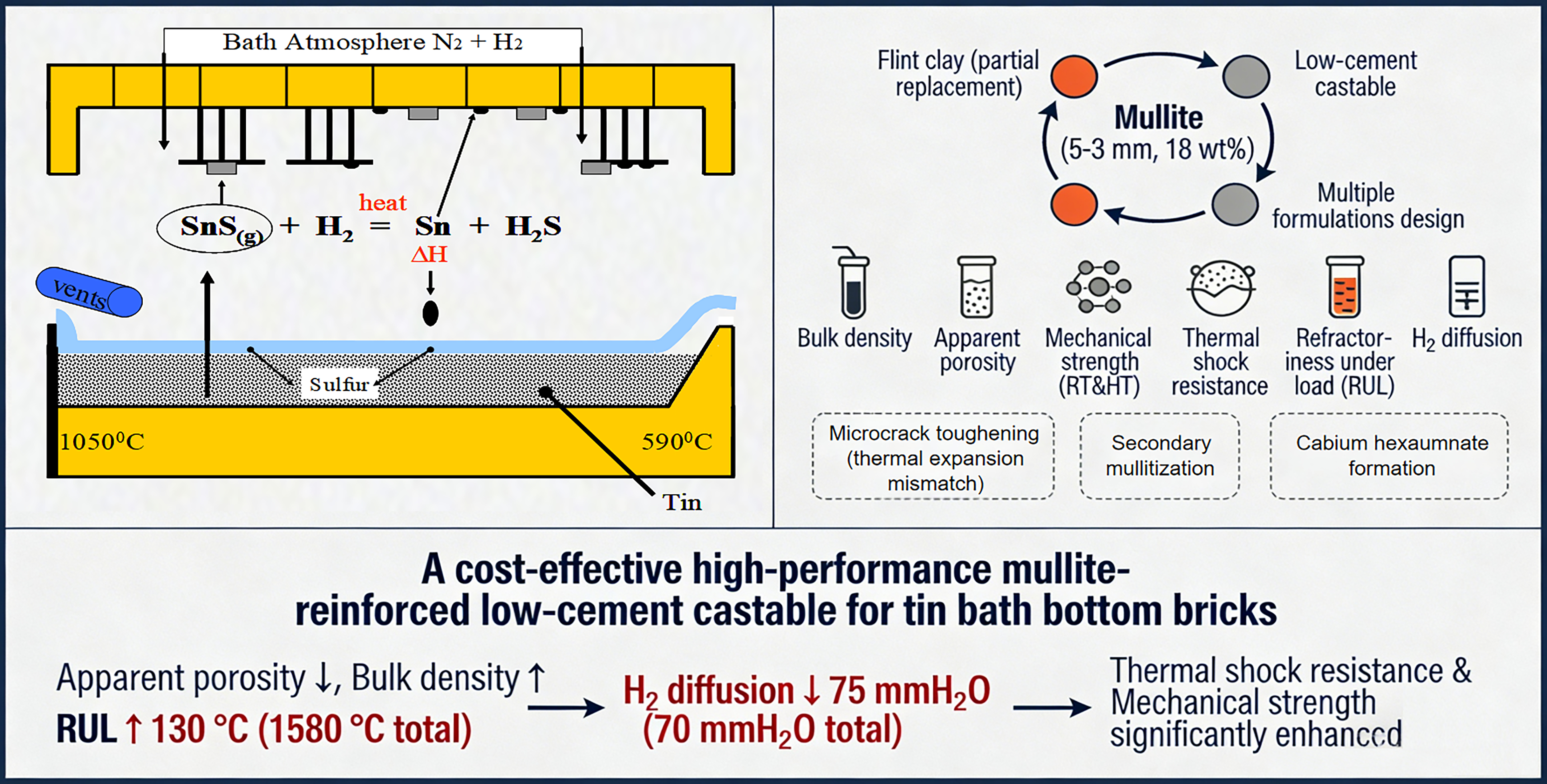
The bottom brick is a critical component of float glass furnace tin baths, serving under harsh conditions including high temperature, tin penetration, hydrogen diffusion and alkali attack. Traditional flint clay-based bottom bricks suffer from high porosity and insufficient service performance. In this study, a high-performance low-cement castable was developed by introducing mullite aggregates to partially replace flint clay. The effects of mullite particle size and addition content on sintering behavior, mechanical properties, thermal shock resistance, refractoriness under load and hydrogen diffusion were systematically investigated. The results demonstrate that, compared with the existing tin bath bottom bricks applied in float glass furnaces, the introduction of 18 wt% mullite with a particle size of 5–3 mm can significantly increase the bulk density, reduce the apparent porosity, enhance the mechanical strength at both room temperature and high temperature, and achieve a higher refractoriness under load and lower hydrogen diffusion capacity. Accordingly, a novel tin bath bottom brick with excellent comprehensive properties for float glass furnaces was successfully developed.
Keywords: mullite; low-cement castable; thermal shock resistance; mechanical properties; float glass furnace mullite; low-cement castable; thermal shock resistance; mechanical properties; float glass furnace
Graphical Abstract