


Abstract
Addressing the problem of limited methane (CH4) recovery degree under different production conditions in a target low-permeability carbonate gas reservoir, this study intends to further investigate the effect of carbon dioxide (CO2) injection on enhanced gas recovery (EGR). A group of long-core physical simulation experiments of CO2 injection for EGR was adopted. Field injection–production parameters were converted to laboratory conditions through similarity criteria to simulate the actual production process of gas wells. Systematic experiments on CH4 depletion and CO2 displacement were carried out under different irreducible water saturation, gas injection timing pressure and injection rates. The influence laws of each key parameter on the CO2 breakthrough time and CH4 recovery degree were analyzed emphatically, and the optimal injection–production scheme was obtained. For the target low-permeability carbonate gas reservoir (permeability < 1 mD), the optimal CO2 injection scheme is as follows: for layers with medium to high irreducible water saturation (≥40%), CO2 injection at a rate of 36,000 m3/d per well after the end of stable production (formation pressure > 7.38 MPa) can increase the CH4 recovery degree by 3–5%. This study provides experimental support for the optimization of CO2 injection schemes for enhanced recovery in gas reservoirs and the adjustment of gas reservoir development strategies under different irreducible water saturation conditions.
1. Introduction
After depletion production of conventional gas reservoirs, the remaining natural gas is difficult to recover by conventional methods (well pattern infill, pressure-depletion production, dewatering and gas lifting) [1]. Injecting CO2 (carbon dioxide) into developed reservoirs to enhance gas recovery (EGR) is one of the enhanced, aggressive techniques for improving recovery. The concept of CO2 injection to enhance gas recovery (CO2-EGR) was proposed in the 1990s, and the team led by Oldenburg at the Lawrence Berkeley National Laboratory first established a complete theoretical and numerical modeling framework in 2001 [2,3], thereby formally laying the academic foundation for CO2-EGR technology [4,5,6]. Numerous subsequent researchers have further refined the theory, clarified reservoir CO2-injection recovery mechanisms (such as miscible/immiscible displacement, gravity segregation, dissolution-driven relative permeability modification, and competitive adsorption) and conducted reservoir case simulations to advance the technology toward field application.
CO2-EGR field implementations have produced few landmark projects, including the K12-B depleted sandstone gas reservoir (Netherlands), the Altmark sandstone gas field (Germany), and the Budafa fractured carbonate gas field (Hungary). China’s CO2-EGR technology is overall at the pilot-test stage [7], with sites including the Wolonghe depleted carbonate gas reservoir in Sichuan, the Puguang high-sulfur carbonate gas field, the Sulige tight gas field in Changqing, and the Fushan condensate oil-and-gas reservoir in Hainan. Overall, field implementation projects remain limited, and the mechanisms and effectiveness of CO2 injection for enhanced gas recovery (CO2-EGR) require further research and evaluation.
The existing studies have verified the technical feasibility of CO2-EGR [8,9]. Supercritical carbon dioxide exhibits characteristics such as a smaller diffusion coefficient, higher density, and greater viscosity, relative to methane under the same temperature and pressure conditions. The mechanisms of CO2 injection for enhanced gas recovery in conventional gas reservoirs mainly include pressure support and displacement and water dissolution and permeability enhancement [10,11]. Pressure support and displacement means that injected CO2 rapidly replenishes the formation energy and increases the reservoir pressure, driving the CH4 retained in pores to migrate toward production wells and enhancing displacement power. CO2 and CH4 are completely miscible under reservoir conditions; however, supercritical CO2 has lower diffusivity and higher viscosity than CH4. A miscible zone is formed through molecular diffusion and convective dispersion, gradually displacing CH4 from the pore space. Water dissolution and permeability enhancement refers to the fact that part of the injected CO2 dissolves in irreducible water, reducing the CO2 dispersion coefficient. The CO2–water–rock interaction improves flow pathways and enhances the gas phase flow capacity, allowing for more CH4 to be effectively displaced. For CO2 enhanced gas recovery (CO2-EGR) in conventional gas reservoirs, the key controlling parameters include the reservoir irreducible water saturation, CO2 injection pressure, and injection rate, which govern the miscibility degree between CO2 and CH4, CO2 breakthrough time, and CH4 recovery. This paper systematically reviews the laboratory and simulation research progress of CO2-EGR. Table 1 summarizes the existing studies on the effects of irreducible water saturation, gas injection timing pressure, and gas injection rate/injection–production ratio on CH4 recovery and CO2 breakthrough time.
1.1. Irreducible Water Saturation
The effect of irreducible water saturation on CH4 recovery by CO2 injection is controversial.
On one hand, some scholars argue that increasing the irreducible water saturation significantly reduces CH4 recovery and accelerates CO2 breakthrough. The reason is that high irreducible water saturation occupies micro- and small pores, increases the tortuosity of the pore structure, enlarges the CO2 dispersion coefficient, intensifies gas mixing, and leads to early CO2 breakthrough [6,12,13,14].
On the other hand, other scholars propose that increasing the irreducible water saturation improves CH4 recovery and delays CO2 breakthrough. The reason is that high irreducible water saturation occupies narrow pore throats, forcing gas to flow uniformly along large pore channels, reducing reservoir heterogeneity. In addition, CO2 dissolution in residual water shortens the mixing zone, decreases the CO2 dispersion coefficient, and delays CO2 breakthrough [15,16,17,18,19,20,21,22].
1.2. CO2 Injection Timing Pressure
“CO2 Injection Timing Pressure” refers to the reservoir pressure at the time of CO2 injection. Studies on CO2 injection timing pressure can be divided into two categories.
Some scholars did not consider the reservoir depletion process and directly conducted displacement experiments at different pressures. They used CH4 recovery and CO2 breakthrough time obtained from simple displacement as the criteria for determining the optimal CO2 injection timing pressure. Results from these studies show that a higher injection timing pressure leads to better recovery enhancement and longer breakthrough time. The reason is that as the pressure increases, the dispersion coefficient of CO2 decreases, and the mixing zone between CO2 and CH4 becomes narrower, resulting in higher recovery [5,8,21,23,24,25,26,27].
Other scholars considered the reservoir depletion process and performed CO2 injection after depleting the gas reservoir to different pressure levels. They used the sum of depletion recovery and incremental recovery by CO2 injection as the ultimate CH4 recovery and the criterion for the optimal reservoir pressure at injection. Results show that gas injection in the late stage of depletion, when reservoir pressure is relatively low, maximizes the ultimate gas recovery. Although CO2 injection at an early stage improves incremental recovery by CO2 to a high extent, it fails to fully utilize the natural elastic energy of the reservoir and causes early gas quality contamination by CO2, resulting in lower ultimate recovery [2,4,28,29,30,31].
1.3. Gas Injection Rate or Injection–Production Ratio
Studies on the CO2 injection rate can be divided into two categories.
Some scholars believe that a higher injection rate can improve CH4 recovery. High-rate injection is beneficial because it rapidly replenishes the reservoir energy, maintains stable pressure, reduces the excessive mixing of CO2 and CH4, and thus lowers the degree of gas contamination. In contrast, at low injection rates, diffusion dominates and convective displacement is weak, allowing the CO2 and CH4 to mix thoroughly and form a wide miscible zone, which reduces CH4 recovery [16,21,22,29,32,33,34].
Other scholars argue that low injection rates reduce gas dispersion coefficients, prolong contact time between gas and irreducible water, enhance CO2 dissolution and gravitational differentiation, and improve displacement front stability, thereby delaying CO2 breakthrough and increasing CH4 recovery. However, high injection rates intensify mixing and cause an early CO2 breakthrough, thus reducing CH4 recovery [25,30,35,36,37].
Overall, the existing studies have investigated the mechanisms and influencing parameters of CO2-EGR. However, most experiments have not been scaled according to actual field development conditions, and the parameters used are not representative of the field reality. Most of the enhanced recovery factors reported in previous experiments were either based on depletion experiments or did not involve the depletion process at all, without a direct comparison with concurrent depletion experiments (Table 1). This leads to deviations in the final evaluation of the CO2-EGR performance. In addition, most studies focus on conventional sandstone and tight sandstone reservoirs, while research on carbonate reservoirs remains insufficient (Table 1). Therefore, this study intends to conduct long-core displacement experiments, converting the field scale to the laboratory scale using similarity criteria. Taking a typical carbonate gas reservoir as the target, the effects of different irreducible water saturations, CO2 injection timing pressures, and injection rates on CH4 recovery and CO2 breakthrough time are investigated. The experimental results can better reflect the actual reservoir behavior, thereby providing a solid theoretical basis for the design of injection–production schemes in related field pilot tests.
Table 1.
Literature review on CO2 injection for enhancing CH4 recovery in gas reservoirs.
2. Experimental Materials, Equipment and Methods
2.1. Experimental Materials and Equipment
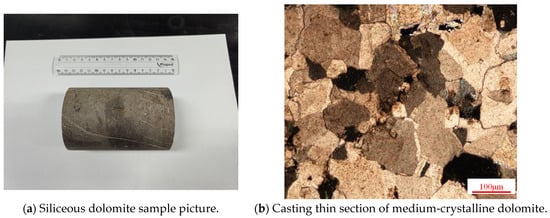
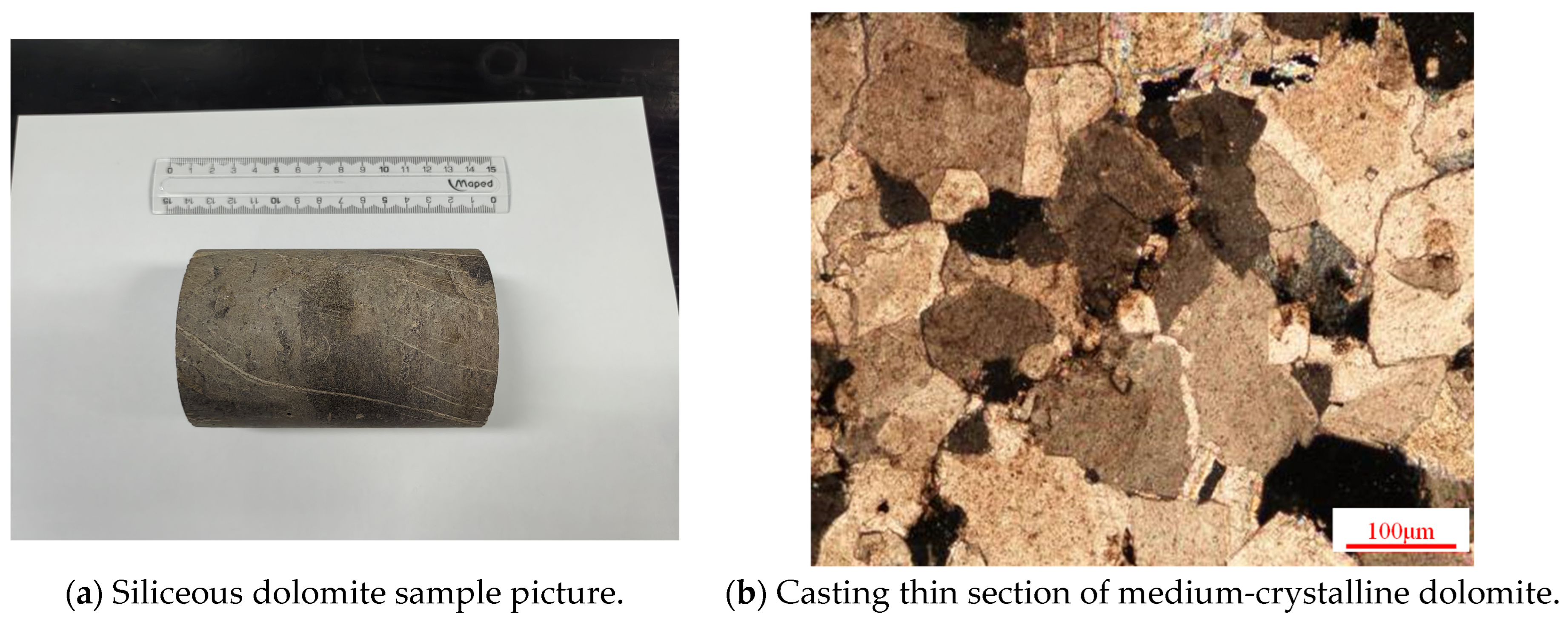
The main lithologies of the carbonate reservoir are crystalline dolomite and siliceous dolomite: mostly gray, dark gray and grayish-black, as presented in Figure 1a. Based on core observation and casting thin sections, the reservoir storage spaces are dominated by intercrystalline pores and intercrystalline dissolved pores, with low average porosity, and the throats serve as the main percolation pathways, as presented in Figure 1b. Representative core samples were selected from the target carbonate gas reservoir for long core experiments, with the core properties presented in Table 2. The core samples show a good porosity–permeability correlation. These core samples were spliced to simulate the heterogeneity of the target reservoir. The average permeability (0.478 mD) and porosity (8.55%) of the core samples were consistent with the field reservoir properties. The formation water was prepared in accordance with the ion composition of the field formation water (as presented in Table 3); it is of the calcium chloride type with a salinity of 37,000 mg/L, falling into the low-salinity condition. Please refer to these three studies [38,39,40] for the geological characteristics, physical properties and pore structure of the target carbonate gas reservoir.
Figure 1.
(a) Siliceous dolomite sample picture from target carbonate gas reservoir; and (b) casting thin section of medium-crystalline dolomite, showing developed intercrystalline pores and intercrystalline dissolved pores.
Table 2.
Field core property data table.
Table 3.
Composition of formation water.
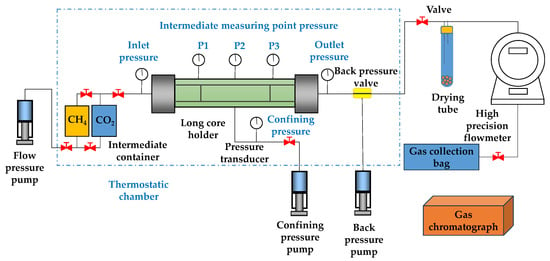
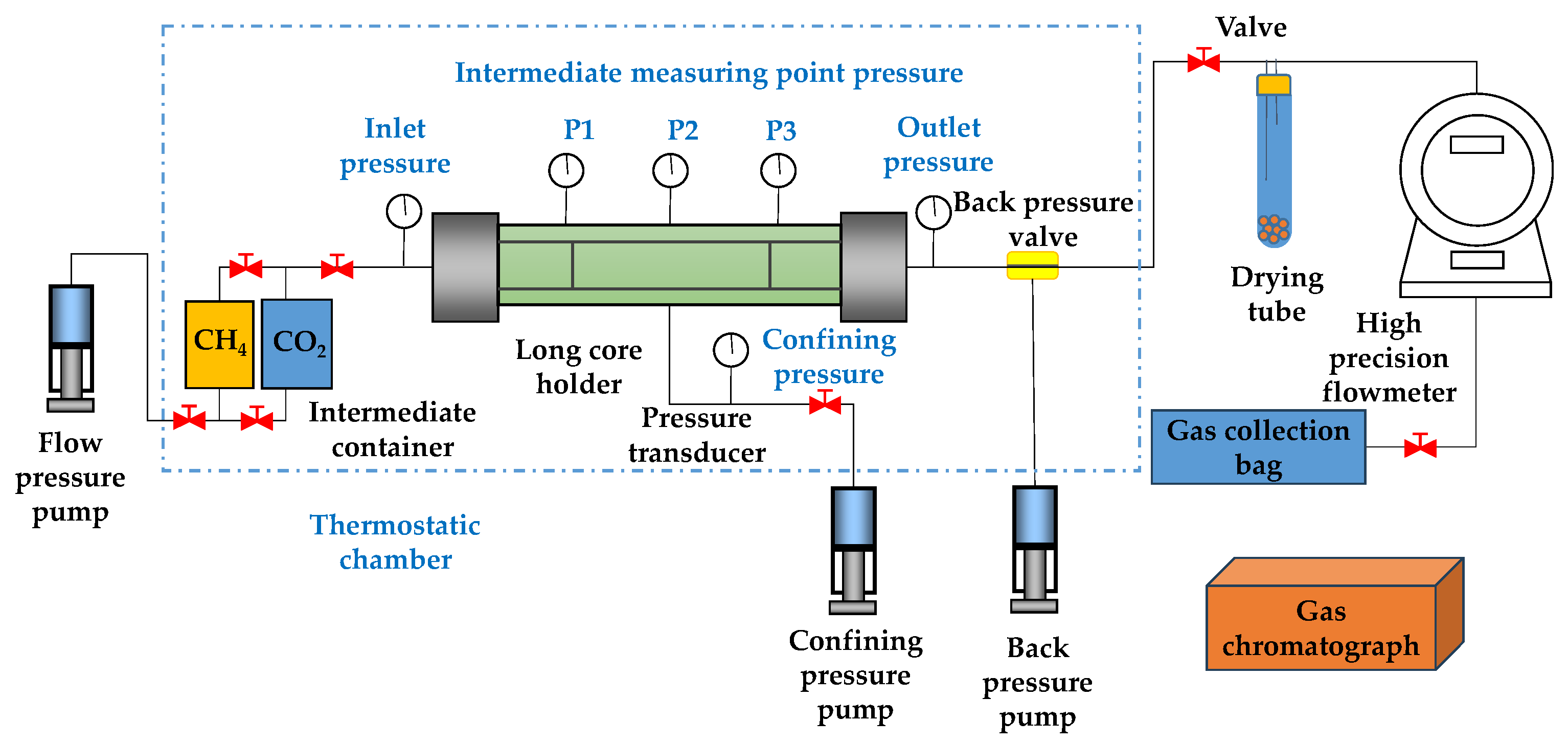
Figure 2 displays the experimental equipment (Nantong Huaxing Petroleum Instrument Co., Ltd., Nantong City, Jiangsu Province, China).
Figure 2.
Flow chart of CO2 injection and CH4 displacement experiment for long core.
The main components of the long core experimental setup include a thermostatic chamber, a Quizix flow pressure pump (Chandler Engineering, Tulsa, OK, USA), a 3-pressure-measurement-point long core holder, pressure transducers, a backpressure pump, a high precision flowmeter, a gas collection bag, a gas chromatograph, and other auxiliary devices. The inlet end of the long core represents the well control boundary, while the outlet end corresponds to the bottom of the well. Pressure measurement points P1, P2 and P3 are used to represent the pressure at different positions from the bottom of the well to the well control boundary.
2.2. Experimental Similarity Criterion Design
The formation pressure and temperature adopted in the experiment were consistent with those in the gas field, as were the core porosity, permeability and irreducible water saturation. Acid fracturing stimulation has been conducted near the wellbore in actual field operations, resulting in relatively high permeability there. To simulate the actual reservoir characteristic of decreasing permeability from the near-wellbore to the far-wellbore zone, the long core samples were spliced in a way that their permeability decreases progressively from the inlet end to the outlet end in the displacement experiment to reflect the heterogeneity of the reservoir. In terms of production regime, the radial flow in the gas well was converted to the linear flow of the long core via Equations (1) and (2) [41,42]. The CH4 (methane) production rate of a single well in the field was 90,000 m3/d, which was converted to 25 mL/min for the long core experiment under normal temperature and pressure conditions. Subsequently, the flow rate was converted to 0.48 mL/min under high-temperature and high-pressure conditions, in accordance with the real gas equation of state. It was then converted to a one-dimensional linear velocity of 16.33 × 10⁻³ mm/s, based on the cross-sectional area of the core sample. For gas wells, the injection timing pressure is defined as the ratio of the average reservoir pressure at injection to the initial formation pressure. In experiments, the injection timing pressure is defined as the ratio of the core pressure at injection to the initial core pressure. The average pressure retention level during the experiment is defined as the average pressure value of the core divided by the initial core pressure. In gas well operation, gas production is generally conducted at a constant rate of 90,000 m3/d until the abandonment pressure is reached, after which production is ceased; the abandonment pressure is close to the atmospheric pressure. The experimental production regime was consistent with the gas well production, where gas production was carried out at a constant rate of 25 mL/min until the abandonment pressure, and then the gas production was stopped. Differently from the experiments reported in the existing literature, in this study, the depletion process and gas production rate under the field production regime are taken into account, and the feasibility of CO2 injection for enhanced gas recovery on the basis of depletion development is demonstrated.
where —daily gas production rate of a single well, 104 m3; —gas flow rate under laboratory conditions, m3/s; —wellbore radius, m; —reservoir thickness, m; and —core diameter, m.
where , , and represent the pressure, volume, and temperature of the gas, respectively and , and represent the gas compressibility factor, amount of substance of gas and universal gas constant, respectively.
The field and experimental parameters are presented in Table 4.
Table 4.
Conversion parameters of field and experimental conditions.
2.3. Experimental Procedures
- 1.
- Select core samples, dry them in an oven for 24 h, and then weigh the dry mass .
- 2.
- Place the core in a saturation vessel and evacuate the core for 24 h, followed by pressurized saturation with formation water for another 24 h, and the weight of the water-saturated core sample is measured. Then, install the cores into the core holder and conduct CH4-displacing-water to establish the initial irreducible water saturation required for the experiment. Measure the mass of produced water during methane flooding; by controlling the mass of displaced water, the initial irreducible water saturation required for the experiment is finally established. The formula for calculating irreducible water saturation is given as Equation (3).where represents the dry mass of the rock sample, represents the weight of the water-saturated core sample, represents the weight of produced water during methane flooding and represents the initial irreducible water saturation of the rock sample.
- 3.
- Set the oven to the experimental temperature (85 °C). Inject CH4 into the cores with a Quizix flow pressure pump for a certain period to achieve complete CH4 saturation of the cores, until the inlet pressure is consistent with the backpressure valve pressure (55 MPa). Increase the confining pressure continuously during the CH4 injection process, maintaining it at 5 MPa higher than the internal pressure at all times, with the final confining pressure reaching 60 MPa.
- 4.
- First, perform a set of pure CH4 depletion experiments as the baseline test. On the basis of CH4-saturated cores (55 MPa), set a constant outlet flow rate of 25 mL/min until the outlet pressure depletes to atmospheric pressure; then, reduce the flow rate to 0 mL/min to terminate the experiment, and record the flow rate and pressure at each measurement point in real time.
- 5.
- Subsequently, conduct the CO2 injection and CH4 displacement experiment. On the basis of CH4 saturated cores (55 MPa), set a constant outlet flow rate of 25 mL/min and first conduct a CH4 depletion development until the average core pressure reaches the CO2 injection timing pressure. Set the injection flow rate with a Quizix flow pressure pump to drive CO2 from the intermediate container into the long cores at a constant flow rate from the inlet. Measure the outlet flow rate and pressure at each measurement point during the experiment, and collect the produced gas at the outlet with gas collection bags simultaneously.
- 6.
- Terminate the displacement experiment after injecting CO2 at least one time at pore volume (PV).
- 7.
- Measure the gas samples collected in the gas bags in chronological order with a gas chromatograph. Plot the CO2 breakthrough curve by combining the experimental time data, and calculate the enhanced gas recovery based on the produced gas flow rate and gas composition.
- 8.
- Repeat the above experimental procedures by altering the core irreducible water saturation, CO2 injection timing pressure or CO2 injection rate.
2.4. Experimental Error Analysis
- (1)
- Measurement uncertainties in the experiment mainly originate from two sources.
- ①
- Accuracy of various sensors. Pressure sensor: uncertainty of ±0.25%. Flow sensor: uncertainty of ±0.5%. Gas chromatograph: uncertainty of ±0.01%.
- ②
- Changes in pore structure and physical properties caused by repeated core tests: uncertainty of ±1.0%.
- (2)
- A low dead-volume experimental setup was adopted, and the dead-volume of the experiment system was subtracted when calculating the CH4 recovery factor and CO2 breakthrough time.
- (3)
- Gas chromatography (GC) calibration: The accuracy of GC analysis was regularly verified using standard gases to ensure accurate measurement of methane and injected gas concentrations.
Sampling frequency: Produced gas composition was analyzed every 5–7 min to avoid missing the CO2 breakthrough point due to excessively long sampling intervals.
- (4)
- Core-scale experiments cannot fully represent reservoir heterogeneity. The recovery factor of the Hungarian field trial (35%) is significantly lower than that of laboratory results (70%) [10], indicating that scale effects and reservoir heterogeneity are key sources of error in data extrapolation.
3. Results and Discussion
The experimental results are divided into four parts, including the results of the depletion experiments and the results of the CO2 injection for enhanced CH4 recovery experiments corresponding to different irreducible water saturations, injection timing pressures and injection rates. Among them, the depletion experiments correspond to the core samples at different irreducible water saturations. The key data from the ten experiments are summarized in Table 5 in this paper. Among them, Experiments (1)–(3) are depletion contrast experiments under different irreducible water saturation conditions, Experiments (4)–(6) are irreducible water saturation contrast experiments, Experiments (5), (7) and (8) are gas injection timing pressure contrast experiments, and Experiments (5), (9) and (10) are gas injection rate contrast experiments. Representative experimental results are selected in Table 5, including the final recovery degree, the cumulative injected PV of CO2 when the CO2 content in the produced gas reaches 20%, the cumulative CH4 recovery degree, the CH4 recovery degree at 20% CO2 content and the increment in CH4 recovery degree compared with the depletion experiment at the same stage. Column 6 in Table 5 refers to the CH4 recovery degree when CH4 production no longer increases. Columns 7 and 8 represent the CO2 injection pore volume (PV) multiple and the corresponding CH4 recovery degree when the CO2 content in the produced gas reaches 20%. Depletion experiments serve as the base control experiments for subsequent CO2 injection tests. The depletion experiment on core samples with 20% irreducible water saturation acts as the base control for the CO2 injection experiment on core samples with the same 20% irreducible water saturation, and the same applies to the other cases. The incremental CH4 recovery degree of the CO2 injection experiment is calculated relative to the CH4 recovery degree of the depletion experiment at the same time point, as shown in the last column of Table 5. The laws governing recovery enhancement corresponding to different injection conditions are analyzed as follows.
Table 5.
Summary table of experimental results for enhanced CH4 recovery by CO2 injection with different schemes.
3.1. Comparison of Depletion Experiment Results for Different Irreducible Water Saturation Levels
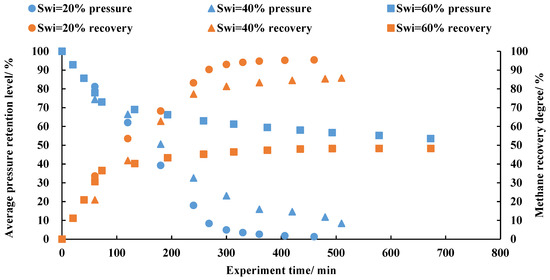
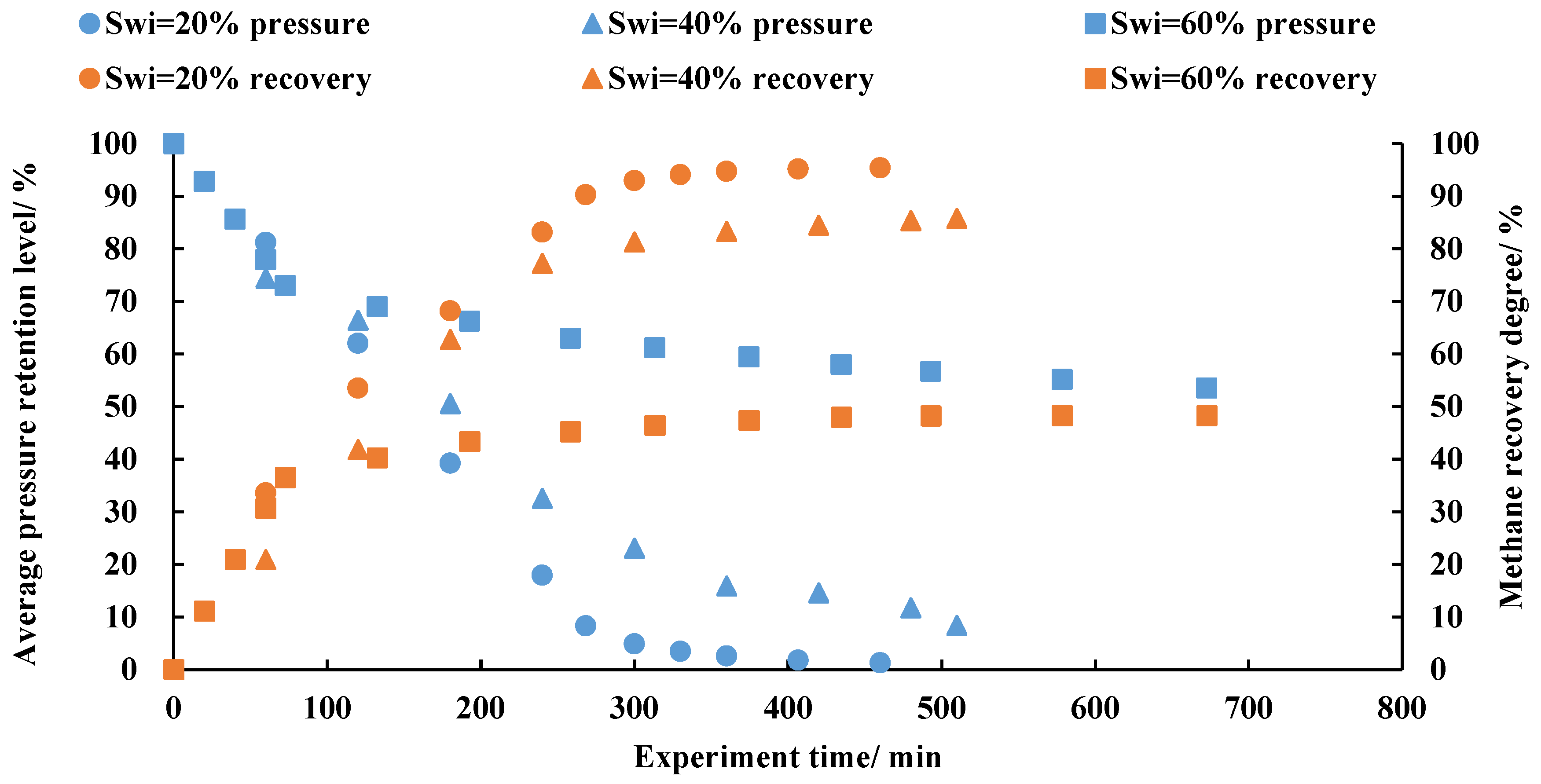
Figure 3 illustrates that a comparison of the depletion experiment results for different irreducible water saturations reveals that a higher irreducible water saturation leads to a more severe gas–water Jamin effect during the depletion process, accompanied by poorer gas percolation capacity and a longer pressure transmission time from the well control boundary to the well bottom. This results in a lower ultimate gas recovery degree, a shorter stable production period, a slower pressure decline between wells and a higher abandonment pressure, all of which are less conducive to the primary gas recovery of gas reservoirs. The final CH4 recovery degrees of different depletion experiments are 95.4%, 85.8% and 48.3% at irreducible water saturations of 20%, 40% and 60%, respectively. The results are comparable to depletion experimental results of similar-property core samples in previous studies (Table 1). For every 1% increase in irreducible water saturation, the depletion gas recovery degree decreases by approximately 1.2%.
Figure 3.
Comparison chart of depletion experiment results for core samples with different irreducible water saturations.
3.2. Comparison of CO2 Displacement Experiment Results for Different Irreducible Water Saturation Levels
All three sets of experiments were performed with CO2 injection at the same injection timing pressure (16.2 MPa), and CO2 was injected into the core at a constant flow rate of 6.53 × 10⁻³ mm/s. A CO2 content of 20% at the core outlet indicates that the bottom-hole CO2 concentration reaches 20% during field CO2 injection. The produced gas from production wells must be purified after entering the manifold, which will increase the operational cost. Therefore, the time point at which the CO2 content at the outlet reaches 20% is selected as the benchmark to evaluate the magnitude of CO2-EGR. The gas injection volume is characterized by the multiple of core PV.
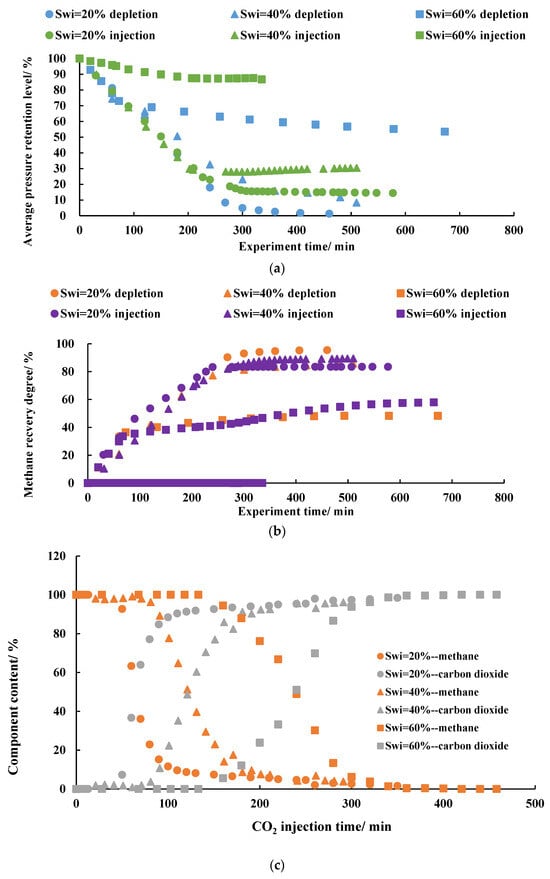
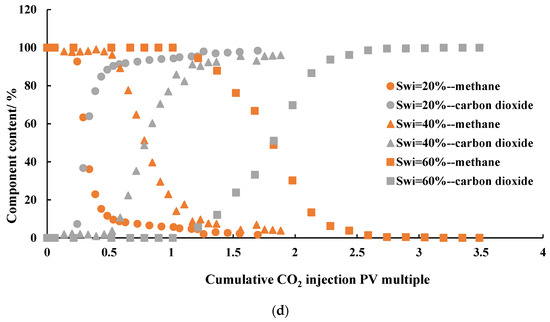
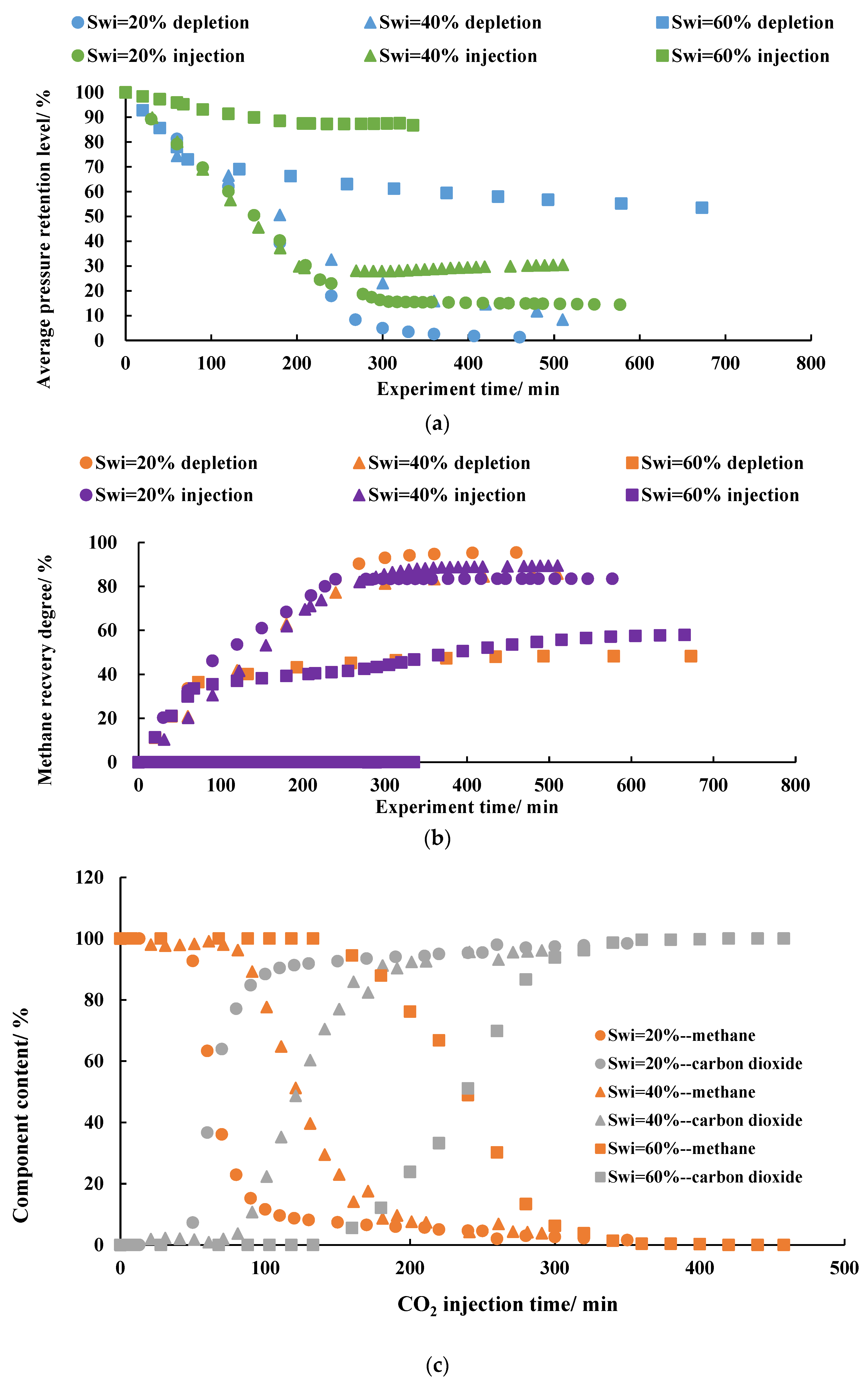
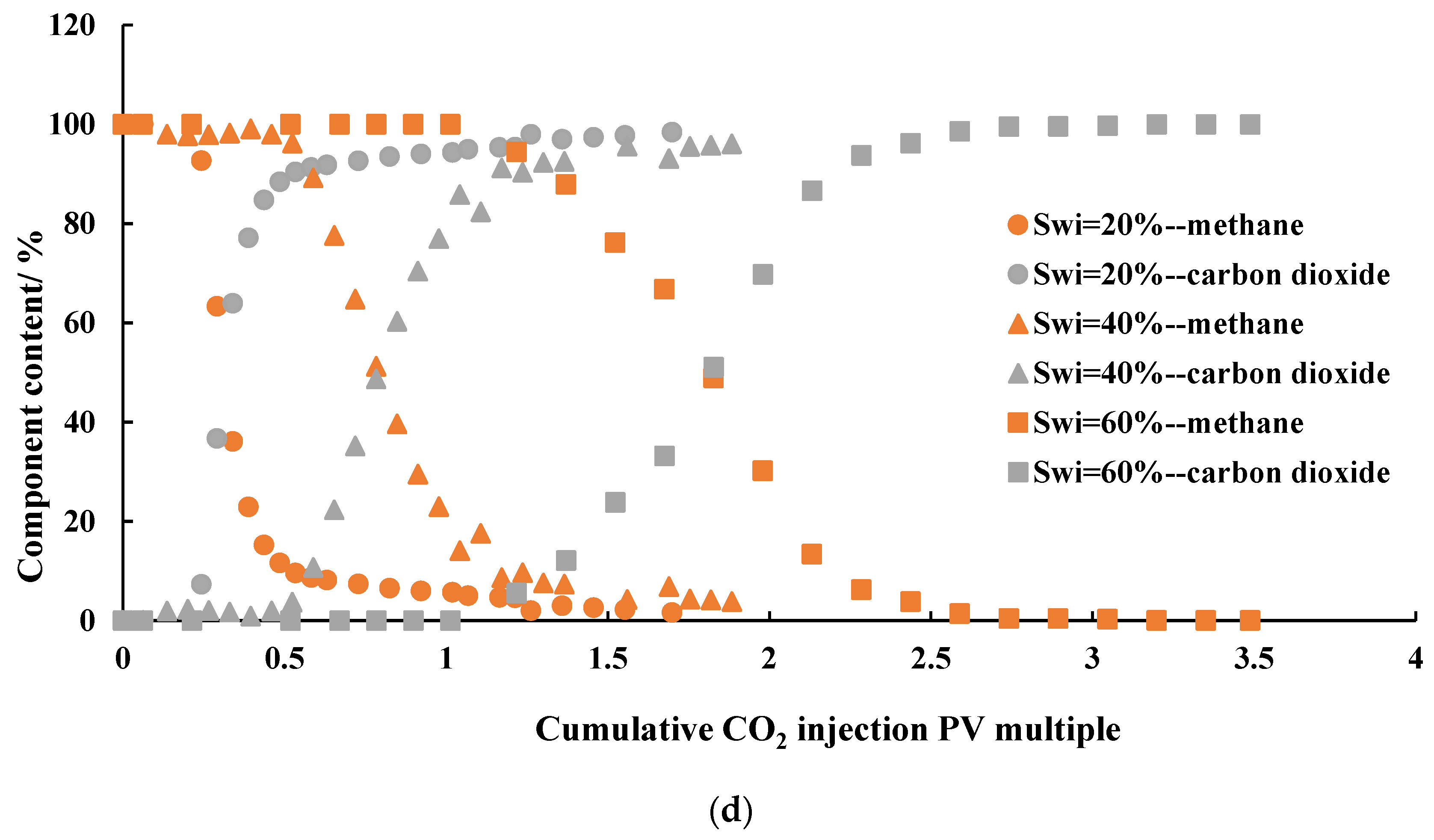
Figure 4a,b compares the variation curves of the average pressure retention level of the rock sample and the CH4 recovery rate under different irreducible water saturation. Figure 4c,d compares the variations in the composition of the produced gas corresponding to different irreducible water saturations. For the core sample with 20% irreducible water saturation, the results show that CO2 breakthrough occurs when approximately 0.1 PV of CO2 is injected (CO2 injection time 25 min), and the CO2 component content rises rapidly after breakthrough. The CO2 component content at the outlet reaches 20% with an injection of 0.26 PV (CO2 injection time 55 min), at which point the CO2 injection recovery degree decreases by 8.3% compared with the concurrent depletion recovery degree. For the core sample with 40% irreducible water saturation, CO2 breakthrough occurs at an injection of about 0.46 PV of CO2 (CO2 injection time 60 min), and the CO2 component content rises relatively rapidly after breakthrough. The CO2 component content at the outlet reaches 20% with an injection of 0.65 PV (CO2 injection time 100 min), at which point the CO2 injection recovery degree increases by 4.7%, relative to the concurrent depletion recovery degree. For the core sample with 60% irreducible water saturation, CO2 breakthrough occurs at an injection of approximately 1 PV of CO2 (CO2 injection time 140 min), and the CO2 component content rises slowly after breakthrough. The CO2 component content at the outlet reaches 20% with an injection of about 1.5 PV (CO2 injection time 195 min), at which point the CO2 injection recovery degree increases by 3.1% compared with the concurrent depletion recovery degree.
Figure 4.
Curves of relationship between (a) average pressure retention level and experiment time, (b) methane recovery degree and experiment time, (c) component content and CO2 injection time, and (d) component content and cumulative CO2 injection PV multiple in CO2 injection experiments for different irreducible water saturation.
This indicates that after the end of stable production, CO2 injection in well blocks with low irreducible water saturation is more likely to cause gas channeling, thus reducing the gas reservoir recovery degree. In well blocks with moderate irreducible water saturation, more water in the pores dissolves the CO2, leading to a decrease in the CO2 diffusion coefficient, a delay in the CO2 breakthrough time and an increase in the methane recovery degree. However, with a further increase in pore water, irreducible water in well blocks with high irreducible water saturation clogs more micro-pores, small pores, and even large pores, resulting in a decrease in residual gas after depletion. Consequently, the efficiency of CO2 in displacing the remaining methane inside the core sample is also affected and reduced. Therefore, after the end of stable production, well blocks with a moderate irreducible water saturation are more suitable for energy supplement and the displacement of residual gas in pores by means of CO2 injection for low-permeability core samples (<1 mD). Compared with the existing relevant studies, the results in this paper not only consider the effect of irreducible water saturation on dissolving CO2 and reducing the CO2 dispersion coefficient, but also account for the limited enhancement in recovery caused by irreducible water occupying pore space. Therefore, the results obtained in this paper can more comprehensively reflect the conditions of real gas reservoirs.
3.3. Comparison of CO2 Displacement Experiment Results for Different Injection Timing Pressures
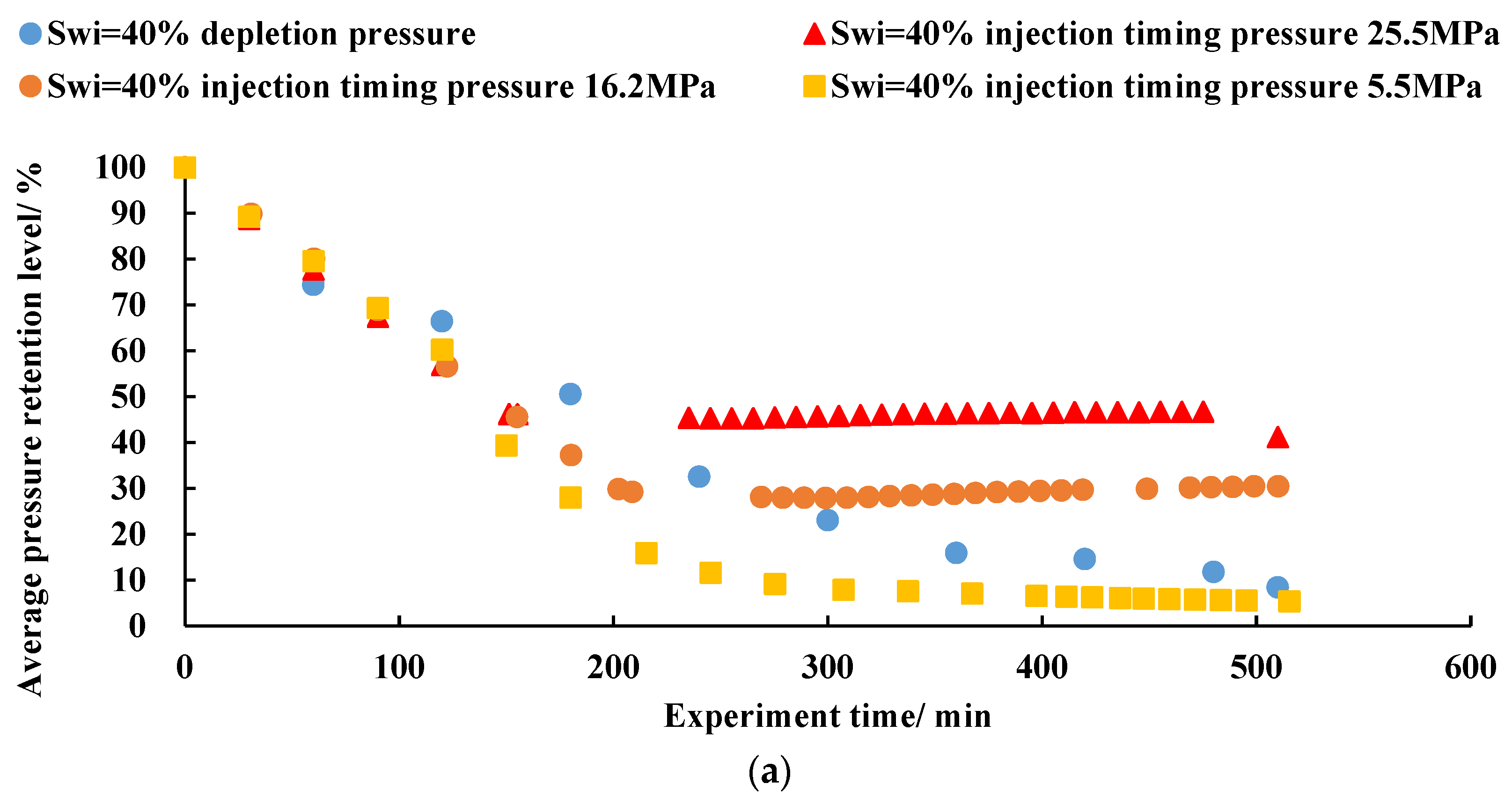
In this group of experiments, the irreducible water saturation of all core samples was 40%, and the CO2 injection rate was uniformly 6.53 × 10⁻³ mm/s. The gas injection timing pressure is defined as a dimensionless quantity, i.e., the percentage of the average core pressure at the time of CO2 injection, relative to the initial formation pressure of 55 MPa. All gas injection timing pressures in this study fall into the category of late-stage gas injection (i.e., implemented after more than 50% of the original reserves have been produced). For CO2 at a temperature of 85 °C, when the pressure is lower than 7.38 MPa (the supercritical pressure of CO2), CO2 exists in a gaseous state with a low density and high kinematic viscosity, and the diffusion term dominates according to the advection–dispersion equation (ADE) (Equation (4)); when the pressure is higher than 7.38 MPa (the supercritical pressure of CO2), CO2 exists in a supercritical state with a low kinematic viscosity and high density, and the advection term becomes dominant based on the same equation.
where , , and represent the displacing-fluid concentration, the interstitial velocity, and the longitudinal dispersion coefficient of the displacing fluid, respectively; and represent time and position.
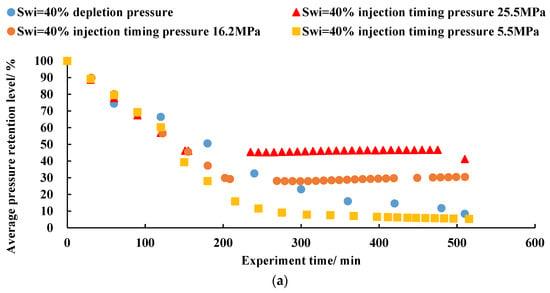
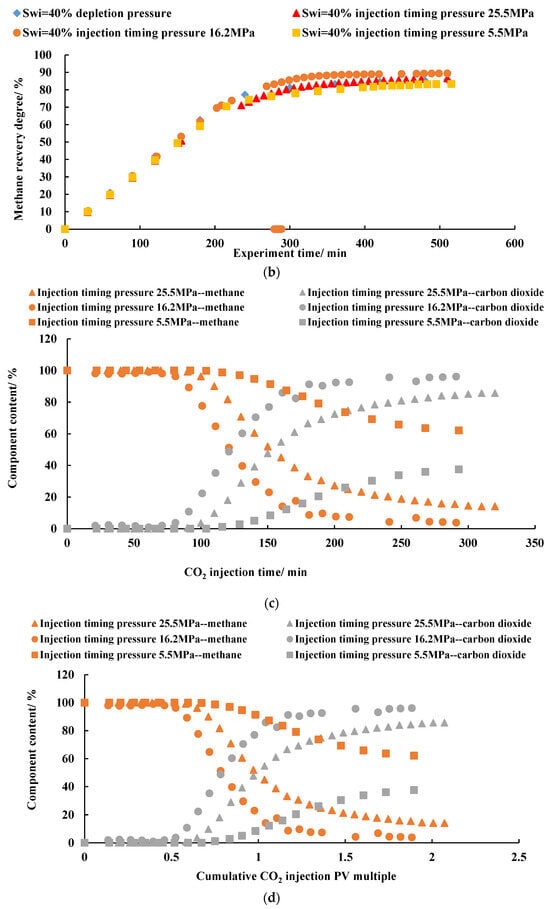
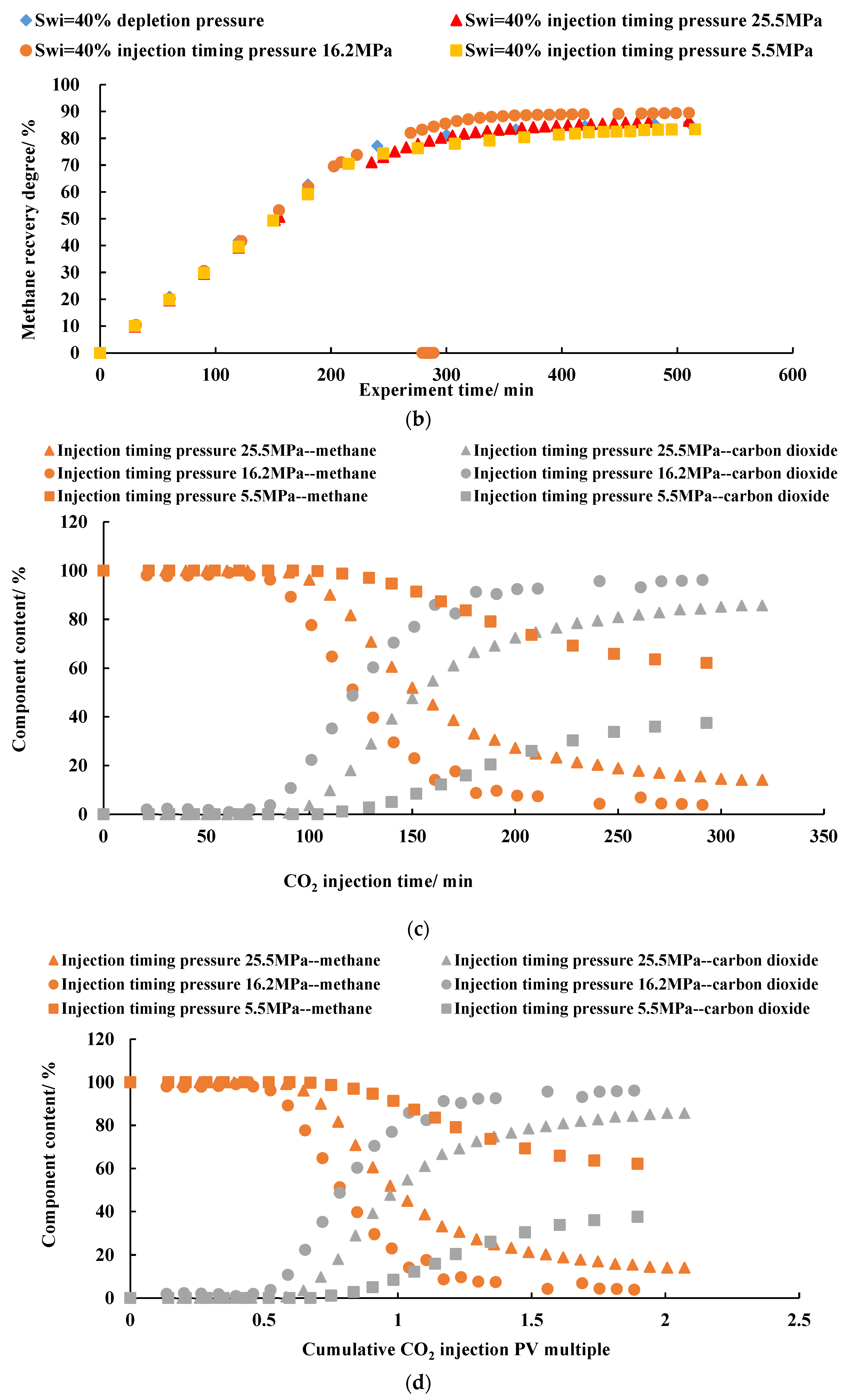
Figure 5a,b compares the variation curves of the average pressure retention level of the rock sample and the CH4 recovery rate under different injection timing pressures (i.e., under different pressure conditions). Injecting CO2 when stable production ceases (i.e., when the formation pressure drops to approximately 16.2 MPa) enables full utilization of both the reservoir’s elastic energy and the supercritical state of CO2, leading to a maximum increase in the recovery degree of 4.7%, relative to the depletion experiment. CO2 exists in a supercritical state with low kinematic viscosity and favorable displacement efficiency. However, injecting CO2 at a relatively high formation pressure (25.5 MPa) fails to fully utilize the reservoir’s elastic energy, causing CO2 to mix with CH4 and ultimately reducing the core recovery degree by 2.1% compared with the depletion experiment. Injecting CO2 at a low formation pressure (5.5 MPa) results in CO2 being in a gaseous state with high kinematic viscosity and a high diffusion coefficient, leading to poor displacement efficiency. Under this condition, CO2 injection cannot restore the formation energy, and fully mixing CO2 with CH4 also causes a 2.3% reduction in the core recovery degree, relative to the depletion experiment. Therefore, for late-stage gas injection, to improve the ultimate recovery degree, the reservoir pressure at the time of CO2 injection should not be excessively low and should be at least above the supercritical pressure of CO2 (7.38 MPa) to maintain the CO2 displacement efficiency.
Figure 5.
Curves of relationship between (a) average pressure retention level and experiment time, (b) methane recovery degree and experiment time, (c) component content and CO2 injection time, and (d) component content and cumulative CO2 injection PV multiple in CO2 injection experiments for different injection timing pressures.
Figure 5c,d compares the variations in the composition of the produced gas corresponding to different injection timing pressures (i.e., under different pressure conditions). When the pressure is higher than 7.38 MPa (the supercritical point of CO2), a higher pressure results in a higher CO2 kinematic viscosity and a lower diffusion coefficient, which is more conducive to retarding gas channeling. When the pressure is lower than 7.38 MPa, the movement of CO2 is dominated by diffusion, which is much slower than advection; this thus helps to delay gas channeling and expand the mixing zone. However, considering the release of the reservoir’s own elastic energy, the reservoir pressure for CO2 injection is neither excessively low nor excessively high to achieve the optimal effect, but instead has a critical value. Compared to the existing related studies, the results of CO2 injection in this paper are benchmarked against the depletion outcomes at corresponding timings. This result accounts for both the depletion recovery degree of CH4 and the dispersion coefficient of CO2 under varying pressure conditions, thus yielding findings that more comprehensively reflect the actual behavior of gas reservoirs.
3.4. Comparison of CO2 Displacement Experiment Results for Different Injection Rates
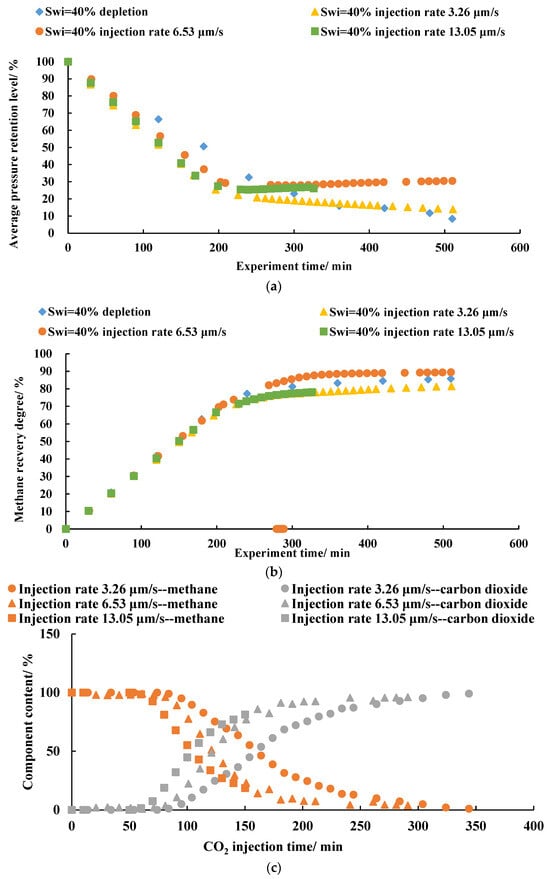
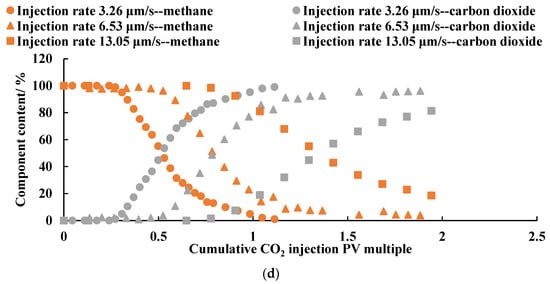
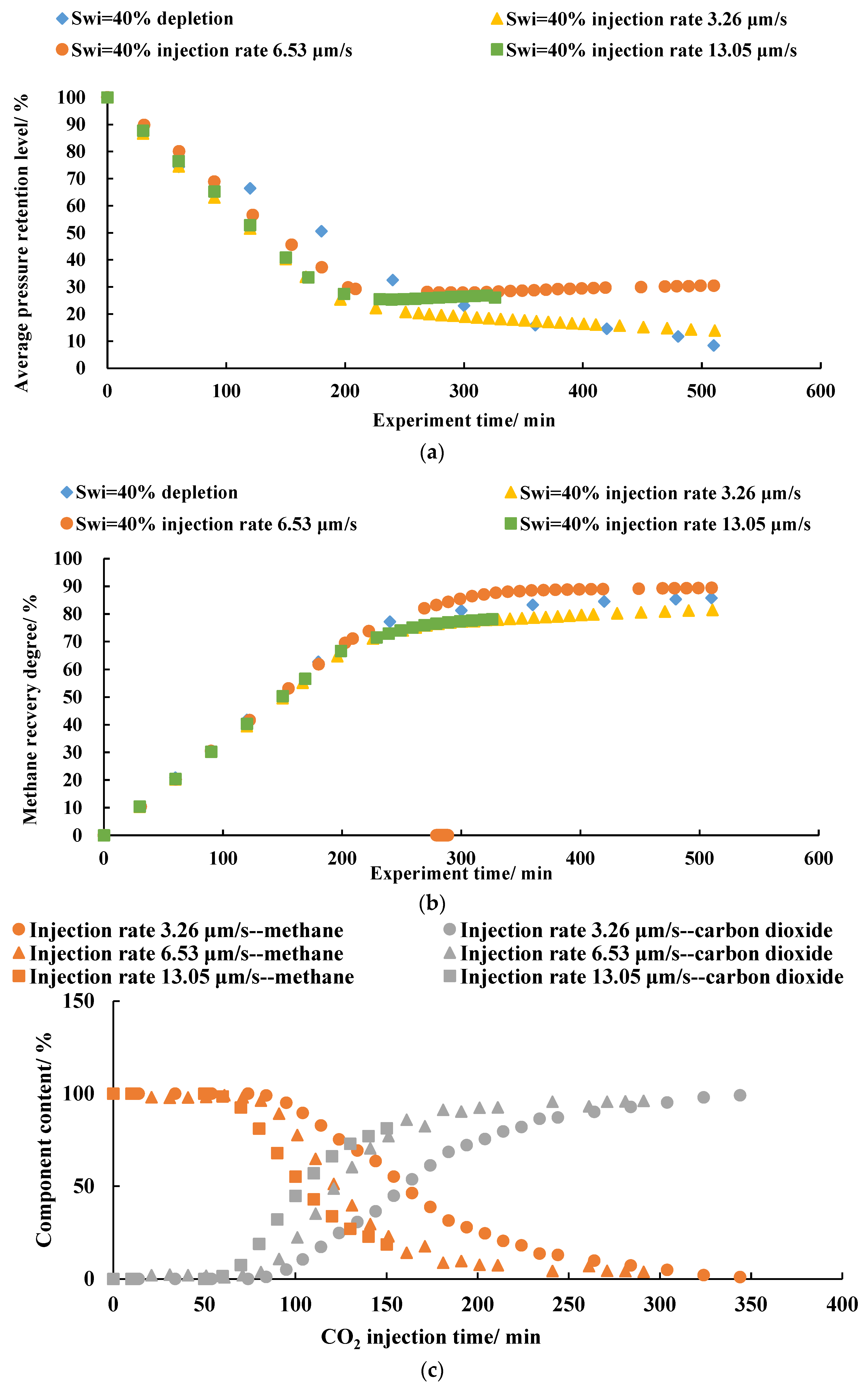
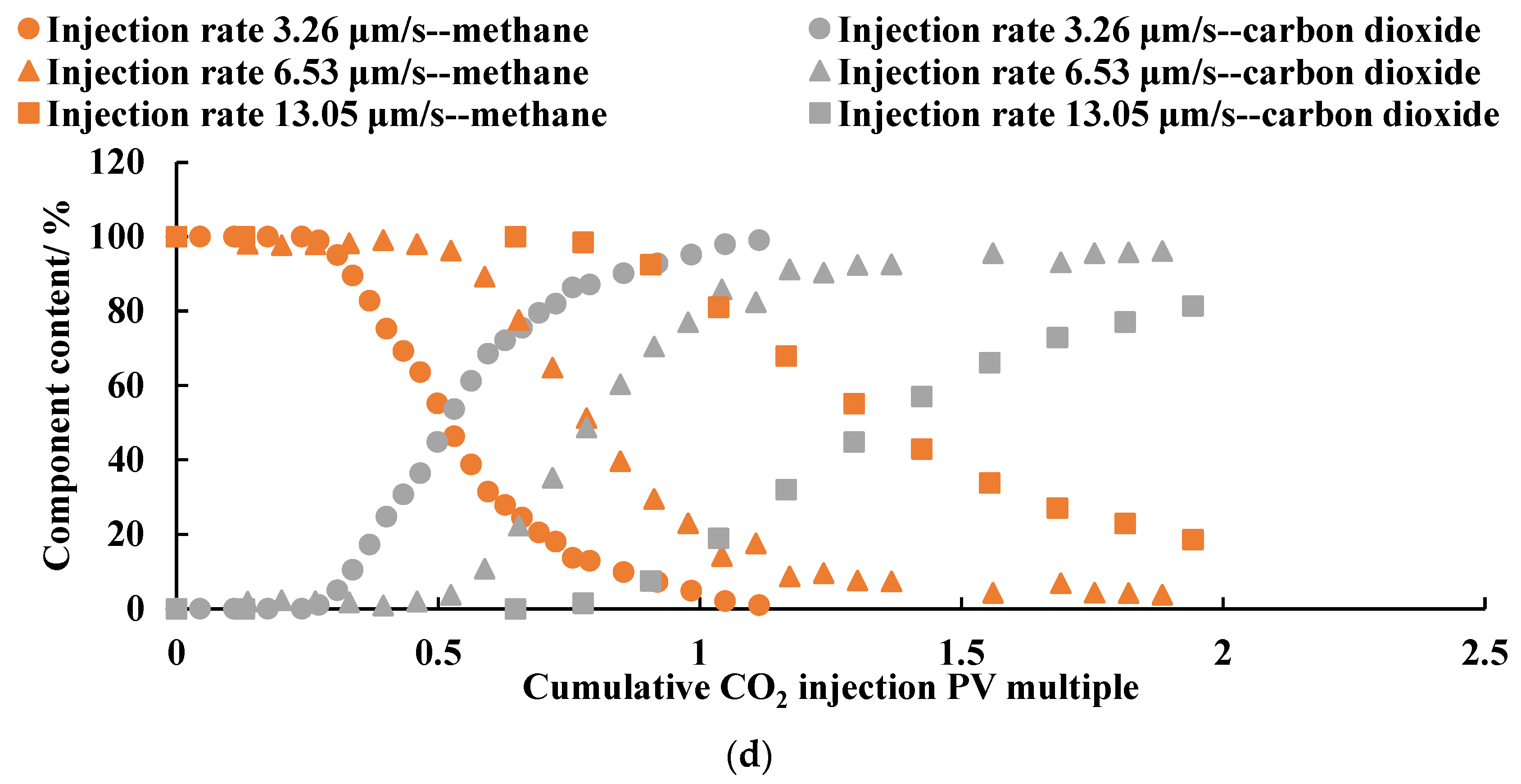
Based on the experimental results of injection timing pressure (with 40% irreducible water saturation), the optimal injection timing pressure is determined to be when the formation pressure drops to 30% of the original pressure, i.e., 16.2 MPa. Building on this optimal injection timing pressure, the enhanced recovery effects corresponding to different injection rates are simulated by this group of experiments. The injection rates were converted into one-dimensional flow velocities under the reservoir temperature and pressure conditions via Equations (1) and (2), so as to facilitate the comparison with the research results reported in the other literature. The experimental results of different injection rates after the average pressure drops to 16.2 MPa for reservoirs with a irreducible water saturation of 40% are presented in Figure 6. Figure 6a,b compares the variation curves of the average pressure retention level of the rock sample and the CH4 recovery rate under different CO2 injection rates. Figure 6c,d compares the variations in the composition of the produced gas corresponding to different CO2 injection rates.
Figure 6.
Curves of relationship between (a) average pressure retention level and experiment time, (b) methane recovery degree and experiment time, (c) component content and CO2 injection time, and (d) component content and cumulative CO2 injection PV multiple in CO2 injection experiments for different CO2 injection rates.
At an injection rate of 3.26 × 10⁻³ mm/s, the volume of injected CO2 was insufficient to maintain the formation pressure, causing the formation pressure to decrease continuously to near 7.38 MPa. Owing to the low injection rate, the time required for the CO2 content in the produced gas to reach 20% was the latest (120 min). At this stage, CO2 was close to a gaseous state, with a high kinematic viscosity and high diffusion coefficient, resulting in a poor displacement effect; thus, the CH4 recovery degree decreased by 4% relative to that of the depletion experiment.
At an injection rate of 6.53 × 10⁻³ mm/s, a relatively large volume of CO2 was injected, which maintained the average formation pressure at approximately 16 MPa. With a moderate injection rate, the time for the CO2 content in the produced gas to reach 20% was intermediate (100 min). Under this condition, CO2 was in a supercritical state with a low kinematic viscosity and a low diffusion coefficient, leading to an excellent CH4 displacement effect; consequently, the CH4 recovery degree increased by 4.7% compared with that of the depletion experiment.
At an injection rate of 13.05 × 10⁻³ mm/s, the maximum volume of CO2 was injected, which elevated the formation pressure. However, the relatively high injection rate also induced a premature CO2 breakthrough, with the time for the CO2 content in the produced gas to reach 20% being the shortest (82 min). Although CO2 was in a supercritical state under this condition, the excessively high injection rate enhanced advective displacement and caused premature CO2 breakthrough, resulting in a 9.2% decrease in the recovery degree, relative to that of the depletion experiment.
Therefore, for the low-permeability carbonate core samples (<1 mD) of the target reservoir, the optimal injection rate is approximately 6.53 × 10⁻³ mm/s at the experiment scale (3.6 × 10⁴ m3/d at reservoir scale), which is close to the optimal injection rate reported in the literature (Table 1).
A comprehensive analysis of the data from the ten experiments reveals that CO2 injection can enhance the CH4 recovery degree of carbonate rocks in the target gas reservoir (with permeability < 1 mD) by 3–5%. However, the conditions for such recovery enhancement are rather stringent: CO2 injection can only exert a positive effect on improving the recovery degree of carbonate gas reservoirs under the combined conditions of medium to high irreducible water saturation reservoirs, the middle and late production stages after the end of stable production (with reservoir pressure above 7.38 MPa), and a moderate injection rate. Under other conditions, the CO2 injection will reduce the recovery degree due to premature breakthrough or reservoir gas contamination, thus exerting a negative impact of CO2 injection on CH4 displacement. In addition, the core samples exhibit strong pore structure homogeneity; therefore, the experimental results are not applicable to gas reservoirs with strong heterogeneity and require further verification combined with other research methods.
4. Conclusions
(1) For the target low-permeability carbonate gas reservoir (permeability <1 mD), layers with medium to high irreducible water saturation are more suitable for CO2 injection to enhance CH4 recovery compared with those with low irreducible water saturation. There exists an optimal range of reservoir irreducible water saturation for CO2 injection to enhance CH4 recovery. Increasing the irreducible water saturation helps to delay the CO2 breakthrough.
(2) For the target low-permeability carbonate gas reservoir, late-development-stage CO2 injection is conducive to improving the CH4 recovery degree, yet the reservoir pressure must not be lower than 7.38 MPa, which is the supercritical pressure of CO2. The optimal timing is after the end of stable production and before the formation pressure drops to 7.38 MPa. This timing enables full utilization of both the reservoir elastic energy and the supercritical state of CO2, thus enhancing the CH4 recovery degree. Injecting CO2 at either low or high reservoir pressure will result in a widened miscibility zone of CH4 and CO2.
(3) For the target low-permeability carbonate gas reservoir, either excessively high or low injection rates are unfavorable for CO2 injection to enhance CH4 recovery. A low injection rate results in an insufficient volume of injected CO2 to maintain the formation pressure, leading to poor CO2 displacement efficiency and a reduced recovery degree. A high injection rate can supplement the formation energy rapidly, but it also causes premature CO2 breakthrough, which likewise lowers the recovery degree. Therefore, there exists an optimal range of CO2 injection rates for enhancing CH4 recovery.
(4) The experimental parameters were converted to field parameters via similarity criteria. For the target low-permeability carbonate gas reservoir, the suitable reservoir irreducible water saturation for CO2 injection is approximately 40–60%, the optimal injection timing pressure is when the reservoir pressure drops to near 7.38 MPa, and the optimal injection rate is about 36,000 m3/d per well. Under the optimal injection conditions, CO2 injection is expected to increase the recovery degree by 3–5% compared with the single depletion production method. The findings of this study are based on core samples with relatively good homogeneity; their applicability to reservoirs with strong heterogeneity remains to be verified.
Author Contributions
Conceptualization, methodology, investigation, writing—original draft preparation, writing—review and editing, Y.Z.; supervision, conceptualization, methodology and visualization, Z.C.; conceptualization, methodology and visualization, Y.H.; methodology and formal analysis, H.Y. and J.G.; data curation and investigation, C.J.; data curation and visualization, M.L.; validation and visualization, Y.L.; data curation and investigation, P.Y.; investigation and validation, N.Q. All authors have read and agreed to the published version of the manuscript.
Funding
This research was funded by the China National Petroleum Corporation, grant number 2023YQX10501, 2023YQX10503ZK and 2024DJ86.
Data Availability Statement
The raw/processed data required to reproduce these findings cannot be shared at this time, as the data also form part of an ongoing study.
Acknowledgments
The authors are grateful to the China National Petroleum Corporation for the financial support and the Exploration and Development Research Institute of the Southwest Oil & Gas Field Company in Chengdu for the provision of rock samples.
Conflicts of Interest
Authors Yuxiang Zhang, Zhenglin Cao, Yong Hu, Haijun Yan, Jianlin Guo and Chunyan Jiao were employed by the institute Research Institute of Petroleum Exploration & Development, PetroChina. Authors Mingqiu Li, Yu Luo, Peng Yu and Nan Qin were employed by the institute Exploration and Development Research Institute, PetroChina Southwest Oil & Gas field Company. The authors declare that this study received funding from China National Petroleum Corporation. The funder was not involved in the study design, collection, analysis, interpretation of data, the writing of this article or the decision to submit it for publication. The remaining authors declare that the research was conducted in the absence of any commercial or financial relationships that could be construed as a potential conflict of interest.
Abbreviations
The following abbreviations are used in this manuscript:
| CO2 | Carbon dioxide |
| CH4 | Methane |
| EGR | Enhanced gas recovery |
| CT | Computed tomography |
| GC | Gas chromatography |
| PV | Pore volume |
| Swi | Irreducible water saturation |
References
- Wei, Y.; Yan, H.; Guo, J.; Wang, J.; Tang, H.; Guo, Z.; Qi, Y.; Zhu, H.; Wang, Z.; Gao, Y. Concept, technology generation classification and field practices of enhanced gas recovery. Pet. Explor. Dev. 2026, 53, 408–419. [Google Scholar] [CrossRef] [Scilit]
- Oldenburg, C.M.; Pruess, K.; Benson, S.M. Process modeling of CO2 injection into natural gas reservoirs for carbon sequestration and enhanced gas recovery. Energy Fuels 2001, 15, 293–298. [Google Scholar] [CrossRef] [Scilit]
- Oldenburg, C.M.; Benson, S.M. CO2 injection for enhanced gas production and carbon sequestration. In SPE International Oil Conference and Exhibition in Mexico; SPE: Richardson, TX, USA, 2002; p. SPE-74367. [Google Scholar]
- Clemens, T.; Wit, K. CO2 enhanced gas recovery studied for an example gas reservoir. In SPE Annual Technical Conference and Exhibition; SPE: Richardson, TX, USA, 2002; p. SPE-77348. [Google Scholar]
- Mamora, D.D.; Seo, J.G. Enhanced gas recovery by carbon dioxide sequestration in depleted gas reservoirs. In Proceedings of the SPE Annual Technical Conference and Exhibition, San Antonio, TX, USA, 29 September–2 October 2002. [Google Scholar]
- Jikich, S.A.; Smith, D.H.; Sams, W.N.; Bromhal, G.S. Enhanced Gas Recovery (EGR) with carbon dioxide sequestration: A simulation study of effects of injection strategy and operational parameters. In SPE Eastern Regional Meeting; SPE: Richardson, TX, USA, 2003; p. SPE-84813. [Google Scholar]
- Zhang, Y.; Yan, H.; Wei, Y.; Cao, Z.; Guo, J.; Luo, Y.; Ye, L.; Zhong, J. Seepage Mechanism of CO2 Injection in Different Lithological Gas Reservoirs. J. South China Norm. Univ. (Nat. Sci. Ed.) 2025, 57, 60–69. [Google Scholar]
- Hughes, T.J.; Honari, A.; Graham, B.F.; Chauhan, A.S.; Johns, M.L.; May, E.F. CO2 sequestration for enhanced gas recovery: New measurements of supercritical CO2–CH4 dispersion in porous media and a review of recent research. Int. J. Greenh. Gas Control 2012, 9, 457–468. [Google Scholar] [CrossRef] [Scilit]
- Hamza, A.; Hussein, I.A.; Al-Marri, M.J.; Mahmoud, M.; Shawabkeh, R.; Aparicio, S. CO2 enhanced gas recovery and sequestration in depleted gas reservoirs: A review. J. Pet. Sci. Eng. 2021, 196, 107685. [Google Scholar] [CrossRef] [Scilit]
- Liu, S.; Yuan, L.; Zhao, C.; Zhang, Y.; Song, Y. A review of research on the dispersion process and CO2 enhanced natural gas recovery in depleted gas reservoir. J. Pet. Sci. Eng. 2022, 208, 109682. [Google Scholar] [CrossRef] [Scilit]
- Lin, B.; Wei, Y.; Gao, S.; Ye, L.; Liu, H.; Zhu, W.; Zhang, J.; Han, D. Current progress and development trend of gas injection to enhance gas recovery in gas reservoirs. Energies 2024, 17, 1595. [Google Scholar] [CrossRef] [Scilit]
- Honari, A.; Zecca, M.; Vogt, S.J.; Iglauer, S.; Bijeljic, B.; Johns, M.L.; May, E.F. The impact of residual water on CH4-CO2 dispersion in consolidated rock cores. Int. J. Greenh. Gas Control 2016, 50, 100–111. [Google Scholar] [CrossRef] [Scilit]
- Zecca, M.; Vogt, S.J.; Honari, A.; Xiao, G.; Fridjonsson, E.O.; May, E.F.; Johns, M.L. Quantitative dependence of CH4-CO2 dispersion on immobile water fraction. AIChE J. 2017, 63, 5159–5168. [Google Scholar] [CrossRef] [Scilit]
- Abba, M.K.; Abbas, A.J.; Nasr, G.G.; Al-Otaibi, A.; Burby, M.; Saidu, B.; Suleiman, S.M. Solubility trapping as a potential secondary mechanism for CO2 sequestration during enhanced gas recovery by CO2 injection in conventional natural gas reservoirs: An experimental approach. J. Nat. Gas Sci. Eng. 2019, 71, 103002. [Google Scholar] [CrossRef] [Scilit]
- Turta, A.T.; Sim, S.S.K.; Singhal, A.K.; Hawkins, B. Basic investigations on enhanced gas recovery by gas-gas displacement. J. Can. Pet. Technol. 2008, 47, PETSOC-08-10-39. [Google Scholar] [CrossRef] [Scilit]
- Tang, Y.; Zhang, C.; Du, Z.M.; Cui, S.H.; Ma, Y.X.; Mi, H.G. Experiments on enhancing gas recovery and sequestration by CO2 displacement. Reserv. Eval. Dev. 2015, 5, 34–40. [Google Scholar]
- Zhang, Y.; Liu, S.; Wang, L.; Song, Y.; Yang, M.; Zhao, J.; Zhao, Y.; Chi, Y. In situ measurement of the dispersion coefficient of liquid/supercritical CO2–CH4 in a sandpack using CT. RSC Adv. 2016, 6, 42367–42376. [Google Scholar] [CrossRef] [Scilit]
- Wang, F.; Liu, Y.; Hu, C.; Wang, Y.; Shen, A.; Liang, S. Experimental study on feasibility of enhanced gas recovery through CO2 flooding in tight sandstone gas reservoirs. Processes 2018, 6, 214. [Google Scholar] [CrossRef] [Scilit]
- Ding, J.; Cao, T.; Wu, J. Experimental investigation of supercritical CO2 injection for enhanced gas recovery in tight gas reservoir. In Proceedings of the Carbon Management Technology Conference, CMTC, Houston, TX, USA, 15–18 July 2019. [Google Scholar]
- He, C.; Ji, Z.; Geng, X.; Zhou, M. The influence of irreducible water for enhancing CH4 recovery in combination of CO2 storage with CO2 injection in gas reservoirs. Int. J. Greenh. Gas Control 2023, 126, 103919. [Google Scholar]
- Zhao, Z.; Wen, S.; Wang, M.; Zhang, L.; Cao, C.; Yang, C.; Li, L. Experimental and Numerical Simulation Study on Enhancing Gas Recovery with Impure CO2 in Gas Reservoirs. Processes 2024, 12, 1663. [Google Scholar] [CrossRef] [Scilit]
- Zha, Y.; Ye, Q.; Zhao, N.; Xiong, R.; Cao, B.; Zhao, Y.; Li, Y.; Xiong, W.; Tian, Y.; Cao, C. Mechanism of Enhanced Gas Recovery and Carbon Storage Capacity in Gas Reservoirs with CO2 Injection: An Example of Dongfang Gas Field. Eng. Rep. 2025, 7, e70068. [Google Scholar] [CrossRef] [Scilit]
- Sidiq, H.; Amin, R. Mathematical model for calculating the dispersion coefficient of super critical CO2 from the results of laboratory experiments on enhanced gas recovery. J. Nat. Gas Sci. Eng. 2009, 1, 177–182. [Google Scholar]
- Honari, A.; Hughes, T.J.; Fridjonsson, E.O.; Johns, M.L.; May, E.F. Dispersion of supercritical CO2 and CH4 in consolidated porous media for enhanced gas recovery simulations. Int. J. Greenh. Gas Control 2013, 19, 234–242. [Google Scholar] [CrossRef] [Scilit]
- Shi, Y.; Jia, Y.; Pan, W.; Huang, L.; Yan, J.; Zheng, R. Potential evaluation on CO2-EGR in tight and low-permeability reservoirs. Nat. Gas Ind. B 2017, 4, 311–318. [Google Scholar] [CrossRef] [Scilit]
- Ye, Q.; Zha, Y.; Xiong, R.; Zhao, N.; Mo, F.; Li, M.; Zeng, Y.; Sun, L.; Liang, B. CO2-Enhanced Gas Recovery (EGR) in Offshore Carbon-Rich Gas Reservoirs—Part 2: EGR Performance and Its Dependency. Processes 2025, 13, 698. [Google Scholar] [CrossRef] [Scilit]
- Zhang, Y.; Liu, S.; Chen, M.; Xu, S. Experimental study on dispersion characteristics and CH4 recovery efficiency of CO2, N2 and their mixtures for enhancing gas recovery. J. Pet. Sci. Eng. 2022, 216, 110756. [Google Scholar] [CrossRef] [Scilit]
- Amer, M.A.; Ghazi, S.; Ali, S.; Zafar, T.; Riaz, M. Enhanced gas recovery by CO2 injection method in depleted gas reservoirs. Arch. Pet. Environ. Biotechnol. 2018, 10, 2574–7614. [Google Scholar]
- Du, J.; Zhao, Y.; Guo, P.; Zhao, Q. Experiment research on recovery efficiency improvement by CO2 injection in tight gas reservoirs in northern Hubei. Sci. Tech. Eng. 2020, 20, 6459–6465. [Google Scholar]
- Wang, M.; Zhao, Z.; Zhang, L.; Liu, X. Mechanism and Potential of CO2 Injection to Enhance Recovery Rate of Gas Reservoir. In Abu Dhabi International Petroleum Exhibition and Conference; SPE: Richardson, TX, USA, 2024; p. D031S116R005. [Google Scholar]
- Liao, H.; Pan, W.; He, Y.; Fang, X.; Zhang, Y. Study on the mechanism of CO2 injection to improve tight sandstone gas recovery. Energy Rep. 2023, 9, 645–656. [Google Scholar] [CrossRef] [Scilit]
- Hussen, C.; Amin, R.; Madden, G.; Evans, B. Reservoir simulation for enhanced gas recovery: An economic evaluation. J. Nat. Gas Sci. Eng. 2012, 5, 42–50. [Google Scholar] [CrossRef] [Scilit]
- Zhang, L.; Bai, T.; Zhao, Q.; Zhang, X.; Cheng, H.; Li, Z. CO2 injection for enhanced gas recovery and Geo-Storage in complex tight sandstone gas reservoirs. Processes 2023, 11, 2059. [Google Scholar] [CrossRef] [Scilit]
- Jiang, P.; Zha, Y.; Ye, Q.; Xiong, R.; Zhao, N.; Mo, F.; Sun, L.; Li, M.; Zeng, Y.; Liang, B. CO2-Enhanced Gas Recovery in Offshore Carbon-Rich Gas Reservoirs—Part 1: In Situ Gas Dispersion Behaviors. Processes 2024, 12, 2479. [Google Scholar] [CrossRef] [Scilit]
- Liu, S.; Agarwal, R.; Sun, B.; Wang, B.; Li, H.; Xu, J.; Fu, G. Numerical simulation and optimization of injection rates and wells placement for carbon dioxide enhanced gas recovery using a genetic algorithm. J. Clean. Prod. 2021, 280, 124512. [Google Scholar] [CrossRef] [Scilit]
- Zhao, E.-M.; Jin, Z.-J.; Li, G.-S.; Zhang, K.-Q.; Zeng, Y. Feasibility of CO2 storage and enhanced gas recovery in depleted tight sandstone gas reservoirs within multi-stage fracturing horizontal wells. Pet. Sci. 2024, 21, 4189–4203. [Google Scholar] [CrossRef] [Scilit]
- Jiang, Y.; Yang, S.; Bai, H.; Chen, Y.; Mei, Q.; Wang, B. Study on CO2 Storage and CH4 Recovery Enhancement in Tight Sandstone Gas Reservoirs. Xinjiang Pet. Geol. 2025, 46, 591–599. [Google Scholar]
- Zhang, Y.; Yang, S.; Zhang, Z.; Li, Q.; Deng, H.; Chen, J.; Geng, W.; Wang, M.; Chen, Z.; Chen, H. Multiscale pore structure characterization of an ultra-deep carbonate gas reservoir. J. Pet. Sci. Eng. 2022, 208, 109751. [Google Scholar] [CrossRef] [Scilit]
- Zhang, Y.; Yan, H.; Wei, Y.; Cao, Z.; Guo, J.; Deng, H.; Luo, Y.; Jiang, Y.; Wang, J.; Qin, N. Strain Characteristics of Pore-Throat Structures in an Ultradeep Dolomite Gas Reservoir. ACS Omega 2025, 10, 32791–32812. [Google Scholar] [CrossRef] [Scilit] [PubMed]
- Zhang, Y.; Yan, H.; Wei, Y.; Cao, Z.; Guo, J.; Luo, Y.; Qin, N.; Wang, M.; Wang, C.; Zhang, G.; et al. The Influence of CO2-Water–Rock Reaction on the Permeability of Different Reservoirs. In Proceedings of the International Field Exploration and Development Conference 2024. IFEDC 2024; Springer Nature: Singapore, 2024; pp. 623–630. [Google Scholar]
- Wang, L.; Yang, S.; Xu, W.; Meng, Z.; Han, W.; Qian, K. Application of Improved Productivity Simulation Method in Determination of the Lower Limits of Reservoir Physical Properties in Moxi District of Anyue Gas Field. Xinjiang Pet. Geol. 2017, 38, 358–362. [Google Scholar]
- Zhang, Y.; Yang, S.; Wang, B.; Li, Q.; Gao, X.Y.; Deng, H.; Yan, Y.J.; Chen, Z.X. Determining ultra-deep carbonate gas reservoir property cutoffs by radial flow productivity simulation method: Taking Gaoshiti-Moxi block as an example. Pet. Geol. Oilfield Dev. Daqing 2023, 42, 75. [Google Scholar]

Disclaimer/Publisher’s Note: The statements, opinions and data contained in all publications are solely those of the individual author(s) and contributor(s) and not of MDPI and/or the editor(s). MDPI and/or the editor(s) disclaim responsibility for any injury to people or property resulting from any ideas, methods, instructions or products referred to in the content. |
© 2026 by the authors. Licensee MDPI, Basel, Switzerland. This article is an open access article distributed under the terms and conditions of the Creative Commons Attribution (CC BY) license.