


Abstract
Power electronic systems are often engineered through a sequential–iterative workflow in which hardware parameters are initially sized from steady-state, ripple, thermal, and electromagnetic-compatibility constraints, and controllers are subsequently tuned to satisfy dynamic and closed-loop performance requirements. While converters are inherently designed for closed-loop operation, increasing power density, uncertainty, and distributed interaction make the underlying design process resemble a strategic interplay among multiple decision-makers, including hardware designers, control algorithms, loads, disturbances, and manufacturing constraints. This paper develops a unifying game-theoretic perspective on the optimal design and control of power electronic systems. Classical concepts—such as robust control, worst-case design, droop-based load sharing, and tolerance allocation—are reinterpreted as equilibrium solutions of zero-sum, Stackelberg, non-cooperative, or cooperative games. Beyond a conceptual taxonomy, two illustrative simulation case studies are provided: (i) a Stackelberg hardware–controller co-design of a buck converter, demonstrating simultaneous passive-component reduction and improved transient performance relative to a conservative sequential design; and (ii) a droop-controlled parallel-converter example contrasting Nash and cooperative equilibria, explicitly quantifying trade-offs between bus-voltage regulation, current-sharing fairness, and conduction losses. By framing power electronic design and control as interacting strategic processes rather than isolated optimization stages, the paper aims to show that game theory can serve as a structured and practically interpretable framework for distributed and uncertainty-aware power electronic systems.
1. Introduction
Power electronic systems constitute a technological backbone of modern energy infrastructures, enabling efficient conversion, control, and integration of electrical energy across scales ranging from compact embedded converters to grid-connected energy systems. In most practical workflows, converter design is organized in a sequential or sequential-iterative manner: passive components and operating points are first selected from steady-state, ripple, thermal, electromagnetic-compatibility, and cost constraints, and control laws are subsequently tuned to satisfy dynamic and closed-loop performance requirements. Although converters are inherently intended for closed-loop operation, this stage-wise decomposition remains dominant in both industrial practice and academic design methodologies [1,2].
However, the growing complexity of contemporary power electronic systems increasingly challenges this paradigm. High power density, wide-bandgap devices, tight electromagnetic-compatibility margins, manufacturing variability, distributed converter interaction, and uncertainty in loads and operating conditions create decision problems with multiple objectives that are only partially aligned. Hardware choices influence achievable control performance; control strategies reshape sensitivity to uncertainty and tolerances; and in modular systems, locally rational decisions may not coincide with globally desirable operating points. Such interactions are difficult to describe faithfully through a single scalar objective and a single decision-maker [3,4].
From this perspective, many familiar problems in power electronics can be reinterpreted as structured interactions among competing or cooperating decision variables. Robust control admits a minimax interpretation against adversarial disturbances, hardware-controller co-design can be viewed through leader-follower formulations, tolerance allocation can be interpreted through cooperative or hierarchical games, and distributed converter coordination naturally gives rise to non-cooperative or cooperative equilibria. Making these structures explicit is useful not only conceptually, but also methodologically, because it helps clarify which objectives are in conflict, which decisions are hierarchical, and which equilibria are likely to emerge in practical designs [5,6].
Game-theoretic methods are already well established in the broader energy-systems literature, particularly in decentralized energy management, peer-to-peer trading, and multi-agent coordination in microgrids and distributed energy resources. Recent review papers confirm that this activity remains strong, especially in energy-management and distributed decision-making settings. However, within power electronics proper, their use remains more fragmented. Existing studies typically address isolated aspects such as minimax robustness, converter interaction in microgrids, or hierarchical coordination, without connecting these formulations into a common methodological language for hardware sizing, control synthesis, uncertainty allocation, and modular converter operation. As a result, the literature still lacks a compact and technically interpretable taxonomy that relates different game structures to the engineering hierarchies and time scales encountered in converter design and operation. The present paper addresses this gap by organizing these dispersed viewpoints into a unified framework and by illustrating the resulting formulations through transparent case studies [7,8,9,10].
The contribution of this paper is not the introduction of a new converter topology or a stand-alone control algorithm. Rather, the paper develops a unified methodological perspective for power electronics in which design, control, uncertainty, tolerance allocation, and distributed coordination are formalized as equilibrium problems among interacting decision variables. The originality lies in organizing these viewpoints into a unified taxonomy and in demonstrating, through reproducible illustrative case studies, how equilibrium-based formulations can reveal trade-offs that remain partly hidden in conventional stage-wise design workflows.
Specifically, this paper makes four contributions. First, it proposes a unified taxonomy linking hardware design, control synthesis, uncertainty, manufacturing tolerances, and distributed operation through explicit game-theoretic concepts. Second, it reformulates representative power-electronic problems through zero-sum, Stackelberg, non-cooperative, and cooperative structures, clarifying what each viewpoint contributes beyond classical single-objective optimization. Third, it provides two illustrative case studies: a Stackelberg hardware-controller co-design of a buck converter and a droop-coefficient selection problem for parallel converters comparing Nash and cooperative outcomes. Fourth, it discusses the scope and limits of such formulations, emphasizing their role as structured design abstractions and methodological tools rather than universal synthesis recipes.
The remainder of the paper is organized as follows. Section 2 introduces the transition from classical optimal and robust control to strategic interaction. Section 3, Section 4 and Section 5 develop the unified framework for co-design, uncertainty and tolerance allocation, and distributed modular systems, respectively, while Section 3.6 and Section 5.7 provide two illustrative simulation case studies. Section 6 synthesizes the discussion through a unified taxonomy and future research directions, and Section 7 concludes the paper.
2. From Optimal Control to Strategic Interaction
2.1. Classical Optimal and Robust Control in Power Electronics
Optimal control theory has long been a cornerstone of power electronic system design. Linear quadratic regulators, model predictive control, and frequency-domain optimization techniques provide systematic tools for achieving desired dynamic performance under nominal conditions. Robust control methodologies, including H∞ and μ-synthesis, extend these approaches by explicitly accounting for uncertainty and disturbances [8,9,10].
Despite their mathematical sophistication, these methods implicitly assume a single decision-maker optimizing a scalar objective function [11]. Uncertainty is treated as an exogenous phenomenon rather than as an active adversary, and design parameters are typically fixed prior to controller synthesis [12,13,14]. As a result, the interaction between hardware choices and control strategies is often addressed heuristically, through iterative tuning rather than formal co-optimization [15,16,17].
Yet even within classical robust control, a latent game-theoretic structure is present. The minimax formulation underlying H∞ control can be interpreted as a zero-sum game between the controller and an adversarial disturbance that seeks to maximize system degradation. This observation suggests that game theory is not an external addition to control theory, but rather an implicit foundation that can be made explicit and generalized [18,19,20].
2.2. Control as a Zero-Sum Game
When uncertainty or disturbances are modeled as strategic opponents rather than passive noise sources, the control problem naturally assumes the form of a zero-sum differential game. The controller selects an input strategy to minimize a performance cost, while the disturbance selects a strategy to maximize it. The resulting equilibrium corresponds to a saddle point of the cost functional and guarantees robust performance under worst-case conditions [18,19,20].
This interpretation provides physical meaning to robustness margins and performance bounds: they represent the outcome of an adversarial interaction rather than abstract conservatism. Moreover, it enables the extension of robust control concepts to settings involving multiple adversaries, hierarchical interactions, and constraints that evolve over time [19,20].
2.3. Beyond Zero-Sum Formulations
While zero-sum games capture robustness against disturbances, many interactions in power electronic systems are fundamentally non-zero-sum. Designers and controllers do not share identical objectives; distributed converters may pursue individual efficiency at the expense of system-level stability; manufacturers and system integrators negotiate tolerances that trade performance against yield and cost [21,22,23].
In such cases, the solution concept shifts from minimax optimality to equilibrium analysis, such as Nash or Stackelberg equilibria. These equilibria characterize stable operating points in which no participant can unilaterally improve their outcome by changing strategy. Importantly, equilibrium solutions need not coincide with global optima, reflecting the practical reality that engineering designs often represent compromises among competing interests rather than idealized solutions [23,24,25].
Recognizing power electronic design and control problems as strategic interactions thus enables a richer and more realistic modeling of engineering decision-making. It also opens the door to systematic co-design methodologies in which hardware parameters, control laws, and operating policies are determined jointly as equilibrium outcomes of well-defined games.
In the broader energy-systems literature, game-theoretic methods are already widely used for decentralized decision-making, energy management, peer-to-peer coordination, and multi-agent optimization in microgrids and distributed energy resources. Recent review papers confirm sustained activity in these areas, particularly in distributed energy-management architectures, strategic coordination under decentralized ownership, and predictive or robust decision-making under uncertainty [7,8,9,11].
By contrast, in the power-electronics literature, the use of game-theoretic reasoning remains more fragmented. Relevant studies are typically distributed across robust and minimax control, hierarchical or bilevel design, converter interaction in microgrids, and coordination among converter-interfaced resources. Although these contributions are valuable, they are usually developed in separate methodological streams rather than presented as a unified converter-oriented framework spanning hardware sizing, control synthesis, uncertainty and tolerance allocation, and modular converter operation [12,13,14,15].
Accordingly, the main gap is not the absence of game theory in energy-related systems, but the lack of a compact and technically interpretable taxonomy that connects distinct equilibrium structures to the engineering hierarchies and time scales encountered in power-electronic design and operation. The present paper addresses this gap by organizing these dispersed viewpoints into a unified methodological framework and by illustrating the resulting formulations through two transparent case studies. Table 1 summarizes this positioning relative to the existing literature.
Table 1.
Positioning of prior game-theoretic studies and relation to the present paper.
Table 1 highlights that the novelty of the present paper lies not in the first use of game theory, but in the unified methodological treatment of several converter-relevant decision layers within a common equilibrium-based framework.
3. Hardware–Controller Co-Design as a Stackelberg Game
3.1. Limitations of the Sequential Design Paradigm
In many industrial power-electronic design workflows, hardware design and controller synthesis are organized as separate and sequential stages for tractability. Initial passive component values, switching frequency, semiconductor ratings, and thermal limits are typically sized from steady-state, ripple, EMI, and safety constraints—followed by iterative refinement to satisfy dynamic and closed-loop requirements. This sequential–iterative loop motivates formal co-design formulations that optimize hardware in anticipation of the best achievable control performance, rather than treating the controller as an afterthought [26].
While this paradigm simplifies the design process, it inherently restricts optimality. Hardware parameters determine the achievable control bandwidth, robustness margins, and sensitivity to uncertainty. Conversely, the choice of control strategy influences optimal hardware sizing, allowable tolerances, and operational stress. Treating these decisions independently frequently results in overdesigned hardware, conservative control laws, or excessive sensitivity to parameter variations [26]. Classic examples include input-filter–converter interactions and impedance-based stability analysis in AC distributed power systems [27,28].
These shortcomings become particularly pronounced in high-power-density converters, wide-bandgap-based systems, and applications with tight efficiency, electromagnetic compatibility, and lifetime requirements. In such cases, the sequential paradigm fails to capture the strategic dependency between design and control decisions [29,30,31].
3.2. Stackelberg Game Formulation of Co-Design
The interaction between hardware design and controller synthesis can be naturally formulated as a Stackelberg game, a hierarchical game-theoretic model involving a leader and a follower. In the context of power electronics [32,33,34]:
- The designer acts as the leader, selecting hardware parameters such as inductances, capacitances, switching frequency, and thermal constraints.
- The controller acts as the follower, synthesizing an optimal control law given the chosen hardware configuration.
Formally, the leader–follower co-design problem can be written as:
where d denotes the vector of design parameters (e.g., L, C, fsw), K represents the controller, and JD and JC encode design- and control-related objectives (e.g., volume, losses, ripple, bandwidth, robustness margins).
The nested optimization emphasizes that hardware choices should anticipate the best controller that can be synthesized for that hardware configuration. This formulation captures a fundamental engineering reality: hardware should be selected not for nominal operation alone, but in anticipation of the best achievable control performance [26].
3.3. Interpretation and Engineering Implications
The Stackelberg perspective provides several important insights. First, it clarifies that the optimal hardware configuration depends on the class of controllers under consideration. For instance, a design optimized for proportional–integral control may differ substantially from one optimized for model predictive or robust control strategies [35,36].
Second, the Stackelberg equilibrium generally does not coincide with the solution of a single aggregated optimization problem. Instead, it represents a stable configuration in which neither the designer nor the controller can unilaterally improve their outcome. This explains why classical “globally optimal” designs may perform poorly in practice when controller limitations are taken into account [37,38].
Third, the framework enables systematic exploration of trade-offs between hardware complexity and control effort. Increasing inductance may simplify control but penalize size and cost, while higher switching frequencies improve dynamic response at the expense of losses and electromagnetic interference. These trade-offs emerge naturally as equilibrium outcomes rather than ad hoc compromises [39,40,41].
3.4. Examples in Power Electronic Applications
The Stackelberg co-design framework is applicable across a wide range of power electronic systems. In resonant converters, designers select tank parameters while controllers regulate frequency or phase to maintain soft switching and efficiency. In grid-connected inverters, filter components determine control bandwidth and harmonic attenuation, directly constraining achievable current regulation. In modular and multilevel converters, submodule sizing influences control complexity and fault-tolerance strategies [42,43,44,45].
Although many of these systems are currently designed using heuristic iteration between hardware and control teams, the Stackelberg formulation provides a formal basis for integrated optimization. It also establishes a natural bridge between classical design rules and advanced optimization-based synthesis methods.
3.5. Relation to Robust and Learning-Based Control
The Stackelberg framework can be extended to incorporate uncertainty and adaptation. When the controller accounts for model uncertainty or parameter drift, the follower problem becomes a robust or learning-based control synthesis. In this case, the designer optimizes hardware parameters to facilitate robustness and adaptability rather than nominal performance alone [46,47,48].
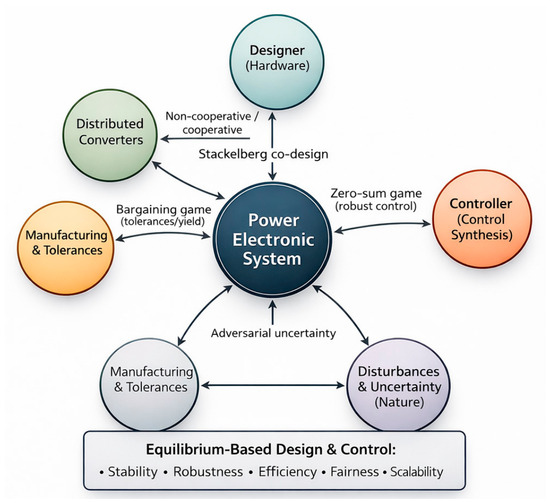
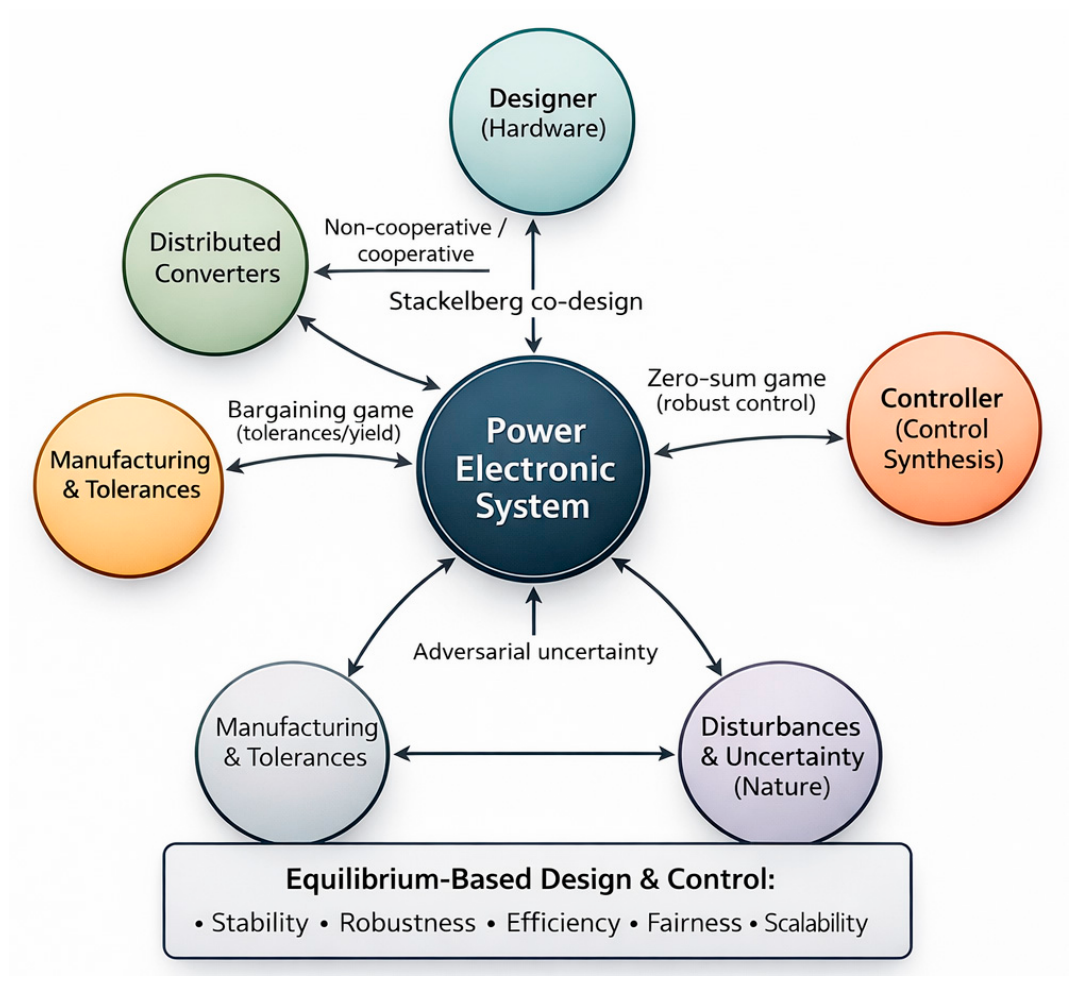
This extension is particularly relevant for systems subject to aging, thermal cycling, and changing operating conditions. Hardware that is optimal for a nominal controller may perform poorly when long-term degradation is considered, whereas a game-theoretic co-design can explicitly account for such effects. Figure 1 summarizes the equilibrium-based design perspectives discussed in the literature, and Section 3.6 and Section 5.7 add illustrative simulation case studies that instantiate the Stackelberg and (non-)cooperative viewpoints [49,50].
Figure 1.
Conceptual map of game-theoretic interactions in power electronic systems and their equilibrium interpretations.
Hardware design, control synthesis, uncertainty, manufacturing tolerances, and distributed subsystems are modeled as interacting players with partially conflicting objectives. Classical robust control can be interpreted as a zero-sum game between the controller and disturbances, whereas hardware–controller co-design is naturally formulated as a Stackelberg game. Distributed converters and modular systems, in turn, correspond to non-cooperative or cooperative games, whose equilibria determine system-level performance, robustness, and scalability. This game-theoretic interpretation provides a unifying perspective for analyzing design trade-offs and equilibrium behavior across different power-electronic architectures [51,52,53].
3.6. Case Study: Stackelberg Co-Design of a Buck Converter (Simulation)
To make the Stackelberg interpretation concrete and to address the need for representative examples, this subsection presents an illustrative co-design study for a continuous-conduction-mode (CCM) buck DC–DC converter. The purpose is not to claim a new converter model, but to provide a transparent numerical instantiation of the Stackelberg co-design concept in a familiar converter setting, showing how a leader–follower formulation naturally couples passive-component sizing with controller tuning within a single optimization loop.
An averaged small-signal model is used with parameters Vin = 48 V, Vout = 12 V, Pout = 120 W (R = 1.2 Ω), and fsw = 100 kHz. The leader (designer) selects the output-filter parameters d = [L, C] subject to practical ripple constraints (ΔiL,pp ≤ 2 A and Δvout,pp ≤ 0.12 V). For a CCM buck converter, the ripple approximations are ΔiL,pp ≈ (Vin − Vout)·D/(L·fsw) and Δvout,pp ≈ ΔiL,pp/(8·C·fsw), where D = Vout/Vin [1].
From the ripple constraints, the minimum inductance Lmin satisfying is obtained as:
Given the resulting worst-case ripple ΔiL,pp, the minimum capacitance Cmin that satisfies is approximated as:
For the above parameter set, these expressions yield Lmin = 45 μH and Cmin ≈ 20.8 μF. These quantities define a minimum ripple-satisfying design and are used as normalization references in the leader objective below.
Follower (controller) problem. Given a candidate hardware pair d = [L, C], the follower (controller) tunes a PI voltage regulator K(s) = Kp + Ki/s for the duty-to-output transfer function: Gvd(s) = Vin/(L·C·s2 + (L/R)·s + 1) [1,2,8]. In the Stackelberg interpretation, the controller parameters are selected to minimize the integral of squared tracking error (ISE) for a 1 V reference step, subject to an overshoot constraint Mp ≤ 10% and closed-loop stability.
Follower solution method. The optimization variables (Kp,Ki) are searched within bounded intervals Kp ∈ [0, Kp,max] and Ki ∈ [0, Ki,max] using a coarse-to-fine grid refinement strategy. Among all feasible candidates, the pair yielding the smallest ISE defines the follower best response K*(d).
Algorithmic implementation. To make the illustrative Stackelberg procedure reproducible, the co-design workflow can be summarized as follows. First, the feasible hardware design region is defined from the ripple constraints, yielding lower bounds on L and C and any additional practical bounds selected by the designer. Second, for each candidate hardware pair d = [L, C] in this feasible region, the follower solves a constrained PI-tuning problem for the corresponding duty-to-output model Gvd(s), minimizing the integral of squared tracking error (ISE) for a 1 V reference step subject to closed-loop stability and an overshoot limit of 10%. Third, the resulting best-response controller K*(d) is used to evaluate the leader objective, which combines closed-loop performance with a normalized passive-size proxy. Fourth, the leader selects the hardware pair d* that minimizes this objective over the feasible design set. The resulting pair (d*, K*(d*)) constitutes the Stackelberg solution of the illustrative co-design problem.
In the present example, this procedure is implemented numerically through a bounded coarse-to-fine search over both the hardware variables and the controller gains. The purpose is not to claim global optimality of the numerical search itself, but to provide a transparent and reproducible equilibrium-construction procedure that makes the leader–follower logic explicit.
Sensitivity and scope of the illustrative formulation. The weighting factor used in the passive-size surrogate is intentionally heuristic and serves only to reflect the common engineering observation that inductors often dominate volume and cost in buck-filter designs. Different applications may justify different relative penalties on L and C, and the resulting equilibrium should therefore be interpreted as dependent on the chosen design priorities rather than as a universal optimum. Likewise, the present case study is based on an averaged small-signal model and idealized ripple expressions, which makes it suitable for illustrating the leader–follower co-design logic but not for claiming full implementation-level validation. In practical designs, switching ripple, parasitic resistances, dead time, sampling, sensor noise, EMI constraints, thermal limits, and efficiency objectives can all be incorporated into the leader and follower cost functions without changing the underlying Stackelberg structure. The present example should therefore be interpreted as a transparent methodological demonstration rather than a complete converter-design prescription [54,55,56].
Leader objective and baseline comparison. The leader then chooses (L,C) to balance closed-loop performance against a simple passive “size” surrogate using the normalized proxy:
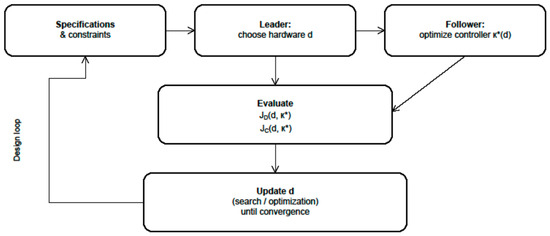
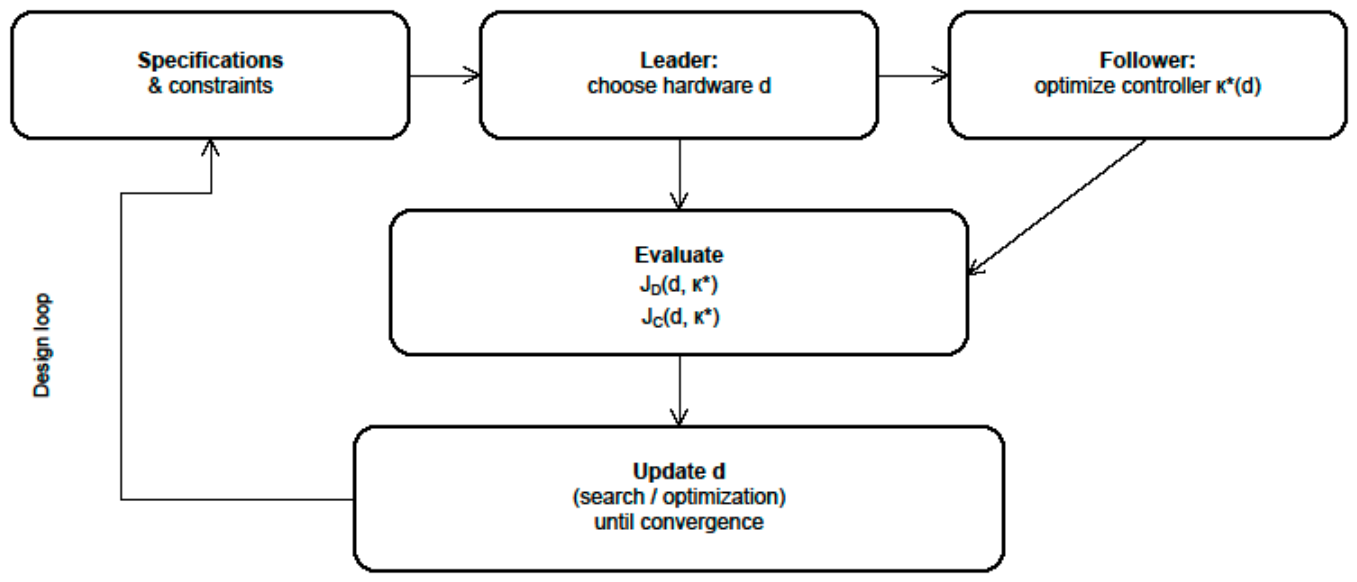
where the weighting factor reflects that inductors often dominate volume/cost in buck-filter designs (the exact weight is application dependent). Figure 2 sketches the leader–follower workflow used in this example.
Figure 2.
Leader–follower workflow for the Stackelberg co-design case study (Section 3.6).
Interpretation of the weighting factor. In the present illustrative example, the weighting coefficient assigned to L in the passive-size proxy is chosen to bias the leader objective toward solutions with lower inductance burden, reflecting a typical engineering preference in compact buck-converter design. This coefficient is not claimed to be universal. Rather, it represents an application-dependent design preference that can be varied to emphasize compactness, stored energy, cost, or capacitance usage. Changing this coefficient would generally shift the Stackelberg equilibrium along the trade-off surface between passive size and closed-loop performance, but it would not alter the underlying leader–follower interpretation of the problem. For this reason, the numerical value used here should be viewed as part of the illustrative instantiation of the method, not as a fixed prescription for practical converter design [57,58,59].
Practical implementation scope and relevance to integrated power electronics. Although the present case study is based on an averaged CCM buck model, the same Stackelberg co-design structure can be extended to implementation-level switched models and to more tightly coupled hardware architectures. In a switched-model setting, the leader objective may be augmented with efficiency, semiconductor stress, EMI, thermal limits, measurement noise sensitivity, sampling effects, and delay robustness, while the follower problem may use either classical digital control, MPC, or robust control formulations. The same logic is also relevant to integrated power electronics, where magnetic, capacitive, thermal, and geometric couplings are even stronger than in a conventional discrete-component converter. In such systems, design variables would no longer be limited to lumped L and C values, but could include integrated passive geometry, magnetic coupling, parasitics, packaging constraints, and radiation-related metrics [60,61]. The proposed formulation therefore should not be interpreted as limited to the simple buck example; rather, the example serves as a transparent low-order illustration of a broader leader–follower co-design principle that can be enriched for compact and highly integrated converter structures.
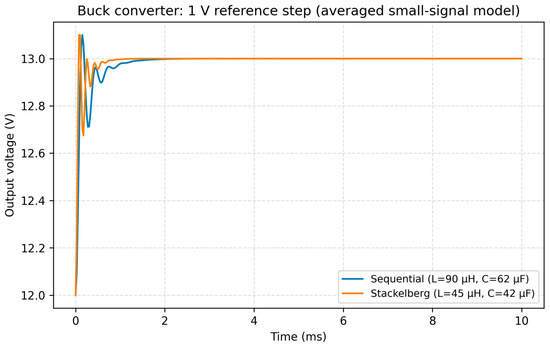
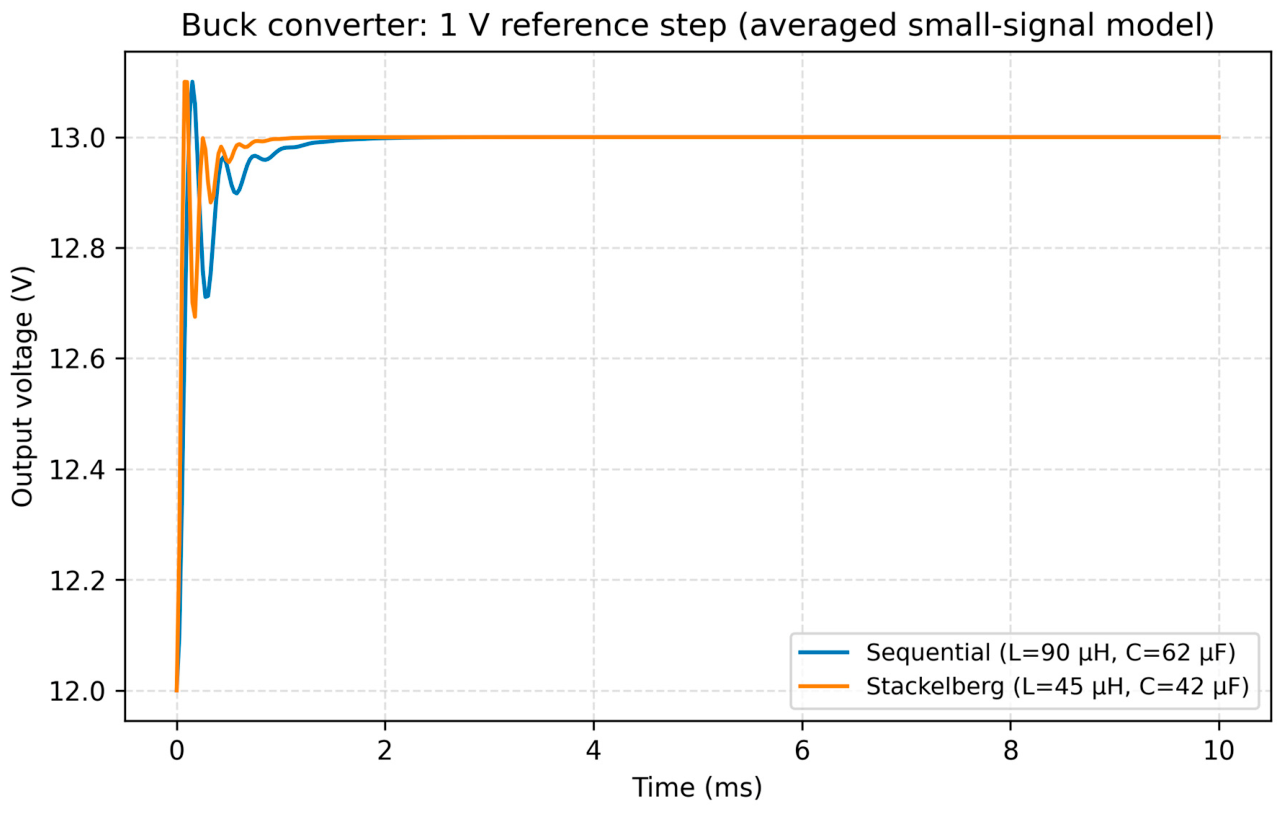
For comparison, a conservative sequential design is constructed by oversizing both passive components relative to the minimum ripple-satisfying values (Lseq = 90 µH and Cseq = 62.5 µF). The Stackelberg co-design, in contrast, selects (L*, C*) = (45 µH, 41.7 µF), which still satisfies the ripple limits but reduces a weighted passive-volume proxy by approximately 44% in this example (3·L/Lmin + C/Cmin). Figure 3 shows the resulting step responses, and Table 2 summarizes key metrics.
Figure 3.
Buck DC-DC converter case study: 1 V reference step responses for a conservative sequential design and the Stackelberg co-design (averaged small-signal model).
Table 2.
Buck DC-DC converter Stackelberg co-design case study: design parameters and closed-loop performance (simulation).
Although simplified, the example illustrates the core point of Stackelberg co-design: hardware is selected in anticipation of the best achievable closed-loop behavior, and controller gains are chosen with explicit awareness of the hardware choices. In practical converter design, additional objectives (efficiency, EMI, thermal stress, and lifetime) can be incorporated into JD and JC without changing the underlying leader–follower logic.
4. Tolerances, Uncertainty, and Risk Allocation as Games
4.1. Beyond Classical Tolerance Analysis
Tolerance analysis is a fundamental aspect of power electronic design, directly affecting performance, reliability, cost, and manufacturability. Traditionally, tolerances are treated either through worst-case analysis, which is often overly conservative, or through statistical methods such as Monte Carlo simulation, which typically assume independent and identically distributed parameter variations. While these approaches are useful, they fail to capture the strategic nature of tolerance selection and risk distribution in practical engineering workflows [61,62,63].
In reality, tolerances are not merely random deviations but the outcome of interacting decisions made by multiple stakeholders. Designers seek tight tolerances to guarantee performance and robustness, manufacturers favor wider tolerances to maximize yield and reduce cost, and the operating environment introduces adversarial effects through load variations, temperature changes, and aging. These interactions create conflicts that cannot be adequately represented by purely probabilistic models [64,65].
From a game-theoretic perspective, tolerance analysis can be reinterpreted as a strategic interaction in which uncertainty is not a passive phenomenon but an active player influencing system outcomes.
4.2. Nature as an Adversary: Robustness as a Zero-Sum Game
One of the most intuitive game-theoretic interpretations of uncertainty models the environment—often referred to as “Nature”—as an adversarial player. In this formulation, the controller or system designer seeks to minimize a performance degradation metric, while Nature selects parameter realizations and disturbances to maximize it. This leads naturally to a zero-sum game formulation.
This interpretation aligns closely with classical robust control theory, where worst-case disturbances are considered in a minimax framework. However, extending this viewpoint to tolerances highlights an important insight: worst-case tolerance analysis implicitly assumes a perfectly coordinated adversary that simultaneously pushes all parameters to their extreme limits. While mathematically convenient, this assumption may significantly overestimate risk in realistic scenarios [14,15,16,17]. Related non-game formulations include robust optimization and convex relaxations, which enforce guarantees over bounded uncertainty sets and often provide scalable computational tools [66,67,68].
Game-theoretic formulations allow intermediate adversarial models, where Nature is constrained by physical, manufacturing, or economic limitations. This enables more realistic assessments of robustness margins and avoids unnecessary conservatism in tolerance specification.
4.3. Designer–Manufacturer Interaction as a Bargaining Game
Tolerance selection is rarely determined by technical considerations alone. In industrial practice, tolerances emerge through negotiation between designers and manufacturers, each pursuing different objectives. Designers prioritize performance, stability margins, and lifetime, whereas manufacturers prioritize production yield, cost efficiency, and supply-chain flexibility.
This interaction can be modeled as a bargaining game, in which the feasible tolerance set represents the negotiation space and the final agreement corresponds to a bargaining equilibrium. Such a formulation explicitly recognizes that tolerances are economic as well as technical variables. It also provides a principled framework for quantifying trade-offs between performance margins and manufacturing cost [34,35].
By viewing tolerances as equilibrium outcomes rather than fixed constraints, designers can reason systematically about where tight tolerances are truly critical and where relaxed tolerances are acceptable without compromising system-level objectives.
4.4. Multi-Parameter Interaction and Risk Attribution
In power electronic systems, performance degradation is rarely caused by a single parameter deviation. Instead, multiple tolerances interact nonlinearly, affecting key performance indicators such as efficiency, current ripple, electromagnetic emissions, and thermal stress. Classical sensitivity analysis often fails to capture these interactions, leading to misleading conclusions about parameter importance.
Game-theoretic risk attribution offers an alternative perspective. By modeling parameters as players in a cooperative game whose joint action produces performance degradation, it becomes possible to allocate responsibility for risk among parameters in a principled way. Solution concepts such as marginal contribution and fair allocation provide quantitative measures of how individual tolerances contribute to system-level uncertainty [36,37,38,39].
This perspective is particularly valuable for guiding design effort. Rather than uniformly tightening all tolerances, resources can be directed toward parameters that dominate risk in equilibrium, improving both robustness and cost efficiency.
4.5. Hierarchical and Multi-Scale Uncertainty Games
Tolerance interactions in power electronics span multiple physical and temporal scales, from semiconductor device characteristics and layout parasitics to thermal interfaces and long-term degradation mechanisms. Treating all uncertainties at a single level obscures their hierarchical structure.
Game-theoretic formulations naturally accommodate multi-level interactions. At lower levels, device- and layout-related uncertainties may interact competitively, while at higher levels, system-level controllers and protection mechanisms act to mitigate aggregated effects. Hierarchical game models reflect this structure and enable consistent tolerance allocation across scales.
Such formulations are especially relevant for wide-bandgap-based converters and high-density designs, where small geometric or material variations can have disproportionate effects on performance and reliability.
4.6. Implications for Design and Control Co-Optimization
Viewing tolerances and uncertainty through a game-theoretic lens has important implications for co-design. Controllers can be synthesized not only to stabilize nominal systems but also to reshape the underlying tolerance game by reducing sensitivity to certain parameters. Conversely, hardware can be designed to simplify the control problem by limiting adversarial uncertainty.
This mutual influence reinforces the need for integrated design and control methodologies. Tolerances cease to be static constraints and become strategic variables whose optimal values depend on the anticipated behavior of controllers, operating environments, and manufacturing processes.
5. Distributed and Modular Power Electronic Systems as Games
5.1. From Centralized Control to Strategic Interaction
The evolution of power electronic systems toward modular and distributed architectures represents a fundamental shift in both design philosophy and control requirements. Parallel converters, modular multilevel inverters, distributed generation units, and electric-vehicle charging infrastructures operate without a single centralized decision-maker. Instead, multiple autonomous units interact through shared electrical networks, competing for limited resources such as voltage margins, current capacity, and thermal headroom [40,41,42,43].
In such systems, traditional centralized optimization becomes impractical due to scalability, communication constraints, and robustness considerations. As a result, local control strategies are commonly employed, relying on limited information and decentralized decision-making. These conditions naturally give rise to strategic interactions among subsystems, making game-theoretic models particularly well suited for analysis and design.
5.2. Parallel Converters and Load Sharing as Non-Cooperative Games
One of the most studied examples of distributed power electronic systems is the parallel operation of converters. Each converter regulates its output while interacting electrically with others through a common bus. From a game-theoretic perspective, each converter can be viewed as a player selecting a control strategy—such as reference current, droop slope, or virtual impedance—to optimize a local objective function.
These local objectives typically include efficiency maximization, thermal stress minimization, and component lifetime preservation. However, when converters act independently, the resulting operating point corresponds to a non-cooperative equilibrium. Classical droop control can be interpreted as a mechanism that induces a Nash equilibrium in which no converter can improve its local objective without adversely affecting others.
This interpretation explains both the strengths and limitations of droop-based methods. While they enable decentralized operation and scalability, the resulting equilibria may be suboptimal in terms of global efficiency or fairness. Game-theoretic analysis thus provides insight into how control laws shape equilibrium outcomes rather than merely stabilizing dynamics.
5.3. Cooperative Games and Fairness in Modular Systems
In many applications, particularly in microgrids and energy communities, cooperation among power electronic units is desirable. Cooperative game formulations enable subsystems to share information or coordinate strategies to achieve system-level objectives such as loss minimization, equitable load distribution, or enhanced resilience [40,41,42,43].
By introducing incentive mechanisms, pricing signals, or coordination protocols, the equilibrium can be shifted from a purely non-cooperative outcome toward a cooperative solution. This transition is particularly relevant in applications where fairness and long-term sustainability are critical, such as shared energy storage, community-owned renewable assets, and vehicle-to-grid systems.
Game-theoretic tools provide a formal framework for analyzing such coordination mechanisms and evaluating their impact on both individual units and overall system performance.
5.4. Modular Multilevel Converters and Hierarchical Games
Modular multilevel converters (MMCs) exemplify hierarchical interactions across multiple scales. Submodules, arms, and system-level controllers operate on different time scales and pursue different objectives, ranging from capacitor voltage balancing to grid-level power quality [46,47,48].
Hierarchical game models naturally reflect this structure. Lower-level games govern interactions among submodules, while higher-level games coordinate arms or phases. Stackelberg formulations can be employed to capture leader–follower relationships between supervisory controllers and local control units, enabling systematic design of hierarchical control architectures.
This perspective clarifies how local decisions propagate upward and how system-level objectives can be enforced without centralized control.
5.5. Implications for Smart Grids and Energy Systems
In smart grids, power electronic interfaces act as intelligent agents that mediate energy flows between generation, storage, and consumption. Their interactions extend beyond purely technical considerations to include economic incentives, regulatory constraints, and user behavior. Game-theoretic models provide a unified language for analyzing these multi-dimensional interactions [49,50,51].
By framing distributed power electronic control as a game, it becomes possible to address issues such as stability under strategic behavior, fairness in resource allocation, and robustness against selfish or adversarial actions. This perspective aligns naturally with emerging trends in grid digitalization, transactive energy, and peer-to-peer energy trading.
5.6. Summary and Link to the Unified Framework
Distributed and modular power electronic systems exemplify the transition from centralized optimization to equilibrium-based operation. Game theory provides the analytical tools needed to understand and shape these equilibria, enabling scalable, robust, and socially acceptable system behavior. Recent work extends such game-theoretic formulations to microgrid clusters, transactive energy, and multi-stakeholder optimization using Stackelberg and cooperative games [58,59,60].
Within the unified framework proposed in this paper, distributed control problems correspond to non-cooperative or cooperative games whose equilibria determine system-level performance. Recognizing this connection allows designers to move beyond heuristic control laws toward principled, equilibrium-aware design methodologies.
5.7. Case Study: Droop-Coefficient Selection as a Game (Simulation)
Droop control is a widely used decentralized mechanism for current sharing in parallel converters and inverter-dominated microgrids. Its behavior is naturally interpretable through non-cooperative and cooperative games: each module’s droop coefficient affects its own current contribution, the common bus voltage, and therefore the operating losses and fairness of the overall system.
Consider two DC sources connected to a common bus with droop laws V = Vref − mi·Ii (i = 1,2), where V is the bus voltage and mi > 0 are droop slopes. Let the load be resistive with RL, so that Iload = V/RL and I1 + I2 = Iload in steady state. Defining inverse droop conductance gi = 1/mi, we obtain:
which yields the steady-state relations
Non-cooperative game (Nash equilibrium). Each converter chooses gi to minimize a private cost:
where ri models conduction-loss sensitivity (e.g., an equivalent resistance) and λ weights voltage regulation. In this illustrative example, we use Vref = 48 V, r1 = 0.02 Ω, r2 = 0.01 Ω, and λ = 0.1. Substituting the steady-state relations yields a one-dimensional best-response problem in gi. For this two-player resistive-load setting, the follower best response admits the closed form:
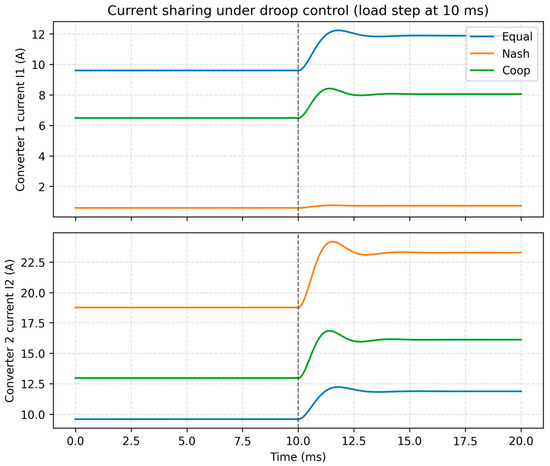
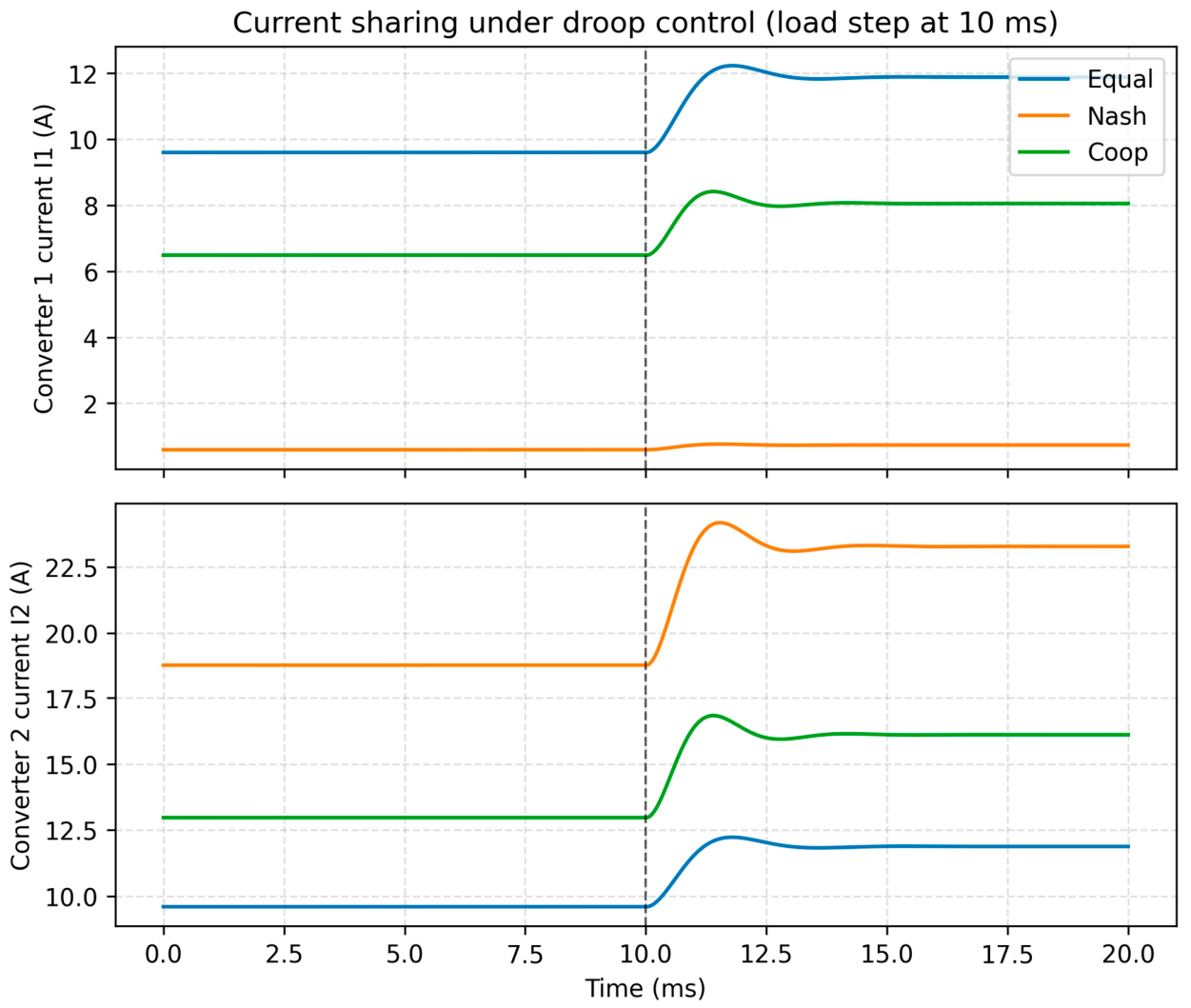
and the Nash equilibrium is obtained by solving the coupled best-response equations. The resulting Nash slopes (computed at the nominal load RL = 2.4 Ω) are m1 = 2.561 V/A and m2 = 0.081 V/A.
Cooperative (loss-aware) droop. For comparison, a cooperative droop design can be obtained by choosing droop slopes proportional to loss coefficients, mi ∝ ri, which yields a sharing ratio close to the loss-minimizing allocation for quadratic conduction losses under the same decentralized droop structure. With the above (r1,r2), this gives m1 = 0.200 V/A, m2 = 0.100 V/A. A conventional “equal droop” baseline uses m1 = m2 = 0.200 V/A.
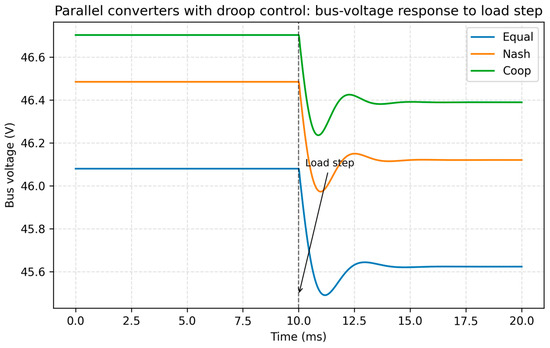
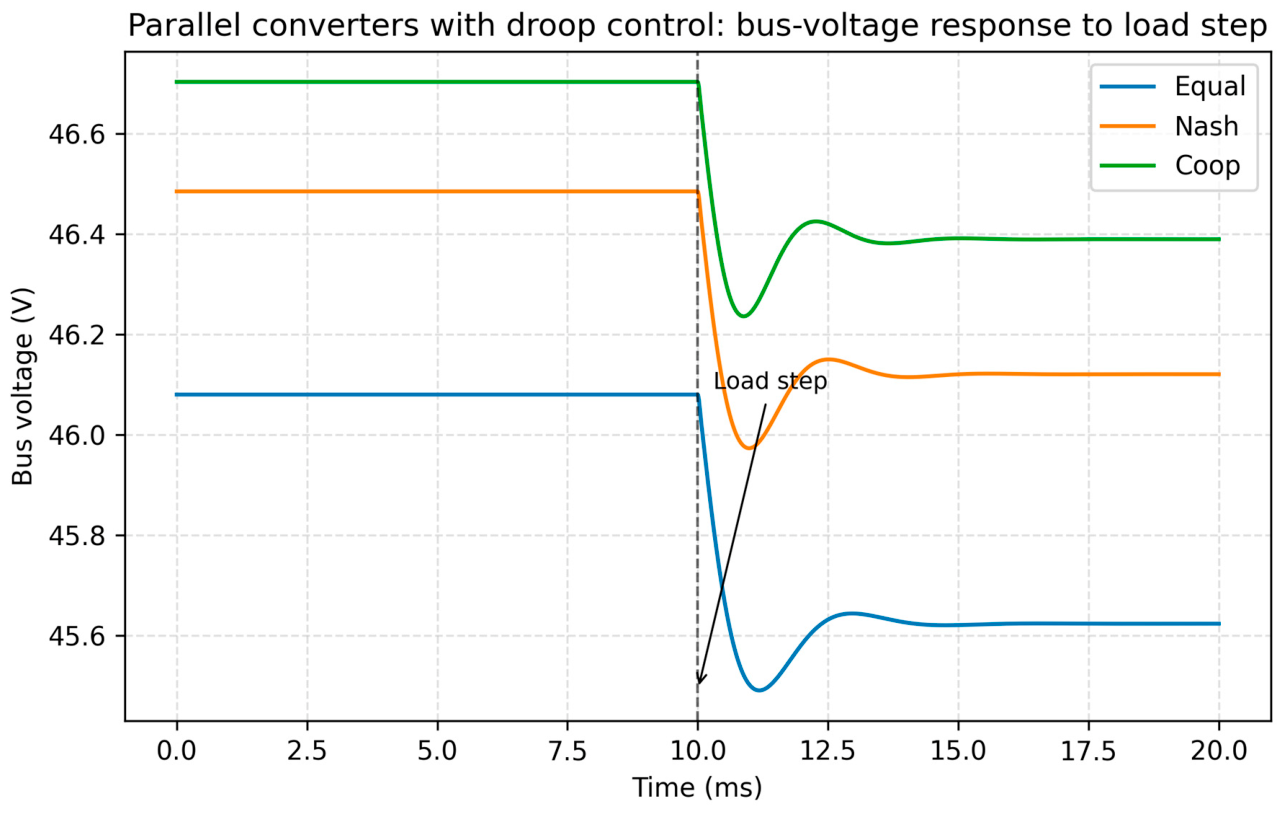
Figure 4 and Figure 5 show the bus-voltage and current responses to a load step (RL: 2.4 Ω → 1.92 Ω at 10 ms) for the three droop selections (equal, Nash, cooperative), while Table 3 reports steady-state values under nominal and heavy load. In this example, the cooperative (loss-aware) droop improves both voltage regulation and efficiency relative to equal droop (≈9% lower total conduction loss at nominal load in Table 3), whereas the non-cooperative Nash equilibrium increases bus-voltage stiffness by shifting most of the load to the more efficient module. This improves voltage droop but strongly degrades current-sharing fairness and can increase total losses. The case study illustrates how equilibrium analysis can explicitly quantify the trade-offs between regulation, efficiency, and fairness in decentralized converter fleets.
Figure 4.
Droop-control case study: bus-voltage response to a load step (Rload: 2.4 Ω → 1.92 Ω at 10 ms) for equal droop, Nash-equilibrium droop, and cooperative loss-aware droop.
Figure 5.
Droop-control case study: converter currents I1 and I2 during the load step for the three droop-coefficient selections (equal, Nash, cooperative).
Table 3.
Droop-control case study: steady-state sharing, voltage droop, and total conduction loss for three droop-coefficient selections.
Table 3 highlights the equilibrium trade-offs among the three decentralized strategies. Under both nominal and heavy load, the cooperative droop solution achieves the highest bus voltage and the lowest total conduction loss, while maintaining a substantially more balanced current distribution than the Nash equilibrium. By contrast, the Nash solution strongly favors the electrically more efficient module, resulting in a highly asymmetric current allocation (e.g., 0.59 A versus 18.78 A at nominal load), which improves voltage stiffness but does so at the expense of fairness and, in this example, also increases total loss relative to the cooperative solution. The equal-droop baseline remains the fairest in the strict sense of symmetric sharing, but it is inferior to the cooperative strategy in both voltage regulation and efficiency. Overall, this comparison illustrates a key point of the paper: different equilibrium concepts correspond to different engineering priorities, and a game-theoretic formulation makes these priorities and their consequences explicit.
6. Unified Taxonomy and Future Research Directions
6.1. A Unified Taxonomy of Game-Theoretic Problems in Power Electronics
The analysis presented in the previous sections shows that a broad class of power electronic design and control problems can be consistently interpreted within a game-theoretic framework.
Based on this observation, a unified taxonomy of game-theoretic formulations in power electronics can be proposed, as summarized in Figure 1 and Table 4. At the most fundamental level, zero-sum games capture robustness against disturbances and uncertainty, corresponding to classical robust and H∞-based control. These formulations are particularly relevant for converter stability, disturbance rejection, and worst-case performance guarantees [18,19,20,21,22,23,24].
Table 4.
Taxonomy of Game-Theoretic Formulations in Power Electronics Design and Control.
Taken together, these categories show that different game-theoretic formulations correspond not only to different technical problems, but also to distinct decision hierarchies and time scales in power electronic systems.
At the next level, Stackelberg games formalize hierarchical interactions between hardware design and control synthesis. Here, the designer anticipates the behavior of an optimal controller and selects hardware parameters accordingly, enabling systematic co-design. This category encompasses problems related to component sizing, switching frequency selection, and robustness-aware hardware optimization.
Non-cooperative games arise naturally in distributed and modular power electronic systems, where individual units pursue local objectives while interacting through shared electrical networks. Load sharing, droop control, and decentralized voltage regulation can be interpreted as equilibrium outcomes of such games. In contrast, cooperative and bargaining games model negotiated interactions among designers, manufacturers, and system operators, particularly in the context of tolerance allocation, yield optimization, and lifecycle cost management.
Finally, repeated and learning-based games extend these formulations to dynamic environments characterized by aging, parameter drift, and evolving operating conditions. These models provide a bridge between classical control theory and modern data-driven and adaptive approaches.
6.2. Linking Game Types to Design Objectives and Time Scales
An important advantage of the proposed taxonomy is its ability to relate different game formulations to specific design objectives and time scales. Fast-time-scale interactions, such as current regulation and disturbance rejection, are well captured by differential zero-sum games. Medium-time-scale decisions, including hardware–controller co-design and tolerance selection, align with Stackelberg and bargaining games. Long-time-scale phenomena, such as degradation, maintenance planning, and economic optimization, motivate repeated and evolutionary game formulations.
This multi-scale perspective reflects the physical reality of power electronic systems, in which fast electrical dynamics coexist with slow thermal and aging processes. Game-theoretic models provide a coherent framework for integrating these disparate time scales without resorting to ad hoc assumptions.
This mapping between game structure, engineering objective, and physical time scale clarifies which equilibrium concept is most appropriate for a given converter problem, rather than treating all multi-objective interactions through a single optimization framework.
6.3. Open Challenges and Research Opportunities
Despite their conceptual and methodological appeal, game-theoretic approaches in power electronics should be interpreted within an explicit scope. The present paper is intended as a unifying analytical framework supported by illustrative case studies, rather than as a universal synthesis tool for all converter classes and operating regimes. In particular, the two examples introduced in Section 3.6 and Section 5.7 are intentionally transparent and low order, which helps expose the equilibrium structure but does not capture the full implementation complexity of practical converter systems. Switched dynamics, parasitics, semiconductor losses, EMI constraints, thermal coupling, sensor noise, sampling and delay effects, and digital implementation limits would need to be incorporated explicitly in application-specific formulations.
Within this scope, several open challenges and research directions emerge.
First, experimental validation of game-theoretic control and design strategies remains limited. To partially bridge this gap, the revised manuscript adds two reproducible simulation case studies (Section 3.6 and Section 5.7) that quantify equilibrium trade-offs on representative converter and droop-control examples; nevertheless, hardware prototypes and large-scale field tests remain essential for assessing robustness, implementation constraints, and measurement/actuation non-idealities. In this context, the present work does not claim real-time equilibrium computation for fast converter dynamics, but rather uses game-theoretic structures as design and coordination abstractions.
Second, computational complexity poses a challenge for real-time implementation, particularly in large-scale or highly modular systems. Efficient approximation methods and hierarchical decomposition techniques are needed to translate theoretical formulations into practical design tools.
Third, the integration of learning and adaptation into game-theoretic frameworks raises questions of stability, convergence, and safety. Combining reinforcement learning with equilibrium-seeking control is particularly attractive for systems with hard-to-model dynamics (e.g., changing impedances, aging, or uncertain grids), but must be paired with stability guarantees (e.g., Lyapunov constraints, barrier certificates, or robust safety filters). Likewise, model predictive control (MPC) can act as a computational engine for solving local best-response problems online, suggesting hybrid architectures in which distributed MPC computes equilibrium updates while respecting constraints, and learning mechanisms update models or payoff functions over longer time scales [8,9,10].
Fourth, standardization and design methodology are largely absent. Translating game-theoretic insights into engineering guidelines, design rules, and software tools represents a significant opportunity for impact.
Finally, emerging concerns related to fairness, transparency, and societal acceptance, particularly in smart grids and energy communities, suggest the need for interdisciplinary approaches that combine technical game-theoretic models with economic and regulatory considerations.
6.4. Implications for the Future of Power Electronic Design
The unifying perspective developed in this paper suggests a shift in how power electronic systems are conceived and engineered. Rather than viewing design and control as isolated optimization problems, they can be understood as interacting strategic processes whose outcomes are equilibrium configurations. This shift has profound implications for robustness, scalability, and sustainability.
By explicitly modeling strategic interactions, engineers can anticipate conflicts, allocate risk more effectively, and design systems that remain stable and efficient under realistic operating conditions. Game theory thus emerges not merely as an abstract mathematical tool, but as a structured and practically interpretable framework for future power electronic design methodologies.
7. Conclusions
The results presented in Section 3.6 and Section 5.7, together with the unified taxonomy in Section 6, illustrate how different equilibrium concepts expose distinct engineering trade-offs in representative converter problems.
This paper has presented a unified game-theoretic perspective on the optimal design and control of power electronic systems. By reframing classical problems—such as robust stabilization, co-design, tolerance allocation, and droop-based load sharing—as equilibrium solutions of underlying games, the manuscript connects a diverse set of methods under a single conceptual umbrella.
The proposed framework highlights that design and control decisions in modern power electronics are inherently interdependent. Rather than relying solely on a sequential division of labor, equilibrium viewpoints (Stackelberg, Nash, cooperative) provide a language for quantifying and negotiating trade-offs among efficiency, robustness, ripple, fairness, and scalability.
Beyond conceptual unification, two illustrative simulation case studies were provided. A buck-converter Stackelberg co-design example demonstrated how passive-component sizing and PI tuning can be coupled to reduce a weighted volume proxy while improving transient performance. A droop-control example for parallel converters showed how non-cooperative equilibria can differ from cooperative designs, making explicit the trade-off between bus-voltage regulation, current-sharing fairness, and losses.
Overall, the paper argues that game theory should be regarded not merely as an auxiliary mathematical tool, but as a structured and practically interpretable methodological framework for power electronic systems in which distributed decision-making, uncertainty, and multi-objective trade-offs are unavoidable.
Funding
This work was supported by the European Regional Development Fund under the “Research Innovation and Digitization for Smart Transformation” program 2021–2027 under Project BG16RFPR002-1.014-0006 “National Centre of Excellence Mechatronics and Clean Technologies”, and the APC was funded by Project BG16RFPR002-1.014-0006.
Data Availability Statement
The simulation parameters and models used for the illustrative case studies in this paper are described in the manuscript and can be provided by the author upon reasonable request.
Acknowledgments
The present research has been carried out under the project BG16RFPR002-1.014-0006 “National Centre of Excellence Mechatronics and Clean Technologies”, funded by the Operational Programme Science and Education for Smart Growth.
Conflicts of Interest
The author declares no conflicts of interest.
Nomenclature
| Symbols | |
| L, C | Inductance and capacitance of Buck DC-DC |
| Kp, Ki | PI-controller gains |
| Gvd(s) | Duty-cycle-to-output transfer function |
| d | Hardware design vector |
| K*(d) | Follower best-response controller |
| JL | Leader objective |
| JF | Follower objective |
| ISE | Integral of squared error |
| Acronyms | |
| CCM | Continuous conduction mode |
| EMI | Electromagnetic interference |
| MPC | Model predictive control |
| DER | Distributed energy resource |
References
- Erickson, R.W.; Maksimović, D. Fundamentals of Power Electronics, 2nd ed.; Springer: Boston, MA, USA, 2001. [Google Scholar]
- Mohan, N.; Undeland, T.M.; Robbins, W.P. Power Electronics: Converters, Applications, and Design, 3rd ed.; Wiley: Hoboken, NJ, USA, 2003. [Google Scholar]
- Rashid, M.H. Power Electronics: Circuits, Devices, and Applications, 4th ed.; Pearson: Boston, MA, USA, 2014. [Google Scholar]
- Millán, J.; Godignon, P.; Perpiñà, X.; Pérez-Tomás, A.; Rebollo, J. A survey of wide bandgap power semiconductor devices. IEEE Trans. Power Electron. 2014, 29, 2155–2163. [Google Scholar] [CrossRef] [Scilit]
- Ott, H.W. Electromagnetic Compatibility Engineering; Wiley: Hoboken, NJ, USA, 2009. [Google Scholar]
- Blaabjerg, F.; Teodorescu, R.; Liserre, M.; Timbus, A.V. Overview of control and grid synchronization for distributed power generation systems. IEEE Trans. Ind. Electron. 2006, 53, 1398–1409. [Google Scholar] [CrossRef] [Scilit]
- Yarar, N.; Yoldas, Y.; Bahceci, S.; Onen, A.; Jung, J. A comprehensive review based on game theory with energy management and trading. Energies 2024, 17, 3749. [Google Scholar] [CrossRef] [Scilit]
- Eyimaya, S.E.; Altin, N. Review of energy management systems in microgrids. Appl. Sci. 2024, 14, 1249. [Google Scholar] [CrossRef] [Scilit]
- González, F.; Arévalo, P.; Ramirez, L. Game theory and robust predictive control for peer-to-peer energy management: A pathway to a low-carbon economy. Sustainability 2025, 17, 1780. [Google Scholar] [CrossRef] [Scilit]
- Mokhtarnejad, Z.; Nazarzadeh, J. On the optimal game control in DC microgrid systems. IET Renew. Power Gener. 2024, 18, 1711–1722. [Google Scholar] [CrossRef] [Scilit]
- Wang, K.; Cheng, L.; Yin, M.; Zhang, K.; Wang, R.; Zhang, M.; Sun, R. Evolutionary game theory in energy storage systems: A systematic review of collaborative decision-making, operational strategies, and coordination mechanisms for renewable energy integration. Sustainability 2025, 17, 7400. [Google Scholar] [CrossRef] [Scilit]
- Mokhtarnejad, Z.; Nazarzadeh, J. Applying optimal Nash–Stackelberg game for load adjusting in DC microgrids. Int. Trans. Electr. Energy Syst. 2019, 29, e2781. [Google Scholar] [CrossRef] [Scilit]
- Samal, K.B.; Mahapatra, M.; Pati, S.; Debnath, M.K. A review on microgrid control: Conventional, advanced and intelligent control approaches. Unconv. Resour. 2025, 9, 100297. [Google Scholar]
- Shabbir, G.; Hasan, A.; Javed, M.Y.; Shahid, K.; Mussenbrock, T. Review of DC microgrid design, optimization, and control for resilient and efficient renewable energy integration. Energies 2025, 18, 6364. [Google Scholar] [CrossRef] [Scilit]
- Tang, Z.; Yang, Y.; Blaabjerg, F. Power electronics: The enabling technology for renewable energy integration. CSEE J. Power Energy Syst. 2022, 8, 39–52. [Google Scholar] [CrossRef] [Scilit]
- Blaabjerg, F.; Yang, Y.; Kim, K.A.; Rodriguez, J. Power electronics technology for large-scale renewable energy generation. Proc. IEEE 2023, 111, 335–355. [Google Scholar] [CrossRef] [Scilit]
- Karamanakos, P.; Liegmann, E.; Geyer, T.; Kennel, R. Model predictive control of power electronic systems: Methods, results, and challenges. IEEE Open J. Ind. Appl. 2020, 1, 95–114. [Google Scholar] [CrossRef] [Scilit]
- Yu, Z.; Long, J. Review on advanced model predictive control technologies for high-power converters and industrial drives. Electronics 2024, 13, 4969. [Google Scholar] [CrossRef] [Scilit]
- Alharbi, Y.; Darwish, A.; Ma, X. A review of model predictive control for grid-connected PV applications. Electronics 2025, 14, 667. [Google Scholar] [CrossRef] [Scilit]
- Buso, S.; Mattavelli, P. Digital Control in Power Electronics; Springer Nature: Cham, Switzerland, 2022. [Google Scholar]
- Leong, Y.P.; Doyle, J.C. Understanding robust control theory via stick balancing. In Proceedings of the 2016 IEEE 55th Conference on Decision and Control (CDC), Las Vegas, NV, USA, 12–14 December 2016; pp. 1508–1514. [Google Scholar] [CrossRef] [Scilit]
- Borutzky, W. Robust Control. In Linear Multivariable Control Engineering Using GNU Octave; Springer Nature: Cham, Switzerland, 2023; pp. 245–293. [Google Scholar]
- Dong, Z.; Zhang, X.; Zhang, N.; Kang, C.; Strbac, G. A distributed robust control strategy for electric vehicles to enhance resilience in urban energy systems. Adv. Appl. Energy 2023, 9, 100115. [Google Scholar]
- Liu, K.-Z.; Yao, Y. Robust Control: Theory and Applications; Wiley: Hoboken, NJ, USA, 2016. [Google Scholar]
- Lewis, F.L.; Xie, L.; Popa, D. Optimal and Robust Estimation: With an Introduction to Stochastic Control Theory; CRC Press: Boca Raton, FL, USA, 2017. [Google Scholar]
- Manchester, I.R.; Slotine, J.-J.E. Robust control contraction metrics: A convex approach to nonlinear state-feedback H∞ control. IEEE Control Syst. Lett. 2018, 2, 333–338. [Google Scholar] [CrossRef] [Scilit]
- Bhattacharyya, S.P.; Datta, A.; Keel, L.H. Linear Control Theory: Structure, Robustness, and Optimization; CRC Press: Boca Raton, FL, USA, 2018. [Google Scholar]
- Chen, B.M. H∞ Control and Its Applications; Springer: Berlin, Germany, 2013. [Google Scholar]
- Nazari, S.; Ahmadi, A.; Rad, S.K.; Ebrahimi, B. Application of non-cooperative dynamic game theory for groundwater conflict resolution. J. Environ. Manag. 2020, 270, 110889. [Google Scholar] [CrossRef] [Scilit]
- Sheha, M.; Mohammadi, K.; Powell, K. Solving the duck curve in a smart grid environment using a non-cooperative game theory and dynamic pricing profiles. Energy Convers. Manag. 2020, 220, 113102. [Google Scholar] [CrossRef] [Scilit]
- Hespanha, J.P. Noncooperative Game Theory: An Introduction for Engineers and Computer Scientists; Princeton University Press: Princeton, NJ, USA, 2017. [Google Scholar]
- Apkarian, P.; Noll, D. The H∞ control problem is solved. Aerosp. Lab 2017, 13, 1–10. [Google Scholar]
- Friedman, A. Differential Games; Courier Corporation: Mineola, NY, USA, 2013. [Google Scholar]
- Nash, J.F. Equilibrium points in N-person games. Proc. Natl. Acad. Sci. USA 1950, 36, 48–49. [Google Scholar] [CrossRef] [Scilit]
- Matsumoto, A.; Szidarovszky, F. Game Theory and Its Applications; Springer: Tokyo, Japan, 2016. [Google Scholar]
- Ho, E.; Rajagopalan, A.; Skvortsov, A.; Arulampalam, S.; Piraveenan, M. Game theory in defence applications: A review. Sensors 2022, 22, 1032. [Google Scholar] [CrossRef] [Scilit]
- Herber, D.R.; Allison, J.T. Nested and simultaneous solution strategies for general combined plant and control design problems. J. Mech. Des. 2019, 141, 011402. [Google Scholar] [CrossRef] [Scilit]
- Kazimierczuk, M.K. Resonant Power Converters, 2nd ed.; Wiley: Hoboken, NJ, USA, 2011. [Google Scholar]
- Yuan, T.; Jin, F.; Li, Z.; Zhao, C.; Li, Q. Design of an integrated transformer with parallel windings for a 30-kW LLC resonant converter. IEEE Trans. Power Electron. 2023, 38, 14317–14333. [Google Scholar] [CrossRef] [Scilit]
- Gabrel, V.; Murat, C.; Thiele, A. Recent advances in robust optimization: An overview. Eur. J. Oper. Res. 2014, 235, 471–483. [Google Scholar] [CrossRef] [Scilit]
- Li, C.; Han, S.; Zeng, S.; Yang, S. Robust optimization. In Intelligent Optimization: Principles, Algorithms and Applications; Springer Nature: Singapore, 2024; pp. 239–251. [Google Scholar]
- Bertsekas, D. Convex Optimization Algorithms; Athena Scientific: Belmont, MA, USA, 2015. [Google Scholar]
- Taylor, J.A. Convex Optimization of Power Systems; Cambridge University Press: Cambridge, UK, 2015. [Google Scholar]
- Iooss, B.; Lemaître, P. A review on global sensitivity analysis methods. In Uncertainty Management in Simulation-Optimization of Complex Systems: Algorithms and Applications; Springer: Boston, MA, USA, 2015; pp. 101–122. [Google Scholar]
- Sysoev, A. Sensitivity analysis of mathematical models. Computation 2023, 11, 159. [Google Scholar] [CrossRef] [Scilit]
- Torii, A.J.; Begnini, R.; Kroetz, H.M.; Matar, O.M.I.; Lopez, R.H.; Miguel, L.F.F. Global sensitivity analysis for mathematical models comparison. Comput. Appl. Math. 2023, 42, 345. [Google Scholar] [CrossRef] [Scilit]
- Papadimitriou, C.N.; Zountouridou, E.I.; Hatziargyriou, N.D. Review of hierarchical control in DC microgrids. Electr. Power Syst. Res. 2015, 122, 159–167. [Google Scholar] [CrossRef] [Scilit]
- Singh, J.; Prakash Singh, S.; Shanker Verma, K.; Iqbal, A.; Kumar, B. Recent control techniques and management of AC microgrids: A critical review on issues, strategies, and future trends. Int. Trans. Electr. Energy Syst. 2021, 31, e13035. [Google Scholar] [CrossRef] [Scilit]
- Simpson-Porco, J.W.; Dörfler, F.; Bullo, F. Voltage stabilization in microgrids via quadratic droop control. IEEE Trans. Autom. Control 2017, 62, 1239–1253. [Google Scholar] [CrossRef] [Scilit]
- Yang, B.; Zhou, Y.; Yan, Y.; Su, S.; Li, J.; Yao, W.; Li, H.; Gao, D.; Wang, J. A critical and comprehensive handbook for game theory applications on new power systems: Structure, methodology, and challenges. Prot. Control Mod. Power Syst. 2025, 10, 5. [Google Scholar] [CrossRef] [Scilit]
- Pilz, M.; Al-Fagih, L. Recent advances in local energy trading in the smart grid based on game-theoretic approaches. IEEE Trans. Smart Grid 2019, 10, 1363–1371. [Google Scholar] [CrossRef] [Scilit]
- Wu, X.; Zhuang, Y.; Bai, W.; Zhou, Y.; Wang, Y. Optimal Subsidy Policy for Green Energy Trading Among Three Parties: A Game Theoretical Approach. IEEE Access 2021, 9, 86321–86330. [Google Scholar] [CrossRef] [Scilit]
- Navon, A.; Ben Yosef, G.; Machlev, R.; Shapira, S.; Roy Chowdhury, N.; Belikov, J.; Orda, A.; Levron, Y. Applications of game theory to design and operation of modern power systems: A comprehensive review. Energies 2020, 13, 3982. [Google Scholar] [CrossRef] [Scilit]
- Tushar, W.; Yuen, C.; Mohsenian-Rad, H.; Saha, T.; Poor, H.V.; Wood, K.L. Transforming energy networks via peer-to-peer energy trading: The potential of game-theoretic approaches. IEEE Signal Process. Mag. 2018, 35, 90–111. [Google Scholar] [CrossRef] [Scilit]
- Islam, S.N. A review of peer-to-peer energy trading markets: Enabling models and technologies. Energies 2024, 17, 1702. [Google Scholar] [CrossRef] [Scilit]
- Amin, W.; Huang, Q.; Umer, K.; Zhang, Z.; Afzal, M.; Khan, A.A.; Ahmed, S.A. A motivational game-theoretic approach for peer-to-peer energy trading in islanded and grid-connected microgrid. Int. J. Electr. Power Energy Syst. 2020, 123, 106307. [Google Scholar] [CrossRef] [Scilit]
- Malik, S.; Duffy, M.; Thakur, S.; Hayes, B.; Breslin, J. A priority-based approach for peer-to-peer energy trading using cooperative game theory in local energy community. Int. J. Electr. Power Energy Syst. 2022, 137, 107865. [Google Scholar] [CrossRef] [Scilit]
- Zhu, H.; Ouahada, K.; Abu-Mahfouz, A.M. Peer-to-peer energy trading in smart energy communities: A Lyapunov-based energy control and trading system. IEEE Access 2022, 10, 42916–42932. [Google Scholar] [CrossRef] [Scilit]
- Zhang, J.; Gao, Y.; Yu, P.; Li, B.; Yang, Y.; Shi, Y.; Zhao, L. Coordination control of multiple micro sources in islanded microgrid based on differential games theory. Int. J. Electr. Power Energy Syst. 2018, 97, 11–16. [Google Scholar] [CrossRef] [Scilit]
- Serna-Torre, P.; Shenoy, V.; Schoenwald, D.; Poveda, J.I.; Hidalgo-Gonzalez, P. Non-cooperative games to control learned inverter dynamics of distributed energy resources. Electr. Power Syst. Res. 2024, 234, 110641. [Google Scholar] [CrossRef] [Scilit]
- Pan, X.; Yang, F.; Ma, P.; Xing, Y.; Zhang, J.; Cao, L. A Game-Theoretic Approach of Optimized Operation of AC/DC Hybrid Microgrid Clusters. Energies 2022, 15, 5537. [Google Scholar] [CrossRef] [Scilit]
- Barto, A.G. Reinforcement learning: An introduction, by Richard S. Sutton. SIAM Rev. 2021, 63, 423. [Google Scholar]
- Fayaz, S.A.; Jahangeer Sidiq, S.; Zaman, M.; Butt, M.A. Machine learning: An introduction to reinforcement learning. In Machine Learning and Data Science: Fundamentals and Applications; John Wiley & Sons. Ltd.: Hoboken, NJ, USA, 2022; pp. 1–22. [Google Scholar]
- Dong, X.; Li, X.; Cheng, S. Energy management optimization of microgrid cluster based on multi-agent system and hierarchical Stackelberg game theory. IEEE Access 2020, 8, 206183–206197. [Google Scholar] [CrossRef] [Scilit]
- Wu, Q.; Xie, Z.; Li, Q.; Ren, H.; Yang, Y. Economic optimization method of multi-stakeholder in a multi-microgrid system based on Stackelberg game theory. Energy Rep. 2022, 8, 345–351. [Google Scholar] [CrossRef] [Scilit]
- Ali, L.; Muyeen, S.M.; Bizhani, H.; Ghosh, A. Optimal planning of clustered microgrid using a technique of cooperative game theory. Electr. Power Syst. Res. 2020, 183, 106262. [Google Scholar] [CrossRef] [Scilit]
- Guo, J.; Tan, J.; Li, Y.; Gu, H.; Liu, X.; Cao, Y.; Xu, D. Decentralized incentive-based multi-energy trading mechanism for CCHP-based MG cluster. Int. J. Electr. Power Energy Syst. 2021, 133, 107138. [Google Scholar] [CrossRef] [Scilit]
- Feng, F.; Du, X.; Si, Q.; Cai, H. Hybrid game optimization of microgrid cluster based on service provider and tiered carbon price. Energies 2022, 15, 5291. [Google Scholar] [CrossRef] [Scilit]

Disclaimer/Publisher’s Note: The statements, opinions and data contained in all publications are solely those of the individual author(s) and contributor(s) and not of MDPI and/or the editor(s). MDPI and/or the editor(s) disclaim responsibility for any injury to people or property resulting from any ideas, methods, instructions or products referred to in the content. |
© 2026 by the author. Licensee MDPI, Basel, Switzerland. This article is an open access article distributed under the terms and conditions of the Creative Commons Attribution (CC BY) license.