Article

Recovery and Utilization of Flash Steam from Rotary Desiccant Regeneration in Dry Room HVAC Systems


1
Department of Architecture, Graduate School, Seoul National University of Science & Technology, Seoul 01811, Republic of Korea
2
School of Architecture, Seoul National University of Science & Technology, Seoul 01811, Republic of Korea
*
Author to whom correspondence should be addressed.
Energies 2026, 19(9), 2127; https://doi.org/10.3390/en19092127
Submission received: 17 March 2026 / Revised: 16 April 2026 / Accepted: 21 April 2026 / Published: 28 April 2026
(This article belongs to the Section B: Energy and Environment)

Abstract

Dry rooms used in battery and semiconductor research facilities require ultra-low dew-point environments, which demand significant thermal energy for desiccant rotor regeneration. In steam-regenerated systems, condensate discharged through steam traps partially evaporates due to pressure reduction, generating flash steam that is typically released into the atmosphere, resulting in substantial energy losses. This study investigates the generation and recovery potential of flash steam in dry room HVAC systems. Field measurements were conducted for 18 steam-regenerated desiccant air handling units installed in a medium-scale research facility (total floor area: 43,000 m2) in southern Gyeonggi Province, Korea. Boiler operation data—including feedwater flow rate, pressure, and operating time—were analyzed over a six-month period from March to August 2025. The results showed that the average flash steam generation rate was approximately 1.16 ton/h, corresponding to 8.56% of the average feedwater flow rate. Two recovery methods were evaluated: a steam jet thermocompressor (SJT) and an exhaust vapor condenser (EVC). The analysis revealed that the EVC system provides a more practical solution for medium-scale dry rooms because it does not require high-pressure primary steam. By recovering flash steam using three EVC units, an average heat recovery of 724 kW was achieved. The recovered heat can produce 86 °C hot water, which can be utilized as a driving heat source for an absorption chiller, generating approximately 507 kW of cooling capacity. This configuration partially offsets the cooling load of existing centrifugal chillers, thereby reducing electrical energy consumption. In addition, the proposed system eliminates atmospheric discharge of flash steam, mitigating the visible white plume phenomenon commonly observed in industrial facilities. The results demonstrate the technical feasibility of integrating flash steam recovery with absorption cooling to enhance energy efficiency in medium-scale dry room HVAC systems.

1. Introduction

Dry rooms used in battery and semiconductor manufacturing require extremely low dew-point environments, often below −60 °C, to prevent moisture contamination during production processes. These conditions are typically achieved using rotary desiccant dehumidification systems integrated into dry room HVAC systems [1].
During the regeneration process of the desiccant rotor, high-temperature and high-pressure steam is supplied as a heat source, and after use, the steam passes through a steam trap and is discharged to atmospheric pressure [2]. During this process, a portion of the condensate undergoes flash evaporation, generating flash steam. This flash steam is released into the atmosphere, resulting in significant energy loss and reduced overall system efficiency [3]. If flash steam is recovered and reused instead of being discharged to the atmosphere, significant energy savings can be achieved, reducing operating costs and decreasing greenhouse gas emissions. Therefore, flash steam recovery has attracted increasing attention as an effective waste heat recovery strategy [4,5].
Recent literature emphasizes that electrode drying and dry room operations are the most energy-intensive processes in battery manufacturing, accounting for nearly half of the total energy consumption [6]. To mitigate this, researchers have explored the implementation of “mini-environments” to drastically reduce the volume of dehumidified spaces and lower the baseline thermal load [7]. Interestingly, this challenge of managing extreme energy density is not limited to the battery industry; other high-load facilities, such as data centers, have actively adopted switchable multistage absorption chillers to utilize ultra-low-grade waste heat for cooling requirements [8]. However, despite these cross-industry efforts, empirical research on integrating flash steam recovery with absorption cooling in large-scale, multi-unit dry room systems remains scarce.
In this study, targeting 18 dry air handling units installed in dry rooms located in the southern Gyeonggi region of South Korea, the boiler feed water volume, operating pressure, and operating time were measured over six months to determine the amount of flash steam generated during the desiccant rotor regeneration process. Using the measured data, methods for recycling flash steam as an energy source were reviewed, and a comparative analysis was conducted between an ejector-type SJT (Steam jet thermocompressor) system and a shell-and-tube type EVC (Exhaust vapor condenser) system. The results confirmed that the EVC method is more suitable than the SJT method in terms of energy efficiency and economic feasibility [9,10].
Therefore, this study aims to quantify flash steam generation in dry room DHUs, compare SJT and EVC recovery methods, and evaluate the feasibility of waste heat-driven absorption cooling [11]. Previous studies have investigated various waste heat recovery technologies in industrial systems. While various heat recovery technologies have been explored in general industrial sectors, their specific application to rotary desiccant-based dry room HVAC systems remains under-researched [12]. Existing literature has predominantly focused on the performance of recovery devices in generalized industrial environments or small-scale laboratory settings. However, dry room systems for high-tech manufacturing require massive and continuous thermal energy for desiccant regeneration, necessitating a more specialized analysis of recovery potential and system integration.
This study addresses a critical research gap by providing long-term empirical data (6-month field measurements) from a large-scale operating facility equipped with 18 AHUs. Furthermore, it differentiates itself from prior work by evaluating a systematic ‘closed-loop’ approach: utilizing recovered low-pressure flash steam specifically as a driving heat source for absorption cooling to offset the cooling demand of the dry room HVAC system.
  • The subjects of this study are 18 dry air handling units in a medium-scale dry room currently in operation. The specifications and test conditions are shown in Table 1.
  • Data on boiler feed water volume, boiler pressure, operating time, and temperatures before and after the steam trap were measured and analyzed over a six-month period from March to August 2025.
  • The advantages, disadvantages, and heat recovery efficiencies of the ejector-type SJT and the shell-and-tube type EVC systems were compared [13,14].
  • In the EVC method, the logarithmic mean temperature difference (ΔT_LMTD), overall heat transfer coefficient (U), and heat transfer area (A) were calculated to estimate the actual monthly recoverable heat, and a waste heat recovery system applicable to medium-scale dry rooms was proposed [15,16,17].
  • The correlation among boiler feed water volume, pressure, and operating time according to the outdoor temperature was identified. These values increased during the summer season, with the feed water volume reaching its maximum in July.

2. Theoretical Considerations

2.1. Concept and Generation Mechanism of Flash Steam

2.1.1. Concept and Mechanism of Flash Steam Generation

Flash steam refers to secondary steam produced when saturated water, formed by the condensation of steam used at high pressure, is released at a lower pressure. This phenomenon corresponds thermodynamically to throttling [18]. When high-pressure condensate moves to a low-pressure state, a portion of the liquid evaporates into steam to maintain energy balance. Thus, the discharge of flash steam into the atmosphere is a process where energy is released due to steam generation during an isenthalpic process under pressure reduction [19].
For example, when 7 bar saturated water is released to atmospheric pressure, approximately 10–15% of the condensate is converted into flash steam. If not managed properly, this leads to unnecessary energy loss through atmospheric discharge [20]. Conversely, systematic recovery and reuse of this heat source can yield various benefits, such as reducing boiler load, saving fuel, improving facility efficiency, and reducing greenhouse gas emissions [21]. Therefore, flash steam is regarded not as a simple byproduct but as a core resource for waste heat recovery and energy conservation. In medium-sized dry rooms, the cumulative amount of flash steam can cause significant energy loss; thus, identifying its causes and proposing recovery methods holds great academic and practical significance [22].

2.1.2. Flash Steam Generation Ratio

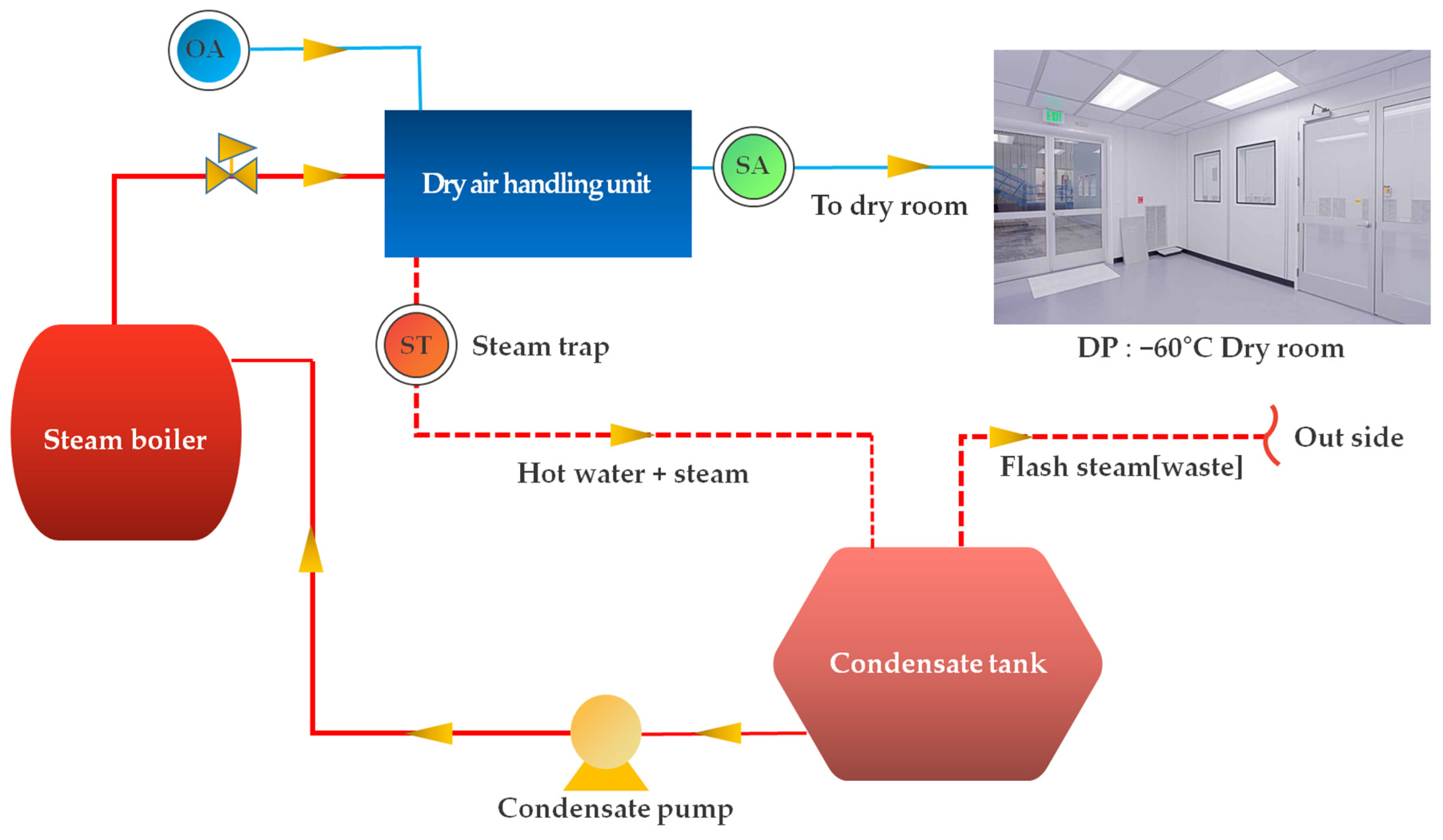
As shown in Figure 1, flash steam is generated as the liquid-phase saturated water evaporates when high-pressure condensate flows into the condensate tank and the pressure drops [23]. In the figure, OA, SA, and ST denote Outdoor Air, Supply Air, and Steam Trap, respectively.
The flash steam generation ratio ( x ) can be expressed by Equation (1). In this equation, h i n represents the enthalpy of the condensate before entering the condensate tank, h g , l o w is the enthalpy of saturated vapor at low pressure, and h f , l o w is the enthalpy of saturated liquid at low pressure. The total amount of flash steam generation can be determined by multiplying this generation ratio ( x ) by the boiler feedwater consumption. This phenomenon is a result of the law of conservation of energy; as the pressure difference increases, the enthalpy difference ( h i n h f , l o w ) becomes larger, leading to a higher flash steam generation ratio and a corresponding increase in the total amount generated [24].
x = h i n h f , l o w h g , l o w h f , l o w

2.2. Dry Room HVAC System and Heat Source Configuration

The dry room heat source system utilizes high-pressure primary steam for desiccant rotor regeneration to achieve an ultra-low dew point of DP −60 °C. The supplied steam is condensed during the dehumidification process and recovered in the form of condensate [25].

2.2.1. Principles of Dry Room Regenerator and Dehumidification

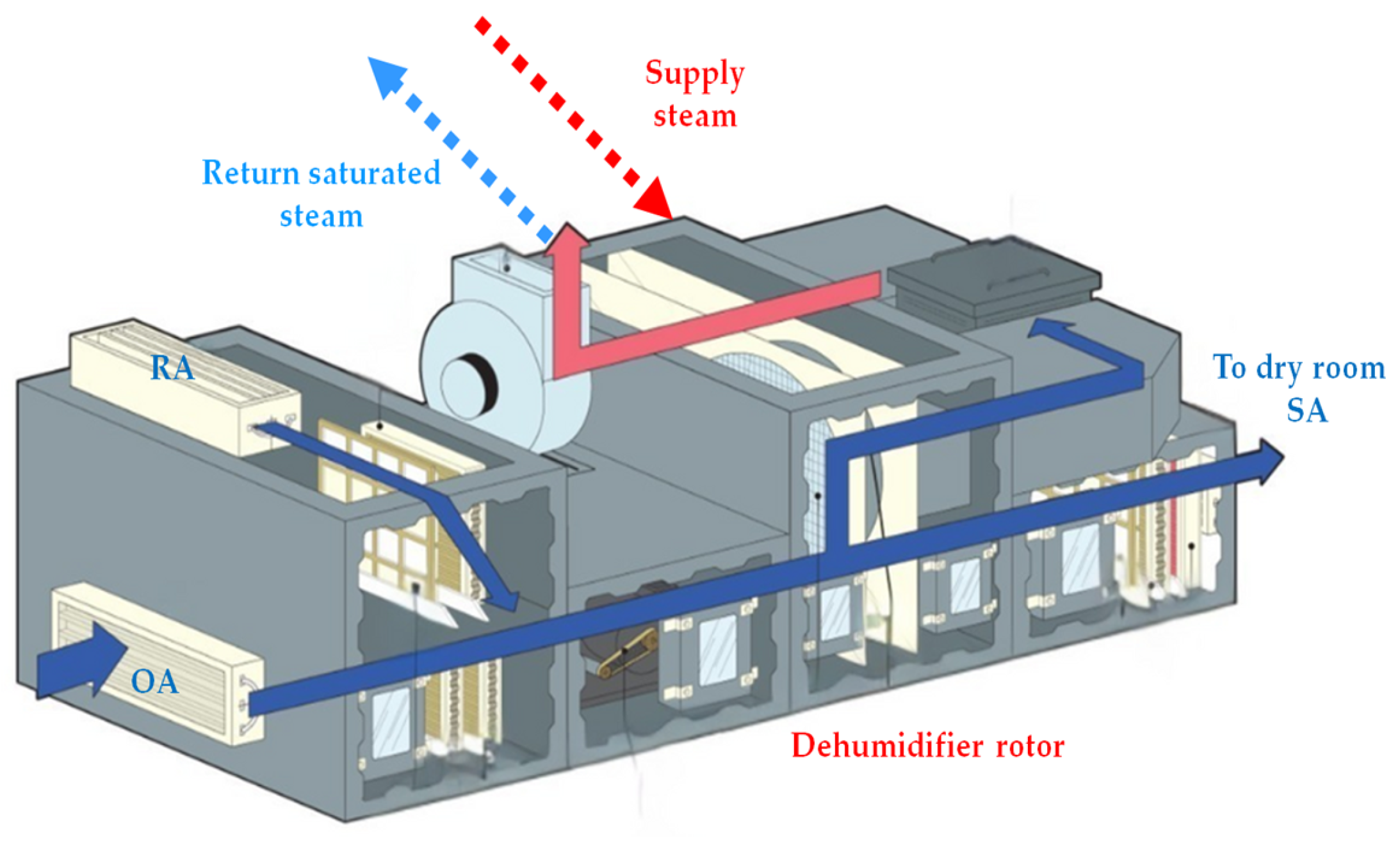
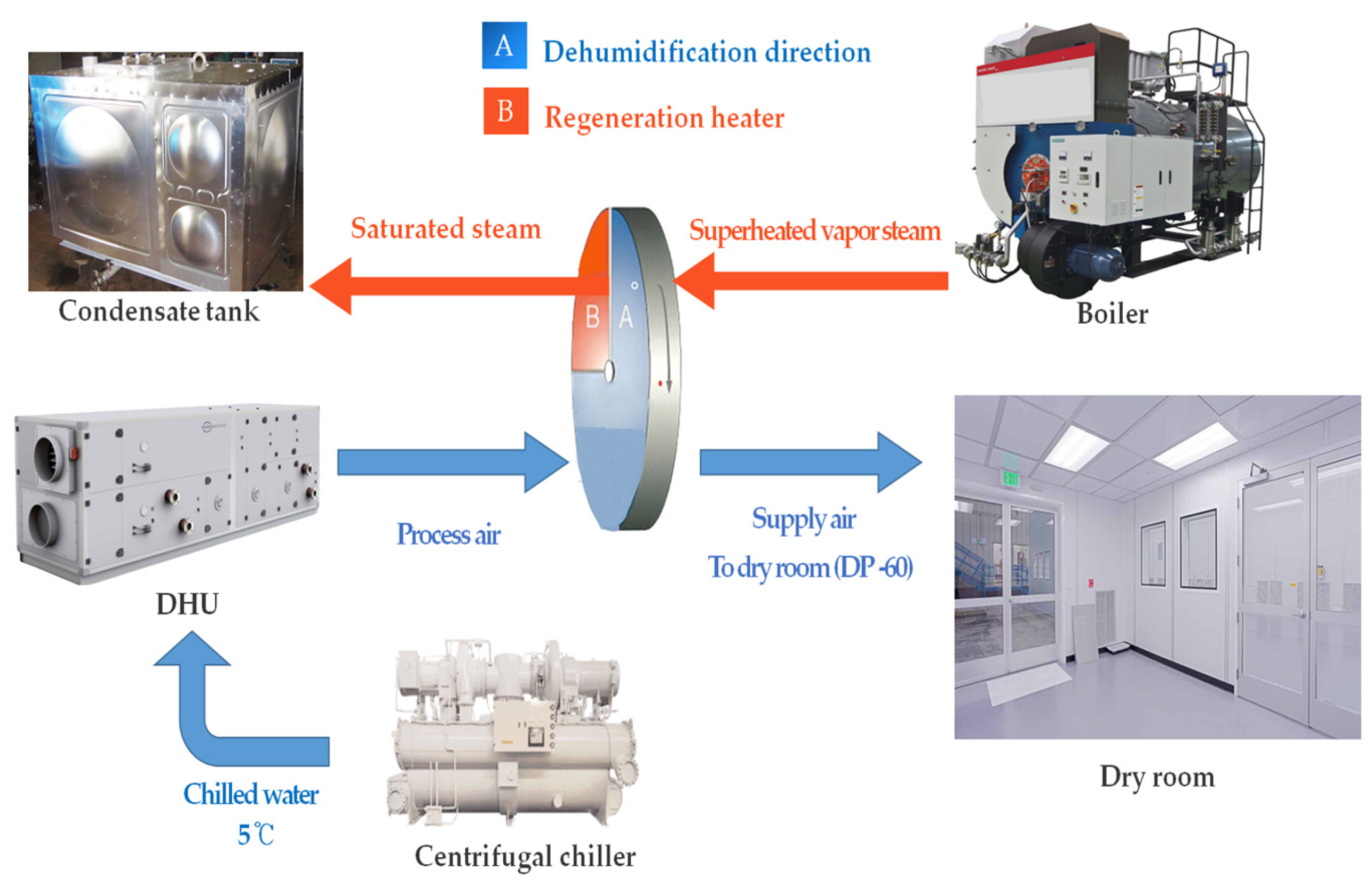
Large-scale dry rooms primarily employ rotor-type dehumidification systems with steam regeneration to achieve low DP levels. Each unit (DHU-A1 to DHU-I2) is operated by zone according to the specific DP requirements of each process, ranging from DP −60 to DP −40 °C [26]. The dehumidification air handlers and their auxiliary equipment are illustrated in Figure 2 and Figure 3. Saturated primary steam at 5.0 bar is supplied to heat the desiccant rotor, discharging moisture from the rotor for regeneration. The steam passing through the regeneration section condenses under high-pressure conditions and returns to the return line (upstream of the steam trap) as saturated water at a pressure of 3.5 bar or higher.
The March–August period was selected to ensure high data integrity, as the system underwent comprehensive stabilization and instrument calibration during the preceding and subsequent months. In particular, winter data were excluded due to reduced reliability during the initial system readjustment phase.
In this study, the amount of flash steam generation was determined based on six months of operation data (boiler feedwater, supply pressure, and operation time) from 18 dry air handling units. The March–August period was selected to ensure high data integrity, as the system underwent comprehensive stabilization and instrument calibration during the preceding and subsequent months. In particular, winter data were excluded due to reduced reliability during the initial system readjustment phase. Since dry rooms have high steam consumption, they also generate a significant amount of flash steam. Therefore, it was confirmed that efficient energy-saving measures could be derived by recovering this wasted heat [27]. Production equipment and materials in dry rooms are highly sensitive to moisture, requiring the indoor DP to be maintained below −60 °C through the application of desiccant rotor air-conditioning systems [28].
Desiccant rotor dehumidification is the most core technology for creating low-DP environments. Solid desiccants such as silica gel or zeolite are used as rotor materials. These materials are coated onto a honeycomb-shaped microstructure and rolled into a wheel to form the desiccant rotor. Factors influencing rotor performance include rotor geometry (diameter, flow path length), air conditions (temperature, humidity, flow rate), and operational conditions such as rotation speed. Air, consisting of a mixture of outdoor air and dry room return air, passes through a mixing chamber and a pre-coil for cooling and dehumidification, after which the remaining moisture is adsorbed while passing through the rotor-type adsorbent impregnated with silica gel [29].

2.2.2. State Changes Before and After Dehumidification

Since the adsorption rotor becomes saturated with moisture after a certain period, leading to a decrease in adsorption capacity, it is regenerated using high-temperature air. In the system investigated in this study, saturated steam at approximately 5.0 bar is used as a heat source. High-temperature air of over 150 °C is passed through the dehumidification rotor, which has moved to the regeneration section in the opposite direction of the process air, to desorb the adsorbed moisture.
The saturated water condensed during the regeneration process is discharged to the return line, during which flash steam is generated. In Equation (2), ( Q R ˙ ) represents the regeneration heat required for the saturated steam to heat the regenerator, which can be expressed as the difference between the supplied steam ( m ˙ s t e a m ) at saturated steam enthalpy ( h g , h i g h ) and the saturated water enthalpy ( h f , h i g h ). At this time, the fluid at the regenerator outlet is high-temperature saturated water at a temperature of 149.2 to 161.7 °C, and the system interior operates under high-pressure conditions of 3.5 bar or higher.
Q R ˙ = m ˙ s t e a m ( h g , h i g h h f , h i g h )

2.3. Basic Theory and Calculation Formulas of Heat Transfer

2.3.1. Measurement of Temperature Downstream of the Steam Trap

To analyze the flash steam generation characteristics of the dehumidification air handling units in the dry room, the temperatures (°C) and pressures (bar) upstream and downstream of the steam traps were measured and compiled for 18 DHUs, from DHU-A1 to DHU-I2. Based on the measured pressure values, the corresponding saturation temperatures were calculated using a saturated steam table [30].
The upstream side of the trap contains high-pressure saturated water that has passed through the regenerator, while the downstream side corresponds to the section where the condensate is discharged after a pressure drop within the trap. The infrared thermometer (testo 835-T) used for temperature measurement in this study is a device with a spectral range of 8–14 μm and an optical resolution of 50:1. The margin of error, which indicates the reliability of the measurements, is ±1.0 °C in the range of 0.0–99.9 °C, and ±1% of the measured value in higher temperature ranges.
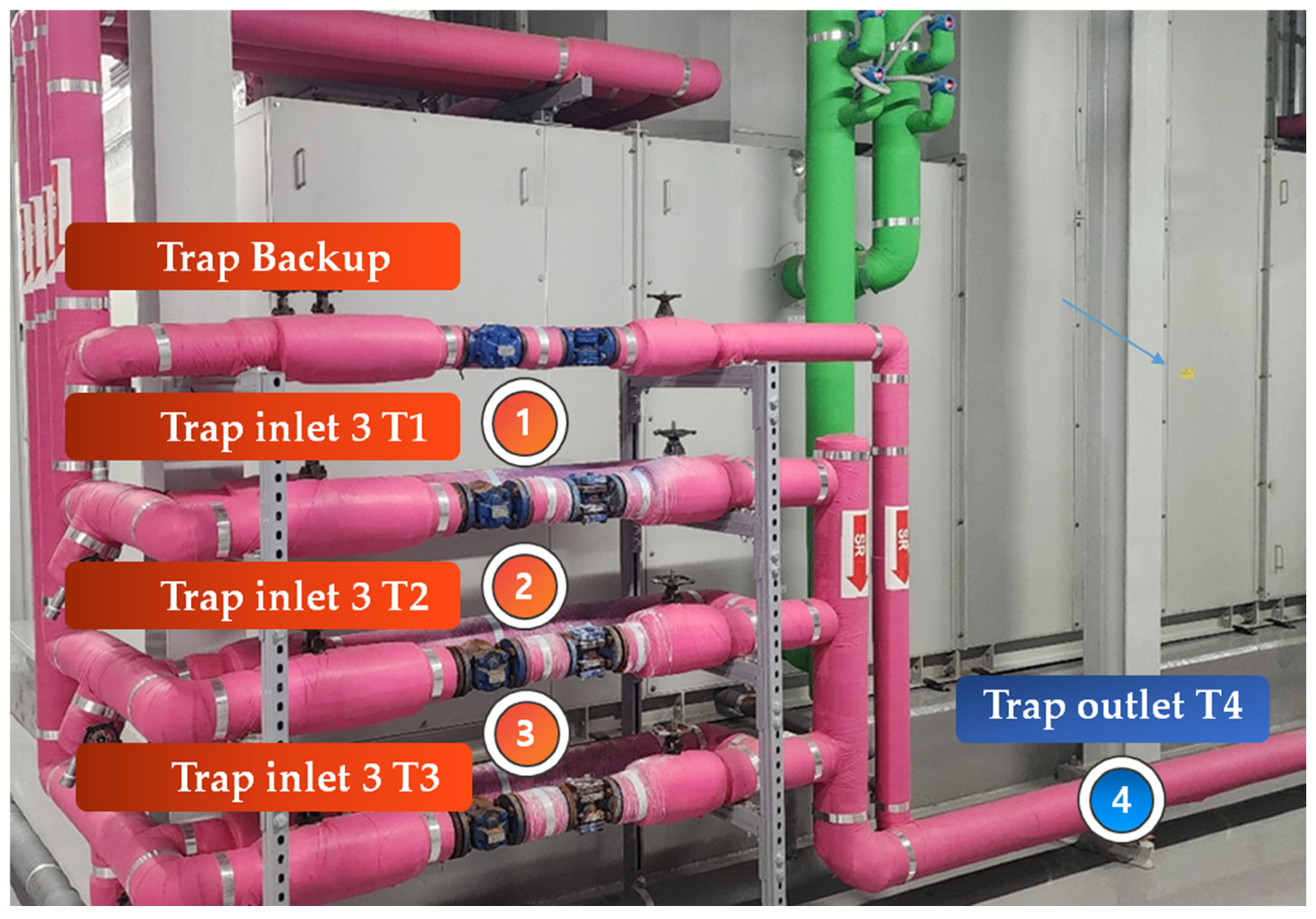
The upstream temperatures of the traps ranged from 149.2 to 161.7 °C, and the measurement locations upstream and downstream of the steam trap are shown in Figure 4. The average of the measured values (Inlet 1–3) ranged from 152.4 to 160.3 °C. These values mostly coincide with the saturated steam temperatures (152–160 °C) at the operating pressures of the respective DHUs (4.5–5.5 bar), indicating that the steam supplied to the regeneration heater is operating in a normal saturated state.
The condensate temperature downstream of the trap was measured to be in the range of 101–120 °C. This indicates that a temperature drop of approximately 40–50 °C occurred under atmospheric pressure conditions while passing through the trap. Due to the pressure drop during passage through the trap, a portion of the condensate re-evaporated and was converted into flash steam. In particular, DHU-B1-1 exhibited the largest temperature drop, with an average upstream temperature of 152.5 °C and a downstream temperature of 120 °C. DHU-D was identified as a special case operated at a relatively low upstream temperature (approximately 107 °C).
The upstream pressures of the traps were measured in the range of 3.26–5.44 bar, with most DHUs distributed in the 4.5–5.2 bar range. This matches the design supply pressure of the supplied steam (approximately 5.0 bar), indicating that a normal pressure drop is occurring in the regeneration heater. The downstream pressures of the traps ranged from 0.00 to 0.97 bar, with most DHUs discharging in the range of 0.05–0.20 bar. Some Double Rotor configurations (DHU-B1, DHU-F1, etc.) showed relatively high downstream pressures of 0.57–0.97 bar due to structural influences.
Therefore, in this section, based on the actual measured temperature and pressure data upstream and downstream of the traps shown in Table 2 and Table 3, it was confirmed that the pressure drop occurring upon passing through the trap and the resulting temperature difference act as the primary causes of flash steam generation. These measured values are used in the flash steam generation calculation formula presented in the following section, Section 3.2.2.

2.3.2. Calculation of Flash Steam Generation Amount

The saturated steam passing through the regenerator condenses and releases latent heat, then passes through the steam trap, where a portion of the condensate is converted into flash steam due to a pressure drop. Since the saturated water temperatures upstream and downstream of the trap are known, the flash steam generation ratio ( x ) was calculated using Equation (1) presented in Section 2.1.2 based on the enthalpy difference at the corresponding temperatures.
To ensure the thermodynamic validity and transparency of this calculation, the following engineering assumptions were established
  • State of Fluid: The high-pressure condensate is assumed to be in a fully saturated liquid state at the operating pressure, while the generated flash steam is assumed to be saturated vapor. This is consistent with the measured temperature data in Section 2.3.1. Specifically, data on boiler feed water volume, boiler pressure, operating time, and temperatures before and after the steam trap were measured and analyzed over a six-month period from March to August 2025.
  • The pressure drop across the steam trap is treated as an isenthalpic expansion process. Given the rapid nature of the flash phenomenon, heat exchange with the surroundings during the pressure drop is considered negligible.
  • For the energy recovery potential analysis, heat losses through the piping and the condensate tank walls were ignored to determine the theoretical maximum potential of the DHU system.
  • The calculation assumes a steady-state flow condition with a constant mass flow rate during the evaluation period.
Based on these assumptions, the average upstream temperature of the trap ( T ¯ ) was calculated using Equation (3). To ensure thermodynamic accuracy, a weighted average method was applied to the 18 DHUs, reflecting the design steam flow rate of each unit as detailed in Table 4. Due to the practical constraints of installing individual flow meters on the condensate return lines for each of the 18 AHUs in an active industrial facility, the design steam flow rates were utilized as the weighting factors ( ω i ). This approach provides a reasonable engineering approximation to estimate the representative thermal state, as the total mass balance is fundamentally governed by the overall boiler feedwater consumption, which is based on actual long-term field measurements. This was achieved by applying a weighted average to the upstream and downstream saturated water temperatures in Table 2 and Table 3 and the amount of steam supplied to each DHU. Then, the saturated water enthalpy ( h f , h i g h ) at that temperature was derived. The trap upstream has a temperature of 151.81 °C and an enthalpy ( h f , h i g h ) of 639.15 kJ/kg, while the trap downstream has a temperature of 106.37 °C and an enthalpy ( h f , l o w ) of 445.98 kJ/kg. Finally, through Equation (1), the flash steam generation ratio ( x ) is calculated to be 8.56%. Finally, using the calculated flash steam generation ratio ( x ), the total amount of flash steam generated can be estimated.
As shown in the feed water variation data in Section 4.1.1 of Section 4, the average feed water consumption from March to August ( m ˙ a v e ) is 13.60 ton/h. Substituting these values into Equation (4) yields an average flash steam generation rate ( m ˙ f l a s h ) of 1.16 ton/h for the March to August period.
T ¯ = i = 1 18 ( ω i t i )
m ˙ f l a s h = x m ˙ a v e

2.4. Heat Exchange Technology

If the flash steam from the dry room is not recovered, it is released into the atmosphere, resulting in energy loss. Accordingly, in this section, among the representative technologies for recovering and utilizing flash steam—SJT (Steam Jet Thermocompressor) and EVC (Exhaust Vapor Condenser)—the principles and characteristics of the SJT system were examined first.

2.4.1. Principle of the SJT Ejector Method

The SJT method is a steam recovery technology that utilizes the flow energy of high-pressure primary steam to suction and mix low-pressure flash steam, and then recompresses it into intermediate-pressure steam for recycling [31].
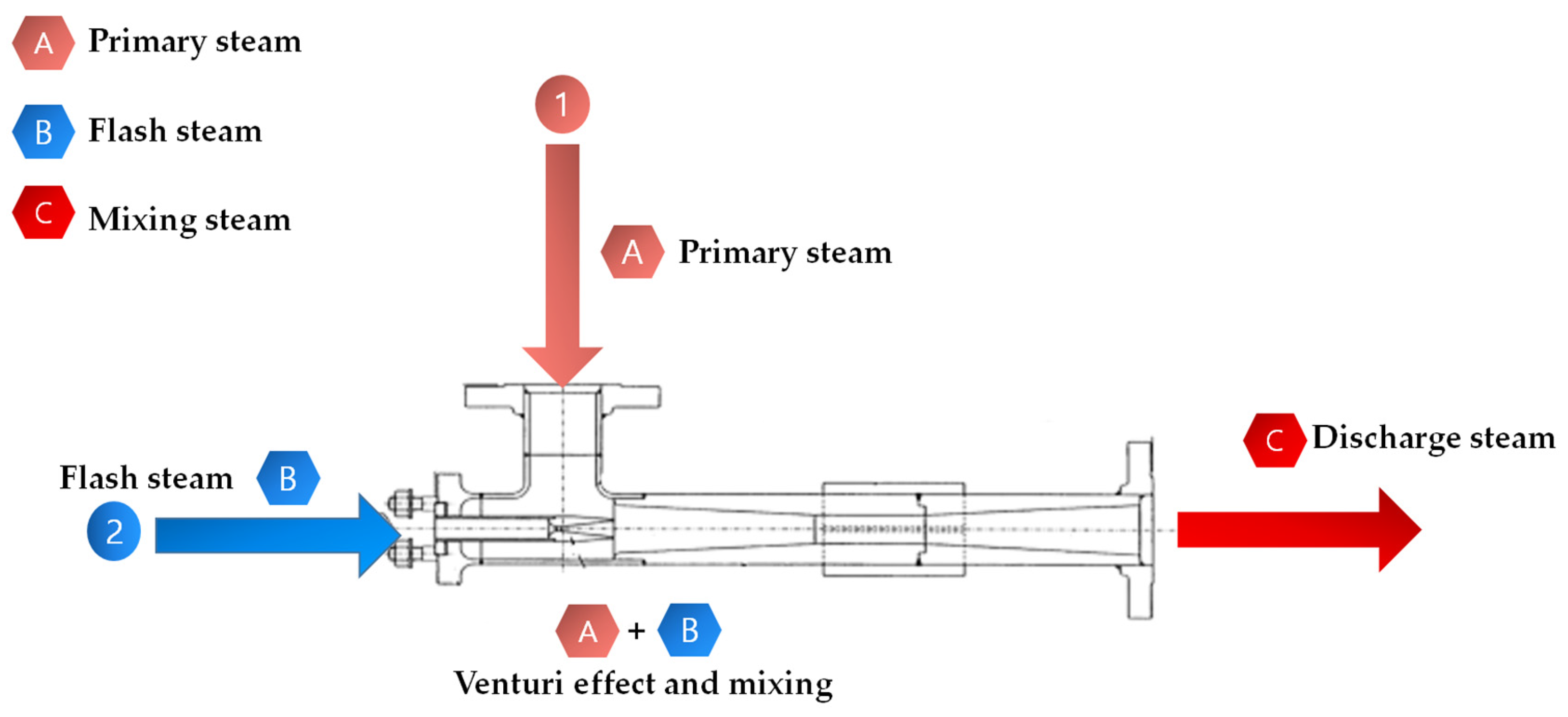
This system utilizes the Venturi effect based on Bernoulli’s principle, as shown in Equation (5), to convert the pressure energy of the steam without any separate rotating machinery. Structurally, it consists of a nozzle, a mixing chamber, and a diffuser. The high-speed primary steam passing through the nozzle suctions and mixes the steam, and as shown in Equation (6), the velocity energy is converted into pressure energy (P) in the diffuser section to generate steam [32]. As shown in Figure 5, primary steam is supplied from direction A and flash steam is supplied from direction B; as they are mixed inside the SJT, a usable steam heat source is generated.
P 1 + 1 2 ρ 1 V 1 2 = P 2 + 1 2 ρ 2 V 2 2
Δ P = P 1 P 2 = 1 2 ρ ( V 2 2 V 1 2 )

2.4.2. EVC Heat Exchanger Method

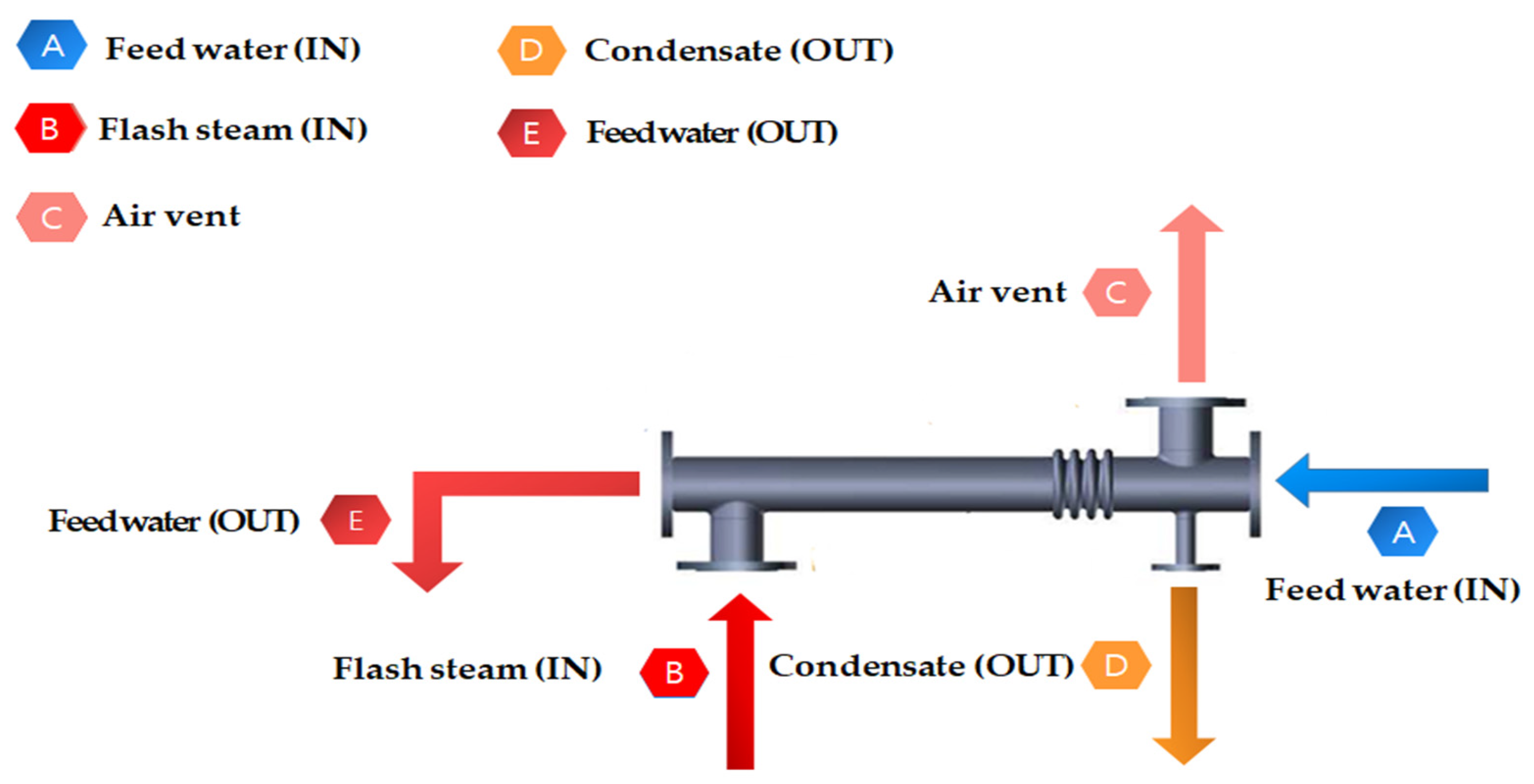
The EVC method is a waste heat recovery system that utilizes flash steam as a heat source to transfer heat to a secondary fluid, such as cooling water, domestic hot water, or heating water [33]. This system is configured as a heat exchanger where feed water flows into the tube side, and low-pressure flash steam is supplied to the shell side. As the steam condenses, it releases latent heat, thereby heating the feed water. It has the advantage of enabling stable waste heat recovery operation without incurring additional energy consumption for steam generation. Furthermore, its simple structure and high heat transfer area ratio provide excellent heat transfer efficiency and easy maintenance. As shown in Figure 6, heat exchange occurs between fluids A and B, and the condensate (D) generated after the heat exchange is returned to the condensate tank. The feed water (E), having recovered thermal energy, is subsequently utilized as an energy source for cooling, heating, and domestic hot water [34].

3. Research Methods

3.1. Research Subjects and Conditions

This study targets an ultra-low dew point dry room located in an 8-story building (total floor area of approximately 43,000 m2) in the southern Gyeonggi region of South Korea, where a steam heat source is used for desiccant rotor regeneration. A total of 18 dehumidification air handling units (DHUs) are installed in the target building. They are operated by supplying 5.0 bar saturated steam to the regeneration section to heat and regenerate the desiccant rotor.
Data was collected in conjunction with the BAS (Building Automation System) using actual measurements taken over approximately six months from March to August 2025 [35]. For the measurement items, averaged data such as boiler feed water volume, supply pressure, and operating time were utilized. The collected data was compared after removing outliers and missing values, and normalizing it based on intervals with the same boiler operating time.
The outdoor air conditions during the research period were based on actual measurement data from the Automatic Weather Station (AWS) of the Korea Meteorological Administration. The average temperature in the southern Gyeonggi region during the summer season (June to August) was approximately 28 °C, the daily maximum temperature was 32–34 °C, and the average relative humidity ranged from 68 to 78%. These variations in outdoor temperature and humidity directly affect the dehumidification and regeneration loads, showing a tendency for both boiler feed water volume and steam usage to increase together during the summer.
In particular, the temperatures upstream and downstream of the steam trap were measured once at the time of maximum load in 2025. Although not long-term average data, since the outdoor load and process conditions at that time were at their peak annual levels, these were utilized as reference values capable of representing flash steam generation characteristics. Based on the aforementioned measured data, this study analyzed the feasibility of utilizing flash steam resulting from steam usage in the dry room DHUs, and based on this, examined the amount of waste heat recovered and the applicable recovery methods.
In particular, the temperatures upstream and downstream of the steam trap were strategically measured during the 2025 summer season, when the dehumidification and regeneration loads reach their peak due to high outdoor humidity. Although these are not long-term cumulative averages, the measurements captured at a stabilized thermal steady state during this period provide a highly representative baseline for evaluating the system’s operational characteristics. By focusing on the most significant load conditions, this study establishes the upper boundary of the recovery capacity, offering a more robust engineering basis for assessing waste heat recovery potential than time-averaged values. This approach ensures a reliable and conservative foundation for quantifying flash steam generation in the dry room DHUs.

3.2. Data Collection and Preprocessing

3.2.1. Data Collection

The data used in this study were collected from the dry room dehumidification air handling units (DHUs), and the main measurement items for each process section consist of the boiler feed water flow rate, boiler supply pressure, operating time, and temperatures upstream and downstream of the steam trap.
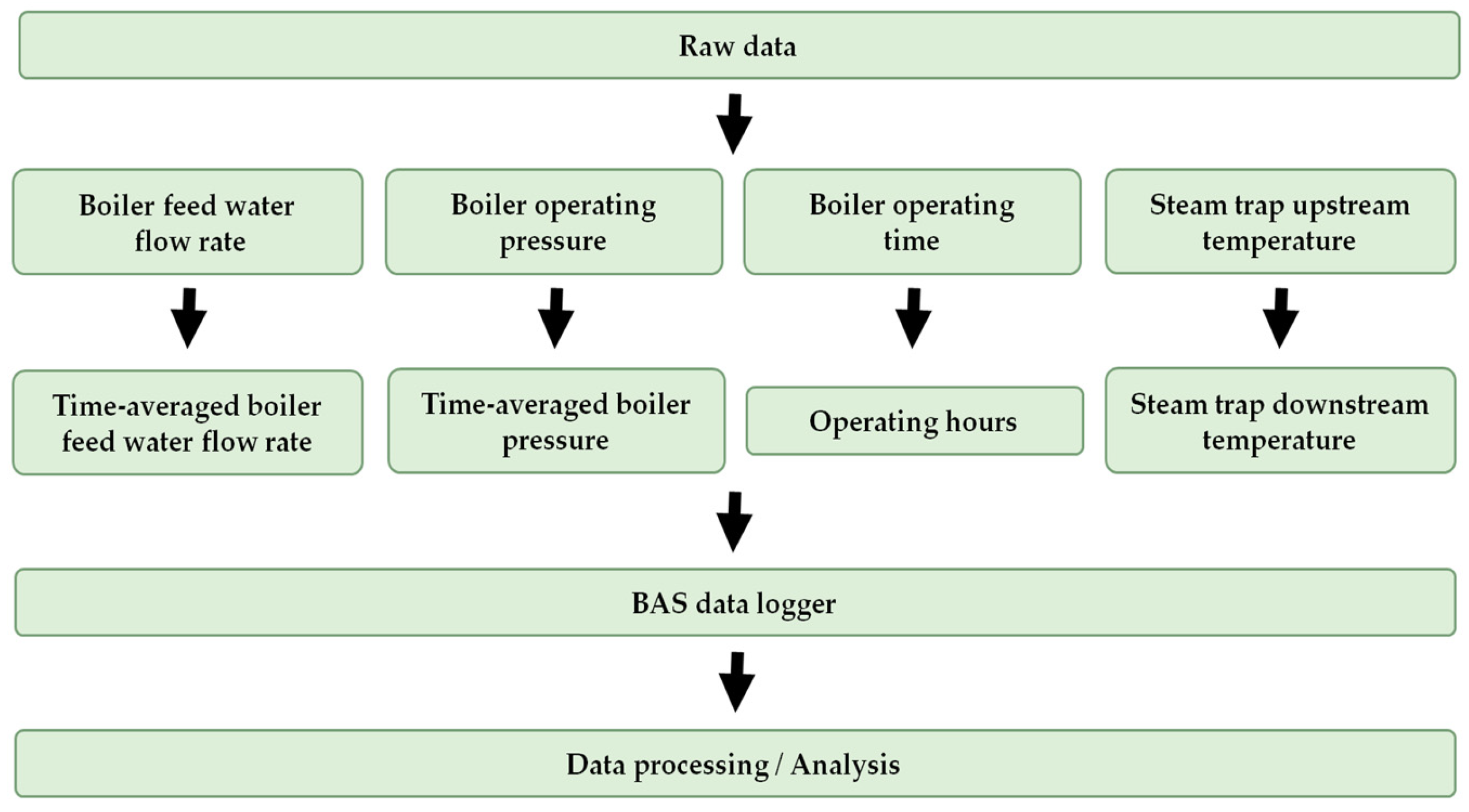
The heat source is supplied to the DHUs through steam generated from a once-through boiler. The feed water flow rate and supply pressure were measured using measuring devices on the boiler side, and all measurement data automatically saved through the BAS were organized according to the flow shown in Figure 7.

3.2.2. Data Preprocessing and Verification

The boiler pressure, feed water flow rate, and operating time data were preprocessed, targeting the operating data of all units collected during the period from March to August 2025. The operating pressure ranged from 6.6 to 7.8 bar based on the monthly average, with an overall average of 7.2 bar. As it was stably maintained at a level exceeding 5.0 bar, which is the supply pressure required for the regenerator, it was confirmed that the steam supply system was being stably controlled throughout the analysis period.
Although the feed water flow rate was recorded for each individual unit, in the actual system, units 1 to 5 are operated simultaneously as a single package. Therefore, the hourly consumption was recalculated using only the integrated feed water flow rate of all units and the actual operating time. As a result, the feed water flow rate increased from approximately 9 ton/h in March to 16–17 ton/h in the summer season, with the average from March to August being 13.6 ton/h. Regarding the operating time, a simple summation of individual records resulted in an error exceeding the theoretical maximum operating time. Based on the preprocessed data, the overall average operation rate was approximately 98%, demonstrating highly continuous operation characteristics.
Through this data preprocessing and verification process, the reliability of the main input values used in this study was secured, and these values were subsequently utilized as basic data for the analysis of flash steam generation and heat recovery amounts.

3.3. Analysis of Measured Data

As a result of analyzing the seasonal variation in boiler feed water volume from March to August 2025, the feed water volume showed a distinct tendency to increase with the rise in outdoor temperature. The average feed water volume in March was approximately 9.05 ton/h, but it increased by about 81–87% in the summer months of July and August to 16.95 ton/h and 16.44 ton/h, respectively. This is analyzed to be primarily caused by the increased regeneration load of the dehumidification air handling unit due to the rise in outdoor temperature and humidity, and the consequent increase in steam usage. In particular, the sharp increase in feed water volume after June is mainly due to the rapid increase in outdoor absolute humidity caused by entering the monsoon season, resulting in a simultaneous increase in the operating times of the regeneration rotor and the dehumidification air handling unit.
The fact that only the feed water volume increased while the operating pressure remained relatively constant suggests that the boiler control was performed stably throughout the entire period. Therefore, the change in feed water volume is a clear indicator showing the correlation between seasonal outdoor conditions and dehumidification load, and it will be utilized as key basic data for subsequent heat load analysis and flash steam generation evaluation. These results imply the importance of establishing summer load management strategies in humidity-sensitive processes such as dry rooms.

3.3.1. Changes in Feed Water Volume

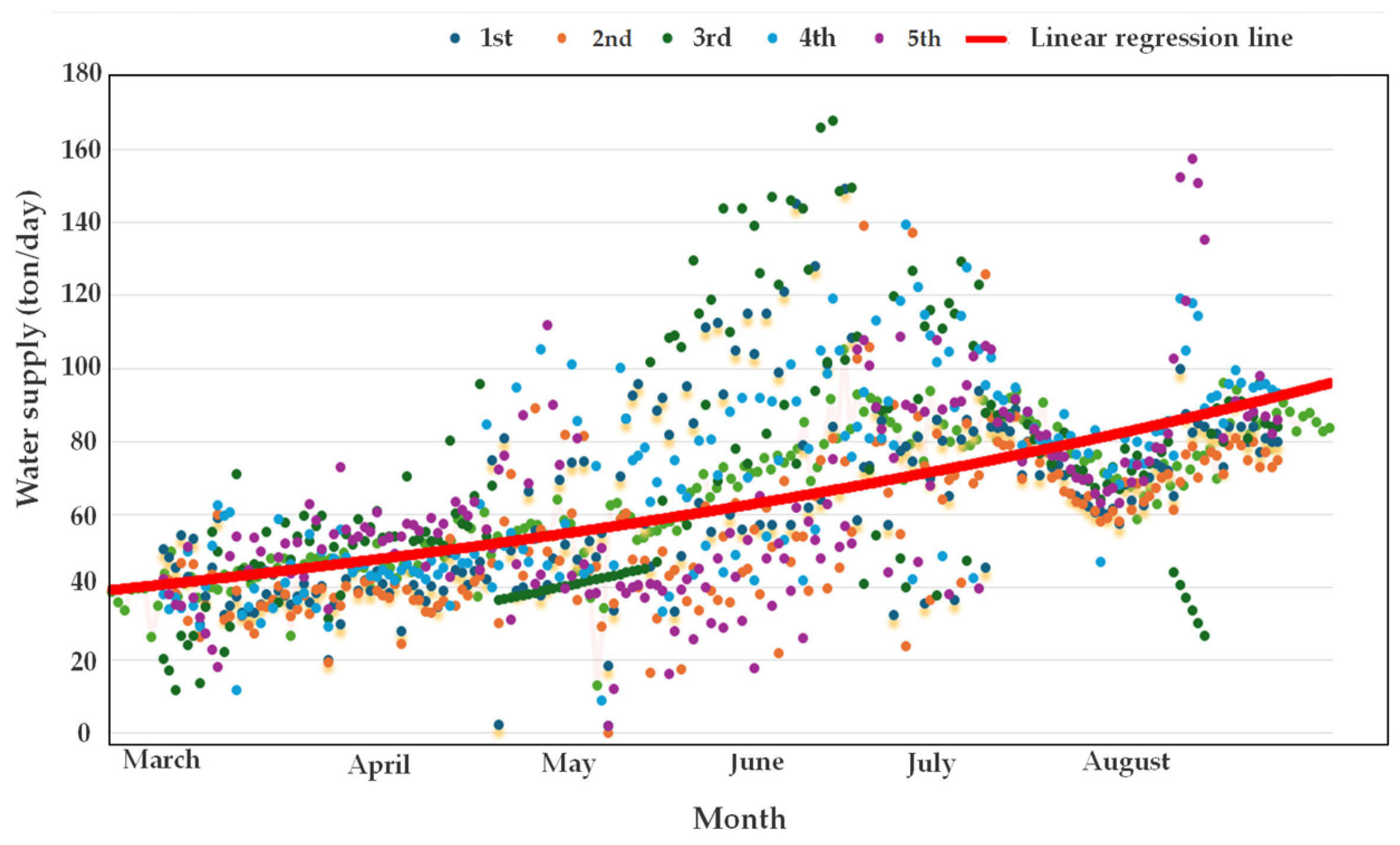
The change in daily feed water consumption (ton/day) for each individual unit (Units 1–5) from March to August 2025 is shown in Figure 8. In this visualization, the colored dots represent the daily measurements for Units 1–5, while the solid red line indicates the overall linear regression trend. The feed water consumption during this period exhibits a long-term increasing trend over the entire period. Specifically, from March to May, the basic regeneration load of the dehumidification air handling unit gradually increased along with the rise in outdoor temperature, resulting in a relatively stable increase in average feed water consumption. After June, the high outdoor absolute humidity due to the monsoon season and the increase in outdoor air inflow acted simultaneously, greatly expanding the regeneration load and causing the most prominent rate of increase in feed water consumption.
On the other hand, the short-term decreasing section observed from late July to early and mid-August is difficult to fully explain solely by changes in outdoor conditions. It is judged to be the result of operating condition impacts, such as the intermittent shutdown of some dehumidifiers, adjustments to the number of operating units, or fluctuations in production volume. Nevertheless, the linear regression analysis conducted over the entire observation period still yielded a positive slope, implying that despite local fluctuations, feed water consumption increases in accordance with the rise in outdoor temperature during the summer season.
This trend is primarily driven by the surge in latent heat load during the monsoon season. As the outdoor dew point temperature rises, the dehumidification AHUs require higher enthalpy exchange to maintain the target dry room conditions, directly leading to the increased steam demand and feed water consumption.

3.3.2. Changes in Boiler Pressure

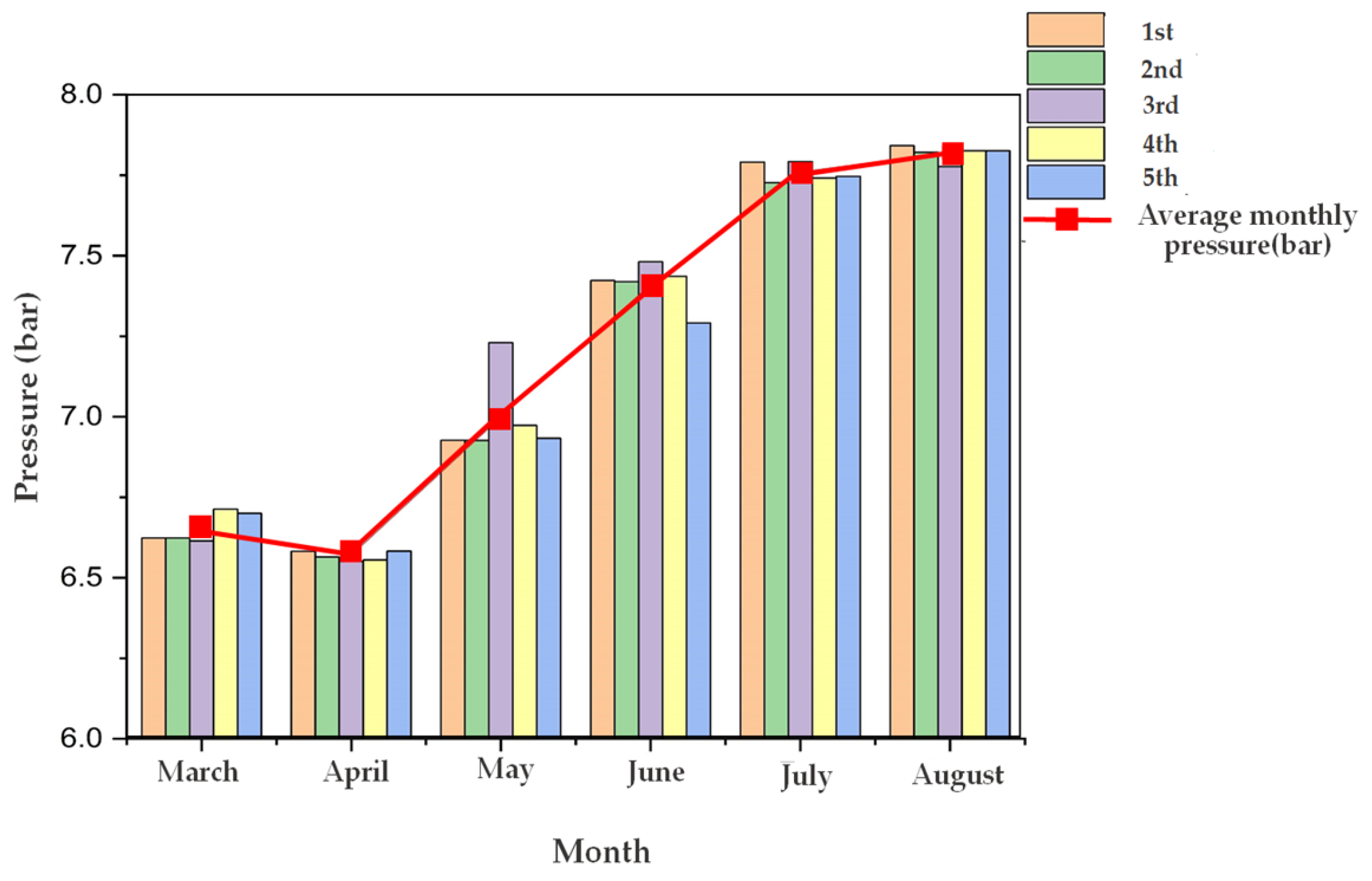
The average monthly boiler pressure during the same period was confirmed to be 6.65 bar in March, 6.57 bar in April, 7.00 bar in May, 7.41 bar in June, 7.76 bar in July, and 7.82 bar in August. As shown in Figure 9, a continuous upward trend in boiler pressure can be observed as the system enters the summer season. In this visualization, the colored bars represent the operating pressure of individual units (1st–5th), while the red line indicates the average monthly pressure. Compared to March, the pressure in August increased by approximately 1.17 bar (about 17.6%). This increase is interpreted as a result of the boiler steam supply pressure being adjusted upward in response to the seasonal load increase, in order to cope with the increased regeneration load of the dehumidification air handling units caused by the rise in outdoor temperature and humidity.
In particular, after June, most of the average monthly pressures exceeded 7 bar. This is judged to be because the target pressure was set higher to ensure the steam supply capacity of the boiler control system during the peak summer load periods. This implies that the pressure control of the steam supply system remained stable even during periods of significant increases in feed water volume.

3.3.3. Changes in Boiler Operating Time

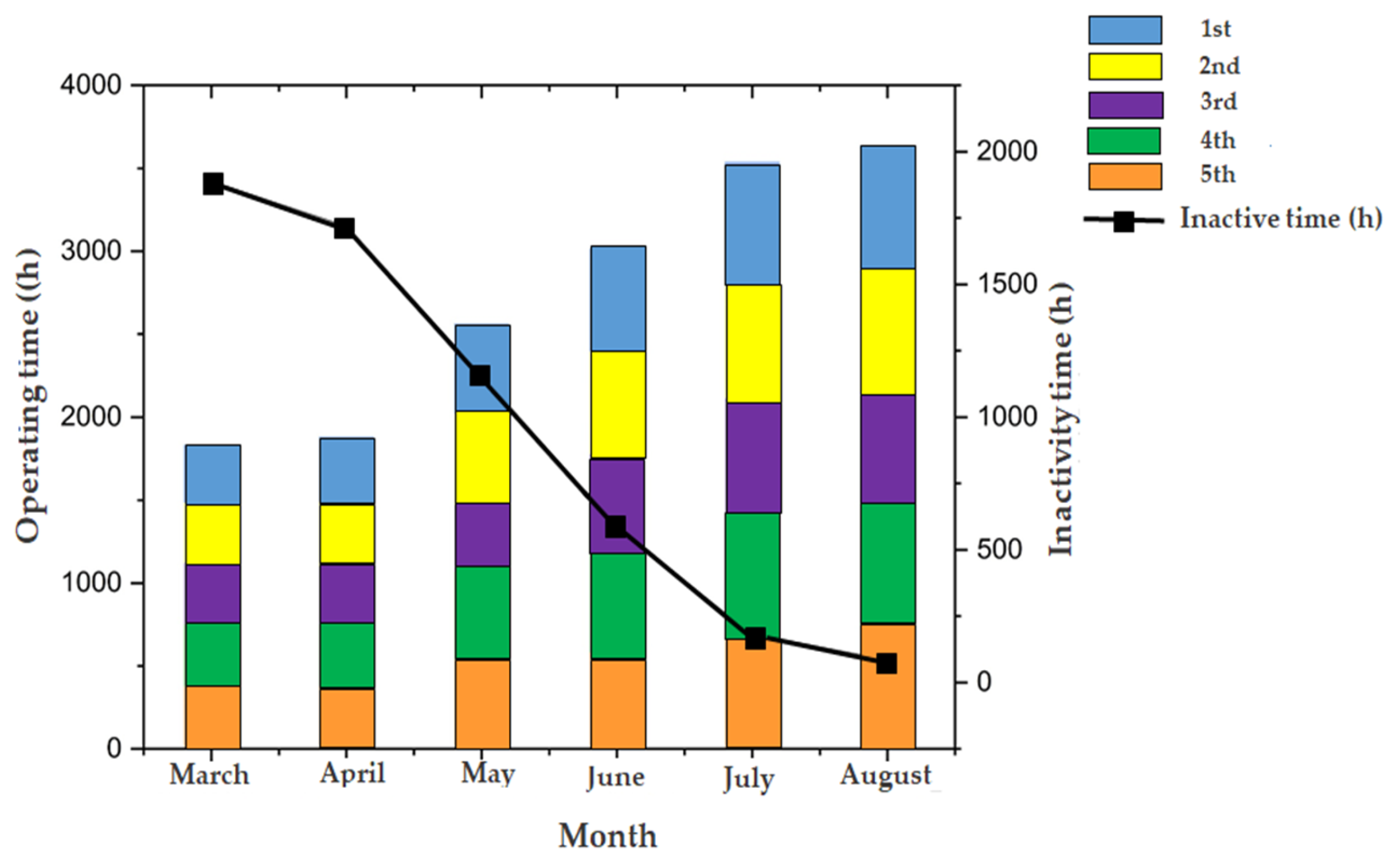
Based on the same period, the monthly boiler operating times for all units were 699 h in March, 720 h in April, 719 h in May, 720 h in June, 744 h in July, and 744 h in August. As shown in Figure 10, the overall average operating time from March to August is approximately 724 h/month, and the average operation rate is analyzed to be 98.41%. In this visualization, the stacked colored bars represent the cumulative operating time of individual units (1st–5th), while the solid black line indicates the total inactive time. While some inactivity time existed from March to May due to equipment inspections and load fluctuations, it is judged that a 24 h/day continuous operation state was virtually maintained after June to respond to the rise in outdoor absolute humidity and the increase in the dehumidification air handling unit load. In particular, in July and August, the operating time reached the maximum of 744 h/month with an operation rate close to 100%, clearly demonstrating the continuous operation characteristics of the heat source system to stably supply the regeneration load for the dehumidification air handling units in high-humidity summer environments.
The stabilization of the operation rate near 100% ensures a consistent supply of flash steam, which is critical for the steady-state thermal equilibrium of the waste heat recovery system. This continuity minimizes thermal fluctuations in the EVC unit, allowing the absorption chiller to operate at its optimized design point without intermittent cycling losses.

3.3.4. Quantitative Correlation Analysis of Measured Operating Indicators

To provide a detailed and quantitative explanation for the observed feedwater flow rate, operating pressure, and operating time, a statistical correlation analysis was performed using the Ordinary Least Squares method. In this model, the outdoor mean temperature ( T O A ) was defined as the independent variable (x), and the primary measured operating indicators were defined as the dependent variables ( y ) [36]. The relationship is expressed through the following linear regression equation shown in Equation (7), incorporating the system sensitivity ( a ) and the theoretical base load ( b ) .
The reliability of the regression model was evaluated using the coefficient of determination ( R 2 ), which represents the proportion of variance in the dependent variable explained by the model. ( R 2 ) was calculated according to Equation (8), based on the predicted values from the regression model ( y ^ i ) and the arithmetic mean of all observed values ( y ¯ i ) . These indicators were quantified and are presented in Table 5.
The quantitative results demonstrate a significant correlation between the outdoor temperature and all measured boiler operating indicators. Specifically, the feedwater flow rate achieved the highest coefficient of determination ( R 2 ) of 0.880, indicating that steam consumption is directly governed by outdoor air fluctuations. The operating pressure and total operating hours also exhibited high coefficients of determination of 0.763 and 0.845, respectively. These results strongly suggest a clear correlation between variations in outdoor conditions and changes in system utilization.
y = a T O A + b
R 2 = ( y ^ i y ¯ i ) 2 ( y i y ¯ i ) 2

3.3.5. Summary of Measured Data

The measured data from March to August 2025 are comprehensively summarized in Table 6. All key operating indicators, such as boiler feedwater flow rate, operating pressure, and operating time, showed a tendency to increase as outdoor conditions became more severe during the summer season. This was confirmed to be primarily due to the rise in outdoor conditions and the subsequent increase in the regeneration load of the dehumidification air handling units.
First, the boiler feedwater flow rate started at 9.05 ton/h in March, rose gradually to 10.23 ton/h in April and 11.98 ton/h in May, and then increased sharply in June to 16.64 ton/h and July to 16.95 ton/h, recording its peak. Subsequently, in August, the flow rate decreased slightly to 16.44 ton/h due to internal operational reasons within the dry room. Overall, a maximum increase of approximately 87% was observed between March and the severe outdoor conditions of June to August. This change in feedwater flow rate is interpreted as a result of the increased regeneration load of the desiccant rotor due to the rise in outdoor temperature and humidity, leading to higher steam consumption and feedwater makeup requirements.
Boiler operating pressure also showed a trend similar to the increase in feedwater flow rate. The average pressure in March was 6.65 bar, and after showing slight fluctuations until May, it rose steadily to 7.41 bar in June, 7.76 bar in July, and 7.81 bar in August. The overall average was 7.20 bar, and the average boiler pressure in August was found to have increased by approximately 17% compared to March. This indicates that the boiler load increased in accordance with the rise in outdoor temperature.
Operating time also showed a similar trend according to seasonal variations. It remained at levels of 699 h in March, 720 h in April, 719 h in May, and 720 h in June, but stayed at 744 h from July to August, approaching an operation rate of 100% under maximum load conditions. This implies that the desiccant rotor regeneration load continued for 24 h a day during July and August. The fact that fluctuations in feedwater flow rate and pressure remained small even in an environment where the boiler operated continuously indicates high system control stability. Overall, the three major items—feedwater flow rate, pressure, and operating time—showed a high correlation and were proportional to the seasonal load increase. In particular, the sharp increase observed between June and August quantitatively proves the high sensitivity of the dry room dehumidification air handling units to outdoor humidity due to their operating characteristics. These results can be usefully applied to establishing regression models based on measured data when predicting future heat source system loads and analyzing steam recovery efficiency. In summary, during the summer of 2025, the boiler system exhibited an upward trend in feedwater flow rate, pressure, and operating time in response to changes in outdoor conditions, which is directly related to the increase in the regeneration load of the dehumidification air handling units.
Therefore, these measured data can be utilized as reference data for the flash steam verification and EVC heat recovery performance analysis in Section 4.2. Building upon the observed stability, an integrated performance analysis model was employed to evaluate the system’s recovery potential. Specifically, long-term averaged flow rates and operating hours were combined with instantaneous temperature measurements obtained during the peak load period. This approach was intended to quantify the maximum potential for waste heat recovery, which serves as a necessary basis for industrial system sizing. While inherent variability and data uncertainty are associated with representative measurements, the stable operation of the steam heat source system—evidenced by the precise pressure control described in Section 3.3.2—ensures a consistent thermodynamic state. This provides a reliable engineering basis for assessing the system’s peak recovery capacity with minimal risk of underestimation.
Nevertheless, it should be noted that, although this steady-state approach establishes an important baseline, the pronounced seasonal variations presented in Table 6 indicate that the results correspond to a specific thermal boundary. Extending these steady-state benchmarks to real-world applications across different seasons requires careful consideration, as the present findings primarily reflect peak load recovery potential rather than year-round transient behavior.

3.4. Proposal for Flash Steam Utilization Methods

3.4.1. Technical Characteristics and Limitations of the SJT Method

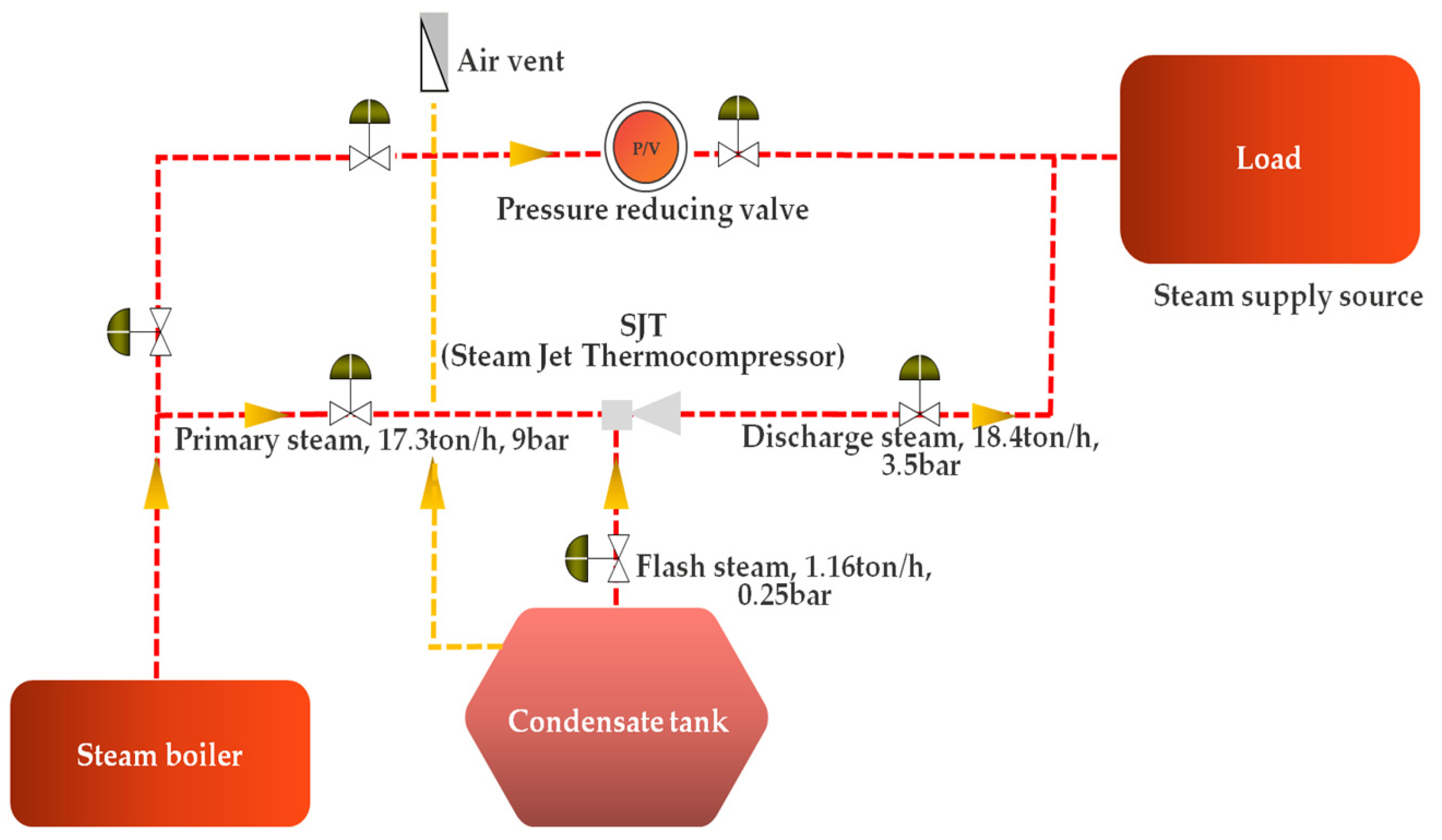
The SJT is a proven and highly advantageous technology in large-scale industrial facilities where high-pressure steam sources are stable, and there is a continuous, massive demand for medium-pressure discharge steam. However, for the medium-sized architectural dry rooms investigated in this study, the application of SJT presents significant practical challenges as follows. SJT is a device that utilizes the Venturi effect to transfer the energy of high-pressure primary steam to low-pressure suction steam, and mixes and compresses them to generate medium-pressure discharge steam, as shown in Figure 11 [37]. In other words, the high-speed primary steam injected through the nozzle induces the suction steam as it passes through the clearance, and after mixing, it is discharged at the desired pressure.
The design conditions of the SJT subject to this study are a primary steam pressure of 9 bar, a temperature of 184 °C, and a steam flow rate ( m ˙ p s ) of 17.3 ton/h. The flash steam side has a pressure of 0.25 bar, a temperature of 106.37 °C, and a steam flow rate ( m ˙ f s ) of 1.16 ton/h. The discharge side generates high-pressure steam with a pressure of 3.5 bar, a temperature of 147.9 °C, and a generated steam flow rate ( m ˙ d s ) of 18.46 ton/h. Therefore, to utilize the 3.5 bar steam for regeneration or as another heat source, 9 bar primary steam is required. It requires an enthalpy ( h d i s c h a r g e ) of 2778 kJ/kg, which mixes with the flash steam at 0.25 bar and an enthalpy ( h f s ) of 2685 kJ/kg; this process is expressed by Equation (9).
The mixing heat amount ( Q m i x n g ) is 14.21 MW. Knowing that the 3.5 bar enthalpy ( h d i s c h a r g e ) is 2721 kJ/kg, and the generated steam flow rate ( m ˙ d s ) is 18.46 ton/h, the SJT generated heat amount ( Q S J T ) is derived as 13.95 MW, as shown in Equation (10). The loss until discharge after mixing is approximately 0.262 MW, a reduction of 1.8%.
Two critical challenges arise in the practical application of the SJT method. First, dry room dehumidifiers typically require a regeneration heat source at pressures of 5 bar or higher, whereas the SJT produces discharge steam at approximately 3.5 bar, making direct utilization difficult. This pressure mismatch significantly limits the potential use of the generated steam within the facility.
Second, the primary steam required to operate the SJT is approximately 15 times greater than the amount of recovered flash steam. In this study, recovering only 1.16 ton/h of flash steam requires a substantially larger primary steam input, resulting in low overall efficiency [35]. Since the primary objective of waste heat recovery is to achieve net energy savings, generating such a large amount of additional primary steam is counterproductive, particularly for medium-sized facilities. Consequently, the SJT method exhibits clear technical and economic limitations for this application due to increased boiler operating requirements. In this study, to overcome the limitations of the SJT method, a recovery method using the EVC method was separately reviewed [38].
Q m i x n g = m ˙ p s h p s + m ˙ f s h f s
Q S J T = 98.2 % × Q m i x i n g

3.4.2. EVC Heat Exchange Application Concept and Design Conditions

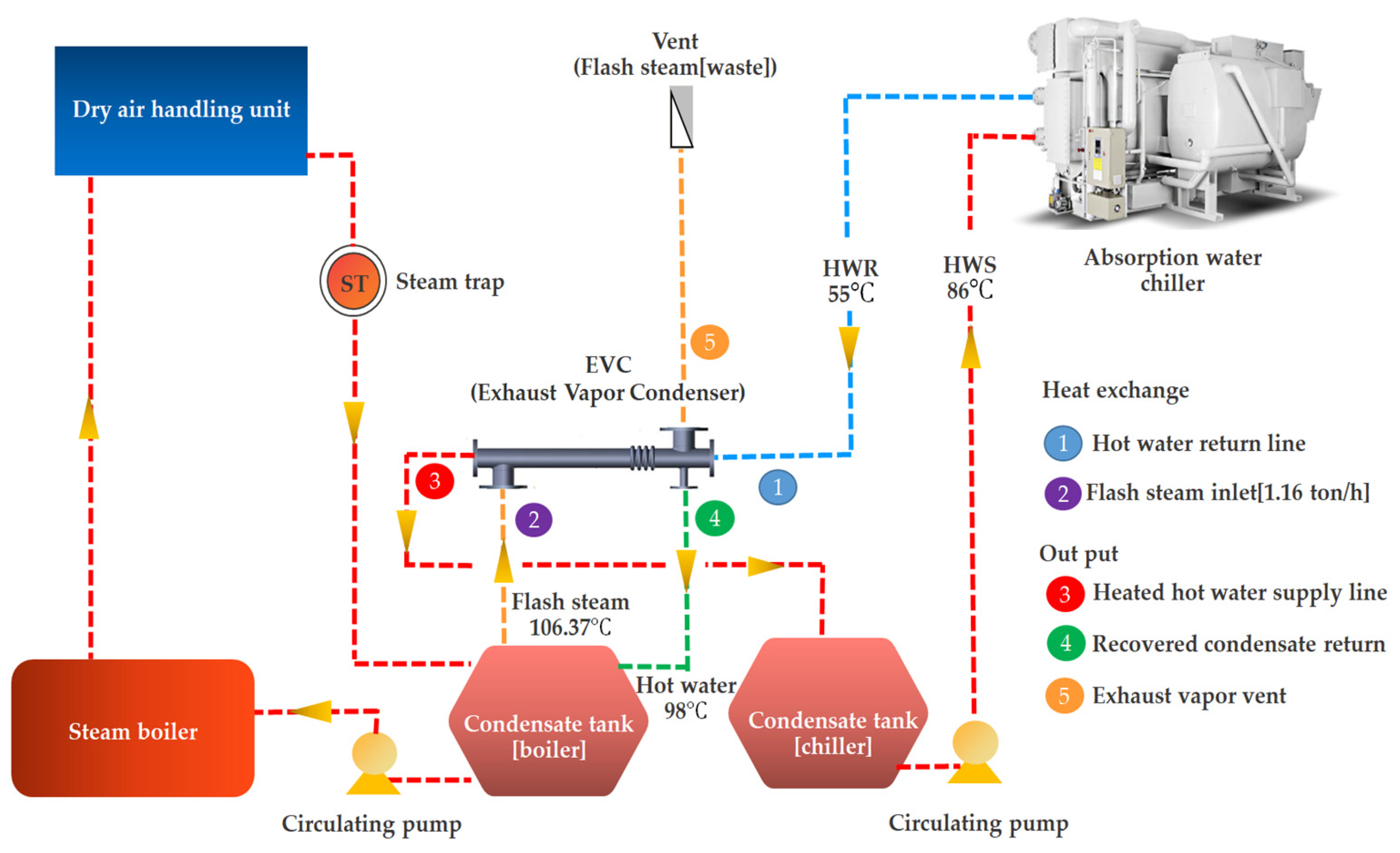
To compensate for the application limitations of the SJT method, this study examined the application of an EVC (Exhaust Vapor Condenser) that recovers flash steam generated downstream of the trap and utilizes it as an effective heat source [39]. The average saturated steam temperature measured downstream of the trap in this system is 106.37 °C. As shown in Figure 12, heat exchange occurs between the feed water and flash steam in the EVC, and the steam is converted into condensate at 98 °C. The EVC applied in this study has a shell-and-tube structure. The steam-side temperature is fixed at 106.37 °C, while the tube-side feed water is heated from 55 °C to 86.0 °C. The approximately 98 °C condensate is utilized as boiler feed water.
The EVC manufacturing design values were set by reflecting the actual measured temperature of 106.37 °C. Based on Equation (11), the logarithmic mean temperature difference ( Δ T L M T D ) was calculated as 30.28 °C. By applying the overall heat transfer coefficient ( U ) of 2200 W/m2·K and the heat transfer area ( A ) of 4.7 m2 to the heat exchanger calculation, the heat transfer rate ( Q ˙ E V C ) was calculated as 312 kW using Equation (12).
The flash steam treatment capacity of a single EVC unit was designed to be approximately 0.5 ton/h. However, the analysis based on actual feed water and trap data showed that the flash steam generation rate is approximately 1.16 ton/h (re-evaporation rate of 8.56%), which is about three times the design capacity of a single EVC unit. Therefore, the total recoverable heat from 1.16 ton/h of flash steam was calculated to be approximately 724 kW.
Consequently, to accommodate the entire load, it is necessary to configure the EVC units in parallel. When three units are applied in parallel, each unit handles a load of approximately 0.38 ton/h, which accurately satisfies the design specifications. This configuration enables stable heat exchange performance without overload and is judged to be a structure capable of responding to load fluctuations under actual operating conditions. The EVC system can be installed by connecting three units in parallel with minimal piping system changes according to the heat transfer capacity. Its structure is simple, and it offers excellent controllability. Its greatest advantage is that it does not require primary steam, making it highly applicable even in small-to-medium-scale dry room systems.
Δ T L M T D = ( T H , i n T C , o u t ) ( T H , o u t T C , i n ) ln ( T H , i n T C , o u t T H , o u t T C , i n )
Q ˙ E V C = U   A   Δ T L M T D

3.4.3. EVC Recovery Performance Evaluation (NTU Analysis)

The recovery performance of the EVC was evaluated based on the NTU (Number of Transfer Units) method for the heat exchange process accompanied by phase changes [40]. It was assumed that the feed water at 55 °C is heated to 86.0 °C through the EVC and utilized as a heat source for the regenerator of an absorption chiller/heater. First, the minimum heat capacity rate ( C m i n ) of the cooling water was calculated. The cooling water flow rate ( m ˙ f w ) of this system is 2.41 kg/s, and the specific heat ( c p ) is 4.18 kJ/kg·K. Using Equation (13), the heat capacity rate ( C m i n ) was calculated as 10.1 kW/K, and the mixing temperature of the steam is maintained at 106.37 °C.
The single design heat transfer rate ( Q ˙ E V C ) of the EVC is approximately 312 kW, which corresponds to the heat recoverable from the actual flash steam. Through Equation (14), the effectiveness ( ε ) of the device was calculated to be approximately 0.60, indicating that this heat exchanger can theoretically recover about 60% of the recoverable heat under the given conditions. Subsequently, as a result of calculating the NTU, the NTU value was derived as 0.91 using Equation (15) for conditions where phase change occurs during heat exchange. These characteristics confirm that the EVC is a device capable of sufficiently utilizing waste heat, although it is not a high-efficiency heat recovery system.
The design steam treatment capacity of a single EVC unit is approximately 0.5 ton/h, while the total flash steam volume calculated in this study was analyzed to be approximately 1.16 ton/h. Therefore, to stably recover the entire volume of flash steam, a configuration in which at least three EVC units are installed in parallel is deemed appropriate.
C m i n = m ˙ f w c p
ε = Q ˙ E V C C m i n ( T H , i n T C , i n )
N T U = l n ( 1 ε )

3.4.4. Comparison and Review of Heat Recovery Amount

As presented in Table 7, this study compared the flash steam treatment methods using SJT and EVC based on the same condition of 1.16 ton/h of flash steam. The SJT method utilizes 9 bar high-pressure primary steam to produce high-pressure steam at a 3.5 bar level, thereby generating a steam flow rate of 18.46 ton/h and a thermal output of 13.95 MW. This approach is highly advantageous for large-scale industrial processes that require the direct integration of high-grade steam into existing lines without secondary conversion systems. However, to maintain these conditions, a supply of approximately 17.3 ton/h of high-pressure primary steam is essential. Consequently, the necessity of high-pressure primary steam to recover waste heat poses a limitation for its independent application as an energy recovery system in medium-sized dry rooms.
In contrast, the EVC method does not require primary steam and is a system that utilizes recovered heat in the form of hot water by directly exchanging heat between flash steam and feed water. To utilize the waste heat from the 1.16 ton/h of flash steam verified in this study, a total of three EVC units must be applied in parallel, and the maximum recoverable heat was found to be 724 kW. This confirms that energy recovery is feasible through waste heat utilization in medium-sized dry room systems.
In summary, SJT and EVC represent complementary technologies that differ fundamentally in their required supply conditions and the grade of recovered energy. The SJT method is a highly reliable and specialized solution for large-scale industrial plants with surplus high-pressure steam infrastructure, as it enables the recovery of high-grade process steam. Its semi-permanent design further ensures superior operational reliability in harsh environments. In contrast, the EVC method is optimized for medium-sized systems, such as the dry rooms in this study, where the priority is maximizing thermal recovery without additional utility burdens. Therefore, the selection between these two technologies should be viewed as a strategic engineering choice based on the site’s energy infrastructure and the specific grade of thermal demand.

3.5. Application of Waste Heat-Based Absorption Cooling System to Dry Room Pre-Cooling Process

3.5.1. Chilled Water Generation Using Waste Heat and Application of Pre-Cooling Heat Source

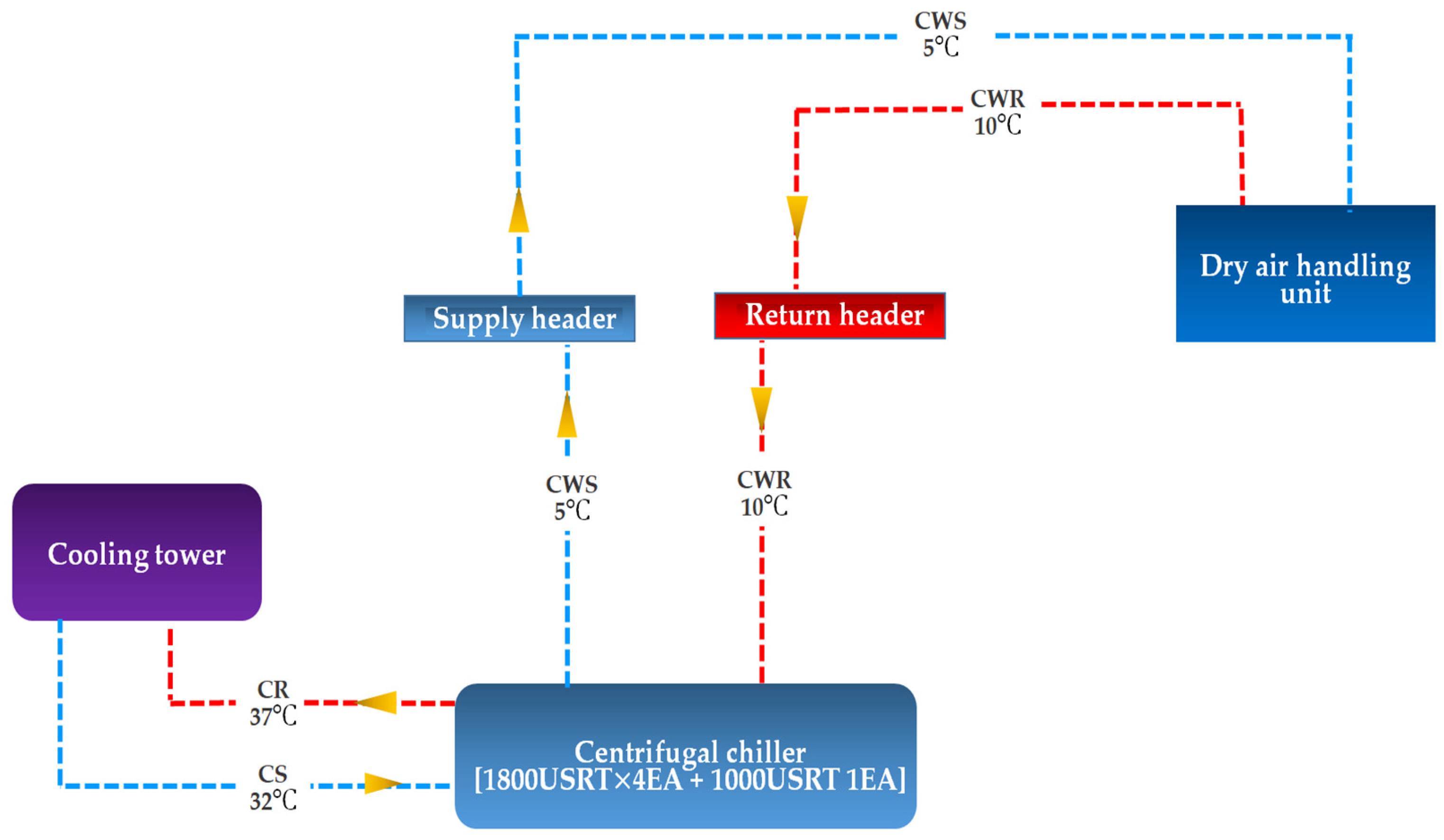
In this study, a system is proposed to generate chilled water for pre-cooling dry room air handling units (AHUs) by utilizing heat recovered through EVC units to drive an absorption chiller. As shown in the system schematic in Figure 13, centrifugal chillers are currently employed for the pre-cooling process within the dry room. Specifically, the installation consists of four 1800 USRT-class units and one 1000 USRT-class unit, operating with a supply temperature (CWS) of 5 °C and a return temperature (CWR) of 10 °C.
The objective of this research is to reduce the electrical energy consumed during the operation of these centrifugal chillers by utilizing the recovered waste heat source to produce chilled water for the pre-cooling coils.

3.5.2. Load Sharing Linked to Return Header and Operation Control Strategy

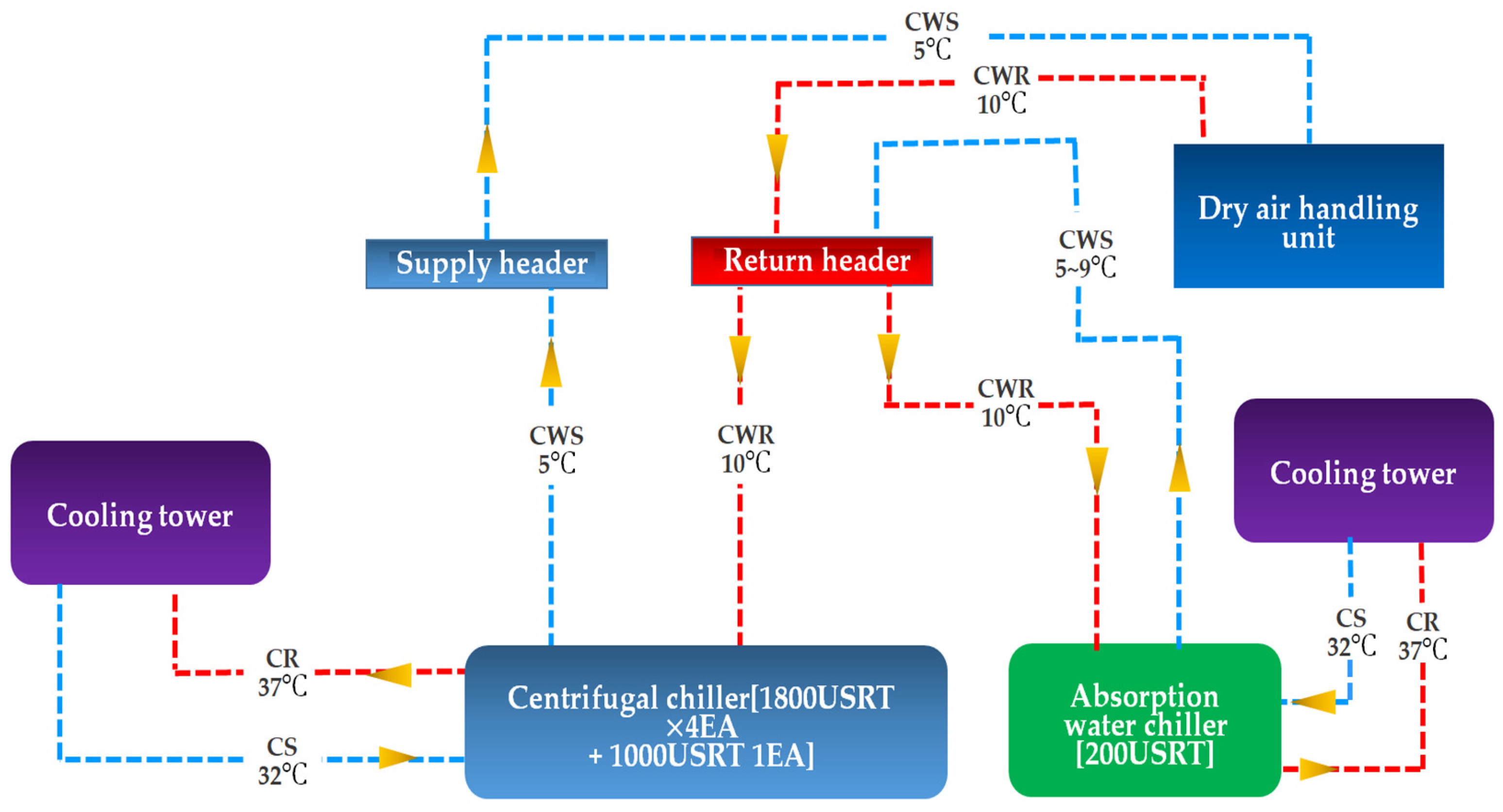
Hot water at approximately 86.0 °C recovered from the EVC system is supplied as a driving source for the regenerator of the absorption chiller to produce chilled water for HVAC. The produced chilled water is integrated into the system by being directly injected into the main return header shown in Figure 14. The core operation strategy of this system is to maximize the waste heat utilization rate by flexibly supplying chilled water within the range of 5.0–10.0 °C, rather than fixing the outlet temperature to a specific value, considering the instability of the waste heat source and the variability of the outdoor load.
Considering that the return water temperature of the existing system coming back after heat exchange in the dry room AHU is 10 °C, as long as the chilled water temperature produced by the absorption chiller is lower than 10 °C, the temperature of the water entering the centrifugal chiller can be proactively lowered through mixing with the return water. This return header injection method not only acts as a buffer to mitigate thermal shocks to the system caused by fluctuations in waste heat volume but also reduces electrical energy consumption by removing the direct load from the centrifugal chillers, which are the main cooling units.
Consequently, this operation process is designed to preferentially supply all effective cooling capacity between 5.0 and 9.0 °C to the system, in addition to the rated chilled water production at 5.0 °C. This implements an intelligent energy-saving mechanism that optimizes the operation rate of the large-scale, power-based centrifugal chiller plant and consistently improves the part-load efficiency of the entire system. This serves as a practical solution to innovate the energy consumption structure during dry room operation by effectively sharing the base load using low-temperature waste heat that would otherwise be discarded in large-scale industrial sites.

3.5.3. Absorption Chiller Capacity Determination and Energy Saving Potential Analysis

To convert the 86.0 °C hot water waste heat recovered through the EVC units into practical cooling energy, the system capacity was determined by reflecting the changes in cooling capacity due to the decrease in the heat source temperature. Furthermore, the electrical energy replacement effect when integrated with the existing centrifugal chillers was quantitatively analyzed. The total average recovered heat ( Q ˙ T o t a l ) during the summer was based on 724 kW. Although the rated specifications for L-Company’s single-stage hot water absorption chiller are based on a hot water inlet temperature of 95.0 °C, this system was designed to operate at 86.0 °C to match the characteristics of the waste heat source. By applying a cooling capacity reduction factor ( F t ) due to the lower heat source temperature, a COP of 0.70 rather than 0.72 was applied to derive a cooling capacity ( Q ˙ c h i l l e d ) of 506.8 kW, as shown in Equation (16).
Considering these performance degradation characteristics, a chiller with a rated capacity of 200 USRT or higher was selected during actual system design. This ensured a constant cooling capacity of over 144.1 USRT required for sharing the dry room pre-cooling load even under low-temperature waste heat inlet conditions, thereby directly replacing the power-based cooling load generated at the pre-cooling coils. The average power efficiency ( C O P t u r b o ) of the existing centrifugal chillers is applied as 5.47, and the hourly energy saving potential ( P s a v i n g ) resulting from the introduction of the waste heat-based system can be derived through Equation (17).
Q ˙ c h i l l e d = Q ˙ T o t a l C O P
P s a v i n g = Q ˙ c h i l l e d C O P t u r b o

4. Research Results

4.1. Heat Recovery Effect of EVC Application

The heat recovery performance and energy-saving effects were quantitatively analyzed when an EVC was applied as a heat exchanger to recover the flash steam generated downstream of the trap. Based on the measured data, the heat transfer performance, recovered heat amount, and generated hot water characteristics of the EVC were evaluated. Furthermore, the feasibility of its application to medium-sized dry room systems was reviewed by comparing it with the SJT method under the same conditions.

4.1.1. Hypotheses and Scope of Application

The primary hypotheses of this study are as follows
  • When recovering the flash steam downstream of the steam trap using an EVC, it is more advantageous in terms of energy saving compared to an SJT system under the same conditions.
  • In medium-sized dry rooms, EVC utilization is more advantageous than SJT in terms of load, maintenance, and stability due to issues such as the lack of primary steam infrastructure and limitations on the utilization of 3.5 bar high-pressure steam.
  • By utilizing the 86.0 °C hot water generated through the EVC to drive a 144.1 USRT absorption chiller, the energy required for dry room operation is generated.
Therefore, in this section, the heat recovery performance was compared, verified, and utilized for plans to apply the thermal energy produced by recovering the flash steam generated from the boiler steam pipes using an EVC as either hot water production or a driving heat source for an absorption chiller/heater.

4.1.2. EVC Heat Transfer Performance Evaluation (NTU Analysis)

The performance of the EVC heat exchanger was evaluated based on the NTU analysis method. In this system, the trap downstream temperature was determined to be 106.37 °C by applying a weighted average to the measured values upstream and downstream of the steam trap. Upon EVC application, the feed water is heated from 55 to 86.0 °C to be used as a heat source, while the flash steam is condensed from 106.37 to 98 °C. Assuming a cooling water mass flow rate ( m ˙ r e ) of 2.41 kg/s and a specific heat ( c p ) of 4.186 kJ/kg·K, the heat capacity rate ( C m i n ) was calculated using Equation (11) from Section 3.3.3 of Section 3.
As a result of applying an effectiveness ( ε ) of 0.60 through Equation (12), the EVC heat transfer rate ( Q ˙ T o t a l ) was calculated to be approximately 312 kW. Since the design flash steam treatment capacity per EVC unit is 0.5 ton/h, three EVC units are required to recover 1.16 ton/h. Therefore, to properly recover the flash steam generated in the dry room, the total average recovered heat ( Q ˙ T o t a l ) during the summer was calculated to be 724 kW based on the application of three EVC units and a total steam treatment capacity of 1.5 ton/h, as shown in Equation (18).
Q ˙ T o t a l = N E V C   Q ˙ E V C   m ˙ f l a s h m ˙ s t e a m

4.1.3. Monthly Recovered Heat Rate Analysis

The EVC can recover flash steam without any special control, and the operation and control logic do not change even if the pressure and monthly generation amount of the flash steam vary. However, the recoverable heat varies because the monthly generation amount of flash steam differs. Therefore, to predict the monthly recoverable heat, it was quantitatively calculated as a ratio based on the average boiler feedwater flow rate ( m ˙ a v e ) from March to August. The average total recovered heat ( Q ˙ T o t a l ) during the summer can be confirmed as 724 kW through Section 4.3.2 of Section 4. By predicting the monthly recoverable heat through Equation (19) using the monthly feedwater flow rate ( m ˙ m o n t h ), the monthly recovery ratio and recoverable heat rate ( Q ˙ T o t a l , m o n t h ) are organized and presented in Table 8.
As a result of the analysis, the operation level from March to May was found to be approximately 66 to 88% of the average recovery amount, while from June to August, it reached over 120% of the average recovery amount. Overall, it can be confirmed that during the intermediate seasons when outdoor conditions are not severe, boiler usage is low, leading to a decrease in flash steam generation and a subsequent reduction in the recovered heat amount. In contrast, during the summer months from June to August, when outdoor conditions are severe, the recovered heat amount increases. The EVC applied for flash steam recovery has a recoverable heat of 312 kW per 0.5 ton/h (a total of 936 kW when 3 units are applied), demonstrating that it can comfortably accommodate the maximum recovered heat amount of 902 kW in July during the summer.
Q ˙ T o t a l , m o n t h = Q ˙ t o t a l ( m ˙ m o n t h m ˙ a v e )

4.1.4. Comparison with SJT and Feasibility of Medium-Scale Application

The SJT method uses primary steam to mix and utilize the flash steam downstream of the trap, making it applicable to large industrial facilities such as large plants that require a massive amount of high-pressure steam at 3.5 bar or higher. However, in medium-sized dry rooms, the supply of 17.3 ton/h of primary steam is limited, and it has the limitation of requiring additional energy consumption for waste heat recovery. Furthermore, there is a limitation in that the specific usage for the generated high-pressure steam is unclear.
In contrast, the EVC generates hot water by directly recovering the latent heat of the flash steam using a simple shell-and-tube heat exchanger. This simplicity is advantageous not only in terms of pressure stability, installation space, and maintenance, but also has the advantage of relatively small fluctuations in heat exchange performance even under load variation conditions. Using the actual measurement data of this study, the average flash steam generation rate ( m ˙ f l a s h ) from March to August was 1.16 ton/h, and the heat recoverable through this was found to be approximately 724 kW. It also demonstrated that the maximum recovered heat amount of 902 kW in July during the summer can be sufficiently recovered.
In conclusion, while the SJT is a robust and reliable solution for large-scale industrial facilities that require constant high-pressure steam and high-grade energy recovery, its implementation in medium-scale dry rooms can be constrained by the necessity of a significant primary steam supply. For the specific facility scale and utility conditions investigated in this study, the EVC offers a more site-specific and practical alternative by focusing on thermal energy recovery without additional utility burdens. This comparison highlights that each technology possesses distinct operational advantages depending on the system’s energy infrastructure and the required grade of the recovered heat source. For medium-sized dry rooms with limited motive steam capacity, the EVC provides an optimized path for sustainable waste heat utilization.

4.2. Economic Feasibility Evaluation of the EVC System

4.2.1. Calculation of Capital Expenditure (CAPEX) and Application of Site-Specific Adjustment Factor

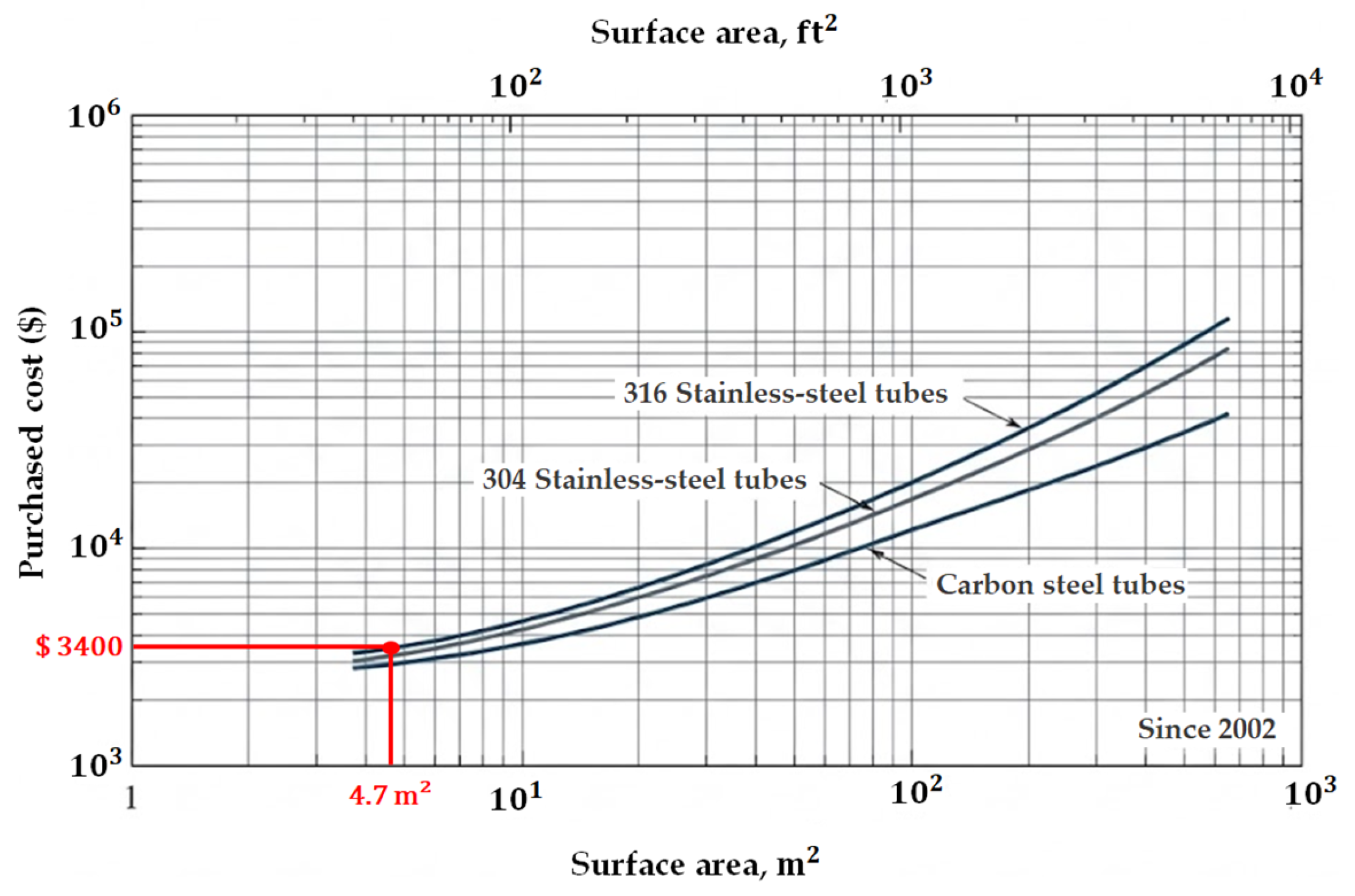
The Capital Expenditure (CAPEX) for the EVC system proposed in this study was estimated based on the methodologies provided by Peters et al. in “Plant Design and Economics for Chemical Engineers,” specifically by examining the cost per heat transfer area for shell-and-tube heat exchangers [41]. Based on the design specifications of this study—a heat transfer area ( A ) 4.7 m2 and the use of high-corrosion-resistant 316 stainless steel tubes—the purchased cost for a single unit was determined to be approximately $3400 as of 2002, as shown in Figure 15.
However, since this cost data reflects 2002 values and covers only the base equipment price, the Chemical Engineering Plant Cost Index (CEPCI) ratio { ( I 2026 ) / ( I 2002 ) } was applied as approximately 2.1 to reflect inflation up to the current year, 2026. To account for current market values and actual industrial requirements, the appropriate initial investment cost was calculated by adjusting the base cost through Equation (20).
Particularly, this study introduced a site-specific adjustment factor ( f s i t e ) to bridge the gap between theoretical base prices and the actual implementation costs in industrial settings. This factor comprehensively encompasses the costs of skid units (including automatic control valves and measurement sensors), compliance with national industrial safety standards, and manufacturing premiums associated with the use of high-grade STS 316 L materials.
Based on a comparative analysis of manufacturer quotes, the adjustment factor ( f s i t e ) was set to 5.2, resulting in an estimated implementation cost (including the package) of approximately $37,000 for a single EVC unit. Finally, the total CAPEX of the system was finalized at approximately $222,000 for the economic feasibility analysis, which includes the cost of a triple-unit parallel configuration for system reliability $111,000 and onsite piping and auxiliary facility costs ( C p i p e ) , calculated at 100% of the EVC cost $111,000.
C A P E X = [ ( C E V C , c o s t I 2026 I 2002 f s i t e ) × 3 ] + C p i p e

4.2.2. Analysis of Annual Energy Saving Benefits and Economic Feasibility

In this section, the practical economic value of the EVC system was evaluated based on the maximum heat recovery rate of 724 kW derived in Section 3.4. The economic analysis was conducted using the industrial natural gas wholesale price ( P g a s ) of $0.01266/MJ (provided by Korea Gas Corporation as of April 2026). To ensure a realistic assessment, the annual operating time was conservatively set to 4000 h ( t m e a s u r e d ) , reflecting the actual 6-month operation data collected from the field. The recovered heat ( Q ˙ T o t a l ) of 724 kW was converted into an annual energy value, and the corresponding annual energy cost savings ( S s e a s o n ) of $146,659—assuming a conventional LNG boiler efficiency of 90%—were determined using Equation (21). To ensure the long-term reliability of the system, annual Operating Expenditure (OPEX) was incorporated into the analysis. Although the EVC system is a static device that requires no driving power, an annual maintenance cost of $6660 (3.0% of CAPEX) was allocated to account for periodic cleaning and sensor calibration. Consequently, the Simple Payback Period (PBP) was finalized at 1.586 years using Equation (22). Given that an investment recovery within 2 to 3 years is generally considered highly favorable in an industrial context, these results demonstrate that the proposed system possesses significant investment value and economic viability for corporate applications.
S s e a s o n = ( Q ˙ T o t a l t m e a s u r e d 3.6 0.9 ) × P g a s
P B P = C A P E X S s e a s o n O P E X

4.2.3. Sensitivity Analysis of Economic Feasibility

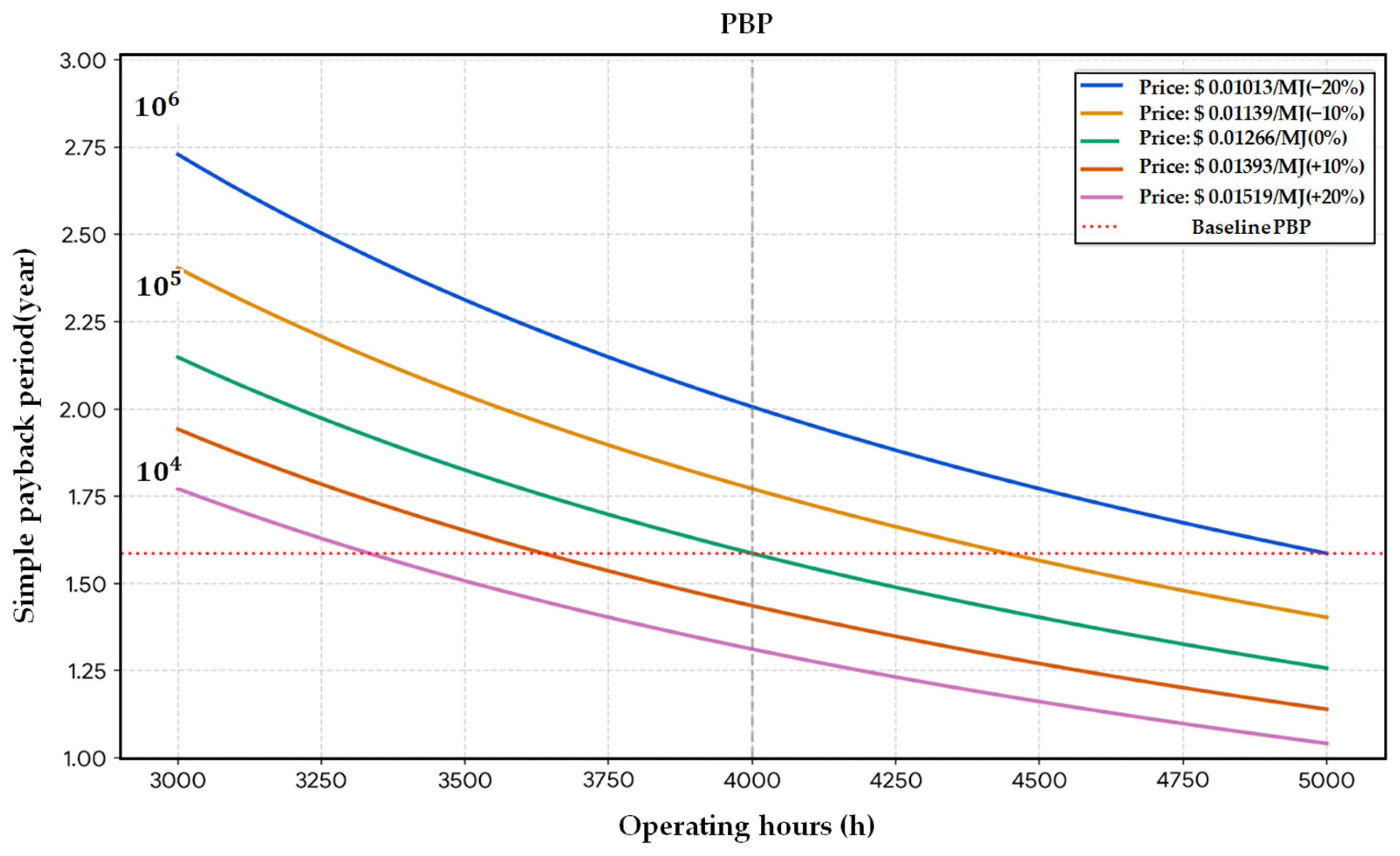
To evaluate the robustness of the economic assessment and address potential optimism, a sensitivity analysis was conducted on two key parameters: industrial LNG prices and annual operating hours ( T o p ) . Figure 16 illustrates the Simple Payback Period (PBP) when LNG prices fluctuate by ±20% relative to the baseline $0.01266/MJ across a range of operational schedules from 3000 to 5000 h/year.
The analysis reveals that the PBP is responsive to both variables. Specifically, as operating hours and fuel prices decrease, the PBP extends. However, even under the most conservative scenario considered ±20% reduction in fuel prices paired with a minimum operational schedule of 3000 h/year the PBP is maximized at approximately 2.73 years. This worst-case scenario remains comfortably below the general industrial threshold for commercially viable investments, typically set at 3 years. These results, as shown in Figure 16, confirm that the proposed EVC absorption chiller hybrid system maintains high economic resilience despite potential fluctuations in external market conditions and facility utilization rates.

4.3. Analysis of Cooling Production and Energy Efficiency

4.3.1. Monthly Cooling Production Performance Analysis

When the 86.0 °C hot water produced through the EVC system was input as the driving heat source for the absorption chiller, the monthly producible cooling capacity was expressed as shown in Table 9 by applying Equation (14) from Section 3.3.5 of Section 3 and reflecting the cooling capacity ( Q ˙ c h i l l e d ) and COP. As a result of the analysis, it was found that a cooling capacity of approximately 631.4 kW (179.5 USRT) could be secured in July, when the summer outdoor load is at its maximum. This implies that as the boiler load increases during the summer, the amount of waste heat recovered is maximized, causing a concurrent rise in the output of the absorption chiller. It indicates that the system’s contribution is highest when the dry room pre-cooling load is concentrated. On the other hand, in March, when the boiler operation rate is relatively low, it exhibited a cooling capacity of approximately 336.7 kW (95.7 USRT). However, as effective cooling energy in the range of 5.0 to 10.0 °C, this is also judged to be a figure capable of sufficiently contributing to sharing the pre-cooling load.

4.3.2. Comparison Between Absorption Chiller Produced Energy and Dry Room Pre-Cooling Load

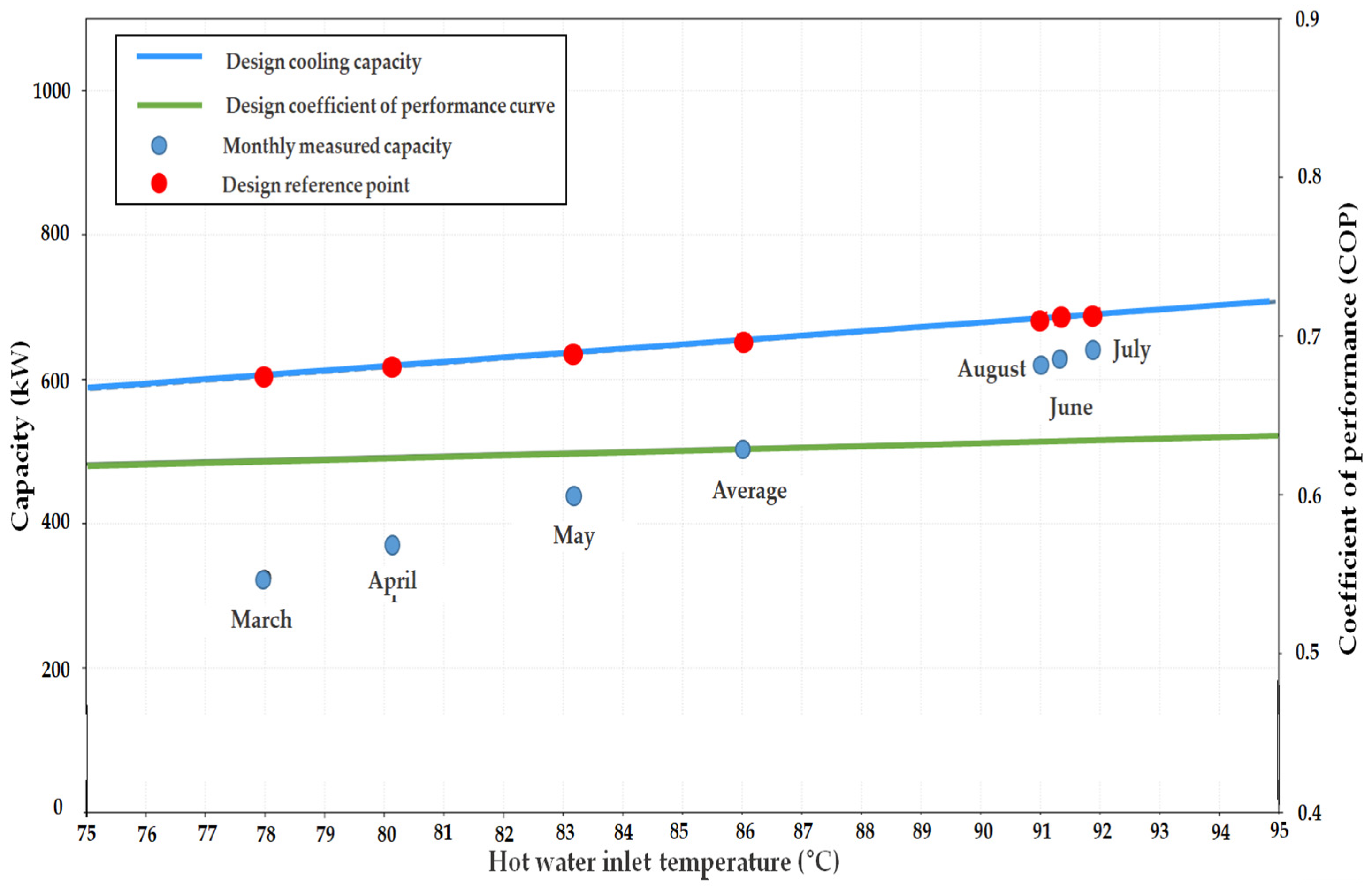
To analyze the extent to which the waste heat recovery-based absorption cooling system proposed in this study can replace the pre-cooling load of the actual dry room air conditioning process, the cooling production and pre-cooling load were directly compared based on measured data from March to August. In Figure 17, the blue and green lines represent the design cooling capacity and the design coefficient of performance (COP) curve, respectively. The light blue dots denote the monthly measured cooling capacity, while the red dots signify the design reference points. As can be seen in Figure 16, the absorption chiller demonstrated a maximum cooling capacity of 179.5 USRT during the summer when the outdoor load rises most steeply, proactively sharing the dry room’s pre-cooling load.
This results from the concurrent increase in the chiller’s COP and output as the waste heat recovery temperature rises to 91.9 °C due to the increased boiler operation rate during the summer. In particular, the chilled water produced solely from waste heat energy preferentially handles the load required by the pre-cooling coils of the dry room AHU, thereby directly removing the load that the existing main centrifugal chiller would have had to process. It was confirmed that even in March, which is an intermediate season, it continuously supplied an effective cooling capacity of at least 95.7 USRT, fully performing its role as an auxiliary heat source for the pre-cooling system.
Consequently, this load-sharing mechanism has been empirically proven to be a practical energy-saving measure that improves the energy consumption structure of the dry room pre-cooling and effectively mitigates the summer peak load by continuously supplying a summer average of 144.1 USRT of cooling energy to the system, despite the instability of the waste heat source.
The correlation in Figure 17 indicates that as the waste heat temperature rises to 91.9 °C, the absorption cycle’s efficiency improves, enhancing its cooling capacity. By utilizing this recovered heat to handle a portion of the pre-cooling load, the system reduces the overall cooling demand placed on the existing centrifugal chillers, thereby helping to lower the total electrical energy consumption of the facility.

4.3.3. Electrical Energy Saving Effect Through Absorption Chiller

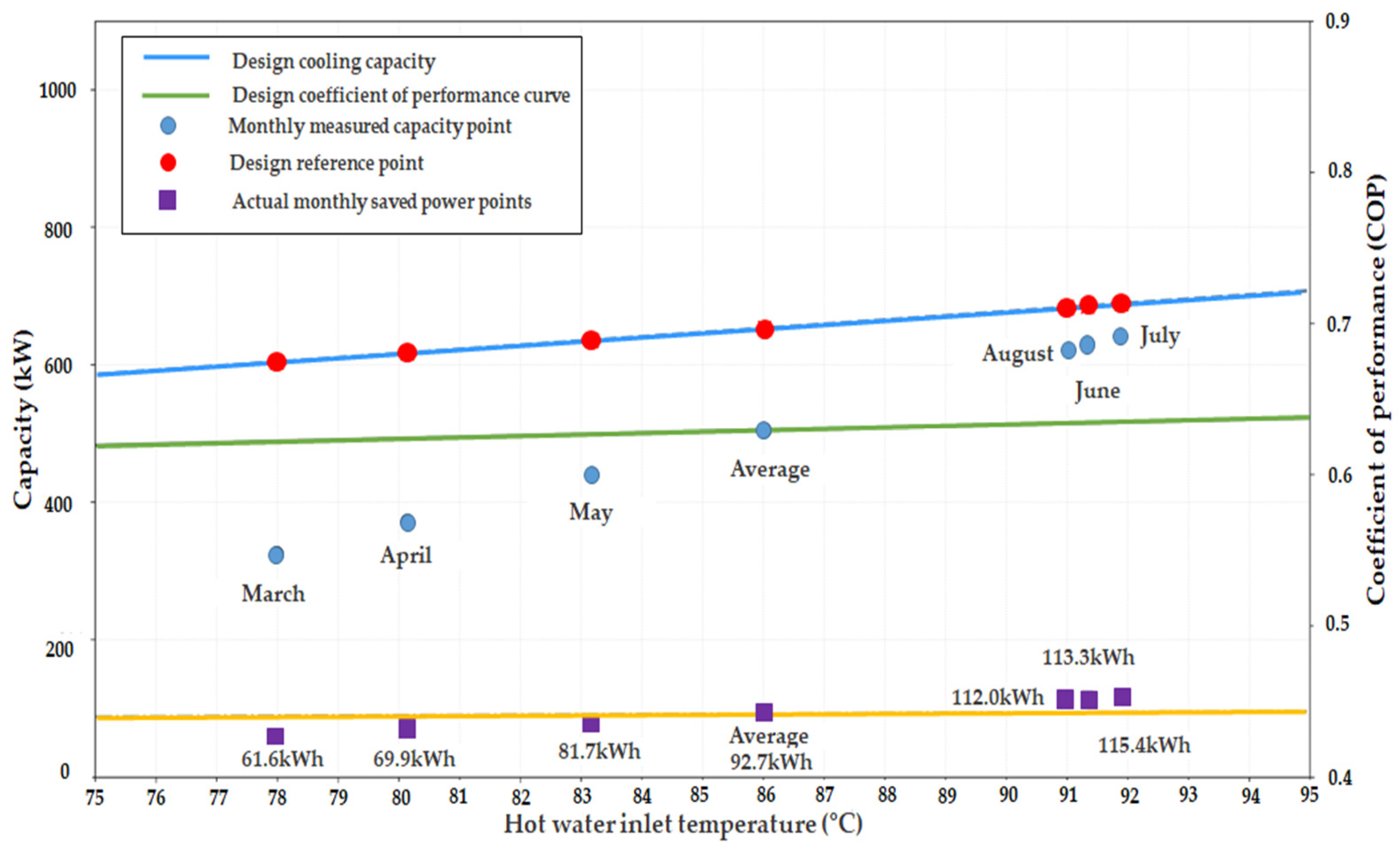
To quantify the electrical energy saving effect of introducing the waste heat recovery-based absorption cooling system, the operating efficiency of the centrifugal chiller and the cooling production of the absorption chiller were comparatively analyzed. Based on the COP of 5.47 for the centrifugal chiller installed at the research site, the monthly hourly power saving potential ( P s a v i n g ) can be calculated using Equation (15) from Section 3.5.3 and expressed as shown in Figure 18. In this visualization, the purple square dots represent the actual monthly saved power points, corresponding to the electrical energy reduced by utilizing the absorption chiller to replace a portion of the pre-cooling load. The cooling energy produced by the absorption chiller directly replaces the power consumption of the centrifugal chiller, which previously handled the entire pre-cooling load of the dry room.
When the annual average cooling production of 144.1 USRT is converted using the actual measured efficiency of the centrifugal chiller, it was analyzed to avoid a power consumption of approximately 92.6 kW per hour. It was confirmed that during the summer peak, power of over 115.4 kW per hour can be saved according to the increase in cooling capacity. Considering the continuous operating environment, reaching an annual operation rate of 98.4% due to the nature of the dry room process, these hourly savings lead to a groundbreaking reduction in annual power consumption. Consequently, electrical energy can be saved by utilizing the otherwise discarded flash steam as a heat source to replace the load of the centrifugal chiller.

4.4. Direction of Comparison and Comprehensive Discussion

4.4.1. Integrated Evaluation of EVC Application Effects

This study compared the recovery performance of SJT and EVC based on the same flash steam generation rate ( m ˙ f l a s h ) of 1.16 ton/h. The SJT method mixes 9 bar primary steam to generate 18.46 ton/h of 3.5 bar steam with 13.95 MW, but it is difficult to apply it to the medium-sized dry room energy recovery system because it requires an additional supply of 17.3 ton/h of high-pressure primary steam. The EVC recovers heat by directly condensing 1.16 ton/h of flash steam without additional energy, and stably provides an average summer recovered heat of 724 kW when 3 units are applied. Therefore, the EVC is judged to be a more realistic and efficient alternative for the thermal energy recovery system of medium-sized dry rooms.

4.4.2. Low-Temperature Waste Heat-Based Chilled Water Production and Process Load Sharing Characteristics

The value and load-sharing characteristics of the approximately 86.0 °C hot water recovered through the EVC units as a cooling source supplied to the actual dry room pre-cooling process via the absorption chiller were analyzed. The analysis revealed that the recovered hot water waste heat rises to a maximum of 91.9 °C during the summer peak, and accordingly, the absorption chiller secures a cooling capacity of up to 179.5 USRT based on an improved COP compared to the rating.
In particular, as confirmed in Section 4.2.2, the method of directly injecting the produced chilled water into the return header of the existing centrifugal chiller system allows the cooling energy of the absorption chiller utilizing waste heat to preferentially handle the load borne by the centrifugal chiller, thereby effectively lowering the operation rate of the power-based cooling system. The ability to consistently supply an annual average of approximately 144.1 USRT of cooling energy implies that the practical application feasibility of the waste heat recovery system as an auxiliary cooling source in medium-sized dry room facilities is extremely high. Consequently, this cooling energy production process serves as a core mechanism that converts unutilized waste heat into high-value-added cooling energy in the highly energy-consuming dry room process, drastically lowering power dependency.

4.4.3. Applicability and Implications for Medium-Sized Dry Rooms

The integrated EVC and absorption chiller system demonstrated in this study is an energy solution optimized for medium-sized industrial dry rooms with limited infrastructure, and it has the following practical implications.
First, structural suitability and ease of installation. Unlike large plants, in medium-sized facilities lacking sufficient primary steam capacity, the EVC method—which directly condenses low-pressure waste steam—has a simple system configuration and minimizes installation space compared to the SJT method, which requires high-pressure steam. This makes it advantageous for remodeling or expanding existing facilities. In particular, the process of stably recovering the approximately 106.37 °C waste heat downstream of the trap to produce 86.0 °C hot water maximizes maintenance efficiency, as continuous operation is possible without complex control logic.
Second, the combination of energy savings and the resolution of environmental complaints. flash steam, which was conventionally discharged into the atmosphere from the dry room process, is not only an energy loss but also a primary cause of complaints from nearby residents due to the white plume generated under winter and high-humidity weather conditions. By completely condensing the waste steam at the latent heat recovery stage through the application of the EVC system, companies can obtain the economic benefit of electrical energy savings while simultaneously gaining the intangible asset value of fundamentally resolving environmental complaints related to white plume generation.
Third, securing operational stability through improved power dependency. Breaking away from the conventional method that relied entirely on large-scale centrifugal chillers to maintain an ultra-low DP, the load on the power-based cooling system is consistently reduced by approximately 92.6 kW by utilizing discarded waste heat as a cooling source. This serves as a practical measure to optimize operating costs by lowering the operational load during peak power hours.

4.4.4. Limitations of the Study and Future Directions

This study is significant in that it analyzed the flash steam generated in the medium-sized dry room dehumidification HVAC process based on actual measurements and demonstrated the performance of the integrated EVC and absorption chiller system. However, to achieve a more precise system design, the following are limitations of the study. First, is the seasonal bias of the data. This analysis was limited to data from March to August, when the outdoor load is concentrated, and thus could not perfectly reflect the variability during the winter and parts of the intermediate seasons when boiler operation patterns change. Future long-term monitoring over a year is required to more precisely verify the correlation between seasonal waste heat generation and cooling load.
Second, the limitation of steady state based analysis. While the measured data clearly exhibit strong seasonal variations, this study primarily focused on identifying the fundamental energy-saving mechanisms and technical feasibility for medium scale systems. We acknowledge that relying on steady state results under such variations may limit the applicability of the findings to highly transient, year-round operating conditions. However, the current analysis provides a critical theoretical baseline. Establishing such a benchmark is an essential precursor to evaluating the relative impact of transient fluctuations on overall system performance.
Furthermore, the temperature measurements were conducted during the peak load period, as the primary objective of this study was to quantify the maximum potential for waste heat recovery under the most demanding conditions. While this single snap-shot approach entails inherent limitations related to variability and data uncertainty, it is appropriate for establishing an upper boundary for system capacity. As shown in Section 3.3.2, the high stability of the supply pressure during this period supports the use of the measured values as a reliable basis for maximum load analysis. Nevertheless, potential seasonal discrepancies is recognized as a limitation of this steady-state approach and warrant further validation through long-term monitoring.
Third, the integrated matching analysis between the heat source and the cooling load. It should be acknowledged that the current results are derived from idealized assumptions representing maximum theoretical conditions. While these provide a foundational baseline, there is an inherent gap between such theoretical ideals and practical conclusions when used for system evaluation and economic analysis. To bridge this gap, research on dynamic simulation and optimal control logic must be supplemented to resolve the temporal discrepancy between the time of waste heat generation and the dry room cooling demand. In the future, dynamic modeling of the entire integrated heat source plant—including the EVC, absorption chiller/heater, and boiler—will be constructed, and the economic and environmental validity of the system will be comprehensively verified through comparison with measured values.
Fourth, the uncertainty of the weighting method. Due to the physical monitoring limitations of measuring individual steam consumption for each of the 18 DHUs in a large-scale operating facility, design-based weighting factors were utilized to derive the representative thermal state. While this establishes a reasonable engineering baseline for system sizing, it may introduce additional uncertainty compared to real-time operational dynamics. This constraint is clearly acknowledged, and future research will aim to minimize this gap through localized flow monitoring or the implementation of calibrated simulation models to refine the quantification of recovery potential.

5. Discussion

In this study, the flash steam generated from the dry room dehumidification AHU was quantitatively evaluated based on actual measurements, and the applicability of the EVC system to recover it was evaluated. The boiler feedwater flow rate and operating time responded very sensitively to outdoor conditions; in particular, during the summer, steam usage increased, resulting in continuous boiler operation of approximately 24 h/day, showing significant seasonal load variations. The measured flash steam generation rate was confirmed to be an average of 1.16 ton/h, which is a highly valuable heat source for recovery corresponding to approximately 8% of the total condensate.
The EVC has the structural advantage of not requiring primary steam and stably provides an average of 724 kW of recovered heat when applied. On the other hand, the SJT method generates 18.6 ton/h of 3.5 bar high-pressure steam (13.95 MW), but requires 17.3 ton/h of 9 bar primary steam for this purpose, presenting many constraints in terms of economic efficiency and operability in medium-sized dry rooms.
A particular point of focus in this study is that the steam recovered through the EVC can be utilized as a heat source for the absorption chiller to produce cooling energy. This can achieve a direct electrical energy saving effect by sharing the load of the existing centrifugal chiller, and can also contribute to peak power management during the summer. Furthermore, from an operational perspective, there is an additional advantage of fundamentally resolving civil complaints regarding white plumes caused by flash steam.
This study has the limitation of being analyzed primarily from the intermediate season to the summer, and further research is needed on flash steam characteristics under winter conditions, long-term EVC operation, and actual post-construction performance verification evaluations.
  • The boiler heat source exhibits high variability depending on outdoor conditions, and since continuous operation occurs in the summer, seasonal load fluctuations must inevitably be considered.
  • The flash steam of 1.16 ton/h (approximately 8% of the condensate) was confirmed to be a highly valuable heat source for recovery even at the building level.
  • The SJT generates 18.6 ton/h of 3.5 bar high-pressure steam with 13.95 MW, but requires 17.3 ton/h of primary steam, posing structural constraints for application in small-to-medium-sized dry rooms.
  • The EVC does not require primary steam and is suitable for waste heat recovery in medium-sized buildings by supplying a summer average of 724 kW of recovered heat.
  • When linked with an absorption chiller, the 724 kW of recovered heat can produce approximately 507 kW of cooling energy, enabling electrical energy savings for the centrifugal chiller.
  • By completely blocking the atmospheric discharge of flash steam, the white plume issue can be resolved, presenting an additional advantage in terms of corporate operation.
  • Because this study is based on summer-centric data, analyzing flash steam characteristics during winter and the long-term operational impact of the EVC remains a task for future research.
The results derived from this discussion provide an important basis for establishing a waste heat recovery strategy utilizing flash steam in medium-sized dry rooms. In particular, it was confirmed that the hybrid system integrating the EVC and the absorption chiller can effectively distribute the energy load concentrated on the existing centrifugal chillers. This analysis comprehensively supports the applicability of the EVC-based heat source recovery system to be presented in Section 6, Conclusions. The next chapter comprehensively summarizes the main contributions and future development potential of this study.

6. Conclusions

This study investigated the generation characteristics and recovery potential of flash steam from steam-regenerated desiccant air handling units in a medium-scale dry room HVAC system. Field measurements and operational data from March to August 2025 were analyzed to quantify flash steam generation and to evaluate the applicability of an exhaust vapor condenser (EVC) heat recovery system. The main contributions are as follows.
  • Analysis of the boiler operation data showed that the boiler pressure was stably maintained at an average of 7.2 bar, while the feedwater flow rate and operating time increased significantly with rising outdoor temperature and humidity. During the summer season (June–August), the boiler operated nearly continuously at approximately 24 h/day due to increased steam demand for desiccant rotor regeneration.
  • The flash steam generation rate calculated from the measured data averaged 1.16 ton/h during the summer, corresponding to approximately 8.56% of the total condensate flow rate. This indicates that flash steam represents a considerable waste heat source with significant recovery potential in dry room HVAC systems.
  • When three EVC units were installed in a parallel configuration to recover flash steam, the average recoverable heat during the summer was estimated to be approximately 724 kW, with the maximum recovery potential reaching 902 kW in July.
  • The recoverable heat of the EVC was estimated to be 312 kW per unit, corresponding to a total capacity of 936 kW for three units. This result indicates stable heat recovery performance even under fluctuating load conditions. Furthermore, the heat exchanger effectiveness (ε) was approximately 0.60, demonstrating good agreement between the design specifications and the measured operating conditions.
  • Under the same flash steam conditions, the SJT can generate 18.6 ton/h of 3.5 bar steam (13.95 MW). However, it requires 17.3 ton/h of 9 bar primary steam, which limits its economic feasibility and practical applicability in small- and medium-sized dry room facilities.
  • In contrast, the EVC system does not require primary steam and has a simple configuration, ensuring high operational stability. The recovered heat can produce 86.0 °C hot water, which can be used as a driving heat source for an absorption chiller. This configuration enables the production of approximately 507 kW of cooling capacity, thereby reducing the electricity consumption of the existing centrifugal chiller.
  • Furthermore, the proposed system prevents the atmospheric release of flash steam, thereby eliminating the white plume phenomenon and reducing potential environmental complaints.
However, several limitations of this study should be noted to ensure a balanced interpretation of the findings. First, this research primarily utilized data from a single facility over a six-month period (March to August), which may not fully capture the operational variability during the winter season when boiler load patterns shift.
Second, the analysis was based on a steady-state approach to identify the fundamental energy-saving mechanisms and technical feasibility for medium-scale systems. While this provides a critical theoretical baseline and a versatile reference for initial design and economic assessment, actual industrial environments exhibit dynamic behaviors and transient fluctuations that could affect long-term performance. Therefore, while the EVC system demonstrates superior practicality and sustainability over the SJT method in this case, full-scale quantification of these dynamic variables and multi-site validation are proposed as essential tasks for future research to enhance the generalizability of the results.

Author Contributions

Conceptualization, K.H.J.; methodology, K.H.J.; experiment, K.H.J.; software, K.H.J. and Y.I.K.; verification, Y.I.K.; formal analysis, K.H.J.; investigation, K.H.J.; resources, K.H.J.; data Curation, K.H.J. and Y.I.K.; writing—original draft preparation, K.H.J. and Y.I.K.; writing—review and editing, Y.I.K.; visualization, K.H.J.; director, Y.I.K.; project management, Y.I.K.; funding, K.H.J. All authors have read and agreed to the published version of the manuscript.

Funding

This study was supported by the Research Program funded by Seoul National University of Science and Technology.

Data Availability Statement

The original contributions presented in the study are included in the article, further inquiries can be directed to the corresponding author.

Conflicts of Interest

The authors declare no conflicts of interest.

Nomenclature

V 2 Average velocity at nozzle throat (m/s)
V 1 Average velocity of primary steam at nozzle inlet (m/s)
C O P Coefficient of Performance
C R Cooling water return
C S Cooling water supply
C W R Chilled water return
C W S Cooling water supply
ρ 2 Density of fluid at nozzle throat (kg/m3)
ρ 1 Density of primary steam at nozzle inlet (kg/m3)
P i P ¯ Deviation of boiler operating pressure from its mean value (bar)
T i T ¯ Deviation of outdoor dry-bulb temperature from its mean value (°C)
R H i R H ¯ Deviation of outdoor relative humidity from its mean value (%)
t i t ¯ Deviation of time index from its mean value
x Flash steam generation ratio
ε Heat exchanger effectiveness
C m i n Minimum heat capacity rate of cold side
N T U Number of Transfer Units
Δ P Pressure difference induced by nozzle acceleration (bar)
m ˙ s t e a m Required steam mass flow rate for each unit (kg/s)
h f , l o w Saturated liquid enthalpy at downstream (kJ/kg)
h f , h i g h Saturated liquid enthalpy at upstream (kJ/kg)
P 2 Static pressure at nozzle throat (suction region) (bar)
P 1 Static pressure of primary steam at nozzle inlet (bar)
T i Steam-flow-weighted inlet temperature of each unit (°C)
U S R T United States Refrigeration Ton

References

  1. Ahmed, S.; Nelson, P.A.; Dees, D.W. Study of a dry room in a battery manufacturing plant using a process model. J. Power Sources 2016, 326, 490–499. [Google Scholar] [CrossRef]
  2. Goodarzvand-Chegini, F.; Samiee, L.; Rahmanian, N. Energy savings from flash steam recovery: An industrial case study. Energy Convers. Manag. X 2023, 19, 100393. [Google Scholar] [CrossRef]
  3. Tontu, M. Performance analysis of a large-scale steam condenser used in a steam power plant. Eur. Mech. Sci. 2020, 4, 72–77. [Google Scholar] [CrossRef]
  4. Kim, S.W.; Kim, Y.I. Hybrid TRRM-deep learning approach for water-cooled centrifugal chiller COP prediction. Case Stud. Therm. Eng. 2025, 76, 107309. [Google Scholar] [CrossRef]
  5. Imran, M.; Park, B.S.; Kim, H.J.; Lee, D.H.; Usman, M. Economic assessment of greenhouse gas reduction through low-grade waste heat recovery using organic Rankine cycle (ORC). J. Mech. Sci. Technol. 2015, 29, 835–843. [Google Scholar] [CrossRef]
  6. Schütte, M.; Degen, F.; Walter, H. Reducing energy consumption and greenhouse gas emissions of industrial drying processes in lithium-ion battery cell production: A qualitative technology benchmark. Batteries 2024, 10, 64. [Google Scholar] [CrossRef]
  7. Plocher, L.; Marius, H.; Benedict, I.; Hasibe, T.; Matthias, B.; Sarah, W.; Achim, K.; Marc, K. Mini-environments in lithium-ion battery cell production: A survey on current state, challenges and trends. In Proceedings of the Conference on Production Systems and Logistics: CPSL 2023-2; Publish-Ing: Hannover, Germany, 2023. [Google Scholar]
  8. Ebrahimi, K.; Jones, G.F.; Fleischer, A.S. A review of data center cooling technology, operating conditions and the corresponding low-grade waste heat recovery opportunities. Renew. Sustain. Energy Rev. 2014, 31, 622–638. [Google Scholar] [CrossRef]
  9. Bai, T.; Yao, Y.; Hu, B.; Feng, J.; Jin, Z. Thermodynamic analysis of exhaust waste heat recovery in a compound open absorption heat pump system. Appl. Therm. Eng. 2024, 257, 124387. [Google Scholar] [CrossRef]
  10. Meyer, A.J.; Harms, T.M.; Dobson, R.T. Steam jet ejector cooling powered by waste or solar heat. Renew. Energy 2009, 34, 297–306. [Google Scholar] [CrossRef]
  11. Vogt, M.; Platzdasch, A.; Abraham, T.; Herrmann, C. Model-based energy flexibility analysis of a dry room HVAC system in battery cell production. Procedia CIRP 2022, 105, 410–415. [Google Scholar] [CrossRef]
  12. Popescu, L.L.; Popescu, R.S.; Catalina, T. Study of heat recovery equipment for building applications. Buildings 2023, 13, 3125. [Google Scholar] [CrossRef]
  13. Wang, R.; Du, X.; Shi, Y.; Wang, Y.; Sun, F. An ejector and flashbox-integrated approach to flue gas waste heat recovery: A novel systematic study. Energies 2023, 16, 7607. [Google Scholar] [CrossRef]
  14. Wakui, T.; Yokoyama, R. Online model-based performance monitoring of a shell-and-tube type heat exchanger using steam and water. Energy Convers. Manag. 2008, 49, 2669–2677. [Google Scholar] [CrossRef]
  15. Silaipillayarputhur, K.; Khurshid, H. The design of shell and tube heat exchangers—A review. Int. J. Mech. Prod. Eng. Res. Dev. 2019, 9, 87–102. [Google Scholar]
  16. Alperen, M.A.; Kayabaşı, E.; Kuus, H. Detailed comparison of the methods used in the heat transfer coefficient and pressure loss calculation of shell side of shell and tube heat exchangers with the experimental results. Energy Sources Part A Recovery Util. Environ. Effects 2023, 45, 5661–5680. [Google Scholar] [CrossRef]
  17. U.S. Department of Energy. Improving Steam System Performance: A Sourcebook for Industry; U.S. Department of Energy: Washington, DC, USA, 2004.
  18. Yan, Y.; Ge, Z.; Xu, J.; Xie, Z.; Xie, J.; Ma, R.; Li, J. Thermodynamic analysis of double flash organic flash cycle using R600a/R601a mixtures. Sustain. Energy Technol. Assess. 2022, 50, 101727. [Google Scholar] [CrossRef]
  19. Wang, C.; Xu, R.; Chen, X.; Jiang, P.; Liu, B. Study on water flash evaporation under reduced pressure. Int. J. Heat Mass Transf. 2019, 131, 31–40. [Google Scholar] [CrossRef]
  20. Rosado, D.J.M.; de Carvalho, J.A., Jr. ENCIT-2018-0745: Energy saving in the steam system and condensate recovery in the health industry. In Proceedings of the 17th Brazilian Congress of Thermal Sciences and Engineering, Águas de Lindóia, Brazil, 25–28 November 2018. [Google Scholar]
  21. Barma, M.C.; Saidur, R.; Rahman, S.M.A.; Allouhi, A.; Akash, B.A.; Sait, S.M. A review on boilers energy use, energy savings, and emissions reductions. Renew. Sustain. Energy Rev. 2017, 79, 970–983. [Google Scholar] [CrossRef]
  22. Lee, D.Y.; Kim, S.R.; Kim, H.J.; Kim, D.S.; Park, J.S.; Ihm, P.C. Recent progress in air-conditioning and refrigeration research: A review of papers published in the Korean Journal of Air-Conditioning and Refrigeration Engineering in 2014. Korean J. Air-Cond. Refrig. Eng. 2015, 27, 380–394. [Google Scholar][Green Version]
  23. Kim, C.; Cho, K.; Joe, I. Artificial intelligence-based fault diagnosis for steam traps using statistical time series features and a transformer encoder-decoder model. Electronics 2025, 14, 1010. [Google Scholar] [CrossRef]
  24. Chantasiriwan, S. The recovery of blowdown heat using steam dryer in biomass power plant. Energy 2023, 283, 129002. [Google Scholar] [CrossRef]
  25. Goldsworthy, M.J.; Alessandrini, S.; White, S.D. Superheated steam regeneration of a desiccant wheel—Experimental results and comparison with air regeneration. Dry. Technol. 2015, 33, 471–478. [Google Scholar] [CrossRef]
  26. Chen, Q.; Jones, J.R.; Archer, R.H. A dehumidification process with cascading desiccant wheels to produce air with dew point below 0 °C. Appl. Therm. Eng. 2019, 148, 78–86. [Google Scholar] [CrossRef]
  27. Al Moussawi, H.; Fardoun, F.; Louahlia-Gualous, H. Review of tri-generation technologies: Design evaluation, optimization, decision-making, and selection approach. Energy Convers. Manag. 2016, 120, 157–196. [Google Scholar] [CrossRef]
  28. Pi, C.H.; Kang, B.H.; Chang, Y.S. Performance analysis of a desiccant rotor for rotational period in a desiccant cooling system. Trans. Korean Soc. Mech. Eng. B 2012, 36, 523–531. [Google Scholar] [CrossRef]
  29. Shin, H.; Park, I.S. Heat and mass transfer in hygroscopic rotor during adsorption and desorption process. Trans. Korean Soc. Mech. Eng. B 2013, 37, 977–984. [Google Scholar] [CrossRef]
  30. Thomas, F., Jr. Steam and Gas Tables with Computer Equations; Elsevier: Amsterdam, The Netherlands, 2012. [Google Scholar]
  31. Ariafar, K.; Buttsworthy, D.; Al-Doori, G.; Sharifi, N. Mixing layer effects on the entrainment ratio in steam ejectors through ideal gas computational simulations. Energy 2016, 95, 380–392. [Google Scholar] [CrossRef]
  32. Cengel, Y.; Cimbala, J. Fluid Mechanics Fundamentals and Applications (SI Units); McGraw Hill: Columbus, OH, USA, 2013. [Google Scholar]
  33. Zhao, Z.; Gao, S.; Tian, Y.; Zhang, H. Study on performance of high temperature heat pump system integrated with flash tank for waste heat recovery employed in steam production. Int. J. Energy Res. 2021, 45, 20318–20330. [Google Scholar] [CrossRef]
  34. Saari, J.; Martinez, C.M.; Kaikko, J.; Sermyagina, E.; Mankonen, A.; Vakkilainen, E. Techno-economic optimization of a district heat condenser in a small cogeneration plant with a novel greedy cuckoo search. Energy 2022, 239, 122622. [Google Scholar] [CrossRef]
  35. Tremblay, V.; Zmeureanu, R. Benchmarking models for the ongoing commissioning of heat recovery process in a central heating and cooling plant. Energy 2014, 70, 194–203. [Google Scholar] [CrossRef]
  36. Benesty, J.; Chen, J.; Huang, Y.; Cohen, I. Pearson correlation coefficient. In Noise Reduction in Speech Processing; Springer: Berlin/Heidelberg, Germany, 2009; pp. 1–4. [Google Scholar]
  37. Sriveerakul, T.; Aphornratana, S.; Chunnanond, K. Performance prediction of steam ejector using computational fluid dynamics: Part 1. Validation of the CFD results. Int. J. Therm. Sci. 2007, 46, 812–822. [Google Scholar] [CrossRef]
  38. Sharifi, N.; Sharifi, M. Reducing energy consumption of a steam ejector through experimental optimization of the nozzle geometry. Energy 2014, 66, 86–87. [Google Scholar] [CrossRef]
  39. Pattanayak, L.; Padhi, B.N.; Kodamasingh, B. Thermal performance assessment of steam surface condenser. Case Stud. Therm. Eng. 2019, 14, 100484. [Google Scholar] [CrossRef]
  40. De Paepe, M.; Janssens, A. Thermo-hydraulic design of earth-air heat exchangers. Energy Build. 2003, 35, 389–397. [Google Scholar] [CrossRef]
  41. Peters, M.S.; Timmerhaus, K.D.; West, R.E. Plant Design and Economics for Chemical Engineers, 4th ed.; McGraw-Hill: Columbus, OH, USA, 2003. [Google Scholar]
Figure 1. Schematic of steam flow and flash steam generation in a dry room DHU system.
Energies 19 02127 g001
Figure 2. Schematic of steam flow and flash steam generation in a dry room AHU system.
Energies 19 02127 g002
Figure 3. Integrated dehumidification and regeneration process of dry room.
Energies 19 02127 g003
Figure 4. Temperature measurement locations of team trap inlet and outlet lines.
Energies 19 02127 g004
Figure 5. Flow schematic of Steam jet thermocompressor (SJT).
Energies 19 02127 g005
Figure 6. Flow schematic of exhaust vapor condenser (EVC).
Energies 19 02127 g006
Figure 7. Configuration of the data acquisition and monitoring system for DHU.
Energies 19 02127 g007
Figure 8. Supply water consumption pattern of 5 units (March–August 2025).
Energies 19 02127 g008
Figure 9. Variation in monthly boiler operating pressure of 5 units (March–August 2025).
Energies 19 02127 g009
Figure 10. Monthly operating and inactive time of 5 units (March–August 2025).
Energies 19 02127 g010
Figure 11. Schematic diagram of the SJT system for flash steam recompression.
Energies 19 02127 g011
Figure 12. Flow schematic of the EVC system for flash steam recompression.
Energies 19 02127 g012
Figure 13. Schematic diagram of the existing centrifugal chiller-based dry room pre-cooling system.
Energies 19 02127 g013
Figure 14. Schematic diagram of the hybrid pre-cooling system integrated with waste heat recovery absorption chiller.
Energies 19 02127 g014
Figure 15. Purchased cost of shell-and-tube heat exchangers by surface area.
Energies 19 02127 g015
Figure 16. Sensitivity analysis of economic viability based on operational and market parameters.
Energies 19 02127 g016
Figure 17. Correlation between waste heat temperature and system performance characteristics.
Energies 19 02127 g017
Figure 18. Analysis of cooling capacity and electrical energy saving effects of the absorption chiller.
Energies 19 02127 g018
Table 1. Specifications and test conditions of dry air handling units.
EquipmentQtyRoom Temperature
/Dew Point T
(°C)
Rotor 1 Size
(mm)
Rotor 2 Size
(mm)
Heating Coil 1
Mass Flow Rate
(kg/h)
Heating Coil 2
Mass Flow Rate
(kg/h)
DHU-A 1–4423 ± 2/−60-ϕ3600 × 400 t-830
DHU-B 1–2223 ± 2/−60ϕ3000 × 200 tϕ3600 × 400 t940940
DHU-C 1–2223 ± 2/−50-ϕ3600 × 400 t-530
DHU-D123 ± 2/−8ϕ3600 × 200 t 1230
DHU-E 1–2223 ± 2/−50-ϕ3000 × 400 t-620
DHU-F 1–3323 ± 2/−60ϕ2200 × 200 tϕ3000 × 400 t400610
DHU-G125 ± 2/−60-ϕ2200 × 400 t-250
DHU-H123 ± 2/−50-ϕ2700 × 400 t-430
DHU-I 1–2225 ± 2/−40-ϕ2200 × 400 t-280
Table 2. Measured steam temperatures before and after steam trap for each DHU.
AHU IDTrap
Inlet T1 (°C)
Trap
Inlet T2 (°C)
Trap
Inlet T3 (°C)
Trap
Average (°C)
Trap
Outlet T4 (°C)
Note
DHU–A1155.4152.6149.2152.4103.9
DHU–A2159.7158.9159.5159.4103.9
DHU–A3158.5159.2155.7157.8102.9
DHU–A4157.7156.6155.2156.5101.2
DHU–B1–1150.0155.4152.2152.5119.9Single
DHU–B1–2150.6150.9150.1150.5113.1Double
DHU–B2–1156.7157.8156.9157.1108.3Single
DHU–B2–2146.0146.7143.8145.5102.9Double
DHU–C1148.2152.0150.7150.3110.1
DHU–C2152.9158.0158.4156.4105.1
DHU–D107.0103.0108.0106.0100.0
DHU–E1156.7156.2157.6156.8102.9
DHU–E2159.3160.6160.4160.1102.1
DHU–F1-1161.7162.1157.3160.4103.9Single
DHU–F1-2134.0138.1138.6136.9102.9Double
DHU–F2-1159.4158.4158.5158.8101.2Single
DHU–F2-2134.1135.4133.5134.3105.1Double
DHU–F3-1156.9158.6155.5157.0102.1Single
DHU–F3-2146.4144.5141.3144.0102.1Double
DHU–G152.3152.2150.5151.7102.1
DHU–H159.5158.3156.1158.0102.9
DHU–I1158.9158.9162.9160.2102.1
DHU–I2161.0162.0162.4161.8102.9
Table 3. Measured steam pressure before and after steam trap for each AHU.
DHU IDTrap Inlet 1
(bar)
Trap Inlet 2
(bar)
Trap Inlet 3
(bar)
Trap Average
(bar)
Trap Outlet (bar)Note
DHU–A14.484.093.654.060.15
DHU–A25.125.005.095.070.15
DHU–A34.945.044.524.830.11
DHU–A44.814.654.454.640.04
DHU–B1–13.754.484.044.080.97Single
DHU–B1–23.823.863.763.820.57Double
DHU–B2–14.674.834.704.730.33Single
DHU–B2–23.263.343.013.200.11Double
DHU–C13.524.013.843.790.42
DHU–C24.134.864.924.630.20
DHU–D4.274.344.194.270.00
DHU–E14.674.594.804.690.11
DHU–E25.065.265.235.180.08
DHU–F1-15.445.514.765.230.15Single
DHU–F1-22.032.412.462.300.11Double
DHU–F2-15.074.924.944.980.04Single
DHU–F2-22.042.161.982.060.20Double
DHU–F3-14.704.954.494.710.08Single
DHU–F3-23.313.092.743.040.08Double
DHU–G4.054.043.813.960.08
DHU–H5.094.914.584.860.11
DHU–I15.005.005.645.200.08
DHU–I25.335.495.555.460.11
Table 4. Weighting factors and representative temperatures for 18 DHUs.
Group IDUnits (n)Weighting Factor ( ω i ) Representative Temperatures ( t i )
DHU-A422.3%156.51
DHU-B225.3%154.80
DHU-C27.1%153.35
DHU-D18.3%106.00
DHU-E28.3%158.45
DHU-F320.4%148.10
DHU-G, H24.6%155.70
DHU-I23.7%161.00
DHU-A422.3%156.51
DHU-B225.3%154.80
Table 5. Quantitative correlation results between outdoor temperature and boiler operating indicators using linear regression.
Feedwater
Flow Rate (m3/h)
Operating Pressure
(bar)
Operating Time (h/month)
Sensitivity0.1210.0572.852
Base load0.8426.12645.210
R20.8800.7630.845
Table 6. Monthly average pressure, feedwater flow rate, and operating time from March to August 2025.
MonthAverage Pressure
(bar)
Average Feedwater
Flow Rate (ton/h)
Average Operating Time (h/month)
March6.659.05699
April6.5710.23720
May7.0011.98719
June7.4116.64720
July7.7616.95744
August7.8216.44744
Average7.2013.60724
Table 7. Comparison of SJT and EVC performance characteristics.
ItemSteam Jet Thermocompressor (SJT)Exhaust Vapor Condenser
(EVC)
Primary steam pressure9 barNot required
Recovered flash steam1.16 ton/h1.16 ton/h
Additional steam required17.3 ton/h/9 barNot required
Recovered useful output18.46 ton/h, 13.95 MW2.41 kg/s, 724 kW
Thermal effectiveness (ε)Not required0.60
Installation spaceLargeSmall
Number of units required1 unit3 units
MaintenanceDifficultSimple
Applicable scaleLarge industrial plantMedium and small–sized building
Recovered energy gradeHigh (High-grade process steam)Medium (Utility hot water)
Process integrationDirect
(Direct injection to steam lines)
Indirect
(Requires secondary heat use)
Operational reliabilitySemi-permanent
(No maintenance required)
High (Periodic cleaning required)
Table 8. Monthly predicted recoverable heat rate.
MonthFeedwater Flow Rate
(ton/h)
Ratio Relative to the
Average (-)
Recoverable Heat Rate
(kW)
March9.050.665481
April10.230.752546
May11.980.880638
June16.641.223885
July16.951.246902
August16.441.208875
Average13.601.000724
Table 9. Monthly predicted cooling capacity.
MonthRecoverable Heat Rate
(kW)
Cooling Capacity
Average (kW)
Cooling Capacity
(USRT)
March481336.795.7
April546382.2108.7
May638446.6127.0
June885619.5176.1
July902631.4179.5
August875612.5174.1
Average724506.8144.1
Disclaimer/Publisher’s Note: The statements, opinions and data contained in all publications are solely those of the individual author(s) and contributor(s) and not of MDPI and/or the editor(s). MDPI and/or the editor(s) disclaim responsibility for any injury to people or property resulting from any ideas, methods, instructions or products referred to in the content.