


Abstract
The integration of photovoltaics, heat pumps, and energy storage systems is frequently assessed under the term “power grid integration”, yet studies operationalise grid interaction in different ways. This review addresses this inconsistency by synthesising and classifying assessment approaches according to the explicitness with which grid interactions are represented. A structured narrative review of peer-reviewed studies analysing coordinated photovoltaic–heat pump–storage operation was conducted. The literature is classified into three categories: A—grid-aware approaches that explicitly model distribution networks and evaluate compliance with voltage and loading constraints; B—interface-based approaches that represent the grid at the point of common coupling through aggregated import/export variables embedded as objectives or constraints; and C—grid-oriented approaches that evaluate grid-relevant indicators as proxies for grid stress without enforcing grid constraints. The synthesis shows that the categories align with distinct modelling perspectives, metrics, temporal resolutions, and control paradigms, reflecting different assessment questions rather than methodological quality. The proposed framework supports consistent interpretation and comparison of photovoltaic–heat pump–storage grid-integration studies within their respective modelling contexts.
1. Introduction
The coordinated integration of photovoltaics, heat pumps, and energy storage systems has become a growing focus of analysis in papers examining the interaction between distributed energy resources (DER), low-carbon technologies (LCT), and electrical power grids. Rather than being investigated as isolated technologies, these components are increasingly examined as coupled systems whose combined operation shapes power exchange with the grid, local loading conditions, and overall system behaviour at the distribution level. In particular, the temporal coupling of variable generation, electrified demand, and storage-mediated flexibility introduces grid interactions that cannot be captured by technology-specific analyses alone. Consequently, the term “grid integration” is widely used to describe whether such systems can be accommodated within existing grid infrastructures and operational practices.
Several review papers address the integration of DERs and LCTs from a power-system perspective. These reviews examine how increasing penetration of PV, electrified heating, and other distributed resources affects grid operation, with particular emphasis on distribution-level challenges such as voltage regulation, network loading, congestion, and operational constraints [1,2,3,4]. In this body of literature, grid integration is primarily discussed in terms of the ability of existing networks to accommodate new generation and demand patterns while maintaining secure and reliable operation.
Across these grid-focused reviews, different solution domains and mitigation strategies are surveyed, including network reinforcement, active and reactive power control, coordinated operation of distributed resources, and flexibility options such as energy storage or demand-side measures [5,6]. While these contributions provide comprehensive overviews of grid challenges and solution approaches, they implicitly adopt different perspectives on how interaction with the power grid is represented and evaluated, ranging from explicit consideration of network constraints to more aggregated or solution-oriented representations of grid impact.
In addition to the perspectives outlined above, some recent studies approach grid integration from the standpoint of explicitly ensuring secure system operation in integrated electricity-heating systems. These works incorporate network constraints, system dynamics, and multi-timescale interactions between energy carriers to verify the feasibility of coordinated operation under realistic conditions [7,8]. Such approaches further illustrate the diversity of modelling perspectives in the literature, ranging from simplified indicator-based assessments to detailed, constraint-based representations of grid behaviour.
Taken together, existing review studies demonstrate a broad and well-developed literature on grid-related challenges of individual technologies, as well as integrated system concepts combining PV, HP, and energy storage. However, the representation of interaction with the power grid varies substantially across studies. In some cases, grid integration is operationalised through explicit network constraints and operational limits; in others, it is inferred from aggregated power exchange variables or proxy indicators. These different perspectives are rarely distinguished systematically, even though they correspond to fundamentally different assessment questions and assumptions.
The objective of this review is to address this issue by focusing on how grid interaction is represented in assessment approaches for integrating PV, HP, and energy storage systems. Rather than reviewing technologies or control strategies in isolation, the review adopts a methodological perspective and classifies existing studies according to the degree and explicitness with which the power grid is modelled. Based on this criterion, three assessment categories are identified, capturing distinct modelling perspectives and corresponding assessment questions. These categories are not intended as a ranking of methodological quality, but as a framework for interpreting and comparing results derived under different assumptions about grid representation.
By providing a structured classification of assessment approaches, this review aims to clarify implicit interpretations of grid integration in the existing literature and to support a more transparent synthesis of results across studies. The classification framework serves as a reference for understanding the scope and limitations of different assessment perspectives and for aligning modelling choices with specific research objectives.
The remainder of the paper is structured as follows. Section 2 describes the literature search strategy and selection criteria. Section 3 introduces the classification framework and defines the assessment categories. Section 4, Section 5 and Section 6 synthesise the reviewed studies within each category, focusing on modelling approaches, evaluation metrics, and control strategies. Section 7 discusses the implications of the classification and associated trade-offs, and Section 8 concludes the paper.
2. Literature Review Search Strategy
This review follows a literature selection process designed to identify and critically assess studies addressing the integrated grid interaction of PV, HP, and energy storage systems. The review adopts a structured narrative approach rather than a fully systematic review, with the objective of synthesising and classifying assessment approaches rather than exhaustively cataloguing all available studies.
This approach is appropriate given the heterogeneity of the reviewed literature in terms of modelling methodologies, system configurations, evaluation metrics, and temporal scales. A fully systematic comparison of quantitative results would therefore be limited in interpretability. Instead, the structured narrative approach enables a concept-driven synthesis focused on differences in how grid interaction is represented, which is central to the objective of this review.
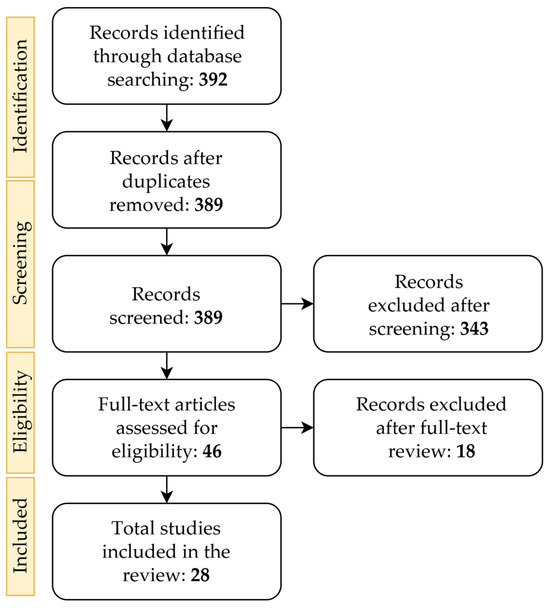
The search strategy consisted of four main stages: identification of publications, screening of titles and abstracts, assessment of full-text eligibility, and final inclusion in the review. The overall selection process is documented using a PRISMA flow diagram (Figure 1), which transparently reports the search and selection process, without implying a systematic review in the strict methodological sense.
Figure 1.
PRISMA flow diagram illustrating the literature search, screening, and selection process.
2.1. Databases
The literature search was conducted in September 2025 across four major scientific databases widely used in electrical engineering, energy systems, and applied energy research: Web of Science, Elsevier ScienceDirect, MDPI, and IEEE Xplore. These platforms were selected for their broad coverage of peer-reviewed journal articles and conference proceedings on low-carbon energy technologies, power system analysis, and grid integration.
2.2. Search Query and Strategy
A structured Boolean search strategy was formulated to identify publications that consider PV, HP, and energy storage systems in relation to power grid operation. Searches were performed within article titles, abstracts, and author-specified keywords.
The initial search query combined grid-related terminology (e.g., “power grid”, “electrical grid”, “power system”, “electrical network”) with technology-specific keywords referring to photovoltaics (“photovoltaic”, “photovoltaics”, “PV”), energy storage systems including both electrical and thermal storage (“energy storage”, “energy storage system”, “ESS”, “thermal energy storage”, “TES”), and heat pumps (“heat pump”, “heat pumps”, “HP”). Integration-related terms (e.g., “integration”, “grid integration”) were included as an additional conceptual group. Synonyms within each group were combined using the OR operator, while the different concept groups were linked using the AND operator.
An example of the Boolean search string used in the Web of Science database is provided below:
(“power grid” OR “electrical grid” OR “power system” OR “electrical network”)
AND (“photovoltaic” OR “photovoltaics” OR “PV”)
AND (“energy storage” OR “energy storage system” OR “ESS” OR “thermal energy storage” OR “TES”)
AND (“heat pump” OR “heat pumps” OR “HP”)
AND (“integration” OR “grid integration”).
During screening, it became evident that several relevant studies analysing the technical interaction among PV, HP, and energy storage did not explicitly use the term “integration”, even though they addressed their combined impact on power grid operation. To ensure adequate coverage of assessment approaches, the search strategy was therefore extended by performing an additional search without the integration-related keywords. The same inclusion and exclusion criteria were applied to all retrieved records, and all publications were screened following the same selection procedure.
The core set of technology-related and grid-related keywords was maintained consistently across all databases to ensure conceptual coherence. Minor adaptations were applied where necessary to accommodate database-specific search functionalities and limitations, without altering the underlying search logic. This two-step strategy enabled a balance between specificity and coverage, ensuring that studies explicitly framed around grid integration, as well as studies addressing equivalent interactions using different terminology, were captured.
2.3. Time Span
No restrictions were imposed on the publication year. The search results indicate that only a limited number of relevant studies were published prior to 2010, with a pronounced increase in publication activity thereafter. This trend reflects growing research interest in integrated LCTs and their role in enhancing power system flexibility.
2.4. Inclusion and Exclusion Criteria
Publications were included in the review if they met all the following criteria:
- The study investigates the joint integration of photovoltaics, heat pumps, and energy storage systems in relation to electrical power grid operation.
- The analysis focuses on technical aspects of grid interaction, such as system modelling, control strategies, grid interaction, or operational impacts.
- The publication is a peer-reviewed scientific paper or conference paper written in English.
Studies including additional technologies (e.g., electric vehicles (EV), district heating systems, or hybrid photovoltaic-thermal systems (PVT)) were included only if PV, HP, and energy storage systems constituted the central components of the analysed system and their interaction with the power grid remained the primary focus.
Publications were excluded if they:
- Addressed only one or two of the considered technologies without analysing their combined interaction in a grid-related context.
- Focused exclusively on economic, regulatory, policy, or legal aspects without accompanying technical analysis.
- Investigated off-grid, islanded, or stand-alone systems not connected to an electrical power network.
- Were limited to behind-the-metre component optimisation or household-level energy management without a clear interpretation of system behaviour in relation to power grid operation.
Studies employing indirect indicators (such as self-consumption, load matching, or peak reduction) were included only if these indicators were explicitly interpreted in terms of grid-related impacts.
2.5. Screening and Final Selection
The screening process was carried out in several stages. First, duplicate records were identified and removed. Subsequently, titles and abstracts were screened based on the defined inclusion and exclusion criteria. Publications that met these criteria were then subjected to full-text screening, where the presence of explicit grid interaction or grid-related performance evaluation was verified.
Full-text screening was conducted to confirm whether the identified studies included explicit grid interaction or a grid impact assessment. The high number of exclusions during the title and abstract screening stage primarily reflects the fact that many publications mentioned PV, HP, and energy storage but did not assess their combined interaction with the grid, addressing the technologies either in isolation or without a clear grid-related focus.
While the inclusion and exclusion criteria defined the overall scope of the reviewed literature, the selected publications exhibited substantial heterogeneity in terms of how grid interaction was represented. To systematically analyse these differences, the included studies were classified into three conceptual categories, as described in Section 3.
3. Classification of Grid-Integration Assessment Approaches
3.1. Classification Rationale
The term “grid integration” is widely used in the literature addressing PV, HP, and energy storage systems; however, its interpretation varies substantially across studies. In some works, grid integration is understood as explicit modelling of electrical networks and their operational constraints, while in others it refers to aggregated indicators at the point of common coupling (PCC) or to indirect grid-related benefits such as peak load reduction or increased system flexibility. As a result, studies that nominally address grid integration can differ significantly in their modelling depth, underlying assumptions, and the types of conclusions that can be drawn.
This heterogeneity complicates comparative assessment. Approaches that explicitly represent distribution network components enable different insights than approaches relying on aggregated or indirect indicators, even when analysing similar technology configurations. Consequently, a meaningful synthesis requires a classification framework that reflects the degree and explicitness with which the power grid is represented in the applied methodology, rather than the mere presence of grid-related terminology.
In this review, studies are therefore classified based on their conceptual and methodological treatment of the power grid. Where appropriate, terminology and metric definitions are retained as used by the original authors to reflect differences in conceptualisation across studies. The central criterion is the degree of explicit grid representation, ranging from detailed distribution network models to indicator-based proxy interpretations.
Based on this criterion, the reviewed literature is grouped into three categories. These categories do not represent a quality ranking. Instead, they capture distinct levels of abstraction in the representation of grid interactions, each associated with specific modelling capabilities, limitations, and types of insights. The resulting classification provides a structured basis for synthesising the literature and for comparing assessment approaches that would otherwise be difficult to interpret within a single analytical framework.
3.2. Definition of Assessment Categories
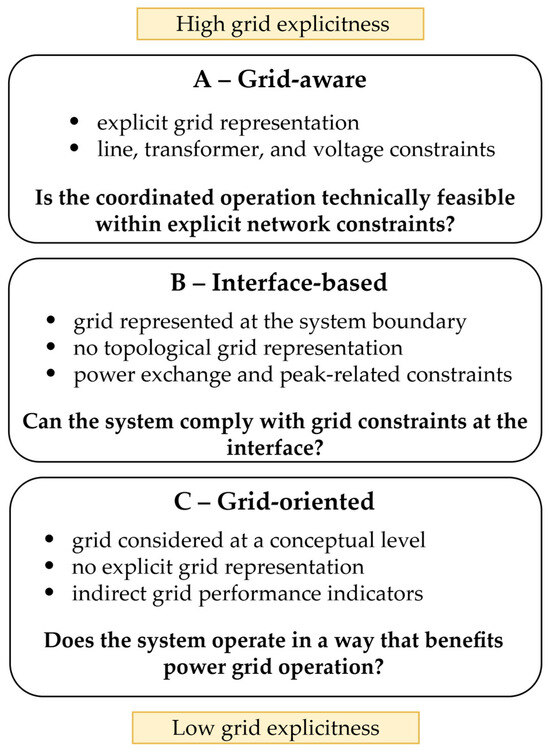
Based on the degree and explicitness of grid representation, the reviewed studies were classified into three assessment categories: A—grid-aware, B—interface-based, and C—grid-oriented. An overview of the three categories and their increasing levels of grid explicitness is provided in Figure 2. The categories reflect different modelling perspectives on grid integration assessment and enable structured comparison of assessment approaches under different modelling assumptions.
Figure 2.
Classification of assessment approaches according to the level of grid representation.
The classification framework was developed inductively based on recurring modelling patterns identified across the reviewed studies. Its validity is therefore supported by its consistent applicability to a heterogeneous set of assessment approaches.
To ensure transparent allocation of studies at the boundary between categories, the following decision rule was applied: a study is classified as interface-based (B) if PCC import/export indicators are explicitly embedded as optimisation objectives or constraints; it is classified as grid-oriented (C) if such indicators are evaluated post hoc as proxies for grid impact without constraining system operation.
In cases where PCC-based indicators both influence system operation and are evaluated after system operation, classification is determined by their functional role in the model. If these indicators directly influence system operation, the study is assigned to the interface-based (B) category, as this role takes precedence over their post hoc interpretation.
3.2.1. A—Grid-Aware Approaches
Grid-aware approaches explicitly represent the electrical power grid within the assessment framework. These studies incorporate detailed network models at different voltage levels, including feeders, nodes, and spatially resolved connections between components. As a result, technical constraints related to power flows can be directly modelled, including line and transformer loading limits and voltage magnitude constraints.
By explicitly accounting for the electrical network, grid-aware approaches enable a quantitative, constraint-based assessment of how the combined operation of PV, HP, and energy storage affects grid operation. This includes identifying local bottlenecks, voltage violations, and the spatial distribution of impacts across the network. However, such approaches typically entail higher data requirements and computational effort, which often limit their application to specific case studies or well-defined network segments.
Grid-aware approaches primarily address the question: Is coordinated PV-HP-storage operation technically feasible within explicit network constraints?
3.2.2. B—Interface-Based Approaches
Interface-based approaches represent the power grid as a technical boundary of the analysed system rather than modelling its internal topology. In these studies, grid interaction is captured at the PCC using aggregated variables such as grid import/export power, peak demand, peak feed-in, or residual load, which are explicitly included as assessment metrics, control objectives, or operational constraints. Internal grid elements, such as feeders or nodes, are not represented.
This modelling perspective enables assessment of grid interaction using simplified yet operationally meaningful indicators, making interface-based approaches particularly suitable for system-level analyses or optimisation studies involving multiple energy technologies. While these approaches cannot capture spatially resolved grid constraints or voltage-related effects, they provide insight into how coordinated operation of PV, HP, and energy storage influences grid loading and peak behaviour at the system boundary.
From an assessment perspective, interface-based approaches primarily address the question: Can the system comply with grid constraints at the interface?
3.2.3. C—Grid-Oriented Approaches
Grid-oriented approaches assess the integration of PV, HP, and energy storage with an explicit focus on potential benefits for grid operation, without modelling the electrical network or imposing grid-related constraints on system operation. In these studies, the grid is not represented through feeders, nodes, or power-flow equations; instead, grid-related impacts are evaluated using technically motivated indicators.
Typical indicators include peak load reduction, limitation of reverse power flows, flexibility provision, or coordinated load shifting, which are interpreted as proxies for grid impacts rather than enforced as operational constraints. Studies focusing primarily on self-consumption maximisation, cost reduction, or user comfort are included in this category only if their results are explicitly analysed and discussed in relation to grid operation.
Grid-oriented approaches address a different assessment question: Does the system operate in a way that indicates grid-beneficial behaviour?
4. A—Grid-Aware Assessment Approaches
Table 1 provides an overview of the grid-aware studies included in this review. The table summarises the considered technology combinations, assessment objectives, modelling approaches and tools, evaluation metrics, grid types and voltage levels, temporal scope, and key findings of the selected publications. This structured comparison serves as a reference for the synthesis presented in Section 4.1, Section 4.2, Section 4.3 and Section 4.4.
Table 1.
Overview of grid-aware assessment studies integrating PV, HP and energy storage systems.
4.1. Overview of Grid-Aware Assessment Approaches
Grid-aware assessment approaches represent the most detailed and physically grounded class of methods for evaluating the integration of PV, HP, and energy storage into electrical power grids. Across the reviewed literature, grid integration is operationalised through explicit modelling of distribution network constraints, enabling direct assessment of whether coordinated PV–HP–storage operation is compatible with safe and reliable grid operation under high electrification levels [9,10,11,12,13,14,15,16]. Rather than relying on aggregated indicators or proxy metrics, grid-aware studies evaluate integration performance using network-state variables directly relevant to distribution system operators (DSOs).
A defining characteristic of grid-aware approaches is their focus on local operational constraints in LV and MV distribution networks. Voltage magnitude limits, transformer loading, and line ampacity constraints consistently emerge as the dominant criteria for assessing grid compatibility, reflecting the primary technical challenges associated with high penetrations of distributed PV generation and electrically driven heating. Within this perspective, grid integration is defined as the ability of coordinated PV-HP-storage operation to prevent or mitigate explicit network violations.
From an assessment standpoint, grid-aware approaches prioritise operational feasibility over economic optimality. This focus enables the identification of impacts—such as feeder-specific voltage violations or transformer-level bottlenecks—that require explicit spatial representation of the network and are therefore not accessible through interface-level or indicator-based modelling frameworks. As a result, grid-aware assessments serve as a high-fidelity reference against which more abstract grid-integration assessment approaches can be interpreted.
4.2. Grid Modelling and Evaluation Metrics in Grid-Aware Assessments
Grid-aware assessment approaches employ distribution network models with sufficient spatial and temporal resolution to capture local operational constraints under coordinated PV-HP-storage operation. Most studies rely on quasi-static time-series simulations of LV or MV networks, implemented using either full-power flow formulations or simplified voltage models, depending on the required level of fidelity and computational effort.
Across the reviewed studies, a clear convergence in the evaluation metrics used to assess grid integration is evident. The voltage magnitude at network nodes or critical connection points is the dominant indicator, reflecting the prevalence of voltage-related issues in distribution grids with high PV penetration and electrified heating demand [9,10,13,14,15]. Transformer loading is frequently assessed as a complementary metric that captures the aggregated impact of coincident HP operation and PV generation on upstream network components [9,11,12,13,14,16]. In some studies, these metrics are further synthesised into hosting capacity indicators to quantify the effectiveness of coordinated control strategies [14,15].
The temporal resolution of grid-aware simulations typically ranges from sub-hourly to hourly time steps, with assessment horizons spanning representative days, weeks, or full annual cycles. Higher temporal resolution is adopted when short-term voltage effects or fast control actions are of interest, whereas longer horizons are used to capture seasonal interactions between heating demand and solar availability, as well as their cumulative impact on grid operation.
4.3. Role of Photovoltaics, Heat Pumps, and Energy Storage in Grid-Aware Assessments
Grid-aware assessment approaches explicitly consider the interdependent operation of PV, HP, and energy storage, treating grid integration as an emergent property of their combined behaviour rather than as the performance of individual technologies. Within this framework, PV systems are the primary source of variability and potential constraint violations, HPs represent a rapidly growing, controllable electrical demand, and energy storage provides flexibility that mediates their interactions at the network level [9,10,11,12,13,14,15,16].
Across the reviewed studies, PV generation is consistently identified as the main driver of voltage rise and reverse power flow in distribution networks, particularly under high penetration levels and coincident low-demand conditions. Curtailment strategies, coordinated control, and demand-coupled operation are therefore widely employed to maintain voltage limits while maximising local PV utilisation [10,12,13].
HPs play a dual role in grid-aware assessments. On the one hand, large-scale electrification of heating increases peak demand and transformer loading, potentially exacerbating existing network constraints [9,11,13,14,15]. On the other hand, when operated flexibly, HPs can actively mitigate these impacts by reshaping demand in response to local grid conditions, particularly when combined with thermal storage [11,12,13,14,15].
Energy storage acts as a coupling element that shapes the interaction between PV generation and HP operation. BESSs are primarily employed to address short-term voltage deviations and power peaks, offering fast response capabilities at specific network locations [9,10,14,15]. TES, by contrast, supports longer-term load shifting of HP operation, enabling demand alignment with periods of high PV generation and reducing cumulative stress on upstream network components [11,12,13].
Taken together, grid-aware studies demonstrate that effective grid integration cannot be attributed to any single technology in isolation. Instead, it emerges from coordinated control and mutual interaction of generation, demand, and storage within explicitly modelled network constraints. This integrated perspective distinguishes grid-aware assessments from more abstract evaluation approaches and underscores the importance of jointly considering PV, HP, and energy storage when analysing grid compatibility under high electrification scenarios.
4.4. Control Strategies in Grid-Aware Assessments
Grid-aware assessment studies employ a range of control strategies to coordinate the operation of PV, HP, and energy storage under explicit network constraints. The choice of control strategy is primarily driven by the need to ensure technically feasible grid operation, rather than by economic optimisation or market participation.
Across the reviewed literature, two broad control paradigms can be identified. Some studies adopt centralised or coordinated control schemes, where the operation of multiple technologies is determined based on a system-wide view of the network state. Such approaches enable explicit consideration of voltage and loading constraints across feeders or transformer areas and are therefore well-suited for analysing coordinated operation under constrained grid conditions. Other studies rely on local or rule-based control strategies, where control actions are triggered by locally measured variables such as voltage magnitude or power flow. These approaches reduce modelling and communication complexity while still allowing effective mitigation of local grid issues.
Importantly, the objectives underlying control strategies in grid-aware studies are predominantly technical, focusing on maintaining network operation within permissible limits. This emphasis reinforces the role of grid-aware assessments as high-fidelity tools for analysing grid compatibility, while also highlighting their limitations in terms of scalability and generalisability. The data intensity and case-specific nature of grid-aware modelling, therefore, motivate complementary assessment approaches that evaluate grid interaction at higher levels of abstraction.
5. B—Interface-Based Assessment Approaches
Table 2 provides an overview of the interface-based assessment studies included in this review. It summarises the considered technology combinations, assessment objectives, modelling approaches and tools, evaluation metrics, grid representation at the system interface, temporal scope, and key findings of the selected publications. This structured comparison serves as a reference framework for the synthesis presented in Section 5.1, Section 5.2, Section 5.3 and Section 5.4.
Table 2.
Overview of interface-based assessment studies integrating photovoltaics, energy storage systems, and heat pumps.
5.1. Overview of Interface-Based Assessment Approaches
Interface-based assessment approaches represent an intermediate level of abstraction between grid-aware modelling and grid-oriented analyses. In this class of studies, the power grid is not represented through its internal topology; instead, it is modelled as a technical boundary of the analysed system, typically defined at the PCC. Grid integration is therefore assessed through aggregated power exchange variables that characterise how coordinated operation of PV, HP, and energy storage interacts with the grid at this interface [17,18,19,20,21,22,23,24].
Across the reviewed literature, interface-based approaches operationalise grid integration primarily in terms of grid import and export power, peak demand, peak feed-in, and reverse power flow. These metrics reflect technical concerns related to connection capacity, upstream equipment loading, and compliance with grid connection requirements, while avoiding the data requirements and computational burden associated with explicit network modelling. As a result, interface-based assessments are well-suited for analysing building-level or multi-building energy systems under realistic operational constraints imposed at the grid connection.
A defining characteristic of interface-based approaches is their focus on operational coordination at the system boundary rather than on internal network state estimation. The grid is treated as an external system that imposes admissible limits on power exchange. At the same time, the internal coordination of PV generation, flexible HP demand, and energy storage resources is optimised to remain within these limits. This modelling perspective enables interface-based studies to capture key grid-relevant effects—such as peak shaving, mitigation of reverse power flow, and smoothing of net load profiles—without resolving spatially distributed constraints within the distribution network.
From an assessment perspective, interface-based approaches strike a balance between model fidelity and practical applicability. They enable systematic evaluation of grid interaction across long time horizons and multiple system configurations. They are closely aligned with energy management and control concepts that can be implemented in practice. However, because internal grid conditions are not explicitly represented, interface-based assessments cannot identify or exclude localised voltage or loading violations beyond the PCC. Consequently, they complement rather than replace grid-aware approaches, providing a boundary-focused perspective on grid integration.
5.2. Grid Representation and Evaluation Metrics in Interface-Based Assessments
In interface-based assessment approaches, grid interaction is evaluated using a limited set of aggregated power exchange metrics defined at the system boundary. Rather than resolving internal network states, these studies focus on how coordinated PV-HP-storage operation shapes the magnitude and temporal distribution of power exchange at the PCC.
Across the reviewed literature, an apparent convergence in the choice of evaluation metrics can be observed. Peak grid import and peak grid export are the most frequently used indicators, reflecting technical concerns related to connection capacity, upstream transformer loading, and contractual limits at the grid interface [17,18,19,20,24]. Closely related metrics include reverse power flow, net grid exchange, and grid-connected time, which capture complementary dimensions of how distributed generation and flexible demand influence grid interaction at the interface level [19,20,21,22,23].
In interface-based approaches, grid compatibility is inferred from the ability of coordinated system operation to limit extreme import or export events or to maintain power exchange within predefined technical thresholds. In several studies, individual indicators are further synthesised into composite performance measures, such as peak reduction factors or grid relief indices, to facilitate comparative evaluation of control strategies and system configurations [19,24].
The temporal resolution adopted in interface-based assessments is closely linked to the targeted grid metrics and control objectives. High-resolution simulations, ranging from minutes to sub-hourly time steps, are commonly used to evaluate peak shaving, reverse power flow mitigation, and predictive control strategies. Longer assessment horizons, often spanning complete annual cycles, are used to capture seasonal interactions among PV generation, heating demand, and energy storage operations, thereby evaluating the robustness of interface-level performance over time.
5.3. Role of Photovoltaics, Heat Pumps, and Energy Storage in Interface-Based Assessments
In interface-based assessment approaches, the roles of PV, HP, and energy storage are primarily defined by their contributions to the aggregated power exchange at the grid interface, rather than by their impact on internal network states. Grid integration is therefore interpreted as the ability of coordinated PV-HP-storage operation to shape import and export profiles at the PCC in a technically acceptable manner.
Within this framework, PV systems are consistently treated as the dominant source of variability driving grid interaction. Consequently, interface-based assessments focus on mitigating excessive PV feed-in by coordinating the operation of flexible demand and energy storage rather than relying solely on curtailment. PV integration performance is evaluated in terms of peak export reduction, limitation of reverse power flow, and smoothing of grid exchange profiles [17,19,21,22,23,24].
HPs play a central role as controllable electrical loads that can be temporally aligned with PV generation. Accordingly, HPs are primarily evaluated based on their ability to reshape demand profiles in response to PV availability and interface-level constraints, such as peak import limits or export thresholds [18,19,20,21,22,23,24].
Energy storage enables both fast and slow flexibility at the grid interface. BESS are primarily used to address short-term fluctuations and peak events, providing rapid responses to changes in PV output or demand. TES supports longer-term load shifting of HP operation, facilitating alignment between PV generation and thermal demand over extended periods [17,18,19,21,24].
Taken together, interface-based studies demonstrate that grid integration at the system boundary is achieved through coordinated operation of PV generation, flexible HP demand, and energy storage. Rather than addressing spatially resolved network constraints, these approaches focus on shaping the temporal profile of power exchange at the PCC, making them particularly suitable for contexts in which only interface-level grid information is available.
5.4. Control Strategies in Interface-Based Assessments
Interface-based assessment studies employ a range of control strategies to coordinate the operation of PV, HP, and energy storage with the explicit objective of shaping power exchange at the grid interface. In contrast to grid-aware approaches, where internal network states drive control actions, interface-based strategies are designed to respect connection-level constraints and to mitigate extreme import or export events at the PCC.
Across the reviewed literature, two dominant control paradigms can be identified. Rule-based strategies rely on predefined operational rules, such as activating HPs during PV surplus periods or charging energy storage when export thresholds are approached. These approaches are characterised by low computational complexity and limited information requirements. Despite their simplicity, rule-based strategies can achieve substantial reductions in peak feed-in and reverse power flow when sufficient thermal or electrical flexibility is available.
More advanced studies adopt optimisation-based control frameworks, including MILP and MPC. These approaches explicitly incorporate interface-level constraints into the control problem and optimise the coordinated operation of multiple technologies over a prediction horizon. While computationally more demanding, such strategies enable systematic trade-offs between competing objectives, such as peak reduction, self-consumption, and operational cost.
A defining feature of interface-based control strategies is their emphasis on temporal coordination rather than spatial control. As a result, these approaches are closely aligned with energy management systems that can be implemented without detailed knowledge of the underlying distribution network. However, this abstraction also implies that interface-based control cannot guarantee the absence of localised network violations beyond the PCC. Where interface limits are unavailable or intentionally abstracted, grid-oriented assessments provide an indicator-based perspective on grid-beneficial operation.
6. C—Grid-Oriented Assessment Approaches
Table 3 provides an overview of the grid-oriented assessment studies included in this review. The table summarises the considered technology combinations, assessment objectives, approaches and tools, grid-oriented indicators and their interpretation, temporal scope, and key findings of the selected publications. In contrast to Table 1 and Table 2, which focus on explicitly modelled grid constraints or interface-level limits, Table 3 emphasises indicators that are used to interpret potential benefits for power grid operation based on system behaviour, without imposing grid-related constraints on system operation. This structured comparison serves as a reference framework for the synthesis presented in Section 6.1, Section 6.2, Section 6.3 and Section 6.4.
Table 3.
Overview of grid-oriented assessment studies integrating photovoltaics, energy storage systems, and heat pumps.
6.1. Overview of Grid-Oriented Assessment Approaches
Grid-oriented assessment approaches evaluate the integration of PV, HP, and energy storage with an explicit focus on their potential benefits for power grid operation, while deliberately refraining from explicit modelling of electrical network constraints. In contrast to grid-aware and interface-based approaches, grid-oriented studies do not aim to verify technical feasibility with respect to voltage limits, line loading, or connection capacity. Instead, grid integration is assessed through observed or simulated operational behaviour and its alignment with grid-relevant performance objectives, such as peak reduction, load smoothing, or improved temporal matching between generation and demand [25,26,27,28,29,30,31,32,33,34,35,36].
Across the reviewed literature, grid-oriented approaches are characterised by a high level of abstraction in grid representation. The electrical grid is neither modelled as a physical system with enforceable constraints nor represented as a technical boundary with predefined import or export limits. Instead, grid impacts are inferred from aggregated indicators derived from system operation. This modelling perspective enables assessment of coordinated PV-HP-storage operation over long-time horizons and across a wide range of system configurations, while avoiding the data requirements and computational complexity associated with explicit network modelling.
From an assessment perspective, grid-oriented approaches address a fundamentally different question than grid-aware or interface-based methods. Rather than asking whether a system can operate within explicitly defined grid constraints, grid-oriented studies examine whether the system tends to operate in a manner indicative of grid-beneficial behaviour. This includes reducing extreme power exchange events, shifting flexible demand toward periods of high PV generation, and improving the temporal structure of net load profiles. As a result, grid-oriented approaches are particularly well-suited for exploring general integration trends, comparative control strategies, and system-level flexibility potentials, while acknowledging that technical feasibility at specific grid locations cannot be guaranteed.
6.2. Grid Representation and Indicators in Grid-Oriented Assessments
In grid-oriented assessment approaches, the electrical power grid is not represented through explicit network models or power-flow formulations. Instead, grid interaction is evaluated indirectly using technically motivated indicators derived from the operational behaviour of PV-HP-storage systems. These indicators are interpreted as proxies for grid stress or grid support rather than as evidence of compliance with specific technical limits.
Across the reviewed literature, a recurring set of aggregated grid-oriented indicators can be identified. Peak grid import and peak grid export are among the most frequently used metrics, reflecting concerns about extreme loading conditions and the temporal concentration of power exchange [26,27,28,30]. Closely related indicators include net grid exchange profiles and cumulative imported or exported energy, which are used to characterise overall grid dependence and the magnitude of interaction between distributed energy systems and the power grid [27,33,36].
Several studies also evaluate load smoothing and variability reduction in aggregated power profiles, capturing the extent to which coordinated operation mitigates fluctuations in grid exchange over time [28,29,30,35]. In this context, self-consumption and self-sufficiency indicators are often reported as complementary metrics and interpreted as indirect signals of reduced grid interaction, rather than as primary measures of grid compatibility [32,33,34,36].
The temporal resolution and assessment horizons adopted in grid-oriented studies are closely aligned with the selected indicators. Hourly or sub-hourly time steps over annual or multi-year horizons are commonly employed to capture seasonal interactions between PV generation, HP operation, and energy storage utilisation, as well as their cumulative effects on grid interaction patterns.
6.3. Role of Photovoltaics, Heat Pumps, and Energy Storage in Grid-Oriented Assessments
In grid-oriented assessment approaches, the roles of PV, HP, and energy storage are evaluated based on their combined effects on aggregated grid-oriented indicators, rather than on their impact on explicit network states [25,26,27,28,29,30,31,32,33,34,35,36].
Within this perspective, PV generation is primarily characterised as a driver of grid-relevant variability. Consequently, PV capacity alone is not interpreted as a proxy for improved grid integration. Instead, grid-oriented assessments consistently highlight coordination with flexible demand and storage as the decisive factor for mitigating adverse grid-oriented indicators, such as high peak exports or increased variability of grid exchange [25,26,27,33,36].
HPs are valued in grid-oriented assessments primarily for their ability to provide controllable, shiftable electrical demand. Accordingly, HPs are interpreted primarily as sources of operational flexibility that influence aggregated grid-oriented indicators through demand reshaping and temporal alignment with PV generation [26,27,28,29,30,32,34].
Energy storage acts as an enabling technology that amplifies the grid-relevant benefits of coordinated PV and HP operation. By providing buffering across different time scales, both electrical and thermal storage support the aggregation, modulation, and smoothing of grid-oriented performance indicators [27,29,32,34,35,36].
Taken together, grid-oriented assessments emphasise that grid-beneficial operation cannot be attributed to any single technology in isolation. Instead, it emerges from the coordinated operation of PV generation, flexible HP demand, and appropriately dimensioned energy storage systems, providing insight into general integration trends and the potential for flexibility at an aggregated level.
6.4. Control Strategies in Grid-Oriented Assessments
Grid-oriented assessment studies employ a diverse range of control and operational strategies to coordinate the operation of PV, HP, and energy storage, aiming to enhance aggregated grid-oriented indicators. Unlike grid-aware and interface-based approaches, these strategies are not designed to enforce explicit grid constraints; instead, they are evaluated based on their influence on peak demand, load smoothing, and the temporal alignment between generation and demand.
Control strategies in grid-oriented assessments range from simple rule-based schemes to advanced optimisation and data-driven methods, including model predictive control, heuristic optimisation, and machine-learning-based approaches. While methodological complexity varies widely, all strategies share a common focus on reshaping the temporal profile of power exchange rather than on representing grid physics.
Overall, grid-oriented control strategies demonstrate how coordinated operation of PV, HP, and energy storage can promote grid-friendly behaviour at an aggregated level. At the same time, they highlight an inherent limitation of this assessment perspective: improvements in indicator-based performance do not guarantee technically feasible operation under local grid conditions.
7. Discussion
7.1. Comparative Perspective on Grid-Integration Assessment Approaches
The reviewed literature demonstrates that the integration of PV, HP, and energy storage into power grids is assessed using fundamentally different modelling perspectives, which cannot be meaningfully compared without a structured classification framework. The three assessment categories identified in this review—grid-aware, interface-based, and grid-oriented—represent distinct levels of abstraction in the representation of grid interactions, addressing different underlying research questions.
Grid-aware approaches focus on technical feasibility within explicitly modelled distribution networks, evaluating whether coordinated PV-HP-storage operation can be accommodated under voltage and loading constraints at specific grid locations. Interface-based approaches abstract from internal network topology and assess grid interaction at the system boundary, focusing on compliance with connection-level constraints such as peak import limits, feed-in limits, or transformer capacity. Grid-oriented approaches adopt the highest level of abstraction, evaluating system behaviour through aggregated indicators interpreted as proxies for grid stress or support, without enforcing grid-related constraints.
Rather than forming a hierarchy of methodological quality, these approaches reflect complementary perspectives on grid integration. Each category enables specific insights while inherently limiting others, underscoring the importance of aligning the assessment approach with the intended research objective and application context.
To support this comparative perspective, Table 4 provides an aggregated overview of key modelling and assessment characteristics across the three categories. Rather than focusing on individual modelling techniques, the table highlights how core structural features—such as the role of grid representation, temporal characteristics, and evaluation metrics—are distributed across the reviewed studies. The classification of characteristics is based on the detailed analysis of individual studies presented in Table 1, Table 2 and Table 3 and reflects their dominant modelling and evaluation features.
Table 4.
Aggregated comparison of assessment characteristics across the three assessment categories. Values indicate the number of studies exhibiting a given characteristic within each category. Colour intensity reflects the relative frequency of each characteristic within a category.
The comparison reveals clear and systematic differences between the assessment categories. Grid-aware approaches are consistently characterised by explicit network constraints and voltage- or loading-based metrics, reflecting their focus on constraint-based feasibility. Interface-based approaches are defined by PCC-based constraints and grid exchange indicators, with a strong emphasis on peak import and export at the system boundary. Grid-oriented approaches, in contrast, rely predominantly on indicator-based evaluation and aggregated metrics such as peak reduction and self-consumption, often over longer temporal horizons. Across all categories, simulation-based modelling dominates, while optimisation-based methods appear across different levels of grid representation, indicating that methodological techniques alone do not determine the level of grid integration assessment.
The patterns summarised in Table 4 further illustrate how differences in grid representation translate into distinct types of insight and applicability across the assessment categories. The choice of assessment approach fundamentally shapes the conclusions that can be drawn about grid integration. Approaches with lower levels of grid representation (grid-oriented) tend to produce results that are indicative and broadly generalisable, but potentially incomplete with respect to local grid constraints. Highly detailed approaches (grid-aware), however, provide technically robust and constraint-consistent results but are often case-specific and less transferable. Interface-based approaches balance these aspects but remain limited in their ability to capture spatially heterogeneous grid effects.
This distinction has important implications for the interpretation of reported results. Findings derived from grid-oriented approaches should be understood as indicative of general system behaviour rather than as evidence of technical feasibility within a specific network context. Conversely, results obtained from grid-aware models are inherently conditional on the analysed network configuration and may not be directly transferable to other grid settings.
Consequently, conclusions regarding grid compatibility, flexibility potential, or optimal control strategies are not universally comparable across categories, as they reflect fundamentally different levels of physical representation and constraint enforcement. This underscores the importance of interpreting results within the context of the underlying modelling assumptions and avoiding implicit generalisation across assessment approaches.
7.2. Trade-Offs Between Model Fidelity, Scalability, and Practical Applicability
A central insight emerging from the comparative analysis is the trade-off between grid modelling fidelity, scalability, and practical applicability. Grid-aware assessments offer the highest level of physical realism by explicitly resolving network states; however, their data requirements, computational burden, and case-specific nature limit their scalability and transferability. These approaches are indispensable for analysing local grid compatibility but are difficult to apply across large system portfolios or long-term planning horizons.
Interface-based approaches strike a balance between abstraction and operational relevance. By representing the grid through capacity-related constraints at the PCC, they enable optimisation and control strategies that are computationally tractable and closely aligned with practical energy management systems. However, improvements in interface-level indicators cannot guarantee the avoidance of spatially localised grid violations within the distribution network.
Grid-oriented approaches prioritise scalability and generalisability. Their reliance on aggregated indicators enables long-term analyses, comparative evaluation of control strategies, and exploration of system-level trends across diverse configurations. This abstraction provides broad insights into flexibility potentials and operational tendencies but comes at the cost of technical specificity, as local voltage or congestion issues remain unobservable.
An important distinction emerging from these trade-offs concerns the difference between indicative and verification-based assessments of grid integration. Grid-oriented approaches rely on indicators that may suggest grid-beneficial behaviour; however, they do not verify whether system operation remains feasible under actual network constraints. In contrast, grid-aware approaches enable explicit verification of secure operation by modelling the electrical network and enforcing technical constraints, such as voltage limits and line loading. Interface-based approaches occupy an intermediate position, as they impose constraints at the system boundary but cannot capture spatially resolved network effects. As a result, improvements observed in interface-level or aggregated indicators do not necessarily guarantee secure operation within the distribution network.
Beyond the general trade-offs between model fidelity and scalability, the temporal and spatial characteristics of the modelling framework significantly influence the validity of grid-integration conclusions. Temporal resolution determines the ability to capture short-term dynamics, such as peak loads, rapid PV fluctuations, or demand-response actions. Coarse temporal resolutions may underestimate peak loading and mask critical operating conditions, leading to overly optimistic assessments of grid compatibility.
Spatial granularity plays an equally important role. Approaches that do not resolve the internal structure of the distribution network cannot capture localised voltage deviations or line congestion, even if aggregated indicators suggest acceptable system behaviour. As a result, conclusions derived from spatially aggregated models may not reflect actual grid constraints at specific locations.
In addition, the control and optimisation horizon influence operational strategies and their perceived grid impact. Short-term control horizons may prioritise immediate balancing actions, while longer horizons enable anticipatory strategies that shift loads or storage operation in time. Consequently, the observed grid interaction depends not only on system configuration but also on the temporal scope of decision-making embedded in the model.
7.3. Interpretation of Grid Support Across Assessment Categories
Across the reviewed literature, grid integration is rarely explicitly defined; instead, it is operationalised through various interpretations of grid support. The analysis reveals that the meaning of grid-supportive operation is context-dependent and closely linked to the assessment perspective applied.
In grid-aware approaches, grid support is operationalised as the prevention or mitigation of explicit network constraints, predominantly voltage deviations and component overloading, in low-voltage distribution grids. Interface-based approaches interpret grid support as compliance with connection-level constraints and the shaping of import and export profiles to avoid extreme loading conditions at the system boundary. Grid-oriented approaches, by contrast, interpret grid support through changes in aggregated system behaviour, such as peak reduction, load smoothing, or improved temporal matching between generation and demand.
These interpretations are not contradictory but reflect different modelling objectives and levels of abstraction. Notably, several grid-oriented studies demonstrate that economically optimal or self-consumption-maximising operation does not necessarily coincide with grid-supportive behaviour as interpreted from a system perspective. Conversely, strategies that improve grid-oriented indicators may not be financially optimal for individual prosumers. This highlights the need for an explicit definition of grid-related performance objectives, even when grid constraints are not formally modelled.
7.4. Positioning of the Proposed Classification Framework
The proposed classification framework provides a structured basis for synthesising a heterogeneous body of literature that would otherwise be difficult to compare. By explicitly distinguishing between different levels of grid representation and their associated assessment questions, the framework facilitates transparent interpretation of results and reduces the risk of implicit overgeneralisation.
Rather than prescribing a single preferred assessment approach, the framework highlights the complementary roles of grid-aware, interface-based, and grid-oriented methods. This perspective supports informed methodological choices and encourages alignment between modelling effort, data availability, and research objectives. In this sense, the framework can also serve as a reference for designing assessment strategies that combine different levels of grid representation to strike a balance between realism and scalability.
The classification framework was developed inductively based on recurring modelling patterns identified across the reviewed studies. Its robustness is supported by its consistent applicability to a heterogeneous set of assessment approaches and its ability to distinguish between studies based on clearly defined modelling characteristics. In this sense, the framework does not aim to provide validation, but rather a structured and reproducible basis for interpreting differences in how grid interaction is represented across literature.
The proposed classification framework focuses on how grid interaction is represented within assessment approaches, rather than on the explicit verification of secure system operation. While grid-aware approaches incorporate network constraints and therefore allow a constraint-based assessment of feasibility, more advanced security-oriented models extend this perspective by explicitly addressing system stability and contingencies. From this perspective, the identified assessment categories should be interpreted as reflecting different levels of abstraction in grid representation, rather than as indicators of the ability to verify secure system operation under real network conditions.
In addition, it should be noted that the practical deployment of PV-HP-storage systems is not determined solely by technical feasibility, but is strongly influenced by market design, tariff structures, and regulatory frameworks. While such aspects were excluded from the scope of this review to maintain a consistent focus on technical assessment approaches, they may significantly affect the real-world applicability of different control strategies and system configurations. Consequently, the relevance of the identified assessment categories should be interpreted in the context of broader techno-economic and regulatory conditions, which may shape both system operation and the incentives for grid-supportive behaviour.
7.5. Implications and Future Research Directions
The findings of this review have several implications for both research and practical application. The identified assessment categories highlight that different modelling approaches provide fundamentally different types of insight into grid integration, which should be carefully considered when selecting an appropriate methodology for practical applications such as system planning, control design, or grid impact assessment. In particular, the choice of modelling perspective directly affects whether conclusions relate to indicative system behaviour, interface-level feasibility, or constraint-based verification within the electrical network.
From a practical perspective, the identified assessment categories provide guidance for different stakeholders. For grid operators, grid-aware approaches are essential for assessing local network constraints and ensuring secure operation under increasing penetration of DERs. Interface-based approaches can support the definition of connection requirements and flexibility services at the system boundary, particularly in the context of active distribution network management. For policymakers and regulators, grid-oriented approaches offer insights into system-level trends and the potential of coordinated PV-HP-storage operation to contribute to broader energy system objectives, such as peak reduction and improved utilisation of renewable generation. However, the results also indicate that conclusions derived from aggregated indicators should be interpreted with caution, as they do not necessarily guarantee secure operation under real network conditions.
The analysis also reveals several directions for future research. A key gap lies in the limited integration of different modelling perspectives, as existing approaches typically prioritise either detailed grid representation or system-level scalability but rarely combine both. Furthermore, the interaction between electricity and heat systems is often represented in a simplified manner, with limited consideration of coupled dynamics across temporal and spatial scales. In addition, uncertainty related to demand variability and user behaviour remains insufficiently addressed in many grid-integration assessments.
Addressing these challenges requires the development of multi-scale modelling approaches that integrate different levels of grid representation, as well as improved treatment of multi-energy system dynamics and uncertainty. Such advancements would enhance both the robustness and practical relevance of assessment approaches for PV-HP-storage integration.
8. Conclusions
This review addresses the heterogeneous interpretation of grid integration in studies analysing the combined operation of PV, energy storage systems, and HP. By focusing on how grid interactions are conceptualised and represented in different assessment approaches, the review demonstrates that conclusions regarding grid integration are inherently dependent on the underlying modelling perspective.
To support transparent synthesis, the reviewed literature was classified into three assessment categories based on the degree of grid representation: grid-aware, interface-based, and grid-oriented. These categories capture distinct assessment questions and modelling abstractions rather than methodological quality. Consequently, reported improvements in grid-related performance must be interpreted within the context in which they are derived, as different categories address fundamentally different aspects of grid integration.
Beyond synthesising existing studies, the specific contributions of this review are as follows:
- A systematic classification framework distinguishing grid-aware, interface-based, and grid-oriented assessment approaches according to the explicitness of grid representation, enabling transparent comparison of otherwise heterogeneous studies.
- Clarification of how grid integration is implicitly operationalised across the literature, showing that grid-related benefits depend strongly on whether grid interaction is assessed through explicit network constraints, interface-level limits, or indicator-based proxies.
- A structured link between modelling perspectives, evaluation metrics, and control strategies, demonstrating that differences between studies primarily reflect distinct assessment questions rather than methodological quality.
- A reference for interpreting grid-related performance claims, helping to avoid overgeneralisation when transferring conclusions across studies employing different grid-integration perspectives.
Future research should focus on bridging the gap between different modelling perspectives by developing multi-scale approaches that combine system-level analyses with explicit representation of network constraints. In particular, the integration of electricity and heat systems requires improved modelling of coupled dynamics across temporal and spatial scales. Furthermore, the incorporation of uncertainty related to demand variability, user behaviour, and renewable generation remains an important challenge. Addressing these aspects would enhance both the robustness and the practical applicability of grid-integration assessments for PV-HP-storage systems.
Author Contributions
Conceptualization, E.S. and K.S.; methodology, E.S.; software, E.S.; validation, K.S. and S.S.; formal analysis, E.S.; investigation, E.S.; resources, E.S.; data curation, E.S.; writing—original draft preparation, E.S.; writing—review and editing, K.S. and S.S.; visualisation, E.S.; supervision, K.S. and S.S.; project administration, S.S.; funding acquisition, S.S. All authors have read and agreed to the published version of the manuscript.
Funding
This research received no external funding.
Data Availability Statement
This study is based exclusively on previously published literature. No new data were generated or analysed, and therefore data sharing is not applicable.
Conflicts of Interest
The authors declare no conflicts of interest.
Abbreviations
The following abbreviations are used in this manuscript:
| BESS | Battery energy storage system |
| DSO | Distribution system operator |
| ESS | Energy storage system |
| EV | Electric vehicle |
| HP | Heat pump |
| LV | Low voltage |
| MILP | Mixed-integer linear programming |
| MINLP | Mixed-integer nonlinear programming |
| MPC | Model predictive control |
| MV | Medium voltage |
| nZEB | Nearly zero-energy building |
| PV | Photovoltaic |
| TES | Thermal energy system |
References
- Fischer, D.; Madani, H. On heat pumps in smart grids: A review. Renew. Sustain. Energy Rev. 2017, 70, 342–357. [Google Scholar] [CrossRef] [Scilit]
- Sinsel, S.R.; Riemke, R.L.; Hoffmann, V.H. Challenges and solution technologies for the integration of variable renewable energy sources-a review. Renew. Energy 2020, 145, 2271–2285. [Google Scholar] [CrossRef] [Scilit]
- Shafiullah, M.; Ahmed, S.D.; Al-Sulaiman, F.A. Grid Integration Challenges and Solution Strategies for Solar PV Systems: A Review. IEEE Access 2022, 10, 52233–52257. [Google Scholar] [CrossRef] [Scilit]
- Kotsonias, A.; Hadjidemetriou, L.; Asprou, M.; Panayiotou, C.G. Operational challenges and solution approaches for low voltage distribution grids—A review. Electr. Power Syst. Res. 2025, 239, 111258. [Google Scholar] [CrossRef] [Scilit]
- Diahovchenko, I.; Morva, G.; Chuprun, A.; Keane, A. Comparison of voltage rise mitigation strategies for distribution networks with high photovoltaic penetration. Renew. Sustain. Energy Rev. 2025, 212, 115399. [Google Scholar] [CrossRef] [Scilit]
- Maghami, M.R.; Pasupuleti, J.; Ekanayake, J. Energy storage and demand response as hybrid mitigation technique for photovoltaic grid connection: Challenges and future trends. J. Energy Storage 2024, 88, 111680. [Google Scholar] [CrossRef] [Scilit]
- Zhang, S.; Pan, G.; Li, B.; Gu, W.; Fu, J.; Sun, Y. Multi-Timescale Security Evaluation and Regulation of Integrated Electricity and Heating System. IEEE Trans. Smart Grid 2025, 16, 1088–1099. [Google Scholar] [CrossRef] [Scilit]
- Cao, Y.; Xu, Y. Secure operation of a multi-energy system: A comprehensive review. Renew. Sustain. Energy Rev. 2025, 211, 115312. [Google Scholar] [CrossRef] [Scilit]
- Friedrich, D.; Jungandreas, C.; Gottschalk, B.; Bodach, M.; Schirmer, M.; Li, P. Economic Reinforcement of Low Voltage Power Grids with Battery Energy Storage Systems: Combined Grid Service and Spot Market Trading. IFAC-PapersOnLine 2025, 59, 253–258. [Google Scholar] [CrossRef] [Scilit]
- Hatta, H.; Yamashiro, S.; Oshiro, M.; Taira, Y.; Higa, N. Effect of distributed energy resources integration in the distribution system. In Proceedings of the CIRED 2021—The 26th International Conference and Exhibition on Electricity Distribution, Geneva, Switzerland, 20–23 September 2021; The Institution of Engineering and Technology: Stevenage, UK, 2021; pp. 1838–1842. [Google Scholar]
- Pecjak, M.; Zupancic, J.; Lakic, E.; Gubina, A.F.; Mayer, E. Heat pumps associated with thermal energy storages to improve network utilization and flexibility: The case of Chrysa Xanthi, Greece. In Proceedings of the 18th International Conference on the European Energy Market, Ljubljana, Slovenia, 13–15 September 2022. [Google Scholar]
- Cheilas, P.D.; Sinha, R.; Pillai, J.R. Local coordinated control of heat pumps and PV systems in residential distribution grids. In Proceedings of the 2nd International Conference on Smart Energy Systems and Technologies, Porto, Portugal, 9–11 September 2019. [Google Scholar]
- Brunner, M.; Rudion, K.; Tenbohlen, S. PV Curtailment Reduction with Smart Homes and Heat Pumps. In Proceedings of the 2016 IEEE International Energy Conference (Energycon), Leuven, Belgium, 4–8 April 2016; IEEE: Piscataway, NJ, USA, 2016. [Google Scholar]
- Sinha, R.; Chaudhary, S.K.; Bak-Jensen, B.; Golmohamadi, H. Smart Operation Control of Power and Heat Demands in Active Distribution Grids Leveraging Energy Flexibility. Energies 2024, 17, 2986. [Google Scholar] [CrossRef] [Scilit]
- Sengor, I.; Mehigan, L.; Zehir, M.A.; Cuenca, J.J.; Geaney, C.; Hayes, B.P. Voltage constraint-oriented management of low carbon technologies in a large-scale distribution network. J. Clean. Prod. 2023, 408, 137160. [Google Scholar] [CrossRef] [Scilit]
- Tani, T.; Yoshizawa, S.; Miyazaki, T.; Hirohashi, W.; Hayashi, Y.; Shio, M.; Umeoka, T. Hierarchical BESS management for Electric Power Self-supply Ratio Improvement and Power Flow Reduction in Residential Town. In Proceedings of the 2018 IEEE Power & Energy Society Innovative Smart Grid Technologies Conference, Washington, DC, USA, 19–22 February 2018. [Google Scholar]
- Liu, D.R.; Carta, D.; Xhonneux, A.; Müller, D.; Benigni, A. Short-Term Control of Heat Pumps to Support Power Grid Operation. IEEE Open J. Ind. Electron. Soc. 2024, 5, 1221–1238. [Google Scholar] [CrossRef] [Scilit]
- von Appen, J.; Braun, M. Sizing and Improved Grid Integration of Residential PV Systems With Heat Pumps and Battery Storage Systems. IEEE Trans. Energy Convers. 2019, 34, 562–571. [Google Scholar] [CrossRef] [Scilit]
- Liu, F.; Mo, Q.; Yang, Y.W.; Li, P.; Wang, S.; Xu, Y.P. A nonlinear model-based dynamic optimal scheduling of a grid-connected integrated energy system. Energy 2022, 243, 123115. [Google Scholar] [CrossRef] [Scilit]
- Cho, M.; Honda, T. Demand Management for an Electrified Apartment Building with a Photovoltaic Power Source and Battery Energy Storage System. IEEE Access 2024, 12, 142784–142798. [Google Scholar] [CrossRef] [Scilit]
- Williams, C.J.C.; Binder, J.O.; Kelm, T. Demand Side Management through Heat Pumps, Thermal Storage and Battery Storage to Increase Local Self-Consumption and Grid Compatibility of PV Systems. In Proceedings of the 2012 3rd IEEE PES Innovative Smart Grid Technologies Europe, Berlin, Germany, 14–17 October 2012. [Google Scholar]
- Asari, M.; Kobayashi, H. Method of Controlling Reverse Power Flow of PV System with Heat Pump Water Heater. In Proceedings of the 2012 3rd IEEE PES Innovative Smart Grid Technologies Europe, Berlin, Germany, 14–17 October 2012. [Google Scholar]
- Inoue, K.; Iwafune, Y. Operation of heat pump water heaters for restriction of photovoltaic reverse power flow. In Proceedings of the 2010 International Conference on Power System Technology, Hangzhou, China, 24–28 October 2010; IEEE: Piscataway, NJ, USA, 2010; pp. 1–7. [Google Scholar]
- Gelleschus, R.; Böttiger, M.; Bocklisch, T. Optimization-Based Control Concept with Feed-in and Demand Peak Shaving for a PV Battery Heat Pump Heat Storage System. Energies 2019, 12, 2098. [Google Scholar] [CrossRef] [Scilit]
- Li, Y.X.; Zhang, X.Y.; Gao, W.J.; Xu, W.Y.; Wang, Z.X. Operational performance and grid-support assessment of distributed flexibility practices among residential prosumers under high PV penetration. Energy 2022, 238, 121824. [Google Scholar] [CrossRef] [Scilit]
- Panda, N.K.; Paterakis, N.G. A Multi-objective Optimization Model for the Quantification of Flexibility in a Large Business Park. In Proceedings of the 2021 International Conference on Smart Energy Systems and Technologies, Vaasa, Finland, 6–8 September 2021; IEEE: Piscataway, NJ, USA, 2021. [Google Scholar]
- Efkarpidis, N.A.; Christoforidis, G.C.; Papagiannis, G.K. Assessment of Energy Management Strategies in Buildings Equipped with Modulating Heat Pumps. In Proceedings of the 2nd International Conference on Energy Transition in the Mediterranean Area, Thessaloniki, Greece, 17–19 October 2022; IEEE: Piscataway, NJ, USA, 2022; pp. 1–6. [Google Scholar]
- Sonnenschein, M.; Lünsdorf, O.; Bremer, J.; Tröchel, M. Decentralized control of units in smart grids for the support of renewable energy supply. Environ. Impact Assess. Rev. 2015, 52, 40–52. [Google Scholar] [CrossRef] [Scilit]
- Yu, S.; Liu, X.Y.; Li, R.Z.; Yin, Z.K.; Chen, Z.J.; Han, F.H.; Li, S.Y. Demand side management full season optimal operation potential analysis for coupled hybrid photovoltaic/thermal, heat pump, and thermal energy storage systems. J. Energy Storage 2024, 80, 110375. [Google Scholar] [CrossRef] [Scilit]
- Bauer, P.; Kapfinger, J.; Konrad, M.; Leopold, T.; Wilker, S.; Sauter, T. DER Control: Harnessing DDPG and MILP for Enhanced Performance in Active Energy Management. In Proceedings of the 2024 International Workshop on Intelligent Systems, Ulsan, Republic of Korea, 28–30 August 2024. [Google Scholar]
- Magerko, A.; Huque, A.; Hubert, T.; Cortes, A.; May, R. Enabling Behind-the-Meter Distributed Energy Resources to Provide Grid Services. In Proceedings of the 2019 IEEE 46th Photovoltaic Specialists Conference, Chicago, IL, USA, 16–21 June 2019; IEEE: Piscataway, NJ, USA, 2019; pp. 2064–2071. [Google Scholar] [CrossRef] [Scilit]
- Amara, F.; Dermardiros, V.; Athienitis, A.K. Energy Flexibility for an Institutional Building with Integrated Solar System: Case Study Analysis. In Proceedings of the 2019 IEEE Electrical Power and Energy Conference, Montreal, QC, Canada, 16–18 October 2019. [Google Scholar]
- Tumminia, G.; Guarino, F.; Longo, S.; Aloisio, D.; Cellura, S.; Sergi, F.; Brunaccini, G.; Antonucci, V.; Ferraro, M. Grid interaction and environmental impact of a net zero energy building. Energy Convers. Manag. 2020, 203, 112228. [Google Scholar] [CrossRef] [Scilit]
- Battaglia, M.; Haberl, R.; Bamberger, E.; Haller, M. Increased self-consumption and grid flexibility of PV and heat pump systems with thermal and electrical storage. Energy Procedia 2017, 135, 358–366. [Google Scholar] [CrossRef] [Scilit]
- Jang, D.; Kim, I.; Kim, W. Optimization and operation of integrated air-water heat pump systems with energy storage and renewable energy based on deep learning. J. Build. Eng. 2025, 111, 113344. [Google Scholar] [CrossRef] [Scilit]
- Cillari, G.; Franco, A.; Fantozzi, F. Sizing strategies of photovoltaic systems in nZEB schemes to maximize the self-consumption share. Energy Rep. 2021, 7, 6769–6785. [Google Scholar] [CrossRef] [Scilit]

Disclaimer/Publisher’s Note: The statements, opinions and data contained in all publications are solely those of the individual author(s) and contributor(s) and not of MDPI and/or the editor(s). MDPI and/or the editor(s) disclaim responsibility for any injury to people or property resulting from any ideas, methods, instructions or products referred to in the content. |
© 2026 by the authors. Licensee MDPI, Basel, Switzerland. This article is an open access article distributed under the terms and conditions of the Creative Commons Attribution (CC BY) license.