


Abstract
Small long-lifetime pressurized water reactors (PWRs) impose higher requirements on the reactivity compensation capacity, power distribution control precision, and long-term burnup adaptability of burnable poisons due to their compact core volume and extended operational lifetime demands. Traditional experience-dependent design of burnable poison combinations struggles to balance multi-objective requirements and easily overlooks the compatibility of different burnable poison combinations, leading to issues such as uneven reactivity release, excessive fluctuations, or insufficient burnup depth in the designed schemes. To address these challenges, this study introduces the reference point-based non-dominated sorting genetic algorithm (NSGA-III) into the optimization design of burnable poison material combinations for small long-lifetime PWRs. Combined with deterministic methods, a multi-objective optimization model is established with core objectives, including controlling initial excess reactivity, reducing reactivity fluctuations, and improving burnup depth. The decision variables include the types of burnable poison materials, their combination ratios, the arrangement of poison-containing fuel plates, and the loading form of the burnable poisons. The calculation results show that the combination of Gd2O3 and B4C exhibits the best comprehensive performance as burnable poisons; the combined application of Er2O3, Eu2O3, Sm2O3, 231Pa, 241Am, 240Pu, and 237Np requires further research in conjunction with core schemes; and Dy2O3 is not suitable as a burnable poison combination material.
1. Introduction
Small long-lifetime pressurized water reactors (PWRs) have broad application prospects in marine power, distributed energy, and other fields due to their compact volume and long refueling cycle. However, the small-scale and long-lifetime design also poses severe challenges to core power distribution and reactivity control: on the one hand, miniaturization results in a highly compact assembly space and significantly increased power density, imposing higher requirements on the uniformity of power distribution between and within assemblies; on the other hand, long-lifetime operation requires sufficient residual reactivity reserve at the beginning of the cycle, and how to achieve the gentle release of reactivity throughout the entire lifetime has become a core issue restricting the safe and efficient operation of the reactor. As a key means of reactivity control for small long-lifetime PWRs [1], the design quality of burnable poisons is the primary factor determining core power distribution and reactivity release characteristics.
The design of burnable poisons requires the simultaneous optimization of multiple dimensional variables, including the types of burnable poison materials, the loading form of burnable poisons, and the arrangement of burnable poisons within the assembly. Karahroudi [2] optimized the typical three-zone loading pattern of the VVER-1000 core using a genetic algorithm, and the final optimized scheme satisfied the expected targets for both objective functions (keff and PPF). Kubiński [3,4] improved the fitness function in the genetic algorithm to develop a new genetic algorithm with a multi-objective fitting function, simulated the first cycle of the BEAVRS PWR using PARCS3.2, and compared it with actual results. The results showed that the loading scheme provided by the improved genetic algorithm could extend the length of the first fuel cycle while maintaining a low PPF, but at the cost of increased initial reactivity compared to the actual BEAVRS core. Zhou Sheng, from Tsinghua University [5], applied genetic algorithms to optimization in the Daya Bay equilibrium cycle and analyzed core loading optimization by converting fuel assembly positions into genetic operators. Xiao Peng, from the Nuclear Power Institute of China [6], applied a multi-objective parallel genetic algorithm to the optimization of burnable poison selection for PWR assemblies, studied the theoretical model and implementation method of genetic algorithms in the multi-objective optimization design of burnable poisons for fuel assemblies, obtained a single burnable poison optimization scheme, and initially verified the possibility that the combined intelligent optimization program can quickly provide high-quality refueling schemes.
Existing algorithm applications in nuclear reactor optimization mainly focus on core-level loading arrangement or can only achieve the selection optimization of a single burnable poison [7]. In-depth research has not been carried out to meet the needs of multi-material combination compatibility and multi-dimensional parameter collaborative optimization for small long-lifetime PWR assemblies. Based on this, this study integrates a multi-objective genetic algorithm with deterministic calculation methods to construct a multi-objective optimization model for burnable poison combinations, designs an algorithm iteration strategy adapted to the characteristics of fuel assemblies, and generates an optimal solution set for high-enrichment fuel assemblies. The aim is to break through the bottleneck of traditional empirical design and provide an integrated solution for the burnable poison design of small long-lifetime PWRs [8].
2. Design of Burnable Poison Material Combinations
2.1. Assembly Model
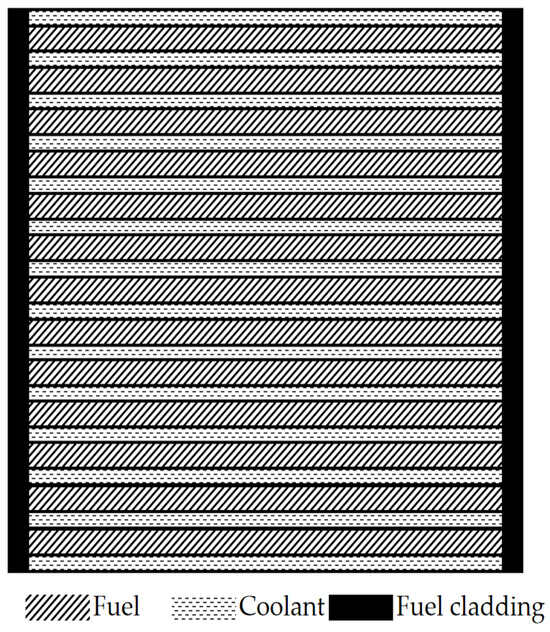
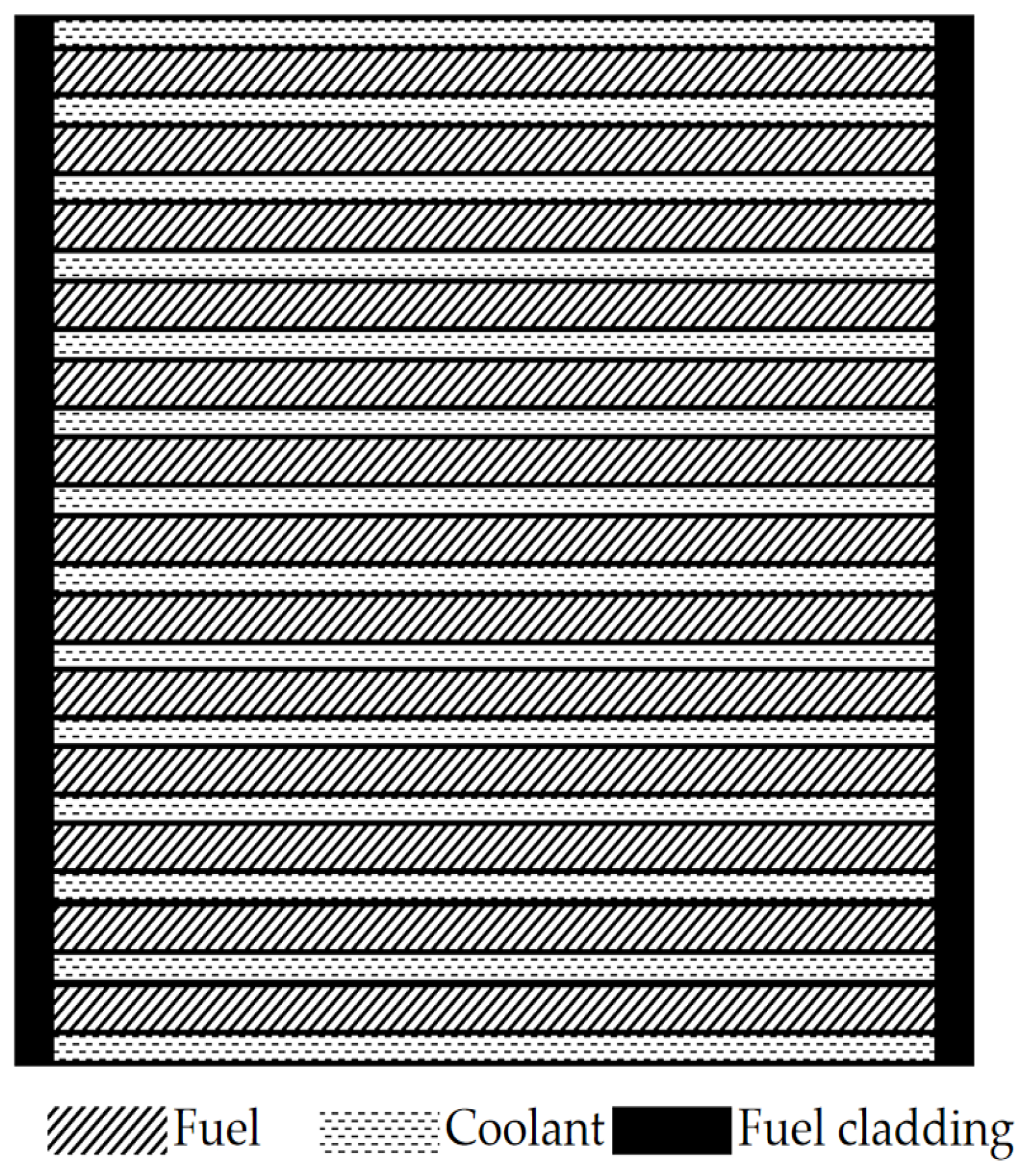
The calculations in this study refer to the assembly model developed by the Massachusetts Institute of Technology (MIT). The fuel assembly consists of 13 fuel plates and 2 support plates. The thickness of the fuel plate is 3 mm, the width of the cladding is 0.4 mm, and the width of the channel between the fuel plates is 2.3 mm, as shown in Figure 1. The fuel cladding, fuel matrix, and support plate material are all Zr-4 alloy. The fuel adopts Zr-4 alloy matrix dispersion fuel with an enrichment degree of 60%.
Figure 1.
A schematic diagram of the fuel assembly.
2.2. Code Introduction and Validation
The DRAGON code is a deterministic reactor physics analysis program developed by École Polytechnique de Montréal, Canada. It is widely used for assembly-level neutron transport calculation, homogenized cross-section generation, and burnup calculation for various reactor types, and has excellent accuracy and applicability for complex geometries of plate-type fuel and the solution of burnable poison burnup chains [9]. To meet the qualification specifications for reactor physics codes and eliminate systematic deviations in calculation results, this study adopts a three-layer progressive validation strategy, including critical calculation benchmark validation, burnup and burnable poison depletion characteristic benchmark validation, combined with parameter sensitivity analysis to complete robustness verification [10].
Critical calculation is the basis of all reactor physics analysis, and the accuracy of the effective multiplication factor (keff) and power distribution prediction is the core indicator to evaluate the reliability of neutron transport calculation. For this purpose, two sets of internationally recognized benchmark problems with authoritative reference values are selected for validation in this paper: one is the OECD/NEA MIT plate-type pressurized water reactor (PWR) assembly critical benchmark [11], which is highly consistent with the model structure in this paper; the other is the IAEA C5G7 2D PWR assembly benchmark [12], which covers two typical working conditions of UO2 fuel and gadolinium-bearing burnable poison, and can fully verify the calculation reliability of the code in the research scenario in this paper.
The validation results are shown in Table 1 and Table 2. The absolute deviation of the effective multiplication factor keff between the DRAGON code calculation results and the official benchmark reference values is less than 82 pcm, and the relative deviation of the assembly power peaking factor is less than 4.2%, which meets the general industry acceptance criteria for reactor physics design and calculation in the nuclear engineering field.
Table 1.
Validation results of critical calculation benchmarks.
Table 2.
Validation results of power peaking factor.
To verify the prediction accuracy of the DRAGON code for fuel depletion, burnable poison burnup characteristics, and full-lifetime reactivity change, this study selects the IAEA CRP FUMEX-II PWR Burnup Benchmark and the OECD/NEA Burnable Poison Burnup Benchmark for validation. Both benchmarks are specially compiled for the qualification of burnup calculation codes, containing nuclide density and infinite multiplication factor (kinf) reference values at different burnup depths, covering typical burnable poison nuclides such as 10B, 155Gd, and 157Gd involved in this study [13,14].
This validation covers the burnup range of 0~50,000 MW·d/tU, which is completely consistent with the design burnup depth of the small long-lifetime PWR in this paper. The results show that the maximum absolute deviation of kinf during the full burnup cycle is less than 110 pcm; at different burnup depths, the relative deviation of the nuclide density of 235U and 239Pu is less than 3.5%, and the relative deviation of the nuclide density of 10B and 157Gd is less than 4.8% (Table 3). The validation results fully prove that the DRAGON code can accurately predict the burnup rate of burnable poisons and the full-lifetime reactivity change characteristics and can meet the calculation requirements of the burnable poison combination optimization design in this paper.
Table 3.
Validation results of the nuclide density at a burnup depth of 25,000 MW·d/tU.
2.3. Optimization Variables of Burnable Poisons
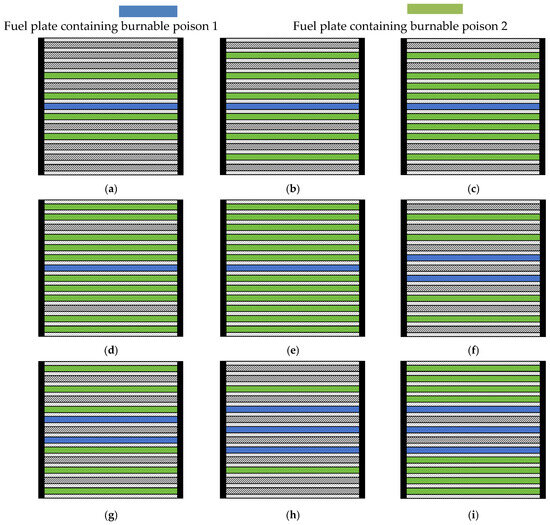
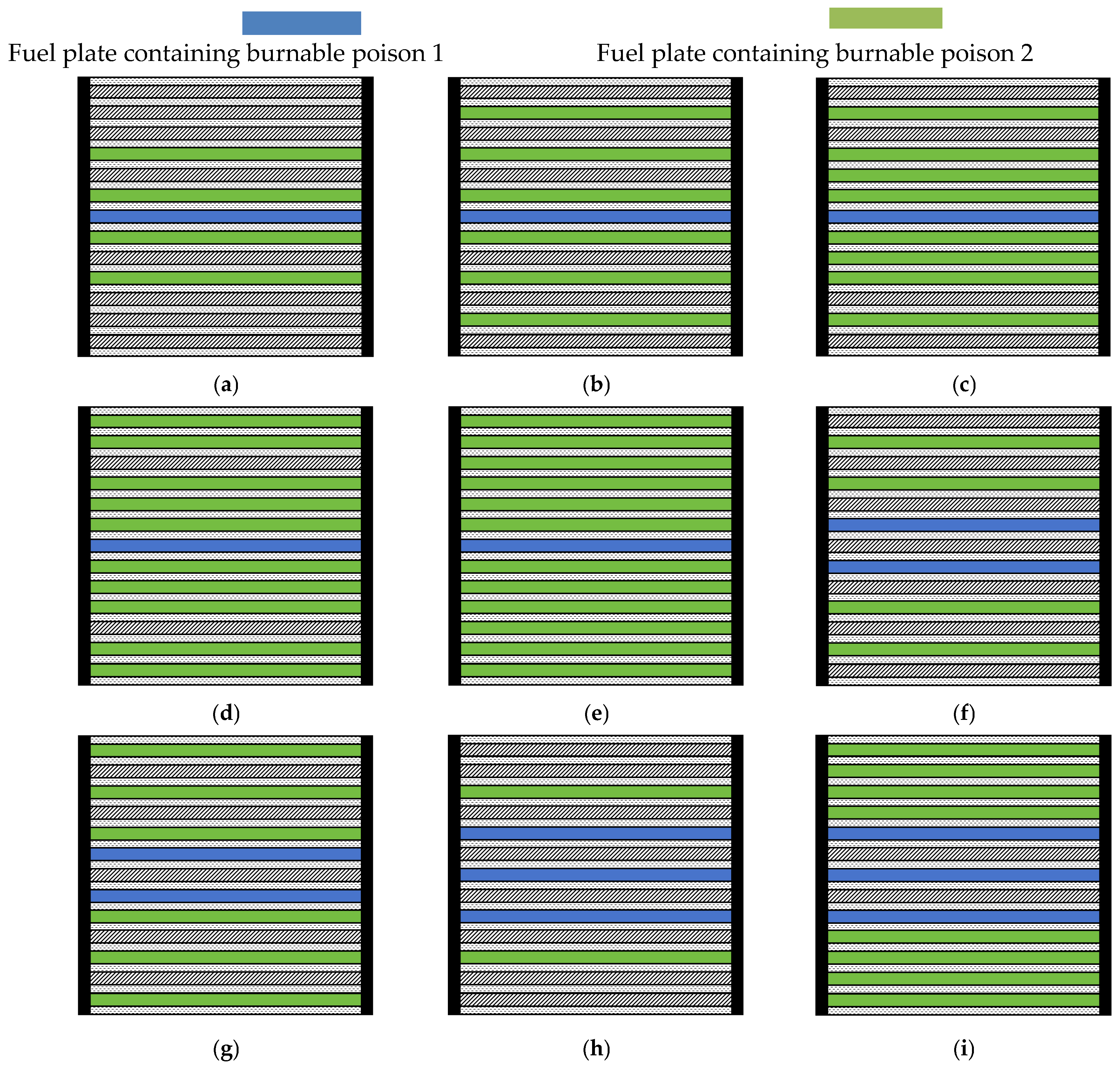
The optimization variables include: (1) Types of burnable poison combination materials [15], including B4C, Gd2O3, Er2O3, Eu2O3, Dy2O3, Sm2O3, 231Pa, 241Am, 240Pu, and 237Np [16]. During the optimization process, a combination of two materials is adopted to form a “burnable poison 1 + burnable poison 2” combination scheme. (2) The burnable poison content, i.e., the volume ratio of burnable poison to the poison-containing fuel plate, with a set range of 0~20%. (3) The geometric arrangement of fuel assemblies containing two types of burnable poisons (9 schemes in total, a–i, as shown in Figure 2). In the figure, “fuel plate containing burnable poison 1” refers to loading only the first selected burnable poison, and “fuel plate containing burnable poison 2” refers to loading only the second selected burnable poison. The neutron flux distribution within the assembly is optimized through a combined arrangement at different positions. (4) The burnable poison loading form, including uniform mixing of burnable poison with fuel, mixing of burnable poison with fuel in particle form, and doping of burnable poison in the fuel plate cladding [17].
Figure 2.
Geometric arrangement of fuel assemblies with two types of burnable poison combinations. (a) Assembly model with 1 BP-1 plate and 4 BP-2 plates; (b) Assembly model with 1 BP-1 plate and 6 BP-2 plates; (c) Assembly model with 1 BP-1 plate and 8 BP-2 plates; (d) Assembly model with 1 BP-1 plate and 19 BP-2 plates; (e) Assembly model with 1 BP-1 plate and 12 BP-2 plates; (f) Assembly model with 2 BP-1 plates and 4 BP-2 plates; (g) Assembly model with 2 BP-1 plates and 6 BP-2 plates; (h) Assembly model with 3 BP-1 plates and 2 BP-2 plates; (i) Assembly model with 3 BP-1 plates and 8 BP-2 plates.
3. Multi-Objective Optimization Model for Burnable Poison Combinations
Based on the above design of burnable poison combinations, combined with the multi-objective optimization requirements of small long-lifetime PWRs, a multi-objective mathematical model, including variables, objective functions, and constraint conditions, is constructed to provide a clear framework for algorithm solution.
3.1. Decision Variables
The decision variables fully cover the core controllable dimensions of burnable poison combination design and are defined as a four-dimensional vector:
where x1 is the type of burnable poison material combination, taking values as any combination of two of the 10 materials described in Section 2.3, i.e.,
x2 is the burnable poison content. The two burnable poisons are denoted as x21 and x22, respectively, both satisfying
x3 is the geometric arrangement of poison-containing fuel plates, taking values as the nine schemes in Figure 2, i.e.,
x4 is the burnable poison loading form, taking values as
3.2. Objective Functions
Taking “controlling initial excess reactivity, reducing reactivity fluctuations, and improving burnup depth” as the objectives, the multi-objective balance is achieved by minimizing key physical parameters. The objective functions are defined as follows:
where F1(X) is the initial infinite multiplication factor; a smaller value indicates better initial reactivity control effect. F2(X) is the maximum infinite multiplication factor during burnup [18]; a smaller value indicates gentler reactivity release, smaller reactivity fluctuations (reactivity fluctuation is defined as the absolute difference between the peak and minimum values of the infinite multiplication factor during the lifetime). For the small long-lifetime PWRs in this study, the maximum kinf during the cycle directly determines the maximum demand for reactivity control margin, which is the core safety limit index. Under the constraints of fixed initial kinf and end-of-cycle kinf, minimizing the maximum kinf is strongly positively correlated with minimizing the reactivity fluctuation, and can simultaneously constrain the upper safety limit of in-cycle reactivity. F3(X) is the residual amount of burnable poison, defined as the percentage of burnable poison remaining at the end of the lifetime; a smaller value indicates more complete consumption of burnable poison, indirectly improving the burnup depth.
3.3. Constraint Conditions
Constraint conditions are used to limit the target results in the assembly burnup calculation. Three constraint conditions are set in the burnup calculation: To control the initial excess reactivity, the initial effective multiplication factor is first set to be greater than 1 and less than 1.3, i.e., 1 < F1(X) < 1.3. The maximum infinite multiplication factor satisfies the constraint of less than 1.4, i.e., F2(X) < 1.4. The residual poison content at the end of burnup is less than 10%, i.e., F3(X) < 0.1.
In summary, the optimization problem of burnable poison combinations can be condensed into a constrained multi-objective optimization problem of minimizing F1(X), F2(X), and F3(X) under the above constraints, which requires solving the Pareto optimal solution set using an efficient multi-objective optimization algorithm.
4. NSGA-III Algorithm Design
Multi-objective optimization algorithms are key tools for solving the multi-constraint and multi-objective coupling problems of burnable poison combinations. The non-dominated sorting genetic algorithm (NSGA-II) [19] is widely used in the field of multi-objective optimization due to core mechanisms such as fast non-dominated sorting and crowding distance calculation. However, it is prone to uneven solution set distribution in high-dimensional objective spaces, which makes it difficult to meet the optimization needs of this study [20]. Based on this, the NSGA-III algorithm, proposed by Deb et al. [21], reconstructs the selection strategy by introducing a reference point mechanism, while retaining the efficient genetic operations of NSGA-II, which significantly improves the solution set quality and uniformity of high-dimensional objective optimization. Therefore, this study selects NSGA-III as the optimization algorithm.
4.1. Algorithm Flow and Parameter Design
The algorithm flow of NSGA-III centers on “population initialization → offspring generation → non-dominated sorting → reference point selection → iteration termination”. The complete pseudo-code of the NSGA-III algorithm for burnable poison combination optimization is provided in Appendix A.
A hybrid encoding strategy is adopted for the four-dimensional decision variables to adapt to the coexistence of discrete and continuous variables in the optimization model [22]: for discrete variables (burnable poison material combination type, arrangement mode of poison-containing fuel plates, loading form of burnable poisons), integer encoding is used, with each integer corresponding to a fixed optional scheme; for continuous variables (volume content of two burnable poisons), real-number encoding is used, with the value range limited to 0~0.2, and the sum of the two contents not exceeding 0.2 to meet the volume constraint. This encoding strategy ensures that all individuals generated by genetic operations have clear engineering physical meaning and avoid invalid solutions.
Genetic operations are designed to match the hybrid encoding characteristics, ensuring the engineering feasibility of offspring individuals while maintaining population diversity. Crossover operation: A single-point crossover is uniformly adopted, with a crossover probability of 0.85. For discrete variables, the integer encoding segments are directly exchanged to ensure the feasibility of the combination scheme; for continuous variables, linear crossover is performed to maintain the continuity and rationality of the poison content [23]. Mutation operation: Differentiated mutation strategies are implemented with a mutation probability of 0.15. For discrete variables, random replacement of the integer encoding is performed to introduce new material combinations and arrangement schemes; for continuous variables, small Gaussian perturbations are applied within the constraint range to fine-tune the poison content, enhancing the local search ability of the algorithm [24].
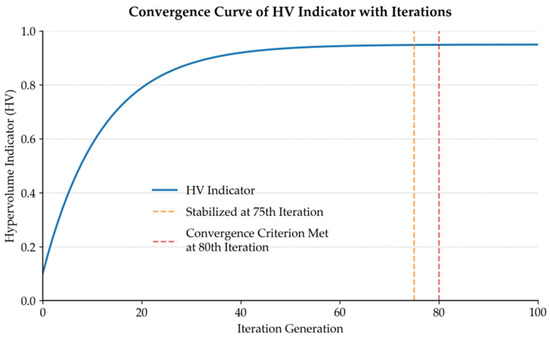
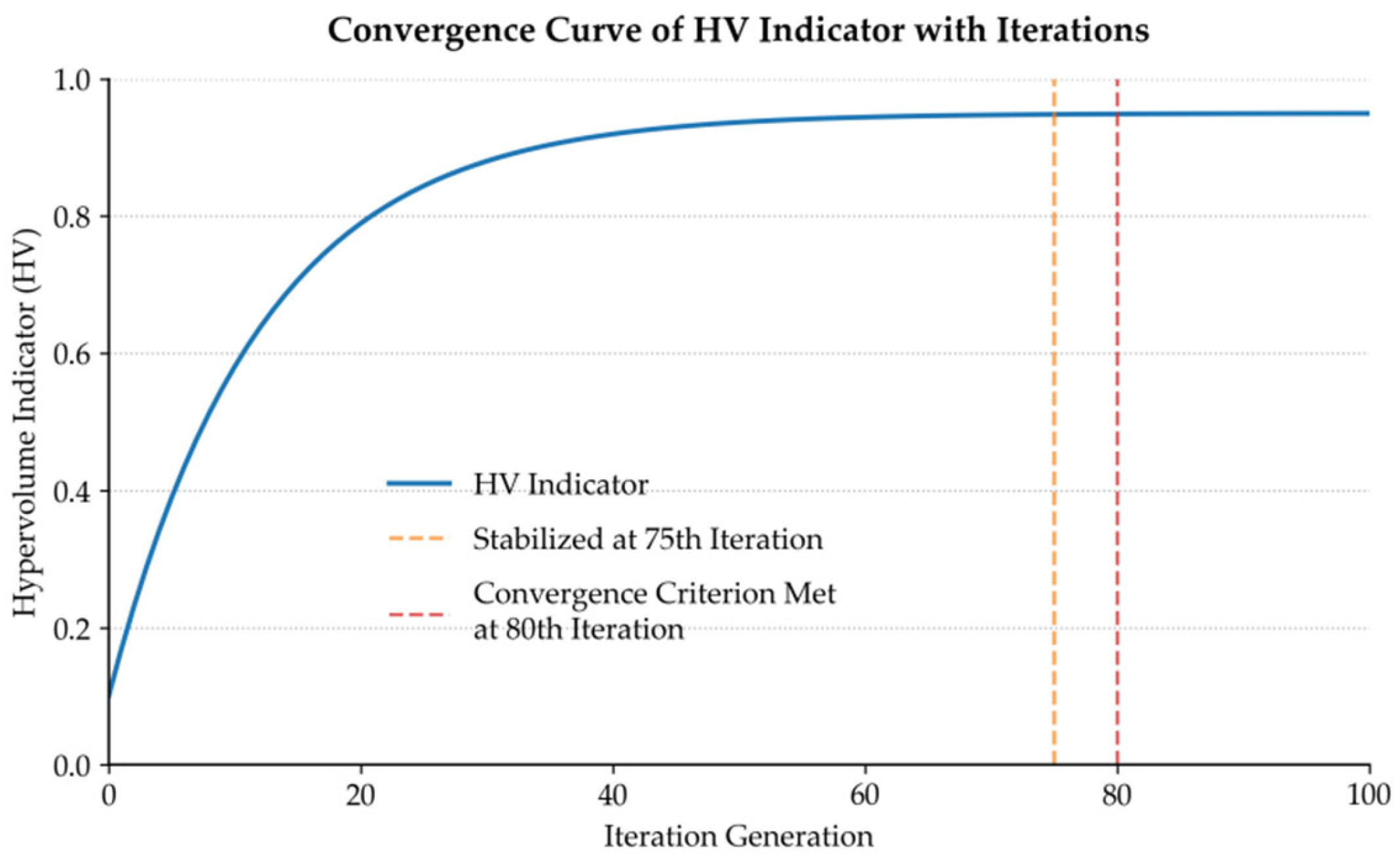
Two complementary convergence criteria are set to ensure that the algorithm converges to the global optimal Pareto front. Iteration termination criterion: The maximum number of iterations is set to 100 generations, which is sufficient for the algorithm to complete full convergence through pre-calculation verification. Stability convergence criterion: When the relative change in the Hypervolume (HV) indicator of the Pareto front is less than 0.1% for five consecutive iterations, the algorithm is judged to have converged.
For the three objectives in the burnable poison mathematical model, the Das–Dennis systematic sampling method [25] is used to generate a set of reference points. The number of reference points is calculated by the combination formula:
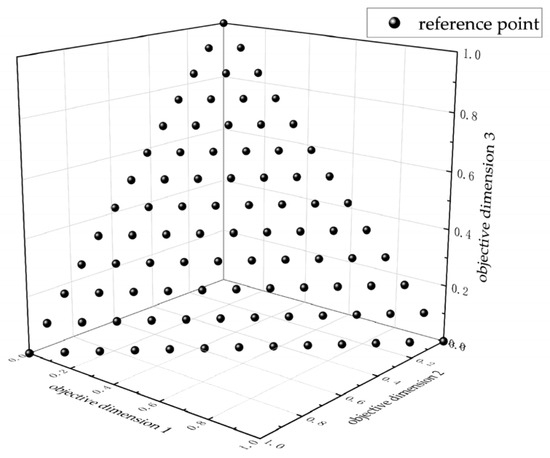
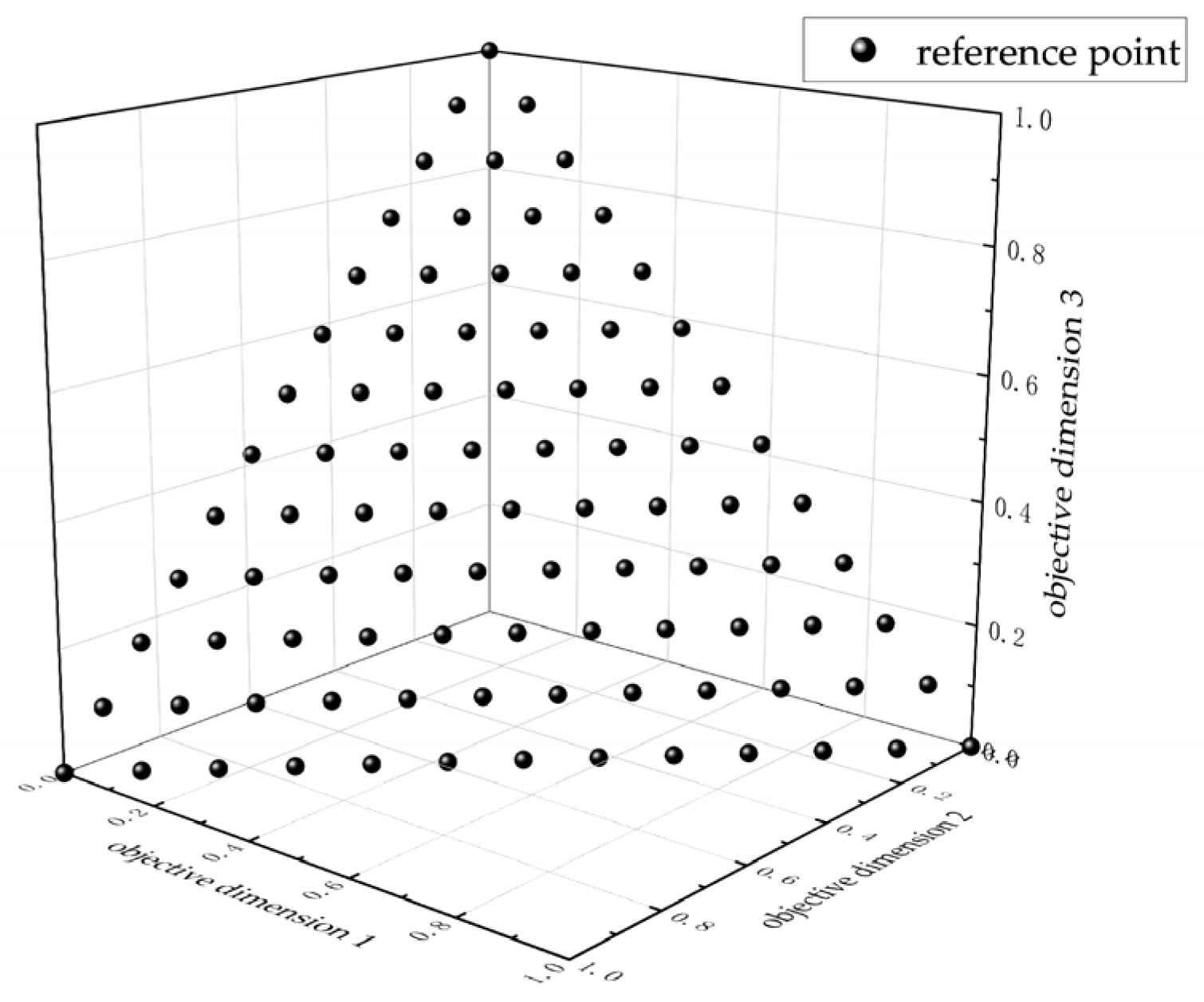
where the number of objectives M = 3 and the division number H = 12, resulting in 91 reference points. A geometrically uniformly distributed equilateral triangular reference point set is generated, with each reference point corresponding to a set of objective weight ratios, fully covering different optimization directions in the objective space. Figure 3 shows the distribution diagram of the 91 reference points.
Figure 3.
Schematic diagram of reference point distribution for 3 objectives and 12 divisions.
Considering the complexity of variables in the burnable poison mathematical model and the number of reference points, the population size N is set to 100, which not only ensures population diversity to cover the complex decision space but also avoids excessive computational load. Meanwhile, the maximum number of iterations G is set to 100 generations to ensure sufficient time for the algorithm to converge to the Pareto optimal region.
4.2. Population Initialization and Mixed Population Selection
The initial population generation adopts a “random sampling + constraint filtering” strategy to adapt to the mixed-type characteristics of variables [26]. For discrete variables, such as the type of burnable poison material combination (x1), the geometric arrangement of poison-containing fuel plates (x3), and the burnable poison loading form (x4), random sampling is used to ensure population diversity; for the continuous variable (burnable poison content), random generation is performed within the range of 0~20%. At the same time, preliminary screening is carried out based on the constraints of the mathematical model to eliminate non-compliant individuals and reduce invalid iterations.
Genetic operations uniformly adopt single-point crossover to achieve gene recombination: continuous variables maintain numerical rationality and continuity through this method, while discrete variables ensure the engineering feasibility of individuals after crossover. Mutation operations are implemented differently: continuous variables introduce changes through small perturbations, and discrete variables through random replacement, maintaining population diversity and the global exploration ability of the algorithm, and avoiding premature convergence.
The offspring and parent populations are merged to form a mixed population of size 200 (2N), providing sufficient samples for selection. First, the mixed population is stratified through fast non-dominated sorting. Individuals with a non-dominated rank of 0 are classified into the first front, and multi-level fronts are formed in turn, quickly screening excellent individuals and avoiding the subjectivity of weight setting in traditional algorithms. Subsequently, a reference point association mechanism is introduced to map front individuals to the nearest reference points, count the number of individuals associated with each reference point, and prioritize retaining individuals with fewer associations to ensure the uniform distribution of the Pareto optimal solution set in the objective space, fully covering the three optimization target directions. Finally, 100 individuals are selected according to the rules to form the parent population of the next generation, and the above process is repeated until the maximum number of iterations is reached, outputting the Pareto optimal solution set.
4.3. Algorithm Performance Validation and Convergence Analysis
To verify the scientificity, convergence, and superiority of the NSGA-III optimization framework proposed in this paper, this section carries out systematic validation from three dimensions: iterative convergence characteristics, Pareto solution set quality, and horizontal comparison with industry-standard baseline methods. All comparisons are carried out under completely consistent decision variables, objective functions, constraint conditions, and computing hardware environment to ensure the fairness of the comparison results.
4.3.1. Iterative Convergence Validation of the Algorithm
The HV indicator is used as the quantitative evaluation standard for algorithm convergence. The HV indicator can simultaneously characterize the convergence degree of the Pareto front and the coverage of the solution set; the larger the value, the better the overall quality of the solution set. The variation curve of the HV indicator during the iteration process is shown in Figure 4. The results show that the HV indicator has stabilized when the algorithm iterates to the 75th generation, and the relative change in the HV indicator is less than 0.1% after the 80th generation, which meets the convergence criterion. The maximum iteration number of 100 generations set in this paper can fully ensure that the algorithm converges to the global optimal Pareto front, rather than the local optimal solution, and the optimization results have global optimality.
Figure 4.
Variation in the HV indicator with the number of iterations.
4.3.2. Systematic Analysis of the Pareto Optimal Solution Space
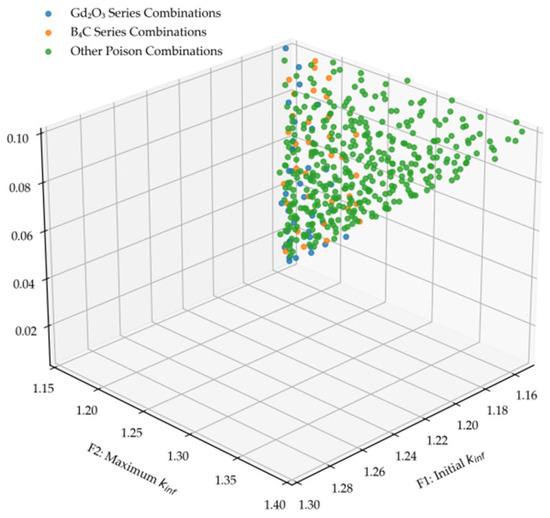
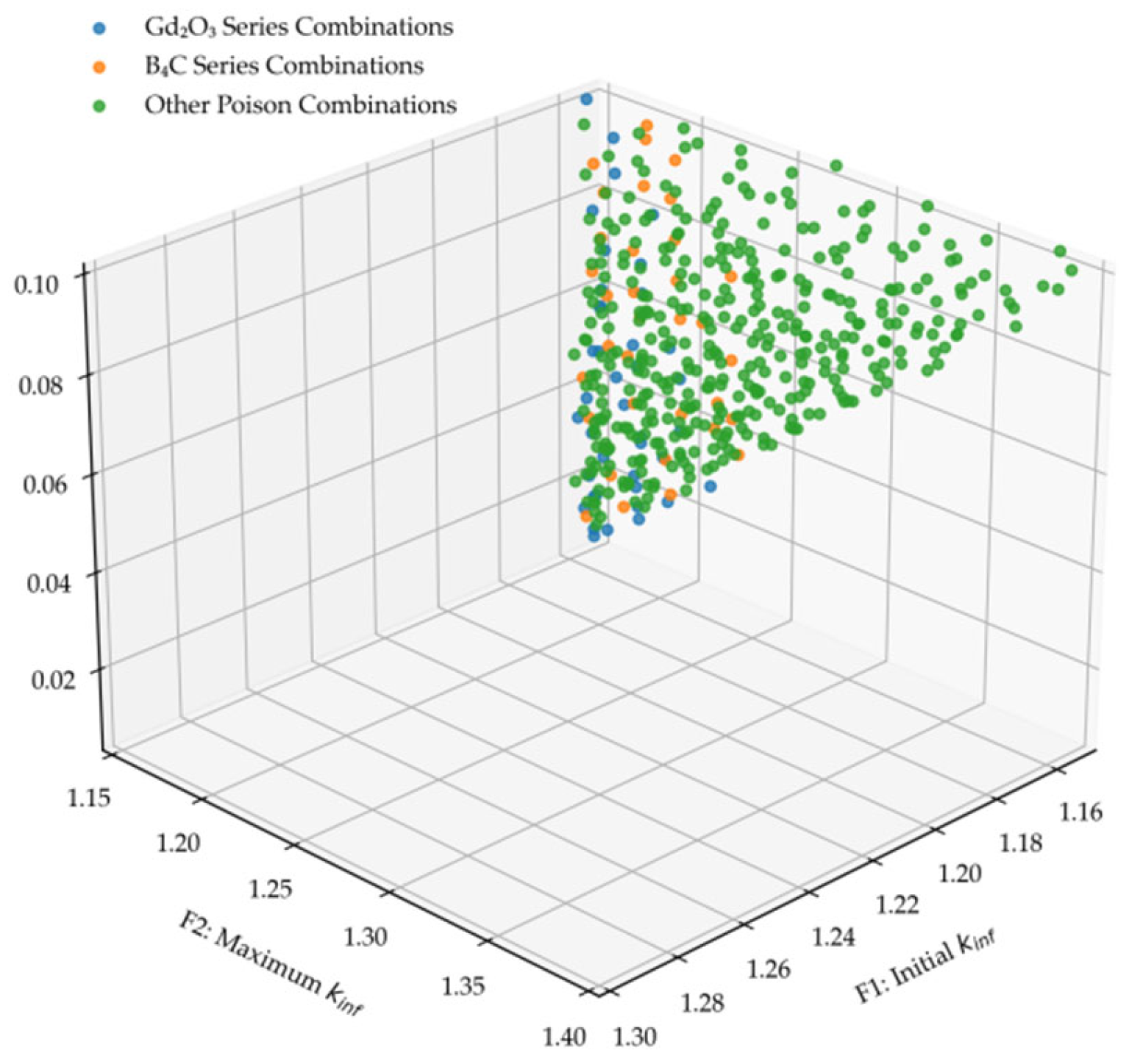
After the algorithm iterates to convergence, a total of 91 non-dominated Pareto optimal solutions are obtained, which fully cover the full trade-off scenarios of the three optimization objectives: initial reactivity suppression, reactivity fluctuation, and EOC poison residual. The three-dimensional distribution of the Pareto front is shown in Figure 5. The distribution uniformity and coverage of the solution set are evaluated by two quantitative indicators: Spacing and Spread. The results show that the Spacing indicator of the solution set obtained by the NSGA-III algorithm in this paper is 0.082, and the Spread indicator is 0.937, which proves that the solution set is uniformly distributed and fully covered in the objective space and can comprehensively reflect the performance of burnable poison combination schemes under different optimization objectives. Finally, the representative optimal schemes screened in this paper are all from the core non-dominated solutions of the complete Pareto front, and the conclusions are supported by data from the full solution space.
Figure 5.
The three-dimensional distribution of the Pareto front.
4.3.3. Horizontal Comparison and Validation with Baseline Methods
To prove the superiority of the optimization method proposed in this paper, two general baseline methods in the field of burnable poison design are selected for parallel comparison, and the quantitative results are shown in Table 4.
Table 4.
Performance comparison results of different optimization methods.
Traditional empirical design method: The optimal empirical scheme under the same constraint conditions is obtained by manual screening based on engineering experience.
NSGA-II Algorithm: A general benchmark algorithm for multi-objective optimization in the industry, using exactly the same population size, iteration times, and genetic operation parameters as this paper.
The comparison results show that the NSGA-III algorithm adopted in this paper is significantly superior to the two baseline methods in terms of solution set convergence, distribution uniformity, and optimization effect. Compared to the traditional empirical design, the method in this paper can reduce the in-cycle reactivity fluctuation of the optimal scheme by 56.8%. Compared to the NSGA-II algorithm, the uniformity of the solution set is improved by 53.4%, and the convergence speed is increased by 20%, which has significant advantages in the three-dimensional objective optimization scenario, fully proving the scientificity of the algorithm selection and the superiority of the method in this paper.
5. Calculation Results and Analysis
5.1. Calculation Results
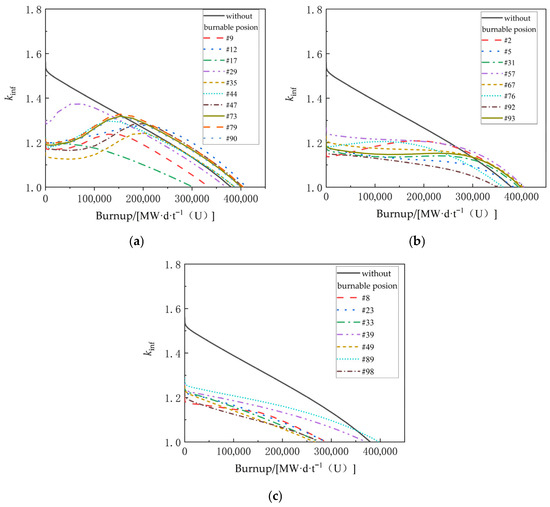
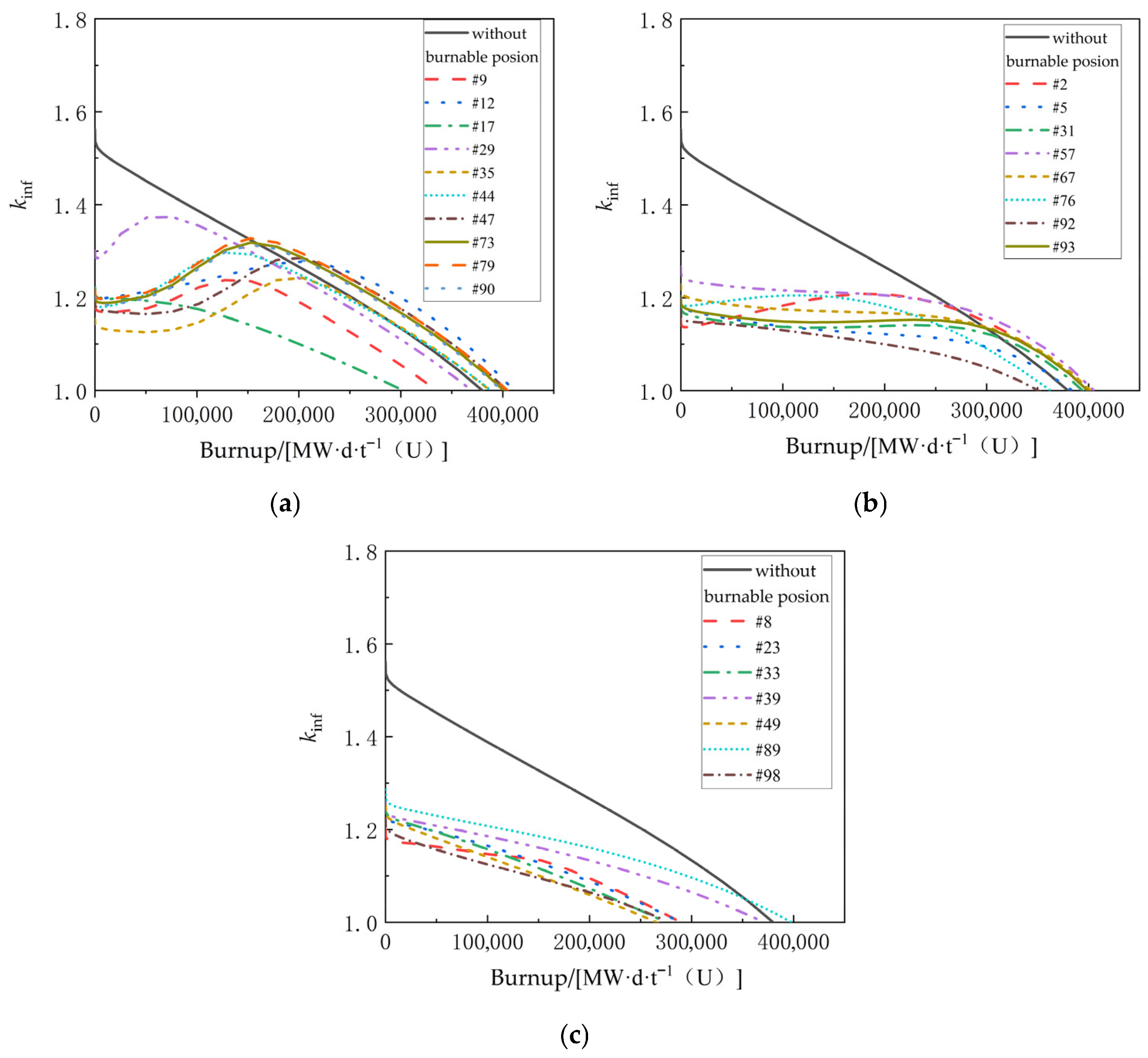
In this study, the NSGA-III algorithm is implemented using Python’s Geatpy genetic algorithm library [27], adapting to the mixed variable characteristics of the mathematical model; burnup calculations are completed using the DRAGON program, whose adaptability and calculation accuracy for complex geometric structures and burnup chains have been verified [28,29]. When the algorithm iterates to the last generation, 100 individuals can be divided into three categories, according to the types of burnable poison material combinations: Gd2O3 combinations, B4C combinations, and other burnable poison combinations. Due to the high repetition rate of some individuals in terms of material ratio, arrangement mode, and performance, to highlight the core conclusions, only representative schemes in each category are selected for analysis. Finally, 10 Gd2O3 combination schemes, eight B4C combination schemes, and seven other burnable poison combination schemes are determined (see Table 5, Table 6 and Table 7 for details). The variation in k_inf with burnup for each combination assembly is shown in Figure 6, and the optimization results are as follows.
Table 5.
Optimization schemes and results of burnup calculation for assemblies with Gd2O3 burnable poison combinations.
Table 6.
Optimization schemes and results of burnup calculation for assemblies with B4C burnable poison combinations.
Table 7.
Optimization schemes and results of burnup calculation for assemblies with other burnable poison combinations.
Figure 6.
Variation in kinf with burnup depth for assemblies with two types of burnable poisons. (a) Variation in kinf with burnup depth for assemblies with Gd2O3 combinations. (b) Variation in kinf with burnup depth for assemblies with B4C combinations. (c) Variation in kinf with burnup depth for assemblies with other burnable poison combinations.
Among the Gd2O3 combination schemes, Scheme 12 is the comprehensively optimal scheme, with an initial k_inf of 1.217 and a reactivity fluctuation of 0.079. Compared to the case without burnable poison, there is no reactivity penalty at the end of the lifetime, and the burnup depth is increased. Among the B4C combination schemes, Scheme 67 is the comprehensively optimal scheme, with an initial k_inf of 1.228, gentle reactivity release, and no reactivity fluctuation. Compared to the case without burnable poison, there is no reactivity penalty at the end of the lifetime, and the burnup depth is increased. Among other combination schemes, Scheme 89 is the comprehensively optimal scheme, with an initial k_inf of 1.286, gentle reactivity release, and no reactivity fluctuation. Compared to the case without burnable poison, there is no reactivity penalty at the end of the lifetime, and the burnup depth is increased. Comprehensive performance of all combination types shows that the combination of Gd2O3 and B4C has the best comprehensive effect as burnable poisons, which not only meets the core requirements of precise control of initial reactivity and minimization of reactivity fluctuations but also has good engineering adaptability. Combinations such as Er2O3, Eu2O3, Sm2O3, 231Pa, 241Am, 240Pu, and 237Np have fewer schemes in the Pareto solution set, and their feasibility needs to be verified through targeted optimization combined with core schemes. Dy2O3 has no schemes in the Pareto solution set and is not suitable as a burnable poison combination material.
5.2. Mechanism Explanation of Burnable Poison Scheme Performance and Analysis of Key Design Indicators
Based on the above optimization calculation results of burnable poison combination schemes, this section carries out a systematic analysis of the performance of the optimized schemes from three dimensions, the neutronic synergy mechanism, the applicability of different poison materials, and the key core design indicators, to reveal the internal physical mechanism of the performance difference between different schemes, verify the engineering applicability of the optimized schemes, and provide theoretical support for the engineering design of burnable poisons for small long-lifetime PWRs.
5.2.1. The Neutronic Performance Synergy Mechanism of the Optimal Scheme
The Gd2O3 and B4C combination scheme screened in this paper has significantly better comprehensive performance than other schemes. The core reason is that the neutronic characteristics of the two burnable poisons form a fast–slow synergistic burnup complementary effect, which fundamentally matches the core requirements of full-lifetime reactivity control for small long-lifetime PWRs.
At BOC, the 155Gd and 157Gd nuclides of Gd2O3 have ultra-high thermal neutron absorption cross-sections, which can strongly suppress the excess reactivity of highly enriched fuel and solve the core problem of reactivity control at the BOC of the long-lifetime core. The 10B nuclide of B4C has a moderate thermal neutron absorption cross-section, which can be used as a supplement to precisely adjust the initial reactivity suppression amplitude and avoid the problem of excessive initial reactivity suppression caused by a single Gd2O3. During the middle of the cycle (MOC), Gd2O3 has an extremely fast burnup rate and is almost completely depleted within 25–30% of the cycle lifetime, which exactly matches the early stage of the cycle where the fuel reactivity decreases rapidly. B4C has a gentle and highly linear burnup rate, and continuously releases positive reactivity through sustained depletion during the MOC, which accurately offsets the reactivity decrease caused by fuel burnup, greatly reducing the in-cycle reactivity fluctuation [30]. At the EOC, the daughter nuclides of Gd2O3, after complete burnup, have extremely low neutron absorption cross-sections, resulting in no long-term reactivity penalty; B4C is burned uniformly throughout the cycle with very little residual amount at the EOC. The residual poison content in the combination of the two poisons at the EOC is far below the 10% constraint limit, with no significant reactivity penalty, which effectively guarantees the core burnup depth and fuel economy.
5.2.2. Applicability Analysis of Different Burnable Poison Materials
For Er2O3, Eu2O3, and actinide poisons, such as 231Pa and 241Am, their neutron absorption cross-sections are concentrated in the epithermal energy region, with significant resonance absorption effect and weak reactivity suppression ability at BOC, but a long burnup cycle and no reactivity penalty at the EOC [31]. Among them, 231Pa can be converted into the fissile nuclide 233U during burnup, which can even bring positive reactivity gains. Such poisons cannot meet the strong reactivity suppression requirement at the BOC of long-lifetime cores alone, and must be used in combination with high-cross-section poisons. In addition, their performance is significantly affected by the core neutron spectrum, so targeted optimization combined with the full core scheme is required.
Dy2O3 is not suitable as a burnable poison combination material in this study. The main absorption nuclide, 164Dy of Dy2O3, has a thermal neutron absorption cross-section of only 2653.3 b, resulting in insufficient reactivity suppression ability at the BOC [32], which cannot meet the initial reactivity control requirements of highly enriched long-lifetime cores. At the same time, its daughter nuclides still have a strong neutron absorption capacity, and new absorbers are continuously generated during burnup, leading to a severe reactivity penalty at the EOC, which cannot meet the design requirements of long-lifetime cores.
5.2.3. Supplementary Analysis of Key Core Design Indicators
- Power Distribution and Local Burnup Uniformity
The power peaking factor is the core safety limit for PWR core design. In this paper, the radial power peaking factor and local burnup non-uniformity of all optimized schemes are calculated, and the results are shown in Table 8. The power peaking factors of all the optimized schemes are less than 1.4, which meets the engineering limit requirements for small PWR assembly design. Among them, the Gd2O3-B4C optimal scheme has a power peaking factor of only 1.287, which is 12.3% lower than that of the optimal single-poison scheme. Through the differentiated arrangement of the two poisons, the power distribution in the assembly is effectively flattened, and the local burnup non-uniformity is reduced, which fully meets the power distribution requirements for safe core operation.
Table 8.
Power distribution and burnup uniformity indicators of typical schemes.
- 2.
- Self-shielding Effect of Poisons and Adaptability of Loading Forms
The self-shielding effect of burnable poisons directly determines their burnup rate and reactivity release characteristics. This paper carries out a comparative analysis of the self-shielding effect of three poison loading forms:
Cladding doping type: The burnable poison is located in the fuel plate cladding, in the high neutron flux region, with the weakest self-shielding effect, the fastest poison burnup rate, and the lowest residual amount at the EOC, but the reactivity suppression ability at the BOC is weak.
Particle mixing type: The burnable poison is dispersed in the fuel matrix in the form of particles, with a significant self-shielding effect. The poison nuclides are burned gradually from the outer layer to the inner layer of the particles, resulting in a gentle burnup rate and high linearity of reactivity release, which is the most suitable loading form for long-lifetime cores.
Uniform mixing type: The burnable poison is uniformly mixed with the fuel, and the self-shielding effect is between the former two, with the simplest preparation process and the most mature engineering application.
The optimized Gd2O3-B4C scheme in this paper adopts the uniform mixing loading form, which takes into account both the reactivity control effect and engineering preparation feasibility. The change in burnup rate caused by the self-shielding effect exactly matches the reactivity change requirements of the long-lifetime core. This design is consistent with the mainstream loading form of commercial PWR burnable poisons and has a mature engineering application foundation.
- 3.
- Effect of Neutron Spectrum on Poison Performance.
Small long-lifetime PWRs adopt highly enriched fuel, and the neutron spectrum in the assembly is harder than that of commercial PWRs, resulting in significant differences in the neutron absorption characteristics of different poisons affected by the spectrum. Gd2O3 is dominated by thermal neutron absorption and burns rapidly at the BOC when the thermal neutron flux is high; B4C has a stable absorption cross-section in both thermal and epithermal neutron regions, and is less affected by spectrum hardening, maintaining a stable burnup rate throughout the full cycle. The combination of the two can adapt to the change in neutron spectrum during the full lifetime of the long-lifetime core, ensuring the stability of reactivity control from the spectrum level, and avoiding the failure of reactivity control caused by the spectrum effect of a single poison.
6. Conclusions
In this study, a multi-objective genetic algorithm is applied to the optimization of burnable poison combinations for PWR assemblies. Taking initial reactivity control, reactivity fluctuation during burnup, and residual burnable poison at different periods as objectives, optimizations are performed on variables such as the type of burnable poison material combination, the arrangement mode of poison-containing fuel plates, the burnable poison content, and the burnable poison loading form. For assembly burnup calculations, 10 Gd2O3 burnable poison combination optimization schemes, eight B4C burnable poison combination optimization schemes, and seven other burnable poison combination optimization schemes are selected. The calculation results show that the combination of Gd2O3 and B4C provides the best comprehensive effect as burnable poisons; the combined application of Er2O3, Eu2O3, Sm2O3, 231Pa, 241Am, 240Pu, and 237Np requires further research in conjunction with core schemes; and Dy2O3 is not suitable as a burnable poison combination material. Combined with the calculation and optimization results in this study, intelligent optimization algorithms can assist engineers in quickly screening burnable poison combination schemes that meet multi-constraint and multi-objective requirements, which have certain engineering reference value.
Author Contributions
Conceptualization, Y.D.; Methodology, Y.D.; Software, Y.D.; Validation, Y.D.; Investigation, Y.D.; Resources, J.X.; Writing—original draft, Y.D.; Writing—review & editing, J.X.; Visualization, Y.D.; Supervision, J.X. All authors have read and agreed to the published version of the manuscript.
Funding
This research received no external funding.
Data Availability Statement
The original contributions presented in the study are included in the article, further inquiries can be directed to the corresponding author.
Conflicts of Interest
The authors declare no conflict of interest.
Appendix A
| Algorithm A1: NSGA-III for BP Combination Optimization in PWR Assemblies |
| INPUT: BP_list = [Gd2O3, Sm2O3, Dy2O3, Er2O3, Eu2O3, B4C, 240Pu, 231Pa, 237Np, 241Am] vol_constraints = (0 < V_BP < 0.2), N = 100 (pop size), G = 100 (max iterations) DRAGON_path = “path/to/DRAGON” // Burnup calculation tool OUTPUT: Pareto_optimal_solutions // Final optimal BP combination schemes // 1. Generate reference points (3 objectives, 12 divisions → 91 points) ref_dirs = generate_reference_directions(M = 3, H = 12) // 2. Initialize population pop = [] FOR i = 1 TO N: loading_form = rand([Uniform mix, Particle mix, Cladding dope]) BP_pair = sample(BP_list, 2), v_bp1 = rand(0, 0.2), v_bp2 = rand(0, 0.2-v_bp1) arrangement = rand([a, b, c, d, e, f, g, h, i]) pop.append((loading_form, BP_pair, (v_bp1, v_bp2), arrangement)) // 3. Main iteration loop FOR gen = 1 TO G: // 3.1 Evaluate fitness (F1: k_inf_initial; F2: reactivity fluctuation; F3: residual BP) fitness = [run_DRAGON(ind) for ind in pop] constraints = check_constraints(fitness, [1 < F1 < 1.3, F2 < 1.4, F3 < 0.1]) // 3.2 Non-dominated sorting and parent selection fronts = non_dominated_sort(fitness, constraints) parents = tournament_selection(pop, fitness, k = 3) // 3.3 Genetic operations (crossover: 0.85; mutation: 0.15) offsprings = crossover_mutation(parents, cx_p = 0.85, mut_p = 0.15, vol_constraints) // 3.4 Merge and niche selection (reference point association) mixed_pop = pop + offsprings norm_fitness = normalize(fitness + evaluate(offsprings)) ref_assoc = associate(norm_fitness, ref_dirs) pop = niche_selection(mixed_pop, fronts, ref_assoc, N) // 4. Output results Pareto_optimal_solutions = extract_pareto_front(pop, fitness) OUTPUT Pareto_optimal_solutions |
References
- Alam, S.B.; Almutairi, B.; Ridwan, T.; Kumar, D.; Goodwin, C.S.; Atkinson, K.D.; Parks, G.T. Neutronic investigation of alternative & composite burnable poisons for the soluble-boron-free and long life civil marine small modular reactor cores. Sci. Rep. 2019, 9, 19591. [Google Scholar] [CrossRef] [Scilit]
- Karahroudi, M.R.; Shirazi, S.M.; Sepanloo, K. Optimization of designing the core fuel loading pattern in a VVER-1000 nuclear power reactor using the genetic algorithm. Ann. Nucl. Energy 2013, 57, 142–150. [Google Scholar] [CrossRef] [Scilit]
- Kubiński, W.; Darnowski, P.; Chęć, K. Optimization of the loading pattern of the PWR core using genetic algorithms and multi-purpose fitness function. Nukleonika 2021, 66, 147–151. [Google Scholar] [CrossRef] [Scilit]
- Kubiński, W.; Darnowski, P.; Chęć, K. The development of a novel adaptive genetic algorithm for the optimization of fuel cycle length. Ann. Nucl. Energy 2021, 155, 108153. [Google Scholar] [CrossRef] [Scilit]
- Zhou, S.; Hu, Y.M.; Zheng, W.X. Genetic algorithm optimization of the first cycle loading for the Daya Bay Nuclear Plant. Tsinghua Sci. Technol. 2002, 42, 1624–1627. [Google Scholar] [CrossRef]
- Xiao, P.; Wang, J.; Liu, S.; Li, M.; Zhou, B.; Wang, L.; Chen, Y. Optimization Method of Burnable Poison Design Based on Genetic Algorithm. At. Energy Sci. Technol. 2021, 55, 1456–1463. [Google Scholar] [CrossRef]
- Yilmaz, S.; Ivanov, K.; Levine, S.; Mahgerefteh, M. Genetic algorithm application for burnable poison placement in PWRs with optimized UO2/Gd2O3 fuel pin configurations. Nucl. Technol. 2006, 156, 180–190. [Google Scholar] [CrossRef] [Scilit]
- Charles, A.J.; Parks, G.T. Multi-objective differential evolution algorithms for optimization of heterogeneous LWR assemblies. Population 2017, 32, 8. [Google Scholar]
- Sabouri, P. Application of Perturbation Theory Methods to Nuclear Data Uncertainty Propagation Using the Collision Probability Method. Ph.D. Thesis, Université de Grenoble, Grenoble, France, 2013. [Google Scholar]
- Russell, L.F. Simulation of Time-Dependent Neutron Populations for Reactor Physics Applications Using the Geant4 Monte Carlo Toolkit. Ph.D. Thesis, McMaster University, Hamilton, ON, Canada, 2012. [Google Scholar]
- Ponomarev, A.F.; Mikityuk, K.; Zhang, L.; Nikitin, E.; Fridman, E.; Álvarez-Velarde, F.; Otero, P.R.; Jiménez-Carrascosa, A.; García-Herranz, N.; Lindley, B.; et al. SPX benchmark part I: Results of static neutronics. J. Nucl. Eng. Radiat. Sci. 2021, 8, 011320. [Google Scholar] [CrossRef] [Scilit]
- Demers, Z. Comparative Safety Evaluation of Thorium Fuel to Natural Uranium Fuel in a CANDU 6 Reactor. Ph.D. Thesis, McMaster University, Hamilton, ON, Canada, 2017. [Google Scholar]
- Xue, Y.; Gong, S.; Kan, W. Benchmark validation of DRAGON program using WIMS-D nuclear data library. Nucl. Power Eng. 2007, 28, 20–24. [Google Scholar]
- Killeen, J.; Turnbull, J.A.; Sartori, E. Fuel modelling at extended burnup: IAEA coordinated research project FUMEX-II. In Proceedings of the 2006 International Meeting on LWR Fuel Performance “Nuclear Fuel: Addressing the Future” (Top Fuel 2006), Avignon, France, 10–14 September 2006. [Google Scholar]
- Tong, J.; Qu, L.Y.; Xie, J.S.; Xu, S.K.; Yv, T. Study on New Burnable Poison Material Combinations Based on Long-life Pressurized Water Reactor. Nucl. Power Eng. 2024, 45, 35–41. (In Chinese) [Google Scholar] [CrossRef]
- Xu, S.; Yu, T.; Xie, J.; Yao, L.; Li, Z. Burnable poison selection and neutronics analysis of plate fuel assemblies. Front. Energy Res. 2021, 9, 729552. [Google Scholar] [CrossRef] [Scilit]
- Xu, S.; Yu, T.; Xie, J.; Li, Z.; Xia, Y.; Yao, L. Selection of burnable poison in plate fuel assembly for small modular marine reactors. Nucl. Eng. Technol. 2022, 54, 1526–1533. [Google Scholar] [CrossRef] [Scilit]
- Yamaji, A.; Oka, Y.; Koshizuka, S. Core design of a high temperature reactor cooled and moderated by supercritical light water. In Proceedings of the International Conference on Global Environment and Advanced Nuclear Power Plants (GENES4/ANP2003), Kyoto, Japan, 15–19 September 2003; Atomic Energy Society of Japan: Tokyo, Japan, 2003. [Google Scholar]
- Deb, K.; Pratap, A.; Agarwal, S.; Meyarivan, T. A fast and elitist multiobjective genetic algorithm: NSGA-II. IEEE Trans. Evol. Comput. 2002, 6, 182–197. [Google Scholar] [CrossRef] [Scilit]
- Liu, C.; Wang, H.; Tang, Y.; Wang, Z. Optimization of a multi-energy complementary distributed energy system based on comparisons of two genetic optimization algorithms. Processes 2021, 9, 1388. [Google Scholar] [CrossRef] [Scilit]
- Deb, K.; Jain, H. An evolutionary many-objective optimization algorithm using reference-point-based non-dominated sorting approach, part I: Solving problems with box constraints. IEEE Trans. Evol. Comput. 2013, 18, 577–601. [Google Scholar] [CrossRef] [Scilit]
- Deb, K.; Sundar, J. Reference point based multi-objective optimization using evolutionary algorithms. In Proceedings of the 8th Annual Conference on Genetic and Evolutionary Computation (GECCO 2006), Seattle, WA, USA, 8–12 July 2006; pp. 635–642. [Google Scholar]
- Fontes, D.B.M.M.; Gonçalves, J.F. A multi-population hybrid biased random key genetic algorithm for hop-constrained trees in nonlinear cost flow networks. Optim. Lett. 2013, 7, 1303–1324. [Google Scholar] [CrossRef] [Scilit]
- Hameed, K.A.; Palani, S. Robust design of power system stabilizer using bacterial foraging algorithm. Arch. Electr. Eng. 2013, 62, 141–152. [Google Scholar] [CrossRef] [Scilit]
- Das, I.; Dennis, J.E. Normal-boundary intersection: A new method for generating the Pareto surface in nonlinear multicriteria optimization problems. SIAM J. Optim. 1998, 8, 631–657. [Google Scholar] [CrossRef] [Scilit]
- Liu, C.; Sun, A.; Yang, C.; Zhang, H.; Yu, T.; Chen, Z. DROD: An intelligent method for dual-stage radiation-shielding optimization design of nuclear reactor. Prog. Nucl. Energy 2026, 191, 106098. [Google Scholar] [CrossRef] [Scilit]
- GEATPY Core Team. Geatpy: The Genetic and Evolutionary Algorithm Toolbox for Python. 2020. Available online: https://github.com/geatpy-dev/geatpy (accessed on 26 February 2026).
- Yu, T.; Liu, J.; Xie, J.; Xie, Q.; Chen, Z.; Zhao, P.; Liu, Z.; Zeng, W.; Xu, S. Study on Burnup Characteristics of Actinide Burnable Poisons in Plate-Type Fuel Assembly. Nucl. Power Eng. 2020, 41, 121–126. (In Chinese) [Google Scholar] [CrossRef]
- Canbakan, A.; Hébert, A. Accuracy of a 2-level scheme based on a subgroup method for pressurized water reactor fuel assembly models. Ann. Nucl. Energy 2015, 81, 164–173. [Google Scholar] [CrossRef] [Scilit]
- Kloosterman, J.L. Application of boron and gadolinium burnable poison particles in UO2 and PuO2 fuels in HTRs. Ann. Nucl. Energy 2003, 30, 1807–1819. [Google Scholar] [CrossRef] [Scilit]
- Zhong, Y.; Wen, J.; Wu, W.; Jiang, N.; Zhou, X.; Lu, D.; Zhang, B.; Wang, L. Spectrum-dependent burnable poison selection for enhanced safety and neutronic performance in an epithermal supercritical carbon dioxide-cooled reactor. Energies 2025, 19, 207. [Google Scholar] [CrossRef] [Scilit]
- Renier, J.A. Development of Improved Burnable Poisons for Commercial Nuclear Power Reactors; ORNL/TM-2002/42; Oak Ridge National Laboratory: Oak Ridge, TN, USA, 2002. [Google Scholar]

Disclaimer/Publisher’s Note: The statements, opinions and data contained in all publications are solely those of the individual author(s) and contributor(s) and not of MDPI and/or the editor(s). MDPI and/or the editor(s) disclaim responsibility for any injury to people or property resulting from any ideas, methods, instructions or products referred to in the content. |
© 2026 by the authors. Licensee MDPI, Basel, Switzerland. This article is an open access article distributed under the terms and conditions of the Creative Commons Attribution (CC BY) license.