A Study on the Optimization of Burnable Poison Material Combinations for Small Long-Lifetime Pressurized Water Reactor Assemblies Based on NSGA-III

Abstract
1. Introduction
2. Design of Burnable Poison Material Combinations
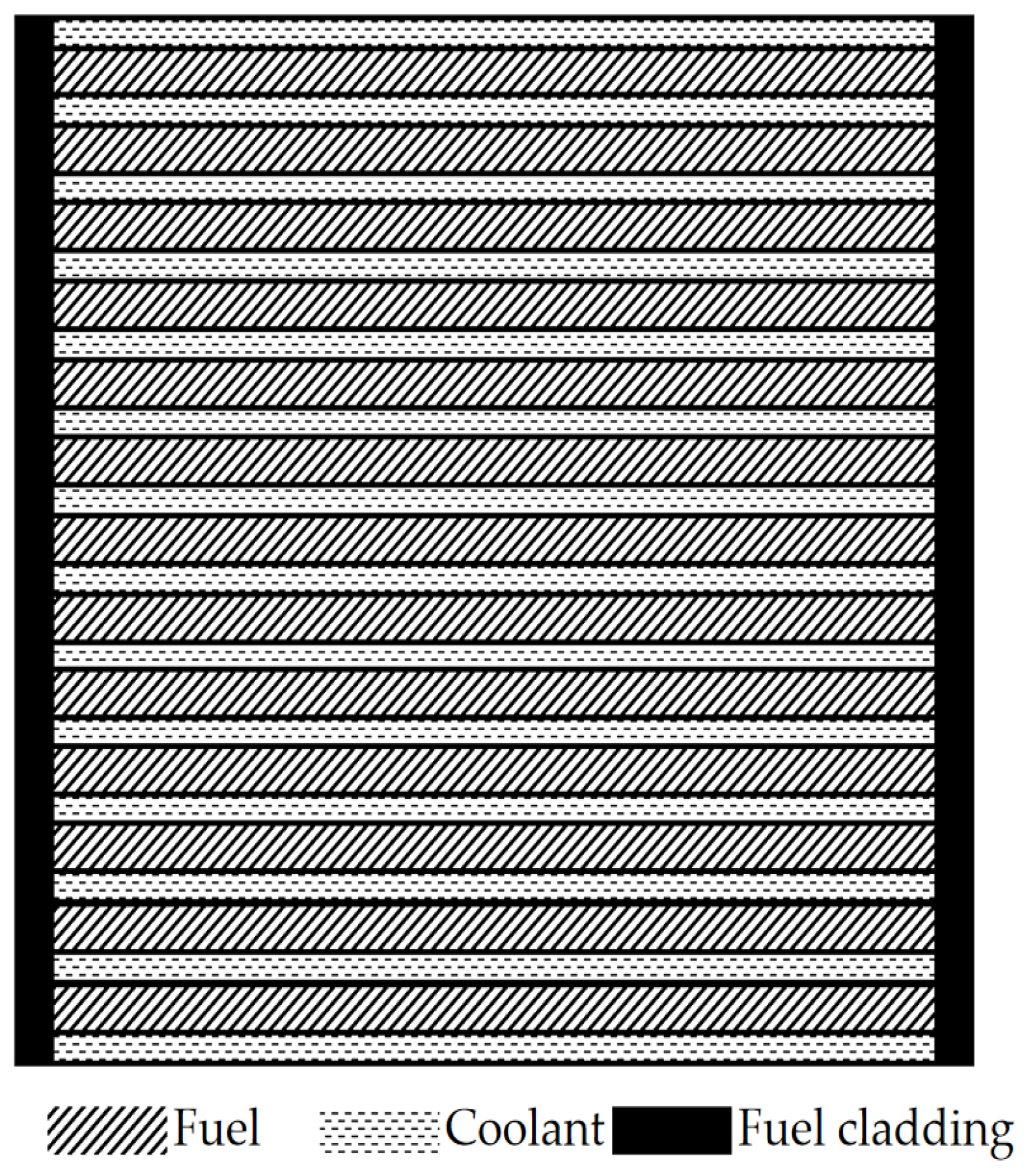
2.1. Assembly Model
2.2. Code Introduction and Validation
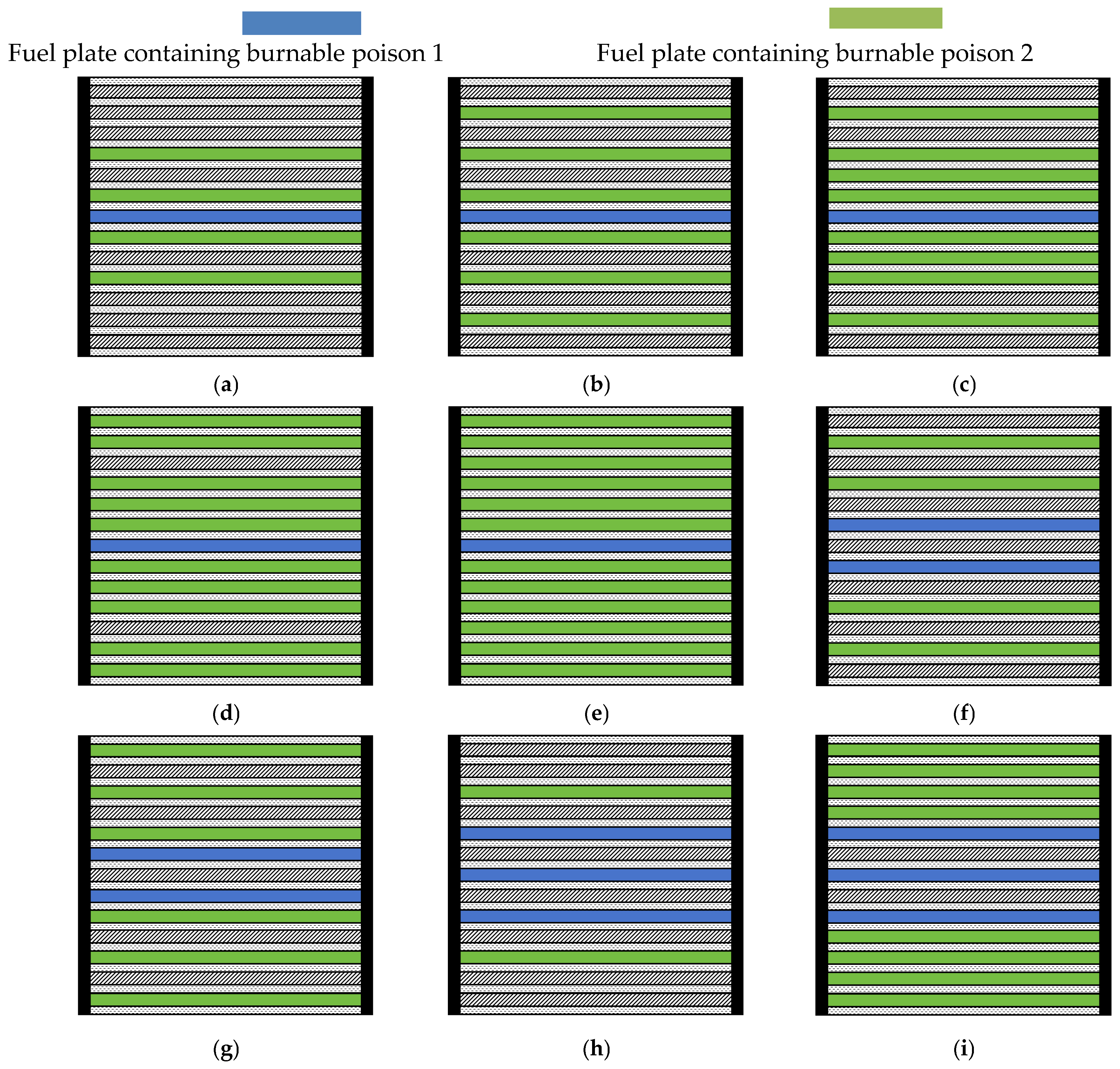
2.3. Optimization Variables of Burnable Poisons
3. Multi-Objective Optimization Model for Burnable Poison Combinations
3.1. Decision Variables
3.2. Objective Functions
3.3. Constraint Conditions
4. NSGA-III Algorithm Design
4.1. Algorithm Flow and Parameter Design
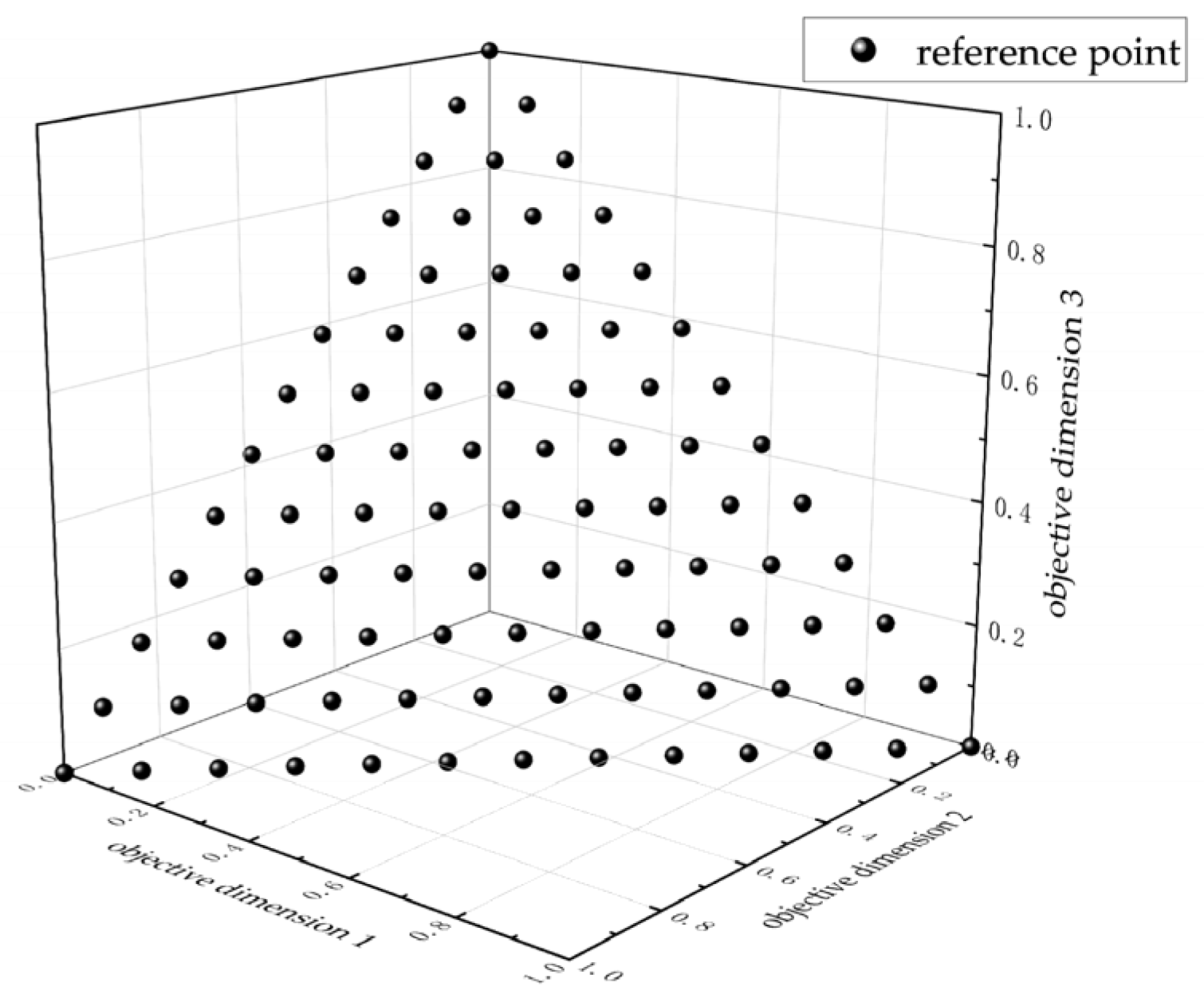
4.2. Population Initialization and Mixed Population Selection
4.3. Algorithm Performance Validation and Convergence Analysis
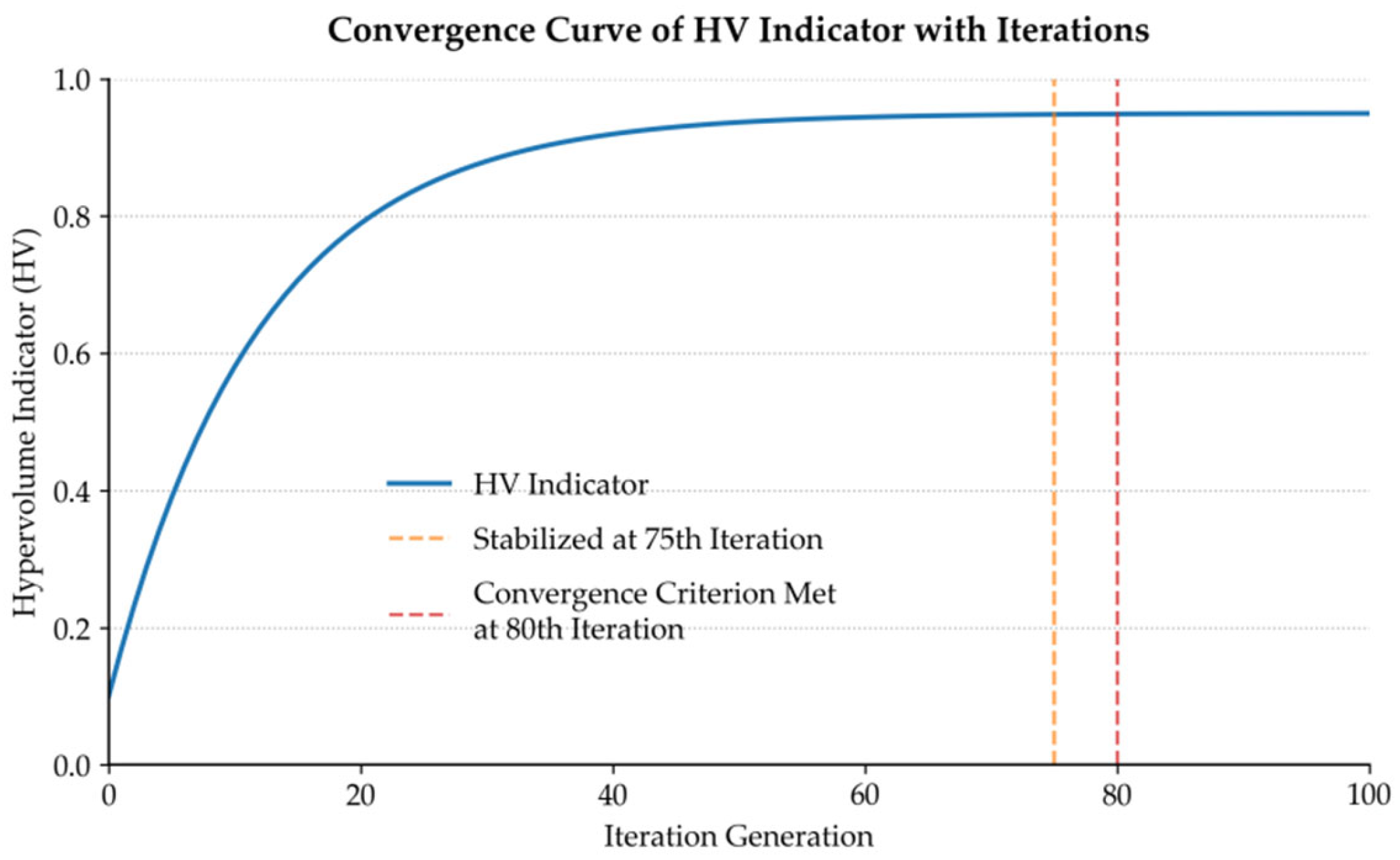
4.3.1. Iterative Convergence Validation of the Algorithm
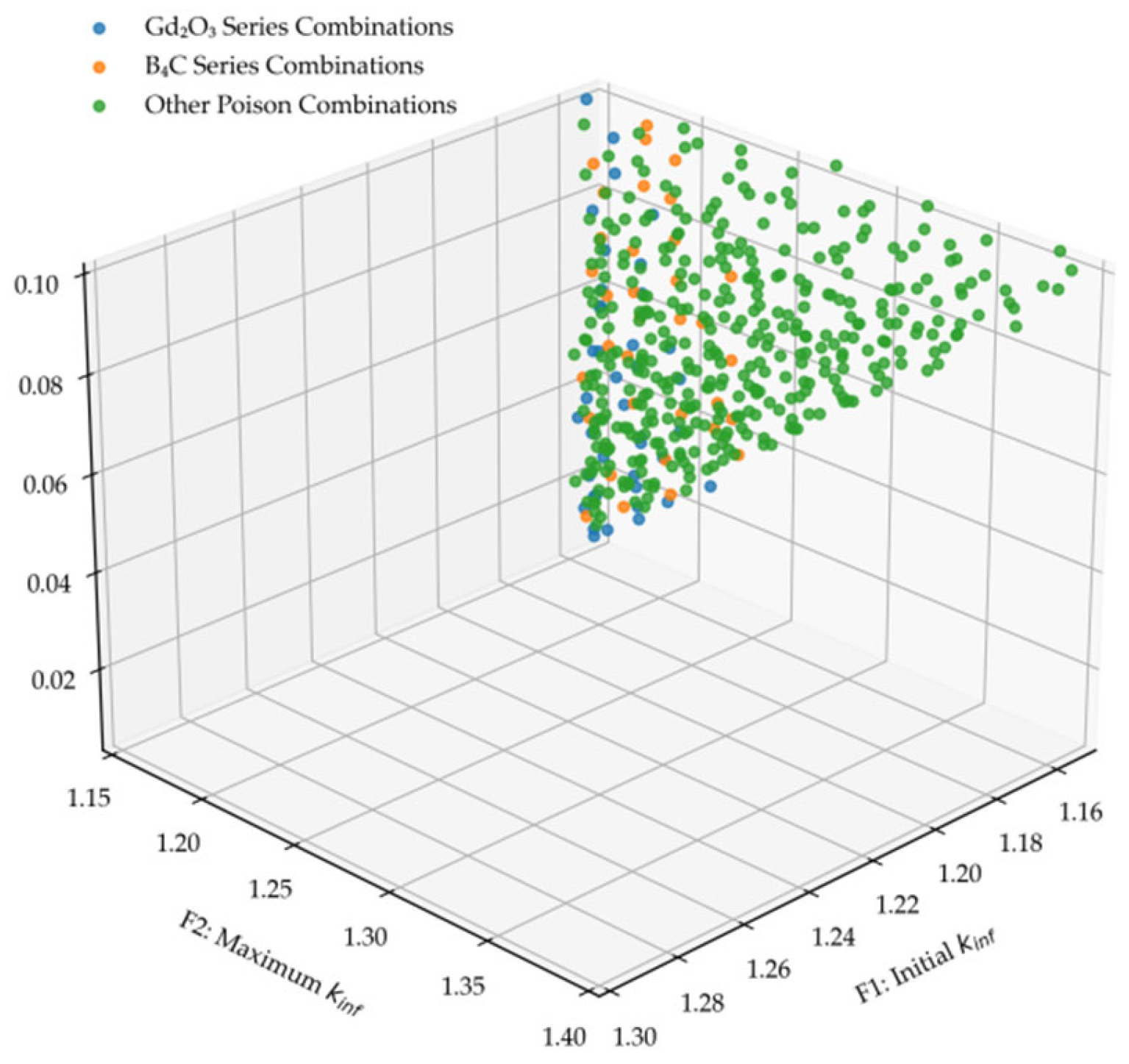
4.3.2. Systematic Analysis of the Pareto Optimal Solution Space
4.3.3. Horizontal Comparison and Validation with Baseline Methods
5. Calculation Results and Analysis
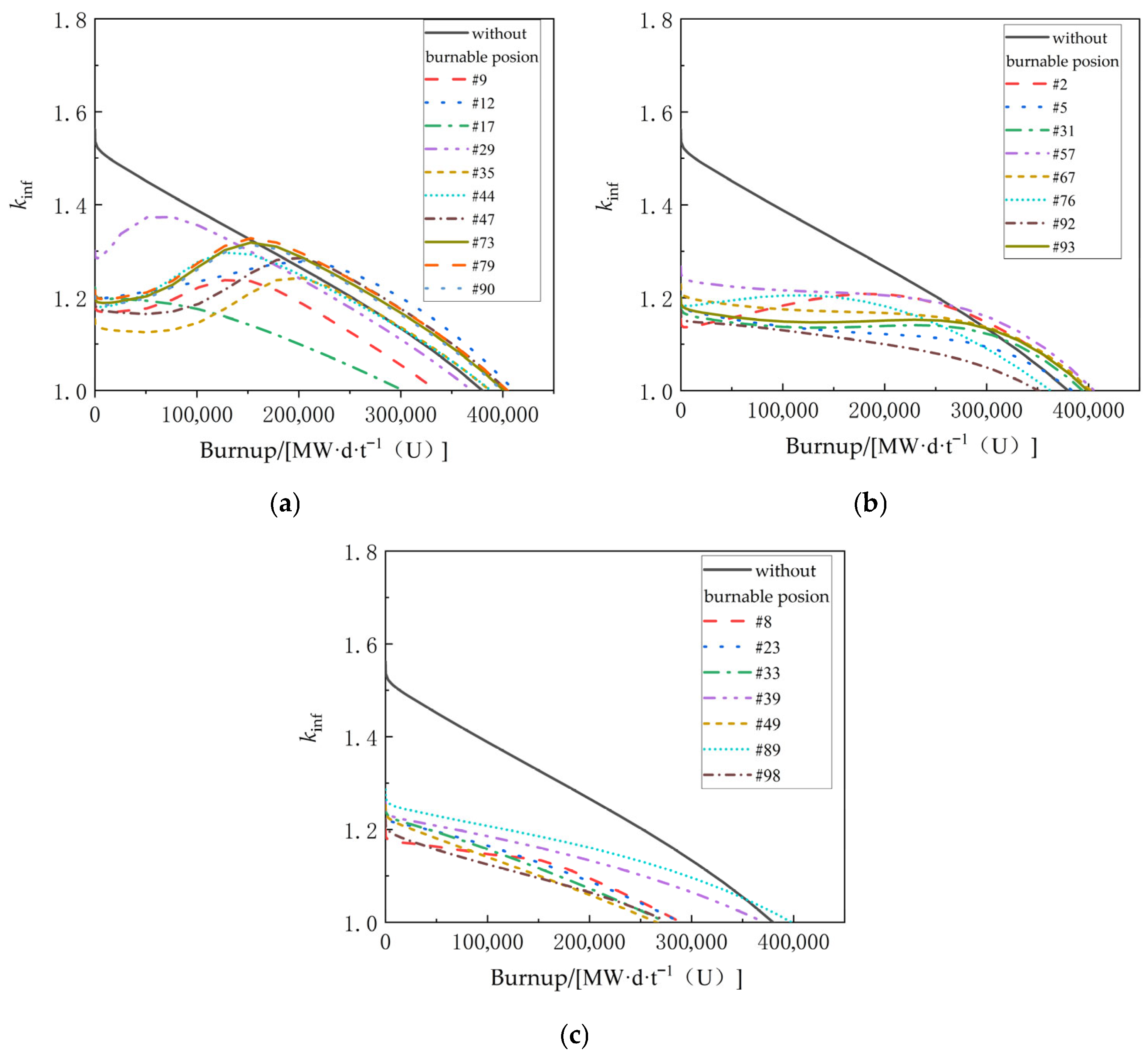
5.1. Calculation Results
5.2. Mechanism Explanation of Burnable Poison Scheme Performance and Analysis of Key Design Indicators
5.2.1. The Neutronic Performance Synergy Mechanism of the Optimal Scheme
5.2.2. Applicability Analysis of Different Burnable Poison Materials
5.2.3. Supplementary Analysis of Key Core Design Indicators
- Power Distribution and Local Burnup Uniformity
- 2.
- Self-shielding Effect of Poisons and Adaptability of Loading Forms
- 3.
- Effect of Neutron Spectrum on Poison Performance.
6. Conclusions
Author Contributions
Funding
Data Availability Statement
Conflicts of Interest
Appendix A
| Algorithm A1: NSGA-III for BP Combination Optimization in PWR Assemblies |
| INPUT: BP_list = [Gd2O3, Sm2O3, Dy2O3, Er2O3, Eu2O3, B4C, 240Pu, 231Pa, 237Np, 241Am] vol_constraints = (0 < V_BP < 0.2), N = 100 (pop size), G = 100 (max iterations) DRAGON_path = “path/to/DRAGON” // Burnup calculation tool OUTPUT: Pareto_optimal_solutions // Final optimal BP combination schemes // 1. Generate reference points (3 objectives, 12 divisions → 91 points) ref_dirs = generate_reference_directions(M = 3, H = 12) // 2. Initialize population pop = [] FOR i = 1 TO N: loading_form = rand([Uniform mix, Particle mix, Cladding dope]) BP_pair = sample(BP_list, 2), v_bp1 = rand(0, 0.2), v_bp2 = rand(0, 0.2-v_bp1) arrangement = rand([a, b, c, d, e, f, g, h, i]) pop.append((loading_form, BP_pair, (v_bp1, v_bp2), arrangement)) // 3. Main iteration loop FOR gen = 1 TO G: // 3.1 Evaluate fitness (F1: k_inf_initial; F2: reactivity fluctuation; F3: residual BP) fitness = [run_DRAGON(ind) for ind in pop] constraints = check_constraints(fitness, [1 < F1 < 1.3, F2 < 1.4, F3 < 0.1]) // 3.2 Non-dominated sorting and parent selection fronts = non_dominated_sort(fitness, constraints) parents = tournament_selection(pop, fitness, k = 3) // 3.3 Genetic operations (crossover: 0.85; mutation: 0.15) offsprings = crossover_mutation(parents, cx_p = 0.85, mut_p = 0.15, vol_constraints) // 3.4 Merge and niche selection (reference point association) mixed_pop = pop + offsprings norm_fitness = normalize(fitness + evaluate(offsprings)) ref_assoc = associate(norm_fitness, ref_dirs) pop = niche_selection(mixed_pop, fronts, ref_assoc, N) // 4. Output results Pareto_optimal_solutions = extract_pareto_front(pop, fitness) OUTPUT Pareto_optimal_solutions |
References
- Alam, S.B.; Almutairi, B.; Ridwan, T.; Kumar, D.; Goodwin, C.S.; Atkinson, K.D.; Parks, G.T. Neutronic investigation of alternative & composite burnable poisons for the soluble-boron-free and long life civil marine small modular reactor cores. Sci. Rep. 2019, 9, 19591. [Google Scholar] [CrossRef] [Scilit]
- Karahroudi, M.R.; Shirazi, S.M.; Sepanloo, K. Optimization of designing the core fuel loading pattern in a VVER-1000 nuclear power reactor using the genetic algorithm. Ann. Nucl. Energy 2013, 57, 142–150. [Google Scholar] [CrossRef] [Scilit]
- Kubiński, W.; Darnowski, P.; Chęć, K. Optimization of the loading pattern of the PWR core using genetic algorithms and multi-purpose fitness function. Nukleonika 2021, 66, 147–151. [Google Scholar] [CrossRef] [Scilit]
- Kubiński, W.; Darnowski, P.; Chęć, K. The development of a novel adaptive genetic algorithm for the optimization of fuel cycle length. Ann. Nucl. Energy 2021, 155, 108153. [Google Scholar] [CrossRef] [Scilit]
- Zhou, S.; Hu, Y.M.; Zheng, W.X. Genetic algorithm optimization of the first cycle loading for the Daya Bay Nuclear Plant. Tsinghua Sci. Technol. 2002, 42, 1624–1627. [Google Scholar] [CrossRef]
- Xiao, P.; Wang, J.; Liu, S.; Li, M.; Zhou, B.; Wang, L.; Chen, Y. Optimization Method of Burnable Poison Design Based on Genetic Algorithm. At. Energy Sci. Technol. 2021, 55, 1456–1463. [Google Scholar] [CrossRef]
- Yilmaz, S.; Ivanov, K.; Levine, S.; Mahgerefteh, M. Genetic algorithm application for burnable poison placement in PWRs with optimized UO2/Gd2O3 fuel pin configurations. Nucl. Technol. 2006, 156, 180–190. [Google Scholar] [CrossRef] [Scilit]
- Charles, A.J.; Parks, G.T. Multi-objective differential evolution algorithms for optimization of heterogeneous LWR assemblies. Population 2017, 32, 8. [Google Scholar]
- Sabouri, P. Application of Perturbation Theory Methods to Nuclear Data Uncertainty Propagation Using the Collision Probability Method. Ph.D. Thesis, Université de Grenoble, Grenoble, France, 2013. [Google Scholar]
- Russell, L.F. Simulation of Time-Dependent Neutron Populations for Reactor Physics Applications Using the Geant4 Monte Carlo Toolkit. Ph.D. Thesis, McMaster University, Hamilton, ON, Canada, 2012. [Google Scholar]
- Ponomarev, A.F.; Mikityuk, K.; Zhang, L.; Nikitin, E.; Fridman, E.; Álvarez-Velarde, F.; Otero, P.R.; Jiménez-Carrascosa, A.; García-Herranz, N.; Lindley, B.; et al. SPX benchmark part I: Results of static neutronics. J. Nucl. Eng. Radiat. Sci. 2021, 8, 011320. [Google Scholar] [CrossRef] [Scilit]
- Demers, Z. Comparative Safety Evaluation of Thorium Fuel to Natural Uranium Fuel in a CANDU 6 Reactor. Ph.D. Thesis, McMaster University, Hamilton, ON, Canada, 2017. [Google Scholar]
- Xue, Y.; Gong, S.; Kan, W. Benchmark validation of DRAGON program using WIMS-D nuclear data library. Nucl. Power Eng. 2007, 28, 20–24. [Google Scholar]
- Killeen, J.; Turnbull, J.A.; Sartori, E. Fuel modelling at extended burnup: IAEA coordinated research project FUMEX-II. In Proceedings of the 2006 International Meeting on LWR Fuel Performance “Nuclear Fuel: Addressing the Future” (Top Fuel 2006), Avignon, France, 10–14 September 2006. [Google Scholar]
- Tong, J.; Qu, L.Y.; Xie, J.S.; Xu, S.K.; Yv, T. Study on New Burnable Poison Material Combinations Based on Long-life Pressurized Water Reactor. Nucl. Power Eng. 2024, 45, 35–41. (In Chinese) [Google Scholar] [CrossRef]
- Xu, S.; Yu, T.; Xie, J.; Yao, L.; Li, Z. Burnable poison selection and neutronics analysis of plate fuel assemblies. Front. Energy Res. 2021, 9, 729552. [Google Scholar] [CrossRef] [Scilit]
- Xu, S.; Yu, T.; Xie, J.; Li, Z.; Xia, Y.; Yao, L. Selection of burnable poison in plate fuel assembly for small modular marine reactors. Nucl. Eng. Technol. 2022, 54, 1526–1533. [Google Scholar] [CrossRef] [Scilit]
- Yamaji, A.; Oka, Y.; Koshizuka, S. Core design of a high temperature reactor cooled and moderated by supercritical light water. In Proceedings of the International Conference on Global Environment and Advanced Nuclear Power Plants (GENES4/ANP2003), Kyoto, Japan, 15–19 September 2003; Atomic Energy Society of Japan: Tokyo, Japan, 2003. [Google Scholar]
- Deb, K.; Pratap, A.; Agarwal, S.; Meyarivan, T. A fast and elitist multiobjective genetic algorithm: NSGA-II. IEEE Trans. Evol. Comput. 2002, 6, 182–197. [Google Scholar] [CrossRef] [Scilit]
- Liu, C.; Wang, H.; Tang, Y.; Wang, Z. Optimization of a multi-energy complementary distributed energy system based on comparisons of two genetic optimization algorithms. Processes 2021, 9, 1388. [Google Scholar] [CrossRef] [Scilit]
- Deb, K.; Jain, H. An evolutionary many-objective optimization algorithm using reference-point-based non-dominated sorting approach, part I: Solving problems with box constraints. IEEE Trans. Evol. Comput. 2013, 18, 577–601. [Google Scholar] [CrossRef] [Scilit]
- Deb, K.; Sundar, J. Reference point based multi-objective optimization using evolutionary algorithms. In Proceedings of the 8th Annual Conference on Genetic and Evolutionary Computation (GECCO 2006), Seattle, WA, USA, 8–12 July 2006; pp. 635–642. [Google Scholar]
- Fontes, D.B.M.M.; Gonçalves, J.F. A multi-population hybrid biased random key genetic algorithm for hop-constrained trees in nonlinear cost flow networks. Optim. Lett. 2013, 7, 1303–1324. [Google Scholar] [CrossRef] [Scilit]
- Hameed, K.A.; Palani, S. Robust design of power system stabilizer using bacterial foraging algorithm. Arch. Electr. Eng. 2013, 62, 141–152. [Google Scholar] [CrossRef] [Scilit]
- Das, I.; Dennis, J.E. Normal-boundary intersection: A new method for generating the Pareto surface in nonlinear multicriteria optimization problems. SIAM J. Optim. 1998, 8, 631–657. [Google Scholar] [CrossRef] [Scilit]
- Liu, C.; Sun, A.; Yang, C.; Zhang, H.; Yu, T.; Chen, Z. DROD: An intelligent method for dual-stage radiation-shielding optimization design of nuclear reactor. Prog. Nucl. Energy 2026, 191, 106098. [Google Scholar] [CrossRef] [Scilit]
- GEATPY Core Team. Geatpy: The Genetic and Evolutionary Algorithm Toolbox for Python. 2020. Available online: https://github.com/geatpy-dev/geatpy (accessed on 26 February 2026).
- Yu, T.; Liu, J.; Xie, J.; Xie, Q.; Chen, Z.; Zhao, P.; Liu, Z.; Zeng, W.; Xu, S. Study on Burnup Characteristics of Actinide Burnable Poisons in Plate-Type Fuel Assembly. Nucl. Power Eng. 2020, 41, 121–126. (In Chinese) [Google Scholar] [CrossRef]
- Canbakan, A.; Hébert, A. Accuracy of a 2-level scheme based on a subgroup method for pressurized water reactor fuel assembly models. Ann. Nucl. Energy 2015, 81, 164–173. [Google Scholar] [CrossRef] [Scilit]
- Kloosterman, J.L. Application of boron and gadolinium burnable poison particles in UO2 and PuO2 fuels in HTRs. Ann. Nucl. Energy 2003, 30, 1807–1819. [Google Scholar] [CrossRef] [Scilit]
- Zhong, Y.; Wen, J.; Wu, W.; Jiang, N.; Zhou, X.; Lu, D.; Zhang, B.; Wang, L. Spectrum-dependent burnable poison selection for enhanced safety and neutronic performance in an epithermal supercritical carbon dioxide-cooled reactor. Energies 2025, 19, 207. [Google Scholar] [CrossRef] [Scilit]
- Renier, J.A. Development of Improved Burnable Poisons for Commercial Nuclear Power Reactors; ORNL/TM-2002/42; Oak Ridge National Laboratory: Oak Ridge, TN, USA, 2002. [Google Scholar]



| Benchmark Case | DRAGON Calculated keff | Official Reference keff | Absolute Deviation (pcm) |
|---|---|---|---|
| MIT Plate-type Assembly Benchmark | 1.00289 | 1.00239 | 50 |
| C5G7 UO2 Fuel Assembly Case | 1.18436 | 1.18354 | 82 |
| C5G7 Gd-bearing Burnable Poison Assembly Case | 1.04605 | 1.04575 | 30 |
| Benchmark Case | DRAGON Calculated Power Peaking Factor | Official Reference Value | Relative Deviation |
|---|---|---|---|
| MIT Plate-type Assembly Benchmark | 1.237 | 1.242 | 0.40% |
| C5G7 Gd-bearing Burnable Poison Case | 1.514 | 1.553 | 2.51% |
| Nuclide | DRAGON Calculated Value (at/cm3) | Official Reference Value (at/cm3) | Relative Deviation |
|---|---|---|---|
| 235U | 9.62 × 10²⁰ | 9.86 × 10²⁰ | 2.43% |
| 239Pu | 2.17 × 10²⁰ | 2.24 × 10²⁰ | 3.12% |
| 10B | 3.85 × 10¹⁸ | 3.67 × 10¹⁸ | 4.90% |
| Optimization Method | HV Indicator | Spacing Indicator | Reactivity Fluctuation of the Optimal Scheme | Convergence Iteration Number |
|---|---|---|---|---|
| NSGA-III Algorithm in this paper | 0.872 | 0.082 | 0.079 | 75 |
| NSGA-II Algorithm | 0.795 | 0.176 | 0.112 | 90 |
| Traditional Empirical Design Method | 0.658 | - | 0.183 | - |
| No. | Scheme No. | Combination Material Type | Arrangement Mode * | Burnable Poison 1 Content/% | Burnable Poison 2 Content/% | Loading Form | Init. kinf | Max. kinf | Residual Poison Content at End of Life/% |
|---|---|---|---|---|---|---|---|---|---|
| 1 | 9 | Gd-Am | a | 4.05 | 14.11 | Uniform mixing | 1.187 | 1.238 | 0.0372 |
| 2 | 12 | Gd-B | b | 7.70 | 3.08 | Uniform mixing | 1.217 | 1.277 | 0.0815 |
| 3 | 17 | Gd-Eu | b | 7.52 | 2.07 | Uniform mixing | 1.153 | 1.242 | 0.0449 |
| 4 | 29 | Gd-Pu | b | 2.76 | 9.9 | Uniform mixing | 1.222 | 1.205 | 0.0628 |
| 5 | 35 | Gd-Eu | g | 3.42 | 1.05 | Particle form | 1.153 | 1.242 | 0.0352 |
| 6 | 44 | Gd-Pu | a | 1.27 | 14.33 | Particle form | 1.290 | 1.363 | 0.0451 |
| 7 | 47 | Gd-Eu | c | 6.27 | 1.83 | Cladding type | 1.193 | 1.286 | 0.0393 |
| 8 | 73 | Gd-Er | a | 7.79 | 3.56 | Uniform mixing | 1.207 | 1.318 | 0.0732 |
| 9 | 79 | Gd-Er | b | 4.32 | 2.83 | Cladding type | 1.215 | 1.168 | 0.0681 |
| 10 | 90 | Gd-Pa | h | 3.84 | 10.33 | Uniform mixing | 1.197 | 1.296 | 0.0583 |
| Scheme No. | Combination Type | Assembly Power Peaking Factor | Local Burnup Non-Uniformity Factor (BNF) |
|---|---|---|---|
| 12 | Gd2O3-B4C | 1.287 | 1.124 |
| 67 | B4C-Er2O3 | 1.312 | 1.156 |
| 89 | Er2O3-231Pa | 1.358 | 1.189 |
| No. | Scheme No. | Combination Material Type | Arrangement Mode * | Burnable Poison 1 Content/% | Burnable Poison 2 Content/% | Loading Form | Init. kinf | Max. kinf | Residual Poison Content at End of Life/% |
|---|---|---|---|---|---|---|---|---|---|
| 1 | 2 | B-Pa | f | 4.16 | 9.04 | Uniform mixing | 1.154 | 1.208 | 0.0089 |
| 2 | 5 | B-Eu | h | 2.07 | 12.67 | Uniform mixing | 1.199 | 1.185 | 0.0532 |
| 3 | 31 | B-Er | c | 9.76 | 8.48 | Uniform mixing | 1.189 | 1.174 | 0.0264 |
| 4 | 57 | B-Er | d | 12.26 | 3.76 | Particle form | 1.267 | 1.250 | 0.0193 |
| 5 | 67 | B-Er | d | 14.71 | 4.77 | Cladding type | 1.228 | 1.212 | 0.0318 |
| 6 | 76 | B-Am | h | 2.73 | 12.89 | Uniform mixing | 1.202 | 1.205 | 0.0647 |
| 7 | 92 | B-Am | a | 12.25 | 4.22 | Particle form | 1.174 | 1.158 | 0.0875 |
| 8 | 93 | B-Eu | a | 4.89 | 9.42 | Particle form | 1.201 | 1.186 | 0.0574 |
| No. | Scheme No. | Combination Material Type | Arrangement Mode * | Burnable Poison 1 Content/% | Burnable Poison 2 Content/% | Loading Form | Init. kinf | Max. kinf | Residual Poison Content at End of Life/% |
|---|---|---|---|---|---|---|---|---|---|
| 1 | 8 | Am-Sm | g | 3.93 | 12.96 | Uniform mixing | 1.200 | 1.184 | 0.0416 |
| 2 | 23 | Np-Am | a | 11.59 | 3.64 | Uniform mixing | 1.247 | 1.228 | 0.0127 |
| 3 | 33 | Np-Pu | f | 13.9 | 5.18 | Uniform mixing | 1.257 | 1.238 | 0.0859 |
| 4 | 39 | Pu-Pa | h | 10.93 | 5.91 | Uniform mixing | 1.261 | 1.242 | 0.0384 |
| 5 | 49 | Eu-Pa | i | 11.35 | 2.87 | Particle form | 1.252 | 1.235 | 0.0053 |
| 6 | 89 | Er-Pa | g | 3.86 | 6.32 | Uniform mixing | 1.286 | 1.266 | 0.0245 |
| 7 | 98 | Er-Eu | e | 1.55 | 2.09 | Particle form | 1.280 | 1.264 | 0.0961 |
Disclaimer/Publisher’s Note: The statements, opinions and data contained in all publications are solely those of the individual author(s) and contributor(s) and not of MDPI and/or the editor(s). MDPI and/or the editor(s) disclaim responsibility for any injury to people or property resulting from any ideas, methods, instructions or products referred to in the content. |
© 2026 by the authors. Licensee MDPI, Basel, Switzerland. This article is an open access article distributed under the terms and conditions of the Creative Commons Attribution (CC BY) license.
Share and Cite
Ding, Y.; Xie, J. A Study on the Optimization of Burnable Poison Material Combinations for Small Long-Lifetime Pressurized Water Reactor Assemblies Based on NSGA-III. Energies 2026, 19, 1948. https://doi.org/10.3390/en19081948
Ding Y, Xie J. A Study on the Optimization of Burnable Poison Material Combinations for Small Long-Lifetime Pressurized Water Reactor Assemblies Based on NSGA-III. Energies. 2026; 19(8):1948. https://doi.org/10.3390/en19081948
Chicago/Turabian StyleDing, Yucheng, and Jinsen Xie. 2026. "A Study on the Optimization of Burnable Poison Material Combinations for Small Long-Lifetime Pressurized Water Reactor Assemblies Based on NSGA-III" Energies 19, no. 8: 1948. https://doi.org/10.3390/en19081948
APA StyleDing, Y., & Xie, J. (2026). A Study on the Optimization of Burnable Poison Material Combinations for Small Long-Lifetime Pressurized Water Reactor Assemblies Based on NSGA-III. Energies, 19(8), 1948. https://doi.org/10.3390/en19081948