


Abstract
Remote off-grid microgrids are often locked into diesel-backed operation because renewable variability creates multi-day and seasonal energy gaps that short-duration batteries cannot economically bridge. This work examines how renewable hydrogen can complement batteries and dispatchable biomass to push an existing hybrid microgrid toward near-autonomous, low-carbon operation, while remaining robust under future electrification demands. The analysis is based on real operational load insights from a remote off-grid system, combined with techno-economic optimization in HOMER Pro. The examined architecture includes PV panels, battery energy storage, a biomass CHP unit, and a diesel generator as backup; the hydrogen pathway additionally incorporates an electrolysis, storage and a PEMFC. Three scenarios are considered: a baseline PV/BAT configuration, an intermediate PV/BAT/BIO configuration that strengthens dispatchable renewable supply and short-term flexibility, and a PV/BAT/BIO/H2 configuration targeting an increase in renewable energy penetration (REP). Results show that hydrogen integration shifts the system from curtailment-limited, diesel-supported operation to storage-enabled operation: surplus renewable production that would otherwise be curtailed is converted into hydrogen and later dispatched during prolonged deficits, enabling deep diesel displacement without compromising reliability. Hydrogen-enabled configurations achieve 90–99% REP, reduced diesel consumption, and lower CO2 emissions, primarily by converting curtailed surplus into storable hydrogen. A rule-based EMS highlights technology complementarity across timescales, with batteries providing diurnal balancing and hydrogen covering longer deficits, which also reduces battery cycling stress. Overall, the study clarifies key design trade-offs, especially the need for coordinated PV expansion and storage sizing, and illustrates how a multi-storage portfolio can support high renewable penetration in such systems.
1. Introduction
The decarbonization of energy systems in remote and off-grid locations remains a challenging aspect of the global energy transition [1]. Such systems are typically characterized by limited access to fuel supply chains, high dependence on diesel generators, pronounced seasonal variability in Renewable Energy Sources (RES) and strict reliability requirements. While photovoltaic (PV) systems and battery energy storage systems (BESS) have become mature and cost-effective technologies for off-grid applications, their capability to ensure year-round energy autonomy is constrained by daily and seasonal mismatches between energy generation and demand, resulting in a high excess of renewable energy remaining unutilized [2].
Hydrogen has emerged as a promising component in the current decarbonization efforts as well as a long-duration energy storage vector capable of complementing short-term storage technologies [3,4]. When produced via water electrolysis using renewable electricity, hydrogen enables surplus energy to be stored over extended periods and reconverted into electricity and heat when renewable generation is insufficient [5,6,7]. This characteristic makes hydrogen particularly attractive for remote micro-grids seeking to minimize fossil fuel dependence while maintaining operational resilience. Recent studies have highlighted the role of hydrogen in hybrid renewable systems for islands, rural communities and isolated micro-grids, especially when combined with PV, batteries and dispatchable renewable sources such as biomass [8,9,10,11,12,13].
Hybrid energy systems that integrate multiple renewable sources with diversified storage technologies are increasingly recognized as the most robust pathway towards high renewable penetration in off-grid contexts [14,15]. Biomass gasification with combined heat and power (CHP) offers dispatchable renewable electricity and useful heat, effectively addressing periods of low solar availability and contributing to system stability [16]. However, biomass availability, operational constraints and sustainability considerations limit the extent to which biomass alone can replace fossil fuel [17]. Batteries, on the other hand, present fast responses and reliability but are limited by footprint and costs when applied for long-term storage. Consequently, the integration of hydrogen as a complementary storage and energy carrier can significantly enhance system flexibility and seasonal balancing capability [3,18,19].
While the recent literature has increasingly explored PV–battery–hydrogen configurations and hybrid multi-microgrids [20], the majority of these studies focus on isolated power-to-gas architectures or rely heavily on synthetic load profiles. For example, recent robust optimization models assessing hybrid renewable energy systems frequently analyze the sizing of PV, wind, and battery components [21,22], but often omit the integration of a secondary dispatchable renewable source like biomass. Even when biomass is considered alongside intermittent renewables for remote area electrification [23] or hydrogen storage [24], it is rarely optimized within a combined dual-storage (battery and hydrogen) cascade under strict hierarchical control. Furthermore, existing techno-economic assessments typically assume static energy demands, neglecting the disruptive impact of sudden load growth. This study differentiates itself from the broader literature by investigating a complex quad-generation architecture (PV–battery–biomass–hydrogen) utilizing real operational SCADA data to evaluate the system’s resilience under an aggressive electrification scenario (EV fleets and heat pumps). Despite the growing literature on PV–battery–hydrogen microgrids, two practical gaps remain insufficiently addressed. First, many studies treat hydrogen as an add-on without explicitly distinguishing its power role (covering peak deficits) from its energy role (covering multi-day/seasonal deficits), which can lead to over- or under-sizing and ambiguous design guidance for practitioners. Second, limited work provides a transparent, replicable comparison of upgrading an existing PV–battery system with dispatchable renewable generation (biomass CHP) versus adding a power-to-hydrogen-to-power chain, under an electrification-driven load growth scenario. As a result, the field lacks actionable design rules on when hydrogen becomes system-relevant, how much PV surplus potential is required to make hydrogen effective, and how multi-storage portfolios should be coordinated to reduce diesel reliance while preserving battery lifetime and reliability in remote settings.
Within this context, remote monastery sites represent a special class of off-grid communities. These sites typically exhibit complex and evolving load profiles, strict environmental and esthetic constraints as well as long-term commitments to sustainability and self-sufficiency [25]. The hybrid off-grid energy system examined in this work is representative of such a setting, operating as an autonomous microgrid that combines PV generation, lithium-ion battery storage, biomass gasification CHP units and diesel generators. Despite the substantial size of renewable energy production, diesel generation remains necessary to ensure reliability, particularly during periods of high demand or low renewable availability [26].
This work investigates the integration of renewable hydrogen into an existing hybrid off-grid energy system, with the objective of substantially increasing renewable energy penetration and reducing diesel dependency under realistic load demand growth. The analysis is grounded in operational data and planned upgrades for the autonomous microgrid, including PV expansion, battery upgrades, electrification of heating/cooling through heat pumps and the introduction of electric vehicles. Hydrogen is introduced as a power-to-gas-to-power pathway, comprising water electrolysis, compressed hydrogen storage and electricity generation through a stationary PEM fuel cell. Although the analysis is anchored to a specific monastery microgrid, the methodology and insights are transferable to other remote communities and critical sites (islands, mountain villages, research stations, heritage facilities) that share the following common characteristics: (i) high solar resource and frequent renewable surplus periods, (ii) seasonal demand–supply mismatch and strict reliability constraints, and (iii) high cost and logistical risk of diesel supply. The presented workflow/resource assessment, load characterization including electrification growth, HOMER-based sizing under REP constraints, and interpretable dispatch logic, can be replicated using site-specific inputs. The main contributions and novelties of this study are summarized as follows:
- Provision of a detailed techno-economic assessment of renewable hydrogen integration in a real-world hybrid off-grid microgrid that already combines short-term storage (batteries) and dispatchable renewables (biomass gasification CHP), rather than analyzing hydrogen in isolation based on real load demand scenarios.
- Comparison of two realistic upgrade pathways for remote microgrid-reinforcing short-term flexibility through PV/BAT/BIO versus introducing long-duration buffering through PV/BAT/BIO/H2, thereby clarifying the system-level value of hydrogen beyond conventional PV–battery scaling.
- Quantification of the hydrogen system sizing requirements (electrolyzer, storage and fuel cell) needed to achieve increasing renewable energy penetration (REP) targets under alternative configurations and increased electrification demands, including EV charging and heat-pump-driven load growth.
- Formulation and application of an operationally grounded energy management strategy based on practical dispatch priorities and SOC safeguards, highlighting the complementary roles of batteries for diurnal balancing, biomass for dispatchable renewable support, and hydrogen for multi-day to seasonal deficits.
- Discussion of key practical limitations and design trade-offs for hydrogen deployment in remote hybrid systems, particularly the role of renewable surplus availability, the need for coordinated PV oversizing and the interaction between battery cycling stress and hydrogen utilization, providing interpretable guidance for robust design choices beyond this study.
- Provision of transferability-oriented insights by identifying the site characteristics and scaling logic under which the proposed PV/BAT/BIO/H2 architecture is replicable (high solar potential with recurrent curtailment, strong seasonality, high diesel logistics cost), supporting application to other remote communities and heritage-sensitive off-grid sites.
This work is organized as follows: Section 2 describes the hybrid off-grid system, including renewable resources and the existing generation and storage assets, as well as the load profiles under the electrification scenario. Section 3 presents the modeling approach, optimization framework, EMS logic and problem formulation. Section 4 discusses the results, including sizing outcomes, energy balances, CAPEX distribution and key techno-economic KPIs. Finally, Section 5 summarizes the main findings and outlines future work directions.
2. System Description
The examined hybrid off-grid energy system serves a remote monastery community that is investing in self-sufficiency in numerous sectors, including energy production and utilization. Due to its isolated character, the system faces continuous challenges in balancing energy autonomy and operational cost. Historically reliant on diesel generators, the site has progressively adopted photovoltaics and biomass CHP to utilize local resources and reduce fossil-fuel dependence.
2.1. Renewable Energy Resources (Solar, Biomass)
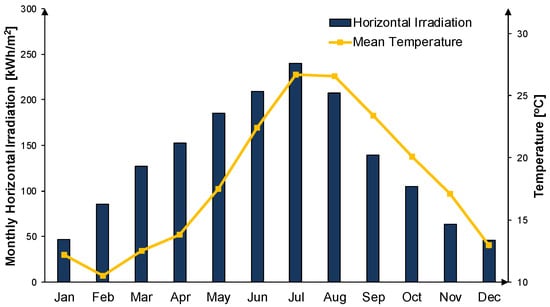
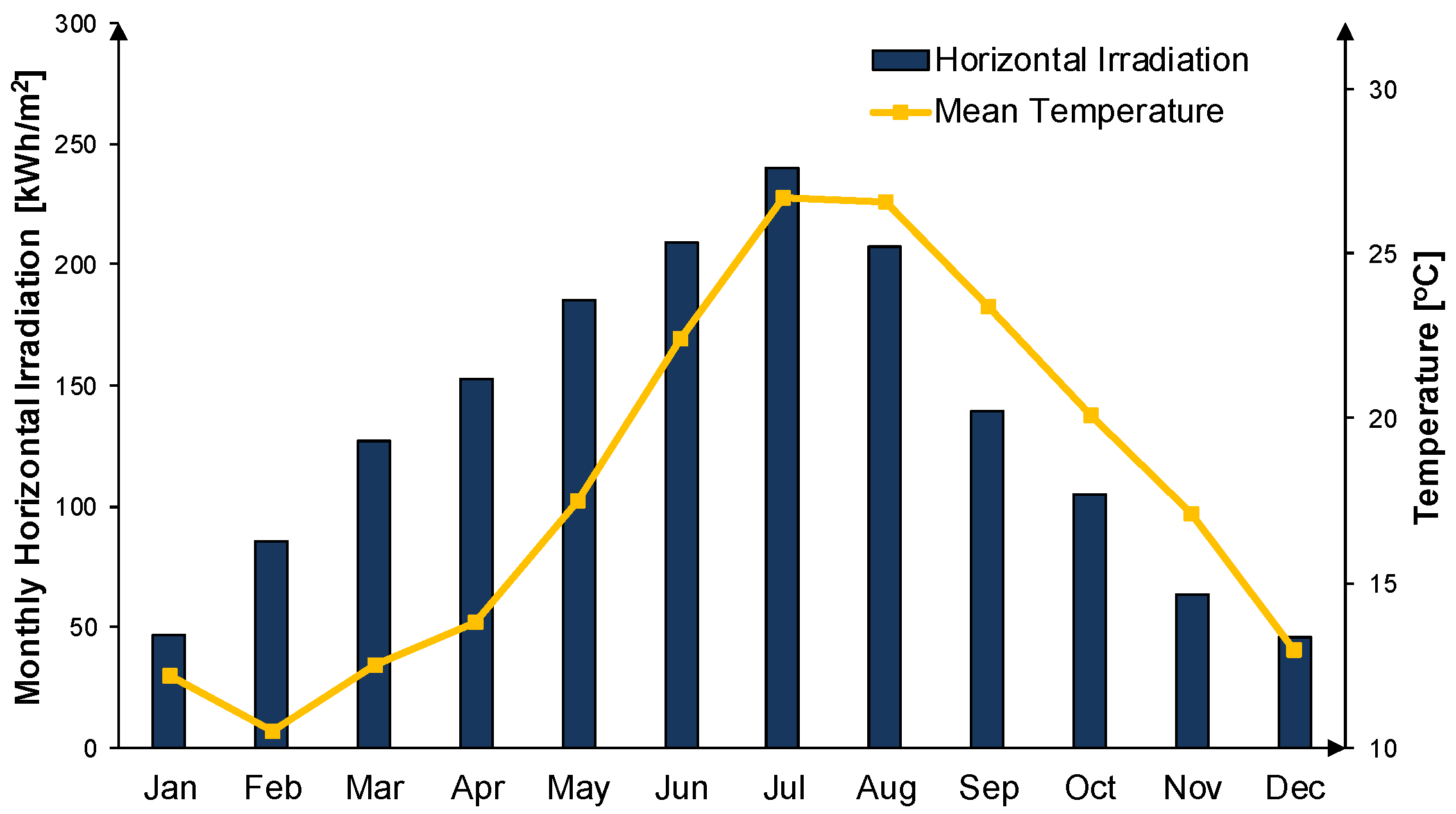
Based on data from the Photovoltaic Geographical Information System (PVGIS), the site exhibits strong solar potential, receiving a mean annual global horizontal irradiation (GHI) of approximately 134 kWh/m2, equivalent to an annual total of around 1600 kWh/m2 [27]. This high level of solar irradiation indicates that solar energy can serve as a primary contributor to the system’s hybrid energy configuration. Monthly data representing the region are presented in Figure 1.
Figure 1.
Monthly solar horizontal irradiation and mean ambient temperature at the site, derived from PVGIS data for the year 2024.
In addition to the significant solar energy potential, the system utilizes locally sourced biomass resources, obtained through sustainable forest management and agricultural pruning activities. Locally sourced biomass, obtained through forest maintenance and agricultural pruning, is processed on-site for the gasification-based CHP system. Operational data from actual records indicate an average annual consumption of approximately 350 metric tons of wood chips. Once gasified, this biomass produces an estimated 2000 MWh/year of electrical output and CHP efficiency (around 35% electrical efficiency and up to 70% overall CHP efficiency). The produced syngas is then combusted in the CHP unit to generate electricity and recoverable heat. This integrated system supports critical energy demands, including space heating, hot water supply and electricity needs, especially during periods of low solar availability. Overall, the synergy between the coupled biomass gasification/CHP operation and the solar PV not only strengthens energy autonomy and resilience but also enables higher renewable energy penetration and a substantial reduction in diesel generator runtime. However, to decarbonize the off-grid energy system and ensure energy autonomy, solely renewable energy generation is not sufficient. Energy storage systems are required to fully utilize the generated renewable energy without curtailments as well as allow for operational autonomy and resilience in case of high impact/low probability events
2.2. Energy Storage (Batteries)
A lithium-ion Battery Energy Storage System (BESS) is deployed on-site as the primary short-term flexibility asset, enabling the microgrid to absorb PV variability and shift solar generation from midday hours to evening and night-time demand. In the current configuration, the installed battery bank has a combined nominal capacity of 3255 kWh, corresponding to approximately 2604 kWh usable energy under the adopted maximum operational limits. It is also interfaced with the microgrid through bidirectional power electronics to provide fast frequency/voltage support, ramp-rate control and peak shaving.
Operationally, the BESS provides intra-day balancing, absorbing PV variability and shifting generation to evening peaks. However, despite its high round-trip efficiency and rapid response, battery storage remains constrained by energy capacity and economics when extended autonomy is required (multi-day or seasonal). As a result, during high solar months the battery frequently reaches high state-of-charge, after which additional PV generation is curtailed once instantaneous demand and charging limits are satisfied. The above limitations are amplified under the projected load growth driven by heat-pump electrification and EV charging. While scaling BESS capacity can further mitigate short-term mismatches and reduce curtailment, large battery-only designs become progressively less cost-effective for covering prolonged renewable deficits and seasonal demand-supply mismatches. Therefore, in this work batteries are treated as the daily cycling storage layer, sized to manage diurnal variability and operational transients, while long-duration balancing (when required) is addressed through complementary storage pathways in the hydrogen-enabled configurations.
2.3. Hydrogen Integration Options and Configurations
The baseline energy system is a hybrid off-grid configuration comprising photovoltaic panels, battery storage, a biomass gasifier CHP unit and diesel generators. Despite the hybrid setup taking into account different forms of power generation and storage, the system remains heavily reliant on diesel fuel, which introduces logistical challenges due to the remote location and results in considerable operational costs and environmental impact. Furthermore, during the occurrence of high-impact/low-probability events causing price spikes or supply disruptions, the community will remain strongly dependent on the price of diesel. Furthermore, this configuration currently serves the electrical and thermal needs of the community, but will face increasing demands from operational electrification, electric vehicle integration and renewable energy expansion objectives. The actual operating data of the off-grid system revealed several key limitations:
- Annual diesel consumption exceeding 188,000 L;
- High solar production periods resulting in battery saturation and renewable energy curtailment;
- Biomass CHP provides base-load support but is constrained by feedstock availability and seasonality.
To address these challenges and maximize renewable energy utilization, two integration options/cases were systematically analyzed:
Battery- and Biomass-enhanced configuration (PV/BAT/BIO): This configuration emphasizes short-term storage expansion through increased battery capacity and integration of biomass CHP while preserving the existing system architecture. The approach includes:
- Expanded BESS capacity to capture additional daily PV surplus;
- Addition of biomass CHP dispatch capability for improved load following;
- Focus on immediate storage constraints with relatively lower capital requirements.
Hydrogen-enhanced configuration (PV/BAT/BIO/H2): This configuration incorporates hydrogen as complementary long-duration storage alongside short-term battery storage, with the objective of achieving near-complete diesel displacement. Major system components include:
- Alkaline electrolyzer to utilize excess PV generation;
- Proton Exchange Membrane (PEM) fuel cells for periods of low solar availability and peak demand;
- Hydrogen storage capacity serving as seasonal energy buffer;
- Optimized BESS capacity, with hydrogen managing baseload variability;
- Expansion of PV capacity.
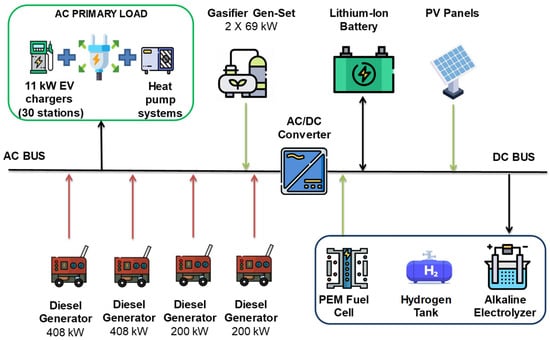
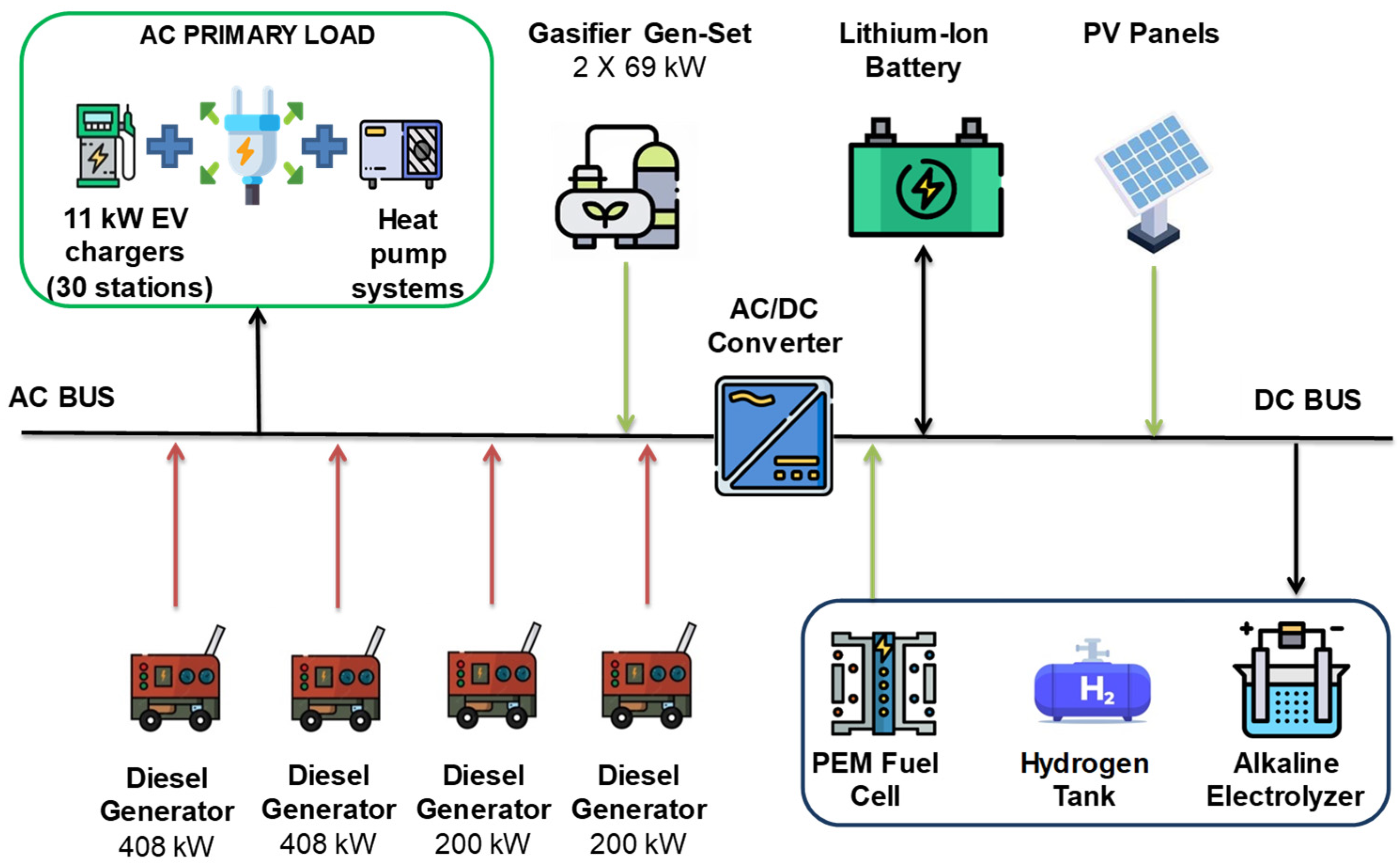
Both integration options directly address the system’s primary limitations of storage saturation, diesel dependence and seasonal generation variability while ensuring compatibility with existing infrastructure. The monastery envisions that the hydrogen subsystem will act as a seasonal energy buffer, storing excess solar energy produced during summer months and making it available during periods of low solar generation. This is seen as essential to achieve year-round renewable energy autonomy and minimize diesel-based generation. The schematic representation of the proposed hybrid energy storage system configuration is shown in Figure 2.
Figure 2.
A schematic representation of the proposed hybrid energy system configuration (PV/BAT/BIO/H2).
2.4. Load Profile
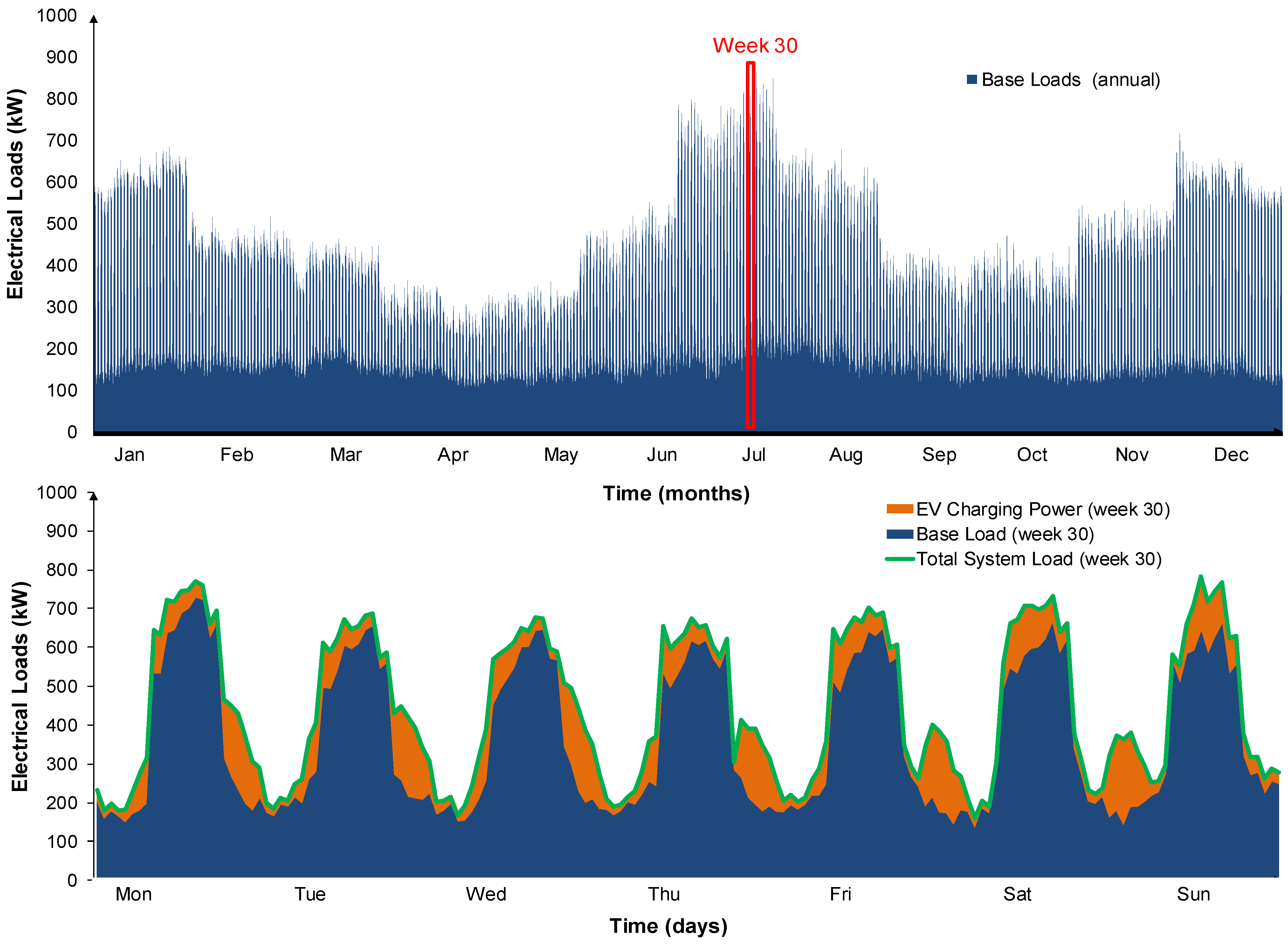
The hybrid system’s electrical and thermal loads are diverse and continue to evolve due to ongoing electrification and modernization efforts. The current demand profile is driven by baseloads such as lighting, kitchen and food preparation equipment, water pumping and treatment systems as well as other essential services that support daily operation. These base electrical loads represent a substantial share of the total annual consumption, with average daily demands of approximately 5750 kWh/day in 2024 and peak power exceeding 600 kW during high-activity periods.
Beyond these base demands, there is an increasing contribution from space heating and cooling, which are progressively being covered using electricity. The recent adoption of electric heat pumps has improved thermal comfort while reducing direct reliance on fossil-fuel-based heating and cooling, but it has also raised electricity consumption during both summer and winter, accentuating seasonal variability in the load profile. In parallel, further electrification is being pursued for workshops, food storage areas and additional communal facilities. However, a key component of the future load profile is the integration of electric vehicle charging infrastructure. The gradual introduction of 50 EVs is expected to add about 2200 kWh/day of electricity demand, underscoring the need for higher renewable generation capacity and adequately sized storage systems to maintain reliable and sustainable operation. Table 1 presents the key parameters of the EV fleet charging profile, including charger specifications, power requirements and scheduling windows designed to align with renewable generation peaks.
Table 1.
EV fleet charging parameters and expected daily load profile [28,29].
The EV charging infrastructure is strategically scheduled across two primary windows: noon/afternoon to coincide with solar generation peaks and battery discharge cycles, and overnight off-peak periods to distribute microgrid stress. This approach results in an average charging power of 30.3 kW that can be satisfied by renewable sources and storage, while peak charging power requirements (350 kW) necessitate coordinated dispatch with other system loads.
Hydrogen production constitutes another key element of the hybrid energy system through the operation of the electrolyzer during periods of renewable energy surplus. The electrolyzer functions as a controllable load that converts excess electricity into hydrogen for storage and subsequent utilization, thereby maximizing renewable source utilization by exploiting otherwise curtailed energy.
To systematically present and analyze these demand trends, the hybrid system’s energy demands are categorized into four main groups:
- Base electrical loads (essential lighting, appliances, communal services, workshops, water systems);
- Heating/cooling loads (primarily electric heat pumps, driven by seasonal variations);
- EV charging loads (additional demand from transport electrification);
- Hydrogen production load (variable, dependent on excess renewable generation and system dispatch strategy).
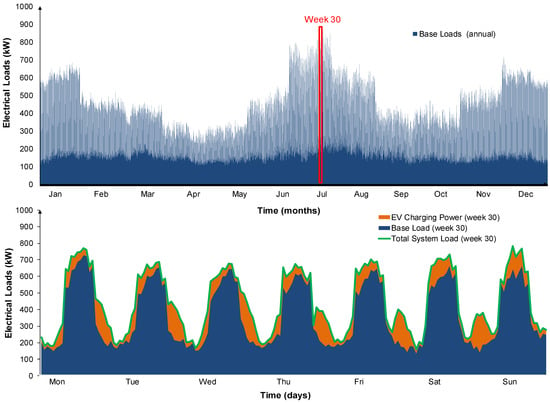
Figure 3 illustrates the annual load curve combining base electrical loads and heating/cooling loads (expressed as electrical consumption). The EV charging and hydrogen production loads represent strategic energy system expansions that are analyzed separately to clearly demonstrate their impact and integration potential. These additional loads are examined in detail to assess their accommodation within current infrastructure constraints, providing critical insights into the system’s flexibility and capacity to support growing electrification needs while maintaining reliability and minimizing fossil fuel dependence.
Figure 3.
(Top) The total electrical load profile of the site throughout the year, comprising microgrid operations, heating and cooling requirements as measured via the SCADA system of the community. (Bottom) A detailed view of Week 30 (July) showing the baseline load curve with superimposed EV charging load profile (orange) and the total served system load (green).
3. Modeling and Methodology
The basic modeling parameters, including the economic assumptions, operational constraints, and the specific variables optimized within the HOMER Pro environment, are detailed in Table 2. The simulation was conducted over a 20-year project lifetime using a 1 h time step to capture the intra-day variability of solar irradiance and community demand. Within the optimization search space, the capacities of the diesel generators and the biomass CHP were treated as fixed variables. Conversely, the sizing of the PV array, lithium-ion battery, electrolyzer, hydrogen storage tank, and PEM fuel cell were treated as dynamically optimized variables to minimize the Net Present Cost (NPC) (Section 3.4). The mathematical modeling of each component within this framework is described in the following subsections.
Table 2.
Overview of simulation parameters and optimization assumptions.
3.1. System Components and Modeling Approach
3.1.1. Solar Photovoltaic Panels
The power output of the site’s PV array is modeled based on the location-specific global solar irradiance and system derating factors, as follows:
where is the derating factor; is the nominal PV capacity (kW); is the solar irradiance at time (kW·m−2), and is the standard test condition irradiance (1 kW/m2).
3.1.2. Diesel Generator Fuel Consumption
To accurately capture the logistical costs of backup power, the diesel generator’s fuel consumption is modeled as a linear function of its rated capacity and instantaneous electrical output:
where is the fuel curve coefficients, is the generator rated capacity (kW), and is the generator output power at time (kW).
3.1.3. Electrolyzer Hydrogen Production
The hydrogen production flow is approximated as a polynomial function of load:
where is the empirical coefficients representing efficiency and depend on electrolyzer efficiency characteristics, and is the input electrical power to the electrolyzer at time (kW).
3.1.4. Hydrogen Storage Dynamics
Storage dynamics are modeled by accounting for production minus consumption:
where is the electrolyzer efficiency, is the lower heating value of hydrogen (33.33 kWh·kg−1), is the fuel cell efficiency, is the fuel cell power output at time (kW), and is the mass of stored hydrogen at time (kg).
3.1.5. Fuel Cell Output Constraint
The fuel cell’s is modeled as a generic power generator. Its electrical output is bounded by the hydrogen consumption:
where is the hydrogen mass flow rate consumed by the fuel cell (kg·s−1).
3.1.6. Battery State of Charge (SOC)
The dynamic state of charge of the lithium-ion battery bank is continuously updated based on the net energy balance, respecting the specific charging and discharging efficiencies of the installed power electronics:
where is the battery charging efficiency, is the battery discharging efficiency, is the charging power at time (kW), is the discharging power at time (kW), is the battery capacity (kWh), and is the state of charge at time (%).
3.1.7. CHP System Electrical Output (From Biomass Gasification)
The electrical output of the biomass gasification CHP units is directly constrained by the available fuel input and the specific electrical efficiency of the generators:
where is the electrical efficiency of the CHP system, and is the fuel input power to the CHP system (kW).
3.2. Energy Management Strategy (EMS)
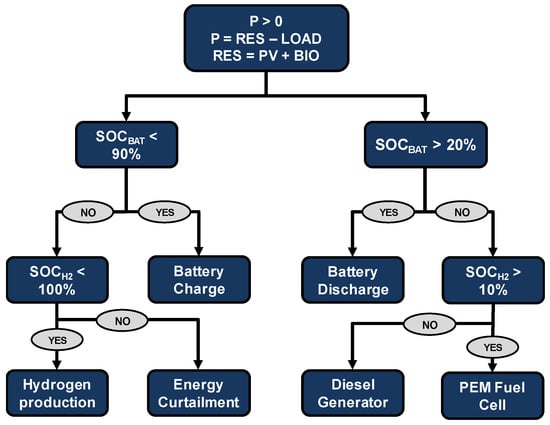
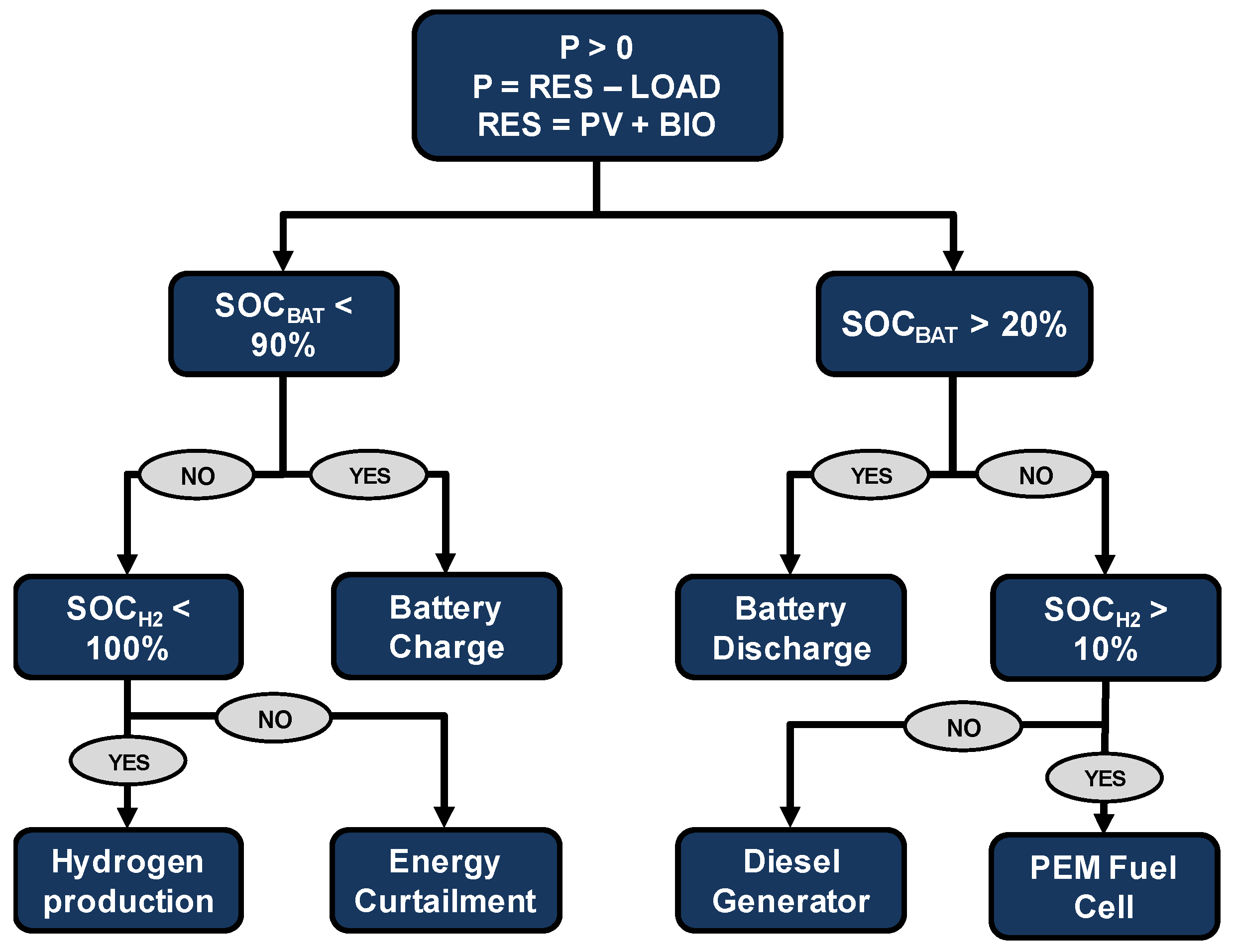
The operation of the hybrid system is governed by a rule-based energy management strategy that dispatches generation and storage assets at each simulation time step based on the instantaneous power balance between renewable production and demand (Figure 4).
Figure 4.
Energy management strategy for the hybrid system, illustrating the decision-making hierarchy for dispatching PV, biomass CHP, battery storage, hydrogen fuel cell and diesel generation.
It is important to clarify that the rule-based EMS scheme presented in Figure 4 represents the exact control logic directly implemented into the HOMER Pro simulations. To enforce this specific operational hierarchy (PV + Biomass > Battery > Hydrogen > Diesel) and the strict state of charge safeguards, a custom dispatch strategy was integrated into the optimization environment. The HOMER Pro algorithm was restricted to evaluate the NPC of various component sizes strictly under the condition that the energy flow at each 1 h time step obeyed the EMS flowchart constraints.
The key decision variable is defined as , where the renewable supply RES comprises the PV array and the biomass gasifier CHP (i.e., RES = PV + BIO). A positive value of P denotes renewable surplus, while a negative value denotes a renewable deficit. The EMS aims to (i) maximize direct renewable utilization, (ii) use batteries for short-term balancing while respecting state-of-charge (SOC) limits, (iii) allocate hydrogen to long-duration buffering and (iv) minimize diesel generator operation, which is retained only as a last-resort reliability layer.
When renewable output exceeds demand, the EMS first attempts to store energy in the BESS, prioritizing high round-trip efficiency and fast response. As illustrated in Figure 4, if the battery is below an upper SOC threshold (set to <90%), the surplus power is directed to battery charging. This limit prevents prolonged operation at very high SOC and preserves headroom for PV ramp events. If the battery is not eligible for further charging (i.e., ≥90%), the EMS then checks the hydrogen storage state. If the hydrogen tank is not full (SOCH2 < 100%), the surplus electricity is diverted to hydrogen production via the alkaline electrolyzer. Finally, if both storage pathways are saturated (battery near its upper bound and hydrogen tank full), the remaining surplus is assigned to energy curtailment, representing unavoidable renewable spillage under physical and operational constraints.
When renewables are insufficient to meet demand, the EMS follows the opposite hierarchy to preserve reliability while minimizing fuel use. The first action is to utilize the BESS as the primary balancing resource, provided that a minimum SOC reserve is maintained. As shown in Figure 4, if the state of charge of the battery is higher than 20%, the battery supplies the deficit through battery discharging, covering short-duration gaps and peak loads. If the battery reaches its lower operational bound (≤20%), the EMS next evaluates hydrogen availability. When the hydrogen storage exceeds the minimum reserve threshold (>10%), the deficit is supplied by hydrogen consumption through the PEM fuel cell, which enables multi-hour to multi-day support during extended low-PV periods. If hydrogen is also below its minimum reserve (≤10%), the diesel generator is dispatched to meet the remaining demand and maintain uninterrupted supply. Overall, the logic in Figure 4 implements a clear operational hierarchy (PV/Biomass, battery, hydrogen, diesel) while embedding SOC-based safeguards (upper/lower battery thresholds and minimum hydrogen reserve) that reduce cycling stress, prevent deep discharge and ensure the system retains adequate resilience against prolonged renewable deficits.
3.3. Problem Formulation and Constraints
3.3.1. Net Present Cost (NPC) Calculation
In this analysis, the Total Net Present Cost represents the life-cycle cost of the system, i.e., the present value of all expenditures minus any revenues over the project lifetime (which is not relevant in this case) [13]. This includes the upfront capital costs, component replacement costs, operation and maintenance (O&M) costs and fuel costs, summed over the lifespan and discounted to present value. Any income or residual value is deducted, notably the salvage value (scrap value) of components at end-of-life. Mathematically, NPC can be obtained by summing all annual cash flows discounted to year 0 or, equivalently, by dividing the total annualized cost Cann by the capital recovery factor (CRF) for the project’s real discount rate i and lifetime n:
where is the total annualized cost (the sum of annualized capital, replacement and O&M costs). This formulation captures all capital and operating expenses (minus salvage) in present-value terms using the minimal NPC as the criterion for the optimal configuration.
3.3.2. Levelized Cost of Energy (LCOE)
The Levelized Cost of Energy is considered as the average cost per unit of useful electricity generated [13]. In practice, it is computed by taking the total annualized cost of the system and dividing by the total electricity load served per year:
where is the total electrical energy served to the loads annually (in kWh/yr). This yields a normalized cost in €/kWh that accounts for all lifecycle costs. The methodology uses LCOE (along with NPC) to rank system designs by economic performance. For instance, if a hybrid system’s NPC is minimized, the corresponding LCOE indicates the cost-effectiveness per kWh of meeting the demand.
The simulation environment considers various technical constraints to ensure feasibility and realistic operation of hybrid renewable energy systems. Key constraints (enforced as equations/inequalities in mathematical formulations) include the following.
3.3.3. State-of-Charge Constraints
The battery bank’s SOC is bounded between a minimum/maximum to prevent over-discharge or over-charge. At any time t, , with the inequalities ensuring the SOC both for the battery and hydrogen tank stay within [, ] for each storage device [13]. The Battery SOC is updated each time-step based on the charge/discharge power:
accounting for charging efficiency , discharging efficiency and battery capacity . This ensures energy balance in the battery when charging increases the stored energy and discharging depletes it, within the permissible SOC range.
For hybrid systems with power-to-hydrogen storage, similar constraints apply to the hydrogen tank level (state of hydrogen). The stored hydrogen (in kg or equivalent kWh) cannot exceed the tank capacity or drop below zero. The electrolyzer (which converts surplus power to hydrogen) and the fuel cell that converts H2 to power are typically not allowed to operate simultaneously at full capacity. In fact, the electrolyzer input is treated as the “charging” power and the fuel cell’s output as the “discharging” power of the hydrogen storage system, with a single state-of-charge variable for hydrogen storage. The constraint can be written such that if electrolyzer power (charging hydrogen), then fuel cell output ; conversely if , then , avoiding simultaneous charge/discharge. Moreover, their output is limited by their rated capacities: . The hydrogen tank SOC (fractional fill level) evolves with production/consumption similar to the battery equation above, using electrolyzer efficiency and fuel cell efficiency . These equations ensure the electrolyzer and fuel cell respect efficiency losses and capacity limits.
3.3.4. Biomass Fuel Availability
Τhe output of the biomass CHP system is constrained by the availability of biomass feedstock, requiring the specification of the maximum biomass consumption rate or an annual fuel resource limit. In particular, an available biomass supply of about 1.4 t/d for a gasifier-based generator is considered, which effectively caps the fuel input and hence the generator’s maximum continuous power output. In that study, a formula links the biomass feed rate (kg/h) to generator power, given conversion efficiency and fuel heating value [6]. This means the generator cannot exceed the power that corresponds to consuming 1.4 tons/day of biomass (approximately 58.3 kg/h), which is a resource-based constraint. More generally, if is the biomass available (e.g., in kg/day) and is the fuel usage at time , the model imposes (over any relevant period) or simply if expressed as an hourly limit.
3.3.5. Energy Balance Constraints and Simulation Targets
A fundamental constraint is that power supply must meet demand at each time step, following equation:
where the generators sum covers all power generation sources (PV, diesel, biomass and H2) and terms for battery charge/discharge whereas any shed load, battery charging or curtailed excess are included in the right side of Equation (11). HOMER’s off-grid formulation ensures that at every hour the generated power (including what can be drawn from storage and the electrolyzer) balances the required load; otherwise, unmet load or excess energy is accounted, which was also shown for similar systems in previous works [6].
Each of the above constraints is typically integrated into the simulation or any equivalent optimization model to ensure that the proposed hybrid system operates within realistic physical limits and resource availabilities. Imposing SOC limits, generation capacity limits, fuel availability and load matching results in close emulation of real-world operational feasibility. Overall, the hybrid system is modeled to optimize the share of renewable generation while maintaining system autonomy. Photovoltaic panels supply the base load during daytime, while batteries and a biomass CHP unit provide backup during low irradiance periods. A diesel generator is retained for emergency coverage. The optimization procedure implemented in HOMER Pro minimizes the total net present cost, taking into account capital and operational expenditures, as well as fuel costs by evaluating different sizes and configurations that could ensure the lowest-cost feasible system under the defined constraints.
3.4. Case Studies
In this work, the main option considered for the baseline configurations is based on the existing PV capacity with a battery for energy storage and biomass CHP (PV/BAT/BIO), whereas a simplified option without biomass CHP was considered for comparison purposes (PV/BAT). Furthermore, the integration of hydrogen was investigated, taking into account the increased load demands of the community as well as potential expansion of existing infrastructures (after the optimization procedure described in Section 3.3). In all cases, the size of the biomass CHP unit is not a subject of optimization due to the restricted biomass feedstock potential of the community. Overall, these configurations are:
- Baseline configuration (PV/BAT): Current configuration with PV, battery, diesel generator and base loads (>600 kWp 5750 kWh/day);
- Integration Option 1 (PV/BAT/BIO): Baseline with the addition of biomass CHP and increased loads (Table 3).
Table 3.
Baseline configuration of the hybrid energy system, including PV, battery storage, biomass CHP and diesel generation parameters (PV/BAT/BIO case).
- Integration Option 2 (PV/BAT/BIO/H2): Baseline with the addition of the electrolyzer, hydrogen storage and fuel cell and with the same increased loads as option 1. Battery and hydrogen storage sized to achieve renewable energy penetration equal to 90%, 95% and 99% (Table 4).
Table 4.
Hydrogen-enhanced configuration of the off-grid hybrid energy system, including PV expansion, enhanced battery storage, alkaline electrolyzer, hydrogen storage and hydrogen PEM fuel cell, supporting electrification (including EV charging) for near-autonomous renewable operation.
These load increases reflect realistic expansion scenarios. Results compare technical performance and economics across options, using the sourced Capital Expenditures (CAPEX)/Operational Expenditures (OPEX) data that are presented in Table 5.
Table 5.
CAPEX and OPEX metrics for key microgrid components (data reflects utility scale, OPEX excludes fuel based on 2024–2025 data).
4. Results
This section presents the results that focus on the performance of the examined hybrid off-grid energy system under the different configuration scenarios presented in Section 3.4. The scope is to discuss the techno-economic and operational Key Performance Indicators (KPIs), highlighting the impacts of battery and hydrogen-enhanced configurations on renewable energy penetration, diesel consumption, storage utilization and overall system costs. Table 6 presents the optimal component capacities resulting from Homer Pro simulations across all integration options. These capacities reflect minimum NPC solutions under REP constraints, balancing CAPEX scaling with operational efficiency gains.
Table 6.
Key component resulting sizes for each system configuration.
Starting from the current PV/BAT baseline, the system amounts to 1670 kW PV and 3255 kWh BESS, adding the 138 kW biomass CHP for the PV/BAT/BIO case that complements the existing configuration. Following the modeling and optimization procedure described in Section 3, the hydrogen-enabled configurations (PV/BAT/BIO/H2) require progressively larger capacities as the REP target tightens and the loads are increased. For REP = 90%, PV increases to 2500 kW while batteries remain at 3255 kWh and the hydrogen subsystem is sized at 1000 kW electrolyzer, 500 kg H2 storage and 400 kW PEM fuel cell. For REP = 95%, PV further rises to 3000 kW and the BESS expands to 5400 kWh, while the electrolyzer stays at 1000 kW and hydrogen storage increases to 800 kg (fuel cell remains 400 kW). Finally, achieving REP = 99% requires a step-change in renewable oversizing and buffering capacity: PV reaches 4500 kW, BESS expands to 7350 kWh and the hydrogen chain scales to 1500 kW electrolyzer with 1000 kg storage, while the fuel cell remains 400 kW. In all three REP cases, the PEM fuel cell capacity converges to 400 kW, indicating that the fuel cell is primarily power-sized to cover similar peak deficit events across the examined scenarios rather than to increase annual energy throughput. Since the magnitude of the critical load peaks and the maximum renewable shortfall periods remain comparable, additional fuel cell capacity would be underutilized and would not further reduce diesel operation, which is already limited by hydrogen availability and overall system energy balance. Therefore, once the 400 kW unit can meet the required peak support, further upsizing offers marginal operational benefit while increasing CAPEX, making it non-optimal for the investigated system. Overall, Table 6 indicates that higher REP targets are met by (i) substantial PV expansion to create sufficient surplus energy, (ii) moderate-to-large battery expansion to manage diurnal cycling and (iii) increasing hydrogen production/storage capacity to cover extended deficits.
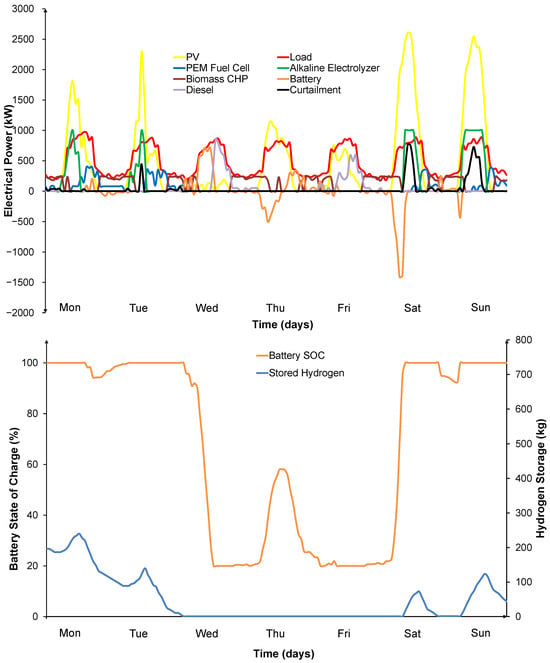
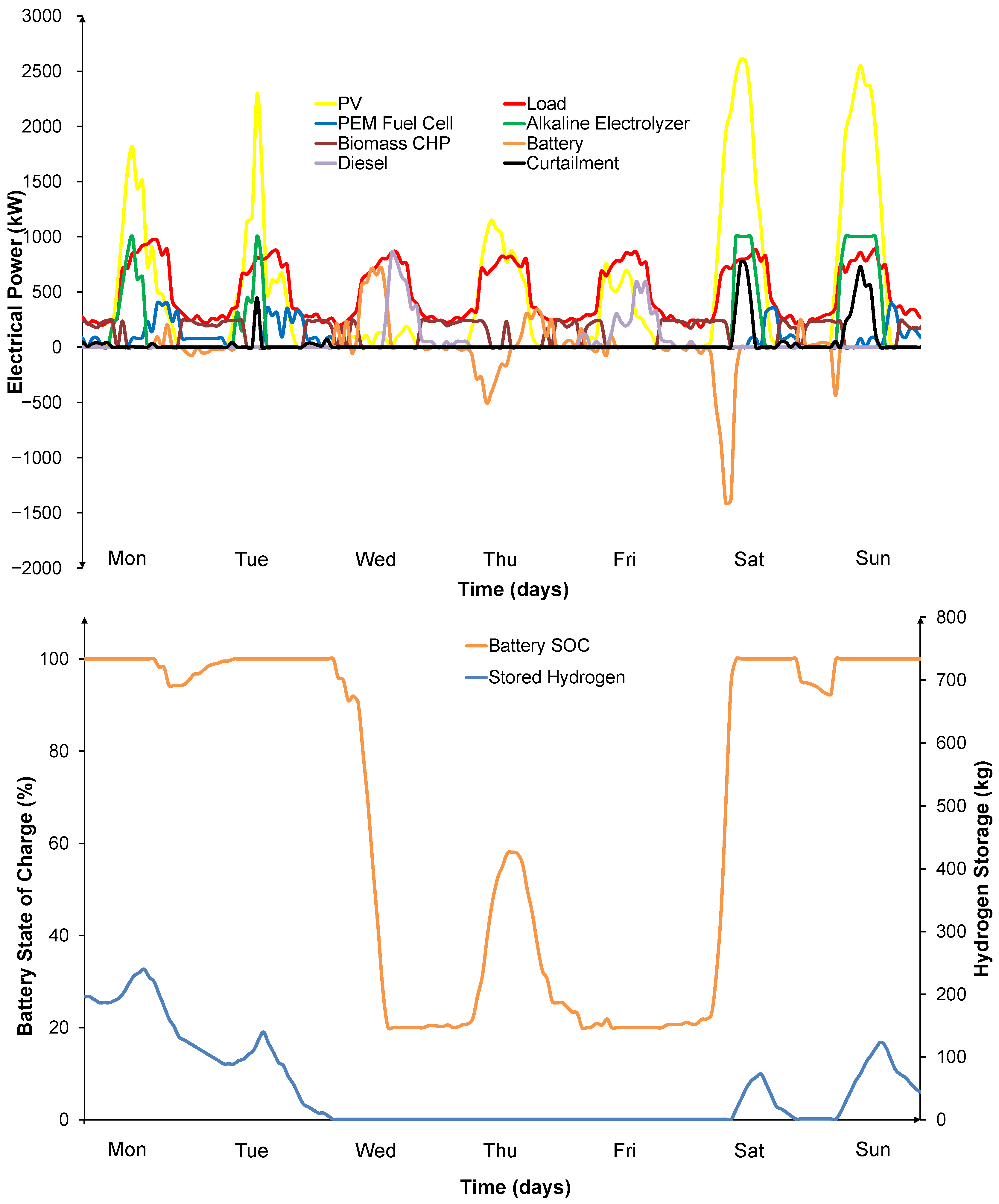
To understand the dynamics of the energy flows, Figure 5 (top) illustrates the annual power distribution across subsystems for PV/BAT/BIO/H2 at 90% REP, showing the relative contributions of PV generation, battery cycling, biomass CHP baseload, hydrogen components and residual diesel operation. The illustrated period is week 30 in July, an indicative high-demand, high-production week in summer. During daytime hours, PV covers the largest share of the load and simultaneously charges the BESS; once the battery approaches its upper SOC limit, additional PV surplus is redirected to the electrolyzer, resulting in hydrogen production that would otherwise be curtailed. In the evening and night, as PV output declines, the BESS supplies the short-term deficit through discharge, while the biomass CHP provides a steady dispatchable contribution that reduces the magnitude and duration of storage discharge. Fuel-cell operation appears mainly when battery SOC approaches its lower limit or when longer deficit intervals occur, demonstrating hydrogen’s function as a longer-duration buffer rather than a primary daily cycling asset. Furthermore, it is observed that on Wednesday when PV output was low, the biomass CHP and the battery provided the required load, whereas the diesel generators were operated when the energy management strategy permitted. Overall, the figure visually confirms the intended dispatch hierarchy (PV → Biomass → Battery → Hydrogen → Diesel), with diesel confined to brief residual coverage events under tight constraints.
Figure 5.
(Top) Hourly energy distribution between system components for a representative week in July (Week 30), showing PV generation, biomass CHP, battery discharge/charge, fuel cell and diesel generator contributions to meeting electrical demand. (Bottom) Storage components state-of-charge evolution for the same period.
Figure 5 (bottom) shows the evolution of the storage components (battery, hydrogen) throughout the same week. The battery SOC exhibits pronounced diurnal cycling, charging during PV-rich midday periods and discharging during evening peaks, consistent with its role in intra-day balancing. In contrast, hydrogen storage changes more gradually, with net accumulation during sustained surplus periods and limited drawdown during extended deficits, reflecting its suitability for multi-day or seasonal balancing. Together, the two trajectories emphasize the complementarity of BESS and hydrogen: batteries stabilize fast dynamics and daily variability, while hydrogen provides resilience against longer renewable gaps and supports high renewable penetration under increased demand.
Table 7 provides a concise overview of how the system transitions from a diesel-supported, PV–battery microgrid to a high-REP hybrid architecture highlighting the central trade-off between renewable autonomy and capital-intensive storage/overcapacity.
Table 7.
Key performance indicators for each system configuration.
Starting from the baseline PV/BAT, the system reaches 77.9% REP with 136,663 L/y diesel and 357,454 kg/y CO2 emissions. Moving to PV/BAT/BIO, REP improves only marginally to 80.1%, while diesel consumption rises to 187,056 L/y along with CO2 emissions (489,261 kg/y). This increase is consistent with the fact that the PV/BAT/BIO cases are evaluated under the expanded/electrified load assumptions, meaning that, despite the addition of dispatchable biomass, the system still requires substantial diesel for adequacy during extended deficits. It is critical to note that direct comparison of absolute emissions across these scenarios is misleading due to a 52% increase in total energy demand. When evaluating specific normalized metrics (Table 7), the transition from the baseline to the PV/BAT/BIO results in a reduction in carbon intensity from 170.3 to 152.8 kg/MWhload. At the same time, the LCOE decreases to 0.161 €/kWh, suggesting that locally sourced, biomass helps supply a portion of energy at a lower lifecycle cost than diesel-driven operation in the expanded-load context.
The hydrogen-enabled pathway (PV/BAT/BIO/H2) shows the clearest performance gains and also the internal scaling trend with REP targets. As the REP constraint tightens (from 90 to 99%) diesel use drops sharply from 103,540 L/y to 58,698 L/y and 12,119 L/y, i.e., a 93.5% reduction at the highest-REP case relative to PV/BAT/BIO. CO2 emissions follow the same trajectory, falling from 270,818 kg/y at 90% REP to 31,697 kg/y at 99% REP (approximately 93.5% lower than PV/BAT/BIO), corresponding to a drop in specific CO2 emissions from 84.6 to just 9.9 kg/MWhload. This confirms that hydrogen infrastructure primarily acts as the “last-mile” enabler for deep diesel displacement by providing long-duration coverage when PV/battery/biomass cannot sustain the load.
A key outcome is the behavior of energy curtailment, which increases markedly as REP approaches unity: from 366,859 kWh/y (REP 90%) to 1,355,372 kWh/y (REP 95%) and 2,861,990 kWh/y (REP 99%). Rather than indicating poorer design, this reflects the need to oversize PV and conversion pathways to eliminate rare but critical deficit periods in an off-grid system; once those deficits are covered, the system inevitably produces surplus energy during high-resource periods that cannot always be fully absorbed (even with batteries and electrolysis constrained by component ratings). In other words, very high REP is achieved partly through redundancy and surplus generation, with curtailment becoming the cost of near-autonomous operation. In this case, advanced management and control techniques such as forecast-based and optimized energy management strategies [31,32], smart charging and vehicle-to-grid systems [33,34] as well as multi-energy co-optimization [35,36] can be explored in future works to further utilize this surplus energy.
Operationally, Table 7 also shows how hydrogen reduces stress on the battery. Battery cycling (EFC/year) declines from 155/year in PV/BAT/BIO to 70.2/year (REP 90%), 38.5/year (REP 95%) and 15.5/year (REP 99%); a 90% reduction in cycling intensity at the highest REP case. This supports the intended multi-timescale storage role allocation: BESS handles fast/diurnal balancing, while hydrogen absorbs longer deficits, reducing deep cycling and potentially extending battery lifetime and replacement frequency.
Economically, higher REP comes with higher unit energy cost: LCOE rises from 0.238 €/kWh (REP 90%) to 0.302 €/kWh (REP 99%), reflecting the added CAPEX of PV expansion and the hydrogen chain. Correspondingly, the total net present cost increases from 8.85 M€ at 90% REP to 12.4 M€ at 99% REP. This sharp rise in the 99% scenario demonstrates the exponential cost penalty associated with oversizing generation and storage assets solely to bridge the final few percentage points of seasonal energy deficits, even when accounting for the near-total elimination of diesel fuel purchases.
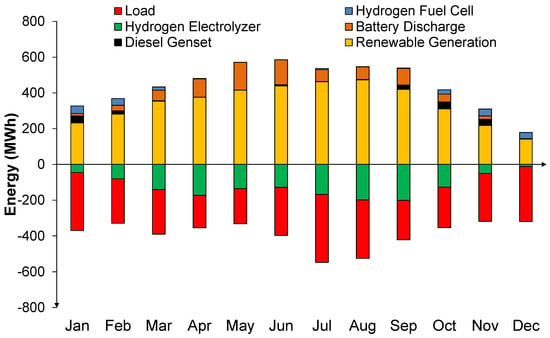
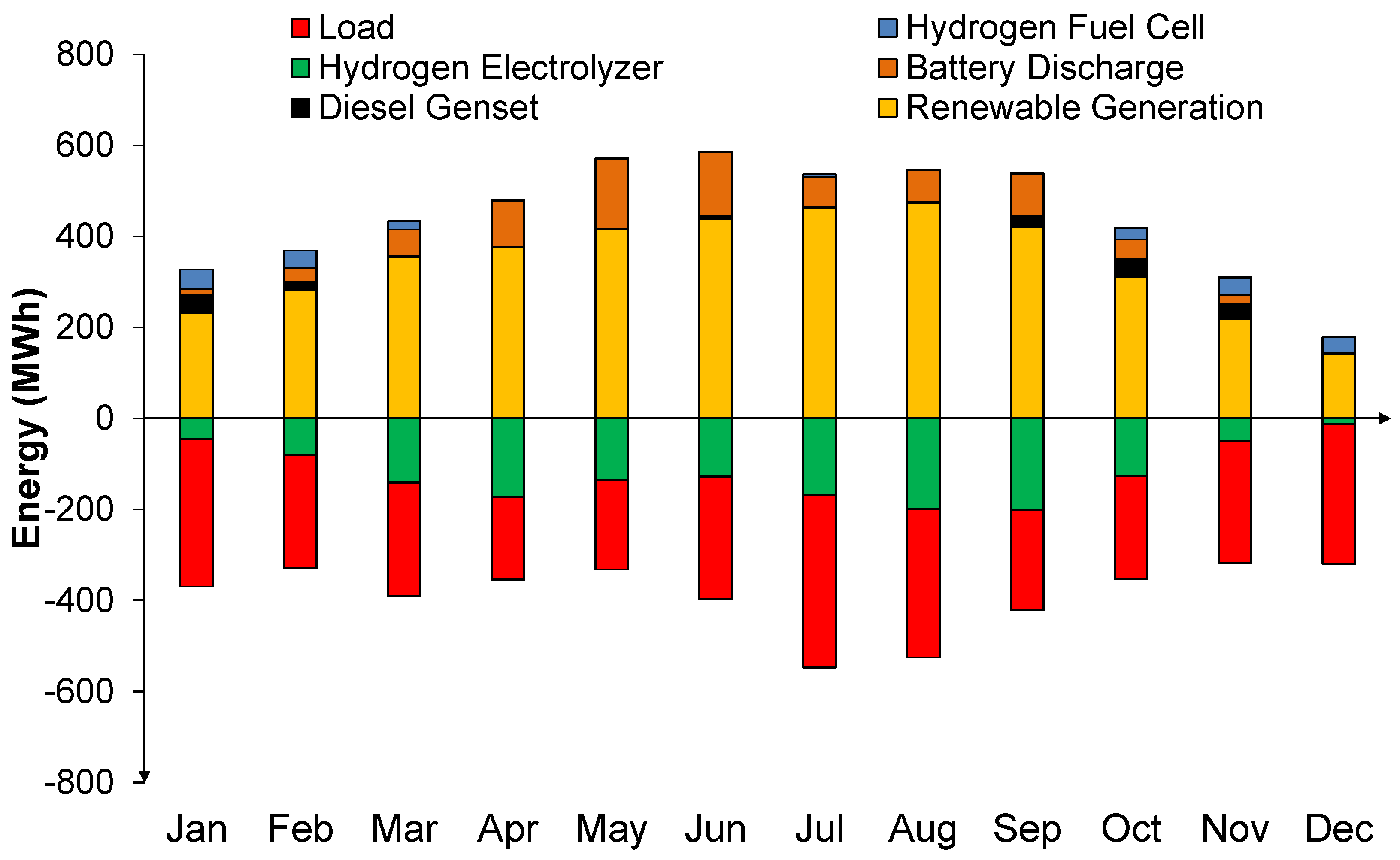
To provide deeper insight into the system’s operational dynamics throughout the year, Figure 6 and Table 8 detail the monthly energy distribution among the microgrid components for the 95% REP scenario. This specific configuration was selected for detailed monthly analysis as it represents a pivotal transition point where the hydrogen pathway and short-term battery storage must work in tandem to minimize reliance on dispatchable generators.
Figure 6.
Monthly energy distribution supplied by system components over a one-year period for the 95% REP scenario.
Table 8.
Key monthly electricity supplied (MWh) by generation and storage sources for the 95% REP scenario.
As shown in the visual distribution (Figure 6) and the exact quantitative outputs (Table 8), direct PV generation and battery discharge dominate the energy supply across the year to handle standard diurnal buffering. However, during seasonal shifts or periods of extended renewable deficits, the PEM fuel cell strategically scales up its power contribution, utilizing the long-duration hydrogen buffer. Consequently, the diesel generators are utilized only sparingly, primarily acting as a final firm backup to maintain the 95% renewable target when both battery and hydrogen reserves are depleted.
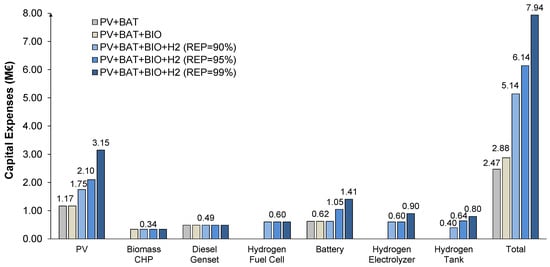
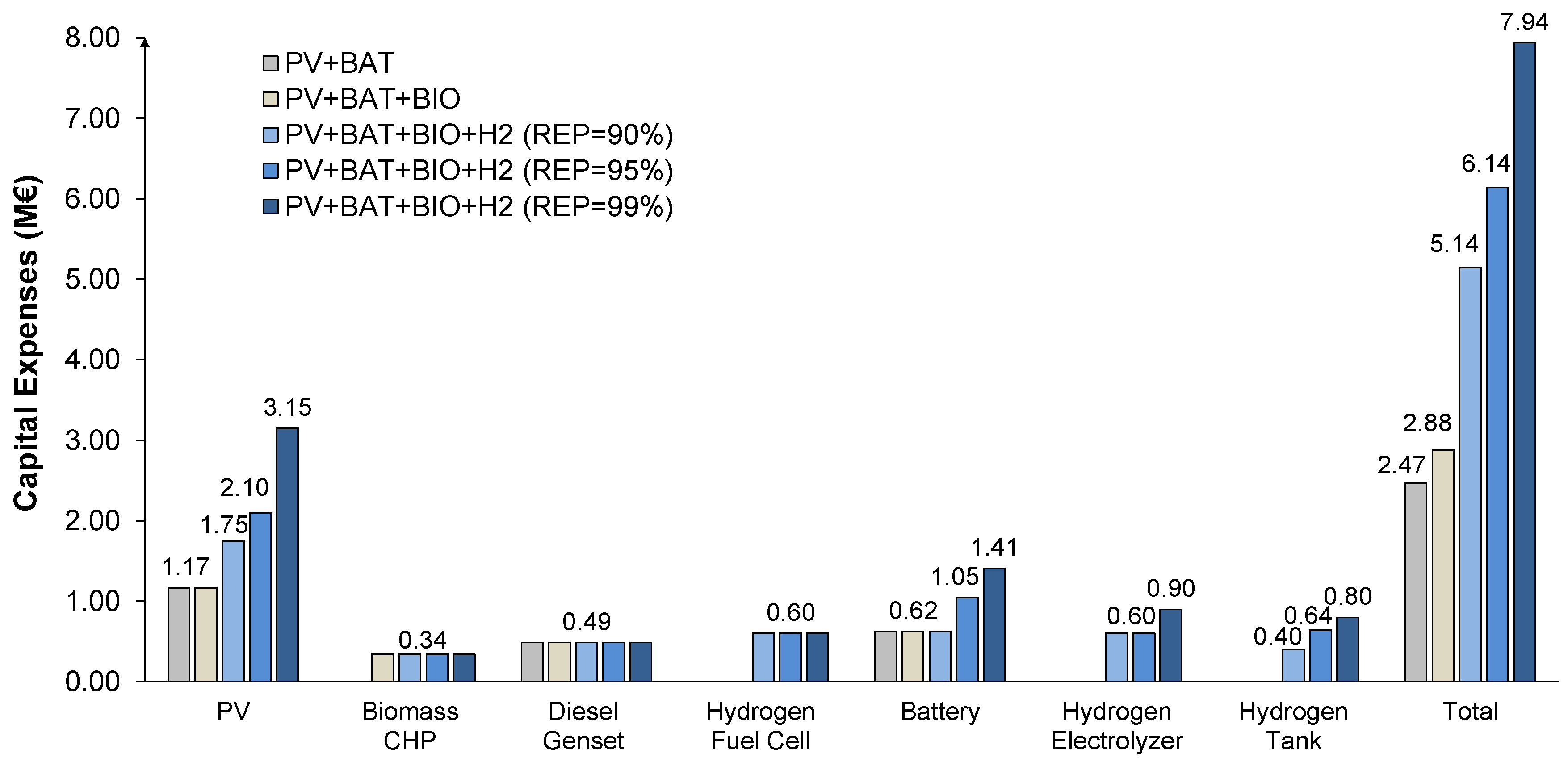
Finally, Figure 7 presents the CAPEX breakdown across the analyzed configurations, illustrating how the investment focus shifts as the system transitions from a PV–battery design to a hydrogen-enabled, near-autonomous architecture. In the baseline PV/BAT case, the investment is concentrated in PV (1.17 M€) and BESS (0.62 M€), with the diesel genset (0.49 M€) retained as an essential reliability asset; together these sum to a total CAPEX of 2.47 M€. Moving to PV/BAT/BIO, total CAPEX increases modestly to 2.88 M€, driven primarily by the addition of the biomass CHP (0.34 M€), while PV, battery and diesel capacities remain broadly unchanged, indicating that biomass is introduced as a dispatchable complement rather than a driver of major re-sizing. It is worth noting that those components are existing and are discussed as reference cases for the costing comparison.
Figure 7.
Capital expenditure breakdown across system configurations.
The introduction of hydrogen (REP90%–REP99%) fundamentally changes the CAPEX structure. At REP = 90%, total CAPEX rises to 5.14 M€, due to the costs associated with the electrolyzer (0.60 M€), fuel cell (0.60 M€) and H2 tank (0.40 M€), alongside a clear PV expansion (to 1.75 M€). As the REP constraint tightens (95% and 99%), CAPEX increases further to 6.14 M€ and 7.94 M€, respectively, with the largest incremental growth coming from (i) additional PV capacity (from 2.10 to 3.15 M€), (ii) higher BESS sizing (from 0.62 to 1.05 and 1.41 M€) and (iii) larger hydrogen infrastructure, particularly storage (from 0.64 to 0.80 M€) and electrolysis (from 0.60 to 0.90 M€). In contrast, the fuel cell CAPEX remains essentially constant (0.60 M€) across hydrogen cases, consistent with the fixed size, while the electrolyzer and tank scale with the need to convert and store larger seasonal surpluses.
A key insight from Figure 7 is that near-total autonomy is achieved through the oversizing of renewable energy generation units along with long-duration buffering: PV remains the single largest CAPEX contributor at high REP, because the system must generate sufficient surplus energy in high-resource periods, while hydrogen components provide the seasonal time-shift required to reduce diesel to residual operation. Meanwhile, components whose capacity is held constant across cases (diesel genset and biomass CHP) become a smaller fraction of total CAPEX as the system scales, reflecting their role as robustness layers rather than the main pathway to high REP.
Overall, it is important to interpret the results within the scope of the study. The analysis is based on HOMER Pro sizing and a rule-based EMS, which is suitable for comparative system-level assessment but does not capture sub-hourly dynamics that can influence islanded microgrid performance. Furthermore, the findings are derived from a single field deployment with a specific generation mix, storage sizing, and demand structure; therefore, absolute values should be viewed as case-specific benchmarks, while the observed sizing drivers, methodological approach and operational trends are intended as transferable insights. Third, the present work emphasizes operational behavior, control logic, and resilience-oriented performance rather than full techno-economic optimization under uncertainty or comprehensive lifecycle assessment. Broader sensitivity analyses and LCA/extended sustainability metrics could be addressed in future works alongside site-specific feasibility aspects such as safety, permitting, and footprint requirements for the hydrogen infrastructure.
Finally, it should be noted that the techno-economic outcomes and viability of this study are sensitive to the assumed capital costs of emerging technologies and volatile fuel markets. For instance, the economic viability of the hydrogen-enhanced configurations (PV-BAT-BIO-H2) depends strongly on the assumed diesel price and the projected CAPEX of electrolyzers and fuel cells (Table 5). Should diesel prices spike due to geopolitical events or supply chain disruptions, common vulnerabilities for remote off-grid locations, the high NPC of the hydrogen infrastructure would become competitive much faster. Conversely, if the anticipated cost reductions in green hydrogen technologies are delayed, the levelized cost of energy for the 95% and 99% REP scenarios could be higher than projected. Furthermore, the growth rate of electromobility and seasonal space heating demands introduces load uncertainty. Electrification that occurs faster than expected would require even larger seasonal storage buffers, potentially straining biomass availability and increasing the reliance on the hydrogen pathway. Therefore, while the operational benefits of multi-storage configurations are clear, the precise economic crossover points remain subject to these external market demand dynamics and operational uncertainties.
5. Conclusions
This study demonstrates that achieving near-total energy autonomy in remote microgrids facing electrification load growth requires a multi-timescale storage approach. The techno-economic optimization reveals that expanding battery capacity and utilizing dispatchable biomass face economic and physical limits during extended seasonal energy deficits. Integrating a renewable hydrogen pathway (electrolysis, storage, and fuel cell) effectively bridges these gaps by converting curtailed summer solar generation into a seasonal buffer. This multi-storage complementarity, where batteries handle diurnal fluctuations and hydrogen manages multi-day deficits, enables the microgrid to achieve up to 99% renewable energy penetration (REP), reducing diesel consumption by over 93% and fundamentally lowering the carbon intensity of the community.
From a practical perspective, these findings provide actionable design guidance for off-grid systems. Hydrogen infrastructure must be viewed as a complementary enabler for deep decarbonization rather than a standalone alternative to batteries. Furthermore, economic viability for hydrogen requires coordinated PV oversizing to guarantee sufficient surplus generation. The customized rule-based EMS developed in this study proves that strict dispatch hierarchies successfully minimize battery degradation and optimize the levelized cost of energy (LCOE). These insights are directly transferable to other isolated communities, islands, and eco-sensitive heritage sites seeking to electrify operations without increasing fossil fuel dependence.
While the proposed architecture is technically robust, the economic outcomes are highly sensitive to market dynamics. The viability of the PV-BAT-BIO-H2 configurations depends on assumed diesel prices and the projected capital costs of hydrogen components. Spikes in diesel prices would accelerate the competitiveness of hydrogen, whereas delayed cost reductions in electrolyzer and fuel cell technologies would increase the LCOE for high-REP scenarios. Additionally, faster-than-expected electrification (e.g., EV integration or heat pumps) could strain biomass availability, increasing reliance on the hydrogen pathway. Finally, the employed EMS relies on deterministic logic and a single year of SCADA data, which does not account for inter-annual climate extremes.
Future work: Building upon these findings, future research will focus on transitioning to predictive control strategies, such as Model Predictive Control (MPC) utilizing machine learning for demand and weather forecasting. Furthermore, investigating the thermal integration of the PEM fuel cell and electrolyzer to capture waste heat will be prioritized. Ultimately, field-testing these multi-storage configurations in pilot-scale environments will be critical to validating the techno-economic scaling laws identified in this work.
Author Contributions
Conceptualization, A.K., M.B., N.N. and K.D.P.; methodology, A.K., M.C. and M.B.; software, A.K. and M.C.; validation, A.K. and M.B.; formal analysis, A.K. and M.B.; investigation, A.K., M.C. and M.B.; resources, N.N. and K.D.P.; data curation, A.K., K.D.P. and M.B.; writing—original draft preparation, A.K., M.C. and M.B.; writing—review and editing, A.K., M.B. and K.D.P.; visualization, A.K. and M.B.; supervision, N.N. and K.D.P.; project administration, N.N. and K.D.P.; funding acquisition, N.N. and K.D.P. All authors have read and agreed to the published version of the manuscript.
Funding
This research received no external funding.
Data Availability Statement
The raw data supporting the conclusions of this article will be made available by the authors on request.
Conflicts of Interest
The authors declare no conflicts of interest.
Abbreviations
The following abbreviations are used in this manuscript:
| BESS | Battery Energy Storage System |
| BEV | Battery Electric Vehicle |
| CAPEX | Capital Expenditures |
| CHP | Combined Heat and Power |
| CRF | Capital Recovery Factor |
| EFC | Effective Full Cycle |
| EMS | Energy Management System |
| EV | Electric Vehicle |
| GHI | Global Horizontal Irradiation |
| H/C | Heating/Cooling |
| KPI | Key Performance Indicator |
| LCOE | Levelized Cost of Energy |
| NPC | Net Present Cost |
| OPEX | Operational Expenditures |
| PEMFC | Proton Exchange Membrane Fuel Cell |
| PV | Photovoltaic |
| PVGIS | Photovoltaic Geographical Information System |
| REP | Renewable Energy Penetration |
| RES | Renewable Energy Source |
| SCADA | Supervisory Control and Data Acquisition |
| SOC | State of Charge |
References
- Sparber, W.; Weiss, W.; Sanner, B.; Angelino, L.; De Gregorio, M.; Février, N.; Haslinger, W.; Kujbus, A.; Landolina, S.; Stryi-Hipp, G. Strategic Research and Innovation Agenda 2021–2027 of Clean Hydrogen Joint Undertaking; Europe Commission, Clean Hydrogen Partnerhip: Brussels, Belgium, 2022. [Google Scholar]
- Lund, P.D.; Lindgren, J.; Mikkola, J.; Salpakari, J. Review of energy system flexibility measures to enable high levels of variable renewable electricity. Renew. Sustain. Energy Rev. 2015, 45, 785–807. [Google Scholar] [CrossRef] [Scilit]
- Bampaou, M.; Panopoulos, K.D. An overview of hydrogen valleys: Current status, challenges and their role in increased renewable energy penetration. Renew. Sustain. Energy Rev. 2025, 207, 114923. [Google Scholar] [CrossRef] [Scilit]
- Matino, I.; Dettori, S.; Zaccara, A.; Petrucciani, A.; Iannino, V.; Colla, V.; Bampaou, M.; Panopoulos, K.; Rechberger, K.; Kolb, S.; et al. Hydrogen role in the valorization of integrated steelworks process off-gases through methane and methanol syntheses. Matériaux Tech. 2021, 109, 308. [Google Scholar] [CrossRef] [Scilit]
- IEA. The Future of Hydrogen for G20. Seizing Today’s Opportunities; Report Prepared by IEA G20, Japan 2019; IEA: Paris, France, 2019. [Google Scholar]
- Zhu, Z.; Weng, Z.; Zheng, H. Optimal Operation of a Microgrid with Hydrogen Storage Based on Deep Reinforcement Learning. Electronics 2022, 11, 196. [Google Scholar] [CrossRef] [Scilit]
- Bampaou, M.; Panopoulos, K.D. A Comprehensive Overview of Technologies Applied in Hydrogen Valleys. Energies 2024, 17, 6464. [Google Scholar] [CrossRef] [Scilit]
- Kafetzis, A.; Ziogou, C.; Panopoulos, K.D.; Papadopoulou, S.; Seferlis, P.; Voutetakis, S. Energy management strategies based on hybrid automata for islanded microgrids with renewable sources, batteries and hydrogen. Renew. Sustain. Energy Rev. 2020, 134, 110118. [Google Scholar] [CrossRef] [Scilit]
- Aslani, M.; Imanloozadeh, A.; Hashemi-Dezaki, H.; Hejazi, M.A.; Nazififard, M.; Ketabi, A. Optimal probabilistic reliability-oriented planning of islanded microgrids considering hydrogen-based storage systems, hydrogen vehicles, and electric vehicles under various climatic conditions. J. Power Sources 2022, 525, 231100. [Google Scholar] [CrossRef] [Scilit]
- Carbone, R.; Marino, C.; Nucara, A.; Panzera, M.F.; Pietrafesa, M. Electric load influence on performances of a composite plant for hydrogen production from RES and its conversion in electricity. Sustainability 2019, 11, 6362. [Google Scholar] [CrossRef] [Scilit]
- Abdin, Z.; Mérida, W. Hybrid energy systems for off-grid power supply and hydrogen production based on renewable energy: A techno-economic analysis. Energy Convers. Manag. 2019, 196, 1068–1079. [Google Scholar] [CrossRef] [Scilit]
- Dawood, F.; Shafiullah, G.M.; Anda, M. Stand-alone microgrid with 100% renewable energy: A case study with hybrid solar pv-battery-hydrogen. Sustainability 2020, 12, 2047. [Google Scholar] [CrossRef] [Scilit]
- Ahmad, J.; Imran, M.; Khalid, A.; Iqbal, W.; Ashraf, S.R.; Adnan, M.; Ali, S.F.; Khokhar, K.S. Techno economic analysis of a wind-photovoltaic-biomass hybrid renewable energy system for rural electrification: A case study of Kallar Kahar. Energy 2018, 148, 208–234. [Google Scholar] [CrossRef] [Scilit]
- Araoye, T.O.; Ashigwuike, E.C.; Mbunwe, M.J.; Bakinson, O.I.; Ozue, T.I. Techno-economic modeling and optimal sizing of autonomous hybrid microgrid renewable energy system for rural electrification sustainability using HOMER and grasshopper optimization algorithm. Renew. Energy 2024, 229, 120712. [Google Scholar] [CrossRef] [Scilit]
- Al-Shetwi, A.Q.; Atawi, I.E.; Abuelrub, A.; Hannan, M.A. Techno-economic assessment and optimal design of hybrid power generation-based renewable energy systems. Technol. Soc. 2023, 75, 102352. [Google Scholar] [CrossRef] [Scilit]
- Joaquim, S.; Amaro, N.; Lapa, N. Assessing the Potential of a Hybrid Renewable Energy System: MSW Gasification and a PV Park in Lobito, Angola. Energies 2025, 18, 3125. [Google Scholar] [CrossRef] [Scilit]
- Ribó-Pérez, D.; Herraiz-Cañete, Á.; Alfonso-Solar, D.; Vargas-Salgado, C.; Gómez-Navarro, T. Modelling biomass gasifiers in hybrid renewable energy microgrids; a complete procedure for enabling gasifiers simulation in HOMER. Renew. Energy 2021, 174, 501–512. [Google Scholar] [CrossRef] [Scilit]
- Lata-García, J.; Zamora Cedeño, N.; Ampuño, G.; Jurado, F.; Swarupa, M.L.; Maliza, W. Optimization and Evaluation of a Stand-Alone Hybrid System Consisting of Solar Panels, Biomass, Diesel Generator, and Battery Bank for Rural Communities. Sustainability 2024, 16, 9012. [Google Scholar] [CrossRef] [Scilit]
- Okundamiya, M.S. Integration of photovoltaic and hydrogen fuel cell system for sustainable energy harvesting of a university ICT infrastructure with an irregular electric grid. Energy Convers. Manag. 2021, 250, 114928. [Google Scholar] [CrossRef] [Scilit]
- Li, Q.; Li, R.; Pu, Y.; Li, S.; Sun, C.; Chen, W. Coordinated control of electric-hydrogen hybrid energy storage for multi-microgrid with fuel cell/electrolyzer/PV/battery. J. Energy Storage 2021, 42, 103110. [Google Scholar] [CrossRef] [Scilit]
- Barbosa, A.; Rotella Junior, P.; Peruchi, R.; Pires, A.; Barbosa, A.; Aquila, G. Robust parameter optimization of a hybrid wind-solar photovoltaic system with battery energy storage. Renew. Energy 2026, 259, 125077. [Google Scholar] [CrossRef] [Scilit]
- Gharib, M.R.; Mohammadbeigi, A. Optimal sizing, techno-economic, and environmental assessment of hybrid renewable energy systems. Energy Strategy Rev. 2025, 59, 101721. [Google Scholar] [CrossRef] [Scilit]
- Sadeghi, A.; Maleki, A.; Haghighat, S. Techno-economic analysis and optimization of a hybrid solar-wind-biomass-battery framework for the electrification of a remote area: A case study. Energy Convers. Manag. X 2024, 24, 100732. [Google Scholar] [CrossRef] [Scilit]
- Hussein, M. Simulation of a hybrid solar-hydro-biomass energy system with hydrogen storage for optimal energy demand fulfillment. Polityka Energ. 2025, 28, 79–98. [Google Scholar] [CrossRef] [Scilit]
- Katsaprakakis, D.A. Toward a Renewable and Sustainable Energy Pattern in Non-Interconnected Rural Monasteries: A Case Study for the Xenofontos Monastery, Mount Athos. Sustainability 2024, 16, 2111. [Google Scholar] [CrossRef] [Scilit]
- Nadimi, R.; Goto, M.; Tokimatsu, K. The impact of diesel operation time constraint on total cost of diesel-based hybrid renewable power system simulation model. Renew. Energy Focus 2023, 44, 40–55. [Google Scholar] [CrossRef] [Scilit]
- Joint Research Centre. Photovoltaic Geographical Information System (PVGIS) The Joint Research Centre: EU Science Hub. n.d. Available online: https://joint-research-centre.ec.europa.eu/photovoltaic-geographical-information-system-pvgis_en (accessed on 11 January 2026).
- Needell, Z.; Wei, W.; Trancik, J.E. Strategies for beneficial electric vehicle charging to reduce peak electricity demand and store solar energy. Cell Rep. Phys. Sci. 2023, 4, 101287. [Google Scholar] [CrossRef] [Scilit]
- Huang, P.; Ma, Z. Unveiling electric vehicle (EV) charging patterns and their transformative role in electricity balancing and delivery: Insights from real-world data in Sweden. Renew. Energy 2024, 236, 121511. [Google Scholar] [CrossRef] [Scilit]
- International Renewable Energy Agency (IRENA). Renewable Power Generation Costs in 2024; IRENA: Abu Dhabi, United Arab Emirates, 2025. [Google Scholar]
- Thaler, B.; Posch, S.; Wimmer, A.; Pirker, G. Hybrid model predictive control of renewable microgrids and seasonal hydrogen storage. Int. J. Hydrogen Energy 2023, 48, 38125–38142. [Google Scholar] [CrossRef] [Scilit]
- Yang, G.; Yang, D.; Perez, M.J.; Perez, R.; Kleissl, J.; Remund, J.; Pierro, M.; Cheng, Y.; Wang, Y.; Xia, X.; et al. Hydrogen production using curtailed electricity of firm photovoltaic plants: Conception, modeling, and optimization. Energy Convers. Manag. 2024, 308, 118356. [Google Scholar] [CrossRef] [Scilit]
- van der Kam, M.; vanSark, W. Smart charging of electric vehicles with photovoltaic power and vehicle-to-grid technology in a microgrid: A case study. Appl. Energy 2015, 152, 20–30. [Google Scholar] [CrossRef] [Scilit]
- Hermans, B.A.L.M.; Walker, S.; Ludlage, J.H.A.; Özkan, L. Model predictive control of vehicle charging stations in grid-connected microgrids: An implementation study. Appl. Energy 2024, 368, 123210. [Google Scholar] [CrossRef] [Scilit]
- Gambino, G.; Verrilli, F.; Meola, D.; Himanka, M.; Palmieri, G.; Del Vecchio, C.; Glielmo, L. Model predictive control for optimization of combined heat and electric power microgrid. IFAC Proc. 2014, 47, 2201–2206. [Google Scholar] [CrossRef] [Scilit]
- Wüllhorst, F.; Reuter-Schniete, J.; Maier, L.; Müller, D. Heat pump and thermal energy storage: Influences of photovoltaic, the control strategy, and price assumptions on the optimal design. Renew. Energy 2024, 236, 121409. [Google Scholar] [CrossRef] [Scilit]

Disclaimer/Publisher’s Note: The statements, opinions and data contained in all publications are solely those of the individual author(s) and contributor(s) and not of MDPI and/or the editor(s). MDPI and/or the editor(s) disclaim responsibility for any injury to people or property resulting from any ideas, methods, instructions or products referred to in the content. |
© 2026 by the authors. Licensee MDPI, Basel, Switzerland. This article is an open access article distributed under the terms and conditions of the Creative Commons Attribution (CC BY) license.