


Abstract
This article aims to analyze the impact of the energy sector on the economic security of European households over the period 2010–2023, addressing an important gap in the literature since there is no EU cross-country evidence linking energy dependence on non-EU countries to a multidimensional measure of household economic insecurity over a long-time span. To achieve our goal, the dependent variable considered was an aggregate index of economic insecurity developed in previous research and constructed based on three fundamental dimensions: basic needs of the household, household fragility, and the burden of unemployment. Subsequently, panel data regression analysis with fixed effects was performed (considering 23 EU countries and the time period 2010–2023). The results highlight how more energy dependency on third countries could lead to more economic insecurity for European households. The robustness tests confirmed the initial results and underlined structural differences between countries. The research demonstrates how the energy dependence of EU states on countries outside the EU could have serious repercussions on the long-term economic security of Europeans, but, at the same time, this can be counterbalanced by a possible shift towards domestic renewable energy sources. Based on these results, both our hypotheses were confirmed.
1. Introduction
The importance of energy as a cornerstone of the economic development of any nation cannot be undermined. This role was globally recognized through the UN’s declaration of SE4ALL, in which one of the three goals to be achieved until 2030 is to ensure universal access to modern energy services. Therefore, within a European Union (EU) energy system heavily reliant on imports, particularly from non-EU countries, there is a growing concern about the economic vulnerabilities that could result from such a dependency. In this context, particular attention was paid to economic security. Usually defined as the ability of households to meet basic needs, maintain stable income sources, and avoid falling into economic fragility, economic security might be negatively influenced by fluctuations in energy prices and disruptions in energy supply. The energy costs account for a large proportion of the households’ expenditures in many EU countries [1]. Consequently, any fluctuation in the energy prices or disruption in the energy supply could have a significant impact on the households’ financial stability, the most affected ones being the lower-income households. Since their financial resources are often limited and they allocate a larger portion of their income to energy expenses, they are particularly vulnerable to sudden price increases [2].
Energy consumption was considered to be an essential need or right that should be provided, and the lack of it was seen as a form of deprivation [3]. Moreover, recent studies underlined that energy poverty, defined as the lack of domestic energy services, undermines individuals’ well-being and social life [4]. Yet, the recession that followed the COVID-19 pandemic and the Russia–Ukraine war amplified the energy poverty of the households, with 9.3% of Europeans being unable to keep their homes adequately warm in 2022, compared to 6.9% in 2021 [5]. The transition toward renewable energy sources could be a viable solution to reduce the risks associated with energy dependence and fossil-fuel volatility. However, this process requires substantial investment, infrastructure adaptation and policy coordination [6].
Access to energy is not only an economic issue, but also a matter of social and existential security, as insufficient access to affordable energy affects the health, social participation, and general well-being of individuals [7]. At the same time, energy systems are closely linked to environmental security. The structure of energy production and the continued reliance on fossil fuels influence the greenhouse gas emissions, the environmental degradation and the long-term climate stability of national economies. In this sense, economic security, social vulnerability and environmental sustainability are structurally interconnected dimensions of the energy-security nexus. While the present study focuses empirically on the relationship between energy dependence and economic security, this analysis is integrated into a broader understanding of energy systems as simultaneously shaping economic stability, social inclusion and environmental security in the context of the European Union.
Considering all these aspects, the purpose of the present paper is to analyze the relationship between energy dependency on non-EU countries and the economic security of the EU households, during the period 2010–2023.
Our paper is structured in five parts, as detailed below.
Part 1 highlights the theoretical framework and includes a review of the main studies that show the link between economic security/insecurity and energy dependency. Starting from the findings of the previous studies, we developed two main research hypotheses.
Part 2 presents the research methodology. Our research started from an aggregate index of economic insecurity, developed in a previous research, which included three fundamental dimensions: the basic needs of the household, the household fragility and the burden of unemployment. We used panel data regression equations, the analysis including four fixed effects models (FEMs). The FEM method was chosen because the estimation of coefficients takes place by eliminating individual heterogeneities, constant over time. The random effects model (REM) was also tested, but the results were not relevant. Our sample included 23 out of the 27 EU countries, analyzed during the period 2010–2023.
Part 3 presents the obtained results. After segmenting countries into various groups (based on insecurity and GDP/capita), we proceeded with robustness tests.
In parts 4 and 5, Discussions and Conclusions, we underline the main contributions of the study, and we highlight the future research directions.
2. Literature Review
The sustainable development of European countries is closely related to the security of energy supply [8]. According to the definition offered by the International Energy Agency [9], energy security refers to the uninterrupted availability of energy sources at affordable prices. The lasting effects of the pandemic, the Russia–Ukraine war, and the disruptions of the supply chain, followed by the inflationary pressures, have posed threats to the energy security of the EU countries. Many of these states are net importers of oil, petroleum, gas, and solid fossil fuels; therefore, they are very vulnerable to energy dependency and market volatility risks [6]. Looking at the statistics, it can be noticed that the EU imported 57.5% of the energy it consumed in 2020 [10], while in 2022 the energy import dependency rate increased to 63% [11]. This energy dependency raises concerns regarding geopolitical vulnerability, especially because more than half of the energy demand is covered by non-EU sources. According to a report published by Eurostat [11], in 2022, over 20% of the imported oil and petroleum products, natural gas, and solid fossil fuels came from Russia. Other major suppliers were the United States, Norway, Saudi Arabia, the United Kingdom, Australia, South Africa, Colombia, and Algeria. Energy dependency represents an important concern, especially for the Central and Eastern European countries, because they rely the most on the non-EU sources and, thus, are much more exposed to the external energy-supply shocks [12].
While energy security is often framed in economic terms, it is a multidimensional concept. Energy systems shape the social and existential security, influencing households’ access to basic needs, health and social participation. Moreover, the environmental implications of energy production and consumption, including greenhouse gas emissions and ecological risks, are an integral part of a broader nexus between energy and security, linking economic stability, social inclusion and environmental sustainability.
Within this context and considering the fact that the European Union is one of the largest energy consumers in the world, the relationship between energy dependency and economic security is a significant challenge for the EU countries, generating numerous debates about energy price volatility, supply disruptions and long-term sustainability.
Energy dependency raises several direct and indirect risks to the economic and social security of the EU households. First of all, energy price volatility, resulting from supply disruptions or market fluctuations, increases the production costs of the firms, which would be tempted to lower the wages or even the number of jobs. As noticed by Bijnens et al. [13], high energy prices have a negative impact on the competitiveness of energy-intensive firms in Europe, leading to job losses in manufacturing and services. Therefore, a permanent rise of 10% in electricity prices could reduce employment in the most energy-intensive industries by 1–2% [13]. Research conducted on the case of Germany states that the real wages fell and the burden on the households augmented due to the significant energy price increases that were generated by the Russia–Ukraine war and the following sanctions and supply issues [14].
Secondly, the 2021–2022 EU energy crisis caused record-high electricity and heating prices, pushing many households into energy poverty, especially the middle- and low-income ones. Considering that the share of households’ monthly income that goes on utilities and transport services is an approximate indicator of their exposure to an energy price change, it can be noticed how that exposure differs widely across different income groups. According to a study conducted by Battistini et al. [15], the exposure for the lowest income quintile of the income distribution can be almost 35% of monthly income for utilities and energy-intensive consumption, compared to less than 10% for the top quintile. Meanwhile, Carfora and Scandurra [16] show that the inflationary surge of energy commodity prices, partly due to the supply shocks, disproportionately affected the most vulnerable EU households and increased the risk of energy poverty. Other empirical studies underlined that, at least in the short run, the low and even middle-income households substantially reduce their savings and, in some cases, their purchases of essential goods and services in order to compensate for the increased energy price [17]. Since households consider it to be very difficult for them to allocate resources toward essential needs like food, healthcare and education, it can be easily understood that energy insecurity is an exacerbating factor for economic insecurity [18]. Therefore, the energy dependency not only raises the risk of energy poverty but also deepens the socio-economic inequalities. This idea is supported by the findings of Volodzkiene and Streimikiene [19], who underline that the lack of access to energy-efficient housing of marginalized households amplifies the social disparities. Moreover, Middlemiss et al. [20] noticed that deprivation of adequate energy undermines social relations and people’s ability to engage socially, revealing structural dimensions of exclusion. Therefore, by including energy insecurity as a structural risk to existential and social well-being, it is understandable that the consequences of dependency extend beyond financial losses to broader social exclusion and inequality.
Thirdly, the increase in the energy price in the context of the energy crisis that followed the Russia–Ukraine war also negatively affected other goods and services [21], eroding the households’ purchasing power. It was estimated that the rise in international fossil fuel prices increased the cost of living for European households in 2022 by 7% [22]. According to a report of the European Central Bank [23], inflation was more significant in the EU emerging markets than in the advanced economies, due to the greater weight of goods in the consumer baskets of the first ones. Valadkhani, Babacan and Dabir-Alai [24] concluded that increased energy prices usually increase the production costs for tradable, less labor-intensive manufacturing, transportation and agricultural products, but have a smaller impact on services’ prices. However, in the case of the Croatian economy, it was found that the increase in energy prices in the context of the current energy crisis significantly influenced not only the prices of goods but also of services [25]. It was estimated that the effect of the energy shock on the level of total prices in Croatia amounted to more than 4%.
Fourthly, it was noticed that energy poverty, caused by increased energy prices, can lead to health risks. Due to cold homes and inadequate living conditions, individuals’ health deteriorates and, thus, the households’ economic security is indirectly reduced because illnesses can prevent household members from working, reducing the earnings and increasing the medical spending. According to a recent statistic, exposure to cold indoors, due to energy poverty, is one of the largest environmental risks in terms of disease burden in Europe, causing over 11% of chronic respiratory deaths [26]. A study examining panel data across the EU-27 during the period 2003–2020 finds that the inability to keep the home adequately warm is associated with worse self-perceived health and higher health expenditures [27]. Champagne et al. [28] found that women, children and older adults are particularly vulnerable to energy poverty’s adverse health repercussions, the financial security of their households being severely affected. All these findings emphasize that energy poverty constitutes a fundamental existential risk. Households lacking reliable and affordable energy access not only have reduced economic security, but also reduced health, comfort and participation in social and community life [29]. By considering energy poverty a social and human security issue, Bouzarovski and Petrova [30] emphasize that energy dependence affects both the material and non-material dimensions of households’ well-being.
Based on all these aspects, our first research hypothesis is as follows.
H1.
Energy dependence on non-EU countries reduces the economic security of European households.
Taking into account all the risks associated with the energy dependence of the EU states, both researchers and policy-makers looked for solutions to reduce this source of vulnerability. It was largely agreed that the expansion of domestic renewable energy sources could be one of the best options. Renewables, such as wind, solar or biomass, offer the potential to decentralize energy production, reduce reliance on fossil fuel imports and stabilize energy prices [31].
The European Green Deal [32] considers a new “growth strategy” for Europe, aimed at reducing the use of traditional resources by investing in renewable energy and critical supply chains in order to generate economic growth without environmental damage and, also, to reduce the reliance on imports of fossil fuels or strategic materials from politically unstable regions. The current geopolitical landscape and the crisis of the liberal international order, which have made the EU countries vulnerable to external pressures, threatening both their political and economic security, could further justify the impetuous need for reducing energy dependency [33]. To all of these, it also adds the increasing tendency of major powers, namely China, the US and India, to self-reliance and protectionism [34].
It was largely agreed that the transition to domestic renewable energy sources could reduce energy poverty and, thus, strengthen economic security by providing a more stable energy supply to vulnerable households. Investigating the case of the Central and Eastern European states during the period 2005–2022, Simionescu et al. [35] concluded that increased renewable energy consumption reduced energy poverty in the analyzed countries. The explanation for this is related to the fact that, by reducing the exposure to external price fluctuations and stabilizing the domestic energy markets, the EU states were able to reduce the economic insecurity of households. The results of an empirical study conducted on six European countries during the period 2015–2025 that used high-frequency data (15 min to hourly) show how increasing shares of renewable sources (wind and solar) correlate with lower short-term price volatility [36]. Śmiech, Karpinska, and Bouzarovski [37] also highlighted that households that have residential solar photovoltaic panels or live in energy-efficient homes can diminish their energy costs very much. According to a recent report, renewable sources represent the cheapest way to generate electricity because they lead to economies of scale [38]. The results are promising: since 2022, wind and solar surpassed fossil fuels as the main source of electricity generation [39].
Apart from reducing the energy price and, thus, the energy poverty and economic insecurity, it was noticed that the expansion of renewable energy can contribute to economic resilience by creating new jobs and stimulating the local economies, which are also important determinants of the economic security of households. Heinbach et al. [40], using a model for a “typical municipality” in Germany, estimated that renewable energy sources could generate 9.3 million euros in added municipal value and around 166 jobs at the local level. Similar findings are highlighted in a study of Hanna, Heptonstall and Gross [41] that highlights that investment in renewable energy often creates more jobs per unit of investment than fossil fuel sectors, especially during construction, installation, operation, and maintenance. Investigating the local households (prosumers) and energy communities that produce their own renewable energy, Vögele et al. [42] found that jobs are created in installation, operation and maintenance, especially in rural or less developed regions, improving in this way the households’ economic security.
Beyond improving the economic outcomes, the transition to domestic renewable energy also contributes to environmental security by reducing dependence on fossil fuels, diminishing emissions, and supporting long-term climate and ecological stability. Recent studies found that burning fossil fuels accounts for most of the greenhouse gas emissions, and shifting from carbon-intensive energy to cleaner renewable sources lowers the environmental pressure and supports long-term sustainability [43,44]. The findings of Polat [45] highlight that renewable energy consumption in the EU significantly lowers carbon emissions, directly linking the transition policies to environmental sustainability and reduced fossil fuel reliance.
Based on all these aspects, our second research hypothesis is as follows.
H2.
An increase in energy from domestic renewable sources can mitigate the negative effects that energy dependence on third countries has on European households.
While the benefits of renewable energy in enhancing energy security and reducing economic insecurity are clear, there are significant challenges associated with the transition to renewable energy. A recent study warns that without well-designed policies, tailored to the economic and energy development diversity of the European Union member states, the EU’s scheduled actions aimed to stabilize climate change may increase the energy poverty of some households [46]. The explanation is related to the fact that, due to the implementation of the EU Emission Trading System 2 in 2027, transport costs may increase by almost one-third, a fact that will raise the prices of goods and services, which will raise the energy poverty and the economic insecurity of the most vulnerable households. Comparing the situation of Poland, which did not succeed very well to minimize the impact on vulnerable population when trying to shift towards cleaner energy sources, with the case of Sweden that successfully has implemented strategies to reduce the energy poverty, Janikowska, Generowicz-Caba, and Kulczycka [47] have also underlined that, unless accompanied by strong social policies, the energy transition can increase the energy poverty.
Another risk brought by the renewable energy transition could be the capital costs associated with the infrastructure, especially for the economically weaker EU member states. Wyszomierski et al. [48] noticed that the weighted average cost of capital for onshore wind in EU countries is much higher in some less wealthy Eastern, Central or Southern European countries compared to richer ones from Western or Northern Europe. Therefore, the differences in financing costs could represent a big challenge for the energy security of the economically weaker EU member states.
The renewable energy transition can also exacerbate social and environmental inequalities if it is not accompanied by well-designed policies. Capital costs, regional disparities and uneven policy implementation can increase energy poverty or environmental pressures in certain contexts. For example, Sasse and Trutnevyte [49], conducting a spatial analysis in Europe, showed that while net-zero electricity systems reduce emissions, the benefits, in terms of investment and employment, are concentrated in affluent regions, while vulnerable regions face higher electricity prices and job losses, increasing, therefore, the regional disparities. Similar conclusions were drawn by Chudner et al. [50]. They observed that decentralized renewable energy adoption often favors higher-income groups due to high upfront costs and access barriers. Therefore, vulnerable people often lack access to renewable energy benefits and face higher costs for green technologies, which can reinforce the existing social and environmental inequalities, if they are not mitigated through inclusive policy frameworks [51].
3. Methodology
The methodology of this article will follow several steps: defining the dependent variable (which, in this case, will be the economic insecurity of European households), determining the most appropriate independent variables, and illustrating the correlations between them using a correlation matrix. Subsequently, we will proceed with the use of regression equations with panel data (given that the analysis is based on 26 EU countries and a period of 13 years). Then, we will determine whether regression equations can be better explained by fixed effects or by random effects (to determine this, we will use the Hausman test). Finally, we will proceed with robustness testing.
Variables. The first condition to be met, therefore, is the quantification of economic insecurity, which was elaborated as an aggregate index. The aggregate index, presented previous in the article Popescu et al. [52], was created using the average of twelve Eurostat variables for the period 2008–2024 for 26 of the 27 countries of the European Union (Croatia was excluded because the data needed to construct the aggregate economic insecurity index were not available for the entire period analyzed in the source study), applying factor analysis and, subsequently, VARIMAX rotation to obtain an aggregate index that is as accurate as possible. We consider this methodology to be appropriate because the economic insecurity index is multidimensional and comprehensive, highlighting various aspects of households in difficult economic situations.
In this sense, the base economic insecurity index formula is as follows:
Economic insecurity = ∑ (variable value × loading × factor explanation).
After applying the factorial analysis and VARIMAX rotation, the final form of the index on the economic insecurity of European households becomes
where AFME = inability to afford a meal with meat, chicken, fish (or vegetarian equivalent) every second day; CAR = persons who cannot afford a personal car; COMP = persons who cannot afford a computer; OVERCROW = overcrowding rate; INFUFE = inability to face unexpected financial expenses; AFHOL = inability to afford paying for one-week annual holiday away from home; ARREARS = arrears (mortgage or rent, utility bills or hire purchase); FBURD = financial burden of the repayment of debts from hire purchases or loans; IMEM = inability to make ends meet; WARMHOME = inability to keep home adequately warm; WJH = women aged 18–59 living in jobless households; MJH = men aged 18–59 living in jobless households.
Economic insecurity = (0.8306 × 0.3031 × afme) + (0.9279 × 0.3031 × car) + (0.8087 × 0.3031 × comp) + (0.8356 × 0.3031 × overcrow) + (0.6043 × 0.3031 × infufe) + (0.6694 × 0.2574 × afhol) + (0.7914 × 0.2574 × arrears) + (0.7645 × 0.2574 × fburd) + (0.8703 × 0.2574 × imem) + (0.6746 × 0.2574 × warmhome) + (0.8782 × 0.1616 × wjh) + (0.9301 × 0.1616 × mjh),
We consider this index to be appropriate because it highlights three important dimensions of economic insecurity: basic needs of the household, household fragility and the burden of unemployment.
Thus, in this article, we use the index presented in the above-mentioned article [52] and correlate it with the variables of energy dependence through panel data regressions.
In Table 1, we can observe the six independent variables regarding energy dependency that we will use in the analysis. The variables were extracted from the Eurostat and World Bank databases, respecting the statistical validity of the data and their comparability.
Table 1.
Variables utilized and abbreviations.
Data. We will conduct a panel data analysis for 23 out of the 27 EU countries, during the period between 2010 and 2023.
Table 2 shows descriptive statistics, noting that for variables related to energy dependence, the minimum value was zero, thus capturing the dynamics that marked the energy market in the European countries. This situation stems from the fact that various countries, in certain years, had zero dependence on imports for certain resources; this was the case for Austria with regard to renewable combustible fuels (CFs) at the beginning of the last decade (with the Czech Republic, Greece, Lithuania, Luxembourg and Portugal being in similar situations), Portugal with regard to solid fossil fuels (SFs) between 2020 and 2023, Sweden (between 2012 and 2016) in natural gas (NG) and Luxembourg (2013–2014) in regard of oil and petroleum products (OPP).
Table 2.
Descriptive statistics.
When defining our sample, we decided to include those countries that have experienced variations in these variables over the years, thus excluding countries that had one or more variables without variations (as was the case with Cyprus, Malta, and Estonia), since it would affect the output of the fixed effects model. Therefore, Cyprus, Malta, and Estonia were excluded because the values for one or more independent variables (particularly those related to import dependence) were constant over time (lack of variation), which would have prevented the correct estimation of coefficients in the fixed effects model, which requires temporal variation in variables to produce valid estimators [56]. As mentioned above, Croatia was also excluded from the analysis due to a lack of data on the aggregate index of economic insecurity.
In Table 3, the correlation matrix is presented.
Table 3.
Correlation matrix.
As we can observe in Table 4, the Variance Inflation Factor (VIF) test shows that there is no presence of multicollinearity, meaning that there is no need to exclude independent variables from the analysis [57,58]. In this sense, we will proceed with the panel data regressions.
Table 4.
VIF results.
Models. After observing how all variables presented in Table 1 are fit for regression analysis, using the VIF test, the next step is to create the regression models that will be estimated.
The first model we propose to test focuses exclusively on energy dependence on non-EU countries. Therefore, the regression equation is as follows:
EII it = α + β1CF it + β2NG it + β3OPP it + β4SF it + u
In the second model, we introduce the domestic renewable energy variable (RENW), and the model becomes
EIIit = α + β1CF it + β2NG it + β3OPP it + β4SF it + β5RENW it + u
We can also add electricity production from oil, gas, and coal sources (ENEO), and thus, the final form of the model becomes
EIIit = α + β1CF it + β2NG it + β3OPP it + β4SF it + β5RENW it + β6ENEO it + u
If we remove NG and SF (low correlations), we have the last model:
EIIit = α + β1CF it + β2OPP it + β3RENW it + β4ENEO it + u
The equations presented above are the basic theoretical models on which this article is based. Their actual testing will be carried out in the section dedicated to results.
Before proceeding with the actual testing of the models, we reaffirm that, in order to decide whether fixed effects are more appropriate than random effects, we will rely on the Hausman test, which can determine values either <0.05 (in which case we prefer fixed effects) or >0.05 (in which case random effects are preferred). After validating the models using the Hausman test, we will proceed with various robustness tests, dividing the analysis either by degree of economic insecurity or by economic development (approximated by GDP). Fixed effects models allow control over unobserved heterogeneity that is constant over time and an estimation of the association between variables, which does not imply causality.
In order to test the causality as well, we finally used the panel causality test proposed by Dumitrescu–Hurlin [59]. The advantage of this test is that it allows for heterogeneity between cross-sectional units, providing robustness when there are cross-sectional dependencies. The choice of the test is also justified by the short analysis period (T = 14).
4. Results
Considering the above presented formulas, we will retain the results of Table 5. As we can observe, we can propose a supplementary model if we remove NG and SF, as they have low correlations and significance in the previous models.
Table 5.
Fixed effects models and Hausman test.
In the model (4), we can see that all the selected variables have significance and a stable correlation. We can consider that the import dependency (for renewable combustible, gas, and oil) is associated with higher economic insecurity of the EU households, meaning that an increase in dependency would be related to a higher economic insecurity of the European citizens. On the other hand, a higher share of renewable domestic sources and less electricity production from oil, gas, and coal sources will be associated with lower economic insecurity.
We will also conduct robustness tests based on the level of economic insecurity and per capita GDP. In Table 6, we observe the segmentation based on the level of economic insecurity. The quartiles were arranged considering that the minimum score was 16.93 (Netherlands) while the maximum was 76.61 (Bulgaria), thus the difference between the quartiles was 14.92 (the scores are calculated as an average from 2010 to 2023).
Table 6.
Quartiles based on economic insecurity levels.
Considering that the Hausman tests in Table 5 showed that fixed effects models are more suitable (since all models have a probability < 0.05), robustness testing will be performed exclusively for fixed effects models, considering that we are not talking about new models per se, but only about testing the robustness of previous models. Thus, the presentation of random effects models for robustness testing is a step that can be omitted.
Table 7 shows the models that only include countries with low levels of economic insecurity. The main difference with the reference model is that CFs (combustible fuels—renewable) have a negative correlation, meaning that an increase in the dependency on this source would be associated with a decrease in economic insecurity, and vice versa. We will explore this result in the discussion section.
Table 7.
Fixed effects models—countries with low economic insecurity.
Table 8 provides the results for countries with medium, high, and very high economic insecurity. There are no major variations from the reference model, but we can observe how OPP (dependency on oil and petroleum products) is the most important variable in this case, underlying how countries with a higher degree of economic insecurity are more susceptible to gas and petroleum import dependency. This situation is due to the economic structure of these countries, which continue to rely on traditional energy sources [60].
Table 8.
Fixed effects models—countries with medium, high and very high economic insecurity.
Next, we will proceed with a robustness test based on GDP per capita. In order to do that, we divided the countries into two major groups: countries with GDP per capita higher than the EU mean and countries with GDP per capita lower than the EU mean. Table 9 provides information regarding this differentiation.
Table 9.
List of EU countries based on GDP per capita.
Table 10 shows the models if we include only countries with a GDP/capita higher than the EU mean. Here we can observe how NG (natural gas) and OPP (oil and petroleum) are more relevant than CFs (renewable combustible fuels). RENW (share of energy from renewable sources) has now a weaker correlation than in the reference model (−0.133 compared to −0.570, in the fourth model).
Table 10.
Fixed effects models—countries with GDP/capita higher than the EU average.
In Table 11, where only countries with a GDP/capita lower than the EU mean were considered, we can observe a stronger correlation for RENW. This shows that developing countries should rely more on renewable energy [61] as an alternative to dependence on energy imports.
Table 11.
Fixed effects models—countries with GDP/capita lower than the EU average.
Therefore, the results in the above table (applicable, therefore, for Eastern European countries in particular) indicate that the current economic situation, marked by the energy crisis caused by the invasion of Ukraine in 2022, is favorable to the adoption of renewable sources as a method of counteracting the dependence on third countries and increasing domestic energy production.
To test causality, we used the Dumitrescu–Hurlin test (see Table 12), which is an adapted version of the Granger test for panel data. We can see how all the variables in the analysis have a direct causal relationship with economic insecurity (SF is at the threshold) and, moreover, how NG and SF even have a bidirectional relationship with insecurity. Direct causal relationships thus reinforce the correlations presented in Table 5, indicating a direct observable effect of energy dependence and the adoption of renewable resources on the economic insecurity of EU households.
Table 12.
Dumitrescu–Hurlin test.
Given the short time dimension (T = 14), formal panel unit-root tests have low power and may distort variables if differenced [62]. Therefore, we conduct the Dumitrescu–Hurlin panel causality test using levels, controlling for lags and time effects.
5. Discussion
Our analysis combines fixed effects models with the Dumitrescu–Hurlin panel causality test. The FEM method was chosen because the estimation of coefficients takes place by eliminating individual heterogeneities, constant over time. Since independence between the explanatory variables and the unit effects cannot be guaranteed, the fixed effects model is the most recommended in such analyses [63]. The REM was also tested, but the results were not relevant. If FEMs highlight some significant associations between variables, the Dumitrescu–Hurlin test reveals the causal nature of these relationships.
The first fixed effects model (FEM1) took into account four variables (CF, NG, OPP and SF). The model is significant, and the degree of determination of the chosen variables is high (0.804). However, the coefficient of SF is small and statistically insignificant, suggesting a negligible relationship with the dependent variable. CF has the strongest influence (of 0.582), with a significance level of 5%. OPP has a determination of 0.422, with a significance level of 1%, and NG has a reduced influence of 0.068 and a significance level of 10%. Therefore, when renewable energy production is not taken into account, imports of gas and renewable fuels are related, in a large proportion, to an increase in economic insecurity. This result is in line with the findings of recent studies [64] and requires, in the case of EU countries, the improvement of the common policy regarding energy security and the rethinking of strategic partnerships regarding energy imports. However, when we apply the F1 model to samples adjusted for the level of economic insecurity, we observe that the influence of CF strongly increases (1.032) in the case of countries with medium, high and very high economic insecurity, but becomes negative (−0.518) in the case of countries with low economic insecurity.
As mentioned before, in Table 7, we observed how CF was negatively correlated with economic insecurity. The result is in line with Kuznets’ theory [65], synthesized by the Environmental Kuznets Curve (EKC), according to which the relationship between economic development and inequality (with which pollution is directly related) is not linear, but in the shape of an inverted U curve. In the post-industrial phase, the phase in which the developed countries, with a low level of economic insecurity and with care for the environment, are now, the development of less polluting technologies (which include the use of renewable fuels) becomes a priority. Therefore, according to further developments of Kuznets’ theory [66], there is a direct, natural relationship between the consumption of less polluting energies and well-being (associated with high economic security). If, overall, we agree with this correlation, then we can accept the result we obtained in the case of imported CF. However, it is worth studying further what the source of CF imports is for countries with a low degree of economic insecurity, and whether this influences the degree of economic insecurity differently. However, the result obtained opens a new direction in researching the problem of energy import dependence. What we know so far from previous studies [67] is that, in the case of developed countries, diversifying energy imports, with an emphasis on renewable energies, strengthens energy security and decreases economic insecurity.
On the other hand, the negative correlation may result from the fact that developed countries have higher energy consumption, so energy imports are related to increased economic security. As for the CF and OPP values, this can be explained by the fact that these countries have imposed strict standards on fossil fuel engines, which have shifted most of the consumption toward sustainable engines based on renewable energy [68,69]. Consequently, the costs of owning and operating fossil fuel engines have increased substantially, redirecting consumption towards environmentally friendly engines based on renewable energy. Thus, the consumption of renewable energy has increased substantially, with imports of such energy being related to economic security through lower costs than those generated by the use of conventional energy.
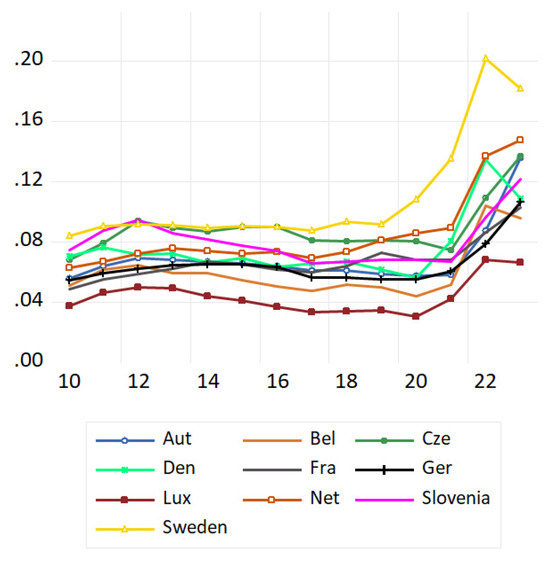
On the other hand, in the case of countries with a low insecurity level, NG (dependency on natural gas) is positive and very significantly linked with economic insecurity. This situation is due to the evolution of the gas market in the European Union. In Figure 1, we can observe how prices/kw evolved in the countries with low economic insecurity levels. The graph is based on the variable gas prices for household consumers [70], calculated based on the average of the two semesters (we used kilowatt-hour, in purchasing power standard with all taxes included in the final price). We may see that the year 2022 represents a turning point.
Figure 1.
Gas price evolution in the EU, 2010–2023. Source: own elaboration based on [70]. Notes: Finland is missing as there are no available data for gas prices for household consumers—bi-annual data.
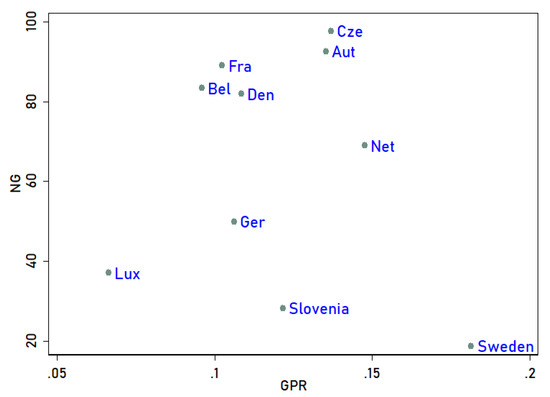
In Figure 2, we can observe the scatter plot between the gas prices (GPRs) and the dependency on natural gas (NG). Sweden has a particularly unique situation, with the highest prices on gas but also with the lowest dependency, as it is a country that relies on alternative energy sources, mainly hydroelectric and nuclear [71]. We also notice that, with few exceptions (Sweden, Slovenia, Luxembourg and Germany), most of the countries presented in Figure 2 relied on gas imports from third countries, with an average price.
Figure 2.
Scatter plot for gas price–gas dependency (2023 data). Source: own elaboration. Notes: Finland is missing as there are no available data for gas prices for household consumers—bi-annual data.
Therefore, also considering the findings of other recent studies [72], we may argue that one solution to mitigate the negative effects of energy dependence is to focus on domestic renewable energies and diversify the energy sources. However, the energy sector should not be viewed strictly from an economic perspective, as there are many other factors that influence it, such as political [73] or infrastructural factors [74]. All these factors may be considered in future studies.
When we use GDP/capita as a robustness criterion, in the case of countries with GDP/capita lower than EU average the strongly positive link is maintained for CF and NG, with an even stronger and significant relationship for OPP (0.527), which shows that countries with a level of GDP/capita below the European average are much more sensitive in terms of economic insecurity to the variation in import prices of petroleum products (Table 11). This relationship diminishes (0.238), but it remains significant in the case of countries with GDP/capita higher than the EU average (Table 10).
The second fixed effects model (FEM2) brings into the analysis the variable Share of energy from renewable sources (RENW). Its relationship is strongly negative (−0.934) and significant, which shows that an increase in the domestic renewable energy production leads to a considerable decrease in the degree of economic insecurity. Behera et al. [75] also reached the same conclusion in the case of oil-importing countries from the G20. The trend is also maintained in the case of robustness tests, noting that the relationship is much stronger in the case of countries with lower incomes (−2.022) and a higher degree of insecurity (−1.843). In this model, the SF is not statistically significant. The coefficient of CF remains high (0.414) at the level of the entire sample, although less significant. In the case of countries with low economic insecurity, the coefficient of CF is negative and statistically significant, as in the first model. Therefore, in these countries, a higher share of imported renewable fuels is associated with lower economic insecurity, even when the domestic production of renewable energies exists.
The FE2 model, like the FE1 model, confirms that dependence on imports of oil and petroleum products is positively and statistically significantly associated with the degree of insecurity. Numerous other studies reached the same conclusion [76]. This relationship is much more evident in the case of countries below the European average of GDP per capita (0.378) and almost double in the case of countries with a high degree of economic insecurity (0.663). This fact should be correlated with the continuous increase in prices for this category of products, under the pressure of conflicts in the Middle East and sanctions against Russia. At the same time, fuels have a very low price elasticity function. Therefore, as pump prices increased, the share of household fuel expenditure increased significantly in lower-income countries, being related to an increase in insecurity. Similar results are found in a study conducted by Kpodar and Liu in 2022 [77]. A recent study that used a multi-regional input–output model and household expenditure data for 116 countries to estimate how energy price shocks hit household budgets revealed that when the energy costs for households rise dramatically, millions of families are pushed more into extreme poverty [78].
The third fixed effects model (FEM3) introduces into the analysis, as an independent variable, Electricity production from oil, gas and coal sources (% of total) (ENEO). The component of domestic energy production from non-renewable sources brings more accuracy to the model. The estimated coefficient is positive and statistically significant (0.163), indicating a meaningful association with the dependent variable. This new variable slightly modifies the estimated coefficients of the others, without producing important changes. The question that may arise is why domestic energy production from non-renewable sources is positively related to the increase in insecurity. The answer lies in the way in which this variable is measured, as a percentage of total domestic production. Since we are talking about unsustainable, heavily extracted productions, it was expected that any increase in the share of production of such energies, mostly intended for domestic consumption, would be negatively related to the level of household incomes, which is perceived as an increase in the level of economic insecurity [79]. At the same time, there are studies that show that this is the so-called “paradox of plenty” [80]. On the other hand, it is normal to have a negative relationship between this variable and the RENWvariable (share of energy from renewable sources) [81], between the two types of energy being a very close relationship of substitutability [82]. The relationship is maintained even after segmenting the sample, which shows that, regardless of the stage of development and the level of insecurity, dependence on conventional energies represents a risk factor, and the solution lies in expanding the production and consumption of renewable energies.
The fourth fixed effects model (FEM 4) excludes import dependency from the analysis on third countries by fuel type: gas (NG) and import dependency on third countries by fuel type, and solid fossil fuels (SFs). After their exclusion, the estimated coefficients of the remaining variables exhibit stronger statistical significance. However, robustness tests show inconclusive results after segmenting the sample.
Since the results obtained through the FEMs identified correlational relationships, reflecting only statistically significant associations, we further resorted to the analysis of causal relationships between variables. Such an analysis provides additional insight into the characteristics of the relationships between the variables. The results summarized in Table 12 show that, beyond the association between variables, there is also a causal link and provide additional empirical support for the research hypotheses. Regarding the first hypothesis, H1, it is observed that the energy-dependent variables CF, SF, NG, and OPP significantly cause economic insecurity. Reverse causality was also tested, but it is more limited, as the economic insecurity causes only SF and NG. Therefore, the most relevant direction is from the energy sector towards economic insecurity.
In the case of hypothesis H2, the test results revealed a unidirectional causality, from RENW to economic insecurity, which suggests that more intensive use of renewable resources improves the level of economic security.
If we look at the causality relationship from conventional energy production (ENEO) to economic inefficiency, we can reconfirm that dependence on traditional energy resources increases economic insecurity.
6. Conclusions
This study focused on the link between economic insecurity and the energy sector, demonstrating how increased energy dependence on third countries can be related to negative consequences on the daily lives of European Union households and citizens. The statistical analysis used panel data regression equations with fixed effects, analyzing 23 of the 27 EU countries over a 14-year period (between 2010 and 2023). The initial results highlight a positive relationship between energy dependence and economic insecurity. They also reveal a significant relationship between conventional energy (ENEO), renewable energy (RENW) and economic insecurity. The reference models suggest that renewable energy is associated with higher economic security of European households, given that its costs tend to be lower in the long term.
After segmenting countries into various groups (based on insecurity and GDP/capita), we proceeded with robustness tests, which in turn yielded interesting results. In the robustness test, which only included countries with a low degree of insecurity, we observed a transition to renewable energies, particularly in terms of fuels, with gas also playing an important role. If, on the other hand, we look at countries with a higher degree of insecurity, we can see the importance of oil and petroleum, as these are economies based on traditional energy. In differentiating by GDP per capita, we noted that the negative correlation between domestic renewable energy and economic insecurity is stronger in countries with GDP per capita below the EU average.
Based on these results, we may argue that both H1 and H2 are confirmed by the models presented above, and we recommend, in the long term, a shift towards domestic renewable energies as an alternative to energy dependence on non-EU countries, in an effort to increase economic security in European households.
The robustness of our results is strengthened by the Dumitrescu–Hurlin test. This test confirms the direction of the identified relationships: energy dependence and energy production from conventional sources cause economic insecurity, and, on the other hand, increasing the share of renewable resources causes a reduction in insecurity.
Taking into account our findings, a future research direction could be related to the mediating role of the geopolitical shocks on energy dependence and, thus, on economic insecurity. In another study, we could also conduct a comparative analysis between the EU and the non-EU states (for instance, the EU candidate countries) regarding the impact of energy dependence on their households’ economic security.
Our study has some limitations in terms of data consistency. For example, according to official statistics, some countries did not report imports for certain periods: Austria, Czech Republic, Greece, Lithuania, Luxembourg, and Portugal for renewable combustible fuels (CF), Portugal for solid fossil fuels, Sweden for natural gas, and Luxembourg for oil and petroleum products. At the same time, we eliminated from the sample certain countries (Cyprus, Malta and Estonia) that did not record oscillations over time for certain variables. Thus, the sample was reduced to 23 EU countries. At the same time, we preferred to use our own aggregate index on European households’ economic insecurity, which may lead to some discussions related to the acceptance and testing methodology used for its elaboration. On the other hand, we consider that this index also constitutes an element of novelty, opening new perspectives of analysis, especially since it highlights three important dimensions of economic insecurity: basic needs of the household, household fragility and the burden of unemployment. Another limitation concerns the possibility of taking into account other factors that influence the energy sector, such as political environment, institutional factors or infrastructure.
Author Contributions
Conceptualization, L.D., C.C.P. and A.-I.P.; methodology, L.D., C.C.P. and A.-I.P.; software, C.C.P. and A.-I.P.; validation, L.D., C.C.P. and A.-I.P.; formal analysis, L.D., C.C.P. and A.-I.P.; investigation, L.D., C.C.P. and A.-I.P.; resources, L.D., C.C.P. and A.-I.P.; data curation, A.-I.P.; writing—original draft preparation, L.D. and A.-I.P.; writing—review and editing, L.D.; visualization, L.D., C.C.P. and A.-I.P.; supervision, L.D. and C.C.P.; project administration, L.D. All authors have read and agreed to the published version of the manuscript.
Funding
This research received no external funding.
Data Availability Statement
Data utilized in this research can be found at https://ec.europa.eu/eurostat/databrowser/view/NRG_IND_REN/default/table?lang=en, https://ec.europa.eu/eurostat/databrowser/view/NRG_IND_ID3CF/default/table?lang=en, https://ec.europa.eu/eurostat/databrowser/view/nrg_pc_202/default/table?lang=en and https://databank.worldbank.org/reports.aspx?source=2&series=EG.ELC.FOSL.ZS&country= (last accessed on 6 October 2025).
Conflicts of Interest
The authors declare no conflicts of interest.
References
- Eurostat. Housing, Food & Transport: 61% of Households’ Budgets. 2023. Available online: https://ec.europa.eu/eurostat/web/products-eurostat-news/w/ddn-20230327-2 (accessed on 9 September 2025).
- European Central Bank. Household Inequality and Financial Stability Risks: Exploring the Impact of Changes in Consumer Prices and Interest Rates. 2022. Available online: https://www.ecb.europa.eu/press/financial-stability-publications/fsr/special/html/ecb.fsrart202211_02~8c5b8be620.en.html (accessed on 12 September 2025).
- Day, R.; Walker, G.; Simcock, N. Conceptualising energy use and energy poverty using a capabilities framework. Energy Policy 2016, 93, 255–264. [Google Scholar] [CrossRef] [Scilit]
- Thomson, H.; Snell, C.; Bouzarovski, S. Health, Well-Being and Energy Poverty in Europe: A Comparative Study of 32 European Countries. Int. J. Environ. Res. Public Health 2017, 14, 584. [Google Scholar] [CrossRef] [Scilit]
- European Commission. Commission Publishes Recommendations to Tackle Energy Poverty Across the EU. 2023. Available online: https://energy.ec.europa.eu/news/commission-publishes-recommendations-tackle-energy-poverty-across-eu-2023-10-23_en (accessed on 15 September 2025).
- McKinsey. Five Key Action Areas to Put Europe’s Energy Transition on a More Orderly Path. 2023. Available online: https://www.mckinsey.com/capabilities/sustainability/our-insights/five-key-action-areas-to-put-europes-energy-transition-on-a-more-orderly-path (accessed on 7 October 2025).
- Chomać-Pierzecka, E. Economic, Environmental and Social Security in accordance with the Concept of Sustainable Development. Stud. Adm. Bezpieczeństwa 2025, 18, 257–272. [Google Scholar] [CrossRef] [Scilit]
- Bluszcz, A. European economies in terms of energy dependence. Qual. Quant. 2017, 51, 1531–1548. [Google Scholar] [CrossRef] [Scilit]
- International Energy Agency. Energy Supply Security, Emergency Response of IEA Countries. 2014. Available online: https://www.oecd.org/content/dam/oecd/en/publications/reports/2014/08/energy-supply-security-2014_g1g4668f/9789264218420-en.pdf (accessed on 12 September 2025).
- European Commission. EU Energy Mix and Import Dependency. 2022. Available online: https://ec.europa.eu/eurostat/statistics-explained/SEPDF/cache/104551.pdf (accessed on 14 September 2025).
- Eurostat. Shedding Light on Energy in Europe. 2024. Available online: https://ec.europa.eu/eurostat/web/interactive-publications/energy-2024 (accessed on 5 September 2025).
- Costantini, V.; Morando, V.; Olk, C.; Tausch, L. Fuelling the Fire: Rethinking European Policy in Times of Energy and Climate Crises. Energies 2022, 15, 7781. [Google Scholar] [CrossRef] [Scilit]
- Bijnens, G.; Hutchinson, J.; Guilhem, A.S. How Enduring High Energy Prices Could Affect Jobs; European Central Bank: Frankfurt, Germany, 2025; Available online: https://www.ecb.europa.eu/press/blog/date/2025/html/ecb.blog20250505~86c88d726c.en.html (accessed on 12 October 2025).
- Lutz, C.; Becker, L. Effects of Energy Price Shocks on Germany’s Economy and Private Households. In Vulnerable Households in the Energy Transition; Studies in Energy, Resource and Environmental Economics; Bardazzi, R., Pazienza, M.G., Eds.; Springer: Cham, Switzerland, 2023. [Google Scholar] [CrossRef] [Scilit]
- Battistini, N.; Di Nino, V.; Dossche, M.; Kolndrekaj, A. Energy Prices and Private Consumption: What Are the Channels? ECB Econ. Bull. 2022, 2. Available online: https://www.ecb.europa.eu/press/economic-bulletin/articles/2022/html/ecb.ebart202203_01~f7466627b4.en.html (accessed on 15 September 2025).
- Carfora, A.; Scandurra, G. Forecasting Energy Poverty in European Countries: The Effect of Increasing Energy Commodities Prices. Energies 2024, 17, 1224. [Google Scholar] [CrossRef] [Scilit]
- Cullen, J.B.; Friedberg, L.; Wolfram, C. Do Households Smooth Small Consumption Shocks? Evidence from Anticipated and Unanticipated Variation in Home Energy Costs; UC Berkeley: Center for the Study of Energy Markets: Berkeley, CA, USA, 2005; Available online: https://escholarship.org/uc/item/3qb650hh (accessed on 12 October 2025).
- Mkomba, F.K.; Saha, A.K.; Wali, U.G. Household-Level Effects of Energy Insecurity on Welfare in Southern Africa: A Malawian Case Study. Int. J. Renew. Energy Dev. 2021, 10, 105–118. [Google Scholar] [CrossRef] [Scilit]
- Volodzkiene, L.; Streimikiene, D. Towards Energy Equity: Understanding and Addressing Multifaceted Energy Inequality. Energies 2024, 17, 4500. [Google Scholar] [CrossRef] [Scilit]
- Middlemiss, L.; Ambrosio-Albalá, P.; Emmel, N.; Gillard, R.; Gilbertson, J.; Hargreaves, T.; Mullen, C.; Ryan, T.; Snell, C.; Tod, A. Energy poverty and social relations: A capabilities approach. Energy Res. Soc. Sci. 2019, 55, 227–235. [Google Scholar] [CrossRef] [Scilit]
- Liaqat, M.; Ashraf, A.; Nisar, S.; Khursheed, A. The Impact of Oil Price Inflation on Economic Growth of Oil Importing Economies: Empirical Evidence from Pakistan. J. Asian Financ. Econ. Bus. 2022, 9, 167–176. [Google Scholar]
- Ari, A.; Arregui, N.; Black, S.; Celasun, O.; Iakova, D.; Mineshima, A.; Mylonas, V.; Parry, I.; Teodoru, I.; Zhunussova, K. Surging Energy Prices in Europe in the Aftermath of the War: How to Support the Vulnerable and Speed Up the Transition Away from Fossil Fuels; International Monetary Fund: Washington, DC, USA, 2022; p. 152. [Google Scholar]
- European Central Bank. Economic Bulletin, Issue 3; European Central Bank: Frankfurt, Germany, 2022. [Google Scholar]
- Valadkhani, A.; Babacan, A.; Dabir-Alai, P. The impacts of rising energy prices on non-energy sectors in Australia. Econ. Anal. Policy 2014, 44, 386–395. [Google Scholar] [CrossRef] [Scilit]
- Keček, D. The Effects of Rising Energy Prices on Inflation in Croatia. Energies 2023, 16, 1583. [Google Scholar] [CrossRef] [Scilit]
- European Environment Agency. Cold and Respiratory Disease. 2024. Available online: https://www.eea.europa.eu/en/analysis/publications/beating-chronic-respiratory-disease/cold (accessed on 12 October 2025).
- Polimeni, J.M.; Simionescu, M.; Iorgulescu, R.I. Energy Poverty and Personal Health in the EU. Int. J. Environ. Res. Public Health 2022, 19, 11459. [Google Scholar] [CrossRef] [Scilit]
- Champagne, S.N.; Phimister, E.; Macdiarmid, J.I.; Meera Guntupalli, A. Assessing the impact of energy and fuel poverty on health: A European scoping review. Eur. J. Public Health 2023, 33, 764–770. [Google Scholar] [CrossRef] [Scilit]
- Stojilovska, A.; Thomson, H.; Mejía-Montero, A. Making a Case for Centring Energy Poverty in Social Policy in Light of the Climate Emergency: A Global Integrative Review. Soc. Policy Soc. 2023, 22, 715–729. [Google Scholar] [CrossRef] [Scilit]
- Bouzarovski, S.; Petrova, S. A global perspective on domestic energy deprivation: Overcoming the energy poverty–fuel poverty binary. Energy Res. Soc. Sci. 2015, 10, 31–40. [Google Scholar] [CrossRef] [Scilit]
- Lund, H. Renewable Energy Systems. A Smart Energy Systems Approach to the Choice and Modeling of 100% Renewable Solutions, 2nd ed.; Academic Press: Cambridge, MA, USA, 2014. [Google Scholar]
- European Commission. The European Green Deal: Striving to be the First Climate-Neutral Continent. 2019. Available online: https://commission.europa.eu/strategy-and-policy/priorities-2019-2024/european-green-deal_en (accessed on 22 September 2025).
- Schmitz, L.; Seidl, T. As open as possible, as autonomous as necessary: Understanding the rise of Open Strategic Autonomy in EU Trade Policy. J. Common Mark. Stud. 2023, 61, 834–852. [Google Scholar] [CrossRef] [Scilit]
- European Parliament. EU Strategic Autonomy 2013–2023: From Concept to Capacity; Briefing-EU Strategic Autonomy Monitor; European Parliamentary Research Service: Brussels, Belgium, 2022.
- Simionescu, M.; Radulescu, M.; Belascu, L. The impact of renewable energy consumption and energy poverty on pollution in Central and Eastern European countries. Renew. Energy 2024, 236, 121397. [Google Scholar] [CrossRef] [Scilit]
- Pavlík, M.; Kurimský, F.; Ševc, K. Renewable Energy and Price Stability: An Analysis of Volatility and Market Shifts in the European Electricity Sector (2015–2025). Appl. Sci. 2025, 15, 6397. [Google Scholar] [CrossRef] [Scilit]
- Śmiech, S.; Karpinska, L.; Bouzarovski, S. Impact of energy transitions on energy poverty in the European Union. Renew. Sustain. Energy Rev. 2025, 211, 115311. [Google Scholar] [CrossRef] [Scilit]
- Hassan, Q.; Algburi, S.; Sameen, A.Z.; Al-Musawi, T.J.; Al-Jiboory, A.K.; Salman, H.M.; Ali, B.M.; Jaszczur, M. A comprehensive review of international renewable energy growth. Energy Built Environ. 2024. [Google Scholar] [CrossRef] [Scilit]
- Energy Transitions Commission. Energy Security in the EU. 2024. Available online: https://www.energy-transitions.org/wp-content/uploads/2020/07/Energy-Security-in-the-EU_vf.pdf (accessed on 12 September 2025).
- Heinbach, K.; Aretz, A.; Hirschl, B.; Prahl, A.; Salecki, S. Renewable energies and their impact on local value added and employment. Energy Sustain. Soc. 2014, 4, 1. [Google Scholar] [CrossRef] [Scilit]
- Hanna, R.; Heptonstall, P.; Gross, R. Job creation in a low carbon transition to renewables and energy efficiency: A review of international evidence. Sustain. Sci. 2024, 19, 125–150. [Google Scholar] [CrossRef] [Scilit]
- Vögele, S.; Broska, L.H.; Ross, A.; Rübbelke, D. Macroeconomic impacts of energy communities and individual prosumers: An assessment of transformation pathways. Energy Sustain. Soc. 2023, 13, 13. [Google Scholar] [CrossRef] [Scilit]
- Osman, A.I.; Chen, L.; Yang, M.; Msigwa, G.; Farghali, M.; Fawzy, S.; Rooney, D.W.; Yap, P.-S. Cost, environmental impact, and resilience of renewable energy under a changing climate: A review. Environ. Chem. Lett. 2023, 21, 741–764. [Google Scholar] [CrossRef] [Scilit]
- Wang, Q.; Wang, X.; Li, R. Energy transition and environmental sustainability: The interplay with natural resource rents and trade openness. Humanit. Soc. Sci. Commun. 2025, 12, 1152. [Google Scholar] [CrossRef] [Scilit]
- Polat, M.A. The impact of transition from fossil fuels to renewable energy on carbon emissions: The case of the European Union. Int. J. Energy Stud. 2025, 10, 909–927. [Google Scholar] [CrossRef] [Scilit]
- Dobrowolski, Z.; Adamišin, P.; Sługocki, W.; Kotylak, S. Energy Ladder, Decarbonisation and Energy Poverty: The European Union Inside. Energies 2025, 18, 1180. [Google Scholar] [CrossRef] [Scilit]
- Janikowska, O.; Generowicz-Caba, N.; Kulczycka, J. Energy Poverty Alleviation in the Era of Energy Transition—Case Study of Poland and Sweden. Energies 2024, 17, 5481. [Google Scholar] [CrossRef] [Scilit]
- Wyszomierski, R.; Bórawski, P.; Bełdycka-Bórawska, A.; Brelik, A.; Wysokiński, M.; Wiluk, M. The Cost-Effectiveness of Renewable Energy Sources in the European Union’s Ecological Economic Framework. Sustainability 2025, 17, 4715. [Google Scholar] [CrossRef] [Scilit]
- Sasse, J.P.; Trutnevyte, E. A low-carbon electricity sector in Europe risks sustaining regional inequalities in benefits and vulnerabilities. Nat. Commun. 2023, 14, 2205. [Google Scholar] [CrossRef] [Scilit]
- Chudner, D.Y.; Fishman, R.; Hananel, R. Decentralized Renewable Energy and Socioeconomic Disparities. Urban Sci. 2025, 9, 403. [Google Scholar] [CrossRef] [Scilit]
- Volodzkiene, L.; Streimikiene, D. Integrating energy justice and economic realities through insights on energy expenditures, inequality, and renewable energy attitudes. Sci. Rep. 2025, 15, 27067. [Google Scholar] [CrossRef] [Scilit]
- Popescu, C.C.; Pricop, A.-I.; Diaconu (Maxim), L.; Petrișor, M.-B. The impact of economic freedom on economic (in)security: An empirical perspective. Transform. Bus. Econ. 2026; accepted.
- Eurostat. Import Dependency on Third Countries by Fuel Type. 2025. Available online: https://ec.europa.eu/eurostat/databrowser/view/NRG_IND_ID3CF/default/table?lang=en (accessed on 6 October 2025).
- World Bank. Electricity Production from Oil, Gas and Coal Sources (% of Total). 2025. Available online: https://data.worldbank.org/indicator/EG.ELC.FOSL.ZS (accessed on 6 October 2025).
- Eurostat. Share of Energy from Renewable Sources. 2025. Available online: https://ec.europa.eu/eurostat/databrowser/view/NRG_IND_REN/default/table?lang=en (accessed on 6 October 2025).
- Wooldridge, J.M. Econometric Analysis of Cross Section and Panel Data; MIT Press: Cambridge, MA, USA, 2010. [Google Scholar]
- Pan, Y.; Jackson, R.T. Ethnic difference in the relationship between acute inflammation and serum ferritin in US adult males. Epidemiol. Infect. 2008, 136, 421–431. [Google Scholar] [CrossRef] [Scilit] [PubMed]
- Büyükuysal, M.; Öz, I.J.D. An Alternative Method to Least Squares in Presence of Multicollinearity: Ridge Regression. J. Duzce Univ. Health Sci. Inst. 2016, 6, 110–114. [Google Scholar]
- Dumitrescu, E.I.; Hurlin, C. Testing for Granger non-causality in heterogeneous panels. Econ. Model. 2012, 29, 1450–1460. [Google Scholar] [CrossRef] [Scilit]
- Janiszewska, D. Diversification of energy production and consumption in European Union countries. Polityka Energetyczna Energy Policy J. 2019, 22, 5–20. [Google Scholar] [CrossRef] [Scilit]
- Arndt, C.; Arent, D.; Hartley, F.; Merven, B.; Hossain Mondal, A. Faster Than You Think: Renewable Energy and Developing Countries. Annu. Rev. Resour. Econ. 2019, 11, 149–168. [Google Scholar] [CrossRef] [Scilit]
- Hadri, K.; Larsson, R. Testing for Stationarity in Heterogeneous Panel Data Where the Time Dimension Is Finite. Econom. J. 2005, 8, 55–69. [Google Scholar] [CrossRef] [Scilit]
- Wooldridge, J.M. Econometric Analysis of Cross Section and Panel Data, 2nd ed.; MIT Press: Cambridge, MA, USA, 2010. [Google Scholar]
- Mišík, M. The EU needs to improve its external energy security. Energy Policy 2022, 165, 112930. [Google Scholar] [CrossRef] [Scilit]
- Kuznets, S. Economic growth and income inequality. In The Gap Between Rich and Poor; Routledge: London, UK, 2019; pp. 25–37. [Google Scholar]
- Leal, P.H.; Marques, A.C. The evolution of the environmental Kuznets curve hypothesis assessment: A literature review under a critical analysis perspective. Heliyon 2022, 8, e11521. [Google Scholar] [CrossRef] [Scilit] [PubMed]
- Doğan, B.; Ferraz, D.; Gupta, M.; Huynh, T.L.D.; Shahzadi, I. Exploring the effects of import diversification on energy efficiency: Evidence from the OECD economies. Renew. Energy 2022, 189, 639–650. [Google Scholar] [CrossRef] [Scilit]
- Zamfir, A.-I.; Croitoru, E.O.; Burlacioiu, C.; Dobrin, C. Renewable Energies: Economic and Energy Impact in the Context of Increasing the Share of Electric Cars in EU. Energies 2022, 15, 8882. [Google Scholar] [CrossRef] [Scilit]
- Razmjoo, A.; Ghazanfari, A.; Jahangiri, M.; Franklin, E.; Denai, M.; Marzband, M.; Astiaso Garcia, D.; Maheri, A. A Comprehensive Study on the Expansion of Electric Vehicles in Europe. Appl. Sci. 2022, 12, 11656. [Google Scholar] [CrossRef] [Scilit]
- Eurostat. Gas Prices for Household Consumers—Bi-Annual Data (from 2007 Onwards). 2025. Available online: https://ec.europa.eu/eurostat/databrowser/view/nrg_pc_202/default/table?lang=en (accessed on 26 September 2025).
- Holmberg, P.; Tangerås, T.P. The Swedish Electricity Market—Today and in the Future. Sver. Riksbank Econ. Rev. 2023, 1, 5–36. [Google Scholar]
- Carfora, A.; Pansini, R.V.; Scandurra, G. Energy dependence, renewable energy generation and import demand: Are EU countries resilient? Renew. Energy 2022, 195, 1262–1274. [Google Scholar] [CrossRef] [Scilit]
- Zournatzidou, G.; Floros, C.; Ragazou, K. Exploring the Influence of Government Controversies on the Energy Security and Sustainability of the Energy Sector Using Entropy Weight and TOPSIS Methods. Economies 2025, 13, 124. [Google Scholar] [CrossRef] [Scilit]
- Yu, C.; Boqiang, L. How does infrastructure affect energy services? Energy 2021, 231, 121089. [Google Scholar] [CrossRef] [Scilit]
- Behera, M.K.; Paul, A.; Sahoo, D. The Moderating Role of Renewable Energy in the Energy Insecurity-Economic Growth Nexus in the Net Oil-Importing Countries of G20. Energy Res. Lett. 2026, 7. [Google Scholar] [CrossRef] [Scilit]
- Novikau, A. Energy security in security studies: A systematic review of twenty years of literature. Cent. Eur. J. Int. Secur. Stud. 2023, 17, 36–64. [Google Scholar] [CrossRef] [Scilit]
- Kpodar, K.; Liu, B. The distributional implications of the impact of fuel price increases on inflation. Energy Econ. 2022, 108, 105909. [Google Scholar] [CrossRef] [Scilit]
- Guan, Y.; Yan, J.; Shan, Y.; Hang, Y.; Li, R.; Liu, Y.; Liu, B.; Nie, Q.; Bruckner, B.; Feng, K.; et al. Burden of the global energy price crisis on households. Nat. Energy 2023, 8, 304–316. [Google Scholar] [CrossRef] [Scilit]
- Bruin, K.; Yakut, A.M. The impacts of removing fossil fuel subsidies and increasing carbon taxation in Ireland. Environ. Resour. Econ. 2023, 85, 741–782. [Google Scholar] [CrossRef] [Scilit]
- Mayer, A. Fossil fuel dependence and energy insecurity. Energy Sustain. Soc. 2022, 12, 27. [Google Scholar] [CrossRef] [Scilit]
- Solarin, S.A.; Bello, M.O.; Olabisi, O.E. Toward sustainable electricity generation mix: An econometric analysis of the substitutability of nuclear energy and hydropower for fossil fuels in Canada. Int. J. Green Energy 2021, 18, 834–842. [Google Scholar] [CrossRef] [Scilit]
- Schwerin, H. Long-run substitutability between fossil and renewable energy: Global evidence 1800–2012. Empir. Econ. 2025, 69, 129–148. [Google Scholar] [CrossRef] [Scilit]

Disclaimer/Publisher’s Note: The statements, opinions and data contained in all publications are solely those of the individual author(s) and contributor(s) and not of MDPI and/or the editor(s). MDPI and/or the editor(s) disclaim responsibility for any injury to people or property resulting from any ideas, methods, instructions or products referred to in the content. |
© 2026 by the authors. Licensee MDPI, Basel, Switzerland. This article is an open access article distributed under the terms and conditions of the Creative Commons Attribution (CC BY) license.