Article

A Dataset Establishment Method for Wind Turbine Wake and a Data-Driven Model of Wake Prediction

1
Department of Energy and Power Engineering, Tsinghua University, Beijing 100084, China
2
Institute for Carbon Neutrality, Tsinghua University, Beijing 100084, China
*
Author to whom correspondence should be addressed.
Energies 2026, 19(5), 1385; https://doi.org/10.3390/en19051385
Submission received: 25 January 2026 / Revised: 28 February 2026 / Accepted: 6 March 2026 / Published: 9 March 2026
(This article belongs to the Section A3: Wind, Wave and Tidal Energy)

Abstract

A cross-construction method is proposed to establish a wind turbine wake dataset with significantly reduced computational fluid dynamics (CFD) costs. This method involves adjusting one operating parameter, such as the tip speed ratio (TSR), while maintaining the others at their optimal values. This procedure is repeated across another parameter (inflow velocity) to generate a sparse but informative dataset. CFD simulations were performed using large eddy simulation (LES) coupled with an actuator line model (ALM) to generate data. A pre-training and fine-tuning network based on error classification (PFNEC) was developed, achieving high prediction accuracy with coefficients of determination of 0.9750 and 0.9851 for two validation conditions. Two models based on a softmax function and a residual block were designed, and they achieved the best performance, with coefficients of determination of 0.9921 and 0.9891 under different conditions. The Fourier embedding was applied to enhance input features of neural networks. Four samples added to the original dataset improved the prediction accuracy for extreme operating conditions, from coefficient of determination values of 0.7143 and 0.7034 to 0.9939 and 0.9886 with Fourier embedding. This cross-construction method can significantly reduce the cost of dataset establishment. The models exhibited reliable generalization and prediction accuracy.

1. Introduction

As a form of clean energy, wind power has become an increasingly significant contributor to the energy supply [1]. A wind turbine is an energy-conversion device that converts wind energy into electricity and can be classified into horizontal axis wind turbines (HAWTs) and vertical axis wind turbines (VAWTs) [2], and other configurations. Wind farms are the primary configuration for large-scale wind energy utilization. The wind turbine wake posed a major challenge to operational optimization and the maximization of energy production [3]. It is important to predict wake characteristics and provide more wake information for the control strategy.
In the early stage of wind turbine wake prediction, the analytical model was carried out by researchers to perform the prediction. The Jensen model was given in 1983 [4], and then the Gaussian model was proposed with an assumption of a Gaussian profile of wake velocity deficit [5]. A three-dimensional wake model was developed for offshore wind turbines [6]. Analytical models can efficiently estimate wake velocity, but their accuracy remains limited, especially under non-optimal conditions.
The machine learning method was also applied to the prediction of wind turbine wakes. Neural networks can represent the nonlinear mapping between operating conditions and wake quantities, and they have become widely used for flow prediction [7]. The neural network architectures employed in the prediction of wind turbine wake fields include multilayer perceptrons (MLPs), also referred to as feedforward artificial neural networks (ANNs), convolutional neural networks (CNNs), and graph neural networks (GNNs) [8]. In addition, more advanced frameworks have recently been explored, such as physics-informed neural networks (PINNs) [8]. Wake predictions are performed using the wind speed, tip speed ratio (TSR), and turbulence intensity as the input features. The wind velocity of a single turbine was predicted by the MLP, and the data was generated by computational fluid dynamics (CFD) [9]. The turbulence intensity and wake velocity of a standalone wind turbine with uniform inflow were predicted by the ANN trained by CFD simulations [10]. Ti et al. [11,12] adopted an ANN for wake and power prediction, and the results were acceptable. Nakhchi et al. [13] established a dataset by simulation and also used an ANN architecture to predict the wake field with low deviation. A surrogate model trained on real-world light detection and ranging (LiDAR) was used to extract latent space and forecast wake flows [14]. To incorporate with the analytical wake model, the ANN was used to predict nonlinear wake expansion and calculate wake flows with the Jensen model [15]. To more effectively capture spatial correlations in wake flow fields, the convolutional neural network (CNN) was also applied to spatiotemporal wake prediction [16,17]. A deep convolutional conditional generative adversarial network (DC-CGAN) was proposed. It can capture wake deflection with the turbine yaw angle, and the CGAN has the capability of generalization [18]. LES data were used to train the CNN autoencoder to reconstruct the time-averaged flow field [19]. A Graph Neural Operator (GNO) architecture containing two GNN layers was designed, which can identify zones characterized by strong wake interactions [20]. The physics-informed neural network (PINN) was proposed, and the governing equations can be added into the loss function to make neural networks learn physical law [21]. For wind turbine wake prediction, the measurement data was considered as data loss to reconstruct multi-turbine wake fields [22]. The actuator disk model (ADM) was added in the governing equations to calculate the force acting on the fluid by the wind turbine, and to calculate the wake field [23]. A multi-scale prediction framework of wind turbine wake field was constructed and had high accuracy for single turbine, turbine array, and utility-scale wind farm [24].
Different neural network architectures have been developed for wind turbine wake prediction, but the design of these models does not explicitly consider the intrinsic physical characteristics of turbine wake flows. In this study, the features of wind turbine wakes are incorporated into both data feature engineering and neural network design to improve predictive performance.
The neural networks are capable of rapid wake prediction, but effective training requires a high-quality dataset. 403 simulations were conducted to generate the dataset, and then an artificial neural network (ANN) was established to predict the wake flows [11]. Nakhchi et al. [13] conducted a series of high-fidelity simulations using LES to generate training data and adopted the Extreme Gradient Boosting machine learning algorithm for wake prediction, and they found the Extreme Gradient Boosting model was more accurate than the ANN model. Li et al. [17] conducted 17 temporal simulations under different turbine yaw angles as training data, and a convolutional neural network was trained to infer flow fields. A combination of an engineering wake model and LES simulations was used to train a data-driven model with reduced computational cost [25]. Previous studies typically identify a set of wind turbine operating parameters, vary each parameter uniformly, and then combine all parameter levels to form a dense parameter-space dataset. This approach is computationally expensive because it requires a full CFD simulation for every parameter combination. Therefore, there is a need for approaches that can efficiently construct a comprehensive dataset at a lower cost.
This study addresses two fundamental questions: (1) How can a comprehensive dataset be constructed in a cost-effective manner? (2) How can wake characteristics be effectively embedded into neural network architectures? A neural network based on error classification was designed to improve predictive performance. The Fourier embedding method was introduced to enrich the input features [26]. This study proposed a cross-construction method for dataset establishment, and a sparse wind turbine wake dataset was built at a low cost by using this method. The neural networks were designed for wind turbine wake prediction, and it is demonstrated that the Fourier embedding can improve predictive accuracy. In Section 2, CFD setup and validation are described. The comparison between a fully connected network (FCN) and an artificial neural network (ANN), and the introduction of the cross-construction method, are presented in Section 3. The advanced models based on error classification are illustrated, and results are analyzed in Section 4. The comprehensive results and discussion are in Section 5. The generalization of neural networks and the modification of the cross-construction dataset are in Section 6. The conclusions of this study are in Section 7.

2. CFD Framework

The filtered continuity equation and the filtered Navier–Stokes equation for the LES method in incompressible flows were shown as follows [27,28,29]:
u ¯ i x i = 0
u ¯ i t + x j u ¯ i u ¯ j = 1 ρ p ¯ x i + μ ρ 2 u ¯ i x j x j τ i j x j + f i
where u ¯ i is the filtered velocity tensor, the overbar represents grid-filtered variables, p is pressure, ρ is air density 1.225 kg/m3, μ is dynamic viscosity, and fi is the external force calculated by ALM. τ i j = u i u j ¯ u i ¯ u j ¯ is the sub-grid scale (SGS) stress tensor. In the One-Equation model:
τ i j 1 3 τ k k δ i j = 2 ν s g s S ¯ i j
S ¯ i j = 1 2 u ¯ i x j + u ¯ j x i
k s g s t + u ¯ j k s g s x j = τ i j 1 3 δ i j τ k k S ¯ i j C ε k s g s 3 / 2 Δ ε w + x j C k Δ k s g s + ν k s g s x j
ν s g s = C k Δ k s g s
where νsgs is sub-grid kinematic viscosity, Cε and Ck are two constant coefficients where Cε = 0.93 and Ck = 0.0673, Δ is the filter size, and εw is the near-wall dissipation correction.
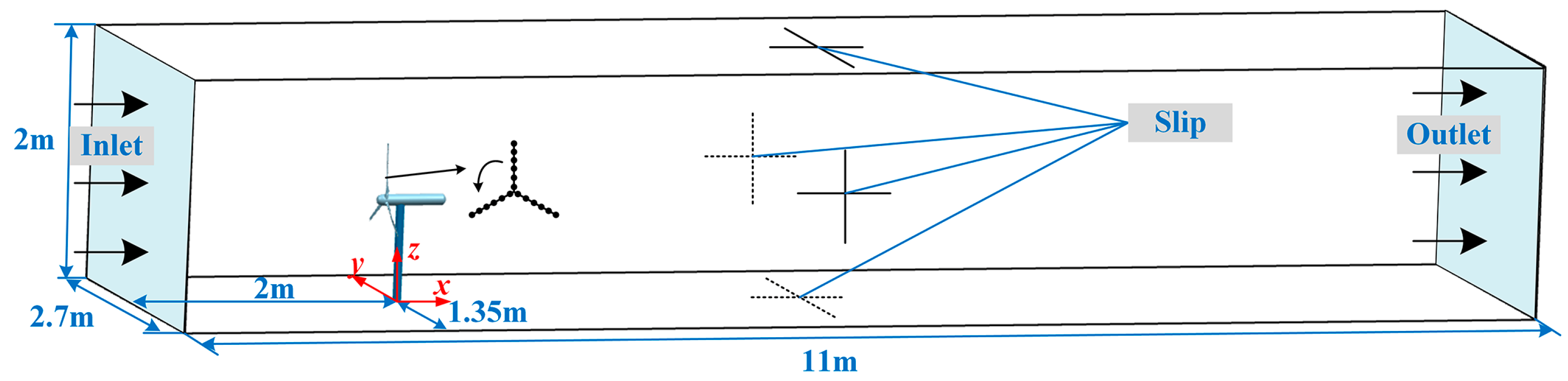
The LES One-Equation model was implemented in this simulation [30,31]. As for the wind turbine wake flow, the ALM was coupled with the LES method for wind turbine flow simulation [32]. The wind turbine model and experimental data come from NTNU (Norges Teknisk-Naturvitenskapelige Universitet) “Blind test 1” [33,34]. The computational domain is depicted in Figure 1. The size of the computational domain is identical to that of the experiment in height and width. The inflow velocity U0 = 10 m/s is set as an inlet boundary, and the outlet is set as a pressure boundary. The turbulence intensity of the inlet is 0.3%, which is consistent with the experimental setup. To avoid resolving the wall boundary layers with a finely refined mesh, slip boundary conditions are applied on the top, bottom, front, and back walls. All of the simulations were conducted using the open software SOWFA (Simulator fOr Wind Farm Applications).
The initial mesh size of the mesh region is 0.15 m for the entire computational domain. The wake region was refined progressively. The first refinement region is x ∈ [−1.8 m, 9 m], y ∈ [−1.35 m, 1.35 m], and z ∈ [0 m, 2 m]. The second refinement region is x ∈ [−0.5 m, 4.9 m], y ∈ [−0.9 m, 0.9 m], and z ∈ [0 m, 1.5 m]. The third refinement region is x ∈ [−0.3 m, 4.7 m], y ∈ [−0.9 m, 0.9 m], and z ∈ [0 m, 1.5 m]. The fourth refinement region is x ∈ [−0.2 m, 2.8 m], y ∈ [−0.9 m, 0.9 m], and z ∈ [0.3 m, 1.5 m]. The grid size in the finest region is 0.009375 m. The unsteady time step corresponded to a 1° rotor rotation across all TSR conditions, with a mean flow field averaging window exceeding 50 revolutions to ensure statistical convergence. The inflow turbulence intensity was set as 0.3% at the inlet, which is the same as the experimental setup [34].
In the application of ALM, the Gaussian projection function is used to make the distribution of lift force and drag force smoother [33]:
η ε = 1 ε 3 π 3 / 2 exp d 2 ε 2
where η ε is a smooth projection function, ε is the Gaussian projection width, and d is the distance between the local actuator point and the local grid. The Gaussian projection width is set as ε = 0.0018 m in this study.
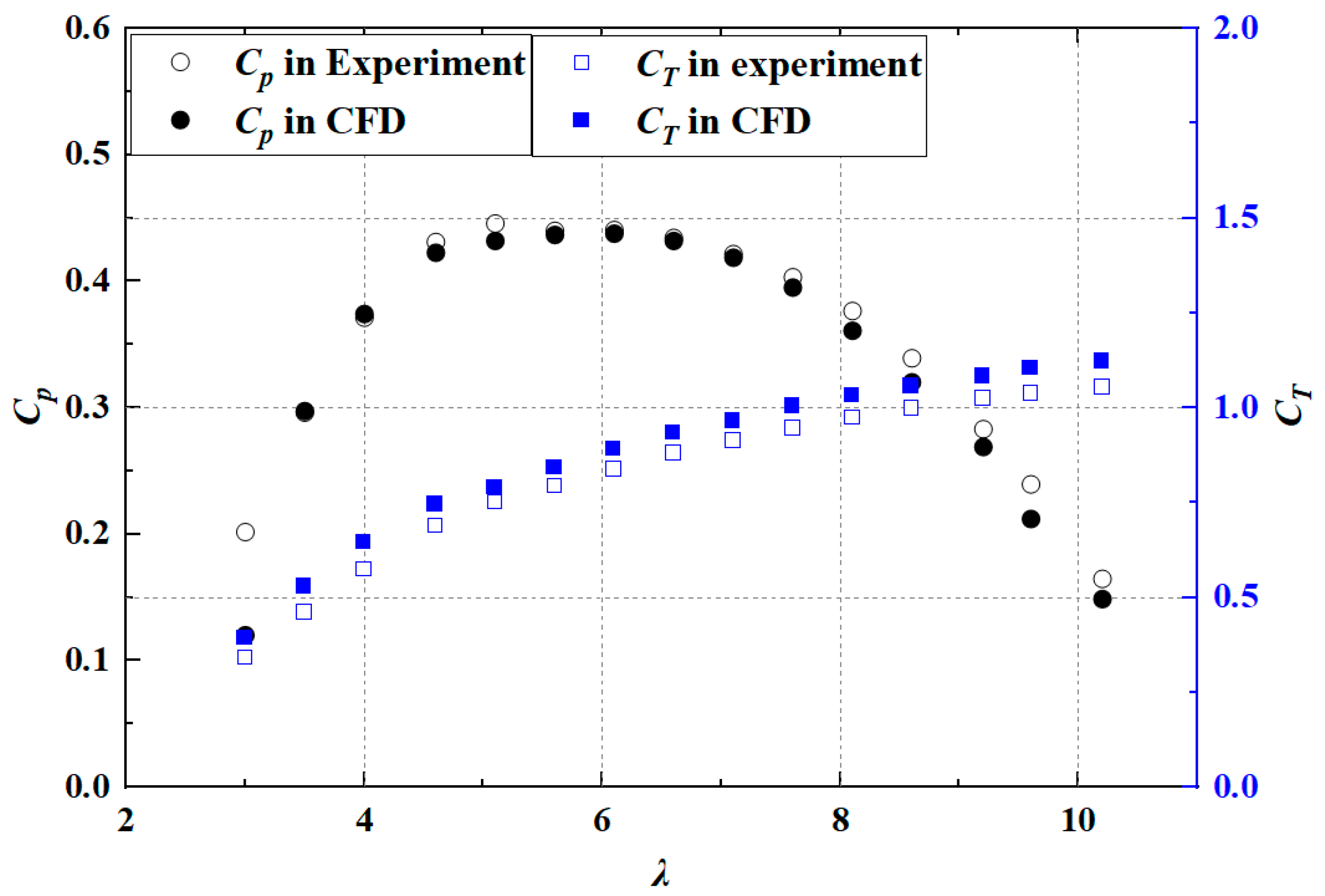
The definition of TSR is shown in Equation (8). The validation of the simulation through the comparison to experimental measurements of power coefficient Cp (Equation (9)) and thrust coefficient CT (Equation (10)) was shown in Figure 2. The numerical results agree well with the experimental data for the power coefficient Cp and thrust coefficient CT from low TSR to high TSR. The numerical framework of this study is credible for the simulation of wind turbine wake flows and for constructing a wake dataset.
λ = ω R U 0
C p = M ω 0.5 ρ A U 0 3
C T = F 0.5 ρ A U 0 2
U d = U 0 U mean U 0
where λ is TSR, ω is rotational speed (rad/s), R is radius of rotor (m), U0 is free stream velocity 10 m/s, Umean is the time-averaged velocity (m/s), M is torque of turbine (N·m), F is axial force of turbine (N), A is swept area of turbine (m2).

3. Verification of Fully Connected Network and Dataset Establishment

3.1. Comparison Between Artificial Neural Network and Fully Connected Network

CFD simulations were performed for different conditions by cross-varying of TSR λ = 5.6 and design wind speed U0 = 10 m/s to build a dataset. Table 1 lists variation in input variables (λ, U0) from Cases 1–36. Cases 35 and 36 are used as validation cases. The CFD dataset was generated on Intel(R) Xeon(R) CPU E5-2678 v3 @ 2.50 GHz using parallel processing. The training and inference of the neural networks were performed on a CPU 13th Gen Intel(R) Core(TM) i7-13700k. In each training, the models were trained for 500 epochs to guarantee convergence. The code link is as follows: https://github.com/CAME-THU/Wake-prediction-model-PFNEC.
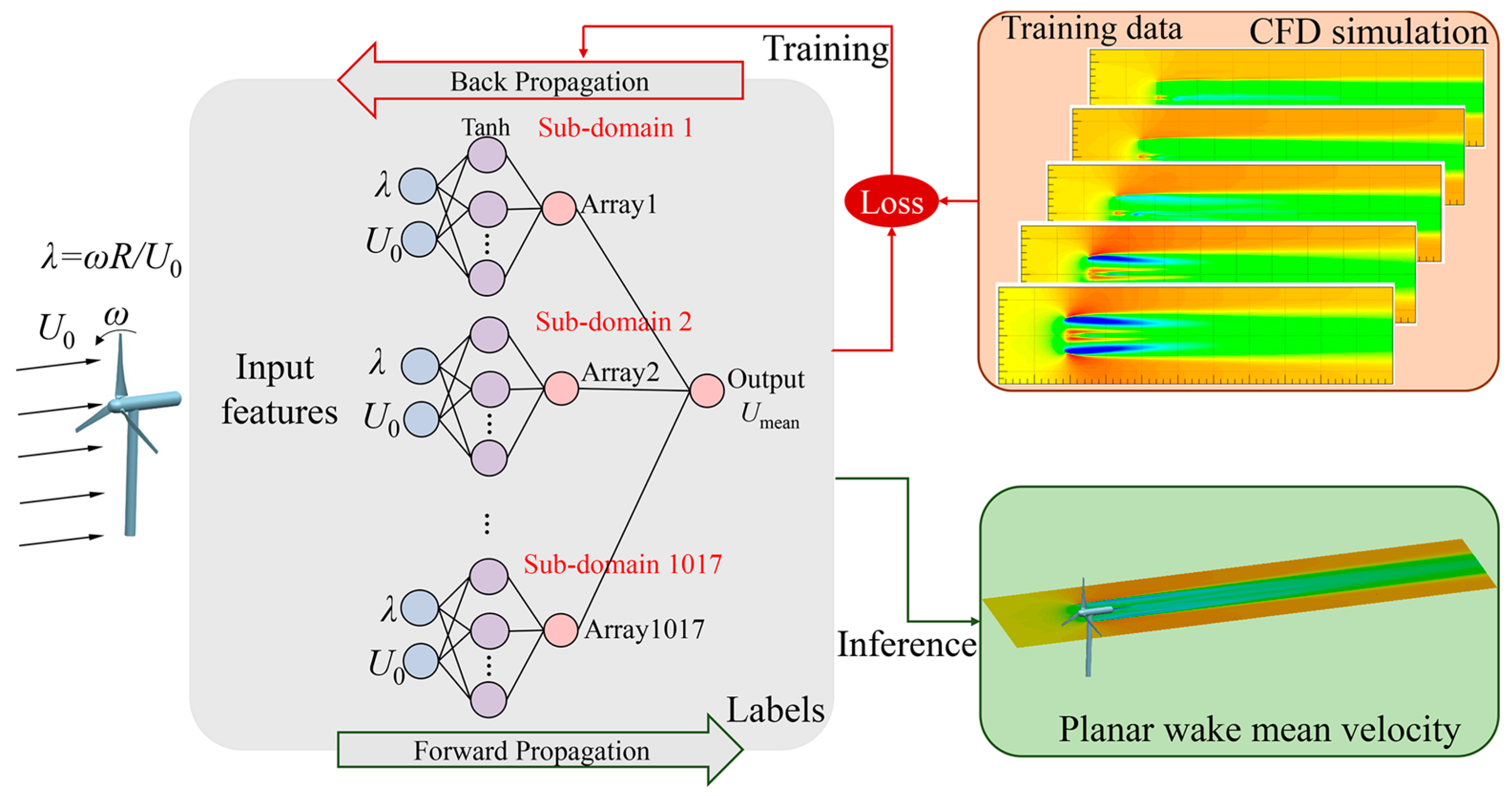
An ANN was applied to wind turbine wake prediction, and the model was decomposed into multiple sub-models [11,12,13]. The architecture of the ANN is shown in Figure 3. A total of 1017 sub-models were designed in this study, and one sub-model contains 75 elements of output U, and the 75 elements are consistent with the setting in Ref [13]. The hidden layer of each sub-model has 10 neurons. The performance of the ANN is compared with neural networks designed in this study.
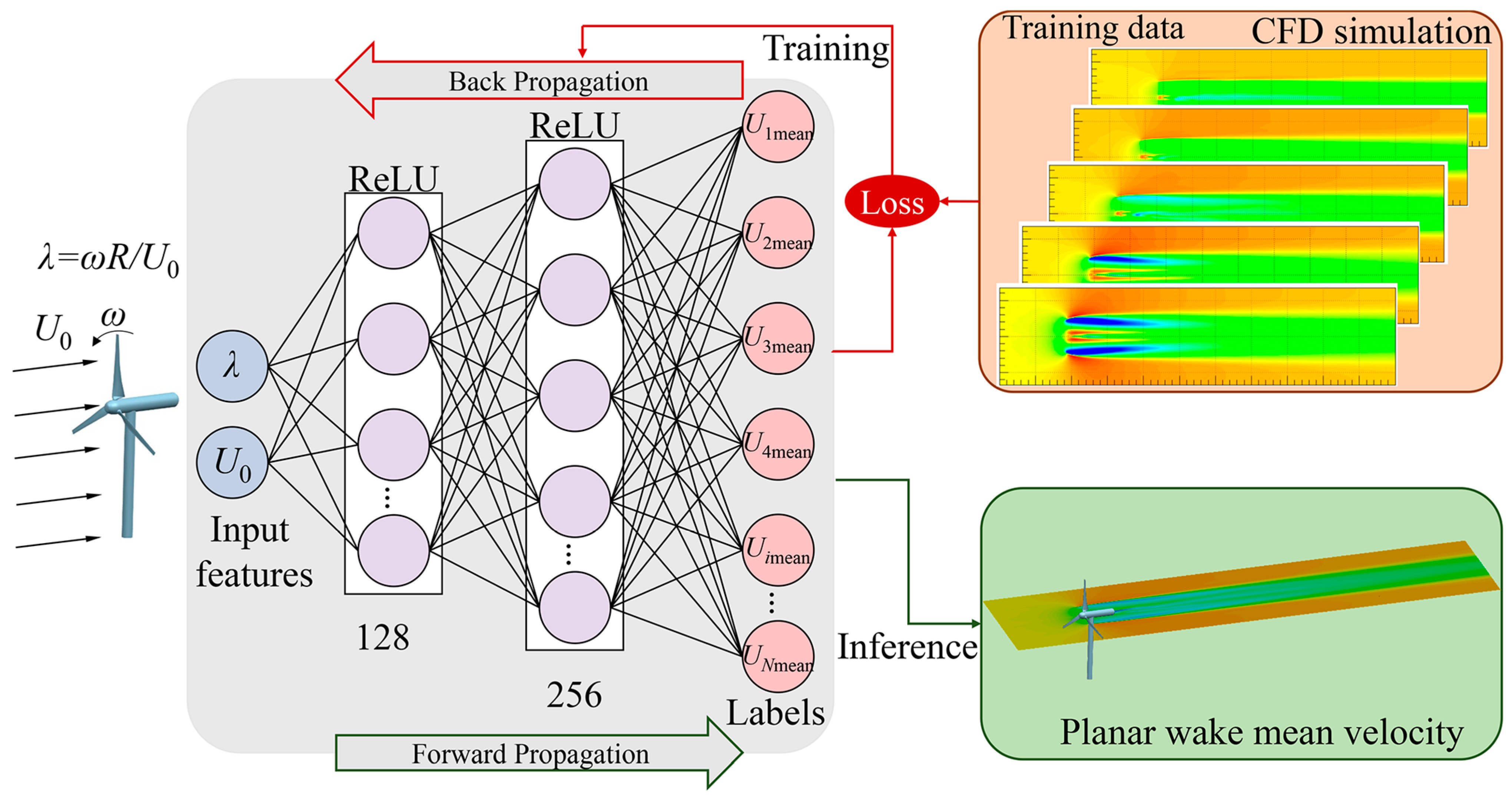
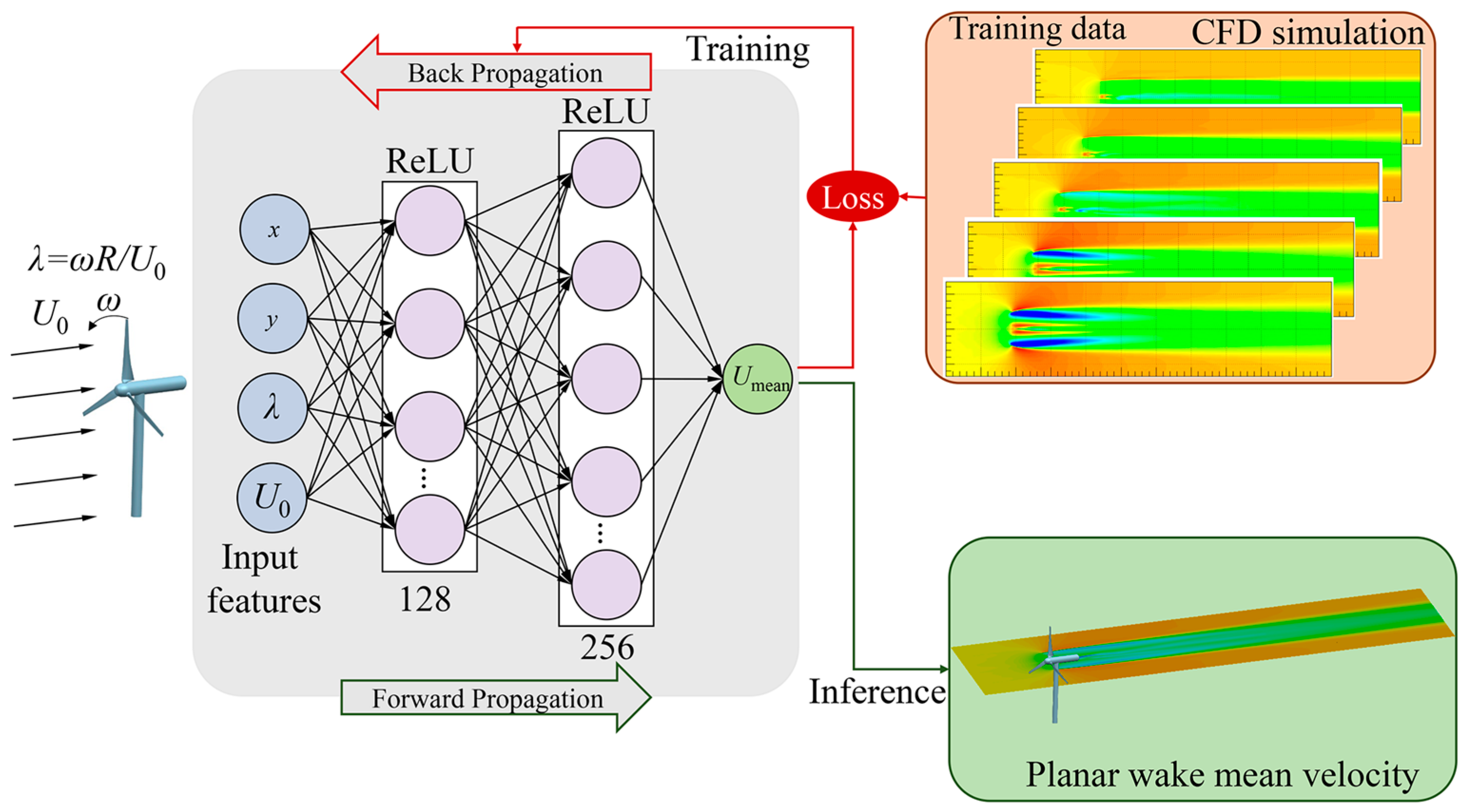
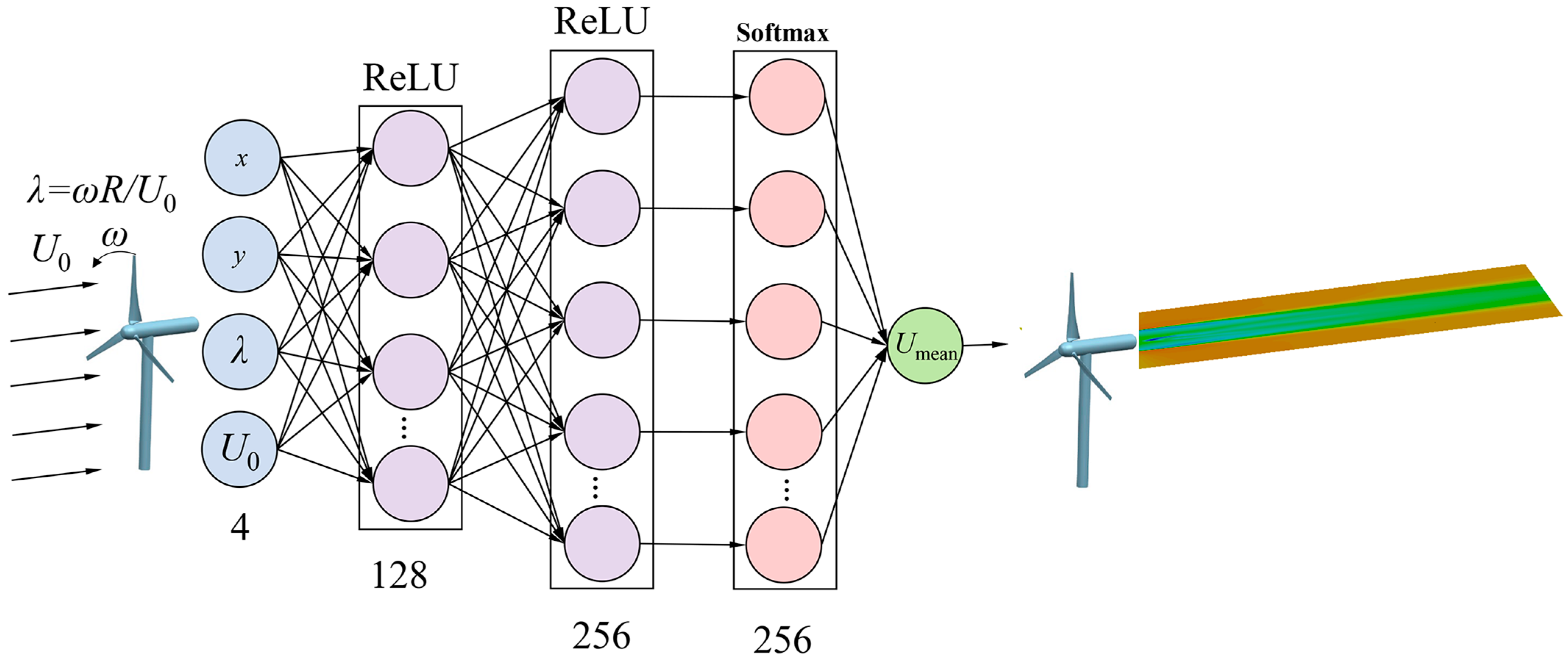
The architecture of the FCN used in this study is designed and shown in Figure 4. The inputs of FCN are TSR λ and freestream wind speed U0, and the output of FCN is grid-point velocities of the XY plane at hub height z = 0.817 m, which contains n = 76,230 spatial points. In order to obtain better prediction performance and avoid overfitting, two hidden layers with 128 and 256 neurons in FCN are selected, respectively.
The relative error δ between neural network (NN) predictions and CFD simulations is defined as:
δ = U mean - NN U mean - CFD U mean CFD × 100
where Umean-CFD is the mean velocity Umean calculated by CFD, and the Umean-NN is the mean velocity regressed by the neural network algorithm.
The coefficient of determination R2 and root mean square error (RMSE) are defined as:
R 2 = 1 i = 1 N y i y ^ i 2 i = 1 N y i y ¯ 2
R M S E = 1 N i = 1 N y ^ i y i 2
where N is the number of samples, and y i is the value of the CFD results, and y ^ i is the value of NN results, and y ¯ is the average value of CFD data.
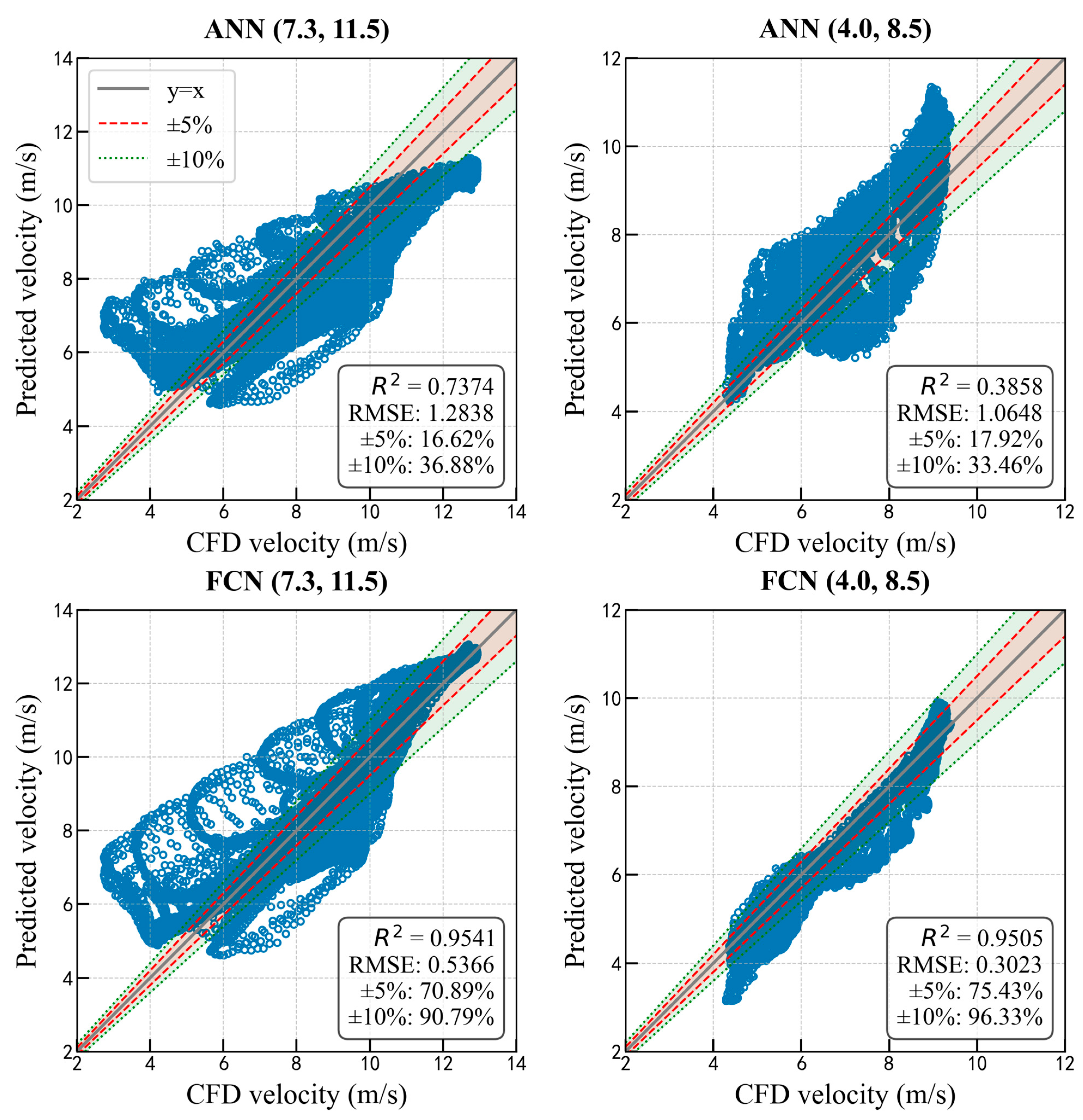
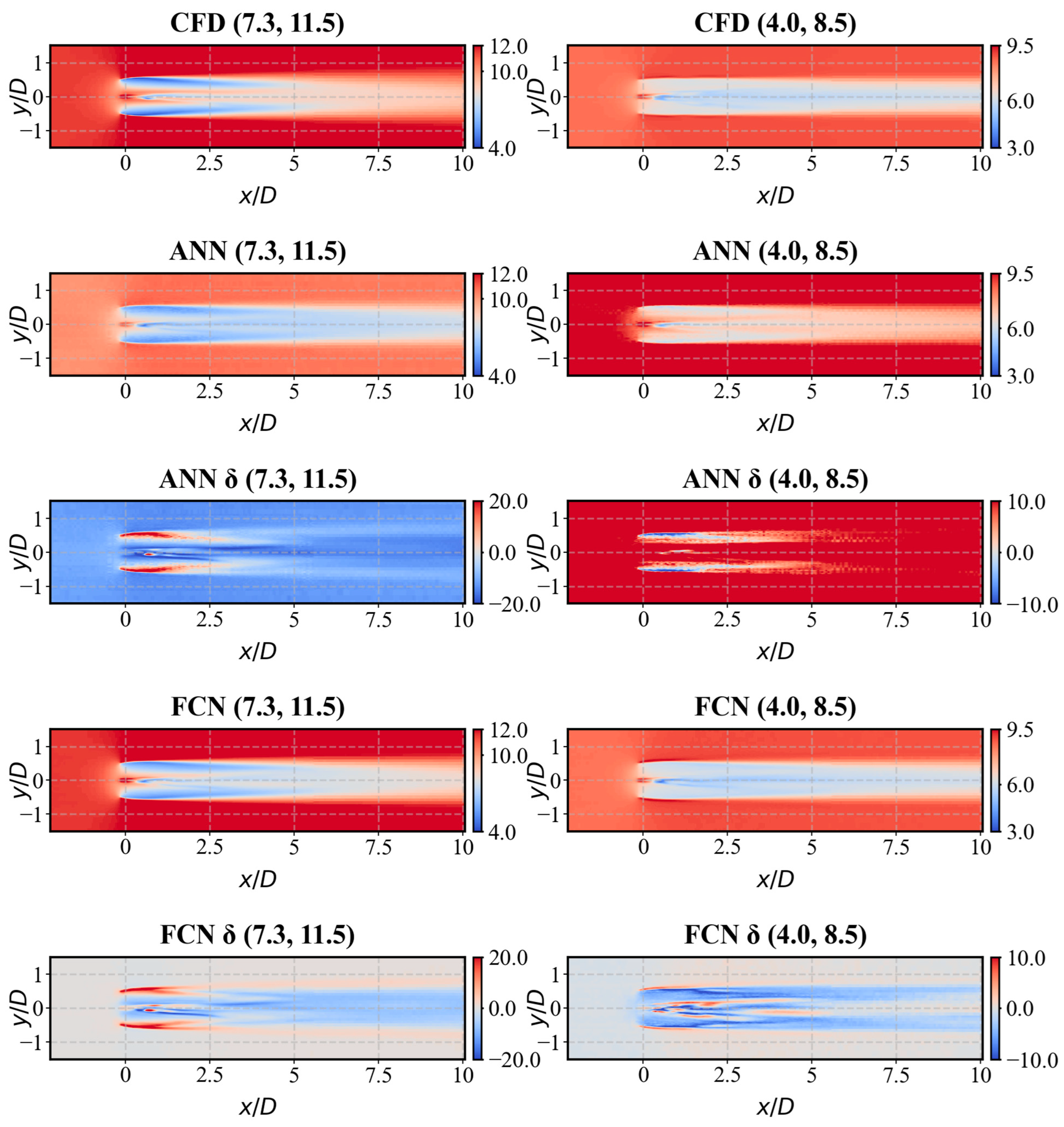
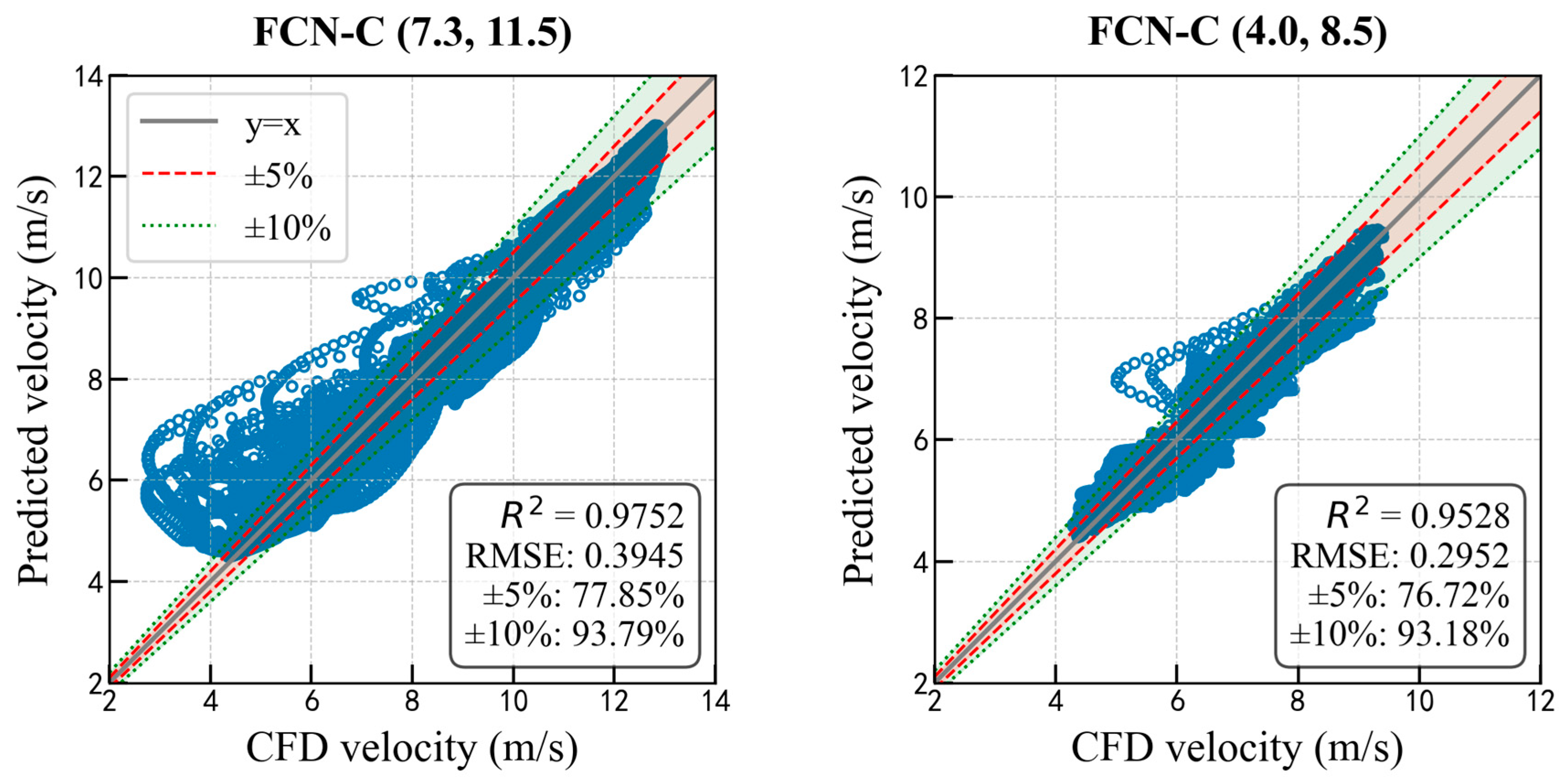
In order to compare the predictive ability of ANN and FCN for external conditions (λ, U0) = (7.3, 11.5) and (λ, U0) = (4.0, 8.5), the inference results are shown in Figure 5. The Umean contour of ANN and FCN is shown in Figure 6. The scatter distributions of the ANN and FCN predictions with respect to the CFD (ground-truth) are depicted, and ±5% as well as ±10% relative error bands are also marked in Figure 5. Based on the comparisons in Figure 5 and Figure 6, the FCN consistently exhibits better performance than the ANN.
The FCN performs better than the ANN for the (λ, U0) = (4.0, 8.5) condition. The coefficient of determination R2 and RMSE for (λ, U0) = (7.3, 11.5) are R2 = 0.9541 and RMSE = 0.5366, which is a little larger than for (λ, U0) = (4.0, 8.5) with R2 = 0.9505. The prediction results of the ANN are R2 = 0.7374 for (λ, U0) = (7.3, 11.5) and R2 = 0.3858 for (λ, U0) = (4.0, 8.5). There is a large difference between the ANN and CFD in Figure 6. In the study by Ti et al. [11], the RANS method was used to generate data for training. The flow data were interpolated into x × y × z = 40 × 250 × 24. Nakhchi et al. [13] used the LES method to generate training data, and the flow field data were interpolated into 360,000 data points for training, but the number of grid elements is 10.36 million for LES. If grid-point data were interpolated into a sparse grid, the detailed features such as sharp gradients and high-frequency structures in the wake would be missed. But in this study, the LES simulation was used to generate training data, and the grid-point data was directly exported without any sparse interpolation. Therefore, both the training and validation results preserve the LES spatial resolution.

3.2. Cross-Construction Method

As for a data-driven model, it is important to construct a comprehensive and high-quality dataset. As analyzed in the previous section, high-fidelity simulations are required, and the data should be exported directly without any interpolation to preserve high spatial resolution for training the neural network. However, the computational cost of constructing a high-fidelity CFD dataset is high. In previous studies, researchers established a dataset comprising several hundred cases. Ti et al. [11] established a wake dataset with a total of 403 simulations across a range of varying velocity and turbulence intensity. Therefore, a critical question arises as to how a sparse dataset can be constructed while still retaining the ability to capture comprehensive wake characteristics.
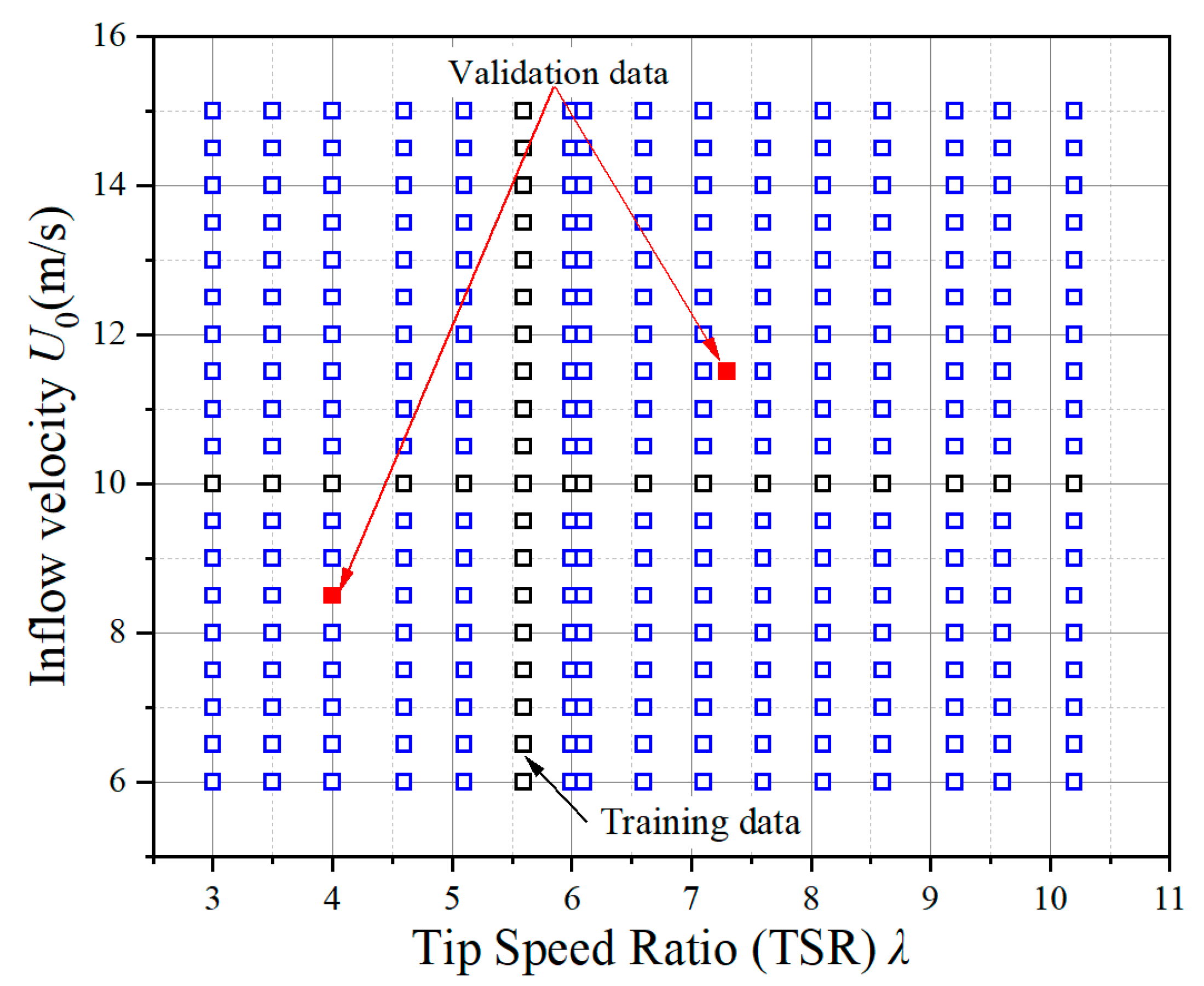
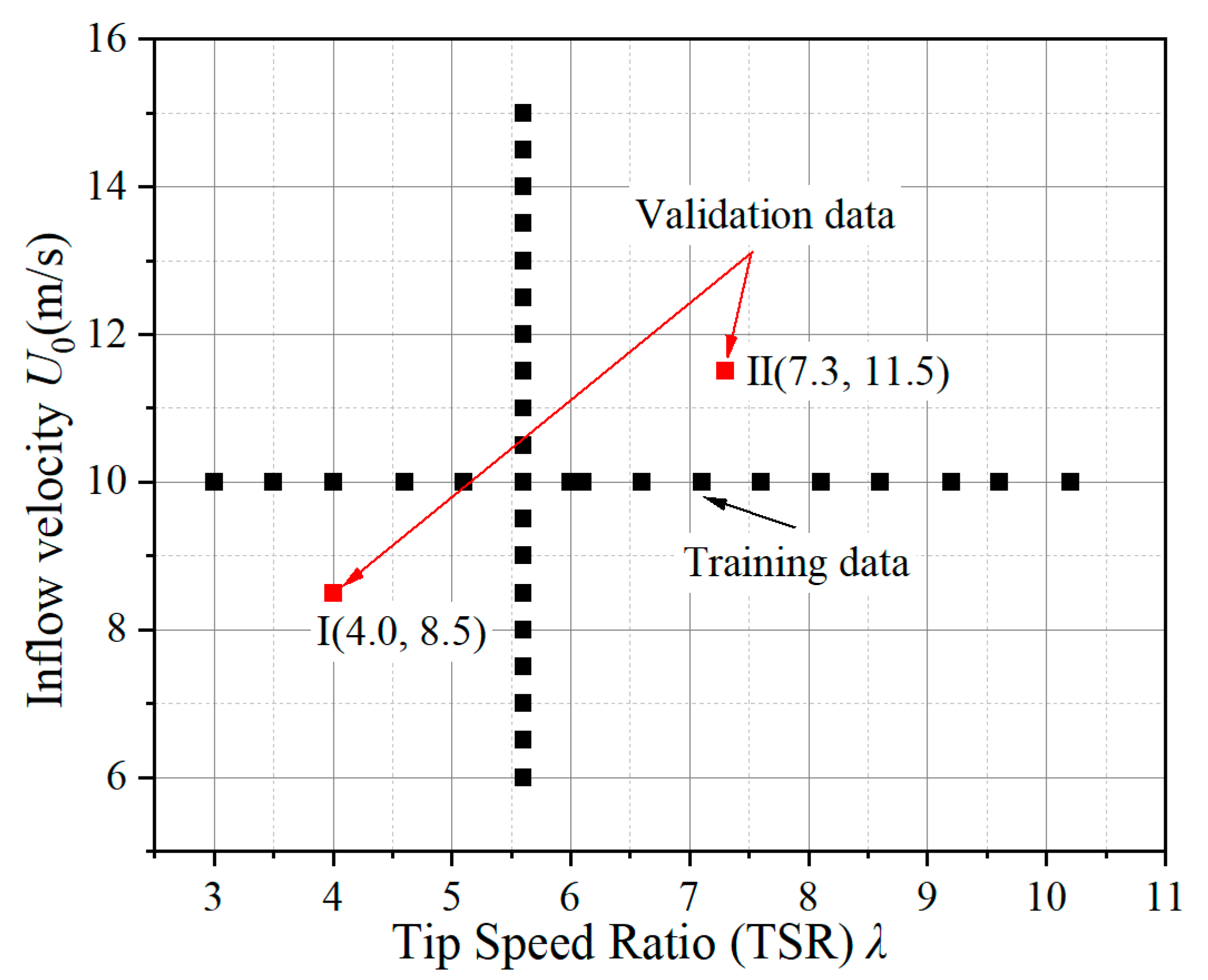
A cross-construction method was proposed to address the above question. Generally, a large number of conditions (blue and black points) should be simulated by CFD to establish a full condition dataset, as shown in Figure 7. In order to reduce computational cost and guarantee diversity of the dataset, a cross-construction sampling method was put forward to establish the dataset, as shown in Figure 8. The parameters of TSR = 5.6 and U0 = 10 m/s are chosen based on turbine design. The turbine is designed for a wind speed of 10 m/s and a design TSR of λ = 6.0 [33]. When the wind speed is high, the pitch control is employed to reduce TSR to prevent overspeed and protect the turbine components. Accordingly, the parameters of U0 = 10 m/s and λ = 5.6 are selected to generate the dataset using the cross-construction method in this study. Two parameters are varied in a crossed manner to construct a sparse dataset, as distributed in Figure 8 and in Table 1. Two external conditions were simulated as validation samples, aiming to verify the effectiveness of the cross-construction method. Obviously, it is a sparse dataset with two parameters varying from low to high values. The simulation of blue data points in Figure 7 was avoided. Approximately 270 CFD simulations corresponding to the blue markers in Figure 7 were avoided using the cross-construction method. The validation is performed to verify whether this dataset can reflect comprehensive characteristics.

4. Network Design and Analysis

4.1. Fully Connected Network with Coordinate Information

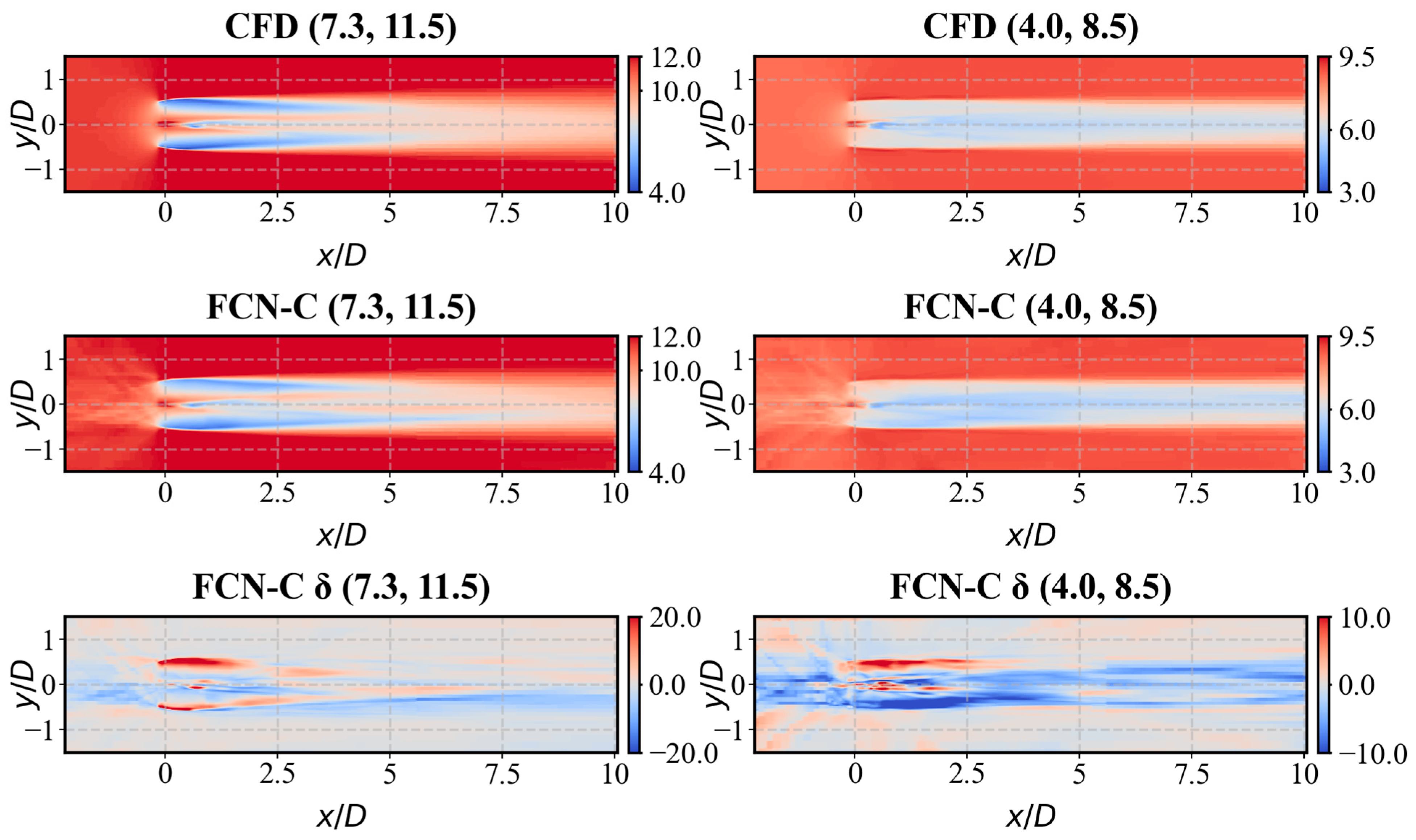
Moreover, it is also necessary to modify the neural network architecture to enable high-accuracy predictions when a model is trained on a sparse dataset. As shown in Figure 5 and Figure 6, it has a large difference in velocity distribution at different spatial locations within the wake flow field. A high-error region occurs near the blade tips. The location near the blade tip has a large velocity deficit due to the effect of the turbine blades. In order to improve the prediction accuracy of the wind turbine wake velocity field, coordinates are included as input features to represent spatial features. The consideration of coordinate information aims to enhance the spatial correlation captured by the neural network. A fully connected network with coordinate (FCN-C) was designed as shown in Figure 9. In FCN-C, the number of inputs is 4, and the output is 1, and every sample has a unique coordinate value (x, y). As for one operating condition, all of the samples in the 2D plane have the same λ and U0. The output is the velocity Umean of one spatial point. One sample (x, y) corresponds to one output velocity Umean. Every case has n = 76,230 points in a 2D plane, so that in FCN-C, every case has n = 76,230 samples.
After consideration of coordinate information, the results of FCN-C are shown in Figure 10 and Figure 11. The predictive result is shown in Figure 10 by scatter plot. The contour of CFD Umean, the predictions, and the corresponding errors are shown in Figure 11. The results show that the prediction accuracy is improved by FCN-C. The coefficient of determination for (λ, U0) = (7.3, 11.5) is R2 = 0.9752, which is larger than R2 = 0.9541 by the FCN model. 93.79% of the n = 76,230 data points have relative error within 10% (−10% ≤ δ ≤ 10%) for (λ, U0) = (7.3, 11.5) condition. The coefficient of determination R2 for (λ, U0) = (4.0, 8.5) is R2 = 0.9528, which is also larger than the FCN result R2 = 0.9505. But 93.18% of the data points, n = 76,230, have relative error within 10% (−10% ≤ δ ≤ 10%), which is lower than the FCN model. The RMSE decreases to 0.3945 and 0.2952 for the two conditions. It is evident in Figure 11 that the high error region near the blade tips is reduced in FCN-C compared with FCN.

4.2. Advanced Model Based on Error Classification

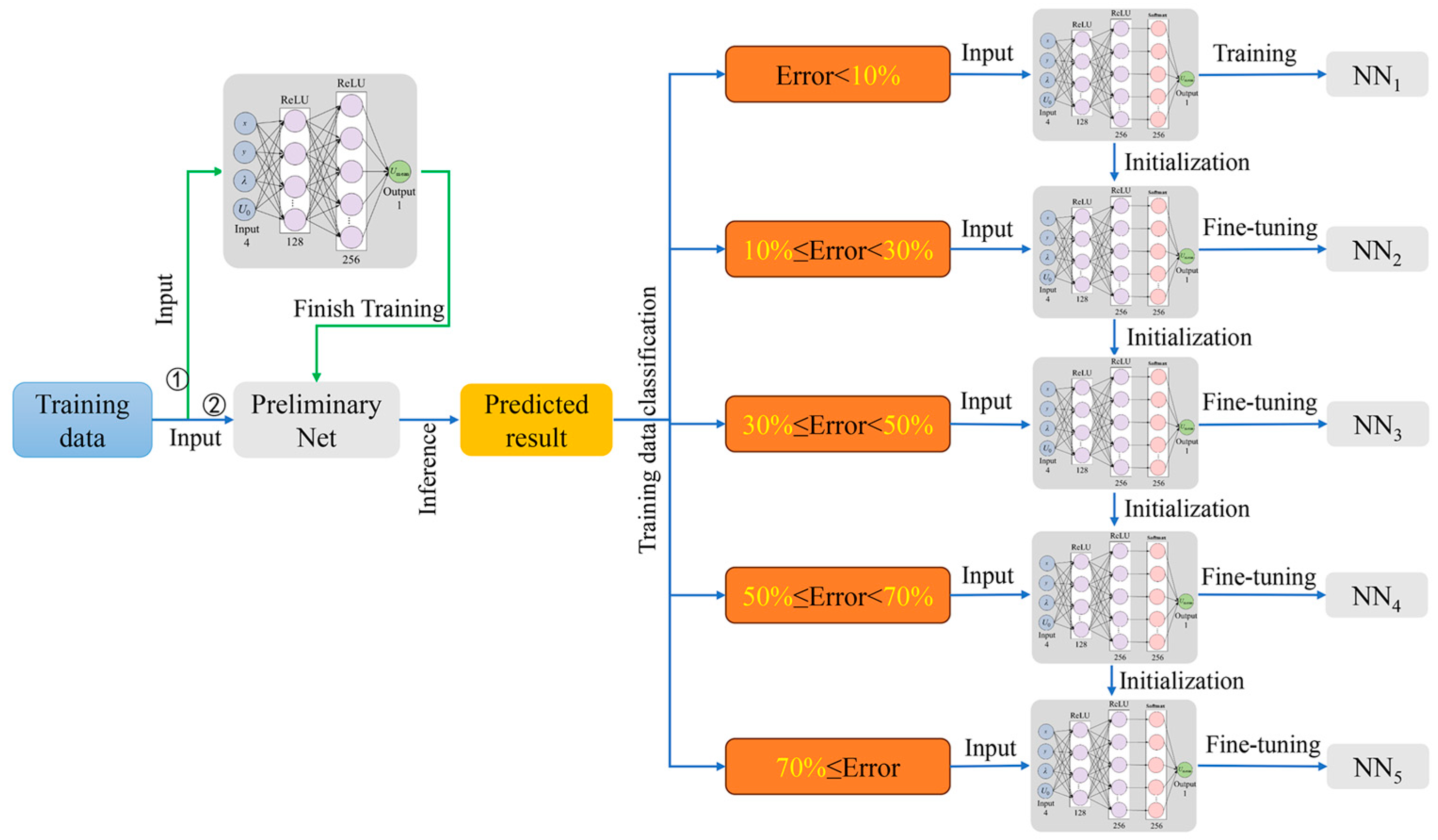
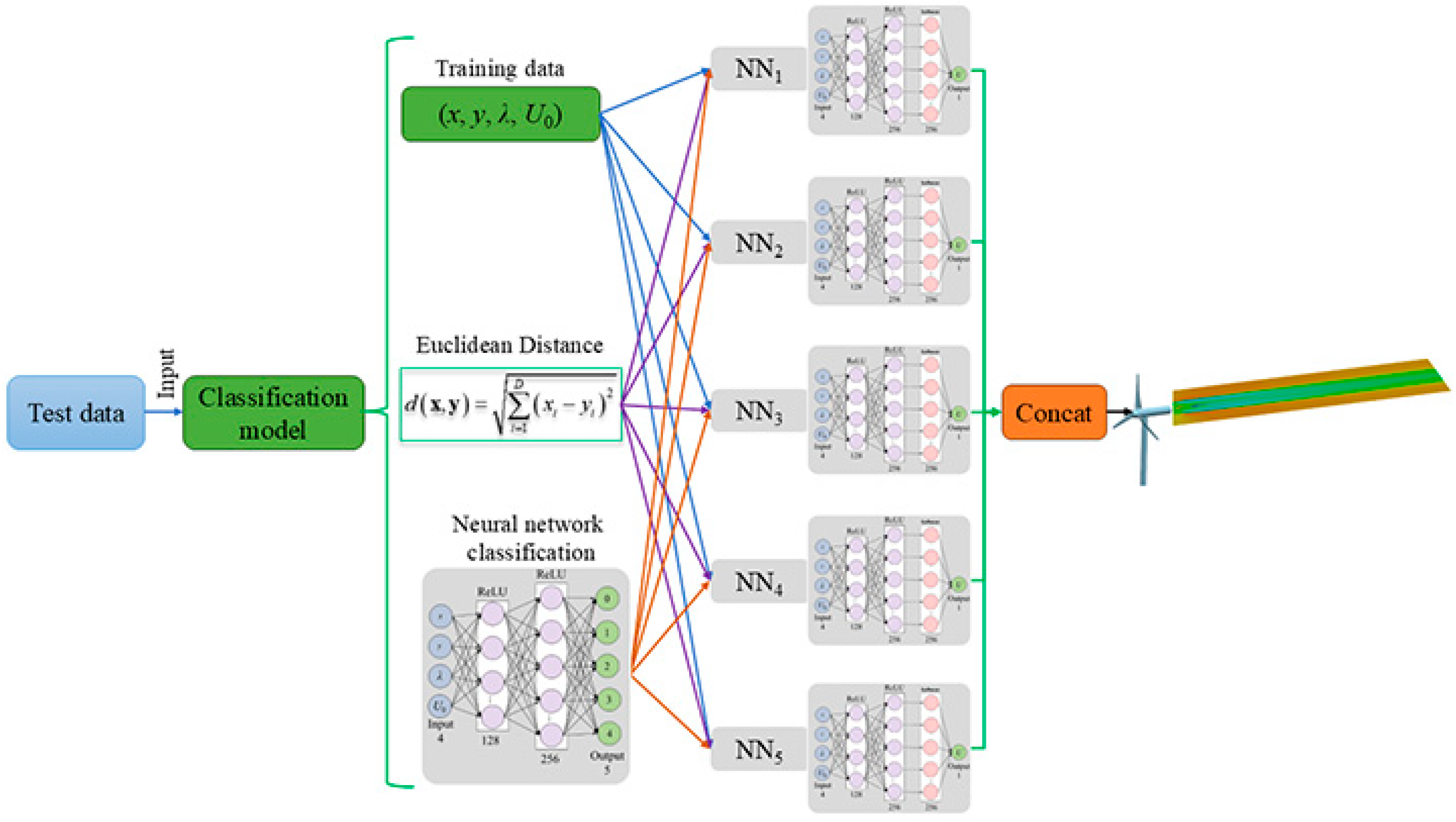
As for the prediction of grid resolution required by LES simulation, a part of the spatial grid points have large deviations from the ground-truth data, especially in low-velocity regions. A fine-tuning neural network was designed to learn features in low-velocity regions. A pre-training and fine-tuning network based on error classification (PFNEC) was designed. As shown in Figure 12, the first neural network is trained initially, and the preliminary network is obtained. The trained preliminary network is used to infer from training data, and the errors are computed against the training data. Samples with large errors indicate that they are difficult for the preliminary network to learn. Then, the relative error is used as the criterion to divide the training data into five categories, as in Figure 12. Bengio et al. proposed the strategy of curriculum learning, starting from easier examples to more difficult examples [35]. In this research, the first training of the network was performed on samples with errors < 10%. After first training with an error < 10%, the NN1 is obtained, and then the data with 10% ≤ error < 30% was used to fine-tune NN1 to obtain NN2. This procedure is repeated in the same manner, and five models are ultimately obtained after the fine-tuning process with the total classified data.
After training, the five models, NN1-NN5, are obtained for different samples according to error performance in the training data. Therefore, as for validation data during inference, the first process is to identify which category the validation sample belongs to, and then the corresponding model is selected to infer. The three classification methods are considered in this study, as shown in Figure 13. (1) The first method is training data classification (TDC), in which the validation samples are classified based on the index of training samples. As for one operating condition for a certain TSR coupled with a certain wind speed, the middle plane contains n = 76,230 spatial points, and corresponding predicted values have different errors, and these points are assigned to different categories. These points are indexed from 0 to 76,229. The validation data is classified according to their index of 76,230 points for one condition, based on which category the training sample with the same index belongs to. (2) The second method is Euclidean distance classification (EDC). As for the FCN-C model, four inputs of coordinates x (i = 0), y (i = 1), TSR (i = 2), and wind speed (i = 3) are used of neural network. The Euclidean distance (in Equation (15)) is used to determine the classification of validation samples. In Equation (15), the dimension is D = 4. As for each testing sample, the Euclidean distance d(x,y) can be calculated for every training sample. In this process, the Euclidean distance related to coordinates x (i = 0) as well as y (i = 1) is calculated first, and the closest indices are found with training samples. The first Euclidean distance discrimination pays more attention to spatial features because high-level error points concentrate in adjacent spatial areas. After the first discrimination, the TSR (i = 2) as the third parameter for Euclidean distance is then incorporated to further determine. Finally, if the previous three parameters i = 0, 1, 2 do not uniquely determine the category of that validation sample, the fourth parameter i = 3 is used to calculate Euclidean distance and identify the nearest neighbor, and assign a unique category. (3) The third method is neural network classification (NNC), in which a classification model is designed to learn based on training error data. The training data is divided into five categories so that five outputs are set for the classification model. After training, the NNC can predict a certain category of validation samples and select and apply the corresponding model for inference. Other classification methods can also be used, such as support vector machine, random forest, and so on.
d x , y = i = 1 D x i y i 2
where D is the dimension of data space (D = 4 in this study), x is the validation sample, and y is the training sample.

4.3. Fully Connected Network with Softmax

Afully connected network with a softmax layer (FCN-S) is designed as shown in Figure 14. A softmax layer is added before the output. The softmax function is often used in classification networks to scale the output satisfying the probability rule with the sum equaling to 1. In this study, two hidden layers are designed, and the softmax operator (Equation (16)) is added after the output of the second hidden layer. The function of softmax in this network is to scale the influence of hidden neurons by exponent arithmetic. The neuron with a larger weight will be enlarged after softmax operator. The neuron with a lower weight will be suppressed after softmax operator. Through this process, irrelevant weight is minimized from hidden neurons while useful weight is retained to make a greater contribution on output.
H = W x + b y ^ = s o f t m a x H y ^ j = exp h j k exp h k
where W is the weights of the neural network, x is the input, b is the bias, h is the output of the second hidden layer, and exp is the exponential function.

4.4. Fully Connected Network with Residual Block

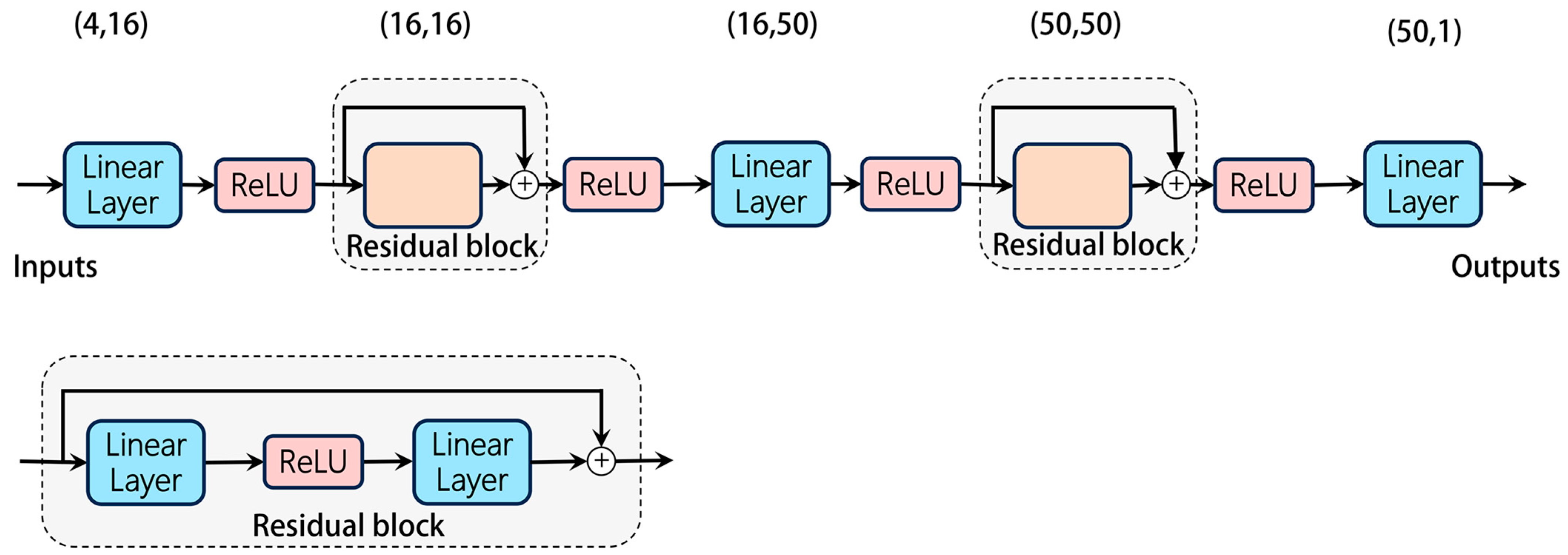
A fully connected network with a residual block (FCN-RB) is designed as shown in Figure 15. Analysis of FCN and FCN-C results indicates that large errors predominantly occur in the blade tip region, characterized by low velocity magnitudes and steep gradients. Therefore, these samples have a slight effect on backpropagation to update weights, especially in the earlier layers. The residual block (Equation (17)) is added to the FCN-C architecture as shown in Figure 15. The FCN-RB retains the original fully connected layers and adds a residual block to facilitate enough parameters and effective backpropagation.
y = σ W x + x
where σ is the activation function, and x is the input of the neural network.

5. Results and Discussion of the Advanced Neural Network

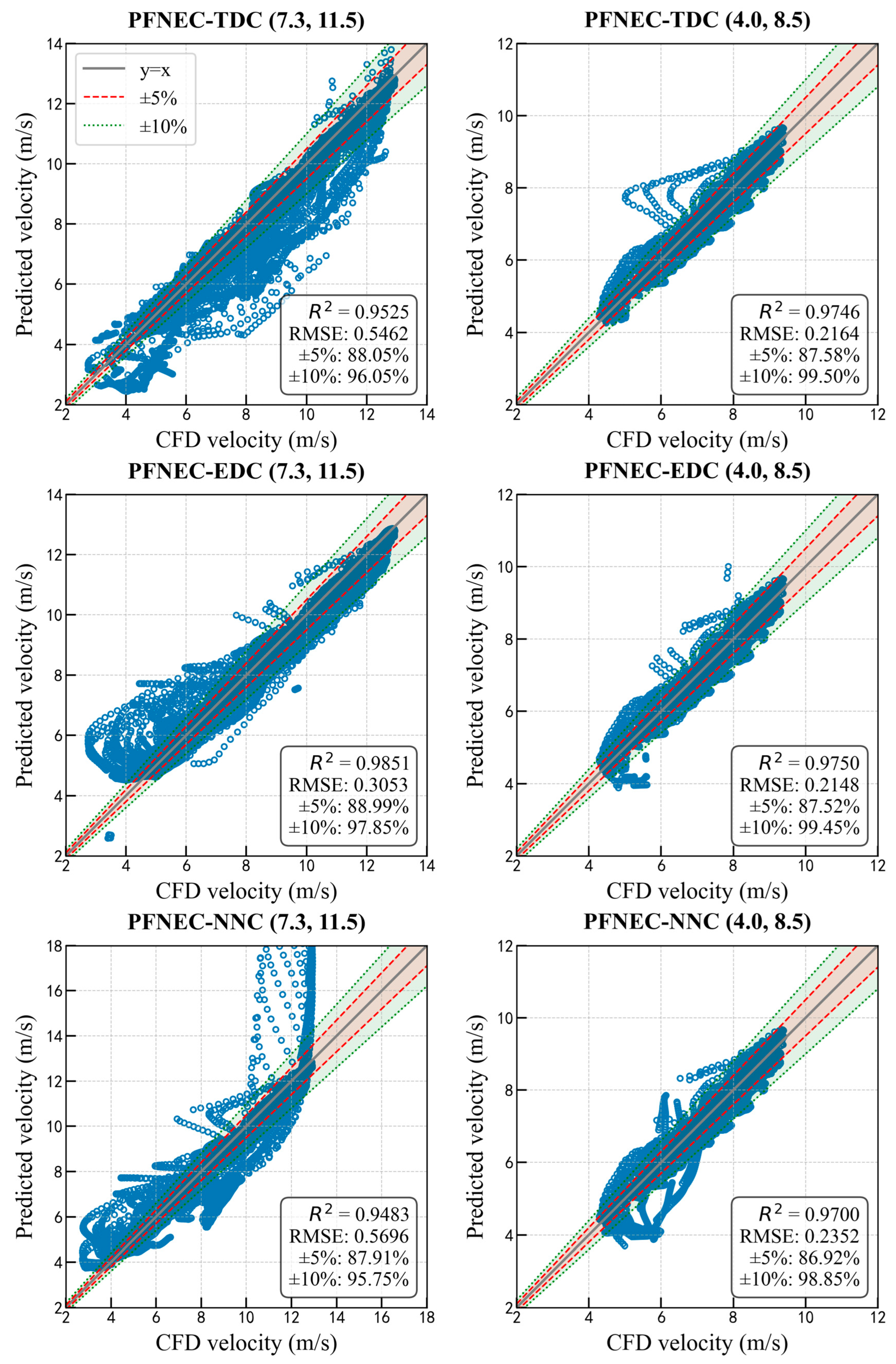
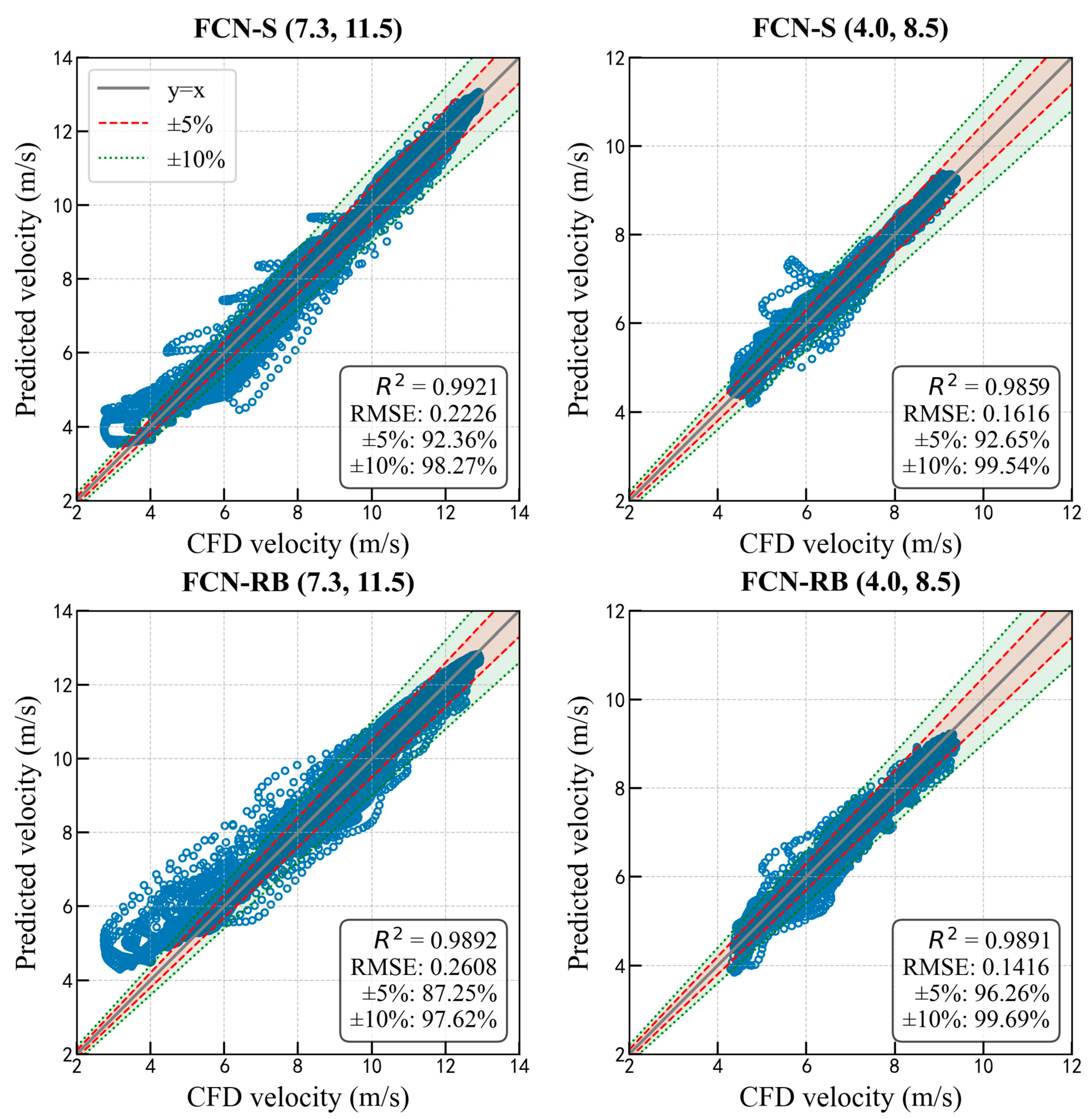
The predictive results of pre-training and fine-tuning networks based on error classification with training data classification (PFNEC-TDC), Euclidean distance classification (PFNEC-EDC), and neural network classification (PFNEC-NNC) are shown in Figure 16. The results of FCN-S and FCN-RB are shown in Figure 17. Compared with FCN and FCN-C, the PFNEC improves a lot in prediction accuracy. As for the three classification models of PFNEC, EDC performs the best and achieves credible prediction accuracy for both external conditions. The NNC has a large deviation for high velocity performance, as shown in Figure 16. As for EDC, the classification is conducted based on Euclidean distance, and this mathematical information restricts the classification deviation on validation samples within a reasonable range. The classification of NNC is unrestricted mathematically. The prediction results of FCN-S and FCN-RB are slightly better than PFNEC for both external conditions, as shown in Figure 17. The FCN-S performs the best for prediction of (λ, U0) = (7.3, 11.5) with R2 = 0.9921 and 98.27% of the n = 76,230 data points have relative error within 10% (−10% ≤ δ ≤ 10%) and 92.36% the of n = 76,230 data points have relative error within 5% (−5% ≤ δ ≤ 5%). The FCN-RB performs the best for prediction of (λ, U0) = (4.0, 8.5) with R2 = 0.9891 and 99.69% the of n = 76,230 data points have relative error within 10% (−10% ≤ δ ≤ 10%) and 96.26% the of n = 76,230 data points have relative error within 5% (−5% ≤ δ ≤ 5%). The prediction results of PFNEC-EDC are close to the results of the optimal model. All models show good performance for the prediction of wind turbine wake flow, and note that the initialization of the neural network model during training has a non-negligible effect on prediction accuracy. Overall, the operating condition (λ, U0) = (4.0, 8.5) is easier to learn and to infer than the (λ, U0) = (7.3, 11.5) condition.
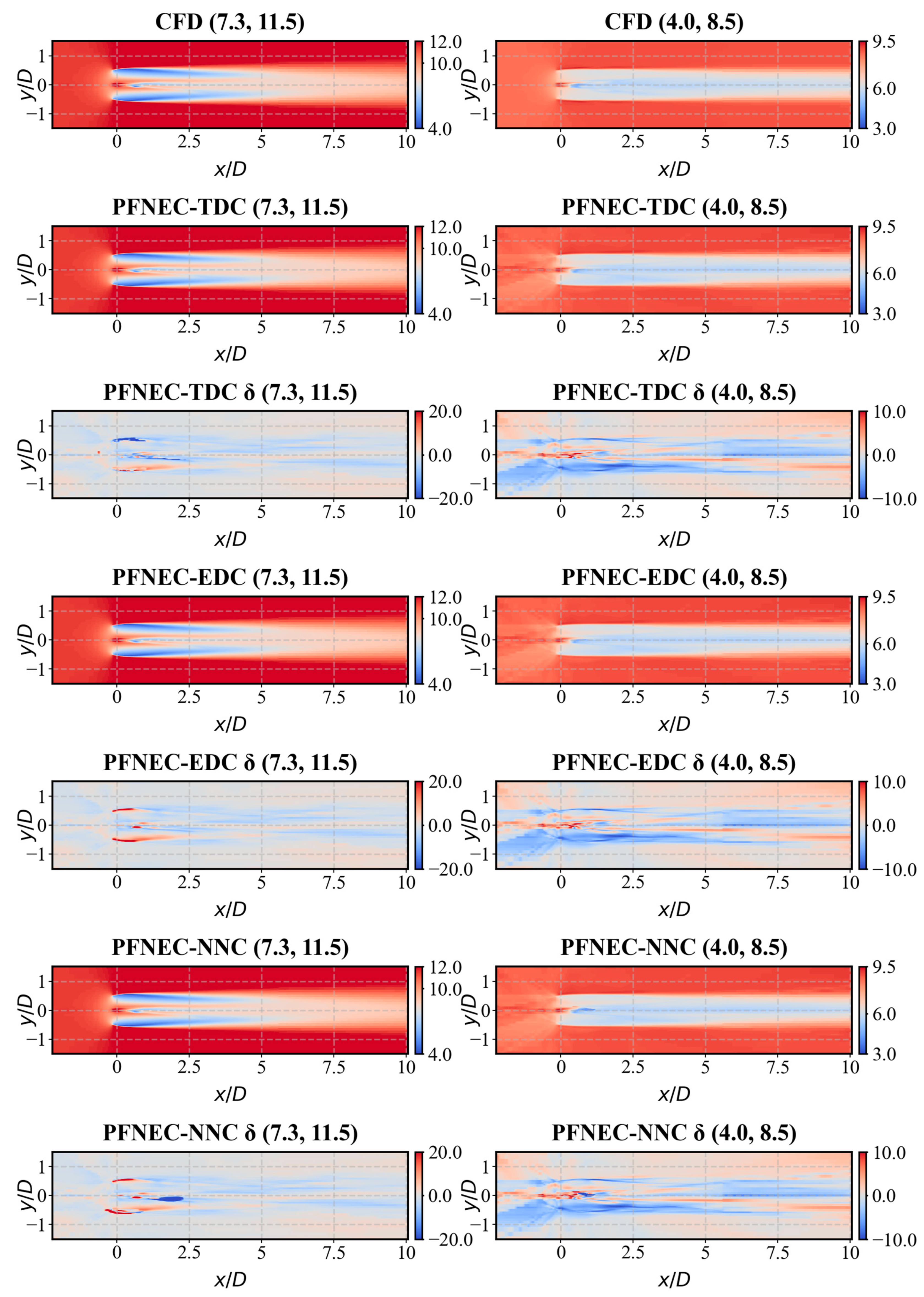
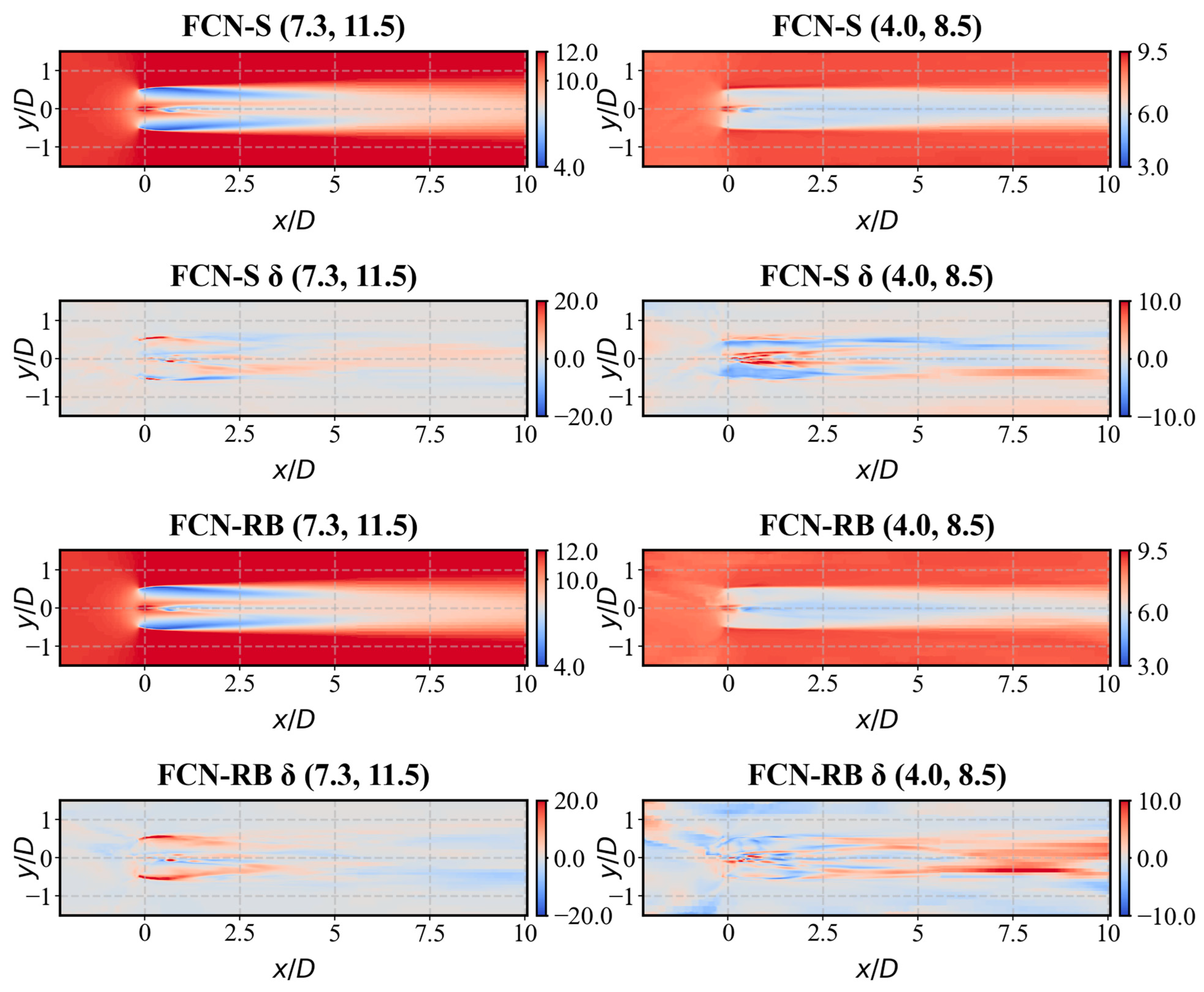
The contour of different models and their distribution of relative error are shown in Figure 18 and Figure 19. It can be found that the high error region is mainly distributed around the blade tip region for the (λ, U0) = (7.3, 11.5) condition and around the nacelle wake region for the (λ, U0) = (4.0, 8.5). The reason is that higher TSR induces larger velocity gradients near the blade tip region, and it is difficult to capture this feature. When compared with CFD results, the models achieve acceptable accuracy. As analyzed in previous analysis, the FCN-RB performs the best for (λ, U0) = (4.0, 8.5) condition, and FCN-S results perform best for (λ, U0) = (7.3, 11.5) condition. PFNEC-EDC also has reliable performance for the prediction of both external conditions.
M S E = 1 N i = 1 N y ^ i y i 2
M A E = 1 N i = 1 N y ^ i y i
M A P E = 100 N i = 1 N y ^ i y i y i
s M A P E = 100 N i = 1 N 2 y ^ i y i y ^ i + y i
P A P = 100 1 2 2 1 N i = 1 N y ^ i y i y i 2 + i = 1 N y i y ^ i 2 / i = 1 N y i y ¯ 2 2
Six evaluation parameters are used to estimate the performance of different models. They include the coefficient of determination R2 (Equation (13)), mean squared error (MSE) in Equation (18), mean absolute error (MAE) in Equation (19), mean absolute percentage error (MAPE) in Equation (20), symmetric mean absolute percentage error (sMAPE) in Equation (21), Percentage of Accuracy-Precision (PAP) [36] in Equation (22). The results of different models across six evaluation parameters are shown in Table 2. It is also evident that the FCN-RB performs best for the (λ, U0) = (4.0, 8.5) condition, and the performance of FCN-S is the best for the (λ, U0) = (7.3, 11.5) condition. The results of PFNEC-EDC are also acceptable and reliable.

6. Generalization of the Advanced Model with the Cross-Construction Method

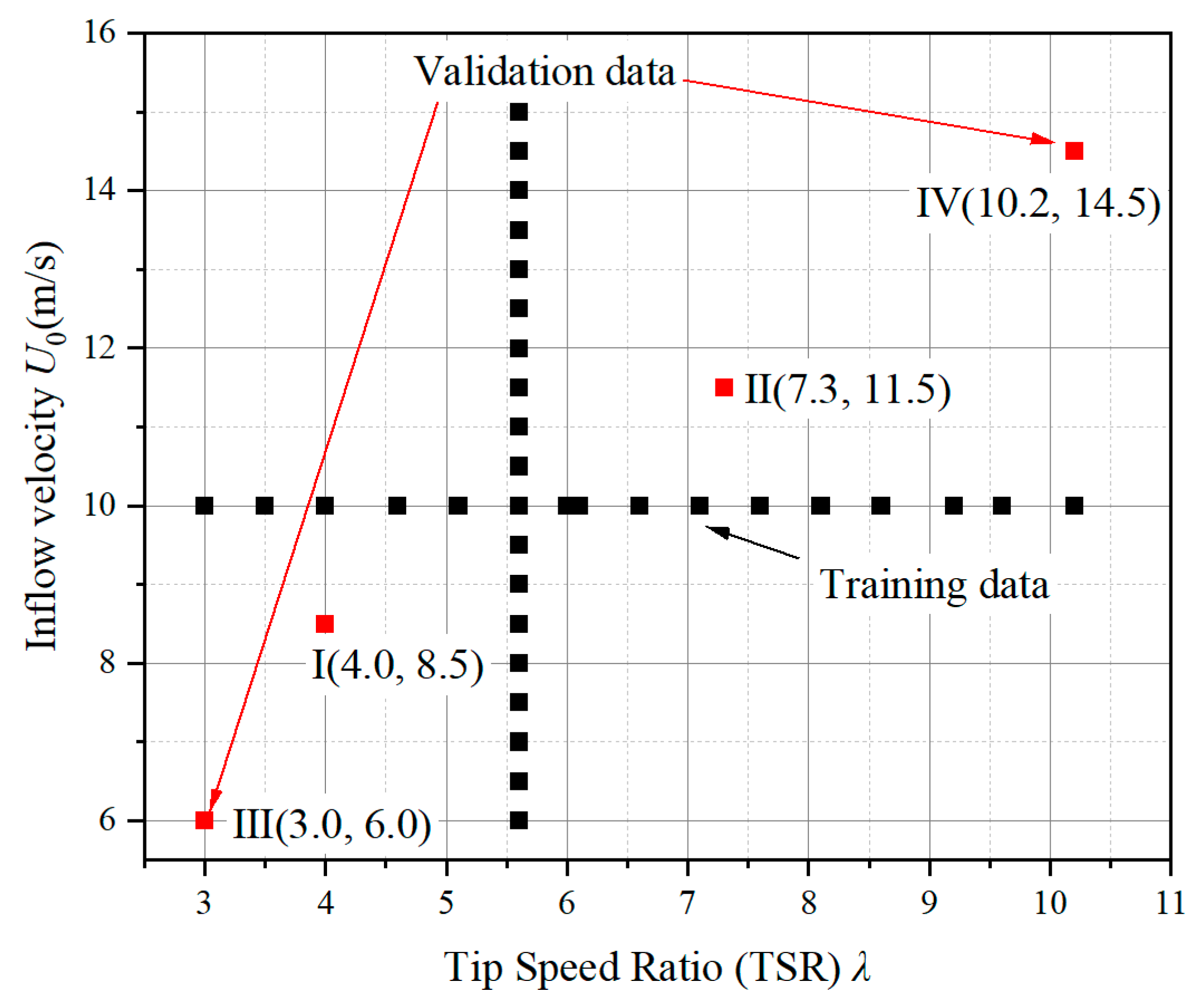
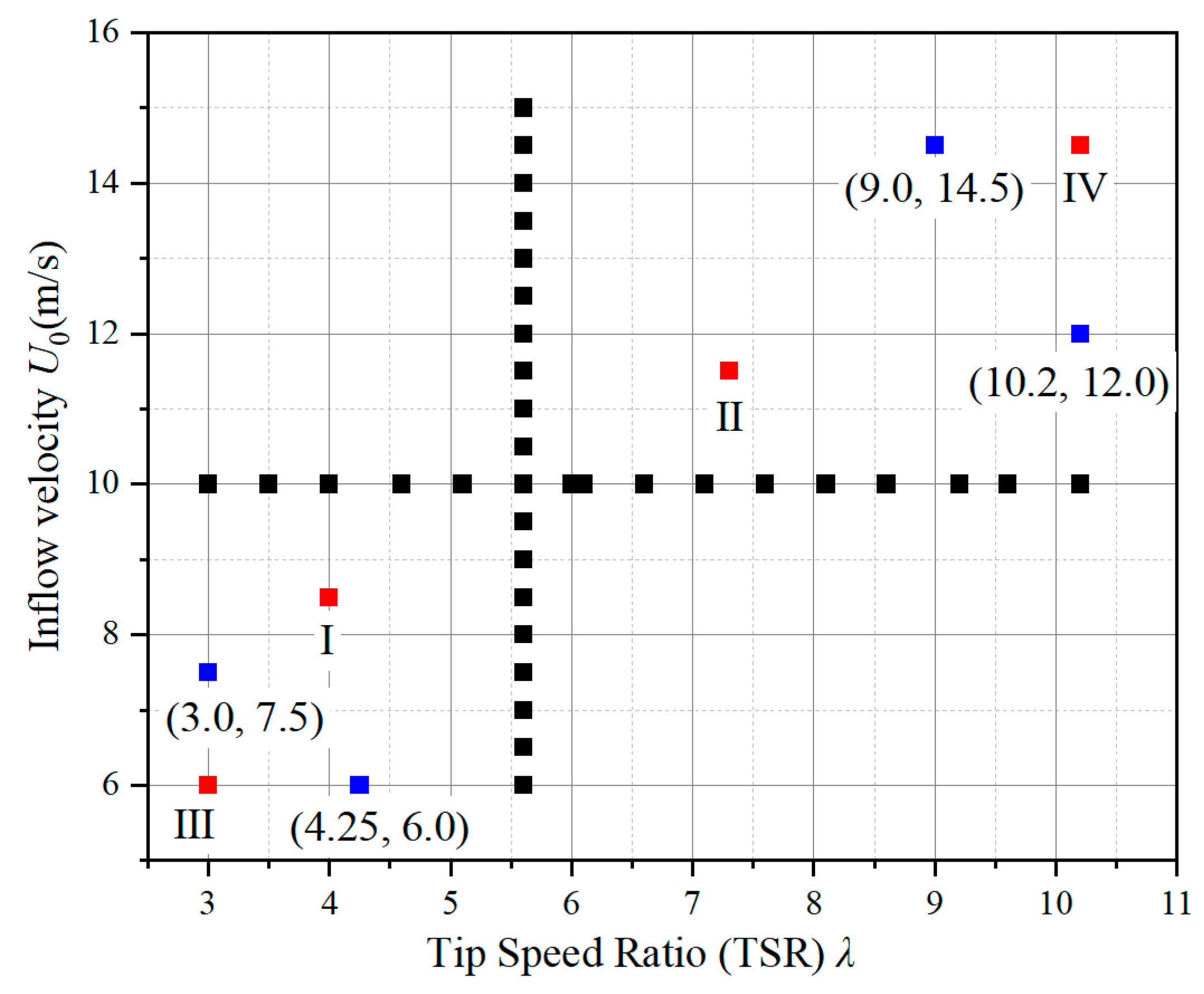
The effectiveness of the cross-construction method has been validated by the performance of different neural networks in the previous section. It is necessary to estimate the performance of neural networks for wake prediction on extreme operating conditions and to test whether the present dataset can train a neural network that has the ability to predict wake flow under extreme operating conditions. Therefore, two conditions of (III (λ, U0) = (3.0, 6.0) and IV (λ, U0) = (10.2, 14.5)) located on the boundary of the dataset were selected to test the neural network trained on the present dataset, as shown in Figure 20.
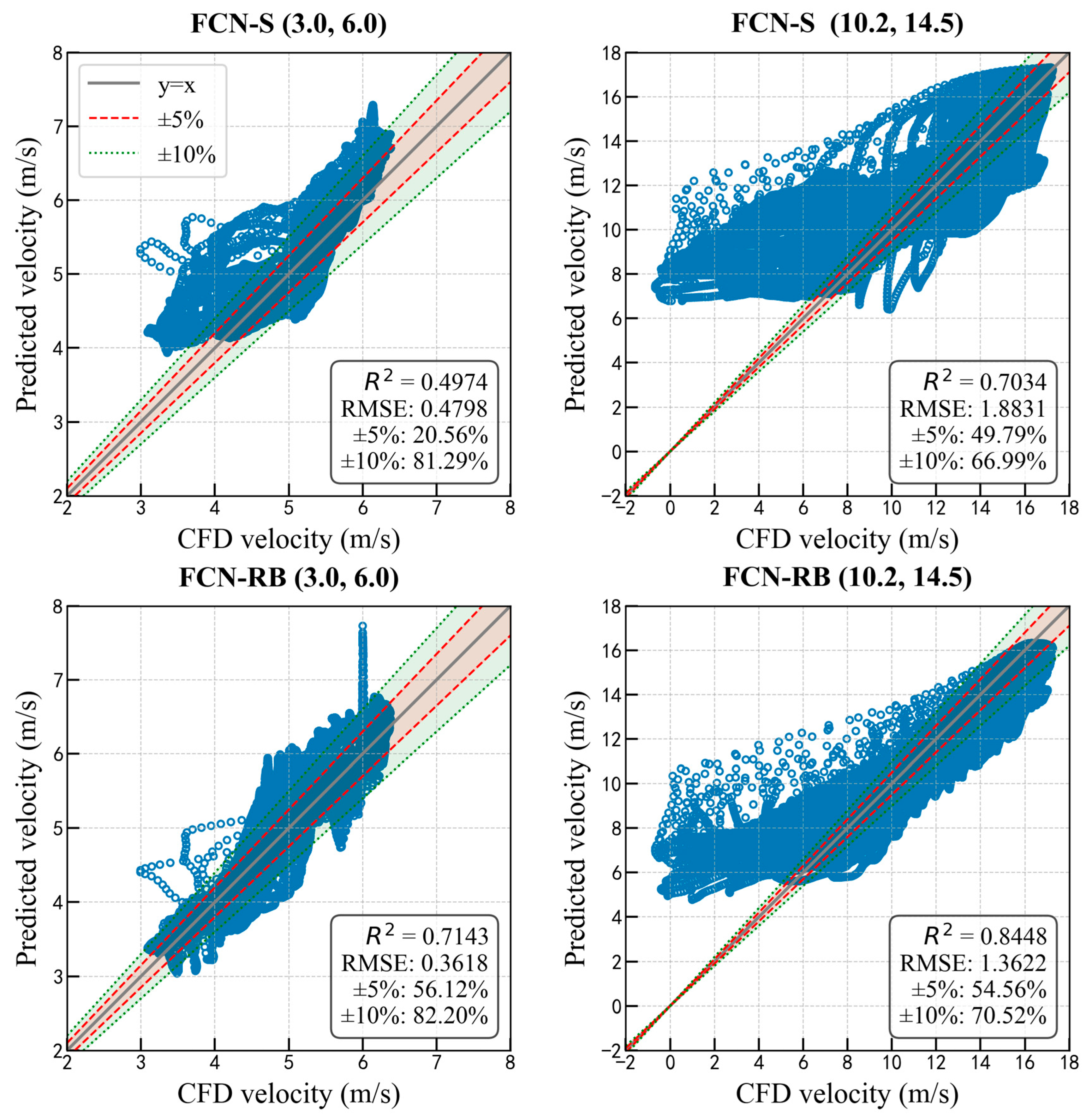
As concluded in the previous section, the FCN-S and FCN-RB perform the best for the wake prediction of Cases I and II. The predictions of the FCN-S and FCN-RB trained on the cross-construction dataset under validation Cases III and IV are shown in Figure 21. It is obvious that the large deviations are observed in the predictions for Cases III and IV compared with Cases I and II. As for the FCN-S model, the coefficient of determination R2 = 0.4974 for case III (λ, U0) = (3.0, 6.0) and R2 = 0.7034 on IV (λ, U0) = (10.2, 14.5) condition. The FCN-RB had the results of the coefficient of determination, R2 = 0.7143 on III (λ, U0) = (3.0, 6.0) condition and R2 = 0.8448 on IV (λ, U0) = (10.2, 14.5) condition. It is necessary to improve the prediction accuracy on extreme operating conditions while still retaining low computational cost.
The flow features under extreme operating conditions should be included in the dataset to make the neural network learn these features. Four conditions located on the boundary of the dataset were added in modified cross-construction dataset, as shown in Figure 22. The four cases were marked with blue data points in Figure 22. The FCN-S and FCN-RB were retrained on a modified cross-construction dataset using the same initialization parameters. After training for 500 epochs, the prediction results under Cases III and IV are shown in Figure 23.
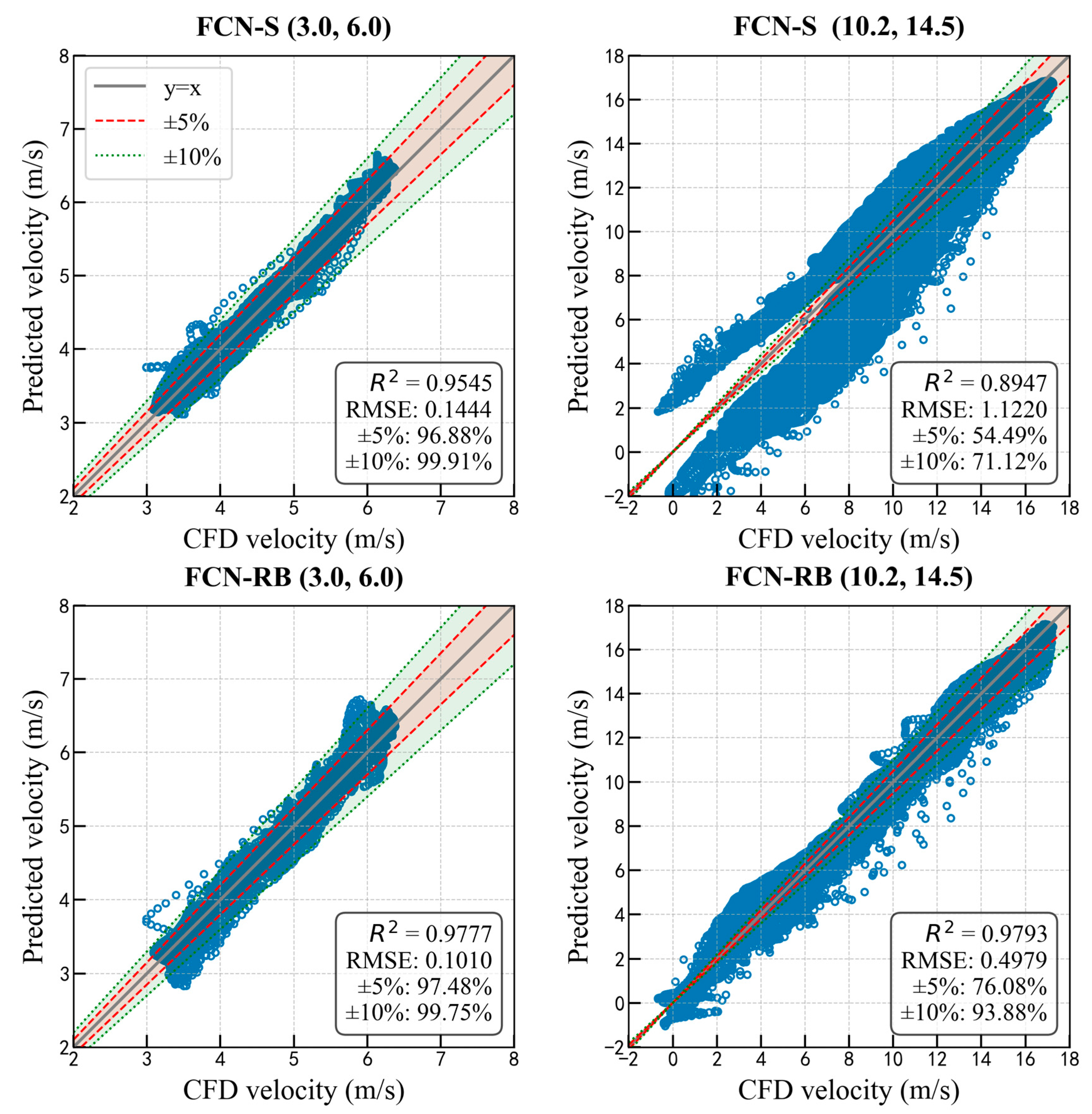
Figure 23 gives the scatter plot of prediction results compared with CFD results. It is obvious that the deviation decreases compared with the prediction results trained on the original dataset (as shown in Figure 8). The coefficient of determination is R2 = 0.9545 for the FCN-S under case III (λ, U0) = (3.0, 6.0) and R2 = 0.8947 under case IV (λ, U0) = (10.2, 14.5). The FCN-RB exhibits a further improvement in accuracy compared with the FCN-S, with R2 = 0.9777 for case III (λ, U0) = (3.0, 6.0) and R2 = 0.9793 for case IV (λ, U0) = (10.2, 14.5).
By analyzing the characteristics of wind turbine wake and the distribution of predictive error, it is obvious that large errors occur near the blade tip wake region. At the blade tips, large velocity gradients occur, and blade tip vortices are induced so that the neural network cannot capture the gradient variation characteristics in this area. In order to enable the neural network to learn the complicated data containing multiple frequency components, a two-dimensional Fourier feature embedding was emploied [26]. The Fourier embedding is introduced as Equation (23):
γ x , y = sin 2 π x , cos 2 π x , , sin 2 i 1 π x , cos 2 i 1 π x , sin 2 π y , cos 2 π y , , sin 2 j 1 π y , cos 2 j 1 π y
where γ is the Fourier operator, x and y are coordinate values.
Considering that the gradient in the y direction is larger than in the x direction, a higher embedding should be applied to y. Therefore, the i and j are set as:
i = 1 , 2 , 3 , 4 , 5 j = 1 , 2 , 3 , 4 , 5 , 6 , 7 , 8 , 9 , 10
After Fourier embedding, the input features are extended to [γ(x, y), x, y, λ, U0]. The FCN-S with Fourier embedding (FCN-S-F) and FCN-RB with Fourier embedding (FCN-RB-F) were conducted with the original dataset and the modified cross-construction dataset. The prediction results trained on the original dataset (in Figure 8) are summarized in Table 3. The modified cross-construction dataset is summarized in Table 4.
The results of FCN-S-F and FCN-RB-F in Table 3 and Table 4 were obtained with different initialization schemes. It is evident in Table 3 that the prediction accuracy of FCN-S and FCN-RB was improved by employing Fourier embedding. This demonstrates that the Fourier embedding can enhance the generalization capacity of FCN-S and FCN-RB. Compared with the accuracy of FCN-S and FCN-RB for I (λ, U0) = (4.0, 8.5) and II (λ, U0) = (7.3, 11.5), the accuracy of FCN-S-F and FCN-RB-F for III (λ, U0) = (3.0, 6.0) and IV (λ, U0) = (10.2, 14.5) conditions remains relatively low. The results trained by the modified dataset of different neural networks are summarized in Table 4. Different networks were trained more effectively on the modified cross-construction dataset than on the original dataset. The FCN-RB performed better than the FCN-S in the prediction of extreme operating conditions. Therefore, the cross-construction method for dataset establishment is effective, and only sparse extreme operating conditions added in the cross-construction dataset can significantly enhance the model’s generalization capability and its predictive performance under extreme operating conditions.

7. Conclusions

A cross-construction method was proposed to establish a sparse dataset for wind turbine wake, and the neural networks trained on this dataset achieved high accuracy and fidelity. The neural network models were designed in this study to make predictions of wind turbine wake with a cross-construction dataset. Some neural models were designed to improve the prediction accuracy of the wake flow field. The main conclusions are summarized as follows:
This study proposed a cross-construction method to generate a sparse yet representative CFD dataset for wind turbine wakes. The cross-construction method can build a sparse wind turbine wake dataset at a low cost, and the trained neural network has high prediction accuracy. The FCN-C predicted wake fields with the accuracy of R2 = 0.9528, RMSE = 0.2952 under (λ, U0) = (4.0, 8.5) condition and R2 = 0.9752, RMSE = 0.3945 under the condition (λ, U0) = (7.3, 11.5).
A pre-training and fine-tuning network based on error classification using three classification models was designed. The PFNEC improves the prediction accuracy for the wake flow field. PFNEC-EDC performed better than the other two models. PFNEC-EDC had the coefficient of determination R2 = 0.9750 for (λ, U0) = (4.0, 8.5) condition and R2 = 0.9851 for (λ, U0) = (7.3, 11.5).
Two models, FCN-S and FCN-RB, were developed and showed the best performance for the prediction of external conditions. The Fourier embedding can improve the predictive accuracy from R2 = 0.7143 to R2 = 0.8723 under (λ, U0) = (3.0, 6.0) conditions and enhance the generalization capacity of neural networks. As for extreme operating conditions, adding four samples in the original dataset can improve the accuracy of extreme operating conditions from R2 = 0.9545 to R2 = 0.9939 under (λ, U0) = (3.0, 6.0) condition and from R2 = 0.8947 to R2 = 0.9886 under (λ, U0) = (10.2, 14.5) condition.
Limitations of this study should be noted. The cross-construction method was proposed and verified on a two-parameter space (TSR and inflow velocity), and its scalability to higher-dimensional conditions remains to be explored further. It is worthwhile to validate this method in a multi-parameter space.

Author Contributions

Conceptualization, Y.W. and Q.T.; methodology, Y.W. and Q.T.; software, Q.T., C.L., P.D. and J.W.; validation, Y.W. and Q.T.; formal analysis, Q.T.; investigation, Y.W. and Q.T.; resources, Y.W.; data curation, Q.T.; writing—original draft preparation, Q.T.; writing—review and editing, Y.W. and Q.T.; visualization, Q.T.; supervision, Y.W. and J.L.; project administration, Y.W.; funding acquisition, Y.W. All authors have read and agreed to the published version of the manuscript.

Funding

This research was funded by the Fundamental Research Funds for the Central Universities (2022ZFJH004), the Creative Seed Fund of Shanxi Research Institute for Clean Energy, the Carbon Neutrality and Energy System Transformation project, and the National Science and Technology Major Project (2019-I-0022-0021).

Data Availability Statement

The data that support the findings of this study are available within the article.

Conflicts of Interest

The authors declare no conflicts of interest.

References

  1. GWEC. Global Wind Report 2024; Global Wind Energy Council: Brussels, Belgium, 2024. [Google Scholar]
  2. Abdallah, A.; William, M.A.; Moharram, N.A.; Zidane, I.F. Boosting H-Darrieus vertical axis wind turbine performance: A CFD investigation of J-Blade aerodynamics. Results Eng. 2025, 27, 106358. [Google Scholar] [CrossRef]
  3. Porté-Agel, F.; Bastankhah, M.; Shamsoddin, S. Wind-Turbine and Wind-Farm Flows: A Review. Bound.-Layer Meteorol. 2020, 174, 1–59. [Google Scholar] [CrossRef] [PubMed]
  4. Jensen, N.O. A Note on Wind Generator Interaction; Risø National Laboratory: Roskilde, Denmark, 1983. [Google Scholar]
  5. Bastankhah, M.; Porté-Agel, F. A new analytical model for wind-turbine wakes. Renew. Energy 2014, 70, 116–123. [Google Scholar] [CrossRef]
  6. Zhang, H.; Gao, X.; Lu, H.; Zhao, Q.; Zhu, X.; Yu, W.; Fei, Z. Investigation of a new 3D wake model of offshore floating wind turbines subjected to the coupling effects of wind and wave. Appl. Energy 2024, 365, 123189. [Google Scholar] [CrossRef]
  7. Brunton, S.L.; Noack, B.R.; Koumoutsakos, P. Machine Learning for Fluid Mechanics. Annu. Rev. Fluid Mech. 2020, 52, 477–508. [Google Scholar] [CrossRef]
  8. Ye, M.; Li, M.; Liu, M.; Xiao, C.; Wan, D. Overview of Data-Driven Models for Wind Turbine Wake Flows. J. Mar. Sci. Appl. 2025, 24, 1–20. [Google Scholar] [CrossRef]
  9. Wilson, B.; Wakes, S.; Mayo, M. Surrogate modeling a computational fluid dynamics-based wind turbine wake simulation using machine learning. In Proceedings of the 2017 IEEE Symposium Series on Computational Intelligence (SSCI), Honolulu, HI, USA, 27 November–1 December 2017; pp. 1–8. [Google Scholar]
  10. Purohit, S.; Ng, E.Y.K.; Kabir, I.F.S.A. Evaluation of three potential machine learning algorithms for predicting the velocity and turbulence intensity of a wind turbine wake. Renew. Energy 2022, 184, 405–420. [Google Scholar] [CrossRef]
  11. Ti, Z.; Deng, X.W.; Yang, H. Wake modeling of wind turbines using machine learning. Appl. Energy 2020, 257, 114025. [Google Scholar] [CrossRef]
  12. Ti, Z.; Deng, X.W.; Zhang, M. Artificial Neural Networks based wake model for power prediction of wind farm. Renew. Energy 2021, 172, 618–631. [Google Scholar] [CrossRef]
  13. Nakhchi, M.E.; Naung, S.W.; Rahmati, M. Wake and power prediction of horizontal-axis wind farm under yaw-controlled conditions with machine learning. Energy Convers. Manag. 2023, 296, 117708. [Google Scholar] [CrossRef]
  14. Renganathan, S.A.; Maulik, R.; Letizia, S.; Iungo, G.V. Data-driven wind turbine wake modeling via probabilistic machine learning. Neural Comput. Appl. 2022, 34, 6171–6186. [Google Scholar] [CrossRef]
  15. Pujari, K.N.; Miriyala, S.S.; Mitra, K. Jensen-ANN: A Machine Learning adaptation of Jensen Wake Model. IFAC-PapersOnLine 2023, 56, 4651–4656. [Google Scholar] [CrossRef]
  16. Liu, X.; Li, Z.; Yang, X. PhyWakeNet: A dynamic wake model accounting for aerodynamic force oscillations. Wind Energy Sci. Discuss. 2025, 2025, 1–29. [Google Scholar] [CrossRef]
  17. Li, B.; Ge, M.; Li, X.; Liu, Y. A physics-guided machine learning framework for real-time dynamic wake prediction of wind turbines. Phys. Fluids 2024, 36, 035143. [Google Scholar] [CrossRef]
  18. Zhang, J.; Zhao, X. Wind farm wake modeling based on deep convolutional conditional generative adversarial network. Energy 2022, 238, 121747. [Google Scholar] [CrossRef]
  19. Zhang, Z.; Santoni, C.; Herges, T.; Sotiropoulos, F.; Khosronejad, A. Time-Averaged Wind Turbine Wake Flow Field Prediction Using Autoencoder Convolutional Neural Networks. Energies 2022, 15, 41. [Google Scholar] [CrossRef]
  20. Schøler, J.P.; Rasmussen, F.P.W.; Quick, J.; Réthoré, P.E. Graph Neural Operator for windfarm wake flow. Wind Energy Sci. Discuss. 2025, 2025, 1–38. [Google Scholar]
  21. Raissi, M.; Perdikaris, P.; Karniadakis, G.E. Physics-informed neural networks: A deep learning framework for solving forward and inverse problems involving nonlinear partial differential equations. J. Comput. Phys. 2019, 378, 686–707. [Google Scholar] [CrossRef]
  22. Zhang, J.; Zhao, X. Digital twin of wind farms via physics-informed deep learning. Energy Convers. Manag. 2023, 293, 117507. [Google Scholar] [CrossRef]
  23. Ctp, A.G.; Boya, S.K.; Jinka, R.; Gupta, A.; Tyagi, A.; Sarkar, S.; Subramani, D.N. A physics-informed neural network for turbulent wake simulations behind wind turbines. Phys. Fluids 2025, 37, 015110. [Google Scholar] [CrossRef]
  24. Wang, L.; Dong, M.; Wang, L.; Huang, C.; Song, D.; Fan, X.; Yang, J.; Wang, T.; Chen, S.; Li, Q.A. Multi-scale wake modeling based on physics-informed neural networks and transfer learning. Appl. Energy 2026, 406, 127318. [Google Scholar] [CrossRef]
  25. Kirby, A.; Briol, F.-X.; Dunstan, T.D.; Nishino, T. Data-driven modelling of turbine wake interactions and flow resistance in large wind farms. Wind Energy 2023, 26, 968–984. [Google Scholar] [CrossRef]
  26. Wang, S.; Sankaran, S.; Perdikaris, P. Respecting causality for training physics-informed neural networks. Comput. Methods Appl. Mech. Eng. 2024, 421, 116813. [Google Scholar] [CrossRef]
  27. Sedaghatizadeh, N.; Arjomandi, M.; Kelso, R.; Cazzolato, B.; Ghayesh, M.H. Modelling of wind turbine wake using large eddy simulation. Renew. Energy 2018, 115, 1166–1176. [Google Scholar] [CrossRef]
  28. Ji, R.; Sun, K.; Zhang, J.; Zhu, R.; Wang, S. A novel actuator line-immersed boundary (AL-IB) hybrid approach for wake characteristics prediction of a horizontal-axis wind turbine. Energy Convers. Manag. 2022, 253, 115193. [Google Scholar] [CrossRef]
  29. Zhao, M.; Chen, S.; Wang, K.; Wu, X.; Zha, R. Effect of the yaw angle on the aerodynamics of two tandem wind turbines by considering a dual-rotor wind turbine in front. Ocean Eng. 2023, 283, 114974. [Google Scholar] [CrossRef]
  30. Kim, W.-W.; Menon, S. A new dynamic one-equation subgrid-scale model for large eddy simulations. In Proceedings of the 33rd Aerospace Sciences Meeting and Exhibit, Reno, NV, USA, 9-12 January 1995; American Institute of Aeronautics and Astronautics: Reston, VA, USA, 1995. [Google Scholar]
  31. Huang, S.; Li, Q.S. A new dynamic one-equation subgrid-scale model for large eddy simulations. Int. J. Numer. Methods Eng. 2010, 81, 835–865. [Google Scholar] [CrossRef]
  32. Sørensen, J.N.; Shen, W.Z. Numerical modeling of wind turbine wakes. J. Fluids Eng. 2002, 124, 393–399. [Google Scholar] [CrossRef]
  33. Krogstad, P.-Å.; Eriksen, P.E. “Blind test” calculations of the performance and wake development for a model wind turbine. Renew. Energy 2013, a 50, 325–333. [Google Scholar] [CrossRef]
  34. Krogstad, P.Å.; Lund, J.A. An experimental and numerical study of the performance of a model turbine. Wind Energy 2012, 15, 443–457. [Google Scholar] [CrossRef]
  35. Bengio, Y.; Louradour, J.; Collobert, R.; Weston, J. Curriculum learning. In Proceedings of the 26th Annual International Conference on Machine Learning, Montreal, QC, Canada, 14-18 June 2009; Association for Computing Machinery: Montreal, QC, Canada, 2009; pp. 41–48. [Google Scholar]
  36. Heidaryan, E. A Note on Model Selection Based on the Percentage of Accuracy-Precision. J. Energy Resour. Technol. 2018, 141, 045501. [Google Scholar] [CrossRef]
Figure 1. The computational domain.
Energies 19 01385 g001
Figure 2. Power and thrust coefficient.
Energies 19 01385 g002
Figure 3. Architecture of ANN.
Energies 19 01385 g003
Figure 4. Architecture of FCN.
Energies 19 01385 g004
Figure 5. The distribution of mean velocity Umean regressed by ANN and FCN against CFD simulation results.
Energies 19 01385 g005
Figure 6. The comparison of ANN and FCN results of mean velocity Umean on the XY plane.
Energies 19 01385 g006
Figure 7. Distribution of parameters TSR and U0 for constructing the training dataset.
Energies 19 01385 g007
Figure 8. Sparse distribution of parameters TSR and U0 of the cross-constructed training dataset.
Energies 19 01385 g008
Figure 9. Architecture of a fully connected network with coordinate information.
Energies 19 01385 g009
Figure 10. The distribution of mean velocity Umean regressed by FCN-C against CFD simulation results.
Energies 19 01385 g010
Figure 11. The comparison of FCN-C and CFD simulation results of mean velocity Umean on the XY plane.
Energies 19 01385 g011
Figure 12. The architecture of pre-training and fine-tuning a network based on error classification.
Energies 19 01385 g012
Figure 13. Three classification methods for inference.
Energies 19 01385 g013
Figure 14. The architecture of a fully connected network with softmax layer.
Energies 19 01385 g014
Figure 15. The architecture of a fully connected network with a residual block.
Energies 19 01385 g015
Figure 16. The distribution of mean velocity Umean regressed by PFNEC-TDC, PFNEC-EDC, and PFNEC-NNC against CFD simulation results.
Energies 19 01385 g016
Figure 17. The distribution of mean velocity Umean regressed by FCN-S and FCN-RB against CFD simulation results.
Energies 19 01385 g017
Figure 18. The comparison of PFNEC-TDC, PFNEC-EDC, and PFNEC-NNC with CFD simulation results of mean velocity Umean on the XY plane.
Energies 19 01385 g018
Figure 19. The comparison of FCN-S and FCN-RB with the CFD simulation results of mean velocity Umean on the XY plane.
Energies 19 01385 g019
Figure 20. The distribution of validation data points in the cross-constructed dataset.
Energies 19 01385 g020
Figure 21. The distribution of mean velocity Umean regressed by FCN-S and FCN-RB against CFD simulation results by the original dataset under III and IV conditions.
Energies 19 01385 g021
Figure 22. The distribution of data points in the modified dataset.
Energies 19 01385 g022
Figure 23. The distribution of mean velocity Umean regressed by FCN-S and FCN-RB by the modified dataset against CFD simulation results under III and IV conditions.
Energies 19 01385 g023
Table 1. The conditions of the dataset.
CaseλU0 (m/s)CaseλU0 (m/s)
15.66195.615
25.66.520310
35.67213.510
45.67.522410
55.68234.610
65.68.5245.110
75.6925610
85.69.5266.110
95.610276.610
105.610.5287.110
115.611297.610
125.611.5308.110
135.612318.610
145.612.5329.210
155.613339.610
165.613.53410.210
175.614357.311.5
185.614.5364.08.5
Table 2. Performance comparison of different models.
ConditionModelMSEMAEMAPEsMAPER2PAP
(4.0, 8.5)FCN0.09140.20963.12333.22130.950596.8767
FCN-C0.08710.19883.04893.12160.952896.9511
PFNEC-TDC0.04680.14932.14372.17710.974697.8563
PFNEC-EDC0.04610.14942.14712.18450.975097.8529
PFNEC-NNC0.05530.15582.25982.31220.970097.7402
FCN-S0.02610.10761.64091.64620.985998.3591
FCN-RB0.02000.09591.40411.41370.989198.5959
(7.3, 11.5)FCN0.28790.32634.19914.09990.954195.8009
FCN-C0.15560.25293.35893.27040.975296.6411
PFNEC-TDC0.29830.23633.04913.24960.952596.9509
PFNEC-EDC0.09320.19502.46252.41930.985197.5375
PFNEC-NNC0.32440.24512.88872.89380.948397.1113
FCN-S0.04950.14651.85421.85730.992198.1458
FCN-RB0.06800.17682.34142.27460.989297.6586
Table 3. Performance comparison of different models with the original dataset.
ConditionModelMSEMAEMAPEsMAPER2PAP
(3.0, 6.0)FCN-S 0.23020.43427.81507.61540.497492.1850
FCN-RB 0.13090.28425.36685.20260.714394.6332
FCN-S-F0.07990.17443.62303.43780.825696.3770
FCN-RB-F0.05850.16103.26853.13210.872396.7315
(10.2, 14.5)FCN-S 3.54601.193329.916512.41850.703470.0835
FCN-RB 1.85570.894222.51479.92830.844877.4853
FCN-S-F1.84260.937516.23349.55020.845983.7666
FCN-RB-F2.70171.128626.354911.23880.774073.6451
Table 4. Performance comparison of different models with a modified dataset.
ConditionModelMSEMAEMAPEsMAPER2PAP
(3.0, 6.0)FCN-S 0.02090.12772.29702.27170.954597.7030
FCN-RB 0.01020.06991.34231.34020.977798.6577
FCN-S-F0.00280.03990.75460.75060.993999.2454
FCN-RB-F0.00300.04180.79360.79270.993399.2064
(10.2, 14.5)FCN-S 1.25890.769812.85869.76830.894787.1414
FCN-RB 0.24790.35824.40424.04260.979395.5958
FCN-S-F0.13640.24022.68372.82910.988697.3163
FCN-RB-F0.18880.28158.12983.61930.984291.8702
Disclaimer/Publisher’s Note: The statements, opinions and data contained in all publications are solely those of the individual author(s) and contributor(s) and not of MDPI and/or the editor(s). MDPI and/or the editor(s) disclaim responsibility for any injury to people or property resulting from any ideas, methods, instructions or products referred to in the content.