


Abstract
Under the constraints of carbon peaking and carbon neutrality targets, corporate emission reduction is shifting from fragmented governance toward integrated governance that aligns pollution control with carbon reduction and long-term sustainable development. New energy transition policies have become a key instrument for restructuring urban energy, environmental, and economic systems, yet it remains unclear how these macro-level policies reshape firms’ marginal abatement cost–benefit structures and under what governance conditions they generate the synergy within corporate pollution reduction, rather than merely shifting burdens. It is valuable to identify whether, how, and under which governance conditions new energy demonstration city policies enhance the synergy between corporate pollution reduction and carbon mitigation. Guided by system synergy theory and a marginal abatement cost perspective, we use panel data on listed firms to construct a synergy index that jointly reflects multiple pollutant emissions and abatement costs, capturing both environmental effectiveness and economic efficiency. A DID model based on the staggered rollout of new energy demonstration cities is then employed to estimate the policy’s impact on the synergy between corporate pollution reduction and carbon mitigation and its contextual conditions. The results show the following: (1) Inclusion in a new energy demonstration city significantly increases the synergy within corporate pollution reduction. (2) Mechanism analysis indicates that higher municipal attention to green and environmental development and higher corporate ESG (environmental, social, and governance) performance strengthen the positive policy influence. (3) Heterogeneous effects are mainly concentrated in non-energy intensive industries, state-owned enterprises, and small firms, which indicates structural divergence in policy incentives across different types of firms. Overall, this study enriches the studies about the synergy between pollution reduction and carbon mitigation to the firm level, embeds a marginal abatement cost perspective into synergy measurement, and provides an evaluative framework that is consistent with how firms balance environmental and financial objectives. The findings contribute to the sustainability literature by informing the design and assessment of energy transition policies and by offering evidence to refine new energy demonstration city programs so that limited governance resources are directed toward more cost-effective joint gains.
1. Introduction
The new energy demonstration city initiative is an important policy in China’s ongoing energy transition to achieve the goals of carbon peaking, carbon neutrality, and high-quality development. By reshaping the structure of the energy supply, end-use patterns, and environmental regulation at the city level, this policy seeks to accelerate the deployment of new energy, improve energy efficiency, and integrate energy and environmental governance within a unified institutional framework [1,2]. From a system synergy perspective, these institutional changes reconfigure the linkages among energy use, pollution control, and carbon mitigation within the urban energy–environment–economy system, creating new conditions under which firms can pursue greener and low-carbon development paths [3]. Demonstration cities undertake clearer tasks in new energy generation and grid integration, terminal energy-use optimization, and supervision of energy use and emissions, while benefiting from a more stable clean energy supply, stricter energy-efficiency and emission standards, and more concentrated green finance and fiscal support tools [4].
Within this evolving system, firms are expected to move beyond controlling single pollutants or carbon sources and instead coordinate multiple environmental constraints within an integrated governance framework [5]. In long-term practice, sulfur dioxide and carbon dioxide have often been linked to different abatement facilities and assessment criteria, so firms must allocate financial and managerial resources across several dimensions and marginal abatement costs tend to accumulate. The synergy within corporate pollution reduction emphasizes integrated optimization within the same production system [6]. From a marginal abatement cost perspective, achieving such synergy requires both coordinated processes upgrading, energy substitution, and process management to reduce multiple emissions, and a restructuring of the abatement cost–benefit profile so that the environmental gains from each unit of reduction are reasonably aligned with its cost. When this alignment is in place, firms have clearer economic incentives to sustain the coordinated governance of pollution and carbon reduction in the long term.
In practice, the energy transition driven by new energy demonstration city policies unfolds within heterogeneous governance environments. Cities vary in how strongly they prioritize green development and how much attention they pay to ecological issues. Some incorporate environmental quality and a green image into core development goals and consistently guide corporate environmental behavior through planning, performance assessment, and resource allocation, while others place greater emphasis on short-term growth. Under the same policy label, firms therefore encounter different mixes of constraints and incentives [7]. At the firm level, ESG foundations also differ. Some firms embed environmental governance into their overall corporate strategy and are willing to adjust information disclosure, internal control, and stakeholder management in ways that align with sustainable development objectives, whereas others remain close to a minimum-cost compliance mode. Existing studies have assessed the effects of new energy demonstration city policies from the perspectives of urban air quality, energy structure adjustment, and green innovation [8,9,10], but micro-level evidence is still lacking on whether these policies improve firms’ marginal abatement cost structures for pollution and carbon reduction and whether they truly induce durable synergy under comprehensive cost constraints in a setting of differentiated city and firm governance. Under this background, this study adopts system synergy theory and a marginal abatement cost perspective to examine the relationship between new energy demonstration city policy and the synergy within corporate pollution reduction from a sustainability-oriented energy transition perspective.
2. Literature Review
In the context of energy transition and tightening environmental constraints, a growing body of research has begun to examine how policy instruments and governance arrangements shape pollution and carbon reduction outcomes. To situate our study, this section reviews three closely related strands of the literature. Taken together, these strands provide the analytical background for our focus on the synergy within corporate pollution reduction under new energy demonstration city policies and help to clarify the specific gaps that the present study seeks to address.
Firstly, research on new energy demonstration city policies mainly focuses on the environmental and economic impacts of the policy itself. Studies treat these policies as institutional arrangements for promoting the energy transition and examines their effects on energy-use structure, pollutant intensity, carbon emissions and air quality at the city or regional level [11]. The evidence generally shows that demonstration cities achieve a higher share of clean energy, larger reductions in conventional pollutants and more pronounced declines in carbon intensity [12]. Some also takes the policy as a quasi-natural experiment and uses city- or firm-level panel data to analyze its effects on green technological innovation, resource allocation efficiency, capital flows and industrial upgrading [13,14]. These studies typically rely on multi-period DID or triple-difference designs, often with dynamic and heterogeneity analyses, and confirm that the policy strengthens incentives for green innovation, mitigates high-carbon path dependence and improves corporate environmental performance [15]. Overall, the existing work remains focused on macro or meso indicators, such as single emission measures, innovation output or productivity and offers limited evidence on whether and how the policy reshapes firms’ pollution–carbon reduction behavior in a coordinated way under explicit cost constraints.
Secondly, research on the synergy between pollution reduction and carbon mitigation or coordinated development has developed a stronger foundation at the macro and sectoral levels. Most studies use cities, regions or industries as the unit of analysis and place air pollutants and greenhouse gases in a unified framework to examine the necessity, pathways and efficiency differences in coordinated governance [16]. In terms of measurement, some contributions construct composite indices, coupling-coordination models or synergy efficiency indicators to capture the degree of alignment between pollution control and carbon reduction [17]. Other work incorporates synergy into total factor productivity, green technological progress or similar indicators, thereby linking technological upgrading and structural adjustment to joint emission outcomes [18]. More recent contributions adopt a marginal abatement cost perspective [19]. They include abatement facility investment, operating expenditure and output loss on the cost side and estimate marginal abatement costs for different pollutants and carbon, then evaluate the synergy by comparing unit abatement costs with multi-target emission outcomes. These studies deepen the understanding of trade-offs in pollution–carbon governance at the system level. Yet, most of them remain at the city, regional or industry level, and firm-level measures of synergy are still scarce. In particular, few studies start from firms’ marginal abatement costs and systematically assess how enterprises achieve the synergy within pollution reduction when facing joint constraints on environmental targets and abatement costs.
Thirdly, about the influencing factors, some studies also highlight the role of external and internal governance in shaping environmental outcomes. On the external side, studies show that local governments that attach greater importance to green or ecological development tend to implement environmental regulations more stringently, provide more policy resources for environment governance, and send clearer signals for green transformation [20]. On the internal side, research on corporate governance and ESG performance indicates that firms with stronger ESG practices and environmental management systems are better able to integrate environmental goals into their strategy, to disclose and manage environmental risks, and to respond proactively to regulatory and market pressures [21]. Taken together, the literature suggests that both local governance orientation and firms’ internal governance foundations influence the strength and effectiveness of environmental policies. However, these factors are usually examined separately in relation to environmental investment, green innovation or emission outcomes, and have rarely been incorporated into analyses of how new energy demonstration city policies affect the synergy within corporate pollution reduction.
Synthesizing these strands, the existing literature exhibits three limitations that directly motivate this study. First, research on new energy demonstration city policies has largely remained at the city, regional or industry level and has not provided a systematic account of the policy’s micro-level effects on firms’ coordinated emission-reduction behavior. Because most studies focus on single pollutants, innovation output or productivity, they cannot reveal whether corporate environmental governance has been reshaped toward joint reductions in pollution and carbon under cost constraints. Second, most evaluations of the synergy rely on synergy indices, synergy efficiency or coupling-coordination measures and treat costs through coarse proxies such as input intensity or total abatement expenditure. Without a firm-level, marginal abatement cost-based perspective, it is difficult to assess how much firms actually pay for synergistic emission reductions and whether they obtain simultaneous gains in emissions and abatement costs within the energy–environment–economy system, which weakens the guidance for corporate abatement decisions and policy design. Third, although the existing studies show that both local green-development orientation and firms’ internal governance (including ESG performance) shape environmental policy implementation and corporate responses, these governance factors have seldom been integrated into the evaluation of new energy demonstration city policies. As a result, the heterogeneity and boundary conditions of policy effects on the synergy within corporate pollution reduction remain insufficiently understood.
Under the ongoing energy transition and tightening constraints on firms’ pollution and carbon emissions, it is therefore necessary to clarify how new energy demonstration city policies influence the synergy within pollution reduction at the micro level, and how external and internal governance conditions shape this influence. This study makes three main contributions. First, it incorporates new energy demonstration city policies into a firm-level analytical framework of the synergy within corporate pollution reduction and focuses on how the policy affects corporate environmental performance under multiple emission targets. In doing so, it links urban energy-transition policy to firms’ coordinated emission-reduction behavior and adds micro-level evidence at the intersection of urban policy, firm responses and multi-goal environmental outcomes. Second, it develops a synergy measure that reflects the full process and systemic features of firms’ pollution and carbon reduction. By constructing a marginal abatement cost-based indicator, the study captures how enterprises jointly adjust production, energy use and output to achieve simultaneous improvements in emissions and abatement costs within the energy–environment–economy system, thereby extending the existing synergy measures that rely mainly on quantity-based indices. Third, it adopts a combined external–internal governance perspective by incorporating local governments’ attention to green development and firms’ ESG performance as moderating factors in a unified framework. Building on prior evidence that local green orientation affects the implementation intensity and that strong ESG practices reflect internal governance structures that embed environmental goals, the analysis identifies how these external and internal governance conditions jointly shape the effectiveness and boundaries of new energy demonstration city policies on the synergy within corporate pollution reduction, and provides more targeted guidance for tailoring such policies to local contexts and firm characteristics.
3. Research Design
3.1. Theoretical Foundation and Research Hypothesis
3.1.1. New Energy Demonstration City Policies on Corporate Synergy in Pollution and Carbon Reduction
System synergy theory views complex socio-economic systems as consisting of several interacting subsystems that constrain each other and evolve together [22,23]. In this study, the energy, environmental and economic dimensions form an integrated energy–environment–economy system around firms. Within this system, the synergy within corporate pollution reduction means that firms adjust their production processes, energy use and environmental management in a unified way, so that one set of technological and managerial changes improves multiple emission outcomes simultaneously, rather than treating pollutants and carbon as separate compliance tasks.
New energy demonstration city policies act directly on key elements of this system. By increasing the share of new energy, tightening efficiency and emission constraints and directing public resources toward green development, they alter both the pressure variables and the opportunity structure for cleaner production [24]. These changes weaken the viability of the previous high-energy, high-emission pattern and push the system toward a more ordered, low-carbon configuration. Under such conditions, fragmented, pollutant-by-pollutant responses become more costly and less compatible with the external environment, whereas integrated abatement strategies that jointly optimize pollution and carbon reduction better match the new system constraints and incentives. System synergy theory therefore suggests that policy-induced ordering of the energy–environment–economy system will be accompanied by stronger synergy within pollution reduction.
Accordingly, we propose the following hypothesis:
Hypothesis 1.
New energy demonstration city policies significantly increase the synergy within corporate pollution reduction.
3.1.2. Moderating Effects of External and Internal Governance
System synergy theory also emphasizes that the evolution of a complex system depends not only on external shocks but also on the properties of its constituent subsystems and their ability to coordinate [25]. In a multilevel governance setting, firms sit at the intersection of at least two such subsystems: the external institutional environment shaped by urban governance, and the internal governance arrangements reflected in corporate ESG practices. Whether policy-induced changes in the energy–environment–economy system translate into higher firm-level synergy thus depends on how these external and internal subsystems interact with the policy shock.
Government attention to green and environmental development captures the strength and persistence of the city-level governance subsystem’s orientation toward ecological goals. Where green development is more deeply embedded in planning, performance assessment, and public resource allocation, the objectives of new energy demonstration city policies are more closely aligned with the broader trajectory of urban governance. From a system-synergy perspective, such alignment reduces the goal conflict between subsystems and increases the likelihood that policy instruments, regulatory supervision, and informational signals will evolve in an ordered and coherent way. Firms embedded in these cities face a clearer and more consistent set of constraints and incentives, which facilitates the co-evolution of their production and abatement decisions with the policy-driven restructuring of the energy–environment–economy system. The positive effect of the policy on the synergy within corporate pollution reduction is therefore expected to be stronger when local green governance attention is higher.
Corporate ESG performance reflects the internal governance subsystem’s capacity for coordinated adjustment. Firms with stronger ESG performance tend to have more mature disclosure practices, risk-management systems, and internal control, and they are more accustomed to integrating environmental and social objectives into strategic and operational decisions. Within the system-synergy framework, such an internal coordination capacity increases the likelihood that external policy signals will be translated into mutually reinforcing changes across departments and business units, rather than piecemeal reactions. When new energy demonstration city policies shift the external system toward a more stringent, greener configuration, firms with stronger ESG foundations are better positioned to redesign processes, optimize energy structures, and upgrade environmental management in ways that simultaneously reduce multiple emissions. Therefore, the synergy within corporate pollution reduction should therefore be more sensitive to the policy shock than that of firms with weaker ESG foundations, which are more likely to treat the policy as a narrow compliance requirement. Based on this reasoning, we propose the following hypotheses:
Hypothesis 2a.
The government’s green and environmental development attention positively moderates the effect of new energy demonstration city policies on the synergy within corporate pollution reduction.
Hypothesis 2b.
Corporate ESG performance positively moderates the effect of new energy demonstration city policies on the synergy within corporate pollution reduction.
3.2. Data Selection
This study uses A share listed firms in Shanghai and Shenzhen from 2011 to 2022 as the research sample. Data on new energy demonstration city pilot policies are compiled from documents issued by the National Energy Administration. ESG performance data are obtained from the China Securities Index ESG rating system. Word frequency measures of the municipal government’s attention to green and environmental development are calculated based on city-level government work reports. Control variables and the data needed to construct the synergy within corporate pollution reduction are drawn from the CSMAR and CNRDS databases.
3.3. Variable Definition
3.3.1. Dependent Variable: Synergy Between Pollution Reduction and Carbon Mitigation
According to the previous discussion on the evaluation method for the synergy within corporate pollution reduction, most of the approaches cannot clearly show how much firms actually pay to obtain joint improvements, nor do they fully reflect the full-factor, multi-pollutant nature of the abatement process.
In specifying the inputs for the GN-DDF, we follow two principles: inputs should (1) represent the core real resources that shape the joint production of desirable output and multiple emissions [26], and (2) be directly relevant to the marginal abatement cost structure that this paper aims to recover [27]. Under this background, we use green investment, labor and energy use as inputs. Green investment captures capital devoted to cleaner technologies and environmental facilities, and thus shifts both the production and abatement frontiers. Labor reflects the human and organizational resources required to operate production processes and environmental management systems. Energy use is the main physical carrier of both output and emissions in manufacturing firms and directly links production activity to pollution and carbon release. Taken together, these three inputs span the key levers through which firms in the energy–environment–economy system trade off production performance against pollution and carbon mitigation, and therefore provide an appropriate basis for constructing a cost-based synergy indicator.
Revenue is used as the sole desirable output for two reasons. First, it provides an aggregate monetary measure of economic performance that already embodies the product mix, quality and scale, which is consistent with our marginal abatement cost perspective that expresses shadow prices in value terms [28]. Second, using a single revenue-based output avoids double-counting when multiple physical outputs are produced and makes the interpretation of marginal abatement costs more transparent. Undesirable outputs are represented by carbon emissions and air pollutants, which reflect the key environmental by-products of firms’ activities. Taken together, this input–output specification allows the GN-DDF to characterize how firms transform real resources into revenue while jointly generating multiple emissions, and to link pollution–carbon synergy directly to the structure of marginal abatement costs under the energy–environment–economy system.
Compared with conventional index-based measures, this indicator is cost-based rather than purely outcome-based, respects the joint production of pollutants and carbon within the energy–environment–economy system, and allows firm-level comparisons of how efficiently marginal abatement resources are converted into coordinated emission reductions. The procedure includes three steps.
First, we use a DEA framework in which each firm is treated as a decision-making unit (DMU). Green investment , labor and energy use are entered as inputs, firm revenue is taken as the single desirable output, and carbon emissions and air pollutants are modeled as undesirable outputs. Under constant returns to scale, the production technology is represented by the production possibility set , which describes all feasible input–output combinations that are consistent with the weak disposability of undesirable outputs.
In Equation (1), indexes DMUs (firms), indexes observations over time for each firm, are intensity variables defining the reference frontier, and denote the observed inputs and outputs. The double summation over and constructs a global reference technology in which the current inputs and outputs are compared with convex combinations of historical firm–year observations. On this basis, we specify a global non-radial directional distance function (GN-DDF) as the core tool for estimating firm-level marginal abatement costs.
denotes the composite efficiency score. The terms are the weights attached to each input and output, reflecting their relative contribution to the overall measure. The variables capture the proportional reductions that can be made to capital, labor and energy inputs, while represent the proportional adjustments for the desirable output and the undesirable outputs. The vector specifies the direction in which inputs and outputs are to be simultaneously contracted or expanded, i.e., the improvement direction in the input–output space. The constraints ensure that these directional movements keep the adjusted input–output bundle inside the feasible production set, . Here, denote the aggregated inputs for capital, labor and energy, and are the intensity variables attached to the -th observation of firm , restricted to . The condition imposes the convexity of the technology. The indices and refer to firms (DMUs) and time observations, respectively. Assuming equal value for inputs and outputs, the direction vector and weight vector are set as follows:
Second, this study employs a non-parametric approach to estimate the shadow prices of and . Specifically, leveraging the dual relationship between the non-radial directional distance function and the cost function, the shadow prices are obtained using Shephard’s lemma. The dual form of Equation (2) is expressed as follows:
Equation (4) characterizes the minimum cost of the economic system for a given input–output bundle. It yields the lowest total cost required to produce the observed desirable output while reducing the undesirable outputs. The terms denote the shadow prices of capital, labor and energy, respectively, and is the shadow value of the desirable output. The coefficients and correspond to the shadow prices (i.e., marginal abatement costs) of CO2 and air pollutants. The variables represent the observed use of capital, labor and energy for firm , while are the observed values of revenue, CO2 emissions and air pollution. The inequality restriction ensures that the cost-minimizing combination of inputs and outputs is consistent with, and does not fall below, the production frontier. The lower bounds on the shadow prices normalize the price space, where denote the components of the directional vector for capital, labor, energy, CO2 and air pollutants in the NDDF. Solving this linear programming problem yields the marginal abatement costs for the undesirable outputs.
In this setting, denotes the market price of the desirable output, while and are the market prices of air pollutants and CO2, respectively. The terms and are their associated shadow prices. The marginal abatement costs and are defined as the ratio of the shadow price of each undesirable output to the shadow price of the desirable output. They indicate how much desirable output a producer is prepared to sacrifice to reduce one additional unit of pollution or CO2, thereby providing a clear measure of abatement cost efficiency.
Third is the measurement of synergy. Synergy between pollution reduction and carbon mitigation means reducing air pollutants and carbon together in one integrated abatement system. When joint abatement makes the combined marginal abatement cost lower than the sum of doing each separately, firms save costs and can better balance energy use, emission cuts, and economic growth. According to this concept definition, this study defines synergy as the relative change in marginal abatement costs when firms move from the standalone abatement of pollutants or carbon to joint abatement.
where denotes marginal abatement cost under a standalone abatement and denotes the marginal abatement cost under a joint abatement. and measure the proportional difference in marginal abatement costs for air pollutants and carbon emissions between the joint abatement state and the standalone state. Based on this, the overall synergy effect of corporate pollution and carbon reduction is defined using a weighted average: .
3.3.2. Independent Variable: New Energy Demonstration City Policy
The independent variable is the new energy demonstration city policy. This policy was launched in 2014 and implemented in 81 cities. If a city is included in the list of demonstration cities, the policy dummy DID takes the value of one from 2014 onward. Otherwise, DID equals 0.
3.3.3. Moderating Variables
Government attention to green development GZ is used as one moderating variable. It is measured by word frequency statistics on green development-related terms in prefecture level government work reports [29]. With the steady advance of high quality economic development in China, governments as key providers of institutions and public services are placing greater emphasis on green development. This rise in attention mainly reflects the evolution of the development stage, rather than the introduction of a single pilot policy. Inclusion in the policy list therefore does not alter the basic requirement for low carbon development, and variation in government attention to green development can be treated as exogenous.
Corporate ESG performance is the second moderating variable. This study uses the Huazheng ESG rating as a proxy for firms’ ESG performance. The Huazheng system has nine rating levels from C to AAA. To reduce the impact of potential ESG manipulation by listed firms on the rating indicator, the analysis uses the average ESG score as the final measure of corporate ESG performance.
3.3.4. Control Variables
Following prior research [30,31], this study includes a set of control variables and adds industry, year, city and firm fixed effects. The specific definitions are reported in Table 1.
Table 1.
Variable selection and definition.
3.3.5. Model Specification
Since 2014, China has gradually implemented the new energy demonstration city policy in selected regions, and the timing and geographic coverage of the policy have varied across stages. Firms are therefore affected by the policy at different points in time. A multi-period difference in approach is suitable for identifying the average treatment effect under this staggered implementation pattern. Based on the research hypotheses, this study specifies a multi-period DID model to estimate the impact of the new energy demonstration city policy on the synergy within corporate pollution reduction, as shown in Equation (1):
4. Empirical Analysis
4.1. Descriptive Statistics
Table 2 reports the descriptive statistics for the key variables. The mean of the synergy is 0.953, with a standard deviation of 0.096 and values between 0 and 1. This suggests that most firms have a relatively high and concentrated level of synergy, although a small number still shows low synergy. The mean of the attention is 0.012, with a minimum of 0.004, a maximum of 0.021 and a standard deviation of 0.003. This indicates that overall government attention to green development in prefecture level cities is low, but there is some variation across cities. The mean of ESG is 4.010, with a standard deviation of 1.042 and values ranging from 1.000 to 7.250. This shows that firms in the sample have a moderate ESG foundation on average, with clear differences in environmental and social governance performance across firms. The mean of the policy is 0.245, which implies that about 24.5 percent of firm year observations are located in new energy demonstration cities during the policy period. This is consistent with the relatively limited coverage of the demonstration city policy that is in practice.
Table 2.
Descriptive statistical results.
4.2. Baseline Regression
Table 3 reports the baseline regression results for the impact of the new energy demonstration city policy on the synergy within corporate pollution reduction. In model M1, which only includes multi-dimensional fixed effects, the coefficient for policy is 0.007 and it is positive and significant at the five percent level. This indicates that firms located in new energy demonstration cities during the policy period display higher synergy within corporate pollution reduction than non-pilot firms. In model M2, after adding firm level control variables, the coefficient for policy rises to 0.008 and remains positive and significant at the one percent level. This shows that the positive effect of the new energy demonstration city policy on corporate synergy is robust to the inclusion of a broad set of firm characteristics. Overall, the baseline results support the hypothesis that the policy significantly improves the synergy within corporate pollution reduction.
Table 3.
Benchmark regression results.
4.3. Parallel Trend Test
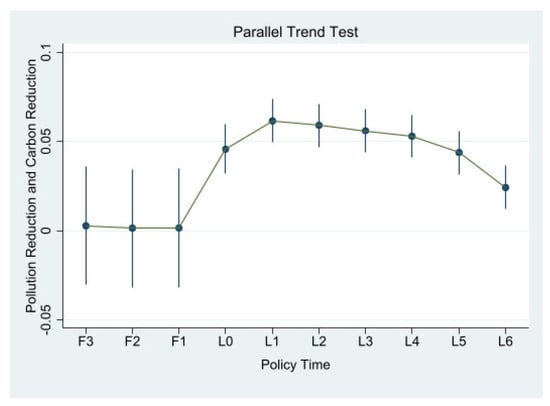
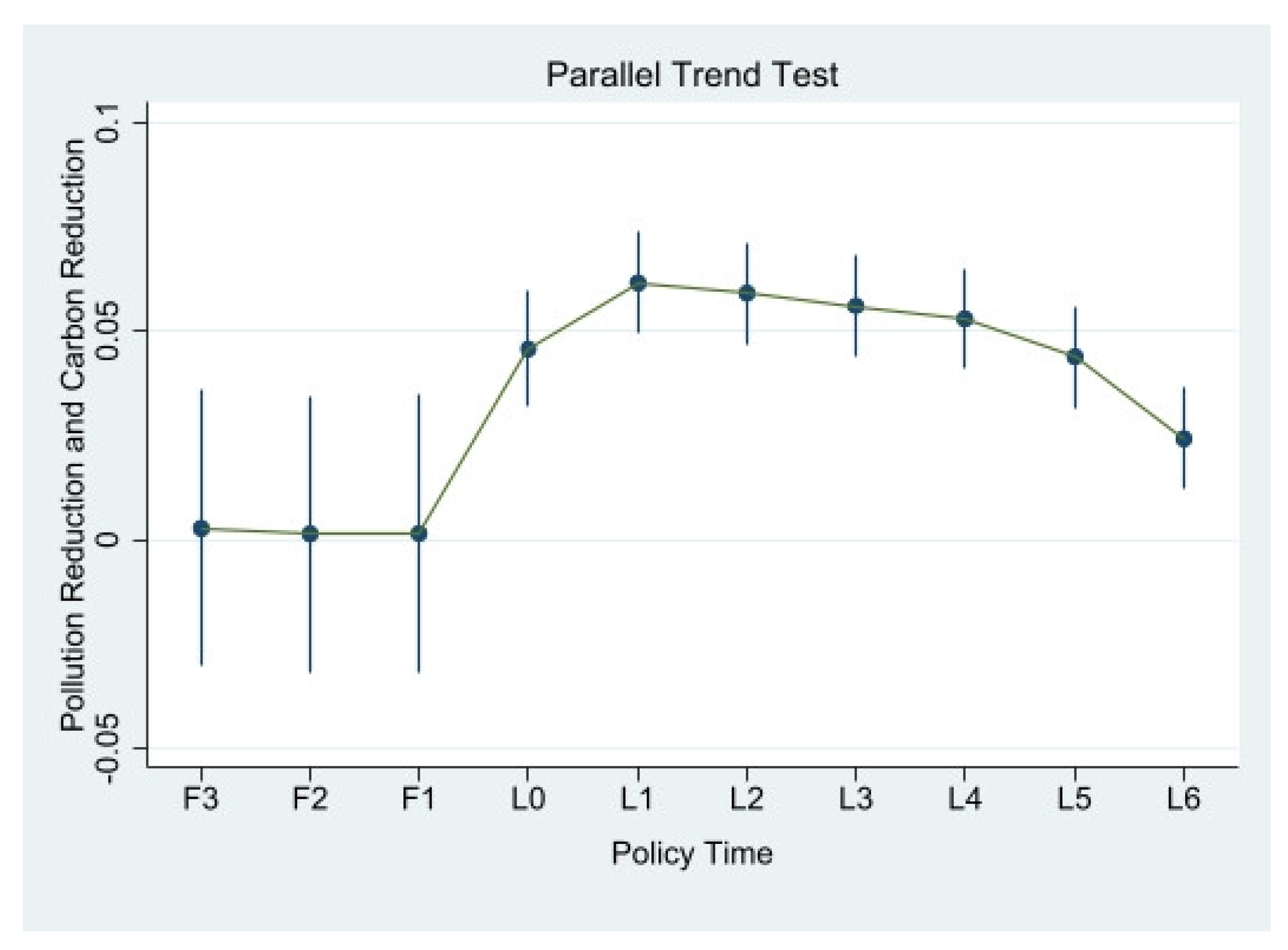
Figure 1 presents the results of the parallel trend test. Before policy implementation, the estimated coefficients in each lead period fluctuate around zero and their confidence intervals all cross zero. There is no significant deviation from the common trend. Starting from period L0, the policy coefficients shift from values close to zero to significantly positive values. This indicates that the policy’s positive effect on the synergy within corporate pollution reduction emerges after implementation. The parallel trend assumption is therefore satisfied.
Figure 1.
Parallel trend test results.
4.4. Robustness Tests
To mitigate the potential estimation bias arising from the sample selection, this study conducts robustness checks using a PSM–DID approach. After propensity score matching, the estimated ATE remains significant at the 1% level, the standardized biases of all covariates are within 10%, and the t-test results generally fail to reject the null hypothesis of no systematic differences between the treated and control groups. These results indicate that the matched sample satisfies the covariate balance requirement. The model is then re-estimated on the matched sample, and the regression results are reported in Table 4. They show that, after controlling for differences in covariates between treated and control firms and alleviating sample selection bias, the policy’s positive effect on the synergy within corporate pollution reduction remains robust and closely aligned in magnitude with the benchmark estimates. In addition, the policy starting year is reset to 2011 and the DID model is re-estimated to test the uniqueness of the actual policy timing. The coefficients are insignificant and do not pass the 10% significance threshold; the main results are not driven by spurious effects related to sample selection or time trends.
Table 4.
Sample regression results after PSM matching.
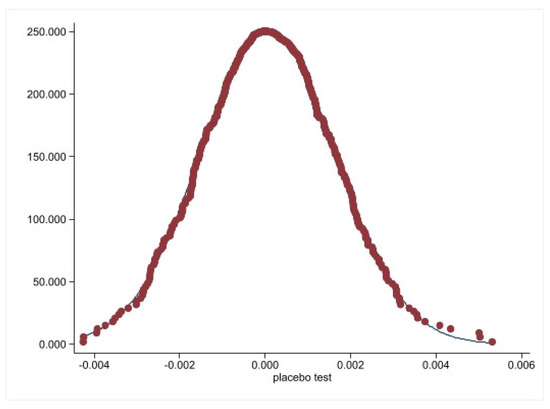
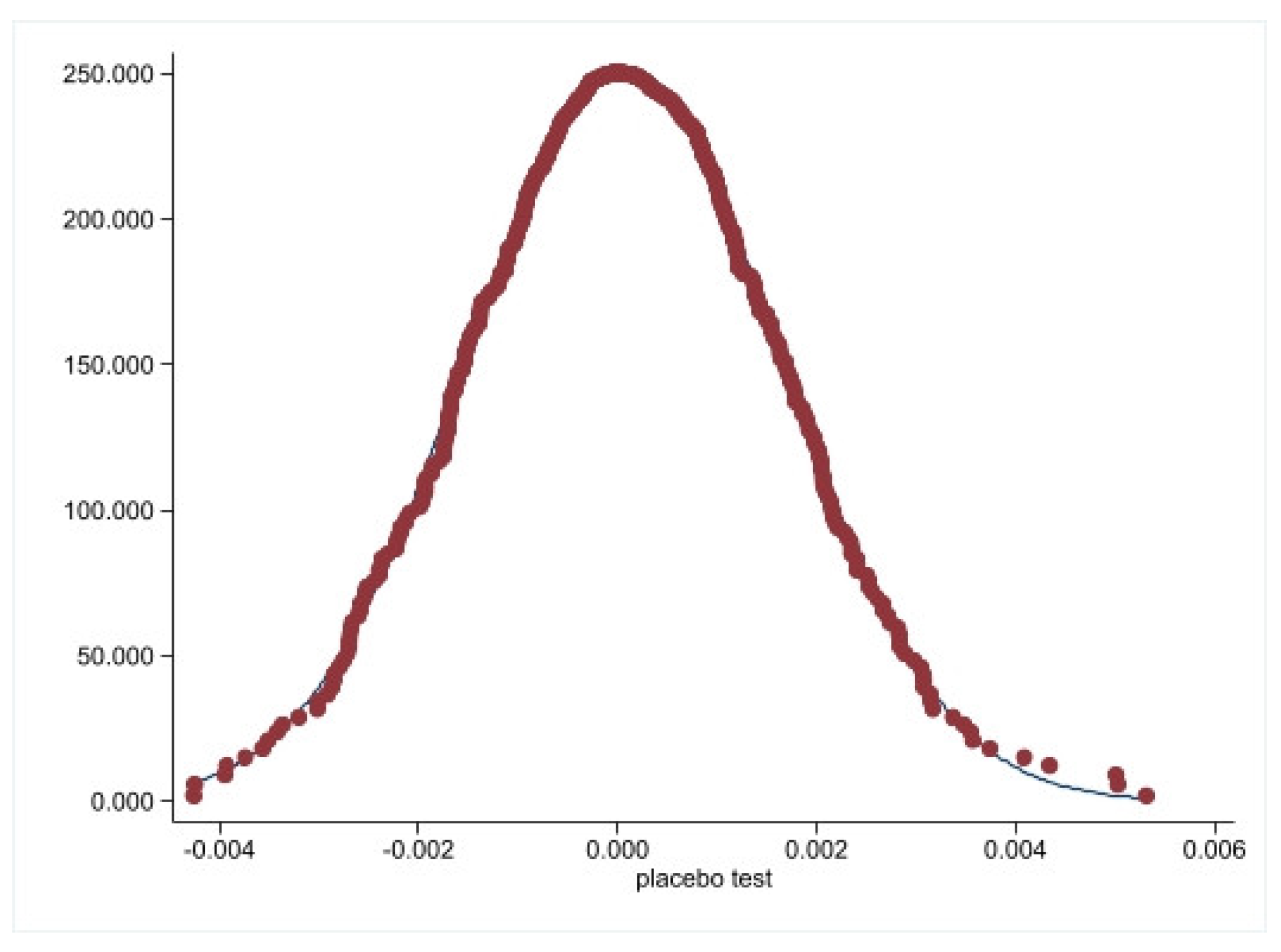
To further verify the actual effect of the new energy demonstration city policy and to mitigate the influence of unobserved factors, this study conducts a placebo test based on counterfactual random shocks. The policy variable is first randomly reassigned and 500 simulated samples are generated. The model is then re-estimated for each sample to obtain the distribution of placebo effects. As shown in Figure 2, the estimated coefficients under the simulated distribution are concentrated around zero and display an approximate normal shape. This result indicates that unobserved factors have only a limited influence on the findings and that the main results are unlikely to be driven by random shocks.
Figure 2.
Placebo test result.
4.5. Mechanism Analysis
The effect of the new energy demonstration city policy on the synergy within corporate pollution reduction is jointly shaped by the external institutional environment and firms’ internal governance foundations. This study uses municipal government attention to green development and corporate ESG performance as moderating variables. These two indicators capture, respectively, the green governance orientation at the city level and the green governance basis at the firm level and help to identify how the strength of the policy effect varies across different governance contexts.
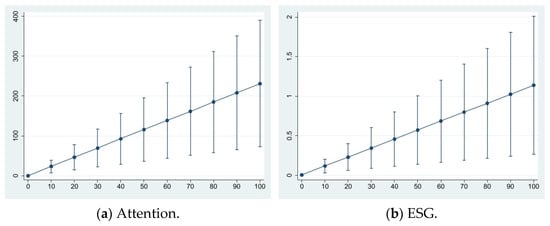
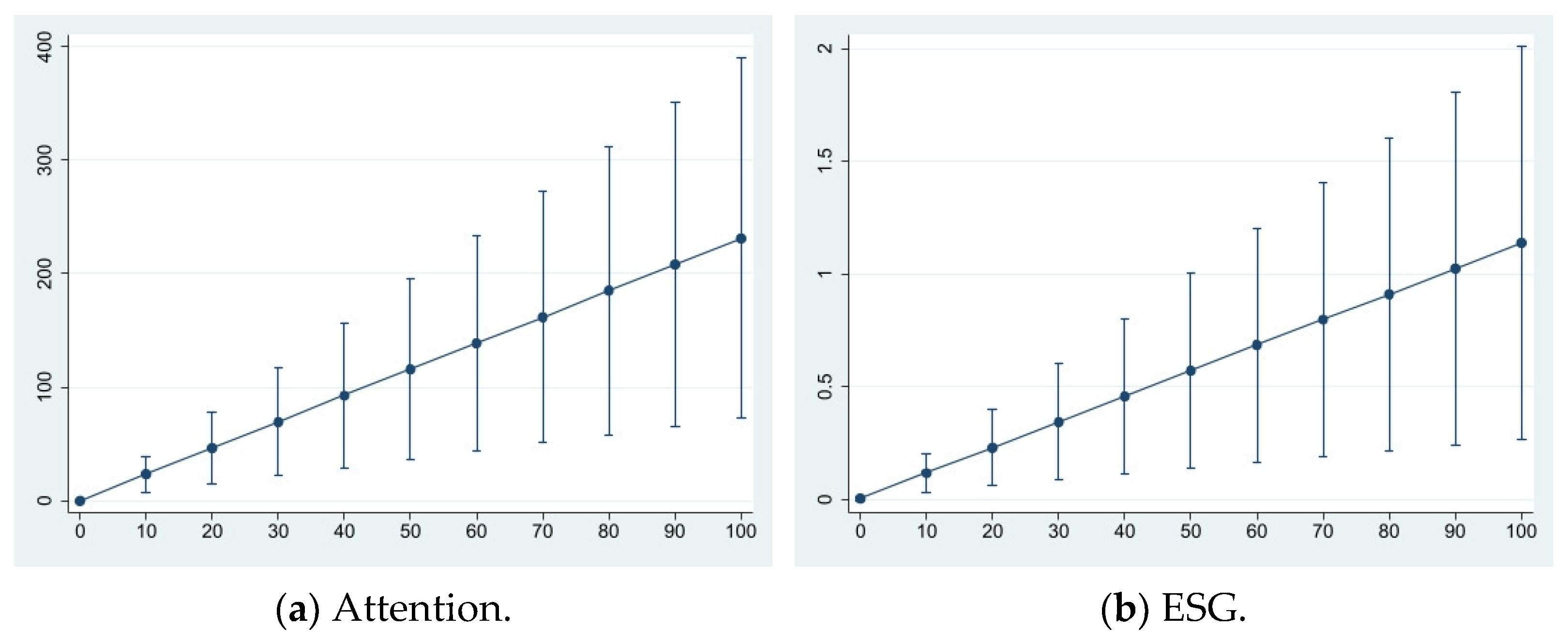
Figure 3 presents the moderating effects of the green attention and ESG. The left panel reports the estimated policy effect on synergy at different quantiles of attention. The marginal effect of the policy rises almost linearly as attention increases, indicating that in cities with higher attention to green development, the new energy demonstration city policy has a stronger and more stable positive impact on the synergy within corporate pollution reduction. The right panel shows the moderating role of ESG. As ESG scores increase from low to high, the policy effect on coordinated governance rises in parallel and remains strong in the medium to high ESG range. These results suggest that municipal green governance attention and firms’ internal environmental and social governance jointly condition the effectiveness of the policy. Where the external green governance environment is more favorable and corporate ESG performance is higher, the policy is more likely to translate into substantive improvements in the synergy within corporate pollution reduction, which is consistent with the two moderating hypotheses of this study.
Figure 3.
Moderating effect.
4.6. Heterogeneity Analysis
Industry energy intensity, ownership structure and firm size jointly shape firms’ emission reduction paths, their access to resources and their sensitivity to policy. These factors are key contextual conditions for the formation of coordinated governance patterns. Based on this, the policy effect is examined across three dimensions—industry energy intensity, ownership type and firm size—in order to reveal structural differences across firm groups.
Table 5 reports the heterogeneous effects of the new energy demonstration city policy on the synergy within corporate pollution reduction. When firms are grouped by industry energy intensity, the policy does not significantly raise synergy in high-energy intensive industries, but the coefficient is significantly positive for firms in non-energy intensive industries. This indicates that the pilot policy is more likely to generate substantive synergistic benefits where there is greater scope for technological and managerial adjustment. By ownership type, the policy shows a significant positive effect on synergy among state-owned enterprises, but not among private firms. This suggests that the characteristics of state-owned enterprises within resource access, policy response and green transition responsibility make it easier for them to internalize the demonstration city policy as coordinated pollution and carbon reduction actions. Grouping by firm size shows that the policy effect is significantly positive for small firms, but not for large firms. In a setting where governance pressure and resource constraints coexist, smaller firms appear to be more sensitive to external institutional changes and more inclined to improve emission performance through coordinated governance.
Table 5.
Heterogeneity test results.
5. Discussion
The transition from single-target emission control to integrated pollution–carbon governance has brought the firm back to the center of debates on energy and climate policy. Under carbon neutrality constraints, what matters is no longer only whether aggregate emissions fall, but whether firms manage to reorganize production, energy use and environmental management in ways that generate genuine multi-pollutant synergies under binding cost constraints. Yet, the existing research tends to fragment this problem.
By constructing a marginal abatement cost-based synergy index at the firm level, this study finds that the policy also pushes firms toward a more ordered pattern of joint abatement. This finding extends previous macro-level evaluations of demonstration city policies [32], which primarily document improvements in air quality, energy structure optimization, or green innovation, by showing that the policy also generates micro-level coordination effects within firms.
Studies on green-oriented local governance suggest that cities prioritizing ecological goals implement environmental policies more consistently and achieve stronger improvements in environmental quality and innovation outcomes [33]. Our findings complement the literature by demonstrating that such governance orientation not only improves environmental indicators but also strengthens firms’ ability to achieve cost-effective, coordinated reductions in multiple emissions. Similarly, ESG research shows that firms with stronger environmental governance and strategic commitment to sustainability tend to adopt more forward-looking risk management practices and integrate environmental objectives into corporate strategy [34]. We find that firms with stronger ESG foundations respond more substantively to demonstration city policies, transforming regulatory pressure into structured pollution–carbon coordination, rather than symbolic compliance. In this sense, our results bridge the literature on ESG and environmental policy by showing how internal governance capacity conditions the translation of policy signals into multi-pollutant synergy.
Heterogeneous effects across industries, ownership types and firm sizes further clarify the boundary conditions of the policy impact. At a deeper level, these patterns point to two underlying dimensions. For a governance embedding dimension, SOEs are more tightly coupled to state objectives and policy evaluation systems, so comprehensive energy policies are more easily internalized as mandates for system-wide, pollution–carbon coordination, rather than narrow compliance [35]. Along a structural flexibility dimension, non-energy-intensive and smaller firms typically face lower asset specificity, simpler process linkages and lower internal coordination costs, which reduces the organizational friction of jointly adjusting technologies, energy portfolios and abatement practices [36]. The absence of significant effects for large private firms thus reflects a combination of weaker policy binding and higher adjustment rigidity, rather than a contradiction in the results. This pattern suggests that the demonstration city policy is more likely to generate synergy effects among firms that jointly exhibit high policy embeddedness and high organizational flexibility.
6. Conclusions
This study investigates how new energy demonstration city policies influence firms’ coordinated pollution and carbon reduction under the constraints of carbon peaking and carbon neutrality. Drawing on system synergy theory and a marginal abatement cost perspective, we construct a firm-level synergy index that jointly reflects multiple pollutant emissions and abatement costs, and apply a DID framework based on the staggered rollout of new energy demonstration cities to identify the policy’s impact and its contextual conditions. The main conclusions are as follows.
First, the new energy demonstration city policy significantly improves the synergy within corporate pollution reduction. Compared with firms in non-pilot cities, firms in demonstration cities show a persistent rise in the synergy index during and after the policy implementation period, even after controlling for a wide range of firm characteristics. This pattern indicates that by adjusting the energy supply, tightening emission constraints and improving resource allocation, the policy does not only achieve more emission reduction. It also shifts firms from fragmented abatement toward more coordinated governance and leads to a more orderly emission reduction pattern under multiple targets. The findings therefore confirm that the policy generates substantive synergy effects at the firm level and provide firm-based evidence for evaluating the environmental performance of comprehensive energy policies.
Second, municipal attention to green and environmental development and corporate ESG performance both play a significant positive moderating role. In cities with higher green attention and among firms with stronger ESG foundations, the synergy index responds more strongly to the policy shock, and the joint improvement in pollution control and carbon reduction is more stable. This result shows that a clear green orientation in the external governance environment, together with a solid internal governance base, jointly shapes firms’ ability to absorb policy signals and turn them into concrete actions. These conditions are essential for making the new energy demonstration city policy deliver genuine coordinated emission reductions, rather than mere formal compliance. By revealing these moderating effects, the study clarifies the contextual boundaries of the policy’s impact and offers practical guidance for local governments on strengthening urban green governance and corporate ESG practices when implementing demonstration policies.
Third, the positive effect of the new energy demonstration city policy on corporate synergy displays clear heterogeneity across industries, ownership types and firm sizes. The empirical results show that the policy effect is concentrated in non-energy intensive industries, state-owned enterprises and small firms. This structural pattern indicates that while the policy exerts broad incentives and constraints, its impact is selectively amplified or weakened across different firm groups. By analyzing these heterogeneous effects, the study provides empirical support for refining the policy tool mix, prioritizing key industries and firm types, and improving the allocation efficiency of limited governance resources in promoting the synergy within corporate pollution reduction.
Despite these findings and contributions, this study has several limitations that point to directions for future research. First, the synergy index is based on a GN-DDF framework that yields marginal abatement costs for air pollutants and carbon dioxide. Other environmental dimensions such as water pollution and solid waste are not directly included. Future work could extend the marginal abatement cost-based approach to a broader set of pollutants and environmental outcomes, or compare different multi-pollutant metrics within a unified system to test and explore whether the results still consist. Second, the empirical analysis focuses on listed firms, which tend to be larger, more regulated and more visible than the broader population of enterprises. These firms may have different financing conditions, governance structures and exposure to the new energy demonstration city policy compared with small, unlisted firms. Subsequent studies could incorporate survey data, administrative microdata or sector-specific samples to examine whether similar synergy patterns hold among smaller or less formal firms. By addressing these limitations, future research can further refine the measurement of the synergy within corporate pollution reduction, deepen understanding of the micro-level mechanisms linking energy transition policies to corporate behavior, and provide more targeted guidance for strengthening firms’ capacity for coordinated emission reduction under increasingly stringent environmental and climate constraints.
7. Implications
We should reorient demonstration city policy goals and instruments around synergistic performance. Future rounds of demonstration city construction should treat the synergy within corporate pollution reduction as an explicit policy goal and assessment criterion, rather than focusing only on single pollutant indicators or carbon intensity. In planning, performance evaluation and project support, priority can be given to projects that achieve joint reductions in multiple emissions within a single upgrade and that clearly improve the structure of marginal abatement costs. Fiscal funds and green finance should be concentrated on technologies and processes with the strongest synergistic effects. This would shift demonstration city policies from the broad tightening of constraints toward a more refined tool that builds firms’ long-term capacity for coordinated emission reduction and better aligns macro carbon targets with micro-level governance behavior.
We should embed city-level green attention and corporate ESG-building into a combined system of hard constraints and soft support. At the city level, the success of demonstration policies should not be judged only by new energy capacity and emission reduction targets. Attention to green development needs to be embedded in spatial planning, budget structure and cadre evaluation, so that stable institutional arrangements anchor firms’ expectations about coordinated emission reduction. At the firm level, indicators such as ESG disclosure quality and fulfillment of environmental responsibilities can be integrated into standards for green credit, green bonds and the selection of emission reduction projects. This would guide firms to strengthen internal governance in order to better absorb and amplify policy signals. Through this joint reinforcement of an external green orientation and internal ESG building, demonstration city policies are more likely to take root as stable mechanisms of coordinated emission reduction, rather than one-off administrative shocks.
We should design a tiered toolbox for coordinated governance that reflects differences in industry, ownership and size. For high-energy intensive industries, city-level rules alone are often insufficient to induce costly and long cycle process upgrades. Industry-level support is needed in the form of detailed technical roadmaps for synergistic emission reduction and clearer mechanisms for sharing costs. For example, authorities can publish industry-specific catalogs for coordinated upgrading and use electricity prices, pollution charges and carbon prices to provide stronger price incentives for key process improvements. For private firms and medium and large firms, it is important to ease green financing constraints and strengthen supply chain responsibility so as to lower the upfront costs of participating in coordinated upgrading, while using the governance requirements of lead firms to transmit pressure for synergy along the value chain. By tailoring tools to these differences and keeping the overall policy direction consistent, policymakers can improve the targeting of key industries and firm types and achieve higher synergistic returns in pollution and carbon reduction with limited governance resources.
Author Contributions
Methodology, Y.Q.; software, Y.Q.; validation, Y.Q.; investigation, Z.D.; resources, Z.D.; data curation, Y.Q.; writing—original draft, Y.Q. and Z.D.; writing—review and editing, Y.Q.; visualization, Y.Q.; supervision, Z.D.; project administration, Z.D.; funding acquisition, Y.Q. All authors have read and agreed to the published version of the manuscript.
Funding
This research received no external funding.
Data Availability Statement
The raw data supporting the conclusions of this article will be made available by the authors upon request.
Conflicts of Interest
The authors declare no conflict of interest.
References
- Ding, Y.; Bi, C.; Qi, Y.; Han, D. Coordinated governance of energy transition policy and pollution and carbon reduction: A quasi-natural experiment based on new energy demonstration city policy. Energy Strategy Rev. 2024, 53, 101395. [Google Scholar] [CrossRef] [Scilit]
- Gan, H.; Miao, L. Politics and governance in the era of urban energy transition: Shaping public policies and empowering sustainable urban futures. Sustain. Cities Soc. 2024, 106, 105373. [Google Scholar] [CrossRef] [Scilit]
- Khanna, N.; Fridley, D.; Hong, L. China’s pilot low-carbon city initiative: A comparative assessment of national goals and local plans. Sustain. Cities Soc. 2014, 12, 110–121. [Google Scholar] [CrossRef] [Scilit]
- Wu, J.; Zuidema, C.; Gugerell, K. Experimenting with decentralized energy governance in China: The case of New Energy Demonstration City program. J. Clean. Prod. 2018, 189, 830–838. [Google Scholar] [CrossRef] [Scilit]
- Xie, P.; Duan, Z.; Wei, T.; Pan, H. Spatial disparities and sources analysis of co-benefits between air pollution and carbon reduction in China. J. Environ. Manag. 2024, 354, 120433. [Google Scholar] [CrossRef] [Scilit]
- Zhu, J.; Wu, S.; Xu, J. Synergy between pollution control and carbon reduction: China’s evidence. Energy Econ. 2023, 119, 106541. [Google Scholar] [CrossRef] [Scilit]
- Chen, C.; Lin, Y.; Lv, N.; Zhang, W.; Sun, Y. Can government low-carbon regulation stimulate urban green innovation? Quasi-experimental evidence from China’s low-carbon city pilot policy. Appl. Econ. 2022, 54, 6559–6579. [Google Scholar] [CrossRef] [Scilit]
- Guo, B.; Feng, Y.; Lin, J.; Wang, X. New energy demonstration city and urban pollutant emissions: An analysis based on a spatial difference-in-differences model. Int. Rev. Econ. Financ. 2024, 91, 287–298. [Google Scholar] [CrossRef] [Scilit]
- Chai, M.; Wu, C.; Luo, Y.; Mensah, C.N. New Energy Demonstration City Policy and Corporate Green Innovation: From the Perspective of Industrial and Regional Spillover Effect. Sustainability 2025, 17, 3179. [Google Scholar] [CrossRef] [Scilit]
- Topi, C.; Esposto, E.; Govigli, V.M. The economics of green transition strategies for cities: Can low carbon, energy efficient development approaches be adapted to demand side urban water efficiency? Environ. Sci. Policy 2016, 58, 74–82. [Google Scholar] [CrossRef] [Scilit]
- Hou, Y.; Yang, M.; Ma, Y.; Zhang, H. Study on city’s energy transition: Evidence from the establishment of the new energy demonstration cities in China. Energy 2024, 292, 130549. [Google Scholar] [CrossRef] [Scilit]
- Zeng, S.; Jin, G.; Tan, K.; Liu, X. Can low-carbon city construction reduce carbon intensity? Empirical evidence from low-carbon city pilot policy in China. J. Environ. Manag. 2023, 332, 117363. [Google Scholar] [CrossRef] [Scilit]
- Zhang, Z.; Li, P.; Wang, X.; Ran, R.; Wu, W. New energy policy and new quality productive forces: A quasi-natural experiment based on demonstration cities. Econ. Anal. Policy 2024, 84, 1670–1688. [Google Scholar] [CrossRef] [Scilit]
- Liu, C.; Tang, C.; Liu, Y. Does the transformation of energy structure promote green technological innovation? A quasi–natural experiment based on new energy demonstration city construction. Geosci. Front. 2024, 15, 101615. [Google Scholar] [CrossRef] [Scilit]
- Yang, X.; Wang, W.; Wu, H.; Wang, J.; Ran, Q.; Ren, S. The impact of the new energy demonstration city policy on the green total factor productivity of resource-based cities: Empirical evidence from a quasi-natural experiment in China. J. Environ. Plan. Manag. 2022, 66, 293–326. [Google Scholar] [CrossRef] [Scilit]
- Nie, C.; Lee, C.C. Synergy of pollution control and carbon reduction in China: Spatial–temporal characteristics, regional differences, and convergence. Environ. Impact Assess. Rev. 2023, 101, 107110. [Google Scholar] [CrossRef] [Scilit]
- Ma, P.; Zhang, M.; Wu, W.; Zhu, B. Synergistic efficiency in pollution and carbon reduction: Measurement, evolution, and pathways in Chinese cities. Environ. Impact Assess. Rev. 2025, 113, 107879. [Google Scholar] [CrossRef] [Scilit]
- Hu, C.; Ma, X.; Yang, L.; Chang, X.; Li, Q. Spatial-temporal variation and driving forces of the synergy of “pollution reduction, carbon reduction, green expansion and economic growth”: Evidence from 243 cities in China. Front. Ecol. Evol. 2023, 11, 1202898. [Google Scholar] [CrossRef] [Scilit]
- Ji, D.J.; Zhou, P. Marginal abatement cost, air pollution and economic growth: Evidence from Chinese cities. Energy Econ. 2020, 86, 104658. [Google Scholar] [CrossRef] [Scilit]
- Man, H.; Sun, Y.; Wang, X.; Qin, Z.; Chen, S.; Chen, J. Effect of government environmental attention on green transformation: Empirical analysis from a spatiotemporal perspective in China. J. Clean. Prod. 2024, 473, 143595. [Google Scholar] [CrossRef] [Scilit]
- Chopra, S.S.; Senadheera, S.S.; Dissanayake, P.D.; Withana, P.A.; Chib, R.; Rhee, J.H.; Ok, Y.S. Navigating the challenges of environmental, social, and governance (ESG) reporting: The path to broader sustainable development. Sustainability 2024, 16, 606. [Google Scholar] [CrossRef] [Scilit]
- Batra, G. Renewable energy economics: Achieving harmony between environmental protection and economic goals. Soc. Sci. Chron. 2023, 2, 1–32. [Google Scholar] [CrossRef] [Scilit]
- Kahouli-Brahmi, S. Technological learning in energy–environment–economy modelling: A survey. Energy Policy 2008, 36, 138–162. [Google Scholar] [CrossRef] [Scilit]
- Lu, Y.; Khan, Z.A.; Alvarez-Alvarado, M.S.; Zhang, Y.; Huang, Z.; Imran, M. A critical review of sustainable energy policies for the promotion of renewable energy sources. Sustainability 2020, 12, 5078. [Google Scholar] [CrossRef] [Scilit]
- Nikolić, J.; Zlatanović, D. Corporate governance and corporate social responsibility synergies: A systemic approach. Naše Gospod. Our Econ. 2018, 64, 36–46. [Google Scholar] [CrossRef] [Scilit]
- Duan, Z.; Wei, T.; Xie, P.; Lu, Y. Co-benefits and influencing factors exploration of air pollution and carbon reduction in China: Based on marginal abatement costs. Environ. Res. 2024, 252, 118742. [Google Scholar] [CrossRef] [Scilit]
- Zhu, Y.; Wang, X.; Qi, Z. Quantitative assessment of the synergistic effect of pollution reduction and carbon reduction in the planting industry from the perspective of marginal abatement costs-Evidence from the main producing areas in the Yangtze River Basin of China. Socio-Econ. Plan. Sci. 2025, 103, 102376. [Google Scholar] [CrossRef] [Scilit]
- Huang, R.; Liu, J.; Song, A.; Wu, H.; Li, H.; Zhang, J.; Wang, H. Marginal abatement costs of direct carbon emissions from municipal wastewater treatment plants: Insights for prioritizing pollution removal or carbon mitigation in collaborative control strategies. Resour. Conserv. Recycl. 2026, 224, 108564. [Google Scholar] [CrossRef] [Scilit]
- Jell-Ojobor, M.; Raha, A. Being good at being good—The mediating role of an environmental management system in value-creating green supply chain management practices. Bus. Strategy Environ. 2022, 31, 1964–1984. [Google Scholar] [CrossRef] [Scilit]
- Pan, H.; Wei, T. Technology and justice: Can technological research and development for new energy vehicles reduce environmental inequality in China? Local Environ. 2025, 1–23. [Google Scholar] [CrossRef] [Scilit]
- Xu, Q.; Li, X.; Guo, F. Digital transformation and environmental performance: Evidence from Chinese resource-based enterprises. Corp. Soc. Responsib. Environ. Manag. 2023, 30, 1816–1840. [Google Scholar] [CrossRef] [Scilit]
- Zhu, B.; Jia, J.; Wang, P. Exploring the drivers for the synergy of pollutant mitigation and carbon reduction: Evidence from Chinese cities. J. Clean. Prod. 2025, 531, 146876. [Google Scholar] [CrossRef] [Scilit]
- Wei, T.; Duan, Z.; Xie, P. Fall into the pseudo-decoupling trap: Type identification, trend characterization and solution path of carbon decoupling trap in urban agglomerations of China. Environ. Pollut. 2024, 361, 124782. [Google Scholar] [CrossRef] [Scilit]
- Cho, Y. ESG and firm performance: Focusing on the environmental strategy. Sustainability 2022, 14, 7857. [Google Scholar] [CrossRef] [Scilit]
- Chen, H.; Niu, D.; Gao, Y. Research on the impact of energy transition policies on green total factor productivity of Chinese high-energy-consuming enterprises. Energy 2025, 319, 135066. [Google Scholar] [CrossRef] [Scilit]
- Lu, L.; Liu, P.; Yu, J.; Shi, X. Digital inclusive finance and energy transition towards carbon neutrality: Evidence from Chinese firms. Energy Econ. 2023, 127, 107059. [Google Scholar] [CrossRef] [Scilit]

Disclaimer/Publisher’s Note: The statements, opinions and data contained in all publications are solely those of the individual author(s) and contributor(s) and not of MDPI and/or the editor(s). MDPI and/or the editor(s) disclaim responsibility for any injury to people or property resulting from any ideas, methods, instructions or products referred to in the content. |
© 2026 by the authors. Licensee MDPI, Basel, Switzerland. This article is an open access article distributed under the terms and conditions of the Creative Commons Attribution (CC BY) license.