


Abstract
The high-temperature engine nozzle is a critical component of a rocket motor, and its stability and performance are significantly influenced by internal high-temperature gas radiative heat transfer. Due to the non-gray nature of the nozzle medium and the complexity of the Radiative Transfer Equation (RTE), rapid and accurate simulation of radiative heat transfer is crucial for engineering applications. This paper presents a high-efficiency solution coupling the Full-Spectrum Correlated k-Distribution (FSCK) model with the Null-Collision Monte Carlo Method (NCMCM). To address the inherent computational bottleneck of linear traversal in unstructured grids, a hybrid ray-localization model integrating KD-tree and Bounding Volume Hierarchy (BVH) is proposed. This model shifts the search mechanism from element-wise iteration to spatial topological indexing, achieving logarithmic search complexity and significantly mitigating the sensitivity of computational cost to grid scale. Furthermore, a collaborative MPI–OpenMP parallel framework is established to maximize hardware utilization, where an optimized guided scheduling strategy effectively counteracts the stochastic load imbalances encountered in traditional static schemes. Results indicate that the proposed method reduces the total execution time to approximately 1/4 compared to traditional models. Simulations identify the convergent section as the primary radiation zone, where CO2 contributes less to the radiative source term than H2O under high-temperature conditions.
1. Introduction
In modern aerospace propulsion systems, the nozzle is the core component for efficient energy conversion. It plays a pivotal role in maintaining stable combustion chamber pressure [1], ensuring the high-efficiency combustion of propellants [2], and converting the internal energy of high-temperature and high-pressure gases into kinetic energy to generate thrust [3]. However, the operating conditions for nozzles are extremely severe, requiring them to withstand the synergistic effects of high temperatures [4], ablation [5], and complex mechanical loads [6]. In recent years, driven by the pursuit of higher specific impulse and payload capacity, the temperature and pressure levels within the combustion chambers and nozzles of rocket motors have risen significantly [7,8]. Under such extreme conditions, the heat transfer mechanisms have undergone fundamental changes. Given that the radiative heat flux density is proportional to the fourth power of the absolute temperature of the medium, the radiative heat transfer process within high-temperature gases has become a dominant thermal load, posing a massive challenge to the thermal protection structures of nozzles [9]. Qin et al. [10] reported that radiative heat flux contributes up to 25% of the total heat flux in the nozzle throat, and this proportion increases to >30% in the convergent section, highlighting the urgency of accurate radiative transfer simulation. Consequently, for the design and thermal protection of aerospace engines, rapidly and accurately characterizing and predicting the radiative heat transfer properties of non-gray gases within high-temperature nozzles is of profound engineering significance and represents an urgent research necessity.
The pronounced non-gray characteristics of high-temperature gaseous media represent the primary obstacle to achieving high-precision numerical simulations of radiative heat transfer. Currently, gas radiative property models mainly include the Line-by-Line (LBL) method [11], narrow-band/wide-band models [12], and full-spectrum global models [13]. Although the LBL method offers the highest accuracy, its computational cost is prohibitive due to the requirement of processing millions of spectral lines; consequently, it is typically reserved as a benchmark for verification [14,15]. The Weighted-Sum-of-Gray-Gases (WSGG) model is frequently coupled with CFD solvers because it balances accuracy and efficiency [16]; however, its performance in non-homogeneous media is often limited. Atashafrooz [17] and Sun [18] employed the Line-by-Line-based Weighted-Sum-of-Gray-Gases (SLW) model to handle the non-gray behavior of participating media, demonstrating its superiority over the traditional WSGG model in non-isothermal and non-homogeneous environments. Atashafrooz [19] utilized the Full-Spectrum k-distribution (FSK) model for non-gray radiative heat transfer and observed that applying FSK directly to non-homogeneous media could lead to reduced accuracy, as local temperature variations cause inconsistencies in the spectral space. To address this, Modest [20] innovatively introduced the correlation assumption [21,22] and scaling approximation [23], developing the Full-Spectrum Correlated-k (FSCK) and Full-Spectrum Scaled-k (FSSK) methods. Research by Porter [24] and Clements [25] in oxy-fuel combustion environments has shown that the FSCK model offers greater advantages in computational effectiveness compared to the FSSK model.
The Radiative Transfer Equation (RTE) is essentially a complex integro-differential equation. In complex engineering applications such as nozzles, it is difficult to obtain exact analytical solutions, necessitating a reliance on numerical algorithms for approximation [26,27]. Currently, the predominant numerical algorithms include the Finite Volume Method (FVM) [28,29], the Discrete Ordinates Method (DOM) [29], and the Monte Carlo Method (MCM) [30]. Among existing studies, Byun [31] utilized the FVM to investigate the impact of radiation on compressible flow within rocket motors, highlighting the dominant role of particulate radiation. Paul [32] found in turbulent flame simulations that the DOM employing high-order schemes could achieve superior numerical accuracy. Compared to deterministic methods, the MCM possesses inherent advantages in handling complex boundaries. Galtier [33] first proposed the Null-Collision Monte Carlo Method (NCMCM), discovering that it exhibits higher efficiency than the traditional MCM when dealing with unstructured grids and non-homogeneous media. Applied research by Eymet [34] further confirmed that the NCMCM demonstrates excellent adaptability and precision in calculating the radiative source terms within combustion chambers.
Although the combination of FSCK and NCMCM is regarded as a high-precision solution, its engineering application still faces severe challenges regarding computational efficiency [35]. Firstly, the ray-tracing process in NCMCM is highly dependent on the localization and searching of grid cells. When dealing with large-scale unstructured grids, the inefficiency of traditional traversal methods scales exponentially with the number of grid elements, becoming the core bottleneck that constrains overall computational speed [36]. Secondly, while parallel technologies such as MPI [37], OpenMP [38], and CUDA [7] have been widely explored, their adaptability to this specific problem still requires optimization. On one hand, the inherent stochastic sampling nature of MCM leads to severe load imbalances among threads, making it difficult to achieve efficient load balancing using only the static scheduling of OpenMP [39]. On the other hand, the construction of the FSCK database involves high-frequency I/O operations and intensive computation [40], where traditional serial or single-parallel modes fail to meet the requirements for rapid response. Therefore, selecting and optimizing an efficient parallel model suitable for CPU architectures is a key pathway toward achieving a significant reduction in the time required for nozzle radiative heat transfer simulations.
The primary contributions of this work are organized as follows: In Section 1, the fundamental principles of the gas radiation model and the radiative transfer solution method employed in this study are introduced in detail. In Section 2, MPI parallelization is first implemented to accelerate the construction of the FSCK database; subsequently, OpenMP is applied to parallelize the NCMCM process. Furthermore, a ray-localization model based on KD-tree and Bounding Volume Hierarchy (BVH) is proposed, effectively enhancing the computational speed of ray tracing within the NCMCM framework. In Section 3, numerical simulations are conducted to investigate the influence of wall emissivity and gas composition on radiative heat transfer. Finally, the main conclusions are summarized in Section 4.
2. Numerical Models
2.1. Full-Spectrum Correlated k-Distribution Model
2.1.1. Rearrangement Principle of k-Distribution and Correlated Assumption
The Full-Spectrum Correlated k-Distribution (FSCK) model [8] is employed in this study to characterize the non-gray radiative properties of high-temperature gases. As the fundamental principles and mathematical formulations of the FSCK method are well-established, detailed derivations are omitted in this text; for a rigorous theoretical framework, readers are referred to the foundational literature [8]. Briefly, the model introduces the correlation assumption, which posits that the spectral distribution of gas absorption coefficients at various thermodynamic states remains correlated with that of a defined reference state (T0, ϕ0). This assumption effectively transforms the computationally intensive line-by-line spectral integration into an efficient numerical integration over the cumulative distribution function g. Although this approximation represents the primary source of error in the FSCK method, it significantly reduces computational costs while maintaining sufficient accuracy for engineering applications.
Similarly to FSCK, by rearranging the RTE, the expression for the RTE after introducing the FSCK model can be obtained [41]:
where Ig is the rearranged radiation intensity. a(T, T0, g0) is the non-gray stretching coefficient. κs is the scattering coefficient; Φ is the scattering phase function; Ω is the solid angle; and s is the path distance.
The expressions for Ig and a(T, T0, g0) in Equation (1) are as follows:
2.1.2. Gaussian Numerical Integration
Since the artificial spectral g-space is energy-equivalent to the physical spectral η-space, the calculation of spectral radiative intensity and radiation source terms can be transformed into an integration over the cumulative distribution function g within the interval [0, 1] [42]. Given that the rearranged absorption coefficients exhibit monotonically increasing and smooth characteristics within the g-space, the system is well-suited for solution via Gaussian-type quadrature methods. To enhance computational efficiency while ensuring numerical accuracy, this study employs a 16-point Gauss-Chebyshev quadrature scheme. By mapping the orthogonal nodes from the standard interval [−1, 1] to the [0, 1] domain, this method accurately captures the full-spectrum radiative properties of non-gray gases using a minimal number of discrete points.
2.2. Null-Collision Monte Carlo Method
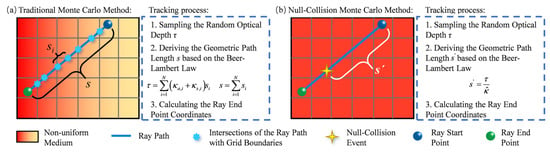
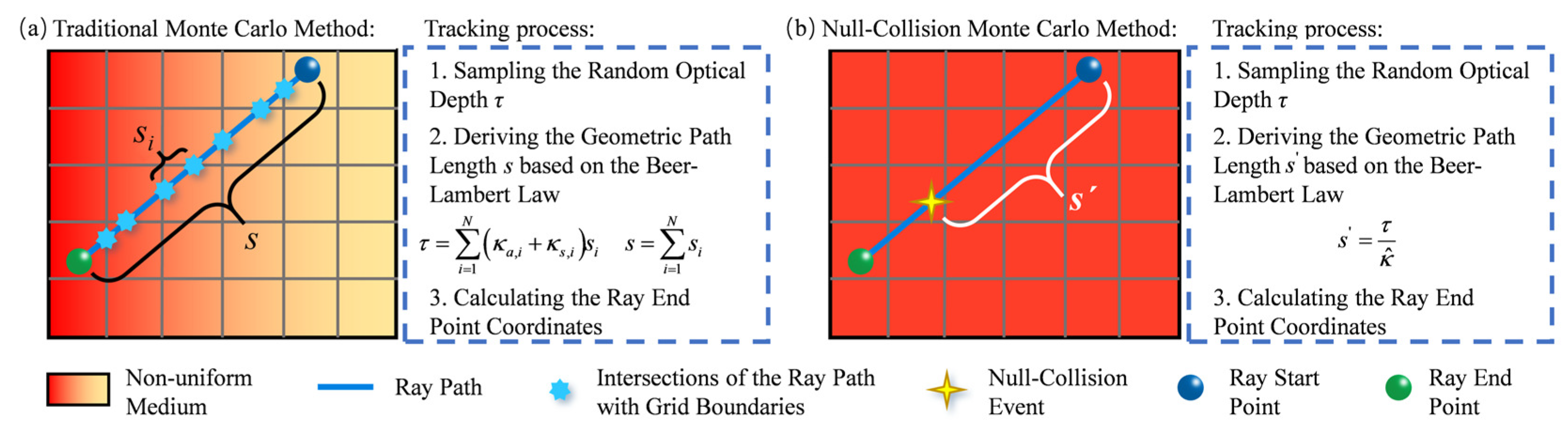
As illustrated in Figure 1a, the traditional Monte Carlo Method, when handling non-uniform media problems, requires tracking the ray mesh cell by mesh cell to determine the geometric propagation distance until the accumulated optical thickness equals the sampled optical thickness. This leads to relatively low tracing efficiency. When unstructured grids are employed for spatial discretization, the complexity of this tracing process is further increased. Addressing these challenges, Galtier et al. [33] introduced the null-collision algorithm into radiative transfer simulation. As shown in Figure 1b, the fundamental concept of the null-collision algorithm is to “artificially” regulate the non-uniform medium into a uniform medium. Consequently, the process of inverting the geometric propagation distance based on the Beer-Lambert law can be determined in a single step. Since the step-by-step mesh tracking process is bypassed, the introduction of the null-collision algorithm effectively enhances the computational efficiency of the ray tracing procedure.
Figure 1.
Schematic diagram of the ray tracing process: (a) Traditional Monte Carlo method; (b) Null-collision Monte Carlo method.
After introducing the null-collision algorithm, the expression for the RTE in a gray medium becomes [43]:
where r is the position; s is the direction; I is the radiation intensity; Ib is the blackbody radiation intensity; κa, κs, and κn are the absorption, scattering, and null-collision coefficient; Φ is the scattering phase function; and δ is the Dirac delta function.
From a mathematical perspective, the two additional terms in Equation (4) compared to the traditional RTE, namely and , exactly cancel each other out. This demonstrates that the introduction of the null-collision algorithm does not alter the solution of the equation, thus the algorithm is unbiased. From a physical perspective, Equation (4) is equivalent to adding several virtual particles to the original non-uniform medium to make it uniform (this is the process by which the medium is “artificially” regulated into a uniform medium), and the scattering phase function of these virtual particles is a δ Dirac delta function.
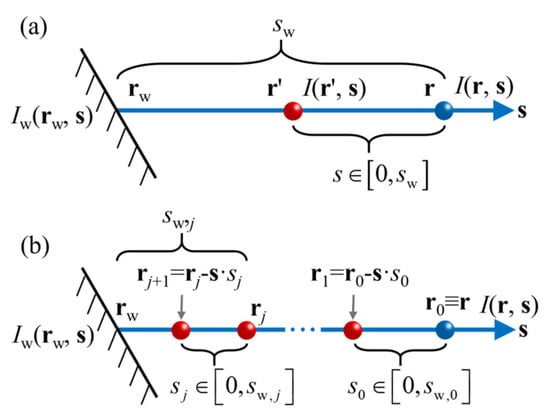
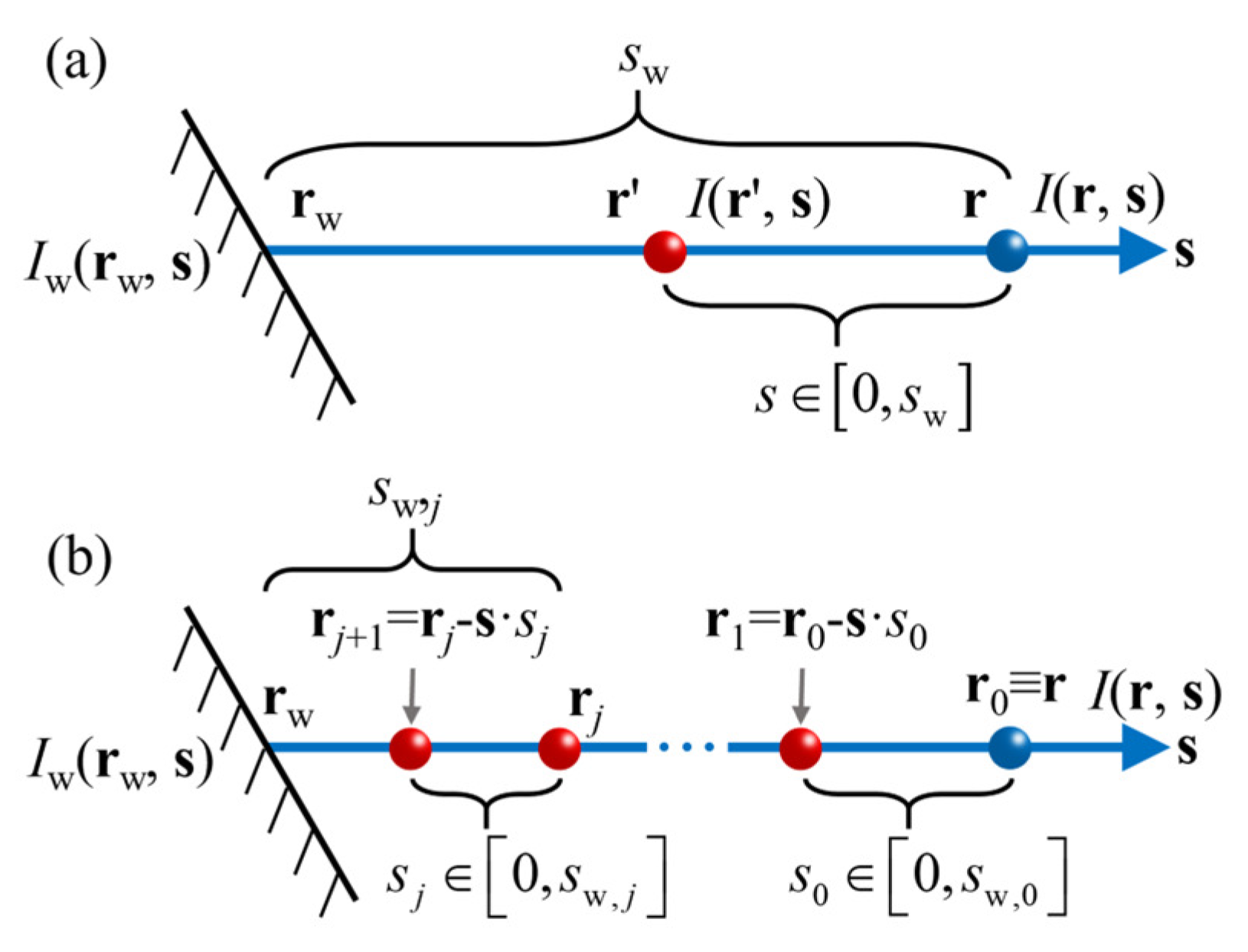
Combining with the schematic diagram in Figure 2a, integration of Equation (4) yields the integral expression for the radiation intensity [44]:
where s is the distance; is the radiation source function at position ; is the null-collision attenuation coefficient; the subscript w denotes the wall; and meaning that the physical quantity with the subscript w corresponds to the wall.
Figure 2.
(a) Integral expression of radiative intensity; (b) Recursive process of the integral expression of radiative intensity.
It is noted that the expression for the radiation source function in Equation (6) involves the radiation intensity at position . Since is also calculated based on Equation (5), the process of calculating using Equation (5) is essentially a recursive process. To facilitate the description of this recursive relationship, the probability density function p(sj), as shown in a subsequent equation, is further introduced, and the scattering term of the radiation source function during the recursive process is simplified as an expression in Equation (8).
Combining with the schematic diagram in Figure 2b, and substituting Equations (7) and (8) into Equation (5), the recursive expression for the radiation intensity I(r, s) can be obtained [44]:
where Pa, Ps and Pn are the probabilities of absorption, scattering, and null-collision events, respectively (satisfying Pa + Ps + Pn = 1).
The termination condition for the aforementioned recursive process is generally given by the wall radiation intensity along the required direction s or the radiation intensity at any known position. Theoretically, the null-collision coefficient κn and the event probabilities can be arbitrarily chosen and combined while still yielding consistent calculation results, meaning the algorithm is unbiased. For convenience, the following schemes are commonly adopted [44]:
Finally, the Monte Carlo method is used to estimate the integral in Equation (9). After a large number of random samplings, the expected value of the radiation intensity can be obtained [44]:
where N is the number of sampled rays; Ib,i is the blackbody radiation intensity at the absorption position rabs of the i-th ray, and sabs is the direction of the ray when it is absorbed.
3. Parallel Computing for Radiative Heat Transfer and Acceleration Strategy for Ray Localization
All computational results in this section were obtained on a server equipped with 64 cores and 64 threads, featuring an Intel Xeon Platinum 8375C CPU with a base frequency of 2.9 GHz and 256 GB of RAM. To minimize stochastic errors, all reported results are the average of 10 independent runs. In parallel computing, the performance of a parallel program is commonly evaluated using the speedup ratio or parallel efficiency. In this study, parallel efficiency is adopted as the evaluation metric, which is defined as follows:
where ts and tP are the execution times of the program in serial and parallel modes, respectively, and N is the number of processes (threads).
3.1. Building the FSCK Database Based on MPI Parallelism
While standard FSCK databases and their associated Fortran-based generation codes remain well-established benchmarks, they are primarily optimized for conventional combustion regimes, with validated coverage typically restricted to temperatures up to 3000 K [45]. In contrast, the nozzle core flow investigated in this study exhibits extreme thermal conditions exceeding 3500 K, a regime often beyond the fidelity of general-purpose resources. Consequently, to ensure high-fidelity characterization of radiative properties under such conditions and to maintain architectural consistency with the C++ based NCMCM solver, this work establishes an independent, MPI-parallelized FSCK database generation framework.
Depending on the evaluation of the correlated absorption coefficients, four distinct FSCK formulations have been derived, namely FSCK-1 through FSCK-4. Wang et al. [46] compared these formulations and noted that, with the exception of FSCK-1, the remaining three schemes preserve emission conservation and consequently demonstrate superior performance across all test cases. Among these, FSCK-2 yields the highest accuracy. However, while FSCK-2 is the most precise, it requires three evaluations of the k-distribution function, whereas FSCK-3 and FSCK-4 require only two. Given that FSCK-3 lacks a rigorous theoretical proof [44], this study adopts the FSCK-4 formulation to optimize computational efficiency while maintaining sufficient accuracy. When the correlation assumption holds approximately or strictly, the choice of the reference state has negligible impact on the results. In practice, however, this assumption is not always satisfied, necessitating a rational determination of the reference state. Regarding temperature, three common methods are employed: the global maximum value, the T4 volume average, and the Planck Emission Averaged (PEA) method. Literature [47] indicates that FSCK-4 is relatively insensitive to the choice of reference temperature; nonetheless, the PEA method generally provides the most optimal reference temperature among the three approaches by weighting the temperature field according to local emission capabilities. Consequently, the PEA method is employed in this work. Specifically, for the nozzle flow field simulation conducted in Section 4, the calculated global reference temperature is approximately 3470 K. This value effectively represents the emission-weighted thermodynamic state of the computational domain, properly accounting for the volumetric dominance of the high-temperature gas within the convergent section.
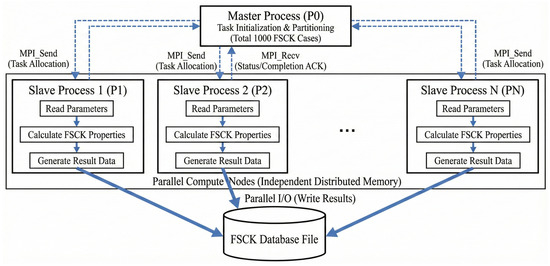
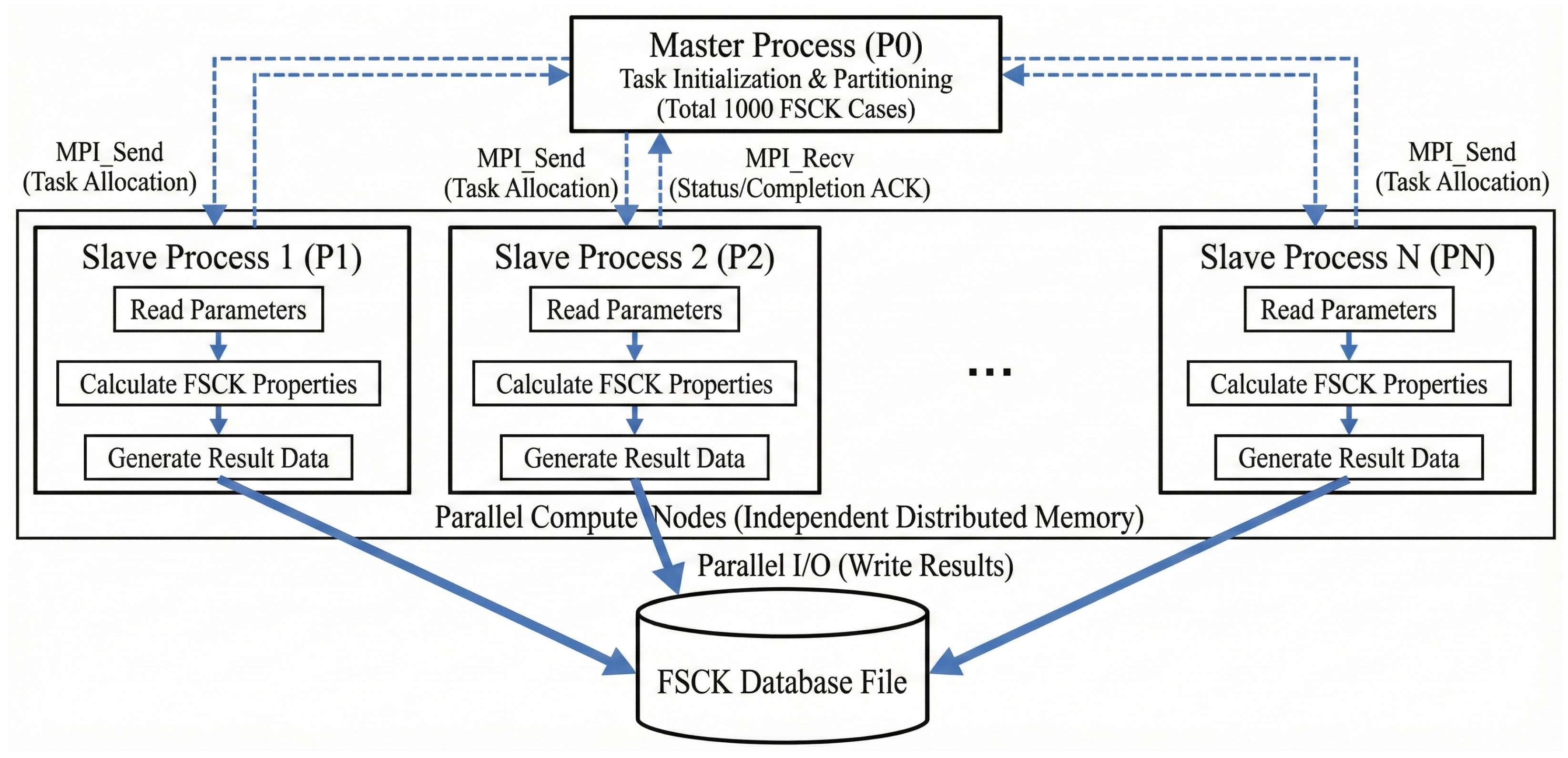
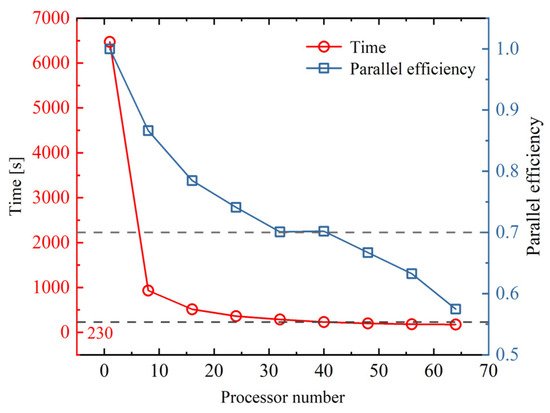
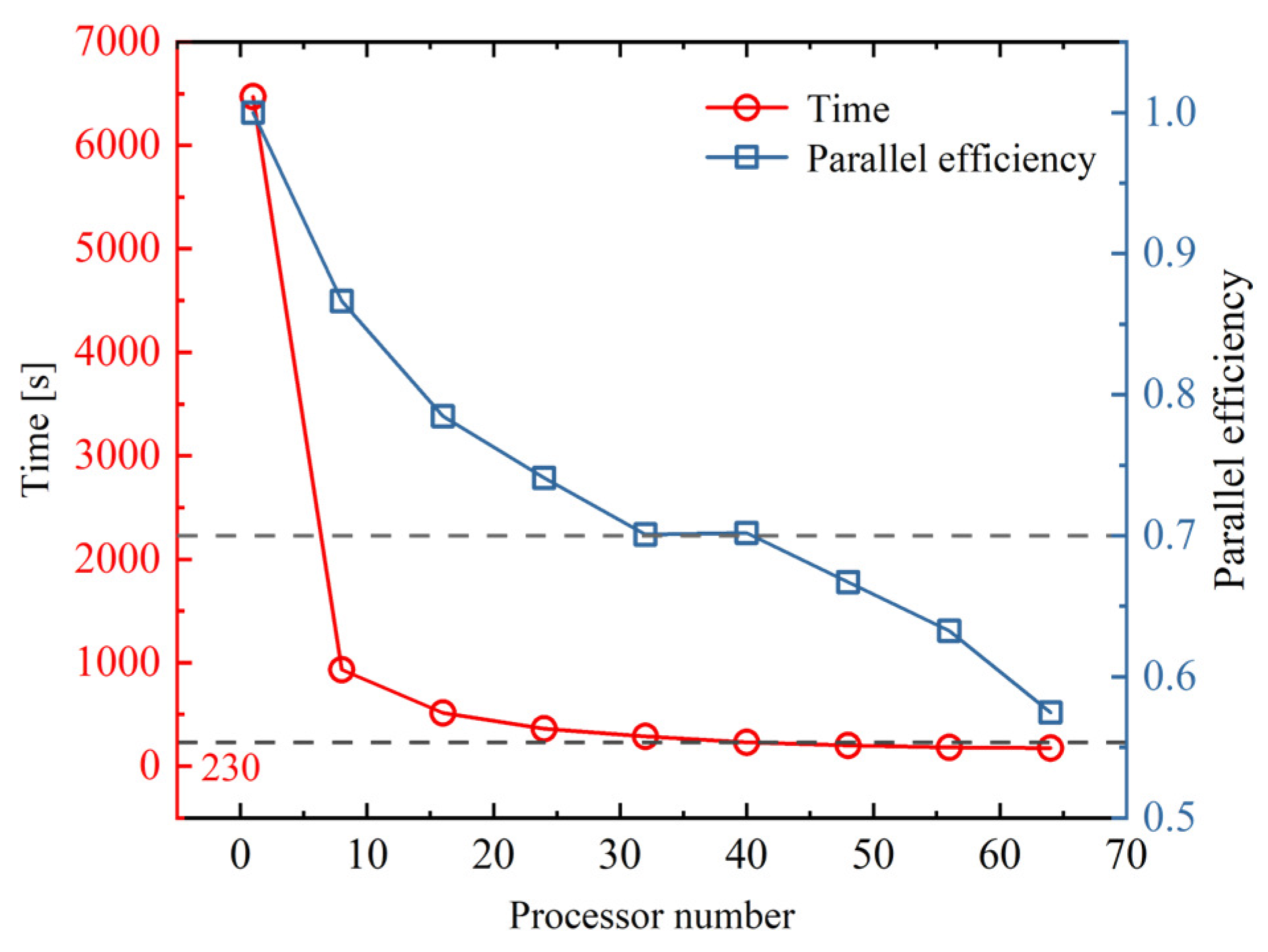
The schematic diagram for the MPI-parallelized construction of the FSCK database is illustrated in Figure 3. The variation in the generation time of the FSCK database as a function of the number of processes was statistically analyzed. In this analysis, the number of operating conditions was set to 1000, with the corresponding reference temperatures and thermodynamic states listed in Table 1. The number of processes was increased from 1 to 64 in increments of 8. The calculated results presented in Figure 4 show that the evolution of computational time with the number of processes follows a characteristic exponential decay trend. However, when the number of processes exceeds 40, the gradient of time reduction gradually approaches saturation, and the parallel efficiency exhibits a discernible decline. This degradation in parallel efficiency is attributed to the master node bearing a substantial communication overhead during the task distribution and data aggregation phases as the number of slave nodes increases, eventually becoming a bottleneck that limits the overall computational speed. Furthermore, since the generation of the FSCK database involves the storage and output of massive datasets, concurrent parallel I/O operations under large-scale parallelism exacerbate file system contention, further impeding the linear scaling of efficiency. Despite these interaction and storage overheads, the proposed algorithm maintains a parallel efficiency exceeding 70% within 40 processes and remains at a robust level above 55% even with 64 processes. Ultimately, the implementation of the parallel strategy achieved a significant time reduction from 6472 s with a single process to 176 s with 64 processes, greatly enhancing the construction efficiency of the FSCK database.
Figure 3.
Principle Diagram of Parallel FSCK Database Construction using MPI.
Table 1.
Parallel efficiency test specifications for FSCK database construction process.
Figure 4.
Variation in computational time and parallel efficiency with the number of processes during FSCK database generation.
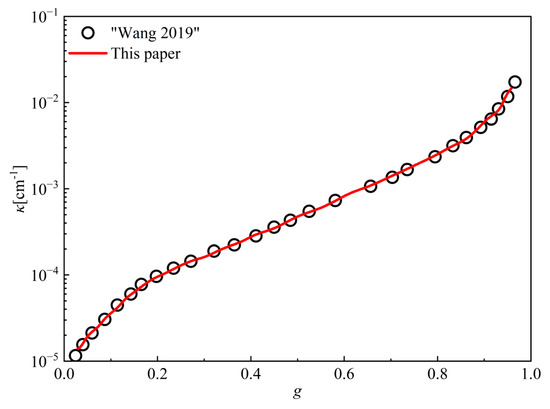
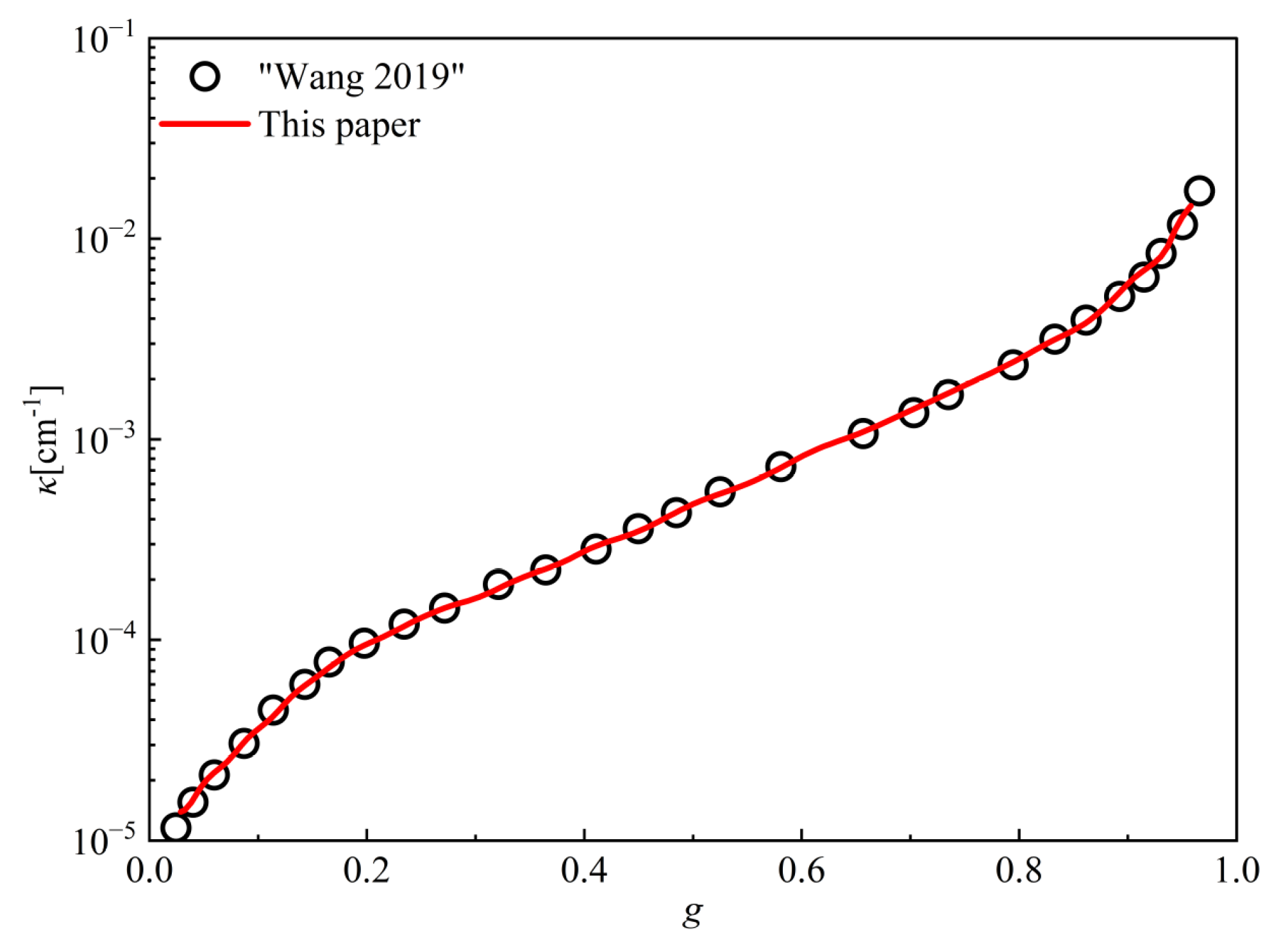
To verify the accuracy of the developed FSCK program, a validation case was conducted for H2O correlated absorption coefficients at a temperature of T = 2000 K, with a total pressure of p = 1 bar and a reference temperature of T0 = 1000 K [43]. The calculated results are presented in Figure 5, which demonstrates excellent agreement between the current work and the reference data [43]. The relative error in the calculated Planck mean absorption coefficient compared to the literature is 1.4%, thereby validating the reliability and accuracy of the FSCK program developed in this study.
Figure 5.
Validation of the FSCK calculation results against the reference data from Reference [43].
3.2. Parallel Tracing of NCMCM Rays Based on OpenMP
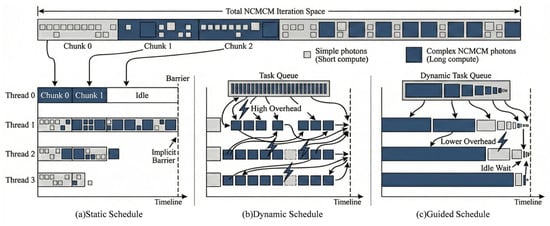
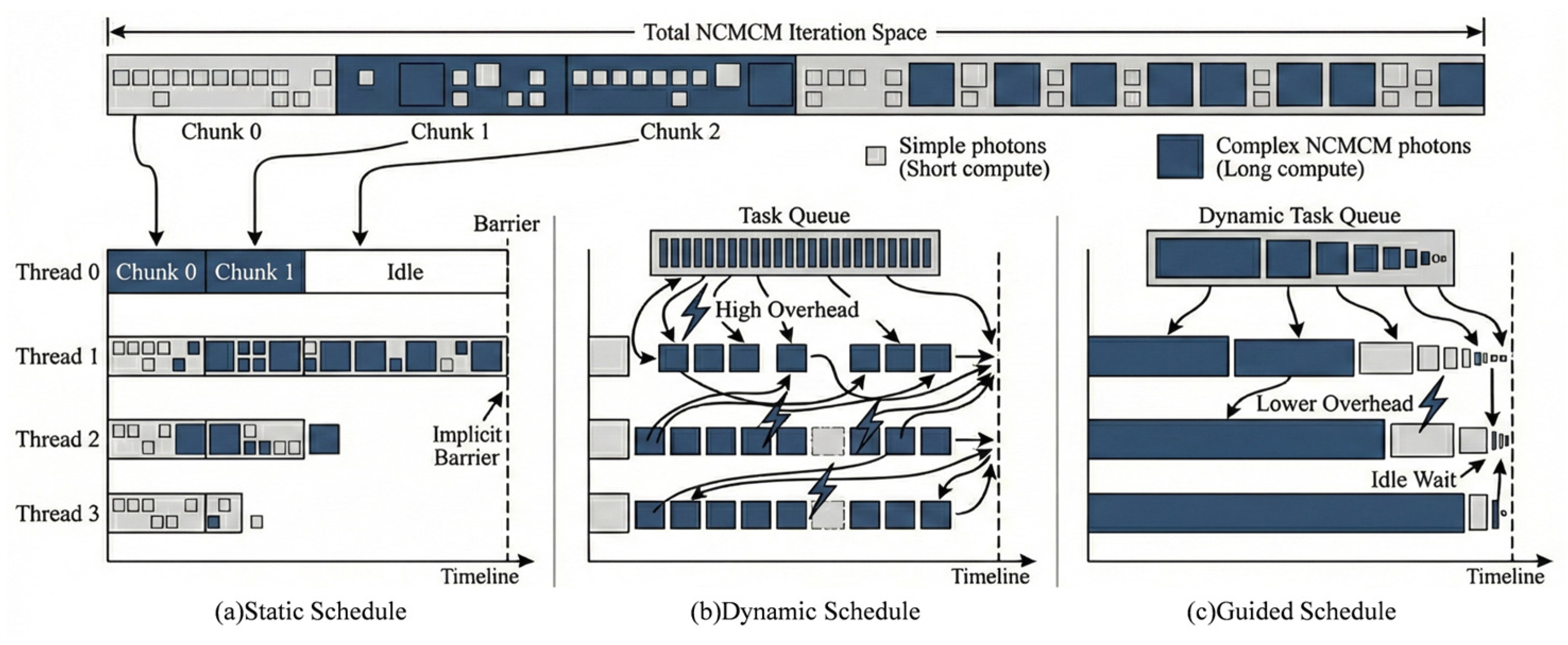
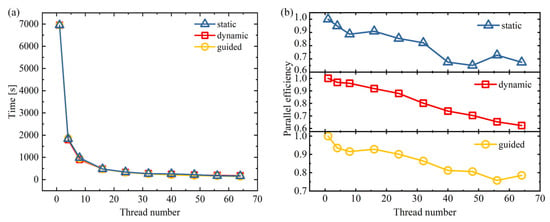
OpenMP offers three parallel scheduling strategies—static, dynamic, and guided—whose differences are illustrated in Figure 6. In the static and dynamic strategies, the task blocks are determined before the loop execution: the former assigns a fixed task to each thread, while the latter allocates new blocks to idle threads based on a “first-come, first-served” principle. Conversely, the guided strategy dynamically determines the task blocks during the loop, continually re-partitioning the remaining work and assigning it to idle threads using a “first-come, first-served” approach. Although dynamic and guided are logically more efficient for load balancing, they incur greater computation and communication overhead, which is why static is the default scheduling strategy in OpenMP. The relationship between Monte Carlo calculation time and the number of threads was statistically analyzed, with results shown in Figure 7a, and a comparison of the three scheduling strategies is presented in Figure 7b.
Figure 6.
Principle Diagram of the Static, Dynamic, and Guided Parallel Scheduling Policies Provided by OpenMP.
Figure 7.
Variation in computational performance metrics with thread count and scheduling strategy in the Monte Carlo method: (a) Computational time; (b) Parallel efficiency.
As the number of threads increases, the calculation time similarly shows an “exponential” decrease, generally stabilizing when the number of threads is greater than or equal to 48. Overall, the parallel efficiency of all three scheduling methods decreases as the number of threads increases. This decline is attributed to several factors: the time required for thread creation and destruction; communication overhead arising from threads inheriting shared variables; and the fact that OpenMP automatically sets synchronization points during the parallel loop, meaning the final calculation time is ultimately affected by the computational differences between different threads.
In terms of parallel efficiency, the guided scheduling strategy generally exhibits higher efficiency than the other two, maintaining a parallel efficiency of nearly 80% even when the number of threads is 64. It is noted that the parallel efficiency of the static scheduling strategy shows a more pronounced fluctuation. This can be attributed to two potential reasons: first, the computational time required to trace different photons in the Monte Carlo method inherently varies; and second, the fixed task assignment of the static scheduling strategy amplifies the differences in computation time caused by the inherent randomness of the Monte Carlo method, leading to poor load balancing. In contrast, the parallel efficiency of the dynamic scheduling strategy shows an almost linear relationship with the number of threads. This is because the “first-come, first-served” task assignment strategy can partially counteract the computation time differences resulting from the Monte Carlo method’s randomness; threads with greater computational power are assigned more tasks, thereby increasing thread utilization.
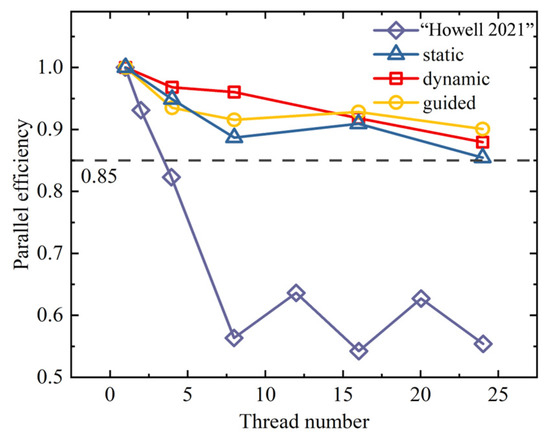
The parallel efficiency of the NCMCM program developed in this study was compared with that of the Monte Carlo method reported in Ref. [47], as illustrated in Figure 8. At a thread count of 24, the parallel efficiency of the Monte Carlo method in Ref. [47] is only 55%, whereas the parallel efficiency of the current program remains above 85% regardless of the scheduling strategy employed. It should be noted that the computational cases in Ref. [47] differ from those in this study. However, the pronounced efficiency advantage of the present method is not merely incidental to these physical differences; rather, it is fundamentally underpinned by a holistic optimization framework that bridges algorithmic adaptivity with hardware-software synergy. At the algorithmic core, the implementation of the guided scheduling strategy effectively neutralizes the load imbalance inherently caused by the stochastic nature of ray tracing. This algorithmic adaptivity is reinforced at the software level by rigorous C++ memory management and data structure optimization, which significantly enhances data locality and minimizes cache misses. Furthermore, these computational efficiencies are fully realized through the high-performance hardware capabilities of the Intel Xeon Platinum 8375C CPU, utilizing its substantial memory bandwidth and low-latency interconnects to drastically reduce the relative weight of communication and synchronization overheads. Since the guided scheduling strategy consistently yields the highest parallel efficiency, it is adopted for all subsequent simulations in this work.
Figure 8.
Parallel efficiency comparison of the current implementation and the implementation in Ref. [47].
3.3. Ray Tracing/Localization Models Based on KD-Tree and BVH
During ray tracing in the NCMCM, it is essential to determine the propagation path and perform event decision-making. The criticality of event decision-making lies in the real-time determination of the absorption, scattering, and extinction coefficients at the ray’s location—specifically, identifying the cell index of the ray’s endpoint. Although NCMCM can directly calculate the endpoint coordinates, the starting and ending points may be separated by a significant distance. Consequently, identifying the target cell through an exhaustive search is prohibitively inefficient.
To address such computational bottlenecks, ray-tracing acceleration techniques have been extensively studied in computer graphics and subsequently adapted for radiative heat transfer simulations. Early foundational works established the efficacy of hierarchical data structures, such as the BVH proposed by Kay and Kajiya [48], which utilizes efficient ray-box intersection algorithms, and spatial partitioning methods like Binary Space Partitioning trees [49,50]. In the field of radiative transfer, Mazumder et al. [51,52] demonstrated that these acceleration structures significantly reduce the computational cost of Monte Carlo simulations in complex geometries. Naeimi and Kowsary [53] further optimized these methods for 3D complex cavities. Building upon these established algorithms, this section develops a novel hybrid ray-localization model based on KD-tree and BVH to resolve traversal inefficiencies in unstructured grids.
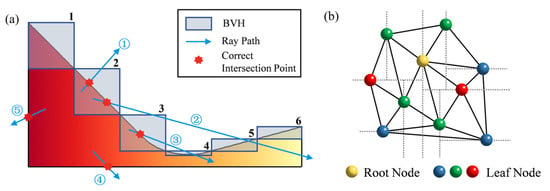
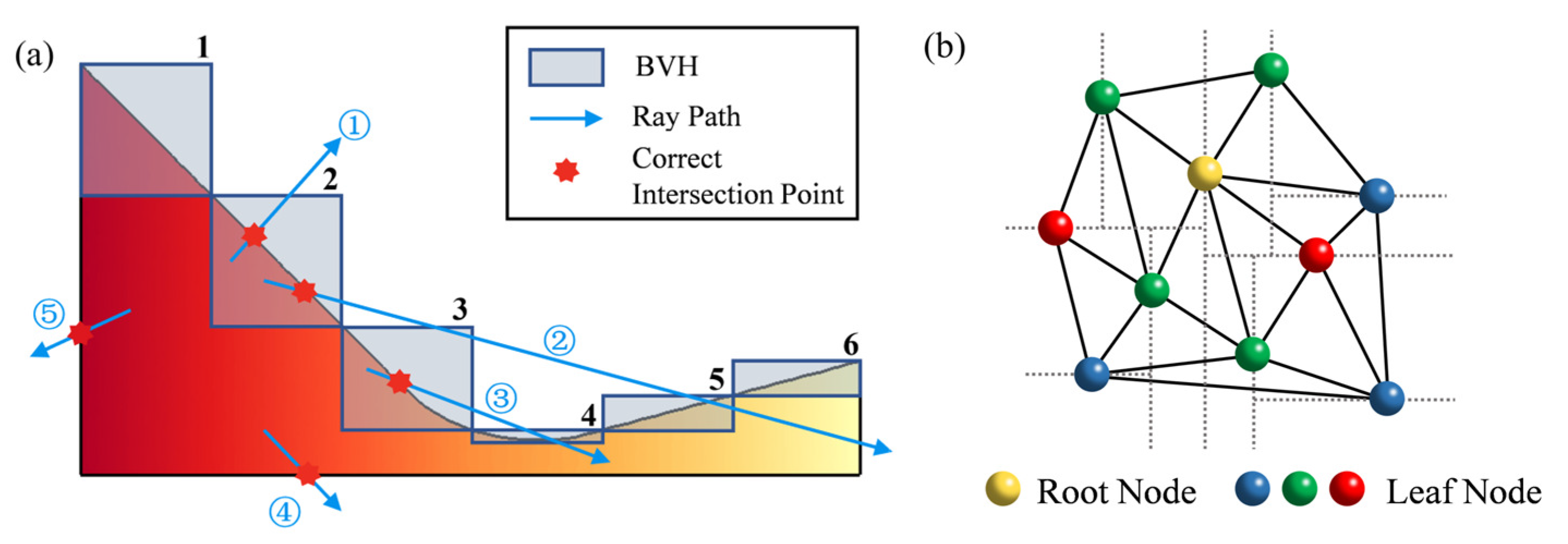
First, a typical propagation path of a ray inside a nozzle is analyzed, as shown in Figure 9a. The blue arrows indicate the ray’s propagation path, and the red symbols indicate the correct intersection points between the ray and the computational domain. A ray might exhibit a situation, such as ③, where it first penetrates the boundary and then re-enters the medium. Consequently, if one were to search directly for the ray’s endpoint, it would lead to the incorrect conclusion that “the ray’s endpoint is located inside the medium.” The method to avoid this error is to prioritize boundary searching, meaning to first check whether the ray’s propagation path intersects the boundary. If an intersection exists, the ray must intersect the wall first and will not continue propagating along its original path. To further accelerate the boundary search efficiency, a Bounding Volume Hierarchy (BVH), indicated by the blue box in Figure 9a, is established at the boundary. During the search, priority is given to determining whether the ray intersects the BVH bounding box. If there is an intersection, the wall elements within the bounding box are further searched; otherwise, the search is skipped entirely.
Figure 9.
Schematic diagrams: (a) Characteristic ray propagation path; (b) KD-tree data structure.
The “priority boundary search” strategy, while preventing errors in Figure 9a, introduces another issue: the computational efficiency is low for cases like ④ where the ray propagates entirely within the medium. To compensate for this efficiency loss, a more efficient data structure is necessary, leading to the adoption of the KD-tree for internal medium searches. The KD-tree is a multi-dimensional binary tree highly efficient for finding the K-nearest neighbors (KNN) to a given point. The rapid localization principle based on the KNN algorithm is: first, construct the KD-tree based on the grid node information as shown in Figure 9b; second, use the KNN search algorithm to find the K grid nodes closest to the ray’s endpoint; and finally, sequentially check the cells containing these K grid nodes until the correct result is found. Extensive numerical experiments show that in most cases, the KD-tree requires searching only 2–4 cells for localization. For the remaining low-probability events, a “Hierarchical Search” strategy is employed, recursively searching the cell of the K+1-th nearest neighbor if the result is not found within the current K set.
Taking the nozzle upper boundary shown in Figure 9a as an example, the Bounding Volume Hierarchy is constructed using a uniform spatial partitioning strategy. Specifically, the boundary is subdivided along the axial direction into M equidistant bounding boxes based on the extremal range of axial coordinates, with corresponding surface elements assigned to each box. Subsequently, the physical dimensions of each bounding box are refined to ensure they strictly encompass all vertices of the associated surface elements. For searches within the interior medium, this study leverages the high-performance open-source library FLANN to implement KD-tree construction and KNN search algorithms.
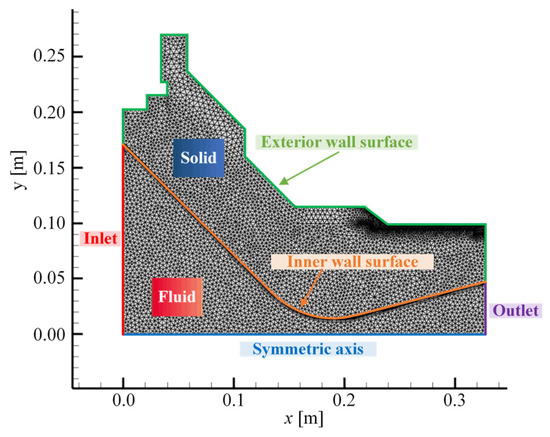
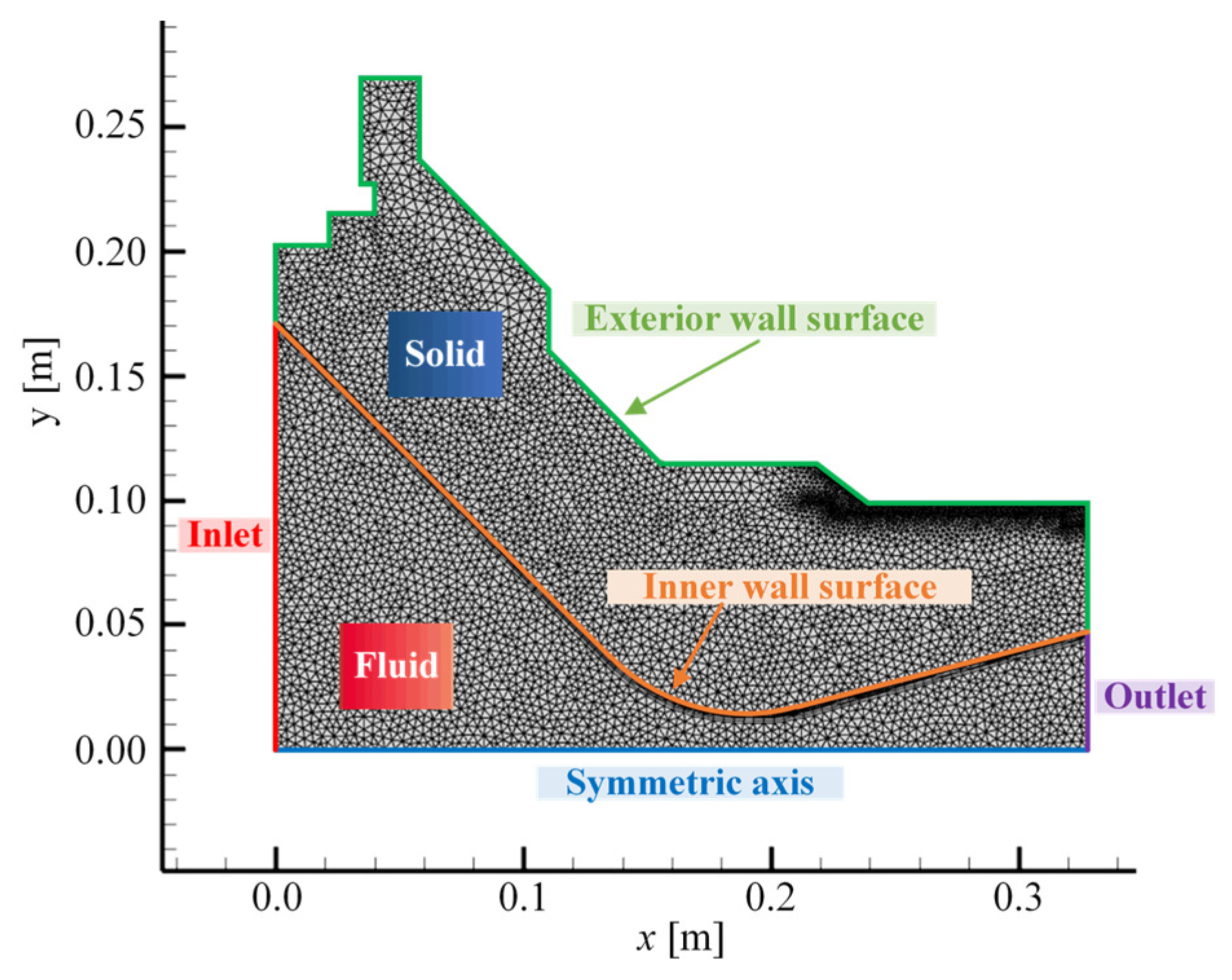
The computational efficiency of the developed beam localization model, based on KD-tree and BVH structures, is validated. For the nozzle shown in Figure 10, each cell randomly emits 104 beams, with the origin, direction, and propagation distance of each beam generated via random sampling. The computational times of two models are compared over five iterations. Model 1 represents the conventional approach, utilizing BVH for interior cell searches and an exhaustive surface-traversal method for boundary detection. In contrast, Model 2 introduces the tracking method developed in this study, which employs a KD-tree for interior cell searches and a BVH specifically for boundary searches. For both models, the axial subdivision count for the BVH is set to 20. To balance the memory footprint of the KD-tree with ray-searching efficiency, preliminary tests were conducted to establish an optimal configuration: the maximum leaf node capacity is set to 10, and the maximum search depth is capped at 20. This configuration constrains the tree hierarchy to prevent excessive traversal overhead while simultaneously controlling the primitive density within each leaf node, thereby significantly reducing the computational complexity of local intersection tests.
Figure 10.
Schematic of the nozzle computational domain.
The execution times of the two models are listed in Table 2 and evaluated using the speedup ratio metric (defined as Equation (13)); a higher ratio indicates a more pronounced enhancement in efficiency. Results show that the proposed beam localization model possesses a clear advantage over the traditional model, with a total speedup of approximately 4.1 and a cell-wise speedup reaching as high as 9.5. Building upon the experimental results that confirm significant acceleration, an analysis of the intrinsic parallel mechanism further elucidates the theoretical scalability of the algorithm under varying computational loads. While serial execution time increases linearly with the number of rays, the parallel mode allows an increased ray workload to significantly enhance the proportion of effective computation within the total execution time, thereby demonstrating excellent weak scaling. Furthermore, owing to the logarithmic search complexity inherent in tree-based structures, the localization time per ray remains insensitive to grid size. Large-scale mesh systems provide more abundant computational tasks to saturate parallel threads, further reducing the temporal weight of non-computational operations and ensuring the efficiency of the algorithm when addressing complex engineering problems.
where tpaper and ttraditional are the calculation times for the model proposed in this paper and the conventional model, respectively.
Table 2.
Computational time comparison of different beam positioning models.
4. Calculation of Radiative Source Term in a High-Temperature Nozzle
This section focuses on simulating radiative heat transfer for the convergent-divergent nozzle described in Reference [54] and calculating the resulting negative radiative source term distribution within the nozzle. The computational domain for the nozzle is shown in Figure 10. When performing convective heat transfer calculations, the fluid and solid domains are solved together as a single field. However, for radiative heat transfer calculations, only the fluid domain is considered, as radiation reaching the solid is assumed to be completely absorbed within a very small distance at the surface, which allows the radiation field calculation to be decoupled from the solid domain.
The boundary conditions for the nozzle simulation are set as follows: the Nozzle Inlet has a total pressure of 3.95 MPa and a total temperature of 3540.3 K; the Nozzle Outlet is a supersonic outlet; the Lower Boundary is set as a symmetry boundary; and the Solid Domain Boundaries are set as adiabatic. After grid independence verification, the total number of grid cells used is 30,875, of which the fluid domain comprises 10,946 cells. Further details on the simulation setup and geometry can be found in Reference [54].
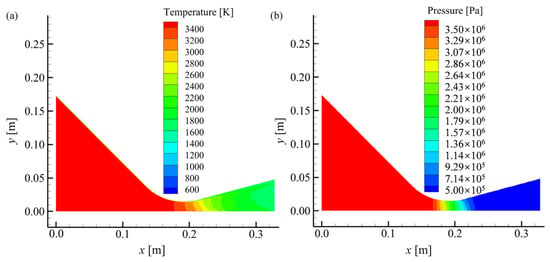
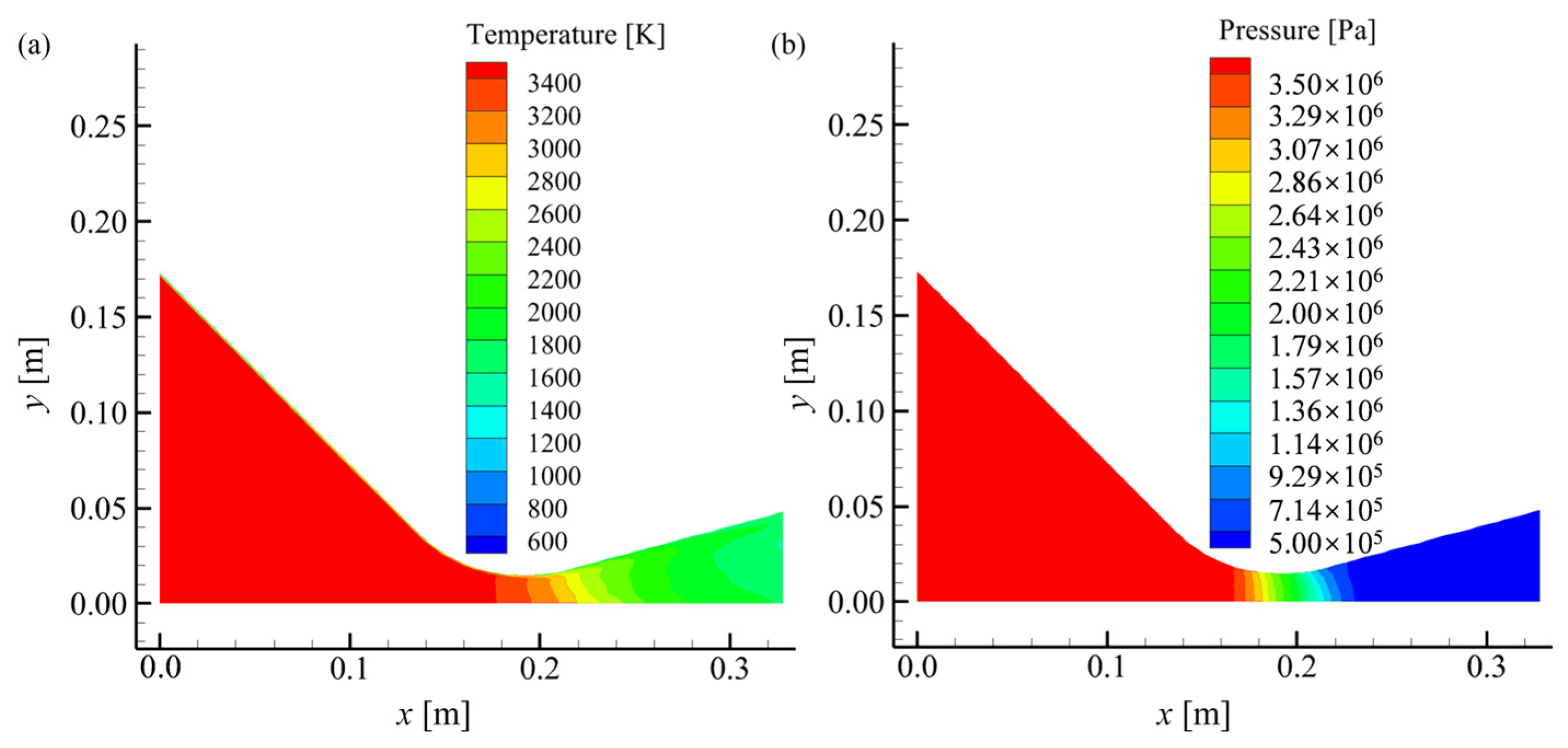
The calculated temperature and pressure fields are input into the developed high-temperature nozzle radiative heat transfer calculation program for a single-step computation. Assuming complete combustion and no particulate matter, the radiating gases in the combustion products include 25% H2O and 20% CO2. Due to the small geometric size of the nozzle, the high velocity of the gas flow, and the absence of chemical reactions among the gas components, the concentration distribution within the nozzle is considered to be nearly constant. The nozzle wall, inlet, and outlet are all assumed to be blackbodies; the wall temperature is given by the results of the flow field calculation, and the inlet and outlet temperatures are set to be consistent with the gas temperature in the adjacent control cells. The number of threads for the parallel Monte Carlo process is set to 64, and the number of rays traced per cell at each Gaussian integration node is set to 105. The temperature and pressure distributions within the nozzle are shown in Figure 11. Both temperature and pressure gradually decrease along the axial direction, concurrently accelerating the combustion gas to a supersonic state.
Figure 11.
Temperature and pressure distributions within the nozzle: (a) Temperature; (b) Pressure.
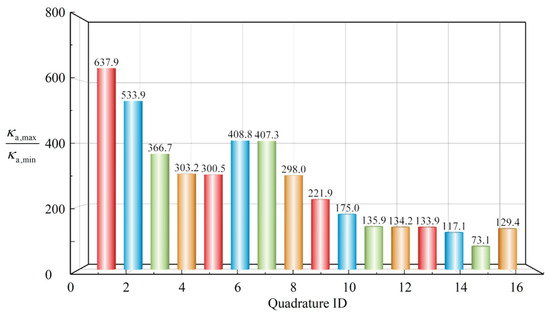
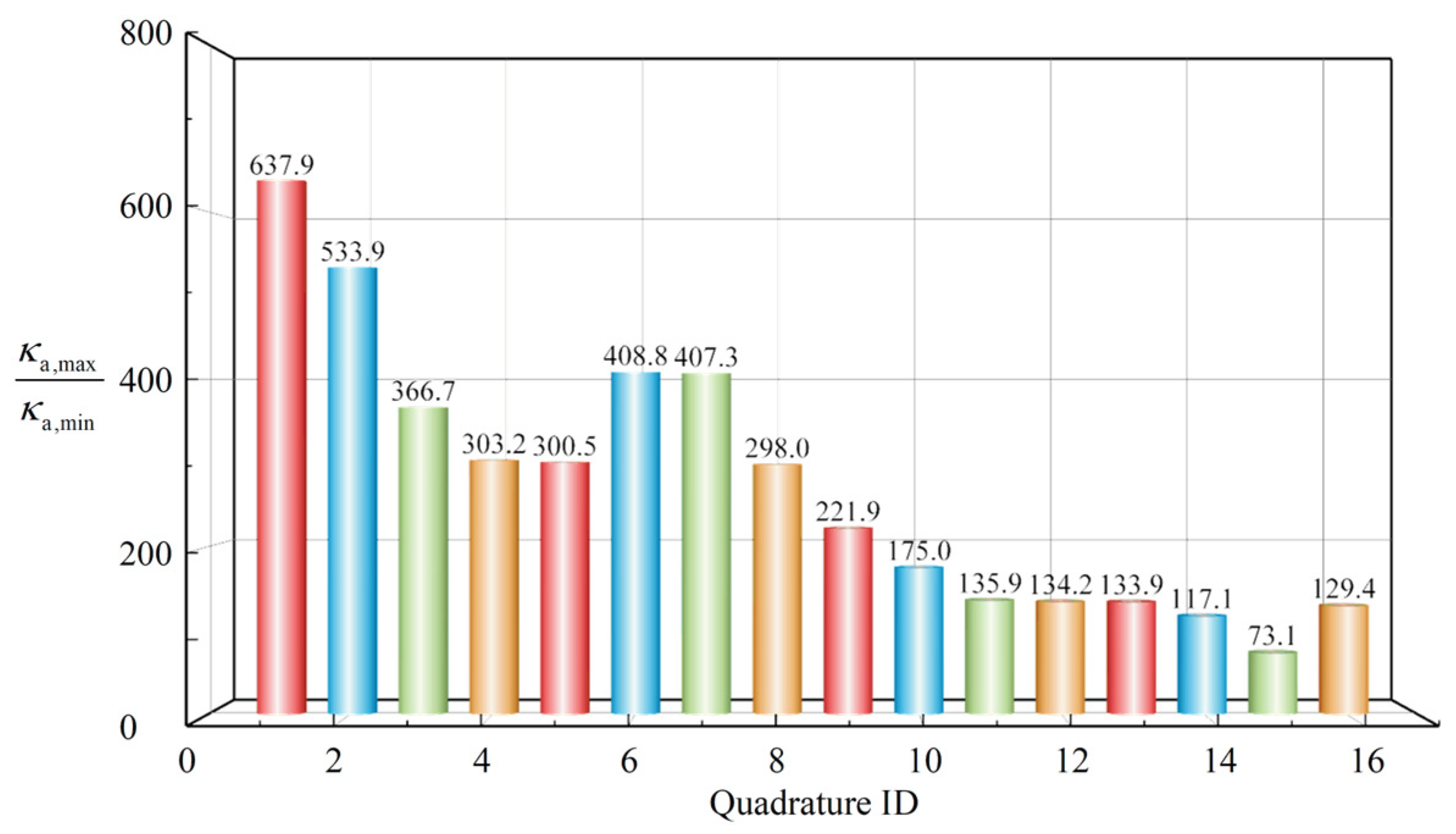
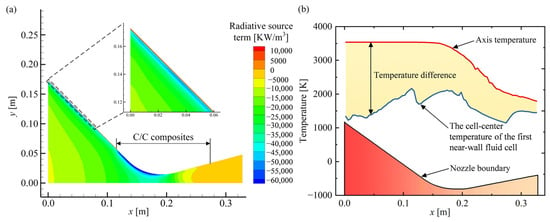
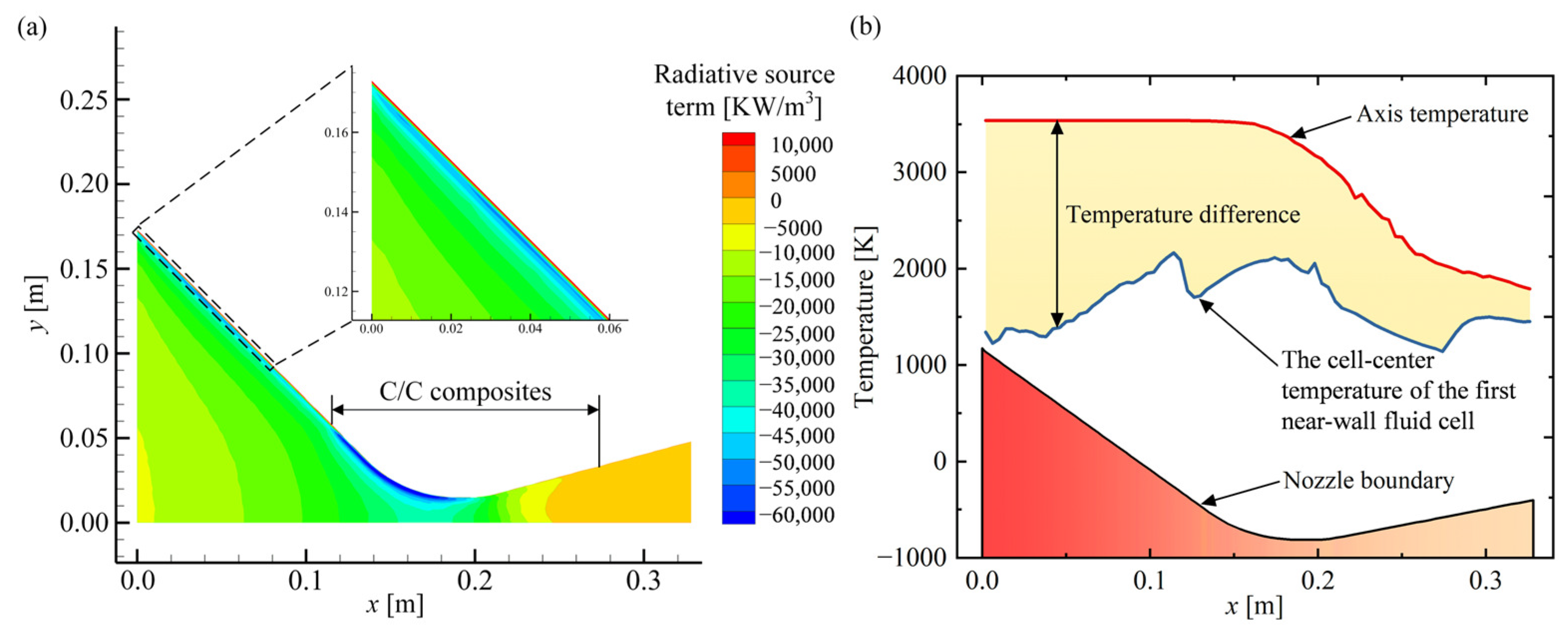
Figure 12 illustrates the ratio between maximum and minimum correlated absorption coefficients within the fluid domain at different Gauss integration points. It is observed that the correlated absorption coefficients at each integration point span about two to three orders of magnitude. The calculated distribution of the radiative source term is presented in Figure 13a. Within the mainstream region of the nozzle, the radiative source term is negative, indicating that the high-temperature gas intensely radiates energy to its surroundings; a higher absolute value correlates with increased radiative intensity. Conversely, regions with positive radiative source terms are located within the boundary layer of the convergence section and the upstream portion of the throat. Correlating this with the temperature profiles in Figure 13b, this phenomenon occurs because the temperature gradient between the boundary layer elements and the core gas is substantial. Consequently, the incident radiation significantly exceeds the local self-emission, resulting in a positive net radiative source term. In practical engineering applications, this energy deposition mechanism within the boundary layer is frequently underestimated. Its potential impact lies in significantly altering the near-wall thermodynamic state: radiative heating reshapes the thermal boundary layer profile, which may lead to an unexpected enhancement of the convection heat transfer coefficient. Given these findings, relying solely on the traditional linear superposition assumption may underestimate thermal load risks in complex flow fields. To improve design reliability, it is essential to evaluate the nonlinear modulation of the flow field structure by radiation and consider it a critical factor in refining thermal load predictions. Furthermore, due to nozzle geometry, radiation is most intense at the upstream region of the throat, with the radiative source term reaching 60,000 kW/m3. In the divergent section, particularly near the exit, the absolute value of the source term decreases. This indicates a weakening of radiative effects due to the relatively lower temperature and pressure of the gas, which reduces both its emissivity and absorptivity.
Figure 12.
Ratio of maximum to minimum rearranged absorption coefficients under different Gaussian quadrature nodes.
Figure 13.
Radiative source term and temperature distributions within the nozzle: (a) Radiative source term; (b) Temperature in the boundary layer nearest to the wall and along the axis.
From the analysis above, it is clear that the radiation effects in the convergent section and the upstream section of the throat are significantly more intense compared to the divergent section. Under the intense radiation from the high-temperature combustion gas, the wall temperature in the convergent section and the upstream throat will increase substantially. Therefore, it is necessary to strengthen the thermal protection measures in these regions, for example, by utilizing C/C ablative materials with stronger high-temperature resistance.
Regarding the calculation time, the serial computation time without acceleration was 42,450.64 s, which decreased sharply to 744.55 s when using 64 threads for parallel processing. The resultant parallel efficiency was 89.09%. This high utilization rate of the threads, resulting from the massive computational workload of radiation calculations in a real nozzle, contributed to the improved parallel efficiency observed with 64 threads.
Considering that the ablative material covering the actual nozzle wall is not an ideal blackbody, we further investigated the impact of wall emissivity on the calculated radiative heat transfer results inside the nozzle. Different ablative materials are simplified as gray bodies with varying emissivity. Due to the high emissivity of C/C material, its emissivity is set to 0.9. For the remaining wall surfaces, three cases are considered: 0.3, 0.5, and 0.7, which represent ablative materials with low, medium, and high emission characteristics, respectively.
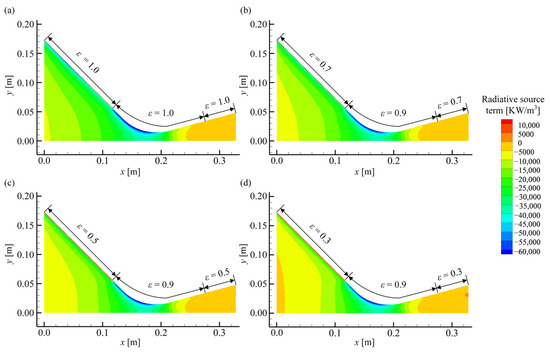
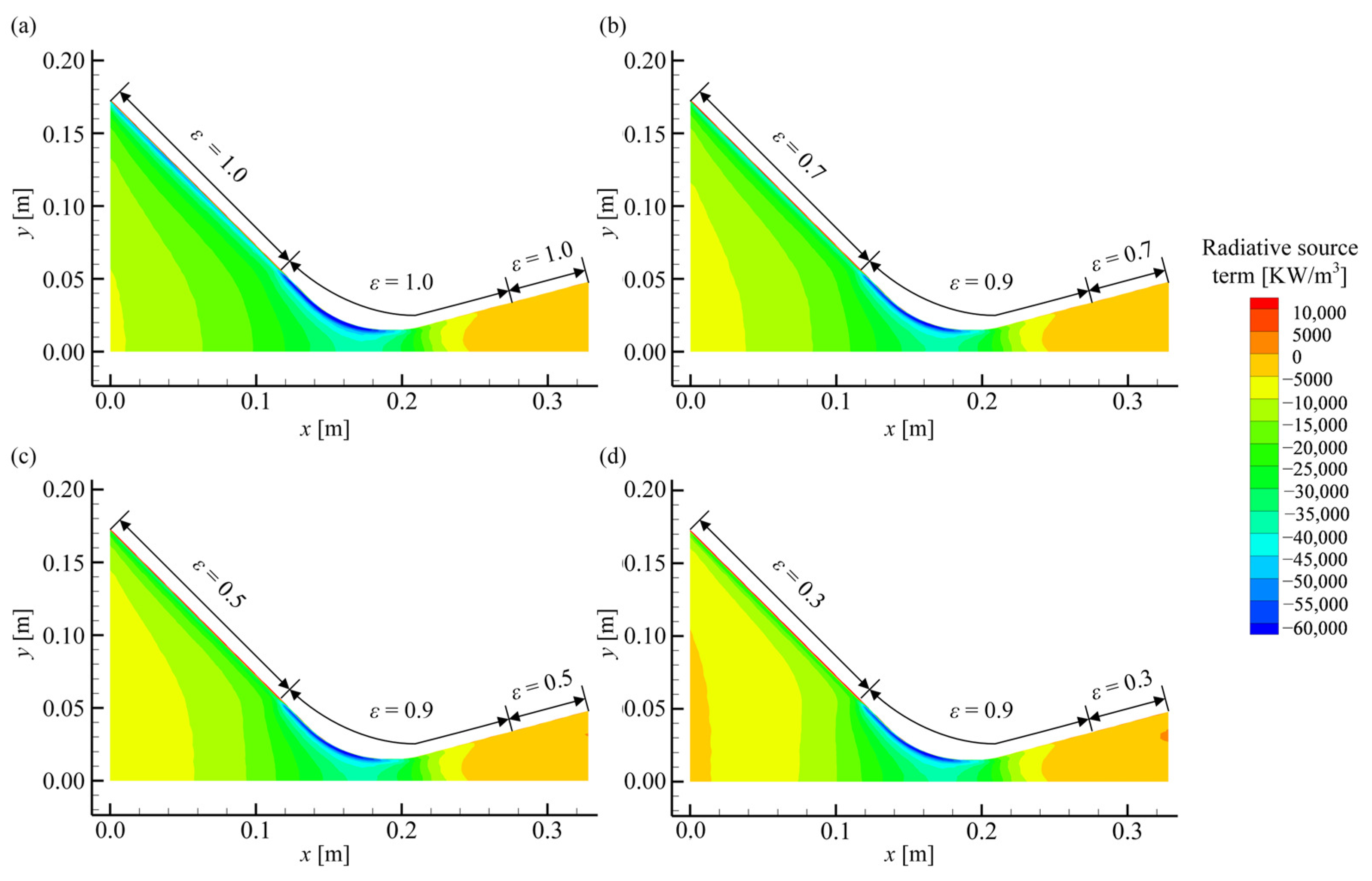
The distribution of the radiative source term for different wall emissivity is shown in Figure 14, where Figure 14a represents the case where all walls are assumed to be blackbodies. As the wall emissivity continuously decreases, the absolute value of the radiative source term in the convergent section near the inlet tends to decrease. This is because the high-temperature gas radiation originating from other regions is reflected by the wall, contributing to the incident radiation in these specific areas, thereby causing a reduction in the absolute value of the radiative source term. The radiative source term distribution in the throat and divergent section shows a similar trend; when the wall emissivity is reduced to a certain extent, the radiative source term in some parts of the divergent section’s exit even changes from negative to positive.
Figure 14.
Distribution of radiative source terms in the nozzle under different wall emissivities: (a) all walls are assumed to be blackbodies (e = 1.0); (b) C/C material e = 0.9, remaining walls e = 0.7; (c) C/C material e = 0.9, remaining walls e = 0.5; (d) C/C material e = 0.9, remaining walls e = 0.3.
However, generally speaking, the changes in the radiative source term distribution in the throat and divergent section are less pronounced than in the convergent section. This is attributed to the smaller change in the throat wall emissivity and the relatively milder radiative heat transfer in the divergent section. Crucially, for the boundary layer regions where radiative heat transfer is intense and the radiative source term is already positive (net absorption), a decrease in wall emissivity leads to a further increase in the radiative source term’s numerical value, consequently resulting in an additional increase in the thermal load on these specific regions.
Regarding computational efficiency, when utilizing 64-thread parallel processing without acceleration strategies, the execution times for Figure 14a–d are 744.55 s, 782.13 s, 811.24 s, and 840.81 s, respectively. This increase in time is a direct consequence of the augmented computational load induced by multiple reflection mechanisms: as the wall emissivity decreases, the probability of ray absorption is reduced, which significantly extends the average ray lifetime. Consequently, the solver must perform a higher frequency of ray-surface intersection operations. However, from the perspective of parallel computing performance, the increased workload per ray directly enhances the computation-to-communication ratio of the solution process. This indicates that the threads dedicate a larger proportion of time to high-density physical computations, thereby markedly reducing the relative overhead of thread communication and synchronization within the total execution cycle. Therefore, despite the increased complexity of the physical processes, the resulting growth in computational time remains within a reasonable linear range.
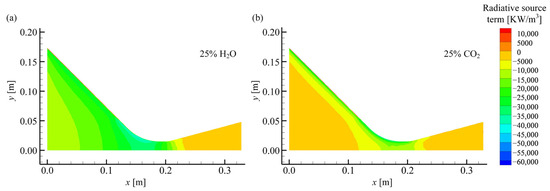
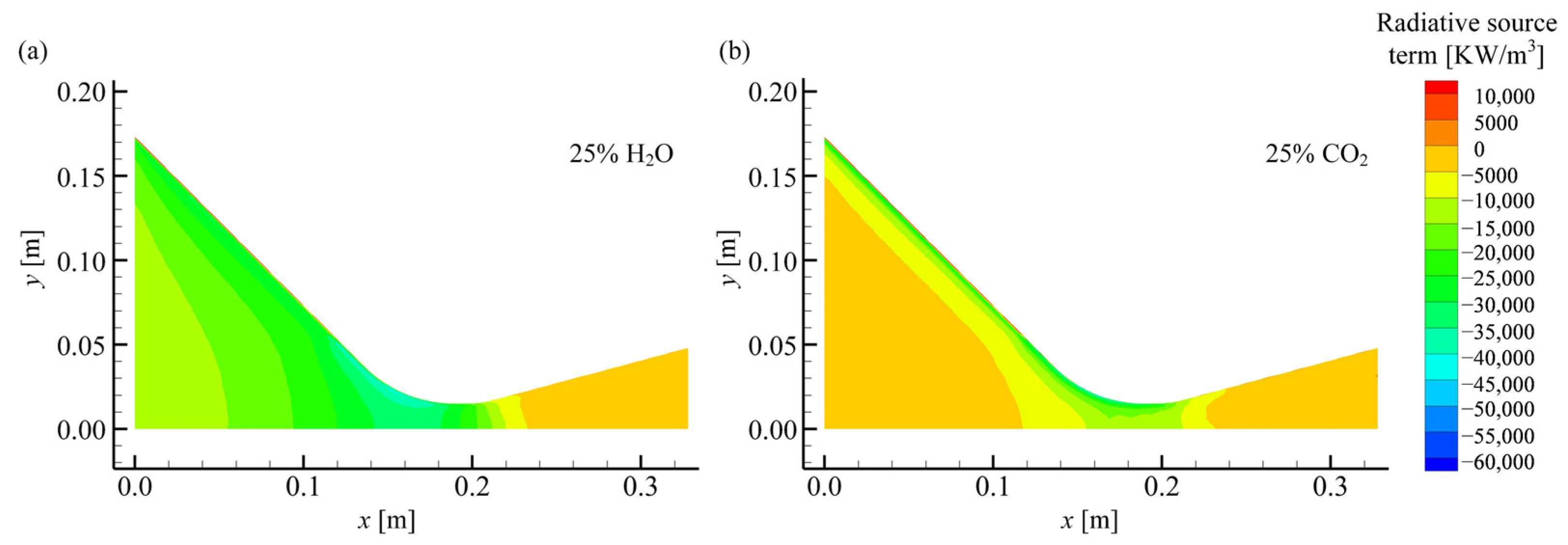
Finally, we compare the impact of the two common gas components found in the nozzle—H2O and CO2—on the distribution of the radiative source term within the nozzle. Assuming the walls are blackbodies, the radiative source term distributions were calculated separately for the case containing only 25% H2O and the case containing only 25% CO2, as shown in Figure 15. In the convergent section and throat, the calculated absolute value of the radiative source term is generally smaller when the gas component contains only CO2 compared to the case containing only H2O; in the divergent section, the numerical values are relatively similar. Given that the radiative source term is the difference between the incident radiation absorbed by the gas and the gas’s self-emission, and both these energies are related to the gas’s absorption characteristics, it is necessary to first analyze the absorption characteristics of H2O and CO2 under high-temperature, high-pressure conditions before analyzing the reasons for the observed differences in the convergent section and throat.
Figure 15.
Influence of different gases on nozzle radiative heat transfer: (a) 25% H2O; (b) 25% CO2.
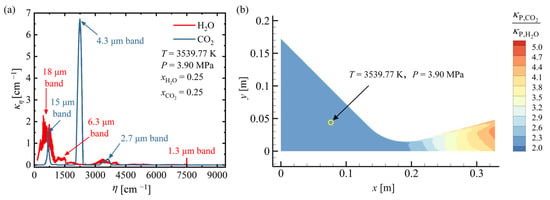
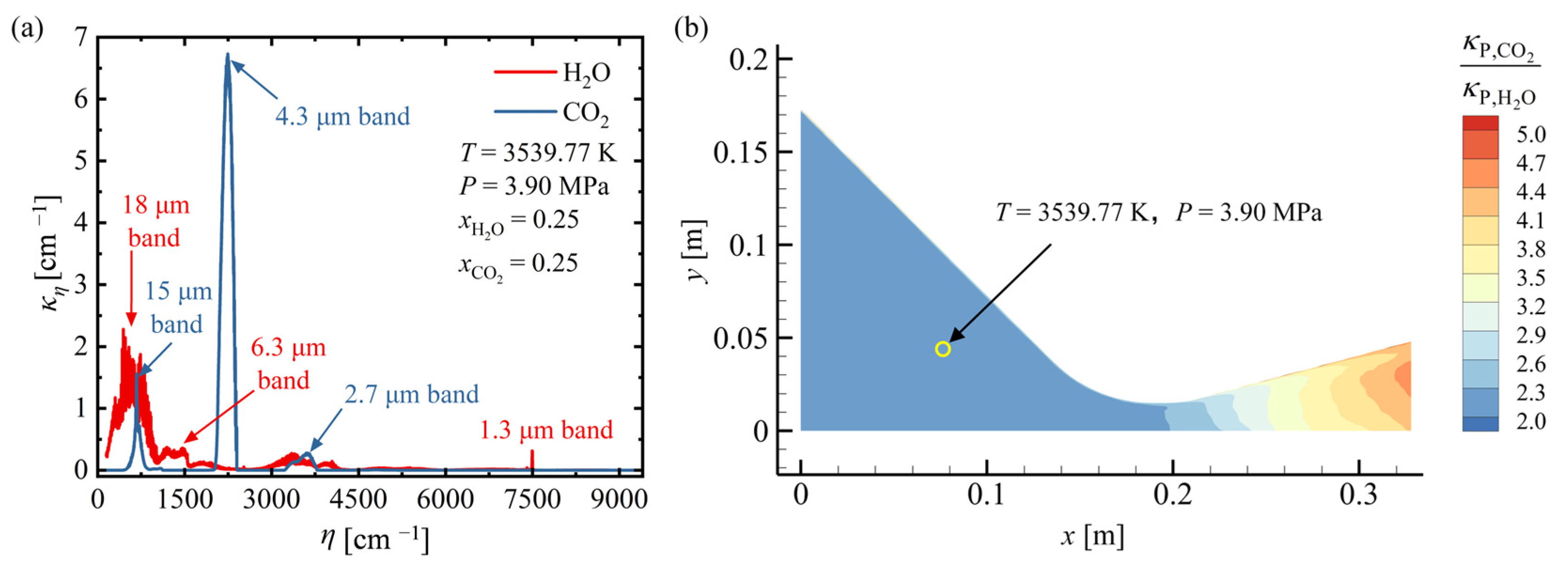
We randomly selected a cell in the convergent section (with a temperature of 3539.77 K and a total pressure of 3.90 MPa) and plotted the spectral absorption coefficient distribution curve for this cell, where both H2O and CO2 components have a concentration of 25%, as shown in Figure 16a. CO2 absorption coefficient peaks occur at 2.7 μm, 4.3 μm, and 15 μm, with the 4.3 μm band being the most prominent due to it being the primary region for the vibrational and rotational energy transitions of the CO2 molecule [55]. H2O absorption is primarily concentrated in the 1.3 μm, 2.7 μm, 6.3 μm, and 18 μm bands, which are generally shifted towards the longer wavelength region compared to CO2, indicating that H2O requires less energy for its transitions. Notably, both H2O and CO2 have large absorption coefficients and dense spectral lines in the far-infrared region (≥15 μm); these lines are the “hot lines” that appear only under high-temperature conditions. High temperatures also lead to “band broadening” in both components due to a greater number of molecules with significantly excited vibrational and rotational states.
Figure 16.
Radiation absorption properties of H2O and CO2: (a) Spectral distribution of absorption coefficients; (b) Planck mean absorption coefficient ratio.
Figure 16b illustrates that in the vast majority of the nozzle region, the Planck mean absorption coefficient of CO2 is greater than that of H2O, indicating that under high-temperature, high-pressure conditions, the overall absorption and emission capability of CO2 is stronger than that of H2O. This is primarily attributed to the significantly enhanced absorption capability and increased band width of CO2 in the 4.3 μm spectral band as seen in Figure 16a. In the convergent section and throat, where gas temperatures are high, the primary phenomenon is the net outward radiation of energy. According to Kirchhoff’s law, a stronger emitter radiates more energy outward. For a specific cell, the increase in absorbed incident radiation is generally greater than the increase in self-emission when containing only CO2 due to the enhanced energy projected from other regions. Consequently, the calculated radiative source term for CO2 is negative and has a smaller absolute value than that for H2O. This result, where higher H2O content leads to a lower temperature and a larger absolute value of the negative radiative source term, aligns with findings in Reference [55] regarding jet plume radiation, further validating the analysis.
5. Conclusions
In this study, a high-efficiency computational framework coupling the FSCK model and the NCMCM was developed to simulate radiative transfer within a high-temperature nozzle. To address the computational bottlenecks associated with unstructured grid traversal and stochastic sampling, a hybrid ray-localization model based on KD-tree and BVH, along with a collaborative MPI–OpenMP parallel strategy, was proposed. The effects of wall emissivity and gas composition on the radiative source term distribution were also systematically investigated. Based on the comprehensive numerical simulations and performance analyses, the following conclusions are drawn:
- (1)
- The constructed collaborative parallel framework successfully resolves the adaptability limitations of single-mode parallelism. By assigning MPI to the I/O-intensive database generation and OpenMP to the computation-intensive NCMCM, the framework maximizes hardware utilization. Specifically, the guided scheduling strategy effectively counteracts the thread idling caused by the intrinsic stochasticity of ray tracing, maintaining a parallel efficiency exceeding 80% where static scheduling fails to adapt.
- (2)
- The hybrid KD-tree and BVH model structurally overcomes the scalability limitation of unstructured grid traversal. Unlike traditional algorithms where time consumption grows linearly with grid count, the proposed model leverages spatial subdivision to constrain the search cost to a logarithmic level. This mechanism provides a speedup of approximately 9.5 times for per-cell computation and 4.1 times for total execution, validating its essential superiority in handling complex engineering geometries.
- (3)
- Radiative heat transfer primarily concentrates in the convergent section and the upstream region of the throat, where intense radiative energy exchange leads to elevated wall temperatures. As wall emissivity decreases, the absolute value of the radiative source term in the main stream diminishes, while it increases within the boundary layer, resulting in a slight increase in simulation time due to prolonged ray lifespans. Under high-temperature and high-pressure conditions, the radiative contribution of H2O in the convergent section is found to dominate over that of CO2, exhibiting larger absolute negative source term values.
This study currently focuses on H2O and CO2, excluding CO and particulate radiation present in actual rocket exhaust. Future work will integrate multi-component gas models and soot radiation to enhance fidelity. Additionally, porting the parallel algorithm to GPU architectures offers potential for further acceleration. Finally, machine learning techniques could be explored to automatically optimize the hybrid KD-tree/BVH parameters for varying nozzle geometries.
Author Contributions
Conceptualization, B.G.; methodology, Q.D.; software, Q.D. and X.W.; validation, X.W. and Y.R.; formal analysis, J.X. and Y.R.; investigation, J.X. and M.H.; resources, B.G.; data curation, M.H.; writing—original draft preparation, Q.D.; writing—review and editing, B.G. and X.W.; visualization, Q.D.; supervision, B.G. and H.Q.; project administration, H.Q.; funding acquisition, B.G. and H.Q. All authors have read and agreed to the published version of the manuscript.
Funding
This research was funded by the National Natural Science Foundation of China (grant numbers: 52306079, 52227813), and the Foundation for ‘Heilongjiang Excellent Master’s and Doctoral Theses in the New Era’ (grant number: LJYXL2022-010).
Institutional Review Board Statement
Not applicable.
Informed Consent Statement
Not applicable.
Data Availability Statement
The data and source code that support the findings of this study are available from the corresponding author upon reasonable request.
Acknowledgments
Special appreciation to the editors and reviewers for their valuable comments that have enhanced the quality of this paper.
Conflicts of Interest
The authors declare no conflicts of interest.
References
- Bianchi, D.; Neri, A. Numerical simulation of chemical erosion in VEGA launcher solid-propellant rocket motor nozzles. J. Propuls. Power 2017, 34, 1–17. [Google Scholar]
- Kumar, N.; Bansal, A. Modeling of turbulence, chemistry, and heat transfer of a rocket nozzle. Acta Astronaut. 2024, 223, 495–504. [Google Scholar] [CrossRef] [Scilit]
- Kumar, N.; Siddapureddy, S. Flow modelling of a rocket nozzle using hydrogen and methane propellants. Adv. Space Res. 2025, 75, 7445–7465. [Google Scholar] [CrossRef] [Scilit]
- Modest, M.F.; Mazumder, S. Chapter 7—The Monte Carlo method for surface exchange. In Radiative Heat Transfer, 4th ed.; Academic Press: Cambridge, MA, USA, 2022; pp. 235–259. [Google Scholar]
- Asllanaj, F.; Contassot-vivier, S.; Botella, O.; Franca, F.H.R. Numerical solutions of radiative heat transfer in combustion systems using a parallel modified discrete ordinates method and several recent formulations of WSGG model. J. Quant. Spectrosc. Radiat. Transf. 2021, 274, 107863. [Google Scholar] [CrossRef] [Scilit]
- Cross, P.G. Radiative Heat Transfer in Solid Rocket Nozzles//Thermophysics: AIAA Aviation Forum 2019; AIAA: Dallas, TX, USA, 2019; pp. 17–21. [Google Scholar]
- Shao, J.; Zhu, K.Y.; Huang, Y. A fast GPU Monte Carlo implementation for radiative heat transfer in graded-index media. J. Quant. Spectrosc. Radiat. Transf. 2021, 269, 107680. [Google Scholar] [CrossRef] [Scilit]
- Modest, M.F.; Mazumder, S. Chapter 19—Svolution methods for nongray extinction coefficients. In Radiative Heat Transfer, 4th ed.; Academic Press: Cambridge, MA, USA, 2022; pp. 657–736. [Google Scholar]
- Modest, M.F.; Mazumder, S. Chapter 10—Radiative properties of molecular gases. In Radiative Heat Transfer, 4th ed.; Academic Press: Cambridge, MA, USA, 2022; pp. 311–399. [Google Scholar]
- Qin, J.; Xie, Y.; Liu, J.; Xu, Z.; Zhu, J.; Liu, G.; Wang, H.; Yuan, H. Natural gas diffusion behavior and gas detector layout in the ship engine room considering heat radiation effect. Ocean Eng. 2025, 317, 120007. [Google Scholar] [CrossRef] [Scilit]
- Du, Y.; Li, X.; Shi, L.; Li, F. An Extended Model of HITRAN Gas Spectral Parameters Based on AdaTransformer. IEEE Trans. Aerosp. Electron. Syst. 2025, 61, 6897–6912. [Google Scholar] [CrossRef] [Scilit]
- Fabiani, M.; Migliorino, M.T.; Bianchi, D.; Nasuti, F. Spectral and Global Radiative Heat Transfer Models for Liquid Propellant Rocket Engines. J. Propuls. Power 2025, 41, 15. [Google Scholar] [CrossRef] [Scilit]
- Gao, B.H.; Qi, H.; Zhao, Y.; Ren, Y.-T.; He, M.-J. An efficient equation-solving method for calculating radiative transfer in isotropic scattering medium. Int. J. Heat Mass Transf. 2021, 174, 121298. [Google Scholar] [CrossRef] [Scilit]
- Liu, J.A.; Eri, Q.T.; Kong, B.; Huang, J.; Zhou, Y. Ray tracing core accelerated high performance implementation for infrared radiation signature simulation using reverse Monte Carlo method. Int. J. Therm. Sci. 2025, 214, 109904. [Google Scholar] [CrossRef] [Scilit]
- Zhang, S.; Ling, K.; Sun, N.; Yang, S.; Hao, X.; Sui, X.; Tao, W.-Q. 2-D numerical study of ferrofluid droplet formation from microfluidic T-junction using VOSET method. Numer. Heat Transf. Appl. 2021, 20, 611–630. [Google Scholar] [CrossRef] [Scilit]
- Liu, Y.Y.; Zhu, J.Y.; Liu, G.H.; Liu, F.; Consalvi, J.-L. Assessment of various Full-Spectrum Correlated k-distribution methods in radiative heat transfer in oxy-fuel sooting flames. Int. J. Therm. Sci. 2023, 184, 107919. [Google Scholar] [CrossRef] [Scilit]
- Atashafrooz, M.; Asadi, T.; Yan, W.M. Numerical study on forced convection in the exhaust problem using the spectral line-based weighted sum of gray gases model. Heat Mass Transf. 2020, 156, 119837. [Google Scholar] [CrossRef] [Scilit]
- Sun, Y.; Zhang, X.; Howell, J.R. Non-gray combined conduction and radiation heat transfer by using FVM and SLW. Quant. Spectrosc. Radiat. Transf. 2017, 197, 51–59. [Google Scholar] [CrossRef] [Scilit]
- Atashafrooz, M.; Salehi, F.; Asadi, T.; Yang, T.-F.; Yan, W.-M. Gray and non-gray simulations of the combined conduction and radiation heat transfer in a complex enclosure utilizing FSK method considering the scattering influences. Heat Mass Transf. 2021, 126, 105390. [Google Scholar] [CrossRef] [Scilit]
- Modest, M.F.; Zhang, H. The full-spectrum correlated-k distribution for thermal radiation from molecular gas-particulate mixtures. Heat Transf. 2002, 124, 30–38. [Google Scholar] [CrossRef] [Scilit]
- Fu, Q.; Liou, K.N. On the correlated k-distribution method for radiative transfer in nonhomogeneous atmospheres. Atmos. Sci. 1991, 49, 2139–2156. [Google Scholar] [CrossRef] [Scilit]
- Lacis, A.A.; Oians, V. A description of the correlated k distribution method for modeling nongray gaseous absorption, thermal emission, and multiple scattering in vertically inhomogeneous atmospheres. Geophys. Res. Atmos. 1991, 96, 9027–9063. [Google Scholar] [CrossRef] [Scilit]
- Modest, M.F. Narrow-band and full-spectrum k-distributions for radiative heat transfer-correlated-k vs. scaling approximation. Quant. Spectrosc. Radiat. Transf. 2003, 76, 69–83. [Google Scholar] [CrossRef] [Scilit]
- Porter, R.; Liu, F.; Pourkashanian, M.; Williams, A.; Smith, D. Evaluation of solution methods for radiative heat transfer in gaseous oxy-fuel combustion environments. Quant. Spectrosc. Radiat. Transf. 2010, 111, 2084–2094. [Google Scholar] [CrossRef] [Scilit]
- Clements, A.G.; Porter, R.; Pranzitelli, A.; Pourkashanian, M. Evaluation of FSK models for radiative heat transfer under oxyfuel conditions. Quant. Spectrosc. Radiat. Transf. 2015, 151, 67–75. [Google Scholar] [CrossRef] [Scilit]
- Wang, Q.; Cheng, C.; Shi, H.; Wang, X.; Ye, H.; Sun, X.; Zhu, F.; Wu, S.; Xiong, W. Evaluation and Selection of Aerosol Models in Atmospheric Radiative Transfer Calculations. Acta Opt. Sin. 2024, 44, 1201012. [Google Scholar]
- Losacker, J.; Garcia, A.M.; Schmitz, N.; Wuppermann, C. Full-spectrum k-distribution weighted sum of gray gases model for air and oxyfuel combustion of hydrogen-hydrocarbon blends at atmospheric pressure. Therm. Sci. Eng. Prog. 2025, 61, 103514. [Google Scholar] [CrossRef] [Scilit]
- Li, Z.; Yin, Y.; Wang, F.; Ma, S. Evaluation of air impact on urban radiative transfer and building loads using discrete ordinate method. Build. Simul. 2025, 18, 2135–2150. [Google Scholar] [CrossRef] [Scilit]
- Koklu, H. Calculation of radiative thickness using spherical harmonic methods for the radiative transfer equation. Front. Phys. 2025, 13, 1570080. [Google Scholar] [CrossRef] [Scilit]
- Li, D.; Li, G.; Hong, D.; Li, P.; Ji, W.; Yi, Z. Improved Monte Carlo method for radiative heat transfer in semitransparent media with BRDF surface. Int. J. Therm. Sci. 2023, 187, 108152. [Google Scholar] [CrossRef] [Scilit]
- Byun, D.; Baek, S.W. Numerical investigation of combustion with non-gray thermal radiation and soot formation effect in a liquid rocket engine. Int. J. Heat Mass Transf. 2007, 50, 412–422. [Google Scholar] [CrossRef] [Scilit]
- Paul, S.C.; Paul, M.C. Radiative heat transfer during turbulent combustion process. Int. Commun. Heat Mass Transf. 2010, 37, 1–6. [Google Scholar] [CrossRef] [Scilit]
- Galiter, M.; Blanco, S.; Caliot, C.; Coustet, C.; Dauchet, J.; El Hafi, M.; Eymet, V.; Fournier, R.; Gautrais, J.; Khuong, A.; et al. Integral formulation of null-collision Monte Carlo algorithms. Quant. Spectrosc. Radiat. Transf. Quant. Spectrosc. Radiat. Transf. 2013, 125, 57–68. [Google Scholar] [CrossRef] [Scilit]
- Eymet, V.; Poitou, D.; Galiter, M.; El Hafi, M.; Terrée, G.; Fournier, R. Null-collision meshless Monte-Carlo—Application to the validation of fast radiative transfer solvers embedded in combustion simulators. J. Quant. Spectrosc. Radiat. Transf. 2013, 129, 145–157. [Google Scholar] [CrossRef] [Scilit]
- Yuen, W.W. Radiative Transfer in Finite Concentric Cylinders by the Zonal Monte Carlo Method. J. Thermophys. Heat Transf. 2024, 38, 12. [Google Scholar] [CrossRef] [Scilit]
- Shi, Y.; Xie, H. A predictor-corrector Monte Carlo method for thermal radiative transfer equations. Ann. Nucl. Energy 2024, 197, 110252. [Google Scholar] [CrossRef] [Scilit]
- Sarvari, S.M.H. A general ray tracing approach for solving thermal radiation in regular one-dimensional variable index media via the Monte Carlo method. Int. Commun. Heat Mass Transf. A Rapid Commun. J. 2024, 155, 107551. [Google Scholar] [CrossRef] [Scilit]
- Ma, Z.; Li, D.C.; Wu, J.; Cheng, C. Research on Parallel Computing Methods for High-Resolution Atmospheric Spectral Lines. Acta Opt. Sin. 2024, 44, 18. [Google Scholar]
- Peest, C.; Reich, O.; Bressel, L. Monte Carlo radiative transfer peel off mechanism for spatially extended detectors. J. Comput. Phys. X 2023, 17, 100132. [Google Scholar] [CrossRef] [Scilit]
- Liu, S.C.; Liang, J.G.; Wang, K.; Chen, Y.X. Development of the integrated parallelism strategy for large scale depletion calculation in the Monte Carlo code RMC. Ann. Nucl. Energy 2020, 135, 106941. [Google Scholar] [CrossRef] [Scilit]
- Lee, C.M.; Ye, S.J. A GPU-accelerated Monte Carlo code, RT2 for coupled transport of photon, electron/positron, and neutron. Phys. Med. Biol. 2024, 69, 22. [Google Scholar] [CrossRef] [Scilit] [PubMed]
- Soufiani, A.; Taine, J. High temperature gas radiative property parameters of statistical narrow-band model for H2O, CO2 and CO, and correlated-K model for H2O and CO2. Int. J. Heat Mass Transf. 1997, 40, 987–991. [Google Scholar] [CrossRef] [Scilit]
- Wang, C.J.; He, B.S.; Modest, M.F. Full-spectrum correlated k-distribution look-up table for radiative transfer in nonhomogeneous participating media with gas-particle mixtures. Int. J. Heat Mass Transf. 2019, 137, 1053–1063. [Google Scholar] [CrossRef] [Scilit]
- Sit, A.; Wulf, R.; Fieback, T.; Talukdar, P. Identification of spectral radiative properties of closed cell polymeric foams using coupled Monte Carlo-particle swarm optimization. Int. J. Therm. Sci. 2023, 189, 108263. [Google Scholar] [CrossRef] [Scilit]
- Modest, M.F.; Mazumder, S. Appendix F—Computer Codes. In Radiative Heat Transfer, 4th ed.; Academic Press: Cambridge, MA, USA, 2022; pp. 855–862. [Google Scholar]
- Wang, C.J.; Modest, M.F.; Ren, T.; Cai, J.; He, B. Comparison and refinement of the various full-spectrum k-distribution and spectral line weighted-sum-of-gray-gases models for nonhomogeneous media. J. Quant. Spectrosc. Radiat. Transf. 2021, 271, 107695. [Google Scholar] [CrossRef] [Scilit]
- Howell, J.R.; Daun, K.J. The past and future of the Monte Carlo method in thermal radiation transfer. J. Heat Transf. 2021, 143, 100801. [Google Scholar] [CrossRef] [Scilit]
- Kay, T.L.; Kajiya, J.T. Ray tracing complex scenes. Comput. Graph. 1986, 20, 269–278. [Google Scholar] [CrossRef] [Scilit]
- Arvo, J.; Kirk, D. A Survey of Ray Tracing Acceleration Techniques; Academic Press: Cambridge, MA, USA, 1989. [Google Scholar]
- Sung, K.; Shirley, P. Ray Tracing with a BSP Tree; AP Professional: Rochester, NY, USA, 1992. [Google Scholar]
- Mazumder, S.; Kersch, A. A fast Monte Carlo scheme for thermal radiation in semiconductor processing applications. Numer. Heat Transf. Part B Fundam. 2000, 37, 185–199. [Google Scholar]
- Mazumder, S. Methods to accelerate ray tracing in the Monte Carlo method for surface-to-surface radiation transport. ASME J. Heat Transf. 2006, 128, 945–952. [Google Scholar] [CrossRef] [Scilit]
- Naeimi, H.; Kowsary, F. An optimized and accurate Monte Carlo method to simulate 3D complex radiative enclosures. Int. Commun. Heat Mass Transf. 2017, 84, 150–157. [Google Scholar] [CrossRef] [Scilit]
- Zhu, W.; Lin, W.Y.; Zhang, S.; Yang, S.; Wu, T.; Ma, R.; Cao, T.-F.; Dai, Y.-J.; Tao, W.-Q. Modeling and analysis of fluid-solid coupling heat transfer and fluid flow in transonic nozzle. Appl. Therm. Eng. 2025, 260, 124885. [Google Scholar] [CrossRef] [Scilit]
- Giménez-alventosa, V.; Giménez, G.V.; Oliver, S. PenRed: An extensible and parallel Monte-Carlo framework for radiation transport based on PENELOPE. Comput. Phys. Commun. 2021, 267, 108065. [Google Scholar] [CrossRef] [Scilit]

Disclaimer/Publisher’s Note: The statements, opinions and data contained in all publications are solely those of the individual author(s) and contributor(s) and not of MDPI and/or the editor(s). MDPI and/or the editor(s) disclaim responsibility for any injury to people or property resulting from any ideas, methods, instructions or products referred to in the content. |
© 2026 by the authors. Licensee MDPI, Basel, Switzerland. This article is an open access article distributed under the terms and conditions of the Creative Commons Attribution (CC BY) license.