


Abstract
Peer-to-peer (P2P) energy-trading has emerged as a promising mechanism for decentralized electricity markets, but its practical deployment is often limited by the difficulty of accounting for physical network constraints and transmission losses in real time. This paper presents a decentralized P2P energy trading mechanism that incorporates network constraints and transmission losses directly into the market-clearing process. The framework combines Power Transfer Distribution Factors (PTDFs) for pre-trade feasibility validation with an Enhanced Least Squares Method (ELSM) for loss estimation, enabling loss-aware settlement without computationally intensive and redundant AC power flow calculations. The mechanism is implemented on Hyperledger Fabric using Attribute-Based Access Control, Access Control Lists and Private Data Collections to ensure privacy and auditability. Numerical studies on a 3-bus and the IEEE 39-bus system show that the proposed approach closely reproduces AC Optimal Power Flow dispatch and cost outcomes, while significantly improving simplified DC-based loss models. The results demonstrate that physically feasible and economically efficient decentralized trading can be achieved in a permissioned blockchain environment.
1. Introduction
The modern power system is undergoing a transformation. Highly impacted by technological advancements, it is moving from a centralized utility model to a more decentralized and intelligent structure [1,2,3]. The large-scale exploitation of renewable energy sources (RESs) and affordable small-scale storage in the forms of stand-alone batteries or electric vehicles, as well as new Demand-Side Management (DSM) tools provided by non-critical IoT-enabled loads, converted many passive consumers to distributed energy resources (DERs) in a Smart Grid (SG) [4,5,6]. Recent studies and regulatory directives increasingly promote more active participation of energy system stakeholders to improve the efficiency, stability, and resilience of energy supply systems. In particular, European resilience-oriented policy frameworks emphasize the need to ensure the continuous provision of essential services, such as electricity supply, under volatile and stressed operating conditions, while reducing systemic vulnerabilities associated with centralized control structures [7,8,9,10]. Since the participation of distributed, small-scale, controllable generation and demand is now technologically mature, markets that coordinate transactions between them and lead the overall system to an economic and environmentally optimal operation are needed [1,5,6,11,12].
Recently, the framework for peer-to-peer (P2P) energy trading, which allows individual producers and consumers to negotiate and exchange energy directly within local energy markets (LEMs), has emerged [1,8,13]. It provides flexibility on prices and quantities for participants, which is a prerequisite for the maximization of social welfare in comparison to traditional grid tariffs [14]. To support decentralized trading with transparency, security and autonomy, the market requires a robust and scalable digital infrastructure without strong dependence on central and trusted intermediaries [6,7]. Blockchain technology addresses most of the aforementioned requirements, with embedded functionalities as far as security, immutability and distribution of the technological aspects of the P2P markets are concerned [15,16]. Inherent characteristics, such as the decentralization of the underlying infrastructure and consensus-based validation, help the establishment of trust among energy participants and enhance the technological resiliency against cyber-attacks and data manipulation [2,6,11].
The foundational blockchain technology was mainly introduced to a broader audience with the introduction of Bitcoin in 2008 [17]. The initial focus was on a secure peer-to-peer digital currency exchange through a distributed ledger [15]. This focus became wider with the incorporation of smart contracts (SCs) into the distributed ledger [18]. They allowed automated agreements to be implemented with self-executing programs with predefined embedded logic. SCs enable reliable and automated policy evaluation, which reduces the transactional cost and increases the protection of energy-trading procedures [12]. Additionally, blockchain provides a secure platform for managing large volumes of data generated by SG components, ensuring data integrity and consistent information sharing among all participants [8,16,19].
A major challenge in designing scalable and real-world-fitted P2P markets, though, is the assurance of confidentiality for economic trades, while respecting the non-negotiable operating/physical limitations of transmission lines [1]. The term autonomy is closely related to the ability of energy participants to define their economic preferences privately and settle transactions automatically, without manual intervention or a central intermediary [8]. Energy participants negotiate and agree to the amount of energy to be exchanged, but when this trade is actually implemented, technical constraints of the system must not be violated. For instance, if line flow capacity limits are not considered during or after trading, the overall settlement may lead to a congested or even disastrous system state [1].
Monitoring and allocating available transmission resources in real time, without a centralized managing system or operator, is both difficult and computationally intensive. To address this, the concept of Power Transfer Distribution Factors (PTDFs) has been proposed [20,21]. PTDFs act as a linear sensitivity coefficient, calculated based on the fixed network topology, which quantifies the physical active power flow over a transmission line caused by a unit of energy exchanged between two interconnected buses in a network. They are critical for the calculation of the physical impact that each bilateral trade imposes on the network, which may also affect the total cost of this trade [13,22]. PTDFs are not only used for remuneration of network usage, but can also be used for the creation of validation mechanisms for potential violations of line flows before the settlement of a transaction, which would lead to an infeasible energy trade [13,23].
Transmission losses, converted into heat as electricity is transmitted through lines, reduce the total energy available, increase the cost of generation to meet demand, and lead to higher electricity rates for consumers [21]. In order to be calculated precisely, though, computationally intensive and data-intensive Alternating Current (AC) Power Flow (PF) analysis is required [24]. Therefore, it is rather difficult to directly implement and integrate them into a P2P market mechanism, because solving nonlinear problems is by nature a resource-intensive process, especially in large-scale decision-making environments and given the fact that our energy procedures and logic are embedded into SCs [24]. In related work, a revised methodology had been designed, for the accurate estimation of transmission losses under volatile power injections, based on the B-coefficient loss formula and the Enhanced Least Squares Method (ELSM) for the improvement of its accuracy. Notably, such injection patterns are closely related to price fluctuations in real-world scenarios [24]. However, to the best of our knowledge, no existing implementation accounts for both losses and transfer limits in a precise, computationally efficient manner suitable for a P2P decentralized market.
Clearly, significant deadlocks exist regarding the technical considerations of decentralized architecture targeting P2P energy markets. The high data volumes and low-latency computation requirements of real-time energy exchanges frequently exceed the throughput and latency limits of public blockchains, resulting in scalability constraints, increased costs, and reduced control over data ownership [6,25]. This is why the literature also proposes the implementation of permissioned blockchains to achieve a necessary speed and scale [19,26]. In addition, off-chain data storage infrastructures have been proposed in the literature, such as the Interplanetary File System (IPFS), that respect the separation of concerns between on-chain logic execution and data persistence [22,26]. In contrast, in this work, no off-chain mechanism will be utilized, and Decentralized Ledger Technology (DLT) will be used only for data storage. Additionally, the literature suggests Access Control Lists (ACLs) as a technological means for the prevention of unauthorized users executing unattended logic on SCs [22,27]. More specifically, we implemented an on-chain authorization approach and adopted Attribute-Based Access Control (ABAC) to define each participant’s attributes in their digital certificate. The SCs evaluate the authorization or denial of the execution of procedures [2,22,27]. ACLs validate that a user is eligible to execute a smart-contract method and ABAC is used to define each participant’s unique characteristics into their digital identity.
All in all, the literature confirms the potential of decentralized P2P energy markets [1,23]. However, a significant gap remains in the creation of a robust, unified framework that seamlessly integrates the main pillars of such kinds of markets: privacy, real-time settlement and decentralization; this framework must include the cost of transmission losses and a mechanism for noticing non-feasible trades on the decentralized market [1,20]. Existing works confirm the role of network sensitivity analysis in feasible transactions, but none fully combine these components into a unified technological infrastructure that avoids the high computational demands of continuous distributed dispatching. To position the proposed contribution with respect to existing approaches, Table 1 provides a qualitative comparison of corresponding P2P market mechanisms in terms of physical feasibility considerations, loss awareness and reliance on external services during the clearing process and privacy preservation.
Table 1.
Qualitative comparison of P2P energy-trading mechanisms.
This manuscript addresses this critical gap by introducing a private blockchain bilateral P2P trading mechanism. It is designed to maximize economic welfare with an economic dispatch based on P2P trading of small quantities, which results in an optimality of transactions close to that produced by centralized coordination, while considering physical network limits and the cost of losses, but without the computation burden of other decentralized optimization techniques [30]. The performance of the proposed mechanism, which integrates cost-based matching, PTDF-based verification, loss allocation, and dynamic capacity updates, is rigorously validated by benchmarking against an Optimal Power Flow (OPF) solution in terms of traded energy, losses, and economic outcomes, confirming its feasibility and near-optimal social welfare achievement [21]. In summary, the key contributions of this work are (i) PTDF-based feasibility validation embedded in bilateral clearing, (ii) ELSM-based loss-aware settlement without repeated AC power flow calculations, and (iii) a privacy-preserving implementation on Hyperledger Fabric using ABAC, ACLs, and Private Data Collections.
In the next section, the foundational methodologies of the decentralized P2P market are proposed. This includes a mathematical formulation of the market mechanisms and a loss-estimation model. The technological components that enable on-chain execution are detailed in Section 3. In Section 4, we present the results of the proposed mechanism and compare them with the results of conventional, centralized, economic dispatching and power coordination. Section 5 includes a discussion of the main results that can be used for the assessment of the overall approach. Finally, Section 6 summarizes the main findings, and outlines directions for future extensions and real-world validation.
2. Methodology
This section presents the framework developed for the implemented blockchain-enabled bilateral P2P trading mechanism with embedded loss calculations and transmission feasibility checks, which are performed before any energy trade is accepted as valid. The framework specifically addresses the dual challenge of maximizing social welfare through decentralized economic matching while simultaneously maintaining real-time network integrity and cybersecurity within the energy grid.
We first recall the PTDF-based representation of power flows in the network. We then describe the modeling of transmission losses, including both approximate formulations and the ELSM for B-coefficient calculation. Subsequently, we present the flow evaluation and loss-covering scheme and its integration into the bilateral settlement mechanism. In the next section, we will outline the implementation of the proposed mechanism on Hyperledger Fabric, highlighting how the settlement of trades and privacy requirements are enforced on-chain.
2.1. Power Transfer Distribution Factors
The physical network constraints are considered in this framework via the PTDFs. They determine the contribution of each transaction in the active power line flow before each trade is settled [1,21]. This allows network operators to be assured that economic transactions will not lead to a violation of the transfer capacity limits of lines in the energy grid, without the addition of computational burden, which ensures stable network operations [1]. In theory, these factors provide a linear approximation of the sensitivity regarding the active power flow, representing the change in the power flow over a specific line, due to the injection and absorption of energy among different interconnected buses of the energy system [1,20]. These factors are represented as a fixed matrix, which is calculated off-chain by the grid operators.
The Injection Shift Factor (ISF) matrix is derived from the physical properties of the network using the DC power flow approximation [1]. This step is crucial in order to provide the fixed sensitivities per line needed to calculate expected flow, avoiding the solution of a computationally intensive iterative power flow during market clearing and for all P2P trades that occur. The ISF matrix is calculated according to the following equation:
where
- : diagonal susceptance matrix;
- : branch to node incidence matrix;
- : Kron-reduced nodal susceptance matrix.
PTDFs are calculated directly from the ISFs, quantifying the redistribution of power through each branch following a change in the abovementioned transactions in the energy market [1,20]. We calculate each PTDF by taking the difference between the respective ISFs, which are the corresponding elements of the resulting matrix of Equation (1), by the sender and receiver buses, respectively:
where
- : PTDF factor for line due to the transaction between buses and ;
- and : ISF in line for injections at buses and , respectively.
Using the derived PTDFs, the total active power flow in any line resulting from all bilateral energy transactions, , is calculated below:
where
- : active power flow of line (MW);
- : traded power between seller and buyer , in the next market time unit;
- : Set of sellers and buyers, respectively.
The calculated flow must satisfy the line capacity constraints:
where is the maximum line capacity (MW).
2.2. Estimation of Power Losses
The consideration of expected thermal losses during market clearing is essential, not only for economic efficiency, but also for maintaining system security. For the avoidance of a complete recalculation of the expected power flow after each candidate transaction is examined, which would require exhaustive computational power, the classical B-coefficient loss formula could be applied. This formula provides a quadratic approximation for expressing losses as a function of net injections. The exact calculation process for B-coefficients, based on system characteristics, is presented in [24]:
where
- : vector of net active power injections;
- : symmetric quadratic loss matrix;
- : vector of linear loss coefficient;
- : scalar of constant term.
This approach heavily relies on the assumptions that voltage magnitudes are close to 1 p.u., angle differences between connected buses are small, reactive power flows are neglected and network topology is constant. The accuracy is reduced when generation is highly variable, especially due to high-RES penetration [31]. It can be improved by simulating a sufficient number of different loading scenarios, solving the resulting power flows and calculating a set of B-coefficients for each respective generation and load matrix [32]. Researchers proposed two different methodologies to analyze this pool of sets and generate a unique set of B-coefficients that estimates losses adequately: the Ordinary Least Squared Method (OLSM) and the ELSM. This manuscript employed the latter, as it is more accurate, implementing the last version of residual-based ELSM formulation (Version C), which has been shown to consistently outperform alternative B-coefficient formulations under volatile power injections. Moreover, ELSM systematically exhibits improved robustness and accuracy compared to OLS approaches, motivating its selection for decentralized and near real-time market applications [24].
More specifically, the estimated matrix, based on the mean value of all precomputed corresponding matrixes of the dataset, is calculated below:
where
- M: the total number of scenarios;
- s: the number of each scenario.
In contrast, the linear term and constant term are closely dependent on the load vector:
and
where
- : the load vector per bus;
- : constant parameters.
The parameters of 7 and 8 are estimated using the intermediate per-scenario calculated values of and [24]. Accuracy can be improved further by adopting a different approximation approach for the quadratic loss contribution associated with matrix [24]. For each operating scenario , is treated as known and fixed across all scenarios:
Next, this quadratic term is subtracted from the losses calculated from the respective full AC power flow of each scenario in order to isolate the remaining loss components for every scenario, which is needed for the calculation of (5):
The residual losses represent the portion of the total thermal losses, which cannot be captured by the quadratic term . In our implementation, these residual losses are assumed to be entirely captured by the load-dependent terms and , as defined by Equations (7) and (8). To calculate the constant parameters, we formulated the following Ridge regularized enhanced least square optimization problem:
where
- : vector of net active power injections for scenario ;
- : vector of nodal active power demands for scenario ;
- : ridge regularization parameter;
- : Frobenius norm, used for matrix-valued parameters;
- : Euclidean norm, used for vector-valued parameters.
The regularization parameter is selected using a grid-search procedure over a predefined range of candidate values. For each candidate , the ELSM model is fitted using the full scenario dataset and the resulting residual error and coefficient sensitivity across the data are evaluated. The selected value corresponds to the value that minimizes the residual loss-estimation error, while maintaining stable coefficient estimation.
This residual-based formulation improves numerical stability by decoupling quadratic loss effects from load-dependent linear and constant components, reducing collinearity across scenarios.
After the identification of the best-fitted parameters, losses can be estimated:
In the context of nearly real-time market clearing, this expression provides a highly accurate approximation of AC transmission losses while avoiding the computational burden of repeatedly solving full AC power flow problems. Compared to per-scenario coefficient estimation approaches, the proposed residual-based formulation was found to provide consistently improved accuracy and numerical stability across all tested operating conditions (see Section 4.1).
Additionally, for benchmarking purposes, an oversimplified approximation that depends only on the resistive properties of transmission lines was implemented [24]. The ohmic losses for line connecting buses and are given by the following foundational expression:
where
- : the current in the line (Ampere);
- : the series resistance of line (Ohm).
Assuming bus voltages do not deviate much from nominal voltages (1 p.u.), the line active power flow , which allows further approximation:
Equation (14) neglects shunt elements of lines or deviations in bus voltages from nominal values, which leads to further inaccuracies. Estimates provided from both Equations (11) and (13) will be compared with the calculation of exact losses provided by the full AC OPF solution, so that a judgment can be made on whether additional complexity actually justifies the improvement in accuracy.
2.3. Inclusion of Losses in Market Transactions and Line Flows
Each bilateral trade is adjusted to include the additional energy that needs to be produced to cover the losses on transmission lines. The active power flow on line before evaluating any candidate trade is
The expected incremental contribution of a candidate transaction for energy quantity to the flow of line is
If the trade is accepted, the active power flow of line changes to
According to the loss model introduced in Section 2.2, we can calculate the quantity that has to be added to the line flows due to losses. Losses from previous transactions, , and expected losses if the candidate transaction is accepted, , are derived from the net injection vectors associated with and , respectively. Therefore, the formula for the expected change in losses if the transaction is completed is
This expected change in losses is then allocated to the corresponding trade and interpreted as additional energy that the transaction must also cover. We assume that losses are fully covered by the seller, but practically, they could be shared or even exclusively covered by the buyer. The effective contribution of this trade to the flow on line , including its loss-covering energy, can thus be written as
3. On-Chain Implementation
This section explains the implementation of the bilateral P2P market. It presents how each component interacts with users and other components, as well as how the overall mechanism is initiated and executed, so that it can produce a final market settlement that is compatible with the physical system’s operation constraints (transmission constraints and limits).
The whole process assumes that each energy participant defines their own private economic cost function on-chain, expressed in a quadratic form, consistent with the standardization of OPF solution methodologies. These cost functions act as individual order books, determining the marginal cost of producing or consuming energy quantities within the limits of each market participant. Each seller can select a subset of buyers to interact with, which defines the concept of private order books among sellers. This mechanism is embedded in the smart contracts, creating a private and autonomous method of bilateral trading without exposing sensitive information.
3.1. Market Mechanism Initialization
First, the power system operator should define, on-chain, the reduced representation of the physical network topology. In this implementation, only grid parameters relevant to the DC-based sensitivity analysis, in combination with loss-related data, are defined on-chain. More specifically, the administrator determines PTDFs, derived by the power system analytical modeling; defines actual transmission limits; and performs the optimization process for the calculation of and . This on-chain data structure, representing the physical interconnection between the market and power system operation, is a vital component of the decentralized P2P market.
All market participants are registered through the Hyperledger’s Certificate Authority (CA). Using the ABAC scheme, they receive a digital certificate embedding the key attributes required for market operation, such as the participant’s bus location, selling or buying role, unique identifiers and metadata. These attributes are always under validation for each interaction within the blockchain so that sensitive economic and operating data are protected. Unauthorized access methods, such as defining or updating data related to network topology and user cost functions, are prohibited. This way, a buyer/seller cannot modify the network topology, which replicates current methodologies identical to centralized authorities’ authorization. Offer functions in the proposed methodology can be modified only by the respective seller and produce specific offers only to the counterparties they have chosen to interact with. Similarly, functions that declare the highest price each buyer is willing to pay for the requested energy volume are used by a mechanism to confirm the agreement of purchase of the lowest technically feasible offer, but this is not disclosed to any market participant other than the respective buyer.
The grid operator is assumed to provide validated physical inputs required for secure system operation, including a reduced representation of the network topology, line limits, and the PTDF matrix. These parameters originate from established grid models and operational data and are therefore treated as an operator-provided configuration. Importantly, the operator is not assumed to be trusted for market outcomes: feasibility checks, loss-aware settlement, and state updates are executed as smart-contract logic under ledger consensus, while sensitive economic data are protected through Hyperledger Fabric’s identity management and privacy mechanisms.
The methodology for the instantiation of this mechanism is illustrated in Figure 1. First, the network topology is defined by the operator. Next, credentials for buyers and sellers are issued. Finally, the members of the P2P market determine their offer functions: sellers determine the prices they will offer for any requested energy quantity that can be delivered by them, and buyers determine the maximum price they are willing to pay for any quantity of energy they may request.
Figure 1.
Diagram of market mechanism initialization.
3.2. Trading Mechanism
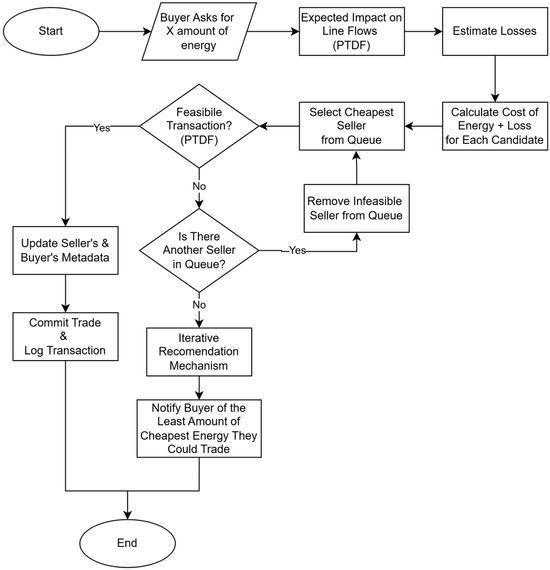
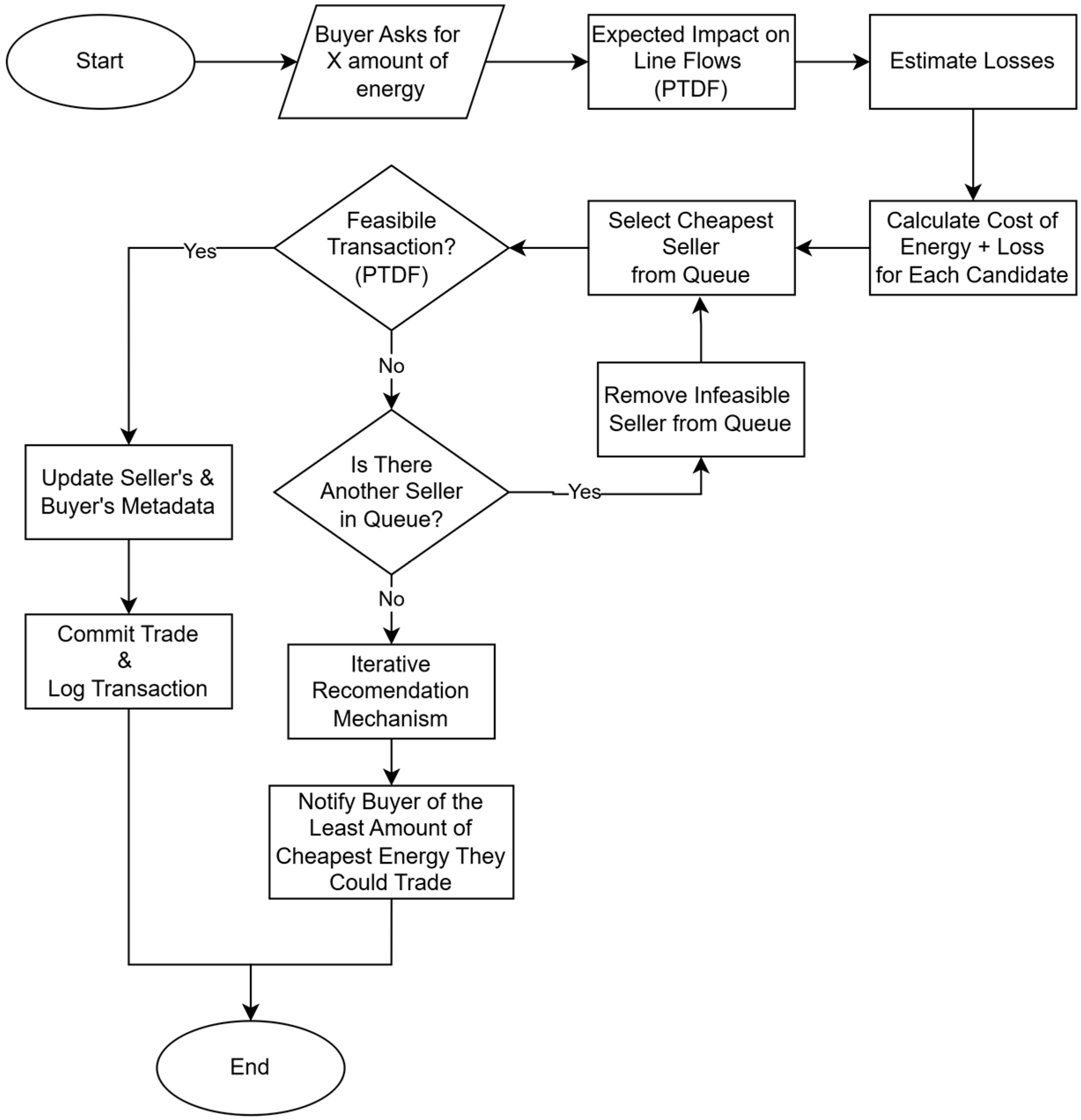
The suggested market mechanism, illustrated in Figure 2, ensures fairness among participants within each time interval, similar to conventional bid-based auction markets. Once the system is initialized, the cost functions of both buyers and sellers are set, and a buyer submits the amount of energy they are willing to purchase. For each incoming request, the mechanism first checks whether there are offers with sufficient supply from the pool of suppliers the buyer has chosen and with an offer lower than the marginal willingness to pay. If the set is empty, the buyer can increase their marginal willingness to pay to expand the pool of traders with whom they can trade or let their trade demand remain unserved.
Figure 2.
Diagram of P2P trading mechanism.
For each potential seller, the mechanism first evaluates the impact of the candidate trade on system losses. Using the PTDFs, the incremental injection–withdrawal pair between the seller’s and buyer’s buses is mapped into the corresponding changes in active power flows on all lines. These changes are then combined with the current network state in the fitted B-coefficient loss model so that the losses attributed to the candidate transaction are calculated. Depending on the loading conditions, the candidate transaction may increase or reduce the total system losses, increasing or reducing, respectively, the power produced by the seller. Each seller’s cost is then re-evaluated, reflecting the fact that the seller must effectively cover both the requested power quantity and the network losses associated with delivering it to the buyer’s bus. This yields an updated marginal cost for the trade, which is lower or higher than the marginal cost computed under the idealized assumption of a lossless network.
In case the cheapest candidate trade is expected to violate a transmission limit if implemented, two underlying mechanisms are activated, addressing the economic and physical aspects of the network. The economic mechanism first searches for the next-cheapest sellers that can supply the same requested energy without causing any network violations. If no such alternative seller is found from the pool of chosen suppliers, the physical mechanism is triggered to determine the maximum admissible amount of energy that can be traded from the original cheapest seller. To this end, an iterative procedure reduces the initially requested energy volume and recalculates the resulting losses and line flows using the PTDFs and the loss model until the largest feasible quantity that does not cause any line-capacity violations is determined. Finally, the buyer is informed about the maximum amount of energy that can be traded between them and the cheapest seller with respect to network constraints.
The last step for a finalized trade is the update of the supplier’s remaining capacity and the buyer’s remaining demand. Although each successful transaction is recorded on-chain, the mechanism does not disclose the details of individual trades while the market gate remains open. This ensures both privacy and fairness, preventing strategic bidding or information leakage during the active trading window. Instead, all transactions are encrypted and stored, and volumes are only decrypted and published after gate closure by the system operator, enabling full auditability of the market outcomes without compromising confidentiality. In this way, the system ensures transparent post-market verification while preserving participant privacy throughout the settlement process.
3.3. Smart Contracts
Smart contracts constitute the foundation of the proposed mechanism, interconnecting all processes in a consistent, automated and authorization-controlled manner. They encode the market logic, validate network limits via PTDFs, calculate losses, and update rules and the recommendation mechanism directly on-chain. As long as the network topology remains unchanged, every trade is processed through the same auditable pipeline without manual intervention. From the user’s perspective, interaction is kept to a minimum. Sellers define their offer functions and wait for the system to match them with buyers based on the requested demand. Buyers also determine the functions of maximum marginal cost that they are willing to pay and, when a potential energy exchange arises, they simply query the market for the amount of energy they are willing to purchase. In this way, the mechanism reduces operational complexity and the risk of human error, while leveraging the current technological advancements of blockchain technology.
3.4. Hyperledger Fabric
The proposed P2P market is deployed leveraging Hyperledger Fabric (HF), a permissioned distributed ledger technology specifically designed for consortium-based environments, where participants are known and authenticated [33]. Fabric separates the roles of transaction execution, ordering, and validation, and provides a flexible identity and access management layer, which makes it well-suited for privacy-preserving, auditable, and scalable energy markets with tailor-made business logic embedded into smart contracts [34,35,36].
HF consists of different core components, each one performing different functions. Peer nodes perform the persistent storage of the ledger and the execution of smart contracts. Persistent storage involves the blockchain’s immutable history of all accepted transactions, as well as the world state, which is the latest snapshot of key data. There are two kinds of peer nodes. Endorsing peers, in our implementation, simulate transactions by running P2P SCs, and committing peers validate ordered transactions and update the world state. In the implemented market, a peer node can act as both a committing and endorsing peer. The ordering service defines the global order of transactions. It collects endorsed trade proposals, arranges them and distributes them among all peers. It does not participate in any logic execution or storing of data and just ensures that data is interchanged in a consistent manner among all peer nodes. It also addresses Certificate Authority issues and manages digital certificates for all participants. This is the service that is responsible for the issuing of ABAC, in order to add different properties into certificates in further on-chain authorization by SCs [37].
Other foundational components that are mainly defined and used by the system operator (which also has the role of HF administrator) are the SCs, which, under the umbrella of this ecosystem, are named Chaincodes [33]. They contain all the business-related logic of the market and all the fundamental physical laws that determine system-related properties, minimizing user interaction by handling fiscal offers, PTDF calculation, loss approximation, access control validation, and, finally, the publication of related information on the ledger.
An important architectural feature of HF is its consensus mechanism, which determines the agreed-upon final order and validity of transactions across the network. Rather than employing energy-intensive proof-of-work schemes, like the one that Bitcoin employs, it adopts crash-fault-tolerant consensus protocols, with Raft serving as the default ordering mechanism [17,38,39]. This algorithm is a leader-based protocol in which a designated leader sequences transactions into blocks and replicates them to follower nodes, ensuring that a consistent log is maintained by all ordering nodes. In the context of the proposed P2P market, the use of Raft provides deterministic finality and low latency, ensuring that all accepted trades are recorded in an identical order across organizations.
Additionally, HF provides built-in functionalities related to privacy and fairness, namely Private Data Collections (PDCs). They are responsible for restricting data visibility to selected organizations. Although a single organization can include multiple participants, the use of PDCs together with our chaincode design and Access Control Lists (ACLs) ensures that cost-related data is restricted to the smart contract responsible for clearing, while ACLs guarantee that only the owning market entity can create, read, update, and delete their individual cost function. Thus, individual financial data are never disclosed to other market participants or the network operator, and they are only accessed by the clearing mechanism, which outputs aggregated settlement results to the common ledger [40]. Making the aggregated settlement of all trades public allows participants and the network operator to independently check the validity of the final power flow against transmission constraints and evaluate the impact of congestion and losses in future market rounds.
4. Results
This section presents the performance evaluation of the proposed market architecture. The first set of results evaluates the performance of the loss-approximation algorithm, which is compatible with the P2P market architecture, while the second set demonstrates the operation and outcomes of the P2P trading mechanism. Together, they provide a comprehensive validation of the suggested methodology and its implementation.
4.1. Loss Estimation
To assess the performance and P2P applicability of the proposed loss-estimation methodology introduced in Section 2, we generate a diverse set of simulation scenarios with different network sizes, loading patterns and stress levels [24]. Network data from a 3-bus system and the 39-bus IEEE power system is used [41].
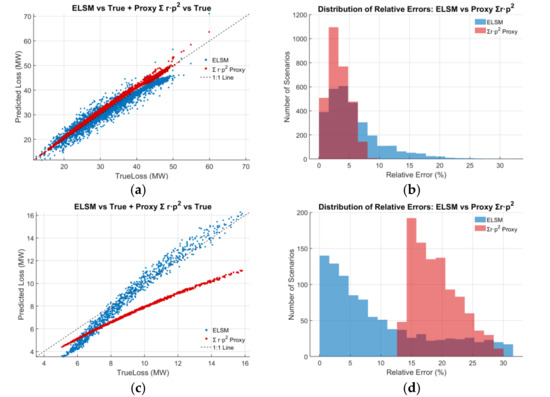
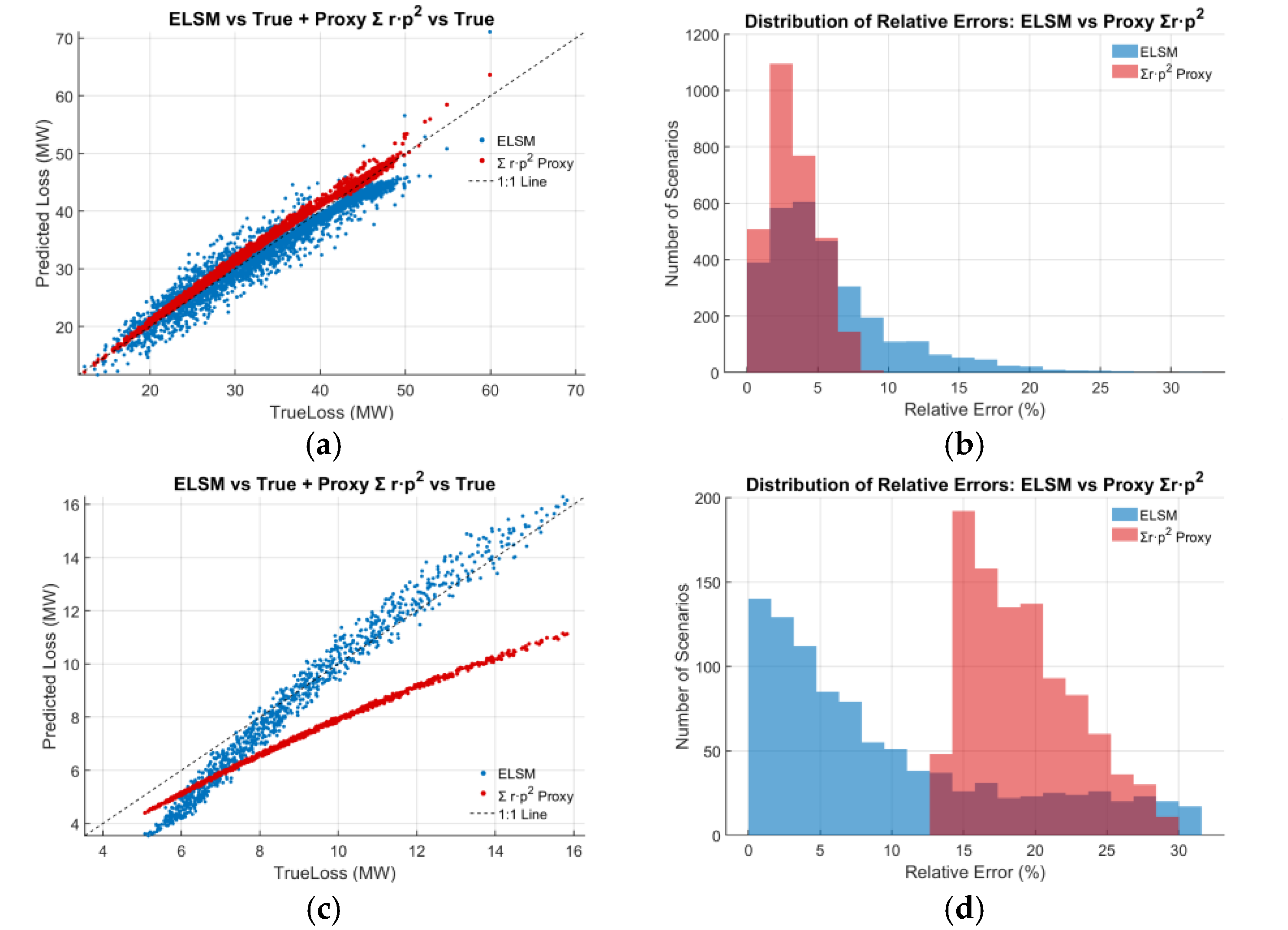
Figure 3 presents a comparison between the estimation of losses from the ELSM with the losses calculated from the full AC power flows of 3000 different scenarios, with demand varying from 60% to 110% of the nominal value. Figure 3a depicts the ELSM estimated losses for each scenario (blue dots) and the oversimplified approach (red dots), plotted against the exact losses (dashed line) calculated from the full system power flow analysis. The close clustering around the AC power flow results demonstrates that both methods provide accurate loss estimates without the computational burden of repeated AC power flow calculations. Figure 3b presents the distribution of the relative errors for both methods, highlighting that ELSM achieves numerical stability and closely follows the true AC losses across all scenarios, with only a few cases showing noticeable deviations from the baseline, while the oversimplified approach depicts a tighter concentration at lower errors. Figure 3c,d present the corresponding loss-estimation results for the 3-bus system. In this stressed case, the oversimplified approximation deviates systematically from the AC power flow loss reference, while the ELSM remains numerically stable across the full scenario range, confirming the robustness and reliability of the implemented model.
Figure 3.
Loss estimation results for different network sizes and properties: (a) IEEE 39-bus system: comparison between the losses estimated by the ELSM (blue dots) and the oversimplified method (red dots) against the exact losses, calculated from the full AC power flow (dashed diagonal line), (b) IEEE 39-bus system: distribution of the corresponding relative errors for the ELSM (blue bars) and the oversimplified method (red bars), (c) 3-bus system: comparison between the losses estimated by the ELSM (blue dots) and the oversimplified method (red dots) against the exact losses, calculated from the full AC power flow (dashed diagonal line) under highly stressed operating conditions, (d) 3-bus system: distribution of the corresponding relative errors for the ELSM (blue bars) and the oversimplified method (red bars).
Table 2 summarizes the key performance indicators (KPIs) for loss estimation. It reports the errors obtained from ELSM and the oversimplified approximation. For the IEEE 39-bus dataset, the oversimplified method has lower average and maximum errors compared to the ELSM approach, whereas in the 3-bus dataset, the ELSM achieves a lower average error than the oversimplified method. While the oversimplified approach can achieve competitive accuracy under near-nominal operating conditions, sensitivity considerations indicate that its performance is strongly dependent on the resistive characteristics of the network and modeling assumptions, such as nominal voltage magnitude and negligible shunt elements (see Section 2.2). In particular, the approximations of the oversimplified method rely directly on line resistances and active power flows and therefore become increasingly sensitive to the effective ratio of lines, deviations from the nominal voltage, and line charging effects. In contrast, the ELSM formulation implicitly captures the combined impact of resistance, reactance, and network topology through data-driven coefficient estimation, resulting in more accurate loss estimates across a broader range of line characteristics and loading regimes.
Table 2.
Key performance indicators (KPIs) for loss estimation in the IEEE 39-bus and 3-bus power systems using the oversimplified approximation and the ELSM formulation [24].
4.2. P2P Market Performance
The literature supports that P2P energy-trading mechanisms offer several economic advantages over traditional retailer-based or centrally cleared markets, allowing buyers to procure energy at prices below the retail tariff and sellers to receive revenues above the Feed-in Tariff (FiT), while still achieving near-optimal social welfare with lower computational complexity [20,21,23]. Prior studies report that decentralized P2P clearing mechanisms can achieve outcomes close to centralized coordination, with small cost deviations under comparable operating assumptions (e.g., welfare gaps around 1.3% and cost deviations below 4%) [21,28].
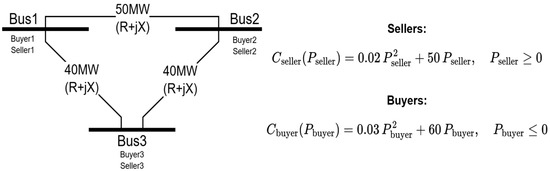
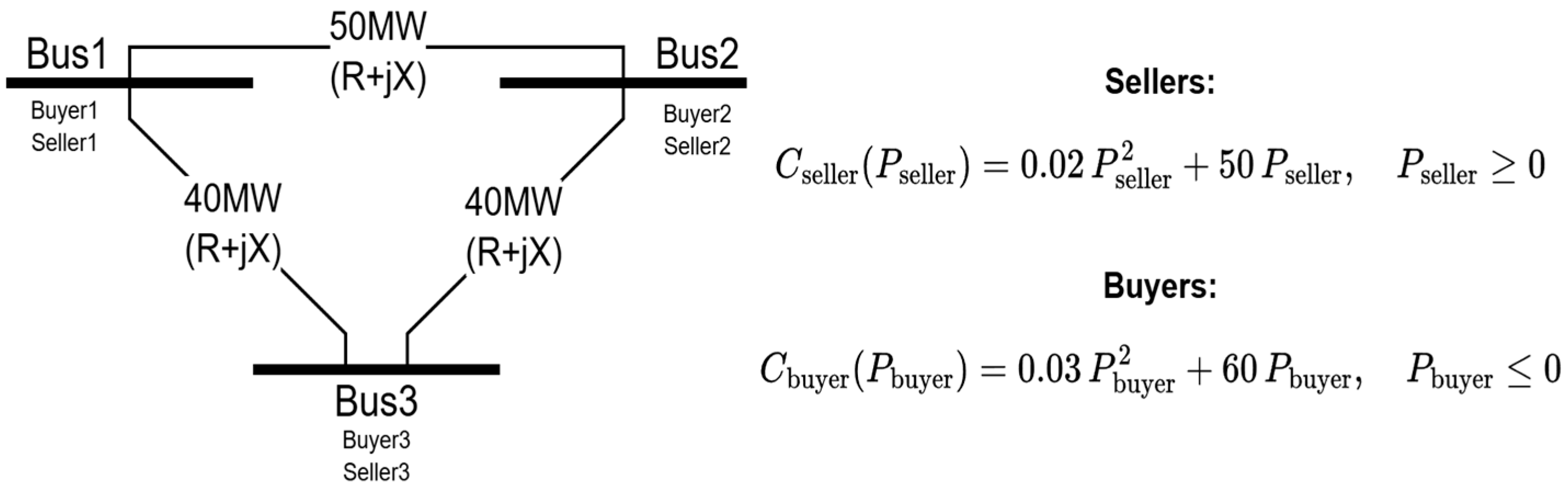
Motivated by these findings, we validate the proof of concept and economic consistency of our implemented P2P trading engine using a 3-bus case with three buyers and three sellers. Figure 4 presents the network topology of the 3-bus system and the location of each buyer and seller, as well as the line characteristics and transmission capacity.
Figure 4.
The 3-bus system: topology, transmission lines capacity and characteristics, participants’ connection buses and offer functions.
Network characteristics were obtained from the relevant literature to reflect real-world medium-voltage power systems [42]. The transmission lines were assigned to thermal limits consistent with the reported system ratings, with the line connecting bus 1 to 2 set to 50 MW and the remaining lines limited to 40 MW. Since reactive power was neglected in this analysis, these thermal ratings were converted directly to limits of active power flows. The small system size and number of market participants made the operation results, described below, clearer to understand. Besides that, according to economic theory, if the number of participants increases, the efficiency of bilateral trading is expected to increase further, so the presented results are “on the conservative side”. Participants within each group of buyers and sellers shared identical cost functions, so the effect of losses, which makes long-distance deals more expensive, could be depicted in the results as well (see Figure 4). These functions were used in both the P2P trading and the centrally settled spot market simulated by the AC OPF.
It was assumed that 32 trades were sequentially processed by the P2P market, computing payments, updating network flows, and allocating incremental path-dependent losses according to the methodology described in Section 3. As expected, same-bus trades yielded negligible losses, whereas inter-bus trades introduced small but measurable loss components, which were systematically integrated into the settlement. Validation of the total power resulting from dispatched power between buses confirmed that all transactions satisfy network constraints and that the cleared quantities and resulting losses closely aligned with the AC-OPF benchmark solution [30]. A quantitative comparison in Table 3 shows that the proposed P2P mechanism reproduced economically efficient and physically feasible dispatch outcomes, which were very close to those produced by a centrally dispatched spot market simulated by a full AC OPF.
Table 3.
Comparison of KPIs between the suggested peer-to-peer trading engine and the AC OPF.
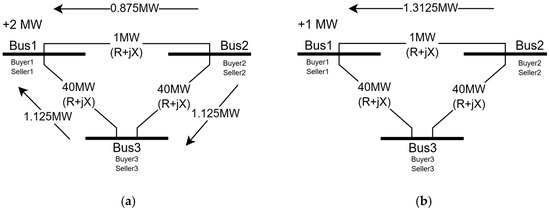
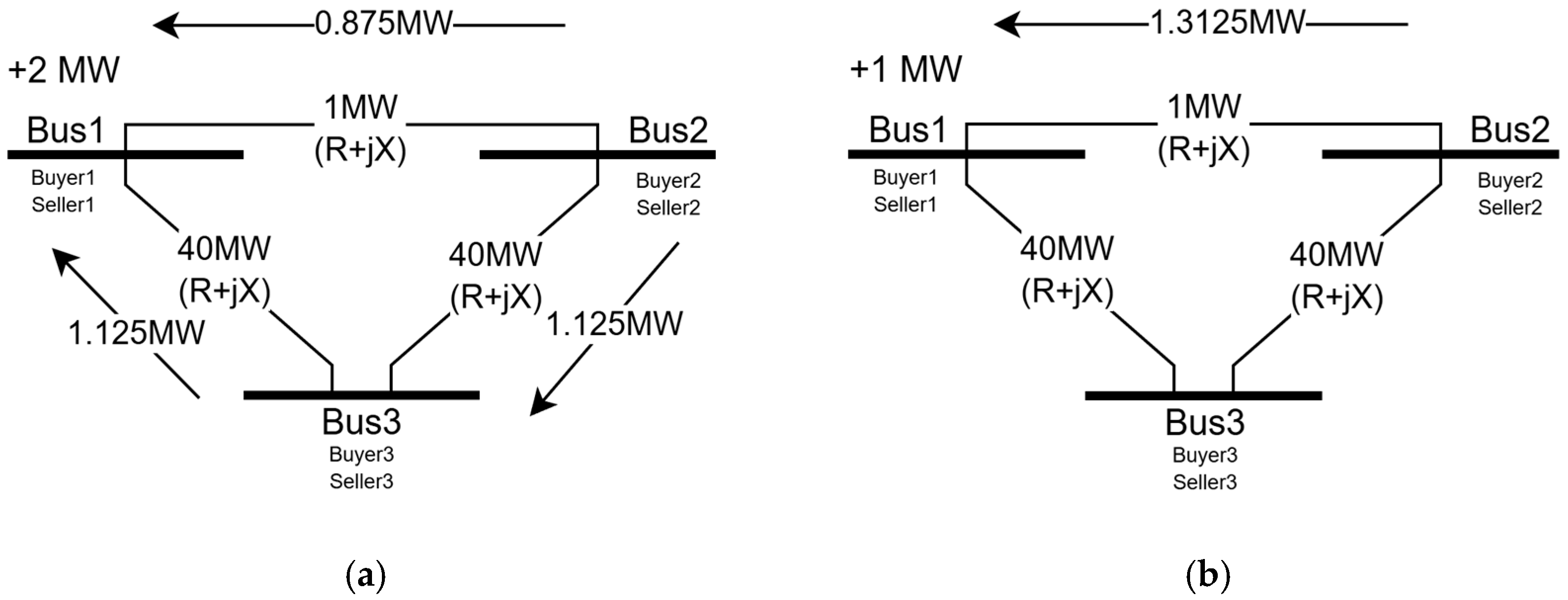
In order to create a scenario with a congested line, we tightened the capacity of the line connecting buses 1 and 2 from its original 50 MW limit down to 1 MW, ensuring that it became a binding constraint. Additionally, we changed the offers of sellers at bus 2 to become half the price of all the others. As a result, the network could no longer accommodate all inter-bus trades. Table 4 contains the results of all sequential trades of this severely congested scenario on the 3-bus system. During the first two transactions, Buyer 1 was able to trade energy with the cheapest seller, although, in the second transaction, despite the fact that Seller 2 offered energy at almost half the price of all the others, the corresponding inter-bus trade was infeasible due to the tightened thermal limit on line 1. Figure 5 illustrates the line flows for the first trade and the first attempt at the second trade. Figure 5a depicts the flows of all lines of the first trade, and Figure 5b depicts the first attempt to clear the second trade, where Seller 2 was initially selected as the most cost-effective one; however, this attempt was rejected due to line violation. Consequently, the buyer was matched with the seller located on the same bus, avoiding any violation of network constraints.
Table 4.
Comparison of KPIs between the suggested P2P market and the AC OPF applied to the scenario with congestion.
Figure 5.
Line flows in the congested scenario (a) in the 1st trade, (b) during the 1st attempt at the 2nd trade.
For the buyer connected on Bus 1, any attempt to clear the full requested volume at the 25th transaction would violate the thermal limit of this line. The P2P engine therefore declared the full 3 MWh trade infeasible and, through the market interface, informed the buyer that only a reduced quantity of 2 MWh could be transacted without causing congestion. The solution provided by the P2P market settlement was very close to the AC OPF. Since losses were treated incrementally along with the sequence of trades in the P2P market, each new trade was charged or credited based on how it changed system losses relative to the current operating point. Some trades increased losses and paid a positive loss charge, while others relieved flows on congested branches and reduced losses, receiving a loss credit, which could be interpreted as an incentive for de-congestion, a common feature in flexibility markets [12]. Aggregating these incremental charges and credits can lead to a negative net loss payment in monetary terms, even though total physical losses per line remained strictly positive. In the case of the severely congested line, trading was practically limited between participants on the same bus, so that physical constraints were not violated, which drastically reduced possible power exchanges. The small deviation between the proposed P2P mechanism (81.2 MW) and the AC-OPF solution (81.15 MW) can be attributed to the use of DC approximations in the decentralized clearing engine. The DC formulation neglected voltage magnitude variations and nonlinear loss effects, which were fully represented in the AC-OPF model. As a result, minor differences in total dispatched energy and loss estimation are expected under congested conditions.
Table 5 provides a detailed, transaction-level view of the execution of the decentralized market under the congested scenario. For each accepted trade, the table reports the buyer–seller pair, the traded energy quantity, the corresponding energy cost, and the incremental transmission losses attributed to the trade. The loss column represents the change in total system losses caused by the transaction relative to the current operating point, while the associated loss cost reflects the monetary valuation of this change.
Table 5.
Detailed list of trades with the congested line.
Same-bus transactions result in zero incremental losses, whereas inter-bus trades may either increase or decrease total system losses depending on their impact on power flows across the congested line. Negative loss values indicate trades that relieve congestion and reduce overall system losses, leading to loss credits for the corresponding transactions. Step 25 illustrates an unfulfilled request, where no feasible seller could be identified due to transmission capacity constraints. The trade is therefore rejected and the buyer notified that only 2 MW can be currently traded based on the charging level of the network, based on the already-settled transactions. Overall, the table demonstrates how physical feasibility, loss allocation, and economic settlement are jointly enforced on a per-transaction basis within the proposed decentralized P2P market.
Table 6 compares the final cleared power quantities for each buyer and seller obtained from the proposed P2P market and the AC-OPF benchmark. The results show close agreement between the two approaches, with small deviations attributable to the sequential and decentralized nature of the P2P clearing process, as opposed to the central dispatch performed by the AC-OPF.
Table 6.
Final participant power allocations by the proposed P2P trading mechanism and the AC Optimal Power Flow (AC-OPF) solution for the 3-bus system.
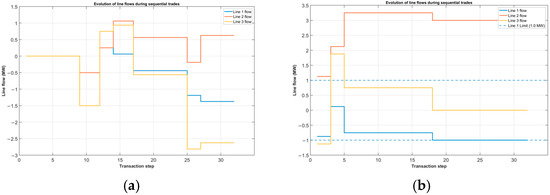
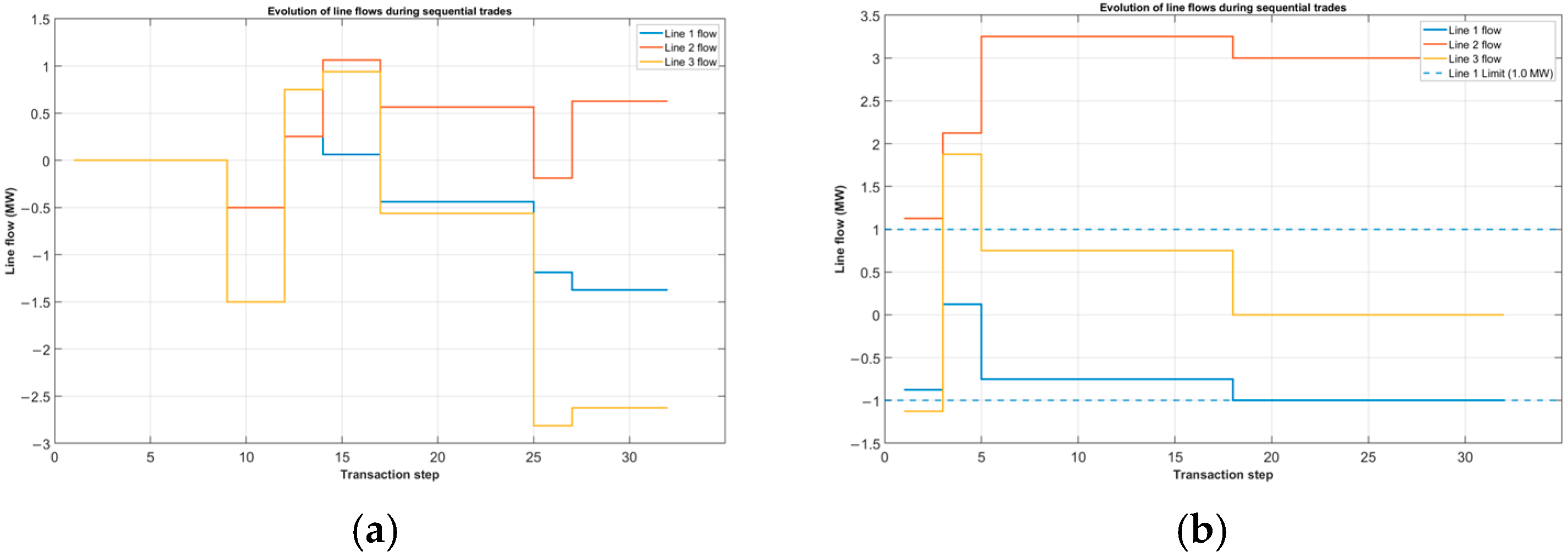
Figure 6a shows the evolution of line flows in the uncongested case, where line 1 operates well below its original 50 MW limit and does not become binding. In contrast, Figure 6b corresponds to the congested scenario, where the thermal limit of line 1 is tightened to 1 MW. As observed, the absolute flow of line 1 remains constrained within ±1 MW throughout the sequential clearing process, indicating that the P2P mechanism strictly enforces the binding constraint at every transaction step. Because line 1 cannot accommodate additional transfers, subsequent feasible trades are redirected in a way that alters the distribution of flows across the network. It is clearly depicted that the thermal limit after the 18th trade was clearly allocated at its maximum, and that the majority of trades were in the same bus. This redistribution of flows emerges endogenously from the transaction-by-transaction feasibility checks, ensuring that congestion is respected while maintaining overall network security during the sequential execution of trades.
Figure 6.
Evolution of line flows during sequential P2P trades in the 3-bus system: (a) uncongested scenario and (b) congested scenario with Line 1 capped at 1 MW.
5. Discussion
The previous section demonstrated that decentralized P2P markets can achieve physically feasible and loss-aware economic settlement of trades, maintaining low computational complexity by avoiding the need to solve complex AC power flows [24]. Table 6 shows that both methodologies result in similar system charging outcomes, aligned with findings in [20]. The ELSM loss estimation confirms that accurate loss-aware settlement is possible despite the inevitable approximation error introduced by the underlying modeling assumptions, as shown in Table 2, and is in agreement with the recent prior results of other studies. No universal blueprint exists for loss approximation methods, as network topology and line characteristics can significantly affect their accuracy. Nevertheless, the ELSM exhibits adequate accuracy across a wide range of network topologies [24]. Further analysis of its applicability to low-voltage distribution grids is required, as those grids are expected to accommodate future P2P local energy markets.
Additionally, the P2P market mechanism reproduced economic and energy dispatch results that are closely consistent with those obtained from a centrally administered spot market simulated by an AC OPF, as Table 3 and Table 4 depict, validating previous findings that decentralized market structures can approach near-optimal social welfare [1]. An important distinction in our approach is that buyers accept the cheapest offer that sellers are willing to provide for each request. In this context, Hyperledger Fabric and its privacy-preserving features can play a crucial role in protecting private economic data, ensuring the fairness of trades and supporting a more transparent redistribution of social welfare, which is aligned with recent studies of the adoption of such technology (see [4,16]). At the same time, the PTDF-based feasibility validation prevented thermal limit violations and correctly identified infeasible transactions without requiring corrective centralized redispatch, which is validated in Table 4, and it does not conflict with results from prior studies, such as [1]. PTDF-based feasibility validation uses a DC approximation, neglecting reactive power and voltage magnitude effects, which could affect low-voltage networks with higher resistance–reactance ratios. Although the sequential execution of 32 transactions in the 3-bus system is sufficient to validate physical feasibility, loss-aware settlement and economic correctness, it is not intended to stand as a performance benchmark.
Finally, the integration of these mechanisms within a permissioned blockchain environment provided an auditable and privacy-preserving execution layer compatible with near real-time market operation. The combined use of ABAC, ACLs and Private Data Collections ensured that individual cost functions and trading preferences remain confidential, while settlement outcomes are immutably recorded and verifiable, in accordance with the foundational design principles of HF, as described in [2,16,43]. Overall, the findings indicate that a unified framework combining PTDF-based power flow validation, ELSM-based loss estimation and blockchain-enabled settlement can deliver both physically consistent solutions and robust economic performance in decentralized energy coordination [1,21]. From a broader perspective, the proposed architectural and market design is consistent with recent European policy directions that emphasize resilient, decentralized, and auditable energy system operation, supporting secure service continuity under stressed and volatile conditions [10].
6. Conclusions
This work introduced a decentralized P2P trading framework that incorporates network constraints and transmission losses directly into the market-clearing process. The proposed combination of PTDF-based feasibility validation and ELSM for loss estimation enables loss-aware settlement without centralized and computationally intensive AC power flow calculations, while maintaining feasibility under the adopted DC/PTDF modeling assumptions.
Numerical experiments on a 3-bus and the IEEE 39-bus system showed that the mechanism reproduces dispatch and cost outcomes that are close to centralized AC-OPF benchmarks for the tested cases. The implementation on Hyperledger Fabric demonstrated the practical applicability of the approach in a privacy-preserving and auditable environment.
The main findings of this work can be expressed as follows:
- (i)
- We developed a decentralized P2P trading framework that incorporates network constraints and transmission losses directly into the market-clearing process.
- (ii)
- By pairing PTDF-based feasibility checks with ELSM-based loss estimation, the system supports loss-aware settlement without relying on repeated, computationally heavy AC power flow runs.
- (iii)
- Experiments on a 3-bus case show that the resulting dispatch and costs closely match those of a centralized market.
- (iv)
- The Hyperledger Fabric prototype confirms that the approach is practical, while still maintaining privacy and auditability.
Future research and extensions of this implementation will focus on scalability to larger network topologies and the number of transactions per time unit; improvement and generalization of the calculation of losses in a P2P market environment; the incorporation of uncertainty in generation and demand, stemming from RES penetration; and the operation of the mechanism under higher transaction volumes and real-world applications. Future work will extend the evaluation to a broader range of network sizes and topologies through a sensitivity analysis of how our approach behaves under different network characteristics and variations in line R/X ratios within the same topology. Additional directions include the integration of IoT-enabled producers and dispatchable consumers, as well as the development of trading agents capable of adjusting costs according to participants’ risk preferences.
Author Contributions
Conceptualization, N.K. and P.N.V.; methodology, P.N.V.; software, N.K.; validation, P.N.V.; formal analysis, P.N.V.; investigation, N.K. and P.N.V.; resources, N.K. and P.N.V.; data curation, N.K.; writing—original draft preparation, N.K.; writing—review and editing, N.K. and P.N.V.; visualization, N.K.; supervision, P.N.V.; project administration, P.N.V.; funding acquisition, P.N.V. All authors have read and agreed to the published version of the manuscript.
Funding
This research received no external funding.
Data Availability Statement
The data supporting the findings of this study are publicly available at https://github.com/nikolaoskoutantos/ELSM-Dataset (accessed on 13 February 2026).
Acknowledgments
The authors gratefully acknowledge the support of the Research Council of the University of Patras for financing the open access publication fees of this manuscript.
Conflicts of Interest
The authors declare no conflicts of interest.
Abbreviations
The following abbreviations are used in this manuscript:
| RES | Renewable Energy Source |
| DSM | Demand-Side Management |
| IoT | Internet of Things |
| DER | Distributed Energy Resource |
| SG | Smart Grid |
| P2P | Peer-to-Peer |
| LEM | Local Energy Market |
| SC | Smart Contract |
| PTDF | Power Transfer Distribution Factor |
| AC | Alternating Current |
| PF | Power Flow |
| DLT | Distributed Ledger Technology |
| IPFS | Interplanetary File System |
| ACL | Access Control List |
| ABAC | Attribute-Based Access Control |
| OPF | Optimal Power Flow |
| ISF | Injection Shift Factor |
| DC | Direct Current |
| ELSM | Enhanced Least Squares Method |
| OLSM | Ordinary Least Squares Method |
| KPI | Key Performance Indicator |
| FiT | Feed-In Tariff |
| HF | Hyperledger Fabric |
| CA | Certificate Authority |
| PDC | Private Data Collection |
| IEEE | Institute of Electrical and Electronics Engineers |
| p.u. | Per Unit |
| MW | Megawatt |
| MWh | Megawatt-Hour |
References
- Khorasany, M.; Mishra, Y.; Ledwich, G. A Decentralized Bilateral Energy Trading System for Peer-to-Peer Electricity Markets. IEEE Trans. Ind. Electron. 2020, 67, 4646–4657. [Google Scholar] [CrossRef] [Scilit]
- Al Dakhl, S.; Alali, D.; Habbi, H.M.; Zohdy, M. Security Issues on Smart Grid and Blockchain-Based Secure Smart Energy Management Systems. In Proceedings of the 2023 IEEE 11th International Conference on Smart Energy Grid Engineering (SEGE), Oshawa, ON, Canada, 13–15 August 2023; pp. 194–200. [Google Scholar]
- Hammouti, I.; Addaim, A.; Guennoun, Z. Proposed Architecture of Cyber Security in Smart Grids, Blockchain as Solution. In Proceedings of the 2022 IEEE Information Technologies & Smart Industrial Systems (ITSIS), Paris, France, 15–17 July 2022. [Google Scholar] [CrossRef] [Scilit]
- Dimobi, I.; Pipattanasomporn, M.; Rahman, S. A Transactive Grid with Microgrids Using Blockchain for the Energy Internet. In Proceedings of the 2020 IEEE Power & Energy Society Innovative Smart Grid Technologies Conference (ISGT), Washington, DC, USA, 17–20 February 2020. [Google Scholar] [CrossRef] [Scilit]
- Celik, D.; Emin Meral, M.; Waseem, M. Scenarios, Virtualization and Applications for Blockchain Technology in Smart Grids. In Proceedings of the 2022 IEEE Kansas Power and Energy Conference (KPEC), Manhattan, KS, USA, 25–26 April 2022. [Google Scholar] [CrossRef] [Scilit]
- Musleh, A.S.; Yao, G.; Muyeen, S.M. Blockchain Applications in Smart Grid–Review and Frameworks. IEEE Access 2019, 7, 86746–86757. [Google Scholar] [CrossRef] [Scilit]
- Kuzlu, M.; Sarp, S.; Pipattanasomporn, M.; Cali, U. Realizing the Potential of Blockchain Technology in Smart Grid Applications. In Proceedings of the 2020 IEEE Power & Energy Society Innovative Smart Grid Technologies Conference (ISGT), Washington, DC, USA, 17–20 February 2020; pp. 1–5. [Google Scholar]
- Al Dakhl, S.; Mezaael, A.; Taleb, Y.; Alali, D.; Zohdy, M. Advanced Distribution Method for Smart Grids in the Mobility World Using Blockchain Technology. In Proceedings of the 2020 IEEE 8th International Conference on Smart Energy Grid Engineering (SEGE), Oshawa, ON, Canada, 12–14 August 2020; pp. 75–81. [Google Scholar]
- Aitzhan, N.Z.; Svetinovic, D. Security and Privacy in Decentralized Energy Trading Through Multi-Signatures, Blockchain and Anonymous Messaging Streams. IEEE Trans. Dependable Secure Comput. 2018, 15, 840–852. [Google Scholar] [CrossRef] [Scilit]
- European Union. Directive (EU) 2022/2557 of the European Parliament and of the Council of 14 December 2022 on the Resilience of Critical Entities and Repealing Council Directive 2008/114/EC (Text with EEA Relevance). Off. J. Eur. Union 2022, L 333, 164–198. Available online: https://eur-lex.europa.eu/eli/dir/2022/2557/oj/eng (accessed on 13 February 2026).
- Suciu, G.; Sachian, M.-A.; Dobrea, M.; Istrate, C.-I.; Petrache, A.L.; Vulpe, A.; Vochin, M. Securing the Smart Grid: A Blockchain-Based Secure Smart Energy System. In Proceedings of the 2019 54th International Universities Power Engineering Conference (UPEC), Bucharest, Romania, 3–6 September 2019; pp. 1–5. [Google Scholar]
- Zhang, K.; Troitzsch, S.; Hanif, S.; Hamacher, T. Coordinated Market Design for Peer-to-Peer Energy Trade and Ancillary Services in Distribution Grids. IEEE Trans. Smart Grid 2020, 11, 2929–2941. [Google Scholar] [CrossRef] [Scilit]
- Paudel, A.; Sampath, L.P.M.I.; Yang, J.; Gooi, H.B. Peer-to-Peer Energy Trading in Smart Grid Considering Power Losses and Network Fees. IEEE Trans. Smart Grid 2020, 11, 4727–4737. [Google Scholar] [CrossRef] [Scilit]
- Hajati, M.; Sheikh-El-Eslami, M.K.; Delkhosh, H. Maximizing Social Welfare in Local Flexibility Markets by Integrating the Value of Flexibility Loss (VOFL). Electr. Power Syst. Res. 2024, 235, 110840. [Google Scholar] [CrossRef] [Scilit]
- Abaas, M.; Singh, P.; Lee, R. Blockchain Applications in Smart Grid Systems. In Proceedings of the 2020 52nd North American Power Symposium (NAPS), Tempe, AZ, USA, 11–13 April 2021; pp. 1–6. [Google Scholar]
- Chen, G.; He, M.; Gao, J.; Liu, C.; Yin, Y.; Li, Q. Blockchain-Based Cyber Security and Advanced Distribution in Smart Grid. In Proceedings of the 2021 IEEE 4th International Conference on Electronics Technology (ICET), Chengdu, China, 7–10 May 2021; pp. 1077–1080. [Google Scholar]
- Nakamoto, S. Bitcoin: A Peer-to-Peer Electronic Cash System. Available online: https://bitcoin.org/bitcoin.pdf (accessed on 13 February 2026).
- Seijas, P.L.; Thompson, S.; McAdams, D. Scripting Smart Contracts for Distributed Ledger Technology. IACR Cryptol. ePrint Arch. 2016, 2016, 1156. [Google Scholar]
- Liang, X.; An, N.; Li, D.; Zhang, Q.; Wang, R. A Blockchain and ABAC Based Data Access Control Scheme in Smart Grid. In Proceedings of the 2022 International Conference on Blockchain Technology and Information Security (ICBCTIS), Huaihua, China, 15–17 July 2022. [Google Scholar] [CrossRef] [Scilit]
- Li, G.; Xuanline, J.; Xue, W.; Jia, F. Design and Implementation of Electronic Data Blockchain Judicial Deposit Platform for Power Grid Gusiness. In Proceedings of the 2022 4th International Academic Exchange Conference on Science and Technology Innovation (IAECST), Guangzhou, China, 9–11 December 2022; pp. 876–881. [Google Scholar]
- Shen, S.; Sun, C. Research on Framework of Smart Grid Data Secure Storage from Blockchain Perspective. In Proceedings of the 2021 4th International Conference on Advanced Electronic Materials, Computers and Software Engineering (AEMCSE), Changsha, China, 26–28 March 2021; pp. 270–273. [Google Scholar]
- Guerrero, J.; Chapman, A.; Verbic, G. Decentralized P2P Energy Trading under Network Constraints in a Low-Voltage Network. IEEE Trans. Smart Grid 2018, 10, 5163–5173. [Google Scholar] [CrossRef] [Scilit]
- Yang, Y.; Chen, Y.; Hu, G.; Spanos, C.J. Optimal Network Charge for Peer-to-Peer Energy Trading: A Grid Perspective. IEEE Trans. Power Syst. 2023, 38, 2398–2410. [Google Scholar] [CrossRef] [Scilit]
- Imran Azim, M.; Islam, M.T.; Rakib, J.H.; Islam, M.R.; Ali, L.; Alzahrani, S.; Masrur, H.; Muyeen, S.M. Coalition Game Theoretic P2P Trading in a Distribution Network Integrity-Ensured Local Energy Market. Sustain. Energy Grids Netw. 2023, 36, 101186. [Google Scholar] [CrossRef] [Scilit]
- Liu, B.; Liu, F.; Wei, W.; Wang, J. Estimating B-coefficients of Power Loss Formula Considering Volatile Power Injections: An Enhanced Least Square Approach. IET Gener. Transm. Distrib. 2018, 12, 2854–2860. [Google Scholar] [CrossRef] [Scilit]
- Shiddike, J.; Ahmed, A.; Farshid, M.; Oaishe, P.D. Development of Blockchain In Smart Grid Using IoT. In Proceedings of the 2022 International Conference on Inventive Computation Technologies (ICICT), Lalitpur, Nepal, 20–22 July 2022. [Google Scholar] [CrossRef] [Scilit]
- Falahi, M.; Vasilateanu, A.; Goga, N.; Suciu, G.; Sachian, M.-A.; Florescu, R.; Ali, H.A.; Qian, Y. An Innovative Blockchain System for Smart Grids. In Proceedings of the 2022 IEEE International Conference on Blockchain, Smart Healthcare and Emerging Technologies (SmartBlock4Health), Bucharest, Romania, 24–25 October 2022; pp. 1–6. [Google Scholar]
- Guo, Z.; Pinson, P.; Chen, S.; Yang, Q.; Yang, Z. Online Optimization for Real-Time Peer-to-Peer Electricity Market Mechanisms. IEEE Trans. Smart Grid 2021, 12, 4151–4163. [Google Scholar] [CrossRef] [Scilit]
- Moniruzzaman, M.; Yassine, A.; Benlamri, R. Blockchain-Based Mechanisms for Local Energy Trading in Smart Grids. In Proceedings of the 2019 IEEE 16th International Conference on Smart Cities: Improving Quality of Life Using ICT & IoT and AI (HONET-ICT), Charlotte, NC, USA, 6–9 October 2019; pp. 110–114. [Google Scholar]
- Babiker, A.; Ahmad, S.S.; Ahmed, I.; Khalid, M.; Abido, M.A.; Saleh Al-Ismail, F. Optimal Power Flow: A Review of State-of-the-Art Techniques and Future Perspectives. IEEE Access 2025, 13, 60012–60039. [Google Scholar] [CrossRef] [Scilit]
- Flores, F.; Feijoo, F.; DeStephano, P.; Herc, L.; Pfeifer, A.; Duić, N. Assessment of the Impacts of Renewable Energy Variability in Long-Term Decarbonization Strategies. Appl. Energy 2024, 368, 123464. [Google Scholar] [CrossRef] [Scilit]
- Balamurugan, K.; Srinivasan, D. Review of Power Flow Studies on Distribution Network with Distributed Generation. In Proceedings of the 2011 IEEE Ninth International Conference on Power Electronics and Drive Systems, Singapore, 5–8 December 2011; pp. 411–417. [Google Scholar]
- Androulaki, E.; Barger, A.; Bortnikov, V.; Cachin, C.; Christidis, K.; De Caro, A.; Enyeart, D.; Ferris, C.; Laventman, G.; Manevich, Y.; et al. Hyperledger Fabric: A Distributed Operating System for Permissioned Blockchains. In Proceedings of the Thirteenth EuroSys Conference, Porto, Portugal, 23–26 April 2018; pp. 1–15. [Google Scholar]
- Raso, E.; Bracciale, L.; Gallo, P.; Bernardinetti, G.; Bianchi, G.; Sanseverino, E.R.; Loreti, P. Performance Evaluation of Cryptographic Schemes for Blockchain Security of Smart Grids. In Proceedings of the 2022 Workshop on Blockchain for Renewables Integration (BLORIN), Palermo, Italy, 2–3 September 2022. [Google Scholar] [CrossRef] [Scilit]
- Farhoumandi, M.; Bahramirad, S.; Shahidehpour, M.; Alabdulwahab, A. Blockchain for Peer-to-Peer Energy Trading in Electric Vehicle Charging Stations With Constrained Power Distribution and Urban Transportation Networks. Energy Internet 2025, 2, 28–44. [Google Scholar] [CrossRef] [Scilit]
- Gorenflo, C.; Lee, S.; Golab, L.; Keshav, S. FastFabric: Scaling Hyperledger Fabric to 20 000 Transactions per Second. Int. J. Netw. Manag. 2020, 30, e2099. [Google Scholar] [CrossRef] [Scilit]
- Pericherla, A.; Paul, P.; Sural, S.; Vaidya, J.; Atluri, V. Towards Supporting Attribute-Based Access Control in Hyperledger Fabric Blockchain. In ICT Systems Security and Privacy Protection; Meng, W., Fischer-Hübner, S., Jensen, C.D., Eds.; IFIP Advances in Information and Communication Technology; Springer International Publishing: Cham, Switzerland, 2022; Volume 648, pp. 360–376. [Google Scholar]
- Ongaro, D.; Ousterhout, J. In Search of an Understandable Consensus Algorithm. In Proceedings of the 2014 USENIX Annual Technical Conference: 19–20 June 2014, Philadelphia, PA, USA; USENIX Association: Berkeley, CA, USA, 2014; pp. 305–320. [Google Scholar]
- Liu, J.; Liu, C.; Lin, M.; Xu, G. Comprehensive Survey of Blockchain Consensus Mechanisms: Analysis, Applications, and Future Trends. Comput. Netw. 2025, 272, 111661. [Google Scholar] [CrossRef] [Scilit]
- Shammar, E.A.; Zahary, A.T.; Al-Shargabi, A.A. An Attribute-Based Access Control Model for Internet of Things Using Hyperledger Fabric Blockchain. Wirel. Commun. Mob. Comput. 2022, 2022, 6926408. [Google Scholar] [CrossRef] [Scilit]
- Zimmerman, R.D.; Murillo-Sanchez, C.E.; Thomas, R.J. MATPOWER: Steady-State Operations, Planning, and Analysis Tools for Power Systems Research and Education. IEEE Trans. Power Syst. 2011, 26, 12–19. [Google Scholar] [CrossRef] [Scilit]
- Jayatunga, U.; Perera, S.; Ciufo, P.; Agalgaonkar, A.P. Voltage Unbalance Emission Assessment in Interconnected Power Systems. IEEE Trans. Power Deliv. 2013, 28, 2383–2393. [Google Scholar] [CrossRef] [Scilit]
- Samy, S.; Azab, M.; Rizk, M. Towards a Secured Blockchain-Based Smart Grid. In Proceedings of the 2021 IEEE 11th Annual Computing and Communication Workshop and Conference (CCWC), Las Vegas, NV, USA, 27–30 January 2021; pp. 1066–1069. [Google Scholar]



Disclaimer/Publisher’s Note: The statements, opinions and data contained in all publications are solely those of the individual author(s) and contributor(s) and not of MDPI and/or the editor(s). MDPI and/or the editor(s) disclaim responsibility for any injury to people or property resulting from any ideas, methods, instructions or products referred to in the content. |
© 2026 by the authors. Licensee MDPI, Basel, Switzerland. This article is an open access article distributed under the terms and conditions of the Creative Commons Attribution (CC BY) license.