1. Introduction
With the recent advancement of high-efficiency solar cell technologies, environmental sustainability and carbon emission reduction in terms of manufacturing processes and materials have emerged as critical research issues. Photovoltaic modules consist of various polymeric components, such as front films, encapsulants, and back sheets, which can act as major sources of carbon emissions during both the manufacturing and disposal stages.
In particular, as photovoltaic modules increase in size and production scales continue to expand, the impact of carbon emissions is expected to become even more significant. Consequently, the demand for low-carbon and environmentally friendly materials capable of replacing conventional petroleum-based polymer films has been continuously increasing. In response, active research efforts are being undertaken to apply renewable and biodegradable bio-based materials to solar cells and photovoltaic modules [
1].
Among bio-based materials, cellulose-based materials have attracted considerable attention as environmentally friendly materials due to their abundant availability and excellent mechanical properties. Cellulose exhibits superior mechanical performance owing to its fibrous structure formed by strong intermolecular hydrogen bonding, and when structured at the nanoscale, cellulose nanofibers (CNFs) form dense network structures with high specific surface areas [
2].
As a widely used method to control the surface properties and dispersibility of cellulose nanofibers, TEMPO (2,2,6,6-tetramethylpiperidine-1-oxyl)-mediated oxidation has been extensively applied [
3]. TEMPO oxidation is known to selectively convert the primary hydroxyl groups of cellulose into carboxyl groups, thereby introducing negative charges onto the nanofiber surface. This surface modification enhances the aqueous dispersibility of CNFs and enables the formation of more uniform nanofiber networks [
4].
In particular, TEMPO-oxidized CNFs exhibit fine and uniform fiber diameters and can form dense network structures, which makes them highly suitable for the fabrication of transparent films [
5]. These structural characteristics not only improve the mechanical stability of the films but also contribute to maintaining high optical transmittance, making them promising materials for solar cell and photovoltaic module applications [
6].
Meanwhile, previous studies have mainly focused on evaluating the properties and performance of CNF-based films at the solar cell level or using small-area specimens. When CNF films are applied as transparent substrates or optically functional layers in solar cells, they can maintain high optical transmittance while inducing light-scattering effects, thereby enhancing light absorption, as reported in earlier studies [
7]. However, most of these studies have been limited to small-area films or cell-level performance evaluations, and thus, the feasibility of large-area film fabrication, applicability within laminated module structures, and their influence on module output characteristics required in practical photovoltaic module environments have not been sufficiently verified.
In photovoltaic modules, the placement of materials, the lamination structure, and the conditions of light incidence and reflection act in a combined manner to determine the final output characteristics. Therefore, it is essential to evaluate the effects of CNF film application at the module level. In particular, the uniformity of large-area films, process stability, and the retention of material properties under module fabrication conditions are critical factors in determining the practical feasibility of material replacement.
As photovoltaic application environments continue to expand, it has become increasingly evident that the performance and reliability of PV modules depend not only on the intrinsic properties of solar cells but also on the characteristics of encapsulation and packaging materials. Notably, in emerging applications such as underwater photovoltaics, the choice of encapsulation materials has been shown to play a decisive role in sustaining module performance [
8]. These findings underscore the importance of packaging materials in determining both the electrical performance and application viability of photovoltaic modules.
Accordingly, in this study, large-area transparent CNF films were fabricated using TEMPO-oxidized cellulose nanofibers and applied to the front and rear sides of photovoltaic modules, respectively. In addition to evaluating the optical, mechanical, and thermal properties of the films, the output characteristics of photovoltaic modules incorporating the CNF films were analyzed. Through these module-level investigations, the potential and limitations of CNF films as photovoltaic module materials capable of replacing conventional petroleum-based polymer films were comprehensively assessed.
2. Materials and Methods
2.1. Preparation of TEMPO-Oxidized Cellulose Nanofibers (CNFs)
Chemical pretreatment via TEMPO-mediated oxidation is a method that oxidizes the fiber surface by substituting the hydroxyl group (–OH) at the C6 position of cellulose fibers with a carboxyl group (–COOH), using TEMPO (2,2,6,6-tetramethylpiperidine-1-oxyl) as a catalyst. This treatment enhances the dispersibility of the nanofibers and provides favorable conditions for forming a uniform fiber network during film fabrication [
4]. Based on these characteristics, cellulose nanofibers were prepared through TEMPO-mediated oxidation.
Deionized water (DI water) was used as the reaction medium, and hardwood pulp was added and dispersed by stirring for approximately 3 h. TEMPO and NaBr were then added as catalysts to the dispersed slurry, followed by additional stirring for about 1 h. Subsequently, a 12 wt% NaClO solution was introduced as an oxidizing agent to initiate the oxidation reaction. During the reaction, the pH was maintained in the range of 10.2–10.5 using a 0.2 M NaOH aqueous solution, and a rapid decrease in pH was observed during the initial 40–60 min of the reaction. As the rate of pH decrease slowed, NaOH was automatically supplied using a pH controller to continue the reaction. The total reaction time was set to 4 h, and the oxidation was terminated by adding ethanol at the end of the reaction. The resulting slurry was stirred and then dewatered using a filter press to obtain a cake form, followed by repeated washing with deionized water. The washed slurry was subsequently fibrillated into nanofibers using a high-pressure homogenizer [
9].
2.2. Fabrication of Large-Area TEMPO-Oxidized CNF Films
Based on the prepared cellulose nanofibers, large-area films for photovoltaic module applications were fabricated. The CNF suspension was prepared as a relatively high-concentration dispersion, and glycerin and a surfactant were added according to the designated composition ratios and mixed thoroughly. The total solid content of the mixed slurry was adjusted to 0.8–0.9 wt%.
The slurry with the controlled solid content was evenly poured into a rectangular stainless steel (SUS) tray and then dried at 50 °C to form the films.
2.3. Characterization of CNF Films
To evaluate the suitability of the fabricated TEMPO-oxidized CNF films as materials for photovoltaic modules, optical, mechanical, thermal, and electrical properties were investigated. Each characterization was selected based on the fundamental property requirements for films used in photovoltaic module applications.
2.3.1. Optical Properties
The optical behavior of the CNF films was evaluated by measuring transmittance and reflectance using an integrating sphere. Measurements were conducted over a broad wavelength range including the visible region, and the overall optical transmittance characteristics and wavelength-dependent behavior of the CNF films were compared with those of conventional commercial films. Through this analysis, the influence of CNF films on light incidence conditions when applied to the front or rear lamination structure of photovoltaic modules was investigated.
2.3.2. Mechanical Properties
The mechanical stability of the CNF films was analyzed by measuring density, tensile strength, and tensile modulus. Film density was calculated based on thickness and mass, allowing comparison of material characteristics in terms of lightweight potential. Tensile strength and tensile modulus were determined through tensile testing to evaluate the mechanical strength and stiffness of the films. These mechanical properties were used to assess the structural stability of the films during the photovoltaic module fabrication process.
2.3.3. Thermal Properties
The thermal properties of the CNF films were evaluated by thermogravimetric analysis (TGA). By analyzing the mass change behavior as a function of increasing temperature, the temperature range at which thermal decomposition begins and the range in which the material remains relatively stable were identified. Based on these results, the thermal stability of the CNF films under photovoltaic module lamination process conditions was assessed.
2.4. Fabrication and Evaluation of Photovoltaic Modules
The TEMPO-oxidized CNF films fabricated as described above were applied to photovoltaic modules, and their performance was evaluated at the module level. In this study, shingled photovoltaic modules were fabricated using PERC silicon solar cells with an M6 format (16.6 cm × 16.6 cm). The solar cells were cut into strip shapes using a laser and then arranged in a shingled configuration, with the overlap length between adjacent cell strips set to 2 mm. Each string was designed to have a total of 14 junctions. The TEMPO-oxidized CNF films were applied to the front and rear sides of the fabricated strings to produce photovoltaic modules with different structural configurations.
To clearly compare the changes in output characteristics caused by the application of CNF films, reference modules with identical structural conditions were also fabricated. The reference modules were designed to have the same cell specifications, shingled structure, string configuration, overlap length, and module size as the CNF-based modules, but conventional commercial materials were used instead of CNF films.
Ethylene tetrafluoroethylene (ETFE), used as the reference material in this study, is a fluoropolymer widely employed as a frontsheet material in photovoltaic modules due to its high optical transmittance, excellent weather resistance, and chemical stability [
10]. Owing to its low density and mechanical durability, ETFE can maintain stable optical properties under long-term outdoor exposure; however, it remains a petroleum-based polymer. In contrast, cellulose nanofiber (CNF) films are derived from bio-based resources and exhibit fundamentally different material characteristics in terms of composition and structure. Considering these differences, ETFE was selected as the reference frontsheet material, and the applicability of CNF films at the module level was systematically evaluated through comparative analysis.
As shown in
Figure 1, the reference module with a conventional front structure consisted of ETFE film/EVA/shingled string/EVA/Zn-coated metal. The corresponding fabricated module was designed by modifying only the front layer, resulting in a structure of CNF film/EVA/shingled string/EVA/Zn-coated metal. To ensure a fair comparison, the CNF and ETFE films were prepared with the same thickness. This configuration allowed direct comparison of output characteristics depending on whether a CNF film was applied to the front light-incidence layer.
For the module with the CNF film applied to the rear side, as shown in
Figure 2, the reference module was fabricated with a structure of cover glass/EVA/shingled string/EVA/transparent backsheet. The corresponding fabricated module was prepared by replacing the transparent backsheet in the rear lamination structure with a CNF film.
3. Results
3.1. Large-Area TEMPO-Oxidized CNF Film Fabrication Characteristics
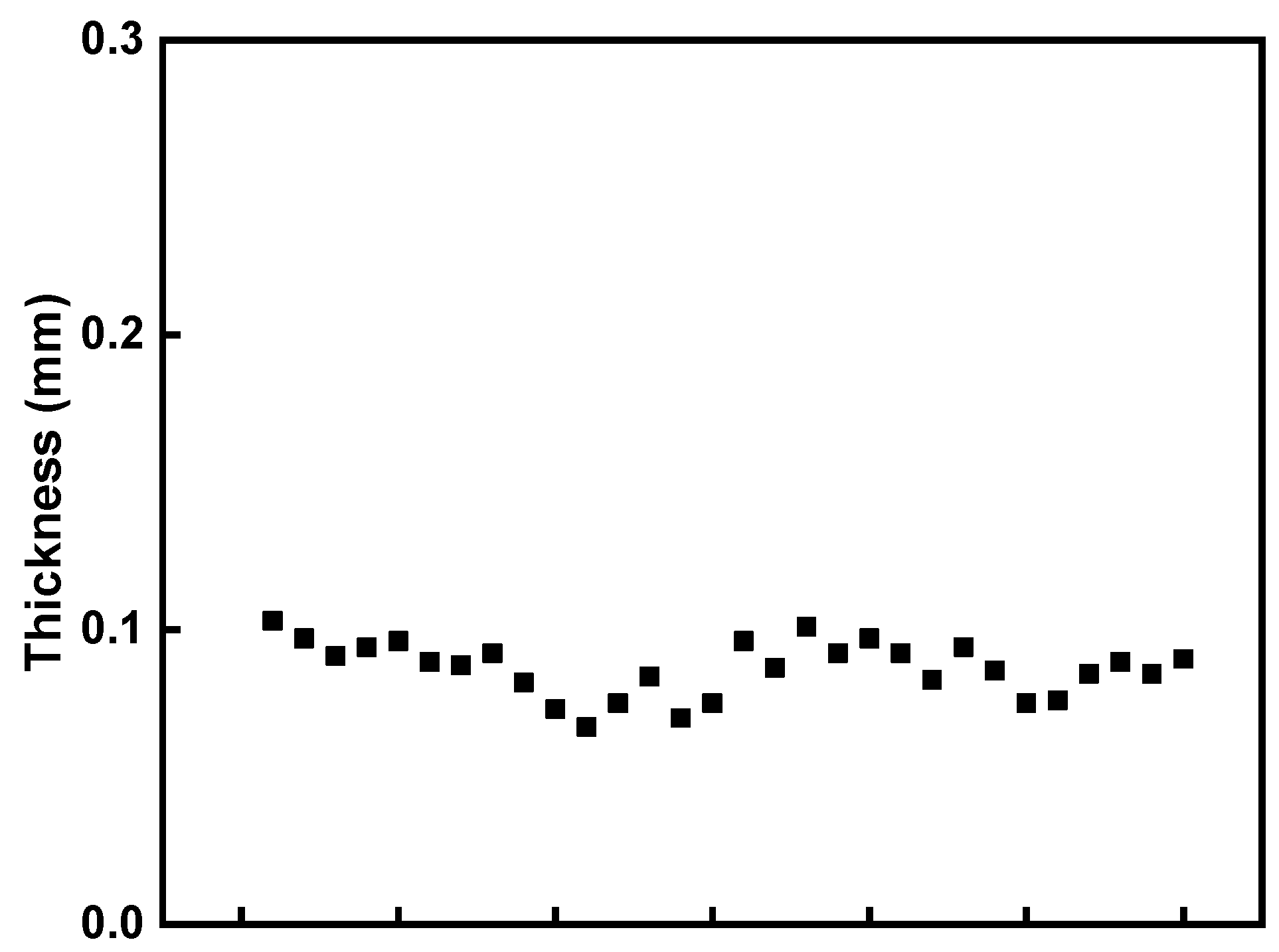
To evaluate the thickness uniformity of the large-area, TEMPO-oxidized CNF films, thickness was measured at a total of 30 points across the entire film area. The results showed that the film thickness was generally distributed within the range of approximately 0.07–0.10 mm, and no abrupt thickness variations depending on the measurement location were observed. Most of the measured values were distributed within the error range around the average thickness, indicating that the film exhibited uniform thickness over its entire area.
As shown in
Figure 3, these results indicate that no significant local thickness accumulation or edge effect occurred during the casting and drying processes of the CNF slurry, demonstrating that TEMPO-oxidized, CNF-based films can be formed in a relatively stable manner even under large-area processing conditions. This suggests that both the dispersion state of the slurry and the drying conditions were maintained uniformly across the entire film area.
In particular, the spatial uniformity of film thickness plays a critical role in ensuring the reliability of the subsequently analyzed optical, thermal, and mechanical property evaluations.
3.2. Optical Properties of CNF Films
Cellulose nanofibers have been reported as materials capable of achieving high optical transmittance owing to their nanoscale fiber diameters and dense network structures [
2,
11]. In this study, to verify whether such optical characteristics are maintained in large-area CNF films, the optical properties of CNF films were compared with those of ETFE films using integrating-sphere-based spectroscopic measurements.
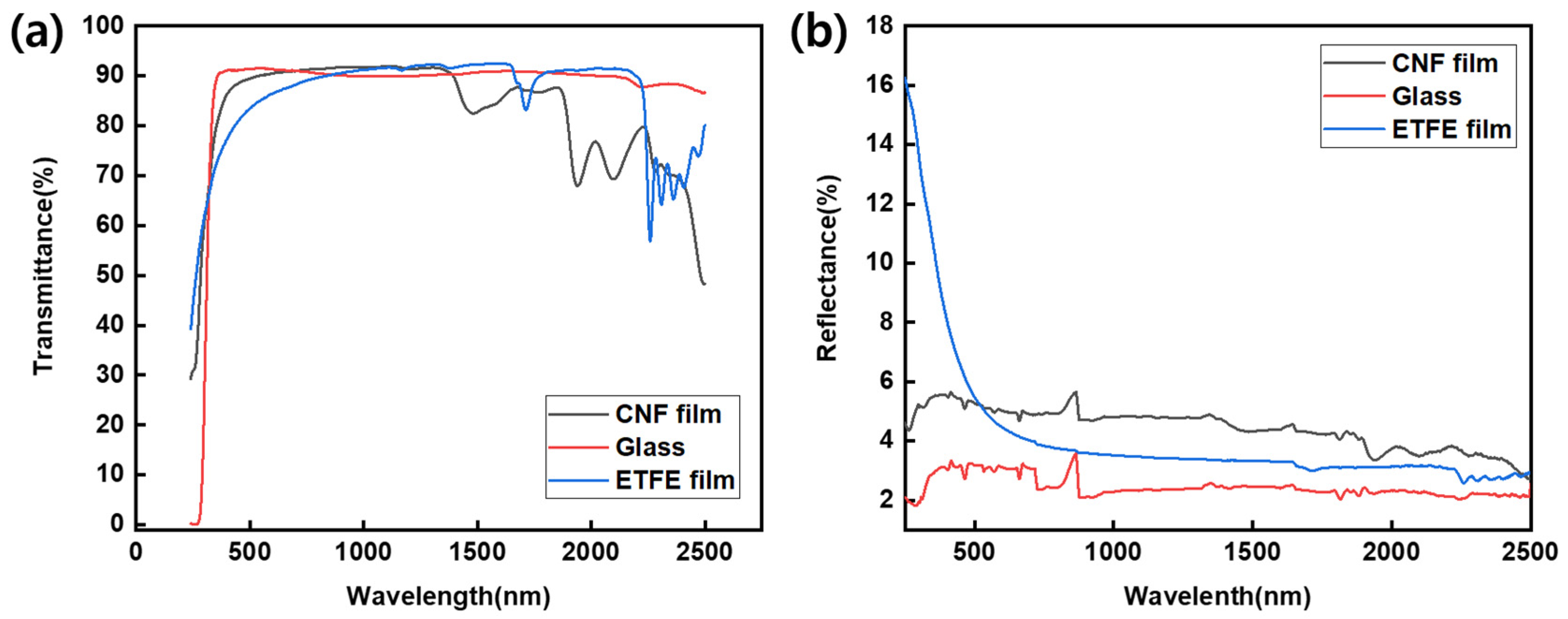
As shown in
Figure 4, the CNF film exhibits wavelength-dependent optical behavior in its spectral transmittance. Silicon PERC solar cells generally exhibit photo-response over a wavelength range of approximately 400–1100 nm [
12], and are particularly sensitive to front-side optical coupling conditions in the short-wavelength region due to the shallow optical absorption depth [
12,
13]. In this context, the reduced transmittance observed around 400 nm is expected to decrease the number of effective photons incident on the cell when the CNF film is applied on the front side, which can lead to a reduction in short-circuit current density [
14]. This interpretation is consistent with the decreased module output observed for the front-side CNF configuration, as summarized in
Table 1.
In contrast, the transmittance fluctuations observed in the infrared (IR) region occur in a wavelength range where the spectral response of silicon solar cells is relatively low; therefore, their contribution to the overall power generation is considered to be limited [
15]. Overall, the spectral modifications induced by the CNF film affect module performance differently depending on the wavelength, indicating that integrated transmittance values alone are insufficient to fully assess the suitability of optical films for photovoltaic module applications. Consequently, an interpretation that simultaneously considers both the spectral transmittance characteristics and the spectral response of silicon PERC solar cells is required.
These results experimentally demonstrate that CNF films maintain the high transmittance required for optical materials in photovoltaic modules within the visible region, while their reflectance is also controlled at a limited level.
3.3. Thermal Properties of CNF Films
Thermogravimetric analysis (TGA) was performed to verify the stability of CNF films under the processing conditions relevant to photovoltaic module fabrication. Since relatively high temperatures are applied during module manufacturing processes, such as lamination, it is necessary to examine the thermal behavior of film materials [
16].
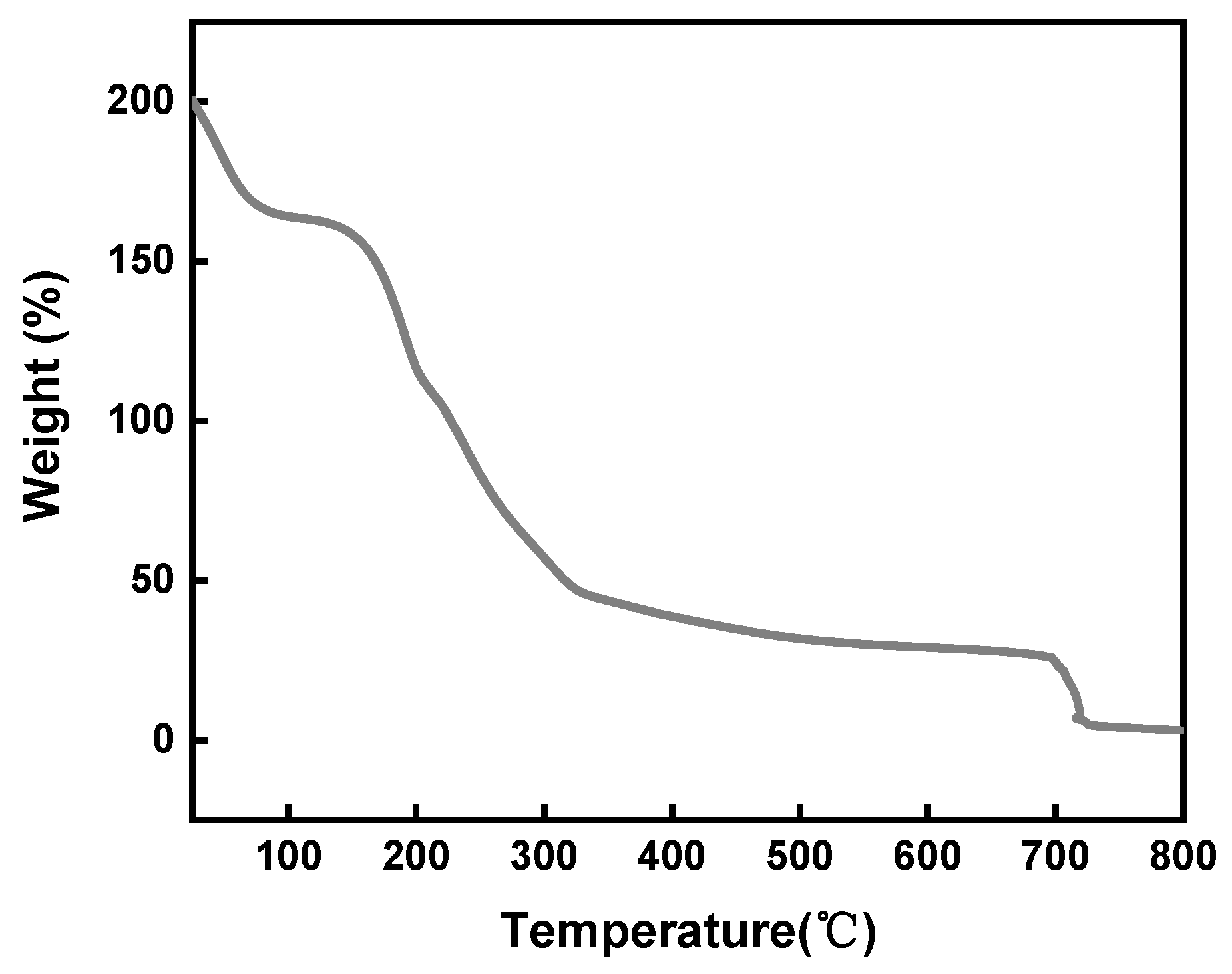
The TGA results showed as
Figure 5 that the TEMPO-oxidized CNF films exhibited only gradual mass changes without noticeable thermal decomposition up to approximately 230 °C, indicating that structural stability was maintained within this temperature range. Significant thermal decomposition behavior appeared at temperatures above 230 °C.
These thermal characteristics occur at temperatures sufficiently higher than the lamination temperature used in this study (140 °C), indicating that no thermal degradation or abrupt structural change in the CNF film occurs under the lamination process conditions. Therefore, the TGA results confirm that the TEMPO-oxidized CNF films fabricated in this work can remain stable under the actual temperature conditions used for photovoltaic module fabrication.
3.4. Mechanical Properties of CNF Films
To evaluate the mechanical properties of the CNF films, density, tensile strength, and tensile modulus were measured and compared with those of conventional photovoltaic module backsheet materials and ETFE films. Tensile properties were measured according to the ASTM D882 standard [
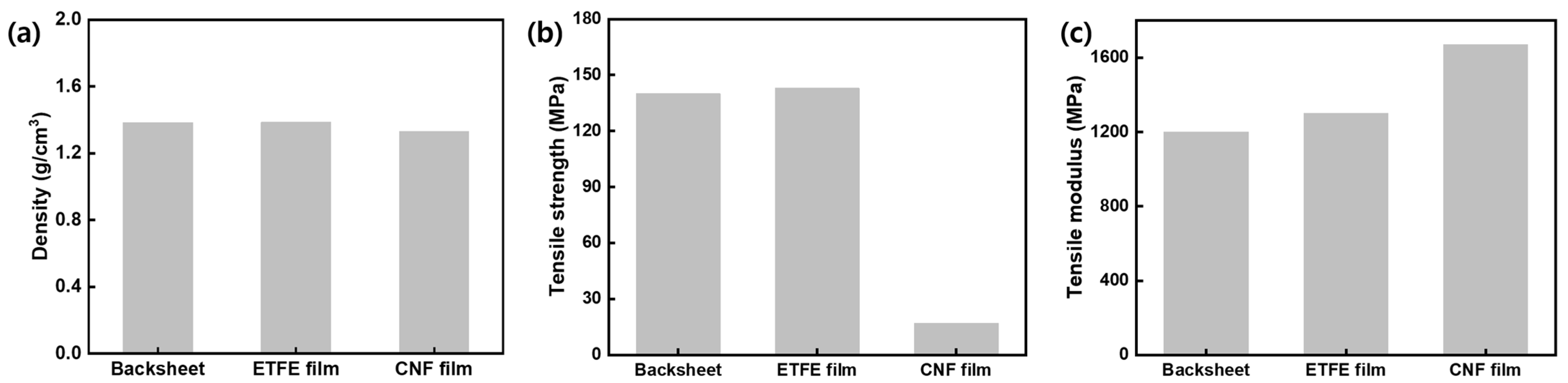
17], allowing the mechanical behavior of CNF films to be compared with that of conventional polymer films on an equivalent basis. The density of the CNF films was approximately 1.3 g/cm
3, which falls within a range similar to that of ETFE films and backsheet materials. No significant differences in density were observed among the three materials, and the CNF films exhibited density characteristics comparable to those of conventional polymer films used in photovoltaic modules.
As shown in
Figure 6, compared with conventional petroleum-based polymer films, the CNF film exhibits a relatively lower tensile strength while possessing a higher Young’s modulus. This indicates that, although the CNF film may be more susceptible to failure under large deformation, it can effectively maintain its shape and resist deformation within a small strain regime. In this study, these mechanical properties were quantitatively presented to enable a clear comparison of the mechanical behavior between CNF films and conventional polymer films.
These results indicate that the mechanical properties of CNF films should be interpreted in the context of their actual service conditions within photovoltaic modules, where the films are incorporated into laminated structures and experience only limited deformation. Accordingly, an evaluation that simultaneously considers both tensile strength and Young’s modulus provides an appropriate basis for discussing the applicability of CNF films at the initial stage of module-level implementation.
3.5. Output Characteristics of Photovoltaic Modules Incorporating CNF Films
From the preceding results, the TEMPO-oxidized, CNF-based films were confirmed to be stably fabricated with small thickness variation even under large-area processing conditions, and their optical, thermal, and mechanical properties satisfied the basic requirements for application in photovoltaic modules. To verify whether these film-level characteristics are maintained in actual module structures, the output characteristics of modules incorporating CNF films were evaluated.
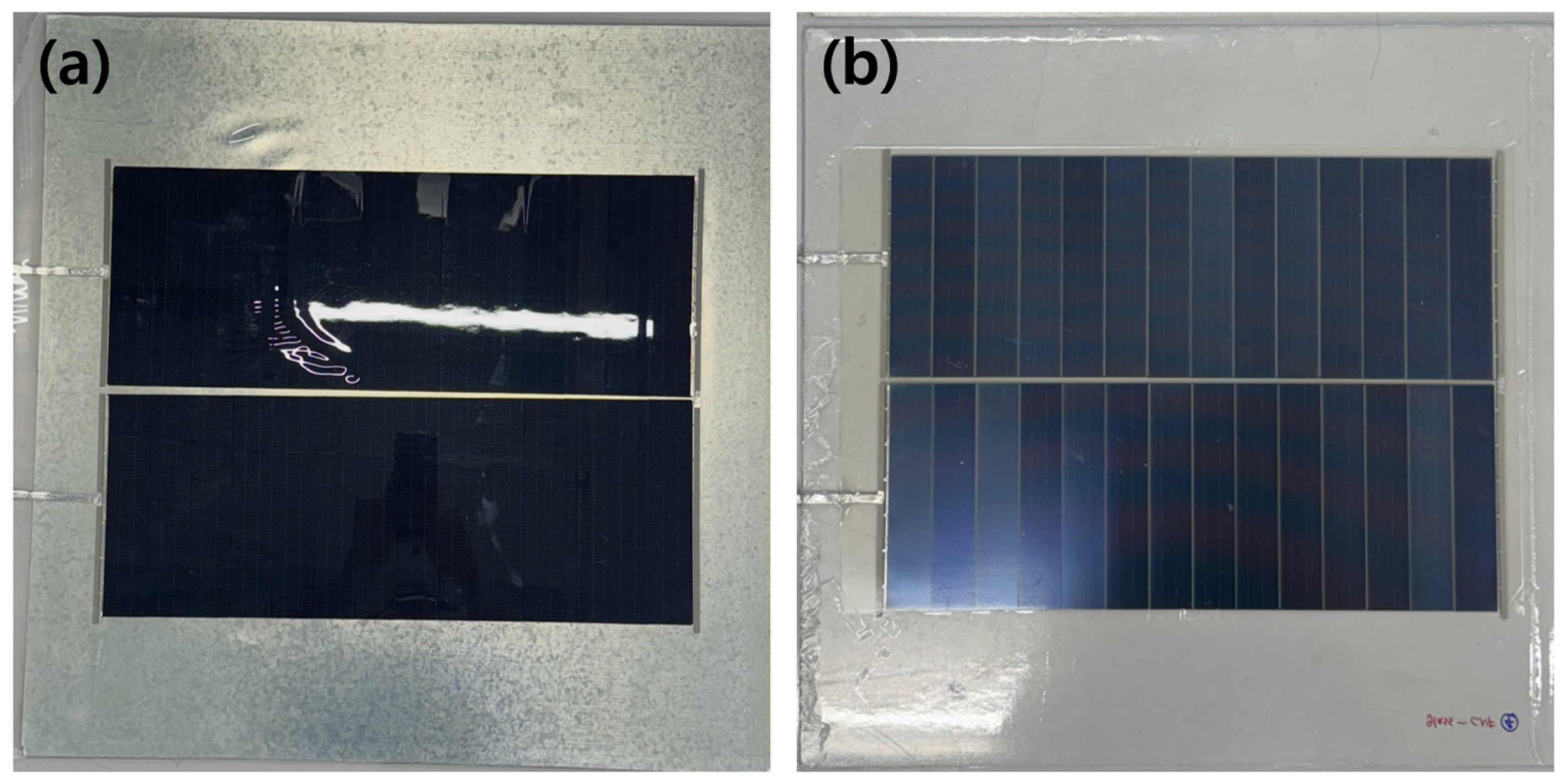
TEMPO-oxidized cellulose nanofiber (CNF) films were applied to the front and rear sides of shingled photovoltaic modules, and the changes in module output characteristics depending on the application position were compared and analyzed. The fabricated modules are shown in
Figure 7. For a clear comparison of the effects of CNF film application, reference modules were also fabricated under identical conditions except for the presence and position of the CNF films.
Figure 7.
Photographs of the fabricated modules: (a) front CNF-applied module; (b) rear CNF-applied module.
Figure 7.
Photographs of the fabricated modules: (a) front CNF-applied module; (b) rear CNF-applied module.
Table 1.
Comparison of output characteristics for modules with various CNF layer.
Table 1.
Comparison of output characteristics for modules with various CNF layer.
| CNF Layer Position | Efficiency Change | Jsc Change | Pmax Change |
|---|
| Front | ▼1.69% | ▼2.32% | ▼1.64% |
| Rear | ▲1.06% | ▲1.17% | ▲1.08% |
Photovoltaic module output characteristics were evaluated under standard test conditions (STC: 1000 W/m2, AM 1.5, and 25 °C), and all I–V curves were recorded under identical conditions to ensure a consistent comparison between the reference and CNF-applied modules.
The analysis of module output characteristics showed that the effects of CNF film application varied depending on the application position. For modules with the CNF film applied to the front side, a decreasing trend in short-circuit current and efficiency was observed compared to the reference module. As shown in
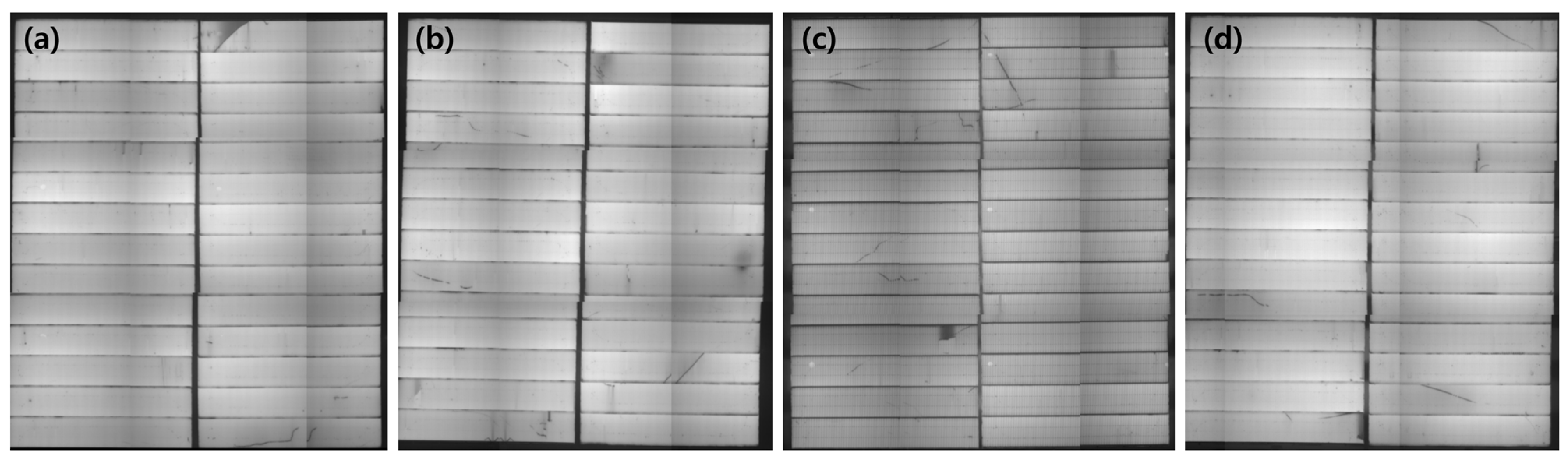
Table 1, for modules with the CNF film applied to the front side, a decreasing trend in short-circuit current and efficiency was observed compared to the reference modules. In contrast, modules with the CNF film applied to the rear side exhibited output characteristics that were generally comparable to those of the reference modules, and slight increases in some output parameters were observed. Considering that no structural or electrical defects were detected in any of the modules before and after CNF film application based on EL image analyses, the observed differences in output characteristics can be attributed to changes in the lamination structure caused by the application of the CNF film rather than to cell damage or electrical degradation.
To examine whether the application of CNF films induced structural or electrical defects in the modules, EL images were analyzed, as shown in
Figure 8. The EL analysis revealed that no typical electrical defects, such as cell cracks, finger disconnections, or localized dark spots, were observed in any of the modules with CNF films applied to either the front or rear side [
18]. In addition, compared with the reference modules, the distribution of emission intensity remained generally uniform, and no abnormal regions of reduced emission intensity associated with CNF film application were identified.
EL imaging is widely used as an effective technique for identifying electrical defects and recombination characteristics in photovoltaic modules [
16]. Electroluminescence (EL) images were acquired under identical bias conditions (0.8 A) with a fixed exposure time of 0.5 s, while maintaining the same imaging and calibration settings, to enable a qualitative comparison of defect distributions among the modules. Considering the uniform emission distribution observed in this study, the changes in module output characteristics induced by CNF film application are not attributed to structural or electrical defects such as cell cracks or poor interconnections, but are more closely related to changes in optical conditions resulting from modifications in the front or rear lamination structure.
4. Discussion
In this study, large-area transparent films were fabricated using cellulose nanofibers (CNFs) produced via TEMPO-mediated oxidation, and subsequently applied to practical shingled-type photovoltaic modules. The resulting changes in module-level optical and electrical performance were comparatively analyzed under identical fabrication and measurement conditions. Unlike previous CNF-related studies that mainly focused on small-area films or cell-level characteristics, this work simultaneously considered large-area film fabrication and module-level application.
The TEMPO-oxidized, CNF-based films were stably fabricated through casting and drying processes, and thickness measurements showed relatively uniform distribution without significant variation across the entire film area. This indicates that thickness control of CNF films is feasible even under large-area processing conditions, providing fundamental reliability for interpreting the subsequently evaluated material properties.
The optical property evaluation showed that the CNF films maintained transmittance levels in the visible region comparable to those of conventional commercial polymer films. Their reflectance characteristics were also confirmed not to induce significant optical losses when applied to photovoltaic modules. The wavelength-dependent variation in transmittance can be interpreted as a result of the light-transport behavior associated with the fine microstructure of the CNF films.
In the mechanical property evaluation, the CNF films were confirmed to possess sufficient stiffness to maintain a stable film form, and the thermogravimetric analysis results showed that the CNF films remained stable without noticeable thermal decomposition within the temperature range of the photovoltaic module lamination process. This indicates that CNF films can be applied under actual module fabrication conditions.
CNF films are derived from renewable bio-based resources and are therefore distinct from conventional petroleum-based polymer films that rely on fossil resources. Owing to this characteristic, CNF films have been discussed in previous studies as candidate materials for addressing environmental impacts across the entire life cycle of photovoltaic module materials, from raw material sourcing to film fabrication and end-of-life stages. In particular, prior studies have reported life cycle assessment (LCA) results for CNF production processes, including TEMPO-mediated oxidation, evaluating energy consumption and carbon emissions and demonstrating that the outcomes can vary depending on process conditions and system boundary definitions [
19]. Building upon this environmental background, the present study is meaningful in that it analyzes the performance characteristics of large-area CNF films when applied to actual photovoltaic modules at the module level, thereby examining the applicability of CNF films from a performance-oriented perspective.
In future work, repeated experiments based on multiple photovoltaic modules will be conducted to systematically verify the reproducibility and statistical reliability of the performance variations observed in this study. In addition, as long-term reliability is essential for the practical application of CNF films as photovoltaic module packaging materials, environmental durability will be comprehensively evaluated through accelerated aging tests, including damp heat exposure, ultraviolet (UV) irradiation, and thermal cycling. Furthermore, based on the outcomes of these reliability assessments, further studies will focus on optimizing the application position and lamination structure of CNF films to more clearly demonstrate their applicability under realistic photovoltaic module operating conditions.