1. Introduction
In recent years, amid the technological evolution of power systems, DC microgrids have emerged as a promising integrated architecture incorporating renewable energy sources, DC loads, and energy storage systems. Compared to their AC counterparts, DC microgrids offer distinct advantages, including a simpler structure, relatively lower control complexity, and the absence of reactive power and phase-related issues [
1,
2,
3]. Their distributed control schemes further contribute to enhanced response speeds. Within the DC microgrid framework, the DC-DC boost converter is a critical component, necessitating high bidirectional energy conversion efficiency [
4,
5,
6]. Consequently, developing novel control strategies for Boost converters that account for the influence of constant power loads (CPLs), mitigate disturbances, and enable rapid voltage regulation is of paramount importance.
Power electronic loads in DC microgrids are primarily categorized into resistive loads and constant power loads. Resistive loads, due to their passive nature, introduce positive damping into the system [
7,
8,
9]. In contrast, CPLs, which maintain constant power draw, exhibit negative impedance characteristics at their input terminals. This negative impedance interaction with other system converters can reduce overall system damping, compromise stability, and introduce oscillation risks [
10,
11,
12,
13]. The increasing penetration of renewable energy sources further exacerbates these stability challenges posed by CPLs. Power system stability analysis is typically divided into large-signal [
14,
15,
16,
17,
18] and small-signal [
19,
20,
21] stability, based on operating scenarios and disturbance magnitudes, with current research predominantly focused on the latter. Primary mitigation strategies include passive damping [
20,
21], which adds passive components to improve damping directly but increases cost and weight, counter to lightweight trends; and active damping [
22,
23], which modifies the control structure to reshape system impedance. However, active damping is often limited to linearized small-signal models around an equilibrium point, restricting its applicability.
Given the inherent nonlinearity of power electronic converters and the negative impedance of CPLs, employing nonlinear control strategies is essential to enhance the global stability of DC microgrid systems. To improve converter stability, nonlinear control methods such as Passivity-Based Control (PBC) [
24], Back-stepping Control (BSC) [
25], Model Predictive Control (MPC) [
26], Sliding Mode Control (SMC) [
27], and PWM-based nonlinear control [
28] have been progressively applied. However, challenges remain in improving output voltage tracking accuracy and system efficiency, leading to extensive research on combined control strategies. The Back-stepping Control method proposed in [
29] is an effective nonlinear approach for enhancing tracking precision and system efficiency, but it requires accurate estimation of system uncertainties and disturbances to minimize tracking error. Observer technology, particularly the Nonlinear Disturbance Observer (NDO) [
24], offers a promising solution for estimating disturbances without additional sensors, providing effective disturbance rejection and uncertainty compensation in nonlinear systems. For instance, ref. [
30] employed an NDO combined with Back-stepping Control to enhance the large-signal stability of a conventional Boost converter system. While these strategies effectively ensure large-signal stability, their high dependency on accurate system modeling makes them susceptible to inevitable steady-state deviations under random source and load disturbances. Integrating compensation loops at relevant stages can reduce or eliminate these deviations, but often at the expense of dynamic response speed.
To address the aforementioned challenges, this paper proposes a Passivity-Based Control (PBC) method for DC-DC converters based on an Adaptive Extended Kalman Filter (AEKF). This approach not only significantly enhances the large-signal stability and robustness of the system but also incorporates precise current limiting control and rapid voltage regulation capabilities, thereby effectively ensuring the stability and reliability of DC microgrids under various complex operating conditions. The proposed control methodology primarily integrates PBC with Kalman filtering techniques. Firstly, an AEKF is designed for the real-time and accurate estimation of time-varying system parameters, notably load power and input voltage. Subsequently, an adaptive PBC technique, utilizing the state variables estimated by the filter, is developed to control the DC-DC boost converter with a CPL. Furthermore, the design of the proposed nonlinear control loop circumvents the difficulties associated with obtaining nominal parameters and performing complex multi-degree-of-freedom parameter tuning inherent in traditional methods, resulting in a relatively simple and practical control structure.
2. System Modeling and Problem Formulation
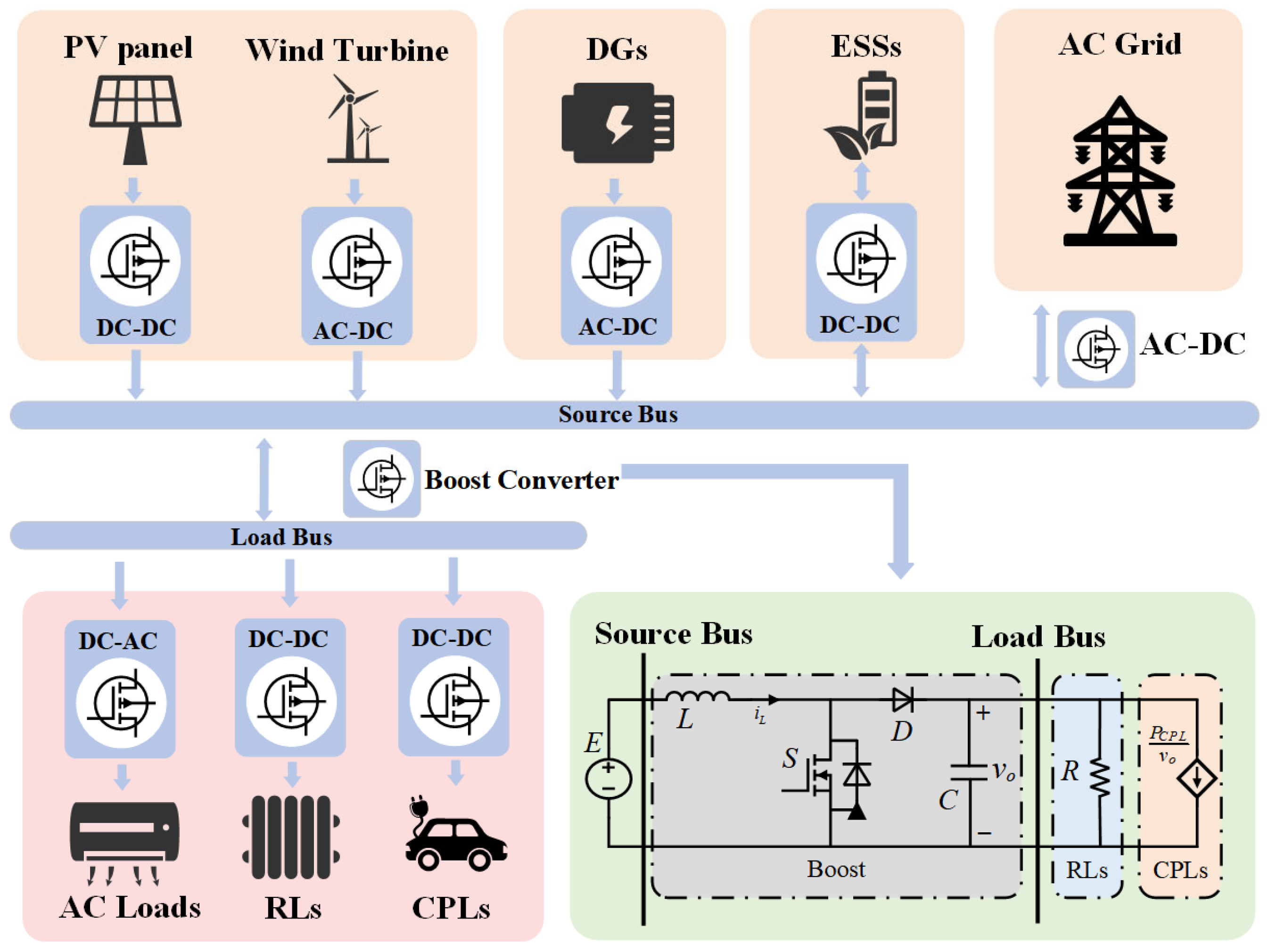
The object of this study is a typical DC microgrid architecture and its equivalent circuit, depicted in
Figure 1. This system features a source bus that is intricately connected to a diversified array of power generation and storage technologies through appropriate power electronic interfaces. These include intermittent renewable sources like photovoltaic arrays and wind turbines, dispatchable generators, battery energy storage systems (BESS), and a point of common coupling to an external AC grid via an AC-DC converter. This multi-faceted integration strategy empowers the source bus to dynamically and flexibly draw power from the most available or economical sources, thereby significantly enhancing the overall reliability, resilience, and operational adaptability of the microgrid. The system’s energy management system (EMS) employs sophisticated optimization algorithms to coordinate power flows, ensuring optimal utilization of renewable resources while maintaining the state of charge of the BESS for grid support services.
A pivotal component in this architecture is the DC-DC boost converter, which interfaces the source bus with the load bus. Its primary function is twofold: first, to ensure precise and stable voltage regulation on the load bus, which is fundamental for high-quality power delivery; and second, to efficiently step up the variable, often lower voltage from the source side to a higher, regulated voltage level required by the loads. The converter’s design must account for wide input voltage variations characteristic of renewable sources, necessitating advanced control techniques to maintain stability across the entire operating range. The performance of this converter is therefore critical, demanding high conversion efficiency and robust control capabilities to maintain a continuous and stable power supply under varying generation and consumption scenarios. Its dynamic response must be sufficiently fast to mitigate disturbances propagating through the system, particularly those originating from load-side perturbations.
The load bus supplies power to a mix of load types, primarily categorized into resistive loads and CPLs. Resistive loads present a linear relationship between current and voltage, contributing naturally to system damping and stable operation. In stark contrast, CPLs, such as tightly regulated power electronic converters found in electric vehicle charging stations, server farms, and variable-speed drive systems, maintain a constant power draw. This behavior manifests as a negative impedance characteristic at their input terminals, meaning an increase in input voltage results in a decrease in input current. This negative impedance introduces non-linearity and can significantly degrade system damping through positive feedback mechanisms. The interaction between this negative impedance and the source-side converters can lead to voltage oscillations, instability, and even system collapse, presenting a major challenge for DC microgrid stability. This instability phenomenon is further exacerbated in cascaded converter systems, where the impedance interaction between source and load converters can create forbidden operating regions. Consequently, the design and implementation of sophisticated, robust control strategies for the interface DC-DC converter are not just beneficial but imperative to mitigate these destabilizing effects and ensure the stable, reliable, and efficient operation of the entire DC microgrid system. Advanced control methodologies must incorporate both large-signal stability guarantees and adaptive capabilities to handle the time-varying nature of modern load profiles.
A mathematical model of the DC-DC boost converter needs to be established to serve as the foundation for subsequent controller design and stability analysis [
31]. Without loss of generality, and assuming continuous conduction mode, the average dynamic model of the DC-DC boost converter can be represented by the following state-space equations:
where
L,
C,
E,
vo,
iL,
μ,
R, and
represent the inductance, output capacitance, input voltage, output voltage, inductor current, switching duty cycle, resistive load, and constant power load of the DC-DC boost converter, respectively. Furthermore, the input voltage and the power of the constant power load are state variables that require estimation.
This model captures the essential nonlinear dynamics of the system. The term explicitly embodies the negative impedance characteristic of the CPL, as the current it draws decreases with increasing voltage. It is crucial to note that within the context of the proposed control strategy, the power of the constant power load are treated as unknown time-varying parameters or state variables that require real-time estimation for precise control synthesis.
3. Adaptive Extended Kalman Filter (AEKF) and Stability Analysis
3.1. Adaptive Extended Kalman Filter (AEKF)
To accurately estimate the state variables using an Extended Kalman Filter, the dynamic model (1) is rewritten and can be expressed in the kinetic form of state-space representation as [
32]:
In Equation (2), the state variable matrix is .
E is the input voltage,
S is the system matrix,
B is the input matrix,
d is the nonlinear term matrix,
h is the output matrix,
y is the output quantity, and
is the influence factor based on the capacitor voltage. Then:
Based on the proposed Extended Kalman Filter method, the power of the constant power load needs to be considered as one of the state variables and added to the state-space expression, resulting in a new state variable matrix:
Due to the power characteristics of the constant power load, it follows that
P equals 0. At this point, the state variable matrix becomes:
where
is the time-varying system input, and
is a function of
and
, representing the Euler equation of the dynamic model after incorporating the output power into the state variable matrix. Furthermore, the output of the EKF algorithm is updated based on changes in the state variables:
After adding noise, the new form of the equation set is obtained,
and
can be considered as Gaussian white noise with zero mean. Their covariance matrices are denoted as
and
, respectively, and their specific values need to be specified by the user during application. The state noise
can be determined through adaptive training, while the observation noise is generally related to sensor accuracy. The following equations are obtained:
Discretization is performed using the Euler method:
where
represents the system dynamic model at time
k, and
is the sampling time. The nonlinear function
is incompatible with the EKF. Instead, its Jacobian, given in (10), is employed within the EKF algorithm.
Here,
denotes the parameter estimated by the EKF at the k-th step. The term
represents the dynamic model utilizing these estimated values. As a result, for the initial values of
,
,
, and
, the EKF algorithm consists of two stages: the time update and the measurement update, as given below.
The calculations for
and
are as follows:
In the proposed algorithm, the prediction step prior to measurement utilization yields the predicted state
and its covariance
, computed via the dynamic model
. Following the measurement update, these are refined to the estimated state
and covariance
. The update magnitude is governed by the EKF gain
. A forgetting factor
is introduced to weight previous estimates, where a larger
increases this influence. This factor directly modulates
, inducing adaptive time delays to compensate for changes. The linearized system is subsequently derived as follows:
The Jacobian matrix is computed as for all state variables, where is the dynamic model and is the identity matrix.
Ultimately, the AEKF algorithm processes the measured current and voltage to estimate the Constant Power Load (CPL) power from the state vector . This estimated power is then fed directly into the PBC controller. A key advantage of this method is its ability to accurately estimate CPL power, thereby eliminating the need for dedicated power sensors. This reduction in hardware not only lowers system cost but also inherently increases robustness against measurement noise. Furthermore, the proposed AEKF eliminates the need for trial-and-error in tuning the covariance matrices.
3.2. Stability Analyzes
The stability of the Adaptive Extended Kalman Filter (AEKF) estimation error is analyzed as follows [
23]. Beginning with the state prediction and update equations omitting Euler expansion:
The dynamic error is defined as
Applying Taylor’s expansion and grouping high-order terms into
, the error dynamics are linearized as:
To assess exponential behavior, consider a Lyapunov function bounded by . If its difference for positive constants , and the inequality holds, then the system is exponentially stable, satisfying for
4. Passivity-Based Control (PBC) and Stability Analysis
4.1. Adaptive PBC
Adaptive Passivity-Based Control Voltage Loop: To facilitate the design of the passivity-based controller, the state-space model (1) is expressed in the following matrix form:
In the equation,
is the transient quantity in the passivity-based controller,
is the state variable matrix in the passivity-based controller,
is the input voltage matrix in the passivity-based controller,
is the voltage transformation coefficient matrix in the passivity-based controller and
is the system impedance.
Obviously, G = −GT, R = RT. Equation (17) satisfies the characteristics of the Euler–Lagrange model, providing a model basis for the design of the passivity-based controller. The design of the passivity-based control voltage loop is divided into two stages:
(1) Energy Shaping Stage: Using
for transformation, (17) can be reshaped into
In the above equation, and represent the reference value and the disturbance value of X, respectively, where is the actual system impedance matrix, and is the reference value of the system impedance at the equilibrium point.
(2) Damping Injection Stage: This stage modifies the system dissipation function by injecting the virtual damping matrix
into both sides of (3), which can be expressed as
To ensure that the system with the injected virtual damping matrix satisfies Lyapunov stability, thus possessing a globally stable equilibrium point for the system (
). The system’s energy function is selected as follows:
Then, the time derivative of the energy function (22) can be expressed as
To ensure global stable convergence of the system, the injected virtual damping coefficient
Rv should make all elements of the matrix
Rp positive. Under this premise, the control law for the passivity-based control voltage loop can be designed as
Although the control law for the passivity-based control voltage loop obtained from Equation (24) can operate with multiple rated parameters, the randomness and time-varying nature of source and load side parameters can lead to steady-state deviations from the control objective. Therefore, substituting the estimated values of output power from AEKF into (24) can be expressed as
Based on the inherent properties of the converter and Equation (24), the control result for the switching duty cycle
μ can be obtained.
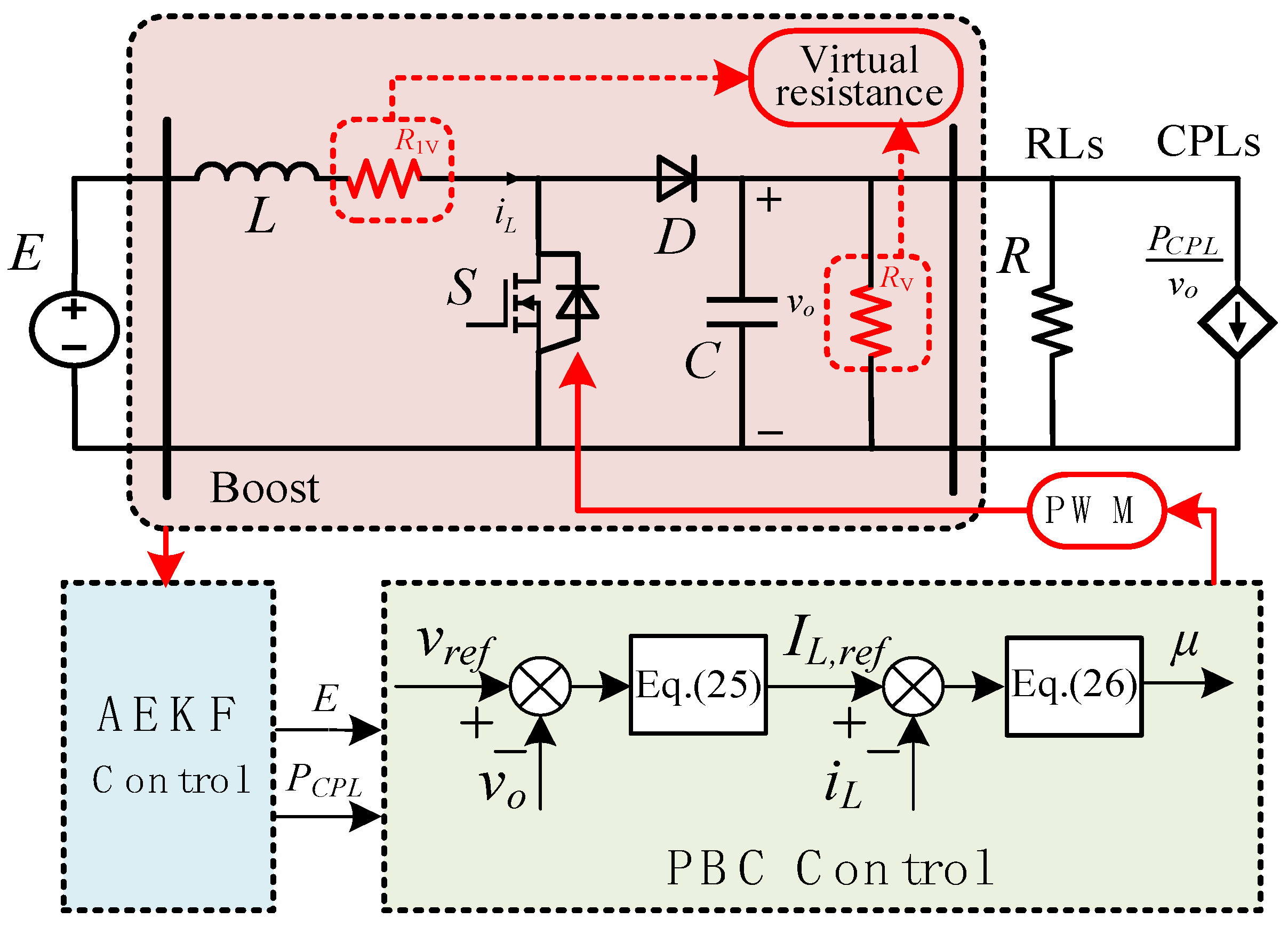
Furthermore, by applying a current limiting block after the current reference, the peak current during startup and disturbances can be suppressed, thereby reducing the current stress on the equipment. Combining the passivity-based control voltage loop and the Extended Kalman Filter forms a nonlinear controller with a simple structure, high robustness, and low computational burden. Integrating the above controller design, the final proposed adaptive Extended Kalman Filter passivity-based control method is shown in
Figure 2. It should be noted that while the stability condition requires
Rp to be positive definite, the practical selection of
R1v is also constrained by the PWM switching frequency and modulator dynamics, as discussed in [
33].
4.2. Stability Analyzes
The stability analysis of the proposed passivity-based control (PBC) algorithm is conducted within the formal framework of Lyapunov stability theory. Following the completion of energy reshaping and damping injection phases, the closed-loop system dynamics are characterized by the following differential equation:
The system energy function is selected as the Lyapunov function candidate:
Since the inertia matrix
H is positive definite and symmetric,
V is consequently positive definite. To examine system stability, we compute the time derivative of the Lyapunov function along the trajectories of the system:
Substituting the system equation yields:
Expanding this expression:
Given that matrix
G is skew-symmetric (
G = −
GT), it follows that:
According to Lyapunov stability theory, the system is globally asymptotically stable at the equilibrium point . Regardless of initial conditions, the system state error converges to zero over time.
The AEKF is designed to estimate the unknown, time-varying CPL power in real time by treating it as an augmented state variable (Equations (4) and (5)). This accurate estimate is then fed forward into the PBC law (Equations (25) and (26)). The PBC controller, through its energy shaping and damping injection stages, inherently compensates for the negative impedance effect of the CPL. The injected virtual damping restores system passivity, ensuring large-signal stability despite the nonlinear load characteristic.
This analysis demonstrates that the passivity-based control algorithm ensures system stability under all operating conditions, thereby providing theoretical assurance for practical engineering applications.
5. Simulation Results
To comprehensively assess both the steady-state and transient performance of the proposed Adaptive Extended Kalman Filter-based Passivity-Based Control strategy for DC microgrid DC-DC converters, a detailed simulation model was implemented within the PLECS simulation environment. The system configuration comprises a single Boost converter supplying power to parallel-connected constant power load and resistive load, where the CPL is practically realized through a current source combined with resistive components.
The converter control system was rigorously evaluated under multiple training scenarios designed to simulate realistic operational challenges. These included step changes in load conditions, abrupt variations in reference voltage commands, and sudden disturbances in the Boost converter’s input voltage. Through these comprehensive tests, the dynamic performance and robustness of the proposed control strategy were systematically evaluated under diverse operating conditions, with control parameters being progressively refined through this process. The simulation parameters employed for this validation study are detailed in
Table 1.
5.1. Case 1: Constant Power and Constant Impedance Load Changes
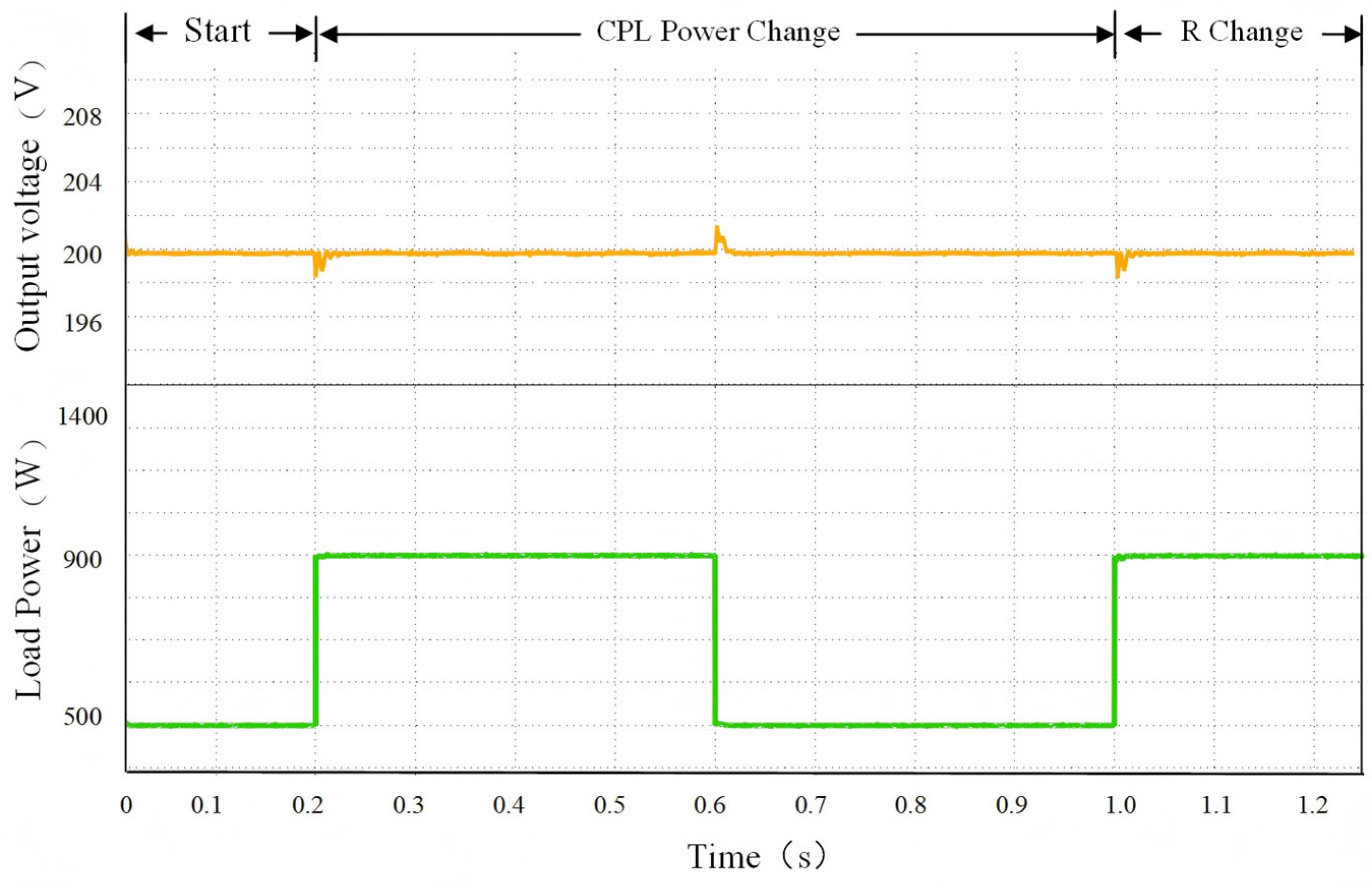
The proposed control algorithm demonstrates exceptional dynamic performance and robustness when subjected to sudden changes in constant power load (CPL). As illustrated in
Figure 3, when the system experiences a step change in CPL power from 500 W to 900 W at t = 0.2 s, both the output voltage and inductor current exhibit minor, brief transients. Critically, the system recovers to its steady-state values rapidly. A subsequent step reduction in CPL power from 900 W back to 500 W occurs at t = 0.6 s, followed by a step decrease in the resistive load R to 50 Ω at t = 1.0 s. In both cases, the output voltage and inductor current revert to their steady-state values promptly, with a remarkably short settling time of 8 ms and a minimal voltage overshoot constrained within 2 V. The output voltage profile maintains a smooth trajectory during these transients, devoid of significant oscillations, which verifies the algorithm’s efficacy in suppressing power oscillations induced by load disturbances. The swift response of the inductor current further underscores the controller’s superior capability for rapid power balance regulation.
5.2. Case 2: Constant Power and Input Voltage Changes
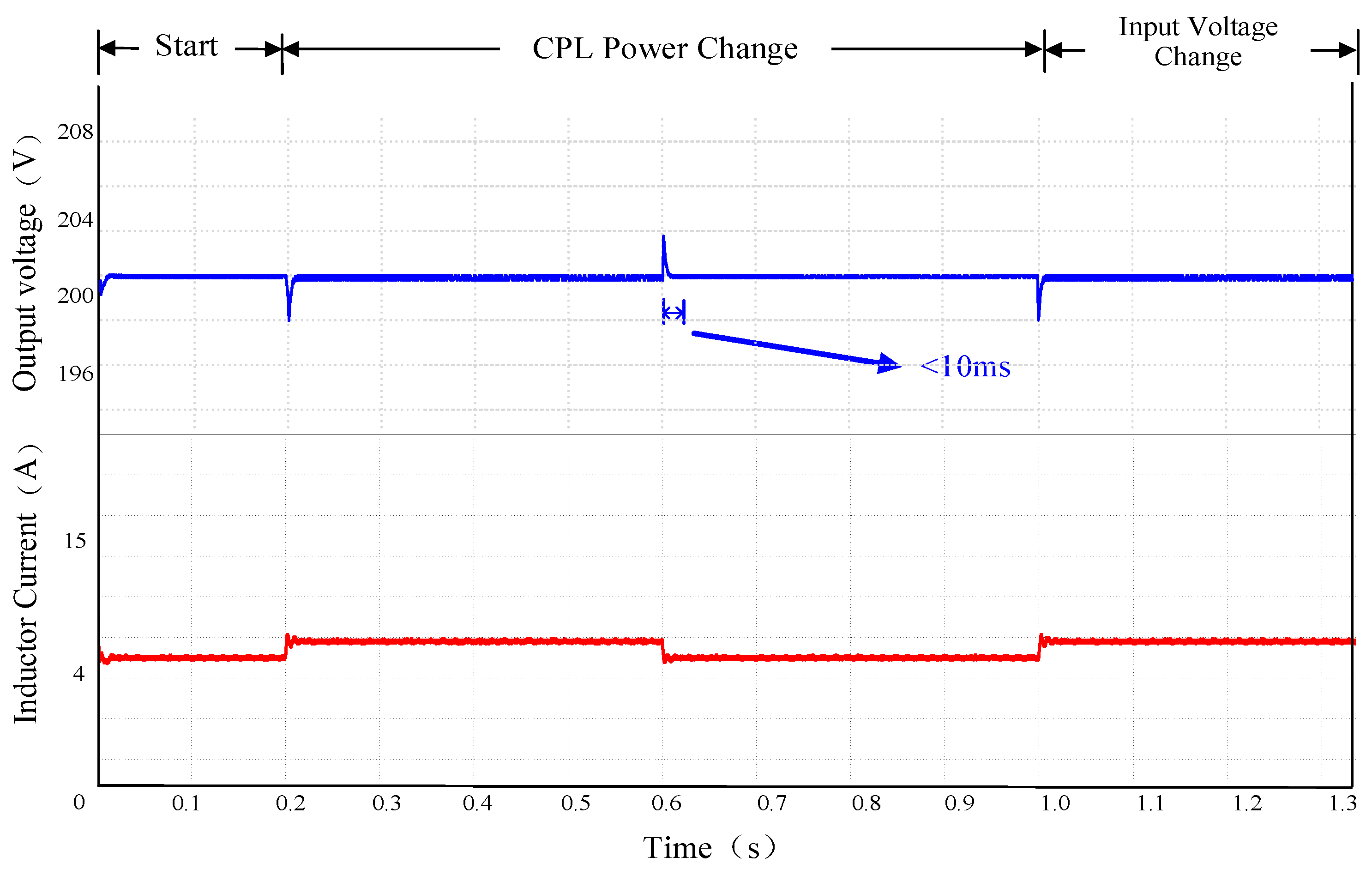
The proposed control algorithm also exhibits outstanding dynamic regulation and robustness in response to input voltage disturbances. As shown in
Figure 4, the system was tested under a sequence of step changes. Initially, a CPL power step from 500 W to 900 W at t = 0.2 s causes brief deviations in the output voltage and inductor current, which are quickly stabilized within a settling time of 10 ms and a voltage overshoot below 1 V. When the CPL power steps back down from 900 W to 500 W at t = 0.6 s, the system demonstrates a faster recovery, with a settling time of 8 ms and an overshoot controlled within 1 V. Furthermore, when subjected to an input voltage step change from 100 V to 80 V at t = 1.0 s, the system again manages the transient effectively, stabilizing within 9 ms. Throughout these tests, the voltage waveform transitions smoothly, and all fluctuations in load voltage and power remain within 10%. These results collectively highlight the controller’s strong capability for rapid compensation of input-side disturbances.
5.3. Case 3: Comparative Analysis with Conventional Methods
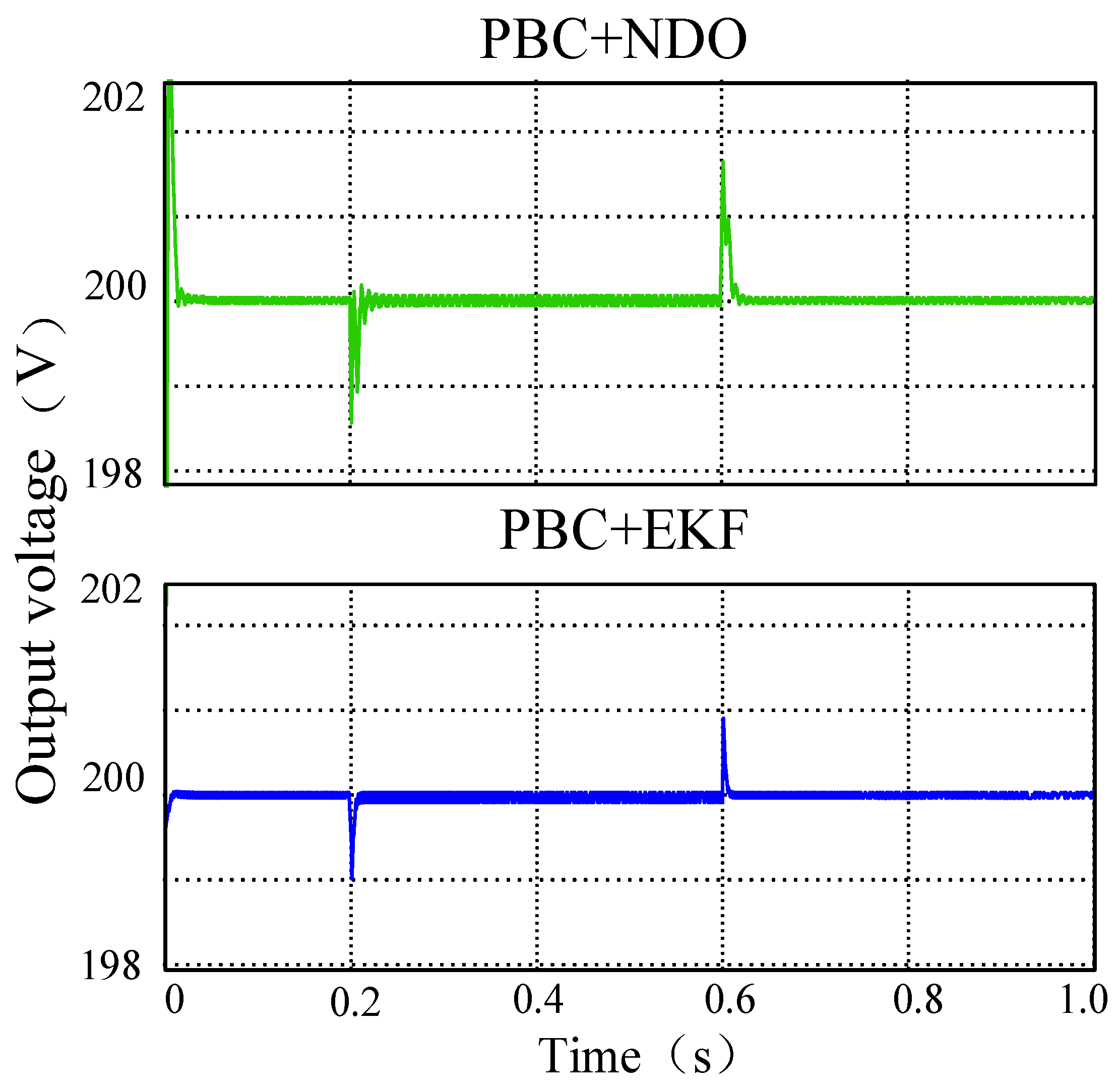
The proposed control method demonstrates rapid bus voltage stabilization, achieving a mere 1 V overshoot and an 8 ms settling time. In contrast, the PBC + NDO control method yields a larger overshoot of 1.7 V and a longer settling time of 20 ms. As shown in
Figure 5, these comparative results highlight the exceptional robustness of the proposed approach to load disturbances.
6. Experimental Results
To validate the superior performance of the proposed converter, an experimental setup was constructed for testing. The setup consists of an oscilloscope (Yokogawa DL850), a DC power supply (ITECH IT-M3433,150 V/12 A), an electronic load (Chroma 63804, 350 V/45 A/4500 W), a sampling circuit, a DC-DC boost converter, and an RT-Box1. The Chroma electronic load can be configured in either resistive mode or constant power load (CPL) mode to accommodate different load types. The control algorithm is developed in PLECS on a host computer, which generates code for the RT-Box. This code enables the RT-Box to acquire voltage and current signals via its analog-to-digital converters (ADCs) and execute the control algorithm, outputting a 20 kHz PWM signal to the DC-DC boost converter. Variations in source-side and load-side operating conditions are implemented using the programmable DC power supply and the electronic load. Furthermore, to faithfully reflect the control performance, the parameters of the experimental platform are kept consistent with those used in the simulation studies. where vo denotes the output voltage, iL represents the inductor current, and io is the output current.
6.1. Case 1: Constant Power Load Changes
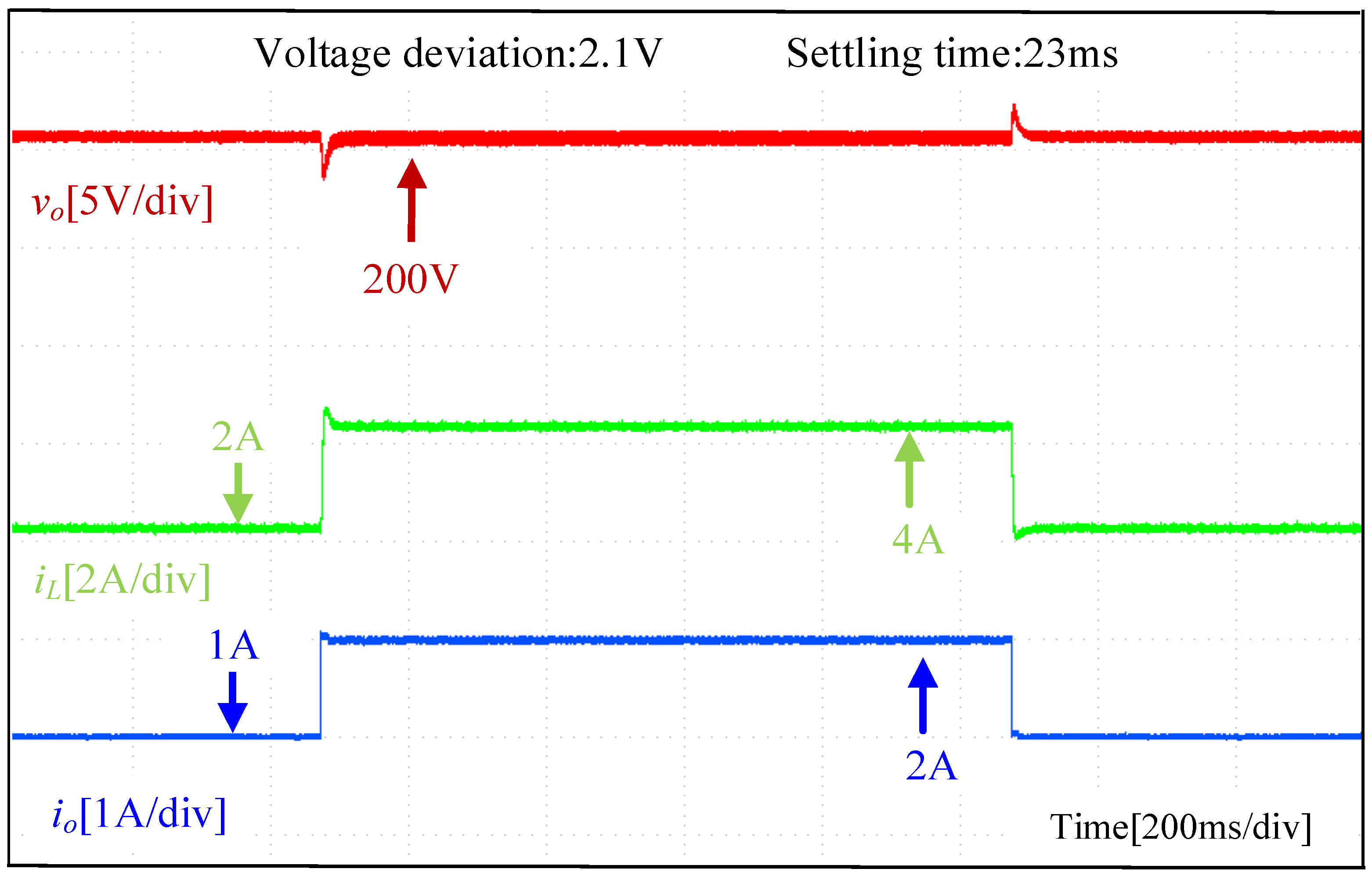
The system was initialized with an input voltage of 100 V and a constant power load of 200 W. The experimental waveforms are shown in
Figure 6. During the test, the constant power load was stepped up to 400 W and, after a period of time, stepped back down to 200 W. Accordingly, the inductor current increased from 2 A to 4 A and then returned to 2 A, while the output current rose from 1 A to 2 A and then recovered to 1 A. The settling time was measured as 23 ms, and the overshoot was limited to 2.1 V. The experimental results demonstrate that the proposed control method can rapidly stabilize the bus voltage under abrupt load changes.
6.2. Case 2: Input Voltage Changes
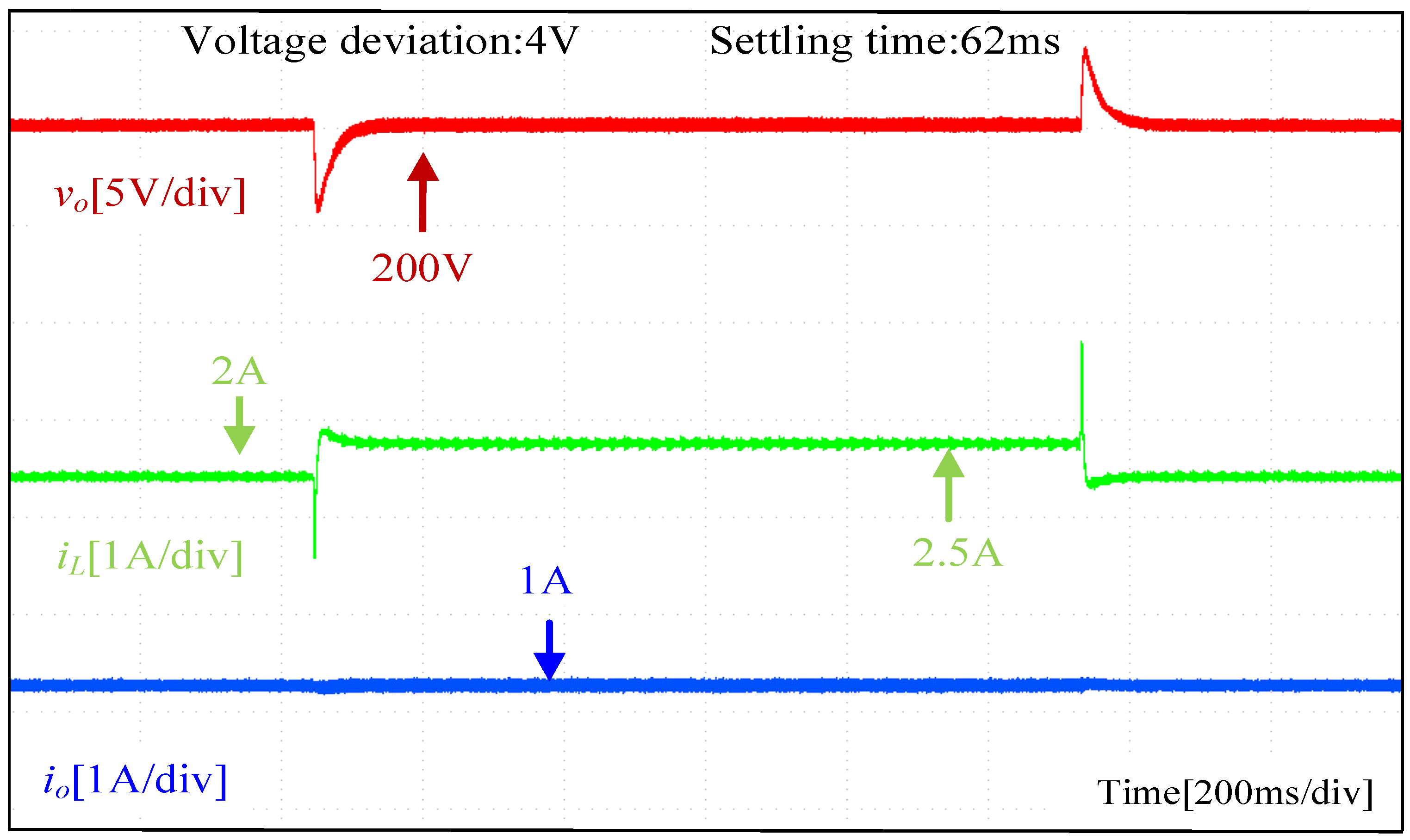
Next, experimental studies were conducted on the proposed control method under input voltage disturbances to evaluate its robustness and stability against source-side variations. The input voltage of the system was varied in the following sequence: 100 V → 80 V → 100 V.
Figure 7 illustrates the comparative experimental waveforms corresponding to the input voltage change from 100 V to 80 V and back to 100 V. It can be observed that the proposed control method is able to rapidly stabilize the bus voltage, with a voltage overshoot of 4 V and a settling time of 62 ms.
6.3. Case 3: Output Voltage Changes
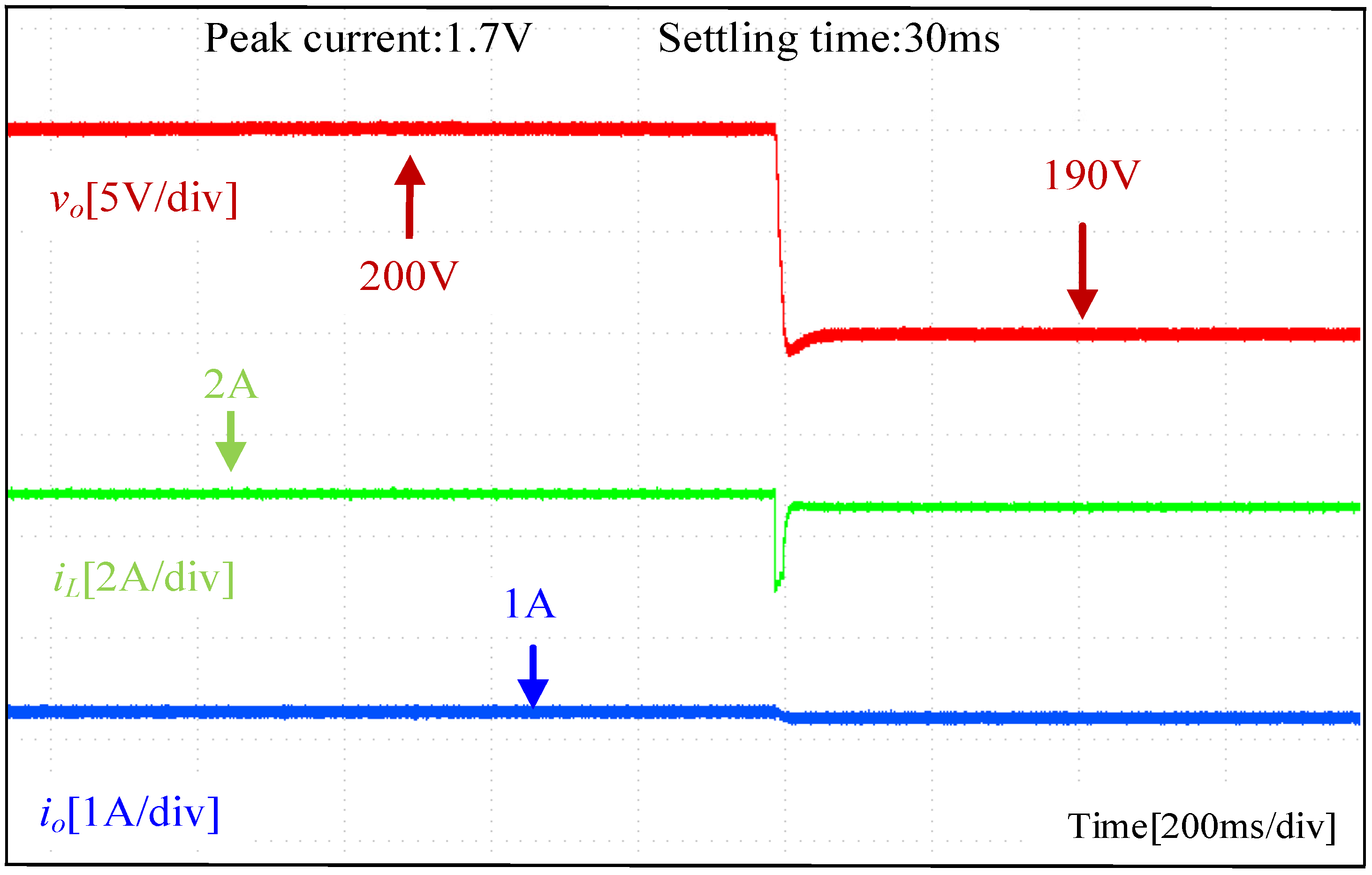
Finally, the dynamic tracking performance of the proposed control method is evaluated by studying its response to changes in the output voltage reference. In this experiment, the output voltage reference of the converter is stepped from 200 V to 190 V while the load is 200 Ω. As shown in
Figure 8, the output voltage rapidly tracks the new reference within 30 ms without any voltage overshoot. The peak inductor current during the transient is 1.7 A. These results demonstrate that the proposed control method provides excellent voltage regulation capability.
7. Conclusions
This paper has proposed a novel control methodology for DC-DC converters that integrates an Extended Kalman Filter (EKF) with Passivity-Based Control (PBC), effectively enhancing system stability under Constant Power Load (CPL) conditions. Initially, the designed Extended Kalman Filter controller accurately estimates the time-varying load power by leveraging real-time converter measurements. This predicted information is subsequently fed into the proposed passivity-based controller to generate PWM signals for driving the power switches, thereby regulating the boost converter supplying the CPLs.
The presented strategy significantly improves large-signal stability and system robustness, while also providing precise current limiting and rapid voltage regulation. These capabilities collectively ensure reliable and stable operation of DC microgrids under various complex operating scenarios. Furthermore, the nonlinear control loop eliminates the conventional requirements for detailed nominal parameters and complex multi-degree-of-freedom tuning, resulting in a relatively simple and practical control structure. Simulation studies validate the superiority of the proposed approach, demonstrating exceptional control performance across various operating conditions.
Author Contributions
Writing—original draft, Conceptualization, P.W. (Peng Wang); AEKF method, Z.M.; PBC method, J.T. and Z.L. Stability analysis, Y.L. Writing—review and editing, Optimization, P.W. (Panbao Wang); Visualization, Y.Z. All authors have read and agreed to the published version of the manuscript.
Funding
This work was supported by technology cooperation project of State Grid Heilongjiang Electric Power Co., Ltd. under Grants 522422240001.
Data Availability Statement
The original contributions presented in this study are included in the article. Further inquiries can be directed to the corresponding author.
Conflicts of Interest
Author P.W., Z.M., J.T., Z.L. and Y.L. were employed by the company Daxinganling Power Supply Company of State Grid Heilongjiang Electric Power Co., Ltd. The remaining authors declare that the research was conducted in the absence of any commercial or financial relationships that could be construed as a potential conflict of interest. The authors declare that this study received funding from technology cooperation project of State Grid Heilongjiang Electric Power Co., Ltd. under Grants (522422240001). The funder was not involved in the study design, collection, analysis, interpretation of data, the writing of this article or the decision to submit it for publication.
References
- Bidram, A.; Davoudi, A. Hierarchical Structure of Microgrids Control System. IEEE Trans. Smart Grid 2012, 3, 1963–1976. [Google Scholar] [CrossRef]
- Dragičević, T.; Lu, X.; Vasquez, J.C.; Guerrero, J.M. DC Microgrids—Part I: A Review of Control Strategies and Stabilization Techniques. IEEE Trans. Power Electron. 2016, 31, 4876–4891. [Google Scholar] [CrossRef]
- Parhizi, S.; Lotfi, H.; Khodaei, A.; Bahramirad, S. State of the Art in Research on Microgrids: A Review. IEEE Access 2015, 3, 890–925. [Google Scholar] [CrossRef]
- Kumar, D.; Zare, F.; Ghosh, A. DC Microgrid Technology: System Architectures, AC Grid Interfaces, Grounding Schemes, Power Quality, Communication Networks, Applications, and Standardizations Aspects. IEEE Access 2017, 5, 12230–12256. [Google Scholar] [CrossRef]
- Meng, L.; Shafiee, Q.; Trecate, G.F.; Karimi, H.; Fulwani, D.; Lu, X.; Guerrero, J.M. Review on Control of DC Microgrids and Multiple Microgrid Clusters. IEEE J. Emerg. Sel. Top. Power Electron. 2017, 5, 928–948. [Google Scholar] [CrossRef]
- Xu, Q.; Vafamand, N.; Chen, L.; Dragičević, T.; Xie, L.; Blaabjerg, F. Review on Advanced Control Technologies for Bidirectional DC/DC Converters in DC Microgrids. IEEE J. Emerg. Sel. Top. Power Electron. 2021, 9, 1205–1221. [Google Scholar] [CrossRef]
- Lu, X.; Sun, K.; Guerrero, J.M.; Vasquez, J.C.; Huang, L.; Wang, J. Stability Enhancement Based on Virtual Impedance for DC Microgrids with Constant Power Loads. IEEE Trans. Smart Grid 2015, 6, 2770–2783. [Google Scholar] [CrossRef]
- Hassan, M.A.; Su, C.-L.; Pou, J.; Almakhles, D.; Zhan, T.-S.; Lo, K.-Y. Robust Passivity-Based Control for Interleaved Bidirectional DC–DC Power Converter with Constant Power Loads in DC Shipboard Microgrid. IEEE Trans. Transp. Electrif 2024, 10, 3590–3602. [Google Scholar] [CrossRef]
- Sadabadi, M.S.; Shafiee, Q. Scalable Robust Voltage Control of DC Microgrids with Uncertain Constant Power Loads. IEEE Trans. Power Syst. 2020, 35, 508–515. [Google Scholar] [CrossRef]
- Hassan, M.A.; Li, E.-P.; Li, X.; Li, T.; Duan, C.; Chi, S. Adaptive Passivity-Based Control of DC–DC Buck Power Converter with Constant Power Load in DC Microgrid Systems. IEEE J. Emerg. Sel. Top. Power Electron. 2019, 7, 2029–2040. [Google Scholar] [CrossRef]
- Sarrafan, N.; Zarei, J.; Razavi-Far, R.; Saif, M.; Khooban, M.-H. A Novel On-Board DC/DC Converter Controller Feeding Uncertain Constant Power Loads. IEEE J. Emerg. Sel. Top. Power Electron. 2021, 9, 1233–1240. [Google Scholar] [CrossRef]
- Li, X.; Jiang, W.; Wang, J.; Wang, P.; Wu, X. An Autonomous Control Scheme of Global Smooth Transitions for Bidirectional DC-DC Converter in DC Microgrid. IEEE Trans. Energy Convers. 2021, 36, 950–960. [Google Scholar] [CrossRef]
- Zeng, J.; Zhang, Z.; Qiao, W. An Interconnection and Damping Assignment Passivity-Based Controller for a DC–DC Boost Converter with a Constant Power Load. IEEE Trans. Ind. Appl. 2014, 50, 2314–2322. [Google Scholar] [CrossRef]
- Ming, J.; Wang, Y.; Wang, F.; Su, B. Large-Signal Stability Analysis and Shunt Active Damper Compensation for DC Microgrid with Multiple Constant Power Loads. In Proceedings of the 22nd International Conference on Electrical Machines and Systems (ICEMS), Harbin, China, 11–14 August 2019; pp. 1–6. [Google Scholar] [CrossRef]
- Ndiwulu, G.W.; De Jaeger, E.; Lusala, A.K.; Matalatala, M. Large-Signal Stability Analysis for Islanded Microgrids Based on Inner Control Loops Approach. In Proceedings of the 2021 IEEE PES/IAS PowerAfrica, Nairobi, Kenya, 23–27 August 2021; pp. 1–5. [Google Scholar] [CrossRef]
- Xia, Y.; Lv, Z.; Wei, W.; He, H. Large-Signal Stability Analysis and Control for Small-Scale AC Microgrids with Single Storage. IEEE J. Emerg. Sel. Top. Power Electron. 2022, 10, 4809–4820. [Google Scholar] [CrossRef]
- Peng, D.; Huang, M.; Li, J.; Sun, J.; Zha, X.; Wang, C. Large-Signal Stability Criterion for Parallel-Connected DC–DC Converters with Current Source Equivalence. IEEE Trans. Circuits Syst. II Express Briefs 2019, 66, 2037–2041. [Google Scholar] [CrossRef]
- Xie, W.; Han, M.; Cao, W.; Guerrero, J.M.; Vasquez, J.C. System-Level Large-Signal Stability Analysis of Droop-Controlled DC Microgrids. IEEE Trans. Power Electron. 2021, 36, 4224–4236. [Google Scholar] [CrossRef]
- Leng, M.; Zhou, G.; Xu, G.; Sahoo, S.; Liu, X.; Zhou, Q.; Yin, Y.; Blaabjerg, F. Small-Signal Stability Assessment and Interaction Analysis for Bipolar DC Microgrids. IEEE Trans. Power Electron. 2023, 38, 5524–5537. [Google Scholar] [CrossRef]
- Cespedes, M.; Xing, L.; Sun, J. Constant-Power Load System Stabilization by Passive Damping. IEEE Trans. Power Electron. 2011, 26, 1832–1836. [Google Scholar] [CrossRef]
- Pang, S.; Nahid-Mobarakeh, B.; Pierfederici, S.; Huangfu, Y.; Luo, G.; Gao, F. Large-Signal Stable Nonlinear Control of DC/DC Power Converter with Online Estimation of Uncertainties. IEEE J. Emerg. Sel. Top. Power Electron. 2021, 9, 7355–7368. [Google Scholar] [CrossRef]
- Lei, J.; Zhou, B.; Qin, X.; Wei, J.; Bian, J. Active Damping Control Strategy of Matrix Converter via Modifying Input Reference Currents. IEEE Trans. Power Electron. 2015, 30, 5260–5271. [Google Scholar] [CrossRef]
- Guan, Y.; Xie, Y.; Wang, Y.; Liang, Y.; Wang, X. An Active Damping Strategy for Input Impedance of Bidirectional Dual Active Bridge DC–DC Converter: Modeling, Shaping, Design, and Experiment. IEEE Trans. Ind. Electron. 2021, 68, 1263–1274. [Google Scholar] [CrossRef]
- Hassan, M.A.; Su, C.-L.; Chen, F.-Z.; Lo, K.-Y. Adaptive Passivity-Based Control of a DC–DC Boost Power Converter Supplying Constant Power and Constant Voltage Loads. IEEE Trans. Ind. Electron. 2022, 69, 6204–6214. [Google Scholar] [CrossRef]
- Viswambharan, A.; Errouissi, R.; Debouza, M.; Shareef, H. Experimental Verification of Disturbance Observer-Based Backstepping Control for DC–DC Boost Converter. IEEE Trans. Circuits Syst. I Regul. Pap. 2023, 70, 5520–5533. [Google Scholar] [CrossRef]
- Zhang, Z.; Wang, P.; Zhou, J.; Wang, W.; Xu, D. A Novel Passivity Model Predictive Control for Predefined-Time Feedforward Compensation in DC Microgrids Feeding Constant Power Loads. IEEE Trans. Power Electron. 2025, 40, 5147–5162. [Google Scholar] [CrossRef]
- Pandey, S.K.; Patil, S.L.; Chaskar, U.M.; Phadke, S.B. State and Disturbance Observer-Based Integral Sliding Mode Controlled Boost DC–DC Converters. IEEE Trans. Circuits Syst. II Express Briefs 2019, 66, 1567–1571. [Google Scholar] [CrossRef]
- Martínez-Treviño, B.A.; Aroudi, A.E.; Valderrama-Blavi, H.; Cid-Pastor, A.; Vidal-Idiarte, E.; Martinez-Salamero, L. PWM Nonlinear Control with Load Power Estimation for Output Voltage Regulation of a Boost Converter with Constant Power Load. IEEE Trans. Power Electron. 2021, 36, 2143–2153. [Google Scholar] [CrossRef]
- Song, J.; Fu, C.; Zhang, G.; Duan, B.; Zhang, C. Backstepping Control of High-Frequency Link Matrix Rectifier for Battery Chargers. IEEE Trans. Power Electron. 2021, 36, 10801–10814. [Google Scholar] [CrossRef]
- Xu, Q.; Zhang, C.; Wen, C.; Wang, P. A Novel Composite Nonlinear Controller for Stabilization of Constant Power Load in DC Microgrid. IEEE Trans. Smart Grid 2019, 10, 752–761. [Google Scholar] [CrossRef]
- Middlebrook, R.D.; Cuk, S. A general unified approach to modelling switching-converter power stages. In Proceedings of the IEEE Power Electronics Specialist Conference, Cleveland, OH, USA, 8–10 June 1976; pp. 18–34. [Google Scholar]
- Abdolahi, M.; Adabi, J.; Mousavi, S.Y.M. An Adaptive Extended Kalman Filter with Passivity-Based Control for DC-DC Converter in DC Microgrids Supplying Constant Power Loads. IEEE Trans. Ind. Electron. 2024, 71, 4873–4882. [Google Scholar] [CrossRef]
- Komurcugil, H. Improved passivity-based control method and its robustness analysis for single-phase uninterruptible power supply inverters. IET Power Electron. 2015, 8, 1558–1570. [Google Scholar] [CrossRef]
| Disclaimer/Publisher’s Note: The statements, opinions and data contained in all publications are solely those of the individual author(s) and contributor(s) and not of MDPI and/or the editor(s). MDPI and/or the editor(s) disclaim responsibility for any injury to people or property resulting from any ideas, methods, instructions or products referred to in the content. |