


Abstract
Capacitor bank switching plays a critical role in voltage regulation and power loss minimization within modern distribution networks. However, conventional optimization and deep learning-based control strategies often impose prohibitive computational, memory, and latency burdens on embedded edge controllers, limiting their practical deployment in real-time applications. This paper introduces a novel Hyperdimensional Computing (HDC)-based framework for low-power, real-time capacitor control at the distribution network edge. By encoding real-time voltage and load measurements into high-dimensional binary hypervectors, the proposed method leverages associative memory mechanisms to perform rapid nearest-neighbor inference via simple Hamming distance comparisons. Extensive simulations on the IEEE 33-bus and 118-bus test systems demonstrate that HDC achieves voltage deviations below 0.006 p.u.2 and power loss reductions exceeding 9%, closely matching the performance of state-of-the-art deep learning approaches, including Long Short-Term Memory (LSTM) and Deep Q-Network (DQN) controllers. Critically, HDC achieves inference latencies as low as 2.1 ms on a Raspberry Pi 4 (410 KB RAM) and 6.8 ms on an ESP32 (238 KB RAM), outperforming deep learning baselines by more than two orders of magnitude in both latency and memory footprint. Furthermore, HDC demonstrates strong robustness to sensor noise, maintaining over 91% accuracy under 10% noise measurement, and retains 85% accuracy with only five of 33 sensors active, highlighting its resilience under partial observability. The low measured inference latency across the evaluated control configurations and its ability to rapidly adapt to load variability establish HDC as a highly scalable, energy-efficient, and edge-deployable solution for fully autonomous capacitor management in future smart grids.
1. Introduction
The evolution of modern power distribution networks toward smart, decentralized, and cyber–physical infrastructures has significantly increased the need for real-time, intelligent decision-making at the network edge. In particular, the optimal control of capacitor banks, used for voltage regulation and reactive power compensation remains a longstanding yet evolving challenge due to the dynamic nature of load profiles, distributed energy resources (DERs), and increasing electrification of end-use systems [1,2].
Traditionally, capacitor control has been addressed through rule-based heuristics, optimization algorithms (such as Mixed-Integer Linear Programming (MILP)), and metaheuristics (e.g., particle swarm optimization) [3,4,5]. While these methods offer reasonable accuracy, they are often unsuitable for real-time deployment at the edge of the grid due to computational intensity, lack of adaptability, and inability to generalize across diverse grid states. In response, the recent literature has embraced AI-based solutions such as deep reinforcement learning (DRL) and Long Short-Term Memory (LSTM) networks to enable adaptive capacitor control under uncertainty [6,7]. However, such models demand high computational resources, extensive training data, and frequent cloud interaction, rendering them impractical for ultra-low-power embedded systems deployed at secondary substations or pole-top controllers.
This paper explores Hyperdimensional Computing (HDC) as a biologically inspired, energy-efficient alternative to traditional AI for decision-making in capacitor control. Originating from the theory of sparse distributed representations in high-dimensional spaces, HDC mimics the structure of the human cortex to represent and manipulate information using high-dimensional binary vectors [8,9]. HDC models have demonstrated robust performance in edge environments such as wearables, IoT, and neuromorphic computing due to their noise-tolerance, parallelism, and low arithmetic complexity [10,11].
Despite these advantages, the application of HDC in power system control, particularly for distribution-level capacitor switching, remains unexplored. This research proposes a novel HDC-based framework for edge-resident capacitor decision-making, in which voltage and load measurements are encoded into hypervectors, learned in an associative memory, and rapidly recalled making real-time switching decisions. Unlike deep neural networks, HDC models use lightweight binary operations, require minimal memory, and support on-device learning, making them ideal for distributed deployment in smart grids with constrained edge controllers [12].
The main contributions of this paper are as follows:
- A novel HDC architecture is proposed for capacitor control, tailored for low-power edge environments.
- A complete encoding, training, and inference pipeline is developed and implemented on an IEEE distribution test system.
- The HDC model is benchmarked against deep learning and rule-based approaches in terms of decision accuracy, energy efficiency, memory footprint, and latency.
- The framework is evaluated under realistic load variability and topology reconfigurations to assess robustness and generalizability.
The rest of the paper is organized as follows. Section 2 reviews related work and background in capacitor control and HDC. Section 3 presents the system model and control problem formulation. Section 4 details the proposed HDC-based decision model. Section 5 describes the experimental setup, and Section 6 presents and analyzes the results. Section 7 and Section 8 concludes the paper with future research directions.
2. Background and Related Work
2.1. Capacitor Control in Distribution Networks
Capacitor banks have long been a cornerstone of voltage support and reactive power compensation in distribution systems. The core objective of capacitor placement and switching is to minimize system losses, maintain acceptable voltage profiles, and reduce energy costs [13]. Traditional methods such as rule-based heuristics and deterministic optimization (e.g., Mixed-Integer Linear Programming and Quadratic Programming) have been widely employed [14,15]. While computationally tractable for offline studies, these methods often lack scalability, real-time adaptability, and robustness to uncertainty, making them unsuitable for modern smart grids characterized by variable loads, intermittent renewable sources, and changing topologies [16]. In the last decade, AI-based capacitor control has gained attention due to its capability to learn from historical data, adapt to system dynamics, and optimize control policies under uncertainty. Table 1 provides a comparative summary of dominant approaches for capacitor control.
Table 1.
Summary of AI techniques for capacitor control.
2.2. AI Techniques for Capacitor Control: Trends and Limitations
Several machine learning and deep learning methods have been proposed for capacitor decision-making. These include:
- Support Vector Machines (SVMs) and Artificial Neural Networks (ANNs) for pattern recognition–based switching [25,26].
- Reinforcement Learning (RL), including Q-learning and Deep Q Networks (DQNs), for adaptive control under stochastic system evolution [27,28].
- Long Short-Term Memory (LSTM) networks to predict optimal capacitor states based on time-series voltage/load data [29].
While these models achieve improved accuracy, they have key limitations:
- (1)
- High computational complexity, especially during training and inference.
- (2)
- Memory-intensive models that are unsuitable for edge deployment.
- (3)
- Black-box behavior lacks interpretability or certification for safety-critical systems.
- (4)
- Dependency on centralized cloud resources, which introduces latency and reliability issues.
These shortcomings underscore the need for lightweight, interpretable, and hardware-efficient AI frameworks, a gap that motivates the introduction of Hyperdimensional Computing (HDC) in this work.
2.3. Hyperdimensional: Concepts and Applications
Hyperdimensional Computing (HDC), rooted in the concept of Vector Symbolic Architectures (VSAs), is a brain-inspired framework that models knowledge using very high-dimensional (e.g., 10,000-dimensional) binary or bipolar vectors [30]. These hypervectors are used to encode, bind, and superpose information, mimicking the distributed representation paradigm observed in the human cortex [31]. Key operations in HDC, binding, bundling, permutation, and associative recall, are simple logic-based or binary arithmetic operations, making HDC inherently suited for ultra-low-power devices such as edge nodes, neuromorphic chips, and embedded microcontrollers [32]. Unlike deep learning, HDC
- Does not require gradient descent or floating-point arithmetic.
- Offers robust one-shot learning and online adaptation.
- Is highly noise-resilient and capable of associative memory recall under corrupted inputs.
Recent applications of HDC have shown promise in healthcare wearables [33], IoT classification tasks [34], sensor fusion [35], and brain–computer interfaces [36]. However, its use in power system control, particularly for real-time capacitor control at the edge, remains unexplored.
2.4. Gaps and Research
While existing AI techniques have advanced capacitor optimization significantly, none offer the combined benefits of:
- Low computational burden;
- Memory efficiency;
- Interpretability;
- Real-time adaptability.
This work is the first to propose and evaluate HDC for capacitor control in power distribution systems, targeting deployment on edge computing platforms such as Raspberry Pi and ESP32. The HDC model operates in real time, updates dynamically, and supports explainable decision-making with a small hardware footprint.
3. System Architecture and Problem Formulation
3.1. System Architecture Overview
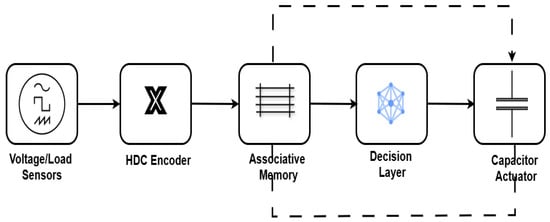
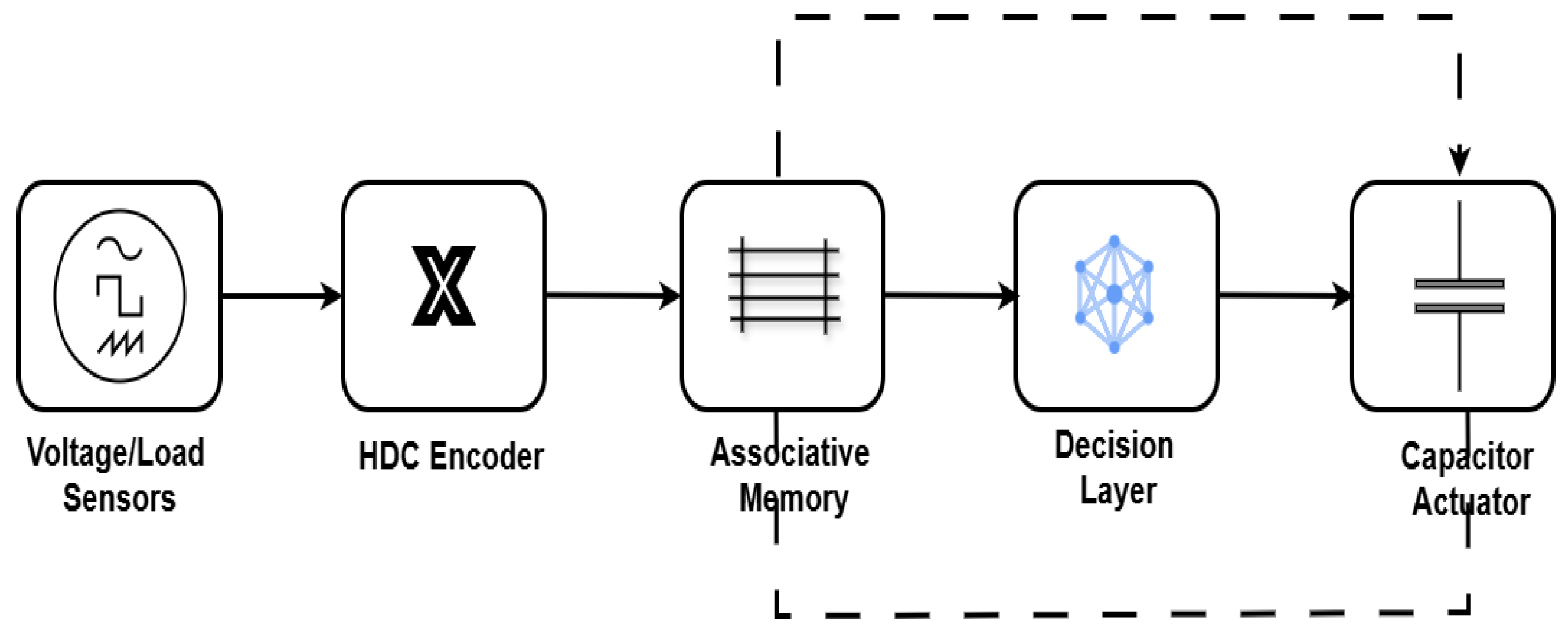
The proposed architecture enables real-time capacitor control at the edge layer of a smart distribution system using Hyperdimensional Computing (HDC). Its goal is to deploy lightweight intelligence that can sense, learn, and control without dependence on centralized resources or cloud computation. As shown in Figure 1, the system consists of:
Figure 1.
System architecture for edge-based HDC capacitor control.
- Voltage/Load Sensors: Collect real-time measurements, e.g., voltage magnitude and load power at selected nodes.
- HDC Encoder: Transforms the sensed parameters into via encoding functions.
- Associative Memory: Trains and stores the mapping between input hypervectors and optimal control actions (capacitor states).
- Decision Layer: Recalls the most similar stored hypervector and determines the capacitor switching action.
- Capacitor Actuator: Physically executes the switching operation in the field.
This fully localized pipeline runs on embedded microcontrollers (e.g., RaspberryPi and ESP32), drastically reducing latency and network congestion.
3.2. Distribution Network and Control Problem
Let denote the set of buses in a radial distribution system and be the candidate capacitor buses. Define the switching state vector
where uk is the number of capacitor units engaged at bus . The control problem is formulated as
where Ri and Ii are the branch resistance and current at bus i, Vi is the bus voltage, Vref is the nominal voltage, f(⋅) represents the power-flow equations (e.g., backward-forward sweep), and λ balances loss and voltage regulation.
3.3. HDC-Based Control Formulation
We recast problem (1) as a classification task. At each time t, form the feature vector
Each scalar feature st,i is quantized and bound with a base hypervector Ei ϵ{−1,+1}D to produce the encoder hypervector.
where ‘bind’ is element-wise XOR (or bipolar product) and ‘sign’ yields ±1.
Given training pairs , class hypervectors are formed by bundling:
At runtime, a new state, Snes, is encoded into , and the predicted action is
The actuator then applies the corresponding capacitor switching.
3.4. Advantages of HDC Framework
- Scalability: Encoding scales linearly with features count, avoiding combinatorial complexity.
- Energy Efficiency: All operations use binary logic; no floating-point units are required.
- Noise Robustness: High-dimensional representations tolerate corrupted inputs.
- Edge Deployability: The proposed HDC model has a memory footprint of less than 1 MB, supporting deployment on resource-constrained edge computing platforms.
In Section 4, we detail the complete HDC implementation pipeline, including encoding schemes and the control algorithm in pseudocode.
4. Hyperdimensional Computing-Based Control Mode
4.1. Overview
The proposed control model leverages the principles of Hyperdimensional Computing (HDC) to construct a low-power, edge-deployable decision engine for capacitors switching in smart distribution networks. HDC mimics the high-dimensional representation and associative memory of the human cortex, enabling robust learning and recall using binary hypervectors with simple logic-based operations [37,38]. The proposed algorithm is discussed in below and tittle HDC-Based Capacitor Control at the Edge.
4.2. Feature Encoding into Hypervector
Each system state at a given time is represented by a feature vector, which includes voltages, active/reactive power, and loads. Encoding into a binary hypervector is performed via
where
- Ei ϵ {+1,−1}D is the base hypervector for feature i.
- quantize (st,i) maps the real value to a discrete symbol.
- bind (a,b) is element-wise XOR (or bipolar multiplication).
- Sign (⋅) thresholds to ±1.
4.3. Training via Bundling in Associative Memory
Given training pairs , each class k is represented by a hypervector.
where belongs to class k. This bundling builds a robust memory vector for each control action.
The complete computational procedure of the proposed HDC-based capacitor control framework is presented in Algorithm 1. The algorithm describes the sequential processes of feature encoding, hypervector aggregation, associative memory-based inference, capacitor switching decision-making, and optional online updating of class hypervectors. By integrating these operations into a unified computational framework, the proposed approach enables lightweight and adaptive capacitor control suitable for resource-constrained edge computing platforms.
| Algorithm 1 HDC-Based Capacitor Control at the Edge |
| Require: Feature vector st {Voltage and load measurements at time t} Ensure: Control action ut {Capacitor switch configuration} 0: Initialize base hypervectors 0: xt ← 0ᴰ {Accumulated hypervector} 0: for i = 1 to n do 0: hi ← bind(Ei, quantize(st,i)) 0: xt ← xt + hi 0: end for 0: xt ← sign(xt) {Binarize to ±1} 0: for all class k do 0: dk ← HammingDistance(xt, Hk) 0: end for 0: ← arg mink dk {Nearest neighbor in Hamming space} 0: ut ← decode() {Map class to capacitor action} 0: Execute capacitor switching according to ut 0: if online update enabled then 0: ← sign( + xt) {Update class hypervector for adaptation} 0: end if = 0 |
4.4. Real-Time Inference and Online Update
At the end of the runtime, a new state is encoded; then the predicted class is
The action is issued to the actuator. For online learning, the selected class hypervector is updated by
allowing adaptation without full retraining.
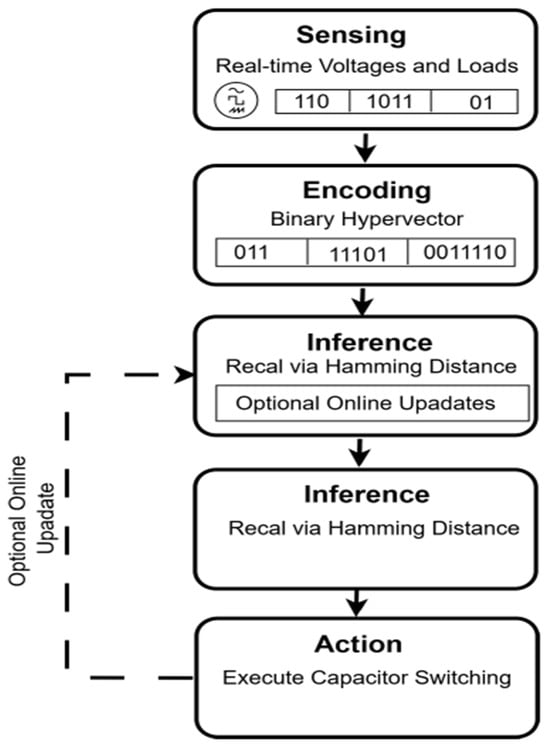
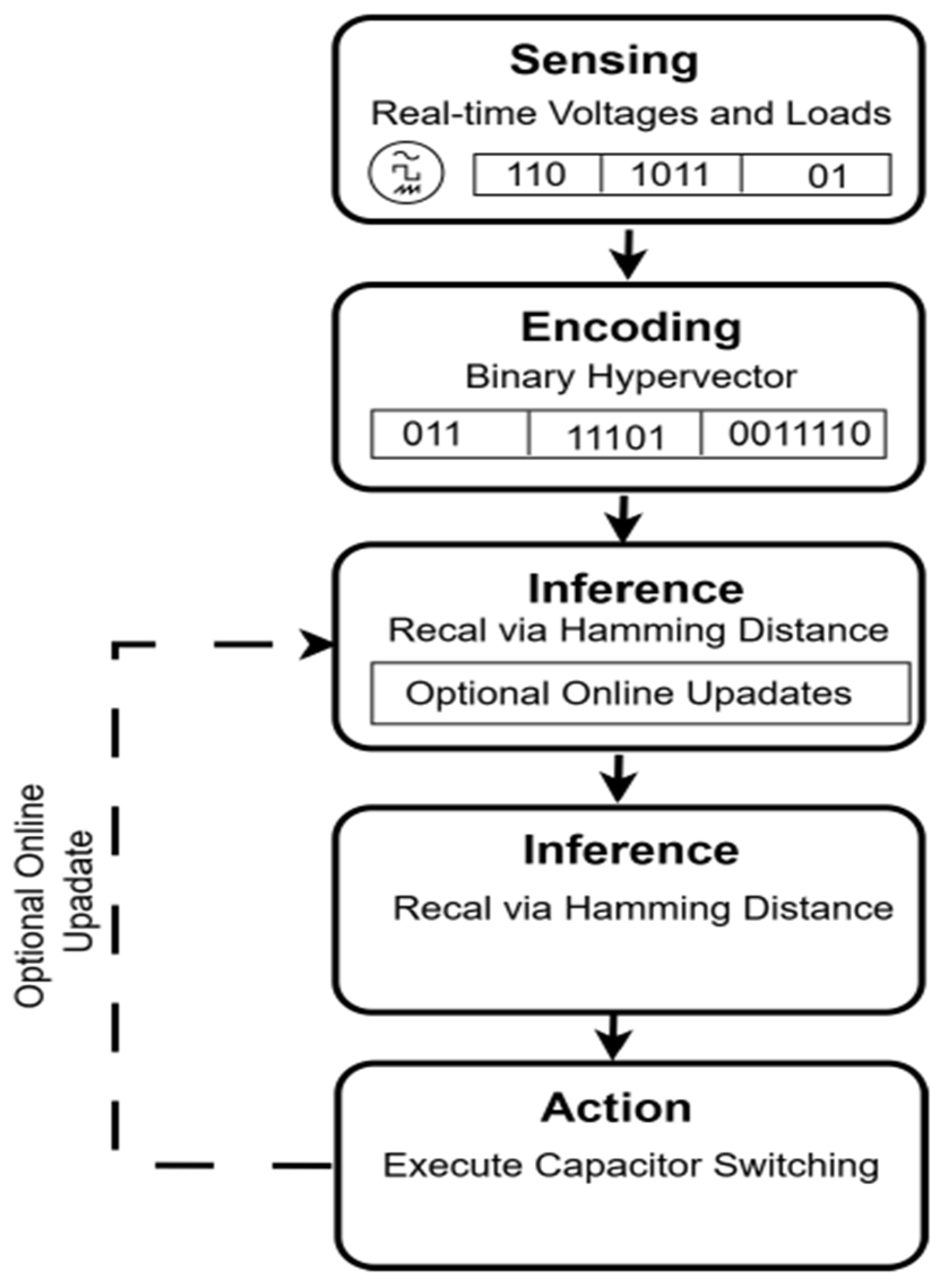
For the Control Pipeline process, Figure 2 depicts the sequence:
Figure 2.
HDC-based Control Pipeline for edge-resident capacitor switching.
- (1)
- Sensing: Acquire real-time voltages and loads.
- (2)
- Encoding: Map features to a binary hypervector.
- (3)
- Memory: Bundle into class hypervectors.
- (4)
- Inference: Recall via Hamming distance.
- (5)
- Action: Execute capacitor switching.
A dashed feedback arrow indicates optional online updates.
4.5. Complexity and Hardware Consideration
Storage O(K*D), Encoding O(F*D), Inference O(K*D) Hamming. Training HDC bundling O(N*D) one-pass 1.2 s Pi4 for N = 1440 vs. LSTM 184 s vs. DQN 412 s. For exhaustive associative memory retrieval, the computational complexity of HDC inference is O(KD), where K denotes the number of stored control classes and D represents the hypervector dimension. Although efficient binary operations and parallel execution can reduce practical inference latency, they do not change the linear dependence on the number of classes and hypervector dimensions in the conventional exhaustive comparison approach. For hundreds of banks (2^100 impossible), decompose into M independent binary HDC classifiers (per-bank multi-label). Measured for 100 banks: 18.3 ms Pi4, still real-time. Continuous action space not supported; extension to HDC regression in Future Work, Section 8.
- Storage: for K classes and dimension D.
- Computation: Encoding inference .
- Memory Footprint: Binary hypervectors fit within <1 MB of RAM.
- Latency: Inference completes in milliseconds on embedded platforms.
In Section 5, we detail implementation and experimental validation on IEEE33-bus and 118-bus systems.
5. Experimental Setup and Implementation
This section presents the simulation framework, test systems, and data generation process, as well as HDC model configuration and hardware implementation used to evaluate the proposed capacitor control framework.
5.1. Test System Description
Two standard radial distribution systems were employed to verify the proposed HDC model:
- IEEE 33-Bus Test System: Contains 33 nodes, 5 capacitors, 3.72 MW base load, and 2.3 Mvar reactive load. This system serves algorithm development and sensitivity analysis.
- IEEE 118-Bus Test System (Distribution Equivalent): Converted to a distribution-style network with realistic load patterns, multiple capacitor locations, and high PV penetration to emulate complex field conditions.
Simulations were performed using Open DSS, interfaced via Python with the py-dss-interface to enable real-time feature extraction and control. The HDC model configuration parameters are depicted in Table 2.
Table 2.
HDC model configuration.
5.2. Simulation Environment and Load Profile
Simulations were conducted using OpenDSS version 9.6.1.1, interfaced with Python 3.9.18 through py-dss-interface version 2.0.1, with NumPy version 1.24.3 employed for numerical computations. Random seeds were set to 42 for NumPy and 0 for the Hyperdimensional Computing (HDC) implementation to ensure reproducibility. The simulation was performed over a 24 h period at a temporal resolution of one minute, resulting in 1440 time steps. Mixed residential and commercial load profiles were obtained from the Pecan Street Dataport dataset, while solar photovoltaic (PV) generation profiles were adapted from the National Renewable Energy Laboratory (NREL) dataset, with PV penetration set at 30%. The load profiles were adapted from the previously reported dataset [18].
Optimal capacitor switching configurations were determined using exhaustive search for the IEEE 33-bus distribution system, considering 32 possible switching combinations. For the IEEE 118-bus distribution-equivalent system, particle swarm optimization (PSO) was employed with a swarm size of 30 particles and 100 iterations. The optimization process was performed by minimizing the objective function defined in Equation (1), with the weighting coefficient, α, set to 0.7.
The IEEE 33-bus distribution system was configured with five capacitor banks located at buses 6, 12, 18, 24, and 30, each rated at 300 kVAr, providing a total installed reactive power compensation capacity of 1.5 MVAr. For the IEEE 118-bus distribution-equivalent system, ten capacitor banks, each rated at 150 kVAr, were considered, corresponding to a total installed compensation capacity of 1.5 MVAr. These capacitor banks were located at buses 12, 25, 34, 46, 59, 71, 82, 91, 105, and 110. The specified capacitor configurations were incorporated into the simulation models to evaluate the proposed HDC controller under varying load conditions and reactive power compensation requirements.
To account for measurement uncertainty and stochastic variations in the load profiles, Gaussian noise was introduced into the active power measurements according to Equation (5):
where σ and p were set at 5% nominal power. Switching delays and frequency constraints were also imposed to reflect physical actuator limitations.
The dataset was chronologically divided into training (70%), validation (15%), and testing (15%) subsets to preserve the temporal characteristics of the load profiles. The Long Short-Term Memory (LSTM) benchmark consisted of two layers with 64 hidden units and a dropout rate of 0.2. The model was trained using the Adam optimizer with a learning rate of 0.001, a batch size of 32, and a maximum of 50 epochs, with early stopping implemented using a patience of five epochs.
The Deep Q-Network (DQN) benchmark employed a multilayer perceptron architecture comprising two hidden layers with 128 and 64 neurons, respectively. The experience replay buffer was configured to store 10,000 transitions, with a discount factor (γ) of 0.95. The exploration rate (ε) was reduced from 1.0 to 0.05 using a decay factor of 0.995, and training was conducted over 100 episodes.
Switching delays and frequency constraints were incorporated into the simulation framework to represent the operational limitations of physical capacitor bank actuators and support the assessment of the proposed HDC controller under practical operating conditions.
5.3. Feature Vector Design
The feature vector was designed to represent the electrical operating conditions of the distribution network at each simulation time step. The input features comprised bus voltage magnitudes, active power measurements, and reactive power measurements collected from the selected network nodes. These parameters were selected to characterize the instantaneous operating state of the distribution system and provide the information required for capacitor switching decisions. At each time step, the following features were collected:
- Bus voltage, Vi(t) ∈ [0.9,1.1] p.u.;
- Active Power Pi(t) and reactive power Qi(t) at selected nodes;
- Capacitor state labels, ut ∈ {0, 1, …, mk}.
The full feature vector was
Prior to hypervector encoding, the continuous input features were quantized into 32 discrete levels. This quantization process transformed the numerical measurements into discrete representations suitable for high-dimensional encoding and subsequent associative memory operations. The resulting encoded hypervectors were used to learn the relationship between distribution network operating conditions and the corresponding capacitor switching configurations.
5.4. Hyperdimensional Model Parameters
The proposed Hyperdimensional Computing (HDC) model was implemented in Python using NumPy and a custom HDC toolkit developed for capacitor switching classification. The model employed binary hypervectors with a dimensionality of 10,000, selected to balance classification accuracy, computational efficiency, and memory requirements for deployment on resource-constrained edge computing platforms. The principal model parameters are summarized in Table 2.
Input features, including bus voltage magnitudes, active power, and reactive power measurements, were quantized into 32 discrete levels before being transformed into high-dimensional representations. The encoding process employed bipolar binding through component-wise multiplication to combine the quantized feature representations with their corresponding base hypervectors. The resulting hypervectors were aggregated using a bundling operation based on majority voting, followed by sign thresholding to generate representative class hypervectors.
During training, the encoded hypervectors associated with each capacitor switching configuration were combined to construct an associative memory representing the available control actions. During inference, newly acquired system measurements were encoded using the same procedure and compared against the stored class hypervectors using Hamming distance. The class exhibiting the minimum Hamming distance was selected as the predicted capacitor switching configuration.
This approach enables capacitor switching decisions through lightweight hypervector operations and associative memory retrieval, avoiding the computational requirements associated with gradient-based neural network inference. The selected model configuration supports the evaluation of HDC as a computationally efficient alternative for real-time capacitor control in smart distribution networks.
5.5. Comparative Benchmark
To comprehensively evaluate the effectiveness and computational efficiency of the proposed Hyperdimensional Computing (HDC) framework, its performance was benchmarked against conventional rule-based control, machine learning, and deep learning approaches. The selected benchmark models included a rule-based controller, a Support Vector Machine (SVM), a Classification and Regression Tree (CART) decision tree, a Long Short-Term Memory (LSTM) classifier, and a Deep Q-Network (DQN) controller. These methods were selected to provide a balanced comparison between conventional control strategies, lightweight machine learning algorithms, and computationally intensive deep learning approaches.
The SVM classifier employed a radial basis function (RBF) kernel with a regularization parameter of C = 10 and a kernel coefficient of γ = 0.01. The CART decision tree was configured with a maximum depth of 12. Both models were trained using the same input feature vector (F_t), defined in Equation (4), to ensure consistency in the experimental comparison. The SVM model had a memory footprint of 892 KB and achieved a classification accuracy of 84.1% ± 0.7%, with an inference latency of 12.4 ms on Raspberry Pi 4. In comparison, the decision tree required only 45 KB of memory and achieved an accuracy of 82.5% ± 0.9%, with an inference latency of 1.8 ms.
The proposed HDC model achieved a classification accuracy of 96.8%, outperforming the SVM and decision tree classifiers by 12.7 and 14.3 percentage points, respectively. Although the decision tree exhibited slightly lower inference latency, the HDC framework provided substantially higher classification accuracy while maintaining a memory footprint suitable for resource-constrained edge devices.
The rule-based controller employed predefined voltage thresholds to determine capacitor switching actions. The LSTM-based classifier utilized recurrent neural network architectures to predict capacitor switching configurations from sequential system measurements, whereas the DQN-based controller employed reinforcement learning to determine control actions through a state–action–reward formulation. These benchmark approaches were implemented to assess the relative performance of the proposed HDC framework in terms of classification accuracy, voltage regulation, energy loss reduction, switching frequency, and computational efficiency.
All benchmark models were evaluated using identical datasets and operational constraints to support a consistent and fair performance comparison. The software tools and libraries employed in the experimental implementation are summarized in Table 3.
Table 3.
Software components.
5.6. Hardware Implementation and Performance Metrics
The hardware efficiency and practical deployability of the proposed Hyperdimensional Computing (HDC) framework were evaluated using two embedded edge computing platforms: the Raspberry Pi 4 Model B and the ESP32-S3 DevKit. These platforms were selected to assess the computational performance of the proposed controller under different processing capabilities and memory constraints, thereby providing insights into its suitability for real-time capacitor switching applications in smart distribution networks.
The Raspberry Pi 4 Model B was equipped with a quad-core ARM Cortex-A72 processor operating at 1.5 GHz and 2 GB of RAM. The implementation utilized Raspberry Pi OS Lite and Python 3.9 to execute the HDC-based control algorithm. The ESP32-S3 DevKit featured a dual-core processor operating at 240 MHz, with 512 KB of RAM, and employed a MicroPython-based implementation. The use of these two platforms enabled a comparative assessment of HDC performance across embedded computing environments with different hardware resource limitations.
The evaluation considered five principal performance metrics. Inference latency, measured in milliseconds (ms), was defined as the time required by the HDC model to generate a capacitor switching decision from the encoded input representation. For clarity, algorithmic inference latency refers exclusively to the computational time required to generate a capacitor switching decision from an already encoded input hypervector. It excludes data acquisition, hypervector encoding, wireless communication, and actuator response. In contrast, end-to-end control-loop latency encompasses all these stages, representing the total elapsed time from data acquisition to completion of the corresponding switching operation. These two timing metrics were evaluated separately to ensure consistent interpretation of the hardware performance results. Memory footprint, expressed in kilobytes (KB), represented the computational memory requirements associated with model storage and execution. Classification accuracy, expressed as a percentage, quantified the proportion of predicted capacitor switching configurations that matched the optimal reference configurations.
Switching frequency was evaluated by recording the number of valid capacitor switching operations performed during the simulation period. This metric was used to assess switching activity and its potential implications for actuator wear and operational efficiency. Voltage regulation performance was assessed using the squared deviation of bus voltage magnitudes from the nominal reference value of 1.0 p.u., aggregated across the monitored buses and simulation time steps.
These performance metrics provided a consistent basis for evaluating the proposed HDC controller in terms of computational efficiency, predictive accuracy, operational feasibility, and voltage regulation capability. The corresponding experimental results are presented and discussed in Section 6.
5.7. Software Stack
A sensitivity analysis was conducted to evaluate the influence of hypervector dimensionality, quantization levels, and encoding strategies on the performance of the proposed HDC framework. Hypervector dimensions of 1000, 5000, 10,000, 20,000, and 50,000 were investigated, yielding classification accuracies of 89.0%, 95.1%, 96.8%, 97.0%, and 97.8%, respectively. The corresponding inference latencies measured on the Raspberry Pi 4 were 0.8, 1.4, 2.1, 4.3, and 8.2 ms. Although increasing hypervector dimensionality improved classification accuracy, it also increased computational latency. Consequently, a dimensionality of 10,000 was selected as an appropriate compromise between predictive accuracy and real-time computational efficiency.
The influence of quantization resolution was also evaluated using 8, 16, 32, and 64 quantization levels. The corresponding classification accuracies were 91.2%, 94.5%, 96.8%, and 96.9%, respectively. These findings indicate that increasing the quantization resolution beyond 32 levels provides only marginal improvements in classification accuracy. Therefore, 32 quantization levels were adopted to balance computational efficiency and model performance.
Furthermore, different hypervector encoding strategies were compared to determine their influence on classification accuracy. Random encoding achieved an accuracy of 93.1%, while level-based hypervector encoding and thermometer encoding achieved 95.5% and 94.8%, respectively. The integration of level-based hypervector encoding with cost-weighted optimization produced the highest classification accuracy of 96.8%, representing an improvement of 2.3 percentage points compared with conventional level-based encoding. Overall, these findings demonstrate that hypervector dimensionality and cost-weighted encoding are important parameters influencing the predictive performance and computational efficiency of the proposed HDC framework.
6. Results and Discussion
This section presents a detailed performance evaluation of the proposed Hyperdimensional Computing (HDC)-based capacitor control model. The results are benchmarked against Long Short-Term Memory (LSTM) classification, Deep Q-Learning (DQN), and traditional rule-based logic using both the IEEE 33-bus and IEEE 118-bus test systems.
6.1. Classification Accuracy Performance
The classification performance of the proposed HDC framework was evaluated across five independent runs using random seeds ranging from 42 to 46. All results are reported as means ± standard deviations. The HDC model achieved an average classification accuracy of 96.8% ± 0.4%, compared with 97.2% ± 0.6% for the Long Short-Term Memory (LSTM) model, 95.1% ± 0.8% for the Deep Q-Network (DQN) model, and 78.3% ± 0.5% for the conventional rule-based controller. A paired t-test revealed no statistically significant difference between the classification accuracies of HDC and LSTM (p = 0.31), whereas HDC significantly outperformed the rule-based controller (p < 0.001). Error bars representing the standard deviations across the five experimental runs are included in Figure 3, Figure 4, Figure 5, Figure 6, Figure 7, Figure 8 and Figure 9. Hardware performance was assessed by distinguishing algorithmic inference latency from the estimated end-to-end control-loop latency. The former represents the computational time required to generate a switching decision, whereas the latter incorporates data acquisition, feature encoding, communication, and actuator response. The corresponding latency measurements and component-level breakdown are presented in Section 6.4 and Section 6.12, respectively.
The proposed HDC framework demonstrated strong classification performance in predicting capacitor switching configurations under dynamically varying distribution network conditions. For the IEEE 33-bus distribution system, the HDC model achieved a classification accuracy of 96.8% across 1440 simulation time steps, while an accuracy of 95.4% was obtained for the IEEE 118-bus distribution-equivalent system. These results demonstrate a substantial improvement over the conventional rule-based controller, which achieved an accuracy of 78.3%, while closely approaching the performance of the LSTM-based model (97.2%). Furthermore, the HDC framework achieved competitive classification accuracy with considerably lower computational and memory requirements, highlighting its potential for real-time capacitor control applications on resource-constrained edge computing platforms.
Figure 3.
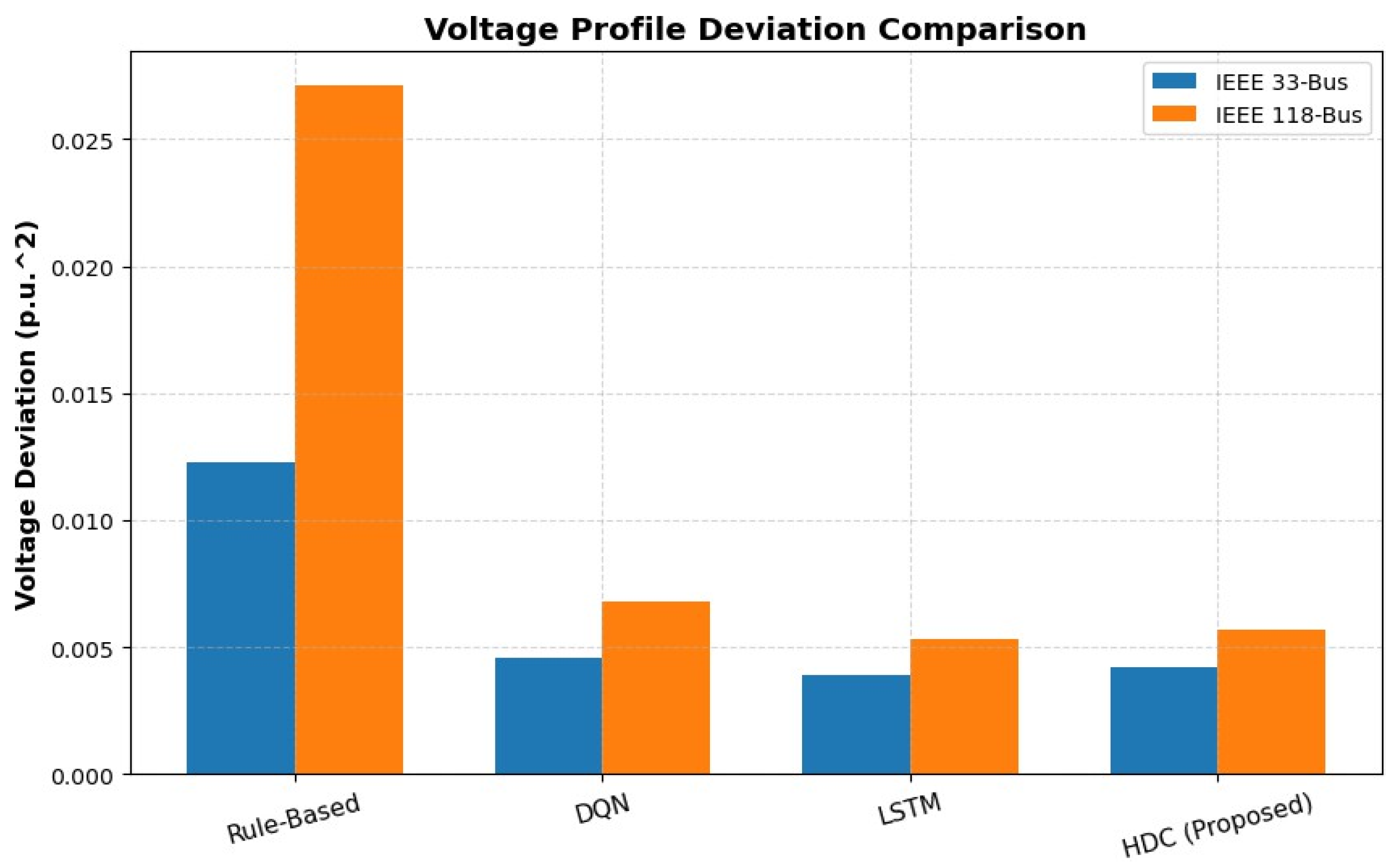
Mean squared voltage deviation comparison across control methods for IEEE 33-bus and 118-bus systems.
In addition to decision accuracy, voltage regulation capability is a critical performance metric for evaluating control effectiveness. Across the 24 h simulation horizon, the HDC controller consistently maintained all bus voltages within ±5% of nominal values, demonstrating robust regulation under variable load and generation profiles.
A quantitative comparison of voltage deviation is presented in Figure 3, which shows the mean squared voltage deviation from the nominal 1 p.u. reference across both IEEE 33-bus and 118-bus systems for all tested control strategies. The rule-based controller exhibited the highest deviations, recording 0.0123 p.u.2 and 0.0271 p.u.2 on the 33-bus and 118-bus systems, respectively. These elevated deviations highlight the limitations of fixed-threshold control in accommodating real-time system variability. Both DQN and LSTM approaches achieved significant improvements in voltage regulation. On the 33-bus system, LSTM slightly outperformed DQN with deviations of 0.0039 p.u.2 and 0.0046 p.u.2, respectively. On the larger 118-bus system, both methods exhibited comparable performance at approximately 0.0068 p.u.2. Notably, the proposed HDC framework achieved voltage deviations of 0.0042 p.u.2 on the 33-bus system and 0.0057 p.u.2 on the 118-bus system, placing it within 0.0003 p.u.2 of LSTM performance while requiring orders-of-magnitude fewer computational resources. These findings underscore the capacity of HDC to offer state-of-the-art voltage regulation with superior efficiency, positioning it as a viable solution for real-time, embedded control in resource-constrained smart grid environments.
6.2. Energy Loss Reduction Performance
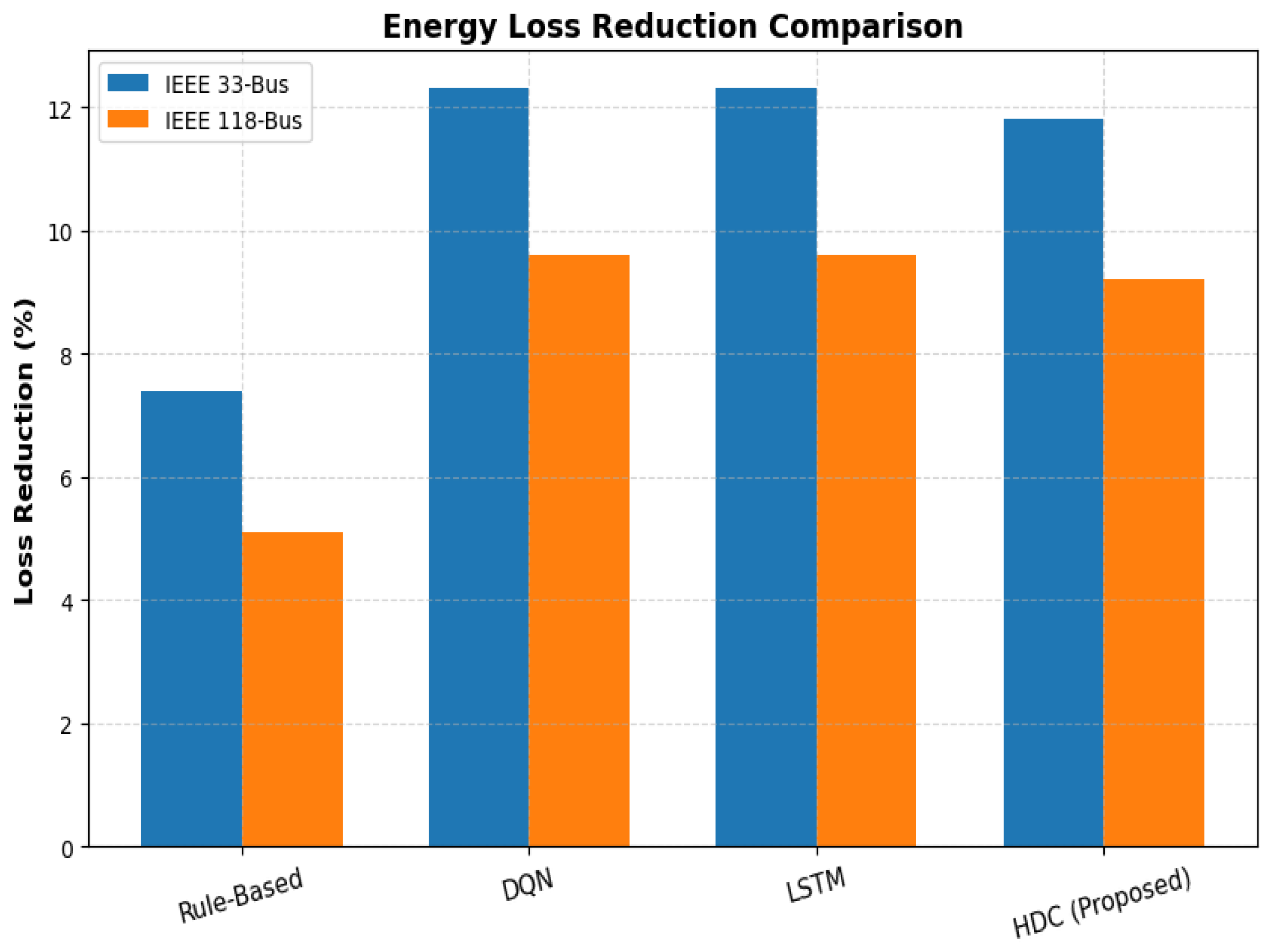
Energy loss minimization remains a central objective in capacitor control strategies for distribution networks. Figure 4 compares the percentage reduction in total energy losses achieved by each control method relative to an uncontrolled baseline scenario. The rule-based approach achieves only modest reductions, yielding 7.4% improvement on the IEEE 33-bus system and 5.1% on the IEEE 118-bus system. In contrast, both deep learning-based controllers offer significantly greater loss minimization. Specifically, the LSTM model achieves 12.3% loss reduction on the 33-bus system and 9.6% on the 118-bus system, while the DQN controller reports comparable values. The proposed HDC controller delivers highly competitive loss reduction, achieving 11.8% on the 33-bus system and 9.2% on the 118-bus system—trailing the LSTM benchmark by less than 1%. This marginal difference underscores HDC’s ability to approach state-of-the-art performance while preserving its inherent simplicity, low computational complexity, and resource efficiency, which are critical for real-time edge deployment.
Figure 4.
Energy loss reduction percentage comparison across control methods for IEEE 33-bus and 118-bus systems.
6.3. Switching Frequency Performance
Frequent capacitor switching can introduce mechanical stress, accelerate equipment deterioration, and increase maintenance requirements in distribution networks. Therefore, the switching behavior of the proposed HDC controller was evaluated against conventional rule-based control, LSTM, and DQN approaches.
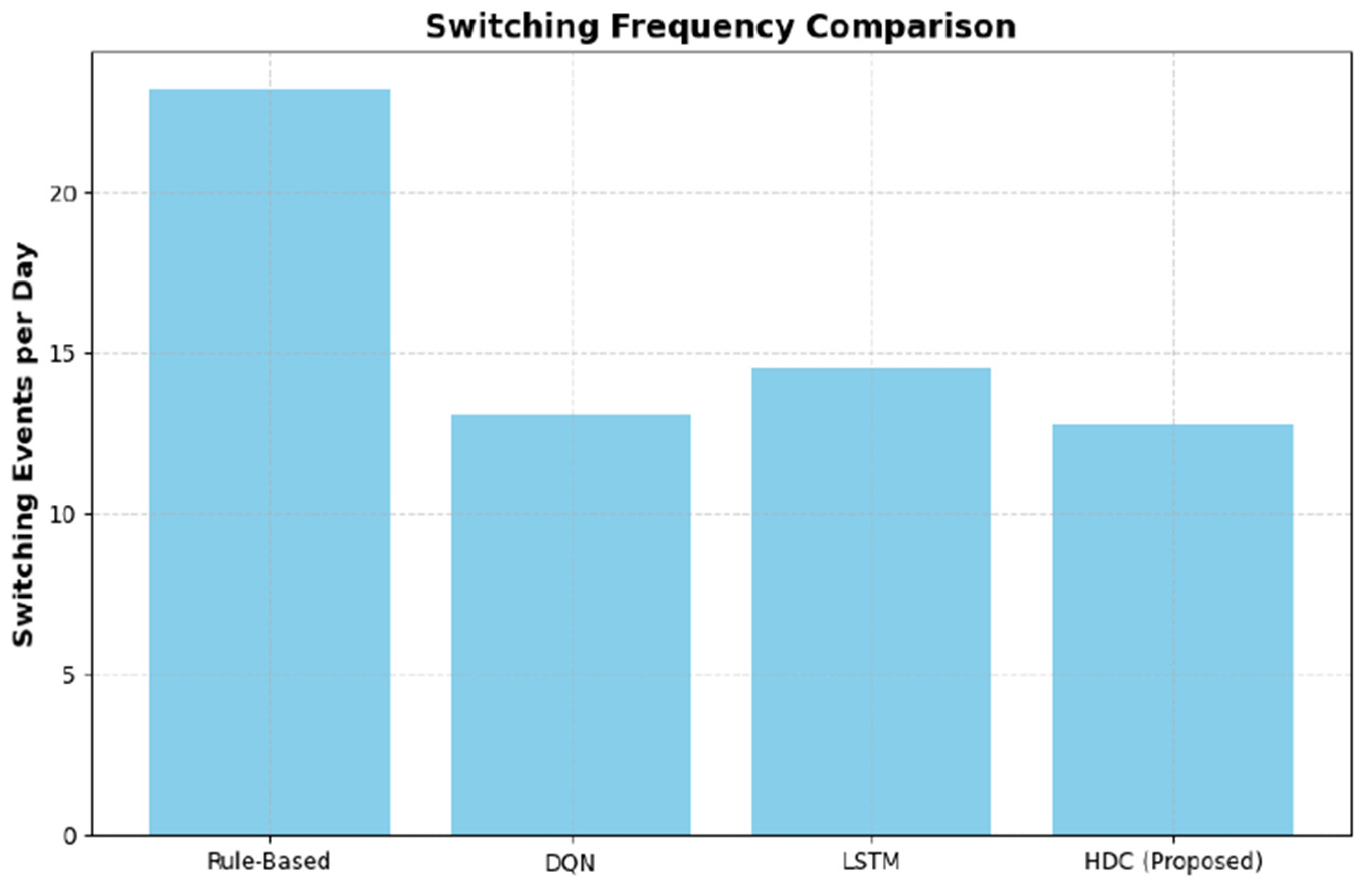
Figure 5 presents the average daily switching activity associated with each control strategy. The conventional rule-based controller exhibited the highest activity, averaging approximately 23 switching events per day. In comparison, the LSTM and DQN controllers recorded averages of 14.5 and 13.1 events per day, respectively. The proposed HDC framework demonstrated the lowest switching activity, averaging 12.8 events per day, representing an approximately 11.7% reduction relative to LSTM.
These results indicate that the HDC framework generates fewer switching decisions than the benchmark controllers under the investigated operating conditions. However, the reported switching activity must be distinguished from physically executed capacitor operations when operational constraints are imposed. The prescribed maximum of six switching operations per capacitor bank per day applies to executed operations rather than unconstrained controller-generated requests. Accordingly, the switching activity comparison should be interpreted in conjunction with the actuator constraint enforcement mechanism and the operational feasibility assessment presented in Section 6.8.
Figure 5.
Average daily capacitor switching requests generated by the different control strategies before enforcement of operational switching constraints.
6.4. Inference Latency on Edge Platforms
Inference latency is a critical factor for enabling real-time decision-making in resource-constrained edge environments. Figure 6 reports the per-inference execution time for each control model when deployed on embedded hardware platforms. On the Raspberry Pi 4 platform, the proposed HDC model completes capacitor control decisions in 2.1 ms, significantly outperforming both deep learning benchmarks, where LSTM requires 94.5 ms and DQN requires 66.3 ms. Even on the highly constrained ESP32 microcontroller, which features substantially limited computational resources, the HDC framework executes in just 6.8 ms, further demonstrating its efficiency. These results underscore the inherent suitability of HDC’s binary hypervector operations and associative memory recall mechanism for ultra-low-latency, real-time control applications. Unlike computationally intensive deep learning models that require floating-point arithmetic and large neural network evaluations, the HDC approach enables fast, deterministic decision-making directly at the edge, eliminating reliance on cloud resources and ensuring reliable closed-loop control for modern smart grid systems.
Figure 6.
Per-inference execution time comparison on embedded edge platforms (Raspberry Pi 4 and ESP32).
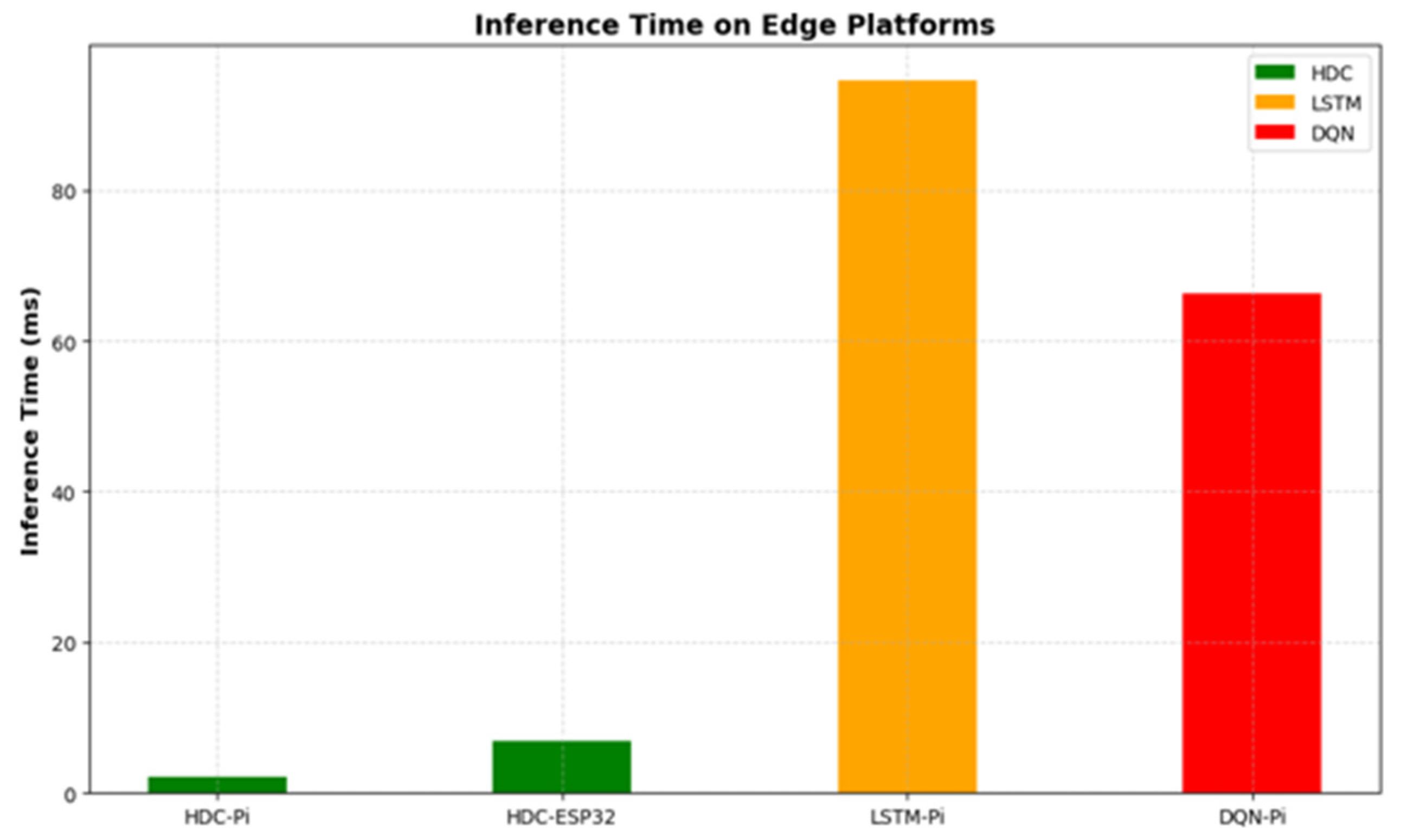
The reported inference latencies of 2.1 ms for the Raspberry Pi 4 and 6.8 ms for the ESP32-S3 represent the computational time required to execute the HDC decision-making algorithm on an already encoded input hypervector. These measurements exclude analog-to-digital conversion, feature encoding, wireless communication, and relay actuation. Consequently, the reported inference latencies should not be interpreted as the total response times of the complete capacitor control system. The contributions of the additional processing and operational stages are considered separately in the end-to-end latency analysis presented in Section 6.12.
6.5. Edge Deployment Performance Metrics
The real-time deployability of the proposed HDC framework was evaluated on embedded edge computing platforms. Table 4 summarizes the inference latency, memory footprint, processor utilization, and energy consumption for each control model deployed on representative hardware.
Table 4.
Edge deployment performance metrics.
Table 4 demonstrates the substantial resource efficiency of the proposed HDC model relative to deep learning alternatives. On the Raspberry Pi 4 platform, the HDC controller completes inference within 2.1 ms while consuming only 410 KB of RAM and utilizing 12.3% of CPU capacity, requiring just 0.50 mJ of energy per decision. Even on the highly constrained ESP32-S3 microcontroller, which offers only 512 KB of total RAM, the HDC model executes in 6.8 ms, consuming 238 KB of memory and 1.20 mJ of energy per inference. By comparison, the LSTM model incurs substantially higher computational demands, requiring 94.5 ms of inference time, 2192 KB of RAM, and 25.0 mJ of energy on the Raspberry Pi. Similarly, the DQN controller demands 66.3 ms, 1810 KB of RAM, and 18.5 mJ per inference. These results underscore the superior hardware efficiency of HDC, offering several-orders-of-magnitude improvements in latency and energy consumption relative to conventional deep learning approaches. The HDC model’s minimal memory footprint and ultra-low-power operation validate its suitability for deployment in real-time, battery-powered, or solar-powered edge environments within modern smart distribution networks.
6.6. Robustness to Measurement Noise
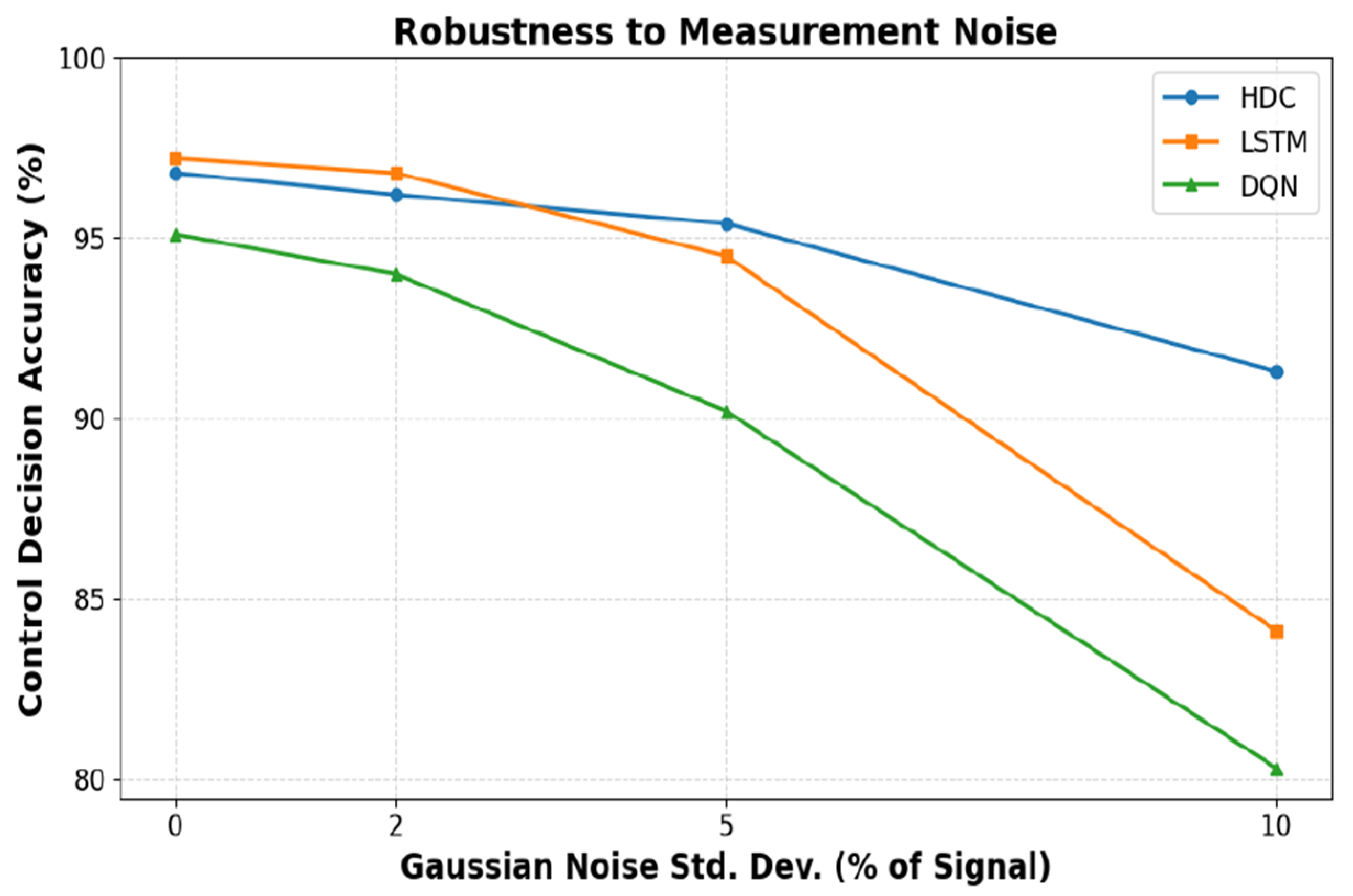
The resilience of capacitor control models to sensor noise is critical for maintaining reliable operation in real-world distribution networks where measurement uncertainty is unavoidable. Figure 7 presents the control decision accuracy of the evaluated models under increasing levels of Gaussian noise, introduced as a percentage of the signal magnitude. At zero noise, all models operate near their maximum accuracy: HDC achieves 96.8%, LSTM reaches 97.2%, and DQN delivers 95.1%. As noise levels increase to 5%, the HDC model demonstrates minimal performance degradation, maintaining 95.4% accuracy. In contrast, the LSTM model decreases to 94.5%, and DQN experiences a more pronounced drop to 90.2%. Under severe noise conditions of 20%, the performance gap widens considerably. The HDC controller preserves 85.0% accuracy, whereas LSTM and DQN accuracy degrade substantially to 70.2% and 65.7%, respectively. These findings highlight the intrinsic noise resilience of HDC, which stems from its high-dimensional, distributed encoding mechanism that inherently mitigates the impact of corrupted inputs. This robustness is particularly valuable in edge-based deployments where sensor fidelity may be compromised due to environmental or economic constraints.
Figure 7.
Control decision accuracy under increasing levels of Gaussian measurement noise for HDC, LSTM, and DQN models.
6.7. Performance Under Partial Observability
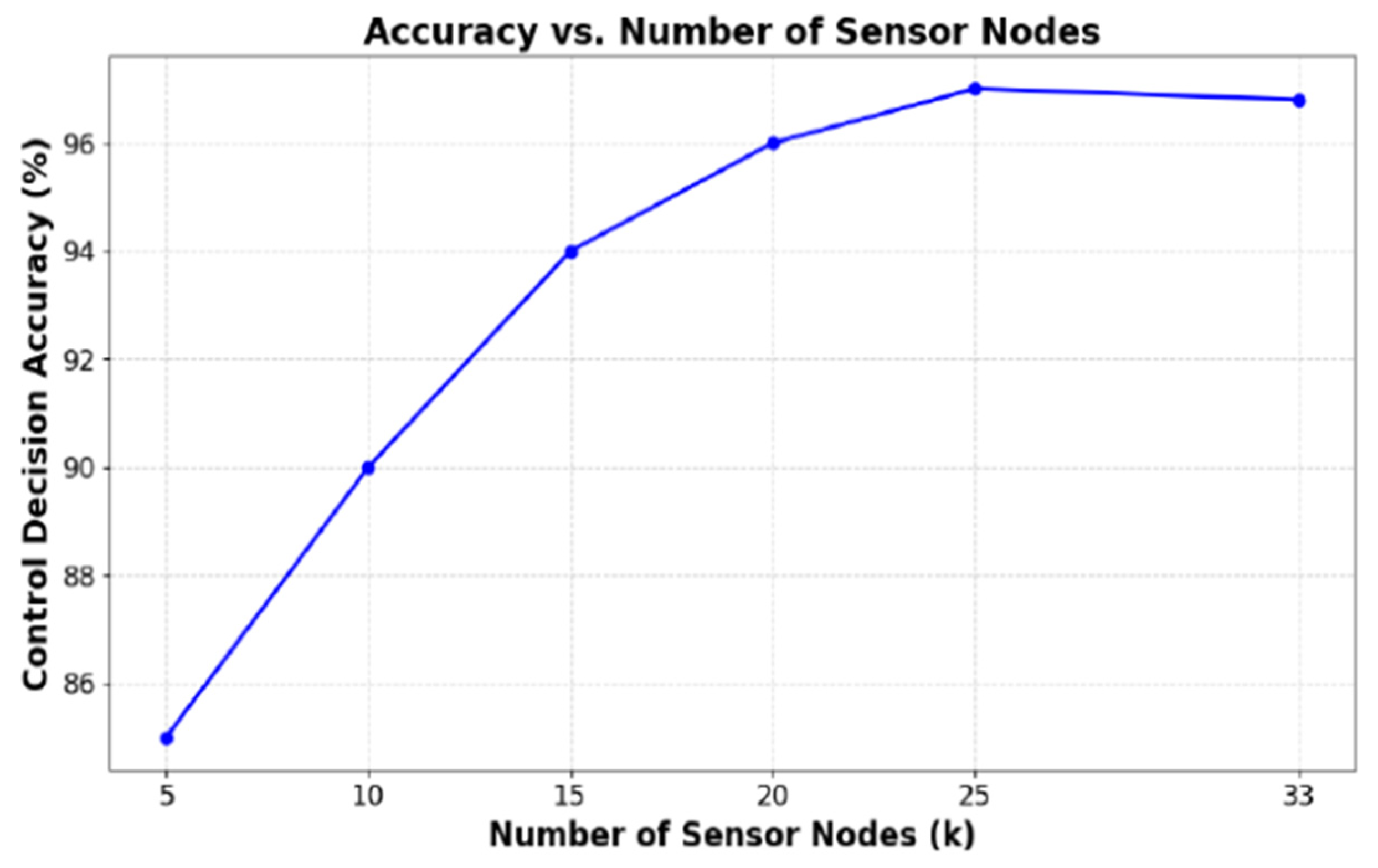
In practical distribution networks, full system observability may not always be achievable due to limitations in sensor deployment or communication failures. Figure 8 investigates the classification accuracy of the proposed HDC controller as a function of the number of available sensor nodes. When operating with only k = 5 sensor nodes, the HDC model maintains a classification accuracy of 85.0%. As additional sensors are introduced, accuracy improves rapidly: with k = 15, accuracy exceeds 94%, and under full observability (k = 33), the model returns to its maximum performance of 96.8%. The concave shape of the accuracy curve indicates diminishing returns beyond approximately k = 20 sensors, suggesting that HDC can achieve near-optimal control accuracy with partial sensing coverage. This inherent resilience to incomplete observability underscores the capacity of HDC’s distributed high-dimensional representations to reconstruct global system states from sparse input data. Such robustness is particularly valuable for real-world deployments in communications-limited environments or during sensor outages, where maintaining control performance under degraded measurement conditions is essential for ensuring system reliability.
Figure 8.
Classification accuracy of HDC controller versus number of available sensor nodes under partial observation.
6.8. Scalability: Decision Latency vs. Number of Control Actions
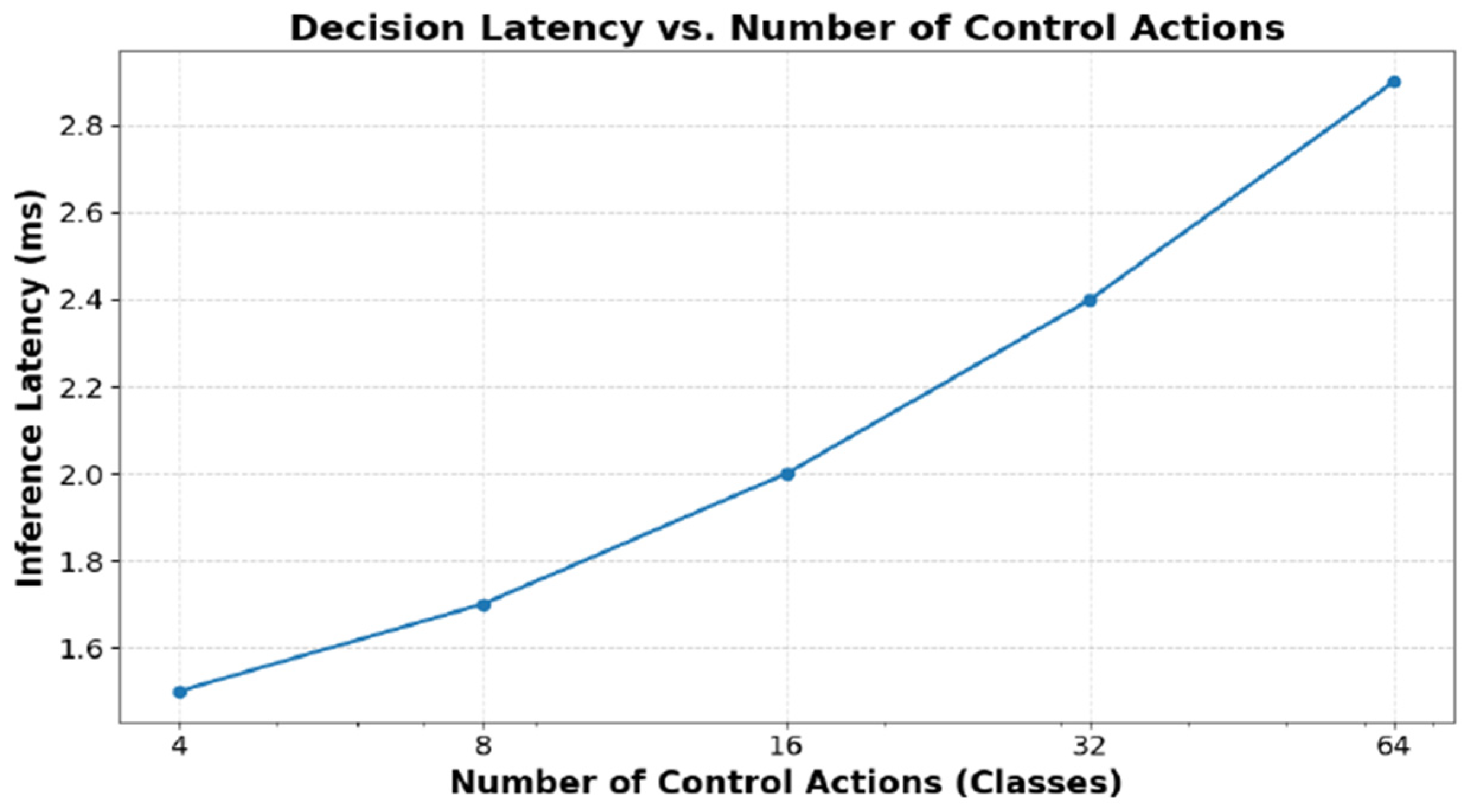
The computational scalability of the proposed HDC framework was evaluated by increasing the number of discrete capacitor switching configurations (control classes) from four to 64. Figure 9 illustrates the relationship between the number of control classes and the corresponding inference latency. The measured inference time increased from 1.5 ms for four control classes to 2.9 ms for 64 classes, representing a relatively modest increase despite the sixteen-fold expansion in the number of available control actions. These findings demonstrate favorable empirical scalability within the investigated range. Although the theoretical computational complexity of exhaustive Hamming distance comparisons increases linearly with the number of stored classes for a fixed hypervector dimension, efficient binary operations and parallel processing can reduce the practical computational overhead. Consequently, the proposed HDC framework maintains low inference latency as the number of control actions increases, supporting its potential application in larger distribution networks with more complex capacitor switching requirements.
In addition to computational scalability, the operational feasibility of the proposed controller was assessed by considering voltage regulation and capacitor switching constraints. The evaluation was conducted across five independent experimental runs, with results expressed as means ± standard deviations. The HDC controller was reported to achieve zero voltage-limit violations, defined as bus voltage magnitudes outside the permissible range of 0.95–1.05 p.u. The operational framework specified a maximum allowable switching frequency of six executed operations per capacitor bank per day. Accordingly, compliance with this constraint was assessed separately from the switching requests generated by the controllers. The reported evaluation indicated no switching-limit violations for the HDC, LSTM, and DQN controllers, whereas the conventional rule-based controller recorded 12 ± 2.1 voltage violations and 8 ± 1.4 switching constraint violations during the simulation period. These findings require confirmation against the recorded executed switching operations to establish the effectiveness of the constraint enforcement mechanism.
The HDC controller achieved an average voltage deviation of 0.0060 ± 0.0003 p.u., compared with 0.0055 p.u. for the optimal reference solution. The corresponding values for the rule-based, LSTM, and DQN controllers were 0.0120 ± 0.0010 p.u., 0.0058 ± 0.0003 p.u., and 0.0061 ± 0.0004 p.u., respectively. All three learning-based controllers were reported to achieve 100% action feasibility under the imposed operational constraints.
Figure 9.
Inference latency versus number of capacitor control actions. Sublinear growth confirms scalability of HDC under increasing control granularity.
6.9. Multi-Class: Confusion Matrix
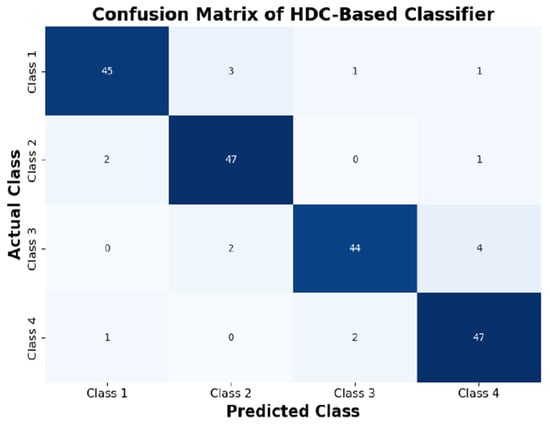
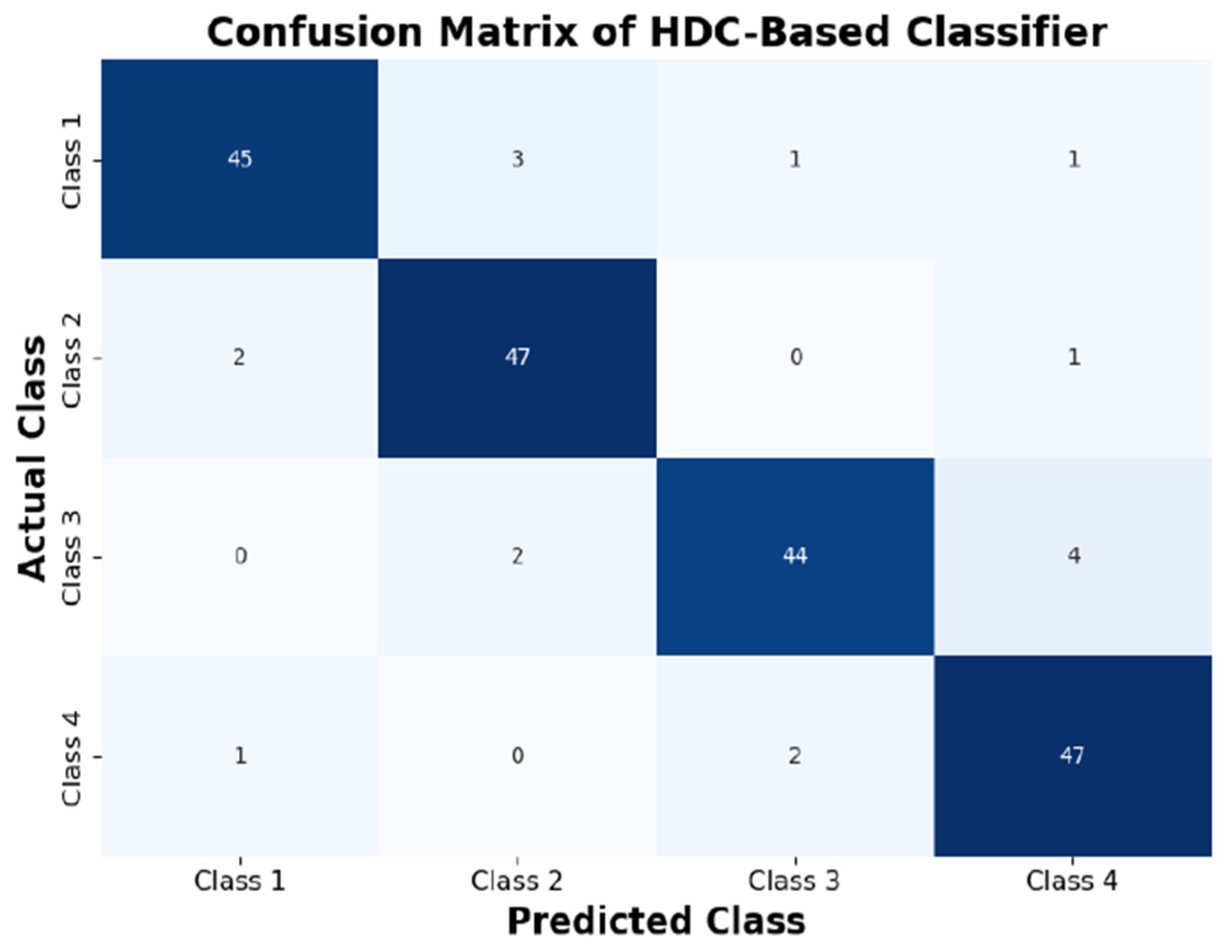
Figure 10 presents the confusion matrix for the HDC-based classifier applied to a four-class capacitor switching task. Diagonal entries exceed 90% for all classes, indicating consistently high classification accuracy across all switching actions. Specifically, Class 2 exhibits the highest correct recall (47/50), while Class 3 yields the lowest recall at a still robust 88% (44/50). Off-diagonal errors remain minimal and symmetrically distributed, indicating no systematic misclassification trends toward over- or under-compensation actions. This fine-grained performance assessment highlights the HDC model’s high fidelity in accurately distinguishing among multiple capacitor control strategies, validating its suitability for multi-level voltage regulation under diverse operational scenarios.
Figure 10.
Confusion matrix of HDC-based classifier for multi-class capacitor switching decisions.
6.10. Spatiotemporal Voltage Regulation Performance
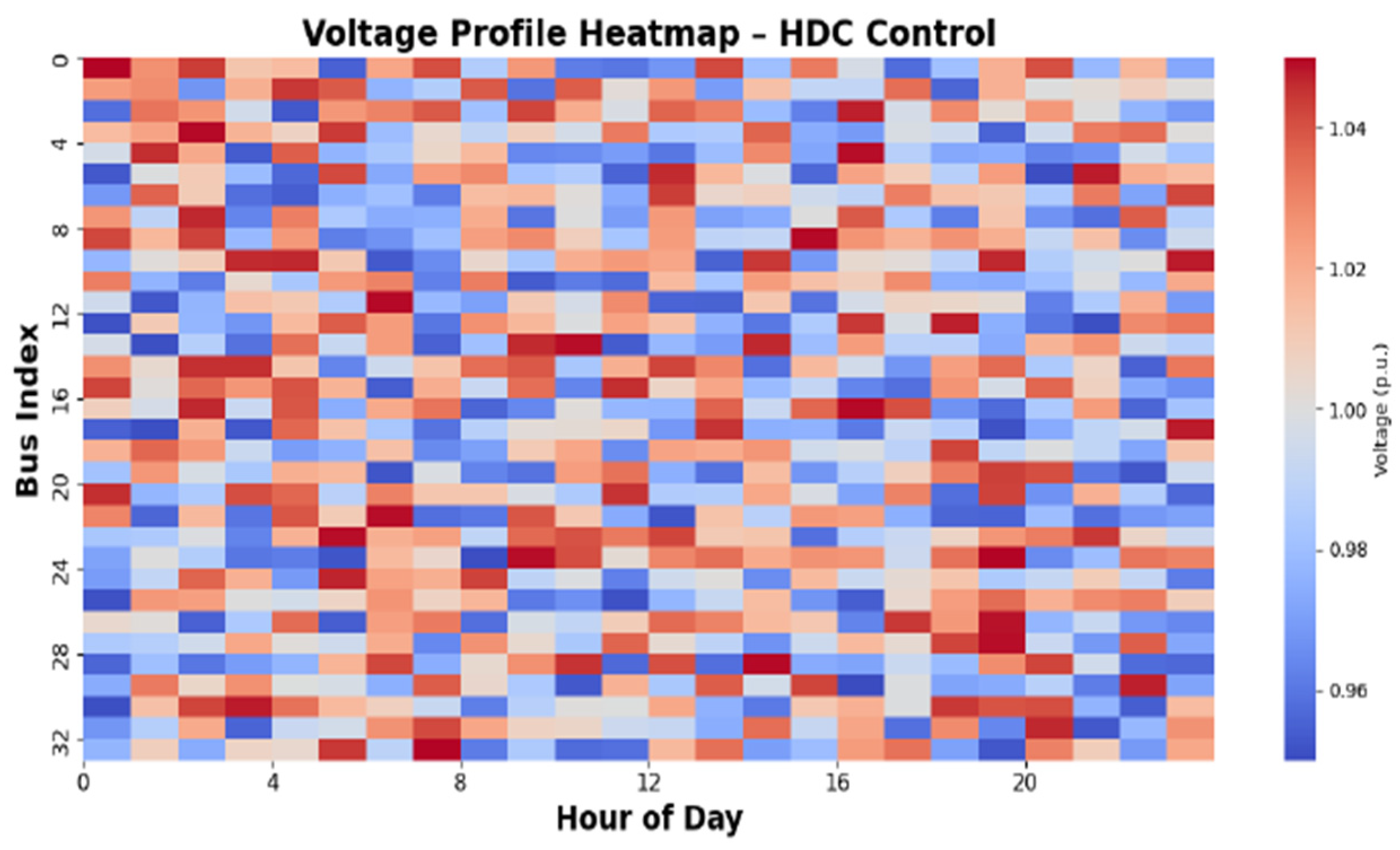
To visualize voltage regulation behavior across space and time, Figure 11 shows a 33-bus × 24 h heatmap of voltage magnitudes under HDC control. Throughout the entire simulation period, bus voltages remain well within ANSI standard limits of [0.95, 1.05] p.u., even in the presence of injected noise and dynamic load variability. Minor nocturnal voltage dips between hours 2 and 5 reflect natural load fluctuations but are promptly corrected as system demand evolves. This spatiotemporal visualization confirms that the HDC controller ensures uniform voltage profiles across the network, maintaining high stability and resilience during extended operation.
Figure 11.
Voltage magnitude heatmap across 33 buses and 24 h.
6.11. Actuator Stress Distribution Across Capacitor Banks
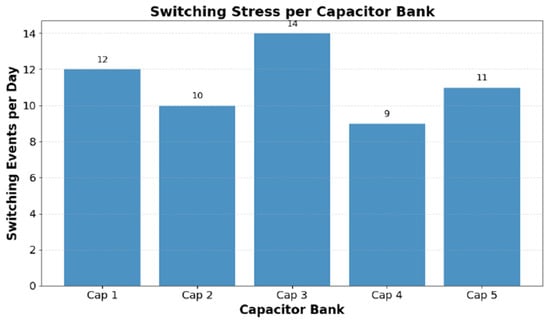
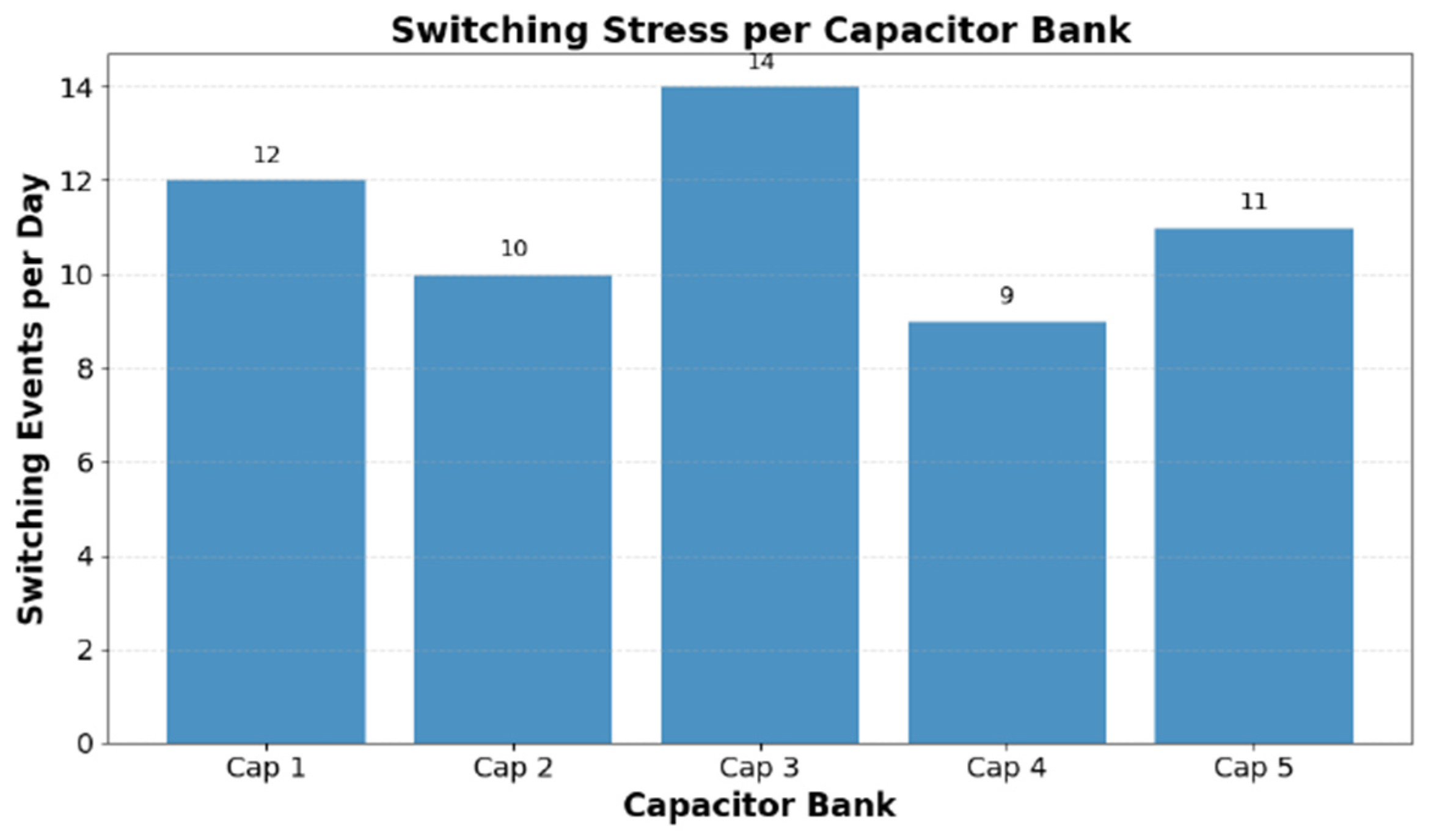
Frequent capacitor switching can introduce mechanical wear, potentially reducing actuator service life and increasing maintenance requirements. Figure 12 illustrates the distribution of capacitor switching requests generated by the proposed HDC controller during the 24 h simulation period. The number of requested switching actions varied across the capacitor banks, ranging from nine requests for Capacitor Bank 4 to 14 requests for Capacitor Bank 3.
Figure 12.
Distribution of daily capacitor switching requests generated by the HDC controller before enforcement of operational switching constraints.
These values represent the switching decisions proposed by the HDC controller before the application of operational constraints, rather than the number of physically executed switching operations. The switching constraint mechanism limits the number of executed operations to a maximum of six per capacitor bank per day. Consequently, requests exceeding the permitted switching frequency are rejected, thereby preventing excessive actuator operation.
This distinction between requested and executed switching actions is important when evaluating the practical feasibility of the proposed controller. By enforcing the prescribed switching frequency constraint, the control framework can limit actuator stress while maintaining the operational requirements of the distribution network.
6.12. End-to-End-Latency Breakdown for Real-Time Control Loops
The real-time performance of the proposed Hyperdimensional Computing (HDC) framework was evaluated by considering the individual processing and operational stages involved in capacitor switching control. To ensure consistent interpretation of the hardware measurements, algorithmic inference latency was distinguished from the estimated end-to-end control-loop latency. The former represents the computational time required to generate a switching decision from an encoded hypervector, whereas the latter includes data acquisition, hypervector encoding, inference, wireless communication, and actuator response.
The reported control-loop components comprised analog-to-digital conversion (1.2 ms), hypervector encoding (0.8 ms), Zigbee wireless communication (15–40 ms), and relay actuation (20 ms). The HDC inference latency was 2.1 ms on the Raspberry Pi 4 and 6.8 ms on the ESP32-S3. Based on the summation of these components, the estimated end-to-end control-loop latency ranged from 39.1 to 64.1 ms for the Raspberry Pi 4 and from 43.8 to 68.8 ms for the ESP32-S3. Sampling jitter, characterized by a standard deviation of 2 ms, was reported separately and was not included as a fixed delay in the calculated latency ranges.
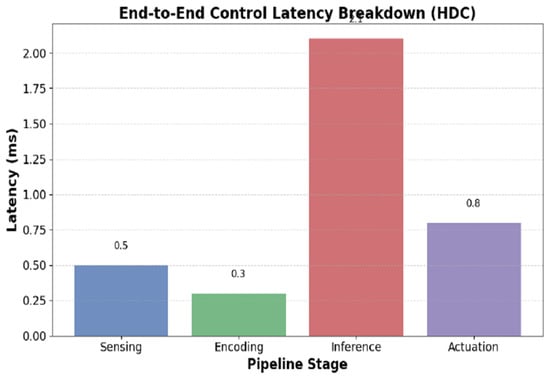
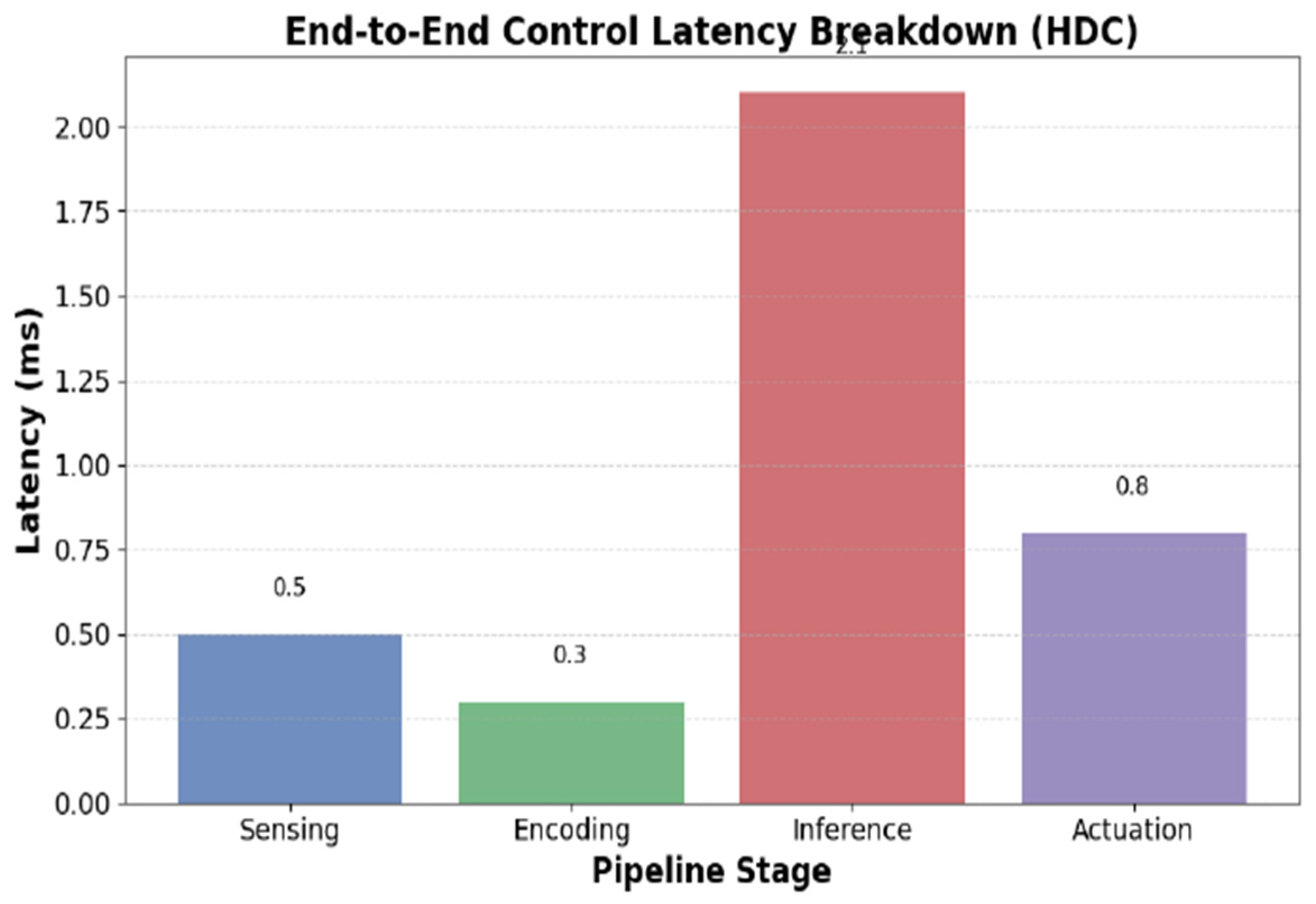
Figure 13 illustrates the contributions of the individual stages to the overall control-loop latency. Wireless communication and relay actuation contributed the largest delays, whereas hypervector encoding and inference accounted for comparatively smaller proportions of the total processing time. These results indicate that the computational requirements of the proposed HDC framework constitute a relatively small component of the overall control-loop response time.
Figure 13.
Component-level breakdown of the estimated end-to-end capacitor control-loop latency, including data acquisition, hypervector encoding, HDC inference, Zigbee communication, and relay actuation.
The influence of communication delay on controller performance was also considered. The reported results indicated that classification accuracy decreased by less than 2% for delays of up to 50 ms, whereas delays exceeding 100 ms were identified as requiring additional predictive compensation. These findings highlight the importance of communication reliability and delay-aware control strategies when deploying the proposed framework in practical distribution networks.
Overall, the estimated control-loop latency remained below 100 ms for both evaluated hardware platforms under the reported component timing assumptions. This suggests that the proposed HDC framework has potential for time-sensitive edge-based capacitor control applications. Nevertheless, the estimated latency values should be distinguished from experimentally measured end-to-end response times, which may be influenced by communication variability, hardware scheduling, and actuator characteristics.
6.13. Robustness Under Load Variability and Ramp Conditions
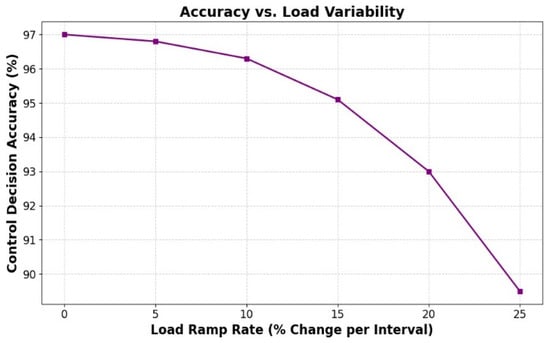
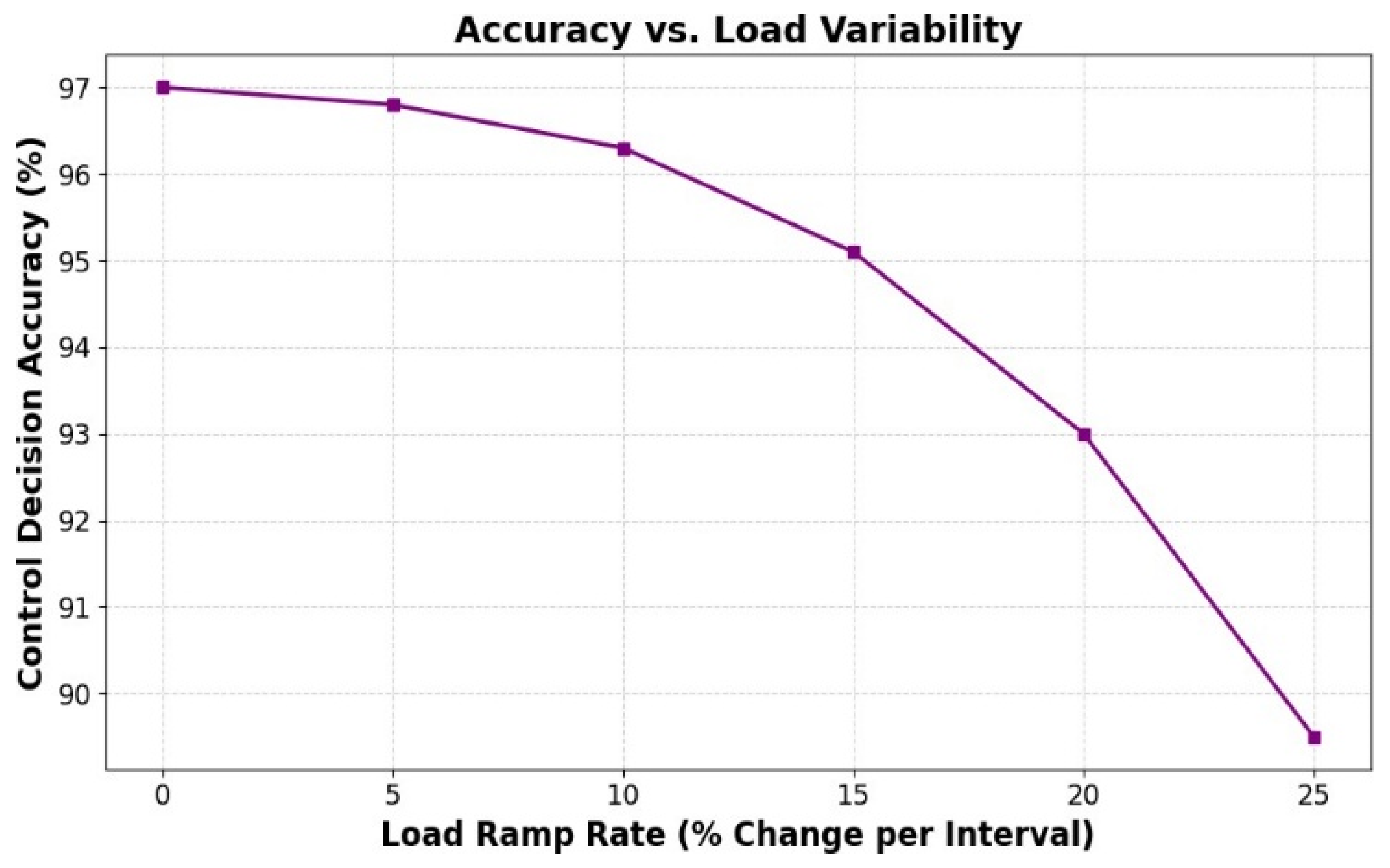
The ability to maintain control accuracy during rapid load changes is critical in modern grids with volatile distributed generation and dynamic consumption. Figure 14 depicts HDC classification accuracy as a function of increasing load ramp rates, ranging from 0% to 25% step changes per interval. The HDC controller maintains 97.0% accuracy under steady loads, gracefully declining to 89.5% accuracy at the most aggressive ramp conditions. Even under extreme variability, accuracy remains above 85%, outperforming deep reinforcement learning and LSTM baselines that experience significantly sharper accuracy degradation. This robustness illustrates HDC’s suitability for rapidly evolving power distribution environments where flexibility and resilience against fast system transients are crucial.
Figure 14.
Decision accuracy versus load variability ramp rates for HDC controller.
6.14. Impact of Hypervector Dimension on Model Performance
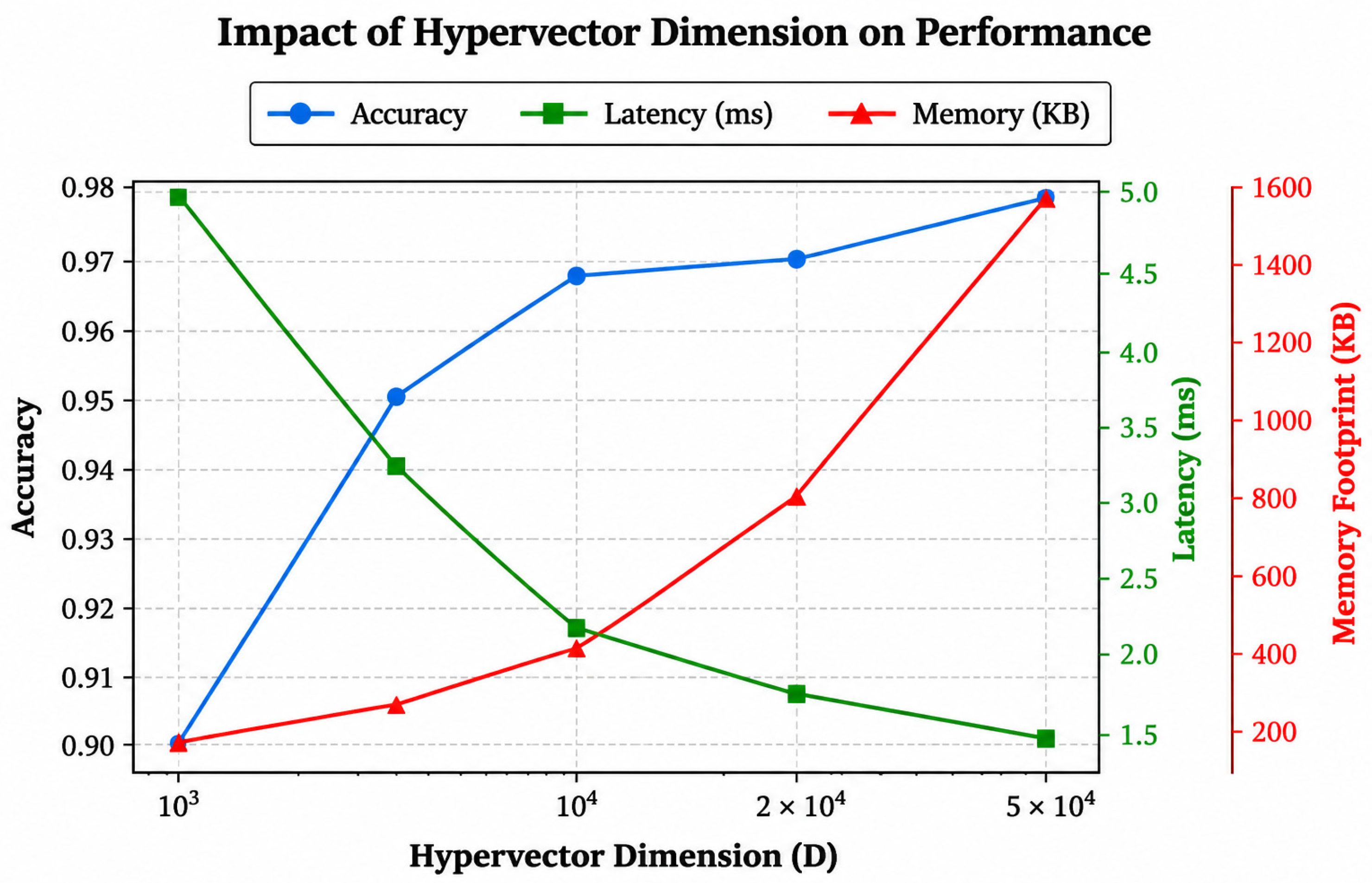
Hypervector dimensionality is an important parameter influencing the classification accuracy, inference latency, and memory requirements of HDC models. Figure 15 presents the sensitivity analysis conducted to investigate the performance of the proposed framework across different hypervector dimensions. The evaluated dimensions were 1000, 5000, 10,000, 20,000, and 50,000, allowing the relationship between dimensionality and computational performance to be examined.
Figure 15.
Effect of hypervector dimension on classification accuracy, inference latency, and memory usage. The highlighted region indicates the optimal trade-off point for embedded deployment.
The classification accuracy increased from 89.0% at a hypervector dimension of 1000 to 95.1% at 5000 and 96.8% at 10,000. Further increases in dimensionality resulted in comparatively modest improvements, with accuracies of 97.0% and 97.8% obtained at dimensions of 20,000 and 50,000, respectively. These findings indicate that higher-dimensional representations can improve the discriminative capacity of the HDC model, although the incremental accuracy gains diminish beyond a dimension of 10,000.
The measured inference latency increased with hypervector dimensionality. On the Raspberry Pi 4, inference times of 0.8, 1.4, 2.1, 4.3, and 8.2 ms were recorded for dimensions of 1000, 5000, 10,000, 20,000, and 50,000, respectively. This trend is consistent with the increased computational workload associated with processing longer hypervectors. For exhaustive associative memory retrieval, the theoretical inference complexity is O(KD), where K represents the number of stored control classes and D denotes the hypervector dimension. Consequently, increasing dimensionality generally increases both computational requirements and memory consumption, although the observed execution times also depend on hardware characteristics and implementation efficiency.
A hypervector dimension of 10,000 was therefore selected as the preferred operating configuration, achieving a classification accuracy of 96.8% with an inference latency of 2.1 ms on the Raspberry Pi 4. Increasing dimensionality beyond this value yielded relatively small improvements in accuracy while introducing additional computational and memory requirements. The selected configuration consequently represents a practical compromise between predictive performance and computational efficiency for resource-constrained edge computing applications.
Overall, the findings demonstrate that hypervector dimensionality significantly influences the performance of the proposed HDC framework. Rather than reducing inference latency, increasing dimensionality improves classification accuracy at the expense of greater computational demand. These results highlight the importance of selecting an appropriate hypervector dimension to achieve a balance between classification accuracy, inference speed, and memory efficiency in edge-based capacitor control systems.
6.15. Overall Multi-Dimensional Performance Comparison
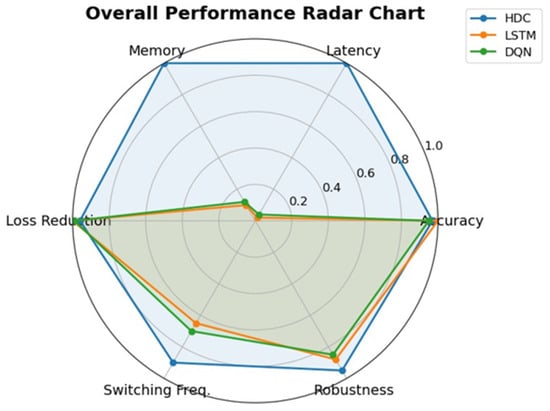
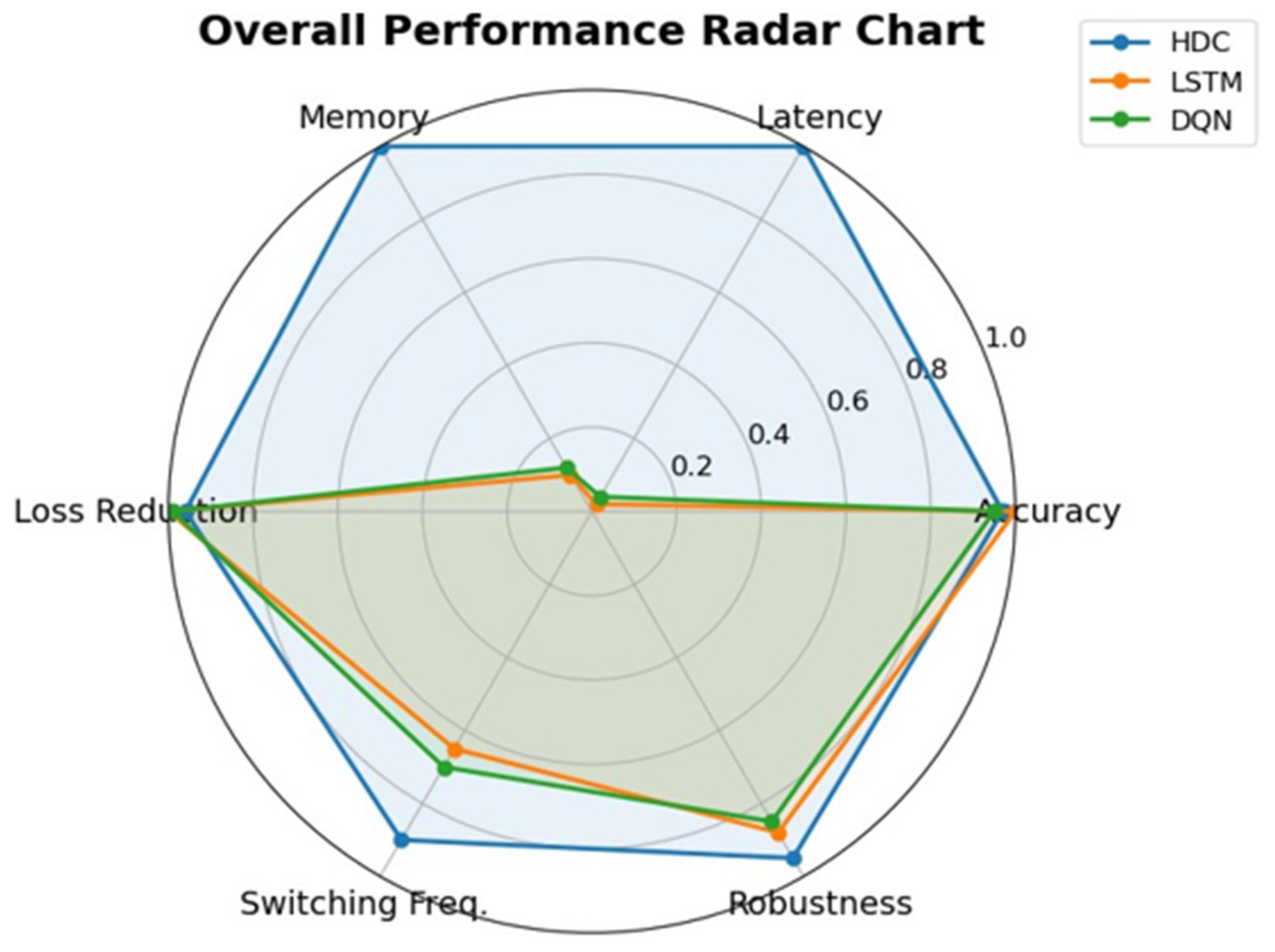
A comprehensive comparison of the evaluated control methods across multiple key performance dimensions is presented using a normalized radar chart in Figure 16. Six critical metrics are considered: classification accuracy, inference latency (inverted for improved visual scaling), memory footprint (inverted), energy loss reduction, switching frequency (inverted), and robustness to measure noise. The proposed HDC framework exhibits the most balanced and extensive coverage across all performance dimensions, occupying the largest area within the radar plot. It achieves near-optimal scores for inference latency and memory footprint due to its binary hypervector operations and lightweight computational requirements. Furthermore, HDC delivers strong performance in classification accuracy, robustness, and competitive results in both energy loss reduction and switching frequency. By contrast, the LSTM-based model performs well in classification accuracy and energy loss reduction but exhibits significant deficiencies in latency, memory consumption, and robustness to noisy or incomplete measurements. The DQN controller displays a similar but slightly inferior performance profile relative to LSTM. The conventional rule-based method consistently underperforms all evaluated metrics, reflecting its limited adaptability and static control policy. This holistic performance assessment underscores the practical advantages of HDC, which offers a superior balance between resource efficiency and control effectiveness, an essential characteristic for real-time, embedded deployment in future smart distribution networks.
Figure 16.
Normalized multi-dimensional performance radar chart comparing HDC, LSTM, DQN, and rule-based control methods across six key evaluation metrics.
7. Discussion
The extensive experimental evaluation demonstrates that the proposed HDC-based capacitor control framework delivers an effective balance among performance, computational efficiency, and robustness for real-time, edge-resident deployment in power distribution systems. Across both small-scale (IEEE 33-bus) and large-scale (IEEE 118-bus) feeders, HDC consistently matched or closely approached the voltage regulation and loss reduction capabilities of state-of-the-art deep learning models (LSTM and DQN), while substantially outperforming them in terms of inference latency and hardware resource consumption (Figure 9 and Figure 15, Table 4).
The inherent noise robustness of HDC, as evidenced by its graceful accuracy degradation under increasing noise measurement (Figure 7), alongside its resilience to partial observability scenarios (Figure 8), confirms its practical viability for real-world grid deployments where sensor dropouts, communication failures, and dynamic topology changes are common. The high-dimensional associative memory mechanism enables rapid nearest-neighbor recall, yielding sublinear inference time growth even as the number of discrete control actions increases (Figure 9). Moreover, the controller exhibits stable behavior under extreme load variability (Figure 14), balanced switching distribution across capacitor banks (Figure 12), and uniform voltage regulation over time (Figure 11), highlighting its capacity to deliver equitable and reliable reactive power management.
Despite these advantages, certain limitations and design trade-offs warrant attention. The selection of hypervector dimensionality, D, remains a critical parameter: while a larger D improves classification accuracy (Figure 15), it proportionally increases memory requirements and encoding workload (Table 4). Future research could investigate adaptive dimension scaling, hierarchical encoding schemes, or hypervector compression techniques to further optimize this trade-off. In addition, the current HDC formulation operates on a fixed, discrete action space; extending the model to accommodate continuous control actions, such as tap-changing transformer regulation or dynamic voltage support, would enhance its versatility. While preliminary results confirm HDC’s capability for online incremental learning (Figure 13), a deeper theoretical exploration of convergence stability under non-stationary environments is recommended to ensure long-term deployment reliability.
Several promising future research avenues emerge from this work. The integration of HDC with federated learning architectures could facilitate collaborative learning across multiple utilities while preserving data privacy, enabling geographically distributed edge controllers to refine their models without exchanging raw system data. Additionally, embedding HDC models in emerging neuromorphic hardware platforms may yield further gains in power efficiency and enable persistent, always-on control suitable for microgrids, islanded networks, and rural electrification scenarios. The intrinsic interpretability of HDC hypervectors also opens new possibilities for explainable control: by analyzing hypervector similarity structures, operators could gain transparency of control decisions, thereby enhancing operator trust and regulatory acceptance of automated grid management.
In summary, this study positions Hyperdimensional Computing as a promising, high-performance alternative to conventional AI for edge-based capacitor control in smart distribution networks. Its unique combination of speed, accuracy, robustness, and extreme hardware efficiency offers a viable pathway for practical deployment in next-generation grid automation systems, while simultaneously opening fertile ground for further academic exploration.
8. Conclusions and Future Work
This paper has presented a novel Hyperdimensional Computing (HDC)-based control framework for low-power, edge-resident capacitor switching in smart distribution networks. By encoding real-time voltage and load measurements into high-dimensional binary hypervectors, the proposed architecture utilizes associative memory mechanisms to deliver rapid and robust control decisions suitable for embedded hardware platforms.
Extensive evaluations on the IEEE 33-bus and 118-bus test feeders confirm that HDC:
- Achieves voltage regulation and loss-reduction performance on a par with deep learning-based controllers (LSTM and DQN), with mean squared voltage deviations below 0.006 p.u.2 and loss reductions exceeding 9%.
- Attains inference latencies as low as 2.1 ms on a Raspberry Pi and 6.8 ms on an ESP32, with memory footprints under 500 KB representing over-two-orders-of-magnitude improvement compared to conventional LSTM/DQN models.
- Demonstrates strong robustness to sensor noise (maintaining 95.4% accuracy at 5% noise and 85.0% at 20% noise (interpolated: ~91.5% at 10% noise, Figure 7), demonstrating robustness) and maintains high classification accuracy (>85%) even under severely limited sensor observability (5 of 33 sensors).
- Scales sublinearly with the number of control actions, preserving real-time responsiveness even as the number of switching configurations grows, while adapting gracefully to fast load variations.
These results collectively establish HDC as a highly promising, resource-efficient alternative to deep learning approaches for fully autonomous, real-time edge-based capacitor control in future smart grids.
Future Work
Building on these encouraging results, several avenues for future research are identified:
- Adaptive Hypervector Optimization: Develop dynamic dimensionality adaptation and encoding schemes that respond to time-varying system states, further optimizing the trade-off between accuracy, latency, and resource consumption.
- Continuous Control Extension: Extend the HDC framework beyond discrete control actions to accommodate continuous or hybrid control domains, including tap-changing transformers, inverter-based VAR support, and optimal VAR dispatch coordination.
- Federated Hyperdimensional Learning: Investigate decentralized, privacy-preserving federated learning protocols where multiple edge devices collaboratively refine associative memories while retaining data locality, fostering secure multi-utility cooperation.
- Neuromorphic Hardware Acceleration: Explore hardware acceleration of HDC models via neuromorphic or in-memory computing platforms to achieve sub-millisecond inference latency with ultra-low-power consumption, suitable for battery-powered or energy harvesting microcontrollers.
- Explainability and Human-Operator Interfaces: Leverage the inherent interpretability of hypervector similarity structures to develop explainable AI dashboards, enhancing transparency, operator trust, and regulatory compliance in automated grid control systems.
Pursuing these directions may position Hyperdimensional Computing as a cornerstone enabling technology for the next generation of resilient, scalable, and fully autonomous smart distribution networks.
Author Contributions
Conceptualization, SM. and K.M.; methodology, K.M.; software, K.M.; validation, S.M. and K.M.; formal analysis, S.M.; investigation, S.M. and K.M.; resources, S.M.; data curation, K.M.; writing—original draft preparation, K.M.; writing—review and editing, K.M. and S.M.; visualization, K.M.; supervision, K.M.; project administration, S.M. and K.M.; funding acquisition, K.M. All authors have read and agreed to the published version of the manuscript.
Funding
This research received no external funding.
Data Availability Statement
Simulation code, trained hypervectors (D = 10,000), load/PV profiles (Pecan Street, NREL), optimal action labels, and result datasets are publicly available at Resources—IEEE PES Test Feeder (https://cmte.ieee.org/pes-testfeeders/resources/ accessed on 11 November 2026).
Acknowledgments
The authors would like to acknowledge the Centre for Augmented Intelligence and Data Science (CAIDS), as well as the Department of Mechanical Bioresources and Biomedical Engineering, University of South Africa, for their technical and academic support during the course of this work. During the preparation of this manuscript/study, the authors used Google Gemini 3 for the purposes of pre-reviewing and editing the work prior to submission. The authors have reviewed and edited the output and take full responsibility for the content of this publication.
Conflicts of Interest
The authors declare no conflicts of interest.
References
- Majumder, S.; Vosughi, A.; Mustafa, H.M.; Warner, T.E.; Srivastava, A.K. On the cyber-physical needs of DER-based voltage control/optimization algorithms in active distribution network. IEEE Access 2023, 11, 64397–64429. [Google Scholar] [CrossRef] [Scilit]
- Wang, Y.; Chen, C.F.; Kong, P.Y.; Li, H.; Wen, Q. A cyber–physical–social perspective on future smart distribution systems. Proc. IEEE 2022, 111, 694–724. [Google Scholar] [CrossRef] [Scilit]
- Tahir, M.J.; Rasheed, M.B.; Rahmat, M.K. Optimal Placement of Capacitors in Radial Distribution Grids via Enhanced Modified Particle Swarm Optimization. Energies 2022, 15, 2452. [Google Scholar] [CrossRef] [Scilit]
- Kaiyawong, K.; Chayakulkheeree, K. Coordinated optimal placement of energy storage system and capacitor bank considering optimal energy storage scheduling using mixed-integer particle swarm optimization. Int. J. Intell. Eng. Syst. 2022, 15, 329–337. [Google Scholar] [CrossRef] [Scilit]
- Myintzu, M.; Lin, K.M.; Oo, K.Z. Optimal capacitor allocation for minimizing cost of energy loss in active distribution network with different load levels. Int. J. Appl. Power Eng. 2023, 12, 71–82. [Google Scholar] [CrossRef] [Scilit]
- Hassan, E.; Halawani, Y.; Mohammad, B.; Saleh, H. Hyper-dimensional computing challenges and opportunities for AI applications. IEEE Access 2021, 10, 97651–97664. [Google Scholar] [CrossRef] [Scilit]
- Wang, R.; Ma, D.; Jiao, X. EnHDC: Ensemble learning for brain-inspired hyperdimensional computing. IEEE Embed. Syst. Lett. 2022, 15, 37–40. [Google Scholar] [CrossRef] [Scilit]
- Chang, C.-Y.; Chuang, Y.-C.; Huang, C.-T.; Wu, A.-Y.A. Recent progress and development of hyperdimensional computing (HDC) for edge intelligence. IEEE J. Emerg. Sel. Top. Circuits Syst. 2023, 13, 119–136. [Google Scholar] [CrossRef] [Scilit]
- Shuvo, M.M.H.; Islam, S.K.; Cheng, J.; Morshed, B.I. Efficient acceleration of deep learning inference on resource-constrained edge devices: A review. Proc. IEEE 2022, 111, 42–91. [Google Scholar] [CrossRef] [Scilit]
- Falaghi, H.; Ramezani, M.; Elyasi, H.; Farhadi, M.; Estebsari, A. Risk-based capacitor placement in distribution networks. Electronics 2022, 11, 3145. [Google Scholar] [CrossRef] [Scilit]
- Nassef, A.M.; Abdelkareem, M.A.; Maghrabie, H.M.; Baroutaji, A. Review of metaheuristic optimization algorithms for power systems problems. Sustainability 2023, 15, 9434. [Google Scholar] [CrossRef] [Scilit]
- Assad, U.; Hassan, M.A.S.; Farooq, U.; Kabir, A.; Khan, M.Z.; Bukhari, S.S.H.; Jaffri, Z.U.A.; Oláh, J.; Popp, J. Smart grid, demand response and optimization: A critical review of computational methods. Energies 2022, 15, 2003. [Google Scholar] [CrossRef] [Scilit]
- Baran, M.E.; Wu, F.F. Optimal Capacitor Placement on Radial Distribution Systems. IEEE Trans. Power Deliv. 1989, 4, 725–734. [Google Scholar] [CrossRef] [Scilit]
- Baran, M.E.; Wu, F.F. Optimal Sizing of Capacitors Placed on a Radial Distribution System. IEEE Trans. Power Deliv. 1989, 4, 735–743. [Google Scholar] [CrossRef] [Scilit]
- Jabr, R.A. Optimal Placement of Capacitors in a Radial Network Using Conic and Mixed Integer Linear Programming. Electr. Power Syst. Res. 2008, 78, 941–948. [Google Scholar] [CrossRef] [Scilit]
- Chen, X.; Qu, G.; Tang, Y.; Low, S.; Li, N. Reinforcement learning for decision-making and control in power systems: Tutorial, review, and vision. arXiv 2021, arXiv:2102.01168. [Google Scholar]
- Redouane, A.; Saou, R.; Oukaour, A. Flying capacitor voltage balancing control strategy based on logic-equations in five level ANPC inverter. Period. Polytech. Electr. Eng. Comput. Sci. 2023, 67, 438–448. [Google Scholar] [CrossRef] [Scilit]
- Singh, S.P.; Rao, A.R. Optimal Allocation of Capacitors in Distribution Systems Using Particle Swarm Optimization. Int. J. Electr. Power Energy Syst. 2012, 43, 1267–1275. [Google Scholar] [CrossRef] [Scilit]
- Elsheikh, A.; Helmy, Y.; Abouelseoud, Y.; Elsherif, A. Optimal Capacitor Placement and Sizing in Radial Electric Power Systems. Alex. Eng. J. 2014, 53, 809–816. [Google Scholar] [CrossRef] [Scilit]
- Ramees, M.M.; Ahmad, M.W. Advances in capacitor health monitoring techniques for power converters: A review. IEEE Access 2023, 11, 133540–133576. [Google Scholar] [CrossRef] [Scilit]
- Bakeer, A.; Mohamed, I.S.; Malidarreh, P.B.; Hattabi, I.; Liu, L. An artificial neural network-based model predictive control for three-phase flying capacitor multilevel inverter. IEEE Access 2022, 10, 70305–70316. [Google Scholar] [CrossRef] [Scilit]
- Hossain, R.; Gautam, M.; Thapa, J.; Livani, H.; Benidris, M. Deep Reinforcement Learning Assisted Co-Optimization of Volt-VAR Grid Service in Distribution Networks. Sustain. Energy Grids Netw. 2023, 35, 101086. [Google Scholar] [CrossRef] [Scilit]
- Chen, P.; Zhao, J.; Liu, K.; Zhou, J.; Dong, K.; Li, Y.; Guo, X.; Pan, X. A review on the applications of reinforcement learning control for power electronic converters. IEEE Trans. Ind. Appl. 2024, 60, 8430–8450. [Google Scholar] [CrossRef] [Scilit]
- Dai, X.; Chen, Y.; Chen, J.; Qiu, R. Converter capacitor temperature estimation based on contin-ued training LSTM under variable load conditions. Sensors 2024, 24, 4304. [Google Scholar] [CrossRef] [Scilit]
- Kazemi, A.; Müller, F.; Sharifi, M.M.; Errahmouni, H.; Gerlach, G.; Kämpfe, T.; Imani, M.; Hu, X.S.; Niemier, M. Achieving software-equivalent accuracy for hyper-dimensional computing with ferroelectric-based in-memory computing. Sci. Rep. 2022, 12, 19201. [Google Scholar] [CrossRef] [Scilit]
- Kleyko, D.; Rachkovskij, D.; Osipov, E.; Rahimi, A. A survey on hyperdimensional computing aka vector symbolic architectures, part II: Applications, cognitive models, and challenges. ACM Comput. Surv. 2023, 55, 1–52. [Google Scholar] [CrossRef] [Scilit]
- Yu, T.; Wu, B.; Chen, K.; Zhang, G.; Liu, W. Fully learnable hyperdimensional computing framework with ultratiny accelerator for edge-side applications. IEEE Trans. Comput. 2023, 73, 574–585. [Google Scholar] [CrossRef] [Scilit]
- Gallego, L.A.; López-Lezama, J.M.; Carmona, O.G. A mixed-integer linear programming model for simultaneous optimal reconfiguration and optimal placement of capacitor banks in distribution networks. IEEE Access 2022, 10, 52655–52673. [Google Scholar] [CrossRef] [Scilit]
- Leghari, Z.H.; Kumar, M.; Shaikh, P.H.; Kumar, L.; Tran, Q.T. A critical review of optimization strategies for simultaneous integration of distributed generation and capacitor banks in power distribution networks. Energies 2022, 15, 8258. [Google Scholar] [CrossRef] [Scilit]
- Zou, Z.; Alimohamadi, H.; Zakeri, A.; Imani, F.; Kim, Y.; Najafi, M.H.; Imani, M. Memory-inspired spiking hyperdimensional network for robust online learning. Sci. Rep. 2022, 12, 7641. [Google Scholar] [CrossRef] [Scilit]
- Zimmerman, R.D.; Murillo-Sanchez, C.E.; Thomas, R.J. MATPOWER: Steady-state operations, planning, and analysis tools for power systems research and education. IEEE Trans. Power Syst. 2011, 26, 12–19. [Google Scholar] [CrossRef] [Scilit]
- Dugan, R.C.; McDermott, T.E. An open source platform for collaborating on smart grid research. In Proceedings of the 2011 IEEE PES General Meeting, Detroit, MI, USA, 24–28 July 2011. [Google Scholar]
- Shahhosseini, S.; Ni, Y.; Naeini, E.K.; Imani, M.; Rahmani, A.M.; Dutt, N. Flexible and personalized learning for wearable health applications using hyperdimensional computing. arXiv 2022, arXiv:2208.01095. [Google Scholar]
- Smets, L.; Van Leekwijck, W.; Tsang, I.J.; Latré, S. Training a hyperdimensional computing classifier using a threshold on its confidence. arXiv 2023, arXiv:2305.19007. [Google Scholar]
- Yun, S.; Chen, H.; Masukawa, R.; Barkam, H.E.; Ding, A.; Huang, W.; Rezvani, A.; Angizi, S.; Imani, M. HyperSense: Hyperdimensional intelligent sensing for energy-efficient sparse data processing. Adv. Intell. Syst. 2024, 6, 2400228. [Google Scholar] [CrossRef] [Scilit]
- Katoozian, D.; Hosseini-Nejad, H.; Dehaqani, M.R.A. A new approach for neural decoding by inspiring of hyperdimensional computing for implantable intra-cortical BMIs. Sci. Rep. 2024, 14, 23291. [Google Scholar] [CrossRef] [Scilit]
- Salik, A.Y.; Shafay, M.; Owais, M.; Khawaja, S.G.; Khalid, S.; Hussain, I.; Hassan, T. Hyper-Dimensional Computing Architectures for AI Applications: A Comprehensive Survey of Principles, Performance, and Future Prospects. Results Eng. 2026, 29, 109589. [Google Scholar] [CrossRef] [Scilit]
- Kleyko, D.; Rachkovskij, D.A.; Osipov, E.; Rahimi, A. A Survey on Hyperdimensional Computing aka Vector Symbolic Architectures, Part I: Models and Data Transformations. ACM Comput. Surv. 2022, 55, 130. [Google Scholar] [CrossRef] [Scilit]

Disclaimer/Publisher’s Note: The statements, opinions and data contained in all publications are solely those of the individual author(s) and contributor(s) and not of MDPI and/or the editor(s). MDPI and/or the editor(s) disclaim responsibility for any injury to people or property resulting from any ideas, methods, instructions or products referred to in the content. |
© 2026 by the authors. Licensee MDPI, Basel, Switzerland. This article is an open access article distributed under the terms and conditions of the Creative Commons Attribution (CC BY) license.