


Abstract
A transparent reduced-order framework is developed for screening hydrogen energy share, H, defined as the fraction of total lower-heating-value fuel energy supplied by hydrogen, and diesel-injection timing in a hydrogen–diesel compression-ignition engine. Slider–crank geometry is coupled according to a finite-support beta apparent-heat-release law, and the constant-γ first-law equation is integrated in closed form. The resulting pressure-response and work kernels explain the competing effects of near-top-dead-center heat release and timing retard. Three parameters are calibrated or anchored using published full-load CFD quantities, while four reported operating points are retained for quantitative agreement diagnostics. For IMEP, peak pressure, and CA10–90 duration, pooled normalized agreement gives R2 = 0.912, heuristic adjusted index = 0.879, RMSE = 1.67%, and MAPE = 1.27%. A fixed-ROM leave-one-case-out affine discrepancy check gives R2 = 0.801 and MAPE = 2.34%. A residual analysis isolates pressure-rise rate as the principal model-form discrepancy at a high hydrogen share. Conditional timing optimization is recomputed on a 0.125° CA grid, and a bi-objective formulation reveals the trade-off between IMEP and hydrogen energy substitution. The model-screened Pareto compromise occurs at H = 0.71 with u = 4.60° CA and IMEP = 22.20 bar, while an explicitly bounded 256-member epistemic ensemble retains all-scenario-feasible timing through H = 0.65. These diagnostics characterize agreement within the four-case full-load reference set and do not constitute independent experimental validation. The contribution is an auditable connection between apparent heat release, quantitative agreement, residual structure, pressure constraints, and multi-objective operating-point screening.
1. Introduction
Hydrogen can displace part of the carbon-containing fuel in compression-ignition engines, but its high auto-ignition temperature usually requires a diesel pilot or another ignition source. Its wide flammability range and high diffusivity can assist mixture preparation, while rapid premixed combustion can increase peak pressure and pressure-rise severity. These competing effects have been established in foundational reviews and experiments [1,2,3,4]. Recent reviews consequently emphasize that hydrogen share cannot be interpreted independently of load, mixture preparation, pilot strategy, oxygen availability, and combustion phasing [5,6,7].
Experiments on port-fuel-injected hydrogen–diesel engines show strong operating-condition dependence. Dimitriou et al. reported substantial hydrogen substitution at a low load but increasingly restrictive combustion behavior at a higher load [8]. Talibi et al. demonstrated coupled effects of exhaust-gas recirculation and boost [9]; Tsujimura and Suzuki clarified the initiating role of the diesel pilot [10]; and Saravanan and Nagarajan showed that hydrogen-injection duration affects performance and emissions [11]. Milojević et al. further demonstrated experimentally that compression ratio and injection timing materially affect cylinder pressure, combustion phasing, pressure-rise behavior, and emissions [12]. More recent studies have examined hydrogen fraction, pilot timing, ambient oxygen concentration, and direct-injection configurations [13,14,15,16]. Chamber design and hydrogen energy ratio have also been investigated experimentally [17,18].
Three-dimensional simulations can resolve spray evolution, mixing, ignition, and local flame structure. Recent numerical studies cover both light- and heavy-duty engines, high-pressure direct injection, injector-hole effects, and EGR sensitivity [19,20,21,22]. Scrignoli et al. presented a particularly useful light-duty reference study because engine geometry and scalar experimental–numerical comparisons were reported together with high-hydrogen operating cases [23]. Thermodynamic and phenomenological models remain valuable for rapid screening, provided that their calibration domain and identifiability are stated explicitly [24,25,26]. They should not be interpreted as substitutes for spatially resolved simulation or cycle-resolved validation.
Existing experimental studies principally establish operating sensitivities, detailed CFD studies resolve local combustion structure, and reduced-order thermodynamic models provide rapid cycle-level predictions. The present framework differs by combining an exact pressure integral, an explicit calibration-and-evidence hierarchy, quantitative residual and leave-one-out diagnostics, grid-verified pressure-constrained optimization, bounded epistemic propagation, and a Pareto representation of the IMEP–hydrogen-share trade-off within one auditable screening model.
Three methodological questions are central to reduced-order continuation studies. The first is whether an empirical map predetermines the reported optimum; the second is whether crank-angle resolution is sufficient for pressure-limited design; and the third is whether the available comparison cases support the reported level of agreement. Global sensitivity, residual diagnostics, cross-validation, and multi-objective optimization provide complementary answers when the evidence level of each calculation is stated clearly [27,28,29].
This study asks how hydrogen energy share and diesel-injection retard can be selected within a reference-calibrated apparent-heat-release model while retaining traceable numerical and evidential support. The contribution is sixfold. First, the pressure equation is solved in an integral form that exposes the causal gain from heat-release timing to cylinder pressure. Second, scalar calibration, source-CFD evidence, and cross-case comparisons are distinguished explicitly. Third, agreement is quantified using R2, adjusted R2, MAE, RMSE, MAPE, residual patterns, and a leave-one-operating-point-out diagnostic. Fourth, timing is optimized conditionally at fixed hydrogen share and then extended to a bi-objective IMEP–hydrogen-share Pareto design. Fifth, every selected nominal point is verified on a finer crank-angle grid. Sixth, uncertainty is represented by a bounded epistemic ensemble that includes the breakpoint and gain of the high-hydrogen duration penalty. The resulting framework provides both a performance-oriented timing policy and a preference-independent view of the efficiency–substitution trade-off.
2. Reference System and Modeling Scope
2.1. Reference Operating Point
At the selected full-load source condition, diesel is supplied through a single main injection. Accordingly, u denotes an effective offset of diesel-injection timing relative to the reference; it does not represent a separately resolved pilot pulse. The reduced-order closure does not simulate injection hydraulics or an independently timed pilot/main sequence.
The geometry and high-load reference quantities in Table 1 are taken from Scrignoli et al. [23]. The 4000 rpm high-load condition was selected because it supplies the complete four-case set needed for calibration, cross-case agreement assessment, and pressure-constrained timing comparison, while also representing the condition at which pressure severity is most consequential. The source study’s 2400 rpm partial-load case does not provide an equivalent four-point optimization set and is therefore not pooled with the present comparisons. Accordingly, the numerical conclusions are restricted to the represented full-load operating state. The single-cylinder calculation represents one cylinder of the four-cylinder engine. The published CFD result supplies the scalar calibration targets because it reports a mutually consistent pressure and work state. The corresponding experimental diesel quantities are withheld from that calibration and used as a limited same-state check in Section 5. The source study also reports validation of its combustion framework against pressure and apparent-heat-release histories from a separate hydrogen–diesel research engine. This evidence supports the provenance of the CFD anchor but does not constitute independent validation of the present reduced-order model.
Table 1.
Reference engine and operating quantities used by the reduced-order model [23].
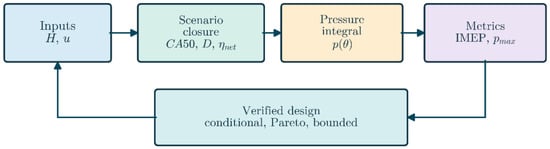
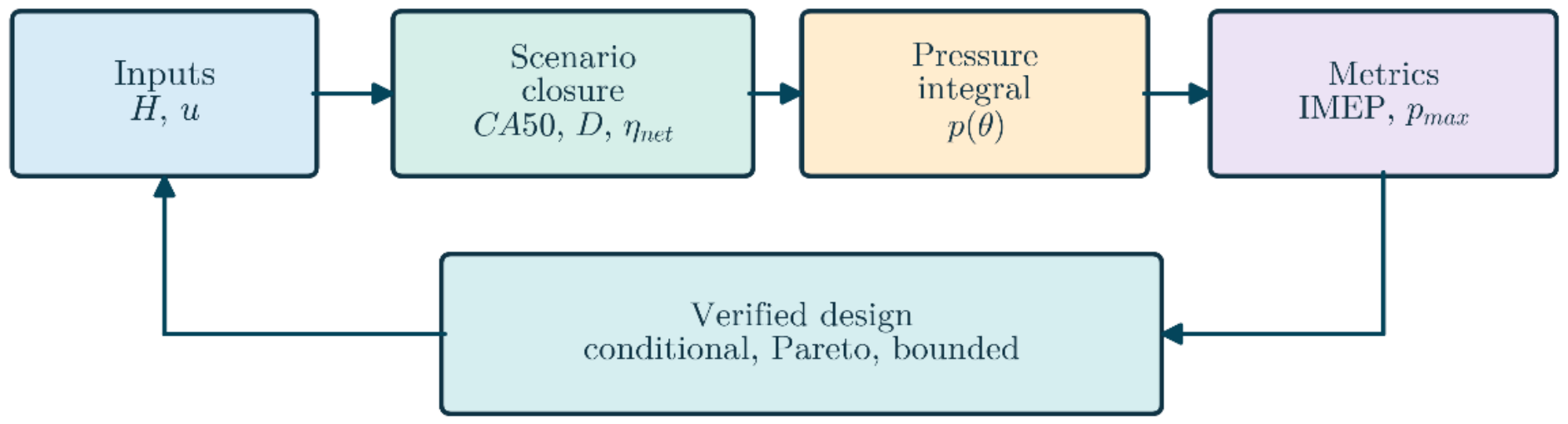
The framework in Figure 1 separates quantities fixed by the reference, phenomenological closures, thermodynamic propagation, numerical verification, and design decisions. This separation is essential: only the thermodynamic propagation follows directly from the governing equation, whereas the share-dependent combustion maps remain assumptions to be tested against future data.
Figure 1.
Computational framework for conditional timing selection at prescribed hydrogen share.
2.2. Fuel-Energy Partition and Diagnostic Mixture Strength
Hydrogen energy share is defined consistently as H = Qh2/(Qh2 + Qd), where Qh2 and Qd are the lower-heating-value energy contributions of hydrogen and diesel, respectively.
For the hydrogen energy share H ∈ [0, 0.8] and fixed-cycle energy Qin, the fuel masses are
where LHVH2 = 120 MJ k−1 and LHVd = 42.5 MJ kg−1. For a diagnostic trapped-air mass ma, the global excess-air ratio is
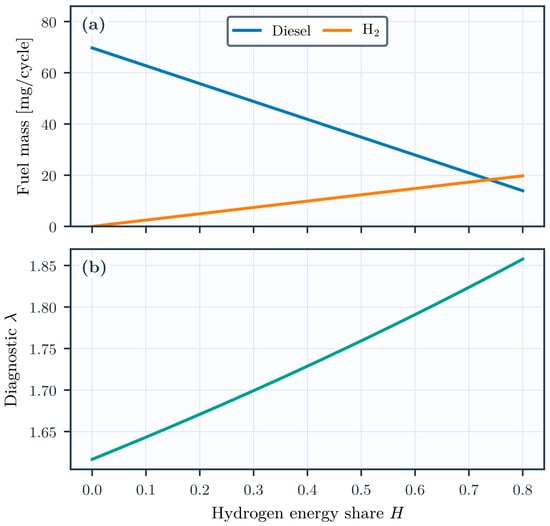
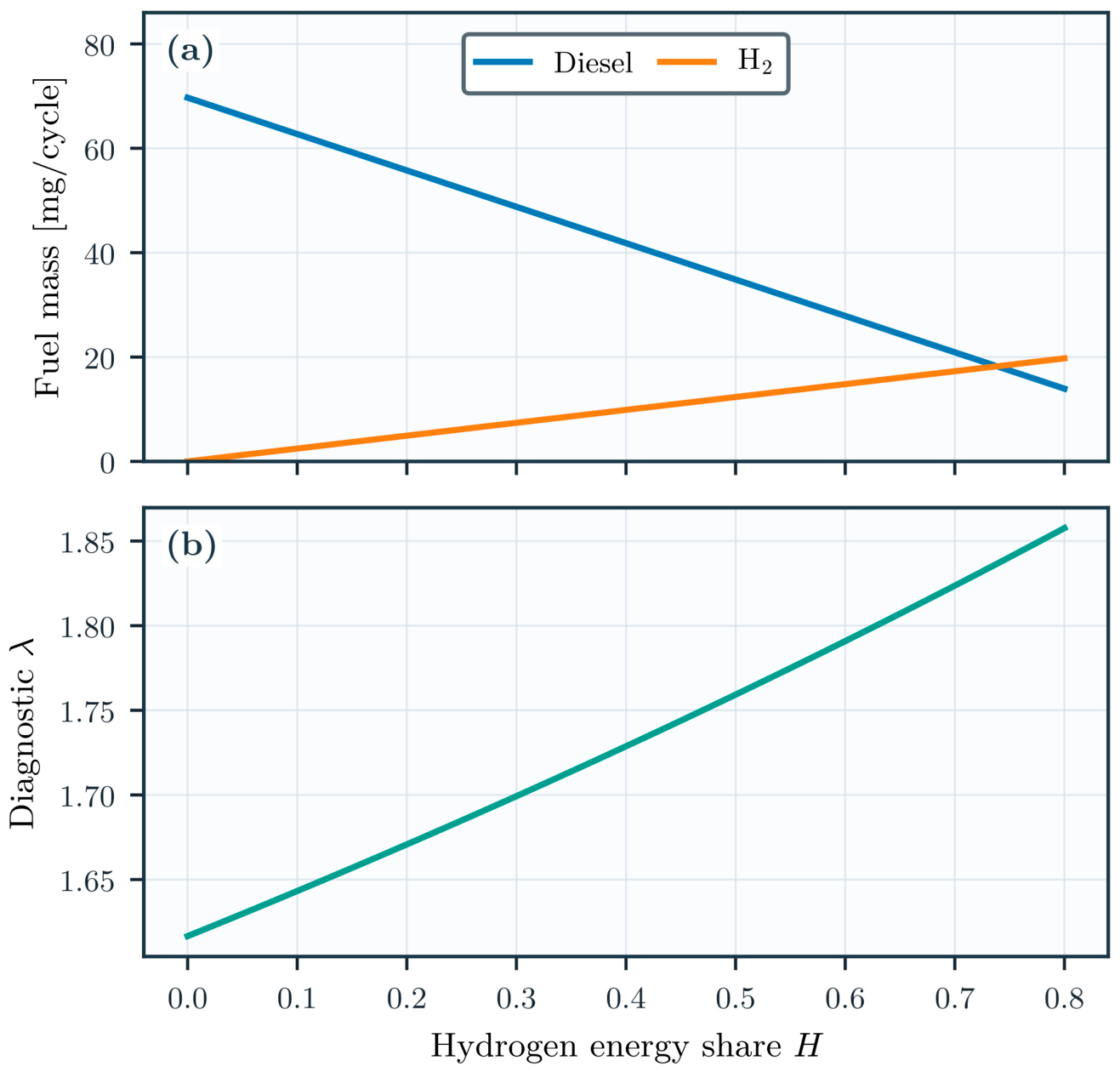
with stoichiometric air requirements and sd = 14.5 on a mass basis. Equations (1) and (2) are accounting relations; λ is not fed back into the pressure closure because the available scalar reference does not identify such a dependency. Figure 2 is therefore descriptive rather than predictive.
Figure 2.
Constant-energy fuel partition and corresponding diagnostic global excess-air ratio: (a) diesel and hydrogen fuel masses per cycle as functions of hydrogen energy share H; (b) diagnostic global excess-air ratio λ as a function of H.
3. Thermodynamic Formulation
3.1. Slider–Crank Geometry
Let θ = 0 denote firing top dead center (TDC), a = S/2, and Ap = πB2/4. The piston displacement from TDC is
and the cylinder volume is
For the stated geometry, L > a, so the square root is real and V(θ) ≥ Vc > 0 throughout the cycle.
3.2. Finite-Support Net Apparent Heat Release
The normalized beta density on z ∈ [0, 1] is
Let denote the qth quantile of the regularized beta distribution. The closure variable Δθb is the CA10–90 duration, consistent with the reference data. The full support and start angle are therefore
The second relation makes the cumulative apparent heat release exactly 0.5 at θ50. The net apparent heat-release rate is then
Here, is a net apparent heat-release rate. Consequently, unresolved wall heat transfer, crevice loss, incomplete combustion, and the difference between gross chemical and apparent release are absorbed into ηn and the inferred shape. A separate Woschni coefficient is not introduced because without wall-temperature and pressure-history data, doing so would add an unidentifiable parameter rather than information [30]. The beta law is used instead of an unbounded Wiebe tail so that support, total heat, and numerical quadrature are explicit [31].
Numerically, the beta quantiles are obtained by monotone inversion of the regularized incomplete beta function. This construction distinguishes the CA10–90 duration from the longer mathematical support and avoids equating the beta mode with CA50.
3.3. Phenomenological Scenario Closure
Diesel-injection retard u is measured in crank-angle degrees relative to the reference timing. The nominal closure is
θ50(H,u) = 18.8 − 18H + (1.25 + 1.20H)u
ηn(H) = sQ(0.9382 + 0.020H − 0.035H2)
ab(H) = 1.50 + 1.80H,bb(H) = 2.50 − 0.50H
Here [x]+ = max(x, 0), Hb = 0.55, kh = 93, and sQ is the calibrated net-heat scale. The duration gain kh is the only closure coefficient anchored directly to the published CA10–90 duration of 38.8° CA at H = 0.784 and u = 6°. The CA50-map, duration-polynomial, efficiency-map, and beta-shape coefficients are assumed phenomenological trend coefficients rather than universal hydrogen correlations; their status is listed in Table 2. Because one additional scalar cannot independently identify both the high-share breakpoint and curvature, Hb and kh are varied in the bounded scenario analysis of Section 4.7, and alternative heat-release shapes are examined in Section 6.5.
Table 2.
Reduced-order model parameters and their status. Angles are in degrees CA, and H is dimensionless: kh and the −18, −28, and 18 share-map coefficients have units of degrees CA; the timing gains, net-heat, and beta-shape coefficients are dimensionless.
Table 2 summarizes the model parameters and distinguishes fixed, calibrated, anchored, and assumed quantities.
3.4. Pressure Equation and Exact Integral Representation
For a closed, spatially uniform charge with constant γ, the net apparent-heat-release equation is
Multiplication by Vγ gives an exact integrating factor. With the initial crank angle θ0 = −180°,
The indicated work and indicated mean effective pressure are
Peak pressure and maximum pressure-rise rate are evaluated directly from the resolved trace,
No multiplicative scaling is applied to PPRR. PPRR reference values are available only from the published CFD results.
4. Mathematical Analysis and Design Formulation
4.1. Well-Posedness and Positivity
For L > a, Equation (4) is continuously differentiable and bounded below by Vc. If and p0 > 0, Equation (13) is the unique absolutely continuous solution of Equation (12). Moreover, implies that the numerator in Equation (13) remains positive; hence p(θ) > 0. Thus, the model cannot generate negative absolute pressure from a non-negative apparent heat input.
The solution also supplies the causal pressure gain. An infinitesimal heat increment δQ released at ϕ ≤ θ produces
Near TDC, V(θ) is small, so the heat release has a large instantaneous pressure effect. For release after TDC, the expansion of V(θ) attenuates its later pressure contribution. Equation (16) provides the theoretical basis for the peak-pressure trade-off.
4.2. Peak Condition and Work Kernel
At an interior pressure maximum θp, Equation (12) gives
After TDC, V′ > 0; the pressure maximum, therefore, occurs when heat addition can no longer balance expansion. Retarding the heat-release law changes both sides: it reduces the compression-side amplification but shifts energy to a larger-volume portion of the expansion stroke.
The work produced by an infinitesimal heat increment at ϕ can be obtained by substituting Equation (16) into Equation (14). Its incremental expansion-work gain is
where θe is the end of the closed expansion interval. Since
Equation (18) reduces to
For post-TDC release during monotonic expansion, KW decreases with V(ϕ); later heat release has less remaining expansion ratio. Equations (16) and (20), therefore, expose the central conflict. Advancing heat release increases pressure leverage, whereas excessive retard sacrifices potential expansion work.
4.3. Parametric Sensitivity
For a closure parameter ξ that does not alter geometry or γ, differentiation of Equation (13) yields
This expression distinguishes two sources of sensitivity: an energy effect through ηn and a redistribution effect through θ50, Δθb, ab, and bb. Because the integral of over a complete burn is zero, a pure phasing perturbation redistributes pressure without changing total apparent heat. The corresponding work change is non-zero because the work kernel weights release angles unequally.
4.4. Conditional Timing Optimization
Hydrogen share is treated as a prescribed operating condition. For each H, only diesel-injection retard is optimized:
where
The closure relations in Equations (8)–(11) are continuous and continuously differentiable; the second derivative of the positive-part duration penalty changes at H = Hb. Pressure and IMEP are continuous functions of u, so the feasible set is a closed subset of the compact interval [0, 9]° CA. Whenever this set is non-empty, the Weierstrass theorem guarantees a maximizer. This is a conditional timing problem at fixed H, rather than simultaneous optimization over H, EGR, or mixture strength.
4.5. Bi-Objective Hydrogen-Performance Design
The conditional solutions are supplemented by a preference-independent bi-objective design over hydrogen share and timing:
where D = {(H,u):0 ≤ H ≤ 0.8,u ∈ U(H)}. The second objective measures diesel-energy displacement at fixed cycle energy; it is not interpreted as a complete emissions or life-cycle-carbon metric. A feasible point is Pareto optimal when no other feasible point improves one component of F without reducing the other.
For a deterministic balanced selection, the two objectives are min–max normalized over the discrete Pareto set. If gI and gH denote the normalized IMEP and hydrogen-share objectives, respectively, the reported compromise point minimizes the Euclidean distance to the normalized utopia point:
The Pareto set is defined without preference weights. Selecting the normalized-utopia compromise nevertheless gives equal importance to the two normalized objectives; it is a transparent selection convention, not a preference-free or economically optimal operating point. Different weights or normalization can select another point from the retained front.
4.6. Grid Verification
The pressure integral is evaluated from −180° to +180° CA by cumulative trapezoidal quadrature on a uniform crank-angle grid. Nominal search uses a 0.25° CA grid and exhaustive diesel-injection-retard increments of 0.05° CA over 0–9°. Each selected point is recomputed at 0.125° CA and rejected if the refined solution violates pmax ≤ 150 bar. The design calculation additionally uses a 0.05 bar pressure guard. This is an a posteriori numerical safeguard, not a formal interval-arithmetic proof. Its adequacy is assessed using the sequence 2°, 1°, 0.5°, 0.25°, 0.125°, and 0.0625° CA.
4.7. Bounded Epistemic Scenario Design
Let the uncertain closure vector be
ω = (sn,δ50,sD,γ,sp,Hb,kh),
With bounds listed in Table 3, the ensemble combines all 128 corners of the seven-dimensional hyper-rectangle with 128 Latin-hypercube interior points. The ±2% heat and initial-pressure ranges represent local calibration perturbations; the ±2° CA50 and ±8% duration ranges cover the observed same-state phasing and duration discrepancies; the γ interval brackets the nominal combustion-gas value; and the wider Hb and kh intervals reflect their weak identification from a single high-share duration anchor. These are engineering bounds for stress testing, not sampled probabilities, confidence limits, or a probabilistic uncertainty distribution.
Table 3.
Bounds used in the epistemic scenario ensemble.
For scenario set Ωs, the all-scenario-feasible policy is
with
Because Ωs is finite and each scenario-feasible set is closed, Us is closed. Equation (27) therefore has a solution whenever Us is non-empty. This policy is conservative relative to the sampled bounds, but it is not a chance constraint and gives no population reliability guarantee.
5. Calibration, Evidence Hierarchy, and Numerical Protocol
The evidence is organized in four levels. First, two scalar parameters are calibrated against two published CFD quantities at H = 0, u = 0: p0 is primarily associated with compression pressure, and sQ with released energy and work. Second, the corresponding experimental diesel quantities provide a same-state check. Third, the provenance of the CFD anchor is considered: the source model was compared with measured pressure and apparent-heat-release histories at two diesel operating points and with a hydrogen–diesel experiment on a separate, comparable research engine [23]. Fourth, the optimized diesel, H = 0.40 and H = 0.784, CFD cases are used for cross-case agreement and residual diagnostics. Only the high-share duration at H = 0.784 is used to anchor kh; the remaining cross-case quantities provide comparison data.
For the source hydrogen–diesel validation case at 2000 rpm, the reported experiment/CFD pairs were 4.38/4.88 bar for IMEP, 60.2/59.8 bar for peak pressure, 9.4/9.6° ATDC for CA50, and 23.0/24.6° CA for CA10–90 [23]. These data establish that the detailed CFD framework was exercised against hydrogen–diesel measurements before being transferred to the present engine. They do not remove the model-form gap between that spatially resolved framework and the single-zone ROM.
Table 4 reports the baseline comparison. The ROM matches its two CFD calibration targets to within 0.02%. Against the withheld experimental values, the deviations are −2.06% for IMEP, +1.25% for peak pressure, +1.0° CA for CA50, and +3.1° CA for CA10–90. These comparisons concern only one diesel operating state and therefore test scalar consistency, not generalization across hydrogen share or timing. The uncalibrated PPRR is 28.2% higher than the published CFD value, signaling that the assumed beta shape does not reproduce the detailed pressure derivative. This discrepancy is why PPRR is not imposed as a quantitative constraint.
Table 4.
Baseline comparison. ROM values are evaluated at 0.125° CA resolution. Dashes indicate unavailable experimental quantities.
Table 5 extends the comparison to the optimized diesel and two optimized hydrogen–diesel timing points without re-optimizing u. Together with the baseline in Table 4, these are the four exact full-load cases tabulated by Scrignoli et al. [23]. IMEP, peak pressure, and duration remain close across the set. PPRR remains within 28.2% through H = 0.40 but is underpredicted by 60.2% at H = 0.784. The reported sharp, double-peaked pressure and heat-release structure at this high-share point explains why a single smooth beta pulse reproduces integral work and peak pressure more readily than the local pressure derivative.
Table 5.
Cross-case comparison at published optimized full-load CFD points [23]. The H = 0.784 duration is the one-point anchor for kh.
For reproducibility, the comparison pairs (H, u) are (0, 0), (0, −2.18°), (0.400, 2.55°), and (0.784, 6.00°) for baseline diesel, optimized diesel, intermediate share, and high share, respectively. The negative optimized-diesel offset is used only to reproduce the source comparison and is outside the new-design retard interval. The highshare value follows the source discussion of the 78.4% operating limit. The rounded kh = 93 reproduces the duration anchor to 38.804° CA rather than exactly 38.800° CA.
Agreement and Leave-One-Operating-Point-Out Diagnostics
Agreement is evaluated at the four exact full-load operating points represented by Table 4 and Table 5: baseline diesel, optimized diesel, optimized H = 0.40, and optimized H = 0.784. For metric m and case i, let yim and denote the published and ROM values. The residual is . Metric-wise agreement is summarized by
For a dimensionless aggregate, IMEP, peak pressure, and CA10–90 are each divided by their four-case published mean before pooling, which prevents variables with larger numerical scales from dominating. R2 summarizes trend agreement, normalized MAE gives average error magnitude, normalized RMSE places greater weight on larger discrepancies, and MAPE expresses case-wise relative error. PPRR is retained as a separate shape-sensitive diagnostic. The adjusted index below uses n = 12 pooled metric entries and k = 3 calibrated or anchored constants. These are not 12 independent engine tests or regression degrees of freedom, so this adjusted index is heuristic and has no inferential or model-selection interpretation:
The pooled core set gives R2 = 0.912, , normalized MAE = 1.24%, normalized RMSE = 1.67%, MAPE = 1.27%, and mean normalized residual = +0.47%.
A leave-one-operating-point-out affine discrepancy diagnostic is evaluated with the ROM closure, calibration constants, and high-share duration anchor held fixed. For each omitted case and each metric, a published-value-versus-ROM affine map is fitted to the remaining three cases and evaluated at the omitted case; pooled core results give R2LOO = 0.801, normalized RMSE = 2.50%, and MAPE = 2.34%. The underlying ROM is not recalibrated in each fold, so information from the baseline calibration and high-share anchor remains in its predictions. The four-case means used for normalization are also fixed over the diagnostic. This calculation assesses only the sensitivity of the affine discrepancy adjustment; it is not a cross-validation of the ROM or an independent validation or population-error estimate.
The nominal conditional design uses 33 equally spaced hydrogen shares over 0–0.8 and 181 timing values over 0–9° CA. The Pareto and heat-release-shape sweeps use 81 equally spaced shares and the same timing grid; the best coarse-grid candidate at each share is recomputed at 0.125° CA and checked for feasibility before dominance testing and balanced-point selection. Local derivatives use centered finite differences of 0.005 in H and 0.05° CA in u, subject to domain bounds. The scenario policy uses 17 shares and 37 timing values, and each selected timing is recomputed for all 256 scenarios at 0.125° CA. Calculations were performed in Python 3.12.14 with NumPy 2.3.5, SciPy 1.17.0, and Matplotlib 3.10.8. Standardized rank-regression coefficients (SRRCs) are calculated using average ranks for tied values, which occur repeatedly at the hyper-rectangle corners, and their fit R2 values are reported as descriptive adequacy diagnostics [27].
6. Results and Discussion
6.1. Quantitative Agreement and Residual Structure
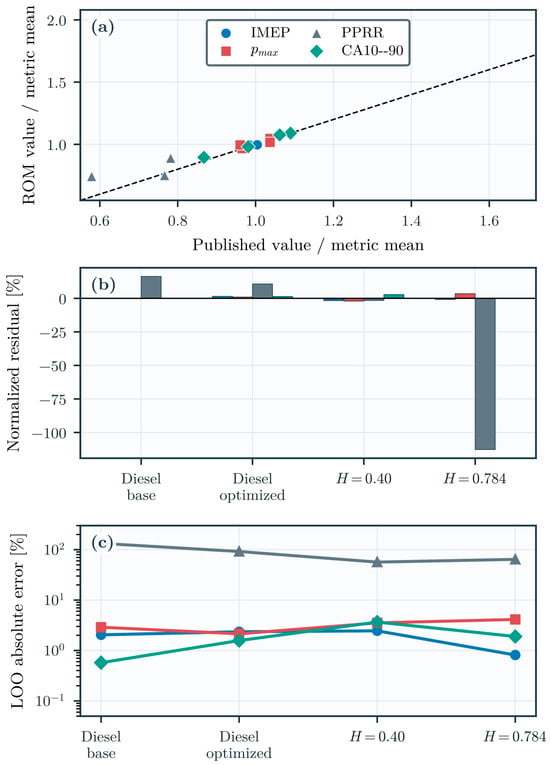
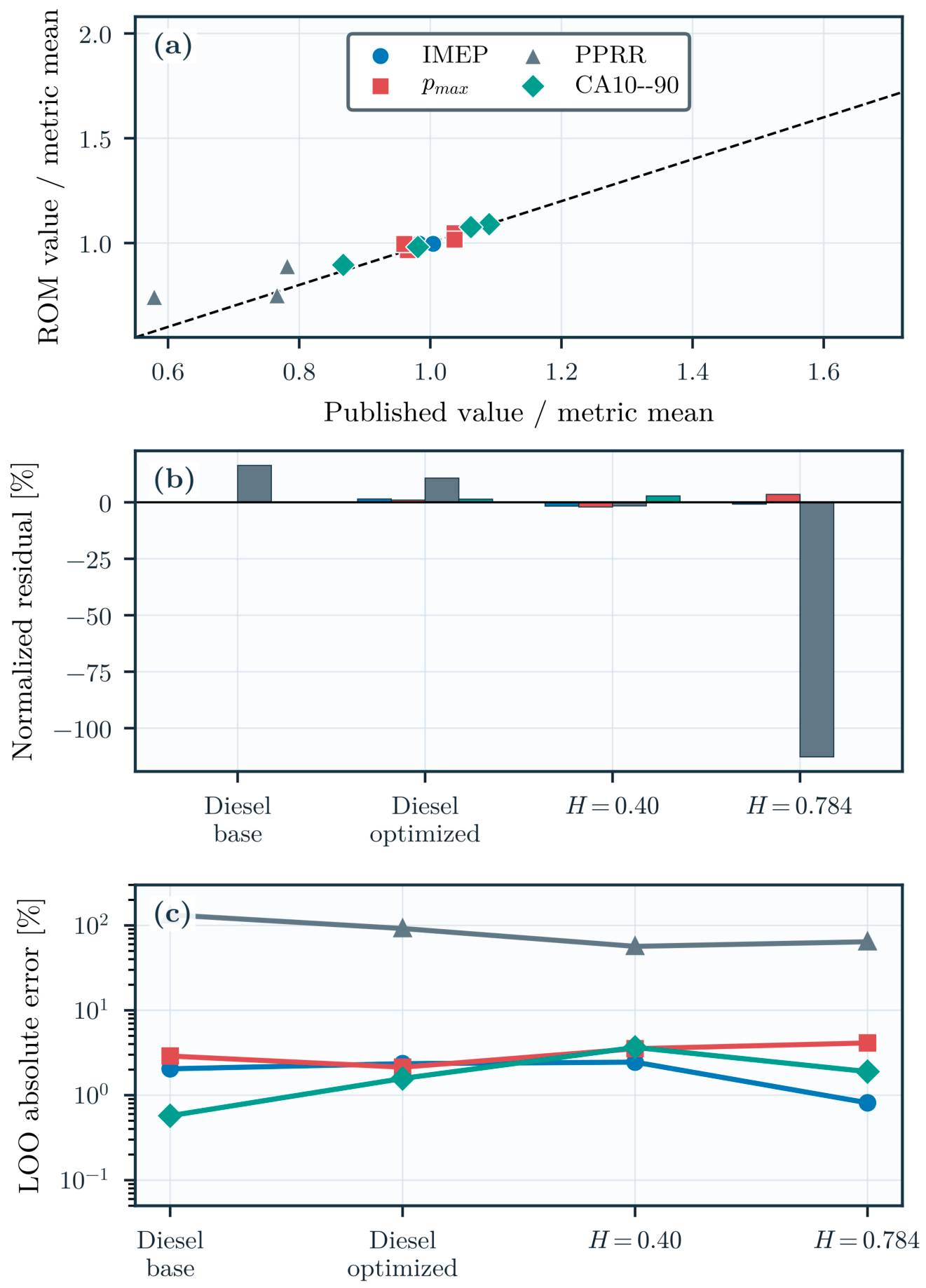
Figure 3 consolidates parity, residual, and affine discrepancy diagnostics. The pooled core R2 and heuristic adjusted index are 0.912 and 0.879, with a mean normalized residual of +0.47%; these aggregate measures do not replace the metric-wise values in Table 6. The affine leave-one-case-out diagnostic gives MAPE = 2.34%, compared with 1.27% for unadjusted ROM agreement. Because this diagnostic adds a fitted discrepancy map while retaining the ROM calibration and anchor, the difference does not measure out-of-sample generalization of the ROM.
Figure 3.
Agreement diagnostics at four published full-load operating points: (a) parity normalized by the published metric mean; (b) residuals normalized by that mean; and (c) absolute errors from the affine leave-one-case-out discrepancy map with the ROM calibration held fixed.
Table 6.
Agreement statistics over the four published full-load operating points. Residual means use ROM minus published values.
The PPRR residuals have a different structure. Deviations remain moderate through the optimized H = 0.40 case, but the H = 0.784 residual is strongly negative. This localized deviation is consistent with the source CFD double-peak heat-release pattern. PPRR is therefore excluded from the quantitative design constraints; the selected high-hydrogen operating points have not been demonstrated to satisfy engine limits on pressure-rise rate.
6.2. Reference Traces and Thermodynamic Interpretation
The fuel partition in Figure 2 shows the large reduction in diesel mass enabled by hydrogen’s higher lower heating value. The calculated λ changes even at fixed energy input because the two fuels have different stoichiometric air requirements. This accounting effect should not be confused with a resolved mixture field.
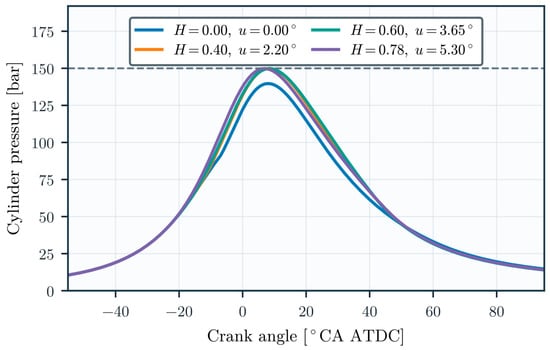
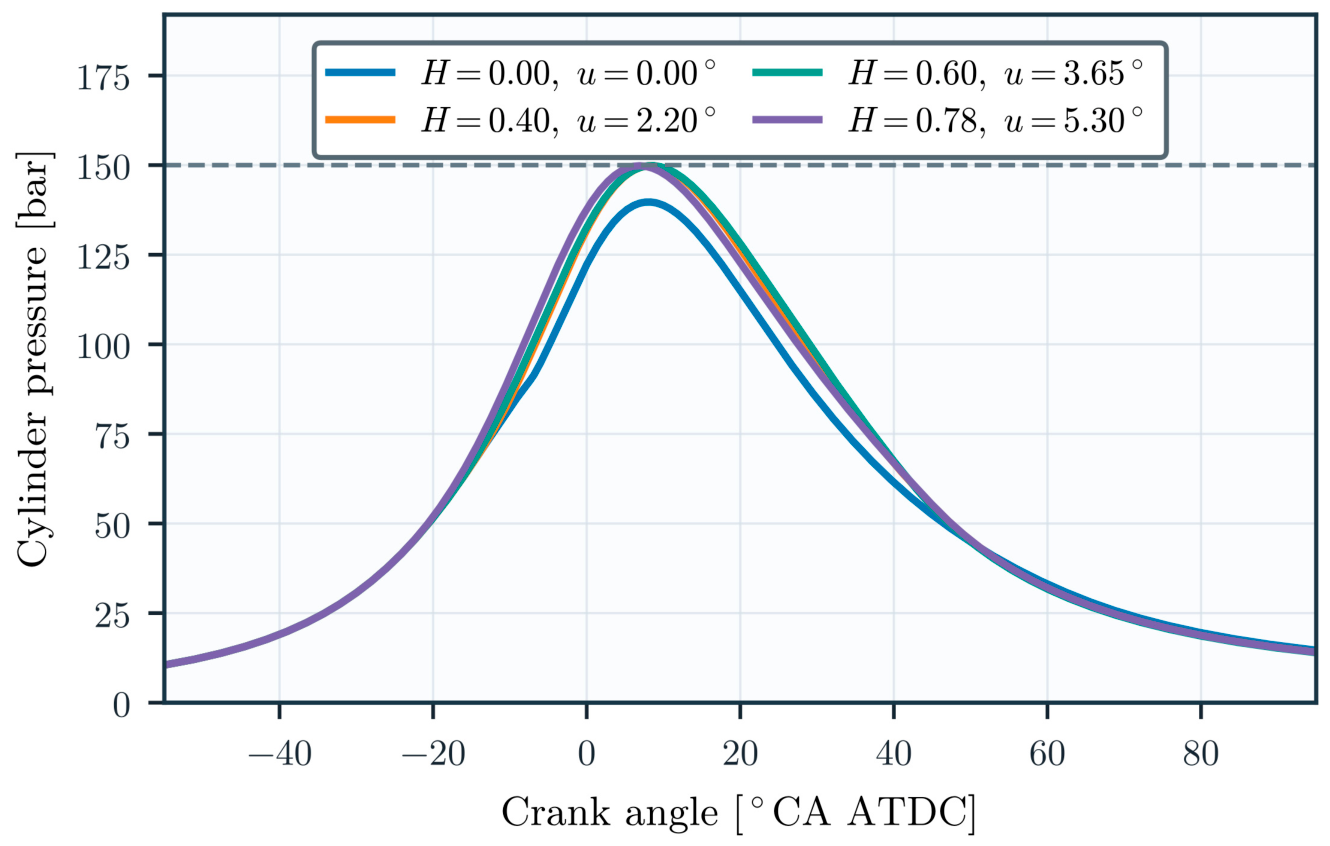
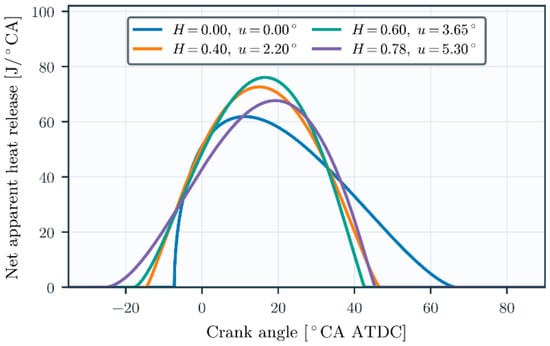
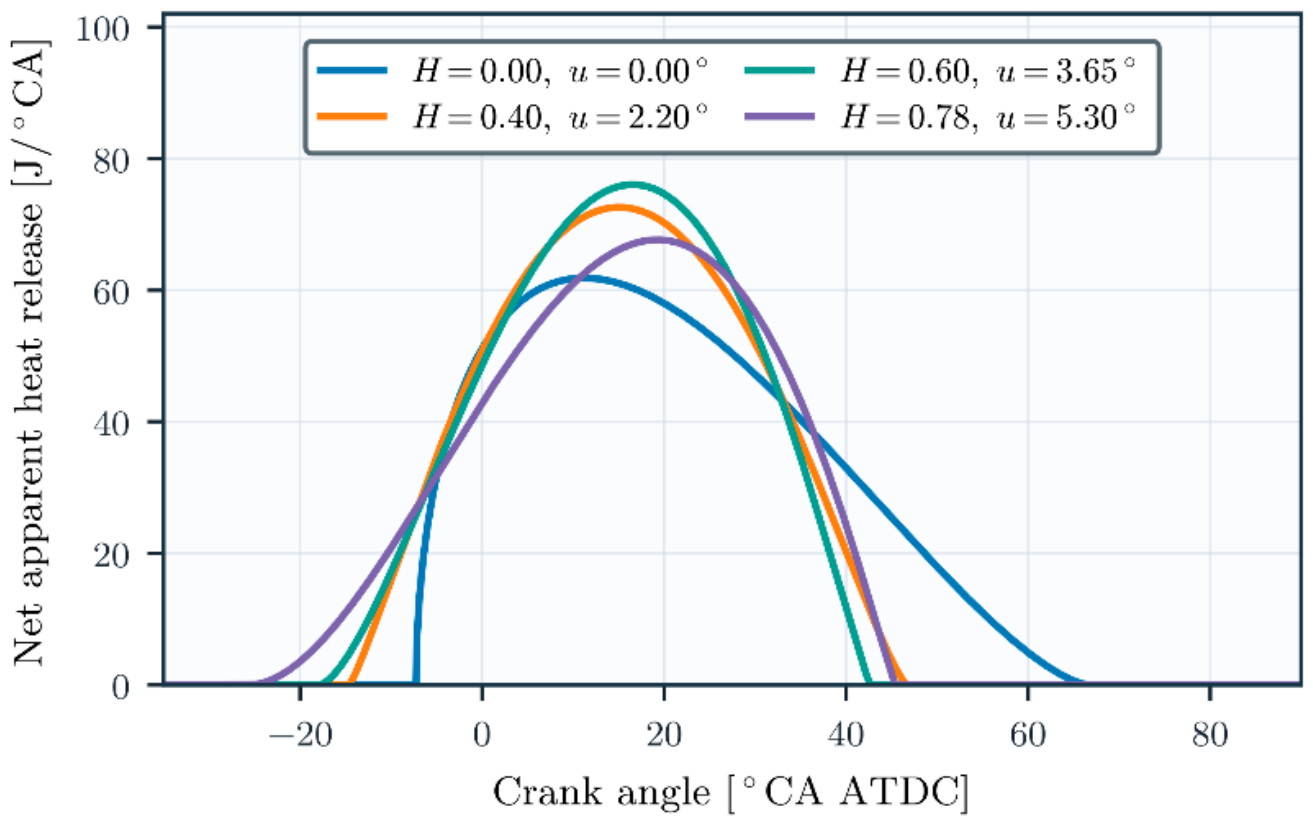
Figure 4 compares pressure traces for the diesel baseline and three hydrogen-share operating points. Figure 5 displays their net apparent heat-release laws. The intermediate case shifts and concentrates release near TDC, increasing work but also bringing peak pressure toward the limit. At high share, the assumed duration penalty broadens the release. These trends follow jointly from the closure and the pressure kernel; they are not independent experimental findings.
Figure 4.
Cylinder-pressure traces for selected nominal operating points. The horizontal line marks the imposed peak-pressure limit.
Figure 5.
Net apparent heat-release-rate histories corresponding to Figure 4.
Equation (16) explains the pressure response: release near minimum volume is strongly amplified. Equation (20) explains why unlimited retard is not favorable: the remaining expansion-work potential declines as the release volume increases. The conditional optimum is therefore usually located either near the unconstrained work maximum or on the pressure boundary.
6.3. Nominal Conditional Design
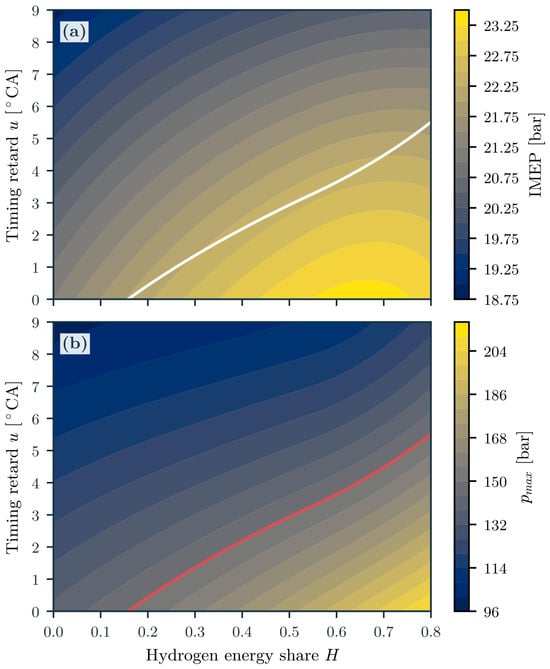
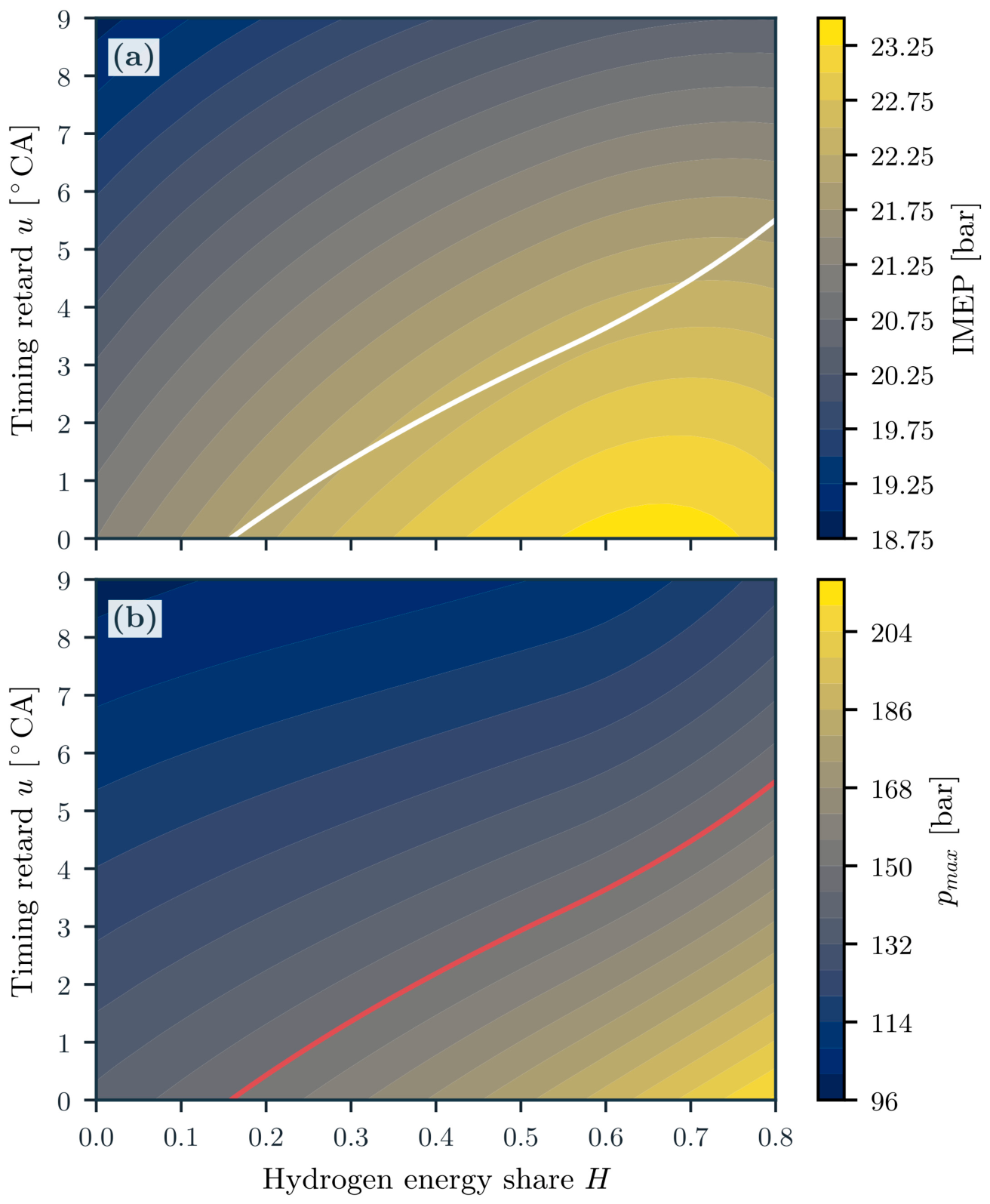
Figure 6 presents the nominal IMEP and peak-pressure distributions over hydrogen share and injection timing. IMEP initially increases with H in the assumed closure, whereas the feasible timing band moves toward greater retard as peak pressure becomes active. The high-share duration term then reduces performance. The result is a curved feasible ridge rather than a monotonic benefit from hydrogen substitution.
Figure 6.
Nominal design maps: (a) IMEP and (b) peak pressure. The white and red contours mark the guarded peak-pressure boundary used in Equation (23).
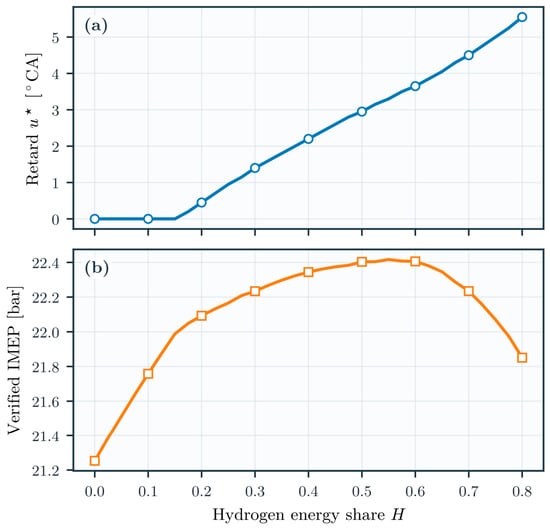
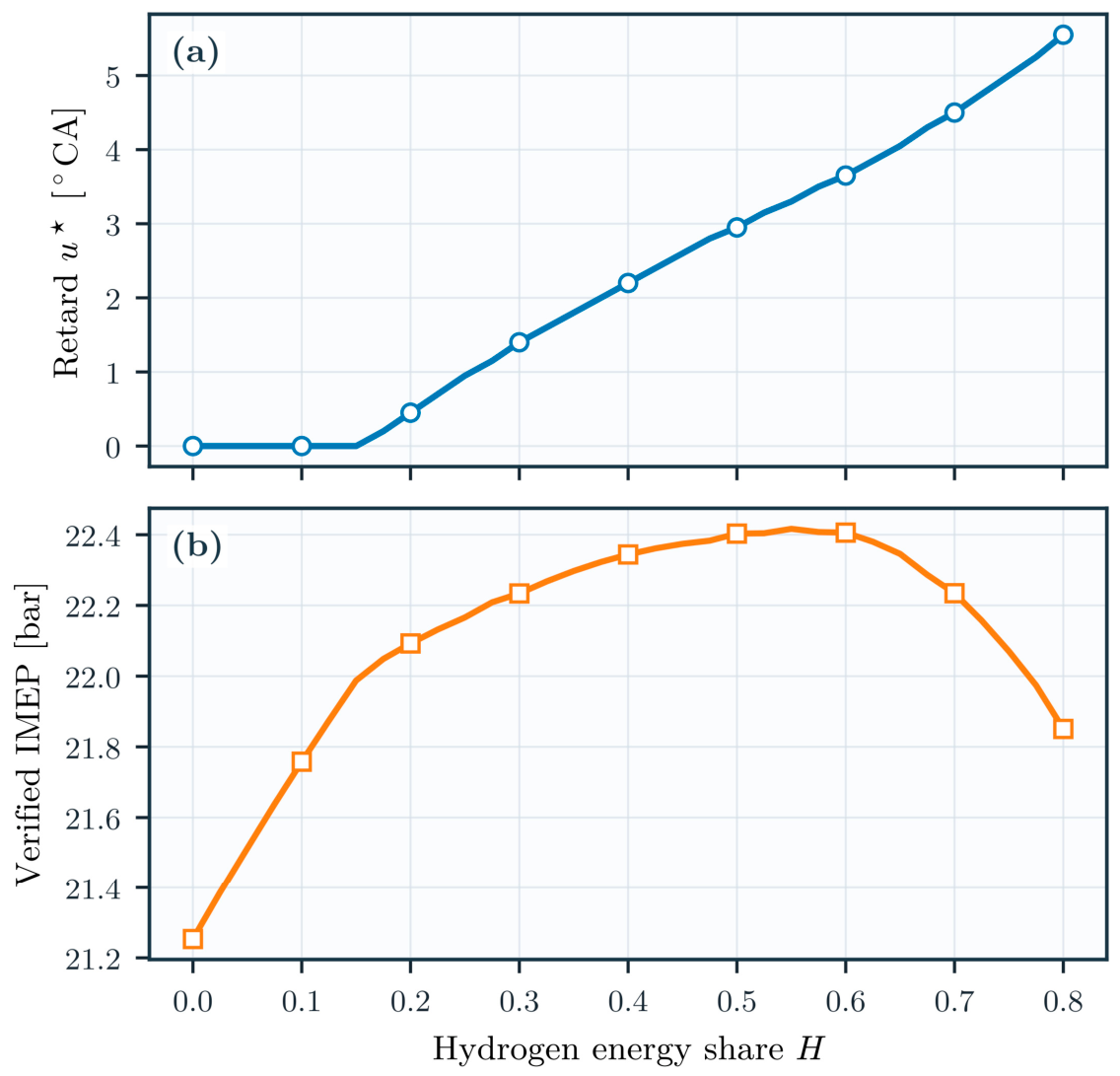
Figure 7 and Table 7 show the grid-verified conditional optima. IMEP forms a broad maximum of approximately 22.40 bar over H = 0.50–0.60 and subsequently declines, while the required retard increases. This intermediate-share optimum is consistent with the published CFD trend, whose largest tabulated IMEP occurs at H = 0.40, but the precise maximizing share is not treated as validated. All tabulated pressure values are recomputed at 0.125° CA and remain below 150 bar. The numerical PPRR remains a diagnostic because Table 4 and Table 5 demonstrate shape error.
Figure 7.
Nominal conditional optimum: (a) diesel-injection retard selected by Equation (22) and (b) verified IMEP. “The superscript star denotes the conditionally optimal pilot-retard value at each hydrogen energy share.”
Table 7.
Selected nominal timing optima verified at 0.125° CA.
6.4. Multi-Objective Performance–Substitution Trade-Off
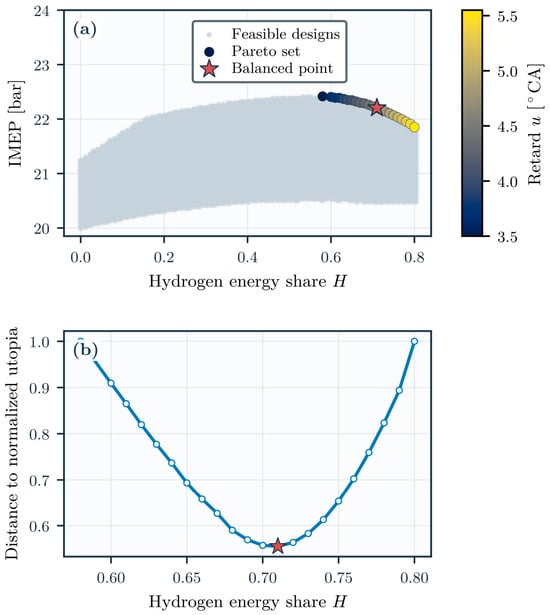
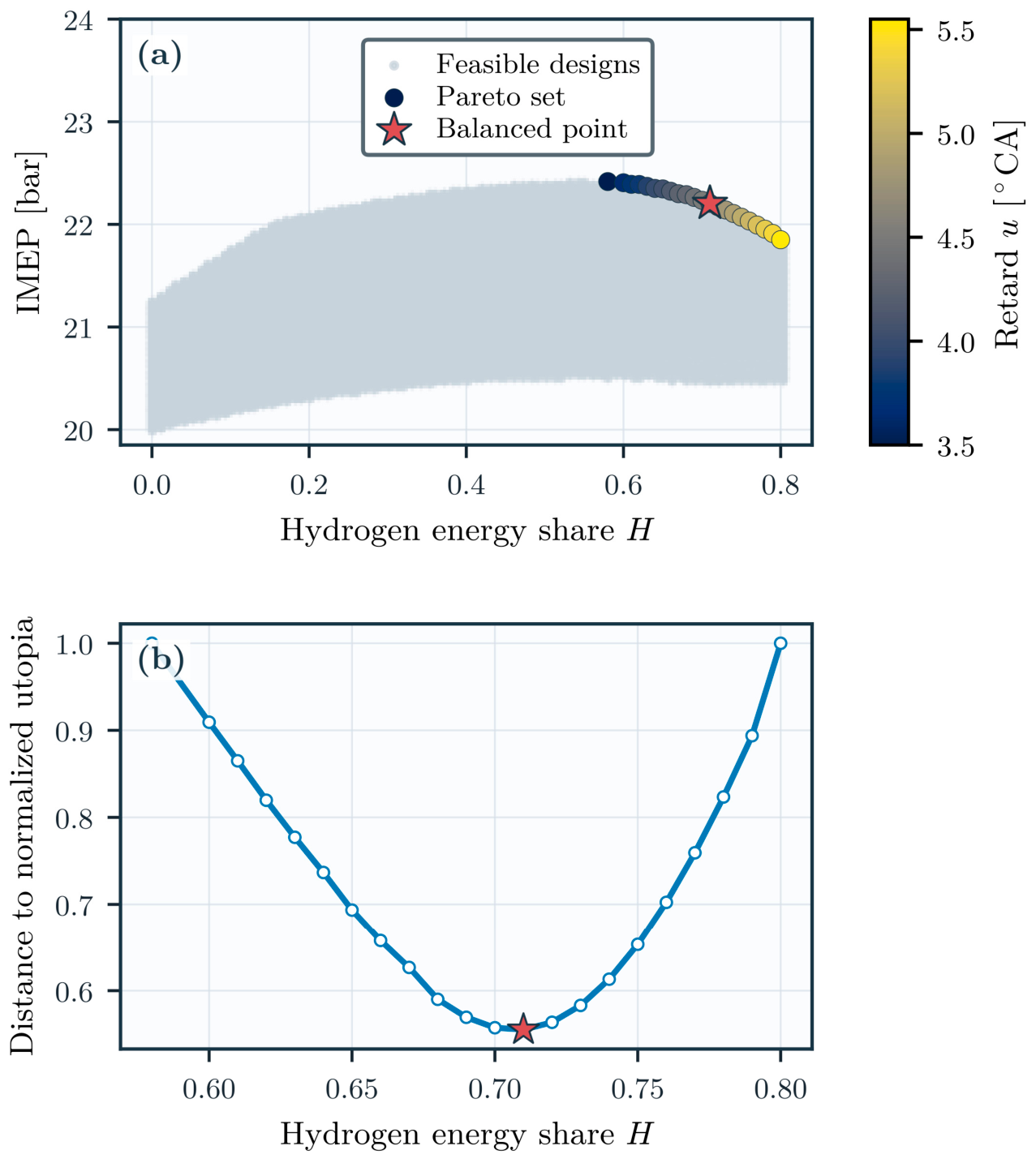
The feasible design cloud and nondominated set in Figure 8 extend the conditional timing calculation to simultaneous selection of H and u. The Pareto front begins at H = 0.58, where the highest feasible IMEP is obtained, and continues to the maximum investigated share H = 0.80. Points at lower H are dominated because both IMEP and hydrogen substitution can be increased without violating the adopted constraints.
Figure 8.
Bi-objective design: (a) feasible IMEP–hydrogen-share points and Pareto set, colored by timing retard, and (b) normalized distance to the utopia point.
Table 8 reports three representative model-screening decisions. The performance extreme gives 22.42 bar at H = 0.58. The normalized-utopia criterion selects H = 0.71 and u = 4.60° CA, retaining 99.1% of the maximum Pareto IMEP while increasing hydrogen energy share by 0.13. At the hydrogen-share extreme, H = 0.80 remains feasible under the imposed peak-pressure, phasing, and duration constraints with 21.85 bar. Because PPRR is not a binding constraint, these points are screening outcomes rather than validated engine recommendations. The full front is retained so that an application-specific preference can replace the equal-weight compromise between the normalized objectives.
Table 8.
Representative grid-verified points from the nominal Pareto set.
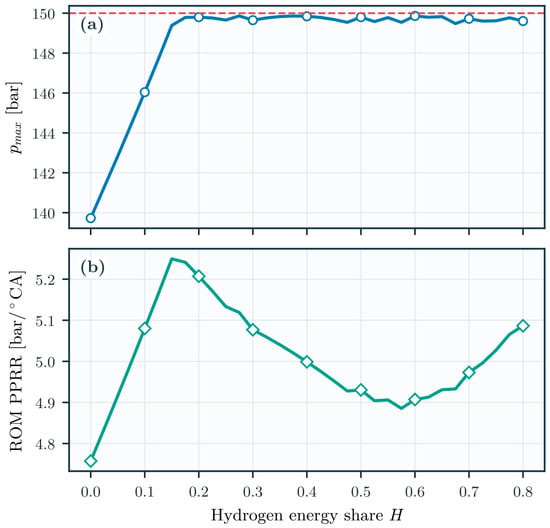
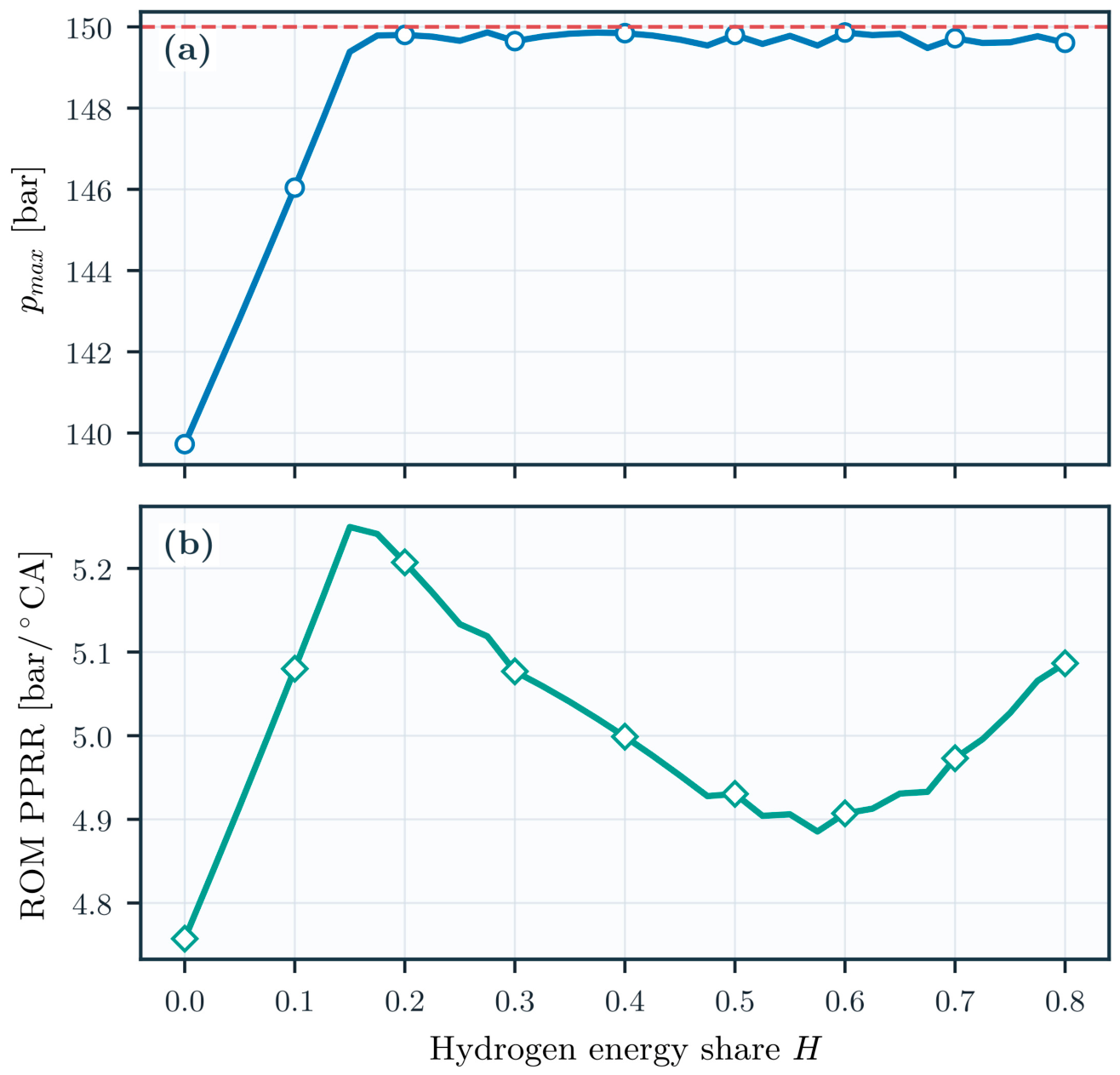
The two severity metrics are plotted on separate axes in Figure 9. Peak pressure lies close to its active limit across much of the optimized path. PPRR changes less monotonically because it depends on beta-law shape as well as phasing. Here, ‘feasible’ refers only to the modeled peak-pressure, CA50, duration, and timing constraints; PPRR remains an internal consistency diagnostic and not an engine-safety prediction.
Figure 9.
Nominal optimized path: (a) verified peak pressure and (b) unscaled model PPRR.
6.5. Local Sensitivity and Numerical Convergence
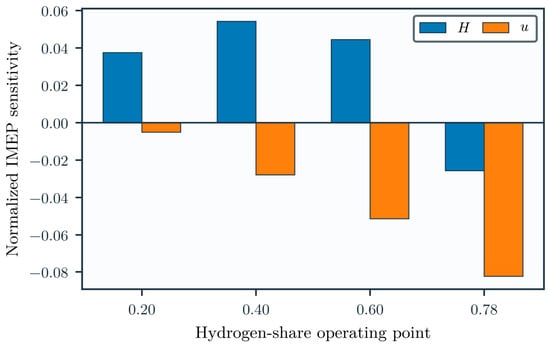
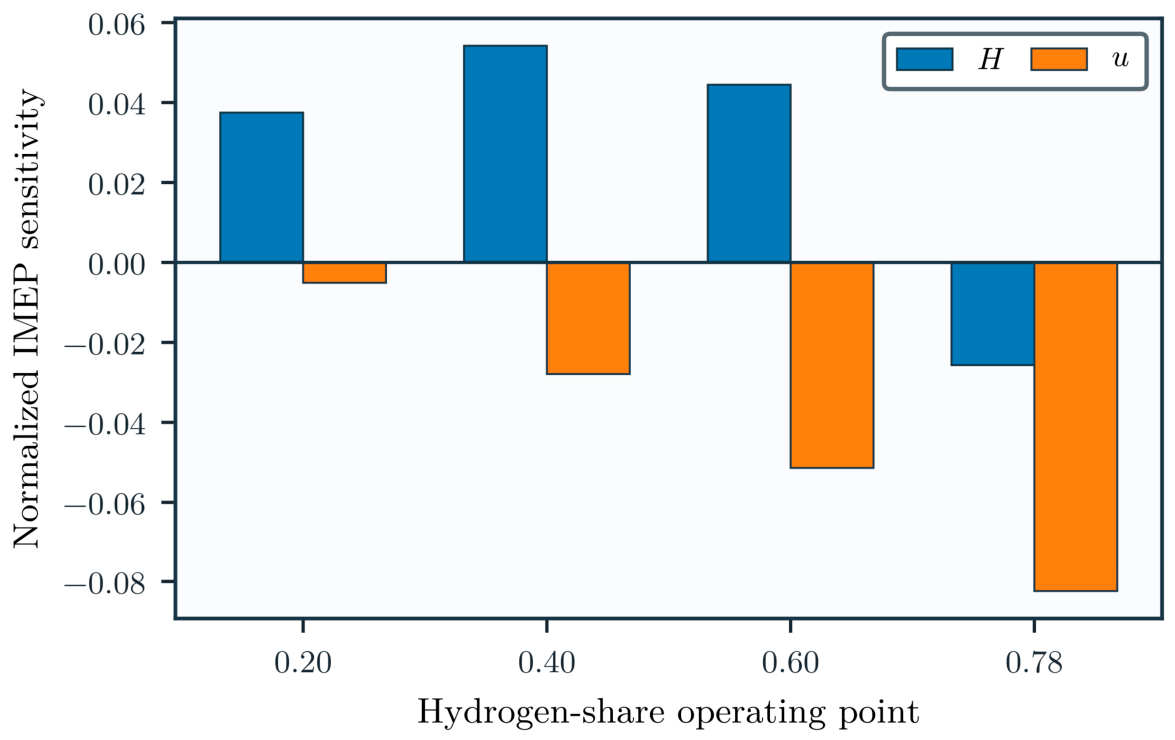
Figure 10 shows normalized IMEP sensitivities to the two quantities actually varied in the nominal design, H and u. Sensitivity to H decreases and changes sign as the closure crosses from the intermediate-share benefit to the high-share duration penalty. Timing sensitivity is small near an unconstrained optimum and non-zero where the pressure boundary truncates the performance ridge. No EGR sensitivity is shown because EGR is not a model input.
Figure 10.
Local normalized IMEP sensitivities to hydrogen share and diesel-injection retard at selected feasible points.
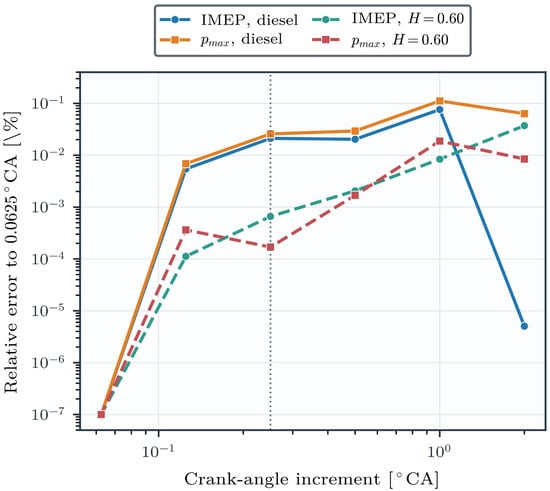
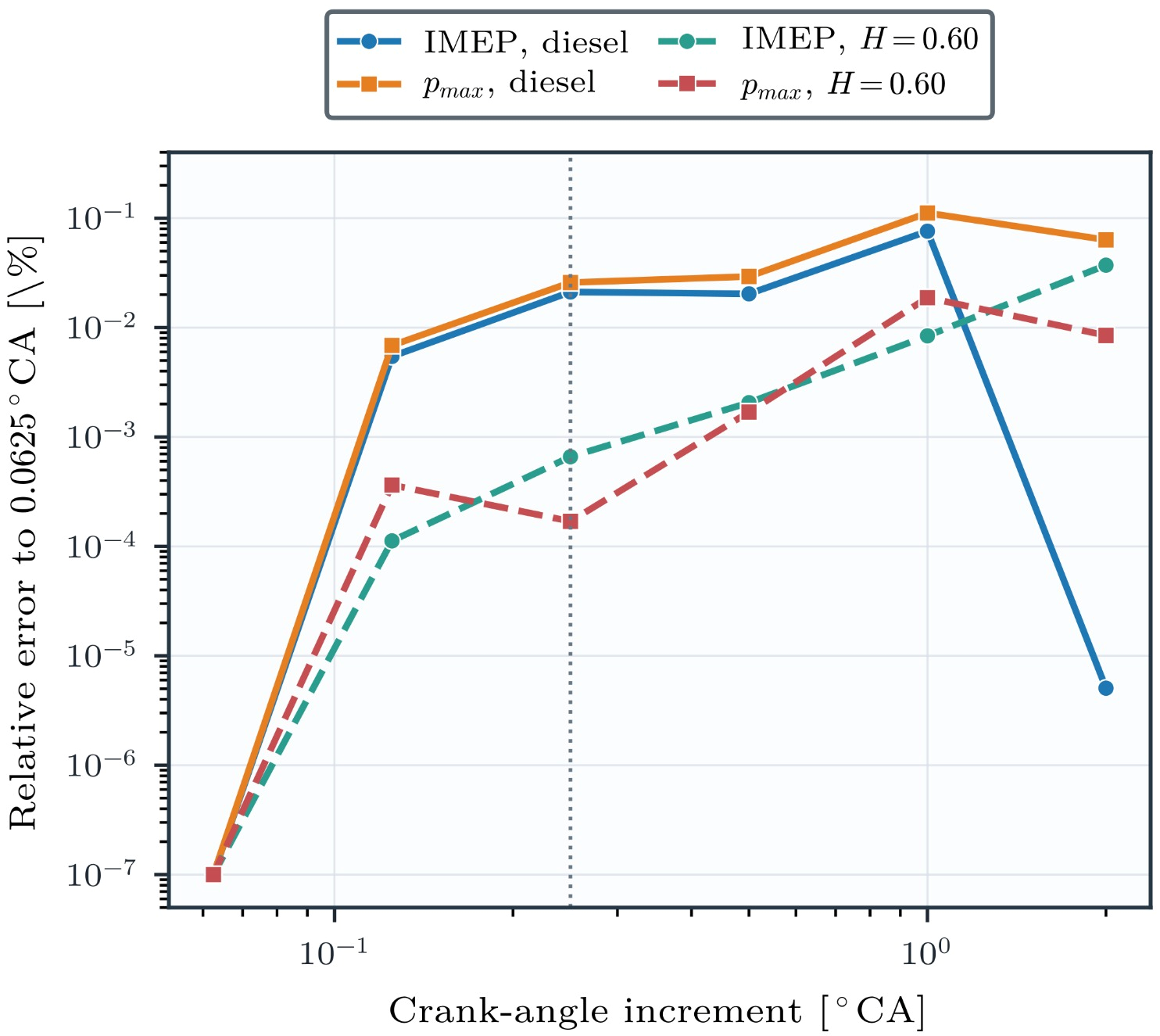
Figure 11 evaluates the diesel baseline and the pressure-limited point H = 0.60, u = 3.65°. Refinement from 0.25° to 0.0625° changes peak pressure by approximately 0.00017% and IMEP by 0.00066% in the latter case. The 0.05 bar design guard is therefore substantially larger than the observed quadrature change. Grid convergence cannot remove closure-form error, but it prevents numerical under-resolution from being confused with physical feasibility.
Figure 11.
Relative crank-angle-grid errors in IMEP and peak pressure for the diesel baseline and the H = 0.60, u = 3.65° pressure-limited case. Errors are measured against the 0.0625° CA calculation.
The heat-release-shape check retains the total apparent heat, CA50, and CA10–90 at each H–u condition as reprented in Table 9. The nominal beta law is replaced by Beta(2,4), Beta(3,3), or the mixture 0.55 Beta(4,8) + 0.45 Beta(8,4), representing front-loaded, symmetric, and double-pulse alternatives. For each density, the 0.10, 0.50, and 0.90 cumulative quantiles define its support and start angle through Equation (6). Verified Pareto candidates give an IMEP-maximizing share of H = 0.52–0.58 and a normalized-utopia selection of H = 0.69–0.71. This analysis evaluates sensitivity to heat-release shape within the assumed phasing, duration, and net-heat maps; it does not independently validate those maps or recover the source-CFD high-share PPRR.
Table 9.
Heat-release-shape robustness of the performance and balanced selections. All alternatives retain the nominal total apparent heat, CA50, and CA10–90 duration.
6.6. Bounded Scenario Propagation and Conservative Timing
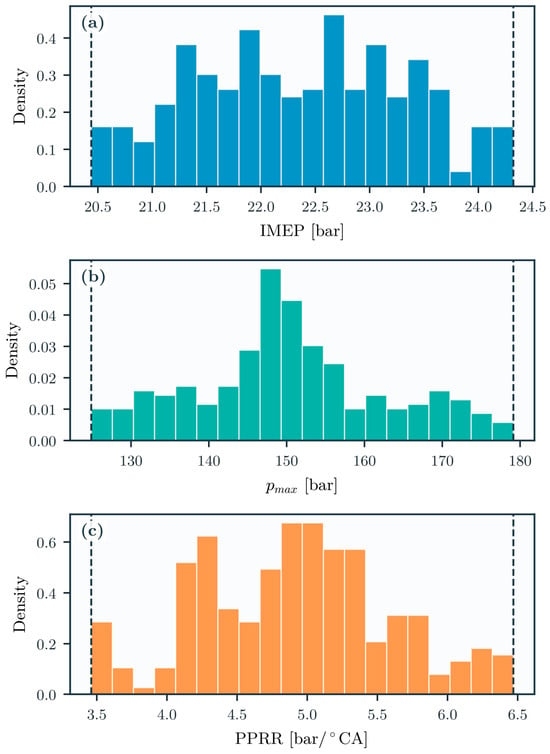
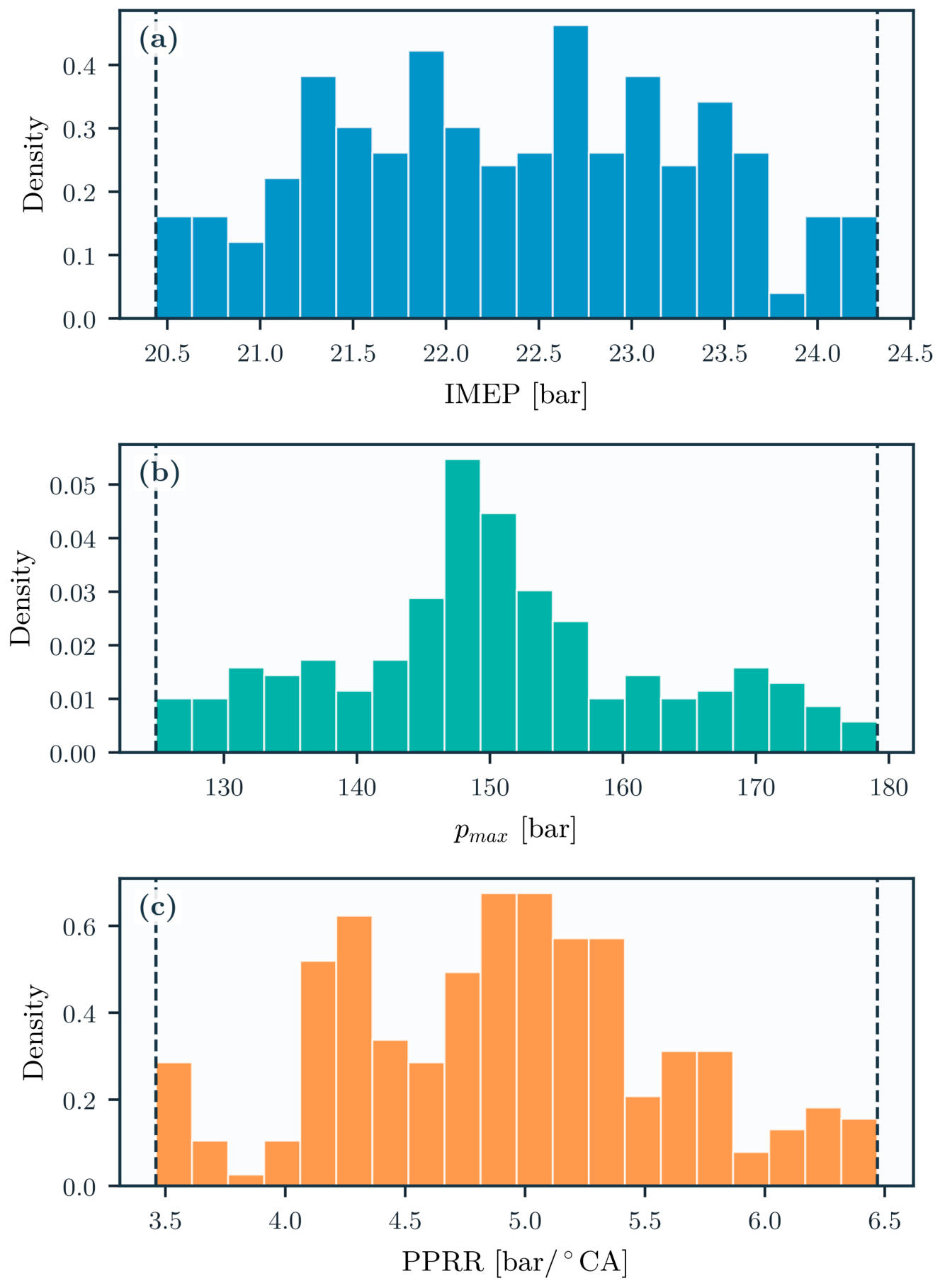
At H = 0.60 and the nominal optimum, the scenario ranges in Figure 12 are wide: IMEP spans approximately 20.44–24.32 bar and peak pressure 124.89–179.14 bar. The nominal pressure-limited point is therefore not feasible throughout the stated epistemic box. These intervals are envelopes over deliberately selected scenarios and must not be read as confidence or credible intervals.
Figure 12.
Responses of the 256 bounded epistemic scenarios at H = 0.60 and nominally optimized timing: (a) IMEP, (b) peak pressure, and (c) PPRR. Histogram heights count the selected scenarios and do not represent a probability distribution.
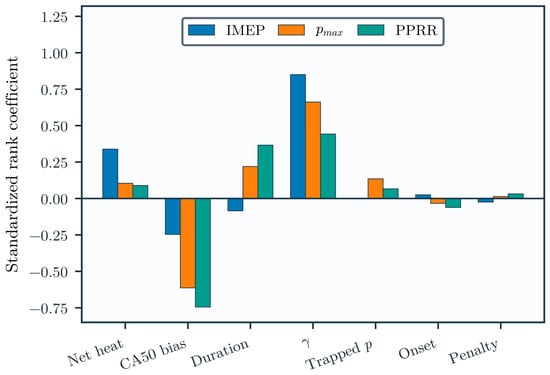
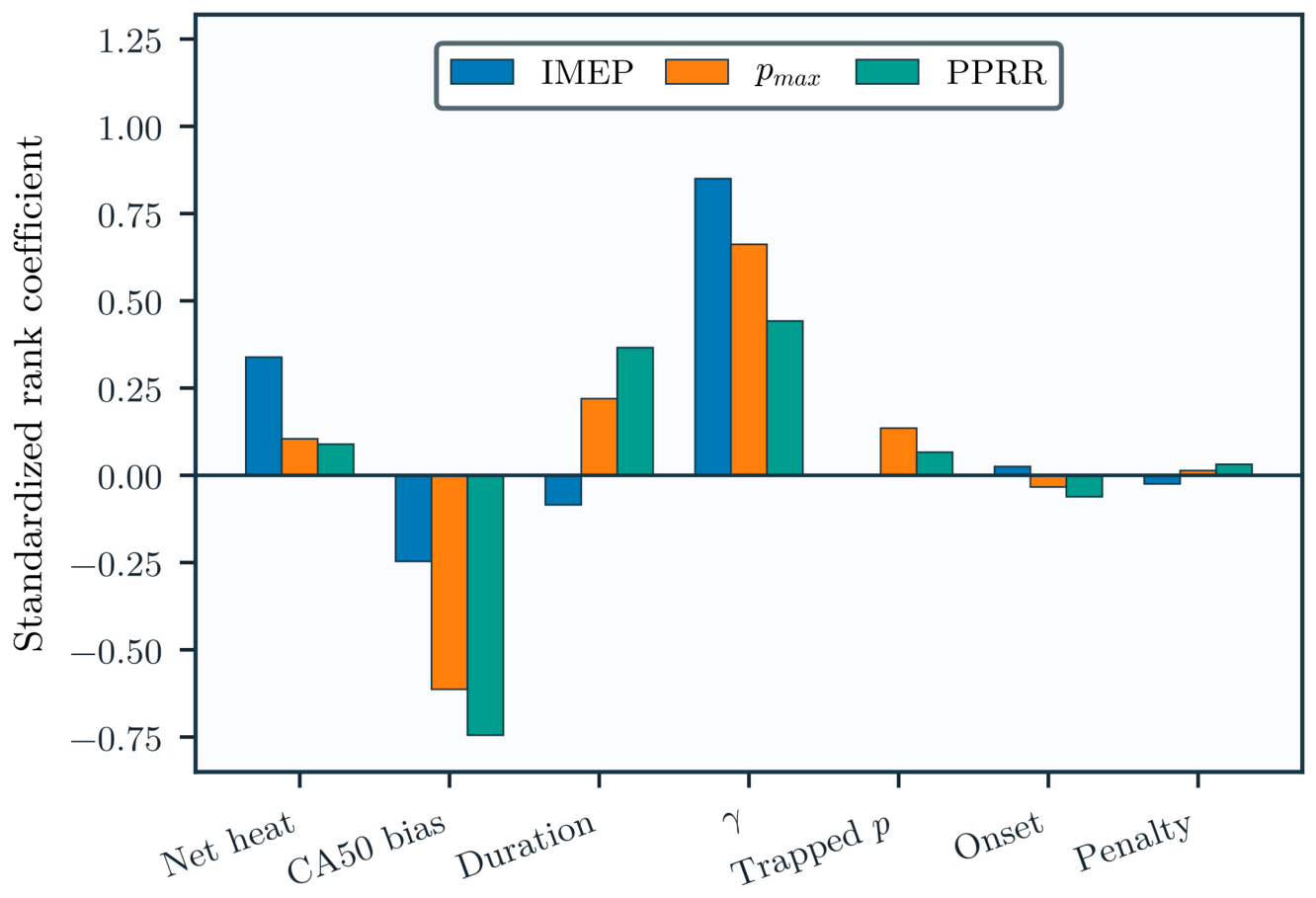
The SRRC results in Figure 13 summarize rank variation within the specified scenario box after assigning average ranks to tied input and output values. The rank-regression fit R2 values are 0.949 for IMEP, 0.902 for peak pressure, and 0.903 for PPRR, leaving approximately 5–10% of rank variance unexplained by the rank-linear fits. These are descriptive sensitivity summaries for the selected corner-enriched design, rather than probability-weighted importance measures. Varying Hb and kh tests sensitivity to the high-share duration penalty within the prescribed ranges.
Figure 13.
Standardized rank-regression coefficients for the bounded scenario ensemble, using average ranks for ties. Fit R2 values are 0.949 for IMEP, 0.902 for peak pressure, and 0.903 for PPRR.
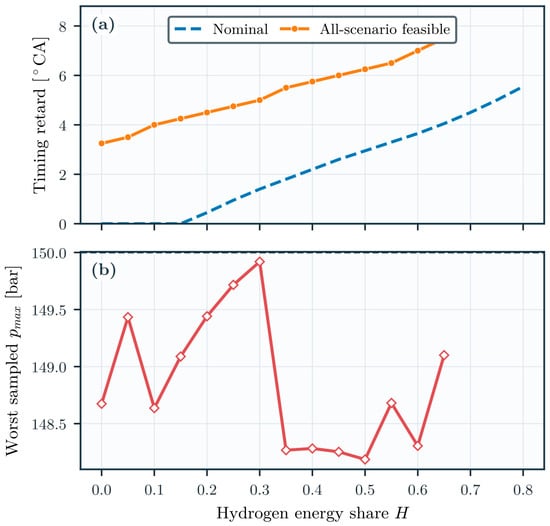
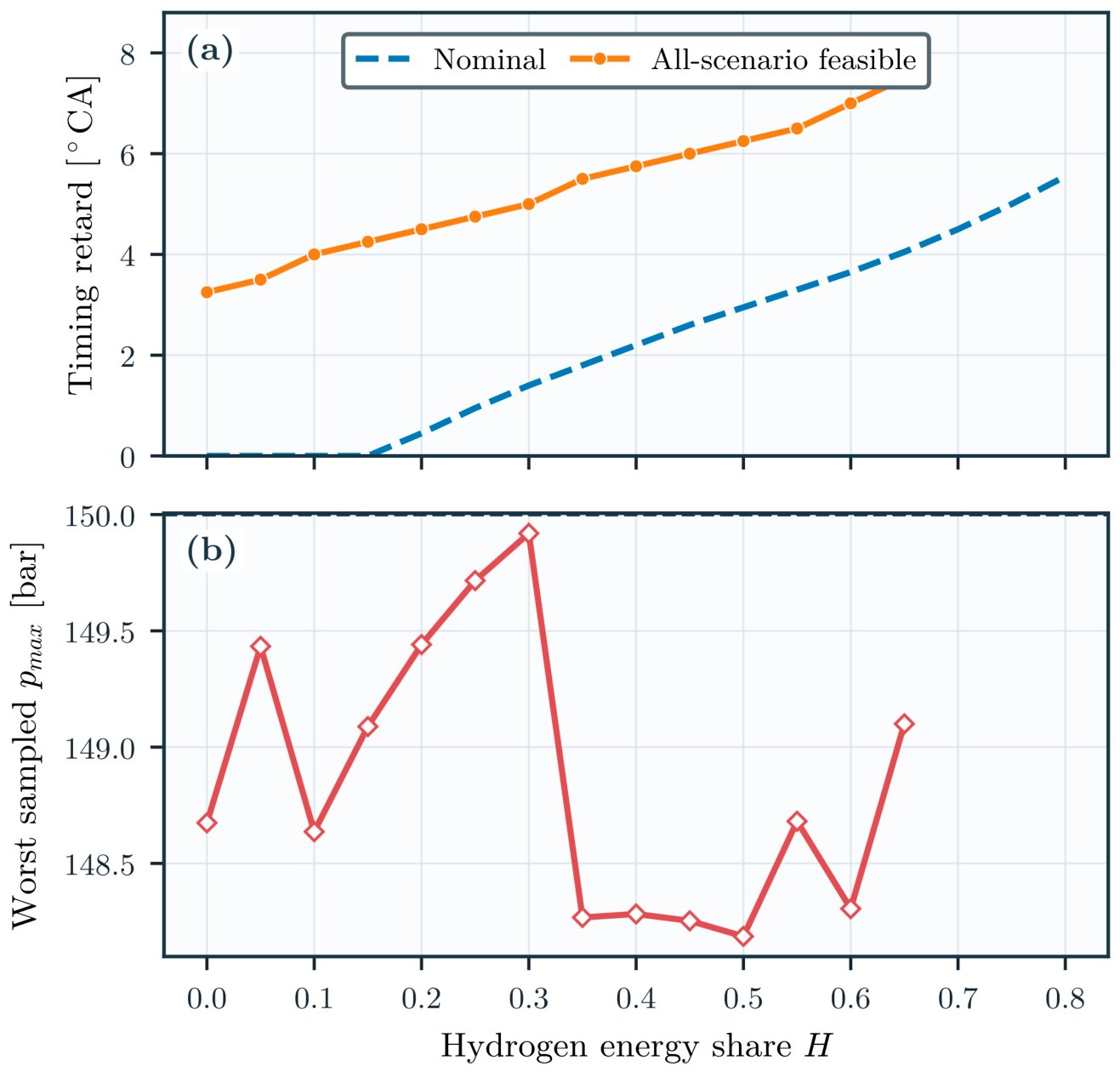
Figure 14 compares nominal timing with the policy satisfying every sampled scenario. Additional retard is required to satisfy the imposed pressure and phasing limits. On the tested grid of 17 hydrogen shares and 37 timing values over 0–9° CA, common feasible timings are found through H = 0.65, but none is found at H = 0.70, 0.75, or 0.80. This is a statement about the tested grid and 256 scenarios, not proof that the continuous feasible-set intersection is empty or a universal hydrogen limit. Finer timing grids, different bounds, additional controls, or cycle-resolved calibration could change this result.
Figure 14.
Nominal and sampled all-scenario-feasible timing policies: (a) selected diesel-injection retard and (b) worst sampled peak pressure. Missing high-share points indicate that no common feasible timing was found on the tested timing grid.
7. Applicability and Further Development
The framework is intended for rapid full-load screening within the operating range represented by the reference engine. Spray evolution, hydrogen stratification, turbulent flame structure, wall interaction, and cylinder variability enter through the apparent-heat-release closure and bounded parameter ensemble rather than through spatially resolved submodels [15,16,19]. The principal quantitative outputs are therefore IMEP, peak pressure, combustion duration, and their Pareto trade-off. PPRR is retained as a shape-sensitive diagnostic, consistent with the residual pattern in Figure 3.
The formulation is directly extensible when additional cycle-resolved data become available. Pressure and heat-release traces across multiple H–u points can identify richer multi-pulse closures; composition-dependent properties and heat transfer can replace constant γ; and boost, trapped mass, and injection-system limits can be introduced as further design variables. With species-resolved combustion chemistry or calibrated empirical submodels, the same operating-point framework could also examine NOx, unburned hydrogen, CO, and particulate trade-offs; the present formulation does not itself predict emissions. These additions preserve the pressure-integral, grid-verification, agreement-diagnostic, and Pareto-analysis structure developed here.
8. Conclusions
The reference-calibrated framework supports thermodynamic screening within the selected full-load reference conditions. Its mathematical, numerical, and model-dependent findings are summarized below.
Experimental evidence is limited to the same-state baseline comparison and the validation reported for the source CFD model.
- The integral pressure solution yields explicit heat-to-pressure and heat-to-work kernels. These kernels show mathematically why near-TDC heat release has high pressure leverage and why excessive post-TDC retard loses expansion-work potential.
- Two calibration parameters reproduce the published CFD IMEP and peak pressure at the reference point within 0.02%. Against withheld experimental diesel quantities at that state, the ROM differs by 2.1% in IMEP, 1.3% in peak pressure, 1.0° CA in CA50, and 3.1° CA in CA10–90.
- Across four exact published full-load cases, the pooled normalized IMEP, peak-pressure, and duration data give R2 = 0.912, heuristic-adjusted index = 0.879, RMSE = 1.67%, and MAPE = 1.27%. The fixed-ROM affine discrepancy diagnostic gives R2 = 0.801 with MAPE = 2.34%. These values quantify agreement and small-sample stability within the selected reference set; they are not evidence of general predictive accuracy or independent experimental validation.
- Residual analysis isolates the high-share PPRR response from the core agreement set: the smooth single-pulse closure captures work, peak pressure, and duration trends more accurately than the sharp pressure derivative associated with the reported double-peak structure. Alternative front-loaded, symmetric, and double-pulse heat-release forms retain an IMEP-maximizing share of H = 0.52–0.58 and a balanced share of H = 0.69–0.71, while confirming that the precise timing and PPRR are shape-dependent.
- In the nominal phenomenological closure, conditional IMEP has a broad maximum over H = 0.50–0.60. Increasing hydrogen share beyond this region requires greater diesel-injection retard and eventually loses work through the duration penalty.
- Every reported nominal optimum satisfies the 150 bar peak-pressure limit after recomputation on a 0.125° CA grid. The observed 0.25°-to-0.0625° change at a representative pressure-limited point is much smaller than the adopted pressure guard.
- The bi-objective calculation identifies a model-based Pareto set over H = 0.58–0.80. The normalized-utopia selection at H = 0.71 and u = 4.60° CA retains 99.1% of the maximum Pareto IMEP while increasing hydrogen substitution relative to the performance extreme. Because PPRR is not validated as a constraint, this point is a thermodynamic screening compromise rather than an engine recommendation.
- The 256-member bounded epistemic ensemble produces a wider pressure range than the nominal sweep. On the tested hydrogen-share and timing grids, common timings satisfying every sampled scenario are found through H = 0.65; this is neither a continuous-domain feasibility proof nor an engine-safety limit.
- The same framework can incorporate multi-pulse heat release and additional measured pressure histories as they become available, without changing the pressure-integral, verification, or Pareto-analysis architecture.
Funding
This research received no external funding.
Data Availability Statement
The original contributions presented in this study are included in the article. Further inquiries can be directed to the corresponding author.
Conflicts of Interest
The author declares no known competing financial interests or personal relationships that could have appeared to influence the work reported in this paper.
References
- Karim, G.A. Hydrogen as a spark ignition engine fuel. Int. J. Hydrogen Energy 2003, 28, 569–577. [Google Scholar] [CrossRef] [Scilit]
- White, C.M.; Steeper, R.R.; Lutz, A.E. The hydrogen-fueled internal combustion engine: A technical review. Int. J. Hydrogen Energy 2006, 31, 1292–1305. [Google Scholar] [CrossRef] [Scilit]
- Lilik, G.K.; Zhang, H.; Herreros, J.M.; Haworth, D.C.; Boehman, A.L. Hydrogen assisted diesel combustion. Int. J. Hydrogen Energy 2010, 35, 4382–4398. [Google Scholar] [CrossRef] [Scilit]
- Kose, H.; Ciniviz, M. An experimental investigation of effect on diesel engine performance and exhaust emissions of addition at dual fuel mode of hydrogen. Fuel Process. Technol. 2013, 114, 26–34. [Google Scholar] [CrossRef] [Scilit]
- Pham, Q.; Park, S.; Agarwal, A.K.; Park, S. Review of dual-fuel combustion in the compression-ignition engine: Spray, combustion, and emission. Energy 2022, 250, 123778. [Google Scholar] [CrossRef] [Scilit]
- Hosseini, S.H.; Tsolakis, A.; Alagumalai, A.; Mahian, O.; Lam, S.S.; Pan, J.; Peng, W.; Tabatabaei, M.; Aghbashlo, M. Use of hydrogen in dual-fuel diesel engines. Prog. Energy Combust. Sci. 2023, 98, 101100. [Google Scholar] [CrossRef] [Scilit]
- Rueda-Vázquez, J.M.; Serrano, J.; Pinzi, S.; Jiménez-Espadafor, F.J.; Dorado, M.P. A review of the use of hydrogen in compression ignition engines with dual-fuel technology and techniques for reducing NOx emissions. Sustainability 2024, 16, 3462. [Google Scholar] [CrossRef] [Scilit]
- Dimitriou, P.; Kumar, M.; Tsujimura, T.; Suzuki, Y. Combustion and emission characteristics of a hydrogen-diesel dual-fuel engine. Int. J. Hydrogen Energy 2018, 43, 13605–13617. [Google Scholar] [CrossRef] [Scilit]
- Talibi, M.; Hellier, P.; Ladommatos, N. The effect of varying EGR and intake air boost on hydrogen-diesel co-combustion in CI engines. Int. J. Hydrogen Energy 2017, 42, 6369–6383. [Google Scholar] [CrossRef] [Scilit]
- Tsujimura, T.; Suzuki, Y. The utilization of hydrogen in hydrogen/diesel dual fuel engine. Int. J. Hydrogen Energy 2017, 42, 14019–14029. [Google Scholar] [CrossRef] [Scilit]
- Saravanan, N.; Nagarajan, G. An experimental investigation on manifold-injected hydrogen as a dual fuel for diesel engine system with different injection duration. Int. J. Energy Res. 2009, 33, 1352–1366. [Google Scholar] [CrossRef] [Scilit]
- Milojević, S.; Savić, S.; Marić, D.; Stopka, O.; Krstić, B.; Stojanović, B. Correlation between emission and combustion characteristics with the compression ratio and fuel injection timing in tribologically optimized diesel engine. Teh. Vjesn. 2022, 29, 1210–1219. [Google Scholar] [CrossRef] [Scilit]
- Li, Z.; Liu, J.; Ji, Q.; Sun, P.; Wang, X.; Xiang, P. Influence of hydrogen fraction and injection timing on in-cylinder combustion and emission characteristics of hydrogen-diesel dual-fuel engine. Fuel Process. Technol. 2023, 252, 107990. [Google Scholar] [CrossRef] [Scilit]
- Farzam, R.; McTaggart-Cowan, G. Hydrogen-diesel dual-fuel combustion sensitivity to fuel injection parameters in a multi-cylinder compression-ignition engine. Int. J. Hydrogen Energy 2024, 49, 850–867. [Google Scholar] [CrossRef] [Scilit]
- Rorimpandey, P.; Yip, H.L.; Srna, A.; Zhai, G.; Wehrfritz, A.; Kook, S.; Hawkes, E.R.; Chan, Q.N. Hydrogen-diesel dual-fuel direct-injection combustion under compression-ignition engine conditions. Int. J. Hydrogen Energy 2023, 48, 766–783. [Google Scholar] [CrossRef] [Scilit]
- Rorimpandey, P.; Zhai, G.; Kook, S.; Hawkes, E.R.; Chan, Q.N. Effects of energy-share and ambient oxygen concentration on hydrogen-diesel dual-fuel direct-injection combustion in compression-ignition conditions. Int. J. Hydrogen Energy 2024, 49, 1346–1361. [Google Scholar] [CrossRef] [Scilit]
- Gültekin, N.; Ciniviz, M. Experimental investigation of the effects of energy ratio and combustion chamber design on engine performance and emissions in a hydrogen-diesel dual-fuel CRDI engine. Atmos. Pollut. Res. 2024, 15, 102235. [Google Scholar] [CrossRef] [Scilit]
- Bakar, R.A.; Kadirgama, K.; Ramasamy, D.; Yusaf, T.; Kamarulzaman, M.K.; Aslfattahi, N.; Samylingam, L.; Alwayzy, S.H. Experimental analysis on the performance, combustion/emission characteristics of a DI diesel engine using hydrogen in dual fuel mode. Int. J. Hydrogen Energy 2024, 52, 843–860. [Google Scholar] [CrossRef] [Scilit]
- Ramsay, C.J.; Ranga Dinesh, K.K.J. Numerical modelling of a heavy-duty diesel-hydrogen dual-fuel engine with late high pressure hydrogen direct injection and diesel pilot. Int. J. Hydrogen Energy 2024, 49, 674–696. [Google Scholar] [CrossRef] [Scilit]
- Zhang, B.; Wang, H.; Wang, S. Computational investigation of combustion, performance, and emissions of a diesel-hydrogen dual-fuel engine. Sustainability 2023, 15, 3610. [Google Scholar] [CrossRef] [Scilit]
- Zareei, J.; Nuñez Alvarez, J.R. Dataset of the effect of the number of injector holes on the heat transfer coefficient and the pressure in the combustion chamber of a hydrogen-diesel engine. Data Brief 2024, 55, 110597. [Google Scholar] [CrossRef] [Scilit]
- Abuelnour, M.A.; Said, M.F.M.; Abuelnuor, A.A.A. Numerical investigation of hydrogen-diesel dual fuel engine: Combustion and emissions characteristics under varying hydrogen concentration and exhaust gas recirculation. Fuel 2024, 377, 132794. [Google Scholar] [CrossRef] [Scilit]
- Scrignoli, F.; Pisapia, A.M.; Savioli, T.; Mancaruso, E.; Mattarelli, E.; Rinaldini, C.A. Exploring hydrogen–diesel dual fuel combustion in a light-duty engine: A numerical investigation. Energies 2024, 17, 5761. [Google Scholar] [CrossRef] [Scilit]
- Heywood, J.B. Internal Combustion Engine Fundamentals, 2nd ed.; McGraw-Hill Education: New York, NY, USA, 2018. [Google Scholar]
- Ferguson, C.R.; Kirkpatrick, A.T. Internal Combustion Engines: Applied Thermosciences, 3rd ed.; Wiley: Chichester, UK, 2015. [Google Scholar]
- Jalivar, G.; Neshat, E. Novel thermodynamic model for simulation of hydrogen/diesel fueled PCCI engine. Heliyon 2025, 11, e42140. [Google Scholar] [CrossRef] [Scilit]
- Saltelli, A.; Ratto, M.; Andres, T.; Campolongo, F.; Cariboni, J.; Gatelli, D.; Saisana, M.; Tarantola, S. Global Sensitivity Analysis: The Primer; Wiley: Chichester, UK, 2008. [Google Scholar]
- Nocedal, J.; Wright, S.J. Numerical Optimization, 2nd ed.; Springer: New York, NY, USA, 2006. [Google Scholar]
- Deb, K.; Pratap, A.; Agarwal, S.; Meyarivan, T. A fast and elitist multiobjective genetic algorithm: NSGA-II. IEEE Trans. Evol. Comput. 2002, 6, 182–197. [Google Scholar] [CrossRef] [Scilit]
- Woschni, G. A Universally Applicable Equation for the Instantaneous Heat Transfer Coefficient in the Internal Combustion Engine; SAE Technical Paper 670931; SAE International: Pittsburgh, PA, USA, 1967. [Google Scholar]
- Wiebe, I.I. Brennverlauf und Kreisprozess von Verbrennungsmotoren; VEB Verlag Technik: Berlin, Germany, 1970. [Google Scholar]

Disclaimer/Publisher’s Note: The statements, opinions and data contained in all publications are solely those of the individual author(s) and contributor(s) and not of MDPI and/or the editor(s). MDPI and/or the editor(s) disclaim responsibility for any injury to people or property resulting from any ideas, methods, instructions or products referred to in the content. |
© 2026 by the author. Licensee MDPI, Basel, Switzerland. This article is an open access article distributed under the terms and conditions of the Creative Commons Attribution (CC BY) license.