


Abstract
Polyoxymethylene dimethyl ethers (PODE) is a promising carbon-neutral synthetic fuel for reducing emissions in compression ignition engines. This study employed a progressive optimization from operating parameters alone to co-optimization with operating and geometric parameters to improve engine performance, and the coupling among fuel properties, injection strategies, and piston geometry is elucidated by comparing the combustion and emission characteristics of diesel and PODE. Compared to diesel, the high oxygen content and superior atomization of PODE promote rapid combustion and lower exhaust losses, albeit with larger heat transfer losses that limit net thermal efficiency gains. Consequently, the optimization priority shifts from enhancing mixture preparation for diesel to managing flame/wall interactions for PODE. From parameter-only tuning to co-optimization, diesel adopts a lower injection pressure to alleviate the fast combustion rate, paired with a shrunken bowl bottom pocket to compensate for the lower spray momentum; PODE prioritizes a lower injection pressure and an elevated side pocket to mitigate flame/wall interactions and suppress heat transfer losses. Under co-optimization, PODE achieves a 2.1% improvement in thermal efficiency and a 14.3% reduction in nitrogen oxides (NOx) relative to parameter-only optimization; both gains are more pronounced than those for diesel. These insights provide a theoretical basis for designing high-efficiency engines with carbon-neutral fuels.
1. Introduction
Diesel engines serve as the primary power source for transportation and industrial sectors; however, they still face the challenge of overcoming the trade-off between nitrogen oxides (NOx) and soot emissions, while simultaneously improving thermal efficiency and reducing carbon emissions. Although various advanced combustion modes have been proposed to address these issues, their practical implementation remains limited by narrow operating ranges, low operational stability, and increased injection complexity, etc., hindering their large-scale commercialization in the near term [1]. Therefore, further improvement of conventional diesel engines is still essential, and numerical optimization offers a viable pathway to maximize their potential in complying with increasingly more stringent regulations in the future.
Current advancements in conventional diesel engines primarily focus on the optimization of injection parameters and intake conditions. A multiple-injection strategy is capable of alleviating combustion rates, reducing combustion noise, lowering unburned emissions, and improving thermal efficiency, which has become the predominant approach for enhancing diesel combustion [1,2]. High-pressure injection significantly enhances fuel atomization and fuel/air mixing [3], thereby effectively mitigating the trade-off between NOx and soot [4]. Intake boosting is frequently coupled with engine downsizing or the Miller cycle to supply sufficient oxygen for complete combustion. The larger intake density not only increases output power but also improves brake thermal efficiency (BTE) [5].
Although the aforementioned strategies can reduce pollutant emissions and improve thermal efficiency, their potential for engine decarbonization remains marginal. Consequently, the achievement of life-cycle carbon neutrality in internal combustion engines necessitates a transition from fossil-derived fuels toward carbon-neutral alternatives, such as polyoxymethylene dimethyl ethers (PODE), which can be synthesized utilizing renewable energy. The PODE molecule features high oxygen content (approximately 47 wt%) and no carbon/carbon bonds, which promotes clean combustion with lower emissions of carbon monoxide (CO), hydrocarbons (HC), and soot [6,7]. Furthermore, the low viscosity and high cetane number (approximately 78) of PODE enhance atomization and ignition, respectively, which can synergistically promote combustion completeness and improve cold-start reliability [8].
Optical experiments by Zhang et al. [9] revealed that PODE exhibited a shorter ignition delay and a faster combustion rate compared to diesel, facilitating more complete diffusion combustion and lower unburned emissions. In a constant-volume chamber, Mazari [10] investigated the spray and combustion characteristics of PODE/diesel blends. Although the injection duration of PODE/diesel blends was longer than that of diesel due to its lower heating value (LHV), the PODE/diesel blend demonstrated superior atomization and fuel/air mixing. Specifically, the shorter spray penetration and lift-off length of the blends improved combustion efficiency, achieving a simultaneous reduction in soot and NOx emissions by 78.2% and 31.3%, respectively. These findings were corroborated by the engine evaluations of Liu et al. [11], which showed substantial decreases in HC, CO, and soot emissions with a larger PODE blending ratio. Although the inherent trade-off between NOx and soot persisted, the simultaneous reduction of both emissions at higher PODE ratios underscored the potential of PODE fuel for achieving clean and high-efficiency combustion.
Furthermore, piston geometry dictates in-cylinder flow dynamics, fuel/wall impingement, and subsequent fuel/air mixture preparation, so it evidently affects flame propagation, combustion efficiency, and thermal efficiency [12,13]. Given the intricate interaction between spray development and piston geometry, the optimal piston configuration is intrinsically dependent on the physicochemical properties of direct-injected fuel [14]. Due to the significant differences between PODE and diesel, particularly in cetane number, oxygen content, and viscosity [15], a dedicated re-optimization of the piston geometry is imperative when PODE is introduced as a primary fuel [16].
Current methodologies of piston geometry optimization predominantly rely on comparative screening of the established configurations, including toroidal, U-type, hemispherical, re-entrant, and stepped-lip pistons. Comparative studies by Manjunath et al. [17] and Pham et al. [18] identified the re-entrant piston as the optimal configuration for reducing fuel consumption and soot emissions, owing to its ability to enhance airflow motion and fuel/air mixing. Complementarily, parametric reconstruction offers a more flexible framework for piston optimization by decomposing piston geometry into key design variables. However, the four-parameter reconstructions proposed by Sener et al. [19] and Rafael et al. [20] were restricted to specific structures and lacked the versatility of more complex piston geometries. Subsequently, Guo et al. [21] developed a six-parameter reconstruction approach capable of reproducing more sophisticated piston structures. Their optimized design effectively divided the spray plume into two distinct jets targeting separate spatial regions, thereby maximizing air utilization and accelerating fuel/air mixing.
Despite these advances in PODE-fueled engines, existing optimization efforts have primarily focused on injection strategies tailored to its unique spray and combustion characteristics. However, systematic investigations into piston geometries specifically designed for PODE to fully exploit its physicochemical advantages remain scarce. More importantly, operating parameters and piston geometry are inherently coupled through their effects on spray/wall interaction, fuel/air mixing, and the combustion process, necessitating their integrated consideration to fully exploit their synergistic effects and maximize engine performance. Furthermore, existing parametric reconstruction methods still struggle to reproduce the advanced complex piston structure with high fidelity, restricting comprehensive exploration across diverse piston geometries. To address the above research gaps, this study integrates an advanced parametric reconstruction method for piston geometry with high-fidelity computational fluid dynamics (CFD) and an efficient optimization algorithm. This framework enables a comprehensive co-optimization of both operating parameters and piston structure for diesel and PODE. The optimal piston configuration customized for each fuel is identified, and the fundamental correlation among fuel properties, operating parameters, and piston geometry is elucidated, which provides essential insights for fuel-specific engine design and facilitates the commercial application of PODE-fueled engines.
2. Computational Methods
2.1. Numerical Models
This study utilizes the three-dimensional simulation platform KIVA@DUT [22,23] to investigate the combustion and emission formation processes of diesel and PODE fuels in a conventional compression ignition engine. The generalized renormalization group (gRNG) k-ε turbulence model [24] was adopted to reproduce the in-cylinder turbulent flow characteristics. Fuel spray dynamics were simulated by an enhanced Kelvin-Helmholtz/Rayleigh-Taylor (KH-RT) breakup model [25] and an improved spray collision model [26]. The spray/wall impingement process was accurately tracked by the model proposed by Zhang et al. [27]. The wall heat transfer model developed by Cao et al. [28] was implemented to quantify the heat flux density across various combustion processes.
To accurately simulate the ignition and combustion characteristics of diesel or PODE fuels, the CHEMKIN solver [29] was coupled with KIVA@DUT by treating each computational cell as a perfectly stirred reactor. A simplified surrogate model was adopted for diesel fuel, whose physical and chemical properties were represented by n-dodecane and n-heptane, respectively. The PODE fuel was modeled as a blend of PODE3, PODE4, PODE5, and PODE6, with respective mass fractions of 44.8%, 28.2%, 17.1%, and 9.9% [30]. A combined chemical reaction mechanism was constructed by coupling the diesel surrogate mechanism from Chang et al. [31] with the PODE oxidation mechanism from Huang et al. [32]. Furthermore, the extended Zeldovich mechanism was used to predict NOx emissions.
During numerical simulation, a variable time step ranging from 1.0 × 10⁻¹² to 5.0 × 10⁻⁵ s was employed in this study, depending on the convergence behavior of the implicit solver. The allowable relative errors for the implicit solution of mass diffusion, momentum diffusion, heat diffusion, and turbulent kinetic energy diffusion are all set to 1.0 × 10⁻³, whereas that for the pressure iteration is set to 1.0 × 10⁻⁴. To ensure the consistency of the calculations, the same numerical convergence criteria are applied in the subsequent validation and optimization for different fuels and piston geometries.
2.2. Numerical Model Validation
Diesel and PODE are separately investigated and optimized in this study, and the properties of the two fuels are compared in Table 1 [33]. Compared with diesel, PODE has a considerably higher cetane number, a markedly lower auto-ignition temperature, and wider flammability limits, indicating its higher reactivity. However, the LHV of PODE is substantially lower than that of diesel, which means that considerably more PODE is required to maintain the same engine load.
Table 1.
Comparison of fuel properties between diesel and PODE.
The engine used in this work was a heavy-duty four-cylinder engine, which was modified into a single-cylinder configuration by deactivating the other cylinders. The main specifications of the test engine are summarized in Table 2. The intake air was boosted by an external air compressor. Two surge tanks were installed upstream of the intake pipe and downstream of the exhaust pipe, respectively, damping the pressure fluctuations traveling along both ducts. The temperature of the intake charge was adjusted by a heating unit mounted downstream of the intake tank. The injector was mounted at the center of the cylinder and features an 8-hole nozzle with a hole diameter of 0.217 mm and a spray included angle of 143°.
Table 2.
Tested engine specifications.
To validate the reliability of the numerical model, a comprehensive comparison between experiment and simulation was performed under different indicated mean effective pressures (IMEP) and engine speeds. Main injection timing and injection pressure were calibrated to achieve the maximum thermal efficiency at each operating condition. A small pilot injection mass was consistently employed across the experiment to mitigate combustion rate and prevent engine knock. The operating parameters under different conditions are summarized in Table 3.
Table 3.
Experimental operating parameters for model validation.
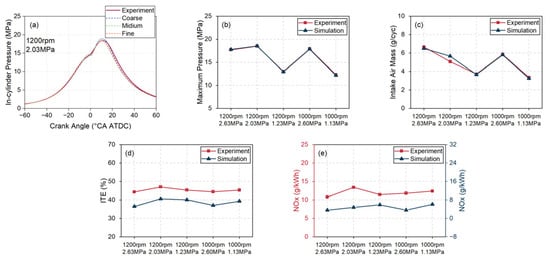
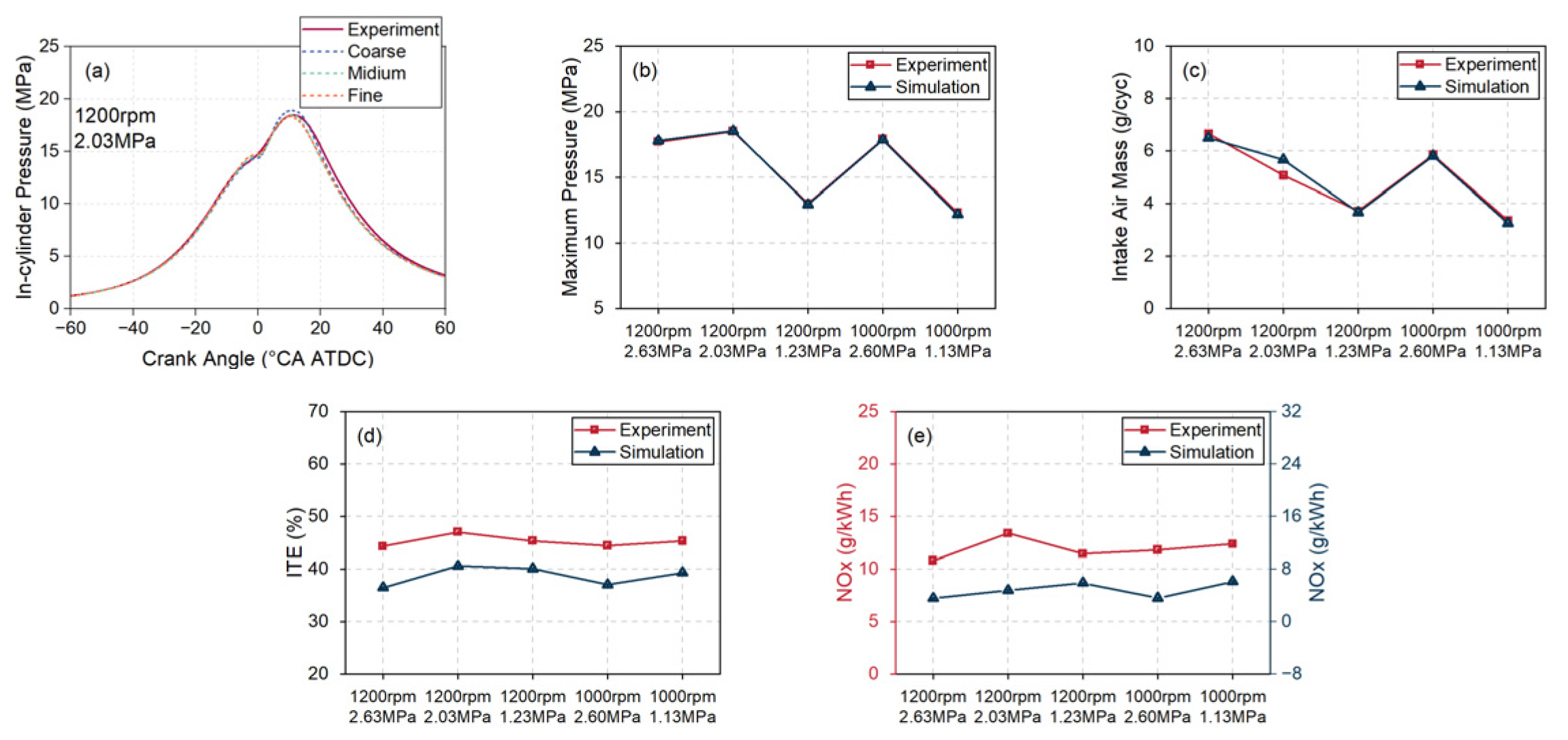
A series of experiments was conducted, and the key metrics, including peak pressure (Pmax), intake air flow, indicated thermal efficiency (ITE), and NOx emissions, are compared between prediction and experiment, as shown in Figure 1. However, although various metrics were measured, few in-cylinder pressure traces were recorded in the experiment. Therefore, the available experimental pressure data are very limited. Owing to the lack of directly measured wall temperatures, the temperatures of the piston, cylinder head, and liner were all prescribed as 500 K, 470 K, and 450 K, respectively.
Figure 1.
Comparison between experiment and simulation for a diesel engine. (a) Comparison of pressure; (b) Comparison of Pmax; (c) Comparison of intake flow; (d) Comparison of ITE; (e) Comparison of NOx emissions.
First, a mesh independence study was performed at an engine speed of 1200 rpm and an IMEP of 2.03 MPa. Three meshes with average mesh sizes of 2.0, 1.6, and 1.2 mm were evaluated, which are referred to as the coarse, medium, and fine meshes. To save computational cost, a 45° sector mesh corresponding to one injector nozzle hole was adopted, as shown in Table 2. As shown in Figure 1a, the peak pressure predicted with the coarse mesh is higher than the measured value. When the mesh is refined to the medium and fine levels, the predicted pressure agrees well with the measured profile. Since the medium and fine meshes yield very similar pressures, the medium mesh is finally adopted as a compromise between prediction accuracy and computational cost. After determining the optimal mesh size, the numerical model was validated by a comprehensive comparison against the experimental data. The results demonstrated good agreement in pressure evolution, peak pressures, and intake airflow rates between simulation and experiment. The relative prediction deviations of Pmax and intake flow rates are 0.45% and 3.83%, respectively. Furthermore, the variations in the measured ITE and NOx were also consistently reproduced by the numerical simulation. The underprediction of ITE in the simulations was attributed to the restricted computational period from intake valve closing (IVC) to exhaust valve opening (EVO), which excluded the gas exchange effects inherent in the experiment.
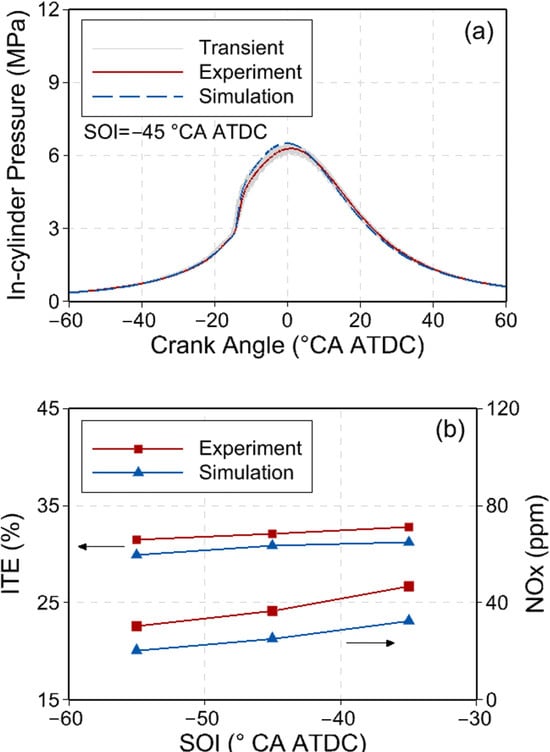
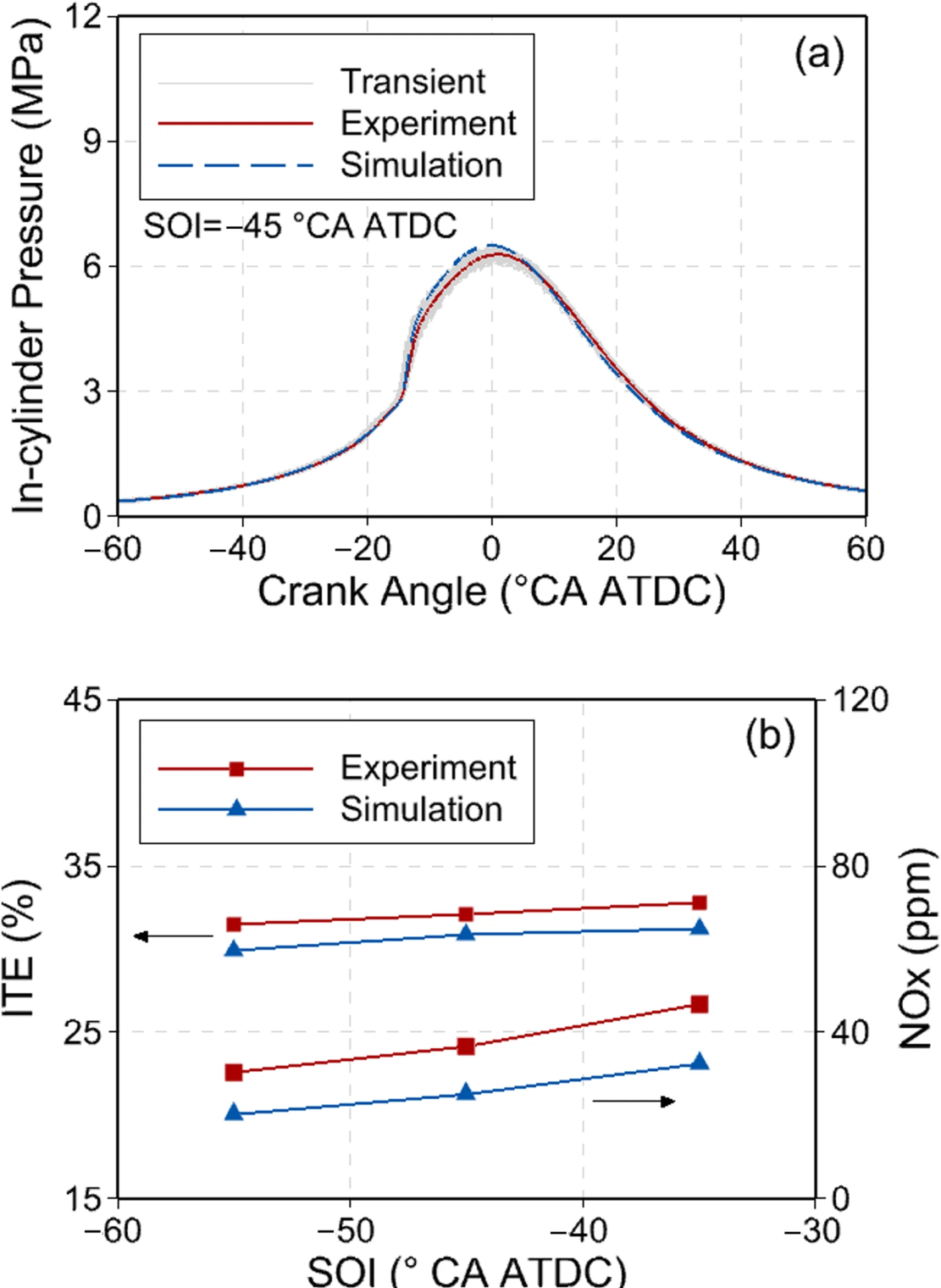
Given the scarcity of experimental data for pure PODE-fueled engines, the model validation for PODE was performed on an alternative engine operating, with its engine specifications and operating parameters listed in Table 4. As seen in Figure 2, the implemented numerical models accurately capture the combustion process and ITE for the PODE-fueled engine. Although an underestimation is observed in the predicted ITE and NOx emissions compared to the measurements, their variations with injection timing remain remarkably close to the measurements. It should be noted that the validations of PODE and diesel were conducted on two different engines, which inevitably limits the generality of the validation results. To address this concern, extensive validations of the models have been performed across diverse engines featuring different compression ratios (CR) and piston geometry, various fuels, and different combustion modes. It can be found that both the in-cylinder pressure and the emissions are accurately reproduced under these widely varying conditions [34,35,36]. These results collectively demonstrate the reliability of the employed numerical models; consequently, the validation performed on the small-bore PODE-fueled engine provides sufficient confidence for extending the models to the large-bore engine and the subsequent optimization.
Table 4.
PODE-fueled engine specifications and operating parameters.
Figure 2.
Comparison between experiment and simulation for a PODE-fueled engine. (a) Comparison of pressure and HRR; (b) Comparison of ITE and NOx emissions.
2.3. Parametric Reconstruction of Piston Geometry
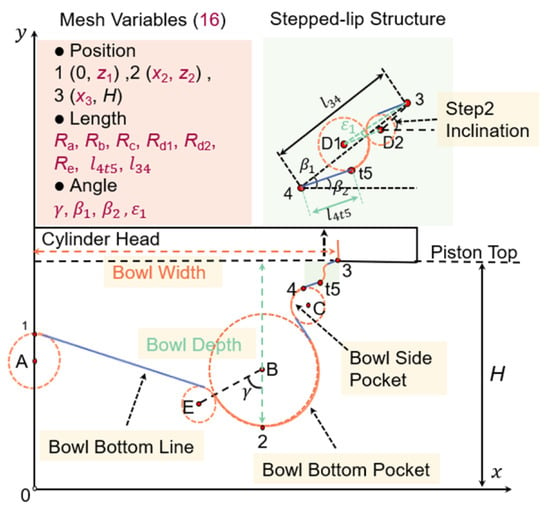
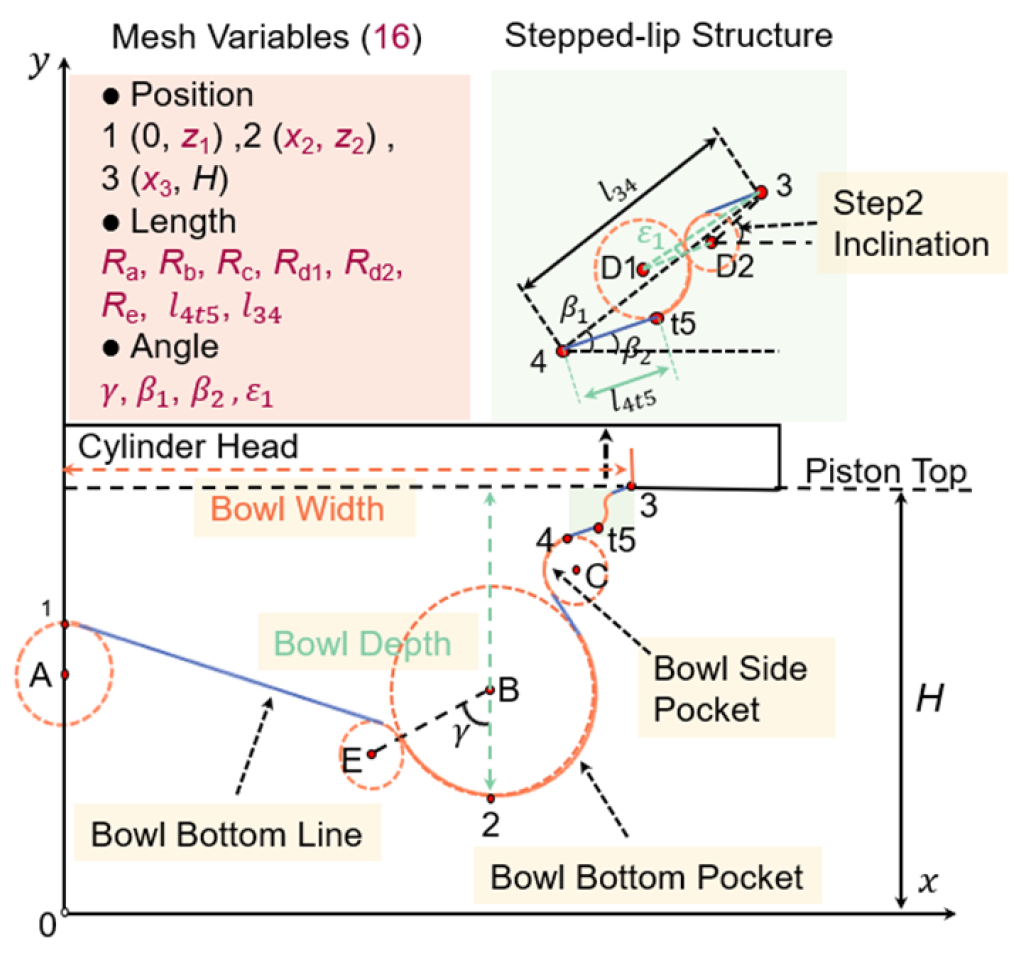
Sixteen geometric variables are employed to parametrically reconstruct diverse piston bowl profiles, which are systematically categorized into positional, length, and angular variables. As illustrated in Figure 3, four positional variables (z1, x2, z2, and x3) define the coordinates of Points 1–3, dictating the bowl depth and radial length. Eight length variables encompass six radii of Circles A–E (Ra, Rb, Rc, Rd1, Rd2, and Re) and two lengths of piston lip segment (l34 and l4t5), which, respectively, adjust arc curvatures and the piston lip size. In addition, four angular variables are also used to shape the piston bowl geometry; specifically, β1, β2, and ε1 collectively control the inclination of the stepped-lip region, while γ specifically governs the contour of the bowl floor. To ensure fluid-dynamic smoothness, tangential continuity is maintained across all geometric segments, with the exception of the junction between the piston bowl and top at Point 3. The minimum radius of the circle is restricted to 1 mm to avoid excessive local curvature. When the piston geometry is varied, the piston bowl volume changes accordingly. Since the displacement is kept constant throughout the optimization, the CR varies synchronously with the piston geometry. In addition, when the piston geometry is optimized using the parametric reconstruction method, the computational mesh is regenerated accordingly. Nevertheless, the average mesh size is kept constant throughout to ensure consistent numerical accuracy across all designs. A comprehensive description of the reconstruction methodology can be found in the dissertation of Cai [36].
Figure 3.
Illustration of parametric reconstruction for piston geometry.
2.4. Optimization Setup
A non-dominated sorting genetic algorithm (NSGA-II) was employed to perform co-optimization of piston geometry and operating parameters. Through iterative evolution, optimal individuals are determined based on non-dominated ranking and crowding distance. These individuals then undergo crossover and mutation to generate promising candidates, progressively improving multiple optimized objectives over successive generations [37,38]. The optimized parameters and their allowable ranges remain identical for both diesel and PODE fuels, as summarized in Table 5.
Table 5.
Optimized parameters and their variation ranges.
The optimization is conducted at the condition characterized by an IMEP of 2.03 MPa and an engine speed of 1200 rpm, which corresponds to the operating condition with the highest thermal efficiency across the operating map. The optimized operating parameters include the in-cylinder initial temperature at intake valve closing (TIVC), the dwell time between two injections (SOI2–SOI1), the main injection timing (SOI2), and the injection pressure (PInj). According to the experiment, a small pilot injection mass is used to mitigate engine knock, so it is not optimized here. The 16 optimized piston parameters are described in Section 2.3. Since modification to the piston bowl inherently changes the CR, it is constrained within the range of 18.5 to 22.0 to prevent excessively high Pmax at higher loads.
Given the inherently soot-free combustion of PODE, the disadvantages of diesel would become even more pronounced if soot emissions were additionally considered. Thus, the optimization objectives for both fuels were confined to fuel consumption and NOx emissions. Due to the different LHV of diesel and PODE, the equivalent indicated specific fuel consumption (EISFC) is introduced for fair comparison between the two fuels, which is defined in Equation (1) [39].
where mf is the mass of direct-injected fuel; Wi represents the indicated work performed from IVC to EVO, obtained by integrating the cylinder pressure and volume; LHVf and LHVd, respectively, represent the LHV of direct-injected fuel and diesel.
To ensure stable and reliable engine operation, the optimization was constrained by a Pmax limit of 21 MPa and a ringing intensity (RI) threshold of 5 MW/m2, which is defined according to Equation (2) [40].
where γ is the specific heat ratio, (dp/dt)max is the maximum pressure rise rate, pmax and Tmax are the in-cylinder maximum pressure and temperature, and R is the ideal gas constant. The population size and the number of generations were set to 600 and 8, respectively, yielding a total of 4800 CFD evaluations. The crossover and mutation probabilities were 0.5 and 0.1. Optimization convergence was assessed using the inverted generational distance (IGD) [41]; when the change in IGD between two consecutive generations fell below 0.002, the population was considered to have converged to the Pareto front.
3. Results and Discussion
3.1. Comparison Between Diesel and PODE Base Cases
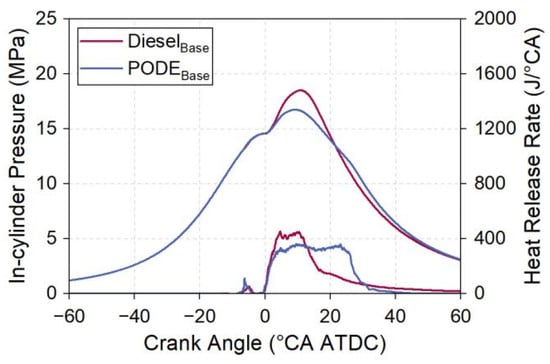
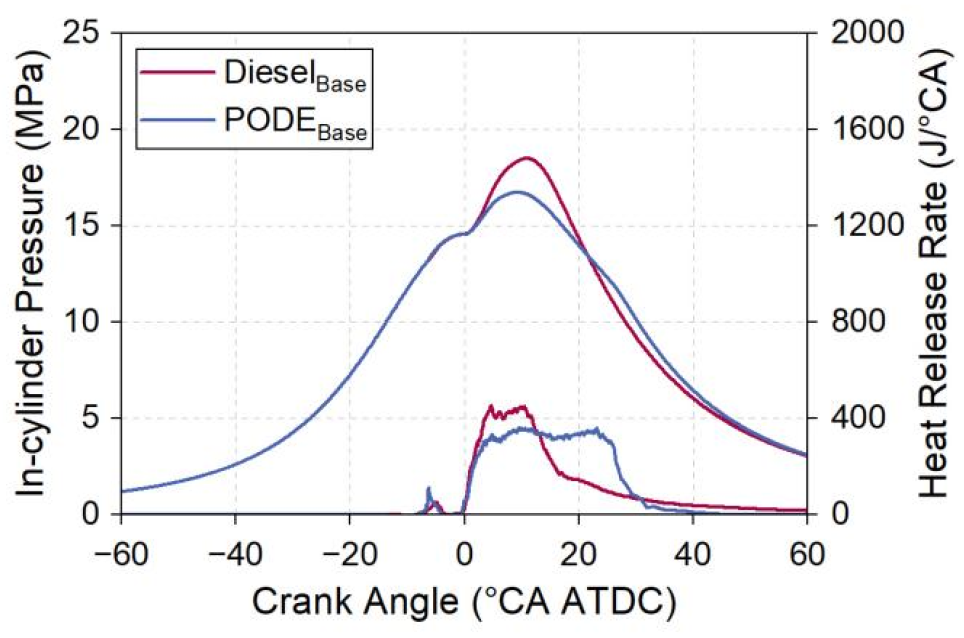
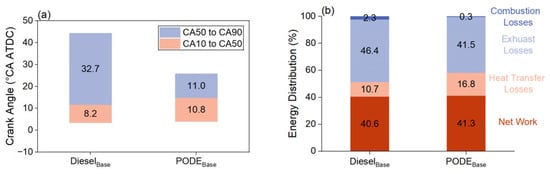
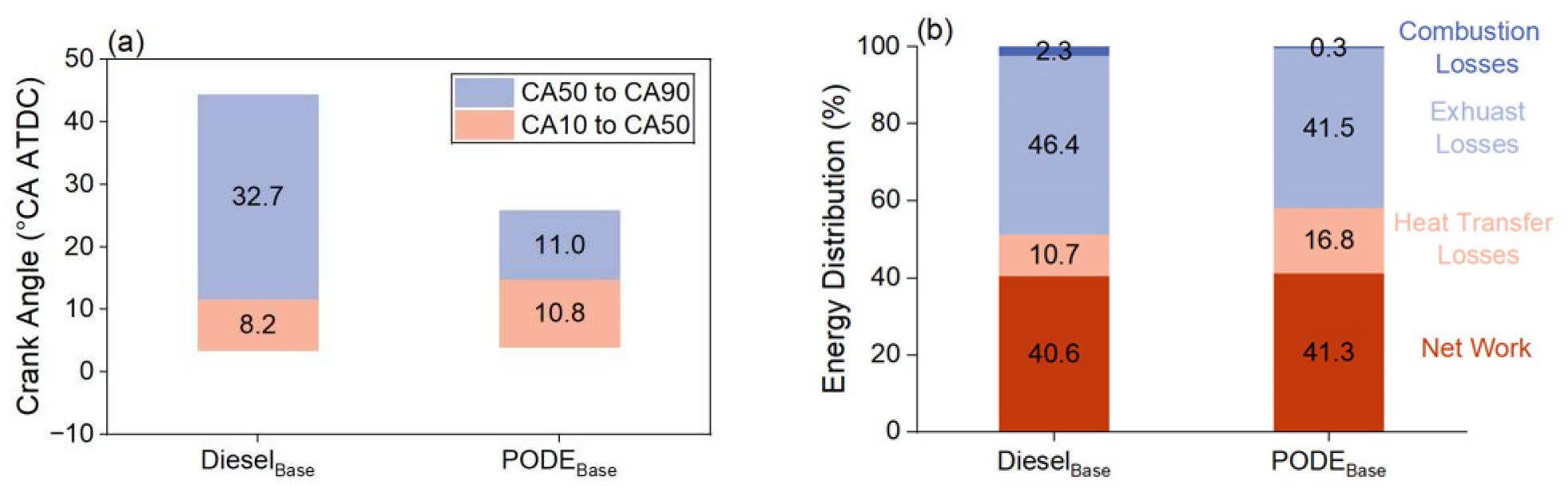
Based on the original piston, the engine is operated with diesel or PODE under the identical operating parameters, which are named DieselBase and PODEBase, respectively. The in-cylinder pressures and heat release rates (HRR) of the two base cases are compared in Figure 4, and their combustion phasings and energy distributions are shown in Figure 5. The ITE is obtained by dividing the net work by the total fuel energy. Heat transfer losses are evaluated using Newton’s cooling law, based on the temperature difference between near-wall cells and the wall surface. Combustion losses are determined by summing the energy of all unburned species. Since the four energy components sum to 100%, the exhaust losses are calculated by difference from the other three terms [42].
Figure 4.
Comparison of pressure and HRR between PODEBase and DieselBase.
Figure 5.
Comparison between PODEBase and DieselBase. (a) Comparison of combustion phasing; (b) Comparison of energy distribution.
Since the LHV of PODE is approximately half that of diesel, its injection duration must be significantly extended to maintain the equivalent total fuel energy under the same injection pressure. Consequently, the higher energy density of diesel leads to a more concentrated initial heat release than PODE, characterized by a higher Pmax, as well as a shorter interval between the crank angle at which 10% of the total energy is released (CA10) and the crank angle at which 50% of the total energy is released (CA50) [43].
Despite the prolonged injection duration of PODE compared to that of diesel, its superior atomization and diffusion characteristics enhance fuel/air mixing, facilitating a higher overall combustion rate and a shorter combustion duration from CA10 to the crank angle at which 90% of the total energy is released (CA90). Compared to DieselBase, the shortened combustion duration of PODEBase effectively reduces exhaust losses, while its superior mixture preparation promotes more complete combustion, as seen in Figure 5b. These synergistic effects ultimately account for the larger ITE of PODEBase relative to DieselBase.
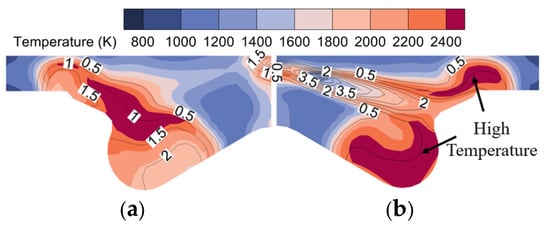
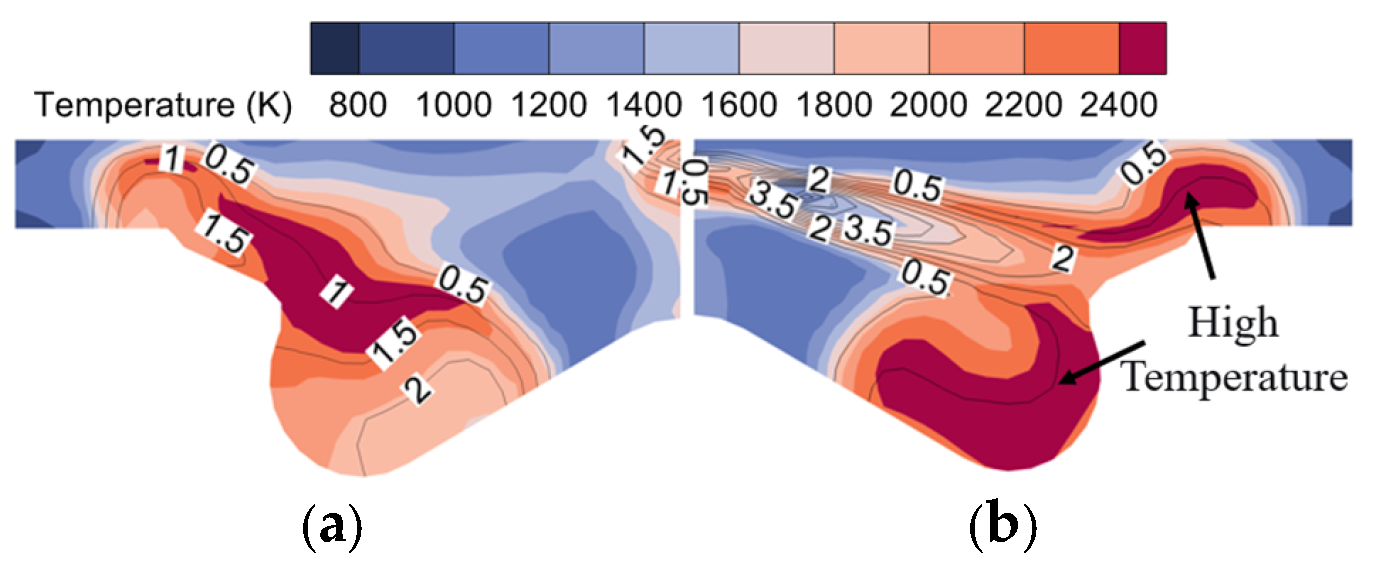
To further elucidate the reason for the different combustion rates between diesel and PODE, the in-cylinder temperature and equivalence ratio distributions of DieselBase and PODEBase are illustrated in Figure 6. The wider high-temperature distribution observed for PODE reveals that PODE spray exhibits better breakup and diffusion behaviors, resulting in more thorough fuel/air mixing (i.e., lower local equivalence ratio) and a more intense overall combustion rate. Beyond the influences of fuel physical properties, the chemical reaction kinetics are also compared between diesel and PODE by analyzing the spatial distributions of equivalence ratio, temperature, and HRR at the respective CA50 timing in Figure 7. Under the identical equivalence ratio and combustion temperature, the HRR of PODE is much faster than that of diesel, owing to its shorter molecular chain length and inherent oxygen content [44]. Therefore, both the physical and chemical properties of PODE contribute to its faster combustion rate, which effectively reduces exhaust losses and improves combustion efficiency. In addition, owing to the superior diffusion characteristics and faster combustion rate of PODE, it is found from Figure 6 that the high-temperature combustion region in PODEBase is larger than that in DieselBase, which leads to its higher NOx emissions [45].
Figure 6.
Comparison of temperature and equivalence ratio distributions between two base cases at 19 °CA ATDC (iso-line denotes equivalence ratio). (a) Distributions of DieselBase; (b) Distributions of PODEBase.
Figure 7.
Distribution of temperature, equivalence ratio, and HRR distributions for two fuels at their respective CA50 timing. (a) Distribution of DieselBase; (b) Distribution of PODEBase.
Although the physicochemical properties of PODE inherently favor high thermal efficiency, the analysis for Figure 6 reveals that the intensified combustion process of PODE elevates peak temperatures, expands the high-temperature reaction zone, and shifts the flame closer to the piston bowl surfaces. These higher localized temperatures inevitably increase NOx formation, and the intensified flame/wall interaction is identified as the primary reason for the elevated heat transfer losses of PODEBase. Consequently, the distinct physicochemical properties of diesel and PODE yield disparate combustion and emission behaviors, necessitating a fuel-specific optimization for PODE [46]. Specifically, the piston geometry must be co-optimized with operating parameters to align with PODE’s unique spray and oxidation characteristics, which is crucial for mitigating heat transfer losses and maximizing the thermodynamic potential of PODE-fueled engines.
3.2. Optimization of Operating Parameters Alone
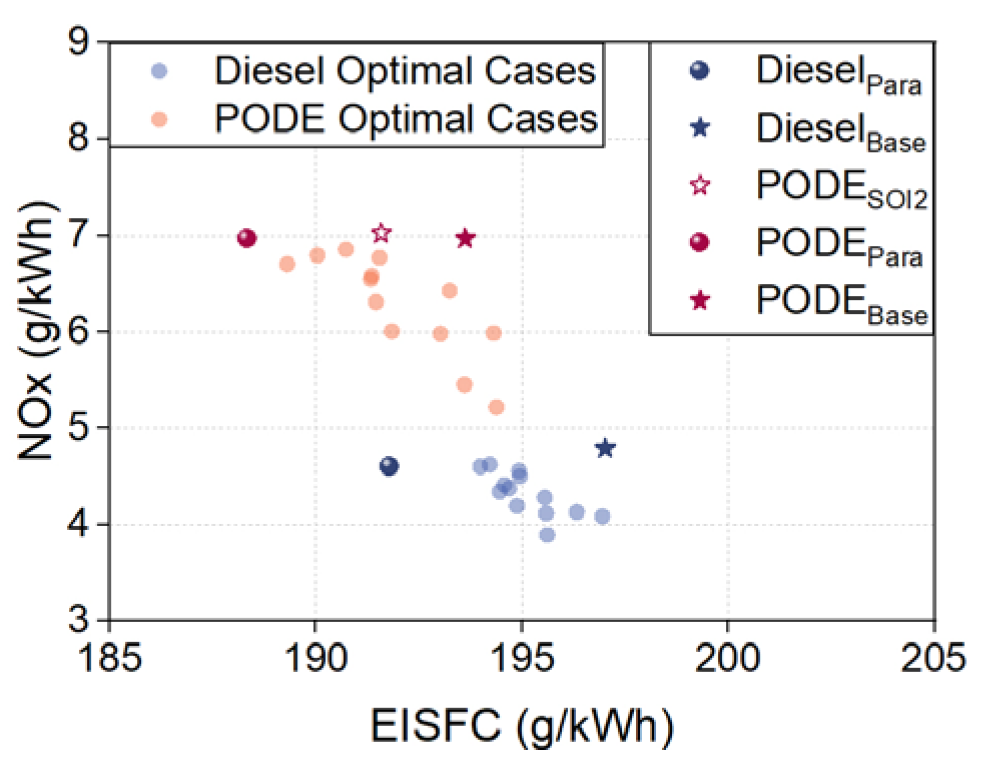
Based on the original piston, an optimization of four key operating parameters is first performed for each fuel within the variation ranges listed in Table 5. The performance metrics for both fuels are quantitatively compared in Figure 8. The optimal cases from the final evolution population are, respectively, designated as Diesel Optimal Cases and PODE Optimal Cases, with the base cases of the two fuels introduced as benchmarks.
Figure 8.
Distributions of EISFC and NOx for all the optimized cases and representative cases.
Through the optimization of operating parameters, both fuels achieve substantial reductions in EISFC without compromising NOx emissions relative to their respective base cases. Comparative analysis reveals that PODE Optimal Cases generally exhibit lower EISFC than Diesel Optimal Cases. However, the advantage of PODE is accompanied by higher NOx emissions, highlighting a distinct trade-off relationship between EISFC and NOx.
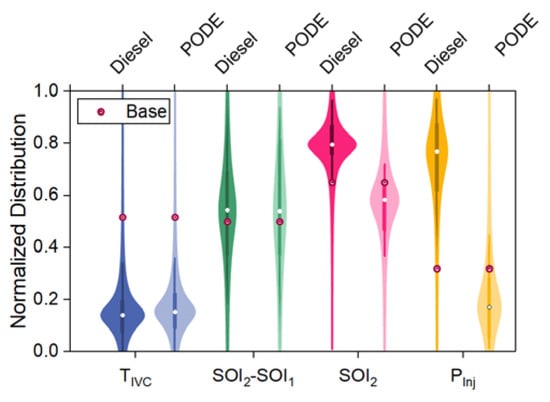
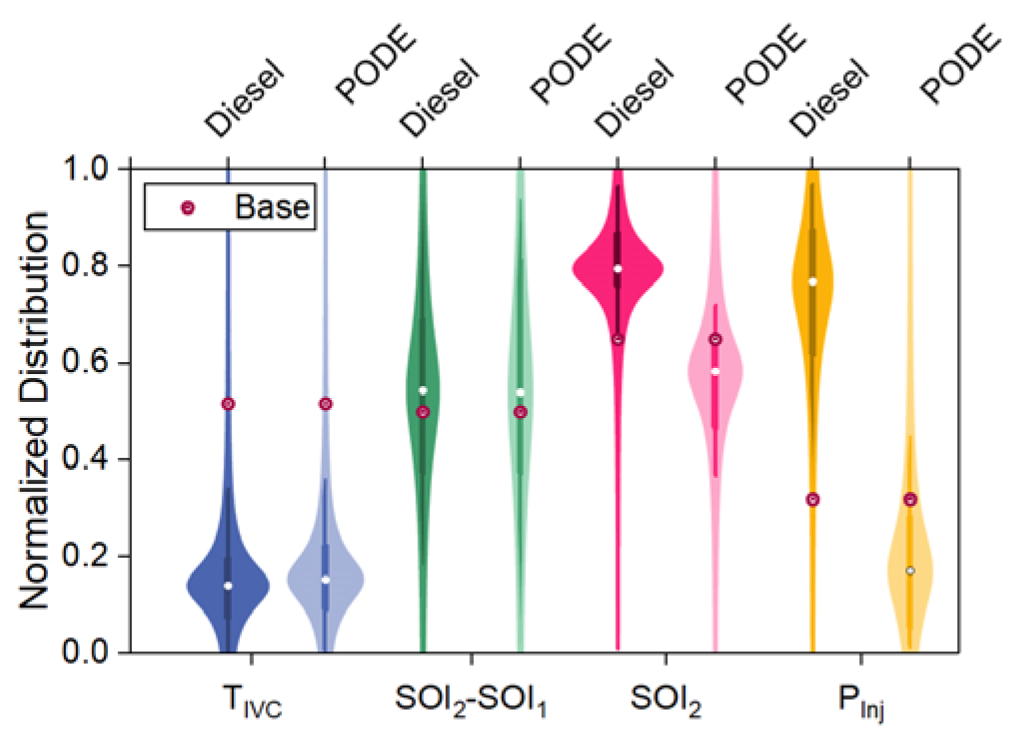
The distributions of the optimal operating parameters are compared in Figure 9 to reveal the different tuning strategies for both fuels. First, the optimized TIVC is generally lower than the base cases for both fuels. The reduced TIVC increases the charge density, which not only augments the oxygen supply for complete combustion but also increases the heat capacity of the charge mixture to lower combustion temperature. Second, the optimal injection dwell (SOI2-SOI1) of both fuels converges at approximately 7 °CA. This specific interval ensures that the pilot injection effectively triggers the ignition of the main injection while avoiding detrimental pulse-to-pulse interactions that would degrade combustion efficiency [47].
Figure 9.
Parameter distributions of optimal cases for diesel and PODE.
The primary difference in the optimized operating parameters between diesel and PODE lies in SOI2 and PInj. Diesel favors a late SOI2 and a high PInj, while PODE achieves optimal performance through an early SOI2 and a low PInj. To investigate the reason for their different injection strategies, two representative cases with the lowest EISFC are selected from the two sets of optimal cases illustrated in Figure 8, designated as DieselPara and PODEPara, respectively. Additionally, another PODE optimal case featuring a late SOI2 and a high PInj is also incorporated for comparative analysis and designated as PODESOI2.
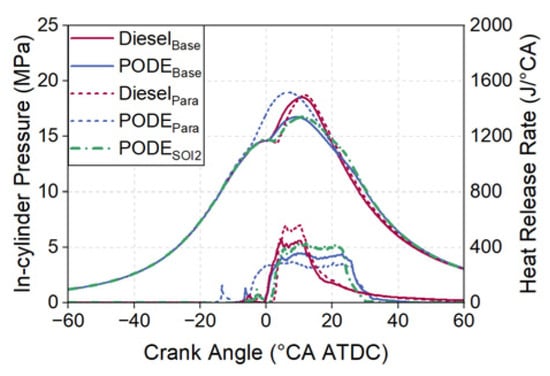
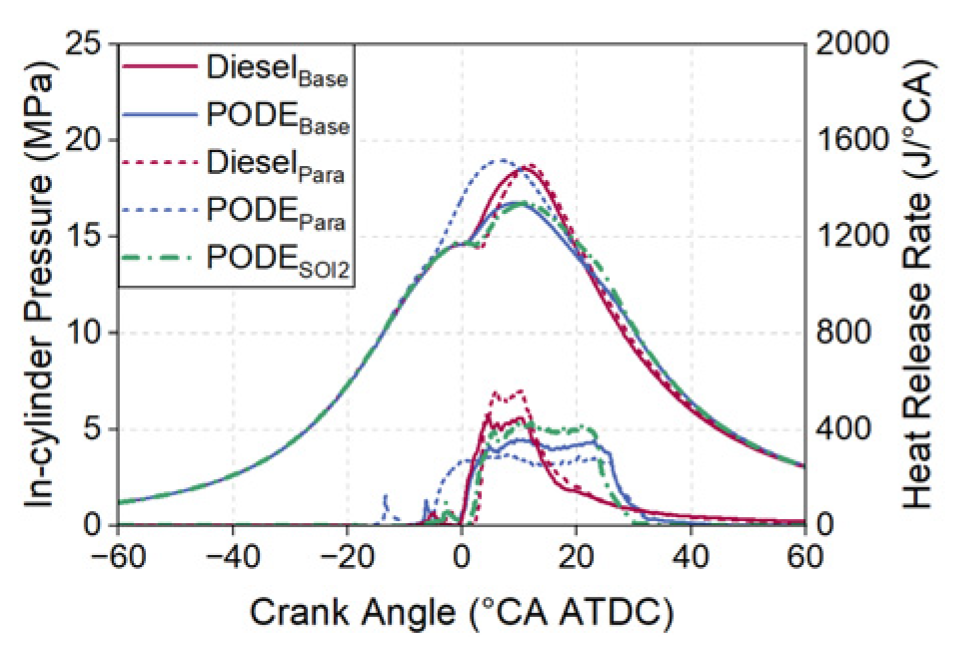
The in-cylinder pressure and HRR of the five representative cases are compared in Figure 10, with their operating parameters listed in Table 6. Compared to the base cases, the implementation of late SOI2 and high PInj can enhance fuel/air mixing and intensify the combustion process for either diesel or PODE, subsequently yielding higher peaks of HRR and pressure, as observed for DieselPara and PODESOI2 in Figure 10. In contrast, the PODEPara case adopts an early SOI2 and a low PInj, which exhibits an advanced ignition timing, a slower combustion speed, and a lower peak HRR.
Figure 10.
Pressure and HRR of representative cases fueled with diesel or PODE.
Table 6.
Operating parameters of base case, DieselPara, PODEPara, and PODESOI2.
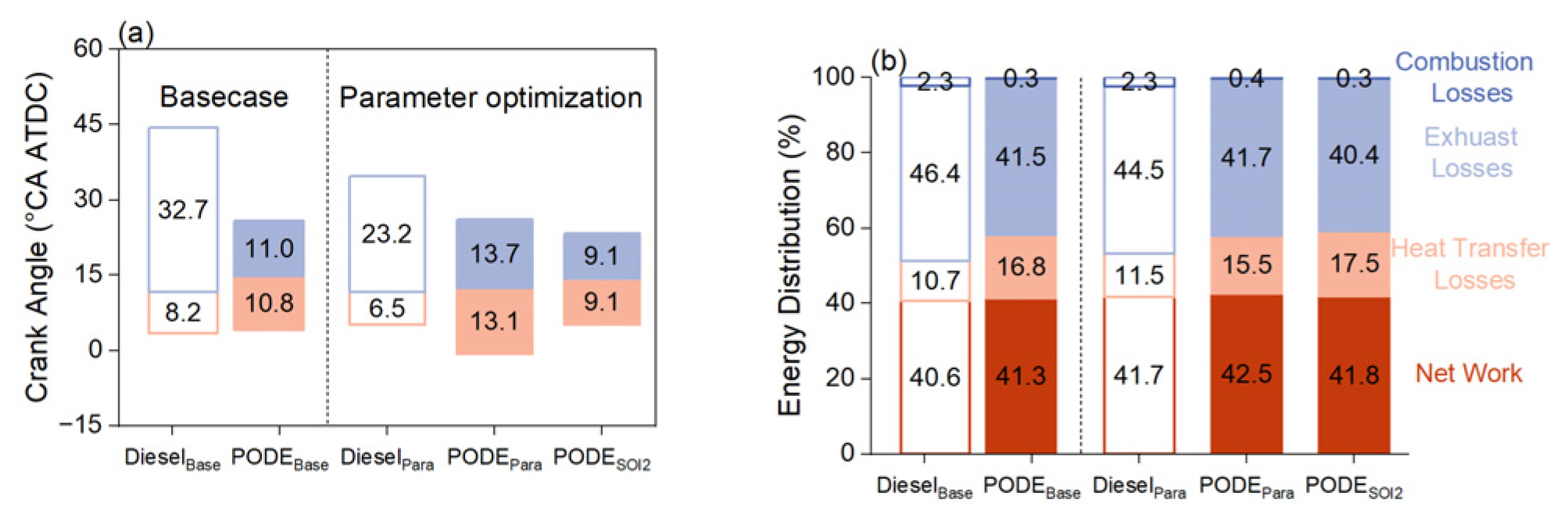
To elucidate the distinct injection strategies for diesel and PODE, Figure 11 compares the combustion phasings and energy distribution between the base cases and the three representative optimized cases. The above analysis indicates that the lower ITE of DieselBase than PODEBase is primarily attributed to its longer combustion duration and higher exhaust losses. Accordingly, the optimization for diesel-fueled engines effectively addresses this weakness by leveraging higher PInj to enhance fuel/air mixing, thereby reducing exhaust losses and increasing ITE. Although the heat transfer losses of DieselPara increase simultaneously, they are outweighed by the substantial reduction in exhaust losses, yielding a net gain in ITE. Furthermore, by delaying the SOI2, DieselPara effectively suppresses the rapid combustion rate, thereby mitigating rough combustion and knock while maintaining high thermal efficiency.
Figure 11.
Comparison among the five representative cases. (a) Comparison of combustion phasing; (b) Comparison of energy distributions.
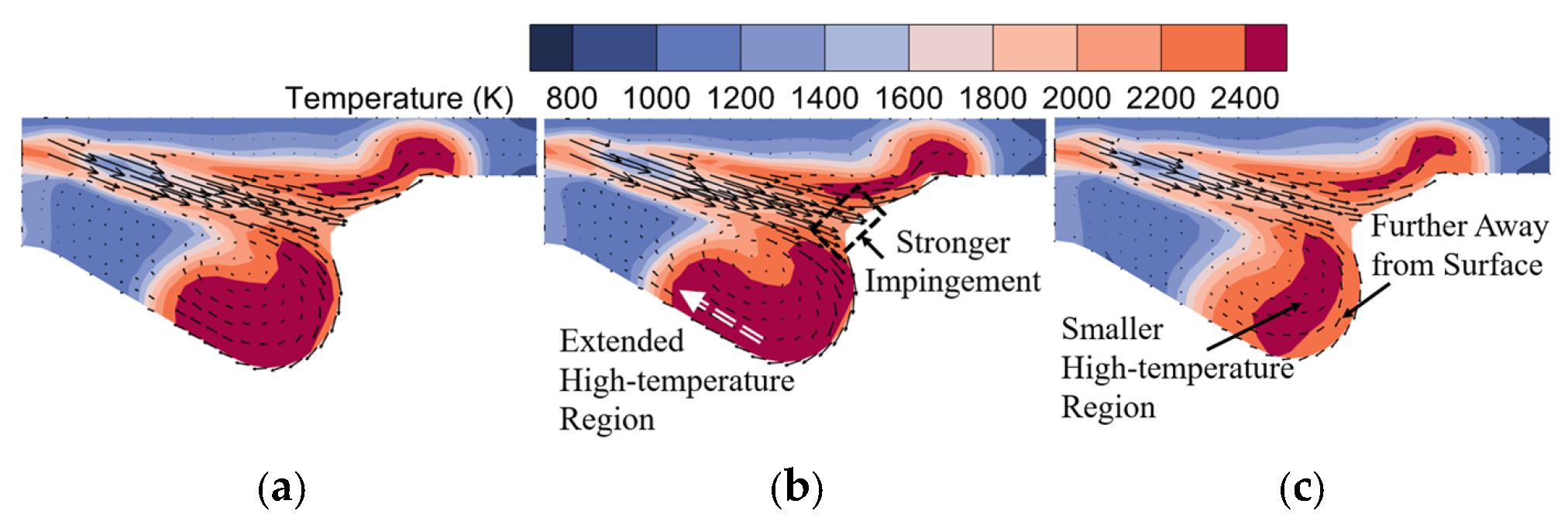
In contrast, due to the superior physical and chemical properties of PODE, PODEBase already achieves rapid fuel/air mixing and high combustion rates. Consequently, when late SOI2 and high PInj are also adopted for PODE (i.e., PODESOI2), the improvements in combustion completeness and exhaust losses reduction are marginally limited. Figure 12 further illustrates the influence of different injection strategies on heat transfer through the visualization of temperature distribution. Compared to PODEBase, PODESOI2 exacerbates spray impingement due to its higher PInj. Thus, the high-temperature combustion region in PODESOI2 not only expands over a larger area but also propagates closer to the piston surface, thereby intensifying heat transfer losses. In contrast, by adopting a lower PInj in PODEPara, the high-temperature regions are substantially reduced, and the spatial distribution of combustion zones is optimized, as seen in Figure 12c. Therefore, the adoption of a lower PInj for PODE is necessary to prevent the excessive expansion of high-temperature flame toward the piston surface.
Figure 12.
Comparison of in-cylinder temperature distributions at 17 °CA ATDC. (a) Distribution of PODEBase; (b) Distribution of PODESOI2; (c) Distribution of PODEPara.
However, an excessively low PInj prolongs injection duration and retards combustion phasing, which is detrimental to thermal efficiency [48]. Therefore, the optimal injection strategy for PODE adopts an advanced SOI2 to compensate for the elongated combustion duration caused by the reduced PInj. In summary, the different injection strategies adopted for diesel and PODE stem from their distinct fuel properties. Owing to the inferior atomization and diffusion characteristics of diesel, DieselPara employs a high PInj and a retarded SOI2 to enhance the diesel/air mixing and reduce exhaust losses, while maintaining an appropriate combustion rate. In contrast, PODE relies on its superior atomization and diffusion characteristics to promote fuel/air mixing. Thus, PODEPara adopts a reduced PInj and an early SOI2 to shorten spray penetration, effectively reducing heat transfer losses while maintaining an optimal combustion phasing.
3.3. Co-Optimization of Operating Parameters and Piston Geometry
The preceding analysis substantiates the correlation between fuel physicochemical properties and the corresponding optimal injection strategy. Beyond injection parameters, the piston geometry, serving as a key spatial boundary constraint, also shows significant impacts on spray development and mixture formation [49]. Consequently, a co-optimization of operating parameters and piston geometry is performed for diesel and PODE, and the matching mechanism among fuel properties, operating parameters, and piston topology is revealed to maximize overall engine performance. The co-optimized parameters and their corresponding variation ranges are listed in Table 5.
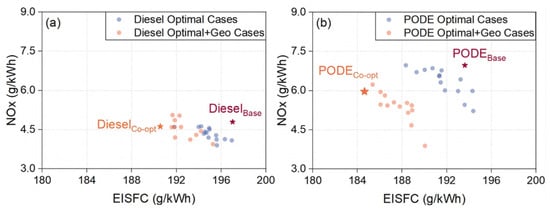
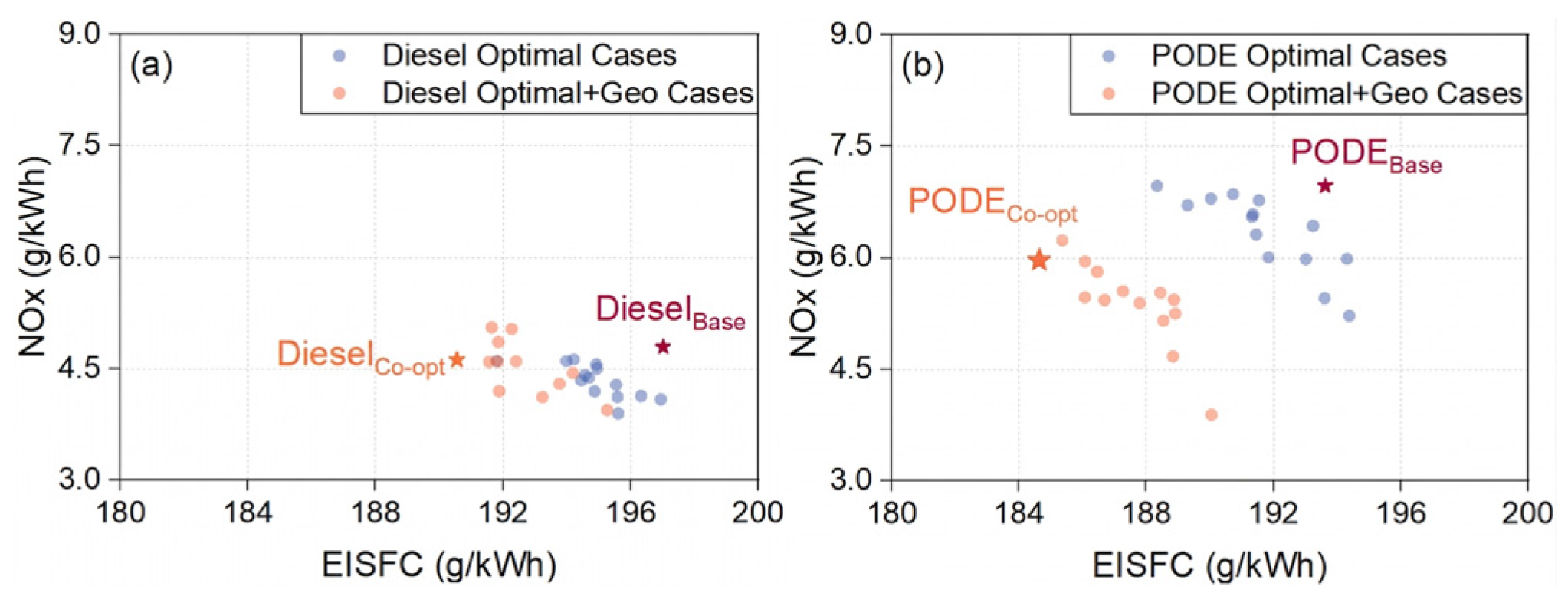
Figure 13 compares the EISFC and NOx of optimal cases for diesel and PODE under two optimization frameworks: the optimization of operating parameters alone and the co-optimization of both operating parameters and piston geometry. The optimal cases from the two frameworks are designated as Optimal cases and Optimal + Geo cases, respectively. In addition, the base cases of diesel and PODE are also introduced into Figure 13 as benchmarks. The results demonstrate that the co-optimization framework effectively transcends the performance limitations of parameter-alone tuning, enabling further improvement in both EISFC and NOx emissions for both fuels. Notably, PODE fuel exhibits a more pronounced performance improvement than diesel under the co-optimization framework.
Figure 13.
Comparison between optimization of operating parameters alone and co-optimization of operating parameters and piston geometry. (a) Comparison for diesel; (b) Comparison for PODE.
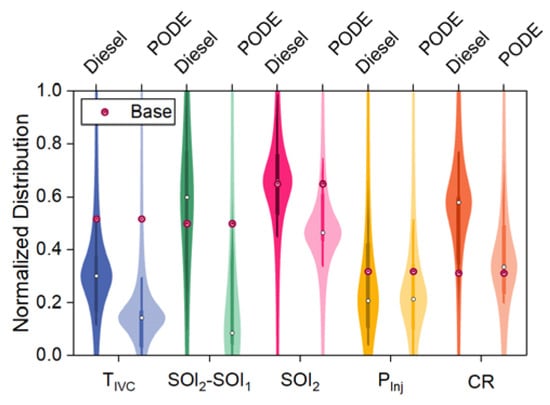
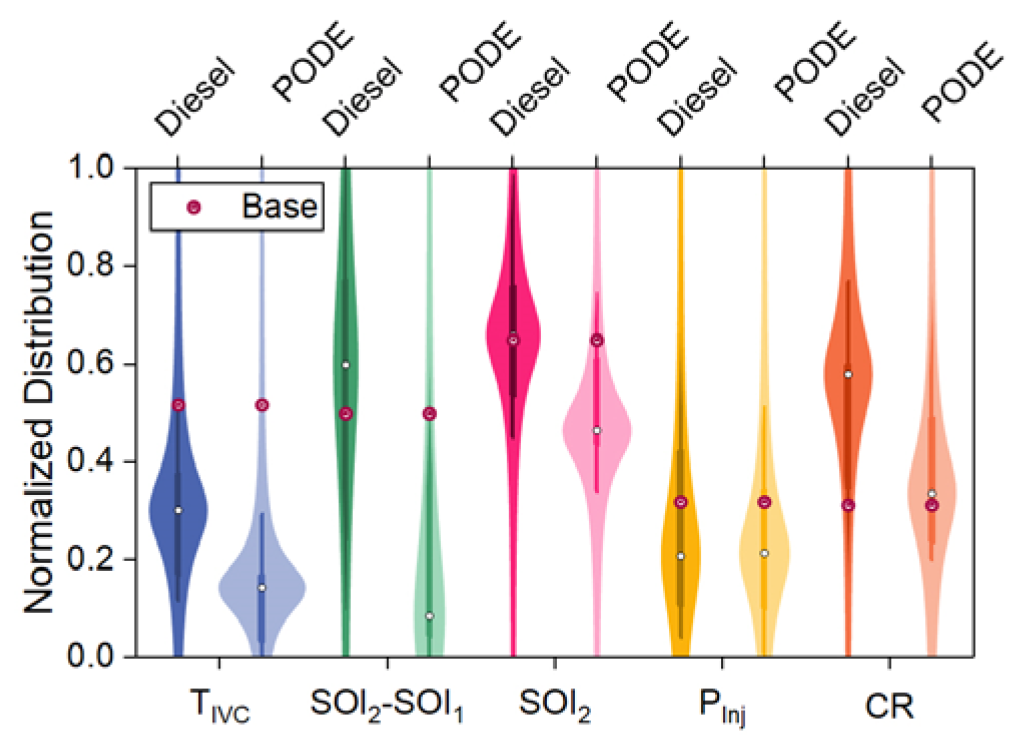
Figure 14 compares the distributions of the operating parameters and CR for the Optimal + Geo cases of diesel and PODE. A comparative analysis of Figure 9 and Figure 14 reveals that the co-optimized operating parameters differ from those under parameter-alone optimization. The co-optimized CR for both fuels is larger than the original one, while the optimal CR for PODE is lower than that for diesel to prevent premature ignition and subsequent degradation of ITE, which is driven by the higher cetane number and superior atomization characteristics of PODE. Although the optimal TIVC under co-optimization aligns with that under parameter-alone optimization, diesel requires a relatively higher TIVC to promote fuel vaporization and mixture preparation under a high-CR environment. Consistent with Figure 9, the co-optimized SOI2 for PODE is more advanced than that for diesel. However, the optimal SOI2 for both fuels under co-optimization is earlier than that under parameter-alone optimization. In addition, a substantial reduction in PInj is observed for diesel under co-optimization, which is related to its piston modification.
Figure 14.
Parameter distributions of co-optimized cases for diesel and PODE.
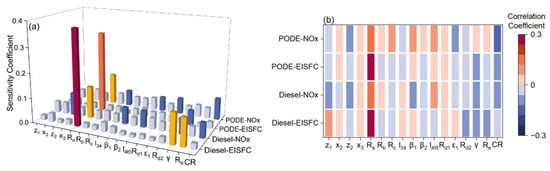
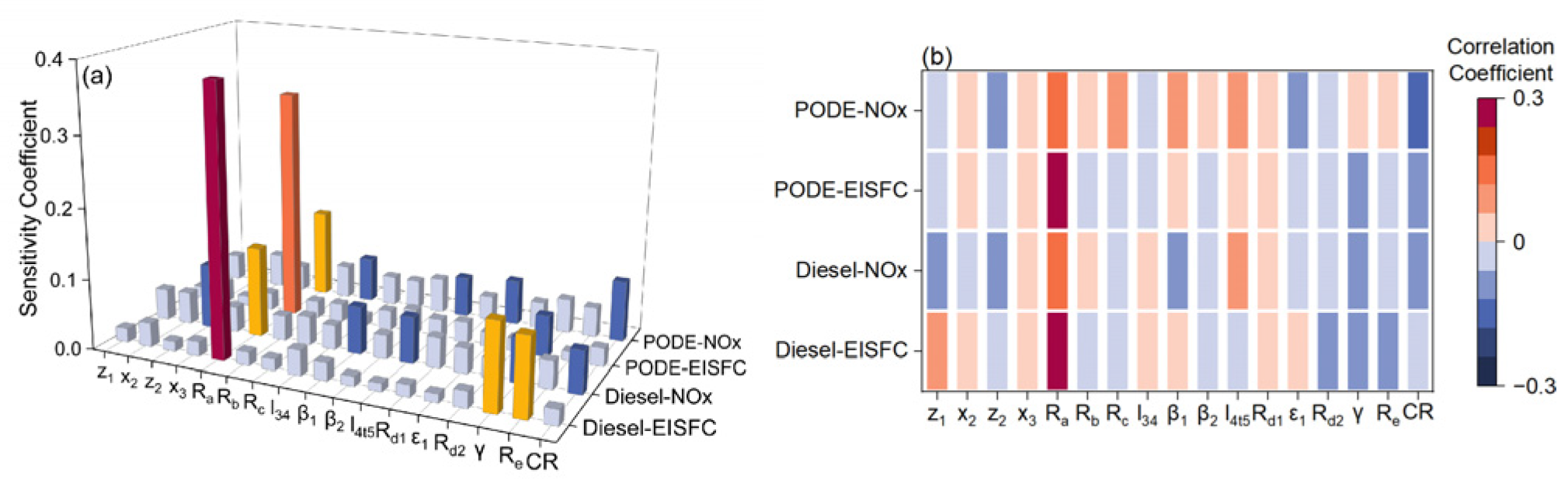
Subsequently, the influences of piston geometrical parameters and CR on engine performance are quantitatively evaluated. Based on the optimized cases during evolution, the sensitivity coefficients of each geometric parameter regarding EISFC and NOx were extracted using a Random Forest regression model, as illustrated in Figure 15a. The Random Forest is configured with 1000 regression trees, which is sufficient to ensure a stable ranking of the variable importance while keeping the computational cost moderate. At each split, a randomly selected subset of one-third of the design variables is evaluated, which decorrelates the individual trees and reduces the variance of the ensemble. The trees are grown without depth limitation so that the nonlinear and interactive effects among the design variables can be fully captured, and the minimum number of samples required at a leaf node is set to unity to keep the model bias low.
Figure 15.
Statistical analysis of EISFC and NOx to piston geometrical parameters for both diesel and PODE. (a) Sensitivity analysis; (b) Correlation analysis.
According to sensitivity analysis, the engine performance of diesel is primarily governed by z2, Ra, β1, γ, Re, and CR. In contrast, the high-sensitivity parameters for PODE shift to Ra, Rc, l4t5, ε1, γ, and CR. Furthermore, to elucidate the relationship between these geometrical parameters and optimization targets, Pearson correlation coefficients were calculated for both fuels, as shown in Figure 15b. The results demonstrate that the distribution of high-correlation parameters is highly consistent with their influence rankings, validating the accuracy and representativeness of these identified key geometric parameters.
Based on sensitivity and correlation analyses, the engine performances of the two fuels are both strongly correlated with Ra, γ, and CR, suggesting that the three parameters are fuel-independent. A high CR is theoretically recognized to improve ITE, which is successfully realized in the Optimal + Geo cases by adopting a shallow flat piston that features a reduced Ra and an increased γ. Conversely, x2, z2, Re, Rc, l4t5, and ε1 exhibit pronounced fuel-specific influences. In diesel-fueled engines, x2 exhibits a positive correlation with EISFC, while z2 and Re are strongly negatively correlated with both EISFC and NOx. Thus, the optimal piston geometry for diesel is characterized by a reduced x2 along with larger z2 and Re. In contrast, Rc and l4t5 display a positive correlation with EISFC and NOx for PODE, whereas ε1 shows a significant negative correlation. Consequently, the optimal piston design for PODE features smaller Rc and l4t5 coupled with an increased ε1.
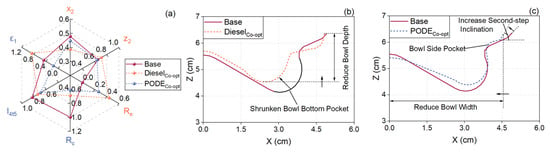
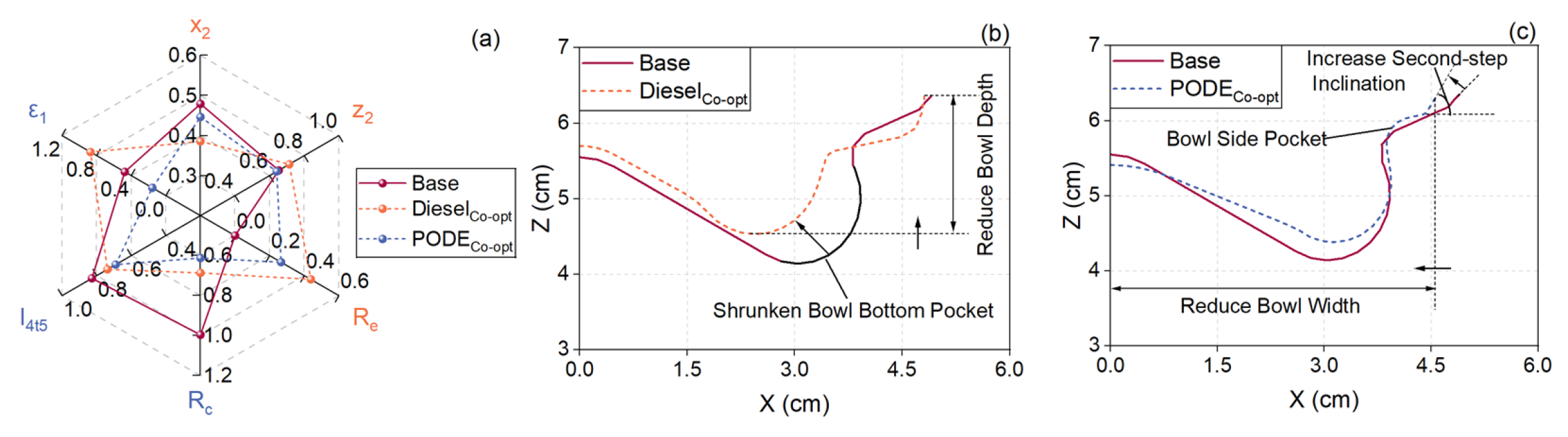
To further examine the discrepancy in the optimized piston geometries between the two fuels, two representative cases with the lowest EISFC are selected from two sets of Optimal + Geo cases for in-depth analysis, designated as DieselCo-opt and PODECo-opt, respectively. By comparing the optimized piston profiles against the base case in Figure 16, it is evident that the configurations of the two representative cases show strong consistency with the statistical results identified in Figure 15. Compared to the original piston, the optimal designs for both fuels achieve a larger CR by reducing piston depth and piston bowl volume. Regarding the specific geometrical features, the optimal piston for diesel adopts a lower x2 as well as larger z2 and Re, resulting in the upward and centripetal migration of the bowl bottom pocket toward the cylinder axis. This optimized structure effectively shortens spray development distance to enhance the guiding effects of the piston wall on spray development and mixture formation. The optimal piston for PODE employs a reduced Rc and l4t5 as well as an increased ε1 to narrow the bowl rim width, reduce the side pocket volume, and increase the second-step inclination, which effectively suppresses excessive spray diffusion.
Figure 16.
Comparison of piston geometry between co-optimization and base case for two fuels. (a) Comparison of geometrical parameters; (b) Comparison of piston geometry between baseline and DieselCo-opt; (c) Comparison of piston geometry between baseline and PODECo-opt.
In addition to the difference in the optimal piston geometry between diesel and PODE, Figure 17 further compares the pressures of two co-optimized cases with their base cases, and their operating parameters are summarized in Table 7. The higher CR adopted in both DieselCo-opt and PODECo-opt enhances not only the in-cylinder thermal conditions but also the flow intensity. Thus, a more advanced ignition timing and a higher Pmax are achieved compared to the respective base cases, contributing to the reduced EISFC. Although DieselCo-opt still maintains a larger Pmax than PODECo-opt, their difference is much smaller than that observed between DieselBase and PODEBase.
Figure 17.
Comparison of combustion process between co-optimization and base case for two fuels.
Table 7.
Comparison of operating parameters among representative cases.
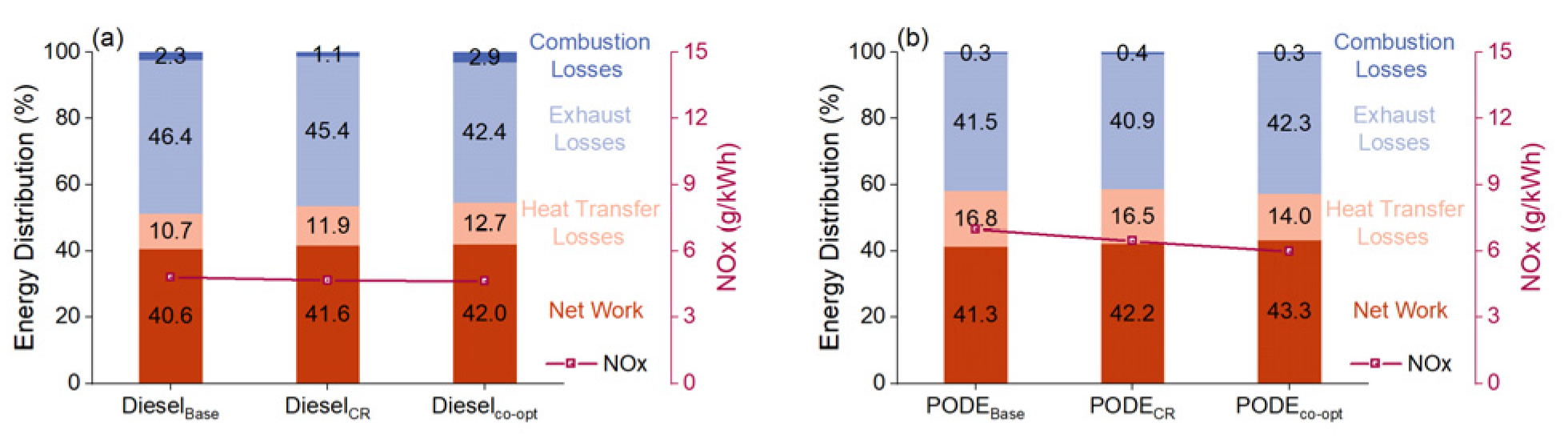
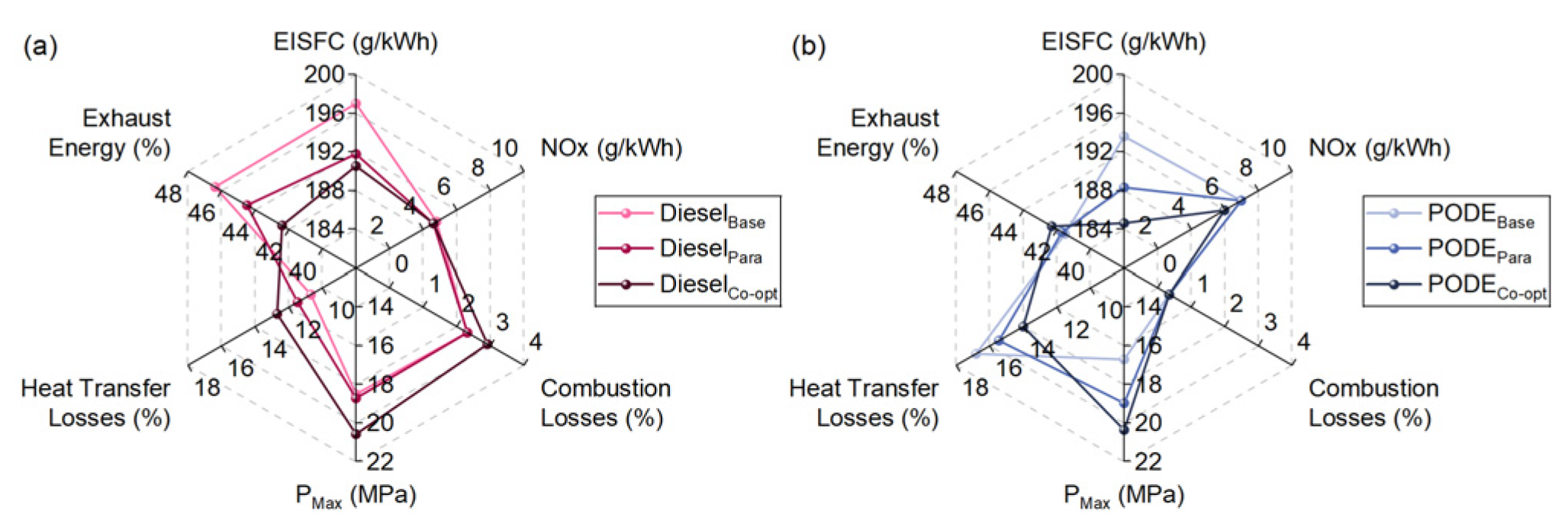
Finally, the benefits of co-optimization are demonstrated in Figure 18 by comparing EISFC, NOx emissions, Pmax, and energy distribution among three distinct scenarios: base case, parameter-alone optimization, and co-optimization. The results indicate that parameter-alone optimization already significantly reduces EISFC for both fuels, while maintaining a comparable NOx emissions level to the base case. The co-optimization of piston geometry and operating parameters successfully exploits their synergistic interaction to yield a further reduction in EISFC.
Figure 18.
Comparison of energy distribution and NOx among the three representative cases. (a) Comparison for diesel; (b) Comparison for PODE.
It is worth noting that the improvement achieved by co-optimization stems from both the increased CR and the optimized piston geometry. To separate their individual contributions, two additional cases, DieselCR and PODECR, are designed for diesel and PODE based on the baseline and co-optimized cases; they retain the original piston geometry while adopting the optimized CR by reducing the distance between top dead center and cylinder head. The comparison of energy distributions and NOx among the three cases is shown in Figure 18. Since the three representative cases of each fuel maintain nearly identical NOx levels, the comparison is focused on their difference in ITE. Although DieselCR accelerates combustion and yields a 1% higher ITE than Dieselbase, its exhaust losses remain considerably larger than those of Dieselco-opt due to the absence of the mixing enhancement provided by the optimized piston geometry, resulting in its ITE being 0.4% lower than Dieselco-opt. Similarly, the higher ambient density associated with the larger CR in PODECR suppresses the PODE spray diffusion, which reduces the heat transfer losses relative to PODEbase. Nevertheless, without the optimized piston geometry, the heat transfer losses are still 2.5% larger than those of PODEco-opt. The above results reveal that increasing the CR alone cannot fully exploit the potential of the engine performance; hence, the co-optimization of both CR and piston geometry is imperative [50].
After the individual effects of the CR and piston geometry are quantified, the correlation between the piston geometry and the fuel properties is investigated. From the energy distribution perspective illustrated in Figure 19, the dominant mechanisms driving performance improvements are different for the two fuels. As the optimization strategy transitions from base case to parameter-alone, and ultimately to co-optimization, the EISFC reduction in the diesel-fueled engine stems primarily from a continuous decrease in exhaust losses. Conversely, the EISFC gain in the PODE-fueled engine is predominantly attributed to the sustained mitigation of heat transfer losses. These findings demonstrate that the physicochemical properties of injected fuel dictate distinct evolutionary pathways for improving engine performance.
Figure 19.
Comparison between co-optimization and base case for diesel and PODE. (a) Engine performance; (b) Geometry parameters.
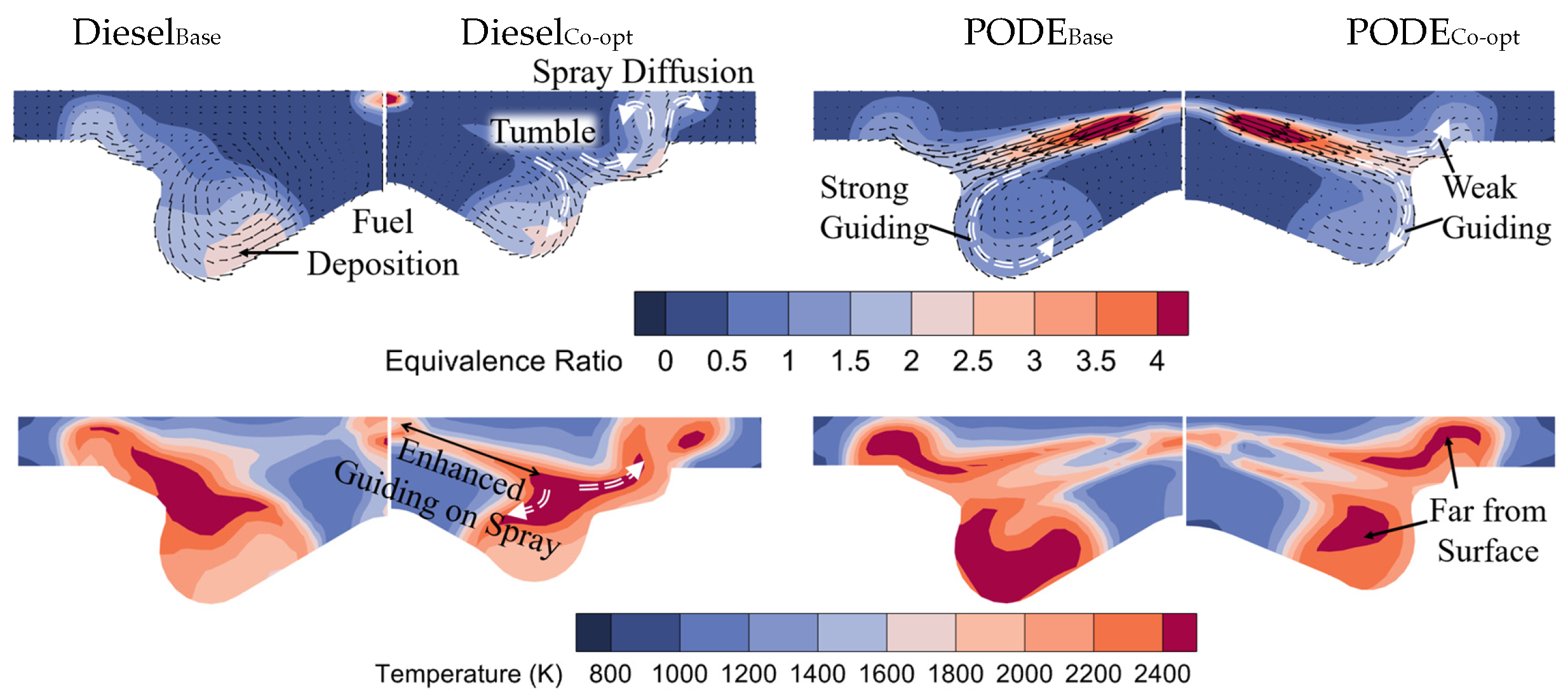
In order to explain the impacts of fuel physicochemical properties on the optimization strategy, Figure 20 compares the in-cylinder temperature and equivalence ratio distributions of the base cases and the co-optimized cases at 4 °CA after CA50 between both fuels. Given that diesel exhibits a lower cetane number and inferior diffusion characteristics compared to PODE, DieselCo-opt is allowed to adopt a higher CR. Owing to the positive effects of a high CR on thermal conditions and tumble flow, together with the 14.2% enhancement of turbulent kinetic energy achieved by the optimized piston, a reduced PInj is employed to alleviate the combustion rate under high-CR and optimized piston conditions. To compensate for the lower spray momentum, the bowl bottom pocket was migrated toward the cylinder axis to strengthen the guiding effect of the piston on spray diffusion. This architectural refinement not only expands the spatial volume for fuel/air mixing in the upper bowl but also promotes a stronger tumble motion in the bowl, effectively mitigating fuel deposition at the bowl bottom, as seen in Figure 20. Consequently, the fuel/air mixing rate in DieselCo-opt is significantly enhanced, and the combustion duration is markedly shortened, leading to a substantial reduction in both exhaust losses and EISFC.
Figure 20.
Comparison of equivalence ratio and temperature between co-optimized cases and base cases for diesel and PODE at 4 °CA after CA50.
Due to the superior diffusion characteristics of PODE, the high-temperature region of PODE combustion locates closer to the piston surface, resulting in higher heat transfer losses. Thus, PODECo-opt adopts a lower PInj to shorten spray penetration and shift the high-temperature region away from the piston surface. However, a reduced PInj prolongs the combustion duration, deteriorating EISFC, which is compensated by advancing SOI2. Complementing the PInj reduction, the piston geometry is optimized specifically for PODE by incorporating a smaller and more elevated side pocket. This modification not only reduces turbulent kinetic energy by 22%, thereby diminishing air entrainment and its effect on spray breakup, but also effectively weakens the guiding influence of the step structure on spray development, which further repositions the combustion region away from the piston surface. In summary, the optimal piston geometries for diesel and PODE are dependent on their optimized injection parameters, which are inherently governed by the specific physicochemical properties of each fuel.
4. Conclusions
This study presents a comprehensive analysis of the combustion and emission characteristics of diesel and PODE fuels in compression ignition engines. Through the co-optimization of both operating and geometric structural parameters, the engine performance of the two fuels is substantially improved. The results elucidate the intricate coupling among fuel properties, optimal operating parameters, and optimal piston geometry, providing a theoretical foundation for the practical application of PODE fuel in carbon-neutral power systems. The main conclusions are as follows.
- (1)
- Benefiting from the higher oxygen content and superior atomization characteristics, PODE exhibits a faster combustion rate than diesel under the same piston and operating parameters. This significantly reduces exhaust loss and yields a 0.7% improvement in ITE. However, the enhanced atomization also leads to a larger high-temperature combustion zone near the piston surface. Consequently, heat transfer losses of PODE combustion increase, which in turn limits its net improvement in thermal efficiency.
- (2)
- Diesel and PODE require distinct optimal operating strategies owing to their different fuel properties. A high Pinj and late SOI2 strategy is adopted for diesel to enhance fuel/air mixing and maintain favorable combustion phasing, which reduces exhaust losses and improves thermal efficiency. Conversely, increasing Pinj shows a marginal effect on the combustion rate of PODE; a low Pinj and an advanced SOI2 are more suitable for PODE to reduce heat transfer losses and increase ITE.
- (3)
- Compared with optimizing the operating parameters alone, the co-optimization of both the operating parameters and the piston geometry yields further improvements in ITE and NOx emissions for both fuels, with PODE exhibiting a more pronounced improvement. Relative to parameter-only tuning, PODE achieves a 2.1% improvement in ITE and a 14.3% reduction in NOx emissions, underscoring the stronger potential for co-optimization.
- (4)
- The mechanisms driving performance improvements follow distinct pathways dictated by fuel properties: diesel efficiency gains stem primarily from minimized exhaust losses via enhanced mixing rates, whereas PODE improvements are driven by the mitigation of heat transfer losses. This underscores a shift in optimization priorities from mixing enhancement for diesel to flame/wall interaction management for PODE.
- (5)
- The optimal piston geometries for diesel and PODE are correlated to their respective operating parameters and fuel properties. The optimal piston for diesel focuses on enhancing spray diffusion and tumble motion via bowl-bottom refinement to compensate for its inferior diffusion, while the optimal piston for PODE prioritizes shifting high-temperature regions away from the cylinder walls through elevated side pockets to suppress its inherent high heat transfer losses.
It should be noted that the spray-included angle shows a strong correlation with the piston geometry, which should be optimized together in future work. Moreover, the piston optimization is performed at only one medium operating condition via numerical simulation. Its performance over a wider range of operating conditions requires further evaluation and experimental verification, which will be addressed in our future work.
Author Contributions
Conceptualization, Y.L.; methodology, H.W.; software, M.J.; validation, H.W.; formal analysis, Z.T. and Z.D.; investigation, J.L.; resources, J.L., Y.G., and G.H.; data curation, Y.G. and G.H.; writing—original draft preparation, J.L.; writing—review and editing, Z.T., Z.D., and Y.L.; visualization, H.W.; supervision, M.J.; project administration, Y.L.; funding acquisition, Y.L. All authors have read and agreed to the published version of the manuscript.
Funding
This research was funded by the National Natural Science Foundation of China, grant number 52406125, State Key Laboratory of Engine and Powertrain System, grant number skleps-sq-2023-234, and National Science Fund for Distinguished Young Scholars, grant number 52325603.
Data Availability Statement
Data are available on reasonable request.
Acknowledgments
During the preparation of this manuscript, the author used Deepseek V3.1 for the purposes of language polishing. The authors have reviewed and edited the output and take full responsibility for the content of this publication.
Conflicts of Interest
Authors Junlong Liu, Zhixue Tan, Zhancheng Dou, Ying Gao, and Guangdai Huang were employed by the company Weichai Power Co., LTD. The remaining authors declare that the research was conducted in the absence of any commercial or financial relationships that could be construed as a potential conflict of interest.
Abbreviations
The following abbreviations are used in this manuscript:
| BTE | Brake thermal efficiency |
| CFD | Computational fluid dynamics |
| CO | Carbon monoxide |
| CR | Compression ratio |
| EISFC | Equivalent indicated specific fuel consumption |
| EVO | Exhaust valve opening |
| gRNG | Generalized renormalization group |
| HC | Hydrocarbons |
| HRR | Heat release rates |
| IMEP | Indicated mean effective pressures |
| ITE | Indicated thermal efficiency |
| IVC | Intake valve closing |
| LHV | Lower heating value |
| NOx | Nitrogen oxides |
| NSGA-II | Non-dominated sorting genetic algorithm |
| PODE | Polyoxymethylene dimethyl ethers |
| RI | Ringing intensity |
References
- Rajasegar, R.; Srna, A. A review of current understanding of the underlying physics governing the interaction, ignition and combustion dynamics of multiple-injections in diesel engines. SAE Int. J. Adv. Curr. Pract. Mobil. 2022, 5, 117–134. [Google Scholar] [CrossRef] [Scilit]
- Simpson, T.; Depcik, C. Multiple fuel injection strategies for compression ignition engines. Energies 2022, 15, 5214. [Google Scholar] [CrossRef] [Scilit]
- Vera-Tudela, W.; Haefeli, R.; Barro, C.; Schneider, B.; Boulouchos, K. An experimental study of a very high-pressure diesel injector (up to 5000 bar) by means of optical diagnostics. Fuel 2020, 275, 117933. [Google Scholar] [CrossRef] [Scilit]
- Zhou, L.; Yang, K.; Ping, Z.; Nie, T.; Biao, X.; Huang, L. Experimental study on the effect of post-injection parameters on performance of extra-high pressure common-rail diesel engine. Energy Rep. 2022, 8, 152–160. [Google Scholar] [CrossRef] [Scilit]
- Garcia, E.; Triantopoulos, V.; Trzaska, J.; Taylor, M.; Li, J.; Boehman, A.L. Extreme Miller cycle with high intake boost for improved efficiency and emissions in heavy-duty diesel engines. Int. J. Engine Res. 2023, 24, 552–566. [Google Scholar] [CrossRef] [Scilit]
- Gu, H.; Liu, S.; Wei, Y.; Liu, X.; Zhu, X.; Li, Z. Effects of polyoxymethylene dimethyl ethers addition in diesel on real driving emission and fuel consumption characteristics of a CHINA VI heavy-duty vehicle. Energies 2022, 15, 2379. [Google Scholar] [CrossRef] [Scilit]
- Rollins, M.; Rodriguez, J.F.; Windom, B.C.; Olsen, D.B. Dimethyl ether as a compression ignition engine fuel for simultaneous NOx and PM reduction. Energies 2026, 19, 2439. [Google Scholar] [CrossRef] [Scilit]
- O’Connell, N.; Röll, A.; Lechner, R.; Luo, T.; Brautsch, M. PODE-blend as pilot fuel in a biomethane dual fuel engine: Experimental analysis of performance, combustion and emissions characteristics. Renew. Energy 2019, 143, 101–111. [Google Scholar] [CrossRef] [Scilit]
- Zhang, R.; Li, J.; Chen, L.; Li, W.; Wei, H.; Pan, J. A comparative study on combustion and emission characteristics of ammonia ignited by n-heptane, n-dodecane, and PODE in an optical engine. Appl. Therm. Eng. 2025, 274, 126754. [Google Scholar] [CrossRef] [Scilit]
- Mazari, F. A study on emission reduction and combustion efficiency, analyzing oxymethylene ether (OME1-5) with diesel fuel. Fuel 2024, 375, 132578. [Google Scholar] [CrossRef] [Scilit]
- Liu, J.; Wang, H.; Li, Y.; Zheng, Z.; Xue, Z.; Shang, H.; Yao, M. Effects of diesel/PODE (polyoxymethylene dimethyl ethers) blends on combustion and emission characteristics in a heavy duty diesel engine. Fuel 2016, 177, 206–216. [Google Scholar] [CrossRef] [Scilit]
- Wang, Z.; Cao, R.; Li, Y.; Hao, C.; Liu, J.; An, Y.; Ma, R. Investigation of lips-guided-flow combustion chamber and Miller cycle to improve the thermal efficiency of a highly intensified diesel engine. Sustainability 2023, 15, 14968. [Google Scholar] [CrossRef] [Scilit]
- Zhang, T.; Eismark, J.; Munch, K.; Denbratt, I. Effects of a wave-shaped piston bowl geometry on the performance of heavy duty Diesel engines fueled with alcohols and biodiesel blends. Renew. Energy 2020, 148, 512–522. [Google Scholar] [CrossRef] [Scilit]
- Zepf, A.; Gelner, A.D.; Härtl, M.; Jaensch, M. 3D-CFD-Based optimization of piston Geometry, injector nozzle Design, and injection strategy for the alternative diesel fuel Oxymethylene ether (OME). Fuel 2026, 406, 136995. [Google Scholar] [CrossRef] [Scilit]
- Khalaf, M.; Xuan, T.; He, Z.; Wang, Q. Spray and combustion characteristics of PODE fuel under high-pressure high-temperature compression ignition engine conditions: A review. Renew. Sustain. Energy Rev. 2026, 231, 116728. [Google Scholar] [CrossRef] [Scilit]
- Li, Y.; Huang, L.; Chen, Y.; Tang, W. Design and optimization of combustion chamber geometry and fuel spray targeting of a natural gas/biodiesel dual direct injection engine. Energy 2024, 311, 133406. [Google Scholar] [CrossRef] [Scilit]
- Channappagoudra, M.; Ramesh, K.; Manavendra, G. Comparative study of standard engine and modified engine with different piston bowl geometries operated with B20 fuel blend. Renew. Energy 2019, 133, 216–232. [Google Scholar] [CrossRef] [Scilit]
- Pham, V.C.; Kim, J.K.; Lee, W.J.; Choe, S.J.; Le, V.V.; Choi, J.H. Effects of piston bowl geometry on combustion and emissions of a four-stroke heavy-duty diesel marine engine. Appl. Sci. 2022, 12, 13012. [Google Scholar] [CrossRef] [Scilit]
- Şener, R.; Gül, M.Z. Optimization of the combustion chamber geometry and injection parameters on a light-duty diesel engine for emission minimization using multi-objective genetic algorithm. Fuel 2021, 304, 121379. [Google Scholar] [CrossRef] [Scilit]
- Menaca, R.; Liu, X.; Mohan, B.; Zhang, A.; Silva, M.; Shakeel, M.R.; AlRamadan, A.S.; Cenker, E.; Pei, Y.; Im, H.G. Data-driven co-optimization of piston and pre-chamber in a heavy-duty hydrogen engine. Int. J. Hydrog. Energy 2025, 189, 152082. [Google Scholar] [CrossRef] [Scilit]
- Guo, Q.; Liu, J.; Wu, B.; Liu, Y. On the optimization of the double-layer combustion chamber with and without EGR of a diesel engine. Energy 2022, 247, 123486. [Google Scholar] [CrossRef] [Scilit]
- Li, Y.; Cai, Y.; Jia, M.; Wang, Y.; Su, X.; Li, L. A full-parameter computational optimization of both injection parameters and injector layouts for a methanol/diesel dual-fuel direct injection compression ignition engine. Fuel 2024, 369, 131733. [Google Scholar] [CrossRef] [Scilit]
- Li, Y.; Jia, M.; Han, X.; Bai, X.-S. Towards a comprehensive optimization of engine efficiency and emissions by coupling artificial neural network (ANN) with genetic algorithm (GA). Energy 2021, 225, 120331. [Google Scholar] [CrossRef] [Scilit]
- Wang, B.L.; Lee, C.W.; Reitz, R.D.; Miles, P.C.; Han, Z. A generalized renormalization group turbulence model and its application to a light-duty diesel engine operating in a low-temperature combustion regime. Int. J. Engine Res. 2013, 14, 279–292. [Google Scholar] [CrossRef] [Scilit]
- Jia, M.; Pan, H.; Bian, Y.; Zhang, Z.; Chang, Y.; Liu, H. Calibration of the constants in the kelvin-helmholtz rayleigh-taylor (KH-RT) breakup model for diesel spray under wide conditions based on advanced data analysis techniques. At. Sprays 2022, 32, 1–27. [Google Scholar] [CrossRef] [Scilit]
- Suo, S.; Jia, M.; Jiang, L.; Liu, H. Construction of an approach for evaluation of droplet collision models under DDM framework based on an improved Beer’s law. Phys. Fluids 2023, 35, 013325. [Google Scholar] [CrossRef] [Scilit]
- Zhang, Y.; Jia, M.; Liu, H.; Xie, M.; Wang, T.; Zhou, L. Development of a new spray/wall interaction model for diesel spray under PCCI-engine relevant conditions. At. Sprays 2014, 24, 41–80. [Google Scholar] [CrossRef] [Scilit]
- Cao, J.; Jia, M.; Niu, B.; Chang, Y.; Xu, Z.; Liu, H. Establishment of an improved heat transfer model based on an enhanced thermal wall function for internal combustion engines operated under different combustion modes. Energy Convers. Manag. 2019, 195, 748–759. [Google Scholar] [CrossRef] [Scilit]
- Kee, R.J.; Rupley, F.M.; Meeks, E. Chemkin-II: A Fortran Chemical Kinetics Package for the Analysis of Gasphase Chemical and Plasma Kinetics; Tech Rep 1989:SAND-89-8009; Sandia National Laboratories: Livermore, CA, USA, 1989. [Google Scholar]
- Duan, H.; Jia, M.; Chang, Y.; Liu, H. Experimental study on the influence of low-temperature combustion (LTC) mode and fuel properties on cyclic variations in a compression-ignition engine. Fuel 2019, 256, 115907. [Google Scholar] [CrossRef] [Scilit]
- Chang, Y.; Jia, M.; Li, Y.; Xie, M. Application of the optimized decoupling methodology for the construction of a skeletal primary reference fuel mechanism focusing on engine-relevant conditions. Front. Mech. Eng. 2015, 1, 11. [Google Scholar] [CrossRef] [Scilit]
- Huang, S.; Chang, Y.; Jia, M.; Han, X.; Wang, H. Cross-effect considered skeletal chemical mechanism construction for primary reference fuel/oxymethylene ethers blends using radical trace and sensitivity analysis. Combust. Flame 2024, 262, 113359. [Google Scholar] [CrossRef] [Scilit]
- Hua, R.; Sun, L.; Wang, Z.; Hao, Z.; Jin, T.; Wang, C.; He, Z. Effects of working condition and blending ratio on hydraulic characteristics of diesel/PODE blends. Flow Meas. Instrum. 2026, 110, 103317. [Google Scholar] [CrossRef] [Scilit]
- Ding, R.; Li, Y.; Li, H.; Li, X.; Jia, M.; García, A.; Monsalve-Serrano, J. Toward clean and efficient PODE/ammonia RCCI engines: From system optimization to experimental validation with insights from reaction pathway analysis. Fuel 2027, 428, 140162. [Google Scholar] [CrossRef] [Scilit]
- Li, Y.; Li, H.; Pang, B.; Liu, F.; Jia, M.; Long, W.; Tian, J.; Guo, L. Co-optimization of injection parameters and injector layouts for a methanol/diesel direct dual-fuel stratification (DDFS) engine. Energy 2023, 284, 128647. [Google Scholar] [CrossRef] [Scilit]
- Cai, Y. Numerical Simulation Investigation on Modulation and Optimization of Dual-Fuel Engine Based on n-Butanol. Ph.D. Thesis, Dalian University of Technology, Dalian, China, 2024. [Google Scholar]
- Deb, K.; Pratap, A.; Agarwal, S.; Meyarivan, T. A fast and elitist multiobjective genetic algorithm: NSGA-II. IEEE Trans. Evol. Comput. 2002, 6, 182–197. [Google Scholar] [CrossRef] [Scilit]
- Liu, L.; Liu, H.; Jiao, H.; Liu, D.; Xue, R.; Liu, X.; Wang, X.; Wang, Z.; Mu, H.; Wang, H. Data-driven based ignition strategy optimization for hydrogen rotary engines. Energy 2025, 343, 139774. [Google Scholar] [CrossRef] [Scilit]
- Yao, C.; Cheung, C.S.; Cheng, C.; Wang, Y. Reduction of smoke and NOx from diesel engines using a diesel/methanol compound combustion system. Energy Fuels 2007, 21, 686–691. [Google Scholar] [CrossRef] [Scilit]
- Eng, J. Characterization of pressure waves in HCCI combustion. In Proceedings of the SAE Powertrain & Fluid Systems Conference & Exhibition, San Diego, CA, USA, 21 October 2002. [Google Scholar]
- Coello Coello, C.A.; Reyes Sierra, M. A study of the parallelization of a coevolutionary multi-objective evolutionary algorithm. In MICAI 2004: Advances in Artificial Intelligence. MICAI 2004; Springer: Berlin/Heidelberg, Germany, 2004; pp. 688–697. [Google Scholar]
- Fu, W.; Pan, J.; Fan, B.; Zhang, Z.; Lu, Q.; Zhang, Y.; Yang, W. Thermodynamic analysis and ignition parameter optimization in a hydrogen/ammonia dual direct-injection rotary engine. Appl. Therm. Eng. 2026, 302, 131814. [Google Scholar] [CrossRef] [Scilit]
- Liu, H.; Ma, J.; Tong, L.; Ma, G.; Zheng, Z.; Yao, M. Investigation on the potential of high efficiency for internal combustion engines. Energies 2018, 11, 513. [Google Scholar] [CrossRef] [Scilit]
- Wiesmann, F.; Nguyen, T.M.; Manin, J.; Pickett, L.M.; Wan, K.; Tagliante, F.; Lauer, T. LES and RANS spray combustion analysis of OME3-5 and n-dodecane. Energies 2024, 17, 2265. [Google Scholar] [CrossRef] [Scilit]
- Bao, J.; Wang, R.; Wang, H.; Lei, J.; Zhu, J.; Shi, C. Exploring mixture formation mechanisms and mitigating thermal inhomogeneity in a zero-carbon ammonia-hydrogen rotary engine by combined injection strategies. Fuel 2027, 430, 141237. [Google Scholar] [CrossRef] [Scilit]
- Ashok, B.; Usman, K.M.; Vignesh, R.; Umar, U. Model-based injector control map development to improve CRDi engine performance and emissions for eucalyptus biofuel. Energy 2022, 246, 123355. [Google Scholar] [CrossRef] [Scilit]
- Guo, Q.; Liu, J.; Wu, B.; Liu, Y. The multi-parameter optimization of injections on double-layer diesel engines based on genetic algorithm. Fuel 2023, 339, 126920. [Google Scholar] [CrossRef] [Scilit]
- Balaji, B.; Alur, V.B.; Suresh, A.; Ranjit, P.S. Impact of injection pressure on the performance, emissions, and combustion of a common rail direct injection engine fueled with quaternary blends. Proc. Inst. Mech. Eng. Part E J. Process Mech. Eng. 2026, 240, 1742–1758. [Google Scholar] [CrossRef] [Scilit]
- Devaraj, T.V.; Thiruppathi, R.K.; Sampathkumar, A. Influence of injection strategy and combustion chamber geometry on the performance and emissions of a bio-ethanol fuelled CRDI diesel engine. Indian J. Chem. Technol. 2026, 33, 427–443. [Google Scholar] [CrossRef] [Scilit]
- Milojević, S.; Savić, S.; Marić, D.; Stopka, O.; Krstić, B.; Stojanović, B. Correlation between emission and combustion characteristics with the compression ratio and fuel injection timing in tribologically optimized diesel engine. Teh. Vjesn. 2022, 29, 1210–1219. [Google Scholar] [CrossRef] [Scilit]

Disclaimer/Publisher’s Note: The statements, opinions and data contained in all publications are solely those of the individual author(s) and contributor(s) and not of MDPI and/or the editor(s). MDPI and/or the editor(s) disclaim responsibility for any injury to people or property resulting from any ideas, methods, instructions or products referred to in the content. |
© 2026 by the authors. Licensee MDPI, Basel, Switzerland. This article is an open access article distributed under the terms and conditions of the Creative Commons Attribution (CC BY) license.