


Abstract
This study pioneers an examination of the moderating role of supply chain management in the relationships between globalisation (financial, social and trade) and energy transition (implicit and explicit) for the BRICS nations using data from 2005 to 2022. In doing so, we employ a series of second-generation panel regression techniques. The results show that stronger supply chain management acts as a central engine of transition, particularly boosting explicit deployment when combined with supportive financial openness, while trade-linked interactions also enhance implicit efficiency. At the same time, rapid economic growth and deeper urbanisation tend to erode implicit gains and provide only limited support for explicit capacity build-out. Knowledge management and financial development emerge as short-run double-edged mechanisms as they support process-oriented improvements. The differentiated roles of globalisation are crucial, with financial globalisation consistently supporting explicit transition, social globalisation correlating with weaker explicit progress, and trade openness becoming strongly beneficial only when aligned with robust supply chain capabilities, while both social and trade integration dampen the marginal effectiveness of supply chain improvements. The study proposed policies based on these findings.
1. Introduction
Environmental sustainability has become a strategic priority for the BRICS economies (Brazil, Russia, India, China and South Africa), which now account for a substantial share of global greenhouse gas emissions due to their rapid industrialisation, coal-intensive energy mix and urban expansion. Recent evidence shows that BRICS are simultaneously key contributors to global emissions and crucial players in the low-carbon transition, as renewable energy deployment, green finance and climate policy coordination begin to reshape their development pathways [1,2]. Within this context, energy transition in BRICS can be understood along two complementary margins. Explicit energy transition refers to tangible shifts in the energy system, such as expanding renewable capacity, upgrading grids and retiring carbon-intensive assets, while implicit energy transition captures process-oriented improvements, including energy efficiency gains, digital optimisation and cleaner production within existing infrastructures [3]. Emerging studies suggest that both dimensions are increasingly visible in BRICS through green industry strategies, climate-focused capital markets and cross-border cooperation on low-carbon technologies, yet progress remains uneven and constrained by structural dependencies on fossil fuels and carbon-intensive supply chains [4,5].
Globalisation powerfully shapes how BRICS pursue these dual forms of energy transition. Financial globalisation influences access to green capital, cross-border clean technology investments and the capacity to scale renewable projects, with recent work showing that financial openness and green finance instruments can either accelerate or hinder decarbonisation depending on regulatory quality and project pipelines [6,7]. Social globalisation, through information flows, networks and transnational norms, diffuses climate awareness, sustainability standards and best practices in low-carbon technologies, thereby altering societal expectations around energy use and environmental quality [8,9] Trade globalisation, meanwhile, shapes the cost and availability of renewable technologies, critical minerals and low-carbon equipment, and can support both explicit and implicit transition by enabling access to cleaner inputs and more efficient production networks [10,11]. However, existing research on BRICS has largely examined globalisation and environmental outcomes in aggregate terms, focusing on emissions or renewable shares, with limited attention to how financial, social and trade dimensions differentially influence implicit versus explicit energy transition trajectories.
Supply chain management (SCM) sits at the heart of this nexus because globalisation is materially transmitted through production networks, logistics systems and cross-border value chains [12]. Decarbonising supply chains has been identified as a game-changing lever for meeting climate targets, since a large share of firms’ emissions lies in upstream and downstream activities rather than in direct operations [4,13]. Recent work highlights that low-carbon supply chain strategies, green procurement, collaborative logistics and digital traceability can significantly reduce energy use and emissions, while enabling firms to integrate into greener segments of global trade [14]. At the same time, empirical studies show that SCM capabilities, when combined with knowledge management and green innovation, can amplify the impact of energy transition policies on environmental performance. In BRICS, where export-oriented manufacturing, resource extraction and infrastructure projects are deeply embedded in global value chains, SCM is therefore likely to condition how financial, social and trade globalisation translate into both implicit (efficiency-oriented) and explicit (capacity-expansion) energy transition outcomes. Yet, the moderating role of SCM in this relationship remains underexplored in the literature.
Beyond globalisation and supply chains, a rich body of research underscores the importance of internal capabilities and structural conditions—particularly knowledge management, financial development, economic growth and urbanisation—in shaping energy transition and environmental quality. Smart and sustainable knowledge management systems facilitate the capture, sharing and deployment of technical and organisational knowledge required for energy efficiency improvements, low-carbon innovation and continuous process optimisation in firms and utilities [13,15]. Financial development can, in principle, mobilise long-term capital for renewable projects, grid upgrades and green technologies, though recent evidence suggests heterogeneous and sometimes ambivalent effects depending on whether finance also flows into fossil-fuel sectors. Economic growth and urbanisation create scale and resources for low-carbon investments, but they also intensify energy demand and emissions if not accompanied by structural shifts toward cleaner energy and compact, efficient cities [16,17]. For BRICS, where rapid urban expansion, evolving financial systems and growth-driven industrialisation coexist, controlling for these factors is essential to isolate the distinctive contribution of globalisation and SCM to implicit and explicit energy transition.
Against this backdrop, the present study is significant in several respects. Conceptually, it advances the energy transition literature by explicitly distinguishing between implicit and explicit transition in the BRICS context and linking both to multidimensional globalisation, thereby moving beyond aggregate measures of environmental performance. Empirically, it pioneers the examination of supply chain management as a moderating mechanism through which financial, social and trade globalisation shape energy transition outcomes, a channel that existing work on green supply chains, trade and decarbonisation has only partially theorised and rarely tested in a unified framework. Methodologically, by controlling for knowledge management, financial development, economic growth and urbanisation, the study offers cleaner estimates of these relationships and provides nuanced evidence on how internal capabilities and structural conditions interact with external integration to drive low-carbon transformation in major emerging economies. The findings are expected to yield actionable insights for BRICS policymakers and business leaders seeking to design integrated strategies that align globalisation, supply chain restructuring and capability building with the dual goals of environmental sustainability and resilient, inclusive development.
2. Theoretical Underpinning and Literature Review
2.1. Theoretical Underpinning
The theoretical framework for this study rests on the dynamic capabilities view and the energy transition literature applied to the BRICS context, and it connects firm-level capabilities with system-level transformation. Dynamic capabilities theory explains how firms purposefully integrate, build and reconfigure internal and external resources to respond to rapid environmental and market changes, which includes the shift toward low carbon production and clean energy systems [18]. Within this lens, supply chain management is interpreted as a cluster of dynamic capabilities that enable the sensing of low carbon opportunities, the seizing of green technologies and the reconfiguration of procurement, logistics and production networks in favour of cleaner inputs and processes [19]. Knowledge management, together with education and skills, deepens this capability base by shaping how organisations absorb, share and apply environmental knowledge, which in turn supports green innovation, learning based efficiency gains and broader sustainable performance outcomes [20,21]. In this setting, implicit energy transition, understood as improvements in efficiency, behavioural change and process optimisation, and explicit energy transition, reflected in visible shifts in energy mix and infrastructure, are seen as outcomes of how effectively these dynamic capabilities are mobilised along the supply chain and embedded in organisational routines across BRICS economies.
At the macro level, the framework draws on energy transition and green growth theories that link structural factors such as economic growth, urbanisation, financial development and globalisation to the evolution of energy systems. Energy transition theory emphasises the gradual but path dependent shift from fossil fuel based systems toward cleaner portfolios and highlights the importance of institutions, investment patterns and technological capabilities in steering this shift [6,7,22]. Green growth and BRICS focused studies show that financial development and different forms of globalisation can either accelerate or hinder low carbon transformation depending on how capital, trade and cross border knowledge flows are aligned with environmental and climate objectives [6,23]. Urbanisation, industrialisation and demographic pressures further shape energy demand profiles and lock in infrastructure choices, which often commit BRICS economies to long lived capital stocks that can be either carbon intensive or compatible with low carbon pathways [24,25]. These macro forces create opportunities and constraints within which firms and supply chains operate and thereby condition the scope and pace of both efficiencies oriented and capacity-oriented transition.
Bringing these perspectives together, the framework conceptualises BRICS energy transition as the outcome of an interaction between firm level dynamic capabilities and country level structural conditions. Supply chain management, knowledge management and education and skills form a capability triad that determines how quickly and effectively organisations can identify low carbon options, redesign sourcing and logistics and scale green innovations in ways that contribute to both implicit and explicit energy transition [18]. At the same time, the effectiveness of these capabilities depends on enabling financial systems, trade openness patterns, urban development trajectories and institutional quality, which influence access to green finance, diffusion of clean technologies and the regulatory signals that reward or penalise carbon intensive practices [6,7]. Within the BRICS context, characterised by rapid growth, rising energy needs and diverse institutional settings, this integrated framework suggests that progress in energy transition is most likely when dynamic capabilities in supply chains are complemented by supportive macro level drivers, allowing firms to convert knowledge resources and operational flexibility into measurable gains in both implicit and explicit energy transition.
2.2. Empirical Review
The existing literature already suggests that globalisation and energy transition are tightly interlinked, but it typically treats globalisation as a direct driver of renewable energy and decarbonisation, rather than a process that works through the organisation of supply chains. Recent panel evidence shows that financial globalszation and ICT-enabled trade reinforce renewable energy consumption and help decouple growth from emissions, for instance in Asian and emerging economies [8]. Cross-country work on natural-resource-rich states similarly finds that financial globalisation and renewable energy jointly improve environmental quality when supported by appropriate institutions [26]. Studies on BRICS document that financial globalisation, green innovation and digitalisation significantly shape consumption-based emissions via their effect on renewable energy deployment [27]. For belt and road economies, ref. [28] shows that globalisation, trade openness and financial deepening accelerate renewable energy transition, although the strength of these effects is heterogeneous across countries. However, this literature generally models globalisation indices—financial, trade and sometimes social—as exogenous macro drivers of energy outcomes, with limited attention to how the quality of supply chain management may amplify or dampen these links or how different dimensions of energy transition (implicit efficiency gains versus explicit capacity build-out) might respond differently.
A growing set of studies now highlights supply chain management as a core lever in low-carbon transition, offering a natural basis for theorising a moderating role between globalisation and energy outcomes. Ref. [5] show that advanced supply chain management practices, when combined with knowledge management and green innovation, significantly promote energy transition and environmental sustainability, indicating that supply chains are not simple transmission belts but active “design spaces” where decarbonisation choices are made. Ref. [29] find that supply chain collaboration, mapping and innovation drive decarbonisation by enabling renewable sourcing, circular flows and process optimisation along the chain, which in turn improve both environmental and economic performance. At the firm level, ref. [30] show that supply chain digitalisation enhances corporate green transformation performance through improved information flows and coordination, again underscoring that how supply chains are managed determines whether firms can translate global market signals into low-carbon investments. Broader policy work on global trade in the energy transition and net-zero supply chains similarly stresses that clean-energy trade only supports climate goals when supply chain design internalises climate risks and carbon constraints [4,5].
Knowledge management adds another layer that justifies explicit control in modelling this relationship. Comparative case studies of energy firms show that smart knowledge management systems can accelerate green transformation by codifying, sharing and applying context-specific knowledge about efficiency measures, renewable options and regulatory requirements [31]. Empirical work on green knowledge management finds that knowledge creation, sharing and application foster green innovation and sustainable performance in manufacturing and service firms, often through process optimisation and cleaner technologies [32,33]. These are precisely the mechanisms associated with implicit energy transition, such as improved energy efficiency, reduced losses and smarter operations. Ref. [5] also show that knowledge management and green innovation mediate the impact of supply chain practices on energy transition, implying that supply chain management is more effective when embedded in strong knowledge processes. If knowledge management is not accounted for, the estimated moderating role of supply chain management between globalisation and energy transition risks being confounded by firm-level learning capabilities. Controlling for knowledge management therefore helps isolate the additional contribution of supply chain management as a structural moderator rather than a proxy for organisational learning.
Financial development, economic growth and urbanisation further shape the environment in which globalisation and supply chain management interact to influence energy transition. Panel evidence suggests that renewable energy consumption responds positively to financial globalisation and GDP, since financial openness eases access to cross-border capital and growth enlarges the market for clean technologies [8]. For resource-abundant countries, financial globalisation and renewable energy together help improve environmental quality, but the effect depends on the depth and stability of domestic financial systems [9]. BRICS-focused studies find that financial globalisation and digital innovation affect environmental sustainability through their impact on renewable energy investment and technology diffusion [27]. In BRICS specifically, ref. [1] show that the renewable energy transition contributes to environmental sustainability but interacts with technological innovation, foreign finance and urbanisation, indicating that macro-financial conditions and structural change jointly determine transition outcomes.
Urbanisation and participation in global value chains reinforce the need to control for structural context while examining the moderating role of supply chain management. For BRICS economies, ref. [34] show that renewable energy consumption and deeper integration in global value chains reduce carbon emissions, whereas rapid urbanisation is associated with higher emissions, reflecting changes in demand patterns, infrastructure requirements and spatial organisation of production. Similar results emerge for other regions, where urbanisation and renewable energy transition jointly shape environmental outcomes in MENA economies and Black Sea states [35]. At the same time, ref. [13] document that supply chains, digitalisation, renewable energy and trade are tightly intertwined, with supply chain factors and renewable energy influencing international trade patterns in complex, quantile-dependent ways. These strands imply that the spatial concentration of economic activity and countries’ positions in global value chains shape both the pressure on energy systems and the potential for supply chain-based decarbonisation.
Against this backdrop, a clear gap emerges. Existing studies either analyse how globalisation and financial openness affect renewable energy and emissions, or they explore how supply chain practices, knowledge management and digitalisation drive firm-level green performance. Very few, if any, explicitly model supply chain management as a moderating mechanism through which disaggregated globalisation dimensions—financial, social and trade—affect a dual-margin understanding of energy transition that distinguishes implicit (operational efficiency, process optimisation) from explicit (capacity expansion, grid integration) change, while simultaneously controlling for knowledge management, financial development, economic growth and urbanisation. The proposed study speaks directly to this gap by integrating these strands into a unified framework. It treats globalisation as a source of opportunities and risks, supply chain management as the organisational capability that conditions how those external forces translate into implicit and explicit transition, and knowledge management, financial development, growth and urbanisation as structural controls that ensure estimated moderating effects are not simply capturing broader development dynamics. This integrated perspective has strong support in the literature and promises more policy-relevant insights for emerging economies where globalisation pressures, rapid urbanisation and supply chain restructuring coincide.
3. Data and Method
3.1. Data
This study used panel data of BRICS nations spanning between 2005 and 2022 to examine the drivers of energy transition (implicit and explicit). The study also examines the moderating role of supply chain management in the relationship between globalisation (trade, social and financial) and energy transition. The study also controls for the role of knowledge management, financial development, urbanisation and economic growth. The study used principal component analysis (PCA) to create index for KM, SCM, IET and EET. Table 1 presents a detailed information of the variables.
Table 1.
Data source and measurement.
The data for supply chain management and knowledge management are macro data both sourced from World Bank World Development Indicators and constructed by PCA. In this study, Supply Chain Management is proxied using six logistics related indicators. These are overall logistics performance, quality of trade and transport infrastructure, ability to track and trace consignments, quality of logistics services, container port traffic and liner shipping connectivity for the BRICS economies over 2005 to 2020. Knowledge management is captured using a set of innovation and knowledge related indicators. These include research and development expenditure as a share of GDP, the number of researchers in research and development per million people, the number of technicians in research and development per million people, the volume of scientific and technical journal articles and the share of high technology exports in manufactured exports.
In this study, the SCM and KM indices used in this study reflect country-level structural and systemic capabilities—capturing, respectively, broad logistics and supply-chain enabling conditions and the overall knowledge intensity of the national innovation environment.
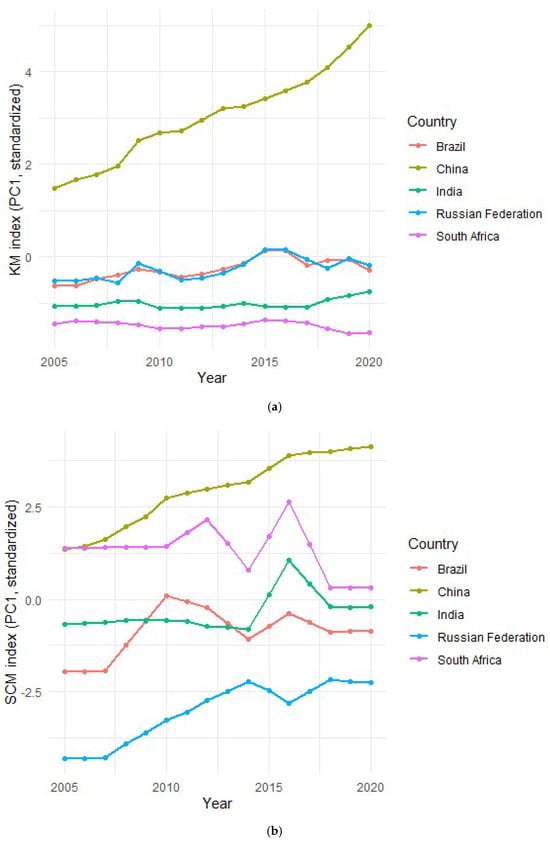
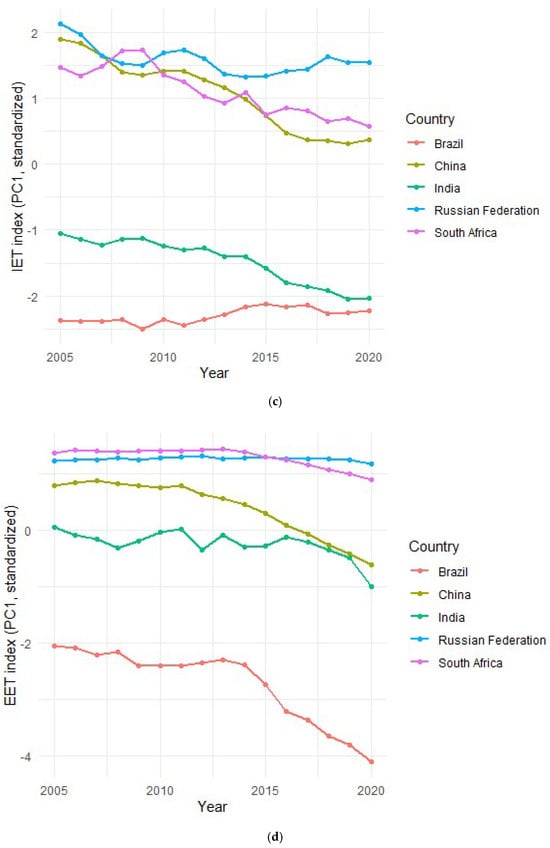
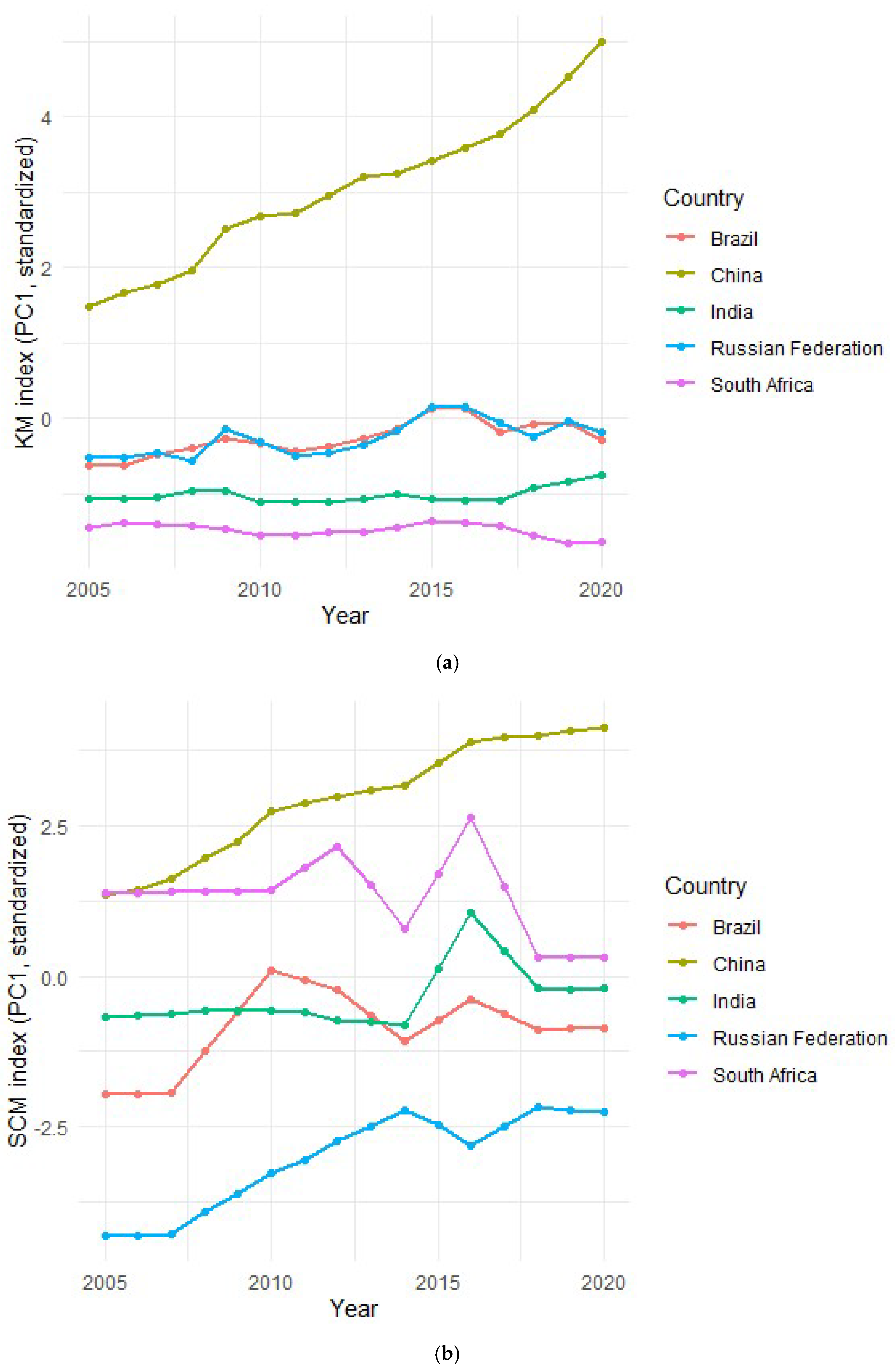
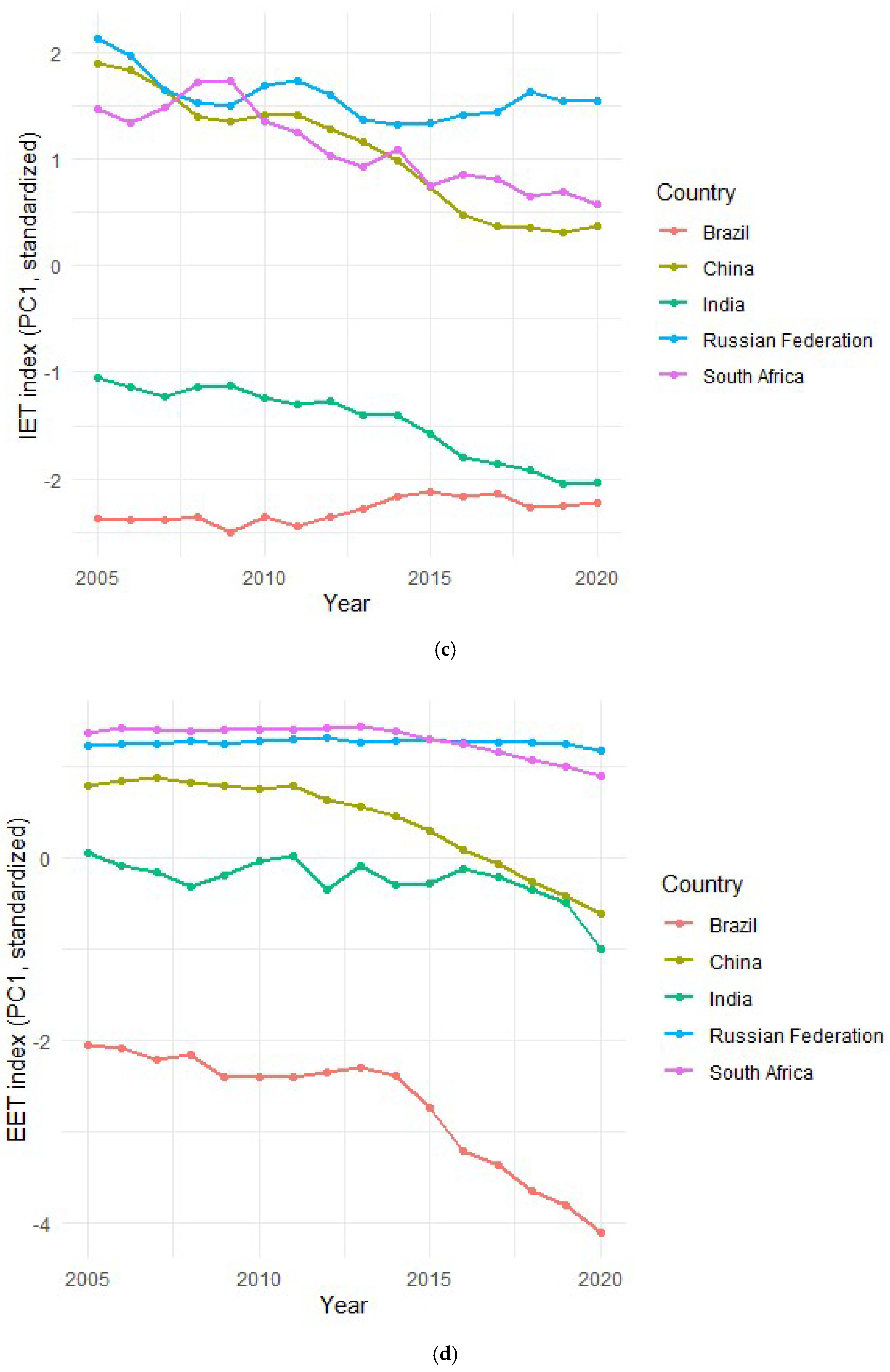
Figure 1a–d presents the PC1 of the variables created and the full PCA diagnostics for both knowledge management and supply chain management. Table 2a for KM shows that the first component loads positively and with similar magnitudes on R and D expenditure, researchers, journal articles and high technology exports, while Table 2b for SCM shows that the first component loads positively on all six logistics indicators, confirming that each block is driven by a common latent factor rather than unrelated items. The eigenvalue and variance decomposition indicates that KM_PC1 explains about 69.6 percent of the total variance and KM_PC1–PC2 together explain about 94.8 percent, while for SCM the first component alone explains about 77.3 percent of the variance and the first two components together explain about 97.8 percent, which supports the use of a single summary index in each case. Furthermore, we also compute and report standard adequacy diagnostics such as the Kaiser Meyer Olkin statistic and the Bartlett test of sphericity, which confirm that the correlation structure within each block is suitable for PCA. To check robustness, we have estimated the indices after dropping one indicator at a time and by comparing with a simple equal weighted average, and the resulting KM and SCM indices remain highly correlated with the baseline PCA based PC1 series, which shows that the indices are internally coherent and that the main empirical results do not hinge on a particular weighting scheme. Principal component analysis is therefore preferred over ad hoc or equal weighted indices because it provides data driven weights that capture the dominant common variation in each construct and mitigates multicollinearity when KM and SCM enter the regression models.
Figure 1.
(a): PCA for KM. (b): PCA for SCM. (c): PCA for IET. (d): PCA for EET.
Table 2.
(a) Principal component loadings and Eigenvalues and variance explained for KM. (b) Principal component loadings and Eigenvalues and variance explained for SCM.
KM and SCM are critical organisational levers that shape EET, understood as observable shifts in energy technologies, infrastructure and fuel mix toward low-carbon systems. Strong KM practices help firms and governments capture, integrate and deploy climate relevant knowledge, which accelerates the diffusion of renewable technologies, digital energy solutions and green finance instruments that fund visible transition projects [38,39]. Effective KM systems also underpin green innovation capability by supporting the acquisition and application of environmental knowledge in product and process design, which in turn raises investment in low carbon assets and technologies that manifest as measurable EET outcomes [30,40]. At the same time, SCM determines how quickly and efficiently organisations can decarbonise their value chains through low carbon sourcing, logistics optimisation and supplier collaboration, thereby reducing embedded emissions in traded goods and enabling large scale deployment of renewable energy technologies and storage along global supply networks [29]. Recent policy and industry reports emphasise that resilient and sustainable supply chains for critical raw materials and clean technologies are now seen as a precondition for successful energy transition pathways, especially in regions that depend heavily on imported components for renewables and storage solutions.
IET captures the less visible but equally important shifts that accompany EET, such as behavioural change, energy efficiency improvements, digital optimisation and organisational routines that reduce energy intensity and emissions without immediately altering headline energy mixes [41]. Behavioural and organisational changes in investment, maintenance and day to day energy use have been shown to deliver savings comparable to those achieved through purely technological upgrades, especially when interventions leverage social norms, information feedback, and behavioural insights [30]. These IET processes are strongly conditioned by KM, since learning mechanisms, knowledge sharing routines and green knowledge repositories determine whether energy saving practices, behaviour-based interventions, and digital control strategies are identified, scaled and retained over time [30,39]. SCM provides the operational context in which IET translates into EET, because supplier development, collaborative planning and data driven logistics allow behavioural and process-based efficiency gains to be locked into contracts, standards and investment decisions that reshape physical supply networks in favour of low carbon options [5,29]. Recent work on the joint effects of artificial intelligence on IET and EET shows that digital tools amplify this interaction by turning implicit learning and optimisation into explicit changes in energy structures at the system level, reinforcing the view that KM, SCM and IET operate as intertwined drivers of explicit transition trajectories [3].
3.2. Empirical Method
The study employed the novel estimator proposed by Lewbel [42] to examine the moderating role of globalisation in the link between supply chain management and energy transition. We begin from a standard moderation framework in which supply chain management (SCM) is the core explanatory variable, the three globalisation dimensions act as moderators, and their products capture the interaction effects. For explicit energy transition the baseline model is
for implicit energy transition
where and denote explicit and implicit energy transition for country in year . The vector collects the three globalisation dimensions that act as moderators. The term is the core explanatory variable and captures the corresponding moderation effects. The vector of controls is . The terms and are country and year fixed effects and are structural error terms. All interactions are constructed after mean centering their components so that and measure the effect of SCM at average levels of globalisation.
Because SCM and its interactions are likely to be endogenous, the empirical implementation replaces them with Lewbel type fitted values. Let the set of endogenous regressors be
with only the relevant members included in each specification. Let denote the exogenous variables used to construct Lewbel instruments. For each endogenous regressor we first estimate a reduced form equation on and obtain residuals . Lewbel instruments are then defined as
where is the sample mean of . The full first stage equation for each endogenous variable is
estimated with country and year fixed effects and cluster robust standard errors by country. The fitted values and then enter the second stage as
with identification based on
and on the heteroskedasticity driven relevance of for the endogenous regressors .
4. Results
4.1. Basic Statistical Information
Table 3 summarizes the main distributional features of the variables. Both EET and IET are standardized (mean 0), with EET showing moderate dispersion and a left-skewed, heavy-tailed distribution, while IET is slightly left-skewed with a flatter, less heavy-tailed profile. KM is also standardized but exhibits a relatively high variance and strong positive skewness, reflecting occasional large positive values, whereas SCM is the most volatile index, with wide dispersion but an almost symmetric shape. Among the controls, FD displays substantial spread and a moderately right-skewed distribution, EG is comparatively stable with mild left skewness, and UB shows moderate variation with slight left skewness. The three globalisation measures (FIG, SG, TG) indicate relatively high integration levels with moderate dispersion, mild skewness and kurtosis values close to two, suggesting approximately symmetric but non-normal distributions.
Table 3.
Descriptive statistics.
Table 4 indicates that EET and IET are strongly positively related, with a correlation close to 0.88, and both co-move positively with financial development and globalisation, especially IET with FIG and SG and EET with FIG and TG. KM is moderately linked with SCM and FD, while SCM is very highly correlated with FD and strongly with UB, suggesting that stronger supply chain management tends to appear where finance and urbanisation are higher. EG is strongly associated with FIG and SG but negatively related to UB, and urbanisation also has a sizeable negative correlation with SG. The three globalisation indicators are tightly connected, and FD is notably correlated with TG, so the matrix reveals clear clusters around energy transition, financial development, and globalisation that need to be considered when specifying the empirical models.
Table 4.
Correlation results.
Table 5 presents the multicollinearity test result. We observed that all VIF values are below the common rule of thumb threshold of 10 (and even below the stricter five benchmark), suggesting that multicollinearity is not severe among IET, KM, SCM, FIG, SG, TG, EG and UB in the EET equation.
Table 5.
Multicollinearity test.
4.2. Cross Sectional Dependence
Table 6 reports strong evidence that CSD is present in most series for the BRICS panel. For EET, KM, SCM, FD, EG and SG the Pesaran CD statistics are large with very small p values, and the Breusch Pagan LM statistics are also high with p values equal to 0.0000, which means the null hypothesis of cross section independence is clearly rejected and shocks to these variables tend to be correlated across Brazil, Russia, India, China and South Africa. For IET, FIG and TG the Pesaran CD p values are above conventional significance thresholds, while the LM tests remain strongly significant, suggesting that these indicators also exhibit non negligible cross-country correlation that is more clearly picked up by the LM measure. UB is the only variable where the Pesaran CD test fails to reject cross sectional independence, yet the LM statistic is again significant, pointing to some common components that the CD test may not fully detect in this BRICS setting.
Table 6.
Cross-sectional dependence.
4.3. Stationarity Test Results
Table 7 reports CIPS and CADF panel unit root tests with trend and shows a mixed order of integration across BRICS variables. EET, FIG, IET, SCM, SG and TG have negative and statistically significant CIPS and CADF statistics in levels, so they can be treated as stationary. KM and UB also show significant evidence of stationarity, with UB displaying particularly strong mean reversion. By contrast, EG and FD are non-stationary in levels but become stationary after first differencing, indicating I (1) behaviour. Overall, most transition, supply chain and globalisation indicators are I (0), while EG and FD are I (1), so the empirical strategy must accommodate this mixture of integration orders, for instance through panel cointegration techniques.
Table 7.
CIPS and CADF results.
4.4. Baseline Regression Results
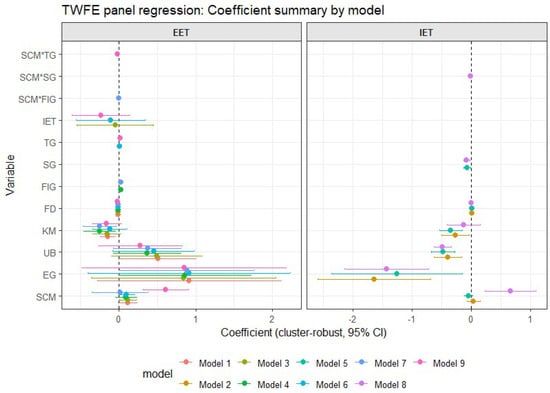
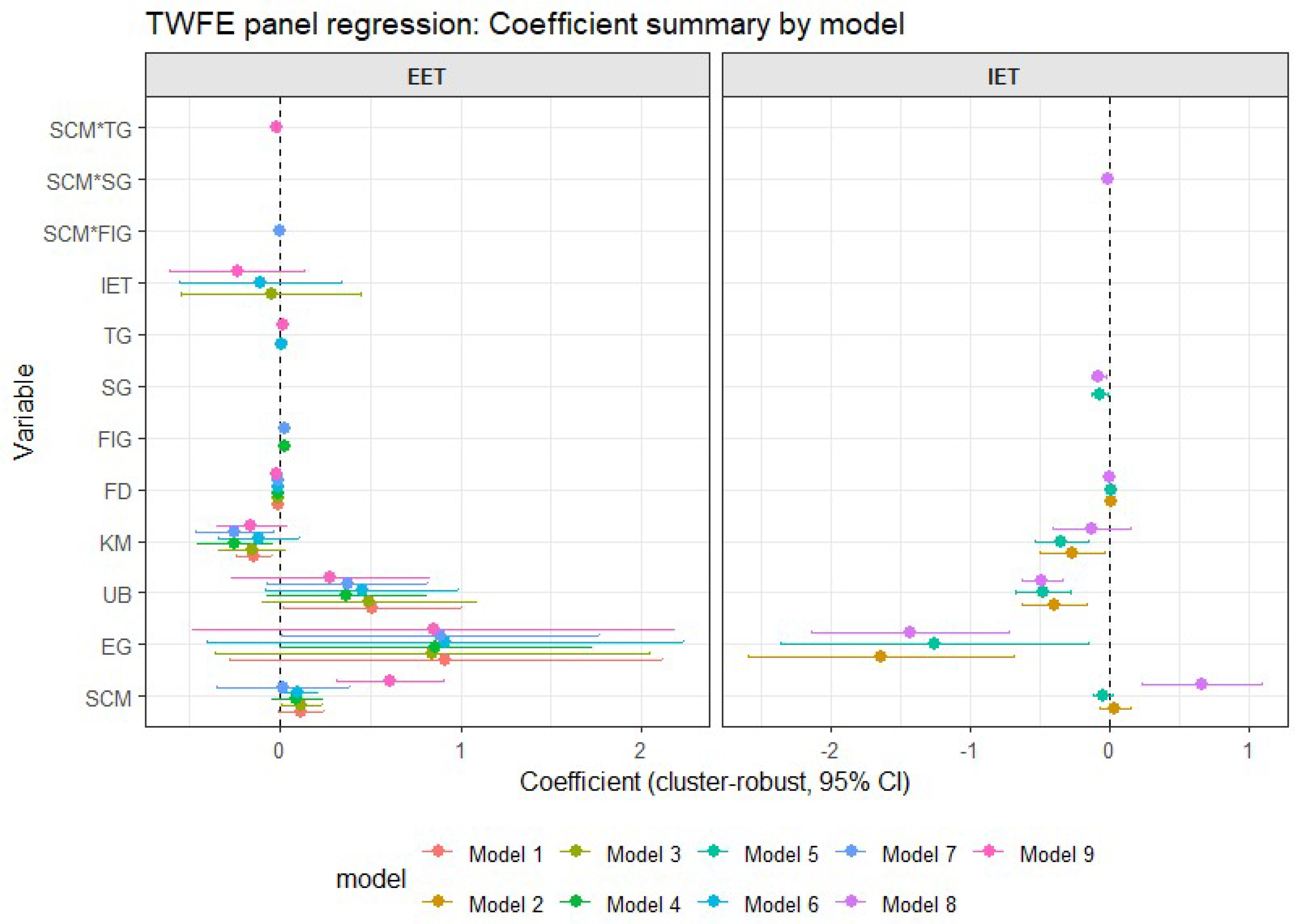
Table 8 and Figure 2 report two-way fixed effects panel regressions for the BRICS economies, with country and year effects and cluster robust standard errors. Across nine specifications the dependent variable alternates between explicit energy transition (EET) and implicit energy transition (IET), while SCM, EG, UB, KM, FD and the three dimensions of globalisation (FIG, SG, TG) enter as core regressors. With 80 observations, the models deliver R2 values between about 0.44 and 0.71 and adjusted R2 between about 0.40 and 0.68, indicating that once unobserved heterogeneity and common shocks are controlled for, the explanatory variables capture a substantial share of within country variation in both EET and IET.
Table 8.
Two-way fixed-effects (TWFE) panel regression.
Figure 2.
Summary of Table 8 findings.
SCM emerges as a central driver, particularly for EET, although its strength and significance depend on the included controls and interactions. In the baseline models SCM is positively associated with EET at conventional significance levels, and when trade globalisation and its interaction with SCM are introduced the SCM coefficients become large and highly significant for both EET and IET, pointing to a strong underlying contribution of supply chain capability to both margins of transition. EG and UB show clear asymmetries across the two indices. Higher growth and urbanisation tend to weaken IET, consistent with rising energy demand and carbon intensive lock in, while they generally support EET by fostering visible investment in new clean energy capacity, although the evidence for UB on EET is weaker and less consistent.
KM and FD shed light on internal capabilities and the financial environment. KM is negative in all specifications and often statistically significant, suggesting that periods with more intensive knowledge and innovation effort are associated with short run adjustment costs that dampen observed EET and IET. FD shows an even more pronounced split. It consistently reduces EET but supports IET, which is compatible with deep financial systems that still fund fossil assets and delay physical reallocation of capacity, even as they help firms adopt efficiency enhancing technologies and processes captured by the implicit transition index.
The three globalisation dimensions add further structure. Financial globalisation is robustly positive for EET, indicating that greater financial openness tends to support explicit transition, likely through easier access to capital and technology. Social globalisation is negatively associated with EET, while trade globalisation becomes clearly supportive of EET once its interaction with SCM is accounted for. Interaction terms show that higher social and trade openness reduce the marginal effect of SCM on transition, so in very open settings a given improvement in SCM yields smaller gains in EET or IET. The pattern of fit statistics across models reinforces these interpretations and indicates that SCM, macro fundamentals, KM, FD and disaggregated globalisation jointly shape both explicit and implicit energy transition in BRICS, with social and trade openness significantly moderating the effectiveness of SCM.
4.5. Robustness Check (with Lagged Controls) Results
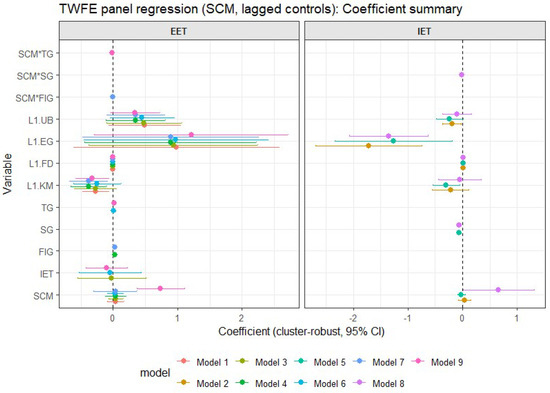
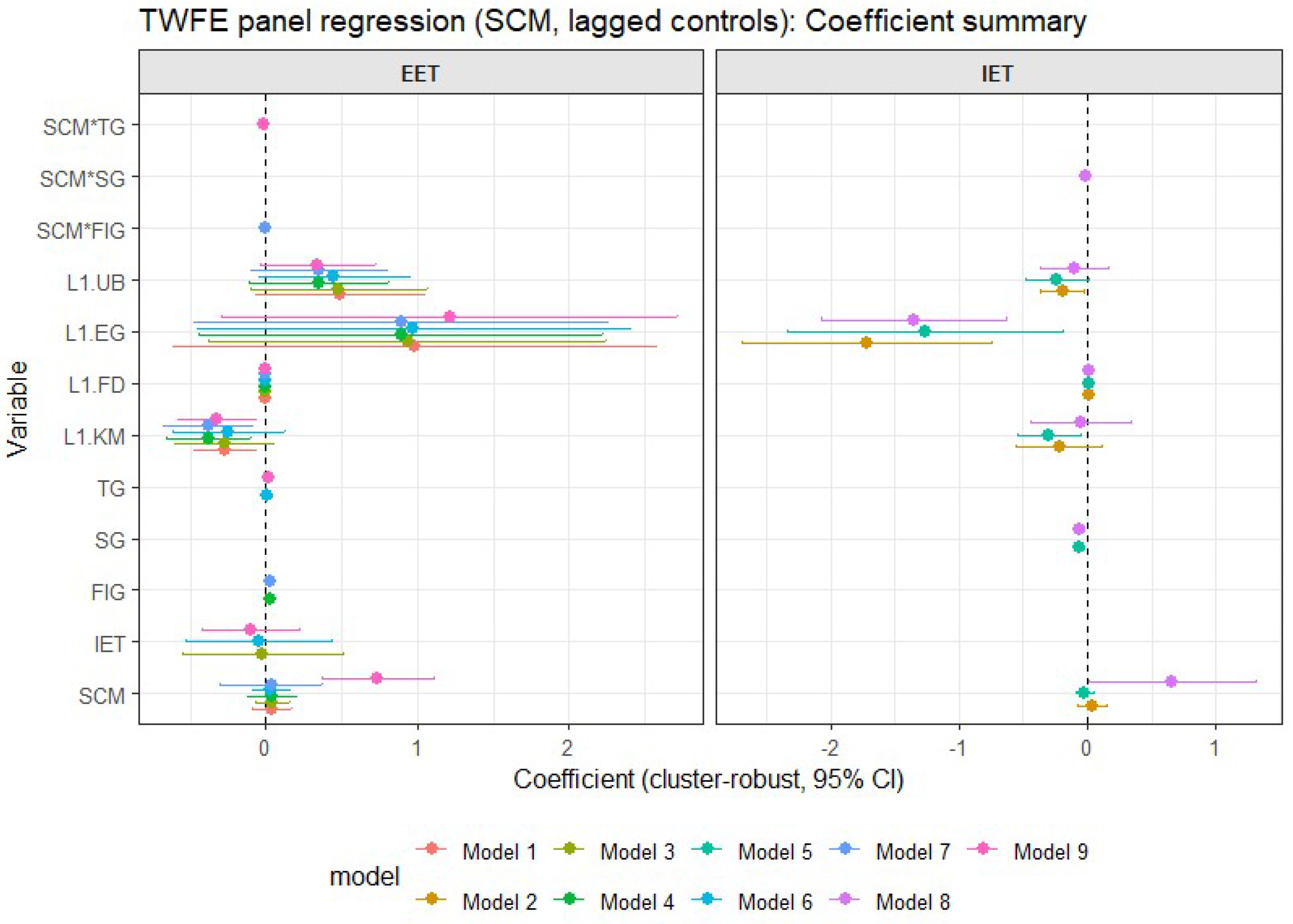
Table 9 and Figure 3 provide a dynamic robustness check of the baseline two-way fixed effects results by re-estimating the nine specifications with KM, FD, EG and UB lagged by one period. The panel still includes country and year fixed effects with cluster robust standard errors, but the use of lagged controls reduces the sample from 80 to 75 observations. The fit remains close to the baseline, with R squared between about 0.43 and 0.67 and adjusted R squared between about 0.37 and 0.63. Only a small decline in fit relative to the contemporaneous models is observed, and the ranking of stronger and weaker specifications is largely unchanged, which indicates that the main conclusions are not driven by contemporaneous controls and are robust to a simple dynamic structure.
Table 9.
Two-way fixed-effects (TWFE) panel regression (controls lagged one period).
Figure 3.
Summary of Table 9 findings.
The behaviour of SCM in Table 9 complements the baseline results. In the simpler models for EET and IET (Models 1 to 7), SCM coefficients are small and insignificant once lagged controls are included, suggesting that contemporaneous SCM alone has limited impact in these restricted specifications. However, in Models 8 and 9, where SCM operates jointly with SG and TG through interaction terms, SCM becomes large and highly significant for both IET and EET. The magnitudes are comparable to and even slightly larger than in the baseline, which confirms that the strong positive link between SCM and both margins of transition, once globalisation interactions are included, survives the introduction of lagged fundamentals and is not an artefact of contemporaneous feedback.
The lagged controls themselves largely reproduce the directional patterns from the baseline and clarify timing. Lagged KM is negative and often significant, especially in the EET equations, indicating that higher KM in the previous period is associated with lower current EET and IET, consistent with short run adjustment frictions. Lagged FD retains its split behaviour, with negative effects on EET and positive effects on IET, now interpreted more clearly as finance in period t−1 strengthening implicit transition while being associated with weaker explicit transition in period t. Lagged EG and UB also preserve their asymmetries. Past growth continues to depress IET while remaining weakly supportive of EET, and past urbanisation still reduces IET and modestly supports EET, which suggests that these effects are persistent rather than purely contemporaneous and reduces concerns about reverse causality running from transition to growth or urban structure.
Finally, the globalisation variables and their interactions remain in line with the baseline findings. Financial globalisation continues to have a positive and highly significant effect on EET, social globalisation remains negative and significant for EET, and trade globalisation is still small on its own but becomes important through its interaction with SCM. The SCM with SG and SCM with TG interactions stay negative and significant, confirming that higher levels of social and trade openness weaken the marginal impact of SCM on both forms of transition. The fact that these moderation patterns survive with lagged controls reinforces the view that the SCM–globalisation interplay is structural and not driven by short run simultaneity.
4.6. Lewbel IV-2SLS Panel Regression Results (Robustness Check)
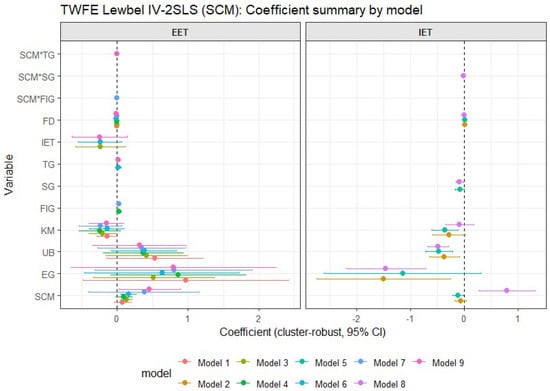
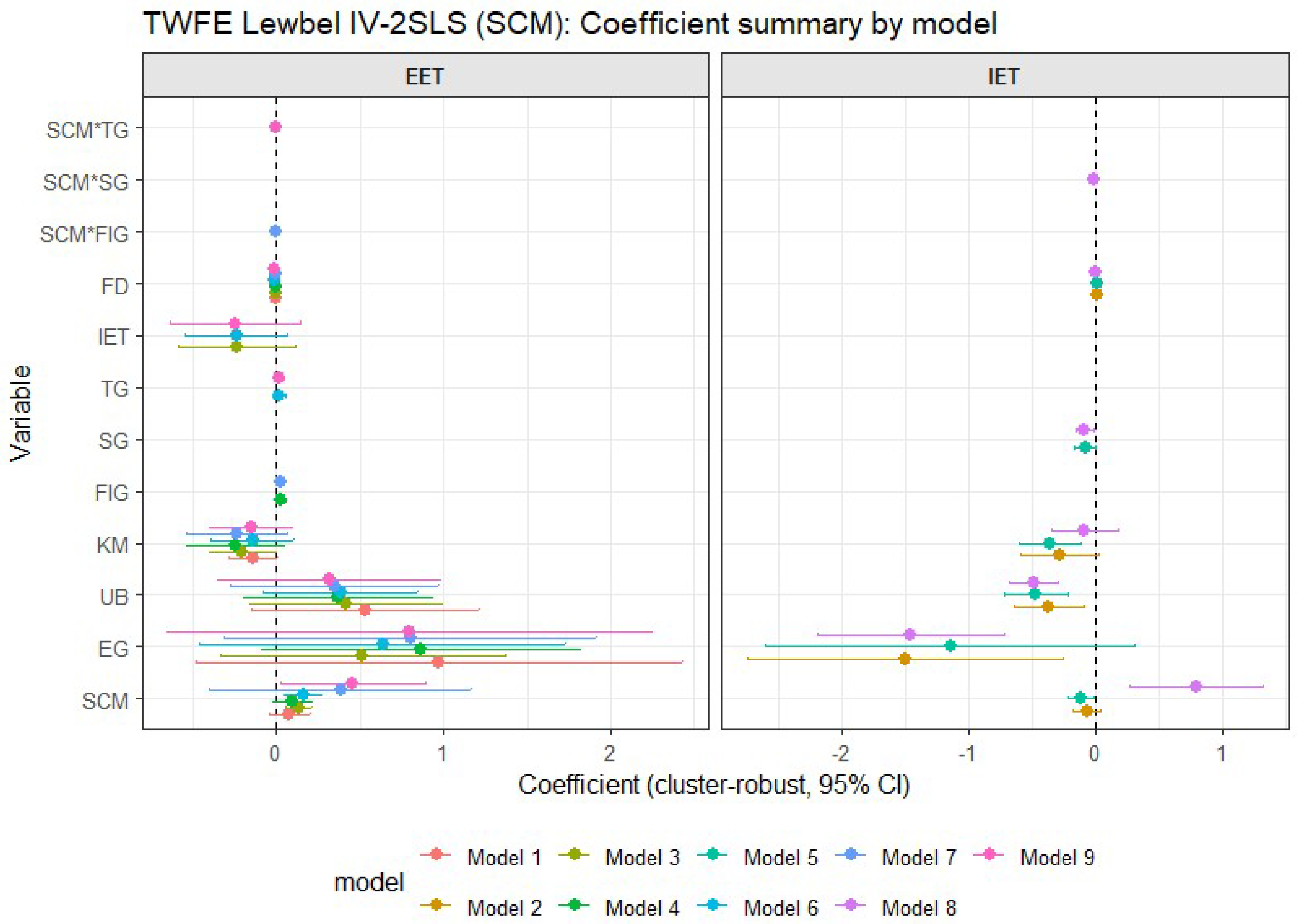
Table 10 and Figure 4 present Lewbel IV 2SLS estimates with country and year fixed effects, treating SCM and IET as potentially endogenous and using heteroskedasticity based instruments to address this concern. The sample still covers 80 BRICS observations and the fit is very high, with R squared between about 0.985 and 0.993 and adjusted values between about 0.979 and 0.990, reflecting the rich set of dummies and instrumented terms. Crucially, the IV estimates largely preserve the main patterns from the TWFE models, which indicates that the central conclusions on SCM, macro fundamentals and disaggregated globalisation are not driven by endogeneity in SCM or IET.
Table 10.
Lewbel IV-2SLS panel regression.
Figure 4.
Summary of Table 10 findings.
SCM continues to play a central role in the IV framework, especially when globalisation and interactions are included. In the simpler specifications, SCM effects are small and insignificant, but once IET and financial openness enter the EET equations the SCM coefficients become positive and strongly significant, confirming that exogenous variation in SCM is linked to higher explicit transition. For IET, SCM is negative and significant in one specification, suggesting that under financial and competitive pressure SCM may favour visible capacity expansion over efficiency gains. In the interaction models, SCM becomes even more powerful, with large and significant effects on both EET and IET, which echoes the TWFE results and shows that the SCM–transition link is robust to instrumentation.
EG and UB retain their asymmetric roles across explicit and implicit transition after applying Lewbel IV. Growth remains clearly negative and significant for IET in the richer models, confirming that expansion in BRICS continues to rely on energy intensive structures and weakens implicit transition even when endogeneity is controlled. For EET, EG coefficients stay positive but statistically weak, consistent with the idea that growth may support clean capacity build out but with limited precision once SCM and IET are instrumented. UB again undermines implicit transition, with negative and highly significant coefficients in the IET equations, while its positive effects on EET remain small and not significant, reinforcing the view that urbanisation in BRICS systematically harms implicit transition and offers only weak support for explicit deployment.
KM and FD also preserve their core patterns in the IV setting. KM is uniformly negative and often significant, particularly in models focused on IET or including FIG, which supports the interpretation that higher KM is associated with short run adjustment and reorganisation costs that temporarily depress observed transition before longer term gains materialise. FD continues to show a split effect. It supports implicit transition, with positive and significant coefficients in the IET equations, while in several EET specifications it remains negative and, in some cases, highly significant, suggesting that deeper financial systems still channel substantial resources to carbon intensive assets and slow the reallocation needed for explicit transition.
The three dimensions of globalisation remain distinct and robust under Lewbel IV. Financial globalisation keeps a positive and significant association with EET, confirming that deeper cross border financial links favour explicit transition. Social globalisation continues to show a negative and significant effect on EET, consistent with global communication and cultural flows that reinforce energy intensive lifestyles more than decarbonisation efforts. Trade globalisation has a weakly positive direct effect but becomes more important through interactions. The SCM with SG and SCM with TG interaction terms remain clearly negative and significant, indicating that higher social and trade openness dampen the marginal contribution of SCM to both EET and IET, and the fact that these interaction effects survive instrumentation strengthens the view that this moderating role of openness is not an artefact of endogeneity.
4.7. Discussion of Findings
Across the different estimation strategies, we observed that SCM matters for the energy transition in BRICS primarily once the broader macro-globalisation environment is accounted for. In parsimonious models, SCM is only weakly related to both explicit (EET) and implicit (IET) transition, implying that supply-chain improvements alone are unlikely to shift transition outcomes in a meaningful way. However, when financial openness and a richer set of controls are introduced, SCM becomes strongly and positively associated with higher EET, suggesting that better coordination, logistics performance and supplier networks help translate capital, imported inputs and technology access into tangible clean-energy capacity expansion and system upgrades [25,43].
For IET, SCM is generally positive as well, but the relationship is more conditional—its strength depends on the surrounding globalisation architecture, indicating that process optimisation and efficiency-oriented transition gains require complementary institutional, trade and financial settings to materialise [12,14]. Importantly, one recurrent tension is that, under tighter constraints or in “control-rich” configurations, SCM can appear aligned with visible, capital-intensive transition (EET) while IET gains weaken, consistent with a reprioritisation toward showcase projects (new plants, grid extensions) over less observable retrofits and operational optimisation. This reinforces the broader message that transition benefits are context-dependent and mediated by policy and structural conditions, rather than mechanically guaranteed by improvements in supply-side coordination [4,44].
The control variables also display stable, economically intuitive asymmetries across specifications. Economic growth (EG) and urbanisation (UB) tend to be systematically negative for IET, indicating that, in BRICS, expansion episodes and rapid urban development remain closely tied to energy-intensive production structures, infrastructure lock-in, and scale effects that outpace efficiency improvements [45]. In contrast, EG and UB show at most weak and less robust links to EET, implying that rising income and urban market size may support clean-capacity investment in principle, but not consistently enough to offset the pressures working against efficiency-driven transition [16,46,47,48,49,50]. For KM and FD, the results underscore transition as a dynamic, path-dependent process with potential short-run trade-offs. KM is often negative, especially in IET-focused and financially integrated settings, which is consistent with the possibility that reorganisation of knowledge systems, codification, and digital integration can be disruptive initially even if beneficial over longer horizons. These KM effects are best interpreted as short- to medium-run phenomena in structurally transforming economies, where reconfiguration costs and adjustment frictions can temporarily dominate before longer-run efficiency and innovation benefits emerge.
FD shows a clearer split—more developed domestic finance is generally supportive of IET, via credit and process upgrades, but can be less supportive of EET when financial intermediation still funds carbon-intensive assets alongside green projects, highlighting the “green–brown allocation” tension in emerging financial systems [51,52,53]. This asymmetry in FD should likewise be framed as a short- to medium-run feature of ongoing structural transformation, reflecting transitional portfolio reallocation, legacy asset exposure, and evolving risk pricing rather than a normative judgment about finance per se. Finally, the three globalisation dimensions retain distinct roles across models. FIG is the most robust enabler of EET, while SG is persistently adverse for EET, and TG is weaker and more composition-dependent [54,55,56]. The interaction results sharpen the policy implication. SCM does not meaningfully amplify FIG, but its marginal contribution is eroded under deeper social and trade integration, with negative SCM × SG and SCM × TG effects, suggesting that global lifestyles and trade structures can absorb some efficiency and coordination gains unless they are steered toward low-carbon consumption norms and cleaner production networks.
5. Conclusions and Policy Directions
5.1. Conclusions
This study examines how supply chain management shapes the impact of financial, social and trade globalisation on implicit and explicit energy transition in the BRICS over 2005–2022, using second-generation panel methods. In doing so, we employ a series of second-generation panel regression techniques. The results show that supply chain management acts as a central engine of energy transition, with stronger SCM generally linked to higher explicit deployment and, once interactions with trade openness are considered, also to improvements in implicit efficiency, while faster economic growth and deeper urbanisation tend to weaken implicit transition and provide only tentative support for explicit capacity build out. Knowledge management and financial development behave as short run double edged mechanisms, since periods of more intensive KM are associated with temporarily weaker transition, consistent with adjustment frictions during organisational change, and FD tends to support implicit, process-oriented gains while at the same time being associated with lower explicit deployment. The three globalisation dimensions have clearly differentiated roles, with financial globalisation robustly supporting explicit transition through easier access to capital and technology, social globalisation persistently linked to weaker explicit progress, and trade openness becoming clearly supportive only when its interaction with SCM is taken into account. Social and trade globalisation also dampen the marginal effectiveness of SCM, so that in more socially and commercially integrated BRICS economies a given improvement in SCM translates into smaller gains in both explicit and implicit transition.
5.2. Practical Implications
First, the results show that BRICS governments should treat supply chain management as a core lever of energy transition policy rather than only an operational concern. When SCM improves in a context of supportive financial openness, explicit transition outcomes such as new renewable capacity, grid upgrades, storage and related infrastructure respond strongly. Energy, industry and planning ministries should therefore integrate SCM performance metrics into national transition strategies, for example by linking access to green credit lines, public guarantees and tax incentives to verified improvements in supplier coordination, logistics reliability and low-carbon sourcing.
Second, for firms and supply chain managers, the evidence cautions against an overly narrow focus on high-visibility projects. In several specifications, stronger SCM coincides with weaker implicit transition, suggesting that under financial or political pressure firms may prioritise headline investments such as new plants, large solar projects or prominent grid extensions while postponing efficiency upgrades, maintenance, digital optimisation and loss reduction. Managers should adopt portfolio rules that protect budgets for process improvements such as smart metering, energy management systems, retrofits and staff training alongside large-scale assets. Internal dashboards should monitor explicit and implicit transition indicators in parallel so that SCM reforms do not unintentionally displace less visible but essential efficiency gains.
Third, the negative association between economic growth, urbanisation, and implicit transition has immediate implications for BRICS development strategies. Planning agencies should anticipate that business-as-usual growth and rapid urban expansion will raise energy intensity unless deliberate countermeasures are implemented. This strengthens the case for tighter building and appliance standards in fast-growing cities, compact and transit-oriented urban development, and mandatory low-carbon criteria for industrial parks and special economic zones. Growth strategies should also embed energy-efficiency conditions into fiscal incentives, export promotion programmes and infrastructure spending so that additional output is progressively less energy intensive.
Fourth, the short-run negative relationship between knowledge management and transition outcomes implies that reorganising knowledge systems, adopting new digital tools or restructuring decision processes can be disruptive before benefits materialise. For managers and regulators, this means KM reforms should be sequenced, supported and evaluated rather than assumed to deliver immediate gains. Firms can pilot KM changes in selected plants or regions, pair them with targeted training and change-management support and align implementation with specific efficiency and deployment targets. At the same time, the split role of financial development, which tends to support implicit transition yet is sometimes associated with weaker explicit deployment, suggests that central banks and financial regulators should strengthen green taxonomies and disclosure, recalibrate prudential incentives where appropriate, and expand blended-finance instruments that redirect capital away from carbon-intensive assets toward renewables and efficiency projects.
Finally, the behaviour of the globalisation channels and their interactions with SCM offers strategic guidance. Financial globalisation supports explicit transition, so BRICS policymakers should expand access to international green capital through instruments such as sovereign green bonds, sustainability-linked lending, and cross-border project finance, while ensuring domestic SCM capabilities are strong enough to deliver projects on time and within budget. In contrast, social and trade globalisation appear to weaken the marginal gains from SCM, implying that prevailing consumption norms and trade structures remain aligned with energy-intensive demand and carbon-heavy supply networks. Practical responses include using public communication and education to shift social norms toward low-carbon lifestyles, redesigning trade and industrial policies to encourage cleaner inputs and technologies and incorporating carbon-content benchmarks into procurement and trade-related standards.
5.3. Limitation and Future Directions
This study has several limitations that also point to clear directions for future research. First, the analysis is restricted to BRICS economies over 2005–2021 and relies on aggregate, country-level indicators for SCM, KM, globalisation and implicit and explicit energy transition. Such aggregation can conceal meaningful heterogeneity across sectors, regions, and firm types, and therefore may not fully reflect within-country transition dynamics. Second, although second-generation panel techniques and interaction specifications are employed, the findings should be interpreted as robust associations rather than strict causal effects. Residual concerns about measurement error, omitted variables and reverse causality cannot be entirely ruled out, particularly given the potential two-way feedback linking growth, urbanisation, finance and energy systems.
Third, the proxies used for SCM, KM and implicit transition capture broad structural patterns instead of detailed operational practices, behavioural adjustments, or digital optimisation, meaning the identified mechanisms are indicative rather than exhaustive. Future research could build on this framework by integrating country-level panels with firm- or supply-chain-level microdata to better isolate how specific SCM and KM practices shape transition pathways. It would also be valuable to extend the analysis beyond BRICS to other emerging and advanced economies, test alternative and more disaggregated measures of implicit and explicit transition, and incorporate policy shocks, green industrial strategies, and digitalisation indicators into dynamic (and potentially nonlinear) modelling frameworks to capture adjustment processes and threshold effects more explicitly.
Author Contributions
Writing—original draft, A.S.R.; Writing—review & editing, A.S.R.; Supervision, K.I.; Project administration, K.I. All authors have read and agreed to the published version of the manuscript.
Funding
This research received no external funding.
Data Availability Statement
The data presented in this study are available from the corresponding author upon reasonable request. The data are not publicly available due to privacy considerations related to the data sources.
Conflicts of Interest
The authors declare no conflict of interest.
References
- Alam, M.M.; Destek, M.A.; Haque, A.; Kirikkaleli, D.; Pinzón, S.; Khudoykulov, K. Can undergoing renewable energy transition assist the BRICS countries in achieving environmental sustainability? Environ. Sci. Pollut. Res. Int. 2024, 31, 9700–9712. [Google Scholar] [CrossRef] [Scilit]
- Radulescu, M.; Mohammed, K.S.; Baldan, C.; Dascalu, N.M. Dynamic effects of energy transition on environmental sustainability: Fresh findings from the BRICS+1. Energy Rep. 2024, 12, 2441–2451. [Google Scholar] [CrossRef] [Scilit]
- Zhang, W.; Zhang, Y.; Lan, X.; Song, M. “Green BRICS”: How artificial intelligence can build the explicit structure and implicit order of energy transition. Energy Econ. 2025, 149, 108713. [Google Scholar] [CrossRef] [Scilit]
- Tiwari, S.; Mohammed, K.S.; Mentel, G.; Majewski, S.; Shahzadi, I. Role of circular economy, energy transition, environmental policy stringency, and supply chain pressure on CO2 emissions in emerging economies. Geosci. Front. 2024, 15, 101682. [Google Scholar] [CrossRef] [Scilit]
- Younes, S.; Adedokun, M.W.; Alzubi, A.B.; Aljuhmani, H.Y. Impact of Supply Chain Management on Energy Transition and Environmental Sustainability: The Role of Knowledge Management and Green Innovations. Sustainability 2025, 17, 9249. [Google Scholar] [CrossRef] [Scilit]
- Ramzan, M.; Razi, U.; Quddoos, M.U.; Adebayo, T.S. Do green innovation and financial globalization contribute to the ecological sustainability and energy transition in the United Kingdom? Policy insights from a bootstrap rolling window approach. Sustain. Dev. 2022, 31, 393–414. [Google Scholar] [CrossRef] [Scilit]
- Sibt-e-Ali, M.; Xiqiang, X.; Javed, K.; Javaid, M.Q.; Vasa, L. Greening the future: Assessing the influence of technological innovation, energy transition and financial globalization on ecological footprint in selected emerging countries. Environ. Dev. Sustain. 2024, 7, 1–27. [Google Scholar] [CrossRef] [Scilit]
- Fan, C.; Usman, A. How Does Renewable Energy Respond to Financial Globalization and Information and Communications Technology Trade? Energies 2024, 17, 750. [Google Scholar] [CrossRef] [Scilit]
- Zhang, H.; Khan, K.A.; Eweade, B.S.; Adebayo, T.S. Role of eco-innovation and financial globalization on ecological quality in China: A wavelet analysis. Energy Environ. 2024, 36, 0958305X241228518. [Google Scholar] [CrossRef] [Scilit]
- Ahmed, Z.; Ahmad, M.; Murshed, M.; Shah, M.I.; Mahmood, H.; Abbas, S. How do green energy technology investments, technological innovation, and trade globalization enhance green energy supply and stimulate environmental sustainability in the G7 countries? Gondwana Res. 2022, 112, 105–115. [Google Scholar] [CrossRef] [Scilit]
- Pata, U.K.; Kartal, M.T.; Dam, M.M.; Kaya, F. Navigating the Impact of Renewable Energy, Trade Openness, Income, and Globalization on Load Capacity Factor: The Case of Latin American and Caribbean (LAC) Countries. Int. J. Energy Res. 2023, 2023, e6828781. [Google Scholar] [CrossRef] [Scilit]
- Cheng, J.; Mohammed, K.S.; Tedeschi, M.; Ma, X. Role of green technologies, climate uncertainties and energy prices on the supply chain: Policy-based analysis through the lens of sustainable development. Technol. Forecast. Soc. Change 2023, 194, 122705. [Google Scholar] [CrossRef] [Scilit]
- Han, Q.; Wang, F.; Wang, Y.; Guo, F. How supply chain and digitalization are significant contributors to international trade? The role of renewable and energy intensity in global trade powerhouses’ economies. Energy Econ. 2025, 145, 108429. [Google Scholar] [CrossRef] [Scilit]
- Hu, G.; Gozgor, G.; Lu, Z.; Mahalik, M.K.; Pal, S. Determinants of renewable stock returns: The role of global supply chain pressure. Renew. Sustain. Energy Rev. 2024, 191, 114182. [Google Scholar] [CrossRef] [Scilit]
- Abbass, K.; Amin, N.; Khan, F.; Begum, H.; Song, H. Driving sustainability: The nexus of financial development, economic globalization, and renewable energy in fostering a greener future. Energy Environ. 2025, 0958305X241305374. [Google Scholar] [CrossRef] [Scilit]
- Achour, H.; Belloumi, M. Investigating the causal relationship between transport infrastructure, transport energy consumption and economic growth in Tunisia. Renew. Sustain. Energy Rev. 2016, 56, 988–998. [Google Scholar] [CrossRef] [Scilit]
- Li, B.; Haneklaus, N. The role of renewable energy, fossil fuel consumption, urbanization and economic growth on CO2 emissions in China. Energy Rep. 2021, 7, 783–791. [Google Scholar] [CrossRef] [Scilit]
- Teece, D.J. Explicating dynamic capabilities: The nature and microfoundations of (sustainable) enterprise performance. Strateg. Manag. J. 2007, 28, 1319–1350. [Google Scholar] [CrossRef] [Scilit]
- Chari, A.; Niedenzu, D.; Despeisse, M.; Machado, C.G.; Azevedo, J.D.; Boavida-Dias, R.; Johansson, B. Dynamic capabilities for circular manufacturing supply chains—Exploring the role of Industry 4.0 and resilience. Bus. Strategy Environ. 2022, 31, 2500–2517. [Google Scholar] [CrossRef] [Scilit]
- Moftah, N.; Alzubi, A.B. Bridging the Digital–Energy Divide: Artificial Intelligence, Internet Connectivity, and Knowledge Management. Sustainability 2025, 17, 8912. [Google Scholar] [CrossRef] [Scilit]
- Zhang, Y.; Li, L.; Sadiq, M.; Chien, F.S. Impact of a sharing economy on sustainable development and energy efficiency: Evidence from the top ten Asian economies. J. Innov. Knowl. 2023, 8, 100320. [Google Scholar] [CrossRef] [Scilit]
- Adebayo, T.S.; Abbas, S.; Olanrewaju, V.O.; Uzun, B. Unpacking policy ambiguities in residential and commercial renewable energy adoption: A novel multivariate wavelet quantile regression analysis. Appl. Econ. 2025, 2, 1–22. [Google Scholar] [CrossRef] [Scilit]
- Ahmad, M.; Dai, J.; Mehmood, U.; Houran, M.A. Renewable energy transition, resource richness, economic growth, and environmental quality: Assessing the role of financial globalization. Renew. Energy 2023, 216, 119000. [Google Scholar] [CrossRef] [Scilit]
- Gawusu, S.; Zhang, X.; Jamatutu, S.A.; Ahmed, A.; Amadu, A.A.; Djam Miensah, E. The dynamics of green supply chain management within the framework of renewable energy. Int. J. Energy Res. 2022, 46, 684–711. [Google Scholar] [CrossRef] [Scilit]
- Ifekanandu, C.C.; Iloka, C.B.; Anukwe, G.I.; Eze, J.O.; Uwakwe, I.V.; Asagba, S. Adoption of sustainable fuels and renewable energy in logistics: Examining the role of stakeholder theory in supply chain strategy. PLoS ONE 2025, 20, e0320507. [Google Scholar] [CrossRef] [Scilit] [PubMed]
- Zhang, Y.; Radmehr, R.; Ali, E.B.; Samour, A. Natural resources, financial globalization, renewable energy, and environmental quality: Novel findings from top natural resource abundant countries. Gondwana Res. 2025, 145, 170–182. [Google Scholar] [CrossRef] [Scilit]
- Shekhawat, K.K.; Kumar, N.; Sharma, V. Impact of renewable energy, financial globalization, and technological innovation on environmental sustainability in BRICS. Discov. Sustain. 2025, 6, 644. [Google Scholar] [CrossRef] [Scilit]
- Qamaruzzaman, M. Driving energy transition in BRI nations: The role of education, globalization, trade liberalization, and financial deepening—A comprehensive linear and nonlinear approach. Energy Strategy Rev. 2025, 57, 101620. [Google Scholar] [CrossRef] [Scilit]
- Mubarik, M.S.; Gunasekaran, A.; Khan, S.A.; Mubarak, M.F. Decarbonization through supply chain innovation: Role of supply chain collaboration and mapping. J. Clean. Prod. 2025, 507, 145492. [Google Scholar] [CrossRef] [Scilit]
- Wang, T.; Feng, M.; Wu, H.; Shen, Y. From Digitalization to Sustainability: Does Supply Chain Digitalization Enhance Corporate Green Transformation Performance? Sustainability 2025, 17, 10159. [Google Scholar] [CrossRef] [Scilit]
- Magyari, J.; Zavarkó, M.; Csedő, Z. Smart knowledge management driving green transformation: A comparative case study. Smart Energy 2022, 7, 100085. [Google Scholar] [CrossRef] [Scilit]
- Cong, Y.; Zhu, C.; Hou, Y.; Tian, S.; Cai, X. Does ESG investment reduce carbon emissions in China? Front. Environ. Sci. 2022, 10, 977049. [Google Scholar] [CrossRef] [Scilit]
- Khan, A.N.; Mehmood, K.; Kwan, H.K. Green knowledge management: A key driver of green technology innovation and sustainable performance in the construction organizations. J. Innov. Knowl. 2024, 9, 100455. [Google Scholar] [CrossRef] [Scilit]
- Huang, H.; Saeed, M.Z.; Waheed, R. Renewable Energy and Global Value Chains: Catalysts for Reducing Carbon Emissions in BRICS Countries. Pol. J. Environ. Stud. 2025, 20, 1–15. [Google Scholar] [CrossRef] [Scilit]
- Mahmood, H.; Furqan, M. Renewable energy transition, urbanization, and environment nexus in the Middle East and North Africa: Cross-sectional dependence analyses. Environ. Econ. 2025, 16, 89–101. [Google Scholar] [CrossRef] [Scilit]
- WDI. World Development Indicator. 2025. Available online: https://data.worldbank.org/country/nigeria (accessed on 1 January 2025).
- Gygli, S.; Haelg, F.; Potrafke, N.; Sturm, J.-E. The KOF Globalisation Index—Revisited. Rev. Int. Organ. 2019, 14, 543–574. [Google Scholar] [CrossRef] [Scilit]
- Mukarram, S.S.; Saleem, F.; Alomair, A.; Al Naim, A.S. Knowledge management and sustainable innovation for green finance: Evidence from Asia. Humanit. Soc. Sci. Commun. 2025, 12, 1742. [Google Scholar] [CrossRef] [Scilit]
- Aly, A.A.; Shaltout, M.; Salaheldin, M.; Elshazly, A. Knowledge Management Index for Better Climate Change Management: A Case Study in the Egyptian Petroleum Sector. Int. J. Euro-Mediterr. Stud. 2025, 18, 53–82. [Google Scholar] [CrossRef] [Scilit]
- Broccardo, L.; Giordino, D.; Yaqub, M.Z.; Alshibani, S.M. Implementing sustainability: What role do knowledge management and management accounting play? Agenda for environmentally friendly businesses. Corp. Soc. Responsib. Environ. Manag. 2025, 32, 383–403. [Google Scholar] [CrossRef] [Scilit]
- Yang, Y.; Xia, S.; Huang, P.; Qian, J. Energy transition: Connotations, mechanisms and effects. Energy Strategy Rev. 2024, 52, 101320. [Google Scholar] [CrossRef] [Scilit]
- Lewbel, A. Using Heteroscedasticity to Identify and Estimate Mismeasured and Endogenous Regressor Models. J. Bus. Econ. Stat. 2012, 30, 67–80. [Google Scholar] [CrossRef] [Scilit]
- Raygoza-Limón, M.E.; Orduño-Osuna, J.H.; Trujillo-Hernández, G.; Bravo-Zanoguera, M.E.; Garcia, J.A.A.; Ramírez-Hernández, L.R.; Flores-Fuentes, W.; Antúnez-García, J.; Murrieta-Rico, F.N. Supply Chain Management in Renewable Energy Projects from a Life Cycle Perspective: A Review. Appl. Sci. 2025, 15, 5043. [Google Scholar] [CrossRef] [Scilit]
- Adebayo, T.S.; Kirikkaleli, D. Impact of renewable energy consumption, globalization, and technological innovation on environmental degradation in Japan: Application of wavelet tools. Environ. Dev. Sustain. 2021, 23, 16057–16082. [Google Scholar] [CrossRef] [Scilit]
- Akram, R.; Umar, M.; Xiaoli, G.; Chen, F. Dynamic linkages between energy efficiency, renewable energy along with economic growth and carbon emission. A case of MINT countries an asymmetric analysis. Energy Rep. 2022, 8, 2119–2130. [Google Scholar] [CrossRef] [Scilit]
- Alam, M.; Murad, W. The impacts of economic growth, trade openness and technological progress on renewable energy use in organization for economic co-operation and development countries. Renew. Energy 2020, 145, 382–390. [Google Scholar] [CrossRef] [Scilit]
- Abbasi, K.R.; Shahbaz, M.; Jiao, Z.; Tufail, M. How energy consumption, industrial growth, urbanization, and CO2 emissions affect economic growth in Pakistan? A novel dynamic ARDL simulations approach. Energy 2021, 221, 119793. [Google Scholar] [CrossRef] [Scilit]
- Armeanu, D.S.; Joldes, C.C.; Gherghina, S.C.; Andrei, J.V. Understanding the multidimensional linkages among renewable energy, pollution, economic growth and urbanization in contemporary economies: Quantitative assessments across different income countries’ groups. Renew. Sustain. Energy Rev. 2021, 142, 110818. [Google Scholar] [CrossRef] [Scilit]
- Rahman, M.M.; Vu, X.-B. The nexus between renewable energy, economic growth, trade, urbanisation and environmental quality: A comparative study for Australia and Canada. Renew. Energy 2020, 155, 617–627. [Google Scholar] [CrossRef] [Scilit]
- Yusuf, A. Dynamic effects of energy consumption, economic growth, international trade and urbanization on environmental degradation in Nigeria. Energy Strategy Rev. 2023, 50, 101228. [Google Scholar] [CrossRef] [Scilit]
- Batool, Z.; Raza, S.M.F.; Ali, S.; Abidin, S.Z.U. ICT, renewable energy, financial development, and CO2 emissions in developing countries of East and South Asia. Environ. Sci. Pollut. Res. 2022, 29, 35025–35035. [Google Scholar] [CrossRef] [Scilit]
- Adams, S.; Fotio, H.K. Economic integration and environmental quality: Accounting for the roles of financial development, industrialization, urbanization and renewable energy. J. Environ. Plan. Manag. 2024, 67, 688–713. [Google Scholar] [CrossRef] [Scilit]
- Anton, S.G.; Nucu, A.E.A. The effect of financial development on renewable energy consumption. A panel data approach. Renew. Energy 2020, 147, 330–338. [Google Scholar] [CrossRef] [Scilit]
- Ghazouani, T. Dynamic impact of globalization on renewable energy consumption: Non-parametric modelling evidence. Technol. Forecast. Soc. Change 2022, 185, 122115. [Google Scholar] [CrossRef] [Scilit]
- Jóźwik, B.; Sarıgül, S.S.; Topcu, B.A.; Çetin, M.; Doğan, M. Trade Openness, Economic Growth, Capital, and Financial Globalization: Unveiling Their Impact on Renewable Energy Consumption. Energies 2025, 18, 1244. [Google Scholar] [CrossRef] [Scilit]
- Erkılıç, E.; Gazeloğlu, C.; Ünlü, E.Ö. Renewable Energy Solution to Carbon Emissions: BRICS Countries in the Grip of Globalization and Economic Growth. Sustainability 2025, 17, 4117. [Google Scholar] [CrossRef] [Scilit]

Disclaimer/Publisher’s Note: The statements, opinions and data contained in all publications are solely those of the individual author(s) and contributor(s) and not of MDPI and/or the editor(s). MDPI and/or the editor(s) disclaim responsibility for any injury to people or property resulting from any ideas, methods, instructions or products referred to in the content. |
© 2026 by the authors. Licensee MDPI, Basel, Switzerland. This article is an open access article distributed under the terms and conditions of the Creative Commons Attribution (CC BY) license.